
Huntsville City Zoning Code
ARTICLE 27
- VILLAGE BUSINESS C-6 DISTRICT REGULATIONS
Purpose.
The Village Business C-6 District is intended to preserve neighborhood character as well as encourage a variety of uses in a more pedestrian oriented setting and sustain a harmonious transition between existing and new structures. This district is intended to encourage innovative redevelopment projects that set standards for landscaping, community design and aesthetics.
Within a Village Business C-6 District as shown on the official Zoning Maps of the City of Huntsville, the following regulations shall apply:
(Ord. No. 15-677, § 1, 10-22-2015)
27.1.- Uses permitted.
No building, structure, or land shall be used and no building or structure shall hereafter be erected, structurally altered, enlarged or maintained except for one or more of the uses herein cited and subject to the conditions stated herein:
Accessory structures and uses.
Agricultural uses.
Antique stores and art galleries, excluding flea markets.
Bakeries, where not more than five persons are employed on the premises.
Barber shops, beauty parlors, reducing salons and fitness/exercise centers, excluding tattoo and body piercing parlors.
Book, map, card and stationery stores.
Cafes, delicatessens, coffee shops and restaurants without alcoholic beverages.
Churches and similar places of worship.
Computer programming, software design and web design services.
Dance and music academies.
Drug stores.
Florist shops.
Grocery, health, and ethnic food stores.
Gift shops.
Home furnishings stores.
Jewelry stores and watch repair shops.
Multiple family dwellings, accessory structures and uses.
Municipal, county, state or federal uses and facilities.
Music and video stores.
Newsstands and hobby shops.
Notions and dry goods stores.
Office supply stores.
Offices for accountants, architects, attorneys and other professionals; consumer service offices such as real estate agencies, insurance agencies, travel agencies, advertising agencies; and administrative offices.
Performing arts centers.
Photography studios and photo retail sales.
Quick copy print shops.
Radio and television studios but not including broadcast towers.
Residential dwelling units—provided such residential units occupy upper-story space within new or rehabilitated existing buildings having non-residential uses on the street level and provided that such residential units are in compliance with all applicable regulations for habitable space. All such residential uses shall have an entrance separate from the non-residential uses on the street level unless the entrance to the building opens into a lobby from which access to each use originates.
Shoe stores, shoe repair shops and tailor shops.
Sound and video recording studios.
Permitted uses as special exceptions as defined and regulated by subsection 92.5.2 hereof.
(Ord. No. 15-677, § 1, 10-22-2015)
27.2. - Density controls.
The following yard, density, and height of building requirements shall be observed except as provided in Article 73 hereof:
(1)
Minimum front yard requirements: None.
(2)
Minimum rear yard requirements: None, except that when the rear lot line abuts a residential district, except across an alley or street, a rear yard of 25 feet is required of which the first five feet of the required rear yard shall be landscaped with a minimum of one small Type 3 or Type 4 tree and six shrubs per each linear 50 feet of yard or portion thereof, and the area shall be planted with a permanent evergreen ground cover or turf grass.
(3)
Minimum side yard requirements: None, except that when the side lot line abuts a residential district, except across a street, a side yard of ten feet is required.
(4)
Maximum height is 35 feet.
(Ord. No. 15-677, § 1, 10-22-2015; Ord. No. 16-648, § 1, 10-27-2016)
27.3. - Site development.
In order to promote the purpose of the district the following standards shall be applied:
(Ord. No. 15-677, § 1, 10-22-2015)
27.3.1. Building size, architecture, and walkability.
(1)
For purposes of this section: (a) buildings sharing a common wall or having walls touching at or above grade shall be considered as one building; (b) the term "retail trade" means an establishment engaged primarily in selling goods, including groceries, or merchandise to the general public at retail.
(2)
An individual retail trade, including tenants, shall not occupy more than 25,000 square feet of gross floor area in a building, including all interior floor space, roof top parking, and outdoor retail and storage areas.
(3)
A group of retail trades separately owned or operated, including tenants, shall not occupy more than 50,000 square feet of floor area in a building, including all interior floor space, roof top parking, and outdoor retail and storage areas.
(4)
New buildings shall not have, nor shall existing buildings be altered to have, a distinct architectural style commonly employed by retail franchises to enhance or promote brand identity through visual recognition.
(5)
Where buildings are not contiguous, the space between them shall be a minimum of ten feet and shall be improved for use by cyclists, pedestrians, or vehicles, or be landscaped.
(Ord. No. 15-677, § 1, 10-22-2015)
27.3.2. Street level walls. The purpose of the street level wall requirement is to promote pedestrian use and activity and to encourage a higher degree of street life and vitality in the village district. Retailing is enhanced by having transparent store fronts abutting the sidewalk and by assembling a critical mass of continuous retail activities along adjoining streets.
(1)
Doorways that front on a public sidewalk shall be recessed into the building interior to a depth sufficient to separate sidewalk traffic from outwardly opening doors, to create focal interest, and to punctuate the street wall.
(2)
New construction, including substantial remodeling, shall utilize natural materials for the exterior cladding of all visible wall surfaces. The facades should be designed to be compatible with the purpose of the district in terms of scale, color and texture of materials, form and massing, and design detailing. Acceptable materials include, but are not limited to, brick, stone, concrete stucco, terra cotta, precast concrete, glass, and where appropriate, cast metal for fenestrations, columns and beams. Reflective materials, including mirrored glass should be avoided as primary materials. Synthetic and imitation materials as well as aluminum, steel or other metal siding or cladding, vinyl and plastic materials are not allowed, except as a special exception in accordance with section 92.5.3(37). Where a new or remodeled non-residential building abuts a lot containing an existing single or two-family dwelling unit or a residential district, its facades should be designed to be compatible with the residential use in terms of scale, color and texture of materials, form and massing, and design detailing.
(3)
To create an animated streetscape, an unbroken expanse of solid or blank wall shall not exceed 20 linear feet. Devices suitable to break such a wall span include doors, windows, display windows and cases, street art, fountains, plazas, trees and landscaping, pedestrian furniture and the introduction of variety in materials, texture, color and/or pattern of wall materials.
(4)
Street level commercial spaces should be configured as units in order to stimulate visual interest, establish a predictable rhythm for pedestrians, and encourage the introduction of small retail and service businesses.
(5)
Windows located in street level walls, with the exception of stained glass windows, shall be transparent.
(Ord. No. 15-677, § 1, 10-22-2015; Ord. No. 25-157, § 11, 4-24-2025)
27.3.3. Utilities and mechanical units.
(1)
All electrical, communication and other wiring shall be located underground within the alleys where practicable.
(2)
All exterior mechanical equipment and loading areas shall be adequately screened as well as practicable so as not to be visible from any street or by pedestrians.
(3)
Trash collection facilities and dumpsters shall be concealed by solid wood and/or masonry walls for their full height. Where wood is used as the screening material, it shall be securely attached to an all metal support structure; if the wood is not pressure treated, it shall be cedar, redwood or cypress; and no wood member shall exceed 12 inches in width. The gates shall be of metal, shall be at least 80 percent opaque, and shall be self-closing.
(Ord. No. 15-677, § 1, 10-22-2015)
27.3.4. Landscaping requirements.
(1)
Landscape buffers for surface parking. Buffer strips required to separate surface parking spaces from streets and pedestrian uses shall be landscaped in one of the following ways:
(a)
A minimum five-foot wide planting bed having a continuous masonry wall between 30 and 42 inches high planted on the street side with at least one nondeciduous vine or shrub for every ten feet of wall length and one small maturing tree for every 30 feet of wall length. Trees, shrubs and vines shall be evenly distributed along the length of the wall. The landscape bed shall be planted with an evergreen ground cover; or
(b)
A minimum five-foot wide bed having a hedge of a nondeciduous species, planted and maintained to form a continuous visual screen at least 30 inches high within one year of planting and one small maturing tree for every 30 linear feet of required planting bed. The bed shall be planted with an evergreen ground cover.
(2)
General landscape requirements.
(a)
Plant material used to fulfill these requirements must be provided with an adequate irrigation system which does not rely on drainage from the street, sidewalk, or buildings.
(b)
All plant material must conform to the current version of the "American Standard for Nursery Stock" published by the American Association of Nurserymen.
(c)
The species of trees used must be consistent with adopted city ordinances concerning urban trees.
(d)
Maintenance of landscaping in a healthy, neat and attractive condition is the responsibility of the owner of the property. Specifically, all plant material shall be watered, fertilized, pruned, kept free from weeds and litter, and replaced if diseased, injured or dead in a manner consistent with good horticultural practices.
(e)
All landscaping shall be installed in accordance with Section 73.19— Installation of Landscaping.
(Ord. No. 15-677, § 1, 10-22-2015)
27.3.5. Exterior storage. No exterior storage of any type shall be permitted, unless it is totally contained, the containers are screened from public view, and such storage is located in a rear or side yard.
(Ord. No. 15-677, § 1, 10-22-2015)
27.4. - Signs permitted.
Signs shall be permitted in accordance with the provisions of article 72—Sign Control Regulations.
(Ord. No. 15-677, § 1, 10-22-2015; Ord. No. 21-46, § 1(Exh. A, § B.2.), 2-25-2021)
27.5. - Off-street parking and loading requirements.
For all single tenant, individual retail trade and multi-tenant retail trades, mixed use, and multi-family developments, shared parking is strongly encouraged. Off-street parking and loading requirement shall be provided as set forth on the following chart.
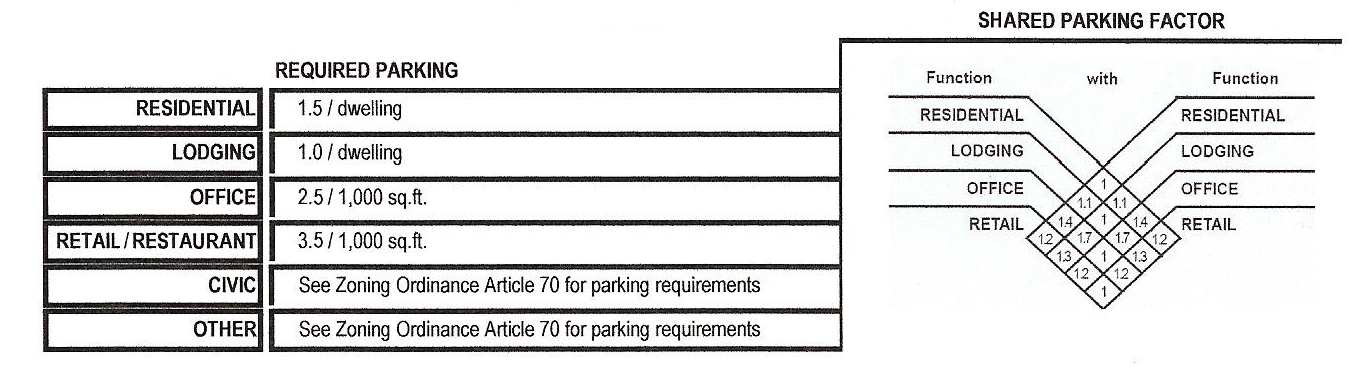
Sharing factor—The sharing factor may be used to calculate the required parking for any shared parking agreement or mixed use development (defined as two dissimilar functions occurring within the same development or property, as determined by the planning department). The actual parking required is calculated by adding the total number of spaces required by each separate function and dividing the total by the appropriate factor from the Sharing Factor Table. When three or more uses share parking, the highest factor shall be used to calculate the required number of spaces.
(Example: A residential component with 50 units requires 75 spaces while a retail component, comprised of 14,000 square feet, requires 49 spaces. Independently they would require a total of 124 spaces, but when divided by the sharing factor of 1.2, they would require only 103 spaces. Buildings may be designed to a functional density corresponding to 124 parking spaces.)
Any available on-street and public parking, which correlates with the applicable site or development, shall be counted towards the overall parking and loading requirements. These parking spaces must be provided within 1,200 feet of the intended site or development.
Parking shall not be permitted in any required side yard nor in the first five feet of any required rear yard.
Required bicycle parking spaces and facilities shall be provided as set forth in Article 76 hereof.
(Ord. No. 15-677, § 1, 10-22-2015; Ord. No. 16-493, § 1, 8-25-2016)
27.6. - Off-street parking and vehicular use area (PVA) landscaping and lighting.
Landscaping of the interior of parking lots and lighting of off-street parking and vehicular use areas is required in accordance with the provisions of Article 71—Off-Street Parking and Vehicular Use Area Landscaping Requirements.
(Ord. No. 15-677, § 1, 10-22-2015)
27.8. - Performance standards.
The performance standards listed in section 50.2 (Research Park District) hereof shall be required for all uses located in a Village Business C-6 District.
(Ord. No. 15-677, § 1, 10-22-2015)
27.9. - Alcoholic beverage establishment regulations.
Alcoholic beverage establishments shall be permitted in accordance with Section 75.3—Permitted Establishments by Districts, subsection 75.3.7, and shall be regulated by Article 75—Alcoholic Beverage Establishment Regulations.
(Ord. No. 15-677, § 1, 10-22-2015)

