
Huntsville City Zoning Code
ARTICLE 73
- SUPPLEMENTARY REGULATIONS AND MODIFICATIONS
The provisions of this zoning ordinance shall be subject to such exceptions, additions, or modifications as herein provided by the following supplementary regulations:
73.1.- Uses; accessory and temporary.
73.1.1. Accessory uses.
(1)
Definitions; examples.
(a)
An accessory use is defined as a use on the same lot with, and of a nature customarily incidental and subordinate to, the principal use permitted on such lot.
(b)
This definition includes, but shall not be limited to, such customary home occupations as the offices of a doctor, lawyer, architect, notary, artist, and dressmaker.
(c)
In the case of a dwelling unit occupied by no more than two adult residents, the definition also includes the taking in by a resident, for compensation, of not more than three (3) non-transient boarders (meals included) or three (3) non-transient roomers; provided, however, that the term does not include individuals who occupy the space as an incident of employment therein.
(2)
Accessory uses permitted in residential districts must adhere to the following requirements:
(a)
Except in the case of the taking in of boarders or roomers, accessory uses shall be engaged in the main building only and shall be conducted only by one person resident in said building.
(b)
In the case of the taking in of boarders or roomers, the accessory use shall be engaged in the main building only, shall be conducted only by an individual actually residing in the dwelling unit, and shall only be allowed where the dwelling unit does not have a second kitchen (see section 10.6 of this Zoning Ordinance concerning second kitchens).
(c)
The floor area designed or used for such accessory use shall not exceed the following percentages of total floor area of the dwelling unit:
Twenty percent for residence 1 and 1-A districts. In the case of roomers and boarders, only their private rooms shall be counted toward the maximum percentage.
Twenty-five percent for residence 1-B district. In the case of roomers and boarders, only their private rooms shall be counted toward the maximum percentage.
Thirty percent for residence 2 and 2-A districts. In the case of roomers and boarders, only their private rooms shall be counted toward the maximum percentage.
Thirty-five percent for residence 2-B district. In the case of roomers and boarders, only their private rooms shall be counted toward the maximum percentage.
(d)
There shall be no external evidence of such accessory use or customary home occupation except one sign, not larger than two square feet in area, may be displayed provided such sign must be directly attached to the residence and must not be illuminated.
(3)
Private swimming pools constructed in a residential district shall be located in the rear yard and shall be at least five feet from any other structure and a minimum of five feet from all property lines.
(4)
Child care and group child care homes. A child care home shall be permitted in all zoning districts permitting residences, and a group child care home shall be permitted in residence 2-B districts, provided that:
(a)
The dwelling and lot conform to all applicable regulations for the zoning district;
(b)
The child care activity does not utilize an accessory structure;
(c)
An off-street drop-off/pick-up area is provided if the facility is located on a major street;
(d)
The facility displays only one sign, not larger than two square feet in area, attached directly to the residence and not illuminated; and
(e)
A copy of the license issued by the department of human resources is filed with the zoning administrator.
(5)
Photovoltaic solar energy system, on-site. A photovoltaic solar energy system ("solar energy system") is permitted in all zoning districts as an accessory use to a principal use except in the case of a non-residential use in a residential zoning district. A solar energy system as an accessory use to a non-residential use in a residential zoning district requires a special exception. A solar energy system is considered an accessory use when the power generated from the solar energy system is equal to or less than the expected power usage of the principal use and any other accessory use on the property based on Huntsville Utilities Electric Department estimates. The installation and construction of a solar energy system shall be subject to the following development and design standards:
(a)
A solar energy system shall provide no more electricity than is needed for the principal use and/or accessory use of the lot on which the solar energy system is located and shall not be used for the generation of energy for the sale of energy to users other than the homeowner's primary supplier of electricity.
(b)
The owner of a solar energy system connected to the utility grid shall provide written authorization from the local utility company acknowledging and approving such connection.
(c)
A solar energy system may be roof mounted, pole mounted or ground mounted.
(d)
A roof mounted system may be mounted on a principal building or accessory building. A roof mounted system, whether mounted on the principal building or accessory building, may not exceed the maximum principal building height or accessory building height, as the case may be, that is specified for the building type in the applicable zoning district. In no instance shall any part of the solar energy system extend beyond the edge of the roof. For purposes of the height measurement, solar energy systems other than building integrated systems shall be considered to be mechanical devices and are restricted consistent with other building mounted mechanical devices.
(e)
A ground mounted or pole mounted system, measured when oriented at maximum design tilt, shall not exceed the maximum building height for accessory buildings in the applicable zoning district.
(f)
Ground mounted and pole mounted solar energy systems shall be located so that any glare is directed away from an adjoining property.
(g)
In residential zoning districts, no portion of a solar energy system shall be located within or above any front yard.
(h)
In a non-residential zoning district, no portion of a solar energy system shall be located within or above any required front yard.
(i)
In all zoning districts, the minimum solar energy system setback distance from the side and rear property lines, measured when the system is oriented at minimum design tilt, shall be equivalent to the accessory building setback requirement of the applicable zoning district.
(j)
All electrical lines/utility lines shall be buried underground.
(k)
For ground mounted and pole mounted solar energy systems, screening, capable of providing year round screening, shall be provided along the non-reflective sides of the solar energy system or collection of systems.
(l)
The installation of a solar energy system shall not cause to apply the requirements of Article 70—Off-Street Parking and Loading Requirements or of Article 71—Off-Street Parking and Vehicular Use Area (PVA) Landscaping Requirements.
(m)
Any solar energy system that has not been in use for its original purpose for a period of 180 days shall be deemed to be abandoned. The solar energy system owner and/or the property owner shall have an additional 90 days to remove the abandoned solar energy system and any appurtenant structures or to reactivate the solar energy system.
(Ord. No. 25-267, § 3, 6-12-2025)
73.1.2. Temporary uses.
(1)
Temporary structures, including portable storage structures, incidental to construction of buildings or structures with an active building permit are allowed provided such structures shall be removed following completion or abandonment of such construction.
(2)
A temporary real estate sales office is permitted in a subdivision during the development of such subdivision provided its use relates only to the subdivision in which it is located and provided it shall be removed after the subdivision is developed. (63-93)
(3)
One portable storage structure may be placed on a residential lot without an active building permit subject to the following conditions and limitations:
(a)
Prior to placement of the portable storage structure on the lot, the property owner shall apply for and obtain a portable storage structure permit from zoning administration; and
(b)
Multi-family dwellings are allowed one portable storage structure per dwelling unit and the portable storage structures shall not be placed in required parking spaces or in required landscaped areas; and
(c)
The permits for the portable storage structures shall be conditional permits and each residential lot is limited to a maximum of three 30-day permits within any 12-month period; and
(d)
The portable storage structure shall not exceed 160 square feet in area and ten feet in height; and
(e)
The portable storage structure shall be set back a minimum of ten feet from the front property line and a minimum of five feet from the side and rear property lines and a minimum of five feet from all other structures on the property and if placed in a front yard shall comply with the safe sight distance triangle regulations which are defined by the adopted standards of the American Association of State Highway and Transportation Officials (AASHTO); and
(f)
The portable storage structure shall not encroach on public property or public rights-of-way; and
(g)
No mechanical, plumbing or electrical installations or connections are to be made to the portable storage structure; and
(h)
The portable storage structure shall have clearly posted on the exterior of the unit a copy of the current permit issued for the portable storage structure, and the date the portable storage structure was placed at the site; and
(i)
The conditional permit approval for the portable storage structure may be revoked by the zoning administrator at any time should the property owner's utilization of such portable storage structure result in unsafe or unsanitary conditions on the site or upon violation of any of the conditions or limitations stated herein.
(Ord. No. 07-460, § 8, 6-28-2007; Ord. No. 08-529, § 2, 8-14-2008; Ord. No. 12-466, § 2, 8-23-2012)
73.2. - Fallout shelters.
73.2.1. Fallout shelters for unlimited occupancy are permitted as a principal or accessory structure in any business or industrial district.
73.2.2. Fallout shelters operated by a local, state or federal governmental agency may be located in any district.
73.2.3. Aboveground shelters intended for occupancy by not more than two families are permitted in any district as an "accessory structure" subject to the requirements of section 73.8 hereof.
73.2.4. Underground shelters intended for occupancy by not more than two families are permitted at any location in any yard notwithstanding other provisions of this ordinance, provided the structure or its overburden does not exceed 30 inches above the natural grade of the yard.
73.2.5. Fallout shelters intended for occupancy by more than two families may be permitted as special exceptions in accordance with section 92.5.2 hereof, in cases where such use would not be damaging or injurious to surrounding land uses.
73.2.6. Nothing in this ordinance shall be construed to prohibit the multiple use of a fallout shelter with other permitted uses of the district in which it is located.
73.3. - Trailers.
73.3.1. All trailers except as hereinafter provided shall be located in approved trailer parks regardless of whether or not such trailer is occupied.
73.3.2. Vacant.
73.3.3. Trailers may be temporarily parked and used as a bona fide construction office and the quarters of a lone night watchman at the construction site provided a construction office trailer permit is secured from the manager of inspection.
73.3.4. Office trailers are permitted in industrial districts only as bona fide sales or rental offices for only the following uses: trailer sales, new and used car sales and trailer park rental.
73.4. - Future street lines.
Any lot intercepted by a future street line as indicated on the duly adopted major street plan, or as the same may be hereafter amended, shall protect and preserve such future street line by considering the same to be the lot line for the purposes of establishing minimum required yards, minimum required lot area, minimum required lot width, and maximum building area of such lot. If such major street plan established a greater front yard requirement than contained in this ordinance, then such greater front yard requirement shall be required.
73.5. - Rear dwelling prohibited.
No dwelling shall be erected on a lot which does not abut on at least one street for at least 20 feet.
No building in the rear of a main building on the same lot may be used for residential purposes.
73.6. - Dual occupancy or uses.
No building or structure may be used for residential purposes when said building or structure's primary purpose is used for office or other non-residential uses, except in a neighborhood business C-1 district when in compliance with section 20.1.1 (residential dwelling units); an office district; a planned development-housing district; a central business C-B district; or in a general business C-3 district.
(Ord. No. 02-196, § 2(73.6), 4-25-2002; Ord. No. 06-1201, § 3, 1-25-2007; Ord. No. 11-899, § 3, 1-26-2012)
73.7. - Yards.
73.7.1. Projecting architectural features. The space in any required yard shall be open and unobstructed except for the ordinary projections of window sills, belt courses, cornices, eaves, chimneys and other architectural features provided that such features shall not project more than two feet into any required yard.
73.7.2. Porches. Any porch or carport having a roof shall be considered a part of the building for the determination of the size of yard or lot coverage.
73.7.3. Terraces. A paved terrace shall not be considered in the determination of yard sizes or lot coverage provided that such terrace is unroofed and without walls or parapets or other forms of enclosure. Such terrace, however, may have an open guard railing not over three feet high and shall not project into any yard to a point closer than two feet from any lot line.
73.7.4. Front yards. Where the developed lots within 100 feet on the same side of the street of any undeveloped lot have a greater or lesser front yard than required herein, the front yard of such undeveloped lot shall be within five feet of the average front yard; provided no front yard shall be less than 20 feet except in a residence 1-C district, and further provided this section shall not apply to secondary front yards, or lots fronting on arterials and major collectors as established by the major street plan.
73.7.5. Front yards required in business districts may contain pump islands of service stations provided such pump islands are a minimum of 15 feet from all front property lines, except that covers for such pump islands, whether attached or unattached to the main building, may extend five feet from the center of the said pump island.
73.7.6. Rear yards may contain accessory buildings provided such buildings must comply with section 73.8 hereof.
73.7.7. Corner lots in residential districts have two front yards.
(1)
Houses whose fronts are oriented parallel to a street shall maintain required front yard on such street. The front yard on the remaining street may be ten feet less than the normal front yard required provided it is not less than 20 feet to the nearest point on the street line.
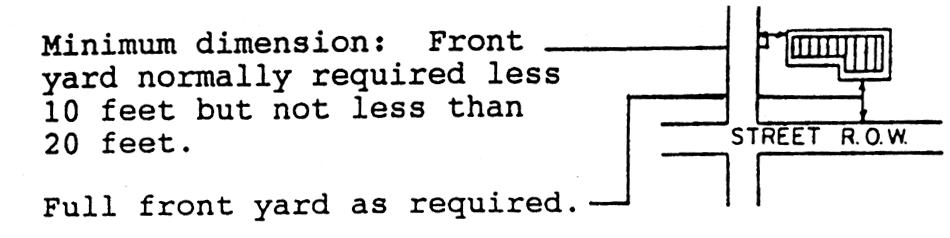
Street R.O.W. 1
(2)
Corner lots having houses oriented at an angle of 30 degrees or more to abutting streets may have five feet less than the normally required front yard on each street provided the house shall not be situated closer than 20 feet to the nearest point of any street line.
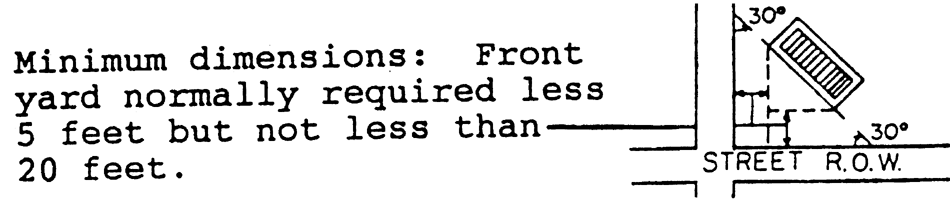
Street R.O.W. 2
(3)
Triangular portions of rear yards may count as one-half foot for each foot of its altitude; the base of such triangle being parallel to the house and intercepting a lot line.
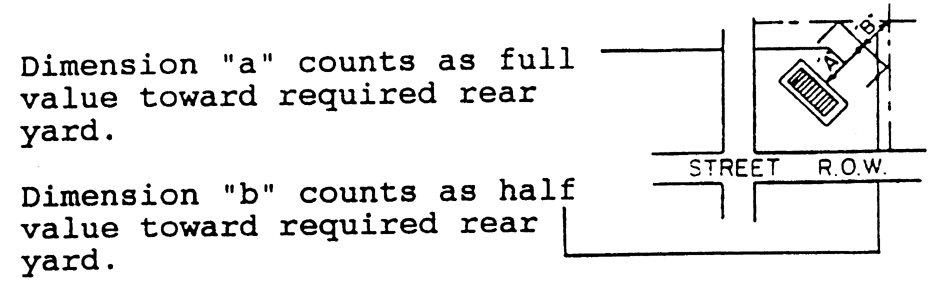
Street R.O.W. 3
(4)
"L" shaped houses oriented on corner lots as shown in the following diagram shall have the minimum required yards as illustrated.
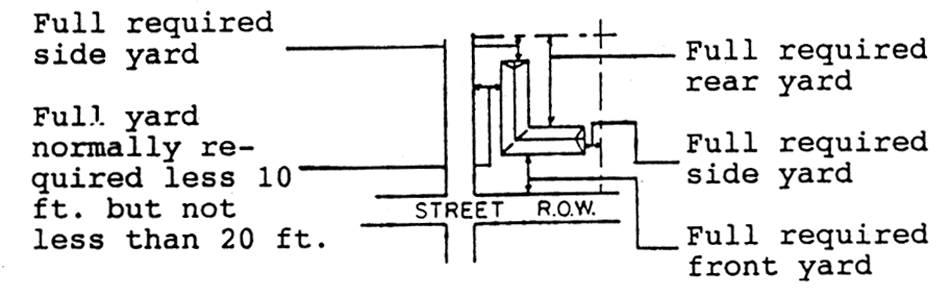
Street R.O.W. 4
73.7.8. Office buildings of not more than two stories located on corner lots in residence 2-B districts, neighborhood business C-1 and C-2 districts, and light and heavy industry districts shall be required to have the following yards:
(1)
One front yard of required depth;
(2)
One front yard ten feet less than the required front yard but not less than 15 feet;
(3)
One rear yard of required depth; and
(4)
One side yard of required depth.
Placement of the required front yard does not necessarily determine the placement of the front door. This regulation shall not be construed as voiding corner restrictions for other districts or corner visibility requirements.
(Ord. No. 01-644, § 2, 9-13-2001; Ord. No. 19-780, § 1, 10-24-2019; Ord. No. 22-898, § 1, 12-15-2022)
73.8. - Location of accessory structures on residential lots.
Accessory structures in residential districts and on any lot used primarily for residential purposes shall conform to the following regulations:
73.8.1. No accessory structure shall be erected in any front yard or any required side yard except underground fallout shelters provided for under section 73.2 hereof. Accessory structures shall not exceed two stories in height and shall not cover more than 30 percent of any required rear yard and shall be at least five feet from all lot lines and ten feet from any other structure on the same lot.
73.8.2. On corner lots, detached residence accessory structures (except underground fallout shelters) shall not be located closer to a street than the minimum building line.
(Ord. No. 09-1053, § 6, 12-17-2009; Ord. No. 11-899, § 3, 1-26-2012)
73.9. - Height modifications.
73.9.1. Except as provided in sections 73.9.2 and 73.20 hereof, the height limitations of this ordinance shall not apply to church spires, barns, silos, monuments, missiles, flag poles, antennas, penthouses and domes not used for human occupancy, nor to chimneys, water tanks, and necessary mechanical appurtenances usually carried above the roof level. Such features, however, shall be erected only to such height as is necessary to accomplish the purpose they are to serve and shall not exceed in cross sectional area 20 percent of the ground floor area of the building.
73.9.2. Airport obstruction zoning. Where the height provisions of this ordinance are less restrictive than the height provisions of the airport obstruction zoning ordinance, as herein defined, the provisions of the airport obstruction zoning ordinance shall apply.
73.9.3. Obstruction marking and lighting. All obstructions as defined by the Civil Aeronautics Board publication "Obstruction Marking and Lighting" shall be marked and lighted as specified by said publication at the owner's expense.
(Ord. No. 96-1008, § 3, 1-23-1997)
73.10. - Corner visibility.
On a corner lot in any district except the general business C-3 district, no fence, wall, hedge, structure, or planting, or other obstruction to vision between the heights of 2½ feet and 15 feet above street level shall be erected, placed, or maintained within the triangular area formed by the intersection of street lines with a straight line joining said street lines at points which are 30 feet distant from the point of intersection measured along said street lines.
73.11. - Curb cuts; driveways.
All curb cuts or driveway entrances to major streets shall be constructed only after the city traffic engineer and the city engineer have ascertained that the proposed construction would not create a traffic hazard, would not create a drainage problem, and would not be detrimental to proposed improvements to said major street. Notwithstanding, any curb cut or driveway entrance shall meet all city engineering specifications.
73.12. - Access.
No structure shall be erected on a lot that does not abut on and have legal access to at least one street for the minimum frontage distance required by the zoning district; if no street frontage is specified, then the minimum street frontage shall be 20 feet. Notwithstanding other provisions of this ordinance, the planning commission shall have the discretion and authority to require that each use to which land is put in the City of Huntsville have sufficient means of access to serve the particular needs of the land affected prior to the approval by the planning commission or prior to the issuance of a building permit.
(Ord. No. 96-259, § 1, 5-23-1996)
73.13. - Multiple-family dwellings (apartment buildings).
Plans for proposed multiple-family dwellings containing two or more buildings which are located on a parcel of land not subdivided into the customary streets and lots, or which contain a building not oriented so the main entrance(s) directly faces a street, shall be presented to the planning commission for review. The commission shall make certain the proposed development meets the following requirements:
73.13.1. The proposed development shall be compatible with requirements and intent of the subdivision regulations relative to access, drainage, utilities, and major streets.
73.13.2. Sidewalks not less than four feet wide are required in the project area leading from all front and rear doors to streets. Sidewalks are also required along all property of the project abutting streets.
73.13.3. Off-street parking spaces shall be provided as follows:
(1)
Residence 2-A district. One and one-half spaces for each dwelling unit.
(2)
Other districts. One and one-quarter spaces for each dwelling unit.
73.13.4. The following density controls are required:
(1)
Residence 2-A district:
(a)
Eight thousand square feet of land area for the first two dwelling units; 3,000 square feet for each additional dwelling unit; provided, however, such required land area must be exclusive of public or private vehicular access ways but may include parking space.
(b)
Closest permitted distance between any two buildings shall be 14 feet for one-story buildings; 16 feet for two-story buildings.
(c)
Minimum distance from an apartment building to a parking space shall be ten feet.
(d)
Minimum distance from the front of an apartment building shall be 50 feet to a major arterial and 30 feet to other public streets.
(e)
On corner lots, the minimum distance from the side of an apartment building shall be 50 feet to a major arterial and 25 feet to other public streets.
(f)
Minimum distance from side of apartment building to side property line shall be eight feet for one-story buildings; ten feet for two-story buildings.
(g)
Minimum distance from rear of apartment building to side property line shall be 32 feet without a buffer; 27 feet if a buffer is provided.
(h)
Minimum distance from either rear or side of apartment building to rear lot line shall be 35 feet.
(i)
Minimum distance from front of apartment building to front of another apartment building shall be 40 feet.
(j)
Windows in all apartment buildings shall have not less than a 30-foot view (measured perpendicularly from the window) unobstructed by other buildings located on the same parcel of land.
(k)
Maximum number of structures shall be limited to four structures per acre.
(l)
No front of a multi-family dwelling building shall be in the rear of another building.
(2)
Other districts permitting multiple-family dwellings:
(a)
Six thousand square feet of land area for the first two dwelling units; 2,000 square feet for each additional dwelling unit; provided, however, such required land area must be exclusive of vehicular accessways but may include parking space.
(b)
Closest permitted distance between any two apartment buildings shall be ten feet for one-story buildings; 14 feet for two-story buildings.
(c)
Minimum distance from an apartment building to a parking space shall be eight feet.
(d)
Minimum distance from the front or side of an apartment building shall be 50 feet to a major arterial and 20 feet to other public streets.
(e)
Minimum distance from side of apartment building to side property line shall be seven feet for one-story buildings; eight feet for two-story buildings.
(f)
Minimum distance from rear of apartment building to side property line shall be 30 feet without a buffer; 25 feet with a buffer.
(g)
Minimum distance from either rear or side of apartment building to rear lot line shall be 25 feet.
(h)
Minimum distance from front of one apartment building to front of another apartment building shall be 30 feet.
(i)
Windows in all apartment buildings shall have not less than a 20-foot view (measured perpendicularly from the window) unobstructed by other buildings located on the same parcel of land.
(j)
Maximum number of structures shall be limited to four structures per acre.
(k)
No front of a multi-family dwelling building shall be in the rear of another building.
(Ord. No. 22-685, § 2, 10-27-2022; Ord. No. 22-484, § 2, 8-25-2022)
73.14. - Residential parking modifications.
For the purpose of this section, parking means the keeping on a residential lot of a vehicle regularly used or owned by a member of the residential household. A motorized vehicle that does not have a current license registration or tag is deemed to be stored only and shall not be parked in a residential yard. The following provisions of this section shall not apply to passenger automobiles or passenger vans or pickup trucks:
73.14.1. The parking of a truck, bus, or commercial vehicle greater than three-quarter ton or 9,000 pounds gross vehicle weight rating (GVWR) shall not be permitted on any residential lot, except that a truck, bus, or commercial vehicle not greater than 1½ tons or 16,000 pounds GVWR may be parked in a fully enclosed accessory structure on a residential lot. This provision includes bus conversions.
73.14.2. Refrigeration units and generators attached to vehicles shall not be operated while such vehicles are parked on a residential lot.
73.14.3. All motorized vehicles shall be parked off-street, not within nor overhanging any right-of-way, and shall not obstruct vision with respect to traffic entering or exiting any adjoining or nearby driveway or street, nor obstruct any pedestrian walkway.
73.14.4. The occupancy of any motor home, camping trailer, or similar vehicle designed or intended for occupancy is prohibited while such vehicle is parked on a residential lot.
73.14.5. All vehicles that fail to comply with section 73.14.1 shall be removed by the owner or person responsible for same within 90 days after the effective date of this ordinance, and thereafter it shall be unlawful to maintain such vehicles on a residential lot except in conformity with this ordinance.
73.14.6. No variances from section 73.14 shall be permitted.
(Ord. No. 02-1005, § 1, 1-23-2003)
73.15. - Front yards along major arterials.
73.15.1. With the exception of the article 60, medical district regulations, minimum setback of 50 feet, of which the first ten feet for all non-residential uses shall be landscaped and maintained, shall be required along all major arterials, as defined in the major street plan, unless the applicable zoning regulations require a greater setback; provided however, that residential uses that do not derive their access from the major arterial shall be excluded from this provision.
73.15.2. Exterior storage of materials shall be in the side and rear yards only and shall be contained and screened by fencing or landscaping in such a manner as to be neat in appearance when viewed from any street. No exterior display of products or merchandise is permitted in the required front yard except for sales of farm equipment, new and used cars, trailers, recreational vehicles, and mobile homes, and these uses shall not be permitted in the first ten feet of the required front yard.
73.15.3. Off-street parking spaces are not permitted in the first ten feet of the required front yard as measured from the arterial right-of-way. Areas used for parking of motor vehicles shall be paved or surfaced with at least four inches of limestone.
73.15.4. All businesses offering merchandise of any description for sale or rent shall have a permanent sales building on the lot except as provided in section 73.15.4.
73.15.5. The temporary, seasonal sale of perishable farm products is permitted so long as all evidence of such operations is removed from the premises each night and such operations are not conducted in any part of the required front yard.
73.15.6. The first ten feet of the required front yard shall be landscaped with at least an average of one tree and five shrubs per each 50 linear feet of frontage or portion thereof and the area shall be planted with a permanent evergreen ground cover. Shrubs are optional in areas where a berm at least three feet in height is used and the berm is planted with a permanent evergreen ground cover. Trees and shrubs shall be well distributed, though not necessarily evenly spaced.
(1)
All landscaping shall be installed in accordance with section 73.19, installation of landscaping.
(2)
All required landscaping shall be maintained in a neat, healthy and growing condition; all unhealthy or dead plants shall be replaced by the next growing season with plants that conform to these regulations.
73.15.7. Where these regulations conflict with other applicable zoning provisions, the more stringent shall apply.
(Ord. No. 98-104, § 2, 3-26-1998; Ord. No. 18-900, § 3, 11-15-2018)
73.16. - The land use intensity (LUI) system; standards, definitions, methods of measurement, general requirements and limitations.
In certain districts, and for specified uses in other districts, special forms of regulation based on the land use intensity (LUI) system and related controls apply. Standards relating to this system, definitions, methods of measurement, and general requirements and limitations are as follows:
73.16.1. Definitions and methods of measurement relating to standard LUI ratios; requirements and limitations. The following definitions and methods of measurement shall be used in the districts and for the uses regulated under the LUI system. Except where application to other uses is specifically indicated, floor area, open space, livability space, and recreation space ratios shall be applied only to such land area, floor area, open space, and related elements as are allocated for residential uses and accessory uses incidental to and compatible with residential uses.
(1)
Gross land area for PD districts. Gross land area of PD districts shall be computed as all land (except that to be devoted to nonresidential purposes) within district boundaries, plus one-half of adjoining permanent open space such as streets, parks, lakes, cemeteries, streams, and the like; provided width of adjoining open space credited shall not exceed in number of feet the numerical LUI rating for the district unless otherwise specified. Computations involving such open space shall be as provided for in section 3.1, lot, area for gross area of lots.
Gross land area of PD districts shall not be construed to include lands not beneficial to residential use due to location or character, or areas used predominantly for commercial or other nonresidential purposes.
As a further guide, where floor area of a building is predominantly in residential use, the building site shall be included in residential land area (as, for example, in the case of a multifamily structure with ten percent of its floor area in accessory commercial and service uses).
(2)
Residential floor area defined; inclusions and exclusions; maximum limitation. Residential floor area is the sum of areas for residential use on all floors of buildings, measured from the outside faces of the exterior walls, including interior halls, lobbies, stairways, elevator shafts, enclosed porches and private balconies, and belowgrade floor areas used for habitation and residential access.
Not countable as residential floor area are:
Open terraces, patios, atriums, or balconies; carports, garages, breezeways, tool sheds; exterior accessways serving more than one unit; special purpose areas for common use of occupants, such as recreation rooms or social halls; staff space for therapy or examination in care housing; basement space not used for living accommodations; or any commercial or other nonresidential space.
Maximum residential floor area shall not exceed the number of square feet derived by multiplying gross land area by the floor area ratio (FAR) applying.
(3)
Open space defined; inclusions and exclusions; minimum requirements. Open space is the total horizontal area of uncovered open space plus half the total horizontal area of covered open space subject to limitations set forth below:
Uncovered open space is total gross land area not covered by buildings, plus open exterior balconies and roof area improved as recreation space.
Covered open space is open space closed to the sky, suitable and designed for use as open space and/or livability or recreation space. Such space shall have not less than 20 percent of its perimeter open or partially open. "Partially open" is to be construed as having at least 50 percent open and unimpeded by visually opaque material. Examples of covered open space are covered balconies, covered portions of roof area, or spaces under buildings supported by posts, columns, or cantilevers. The square feet countable as covered open space shall not exceed the square footage of the open or partially open sides.
Minimum open space required shall be not less than the number of square feet derived by multiplying gross land area by the open space ratio (OSR) applying.
(4)
Livability space defined; inclusions and exclusions; minimum requirements. Livability space is space including lawns and other landscaped areas, walkways, paved terraces and sitting areas, outdoor recreation areas, and landscaped or sidewalk portions of street rights-of-way, appropriately improved and located for outdoor use by occupants and visitors, for safety and convenience, and for aesthetic appeal. Such space shall not be used by vehicles except for emergency actions.
Minimum livability space required shall not be less than the number of square feet derived by multiplying gross land area by the livability space ratio (LSR) applying to the land use intensity.
(5)
Recreation space defined; inclusions and exclusions; minimum requirements. Recreation space, part of total and livability open space, is exterior area appropriately improved for common recreational use.
Active recreation space (swimming pools, shuffleboard courts, tennis courts, tot lots, and the like) for common use shall be a minimum of 40 feet from any residential window at the same level, and this distance may be increased as required in particular circumstances. Both active and passive recreation space (with the latter consisting of walkways, sitting areas, and the like) for common use shall be so located, designed, screened, and buffered as to minimize potential adverse effects on privacy or tranquility of nearby residential units. In the case of active recreation space, character, hours of use, and lighting shall be considered in establishing any special conditions and safeguards.
Recreation space may be located at ground level, or on suitably improved roof, terrace or balcony levels.
Minimum recreation space required shall be not less than the number of square feet derived by multiplying gross land area by the recreation space ratio (RSR) applying.
(6)
Car space defined; requirements. Occupant car space is garage, carport, or other off-street parking space, together with appropriate access and maneuvering ways, available to residents without time limits.
Total car space is occupant car space plus other parking space available for unlimited or seldom limited time periods, primarily for guests. Where curb parking on streets is permissible, and likely to remain so, part or all of such other parking space requirements may be met by such curb parking.
The occupant car ratio (OCR) and total car ratio (TCR) for the applicable land use intensity times the number of dwelling or lodging units equals the number of occupant and total parking spaces required, except in districts where lodging unit requirements are otherwise specified.
73.16.2. Open space and building spacing. Yards, courts and other open spaces required herein in relation to structures or portions of structures are intended to perform a variety of functions. Among these (as appropriate to and required by the uses involved and their location) are ensuring adequate privacy; desirable outlook; natural light and ventilation; access to and around buildings; off-street parking and loading spaces and service areas; space for landscaping; spacing between buildings and portions of buildings for reducing potential adverse effects of noise, odor, glare, or hazards from fire; and recreational space near buildings.
These regulations, supplementing others set forth elsewhere in this ordinance, shall apply to yards, courts, other open spaces and building spacing in particular districts, or in relation to particular uses, as specified in regulations relating to such districts or uses.
73.16.3. Rules concerning location and use of open space:
(1)
Except in the case of fixed yards required adjacent to streets or lot lines, or as otherwise specified in regulations for particular districts, required yards and courts relating to residential uses controlled by these regulations need not be at ground level if, and to the extent that, in other locations their functions, nature, orientation, areas, access, and improvements are appropriate to uses within the buildings and adjoining buildings, and particularly to adjacent uses at the same level of the building and overviewing uses in the same or nearby buildings.
(2)
Where lots or building sites adjoin permanent open space in parks, common open space, or other open space, excluding streets or drives, intended to remain so for perpetuity, half of the width of such open space shall be included in meeting building spacing requirements subject to the following limitations and exceptions:
(a)
Where walls containing primary or secondary windows at or below the third story level face parking areas for ten or more cars, the full dimension of the required yard shall be provided and no such dimension shall include any portion of the parking area. Where such walls rise from decks of buildings, the third story level shall be construed to be the third story level above such decks.
(b)
Where walls containing primary or secondary windows at or below the third story level face other permanent off-site open space which is likely to be of a nature adversely affecting privacy or tranquility of residential occupancy, then the full dimension of the required yard or open space shall be provided and no such dimension shall include any portion of such off-site open space. Where such walls rise from decks of buildings, the third story level shall be construed to be the third story above such decks.
(3)
Where lots or building sites are located adjacent to public or private streets or private drives, then the full dimension of the required yard shall be provided from the back of the curb or pavement edge of a street, except for lots or buildings adjacent to a designated collector or major street in which case a minimum of 30 feet shall be required.
(4)
Where two or more buildings containing living quarters are to be located on a single lot or tract, building sites pertaining to each shall be identified for determinations concerning compliance with spacing requirements. Open space shall be provided adjacent to lines of the building site as though they were lot lines.
(5)
Spacing requirements for buildings or portions of buildings containing living quarters shall be based on horizontal length, number of stories, type of windows in walls involved, and orientation of main entrances to living quarters. Distance between walls shall be at least the sum of the depths of the open spaces required for each.
(a)
Where portions of buildings contain different numbers of stories, required clearance from lot or building site lines shall be as established for the portion nearest to the lot line, except where spacing required for portions farther from the line is of greater depth, in which case the depth so established is the required clearance from the lot or site line (as projected vertically when space is provided other than at ground level). Lower portions of buildings may extend into clearance distances required for upper portions if roof areas are appropriately improved in relation to views from the same or higher levels by visual amenities such as landscaping, but such lower portions shall provide clearance to meet their own requirements.
The drawing which follows illustrates these relationships. At the left of the building, the lot or building site line would be required to be at or beyond the point at which the diagonal at A reaches the ground, since the portion of the building to which it relates requires greater spacing than does B. To the right of the building, D requires greater spacing than does C, and would therefore determine the requirement.
Permitted Overlap of Yards (vertical relationship)
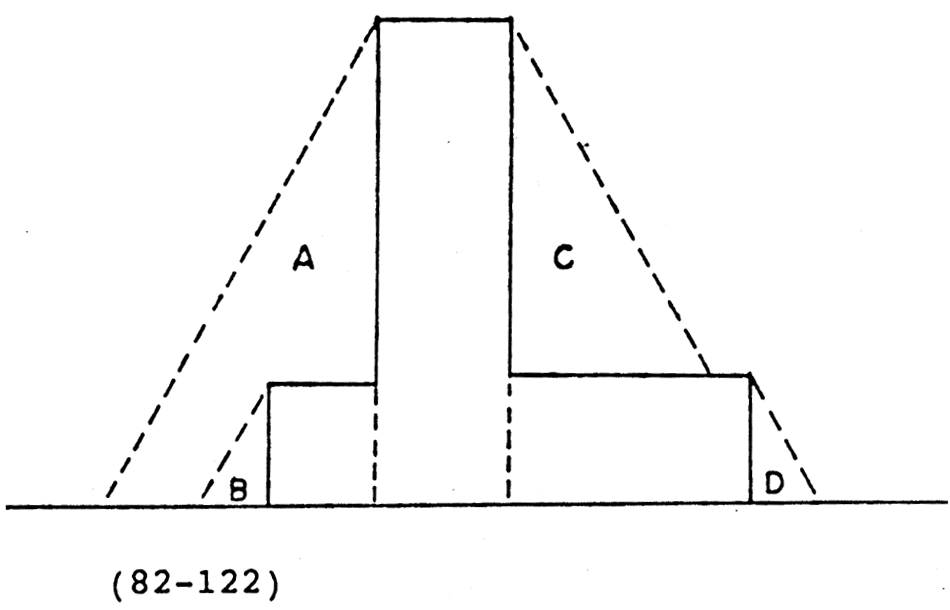
Vertical Relationship
(b)
Length of walls shall be measured as the horizontal distance from corner to corner. Where walls in continuous general frontage area offset by setbacks equalling 30 percent or more of the height of the facade, the length of each segment so set off shall be measured separately in establishing pertinent yard or open space depth, provided that where open, partially open, or enclosed structures devoted to entrances, stair wells, and/or elevator shafts project from the general alignment of a wall, such structures shall not be construed as constituting a break-point in lengths involving building spacing determinations.
Where walls in continuous general frontage enclose portions of buildings varying one story or more in height (as in the illustration above) length of each segment so varying shall be measured separately in computing pertinent yard depth. Length of a curved or irregularly shaped wall shall be construed as the shortest distance between the wall's end corners. Length of the wall of a circular building shall be construed as the diameter of the building.
The drawing which follows illustrates the setbacks required when there is an offset
in a wall equalling 30 percent or more of the height of the facade.
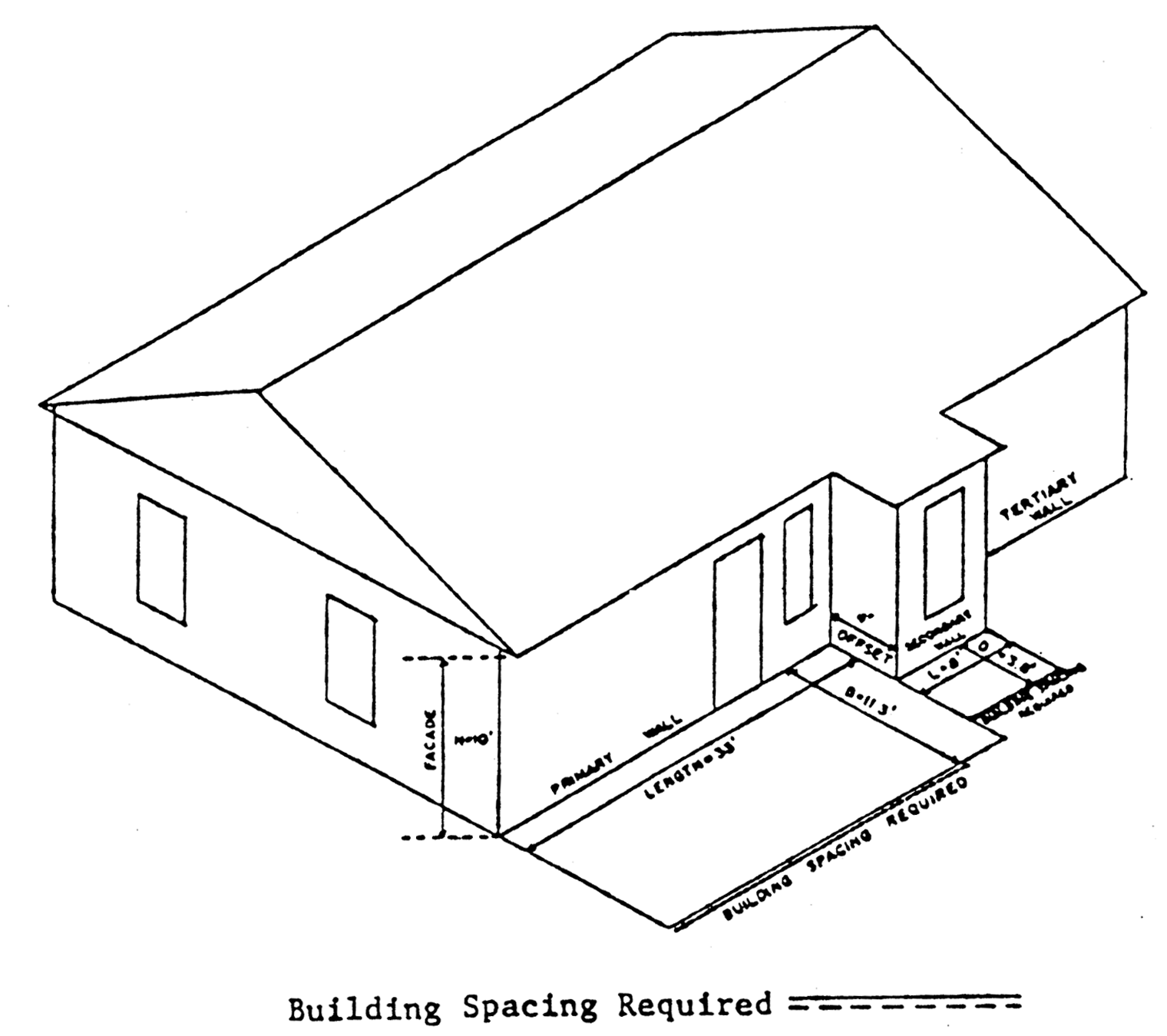
Building Spacing Required
(c)
Height in stories shall be computed as actual number of stories in the wall above ground level, with the following exceptions. Where the wall is along a slope, number of stories shall be construed as the arithmetic mean number, with half a story or more considered as a full story, and less than half a story ignored in computations. When height per story exceeds an average of 11 feet, calculations involved in yard or spacing determinations shall be based on an assumed number of stories derived by dividing building height by ten feet.
Penthouses, roof shelters, and housing for mechanical equipment shall be ignored in computations involving number of stories except where they are visible from the ground level within 200 feet of the lot, are ten feet or more in height, and occupy 50 percent or more of the length of the wall at their bases, in which case an additional story shall be included in computations. On sloped sites, visibility shall be determined from the downhill side or from the sides at the same elevation only.
(d)
Yard or other open space depth, between exterior building walls and adjacent lot or building site lines (projected vertically where appropriate), shall be measured horizontally in relation to the ground, and perpendicularly to straight walls or radially to curved walls. Distance at all points shall be at least equal to minimum requirements set forth herein, except as provided in section 3.1, court, and 3.1, yard, with regard to architectural and other projections.
Yard space for two walls may overlap where it does not affect the distance between two buildings.
The drawings which follow provide graphic explanation of permissible overlap and methods for measuring length of walls and depth of yards for a variety of building forms.
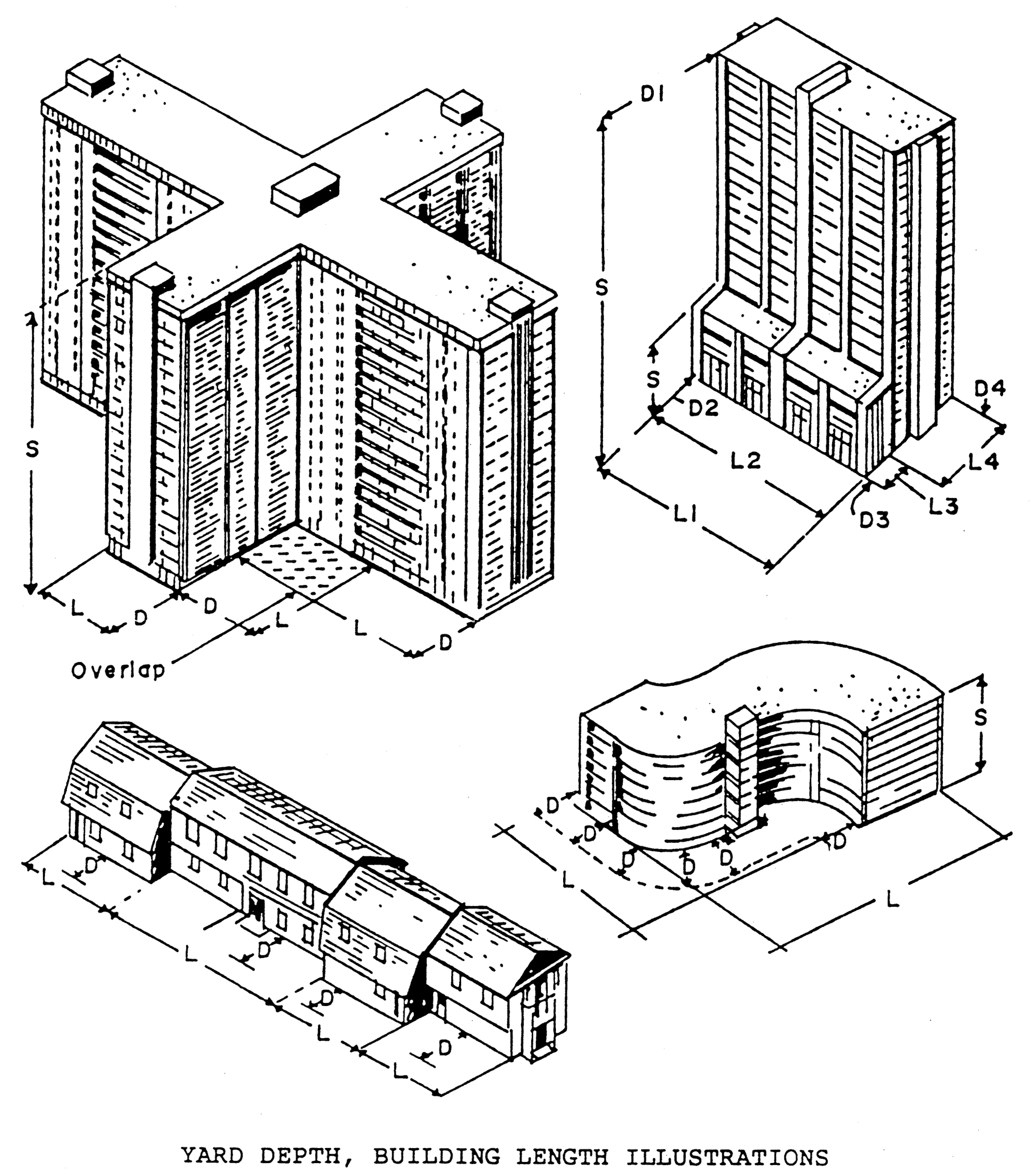
Yard Depth, Building Length Illustrations
(e)
For purposes of establishing open space requirements adjacent to walls enclosing living quarters, the following definitions and classifications shall govern:
Habitable rooms are rooms designed and used for living, sleeping, eating, or cooking or combinations thereof. Bathrooms, toilet compartments, closets, halls, storage rooms, laundry and utility spaces, basement recreation rooms, and similar areas are not considered habitable rooms.
Primary windows are principal windows in habitable rooms except bedrooms and kitchens.
Primary walls are walls containing primary windows and/or main exterior entrances to individual living quarters when directly facing the primary wall of other living quarters.
Secondary windows are windows of habitable rooms other than primary windows, as defined above.
Secondary walls are walls containing only secondary or secondary and tertiary windows.
Tertiary windows are windows other than for habitable rooms.
Tertiary walls are windowless walls, or walls containing only tertiary windows.
Minimum distance from walls to lot lines or building site lines for buildings or portions of buildings containing living quarters shall be computed as follows, where D = depth in feet, L = length in feet, and S = height in stories:
(i)
Primary walls: D = 6 + 2S + L/10
(ii)
Secondary walls: D = 2 + S + L/10
An example of building spacing requirements is shown in the following illustration:
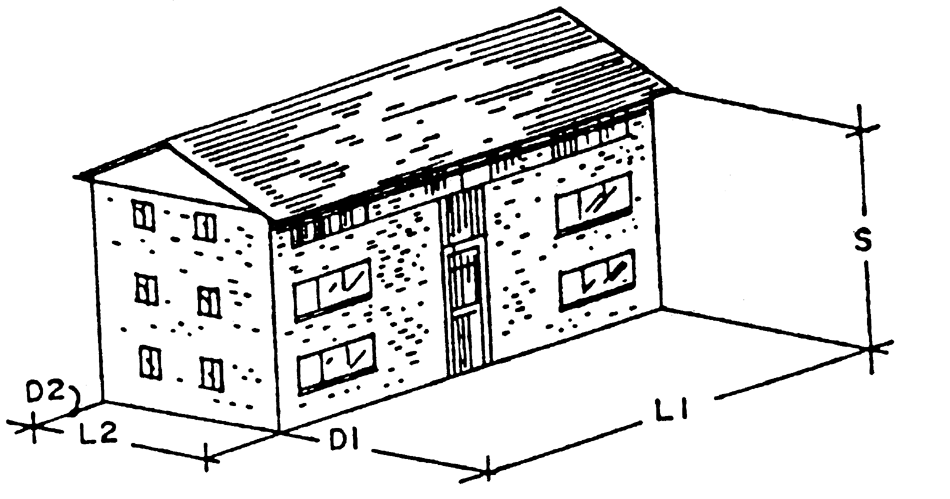
Building Spacing Requirements
D1 equals 18 feet for a primary window wall
— Six feet plus two feet for each floor of a three-story building plus
— One foot for each ten feet of length (60 feet)
— 6 + 6 + 6 = 18 ft.
D2 equals 7.6 ft. for a secondary window wall
— Two feet plus one foot for each floor of a three-story building plus
— One foot for each ten feet of length (26 feet)
— 2 + 3 + 2.6 = 7.6 ft.
An illustration of building spacing requirements is shown in the following example, where
Primary walls: D = 6 + 2S + L/10
Secondary walls: D = 2 + S + L/10
Tertiary walls: No setback required
S = Number of Stories
L = Length of Wall
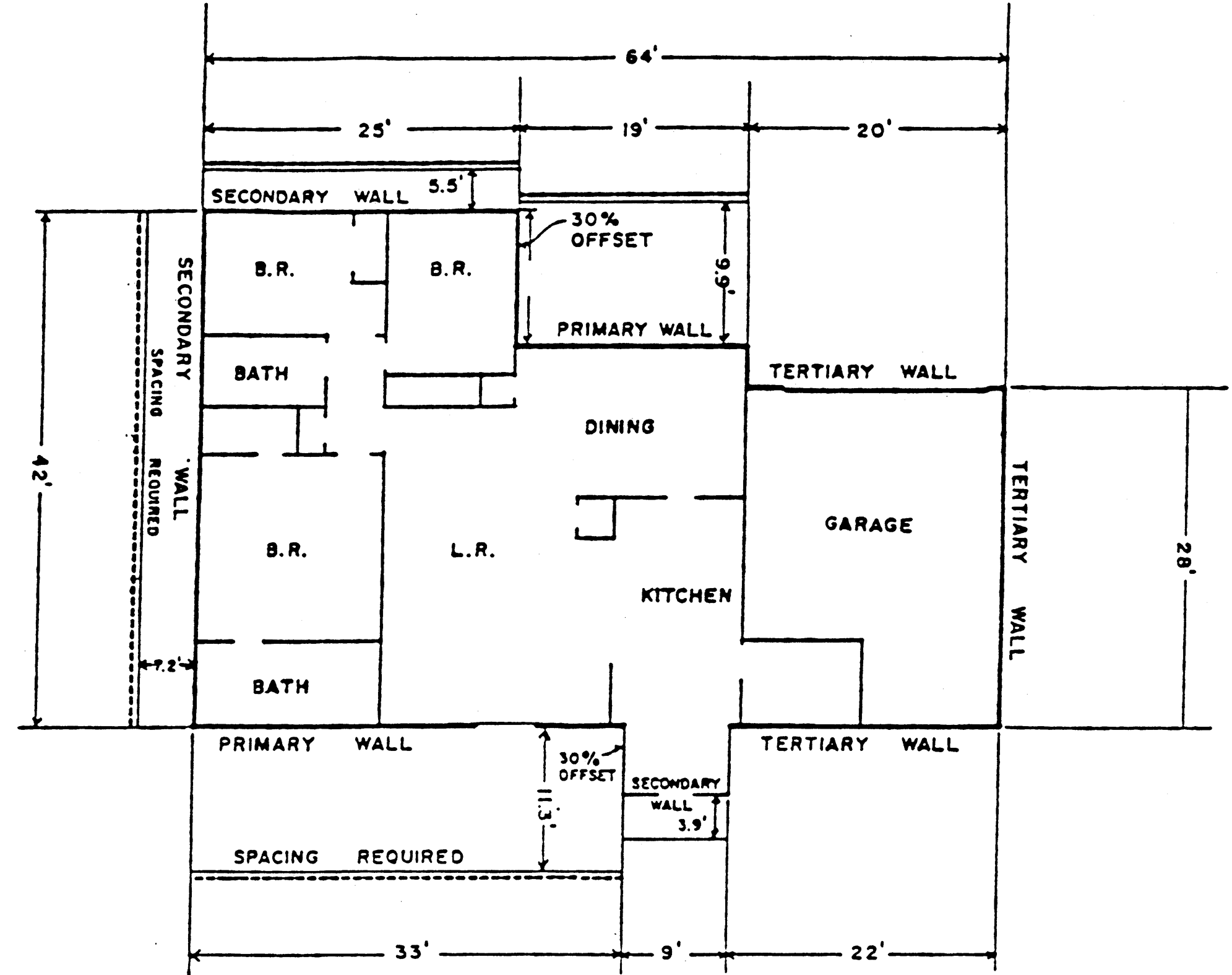
Building Spacing
(f)
Special requirements and modifications concerning courts.
(i)
Inner courts.
1.
Inner courts are open outdoor spaces enclosed on all sides by building walls or potential building walls, [and] shall have a minimum dimension equal to the sum of the required yards but not less than ten feet. Their areas shall not be less than 100 square feet for one story or 150 square feet for two stories or more.
2.
Unobstructed passageway. Except in the case of an inner court, atrium, or enclosed patio for a single dwelling unit, a passageway shall be provided at the lowest level of each inner court, as provided by the building code. Such passageway shall be continuous from the inner court to unobstructed open space adjacent to the building, and shall be so aligned as to facilitate passage of nonvehicular fire fighting and emergency equipment, including ladders.
3.
Inner court design shall be such as to permit use of fire fighting equipment.
(ii)
Outer courts.
1.
Outer courts are open outdoor spaces enclosed on at least three sides by building walls or potential walls, with one side open to a street, driveway, alley, yard or other open space.
2.
Width of outer courts bounded on three sides by building walls or potential building walls shall be not less than the sum of the required open space distances measured from opposing building walls.
3.
Width reduction for shallow courts. Where outer court depth is less than half of width, maximum required width may be reduced by up to 25 percent.
4.
Depth of outer courts shall not be greater than one and one-half times width.
5.
Where walls are not parallel to property or site lines, the nearest portion of a building to such lines shall be at least the required distance therefrom.
(g)
For structures or portions of structures not containing dwelling units and not otherwise controlled by these regulations, yards, courts, open space and building spacing shall be appropriate to the use of such structures or portions, as related to anticipated amounts and timing of vehicular and pedestrian traffic and exposure of nearby living quarters to such use, and with due regard for location of primary or secondary window walls, separation of residential open space from other open space on the site by walls, fences, or vegetative screening where desirable, location of proposed parking areas, drives and service areas, and similar considerations.
73.17. - Extraction permits.
No new extraction operation shall begin and no existing extraction operation shall expand until an extraction permit has been issued by the natural resources and environmental management division. The following information shall be submitted to the manager of natural resources and environmental management when making application for an extraction permit. The manager may require other pertinent data if necessary to determine that the proposed extraction operation will satisfy the provisions of all applicable local laws and regulations. After all data has been submitted to the manager as required herein, the manager shall have 60 days within which to approve or deny the application. If the manager has taken no action on the completed application within the stated time period, the application shall be deemed denied.
73.17.1. Legal description of the extraction site, including the total acreage.
73.17.2. Copies of all instruments (deeds, leases, etc.) conveying to the applicant mineral rights in and to the real property within the boundaries of the site. Provided, however, that the applicant has the option of attaching, in lieu of a copy of any lease, a memorandum of lease satisfying the execution, acknowledgment, and content requirements of Code of Ala. 1975, §§ 35-4-6, 35-4-51.1.
73.17.3. Vicinity map drawn on an official Huntsville Zoning Map at a scale of one inch to 400 feet, on which is identified the following data for both the proposed extraction site and the area one-half mile beyond the site:
(1)
Boundaries of the extraction site;
(2)
Public routes to be used by vehicles and equipment entering and leaving the site;
(3)
Locations of streams and bodies of water, public roads, railroads, utilities, residences, and structures or areas of cultural or historic significance; and
(4)
Locations and descriptions of any environmentally sensitive areas including, but not limited to, wetlands and lands harboring endangered plant and animal species.
73.17.4. Site plan drawn on a topographic map at a scale of one inch to 200 feet, on which is identified the following data:
(1)
Boundaries of the extraction site;
(2)
Locations and descriptions of all proposed buffers, setbacks and visual screens;
(3)
Topography of the site and the lands within one-half mile thereof at five-foot intervals; and
(4)
Locations and acreages of areas planned for extraction; for storage of overburden, byproducts and excavated materials; for processing facilities; and for those lands to be left undisturbed.
73.17.5. Operational plan, with maps drawn at a scale of one inch to 200 feet or less, to include the following:
(1)
A description of the method of operation, including the disposition of topsoil, overburden and byproducts.
(2)
A general description of the equipment to be used in the extraction process.
(3)
Measures to be taken to control noise, dust, litter, and vibrations from the operation.
(4)
Measures to be taken to screen visibility of the operation, including section drawings of the site clearly indicating the effectiveness of all existing and proposed measures to be used to screen the operation from view of surrounding lands.
(5)
Measures to be taken to prevent the tracking of material onto public roadways.
(6)
Plan view drawing showing how the applicant plans to proceed with the extraction operation including, but not limited to, the extent of the mining area, sediment and/or wash ponds, sediment basins, stockpiles, structures, roads, railroads, utilities and other permanent or temporary structures.
(7)
Measures to be taken to control surface water runoff and soil erosion.
(8)
General description of the geologic character of the site.
(9)
General description of the products to be produced at the site, their end use, and general market area.
(10)
Copies of applications to federal, state and local regulatory agencies for environmental permits including, but not limited to, control of air and water quality.
73.17.6. Reclamation plan, with maps drawn at a scale of one inch to 200 feet or less, to include the following:
(1)
Approximate expected topography of site when extraction activity has been completed, at intervals no greater than five feet.
(2)
Approximate expected topography of site when reclamation activity has been completed, at intervals no greater than five feet, to include methods to be employed for backfilling and grading.
(3)
The location and identification of all lakes, ponds, streams, rivers, or other waterways planned to exist when reclamation activity has been completed.
(4)
A description of the methods and procedures to be used and a proposed timetable for the various reclamation phases.
(5)
An estimate of the cost per acre of reclamation with supporting calculations for the estimate.
(6)
A plan for revegetation of the site.
(7)
A description of the expected future use following reclamation of the site and the relationship of the expected future use to existing surrounding land uses.
An extraction permit shall be valid for a maximum period of five years unless renewed by the manager of natural resources and environmental management as follows: If the permitted extraction operation and reclamation program are not completed within five years, then a review of the extraction permit shall be conducted by the manager of natural resources and environmental management based on the submittal of an updated extraction application. The updated extraction application shall reflect any additions, changes, or other modifications to the information provided in the original application. At each review, the manager shall establish a new bond or adjusted cash escrow amount, which bond or cash escrow shall be posted before the extraction permit is renewed. The renewal process shall occur at five-year intervals until such time as the reclamation plan has been completed.
73.18. - Performance bond for extractive operations.
73.18.1. The applicant shall post a bond in an amount equal to the estimated costs of reclamation as indicated by the approved reclamation plan; however, in no case shall said amount be less than $3,000.00 per acre (rounded to the nearest full acre of land) to secure to the City of Huntsville satisfactory compliance with all regulations contained or referenced herein. Such bond shall be approved as to form by the legal department and shall be secured by an insurance company licensed by the State of Alabama, or be a cash escrow, or be an irrevocable letter of credit from an approved lending institution.
73.18.2. Such performance bond shall comply with all statutory requirements and shall be satisfactory to the City of Huntsville as to form, sufficiency, and manner of execution. A signature bond will not be accepted by the City of Huntsville.
73.18.3. The performance bond shall contain a legal description of the extraction site. The bond shall remain in force and effect until it has been released in writing by the manager of natural resources and environmental management and shall bear a termination date of one-full year beyond the expiration date of the extraction permit.
73.18.4. Before abandoning a permit area or seeking bond release, the operator shall ensure that all temporary structures are removed and that all permanent sedimentation ponds, diversions, impoundments, and treatment facilities meet the requirements of the approved reclamation plan.
73.18.5. Upon request by the permit holder for bond release, the manager of natural resources and environmental management shall promptly inspect the site. When the manager has determined that all applicable requirements have been satisfied, he shall notify the city clerk-treasurer in writing to release the bond or escrow to the applicant.
73.18.6. If a renewal of an extraction permit is approved by the manager of natural resources and environmental management, the applicant shall be required to post a new bond. If the existing bond is a cash escrow, then the applicant shall be required to post the difference between the existing escrow and the new escrow.
73.18.7. If the extraction permit expires and the provisions of the approved reclamation plan have not been completely satisfied, the manager of the department of natural resources and environmental management shall be authorized to invoke the bond (by notifying the city clerk-treasurer in writing of the details of the default) to have the reclamation plan completed.
73.18.8. If an extraction activity ceases or remains dormant for a period of 12 consecutive months, the permit holder must begin reclamation of the site in accordance with the reclamation plan.
If the permit holder does not commence reclamation in accordance with the reclamation plan, then the manager of natural resources and environmental management shall invoke the bond and begin reclamation of the site as provided in section 73.18.7.
73.18.9. At such time as the reclamation plan is completed, the permit holder may post with the City of Huntsville a maintenance bond in order to secure the two-year maintenance period required by the reclamation standards. The manager of natural resources and environmental management shall set the amount of the maintenance bond and shall direct the city clerk-treasurer to release the performance bond when the maintenance bond has been posted.
73.18.10. It shall be the duty of the manager of natural resources and environmental management to enforce the regulations pertaining to the extraction permit and the extraction bond procedure.
The manager of natural resources and environmental management shall notify the permit holder in writing whenever he is made aware of or determines that any existing land condition or exposed surface created or caused by means of extraction or reclamation activity has (1) become a hazard to life and limb; (2) endangered property; (3) adversely affected the safety, use or stability of a public way or drainage channel; (4) caused erosion; or (5) otherwise failed to comply with any applicable requirements. The permit holder shall rectify or eliminate the stated condition within 60 days of notification by the manager of natural resources and environmental management. Failure to do so within the stated time period shall be grounds for revocation of the extraction permit.
73.18.11. The requirements of the extraction permit and bonding procedure are intended to be minimum and shall not abrogate, repeal, or otherwise affect the requirements of other applicable federal, state, or local laws and regulations.
73.19. - Installation of landscaping.
No certification of occupancy shall be issued until the required landscaping has been completed and approved by the zoning administrator or a performance bond, letter of credit or certified check has been posted. When circumstances preclude immediate planting, a certificate of occupancy may be granted after (1) the owner has completed all necessary construction preliminary to planting, and (2) the property owner posts a corporate surety bond, letter or credit, or cashier's check with the city clerk in an amount equal to 100 percent of the cost of the total required planting, including labor. Such bond shall be made payable to the City of Huntsville. Landscaping must be completed and approved within six months (180 calendar days) after a certificate of occupancy is issued in order to redeem the bond.
(Ord. No. 07-460, § 8, 6-28-2007)
73.20. - Wireless telecommunications towers.
The regulations of this section are intended to provide for the growing need for telecommunications towers and antennas while minimizing any adverse environmental, aesthetic and visual impacts through careful design, siting, and landscape screening; to promote and encourage shared use (collocation) of existing and new towers and sites; to avoid potential damage to adjacent properties from tower failure or falling ice; to protect the health, safety and welfare of the general public; and to preserve the character of residential districts through judicious permitting of towers within such districts.
73.20.1. Applicability; towers. Wireless telecommunications towers shall be permitted according to their function and location as provided herein:
(1)
Towers in nonresidential districts. AM radio broadcast towers, a tower erected primarily for the use of mobile or fixed point radio service antennas, or any other telecommunications tower not otherwise covered by section 73.20.1 that will accommodate multiple users shall be permitted in nonresidential zoning districts subject to these regulations and any other applicable codes and regulations.
(2)
Single user towers. A special exception shall be required to construct AM radio broadcast towers, a tower erected primarily for the use of mobile or fixed point radio service antennas, or any other telecommunications tower not otherwise covered by section 73.20.1 in any nonresidential district if it will not be designed, constructed, and available to accommodate multiple users.
Tower applicants, except those for AM radio broadcast towers, must demonstrate an inability to locate on existing towers or other structures accompanied by supporting documentation as specified in section 73.20.16, collocation. (See section 92.5.3(20) hereof.)
(3)
Towers in residential districts. A special exception shall be required to locate or construct a tower erected for the support of personal wireless service antennas in any residential district. (See section 92.5.3(9) hereof.)
(4)
Broadcast towers. A special exception shall be required to construct a broadcast tower in any district if it will support one or more UHF or VHF television or FM radio transmitting antennas or other broadcast antennas having similar elevation and height requirements. (See section 92.5.3(21) hereof.)
(5)
Existing towers. All telecommunications towers existing on the effective date of this ordinance [January 23, 1997,] that have been lawfully erected shall be allowed to continue as nonconforming uses, provided they continue to meet or exceed current federal standards and regulations, as amended, and the provisions of section 73.20.8, structural design of towers, hereof. Such towers shall be permitted to accommodate additional antennas and any necessary new construction if such antennas and new construction do not increase the tower height beyond that allowed by the FCC or the FAA or by sections 92.5.3(9)(e) or 73.20.7, tower height, or beyond the existing height if already in excess of the allowable height. Any new construction that would increase tower height or alter the structural strength or configuration of the tower will require the tower to be brought into compliance with the provisions of this ordinance except for section 73.20.3, setbacks.
(6)
Personal use towers. Personal use towers are exempt from all provisions of this ordinance if all of the following criteria are met:
(a)
Tower is located on property which owned by a natural person or non-profit service organization.
(b)
Tower is used exclusively for non revenue producing activity.
(c)
Tower and all guy wires must be contained on the property, and may not be located within five feet of the property boundaries.
(d)
Tower is located to the rear or side of building.
(e)
Tower is outside National Register historic district, or if within such district, proposed tower has been approved by the Huntsville Historic Preservation Commission.
(f)
Tower does not support any sign.
(g)
Tower and antennas shall not exceed 100 feet in height. A building permit must be issued prior to installation of a personal use tower in excess of 75 feet.
(7)
Portable or mobile towers. Portable or mobile towers may be utilized only for special, short term events attracting large numbers of people or for emergency situations; the provider must be issued a temporary use permit by the zoning administrator prior to siting of the portable facility, and the permit must specify the permitted location and the permitted dates of operation not to exceed ten days. The zoning administrator shall collect a $100.00 application fee each time a portable tower is permitted for a period not to exceed ten days. Personal use towers are specifically exempt from the requirements of this section.
(8)
Accessory towers. A tower that is accessory to a business or other nonresidential entity on the same lot in a nonresidential district and that is for the exclusive use of the principal entity, its branches and its employees shall:
(a)
Not exceed 100 feet in height;
(b)
Not be permitted to carry other transmitting antennas;
(c)
Have all guy anchors located at least ten feet inside the lot lines; and
(d)
Have been issued a building permit prior to installation.
73.20.2. Applicability; antennas. Except for replacements of preexisting antennas that neither alter height, configuration or structural integrity of the support structure nor increase radio frequency emissions, all telecommunications antennas installed following adoption of this ordinance [January 23, 1997,] shall comply with one of the following provisions:
(1)
Tower-supported antennas that will be attached to existing, lawfully erected towers shall be issued building and other required permits prior to installation subject to compliance with subsections 73.20.8(2) and 73.20.17(9) hereof.
(2)
Building or ground mounted antennas shall comply with the provisions of section 73.20.12, antennas, hereof.
73.20.3. Setbacks.
(1)
The minimum setback for a tower shall be 25 percent of the tower height unless a greater setback is required by the regulations for the district in which the tower is located; however, no tower shall be located closer than 200 feet to any residential district or closer than a distance equal to the height of the tower to any residential structure.
(2)
Towers located on the leased portion of a larger lot shall not be constructed in any required yard of the lot; towers shall not be located on the same lot with a residential structure.
(3)
Tower setbacks from the property lines of the lot on which the tower is located shall be measured from the perimeter of the tower base.
(4)
Guyed towers shall have their guy anchors located on the tower site at least ten feet from any lot line, and guy wires shall not cross any adjoining property, rights-of-way or public easements without prior approval of the owner of the public easement.
(5)
Setbacks shall in all cases be sufficient to contain on-site all ice-fall unless adequate provisions have been incorporated to prevent the buildup of ice.
(6)
Minimum setbacks for accessory structures constructed in conjunction with a tower shall be as established by the zoning district for principal buildings or be at least 25 feet if no setback is required by the district.
73.20.4. Lighting.
(1)
Towers shall not be artificially illuminated except as required by the Federal Aviation Administration or the Federal Communications Commission. Any required lighting shall be the minimum necessary to comply with federal regulations.
(2)
All security lighting must be contained within the fenced area and must not illuminate higher than ten feet.
73.20.5. Tower color. Towers shall have a galvanized finish or be painted a silver, pale blue or gray; any regulation of the FAA or FCC that contradicts this requirement shall govern.
73.20.6. Site security. The facility shall be fully secured. A chainlink fence or a wall not less than eight feet in height from finished grade shall be provided around each tower and all accessary structures. Access to the tower shall be through a locked gate. Where guy anchors are not contained within the security fence, a separate fence at least eight feet in height shall be provided around each anchor. Towers without accessory structures may utilize anticlimb devices in place of a fence.
73.20.7. Tower height.
(1)
Towers in C-1 through C-3 districts shall not exceed 120 feet in height; towers in other nonresidential districts shall not exceed 180 feet in height.
(2)
Measurement of tower height shall include antennas, base pad, and other appurtenances and shall be measured from the natural grade of the site.
73.20.8. Structural design of towers.
(1)
Towers shall meet or exceed the structural requirements as set out in EIA/TIA-222-E "Structural Standards for Steel Antenna Towers and Antenna Supporting Structures," as amended, published by the Electronic Industries Association and all applicable City of Huntsville building codes.
(2)
Any improvements and/or additions (antennas, dishes, etc.), excluding the repair and replacement of parts or components that do not increase tower height or alter the structural strength or configuration of the tower, to existing towers shall require that a notarized verification of compliance with the EIA/TIA-222-E Standards in effect at the time of the improvement or addition be submitted to the manager of inspection by the owner and a registered professional engineer.
(3)
Commercial towers 180 feet in height or less, except for accessory towers as described in section 73.20.1(9), shall be monopoles unless the applicant can demonstrate that the specific conditions require another tower type.
(4)
Tower diameter at the base shall not be greater than required for the permitted tower height.
73.20.9. Signs. No signs shall be allowed on any tower or antenna.
73.20.10. Access.
(1)
Where the lot on which a tower is to be erected does not meet the minimum lot area requirement for the zoning district or does not have frontage on the public road from which it derives access, then building permits shall not be issued for any structures other than telecommunications towers and the unmanned accessory facilities required for equipment storage and tower operation. This use restriction must be made a part of any plat or deed describing this lot until such time as the lot comes into compliance with the zoning regulations.
(2)
Whenever a tower site does not have frontage on the public street from which it derives access, a permanent, 20-foot wide access easement shall be required.
73.20.11. Landscaping. A landscape buffer shall be required in all districts and shall effectively screen the view of the tower facility from public ways and adjacent properties.
(1)
The buffer shall be installed on the outside of the security fence.
(2)
The buffer shall consist of a minimum ten-foot wide landscaped strip planted with an attractive combination of trees, shrubs, vines and/or ground covers.
(3)
Minimum required plantings include:
(a)
A row of evergreen trees a minimum of eight feet tall when planted placed a maximum of ten feet apart;
(b)
A continuous hedge of evergreen shrubs at least 30 inches high at planting placed in front of the tree line; and
(c)
All plant materials shall be xeriscape tolerant.
(4)
Where towers are located on wooded sites:
(a)
Tree cutting shall be limited to the area to be fenced and a five-foot buffer along the outside of the fence. If the accessway must be cleared of trees, then tree cutting shall be limited to the minimum width necessary to provide vehicular access to the tower facility but shall not exceed 15 feet in width.
(b)
Preservation of the natural vegetation surrounding the fenced area shall be substituted for the landscape buffer if it screens the compound from view from adjacent development and rights-of-way.
(5)
All landscaping must be installed in accordance with the provisions of section 73.19, installation of landscaping.
(6)
The owner of the tower shall be responsible for providing and maintaining all landscaping in a healthy and growing condition and replacing unhealthy or dead plants by the next growing season with plants that conform to the original intent of these regulations for as long as the tower stands.
73.20.12. Antennas.
(1)
Nonresidential districts. An antenna that is not attached to a tower shall be permitted on nonresidential structures or be ground mounted provided:
(a)
The antenna and its supporting structure, when attached to a nonresidential structure, do not exceed 20 feet in height;
(b)
The antenna complies with all applicable FCC and FAA regulations;
(c)
The antenna does not extend into the air space above any public right-of-way nor extend any closer than ten feet to the boundary of the lot on which the structure is located;
(d)
The support structure for the antenna and any facilities or equipment necessary for its operation comply with all applicable building codes and have received appropriate permits;
(e)
The antenna will be, and will remain, in compliance with current FCC standards concerning radio frequency emissions;
(f)
The antenna site is not within the boundaries of a national register historic district; and
(g)
Satellite earth station antennas having a diameter greater than two meters, and DBS and MMDS antennas having a diameter greater than one meter:
(i)
If attached to a building are placed to minimize their visibility from adjacent streets; or
(ii)
If ground mounted meet required yard setbacks or have a setback of ten feet from lot lines if no setbacks are specified for the district; and
(iii)
Are not located in front yards unless visually screened from public rights-of-way.
(2)
Residential districts. An antenna that is not attached to a tower shall be permitted under the following conditions:
(a)
Personal wireless service antennas shall be permitted on principal, nonresidential structures provided the antenna is in compliance with conditions (a) through (f) of section 73.20.12(1) above.
(b)
Satellite dishes, DBS, and MMDS receiving antennas having a diameter greater than one meter shall:
(i)
Be regulated as accessory structures;
(ii)
Be approved by the Huntsville Historic Preservation Commission if located in a national register historic district at a site visible from a public place; and
(iii)
Be issued a building permit prior to installation.
(3)
Masts greater than 12 feet in height used to support satellite dishes, television receiving antennas, or other antennas in nonresidential districts shall require a building permit to insure safety of installation and shall not exceed 20 feet in height.
Masts used to support satellite dishes in residential districts shall not exceed 12 feet in height.
Masts in residential districts, used to support other receive-only antennas used for radio/television broadcast reception shall not exceed either 30 feet in height, or ten feet above the roofline, whichever is greater.
(4)
Microwave dishes shall be of mesh or open grid construction whenever technically feasible and be colored to minimize their visibility.
(5)
Signs shall not be allowed on any antenna.
(6)
Receive-only antennas intended solely for the use of the occupants of the building or residence to which they are accessory shall be permitted when in compliance with the applicable provisions of this ordinance.
73.20.13. Nonconforming towers. A telecommunications tower legally erected prior to adoption of these regulations that is damaged or destroyed to an extent of 50 percent or more of its replacement cost at the time of destruction may be reconstructed on its original site in conformity with the provisions of this ordinance. A building permit to reconstruct the facility shall comply with the then applicable standards, codes, and regulations, and shall be obtained within 180 days from the date the facility is damaged or destroyed. If no permit is obtained or if the permit expires, the telecommunications facility shall be deemed to be abandoned.
73.20.14. Abandonment.
(1)
Any tower that has not been in use for its original telecommunications purpose for a period of 180 days shall be deemed to be abandoned. The tower owner shall have an additional 90 days to remove an abandoned tower and any accessory structures or to reactivate the tower or to transfer the tower to another owner/operator who reactivates it. Removal of abandoned towers and accessory structures shall be at the owner's expense.
(2)
Each January every tower owner, with the exception of amateur radio operators, shall provide the zoning administrator with a list of all towers owned during the previous 12 months indicating the date of cessation of operation for any inactive towers, the date of dismantling for removed towers, the date of transfer of towers to other owners, and a certification that each standing tower is in compliance with section 73.20.8, Structural Design of Towers, accompanied by a copy of the annual maintenance inspection report.
73.20.15. Publicly owned property.
(1)
A tower to be located on land owned by any governmental entity or public agency shall comply with these regulations unless the tower and all antennas thereon are for the exclusive use of the public entity occupying or controlling the property.
(2)
Towers to be located on property owned by the City of Huntsville, other than rights-of-way, shall be subject to all applicable requirements of the zoning ordinance and other city codes.
(3)
Neither towers nor antennas shall be placed in city rights-of-way without the approval of the Huntsville City Council.
73.20.16. Collocation. To minimize the adverse visual, aesthetic and environmental impacts associated with the proliferation of towers, collocation of antennas by more than one user on existing or permitted towers shall take precedence over the construction of new towers. Towers shall be designed to maximize shared use to the extent possible for the type of tower proposed without creating structural instability or electromagnetic interference with other antennas on the tower.
(1)
Subject to section 73.20.16(2), no new tower shall be permitted unless the applicant demonstrates by sufficient documentary evidence that at least one of the following conditions is applicable:
(a)
No existing towers or suitable structures are located within the geographic area required to meet applicant's engineering requirements, and no such towers are under consideration for building permits.
(b)
Existing towers or other structures are not of sufficient height and cannot be reasonably altered to meet applicant's engineering requirements.
(c)
Existing towers or other structures do not have sufficient structural strength and cannot be reasonably altered to support applicant's proposed antenna and related equipment.
(d)
The proposed antenna would cause electromagnetic interference with existing antenna(s) on the tower or structure, or the existing antenna(s) would cause interference with the proposed antenna and the interference cannot be prevented at a reasonable cost.
(e)
The applicant demonstrates that there are other limiting factors that render existing towers and structures unsuitable.
(f)
Collocation would have a more detrimental environmental, aesthetic, or visual impact on the surrounding area than would construction of a new tower.
(2)
Even if an applicant is able to demonstrate the existence of one of the foregoing conditions, a new tower may not be permitted if it is determined that the proposed location of the tower is not essential to the applicant to provide service in a given geographical area, and the tower would:
(a)
Interfere with or endanger the use of other telecommunications facilities; or
(b)
Endanger persons or property; or
(c)
Not be compatible with existing or proposed adjacent development; or
(d)
Have an impermissible environmental, visual, or aesthetic impact on the surrounding area.
(3)
Written requests by certified mail to collocate on an existing or proposed tower shall be answered by the tower owner within 30 days of receipt of the request. Denial of a request without substantial documentary evidence as required herein demonstrating why collocation would not be possible or failure to respond to a request shall be a violation of the zoning ordinance.
73.20.17. Building permits for towers. Each application for a building permit for a tower, other than an amateur or accessory radio service tower, or for a structure accessory to such a tower shall contain the following information as appropriate:
(1)
A site plan drawn to scale and identifying the tower lot boundary and the tower site boundary, if different, and all required setbacks; location, type and height of tower(s); guy anchors; location, use and dimensions of existing and proposed structures; vehicular parking and access; existing vegetation to be retained; topography of the site; fences; [and] adjacent land uses and current zoning.
(2)
A copy of the subdivision plat, deed, and/or memorandum of lease for the tower site; provided, however, the manager of inspection may require a copy of the lease agreement, if necessary, to verify compliance with this ordinance.
(3)
A plan drawn to scale showing proposed landscaping, if required, including species type, size, and spacing.
(4)
A report from a registered professional engineer indicating tower height and design, structure, installation, and total number and types of antennas that could be accommodated.
(5)
A notarized letter signed by both the owner and a registered professional engineer stating that the tower complies with all EIA/TIA-222-E Standards, as amended.
(6)
A signed affidavit from the applicant verifying the inability to locate the proposed antennas on existing towers or other structures accompanied by supporting documentation as specified in section 73.20.16, collocation.
(7)
A letter of intent stating whether the applicant intends to lease space on the tower to other potential users at reasonable rates and on reasonable terms. The letter shall commit the tower owner and successors in interest to:
(a)
Negotiate in good faith for shared use by third parties.
(b)
Allow shared use if an applicant agrees in writing to pay reasonable rental charges or other consideration.
(c)
Make no more than a reasonable charge for shared use based on generally accepted industry standards and impose no terms or conditions that would render collocation impractical.
(8)
Documentation demonstrating that the proposed site is required to serve the company's planned network or coverage in the city.
(9)
A notarized statement signed by the applicant that the tower facility will conform with applicable FCC standards for radio frequency emissions and copies of any federally required studies or measurements of radio frequency emissions.
(10)
If federal regulations require an environmental assessment, then a copy of the EA shall be submitted as part of the application.
(11)
Documentation demonstrating the amount of liability insurance to be carried by the owner on the proposed tower.
(12)
The FCC assigned frequency for the licensed service, and a copy of all permits, approvals, or licenses issued by the FCC or the FAA in connection with the proposed tower.
(13)
An application fee of $1,000.00 for each tower.
The zoning administrator shall act upon any application for authorization to place, construct or modify any personal wireless service facility within a reasonable period of time after the application and all required supporting documentation is duly filed, taking into account the nature and scope of such application.
A decision by the zoning administrator to grant or deny an application to place, construct, or modify any personal wireless service facility shall be in writing and supported by substantial evidence contained in the record.
(Ord. No. 96-1008, § 4, 1-23-1997; Ord. No. 98-689, § 2, 10-1-1998; Ord. No. 00-620, § 1, 8-23-2000; Ord. No. 07-460, § 8, 6-28-2007)
73.21. - Vehicle repair in residential districts or on residential lots.
(1)
Vehicle repair for purposes of this section 73.21 shall mean and include the repair and/or body work of any motorized or non-motorized vehicle.
(2)
Vehicle repair performed in a residential district or on a residential lot shall be allowed subject to each of the following conditions:
(a)
Vehicle repair shall be incidental to a primary permitted residential use and shall be on the same lot as the primary residential structure;
(b)
Vehicle repair, including without limitation vehicles in the process of or awaiting repair, shall be performed on vehicles which are registered in the name of or titled to a member of the household of the primary residential structure, and proof of title may be requested by any official charged with the enforcement of this ordinance;
(c)
Vehicle repairs shall not be performed after 10:00 p.m. and before 7:00 a.m.
(3)
Nothing herein shall be construed to relieve any person or entity from complying with any other applicable provision of this zoning ordinance, or any other laws of this city including without limitation ordinances regulating inoperable vehicles.
(Ord. No. 05-139, § 1, 4-14-2005)
73.22. - Correctional facilities.
73.22.1. Definitions; subclassifications. Correctional facilities are publicly or privately owned or operated uses which include monitoring and control of the offender population, including juveniles, persons on pretrial status, on prerelease status, probationers, parolees or persons incarcerated to serve a sentence, and is divided into the following two subclassifications:
(1)
Custodial facility is a community based correctional facility which provides transitional housing or housing in a custodial residential setting, assistance with employment, counseling and other services to offenders who are placed in the custodial facility under terms of probation, parole, or pretrial status, or offenders sentenced to such a facility in lieu of prison or placed in such a facility as part of a prerelease program. Offenders assigned to a custodial facility are generally allowed to leave the facility for off-site employment, job training, or other purposes as permitted by the operators of the facility and may be monitored in their activities by staff. A facility in this subclass may be but is not necessarily designed to be a secure facility.
(2)
Jail or prison is a correctional facility which provides for the incarceration or detention of offenders serving a sentence as required under the city, county, state or federal criminal justice system. A jail or prison is a secure place or building designed for the incarceration of offenders who are sentenced to a period of time under confinement. These facilities may employ one or more of the following measures to ensure accountability of offenders: fences, walls, outside patrols and/or towers with armed staff, inside recreation yards, and secure control centers.
73.22.2. Classification based on capacity.
(1)
A class 1 correctional facility has a maximum capacity, excluding staff, of no more than 30 persons at any given time.
(2)
A class 2 correctional facility has a maximum capacity, excluding staff, of no more than 100 persons at any given time. A custodial facility shall not exceed the class 2 capacity limit.
(3)
A class 3 jail or prison has a maximum capacity, excluding staff, of no more than 1,500 persons at any given time.
A class 2 custodial facility and a class 3 jail or prison may apply for a conditional use permit to exceed the maximums established hereinabove in accordance with subsection 73.22.7.
73.22.3. Minimum setbacks. Minimum setbacks, which setbacks are measured to the property line and are required for any structure, including a fenced enclosure, are as follows:
(1)
A class 1 custodial facility shall have a minimum side and rear yard setback from the property lines of 25 feet and a minimum front yard setback from the street right-of-way of 50 feet.
(2)
A class 2 custodial facility or a class 1 jail or prison shall have a minimum side and rear yard setback from the property lines of 40 feet and a minimum front yard setback from the street right-of-way of 60 feet.
(3)
A class 2 jail or prison shall have a minimum side and rear yard setback from the property lines of 50 feet and a minimum front yard setback from the street right-of-way of 75 feet.
(4)
A class 3 jail or prison shall have a minimum side and rear yard setback from the property lines of 100 feet and a minimum front yard setback from the street right-of-way of 150 feet.
Where the minimum setback provisions of this section are less restrictive than the minimum setback provisions of the particular zoning district in which the correctional facility is located, then the minimum setback provisions of the particular zoning district shall apply.
73.22.4. Separation. Correctional facilities shall have minimum separation requirements as provided for in this section. Measurements shall be made from the exterior property line of the correctional use site to the exterior property line of the hereinafter specified uses.
(1)
A class 1 custodial facility shall be separated by a minimum of 500 feet from each of the following uses:
(a)
Other correctional facilities;
(b)
Residential zoning districts;
(c)
A residential dwelling;
(d)
Places of worship;
(e)
Public or private schools, daycares, nurseries or kindergartens; and
(f)
Lounges and off-premises liquor retailers.
(2)
A class 2 custodial facility or any class of jail or prison shall be separated by a minimum of 1,000 feet from each of the following uses:
(a)
Other correctional facilities;
(b)
Residential zoning districts;
(c)
A residential dwelling;
(d)
Places of worship;
(e)
Public or private schools, daycares, nurseries or kindergartens; and
(f)
Lounges and off-premises liquor retailers.
(3)
Separation requirements shall not apply in each of the following cases:
(a)
Where the above stated uses were established after the correctional facility was issued a building permit or, if no building permit was required, was duly licensed as such correctional facility; provided, however, if the building permit has expired without commencement of significant site work, the correctional facility is abandoned or discontinued for a period of six months, or the correctional facility has not renewed its licensing for a period of six months, the separation requirements shall then apply; and
(b)
Where, except in the case of a residential dwelling or residential zoning district, said correctional facility is separated from the above stated uses by an interstate highway.
(c)
Lots housing lawfully existing correctional facilities at the time of the adoption of this ordinance shall not be subject to the separation requirements or the minimum setback requirements of this section 73.22 except in the case of abandonment or discontinuance of the use of such lots for correctional facilities.
73.22.5. Building height. Correctional facilities shall have the same height limitation as the general height limitation in the particular zoning district in which they are located.
73.22.6. Performance standards. Correctional facilities shall conform to each of the following standards:
(1)
Lighting, access and security devices shall be located and screened to avoid negative effects on, and achieve compatibility with, surrounding and adjacent uses and property;
(2)
All outdoor activity shall be located inside the perimeter security fencing;
(3)
Neither the perimeter security fencing nor the property boundary fencing shall employ barbed wire, razor wire, electrical fencing, or similar materials where abutting and visible from a public street;
(4)
A seven-foot high screen shall be provided along the perimeter at the rear and sides of the property. Such screening shall not extend closer than the minimum setbacks established in subsection 72.22.3 above. If planting is to be used as a screen, it shall be provided as set forth in section 3.1—Buffer of Screen Planting, hereof. Such plants shall be initially not less than seven feet in height; and in subsection 72.22.3 above. If planting is to be used as a screen, it shall be provided as set forth in section 3.1—Buffer of Screen Planting, hereof. Such plants shall be initially not less than seven feet in height; and
(5)
Required plantings shall be in a location which maximizes their effectiveness while not compromising the security of the correctional facility.
73.22.7. Conditional use permits. Requests for conditional uses are permitted only after review by the planning commission and approval of the city council. The following review procedure shall be adhered to:
(1)
The applicant shall submit a complete conditional use application to the planning division, at least 21 days prior to the planning commission meeting at which the conditional use is to be considered, containing as a minimum, the information required in the application along with a one-hundred-dollar fee to defray the cost of processing the application.
(2)
A minimum of 14 days prior to the planning commission meeting at which the conditional use request is to be considered, the planning division shall mail notification to all adjacent property owners. The notice shall state:
(a)
The location of the conditional use request.
(b)
The nature of the request.
(c)
The time, date and location of the planning commission meeting at which the request will be considered.
(3)
The planning commission shall schedule a hearing on the application at the first regularly scheduled meeting after compliance with notice provisions as set forth herein. An application shall not be continued more than three times at the request of the applicant.
(4)
Upon receipt of a favorable recommendation from the planning commission, the city clerk treasurer shall schedule and advertise the proposed conditional use request for a public hearing before the city council. A proposed conditional use request shall not be continued more than three times at the request of the applicant.
(5)
Upon receipt of a negative recommendation from the planning commission, the city council review process will be initiated at the request of the applicant.
(6)
Conditional use permits may be subject to such conditions and safeguards as are appropriate under the circumstances.
(7)
When the planning commission gives an unfavorable recommendation to a request and the applicant does not initiate the city council review process or when the city council denies a conditional use request, the planning commission shall not reconsider the same request for a period of 18 months. Each time the city considers a conditional use request, the $100.00 administrative fee must be paid.
73.23. - Mobile food vending.
73.23.1. Mobile food vending. Mobile food vending in General Business C-3, Highway Business C-4, Commercial Recreation C-5, Light Industry, Heavy Industry, Commercial Industrial Park, Research Park, Research Park West, Research Park Applications, Research Park Applications 2, and Research Park 2 districts shall conform to the following regulations:
(1)
Mobile food vending units located in applicable districts shall have a minimum buffer of 100 feet as measured from the primary entrance of existing restaurants, cafes, and other food related establishments.
(2)
Mobile food vending units are permitted to operate between the hours of 6:00 a.m.—10:00 p.m. Sunday through Wednesday and 6:00 a.m.—2:00 a.m. Thursday through Sunday in General Business C-3, Highway Business C-4, Commercial Recreation C-5, Light Industry, Heavy Industry, and Commercial Industrial Park districts.
(3)
Mobile food vending units are permitted to operate between the hours of 10:00 a.m.—2:00 p.m. Monday through Friday in Research Park, Research Park West, Research Park Applications, Research Park Applications 2 and Research Park 2 districts.
(4)
Food preparation will be regulated by the Madison County Health Department. The business license application must be accompanied by a food permit issued by the Madison County Health Department and written consent from the property owner (if applicable).
(5)
For any location where the mobile food vending unit is proposed to stay for two or more hours, vendors shall provide toilet facilities for persons operating the unit, including employees, in accordance with the requirements of the Madison County Health Department.
(6)
Mobile food vending sites shall have fixed public toilet facilities including one male and one female restroom available for operators, including employees, and patrons, which meet the requirements of the Madison County Health Department for food establishment toilet rooms.
(7)
Mobile food vending units shall be removed from the premises each night and such operations are not permitted to operate in the required front yard on major arterials.
(8)
Mobile food vending units are not permitted to operate in loading zones, public rights-of-way, or obstruct or impede the flow of traffic for neighboring businesses.
(9)
All mobile food vending units must meet the zoning district setbacks.
(10)
All signage must be attached to the mobile food vending unit.
(11)
Mobile food vending units must provide sufficient artificial lighting during non-daylight hours.
(12)
Mobile food vending units shall not be allowed to consume otherwise necessary parking spaces.
(13)
No outdoor loudspeaker, public address system, music, or other form of entertainment shall be audible from mobile food vending units.
(14)
Any on-site preparation of food shall be performed inside the primary vending unit only. There shall be no grills or other cooking facilities allowed outside the primary vending unit.
(15)
Notwithstanding anything to the contrary contained in this section, mobile food vending units regulated under section 18-36 of the City Code shall not be subject to the regulation of this section.
(Ord. No. 09-815, § 1, 12-17-2009; Ord. No. 10-178, §§ 2, 3, 4-22-2010; Ord. No. 13-882, § 3, 12-19-2013; Ord. No. 15-479, § 2, 8-27-2015; Ord. No. 18-230, § 3, 5-24-2018)

