
Huntsville City Zoning Code
ARTICLE 3
- DEFINITIONS
Except where specifically defined herein, all words used in this ordinance shall carry their customary meanings. Words used in the present tense include the future; and the plural number includes the singular, and the singular the plural. The word "shall" is mandatory, the word "may" is permissive. The word "lot" includes the word "plot" or "parcel." The word "person" includes a firm, association, organization, partnership, trust company, or corporation, as well as an individual. The word "building" includes the word "structure"; the term "occupied" or "used" shall be considered as though followed by the words "or intended, arranged, or designed to be used or occupied."
3.1.- Interpretation.
For the purpose of this ordinance, certain terms or words shall be interpreted as follows:
Accessory structure. A supplementary structure detached from a principal building on the same lot and customarily incidental and subordinate to the principal building or use, containing no plumbing facilities other than one laundry sink and/or one toilet, and meeting the requirements of section 73.8 with the exception that plumbing facilities may be allowed in an accessory structure that is used as a bathhouse in conjunction with a swimming pool, provided such bathhouse does not exceed 180 square feet in area.
Accessory use. See section 73.1.1 in supplementary regulations hereof.
Alley. A public thoroughfare having a narrow right-of-way and affording a secondary means of access to abutting properties.
Antenna. A device used to transmit and/or receive radio frequency signals.
Apartment. See dwelling, multiple-family.
Area, building. Total building area is the area of the lot covered by all buildings, principal and accessory, but not including the ordinary projections of window sills, belt courses, cornices, eaves, chimneys and other architectural features provided that such features shall not project more than two feet from the building.
Assisted living facility. A system of housing and limited care that is designed for those who need some assistance with daily activities but do not require care in a nursing home.
Basement. A story partly underground, but having at least one-half of its height above the average level of the adjoining ground.
Bearing capacity. The safety factor for bearing capacity applies to all structures that have a foundation. A soilbearing capacity is defined as the amount of load a soil can carry without experiencing a shear failure. A minimum safety factor of 3.0 is commonly recommended for bearing capacity.
Bed and breakfast. A bed and breakfast is a single-family dwelling operated as a transient lodging facility by a resident of the dwelling which provides overnight accommodations and morning meals to overnight guests for compensation.
Boarding house. A boarding house is a building, other than a hotel, motel, or bed and breakfast, where, for compensation, individual rooms and board (meals) are provided by a resident or non-resident landlord/operator for up to ten (10) transient or non-transient, related or unrelated individuals, and in which the boarders share common areas, and where the landlord/operator may supply some services such as laundry and cleaning services.
Broadcast services. The transmission of television and radio programming to reach the general public. For the purposes of this ordinance, towers supporting VHF and UHF television and FM radio transmitting antennas shall be regulated as broadcast towers as shall any other towers that require an elevated site to broadcast programming to the general public. AM radio broadcast towers, which do not require elevated sites, exceptionally tall towers or line of sight transmission, shall be regulated as for mobile and fixed point radio service towers.
Buffer of screen planting. A strip of land not less than 15 feet wide containing plant materials planted and maintained as follows:
One tree per 15 linear feet of length of said strip, no less than 60 percent of which shall be of an evergreen screening tree species, as defined herein, with the remainder of the required trees being deciduous trees, 50 percent of which shall be deciduous screening trees, as defined herein, with no single species constituting more than one-third of the total required trees; as well as, two screening shrubs, as defined herein, per five linear feet of said strip, a minimum of which 60 percent shall be evergreen, however, in no case shall any one species constitute more than one-third of the total number of required shrubs; as well as, grass, permanent mulch beds, or other permanent vegetative ground cover on all parts of each screen planting strip. All required plants shall be arranged in such a manner so as to provide a variety of plant materials, locations, and spacing with the intent of achieving the greatest degree of screening practical. Additional plants may be planted within the strip provided the minimum screening requirements as listed above are met. Existing vegetation may be credited in lieu of the required planting provided the existing vegetation is identified by species, size and condition on an approved landscape plan, and provided that the existing vegetation provides a degree of screening that meets or exceeds that which would be provided by the required planting.
A screening shrub shall be a locally adapted species of a type capable of reaching a minimum height of five feet and a minimum spread of five feet within three years of planting. All such shrubs shall be a minimum 24 inches in height and spread at time of installation.
A screening tree shall be any deciduous or evergreen tree whose mature height can be expected to exceed 35 feet, and which has an expected crown spread of 20 feet or more. Deciduous screening trees shall be at least ten feet in height and two inches in diameter measured at one-half foot above grade for newly planted trees at the time of planting, or two inches in diameter measured 4½ feet above grade if existing. Evergreen screening trees shall be at least six feet in height and three feet in crown width at the time of planting, or two inches in diameter measured at 4½ feet above grade if existing. However, in no case shall any tree required herein be of a height of less than six feet, or of a crown width of less than three feet at the time of planting.
In the case where there is an easement on the property in the area where the buffer of screen planting is required and said easement prevents the planting of landscape materials as required in the buffer of screen planting, then the required buffer of screen planting shall be located outside of and alongside the easement and shall meet the full requirements of the buffer of screen planting.
In the case where there are overhead utility lines located within 15 feet of the boundary of the required buffer of screen planting, the required screening trees shall be replaced by tree species with an expected mature height of no less than ten feet, and no greater than 20 feet; however, no less than 60 of the required trees, in such cases, shall be evergreen, and no single species shall constitute more than one-third of the required trees.
A shade tree shall be any deciduous or evergreen tree whose mature height of its species can be expected to exceed 35 feet and which has an expected crown spread of 30 feet or more and is considered a shade tree in accordance with American Standards of Nursery Stock, set forth by the American Association of Nurserymen. The shade tree, existing or planted, shall be at least eight feet in height and two inches in diameter measured at one-half foot above grade for new planted trees and measured 4½ feet above grade for existing trees.
Buildable area. The buildable area is the portion of the lot remaining after required yards have been provided. Buildings may be placed in any part of the buildable area, but limitations on total building area as a percent of lot area may require open space within the buildable area.
Building. Any structure having a roof supported by columns or by walls.
Building height. The vertical distance measured from the average elevation of the proposed finished grade at the front of the building to the highest point of the roof for flat roofs, to the deck line of mansard roofs, and the mean height between eaves and ridge for gable, hip and gambrel roofs.
Building line. A line showing the nearest distance to the street property lines that it is permissible to build a structure as permitted by this ordinance.
Child care center. A facility licensed by the Alabama Department of Human Resources that provides for the care of 13 or more children.
Child care home. A child care facility which is a family home, which receives on a regular basis not more than six children for care during part of the 24-hour day, and which is licensed and regulated by the Alabama Department of Human Resources.
Commercial mobile radio services. Encompasses those mobile services that are operated for profit, are connected to a telephone exchange network, and are available to the general public; includes services such as cellular telephone, personal communication services (PCS), specialized mobile radio (SMR), and paging.
Convenience store. A small scale retail store that offers for sale a limited line of groceries and household items and may also sell gasoline.
Court. A court is an uncovered outdoor space enclosed on two or more sides by exterior walls of buildings on the same lot. Courts need not be based at or near grade level, depending on their function in buildings, but where a court is overlooked by residential occupancies, limitations on occupancy from the surface of the required court upward shall be as provided for in [the term] "yard," below.
Coverage. That percentage of the lot area covered by the building area.
Day care home. See child care home.
DBS. Direct broadcast satellite services; a satellite system with sufficient power to allow small earth stations to be used for reception of compressed video signals.
Dog kennel. A structure used for the harboring of more than three dogs that are more than six months old.
Domicile. A family's true, fixed, sole, and permanent home and place of habitation.
Dwelling. Any building or portion thereof which is principally used solely as a residence for a family.
Dwelling, multiple-family. Three or more dwelling units on a single lot.
Dwelling, single-family. One detached or semi-detached dwelling unit on a single lot.
Dwelling, two family. Two dwelling units on a single lot.
Dwelling unit. A dwelling used as a separate residence for one family with its own permanent facilities for living, sleeping, eating, cooking, and sanitation.
Earth station. A facility that transmits and/or receives radio signals to and/or from a satellite.
Enclosed mall shopping center. A single structure composed of buildings or groups of buildings connected by a covered mall and designed primarily for mercantile use with multiple tenants.
Expected future use. The land use that is anticipated to be appropriate for a site after reclamation has been completed.
Expressway. A multi-lane divided highway for through traffic with full control of access and with grade separations at street intersections.
Extraction activities. All functions, work, and activities in connection with the development or extraction of mineral deposits, and all uses reasonably incidental thereto, including but not limited to the construction of roads and other means of access, pipelines, electric power lines, storage facilities, structures, processing equipment, and recirculating water systems, but not including chemical processing plants. The definition of extraction activities also includes all preextraction activities, which are those activities involving physical alteration of the earth that are necessary before the actual extraction process can begin, and includes clearing and grading, but excludes site surveying, coring, mapping, and other functions necessary solely for proper planning and evaluation of the site.
Extraction site. All that land owned, leased or controlled for the primary purpose of conducting extraction activities to include but not be limited to all surface areas from which minerals are removed or are to be removed in the future, related storage and processing areas, and areas disturbed by extraction activities such as the construction or improvement of roads.
FAA. Federal Aviation Administration.
Family. A family consists of:
(i)
An individual living alone as a single housekeeping unit;
(ii)
Any number of related individuals who are connected by the following established and verifiable relations: blood within the fourth degree of consanguinity (first cousins), marriage, adoption, foster care, or guardianship, and who are living together as a single housekeeping unit;
(iii)
Two unrelated individuals in a domestic relationship who have made a commitment to share their lives and where each party is responsible for the basic material needs of the other, along with their respective relations who are connected by the following established and verifiable relations: blood within the fourth degree of consanguinity, marriage, adoption, foster care, or guardianship, and who are living together as a single housekeeping unit; or
(iv)
Up to four unrelated individuals living together as a single housekeeping unit.
Farmers market. A market conducted outdoors or in an unenclosed shelter where retail sales and demonstration of home-grown products, including produce, ornamental crops, meat, eggs and other agricultural products; homemade value added products, including baked goods, jams and jellies, pickles and relish, dried fruits, syrups and honey; and handmade arts, crafts, and unique local goods are conducted by the vendor engaged in the production of such products. The term does not include the sale or demonstration of mass produced items, used clothing, appliances, and other similar products.
FCC. Federal Communications Commission.
Fixed point radio services. Encompasses non-mobile common carriers and multipoint distribution service operations that require fixed transmitting and receiving facilities, such as fixed point microwave and multipoint multichannel distribution services (MMDS).
Food court. A common space adjacent to food vendors within an enclosed shopping mall designed and furnished for the convenience of diners.
Food kiosk. A non-motorized pushcart or stand designed to be portable and not permanently attached to the ground from which prepared food or beverages are peddled, vended, sold, displayed, offered for sale, or given away.
Garage, private. An accessory structure used for storage purposes only and having a capacity of not more than three automobiles, or not more than two automobiles per family housed in the building to which the garage is accessory, whichever is greater.
Garage, repair. Any garage other than a private garage, available to the public, operated for gain, and which is used for storage, repair, rental, greasing, washing, servicing, adjusting or equipping of automobiles, or other motor vehicles.
Gravel pit. A site from which gravel is removed or excavated for the purpose of disposition away from the immediate premises whether such disposition is immediate or in the future.
Group child care home. A child care facility which is a family home, which receives on a regular basis at least seven but no more than 12 children for care during part of the 24-hour day, which has at least two adults present and supervising the activities, and which is licensed and regulated by the Alabama Department of Human Resources.
Group day care home. See group child care home.
Group nighttime home. See group child care home.
Health officer. Huntsville-Madison County Health Officer or his duly authorized assistant.
Heliport (commercial). An area, either at ground level or elevated on a structure, that is used for the frequent landing and takeoff of helicopters, whose surface of the heliport be [is] of such material that dust, dirt, or other objectional matter will not be blown onto adjoining property by helicopter operations, which heliport may or may not contain all or part of such auxiliary facilities as waiting rooms, hangers, parking, fueling, and maintenance areas.
Hotel. A building or group of buildings used by transient guests and containing no cooking facilities in the individual units.
House trailer. Any structure intended for or capable of human habitation, mounted upon wheels and capable of being driven, propelled, or towed from place to place without change in structure, or design by whatsoever name it is colloquially or commercially known; and regardless of whether or not its wheels are removed and the structure is fixed to a permanent foundation.
Hydrologic. Dealing with the properties, distribution and circulation of water on the surface of the land, in the soil and underlying rocks, and in the atmosphere.
Kitchenette. A facility designed and intended for storing and preparing food for limited use for transient guests. Such kitchenette shall be limited to six linear feet of counter space containing a stove having not more than three eyes, a sink, and a refrigerator having a volume of not more than 4.5 cubic feet. Overhead cabinets shall not exceed six linear feet in length.
Launderette. A business premises equipped with individual clothes washing machines for the use of retail customers.
Lot. A lot is a parcel of land. For the regulatory purposes of this ordinance a lot may consist of a single lot of record, a portion of a lot of record, combinations of adjacent individual lots and/or portions of lots, or a parcel described by metes and bounds, provided that in no case of division or combination by private action shall any residual lot be created which does not meet the requirements of this ordinance and other applicable regulations.
Lot, area. Lot areas shall be computed as follows:
(1)
Net area of a regular lot shall be computed as total area within its boundaries.
(2)
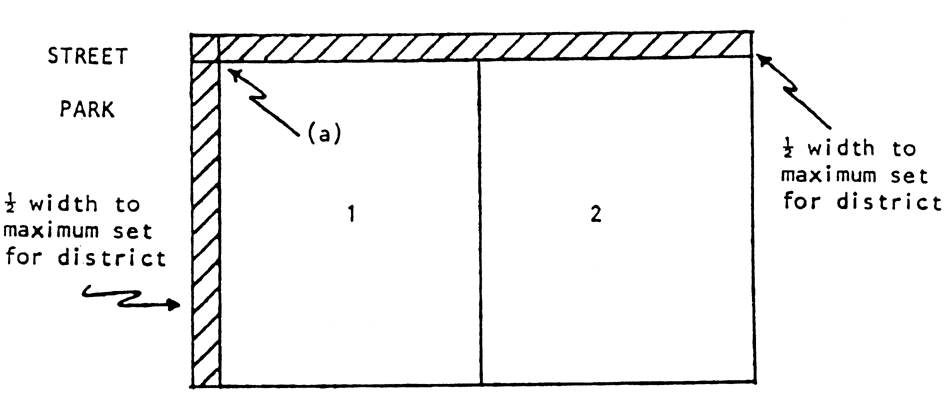
Gross area of a regular lot shall be computed as net area plus half of adjoining permanent open space, such as streets, parks, floodplains or slopes on which building is prohibited, or lands dedicated or covenanted to remain in permanent open space, up to a maximum specified for the district. Where such permanent open space adjoins a lot on two or more adjacent sides, the area thus added shall include the area required to complete the gap otherwise left at the intersection, as indicated at (a) below:
Street Park
The gross area of lot 1 is thus the area within its boundaries plus the hatched areas at the top and side, including the small rectangle marked (a).
Major arterial. A street or highway of great continuity designed to accommodate the highest traffic volumes and longest trip desires. Major arterials are defined and designated in the major street plan.
Major collector. A street of reasonable continuity that channels traffic between arterials and from other collector streets to the arterial system. Major collectors are defined and designated in the major street plan.
Major repair work. Any work on a motorized vehicle, including, but not limited to, major mechanical and body work, straightening of body parts, painting, welding, storage of automobiles not in operating condition or other work involving noise, glare, fumes, smoke or vibration.
Major street plan. The latest adopted major street plan of the City of Huntsville as it may be from time to time amended.
Mineral. Any substance, organic or inorganic, found in nature as part of the earth and having sufficient value away from its natural location to be mined, quarried, or dug for its own sake or for its own specific use.
Minor arterial. A street or highway of considerable continuity interconnecting with and augmenting the principal arterial system and providing service to moderate length trips at a somewhat lower level of mobility. Minor arterials are defined and designated in the major street plan.
Minor collector. A street that carries traffic from a number of local streets to the major collector/arterial system, between other collectors, and from activity centers to a street of higher classification. Minor collectors are defined and designated in the major street plan.
MMDS. Multichannel multipoint distribution services (also called wireless cable).
Mobile food vending site. A collection of mobile food vending units clustered together on a single lot or parcel of land under common ownership or control.
Mobile food vending unit. A trailer or motorized vehicle designed to be portable and not permanently attached to the ground from which only prepared food or beverages are peddled, vended, sold, displayed, offered for sale, or given away.
Mobile radio services. A radio communication service that operates between mobile and fixed stations or between mobile stations. Mobile radio includes personal wireless services and private mobile radio services.
Motel. A building or group of buildings used by transient guests.
Nighttime home. See child care home.
Nursery school. A school designed to provide daytime care or instruction for two or more children from two to five years of age inclusive.
Offices. Space or rooms used for professional, administrative, clerical, and other similar uses.
Parking space. An off-street space, enclosed or unenclosed, containing not less than 180 square feet of area exclusive of driveways appurtenant thereto, permanently reserved for the temporary storage of one motor vehicle and connected without obstruction to a street or alley by a driveway.
PCS. Personal communications services.
Performing arts center. A facility for the presentation of the performing arts, including indoor live performances, and indoor and outdoor concert halls.
Permanent building. A building erected with the required footings and supported on a perimeter foundation, piers or slab; connected to all required utilities; and meeting all applicable building codes.
Personal use tower. A tower or must supporting only those antennas used for amateur radio service, non-commercial citizens band, short wave listening, residential TV and/or radio broadcast reception or other personal radio enthusiast or public service purposes, which are used entirely on a non-revenue-producing basis.
Personal wireless services. Includes commercial mobile services, unlicensed wireless services, and common carrier wireless exchange access services as defined by the Federal Communications Commission.
Photovoltaic solar energy production facility. Consists of one or more freestanding ground, pole, or roof mounted solar collector devices, solar related equipment and other accessory structures and buildings including substations, electrical infrastructure, transmission lines and other appurtenant structures and facilities.
Portable storage structure. A transportable storage structure that is designed and used primarily for the storage of household goods, personal items and other materials for use on a limited basis on residential property. Such structures are uniquely designed for their ease of loading to and from a transport vehicle. For the purposes of this ordinance, the trailer portion of a tractor trailer, boxcars and shipping containers shall also be considered portable storage structures when expressly used for the purposes of on-site storage in residential districts.
Portable tower, mobile tower or truck-mounted tower. Towers designed to be portable, whether or not the facility of which they are a part is permanently affixed to the ground, a building, or other permanent structure and utilized to supplement the service of a personal wireless service provider on a temporary basis.
Private accessway. A private vehicular thoroughfare permanently reserved in order to provide a means of access to more than one zoning lot, all having frontage on a public or private street.
Private mobile radio services. Includes mobile radio services such as two-way radio used by public safety, special emergency, land transportation, and industrial radio service users.
Quarry. An extraction operation in which rock, stone or any mineral other than sand, gravel and soil is removed or excavated for the purpose of disposition away from the immediate premises whether such disposition is immediate or in the future.
Radio. Generic term referring to the communication of impulses, sounds and pictures through space by means of electromagnetic waves.
Reclamation. The reconditioning or rehabilitation of land used for an extraction activity to make it suitable for the expected future use.
Residence. A residence is: (1) a domicile; or (2) a family's place of habitation for a period of 180 continuous days or more. This term does not include transient occupancy. Related terms, including, but not limited to, the terms reside, residing, resident, and residential, shall have meanings consistent with the term residence.
Rooming house. A rooming house is a building where, for compensation, individual rooms are provided by a resident or non-resident landlord/operator for up to ten (10) transient or non-transient, related or unrelated individuals, and in which the roomers share common areas, and where the landlord/operator may supply some services such as laundry and cleaning services.
Sand pit. A site from which sand is removed or excavated for the purpose of disposition away from the immediate premises whether such disposition is immediate or in the future.
Seating capacity. Number of seats or occupancy permitted in any area as established by the Huntsville Bureau of Fire Prevention in accordance with relevant safety codes.
Sign. See article 72, sign control regulations.
Single housekeeping unit. A single housekeeping unit is a household consisting of a non-transient individual, or a non-transient interactive group of individuals jointly occupying an abode, including joint access to and use of all common living areas, including living, kitchen, and eating areas within the abode. A single housekeeping unit may also be comprised of domestic servants; one professional caregiver at any one time; and gratuitous, temporary guests of a resident. The term does not include transients, occupants of a boarding house or rooming house, or occupants that act as separate roomers or boarders.
Soil pit. A site where dirt or soil is removed below the grade of surrounding land for any purpose other than that necessary for and incidental to site grading or building construction.
Stability. The safety factor for stability is the sum of the forces which resist downslope movement divided by the sum of the forces which would cause downslope movement. For stability a value of unity (1.0) represents static equilibrium, and any value less than 1.0 represents failure. A minimum safety factor of 1.5 is commonly recommended for stability.
Story. That portion of a building included between the surface of any floor and the surface of the floor next above it, or if there be no floor above it, then the space between any floor and the ceiling next above it.
Story, half. A top floor in which the floor area with eight feet or more of head clearance is less than 50 percent of the floor area of the story next below.
Street. Any public or private way set aside for common travel more than 21 feet in width if such existed at the time of enactment of this ordinance, or such right-of-way 40 feet or more in width if established thereafter.
Street frontage. All the property on one side of a street between two intersecting streets (crossing or terminating), or if the street is dead ended, then all of the property abutting on one side between an intersecting street and the dead end of the street. In no case shall this definition be construed to mean or include any portion of a dead end street which is perpendicular to the centerline of the street. For the purpose of this definition, a cul-de-sac is not considered a dead end street.
Structure. Any combination of materials, including buildings, constructed or erected, the use of which requires location on the ground or attachment to anything having location on the ground, including among other things, signs, billboards, and fences, but not including telephone poles and overhead wires, fences less than three feet high, retaining walls or terraces.
Subdivision regulations. Subdivision Regulations of the City of Huntsville adopted September 29, 1949, or as may be revised or amended from time to time.
Swimming pools, private. Permanent or semi-permanent pools accessory to residential uses; this does not include portable plastic wading pools.
Total floor area. The area of all floors of a building including finished attics and basements when considered as a story under the terms of this ordinance.
Tourist home. A dwelling in a residential district in which the permitted area for business use under this ordinance consists of rooms for the accommodations of paying transient guests.
Trailer camp. Any site, lot, field, or tract of land privately or publicly owned or operated, upon which two or more house trailers used for living, eating, or sleeping quarters are located; such establishments being open and designated to the public as places where temporary residential accommodations are available, whether operated for or without compensation, by whatsoever name or title they are colloquially or commercially termed.
Trailer regulations. Madison County Regulations governing the construction, equipment, and operations of trailer camps adopted and approved August 25, 1966, as the same may be amended.
Transient. The term transient means an individual or family who is temporarily boarding, rooming, lodging, or otherwise staying in a place for a period of less than 180 continuous days. Where there is a legal arrangement, including a lease, that purports to have a term of 180 continuous days or more, but which has been negotiated to allow or allows for a shorter term in an attempt to evade the length-of-stay requirement, the individual or family shall nevertheless be treated as being engaged in a transient stay.
Transmitter. Equipment that generates radio signals for transmission via antenna.
TVBS. Television broadcast station.
Use. The purpose for which land, or a building or other structure is designed, arranged, or intended, or for which it is or may be occupied or maintained.
Variance. A variance is a relaxation of the terms of the Zoning Ordinance where such variance will not be contrary to the public interest and where, owing to the conditions peculiar to the property and not the result of the action of the applicant, a literal enforcement of the ordinance would result in unnecessary and undue hardship. As used in this ordinance, a variance is authorized only for height, area, and size of structure, or size of yards and open spaces; establishment or expansion of a use otherwise prohibited shall not be allowed by variance, nor shall a variance be granted because of the presence of non-conformities in the zoning district or adjoining zoning districts. (63-93)
Wireless telecommunications. Any transmission or reception of signs, signals, writing, images, sounds, and/or data of any nature by means of the electromagnetic spectrum. Wireless telecommunications include but are not limited to cellular telephone, personal communication services (PCS), commercial and private mobile radio, paging, public safety, fixed point microwave, amateur radio, radio and television broadcasting, satellite services such as direct broadcast satellite (DBS), and multichannel multipoint distribution services (MMDS).
Wireless telecommunications tower. A structure, such as a self-supporting lattice tower, a guyed tower, or a monopole, designed and constructed primarily for the purpose of supporting one or more antennas, which may include accessory facilities necessary for equipment storage and unmanned operations.
Yard. A yard is an open space other than a court, unoccupied and unobstructed by any structure or portion of a structure from 36 inches above the general ground level of the graded lot upward (except as otherwise provided by these regulations); provided, however, that fences and walls may be permitted in any yard subject to any height limitations established herein, and further provided that poles, posts, and other customary yard accessories, ornaments and furniture shall be permitted in any required yard if they do not constitute substantial impediments to [the] free flow of light and air across the yard to adjoining properties.
Ordinary projections of window sills, belt courses, chimneys, cornices, eaves and similar architectural features, and air conditioners or similar appliances, shall not project more than two feet into any required yard, and no support for a roof shall be based in any required yard.
Yard, front. A yard extending across the front of a lot between the side lot lines. Corner lots have two front yards, as described in section 73.7 hereof. Front yards are measured at the building line.
Yard, rear. A yard extending across the rear of a lot between the side lot lines. The rear yard shall be to the rear of the front yard, as described in section 73.7 hereof.
Yard, side. A yard between the main building and the side lot line and extending from the required front yard to the required rear yard, as described in section 73.7 hereof.
(Ord. No. 96-1008, § 1, 1-23-1997; Ord. No. 97-512, § 1, 8-14-1997; Ord. No. 98-104, § 1, 3-26-1998; Ord. No. 98-689, § 1, 10-1-1998; Ord. No. 99-206, § 2, 4-8-1999; Ord. No. 01-732, § 1, 10-25-2001; Ord. No. 03-593, § 1, 8-14-2003; Ord. No. 05-013, § 1, 2-10-2005; ; Ord. No. 06-730, § 1, 10-12-2006; Ord. No. 06-826, § 1, 10-26-2006; Ord. No. 06-1203, § 1, 1-25-2007; Ord. No. 07-401, § 1, 6-14-2007; Ord. No. 08-529, § 1, 8-14-2008; Ord. No. 11-11, § 3, 2-24-2011; Ord. No. 11-899, § 1, 1-26-2012; Ord. No. 12-466, § 1, 8-23-2012; Ord. No. 13-882, § 1, 12-19-2013; Ord. No. 14-576, § 1, 9-25-2014; Ord. No. 15-406, § 1, 7-23-2015; Ord. No. 21-46, § 2(a), 2-25-2021; Ord. No. 24-289, §§ 1, 2, 5-23-2024; Ord. No. 25-267, §§ 1, 2, 6-12-2025)

