
Huntsville City Zoning Code
ARTICLE 72
- SIGN CONTROL REGULATIONS15
Editor's note—Ord. No. 21-46, § 1(Exh. A, § A), February 25,2021, repealed the former article 72, §§ 72.1—72.13, and enacted a new article 72 as set out herein. The former article 72 pertained to similar subject matter. See Code Comparative Table for complete derivation.
72.1.- Findings and purpose.
72.1.1 Signs are an important visual communication tool that benefits our community and its citizens, and the messages they contain are a protected constitutional right under the First Amendment.
72.1.2 In the interest of furthering the purpose of this zoning ordinance, these sign regulations are herein established to provide for the use, location, and size of signs in a manner that ensures that signs are in harmony with the character of the associated use and surrounding area. More specifically, the purposes of these regulations are to:
(1)
Promote and maintain attractive, high value residential, commercial and industrial areas;
(2)
Control the size, location, and general design so that signs will be aesthetically harmonious and in context with the area in which they are located;
(3)
Eliminate any conflict that would be hazardous between signs and traffic control signs and traffic control devices; and
(4)
Ensure that signs are located and designed to maintain a safe and orderly pedestrian and vehicular environment.
72.1.3 In establishing these purposes, the city has determined that signs may be unduly distracting to motorists and pedestrians, and thereby create a traffic hazard and reduce the effectiveness of signs needed to direct the public and therefore regulations are necessary.
72.1.4 The provisions of this article are intended to be an exercise of the city's police powers to promote and protect the public health, safety, morals, convenience, order, prosperity, and general welfare (collectively "public welfare"), within the framework of constitutional freedoms of speech and expression, as protected by the First Amendment to the United States Constitution and Section 4 of the Alabama Constitution (Ala. Const. Art. I, § 4). All regulations in this article are to be construed, whenever possible, in favor of vigorous political debate and accommodation of the rights of persons to speak freely.
(Ord. No. 21-46, § 1(Exh. A, § A), 2-25-2021)
72.2. - Definitions.
72.2.1 For the purpose of this article, certain words and phrases shall have the meanings respectively ascribed to them within this section. Additional terms within this article that are utilized throughout the zoning ordinance may also be defined in article 3 of the zoning ordinance. See also the definitions and rules of construction set forth in section 1-2 of the Code of Ordinances of the City of Huntsville, which generally apply to all ordinances of the city.
72.2.2 Where terms are related to measurements and calculations set out in this article (e.g., sign height, setbacks, sign area, etc.), such terms are defined in section 72.3.
Alter (or its derivations). Any change in a sign, or related structure, that changes its exterior dimensions or otherwise changes the sign's size, height, structure type, or illumination.
Apartment building. For the purposes of this article, a single building housing multiple dwelling units, including leaseholds or condominiums, and that is not a part of an apartment complex.
Apartment complex. A series of buildings housing a complex of multi-family dwelling units, including leaseholds or condominiums, on a single lot.
Attached sign. Any sign that is directly attached to a building or that is attached to a non-structural element, such as an awning or canopy, which non-structural element is affixed to the building.
Awning. A shelter projecting from and supported by the exterior wall of a building constructed of non-rigid materials on a supporting framework.
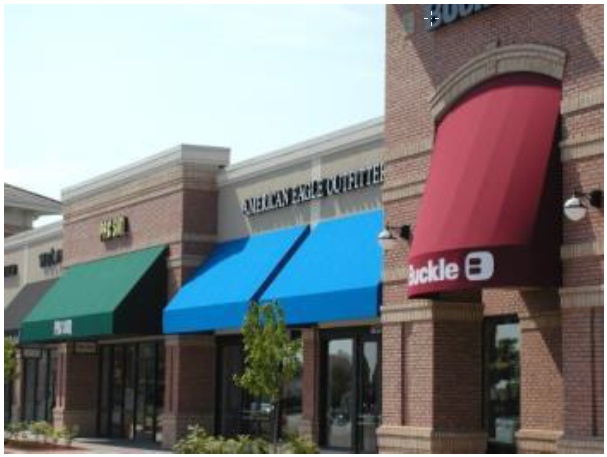
Examples of traditional awnings
Awning sign. A permanent, attached sign that is painted on, applied to, or otherwise is a part of a fabric or other non-structural awning which awning is affixed to the building. An awning sign is considered an "attached sign".
Building. Where the term "building" is used in reference to the location of a sign it means a primary building on a lot and does not include accessory buildings or accessory structures. In those districts that do not have side yard setback requirements and buildings share a common wall, then a change from one building to another shall occur when there is a firewall separating the buildings.
Building unit. A stand-alone building or a building divided into separate units or spaces that are individually owned or leased by different enterprises, businesses, firms, or other nonresidential occupants, and which meets the following conditions:
• Where a building is divided into individual spaces, each space with its own exterior entry or access point directly into the space shall be consider a building unit.
• Where a building contains individual spaces that are all accessed from the interior through a joint entry, such building shall be considered one building unit.
• Where a lot contains multiple principal buildings, each building shall be considered a building unit.
"Building unit" shall not be used to define an apartment building or similar residential-only building that is divided into individual dwelling units. For a mixed-use building, as defined in this article, the number of building units on any given lot shall be determined by the number of nonresidential enterprises, businesses, firms, or other nonresidential occupants.
Campus. A complex of buildings and grounds that belong to a given institution, either academic or non-academic.
Canopy. A permanent structure made of cloth, metal, or other material attached or unattached to a building for the purpose of providing shelter to patrons or automobiles, or as a decorative feature on a building wall. A canopy is not a completely enclosed structure but typically is supported by features other than the building façade (e.g., structural legs, building extensions, etc.).
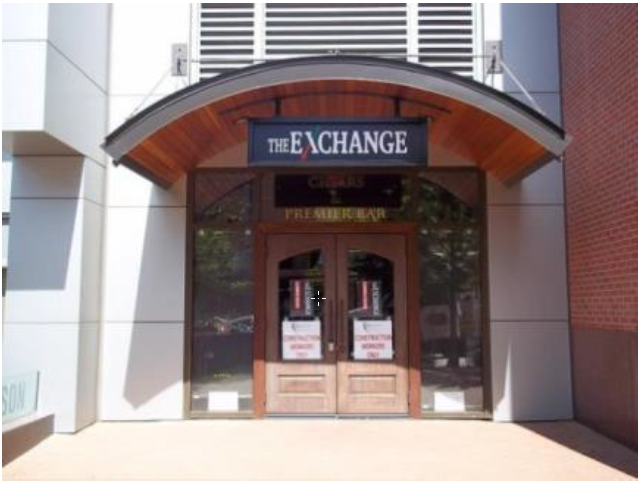
Example of a canopy and related sign
Canopy sign. A permanent sign that is a part of or attached to a canopy and is considered an "attached sign".
Changeable copy sign. A sign designed so that the characters, letters, or illustrations can be changed or rearranged manually or electronically without altering the sign display surface. May also be known as readerboards. See also the definition of "electronic display sign."
Commercial use sign. A sign, regardless of the message it contains, for which the person that owns, leases, or otherwise controls the sign structure or the premises on which the sign is located, receives consideration, whether monetary or another form of value, for the use of the sign structure or the premises for a sign, or otherwise holds out the sign as being available in exchange for consideration.
Complex. One or more lots used as an integrated development or project with a common identity or common ownership.
Detached sign. Any sign affixed to or supported upon the ground by a monument, pedestal, pole, bracing, or other permanent structural element and not attached to any building.
Driveway signs. A small permanent sign located near driveway access points or at the intersection of internal access drives.
Electronic display sign. A sign designed so that the characters, letters, or illustrations can be changed or rearranged automatically on a lamp bank or through mechanical means (e.g., electronic or digital signs).
Façade. The exterior wall on the front, side, or rear elevation of the building regardless of whether the building side faces a street.
Feather sign A temporary sign that is constructed of cloth, canvas, plastic fabric or similar lightweight, non-rigid material and that is supported by a single vertical pole mounted into the ground or on a portable structure. Such sign may take the shape of a feather, tear drop, or any other shape.
Ground sign. A permanent, detached sign other than a pylon or monument sign, which is affixed to the ground by no more than two poles, columns, or uprights permanently imbedded in the ground.
Hanging sign. A permanent, attached sign suspended from, and located entirely under a covered porch, covered walkway, canopy, or an awning, which are attached to a building. A hanging sign shall be considered an "attached sign".
Illuminated sign. A sign with an artificial light source incorporated internal to the sign or projected externally onto the sign for the purpose of illuminating the sign, which includes signs made from neon or other gas tube(s) that are bent to form letters, symbols, or other shapes. An illuminated sign excludes electronic display signs, which are addressed separately.
Legible. A sign shall be considered legible from a stated location if a person who is between five and six feet tall can read and decipher the sign.
Lot. A lot is a parcel of land. For the regulatory purposes of this ordinance a lot may consist of a single lot of record, a portion of a lot of record, combinations of adjacent individual lots or portions of lots, or a parcel described by metes and bounds, provided that in no case of division or combination by private action shall any residual lot be created which does not meet the requirements of this ordinance and other applicable regulations.
Mixed-use building. A single building that blends residential uses with nonresidential uses, where those functions are physically and functionally integrated. See also the definition of "building unit" for use as part of a mixed-use building.
Mobile sign. A sign painted on or affixed to motor vehicles, or to open or enclosed trailers, designed and licensed for transportation of cargo on the public streets.
Monument sign. A permanent detached sign, other than a pylon or ground sign, not attached to a building, which is placed upon or supported by the ground independently of any other structure, typically on a monument or pedestal structure.
Non-conforming sign. Any sign that was erected legally prior to the adoption of this ordinance, or amendment thereto, but which does not comply with subsequently enacted sign restrictions and regulations or a sign which does not conform to the regulations of this article.
Park. An area or district with multiple buildings and/or building units within a controlled environment designed around an attractive, park-like setting, or enhanced landscaping, that is intended to promote a particular field of endeavor, such as a research park, business park, or an industrial park.
Pedestrian gateway sign. A permanent, detached sign that is intended to be placed in locations only visible by pedestrians including, trails, sidewalks, and similar pathways in large-scale complexes.
Permanent sign. A sign permitted by this ordinance to be located on the premises and designed to be permanently attached to a structure or the ground. Such sign is constructed of rigid, non-flexible materials.
Permitted use building. A building that houses one or more uses that are allowed as a matter of right in the applicable zoning district or allowed by special exception. The term does not include a building that houses only a variant use or non-conforming use. This term may also be qualified as follows:
• A "permitted nonresidential use building" shall mean where the principal building contains a permitted use, that is not a residential use, in the applicable district. Permitted mixed use buildings shall be considered a permitted nonresidential use building for the purposes of this article, regardless of presence of residential dwelling units.
• A "permitted residential use building" shall mean where the principal building contains a permitted principal residential use in the applicable district, including any permitted accessory uses (e.g., customary home occupations).
Portable sign. Any sign not attached to a building or the ground that is designed to be transported, including signs designed to be transported by means of wheels. This definition shall not include "sidewalk sign" or other defined temporary sign types.
Projecting sign. A sign that is affixed perpendicular to a building or wall and extends more than eight inches beyond the face of such building or wall and the lowest point of which sign is not less than 12 feet above the sidewalk or ground level. A projecting sign shall be considered an "attached sign".
Pylon sign. A permanent, detached sign other than a monument or ground sign, that is supported by no more than two, 24-inch structural elements which are architecturally similar to the design of the sign.
Repair. The replacement of any part of a sign with equivalent material for the purpose of maintenance that does not affect its design, size, structural framework, exterior dimensions, or its structural members and uprights.
Required yard. The area (front, side, and rear yard) that lies between a property line and the required setback line for primary structures according to the provisions of this zoning ordinance.
Residential. The use of a building, or portion thereof, as a residence (dwelling unit), or a vacant lot in a residential district. The term does not include a dormitory or other housing associated with a campus.
Residential district. Those districts that are identified in chapter 1 and chapter 8, article 80 of this zoning ordinance.
Residential subdivision. A multi-lot residential subdivision or development consisting of at least six lots, which is developed as an integrated development or project with a common identity
Right-of-way. A strip or area of land dedicated for use as a public roadway, railroad, or dedicated for other public uses. For streets, the right-of-way typically includes the paved roadway, curbs, lawn strips, sidewalks, lighting, drainage facilities and utilities and may include special features (required by the topography or treatment) such as grade separation, landscaped areas, viaducts, and bridges.
Roof sign. A sign which is affixed to and which extends above the roof of any building. A roof sign shall be considered an "attached sign".
Sidewalk sign. A temporary sign that may be placed on a public sidewalk or on a private sidewalk/walkway, during business hours in accordance with this article and which may include an "A-frame sign" or a "T-frame sign" as defined below:
• A-Frame sign means a detached temporary sign that is ordinarily in the shape of an "A" or some variation thereof, which is readily moveable, and is not permanently attached to the ground or any structure.
• T-Frame sign means a detached temporary sign that is ordinarily in the shape of an upside down "T" or some variation thereof, which is readily moveable, and is not permanently attached to the ground or any structure.
Sign. A structure, device, or surface that contains, supports, or displays sign copy.
Sign area. The total area of a sign face as measured pursuant to section 72.3.3.
Sign copy. Letters, numerals, figures, symbols, logos, pictorial, or graphic elements comprising the content or message of a sign.
Sign face. The surface of the sign upon, against, or through which the message of the sign is exhibited.
Street frontage. The distance for which a lot line adjoins a public street, from the lot line intersecting said street to the furthest distant lot line intersecting the same street. Alternatively, where the number of signs is based on the number of street frontages, a street frontage means a continuous border between the subject property and a public street or road.
Temporary sign. A non-permanent sign that is neither permanently anchored to the ground, nor permanently affixed to a structure, nor mounted on a chassis.
Temporary yard sign. Any temporary detached sign that is not defined as a "sidewalk sign."
V-Mounted sign. An attached, permanent sign with two attached sides in which the faces of said sign are not parallel and the smallest angle of said sign is not greater than 30 degrees. A v-mounted sign shall be considered an "attached sign".
Wall sign. A permanent sign attached directly to an exterior wall of a building and which does not extend more than a certain distance from the façade, as established in this article, nor above the roof line or beyond the limits of the outside wall. The exposed face of the sign in a plane parallel to the building wall. A wall sign shall be considered an "attached sign".
Zoning administrator. The chief enforcement officer of the zoning ordinance as designated by the director of planning, or any of their authorized designees, assistants, or inspectors.
(Ord. No. 21-46, § 1(Exh. A, § A), 2-25-2021)
72.3. - Calculations and measurements.
For the purpose of this article, the following shall be the method for determining and interpreting any form of calculation or measurement.
72.3.1 Sign setback. All required setbacks for signs shall be measured as the distance in feet from the applicable lot line, or other stated point of measurement, to the closest point on the sign structure.
72.3.2 Sign height.
(1)
The height of a sign shall be computed as the distance from the base of the sign at normal grade (average grade at the base of the sign) to the top of the highest attached component of the sign. Normal grade shall be construed to be the newly established grade after construction, exclusive of any filling, berming, mounding, or excavating undertaken for the purpose of locating or increasing the height of sign.
(2)
The filling of a pre-existing hole or depression to create an average grade at the same level as that surrounding the hole or depression is permitted, provided such filling is allowed by other ordinances.
(3)
In cases where the normal grade is below grade at street level, sign height shall be computed on the assumption that the elevation of the normal grade at the base of the sign is equal to the elevation of the nearest point of the crown of a public or private street. See figure A.
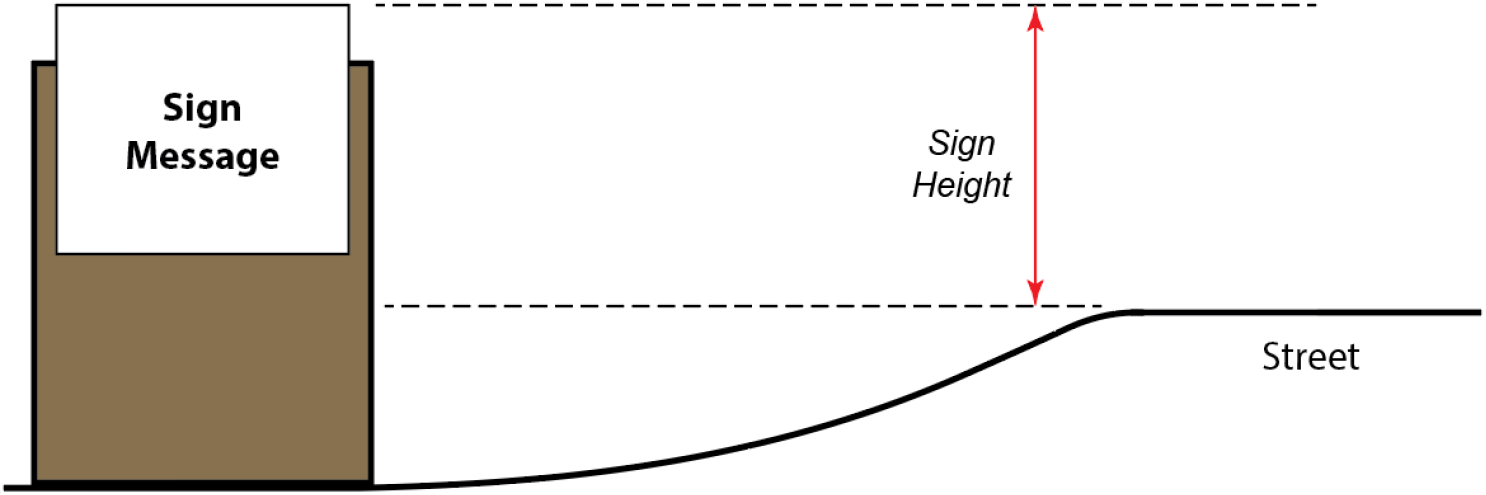
Figure A: Illustration of the measurement of sign height when the grade at the bottom
of the sign is below the grade of the adjacent street.
(4)
Any material whose major function is providing structural support for a sign shall be considered part of the sign for purposes of determining sign height.
(5)
Where a distance is established for the clearance of a sign, such measurements shall be made from the normal grade of the ground, directly under the applicable sign or structure supporting the sign, and the bottom most point of the sign or the structure supporting the sign, whichever is closest.
72.3.3 Sign area. The surface of a sign to be included when computing maximum allowable square footage of sign area shall be calculated as follows:
(1)
For sign copy mounted or painted on a background panel, cabinet, or surface distinctively painted, textured, lighted, or constructed to serve as the background for the sign copy, the sign area shall be computed by means of the smallest square, circle, rectangle, triangle, or combination thereof that encompasses the extreme limits of the background panel, cabinet, or surface. See figure B and figure C.
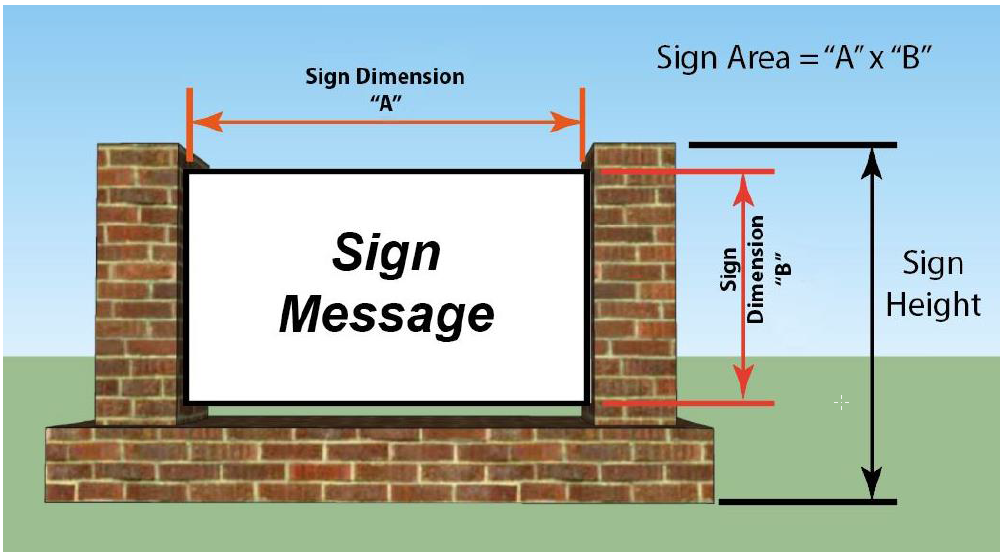
Figure B: Illustration of sign area calculation for a monument sign with copy on a
distinct cabinet.
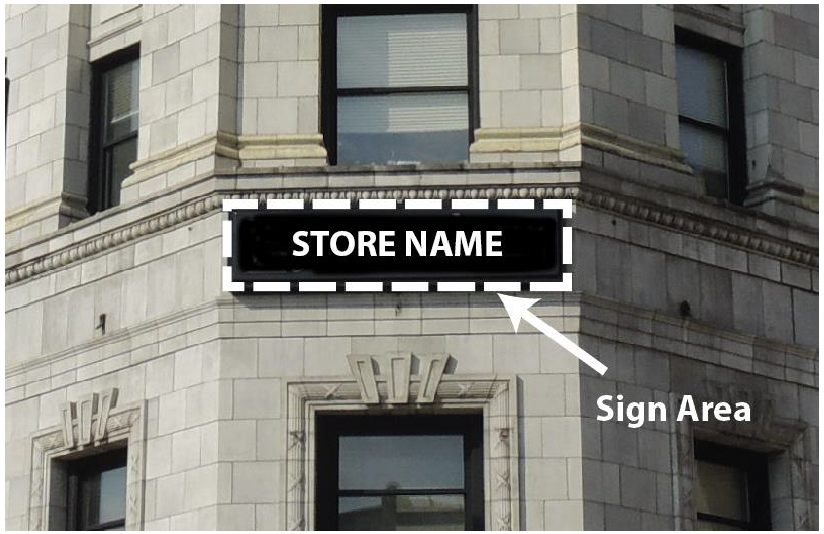
Figure C: Illustration of computing the sign area for wall signs with a background
panel or cabinet.
(2)
For sign copy where individual letters or elements are mounted on a building façade where there is no background panel, cabinet, or surface distinctively painted, textured, lighted, or constructed to serve as the background for the sign copy, the sign area shall be computed by means of the combination of the smallest square, circle, rectangle, triangle, or combination thereof that encloses all the letters or elements associated with the sign. See figure D.
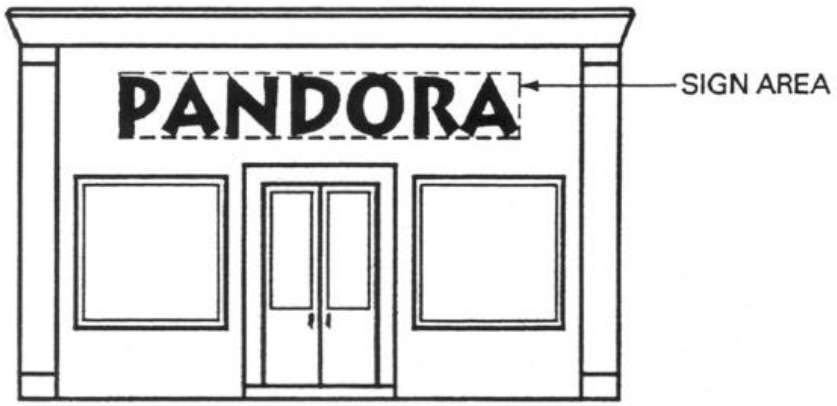
Figure D: Illustration of sign area calculation for two differently shaped wall signs
with individual letters.
(3)
In cases where there are multiple sign elements on the same surface, the zoning administrator shall have the authority to determine the outermost boundaries of individual sign elements based on the shape of the sign and the distance separating various elements of sign copy. Decorative edging or other window treatments that are not an integral part of the sign copy shall not be considered a part of the sign for the purposes of this article.
(4)
The calculation of sign area shall not include any supporting framework, bracing, or decorative fence or wall unless such structural support is determined to constitute an integral part of the sign design by means of any form of sign copy, as determined by the zoning administrator. See figure A.
(5)
In the case of a three-dimensional sign where the sign faces are not mounted back-to-back, the sign area shall be calculated by the smallest square, circle, rectangle, triangle, or combination thereof that encompasses the profile of the sign message, multiplied by two. The profile used shall be the largest area of the sign face visible from any one point.
(6)
Except for three-dimensional signs, the sign area for a sign with more than one face (multi-faced signs) shall be computed by adding together the area of all sign faces unless two sign faces are mounted back-to-back.
(7)
When two flat sign faces are placed back-to-back and when such sign faces are part of the same sign structure and are not more than 12 inches apart, the sign area shall be computed by the measurement of one of the faces. If the two faces are unequal, the sign area shall be calculated based on the larger of the two faces.
72.3.4 Determining width of building facades.
(1)
For the purposes of this article, the length of the building wall that faces a public street shall be considered the building facade unless otherwise stated.
(2)
The calculation of the width or lineal measurement of any façade shall be the measurement of the façade between two side facades. The calculation shall be based on viewing the façade from a 90-degree angle (i.e., straight on), regardless of façade insets, offsets, or angles. See figure E.
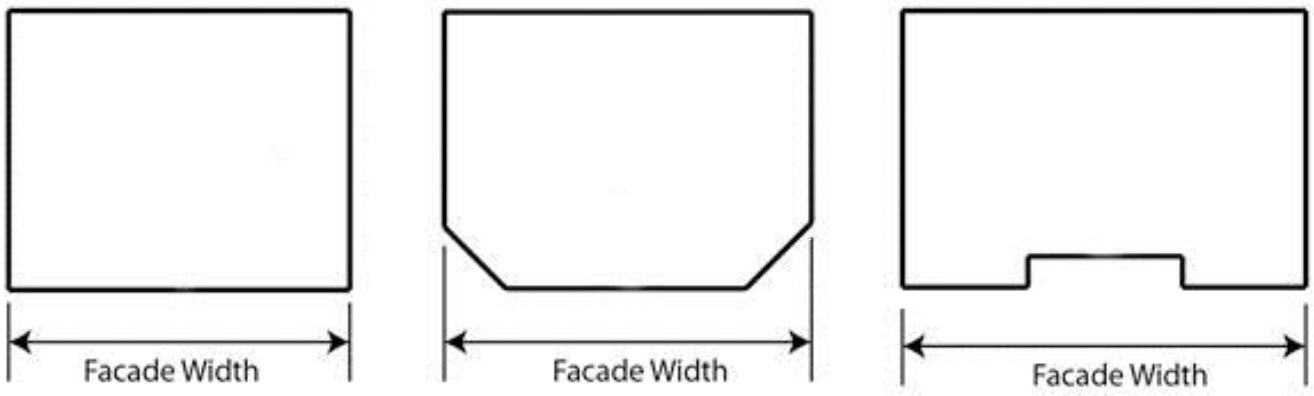
Figure E: Illustration of façade width measurement on varied façade shapes.
(Ord. No. 21-46, § 1(Exh. A, § A), 2-25-2021)
72.4. - Compliance with article; coverage; variant and non-conforming uses; exclusions from article.
72.4.1 Compliance with article. No premises within the corporate limits of the City of Huntsville shall be used to construct, erect, or maintain a sign that does not meet the requirements of this article, and it shall be unlawful for any person to use premises in the corporate limit of the city to construct, erect, or maintain a sign that is not in conformity with the requirements of this article.
72.4.2 This article shall only apply to any sign, in any zoning district, that is outdoors and displaying sign copy that is visible from a public right-of-way or otherwise visible to the general public. This article is not intended to, and does not, regulate signs inside of homes or other buildings.
72.4.3 Any sign legally established prior to the effective date of this article, or amendments thereto, and which sign is rendered non-conforming by the provisions herein, shall be subject to the non-conforming sign regulations of section 72.9.
72.4.4 Coverage.
(1)
Nothing in this article shall be construed to affect the franchise authority of the city.
(2)
Nothing in this article shall be construed to allow or give permission to any person to install a sign on private property without the consent of the owner of the property or the person otherwise in possession or control of the property. Where a sign has been placed on premises without proper consent, the sign shall constitute a trespass.
(3)
Nothing in this article shall be construed to exempt from or except the application of the building and other technical codes of the city to the installation of signs.
72.4.5 Variant and non-conforming uses.
(1)
Notwithstanding anything to the contrary contained in this article, where nonresidential uses are allowed by variance, the permanent signs allowed, if any, shall be as approved in connection with the variance.
(2)
Notwithstanding anything to the contrary contained in this article, where nonresidential uses are classified as a non-conforming use under the provisions of article 74, unless a variance has been granted for permanent signage associated with the non-conforming use or the permanent signage itself is grandfathered in accordance with the provisions of this article, then the non- conforming use is not allowed a permanent sign for the premises. Temporary signs shall only be permitted in accordance with the applicable zoning district
72.4.6 Exclusions from article
(1)
Excluded by law. In some cases, federal and state law preempt or otherwise limit or prohibit the city's regulatory authority over signs, which may include, signs required by state or federal law including signs ordered in the case of bankruptcies and government-function signs. It is not the intent of this ordinance to challenge or create conflicts with or act contrary to such law and thus this article shall not apply in such cases.
(2)
Exclusion from this article does not relieve a person from complying with other applicable laws, including the building and electrical codes of the city.
(3)
Maintenance. Unless otherwise preempted by applicable law, exclusion from this article, including exclusions under this section and definitional exceptions to the term "sign", shall not be construed to exclude or exempt the sign from being maintained in good condition, order, and repair in accordance with section 72.13 of this article; and references to the term sign or permitted sign in section 72.13 shall include such exclusions or exceptions.
72.4.7 Reclassification of signage. If the type of any sign that legally existed prior to the effective date of this amendment is reclassified by this amendment, such sign shall be classified as the sign type defined in this article and shall be subject to the applicable standards for such sign type from the effective date of this amendment. Such reclassification shall be regardless of any variances that were approved prior to the effective date of this amendment.
(Ord. No. 21-46, § 1(Exh. A, § A), 2-25-2021)
72.5. - Residential subdivision, apartment building, or apartment complex signs.
Permanent signs may be permitted within a residential subdivision, an apartment building, or for an apartment complex in accordance with the following:
72.5.1 The placement and allocation of the permanent sign may be reviewed and decided upon during the subdivision platting process or as part of a site plan review, whichever is applicable or comes first where both are required. However, a sign permit will be required for the installation or any changes to the signs in accordance with this article.
72.5.2 Residential subdivisions. Residential subdivisions that have six or more lots are permitted the following signs:
(1)
No more than two monument signs shall be permitted at each major entrance, the location of which shall be determined by the zoning administrator.
(2)
The signs shall be located within 150 feet of the established major entrance.
(3)
The monument signs must be located the greater of either ten feet from the existing or proposed public right-of-way or 15 feet from the back of curb or edge of pavement if there is no curb; and 15 feet from the curb entrance of any drive or accessway.
(4)
The maximum sign area for any single monument sign shall be 40 square feet. The maximum height shall be five feet, excluding a base with a maximum one foot of height.
(5)
The placement of such signage shall be determined during the layout approval process and shall be based on the entire subdivision and not on individual phases.
72.5.3 Apartment complexes. Apartment complexes that have 50 or more dwelling units are permitted the following signs:
(1)
Where an apartment complex is located in a residential zoning district, the complex shall be permitted to have the same monument signs as is allowed for residential subdivisions in section 72.5.2 above.
(2)
Where an apartment complex is located in a nonresidential zoning district, the complex shall be permitted to have the same type of detached sign as a lot with a single building unit in the applicable zoning district. Such sign shall not include an electronic display sign. Additionally, any building in the apartment complex used for office space shall be permitted to have the same amount of attached signs as permitted in the applicable zoning district.
72.5.4 Apartment buildings. Apartment buildings that have 25 or more dwelling units are permitted the following signs:
(1)
One projecting sign not to exceed 40 square feet in sign area is allowed per street frontage.
(2)
The sign may project over the public sidewalk to the same extent as other similar sign structures in the same district.
(Ord. No. 21-46, § 1(Exh. A, § A), 2-25-2021)
72.6. - Temporary signs.
72.6.1 Standards applicable to all temporary signs. Unless provided for otherwise, each of the following conditions shall apply to all temporary signs:
(1)
Temporary signs shall not be mounted, attached, affixed, installed, or otherwise secured in a manner that will make the sign a permanent sign.
(2)
Temporary signs shall not be illuminated.
(3)
No temporary sign shall be installed that requires a foundation, support, wiring, fittings, or elements that would traditionally require a building permit or electrical permit.
(4)
Temporary signs shall not contain any changeable copy.
(5)
All temporary signs shall be secured in such a manner as to prevent swinging or other significantly noticeable movement resulting from the wind that could pose a danger to people, vehicles, or structures.
(6)
Mobile signs on wheels, runners, casters, parked trailers, parked vehicles, or other temporary or movable signs shall not be permitted unless otherwise specifically stated in this article.
(7)
Temporary signs shall be constructed of durable fabric, plastic, paper, or other light pliable material. Because of the nature of materials typically used to construct temporary signs and to avoid the unsightliness of deteriorating signs and all safety concerns which accompany such a condition, temporary signs shall be removed or replaced when such sign is a deteriorated sign.
(8)
Temporary signs shall be located outside the public right-of-way, which shall be presumed if the sign is located at least ten feet from the back of curb or the edge of pavement if there is no curb.
(9)
No part of any temporary sign shall be erected closer than ten feet to any overhead electric, cable, telephone or other transmission line nor closer than five feet to any property line.
(10)
Temporary signs may be located in a required yard provided that they do not create a visibility obstruction or violate the visibility obstruction regulations established in this article.
(11)
Temporary signs shall not be placed on utility poles, light poles, or other similar structures.
(12)
Commercial use signs are prohibited.
(13)
The general sign standards set forth in section 72.8 of this article shall apply to temporary signs, unless this section provides otherwise.
72.6.2 Temporary sign removal. A temporary sign shall be removed when the sign has deteriorated, as determined by the Zoning Administrator.
72.6.3 Temporary signs on residential premises.
(1)
The total combined sign area of all temporary signs on any lot with a permitted residential use building or on any vacant lot in a residential zoning district shall not exceed 40 square feet. No individual temporary sign shall exceed 20 square feet in sign area.
(2)
On vacant lots that are five acres or larger, the total combined sign area may be increased to a total of 40 square feet of temporary sign area along each street frontage and no individual temporary sign shall exceed 40 square feet.
(3)
The maximum height of any sign shall be four feet.
72.6.4 Temporary signs on nonresidential premises. The following temporary signs are permitted on any lot where there is a permitted nonresidential use building or on any vacant lot in a nonresidential zoning district.
(1)
Attached signs. Except in research park district and research park west districts (See subsection 72.6.4(2)(c).), the following attached signs shall be allowed for any permitted nonresidential use building:
(a)
Where the use of the lot is allowed by a variance or as a permitted, non-conforming use, the lot shall be allowed to have one attached, temporary sign, except for premises located in residential districts under chapter 1 and chapter 8 of this zoning ordinance.
(b)
For each building unit, the total combined sign area of temporary attached signs shall not exceed 32 square feet. Up to four attached signs are permitted at any one time. Such attached signs shall require a sign permit.
(2)
Detached signs. The following detached, temporary signs are allowed on any lot where there is a permitted nonresidential use building or on any vacant lot in a nonresidential zoning district.
(a)
Residential districts, except for residence 2-B district:
(i)
The total combined sign area of all detached temporary signs shall not exceed 20 square feet.
(ii)
The maximum height of any sign shall be four feet.
(b)
All nonresidential districts, except for research park and research park west districts:
(i)
The total combined sign area of all detached temporary signs on any lot with a permitted nonresidential use building shall not exceed 20 square feet. No individual temporary sign shall exceed 20 square feet in sign area.
(ii)
On vacant lots, the total combined sign area may be increased to a total of 40 square feet of temporary sign area along each street frontage and no individual temporary sign shall exceed 40 square feet.
(iii)
The maximum height of any sign shall be six feet.
(c)
Research park district and research park west districts. Such signs are allowed provided the following conditions are met:
(i)
No more than one such sign per street frontage is allowed per lot, and the maximum sign area shall be 20 square feet on an improved lot and 40 square feet of a lot not improved with a building.
(ii)
Signs shall be of post and panel construction. The panel portion of the sign shall not exceed four feet in height and four feet in width for a total of 16 square feet of sign area. The overall height of the sign shall not exceed six feet. A one-foot by four-foot rider shall be allowed along the bottom of the sign.
(iii)
Sign posts shall be made of PVC or equal material and shall be white in color.
(iv)
Signs must be placed outside of and perpendicular to an existing public right-of-way and shall be set back a minimum of 20 feet from the back of curb of said public right-of-way.
(v)
When applicable, it is required to use the ground sign in place of an additional sign.
(3)
Sidewalk signs.
(a)
There shall be no time limit for sidewalk signs with the exception that the sign shall only be placed outside during the hours of the establishment's operation.
(b)
A sign permit shall be required for the initial use of a sidewalk sign when it will be placed on a public sidewalk. No additional permit shall be required unless a new occupant or tenant wishes to utilize a new sign. A permit shall not be required for the placement on a private sidewalk or walkway but such sign shall still be subject to all other applicable requirements for sidewalk signs.
(c)
There shall be a maximum number of sidewalk signs permitted in association with any single lot or building equal to the number of building units on the ground floor.
(d)
Only one sidewalk sign is allowed for any one business establishment (building unit) at one time and shall be located within ten feet of such business establishment provided that:
(i)
In the case of RPC, it shall be placed adjacent to the sidewalk. In all other districts, it shall not be placed closer than two feet to any public street as measured from the curb line;
(ii)
It shall not reduce any sidewalk width, as measured perpendicular to the curb, to less than five feet to allow for continuous unobstructed pedestrian traffic; and
(iii)
It shall not be placed in a location that will obstruct the view of a motorist or a pedestrian leaving or passing the business or shopping center.
(e)
Such signs shall not exceed three feet in height or two feet in width.
(f)
The sign may be located on a public or private sidewalk or walkway provided it is placed on pavement and not in any landscaped areas or on pavement used for vehicles (e.g., driveways and parking lots).
(g)
The sign must be free-standing and shall not be affixed, chained, anchored, or otherwise secured to the ground or to any pole, parking meter, tree, tree grate, fire hydrant, railing, or other structure.
(h)
The sign must not obstruct access to parking meters, bicycle racks and other features legally in the right-of-way.
(i)
The sign must not interfere with the opening of car doors in legal spaces, or with the operation of wheelchair lifts and ramps, cab stands, loading zones or bus stops.
(j)
The sign shall be internally weighted so that it is stable and windproof.
(k)
Where a sidewalk sign is to be placed upon a public sidewalk, each of the following shall apply:
(i)
The City of Huntsville shall be held harmless from any liability resulting from accident or injury caused by the placement or maintenance of such sign; and
(ii)
The right to place a sign upon the public sidewalk may be revoked or suspended by the zoning administrator if the sign is being maintained contrary to the provisions of this section, or if the sign becomes a hazard to the public safety.
(l)
If the provisions of this section are amended or repealed, the signs allowed hereunder shall be removed or altered to conform to said action.
(Ord. No. 21-46, § 1(Exh. A, § A), 2-25-2021; Ord. No. 22-809, § 1, 11-17-2022)
72.7. - Permanent sign on nonresidential premises by district.
Permanent signs shall be allowed on lots with permitted nonresidential use building in the zoning district as hereinafter provided:
72.7.1 Sign clearance. Unless provided otherwise, signs allowed under this section 72.7 shall meet each of the following conditions:
(1)
No part of any such sign shall be located in or protrude into any existing or proposed public-right-of-way or public utility and drainage easement, except as otherwise expressly stated in this article.
(2)
Unless other provided in this article, all monument signs must be located either ten feet from the existing or proposed public right-of-way or 15 feet from the back of curb or edge of pavement if there is no curb; and 15 feet from the curb entrance of any drive or accessway.
(3)
Unless otherwise provided in this article, no pylon sign shall be erected within any required yard unless the lowest point of the sign display is mounted at a height of at least eight feet above the ground and no more than two poles or structural elements are used, neither of which shall exceed 24 inches in diameter.
(4)
Notwithstanding or anything to the contrary no part of any sign shall be erected closer than ten feet to any overhead electric, cable, telephone or other transmission line nor closer than five feet to any side property line unless otherwise provided herein.
72.7.2 Permanent signs in the residence 1, residence 1-A, residence 1-B, residence 1-C, residence 2, residence 2-A, and residence 2-C districts
(1)
Either one monument sign or one ground sign is permitted, per street frontage, on any lot used for a permitted nonresidential use building in accordance with the applicable provisions of this article and the following:
(a)
Monument signs shall not exceed five feet in height, excluding a base that does not exceed one foot in height.
(b)
Ground signs shall not exceed 20 feet in height.
(c)
The maximum sign area of any monument or ground sign shall be 40 square feet.
(d)
Such signs may incorporate an electronic display sign when the sign is located on a street frontage along a major or minor arterial and complies with section 72.8.21.
(2)
Wall signs are permitted on all permitted nonresidential use buildings provided they do not exceed 100 square feet of total sign area per street frontage.
72.7.3 Permanent signs in the residence office 1 and residence office 2 districts. For lots occupied by a permitted nonresidential use building, either one wall sign is permitted or alternatively, one monument sign is permitted, in accordance with the provisions of this article and the following:
(1)
The wall sign shall not exceed six square feet in sign area and shall be mounted on the first story of the façade. Such sign shall not cover or obscure any windows, doors, or other architectural features.
(2)
A monument sign may be used instead of an attached sign provided that such sign shall not exceed 20 square feet in sign area with a maximum height of five feet, excluding a base that does not exceed one foot in height.
(3)
On a corner lot, one additional wall sign is permitted on the façade facing the side street. Such sign shall not exceed two square feet in sign area and shall not cover or obscure any windows, doors, or other architectural features.
72.7.4 Permanent signs in the research park, research park applications, office, residence 2-B, neighborhood business C-1, neighborhood business C-2, planned industrial, and disposal storage districts.
(1)
Attached signs are permitted on lots used for permitted nonresidential use buildings in accordance with the following:
(a)
In the office, residence 2-B, neighborhood business C-1, and neighborhood business C-2 districts, attached signs are permitted with a maximum sign area of 100 square feet allowed for each building unit, per street frontage.
(b)
In the research park district, research park applications, planned industrial, and disposal storage districts, a maximum of one attached sign is permitted with a maximum sign area of 100 square feet, per street frontage. Each building unit on a campus or park shall be permitted to have one attached sign with a maximum sign area of 100 square feet per street frontage.
(2)
Detached signs are permitted on lots used for permitted nonresidential use buildings in accordance with the following:
(a)
In the neighborhood business C-1, neighborhood business C-2, office, and residence 2-B districts:
(i)
Where a lot has two or more building units, one monument sign or ground is permitted for each 250 feet of street frontage, or fraction thereof. Each sign shall have a maximum sign area of 100 square feet. Where more than one sign is permitted due to a street frontage in excess of 250 feet, the signs shall be separated by 150 feet.
(ii)
A monument sign shall have a maximum height of ten feet, excluding a base that does not exceed one foot in height. A ground sign shall not exceed 35 feet in height.
(b)
In neighborhood business C-1 and neighborhood business C-2 districts only.
(i)
Where a lot has one building unit, one monument sign or ground is permitted for each 250 feet of street frontage, or fraction thereof. Each sign shall have a maximum sign area of 35 square feet. Where more than one sign is permitted due to a street frontage in excess of 250 feet, the signs shall be separated by 100 feet.
(ii)
A monument sign shall have a maximum height of five feet, excluding a base that does not exceed one foot in height. A ground sign shall not exceed 35 feet in height.
(c)
In office and residence 2-B districts only.
(i)
Where a lot has one building unit, one monument sign is permitted for each 250 feet of street frontage, or fraction thereof. Each sign shall have a maximum sign area of 35 square feet. Where more than one sign is permitted due to a street frontage in excess of 250 feet, the signs shall be separated by 100 feet.
(ii)
A monument sign shall have a maximum height of five feet, excluding a base that does not exceed one foot in height.
(d)
In research park district, research park applications, planned industrial, and disposal storage districts only.
(i)
One monument sign is permitted, per building (regardless of the number of building units in the building), per street frontage to be located at the entrance from the street. The maximum sign area shall be 100 square feet with a maximum height of ten feet, excluding a base that does not exceed one foot in height. Such sign shall be set back a minimum of 15 feet from an existing or proposed street right-of-way.
(ii)
Where a monument signs is to be located in a PI district, the sign setback shall be increased to 25 feet from an existing or proposed street right-of-way.
(iii)
Two monument signs are allowed at major entrances into a campus or park in the research park district, research park applications, and planned industrial districts, the location of which shall be determined by the zoning administrator. Such signs shall have a maximum sign area of 150 square feet per sign. Such signs shall have a maximum height of 35 feet, excluding a base that does not exceed one foot in height.
72.7.5 Permanent signs in the general business C-3, central business C-B, research park 2, and village business C-6 districts.
(1)
Attached signs are permitted in the general business C-3, central business C-B, research park 2, and village business C-6 districts in accordance with the following:
(a)
No V-mounted signs shall project more than four feet from a basic line measured perpendicular to the face of the building;
(b)
No wall sign shall project more than eight inches from the face of the building; and
(c)
No projecting signs shall project more than four feet from the face of the building, and must have a clearance of at least 12 feet, and shall not extend above the roof line of the building.
(d)
No projecting or awning sign, inclusive of any supporting structures or brackets, may be located on or over the public right-of-way unless attached to a structural element of the building.
(e)
For lots that contain one building unit, the following shall be allowed:
(i)
One attached sign is permitted on each street frontage provided the sign area shall not exceed one square foot per linear foot of building façade width on the applicable street frontage, with a maximum sign area of 100 square feet.
(ii)
Buildings with a height of five stories and above are permitted to have an additional 100 square feet per street frontage, located at or above the top story of the building, but not above the roof line, provided the maximum sign area for any one sign shall be no more than 200 square feet.
(iii)
Illumination shall only be internal to the sign.
(f)
For lots that contain two or more building units with permitted nonresidential use buildings, the following shall be allowed:
(i)
One attached sign is permitted with a maximum sign area of 100 square feet per street frontage, located at or above the top story of the building, but not above the roof line; buildings with a height of five stories and above are permitted to have an additional 100 square feet per street frontage provided the maximum sign area for any one sign shall be no more than 200 square feet and;
(ii)
One attached sign is permitted for each building unit on each street frontage provided the total cumulative sign area does not exceed two square feet of sign area per each linear foot of building façade width, per street frontage. No one building unit shall have a sign with a sign area that exceeds 40 square feet. Wall signs shall be mounted in such a way so that they do not extend above the top of the second-floor windows. Projecting signs may be mounted on area of the sign subject to any applicable height standards in this article.
(iii)
Illumination shall only be internal to the sign.
(g)
For lots that contain a mixed-use building that includes both residential dwelling units and nonresidential building units, the following signs are allowed:
(i)
One attached sign is permitted with a maximum sign area of 100 square feet per street frontage, located at or above the top story of the building, but not above the roof line; buildings with a height of five stories and above are permitted to have an additional 100 square feet per street frontage provided the maximum sign area for any one sign shall be no more than 200 square feet and;
(ii)
One wall sign is permitted for each ground-floor nonresidential building unit, per street frontage, provided that the total sign area shall not exceed one square foot per linear foot of building façade width of the applicable frontage, and no one building unit shall have a sign with a sign area that exceeds 40 square feet.
(iii)
One projecting sign is permitted to be attached to any residential component in accordance with section 72.5.4.
(iv)
Illumination shall only be internal to the sign.
(2)
In addition to the attached signage allowed above, one monument sign may be located on a lot with a permitted nonresidential use building containing two or more building units provided:
(a)
Such sign shall not be placed within the right-of-way;
(b)
The maximum sign area shall be 100 square feet; and
(c)
The maximum height of the sign shall be eight feet, excluding a base that does not exceed one-foot in height.
72.7.6 Permanent signs in the light industry, heavy industry, commercial industrial park, and highway business C-4 districts.
(1)
Attached signs are permitted on permitted nonresidential use buildings provided that the sign area for each building unit shall not exceed 150 square feet, per street frontage, plus three additional square feet for each foot of linear façade width in excess of 50 feet. The maximum sign area for any building units shall be 350 square feet.
(2)
Where a lot has one building unit, one ground sign is permitted for each 250 feet of street frontage, or fraction thereof. Each sign shall have a maximum sign area of 150 square feet. Where more than one sign is permitted due to a street frontage in excess of 250 feet, the signs shall be separated by 100 feet. The maximum height of the sign shall be 35 feet.
(3)
Where a lot has two or more building units, one ground sign is permitted for each 250 feet of street frontage, or fraction thereof. Each sign shall have a maximum sign area of 150 square feet. Where more than one sign is permitted due to a street frontage in excess of 250 feet, the signs shall be separated by 200 feet. The maximum height of the sign shall be 35 feet.
72.7.7 Permanent signs in the industrial park, airport commercial, heavy manufacturing, and research park applications 2 districts.
(1)
Attached signs are permitted on permitted nonresidential use buildings provided that the maximum sign area shall be 100 square feet per building unit, per street frontage.
(2)
One monument sign is permitted on each lot that contains a permitted nonresidential use building, on each street frontage, provided the maximum sign area shall be 100 square feet per sign and the maximum height shall be ten feet, excluding a base that does not exceed one foot in height. Such signs shall be placed in the front yard and set back a minimum of ten feet from an existing or proposed street right-of-way.
(3)
In all districts except the research park applications 2 district, one monument sign is allowed at major entrances into a campus or park, the location of which shall be determined by the zoning administrator. The maximum sign area shall be 100 square feet and the maximum height shall be 35 feet.
(4)
In the research park applications 2 district, two monument signs are allowed at major entrances into a campus, or park, the location of which shall be determined by the zoning administrator. Each sign shall have a maximum sign area of 144 square feet per sign and a maximum height of 35 feet.
72.7.8 Permanent signs in the medical and medical 2 districts.
(1)
One, four-sided, multi-panel monument sign is allowed at each major entrance into the district or campus, the location of which shall be determined by the zoning administrator. Such sign shall be in accordance with the following:
(a)
The sign may be located in the required front yard setback, upon approval by the city traffic engineer.
(b)
The monument sign shall not exceed a total sign area of 240 square feet, with each sign face having a maximum of 60 square feet of sign area. The maximum height shall be 35 feet, excluding a base that does not exceed one foot in height.
(2)
Where buildings are located on a campus, each building shall be permitted to have one monument sign, to be located in front of the applicable building in accordance with the following:
(a)
Each monument sign shall not exceed five feet in height, excluding a base that does not exceed one foot in height.
(b)
Each sign shall not exceed 30 square feet in sign area.
(c)
The sign must be set back a minimum of 25 feet from the curb of any public street and 15 feet from the curb of any entrance drive or access way.
(3)
Monument signs for buildings not on a campus. Monument signs are permitted on lots that are not part of a campus in accordance with the following:
(a)
For lots that have one building unit, one monument sign is permitted for each 250 feet of street frontage, or fraction thereof. Each sign shall have a maximum sign area of 35 square feet. The maximum height shall be five feet, excluding a base that does not exceed one foot in height. Where more than one sign is permitted due to a street frontage in excess of 250 feet, the signs shall be separated by 100 feet.
(b)
For lots that have two or more building units, one monument sign is permitted for each 250 feet of street frontage, or fraction thereof. Each sign shall have a maximum sign area of 100 square feet. The maximum height shall be five feet, excluding a base that does not exceed one foot in height. Where more than one sign is permitted due to a street frontage in excess of 250 feet, the signs shall be separated by 150 feet.
(4)
Attached signs are allowed in accordance with the following:
(a)
Each building unit is permitted to have wall signs on any façade with a street frontage provided the signs do not project more than eight inches from the building surface.
(b)
No sign shall project above the roof line of the building on which it is mounted, notwithstanding any other provision of this zoning ordinance.
(c)
The total sign area of all wall signs for any building unit, on any one facade shall not exceed one square foot per linear foot of building façade established for the applicable building unit with a maximum total sign area of 300 square feet.
72.7.9 Permanent signs in the planned development and planned development—Housing district. Signage in a PD district shall be approved as part of the PD review process provided however, no signs visible from outside the PDH district shall be erected within the PDH District other than what is allowed in Section 72.5.
72.7.10 Permanent signs in the commercial recreation C-5 district.
(1)
One detached sign is allowed at each major entrance into the district, the location of which shall be determined by the zoning administrator. Such sign shall not exceed 250 square feet in sign area or 35 feet in height. If the sign is a monument sign, the height shall exclude a base that does not exceed one foot in height.
(2)
One attached sign is permitted on each side of a building that faces a street frontage provided that the maximum sign area of the attached sign does not exceed 100 square feet.
72.7.11 Permanent signs in the research park west district. The research park west district signage is intended to be uniform in appearance in order to promote and advance the use of the district as a premiere research park. To that end, signs within the district shall follow the standards set forth in this section.
(1)
Detached signs. One monument sign is permitted on each lot at the entrance onto a lot that contains a permitted nonresidential use building, in accordance with the following:
(a)
The sign shall have the following dimensions: a height of eight feet and one inch; a width of eight feet; and a depth of 12 to 18 inches. The sign may be mounted on a base that does not exceed one foot in height.
(b)
All sign copy shall be located on only one sign face.
(c)
The primary information on the upper half of the sign should be positioned so as to leave a minimum clear margin of eight inches along the top and each side and four inches along the bottom.
(d)
The color, typography, logo, copy, or combination used on the upper half of the sign may be selected by the applicant or owner of the building unit, but the background must be one continuous color.
(e)
Only the upper half of the sign may be internally illuminated.
(f)
The lower half of the sign shall have a dark bronze background and white typography in Helvetica regular. Any secondary information, such as an address and traffic safety information shall be positioned in the upper left corner with margins and spacing as shown in figure F.
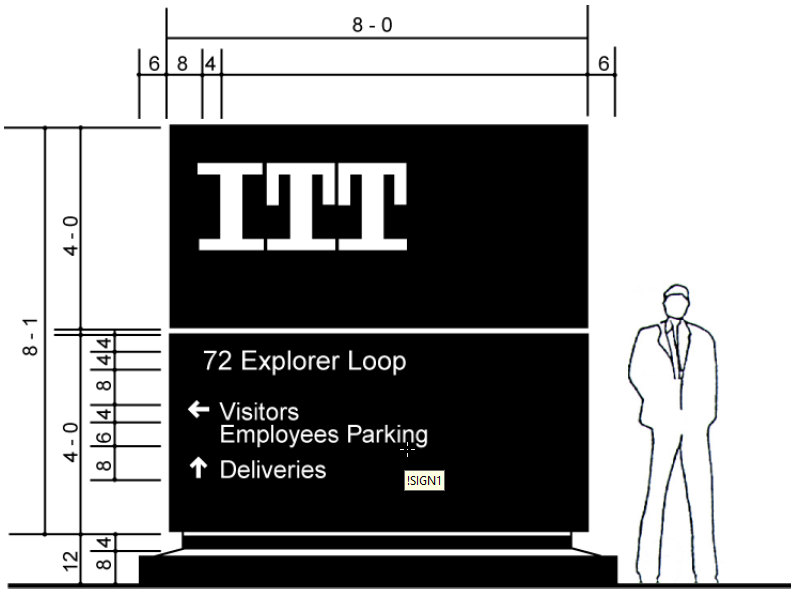
Figure F: Illustrative example of a detached monument sign in the Research Park West
District
(g)
Only one detached sign per access road to the lot is allowed.
(h)
The sign shall be placed parallel to an existing public road, either within or outside the public street right-of-way and must be located a minimum of 20 feet from the curb of said public road and 15 feet from the curb of the site access road.
(2)
Driveway ground signs. Driveway ground signs are permitted in the research park west district in accordance with the following:
(a)
The signs shall be of post and panel construction and shall not exceed six feet in height and four feet in panel width. Dimension details are presented in figure G.
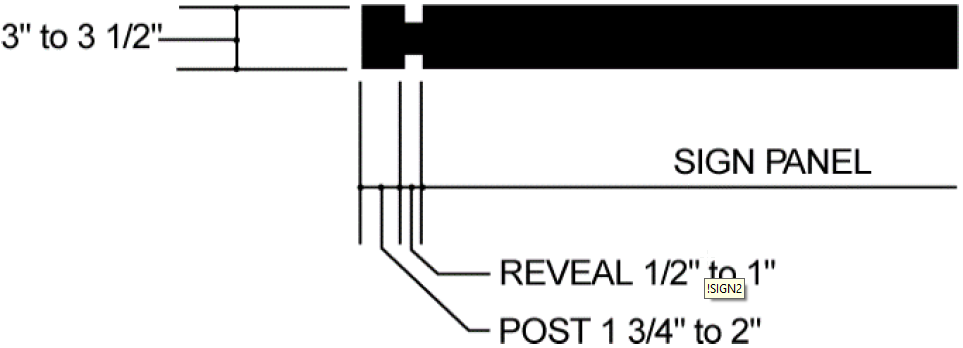
Figure G: Illustration of the dimensions for allowed driveway ground signs
(b)
The posts and panel background color shall be dark bronze; the typography shall be white in Helvetica regular and positioned in the upper left corner with margins and spacing as presented in figure H.
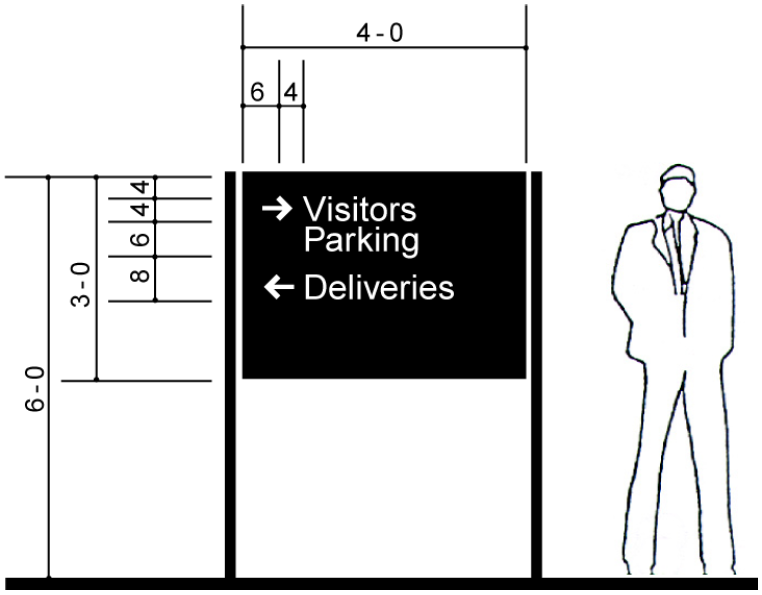
Figure H: Illustrative example of driveway ground signs
(c)
Such signs shall not be located closer than 50 feet to an existing or proposed public street right-of-way and shall be a minimum of ten feet from an existing or proposed curb of any entrance drive or access way.
(3)
Attached signs. Attached signs are permitted in accordance with the following:
(a)
Attached signs shall be part of, or mounted directly on, the building wall and shall not project more than 12 inches from the building surface.
(b)
Roof mounted signs are prohibited.
(c)
Illumination of such attached signs is optional.
(d)
For lots that contain one building unit, one attached sign is permitted, per street frontage. Such sign shall not exceed a sign area equal to ten percent of the gross area of the face of the main building façade fronting the street.
(e)
For lots that contain two or more building units, one attached sign is allowed per street frontage and the sign area for that sign shall not exceed ten percent of the gross area of the building facade fronting the street. In addition, where the facility has no more than four building units, each building unit may have one attached sign provided that the combined sign area shall not exceed 20 percent of the gross area of the building façade fronting a street. All such individual building unit attached signs shall be visually equal in size and positioned according to a consistent format.
72.7.12 Permanent signs in the airport industrial park district.
(1)
Attached signs are permitted provided that the sign area for each building unit shall not exceed 150 square feet, per street frontage, plus three additional square feet for each foot of linear façade width in excess of 50 feet. The maximum sign area for any building units shall be 350 square feet.
(2)
One monument sign is permitted per lot, on each street frontage, provided the maximum sign area shall be 100 square feet per sign and the maximum height shall be ten feet, excluding a base that does not exceed one foot in height. Such signs shall be placed in the front yard and set back a minimum of 25 feet from an existing or proposed street right-of-way.
(3)
Two monument signs are allowed at major entrances into the AIP district, the location of which shall be determined by the zoning administrator. Each sign shall have a maximum sign area of 150 square feet per sign and a maximum height of 35 feet, excluding a base that does not exceed one foot in height.
72.7.13 Permanent signs in the research park commercial district.
(1)
Large-scale complexes. Large-scale, complexes with a minimum area of 50 acres that contains multiple building units are allowed the following signs:
(a)
Monument signs.
(i)
One monument sign is permitted to be located in a front yard facing an arterial street that is located a minimum of 200 feet from the district boundary. The maximum sign area shall be 150 square feet with a maximum height of 35 feet, excluding a base that does not exceed one foot in height.
(ii)
Up to two monument signs are permitted to be located in a required front yard setback at each collector or arterial street entrance into the complex, upon approval by the city traffic engineer. Each sign shall not exceed a maximum sign area of 130 square feet with a maximum height of 35 feet, excluding a base that does not exceed one foot in height.
(b)
Monument signs for building units. Each stand-alone building unit that has direct access onto a public street may have one monument sign not to exceed 35 square feet in sign area with a maximum height of five feet, excluding a base that does not exceed one foot in height. Such sign shall be located outside the public right-of-way a minimum of 20 feet from the curb of the public street and 15 feet from the curb of the access drive into the site.
(c)
Attached signs.
(i)
For lots that contain one building unit, one attached sign is permitted, per façade, per street frontage. Such sign shall not exceed a sign area equal to ten percent of the gross area of the face of the main building façade fronting the street. The building unit is also permitted one projecting sign of up to six square feet. The total cumulative sign area for any façade shall not exceed 150 square feet of sign area per facade.
(ii)
For lots that contain two or more building units, one attached sign is allowed per façade for each building unit, per street frontage. The maximum sign area for each building unit shall not exceed ten percent of the gross area of the building façade for the individual unit, fronting the street with a maximum sign area of 100 square feet for each building unit. The building unit is also permitted one projecting sign of up to six square feet. The total cumulative sign area for any façade of an individual building unit shall not exceed 100 square feet of sign area per facade.
(d)
Pedestrian area gateway signs. Each RPC district complex shall be allowed up to a total of four monument signs to be located at the pedestrian entrances from the parking lots or other pedestrian areas when such areas are located at least 250 feet from any public street. Each such sign is limited to a maximum of ten feet in height, excluding a base that does not exceed one foot in height and to a maximum of 100 square feet of sign area.
(2)
Allowed permanent signs outside of large-scale complexes. The following signs are allowed on lots with permitted nonresidential use buildings that are not within a large-scale complex:
(a)
Monument signs.
(i)
For lots that have one building unit, one monument sign is permitted for each 250 feet of street frontage, or fraction thereof. Each sign shall have a maximum sign area of 35 square feet. Each sign shall not exceed five feet in height, excluding a base that does not exceed one foot in height. Where more than one sign is permitted due to a street frontage in excess of 250 feet, the signs shall be separated by 100 feet.
(ii)
For lots that have two or more building units, one monument sign is permitted for each 250 feet of street frontage, or fraction thereof. Each sign shall have a maximum sign area of 100 square feet. Each sign shall not exceed five feet in height, excluding a base that does not exceed one foot in height. Where more than one sign is permitted due to a street frontage in excess of 250 feet, the signs shall be separated by 150 feet.
(b)
Attached signs.
(i)
Each building unit is permitted to have one wall sign.
(ii)
Such sign shall not project more than eight inches from the building surface.
(iii)
No sign shall project above the roof line of the building on which it is mounted, notwithstanding any other provision of this zoning ordinance.
(iv)
The total sign area of all such attached signs for any building unit shall not exceed one square foot per linear foot of building facade with a maximum total sign area of 300 square feet.
(Ord. No. 21-46, § 1(Exh. A, § A), 2-25-2021; Ord. No. 22-809, § 2, 11-17-2022)
72.8. - General sign standards.
All signs maintained or hereafter erected in the City of Huntsville shall comply with the standards set forth in this section.
72.8.1 Commercial use signs are commercial uses of land and as such shall not be allowed in residential districts, or on residential lots that are not a part of a mixed-use building that is otherwise allowed to have a commercial use of the premises. Commercial use signs are also prohibited on any attached sign and on any permanent sign permitted to be located at major entrances as established in this article.
72.8.2 Unless otherwise specifically allowed, wall signs shall not extend more than eight inches outside the wall surface. Such signs shall not extend beyond the ends of the wall surface on which they are placed and not more than 18 inches above the top of such wall.
72.8.3 Signs painted or pasted directly on the structures are expressly prohibited.
72.8.4 Feather signs are expressly prohibited.
72.8.5 Signs incorporating any noisy mechanical device are expressly prohibited.
72.8.6 No sign shall be projected onto the side of a building, wall, or ground.
72.8.7 Illuminated signs and outside lighting devices, including beacons and spotlights, shall emit only light of constant intensity, and no sign shall be illuminated by or contain flashing, blinking, intermittent, rotating or moving light or lights, except electronic display signs that comply with the applicable provisions of this article. In no event shall an illuminated sign or lighting device be so placed or directed as to permit focused light to be directed or beamed upon a public street, highway, sidewalk, or adjacent premises so as to cause glare or reflection that constitutes a traffic hazard or nuisance.
72.8.8 No projecting sign, excluding any supporting structures or brackets up to a maximum of 18 inches, shall be erected or maintained to extend more than four feet in width from the front or face building, unless otherwise provided. Additionally, a projecting sign shall not be placed closer than two feet horizontal from the curb line of any street and shall maintain a minimum overhead clearance of 12 feet from the sidewalk.
72.8.9 No roof sign shall be erected or maintained which extends for a height greater than 12 feet above the roof of the building on which it is affixed.
72.8.10 No sign, or portion thereof, shall be placed in any dedicated street or highway right-of-way, or in any utility and drainage easement, except as otherwise specifically stated in this article, and no projecting sign or awning, inclusive of any supporting structure or bracket, may be located on or over the public right-of-way unless attached to a structural element of the building and complies with projection and clearance requirements of this article.
72.8.11 Awnings, inclusive of any supporting structures or brackets, shall project no further than eight feet from the vertical face of the building to which they are attached; however, in no case shall an awning be allowed to extend into an area six feet measured from the back of the curb abutting the building to which the awning is attached. Awnings shall have a minimum height of eight feet above the sidewalk as measured from the bottom edge of the awning.
72.8.12 Unless otherwise specified, ground signs shall not exceed 35 feet in height.
72.8.13 No part of any sign shall be so placed or constructed as to obstruct or interfere with any door, window, fire escape or other means of egress, light or ventilation.
72.8.14 No sign shall be located in such a position that the same obscures the view of pedestrian or vehicular traffic in such a manner as to endanger the safe movement thereof, or otherwise violates the visual obstruction regulations. All signs shall be subject to the provisions of chapter 25, article IX of the city code governing visual obstructions.
72.8.15 Signs shall not be applied to trees, bus shelters, utility poles, benches, trash receptacles, utility cabinets, rocks or natural features, or any other unapproved supporting structure, or otherwise placed in the public right-of-way unless expressly allowed by this article.
72.8.16 Any sign that copies or imitates traffic control signs or devices in a manner likely to confuse motorists or pedestrians, or that obstructs such signs or devices, thereby creating danger to the public, shall be prohibited.
72.8.17 All signs shall be maintained in compliance with applicable sign standards of currently adopted codes including building, electrical, and other technical codes as adopted by the City of Huntsville or as may be legally applied to signs in the City of Huntsville.
72.8.18 Signs attached to and projecting from the exterior wall of a permanent structure shall not extend more than ten feet above said structure.
72.8.19 A vehicle, which includes a motor vehicle, boat, trailer or similar equipment, shall not be used as a support structure for a sign.
72.8.20 Pennants, ribbons, streamers, and spinners are prohibited in all zoning districts, except highway business C-4, light industry, and heavy industry.
72.8.21 Electronic display signs:
(1)
Electronic display signs shall be permitted as part of any ground, monument, or pylon sign, in all districts except the research park district, research park applications, research park applications 2, research park west, planned industrial, and disposal storage districts.
(2)
Electronic display signs shall not be permitted on any sign that is allowed at major entrances into any campus, park, or complex where allowed in this article. Additionally, such signs shall not be permitted on any signs authorized in section 72.5.
(3)
Electronic display signs are allowed on canopy signs in the neighborhood business C-1 and village business C-6 districts.
(4)
Such signs shall count as part of the ground sign, monument, pylon, or attached canopy, as applicable, and shall not exceed the sign area of such sign, as may be allowed by this ordinance.
(5)
Electronic display signs shall be subject to each of the following:
(a)
Electronic display signs shall include an automatic dimming light detector/photocell that causes the sign's brightness to dim to levels which the zoning administrator, or their designee, determines meets current ambient light conditions; provided, the zoning administrator, or their designee, may adopt such standards he deems necessary to administer this provision.
(b)
No scrolling, flashing, blinking, rotating, pulsating, moving, intermittent, or animated displays are allowed.
(c)
The sign shall not display any illumination that moves, appears to move, or changes in intensity during the static display period.
(d)
Electronic display signs shall be static and shall not change more than once in any 15-minute period if the sign has frontage on a minor arterial or collector street or no more than once in any one-minute period if the sign has frontage on a major arterial street.
(e)
The transition time between the changing of the static image shall be achieved within a one-second period.
(f)
Electronic display signs shall contain a default design that will freeze the device in one position if a malfunction occurs.
(g)
Electronic display signs shall be turned on no earlier than 7:00 a.m. and turned off no later than 10:00 p.m. in all residentially districts.
(h)
An electronic display sign shall not exceed 75 percent of the total allowed sign face area.
(i)
Electronic display signs shall be constructed as an integral part of a permanent sign constructed on site. Integral shall be considered to be incorporated into the framework and architectural design of the permanent sign.
(j)
Such signs shall be required to have a 20-millimeter pixel pitch or smaller.
(k)
Electronic display signs may be permitted as part of any monument sign in a residential zoning district with the additional requirements:
(i)
The sign shall only be permitted on street frontage along a major or minor arterial;
(ii)
The sign shall not be a commercial use sign; and
(iii)
The sign shall be located and oriented in such a manner as to create the least impact from illumination on adjacent residential uses, as may be determined by the Zoning Administrator.
(l)
No variances shall be allowed for any of the foregoing conditions.
72.8.22 Canopy signs shall be allowed on lots used for permitted nonresidential buildings provided:
(1)
Canopy signs shall be calculated in the total square footage of the applicable property's attached signage, including the use as an electronic display sign.
(2)
In the neighborhood business C-1 and village business C-6 districts only: Canopy signs may include electronic display signs, of not more than 32 square feet in area, provided that there are no other electronic display signs located on the premise.
(3)
Canopy signs shall not project above or below the canopy or roofline.
(4)
Under-canopy or hanging signs at their lowest point shall be at least eight feet above finished grade.
72.8.23 Unless otherwise stated, all attached signs that project off the face or corner of a building shall have a minimum clearance above finished grade of 12 feet, or the required clearance set forth in the city's building code, whichever is greater.
72.8.24 Driveway signs. Driveway signs, as regulated below, are permitted on all lots with permitted nonresidential use buildings, in all zoning districts, except in the research park, research park west, residential office 1, and residential office 2 districts. Such signs shall include small permanent signs located near driveway entrances to a street and at intersections of internal drives under the following provisions:
(1)
Driveway signs shall comply with the vision obstruction standards, as required by this article.
(2)
In no case, shall a driveway sign be set back more than 50 feet from the driveway entrance or intersection of internal drives. Such signs shall not be located in a right-of-way.
(3)
Up to two driveway signs may be permitted per individual driveway or internal intersection.
(4)
Driveway signs may not exceed three square feet in area and 30 inches in height.
(5)
Driveway signs may be internally or externally illuminated, unless otherwise stated.
(6)
Driveway signs shall not contain electronic display signs.
(7)
Driveway signs may be mounted on a pole provided the entire structure does not exceed the maximum sign height established above.
72.8.25 Signs that constitute a hazard to safety or health by reason of inadequate or inappropriate design, construction, repair or maintenance, as determined by the zoning administrator, shall be prohibited.
72.8.26 Windblown devices and signs that are not securely affixed to the ground or otherwise affixed in a permanent manner to an approved supporting structure unless specifically permitted as a temporary sign, shall be prohibited.
72.8.27 Signs that employ any parts or elements which revolve, rotate, whirl, spin or otherwise make use of motion to attract attention. This shall not include changeable copy signs as allowed in this article, shall be prohibited.
72.8.28 Portable signs shall be prohibited with the exception of sidewalk signs permitted in subsection 72.6.4(3).
(Ord. No. 21-46, § 1(Exh. A, § A), 2-25-2021; Ord. No. 22-809, § 3, 11-17-2022)
72.9. - Non-conforming signs.
72.9.1 Any sign that was lawfully in existence at the time of the effective date of this ordinance, or amendment thereto, that does not conform to the provisions herein, shall be deemed lawfully non-conforming and may remain on a lot, or shall be removed, in accordance with this section.
72.9.2 Non-conforming signs are declared to be incompatible with allowed uses in the districts affected thereby. The intent of this article is that non-conformities shall not be enlarged upon, expanded or extended, nor be used as grounds for other uses prohibited in the same districts except as provided for below.
72.9.3 No lawful non-conforming sign shall be enlarged, extended, structurally altered, or reconstructed in any manner, except to bring it into full compliance with these regulations, except that these regulations shall not prohibit maintenance, minor repairs, or the replacement of the content of a sign provided there is no structural modification of its size, location or configuration except that any lawful non-conforming sign may be replaced with an electronic display sign provided the following:
(1)
Electronic display signs are permitted in the applicable zoning district;
(2)
The electronic display sign shall not exceed the size and shape of the original non-conforming sign;
(3)
All supporting structures, including posts or pylons, remain in place; and
(4)
The electronic display sign shall comply with the standards of section 72.8.21.
72.9.4 A sign shall lose its lawful non-conforming status if any of the following occurs:
(1)
If such sign is damaged to an amount exceeding 50 percent of the sign's replacement value, as determined by at least two sign companies requested to provide a quote by the city;
(2)
The structure of the sign is altered in any form except as allowed by section 72.9.3;
(3)
The sign is relocated; or
(4)
The non-conforming sign and its structure (including support and frame and panel) are determined by the zoning administrator, to be unsafe or in violation of this code or building code, and are declared a nuisance.
72.9.5 Any sign that loses its legal non-conforming status must be brought into compliance with the provisions of this article and any other city laws or ordinances by an application for, and issuance of, a sign permit or by complete removal.
72.9.6 Failure to bring a sign into compliance after loss of a legal non-conformity status shall be considered a violation of this zoning ordinance and may be subject to removal as a public nuisance.
(Ord. No. 21-46, § 1(Exh. A, § A), 2-25-2021)
72.10. - Business license.
Nothing in this article shall be construed to affect the requirements for a business license from the city.
(Ord. No. 21-46, § 1(Exh. A, § A), 2-25-2021)
72.11. - Permits required.
72.11.1 Unless otherwise specifically exempted from this article, It shall be unlawful for any person, either directly, indirectly, or by an agent, to erect or re-erect any sign or to alter or repair in the City of Huntsville any sign exceeding 50 percent of value unless an application for a permit shall have been made to the zoning administrator and a permit shall have been issued therefor. Every permit shall be considered cancelled if active work is not commenced within a period of 90 days from the date of its issuance. Each applicant is allowed one 90-day renewal for each sign permit provided that the request for a renewal shall be filed in writing with the zoning administrator before the expiration of the initial permit. The 90-day renewal period shall start to run upon the issuance of the renewal permit regardless as to whether the initial 90- day period has run.
72.11.2 Permit review.
(1)
An application for a permit shall be submitted to the zoning administrator on the form supplied by the zoning administrator and shall be accompanied by each of the following:
(a)
The written consent of the property owner or lessee desiring any sign to be erected, and, when required by the zoning administrator, a copy of the deed or lease of the premises upon which the sign is to be located;
(b)
Plans and specifications setting forth the character of the sign in all its structural parts, and, except in the case of attached signs, by an accurate engineering survey of the property designating the location of all existing signs on the property and the proposed location of the desired sign; and
(c)
Such other information as may be reasonably required by the zoning administrator in his administration and enforcement of this article.
(2)
An application for a sign permit shall include drawings and text sufficient to:
(a)
Show the location on the premises of the proposed sign(s);
(b)
Show the dimensions of the proposed sign(s) and related support structures;
(c)
For signs for which the dimensions of the lettering or message are specified in this ordinance, show such dimensions;
(d)
Show proposed lighting of the proposed sign;
(e)
For a sign including electronic elements, sufficient information to demonstrate that the sign will conform with the performance and other requirements established in this article; and
(f)
For a sign requiring electricity, information sufficient to apply for an electrical permit; and
(g)
The applicable fee.
(h)
If the zoning administrator determines that the proposed sign conforms with the requirements of this article, the zoning administrator shall issue the permit(s) required for the erection or installation of such sign.
(i)
If the zoning administrator determines that the proposed sign fails to conform with any requirement of this article, the zoning administrator may:
(i)
If the ways in which the failures to conform involve dimensions, approve the application subject to the condition that it be amended to conform fully with this article; or
(ii)
Deny the application in writing, specifying the ways in which the proposed sign fails to conform with this article.
(j)
If the application is not approved or denied, in writing, by the zoning administrator within 30 business days of the date of application, it shall be deemed automatically denied unless an extension of time is agreed upon, in writing, by the applicant and zoning administrator.
72.11.3 Permit exceptions. The following signs are allowed by this article but do not require a sign permit or fee. Additionally, any sign area for these signs do not count toward the sign area allowances specified in this article for all other permitted signs. Permit-exempt signs may still be subject to building code or other applicable code requirements.
(a)
Signs or notices issued by any court, officer, or other person in performance of a public duty, or required by other laws or ordinances. Any such sign shall be removed no later than seven days after the last day it is required to be displayed;
(b)
Any public safety sign that is installed by the City of Huntsville or other governmental agency having jurisdiction that are intended to protect the health and safety of the public that includes traffic control, street name, directional signs, and other signs that may or may not be located in the right-of-way;
(c)
Signs that are located within a stadium, open-air theater, park, arena or other similar outdoor use that can only be viewed by persons within such stadium, open-air theater, park, arena or other similar outdoor use provided that any structure on which the sign is attached is permitted, as may be required by the city;
(d)
Signs that are an integral part of the original construction of vending or similar machines, drive-through facilities, automated teller machines, or similar devices that are not of a size or design as to be legible from a street or by any person other than those using the machine or device;
(e)
Sign face changes where the sign structure is designed with interchangeable panels and one of the panels is replaced without changing the structure, including any changes to the total sign face area, height or alteration of the sign cabinet;
(f)
Changes of copy on signs with changeable copy, including electronic message signs and electronic display signs;
(g)
Certain temporary signs as established in section 72.6;
(h)
One wall sign, mounted flush to the façade of an individual residential dwelling unit, that is not illuminated and does not exceed two square feet in area;
(i)
The posting of an address for a house or building is a public safety issue regulated under chapter 23, article V of the city code, and not this article;
(j)
Signs that are an integral part of the historic character of a structure that has been designated an official landmark or historic structure by any agency or body of the governments of the United States, State of Alabama, Madison or Limestone Counties, or the City of Huntsville, or that otherwise forms an original part of the structure and has only historic significance;
(k)
Any signs located on umbrellas, seating, or similar patio furniture;
(l)
Any warning signs or traffic safety signs required by public utility or infrastructure providers;
(m)
Hand-held signs not set on or affixed to the ground;
(n)
General maintenance, painting, repainting, cleaning and other normal maintenance and repair of a sign or any sign structure unless a structural change is made.
72.11.4 Permit fees.
(a)
The zoning administrator shall collect a minimum of $25.00 for each permit issued at the time an initial or renewal application is made. For signs with an estimated total install cost of over $1,000.00, the permit fee shall be $25.00 plus one-half percent of the estimated installed cost exceeding $1,000.00.
(b)
A permit fee of $25.00 shall be collected for each pair of driveway signs at the entrance from a public street.
(Ord. No. 21-46, § 1(Exh. A, § A), 2-25-2021)
72.12. - Inspections.
All signs in the City of Huntsville for which permits are required under this ordinance may be subject to an annual inspection by the zoning administrator. Such inspection may take place beginning immediately after the adoption of this ordinance and thereafter may be conducted annually.
(Ord. No. 21-46, § 1(Exh. A, § A), 2-25-2021)
72.13. - Maintenance.
(1)
All signs shall be maintained in safe condition, free from damage or the results of excessive weathering.
(2)
At any time the zoning administrator shall find that any allowed sign is in a bad state of repair, or is in danger of falling, or presents a hazard from electrical shock or fire, or at any time an allowed sign is found to be in such bad state of repair or maintenance as to adversely affect the property values in the surrounding neighborhood, then said zoning administrator shall make and enter an order directed to the owner or person in charge of said sign commanding its removal or its repair or maintenance as therein stated.
(3)
Any orders issued under this section shall be subject to an appeal to the board of zoning adjustment in the same manner as other appeals are taken to said board. The board of adjustment is hereby empowered to hear said appeal and to make and enter an order directing the repair or maintenance of said sign upon a finding by said board that the condition of the sign, due to lack of maintenance, or disrepair, is a nuisance and adversely affects the property values in the surrounding neighborhood.
(4)
Appeals from the board of zoning adjustment shall lie to the circuit court in the same manner as all other appeals.
(Ord. No. 21-46, § 1(Exh. A, § A), 2-25-2021)
72.14. - Severability.
Should any section or provision of this ordinance be held void or invalid, it shall not affect the validity of any other section or provision thereof which is not of itself void or invalid, it being the purpose and intention of the city council to enact each separate section and/or subsection separately.
(Ord. No. 21-46, § 1(Exh. A, § A), 2-25-2021)

