
Jenks City Zoning Code
ARTICLE 4
- OVERLAY DISTRICT SPECIFIC STANDARDS
Sec. 16-4-1.- General Overlay District Requirements.
(A)
Development Plan. Prior to the change of occupancy, construction, reconstruction, or exterior remodeling of any building or structure, placement of exterior lighting or signs, or any proposed construction requiring the issuance of a building permit other than a small job permit for a property located within an Overlay District, an application for Site Plan Review, as detailed in section 16-9-3(C), shall be made and shall be subject to the applicable Overlay District Specific Standards.
(B)
PUD Overlay District. The PUD Overlay District is created to visually represent areas of the community that are governed by an approved Planned Unit Development as detailed in section 16-9-8 of this UDO. Overlay district specific standards are therefore not established for the PUD Overlay District.
(Ord. No. 1581, § II, 4-5-2022)
Sec. 16-4-2. - Downtown Transition Overlay District Specific Standards.
(A)
Exterior Building Materials. Exterior building materials shall be traditional, time and weather tested materials and techniques.
(1)
Ground Floor. Exterior building materials utilized on the ground floor shall be limited to wood, masonry, stucco, fiber cement, or stone veneer systems. Stone veneer systems utilized on the ground floor shall have a minimum thickness of three inches.
(2)
Upper Floors. Exterior building materials utilized on upper floors may include all materials permitted on the ground floor as well as EIFS or precast panels with inlaid or stamped brick texture. All materials utilized on upper floors shall have a minimum thickness of one inch and shall be structurally integrated into the façade of the building.
(B)
Type of Construction. Manufactured, mobile, and metal units shall be prohibited unless otherwise expressly permitted by this UDO.
(C)
Alley Access. Where a lot abuts an existing alley, access shall be maintained or established and utilized to access offstreet parking, loading, and service areas.
(D)
Yard Setbacks. Required yard setbacks shall be as detailed in Table 16-4-2(D) below.
(E)
Height. The maximum height of buildings and structures in the DT District shall be 35 feet.
(F)
Parking Location. Private off-street parking spaces and lots shall be located to the rear of buildings and accessed by an alley.
(G)
Orientation. Main entrances to buildings shall be oriented towards the primary street to which it abuts. Secondary entrances are encouraged along secondary streets.
(H)
Articulation. All non-single family detached development shall include architectural details such as bulkheads, masonry piers, transoms, cornices, window hoods, and other similar details to provide horizontal and vertical façade articulation.
(I)
Building Frontage. The primary façade of all nonresidential and mixed use development shall meet the standards of one of the frontage types detailed in subsections (1) through (4) below.
(1)
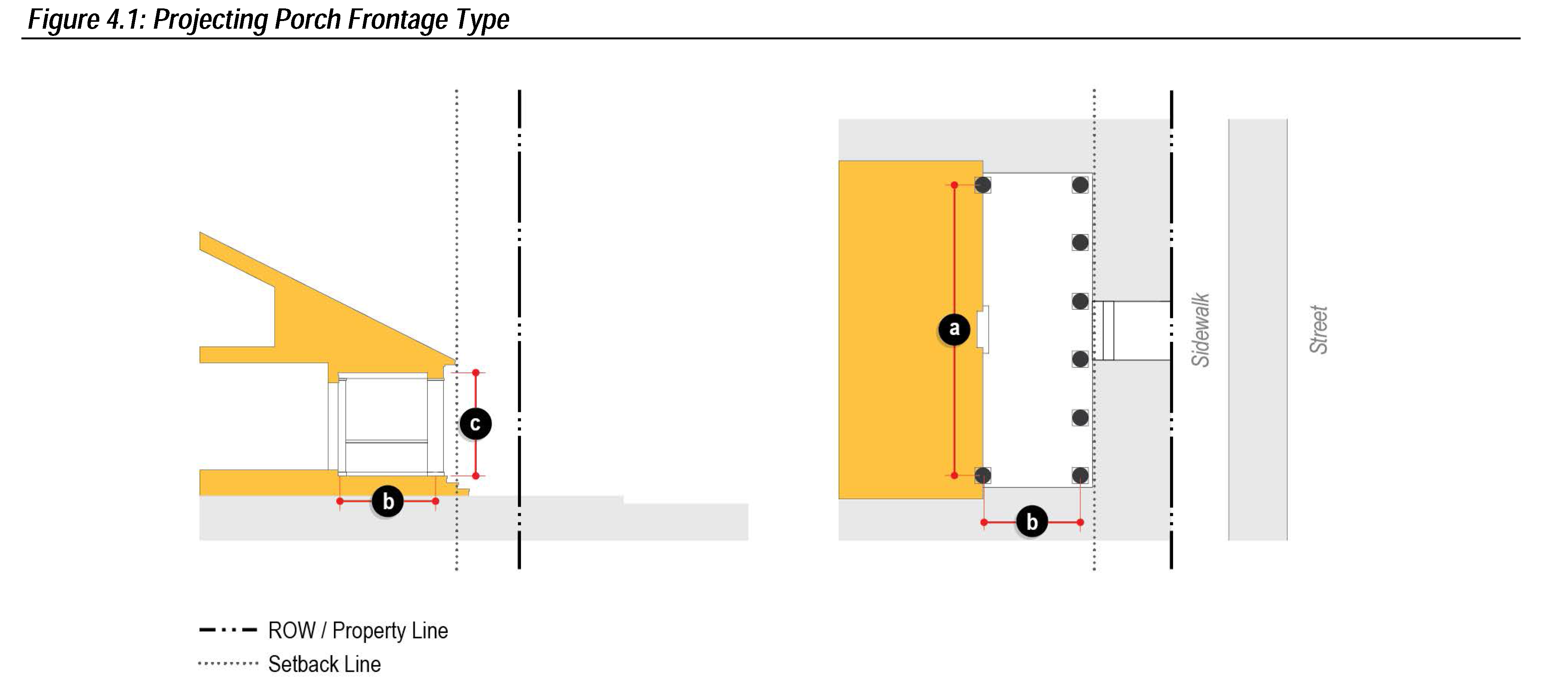
Projecting Porch. The primary façade of the building is sufficiently setback from the property line to accommodate the projecting porch within the front yard. The resulting front yard may or may not be defined by a fence or hedge to spatially maintain the edge of the street. The projecting porch shall be open on three sides and have a roof form that shall be separate from the principal structure. A projecting porch shall encroach into the front yard. The following minimum standards shall apply to projecting porches:
(a)
Width. Ten feet.
(b)
Depth. Eight feet.
(c)
Height. Eight feet.
(2)
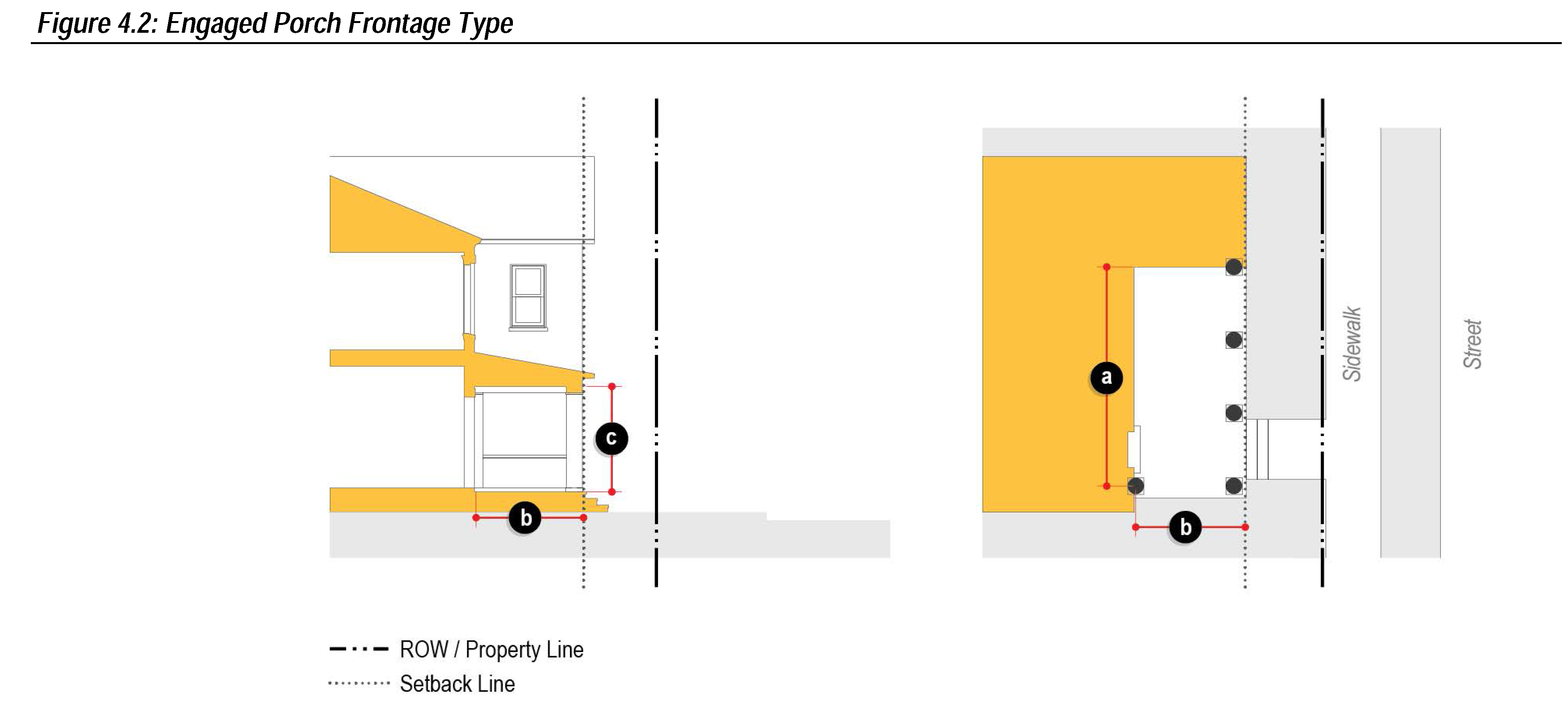
Engaged Porch. The porch shall be partially or fully enclosed on two sides and have a roof. An engaged porch may not encroach into the required front yard. The following minimum standards shall apply to engaged porches:
(a)
Width. Ten feet.
(b)
Depth. Eight feet.
(c)
Height. Eight feet.
(3)
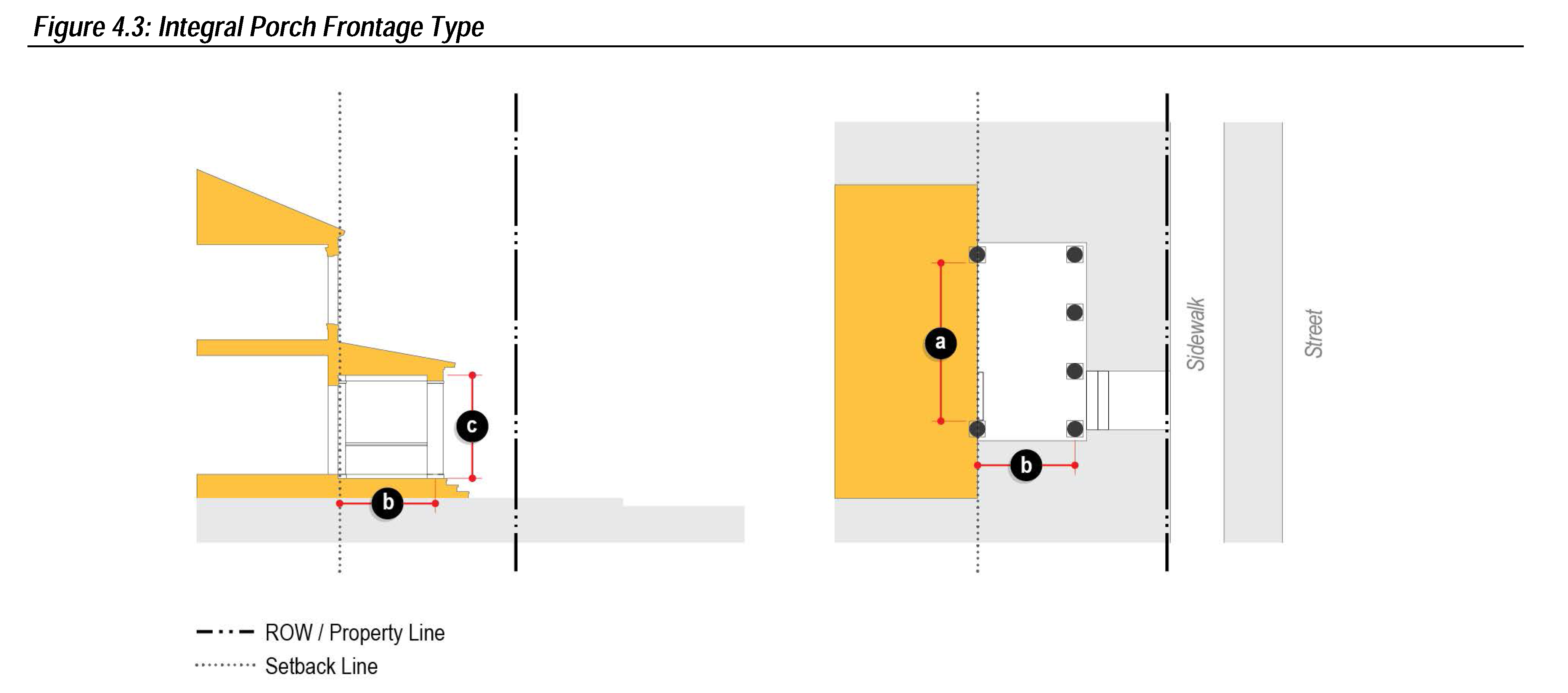
Integral Porch. An integral porch shall be part of the overall massing and roof form of a building. It shall not be possible to remove an integral porch without major changes to the overall roof form. An integral porch shall not encroach into the required front yard. The following minimum standards shall apply to integral porches:
(a)
Width. Eight feet.
(b)
Depth. Eight feet.
(c)
Height. Eight feet.
(4)
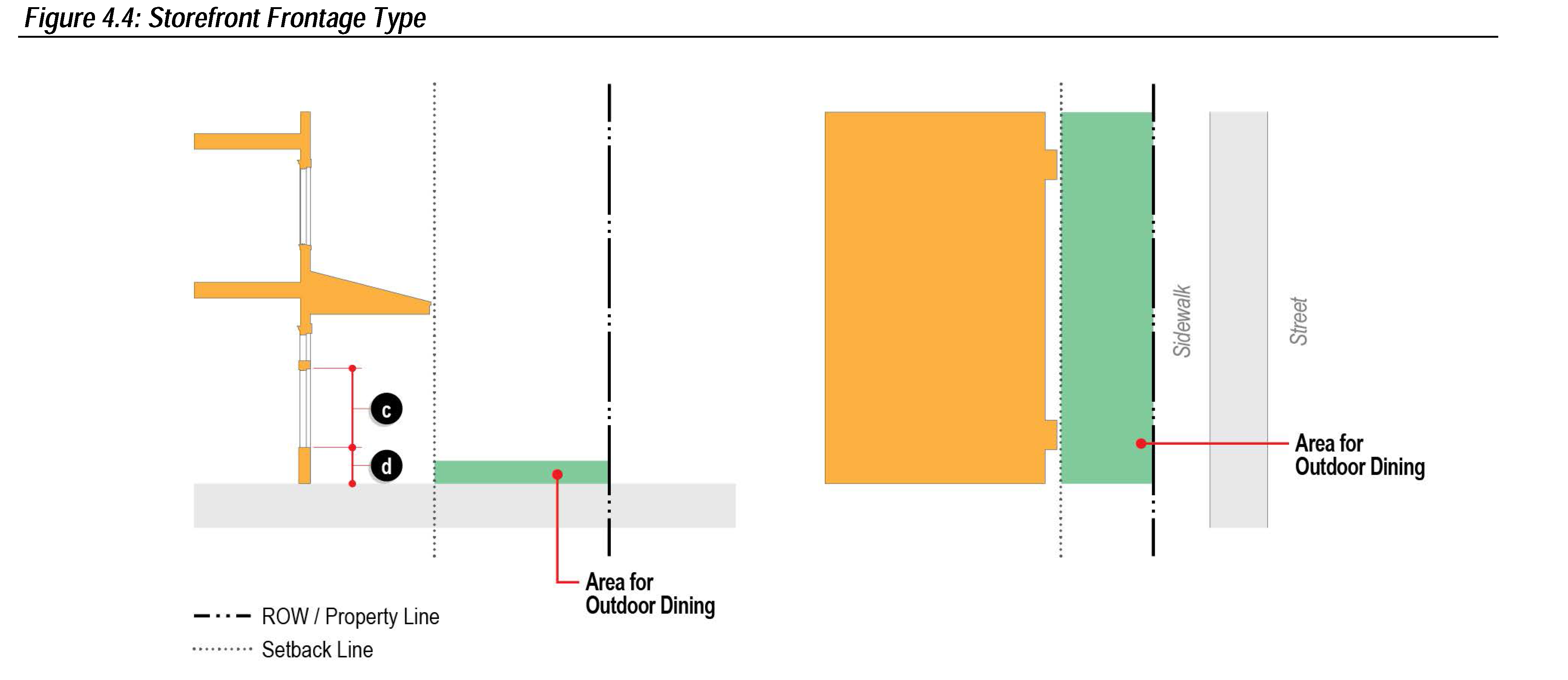
Storefront. The primary façade of the building shall adjoin the required minimum front setback. The use of the resulting front yard for outdoor dining or other activity-generating uses that support the subject lot's principal use is encouraged. A canopy or awning element is encouraged along the majority of the building frontage and accordion-style windows and doors or other operable windows are encouraged. The following standards shall apply to shopfronts and shall be considered minimum requirements unless otherwise stated:
(a)
Window Area. Sixteen square feet.
(b)
Window Width. Three feet.
(c)
Window Height. Four feet.
(d)
Sill Height. Three feet, maximum.
(J)
Transparency. The ground level of mixed use and nonresidential development must offer pedestrian interest along sidewalks and pedestrian paths. Therefore, the first floor of any building façade facing a public right-of-way with the exception of alleys shall include transparent windows and/or doors arranged so that the uses inside are visible from and/or accessible to the street on at least 20 percent of the façade. The City Planner may waive transparency requirements by up to 20 percent for medical and dental office uses.
(K)
Permitted, Special Exception, and Specific Uses. The following key is to be used in the interpretation of Table 16-4-2(L) below:
(1)
Permitted Uses. Uses which are marked as "P" in the tables shall be allowed subject to all applicable regulations of this UDO.
(2)
Conditional Uses. Uses which are marked as "C" in the tables shall be allowed upon the approval of a Conditional Use Permit as detailed in section 16-9-3(D).
(3)
Special Exception Uses. Uses which are marked as "SE" in the tables shall be allowed upon the approval of a Special Exception as detailed in section 16-9-6.
(4)
Specific Uses. Uses which are marked as "S" in the tables shall be allowed upon the approval of a Specific Use Permit as detailed in section 16-9-7.
(5)
Temporary Uses. Uses which are marked "T" in the tables shall be allowed upon the approval of a temporary 16-9-2(G).
(6)
Uses Not Listed. If a proposed use is not listed in the tables, the City Planner shall determine if the use is substantially similar to a use listed on the tables. If it is, they shall treat the use in the same manner as the substantially similar use. If not, the use shall be regarded as prohibited.
(7)
Additional Regulation. If a use has use specific standards, they are referenced in this column. Use specific standards shall apply to permitted, special exception, and specific uses. Where use specific standards conflict with overlay district specific standards, the overlay district specific standards shall be followed.
(8)
Site Plan Review Requirements. The Site Plan Review requirements shall be required for applications as specified in section 16-9-3(C).
(L)
Downtown Overlay District Permitted, Special Exception, and Specific Uses.
(Ord. No. 1581, § II, 4-5-2022; Ord. No. 1624, § II(Att. C), 10-17-2023)

