
Jenks City Zoning Code
ARTICLE 6
- DEVELOPMENT STANDARDS
Sec. 16-6-1.- Off-Street Parking and Loading.
(A)
Applicability of Requirements. Off-street parking and off-street loading facilities, whether they are principal uses, accessory uses, or a minimum requirement for the initiation, enlargement, or change of use, shall meet the requirements of this section as follows:
(1)
For all buildings and structures erected after the effective date of this UDO, parking and loading facilities shall be provided as required by the applicable use or combination of uses.
(2)
When the intensity of use of any building, structure, or premises shall be increased through the addition of dwelling units, floor area, seating capacity, or other units of measurement specified for required parking or loading facilities, parking, and loading facilities as required in this section shall be provided for such increase in intensity of use. However, if due to site constraints and the inability to share parking with adjoining properties, the City Planner may waive up to 20 percent of the required parking.
(3)
Whenever the existing use of a building or structure is changed to a new use, with the exception of multitenant shopping centers, parking and/or loading facilities shall be provided as required for such new use. However, if due to site constraints and the inability to share parking with adjoining properties, the City Planner may waive up to 20 percent of required parking.
(B)
General Requirements.
(1)
Space allocated to any off-street loading berth shall not be used to satisfy the space requirements for any off-street parking facilities. Space allocated to any required off-street parking shall not be used to satisfy the space requirements of any off-street loading facilities.
(2)
No more than one parking space shall be allowed within the required front or exterior side yard of a lot in the RM-1 or RM-2 District for each 600 square feet of lot area in the front or exterior side yards.
(3)
Required off-street parking spaces and off-street loading berths shall not be used for the storage, sales, dismantling, or servicing of any vehicle, equipment, materials, or supplies.
(4)
Required off-street parking spaces and off-street loading berths shall be located on the lot containing the use for which the required spaces or berths are to be provided unless a shared parking agreement is approved by the City in accordance with section 16-6-1(F)(7).
(C)
Setbacks. Off-street loading areas shall not be located within 50 feet of any abutting property which is within an R district unless it is wholly within an enclosed building or screened on all sides abutting the R district by a screening wall or fence.
(D)
Design Standards for Off-Street Parking Areas.
(1)
Access. Each required parking space shall be accessible from a public street without passing through another required space, except in the RE and RS Districts.
(2)
Cross Access. To facilitate vehicular access between adjoining developments and to minimize off-street parking area access points along streets and alleys, non-single-family development shall comply with the following standards:
(a)
Internal vehicular circulation systems shall be designed to allow for vehicular cross-access between the development's off-street parking areas and off-street parking areas in an adjoining non-single-family development, or to the boundary of adjoining vacant land.
(b)
Required vehicular cross access between the adjoining off-street parking areas shall be provided through the use of a single two-way maneuvering lane or two one-way maneuvering lanes that are sufficiently wide to accommodate traffic by automobiles, service vehicles, loading vehicles, and emergency vehicles.
(c)
The City Planner may waive or modify the requirement for vehicular cross access on determining that such cross access is impractical or undesirable because it would require crossing a significant physical barrier or environmentally sensitive area, would create unsafe conditions, or there exists an inability to connect to adjacent property.
(d)
Easements allowing cross access to and from properties served by a vehicular cross-access, along with agreements defining maintenance responsibilities of property owners, shall be recorded with Tulsa County before issuance of a building permit for the development.
(3)
Lighting. Lighting used to illuminate an off-street parking area, if any, shall meet all requirements for outdoor lighting as detailed in section 16-6-7.
(4)
Surfacing. Parking is prohibited in areas of the yard other than dedicated drive aisles within Residential Districts and other zonings districts unless otherwise specified by adopted City of Jenks policy. Off-street parking areas shall be surfaced with a dust free all-weather material including, but not limited to, concrete, bituminous pavement, pavers, or an equivalent material as approved by the City Engineer.
(5)
Drainage. Off-street parking areas shall require submittal of stormwater drainage plans in compliance with City of Jenks Stormwater Management program and Design Criteria to the City Engineer for review and approval prior to installation.
(6)
Curb and Gutter. Combination concrete curb and gutter or concrete barrier curb is required around the perimeter of all parking areas, except for residential parking areas with fewer than eight spaces. Where alternatives to concrete curb and gutter are demonstrated to be more appropriate and recommended by the City Engineer, the alternatives may be approved by the City Planner.
(7)
Wheel Guards. Parking spaces may be provided with wheel guards or bumper guards to prevent the encroachment of parked vehicles in sidewalks, pedestrian circulation areas, or landscape areas. When provided, wheel guards shall be located to ensure that a minimum of four feet of clearance is maintained between the front of a vehicle and a pedestrian circulation area.
(8)
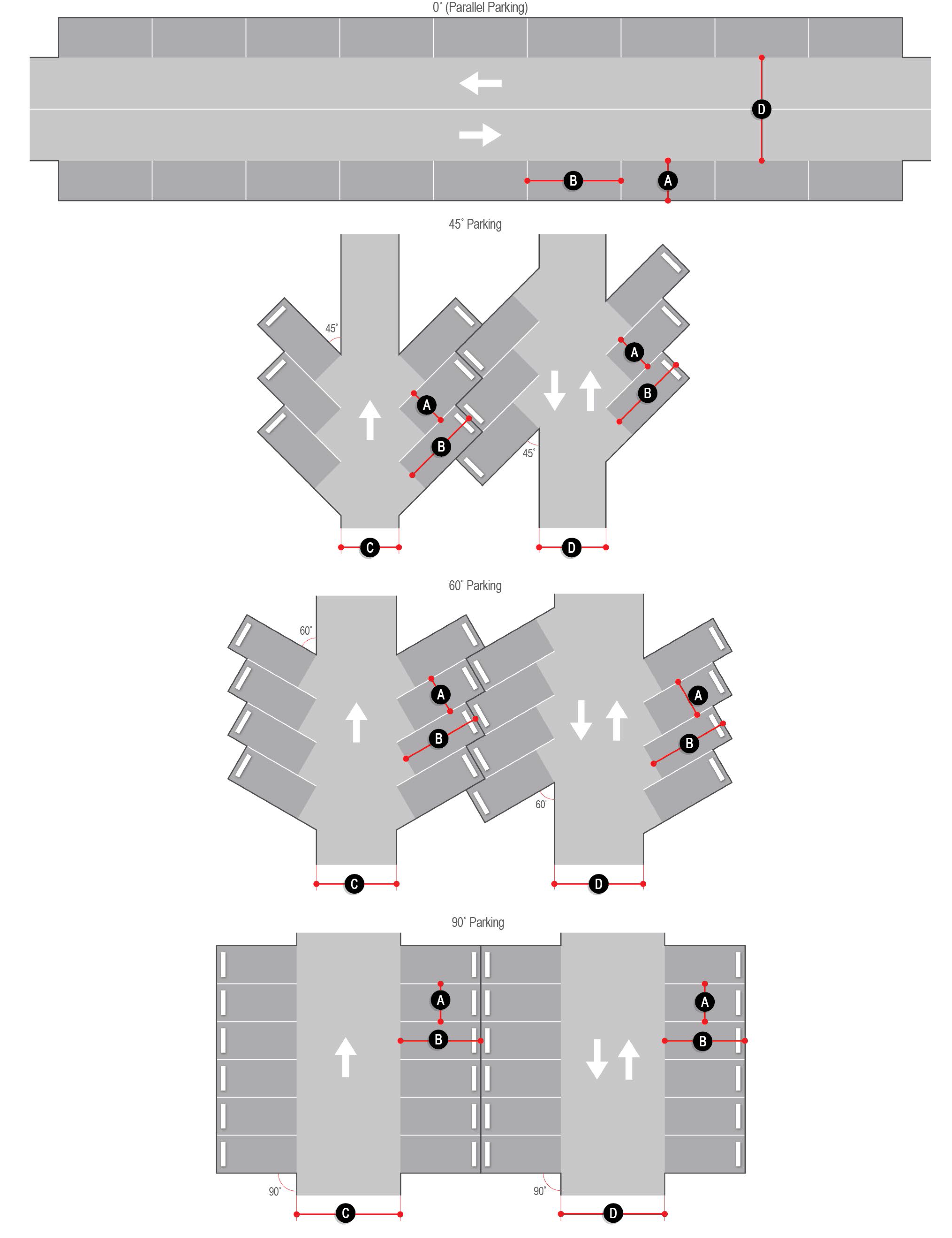
Parking Space and Drive Aisle Dimensions. Plans for the layout of off-street parking areas shall be in accordance with Table 16-6-1(D)(8). If wheel guards are used, stall lengths shall be measured from the internal face of the wheel guard. Two-way aisle width minimum standards shall apply to the total aisle, not a single lane.
(E)
Off-Street Parking Requirements.
(1)
Parking Requirements in the DC District. Requirements regarding the allowed location of off-street parking in the DC - Downtown Core District are located in section 16-3-5.
(2)
Minimum Requirements. Except as otherwise expressly stated, off-street parking spaces shall be provided in accordance with the parking ratio requirements established in Table 16-6-1(E). Parking spaces reserved for specific user groups other than ADA compliant spaces and spaces with electric vehicle charging stations shall not count towards the minimum requirement.
(3)
Maximum Requirements. To minimize excessive areas of pavement, no off-street parking area shall exceed the required minimum number of parking spaces by more than 30 percent for multifamily, mixed-use, and nonresidential uses only, except as approved by the City Planner. In approving additional spaces above the maximum, the City Planner shall determine that the parking is needed based on documented evidence of actual use and demand provided by the applicant.
(4)
Calculations. The following rules shall apply when calculating the required minimum number of parking spaces:
(a)
Fractions. When measurements of the number of required spaces result in a fractional number, the number shall be rounded up to the next higher whole number.
(b)
Area Measurements. Unless otherwise expressly stated, all area-based (square footage) parking standards must be computed on the basis of gross floor area (GFA).
(c)
Occupancy or Capacity-Based Standards. For the purpose of computing parking requirements based on employees, students, residents or occupants, calculations must be based on the largest number of persons working on any single shift, the maximum enrollment, or the maximum fire-rated capacity, whichever is applicable as determined by the City Planner and the Fire Department.
(d)
Unlisted Uses. In the case of uses not listed in Table 16-6-1(E), the number of spaces for a similar use, as determined by the City Planner, shall apply.
(F)
Shared Parking Facilities.
(1)
Purpose. Shared parking is encouraged as a means of conserving land resources, reducing stormwater runoff, reducing the heat island effect caused by large, paved areas, and improving community appearance.
(2)
Authorization. Shared parking facilities for off-street parking of two or more buildings or uses may be approved by the Planning Commission subject to compliance with this section.
(3)
Location. Shared parking facilities shall be located within 300 linear feet of the primary entrance of the main residential building and within 500 linear feet of the primary entrance of the main nonresidential building.
(4)
General Requirements.
(a)
The number of parking spaces provided shall not be less than the sum of the separate requirements for each such building or use. Where a mix of two or more land uses creates staggered peak periods of parking demand, shared parking agreements that have the effect of reducing the total amount of required parking may be approved.
(b)
Required accessible parking spaces for persons with disabilities may not be shared and shall be located on-site.
(c)
Adjacent lots that are subject to a shared parking agreement shall be interconnected by the provision of a cross-access easement for vehicular and pedestrian passage.
(5)
Shared Parking for Uses with Different Hours of Operation.
(a)
For purposes of this section, the following uses are considered daytime uses:
(I)
Office Uses,
(II)
Commercial Service Uses,
(III)
Commercial Retail Uses,
(IV)
Industrial Uses, and
(V)
Other similar primarily daytime uses, as determined by the Planning Commission.
(b)
For purposes of this section, the following uses are considered evening or weekend uses:
(I)
Physical Health and Entertainment Uses,
(II)
Public/Semi-Public Uses,
(III)
Eating and Drinking Uses, and
(IV)
Other similar primarily nighttime or weekend uses, as determined by the Planning Commission.
(6)
Shared Parking Study. The applicant(s) shall demonstrate, through a professionally prepared shared parking study, that there is no substantial conflict in the peak periods of parking demand of the uses for which shared parking is proposed. The shared parking analysis shall include, at minimum, the size and type of the proposed development, the composition of tenants, the anticipated rate of parking turnover and the anticipated hourly and peak parking and traffic loads for all uses that will be sharing parking spaces. If existing land uses are to be included in the shared parking agreement, the study shall also include parking counts that document parking occupancy during weekday, weekend, daytime, and evening periods of peak and off-peak parking demand.
(7)
Agreement. The applicant(s) shall provide a copy of the executed shared parking agreement prior to the City Council's authorization of a shared parking facility permit.
(a)
Shared parking agreements shall have a term of not less than five years, including any renewals at the option of the lessee.
(b)
Authorization of the shared parking facility will continue in effect only as long as the agreement, binding on all parties, remains in force. Should the agreement cease to be in force, parking must be provided as otherwise required by this section.
(G)
Adjustments to Required Parking. The purpose of this section is to allow adjustments to the minimum number of parking spaces required to avoid constructing unneeded and excessive off-street parking areas. Reducing the amount of excess off street parking areas is intended to provide for more cost-efficient site development, to eliminate constructing more impervious surface than necessary, to minimize storm water runoff, to avoid construction of unnecessarily large storm water management facilities, and to provide more landscape areas and open space on commercial and industrial sites. To achieve these purposes, the Planning Commission or Board of Adjustment may reduce the minimum number of required off-street parking spaces in specific cases as described in this section.
(1)
Adjustments. In all districts, the minimum number of required parking spaces may be adjusted on a case-by-case basis. The petitioner for such an adjustment shall show to the satisfaction of the Planning Commission or Board of Adjustment that adequate parking will be provided for residents, customers, clients, visitors, and employees. The following provisions and factors shall be used as a basis to adjust parking requirements:
(a)
Procedures. The petitioner shall submit the requested parking reduction with the Planning Commission when the request is to be approved as part of a plan review or other Planning Commission permit process. The petitioner shall submit the requested parking reduction to the Board of Adjustment if the request is an amendment to a previously approved site plan or not otherwise part of a Planning Commission permit process.
(b)
Evidence That Actual Parking Demands Will Be Less Than Ordinance Requirements. The petitioner shall submit written documentation and data to the satisfaction of the Planning Commission or Board of Adjustment that the operation will require less parking than required in Table 16-6-1(E).
(c)
Use of Optional Modes of Transportation. Upon demonstration to the Planning Commission that effective alternative transportation to the automobile will occur within 12 months following the issuance of the certificate of occupancy, the Planning Commission may reduce parking requirements. Optional modes of transportation may include, but are not limited to, bus transit, van pool operations, car pool/ride sharing, and bicycles. Parking management plans/operations may also be used as a basis to reduce required parking. Parking management plans may include, but are not limited to, flexible working hours or shifts, preferential parking for car pools/van pools, transit/van pool fare subsidy, and establishment of a transportation coordinator to implement car pool, van pool, and transit programs. Proposals for adjustments of parking requirements under this section shall show how the alternative transportation modes will be implemented, the permanency of such modes, extent of the program, the number of vehicles the mode will replace, and other pertinent information as requested by the Planning Commission.
(d)
Bicycle Parking and Credit. Any use which provides bicycle parking beyond the minimum requirement as detailed in section 16-6-1(I)(4)(c) may be granted a credit toward one required vehicle parking space for every four additional bicycle parking spaces. A maximum of four required vehicle parking spaces may be substituted for additional bicycle parking spaces.
(2)
Space to be Set Aside for Reduced Parking. The Planning Commission may require the site plan for the commercial or industrial use be designed to provide sufficient open space on the subject site to accommodate the additional parking spaces otherwise required by this article. Such open space shall be in addition to required yards, setbacks, driveways, private streets, loading and service areas. Sufficient open space shall be provided which, if converted to off-street parking areas, would provide off street parking to meet the full requirements of this article at the time of application.
(a)
Planning Commission Review and Verification. Upon the receipt of a complaint, the Planning Commission shall review the adequacy of parking where an adjustment to parking requirements has been granted and set aside space has been required. If the parking is found to be inadequate, the Planning Commission shall order the use of the property to comply with the parking requirements set forth in Table 16-6-1(E).
(H)
Pedestrian Circulation Standards.
(1)
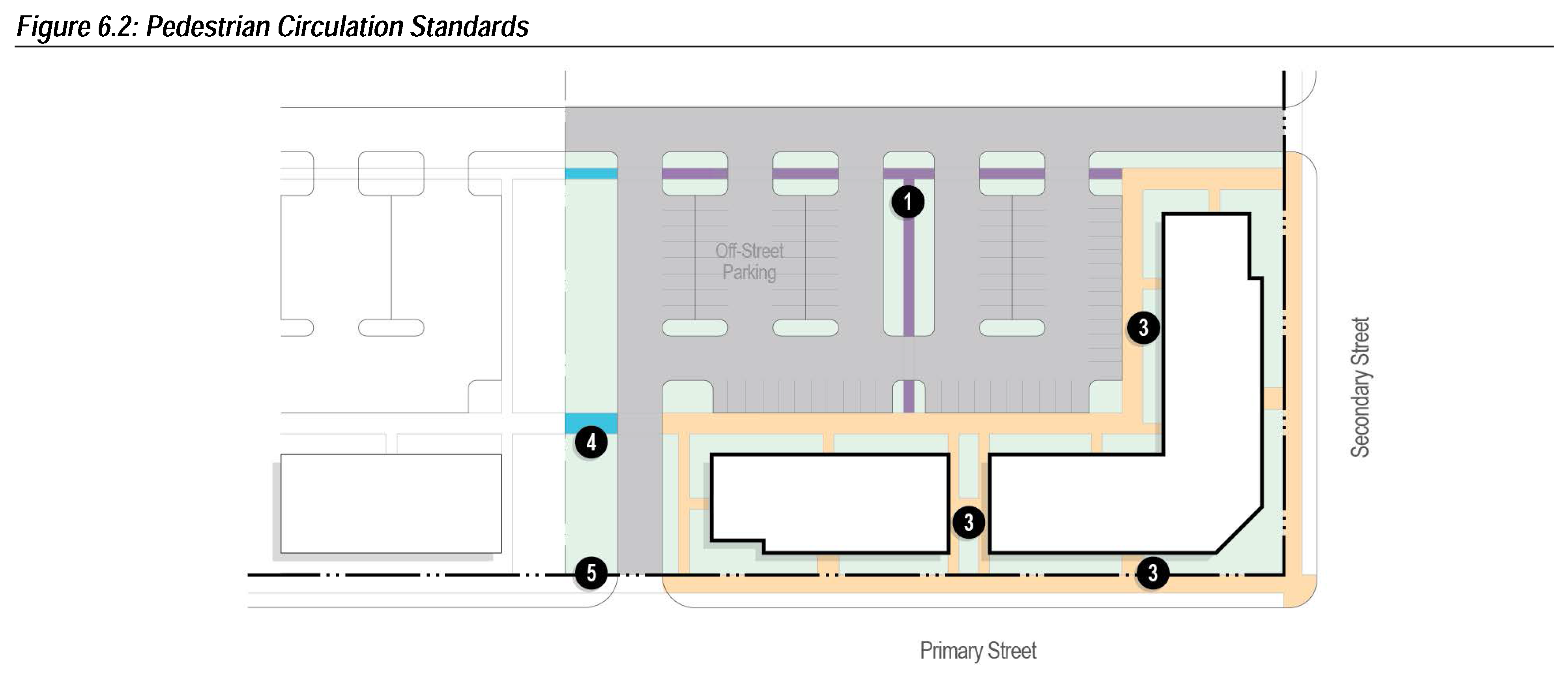
Off-street parking areas shall include on-site pedestrian circulation systems to ensure the safety of pedestrians, bicyclists, and motorists.
(2)
The on-site pedestrian circulation system shall comply with all ADA standards.
(3)
The on-site pedestrian circulation system shall be marked and must connect all buildings on the site to one another and provide connections to the required vehicle and bicycle parking spaces.
(4)
The on-site pedestrian circulation system must connect building entrances to adjacent public rights-of-way along direct routes that do not require significant out-of-direction travel.
(5)
The on-site pedestrian circulation system shall provide at least one connection to all adjacent properties along a shared street frontage. Connections must provide access to existing walkways on adjacent properties, or to the likely future location of walkways on those properties. The City Planner may waive this requirement upon determining that no walkway exists, a future walkway is unlikely to exist, or such connection would create a safety hazard.
(I)
Off-Street Bicycle Parking.
(1)
Location.
(a)
Required bicycle parking shall be provided on the same lot as the use for which it is intended to serve.
(b)
Bicycle parking spaces shall be adequately lit and located such that they are highly visible from the street and/or building entrance(s) from where bicyclists approach.
(c)
The location of bicycle parking shall not conflict with pedestrian and/or vehicle circulation.
(d)
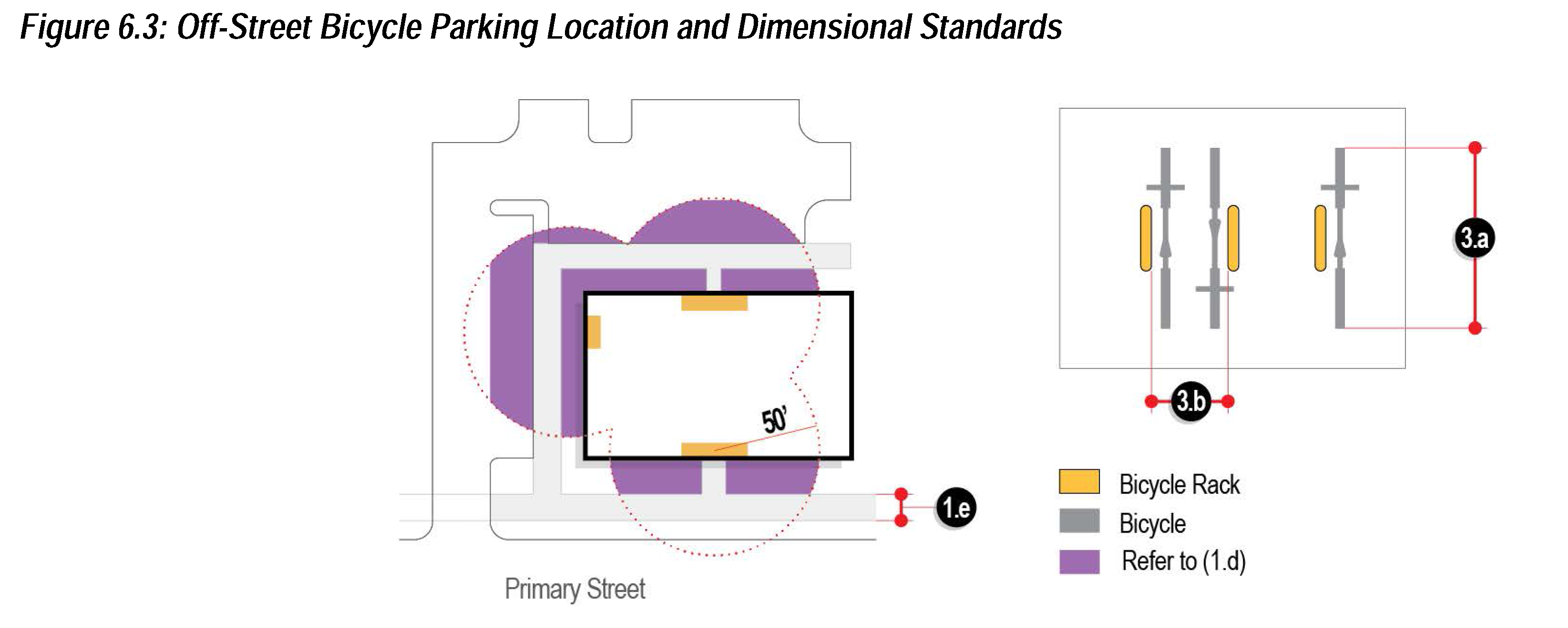
Bicycle parking shall be sited within 50 feet of a building's main entrance. If provided indoors, bicycle parking shall be located within a common area designated for secure bicycle storage.
(e)
Bicycle parking adjacent to a pedestrian walkway shall be sited to ensure that a minimum five-foot walkway clearance is maintained.
(2)
Design Criteria. All bicycle parking facilities shall be designed in accordance with standards established by the National Association of City Transportation Officials.
(3)
Dimensional Standards.
(a)
Each bicycle parking space shall be a minimum of six feet in length.
(b)
Bicycle racks shall be located at least three feet in all directions from any obstruction, including, but not limited to, other bicycle racks, walls, doors, posts, columns, or landscaping.
(c)
A minimum vertical clearance of seven feet shall be maintained above all bicycle parking facilities.
(4)
Off-Street Bicycle Parking Requirements.
(a)
Exemption. The bicycle parking requirements of this section shall apply to all uses other than the following:
(I)
All vehicle related uses,
(II)
Single-family detached, duplex, and townhome uses, and
(III)
Uses in the DC District.
(b)
When the required amount of bicycle parking is two spaces or less, the use shall provide a minimum of two spaces in a bicycle parking area.
(c)
Unless otherwise specified herein, the number of required bicycle parking spaces shall be equal to five percent of required vehicle parking spaces, up to ten bicycle parking spaces.
(J)
Off-Street Loading Requirements.
(1)
Purpose. The purpose of this section is to prevent congestion of public rights-of-way and private lots to promote the safety and general welfare of the public by establishing minimum requirements for the provision of loading facilities on various sites.
(2)
Applicability. Any use which has a gross floor area of 6,000 square feet or more, and which requires deliveries or makes shipments, shall provide off-street loading facilities in accordance with the regulations of this section except for uses within the DC and RTC Districts.
(3)
Location. All loading berths shall be located 25 feet or more from the intersection of two street right-of-way lines. Loading berths shall not be located within any required front yard or corner yard setback area and shall be oriented away from the primary road. All loading areas shall be located on the private lot and shall not be located within, or so as to interfere with, any public right-of-way, off-street parking area, or pedestrian circulation area.
(4)
Size of Off-Street Loading Area. Adequate space for standing, turning, loading, and unloading services shall be provided in a manner that does not interfere with required off-street parking areas, pedestrian circulation areas, and with the public use of streets or alleys.
(5)
Access to Off-Street Loading Area. Each loading berth shall be located to facilitate access to a public street or alley and shall not interfere with other vehicular or pedestrian traffic and shall not interfere with the function of parking areas. In no instance shall loading areas rely on backing movements into public rights-of-way. Users of shared loading areas are encouraged to coordinate loading activities to minimize off-site impacts.
(6)
Surfacing and Marking. All required loading areas shall be paved and maintained in a dust-free condition at all times. Said surface shall be marked in a manner that demarcates the loading areas.
(7)
Use of Off-Street Loading Areas. The use of all off-street loading areas shall be limited to the loading and unloading of vehicles. Said area shall not be used to provide minimum required parking spaces.
(8)
Lighting. Lighting used to illuminate an off-street loading area, if any, shall meet all requirements for outdoor lighting as detailed in section 16-6-7.
(9)
Required Loading Spaces. The number of loading spaces provided shall be determined by the developer and shall provide for adequate space for standing, turning, loading, and unloading services. These spaces shall be provided in a manner that does not interfere with internal site circulation, ingress or egress to the site, access to or use of required off-street parking areas and pedestrian circulation areas, and with the public use of streets or alleys.
(Ord. No. 1581, § II, 4-5-2022; Ord. No. 1668, § III(Att. C), 3-25-2025)
Sec. 16-6-2. - Driveways.
(A)
Residential District Driveway Standards. A single slab or ribbon driveway from the property line to legal, on-site parking shall be provided and shall be in conformance with the following criteria.
(1)
Limit of One.
(a)
One single slab or ribbon driveway and one curb cut shall be permitted per single-family residential lot every 75 feet of lot frontage.
(b)
Circle or semicircle driveways may be approved per adopted engineering standards and adopted City of Jenks policy.
(c)
New single-family detached residential parcels taking access from collector or arterial streets, as identified by INCOG, shall share driveways in order to protect public safety by limiting curb cuts, unless otherwise approved as an administrative exception as detailed in section 16-9-3(E).
(2)
Single-Slab Driveway Design Standards.
(a)
Width.
(I)
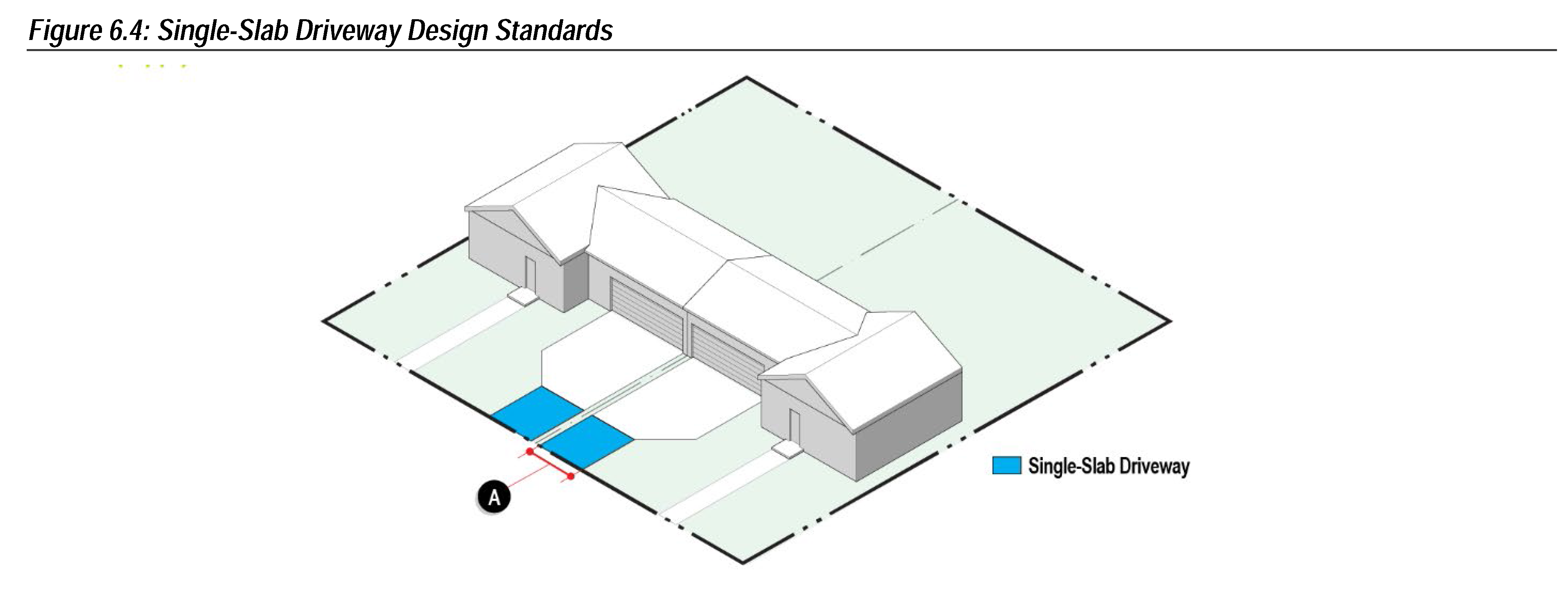
Single-slab driveways on lots with duplex and townhome uses shall not exceed 27 feet in width at the property line.
(II)
Single-slab driveways on lots with single-family detached uses shall not exceed the width of the garage doors.
(b)
Materials.
(I)
Single-slab driveways shall be surfaced with concrete including decorative concrete, patterned concrete, and exposed aggregate concrete, concrete pavers, paving blocks, or similar materials approved by the City Engineering or Planning Staff.
(II)
Porous asphalt may only be used on lots three acres or larger.
(III)
Homes built prior to 1985 may qualify for exceptions on parking pad materials per adopted City of Jenks policy.
(3)
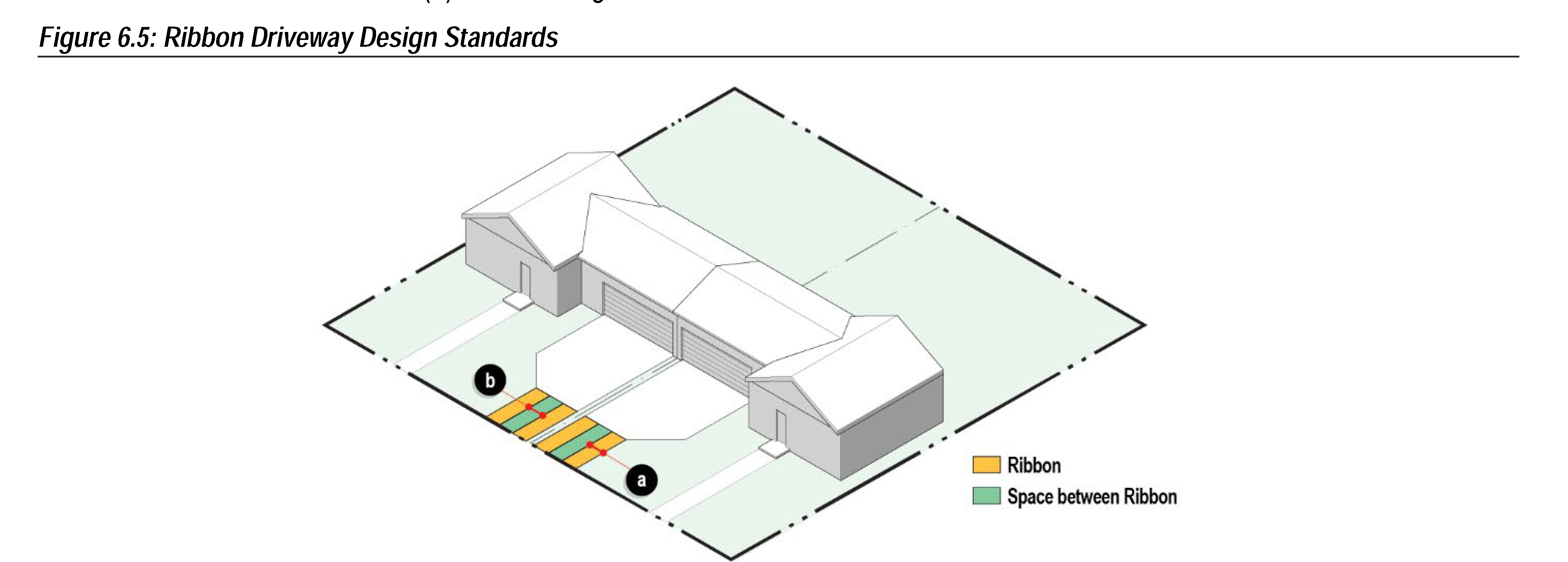
Ribbon Driveway Design Standards.
(a)
Width. Ribbons shall be a minimum of two feet wide and a maximum of three feet wide.
(b)
Dimensions. Ribbons shall be a minimum of three feet apart measured from their nearest edges. The space between ribbons shall be planted in turf grass or other ground cover used in the front yard.
(c)
Materials. Ribbons shall be concrete including decorative concrete, patterned concrete, and exposed aggregate concrete, concrete pavers, paving blocks, or similar materials approved by the City Engineering or Planning Staff. Porous asphalt may only be used on lots three acres or larger.
(4)
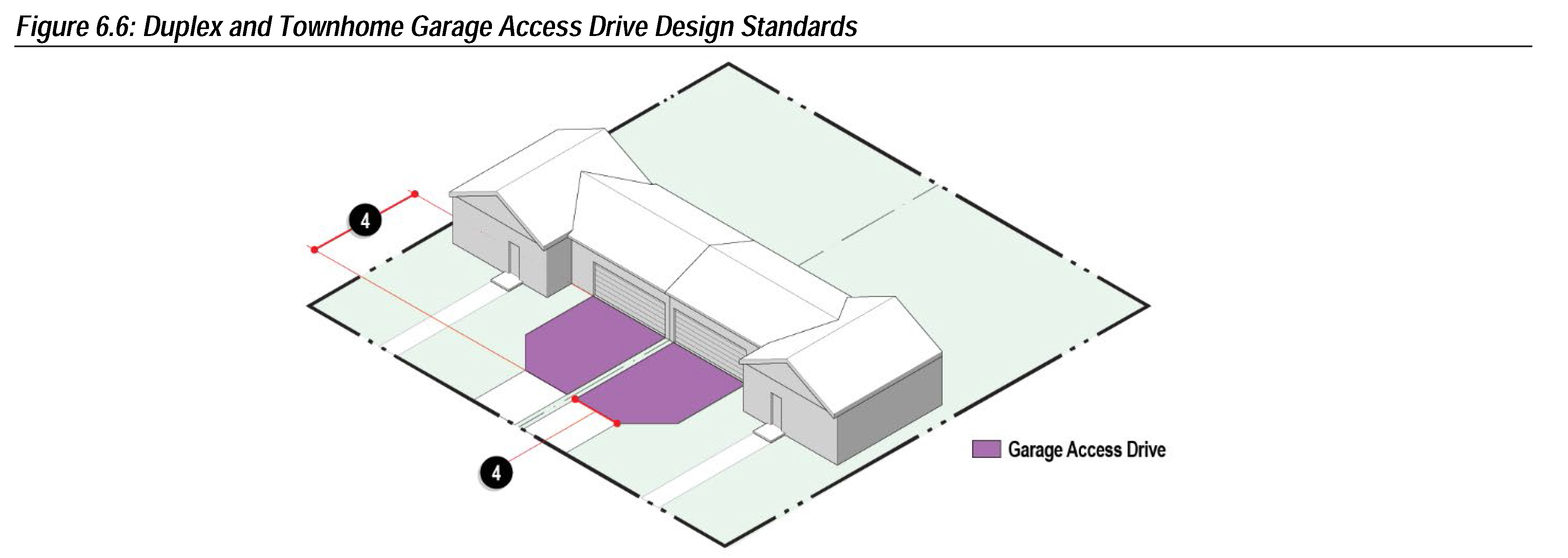
Garage Access Drive For Duplex and Townhome Uses. A garage access drive, the width of the garage, as measured from the garage door(s) plus an additional three feet on either side of the garage door(s), is permitted to extend for a distance of 16 feet from the garage doors before tapering, within ten feet, back to the maximum driveway width.
(5)
Porte Cochère and Courtyard. If a porte cochère is utilized, a courtyard in the rear of the porte cochère for the purpose of accessing the garage(s) may be allowed. The dimensions of the courtyard shall be as approved by the City Planner to ensure compliance with maximum impervious surface requirements as established in section 16-3-1. The driveway leading to the porte cochère shall comply with the requirements established in section 16-6-2(A)(1—3) and shall terminate directly at the porte cochère without being subject to the tapering requirements for garage access drives in section 16-6-2(A)(4).
(6)
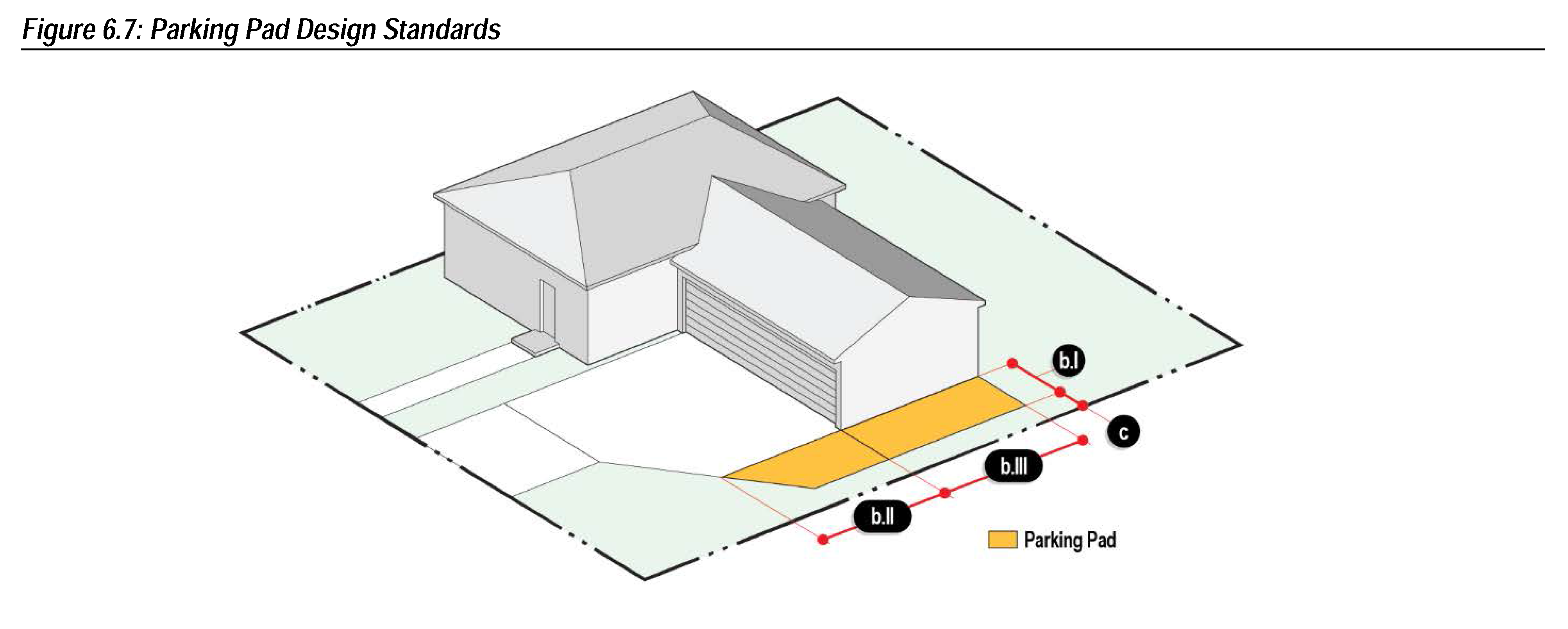
Parking Pad.
(a)
Limit of One. A single-family driveway may be extended to include one parking pad.
(b)
Configuration.
(I)
A parking pad shall be a maximum of ten feet in width.
(II)
Parking pads are limited to a maximum of 400 square feet in aggregate.
(III)
The portion of the parking pad adjacent to the garage shall have a maximum length equal to the depth of the garage, as measured from the front façade line of the garage.
(IV)
Parking pads must be accessed by the driveway.
(V)
Materials. The maximum impervious surface requirements for the lot may not be exceeded to accommodate a parking pad. Parking pads may be constructed of an impervious surface or meet requirements for an approved permeable surface.
(c)
Location. The parking pad shall be set back a minimum of five feet from any side property line.
(B)
Multifamily and Nonresidential Driveway Standards.
(1)
Location.
(a)
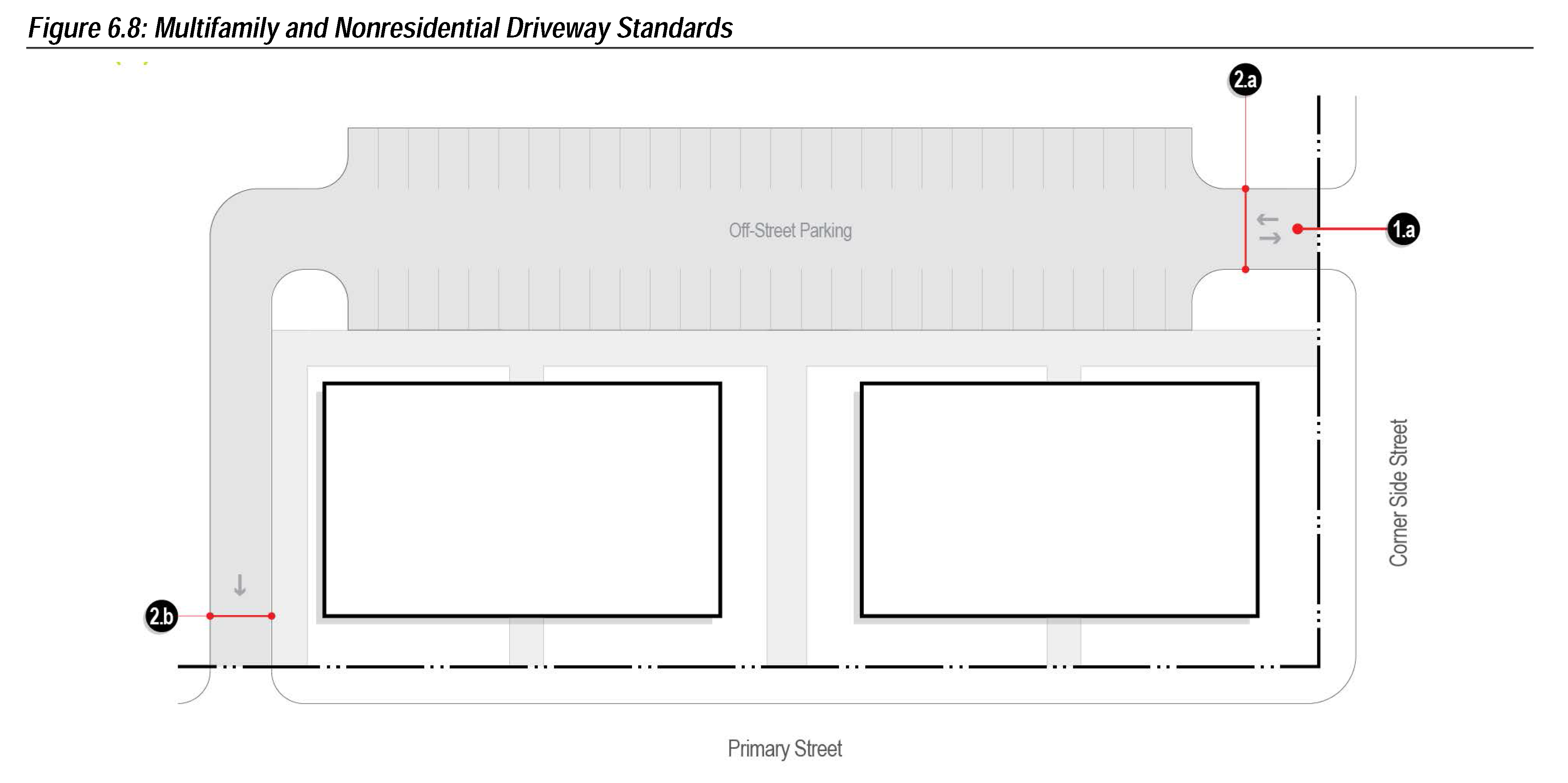
Where an off-street parking area of a corner lot abuts an alley or a corner side street, access to the off-street parking area shall be obtained from a driveway off the alley or corner side street.
(b)
No lot can have multiple driveways for purposes of vehicular ingress and egress without a minimum of 300 foot separation between such curb cuts along a street, unless otherwise approved by the City Engineer.
(2)
Driveway Design Standards.
(a)
Two-way driveways for multifamily and nonresidential uses shall be a minimum of 20 feet and a maximum of 36 feet at the property line.
(b)
One-way driveways for multifamily and nonresidential uses shall be a minimum of twenty (20) feet and a maximum of twenty-six (26) feet at the property line.
(c)
Driveways for multifamily and nonresidential uses shall be surfaced with an asphaltic concrete or portland cement concrete pavement.
(Ord. No. 1581, § II, 4-5-2022; Ord. No. 1668, § III, 3-25-2025)
Sec. 16-6-3. - Landscape.
Landscape improvements required by this section shall apply to all non-single-family development and consist of living plants in a combination of trees, shrubs, native grasses and/or groundcover. Unless otherwise stated in this section, all size specifications for plant materials shall be based upon the time of planting. When caliper is specified for tree planting, the caliper of the tree trunk shall be measured at six inches above the soil level. Any plant materials used to meet the requirements of this section shall not include any plant material identified as a Regulated Invasive Plant by the Oklahoma Department of Agriculture, Food, and Forestry.
(A)
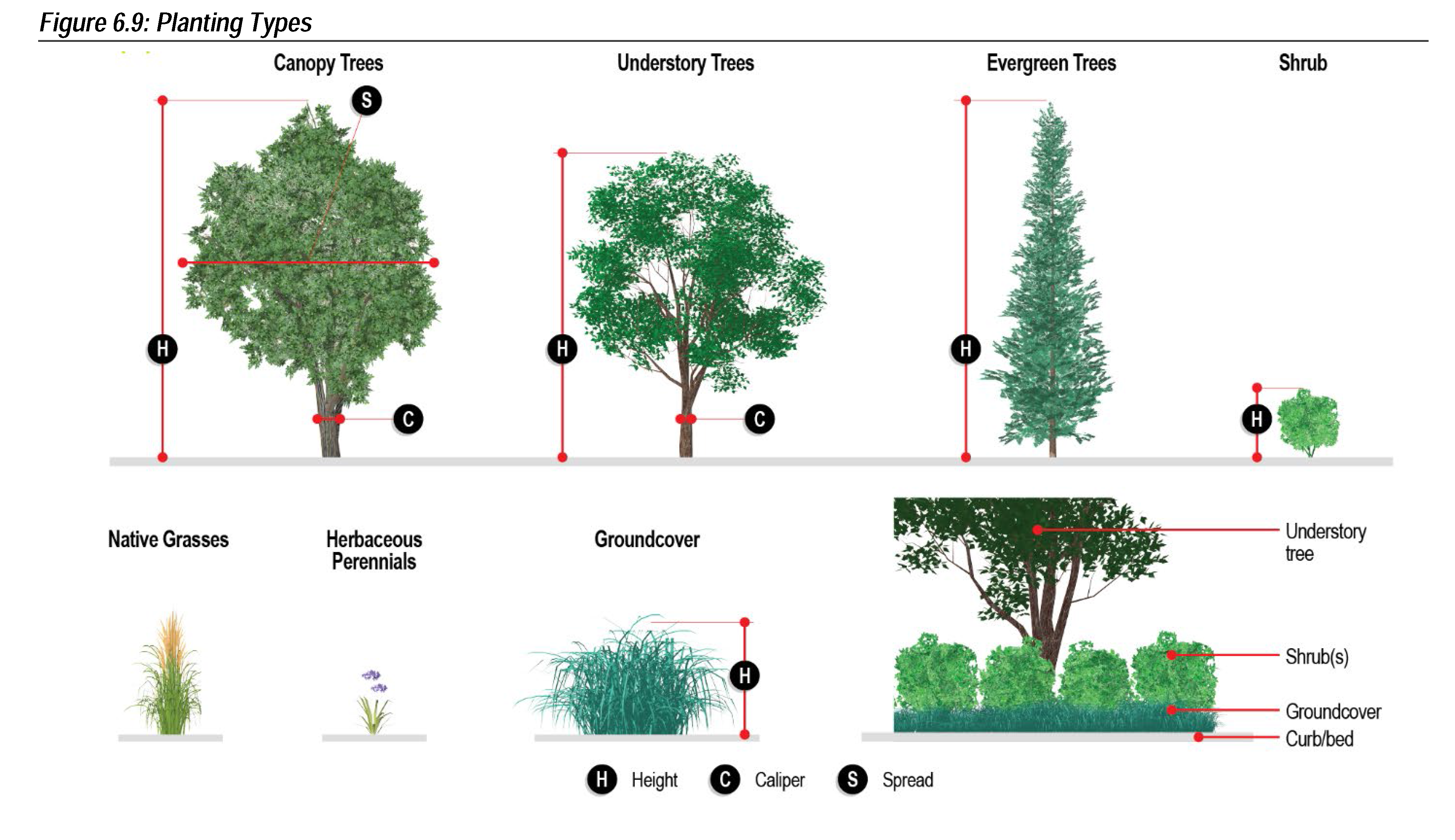
Planting Types.
(1)
Canopy Trees. A woody plant (deciduous or evergreen) having not less than a two and one-half-inch caliper with single central axis which typically reaches a mature height of not less than 40 feet and a mature spread of not less than 15 feet.
(2)
Understory Trees. A woody plant having not less than a one and one-half-inch caliper, or six feet tall for multiple stem species, that normally attains a mature height of at least 15 feet.
(3)
Evergreen Trees. A tree having foliage that persists and remains green throughout the year and has a height of not less than six feet at installation and maturing to a height of not less than 20 feet.
(4)
Shrub. A woody plant (deciduous or evergreen) of low to medium height characterized by multiple stems continuous from its base and having a height of not less than two feet.
(5)
Native Grasses. Grasses that are native to, or adapted to, the State of Oklahoma, not including noxious weeds.
(6)
Herbaceous Perennials. Plants with non-woody stems whose above-ground growth largely or totally dies back during winter months but whose underground plant parts (roots, bulbs, etc.) survive.
(7)
Groundcover. Herbaceous plants, other than turf grass, or prostrate shrubs normally reaching an average maximum height of 18 inches at maturity.
(B)
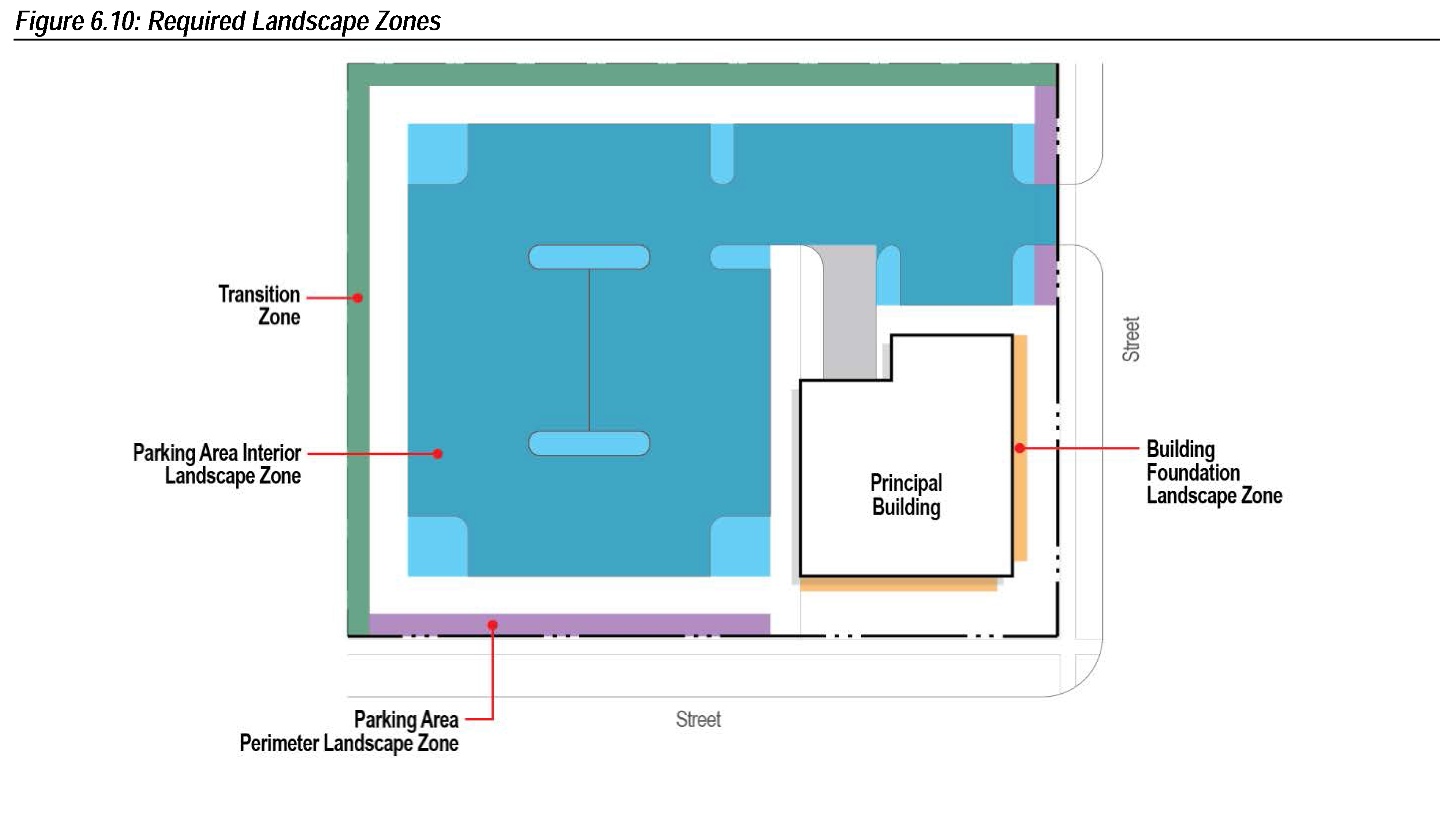
Required Landscape Zones. Figure 6.10 illustrates the location of the required landscape zones as detailed in the following sections. The City Planner may approve up to a 25 percent reduction in the overall required amount of landscape material for properties in the IL District or IM District not visible from properties in commercial or residential districts or from major thoroughfares.
(C)
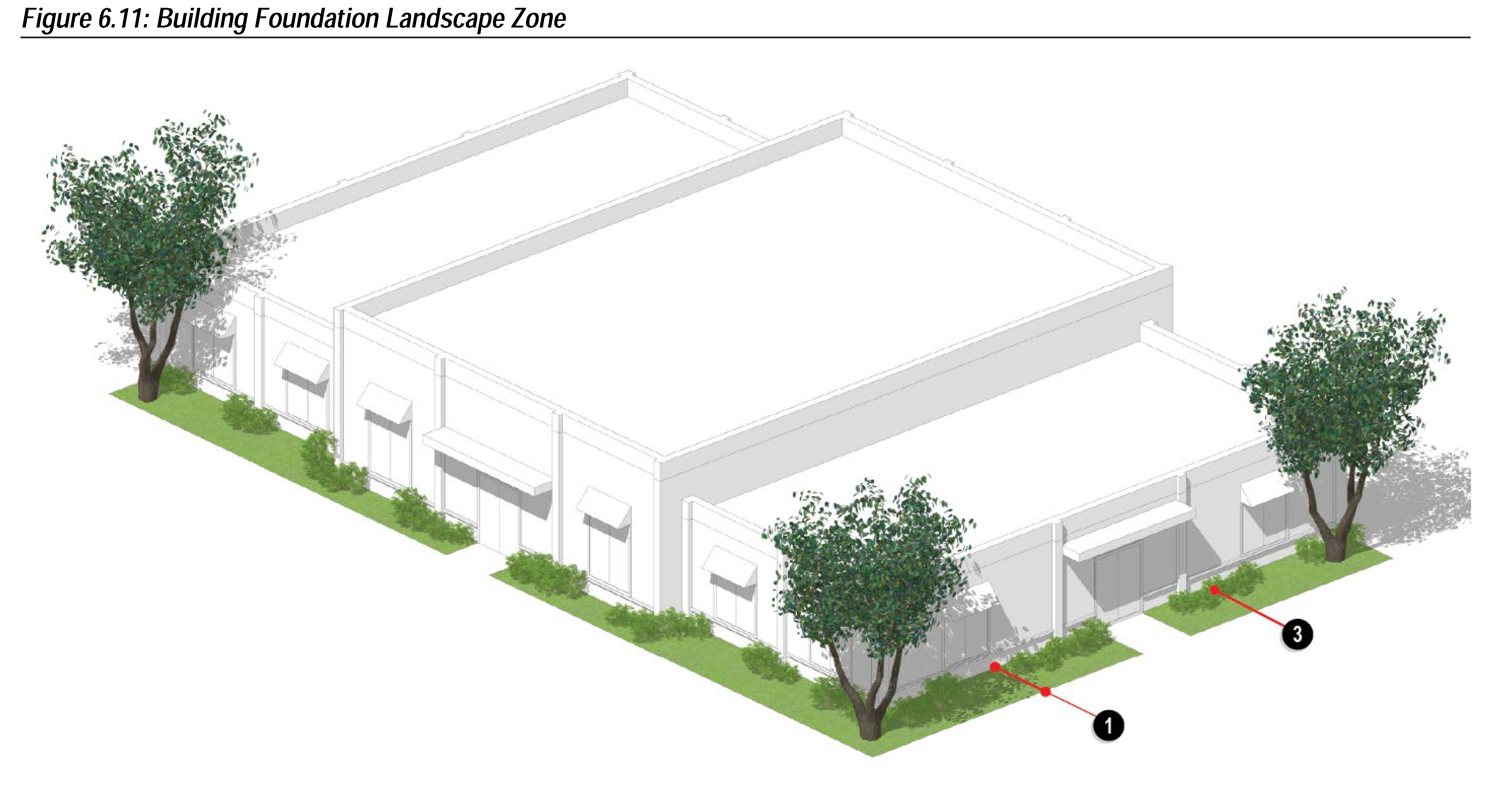
Building Foundation Landscape Zone. All nonresidential, mixed use, and multifamily development where a front yard setback is required, with the exception of food processing facilities regulated by the FDA, shall include landscape located at the building foundation as required by this section. Landscape required by this section shall be in addition to landscape required under other sections of this UDO. It is the objective of this section to provide a softening effect at the base of buildings.
(1)
Applicable development is required to maintain a building foundation area at front and exterior side yards with a minimum width of seven feet.
(2)
Foundation plantings shall be designed to supplement buffer yard plantings to frame important views, while visually softening long expanses of walls.
(3)
Foundation plantings shall be installed across 40 percent of the length of the façade of the building.
(4)
Foundation plantings may include trees, shrubs, native grasses, and groundcover.
(5)
Where the area between the building and parking lot or street curb is entirely paved for pedestrian use, landscaping may consist of canopy trees planted in structural soils beneath tree grates or permeable pavement, at the rate of one tree per 50 linear feet of building façade. Minimum structural soil volume shall be 600 cubic feet.
(6)
Above-ground stormwater planter boxes along building façades may be substituted for foundation plantings.
(7)
Required foundation plantings may be installed between parking lots and the building but shall be installed within 12 feet of the building façade.
(D)
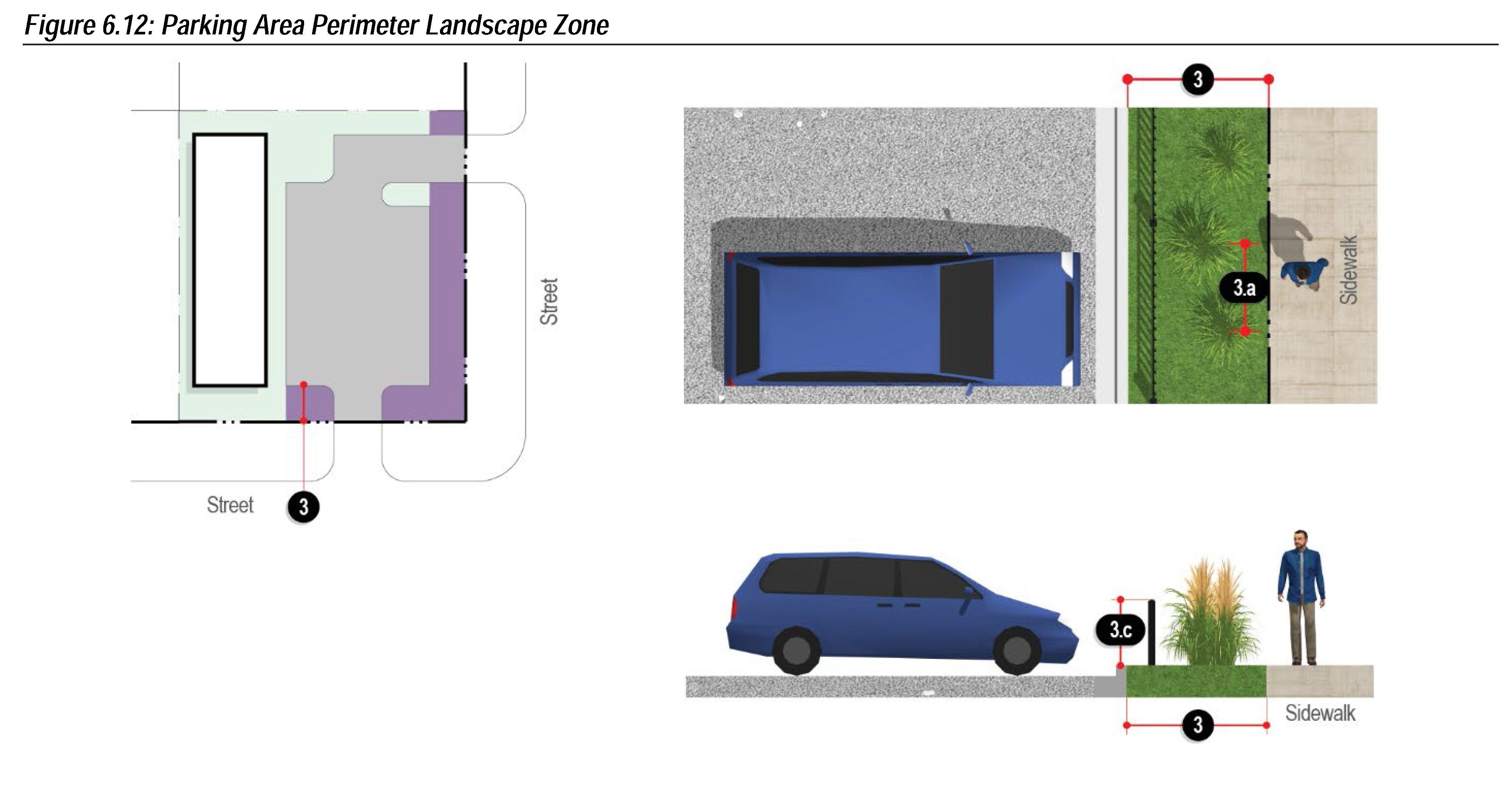
Parking Area Perimeter Landscape Zone. Landscape required by this section shall be in addition to landscape required under other Sections of this UDO. It is the objective of this section to provide screening between off-street parking areas and rights-of-way, and to provide for the integration of stormwater management with required landscaping.
(1)
Location. All off-street parking areas which abut a public or private right-of-way, excluding alleys, shall include landscape and trees as required by this section located between the back of curb of the off-street parking area and the right-of-way.
(2)
Applicability. The parking lot perimeter landscape regulations of this section apply to the following:
(a)
The construction or installation of any new off-street parking area, and
(b)
The expansion of any existing off-street parking area, in which case the requirements of this section apply only to the expanded area.
(3)
Requirements. Perimeter landscape shall be established along the edge of the off-street parking area and have a minimum width of seven feet as measured from the back of curb of the off-street parking area, to accommodate vehicle bumper overhang and ensure planting areas that are adequate in size.
(a)
One shrub or native grasses the height of which shall not be less than three feet nor greater than five feet, shall be planted for every four feet of landscape area length when no masonry wall or fence is provided as described in this subsection, or when such wall or fence is not entirely opaque. One shrub or native grass shall be planted every eight feet when an opaque masonry wall or fence is provided as detailed in this subsection. Such plantings may be clustered or spaced at even intervals as deemed appropriate by the City.
(b)
Landscaped areas outside of shrubs/native grasses and tree masses shall be planted in live groundcover.
(c)
A low masonry wall or fence the height of which provides effective screening to a maximum height of three feet may be used in conjunction with required landscaping as detailed above. Plant materials shall be installed between the sidewalk and the fence or wall to provide a softening effect.
(E)
Parking Area Interior Landscape Zone. All off-street parking areas shall include landscape and trees located within the off-street parking area as required by this section. Trees and landscape required by this section shall be in addition to trees and landscape required under other sections of this UDO. It is the objective of this section to provide shade within parking areas, break up large expanses of parking area pavement, support stormwater management where appropriate, improve the appearance of parking lots as viewed from rights-of-way, and provide a safe pedestrian environment.
(1)
Applicability. The parking area interior landscape zone regulations of this section apply to the following:
(a)
The construction or installation of any new off-street parking lot containing 15 or more parking spaces, and
(b)
The expansion of any existing off-street parking area if the expansion would result in 15 or more new parking spaces, in which case the requirements of this section apply only to the expanded area.
(2)
Requirements. The level of parking lot interior landscape required shall depend on the size and location of the off-street parking area as follows.
(a)
Off-street parking areas consisting of 15 or more continuous spaces shall be required to provide full interior landscaping amenities as specified in subsections (3) through (9) below.
(b)
Off-street parking areas consisting of fewer than 15 continuous spaces that are located to the front or side of the principal building shall be required to terminate all rows of parking with a parking area end cap, as detailed in subsection (4), but shall otherwise be exempt from the requirements of subsections (3) through (9) below.
(c)
Off-street parking areas consisting of fewer than 15 continuous spaces that are located in the rear of the principal building shall be exempt from the requirements of this section.
(3)
Amount. The amount of required parking area interior landscape shall be determined by the yard in which the off-street parking area is located as detailed below.
(a)
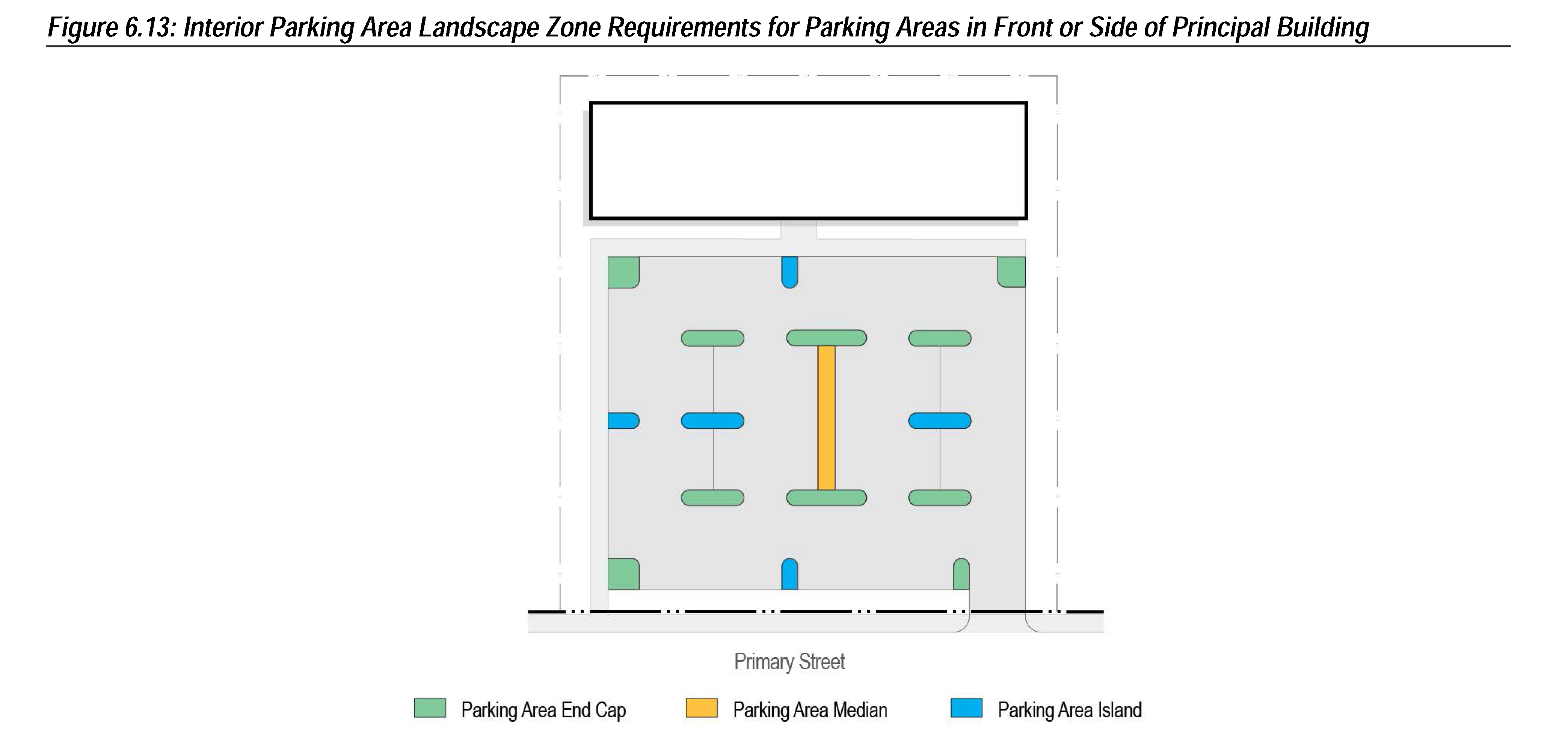
Off-Street Parking Areas in Front or Side of Principal Buildings.
(I)
Parking Area End Caps. A parking area end cap shall be located at the end of any bay of parking bordered by a drive aisle, public or private street, or pedestrian circulation system.
(II)
Parking Area Median Amount Requirement. Parking area medians shall be placed between every third bay of parking.
(III)
Parking Area Island Amount Requirement. Parking area islands shall be located on parking bays which are not required to have parking area medians. Parking area islands shall be spaced not more than 135 feet or more than 15 continuous spaces apart.
(b)
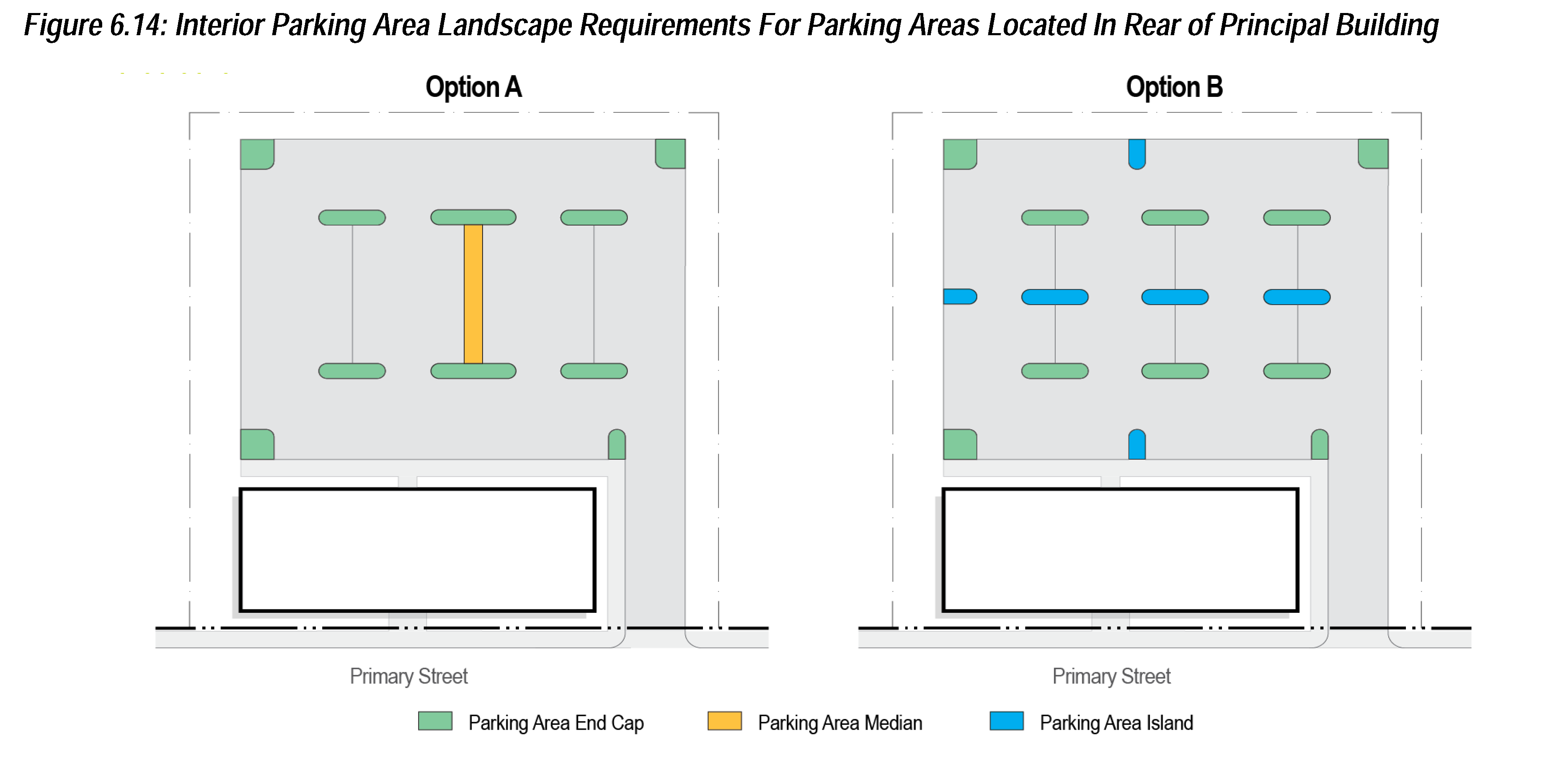
Off-Street Parking Areas in Rear of Principal Building.
(I)
Parking Area End Caps. A parking area end cap shall be located at the end of any bay of parking bordered by a drive aisle, public or private street, or pedestrian circulation system.
(II)
Parking Area Median or Parking Area Island Amount Requirement. The developer may choose to install either parking area medians or parking area islands. If the developer chooses to install parking area medians, they shall be placed between every third bay of parking. If the developer chooses to install parking area islands, they shall be located on parking bays which are not required to have parking area medians. Parking area islands shall be spaced not more than 135 feet or more than 15 continuous spaces apart.
(4)
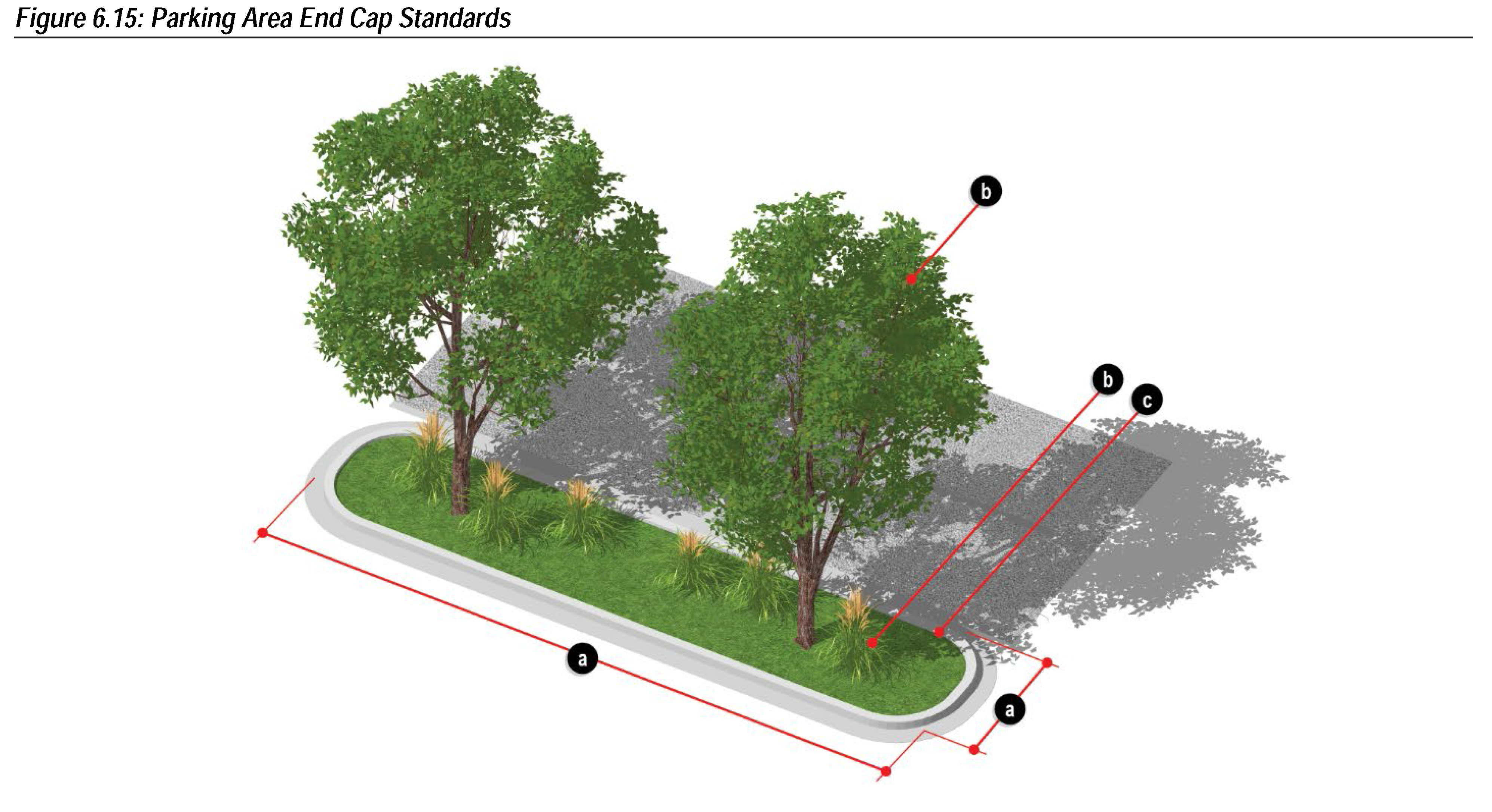
Parking Area End Cap Standards.
(a)
Size. Parking area end caps shall be a minimum nine feet wide by 18 feet long and shall have a minimum soil depth of 36 inches. Double rows of parking shall provide parking area end caps opposite one another to form continuous single end cap.
(b)
Planting. A minimum of one canopy tree and three shrubs or native grasses shall be provided for every parking area end cap. If the end cap extends the width of a double bay, then two canopy trees shall be provided.
(c)
Design. Parking area end caps shall be protected with concrete curbing or other suitable barriers approved by the City Planner. Such end caps shall be properly drained or irrigated as appropriate to the site conditions to ensure survivability of plant materials or proper stormwater management function.
(5)
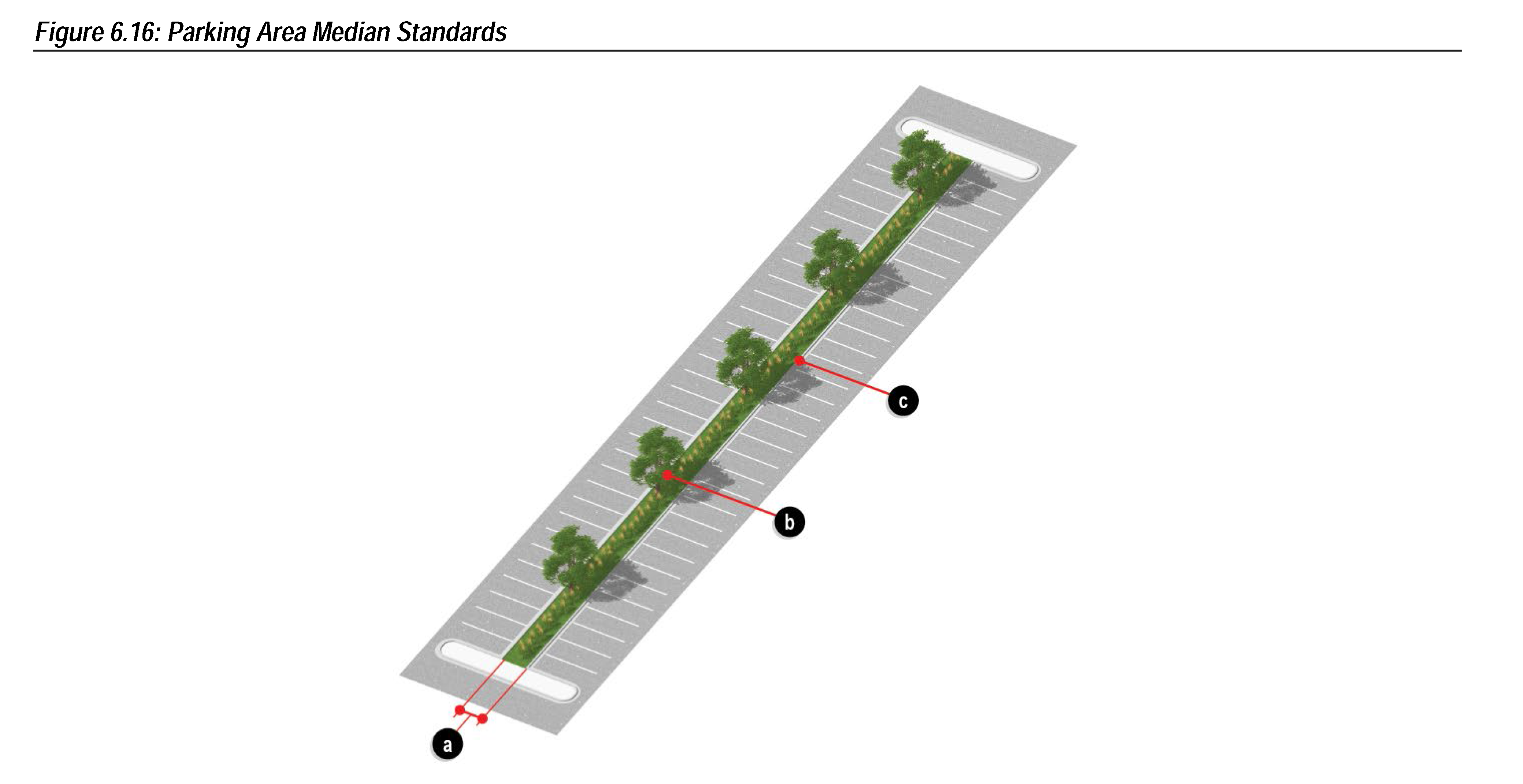
Parking Area Median Standards.
(a)
Width. Parking area medians shall have a minimum width of nine feet and minimum soil depth of 36 inches.
(b)
Planting. A minimum of one canopy tree and 15 shrubs or native grasses shall be planted for each 50 linear feet of parking area median.
(c)
Design. Parking area medians shall be protected with concrete curbing unless the parking area median is designed to be utilized for stormwater management in which case the perimeter shall be protect by wheel stops, or other suitable barriers approved by the City Planner. Such medians shall be properly drained or irrigated as appropriate to the site conditions to ensure survivability of plant materials and proper stormwater management function.
(6)
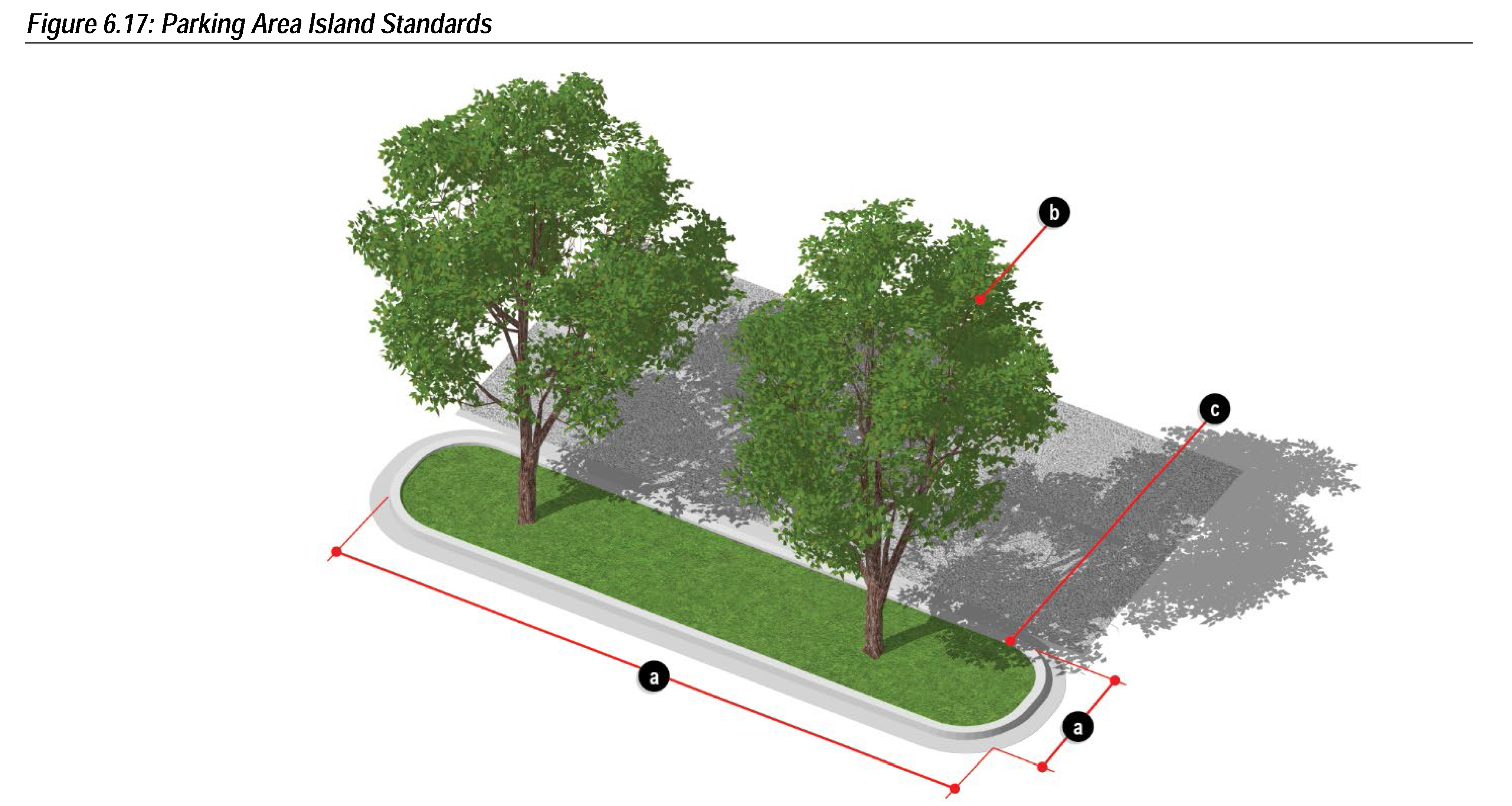
Parking Area Island Standards.
(a)
Size. Parking area islands shall be a minimum nine feet wide by 18 feet long and shall have a minimum soil depth of 36 inches. Double rows of parking shall provide parking area islands opposite one another to form continuous single islands.
(b)
Planting. A minimum of one canopy tree shall be provided for every parking area island. If the island extends the width of a double bay, then two canopy trees shall be provided.
(c)
Design. Parking area islands shall be protected with concrete curbing or other suitable barriers approved by the City Planner. Such islands shall be properly drained or irrigated as appropriate to the site conditions to ensure survivability of plant materials or proper stormwater management function.
(7)
Pedestrian Circulation Systems. Pedestrian circulation systems, as required in the interior of off-street parking areas in section 16-6-1(H), shall be located along parking area medians. The City Planner may waive or modify this requirement on determining that locating pedestrian circulation systems along parking area medians is impractical due to site conditions or undesirable because it would create unsafe conditions.
(8)
Type of Landscape Material. Except where areas are designed as vegetated stormwater management areas, canopy trees shall be the primary plant materials used in parking area islands and canopy trees and shrubs or native grasses shall be the primary plant materials used in parking area medians. Understory trees, evergreen trees, shrubs, native grasses, groundcover, and other plant materials may be used to supplement the required plantings but shall not create visibility concerns for automobiles and pedestrians. If medians or islands are designed as stormwater management areas, deviations from required plantings may be approved by the City Planner.
(9)
Groundcover. A minimum of 75 percent of the surface area of every parking area island and median shall be planted with living groundcover.
(F)
Transition Zone Landscape Requirements. Transition zone landscape shall be required along interior property lines of all nonresidential, mixed use, and multifamily development. It is not expected that the transition area will totally screen such uses but rather will minimize land use conflicts and enhance aesthetics. Landscape required by this section shall be in addition to landscape required under other Sections of this UDO.
(1)
Applicability. Transition zone landscaping is required as follows:
(a)
The construction or installation of any new primary building or primary use; and
(b)
The expansion of any existing primary building or primary use that results in an increase in gross floor area by more than five percent or 1,000 square feet, whichever is greater. In the case of expansions that trigger compliance with transition zone requirements, transition zone landscaping is required only in proportion to the degree of expansion. The City Planner is authorized to allow the transition zone to be established adjacent to the area of expansion or to disperse transition zone landscaping along the entire site transition zone.
(2)
Application of Transition Zone Types. Transition zones shall be provided based on Table 16-6-3(F)(2), except where adjacent uses are of a similar nature, scale, and intensity as determined by the City Planner. As per Table 16-6-3(F)(2), the type of required transition zone is dependent upon the land use type of the subject lot and the land use type of the adjacent lot(s).
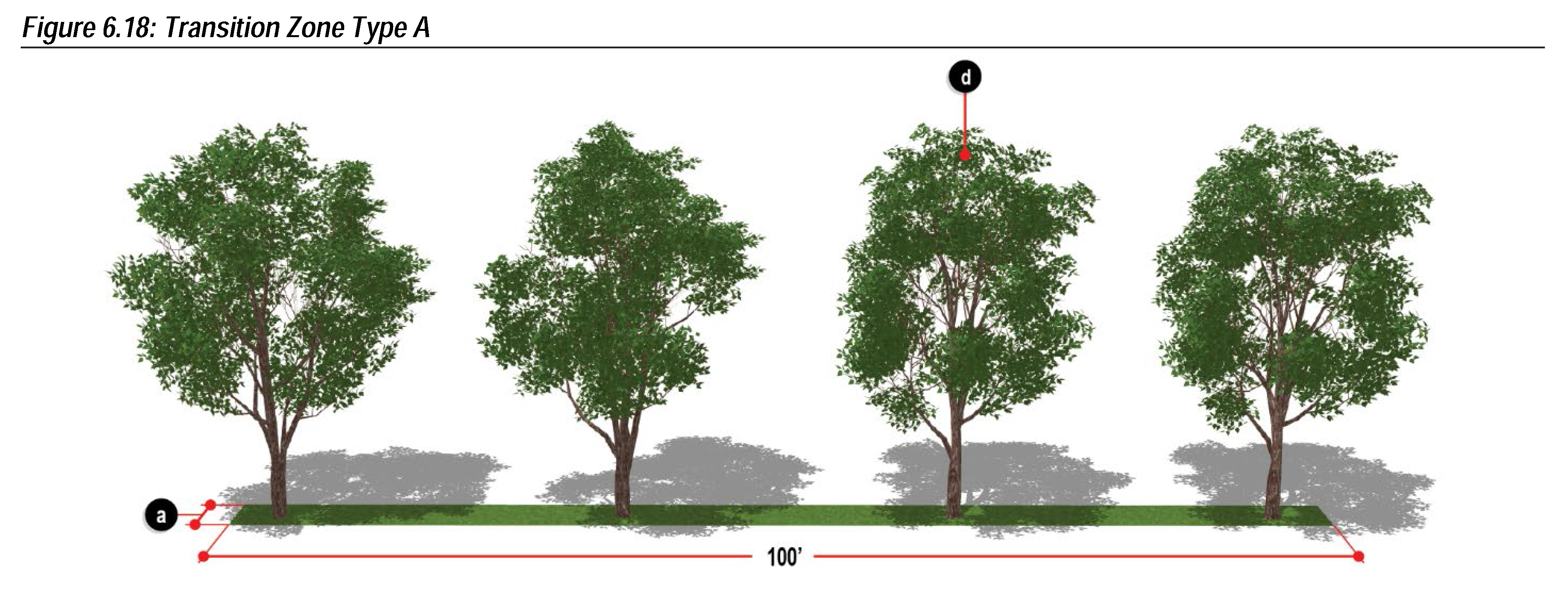
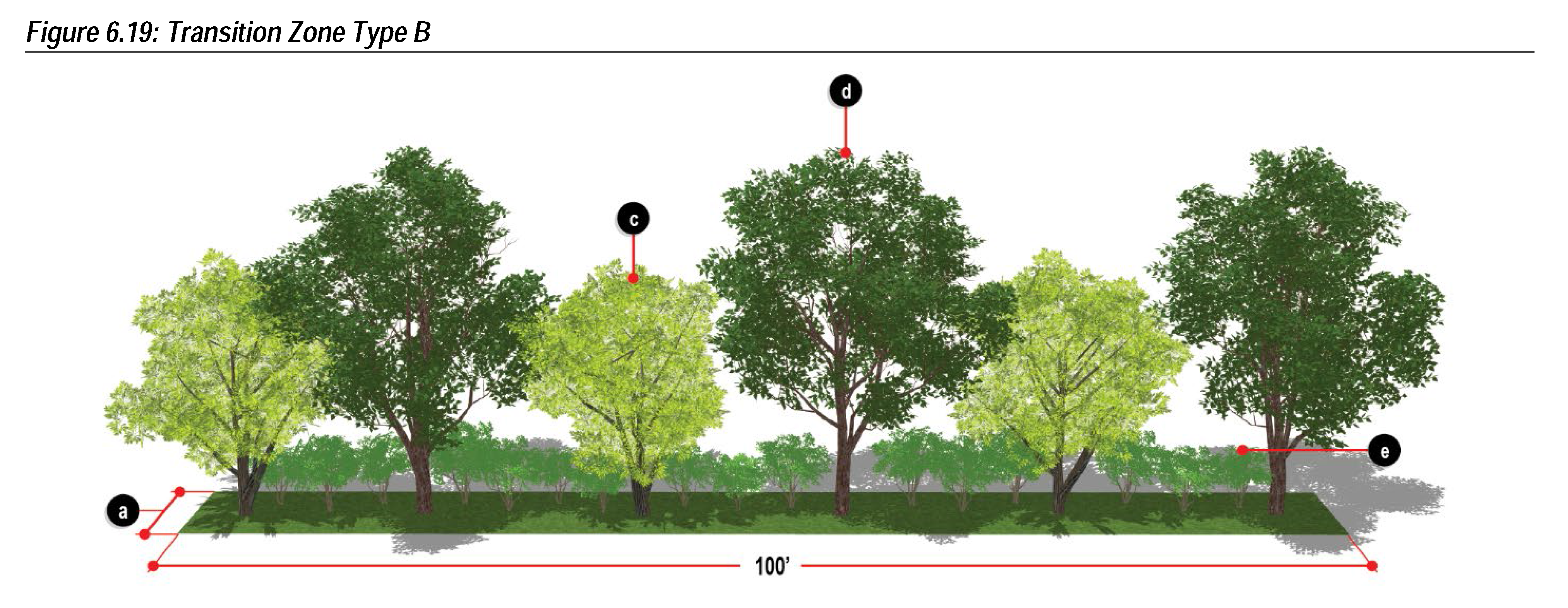
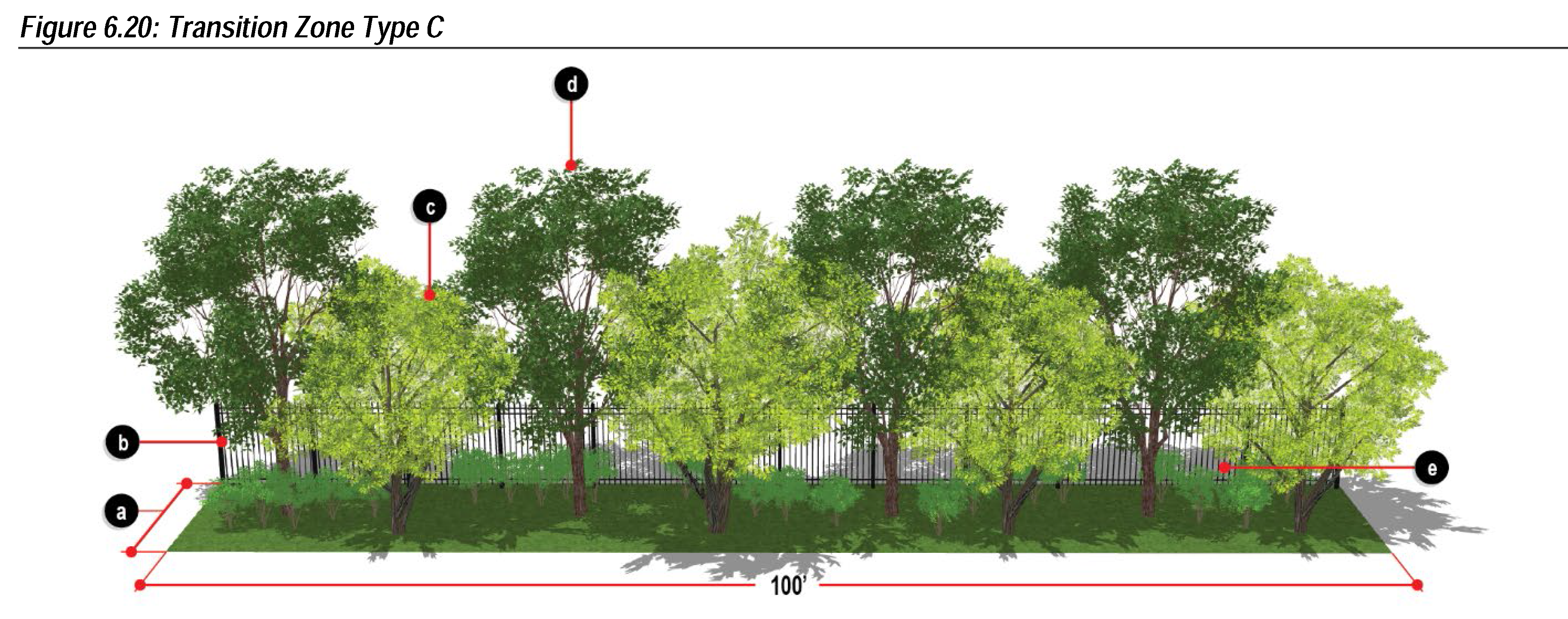
(3)
Transition Zone Types. Four transition zone types are established in recognition of the different contexts that may exist, as shown in Table 16-6-3(F)(3). Transition zones may include a combination of elements including setback distances for separation, planting types, solid fencing, green walls, vegetated stormwater management areas, living groundcover, or turf.
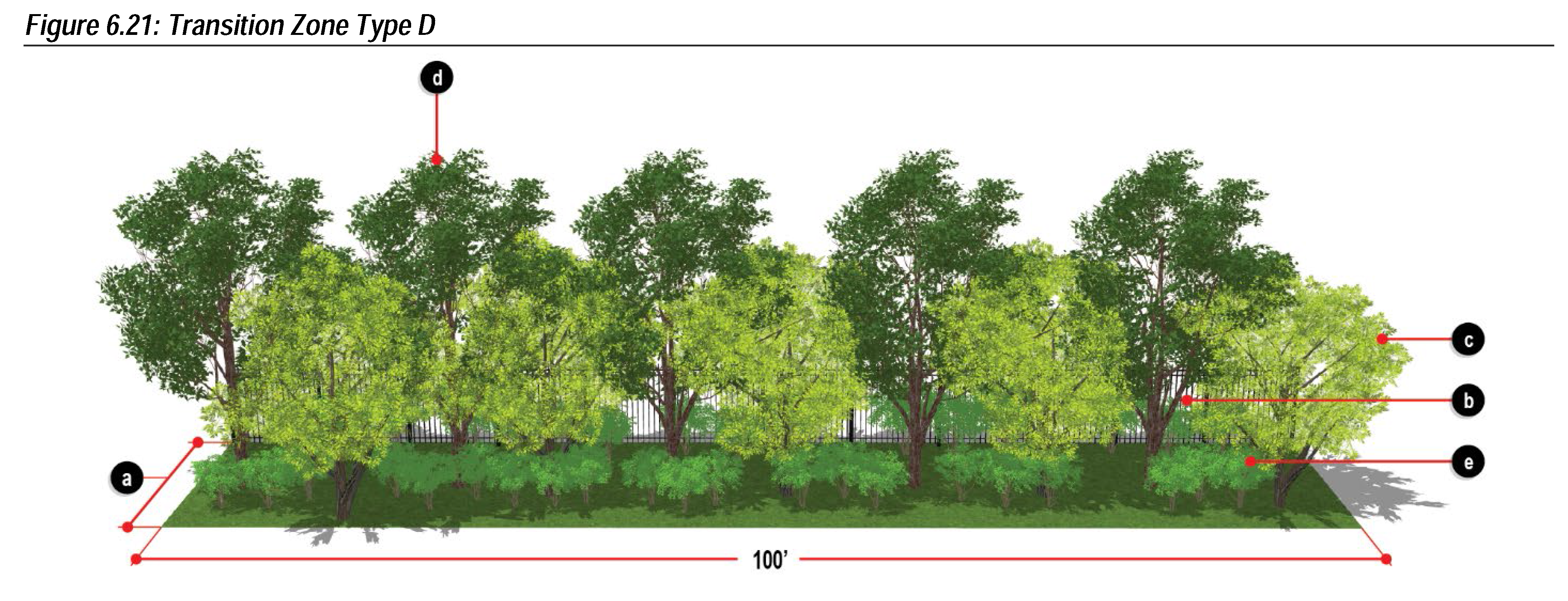
(G)
Species Diversity Requirements. The following species diversity requirements shall be required for all developments, unless otherwise approved by the City Planner in conjunction with approval of vegetated stormwater management areas.
(1)
A minimum of 50 percent of the landscape elements utilized on a parcel that is less than one-half acre shall be drought tolerant native species.
(2)
A minimum of 60 percent of the landscape elements utilized on a parcel that is between one-half and five acres shall be drought tolerant native species. Total landscape elements, excluding turf, shall not be comprised of more than 30 percent of any single species or 50 percent of any genus.
(3)
A minimum of 75 percent of the landscape elements utilized on a parcel that is greater than five acres shall be drought tolerant native species. Total landscape elements, excluding turf, shall not be comprised of more than 20 percent of any single species or 25 percent of any genus.
(H)
Tree Preservation. Preservation of existing high-quality trees within a new development or redevelopment site is highly encouraged. Preserved trees may fulfill a portion of the landscape requirements established in this section. Should the developer propose to maintain existing high-quality trees to count toward satisfying certain landscape requirements of this UDO, the City Planner may, upon receipt of a tree preservation plan, waive certain landscape requirements if mature, high quality trees on a lot are proposed to be preserved. If, upon inspection at the conclusion of the project, trees identified for preservation have been removed, damaged, or are otherwise in declining condition, all waived required landscape shall be installed.
(I)
Installation and Maintenance of Landscape Zones.
(1)
Immediately upon planting, all landscape shall conform to the American Standard for Nurserymen, published by the American Association of Nurserymen, Inc., as revised from time to time.
(2)
Dead plant materials shall be replaced within 60 days upon notification from the City, taking into consideration the season of the year, and shall have at least the same quantity and quality of landscape elements as initially approved. If the particular project is constructed in more than one phase, the 60-day timeframe shall apply to each individual phase.
(3)
All landscape shall be maintained in a healthy, clean, and weed-free condition. The ground surface of landscape areas shall be covered with either turf and/or other types of pervious groundcover or mulch.
(4)
All landscape zones shall be irrigated as follows:
(a)
For stormwater management areas where irrigation is not specified, all installed plantings shall be guaranteed to the City for a period of 18 months following municipal approval of installation. During this guarantee period, the landowner shall supply water as necessary to promote successful establishment and growth.
(b)
Any required landscaped zone not intended for stormwater management, greater than 150 square feet in area, shall be provided with an underground irrigation system or be provided with a portable water supply within 50 feet of said landscaped areas. No part of an irrigation system may be installed in City right-of-way, unless approved by the City Engineer.
(Ord. No. 1581, § II, 4-5-2022; Ord. No. 1624, § IV, 10-17-2023)
Sec. 16-6-4. - Screening.
(A)
Trash and Recycling Receptacles. The following requirements shall apply to all nonresidential, mixed use, and multifamily development.
(1)
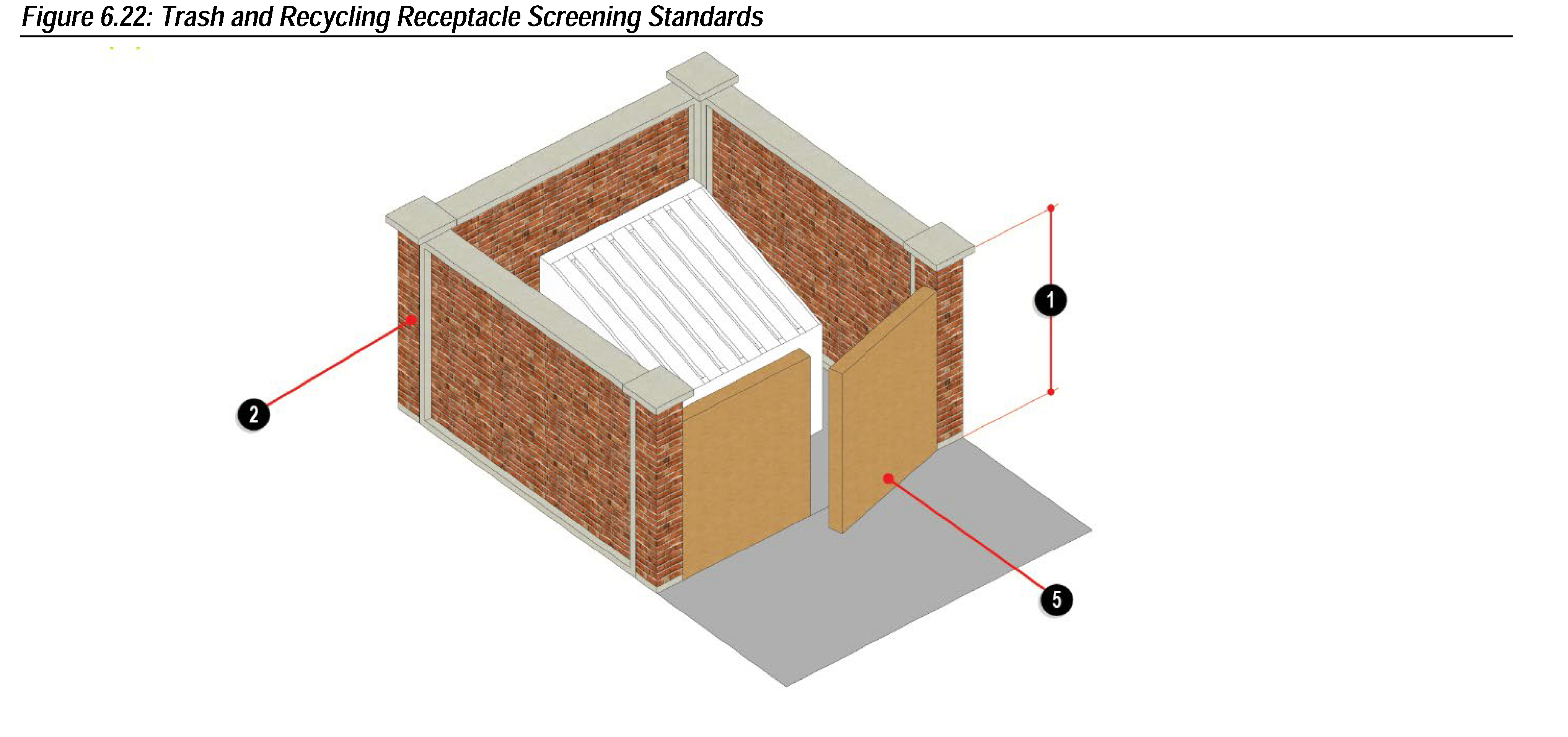
Trash and recycling receptacles shall be screened on three sides with a solid, opaque material with a minimum height of six feet and a maximum height of eight feet. The use of materials that are not solid, such as slats in chain-link, shall only be used to meet this requirement in the Industrial District, however, solid, opaque materials shall be required on any lot in the Industrial District that is adjacent to a residential lot.
(2)
Materials used for screening shall consist of masonry products and shall complement the architecture of the primary building.
(3)
Materials and elevations for enclosures that are attached to buildings shall be designed to be integrated into the primary building.
(4)
If enclosures are to be attached to buildings, they shall comply with applicable fire and building codes.
(5)
Enclosure openings shall be gated with an opaque material and shall not be directly visible from a public right-of-way and/or adjoining residential areas.
(6)
Enclosure openings shall be kept closed at all times except for when the receptacle is being accessed by a service truck or person authorized to place refuse in the enclosure.
(7)
Property owners shall be responsible for ensuring that trash and recycling receptacles be placed in the enclosure at all times other than when it is being emptied by a service truck.
(8)
Access drives shall be constructed of material and thickness to accommodate truck loading. Year-round accessibility to the enclosure area for service trucks shall be maintained by the property owner or tenant.
(9)
Enclosures shall be of an adequate size to accommodate expected containers. It is recommended that the enclosure be designed to be expandable to accommodate future additional containers.
(10)
Enclosure structures shall be designed to protect the walls from damage by containers. Such protection may be provided by use of barrier curbing, reinforced masonry walls, bollards, or other similar means.
(11)
Trash and recycling receptacle enclosures shall not occupy area used for required parking spaces.
(B)
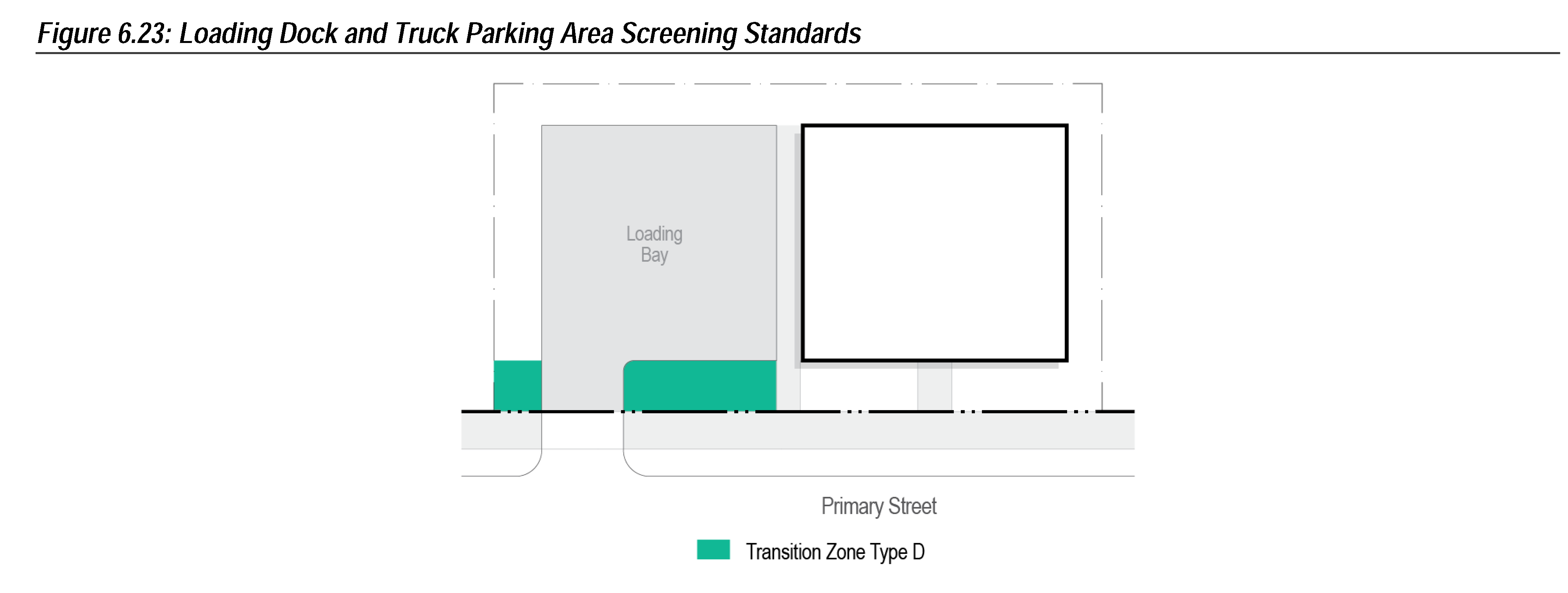
Loading Docks and Truck-Parking Areas. Loading docks and truck-parking areas that are visible from any property in a residential district shall be completely screened from view with a Type D transition zone as specified in Table 16-6-3(F)(3).
(C)
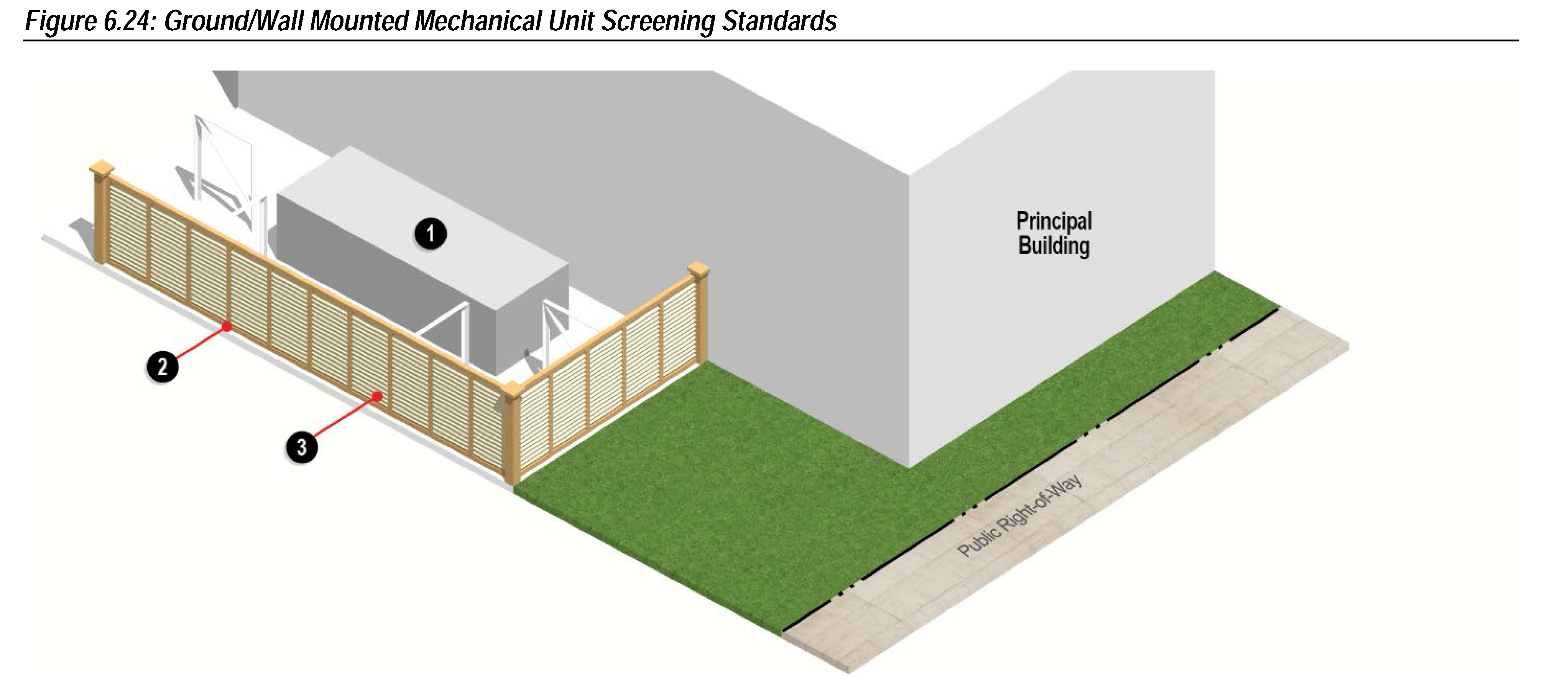
Ground/Wall-Mounted Mechanical Units. The following requirements shall apply to all nonresidential, mixed use, and multifamily development ground-mounted and wall-mounted mechanical units, including, but not limited to, generators, air-conditioning condensers, heat pumps, ventilation units, computer cooling equipment, storage silos, tanks etc., and any related utility structures and equipment.
(1)
Locating mechanical units within the principal building is strongly encouraged in order to minimize exterior visual impacts. Ground/wall-mounted mechanical units are prohibited within the front or exterior side yard, regardless of whether screening is provided, unless operationally necessary and approved by the City Planner.
(2)
Ground/wall-mounted mechanical units that are visible from any public right-of-way or adjacent property in a residential district shall be screened from public view.
(3)
Materials used for screening shall be designed to be architecturally integrated with the building and established so that the area or element being screened is no more than 20 percent visible through the screen.
(4)
Chain-link fence or slats in chain-link fence shall not be used to meet this requirement.
(D)
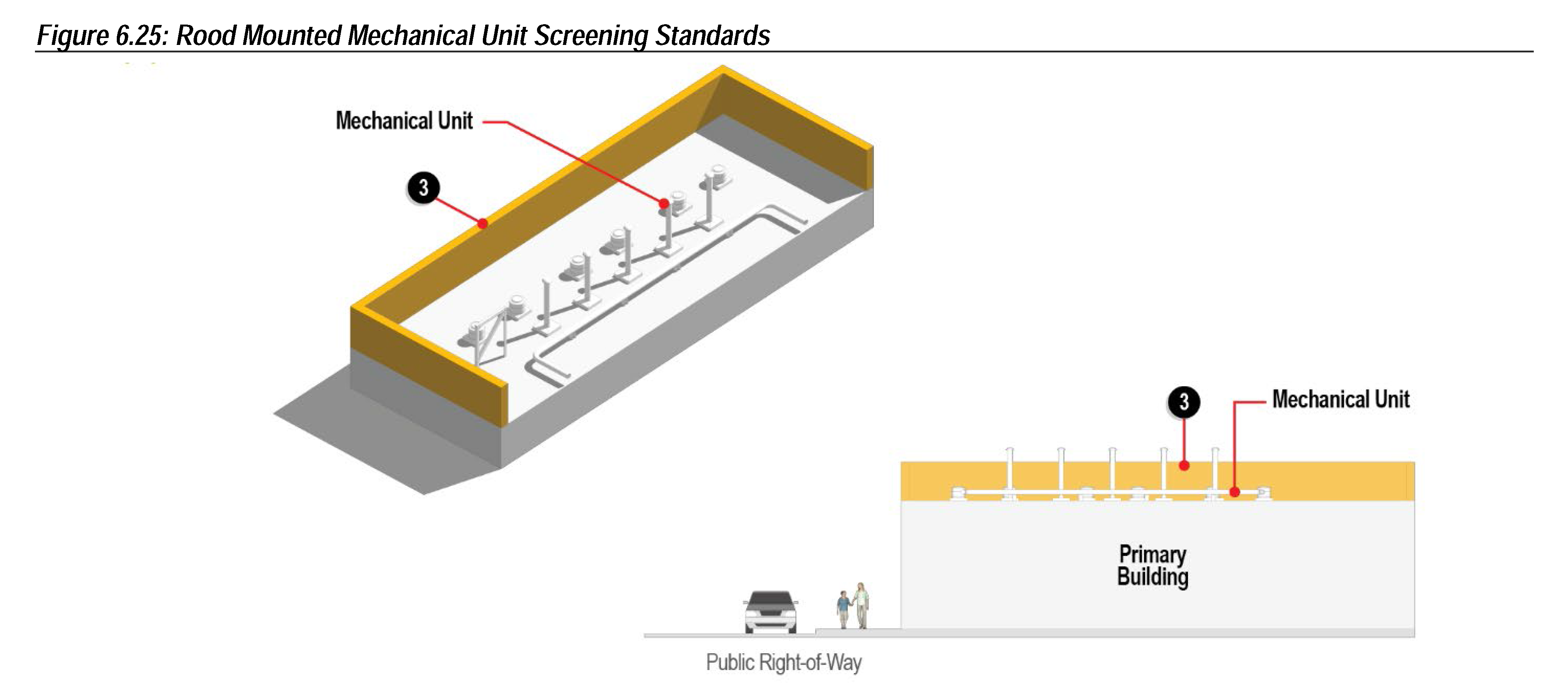
Roof-Mounted Mechanical Units. The following requirements shall apply to all roof-mounted mechanical units, including, but not limited to, air-conditioning condensers, heat pumps, ventilation units, computer cooling equipment, etc., and any related utility structures and equipment which service nonresidential, mixed use, or multifamily developments.
(1)
Locating mechanical units within the principal building is strongly encouraged in order to minimize exterior visual impacts.
(2)
Roof-mounted mechanical units that are visible from any public right-of-way or adjacent property in a residential district shall be completely screened from public view.
(3)
Materials used for screening shall be architecturally integrated with the building in the form of a parapet wall and shall be continuous, permanent, and sound attenuating.
(4)
Screening shall be required when new equipment is installed and shall be provided around both new and existing roof-mounted mechanical units in order to provide visual continuity. Normal maintenance of roof-mounted mechanical units shall not trigger the screening requirements.
(5)
Additional screening may be required due to topographic differences in the adjoining properties.
(E)
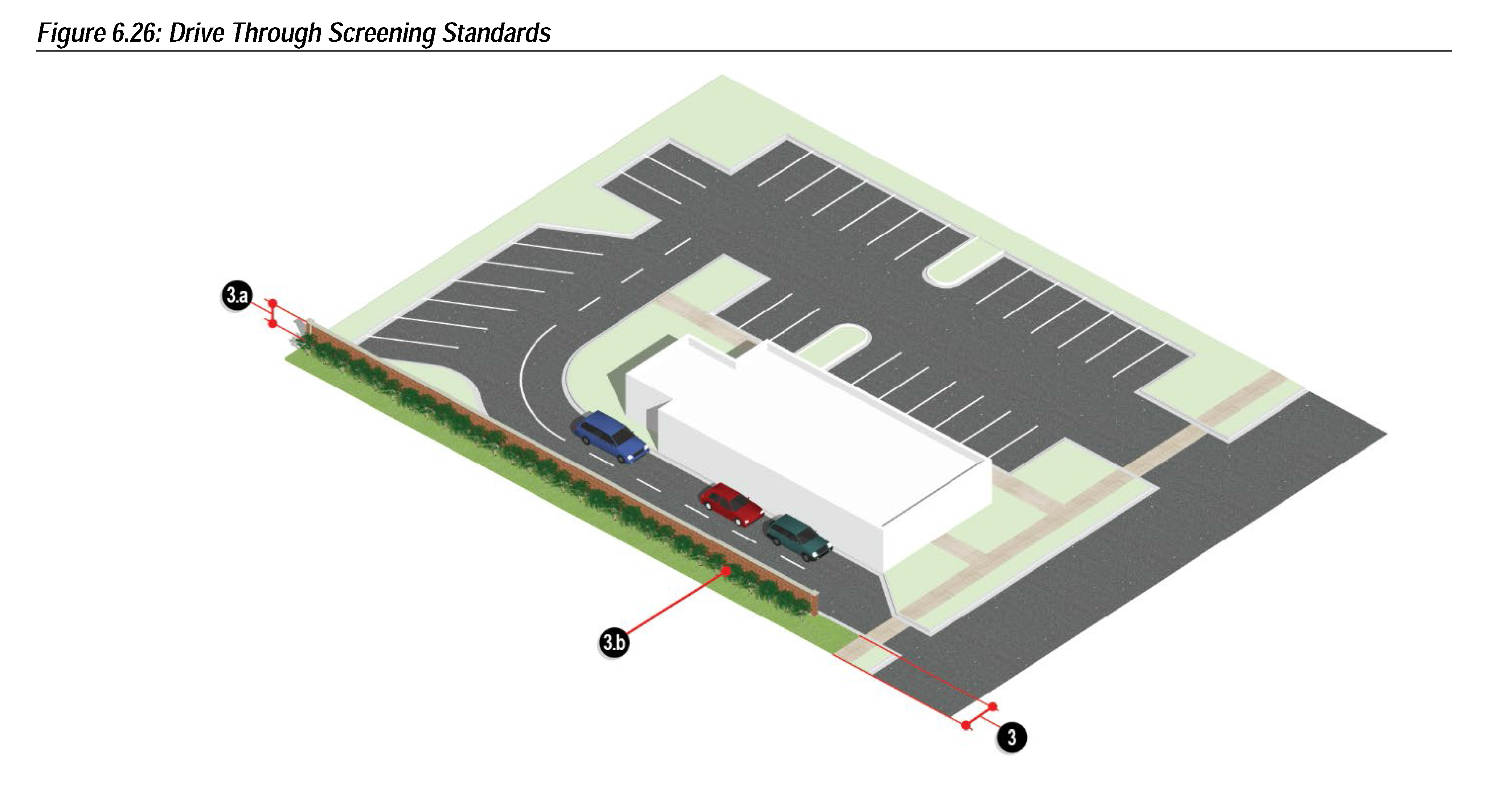
Drive Throughs. The following requirements shall apply to all drive throughs regardless of the use to which it is accessory.
(1)
Drive aisles of drive throughs must be effectively screened from view at the edges of sites adjacent to property in a residential district to minimize the impact of exterior site lighting, headlight glare and any menu boards and intercom systems.
(2)
Screening must be approved during the Specific Use Permit process.
(3)
The screening area shall be a minimum of six feet in width, unless otherwise approved by the Planning Commission during the Specific Use Permit process, and must consist of:
(a)
An opaque masonry wall or wood fence with a minimum height of four feet and a maximum height of six feet, and
(b)
Shrubs or native grasses installed every three feet along the exterior of the wall or fence to provide a softening effect.
(Ord. No. 1581, § II, 4-5-2022; Ord. No. 1624, § IV, 10-17-2023)
Sec. 16-6-5. - Fences.
(A)
General Provisions.
(1)
Permit Required. The construction of any fence greater than seven feet in height shall require a building permit.
(2)
Prohibited Fence Types. Spiked or open picket metal fencing shall be prohibited.
(3)
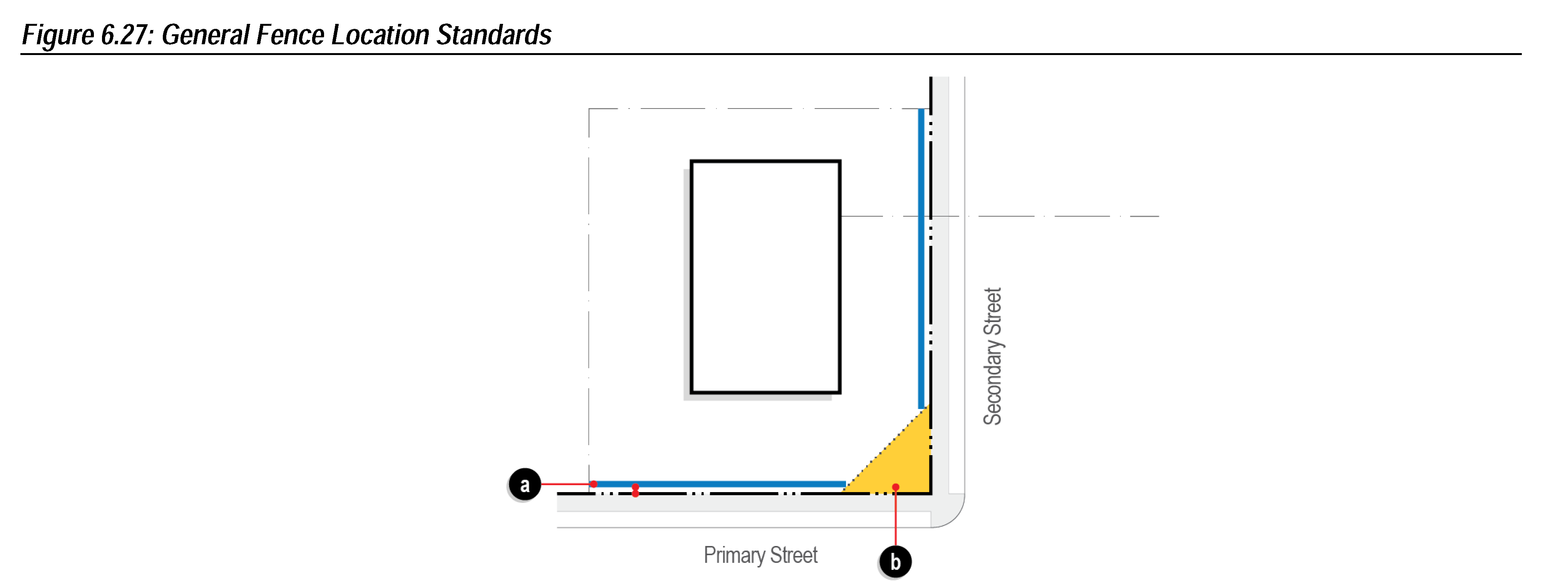
Location. All fences allowed in this section shall be located:
(a)
Wholly within or along property lines,
(b)
Outside of a clear sight triangle as detailed in section 16-6-6,
(c)
In a manner which does not block access to underground utility access structures; drainage structures; telephone, electric, cable television or gas pedestals; or fire hydrants,
(d)
A minimum of two inches above finished grade if located in a drainage swale or a drainage easement, and
(e)
In a manner which does not inhibit the function of stormwater drainage structures.
(4)
Construction Standards. Fences shall be designed and constructed with galvanized steel posts with a diameter of no less than two and three-eights inches. Fences that are leaning at an angle of 15 degrees or greater are considered dangerous and shall be in violation of this UDO. All fences must be constructed with a continuous flat top.
(5)
Private Covenants. Private covenants enacted by homeowners associations or other private entities may apply and may further restrict the construction or location of fences beyond the regulations of this UDO.
(B)
Fences on Lots with Single-Family Uses. Fences on lots with single-family uses shall meet the requirements established below. Barbed wire, razor wire, or makeshift materials such as plywood or tarps shall be prohibited on lots with single-family uses. All fences shall be erected so that the posts and all other supporting members face inward toward the owner's property.
(1)
Materials Prohibited. Barbed wire, razor wire, or makeshift materials such as plywood or tarps shall be prohibited.
(2)
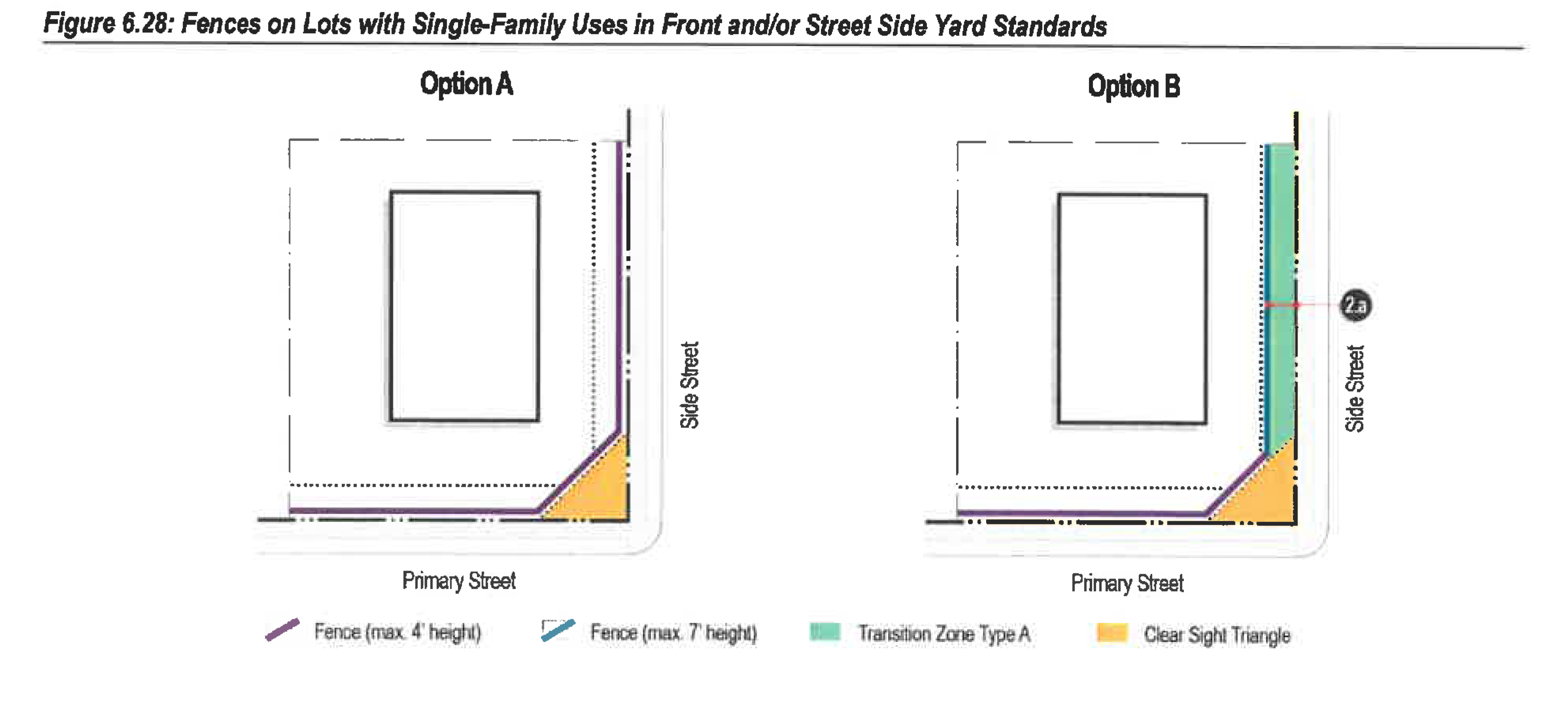
Fences in Front and/or Exterior Side Yards.
(a)
Height. Fences in front and/or exterior side yards shall not exceed four feet in height. Fences in exterior side yards may have a maximum height of seven feet if located a minimum of ten feet from the property line and improved with a landscape area between the fence and right-of-way including the landscape elements required for a Transition Zone Type A as detailed in Table 16-6-3(F)(3).
(b)
Materials. Fences in front yards and/or exterior side yards shall be of non-sight barrier construction and have a maximum opacity of 50 percent. Fence materials utilized in front yards and/or exterior side yards shall complement fence materials utilized in other yards. Permitted fence materials in front yards and/or exterior side yards shall be only those materials which are designed and intended for use in fence installations and shall be limited to:
(I)
Vegetation,
(II)
Wood, chemically treated or naturally resistant to decay,
(III)
Wood Composites,
(IV)
Aluminum,
(V)
Vinyl/PVC,
(VI)
Wrought Iron (non-picketed),
(VII)
Coated Chain Link without inserts, and
(VIII)
As approved by the City Planner.
(3)
Fences in Interior Side and Rear Yards.
(a)
Height. The maximum height of a fence in interior side yards and rear yards shall be seven feet.
(b)
Materials. Fence materials utilized in interior side yards and rear yards shall complement fence materials utilized in other yards. Permitted fence materials in interior side yards and rear yards shall be only those materials which are designed and intended for use in fence installations and shall be limited to:
(I)
Masonry,
(II)
Wood, chemically treated or naturally resistant to decay,
(III)
Wood Composites,
(IV)
Aluminum,
(V)
Vinyl/PVC,
(VI)
Wrought Iron (non-picketed),
(VII)
Coated Chain Link without inserts, and
(VIII)
As approved by the City Planner.
(c)
Location. Fences in interior side yards and rear yards shall be located no closer to the front yard than the established front face of the principal building on the lot or the principal building on the adjacent lot.
(C)
Fences on Lots with Nonresidential, Mixed Use, or Multifamily Uses.
(1)
Height. The maximum height of fences on a lot with nonresidential, mixed use, or multifamily uses shall not exceed eight feet.
(2)
Location. Fences on lots with nonresidential, mixed use, or multifamily uses shall be located in rear and interior side yards only.
(a)
Exceptions. Fencing required may be allowed in other yards if required for outdoor storage uses as detailed in section 16-5-12(K) or outdoor activities and operations in section 16-5-12(I).
(3)
Materials. Permitted fence materials on lots with nonresidential, mixed use, or multifamily uses shall be only those materials which are designed and intended for use in fence installations and shall be limited to:
(a)
Masonry,
(b)
Wood, chemically treated or naturally resistant to decay,
(c)
Wood Composites,
(d)
Aluminum,
(e)
Vinyl/PVC,
(f)
Wrought Iron (non-picketed),
(g)
Coated Chain Link without inserts, and
(h)
As approved by the City Planner.
(4)
Barbed Wire. In the AG District, barbed wire may be utilized along all property lines and shall be limited to a maximum height of one foot from the ground, and a maximum of five strands of wire. The barbed wire shall not be included in the determination of fence height.
(Ord. No. 1581, § II, 4-5-2022)
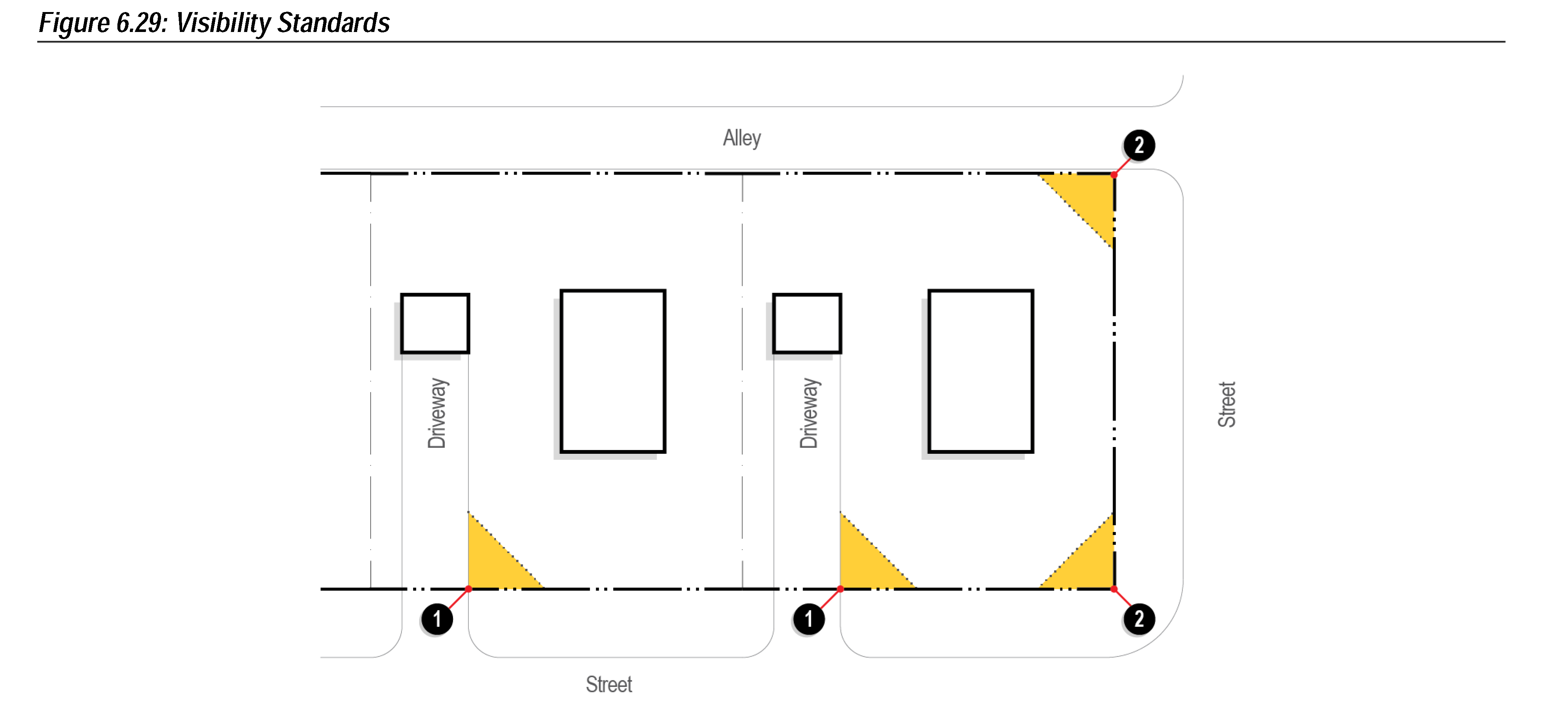
Sec. 16-6-6. - Visibility Standards.
(A)
A clear sight triangle shall be maintained to minimize sight obstructions at intersections.
(B)
No building or structure shall be permitted that creates a visual obstruction taller than three feet in the clear sight triangle.
(C)
The clear sight triangle shall be measured as a distance 15 feet from:
(1)
The point where the driveway meets a right-of-way facing property line, or
(2)
The point where two right-of-way facing property lines meet.
(Ord. No. 1581, § II, 4-5-2022)
Sec. 16-6-7. - Outdoor Lighting.
(A)
Fixture Classification. All outdoor lighting fixtures, with the exception of wall-mounted accent lighting and outdoor lighting in the AG District, shall either have a fixture cutoff classification of "Full Cutoff" or be fully shielded, unless otherwise expressly permitted in this UDO.
(B)
LED Fixtures. All outdoor lighting utilizing a light-emitting diode (LED) fixture shall meet the following standards:
(1)
Color Rendering. Outdoor LED fixtures shall be rated a minimum Color Rendering Index (CRI) value of 70 or higher.
(2)
Color Temperature. Outdoor LED fixtures shall have a correlated color temperature between 4,000 and 5,000 degrees Kelvin.
(C)
Pole-Mounted Outdoor Lighting.
(1)
Pole Placement. Pole-mounted outdoor lighting shall be located outside of utility easements, designed in coordination with required landscape zones in section 16-6-3(B).
(2)
Maximum Pole Height. Pole-mounted fixtures shall be mounted at the following maximum heights by district as shown in Table 16-6-7(C)(2).
(D)
Wall-Mounted Accent Lighting. Wall-mounted accent lighting shall be integrated with the architectural character of the building and shall use low-luminosity lamps, with 2,000 source lumens or less. The illumination on any vertical surface shall not exceed one-half maintained foot candle and shall not spill over roof lines or building edges.
(E)
Outline Lighting Prohibited. Outline lighting shall be prohibited from windows and signs but may be used on buildings, or structures, if approved by the Planning Commission.
(F)
Maximum Light Level at Property Line. All outdoor lighting fixtures shall be designed and located so that the maximum light level shall be one-half maintained foot candles at any property line.
(G)
Light Level Measurement.
(1)
Location. Light level measurements shall be made at the property line of the property upon which the light to be measured is being generated. If measurement on private property is not possible or practical, light level measurements may be made at the boundary of the public street right-of-way that adjoins the property of the complainant or at any other location on the property of the complainant. Measurements shall be made at finished grade (ground level), with the sensor in the horizontal position and not mounted more than six inches above ground level, and with the light registering portion of the meter held parallel to the ground and pointing upward.
(2)
Light Meter Specifications. Light levels shall be measured in foot candles with a direct-reading portable light meter. The meter shall:
(a)
Have cosine and color correction;
(b)
Have an accuracy tolerance of no greater than plus or minus five percent; and
(c)
Have been calibrated within the last two years.
(Ord. No. 1581, § II, 4-5-2022)
Sec. 16-6-8. - Flood Damage Prevention.
(A)
Statutory Authorization. The Legislature of the State of Oklahoma has in (statutes) 82 O.S., §§ 1601—1620 delegated the responsibility of local governmental units to adopt regulations designed to minimize flood losses. Therefore, the City of Jenks, Oklahoma, City Council does ordain as is set out in the provisions of this section.
(B)
Findings of Fact.
(1)
The flood hazard areas of the City of Jenks are subject to periodic inundation that results in loss of life and property, health and safety hazards, disruption of commerce and governmental services, and extraordinary public expenditures for flood protection and relief, all of which adversely affect the public health, safety and general welfare.
(2)
These flood losses are created by the cumulative effect of obstructions in floodplains which cause an increase in flood heights and velocities, and by the occupancy of flood hazard areas by uses vulnerable to floods and hazardous to other lands because they are inadequately elevated, floodproofed or otherwise protected from flood damage.
(C)
Statement of Purpose. It is the purpose of this section to promote the public health, safety and general welfare and to minimize public and private losses due to flood conditions in specific areas by provisions designed to:
(1)
Protect human life and health;
(2)
Minimize expenditure of public money for costly flood control projects;
(3)
Minimize the need for rescue and relief efforts associated with flooding and generally undertaken at the expense of the general public;
(4)
Minimize prolonged business interruptions;
(5)
Minimize damage to public facilities and utilities such as water and gas mains, electric, telephone and sewer lines, streets and bridges located in floodplains;
(6)
Help maintain a stable tax base by providing for the sound use and development of flood prone areas in such a manner as to minimize future flood blight areas; and
(7)
Ensure that potential buyers are notified that property is in a flood area.
(D)
Methods of Reducing Flood Loss. In order to accomplish its purposes, this section uses the following methods:
(1)
Restrict or prohibit uses that are dangerous to health, safety or property in times of flood, or cause excessive increases in flood heights or velocities;
(2)
Require that uses vulnerable to floods, including facilities which serve such uses, be protected against flood damage at the time of initial construction;
(3)
Control the alteration of natural floodplains, stream channels, and natural protective barriers, which are involved in the accommodation of flood waters;
(4)
Control filling, grading, dredging and other development which may increase flood damage; and
(5)
Prevent or regulate the construction of flood barriers which will unnaturally divert floodwaters, or which may increase flood hazards to other lands.
(E)
Lands to Which This Section Applies. This Section shall apply to all areas of special flood hazard within the jurisdiction of the City of Jenks, Oklahoma.
(F)
Basis For Establishing the Areas of Special Flood Hazard.
(1)
The areas of special flood hazard identified by the Federal Emergency Management Agency in a scientific and engineering report entitled, "The Flood Insurance Study for Tulsa County, Oklahoma and Incorporated Areas" dated May 2, 2019, with accompanying Flood Insurance Rate Map (FIRM) are hereby referenced to be effective on October 16, 2012 and before, along with any future revisions thereof that are individually adopted by the Jenks City Council are hereby adopted by reference and declared to be a part of this section.
(2)
That all provisions of the flood management regulations of Section 60.3(d) of the National Flood Insurance Program (44 CFR 59 et seq.) as amended are hereby incorporated by reference and will determine standards for development unless existing Jenks ordinances or state requirements impose a higher standard, in which event the higher or restrictive standard shall apply.
(G)
Establishment of Development Permit. A development permit shall be required to ensure conformance with the provisions of this article.
(H)
Compliance. No structure or land shall hereafter be located, altered, or have its use changed without full compliance with the terms of this section and other applicable regulations.
(I)
Abrogation and Greater Restrictions. This section is not intended to repeal, abrogate, or impair any existing easements, covenants, or deed restrictions. However, where this section and another ordinance, easement, covenant, or deed restriction conflict or overlap, whichever imposes the more stringent restrictions shall prevail.
(J)
Interpretation. In the interpretation and application of this section, all provisions shall be:
(1)
Considered as minimum requirements;
(2)
Liberally construed in favor of the governing body; and
(3)
Deemed neither to limit nor repeal any other powers granted under State statutes.
(K)
Warning and Disclaimer of Liability. The degree of flood protection required by this section is considered reasonable for regulatory purposes and is based on scientific and engineering considerations. On rare occasions greater floods can and will occur and flood heights may be increased by manmade or natural causes. This Section does not imply that land outside the areas of special flood hazards or uses permitted within such areas will be free from flooding or flood damages. This Section shall not create liability on the part of the community or any official or employee thereof for any flood damages that result from reliance on this section or any administrative decision lawfully made hereunder.
(L)
General Standards. In all areas of special flood hazards, the following provisions are required for all new construction and substantial improvements:
(1)
All new construction or substantial improvements shall be designed (or modified) and adequately anchored to prevent flotation, collapse or lateral movement of the structure resulting from hydrodynamic and hydrostatic loads, including the effects of buoyancy;
(2)
All new construction or substantial improvements shall be constructed by methods and practices that minimize flood damage;
(3)
All new construction or substantial improvements shall be constructed with materials resistant to flood damage;
(4)
All new construction or substantial improvements shall be constructed with electrical, heating, ventilation, plumbing, and air conditioning equipment and other service facilities that are designed and/or located so as to prevent water from entering or accumulating within the components during conditions of flooding;
(5)
All new and replacement water supply systems shall be designed to minimize or eliminate infiltration of floodwaters into the system;
(6)
New and replacement sanitary sewage systems shall be designed to minimize or eliminate infiltration of flood waters into the system and discharge from the systems into flood waters; and
(7)
On-site waste disposal systems shall be located to avoid impairment to them or contamination from them during flooding.
(M)
Specific Standards. In all areas of special flood hazards where base flood elevation data has been provided as set forth in section 16-6-8(F) or 16-6-8(N)(3), the following provisions are required:
(1)
Residential construction. New construction and substantial improvement of any residential structure shall have the lowest floor (including basement), elevated one foot above the base flood elevation. A registered professional engineer, architect, or land surveyor shall submit a certification to the Floodplain Administrator that the standard of this subsection as proposed in section 16-9-5 is satisfied.
(a)
The minimum development criteria for projects outside the levee and within the boundaries of the Arkansas River Floodplain (100 year and 500 year), but not within the river channel or floodway:
(I)
Single-family residential developments are not allowed in this area.
(II)
Multifamily residential developments are allowed in this area if, at a minimum, the lowest floor of the structure is built at a height eight feet above the base flood elevation.
(2)
Nonresidential construction.
(a)
New construction and substantial improvements of any commercial, industrial or other nonresidential structure shall either have the lowest floor (including basement) elevated to the base flood level or together with attendant utility and sanitary facilities, be designed so that below the base flood level the structure is water-tight with walls substantially impermeable to the passage of water and with structural components having the capability of resisting hydrostatic and hydrodynamic loads and effects of buoyancy.
(b)
A registered professional engineer or architect shall develop and/or review structural design, specifications, and plans for the construction, and shall certify that the design and methods of construction are in accordance with accepted standards of practice as outlined in this subsection.
(c)
The Floodplain Administrator shall maintain records of all certifications including the specific elevation (in relation to mean sea level) to which any structure is floodproofed.
(d)
The minimum development criteria for projects outside the levee and within the boundaries of the Arkansas River Floodplain, but not within the river channel or floodway:
(I)
All structures shall be built at a height one foot above the 1986 flood event (approximately 350-year floodplain; or
(II)
A 306,000 cfs release from Keystone Dam along with the requirement for zero rise to the 100-year floodplain allowing the same conveyance for floodwaters.
(3)
Enclosures. New construction and substantial improvements, with fully enclosed areas below the lowest floor that are usable solely for parking of vehicles, building access or storage in an area other than a basement and which are subject to flooding shall be designed to automatically equalize hydrostatic flood forces on exterior walls by allowing for the entry and exit of floodwaters. Designs for meeting this requirement must either be certified by a registered professional engineer or architect or meet or exceed the following minimum criteria:
(a)
A minimum of two openings having a total net area of not less than one square inch for every square foot of enclosed area subject to flooding shall be provided;
(b)
The bottom of all openings shall be no higher than one foot above grade; and
(c)
Openings may be equipped with screens, louvers, valves, or other coverings or devices provided that they permit the automatic entry and exit of floodwaters.
(4)
Manufactured Homes.
(a)
Require that all manufactured homes to be placed within Zone A on a community's FHBM or FIRM shall be installed using methods and practices, which minimize flood damage. For the purposes of this requirement, manufactured homes must be elevated and anchored to resist flotation, collapse, or lateral movement. Methods of anchoring may include, but are not limited to, use of over-the-top or frame ties to ground anchors. This requirement is in addition to applicable State and local anchoring requirements for resisting wind forces.
(b)
Require that manufactured homes that are placed or substantially improved within Zones A1-30, AH, and AE on the community's FIRM on sites that are:
(I)
In an existing manufactured home park or subdivision on which a manufactured home has incurred "substantial damage" as a result of a flood, be elevated on a permanent foundation such that the lowest floor of the manufactured home is elevated to or above the base flood elevation and be securely anchored to an adequately anchored foundation system to resist flotation, collapse, and lateral movement.
(c)
Require that manufactured homes be placed or substantially improved on sites in an existing manufactured home park or subdivision with Zones A1-30, AH and AE on the community's FIRM that are not subject to the provisions of this subsection be elevated so that either:
(I)
The lowest floor of the manufactured home is at the base flood elevation; or
(II)
Placed on reinforced piers or other foundation elements of at least equivalent strength that are no less than 36 inches in height above grade and be securely anchored to an adequately anchored foundation system to resist flotation, collapse, and lateral movement support the manufactured home chassis.
(5)
Recreational Vehicles. Require that recreational vehicles placed on sites within Zones A1-30, AH, and AE on the community's FIRM either:
(a)
Be on the site for fewer than 180 consecutive days;
(b)
Be fully licensed and ready for highway use; or
(c)
Meet the permit requirements of section 16-9-5, and the elevation and anchoring requirements for "manufactured homes" in subsection (M)(4) of this section. A recreational vehicle is ready for highway use if it is on its wheels or jacking system, is attached to the site only by quick disconnect type utilities and security devices, and has no permanently attached additions.
(N)
Standards For Subdivision Proposals.
(1)
All subdivision proposals including the placement of manufactured home parks and subdivisions shall be consistent with section 16-6-8(B), (C), and (D).
(2)
All proposals for the development of subdivisions shall meet development permit requirements of section[s] 16-6-8(G) and 16-9-5 and the provisions of this section.
(3)
Base flood elevation data shall be generated for subdivision proposals and other proposed development including the placement of manufactured home parks and subdivisions which is greater than 50 lots or five acres, whichever is lesser, if not otherwise provided pursuant to section 16-6-8(F).
(4)
All subdivision proposals shall have adequate drainage provided to reduce exposure to flood hazards.
(5)
All subdivision proposals shall have public utilities and facilities such as sewer, gas, electrical and water systems located and constructed to minimize or eliminate flood damage.
(O)
Standards For Areas of Shallow Flooding.
(1)
Located within the areas of special flood hazard established in section 16-6-8(F), are areas designated as shallow flooding. These areas have special flood hazards associated with base flood depths of one to three feet where a clearly defined channel does not exist and where the path of flooding is unpredictable and where velocity flows may be evident. Such flooding is characterized by ponding or sheet flow; therefore, the following provisions apply:
(a)
All new construction and substantial improvements of residential structures have the lowest floor (including basement) elevated above the highest adjacent grade at least as high as the depth number specified in feet on the community's FIRM (at least two feet if no depth number is specified).
(b)
All new construction and substantial improvements of nonresidential structures:
(I)
Have the lowest floor (including basement) elevated above the highest adjacent grade at least as high as the depth number specified in feet on the community's FIRM (at least two feet if no depth number is specified); or
(II)
Together with attendant utility and sanitary facilities be designed so that below the base flood level the structure is water-tight with walls substantially impermeable to the passage of water and with structural components having the capability of resisting hydrostatic and hydrodynamic loads of effects of buoyancy.
(c)
A registered professional engineer or architect shall submit a certification to the Floodplain Administrator that the standards of this section are satisfied.
(d)
Require within Zones AH or AO adequate drainage paths around structures on slopes, to guide floodwaters around and away from proposed structures.
(P)
Floodways.
(1)
Floodways located within areas of special flood hazard established in section 16-6-8(F), are areas designated as floodways. Since the floodway is an extremely hazardous area due to the velocity of floodwaters that carry debris, potential projectiles and erosion potential, the following provisions shall apply:
(a)
Encroachments are prohibited, including fill, new construction, substantial improvements, and other development within the adopted regulatory floodway unless it has been demonstrated through hydrologic and hydraulic analyses performed in accordance with standard engineering practice that the proposed encroachment would not result in any increase in flood levels within the community during the occurrence of the base flood discharge.
(b)
If subsection (1)(a) of this section is satisfied, all new construction and substantial improvements shall comply with all applicable flood hazard reduction provisions of this section 16-6-8.
(c)
Under the provisions of 44 CFR Chapter 1, Section 65.12, of the National Flood Insurance Regulations, a community may permit encroachments within the adopted regulatory floodway that would result in an increase in base flood elevations, provided that the community first applies for a conditional FIRM and floodway revision through FEMA.
(Ord. No. 1581, § II, 4-5-2022; Ord. No. 1644, § I, 6-18-2024)

