
Jenks City Zoning Code
ARTICLE 9
- ADMINISTRATIVE PROCEDURES
Sec. 16-9-1.- General Application Provisions.
(A)
Authority to File Applications. An application for Administrative Review and Action or Board/Commission Review and Action under this UDO must be filed by the record owner, purchaser under contract from the record owner with signature from that owner, or the duly authorized agent of the record owner.
(B)
Application Fees. Every application must be accompanied by a fee in such amount as established in the City of Jenks Master Fee Schedule. All costs associated with application review shall be the responsibility of the applicant.
(C)
Application Requirements. Applications for Administrative Review and Action or Board/Commission Review and Action shall include the information as is reasonably required by the City Planner.
(D)
Incomplete Applications. Applications that do not include the information required by the City Planner or that are not accompanied by required fees, will not be processed. No further processing of the application will occur until the deficiencies are corrected. Applications will be processed when determined to be complete.
(Ord. No. 1581, § II, 4-5-2022)
Sec. 16-9-2. - Administrative Authorities.
(A)
City Planner.
(1)
The provisions of this chapter shall be administered and enforced by the City Planner or an authorized representative, who shall have the right to enter upon any premises for the purpose of making inspection of buildings or premises necessary to carry out his duties hereunder.
(2)
The Planning Commission shall supervise the official zoning map, and the City Planner shall keep the same up-to-date with all changes and amendments.
(B)
Planning Commission.
(1)
Creation and Membership. A City Planning Commission is hereby created for this city. It shall consist of seven appointive members, all of whom shall be electors of the city. The seven appointive members shall be nominated by the mayor and appointed by the council and serve for terms of three years, the terms to end at 7:30 p.m. on the first Monday in May. Vacancies shall be filled for the unexpired terms. The members shall serve without compensation. The council may remove members of the City Planning Commission for cause.
(2)
Organization, Meetings, Officers and Employees. The City Planning Commission shall elect a chairman, a vice chairman, and a secretary, who shall serve until 7:30 p.m. on the first Monday of the next May after their appointment. The secretary need not be a member of the commission. The commission shall determine the time and place of its regular meetings; and the chairman, the mayor, or any three members may call special meetings of the commission. The commission may employ engineers, attorneys, clerks, and other help deemed necessary, subject to the approval of the council. Their salaries and compensation shall be fixed by the council, and shall be paid out of the city treasury as other salaries and compensation are paid. The necessary legal expenses shall be paid out of the city treasury as other legal expenses of the city government are paid.
(3)
Powers and Duties. The City Planning Commission shall have all the powers and duties prescribed for it by 11 O.S., § 45-101-104 and all other powers and duties now or hereafter prescribed by any other provision of state law.
(4)
City Planning Commission to Have Power of a Zoning Commission.
(a)
The City Planning Commission heretofore created by this Code is hereby appointed the Zoning Commission of the City; and the City Planning Commission shall have the powers of a zoning commission as provided by state law. Whether exercising the powers of a planning commission or the powers of a zoning commission, it shall be legally one board, known as the City Planning Commission.
(b)
Exercising the powers of a zoning commission, the City Planning Commission shall recommend the boundaries of the various zones and appropriate zoning regulations to be enforced therein.
(C)
Board of Adjustment.
(1)
Creation and Authority. There is hereby created a Board of Adjustment consisting of five members, each to be appointed for a term of three years and removable for cause by the appointing authority, upon written charges and after public hearing. Vacancies shall be filled for the unexpired term of any member whose term becomes vacant.
(2)
Procedure. The Board of Adjustment shall elect one of its members as chairman, who shall serve for the duration of his term. The board shall appoint a secretary who may be an officer of the municipality. The board shall adopt rules in accordance with the provisions of this article. Meetings of the board shall be held at the call of the chairman and at such other times as the board may determine. The chairman, or in his absence the acting chairman, may administer oaths and compel the attendance of witnesses by subpoena. The board shall keep the minutes of its proceedings, showing the vote of each member upon each question, or if absent or failing to vote, indicating such fact, and shall keep records of its examinations and other official actions, all of which shall be immediately filed in the office of the board and shall be a public record. All meetings of the board shall be open to the public.
(3)
Appeal to District Court.
(a)
An appeal from any action, decision, ruling, judgment, or order of the Board of Adjustment may be taken by any person or persons, jointly or severally, or any taxpayer, or any officer, department, board or bureau of the City to the District Court by filing notice of appeal with the City Clerk and with the Board of Adjustment within 60 days from the filing of the decision of the board, which notice shall specify the grounds of such appeal. Upon filing of the notice of appeal as herein provided, the said board shall transmit forthwith to the court clerk of the county the original or certified copy of all the papers constituting the record in the case, together with the order, decision or ruling of the board.
(b)
An appeal to the District Court from the Board of Adjustment stays all proceedings in furtherance of the action appealed from, unless the chairman of the Board of Adjustment, from which the appeal is taken, certified to the court clerk, after the notice of appeal shall have been filed, that by reason of the facts stated in the certificate a stay in his opinion would cause imminent peril to life or property. In such case, proceedings shall not be stayed otherwise than by a restraining order which may be granted by the District Court upon application or notice to the administrative officer in charge of the enforcement of the terms and provisions of the article, and upon notice to the chairman of the Board of Adjustment from which the appeal is taken, and, upon due cause being shown, the court may reverse or affirm, wholly or partly, or modify the decision brought up for review.
(Ord. No. 1581, § II, 4-5-2022)
Sec. 16-9-3. - Administrative Review and Action.
(A)
City Planner Authority. The City Planner shall have the authority to receive applications and make determinations for the following administrative procedures:
(1)
Zoning Clearance Permit
(2)
Site Plan Review,
(3)
Conditional Use Permit,
(4)
Administrative Exception,
(5)
Sign Permit, and
(6)
Temporary Use Permit.
(B)
Zoning Clearance Permit.
(1)
It shall be unlawful for any person to erect, move, add to, or structurally alter any building or structure, or to use or change the use of any building or land or to permit the aforementioned actions, until a Zoning Clearance Permit has been issued by the City Planner or other designee of the City Manager.
(2)
An application for a Zoning Clearance Permit shall be accompanied by a legal description of the lot and plans, drawn to scale, showing the actual shape and dimension of the lot; the location, size and height of any buildings or structures to be erected or altered; the existing and intended use of each building or structure and portion of the lot; the number of dwellings the building is intended to accommodate, if any; and such other information with regard to the lot and neighboring lots as may be necessary to determine and provide for the enforcement of this UDO.
(3)
The City Planner shall act upon each application for a Zoning Clearance Permit after it is filed in compliance with the provisions herein. The City Planner shall return one copy of the plans and issue a Zoning Clearance Permit or notify the applicant, in writing, of said official's refusal to issue a permit setting forth the reasons therefore.
(4)
No Zoning Clearance Permit shall be issued until appropriate fees have been paid. Fees shall be in the amount set forth in the Master Fee Schedule.
(C)
Site Plan Review.
(1)
Purpose. Site Plan Review is required prior to the review and issuance of an application for a building permit to certify compliance with all applicable provisions of this UDO. Site Plan Review shall be required for any development, other than single-family and two-family development, which meets one of the following criteria:
(a)
New development, including the construction or placement of any new building(s) or expansion of any existing building, or
(b)
Any development subject to off-street parking and loading requirements.
(2)
Site Plan Submittal.
(a)
The site plan, including all information required by the City Planner, shall be submitted to the City Planner.
(b)
Upon receipt of the application, the City Planner shall review the application to determine that all required information has been submitted and notify the applicant of completeness or deficiencies.
(c)
Failure to cure the deficiencies within six months from notification of such deficiencies shall be deemed abandonment of the application without further notice from the City.
(3)
City Planner Action.
(a)
Upon determination of completeness, the application shall be reviewed by the City Planner to ensure the application conforms to the requirements of this UDO. Based upon their review, the City Planner shall approve or deny the Site Plan.
(b)
If denied, the City Planner shall report the deficiencies to the applicant. The applicant shall have six months from the date of notification of the deficiencies to correct the deficiencies; otherwise, the Site Plan will be considered abandoned without further notice from the City.
(4)
Concurrent Applications. A Conditional Use Permit, Specific Use Permit, or Variance application may be processed concurrently with the site plan.
(5)
Expiration and Lapse of Approval. The applicant shall have 12 months from the date of a site plan approval to secure a building permit to carry out the proposed improvements. If a building permit has not been obtained within 12 months of the date of approval, the approval shall expire. An extension of the time requirements may be requested in writing and granted by the City Planner for good cause shown by the applicant, provided a written request is filed with the City at least four weeks prior to the respective deadline.
(D)
Conditional Use Permit.
(1)
Purpose.
(a)
In order to provide flexibility and to help diversify uses within a district, specified uses are permitted in certain districts subject to the granting of a Conditional Use Permit. Because of their unusual or special characteristics, Conditional Uses require review and evaluation so that they may be located properly with respect to their effects on surrounding properties. The review process set forth in this section is intended to assure compatibility and harmonious development between Conditional Uses, surrounding properties, and the City at large.
(b)
Conditional Uses are permitted within the district where designated when they comply with specific conditions and limitations as set forth in this UDO to ensure that the location and operation of the Conditional Uses will be in accordance with the specific use criteria. The scope and elements of any Conditional Use may be limited or qualified by the conditions applicable to the specific property. A listed Conditional Use that cannot meet the specific conditions and limitations set forth in this UDO shall not be allowed under a Conditional Use permit.
(2)
Pre-Application Conference. The applicant for a Conditional Use permit is advised to meet with the City Planner prior to submitting an application to discuss the submittal requirements, review criteria, and review process.
(3)
Conditional Use Permit Review Criteria.
(a)
General Criteria. The Conditional Use permit shall be approved upon a finding by the City Planner that the following general criteria have been met, to the extent they may be applicable:
(I)
The proposed use will conform with or further the goals, objectives and strategies of the City's Comprehensive Plan,
(II)
The site, building(s), and use meet all criteria specified for the use and all applicable regulations and development standards as specified in this UDO and for the district in which the use is located; however, nonconforming sites and/or buildings must be brought into conformance if required to do so pursuant to article 10, Nonconformities, of this UDO,
(III)
The proposed use will not substantially alter the basic character of the district in which it is located, or jeopardize the development or redevelopment potential of property within the district,
(IV)
The proposed use will not have a significant adverse impact on the adjacent uses or properties, or result in hazardous conditions for pedestrians or vehicles within or in close proximity to the site,
(V)
The proposed use will be adequately served with public utilities, services, and facilities and not impose an undue burden above and beyond those of the Permitted Uses of the district in which it is located, and
(VI)
Potential negative impacts of the Conditional Use on the surrounding properties have been or may be mitigated through specific setbacks, architecture, screen walls, landscaping, site arrangement or other methods required in the permit as conditions and/or limitations of permit approval. The applicant shall satisfactorily address each of the following impacts:
(i)
Traffic,
(ii)
Activity levels,
(iii)
Light,
(iv)
Noise,
(v)
Odor,
(vi)
Building type, style and scale,
(vii)
Hours of operation,
(viii)
Dust, and
(ix)
Stormwater management, drainage, and erosion control.
(VII)
Use-Specific Criteria. In addition to the general criteria for review of a Conditional Use Permit listed above, certain uses, due to their unique characteristics, must also comply with the special provisions specific to those uses contained in article 5, Use Specific Standards, of this UDO.
(4)
Conditional Use Permit Application Submittal.
(a)
The Conditional Use Permit application, including all information required by the City Planner, shall be submitted to the City Planner.
(b)
Upon receipt of the application, the City Planner shall review the application to determine that all required information has been submitted and notify the application of completeness or deficiencies.
(c)
Failure to cure the deficiencies within six months from notification of such deficiencies shall be deemed abandonment of the application without further notice from the City.
(5)
City Planner Action.
(a)
Upon the determination of completeness, the application shall be reviewed by the City Planner to ensure the application conforms to the criteria in subsection 3 above. Based upon their review, the City Planner shall approve or deny the Conditional Use Permit application.
(b)
If denied, the City Planner shall report the deficiencies to the applicant. The applicant shall have six months from the date of notification of the deficiencies to correct the deficiencies; otherwise, the Conditional Use Permit application will be considered abandoned without further notice from the City.
(6)
Permit Transferability. A Conditional Use Permit may be transferred to any other person to operate the same use on the same property and/or within the same building according to the same terms of the permit. A Conditional Use Permit may not be transferred to any other property or other building. The transfer of a Conditional Use Permit shall be in writing to the new owner or operator of the use, using a form provided or approved by the City Planner. Such transfer shall not be complete until a counterpart of the transfer document has been filed with the City Planner.
(7)
Termination. A Conditional Use Permit shall automatically terminate without any further action by the City under the following circumstances:
(a)
The use for which the permit was granted has not been established at the approved location within a period of one year from the date the permit was issued, or
(b)
The use for which the permit was issued has been discontinued for a period of one year or longer.
(E)
Administrative Exception.
(1)
Purpose. An Administrative Exception is an administrative process through which certain minor deviations from the requirements of this UDO may be approved by the City Planner. Administrative Exceptions are intended to allow a limited amount of flexibility in the siting and height of certain buildings and/or structures. The City Planner shall have the authority to grant or deny applications for Administrative Exceptions for such circumstances as this UDO allows subject to the requirements of this section.
(2)
Administrative Exceptions Considered.
(a)
An Administrative Exception to certain requirements of this UDO may be granted for the following exceptions:
(I)
A maximum ten percent reduction of the interior side and/or rear setback standard for a new principal or accessory building/structure, or an addition to an existing principal or accessory building/structure in any district,
(II)
A maximum ten percent increase of the height standard for a new principal or accessory building/structure in any district, and/or
(III)
Other circumstances as detailed in this UDO.
(b)
Allow individual driveways for two or more adjoining residential parcels that take access from a collector or arterial street as defined by INCOG.
(c)
An Administrative Exception shall not be granted for the approval of any use not otherwise allowed as a permitted, conditional, or specific use within the subject district.
(d)
No Administrative Exception shall be considered where the standard setback is five feet or less.
(e)
In the case of a requested addition to a structure, no exception shall be considered where the existing structure does not meet the minimum standard setback.
(3)
Administrative Exception Review Criteria. The Administrative Exception shall be approved if the City Planner finds that the proposed exception:
(a)
Is consistent with the Comprehensive Plan,
(b)
Is consistent with the purpose of the underlying district,
(c)
Is consistent with adopted building and fire codes,
(d)
Will not result in incompatible development,
(e)
Will not result in adverse impacts unless adequately mitigated, and
(f)
Is of a technical nature and is required to achieve at least one of the following:
(I)
Compensate for an unusual condition,
(II)
Eliminate a minor inadvertent failure to comply with this UDO, or
(III)
To protect a sensitive resource or natural feature.
(4)
Administrative Exception For Driveways Criteria. For the approval of individual driveways for two or more adjoining residential parcels that take access from a collector or arterial street, the City planner shall find the exception:
(a)
Will generate substantially improved pedestrian and/or vehicular circulation on the subject properties.
(b)
Will not substantially impede traffic flow or safety on the subject collector or arterial street.
(5)
Pre-Application Conference. The applicant for an Administrative Exception is required to meet with the City Planner prior to submitting an application to discuss the submittal requirements, review criteria, and review process.
(6)
Administrative Exception Application Submittal.
(a)
The Administrative Exception application, including all information required by the City Planner, shall be submitted to the City Planner.
(b)
Upon receipt of the application, the City Planner shall review the application to determine that all required information has been submitted and notify the application of completeness or deficiencies.
(c)
Failure to cure the deficiencies within six months from notification of such deficiencies shall be deemed abandonment of the application without further notice from the City.
(7)
City Planner Action. Upon the determination of completeness, the application shall be reviewed by the City Planner to ensure the application conforms to the criteria in subsection 3 above. Based upon their review, the City Planner shall approve or deny the Administrative Exception application in writing.
(8)
Advancement To Variance. The City Planner may advance any Administrative Exception application to a Variance in instances that, in the opinion of the City Planner, require public input and review by the Board of Adjustment to approve or deny. Any Administrative Exception advanced to a Variance by the City Planner shall follow the procedure in section 16-9-9.
(9)
Expiration. If a building permit is not issued or a site plan is not approved within six months of the approval of the Administrative Exception, the Administrative Exception shall be null and void.
(F)
Sign Permit.
(1)
Purpose. A Sign Permit shall be required prior to the display, copy change, construction, erection, or alteration of a sign, and its structural components, on any property. All signs must comply with article 7, Sign Standards, and the applicable sections of the building code as adopted by the City. All electrical installations associated with the erection and installation of a sign must be done in accordance with the adopted Building and Electrical Codes.
(2)
Exemptions. Signs exempt from a permit are listed in section 16-7-4 of this UDO.
(3)
Sign Permit Review Criteria. To approve the issuance of a Sign Permit, the City Planner shall make an affirmative finding that all applicable provisions of this UDO, the Building Code, and all other City ordinances are met.
(4)
Sign Permit Application Submittal.
(a)
The Sign Permit application, including all information required by the City Planner, shall be submitted to the City Planner.
(b)
Upon receipt of the application, the City Planner shall review the application to determine that all required information has been submitted and notify the application of completeness or deficiencies.
(c)
Failure to cure the deficiencies within six months from notification of such deficiencies shall be deemed abandonment of the application without further notice from the City.
(5)
City Planner Action. Upon determination of completeness, the application shall be reviewed by the City Planner to ensure the application conforms to the criteria in subsection 4 above. Based upon their review, the City Planner shall approve or deny the Sign Permit application in writing.
(6)
Expiration and Lapse of Approval. A Sign Permit shall become null and void, if work authorized under the permit has not been completed within six months of the date of issuance.
(G)
Temporary Use Permit.
(1)
Purpose. A Temporary Use Permit shall be required prior to the commencement of a Temporary Use identified in Table 16-3-4(B), Table 16-3-4(C), and/or Table 16-4-2(L).
(2)
Temporary Use Permit Review Criteria. To approve the issuance of Temporary Use Permit, the City Planner shall make an affirmative finding that the following criteria are met:
(a)
Land Use Compatibility. The Temporary Use must be compatible with the purpose and intent of this UDO and the district in which it will be located. The Temporary Use shall not impair the normal, safe, and effective operation of a permanent use on the same site. The Temporary Use shall not endanger or be materially detrimental to the public health, safety, or welfare, or injurious to property or improvements in the immediate vicinity of the Temporary Use, given the nature of the activity, its location on the site, and its relationship to parking and access points.
(b)
Compliance with Other Regulations. A building permit, life safety inspection, or temporary certificate of occupancy may be required before any structure used in conjunction with the Temporary Use is approved, constructed, or modified. All structures and the site as a whole shall meet all applicable building code, UDO, and fire code standards and shall be promptly removed upon the cessation of the use or event. Upon cessation of the use or event, the site shall be returned to its previous condition (including the removal of all trash, debris, signage, attention attracting devices, or other evidence of the special event or use).
(c)
Hours of Operation and Duration. The duration and hours of operation of the Temporary Use shall be consistent with the intent of the event or use, and compatible with the surrounding land uses. The duration and hours of operation shall be established by the City Planner at the time of approval of the Temporary Use Permit.
(d)
Traffic Circulation. The Temporary Use, as determined by the City Engineer, shall not cause undue traffic congestion or accident potential given anticipated attendance and the design of adjacent streets, intersections, and traffic controls.
(e)
Off-Street Parking. Adequate off-street parking shall be provided for the Temporary Use, as determined by the City Planner, and it shall not create a parking shortage for any of the other existing uses on the site.
(f)
Public Conveniences and Litter Control. Adequate on-site restroom facilities and on-site solid waste containers may be required. The applicant shall provide a written guarantee that all litter generated by the event or use shall be removed at no expense to the City.
(g)
Appearance and Nuisances. The Temporary Use shall be compatible in intensity, appearance, and operation with surrounding land uses in the area, and shall not impair the usefulness, enjoyment, or value of adjacent property due to the generation of excessive noise, dust, smoke, glare, spillover lighting, or other forms of environmental or visual pollution.
(h)
Signs and Attention-Getting Devices. The City Planner shall review all signage in conjunction with the issuance of the permit, although a Sign Permit is not required. The City Planner may approve the Temporary Use of attention-getting devices. The number and types of signs and attention-getting devices allowed shall be evaluated on the following criteria:
(I)
Type and size of the proposed event or use,
(II)
Safety considerations (sight distance setbacks, sidewalks in area, etc.),
(III)
Lighting considerations (disturbance of nearby residents or adverse effects to traffic on adjacent streets),
(IV)
Aesthetic concerns (appearance, illumination, number, and size of signs and attention-getting devices proposed).
(i)
Other Conditions. The City Planner may establish any additional conditions deemed necessary to ensure land use compatibility and to minimize potential adverse impacts on nearby uses, including, but not limited to, time and frequency of operation, temporary arrangements for parking and traffic circulation, requirements for screening/buffering, and guarantees for site restoration and cleanup following the Temporary Use. Conditions may include, but shall not be limited to:
(I)
Modifications or restrictions to the hours of operation, duration of the event, size of the activity or other operational characteristics.
(II)
If the permit applicant requests the City to provide extraordinary services or equipment or if the City Planner otherwise determines that extraordinary services (e.g., traffic control or security personnel) or equipment should be provided to protect the public health or safety, the applicant shall be required to pay to the City a fee sufficient to reimburse the City for the costs of these services if not provided by the applicant. This requirement shall not apply if the event or use has been anticipated in the budget process and sufficient funds have been included in the budget to cover the costs incurred.
(3)
Temporary Use Permit Application Submittal.
(a)
The Temporary Use Permit application, including all information required by the City Planner, shall be submitted to the City Planner.
(b)
Upon receipt of the application, the City Planner shall review the application to determine that all required information has been submitted and notify the application of completeness or deficiencies.
(c)
Failure to cure the deficiencies within six months from notification of such deficiencies shall be deemed abandonment of the application without further notice from the City.
(4)
City Planner Action. Upon determination of completeness, the application shall be reviewed by the City Planner to ensure the application conforms to the criteria in subsection 2 above. Based upon their review, the City Planner shall approve or deny the Temporary Use Permit application in writing.
(Ord. No. 1581, § II, 4-5-2022)
Sec. 16-9-4. - Board/Commission General Review and Action Procedures.
(A)
Summary of Board/Commission Review and Approval Procedures. Table 16-9-4(A) summarizes the Board/Commission Review and Approval procedures and identifies the appropriate boards or commissions that serve as recommending or decision-making bodies.
(B)
Notice Requirements.
(1)
Cost of Notice. All costs associated with published and written notice, as required by this UDO, shall be the responsibility of the applicant.
(2)
Published Notice.
(a)
Published Notice Method. When published notice is required, as detailed in Table 16-9-4(B)(7), the City Planner shall ensure that notice is published on the City's website and in a newspaper of general circulation in the City at least 15 days before the date of the scheduled public hearing.
(b)
Published Notice Content. Published notices shall require the following content:
(I)
The date, time, and place of the scheduled public hearing,
(II)
A map of the area to be affected, indicating street names or numbers, streams, or other significant landmarks in the area,
(3)
Written Notice.
(a)
Written Notice Method. When written notice is required, as detailed in Table 16-9-4(B)(7), the City Planner shall provide notice by first class mail to all owners of record of the subject property and all owners of record within 300 feet of the boundaries of the subject property. The notice shall be deposited in the U.S. mail by the City Planner at least 20 days before the scheduled public hearing. Ownership information shall be obtained from the records of the Tulsa County Assessor.
(b)
Written Notice Content.
(I)
The date, time, and place of the scheduled public hearing
(II)
Present zoning district of the property,
(III)
The zoning district requested as part of the proposed Map Amendment.
(IV)
A legal description of the property involved in the application and the street address or the approximate location of the property,
(4)
Posted Notice.
(a)
Posted Notice Method. When posted notice is required, as detailed in Table 16-9-4(B)(7), the City Planner shall post a sign on the subject property along the fronting street. If the subject property fronts two or more streets, signs shall be posted along each frontage. The notice shall be posted by the City Planner at least 20 days before the scheduled public hearing.
(b)
Posted Notice Content.
(I)
The date, time, and place of the scheduled public hearing
(II)
Present zoning district of the property,
(III)
The zoning district requested as part of the proposed Map Amendment.
(IV)
Other information as deemed necessary by the City Planner.
(5)
Additional Published and Written Notice Requirements.
(a)
If the Map Amendment requested would permit the use of treatment facilities, multiple family facilities, transitional living facilities, halfway houses and any housing or facility that may be used for medical or nonmedical detoxification as these terms are defined pursuant to Title 43A O.S. § 3-403, the entity proposing the change in district regulation, restriction, or boundary shall mail a written notice within 30 days of the hearing to all real property owners within one-quarter of a mile where the area to be affected is located and shall be responsible for all costs incurred in mailing this notice.
(6)
Board of Adjustment Notices.
(a)
Cost of Notice. All costs associated with published and written notice, as required by this UDO, shall be the responsibility of the applicant.
(b)
Notices.
(I)
Published and Written Notice Method. When published notice is required, as detailed in Table 16-9-4(B)(7), the City Planner shall ensure that notice is published on the City's website and in a newspaper of general circulation in the City at least ten days before the date of the scheduled public hearing.
(II)
Published and Written Notice Content. Published notices shall require the following content:
(i)
Legal description of the property and the street address or approximate location in the municipality;
(ii)
Present zoning classification of the property and the nature of the appeal, variance or exception requested; and
(iii)
Date, time and place of the hearing.
(7)
Notice Methods by Board/Commission Review Procedure. Table 16-9-4(B)(7) shows the required method for each type of required notice.
(8)
Notice Issues. Minor technical deviations from specified notice requirements shall not be deemed to impair notice where there is actual notice. When required written notices have been properly addressed and deposited in the mail, failure of a party to receive such notice shall not invalidate any subsequent action. In all cases, however, the requirements for the timing of the notice and for specifying the time, date, and place of a hearing and the general location of the subject property shall be strictly construed. If questions arise at the hearing regarding the adequacy of notice, the body hearing the matter shall make a finding regarding whether there was compliance with the notice requirements of this article.
(C)
General Application Requirements.
(1)
Pre-Application Conference.
(a)
A prospective applicant, prior to submitting an application, shall meet for a pre-application conference with the City Planner. The purpose of the conference is to help the applicant understand the Comprehensive Plan, UDO, standards by which the application will be evaluated, and the application requirements. The City Planner may waive the pre-application conference requirement for any application when the City Planner deems the preapplication conference not necessary.
(b)
After reviewing the review and approval process, the applicant may request a waiver of any application requirement which in the applicant's judgment should not apply to the proposed application. Such request shall be made in writing prior to the submission of the formal application documents.
(c)
All requests for waiver shall be reviewed by the City Planner. A final determination regarding the waiver shall be given to the prospective applicant following the decision.
(2)
Application Submittal.
(a)
Applications shall be submitted to the City Planner.
(b)
Upon receipt of the application, the City Planner shall review the application to determine that all required information has been submitted and notify the applicant of completeness or deficiencies.
(c)
Failure to cure the deficiencies within six months from notification of such deficiencies shall be deemed abandonment of the application without further notice from the City.
(3)
City Planner Report.
(a)
Upon the determination of completeness, the application shall be reviewed by the City Planner pursuant to the criteria set forth in this article per application type.
(b)
The City Planner shall prepare and issue a report to the applicant identifying issues of concern to be addressed as well as a recommendation for approval, approval with conditions, or denial.
(c)
The City Planner shall forward their report to the applicant.
(4)
Revised Application.
(a)
The applicant shall revise the application as necessary based on the issues of concern identified by the City Planner in their report.
(b)
The revised application shall be accompanied by a letter explaining how all of the issues of concern have been addressed and detailing any other changes that have been made to the application.
(c)
The applicant shall submit the revised application to the City Planner who shall review the revised application for the purpose of ensuring that all required information has been provided and that all issues of concern have been addressed. Once it is determined that all required information has been submitted and all issues of concern addressed, the application shall be referred to the next step in the process. If the City Planner determines that the required information and/or issues of concern have not been addressed, the City Planner shall notify the applicant of such deficiencies.
(d)
Failure to cure the deficiencies within six months from notification of such deficiencies shall be deemed abandonment of the application without further notice from the City.
(Ord. No. 1581, § II, 4-5-2022; Ord. No. 1668, § IV(Atts. D, E), 3-25-2025)
Sec. 16-9-5. - Floodplain Development Permit.
(A)
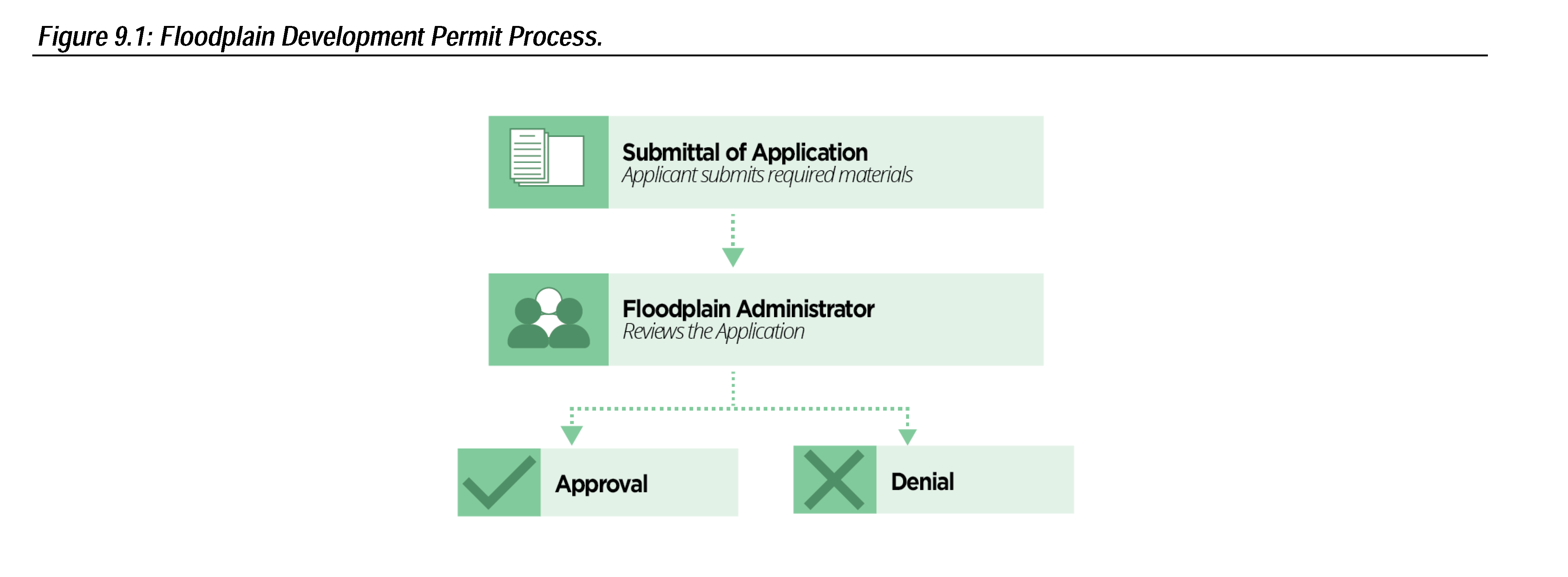
Authority. The City Engineer is hereby designated as the Floodplain Administrator. An application for a Floodplain Development Permit shall be presented to the Floodplain Administrator on forms furnished by the City. The Floodplain Administrator shall be responsible for approving or denying a Floodplain Development Permit application.
(B)
Application Requirements. The following information is required for any Floodplain Development Permit application:
(1)
A plan drawn to scale showing the location, dimensions, elevation, and location in relation to special flood hazard areas of:
(a)
Proposed landscape alterations.
(b)
Existing and proposed structures including manufactured homes.
(2)
Elevation (in relation to mean sea level), of the lowest floor (including basement) of all new and substantially improved structures;
(3)
Elevation in relation to mean sea level to which any nonresidential structure shall be floodproofed;
(4)
A certificate from a registered professional engineer or architect that the nonresidential floodproofed structure shall meet the floodproofing criteria of section 16-6-8(M);
(5)
Elevation certificate with all applicable information completed as required;
(6)
Description of the extent to which any watercourse or natural drainage will be altered or relocated as a result of proposed development.
(C)
Development Permit Review Criteria. Approval or denial of a Floodplain Development Permit by the Floodplain Administrator shall be based on the following factors:
(1)
The risk of danger to life and property due to flooding or erosion damage;
(2)
The susceptibility of the proposed facility and its contents to flood damage and the effect of such damage on the individual owner;
(3)
The danger that materials may be swept onto other lands to the injury of others;
(4)
The compatibility of the proposed use with existing and anticipated development;
(5)
The safety of access to the property in times of flood for ordinary and emergency vehicles;
(6)
The costs of providing governmental services during and after flood conditions including maintenance and repair of streets and bridges, and public utilities and facilities such as sewer, gas, electrical and water systems;
(7)
The expected heights, velocity, duration, rate of rise and sediment transport of the floodwaters and the effects of wave action, if applicable, expected at the site;
(8)
The necessity to the facility of a waterfront location, where applicable;
(9)
The availability of alternative locations, not subject to flooding or erosion damage, for the proposed use; and
(10)
The relationship of the proposed use to the comprehensive plan.
(Ord. No. 1644, § III, 6-18-2024)
Sec. 16-9-6. - Special Exception.
(A)
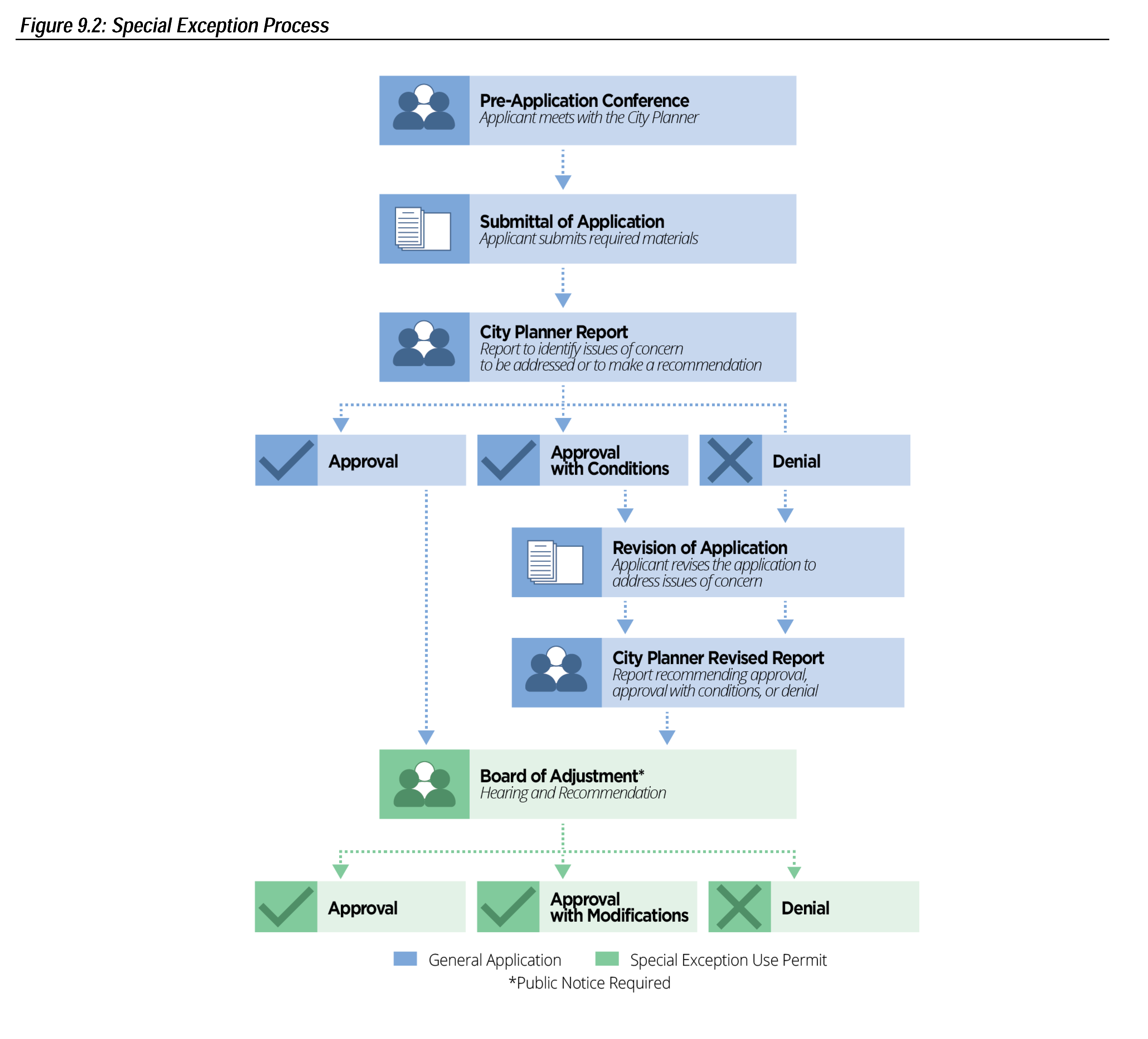
Purpose. The Board of Adjustment, upon application, and after notice (when notice is required) and public hearing, subject to the procedural and substantive standards hereinafter set forth, may grant permits for Special Exception uses as designated in sections 16-3-4 and 16-4-2.
(B)
Special Exception Criteria. The Board of Adjustment, upon application and after notice and public hearing may grant a Special Exception only upon finding that the application:
(1)
Will be in harmony with the spirit of the UDO and the governing zoning district.
(2)
Will not be injurious to the neighborhood or otherwise detrimental to public welfare.
(C)
Hearing and Recommendation by the Board of Adjustment. The Board of Adjustment shall hold the public hearing and, upon the concurring vote of three members, may grant the Special Exception. The Board, in granting a Special Exception shall prescribe appropriate conditions and safeguards and may require such evidence and guarantee or bonds as it may deem necessary to enforce compliance with the conditions attached.
(D)
Time Limitation on Special Exceptions. A Special Exception which has been granted but not been utilized within two years from the date of the order granting same shall be void. For the purpose of this provision, utilization shall mean actual use or the issuance of a building permit, when applicable, provided construction is diligently carried to completion.
(Ord. No. 1581, § II, 4-5-2022)
Sec. 16-9-7. - Specific Use Permit.
(A)
Purpose.
(1)
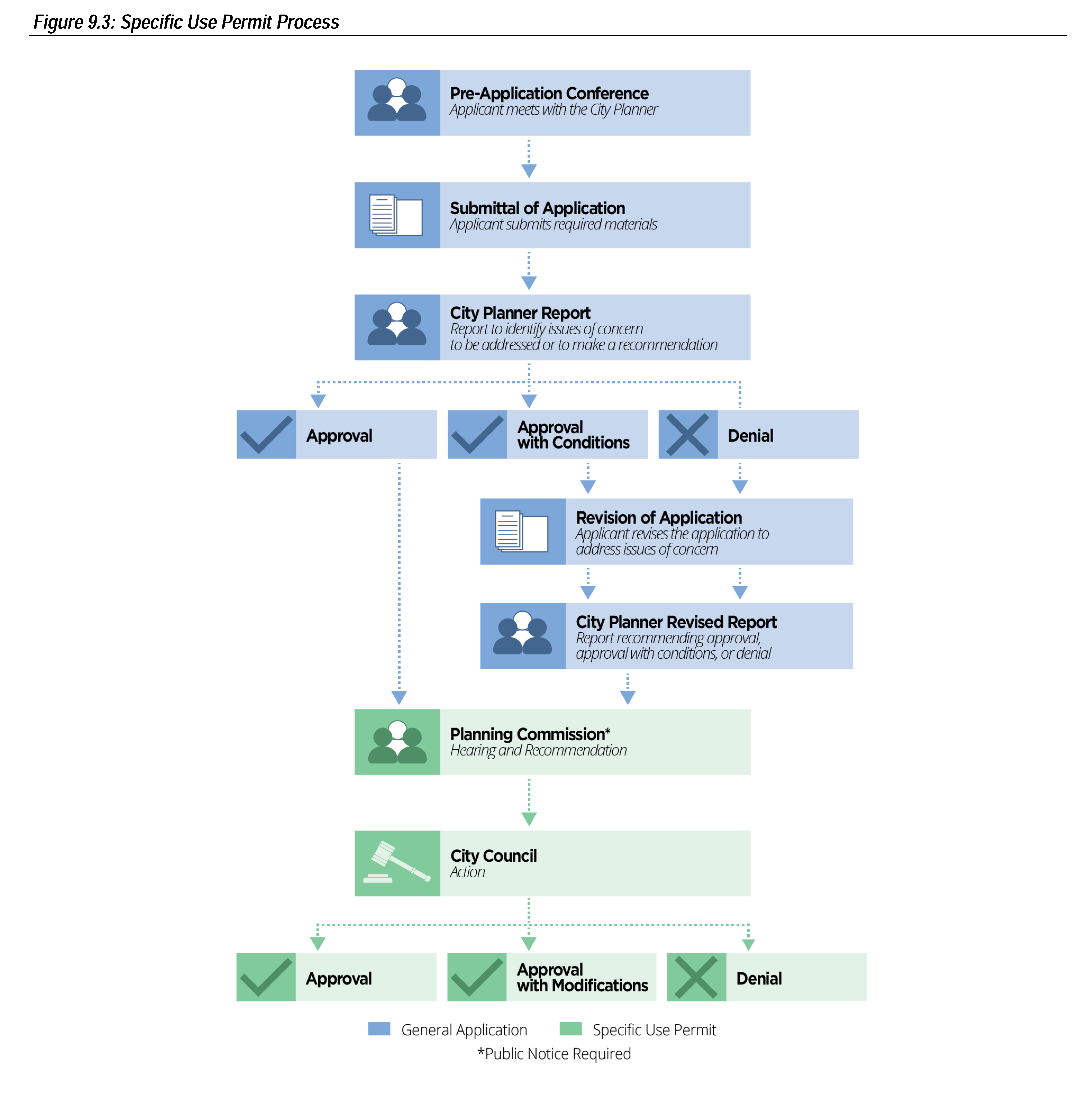
Certain uses specified in sections 16-3-4 and 16-4-2 are designated as Specific Uses because of the size of the land they require, their specialized nature, or because they may more intensely dominate the area in which they are located or generate effects on the general public that are broader in scope than other uses permitted in the district. The City Council may, after a public hearing and recommendation by the Planning Commission and after conducting a public hearing as is required in accordance with the provisions of this section, authorize for specific parcels of land, the issuance of a Specific Use permit.
(2)
The designation of a Specific Use Permit does not constitute an authorization or an assurance that such use will be permitted. Rather, each Specific Use Permit application shall be evaluated to determine its probable effect on the adjacent property and community welfare and may be approved or denied as the findings indicate appropriate.
(B)
Specific Use Review Criteria.
(1)
No Specific Use permit shall be issued unless the City Council finds that the application:
(a)
Is consistent with the City's Comprehensive Plan and other adopted policy documents.
(b)
Complies with all requirements imposed by this article including any applicable use-specific requirements in article 5, Use-Specific Standards.
(c)
Is consistent with the purposes of this UDO and the governing District, and
(d)
When the purposes of this UDO and the governing District cannot be met, the applicant may use the PUD process addressing the concerns of the Specific Use Permit in addition to the PUD criteria.
(e)
Is compatible with surrounding land uses and the area where it will be located.
(2)
In considering an application for a Specific Use permit, the City Council shall consider and may impose modifications or conditions it deems necessary.
(3)
No Specific Use permit shall be issued unless the use-specific standards as applicable, established in article 5, Use-Specific Standards, of this UDO have also been complied with in addition to the findings required in paragraph (1) of this subsection.
(C)
Hearing and Recommendation by the Planning Commission. The Planning Commission shall hold a public hearing on the proposed Specific Use permit, and, at the close of the public hearing and after consideration of the City planner report and public comment, make a recommendation to the City Council to approve, approve with modifications, or deny the Specific Use permit based on the applicable review criteria. The City Planner on behalf of the Planning Commission shall transmit a report containing its recommendation to approve, approve with modifications, or deny the Specific Use permit to the City Council.
(D)
Action by City Council. The City Council shall consider the Planning Commission's recommendation, the City planner report, and the applicable review criteria and shall approve, approve with modifications, or deny the Specific Use permit.
(E)
No Oil or Gas Related Wells Drilled After Granting of Specific Use Permit.
(1)
No permit for the drilling of any oil or gas related well shall be allowed in an AG, or IM zoned area if a Specific Use permit affecting the area has been previously approved by the City Council unless the previous Specific Use permit was oil or gas well related.
(2)
Drilling operations for oil and gas require additional permits as specified in the Jenks City Code. Conditions established under the required City Code application shall be in addition to the land use requirements established through the Specific Use permit process.
(F)
Time Limits for Interpretation. If for any reason the approved specific use ceases operation for a period of two years, then the approval of said Specific Use shall be considered void and will require another public hearing review by the Planning Commission and City Council. This shall also apply to any approved Specific Use that does not begin operation within two years of approval. This voiding of approval shall not apply if orderly progress toward completion of construction is taking place.
(G)
Amendments to Approved Specific Use Permits.
(1)
Determination of Level of Change. Upon receiving a Specific Use permit amendment application, the City Planner shall determine whether the amendment is a minor amendment or a major amendment based on the criteria detailed in section 16-9-7(G)(2) and section 16-9-7(G)(3) below.
(2)
Major Amendment. A major amendment is any proposed change to an approved Specific Use Permit that results in one or more of the following:
(a)
Increase in the intensity of the site's use,
(b)
Additional noise, glare, odor, or other impacts that are detectable from off-site
(c)
Affects the subject property in a manner that inhibits its continued use or reuse, or
(d)
Results in a change inconsistent with any standards or conditions imposed by the City Council in approving the Specific Use Permit, as determined by the City Planner.
(3)
Minor Amendment. A minor amendment is any proposed change to an approved Specific Use Permit that is consistent with the standards and conditions upon which the Specific Use Permit was approved, which does not alter the concept or intent of the Specific Use Permit, and is not considered a major amendment as detailed in section 16-9-7(G)(2).
(4)
Approval Process. A major amendment to an approved Specific Use permit shall follow the procedure for a Specific Use Permit approval set in section 16-9-7(C) and (D). A minor amendment to an approved Specific Use permit may be approved by the Planning Commission.
(Ord. No. 1581, § II, 4-5-2022; Ord. No. 1624, § VII, 10-17-2023)
Sec. 16-9-8. - Planned Unit Development.
(A)
Purpose. In order to establish an alternate zoning procedure under which land can be developed or redeveloped with innovation, imagination, and creative architectural design when sufficiently justified under the provisions of this UDO, the Planned Unit Development process is established. The objective of the Planned Unit Development process is to encourage a higher level of design and amenity than is possible to achieve under otherwise applicable UDO regulations. The end result can be a product which fulfills the objectives of the Comprehensive Plan and planning policies of the City while departing from the strict application of the regulations as detailed in this UDO. The Planned Unit Development process is intended to permit and encourage such flexibility and to accomplish the following purposes:
(1)
To stimulate creative approaches to the commercial, residential, and mixed-use development of land,
(2)
To provide more efficient use of land,
(3)
To preserve natural features and provide open space areas and recreation areas in excess of that required under conventional zoning regulations,
(4)
To develop new approaches to the living environment through variety in type, design, and layout of buildings, transportation systems, and public facilities,
(5)
To unify building and structures through design,
(6)
To promote long-term planning pursuant to the City of Jenks' Comprehensive Plan, which will allow harmonious and compatible land uses or combinations of uses with surrounding areas.
(B)
General Provisions.
(1)
Any residential development greater than 20 acres shall be approved as a Planned Unit Development.
(2)
Developments including only single-family detached residential uses, are discouraged, and may not be approved. Amenity packages may be used to offset "only" single-family.
(3)
Each Planned Unit Development should be presented and judged on its own merits. It shall not be sufficient to base justification for approval of a Planned Unit Development solely upon an already existing Planned Unit Development.
(4)
The burden of providing evidence and persuasion that any planned unit development is necessary and desirable shall rest with the applicant.
(5)
The planned unit development application shall specify the rules by which the parcel or parcels shall be developed and the site plan that specifies the development proposed.
(C)
Site Development Allowances and Modification Standards.
(1)
Site Development Allowances.
(a)
Site development allowances are deviations from the standards of the underlying zoning district set forth outside of this article.
(b)
Notwithstanding any limitations on variations which can be approved as contained elsewhere in this UDO, site development allowances may be approved provided the applicant specifically identifies each site development allowance on the approved site plan and demonstrates how each site development allowance would be compatible with surrounding development; is necessary for proper development of the site; and is aligned with a minimum of one of the modification standards detailed in section 16-9-8(C)(2) below.
(2)
Modification Standards. In addition to the Standards for Review established in section 16-9-8(D), the following modification standards shall be utilized in the consideration of site development allowances. These standards shall not be regarded as inflexible but shall be used as a framework by the City to evaluate the quality of amenities, benefits to the community, and design and desirability of the proposal.
(a)
Public Gathering Space. The Planned Unit Development includes public gathering space, the amount of which is proportional to the size of buildings or number of dwelling units. The public gathering space is activated through the use of moveable tables and chairs, a fountain or other water feature, a sculpture or other public art feature, benches, seat walls, raised landscape planters, pedestrian scale, and celebratory lighting such as string or Tivoli lights, and/or other features. The public gathering space is integrated into the overall design of the Planned Unit Development and has a direct functional or visual relationship to the main building(s) and is not of an isolated or leftover character.
(b)
Sustainable Design. The Planned Unit Development is designed with consideration given to various methods of site design and building location, architectural design of individual buildings, and landscaping design capable of reducing energy consumption and improving onsite stormwater management.
(c)
Landscape Conservation and Visual Enhancement. The Planned Unit Development preserves and enhances existing landscape, trees, and natural features such as rivers, streams, ponds, groves, and landforms.
(d)
Mix of Uses. The Planned Unit Development is comprised of a mix of nonresidential uses and a mix of housing types.
(e)
Affordability. The Planned Unit Development includes residential dwellings that are deed restricted for households that make less than or equal to 80 percent of the area median income.
(f)
Universal Design. The Planned Unit Development includes buildings designed with accessible features such as level access from the street and/or zero entry thresholds.
(g)
High Quality Building Materials. The Planned Unit Development utilizes time and weather tested building materials that are of a higher quality than what is otherwise required by this UDO, including, but not limited to, masonry or wood.
(D)
Standards for Review. Approval of development through the use of the Planned Unit Development process will be considered by the City only in direct response to the accrual of tangible benefits from the Planned Unit Development to the City or the neighborhood in which it would be located. These benefits shall be in the form of exceptional amenities; outstanding environmental, landscape, architectural, and/or site design; or the conservation of special man-made or natural features of the site. Modifications to the conventional zoning and subdivision regulations shall be considered a privilege except when encouraged by the modification standards in section 16-9-8(C)(2). No application for a Planned Unit Development shall be approved unless the City Council finds that the application meets all of the following standards:
(1)
Comprehensive Plan Alignment. The Planned Unit Development is consistent with the goals, objectives, and policies set forth in the Comprehensive Plan and other adopted plans and policy documents of the City.
(2)
Placemaking. The Planned Unit Development has a distinctive identity and brand that is utilized in the signs, streetscape, architecture, public gathering spaces, open spaces.
(3)
Integrated Design with Identifiable Centers and Edges. The Planned Unit Development shall be laid out and developed as a unit in accordance with an integrated overall design, in which the various land uses included function as a cohesive whole and support one another. The design shall provide identifiable centers, which form focus areas of activity in the development, and edges, which define the outer borders of the development, through the harmonious grouping of buildings, uses, facilities, public gathering spaces, and open space.
(4)
Public Welfare. The Planned Unit Development is designed, located, and proposed to be operated and maintained so that it will not impair an adequate supply of light and air to adjacent property and will not substantially increase the danger of fire or otherwise endanger the public health, safety, and welfare.
(5)
Compatibility with Adjacent Land Uses. The Planned Unit Development includes uses which are generally compatible and consistent with the uses of adjacent parcels. If the uses are not generally compatible, all adverse impacts have been mitigated through screening, landscaping, public open space, and other buffering features that protect uses within the development and surrounding properties.
(6)
Impact on Public Facilities and Resources. The Planned Unit Development is designed so that adequate utilities, road access, drainage, and other necessary facilities will be provided to serve it. The planned unit development shall include such impact fees as may be reasonably determined by the City Council or the City Engineer. These required impact fees shall be calculated in reasonable proportion to impact of the planned development on public facilities and infrastructure.
(7)
Archaeological, Historical or Cultural Impact. The Planned Unit Development does not substantially adversely impact an archaeological, historical, or cultural resource, included on the local, state, or federal register, located on or off the parcel(s) proposed for development.
(8)
Drives, Parking and Circulation. The Planned Unit Development has or makes adequate provision to provide necessary parking. Principal vehicular access is from dedicated public streets, and access points shall be designed to encourage smooth traffic flow with controlled turning movements and minimum hazards to vehicular or pedestrian traffic. With respect to vehicular and pedestrian circulation (including walkways, interior drives, and parking), special attention has been given to the location and number of access points to public streets, the width of interior drives and access points, general interior circulation, separation of pedestrian and vehicular traffic, adequate provision for service by emergency vehicles, and arrangement of parking areas that are safe, convenient, and do not detract from the design of proposed buildings and structures and the neighboring properties. Access points are limited through the use of cross access connections.
(E)
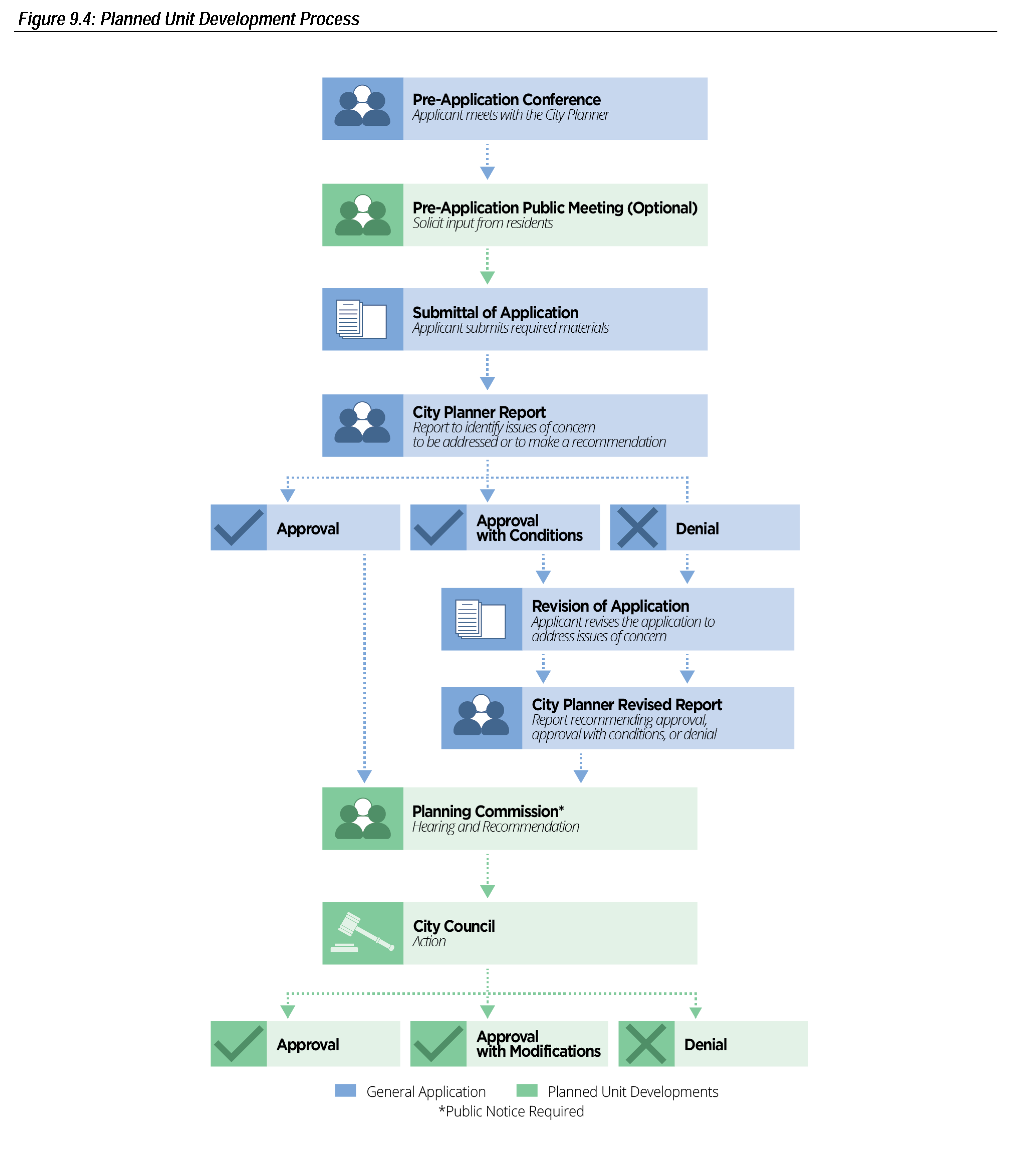
Pre-Application Public Meeting. The applicant, after conducting the required pre-application conference, as detailed in section 16-9-4(C)(1), and prior to application submittal, as detailed in section 16-9-4(C)(2), is encouraged to conduct a public meeting to discuss the proposed Planned Unit Development and its impact on adjoining properties and area residents. If held, the applicant is encouraged to submit a written summary of comments made at the meeting with the application.
(F)
Hearing and Recommendation by the Planning Commission. The Planning Commission shall hold a public hearing on the proposed Planned Unit Development, and, at the close of the public hearing and after consideration of the City planner report and public comment, make a recommendation to the City Council to approve, approve with modifications, or deny the Planned Unit Development based on the applicable review criteria. The City Planner, on behalf of the Planning Commission, shall transmit a report containing its recommendation to approve, approve with modifications, or deny the PUD application to the City Council.
(G)
Action by the City Council. The City Council shall hear the proposed Planned Unit Development, and, at the close of the meeting and after consideration of the recommendation of the Planning Commission, City Planner Report, and public comment either:
(1)
Approve the application,
(2)
Approve the application with modifications,
(3)
Deny the application,
(4)
Refer the application back to the Planning Commission for further review, or
(5)
Postpone further consideration pending the submittal of additional information, including any application requirement previously waived.
(H)
Zoning Map Amendment. Upon approval of the Planned Unit Development by the City Council, the zoning map shall be amended to reflect the PUD Overlay.
(I)
Additional Application Requirements. A Planned Unit Development application shall satisfy the application requirements and review criteria for other review procedures established in this chapter, as applicable to the application, including those for Site Plan Review in section 16-9-3(C), Conditional Use Permits in section 16-9-3(D), Specific Use Permits in section 16-9-7, and Sign Permits in section 16-9-3(F).
(J)
Amendments to Approved Planned Unit Development.
(1)
Determination of Level of Change. Upon receiving a Planned Development Amendment application, the City Planner shall determine whether the amendment is a major amendment, or a minor amendment based on the criteria detailed in section 16-9-8(J)(2) and section 16-9-8(J)(3) below.
(2)
Major Amendment. A major amendment is any proposed change to an approved major or minor planned development that results in one or more of the following changes:
(a)
Increase density,
(b)
Increase the height of buildings,
(c)
Reduce open space by more than five percent,
(d)
Modify the proportion of housing types,
(e)
Change parking areas in a manner that is inconsistent with this UDO,
(f)
Increase the approved gross floor area by more than 500 square feet,
(g)
Alter alignment of roads, utilities, or drainage, or
(h)
Result in any other change inconsistent with any standard or condition imposed by the City Council in approving the Planned Unit Development and/or the approved site plan, as determined by the City Planner.
(3)
Minor Amendment. A minor amendment is any proposed change to an approved Planned Unit Development that is consistent with the standards and conditions upon which the Planned Unit Development was approved, which does not alter the concept or intent of the Planned Unit Development and is not considered a major amendment as detailed in section 16-9-8(J)(2).
(4)
Approval Processes. A major amendment to an approved Planned Unit Development shall follow the procedure set in section 16-9-8(E)(F), and (G). A minor amendment to an approved Planned Unit Development may be approved by the Planning Commission.
(K)
Expiration. For any Planned Unit Development in which there has been no Building Permit issued nor any portion of the property platted after five years since approval by the City Council, the Planned Unit Development shall be considered null and void and shall be brought back before the Planning Commission and the City Council for consideration prior to any development on the property. The underlining zoning of the PUD shall not expire, only the PUD overlay shall expire.
(1)
Conformance with Current Regulations. Expired Planned Unit Developments are required to meet the most recently adopted regulations, ordinances, and development standards.
(Ord. No. 1581, § II, 4-5-2022; Ord. No. 1624, § VII, 10-17-2023)
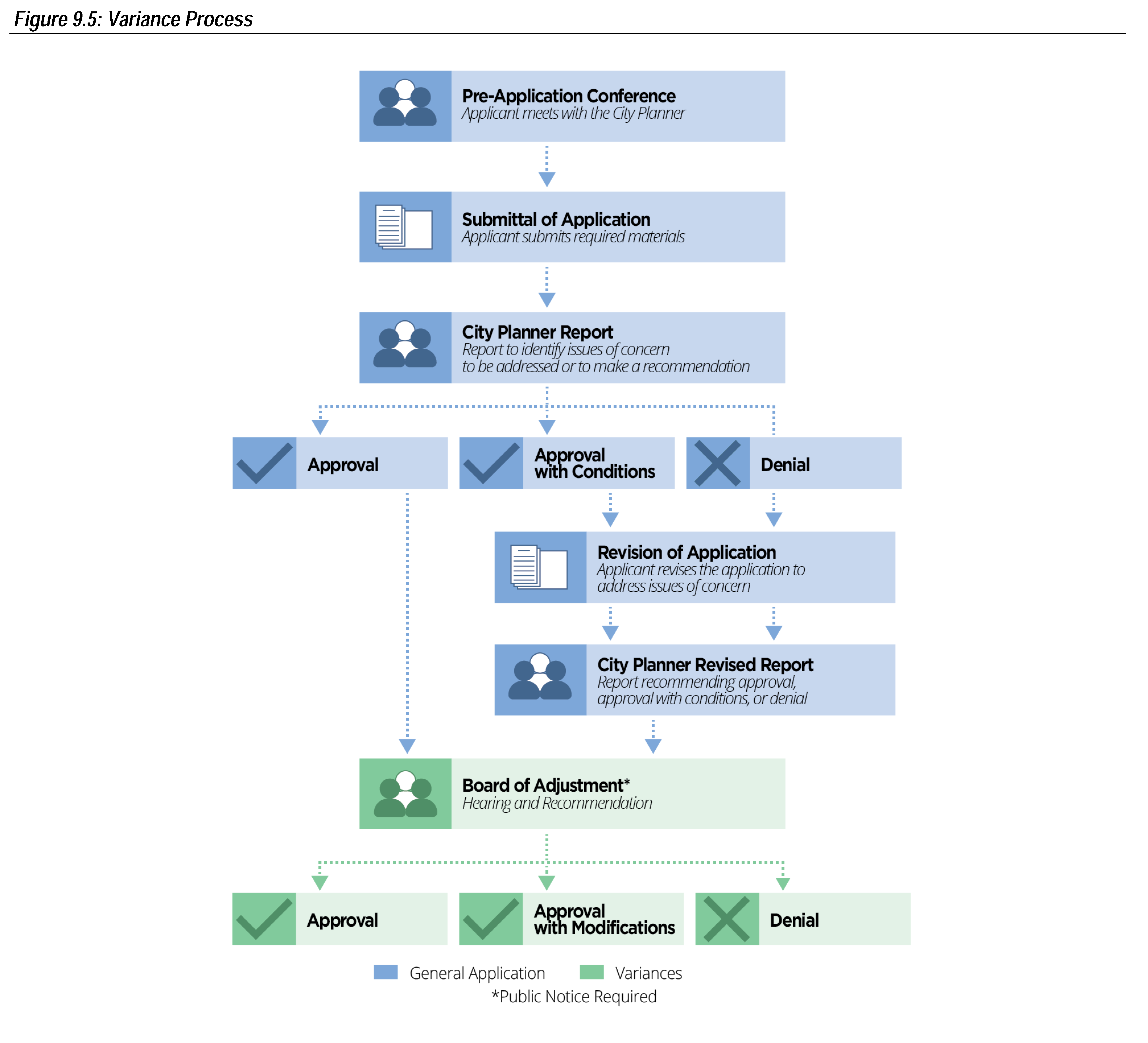
Sec. 16-9-9. - Variances.
(A)
Purpose. The Board of Adjustment, upon application, and after notice (when notice is required) and public hearing, and subject to the procedural and substantive standards hereinafter set forth, may grant limited relief from the requirements of this zoning code as will not cause substantial detriment to the public good or impair the spirit, purposes and intent of this zoning code, or the Comprehensive Plan, whereby reason of exceptional narrowness, shallowness, shape, topography, or other extraordinary or exceptional situation, condition, or circumstances peculiar to a particular property, the literal enforcement of the UDO will result in unnecessary hardship. The Board shall not vary any jurisdictional requirement, such as notice.
(B)
Variance Review Criteria. In determining whether a Variance should be granted, the Board of Adjustment must consider whether the practical difficulty or unnecessary hardship claimed by the applicant was created by the applicant and take into account the nature of the hardship. No Variance shall be granted unless the Board of Adjustment makes all of the following findings:
(1)
The application of the ordinance to the particular piece of property would create an unnecessary hardship;
(2)
Such conditions are peculiar to the particular piece of property involved;
(3)
Relief, if granted, would not cause substantial detriment to the public good, or impair the purposes and intent of the ordinance or the comprehensive plan; and
(4)
The variance, if granted, would be the minimum necessary to alleviate the unnecessary hardship.
(C)
Sign Variance Review Criteria. Application for Variance from the requirements of article 7, Sign Standards, of this UDO may be considered providing the determination for granting such Variance is based upon certain specific criteria. No Variance from the requirements or limitations set forth in article 7, Sign Standards, shall be granted unless the Board of Adjustment makes the following findings:
(1)
That there exists practical difficulties and unnecessary hardships which were not self-created by the applicant. Mere monetary hardship claimed by the applicant will not be sufficient grounds to support the granting of a Variance.
(2)
That the strict application of the provisions of article 7, Sign Standards, would result in undue hardship or practical difficulty inconsistent with the objectives of this UDO.
(3)
That there are unusual circumstances or conditions applicable to the subject parcel that do not exist throughout the district in which the parcel is located.
(4)
That the Variance, if granted, will not substantially or permanently impair the appropriate use or development of adjacent property.
(5)
That no Variance may be granted which will authorize the construction or maintenance of a sign which would endanger the safety of the public in contravention of applicable construction standards or vision clearance setbacks established in this UDO.
(6)
That in any instance where a Variance may be granted, such Variance shall in all cases be granted only to the extent necessary to afford reasonable relief of hardship and any increase to the height of a sign shall be granted only where no other relief can be found. Notwithstanding the foregoing, no Variance shall be granted which results in a deviation of more than ten percent from any standard set forth in Article 7, Sign Standards.
(D)
Board of Adjustment Action. The Board of Adjustment shall hold the public hearing and, upon the concurring vote of three members, may grant a Variance application after finding that the criteria of subsections (B) or (C), as applicable, are satisfied or deny the same upon finding that the criteria of subsections (B) or (C), as applicable, are not satisfied. In granting a Variance, the Board may impose such reasonable conditions and safeguards and may require such evidence and guarantee or bond as it may deem necessary to enforce compliance with the conditions attached.
(E)
Time Limitation on Variances. A Variance which has not been utilized within one year from the date of the order granting the Variance shall thereafter be void. For the purpose of this provision, utilization shall mean actual use or the issuance of a building permit, when applicable, provided construction is diligently carried to completion.
(Ord. No. 1581, § II, 4-5-2022)
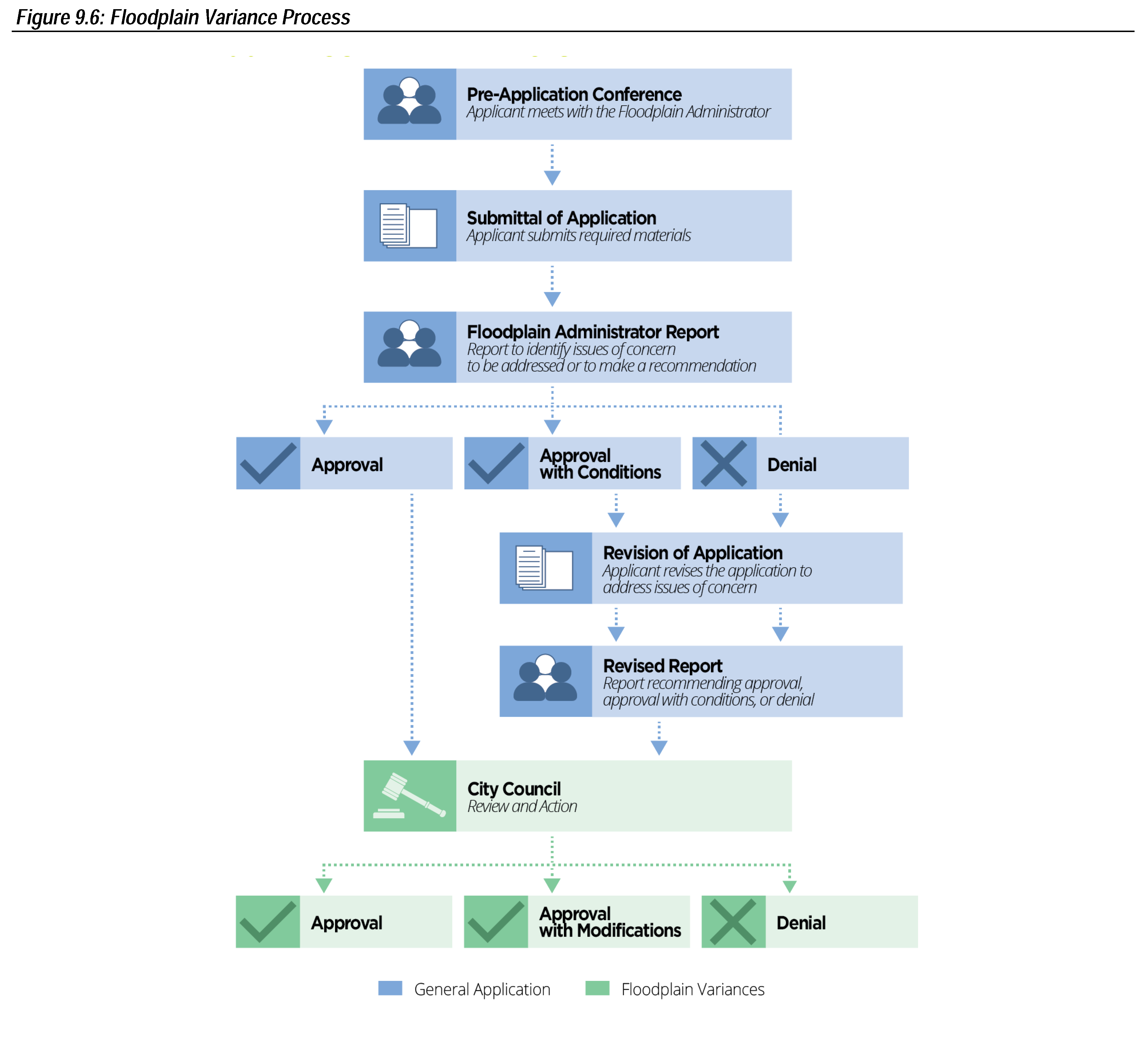
Sec. 16-9-10. - Floodplain Variances.
(A)
Authority and Purpose. The City Council shall act as the Appeal Board and shall hear and render judgment on requests for variances from the requirements of section 16-6-8. The Appeal Board shall hear and render judgment on an appeal only when it is alleged there is an error in any requirement, decision, or determination made by the Floodplain Administrator in the enforcement or administration of floodplain regulation and permits.
(B)
Procedure.
(1)
An appeal shall be in writing in care of the City Clerk and filed within 30 days of the decision or determination appealed from.
(2)
Any person or persons aggrieved by the decision of the Appeal Board may appeal such decision in a court of competent jurisdiction.
(3)
The Floodplain Administrator shall maintain a record of all actions involving an appeal and shall report Variances to the Federal Emergency Management Agency (FEMA) upon request.
(C)
Variances For New Construction. Variances may be issued for new construction and substantial improvements to be erected on a lot of one-half acre or less in size contiguous to and surrounded by lots with existing structures constructed below the base flood level, providing the relevant factors in section 16-9-10(C) has been fully considered.
(D)
Exception For National Register of Historic Places. Variances may be issued for the reconstruction, rehabilitation or restoration of structures listed on the National Register of Historic Places or the state inventory of historic places, without regard to the procedures set forth in the remainder of this article.
(E)
Variances For Historic Structures. Variances may be issued for the repair or rehabilitation of historic structures upon a determination that the proposed repair or rehabilitation will not preclude the structure's continued designation as an historic structure and the Variance is the minimum necessary to preserve the historic character and design of the structure.
(F)
Conditional Approval. Upon consideration of the factors noted above and the intent of this article, the Appeal Board may attach such conditions to the granting of Variances as it deems necessary to further the purpose and objectives of this article and section 16-6-8(C).
(G)
Variances Within Floodways Prohibited. Variances shall not be issued within any designated floodway if any increase in flood levels during the base flood discharge would result. If a Variance is granted for construction within a floodway, it shall only be upon approval of the City Council and in compliance with all requirements of the City Engineer.
(H)
Criteria. The Appeal Board shall grant a flood damage prevention Variance only upon finding that the following criteria are satisfied:
(1)
A determination that failure to grant the Variance would result in exceptional hardship to the applicant, and
(2)
A determination that the granting of a Variance will not result in increased flood heights, additional threats to public safety, extraordinary public expense, create nuisances, cause fraud on or victimization of the public, or conflict with existing local laws or ordinances.
(3)
Variances shall only be issued upon a determination that the Variance is the minimum necessary, considering the flood hazard, to afford relief.
(4)
The structure or other development is protected by methods that minimize flood damages during the base flood and create no additional threats to public safety.
(5)
Monetary hardship, including financial loss, shall not be considered an exceptional hardship and shall not be considered sufficient grounds for granting a Variance.
(I)
Any applicant receiving a variance shall be notified in writing that the structure permitted with the lowest floor elevation constructed below the base flood elevation, the cost of flood insurance will be commensurate with the increased risk resulting from the lowest floor elevation constructed below the BFE.
(Ord. No. 1581, § II, 4-5-2022; Ord. No. 1644, § III, 6-18-2024)
Sec. 16-9-11. - Comprehensive Plan Future Land Use Map Amendments.
Comprehensive Plan Future Land Use Map amendments shall follow the process established in the Comprehensive Plan.
(Ord. No. 1581, § II, 4-5-2022)
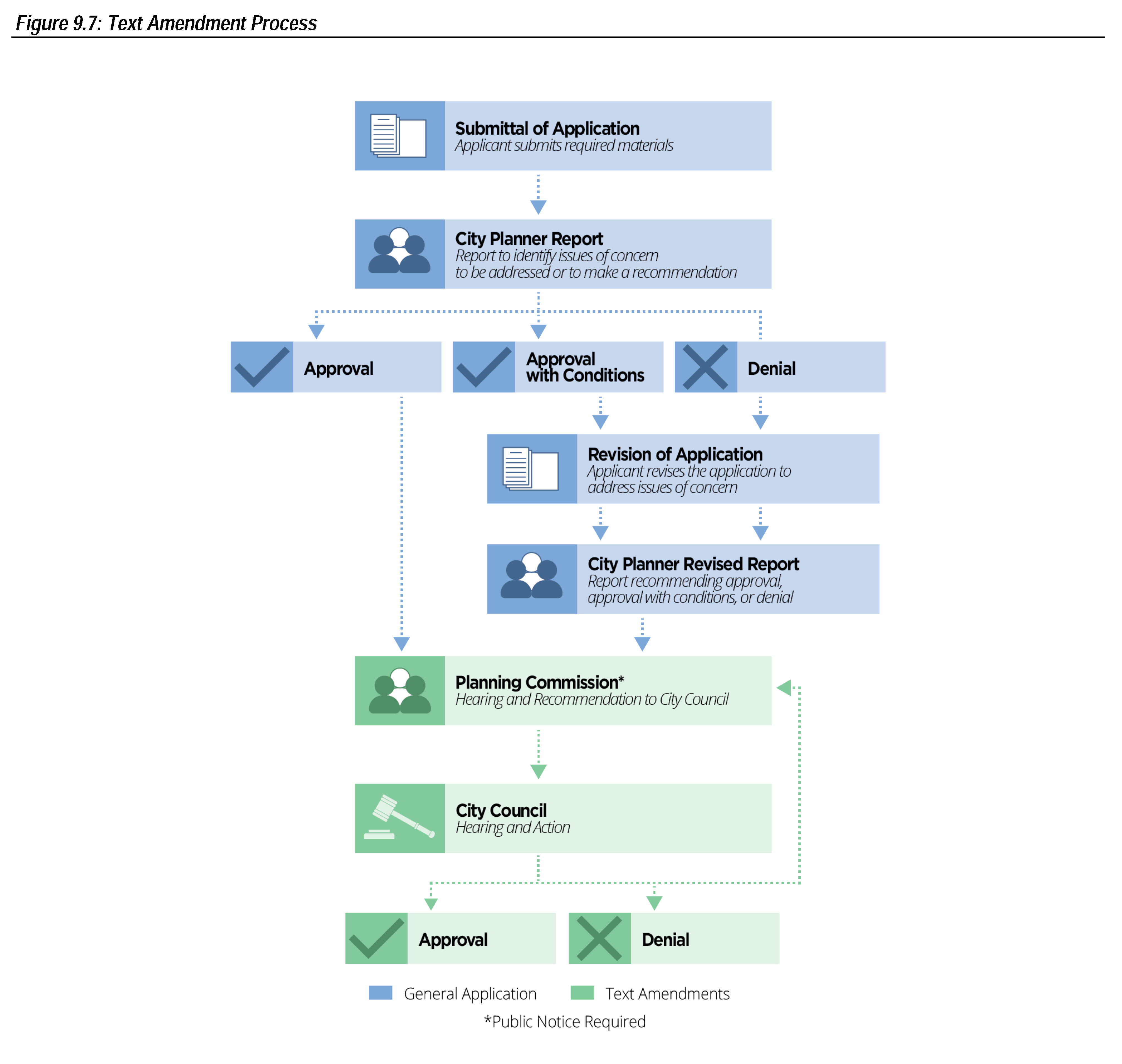
Sec. 16-9-12. - Text Amendments.
(A)
Initiation of Text Amendments. Amendments to the text of this UDO may be initiated by the City Council, by the Planning Commission, City Staff, or a property owner or an authorized agent.
(B)
Text Amendment Review Criteria.
(1)
The amendment is consistent with the purpose of this UDO and the City's Comprehensive Plan.
(2)
The amendment will not adversely affect the public health, safety, or general welfare.
(C)
Hearing and Recommendation by the Planning Commission. The Planning Commission shall hold a public hearing on the proposed Text Amendment, and, at the close of the public hearing and after consideration of public comment and the City planner report, make a recommendation to the City Council to approve, approve with modifications, or deny the amendment based on the applicable review criteria. The City Planner on behalf of the Planning Commission shall transmit a report containing its recommendation to approve, approve with modifications, or deny the amendment to the City Council.
(D)
Action by the City Council. The City Council shall consider the Planning Commission's recommendation, City planner report, and the applicable review criteria and may grant or deny the Text Amendment. The City Council may also refer the Text Amendment application back to the Planning Commission for further consideration.
(Ord. No. 1581, § II, 4-5-2022)
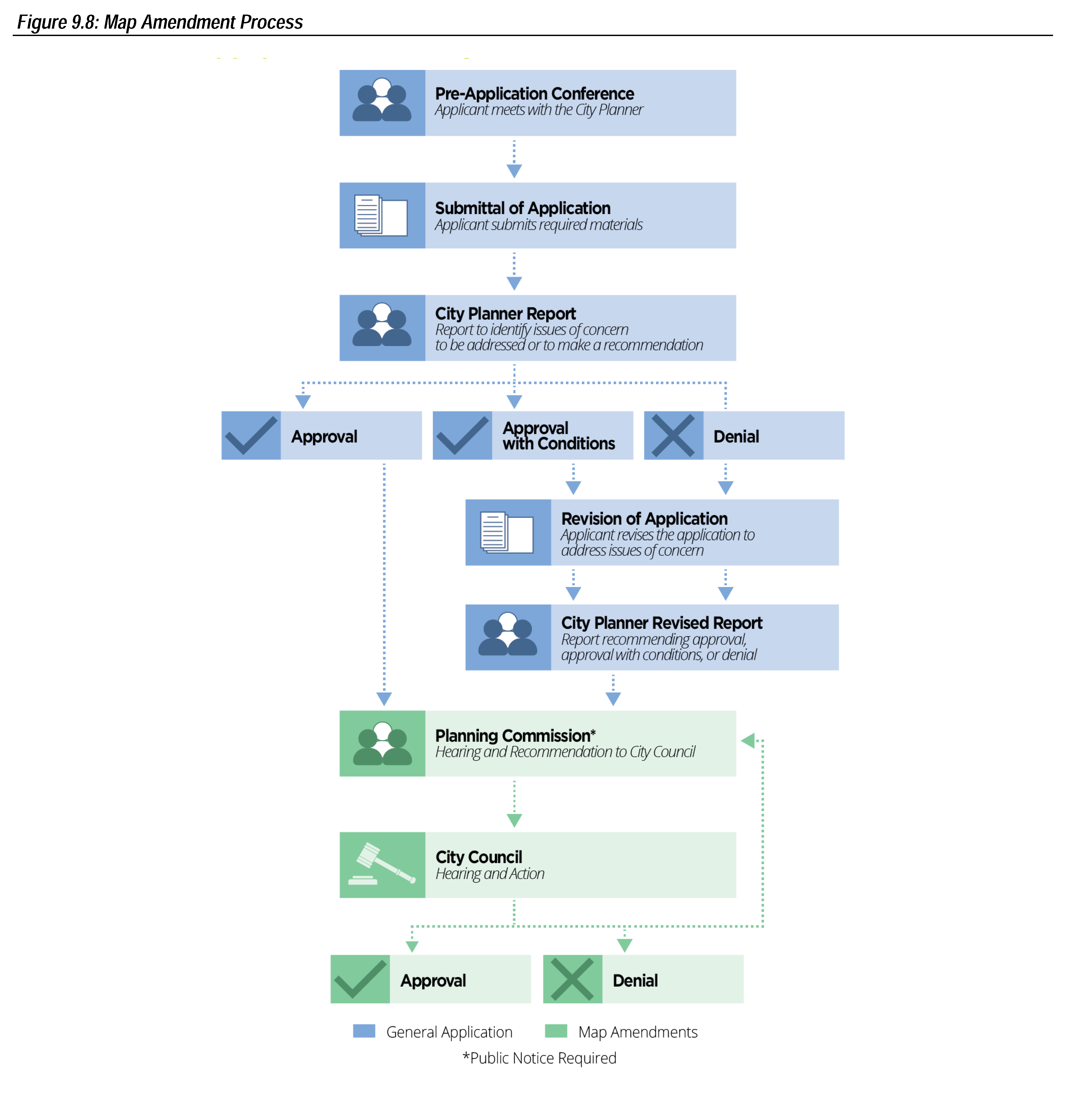
Sec. 16-9-13. - Map Amendments (Zoning/Rezoning—"INCOG" Map Amendments).
(A)
Initiation of Map Amendments. Amendments to the City's Zoning Map may be initiated by the City Council, by the Planning Commission, City Staff, or the property owner or an authorized agent.
(B)
Exceptions for General Revisions. General and broad revisions to the Zoning Map shall be treated as Text Amendment pursuant to section 16-9-12.
(C)
Map Amendment Review Criteria. For the purpose of establishing and maintaining sound, stable and desirable development within the city, the rezoning of land is to be encouraged only in certain circumstances and when consistent with the Comprehensive Plan. Map Amendments should only be approved if at least one of criteria (1)—(4) and both criteria (6) and (7) have been satisfied:
(1)
The proposed rezoning is consistent with the Comprehensive Plan and the purposes of this UDO,
(2)
There have been significant changes in the area to warrant a zoning change,
(3)
The rezoning is consistent with the purpose statement of the proposed zoning district,
(4)
There was an error in establishing the current zoning,
(5)
The rezoning is related to the annexation of an existing subdivision,
(6)
The proposed rezoning will not result in an individual parcel zoned for one district that is not shared by any adjacent parcels, and
(7)
The proposed parcel(s) to be rezoned shall meet the minimum frontage and area requirements of the requested zoning district as specified in section 16-3-1.
(D)
Hearing and Recommendation by the Planning Commission. The Planning Commission shall hold a public hearing on the proposed Map Amendment, and, at the close of the public hearing and after consideration of public comment and the City planner report, make a recommendation to the City Council to approve, approve with modifications, or deny the amendment based on the applicable review criteria. The City Planner, on behalf of the Planning Commission shall transmit a report containing its recommendation to approve, approve with modifications, or deny the amendment to the City Council.
(E)
Hearing and Action by City Council. The City Council shall hold a hearing on each application regularly transmitted, and on each application transmitted pursuant to a written request for further hearing and shall approve the application as submitted, supplemented, or as amended, approve the application subject to modification, or deny the application. The City Council may also refer the Map Amendment application back to the Planning Commission for further consideration.
(1)
Protest Petition. In case of a protest against such amendment, change, or repeal is filed a minimum of three days prior to a public hearing, signed by the owners of 20 percent or more of the area of the lots included in such proposed change, or by 50 percent or more of the owners of the area of the lots immediately abutting any side of the territory included in such proposed change, or separated there from only by an alley or street less than 300 feet wide, such amendment, change, or repeal shall not become effective except by favorable vote of three-fifths of all the members of the City Council.
(Ord. No. 1581, § II, 4-5-2022; Ord. No. 1668, § IV, 3-25-2025)
Editor's note— Ord. No. 1668, § IV, adopted March 25, 2025, amended the title of § 16-9-13 to read as herein set out. The former § 16-9-13 title pertained to map amendments.
Sec. 16-9-14. - Appeals of Administrative Determinations.
(A)
Initiation of Appeals of Administrative Determinations. Any applicant who receives a denial as an outcome of an administrative procedure may, within 30 days after receipt of notice of such decision, appeal such decision to the Board of Adjustment by filing an appeal application with the City Planner with an explanation as to why the decision was not warranted by this UDO. The City Planner, upon receipt of the application, shall transmit to the Secretary of the Board and the City Clerk certified copies of the application. Upon receipt, the City Planner on behalf of the Secretary shall set the matter for public hearing.
(B)
Board of Adjustment Action. The Board of Adjustment shall hold the public hearing and may reverse, affirm, or modify the appealed determination. A concurring vote of three members of the Board shall be necessary to reverse any decision of the City Planner. All decisions of the Board shall be made no later than 30 days after the conclusion of the hearing.
(C)
Appeal Review Criteria. An appeal of administrative decision shall be granted only if the Board of Adjustment makes one of the following findings:
(1)
The decision constituted an erroneous application or interpretation of this UDO.
(2)
The decision constituted an abuse of the administrative official's discretion to interpret or apply this UDO.
(3)
The decision was rendered based upon an erroneous material fact.
(D)
Record of Action. The Board of Adjustment's decision shall be filed and recorded with the City Clerk.
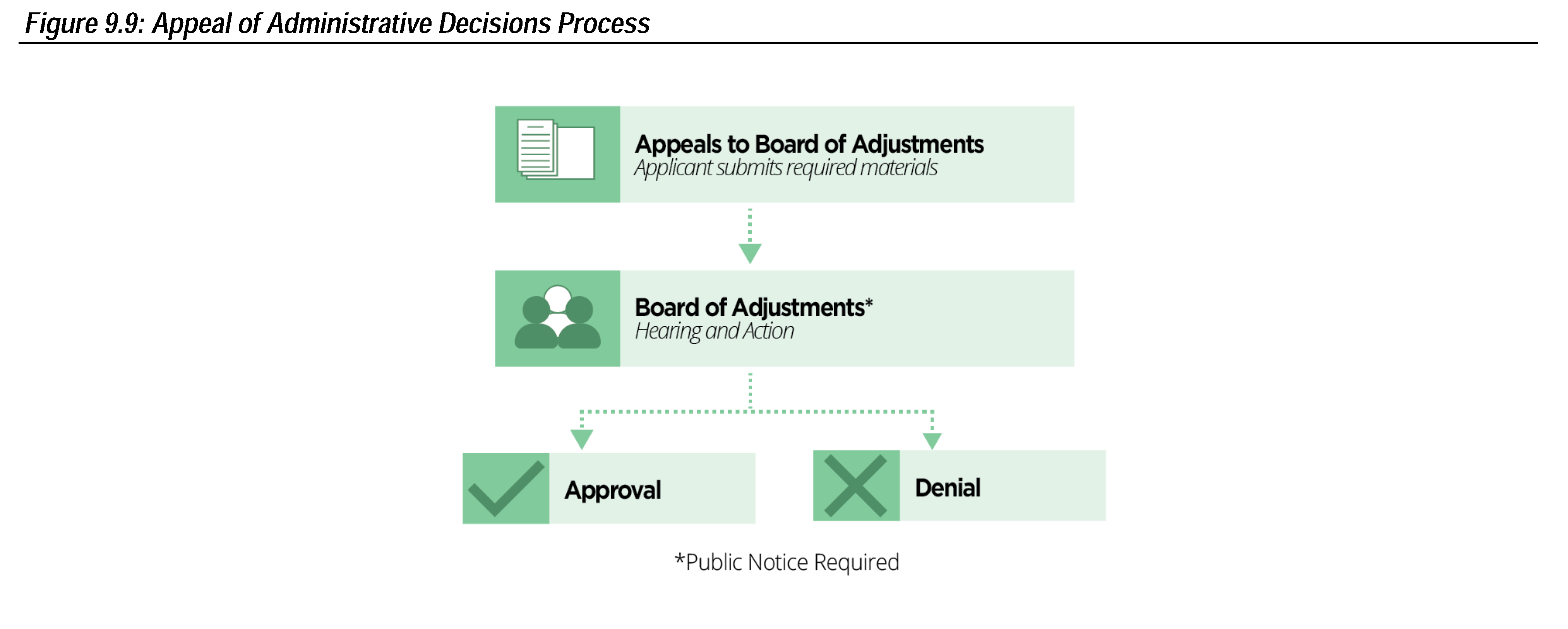
(Ord. No. 1581, § II, 4-5-2022)
Sec. 16-9-15. - Interpretations.
(A)
Initiation of Interpretations. Any applicant, the City Planner, the Planning Commission, or City Council may submit a request for interpretation of a UDO term or provision. Requests for interpretations of UDO terms or provisions shall be submitted to the City Planner and heard by the Board of Adjustment. The City Planner, upon receipt of a request, shall transmit to the Secretary of the Board and the City Clerk certified copies of all the papers constituting the notice. Upon receipt, the City Planner on behalf of the Secretary shall set the matter for public hearing.
(B)
Board of Adjustment Action. The Board of Adjustment shall hold a public hearing and render an interpretation of any request within 30 days of the public hearing.
(C)
Determination of District Classification. Where a question arises as to the district classification of a particular use, the Board of Adjustment, may find and determine the classification of the use in question.
(D)
Interpretation of Building Code. The Board shall interpret the text of the building code in compliance with the criteria established within that code upon an appeal from a determination of the Building Inspector.
(E)
Record of Action. The Board of Adjustment's decision shall be filed and recorded with the City Clerk.
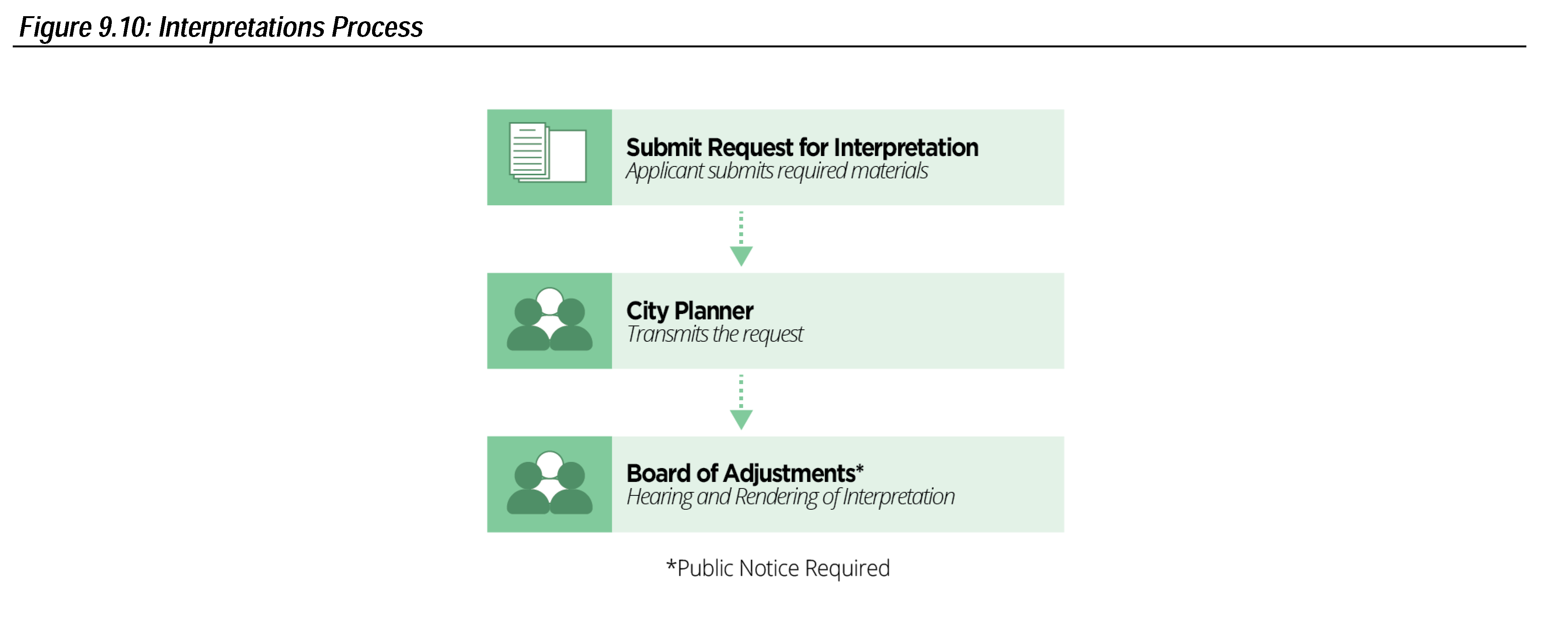
(Ord. No. 1581, § II, 4-5-2022)
Sec. 16-9-16. - Enforcement.
(A)
General UDO Enforcement.
(1)
Duty of the City Planner and Other Officials.
(a)
It is the duty of the City Planner or their designee to enforce this UDO. If any violation is found, they shall notify in writing the persons responsible for such violation, indicating the nature of the violation, and ordering the action necessary to correct it. They shall take such other action to ensure compliance as authorized.
(b)
All departments, officials, and employees of the City of Jenks vested with the duty or authority to issue Permits or Licenses shall comply with the provisions of this Code and shall issue no Permit or Licensee for any use, purpose, excavation, construction, structure, building, or sign in conflict with the provisions in the Jenks Unified Development Ordinance or Jenks City Code.
(2)
Penalties for Violations.
(a)
Any person, firm, or corporation violating any provisions of this Code or failing to comply with any of its requirements, including violations of conditions and safeguards established in connection with grants of Variances or Special Exceptions, shall be deemed guilty of an offense may be fined in accordance with the City of Jenks Code of Ordinances in an amount not to exceed $100.00 plus court costs. Each day's violation thereof shall constitute a separate offense.
(b)
Nothing herein contained shall prevent the City of Jenks, Oklahoma or its authorized officials from taking other legal action, as authorized by law, to remedy violations.
(3)
Construction and Use Provided in Applications, Plans, and Permits. Permits, Variances, or Special Exceptions issued on the basis of approved plans and applications authorize only the uses, arrangement, and construction set forth in such approved plans and applications. Deviation from such approvals shall be deemed a violation of this UDO and punishable as authorized by City Code.
(B)
Flood Damage Prevention Enforcement and Penalties For Noncompliance.
(1)
Fine Imposed. No structure or land shall hereafter be constructed, located, extended, converted, or altered without full compliance with the terms of section 16-6-8 and other applicable regulations. Any person, firm, corporation, or other legal entity violating the requirements of section 16-6-8, or any conditions made pursuant thereto, shall be guilty of an offense and, upon conviction thereof, shall be fined not more than $100.00 and each day's violation thereof shall constitute a separate offense, plus applicable court costs.
(2)
Fine Not Exclusive Remedy. In addition to a fine, the City may institute appropriate actions or proceedings at law or equity for the enforcement of the provisions of this article or to correct the violations thereof. The conviction and punishment of any person hereunder shall not relieve such person from the responsibility to correct prohibited conditions or to remove prohibited buildings, structures, obstructions, or improvements, nor prevent the enforcement, corrections, or removal thereof.
(3)
Certification. It is hereby found and declared by the City of Jenks City Council that severe flooding has occurred in the past within its jurisdiction and will certainly occur within the future; that flooding is likely to result in infliction of serious personal injury or death, and is likely to result in substantial injury or destruction of property within its jurisdiction; in order to effectively comply with minimum standards for coverage under the National Flood Insurance Program; and in order to effectively remedy the situation described herein, it is necessary that sections 16-6-8, 16-9-10, and 16-9-16 become effective immediately.
(4)
Severability. If any section, clause, sentence, or phrase of this section is held to be invalid or unconstitutional by any court of competent jurisdiction, then said holding shall in no way affect the validity of the remaining portions of this section.
(Ord. No. 1581, § II, 4-5-2022)

