
Jenks City Zoning Code
ARTICLE 5
- USE SPECIFIC STANDARDS
Sec. 16-5-1.- Agricultural Use Specific Standards.
(A)
Community Garden.
(1)
The name and contact information of the responsible person or organization shall be clearly posted and maintained for the duration of the existence of the community garden.
(2)
Accessory structures shall be limited in gross floor area to ten percent of the of the lot used for the community garden, shall have a maximum height of 12 feet including any pitched roof, and shall be limited to the following accessory structure types:
(a)
Storage sheds,
(b)
Hoop houses, and
(c)
Cold frames.
(3)
All compost and/or organic matter on the site:
(a)
Shall not cover more than ten percent of the total area of the property,
(b)
Shall be screened from view from adjacent property and the public right-of-way,
(c)
Shall be managed to prevent the harborage of rodents and pests,
(d)
Shall be maintained to prevent odors, and
(e)
Shall be located to prevent leachate from flowing onto adjacent property or into natural or human-made storm channels.
(4)
The site shall be designed and maintained to prevent water from irrigation and/or other activities and/or fertilizer from draining onto adjacent property.
(5)
Trash areas shall be provided and screened from view from adjacent property and the public right-of-way.
(Ord. No. 1581, § II, 4-5-2022)
Sec. 16-5-2. - Residential Use Specific Standards.
(A)
Duplex.
(1)
Duplexes shall be oriented with their primary façades toward the public street. For corner lots, the primary façade must be oriented toward the designated front lot line.
(2)
A minimum of one of the parking spaces, as required in section 16-6-1(E) of this UDO, shall be provided in an attached or detached garage.
(3)
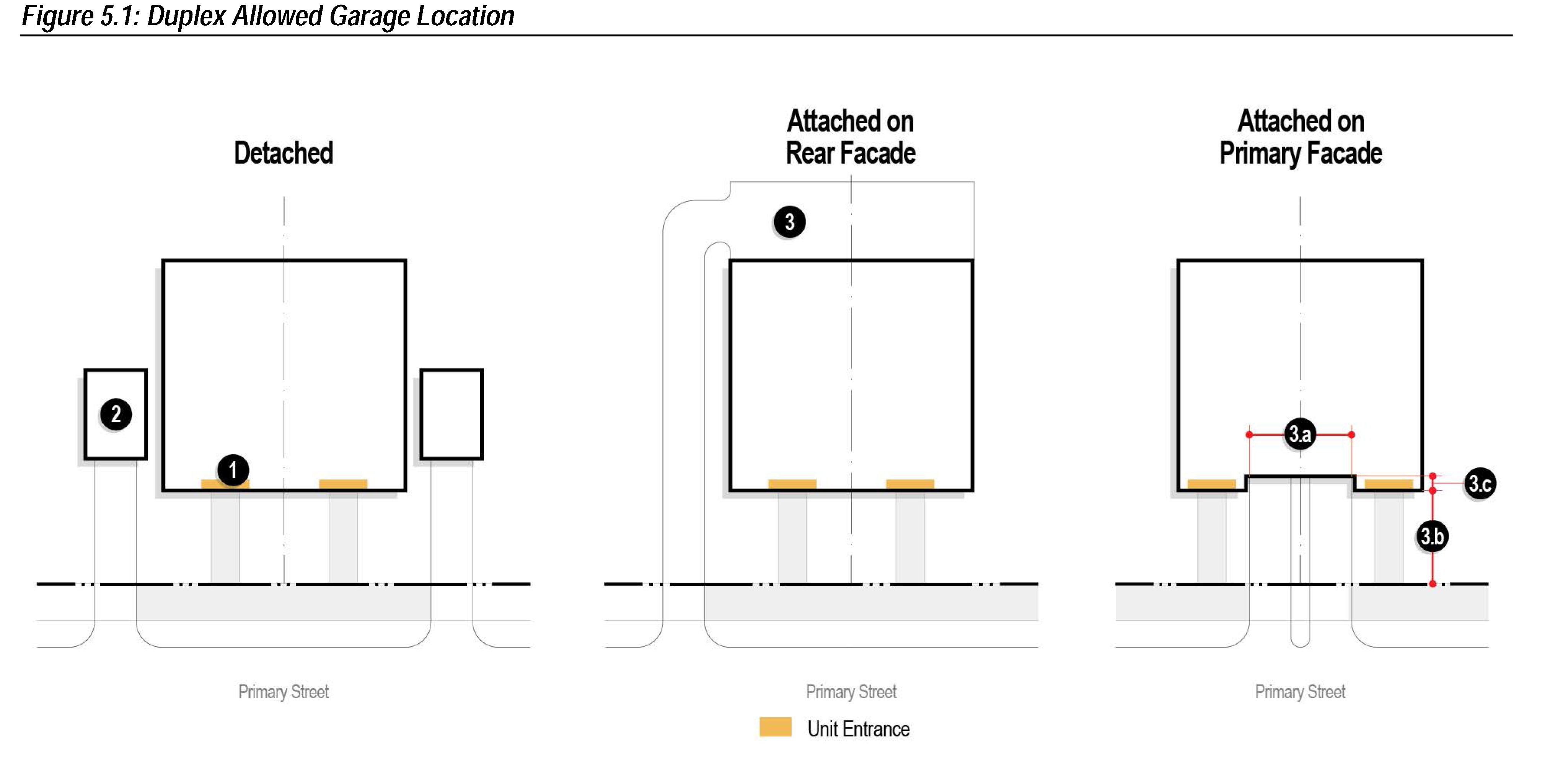
Attached garages are encouraged to be located on rear façades. If attached garages are located on the primary façade they shall:
(a)
Not exceed 45 percent of the façade's total width,
(b)
Be setback a minimum of 25 feet from the property line, and
(c)
Be recessed from the primary front façade (excluding porches) of the duplex a minimum of five feet.
(4)
Exterior building materials shall be time- and weather-tested materials and techniques such as, but not limited to, masonry, stone veneer systems, stucco, precast panels with inlaid or stamped brick texture, and those included in the City of Jenks Preferred Building Materials List.
(B)
Residential Facility for Persons with a Disability.
(1)
Each RFPD shall comply with all applicable state and local building, safety, health, and zoning requirements.
(2)
Each RFPD shall comply with all applicable federal and state laws, standards, and requirements, including state licensure, if applicable and required.
(3)
The minimum number of parking spaces required for an RFPD shall be the same as for similar structures located in the same zone in which the facility is located. Off-street parking shall be adequate to serve the needs of residents, visitors, staff members, and others. Additional parking may be required based on the number of residents occupying the facility, the number of residents who are reasonably expected to maintain a vehicle at the facility, the reasonably anticipated number of visitors, the number of staff members who will be serving the residents, the number of vendors that will serve the facility, and any other factors that may increase or impact parking demands for the facility.
(4)
The RFPD shall not be made available to or occupied by any person whose tenancy would constitute a direct threat to the health or safety of other individuals or whose tenancy would result in substantial physical damage to the property of others.
(5)
The table of conditional, special exception, and specific uses is found in section 16-3-4(B), (C) of the City Code. An RFPD shall be a permitted use in any zone where a specific subtype of group living arrangement is shown in the Table of Uses as a permitted or conditional use, subject to the same development standards as are applied to group living arrangements in City Code. In determining whether a group living arrangement is allowed, only those specific users and types of group living arrangements currently and presently allowed by ordinance and shown in section 16-3-4(B)-(C) shall be considered. Variance, prior accommodations, pre-existing noncomplying structures, or pre-existing nonconforming uses shall not be considered. Providers must comply with state and federal laws when applying for the accommodation.
(6)
Any lawfully created pre-existing nonconforming use(s) or noncomplying structure (s) that are in conflict with this title or any other provision of the City Code may be continued as allowed by City Code. A nonconforming use, noncomplying structure, nonconforming lot, or other nonconformity may not be changed except in conformance with the provisions of this title. Such changes requiring conformance with the provisions of this title shall include, but not limited to, a change in state licensure, additional state licensure(s), an increase in resident census size, or any other expansion of or change in use.
(7)
An RFPD located in a residential zone shall be capable of use as a facility without structural or landscaping alterations that would change the structure's residential character or appearance. Any new or remodeled structure constructed for use as a facility shall be of a size, scale, and design that is in harmony with other residential uses in the vicinity and shall not create a fundamental change in the residential character of the neighborhood in which it is proposed to be located.
(8)
Residency in the facility shall be on a strictly voluntary basis and not a part of, or in lieu of, confinement, rehabilitation, or treatment in either a correctional facility or a condition of probation or parole. A facility shall not include any persons referred by the Oklahoma state department of corrections or any adult or juvenile court.
(9)
The RFPD shall not house more than six persons with a disability.
(10)
No group living arrangement shall be located within 1,200 feet of another group living arrangement. Measurement shall be in a straight line between the closest property lines of the lots/parcels, whether located in the City, County, State, or surrounding municipality.
(11)
An RFPD may request a reasonable accommodation pursuant to federal and state law and Title 24.
(C)
Multifamily Building, All Units.
(1)
Multifamily buildings shall be oriented with their primary façades toward the public street. For corner lots, the primary façade must be oriented toward the designated front lot line.
(2)
Multifamily buildings shall incorporate design elements that create visual interest and avoid large blank façades. Such elements should be used to create a façade rhythm that is consistent with surrounding attached or detached single-family buildings. Appropriate elements include protruding or recessed patios, vertical and horizontal design elements, planar variations, varied roof lines, dormers, and others.
(3)
When a multifamily building is located at the end of a block, the building shall be oriented toward the intersecting side street. Where existing alleys exist and intersect with the side street, the alley must either be accommodated by new development, or reconfigured and dedicated as part of the new development in order to preserve alley access to other properties on the block.
(4)
All off-street parking, as required in section 16-6-1(E) of this UDO, shall be located in the rear and/or interior side yard. Off-street parking located in the interior side yard shall be set back a minimum of one foot from the front elevation of the primary building.
(5)
A maximum of one curb cut shall be permitted per street frontage unless otherwise approved by the City Planner due to site specific constraints.
(6)
ADA compliant pedestrian walkways shall be provided to all building entries and parking areas and shall connect to the sidewalk at the street frontage.
(7)
Exterior building materials shall be time- and weather-tested materials and techniques such as, but not limited to, masonry, stone veneer systems, stucco, precast panels with inlaid or stamped brick texture, and those included in the City of Jenks Preferred Building Materials List.
(D)
Multifamily Complex.
(1)
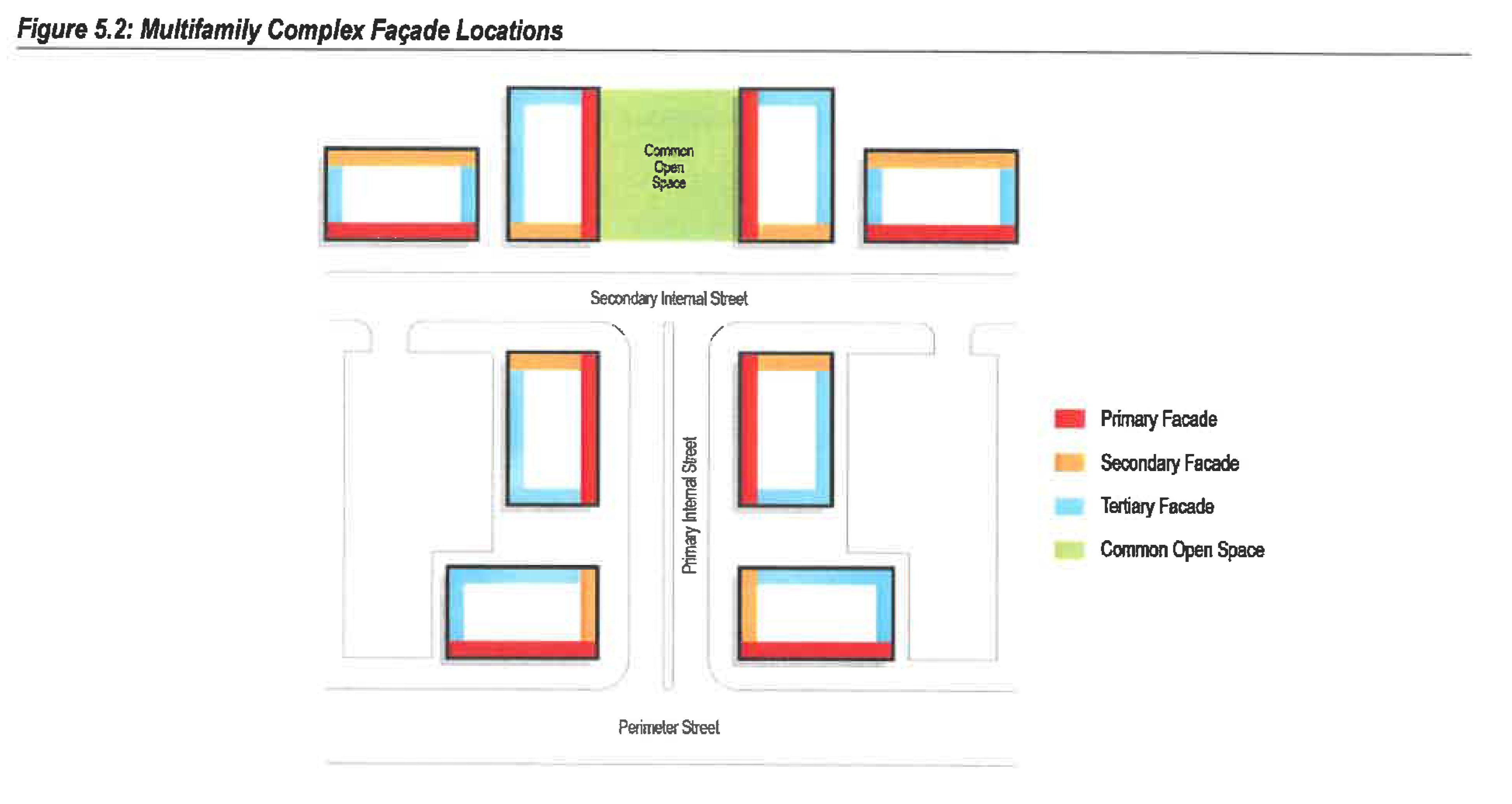
The façades of buildings in multifamily complexes shall be improved as detailed below.
(a)
Primary Façade.
(I)
The primary façade shall include the primary building entrance and shall be oriented towards the following (listed in priority order):
(i)
Perimeter Streets,
(ii)
Primary Internal Streets,
(iii)
Parks or other common open space, or
(iv)
Secondary internal streets. Primary façades shall not be oriented towards off-street parking lots, garages, or carports.
(II)
Building materials of primary façades shall be masonry, stone veneer systems, or stucco on the first level. Precast panels with stamped or inlaid brick texture, EIFS acrylic finishes, or quik-brik concrete masonry units may be utilized above the first level. However, in no instance shall the finish of the non-natural materials utilized mimic or match the texture of the natural materials utilized. A maximum of three building materials may be used on a primary façade.
(i)
When two or more building materials are used on a façade, the material used on the first level shall be visually heavier than the material used above the first level to give a sense of support and grounding. For example, masonry on the first level and EIFS acrylic stucco above.
(III)
In order to provide for primary façade articulation, primary façades shall step back a maximum of two feet and shall step forward a maximum of one foot from the build-to-line for a minimum of 40 percent and maximum of 70 percent of the primary façade.
(b)
Secondary Façade.
(I)
The secondary façade shall be any façade not including the primary building entrance that is oriented towards the following:
(i)
Perimeter streets,
(ii)
Primary internal streets,
(iii)
Parks or other common open space, or
(iv)
Secondary internal streets.
(II)
Building materials of secondary façades shall be a combination of masonry, stone veneer systems, stucco, precast panels with stamped or inlaid brick texture, EIFS acrylic finishes, or quik-brik concrete masonry units. Natural materials shall consist of a minimum of 40 percent of the façade. In no instance shall the finish of the non-natural materials utilized mimic or match the texture of the natural materials utilized. The type and design of materials utilized on the secondary façade shall complement those utilized on the primary façade.
(III)
In order to provide for secondary façade articulation, secondary façades shall step back a maximum of two feet and shall step forward a maximum of one foot from the build-to-line for a minimum of 30 percent and maximum of 70 percent of the secondary façade. Articulation of the secondary façade shall be complimentary to the articulation of the primary façade.
(c)
Tertiary Façade.
(I)
The tertiary façade shall be any façade not considered a primary or secondary façade.
(II)
Building materials of tertiary façades may consist wholly of precast panels with stamped or inlaid brick texture, EIFS acrylic finishes, or quik-brik concrete masonry units, however, a combination of non-natural and natural materials is encouraged. The type and design of materials utilized on the tertiary façade shall complement those utilized on the primary and secondary façades.
(2)
Parking shall be integrated into the overall site design to minimize visual impact, reduce the loss of trees, and be visually concealed from public rights-of-way.
(3)
ADA compliant pedestrian walkways shall be provided to all building entries and parking areas and shall connect to the sidewalk at the street frontage.
(E)
Reserved.
(F)
Townhome.
(1)
Townhomes shall be oriented with their primary façades toward the public street. For corner lots, the primary façade must be oriented toward the designated front lot line.
(2)
Individual townhome units should be articulated through the exterior design of the townhome cluster. This can be accomplished through dormers, porches, vertical design elements, varying roof forms, or other appropriate techniques.
(3)
When townhomes are located at the end of a block, they shall be oriented toward the intersecting side street. Where existing alleys exist and intersect with the side street, the alley must either be accommodated by new development, or reconfigured and dedicated as part of the new development in order to preserve alley access to other properties on the block.
(4)
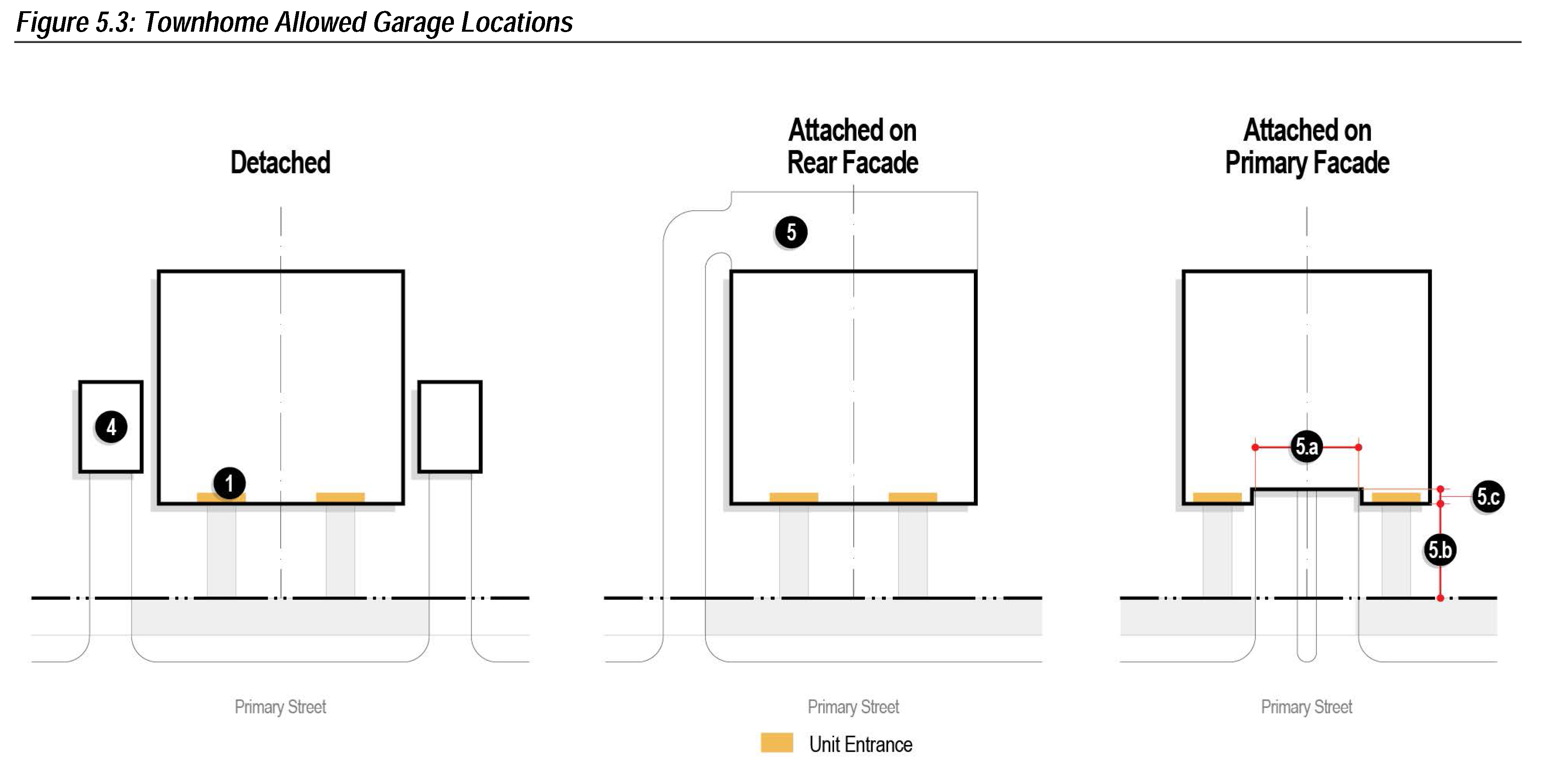
A minimum of one of the parking spaces, as required in section 16-6-1(E) of this UDO, shall be provided in an attached or detached garage. Detached garages shall be exclusively accessed from rear alleys where rear alleys exist. Where rear alleys do not exist, it is encouraged that they be established and that detached garages be exclusively accessed from them. Carports shall be allowed upon Planning Commission approval.
(5)
Attached garages are encouraged to be located on rear façades. If attached garages are located on the primary façade they shall:
(a)
Not exceed 35 percent of the façade's total width,
(b)
Be setback a minimum of 25 feet from the property line, and
(c)
Be recessed from the primary front façade (excluding porches) of the townhome a minimum of five feet.
(6)
Exterior building materials shall be time- and weather-tested materials and techniques such as, but not limited to, masonry, stone veneer systems, stucco, precast panels with inlaid or stamped brick texture, and those included in the City of Jenks Preferred Building Materials List.
(G)
Reserved.
(Ord. No. 1581, § II, 4-5-2022; Ord. No. 1624, § III, 10-17-2023; Ord. No. 1625, § III, 10-17-2023)
Sec. 16-5-3. - Institutional and Utility Use Specific Standards.
(A)
Government Uses, Outdoor.
(1)
Outdoor storage and/or activity areas shall be located a minimum of 50 feet from any residentially zoned property. All outdoor storage and/or activity areas adjoining a residentially zoned property shall comply with the requirements for permanent outdoor storage screening as specified in section 16-5-12(K) of this UDO.
(2)
All buildings and structures shall be located a minimum of 20 feet from any residentially zoned property.
(3)
Buildings shall be similar in character to abutting properties including roof pitch, eaves, building materials, windows, and colors.
(B)
Wireless Communication Facility.
(1)
All wireless communication facilities shall be designed, screened, and camouflaged from view of surrounding properties and the public view in one or more of the following methods:
(a)
The facility shall be co-located with existing uses and on the subject lot so as not to create substantial visual, noise, or aesthetic impacts.
(b)
The facility shall be sited within areas with substantial existing vegetative screening or new vegetative screening to be added by the applicant.
(c)
The facility shall be designed to appear as natural features found in the immediate area such as trees or rocks to be unrecognizable from off-site.
(2)
All wireless communications facilities, including on-site generators shall be designed, operated, and located to have no noise detectable at the property lines of the subject lot.
(3)
A least ten feet of horizontal clearance shall be maintained between any part of the wireless communication facility antenna and any utility lines unless the antenna is co-located with a utility tower or facility.
(4)
Standards in Residential Districts.
(a)
No small cell wireless communication facility shall be placed within 500 feet of another small cell wireless communication facility.
(b)
No small cell wireless communication facility shall be located on a lot immediately adjacent to or immediately across the street from any residential use.
(c)
The cumulative total of all equipment from all wireless communication providers, including antenna for a single facility or property shall not exceed 28 cubic feet in volume.
(5)
Antenna Standards.
(a)
One wireless facility shall be allowed per parcel, unless the applicant can demonstrate the service need for additional antenna.
(b)
Antennae shall be ground-mounted in residential districts. Ground-mounted or building-mounted antennae shall be allowed in nonresidential districts, however the preference is for building-mounted antennae.
(c)
No antenna shall be located in the required front or street side yard of any parcel unless entirely screened from view of the adjoining right-of-way.
(d)
Ground-mounted antennae shall be situated as close to the ground as possible to reduce visual impact.
(e)
Antennae shall be set back at least five feet from all property lines.
(f)
Antennae shall be comprised of subdued colors and nonreflective materials which blend with the surrounding area or building.
(g)
A least ten feet of horizontal clearance shall be maintained between any part of the wireless communication facility antenna and any utility lines unless the antenna is co-located with a utility tower or facility.
(6)
Height Limit. The height limit for towers shall be established by district as listed in Table 16-5-3(B)(6).
(7)
Tower Standards.
(a)
All facilities shall be designed to minimize the visual impact, considering technological requirements by means of placement, screening, and camouflage to be compatible with existing architectural elements, landscape elements, and other site characteristics.
(b)
Towers shall not be in any required front or street side yard in any district. The setback from any street right-of-way, residential property line shall be equal to the height of the facility. The setback in all other situations shall be at least 20 percent of the height of the tower.
(c)
Towers shall not feature lighting except as follows:
(I)
A manually operated or motion-detector-controlled light above the equipment shed door may be provided. The light shall remain off except when personnel are present at night. The lighting shall comply with the standards of section 16-6-7.
(II)
Any tower lighting required by the Federal Aviation Administration.
(Ord. No. 1581, § II, 4-5-2022)
Sec. 16-5-4. - Retail Use Specific Standards.
(A)
Adult Uses.
(1)
Purpose. The purpose of this section is to provide specific regulations for adult uses, in order to accommodate constitutionally-protected non-obscene sexual expression, while protecting the public health, safety, and general welfare of the City. The City Council finds that:
(a)
Adult uses require special supervision from the City's law enforcement and public safety agencies to protect and preserve the public health, safety, morals, and welfare of the patrons and employees of businesses as well as the City's citizens.
(b)
Adult uses are frequently used for unlawful sexual activities, including prostitution and sexual liaisons of a casual nature.
(c)
Sexually transmitted diseases are a legitimate health concern for the City that demands reasonable regulation of adult uses by the City in accordance with this chapter.
(d)
This chapter's regulations are a legitimate and reasonable means of accountability to ensure that operators of adult uses comply with reasonable regulations and to ensure that operators do not allow their establishments to be used as places of illegal sexual activity or solicitation.
(e)
There is convincing documented evidence that adult uses, because of their outward appearance and very nature, have a deleterious effect on both the existing businesses around them and the surrounding residential areas adjacent to them, cause increased crime, particularly during the overnight hours, and reduce property values.
(f)
The City Council desires to minimize and control these adverse effects by regulating adult uses in accordance with this chapter.
(g)
By minimizing and controlling these adverse effects, the City Council seeks to protect the health, safety, and welfare of the citizenry; protect citizens from increased crime; preserve quality of life; preserve property values and the character of the City's neighborhoods; and deter the spread of urban blight.
(h)
The City Council does not enact this chapter to suppress or authorize the suppression of any speech activities protected by the First Amendment; rather, this chapter establishes content-neutral regulations that address the secondary effects of adult uses.
(i)
The City Council does not enact this chapter to restrict, deny, or authorize the restriction or denial of access by adults to sexually oriented materials protected by the First Amendment, or to deny, or authorize denial of, access by the distributors and exhibitors of adult entertainment and adult materials to their intended market.
(j)
Evidence concerning adult uses' adverse secondary effects on communities is readily available in many court decisions, including, but not limited to: Township of Littleton, Colorado v. Z.J. Gifts D-4, LLC, 541 U.S. 774 (2004); City of Los Angeles v. Almaeda Books, Inc., 535 U.S. 425 (2002); Township of Erie v. Pap's A.M., 529 U.S. 277 (2000); Barnes v. Glen Theatre, Inc., 501 U.S. 560 (1991); Township of Renton v. Playtime Theatres, Inc., 475 U.S. 41 (1986); Young v. American Mini Theatres, 426 U.S. 50 (1976); California v. LaRue, 409 U.S. 109 (1972); Illinois One News, Inc. v. City of Marwill, 477 F.3d 461 (7th Cir. 2007); Andy's Restaurant & Lounge, Inc. v. City of Gary, 466 F.3d 550 (7th Cir. 2006); Joelner v. City of Washington Park, 378 F.3d 613 (7th Cir. 2004); G.M. Enterprises, Inc. v. Town of St. Joseph, 350 F.3d 631 (7th Cir. 2003); Pleasureland Museum, Inc. v. Beutter, 288 F.3d 988 (7th Cir. 2002); Shultz v. City of Cumberland, 288 F.3d 831 (7th Cir. 2000); Genusa v. City of Peoria, 619 F.2d 1203 (7th Cir. 1980); Excalibur Group, Inc. v. City of Minneapolis, 116 F.3d 1216 (8th Cir. 1997); and XLP Corporation v. County of Lake, 359 Ill. App. 3d 239 (2d Dist. 2005) (collectively, the "Cases").
(k)
Many cities and other units of government throughout the country have studied and found significant adverse secondary effects associated with adult uses, including, but not limited to: Phoenix, Arizona (1984); Minneapolis, Minnesota (1980); Indianapolis, Indiana (1984); Amarillo, Texas (1977); Whittier, California (1978); St. Croix County, Wisconsin (1993); Bellevue, Washington (1998); Beaumont, Texas (1982); and Des Moines, Iowa (1984) (collectively, the "Studies").
(l)
The United States Congress has heard testimony detailing the negative secondary effects associated with adult uses on numerous occasions, including 136 Cong. Rec. S. 8987; 135 Cong. Rec. S. 14519; 135 Cong. Rec. S. 5636; 134 Cong. Rec. E. 3750 (collectively, the "Testimony").
(m)
Based on secondary effects discussed and found to exist in the Cases, Studies, and Testimony, as well as all evidence presented and matters discussed during all public hearings and meetings conducted by the City, and all other relevant information, including the City Council's own knowledge and experience, the City Council finds that:
(I)
Adult uses can contribute to increased crime in the area where such businesses are located and burden local law enforcement and public safety efforts. Crimes associated with adult uses include, but are not limited to:
(i)
Prostitution and other sex related offenses,
(ii)
Drug use and dealing, and
(iii)
Money laundering.
(II)
Adult uses can contribute to significant public health concerns, including the spread of HIV/AIDS and other sexually transmitted diseases.
(III)
Adult uses and their outward appearance can significantly:
(i)
Contribute to the deterioration of residential neighborhoods,
(ii)
Increase neighborhood blight,
(iii)
Impair the character and quality of residential housing in the surrounding area, and
(iv)
Reduce overall housing appeal for potential residents.
(IV)
The concentration of adult uses in any one area can greatly impact the area by causing blight, decreasing property values, reducing the City's tax base, making the area less attractive to non-adult uses (i.e., marketability), and increasing crime.
(V)
Adult uses can produce higher levels of noise, traffic, and glare as compared to other businesses by virtue of adult uses' hours of operation.
(VI)
Serving or otherwise allowing the consumption of alcoholic liquor at adult uses can lead to increased criminal activity and exacerbate neighborhood deterioration.
(VII)
The findings set forth in this section 16-5-4(A)(1)(m)(I) through (VI) above constitute substantial governmental concerns.
(VIII)
Adult uses have operational characteristics that require reasonable governmental regulation to address those substantial governmental concerns.
(IX)
Passing the ordinance from which this chapter is derived will promote and protect the public health, safety, and welfare.
(2)
Conditions. All adult uses will be subject to the following conditions in order to prevent or minimize substantial or undue adverse effects upon neighboring and adjacent properties and improvements, and substantial or undue or upon public facilities and services:
(a)
Adult uses will only be permitted in the CG District.
(b)
No adult use may be located within 1,000 feet of any existing school, religious institution, day care center, public park, residentially zoned property, agriculturally zoned property, or other adult use.
(c)
No adult use may have more than one outdoor sign.
(d)
No adult use may have an outdoor sign exceeding ten feet in length or three feet in width.
(e)
No adult use may display the stock in trade of adult entertainment establishments to the public from view outside the establishment, including graphics, decorations, or displays.
(f)
No adult use may paint the exterior of the premises any other color than a single neutral, earth tone color.
(g)
No adult use offering live performance of adult entertainment will allow exposed or uncovered specified anatomical areas.
(h)
No adult use will permit persons under the age of 18 on the property subject to the adult use, and all adult uses will post a notice at the door that entry by persons under the age of 18 is prohibited.
(i)
All adult uses will maintain a buffer measuring at least six feet wide between all patrons and any individual conducting live performance of adult entertainment.
(j)
No adult use will allow or permit the occurrence of any specified sexual activities or permit the occurrence of any act constituting the offense of obscenity under Oklahoma law on property subject to the adult use.
(k)
No adult use will allow, permit, or authorize physical contact between any adult use personnel and any patron.
(l)
Adult entertainment employees may not receive tips from patrons except as follows:
(I)
An adult use that desires to provide for tips from its patrons for adult entertainment employees will establish one or more boxes or other containers to receive tips.
(II)
All tips for adult entertainment employees must be placed by the patron into the tip box.
(III)
An adult use that provides tip boxes for adult entertainment employees must post one or more signs to be conspicuously visible to the patrons on the premises in letters at least one inch high to read as follows: "All tips are to be placed in tip box and not handed directly to the entertainer. Any physical contact between the patron and the entertainer is strictly prohibited."
(m)
No adult use offering adult entertainment on the premises may open before 11:30 a.m. or close after 1:00 a.m., except that cleaning and maintenance activities necessary for the property's operation may occur before or after the hours specified in this subsection.
(n)
No adult use offering adult entertainment on the premises will open or operate on Sunday, on any federal holiday, or on any state holiday.
(o)
No animals, excluding animals trained and used to assist a person with a disability, are permitted at any time on property subject to an adult use, and any animal assisting a person with a disability must remain with that person at all times.
(p)
No adult entertainment will occur in any restroom located on a property subject to an adult use.
(q)
Patrons will not enter any non-public portions of a property subject to an adult use, including, without limitation, any storage areas, dressing rooms, or other rooms provided for the primary benefit and use of adult use personnel.
(r)
No adult use will utilize loudspeakers or other sound equipment that is audible outside of the structure in which the adult use is conducted.
(s)
Each adult use will have at least one manager's station allowing direct, unobstructed, and uninterrupted view from the manager's station to every part of the premises accessible to patrons, excluding restrooms.
(t)
All adult uses will comply with all provisions of this Code and all federal, state, and local laws, rules, and regulations, as amended.
(u)
Upon the City's request, permittee will allow the City to inspect the adult use's books, records, and payroll information to allow the City to verify compliance with this Code, state law, and federal law, as amended.
(3)
Penalty.
(a)
Every act or omission constituting a violation of this Code by any adult use, adult use personnel, or patron will be deemed to be an act or omission by the adult use operator, and the adult use operator will be punished in accordance with the provisions of this subsection.
(b)
Nothing in this section will prohibit the City or any person or entity from pursuing any claims at law or in equity, against any person or entity that violates this section or any other City ordinance, rule, or regulation.
(c)
Any adult use established, operated, or maintained in violation of any of the provisions or requirements of this Code will be, and the same is, declared to be unlawful and a public nuisance. The City may, in addition to or in lieu of any other remedies set forth in this subsection, commence an action to enjoin, remove, or abate such nuisance in the manner provided by law and may take such other steps and apply to such court or courts as may have jurisdiction to grant such relief as will abate or remove such public nuisance, and restrain and enjoin any person from establishing, operating, or maintaining an adult use contrary to the provisions of this Code.
(4)
Severability. If any part, subsection or clause of this section will be deemed to be unconstitutional or otherwise invalid, the remaining section, subsection and clauses will not be affected thereby.
(B)
General Retail, less than 10,000 square feet, less than 5,000 square feet in the DT District.
(1)
The main entrance shall be oriented towards the primary street.
(2)
All off-street parking, as required in section 16-6-1(E) of this UDO, shall be located in the rear and/or interior side yard.
(a)
Off-street parking located in the interior side yard shall be set back a minimum of one foot from the front elevation of the primary building.
(b)
CS and CG Districts. Any portion of an off-street parking located in the front yard shall meet the following requirements:
(1)
Parking Area Landscape.
(I)
Parking Area Perimeter Landscape Zone. A low screening wall, the height of which provides effective screening to a maximum height of three feet may be required at the discretion of the City Planner to be used in conjunction with required landscaping as detailed [in section] 16-6-3(D).
(II)
Parking Area Interior Landscape Zone. The parking area interior landscape zone requirements detailed in section 16-6-3(E)(3)(a).
(3)
A maximum of one curb cut shall be permitted per street frontage unless otherwise approved by the City Planner due to site specific constraints.
(4)
ADA compliant pedestrian walkways shall be provided to all building entries and parking areas and shall connect to the sidewalk at the street frontage.
(5)
Exterior building materials shall be time- and weather-tested materials and techniques such as, but not limited to, masonry, stone veneer systems, stucco, precast panels with inlaid or stamped brick texture, and those included in the City of Jenks Preferred Building Materials List.
(C)
General Retail, 10,000—49,999 square feet.
(1)
All off-street parking, as required in section 16-6-1(E) of this UDO, is encouraged to be located in the rear and/or interior side yard. Any portion of an off-street parking located in the front yard shall meet the requirements for Type B interior and perimeter parking lot landscaping.
(2)
Façades greater than 100 feet in length, measured horizontally, shall incorporate surface articulation every 50 feet.
(3)
Ground floor façades that face public streets shall have arcades, clear glass display windows, entry areas, awnings, or other such features along no less than 60 percent of their horizontal length.
(4)
ADA compliant pedestrian walkways shall be provided to all building entries and parking areas and shall connect to the sidewalk at the street frontage.
(5)
Exterior building materials shall be time- and weather-tested materials and techniques such as, but not limited to, masonry, stone veneer systems, stucco, precast panels with inlaid or stamped brick texture, and those included in the City of Jenks Preferred Building Materials List.
(D)
General Retail, 50,000 square feet or more.
(1)
Façades greater than 100 feet in length, measured horizontally, shall incorporate surface articulation every 100 feet.
(2)
Ground floor façades that face public streets shall have arcades, clear glass display windows, entry areas, awnings, or other such features along no less than 60 percent of their horizontal length.
(3)
ADA compliant pedestrian walkways shall be provided to all building entries and parking areas and shall connect to the sidewalk at the street frontage.
(4)
Exterior building materials shall be time- and weather-tested materials and techniques such as, but not limited to, masonry, stone veneer systems, stucco, precast panels with inlaid or stamped brick texture, and those included in the City of Jenks Preferred Building Materials List.
(5)
The property owner(s) shall enter into a "Vacant Building Agreement" with the City including provisions for vacant building and property maintenance and vacant building demolition.
(E)
Multitenant Shopping Center.
(1)
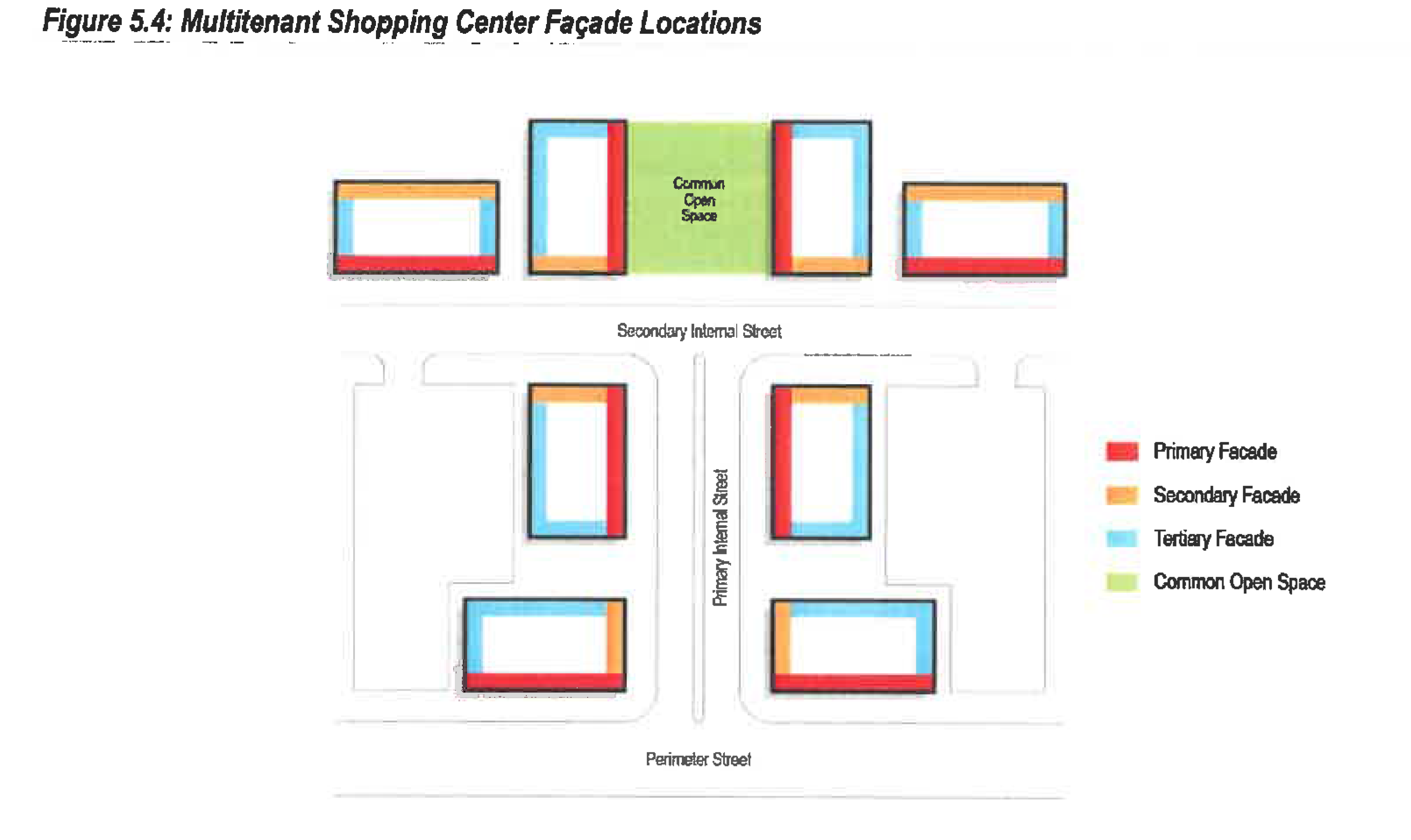
The façades of buildings in multitenant shopping centers shall be improved as detailed below.
(a)
Primary Façade.
(I)
The primary façade shall include the primary building entrance and shall be oriented towards the following (listed in priority order):
(i)
Perimeter streets,
(ii)
Primary internal streets,
(iii)
Parks or other common open space, or
(iv)
Secondary internal streets.
Primary façades shall not be oriented towards off-street parking lots, garages, or carports.
(II)
Building materials of primary façades shall be masonry, stone veneer systems, or stucco on the first level. Precast panels with stamped or inlaid brick texture, EIFS acrylic finishes, or quik-brik concrete masonry units may be utilized above the first level. However, in no instance shall the finish of the non-natural materials utilized mimic or match the texture of the natural materials utilized. A maximum of three building materials may be used on a primary façade.
(i)
When two or more building materials are used on a façade, the material used on the first level shall be visually heavier than the material used above the first level to give a sense of support and grounding. For example, masonry on the first level and EIFS acrylic stucco above.
(III)
In order to provide for primary façade articulation, primary façades shall step back a maximum of two feet and shall step forward a maximum of one foot from the build-to-line for a minimum of 40 percent and maximum of 70 percent of the primary façade.
(b)
Secondary Façade.
(I)
The secondary façade shall be any façade not including the primary building entrance that is oriented towards the following:
(i)
Perimeter streets,
(ii)
Primary internal streets,
(iii)
Parks or other common open space, or
(iv)
Secondary internal streets.
(II)
Building materials of secondary façades shall be a combination of masonry, stone veneer systems, stucco, precast panels with stamped or inlaid brick texture, EIFS acrylic finishes, or quik-brik concrete masonry units. Natural materials shall consist of a minimum of 40 percent of the façade. In no instance shall the finish of the non-natural materials utilized mimic or match the texture of the natural materials utilized. The type and design of materials utilized on the secondary façade shall complement those utilized on the primary façade.
(III)
In order to provide for secondary façade articulation, secondary façades shall step back a maximum of two feet and shall step forward a maximum of one foot from the build-to-line for a minimum of 30 percent and maximum of 70 percent of the secondary façade. Articulation of the secondary façade shall be complimentary to the articulation of the primary façade.
(c)
Tertiary Façade.
(I)
The tertiary façade shall be any façade not considered a primary or secondary façade.
(II)
Building materials of tertiary façades may consist wholly of precast panels with stamped or inlaid brick texture, EIFS acrylic finishes, or quik-brik concrete masonry units, however, a combination of non-natural and natural materials is encouraged. The type and design of materials utilized on the tertiary façade shall complement those utilized on the primary and secondary façades.
(2)
Parking shall be integrated into the overall site design to minimize visual impact, reduce the loss of trees, and be visually concealed from public rights-of-way.
(3)
ADA compliant pedestrian walkways shall be provided to all building entries and parking areas and shall connect to the sidewalk at the street frontage.
(4)
DC District. Multitenant shopping centers in the DC District shall be exempt from the standards established in section 16-5-4(E)(1-3) and shall instead meet all standards established in section 16-3-5 and those detailed below.
(a)
Façade Articulation. Multitenant shopping centers in the DC District shall feature façade articulation, as detailed below, to ensure compatibility with historic development patterns. Articulation involves the horizontal and vertical variation of the façade so that walls are subdivided into bays or sections that are vertically proportioned. The following provisions for façade articulation shall apply to any building elevations facing a public right-of-way and shall supersede the general façade articulation requirements in section 16-5-4(E)(1).
(I)
The frontage of the building shall be divided into architecturally distinct sections or bays with each section taller than it is wide.
(II)
Sections or bays shall be visually established by architectural features such as columns, ribs, pilasters, piers, recesses, projections, windows, awnings, arcades, or an equivalent element that visually subdivides the wall with a roof or cap features that provides a rational terminus and integrates with the overall design of the façade.
(III)
The required dividing elements shall have a minimum width of one foot and minimum projection to width ratio of 1:4.
(Ord. No. 1581, § II, 4-5-2022; Ord. No. 1668, § II, 3-25-2025)
Sec. 16-5-5. - Service Use Specific Standards.
(A)
Business Park.
(1)
Uses allowed within a business park shall be as allowed in the base zoning district.
(2)
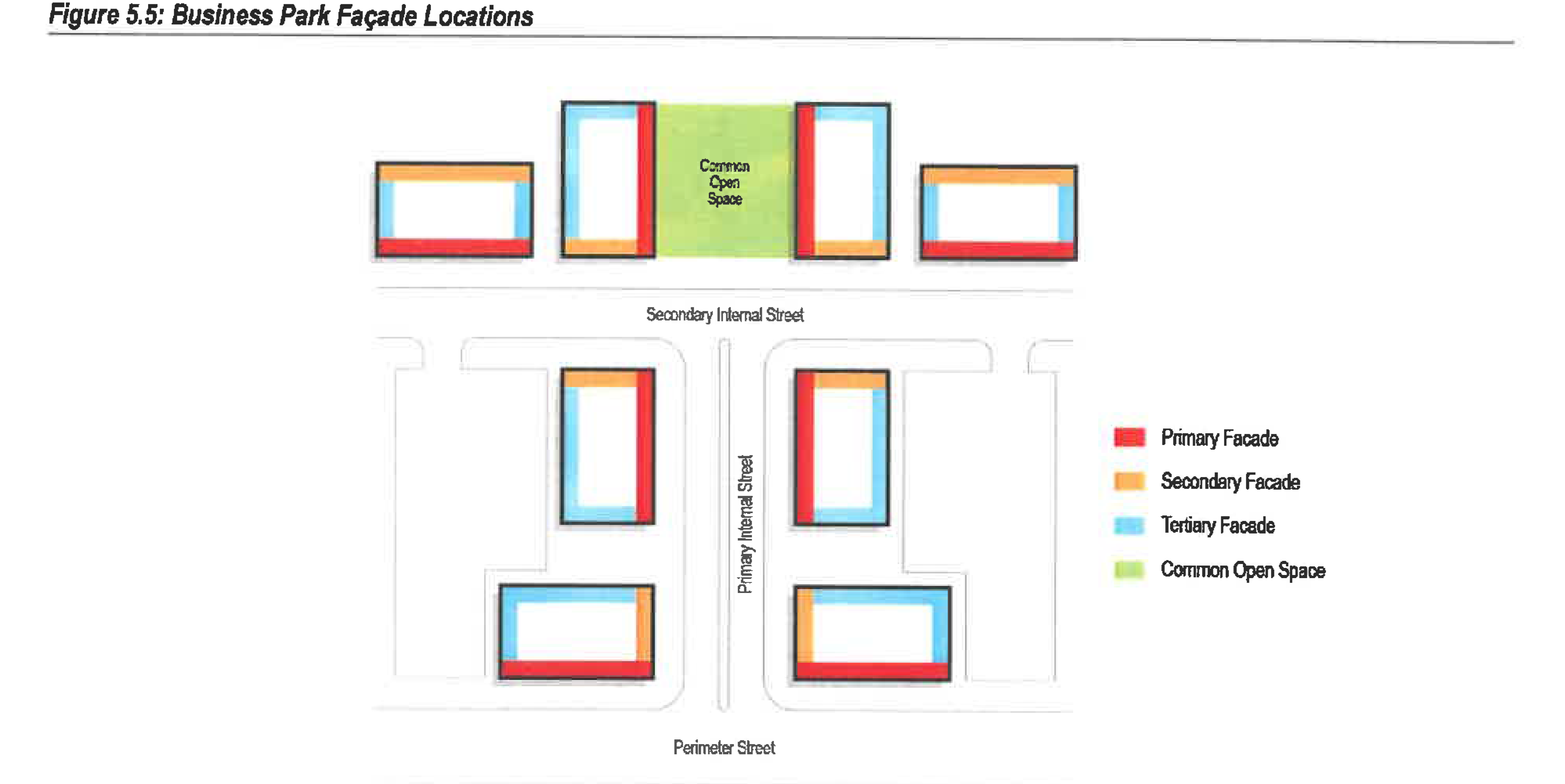
The façades of buildings in business parks shall be improved as detailed below.
(a)
Primary Façade.
(I)
The primary façade shall include the primary building entrance and shall be oriented towards the following (listed in priority order). Primary façades shall not be oriented towards off-street parking lots, garages, or carports.
(i)
Perimeter streets,
(ii)
Primary internal streets,
(iii)
Parks or other common open space, or
(iv)
Secondary internal streets.
(II)
Building materials of primary façades shall be masonry, stone veneer systems, or stucco on the first level. Precast panels with stamped or inlaid brick texture, EIFS acrylic finishes, or quik-brik concrete masonry units may be utilized above the first level. However, in no instance shall the finish of the non-natural materials utilized mimic or match the texture of the natural materials utilized. A maximum of three building materials may be used on a primary façade.
(i)
When two or more building materials are used on a façade, the material used on the first level shall be visually heavier than the material used above the first level to give a sense of support and grounding. For example, masonry on the first level and EIFS acrylic stucco above.
(III)
In order to provide for primary façade articulation, primary façades shall step back a maximum of two feet and shall step forward a maximum of one foot from the build-to-line for a minimum of 40 percent and maximum of 70 percent of the primary façade.
(b)
Secondary Façade.
(I)
The secondary façade shall be any façade not including the primary building entrance that is oriented towards the following:
(i)
Perimeter streets,
(ii)
Primary internal streets,
(iii)
Parks or other common open space, or
(iv)
Secondary internal streets.
(II)
Building materials of secondary façades shall be a combination of masonry, stone veneer systems, stucco, precast panels with stamped or inlaid brick texture, EIFS acrylic finishes, or quik-brik concrete masonry units. Natural materials shall consist of a minimum of 40 percent of the façade. In no instance shall the finish of the non-natural materials utilized mimic or match the texture of the natural materials utilized. The type and design of materials utilized on the secondary façade shall complement those utilized on the primary façade.
(III)
In order to provide for secondary façade articulation, secondary façades shall step back a maximum of two feet and shall step forward a maximum of one foot from the build-to-line for a minimum of 30 percent and maximum of 70 percent of the secondary façade. Articulation of the secondary façade shall be complimentary to the articulation of the primary façade.
(c)
Tertiary Façade.
(I)
The tertiary façade shall be any façade not considered a primary or secondary façade.
(II)
Building materials of tertiary façades may consist wholly of precast panels with stamped or inlaid brick texture, EIFS acrylic finishes, or quik-brik concrete masonry units, however, a combination of non-natural and natural materials is encouraged. The type and design of materials utilized on the tertiary façade shall complement those utilized on the primary and secondary façades.
(3)
Parking shall be integrated into the overall site design to minimize visual impact, reduce the loss of trees, and be visually concealed from public rights-of-way.
(4)
ADA compliant pedestrian walkways shall be provided to all building entries and parking areas and shall connect to the sidewalk at the street frontage.
(B)
Commercial Animal Boarding.
(1)
Outdoor exercise areas shall not be located within 300 feet of a residentially zoned property.
(2)
Outdoor exercise areas shall be fully enclosed with a fence or wall with a minimum height of six feet.
(3)
The hours of operation for outdoor areas shall be limited daily from 7:00 a.m. to 7:00 p.m.
(4)
The animals shall be boarded in appropriate kennel units with insulation to further abate noise.
(5)
All litter and waste must be contained and controlled on site by having appropriate flushing drains and other physical elements to properly dispose of cleaning waste from the boarding area.
(6)
The boarding area must be air-conditioned and heated so that any windows, doors, or other openings can be closed at all times, with the exception of ingress and egress into the area.
(C)
General Service, less than 10,000 square feet, less than 5,000 square feet in the DT District.
(1)
The main entrance shall be oriented towards the primary street.
(2)
All off-street parking, as required in section 16-6-1(E) of this UDO, shall be located in the rear and/or interior side yard.
(a)
Off-street parking located in the interior side yard shall be set back a minimum of one foot from the front elevation of the primary building.
(b)
CS and CG Districts. Any portion of an off-street parking located in the front yard shall meet the following requirements:
(1)
Parking Area Landscape.
(I)
Parking Area Perimeter Landscape Zone. A low screening wall, the height of which provides effective screening to a maximum height of three feet may be required at the discretion of the City Planner in conjunction with required landscaping as detailed in section 16-6-3(D).
(II)
Parking Area Interior Landscape Zone. The parking area interior landscape zone requirements detailed in section 16-6-3(E)(3)(a).
(3)
A maximum of one curb cut shall be permitted per street frontage unless otherwise approved by the City Planner due to site specific constraints.
(4)
ADA compliant pedestrian walkways shall be provided to all building entries and parking areas and shall connect to the sidewalk at the street frontage.
(5)
Exterior building materials shall be time- and weather-tested materials and techniques such as, but not limited to, masonry, stone veneer systems, stucco, precast panels with inlaid or stamped brick texture, and those included in the City of Jenks Preferred Building Materials List.
(D)
General Service, 10,000—49,999 square feet.
(1)
All off-street parking, as required in section 16-6-1(E) of this UDO, is encouraged to be located in the rear and/or interior side yard. Any portion of an off-street parking located in the front yard shall meet the requirements for Type B interior and perimeter parking lot landscaping.
(2)
Façades greater than 100 feet in length, measured horizontally, shall incorporate surface articulation every 50 feet.
(3)
Ground floor façades that face public streets shall have arcades, clear glass display windows, entry areas, awnings, or other such features along no less than 60 percent of their horizontal length.
(4)
Curb cuts and site vehicular access shall be minimized in frequency and width and shall not dominate the site plan or property and street frontage.
(5)
ADA compliant pedestrian walkways shall be provided to all building entries and parking areas and shall connect to the sidewalk at the street frontage.
(6)
Exterior building materials shall be time- and weather-tested materials and techniques such as, but not limited to, masonry, stone veneer systems, stucco, precast panels with inlaid or stamped brick texture, and those included in the City of Jenks Preferred Building Materials List.
(E)
General Service, 50,000 square feet or more.
(1)
Façades greater than 100 feet in length, measured horizontally, shall incorporate surface articulation every 100 feet.
(2)
Ground floor façades that face public streets shall have arcades, clear glass display windows, entry areas, awnings, or other such features along no less than 60 percent of their horizontal length.
(3)
Curb cuts and site vehicular access shall be minimized in frequency and width and shall not dominate the site plan or property and street frontage.
(4)
ADA compliant pedestrian walkways shall be provided to all building entries and parking areas and shall connect to the sidewalk at the street frontage.
(5)
Exterior building materials shall be time- and weather-tested materials and techniques such as, but not limited to, masonry, stone veneer systems, stucco, precast panels with inlaid or stamped brick texture, and those included in the City of Jenks Preferred Building Materials List.
(6)
The property owner(s) shall enter into a "Vacant Building Agreement" with the City including provisions for vacant building and property maintenance and vacant building demolition.
(F)
Personal Storage Facility. The following standards shall apply to personal storage in the CS and CG Districts.
(1)
A personal storage facility shall consist of a single building.
(2)
Outlot development shall be allowed in the required setback with uses permitted in the base zoning district.
(3)
A minimum of 30 percent of the primary façade shall contain transparent window and/or doors.
(4)
Outdoor storage shall be prohibited.
(5)
The storing of hazardous or toxic materials is prohibited.
(6)
No storage space shall be used for residential occupancy, business sales or operation, the storage of commercial or industrial inventory or raw materials, or the operation of machinery.
(7)
Exterior building materials shall be time-and weather-tested materials and techniques such as, but not limited to, masonry, stone veneer systems, stucco, precast panels with inlaid or stamped brick texture, and those included in the City of Jenks Preferred Building Materials List.
(8)
Façade Articulation. Personal storage facilities shall feature façade articulation, as detailed below. Articulation involves the horizontal and vertical variation of the façade so that walls are subdivided into bays or sections that are vertically proportioned. The following provisions for façade articulation shall apply to any building elevations facing a public right-of-way.
(a)
The frontage of the building shall be divided into architecturally distinct sections or bays with each section taller than it is wide.
(b)
Sections or bays shall be visually established by architectural features such as columns, ribs, pilasters, piers, recesses, projections, windows, awnings, arcades, or an equivalent element that visually subdivides the wall with a roof or cap features that provides a rational terminus and integrates with the overall design of the façade.
(c)
The required dividing elements shall have a minimum width of one foot and minimum projection to width ratio of 1:4.
(Ord. No. 1581, § II, 4-5-2022; Ord. No. 1668, § II, 3-25-2025)
Sec. 16-5-6. - Lodging Use Specific Standards.
(A)
Bed and Breakfast.
(1)
The host family must be the operator and resident of the property proposed to be used as a bed and breakfast.
(2)
Bed and breakfasts shall provide a minimum of one bathroom for every three guest rooms.
(3)
The property must be developed, maintained, and operated so that the principal building, accessory buildings, yards, drive, and street frontage have the appearance and character of its adjacent neighborhood and does not detract from abutting properties.
(4)
The operator shall maintain a register of all bed and breakfast guests for each calendar year and shall make such register available to the City upon request.
(5)
The Specific Use Permit shall establish the number of guest rooms permitted.
(6)
Cooking facilities shall not be permitted in any of the guest rooms.
(7)
The Planning Commission may require a bed and breakfast to be screened from the abutting residential properties by the erection and maintenance of a landscape yard in accordance with the Transition Area Type A requirements as detailed in section 16-6-3(F)(3) of this UDO.
(8)
A Site Plan (plot plan) showing the location and size of structures including driveways and off-street parking open spaces; setbacks from property lines; number of guest rooms; proposed location, and any required landscape shall be submitted at the time of application for a Special Exception.
(9)
Bed and breakfasts shall meet the minimum standards of the City of Jenks building, electrical, plumbing and fire codes, and Tulsa City-County Health Department regulations. Off-street parking surfacing drainage and earth-change permits shall be approved by the City Engineer.
(10)
The operator shall file an application for a City of Jenks license and registration and the appropriate tax permit issued by the State of Oklahoma Tax Commission upon approval of the required Specific Use Permit. City licenses and registration to be made by application to the Jenks City Clerk and shall conform to the requirements of the City Code, which levies a lodging tax on gross receipts of any bed and breakfasts and similar businesses.
(B)
Short-Term Rental.
(1)
All applications for short-term rentals shall be filed under the Conditional Use Permit procedures and subject to the Conditional Use Permit review criteria in section 16-9-3(D).
(2)
Short-term rentals shall be subject to the City of Jenks lodging tax rate.
(3)
Private covenants enacted by homeowners associations or other private entities may further restrict the establishment short-term rentals beyond the regulations of this UDO.
(4)
Site is subject to life safety inspection.
(Ord. No. 1581, § II, 4-5-2022; Ord. No. 1624, § III, 10-17-2023)
Sec. 16-5-7. - Eating/Drinking Use Specific Standards.
(A)
Coffee/Tea Shop. The following standards shall apply to coffee/tea shop uses in any residential district or the LC District and in any district when the subject lot abuts a residential zoning district.
(1)
The main entrance shall be oriented towards the primary street.
(2)
All off-street parking, as required in section 16-6-1(E) of this UDO, shall be located in the rear and/or interior side yard. Off-street parking located in the interior side yard shall be set back a minimum of one foot from the front elevation of the primary building.
(3)
A maximum of one curb cut shall be permitted per street frontage unless otherwise approved by the City Planner due to site specific constraints.
(4)
ADA compliant pedestrian walkways shall be provided to all building entries and parking areas and shall connect to the sidewalk at the street frontage.
(5)
A minimum of two permanent restrooms that meet ADA standards shall be made accessible to patrons within 200 feet of the food truck court during hours of operation. Restrooms must include heat and air conditioning.
(B)
Food Truck Court.
(1)
The maximum number of food trucks allowed on site shall depend on the size of the lot and sites ability to provide required electrical access and parking. Site plans shall be provided to the City for review before permitting.
(2)
A minimum of ten feet of clearance shall be provided between all individual food trucks.
(3)
The area for a food truck court shall be clearly defined and separated from all patron parking with an enclosure. Any use of fencing or planters to separate the food truck park from parking shall provide visibility into the site and shall not exceed four feet in height.
(4)
Food truck courts are encouraged to create an inviting and attractive aesthetic environment and shall include seating and shade elements.
(5)
A minimum of two permanent restrooms that meet ADA standards shall be made accessible to patrons within 200 feet of the food truck court during hours of operation.
(6)
Food truck courts shall be located a minimum of 500 feet away from any brick-and-mortar restaurant unless said restaurant is operating a truck within the food truck park, as measured from the facility property line or receives written permission from all brick-and-mortar restaurants within 500 feet.
(7)
Any food truck court shall not be located less than 1,500 feet from any other food truck court, as measured from the facility property line.
(8)
Electrical service shall be provided to each food truck.
(9)
A minimum of one trash receptacle and one recycling receptacle shall be provided per food truck. The food truck park shall also provide a commercial dumpster outside of the designated patron area for waste disposal. The dumpster shall be screened in accordance with section 16-6-4(A).
(10)
Food trucks shall be inspected in accordance with the State of Oklahoma.
(11)
Parking shall be established by the Planning Commission.
(12)
Signs, except for a-frame/sandwich board signs shall be permanently affixed to the food truck.
(a)
Each food truck may have one temporary sign, a-frame/sandwich board, which may not be located in any right-of-way or impede pedestrian or vehicular traffic.
(b)
The sign shall be within 25 feet of the food truck.
(13)
Site Requirements.
(a)
Obstructions.
(I)
The operation of the food truck shall not block a pedestrian walkway or public sidewalk in a manner which reduces its width to less than five feet or causes damage to improvements within the public right-of-way.
(II)
Operations shall not obstruct parking lot circulation or block access to a public street, alley, or sidewalk.
(III)
Operations shall not be located in a driveway or drive aisle except within a residentially zoned parcel, in conjunction with a Conditional Use Permit.
(b)
City Right-of-Way. Food carts or trucks may not operate within any City right-of-way outside of an approved special event permit.
(I)
No merchandise shall be offered, displayed or sold and no customers served except from the sidewalk.
(II)
Only non-motorized carts may be located on sidewalks.
(III)
Carts or trucks shall be located at least 25 feet from any intersection (measured from the edge of sidewalk to the cart or truck) and 15 feet from any driveway.
(Ord. No. 1581, § II, 4-5-2022; Ord. No. 1679, § II, 1-20-2026)
Sec. 16-5-8. - Entertainment Use Specific Standards.
(A)
General Entertainment, Indoor, less than 10,000 square feet.
(1)
The main entrance shall be oriented towards the primary street.
(2)
All off-street parking, as required in section 16-6-1(E) of this UDO, shall be located in the rear and/or interior side yard. Off-street parking located in the interior side yard shall be set back a minimum of one foot from the front elevation of the primary building.
(3)
A maximum of one curb cut shall be permitted per street frontage unless otherwise approved by the City Planner due to site specific constraints.
(4)
ADA compliant pedestrian walkways shall be provided to all building entries and parking areas and shall connect to the sidewalk at the street frontage.
(5)
Exterior building materials shall be time- and weather-tested materials and techniques such as, but not limited to, masonry, stone veneer systems, stucco, precast panels with inlaid or stamped brick texture, and those included in the City of Jenks Preferred Building Materials List.
(6)
Noise is subject to City Code standards and enforcement.
(B)
General Entertainment, Indoor, 10,000—49,999 square feet.
(1)
All off-street parking, as required in section 16-6-1(E) of this UDO, is encouraged to be located in the rear and/or interior side yard. Any portion of an off-street parking located in the front yard shall meet the requirements for Type B interior and perimeter parking lot landscaping.
(2)
Façades greater than 100 feet in length, measured horizontally, shall incorporate surface articulation every 50 feet.
(3)
Ground floor façades that face public streets shall have arcades, clear glass display windows, entry areas, awnings, or other such features along no less than 60 percent of their horizontal length.
(4)
Curb cuts and site vehicular access shall be minimized in frequency and width and shall not dominate the site plan or property and street frontage.
(5)
ADA compliant pedestrian walkways shall be provided to all building entries and parking areas and shall connect to the sidewalk at the street frontage.
(6)
Exterior building materials shall be time- and weather-tested materials and techniques such as, but not limited to, masonry, stone veneer systems, stucco, precast panels with inlaid or stamped brick texture, and those included in the City of Jenks Preferred Building Materials List.
(7)
Noise is subject to City Code standards and enforcement.
(C)
General Entertainment, indoor, 50,000 square feet or more.
(1)
Façades greater than 100 feet in length, measured horizontally, shall incorporate surface articulation every 100 feet.
(2)
Ground floor façades that face public streets shall have arcades, clear glass display windows, entry areas, awnings, or other such features along no less than 60 percent of their horizontal length.
(3)
Curb cuts and site vehicular access shall be minimized in frequency and width and shall not dominate the site plan or property and street frontage.
(4)
Service areas, dumpsters, utilities, and the required screening thereof shall not be visible from rights-of-way.
(5)
ADA compliant pedestrian walkways shall be provided to all building entries and parking areas and shall connect to the sidewalk at the street frontage.
(6)
Exterior building materials shall be time- and weather-tested materials and techniques such as, but not limited to, masonry, stone veneer systems, stucco, precast panels with inlaid or stamped brick texture, and those included in the City of Jenks Preferred Building Materials List.
(7)
Noise is subject to City Code standards and enforcement.
(D)
General Entertainment, Outdoor.
(1)
All buildings associated with the outdoor general entertainment use shall meet the use specific standards for the applicable indoor general entertainment use based on the size of the building.
(2)
Outdoor activity areas shall not be located closer than 300 feet to a property in a RE, RS, or RD district.
(3)
Hours of operation shall be limited to between 7:00 a.m. and 9:00 p.m. weekly between Sunday and Thursday and between 7:00 a.m. and 11:00 p.m. weekly between Fridays and Saturday.
(4)
Noise is subject to City Code standards and enforcement.
(Ord. No. 1581, § II, 4-5-2022; Ord. No. 1624, § III, 10-17-2023)
Sec. 16-5-9. - Vehicle Related Use Specific Standards.
(A)
Car Wash.
(1)
Car washes seeking to locate in a CG District adjacent to or that contains a residential use, the car wash may not be established without approval of a Specific Use Permit, in accordance with section 16-9-7.
(2)
All car wash facilities and accessory equipment such as vacuums, dryers, accessory buildings, etc. shall be set back a minimum of 200 feet from any property in a residential district, in addition to the minimum setbacks required in the zoning district in which the car wash is located.
(3)
All car wash facilities shall be screened from view from any adjoining property in a residential district or that contains a residential use by a solid screening fence or wall at least eight feet in height.
(4)
Blowers or other noise producing drying equipment shall be located inside the car wash tunnel or bay and shall be oriented away from any abutting property in a residential district or that contains a residential use.
(B)
Fuel Sales.
(1)
All fuel pumps shall be set back a minimum of 25 feet from the street right-of-way and side or rear lot lines.
(2)
All fuel pump canopies shall be located a minimum of 20 feet from the street right-of-way and side or rear lot lines.
(3)
All fuel pumps and fuel pump canopies shall be located a minimum of 50 feet from any RE, RS, or RD district boundary line.
(4)
Fuel pump canopies shall maintain a uniform and consistent roofline with the building to which the fuel pump canopy is associated. The Planning Commission may approve additional fuel pump canopy height to accommodate fuel pump canopies that serve commercial vehicles; however, in no instance shall a fuel pump canopy exceed 17 feet.
(5)
Fuel pump canopies shall be lit with only fully recessed lighting.
(C)
Trucking Establishment.
(1)
Locational Standards. A trucking establishment is a unique and specialized land use. Given the distinctive nature of this particular use, the locational standards identified below are of paramount importance for the health, safety and general welfare of the public. As such, the Planning Commission, before recommending approval to City Council, will carefully consider the following provisions of the Specific Use permit.
(a)
No trucking establishment shall be located within five miles of any other trucking establishment or gasoline service provider. For the purpose of this section, all measurements of distance shall be along a straight airline route from the nearest point on any gasoline sales establishment property line to the nearest point on any other gasoline sales property line.
(b)
No trucking establishment shall be located closer than 2,500 feet from property designated Residential on the Land Use Plan Map or land zoned Residential pursuant to the Zoning Code. For the purpose of this section, all measurements of distance shall be along a straight airline route from the nearest point on any trucking establishment property line to the nearest point on any property line zoned or designated Residential.
(2)
Minimum Parcel Dimensions.
(a)
The minimum parcel size for consideration of trucking establishment is 20 acres.
(b)
The minimum lot frontage for a parcel used for a trucking establishment shall be 400 feet.
(3)
Minimum Required Yards.
(a)
The perimeter setback for all yards adjacent to major roadways shall be at least 100 feet from the respective property line.
(b)
Transitional yard setback required where a property line or lease line abuts service stations, truck service (major repair) every adjacent structure shall be set back 100 feet. This requirement would not apply to structures containing convenience stores or other uses if part of the service station use.
(4)
Maximum Building Height. For all permitted uses within a trucking establishment, 35 feet, hotels, motels and similar lodging are prohibited.
(5)
Maximum Building Coverage. Forty percent of site area.
(6)
Minimum Open Space. Twenty percent of site area. One-half of the area required to be devoted to Open Space may be comprised of water bodies.
(7)
Minimum Building Separation. No two buildings on the same parcel within trucking establishment shall be located closer to one another than a distance equal to the height of the lower building.
(8)
Prohibited uses. The following are the prohibited uses and structures in trucking establishments:
(a)
Any permitted use, accessory use, restricted use or structure not specifically or by reasonable implication permitted herein,
(b)
Adult uses,
(c)
Sales of alcoholic beverages for consumption off the premises. This prohibition does not include the sale of beer and wine accessory to a convenience store, and
(d)
Sales, Wholesale. This prohibition does not include the sales of tires, batteries and vehicle parts and bulk storage of petroleum products for sales on-site but does include the bulk sale of petroleum products.
(Ord. No. 1581, § II, 4-5-2022)
Sec. 16-5-10. - Industrial Uses.
(A)
Warehouse, Office. A maximum of 80 percent of the floor area of the structure may comprise warehouse uses and at least 20 percent of the floor area of the structure shall comprise office uses.
(Ord. No. 1581, § II, 4-5-2022)
Sec. 16-5-11. - Medical Marijuana Use Specific Standards and Indoor Commercial Agriculture.
(A)
All Medical Marijuana Uses.
(1)
Grow facilities, testing laboratories, and processing facilities shall be located a minimum of 1,200 feet from any parcel designated in the RE, RS, or RD, RTH, RM, LC, and CS districts or from a habitable structure.
(2)
Grow facilities, testing laboratories, processing facilities, and dispensaries (all medical marijuana uses) shall be located within an enclosed building(s).
(3)
Any ventilation/HVAC system shall be located to expel air away from a residential use located on an adjoining property.
(4)
Shall be located within a detached, single tenant, structure, or multi-tenant structure of like use.
(B)
All Indoor Commercial Agriculture Uses.
(1)
Shall be located a minimum of 1,200 feet from any parcel designated in the RE, RS, or RD, LC, and CS districts or from a habitable structure.
(2)
Shall be located within an enclosed building(s).
(3)
Any ventilation/HVAC system shall be located to expel air away from a residential use located on an adjoining property.
(4)
Shall be located within a detached, single tenant, structure, or multi-tenant structure of like use.
(Ord. No. 1581, § II, 4-5-2022; Ord. No. 1624, § III, 10-17-2023)
Editor's note— Ord. No. 1624, § III, adopted Oct. 17, 2023, amended § 16-5-11, and in so doing changed the title of said section from medical marijuana use specific standards to read as set out herein.
Sec. 16-5-12. - Accessory Use Specific Standards.
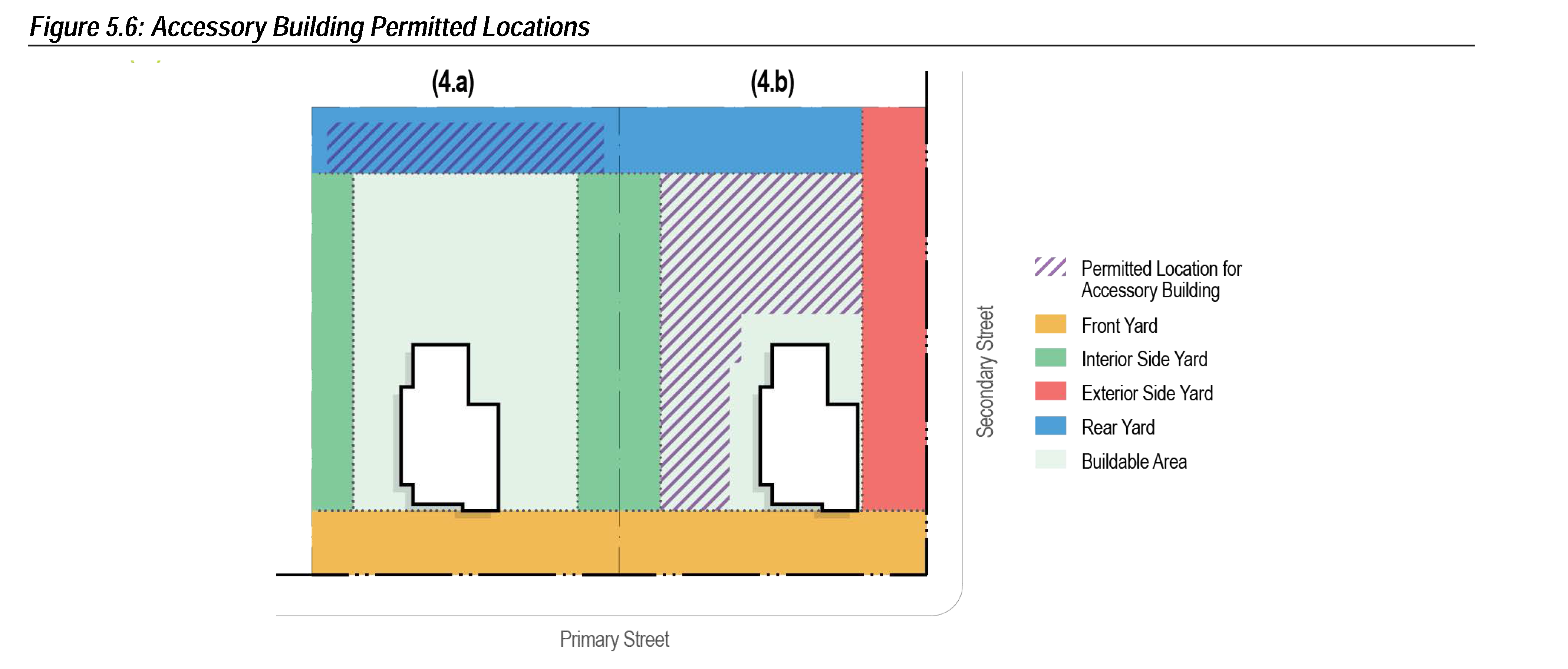
(A)
Accessory Building. In the AG District, only the provisions of subsections (4) and (5) shall apply.
(1)
One accessory building shall be permitted per lot.
(2)
On lots less than or equal to 20,000 square feet, an accessory building shall be a maximum of 700 square feet or 75 percent of the gross floor area of the principal building, whichever is more.
(3)
On lots greater than 20,000 square feet in area, an accessory building shall be a maximum of 1,200 square feet or 75 percent of the gross floor area of the primary building, whichever is more.
(4)
An accessory building shall be located either:
(a)
Completely within the required rear yard and a minimum of five feet from lot lines, or
(b)
Completely within the buildable area of the lot and to the interior side or rear of the principal building.
(5)
An accessory building shall be located a minimum of ten feet from the primary building unless it is constructed with a one hour fire rating in which case the minimum separation from the primary building shall be five feet.
(6)
Private covenants enacted by homeowners associations or other entities may apply and may further restrict the allowed number, size, and location of accessory buildings.
(B)
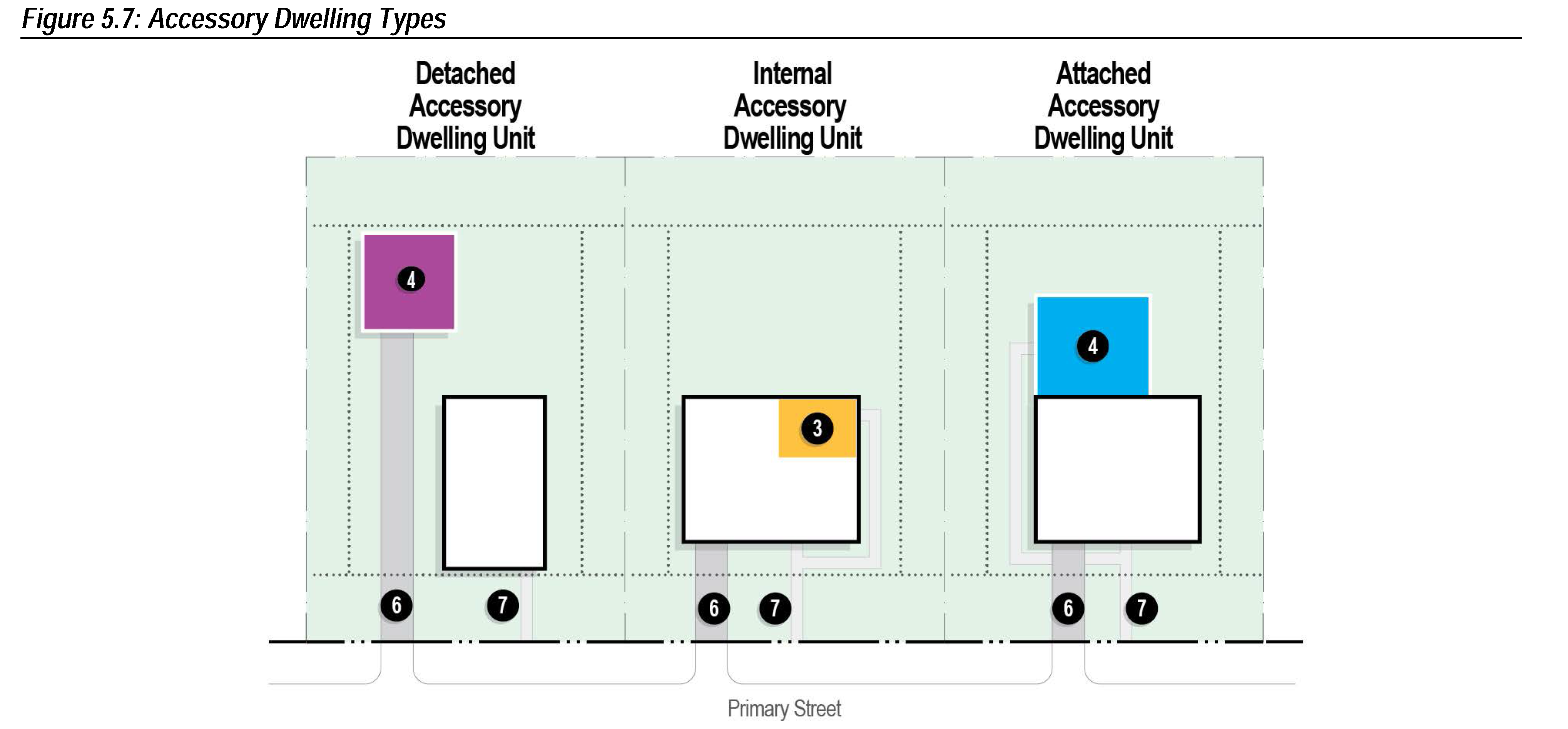
Accessory Dwelling.
(1)
One accessory dwelling unit shall be permitted per lot.
(2)
The primary residence of the owner of the property shall be either the primary building on the lot or the accessory dwelling.
(3)
Internal accessory dwelling units shall not be greater than 20 percent of the size of the primary building, whichever is less.
(4)
Detached and attached accessory dwelling units shall not be greater than 80 percent of the size of the primary building.
(5)
Only one entrance shall be located on the front façade of the primary building. Entrances to accessory dwelling units must be located on the interior side or rear façade.
(6)
Both the primary building and the accessory dwelling unit shall be served by the driveway established for the primary building.
(7)
Parking for the accessory dwelling unit, as required by section 16-6-1(E) of this UDO, shall be in addition to the parking space(s) required for the primary building. The parking for the accessory dwelling unit shall not be located in the required front yard setback. A tandem parking space, where one car is parked behind another, with the spaces required for the primary structure shall be prohibited.
(8)
Accessory dwelling units shall be similar in character to the primary structure and to abutting properties including roof pitch, eaves, building materials, windows, trim, color, and landscaping.
(9)
Private covenants enacted by homeowners associations or other entities may apply and may further restrict the allowed number, size, or location, of accessory dwelling units.
(C)
Accessory Retail.
(1)
The total area devoted to retail activity shall not exceed 25 percent of the total area of the building in which the accessory retail activity shall take place.
(2)
Restroom facilities shall be provided and shall be directly accessible from the accessory retail sales area.
(3)
Accessory retail sales areas shall be physically separated from other activity areas by a wall.
(D)
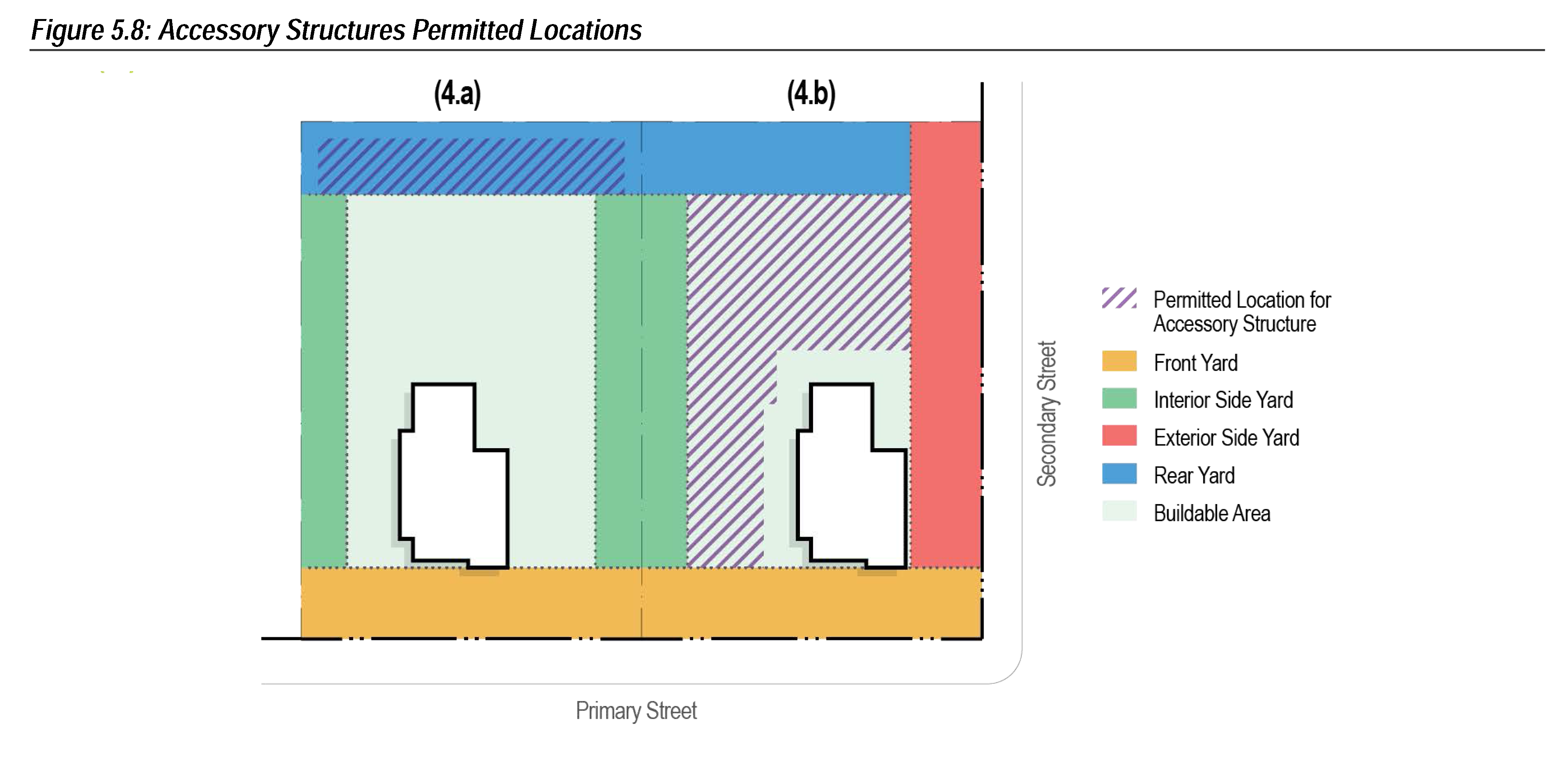
Accessory Structure.
(1)
Two accessory structures shall be permitted per lot.
(2)
An accessory structure shall not exceed 200 square feet.
(3)
An accessory structure shall have a maximum height of eight feet.
(4)
An accessory structure shall be located either:
(a)
Completely within the required rear yard and a minimum of five feet from rear yard lot lines, or
(b)
Completely within the buildable area of the lot and to the interior side or rear of the principal building.
(5)
An accessory structure shall be located a minimum of ten feet from the primary building unless it is constructed with a one hour fire rating in which case the minimum separation from the primary building shall be five feet.
(E)
Donation Drop Box.
(1)
Donation drop boxes shall be on properties that contain a legally existing and operating use.
(2)
No more than two donation drop boxes shall be permitted on a lot less than or equal to two acres.
(3)
No more than three donation drop boxes shall be permitted on a lot greater than two acres.
(4)
Each donation drop box shall not exceed seven feet in height and 25 square feet in ground area.
(5)
Donation drop boxes shall only be located in side or rear yards. No donation drop box shall be located in a front yard.
(6)
Donation drop boxes shall be located on an asphalt or concrete paved surface.
(7)
Donation drop boxes shall not be located in a driveway or drive aisle and shall not reduce the width of paved clear space for the passage of pedestrians to less than five feet. Boxes shall not be located in such a way as to disrupt the flow of vehicular or pedestrian traffic.
(8)
Donation drop boxes shall not be located nearer than 40 feet from an adjoining lot in a RE, RS, or RD District.
(9)
Donation drop boxes shall be located to the side or rear of the primary façade of the building.
(10)
A notice must be permanently affixed to each donation drop box in a highly visible location prohibiting the placement of items outside of the box. The name and 24-hour telephone number of the owner/operator must be permanently affixed to each donation drop box.
(F)
Drive Through.
(1)
Drive-throughs shall be permitted a maximum of four total menu boards and pre-order boards with a combined maximum area of 100 square feet. Each menu board or pre-order board shall not exceed 60 square feet in area and ten feet in height. Menu boards and pre-order boards may utilize electronic message boards for 100 percent of the permitted menu board or pre-order board area and must follow all regulations of section 16-7-7(B) of this UDO.
(2)
Any speaker or intercom associated with a drive-through shall not be audible beyond the boundaries of the property.
(3)
Drive-through canopies shall maintain a uniform and consistent roofline with the building to which the drive-through is associated.
(4)
Stacking spaces and lanes for drive through stations shall not impede on- and off-street traffic movement, are not to cross or pass through off-street parking areas or drive aisles and are not to impede pedestrian access to a public entrance of a building.
(5)
Drive-through lanes are to be separated from off-street parking areas. Individual lanes are to be striped, marked, or otherwise distinctly delineated.
(6)
Drive-through facilities shall be provided with a bypass lane with a minimum width of ten feet.
(7)
Stacking lanes shall have a minimum depth of 20 feet per stacking space and the following minimum lane widths:
(a)
One lane: Twelve feet,
(b)
Two or more lanes: Ten feet per lane.
(8)
Drive-through facilities shall be required to provide a minimum number of stacking spaces as detailed in Table 16-5-12(F)(9).
(9)
Drive-through facilities in the RTC District shall be approved as a by-right use when located in an interior side yard or rear yard. Drive-through facilities in the RTC District shall require a Specific Use Permit as detailed in section 16-9-7 when located in an exterior side or front yard.
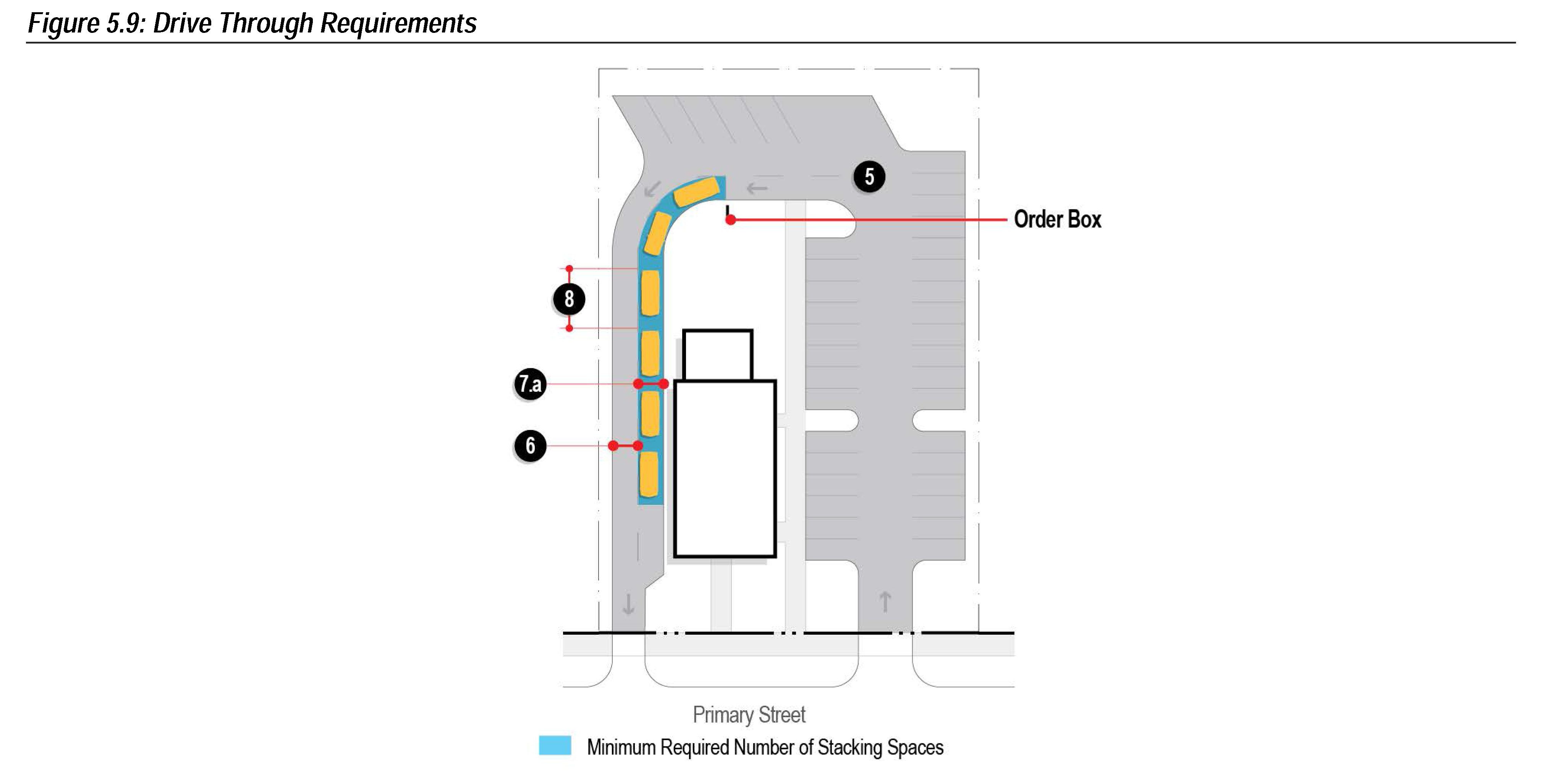
(G)
Home Based Childcare.
(1)
All home based childcare shall be required to receive a Special Exception, as detailed in section 16-9-6 of this UDO.
(2)
The primary use of the lot shall be residential in nature.
(3)
No person other than a resident of the dwelling unit shall be engaged or employed in the home based childcare on the premises.
(4)
No additional sign area, beyond what is permitted in residential districts in sections 16-7-2, 16-7-5, and 16-7-6 of this UDO shall be granted to a home based childcare.
(5)
No alteration of the residential appearance of the premises shall occur, including the creation of a separate entrance for the home based childcare.
(H)
Home Based Business.
(1)
All home based businesses shall be required to receive a Conditional Use Permit, as detailed in section 16-9-3(D) of this UDO.
(2)
The primary use of the lot shall be residential in nature.
(3)
No person other than a resident of the dwelling unit shall be engaged or employed in the home based business on the premises.
(4)
No additional sign area, beyond what is permitted in residential districts in sections 16-7-2, 16-7-5, and 16-7-6 of this UDO shall be granted to a home based businesses.
(5)
No mechanical equipment shall be utilized except that which is necessarily, customarily, or ordinarily used for household or leisure purposes.
(6)
No toxic, explosive, flammable, combustible, corrosive, etiologic, radioactive, or other restricted materials shall be used or stored on the site except those which are necessarily, customarily, or ordinarily used for household or leisure purposes.
(7)
There shall be no outside operations, storage, or display of materials or products.
(8)
No alteration of the residential appearance of the premises shall occur, including the creation of a separate entrance for the home based business.
(9)
No process shall be used which is hazardous to public health, safety, morals, or welfare.
(10)
Visitors, customers, or deliveries shall not exceed that normally and reasonably occurring for a residence.
(11)
The home based business shall not displace or impede use of required parking spaces, including any business storage in required garage parking areas.
(12)
No advertisement shall be placed in any media containing the address of the property.
(I)
Outdoor Activity/Operation, Permanent.
(1)
Any property with permanent outdoor activity or operations shall have a minimum lot size of five acres.
(2)
Outdoor activities and operations shall be conducted between the hours of 7:00 am and 9:00 pm.
(3)
Outdoor activities and operations shall be located to the rear or interior side of the principal building on the lot.
(4)
Outdoor activities and operations shall be prohibited in front or exterior side yards.
(5)
Outdoor activities and operations shall be setback a minimum of 50 feet from all property lines when adjacent properties are zoned OL, OM, or LC.
(6)
Outdoor activities and operations shall be setback a minimum of 100 feet from all property lines when adjacent properties are zoned RE, RS, RD, RTH, RM, CH, or RTC.
(7)
The following minimum screening requirements shall apply to permanent outdoor activities and operations visible from the right-of-way of an existing or proposed arterial or collector roadway or a property zoned RE, RS, RD, RTH, RM, OL, LC, or RTC.
(a)
A solid wall constructed from materials, not including metal, identical to those used on the exterior of the principal building, unless otherwise approved by the Planning Commission, and not less than six feet and not more than eight feet in height shall be erected to screen those portions of permanent outdoor activity and operations areas visible from an existing or proposed arterial or collector roadway or a property zoned RE, RS, RD, RTH, RM, OL, LC, or RTC.
(b)
A landscape strip, not less than five feet wide shall be located in front of the wall. A minimum of four canopy or evergreen trees shall be planted and evenly spaced per every 100 lineal feet. A minimum of ten shrubs shall be planted and evenly spaced per every 100 lineal feet. All landscape maintenance requirements of section 16-6-3(I)of this UDO shall apply.
(J)
Outdoor Display/Sale of Merchandise, Permanent.
(1)
Only those goods and materials associated with the existing on-site use may be displayed or sold.
(2)
Permanent outdoor display or sales areas shall not be located within any required yard or parking area.
(3)
Permanent outdoor display or sales areas shall be surfaced with an approved hard surface material. Partially paved or unpaved outdoor display or sales areas shall be prohibited.
(4)
Permanent outdoor display or sales areas shall not exceed ten percent of the gross floor area of the primary building on the property unless approved as a Specific Use.
(K)
Outdoor Storage, Permanent.
(1)
Permanent outdoor storage areas shall be surfaced with an approved hard surface material. Contact the office of the City Planner for a detailed list, materials not listed in the policy shall require approval from the City Engineer and City Planner. Partially paved or unpaved outdoor storage areas shall be prohibited. Weed and grass management will be required.
(2)
The following minimum screening requirements shall apply to permanent outdoor storage areas which are visible from the right-of-way of an existing or proposed arterial or collector roadway or where adjacent lot uses are not of a similar nature, scale and intensity see Table 16-6-3(F)(2) and (3) for additional standards.
(a)
Materials: A solid wall constructed from materials, not including metal, identical to those used on the exterior of the primary building, unless otherwise approved by the Planning Commission.
(b)
Height: A screening wall not less than six feet and not more than eight feet in height shall be erected to screen those portions of permanent outdoor storage areas visible from an existing or proposed arterial roadway or where adjacent lot uses are not of a similar nature, scale and intensity see Table 16-6-3(F)(2) and (3) for additional standards.
(c)
Landscaping: See Table 16-6-3 (F)(2) and (F)(3) for applicable transition requirements based on adjacent lot uses. For lots visible from the right-of-way of an existing or proposed arterial or collector roadway, a landscape strip, not less than five feet wide shall be located in front of the wall. A minimum of four canopy or evergreen trees shall be planted and evenly spaced per every 100 lineal feet. A minimum of ten shrubs shall be planted and evenly spaced per every 100 lineal feet. All landscape maintenance requirements of section 16-6-3(I) of this UDO shall apply.
(3)
Shipping containers not located on a truck shall be considered outdoor storage. Shipping containers located on a truck which is kept in the same parking or loading area for more than 30 days shall be considered outdoor storage. Any shipping containers considered outdoor storage shall be subject to the regulations of this section.
(L)
Solar Energy Collection System, Canopy.
(1)
The height of canopy solar energy collection systems shall not exceed the height of the primary building that the parking area serves.
(2)
The minimum height of solar energy collection systems shall allow clearance for emergency and service vehicles.
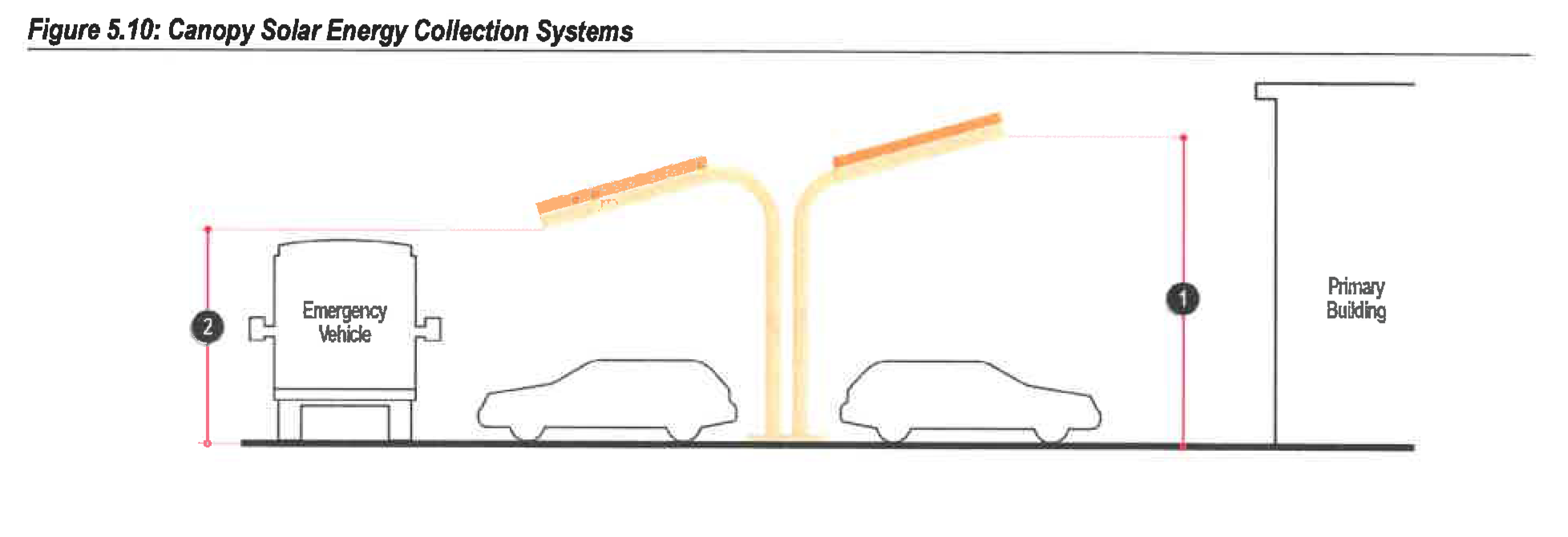
(M)
Solar Energy Collection System, Ground-Mounted.
(1)
Ground-mounted solar energy collection systems shall be permitted in the rear yard only. AG lots are excepted.
(2)
An unlimited quantity of panels is permitted on all zoning lots with the exception of any lot in a RS, or RD district 10,000 square feet or less in size, which are limited to a total of 100 square feet in area of panels, unless approved by Planning Commission.
(3)
The maximum height of ground-mounted solar energy collection systems shall be five feet in height, measured from the grade at the base of the pole to the highest edge of the system, unless approved by Planning Commission.
(4)
Minimum clearance between the lowest point of the system and the surface on which the system is mounted is 12 inches.
(5)
All parts of the freestanding system shall be set back ten feet from the side and rear lot lines and shall not be located in a public utility easement.
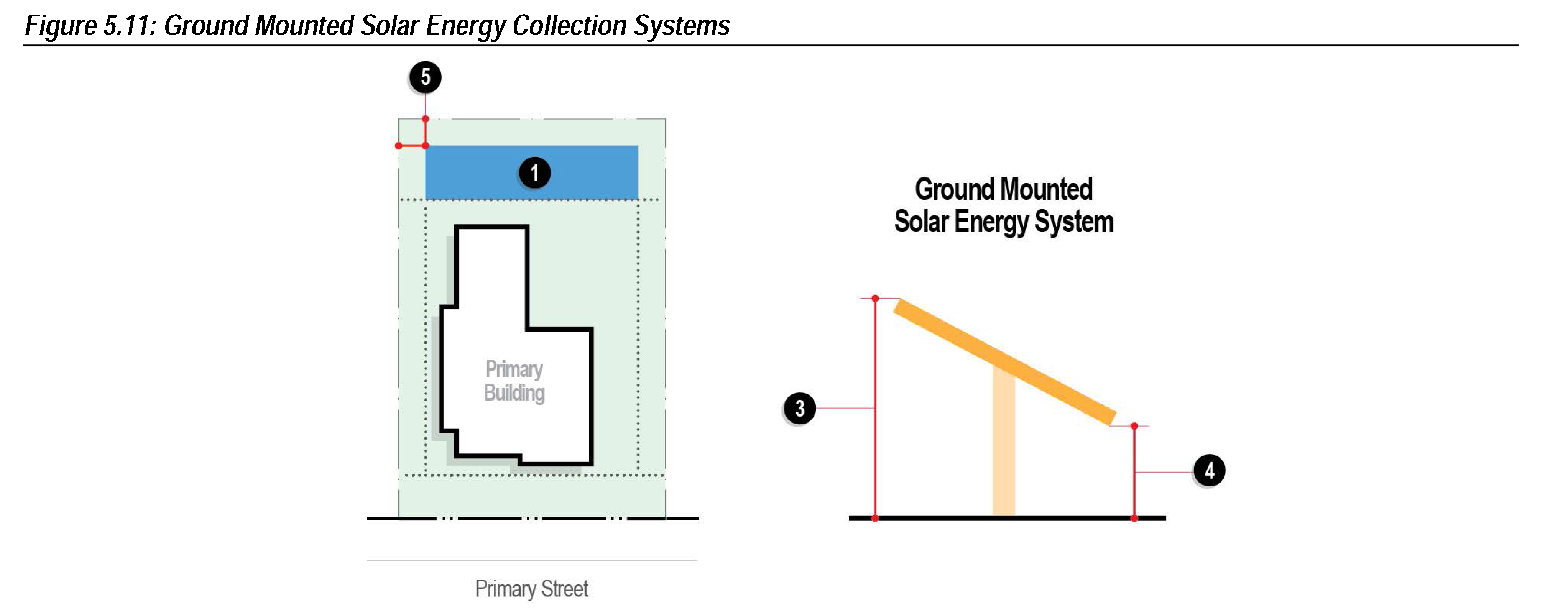
(N)
Solar Energy Collection System, Roof-Mounted.
(1)
Roof-mounted solar energy collection systems may be located on any roof face of principal or accessory buildings. Systems should be flush mounted when possible.
(2)
Systems on residential structures shall not extend beyond 12 inches parallel to the roof surface of a pitched roof or flat roof.
(3)
Systems on nonresidential structures shall not extend beyond 36 inches parallel to the roof surface of a pitched roof or flat roof.
(4)
Systems on all structures shall not extend above the highest peak of a pitched roof. Height is measured from the roof surface on which the system is mounted to the highest edge of the system.
(5)
All materials used for racking, mounts, mounting clamps, and flashings shall be of a color consistent with the color of the roof surface to minimize visibility.
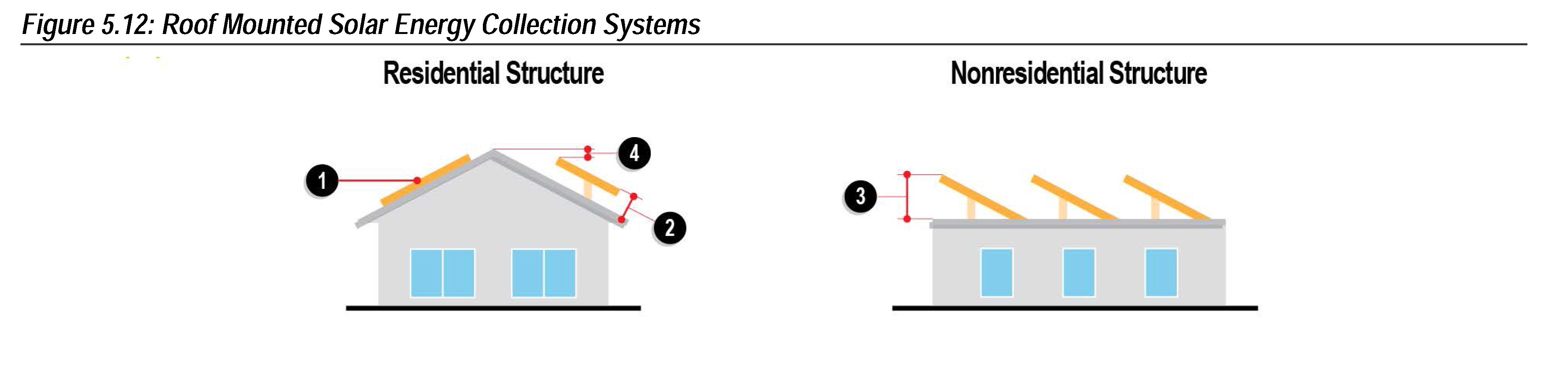
(Ord. No. 1581, § II, 4-5-2022; Ord. No. 1624, § III, 10-17-2023)
Sec. 16-5-13. - Temporary Use Specific Standards.
(A)
Outdoor Dining.
(1)
The outdoor dining area shall be located on an approved hard paved surface.
(2)
Outdoor dining areas may utilize a maximum of 20 percent of the parking spaces required for the operation of the principal use or 2,000 square feet, whichever is less.
(3)
Outdoor dining areas shall not block a pedestrian walkway or public sidewalk in a manner which reduces the width of that walkway or sidewalk to less than five feet.
(4)
A fence, landscape hedge, or wall with a height of four feet shall be utilized to segregate the outdoor dining area.
(5)
Use of outdoor dining areas shall be limited to the posted operational hours of the associated eating and drinking use.
(B)
Outdoor Display/Sale of Merchandise, Temporary.
(1)
Only those goods and materials associated with the existing on-site use may be displayed or sold.
(2)
Temporary outdoor display/sale of merchandise shall be permitted for a period not to exceed 90 days per calendar year.
(3)
Temporary outdoor display/sale of merchandise areas shall occur:
(a)
On the sidewalk area at the foundation of the principal building, not including a five-foot wide pedestrian walkway.
(b)
In a portion of the parking lot, which shall not exceed 20 percent of the parking spaces required for the operation of the primary use, or 2,000 square feet, whichever is less.
(C)
Portable Outdoor Storage Device.
(1)
One portable outdoor storage device shall be permitted per lot.
(2)
A Temporary Use Permit, as detailed in section 16-9-3(G) of this UDO, shall be obtained prior to the setting of the portable outdoor storage device on the property. A site drawing shall be submitted showing the location on the property where the unit will be placed, size of the unit, and distance to all applicable property lines and all other buildings and structures.
(3)
No portable outdoor storage device shall be greater than:
(a)
Twenty feet in length,
(b)
Eight feet in width, or
(c)
Eight feet in height.
(4)
The portable outdoor storage device shall not encroach on City property, City right-of-way, neighboring property, sidewalk, or be placed in the street.
(5)
The unit must be sited on an approved hard paved surface between the front property line and the rear building line of the principal building.
(6)
The minimum distance between the portable outdoor storage device and the interior side yard property line is four feet or upon the approval by the City Planner and as agreed upon by written consent by the neighboring property owner.
(7)
Temporary portable outdoor storage units may be placed for no more than 30 days in any consecutive 12-month period. Extensions beyond the 30-day limit may be granted by the City Planner.
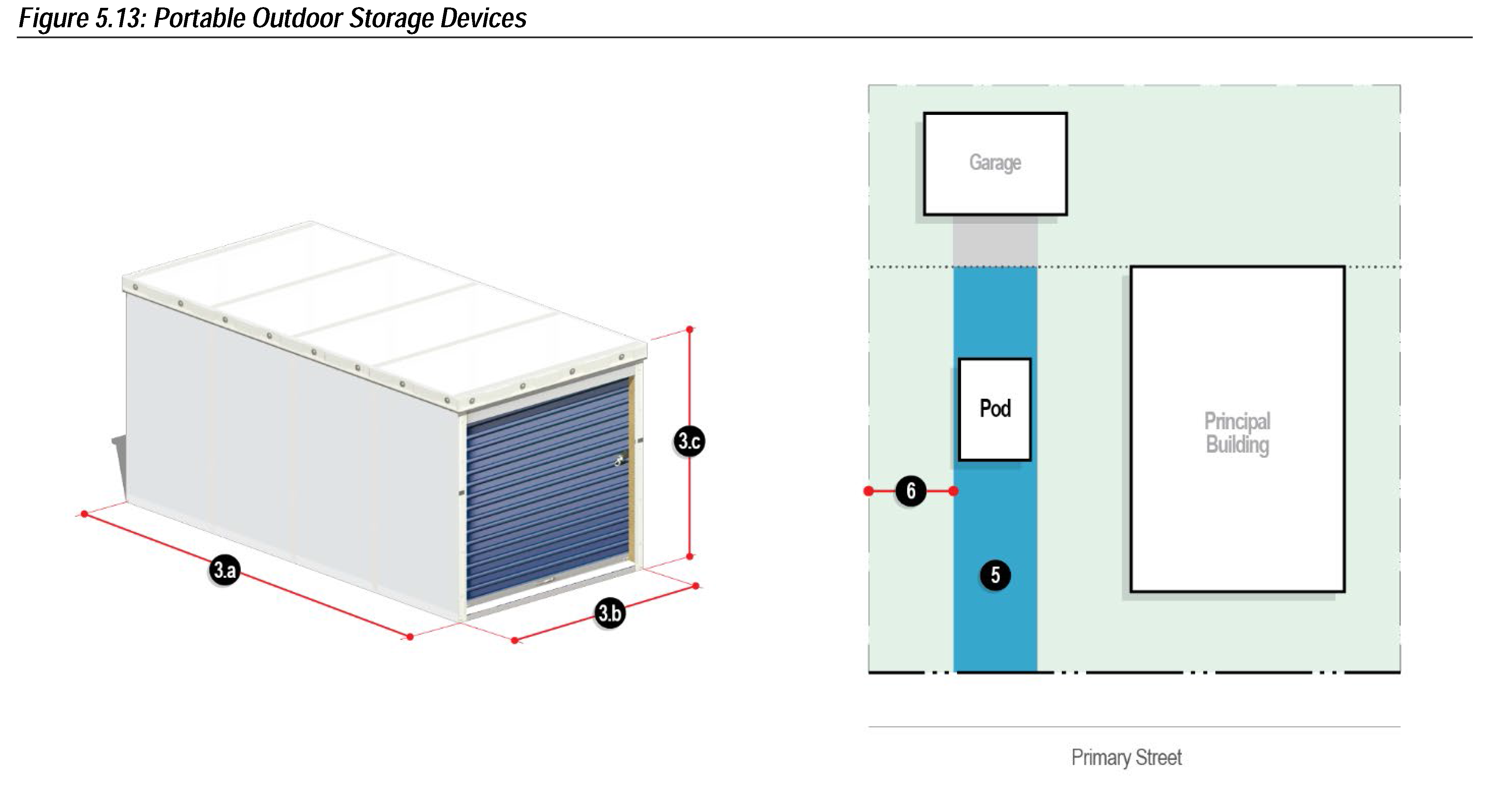
(D)
Seasonal Sales.
(1)
A Temporary Use Permit, as detailed in section 16-9-3(G) of this UDO, shall be obtained prior to the commencement of any seasonal sales activity.
(2)
Seasonal sales shall include the outdoor display or sale of seasonal merchandise not otherwise associated with the principal use of the lot such as holiday tree, firework, or pumpkin sales.
(3)
Seasonal sales shall be permitted for a period not to exceed 42 days per calendar year.
(4)
Seasonal sales areas may utilize a maximum of 20 percent of the parking spaces required for the operation of the principal use or 2,000 square feet, whichever is less.
(5)
Seasonal sales areas shall not block pedestrian walkways in a manner which reduces the width of that walkway to less than five feet.
(Ord. No. 1581, § II, 4-5-2022; Ord. No. 1624, § III, 10-17-2023; Ord. No. 1679, § II, 1-20-2026)

