


Jersey Village City Zoning Code
ARTICLE X
- SIGNS11
Editor's note— Ord. No. 00-16, § 2, adopted May 15, 2000, repealed art. X in its entirety, and replaced it with new provisions pertaining to similar subject matter to read as herein set out. See the Code Comparative Table.
Cross reference— Signs on right-of-way, § 58-2.
Sec. 14-240.- Purpose of article.
The purpose of this article is to provide uniform sign standards which:
(1)
Promote a positive city image reflecting order, harmony and pride and thereby strengthen the economic stability of its business, cultural and residential areas;
(2)
Provide for efficient transfer of information in sign messages; and
(3)
Protect the public welfare by enhancing the appearance and economic value of the landscape.
(Ord. No. 00-16, § 2, 5-15-00)
Sec. 14-241. - General provisions.
(a)
All signs shall comply with the city's building codes and other ordinances, where applicable.
(b)
Not more than two sides of a sign structure may be used for display.
(c)
Each business shall be identified by a street address sign which is clearly visible from the street. Numbers shall be two inches minimum and six inches maximum in height (not internally illuminated).
(d)
For graphic representations of the various types of signs regulated by this article, See Figure 14-19.
(e)
This article shall not apply to electioneering political signs placed on public property in accordance with the provisions of section 58-3.
(Ord. No. 00-16, § 2, 5-15-00; Ord. No. 2013-26, § 2, 7-15-13)
Sec. 14-242. - Administration and enforcement.
(a)
Sign administration. The building official, or such other person as may be designated by the city manager, shall be responsible for the administration and enforcement of the terms and provisions of this article.
(b)
Authorization. The building official is authorized to:
(1)
Inspect and approve every sign subject to the provisions of this article.
(2)
Enter, for the purpose of inspecting and investigating signs or sign structures, any building, structure or other premises or property during normal business hours, upon presentation of proper identification to owner, agent or tenant in charge of the premises.
(3)
Upon notice, issue a written stop order for work that is being conducted on a sign in a manner contrary to the provisions of this article or that is being conducted in a dangerous or unsafe manner. Such notice and order shall state the conditions under which work may be resumed. In an emergency, the building official shall not be required to give written notice. Following the issuance of a stop order, the building official shall initiate proceedings to revoke any permit issued for the work covered by such order in the manner provided by this article unless the cause of the stop order is resolved.
(4)
Revoke any and all licenses or permits authorized by this article for violation of the terms and provisions of this article.
(c)
Annual inspections. The building official shall annually inspect all permanent signs located in the city and its extraterritorial jurisdiction for the purpose of identifying those existing permanent signs which are not in compliance with this article.
(Ord. No. 00-16, § 2, 5-15-00)
Sec. 14-243. - Prohibited signs.
The following signs are prohibited unless otherwise expressly permitted by this article:
(1)
Signs or other advertising structures erected or maintained in violation of the requirements of section 14-244.
(2)
Off-premises signs.
(3)
Outdated signs or other advertising structure that advertise a business or product which is no longer in existence. Abandoned or outdated signs shall be replaced or removed within 30 days of occurrence and/or notice.
(4)
Signs and supports, other than governmental signs and supports, which are located in, or extend over, a public right-of-way.
(5)
Signs visible from the public right-of-way which are tacked, posted or otherwise affixed to trees, utility poles, posts, fences, benches, or similar structures.
(6)
Portable signs.
(7)
Signs which move or which contain visible moving parts or flashing, blinking or traveling lights or messages; provided, however, that the provisions of this section shall not prohibit time and temperature monument signs which are not otherwise intended as an attention getting device or barber poles of traditional design not to exceed 20 inches in height which revolve during the time the barbershop is open for business.
(8)
Signs in the form of banners, posters, pennants, flags, sequins, ribbons, streamers, balloons, strings of light bulbs, spinners, searchlights, beacons or other similar devices; provided however that balloons may be displayed that are less than 13 inches in diameter and attached to a maximum eight-foot long tether line.
(9)
Signs which are obscene.
(10)
Signs which are erected at an intersection of any street or driveway or other location in such manner as to obstruct free and clear vision or that may interfere with, obstruct the view of, or be confused with any authorized traffic sign, signal or device, or which use the words "stop," "danger," or other word, phrase, symbol or character that interferes with, misleads or confuses traffic. A clear vision for approaching vehicles for a distance as measured in Figure 14-5 must be maintained.
(11)
Signs placed on the rear of any building except for identification nameplates or signs on a commercial or industrial establishment not exceeding two square feet in area and located near, and for the purpose of identifying, delivery entrances and authorized parking areas.
(12)
Reader panel signs or signs with runners, slots or tracks in or on which changeable letters and numerals can be mounted, unless totally encased to prevent tampering. Encasement is not required if the bottom of the reader panel sign is a minimum of 15 feet above ground level.
(13)
Roof signs.
(14)
Signs projecting any message, lettering, picture, sound, odor, or any similar advertising display on a surface.
(15)
Spectacular signs.
(Ord. No. 00-16, § 2, 5-15-00; Ord. No. 03-24, § 2, 6-16-03)
Sec. 14-244. - Permits and fees.
(a)
Permit required. It shall be unlawful for any person to construct, reconstruct, alter or use a sign, or for any owner or occupant of land to allow the construction, reconstruction, alteration, or use of a sign on land owned or occupied by such person, without first having secured a written permit from the city to do so, subject to the exceptions set forth in subsection (b) of this section. It is an affirmative defense to prosecution under this subsection that a sign is excepted under subsection (b) of this section from the requirement of a project.
(b)
Exceptions.
(1)
Permits shall not be required under this article for on-premises signs of the following descriptions:
a.
The repainting, cleaning or maintenance of a sign;
b.
Signs painted on glass surfaces or windows or doors which do not cover more than 50 percent of the total surface area;
c.
Wall signs not over five square feet in area;
d.
Signs erected by governmental agencies and their lessees;
e.
Railroad signs;
f.
Legal notices and noninternally illuminated house numbers not less than two inches nor more than six inches in height;
g.
A sign not greater than 32 square feet in area setting forth information concerning a building or other structure under repair or construction or advertising the sale or rental of the premises as permitted by section 14-252;
h.
Any sign:
1.
Erected or maintained pursuant to and in discharge of any governmental function;
2.
Required by law, ordinance or governmental regulation; or
3.
Located on property owned, leased or under the control of a governmental entity.
i.
Signs on private property not greater than four square feet in area and four feet in height that contain no advertising (except logo) and that direct the movement of traffic, warn of obstacles or overhead clearances or that control parking, including entrance and exit signs.
j.
National, state, municipal, religious, and corporate flags; provided that the total flag display allowed is equal to or less than one-third of the flagpole height. The maximum number of flagpoles allowed for a single occupant detached business and integrated business developments shall be three. The maximum size of any one flag shall be ten feet by 19 feet.
k.
Historical and commemorative plaques of recognized historical societies and organizations not greater than 15 square feet in area.
l.
Decorations clearly incidental, customary and commonly associated with a national, local, ethnic or religious holiday; provided, however, that such decorations are displayed for only the length of time that such holiday or event is normally and customarily celebrated by the public.
m.
Nameplates, not exceeding two square feet in area, for residents or occupants of commercial, industrial and professional buildings or dwellings, apartments, boardinghouses or roominghouses or other similar facilities.
n.
Protection or security signs, not exceeding four square feet in area, erected by the occupant of a premises denoting security devices or no trespassing.
o.
Signs located in the interior of a building which are designed and located to be viewed by patrons within the building and not by persons outside the building.
p.
Signs on vehicles required by any governmental agency.
q.
Signs on licensed commercial vehicles, including trailers; provided, however, that such vehicles shall not be used as parked or stationary outdoor signs and further provided that such vehicles or trailers are not designed or constructed for the primary purpose of providing an advertising medium.
r.
Director signs, menu boards and the like which are designed to be read from a distance no greater than ten feet. (i.e. fast food drive thru menus.)
(c)
Application. An application for a construction permit shall be submitted on a form provided by the city and shall be accompanied by plans, drawn to scale, which shall include the following:
(1)
The dimensions of the sign and, where applicable, the dimensions of the wall surface of the building to which it is to be attached;
(2)
The dimensions of the sign's supporting members;
(3)
The proposed location of the sign in relation to the face of the building, on, in front of which it is to be located;
(4)
The proposed location of the sign in relation to the boundaries of the lot or parcel of land upon which it is to be located;
(5)
The location of all electrical transmission lines within 30 feet of any part of the proposed sign or sign structure;
(6)
Plans and specifications if applicable for the electrical system of the sign;
(7)
The dimensions and location of all existing signs whether exempt from these guidelines or permitted under them on the premises;
(8)
The address or location of the proposed sign;
(9)
The names and signatures of sign owners, landowners, sign erector;
(10)
The area of the sign face; and
(11)
Business frontage (if integrated business development/shopping center).
(d)
Operating permits. Operating permits expire December 31 of each year and shall be renewed within 60 days prior to the expiration date. Failure to renew the operating permit by the established deadline shall result in the assessment of late fees as detailed in the adopted fee schedule of the city. It shall be unlawful for any person to maintain or use, or to permit or suffer the use of on premises owned by or under the control of such person, a sign for which a permit is required by subsection (a) of this section without securing an annual operating permit from the city.
(e)
Operating permits for existing signs.
(1)
The building official shall not issue an operating permit for an existing sign that was erected in violation of any law or ordinance in effect at the time of its erection or for an existing sign that does not comply with the provisions of section 14-248.
(2)
Nonconforming signs. Existing signs that were erected in compliance with all laws and ordinances in effect at the time of their erection must conform with the provisions of this article when an operating permit is issued after January 1, 2005. Existing signs that were erected in violation of any law or ordinance in effect at the time of their erection must conform to the provisions of this article prior to issuance of an operating permit. The conformity dates for the removal or modification of those signs for which the conformity date is required to be extended or for which the city is required to compensate the owner or operator by the state or federal law shall be extended for so long as the conformity date extension or compensation is required by state or federal law. When any sign or a substantial part thereof is blown down or otherwise destroyed, or taken down or removed for any purpose other than maintenance operations or for changing the letters, symbols, or other matter on such sign, it shall not be re-erected, reconstructed, repaired, or rebuilt, except in full conformance with this article. For purposes of this section and section 14-259, a sign or substantial part thereof is considered to have been destroyed only if the cost of repairing the sign is more than 60 percent of the cost of erecting a new sign of the same type at the same location.
(f)
Subterfuge. A permit secured before or after the effective date of this article which has been secured through subterfuge and not in full compliance with the provisions of this article shall be revoked by the building official in accordance with the procedures for revocation provided by this article.
(g)
Construction permit effectiveness; removal permit. A permit for construction of a sign shall become null and void unless construction of the sign is completed within 180 days from issuance. A permit may be renewed one time for a period not to exceed 180 days.
(h)
Fees. Each application shall be accompanied by the payment of a fee in accordance with the duly adopted schedule of fees.
(i)
No refund of fees. The applicant for, or holder of, a permit shall not be entitled to a refund of any fee paid.
(j)
Deposit or bond. When any work on a sign structure is to be done on the pavement side of the curbline or on or over public property which may cause the city to sustain loss, damage or injury to public property, or to be put to expense in correcting conditions resulting therefrom, the building official shall require the person proposing to do such work to furnish a bond in the amount of $25,000.00 in a form satisfactory to the city attorney, or to post a deposit of a like amount, to indemnify the city against any cost that may be incurred or any loss, damage or injury that may be sustained by the city because of such work, and as a guaranty of compliance with this and other applicable laws and ordinances. Such required bond or deposit shall be furnished or posted before a permit is issued for the work.
(Ord. No. 00-16, § 2, 5-15-00; Ord. No. 03-24, § 4, 6-16-03; Ord. No. 2010-46, § 1, 10-18-10; Ord. No. 2023-13, § 12, 5-17-23)
Sec. 14-245. - Sign companies.
(a)
License required. It shall be unlawful for any person to engage in the business of leasing or constructing of signs in the city without first obtaining a license from the city.
(b)
Issuance of license; fee. The building official shall issue a license to a person applying therefore upon receipt of a completed application on a form provided by the city and upon receipt of the license fee as provided by the duly adopted schedule of fees. A license shall be valid for a period of one year from the date of issuance.
(c)
Address and agent for service of process. Any person who is licensed under the terms of this article shall at all times maintain an office within the state, the current address of which is recorded with the building official, or shall appoint and file of record with the building official an agent within the state for service of process.
(d)
Electrical sign contractors. Each person licensed under the terms of this article whose operations include signs that in any manner include the use of electricity shall be an electrician licensed by the city.
(Ord. No. 00-16, § 2, 5-15-00)
Sec. 14-246. - Sign maintenance and removal.
(a)
Maintenance. All signs, including their structures, shall be kept in good repair, well cleaned, well painted and well maintained. All signs shall conform to existing fire codes, building codes and other applicable laws and ordinances. If a sign is not maintained as required by this section, the building official shall give written notice to the owner or lessee thereof to so maintain the sign or to remove the sign.
(b)
Unsafe signs. If any sign shall, in the opinion of the building official, become insecure or in danger of falling or become otherwise unsafe, the building official shall give written notice of the condition of the sign to the owner or lessee thereof to correct the unsafe condition of the sign.
(c)
Unlawful signs. If any sign shall be installed, erected, constructed, or maintained in violation of any of the terms of this article, the building official shall give written notice to the owner, lessee or person responsible for the sign ordering such owner, lessee or person to alter the sign so as to comply with this article or to remove the sign.
(d)
Removal of signs. A written notice to alter or remove a sign shall be given by either certified mail or personal service upon the owner, lessee or person responsible for the sign. If such order is not complied with within ten days, the building official shall initiate proceedings to revoke the permit and to remove the sign at the expense of the owner, lessee or person responsible therefor.
(Ord. No. 00-16, § 2, 5-15-00)
Sec. 14-247. - Signs to bear permit numbers.
A sign permit label or marker issued by the city shall be affixed to each sign and shall be placed as follows:
(1)
Ground signs:
a.
Pole sign: Place on pole.
b.
Monument sign: Place on sign face in lower right hand corner.
(2)
Wall, fascia, canopy signs: Place on front window or main entrance door in the lower right hand corner.
(3)
It shall be the duty of the permittee or his agent to affix the label or marker as required. The absence of a proper, nonexpired label or marker shall be prima facie evidence that the sign(s) has been or is being erected or operated in violation of the provisions of this article.
(Ord. No. 00-16, § 2, 5-15-00)
Sec. 14-248. - Construction requirements.
(a)
Structural. Signs shall be constructed in accordance with the building code and other applicable laws and ordinances. Any ground sign with a total height greater than eight feet above natural grade shall be designed, signed and sealed by a registered professional engineer to withstand 30 pounds per square foot (100 mph wind load).
(b)
Electrical. Electrical fixtures, equipment and appurtenances installed in conjunction with a sign shall be designed and installed in accordance with all applicable codes, laws and ordinances. Signs shall be located a minimum distance of six feet measured horizontally and 12 feet measured vertically from overhead electric conductors which are energized in excess of 750 volts. The term "overhead electric conductors," as used in this section, means any electrical conductor, either bare or insulated, installed above the ground.
(c)
Color. The rear of a single-faced sign, if viewable from a public right-of-way or other public property, shall be of a single color.
(d)
Material. Materials for construction of all signs and sign structures shall be of the quality and grade permitted by the city's building and fire code. The materials approved for sign face shall exclude any woven material or product. Plastics which burn at a maximum rate of two and one-half inches per hour when tested in accordance with ASTM D635-98 shall be deemed "approved" for sign face construction notwithstanding any other provision of this Code.
(Ord. No. 00-16, § 2, 5-15-00)
Sec. 14-249. - Measurement of signs.
For purposes of determining compliance with this article, signs shall be measured as follows (see also Figure 14-20):
(1)
Wall/canopy signs. The sign face area shall be computed as including the entire area within a regular geometric form comprising all display area of the sign, including all elements of the display and the frame, if applicable.
(2)
Ground signs. The sign face area shall be computed as including the entire area within a regular geometric form comprising all display area of the sign and including all elements of the matter displayed.
(3)
Structural members. Supporting structural members not bearing advertising matter, identifying color, symbol, wording or pictures shall not be included in computation of sign face area.
(4)
Irregular or separately mounted signs on one supporting structure. The sign face area shall be computed as including the smallest regular geometric form that will wholly contain all of the elements, including the frame.
(5)
Multi-faced signs. The sign face area shall be computed, including all faces.
(6)
Sign spacing. When a sign is placed at an angle to the intersection of two streets, measurement for spacing purposes shall be from the edge or side farthest from the intersection.
(Ord. No. 00-16, § 2, 5-15-00)
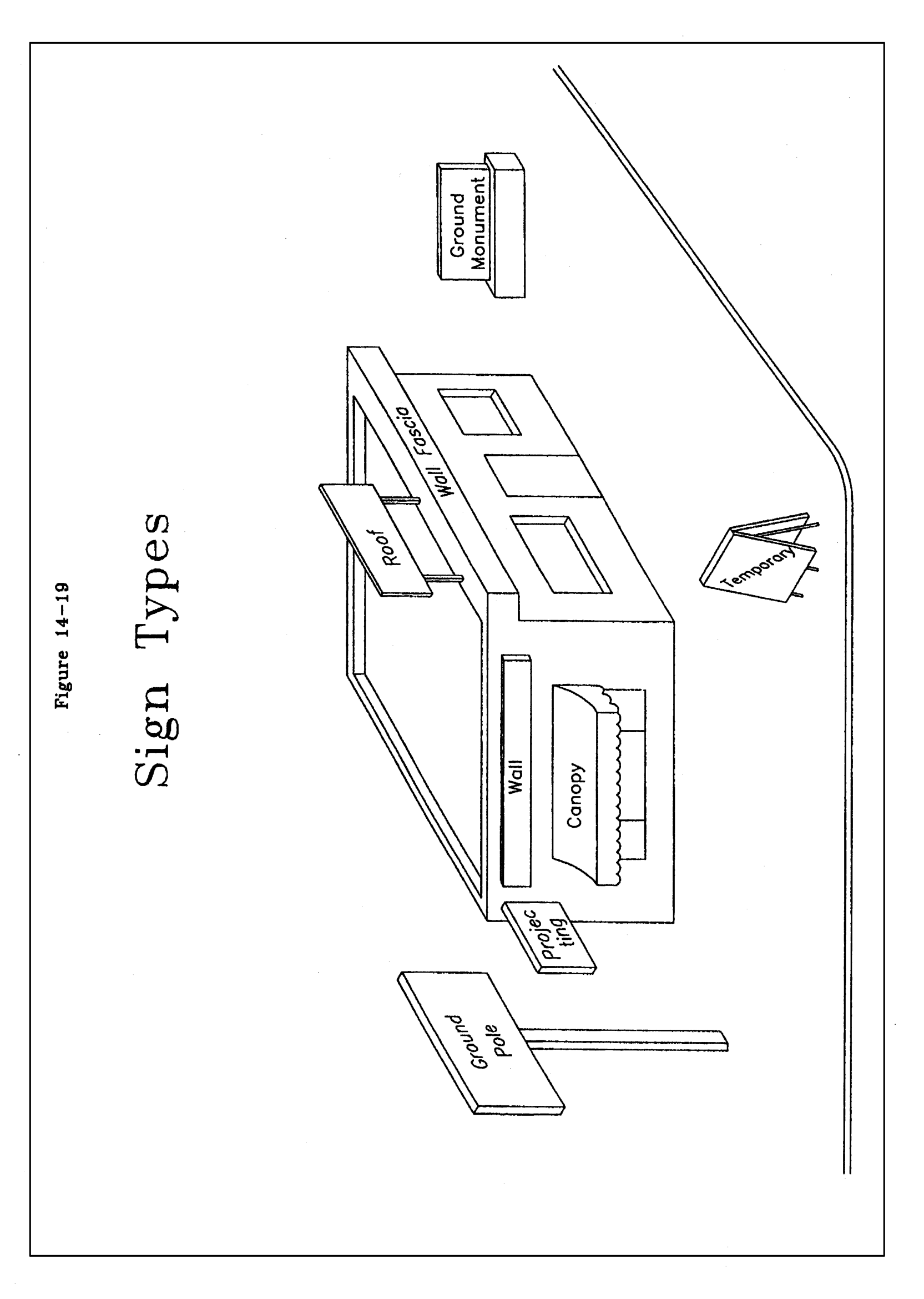
Figure 14-19 Sign Types
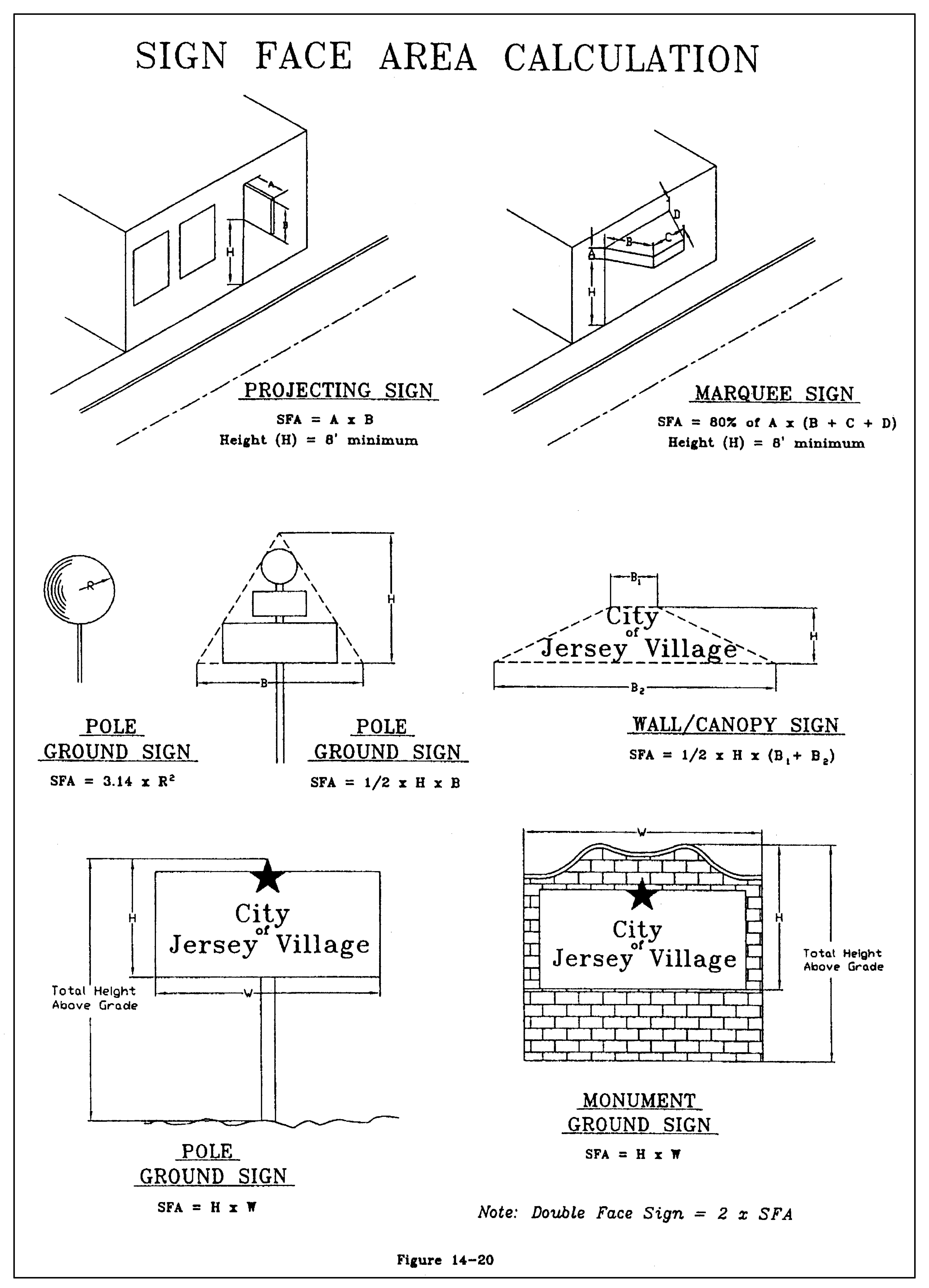
Figure 14-20 Sign Face Area Calculation
Sec. 14-250. - Landscaping requirements.
Ground signs shall be placed in a landscape strip according to the standards contained in subsection 14-309(b)(6) of this chapter.
(Ord. No. 00-16, § 2, 5-15-00)
Sec. 14-251. - Signs in residential zoning districts.
The following signs are permitted in residential districts:
(1)
Temporary signs.
a.
For sale, rental or lease signs for residential lots or structures. One nonilluminated temporary on-premises ground sign not exceeding four square feet in size and five feet in height shall be allowed for each single-family dwelling unit or vacant lot in a platted subdivision in order to give information concerning leasing, renting or selling of such while the dwelling or lot is actually available for lease, rent or sale. No permit shall be required for the erection of a temporary real estate sign under this subsection. A temporary real estate sign may be located anywhere on the premises; provided, however, that such sign shall not project beyond the property line.
b.
For sale, rental or lease signs for vacant land. One nonilluminated temporary on-premises ground sign not exceeding four square feet in size and five feet in height for each tract or parcel of land, other than subdivided residential lots, in order to give information concerning leasing, renting or selling of such property. The sign may be located anywhere on the tract or parcel, provided it is set back not less than ten feet from any street frontage and not less than 200 feet from the intersections of two streets, provided that each tract may have a sign. No permit shall be required for the erection of such sign.
c.
Contractor identification signs. One nonilluminated temporary on-premises ground sign not exceeding four square feet in size shall be allowed for each contractor only during the period that the contractor is engaged in active construction, repair or maintenance of the premises. The sign may be located anywhere on the premises; provided, however, that such sign may not project beyond the property line and shall not be more than five feet in height above the average finished grade. No permit shall be required for the erection of such sign.
d.
Garage sale or personal property sales signs. Sales of personal property may be advertised by one nonilluminated temporary on-premises ground sign not exceeding four square feet in size and five feet in height at the place of sale for two days prior to the sale. The sign shall be removed within 24 hours following the end of the sale. No permit shall be required for the erection of such sign.
e.
Directional signs. One nonilluminated temporary directional sign not exceeding four square feet in size and five feet in height may be located on a lot or tract for a period of time not exceeding 12 hours during the event for which it is providing direction. The sign shall be removed immediately upon conclusion of the event. A temporary directional sign(s) allowed by this part may be located on a lot no more than two times in any 48-hour period. No permit shall be required for the erection of such sign.
f.
Model home signs. One illuminated or nonilluminated temporary on-premises ground sign not exceeding 24 square feet is size or six feet in height located in the front yard of a lot on which a model home is located. Illumination shall not interfere with the tranquility of the neighborhood or with traffic. The sign shall be removed when the structure located on the premises is no longer used, or entitled to be used, for a model home. No permit shall be required for the erection of such sign.
g.
Subdivision signs. One nonilluminated temporary ground sign not exceeding 32 square feet in size, four feet in width and ten feet in height shall be allowed at each entrance to a residential subdivision in order to give information concerning the sale of residential units in the subdivision. The sign shall be located not less than ten feet from the street right-of-way and not less than ten feet from the side property line. It shall not block pedestrian traffic and shall not be within a clear view triangle as described in figure 14-5. Only builders who own or who have contracts to purchase five or more lots in the subdivision may have text on the sign. The sign and the area around the sign shall be maintained as required by this article. The sign shall be removed on the first of the following to occur: (i) the expiration of 30 days after building permits have been issued for 90 percent of the lots in the subdivision or (ii) the expiration of 180 days after issuance of the latest building permit to the builder for a lot in the subdivision.
(2)
Permanent signs.
a.
Multiple dwelling complexes. A townhouse, condominium or multifamily complex may have one sign with a total surface area not to exceed 24 square feet. The permitted sign may be a monument type ground sign or a wall sign. A monument type ground sign not exceeding five feet in height shall be set back from any property line not less than ten feet. If a wall sign is erected, it shall be flush mounted and shall not project above any wall.
b.
Nonresidential uses permitted in residential zoning districts are allowed one monument type ground sign not to exceed 24 square feet in sign face area and five feet in height and a single wall sign with letters not to exceed six inches in height identifying the establishment.
c.
Signs for governmental agencies. Signs erected by government agencies and their lessees and signs otherwise required by federal, state or local law.
d.
Legal notices or, house numbers with characters a maximum of six inches in height; nonilluminated.
e.
Single-family residential subdivisions.
1.
A subdivision entryway sign or plaque, not exceeding 32 square feet, may be permitted on either side of a subdivision entry, attached to an approved masonry screening wall, and illuminated only by spot-lighting of a type that need not be affixed to the wall sign or plaque.
2.
A subdivision may have a masonry monument sign not to exceed 32 square feet for a single face or 40 square feet total of sign face area. The sign is to be measured as established in section 14-249(2) and (3) and Figure 14-20 of this Code. Non-structural, decorative elements atop and to either side of the sign face(s) need not count as sign face area. The overall dimensions of the entire sign structure may not exceed eight feet in height nor exceed more than 15 feet in length. It may be illuminated by spot lighting of a type that need not be affixed to the sign.
(Ord. No. 00-16, § 2, 5-15-00; Ord. No. 01-22, § 1, 11-12-01; Ord. No. 02-33, § 2, 12-16-02; Ord. No. 2006-6, § 1, 2-20-06; Ord. No. 2016-10, § 1, 4-18-16)
Sec. 14-252. - Signs in commercial and industrial zoning districts.
The following signs are permitted in commercial and industrial zoning districts when maintained in good condition:
(1)
Temporary signs.
a.
For sale, rental or lease signs for commercial lots or structures. One nonilluminated temporary on-premises ground sign not exceeding 64 square feet shall be allowed for each commercial unit or vacant lot in a platted commercial development in order to give information concerning leasing, renting or selling of such while the unit or lot is actually available for lease, rent or sale. The sign may be located anywhere on the premises; provided, however, that such sign shall not project beyond the property line and shall not have a height greater than eight feet above the natural ground level. No permit shall be required for the erection of such signs.
b.
Under construction or to be constructed signs. Temporary ground signs, not to exceed eight feet in height and 32 square feet in size, are allowed for commercial or industrial developments which are under construction in addition to permanent signs as provided by this section in order to give information concerning leasing, renting, selling, financing and/or contracting. The temporary "under construction" sign shall be removed 12 months from the date of its erection or when the construction of the development is completed, whichever first occurs. The sign shall be placed a minimum of ten feet behind the street right-of-way and not in the clear view triangle. See Figure 14-5. No permit shall be required for the erection of such signs.
c.
Banner signs.
1.
Grand opening signs. One wall sign, in the form of a banner no greater than 32 square feet in area, advertising a grand opening celebration is allowed for a period not to exceed 30 days. Such 30-day period shall begin on the date of erection of the sign, and the sign shall be removed prior to the expiration of the thirtieth day. A grand opening sign shall comply with the location and height standards for wall signs contained in subsection (2)b.1 of this section. No permit shall be required for the erection of such signs.
2.
Special event signs. One wall sign, in the form of a banner not to exceed 32 square feet in area, advertising special events such as activities, sales or special consignments may be displayed for a period not to exceed one calendar month (i.e. from the date first displayed through the date minus one day of the next month) and shall be removed not later than one day after such activity or sale is completed. Each commercial or industrial establishment shall be limited to not more than four special even signs per calendar year. Such signs shall not be painted directly on the window glass and shall not utilize fluorescent paint or any type of reflectors. Each such sign must be permitted at least three business days prior to the erection or placement of the sign.
(a)
Location and height. The location and height of such signs will be in accordance with the standards for wall signs contained in subsection (2)b.1 of this section; provided, however, that where such required wall is not available, the special event sign may be suspended by means of ropes or cables between two vertical poles, stakes or freestanding supports. The location of banners shall not obstruct pedestrian traffic or be within the clear view triangle. See Figure 14-5.
(b)
Pennants and ribbon streamers. In the case of a special event consisting of more than one activity occurring at the same time, pennant and ribbon streamers may be used to outline the area of each activity, to separate each activity from the other, to provide a designated path for those attending the event or move from one activity to another without confusion, and to designate a proper parking area for those attending the event. Pennant and ribbon streamers shall not be erected more than four feet above ground level.
3.
Changing display signs. One wall sign, in the form of a banner, with a maximum surface area of 200 square feet or two wall signs, in the form of a banner, with a maximum total surface area of 200 square feet advertising special sales opportunities may be displayed on buildings located on lots fronting U.S. Highway 290. No banner shall exceed 50 percent of the area of the wall on which the sign is displayed nor be mounted within 12 inches of any corner, change of elevation, change of building facade material, glass, or other signage. A banner shall not extend above the roofline or over a glass area, or wrap around a corner of a building. A banner shall be attached with not less than four attachment points, one for each corner, and shall have an attachment point a minimum of every 48 inches on all sides. All banners shall be mounted parallel and level with the ground. All banners shall be professionally constructed. For the purpose of this section, the area of the wall is defined as the wall surface on which the banner is mounted, bounded by any change of surface such as corners, changes of elevation of the structure, changes of building facade material, glass or other signage. An annual permit is required. The city shall be notified in writing, on a form provided by the city, of any change in the permitted signage.
(2)
Permanent signs.
a.
Commercial and industrial subdivisions. A commercial or industrial subdivision containing not less than 40 acres of land may have one permanent identification monument type ground sign not to exceed eight feet in height and not to exceed 32 square feet in surface area at each major street entrance to the subdivision.
b.
Single-occupant detached commercial and industrial buildings. Single-occupant detached commercial and industrial buildings may have the following signs:
1.
Wall signs.
(a)
Size and number. Wall signs are permitted for each single-occupant detached building not to exceed the lesser of 25 percent of the elevation where the signs are located or 1,000 square feet.
(b)
Location and height. A wall sign may not project above the wall line of a building except for buildings with parapet walls, in which case the sign shall be flush with the wall and shall not project above the parapet. Signs placed on mansard roofs must be perpendicular to the ground with all permanent structural supports covered from view. Wall signs may be placed on the front or sides but not on the rear of buildings.
2.
Ground signs.
(a)
Size and number. A single-occupant detached commercial or industrial building, may have one ground sign. A pole or monument type ground sign not more than 50 square feet in area is permitted for each lot or tract of land with a street frontage of 100 linear feet or more on which a single-occupant detached building is located;
(b)
Location and height. A ground sign shall not exceed eight feet in height and shall be set back not less than ten feet from the street right-of-way and not less than 25 feet from interior or rear property lines. A ground sign shall not be located within 100 feet of another ground sign, measured from the closest points of the signs; provided however the 100-foot separation does not apply to additional signs permitted elsewhere in this article for signs on the same property.
(c)
[Commercial property.] Any lot on which a commercial building may be legally constructed shall be allowed to have a ground, monument type, sign not to exceed 25 square feet in sign face area and not to exceed four feet in height. The sign shall be located as close to the center of the lot's street frontage as possible and at least ten feet from the street right-of-way in front of the structure. This will not effect [affect] the location of any other ground sign allowed by this article with regards to the 100-foot separation requirement in subsection (b) above.
3.
Canopy signs.
(a)
Size and number. The allowable sign face area for canopy signs shall not exceed 50 percent of the canopy surface. This sign face area shall be included in the total signage allowed for wall signs, see subsection (2)b.1. of this section.
(b)
Location and height. Canopy signs must be an integral part of the canopy, i.e. painted or sewn and must not extend above the wall line.
c.
Signs permitted in integrated business developments. It shall be the responsibility of the integrated business development owner/leasing manager to advise the tenants of, and monitor compliance with, the sign ordinance. No signs shall be allowed in integrated business developments except as follows:
1.
Wall signs.
(a)
Size and number. Each business establishment in an integrated business development may have wall signage not to exceed the lesser of 25 percent of the elevation where the signs are located or 1,000 square feet.
(b)
Location and height. A wall sign may not project above the wall line of a building except for buildings with parapet walls, in which case the sign shall be flush with the wall and shall not project above the parapet. Signs placed on mansard roofs must be perpendicular to the ground with all structural supports covered from view. Wall signs identifying businesses in an integrated business development may only be placed the front building elevation, unless the business is located on a corner of such a development, in which case, side elevation signs are permitted.
2.
Ground signs.
(a)
Size and number. The aggregate sign area for all ground signs in an integrated business development shall not exceed 400 square feet and shall not exceed one square foot of sign area for each 300 square feet of gross leasable area or square footage of the buildings; provided, however, that each sign must meet spacing, size and height requirements contained in this subsection. Each integrated business development shall be allowed one 32 square foot ground sign on each street frontage.
(b)
Location and height. A ground sign shall not exceed eight feet in height and shall be set back not less than ten feet from street rights-of-way and not less than 50 feet from interior or rear property lines. A ground sign shall not be located within 100 feet of another ground sign, measured from the closest points of the two signs. If consistent with the above location and setback requirements, a ground sign allowed for a tract may be placed on any street frontage.
3.
Canopy signs.
(a)
Size and number. The allowable sign face area for canopies shall not exceed 50 percent of the canopy surface. This sign face area shall be included in the total signage allowed for wall signs, see subsection (2)b.1.(a) of this section.
(b)
Location and height. Canopy signs must be an integral part of the canopy, i.e. painted or sewn and shall not extend above the wall line.
(Ord. No. 00-16, § 2, 5-15-00; Ord. No. 03-24, § 3, 6-16-03; Ord. No. 04-04, § 1, 2-16-04; Ord. No. 2023-13, §§ 13, 14, 5-17-2023)
Sec. 14-253. - U.S. 290 corridor standards.
For the purposes of more specifically regulating ground signage along U.S. 290, a ground sign corridor consisting of a 50-foot wide strip of land adjacent to either side of the right-of-way of U.S. 290 is hereby created. The standards contained in this article shall apply to said corridor except where they conflict with the following regulations:
(a)
Commercial/industrial developments shall be allowed one temporary ground sign per 500 linear feet of street frontage with a maximum size of 64 square feet of sign face area and a height not to exceed 12 feet.
(b)
Commercial/industrial subdivisions containing not less than 40 acres of land may have one permanent, monument type ground sign not exceeding 12 feet in height and 200 square feet of sign face area at each street entrance into the subdivision.
(c)
Commercial or industrial developments may have one monument type ground sign per 500 linear feet of street frontage. The maximum size per sign shall not exceed 200 square feet of sign face area and not exceeding 12 feet in height. The total sign face area for all signs allowed by this provision shall not exceed 400 square feet.
(d)
Commercial or industrial developments may have one pole type ground sign, not to exceed 35 feet in height above natural ground level. The maximum size per sign shall not exceed 200 square feet of sign face area. The total sign face area for all signs allowed by this provision shall not exceed 400 square feet.
(Ord. No. 00-16, § 2, 5-15-00; Ord. No. 01-30, § 11, 10-15-01)
Sec. 14-254. - FM 529 corridor standards.
For the purposes of more specifically regulating ground signage along FM 529 a ground sign corridor consisting of a 50-foot wide strip of land adjacent to the north side of the right-of-way of FM 529 is hereby created. The standards contained in this article shall apply to said corridor except where they conflict with the following regulations:
(a)
Commercial/industrial developments shall be allowed one temporary ground sign per 500 linear feet of street frontage with a maximum size of 64 square feet of sign face area and a height not to exceed 12 feet.
(b)
Commercial/industrial subdivisions containing not less than 40 acres of land may have one permanent, monument type ground sign not exceeding 12 feet in height and 200 square feet of sign face area at each street entrance into the subdivision.
(c)
Commercial or industrial developments may have one monument type ground sign per 500 linear feet of street frontage with characters equal to one square foot per linear foot of FM 529 street frontage. The maximum size per sign shall not exceed 200 square feet of sign face area and not exceeding 12 feet in height. The total sign face area for all signs allowed by this provision shall not exceed 400 square feet.
(d)
Commercial or industrial developments may have one pole type ground sign, not to exceed 20 feet in height above natural ground level, with characters equal to one square foot per linear foot of FM 529 street frontage. The maximum size per sign shall not exceed 200 square feet of sign face area. The total sign face area for all signs allowed by this provision shall not exceed 400 square feet.
(Ord. No. 00-16, § 2, 5-15-00)
Sec. 14-255. - Signs for civic events.
Temporary signs that provide information about, or direct the public to, a special event of civic interest, such as a parade, an organized holiday celebration or a special event on the behalf of a charitable or nonprofit organization are allowed, provided a sign plan is submitted to and approved by the director. A sign plan shall comply with the following general requirements:
(1)
One temporary monument type ground sign may be placed at each major entrance to the event.
(2)
Not more than seven additional temporary monument type ground signs or banners may be located at specified locations in the city as approved by the building official.
(3)
Directional signs shall not be greater than eight square feet in area.
(4)
Signs shall be allowed for not more than ten days prior to, and two days after, the event.
(5)
Signs may not be located on a public right-of-way.
(Ord. No. 00-16, § 2, 5-15-00; Ord. No. 02-24, § 1, 8-26-02)
Sec. 14-257. - Parking of advertising vehicles.
No person shall park an advertising vehicle or trailer on a public right-of-way or on public property. Any such vehicle parked on private property, visible from a public right-of-way, shall be used on a regular basis within each business week as a means of transportation for the business that is advertised.
(Ord. No. 00-16, § 2, 5-15-00)
Sec. 14-258. - Signs displaying noncommercial messages.
A sign displaying a noncommercial message is allowed at any location where a sign displaying a commercial message is allowed, subject to all requirements, other than content, applicable to a sign displaying a commercial message.
(Ord. No. 00-16, § 2, 5-15-00)
Sec. 14-259. - Abandoned or damaged signs.
A sign which has been abandoned or which has become obsolete because of the closing of a business, change in the nature of a business, or any other reason rendering the sign nonapplicable to the property upon which it is displayed, shall be removed by the owner of the building or premises upon which it is situated within 60 days from the date the sign was abandoned, became obsolete or became nonapplicable to the property. A construction or use permit may be issued for a sign on a tract upon which an abandoned or obsolete sign is located only upon the condition that the abandoned or obsolete sign shall first be removed.
A sign which has been substantially damaged/destroyed by any cause may not be repaired, replaced, reconstructed or altered until full compliance to the sign ordinance is achieved. Substantial damage is defined in subsection 14-244(e).
(Ord. No. 00-16, § 2, 5-15-00)
Sec. 14-261. - Alternative compliance with comprehensive signage plan.
Notwithstanding the provisions of this chapter, a comprehensive signage plan which is alternative to strict compliance with the various sign requirements of this article may be approved by the planning commission if the commission finds that such plan provides a harmonious benefit to the development of the city.
(Ord. No. 00-16, § 2, 5-15-00)
Sec. 14-262. - Application of regulations in the ETJ.
The provisions of this article shall extend to and be enforced in the extraterritorial jurisdiction of the city.
(Ord. No. 00-16, § 2, 5-15-00)