
Kennesaw City Zoning Code
CHAPTER 1
GENERAL PROVISIONS
1.01.00 - TITLE
This code shall be known and cited as "The Unified Development Code City of Kennesaw, Georgia" and may be referred to as the "UDC."
1.02.00 - AUTHORITY
Pursuant to the authority conferred by O.C.G.A. § 36-66 et seq., and Article IX of the Georgia Constitution and the amendments thereto, for the purposes of promoting the health, safety, morals, convenience, order, prosperity or the general welfare of the municipality; lessening congestion in the streets; securing safety from fire, panic and other dangers; providing adequate light and air; preventing the overcrowding of land; avoiding inadequate light and air; avoiding undue concentration of population; facilitating the adequate provision of transportation, water, sewerage, schools, parks and other public requirements; improving the aesthetic appearance of the municipality; conserving the value of buildings and encouraging the most appropriate use of land and buildings throughout the municipality, all in accordance with a comprehensive plan, the governing body of the City of Kennesaw, Georgia, does hereby ordain, enact and thereby incorporate into the City Code of Kennesaw, Georgia, this article and the following articles and sections.
(Ord. No. 2021-07, § 1(Exh. A1), 6-21-21)
1.04.00 - PURPOSE AND INTENT
1.
These regulations are enacted to promote the proper location, height, bulk, number of stories, and size of buildings and other structures, sizes of yards, courts, and the use of other open spaces, density and distribution of population, and the use of buildings, structures, and land for trade, industry, residence, recreation, agriculture, forestry, conservation, sanitation, protection against floods, and public activities.
2.
The purpose of these regulations is to:
a.
Promote the health, safety, morals, convenience, order, prosperity or general welfare of the municipality;
b.
Promote desirable living conditions and the sustained stability of neighborhoods;
c.
Protect property against blight and depreciation;
d.
Secure economy in government expenditures;
e.
Lessen congestion in the streets;
f.
Secure safety from fire, panic and other dangers;
g.
Provide adequate light and air; preventing the overcrowding of land;
h.
Avoid undue concentration of population;
i.
Facilitate the adequate provision of transportation, water, sewerage, schools, parks, and other public requirements;
j.
Protect the value of existing properties; and
k.
Promote the most appropriate use of land, buildings, and structures throughout the municipality in accordance with the Comprehensive Plan.
1.05.00 - RELATIONSHIP TO THE COMPREHENSIVE PLAN
The City of Kennesaw Comprehensive Plan is the official development policy and implementation guide for the City to coordinate and direct physical and economic development, related public investment, and, to provide reasonable regulations for the development of private property in the interest of public health, safety, and welfare. This UDC is designed to implement all provisions of that Plan for the development and use of land.
1.06.00 - ADMINISTRATION
The City Manager is the Chief Administrative Official of the City of Kennesaw. Throughout this UDC, the term "City Manager" is used to indicate the responsibility for specified actions, except where specified actions are reserved or specifically delegated by law to another official. In all instances, "City Manager" means the "City Manager or designee." The City Manager will assign authority to the appropriate staff personnel listed below in this section, to enforce, interpret, administer and implement all sections of the Unified Development Code.
1.09.00 - ACRONYMS AND DEFINITIONS
Except as specifically defined herein, all words used in this ordinance have their customary dictionary definitions. Unless otherwise expressly stated, the following words shall have the meaning herein indicated. The following terms are defined for purposes of this UDC.
1.03.01 - Generally
This UDC shall apply only to the incorporated areas of the City of Kennesaw. No buildings, structures, or land shall be used or occupied; and no building, structure, or part thereof shall be erected, constructed, reconstructed, moved, enlarged, or structurally altered unless in conformity with the regulations of this UDC. A change of use shall conform to the standards, criteria, requirements, and procedures of this UDC.
1.03.02 - Exemptions and Exceptions
The following general conditions or circumstances are exempt from the provisions and requirements of the UDC:
1.
Buildings or structures that are legally under construction on the date of adoption of the UDC;
2.
Buildings or structures for which a building permit has been issued as of the effective date of this UDC, provided that construction commences prior to the expiration of the building permit, and continues until completed;
3.
Development pursuant to an approved development plan or subdivision plat approved prior to the effective date of this UDC, provided that development commences not later than one (1) year after the effective date of this UDC; or
4.
The proposed use of property lawfully approved as of the effective date of this UDC.
5.
All building and construction codes and activity as set forth in Chapter 18 of the City of Kennesaw Municipal Code.
1.06.01 - Building Official
Shall be the individual who serves as Director of the Construction and Development Division as designated by the Mayor and City Council in accordance with Section 101.4 of the Standard Building Code, 1991 Ed., and as may be amended from time to time. As used herein, the Building Official shall also be known as the Building Services Director.
(Ord. No. 2023-12, § 1, 6-19-23)
1.06.02 - Public Works Director
Shall be the individual who serves as Director of Public Works Department who plans and directs the work of the department, supervises the work of personnel involved in street and drainage system, vehicle and equipment maintenance, and solid waste collection and disposal.
1.06.03 - Zoning Administrator
City of Kennesaw staff person as designated by the Mayor and City Council who serves to administer the Unified Development Code and who is authorized to interpret the terms and provisions of the Unified Development Code, including the Zoning Ordinance, Historic Preservation Design Guidelines, and Architectural Standards and to ensure consistent application and adherence to the adopted Comprehensive Plan, all adopted Master Plans and Studies for the City of Kennesaw and all other duties assigned by the City Manager. As used herein, Zoning Administrator shall also be known as the Planning and Zoning Administrator.
(Ord. No. 2021-07, § 1(Exh. A1), 6-21-21; Ord. No. 2023-12, § 2, 6-19-23)
1.06.04 - Plan Review Committee
The Kennesaw Development Plan Review committee comprised of representatives of internal departments to interface with outside agencies and private companies involved in the development process.
•
Building Services
•
Public Works
•
City Engineer
•
Planning and Zoning
•
Economic Development
•
Environmental
The duty of this committee is to provide review and regulatory oversight over all development regulations that involve development activity in the City of Kennesaw.
1.07.01 - City of Kennesaw Future Land Use Map
The City of Kennesaw Future Land Use Map, together with all explanatory matter thereon, is hereby adopted by reference and declared to be a part of this UDC.
1.07.02 - City of Kennesaw Area Map
The City of Kennesaw Area Map, together with all explanatory matter thereon and provided in the Comprehensive Plan, is hereby adopted by reference and declared to be a part of this UDC.
1.07.03 - City of Kennesaw Zoning Map
The City of Kennesaw Zoning Map, together with all explanatory matter thereon, is hereby adopted by reference and declared to be a part of this UDC.
1.07.04 - Building and Construction Codes
A.
All building and construction codes are listed in Sections 18-15 and Section 18-16 of the City of Kennesaw Municipal Code.
B.
Availability for Review. (Section 18-17)
A copy of each of the technical codes is on file in the office of the Building Official and is available for review upon request.
1.08.01 - Generally
Specific provisions of this UDC shall be followed in lieu of general provisions that may be in conflict with the specific provision. In the interpretation and application of this UDC all standards, provisions, and requirements shall be liberally construed in favor of the objectives and purposes of the City and shall not be construed to limit nor repeal any other powers granted under State statutes. Where provisions of this UDC conflict with other regulations, the more stringent restrictions shall be applied.
1.08.02 - Responsibility for Interpretations
In the event that any question arises concerning the application of regulations, standards, definitions, development criteria, or any other provision of this UDC, the Zoning Administrator and/or his/her designee shall be responsible for interpretation. In the interpretation of this UDC, the Zoning Administrator shall be guided by the City of Kennesaw Comprehensive Plan and applicable State law.
Responsibility for interpretation by the Zoning Administrator as set forth in this section shall be construed to include interpretation of any technical codes adopted by reference in this UDC. Interpretation shall not be construed to override the responsibilities assigned by the Mayor and City Council to any commission, board, or official named in other sections or chapters of this UDC.
(Ord. No. 2021-07, § 1(Exh. A1), 6-21-21)
1.08.03 - Rules for Boundary Interpretations
Interpretations regarding boundaries of zoning districts shall be made in accordance with the following:
1.
Boundaries shown as following or approximately following any street shall be construed as following the centerline of the street.
2.
Boundaries shown as following or approximately following any platted lot line or other property line shall be construed as following such line.
3.
Boundaries shown as following or approximately following section lines, half-section lines, or quarter-section lines shall be construed as following such lines.
4.
Boundaries shown as following or approximately following the shoreline of a river, stream, lake or other water body shall be construed as following such shoreline.
1.08.04 - Reserved
Editor's note— Ord. No. 2021-07, § 1(Exh. A1), adopted June 21, 2021, repealed § 1.08.04, which pertained to Fire District (Sec. 18-19).
1.08.05 - Rules of Construction
1.
Words used in the present tense include the future tense.
2.
Words used in the singular number include the plural, and words used in the plural include the singular.
3.
The word "person" includes a firm, association, organization, partnership, corporation, trust and company as well as an individual.
4.
The word "lot" includes the word "plot" or "parcel."
5.
The word "building" includes the word "structure."
6.
The word "shall" is mandatory not directory.
7.
The word "may" is permissive.
8.
The words "used" or "occupied" as applied to any land or building shall be construed to include the words "intended, arranged or designed to be used or occupied."
9.
The word "map," "zoning map" or "Kennesaw Zoning Map" shall mean the "Official Zoning Map of the City of Kennesaw, Georgia."
10.
"Or" may be read "and," "and" may be read "or," if the sense requires it.
11.
The term "written" or "in writing" shall include any representation of words, letters, or figures, whether by printing or otherwise.
12.
The term "day" means a calendar day.
13.
The term "month" means a calendar month.
14.
The word "week" shall mean seven (7) days.
15.
The word "year" shall mean a calendar year.
1.08.06 - Computation of Time
When a number of days is prescribed for the exercise of any privilege or the discharge of any duty, the first or last day shall not be counted; and if the last day falls on Saturday or Sunday, the person having such privilege or duty shall have through the following Monday to exercise the privilege or to discharge the duty. When the last day prescribed for such action falls on a public and legal holiday as provided for in O.C.G.A., Section 1-4-1, the person having the privilege or duty shall have through the following day to exercise the privilege or to discharge the duty; however, when the following day is a Saturday or Sunday, the person shall have through the following Monday to exercise the privilege or to discharge the duty.
1.09.01 - Acronyms
(Ord. No. 2012-03, 5-7-12; Ord. No. 2021-07, § 1(Exh. A1), 6-21-21)
1.09.02 - Definitions
The following terms shall have the corresponding meanings ascribed to them for purposes of enforcing and applying the provisions of the UDC. However, if a term defined herein is specifically given another meaning within the context of a chapter or article or provision, then in that case, that other meaning shall control for purposes of enforcing and applying that chapter or article or provision.
1st Class Stream Boundary: All that land identified as Zone A on the effective "flood insurance rate map" prepared by the U.S. Department of Housing and Urban Development and/or all that land as identified on the Chattahoochee Tributary Map within the 1st Class Stream Boundary. Provided, however, a report prepared and sealed by a registered engineer defining the unaltered area of special flood hazard may be substituted in lieu of the above.
2nd Class Stream Boundary: The stream channel and all that land identified by the soil survey report of Cobb County, Georgia prepared by the United States Department of Agriculture, Soil Conservation Service classified as a young alluvium and more specifically as the following type series: Buncombe, Congaree, Chewacla, Wehadkee and/or all that land as identified on the Chattahoochee Tributary Map within the 2nd Class stream boundary. Provided, however, a report prepared and sealed by a registered engineer defining the unaltered area of special flood hazard may be substituted in lieu of the above.
A-Frame sign: A portable, self-supporting sign with a maximum width of 650 mm and maximum standing height of one meter. Typically referred to as a sandwich board, blackboard, A-board or footway signage.
Abandoned Sign: A sign that contains or exhibits broken panels, visible rust, visible rot, damaged support structures, or missing letters or which is otherwise dilapidated, unsightly, or un-kept, and for which no person accepts maintenance responsibility. Abandoned signs will be required to meet current sign ordinance regulations for height, square feet, location and material requirements.
Acceleration/deceleration lane: An additional lane provided along a major thoroughfare running from a private driveway or property entrance for a distance of the greater of 60 percent of the property frontage or 100 feet.
Accessory Building or Structure: A building or structure subordinate to the principal use or building on a lot or property and serving a purpose customarily incidental to the use of the principal building. Where an accessory building or structure is attached to the principal building in a substantial manner, as by a wall or roof, such accessory building or structure shall be considered part of the principal building. By way of example, accessory structures include garages, decks and fences.
Accessory Retail Uses: Retail sales and services accessory to the operation of an office building or institutional use, motel, hotel, high-rise apartment development, conducted wholly within the building housing the use to which such activities are accessory, provided that the floor space used or to be used for such secondary uses shall be limited to a total of 25 square feet per dwelling unit in a high-rise apartment development or 25 square feet per room in a hotel or motel, or ten percent of the net floor area in an office building or institutional use, and provided that:
1.
Every public entrance to such a use shall be from a lobby, hallway or other interior portion of the primary use structure;
2.
No show window, advertising, or display shall be visible from the exterior of the primary use structure; and
3.
No merchandise shall be stored or displayed outside of the primary use structure.
However, the requirements of subsections 1. and 2. above shall not apply to restaurants and cafeterias secondary to a hotel or motel and office building or institutional use; these secondary uses may be located in a structure other than the primary use structure. The following secondary uses are permitted: barber shops, beauty shops, laundry and dry cleaning pick-up and distribution stations and other similar personal service establishments; drugstores; bookstores; florists; convenience food stores; gift shops; cafeterias and restaurants; private clubs; laundry facilities for the convenience of residents; newsstands. However, the total net floor space for such secondary building or structure uses shall be limited to 6,000 square feet.
Accessory Uses (commercial): Uses subordinate to the principal use or building on a lot and serving a purpose customarily incidental to the use of the principal building, provided any such use is built with or after the construction of the principal building. Such uses include, but are not limited to the following: fuel pumps, bank ATM units, vending machines, newspaper racks, drink machines, ice boxes, and phone booths.
Accessory Uses (residential): Uses subordinate to the principal use or building on a lot and serving a purpose customarily incidental to the use of the principal building, provided any such use is built with or after the construction of the principal building. Such uses include, but are not limited to: garbage pads, heating and air conditioning units, Jacuzzis, greenhouses, tennis courts, swimming pools (private), playhouses, playgrounds, and the like. A tower and/or antenna are considered an accessory use if located on a lot or parcel shared with a different existing primary use or existing structure.
Accidental Discharge: A discharge prohibited by this article, which occurs by chance and without planning, thought or intention prior to occurrence.
Adaptive Use: Recycling an old building for a use other than that for which it was originally constructed.
Addition (to an existing building): Any walled and roofed expansion to the perimeter of a building in which the addition is connected by a common load-bearing wall other than a firewall. Any walled and roofed addition which is connected by a firewall or is separated by an independent perimeter load-bearing wall shall be considered New Construction.
Administrator: A City of Kennesaw city engineer, zoning administrator, City or County Arborists or environmental specialist.
Adult bookstore or adult video store means a commercial establishment which, as one of its substantial business activities, offers for sale or rental for any form of consideration any one or more of the following items: books, magazines, periodicals or other printed matter, or photographs, films, motion pictures, video cassettes, compact discs, digital video discs, slides, or other visual representations which are characterized by their emphasis upon the display of specified sexual activities or specified anatomical areas. A "substantial business activity" exits where the commercial establishment meets any one or more of the following criteria:
(1)
At least 25 percent of the establishment's displayed merchandise consists of the foregoing items; or
(2)
At least 25 percent of the wholesale value of the establishment's displayed merchandise consists of the foregoing items; or
(3)
At least 25 percent of the retail value of the establishment's displayed merchandise consists of the foregoing items; or
(4)
At least 25 percent of the establishment's revenues derive from the sale or rental, for any form of consideration, of the foregoing items; or
(5)
The establishment devotes at least 25 percent of its interior business space or, if less than 25 percent, devotes at least 500 square feet of its interior business space to the display, sale, and/or rental of the foregoing items (aisles and walkways used to access said items shall be included in the term "interior business space"); or
(6)
The establishment regularly offers for sale or rental at least 1,000 of the foregoing items and limits access to the premises or to the portion of the premises occupied by said items to adults only; or
(7)
The establishment regularly advertises itself or holds itself out, using "adult," "XXX," "sex," "erotic," or substantially similar language, as an establishment that caters to adult sexual interests; or
(8)
Maintains an adult arcade, which means any place to which the public is permitted or invited wherein coin-operated or slug-operated or electronically, electrically, or mechanically controlled still or motion picture machines, projectors, or other image-producing devices are regularly maintained to show images to five or fewer persons per machine at any one time, and where the images so displayed are characterized by their emphasis upon matter exhibiting specified sexual activities or specified anatomical areas.
Adult cabaret means a commercial establishment or facility which regularly features live dancers, performers or other persons who appear nude.
Adult motion picture theater means a commercial establishment where films, motion pictures, videocassettes, slides, or similar photographic reproductions which are characterized by their emphasis upon the display of specified sexual activities or specified anatomical areas are regularly shown to more than five persons for any form of consideration.
Adult movie house means any movie theater which on a regular, continuing basis shows films rated "X" by the Motion Picture Coding Association of America or any movie theater which presents for public viewing on a regular, continuing basis so-called "adult films" depicting sexual conduct.
Agricultural Produce Stand: A structure not greater than 1,000 square feet for the purpose of seasonal sales of products grown or produced on the premises on which it is located.
Alignment: The arrangement of objects along a straight line.
Alley or Service Drive: A public or private way permanently reserved as a secondary means of access to abutting property and which may be used for public utility purposes. Frontage on said alley shall not be construed as satisfying the requirements of this ordinance related to frontage on a dedicated street.
Altered or Alteration of Building: Any change in the supporting members of a building (such as bearing walls, columns, girders) except changes as may be required for its safety; any addition to a building; any change in use from that one district classification to another; or of a building from one location to another; any act or process that changes the exterior architectural appearance of a building.
Alternative Tower Structure: Structures utilized for antenna-mounting purposes that include, but are not limited to, simulated trees, clock towers, steeples, silos, light poles, electric transmission towers and other such structures that are compatible with the natural setting and surrounding structures, and effectively camouflage or conceal the presence of antennas or towers.
Amusement park means a place owned and operated permanently and exclusively for the purpose of providing amusement, attraction, and entertainment to the general public through the means of rides, live entertainment and games either on a seasonal or year round basis, which park has at least 25 rides and 50 games or attractions and the area of the amusement park is comprised of at least 80 acres exclusive of parking.
Ancillary Retail Sales (industrial districts): Retail sale of goods and services which is secondary in nature to the primary industrial use of the property in so much that the goods for sale have been produced on-site or are in storage at the site for planned distribution to other areas. The ancillary retail sale of goods shall only be conducted as part of the permitted industrial use and shall not be a freestanding business.
Animal Shows: Exhibitions of domestic or large animals for a maximum of seven days.
Animated Illumination or Effects: Illumination or effects with action, motion, moving characters or flashing lights. This may require electrical energy, but shall also include wind actuated devices. Specifically included is any motion picture or video mechanism used in conjunction with any outdoor advertising structure in such a manner as to permit or allow the images to be visible from any public right-of-way. This definition does not include signs which indicate only time and/or temperature, provided that such time and/or temperature signs do not change or alternate messages more than 12 times a minute or electronic message signs as permitted within.
Antenna: Any exterior transmitting or receiving devices mounted on a tower, building or structure and used in communications that radiate or capture electromagnetic waves, digital signals, analog signals, radio, wireless, telecommunications signals or other communications signals. Such definition does not include, for purposes of this ordinance, radar antennas, amateur radio antennas, satellite earth stations, television receiving antennas and direct broadcast satellite dishes.
Antenna, Array: Any two or more antennas that operate as components of a complete antenna suite for a single wireless communication facility.
Antenna, Concealed: Any antenna designed and erected on or in a building or alternative structure in such a way that it blends in with the existing façade and/or is located such that it is not readily visible to a person at adjacent street level.
Apartment: A room or suite of two or more rooms occupied or suitable for occupancy as a dwelling unit for one family in a multiple dwelling or any other building not a single-family dwelling or two-family dwellings.
Apartment Building: A building designed for or occupied exclusively by three or more families with separate housekeeping facilities for each family.
Appeal: A request for a review of the City of Kennesaw's interpretation of or decision with respect to any provision of an ordinance or code to the applicable appeals body.
Applicant (as pertaining to storm water management): A person submitting a post-development storm water management application and plan for approval.
Appropriate: Suitable to or compatible with what exists. Proposed work on historic properties is evaluated for "appropriateness" during the design review process.
Arcade: A building or part of a building in which five or more pinball machines, video games, or other children's rides or other similar player-operated amusement devices are maintained, not including commercial recreation restaurant.
Architectural Style: Showing the influence of shapes, materials, detailing or other features associated with a particular architectural style.
Area of Shallow Flooding: A designated "AO", "AH", "AR/AO", "AR/AH" zone on a community's Flood Insurance Rate Map (FIRM) with a one percent or greater annual chance of flooding to an average depth of one to three feet where a clearly defined channel does not exist, where the path of flooding is unpredictable and indeterminate, and where velocity flow may be evident. Such flooding is characterized by ponding or sheet flow.
Area of Special Flood Hazard: the land subject to a one percent or greater chance of flooding in any given year. This includes all floodplain and flood prone areas at or below the base flood elevation (including A, A1-30, A-00, AE, AH, and AR on the FHBM or the FIRM), all floodplain and flood prone areas as referenced in Section 3.01.01 D of the UDC. All streams with a drainage area of 100 acres or greater shall have the area of special flood hazard delineated.
Ashlar: A dressed or squared stone and the masonry built of such hewn stone. It may be coursed, with continuous horizontal joints or random, with discontinuous joints.
Assisted Living Facilities: Housing units designed for dependent senior adults that require on-going supportive services including but not limited to medical care, food preparation, daily living and the like.
Audible sign: Any sign which emits a sound.
Automobile Service Station (gas, filling station): A building or structure used for the retail sale and dispensing of fuel, lubricants, tires, batteries, accessories, and supplies, including installation and minor services customarily incidental thereto; facilities for washing and for chassis and gear lubrication of vehicles are permitted if enclosed in a building.
Automobile Storage Yard and Wrecker Service: An establishment used for the short-term storage of damaged or confiscated vehicles.
Automotive Paint and Body Repair Shops: An establishment for restoring auto bodies, painting or refinishing with all activities carried on entirely within an enclosed building.
Automotive Salvage and Wrecking Yards: Any place where two or more motor vehicles not in running condition, or parts thereof, are stored in the open and are not being restored to operation, or any land, building or structure used for wrecking or storing of such motor vehicles or farm machinery, or parts thereof, stored in the open and not being restored to operating condition; and including the commercial salvaging of any other goods, articles or merchandise.
Auxiliary Water Supply: Any water supply on or available to the premises other than the city's approved public water supply. These auxiliary waters include, but are not limited to, water from another purveyor's public potable water supply or any natural source such as a well, spring, river, stream, harbor, etc., or used waters or industrial fluids. These auxiliary waters may be contaminated, polluted or constitute an unacceptable water source over which the city does not have sanitary control.
Awning/Canopy Sign: Any sign that is part of, or attached to, an awning, canopy or other fabric, plastic or structural protective cover over a door, entrance, window, or outdoor service area. Awning and canopy signs include fascia return signs, fascia signs, on canopy signs and under canopy signs. A marquee is not an awning or a canopy.
Baluster: A turned or rectangular upright supporting a stair handrail or forming part of a balustrade.
Balustrade: An entire railing system including a top rail and its balusters, and often a bottom rail.
Banner: A sign other than a flag with or without characters, letters, illustrations or ornamentation applied to cloth, paper, plastic, or fabric that is intended to be hung either with a frame or without a frame. Flags, feather flag signs and canopy signs are not considered banners.
Bar: Shall be an establishment that does not meet the definition of a restaurant, nightclub, lounge, farm winery or hotel, and serves alcoholic beverages for consumption on premises. The establishment derives 75 percent or more total annual gross revenue from the sale of alcoholic beverages for consumption on the premises. A licensee of a bar shall obtain and keep in force and affect a food service permit.
Base Flood: The flood having a one percent chance of being equaled or exceeded in any given year also known as the "100-year-flood".
Basal Area: The cross-sectional area of a tree trunk at diameter breast-height (DBH) expressed herein in terms of "units" per acre.
Base Flood Elevation: The highest water surface elevation anticipated at any given point during the base flood.
Basement: A portion of the building partly underground which has more than one-half of its height measured from finished floor to finished ceiling above the average grade of the adjoining ground; and not deemed a story unless the ceiling is six feet or more above the grade. A basement shall be counted as a story if subdivided or used for dwelling or business purposes.
Bathhouse and Massage Parlors: An establishment to which the public is permitted or invited and in which services offered include some form of physical contact between employee and patron and in which services offered are characterized or distinguished by an emphasis on specified sexual activities or specified anatomical areas.
Bay: One unit of a building that consists of a series of similar units; commonly defined as the number of vertical divisions within a building façade.
Beacon: Any light with one or more beams directed into the atmosphere or directed at one or more points not on the same lot as the light source; also, any light with one or more beams that rotate or more.
Bed and Breakfast Establishment: A private owner-occupied single-family residence, with a maximum of five guestrooms rented for a daily fee, which is subordinate to the primary residence.
Best Management Practices (BMPs): A collection of structural practices and vegetative measures which, when properly designed, installed and maintained, will provide effective erosion and sedimentation control. The term "properly designed" means designed in accordance with the hydraulic design specifications contained in the "Manual for Erosion and Sediment Control in Georgia" specified in O.C.G.A. § 12-7-6 subsection (b), as may be amended from time to time.
Biochemical Oxygen Demand (BOD): The quantity of oxygen utilized in the biochemical oxidation of organic matter under standard laboratory procedure in five days at 20 degrees Celsius, expressed in milligrams per liter.
Biomedical Waste Transfer and Disposal Facility: A facility engineered and designed for the collection and/or transfer of biomedical waste products such as used gauze, syringes, needles, bandages, test tubes, surgical wastes from a collector vehicle to a larger transport vehicle to another destination for incineration or disposal.
Blade sign: A sign that projects from a wall or surface that normally runs perpendicular to the wall or surface that it is attached.
Block Out Zone: An area that is measured from the intersecting points of a public right-of-way, street, road, highway, railroad, at any entrance onto or exit from any public road or other location and extending 20 feet along the right-of-way in each direction and closed so as to form a triangle in the corner created by the intersection.
Board (as pertaining to environmental protection): The State Board of Natural Resources.
Boardinghouse: A building, house, or portion thereof, where persons reside and meals are provided for not more than 15 persons, who are not members of the operator's family, for compensation.
Bootleg sign: A sign, placard, poster, card, banner, or other indication of the interests of any person, group, business, or organization affixed or attached to any post, pole, fence, tree, including but not limited to light or telephone poles, on any street, sidewalk, thoroughfare, or public right of way other than signs erected or caused to be erected by the City of Kennesaw.
Bottle House: Any place of business open to the public or any private club providing food or entertainment in the normal course of business, which allows guest, patrons or members to bring in and to consume alcoholic beverages on the premises.
Brace: A diagonal stabilizing member of a building frame.
Bracket: A projecting support used under cornices, eaves, balconies, or windows to provide structural support.
Brewery or Brewer: A domestic manufacturer of malt beverages that is licensed by the state. Provided a license is issued as required, a brewery is authorized to sell malt beverages by the package, by the drink and operate flight tastings on the premises of the brewery (or brewer) pursuant to appropriate state law, without additional license requirements, except as required in Chapter 78.
Brewpub means any eating establishment in which malt beverages are manufactured, subject to the barrel production limitation prescribed in O.C.G.A. § 3-5-36. As used in this paragraph, the term "eating establishment" means an establishment which is licensed to sell distilled spirits, malt beverages, or wines and which derives at least 50 percent of its total annual gross food and beverage sales from the sale of prepared meals or food; provided, however, that when determining the total annual gross food and beverage sales, barrels of malt beverages sold to licensed wholesale dealers, as authorized pursuant to subparagraph (D) of paragraph (2) of O.C.G.A. § 3-5-36, or to the public for consumption off the premises, as authorized pursuant to subparagraph (D) of paragraph (2) and paragraph (4) of O.C.G.A. § 3-5-36, shall not be used.
Buffer: An area serving as a visual or physical barrier created by the use of planted or natural existing materials alone in combination with berms, decorative fencing or walls. Except for a water quality buffer as defined in the UDC, the following uses are permitted within an undisturbed perimeter buffer (after site plan approval and certificates of occupancy issue): public and private utilities, detention facilities, access drives, pools, decks, gazebos, and fences.
Buffer Area: An area set aside to give additional setback from adjacent structures or types of land use.
Buildable Area of Lot: Refers to the area of a lot within the building setback lines within which a principal building or structure may be erected.
Building: Any structure designed or built for the support, enclosure, shelter, or protection of persons, animals or property of any kind.
Building, Accessory: A building subordinate to the main building on a lot and used for purposes incidental to the main or principal building and located on the same lot therewith. An accessory building shall be located behind the principal building.
Building, Principal: A building in which is conducted the principal use of the lot on which said building is situated. In any residential district, any structure containing a dwelling unit shall be defined to be the principal building on the plot on which same is situated.
Building Form: The overall shape of a structure.
Building Height (height of structure or building): The vertical distance to the highest point of the roof for flat roofs; to the deck line for mansard roofs; and to the average height between eaves and the ridge of the gable, hip, and gambrel roofs, measured from the curb level if the building is not more than ten feet from the front lot line or from the grade in all other cases.
Building line means a line beyond which no foundation wall or part of the structure of any building shall project, with the exception of roof overhang and the subsurface projection of footings; provided however, that such overhang and footings do not encroach upon the adjacent property or right-of-way.
Building Mass: The physical size and bulk of a structure.
Building Official: Person authorized to enforce provisions of the technical construction codes.
Building Scale: The size of structure as it appears to the pedestrian.
Building Setback Line: A line establishing the minimum allowable distance between the walls of the building or accessory structure and any right-of-way, or other property line, when measured perpendicularly thereto. Covered porches, fireplace chases, decks, eaves or any building structure, whether enclosed or not, shall be considered as a part of the building and shall not project into the required yard.
Bunting: A long colored strip of cloth or other pliable material used for festive decorations and containing no commercial or noncommercial message, logo or emblem, and must be attached to the structure.
Business Announcement Signs: Wall mounted or freestanding signs that announce the future opening and location of a business prior to the issuance of City of Kennesaw Certificate of Occupancy and Business License.
Business Area: Any street length between intersections where 50 percent or more of such street length is in use for business purposes.
Caliper: The standard for trunk measurements of nursery stock. Caliper of the trunk shall be taken at six inches above the ground for trees up to and including four-inch caliper size, and 12 inches above the ground for trees larger than four-inch caliper.
Canopy: A roofed structure constructed of fabric or other material placed so as to extend outward from a building providing a protective shield for doors, windows and other openings, supported by the building and supports extended to the ground directly under the canopy or cantilevered from the building.
Canopy Sign: A sign affixed to, imposed upon or painted on any permanent roof-like structure extending over a driveway or vehicle access area. Such signs may be mounted flush or suspended. A flush canopy sign is one that is mounted in such a manner that a continuous face with the canopy is formed. A hanging canopy sign is one suspended from or beneath the canopy.
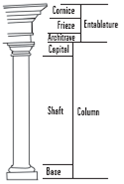
Capital: The uppermost part of a column or pilaster.
Casement: A hinged window frame that opens horizontally like a door.
Car Wash: A building, or portion thereof, where vehicles are washed with the use of a chain conveyor and blower, automated or mechanized washers or hand-held steam-cleaning device.
Cellar: A portion of a building partly underground which has less than one-half of its height measured from finished floor to finished ceiling above the average grade of the adjoining ground and not deemed a story.
Centerline of Street: The line surveyed and monumented by the City of Kennesaw or the Georgia State Highway Department or if a centerline has not been surveyed and monumented, that line running midway between the outside curbs or ditches of the street.
Certificate of Appropriateness: A document evidencing approval by the Historic Preservation Commission of the proposal to make a material change in the appearance of a designated historic property, area, building, structure, monument, streetscape, square or neighborhood located with a designated historic property zone.
Certified Local Government (CLG): A program that is a mechanism to formally involve local governments in the national historic preservation program. Most states have procedures that extend CLG status to communities that adopt a preservation ordinance and establish a preservation commission.
Channel: A natural or artificial watercourse with a definite bed and banks that conducts continuously or periodically flowing water.
Character: Those individual qualities of buildings, sites and districts that differentiate and distinguish them from other buildings, sites and districts.
Characterized by means describing the essential character or quality of an item. As applied in this article, no business shall be classified as a sexually oriented business by virtue of showing, selling, or renting materials rated NC-17 or R by the Motion Picture Association of America.
Charitable Collection Receptacle: Any unattended receptacle or container made of metal, steel, or any other material designed or intended for the collection and temporary storage of charitable donations of clothing, books, personal or household items of other goods, which shall not include containers for the purpose of collecting monetary donations.
Chattahoochee River Tributary Protection Area hereinafter referred to as the "protection area;" is defined and established to be the stream channel and all the land within the 1st Class stream boundary and 2nd Class stream boundary of all 1st Class and 2nd Class flowing tributaries of the Chattahoochee River downstream from Buford Dam and upstream from Peachtree Creek as indicated on the Chattahoochee Tributary Map.
Chattahoochee Tributary Map: That map entitled "Chattahoochee Tributary Map" adopted January 3, 1984, as amended, by the Mayor and City Council which identifies all 1st Class, and 2nd Class flowing streams within the municipal limits of the City of Kennesaw, Georgia, and which may identify any affected land within the 1st Class stream boundary and the 2nd Class stream boundary.
Check cashing establishments means any business, company, corporation, establishment, organization, private enterprise, shop, or store whose primary service is that of a check casher, as defined by O.C.G.A, as may be amended from time to time.
Chemical Oxygen Demand (COD): A measure of oxygen equivalent of that portion of the organic matter in a sample that is susceptible to oxidation by a strong chemical oxidant.
Chevron: A V-shaped decoration generally used as a continuous frieze or molding that is typical of the Art Deco style.
Child care learning center: Any place operated by a person, society, agency, corporation, institution, or group wherein are received for pay for group care less than 24 hours per day, without transfer of legal custody, seven or more children under 18 years of age; provided, however, that this term shall not include a private school which provides kindergarten through grade 12 education, meets the requirements of O.C.G.A. § 20-2-690, and is accredited by one or more of the entities listed in subparagraph (A) of paragraph (6) of O.C.G.A. § 20-3-519 and which provides care before, after, or both before and after the customary school day to its students as an auxiliary service to such students during the regular school year only.
Christmas Tree Sales: Retail sales of Christmas trees between Thanksgiving and December 26th.
Cigar shops, smoke shops and tobacco stores: Any establishment that provides tobacco, cigarette and specialized accessories used for smoking purposes for retail sale. All accessories and products are subject to State and local regulations.
Circuses and Carnivals: Provision of games, eating and drinking facilities, live entertainment, animal exhibitions or similar activities in a tent or other temporary structure for a maximum of seven days. This classification excludes events conducted in a permanent entertainment facility. Fire Code compliance is required.
Citizen Advisory Committee: A committee comprised of a diverse cross section of citizens serving as volunteers for the purpose of providing feedback and recommendations on proposals dealing with city policies, land use proposals and initiatives that affect the general public. This committee is structured and will follow all the appropriate rules of conduct for committees and meeting structure including taking of minutes and submittal of findings to the City of Kennesaw Departments, City Manager and Mayor and Council.
City: City of Kennesaw.
City Council: Mayor and City Council for the City of Kennesaw.
City Engineer: The official or consulting engineer to whom the city has delegated the responsibilities normally associated with this title.
City of Kennesaw or City: Refers to a municipal corporation chartered pursuant to the laws of the State of Georgia, any department, board, or commission of such city, any elected or appointed official, or any employee or designee thereof.
Clean Water Act: The Federal Water Pollution Control Act (33 U.S.C. § 1251 et seq.), and any subsequent amendments thereto.
Clapboard: A long, narrow board with one edge thicker than the other, overlapped to cover the outer walls of frame structures.
Classical: Of, or pertaining to, the architecture of ancient Greece and Rome.
Clinic: A building designed and used for the diagnosis and treatment of human patients, not containing overnight care facilities. A clinic shall include laboratory facilities in conjunction with normal clinic services.
Closed Function: An event not open to the general public which must have a written, limited guest list prepared at least 48 hours in advance of the date on which the closed function is to occur, and which occurs on property owned and maintained by the city. No pay-at-the-door guest or drop-ins are to be permitted. Alcoholic beverages may be served without charge and consumed at closed functions, but the offer and sale of alcoholic beverages at such functions is prohibited; except that a general admission fee permitting attendance at the closed function may be collected in advance.
Club or Lodge (noncommercial): Building or facilities owned or operated by a corporation, association, person or persons for social, educational or recreational purpose, but not primarily for profit or to render a service which is customarily carried on as a business.
Co-location: The placement of additional antennas or antenna array on an existing or approved tower or alternative structures; or the sharing of a common location by two or more approved providers of wireless communication services.
Collector street: A street which is designated as such on the major thoroughfare plan and which is intended to collect traffic from residential streets and direct it safely to secondary or major streets.
Column: A slender upright structure, generally consisting of a cylindrical shaft, a base and a capital; pillar: It is usually a supporting or ornamental member in a building. Also, a vertical support of round section that in classical architecture consists of three parts: base, shaft, and capital.
Combiner: A device that allows two or more wireless service providers to share an antenna or an antenna array by combining signals to be transmitted and separating signals being received.
Commercial Building Type: A definition based on the composition of a commercial building's primary façade. Most commercial façades are divided into major divisions or elements that are used to define the building type.
Commercial Filming, Limited: Commercial motion picture or video photography at the same location six or fewer consecutive days per quarter of a calendar year in residential districts or fewer than 15 days per quarter of a calendar year in nonresidential districts.
Commercial Indoor Recreation Uses: Indoor recreational uses such as bowling alleys, driving ranges, batting cages, shooting ranges, and the like.
Commercial Message: Any message that identifies, advertises, directs attention to or promotes a business; or any message that attempts to generate good will for a business; or any message that advertises a good, product, property or service or otherwise proposing a commercial transaction.
Commercial Outdoor Recreation Uses: Outdoor recreation uses such as baseball and softball batting cages, shooting ranges, miniature golf, putt-putt golf, driving range, and the like.
Commercial Recreation Restaurant: Any establishment which provides as a principal uses the combination of family-oriented recreation and on-premises dining where neither the recreation nor the on-premises dining is clearly accessory or incidental to the operation of the other. Any such establishment shall not be a sexually oriented business. For the purpose of this definition, recreation may include but is not limited to:
1.
Television and motion pictures;
2.
Sound and sight systems;
3.
Mechanical and/or electronic operated games;
4.
Animated mechanical devices and/or rides; and
5.
Live entertainment.
Commission (as pertaining to environmental protection): The state soil and water conservation commission.
Community Activity Center: A future land use category to provide for areas that can meet the immediate needs of several neighborhoods or communities. Typical land uses for this area include low to mid-rise office buildings and department stores.
Community Fair: A festival or fair conducted wholly within public areas owned by a local government, provided that any activity is conducted at least 200 feet from any property line; any event shall not exceed 21 days.
Community Retail Uses: Retail commercial stores and services which are assigned to serve several neighborhoods making up a community such as: neighborhood retail uses larger than 6,000 square feet, department stores, discount houses, mini-malls, strip shopping centers, home improvement stores, wholesale outlets, clothing and apparel-marts, indoor flea markets, antique malls, sporting goods stores, and the like.
Compatible: Not detracting from surrounding elements, buildings, sites or structures; appropriate given what already exists.
Component: An individual part of a building, site or district.
Component: Any assembly, subassembly, or combination of parts for use as a part of a building, which may include structural, electrical, plumbing, mechanical, and fire protection systems and other systems affecting health and safety.
Condominium (building): Individual ownership of units in a multifamily structure, together with joint ownership of common areas of the building and grounds.
Confined Animal Feeding Operation: A building or fenced enclosure designed and used for the holding or fattening of animals in preparation for market.
Conservation Easement: A portion of land set aside in its natural state and preserved as open space in perpetuity.
Construction Activity: Activities subject to the Georgia Erosion and Sedimentation Control Act or NPDES General Construction Permits. These include construction projects resulting in or involving land disturbance. Such activities include but are not limited to clearing and grubbing, grading, excavating, and demolition.
Consumer Fireworks Retail Sales Facility: as defined by NFPA 1124, the structure is used primarily for the retail display and sale of consumer fireworks to the public. If the amount is greater than 1,000 (gross) pounds, then the occupancy must meet special sprinkler system and other special requirements for an H-3 occupancy under the 2012 International Fire Code (IFC) and International Building Code (IBC).
Contemporary: Of the current period; modern.
Context: The setting in which a historic element or building exists.
Contiguous: Next to, abutting, or touching and having a boundary, or portion thereof, which is common or coterminous.
Contributing: Contributes to the architectural or historic significance of a historic district. (A "contributing building" in a historic district is one that may be of limited individual significance but nevertheless functions as an important component of the district.)
Convenience Store: A retail establishment whose primary business is the sale of pre-packaged or unprepared food and grocery items which may sell fuel products, household items, or tobacco products and other goods commonly associated with the same.
Convenience Food Store with Self-service Fuel Sales: Any retail establishment offering for sale automotive fuels, pre-packaged food products, beverages, household items, and other goods commonly associated with the same. Further, there shall be no automotive repairs done on-site.
Conviction: Adjudication of guilt, plea of guilty, plea of "nolo contendere" or the forfeiture or a bond when charged with a crime, but shall not include a discharge under provisions of what is commonly called the State of Georgia First Offender Act.
Cooling Water: The water discharged from any use such as air conditioning, cooling or refrigeration, or to which the only pollutant added is heat.
Copy: Refers to the wording, designs and other advertising display on the surface of a sign.
Corbel: A projection or one of a series of projections, each stepped progressively farther forward with increasing height; anchored in a wall, story, column, or chimney.
| Corinthian Order: The slenderest and most ornate of the classical Greek orders of architecture, characterized by a slim fluted column with bell-shaped capital decorated with stylized acanthus leaves. |  |
Cornice: The projection at the top of a wall. The top course or molding of a wall when it serves as a crowning member.
Corridor: All land within the buffer areas established adjacent to reservoirs or perennial streams within a water supply watershed.
Cottage Food Operator: A person who produces Cottage Food Products only in the Home Kitchen of that person's primary domestic residence and only for sale directly to the Consumer. The definition of terms relating to Cottage Food Operators as set forth in the regulations of the Georgia Department of Agriculture (Cottage Food Regulations - Rules 40-7-19 and as amended from time to time) are hereby adopted and incorporated as if fully set forth herein.
Cover: Vegetative or earth materials that provide natural shelter for animal life, or the factors that provide such shelter.
Critical Root Zone (CRZ): The minimum area beneath a tree which must be left undisturbed in order to preserve a sufficient root mass to give a tree a reasonable chance of survival. The critical root zone (CRZ) will typically be represented by a circle centered on the tree's trunk with a radius equal in feet to one and a quarter the number of inches of the trunk diameter. Example: The CRZ radius of a 20-inch diameter tree is 25 feet.
Crosswalk: A right-of-way within a block dedicated to public use for pedestrian use only and is so designed as to provide access to adjacent streets or lots.
Cul-de-Sac: A street having one end open to traffic and being permanently terminated within the plat by a vehicular turnaround.
Cultural Facility (private): Private building or facility such as art galleries, museums, legitimate theaters (other than motion picture or video), libraries, and other uses similar in character above.
Customer: Any owner of premises receiving any city utility system service or any end-user thereof, including any and all persons, natural or artificial, including any individual firm, association or trust and any municipal or private corporation organized or existing under the laws of this or any other state or country.
Cut (as pertaining to earthwork): A portion of land surface or area from which earth has been removed or will be removed by excavation; the depth below original ground surface to excavated surface; also known as excavation.
Dam: Means any artificial barrier, including appurtenance works, which impounds or diverts water, and which either:
1.
Is 25 feet or more in height from the natural bed of the stream or watercourse measured at the downstream tow of the barrier, or from the lowest elevation of the outside limit of the barrier if it is not across the stream channel or watercourse, to the maximum water storage elevation; or
2.
Has an impounding capacity at maximum water storage elevation of 50 acre-feet or more; excepting the following:
a.
Any artificial barrier which is not in excess of six feet in height, regardless of storage capacity, or which has a storage capacity at maximum water storage elevation not in excess of 15 acre-feet regardless of height;
b.
Any artificial barrier constructed by the United States Soil Conservation Service, or any other department or agency of the United States Government when such department or agency has designed or approved plans, has supervised construction, maintained the program of inspection, provided however, that this exception shall cease when the supervising federal agency relinquishes authority for the operation or maintenance of such artificial barrier;
c.
Any artificial barrier licensed by the Federal Energy Regulatory Commission or for which a license application is pending with the Federal Energy Regulation Commission; or
d.
Any artificial barrier classified by the state soil and water conservation committee as a dam where improper operation or dam failure would not be expected to result in loss of human life.
Dam Break Flood Zone: The area within the flood contour elevations subject to flooding as designated by the city engineer based upon information obtained from the U.S. Corp of Engineers or other federal, state, or county agencies, or local hydraulic studies undertaken as a result of any seepage or failure of any dam.
Dead storage: Storage of goods partly not in use and not associated with any principal commercial or manufactory use.
Dead-end street: A street having only one end open for access to another street, the other end being abruptly terminated with no turnaround.
Deck: A roofless accessory attached or detached platform without exterior walls, generally constructed of wood, which adjoins a residence. Rails or safety features shall not be deemed to be exterior walls.
Demolition: Any act or process that destroys a structure in part or in whole.
Density:
1.
The overall intensity of land use for the total project.
2.
Residential density is the number of housing units permitted per acre in the zoning district involved in accordance with the terms of the zoning ordinance or as authorized under conditional zoning by the Mayor and City Council. The maximum residential density per developable acre authorized for R-40, R-30, R-20, R-15, R-12, R-10, PUD-R, RA-4, RA-5, RA-6 RM-8, RM-12, RM-16, FST and MHP zoning districts are set forth in Chapter Four of the Unified Development Code. These maximums could be lowered by conditional zoning by the Mayor and City Council. A developable acre shall not include any part or parts of rivers, streams, floodplains and natural lakes which are not the result of manmade dams. The maximum allowable dwelling units per acre shall in no event exceed any of the following:
a.
The maximum set forth in article VIII of this appendix for such zoning district;
b.
The maximum dwelling units per acre which can be constructed without violating any other restrictions, limitations, and/or requirements of such zoning district or the maximum authorized under conditional zoning by the Mayor and City Council.
Density Factor: A unit of measure to prescribe the calculated basal area required for replacement or as existing tree coverage on a site.
Dentil: A small rectangular block used in a series below the cornice.
Department (as pertaining to environmental protection): The Georgia Department of Natural Resources.
Design Standards: The "design standards" manual provides specific development and rehabilitation standards for all new construction, as well as rehabilitation, reconstruction of historic properties within the Kennesaw Historic District. Also applies to the City-wide Design Standards.
Designation or Designated: A decision by the Mayor and City Council, wherein a property or district proposed for preservation is located, to designate such property or district as a "historic property" or as a "historic district."
Designated Recycling Collection Location: Metal or heavy-duty plastic containers, bins or dumpsters designed for short-term holding of pre-bagged recyclable items such as tin, aluminum, glass, and paper (no perishable or food items allowed) for scheduled minimum monthly pickup with no on-premises sorting. The center must be maintained in a safe, clean, neat and sanitary fashion.
1.
Such location shall be visually screened and maintained;
2.
Such location shall be within the building setbacks unless otherwise approved by the zoning administrator or his/her designee due to topography, safety, internal traffic flow, site distance, or for other site-related circumstances not created by the property owner.
Detention: The temporary storage of storm water runoff in a storm water management facility for the purpose of controlling the peak discharge.
Detention Facility: A detention basin or structure designed for the detention of storm water runoff and gradual release of stored water at controlled rates.
Developer: A person who undertakes land development activities.
Development: A land development or land development project.
Development or Single Development: Any project or group of related projects constructed or planned for construction on a single parcel or on contiguous parcels under single ownership.
Development Agreement: A written agreement between the City of Kennesaw and a property owner and/or his representative that sets forth obligations, conditions, timing, funding, or other land development project requirements.
Development of Regional Impact: Large scale developments that are likely to have regional effects beyond the City's jurisdiction.
Development Plan: Any plan as determined by the zoning administrator which shows substantial information and intent to develop the property affected in a specific manner.
Diameter: Diameter breast-height/DBH: The standard of tree size (for trees existing on a site). The tree trunk is measured at a height of four and a half feet above the ground. If a tree splits into multiple trunks below four and a half feet, measure the trunk at its most narrow point beneath the split.
Directional: Refers to providing instructions for travel to or indicating the location of a place or event, whether by words, arrows or other symbols.
Director (as pertaining to environmental protection): The director of the Environmental Protection Division of the Georgia Department of Natural Resources.
Distance: The measurement in lineal feet from the closest point of the sign to the nearest property line or to the closest point of another sign, as the case may be.
Distiller: A manufacturer of distilled spirits.
Division (as pertaining to environmental protection): The Environmental Protection Division of the Georgia Department of Natural Resources.
Doric Order: A classical order most readily distinguished by its simple, unornamented capitals and tablets with vertical grooving, called triglyphs, set at regular intervals in the frieze.
Dormer or Dormer Window: A window set upright in a sloping roof. The term is also used to refer to the roofed projection in which this window is set.
Double-Hung Sash Window: A window with two sashes, one above the other, arranged to slide vertically past each other.
Downtown Activity Center: A future land use category that is designed to reinforce the unique role and character of the City of Kennesaw downtown area.
Drainage Easement: An easement appurtenant or attached to a tract or parcel of land allowing the owner of adjacent tracts or other persons to discharge storm water runoff onto the tract or parcel of land subject to the drainage easement.
Drainage Structure: A device composed of a virtually non-erodible material such as concrete, steel, plastic or other such material that conveys water from one place to another by intercepting the flow and carrying it to a release point for storm-water management, drainage control, or flood control purposes.
Drip Line: An imaginary vertical line that extends from the outermost branches of a tree's canopy to the ground.
Drive-in Establishment: An establishment which is designed to provide, either wholly or in part, service to customers while in their automobiles parked upon the premises.
Dwelling: A building designed, arranged or used for permanent living and/or sleeping quarters (excludes mobile home).
Dwelling, Multifamily: A building designed for three or more multifamily dwelling units.
Dwelling, Single-Family: A building designed or arranged to be occupied by one family only.
Dwelling, Two-Family (duplex): A building designed or arranged to be occupied by two families living independently of each other.
Dwelling Unit: One or more rooms physically arranged so as to create an independent housekeeping establishment for occupancy by one family with separate toilets and facilities for cooking and sleeping.
Easement: A grant by the property owner for the use by the public, a corporation, or persons of a strip of land for specific purposes.
Eating and drinking establishment: Retail establishments selling food and drink for consumption on the premises, including lunch counters and refreshment stands selling prepared foods and drinks for immediate on-site consumption.
Eave: The underside of a sloping roof projecting beyond the wall of a building.
Economically and Technically Feasible and Viable: Refers to the capability of being provided:
1.
Through technology which has been demonstrated in actual applications (not simply through tests or experiments) to operate in a workable manner; and
2.
In a manner which has a reasonable likelihood of generating a reasonable profit or other financial benefits, when measured over the term of the lease.
Electronic Display: Shall mean a message displayed through the use of LED, LCD, plasma, or other similar type of panels or screens.
Element: An individual defining feature of a building, structure, site or district.
Elevated Building: A non-basement building which has its lowest elevated floor raised above the ground level by foundation, walls, shear walls, posts, piers, pilings, or columns.
Elevation: A mechanically accurate, "head-on" drawing of a face of a building or object, without any allowance for the effect of the laws of perspective. Any measurement on an elevation will be in a fixed proportion, or scale, to the corresponding measurement on the real building.
Engaged Column: A column partially built into a wall, not freestanding.
Entablature: The horizontal part of an architectural order, supported on columns, composed of architrave, frieze, and cornice.
Entry wall sign: Any single faced sign attached to or erected and confined within the limits of an exterior wall generally along the perimeter of a development.
Environmental Protection Agency (EPA): The United States Environmental Protection Agency, or where appropriate the term may also be used as a designation for the administrator or other duly authorized official of such agency.
Erosion: The process by which land surface is worn away by the action of wind, water, ice or gravity.
Erosion and Sedimentation Control Plan: A plan for the control of soil erosion and sedimentation resulting from a land-disturbing activity.
Escort Bureau, Introduction Services: Any business, agency or persons who, for a fee, commission, hire, reward, profit or other consideration, furnishes or offers to furnish names of persons, or who introduces, furnishes or arranges for persons who may accompany other persons to or about social affairs, entertainments or places of amusements, or who may consort with others about any place of public resort or within any private quarters.
Ex Parte Communication: Some form of communication between one party to a proceeding (e.g., an applicant for a permit) and a public official with some responsibility for making a decision affecting that proceeding occurring outside the formal decision-making process and without the knowledge of the other party to the proceeding.
Existing Construction: Any structure for which the "start of construction" commenced before August 1, 1980.
Existing Manufactured Home Park or Subdivision: A manufactured home park or subdivision for which the construction of facilities for servicing the lots on which the manufactured homes are to be affixed (including at a minimum the installation of utilities, the construction of streets, and the final site grading or the pouring of concrete pads) is completed before August 1, 1980.
Expansion to an Existing Manufactured Home Park or Subdivision: Refers to the preparation of additional sites by the construction of facilities for servicing the lots on which the manufactured homes are to be affixed, including the installation of utilities, the construction of streets, and either final site grading or the pouring of concrete pads.
Explicit media outlet means any commercial establishment which has an inventory of goods that is composed of at least 50 percent of books, pamphlets, magazines, or other printed publications, films or other media which depict sexually explicit nudity or sexual conduct.
Extended Detention: The detention of storm water runoff for an extended period, typically 24 hours or greater.
Extended Stay Hotel or Motels: Any hotel or motel in which fifty percent or greater of all guest rooms have facilities for both the storage and preparation of food and which are designed or utilized for weekly or monthly occupancy.
Exterior Architectural Appearance: Architectural character, general composition, and general arrangement of the exterior of the structure; including, but not limited to, the kind, color, and texture of the building material and type and character of all windows, doors, light fixtures, signs, and appurtenant elements.
Exterior Environmental Features: All those aspects of the landscape or the development of the site including but not limited to walls, fences, signs, light fixtures, steps or appurtenant elements thereof including any improvement, grading or alteration of the land.
Exterior Environmental Features: All those aspects of the landscape or the development of the site including but not limited to walls, fences, signs, light fixtures, steps or appurtenant elements thereof including any improvement, grading or alteration of the land.
Extreme Flood Protection: Measures taken to prevent adverse impacts from large low-frequency storm events with a return frequency of 100 years or more.
Façade: That portion of any exterior elevation on the building extending from grade to top of the parapet, wall, or eaves and the entire width of the building elevation.
False Front: A front wall which extends beyond the sidewalls of a building to create a more imposing façade.
Fall zone: An area equal to 133% of the height of a structure in every direction.
Family: One or more related persons by blood, legal adoption, or marriage or not more than three (3) persons not related, occupying a dwelling and living as a single housekeeping unit, as distinguished from persons occupying a boardinghouse, rooming house, hotel, or Purpose Built Student Housing as herein defined. Maximum residential occupancy for a residential dwelling unit will be calculated by the number of residents per square foot of floor space as per the currently adopted International Property Maintenance Code.
Family child care learning home: means a private residence operated by any person who receives therein for pay for supervision and care less than 24 hours per day, without transfer of legal custody, at least three but not more than six children under 13 years of age who are not related to such person and whose parents or guardians are not residents in the same private residence.
Fanlight: A window, often semi-circular, over a door, with radiating muntins suggestive of a fan.
Farm Winery: A domestic manufacturer of wine in quantities of less than 100,000 gallons of wine per calendar year, that is licensed by the state pursuant to O.C.G.A. 3-6-21.1, or as may be amended from time to time. Provided a license is issued as required by this chapter, a farm winery is authorized to sell wine by the package, by the drink and operate a wine tasting facility on the premises of the farm winery without additional license requirements, except as is required by state or federal law or The tasting room shall be limited to a single room. Licensed premises means the premises for which the farm winery license is issued or property located contiguous to the farm winery and owned by the winery.
Fast food restaurant: An establishment whose principal business is the sale of pre-prepared or rapidly prepared food directly to the customer in a ready-to-consume state for consumption either within the restaurant building, in cars, on the premises, or off the premises.
Feather flag sign: A sign other than a flag or banner without or without characters, letters or illustrations or ornamentation applied to cloth, paper, plastic or fabric affixed to a pole or poles that erected by the insertion of a stake into the ground or other optional base. A feather flag sign includes but is not limited to flags customarily referred to by the sign industry as blade flags, rectangle flags, teardrop flags or swooper flags.
Fee Simple: The owner is entitled to the entire property with unconditional power of disposition during his life and which descends to his heirs and legal representatives upon his death intestate.
Fenestration: The arrangement and design of windows in a building.
Fill (as pertaining to earthwork): A portion of land surface to which soil or other solid material has been added; the depth above the original ground.
Final Plat: A finished drawing or drawings of the subdivision showing completely and accurately all legal and engineering information and certification necessary for recording. The finished drawing or drawings may consist of one or more drawings of the subdivision which together form the final plat, all of which must comply with the requirements of this chapter.
Finished Grade: The final elevation and contour of the ground after cutting or filling and conforming to the proposed design.
Flag: A piece of fabric or other flexible material solely containing distinctive colors, patterns, standards, words or emblems used as the symbol of an organization or entity.
Flag mounted wall sign: A sign that is affixed perpendicular to a wall.
Flashing (as pertains to lighting): Illumination which is not kept constant in intensity at all times when in use and which exhibits sudden or marked changes in lighting effects. The term "flashing" excludes illuminated signs which indicate only time and/or temperature, provided that such time/temperature signs do not change or alternate messages more than 12 times a minute.
Floatable Oil: Oil, fat or grease in a physical state such that it will separate by gravity from wastewater by treatment in an approved pretreatment facility. Wastewater shall be considered free of floatable fat if it is properly pretreated and the wastewater does not interfere with the collection system.
Flood or Flooding: A general and temporary condition of partial or complete inundation of normally dry land areas from:
1.
The overflow of inland or tidal waters; or
2.
The unusual and rapid accumulation or runoff of surface waters from any source.
Flood Hazard Boundary Map (FHBM): An official map of a community, issued by the Federal Insurance Administration, where the boundaries of areas of special flood hazard have been defined as Zone A.
Flood Insurance Rate Map (FIRM): An official map of a community, issued by the Federal Insurance Administration, delineating the areas of special flood hazard and/or risk premium zones applicable to the community.
Flood Insurance Study (FIS): The official report by the Federal Insurance Administration evaluating flood hazards and containing flood profiles and water surface elevations of the base flood.
Floodplain or Flood-prone Area: Any land area susceptible to being inundated by water from any source (see definition of "flooding")
Floodway or Regulatory Floodway: The channel of a river or other watercourse and the adjacent land areas that must be reserved in order to discharge the base flood without cumulatively increasing the water surface elevation more than a designated height.
Floor Area, Gross: The floor area within the inside perimeter of the exterior walls of the building under consideration, exclusive of vent shafts and courts, without deduction for corridors, stairways, closets, the thickness of interior walls, columns or other features. The floor area of a building, or portion thereof, not provided with surrounding exterior walls shall be the usable area under the horizontal projection of the roof or floor above.
Floor Area, Net: The floor area within a building being heated by any equipment or appliance.
Floor Area Ratio: The ratio of floor area permitted on a zoning lot to the size of the lot:
Floor Area/Lot Area = Floor Area Ratio.
Foot Candle: A quantitative unit measuring the amount of light cast on to a given point, measured as one (1) lumen per square foot.
Footprint: The horizontal area as seen in plan, measured from the outside of all exterior walls and supporting columns. It includes residences, garages, covered carports, and accessory structures, but not trellises, patios, and areas of porch, deck, and balcony less than 30 inches from finished grade.
Fraternity or Sorority House: A dwelling maintained exclusively for members affiliated with an academic or professional college or university or other recognized institution of higher learning.
Freestanding Sign: A self-contained sign which is wholly independent of any building or other structure, including but not limited to ground based monument sign but not including any off-premises outdoor advertising sign, any canopy or awning sign located within the buildable area of the lot, temporary signs, flags, standard information sign, wall sign, window sign, menu sign, signs on accessory uses, or suspended sign.
| Frieze: The middle horizontal member of a classical entablature, above the architrave and below the cornice. | 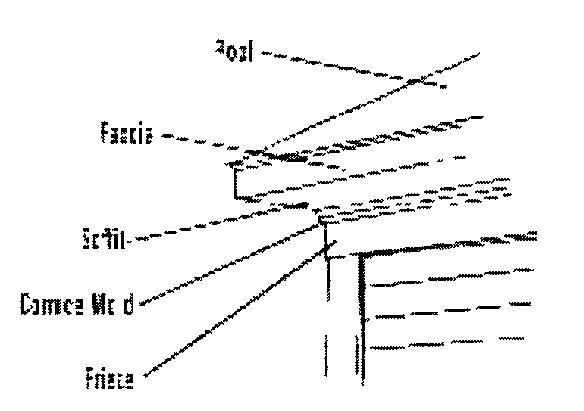 |
| Frontage, Lot: The distance for which the front property line of the lot and the street line are coincident. | |
| Functionally Dependent Use: A use which cannot perform its intended purpose unless it is located or carried out in close proximity to water. |
Functions (as pertaining to wetlands): The beneficial roles that wetlands serve, including: storage, conveyance and attenuation of floodwater and storm water; protection of water quantity and reduction of erosion; habitat for wildlife, including rare, threatened and endangered species; food chain support for a wide variety of wild life and fisheries; educational, historical and archeological value protection; and scenic, aesthetic and recreational amenities.
Gable: The portion, above eave level, of an end wall of a building with a pitched or gambrel roof. In the case of a pitched roof this takes the form of a triangle. The term is also used sometimes to refer to the whole end wall.
Garage: A structure or any portion thereof in which one or more automobiles are housed or kept, not including exhibition or showrooms, or storage of cars for sale.
Garbage (as pertaining to Utilities): The animal and vegetable waste resulting from the handling, preparation, cooking and serving of foods.
Generalized Wetland Map: A map showing the general locations of wetlands within the jurisdiction of the City of Kennesaw as shown on the National Wetlands Inventory (NWI) map.
Golf Course: A tract of land [of] not less than 115 acres dedicated for playing the game of golf which is open to the private club's membership and their guests and special events. The par shall not be less than 68 the men's tees as governed by the United States Golf Association (USGA). Further, the golf course shall not measure less than 5,550 yards as governed by the USGA.
Grade: An average level of the finished surface of the ground adjacent to the exterior walls of the building or structure.
Grading: Altering the shape of ground surfaces to a predetermined condition; this includes stripping, cutting, filling, stockpiling and shaping or any combination thereof and shall include the land in its cut or filled condition.
Grading Permit: A permit issued on-site by the site inspection staff to allow the commencement of any clearing, grubbing and/or grading. This building permit is issued only after a land disturbance permit has been issued and all erosion control and tree protection measures have been installed in accordance with the approved plan.
Green Infrastructure: Is an approach to wet weather management that is cost-effective, sustainable, and environmentally friendly. Green Infrastructure management approaches and technologies infiltrate, evapotranspire, capture and reuse stormwater to maintain or restore natural hydrologies.
Green Space or Open Space: Permanently protected areas of the site that are preserved in a natural state.
Grocery Store: A retail establishment whose primary function is the sale of packaged or unprepared food and grocery items for consumption off the premises and whose annual gross sales of alcoholic beverages do not exceed five percent of its total gross sales.
Ground Based Monument Sign: A self-contained sign permanently attached to the ground which is wholly independent of any building or other structure. The sign must be a solid structure. No open spaces which allow a direct line of sight from one side of the sign to the other are permissible in the area located beneath the widest part of the sign face where the message is located in a direct vertical plane to the ground. By way of example and without limitation the sign cannot be attached to, resting upon, or supported by any pillars, columns, pylons which allow for open spaces or direct line of sight from one side of the sign to the other beneath the widest area of the sign face in a direct vertical plane to the ground.
Ground Elevation: The original elevation of the ground surface prior to cutting or filling.
Group Home: A dwelling unit, operated by an affiliate of a national, regional, state or county organization that has a philanthropic mission, who live together as a single housekeeping unit and which has a long term, family-like environment wherein staff persons provide care, education and participation in community activities, under a structured and scheduled plan with the primary goal of enabling the residents to live as independently as possible in order to reach their maximum potential. A group home may include a home for the disabled. As used in this subsection, the term "disabled" shall mean:
(1)
Having a physical or mental impairment that substantially limits one or more of such person's major life activities;
(2)
Having a record of having such an impairment; or
(3)
Being regarded as having such impairment.
However, "disabled" shall not include persons who currently use illegal controlled substances, persons who have been convicted of the illegal manufacture or distribution of controlled substances, sex offenders, and juvenile offenders or persons with or without disabilities who present a direct threat to the persons or property of others. The term "group home" shall not include a halfway house, a treatment center for alcoholism or drug abuse, a work release facility for convicts or ex-convicts, a home for the detention and/or rehabilitation of juveniles adjudged delinquent or unruly and placed in the custody of the state, or other housing facilities serving as an alternative to incarceration. The term "group home" shall also not allow the use of a dwelling as an apartment or duplex. A group home shall not allow the use of a dwelling as a home for individuals on parole, probation, or convicted and released from incarceration, for any crimes including child molestation, aggravated child molestation, or child sexual abuse, as defined in O.C.G.A. § 16-6-4, as may be amended from time to time, or individuals required to register as sex offenders pursuant to O.C.G.A. § 42-1-12, as may be amended from time to time.
Growing Season: A period of no less than 12 months during which there are at least three contiguous months of dormancy followed by a spring leafing.
Growler Shop: Any establishment selling only malt beverages, craft beer, wine and/or hard cider and holding either a package license or a package/pouring license that allows for both package sales of malt beverages, craft beer and/or hard cider and limited consumption of malt beverages, craft beer, wine and/or hard cider on the premises pursuant to Section 6-111 of the City Code. Growler shops shall not be required to have more than one entrance to the establishment in order to hold a pouring/package license and shall not be required to serve or sell food in addition to the service or sales of alcohol.
Grubbing: The removal of understory vegetation from the site, provided that no trees greater than six inches in diameter as measured at the base shall be removed.
Halfway House: Any dwelling used as a residence for the purpose of rehabilitating individuals in order to transition back into the community and housing any of the following: individuals being treated for drug dependency, on parole, probation, or serving a criminal sentence on condition of house arrest.
Hardwood Tree: Any tree that is not coniferous (cone bearing). This definition is based on the colloquialism, and does not necessarily reflect any true qualities of the tree.
Hazardous Waste: Solid and liquid wastes or combinations thereof that may cause or contribute to an increase in mortality or an increase in serious, irreversible or incapacitating reversible illness or which pose a substantial threat to human health when improperly handled.
Header: The end of a brick, sometimes glazed.
Health Department: Refers to the county health department.
Heavy Manufacturing Establishment: Manufacturing establishments, other than those classified as light manufacturing, including those involving the conversion of raw materials into usable finished products, provided that manufacturing that will generate liquid waste from the manufacturing process or air pollutants shall comply with anti-pollution standards by the state or county.
Height: The measure in linear feet from the highest point on an object to the unaltered elevation of the ground at the base of the object or directly beneath the object. At the election of the permit holder, the height of a sign may be measured from the highest point on the sign to the level of the nearest road from which the sign is intended to be viewed. When referring to a tower or other structure, a distance measured from the finished grade of the parcel to the highest point on the tower or other structure, including the base pad and any antenna.
High Density Residential (land use): A future land use category that provides for locations where housing at densities of four (4) to sixteen (16) dwelling units per acre is appropriate. Density on any particular site should be sensitive to surrounding areas and should offer a reasonable transition of land use. The higher end of the range, sixteen (16) units per acre, should be limited to major highway corridors.
High Style: A completely authentic or academically correct interpretation of an architectural style; a "textbook" example of one particular style and not a composition of several different styles.
Highest Adjacent Grade: The highest natural elevation of the ground surface, prior to construction, adjacent to the proposed foundation of a building.
Historic: Refers to a property or resource that must be at least 50 years old to be considered "historic". Ordinarily cemeteries, birthplaces, graves of historical figures, properties owned by religious institutions or used for religious purposes, structures that have been moved from their original locations, reconstructed historic buildings, properties primarily commemorative in nature, and properties that have achieved significance within the past 50 years shall not be considered "historic" nor eligible for the National Register of Historic Places. However, such properties will qualify if they are integral parts of districts that do meet the criteria or if they fall within the following categories:
1.
A religious property deriving primary significance from architectural or artistic distinction or historical importance; or
2.
A building or structure removed from its original location but which is primarily significant for architectural value, or which is the surviving structure most importantly associated with a historic person or event; or
3.
A birthplace or grave of a historical figure of outstanding importance if there is no other appropriate site or building directly associated with his or her productive life; or
4.
A cemetery which derives its primary significance from graves of persons of transcendent importance, from age, from distinctive design features, or from association with historic events; or
5.
A reconstructed building when accurately executed in a suitable environment and presented in a dignified manner as part of a restoration master plan, and when no other buildings or structure with the same association has survived; or
6.
A property primarily commemorative in intent if design, age, tradition, or symbolic value has invested it with its own exceptional significance; or
7.
A property achieving significance within the past 50 years if it's of exceptional importance.
Historic Building: Any building located in the City of Kennesaw Historic District that is designated by the Historic Preservation Commission as being "historic" pursuant to Section 4.02.01E of the Unified Development Code, as amended from time to time.
Historic District: A zoning district which possesses a significant concentration, linkage, or continuity of sites, buildings, structures, or objects united historically or aesthetically by plan or physical development. (college campuses, central business districts, residential areas, commercial areas, large forts, industrial complexes, civic centers, rural villages, canal systems, collections of habitation and limited activity sites, irrigation systems, large farms, ranches, estate, or plantations, transportation networks, and large landscaped parks).
Historic Landmark or Property (ies) or historical landmark or property (ies): Any site (including significant trees or other plant life located thereon), building, or structure or particular historic or aesthetic significance to the city, the state or the nation. Landmarks include sites, buildings, or structures where cultural, political, spiritual, economic, social or artistic history of the community, state or nation is reflected or exemplified or which are identified with historic personages or with important events in local, state or national history, or which embody the distinguishing characteristics of an architectural specimen, inherently valuable for a representation of a period, style or method of construction, or a notable work of construction, or a notable work of a master designer or architect whose individual genius influenced his age, or as determined by the Historic Preservation Commission or Museum and Agency Director.
Historic Object: A term ("object") used to distinguish buildings and structures from those constructions that are primarily artistic in nature or are relatively small in scale and simply constructed. Although it may be, by nature or design, movable, an object is associated with a specific setting or environment. (Sculpture, monuments, boundary markers, statuary, and fountains).
Historic Preservation: Identification, evaluation, recordation, documentation, curation, acquisition, protection, management, rehabilitation, restoration, stabilization, maintenance, and reconstruction, or any combination of the foregoing activities.
Historic Preservation Jurisdiction: All properties within but not limited to the properties, buildings or sites or districts as designated by the City of Kennesaw and/or further designated on the historic register of the city, state or nation.
Historic Restoration: Requires that the re-creation duplicate the appearance at some previous point in time as closely as current scholarship allows.
Historic Significance: The importance of a property to history, architecture, archeology, engineering, or culture of a community, state, or the nation. It is achieved through association with events, activities or patterns; association with important persons; distinctive physical characteristics of design, construction, or form; potential to yield important information.
Historic Site: Refers to the location of a significant event, a prehistoric or historic occupation or activity, or a building or structure, whether standing, ruined, or vanished, where the location itself possesses historic, cultural, or archeological value regardless of the value of any existing structure (habitation sites, funerary sites, rock shelters, village sites, hunting and fishing sites, ceremonial sites, pertroglyphs, rock carvings, gardens, grounds, battlefields, ruins of historic buildings and structures, campsites, trails, areas of land, cemeteries, designed landscapes, and natural features, such as springs and rock formations, and land areas having cultural significance).
Historic Structure: Refers to any structure that is:
1.
Listed individually in the National Register of Historic Places or that has been determined eligible for individual listing on the National Register of Historic Places as determined by the Secretary of the Interior of the United States, for significance at the local, state or national level.
2.
Determined to be a contributing building, site, structure, or object in a historic district listed on the National Register of Historic Places or a contributing building, site, structure, or object in a historic district that has been determined eligible for listing on the National Register of Historic Places as determined by the Secretary of the Interior of the United States for significance at the local, state, or national level.
3.
Listed on the Georgia Register of Historic Places either individually or as a contributing element in a historic district. The Georgia Register of Historic Places uses the same criteria and documentation procedures as the National Register of Historic Places. Properties listed in the National Register are automatically listed in the Georgia Register. Conversely, properties in the Georgia Register are not included in the National Register unless they are separately nominated. The Georgia Register is the state designation referenced by state laws and regulations regarding state grants, property tax abatements, the Georgia Environmental Policy Act, the State-owned Historic Properties Act, and other state preservation and environmental programs.
4.
Listed on a Local Inventory of Historic Places either individually or as contributing element in a historic district. The City of Kennesaw uses the same criteria and documentation procedures as the National Register of Historic Places.
Historic or Scenic Views: Geographic areas in the City of Kennesaw which have been formally designated on the National Historic Register; have been included in any nature preserve or scenic preservation efforts; have been identified in the City of Kennesaw Comprehensive Plan; or have sufficient historic or scenic merit as determined by the Mayor and Council or by the Kennesaw Historic Preservation Commission. A scenic view may be from a stationary viewpoint or be seen as one travels along a roadway or path.
Holding Tank Waste: Any waste from holding tanks such as vessels, chemical toilets, campers, trailers, septic tanks, and vacuum pump tank trucks.
Home Occupations: Home Occupation means those occupations which are customarily performed in a small area of a residence due to the low intensity nature of such uses and which have any one of the following characteristics associated with its operation:
i.
The home occupation requires customers to frequent the residence;
ii.
The home occupation requires nonrelated employees to work at the residence;
iii.
The home occupation involves the creation, manufacturing, or producing of a product at the residence and such product(s) are intended for sale;
iv.
The home occupation is a cottage food operator;
v.
the home occupation involves the regular collection, purchase, storage, or distribution of products (new or used) at the residence and such product(s) are intended for sale.
vi.
A Land Use permit approval is required.
Hookah: A water pipe of Middle Eastern origin used to smoke tobacco and fruit flavorings. The apparatus utilizes a glass base with a hose and grommet assembly.
Hookah Bars: Similar in use to traditional bar serving alcohol. The hookah bar sells flavored tobacco that is smoked in hookahs. Subject to State and local laws regulating bar operations and smoking and tobacco use.
Hospital: A building or portion thereof designed or used for therapeutic treatment of bed patients who are physically or mentally ill.
Hotel: A facility offering transient lodging for at least 15 guests, and offered to the public for compensation and in which ingress and egress to and from all rooms are made through an inside lobby or office supervised by a person in charge at all hours.
Hotspot: An area where the use of the land has the potential to generate highly contaminated runoff, with concentrations of pollutants in excess of those typically found in storm water.
Housing Official: The building official or his or her authorized representative.
Human Excreta: The bowel and kidney discharges of human beings.
Hydric Soils: Soils that form as a result of saturated soil conditions. A list of these soils is maintained by the Soil Conservation Service.
Hydrologic Soil Group (HSG): A Natural Resource Conservation Service classification system in which soils are categorized into four runoff potential groups. The groups range from group "A" soils, with high permeability and little runoff produced, to group D soils, which have low permeability rates and produce much more runoff.
Hydrophytic Vegetation: Macrophytic plants tolerant of or dependant on saturated soil conditions.
Illicit Discharge: Any direct or indirect non-storm water discharge to the (municipal) separate storm sewer system, except as exempted in Chapter 3.
Illegal Connection: Refers to either of the following:
(1)
Any pipe, open channel, drain or conveyance, whether on the surface or subsurface, which allows an illicit discharge to enter the storm drain system including but not limited to any conveyances which allow any non-storm water discharge including sewage, process wastewater, and wash water to enter the storm drain system, regardless of whether such pipe, open channel, drain or conveyance has been previously allowed, permitted, or approved by an authorized enforcement agency; or
(2)
Any pipe, open channel, drain or conveyance connected to the (municipal) separate storm sewer system which has not been documented in plans, maps, or equivalent records and has not been approved by an authorized enforcement agency.
Illuminated sign, external: A sign illuminated by an external light source. Such source cannot be a device that changes color, flashes or alternates.
Illuminated sign, internal: A sign illuminated by an internal light source. Such source cannot be a device that changes color, flashes or alternates.
Impervious Cover or Surface: A manmade structure or surface that prevents the infiltration of storm water into the ground below the structure or surface. Examples include buildings, roads, driveways, parking lots, decks, swimming pools, and patios.
Includes: Denotes a partial definition.
Indirect Discharge: The discharge or the introduction of nondomestic pollutants from any source regulated under Section 307(b) or (c) of the Act (33 U.S.C. 1317), into the POTW, including holding tank waste discharged into the system.
Indoor Entertainment Hall: A publicly or privately owned commercial establishment that:
1.
Provides professional, live musical entertainment or concerts, performed on site indoors, at least three nights a week on average over the course of a calendar year;
2.
Regularly serves prepared food, with a full service kitchen, consisting of a three-compartment pot sink, a stove or grill permanently installed, and refrigerator, all of which must be approved by the health and fire departments;
3.
Is prepared to serve food every hour it is open;
4.
Derives at least 25 percent of its total annual gross sales from the sale of prepared meals or foods, admission charges, ticket sales, sale of merchandise, vending sales, attendance fees, or other recreational, promotional, or operational activities;
5.
Does not ever provide sexually related adult entertainment;
6.
Has at least 40,000 square feet of enclosed heated space;
7.
Has an occupant capacity of at least 3,500;
8.
Is located on a major thoroughfare;
9.
Does not provide the sale of alcohol on Sundays, unless such establishment qualifies for Sunday sales under state law and the provisions of this chapter of the Kennesaw Code of Ordinances; and
10.
Does not allow the admission of persons under the age of 21 during hours when alcohol is served, except in accordance with the provisions of section 6-90 hereunder. Indoor entertainment halls shall be allowed to sell alcoholic beverages through concession sales.
Industrial Activity: Activities subject to NPDES industrial permits as defined in 40 CFR, Section 122.26 (b) (14).
Industrial area (land use): A future land use category to provide for areas that can support light industrial, office/warehouse, and distribution uses as well as heavy industrial and manufacturing.
Industrial Fluids System: Any system containing a fluid or solution, which may be chemically, biologically or otherwise contaminated or polluted, in a form or concentration such as would constitute a health, system or pollutional hazard if introduced into an approved water supply. This may include, but not be limited to: polluted or contaminated waters; process waters and "used waters" originating from the public potable water system, which may have deteriorated in sanitary quality; chemicals in fluid form; plating acids and alkalies, circulating cooling waters connected to an open cooling tower and/or cooling towers that are chemically or biologically treated or stabilized with toxic substances; oils, gases, glycerin, paraffin's, caustic and acid solutions and other liquid and gaseous fluids used in industrial or other purposes or for firefighting purposes; or contaminated natural waters emanating from wells, springs, streams, rivers, bays, harbors, seas, irrigation canals or systems.
Industrial Storm Water Permit: A National Pollutant Discharge Elimination System (NPDES) permit issued to an industry or group of industries which regulates the pollutant levels associated with industrial storm water discharges or specifies on-site pollution control strategies.
Industrial User: A source of indirect discharge which does not constitute a discharge of pollutants under regulations issued pursuant to section 402 of the Act (33 U.S.C. 1342).
Industrial Waste Surcharge: The charge made in excess of the sewer service charge for all wastewater over and above normal wastewater.
Industrial Wastes: The wastewater from industrial processes as distinct from domestic or sanitary wastes.
Industrialized Building: Any structure or component thereof which is designed and constructed in compliance with the state minimum standards code and is wholly or in substantial part made, fabricated, formed, or assembled in manufacturing facilities for installation or assembly and installation on a building site and has been manufactured in such a manner that all parts or processes cannot be inspected at the installation site without disassembly, damage to, or destruction thereof.
Infill: New construction within a historic district generally situated on the site of a demolished structure but possibly on a site never previously developed.
Infill Development: The construction of a building on a vacant parcel located in a predominantly built up area.
Infiltration: The process of percolating storm water runoff into the subsoil.
Inflatable Advertising Devices: Refers to air or gas filled signs and figures used for advertising purposes. The term "inflatable advertising devices" excludes latex and similar balloons of less than two feet in diameter.
Inoperative or Junk Condition: means and includes, but shall not be limited to, any automobile, vehicle, trailer of any kind or type, or contrivance or part thereof, the condition of which is one or more of the following:
(1)
Wrecked.
(2)
Dismantled.
(3)
Partially dismantled.
(4)
Inoperative.
(5)
Abandoned.
(6)
Discarded.
(7)
Does not have a valid license plate attached thereto or is otherwise in bad repair.
(Code 1986, § 8-5-171; Ord. No. 2006-17, 8-7-06)
Inspection and Maintenance Agreement: A written agreement providing for the long-term inspection and maintenance of storm water management facilities and practices on a site or with respect to a land development project, which when properly recorded in the deed records constitutes a restriction on the title to a site or other land involved in a land development project.
Installation: The assembly of an industrialized building on-site and the process of affixing the industrialized building, component, or system to land, a foundation, footings, or an existing building.
Interference (as pertaining to water and sewerage treatment): The inhibition or disruption of the POTW treatment processes or operations which contribute to a violation of any requirement of the county's NPDES permit. The term includes prevention of sewage sludge use or disposal by the POTW in accordance with section 405 of the Act (33 U.S.C. 1345) or any criteria, guidelines or regulations developed pursuant to the Solid Waste Disposal Act (SWDA), the Clean Air Act, the Toxic Substances Control Act, or more stringent state criteria, including those contained in any state sludge management plan prepared pursuant to title IV of SWDA, applicable to the method of disposal or use employed by the POTW.
Interior Sign: A sign intended to be placed in and viewed from the interior of a building.
Interpretive Restoration: Less scholarly than a historic restoration, it involves keeping all of the original architectural features intact and reconstructing missing elements as faithfully as budget allows.
Interstate Highway: Refers to any road of the state highway system which is a portion of the National System of Interstate and Defense Highways, as officially designated or as may hereafter be so designated by the state department of transportation and approved by the United States Secretary of Transportation pursuant to 23 USC 103, or any limited access highway as officially designated or as may hereafter be so designated by the state department of transportation and approved by the United States Secretary of Transportation pursuant to the provisions of 23 USC 103. Includes Interstate 75.
Ionic Order: A classical order distinguished by a capital with spiral scrolls, called volutes.
Jurisdictional Wetland: A wetland area that meets the definitional requirements for wetlands as determined by the U.S. Army Corp of Engineers.
Keystone: The central voussoir of an arch shaped in a wedge form.
Kitchenette: An area for preparation of foods limited to a refrigerator, sink, stovetop unit, microwave unit or portable oven and shall not include a built-in oven.
Knee Brace: A non-structural diagonal member used as exterior ornamentation, extending from the façade to the eave of a building.
Lake: A body of water one acre or more in surface area, created either by a manmade or natural dam or other means of water impoundment.
Land Development: Any land change, including, but not limited to, clearing, digging, grubbing, stripping, removal of vegetation, dredging, grading, excavating, transporting and filling of land, construction, paving, and any other installation of impervious cover.
Land Development Activities: Refers to those actions or activities which comprise, facilitate or result in land development.
Land Development Project: Refers to a discrete land development undertaking.
Land Disturbance: Means any land change intentionally brought about by any person as a result of activities which include, but are not limited to, clearing, grubbing, stripping, removal of vegetation, dredging, grading, excavating, transporting and filling of land, that do not involve construction, paving or any other installation of impervious cover.
Land-Disturbing Activity: Scraping, plowing, clearing, dredging, grading, excavating, transporting, or filling of land or placement of any structure or impervious surface, dam, obstruction, or deposit and as defined by O.C.G.A. § 12-7-1 et seq. (Georgia's Control of Soil Erosion and Sedimentation Act) as amended from time to time.
Land Use Permit: A time limited privilege permit for allowing compatible business uses in residentially zoned property.
Landfill (private): A disposal site employing an engineering method of disposing of solid wastes in a manner that minimizes environmental hazards by spreading, compacting to the smallest volume, and applying cover material over all exposed waste at the end of the operating day.
Landmark: A building, structure, object or site worthy of preservation, designated as historic for its historic, archaeological, architectural or aesthetic value.
Large Quantity Generator of Hazardous Waste: Any person, corporation, partnership, association or other legal entity defined as a "large quantity generator" by the Georgia Department of Natural Resources pursuant to O.C.G.A. 12-8-60 et seq., as may be amended from time to time, and regulated by the State of Georgia under that section.
Legal Lot of Record: A lot which meets the legal requirements set forth for the applicable zoning district.
Light (architectural): A section of window, the pane or glass.
Light Automotive Repair Establishment: An indoor repair establishment (no outside storage) for performing light auto and small truck repair (under one ton) such as oil changes, lubrication, transmission, belts, hoses, inspections, brakes, and the like.
Light Manufacturing Establishment: An establishment for production, processing, assembly, manufacturing, compounding, preparation, cleaning, servicing, testing, or repair of material, goods or products; however, the manufacturing and production of any product which emits noxious noise, odor or fumes, bulk storage of flammable materials for resale, and other heavy manufacturing uses listed herein, shall not be permitted.
Limited Development Area: The portion of the water supply watershed not included in the water quality area.
Limited Home Occupations: Those occupations which are customarily performed in a small area of a residence due to the low intensity nature of such uses subject to the requirements outlined in the districts in which they are a permitted use.
Limited Retail Uses: Commonly found specialized low scale and/or low intensity retail uses (square footages not to exceed 5,000 square feet unless noted below) that offer basic services and frequently purchased goods to the immediate surrounding residential areas such as: antique shop, bakery, barber and beauty shops, beverage shop, bookstore (but not including adult bookstore), bridal shop, camera shop, china and pottery store, clothing store, craft and hobby shop, delicatessen, dog grooming shop, draperies and interior decorating supplies, drug store or hardware store with no permanent outside display (provided that the gross floor area does not exceed 10,000 square feet total), dry goods store, florist, furniture store, gifts and stationery store, jewelry store, manicurist shop, meat market/butcher shop, millinery store, mimeograph and letter shop, music store, novelty shop, pedicurist shop, shoe repair shop, shoe store, market or grocery store (provided that the gross floor area does not exceed 35,000 square feet), and tailor shop.
| Lintel: A horizontal structural or ornamental member over an opening, which generally carries the weight of the wall above it. | 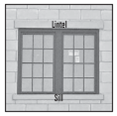 |
| Live Entertainment: Music, comedy, readings, dancing, acting or other entertainment, excluding sexually oriented businesses, performed on-site. This classification includes dancing by patrons to live or recorded music. |
Livestock, Nondomestic and Wild Animals, and Poultry: Animals, nondomestic and wild animals, and species of the aviary family which are or may be raised for the purpose of providing food, transportation, or being resold or bred (excluding only dogs, cats, rabbits, fish, pet mice, hamsters, gerbils, parrots and parakeets):
1.
Shall only be permitted on a lot containing not less than two acres;
2.
All buildings used for animals shall be set back not less than 200 feet from any property line;
3.
All animals shall be maintained at least 25 feet from any residential property line;
4.
There shall be not less than 5,000 square feet of fenced lot area not covered by the principal structure for each animal, unless the property is a bona fide farm.
Local Issuing Authority (pertaining environmental permitting): The City of Kennesaw Environmental Specialist or a designated and qualified representative of either the City of Kennesaw or the environmental specialist, who shall be responsible for administering this article and has been certified by the director of environmental protection division of the department of natural resources, pursuant to subsection (a) O.C.G.A. § 12-7-8.
Local Governing Authority: The Mayor and Council of the City of Kennesaw.
Local Permitting Authority: Refers to the City of Kennesaw to include without limitation, individuals from public works, zoning, or building departments, environmental specialist or code enforcement as applicable.
Lot: Contiguous parcels of land legally platted and recorded as a legal lot of record, in single or common ownership, and not divided by a public street. Also, a portion of a subdivision, or any other parcel of land and identified by a tract number, lot number or symbol of an approved subdivision plat properly recorded, and which is or may in the future be offered for sale, conveyance, transfer or improvement. In determining the area and dimensions of a lot, no part of the right-of-way of a road or crosswalk may be included.
Lot, corner: A lot fronting on two streets at their intersection. When the frontage of one street exceeds the frontage of the other, the one with the least frontage shall be deemed the front of the lot.
Lot, double frontage: Any lot, other than a corner lot, which has frontage on two streets.
Lot Coverage: The percentage of a lot which may be covered with permitted or accessory buildings or structures, excluding walks, drives, and other similar uses, and recreational facilities which are accessory to a permitted use.
Lot Depth: The average horizontal distance between the front and rear lot lines.
Lot Frontage: The distance for which the front property line of the lot and the street line are coincident.
Lot of Record: A lot which is part of a subdivision, a plat of which has been recorded in the records of the Clerk of Superior Court of Cobb County; or a parcel of land, the deed of which has been recorded in the same office as of the effective date of this ordinance.
Lot Width: The distance between side lot lines measured at the front building line.
Lounge: A separate room, in which alcoholic beverages are sold, connected with a part of an adjacent to a restaurant or located in a hotel as defined in this section with all booths, stools and tables being unobstructed and open to view. All lounges shall be air conditioned and have a seating capacity of at least 50. A lounge, as defined in this section, which is operated on a different floor in the premises, or in a separate building, or is not connected to or adjacent to a restaurant, shall be considered a separate establishment and shall pay an additional license fee therefore.
Low Impact Development: Is an approach to land development (or re-development) that works with nature to manage stormwater as close to its source as possible. LID employs principles such as preserving and recreating natural landscape features, minimizing effective imperviousness to create functional and appealing site drainage that treat stormwater as a resource rather than a waste product.
Low/Medium Density Residential (land use): A future land use category to provide for areas that are suitable for low to moderate density housing between one (1) and four (4) dwelling units per acre.
Lowest Floor: The lowest floor of the lowest enclosed area, including basement. An unfinished or flood resistant enclosure, used solely for parking of vehicles, building access, or storage, in an area other than a basement, is not considered a building's lowest floor, provided that such enclosure is not built so as to render the structure in violation of other provisions of this code.
Major Street: An existing or proposed street or highway designated as a major street on the official zoning map of the City of Kennesaw, Georgia.
Maintenance: Routine care for a building, structure or site that does not involve design alterations.
Major Thoroughfare: A street which is designated as such on the major thoroughfare plan and which is intended to provide swift movement of traffic through the community.
Mannequin sign holder: a human-like figure that is used to display, hold or mount a sign.
Manufacture: The process of making, fabricating, constructing, forming, or assembling a product from raw, unfinished, or semi-finished materials.
Manufactured Home: A structure transportable in one or more sections, which is built on a permanent chassis and is designed for use with our without a permanent foundation when attached to the required utilities. The term manufactured home does not include a recreational vehicle.
Marquee, marquee sign: Any permanent roof-like structure projecting beyond a building or extending along and projecting beyond the wall of the building, generally designed and constructed to provide protection from the weather.
Massage Therapy: The application of a system of structured touch, pressure, movement, and holding to the soft tissue of the body in which the primary intent is to enhance or restore health and well-being. The term includes complementary methods, including without limitation the external application of water, superficial heat, superficial cold, lubricants, salt scrubs, or other topical preparations and the use of commercially available electromechanical devices which do not require the use of transcutaneous electrodes and which mimic or enhance the actions possible by the hands; the term also includes determining whether massage therapy is appropriate or contraindicated, or whether referral to another health care provider is appropriate. Massage therapy shall not include the use of ultrasound, fluidotherapy, laser, and other methods of deep thermal modalities.
Master Plan: A comprehensive plan for the city approved by the planning commission which may consist of the major thoroughfare plan, general land use plan, street and road classification plan and other maps, data and descriptive matter for the physical development of the city of any portion thereof, including any amendments, extensions or additions thereto as recommended by the planning commission.
Material Change in Appearance: A change that will affect the exterior environmental feature or the exterior architectural appearance of a historic property including, but not limited to, any one or more of the following:
1.
A reconstruction or alteration affecting any exterior architectural appearance of a historical property;
2.
Excavation or significant land disturbance of a historic property;
3.
The erection, demolition, restoration or removal of any building or other structure;
4.
The construction or alteration of any exterior environmental features including but not limited to: driveways, walkways, parking lots, fences, accessory buildings, accessory structures, lighting fixtures, and permanent yard signs;
5.
The removal of exterior environmental features including trees ten inches in diameter or circumference of 32 inches measured at a point 54 inches above the ground.
Maximum Residential Occupancy: Maximum occupancy for a residential dwelling unit will be calculated by the number of residents per square foot of floor space as per adopted the currently adopted International Property Maintenance Code
Mean Sea Level: The datum to which base flood elevations shown on a community's Flood Insurance Rate Map (FIRM) are referenced. For purposes of this ordinance the term is synonymous with National Geodetic Vertical Datum (NGVD) and/or the North American Vertical Datum (NAVD) of 1988.
Menu sign: A sign or sign structure which is fully enclosed or otherwise protected from the elements, including, but not limited to, a box, shadow box, or cabinet, attached to a wall, or freestanding, which is used generally for the purpose of displaying menus or announcements of activities within an on-premise establishment for which the menu or announcement is displayed. A menu display may be used for a restaurant without drive-through service and for transient lodging facilities which have restaurant facilities open to the general public in addition to registered guests.
Microcell: A wireless communication facility comprising an antenna extending no more than four feet above the structure to which it is attached, and with an area no larger than 576 square inches (e.g. 3" × 1 1/2" panel antenna or 2" diameter parabolic antenna) as viewed from any one point.
Mining: A process involving the removal or extraction of dirt, sand, soil, rock, gravel, minerals, petroleum, natural gas, or other natural resources.
Minor: A person less than 18 years of age.
Mobile Food Vending Unit: Any motorized vehicle, designed to be portable and not permanently attached to the ground from which food is peddled, vended, sold for sale or given away. This term does not include a mobile food service unit as defined and regulated in Chapter 5 of this UDC.
Mobile Home: A transportable, factory-built home designed to be used as a year-round residential dwelling and built prior to the enactment of the Federal Manufactured Housing Construction and Safety Standards Act of 1974. Removal of the wheels and the placement on a foundation does not change its classification. A travel trailer is not a mobile home.
Mobile Home Park: A parcel of land which has been planned and improved for the placement of mobile homes for non-transient use.
Mobile sign: A sign which revolves, rotates, swings, undulates, or otherwise attracts attention through the structural movement of parts.
Modillion: A small curved and ornamented bracket used to support the upper part of the cornice.
Modular Building: A factory-manufactured single-family dwelling which is constructed in one or more sections and complies with the definition of "industrialized building."
Modular Home: A factory-fabricated transportable building consisting of units designed to be incorporated at a building site on a permanent foundation into a permanent structure to be used for residential purposes.
Motel: A building in which lodging or board and lodging are provided for transient guests and offered to the motoring public for compensation in which ingress and egress to and from all rooms are made primarily direct from an exterior walkway rather than from an inside lobby.
Mothballing: The process of stabilizing and securing a historic building against further deterioration due to weather and/or vandalism.
Motor Vehicle: An automotive vehicle not operated on rails for use on highways.
Mullion: A vertical member separating and often supporting windows, doors, or panels in a series.
Multifamily dwelling unit: A multifamily dwelling unit consists of one or more rooms which are arranged, designed or used as living quarters for related and unrelated persons.
Multi-tenant: One or more buildings, located on a single parcel, containing two or more separate and distinct individual suites or space, which suites or space occupy separate portions of a building and which are physically separated from each other by walls or common walls.
Muntin: A secondary framing member to hold panes within a window, window wall, or glazed door.
National Geodetic Vertical Datum (NGVD): As corrected in 1929, a vertical control used as a reference for establishing varying elevations within the floodplain.
National Categorical Pretreatment Standard or Pretreatment Standard: Any regulation containing pollutant discharge limits promulgated by the EPA in accordance with section 307(b) and (c) of the Act (33 U.S.C. 1347) which applies to a specific category of industrial users.
National Pollution Discharge Elimination System or NPDES Permit: A permit issued pursuant to section 402 of the Federal Water Pollution Control Act, also known as the Clean Water Act, as amended, 33 U.S.C. 1251 et seq. (33 U.S.C. 1342). (The "Act" means the Federal Water Pollution Control Act, also known as the Clean Water Act, as amended, 33 U.S.C. 1251 et seq.)
Natural Outlet: Any outlet, including storm sewers and combined sewer overflows, into a watercourse, pond, ditch, lake or other body of surface water or groundwater.
Natural Ground Surface: The ground surface in its original state before any grading, excavation or filling.
Natural Vegetated Area: An undeveloped area largely free from human disturbance where naturally occurring vegetation is allowed to remain undisturbed or is enhanced and maintained by human intervention. Activities specifically allowed in such an area include:
1.
Conservation or preservation of soil, water, vegetation, fish, shellfish and other wildlife;
2.
Outdoor recreational activities, including hunting, fishing, trapping, bird watching, hiking, boating, horseback riding, swimming, canoeing, skeet and trap shooting;
3.
Education, scientific research and nature trails;
4.
Maintenance or repair of lawfully located roads, structures and utilities used in the service of the public, provided that the work is conducted using best management practices to ensure that negative effects on the pervious nature of the land shall be minimized;
5.
Limited excavating, filling and land disturbance necessary for the repair and maintenance of structures necessary to the permissible uses.
Neglect: The failure to care for a property in such a manner as to prevent its deterioration. Neglect is often not intentional, but may lead to very serious deterioration of materials and even structural systems.
Neighborhood Activity Center (land use): A future land use category to provide for areas that serve neighborhood residents and businesses. Typical land uses for these areas include small offices, limited retail, and grocery stores.
Neighborhood Retail Uses: Commonly found low scale and low intensity retail uses (square footages not to exceed 6,000 square feet unless noted below) that offer basic services and frequently purchased goods to the immediate surrounding residential areas such as but not limited to: auto parts store, antique shop, appliance store (home use), bakery, barber and beauty shops, beverage shop, bookstore (but not including adult bookstore), bridal shop, camera shop, china and pottery store, clothing store, dance studio, delicatessen, dog grooming shop, draperies and interior decorating supplies, drug store or hardware store (provided that the gross floor area does not exceed 20,000 square feet total), dry goods store, florist, furniture store, gifts and stationery store, jewelry store, manicurist shop, meat market/butcher shop, millinery store, mimeograph and letter shop, music store, novelty shop, paint store, pedicurist shop, shoe repair shop, shoe store, sporting goods store, supermarket or grocery (provided that the gross floor area does not exceed 70,000 square feet), tailor shop, toy store, variety shop, and video stores.
Nephelometric Turbidity Units (NTU): Numerical units of measure based upon photometric analytical techniques for measuring the light scattered by finely divided particles of a substance in suspension. This technique is used to estimate the extent of turbidity in water in which colloidally dispersed particles are present.
New Construction: For floodplain management purposes, any-structure for which the "start of construction" commenced after August 1, 1980 and includes any subsequent improvements to the structure.
New Development: A land development activity on a previously undeveloped site.
New manufactured home park or subdivision: A manufactured home park or subdivision for the construction of facilities for serving the lots on which the manufactured homes are to be affixed (including at a minimum, the installation of utilities, the construction of streets, and either final site grading or the pouring of concrete pads) is completed on or after August 1, 1980.
Nightclub: An establishment having a seating capacity of at least 100 people with all booths and tables being unobstructed and open to view, deriving its primary income from the sales of alcoholic beverages, and providing to its patrons a band and/or other professional live entertainment performed onsite, including, but not limited to, music, comedy, readings, dancing or acting. All nightclubs shall be equipped with air conditioning and shall maintain an adequate kitchen with a sufficient number of servants and employees for cooking, preparing and serving food and meals for their patrons, provided that nightclubs located in hotels having dining room and kitchen facilities may be excluded from the requirement of maintaining a kitchen in connection with such nightclub. The principal business of such nightclubs shall be entertainment, and the serving of food and spirituous liquors shall be incidental thereto.
Nonautomotive Repair Uses: Commonly found low intensity repair shops such as, but not limited to, jewelry, camera, home appliance, televisions, and video cassette recorders.
Nonprofit Riding Stable: A building for the shelter and feeding of domestic animals, especially horses.
Noncommercial Message: A copy that does not contain a commercial message and specifically included in the definition of noncommercial message is copy whereby the public is to be informed regarding a political event or candidate or issue.
Nonconforming Sign: Any lawfully erected sign which, on the effective date of the ordinance from which this article is derived, fails to comply with the requirements of this article, including by reason of annexation into the city.
Nonconforming Use: Any building or land lawfully occupied by a use at the time of passage of the ordinance or amendment thereto which does not conform after the passage of this ordinance or amendment thereto with the regulation of the district in which it is situated. A use merely contemplated for the future but unrealized of the effective date of an amendment to this UDC does not constitute a nonconforming use. Existing improvements which did not meet required parking and loading regulation, height regulations, area regulations, and residential floor regulations at the time they were constructed in the district in which they are located are not nonconforming uses as defined above.
Noncontributing: Does not contribute to the architectural or historic significance of a historic district. (Some noncontributing resources are not yet fifty years of age, and therefore do not meet the age requirement for contributing resources. Other noncontributing resources may be historic but have lost their architectural integrity due to extensive changes or alterations.)
Nonpoint Source Pollution: A form of water pollution that does not originate from a discrete point such as a sewage treatment plant or industrial discharge, but involves the transport of pollutants such as sediment, fertilizers, pesticides, heavy metals, oil, grease, bacteria, organic materials and other contaminants from land to surface water and groundwater via mechanisms such as precipitation, storm water runoff, and leaching. Nonpoint source pollution is a by-product of land use practices such as agricultural, silvicultural, mining, construction, subsurface disposal and urban runoff sources.
Nonstructural Storm Water Management Practice or Nonstructural Practice: Any natural or planted vegetation or other nonstructural component of the storm water management plan that provides for or enhances storm water quantity and/or quality control or other storm water management benefits, and includes, but is not limited to, riparian buffers, open and green space areas, overland flow filtration areas, natural depressions, and vegetated channels.
Non-Storm Water Discharge: Any discharge to the storm drain system that is not composed entirely of storm water. See Chapter 6.08.02 for exceptions.
Non-Supportive Facilities: Individual housing units designed for independent senior adults that do not include or provide any type of supportive services such as transportation, medical care, food preparation and the like. See also Supportive Facilities and Senior Citizen Housing.
Normal Maintenance and Repair: Activities related to the reasonable and customary upkeep of structures or property including painting and cleaning. However, normal maintenance or repair conclusively does not include any structural alteration, any modification that requires a building permit or any alteration that costs in excess of 50 percent of the value of the sign prior to such maintenance and repair, as established in the initial sign permit application. The city shall consider updated evidence of value by means of qualified appraisal subsequent to the initial application.
Normal Wastewater: Wastewater discharged into the sanitary sewers in which the average concentration of total suspended solids and BOD is not more than 300 mg/l, total phosphorus is not more than 15 mg/l, total Kjeldahl nitrogen is not more than 18 mg/l; and total flow is not more than 25,000 gallons per day.
Novelty store: Any establishment that provides unique products for sale not previously defined in this chapter or under any retail use definition. This definition and use does not involve any uses defined under the Sexually Oriented Business ordinance or cigar shop, smoke shop and tobacco store definitions adopted in the code of ordinances.
Nudity or a state of nudity means the showing of the human male or female genitals, pubic area, vulva, anus, anal cleft or cleavage with less than a fully opaque covering, or the showing of the female breast with less than a fully opaque covering of any part of the nipple and areola.
Nursing Home: A home for aged or ill persons in which three or more persons not of the immediate family are provided with food, shelter and care for compensation; but not including hospitals, clinics or similar institutions devoted primarily to diagnosis and treatment.
Off-premises Outdoor Advertising Sign: Means a sign with a commercial message which identifies, advertises or promotes a product, service, person, place, activity, event, idea or any other thing not sold, offered or conducted on the lot where the sign is located or which may be sold, offered or conducted only incidentally, if at all, on the premises where this sign is located. This shall include those signs commonly referred to as a billboard which is a large (typically over 600 square feet of sign area), immobile and permanent structure. For purposes of this UDC, "off-premises outdoor advertising sign:" shall not include any conforming sign under the Sign Ordinance with or without a permit under any zoning district, including all temporary signs. Changing the sign face on an off-premises outdoor advertising sign from a commercial message to a noncommercial message will not change the grandfathered or non-conforming status of the sign under this UDC.
Off-site Facility: A storm water management facility located outside the boundaries of the site.
Office Park: Two or more buildings which are clustered together in which professional services are primarily engaged.
Office Service and Supply Establishments: Wholesale and retail commercial establishments that sell, service and supply small office equipment and supplies such as, but not limited to, stores that offer sales of copiers, facsimile machines, typewriters, ribbons, transcribers, dictation equipment, tape, staplers, and other general office equipment.
On-site Facility: A storm water management facility located within the boundaries of the site.
On-premises Sign: Means a sign which identifies advertises or promotes a product, service, person, place, activity, event, idea or any other thing which is the principal product, service, person, place, activity, event, idea or any other thing sold, offered or conducted on the premises where the sign is located.
Open Space: Any front, side or rear yards, courts, usable open space provided about a building in order to meet the requirements of this Code.
Open Space, Landscaped: That portion of a given lot, not covered by buildings, parking, access and service areas, that is designed to enhance privacy and the amenity of the development by providing landscaping features, screening and buffering for the benefit of the occupants or those in neighboring areas, or a general appearance of openness. Landscaped open space may include, but need not be limited to, grass lawns, decorative planting, berms, walls and fences, sidewalks/walkways, ornamental objects such as fountains, statues and other similar natural and manmade objects, wood areas, and watercourses, any or all of which are designed and arranged to produce an aesthetically pleasing effect within the development.
Order: A definite arrangement of column, capital, and entablature, each having its own set of rules and ornamental features. The five classical orders are Tuscan, Doric, Ionic, Corinthian, and Composite.
Other Consumer Goods and Services: Businesses which cater to consumers such as awning shops and sales, burglar alarm systems, clothing (secondhand), exhibition house, furniture, home furnishings, equipment, and appliances (secondhand), glass, mirror, lawn mower and small motor, trading stamp redemption center, and the like.
Other Service Establishment: Businesses or locations catering to specialty services such as auction house or store, cabinet maker, caterer, delivery and express service, driving school (private), fur repair and storage, gunsmith shop, locksmith shop, safe and vault repair, scientific instrument repair, taxidermist, tool sharpener, and the like.
Overbank Flood Protection: Measures taken to prevent an increase in the frequency and magnitude of out-of-bank flooding (i.e. flow events that exceed the capacity of the channel and enter the floodplain), and that are intended to protect downstream properties from flooding for the two-year through 25-year frequency storm events.
Overlay District: A district that applies supplementary regulations to land previously classified as belonging to a specific zoning district or land-use category.
Owner: The legal or beneficial owner of a site, including but not limited to, a mortgagee or vendee in possession, receiver, executor, trustee, lessee or other person, firm or corporation in control of the site.
Package Store: A business establishment whose primary business activity is the retail sale of alcoholic beverages by the package.
Pain Management Clinic: Means an entity or business which fulfills all of the following criteria: 1) A privately owned clinic, business, or office; 2) That is not affiliated with any facility for the treatment of the terminally ill; or any facility for the treatment of drug addiction; or any hospice; or any hospital and; 3) Which employs one or more physicians who are primarily engaged in the treatment of pain by prescribing Pain Medications; and, 4) Which fills or dispenses those Pain Medications either at the same or a different location.
Palladian Window: A window of large size, characteristic of neoclassical styles, divided by columns or piers, resembling pilasters, into three lights, the middle of which is taller and wider than the others, and is round-headed.
Par 3 Golf Course: A tract of land not less than 40 acres dedicated for playing an 18 hole game of golf which is open to the general public or private club use. The par shall not be less than 27 for nine holes or 54 for 18 holes from the men's tees as governed by the United States Golf Association (USGA). Further, the golf course shall not measure less than 1,750 or greater than 3,500 yards, respectively.
Parapet: A low wall or railing often used around a balcony or along the edge of a roof.
Parcel: Any plot, lot or acreage shown as a unit on the latest county tax assessment records.
Park means any lands or facility owned, operated, controlled or managed by any county, city or federal government or any governmental entity in and upon which recreational activities or places are provided for recreation and enjoyment to the general public.
Park/Recreation/Conservation (land use): A future land use category to illustrate the public or semi-public park, recreation, and conservation land uses in the City. The future land use map reflects only existing public uses.
Parking for Vehicles: Shall mean to provide a location for on-site parking for automobiles, trucks, and recreational vehicles (with a manufacturer's towing and/or carrying capacity rating of less than 1 1/2 tons). This restriction shall not apply to vehicles parked on religious assembly property which are operated exclusively for religious assembly use.
Parking Space: An area which has for its exclusive purpose the parking of a vehicle which complies with the adopted design standards.
Pawn or Pledge means a bailment of personal property as security for any debt or engagement, redeemable upon certain terms and with the power of sale upon default.
Pawn Stores/Shops: Any establishment which offers in the regular course of business "a pawn transaction" as defined in O.C.G.A. 44-12-139 as it exists or as it may be amended.
Pawn transaction means any loan on the security of pledged goods or any purchase of pledged goods on the condition that the pledged goods may be redeemed or repurchased by the pledger or seller for a fixed price within a fixed period of time.
Pawnbroker means any person engaged in whole or in part in the business of lending money on the security of pledged goods, or in the business of purchasing tangible personal property on the condition that it may be redeemed or repurchased by the seller for a fixed price within a fixed period of time, or in the business of purchasing tangible personal property from persons or sources other than manufactured or licensed dealers as part of or in conjunction with the business activities described in this ordinance.
Pawnshop means any business wherein a substantial part thereof is to take or receive, by way of pledge, pawn, consignment or exchange, any goods, wares, merchandise, or any kind of personal property whatever, as security for the repayment of money lent thereon. "Pawn shop" does not include banks, savings and loan institutions, credit unions, or other banking organizations regulated by state or federal law.
Payday loan establishment means any establishment whose business includes the making of deferred deposit transactions, commonly referred to as "payday loans."
Pediment: The triangular gable end of the roof above the horizontal cornice.
Pennant stream sign: Any lightweight plastic, fabric, or other material suspended from a rope, wire, or string, usually in a series, designed to move in the wind.
Perennial Stream: A stream that flows throughout the year, as indicated by a solid blue line on United States Geological Survey (USGS) seven-minute topographic series maps (scale of 1/24,000).
Permanent sign: Any sign which, when installed, is intended for permanent use. A permanent freestanding sign shall be of a type and construction as not to be easily or readily removed from the lot on which it has been erected.
Permit: The authorization necessary to conduct a land-disturbing activity under the provisions of this ordinance.
Person: Any natural person, corporation, or unincorporated association.
Person in Charge: The person or persons possessed of a freehold of an improvement or improvement parcel or a lesser estate therein, a mortgagee or vendee in possession, assignee of rents, receiver, executor, trustee, lessee, agent or any other person directly or indirectly in control of an improvement or improvement parcel.
Personal Property Sales: Sales of personal property under a permit from the city, such as estate sales, yard sales, bakery sales, garage sales, bazaars, and the like; three weekends per calendar year, not to exceed three days per sale.
pH: The logarithm (base 10) of the reciprocal of the concentration of hydrogen ions expressed in grams per liter of solution.
Pilaster: A flat-faced representation of a column projecting from a wall.
Plan Review Committee: The Kennesaw Development Plan Review Committee comprised of representatives of internal departments as well as interface with outside agencies and private companies involved in the development process.
•
Building Services
•
Public Works
•
City Engineer
•
Planning and Zoning
•
Economic Development
•
Environmental
The duty of this committee is to provide review and regulatory oversight over all development regulations that involve development activity in the City of Kennesaw.
Planned Development: A tract of land developed initially under single ownership or control; the development of which is unique and of a substantially different character than that of surrounding areas. Such development shall be based on a plan which allows for flexibility of design not available under normal zoning district requirements.
Planned Unit Development (land use): A future land use category that is designed to designate locations that are transitional in nature, that have property/structures that could be converted to a use more beneficial to the community, and that are more consistent with the future objectives of the City and the City of Kennesaw Comprehensive Plan. Areas designated as Planned Unit Development are intended to be developed as part of a large scale development and not as part of a lot by lot conversion project. Each Planned Unit Development is considered on a case by case basis.
Planning Commission: The City of Kennesaw Planning Commission.
Planning and Zoning Administrator: City of Kennesaw staff person authorized to interpret, amend and regulate the Zoning Ordinance, Historic Preservation Design Guidelines, Architectural Standards, ensure consistent compliance to the adopted Comprehensive Plan, all adopted Master Plans and Studies for the City of Kennesaw and all other duties assigned by the City Manager.
Plat: A map indicating the subdivision or re-subdivision of land, intended to be filed for record.
Pollutant: Anything, which causes or contributes to pollution and diminished water or air quality. Pollutants may include, but are not limited to: paints, varnishes, and solvents; petroleum hydrocarbons; automotive fluids; cooking grease; detergents (biodegradable or otherwise); degreasers; cleaning chemicals; non-hazardous liquid and solid wastes and yard wastes; refuse, rubbish, garbage, litter, or other discarded or abandoned objects and accumulations, so that the same may cause or contribute to pollution; floatables; pesticides, herbicides, and fertilizers; hazardous liquid and solid wastes; sewage, fecal coliform and pathogens; dissolved and particulate metals; animal wastes; wastes and residues that result from constructing a building or structure; concrete and cement; and noxious or offensive matter of any kind. Any dredge, spoil, solid waste, incinerator residue, sewage, garbage, sewage sludge, munitions, chemical wastes, biological materials, radioactive materials, heat, wrecked or discharged equipment, rock, sand, cellar dirt and industrial, municipal and agricultural waste discharged into water.
Pollution or pollutants: The manmade or man-induced alteration of the chemical, physical, biological and radiological integrity of water or air. The contamination or other alteration of any water's physical, chemical or biological properties by the addition of any constituent and includes but is not limited to, a change in temperature, taste, color, turbidity, or odor of such waters, or the discharge of any liquid, gaseous, solid, radioactive, or other substance into any such waters as will or is likely to create a nuisance or render such waters harmful, detrimental or injurious to the public health, safety, welfare, or environment, or to domestic, commercial, industrial, agricultural, recreational, or other legitimate beneficial uses, or to livestock, wild animals, birds, fish or other aquatic life.
Pond: A body of standing water less than one acre in surface area, created either by a natural dam, or other means of water impoundment.
Porch: A covered but unenclosed projection from the main wall of a building that may or may not use columns or other ground supports for structural purposes.
Portable Display Sign: Any sign which is not permanently affixed to the ground or to a structure, including, but not limited to, signs on trailers or signs mounted or painted on vehicles which are parked in such a manner so as to serve the purpose of a sign.
Portico: A porch or covered walk consisting of a low-pitched roof supported on classical columns and finished in front with an entablature and a pediment.
Porte Cochere: A large covered entrance porch through which vehicles can pass.
Post-development: The time period, or the conditions that may reasonably be expected or anticipated to exist, after completion of the land development activity on a site as the context may require.
Pre-development: The time period, or the conditions that exist, on a site prior to the commencement of a land development project and at the time that plans for the land development of a site are approved by the city. Where phased development or plan approval occurs (preliminary grading, roads and utilities, etc.), the existing conditions at the time prior to the first item being approved or permitted shall establish pre-development conditions.
Preliminary Plat: A drawing which shows the proposed layout of a subdivision in sufficient detail to indicate unquestionably its workability, but is not in final form for recording and the details are not completely computed.
Premises: Any building, lot, parcel of land, or portion of land whether improved or unimproved including adjacent sidewalks and parking strips.
Premises [of Sexually Oriented Business] means the real property upon which the sexually oriented business is located, and all appurtenances thereto and buildings thereon, including, but not limited to, the sexually oriented business, the grounds, private walkways, and parking lots and/or parking garages adjacent thereto, under the ownership, control, or supervision of the licensee, as described in the application for a sexually oriented business license.
Preservation: The process of taking steps to sustain the form, details and integrity of a property essentially as it presently exists. Preservation may involve the elimination of deterioration and structural damage, but does not involve reconstruction to any significant degree.
Pressed Metal: Thin sheets of metal molded into decorative designs and used to cover interior walls and ceilings and on the exterior of some 20th century commercial structures.
Pretreatment or Treatment: The reduction of the amount of pollutants, the elimination of pollutants, or the alteration of the nature of pollutant properties in wastewater to a less harmful state prior to or in lieu of discharging or otherwise introducing such pollutants into a POTW. The reduction or alteration can be obtained by physical, chemical or biological processes, or by process changes or other means, except as prohibited by 40 CFR 403.6(d).
Projecting Sign means a sign securely fastened to the building surface by metal supports which suspend the sign over the public sidewalk.
Properly Shredded Garbage: The wastes from the preparation, cooking and dispensing of food that have been shredded to such a degree that all particles will be carried freely under the flow conditions normally prevailing in public sewers, with no particle greater than one-half inch in any dimension.
Primary Highway: Means any road of the state highway system which is a portion of connected main highways, as officially designated or as may hereafter be so designated by the State Department of Transportation and approved by the United States Secretary of Transportation pursuant to 23 USC 103.
Primary Permittee: Owners, general contractors and operators of a project having day-to-day operational control of a facility or site.
Principal Use: The primary use and chief purpose of a lot or structure.
Private Club: A nonprofit association organized and existing under the laws of the state, actively in operation within the city, which has been in existence at least one year prior to the filing of its application for a license to be issued under this chapter, having at least 75 members regularly paying monthly, quarterly, or semiannual dues, organized and operated exclusively for pleasure, recreation and other non-profitable purposes, no part of the net earnings of which injures to the benefit of any shareholders or members, and owning, hiring or leasing a building or space therein for the reasonable use to its members with suitable kitchen and dining room space and equipment and maintaining and using a sufficient number of servants and employees for cooking, preparing and serving meals for its members and guest; provided, that no member or officer, agent or employee of the club is paid, directly or indirectly receives, in the form of salary or other compensation, any profits from the sale of spirituous liquors to the club or its members or guest beyond the amount of such salary as may be fixed by its members at any annual meetings or by its governing board out of the general revenue of the club.
Private Community Center: A place, structure, area, or other private or non-publicly owned facility used for and providing fraternal, social, and/or recreational programs generally open to the public and designed to accommodate and serve significant segments of the community.
Private Party Function: An event held by an organizer, private party where alcoholic beverages are provided. The licensee must submit to and have the private party function approved by the supervisor of the city's business license office provided such function does not threaten the health, safety and welfare of the participants or public. In the event the private party function is not approved by the business license supervisor the licensee may appeal said decision to the Mayor and Council. The Mayor and City Council shall have authority to approve the private party function provided the function does not threaten the health, safety and welfare of the participants or public.
Private Residence: A house or dwelling wherein not less than one or more than two families customarily reside and shall not include a mobile home, an apartment house having facilities for housing more than two families, a boardinghouse or rooming house where there are five or more boarders or roomers, any residence which has been unoccupied for a period of six consecutive months immediately prior to the filing of any application for license, or any residence that shall be a nonconforming use in a commercial zone.
Pro Shop: An ancillary structure or area provided for sale or supply of equipment associated with the primary permitted or accessory use.
Professional Office: Structure wherein services are performed involving predominately administrative, professional or clerical operations including but not limited to law, doctor, optician, audiologist, accounting, tax preparation, real estate, stock broker, architect, engineer, manufacturer representative, professional counselor, dentist, investigative services, photographer, insurance, contractor, land surveyor, telephone sales, political campaign, veterinarian, travel bureau, chiropractors office.
Prohibited Sign: Means any sign, other than a non-conforming sign, not conforming to the Chapter.
Project: The entire proposed development project regardless of the size of the area of land to be disturbed.
Projecting Sign: Means a sign securely fastened to the building surface by metal supports which suspend the sign over the public sidewalk.
Pub: Means any premises at which a retailer licensed pursuant to this chapter to sell alcoholic beverages derives between 50 percent and 75 percent of its total annual gross revenue from the sale of alcoholic beverages for consumption on the premises. A licensee of a pub shall obtain and keep in force and affect a food service permit.
Public Park: Any public lands owned or controlled and operated by this city, any county of this state, any municipality of the state, the state, the United States of America or any property owned or managed by a nonprofit organization, in and upon which facilities are provided for the recreation and enjoyment of the general public.
Public Service Information: Means time, temperature, notice of public meetings, special events, road/traffic directional signs, etc.
Public Service Institutional (land use): A future land use category to illustrate public or semi-public service institutional land uses in the City. The future land use map reflects only existing public uses.
Public Sign: A sign of a governmental body, governmental agency or public authority or entity, including but not limited to signs in the exercise of the power of eminent domain, traffic signs, directional sign, signals or similar regulatory devices or warnings, official flags, emblems, official public notices, official instruments, signs of historical interest or other similar signs or devices.
Publicly Owned Treatment Works (POTW): A treatment works as defined by Section 212 of the Act (33 U.S.C. 1292) which is owned in this instance by the county or the city. This definition includes any sewers that convey wastewater to the POTW treatment plant, but does not include pipes, sewers or other conveyances not connected to a facility providing treatment.
Purpose Built Student Housing: A multifamily residential development characterized by student housing apartments for adults attending universities and colleges wherein each student is under an independent lease with the landlord to rent on a per bedroom basis.
Pylon Sign: A freestanding sign that is typically detached from a building and supported by one or more structural elements which are architecturally similar to the design of the sign. A pylon sign includes, but is not limited to, a center monument pole sign, a dual pylon sign and flag mounted pylon sign. Pylon sign does not include a ground based monument sign.
Qualified Personnel (pertaining to environmental protection): Any person who meets or exceeds the educational and training requirements of specified by O.C.G.A. 12-7-19, as may be amended from time to time. (Soil Erosion and Control certification)
Quasi Judicial: The action, discretion, etc., of public administrative officers or bodies, who are required to investigate facts, or ascertain the existence of facts, hold hearings, and draw conclusions from them, as a basis for their official action, and to exercise discretion of a judicial nature.
Quoins: Heavy blocks, generally of stone or wood, cut in emulation of stone and used at the corners of buildings to reinforce and ornament walls.
Real Estate Marketing Sign: A temporary real estate sign located at the entrance to a subdivision/real estate development that shows the name of the project or development, name and phone number of real estate agent or agency that is handling the listing or sales, price range and hours of sales, and not to exceed 16 square feet in area.
Rear of the Principal Building: Shall be that point where the main portion of the building ends without consideration of wings or annexes which are not parallel to the main portion of the building.
Reconstruction: The process of reproducing the exact form of a component, building, structure or site that existed at some time in the past.
Recreational Vehicle: Refers to a vehicle which is:
1.
Built on a single chassis;
2.
400 square feet or less when measured at the largest horizontal projection;
3.
Designed to be self-propelled or permanently tow able by light duty truck; and
4.
Designed primarily not for use as a permanent dwelling but as temporary living quarters for recreational, camping, travel, or seasonal use.
Recycling (architectural): The process of restoring, rehabilitating, renovating, remodeling, or adapting an old building so that it can be used by another generation.
Recycling Center: A center or location designed for sorting or collection of recyclables from designated recycling collection locations and other private entity sources.
Redevelopment: A land development project on a previously developed site, but excludes ordinary maintenance activities, remodeling of existing buildings, resurfacing of paved areas, and exterior changes or improvements which do not materially increase or concentrate storm water runoff, or cause additional nonpoint source pollution.
Regional Activity Center (land use): A future land use category to provide for areas that can support a high intensity of development. Typical land uses in these areas include high-rise office buildings and regional malls.
Regional Shopping Center: A group of commercial enterprises offering a range of commercial goods and services in an aggregate of 500,000 square feet or more of net floor area which:
1.
Are designed as a single commercial group, whether or not located on the same lot;
2.
Are under one-common ownership or management, or having one common arrangement for the maintenance of the grounds;
3.
Are connected by party walls, partitions, covered canopies or other structural members to form one continuous structure;
4.
Share a common parking area; and
5.
Otherwise present the appearance of one continuous commercial area.
Regional Storm Water Management: Facility or regional facility referring to storm water management facilities designed to control storm water runoff from multiple properties, where the owners or developers of the individual properties may assist in the financing of the facility, and the requirement for on-site controls is either eliminated or reduced.
Regular or regularly means and refers to the consistent and repeated doing of the act so described.
Rehabilitation: The process of returning a building to a state of utility while retaining those elements essential to its architectural, historical and/or aesthetic significance.
Religious Assembly: A site or facility maintained by a bona fide religious group for the primary purposes of religious worship. Religious assemblies include but are not limited to churches, mosques, synagogues and temples.
Remodeling: Changing the appearance and style of a structure by removing or covering over original details and substituting new materials and forms.
Renovation: The process of making a structure usable again where there is a greater proportion of new materials and elements introduced into the building.
Repair: Any minor change to a property that is not construction, removal, demolition or alteration and that does not change exterior architectural appearance.
Replacement Tree: A new tree planted on a site to meet minimum site density factor requirements (regardless of whether trees existed prior to any development).
Reservoir Boundary: The edge of a reservoir, defined by its normal pool level.
Residence means a house, apartment, boardinghouse or rooming house, duplex, or other multifamily housing, for human dwelling, or any property zoned therefore.
Residential Street: A street which is designated as such on the major thoroughfare plan and which is used for local circulation in residential areas providing access to abutting property.
Rest Home: A health facility where persons are housed and furnished with meals and continuous nursing care for compensation.
Restaurant: Any public place kept, used, maintained, advertised and held out to the public as a place where meals are served, and where meals are actually and regularly prepared and served, without sleeping accommodations, such place seating a minimum of 50 or more people, and holding a certificate of approval from the county health department. A restaurant shall maintain a full-service kitchen which consists of, at a minimum, a three-compartment pot sink, a stove or grill permanently installed and a refrigerator. A restaurant serves meals every hour that they are open and the serving of such meals shall be the principal business conducted, with the serving of distilled spirits, beer and/or wine to be consumed on the premises as only incidental thereto. In order to be classified as a restaurant under this chapter, the licensee must derive a minimum of 50 percent of its total annual gross food and beverage sales, over any 12-month period of time, from the sale of prepared meals or food. In the case of an audit, the relevant time period shall be the 12 months immediately preceding the commencement of the audit. If the restaurant being audited has been in operation as a restaurant for less than 12 months, the audit period shall be the period of time the entity has operated as a restaurant, and the restaurant must derive a minimum of 50 percent of its total annual gross food and beverage sales for that audit period from the sale of prepared meals or food. If the restaurant previously operated as another type of business, e.g., a bar as that term is defined in this section, total annual gross food and beverage sales for the time period it has been operated as a restaurant shall be the only data relevant to the audit and the data for the period it operates as another type of business shall not be examined during the audit.
Restoration: The process of returning a building to its appearance at an earlier time (though not necessarily to its original appearance). Restoration involves the removal of later additions and the replacement of missing components and details.
Retail Activities (limited): See limited retail uses.
Retail Sales, Outdoor: Retail sales of new merchandise on the site of a legally established retail business which has a direct relationship to the existing businesses.
Retaining Wall: A wall or similar structure devise used at a grade change to hold the soil on the up-hillside from slumping, sliding, or falling.
Right-of-Way: The real property owned and controlled by a governmental agency for maintaining public infrastructure, including streets, sidewalks, pathways, mass transit rail lines, drainage ditches and structures, shoulders, traffic control devices, and vegetative buffers. The width of the right-of-way outside the pavement of any given street or road can be determined by the City Public Works department.
Riparian: Belonging to or relating to the bank of a river, stream, lake, pond, or impoundment.
Riser: The vertical part of a step or stair.
Road Classifications: All roads in Kennesaw and the width of such rights-of-way shall be as follows:
1.
Arterial — 100-foot (or more) right-of-way width.
2.
Major collector — 80-foot right-of-way width.
3.
Minor collector — 60-foot right-of-way width.
4.
Local — 40-foot right-of-way width.
Roadway Drainage Structure: A device such as a bridge, culvert, or ditch, composed of a virtually non-erodible material such as concrete, steel, plastic, or other such material that conveys water under a roadway by intercepting the flow on one side of a traveled way consisting of one or more defined lanes, with or without shoulder areas, and carrying water to a release point on the other side.
Roof: The top covering of a building. Following are some types:
1.
Gable roof has a pitched roof with ridge and vertical ends.
2.
Hip roof has sloped ends instead of vertical ends.
3.
Shed roof (lean-to) has one slope only and is built against a higher wall.
4.
Jerkin-head (clipped gable or hipped gable) is similar to gable but with the end clipped back.
5.
Gambrel roof is a variation of a gable roof, each side of which has a shallower slope above a steeper one.
Roof Sign: A sign erected, constructed or maintained on the roof of any building.
Rooming House: A building where lodging only is provided for compensation to three or more, but not exceeding 15 persons. A building which has accommodations for more than 14 persons shall be defined as a hotel under the terms of this ordinance.
Runoff: Storm water runoff.
Sanitary Water Closet: Any flush toilet properly connected with the city sanitary sewer system, or a septic tank of approved construction and condition.
Sash: A window frame that opens by sliding up or down.
School means only such state, county, city, church or other schools as teach the subjects commonly taught in the common schools and colleges and universities of this state and which are public schools or private schools as defined in subsection (b) of O.C.G.A. § 20-2-690, or as may be amended from time to time, including any public or private location that teaches the Georgia Pre-kindergarten Program and shall not include private schools where only specialized subjects such as law, stenography, business, music, art, medicine, dentistry, vocational occupations and other special subjects are taught and shall not include residences where home study programs are located.
Secondary Permittee: Individual builders, utility companies and utility contractors within common developments.
Secondary Street: A street which is designated as such on the major thoroughfare plan and which is intended to provide easy and convenient traffic movement within the community.
Sediment: Solid material, both organic and inorganic, that is in suspension, is being transported, or has been moved from its site of origin by air, water, ice, or gravity as a product of erosion.
Sedimentation: The process by which eroded material is transported and deposited by the action of water, wind, ice or gravity.
Self-Service Storage Facility (SSSF): Fully enclosed facility containing independent bays, which are leased to individuals exclusively for dead storage of goods or personal property.
Semi-Permanent Directional Signs (SPDS): Signs which convey directions to a specific place under construction or to specific real estate for sale or to a noncommercial event, and are not intended to be permanent but rather are intended to provide direction to a place or event for a limited period of time.
Senior Citizen: Citizens that are 55 years of age or older as defined by the Fair Housing Act as amended from time to time.
Senior Citizen Housing or Senior Housing: Residential units that are part of a Senior Living development that may be rented or owned by the resident for occupancy. Residential units may be Supportive or Non-supportive.
Senior Living: Site location, site planning and architectural design that provides a safe, functional live, work, and play environment for residents 55 years of age or older as defined by the Fair Housing Act as amended from time to time.
Separate Storm Sewer System (Municipal): Any facility designed or used for collecting and/or conveying storm water, including but not limited to any roads with drainage systems, highways, city streets, curbs, gutters, inlets, catch basins, piped storm drains, pumping facilities, structural storm water controls, ditches, swales, natural and man-made or altered drainage channels, reservoirs, and other drainage structures, and which is:
(1)
Owned or maintained by the city;
(2)
Not a combined sewer; and
(3)
Not part of a publicly-owned treatment works.
Septic Tank: An underground cavity with watertight walls into which flows the effluent of sanitary water closets and from which effluent does not come to the surface of the ground.
Service Station: Any building, structure or land use for the retail sale of motor vehicle fuel, oil, accessories and motor vehicle servicing, except that major repairs, body repairs and painting of motor vehicles shall not be considered motor vehicle servicing.
Setback: The distance that defines the width of a protected land area, measured from the boundary of the feature of the landscape (e.g., a property line, a wetland, a stream bank) that the measurement is designed to protect.
Setting: The immediate physical environment of a building, structure, site or district.
Sexual conduct means acts of masturbation, homosexuality, sodomy, sexual intercourse, or physical contact with a person's clothed or unclothed genitals, pubic area, buttocks, or, if such person is female, breast, which, to the average person, applying contemporary community standards, taken as a whole, lacks serious literary, artistic, political, or scientific value and predominantly appeals to the prurient interest, that is, a shameful or morbid interest in nudity or sex.
Sexual device means any three-dimensional (object designed for stimulation of the male or female human genitals, anus, buttocks, nipple, or for sadomasochistic use or abuse of oneself or others and shall include devices such as dildos, vibrators, penis pumps, cock rings, anal beads, nipple clamps, and physical representations of the human genital organs. Nothing in this definition shall be construed to include devices primarily intended for protection against sexually transmitted diseases or for preventing pregnancy.
Sexual device shop means a commercial establishment:
(1)
Where more than 100 sexual devices are regularly made available for sale or rental; or
(2)
Where sexual devices are regularly made available for sale or rental and the establishment regularly gives special prominence to sexual devices (e.g., by using lighted display cases for sexual devices, having a room or discrete area of the establishment significantly devoted to sexual devices, positioning sexual devices near cash registers or similar points of sale, hosting events focused on sexual devices, or holding itself out to the public as a place that focuses on sexual devices).
This definition shall not be construed to include an establishment containing a pharmacy that employs a licensed pharmacist to fill prescriptions on the premises or an establishment primarily dedicated to providing durable medical equipment.
Sexually oriented business means an adult bookstore or adult video store, an adult cabaret, an adult motion picture theater, an explicit media outlet, or a sexual device shop.
Shelter (homeless): Charitable, nonprofit, short-term housing and/or room and board accommodations for poor, transient, or needy individuals which must meet the following minimum criteria:
1.
Adequate showers and restroom facilities must be provided at the location to meet the needs of the overnight guests;
2.
Beds must be provided for all overnight guests excluding staff and volunteer workers;
3.
No shelter shall be located closer than 1,000 feet to the nearest single-family residence;
4.
Guests of the shelter shall be required to leave the shelter premises no later than 7:00 a.m.;
5.
All premises shall be maintained in a clean, safe, and sanitary fashion;
6.
Adequate provisions for transporting and parking guests shall be submitted to and approved by the zoning administrator or his/her designee.
Shopping Center: A group of commercial establishments, planned, developed, owned and managed as a unit, with off-street parking provided on the property and related in its location, size and type of shops to the trade area which the unit serves.
Short Term Rentals (STR): An accommodation for transient guests, rented for the purpose of overnight lodging for a period of less than thirty (30) days.
Side Lights: A vertical line of small glass panes flanking a doorway.
Sign: Any name, identification, description, display, illustration, banner, string of lights or device which is affixed to or represented directly or indirectly upon a building, structure, vehicle or land in view of the general public and which directs attention to an idea, opinion, product, place, activity, person, institution or business.
Sign with electronic display: A sign in which the message may be changed at intervals by computer controller, microprocessor controller or by remote control, and whose message is displayed through the use of LED, LDC, plasma or other similar type of panels or screens, including devices known as commercial electronic message signs or similar devices.
Significant: Possessing importance to a particular building, structure, site or district; essential to maintaining the full integrity of a particular building, structure, site or district.
Signs during vacancy: Signs permitted for developments with vacant lots, units, and/or tenant spaces.
Silviculture: A branch of forestry which deals with the establishment, development, care and reproduction of stands of timber.
Single Housekeeping unit: Means that the occupants of a dwelling unit have established ties and familiarity with each other, jointly use common areas, interact with each other, share meals, household activities, lease agreement or ownership of the property, expenses and responsibilities; membership in the single housekeeping unit is fairly stable as opposed to transient, and members have some control over who becomes a member of the single housekeeping unit.
Site: A plot of land intended or suitable for development; also the ground or area on which a building has been built.
Slope: A degree of deviation of surface from the horizontal usually expressed in percent or degree.
Soffit: The underside of a structural part, as of a beam, arch, etc.
Softwood Tree: Any coniferous (cone bearing) tree. This definition is based on the colloquialism, and does not necessarily reflect any true qualities of the tree.
Soil and Water Conservation District Approved Plan: An erosion and sedimentation control plan approved in writing by the Cobb Soil and Water Conservation District.
Special Exception Use: A use that, owing to some special characteristics attendant to its operation or installation, is permitted in a district subject to approval of the Mayor and City Council, and subject to special requirements, different from those usual requirements for the district in which the special exception use may be located.
Specified anatomical areas means and includes:
(1)
Less than completely and opaquely covered human genitals, pubic region, buttock, and female breast below a point immediately above the top of the areola; and
(2)
Human male genitals in a discernibly turgid state, even if completely and opaquely covered.
Specified sexual activity means any of the following:
(1)
Intercourse, oral copulation, masturbation, sodomy, bestiality, flagellation or torture in the context of sexual relations, or excretory functions in the context of sexual relations, anilingus, buggery, coprophagy, coprophilia, cunnilingus, fellatio, necrophilia, pederasty, pedophilia, piquerism, sapphism or zooerasty; or
(2)
Clearly depicted human genitals in a state of sexual stimulation, arousal or tumescence.
Specimen Tree: Any tree that qualifies for special consideration for conservation, due to its size, type, condition, or historical value, according to criteria set forth in this ordinance.
Stabilization: The process of establishing an enduring soil cover of vegetation by the installation of temporary or permanent structures for the purpose of reducing to a minimum the erosion process and the resultant transport of sediment by wind, water, ice or gravity.
Staff: Personnel to include, but not limited to, the Planning and Zoning Administrator, Building Official, and Director of Public Works.
Standard informational sign: A sign with an area not greater than six square feet, containing no reflecting elements, flags, or projections and which, when erect, stands at a height not greater six feet and is mounted on a stake or metal frame with a thickness or diameter not greater than one and one-half inches. Standard information sign includes, but is not limited to, those signs commonly known as post and panel signs.
Start of Construction: (for other than new construction or substantial improvements under the Coastal Barrier Resources Act (Pub. L. 97-348), includes substantial improvement, and means the date a permit was issued, provided the actual start of construction, repair, reconstruction, rehabilitation, addition placement, or other improvement was within 180 days of the permit date. The actual start means the first placement of permanent construction of the structure on a site, such as the pouring of slabs or footings, installation of piles, the construction of columns, or any work beyond the stage of excavation, or the placement of a manufactured home on a foundation. Permanent construction does not include initial land preparation, such as clearing, grading and filling; nor does it include the installation of streets and/or walkways; nor does it include excavation for a basement, footings, piers or foundations or the erection of temporary forms; nor does it include the installation on the property of accessory buildings, such as garages or sheds not occupied as dwelling units or part of the main structure. For a substantial improvement, the actual start of construction means the first alteration of any wall, ceiling, floor, or other structural part of a building, whether or not that alteration affects the external dimensions of the building.
State General Permit (pertaining to environmental permits): The National Pollution Discharge Elimination System general permit or permits issued for the control of storm-water runoff from construction activities as is now in effect or as may be amended or reissued in the future pursuant to the state's authority to implement the same through federal delegation under the Federal Water Pollution Control Act, as amended, 33 U.S.C. Section 1251, et seq., and subsection (f) of O.C.G.A. § 12-5-30.
State Waters: Any and all rivers, streams, creeks, branches, lakes, reservoirs, ponds, drainage systems, springs, wells, and other bodies of surface or subsurface water, natural or artificial, lying within or forming a part of the boundaries of the State which are not entirely confined and retained completely upon the property of a single individual, partnership, or corporation.
Storefront: The street level façade of a commercial building, usually having display windows.
Storm Water or Storm Water Runoff: Any surface flow, runoff, and drainage resulting from any form of natural precipitation and consisting entirely of water from such precipitation.
Storm Water Better Site Design: Nonstructural site design approaches and techniques that can reduce a site's impact on the watershed and can provide for nonstructural storm water management. Storm water better site design includes conserving and protecting natural areas and green space, reducing impervious cover and using natural features for storm water management.
Storm Water Management: The collection, conveyance, storage, treatment and disposal of storm water runoff in a manner intended to prevent increased flood damage, stream bank channel erosion, habitat degradation and water quality degradation, and to enhance and promote the public health, safety and general welfare.
Storm Water Management Facility: Any infrastructure that controls or conveys storm water runoff.
Storm Water Management Measure: Any storm water management facility or nonstructural storm water practice.
Storm Water Management Plan: A document describing how existing runoff characteristics will be affected by a land development project and containing measures for complying with the provisions of this article.
Storm Water Management System: The entire set of structural and nonstructural storm water management facilities and practices that are used to capture, convey and control the quantity and quality of the storm water runoff from a site.
Storm Water Retrofit: A storm water management practice designed for a currently developed site that previously had either no storm water management practice in place or a practice inadequate to meet the storm water management requirements of the site.
Storm Water Runoff: The flow of surface water resulting from precipitation.
Story: That portion of a building included between the surface of any floor and the surface of the floor next above it, or if there is no floor above it, the space between such floor and the ceiling above it. A basement shall be counted as a story if its ceiling is over six feet above the average level of the finished ground surface adjoining exterior walls of such story, or if it is used for business or dwelling purposes.
Stream: Any state waters, beginning:
(1)
At the location of a spring, seep, or groundwater outflow that sustains stream flow; or
(2)
At a point in the stream channel with a drainage area of 25 acres or more; or,
(3)
Where evidence indicates a drainage area of less than 25 acres that the environmental specialist has verified its existence through field study.
Stream Bank: The sloping land that contains the stream channel and begins where vegetation is rested by normal flow.
Stream Channel: The portion of a watercourse that contains the base flow of the stream.
Streamer: Strips of fabric or other flexible material combined together and used as a wind activated device.
Street: A dedicated and accepted public right-of-way which affords the principal means of access to abutting properties.
Streetscape: All physical elements that may be viewed along a street.
Street Fairs: Provision of games, eating and drinking facilities, live entertainment, or similar, temporary activities not requiring the use of roofed structures.
Structural Alteration: Any change in the supporting members of a building, such as bearing walls or partitions, columns, beams or girders, or any structural change in roof, or dimension of the rooms therein.
Structural Erosion and Sedimentation Control Practices: Practices for the stabilization of erodible or sediment- producing areas by utilizing the mechanical properties of matter for the purpose of either changing the surface of the land or storing, regulating or disposing of runoff to prevent excessive sediment loss. Examples of structural erosion and sediment control practices are riprap, sediment basins, dikes, level spreaders, waterways or outlets, diversions, grade stabilization structures, sediment traps and land grading, etc. Such practices can be found in the publication Manual for Erosion and Sediment Control in Georgia.
Structural Storm Water Control: A structural storm water management facility or device that controls storm water runoff and changes the characteristics of that runoff including, but not limited to, the quantity and quality, the period of release or the velocity of flow.
Structure: Anything constructed or erected which has, or the use of which requires, permanent or temporary location on or in the ground, or which is attached to something having a permanent location on the ground, including, but not limited to, the following: buildings, gazebos, signs, billboards, tennis courts, radio and television antennae and satellite dishes (including supporting towers), swimming pools, light fixtures, walls, fences and steps.
Student life programming: Programs to help facilitate learning and growth in Purpose Built Student Housing district that address each of the four themes of the programming model (community development; academic development; personal wellness and growth; and inclusivity) that help guide personal growth for the residents.
Subdivider: A person providing or developing land so as to constitute subdivision.
Subdivision: All divisions of a tract or parcel of land into two or more lots, building sites, or other divisions for the purpose, whether immediate or future, of sale, legacy, or a new street or a change in an existing street, and includes existing subdivisions, and where appropriate to the context, relates to the process of subdividing or to the land or area subdivided; however, the term does not include combination or recombination of portions of previously platted lots where the total number of lots is not increased and the resultant lots are equal to the standards of the local issuing authority.
Substantial Damage: Refers to damage of any origin sustained by a structure whereby the cost of restoring the structure to it's before damaged condition would equal or exceed 50 percent of the market value of the structure before the damage occurred.
Substantial Improvement: Any combination of repairs, reconstruction, rehabilitation, addition or other improvements of a structure the cost of which equals or exceeds 50 percent of the market value of the structure prior to the "start of construction" of the improvement. This term includes structures which have incurred "substantial damage" regardless of the actual amount of repair work performed. The term does not, however, include either (1) any project improvements of a structure to correct existing violations of state or local health, sanitary, or safety code specifications which have been identified by the local code enforcement official and which are the minimum necessary to assure safe living conditions; (2) any alteration of a historic structure, provided that the alteration will not preclude the structure's continued designation as a historic structure.
Substantially Improved Existing Manufactured Home Park or Subdivision: Refers to repair, reconstruction, rehabilitation or improvement of the streets, utilities and pads equals or exceeds 50 percent of the value of the streets, utilities and pads before the repair, reconstruction or improvement commenced.
Supportive Facilities: Individual housing units designed for independent senior adults that include or provide supportive services such as transportation, medical care, food preparation and the like. See also Non-Supportive Facilities and Senior Citizen Housing.
Suspended sign: A sign which is suspended from an eave or soffit of a building, provided it accommodates eight or more feet of ground clearance.
Suspended Solids: The total suspended matter that either floats on the surface of, or is in suspension in, water, wastewater, or other liquids, and that is removable by laboratory filtering as prescribed in Standard Methods for the Examination of Water and Wastewater, and referred to as non-filterable residue.
Swap Meets, Nonrecurring: Retail sale or exchange of new, handcrafted, or secondhand merchandise for maximum period of 48 hours, conducted by a single sponsor no more than twice in any year.
System: Structural, plumbing, mechanical, electrical, or fire safety elements, materials, or components used separately or combined for use in a building.
Take-out restaurant: An establishment where food and/or beverages are sold in a form ready for consumption, here all or a significant portion of the consumption takes place or is designed to take place outside the confines of the restaurant, and where ordering and pickup of food may take place from an automobile.
Temporary sign: Any sign that is not permanently mounted.
Temporary Uses: Specialized and intermittent uses of property such as animal shows, Christmas tree sales, circuses and carnivals, commercial filming limited, live entertainment, personal property sales, religious assemblies, retail sales outdoor, street fairs, and swap meets (nonrecurring) not to exceed 30 days or the time period set forth in these definitions, whichever is lesser. Adequate off-street parking shall be provided for all such uses.
Tent: A temporary or permanent structure having a roof and/or walls of fabric.
Thoroughfare Plan: That plan designated "thoroughfare plan," prepared under the direction of the Public Works Department, and as may be amended from time to time. Thoroughfare Plan may also refer to the Cobb County Thoroughfare Plan as amended from time to time if a City-wide thoroughfare plan is not available.
Title loan establishment means any establishment whose business includes providing a short-term loan in which the borrower's car title is used as collateral. The borrower must be the lien holder (i.e. own the car outright). Loans are usually for less than 30 days. If the loan is not repaid, the lender can take ownership of the car and sell it to recoup the loan amount.
Tobacco product means:
a.
Any substance containing tobacco leaf in any form, including, but not limited to, the following items: bidis, chewing tobacco, dipping tobacco, cigarettes, cigars, dipping smoking, smokeless tobacco of any type and in any form, pipe tobacco, hookah tobacco, snus, snuff, and/or tobacco used to prepare cigarettes.
b.
Smokeless, electronic cigarettes which do not contain tobacco but are designed to appear to be a cigarette and which delivers nicotine to the user, and/or any papers, wrappers, or other products that are used for the purpose of making cigarettes or cigars.
c.
Any product or formulation of matter containing biologically active amounts of nicotine that is manufactured, sold, offered for sale, or otherwise distributed with the expectation that the product or matter will be introduced into the human body, but does not include any cessation product specifically approved by the United States Food and Drug Administration for use in treating nicotine or tobacco dependence.
d.
Tobacco products shall not include items made of candy or gum products in the form of a cigarette or cigar.
Tobacco retailer means any person who sells, offers for sale, or does or offers to exchange for any form of consideration, tobacco, tobacco products or tobacco paraphernalia. "Tobacco retailing" shall mean the doing of any of these things. This definition is without regard to the quantity of tobacco, tobacco products, or tobacco paraphernalia sold, offered for sale, exchanged, or offered for exchange.
Topography: The physical land surface relief describing the terrain elevation and slope.
Tower: Means any structure that is designed and constructed primarily for the purpose of supporting one or more antennas, including but not limited to self-supported or monopole towers and lattice-framed towers. The term includes radio and television transmission towers, microwave towers, common-carrier towers, and cellular telephone or PCS towers and all other non-alternative towers and structures.
Townhouse: An attached or detached house in a row or group, each house separated from adjoining houses in the same row or group by architectural style, changing of façade, offsets and by fire walls or fire separations. Ownership is in fee simple.
Toxic Pollutant: Any pollutant or combination of pollutants listed as toxic in regulations promulgated by the administrator of the EPA.
Trailer, Camping: Any portable structure or vehicle designed for highway travel which is used or intended to be used for either living, sleeping, cooking or eating purposes, and which does not include all of the following facilities: a flush water closet, a lavatory, a bath or shower, and kitchen sink.
Transom Window: A small window or series of panes above a door, or above a casement or double hung window.
Transportation/Utilities (land use): A future land use category to illustrate public or semi-public transportation and utilities land uses in the City. The future land use map reflects only existing public uses.
Tree: Any living, self-supporting, woody perennial plant which normally obtains a trunk diameter of at least two inches and a height of at least ten feet and typically has one main stem or trunk and many branches.
Tree Bank: A fund in the City of Kennesaw's Comprehensive Annual Budget, which holds monies for the sole purpose of purchasing, planting and maintaining trees and landscaping materials on public property. This fund receives contributions made as an alternative compliance means of tree replacement during a land development process. Voluntary contributions may also be made to this fund.
Tree-Save Area: All areas designated for the purpose of meeting tree density requirements, saving specimen or significant trees, and/or conserving natural buffers.
Trout Streams: All streams or portions of streams within the watershed as designated by the Wildlife Resources Division of the Georgia Department of Natural Resources under the provisions of the Georgia Water Quality Control Act, O.C.G.A. § 12-5-20 et seq., as may be amended from time to time. Streams designated as primary trout waters are defined as water supporting a self-sustaining population of rainbow, brown or brook trout. Streams designated as secondary trout waters are those in which there is no evidence of natural trout reproduction, but are capable of supporting trout throughout the year. First order trout waters are streams into which no other streams flow except springs. Understory Tree: Any tree which typically grows to a mature height of less than 40 feet.
Unlawful Structure: A structure found in whole or in part to be occupied by more persons than permitted under the adopted building and safety codes, or was erected, altered or occupied contrary to law.
Unsafe Equipment: Any boiler, heating equipment, elevator, moving stairway, electrical wiring or device, flammable liquid containers or other equipment on the premises or within the structure which is in such disrepair or condition that such equipment is a hazard to life, health, property or safety of the public or occupants of the premises or structure.
Unsafe Structure: A structure that is found to be dangerous to the life, health, property or safety of the public or the occupants of the structure by not providing minimum safeguards to protect or warn the occupants in the event of fire, or because such structure contains unsafe equipment or is so damaged, decayed, dilapidated, structurally unsafe or of such faulty construction or unstable foundation, that partial or complete collapse is possible.
User (pertaining to water and sewerage treatment): Any person, who contributes, causes or permits the contribution of wastewater into the POTW.
Utility: Public or private water or sewer piping systems, water or sewer pumping stations, electric power lines, fuel pipelines, telephone lines, roads, driveways, bridges, river/lake access facilities, storm water systems and railroads.
Variance: A grant of relief from the requirements of this ordinance.
Vegetative Erosion and Sedimentation Control Measures: Measures for the stabilization of erodible or sediment-producing areas by covering the soil with:
1.
Permanent seeding, sprigging or planting, producing long-term vegetative cover; or
2.
Temporary seeding, producing short-term vegetative cover; or
3.
Sodding, covering areas with a turf of perennial sod-forming grass.
Such measures can be found in the Publication Manual for Erosion and Sediment Control in Georgia.
Vernacular: Based on regional tradition and utilizing regional materials.
Village Design: A mixed use corporate, commercial, office or residential district.
Violation: Any breach of the provisions of this article, including failure to obtain a land disturbance permit when required, failure to follow best management practices, and violating NTU levels when BMPs were not followed.
Visual Continuity: A sense of unity or belonging together that elements of the built environment exhibit because of similarities among them.
Wall Sign: Any sign attached parallel to a wall, painted, on the wall surface or erected and confined within the limits of any outside wall of any building or structure, which is supported by such wall or building and which displays only one sign surface. No wall sign shall extend more than 24 inches from any wall, building or structure. A wall sign includes, but is not limited to, a channel letter or individual letter.
Wastewater: The spent water of a community. From the standpoint of source, it may be a combination of the liquid and water carried wastes from residences, commercial buildings, industrial plants and institutions, together with any groundwater, surface water and storm water that may be present.
Watercourse: Any natural or artificial watercourse, stream, river, creek, channel, ditch, canal, conduit, culvert, drain, waterway, gully, ravine, or wash in which water flows either continuously or intermittently and which has a definite channel, bed and banks, and including any area adjacent thereto subject to inundation by reason of overflow or floodwater.
Water, non-potable: Water which is not safe for human consumption or which is of questionable potability.
Water, potable: Any water which, according to recognized standards, is safe for human consumption.
Water, used: Any water supplied by a water purveyor from a public potable water system to a consumer's water system after it has passed through the point of delivery and is no longer under the sanitary control of the water purveyor.
Water Purveyor: A supplier of water, including property owners supplying water for their own use.
Water Quality Buffer: A designated area of adequate width to provide for protection of the stream bank, channel soils and vegetative cover, as determined by the community development department, that is adjacent to any state waters, watercourses, or drainage areas, and in which no land disturbing activities shall be undertaken unless approved in the site plan. Such activities may include stream crossings for transportation routes or utilities construction, sewer and water line construction and minor landscaping or channel improvement activities to stabilize critical areas.
Water Quality Critical Area: The portion of the water supply watershed nearest the public water intake, where the most stringent land-use limitations of this article apply.
Watershed: The land area that drains into a particular stream.
Water Supply Watershed: The drainage area (watershed) of lands upstream of a governmentally-owned public drinking water intake or water supply reservoir.
Water Table: A sloping horizontal surface, of brick or stone, on an exterior wall, usually at the foundation level.
Wetland: An area that is inundated or saturated by surface or ground water at a frequency and duration sufficient to support, and that under normal circumstances does support a prevalence of vegetation typically adapted for life in saturated soil conditions. Wetlands generally include swamps, marshes, bogs, and similar areas.
Wetland Delineation: The establishment of wetland boundaries by a representative of the U.S. Army Corps of Engineers or an authority designated by the Corps.
Wetland Protection District: All wetlands within the jurisdiction of the City of Kennesaw and shown on the generalized wetland map.
Window Parts: The moving units of a window are known as sashes and move within the fixed frame. The sash may consist of one large pane of glass or may be subdivided into smaller panes by thin members called muntins or glazing bars.
Window Sign: Any sign that is placed on a window or upon the window panes or glass, either inside or outside the building, and is visible from the exterior of the structure.
Wireless Transmission Facilities: All equipment at a single location used by a private business user, governmental user, or commercial wireless service provider to transmit, receive or relay electromagnetic waves, digital signals, analog signals, radio waves, microwave or any other wireless communication signals. Such a facility may include antennas, arrays of antennas, telecommunication towers, support structures, transmitters, receivers, base station, combiners, amplifiers, repeaters, filters or other electronic equipment; together with all associated cabling, wiring, equipment enclosures and other improvements.
Wireless Communication Facility, concealed: A wireless communication facility with all the antennas camouflaged to match or complement the color and architectural treatment of the surface upon which they are mounted, or which has all facility components concealed behind landscaping or a façade or parapet wall.
Yard: A space on the same lot with a principal building, open, unoccupied, and unobstructed by buildings or structures from ground to sky except where encroachments and accessory buildings, structures, uses, and decks are expressly permitted. When private roads are involved, the orientation and location of the building itself shall determine the front, back and side yards.
Yard, front: An open, unoccupied space on the same lot with a principal building, extending the full width of the lot, and situated between the street and the front setback line and projected to the side lines of the lot.
Yard, rear: An open, unoccupied space on the same lot with a principal building, extending the full width of the lot, and situated between the rear line of the lot and the line representing the minimum rear yard requirements.
Yard, side: An open, unoccupied space on the same lot with the principal building, situated between the side line of the lot and the minimum required side yard and extending from the rear line of the front yard to the front line of the rear yard.
Zoning Buffer: Any area that is required to remain undisturbed as a condition of zoning.
Zoning District: Refers to the zoning designation of parcels of land as per the Chapter 2 of this UDC.
Zoning Ordinance: The zoning regulations enacted by the Mayor and Council and set forth in the UDC.
(Ord. No. 2012-03, 5-7-12; Ord. No. 2012-15, § 1, 12-17-12; Ord. No. 2014-09, 7-21-14; Ord. No. 2015-05, § 1, 4-20-15; Ord. No. 2015-07, § 1, 8-17-15; Ord. No. 2015-11, 11-16-15; Ord. No. 2016-04, 3-7-16; Ord. No. 2016-18, § 4, 8-15-16; Ord. No. 2018-21, § 2(Exh. C), 10-15-18; Ord. No. 2018-23, § 1(Exh. A), 10-15-18; Ord. No. 2018-24, § 1(Exh. A), 10-15-18; Ord. No. 2019-05, § 1(Exh. A), 9-16-19; Ord. No. 2020-09, § 1, 8-17-20; Ord. No. 2021-04, § 1(Exh. A), 2-15-21; Ord. No. 2021-07, § 1(Exh. A2), 6-21-21; Ord. No. 2025-07, § 1(Exh. A1), 9-15-25)

