Kennesaw City Zoning Code
CHAPTER 7
DEVELOPMENT IMPACT FEE ORDINANCE
SECTION 7.03. - RULES OF CONSTRUCTION AND DEFINITIONS
The provisions of this ordinance shall be construed so as to effectively carry out its purpose in the interest of the public health, safety, and general welfare of the citizens of Kennesaw.
SECTION 7.04. - IMPOSITION OF DEVELOPMENT IMPACT FEES
Any person who after the effective date of this ordinance engages in development shall pay a development impact fee in the manner and amount set forth in this ordinance.
SECTION 7.08. - CREDITS
When eligible, feepayors shall be entitled to a credit against impact fees otherwise due and owing under the circumstances and in the manner set forth in this Section.
7.01.01. - Short title
This ordinance shall be known and may be cited as the "Development Impact Fee Ordinance of Kennesaw, Georgia," or, for brevity, the "Impact Fee Ordinance."
7.01.02. - Authority
This ordinance has been prepared and adopted by the City Council of Kennesaw, Georgia, in accordance with the authority provided by Article 9, Section 2, Paragraph 3 of the Constitution of the State of Georgia, the Georgia Development Impact Fee Act (O.C.G.A. 36-71-1 et seq. as amended), and such other laws as may apply to the provision of public facilities and the power to charge fees for such facilities.
7.01.03. - Applicability
A.
The provisions of this ordinance shall not be construed to limit the power of Kennesaw, Georgia, to use any other legal methods or powers otherwise available for accomplishing the purposes set forth herein, either in substitution of or in conjunction with this ordinance.
B.
This ordinance shall apply to all areas under the regulatory control and authority of Kennesaw, Georgia, and such other areas as may be included by intergovernmental agreement.
7.02.01 - Findings
The City Council of Kennesaw, Georgia, finds and declares:
A.
That an equitable program for planning and financing public facilities to serve new growth and development is necessary in order to promote and accommodate orderly growth and development and to protect the public health, safety, and general welfare of the citizens of Kennesaw; and
B.
That certain public facilities as herein defined have been and must be further expanded if new growth and development is to be accommodated at the same level of service available to existing development; and
C.
That it is fair and equitable that new growth and development shall bear a proportionate share of the cost of such public facilities necessary to serve new growth and development.
7.02.02 - Purpose
A.
The purpose of this ordinance is to impose impact fees, as hereinafter set forth, for certain public facilities, as hereinafter defined.
B.
It is also the purpose of this ordinance to ensure that adequate public facilities are available to serve new growth and development in Kennesaw and to provide that new growth and development bears a proportionate share of the cost of new public facilities needed to serve them.
7.02.03 - Intent
This ordinance is intended to implement and be consistent with the Kennesaw Comprehensive Plan, as it may be adopted or amended in accord with the Georgia Comprehensive Planning Act (O.C.G.A. 50-8-1 et seq.); and the applicable Minimum Standards and Procedures for Local Comprehensive Planning and the Development Impact Fee Compliance Requirements, both as adopted by the Georgia Board of Community Affairs and amended from time to time.
7.03.01 - Rules of Construction
Unless otherwise stated in this ordinance, the following rules of construction shall apply to the text of this ordinance:
A.
In the case of any difference of meaning or implication between words or phrases as used in this ordinance and as used in other codes, regulations or laws of Kennesaw, such difference shall not affect the meaning or implication of such words or phrases as used in this ordinance.
B.
In the case of any difference of meaning or implication between the text of this ordinance and any caption, illustration, summary table or illustrative table, the text shall control.
C.
The word "shall" is always mandatory and not discretionary; the word "may" is permissive.
D.
Words used in the present tense shall include the future and words used in the singular number shall include the plural and the plural the singular, unless the context clearly indicates the contrary.
E.
The word "person" includes an individual, a corporation, a partnership, an incorporated association, or any other legal or similar entity.
F.
The conjunction "and" indicates that all the connected terms, conditions, provisions, or events shall apply.
G.
The conjunction "or" indicates that the connected items, conditions, provisions, or events may apply singly or in any combination.
H.
The use of "either . . . or" indicates that the connected items, conditions, provisions, or events shall apply singly and not in combination.
I.
The word "includes" or "including" shall not limit a term to the specific example but is intended to extend its meaning to all other instances or circumstances of like kind or character.
J.
The Article, Section, and paragraph headings and enumerations used in this ordinance are included solely for convenience and shall not affect the interpretation of this ordinance.
7.03.02 - Definitions
As used in this ordinance, the following terms shall have the meaning set forth below.
ADMINISTRATOR means the City Manager of Kennesaw, Georgia, or the City Manager's designee, who is hereby charged with implementation and enforcement of this ordinance.
BUILDING PERMIT is the permit required for new construction, completion of construction, or an interior finish pursuant to the applicable Building Code. As used herein, the term shall not include permits required for remodeling, rehabilitation, or other improvements to an existing structure provided there is no increase in the demand placed on those Public Facilities as defined herein.
CAPITAL IMPROVEMENT means an improvement with a useful life of ten years or more, by new construction or other action, which increases the service capacity of a public facility.
CAPITAL IMPROVEMENTS ELEMENT means that portion of the Kennesaw Comprehensive Plan that sets out projected needs for system improvements during the planning horizon established therein, which provides a schedule that will meet the anticipated need for system improvements, and which provides a description of anticipated funding sources for each required improvement, as most recently adopted or amended by the City Council.
CITY means Kennesaw, a municipal corporation of the State of Georgia.
CITY COUNCIL means the City Council of Kennesaw, Georgia.
COMMENCEMENT OF CONSTRUCTION, for private development, means initiation of physical construction activities as authorized by a development or building permit and leading to completion of a foundation inspection or other initial inspection and approval by a public official charged with such duties; and for public projects, means expenditure or encumbrance of any funds, whether they be Development Impact Fee funds or not, for a Public Facilities project, or advertising of bids to undertake a Public Facilities project.
COMPREHENSIVE PLAN means the Kennesaw Plan or Planning Elements as adopted or amended in accord with the Georgia Comprehensive Planning Act (O.C.G.A. 50-8-1 et seq.) and the applicable Minimum Standards and Procedures for Local Comprehensive Planning as adopted by the Georgia Board of Community Affairs.
DAY means a calendar day, unless otherwise specifically identified as a "work" day or other designation when used in the text.
DEVELOPER means any person or legal entity undertaking development.
DEVELOPMENT means any action which creates demand on or need for public facilities, as defined herein, and includes any construction or expansion of a building, structure, or use; any change in use of land, a building, or structure; or the connection of any building or structure to a public utility.
DEVELOPMENT APPROVAL means written authorization, such as issuance of a building permit, land disturbance permit or other approval for grading or site development, or other forms of official action required by local law or regulation prior to commencement of construction.
DEVELOPMENT IMPACT FEE means the payment of money imposed upon and paid by new development as a condition of development approval as its proportionate share of the cost of system improvements needed to serve it.
ENCUMBER means to legally obligate by contract or otherwise commit to use by appropriation or other official act of Kennesaw, Georgia.
EXCESS CAPACITY means that portion of the capacity of a public facility or system of public facilities which is beyond that necessary to provide adequate service to existing development at the adopted level-of-service standard.
FEEPAYOR means that person or entity who pays a development impact fee, or his or her legal successor in interest when the right or entitlement to any refund of previously paid development impact fees which is required by this ordinance has been expressly transferred or assigned to the successor in interest.
INDIVIDUAL ASSESSMENT DETERMINATION means a finding by the Administrator that an Individual Assessment Study does or does not meet the requirements for such a study as established by this ordinance or, if the requirements are met, the fee calculated therefrom.
INDIVIDUAL ASSESSMENT STUDY means the engineering, financial, or economic documentation prepared by a feepayor or applicant to allow individual determination of a development impact fee other than by use of the applicable fee schedule.
LEVEL OF SERVICE means a measure of the relationship between service capacity and service demand for specified public facilities as established by Kennesaw, Georgia in terms of demand to capacity ratios or the comfort and convenience of use or service of such public facilities or both.
PRESENT VALUE means the current value of past, present, or future payments, contributions, or dedications of goods, services, materials, construction, or money, as calculated using accepted methods of financial analysis for determination of "net present value."
PROJECT means a single improvement or set of interrelated improvements undertaken together within a finite time period at a specific location. With regard to land development, a project may be identified as those construction activities authorized collectively by a building permit or other development approval, or for an interrelated collection of buildings and common public facilities such as a residential subdivision or an office park.
PROJECT IMPROVEMENTS means site specific improvements or facilities that are planned, designed, or built to provide service for a specific development project and that are necessary for the use and convenience of the occupants or users of that project only, and that are not "system" improvements. The character of the improvement shall control a determination of whether an improvement is a "project" improvement or a "system" improvement, and the physical location of the improvement on-site or off-site shall not be considered determinative of whether an improvement is a "project" improvement or a "system" improvement. A project improvement may provide no more than incidental service or facility capacity to persons other than users or occupants of the particular project they serve. No improvement or facility included in a plan for public facilities and approved for public funding by Kennesaw, Georgia shall be considered a project improvement.
PROPERTY OWNER means that person or entity that holds legal title to property.
PROPORTIONATE SHARE means that portion of the cost of system improvements that is reasonably and fairly related to the service demands and needs of a project.
PUBLIC FACILITIES means: (A) Parks, open space, and recreation areas and related facilities; and (B) Public safety facilities, including police facilities.
SERVICE AREA means a geographically defined area as designated in the Capital Improvements Element of the Comprehensive Plan in which a defined set of public facilities provide or are proposed to provide service to existing or future development.
SYSTEM IMPROVEMENT COSTS means costs incurred to provide public facilities capacity to serve new growth and development, including the costs of planning, design, engineering, construction, land acquisition, and land improvement for the construction or reconstruction of facility improvements or expansions. System improvement costs include the construction contract price, surveying and engineering fees, related land acquisition costs (including land purchases, court awards and costs, attorneys' fees, and expert witness fees), and expenses incurred for qualified staff or any qualified engineer, planner, architect, landscape architect, or financial consultant for preparing or updating the capital improvements element, and administrative costs of up to three (3) percent of the total of all other system improvement costs. Projected interest charges and other finance costs may be included if the impact fees are to be used for the payment of principal and interest on bonds, notes, or other financial obligations issued to finance system improvements, but such costs do not include routine and periodic maintenance expenditures, personnel training, and other operating costs.
SYSTEM IMPROVEMENTS means capital improvements that are public facilities designed to provide service to more than one project or to the community at large, in contrast to "project" improvements.
UNIT OF DEVELOPMENT means the standard incremental measure of land development activity for a specific type of land use upon which the rate of demand for public service and facilities is based, such as a dwelling unit, square foot of floor area, motel room, etc.
UNUSED OR EXCESS IMPACT FEE means any individual impact fee payment from which no amount of money or only a portion thereof has been encumbered or expended according to the requirements of this ordinance.
7.04.01 - Construction Not Subject to Impact Fees
The following projects and construction activities do not constitute "development" as defined in this ordinance, and are therefore not subject to the imposition of impact fees:
A.
Rebuilding no more than the same number of units of development as defined in this ordinance that were removed by demolition, or destroyed by fire or other catastrophe, on the same lot or property.
B.
Remodeling or repairing a structure that does not result in an increase in the number of units of development.
C.
Replacing a residential housing unit with another housing unit on the same lot or property.
D.
Placing or replacing a manufactured home in a manufactured home park on a prepared manufactured home pad in existence and operation prior to the effective date of this ordinance.
E.
Placing a temporary construction or sales office on a lot during the period of construction or build-out of a development project.
F.
Constructing an addition to or expansion of a residential housing unit that does not increase the number of housing units.
G.
Adding uses that are typically accessory to residential uses and intended for the personal use of the residents, such as a deck or patio, satellite antenna, pet enclosure, or private recreational facilities such as a swimming pool.
7.04.02 - Grandfathered Projects
A.
Notwithstanding any other provision of this ordinance, that portion of a project for which a valid building permit has been issued prior to the effective date of this ordinance shall not be subject to development impact fees so long as the permit remains valid and construction is commenced and is pursued according to the terms of the permit.
B.
Any building for which a valid and complete application for a building permit has been received prior to the effective date of this ordinance may proceed without payment of fees otherwise imposed by this ordinance, provided that:
all fees and development exactions in effect prior to the effective date of this ordinance shall be or have been paid in full; and,
said construction shall be commenced, pursued and completed within the time established by the building permit, or within 180 days, whichever is later.
7.04.03 - Method of Calculation
A.
Any development impact fee imposed pursuant to this ordinance shall not exceed a project's proportionate share of the cost of system improvements, shall be calculated on the basis of the establishment of service areas, and shall be calculated on the basis of levels of service for public facilities that are the same for existing development as for new growth and development, as established in the Capital Improvements Element of the Comprehensive Plan.
B.
Notwithstanding anything to the contrary in this ordinance, the calculation of impact fees shall be net of credits for the present value of ad valorem taxes or other revenues as established in the Capital Improvements Element of the Comprehensive Plan, and which:
are reasonably expected to be generated by new growth and development; and
are reasonably expected on the basis of historical funding patterns to be made available to pay for system improvements of the same category and in the same service area for which an impact fee is imposed.
C.
The method of calculating impact fees for public facilities under this ordinance shall be maintained for public inspection as a part of the official records of Kennesaw, Georgia, and may be amended from time to time by official act.
D.
In addition to the cost of new or expanded system improvements needed to be built to serve new development, the cost basis of a development impact fee may also include the proportionate cost of existing system improvements to the extent that such public facilities have excess service capacity and new development will be served by such facilities, as established in the Capital Improvements Element of the Comprehensive Plan.
E.
Development impact fees shall be based on actual system improvement costs or reasonable estimates of such costs, as set forth in the Capital Improvements Element of the Comprehensive Plan.
7.05.01 - Fee Schedule
A.
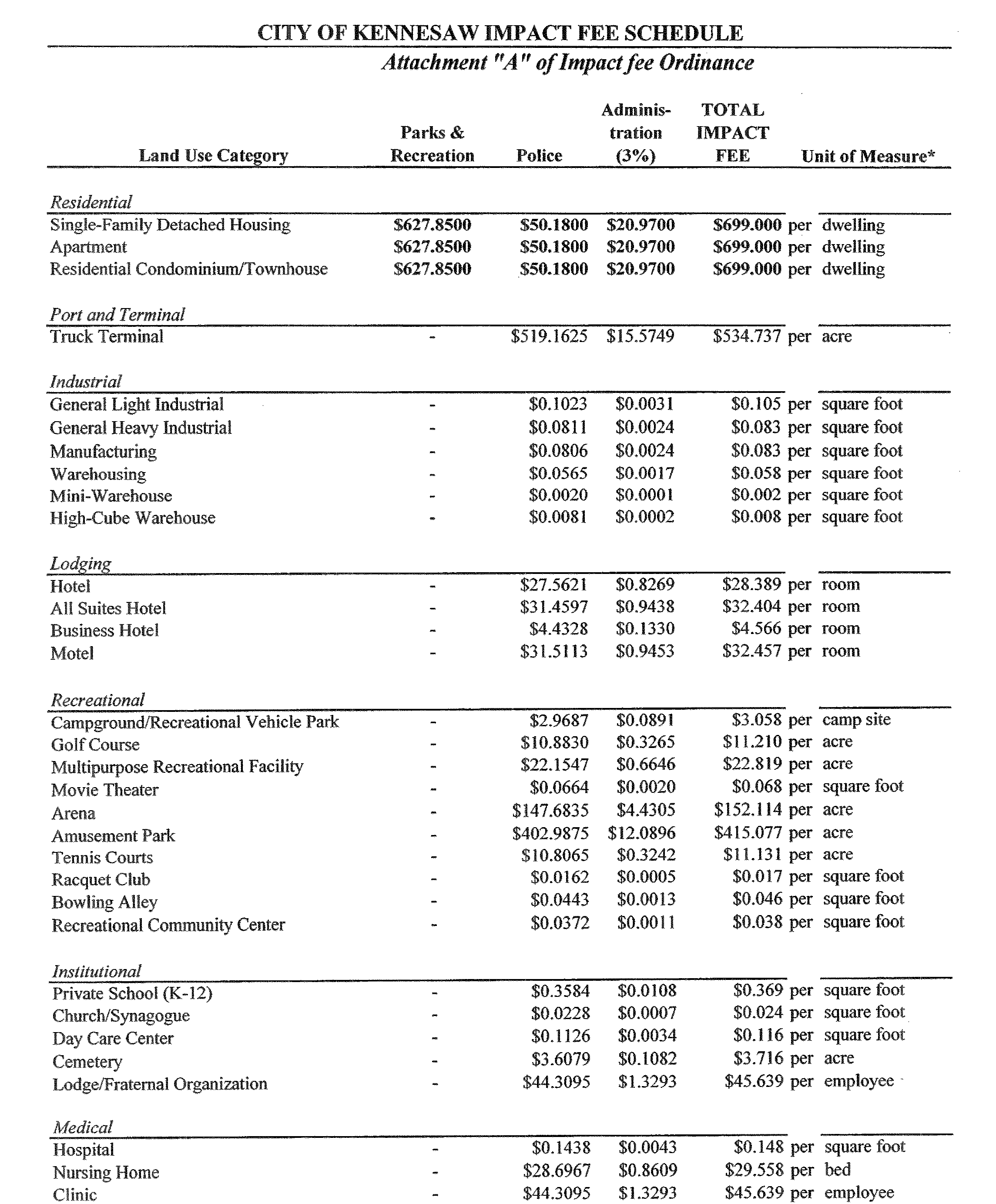
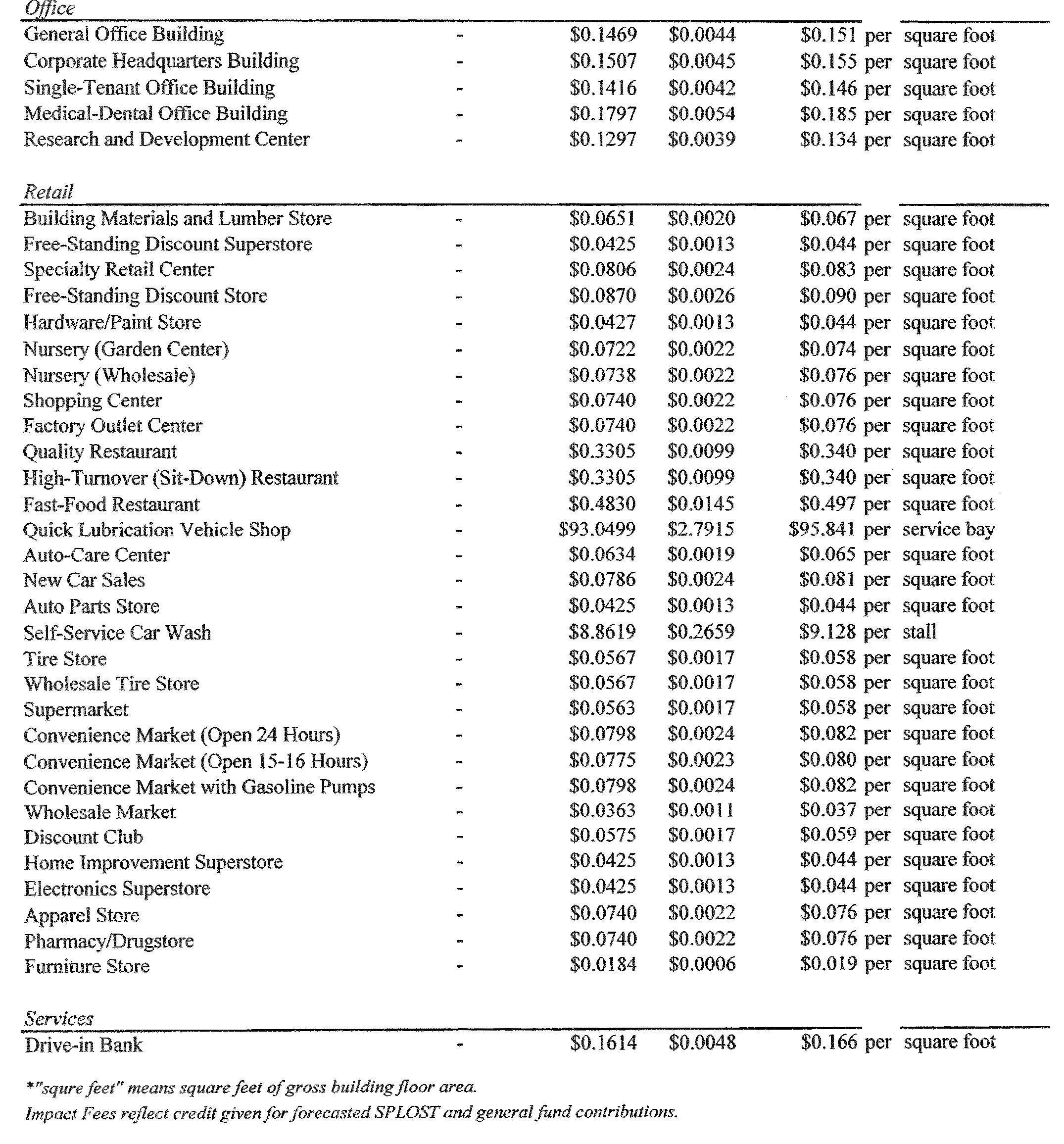
Payment of a development impact fee pursuant to the fee schedule attached hereto and incorporated herein as Attachment A for a property located inside of Kennesaw, shall constitute full and complete payment of the project's proportionate share of system improvements as individually levied by Kennesaw, and shall be deemed to be in compliance with the requirements of this ordinance.
B.
When a land development activity for which an application for a building permit has been made includes two or more buildings, structures or other land uses in any combination, including two or more uses within a building or structure, the total development impact fee shall be the sum of the fees for each and every building, structure, or use, including each and every use within a building or structure.
C.
In the event that an applicant contends that the land use category of the proposed development is not shown on the fee schedule or fits within a different category, then:
The Administrator in his or her reasonable discretion shall make a determination as to the appropriate land use designation and the appropriate development impact fee.
In making such determination, the Administrator may require such additional information from the applicant as necessary to form a logical fee determination relative to the impact fees shown on the adopted fee schedule.
If a land use designation is not in a category contained in this ordinance, then an appropriate new category may be added by the Administrator and an appropriate fee established under the City's current impact fee methodology, subject to annual confirmation by the City Council.
Appeals from the decision of the Administrator shall be made to the City Council in accordance with the Administrative Appeals Section of this ordinance.
7.05.02 - Timing of Assessment and Payment
A.
Development impact fees shall be assessed at the time of application for a building permit.
B.
All development impact fees shall be collected at the time of issuance of a building permit.
C.
For projects not involving issuance of a building permit, all development impact fees shall be collected at the time of approval of the development permit or such other authorization to commence construction or to commence use of a property.
D.
If the final use of a building cannot be determined at the time of the initial building permit, the Administrator shall have the authority to assess a development impact fee based on the most likely use of the building, and shall adjust the fee in accordance with the actual use prior to issuance of an interior finishes permit or approval of a Certificate of Occupancy. An adjustment may result in a refund to the feepayor or payment of the marginal increase of the adjusted fee over the amount already paid.
E.
Notwithstanding any other provision of this ordinance, any future change in demand for public facilities in excess of the average demand anticipated at the time of issuance of the building permit shall be assessed such additional fee as would otherwise have been due. Future changes in demand may result from a change in the land use category of the occupant of the building or property, the expansion of a building or use on a property that results in an increase in the units of development (as defined herein), or the subsequent discovery of facts unknown or misrepresented at the time of issuance of the building permit.
7.05.03 - Individual Assessment Determinations
Individual assessments of development impact fees may be established as follows:
A.
At their option, an applicant for development approval may petition the Administrator for an individual assessment determination of development impact fees due for their project in lieu of the fee established on the fee schedule attached hereto and incorporated herein as Attachment A.
B.
In the event that an applicant elects an individual assessment, the applicant shall submit an individual assessment study. Each individual assessment study shall:
be based on relevant and credible information from an accepted standard source of engineering or planning data; or,
be based on actual, relevant, and credible studies or surveys of facility demand conducted in Kennesaw or its region, carried out by qualified engineers or planners pursuant to accepted methodology; and,
provide any other written specifications as may be reasonably required by the Administrator to substantiate the individual assessment determination.
C.
The Administrator in his or her reasonable discretion shall determine whether the content of an individual assessment study satisfies the requirements of this ordinance. A negative determination by the Administrator may be appealed to the City Council in accordance with the Administrative Appeals Section of this ordinance.
D.
Any fee approved as an individual assessment determination shall have standing for 180 days following the date of approval. Payment of such an approved individual assessment determination shall constitute full and complete payment of the project's proportionate share of system improvements as individually levied by Kennesaw, and shall be deemed to be in compliance with the requirements of this ordinance.
7.05.04 - Fee Certification
Upon application to the Administrator, a developer may receive a certification of the development impact fee schedule attached hereto and incorporated herein as Attachment A or a certified fee for a particular project, as applicable. Such certified schedule or fee shall establish the development impact fee due for a period of 180 days from the date of certification, even if new or revised rate schedules are adopted in the interim.
7.06.01 - Exemption Policy
The City of Kennesaw recognizes that certain office, retail trade and industrial development projects provide extraordinary benefit in support of the economic advancement of the city's citizens over and above the access to jobs, goods and services that such uses offer in general. To encourage such development projects, the City Council may consider granting a reduction in the impact fee for such development projects upon either the determination and relative to the extent that the business or project represents extraordinary economic development and employment growth of public benefit to City of Kennesaw, in accordance with adopted exemption criteria. It is also recognized that the cost of system improvements otherwise foregone through exemption of any impact fee must be funded through revenue sources other than impact fees.
7.06.02 - Process for Exemption Approval
An application for exemption shall be considered under the following procedures:
A.
Application for exemption approval must be made by the building permit applicant to the Administrator. A building permit may be issued upon approval of an exemption, or may be issued without payment of applicable impact fees following receipt of a complete exemption application and pending its approval, but a Certificate of Occupancy shall not be issued until a decision regarding the exemption has been made, or until such time that the application for exemption is otherwise withdrawn by the applicant and payment of impact fees have been paid.
B.
Documentation must be provided to the Administrator that demonstrates the applicant's eligibility for an exemption. This documentation shall address, but need not be limited to, all applicable exemption criteria adopted by the City. This documentation constitutes the application for exemption.
C.
The Administrator in his or her reasonable discretion shall determine whether an application for exemption addresses the exemption criteria adopted by the City and is complete. A negative determination by the Administrator may be appealed to the City Council in accordance with the Administrative Appeals Section of this ordinance.
D.
The Administrator or the City Council shall determine the eligibility for and extent of exemption, in accordance with the standards and procedures contained in the exemption criteria adopted by the City Council. If action by the City Council is required, the application for exemption shall be considered at the next regularly scheduled meeting of the City Council that falls at least two weeks after a complete application for exemption has been received by the Administrator.
7.07.01 - Maintenance of Funds
A.
All development impact fee funds collected for future expenditure on construction or expansion of facilities pursuant to this ordinance shall be maintained in one or more interest-bearing accounts until encumbered or expended. Restrictions on the investment of development impact fee funds shall be the same that apply to investment of all such funds generally.
B.
Separate accounting records shall be maintained for each category of system improvements within each service area wherein fees are collected.
C.
Interest earned on development impact fees shall be considered funds of the account on which it is earned and shall be subject to all restrictions placed on the use of development impact fees under this ordinance.
7.07.02 - Expenditures; Restrictions
A.
Expenditures from the impact fee accounts shall be made only for the category of system improvements within the service area for which the development impact fee was assessed and collected.
B.
Except as provided below, development impact fees shall not be expended for any purpose that does not involve building or expanding system improvements that create additional capacity available to serve new growth and development.
C.
Notwithstanding anything to the contrary in this ordinance, the following shall be considered general revenue of Kennesaw, and may be expended accordingly:
impact fees collected to recover the present value of excess capacity in existing system improvements;
any portion of an impact fee collected as a repayment for expenditures made by Kennesaw for system improvements intended to be funded by such impact fee; and,
any portion of the impact fee (but not to exceed three percent of the total) collected and allocated by the Administrator for administration of the impact fee ordinance, and such additional amount assessed for repayment of the cost of preparing the Capital Improvements Element of the Comprehensive Plan.
7.07.03 - Annual Report
A.
The Administrator shall prepare an annual report to the City Council as part of the annual audit describing the amount of any development impact fees collected, encumbered, and used during the preceding fiscal year by category of public facility and service area.
B.
Such annual report shall be prepared following guidelines of the Georgia Department of Community Affairs (DCA), and submitted to DCA in conjunction with the annual update of the Capital Improvements Element of the Comprehensive Plan.
7.08.01 - Credits; Restrictions
A.
Except as provided in Paragraph 2 below, no credit shall be given for construction, contribution, or dedication of any system improvement or funds for system improvements made before the effective date of this ordinance.
B.
If the value of any construction, dedication of land, or contribution of money made by a developer (or his or her predecessor in title or interest) prior to the effective date of this ordinance for system improvements that are included for impact fee funding in the Capital Improvements Element of the Comprehensive Land Use Plan, is greater than the impact fee that would otherwise have been paid for the Project, then the developer shall be entitled to a credit for such excess construction, dedication, or funding. Notwithstanding anything to the contrary in this ordinance, any credit due under this section shall not constitute a liability of Kennesaw, and shall accrue to the developer to the extent of impact fees assessed for new development for the same category of system improvements within the same service area.
C.
In no event shall credit be given for project improvements, or for system improvements not included for impact fee funding in the Capital Improvements Element of the Comprehensive Plan.
7.08.02 - Granting of Credits
A.
Credit shall be given for the present value of any construction of improvements, contribution or dedication of land, or payment of money by a developer or his or her predecessor in title or interest for system improvements of the same public facilities category and in the same service area for which a development impact fee is imposed, provided that:
the system improvement is included for impact fee funding in the Capital Improvements Element of the Comprehensive Land Use Plan;
the amount of the credit does not exceed the portion of the system improvement's cost that is eligible for impact fee funding, as shown in the Capital Improvements Element; and,
the City Council shall have explicitly approved said improvement, contribution, dedication, or payment and the value thereof prior to its construction, dedication, or transfer.
B.
The credit allowed pursuant to this Section shall not exceed the impact fee due for such system improvement unless a greater credit is authorized under a private agreement executed under the provisions of Section 9 of this ordinance.
7.08.03 - Guidelines for Credit Valuation
Credits under this Section shall be valued using the following guidelines:
A.
For the construction of any system improvements by a developer or his or her predecessor in title or interest and accepted by the City, the developer must present evidence satisfactory to the Administrator of the original cost of the improvement, from which present value may be calculated.
B.
For any contribution or dedication of land for system improvements by a developer or his or her predecessor in title or interest and accepted by the City, the original value of the land shall be the same as that attributed to the property by the validated tax appraisal at the time of dedication, from which present value may be calculated.
C.
For any contribution of capital equipment that qualifies as a system improvement by a developer or his or her predecessor in title or interest and accepted by the City, the value shall be the original cost to the developer of the capital equipment or the cost that Kennesaw, Georgia would normally pay for such equipment, whichever is less.
D.
For any contribution of money for system improvements from a developer or his or her predecessor in title or interest accepted by the City, the original value of the money shall be the same as that at the time of contribution, from which present value may be calculated.
E.
In making a present value calculation, the discount rate used shall be the net of the interest returned on a State of Georgia, AA rated or better municipal bond less average annual inflation, or such other discount rate as the City Council in its sole discretion may deem appropriate.
7.08.04 - Credits; Application
A.
Credits shall be given only upon written request of the developer to the Administrator. A developer must present written evidence satisfactory to the Administrator at or before the time of development impact fee assessment.
B.
The Administrator, in his or her reasonable discretion, shall review all claims for credits and make determinations regarding the allowance of any claimed credit, and the value of any allowed credit.
C.
Any credit approved by the Administrator shall be acknowledged in writing by the Administrator and calculated at the time of impact fee assessment.
7.08.05 - Credits; Abandoned Building Permits
In the event that an impact fee is paid but the building permit is abandoned, credit shall be given for the present value of the impact fee against future impact fees for the same parcel of land, upon submission of adequate evidence to the Administrator that an impact fee was received by the City, the amount paid, and that the building permit was abandoned.
7.09.01 - Eligibility for a Refund
A.
Upon the request of a feepayor regarding a property on which a development impact fee has been paid, the development impact fee shall be refunded if:
capacity is available in the Public Facilities for which the fee was collected but service is permanently denied; or,
the development impact fee has not been encumbered or construction has not been commenced within six years after the date the fee was collected.
B.
In determining whether development impact fees have been encumbered, development impact fees shall be considered encumbered on a first-in, first-out (FIFO) basis.
7.09.02 - Notice of Entitlement to a Refund
When the right to a refund exists due to a failure to encumber the development impact fees, the Administrator shall provide written notice of entitlement to a refund to the feepayor who paid the development impact fee at the address shown on the application for development approval or to a successor in interest who has given adequate notice to the Administrator of a legal transfer or assignment of the right to entitlement to a refund and who has provided a mailing address. Such notice shall also be published in a newspaper of general circulation in Kennesaw within 30 days after the expiration of the six-year period after the date that the development impact fee was collected and shall contain a heading "Notice of Entitlement to Development Impact Fee Refund." No refund shall be made for a period of 30 days from the date of said publication.
7.09.03 - Filing a Request for a Refund
All requests for refunds shall be made in writing to the Administrator within one year of the time the refund becomes payable or within one year of publication of the notice of entitlement to a refund, whichever is later. Failure to make a claim for a refund within said time period shall result in a waiver of all claims to said funds.
7.09.04 - Payment of Refunds
A.
All refunds shall be made to the feepayor within 60 days after it is determined by the Administrator that a sufficient proof of claim for refund has been made, but no sooner than 30 days after publication of the notice of entitlement to the refund.
B.
A refund shall include a refund of a pro rata share of interest actually earned on the unused or excess impact fee collected.
C.
In no event shall a feepayor be entitled to a refund for impact fees assessed and paid to recover the cost of excess capacity in existing system improvements, for any portion of an impact fee collected as a repayment for expenditures made by Kennesaw for system improvements intended to be funded by such impact fee, or for that portion of the fee payment that was assessed for administration of the impact fee ordinance or for recovery of the cost of preparation of the Capital Improvements Element of the Comprehensive Plan.
7.10.01 - Private Agreements; Authorized
Nothing in this ordinance shall prohibit the voluntary mutual approval of a private contractual agreement between the City and any developer or property owner or group of developers and/or property owners in regard to the construction or installation of system improvements and providing for credits or reimbursement for system improvement costs incurred by a developer, including interproject transfers of credits or providing for reimbursement for project improvement costs which are used or shared by more than one development project, provided that:
A.
The system improvements are included for impact fee funding in the Capital Improvements Element of the Comprehensive Plan; and,
B.
The amount of any credit or reimbursement granted shall not exceed the portion of the system improvement's cost that is eligible for impact fee funding.
7.10.02 - Private Agreements; Provisions
A private contractual agreement for system improvements may include, but shall not be limited to, provisions which:
A.
Modify the estimates of impact on public facilities according to the methods and provisions concerning the calculation of impact fees, provided that any such agreement shall allow the City to assess additional development impact fees after the completion of construction according to schedules set forth in this ordinance.
B.
Permit construction of, dedication of property for, or other in-kind contribution for specific public facilities of the type for which development impact fees would be imposed in the same service area in lieu of or with a credit against applicable development impact fees.
C.
Permit a schedule and method of payment appropriate to particular and unique circumstances of a proposed project in lieu of the requirements for payment under this ordinance, provided that acceptable security is posted ensuring payment of the development impact fees. Forms of security that may be acceptable include a cash bond, irrevocable Letter of Credit from a bank authorized to do business within the State of Georgia, a surety bond, or lien or mortgage on lands to be covered by the building permit.
7.10.03 - Private Agreements; Procedure
A.
Any private agreement proposed by an applicant pursuant to this Section shall be submitted to the Administrator for review, negotiation, and submission to the City Council.
B.
Any such agreement must be presented to and approved by the City Council of Kennesaw, Georgia prior to the issuance of a building permit.
C.
Any such agreement shall provide for execution by mortgagees, lien holders or contract purchasers in addition to the landowner, and shall require the applicant to submit such agreement to the Clerk of Superior Court for recording.
7.11.01 - Ordinance Amendments
A.
This ordinance may be amended from time to time as deemed appropriate or desirable.
B.
Interim amendments to the impact fee schedule regarding the establishment of new land use categories by the Administrator under Section 0 are expressly authorized, and shall be confirmed by the City Council when this ordinance is subsequently amended.
7.11.02 - Capital Improvements Element Periodic Review
A.
Update. At least once each year, the City Council shall review and may update the Capital Improvements Element so as to maintain, at a minimum, a schedule of system improvements for each of the subsequent five years. The Capital Improvements Element Update may include changes in funding sources or project costs, or changes in the list or scheduling of projects. The Capital Improvements Element Update shall be submitted to the Regional Development Center for their review, in accordance with the Development Impact Fee Compliance Requirements as adopted by the Board of Community Affairs of the State of Georgia.
B.
Amendment. In conducting a periodic review of the Capital Improvements Element and calculation of development impact fees, the City Council may determine to amend the Capital Improvements Element. Amendments to the Capital Improvements Element shall comply with the procedural requirements of the Development Impact Fee Compliance Requirements as adopted by the Board of Community Affairs of the State of Georgia, and shall be required for any change to the Capital Improvements Element that would:
redefine growth projections, land development assumptions, or goals or objectives that would affect system improvements proposed in the Capital Improvements Element;
add new public facility categories for impact fee funding, modify impact fee service areas or make changes to system improvement projects;
change service levels established for an existing impact fee service area; or
make any other revisions needed to keep the Capital Improvements Element up to date.
7.11.03 - Continuation of Validity
Failure of the City Council to undertake a periodic review of the Capital Improvements Element shall result in the continued use and application of the latest adopted development impact fee schedule and other data. The failure to periodically review such data shall not invalidate this ordinance.
7.12.01 - Eligibility to File an Appeal
Only applicants or feepayors who have already been assessed an impact fee by the City or who have already received a written determination of individual assessment, refund or credit amount shall be entitled to an appeal.
7.12.02 - Appeals Process
A.
The aggrieved applicant or feepayor (hereinafter, the "appellant") must file a written appeal with the Administrator within 15 days of the decision or receipt of written determination from which the appeal is taken.
B.
Such written appeal shall constitute an application for relief, shall be of sufficient content to set forth the basis for the appeal and the relief sought, and shall include:
The name and address of the appellant;
The location of the affected property;
A copy of any applicable written decision or determination made by the Administrator (from which the appeal is taken);
C.
Within 15 days after receipt of the appeal, the Administrator shall make a written final decision with respect to the appeal, such decision to be of sufficient content to set forth the basis for the determination.
D.
Appeals from the final decision of the Administrator shall be made to the City Council within 30 days of receipt by the appellant of the Administrator's decision. Delivery by hand or certified mail to, or posting upon the property at, the address given by the appellant in the application for relief shall constitute "receipt by the appellant" under this provision.
E.
The City Council shall thereafter hold a hearing on the appeal within 30 days provided that at least 2 weeks written notice thereof can be given to the appellant. The City Council shall decide the issue within a reasonable time following the hearing, but in no case more than 15 days following the hearing, unless the appellant agrees to an extension to a later date. Any party making an appeal shall have the right to appear at the hearing to present evidence and may be represented by counsel.
7.12.03 - Payment of Impact Fee during Appeal
A.
The filing of an appeal shall not stay the collection of a development impact fee as a condition to the issuance of development approval.
B.
A developer may pay a development impact fee under protest to obtain a development approval, and by making such payment shall not be stopped from exercising this right of appeal or receiving a refund of any amount deemed to have been collected in excess.
7.13.01 - Enforcement Authority
A.
The enforcement of this ordinance shall be the responsibility of the Administrator and such personnel as the Administrator may designate from time to time.
B.
The Administrator shall have the right to inspect the lands affected by this ordinance and shall have the right to issue a written notice, a stop work order or citation for violations, as the Administrator in his or her reasonable determination may deem appropriate to the circumstances. Refusal of written notice of violation, stop work order or citation under this ordinance shall constitute legal notice of service. The citation shall be in the form of a written official notice issued in person or by certified mail to the owner of the property, or to his or her agent, or to the person performing the work. The receipt of a citation shall require that corrective action be taken within thirty (30) days unless otherwise extended at the discretion of the Administrator.
C.
The Administrator may suspend or revoke any building permit or withhold the issuance of other development approvals. if the provisions of this ordinance have been violated by the developer or the owner or their assigns.
7.13.02 - Violations
A.
Knowingly furnishing false information on any matter relating to the administration of this ordinance shall constitute an actionable violation.
B.
Proceeding with construction of a project that is not consistent with the project's impact fee assessment, such as the use category claimed or units of development indicated, shall constitute an actionable violation.
C.
Failure to take corrective action following the receipt of a citation shall constitute an actionable violation.
D.
A violation of this ordinance shall be a misdemeanor punishable according to law, including the general penalty provisions of the Kennesaw Code of Ordinances. In addition to or in lieu of criminal prosecution, the City Council shall have the power to sue in law or equity for relief in civil court to enforce this ordinance, including recourse to such civil and criminal remedies in law and equity as may be necessary to ensure compliance with the provisions of this ordinance, including but not limited to injunctive relief to enjoin and restrain any person from violating the provisions of this ordinance and to recover such damages as may be incurred by the implementation of specific corrective actions.
7.14.01 - Repeal of Conflicting Laws
Any and all ordinances, resolutions, or regulations, or parts thereof, in conflict with this ordinance are hereby repealed to the extent of such conflict.
7.14.02 - Severability
If any sentence, clause, part, paragraph, section, or provision of this ordinance is declared by a court of competent jurisdiction to be invalid, the validity of the Ordinance as a whole or any other part hereof shall not be affected.
7.14.03 - Incorporation by Reference of Georgia Law
It is the intent of the City Council that the Development Impact Fee Ordinance of Kennesaw, Georgia comply with the terms and provisions of the Georgia Development Impact Fee Act (O.C.G.A. 36-71-1 et seq. as amended). To the extent that any provision of this ordinance is inconsistent with the provisions of said Chapter 36-71, the latter shall control. Furthermore, to the extent that this ordinance is silent as to any provision of said Chapter 36-71 that is otherwise made mandatory by said Chapter 36-71, such provision shall control and shall be binding upon the City.
7.14.04 - Effective Date
This ordinance shall take effect on February 16, 2010.
BE IT SO ORDAINED this _____ th day of ________, 2010, by the CITY COUNCIL OF THE CITY OF KENNESAW, GEORGIA.
City Manager, City of Kennesaw
Attachment A
Fee Schedule—Kennesaw, GA
The attached fee schedule reflects the adoption of an impact fee schedule that is below the maximum allowable impact fee, as calculated in the City of Kennesaw Impact Fee Methodology Report as adopted February 15, 2010. Insert Attachment A.