
Kennesaw City Zoning Code
CHAPTER 2
ZONING DISTRICTS
2.00.00 - GENERALLY
The use of buildings, structures, and land in accordance with the comprehensive plan shall comply with the use requirements for zoning districts set forth in Chapter 2. Buildings, structures, or land shall be occupied or used only in conformity with all of the regulations set forth herein for the district in which it is located. The regulations contained in this article, are intended to: promote the orderly future development of Kennesaw in accordance with the official comprehensive plan; discourage the size and generally type of development which would create excessive requirements and costs for public services; discourage uses which because of its size or type would generate abnormal amounts of traffic on minor streets; and protect and promote a suitable environment for family life.
2.01.01 - Official Zoning Map
A.
The boundaries of the districts are hereby established as shown on a map entitled "Official Zoning Map, City of Kennesaw, Georgia," adopted by the Kennesaw City Council from time to time, and certified by the city clerk. Said map and all explanatory matter, including the adopted zoning resolution, thereon accompanies and is hereby made part of this ordinance.
B.
Said map shall represent as close as possible the actual zoning, but in the event of a discrepancy the explanatory material shall prevail.
C.
Said map shall be retained in the office of the city clerk.
D.
If, in accordance with the provisions of this ordinance, changes are made in district boundaries or other subject matter portrayed on the zoning map, such change shall be made on the official zoning map promptly after the amendment has been approved by the City Council.
E.
Whenever any street, alley or other public way is vacated or abandoned by official action of the Mayor and Council, the zoning district adjoining each side of such street, alley or public way shall be automatically extended to the center of same.
2.01.02 - District Boundaries
Where uncertainty exists with respect to the boundaries of any of the aforesaid districts as shown on the zoning map, the following rules shall apply:
A.
Where district boundaries are indicated as approximately following the centerlines of streets or highways, street lines or highway right-of-way lines or such lines extended, such centerlines, street lines or highway right-of-way lines shall be construed to be such boundaries.
B.
Where district boundaries are so indicated that they approximately follow lot lines, such lot lines shall be construed to be said boundaries.
C.
Where district boundaries are so indicated that they are approximately parallel to the centerlines of streets or highways, or rights-of-way of same, such district boundaries shall be construed as being parallel thereto and at such distance there from as indicated on the zoning map. If no distance is given, such dimension shall be determined by the use of the scale shown on said zoning map. However, the explanatory matter shall be the determining factor.
D.
Where a district boundary line divides a lot in single ownership at the time of enactment of this ordinance, the district requirements for the least restricted portion of such lot shall be deemed to apply to the whole thereof, provided that such extensions shall not include any part of such lot more than thirty five (35) feet beyond the district boundary line.
E.
Where any dispute exists, the metes and bounds legal description shall control.
2.01.03 - Residential Zoning Districts
The following residential zoning districts are established:
2.01.03.01 The regulations for the R-40 Single-Family residential district (40,000-square-foot lot size) are as follows:
A.
Purpose and intent. The R-40 single-family residential district is established to provide locations for single-family detached dwellings or residentially compatible institutional and recreational uses at low densities, as defined under the City of Kennesaw Comprehensive Land Use Plan, and as may be amended from time to time, with access both to public water and sewerage.
B.
Uses. Any use not permitted as of right, or not permitted by Special Exception, or not permitted by land use permit is prohibited. To the extent there is a conflict between the permitted use table and this subsection, this section shall control for purposes of determining whether the use is allowed. See Section 4.04.01 for standards associated with Special Exception uses. Any conflict between the standards set forth in this district and those set forth in Section 4.04.01, the standards in Section 4.04.01 shall control for purposes of developing a Special Exception use.
The following uses are permitted:
Clubs or lodges (noncommercial)
Community fairs
Designated recycling collection locations
Executive golf courses
Fruit trees, nuts and vegetables for personal consumption (not for commerce)
Golf courses (18-hole regulation, public and private use)
Golf course (Par-3)
Group homes
Limited Home Occupation
Nonprofit riding stables
Nonprofit (seasonal use) fishing lake
Private parks
Recreation grounds other than tennis courts and golf courses
Religious assemblies
Single family dwelling units (detached)
Short Term Rentals (STR)
Temporary uses
The following uses are permitted by special exception (refer to section 4.04.01)
Cemeteries
Mausoleums
Private community centers
Private schools of general and special education
The following uses are permitted by land use permit or special land use permit:
Cottage food operators (refer to section 4.04.05 Standards for Home Occupation)
Home Occupations (refer to section 4.04.05)
Family child care learning home (refer to section 4.04.05 Standards for Home Occupation)
Manufactured Homes (refer to section 4.04.04)
Radio, television and other communication towers and antennas (refer to section 4.04.06)
C.
Requirements for certain uses. The following uses shall have the requirements as ascribed to them in this subsection.
1.
Cottage Food Operators:
(a)
Cottage food operators shall adhere to all rules and regulations imposed by the Georgia Department of Agriculture.
(b)
There shall be no signage or other exterior evidence of the cottage food operator.
(c)
Deliveries of specialty ingredients such as herbs and spices, etc., limited to those made by the United States Postal Service or other carrier (FedEx, United Parcel Service, etc.) that routinely deliver mail/internet order products to residents.
(d)
No cottage food products prepared by the cottage food operator may be picked up by a commercial carrier.
(e)
There shall be no employees parking on the site unless approved by the Mayor and City Council in accordance with Section 4.04.05.
(f)
A home occupation land use permit shall be required.
2.
Limited Home Occupations:
(a)
There shall be no exterior evidence of the home occupation, including but not limited to any type of identifying signs.
(b)
No article, product or service used or sold in connection with such activity shall be other than those normally found on the premises.
(c)
No mechanical equipment shall be used for such occupation except such equipment as is customary for purely household and hobby purposes.
(d)
Such use shall be conducted entirely within the dwelling unit, and only persons living in the dwelling unit shall be employed in such occupation.
(e)
No more than 25 percent of the dwelling unit may be used for the operation.
(f)
No materials, equipment or business vehicles may be stored or parked on the premises, except that one business vehicle, used exclusively by the resident may be parked in a carport, garage, or rear or side yard.
(g)
The off-site employees of the resident shall not congregate on the premises for any purpose concerning the business of the home occupation.
(h)
There shall be no deliveries of supplies for use in the home occupation or pickups of the items produced by the occupant by commercial carriers.
(i)
No clients or customers are allowed on the premises on a regular basis.
(j)
The limited home occupation shall not create a nuisance.
3.
Designated Recycling Collection Locations:
(a)
Must be maintained in a safe, clean, neat, and sanitary fashion;
(b)
Such location shall be visually screened and maintained;
(c)
Such location shall be within the building setbacks unless otherwise approved by the zoning administrator or his/her designee due to topography, safety, internal traffic flow, site distance, or for other site-related circumstances not created by the property owner.
4.
Group Home:
(a)
A group home shall be shared by four or fewer persons, excluding resident staff;
(b)
The group home must provide the City of Kennesaw with a copy of its scheduled activity plan, a copy of the group home rules, and, if applicable, evidence of active enforcement under the Georgia Association of Recovery Residence standards;
(c)
The group home must be under the direction and guidance of a designated managing caregiver that resides at the group home;
(d)
The designated managing caregiver or his or her designee shall be available on a 24-hour basis in the event of emergencies or complaints; and
(e)
A group home must submit to random inspections by the City Code Enforcement;
(f)
A group home shall comply with all applicable regulations by the Board of Behavioral Health and Developmental Disabilities and the Department of Behavioral Health and Developmental Disabilities.
5.
Family childcare learning home:
(a)
Maximum of six children under 13 years of age at one time for pay or not for pay;
(b)
For purpose of this section only, children who are related by direct blood kin or adoption to the childcare provider shall not be included in the calculation of the six children limitation;
(c)
The childcare shall not create a nuisance to immediately adjacent property owners;
(d)
Off-street parking must be provided for childcare pick-up and drop-off; and
(e)
No employees;
(f)
Proof of a Family child care learning home license under O.C.G.A. § 20-1A-10(v), or as amended from time to time, by the Department of Early Care and Learning or its successor agency;
(g)
A home occupation land use permit shall be required.
6.
Temporary Uses:
(a)
An approved temporary use shall not exceed 30 days and may be renewed for not more than one additional 30-day period.
(b)
Adequate off-street parking shall be provided.
(c)
Application for a temporary use shall be made with the City Business License division.
D.
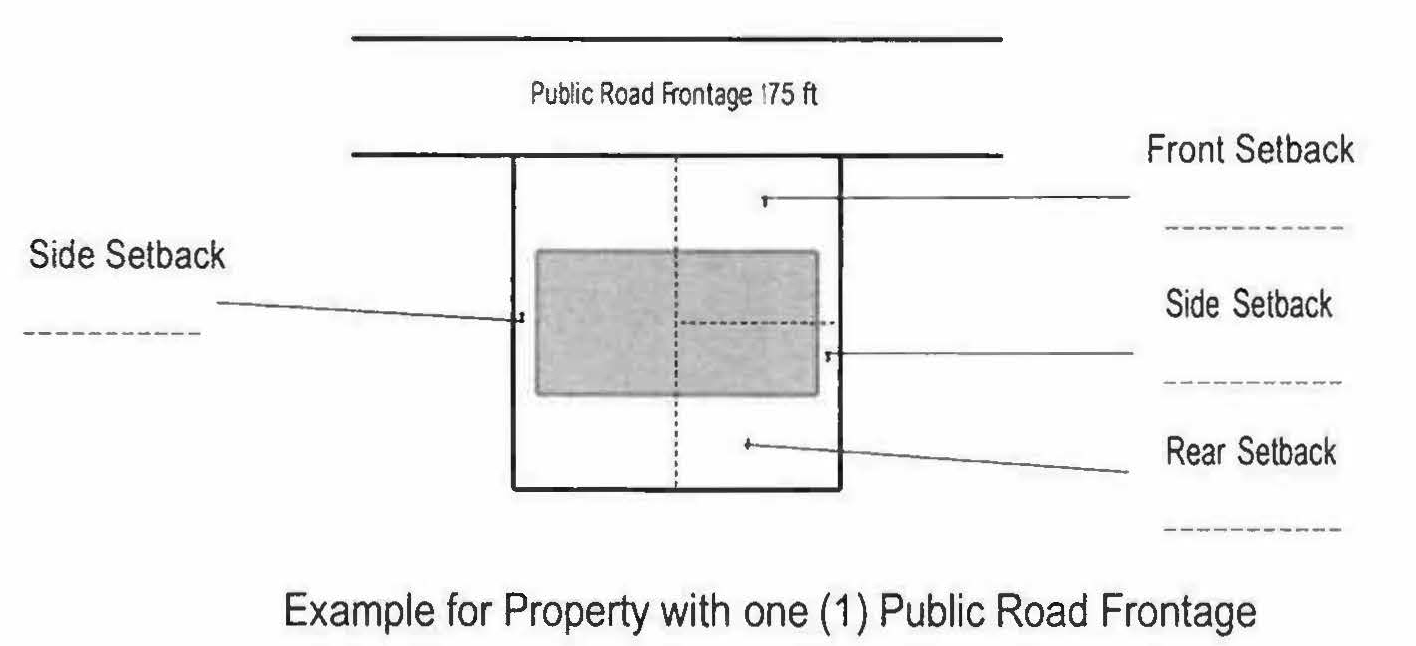
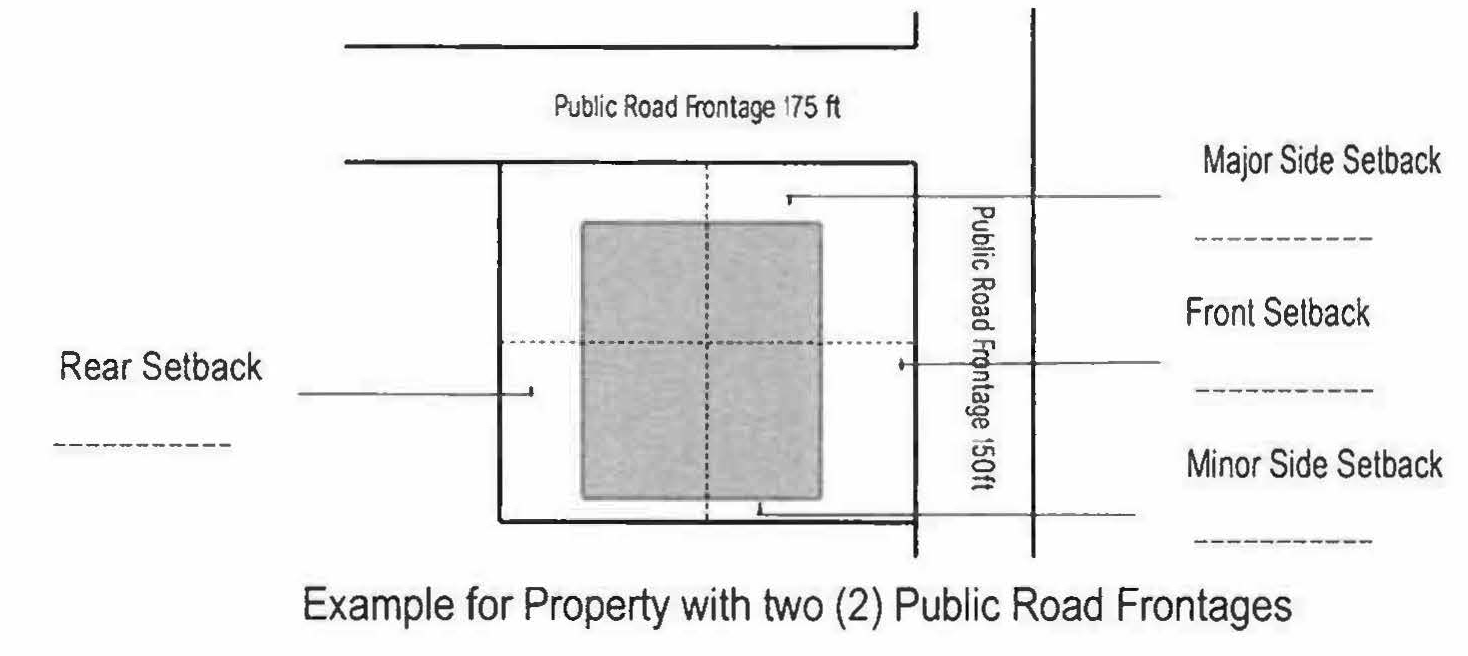
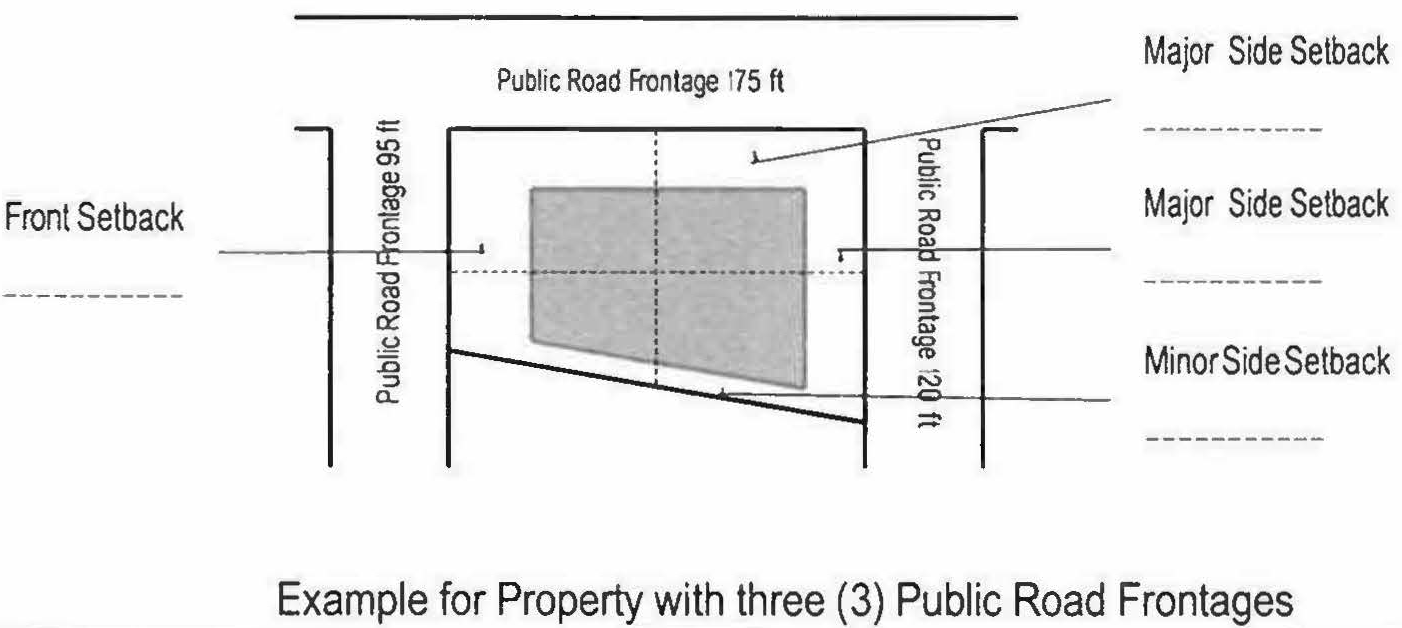
Dimensional standards for Development. Setback shall be measured from the property line of the parcel. The property with the shortest amount of road frontage shall be the front setback for determining other setbacks (major side, side, rear).
1.
Minimum lot size: 40,000 square feet. The Zoning Administrator shall not be authorized to recommend a variance for more than 25 percent of the minimum lot size.
2.
Minimum floor area: 1,600 square feet.
3.
Minimum lot width at front setback line: 75 feet; cul-de-sac, 60 feet.
4.
Minimum public road frontage: 75 feet; cul-de-sac, 50 feet.
5.
Maximum cover: 35%
6.
Maximum building height: 35 feet.
7.
A basement shall be counted as a story if the ceiling is six feet or more above the grade and is either subdivided or used for dwelling or business purposes. A basement is a portion of the building partly underground which has more than one-half of its height measured from finished floor to finished ceiling above the average grade of the adjoining ground.
8.
Please refer to Site Design Standards for Base Zoning Districts set forth in Section 4.01.00 of the Unified Development Code, as amended from time to time, for additional regulations.
9.
Minimum building setbacks:
(a)
Front yard as measured from arterial: 45 feet.
(b)
Front yard as measured from collector: 45 feet.
(c)
Front yard as measured from local: 45 feet.
(d)
Side yard (aka minor side yard): 12 feet.
(e)
Rear yard: 40 feet.
(f)
Major side: 25 feet.
10.
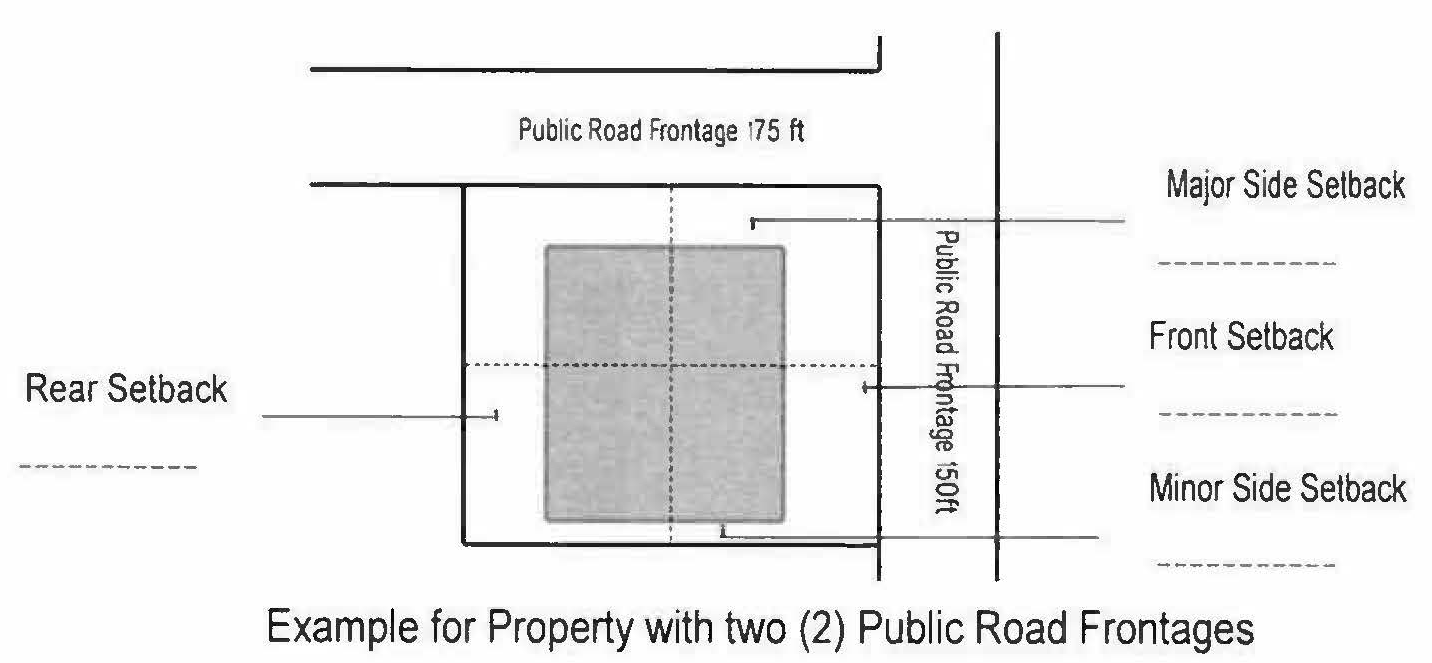
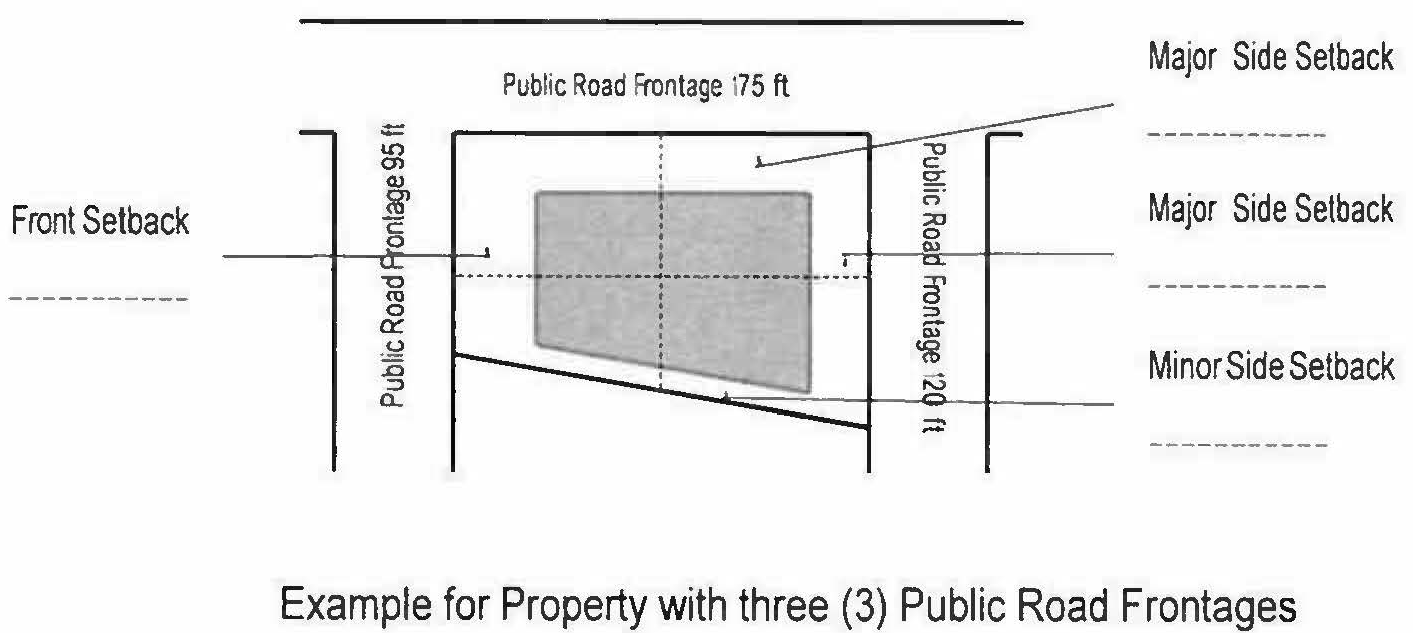
Measuring building setbacks: The number and type of setbacks is determined based on the number and type of public road frontages for the lot as follows and as shown on the following diagram:
(a)
One public road frontage: The front yard setback is measured from the one public road frontage (arterial, collector, or local). The yard opposite the front yard is the rear yard and the other two yards are side yards.
(b)
Two public road frontages: The front yard setback is measured from the road with the shortest frontage (arterial, collector, or local). The major side yard setback is measured from the road with the longer frontage (arterial, collector, or local). The yard opposite the front yard is the rear yard and the yard opposite the major side yard is the minor side yard.
(c)
Three public road frontages: The front yard setback is measured from the road with the shortest frontage (arterial, collector, or local). The two major side yard setbacks are measured from the other two road frontages (arterial, collector, or local). The remaining yard is a minor side yard.
(d)
Building setbacks apply to both principal and accessory buildings and structure except where it explicitly states otherwise.
(e)
Irregular shaped lots: The Planning and Zoning Administrator will determine setbacks for irregular shaped lots adhering to the spirit and intent of this section.
2.01.03.02 The regulations for the R-30 Single-Family residential district (30,000-square-foot lot size) are as follows:
A.
Purpose and intent. The R-30 single-family residential district is established to provide locations for single-family detached dwellings or residentially compatible institutional and recreational uses at low to moderate densities, as defined under the City of Kennesaw Comprehensive Land Use Plan, and as may be amended from time to time, with access both to public water and sewerage.
B.
Uses. Any use not permitted as of right, or not permitted by Special Exception, or not permitted by land use permit is prohibited. To the extent there is a conflict between the permitted use table and this subsection, this section shall control for purposes of determining whether the use is allowed. See Section 4.04.01 for standards associated with Special Exception uses. Any conflict between the standards set forth in this district and those set forth in Section 4.04.01, the standards in Section 4.04.01 shall control for purposes of developing a Special Exception use.
The following uses are permitted:
Clubs or lodges (noncommercial)
Community Fairs
Designated Recycling Collection locations
Executive golf courses
Fruit Trees, Nuts and Vegetables for personal consumption (not for commerce)
Golf Courses (Par 3)
Golf Courses (18-hold regulation; private and public)
Group homes
Limited home occupation
Nonprofit riding stables
Nonprofit (seasonal use) fishing lakes
Private parks
Recreation grounds other than tennis courts and golf courses
Religious assemblies
Single family dwelling units (detached)
Short Term Rentals (STR)
Temporary uses
The following uses are permitted by special exception (refer to section 4.04.01):
Cemeteries
Mausoleums
Private community centers
Private schools of general and special education
The following uses are permitted by land use permit or special land use permit:
Cottage food operator (refer to section 4.04.05 Standards for Home Occupation)
Family childcare learning home (refer to section 4.04.05 Standards for Home Occupation)
Home occupation (refer to section 4.04.05)
Radio, television, and other communication towers and antennas (refer to section 4.04.06)
C.
Requirements for certain uses. The following uses shall have the requirements as ascribed to them in this subsection.
1.
Cottage Food Operators:
(a)
Cottage food operators shall adhere to all rules and regulations imposed by the Georgia Department of Agriculture.
(b)
There shall be no signage or other exterior evidence of the cottage food operator.
(c)
Deliveries of specialty ingredients such as herbs and spices, etc., limited to those made by the United States Postal Service or other carrier (FedEx, United Parcel Service, etc.) that routinely deliver mail/internet order products to residents.
(d)
No cottage food products prepared by the cottage food operator may be picked up by a commercial carrier.
(e)
There shall be no employees parking on the site unless approved by the Mayor and City Council in accordance with Section 4.04.05.
(f)
A home occupation land use permit shall be required.
2.
Limited Home Occupations:
(a)
There shall be no exterior evidence of the home occupation, including but not limited to any type of identifying signs.
(b)
No article, product or service used or sold in connection with such activity shall be other than those normally found on the premises.
(c)
No mechanical equipment shall be used for such occupation except such equipment as is customary for purely household and hobby purposes.
(d)
Such use shall be conducted entirely within the dwelling unit, and only persons living in the dwelling unit shall be employed in such occupation.
(e)
No more than 25 percent of the dwelling unit may be used for the operation.
(f)
No materials, equipment or business vehicles may be stored or parked on the premises, except that one business vehicle, used exclusively by the resident may be parked in a carport, garage, or rear or side yard.
(g)
The off-site employees of the resident shall not congregate on the premises for any purpose concerning the business of the home occupation.
(h)
There shall be no deliveries of supplies for use in the home occupation or pickups of the items produced by the occupant by commercial carriers.
(i)
No clients or customers are allowed on the premises on a regular basis.
(j)
The limited home occupation shall not create a nuisance.
3.
Designated Recycling Collection Locations:
(a)
Must be maintained in a safe, clean, neat, and sanitary fashion;
(b)
Such location shall be visually screened and maintained;
(c)
Such location shall be within the building setbacks unless otherwise approved by the zoning administrator or his/her designee due to topography, safety, internal traffic flow, site distance, or for other site-related circumstances not created by the property owner.
4.
Group Home:
(a)
A group home shall be shared by four or fewer persons, excluding resident staff;
(b)
The group home must provide the City of Kennesaw with a copy of its scheduled activity plan, a copy of the group home rules, and, if applicable, evidence of active enforcement under the Georgia Association of Recovery Residence standards;
(c)
The group home must be under the direction and guidance of a designated managing caregiver that resides at the group home;
(d)
The designated managing caregiver or his or her designee shall be available on a 24-hour basis in the event of emergencies or complaints; and
(e)
A group home must submit to random inspections by the City Code Enforcement;
(f)
A group home shall comply with all applicable regulations by the Board of Behavioral Health and Developmental Disabilities and the Department of Behavioral Health and Developmental Disabilities.
5.
Family childcare learning home:
(a)
Maximum of six children under 13 years of age at one time for pay or not for pay;
(b)
For purpose of this section only, children who are related by direct blood kin or adoption to the childcare provider shall not be included in the calculation of the six children limitation;
(c)
The childcare shall not create a nuisance to immediately adjacent property owners;
(d)
Off-street parking must be provided for childcare pick-up and drop-off; and
(e)
No employees;
(f)
Proof of a Family child care learning home license under O.C.G.A. § 20-1A-10(v), or as amended from time to time, by the Department of Early Care and Learning or its successor agency;
(g)
A home occupation land use permit shall be required.
6.
Temporary Uses:
(a)
An approved temporary use shall not exceed 30 days and may be renewed for not more than one additional 30-day period.
(b)
Adequate off-street parking shall be provided.
(c)
Application for a temporary use shall be made with the City Business License division.
D.
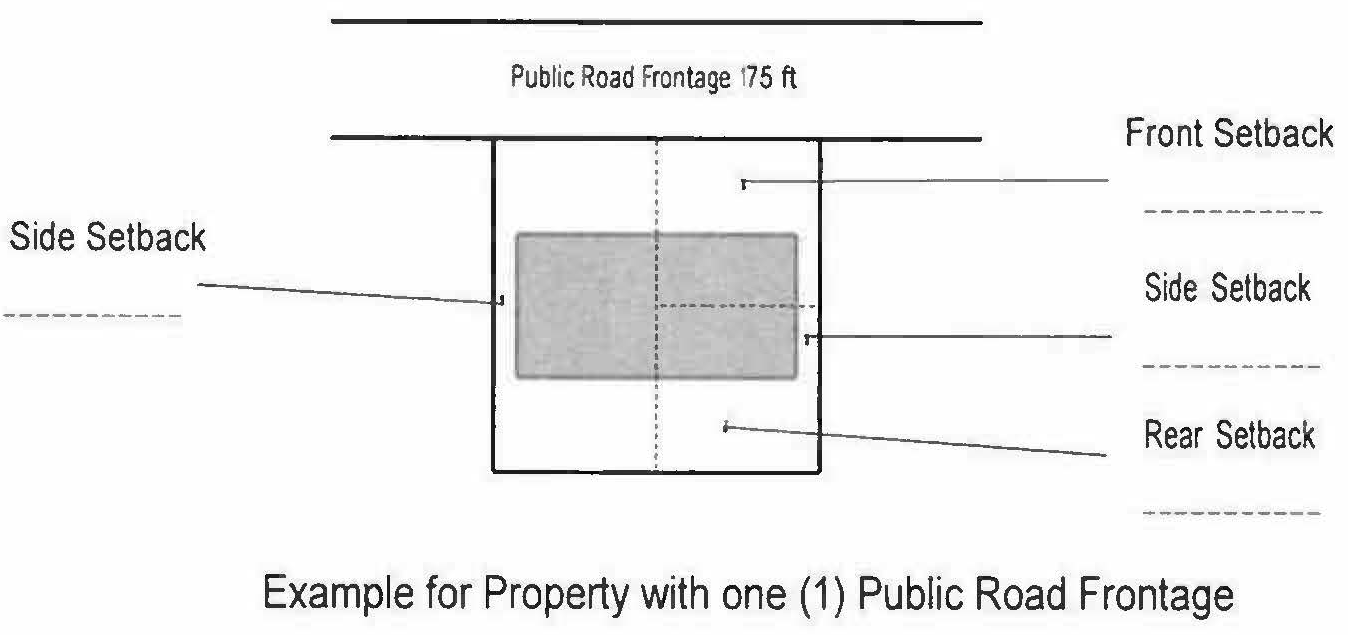
Dimensional standards for Development. Setback shall be measured from the property line of the parcel. The property with shortest amount of road frontage shall be the front setback for determining other setbacks (major side, side, rear).
1.
Minimum lot size: 30,000 square feet. The Zoning Administrator shall not be authorized to recommend a variance for more than 25 percent of the minimum lot size.
2.
Minimum floor area: 1,600 square feet.
3.
Minimum lot width at front setback line: 60-feet; cul-de-sac, 60 feet.
4.
Minimum public road frontage: 75 feet; cul-de-sac, 50 feet.
5.
Maximum cover: 35%
6.
Maximum building height: 35 feet.
7.
A basement shall be counted as a story if the ceiling is six feet or more above the grade and is either subdivided or used for dwelling or business purposes. A basement is a portion of the building partly underground which has more than one-half of its height measured from finished floor to finished ceiling above the average grade of the adjoining ground.
8.
Minimum building setbacks:
(a)
Front yard as measured from arterial: 50 feet.
(b)
Front yard as measured from collector: 50 feet.
(c)
Front yard as measured from local: 40 feet.
(d)
Side yard (aka minor side yard): 10 feet.
(e)
Rear yard: 40 feet.
(f)
Major side: 25 feet.
9.
Measuring building setbacks: The number and type of setbacks is determined based on the number and type of public road frontages for the lot as follows and as shown on the following diagram:
(a)
One public road frontage: The front yard setback is measured from the one public road frontage (arterial, collector, or local). The yard opposite the front yard is the rear yard and the other two yards are side yards.
(b)
Two public road frontages: The front yard setback is measured from the road with the shortest frontage (arterial, collector, or local). The major side yard setback is measured from the road with the longer frontage (arterial, collector, or local). The yard opposite the front yard is the rear yard and the yard opposite the major side yard is the minor side yard.
(c)
Three public road frontages: The front yard setback is measured from the road with the shortest frontage (arterial, collector, or local). The two major side yard setbacks are measured from the other two road frontages (arterial, collector, or local). The remaining yard is a minor side yard.
(d)
Building setbacks apply to both principal and accessory buildings and structure except where it explicitly states otherwise.
(e)
Irregular shaped lots: The Planning and Zoning Administrator will determine setbacks for irregular shaped lots adhering to the spirit and intent of this section.
2.01.03.03 The regulations for the R-20 Single-Family residential district (20,000-square-foot lot size) are as follows:
A.
Purpose and intent. The R-20 single-family residential district is intended to provide suitable areas for single-family, detached dwellings at medium densities as defined under the City of Kennesaw Comprehensive Land Use Plan, and as may be amended from time to time, with access to both public water and sewerage.
B.
Uses. Any use not permitted as of right, or not permitted by Special Exception, or not permitted by land use permit is prohibited. To the extent there is a conflict between the permitted use table and this subsection, this section shall control for purposes of determining whether the use is allowed. See Section 4.04.01 for standards associated with Special Exception uses. Any conflict between the standards set forth in this district and those set forth in Section 4.04.01, the standards in Section 4.04.01 shall control for purposes of developing a Special Exception use.
The following uses are permitted:
Clubs or lodges
Community Fairs
Designated Recycling Collection locations
Executive golf courses
Fruit Trees, Nuts and Vegetables for personal consumption (not for commerce)
Golf courses (Par 3)
Golf courses (18-hold regulation; private and public)
Group homes
Limited home occupations
Nonprofit riding stables
Nonprofit (seasonal use) fishing lakes
Private parks
Recreation grounds other than tennis courts and golf courses
Religious assemblies
Single family dwelling units (detached)
Short Term Rentals (STR)
Temporary uses
The following uses are permitted by special exception (refer to section 4.04.01):
Cemeteries
Mausoleum
Private community centers
Private schools of general and special education
The following uses are permitted by land use permit or special land use permit:
Cottage food operator (refer to section 4.04.05 Standards for Home Occupation)
Family childcare learning home (refer to section 4.04.05 Standards for Home Occupation)
Home occupations (refer to section 4.04.05)
Manufactured Homes
Radio, television and other communication towers and antennas (refer to section 4.04.06)
C.
Requirements for certain uses. The following uses shall have the requirements as ascribed to them in this subsection.
1.
Cottage Food Operators:
(a)
Cottage food operators shall adhere to all rules and regulations imposed by the Georgia Department of Agriculture.
(b)
There shall be no signage or other exterior evidence of the cottage food operator.
(c)
Deliveries of specialty ingredients such as herbs and spices, etc., limited to those made by the United States Postal Service or other carrier (FedEx, United Parcel Service, etc.) that routinely deliver mail/internet order products to residents.
(d)
No cottage food products prepared by the cottage food operator may be picked up by a commercial carrier.
(e)
There shall be no employees parking on the site unless approved by the Mayor and City Council in accordance with Section 4.04.05.
(f)
A home occupation land use permit shall be required.
2.
Limited Home Occupations:
(a)
There shall be no exterior evidence of the home occupation, including but not limited to any type of identifying signs.
(b)
No article, product or service used or sold in connection with such activity shall be other than those normally found on the premises.
(c)
No mechanical equipment shall be used for such occupation except such equipment as is customary for purely household and hobby purposes.
(d)
Such use shall be conducted entirely within the dwelling unit, and only persons living in the dwelling unit shall be employed in such occupation.
(e)
No more than 25 percent of the dwelling unit may be used for the operation.
(f)
No materials, equipment or business vehicles may be stored or parked on the premises, except that one business vehicle, used exclusively by the resident may be parked in a carport, garage, or rear or side yard.
(g)
The off-site employees of the resident shall not congregate on the premises for any purpose concerning the business of the home occupation.
(h)
There shall be no deliveries of supplies for use in the home occupation or pickups of the items produced by the occupant by commercial carriers.
(i)
No clients or customers are allowed on the premises on a regular basis.
(j)
The limited home occupation shall not create a nuisance.
3.
Designated Recycling Collection Locations:
(a)
Must be maintained in a safe, clean, neat, and sanitary fashion;
(b)
Such location shall be visually screened and maintained;
(c)
Such location shall be within the building setbacks unless otherwise approved by the zoning administrator or his/her designee due to topography, safety, internal traffic flow, site distance, or for other site-related circumstances not created by the property owner.
4.
Group Home:
(a)
A group home shall be shared by four or fewer persons, excluding resident staff;
(b)
The group home must provide the City of Kennesaw with a copy of its scheduled activity plan, a copy of the group home rules, and, if applicable, evidence of active enforcement under the Georgia Association of Recovery Residence standards;
(c)
The group home must be under the direction and guidance of a designated managing caregiver that resides at the group home;
(d)
The designated managing caregiver or his or her designee shall be available on a 24-hour basis in the event of emergencies or complaints; and
(e)
A group home must submit to random inspections by the City Code Enforcement;
(f)
A group home shall comply with all applicable regulations by the Board of Behavioral Health and Developmental Disabilities and the Department of Behavioral Health and Developmental Disabilities.
5.
Family childcare learning home:
(a)
Maximum of six children under 13 years of age at one time for pay or not for pay;
(b)
For purpose of this section only, children who are related by direct blood kin or adoption to the childcare provider shall not be included in the calculation of the six children limitation;
(c)
The childcare shall not create a nuisance to immediately adjacent property owners;
(d)
Off-street parking must be provided for childcare pick-up and drop-off; and
(e)
No employees;
(f)
Proof of a Family child care learning home license under O.C.G.A. § 20-1A-10(v), or as amended from time to time, by the Department of Early Care and Learning or its successor agency;
(g)
A home occupation land use permit shall be required.
6.
Temporary Uses:
(a)
An approved temporary use shall not exceed 30 days and may be renewed for not more than one additional 30-day period.
(b)
Adequate off-street parking shall be provided.
(c)
Application for a temporary use shall be made with the City Business License division.
D.
Dimensional standards for Development. Setback shall be measured from the property line of the parcel. The property with shortest amount of road frontage shall be the front setback for determining other setbacks (major side, side, rear).
1.
Minimum lot size: 20,000 square feet. The Zoning Administrator shall not be authorized to recommend a variance for more than 25 percent of the minimum lot size.
2.
Minimum floor area: 1,500 square feet.
3.
Minimum lot width at front setback line: 75 feet; cul-de-sac, 60 feet.
4.
Minimum public road frontage: 75 feet; cul-de-sac, 50 feet.
5.
Maximum cover: 35%
6.
Maximum building height: 35 feet.
7.
A basement shall be counted as a story if the ceiling is six feet or more above the grade and is either subdivided or used for dwelling or business purposes. A basement is a portion of the building partly underground which has more than one-half of its height measured from finished floor to finished ceiling above the average grade of the adjoining ground.
8.
Minimum building setbacks:
(a)
Front yard as measured from arterial: 40 feet.
(b)
Front yard as measured from collector: 40 feet.
(c)
Front yard as measured from local: 35 feet.
(d)
Side yard (aka minor side yard): 10 feet.
(e)
Rear yard: 35 feet.
(f)
Major side: 25 feet.
9.
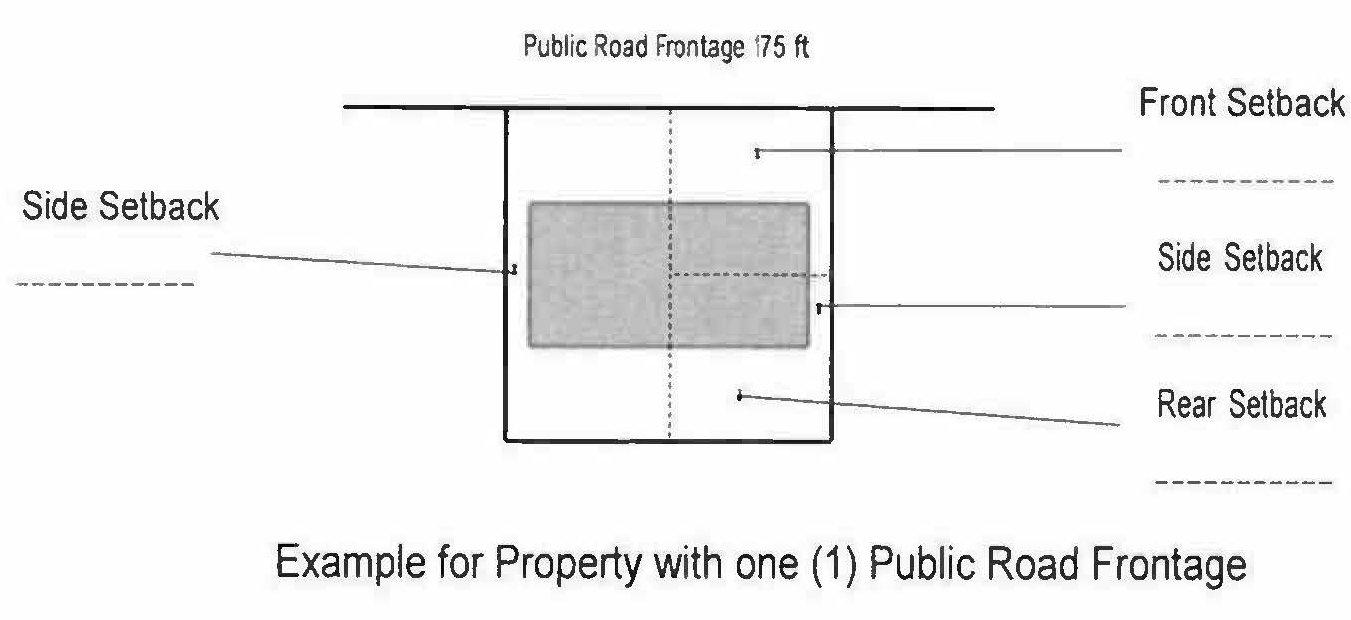
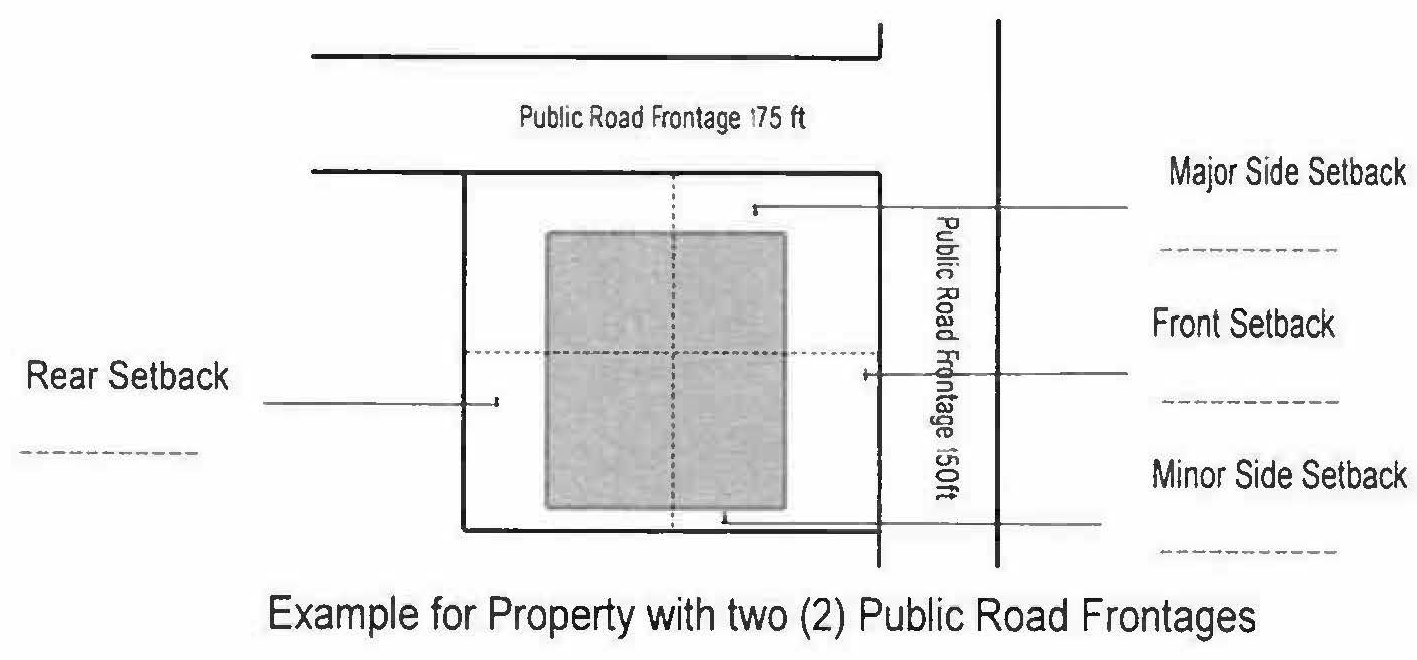
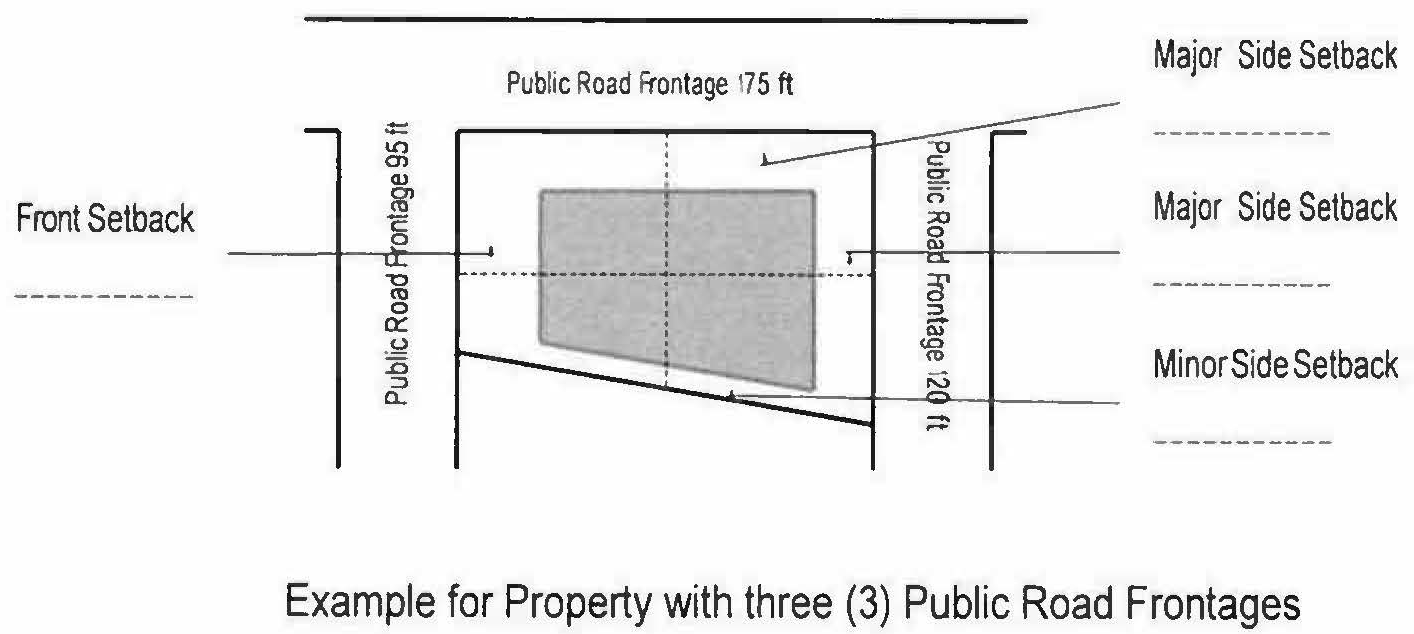
Measuring building setbacks: The number and type of setbacks is determined based on the number and type of public road frontages for the lot as follows and as shown on the following diagram:
(a)
One public road frontage: The front yard setback is measured from the one public road frontage (arterial, collector, or local). The yard opposite the front yard is the rear yard and the other two yards are side yards.
(b)
Two public road frontages: The front yard setback is measured from the road with the shortest frontage (arterial, collector, or local). The major side yard setback is measured from the road with the longer frontage (arterial, collector, or local). The yard opposite the front yard is the rear yard and the yard opposite the major side yard is the minor side yard.
(c)
Three public road frontages: The front yard setback is measured from the road with the shortest frontage (arterial, collector, or local). The two major side yard setbacks are measured from the other two road frontages (arterial, collector, or local). The remaining yard is a minor side yard.
(d)
Building setbacks apply to both principal and accessory buildings and structure except where it explicitly states otherwise.
(e)
Irregular shaped lots: The Planning and Zoning Administrator will determine setbacks for irregular shaped lots adhering to the spirit and intent of this section.
10.
Nonconforming Uses. Any lot with an existing structure that was developed and established in accordance with applicable ordinances prior to March 18, 1996 shall be considered a lawful, conforming use under the Unified Development Code (UDC). In the event of reconstruction, such properties may be rebuilt using the previously established building footprint. The Zoning Administrator or their designee shall have the authority to approve administrative variances to reduce dimensional standards such as setbacks, lot width, coverage for lots identified as nonconforming on the official map referenced in Appendix A, where such standards do not align with current zoning regulations.
Administrative variances may be granted only if:
1.
The proposed reconstruction does not adversely impact adjacent properties, and
2.
The request remains consistent with the intent and purpose of the Unified Development Code.
2.01.03.04 The regulations for the R-15 Single-Family residential district (15,000-square-foot lot size) are as follows:
A.
Purpose and intent. The R-15 single-family residential district is intended to provide suitable areas for single-family, detached dwellings at medium densities as defined by the City of Kennesaw Comprehensive Land Use Plan, and as may be amended from time to time, with access to both public water and sewerage.
B.
Uses. Any use not permitted as of right, or not permitted by Special Exception, or not permitted by land use permit is prohibited. To the extent there is a conflict between the permitted use table and this subsection, this section shall control for purposes of determining whether the use is allowed. See Section 4.04.01 for standards associated with Special Exception uses. Any conflict between the standards set forth in this district and those set forth in Section 4.04.01, the standards in Section 4.04.01 shall control for purposes of developing a Special Exception use.
The following uses are permitted:
Clubs or lodges
Community Fairs
Designated recycling collection locations
Executive golf courses
Golf courses (Par 3)
Golf courses (18-hole regulation; private and public)
Group homes
Limited home occupation
Nonprofit riding stables
Nonprofit (seasonal use) fishing lakes
Private parks
Recreation grounds other than tennis courts and golf courses
Religious assemblies
Single family dwelling units (detached)
Short Term Rentals (STR)
Temporary uses
The following uses are permitted by special exception (refer to section 4.04.01):
Cemeteries
Mausoleums
Private community centers
Private schools of general and special education
The following uses are permitted by land use permit or special land use permit:
Cottage food operators (refer to section 4.04.05 Standards for Home Occupation)
Family childcare learning home (refer to section 4.04.05 Standards for Home Occupation)
Home occupation (refer to section 4.04.05)
Manufactured Homes
Radio, television, and other communication towers and antennas (refer to section 4.05.06)
C.
Requirements for certain uses. The following uses shall have the requirements as ascribed to them in this subsection.
1.
Cottage Food Operators:
(a)
Cottage food operators shall adhere to all rules and regulations imposed by the Georgia Department of Agriculture.
(b)
There shall be no signage or other exterior evidence of the cottage food operator.
(c)
Deliveries of specialty ingredients such as herbs and spices, etc., limited to those made by the United States Postal Service or other carrier (FedEx, United Parcel Service, etc.) that routinely deliver mail/internet order products to residents.
(d)
No cottage food products prepared by the cottage food operator may be picked up by a commercial carrier.
(e)
There shall be no employees parking on the site unless approved by the Mayor and City Council in accordance with Section 4.04.05.
(f)
A home occupation land use permit shall be required.
2.
Limited Home Occupations:
(a)
There shall be no exterior evidence of the home occupation, including but not limited to any type of identifying signs.
(b)
No article, product or service used or sold in connection with such activity shall be other than those normally found on the premises.
(c)
No mechanical equipment shall be used for such occupation except such equipment as is customary for purely household and hobby purposes.
(d)
Such use shall be conducted entirely within the dwelling unit, and only persons living in the dwelling unit shall be employed in such occupation.
(e)
No more than 25 percent of the dwelling unit may be used for the operation.
(f)
No materials, equipment or business vehicles may be stored or parked on the premises, except that one business vehicle, used exclusively by the resident may be parked in a carport, garage, or rear or side yard.
(g)
The off-site employees of the resident shall not congregate on the premises for any purpose concerning the business of the home occupation.
(h)
There shall be no deliveries of supplies for use in the home occupation or pickups of the items produced by the occupant by commercial carriers.
(i)
No clients or customers are allowed on the premises on a regular basis.
(j)
The limited home occupation shall not create a nuisance.
3.
Designated Recycling Collection Locations:
(a)
Must be maintained in a safe, clean, neat, and sanitary fashion;
(b)
Such location shall be visually screened and maintained;
(c)
Such location shall be within the building setbacks unless otherwise approved by the zoning administrator or his/her designee due to topography, safety, internal traffic flow, site distance, or for other site-related circumstances not created by the property owner.
4.
Group Home:
(a)
A group home shall be shared by four or fewer persons, excluding resident staff;
(b)
The group home must provide the City of Kennesaw with a copy of its scheduled activity plan, a copy of the group home rules, and, if applicable, evidence of active enforcement under the Georgia Association of Recovery Residence standards;
(c)
The group home must be under the direction and guidance of a designated managing caregiver that resides at the group home;
(d)
The designated managing caregiver or his or her designee shall be available on a 24-hour basis in the event of emergencies or complaints; and
(e)
A group home must submit to random inspections by the City Code Enforcement;
(f)
A group home shall comply with all applicable regulations by the Board of Behavioral Health and Developmental Disabilities and the Department of Behavioral Health and Developmental Disabilities.
5.
Family childcare learning home:
(a)
Maximum of six children under 13 years of age at one time for pay or not for pay;
(b)
For purpose of this section only, children who are related by direct blood kin or adoption to the childcare provider shall not be included in the calculation of the six children limitation;
(c)
The childcare shall not create a nuisance to immediately adjacent property owners;
(d)
Off-street parking must be provided for childcare pick-up and drop-off; and
(e)
No employees;
(f)
Proof of a Family child care learning home license under O.C.G.A. § 20-1A-10(v), or as amended from time to time, by the Department of Early Care and Learning or its successor agency;
(g)
A home occupation land use permit shall be required.
6.
Temporary Uses:
(a)
An approved temporary use shall not exceed 30 days and may be renewed for not more than one additional 30-day period.
(b)
Adequate off-street parking shall be provided.
(c)
Application for a temporary use shall be made with the City Business License division.
D.
Dimensional standards for Development. Setback shall be measured from the property line of the parcel. The property with shortest amount of road frontage shall be the front setback for determining other setbacks (major side, side, rear).
1.
Minimum lot size: 15,000 square feet. The Zoning Administrator shall not be authorized to recommend a variance for more than 25 percent of the minimum lot size.
2.
Minimum floor area: 1,400 square feet.
3.
Minimum lot width at front setback line: 75 feet; cul-de-sac, 60 feet.
4.
Minimum public road frontage: 75 feet; cul-de-sac, 50 feet.
5.
Maximum cover: 35%
6.
Maximum building height: 35 feet.
7.
A basement shall be counted as a story if the ceiling is six feet or more above the grade and is either subdivided or used for dwelling or business purposes. A basement is a portion of the building partly underground which has more than one-half of its height measured from finished floor to finished ceiling above the average grade of the adjoining ground.
8.
Minimum building setbacks:
(a)
Front yard as measured from arterial: 40 feet.
(b)
Front yard as measured from collector: 40 feet.
(c)
Front yard as measured from local: 35 feet.
(d)
Side yard (aka minor side yard): 10 feet.
(e)
Rear yard: 30 feet.
(f)
Major side: 25 feet.
9.
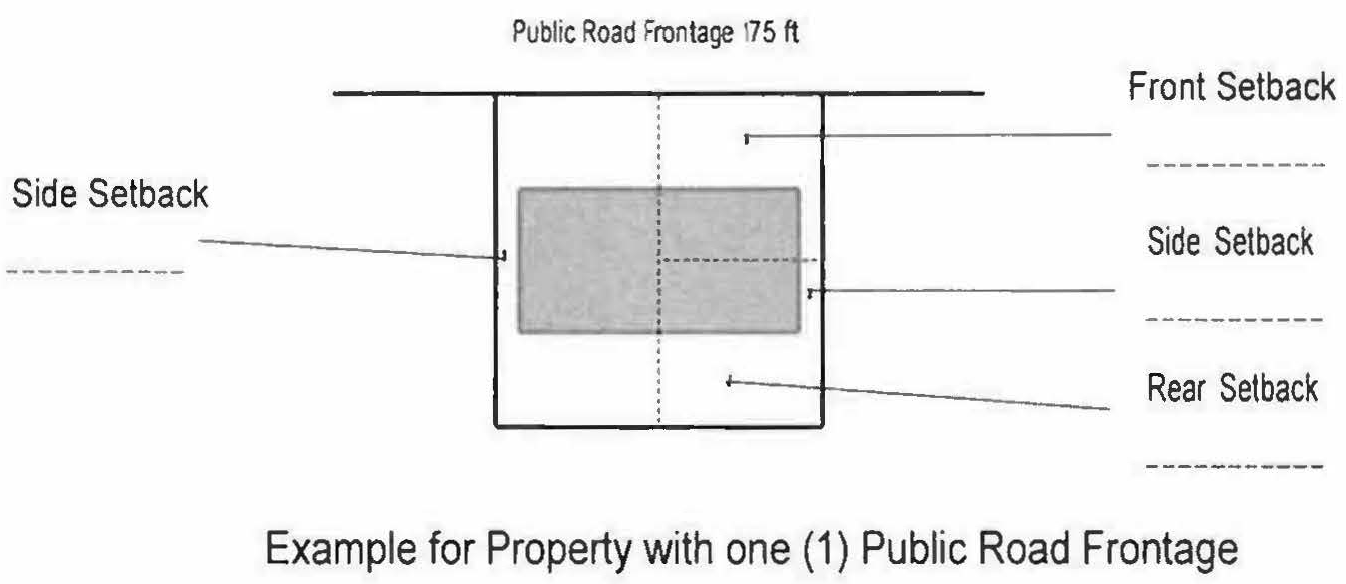
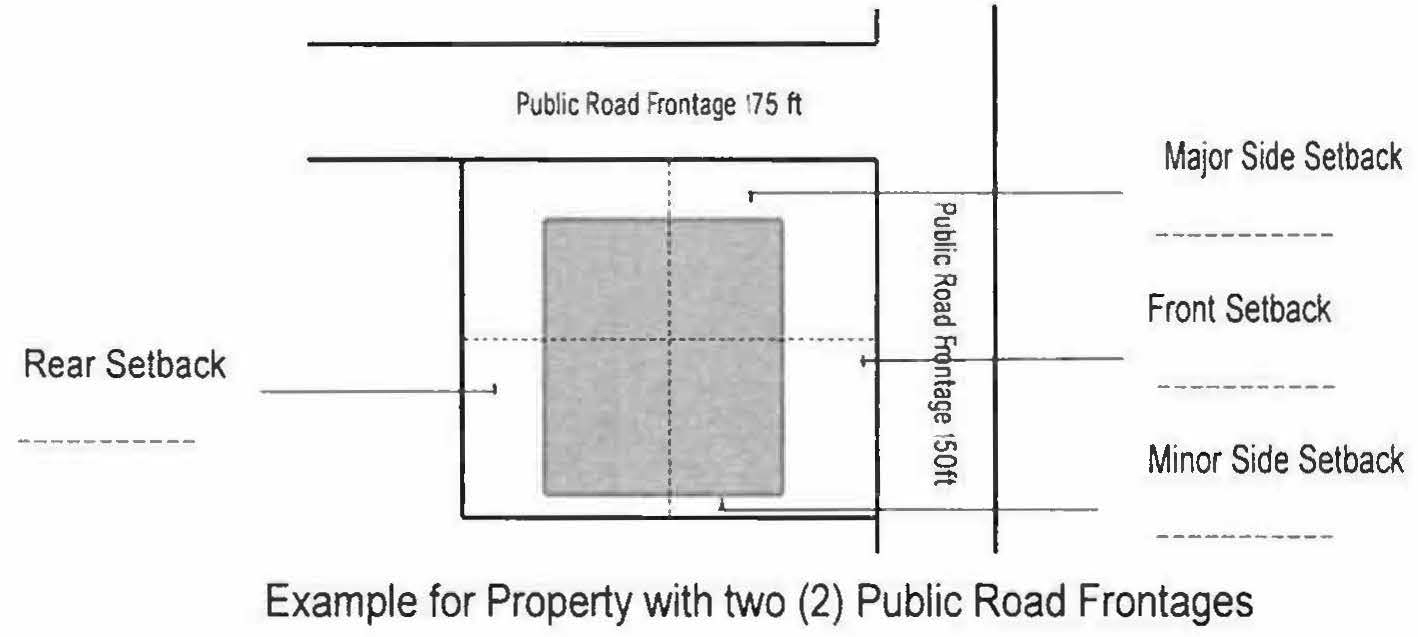
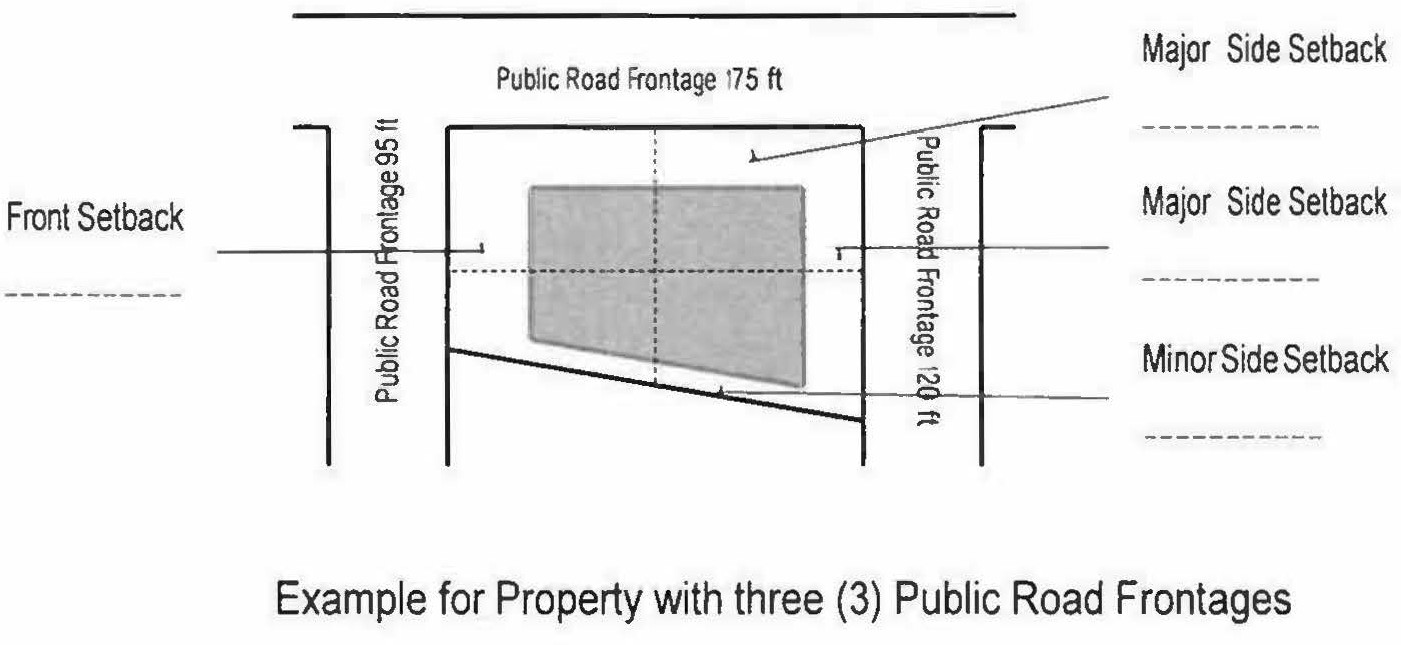
Measuring building setbacks: The number and type of setbacks is determined based on the number and type of public road frontages for the lot as follows and as shown on the following diagram:
(a)
One public road frontage: The front yard setback is measured from the one public road frontage (arterial, collector, or local). The yard opposite the front yard is the rear yard and the other two yards are side yards.
(b)
Two public road frontages: The front yard setback is measured from the road with the shortest frontage (arterial, collector, or local). The major side yard setback is measured from the road with the longer frontage (arterial, collector, or local). The yard opposite the front yard is the rear yard and the yard opposite the major side yard is the minor side yard.
(c)
Three public road frontages: The front yard setback is measured from the road with the shortest frontage (arterial, collector, or local). The two major side yard setbacks are measured from the other two road frontages (arterial, collector, or local). The remaining yard is a minor side yard.
(d)
Building setbacks apply to both principal and accessory buildings and structure except where it explicitly states otherwise.
(e)
Irregular shaped lots: The Planning and Zoning Administrator will determine setbacks for irregular shaped lots adhering to the spirit and intent of this section.
10.
Nonconforming Uses. Any lot with an existing structure that was developed and established in accordance with applicable ordinances prior to March 18, 1996 shall be considered a lawful, conforming use under the Unified Development Code (UDC). In the event of reconstruction, such properties may be rebuilt using the previously established building footprint. The Zoning Administrator or their designee shall have the authority to approve administrative variances to reduce dimensional standards such as setbacks, lot width, coverage for lots identified as nonconforming on the official map referenced in Appendix A, where such standards do not align with current zoning regulations.
Administrative variances may be granted only if:
1.
The proposed reconstruction does not adversely impact adjacent properties, and
2.
The request remains consistent with the intent and purpose of the Unified Development Code.
2.01.03.05 The regulations for the R-12 Single-Family residential district (12,000-square-foot lot size) are as follows:
A.
Purpose and intent. The R-12 single-family residential district is intended to provide suitable areas for single-family, detached dwellings at medium densities as defined by the City of Kennesaw Comprehensive Land Use Plan, and as may be amended from time to time, with access to both public water and sewerage.
B.
Uses. Any use not permitted as of right, or not permitted by Special Exception, or not permitted by land use permit is prohibited. To the extent there is a conflict between the permitted use table and this subsection, this section shall control for purposes of determining whether the use is allowed. See Section 4.04.01 for standards associated with Special Exception uses. Any conflict between the standards set forth in this district and those set forth in Section 4.04.01, the standards in Section 4.04.01 shall control for purposes of developing a Special Exception use.
The following uses are permitted:
Clubs or lodges
Community Fairs
Designated recycling collection locations
Executive golf courses
Golf courses (Par 3)
Golf courses (18-hole regulation; private and public)
Group homes
Limited home occupation
Nonprofit riding stables
Nonprofit (seasonal use) fishing lakes
Private parks
Recreation grounds other than tennis courts and golf courses
Religious assembles
Single family dwelling units (detached)
Short Term Rentals (STR)
Temporary uses
The following uses are permitted by special exception (refer to section 4.04.01):
Cemeteries
Mausoleums
Private community centers
Private schools of general and special education
The following uses are permitted by land use permit or special land use permit:
Cottage food operator (refer to section 4.04.05 Standards for Home Occupation)
Family child care learning home (refer to section 4.04.05 Standards for Home Occupation)
Home occupation (refer to section 4.04.05)
Manufactured Homes
Radio, television, and other communication towers and antennas (refer to section 4.05.06)
C.
Requirements for certain uses. The following uses shall have the requirements as ascribed to them in this subsection.
1.
Cottage Food Operators:
(a)
Cottage food operators shall adhere to all rules and regulations imposed by the Georgia Department of Agriculture.
(b)
There shall be no signage or other exterior evidence of the cottage food operator.
(c)
Deliveries of specialty ingredients such as herbs and spices, etc., limited to those made by the United States Postal Service or other carrier (FedEx, United Parcel Service, etc.) that routinely deliver mail/internet order products to residents.
(d)
No cottage food products prepared by the cottage food operator may be picked up by a commercial carrier.
(e)
There shall be no employees parking on the site unless approved by the Mayor and City Council in accordance with Section 4.04.05.
(f)
A home occupation land use permit shall be required.
2.
Limited Home Occupations:
(a)
There shall be no exterior evidence of the home occupation, including but not limited to any type of identifying signs.
(b)
No article, product or service used or sold in connection with such activity shall be other than those normally found on the premises.
(c)
No mechanical equipment shall be used for such occupation except such equipment as is customary for purely household and hobby purposes.
(d)
Such use shall be conducted entirely within the dwelling unit, and only persons living in the dwelling unit shall be employed in such occupation.
(e)
No more than 25 percent of the dwelling unit may be used for the operation.
(f)
No materials, equipment or business vehicles may be stored or parked on the premises, except that one business vehicle, used exclusively by the resident may be parked in a carport, garage, or rear or side yard.
(g)
The off-site employees of the resident shall not congregate on the premises for any purpose concerning the business of the home occupation.
(h)
There shall be no deliveries of supplies for use in the home occupation or pickups of the items produced by the occupant by commercial carriers.
(i)
No clients or customers are allowed on the premises on a regular basis.
(j)
The limited home occupation shall not create a nuisance.
3.
Designated Recycling Collection Locations:
(a)
Must be maintained in a safe, clean, neat, and sanitary fashion;
(b)
Such location shall be visually screened and maintained;
(c)
Such location shall be within the building setbacks unless otherwise approved by the zoning administrator or his/her designee due to topography, safety, internal traffic flow, site distance, or for other site-related circumstances not created by the property owner.
4.
Group Home:
(a)
A group home shall be shared by four or fewer persons, excluding resident staff;
(b)
The group home must provide the City of Kennesaw with a copy of its scheduled activity plan, a copy of the group home rules, and, if applicable, evidence of active enforcement under the Georgia Association of Recovery Residence standards;
(c)
The group home must be under the direction and guidance of a designated managing caregiver that resides at the group home;
(d)
The designated managing caregiver or his or her designee shall be available on a 24-hour basis in the event of emergencies or complaints; and
(e)
A group home must submit to random inspections by the City Code Enforcement;
(f)
A group home shall comply with all applicable regulations by the Board of Behavioral Health and Developmental Disabilities and the Department of Behavioral Health and Developmental Disabilities.
5.
Family childcare learning home:
(a)
Maximum of six children under 13 years of age at one time for pay or not for pay;
(b)
For purpose of this section only, children who are related by direct blood kin or adoption to the childcare provider shall not be included in the calculation of the six children limitation;
(c)
The childcare shall not create a nuisance to immediately adjacent property owners;
(d)
Off-street parking must be provided for childcare pick-up and drop-off; and
(e)
No employees;
(f)
Proof of a Family child care learning home license under O.C.G.A. § 20-1A-10(v), or as amended from time to time, by the Department of Early Care and Learning or its successor agency;
(g)
A home occupation land use permit shall be required.
6.
Temporary Uses:
(a)
An approved temporary use shall not exceed 30 days and may be renewed for not more than one additional 30-day period.
(b)
Adequate off-street parking shall be provided.
(c)
Application for a temporary use shall be made with the City Business License division.
D.
Dimensional standards for Development. Setback shall be measured from the property line of the parcel. The property with shortest amount of road frontage shall be the front setback for determining other setbacks (major side, side, rear).
1.
Minimum lot size: 12,000 square feet. The Zoning Administrator shall not be authorized to recommend a variance for more than 25 percent of the minimum lot size.
2.
Minimum floor area: 1,200 square feet.
3.
Minimum lot width at front setback line: 75 feet; cul-de-sac, 60 feet.
4.
Minimum public road frontage: 75 feet; cul-de-sac, 50 feet.
5.
Maximum cover: 30%
6.
Maximum building height: 35 feet.
7.
A basement shall be counted as a story if the ceiling is six feet or more above the grade and is either subdivided or used for dwelling or business purposes. A basement is a portion of the building partly underground which has more than one-half of its height measured from finished floor to finished ceiling above the average grade of the adjoining ground.
8.
Minimum building setbacks:
(a)
Front yard as measured from arterial: 40 feet.
(b)
Front yard as measured from collector: 40 feet.
(c)
Front yard as measured from local: 35 feet.
(d)
Side yard (aka minor side yard): 10 feet.
(e)
Rear yard: 20 feet.
(f)
Major side: 25 feet.
9.
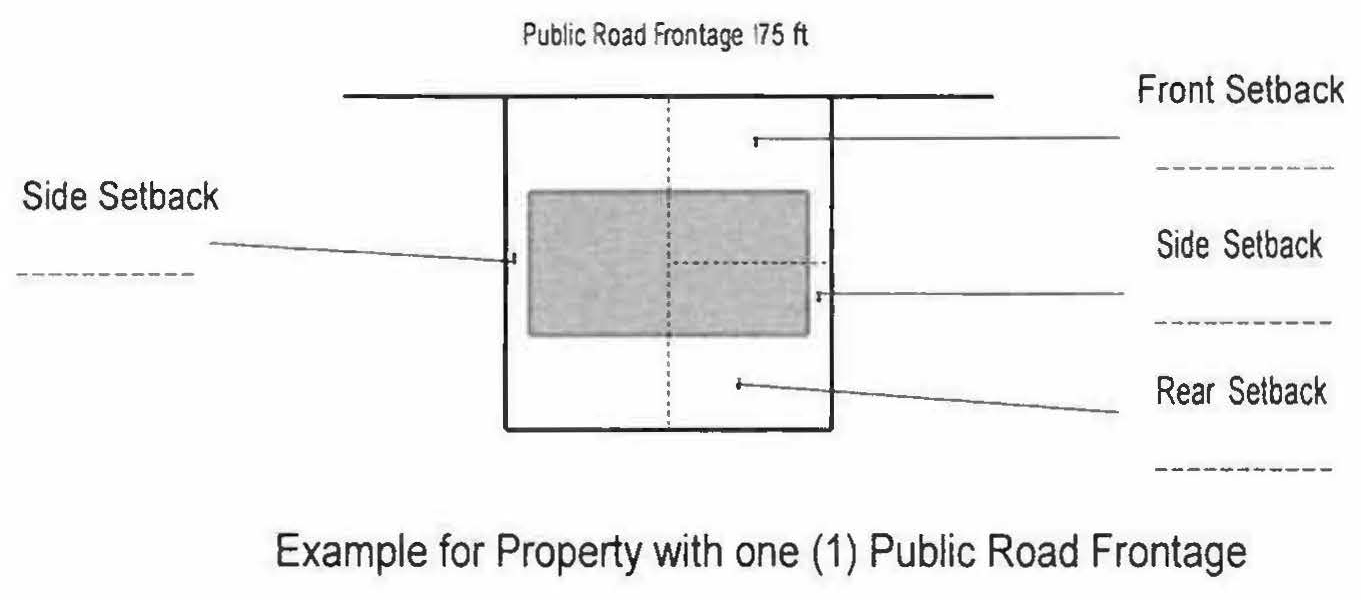
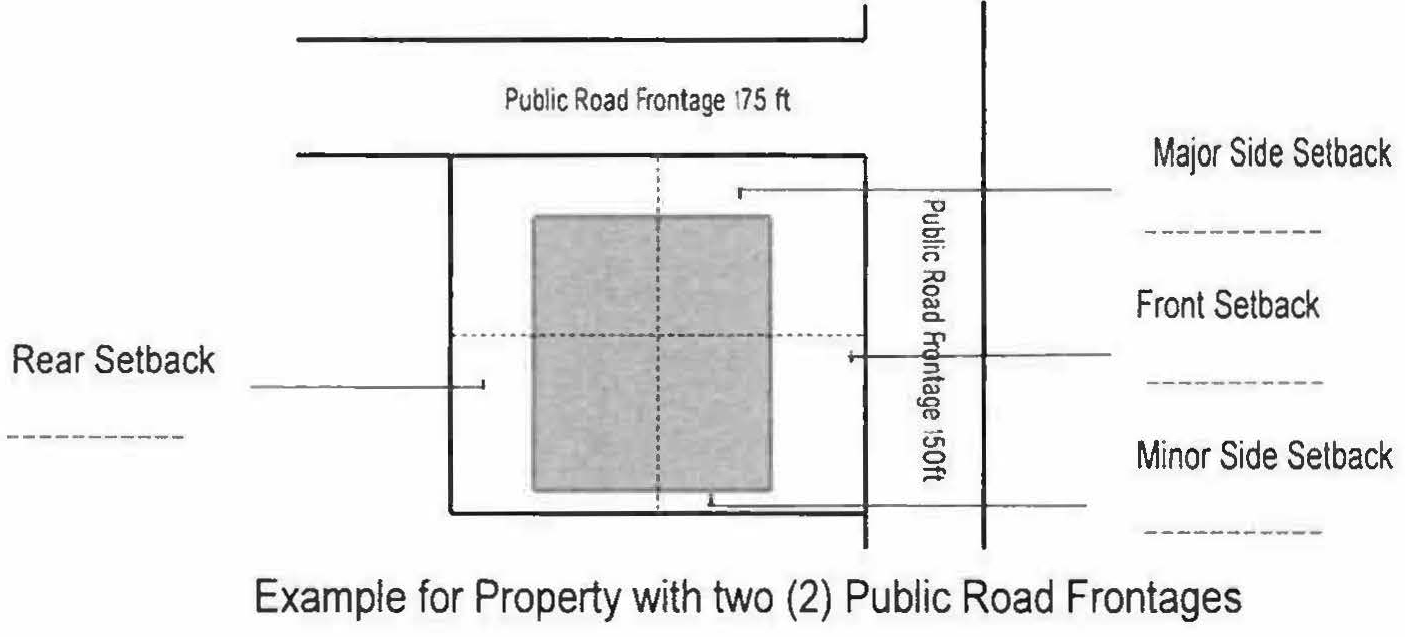
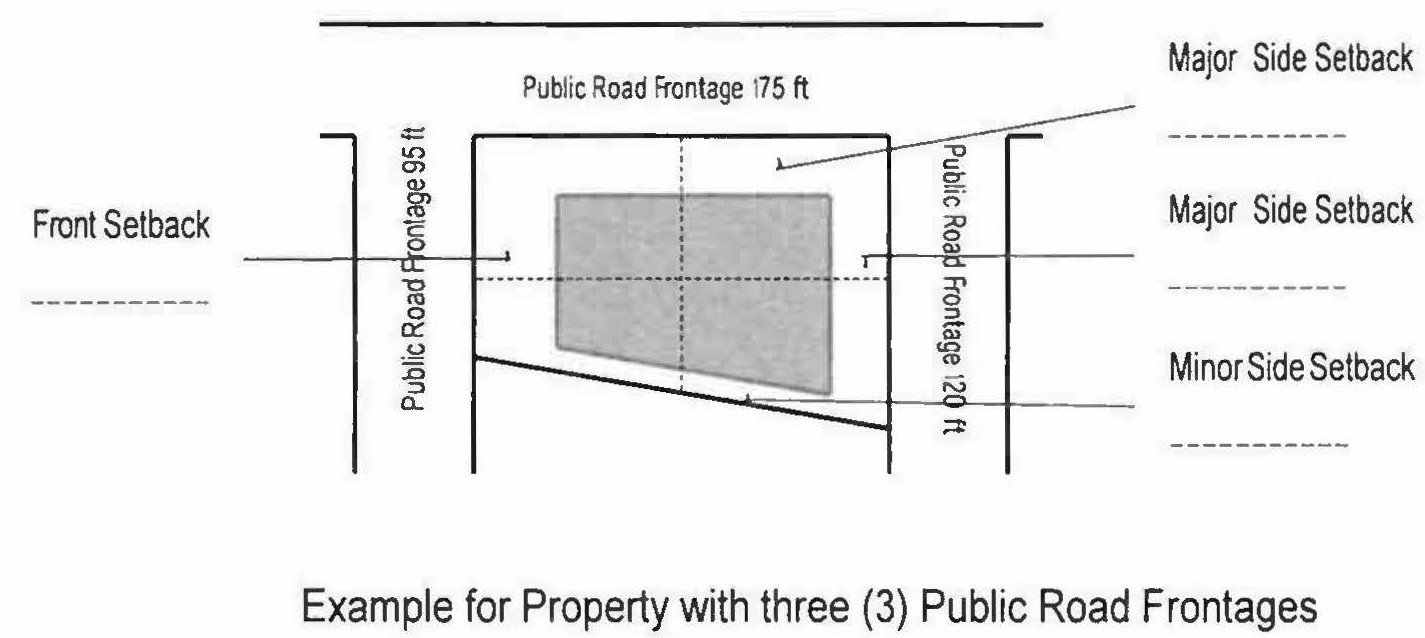
Measuring building setbacks: The number and type of setbacks is determined based on the number and type of public road frontages for the lot as follows and as shown on the following diagram:
(a)
One public road frontage: The front yard setback is measured from the one public road frontage (arterial, collector, or local). The yard opposite the front yard is the rear yard and the other two yards are side yards.
(b)
Two public road frontages: The front yard setback is measured from the road with the shortest frontage (arterial, collector, or local). The major side yard setback is measured from the road with the longer frontage (arterial, collector, or local). The yard opposite the front yard is the rear yard and the yard opposite the major side yard is the minor side yard.
(c)
Three public road frontages: The front yard setback is measured from the road with the shortest frontage (arterial, collector, or local). The two major side yard setbacks are measured from the other two road frontages (arterial, collector, or local). The remaining yard is a minor side yard.
(d)
Building setbacks apply to both principal and accessory buildings and structure except where it explicitly states otherwise.
(e)
Irregular shaped lots: The Planning and Zoning Administrator will determine setbacks for irregular shaped lots adhering to the spirit and intent of this section.
10.
Nonconforming Uses. Any lot with an existing structure that was developed and established in accordance with applicable ordinances prior to March 18, 1996 shall be considered a lawful, conforming use under the Unified Development Code (UDC). In the event of reconstruction, such properties may be rebuilt using the previously established building footprint. The Zoning Administrator or their designee shall have the authority to approve administrative variances to reduce dimensional standards such as setbacks, lot width, coverage for lots identified as nonconforming on the official map referenced in Appendix A, where such standards do not align with current zoning regulations.
Administrative variances may be granted only if:
1.
The proposed reconstruction does not adversely impact adjacent properties, and
2.
The request remains consistent with the intent and purpose of the Unified Development Code
2.01.03.06 The regulations for the R-10 Single-Family residential district (10,000-square-foot lot size) are as follows:
A.
Purpose and intent. The R-10 single-family residential district is intended to provide suitable areas for single-family, detached dwellings at medium densities as defined by the City of Kennesaw Comprehensive Land Use Plan, and as may be amended from time to time, with access to both public water and sewerage.
B.
Uses. Any use not permitted as of right, or not permitted by special exception, or not permitted by land use permit is prohibited. To the extent there is a conflict between the permitted use table and this subsection, this section shall control for purposes of determining whether the use is allowed. See Section 4.04.01 for standards associated with special exception uses. Any conflict between the standards set forth in this district and those set forth in Section 4.04.01, the standards in Section 4.04.01 shall control for purposes of developing a special exception use.
The following uses are permitted:
Clubs or lodges
Community Fairs
Designated recycling collection locations
Executive golf courses
Golf courses (Par 3)
Golf courses (18-hole regulation; private and public)
Group homes
Limited home occupation
Nonprofit riding stables
Nonprofit (seasonal use) fishing lakes
Private parks
Recreation grounds other than tennis courts and golf courses
Religious assemblies
Single family dwelling units (detached)
Short Term Rentals (STR)
Temporary uses
The following uses are permitted by special exception (refer to section 4.04.01):
Cemeteries
Mausoleums
Private community centers
Private schools of general and special education
The following uses are permitted by land use permit or special land use permit:
Cottage food operators (refer to section 4.04.05 Standards for Home Occupation)
Family child care learning home (refer to section 4.04.05 Standards for Home Occupation)
Home occupation (refer to section 4.04.05)
Manufactured Homes
Radio, television and other communication towers and antennas (refer to section 4.04.06)
C.
Requirements for certain uses. The following uses shall have the requirements as ascribed to them in this subsection.
1.
Cottage food operators:
(a)
Cottage food operators shall adhere to all rules and regulations imposed by the Georgia Department of Agriculture.
(b)
There shall be no signage or other exterior evidence of the cottage food operator.
(c)
Deliveries of specialty ingredients such as herbs and spices, etc., limited to those made by the United States Postal Service or other carrier (FedEx, United Parcel Service, etc.) that routinely deliver mail/internet order products to residents.
(d)
No cottage food products prepared by the cottage food operator may be picked up by a commercial carrier.
(e)
There shall be no employees parking on the site unless approved by the mayor and city council in accordance with Section 4.04.05.
(f)
A home occupation land use permit shall be required.
2.
Limited home occupations:
(a)
There shall be no exterior evidence of the home occupation, including but not limited to any type of identifying signs.
(b)
No article, product or service used or sold in connection with such activity shall be other than those normally found on the premises.
(c)
No mechanical equipment shall be used for such occupation except such equipment as is customary for purely household and hobby purposes.
(d)
Such use shall be conducted entirely within the dwelling unit, and only persons living in the dwelling unit shall be employed in such occupation.
(e)
No more than 25 percent of the dwelling unit may be used for the operation.
(f)
No materials, equipment or business vehicles may be stored or parked on the premises, except that one business vehicle, used exclusively by the resident may be parked in a carport, garage, or rear or side yard.
(g)
The off-site employees of the resident shall not congregate on the premises for any purpose concerning the business of the home occupation.
(h)
There shall be no deliveries of supplies for use in the home occupation or pickups of the items produced by the occupant by commercial carriers.
(i)
No clients or customers are allowed on the premises on a regular basis.
(j)
The limited home occupation shall not create a nuisance.
3.
Designated recycling collection locations:
(a)
Must be maintained in a safe, clean, neat, and sanitary fashion;
(b)
Such location shall be visually screened and maintained;
(c)
Such location shall be within the building setbacks unless otherwise approved by the zoning administrator or his/her designee due to topography, safety, internal traffic flow, site distance, or for other site-related circumstances not created by the property owner.
4.
Group home:
(a)
A group home shall be shared by four or fewer persons, excluding resident staff;
(b)
The group home must provide the City of Kennesaw with a copy of its scheduled activity plan, a copy of the group home rules, and, if applicable, evidence of active enforcement under the Georgia Association of Recovery Residence standards;
(c)
The group home must be under the direction and guidance of a designated managing caregiver that resides at the group home;
(d)
The designated managing caregiver or his or her designee shall be available on a 24-hour basis in the event of emergencies or complaints; and
(e)
A group home must submit to random inspections by the city code enforcement.
(f)
A group home shall comply with all applicable regulations by the Board of Behavioral Health and Developmental Disabilities and the Department of Behavioral Health and Developmental Disabilities.
5.
Family childcare learning home:
(a)
Maximum of six children under 13 years of age at one time for pay or not for pay;
(b)
For purpose of this section only, children who are related by direct blood kin or adoption to the childcare provider shall not be included in the calculation of the six children limitation;
(c)
The childcare shall not create a nuisance to immediately adjacent property owners;
(d)
Off-street parking must be provided for childcare pick-up and drop-off; and
(e)
No employees;
(f)
Proof of a family child care learning home license under O.C.G.A. § 20-1A-10(v), or as amended from time to time, by the Department of Early Care and Learning or its successor agency;
(g)
A home occupation land use permit shall be required.
6.
Temporary uses:
(a)
An approved temporary use shall not exceed 30 days and may be renewed for not more than one additional 30-day period.
(b)
Adequate off-street parking shall be provided.
(c)
Application for a temporary use shall be made with the city business license division.
D.
Dimensional standards for development. Setback shall be measured from the property line of the parcel. The property with shortest amount of road frontage shall be the front setback for determining other setbacks (major side, side, rear).
1.
Minimum lot size: 10,000 square feet. The Zoning Administrator shall not be authorized to recommend a variance for more than 25 percent of the minimum lot size.
2.
Minimum floor area: 1,050 square feet.
3.
Minimum lot width at front setback line: 75 feet; cul-de-sac, 60 feet.
4.
Minimum public road frontage: 75 feet; cul-de-sac, 50 feet.
5.
Maximum cover: 30 percent.
6.
Maximum building height: 35 feet.
7.
A basement shall be counted as a story if the ceiling is six feet or more above the grade and is either subdivided or used for dwelling or business purposes. A basement is a portion of the building partly underground which has more than one-half of its height measured from finished floor to finished ceiling above the average grade of the adjoining ground.
8.
Minimum building setbacks:
(a)
Front yard as measured from arterial: 40 feet.
(b)
Front yard as measured from collector: 40 feet.
(c)
Front yard as measured from local: 35 feet.
(d)
Side yard (aka minor side yard): 10 feet.
(e)
Rear yard: 20 feet.
(f)
Major side: 25 feet.
9.
Measuring building setbacks: The number and type of setbacks is determined based on the number and type of public road frontages for the lot as follows and as shown on the following diagram:
(a)
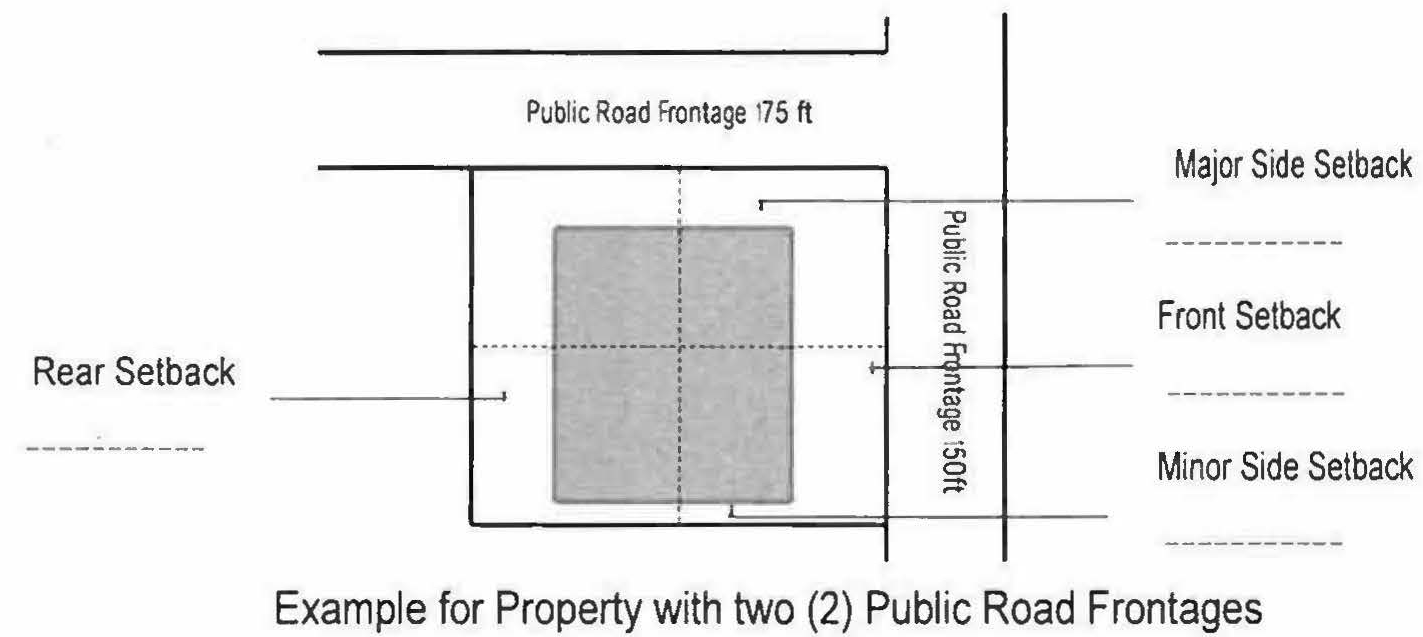
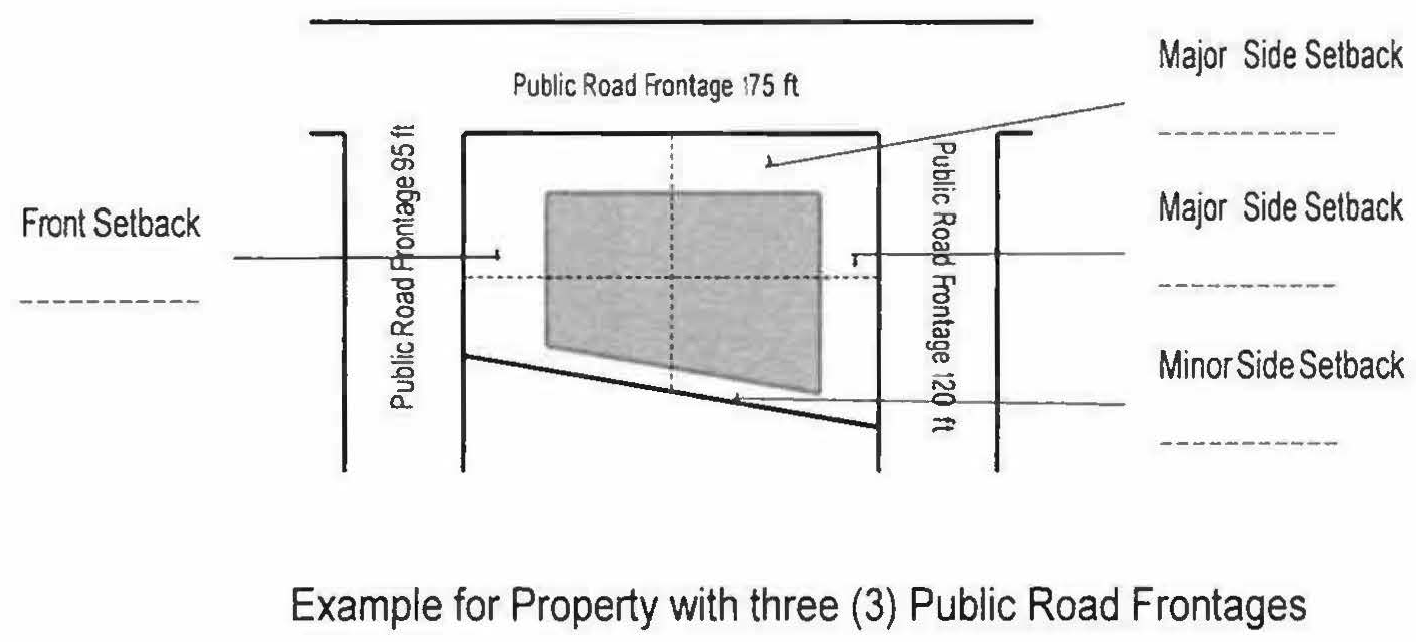
One public road frontage: The front yard setback is measured from the one public road frontage (arterial, collector, or local). The yard opposite the front yard is the rear yard and the other two yards are side yards.
(b)
Two public road frontages: The front yard setback is measured from the road with the shortest frontage (arterial, collector, or local). The major side yard setback is measured from the road with the longer frontage (arterial, collector, or local). The yard opposite the front yard is the rear yard and the yard opposite the major side yard is the minor side yard.
(c)
Three public road frontages: The front yard setback is measured from the road with the shortest frontage (arterial, collector, or local). The two major side yard setbacks are measured from the other two road frontages (arterial, collector, or local). The remaining yard is a minor side yard.
(d)
Building setbacks apply to both principal and accessory buildings and structure except where it explicitly states otherwise.
(e)
Irregular shaped lots: The Planning and Zoning Administrator will determine setbacks for irregular shaped lots adhering to the spirit and intent of this section.
10.
Nonconforming Uses. Any lot with an existing structure that was developed and established in accordance with applicable ordinances prior to March 18, 1996 shall be considered a lawful, conforming use under the Unified Development Code (UDC). In the event of reconstruction, such properties may be rebuilt using the previously established building footprint. The Zoning Administrator or their designee shall have the authority to approve administrative variances to reduce dimensional standards such as setbacks, lot width, coverage for lots identified as nonconforming on the official map referenced in Appendix A, where such standards do not align with current zoning regulations.
Administrative variances may be granted only if:
1.
The proposed reconstruction does not adversely impact adjacent properties, and
2.
The request remains consistent with the intent and purpose of the Unified Development Code.
Editor's note— Ord. No. 2024-02, adopted February 19, 2024, repealed the former § 2.01.03.06, and enacted a new § 2.01.03.06 as set out herein. The former § 2.01.03.06 pertained to similar subject matter and derived from the Ord. No. 2020-09, § 2(Exh. A), adopted August 17, 2020; Ord. No. 2021-07, § 2(Exh. B1), adopted June 21, 2021; Ord. No. 2020-09, § 2(Exh. A), adopted August 17, 2020; Ord. No. 2021-07, § 2(Exh. B1), June 21, 2021.
2.01.03.07 The regulations for the Planned Unit Development residential PUD-R district are as follows:
A.
Purpose and intent. The PUD-R planned unit development residential district is established to encourage and provide flexible site plan and building arrangements under a unified plan of development rather than by lot-by-lot regulation. The PUD-R district is not intended to encourage greater density of development, but rather to encourage ingenuity and resourcefulness in land planning to assure the provision of park and recreation land and facilities for the use of the occupants of the development in order to obtain a more desirable environment. The density should be consistent with the surrounding development.
B.
Uses. Any use not permitted as of right, or not permitted by Special Exception, or not permitted by land use permit is prohibited. To the extent there is a conflict between the permitted use table and this subsection, this section shall control for purposes of determining whether the use is allowed. See Section 4.04.01 for standards associated with Special Exception uses. Any conflict between the standards set forth in this district and those set forth in Section 4.04.01, the standards in Section 4.04.01 shall control for purposes of developing a Special Exception use.
The following uses are permitted:
Clubs or lodges
Community Fairs
Designated recycling collection locations
Executive golf courses
Golf courses (Par 3)
Golf courses (18-hole regulation; private and public)
Limited home occupation
Nonprofit riding stables
Nonprofit (seasonal use) fishing lakes
Private parks
Recreation grounds other than tennis courts and golf courses
Religious assemblies
Single family dwelling units (attached)
Single family dwelling units (detached)
Temporary uses
Townhouse dwelling units
Two family dwelling units
The following uses are permitted by special exception (refer to section 4.04.01):
Cemeteries
Mausoleums
Private community centers
Private schools of general and special education
The following uses are permitted by land use permit or special land use permit:
Cottage food operators (refer to section 4.04.05 Standards for Home Occupation)
Family child care learning home (refer to section 4.04.05 Standards for Home Occupation)
Home occupation (refer to section 4.04.05)
Manufactured Homes
Radio, television, and other communication towers and antennas (refer to secton 4.04.06)
C.
Requirements for certain uses. The following uses shall have the requirements as ascribed to them in this subsection.
1.
Cottage Food Operators:
(a)
Cottage food operators shall adhere to all rules and regulations imposed by the Georgia Department of Agriculture.
(b)
There shall be no signage or other exterior evidence of the cottage food operator.
(c)
Deliveries of specialty ingredients such as herbs and spices, etc., limited to those made by the United States Postal Service or other carrier (FedEx, United Parcel Service, etc.) that routinely deliver mail/internet order products to residents.
(d)
No cottage food products prepared by the cottage food operator may be picked up by a commercial carrier.
(e)
There shall be no employees parking on the site unless approved by the Mayor and City Council in accordance with Section 4.04.05.
(f)
A home occupation land use permit shall be required.
2.
Limited Home Occupations:
(a)
There shall be no exterior evidence of the home occupation, including but not limited to any type of identifying signs.
(b)
No article, product or service used or sold in connection with such activity shall be other than those normally found on the premises.
(c)
No mechanical equipment shall be used for such occupation except such equipment as is customary for purely household and hobby purposes.
(d)
Such use shall be conducted entirely within the dwelling unit, and only persons living in the dwelling unit shall be employed in such occupation.
(e)
No more than 25 percent of the dwelling unit may be used for the operation.
(f)
No materials, equipment or business vehicles may be stored or parked on the premises, except that one business vehicle, used exclusively by the resident may be parked in a carport, garage, or rear or side yard.
(g)
The off-site employees of the resident shall not congregate on the premises for any purpose concerning the business of the home occupation.
(h)
There shall be no deliveries of supplies for use in the home occupation or pickups of the items produced by the occupant by commercial carriers.
(i)
No clients or customers are allowed on the premises on a regular basis.
(j)
The limited home occupation shall not create a nuisance.
3.
Designated Recycling Collection Locations:
(a)
Must be maintained in a safe, clean, neat, and sanitary fashion;
(b)
Such location shall be visually screened and maintained;
(c)
Such location shall be within the building setbacks unless otherwise approved by the zoning administrator or his/her designee due to topography, safety, internal traffic flow, site distance, or for other site-related circumstances not created by the property owner.
4.
Family childcare learning home:
(a)
Maximum of six children under 13 years of age at one time for pay or not for pay;
(b)
For purpose of this section only, children who are related by direct blood kin or adoption to the childcare provider shall not be included in the calculation of the six children limitation;
(c)
The childcare shall not create a nuisance to immediately adjacent property owners;
(d)
Off-street parking must be provided for childcare pick-up and drop-off; and
(e)
No employees;
(f)
Proof of a Family child care learning home license under O.C.G.A. § 20-1A-10(v), or as amended from time to time, by the Department of Early Care and Learning or its successor agency;
(g)
A home occupation land use permit shall be required.
5.
Temporary Uses:
(a)
An approved temporary use shall not exceed 30 days and may be renewed for not more than one additional 30-day period.
(b)
Adequate off-street parking shall be provided.
(c)
Application for a temporary use shall be made with the City Business License division.
D.
Standards for Development.
1.
Lot size and set back requirements. Lot-by-lot setbacks shall not apply in the PUD-R district; however, no primary structure shall be closer than 15 feet to another primary structure.
2.
Landscape buffer and screening requirements. Unless otherwise noted within this district's requirements, any property within a PUD-R district which abuts a more restrictively zoned residentially zoned property shall have a minimum of ten-foot landscaped screening buffer. Additionally, during the construction phase, a 40-foot undisturbed buffer shall be maintained except for access points, required detention/retention facilities or utilities. Required buffers may be included within required setbacks; however, in such case that the required buffer is greater than the required setback, the required buffer shall be adhered to. Additionally, necessary private utilities and access drives may be allowed through, over or across a landscaped buffer. Any such uses which are proposed through, over or across a designated undisturbed buffer must be approved pursuant to an original site plan or site plan modification.
(a)
Objectives. Undisturbed, planted landscaped buffers and berms shall be implemented in connection with a permitted project and shall address the following objectives:
(1)
Screening to enhance aesthetic appeal;
(2)
Control or direction of vehicular and pedestrian movement;
(3)
Reduction of glare;
(4)
Buffering of noise;
(5)
Establishment of privacy.
(b)
Standards. Buffers or berms shall be required when a PUD-R district is located adjacent to a more restrictive residential district; a minimum of ten-foot buffer is required.
(1)
Buffers. Landscaped buffers are subject to review and approval by the Zoning Administrator in accordance with the following standards:
(a)
Plantings are to be a mix of evergreen trees and shrubs.
(b)
Species are to be ecologically compatible to the site and appropriate for the design situation.
(c)
Unless public safety concerns dictate otherwise, a buffer should maximize a visual barrier to a height of six feet within two years of planting.
(d)
Minimum height of plant materials at installation is five feet for trees and two feet for shrubs.
(e)
Fencing or walls are to be a minimum of six feet in height as approved by the Zoning Administrator.
(f)
Trees included in buffer planting may be counted toward site density calculations as required by Section 3.07.00 of the UDC pertaining to tree preservation and replacement, subject to review and approval by the Zoning Administrator.
(g)
Buffers shall be regularly maintained by the property owner to ensure that the objectives and standards are met.
(h)
When topography and existing conditions allow, the required ten-foot buffer should be an undisturbed buffer.
(i)
Any appeals from a determination by the Zoning Administrator shall be to the Mayor and City Council pursuant to Section 10.05.01 of the UDC.
(2)
Berms. Berms are subject to review and approval by the Zoning Administrator in accordance with the following standards:
(a)
Berms shall be utilized when consistent with surrounding property features.
(b)
Berms shall be stabilized.
(c)
Berms shall be constructed to be consistent with natural or proposed drainage patterns.
(d)
Berms shall be regularly maintained by the property owner.
3.
Building and structure requirements. Maximum building height is 35 feet.
4.
Minimum lot size for a single-family dwelling is 8,400 square feet.
2.01.03.08 The regulations for the RA-4 Residential District (four units per acre) (8,400-square-foot lot size) are as follows:
A.
Purpose and intent. The RA-4 residential district is established to provide locations for the development of affordable single-family detached or attached residential dwelling units including the combination of duplexes, triplexes, and quadraplexes, with access to both public water and sewerage for medium to high density residential classifications as defined under the City of Kennesaw Comprehensive Land Use Plan, and as may be amended from time to time. The attached dwelling units are to be designed for placement on an individual lot attached to another dwelling unit or on an adjoining lot where the units will be attached by a common party wall.
B.
Uses. Any use not permitted as of right, or not permitted by Special Exception, or not permitted by land use permit is prohibited. To the extent there is a conflict between the permitted use table and this subsection, this section shall control for purposes of determining whether the use is allowed. See Section 4.04.01 for standards associated with Special Exception uses. Any conflict between the standards set forth in this district and those set forth in Section 4.04.01, the standards in Section 4.04.01 shall control for purposes of developing a Special Exception use.
The following uses are permitted:
Community Fairs
Designated recycling collection locations
Executive golf courses
Golf courses (Par 3)
Golf courses (18-hole regulation; private and public)
Group homes
Limited home occupation
Nonprofit riding stables
Nonprofit (seasonal use) fishing lakes
Private parks
Recreation grounds other than tennis courts and golf courses
Religious assemblies
Single family dwelling units (attached)
Single family dwelling units (detached)
Temporary uses
The following uses are permitted by special exception (refer to section 4.04.01):
Cemeteries
Private community centers
Private schools of general and special education
The following uses are permitted by land use permit or special land use permit:
Cottage food operators (refer to section 4.04.05 Standards for Home Occupation)
Home occupation (refer to section 4.04.05)
Manufactured Homes
Radio, television and other communication towers and antennas (refer to section 4.04.06)
C.
Requirements for certain uses. The following uses shall have the requirements as ascribed to them in this subsection.
1.
Cottage Food Operators:
(a)
Cottage food operators shall adhere to all rules and regulations imposed by the Georgia Department of Agriculture.
(b)
There shall be no signage or other exterior evidence of the cottage food operator.
(c)
Deliveries of specialty ingredients such as herbs and spices, etc., limited to those made by the United States Postal Service or other carrier (FedEx, United Parcel Service, etc.) that routinely deliver mail/internet order products to residents.
(d)
No cottage food products prepared by the cottage food operator may be picked up by a commercial carrier.
(e)
There shall be no employees parking on the site unless approved by the Mayor and City Council in accordance with Section 4.04.05.
(f)
A home occupation land use permit shall be required.
2.
Limited Home Occupations:
(a)
There shall be no exterior evidence of the home occupation, including but not limited to any type of identifying signs.
(b)
No article, product or service used or sold in connection with such activity shall be other than those normally found on the premises.
(c)
No mechanical equipment shall be used for such occupation except such equipment as is customary for purely household and hobby purposes.
(d)
Such use shall be conducted entirely within the dwelling unit, and only persons living in the dwelling unit shall be employed in such occupation.
(e)
No more than 25 percent of the dwelling unit may be used for the operation.
(f)
No materials, equipment or business vehicles may be stored or parked on the premises, except that one business vehicle, used exclusively by the resident may be parked in a carport, garage, or rear or side yard.
(g)
The off-site employees of the resident shall not congregate on the premises for any purpose concerning the business of the home occupation.
(h)
There shall be no deliveries of supplies for use in the home occupation or pickups of the items produced by the occupant by commercial carriers.
(i)
No clients or customers are allowed on the premises on a regular basis.
(j)
The limited home occupation shall not create a nuisance.
3.
Designated Recycling Collection Locations:
(a)
Must be maintained in a safe, clean, neat, and sanitary fashion;
(b)
Such location shall be visually screened and maintained;
(c)
Such location shall be within the building setbacks unless otherwise approved by the zoning administrator or his/her designee due to topography, safety, internal traffic flow, site distance, or for other site-related circumstances not created by the property owner.
4.
Group Home:
(a)
A group home shall be shared by four or fewer persons, excluding resident staff;
(b)
The group home must provide the City of Kennesaw with a copy of its scheduled activity plan, a copy of the group home rules, and, if applicable, evidence of active enforcement under the Georgia Association of Recovery Residence standards;
(c)
The group home must be under the direction and guidance of a designated managing caregiver that resides at the group home;
(d)
The designated managing caregiver or his or her designee shall be available on a 24-hour basis in the event of emergencies or complaints; and
(e)
A group home must submit to random inspections by the City Code Enforcement
(f)
A group home shall comply with all applicable regulations by the Board of Behavioral Health and Developmental Disabilities and the Department of Behavioral Health and Developmental Disabilities.
5.
Temporary Uses:
(a)
An approved temporary use shall not exceed 30 days and may be renewed for not more than one additional 30-day period.
(b)
Adequate off-street parking shall be provided.
(c)
Application for a temporary use shall be made with the City Business License division.
D.
Dimensional standards for Development. Setback shall be measured from the property line of the parcel. The property with shortest amount of road frontage shall be the front setback for determining other setbacks (major side, side, rear).
1.
Minimum lot size: 8,400 square feet.
2.
Minimum acreage required: 80,000 square feet.
3.
Maximum acreage required: 20 acres
4.
Maximum density: 4 units per acre.
5.
Minimum floor area: 1,000 square feet.
6.
Minimum lot width at front setback line: 60 feet; cul-de-sac, 50 feet.
7.
Minimum public road frontage: 70 feet; cul-de-sac, 35 feet; 50 feet minimum public road frontage if interior to development.
8.
Maximum cover: 35%.
9.
Maximum building height: 35 feet.
10.
Minimum width between buildings: 15 feet.
11.
Basement: A basement shall be counted as a story if the ceiling is six feet or more above the grade and is either subdivided or used for dwelling or business purposes. A basement is a portion of the building partly underground which has more than one-half of its height measured from finished floor to finished ceiling above the average grade of the adjoining ground.
12.
Minimum building setbacks:
(a)
Front yard as measured from arterial: 50 feet.
(b)
Front yard as measured from collector: 50 feet.
(c)
Front yard as measured from local: 40 feet.
(d)
Side yard (aka minor side yard): 10 feet (if not interior portion of development); 5 feet (if interior portion of development).
(e)
Rear yard: 30 feet.
(f)
Major side: 25.
13.
Measuring building setbacks: The number and type of setbacks is determined based on the number and type of public road frontages for the lot as follows and as shown on the following diagram:
(a)
One public road frontage: The front yard setback is measured from the one public road frontage (arterial, collector, or local). The yard opposite the front yard is the rear yard and the other two yards are side yards.
(b)
Two public road frontages: The front yard setback is measured from the road with the shortest frontage (arterial, collector, or local). The major side yard setback is measured from the road with the longer frontage (arterial, collector, or local). The yard opposite the front yard is the rear yard and the yard opposite the major side yard is the minor side yard.
(c)
Three public road frontages: The front yard setback is measured from the road with the shortest frontage (arterial, collector, or local). The two major side yard setbacks are measured from the other two road frontages (arterial, collector, or local). The remaining yard is a minor side yard.
(d)
Building setbacks apply to both principal and accessory buildings and structure except where it explicitly states otherwise.
(e)
Irregular shaped lots: The Planning and Zoning Administrator will determine setbacks for irregular shaped lots adhering to the spirit and intent of this section.
(f)
Interior shall be considered the portion which does not abut an exterior property boundary.
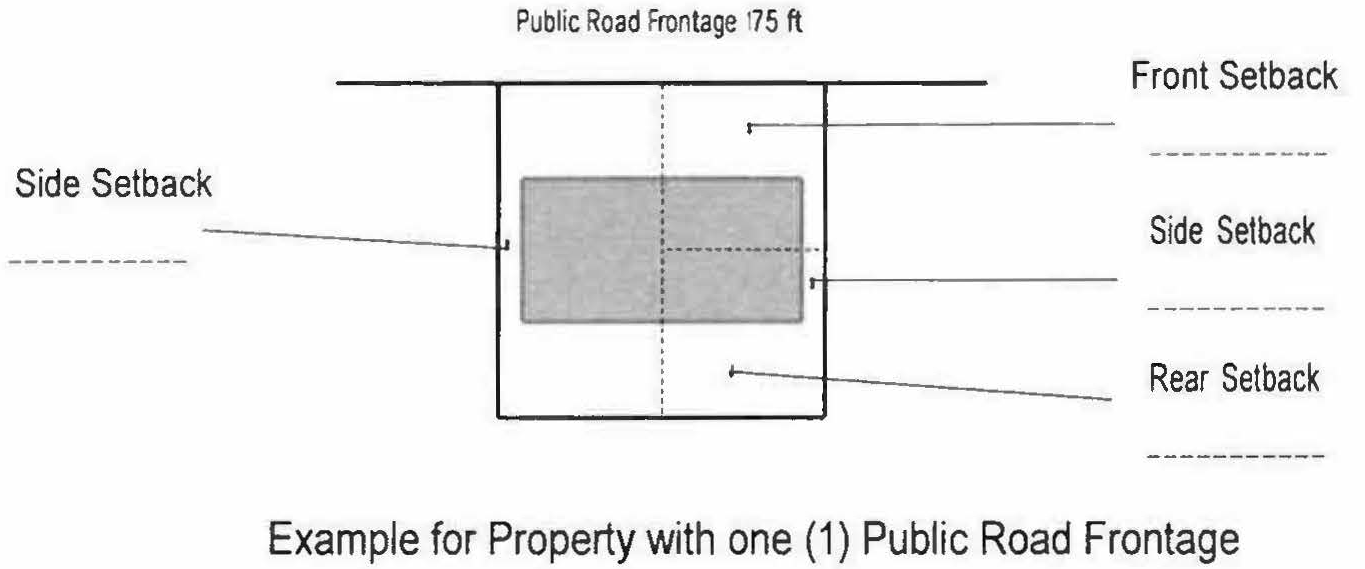
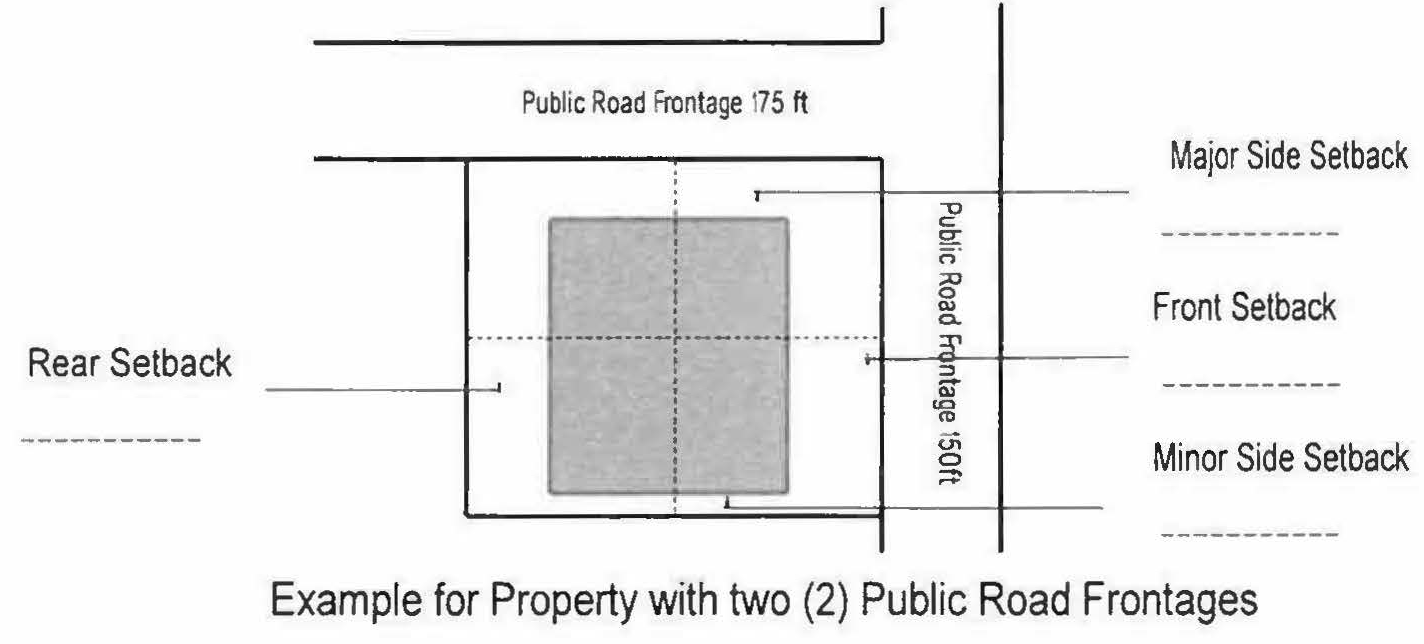
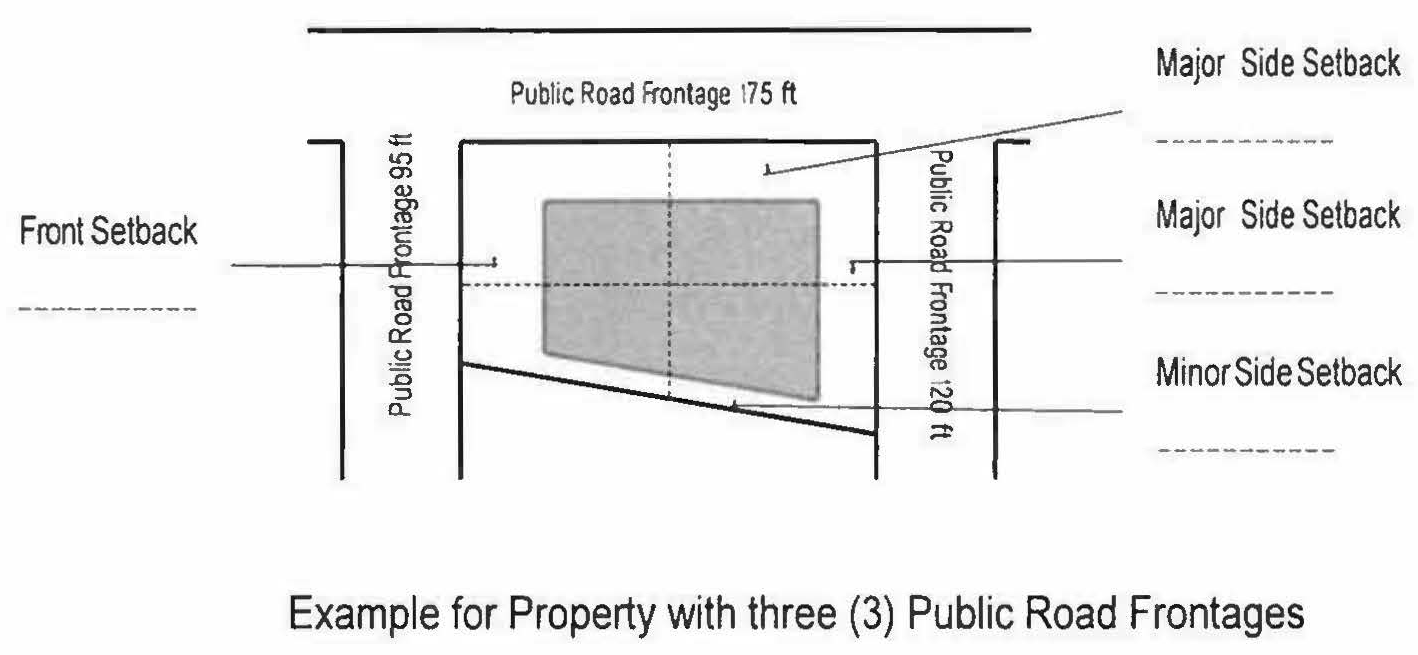
2.01.03.09 The regulations for the RA-5 residential district (7,000-square-foot lot size) are as follows:
A.
Purpose and intent. The RA-5 district is established to provide locations for the development of affordable single-family detached or attached residential dwelling units including the combination of duplexes, triplexes, and quadraplexes, with access to both public water and sewerage for medium to high density residential classifications as defined under the City of Kennesaw Comprehensive Land Use Plan, and as may be amended from time to time. The attached dwelling units are to be designed for placement on an individual lot attached to another dwelling unit or on an adjoining lot where the units will be attached by a common party wall.
B.
Uses. Any use not permitted as of right, or not permitted by Special Exception, or not permitted by land use permit is prohibited. To the extent there is a conflict between the permitted use table and this subsection, this section shall control for purposes of determining whether the use is allowed. See Section 4.04.01 for standards associated with Special Exception uses. Any conflict between the standards set forth in this district and those set forth in Section 4.04.01, the standards in Section 4.04.01 shall control for purposes of developing a Special Exception use.
The following uses are permitted:
Community fairs
Designated recycling collection locations
Executive golf courses
Golf courses (18-hole regulation public and private)
Golf courses (Par 3)
Group homes
Limited Home Occupation
Nonprofit (seasonal use) fishing lakes
Nonprofit riding stables
Private Parks
Recreation grounds other than tennis courts and golf courses
Religious assemblies
Single family dwelling units (attached)
Single family dwelling units (detached)
Temporary uses
The following uses are permitted by special exception (refer to section 4.04.01):
Cemeteries
Private community centers
Private schools of general and special education
The following uses are permitted by land use permit or special land use permit:
Cottage food operators (refer to section 4.04.05 Standards for Home Occupation)
Home occupations (refer to section 4.04.05)
Manufactured homes
Radio, television and other communication towers and antennas (refer to section 4.04.06)
C.
Requirements for certain uses. The following uses shall have the requirements as ascribed to them in this subsection.
1.
Cottage Food Operators:
(a)
Cottage food operators shall adhere to all rules and regulations imposed by the Georgia Department of Agriculture.
(b)
There shall be no signage or other exterior evidence of the cottage food operator.
(c)
Deliveries of specialty ingredients such as herbs and spices, etc., limited to those made by the United States Postal Service or other carrier (FedEx, United Parcel Service, etc.) that routinely deliver mail/internet order products to residents.
(d)
No cottage food products prepared by the cottage food operator may be picked up by a commercial carrier.
(e)
There shall be no employees parking on the site unless approved by the Mayor and City Council in accordance with Section 4.04.05.
(f)
A home occupation land use permit shall be required.
2.
Limited Home Occupations:
(a)
There shall be no exterior evidence of the home occupation, including but not limited to any type of identifying signs.
(b)
No article, product or service used or sold in connection with such activity shall be other than those normally found on the premises.
(c)
No mechanical equipment shall be used for such occupation except such equipment as is customary for purely household and hobby purposes.
(d)
Such use shall be conducted entirely within the dwelling unit, and only persons living in the dwelling unit shall be employed in such occupation.
(e)
No more than 25 percent of the dwelling unit may be used for the operation.
(f)
No materials, equipment or business vehicles may be stored or parked on the premises, except that one business vehicle, used exclusively by the resident may be parked in a carport, garage, or rear or side yard.
(g)
The off-site employees of the resident shall not congregate on the premises for any purpose concerning the business of the home occupation.
(h)
There shall be no deliveries of supplies for use in the home occupation or pickups of the items produced by the occupant by commercial carriers.
(i)
No clients or customers are allowed on the premises on a regular basis.
(j)
The limited home occupation shall not create a nuisance.
3.
Designated Recycling Collection Locations:
(a)
Must be maintained in a safe, clean, neat, and sanitary fashion;
(b)
Such location shall be visually screened and maintained;
(c)
Such location shall be within the building setbacks unless otherwise approved by the zoning administrator or his/her designee due to topography, safety, internal traffic flow, site distance, or for other site-related circumstances not created by the property owner.
4.
Group Home:
(a)
A group home shall be shared by four or fewer persons, excluding resident staff;
(b)
The group home must provide the City of Kennesaw with a copy of its scheduled activity plan, a copy of the group home rules, and, if applicable, evidence of active enforcement under the Georgia Association of Recovery Residence standards;
(c)
The group home must be under the direction and guidance of a designated managing caregiver that resides at the group home;
(d)
The designated managing caregiver or his or her designee shall be available on a 24-hour basis in the event of emergencies or complaints; and
(e)
A group home must submit to random inspections by the City Code Enforcement.
(f)
A group home shall comply with all applicable regulations by the Board of Behavioral Health and Developmental Disabilities and the Department of Behavioral Health and Developmental Disabilities.
5.
Temporary Uses:
(a)
An approved temporary use shall not exceed 30 days and may be renewed for not more than one additional 30-day period.
(b)
Adequate off-street parking shall be provided.
(c)
Application for a temporary use shall be made with the City Business License division.
D.
Dimensional standards for Development. Setback shall be measured from the property line of the parcel. The property with shortest amount of road frontage shall be the front setback for determining other setbacks (major side, side, rear).
1.
Minimum lot size: 7,000 square feet.
2.
Minimum acreage required: 80,000 square feet.
3.
Maximum acreage required: 20 acres
4.
Maximum density: 5 units per acre.
5.
Minimum floor area: 1,000 square feet.
6.
Minimum lot width at front setback line: 60 feet; cul-de-sac, 50 feet.
7.
Minimum public road frontage: 70 feet; cul-de-sac, 35 feet; 50 feet minimum public road frontage if interior to development.
8.
Maximum cover: 35.
9.
Maximum building height: 35 feet.
10.
Minimum width between buildings: 15 feet.
11.
Basement: A basement shall be counted as a story if the ceiling is six feet or more above the grade and is either subdivided or used for dwelling or business purposes. A basement is a portion of the building partly underground which has more than one-half of its height measured from finished floor to finished ceiling above the average grade of the adjoining ground.
12.
Minimum building setbacks:
(a)
Front yard as measured from arterial: 50 feet.
(b)
Front yard as measured from collector: 50 feet.
(c)
Front yard as measured from local: 40 feet.
(d)
Side yard (aka minor side yard): 10 feet (if not interior portion of development); 5 feet (if interior portion of development).
(e)
Rear yard: 30 feet.
(f)
Major side: 25.
13.
Measuring building setbacks: The number and type of setbacks is determined based on the number and type of public road frontages for the lot as follows and as shown on the following diagram:
(a)
One public road frontage: The front yard setback is measured from the one public road frontage (arterial, collector, or local). The yard opposite the front yard is the rear yard and the other two yards are side yards.
(b)
Two public road frontages: The front yard setback is measured from the road with the shortest frontage (arterial, collector, or local). The major side yard setback is measured from the road with the longer frontage (arterial, collector, or local). The yard opposite the front yard is the rear yard and the yard opposite the major side yard is the minor side yard.
(c)
Three public road frontages: The front yard setback is measured from the road with the shortest frontage (arterial, collector, or local). The two major side yard setbacks are measured from the other two road frontages (arterial, collector, or local). The remaining yard is a minor side yard.
(d)
Building setbacks apply to both principal and accessory buildings and structure except where it explicitly states otherwise.
(e)
Irregular shaped lots: The Planning and Zoning Administrator will determine setbacks for irregular shaped lots adhering to the spirit and intent of this section.
(f)
Interior shall be considered the portion which does not abut an exterior property boundary.
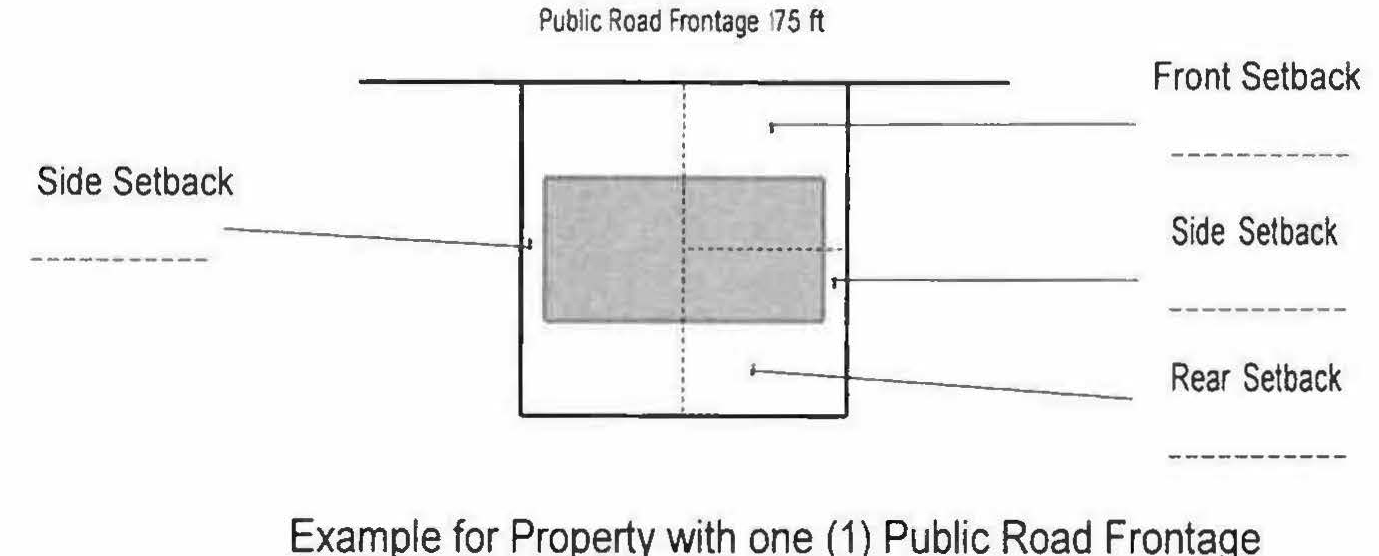
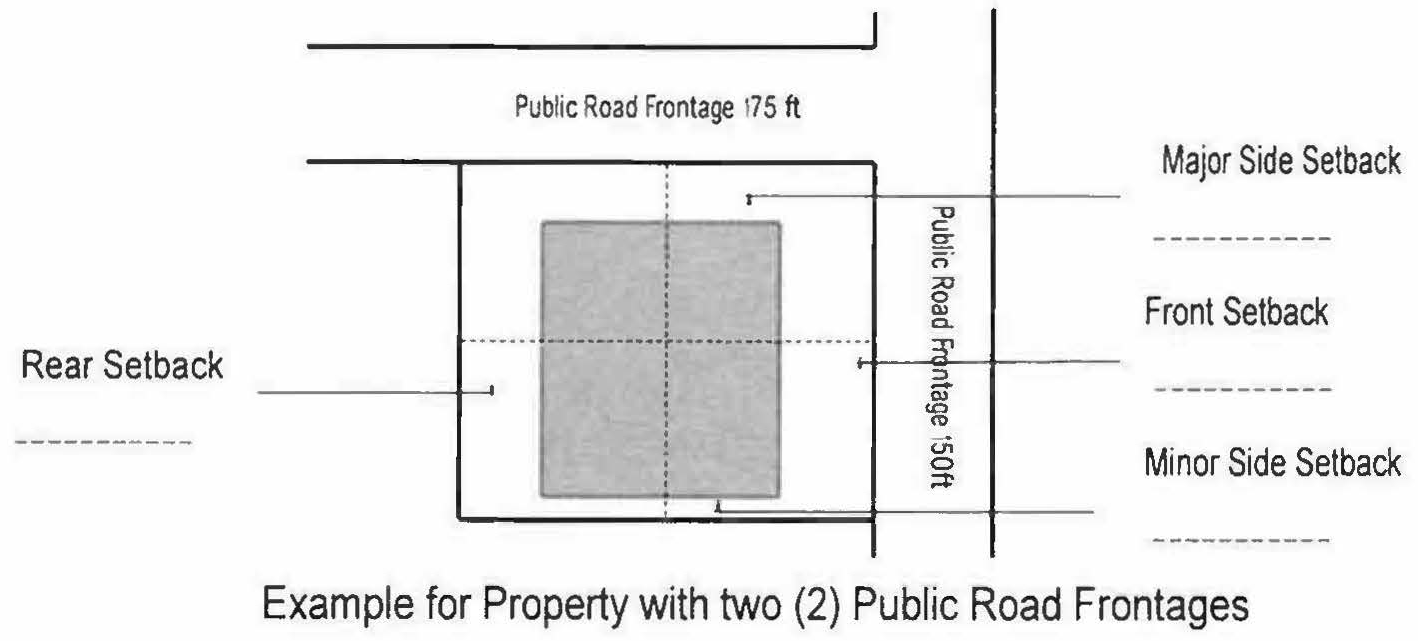
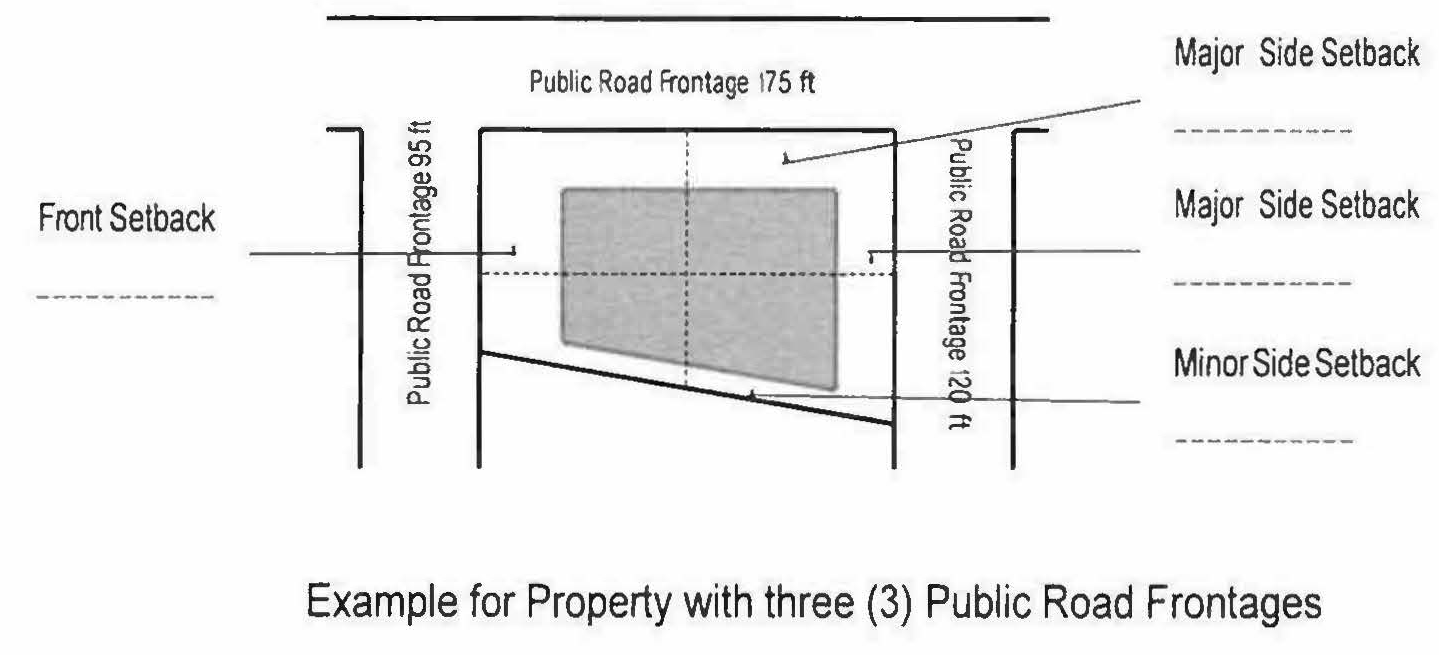
2.01.03.10 The regulations for the RA-6 residential district (6,200-square-foot lot size) are as follows:
A.
Purpose and intent. The RA-6 district is established to provide locations for the development of affordable single-family detached or attached residential dwelling units including the combination of duplexes, triplexes, and quadraplexes, with access to both public water and sewerage for medium to high density residential classifications as defined under the City of Kennesaw Comprehensive Land Use Plan, and as may be amended from time to time. The attached dwelling units are to be designed for placement on an individual lot attached to another dwelling unit or on an adjoining lot where the units will be attached by a common party wall.
B.
Uses. Any use not permitted as of right, or not permitted by Special Exception, or not permitted by land use permit is prohibited. To the extent there is a conflict between the permitted use table and this subsection, this section shall control for purposes of determining whether the use is allowed. See Section 4.04.01 for standards associated with Special Exception uses. Any conflict between the standards set forth in this district and those set forth in Section 4.04.01, the standards in Section 4.04.01 shall control for purposes of developing a Special Exception use.
The following uses are permitted:
Community fairs
Designated recycling collection location
Executive golf courses
Golf course (18-hole regulation; public and private)
Golf courses (Par 3)
Group homes
Limited Home Occupation
Nonprofit (seasonal use) fishing lakes
Nonprofit riding stables
Private Parks
Recreation grounds other than tennis courts and golf courses
Religious assemblies
Single family dwelling units (attached)
Single family dwelling units (detached)
Temporary uses
The following uses are permitted by special exception (refer to section 4.04.01):
Cemeteries
Private community centers
Private schools of general and special education
The following uses are permitted by land use permit or special land use permit:
Cottage food operators (refer to section 4.04.05 Standards for Home Occupation)
Home occupations (refer to section 4.04.05)
Manufactured Homes
Radio, television and other communication towers and antennas (refer to section 4.04.06)
C.
Requirements for certain uses. The following uses shall have the requirements as ascribed to them in this subsection.
1.
Cottage Food Operators:
(a)
Cottage food operators shall adhere to all rules and regulations imposed by the Georgia Department of Agriculture.
(b)
There shall be no signage or other exterior evidence of the cottage food operator.
(c)
Deliveries of specialty ingredients such as herbs and spices, etc., limited to those made by the United States Postal Service or other carrier (FedEx, United Parcel Service, etc.) that routinely deliver mail/internet order products to residents.
(d)
No cottage food products prepared by the cottage food operator may be picked up by a commercial carrier.
(e)
There shall be no employees parking on the site unless approved by the Mayor and City Council in accordance with Section 4.04.05.
(f)
A home occupation land use permit shall be required.
2.
Limited Home Occupations:
(a)
There shall be no exterior evidence of the home occupation, including but not limited to any type of identifying signs.
(b)
No article, product or service used or sold in connection with such activity shall be other than those normally found on the premises.
(c)
No mechanical equipment shall be used for such occupation except such equipment as is customary for purely household and hobby purposes.
(d)
Such use shall be conducted entirely within the dwelling unit, and only persons living in the dwelling unit shall be employed in such occupation.
(e)
No more than 25 percent of the dwelling unit may be used for the operation.
(f)
No materials, equipment or business vehicles may be stored or parked on the premises, except that one business vehicle, used exclusively by the resident may be parked in a carport, garage, or rear or side yard.
(g)
The off-site employees of the resident shall not congregate on the premises for any purpose concerning the business of the home occupation.
(h)
There shall be no deliveries of supplies for use in the home occupation or pickups of the items produced by the occupant by commercial carriers.
(i)
No clients or customers are allowed on the premises on a regular basis.
(j)
The limited home occupation shall not create a nuisance.
3.
Designated Recycling Collection Locations:
(a)
Must be maintained in a safe, clean, neat, and sanitary fashion;
(b)
Such location shall be visually screened and maintained;
(c)
Such location shall be within the building setbacks unless otherwise approved by the zoning administrator or his/her designee due to topography, safety, internal traffic flow, site distance, or for other site-related circumstances not created by the property owner.
4.
Group Home:
(a)
A group home shall be shared by four or fewer persons, excluding resident staff;
(b)
The group home must provide the City of Kennesaw with a copy of its scheduled activity plan, a copy of the group home rules, and, if applicable, evidence of active enforcement under the Georgia Association of Recovery Residence standards;
(c)
The group home must be under the direction and guidance of a designated managing caregiver that resides at the group home;
(d)
The designated managing caregiver or his or her designee shall be available on a 24-hour basis in the event of emergencies or complaints;
(e)
A group home must submit to random inspections by the City Code Enforcement; and
(f)
A group home shall comply with all applicable regulations by the Board of Behavioral Health and Developmental Disabilities and the Department of Behavioral Health and Developmental Disabilities.
5.
Temporary Uses:
(a)
An approved temporary use shall not exceed 30 days and may be renewed for not more than one additional 30-day period.
(b)
Adequate off-street parking shall be provided.
(c)
Application for a temporary use shall be made with the City Business License division.
D.
Dimensional standards for Development. Setback shall be measured from the property line of the parcel. The property with shortest amount of road frontage shall be the front setback for determining other setbacks (major side, side, rear).
1.
Minimum lot size: 6,200 square feet.
2.
Minimum acreage required: 80,000 square feet.
3.
Maximum acreage required: 20 acres.
4.
Maximum density: 6 units per acre.
5.
Minimum floor area: 1,000 square feet.
6.
Minimum lot width at front setback line: 60 feet; cul-de-sac, 60 feet.
7.
Minimum public road frontage: 70 feet; cul-de-sac, 35 feet; 50 feet minimum public road frontage if interior to development.
8.
Maximum cover: 35%.
9.
Maximum building height: 35 feet.
10.
Basement: A basement shall be counted as a story if the ceiling is six feet or more above the grade and is either subdivided or used for dwelling or business purposes. A basement is a portion of the building partly underground which has more than one-half of its height measured from finished floor to finished ceiling above the average grade of the adjoining ground.
11.
Minimum building setbacks:
(a)
Front yard as measured from arterial: 50 feet.
(b)
Front yard as measured from collector: 50 feet.
(c)
Front yard as measured from local: 40 feet.
(d)
Side yard (aka minor side yard): 10 feet (if not interior portion of development); 5 feet (if interior portion of development).
(e)
Rear yard: 30 feet (if not interior portion of development); 30 feet (if interior portion of development).
(f)
Major side: 25 feet
12.
Measuring building setbacks: The number and type of setbacks is determined based on the number and type of public road frontages for the lot as follows and as shown on the following diagram:
(a)
One public road frontage: The front yard setback is measured from the one public road frontage (arterial, collector, or local). The yard opposite the front yard is the rear yard and the other two yards are side yards.
(b)
Two public road frontages: The front yard setback is measured from the road with the shortest frontage (arterial, collector, or local). The major side yard setback is measured from the road with the longer frontage (arterial, collector, or local). The yard opposite the front yard is the rear yard and the yard opposite the major side yard is the minor side yard.
(c)
Three public road frontages: The front yard setback is measured from the road with the shortest frontage (arterial, collector, or local). The two major side yard setbacks are measured from the other two road frontages (arterial, collector, or local). The remaining yard is a minor side yard.
(d)
Building setbacks apply to both principal and accessory buildings and structure except where it explicitly states otherwise.
(e)
Irregular shaped lots: The Planning and Zoning Administrator will determine setbacks for irregular shaped lots adhering to the spirit and intent of this section.
(f)
Interior shall be considered the portion which does not abut an exterior property boundary.
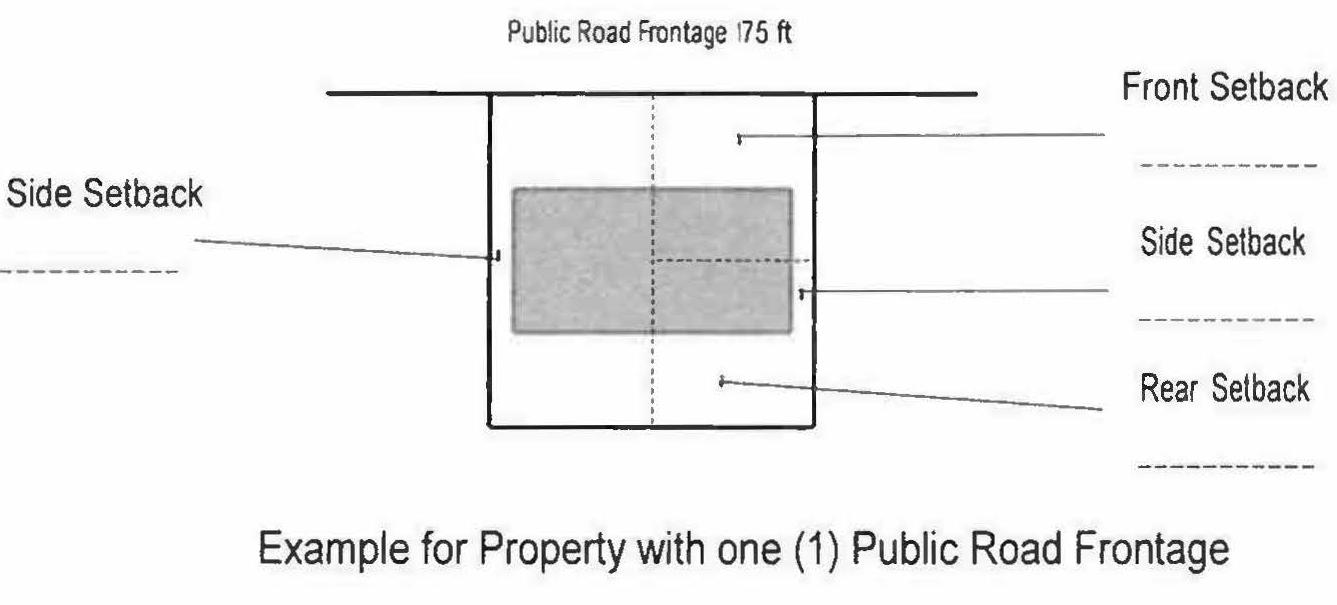
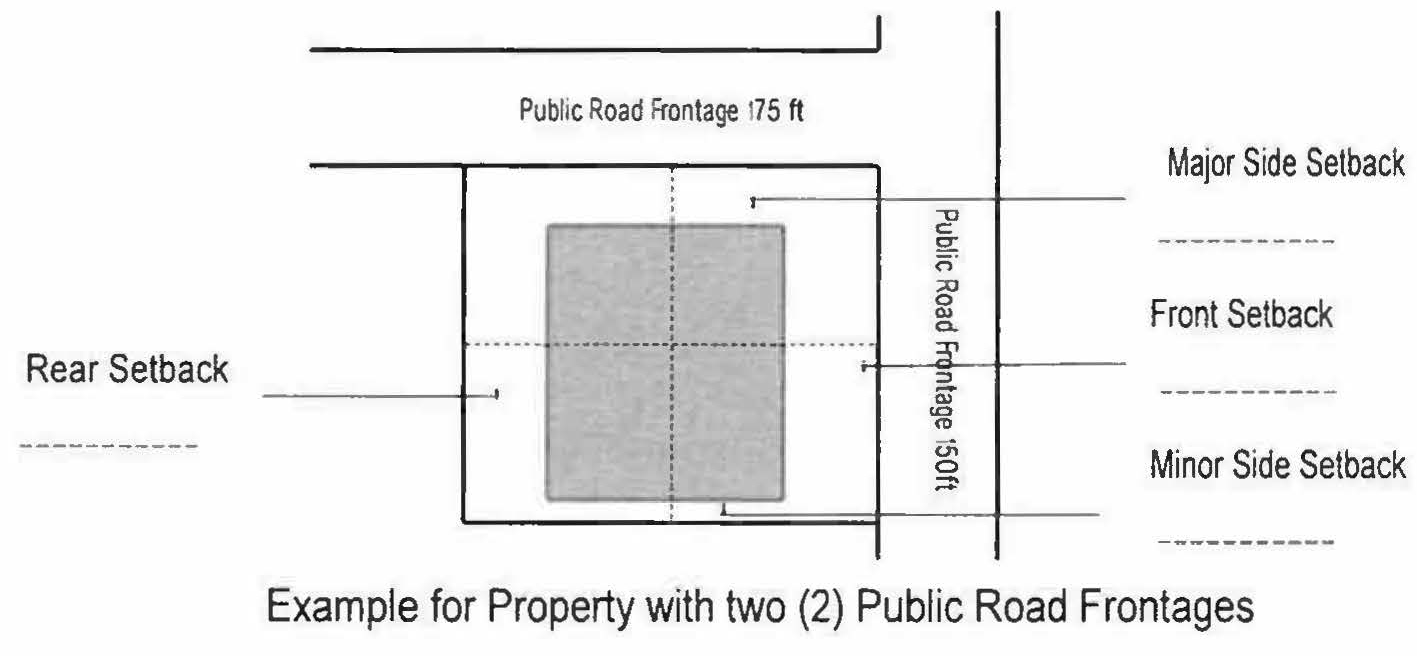
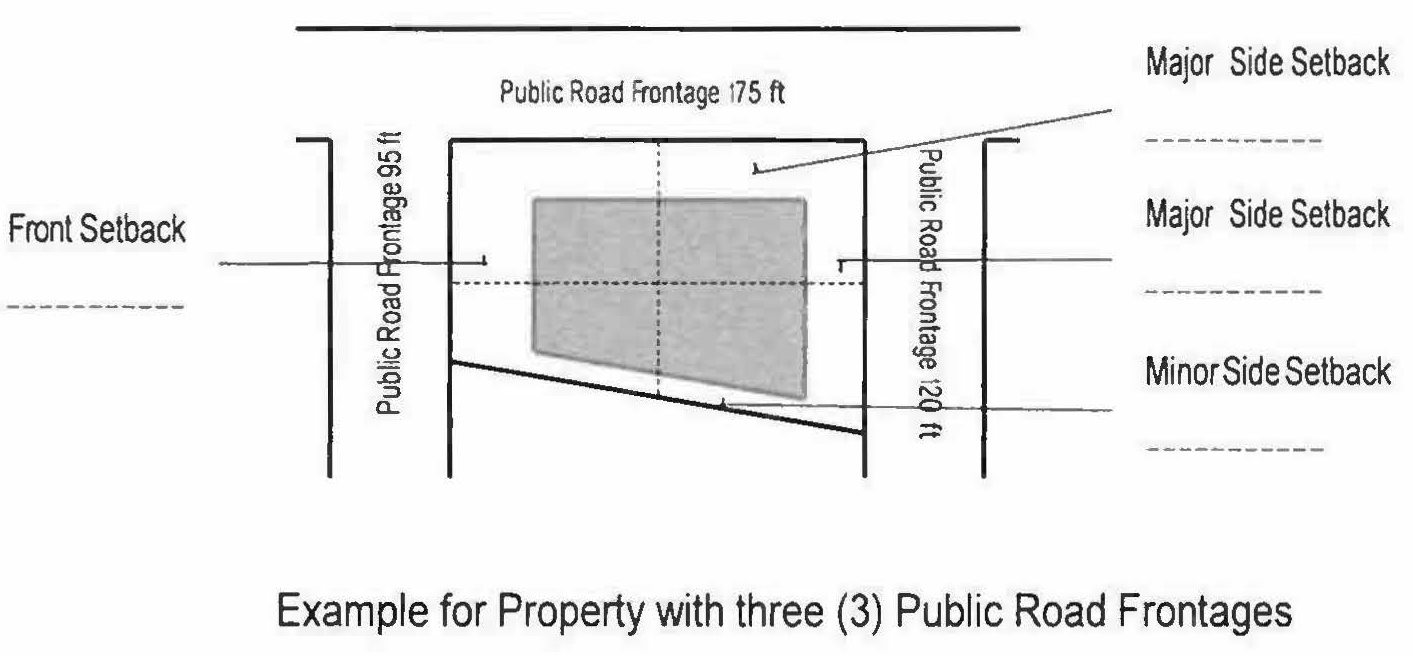
2.01.03.11 The regulations for the Multi-family district (eight units per acre) RM-8 residential district (80,000-square-foot lot size) are as follows:
A.
Purpose and intent. The RM-8 multiple-family residential district is established to provide locations for multifamily residential uses or residentially compatible institutional and recreational uses at high densities as defined under the City of Kennesaw Comprehensive Land Use Plan, and as may be amended from time to time, with access to both public water and sewer.
B.
Uses. Any use not permitted as of right, or not permitted by Special Exception, or not permitted by land use permit is prohibited. To the extent there is a conflict between the permitted use table and this subsection, this section shall control for purposes of determining whether the use is allowed. See Section 4.04.01 for standards associated with Special Exception uses. Any conflict between the standards set forth in this district and those set forth in Section 4.04.01, the standards in Section 4.04.01 shall control for purposes of developing a Special Exception use.
The following uses are permitted:
Community Fairs
Condominiums
Designated Recycling collection locations
Executive golf courses
Fraternity and sorority houses/residence halls
Golf courses (Par 3)
Golf courses (18-hole regulation; private and public)
Limited Home Occupations
Multi-family dwelling units
Nonprofit riding stables
Nonprofit (seasonal use) fishing lakes
Private parks
Recreation grounds other than tennis courts and golf courses
Religious assemblies
Single family dwelling units (attached)
Single family dwelling units (detached)
Temporary uses
Two family dwelling units
The following uses are permitted by special exception (refer to section 4.04.01):
Cemeteries
Private community centers
Private schools of general and special education
The following uses are permitted by land use permit or special land use permit:
Home occupation (refer to section 4.04.05)
Radio, television and other communication towers and antennas (refer to section 4.04.06)
C.
Requirements for certain uses. The following uses shall have the requirements as ascribed to them in this subsection.
1.
Limited Home Occupations:
(a)
There shall be no exterior evidence of the home occupation, including but not limited to any type of identifying signs.
(b)
No article, product or service used or sold in connection with such activity shall be other than those normally found on the premises.
(c)
No mechanical equipment shall be used for such occupation except such equipment as is customary for purely household and hobby purposes.
(d)
Such use shall be conducted entirely within the dwelling unit, and only persons living in the dwelling unit shall be employed in such occupation.
(e)
No more than 25 percent of the dwelling unit may be used for the operation.
(f)
No materials, equipment or business vehicles may be stored or parked on the premises, except that one business vehicle, used exclusively by the resident may be parked in a carport, garage, or rear or side yard.
(g)
The off-site employees of the resident shall not congregate on the premises for any purpose concerning the business of the home occupation.
(h)
There shall be no deliveries of supplies for use in the home occupation or pickups of the items produced by the occupant by commercial carriers.
(i)
No clients or customers are allowed on the premises on a regular basis.
(j)
The limited home occupation shall not create a nuisance.
2.
Designated Recycling Collection Locations:
(a)
Must be maintained in a safe, clean, neat, and sanitary fashion;
(b)
Such location shall be visually screened and maintained;
(c)
Such location shall be within the building setbacks unless otherwise approved by the zoning administrator or his/her designee due to topography, safety, internal traffic flow, site distance, or for other site-related circumstances not created by the property owner.
3.
Temporary Uses:
(a)
An approved temporary use shall not exceed 30 days and may be renewed for not more than one additional 30-day period.
(b)
Adequate off-street parking shall be provided.
(c)
Application for a temporary use shall be made with the City Business License division.
D.
Dimensional standards for Development. Setback shall be measured from the property line of the parcel. The property with shortest amount of road frontage shall be the front setback for determining other setbacks (major side, side, rear).
1.
Minimum lot size: 80,000 square feet.
2.
Maximum density: 8 units per acre.
3.
Minimum floor area:
(a)
450 square feet: efficiency.
(b)
600 square feet: one bedroom.
(c)
750 square feet: two bedroom.
(d)
900 square feet: three bedroom.
4.
Minimum lot width at front setback line: 75 feet.
5.
Minimum public road frontage: 75 feet.
6.
Maximum cover: 25%.
7.
Maximum building height: 35 feet.
8.
Minimum width between buildings: 15 feet.
9.
Basement: A basement shall be counted as a story if the ceiling is six feet or more above the grade and is either subdivided or used for dwelling or business purposes. A basement is a portion of the building partly underground which has more than one-half of its height measured from finished floor to finished ceiling above the average grade of the adjoining ground.
10.
Minimum building setbacks:
(a)
Front yard as measured from arterial: 75 feet.
(b)
Front yard as measured from collector: 50 feet.
(c)
Front yard as measured from local: feet.
(d)
Side yard (aka minor side yard): 35 feet (if not interior portion of development); 15 feet (if interior portion of development).
(e)
Rear yard: 40 feet.
(f)
Major side: 35.
11.
Measuring building setbacks: The number and type of setbacks is determined based on the number and type of public road frontages for the lot as follows and as shown on the following diagram:
(a)
One public road frontage: The front yard setback is measured from the one public road frontage (arterial, collector, or local). The yard opposite the front yard is the rear yard and the other two yards are side yards.
(b)
Two public road frontages: The front yard setback is measured from the road with the shortest frontage (arterial, collector, or local). The major side yard setback is measured from the road with the longer frontage (arterial, collector, or local). The yard opposite the front yard is the rear yard and the yard opposite the major side yard is the minor side yard.
(c)
Three public road frontages: The front yard setback is measured from the road with the shortest frontage (arterial, collector, or local). The two major side yard setbacks are measured from the other two road frontages (arterial, collector, or local). The remaining yard is a minor side yard.
(d)
Building setbacks apply to both principal and accessory buildings and structure except where it explicitly states otherwise.
(e)
Irregular shaped lots: The Planning and Zoning Administrator will determine setbacks for irregular shaped lots adhering to the spirit and intent of this section.
(f)
Interior shall be considered the portion which does not abut an exterior property boundary.
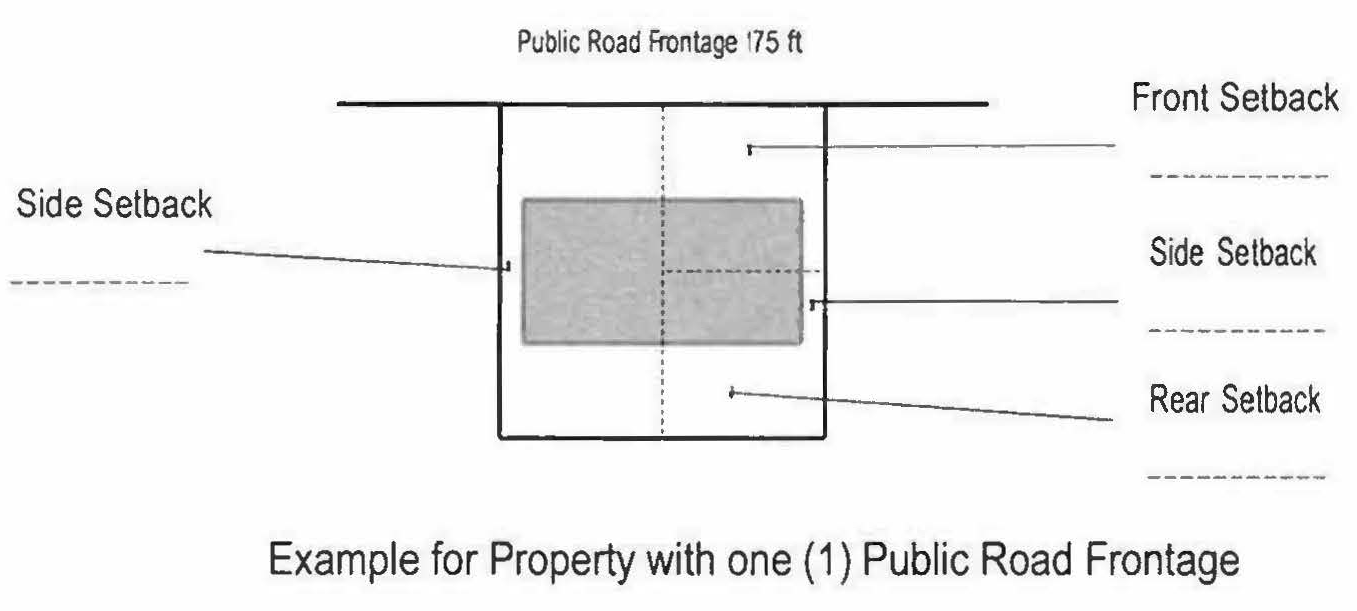
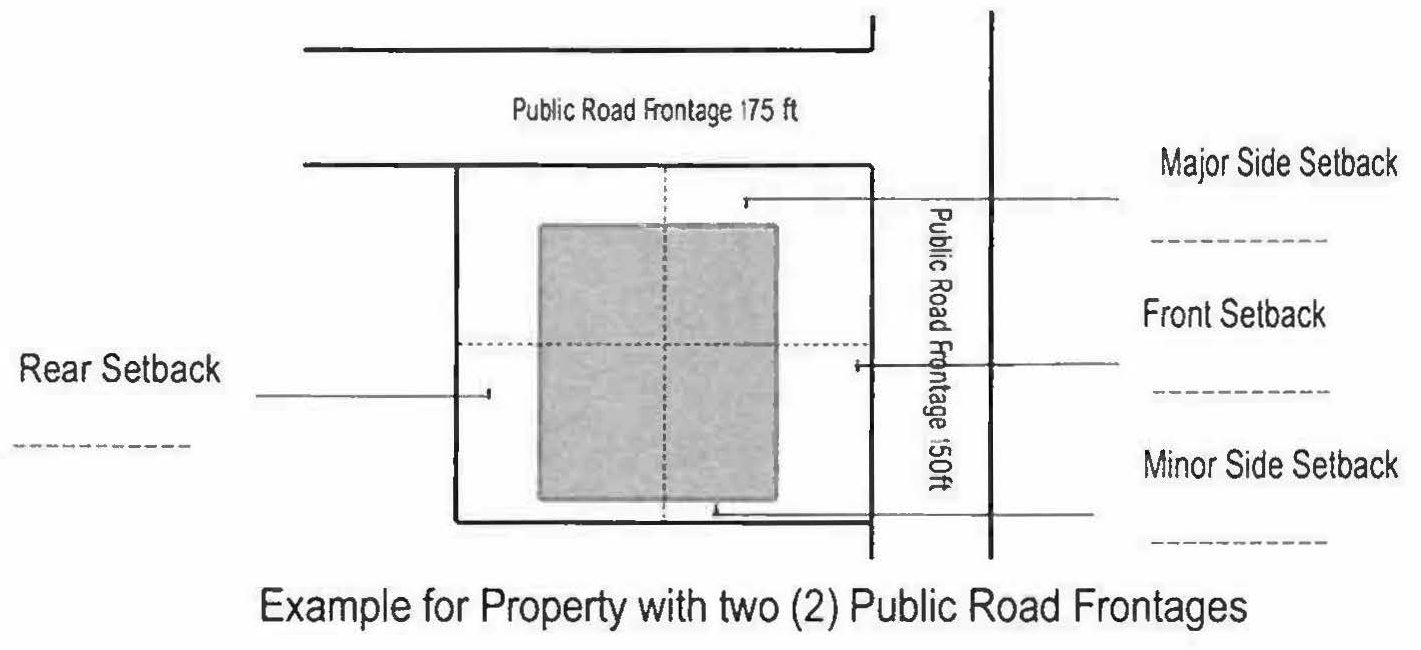
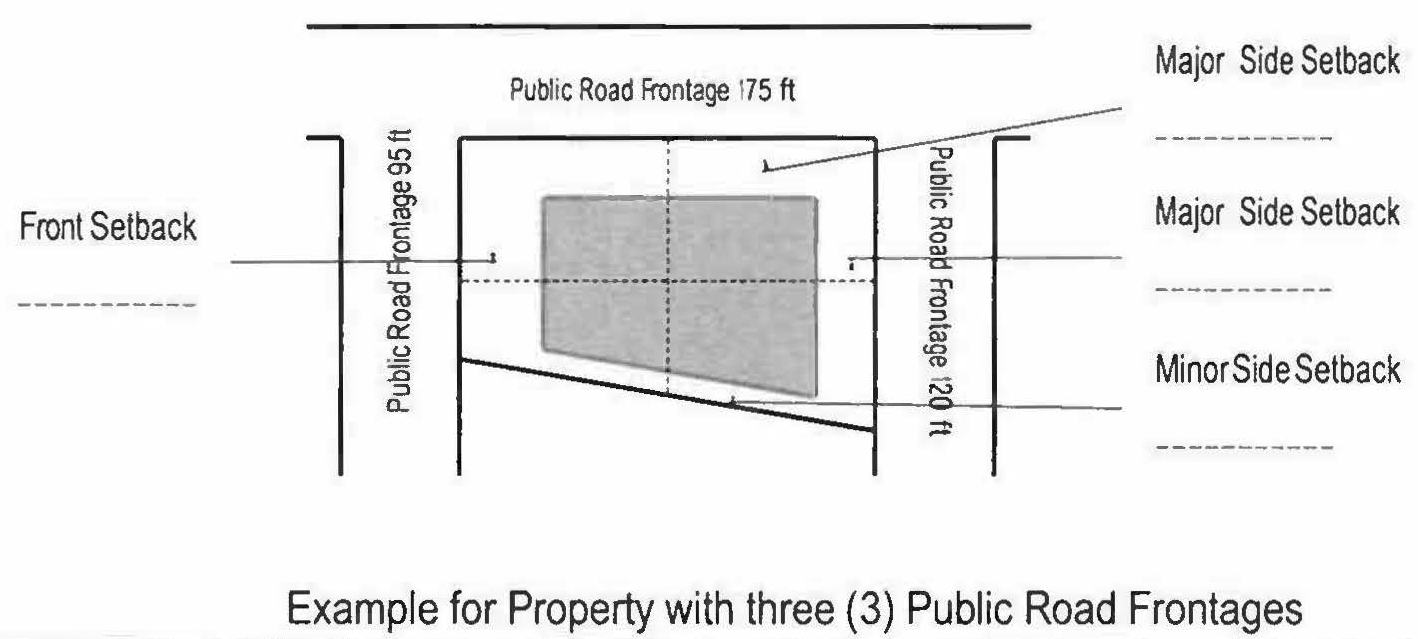
2.01.03.12 Purpose built student housing ("PBSH" District).
A.
Purpose and intent. The PBSH District is established to promote the development of safe, secure, affordable, aesthetically-pleasing student housing apartments for adults attending universities and colleges. Student housing is identified by having at least four of the following characteristics: 1) ability to rent on a per bedroom basis; 2) roommate matching services; 3) flexible lease terms to coincide with academic calendar; 4) furnished apartment units; 5) amenities such as study area, bike share program, and/or student convenience store; or 6) student life programming. The PBSH District is designed to encourage and provide flexible site plan and building arrangements under a unified plan of development rather than by lot-by-lot regulation. The PBSH District is not intended to encourage greater density of development, but rather to encourage ingenuity and resourcefulness in land planning. The PBSH district is appropriate in the following future land use areas as designated by the City of Kennesaw Comprehensive Plan: High density residential; neighborhood activity center; community activity center; and industrial.
B.
Uses. Any use not permitted as of right, or not permitted by Special Exception, or not permitted by land use permit is prohibited. To the extent there is a conflict between the permitted use table and this subsection, this section shall control for purposes of determining whether the use is allowed.
The following uses are permitted:
Purpose built student housing.
C.
Standards for development.
1.
Minimum acreage required: Four acres.
2.
Minimum lot area: Not applicable.
3.
Maximum building coverage: 40 percent.
4.
Maximum impervious surface coverage: 70 percent.
5.
Density requirement: Maximum allowable density is 100 bedrooms per acre, unless the PBSH development abuts (on any side) single family residentially zoned property. Any PBSH development abutting (on any side) single family residentially zoned property, the maximum allowable density is 50 bedrooms per acre for the entire development.
6.
Maximum number of bedrooms per apartment unit: Five bedrooms.
7.
Maximum number of residents per bedroom: One resident.
8.
Minimum lot width at front set back: 75 feet.
9.
Bathroom requirement: There shall be at least one bathroom for every two bedrooms, unless there are an uneven number of bedrooms in the unit, in which case, the odd bedroom shall have a corresponding bathroom. A bathroom shall contain at a minimum:
(a)
One wash basin.
(b)
One toilet.
(c)
One shower and/or bathtub.
10.
Minimum floor area for each unit:
(a)
Efficiency units: 450 square feet (an efficiency unit shall be considered a one bedroom unit for purpose of calculating density and parking).
(b)
One bedroom units: 600 square feet.
(c)
Two bedroom units: 1,000 square feet.
(d)
Three bedroom units: 1,189 square feet.
(e)
Four bedroom units: 1,400 square feet.
(f)
Five bedroom units: 1,700 square feet.
(g)
Minimum floor area shall not include basement, garage or accessory buildings.
(h)
Bedroom and living room size requirements shall at a minimum meet the square footage requirements of the International Property Maintenance Code, as amended from time to time.
11.
Each PBSH development shall include a common-use multi-purpose amenity area that accommodates a study area and an exercise/fitness room. Each development shall also feature green space that can be used by residents as a passive outdoor area. Said green space shall constitute at a minimum five percent of the gross acreage of the subject parcel. Buffers and setbacks can be utilized to accommodate said green space.
12.
Height and structure requirements.
(a)
Maximum building height is 55 feet, unless the PBSH development abuts (on any side) single family residentially zoned property. Any PBSH development abutting (on any side) single family residentially zoned property, the maximum building height is 35 feet for the entire development. All facades shall be masonry, brick or hardy plank (or substantially similar material) or combination thereof, and the construction material of the facade shall incorporate noise absorbing/blocking material in order to minimize noise.
(b)
The use of stucco shall be prohibited.
13.
Minimum set back requirements:
(a)
All structures proposed in the PBSH district that abut residential zoning shall be constructed a minimum of 50 feet from the abutting property line. For purposes of this district, residential zoning is any district that permits a residential use, including any district that permits a mixture of residential and non-residential use. The setback requirement under this section as applied to any residential use that permits a mixture of residential and non-residential (i.e. CBD, HPV, PVC) is applicable to only those portions that are designated or developed for residential use.
(b)
All structures proposed in the PBSH district that abut non-residential zoning shall be constructed a minimum of 35 feet from the abutting property line.
14.
Landscape buffer and screening requirements.
(a)
Any property within a PBSH district which abuts a more restrictively zoned residential property shall have a minimum of 30-foot landscaped screening buffer. More restrictively zoned residential property shall mean those properties that allow for a lesser number of units per acre than the actual density (number of units divided by land area) proposed under the PBSH development plan. The land area, for purposes of calculating the actual density under this section, shall not include floodplain, wetlands, or impervious surface dedicated to common areas (i.e. pool, tennis court, clubhouse, study area, management office).
(b)
Required buffers may be included within required setbacks; however, in such case that the required buffer is greater than the required setback, the required buffer shall be adhered to. Additionally, necessary private utilities and access drives may be allowed through, over or across a landscaped buffer. Any such uses which are proposed through, over or across a designated undisturbed buffer must be approved pursuant to an original site plan or site plan modification.
(c)
Objectives. Undisturbed, planted landscaped buffers and berms shall be implemented in connection with a permitted project and shall address the following objectives:
(i)
Screening to enhance aesthetic appeal;
(ii)
Control or direction of vehicular and pedestrian movement;
(iii)
Reduction of glare;
(iv)
Buffering of noise;
(v)
Establishment of privacy.
(d)
Buffers. Landscaped buffers are subject to review and approval by the Zoning Administrator in accordance with the following standards:
(i)
Plantings are to be a mix of evergreen trees and shrubs.
(ii)
Species are to be ecologically compatible to the site and appropriate for the design situation.
(iii)
Unless public safety concerns dictate otherwise, a buffer should maximize a visual barrier to a height of six feet within two years of planting.
(iv)
Minimum height of plant materials at installation is five feet for trees and two feet for shrubs.
(v)
Fencing or walls are to be a minimum of six feet in height as approved by the Zoning Administrator.
(vi)
Trees included in buffer planting may be counted toward site density calculations as required by Section 3.07.00 of the UDC pertaining to tree preservation and replacement, subject to review and approval by the Zoning Administrator.
(vii)
Buffers shall be regularly maintained by the property owner to ensure that the objectives and standards are met.
(viii)
When topography and existing conditions allow, the required buffer should be an undisturbed buffer.
(ix)
Any appeals from a determination by the Zoning Administrator shall be to the Mayor and City Council pursuant to Section 10.05.01 of the UDC.
D.
Access and parking requirements:
1.
Submission of a traffic impact study that demonstrates either the development will not have a negative impact on existing traffic conditions or that the negative impacts of the development can be mitigated through traffic improvements that will be incorporated as part of the development plan. Traffic counts shall be no more than three years old from date of the study and shall be taken during a time of year when the academic calendar is in session for nearby universities and schools.
2.
The principal access for the development shall be an arterial or major collector roadway, as identified in the City of Kennesaw Unified Development Code or similar classification document.
3.
Parking requirements: Sites shall be designed to accommodate on-site parking for at least 0.75 vehicles per bedroom with additional parking for visitors calculated at 0.30 vehicles per unit.
4.
To the extent the nearby post-secondary college and/or university does not agree to provide regular shuttle service to and from the campus for residents, the development shall agree to provide regular shuttle service to and from the campus for residents;
5.
The development shall have a dedicated pick-up drop-off space/lanes for a transportation network service (i.e. private shuttle, Uber, Lyft, taxi etc.).
E.
Security requirements:
1.
The property management company shall submit a security plan in accordance with the standards of Crime Prevention through Environmental Design (CPTED). The security plan shall be submitted to the City of Kennesaw Police Department for review and safe-keeping and shall be updated annually at the beginning of each calendar year, no later than January 31. Any such security plan shall require that on-site management shall be required 24 hours per day, seven days per week.
2.
All access points on the property shall be secured with gated entry and shall be self-closing;
3.
The development shall be enclosed with a minimum six-foot high privacy fence along the entire property line.
4.
The property shall be equipped with a security camera system that shall be monitored by the property management company on-site. Any such system shall record and store video images located throughout the common areas, including the parking areas, and signs shall be posted throughout the development notifying residents and visitors of the security camera system;
5.
The security system shall provide remote access to 911 operations;
6.
All common area doors and access gates shall be secured with electronic locks;
7.
All apartment units shall be equipped with a door that features a 180-degree peep hole;
8.
For every 200 parking spaces, the development shall feature at least one Emergency Blue Light Phone that is connected to the Cobb County Public Safety's 24-hour communications center and identify the phone location if the caller is unable to talk.
9.
Lighting: In order to ensure adequate illumination of the development and promote safety and security, the Parking Lot Design Guide standards set forth for Basic Enhanced Security, Security, and High Security as set forth in the Illuminating Engineering Society Lighting Handbook (IESNA), latest edition, as amended, is adopted as the standard for the installation and operating of lighting in parking lots in the PBSH district.
F.
In addition to the district requirements as set forth in this section of the Unified Development Code, the development within the PBSH district shall also comply with all other applicable provisions in the Unified Development Code that do not conflict with this ordinance, including but not limited to, regulations pertaining to the following: Floodplain, wetland, water supply, watershed, landscaping, tree, design standard, architectural standards, parking and parking lot design, sidewalks, pathways, storm drainage systems, storm drainage easements, water, sewer, access, lighting, street and roadway, retaining wall, dams, utilities, fences, buffers, berms, mailboxes and irrigations systems, signs, wireless telecommunication facilities, accessory and temporary uses, and incidental and permanent storage.
G.
In addition to any other required information, development proposals submitted for rezoning to the PBSH district shall be required to provide the following information:
1.
Preliminary site plan that illustrates locations of access drives, privacy fencing with gates, bike racks (if any) and amenity areas, setback lines and landscaping buffer locations;
2.
Executive summary of the project. Executive summary shall include: 1) contact and background information of the developer proposing to construct the project specific to the product proposed; 2) Project scope and market demand information; and 3) details regarding the proposed phasing of the construction of the project;
3.
Floor plan of all the proposed unit types that demonstrates the location, dimensions and layout of bedrooms, bathrooms, kitchen and common living area in the units;
4.
Elevations, building height information and proposed materials and facades.
2.01.03.13 The regulations for the Multi-family residential district (twelve units per acre) RM-12 residential district (80,000-square-foot lot size) are as follows:
A.
Purpose and intent. The RM-12 multiple-family residential district is established to provide locations for multifamily residential uses or residentially compatible institutional and recreational uses at high densities as defined under the City of Kennesaw Comprehensive Land Use Plan, and as may be amended from time to time, with access to both public water and sewerage.
B.
Uses. Any use not permitted as of right, or not permitted by Special Exception, or not permitted by land use permit is prohibited. To the extent there is a conflict between the permitted use table and this subsection, this section shall control for purposes of determining whether the use is allowed. See Section 4.04.01 for standards associated with Special Exception uses. Any conflict between the standards set forth in this district and those set forth in Section 4.04.01, the standards in Section 4.04.01 shall control for purposes of developing a Special Exception use.
The following uses are permitted:
Community fairs
Designated recycling collection locations
Executive golf courses
Fraternity and sorority houses/ residence halls
Golf courses (Par 3)
Golf courses (18-hole regulation; private and public)
Limited home occupation
Multi-family dwelling units
Nonprofit riding stables
Nonprofit (seasonal use) fishing lakes
Private parks
Recreation grounds other than tennis courts and golf courses
Religious assemblies
Single family dwelling units (attached)
Single family dwelling units (detached)
Temporary uses
Two family dwelling units
The following uses are permitted by special exception (refer to section 4.04.01):
Cemeteries
Private community centers
Private schools of general and special education
The following uses are permitted by land use permit or special land use permit:
Home occupation (refer to section 4.04.05)
Radio, television and other communication towers and antennas (refer to section 4.04.06)
C.
Requirements for certain uses. The following uses shall have the requirements as ascribed to them in this subsection.
1.
Limited Home Occupations:
(a)
There shall be no exterior evidence of the home occupation, including but not limited to any type of identifying signs.
(b)
No article, product or service used or sold in connection with such activity shall be other than those normally found on the premises.
(c)
No mechanical equipment shall be used for such occupation except such equipment as is customary for purely household and hobby purposes.
(d)
Such use shall be conducted entirely within the dwelling unit, and only persons living in the dwelling unit shall be employed in such occupation.
(e)
No more than 25 percent of the dwelling unit may be used for the operation.
(f)
No materials, equipment or business vehicles may be stored or parked on the premises, except that one business vehicle, used exclusively by the resident may be parked in a carport, garage, or rear or side yard.
(g)
The off-site employees of the resident shall not congregate on the premises for any purpose concerning the business of the home occupation.
(h)
There shall be no deliveries of supplies for use in the home occupation or pickups of the items produced by the occupant by commercial carriers.
(i)
No clients or customers are allowed on the premises on a regular basis.
(j)
The limited home occupation shall not create a nuisance.
2.
Designated Recycling Collection Locations:
(a)
Must be maintained in a safe, clean, neat, and sanitary fashion;
(b)
Such location shall be visually screened and maintained;
(c)
Such location shall be within the building setbacks unless otherwise approved by the zoning administrator or his/her designee due to topography, safety, internal traffic flow, site distance, or for other site-related circumstances not created by the property owner.
3.
Temporary Uses:
(a)
An approved temporary use shall not exceed 30 days and may be renewed for not more than one additional 30-day period.
(b)
Adequate off-street parking shall be provided.
(c)
Application for a temporary use shall be made with the City Business License division.
D.
Dimensional standards for Development. Setback shall be measured from the property line of the parcel. The property with shortest amount of road frontage shall be the front setback for determining other setbacks (major side, side, rear).
1.
Minimum lot size: 80,000 square feet.
2.
Maximum density: 12 units per acre.
3.
Minimum floor area:
(a)
450 square feet: efficiency.
(b)
600 square feet: one bedroom.
(c)
750 square feet: two bedroom.
(d)
900 square feet: three bedroom.
4.
Minimum lot width at front setback line: 75 feet.
5.
Minimum public road frontage: 75 feet.
6.
Maximum cover: 35%.
7.
Maximum building height: 40 feet.
8.
Minimum width between buildings: 15 feet.
9.
Basement: A basement shall be counted as a story if the ceiling is six feet or more above the grade and is either subdivided or used for dwelling or business purposes. A basement is a portion of the building partly underground which has more than one-half of its height measured from finished floor to finished ceiling above the average grade of the adjoining ground.
10.
Minimum building setbacks:
(a)
Front yard as measured from arterial: 50 feet.
(b)
Front yard as measured from collector: 40 feet.
(c)
Front yard as measured from local: 30 feet.
(d)
Side yard (aka minor side yard): 10 feet (if not interior portion of development); 15 feet (if interior portion of development).
(e)
Rear yard: 30 feet.
(f)
Major side: 25.
11.
Measuring building setbacks: The number and type of setbacks is determined based on the number and type of public road frontages for the lot as follows and as shown on the following diagram:
(a)
One public road frontage: The front yard setback is measured from the one public road frontage (arterial, collector, or local). The yard opposite the front yard is the rear yard and the other two yards are side yards.
(b)
Two public road frontages: The front yard setback is measured from the road with the shortest frontage (arterial, collector, or local). The major side yard setback is measured from the road with the longer frontage (arterial, collector, or local). The yard opposite the front yard is the rear yard and the yard opposite the major side yard is the minor side yard.
(c)
Three public road frontages: The front yard setback is measured from the road with the shortest frontage (arterial, collector, or local). The two major side yard setbacks are measured from the other two road frontages (arterial, collector, or local). The remaining yard is a minor side yard.
(d)
Building setbacks apply to both principal and accessory buildings and structure except where it explicitly states otherwise.
(e)
Irregular shaped lots: The Planning and Zoning Administrator will determine setbacks for irregular shaped lots adhering to the spirit and intent of this section.
(f)
Interior shall be considered the portion which does not abut an exterior property boundary.
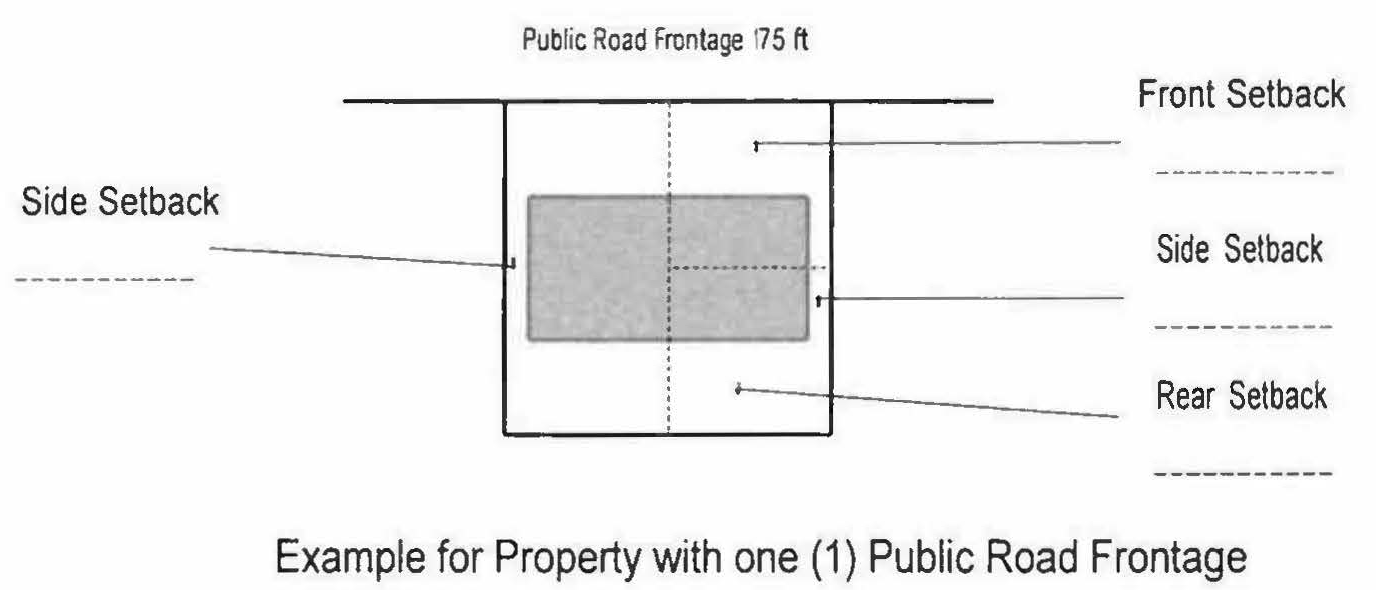
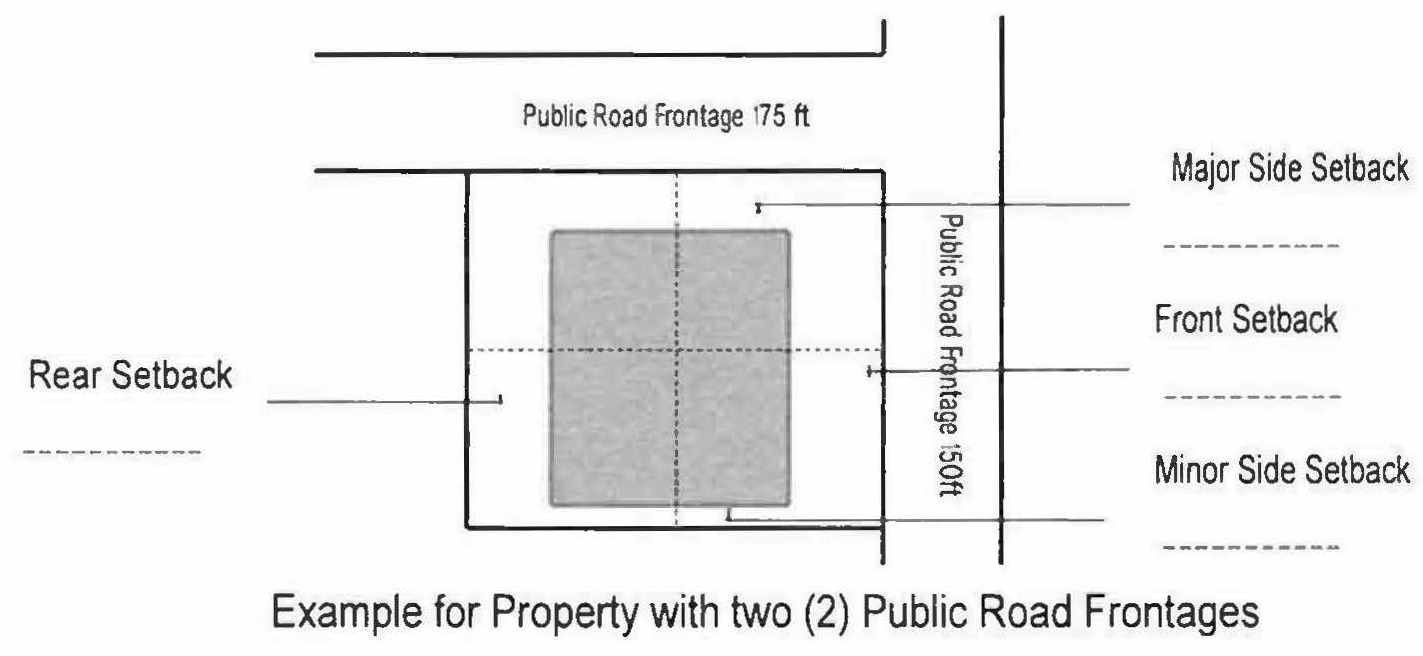
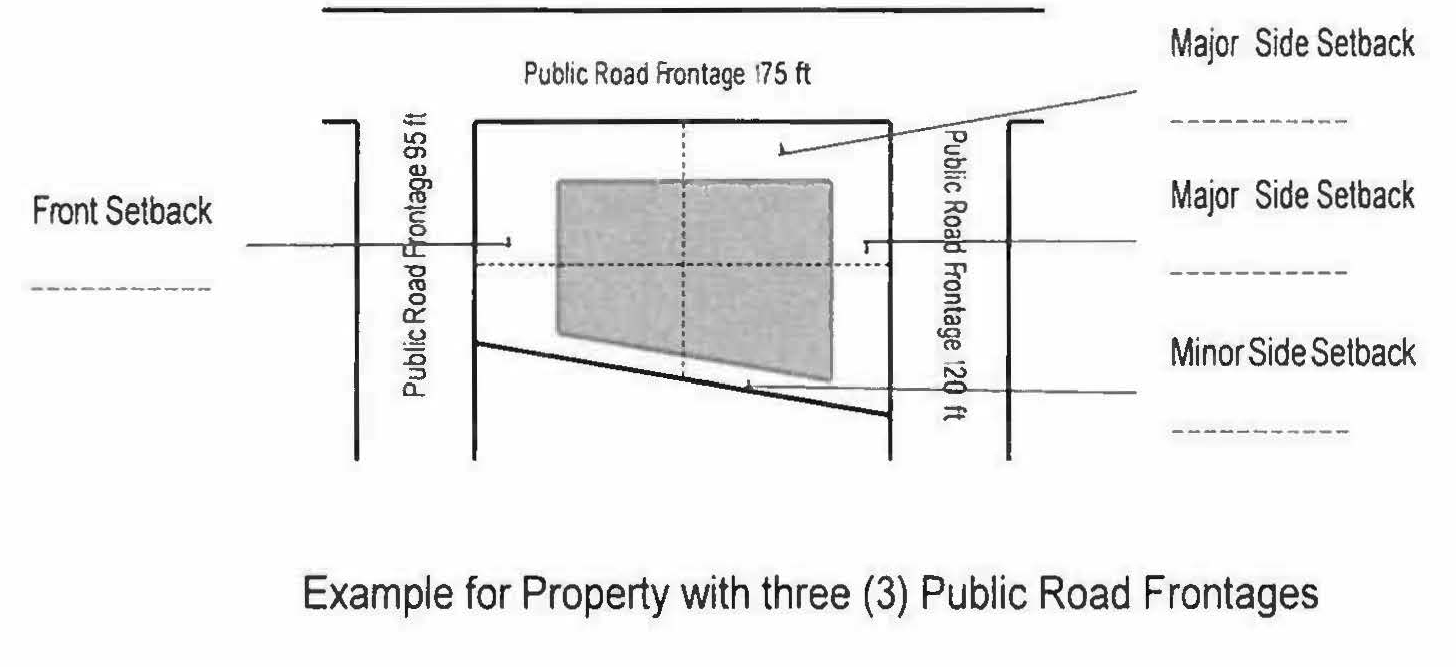
2.01.03.14 The regulations for the Multifamily residential district (sixteen units per acre) RM-16 residential district (80,000-square-foot lot size) are as follows:
A.
Purpose and intent. The RM-16 multi-family residential district is established to provide locations for multifamily residential uses or residentially compatible institutional and recreational uses at high densities as defined under the City of Kennesaw Comprehensive Land Use Plan, and as may be amended from time to time, with access to both public water and sewerage.
B.
Uses. Any use not permitted as of right, or not permitted by Special Exception, or not permitted by land use permit is prohibited. To the extent there is a conflict between the permitted use table and this subsection, this section shall control for purposes of determining whether the use is allowed. See Section 4.04.01 for standards associated with Special Exception uses. Any conflict between the standards set forth in this district and those set forth in Section 4.04.01, the standards in Section 4.04.01 shall control for purposes of developing a Special Exception use.
The following uses are permitted:
Community fairs
Designated recycling collection locations
Executive golf courses
Fraternity and sorority houses and residence halls
Fruit trees, nuts and vegetables for personal consumption (not for commerce)
Golf courses (18-hole regulation, public and private)
Golf courses (Par 3)
Limited home occupation
Multi family dwelling units
Nonprofit (seasonal use) fishing lakes
Nonprofit riding stables
Recreation grounds other than tennis courts and golf courses
Religious assemblies
Single family dwelling units (attached), not to exceed six units per acre
Single family dwelling units (detached), not to exceed six units per acre
Temporary uses
The following uses are permitted by special exception (refer to section 4.04.01):
Cemeteries
Private community centers
Private schools of general and special education
The following uses are permitted by land use permit or special land use permit:
Home occupations (refer to section 4.04.05)
Radio, television and other communication towers and antennas (refer to section 4.04.06)
C.
Requirements for certain uses. The following uses shall have the requirements as ascribed to them in this subsection.
1.
Limited Home Occupations:
(a)
There shall be no exterior evidence of the home occupation, including but not limited to any type of identifying signs.
(b)
No article, product or service used or sold in connection with such activity shall be other than those normally found on the premises.
(c)
No mechanical equipment shall be used for such occupation except such equipment as is customary for purely household and hobby purposes.
(d)
Such use shall be conducted entirely within the dwelling unit, and only persons living in the dwelling unit shall be employed in such occupation.
(e)
No more than 25 percent of the dwelling unit may be used for the operation.
(f)
No materials, equipment or business vehicles may be stored or parked on the premises, except that one business vehicle, used exclusively by the resident may be parked in a carport, garage, or rear or side yard.
(g)
The off-site employees of the resident shall not congregate on the premises for any purpose concerning the business of the home occupation.
(h)
There shall be no deliveries of supplies for use in the home occupation or pickups of the items produced by the occupant by commercial carriers.
(i)
No clients or customers are allowed on the premises on a regular basis.
(j)
The limited home occupation shall not create a nuisance.
2.
Designated Recycling Collection Locations:
(a)
Must be maintained in a safe, clean, neat, and sanitary fashion;
(b)
Such location shall be visually screened and maintained;
(c)
Such location shall be within the building setbacks unless otherwise approved by the zoning administrator or his/her designee due to topography, safety, internal traffic flow, site distance, or for other site-related circumstances not created by the property owner.
3.
Temporary Uses:
(a)
An approved temporary use shall not exceed 30 days and may be renewed for not more than one additional 30-day period.
(b)
Adequate off-street parking shall be provided.
(c)
Application for a temporary use shall be made with the City Business License division.
D.
Dimensional standards for Development. Setback shall be measured from the property line of the parcel. The property with shortest amount of road frontage shall be the front setback for determining other setbacks (major side, side, rear).
1.
Minimum lot size: 80,000 square feet.
2.
Maximum density: 16 units per acre or 6 units per acre for single family dwelling (attached or detached).
3.
Minimum floor area:
(a)
450 square feet: efficiency.
(b)
600 square feet: one bedroom.
(c)
750 square feet: two bedroom.
(d)
900 square feet: three bedroom.
4.
Minimum lot width at front setback line: 75 feet.
5.
Minimum public road frontage: 75 feet.
6.
Maximum cover: 45%.
7.
Maximum building height: 40 feet (three and four stories).
8.
Minimum width between buildings: 15 feet.
9.
Basement: A basement shall be counted as a story if the ceiling is six feet or more above the grade and is either subdivided or used for dwelling or business purposes. A basement is a portion of the building partly underground which has more than one-half of its height measured from finished floor to finished ceiling above the average grade of the adjoining ground.
10.
Minimum building setbacks:
(a)
Front yard as measured from arterial: 50 feet.
(b)
Front yard as measured from collector: 50 feet.
(c)
Front yard as measured from local: 35 feet.
(d)
Side yard (aka minor side yard): 35 feet (if not interior portion of development); 15 feet (if interior portion of development).
(e)
Rear yard: 40 feet.
(f)
Major side: 35.
11.
Measuring building setbacks: The number and type of setbacks is determined based on the number and type of public road frontages for the lot as follows and as shown on the following diagram:
(a)
One public road frontage: The front yard setback is measured from the one public road frontage (arterial, collector, or local). The yard opposite the front yard is the rear yard and the other two yards are side yards.
(b)
Two public road frontages: The front yard setback is measured from the road with the shortest frontage (arterial, collector, or local). The major side yard setback is measured from the road with the longer frontage (arterial, collector, or local). The yard opposite the front yard is the rear yard and the yard opposite the major side yard is the minor side yard.
(c)
Three public road frontages: The front yard setback is measured from the road with the shortest frontage (arterial, collector, or local). The two major side yard setbacks are measured from the other two road frontages (arterial, collector, or local). The remaining yard is a minor side yard.
(d)
Building setbacks apply to both principal and accessory buildings and structure except where it explicitly states otherwise.
(e)
Irregular shaped lots: The Planning and Zoning Administrator will determine setbacks for irregular shaped lots adhering to the spirit and intent of this section.
(f)
Interior shall be considered the portion which does not abut an exterior property boundary.
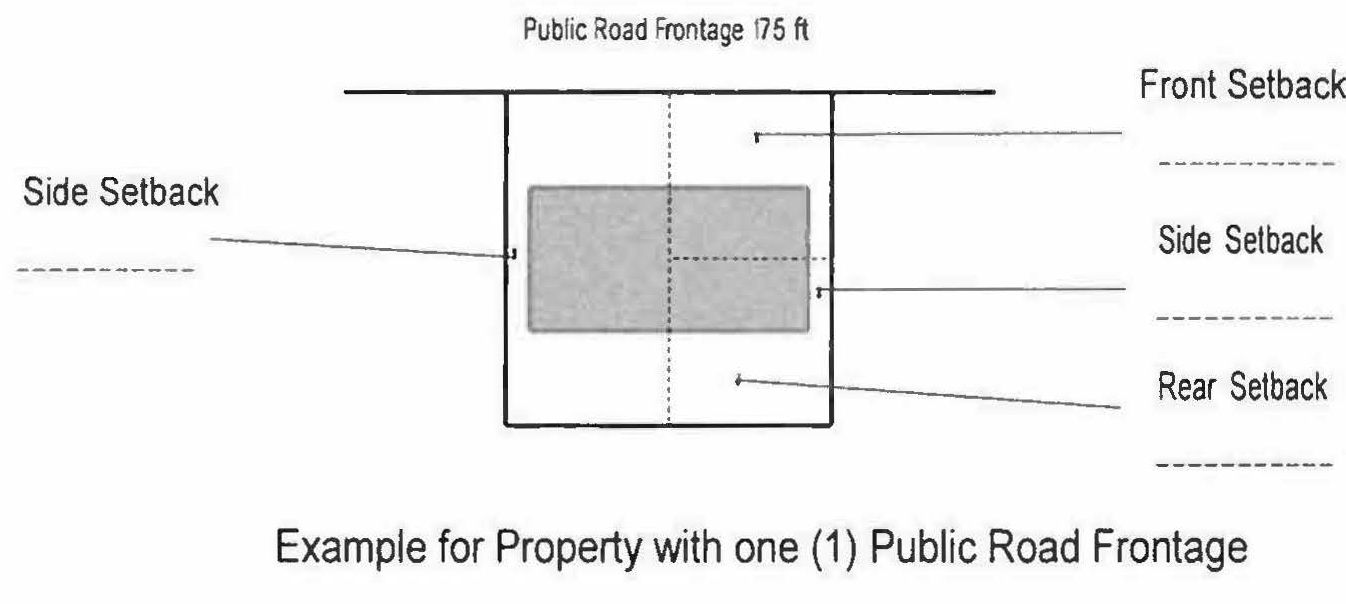
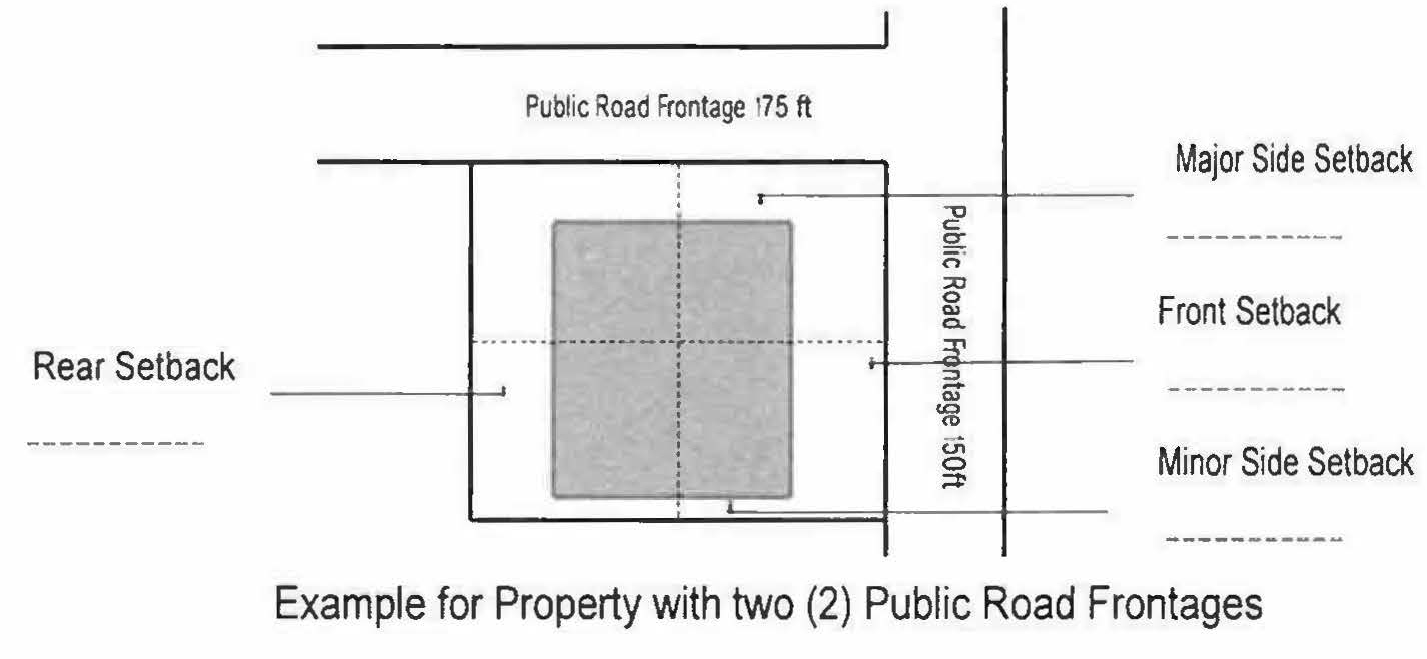
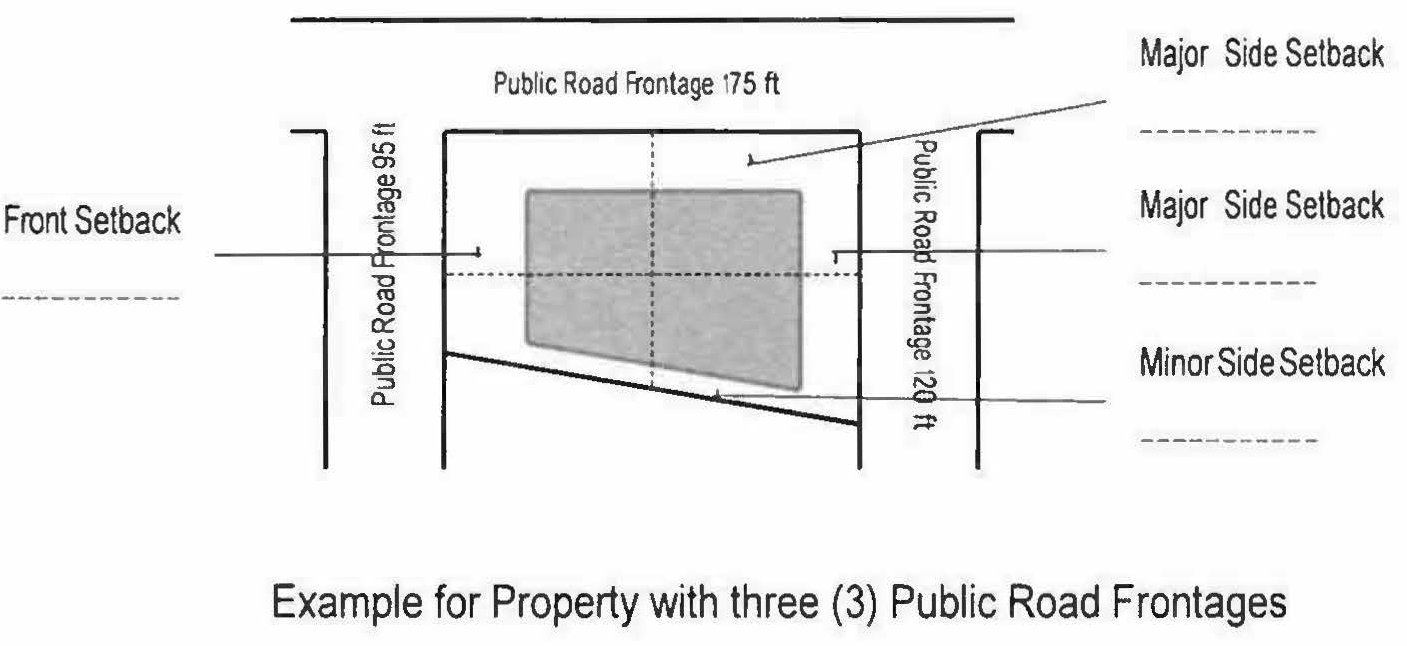
2.01.03.15 The regulations for the Fee-simple townhouse (FST) (multifamily) residential district (80,000-square-foot lot size) are as follows:
A.
Purpose and intent. The FST fee-simple townhouse district is intended to provide suitable areas for single-family attached or detached dwellings at high densities as defined by the City of Kennesaw Comprehensive Land Use Plan, and as may be amended from time to time, of two (2) to twelve (12) dwelling units per acre with access to both public water and sewerage. Each unit shall be individually metered. Each attached dwelling unit shall be separated by a fire wall from foundation to roof decking.
B.
Uses. Any use not permitted as of right, or not permitted by Special Exception, or not permitted by land use permit is prohibited. To the extent there is a conflict between the permitted use table and this subsection, this section shall control for purposes of determining whether the use is allowed. See Section 4.04.01 for standards associated with Special Exception uses. Any conflict between the standards set forth in this district and those set forth in Section 4.04.01, the standards in Section 4.04.01 shall control for purposes of developing a Special Exception use.
The following uses are permitted:
Community fairs
Designated recycling collection locations
Executive golf courses
Fruit trees, nuts and vegetables for personal consumption (not for commerce)
Golf courses (Par 3)
Golf courses (18-hole regulation; private and public)
Group homes
Limited home occupations
Linen and diaper services
Nonprofit riding stables
Nonprofit (seasonal use) fishing lakes
Private parks
Recreation grounds other than tennis courts and golf courses
Religious assemblies
Single family dwelling units (attached)
Single family dwelling units (detached)
Temporary uses
Townhouse dwelling units
Two family dwelling units
The following uses are permitted by special exception (refer to section 4.04.01):
Cemeteries
Private community centers
Private schools of general and special education
The following uses are permitted by land use permit or special land use permit:
Cottage Food Operators (refer to section 4.04.05 Standards for Home Occupation)
Home occupation (refer to section 4.04.05)
Radio, television and other communication towers and antennas (refer to section 4.04.06)
C.
Requirements for certain uses. The following uses shall have the requirements as ascribed to them in this subsection.
1.
Cottage Food Operators:
(a)
Cottage food operators shall adhere to all rules and regulations imposed by the Georgia Department of Agriculture.
(b)
There shall be no signage or other exterior evidence of the cottage food operator.
(c)
Deliveries of specialty ingredients such as herbs and spices, etc., limited to those made by the United States Postal Service or other carrier (FedEx, United Parcel Service, etc.) that routinely deliver mail/internet order products to residents.
(d)
No cottage food products prepared by the cottage food operator may be picked up by a commercial carrier.
(e)
There shall be no employees parking on the site unless approved by the Mayor and City Council in accordance with Section 4.04.05.
(f)
A home occupation land use permit shall be required.
2.
Limited Home Occupations:
(a)
There shall be no exterior evidence of the home occupation, including but not limited to any type of identifying signs.
(b)
No article, product or service used or sold in connection with such activity shall be other than those normally found on the premises.
(c)
No mechanical equipment shall be used for such occupation except such equipment as is customary for purely household and hobby purposes.
(d)
Such use shall be conducted entirely within the dwelling unit, and only persons living in the dwelling unit shall be employed in such occupation.
(e)
No more than 25 percent of the dwelling unit may be used for the operation.
(f)
No materials, equipment or business vehicles may be stored or parked on the premises, except that one business vehicle, used exclusively by the resident may be parked in a carport, garage, or rear or side yard.
(g)
The off-site employees of the resident shall not congregate on the premises for any purpose concerning the business of the home occupation.
(h)
There shall be no deliveries of supplies for use in the home occupation or pickups of the items produced by the occupant by commercial carriers.
(i)
No clients or customers are allowed on the premises on a regular basis.
(j)
The limited home occupation shall not create a nuisance.
3.
Designated Recycling Collection Locations:
(a)
Must be maintained in a safe, clean, neat, and sanitary fashion;
(b)
Such location shall be visually screened and maintained;
(c)
Such location shall be within the building setbacks unless otherwise approved by the zoning administrator or his/her designee due to topography, safety, internal traffic flow, site distance, or for other site-related circumstances not created by the property owner.
4.
Group Home:
(a)
A group home shall be shared by four or fewer persons, excluding resident staff;
(b)
The group home must provide the City of Kennesaw with a copy of its scheduled activity plan, a copy of the group home rules, and, if applicable, evidence of active enforcement under the Georgia Association of Recovery Residence standards;
(c)
The group home must be under the direction and guidance of a designated managing caregiver that resides at the group home;
(d)
The designated managing caregiver or his or her designee shall be available on a 24-hour basis in the event of emergencies or complaints; and
(e)
A group home must submit to random inspections by the City Code Enforcement.
(f)
A group home shall comply with all applicable regulations by the Board of Behavioral Health and Developmental Disabilities and the Department of Behavioral Health and Developmental Disabilities.
5.
Temporary Uses:
(a)
An approved temporary use shall not exceed 30 days and may be renewed for not more than one additional 30-day period.
(b)
Adequate off-street parking shall be provided.
(c)
Application for a temporary use shall be made with the City Business License division.
D.
Dimensional standards for Development. Setback shall be measured from the property line of the parcel. The property with shortest amount of road frontage shall be the front setback for determining other setbacks (major side, side, rear).
1.
Minimum lot size: 80,000 square feet. The Zoning Administrator shall not be authorized to recommend a variance for more than 25 percent of the minimum lot size.
2.
Minimum floor area: 900 square feet for 1 bedroom unit; 1,000 square feet for 2 bedroom unit.
3.
Minimum lot width at front setback line: 20 feet; for end unit: 30 feet.
4.
Minimum public road frontage: 70 feet; cul-de-sac, 35 feet.
5.
Maximum cover: 35%
6.
Maximum building height: two story.
7.
Maximum density per building: 6 units per building footprint.
8.
Maximum dwelling units per acre: 12
9.
A basement shall be counted as a story if the ceiling is six feet or more above the grade and is either subdivided or used for dwelling or business purposes. A basement is a portion of the building partly underground which has more than one-half of its height measured from finished floor to finished ceiling above the average grade of the adjoining ground.
10.
Minimum building setbacks:
(a)
Front yard as measured from arterial: 50 feet.
(b)
Front yard as measured from collector: 40 feet.
(c)
Front yard as measured from local: 35 feet.
(d)
Side yard (aka minor side yard): 20 feet between buildings.
(e)
Rear yard: 30 feet.
(f)
Major side: 25 feet.
11.
Measuring building setbacks: The number and type of setbacks is determined based on the number and type of public road frontages for the lot as follows and as shown on the following diagram:
(a)
One public road frontage: The front yard setback is measured from the one public road frontage (arterial, collector, or local). The yard opposite the front yard is the rear yard and the other two yards are side yards.
(b)
Two public road frontages: The front yard setback is measured from the road with the shortest frontage (arterial, collector, or local). The major side yard setback is measured from the road with the longer frontage (arterial, collector, or local). The yard opposite the front yard is the rear yard and the yard opposite the major side yard is the minor side yard.
(c)
Three public road frontages: The front yard setback is measured from the road with the shortest frontage (arterial, collector, or local). The two major side yard setbacks are measured from the other two road frontages (arterial, collector, or local). The remaining yard is a minor side yard.
(d)
Building setbacks apply to both principal and accessory buildings and structure except where it explicitly states otherwise.
(e)
Irregular shaped lots: The Planning and Zoning Administrator will determine setbacks for irregular shaped lots adhering to the spirit and intent of this section.
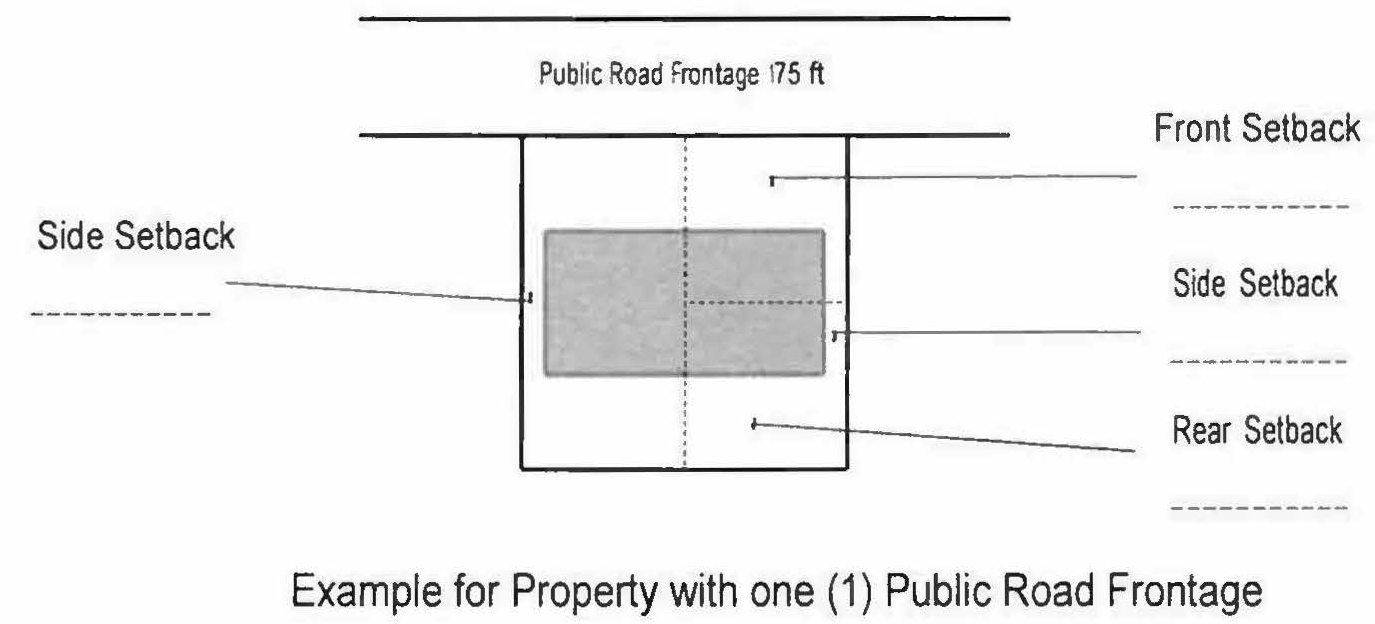
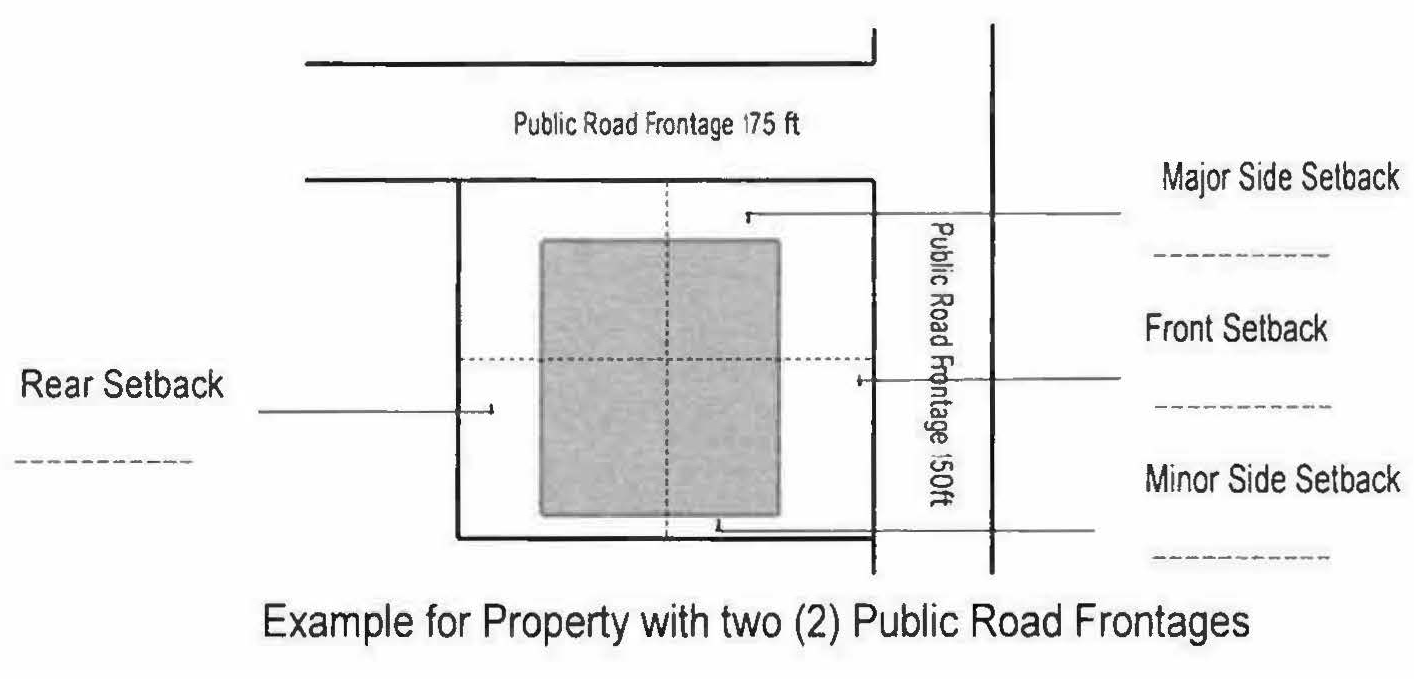
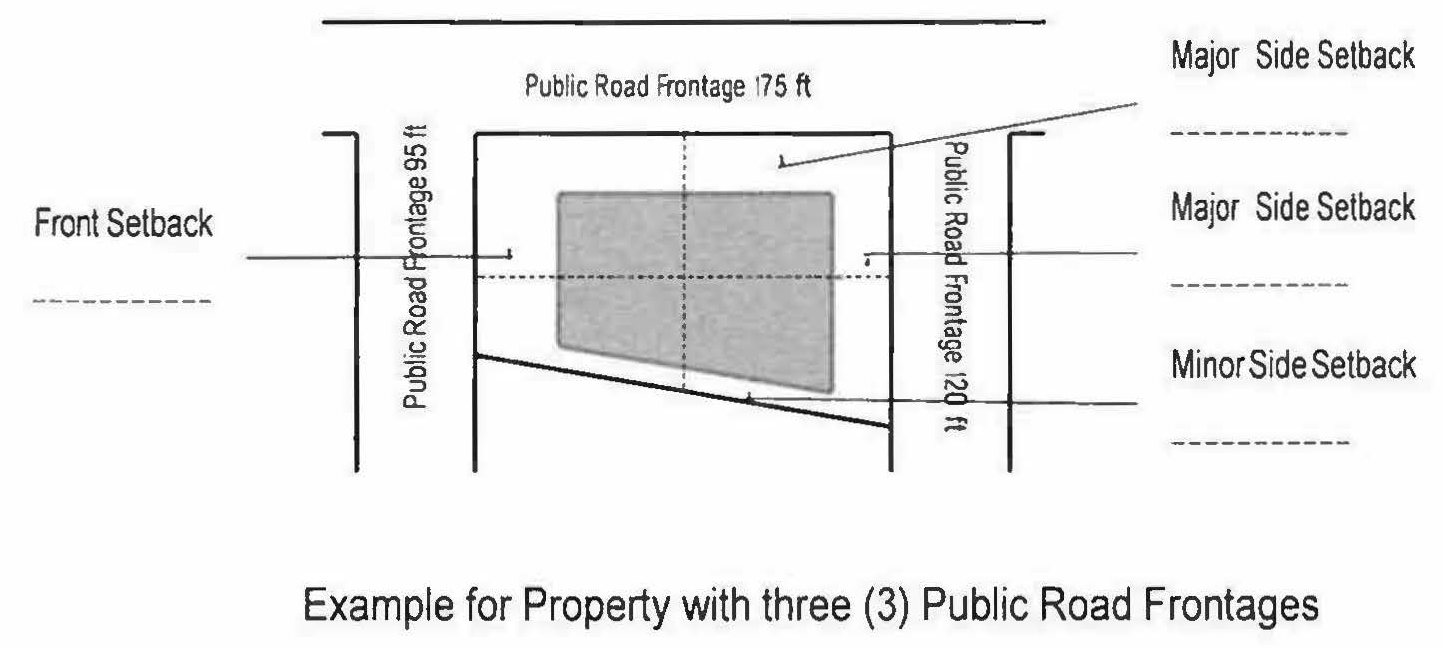
2.01.03.16 The regulations for the Mobile Home Park residential district MHP are as follows:
A.
Purpose and intent. The MHP district is established to provide locations for affordable single family mobile homes or manufactured homes with access to both public water and sewerage for high density residential classifications as defined under the City of Kennesaw Comprehensive Land Use Plan, and as may be amended from time to time.
B.
Uses. Any use not permitted as of right, or not permitted by Special Exception, or not permitted by land use permit is prohibited. To the extent there is a conflict between the permitted use table and this subsection, this section shall control for purposes of determining whether the use is allowed. See Section 4.04.01 for standards associated with Special Exception uses. Any conflict between the standards set forth in this district and those set forth in Section 4.04.01, the standards in Section 4.04.01 shall control for purposes of developing a Special Exception use.
The following uses are permitted:
Community Fairs
Designated recycling collection locations
Limited home occupations
Manufactured home
Mobile home
Private parks
Religious assemblies
The following uses are permitted by land use permit or special land use permit:
Cottage Food Operators (refer to section 4.04.05 Standards for Home Occupation)
Home occupation (refer to section 4.04.05)
Radio, television and other communication towers and antennas (refer to section 4.04.06)
C.
Requirements for certain uses. The following uses shall have the requirements as ascribed to them in this subsection.
1.
Cottage Food Operators:
(a)
Cottage food operators shall adhere to all rules and regulations imposed by the Georgia Department of Agriculture.
(b)
There shall be no signage or other exterior evidence of the cottage food operator.
(c)
Deliveries of specialty ingredients such as herbs and spices, etc., limited to those made by the United States Postal Service or other carrier (FedEx, United Parcel Service, etc.) that routinely deliver mail/internet order products to residents.
(d)
No cottage food products prepared by the cottage food operator may be picked up by a commercial carrier.
(e)
There shall be no employees parking on the site unless approved by the Mayor and City Council in accordance with Section 4.04.05.
(f)
A home occupation land use permit shall be required.
2.
Limited Home Occupations:
(a)
There shall be no exterior evidence of the home occupation, including but not limited to any type of identifying signs.
(b)
No article, product or service used or sold in connection with such activity shall be other than those normally found on the premises.
(c)
No mechanical equipment shall be used for such occupation except such equipment as is customary for purely household and hobby purposes.
(d)
Such use shall be conducted entirely within the dwelling unit, and only persons living in the dwelling unit shall be employed in such occupation.
(e)
No more than 25 percent of the dwelling unit may be used for the operation.
(f)
No materials, equipment or business vehicles may be stored or parked on the premises, except that one business vehicle, used exclusively by the resident may be parked in a carport, garage, or rear or side yard.
(g)
The off-site employees of the resident shall not congregate on the premises for any purpose concerning the business of the home occupation.
(h)
There shall be no deliveries of supplies for use in the home occupation or pickups of the items produced by the occupant by commercial carriers.
(i)
No clients or customers are allowed on the premises on a regular basis.
(j)
The limited home occupation shall not create a nuisance.
3.
Designated Recycling Collection Locations:
(a)
Must be maintained in a safe, clean, neat, and sanitary fashion;
(b)
Such location shall be visually screened and maintained;
(c)
Such location shall be within the building setbacks unless otherwise approved by the zoning administrator or his/her designee due to topography, safety, internal traffic flow, site distance, or for other site-related circumstances not created by the property owner.
D.
Dimensional standards for Development. Setback shall be measured from the property line of the parcel. The property with shortest amount of road frontage shall be the front setback for determining other setbacks (major side, side, rear).
1.
Minimum acreage: 10 acres.
2.
Maximum dwelling units per acre: 6.
3.
Minimum lot width at front setback line: 40 feet; cul-de-sac, 60 feet.
4.
Minimum public road frontage: 70 feet; cul-de-sac, 35 feet.
5.
Maximum cover: 35%.
6.
Maximum building height: one story.
7.
A basement shall be counted as a story if the ceiling is six feet or more above the grade and is either subdivided or used for dwelling or business purposes. A basement is a portion of the building partly underground which has more than one-half of its height measured from finished floor to finished ceiling above the average grade of the adjoining ground.
8.
Minimum building setbacks:
(a)
Front yard as measured from arterial: 40 feet.
(b)
Front yard as measured from collector: 40 feet.
(c)
Front yard as measured from local: 40 feet.
(d)
Side yard (aka minor side yard): at least 10 feet between units.
(e)
Rear yard: 20 feet.
(f)
Major side: 25 feet.
9.
Measuring building setbacks: The number and type of setbacks is determined based on the number and type of public road frontages for the lot as follows and as shown on the following diagram:
(a)
One public road frontage: The front yard setback is measured from the one public road frontage (arterial, collector, or local). The yard opposite the front yard is the rear yard and the other two yards are side yards.
(b)
Two public road frontages: The front yard setback is measured from the road with the shortest frontage (arterial, collector, or local). The major side yard setback is measured from the road with the longer frontage (arterial, collector, or local). The yard opposite the front yard is the rear yard and the yard opposite the major side yard is the minor side yard.
(c)
Three public road frontages: The front yard setback is measured from the road with the shortest frontage (arterial, collector, or local). The two major side yard setbacks are measured from the other two road frontages (arterial, collector, or local). The remaining yard is a minor side yard.
(d)
Building setbacks apply to both principal and accessory buildings and structure except where it explicitly states otherwise.
(e)
Irregular shaped lots: The Planning and Zoning Administrator will determine setbacks for irregular shaped lots adhering to the spirit and intent of this section.
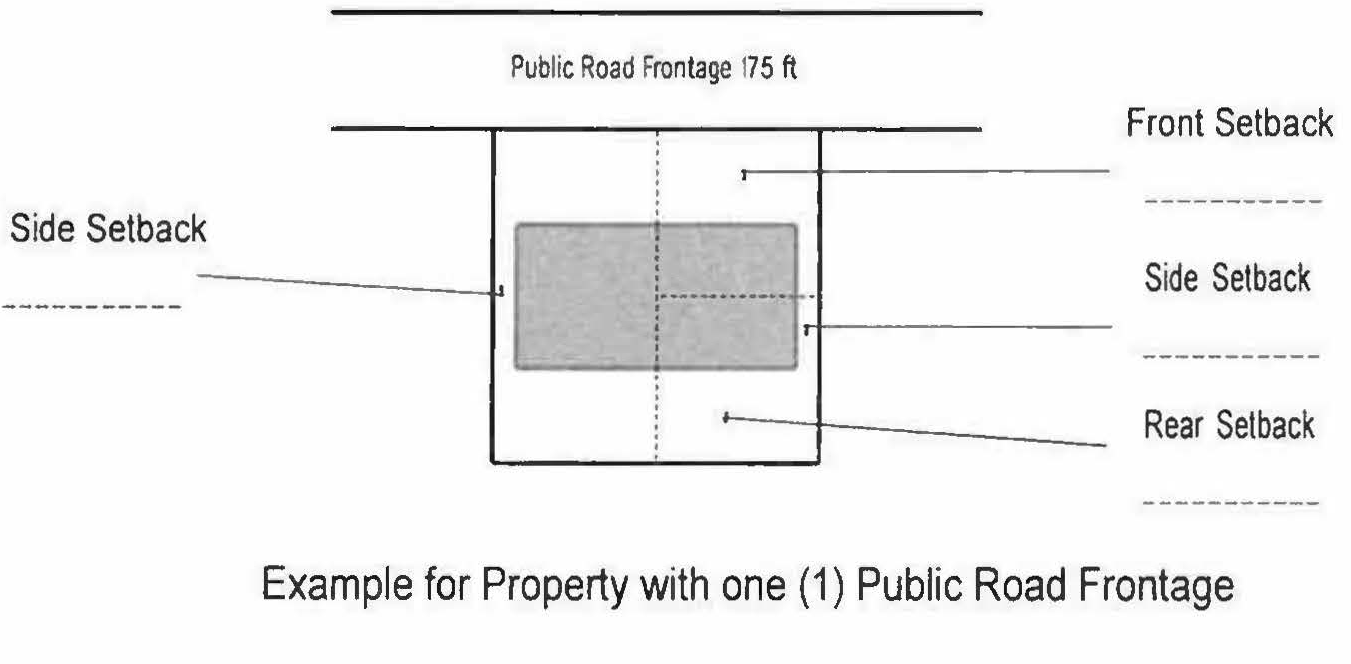
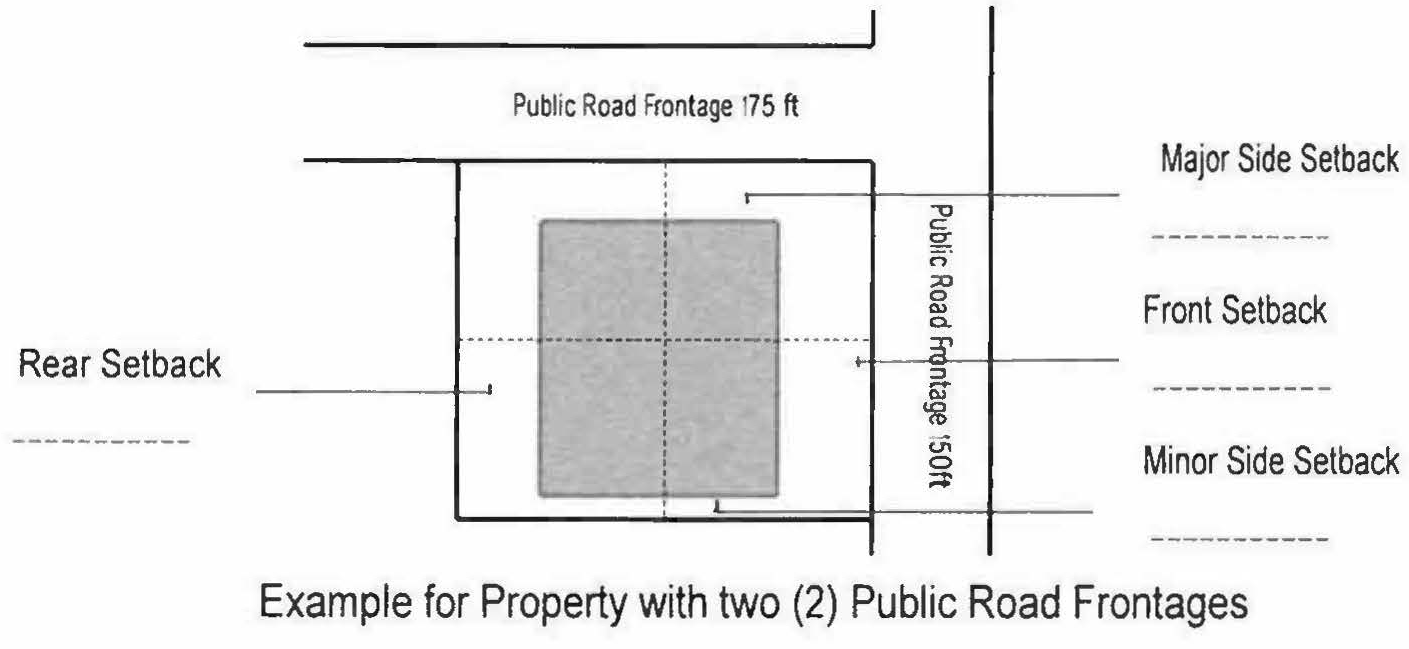
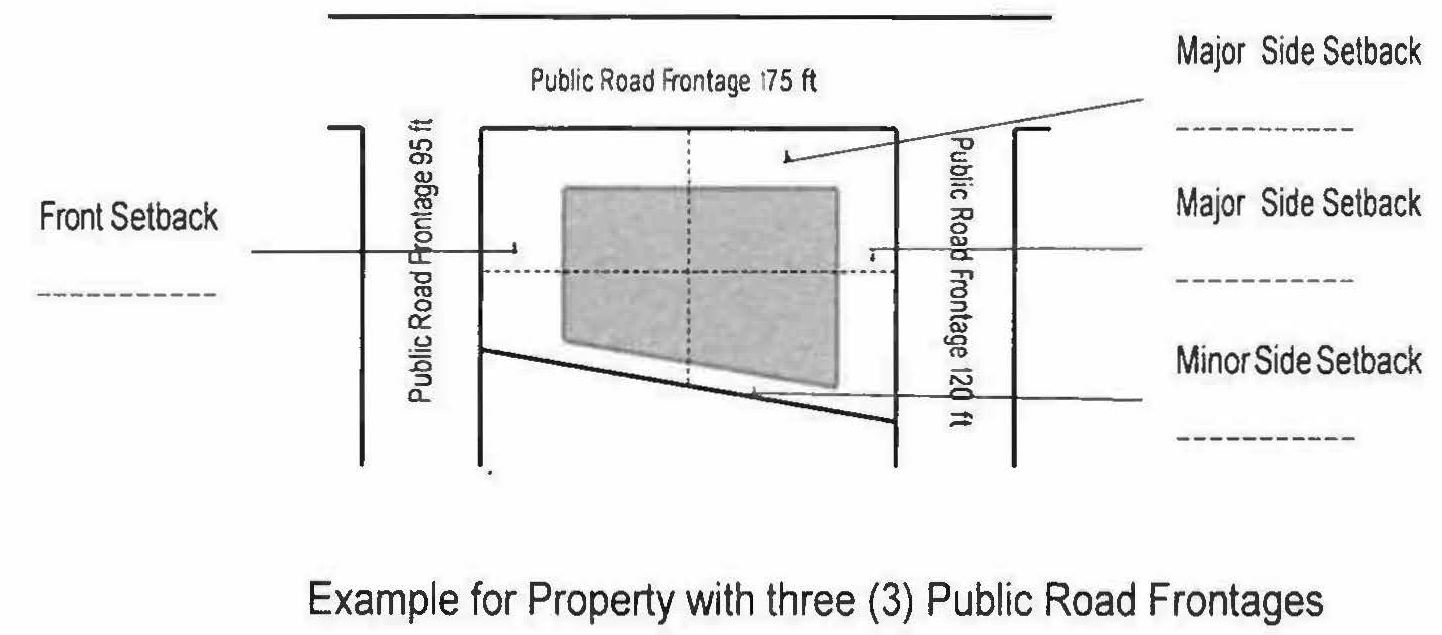
(Ord. No. 2020-09, § 2(Exh. A), 8-17-20; Ord. No. 2021-07, § 2(Exh. B1), 6-21-21; Ord. No. 2024-02, 2-19-24; Ord. No. 2025-07, § 2(Exh. B1), 9-15-25; Ord. No. 2026-04, § 1, 2-16-26)
2.01.04 - Commercial, Office and Institutional Districts
The following commercial, office and institutional districts are established:
A.
OI, Office/Institutional district. The OI Office/Institutional district is established to provide locations for nonretail commercial uses such as offices and financial institutions. The OI district is designed primarily to provide for four story and smaller office developments, office uses, motels, hotels, banking and professional offices that complement and provide step down nodal zoning away from more intensive commercial uses.
B.
NS, Neighborhood Shopping district. The NS district is established to provide locations for specialized and/or limited low intensity shopping facilities which are on properties delineated within a neighborhood activity center, community activity center, or regional activity center as defined and shown on the City of Kennesaw Comprehensive Plan, and as may be amended from time to time. These convenience shopping facilities should have low intensity retail commercial uses that have a neighborhood-oriented market and which supply necessities that usually require purchasing with a minimum of consumer travel.
Areas zoned for the NS district are appropriately located at or adjacent to intersections as opposed to the edge of a NAC. The NS district may also be used to provide step down nodal zoning away from more intensive commercial uses within a community activity center or a regional activity center. The scope at which properties are developed within the NS district should reflect their relatively small neighborhood service area. Additionally, properties developed within the NS should be architecturally compatible with other nonresidential uses permitted within an NS district as defined by the comprehensive plan and the neighborhood residences they serve.
C.
NRC, Neighborhood Retail Commercial district. The NRC neighborhood retail commercial district is established to provide locations for retail commercial and service uses which are designed and oriented to Neighborhood Activity Center as defined by the City of Kennesaw Comprehensive Land Use Plan, and as may be amended from time to time.
D.
CRC, Community Retail Commercial district. The CRC community retail commercial district is established to provide locations for retail commercial and service uses which are designed and oriented to serve several neighborhoods making up a community. The CRC district is aimed to provide for planned developments, one destination shopping and service locations to serve the community and to minimize traffic congestion.
E.
GC, General Commercial district. The GC district is established to provide locations for retail commercial and service uses which are oriented toward diverse range businesses that are service and product intensive with a need for major road access and visibility.
F.
HGB, Highway General Business district. The HGB highway general business district is established to provide locations for commercial and service uses which are oriented toward general and specialty service businesses and interstate and state highway travelers.
G.
UVC, Urban Village Commercial district. The UVC urban village commercial district is established to provide locations for planned mixed-use development of low intensity, low scale commercial, office, and residential uses not subdivided into customary streets and lots and which will not be subdivided.
H.
PVC, Planned Village Community district. The PVC planned village community district is established to provide locations and encourage flexible site plans and building arrangements under a unified plan of development rather than a lot by lot regulation for retail commercial and service uses which are designed and oriented to be self-sufficient neighborhoods making up a community. The developer benefits from better land utilization and economy in the provision of roads and utilities and overall site design.
Projects within the PVC should be designed to compact unified retail centers within the center of the community. Projects developed within the PVC should occupy a quadrant of an intersection and only ingress and egress from a major or collector street or state highway. Additionally, the desired quadrant location will provide for planned developments, one destination shopping, and service locations to serve [the] community, and to minimize traffic congestion.
I.
PSC, Planned Shopping Center district. The PSC planned shopping center district is established to provide locations for retail commercial and service uses which are designed and oriented to serve several neighborhoods making up a community. The PSC district is aimed to provide for planned developments, one destination shopping and service locations to serve the community and to minimize traffic congestion.
2.01.05 - Industrial Zoning Districts
The following Industrial zoning districts are established:
2.01.05.01 LI Light Industrial district:
A.
Purpose and Intent: The LI light industrial district is established to provide locations for light industrial uses such as low intensity automobile repair and service, commercial greenhouses, distribution centers, warehouse and storage, transportation terminals. When located on the perimeter of an industrial node, the LI district should provide for uses that are low in intensity and scale such to ensure compatibility with surrounding properties.
B.
Uses. Any use not permitted, or not permitted by Special Exception, or not permitted by Land Use Permit is prohibited. To the extent there is a conflict between the Table of Land Uses and this district as set forth herein, this district shall control for purposes of determining whether and how the use is allowed. See Section 4.04.01 for standards associated with Special Exception uses. Any conflict between the standards set forth in this district and those set forth in Section 4.04.01 (as amended from time to time), the standards in Section 4.04.01 (as amended from time to time) shall control for purposes of allowing a Special Exception use. Certain uses marked with an asterisk (*) must ascribe to the specific regulations as set forth in this district. Particular uses may need to comply with a combination of special regulations (*), special exception regulations, and special land use permit requirement.
The following uses are permitted:
Accessory retail sales and services
Agriculture produce stands
Ambulance services
Ambulance services, if accessory to hospitals or funeral homes
Amphitheaters
Ancillary retail sales
Animal hospitals
Appliance repair (major)
Assembly halls
Automotive paint and body repair services
Automotive parking lots and garages
Automotive repair and maintenance facilities
Automotive upholstery shops
Aviation airports (private)
Boat sales and service establishments
Breeding and boarding kennels
Building materials stores
Bus stations
Bus stations for freight
Car washes
Clinics
Clubs or lodges (noncommercial)
Colleges and universities (private), including but not limited to research and training facilities
Commercial greenhouses and plant nurseries
Commercial indoor recreation uses
Commercial outdoor recreation uses
Community fairs
Contractors (general, heavy, special) (office/warehouse)
Corporate or administrative offices for any permitted use
Dairies
Designated recycling collection locations*
Dry cleaning plants
Electrical supply stores
Emissions/inspection stations
Executive golf courses
Exterminating facilities (insect and/or rodent)
Farm and garden supply stores
Farm equipment stores/repair
Fast food restaurant
Freight terminals
Fuel and ice dealers
Full service gasoline stations
Funeral homes
Golf courses (Par-3)
Golf courses (18-hole regulation; private and public)
Group homes*
Halfway houses
Heavy automotive repair establishments
Helicopter landing areas
Hospitals
Laundry and dry cleaning pick-up establishments
Light automotive repair
Light manufacturing establishments
Linen and diaper services
Livestock sales pavilions
Machine shops
Medical and dental laboratories, provided that no chemicals are manufactured on site
Mobile food vending unit
Newspaper publishing facilities
Nonautomotive repair service establishments
Nonprofit riding stables
Office service and supply establishments
Other service establishments
Outdoor golf driving ranges
Pain management clinic
Parking for vehicles
Plumbing and/or heating equipment dealers
Poultry hatcheries
Printing, publishing, and lithography establishments
Pro shops (accessory to driving ranges/golf courses)
Professional offices
Radio and television stations
Rail stations (commuter)
Railroad car classification yards
Railroad stations
Recreation grounds other than tennis courts and golf courses
Religious assemblies
Medical research centers
Research testing laboratories
Re-upholstery and furniture repair establishments
Sawmills (temporary)
Self-service storage facilities
Sexually Oriented Businesses*
Shelters (homeless)*
Taxi stands and dispatching agencies
Temporary Uses*
Tire retreading and recapping facilities
Transportation equipment storage and maintenance facilities
Truck terminals
Utility facilities (private)
Vending machine sales, service, rental, or repair establishments
Vocational schools (commercial)
Warehouse and storage facilities
Wholesale sales offices
Wholesale trade and distribution facilities
Wholesale trade offices in conjunction with office showrooms
Zoos
The following uses are permitted by special exception:
Amusement centers
Automobile, truck, and trailer lease and rental facilities (accessory use)
Automobile, truck, and trailer lease and rental facilities (principal use)
Automobile and truck sales and service facilities
Automotive storage yards and wrecker service
Cemeteries
Crematories, human or animal
Drive in theaters
Flea markets
Mausoleums
Motorcycles, ATV, and three-wheel vehicle sales and service facilities (need SE standards)
Private community centers
Private schools of general and special education
The following uses are permitted only by special land use permit:
Coliseums, stadiums, and conventions centers (privately owned) (SLUP)
Radio, television and other communication towers and antennas (SLUP)
Wireless telecommunications facilities (SLUP)
C.
Requirements for certain uses. The following uses shall have the requirements as ascribed to them in this subsection.*
1.
Designated Recycling Collection Locations:
(a)
Must be maintained in a safe, clean, neat, and sanitary fashion;
(b)
Such location shall be visually screened and maintained;
(c)
Such location shall be within the building setbacks unless otherwise approved by the zoning administrator or his/her designee due to topography, safety, internal traffic flow, site distance, or for other site-related circumstances not created by the property owner.
2.
Group Home:
(a)
A group home shall be shared by four or fewer persons, excluding resident staff;
(b)
the group home must provide the City of Kennesaw with a copy of its scheduled activity plan, a copy of the group home rules, and, if applicable, evidence of active enforcement under the Georgia Association of Recovery Residence standards;
(c)
the group home must be under the direction and guidance of a designated managing caregiver that resides at the group home;
(d)
the designated managing caregiver or his or her designee shall be available on a 24-hour basis in the event of emergencies or complaints; and
(e)
a group home must submit to random inspections by the City Code Enforcement.
3.
Halfway House:
(a)
Halfway Houses shall not be located within 1,000 feet of any day care center, school, religious assembly, school bus stop, public or private playground, park or swimming pool, or 'areas where minors congregate' as defined in O.C.G.A. § 42-1-12(a)(3).
(b)
Measurement: For the purpose of measuring the distance required under this subparagraph, measurement shall be made in a straight line in all directions without regard to intervening structures or objects, from the primary point of pedestrian entry of the structure in which the applicant is located to the primary point of pedestrian entry of the structure of the sensitive use. If there is no structure on the parcel comprising the sensitive use, then the point of measurement is to the closest point on a boundary line of any parcel comprising the sensitive use.
4.
Temporary Uses:
(a)
An approved temporary use shall not exceed 30-days and may be renewed for not more than one additional 30-day period.
(b)
Adequate off-street parking shall be provided.
(c)
Application for a temporary use shall be made with the City Business License division.
5.
Shelters (homeless):
(a)
Adequate showers and restroom facilities must be provided at the location to meet the needs of the overnight guests;
(b)
Beds must be provided for all overnight guests excluding staff and volunteer workers;
(c)
No shelter shall be located closer than 1,000 feet to the nearest single-family residence;
(d)
Guests of the shelter shall be required to leave the shelter premises no later than 7:00 a.m.;
(e)
All premises shall be maintained in a clean, safe, and sanitary fashion;
(f)
Adequate provisions for transporting and parking guests shall be submitted to and approved by the zoning administrator or his/her designee.
6.
Sexually oriented business:
(a)
Measurement. For the purpose of measuring the distance required under this subparagraph, measurement shall be made in a straight line in all directions without regard to intervening structures or objects, from the primary point of pedestrian entry of the structure in which the applicant is located to the primary point of pedestrian entry of the structure of the sensitive use. If there is no structure on the parcel comprising the sensitive use, then the point of measurement is to the closest point on a boundary line of any parcel comprising the sensitive use.
(b)
It shall be unlawful to establish, operate, or cause to be operated a sexually oriented business in the city, unless said sexually oriented business is at least 250 feet from another sexually oriented business.
(c)
It shall be unlawful to establish, operate, or cause to be operated a sexually oriented business in the city, unless same is at least 500 feet from a religious assembly building, school building, governmentally owned and operated building, library building, civic center building, public park, hospital building, community club building, prison building or any residence (sensitive uses).
(d)
It shall be unlawful to establish, operate, or cause to be operated a sexually oriented business in the city, unless said sexually oriented business is at least 500 feet from a business licensed to sell alcohol on the premises (sensitive use).
(e)
Sexually oriented businesses are also subject to licensing requirements as set forth in Chapter 22 of the Kennesaw City Code, as may be amended from time to time.
D.
Dimensional standards for Development. Setback shall be measured from the property line of the parcel. The property with the shortest amount of road frontage shall be the front setback for determining other setbacks (major side, side, rear).
1.
Minimum lot size: 40,000 square feet
2.
Minimum lot width at front setback line: 75 feet
3.
Maximum height: 50 feet (4 stories maximum)
4.
A basement shall be counted as a story if the ceiling is six feet or more above the grade and is either subdivided or used for dwelling or business purposes. A basement is a portion of the building partly underground which has more than one-half of its height measured from finished floor to finished ceiling above the average grade of the adjoining ground.
5.
Minimum building setbacks:
(a)
Front yard as measured from arterial: 50 feet.
(b)
Front yard as measured from collector: 50 feet.
(c)
Front yard as measured from local: 50 feet.
(d)
Side yard (aka minor side yard): 20 feet.
(e)
Rear yard: 40 feet.
(f)
Major side: 25 feet.
6.
Maximum cover: 80%
7.
Measuring building setbacks: The number and type of setbacks is determined based on the number and type of public road frontages for the lot as follows and as shown on the following diagram:
(a)
One public road frontage: The front yard setback is measured from the one public road frontage (arterial, collector, or local). The yard opposite the front yard is the rear yard and the other two yards are side yards.
(b)
Two public road frontages: The front yard setback is measured from the road with the shortest frontage (arterial, collector, or local). The major side yard setback is measured from the road with the longer frontage (arterial, collector, or local). The yard opposite the front yard is the rear yard and the yard opposite the major side yard is the minor side yard.
(c)
Three public road frontages: The front yard setback is measured from the road with the shortest frontage (arterial, collector, or local). The two major side yard setbacks are measured from the other two road frontages (arterial, collector, or local). The remaining yard is a minor side yard.
(d)
Building setbacks apply to both principal and accessory buildings and structure except where it explicitly states otherwise.
(e)
Irregular shaped lots: The Planning and Zoning Administrator will determine setbacks for irregular shaped lots adhering to the spirit and intent of this section.
E.
Landscape buffer and screening requirements. Unless otherwise noted within this district's requirements, any property within an LI district which abuts a residentially zoned property shall have a minimum 50-foot landscaped screening buffer adjacent to all residentially zoned property. The buffer shall be subject to approval by City staff. The City discourages locating LI districts and developments adjacent to single-family residential districts, unless in a planned mixed use project. Required buffers may be included within required setbacks; however, in such case that the required buffer is greater than the required setback, the required buffer shall be adhered to. Additionally, necessary private utilities and access drives may be allowed through, over or across a landscaped buffer. Any such uses which are proposed through, over or across a designated undisturbed buffer must be approved pursuant to an original site plan or site plan modification as set forth in the UDC.
1.
Objectives. Undisturbed, planted landscape buffers and berms shall be implemented in connection with a permitted project and shall address the following objectives:
(a)
Screening to enhance aesthetic appeal;
(b)
Control or direction of vehicular and pedestrian movement;
(c)
Reduction of glare;
(d)
Buffering of noise; and
(e)
Establishment of privacy.
2.
Standards. Buffers and berms shall be required when an LI district is located adjacent to a residential district; a minimum 50-foot buffer is required.
(a)
Buffers. Landscape buffers are subject to review and approval by the Zoning Administrator in accordance with the following standards:
(i)
Plantings are to be a mix of evergreen trees and shrubs.
(ii)
Species are to be ecologically compatible to the site and appropriate for the design situation.
(iii)
Unless public safety concerns dictate otherwise, buffers should provide a 100 percent visual barrier to a height of six feet within two years of planting.
(iv)
Minimum height of plant materials at installation is five feet for trees and two feet for shrubs.
(v)
Fencing or walls are to be a minimum of six feet in height.
(vi)
Trees included in buffer plantings may be counted toward site density calculations as required by Chapter 3 of the UDC pertaining to tree preservation and replacement, subject to review and approval of the Zoning Administrator.
(vii)
Buffers shall be regularly maintained by the property owner to ensure that the objectives and standards set out in this subsection are met.
(viii)
When topography and existing conditions allow, the required twenty-foot buffer should be an undisturbed buffer.
(ix)
Any appeals from a determination by the Zoning Administrator shall be to the Mayor and City Council.
(b)
Berms. Berms are subject to review and approval by the Zoning Administrator in accordance with the following standards:
(i)
Berms shall be utilized when consistent with surrounding property features.
(ii)
Berms shall be stabilized.
(iii)
Where possible, berms shall be constructed to be consistent with natural or proposed drainage patterns.
(iv)
Berms shall be regularly maintained by the property owner.
F.
Floodplain, wetlands preservation, and water supply and watershed requirements. Any development must meet all state and federal requirements relating to floodplains and wetlands. The Mayor and City Council encourage preservation of wetland areas. Development and design shall first take into account the protection of environmental and natural resources as set forth in Chapter 3 regarding floodplain, soil erosion and sedimentation control, water supply and watersheds, river corridors, and stream buffers. Any development shall comply with Chapter 46 of the Kennesaw Code of Ordinance. Any development shall be designed to avoid unnecessary impervious surface cover; provide adequate access to lots and sites; avoid adverse effects of shadow glare, noise, odor, traffic, drainage, and utilities on surrounding property. No floodplains and/or wetlands may be used in calculating the overall density of the development.
G.
Chattahoochee River Tributary Protection: Any property located within the "protection area" as defined and established to be the stream channel and all the land within the 1st Class stream boundary and 2nd Class stream boundary of all 1st class and 2nd class flowing tributaries of the Chattahoochee River downstream from Buford Dam and upstream from Peachtree Creek as indicated on the Chattahoochee Tributary Map shall comply with Chapter 3.06.1 of the UDC, and as amended.
H.
Landscaping and Tree Requirements: Any development must meet the landscaping and tree requirements and specifications as set forth in Section 3.07.00, and as amended.
I.
Site Design standards: Any development must meet the applicable site design standards, including but not limited to site design standards for specific uses, conventional subdivision, and architectural design standards as set forth in Section 4.00.00, and as amended.
J.
Accessory and temporary structures: Any development must meet the accessory and temporary structure requirements and specifications as set forth in Section 5.00.00, and as amended.
K.
Signs: Standards for signs used as accessory structures or principal use on a parcel are regulated in Section 5.03.00, and as amended.
L.
Wireless Telecommunication Facilities: Standards for wireless telecommunication facilities, which may be located on a lot or parcel with a principal use, are located in Section 5.04.00, and as amended.
M.
Infrastructure requirements: Any development must comply with all applicable infrastructure requirements as set forth in Chapter 6 of the UDC, and as amended from time to time, including but not limited to those requirements and standards relating to streets, transportation, parking facilities, street lights, major thoroughfares, access, off-street parking facilities, parking lot design and driveway standards, sidewalks and pathways, bus shelters, easements, storm drainage systems, water and sewer, fences, buffers and berms, mailboxes, and irrigations systems, structural retaining walls, dams, cemeteries, utilities, condominiums and gated communities.
N.
Special land use permits: Any development that requires a special land use permit must meet the specifications as set forth in Section 4.04.06 of the UDC, and as amended.
O.
Use limitations:
1.
Maximum floor area ratio is .50 for office uses and 0.75 for industrial uses
2.
All refuse collection and designated recycling collection location facilities must be contained within completely enclosed facilities.
3.
No uses that exceed state and federal guidelines for allowable emissions and discharge of effluents into the air, water and soil are permitted.
4.
No uses that create an unabated noise creating a nuisance as defined under state law are permitted.
5.
If potentially hazardous material or chemicals are used on the premises or pollutants result from the operation under this section, a spill containment plan shall be approved by City staff.
6.
Any outside storage shall be set back a minimum of 35 feet from any public right-of-way. In other cases, the setbacks as required for accessory buildings, structures, uses and decks shall apply.
7.
No drive-in establishments are permitted.
8.
No uses that emit noxious odors, fumes or sounds are permitted.
9.
No outside runs are permitted with any veterinary office use permitted within this district.
10.
Maximum impervious surfaces (80%-RAC, 70%-CAC and NAC) shall be established within activity centers as identified by the City of Kennesaw Comprehensive Plan, as may be amended from time to time.
2.01.05.02 HI Heavy Industrial district:
A.
Purpose and intent. The HI heavy industrial district is established to provide locations for heavy industrial uses such as intensive automobile repair and service, heavy manufacturing, chemical manufacturing and storage, petroleum and petrochemical storage, warehousing. When located on the perimeter of an industrial node, the HI district should provide for uses that are lower in intensity and scale such to ensure compatibility with surrounding properties.
B.
Uses. Any use not permitted, or not permitted by Special Exception, or not permitted by Land Use Permit is prohibited. To the extent there is a conflict between the Table of Land Uses and this district as set forth herein, this district shall control for purposes of determining whether and how the use is allowed. See Section 4.04.01 for standards associated with Special Exception uses. Any conflict between the standards set forth in this district and those set forth in Section 4.04.01 (as amended from time to time), the standards in Section 4.04.01 (as amended from time to time) shall control for purposes of allowing a Special Exception use. Certain uses marked with an asterisk (*) must ascribe to the specific regulations as set forth in this district. Particular uses may need to comply with a combination of special regulations (*), special exception regulations, and special land use permit requirement.
The following uses are permitted:
Agriculture produce stands
Ambulance services
Ambulance services, if accessory to hospitals or funeral homes
Ancillary retail sales
Animal hospitals
Assembly halls
Automotive paint and body repair services
Automotive parking lots and garages
Automotive repair and maintenance facilities
Automotive upholstery shops
Aviation airports (private)
Boat sales and service establishments
Breeding and boarding kennels
Building materials stores
Bus stations
Bus stations for freight
Car washes
Clinics
Clubs or lodges (noncommercial)
Colleges and universities (private), including but not limited to research and training facilities
Commercial greenhouses and plant nurseries
Community fairs
Consumer fireworks retail sales facility
Contractors (general, heavy, special) (office/warehouse)
Corporate or administrative offices for any permitted use
Dairies
Designated recycling collection locations*
Dry cleaning plants
Electrical supply stores
Emissions/inspection stations
Executive golf courses
Exterminating facilities (insect and/or rodent)
Farm equipment stores/repair
Freight terminals
Fuel and ice dealers
Full service gasoline stations
Golf courses (Par-3)
Golf courses (18-hole regulation; private and public)
Halfway houses
Heavy automotive repair establishments
Heavy repair service and trade shops
Helicopter landing areas
Laundry and dry cleaning pick-up establishments
Light automotive repair
Light manufacturing establishments
Linen and diaper services
Machine shops
Medical and dental laboratories, provided that no chemicals are manufactured on site
Newspaper publishing facilities
Nonautomotive repair service establishments
Nonprofit riding stables
Office service and supply establishments
Outdoor golf driving ranges
Parking for vehicles
Plumbing and/or heating equipment dealers
Printing, publishing, and lithography establishments
Private parks
Pro shops (accessory to driving ranges/ golf courses)
Radio and television stations
Rail stations (commuter)
Railroad car classification yards
Railroad stations
Recreation grounds other than tennis courts and golf courses
Religious assemblies
Medical research centers
Research testing laboratories
Re-upholstery and furniture repair establishments
Sawmills (temporary)
Self-service storage facilities
Sexually Oriented Businesses*
Shelters (homeless)*
Taxi stands and dispatching agencies
Temporary uses*
Tire retreading and recapping facilities
Transportation equipment storage and maintenance facilities
Truck terminals
Utility facilities (private)
Vending machine sales, service, rental, or repair establishments
Vocational schools (commercial)
Warehouse and storage facilities
Wholesale sales offices
Wholesale trade and distribution facilities
Wholesale trade offices in conjunction with office showrooms
Zoos
The following uses are permitted by special exception:
Amusement centers
Asphalt plants
Automobile, truck, and trailer lease and rental facilities (accessory use)
Automobile, truck, and trailer lease and rental facilities (principal use)
Automobile and truck sales and service facilities
Automotive storage yards and wrecker service
Biomedical waste transfer and disposal facilities
Cemeteries
Chemical plants or storage facilities
Coliseums, stadiums, and conventions centers (privately owned)
Composting plants*
Concrete plants
Crematories, human or animal
Drive in theaters
Hazardous waste sites
Heavy manufacturing establishments
Landfills (private)*
Mausoleums
Mining operations*
Outdoor commercial racing (motorcycle, automobile, truck, tractor and motorized vehicles)
Motorcycles, ATV, and three-wheel vehicle sales and service facilities
Petroleum or bulk storage stations*
Private community centers
Private schools of general and special education
Quarry or mining operation
Recycling centers*
Waste transfer station
The following uses are permitted only by special land use permit:
Asphalt plants
Automotive salvage and wrecking yards
Biomedical waste transfer and disposal facilities
Chemical plants or storage facilities
Coliseums, stadiums, and conventions centers (privately owned)
Composting plants
Concrete plants
Hazardous waste sites
Landfills (private)
Outdoor commercial racing (motorcycle, automobile, truck, tractor and motorized vehicles)
Petroleum or bulk storage stations
Quarry or mining operation
Radio, television and other communication towers and antennas
Recycling centers
Waste transfer station
Wireless telecommunications facilities
C.
Requirements for certain uses. The following uses shall have the requirements as ascribed to them in this subsection.
1.
Designated Recycling Collection Locations:
(a)
Must be maintained in a safe, clean, neat, and sanitary fashion;
(b)
Such location shall be visually screened and maintained;
(c)
Such location shall be within the building setbacks unless otherwise approved by the zoning administrator or his/her designee due to topography, safety, internal traffic flow, site distance, or for other site-related circumstances not created by the property owner.
2.
Temporary Uses:
(a)
An approved temporary use shall not exceed 30-days and may be renewed for not more than one additional 30-day period;
(b)
Adequate off-street parking shall be provided;
(c)
Application for a temporary use shall be made with the City Business License division.
3.
Shelters (homeless):
(a)
Adequate showers and restroom facilities must be provided at the location to meet the needs of the overnight guests;
(b)
Beds must be provided for all overnight guests excluding staff and volunteer workers;
(c)
No shelter shall be located closer than 1,000 feet to the nearest single-family residence;
(d)
Guests of the shelter shall be required to leave the shelter premises no later than 7:00 a.m.;
(e)
All premises shall be maintained in a clean, safe, and sanitary fashion;
(f)
Adequate provisions for transporting and parking guests shall be submitted to and approved by the zoning administrator or his/her designee.
4.
Sexually oriented businesses:
(a)
Measurement. For the purpose of measuring the distance required under this subparagraph, measurement shall be made in a straight line in all directions without regard to intervening structures or objects, from the primary point of pedestrian entry of the structure in which the applicant is located to the primary point of pedestrian entry of the structure of the sensitive use. If there is no structure on the parcel comprising the sensitive use, then the point of measurement is to the closest point on a boundary line of any parcel comprising the sensitive use.
(b)
It shall be unlawful to establish, operate, or cause to be operated a sexually oriented business in the city, unless said sexually oriented business is at least 250 feet from another sexually oriented business.
(c)
It shall be unlawful to establish, operate, or cause to be operated a sexually oriented business in the city, unless same is at least 500 feet from a religious assembly building, school building, governmentally owned and operated building, library building, civic center building, public park, hospital building, community club building, prison building or any residence (sensitive uses).
(d)
It shall be unlawful to establish, operate, or cause to be operated a sexually oriented business in the city, unless said sexually oriented business is at least 500 feet from a business licensed to sell alcohol on the premises (sensitive use).
(e)
Sexually oriented businesses are also subject to licensing requirements as set forth in Chapter 22 of the Kennesaw City Code, as may be amended from time to time.
5.
Mining
(a)
Removal or extraction of dirt, sand and soil is subject to the following: (1) the removal area shall be completely enclosed with a fence not less than six feet in height when considered necessary by the Zoning Administrator; (2) Drainage plans and a plan for the development of the site when the removal is completed shall be submitted with the application for a development permit; (3) such uses shall not be established within 500 feet of a residential use or 200 feet of any other use; (4) this subsection shall not prohibit the removal of earth and rock and filling and grading in any district done for land development purposes.
(b)
Removal of extraction of rock and gravel is subject to the following: (1) The removal area shall be sealed by fencing or grading or some other device from general public access; (2) all entrances shall be fenced and locked during nonbusiness hours; (3) drainage plans and plan for development of the site when the removal is completed shall be submitted with the application for a development permit; (4) the operational and removal area of such uses shall not be established within 4,000 feet of a residential use or 2,000 feet of any other use.
(c)
No mining shall be allowed except after notice of a public hearing and public hearing by the Mayor and City Council for the purposes of evaluating and considering the adverse effects and impacts (if any) that may result to surrounding property owners and whether or not a nuisance, as defined by state law, would be created by allowing the use.
6.
Petroleum or bulk storage facilities or chemical plants or storage facilities
(a)
A special land use permit is required
(b)
Compliance with all applicable state and federal laws is required
(c)
All necessary state and federal permits shall be obtained
(d)
A spill containment plan shall be approved by City staff
(e)
Minimum acreage is five acres
(f)
No use shall be located closer than 1,000 feet to any residential dwelling or school building
(g)
Hours of operation shall be limited to daylight hours
(h)
Noise abatement and air pollution abatement plans shall be approved by City staff
(i)
A fire prevention, evacuation and safety plan shall be approved by the County fire marshal
7.
Private landfills, composting centers or recycling centers
(a)
A special land use permit is required
(b)
All necessary state and federal permits shall be obtained
(c)
Compliance with all applicable state and federal laws is required
(d)
Such facilities shall only be allowed in heavy industrial zoning district, provided that the Mayor and City Council may grant a variance for filling of a specific natural land depression provided such fill shall not include garbage or other material subject to decomposition
(e)
Such facilities shall be approved by the Mayor and City Council after public hearing. Both a development permit from the community development department and written approval of the County health department shall be issued before any landfill operation may begin
(f)
Such facilities shall be allowed only in areas incapable of development without landfill operations as determined by the community development department
(g)
No hazardous wastes as defined by state and federal law shall be disposed or discharged into a landfill site
(h)
No garbage shall be disposed of within 2,000 feet of the public highway, a residence, or any gathering place unless approved by the Mayor and City Council
(i)
Truck traffic routes and entrances to the facility shall be approved by a traffic engineer
(j)
The sanitary landfill site must be accessible without travel through properties developed for residential use
(k)
All sanitary landfills shall have and keep on their premises in good working order a crawler-type tractor equipped with either a straight blade bulldozer, an angel blade bulldozer, a scraper (eight cubic yards or larger), a front end loader, a bull clam, or other attachments of a similar nature. The combined weight of such tractor and accessories as set forth in this subsection shall be not less than 18,000 pounds.
(l)
All sanitary landfills hereafter established or operated shall be enclosed with a fence at least six feet high with openings therein not more than those in two-inch mesh wire, or some other similar fencing materials or device. Such fencing shall be adequate to prevent paper and similar or related refuse from blowing from the landfill onto neighboring property
(m)
All sanitary landfills shall have an operator in attendance at all times when the fill is in use, and such fill must be barricaded when closed to the public
(n)
Any changes in the normal drainage of the property upon which the sanitary fill is located shall be accommodated by storm sewers as necessary to properly care for drainage. Such storm sewers shall be installed at the expense of the user
(o)
All operators of sanitary landfills must pack and cover daily all materials placed thereon with at least six inches of earth in such a manner as to prevent fires and meet any and all other requirements of the fire code. All completed landfills must be covered with a least two feet of earth. Burning of any kind of refuse on the landfill is prohibited
(p)
This section shall not prohibit the dumping for disposal by burial of dry waste building materials concurrently with and on the same property as a structure under construction. Such waste shall be covered with at least two feet of earth before occupancy of the structure, but no such waste may be buried within 20 feet of any structure, drainage easement or drain field.
D.
Dimensional standards for Development. Setback shall be measured from the property line of the parcel. The property with the shortest amount of road frontage shall be the front setback for determining other setbacks (major side, side, rear).
1.
Minimum lot size: 40,000 square feet
2.
Minimum lot width at front setback line: 75 feet
3.
Maximum height: 50 feet (4 stories)
4.
A basement shall be counted as a story if the ceiling is six feet or more above the grade and is either subdivided or used for dwelling or business purposes. A basement is a portion of the building partly underground which has more than one-half of its height measured from finished floor to finished ceiling above the average grade of the adjoining ground.
5.
Minimum building setbacks:
(a)
Front yard as measured from arterial: 50 feet.
(b)
Front yard as measured from collector: 50 feet.
(c)
Front yard as measured from local: 50 feet.
(d)
Side yard (aka minor side yard): 20 feet.
(e)
Rear yard: 40 feet.
(f)
Major side: 25 feet.
6.
Maximum cover: 80%
7.
Measuring building setbacks: The number and type of setbacks are determined based on the number and type of public road frontages for the lot.
(a)
One public road frontage: The front yard setback is measured from the one public road frontage (arterial, collector, or local). The yard opposite the front yard is the rear yard and the other two yards are side yards.
(b)
Two public road frontages: The front yard setback is measured from the road with the shortest frontage (arterial, collector, or local). The major side yard setback is measured from the road with the longer frontage (arterial, collector, or local). The yard opposite the front yard is the rear yard and the yard opposite the major side yard is the minor side yard.
(c)
Three public road frontages: The front yard setback is measured from the road with the shortest frontage (arterial, collector, or local). The two major side yard setbacks are measured from the other two road frontages (arterial, collector, or local). The remaining yard is a minor side yard.
(d)
Building setbacks apply to both principal and accessory buildings and structure except where it explicitly states otherwise.
(e)
Irregular shaped lots: The Planning and Zoning Administrator will determine setbacks for irregular shaped lots adhering to the spirit and intent of this section.
E.
Landscape buffer and screening requirements. Unless otherwise noted within this district's requirements, any property within an HI district which abuts a residentially zoned property shall have a minimum 50-foot landscaped screening buffer adjacent to all residentially zoned property. The buffer shall be subject to approval by City staff. The City discourages locating HI districts and developments adjacent to single-family residential districts, unless in a planned mixed use project. Required buffers may be included within required setbacks; however, in such case that the required buffer is greater than the required setback, the required buffer shall be adhered to. Additionally, necessary private utilities and access drives may be allowed through, over or across a landscaped buffer. Any such uses which are proposed through, over or across a designated undisturbed buffer must be approved pursuant to an original site plan or site plan modification as set forth in the UDC.
1.
Objectives. Undisturbed, planted landscape buffers and berms shall be implemented in connection with a permitted project and shall address the following objectives:
(a)
Screening to enhance aesthetic appeal;
(b)
Control or direction of vehicular and pedestrian movement;
(c)
Reduction of glare;
(d)
Buffering of noise; and
(e)
Establishment of privacy.
2.
Standards. Buffers and berms shall be required when an LI district is located adjacent to a residential district; a minimum 50-foot buffer is required.
(a)
Buffers. Landscape buffers are subject to review and approval by the Zoning Administrator in accordance with the following standards:
(i)
Plantings are to be a mix of evergreen trees and shrubs.
(ii)
Species are to be ecologically compatible to the site and appropriate for the design situation.
(iii)
Unless public safety concerns dictate otherwise, buffers should provide a 100 percent visual barrier to a height of six feet within two years of planting.
(iv)
Minimum height of plant materials at installation is five feet for trees and two feet for shrubs.
(v)
Fencing or walls are to be a minimum of six feet in height.
(vi)
Trees included in buffer plantings may be counted toward site density calculations as required by Chapter 3 of the UDC pertaining to tree preservation and replacement, subject to review and approval of the Zoning Administrator.
(vii)
Buffers shall be regularly maintained by the property owner to ensure that the objectives and standards set out in this subsection are met.
(viii)
When topography and existing conditions allow, the required twenty-foot buffer should be an undisturbed buffer.
(ix)
Any appeals from a determination by the Zoning Administrator shall be to the Mayor and City Council.
(b)
Berms. Berms are subject to review and approval by the Zoning Administrator in accordance with the following standards:
(i)
Berms shall be utilized when consistent with surrounding property features.
(ii)
Berms shall be stabilized.
(iii)
Where possible, berms shall be constructed to be consistent with natural or proposed drainage patterns.
(iv)
Berms shall be regularly maintained by the property owner.
F.
Floodplain, wetlands preservation, and water supply and watershed requirements. Any development must meet all state and federal requirements relating to floodplains and wetlands. The Mayor and City Council encourage preservation of wetland areas. Development and design shall first take into account the protection of environmental and natural resources as set forth in Chapter 3 regarding floodplain, soil erosion and sedimentation control, water supply and watersheds, river corridors, and stream buffers. Any development shall comply with Chapter 46 of the Kennesaw Code of Ordinance. Any development shall be designed to avoid unnecessary impervious surface cover; provide adequate access to lots and sites; avoid adverse effects of shadow glare, noise, odor, traffic, drainage, and utilities on surrounding property. No floodplains and/or wetlands may be used in calculating the overall density of the development.
G.
Chattahoochee River Tributary Protection: Any property located within the "protection area" as defined and established to be the stream channel and all the land within the 1st Class stream boundary and 2nd Class stream boundary of all 1st class and 2nd class flowing tributaries of the Chattahoochee River downstream from Buford Dam and upstream from Peachtree Creek as indicated on the Chattahoochee Tributary Map shall comply with Chapter 3.06.1 of the UDC, and as amended.
H.
Landscaping and Tree Requirements: Any development must meet the landscaping and tree requirements and specifications as set forth in Section 3.07.00, and as amended.
I.
Site Design standards: Any development must meet the applicable site design standards, including but not limited to site design standards for specific uses, conventional subdivision, and architectural design standards as set forth in Section 4.00.00, and as amended.
J.
Accessory and temporary structures: Any development must meet the accessory and temporary structure requirements and specifications as set forth in Section 5.00.00, and as amended.
K.
Signs: Standards for signs used as accessory structures or principal use on a parcel are regulated in Section 5.03.00, and as amended.
L.
Infrastructure requirements: Any development must comply with all applicable infrastructure requirements as set forth in Chapter 6 of the UDC, and as amended from time to time, including but not limited to those requirements and standards relating to streets, transportation, parking facilities, street lights, major thoroughfares, access, off-street parking facilities, parking lot design and driveway standards, sidewalks and pathways, bus shelters, easements, storm drainage systems, water and sewer, fences, buffers and berms, mailboxes, and irrigations systems, structural retaining walls, dams, cemeteries, utilities, condominiums and gated communities.
M.
Special land use permits. Any development that requires a special land use permit must meet the specifications as set forth in Section 4.04.06 of the UDC, and as amended.
N.
Wireless Telecommunication Facilities. Standards for wireless telecommunication facilities, which may be located on a lot or parcel with a principal use, are located in Section 5.04.00, and as amended.
O.
Use limitations:
1.
Maximum floor area ratio is .50 for office uses and 0.75 for industrial uses
2.
All refuse collection and designated recycling collection location facilities must be contained within completely enclosed facilities.
3.
No uses that exceed state and federal guidelines for allowable emissions and discharge of effluents into the air, water and soil are permitted.
4.
No uses that create an unabated noise creating a nuisance as defined under state law are permitted.
5.
If potentially hazardous material or chemicals are used on the premises or pollutants result from the operation under this section, a spill containment plan shall be approved by City staff.
6.
Any outside storage shall be set back a minimum of 35 feet from any public right-of-way. In other cases, the setbacks as required for accessory buildings, structures, uses and decks shall apply.
7.
No drive-in establishments are permitted.
8.
No uses that emit noxious odors, fumes or sounds are permitted.
9.
No outside runs are permitted with any veterinary office use permitted within this district.
10.
Maximum impervious surfaces (80%-RAC, 70%-CAC and NAC) shall be established within activity centers as identified by the City of Kennesaw Comprehensive Plan, as may be amended from time to time.
(Ord. No. 2018-24, § 2(Exh. B), 10-15-18)
2.01.06 - Special Districts
The following special zoning districts are established:
A.
HIS, Historic District. The historical and architectural heritage of Kennesaw is among its most valued and important assets. The purpose of the Kennesaw Historic District (HIS) is to promote the cultural, economic and general welfare of the city, and the preservation and protection of the old, historic or architecturally worthy structures in quaint areas or neighborhoods which impact a distinct aspect of the city and which serve as visible reminders of the cultural, social, economic and architectural heritage of the city, the state, and the nation.
1.
Boundary. The boundary of the historic properties shall be those specific properties as specified by the Kennesaw Historic Preservation Commission and so designated by ordinances adopted by the Mayor and Council, or designated on state or national registers, pursuant to the provisions of O.C.G.A. §44-10-26 (the Georgia Historic Preservation Act—Acts 1980, pages 1723—1729). All historic properties shall be designated on a map entitled "Official Historic Properties Map of the City of Kennesaw," which shall be as adopted by the Mayor and Council, and the same required boundaries to be shown on the "Official Zoning Map of the City of Kennesaw."
2.
Relationship to Zoning District.
a)
All that tract and parcel of land delineated on the historical district map of historic properties for the City of Kennesaw, dated May 19, 1978, presented on August 20, 1979, by Phil Secrist (Chairman of the Kennesaw Historical Society), and approved by Georgia Department of Natural Resources in October, 1979, and approved for the National Historic Register in April, 1980, which map is hereby incorporated by reference, shall be classified for zoning purposes as KHD (Kennesaw Historical District) and shall be designated as being a part of zoning district KHD (Kennesaw Historical District). Such zoning classification and designation shall be in addition to and not in lieu of the zoning classification and zoning designation applicable to such property at the time such property is designated as being a part of the historic district or is designated as historic property.
b)
If a conflict exists with regard to a use which is available to property having more than one zoning classification or zoning district designation, then the more liberal or less restrictive use shall apply to such property; however, the minimum dimensional requirements applicable to such property shall be those requirements applicable to zoning district HIS (Historic Kennesaw District).
3.
Classification of historic properties and development standards.
a)
The Historic Preservation Commission shall evaluate all properties as designated on the Official Historic Properties Map of the City of Kennesaw, and the Official Zoning Map of the City of Kennesaw. All properties so designated shall be classified as one of the following categories:
i.
Historic: More than 50 years old and contributing to the community's historic character;
ii.
Historic-obscured: More than 50 years old but not contributing to the historical character of the community due to unsympathetic but not irreparable alterations;
iii.
Non-historic: Less than 50 years old and contributing to the historic character of the community by possessing architectural character;
iv.
Intrusion: Structures of any age which detract from the historic character of the district; and
v.
Vacant.
b)
All historic, historic-obscured, non-historic, and intrusion property classifications in the Kennesaw Historic District shall be shown on the Official Historic Properties Map of the City of Kennesaw, and the Official Zoning Map of the City of Kennesaw. In the event a question arises over the classification of the property, the property owner may file an appeal stating the reason(s) for the appeal with the zoning administrator. On such appeal, the commission shall reconsider their original finding and classify the property based on their current evaluation. If such appeal has not been remedied, the commission shall submit a report to the Mayor and Council indicating the reason(s) for their classification of the individual property. After considering the appeal as requested by the individual property owner on the classification of his property, the Mayor and Council may reclassify the property or any portion thereof as they determine.
Refer to Chapter 10 of this UDC for information regarding the appeals process.
B.
HPV, Historic Preservation Village. The HPV district is established to set aside certain properties for the purpose of providing an area that will be designed and used as a historic village. It is encouraged that resourcefulness and ingenuity will be used to assure that the property will meet the goals of the master plan of the City of Kennesaw as adopted by the Mayor and Council in June, 1995. The classification is primarily intended for properties located within Land Lot 138, 20th District, 2nd Section, and is bounded on the North by Cherokee Street and Big Shanty Road, on the east by Sardis Street, on the South by Old Highway 41, and on the West by CSX Railroad, and more particularly, Parcels 69, 70, 71, 72, 73, 74, 76, 77, 78, 79, 80, 173 and 201.
C.
CBD, Central Business District. The CBD is established in order to preserve and protect the cultural and historic aspects of downtown Kennesaw and simultaneously provide for the stimulation and enhancement of the vitality and economic growth of this special area. The classification is primarily intended for a focal point for upscale retail trade, tourism, and financial and public uses. The intent of the CBD is to develop a compact core to encourage and facilitate pedestrian movement and provide convenient access to the amenities of Historic Downtown Kennesaw. The CBD is designed to achieve the following:
1.
Create an environment where residents and visitors can live, work, meet, and play.
2.
Promote a balanced mix of retail, office-professional, entertainment, residential, civil, and cultural uses in the core downtown area.
3.
Allow for growth of a healthy economic business district.
4.
Incorporate aesthetically compatible design from gateway points to the core of the city to improve the aesthetics of street and built environments.
5.
Ensure compatibility with the historic district to achieve architectural and design integrity and consistency.
6.
Provide accessible and sufficient parking that is unobtrusive by encouraging shared, underground, and deck parking and alternative modes of transportation including pedestrian and bicycles.
7.
Promote a pedestrian environment though sidewalk-oriented buildings and attractive street-facing façades that encourage pedestrian activity.
8.
Provide safe and accessible parks and public and private open space.
D.
Conservation Subdivision/Open Space development. The purposes of the Conservation Subdivision/Open Space development are:
1.
To provide for the preservation of greenspace as a nonstructural stormwater runoff and watershed protection measure.
2.
To provide a residential zoning district that permits flexibility of design in order to promote environmentally sensitive and efficient uses of the land.
3.
To preserve in perpetuity unique or sensitive natural resources such as groundwater, floodplains, wetlands, streams, steep slopes, woodlands and wildlife habitat.
4.
To permit clustering of houses and structures on less environmentally sensitive soils, which will reduce the amount of infrastructure, including paved surfaces and utility easements, necessary for residential development.
5.
To reduce erosion and sedimentation by minimizing land disturbance and removal of vegetation in residential development.
6.
To promote interconnected greenways and corridors throughout the community.
7.
To promote contiguous greenspace with adjacent jurisdictions.
8.
To encourage interaction in the community by clustering houses and orienting them closer to the street, providing public gathering places and encouraging use of parks and community facilities as focal points in the neighborhood.
9.
To encourage street designs that reduces traffic speeds and reliance on main arteries.
10.
To promote construction of convenient landscaped walking trails and bike paths both within the subdivision and connected to neighboring communities, businesses, and facilities to reduce reliance on automobiles.
11.
To conserve scenic views and reduce perceived density by maximizing the number of houses with direct access to and views of open space.
12.
To preserve important historic and archaeological sites.
13.
To encourage the development of residential communities designed to preserve and protect environmental resources, scenic vistas, and natural and cultivated landscapes.
14.
To reduce infrastructure impact as a result of efficient community design.
E.
SLO, Senior Living Overlay district. The purpose of this overlay zoning district is:
1.
Establish high quality living standards for senior oriented housing
2.
Create a self sufficient development that addresses transportation and service delivery issues specific to the area.
3.
Create a unique site plan design that accomplishes the housing goals as adopted under the City of Kennesaw Comprehensive Plan.
F.
Civilian Airport Hazard District
1.
Definitions and Acronyms—The following words, terms and phrases, when used in this section, shall have the meanings ascribed to them in this subsection, except where the context clearly indicates a different meaning:
a.
Above Ground Level ("AGL") means a reference of elevation above ground level.
b.
Airport means Cobb County Airport-McCollum Field and Fulton County Airport - Charlie Brown Field and other civilian use public-owned airfields, including heliports as recognized by the State of Georgia.
c.
Airport Manager means the administrative representative of each Airport.
d.
Runway Elevation means height limitations originate from the nearest Airport's runway Mean Sea Level. Runway Elevations are documented in the Airport's Master Plan.
e.
Airport Impact Zones means the Six (6) areas closest to Airport under which Airport operations regularly occur, as shown on the Airport Impact Zones Land Use Map.
f.
Airport Operations means take off, climb out, approach, landing, and traffic pattern operations that may vary for each aircraft.
g.
Airport Impact Zones Land Use Map means map describing compatible land uses within the vicinity of each Airport.
h.
Airspace Surfaces means the same areas as stated in the Federal Aviation Regulations ("FAR") Part 77 Airspace Surfaces as amended from time-to-time.
i.
Federal Aviation Administration ("FAA") means the federal agency titled "Federal Aviation Administration" which is charged with oversight and regulation of civil aviation to promote safety, including that of most publicly-owned airports.
j.
Federal Aviation Regulations ("FAR") Part 77 Airspace Surfaces means regulated airspace surfaces promulgated in 14 Code of Federal Regulations (CFR) Part 77, Objects Affecting Navigable Airspace.
k.
TERPS means Terminal Instrument Procedures, which is the standard instrument approach procedures and takeoff minimums and obstacle departure procedures based on the criteria contained in FAA Order 8260.3 U.S. Standard for Terminal Instrument Procedures
l.
Mean Sea Level ("MSL") means the elevation reference for objects above sea level.
m.
Non-conforming Use means any structure, natural growth or use of land which does not conform to a regulation prescribed in this chapter or an amendment thereto, as of the effective date of such regulations.
n.
Obstruction to Air Navigation means an object of greater height than any of the heights or surfaces presented in Federal Aviation Regulations Part 77 Airspace Surfaces. (Obstructions to air navigation are presumed to be hazards to air navigation until an FAA aeronautical study has determined otherwise.)
o.
Hazard to Air Navigation means an object which, as a result of an aeronautical study, the FAA determines will have a substantial adverse effect upon the safe and efficient use of navigable airspace by aircraft, operation of air navigation facilities, or existing or potential airport capacity.
p.
Runway means an airport's paved or cleared strip on which planes land and take off.
2.
Height Zoning—Height limitation zoning applies to structures and natural growth objects within the airspace as defined by the Federal Aviation Regulations Part 77 Airspace Surfaces and TERPS.
a.
Construction or Alteration Requiring Notice to the FAA. Except for construction less than Twenty-five (25) feet AGL or as provided in FAR Part 77.15, any construction or alteration that meets or exceeds the height criteria established in FAR Part 77.13 as amended from time to time, shall complete the FAA notification process as provided in FAR Part 77.17 as amended from time-to-time, using the FAA Notice of Proposed Construction or Alteration form 7460-1 as amended from time-to-time.
b.
Height Limitation. The Civilian Airport Hazard District Ordinance does not preclude approval of obstructions to air navigation with heights in excess of those height limitations prescribed in FAR Part 77 and/or TERPS, if either of the following is met:
i.
A determination of "No Hazard to Air Navigation" is issued from a FAA Airspace Study resulting from the Notice Requirement of FAR part 77.17 and the Airport Manager supports the determination.
ii.
A variance is granted when such action is considered advisable to effectuate the purposes of this section and reasonable in the circumstances when considering the results of the determination of an FAA Airspace Study and the input from the Airport Manager.
3.
Land Use Zoning Recommendations—Land use zoning recommendations prescribes land uses and zoning designations that are deemed compatible within the Airport Operations areas, as shown on the Airport Impact Zones Land Use Map. Table 1 presents recommended conforming land uses within each Airport Impact Zone.
TABLE 1
AIRPORT IMPACT ZONES LAND USE RECOMMENDATIONS
a.
Low density residential
i.
Generally. Notwithstanding any other provisions of this chapter, no use may be made of land within the zones listed in this section in such a manner as to create electrical interference with radio communication between the Airport and any aircraft, make it difficult for flyers to distinguish between airfield lights and other lights, result in glare in the eyes of flyers using the airfield, impair visibility in the vicinity of the airfield, attract birds, or otherwise endanger the landing, takeoff or maneuvering of any aircraft.
4.
Existing Non-Conforming Uses or Heights. This ordinance shall not be construed to require the removal, lowering, change or alteration of any previously-approved nonconforming use or structure, or otherwise interfere with the continuance of any previously-approved nonconforming use or structure, except as otherwise provided by this section, including those previously-approved nonconforming uses or structures under construction.
a.
Nothing in this Section shall contradict the limitations placed on Non-conforming Uses of a building, structure or land as described in Section 134-31 of the City Ordinances—Non-conforming Uses.
i.
Notwithstanding the preceding section, this ordinance shall provide the right to require the owner of any existing nonconforming structure to mark and/or light any structure as deemed necessary by Cobb County.
ii.
Notwithstanding the preceding section, no existing non-conforming natural growth may become higher, or become a greater hazard to air navigation than it was on the effective date of this ordinance.
5.
Conflicting Regulations. In case of conflict between the regulations of this Chapter and other regulations, unless otherwise stated, the more stringent regulations shall control.
(Ord. No. 2012-03, 5-7-12; Ord. No. 2021-07, § 3(Exh. B2), 6-21-21)
2.02.01 - Generally
The tables describe those uses that are permissible in each base zoning district. Buildings, structures, or land shall be occupied or used only in conformity with all of the regulations set forth herein for the district in which they are located. The zoning districts for the City of Kennesaw are shown on the "Official Zoning Map, City of Kennesaw, Georgia."
2.02.02 - How to Read the Table of Uses
A.
The table is provided for the convenience of the user; however, please consult the permitted uses (P) or special exception use (SE) sections of the specific zoning district(s) for possible use limitations for specific permitted uses or special exception uses.
B.
Within the following table the letter "P" indicates that the land use is permissible, subject to compliance with the standards of the zoning district.
C.
The letters "SE" indicates that the land use is permissible as a special exception use, subject to compliance with the standards of the zoning district, and the supplemental standards specified for the use. Supplemental standards are contained in Chapter 4.
D.
A blank cell indicates the land use is prohibited.
E.
Any land use that is not identified in the table is prohibited unless it is found to be substantially similar by the Planning and Zoning Administrator.
1.
A requested use shall be considered substantially similar when the characteristics of the requested use are equivalent in type, intensity, degree, or impact when compared to a use named in the table. Such characteristics include, but are not limited to:
a.
Typical hours of operation;
b.
Use of outdoor storage;
c.
Trip generation rates;
d.
Generation of noise, light pollution, odor, smoke, electromagnetic interference, or vibration; and
e.
Customary functions of the use.
2.
The administrative interpretation shall be subject to appeal, as set forth in Chapter 10 of the UDC.
2.02.03 - Table of Land Uses — Residential Districts
CBD - Central Business District Uses to be found under Chapter 4.02.03(C)
This chart is provided for the convenience of the user; however, please consult the permitted uses (P) or special exception use (SE) sections of the specific zoning district(s) for possible use limitations for specific permitted uses or special exception uses.
(Ord. No. 2012-03, 5-7-12; Ord. No. 2015-05, § 2, 4-20-15; Ord. No. 2020-09, § 3, 8-17-20; Ord. No. 2021-07, § 4(Exh. B3), 6-21-21; Ord. No. 2025-07, § 3(Exh. B2), 9-15-25)
2.02.04 - Table of Land Uses — Non-Residential Districts
CBD - Central Business District Uses to be found under Chapter 4.02.03(C)
(Ord. No. 2012-03, 5-7-12; Ord. No. 2012-15, § 1, 12-17-12; Ord. No. 2015-05, § 3, 4-20-15; Ord. No. 2015-07, § 3, 8-17-15; Ord. No. 2015-11, 11-16-15; Ord. No. 2016-05, 3-7-16; Ord. No. 2016-18, § 5, 8-15-16; Ord. NO. 2018-24, §§ 3, 4(Exh. C), 10-15-18)
2.03.01 - Purpose.
It is the intent of the City of Kennesaw to permit and encourage public art exhibits on a content-neutral basis. Public art exhibits are a unique medium of expression which serves the public interest. Public art exhibits have purposes distinct from signs and confer different benefits, including improved aesthetics; avenues for original artistic expression; public access to original works of art; community participation in the creation of original works of art; and community building through the presence of and identification with original works of art, particularly those of cultural, historic, or social significance.
(Ord. No. 2013-15, 9-16-13; Ord. No. 2015-03, 2-16-15; Ord. No. 2024-09, § 1, 11-18-24)
2.03.02 - Definitions.
Terms, phrases or words not expressly defined in this section are to be construed in accordance with the customary usage of such terms, phrases, or words. When necessary for a reasonable construction of this chapter, words in the singular shall include the plural, words in the plural shall include the singular, and words used or defined in one tense or form shall include other tenses or derivative forms.
Approving authority means the city manager or designee.
Art on loan means artwork provided to the city to display for a predetermined period, which must be returned to the lender or owner after the loan period has expired.
Arts Programming Coordinator means the city staff designee responsible for programming of the arts in public places program.
Artist means a practitioner in the visual or performing arts and includes student artists recognized by critics and peers as an individual with the ability to produce fine art.
Artist registry means the collection of artists and artworks used as a resource for the arts, the arts activities, and for the arts in public places program selection process.
Arts in public places means any artistically designed feature that is a display, performance, or demonstration in or on city-owned or city-controlled property. Arts in public places shall include a feature that enhances the aesthetics of a city structure, bridge, streetscape, or park.
Artwork or fine art means all forms of original creations of visual art, which may be portable or permanent. Artwork or fine art includes, but is not limited to:
1.
Paintings of all media, frescoes, and murals;
2.
Sculptures of any form and in any material or combination of materials, including statues, monuments, fountains, arches, or other structures intended for ornamentation or commemoration;
3.
Inscriptions, stained glass, fiber works, carvings, mosaics, photographs, drawings, collages, textile works, and prints; and
4.
Artist-designed landscapes and earthworks, including the artistic placement of natural materials or other functional art objects.
Cultural event means a vehicle through which cultural traditions and practices are transmitted through performances and exhibitions. They promote intercultural understanding and showcase various communities' rich and diverse cultural expressions.
Deaccessioning means the removal of artwork from the city's public art collection, including selling, auctioning, or trading of artwork from the public art collection.
Donation means art or monies donated to the city from a private individual, institution, or other outside source.
Murals. For purposes of this section, an original art mural exhibit means an original work of visual art which is tiled or painted directly upon or affixed directly to an exterior wall of a building. A mural is not a "sign" as defined by and regulated by the City of Kennesaw Sign Regulations.
Permanent arts in public places means any permanent visual artwork that is approved to be displayed on or in a city park, right-of-way, or the interior or exterior of any city facility.
Project or art in public places project means the processes of commissioning, acquiring, selecting, or deaccessioning works of art on city property.
Public arts collectionmeans all city-owned or controlled fine art.
Public art exhibits ("The Exhibit"). Art forms including sculptured works, performing arts, paintings, wall murals and any art arrangement located on private property that can be viewed by the general public on a permanent or temporary basis.
Performing arts means a time-based fine arts form that features a live presentation to an audience and includes such arts as acting, poetry, music, dance, and theatre.
Temporary art in public spaces means any visual artwork on loan displayed in a city park, right-of-way, or the interior or exterior of any city facility. The artwork has a specified, temporary time period.
(Ord. No. 2013-15, 9-16-13; Ord. No. 2014-09, 7-21-14; Ord. No. 2015-03, 2-16-15; Ord. No. 2024-09, § 1, 11-18-24)
2.03.03 - General Regulations.
1.
Permitted locations: Public Art Exhibits and performing arts are allowed in all zoning districts within the corporate limits of the City of Kennesaw as well as publicly owned buildings and property approved by the city.
2.
Public art exhibits and performing arts are subject to any and all additional zoning regulations in the district in which the exhibit will be located.
(Ord. No. 2013-15, 9-16-13; Ord. No. 2014-09, 7-21-14; Ord. No. 2015-03, 2-16-15; Ord. No. 2024-09, § 1, 11-18-24)
2.03.04 - Artist/Sponsor Acknowledgements and Title of Work.
An incorporate image or attached plaque identifying the artist, financial sponsor(s) and title of work of the public art exhibit will be allowed. The plaque or image of acknowledgements and titles will be an appropriate scale to the public art exhibit, shall not exceed 6"×6" and will not be incorporated into the artwork.
(Ord. No. 2013-15, 9-16-13; Ord. No. 2014-09, 7-21-14; Ord. No. 2015-03, 2-16-15; Ord. No. 2024-09, § 1, 11-18-24)
2.03.05 - Review and approval process of public art exhibits, murals, cultural events, and performing arts.
A.
All public art exhibits, performances and cultural events shall be required to submit a written application on forms provided by a City of Kennesaw Arts Programming Coordinator staff designee for a site plan permit. A complete permit application will include an artist rendering or visual representation of the art work proposed, owners affidavits, photos of existing conditions on the property including location on permanent structures or buildings, description of materials to be used in association with art work, maintenance agreement and schedules of maintenance, a rendering or visual representation of the plaque or image of acknowledgements and titles, and permit fee as adopted in the City of Kennesaw fee schedule. A complete application packet will be submitted to the staff designee.
B.
The Kennesaw Arts Programming Coordinator will process the application and forward for review to the other appropriate staff members within thirty days of receipt of application. The staff designee upon receipt of application, will review property for issues dealing with traffic issues and other city ordinances prior to rendering a decision to approve or deny the visual, performing art, and/or public art application. Final approval by the City Manager is required prior to issuance of application approval.
C.
The Arts Programming Coordinator will review and provide the City's written decisions to deny or approve to applicant(s) to all submitted site plan permit applications. The Arts Programming Coordinator will provide a findings document that will provide the basis of decision.
D.
Any proposed locations in the Central Business District, Historic Preservation District or other historic districts may require a written recommendation from the Historic Preservation Commission.
E.
The applicant shall be required to attend all scheduled meetings.
F.
All approved site plan permits for permanent art exhibits will be in effect for a determined time period (based on exhibit period and City programs) from the date of approval. The Arts Programming Coordinator will accept a renewal application if the art exhibit is to continue.
G.
All site plan permits for temporary and rotating exhibits, cultural events, and performances shall have expiration dates based on the time period scheduled for the event.
H.
All proposed changes to public art exhibits, including acknowledgement and titles, shall be submitted to the Arts Programming Coordinator for review and coordination with staff.
(Ord. No. 2013-15, 9-16-13; Ord. No. 2014-09, 7-21-14; Ord. No. 2015-03, 2-16-15; Ord. No. 2017-08, 6-19-17; Ord. No. 2024-09, § 1, 11-18-24)
2.03.06 - Denial of site plan permit applications.
A.
In any instance where the application is denied by staff through the Arts Programming Coordinator, the applicant may file an appeal to the city manager's office who may refer the issue to a committee of internal and external stakeholders comprised of staff, arts organization representatives, and businesses to review the appeal for consideration.
B.
When an application for a permit under this chapter is denied, the city shall not accept or consider an application for a permit under this chapter from that applicant or for the same exhibit within ninety (90) days of the denial.
(Ord. No. 2013-15, 9-16-13; Ord. No. 2014-09, 7-21-14; Ord. No. 2015-03, 2-16-15; Ord. No. 2023-16, § 1, 8-21-23; Ord. No. 2024-09, § 1, 11-18-24)
2.03.07 - City of Kennesaw Art and Culture Administration.
A.
Art Programming Coordinator: The city manager shall designate an administrator of the arts in public places program to perform the functions described in this chapter. The Arts Programming Coordinator is responsible for maintaining an inventory of the city's public art collection, identifying and supervising maintenance plans for the city's public art collection, and serving as a liaison to staff and the community. The Art Programming Coordinator's duties include:
1.
Reviews at least annually the approval process of public art exhibit requests to the City.
2.
Provides oversight, coordinates with City staff, and obtains approval from the city manager's office regarding all public art exhibits, performing arts, and cultural events on private property.
3.
Works with City departments to facilitate installation, arts opportunities, and performances based on a timeline of annual and special event programs.
4.
Issues artist contracts approved by the City Manager for installations, exhibits, and performances to address scheduling, and expiration of authorizations/permits.
5.
With the Smith-Gilbert Gardens serving as an arts incubator to feed cultural resources into the City, develops partnerships with public and private organizations to provide arts and culture activities which extend from the Gardens other departments, stakeholders, and partners.
6.
Provide review, and coordinate decisions over all public art exhibits, performing arts and cultural events submitted for approval to the City of Kennesaw.
7.
Provide updates to Mayor and Council, city departments and boards regarding programs and community outreach activities that promote local cultural and artistic awareness and education.
8.
Provide oversight and direction to the Art Advisory Committee regarding promoting of Art events, education, and partnerships with other public or private agencies.
9.
Develop partnerships with City departments, and community organizations (local arts organizations, neighboring municipalities, school systems, and Downtown Develop Authority), to provide arts and culture activities to the City.
B.
Art Advisory Committee:
1.
Creation of an Art Advisory Committee, Member Qualifications, and Appointment:
i.
There is hereby created an advisory committee called the "Kennesaw Public Art Advisory Committee."
ii.
The "committee" shall consist of community members with a professional interest in or outstanding knowledge of the arts that will be appointed by the City Manager.
iii.
There shall be five community members whose qualifications shall include, but are not limited to, public art, visual art, architecture, environmental design, music, performance, literary art, or others who have demonstrated a professional interest in or outstanding knowledge of the arts.
iv.
Qualifications of community members shall be reviewed and considered by the City Manager for their demonstrated background, education and expertise in the visual arts, public art, architecture, or related professions.
2.
Member Terms:
i.
Members of the committee shall serve two-year terms. Initial appointments shall consist of two members with one-year terms and three members with two-year terms. Members shall not receive compensation.
3.
Meetings:
i.
The committee shall meet on an as needed basis.
4.
Duties and Powers:
i.
The committee shall provide feedback to the Arts Programming Coordinator as needed for application reviews and proposals.
ii.
The committee shall endeavor to increase the visibility and awareness of public art through outreach, education, and collaboration.
(Ord. No. 2013-15, 9-16-13; Ord. No. 2014-09, 7-21-14; Ord. No. 2015-03, 2-16-15; Ord. No. 2024-09, § 1, 11-18-24)
2.03.08 - Prohibited public art exhibits.
Prohibited public art exhibits include:
A.
A "sign" as defined and regulated by the City of Kennesaw adopted sign ordinance.
B.
The exhibit contains sexually explicit conduct or sexually explicit nudity, as defined in the Code of Ordinances, Chapter 22 Article XIV, section 22-393.
C.
The exhibit contains gang affiliation symbols.
D.
The exhibit contains content or images which violate the criminal laws of the State of Georgia.
E.
The exhibit is distracting enough to create a public safety issue by impeding traffic flow.
F.
The exhibit incorporates materials that are not weather resistant or may be toxic in any way that may endanger the general public.
G.
The exhibit incorporates any materials in violation of the citywide architectural standards or the historic district standards.
H.
Art objects that are mass produced of standard design such as playground equipment, benches, statuary objects, or fountains.
I.
Reproductions of original works of art.
J.
Existing works of art offered for sale or donation to the City which does not have an established and recognized significance as public art among art professionals and art appraisers.
K.
Logos or corporate identity.
(Ord. No. 2013-15, 9-16-13; Ord. No. 2014-09, 7-21-14; Ord. No. 2015-03, 2-16-15; Ord. No. 2024-09, § 1, 11-18-24)
2.03.09 - Items not applicable to this ordinance.
The following items are not subject to the application of this ordinance:
A.
Decorative or functional elements or architectural details, which are designed solely by the building architect as opposed to an artist commissioned for this purpose working individually or in collaboration with the building architect.
B.
Decorative displays located on single family attached and detached zoning districts including Planned Unit Development districts.
C.
Landscape architecture and landscape gardening except where these elements are designed by an artist and are an integral part of the work of art by the artist.
(Ord. No. 2013-15, 9-16-13; Ord. No. 2014-09, 7-21-14; Ord. No. 2015-03, 2-16-15; Ord. No. 2024-09, § 1, 11-18-24)
2.03.10 - Non-Conforming exhibits.
A.
All exhibits that are in existence at the time of the adoption of this ordinance that meet the definitions of this chapter shall continue until there are improvements or physical change in the exhibit of 50% or more or if deterioration is identified as per section 2.03.11.
B.
All exhibits that do not meet the definitions of this chapter shall be reviewed for further action as set forth in section 2.03.11.
(Ord. No. 2013-15, 9-16-13; Ord. No. 2014-09, 7-21-14; Ord. No. 2015-03, 2-16-15; Ord. No. 2024-09, § 1, 11-18-24)
2.03.11 - Maintenance and violations.
A.
The Arts Programming Coordinator shall be charged with authority to order the painting, repair, alteration, or removal of public art exhibits which violate the requirements of this chapter, become dilapidated or are abandoned. A public art exhibit shall be deemed to be dilapidated when 25% or more of the display surface area contains peeling or flaking paint, deteriorated components or parts, or is otherwise not preserved in the manner in which it was originally created.
B.
Violation of this ordinance will result in the City of Kennesaw issuing a written notice to address the violation of this chapter. Notice of violation will be sent certified mail to the applicant and property owner of record. The applicant and property owner shall be granted 30 days from the date of said notice to comply with this ordinance or remove the exhibit. Failure to comply with this ordinance shall result in the revocation of the approved site plan permit requiring the removal of the approved art exhibit at the applicant and the property owner's expense.
C.
If the public art exhibit is not brought into compliance or removed after notice is issued, the public art exhibit in violation shall be deemed a nuisance under section 46-31 and enforcement procedures defined under sections 46-500 through 46-505 of the Code of Ordinances of Kennesaw. Abatement of the nuisance may involve the painting, repair, alteration, or removal of the public art exhibit at the applicant and property owner's expense. The property owner shall be responsible for any and all costs and fees associated with the painting, repair, alteration or removal of the public art exhibit as set forth in section 46-502.
D.
All costs and fees, including reasonable attorney fees, shall be a lien against the real property upon which such cost was incurred in the same manner as set forth in section 46-502.
(Ord. No. 2013-15, 9-16-13; Ord. No. 2014-09, 7-21-14; Ord. No. 2015-03, 2-16-15; Ord. No. 2024-09, § 1, 11-18-24)

