
Kennesaw City Zoning Code
CHAPTER 5
STANDARDS FOR ACCESSORY AND TEMPORARY USES
5.00.00 - GENERALLY
The provisions of Chapter 5 apply to accessory uses, accessory structures, and temporary uses. Standards pertaining to accessory structures are set forth in Section 5.01.00. Standards for Temporary Structures and Uses are set forth in Section 5.02.00. Standards for Signs, which may be either accessory structures, or the principal use on a parcel, are provided in Section 5.03.00. Standards for Wireless Telecommunication Facilities, which may be located on a lot or parcel with a principal use, or which may be the principal use, are provided in Section 5.04.00.
5.03.00 - SIGNS[11]
Editor's note—Ord. No. 2019-05, § 2(Exh. B), adopted Sep. 16, 2019, repealed the former § 5.03.00 and enacted a new section as set out herein. The former § 5.03.00 pertained to similar subject matter and derived from Ord. No. 2012-03, adopted May 7, 2012; Ord. No. 2013-13, adopted July 15, 2013; Ord. No. 2014-09, adopted July 21, 2014; and Ord. No. 2015-05, §§ 8, 9, adopted April 20, 2015.
5.01.01 - Generally
An accessory structure is defined as a structure on the same lot with, and of a size and nature customarily incidental and subordinate to, the principal structure.
5.01.02 - Standards for Accessory Uses
A.
Any accessory building or structure in excess of 1,000 square feet of gross space:
1.
Shall be located to the rear of the primary structure at least 100 feet from any property line;
2.
Must have the approval of the Zoning Administrator or his/her designee as to the location, architectural design, and size prior to construction; and
3.
Shall be required to submit for plan review through the inspections department or receive approval from the building official or his/her designee.
B.
Accessory buildings, structures, uses and decks are subject to the following conditions:
1.
Maximum height of two (2) stories or 35 feet;
2.
Accessory uses shall include garbage pads, heating and air conditioning units, Jacuzzis, tennis courts, swimming pools (private), playhouses and playgrounds;
3.
All accessory uses shall be located to the rear of the principal building except for heating and air conditioning units or garbage pads which may be located on the side or rear;
4.
The rear of the principal building shall be where the main portion of the building ends without consideration of wings;
5.
Architectural style and design to be approved by the Zoning Administrator or his/her designee;
6.
Such structures or buildings shall be located on the same lot as and to the rear of the principal building to which they are accessory. Decks may be located to the rear or side of the principal subject to the limitations below;
7.
No accessory building, structure, use or deck shall be constructed upon a lot until construction of the principal building has commenced;
8.
On a corner lot no accessory building, structure, use or deck shall be located closer to the side street right-of-way line than the principal building;
9.
No garage or other accessory building, structure, use or deck shall be located closer than five feet to a side or rear lot line or within any required buffers whichever is greater;
10.
When an accessory building is attached to the principal building by a breezeway, passageway or similar means, it shall comply with the yard requirements of the principal building to which it is accessory. This shall not apply to decks.
11.
Incidental storage is permitted, provided that the material is incidental to the permitted use (as determined by the Zoning Administrator or his/her designee) and stored completely within a portion of the enclosed, principal structure permitted within the district, or within a permitted accessory structure;
12.
Car washes accessory to convenience stores with self-service fuel are permitted;
13.
Freestanding parking garages are subject to the following conditions:
a.
Maximum height of 55 feet with no more than four stories;
b.
When abutting any residential property line, freestanding parking garages shall not be located within any required buffers; and
c.
When abutting any other nonresidential district, no freestanding garage shall be located closer than five feet to a side or rear lot line.
14.
Heating and air conditioning units are subject to the following conditions:
a.
When abutting any residential property line, heating and air conditioning units shall not be located within any required buffers;
b.
When abutting any other nonresidential district, no heating [and] air conditioning units shall be located closer than five feet to a side or rear lot line;
c.
Heating and air conditioning units may be installed on the roof of any structure zoned commercially so long as the heating and air conditioning unit does not exceed the height restrictions stated herein and they are placed so as to be hidden from a front or side view; and
d.
No ground-based heating and air conditioning unit shall exceed 35 feet in height.
5.01.03 - Charitable Collection Receptacle Registration and Standards
A.
Definitions.
Charitable Collection Receptacle: Any unattended receptacle or container made of metal, steel, or any other material designed or intended for the collection and temporary storage of charitable donations of clothing, books, personal or household items of other goods, which shall not include containers for the purpose of collecting monetary donations.
Person: Any individual, sole proprietor, firm, partnership, cooperative, nonprofit membership corporation, joint venture, association, company, corporation, agency, syndicate, estate, trust, business trust, receiver, fiduciary, limited liability company, limited partnership, limited liability partnership, general partnership or other group or combination acting as a unit, whether public, private or quasi-public.
B.
Registration Required.
1.
Notwithstanding any other provision of law to the contrary, no person shall place, use or employ a charitable collection receptacle, within the City of Kennesaw, for gathering or solicitation purposes, unless the person has registered with the Secretary of State and registered with the City of Kennesaw.
2.
Owners of charitable collection receptacles must be registered and in good standing with the Secretary of State for the State of Georgia under the Georgia Charitable Solicitations Act O.C.G.A. Title 43, Chapter 17, and as may be amended from time to time.
D.
Registration Requirements. The registration information shall include:
1.
A diagram illustrating the precise location where the charitable collection receptacle would be positioned on the property;
2.
Disclosures prominently displayed as required by O.C.G.A. § 43-17-8.1, and as may be amended from time to time.
3.
Written permission of the property owner or his/her authorized representative consenting to the placement, maintenance and associated liabilities of the charitable collection receptacle.
4.
The name and telephone number of the bona fide office of the person which may share or profit from any clothing or other donations collected via the receptacle, which can be reached during normal business hours. For the purposes of this ordinance, an answering machine or service unrelated to the person does not constitute a bona fide office.
E.
Renewal Registration Requirements. An expiring registration may be renewed upon application and payment of a renewal fee in accordance with the schedule of fees and charges maintained in the office of the City Clerk as established by the Mayor and City Council. In addition to the above application requirements, renewal registrations must include:
1.
Proof of registration or exemption from such registration with the Secretary of State for the State of Georgia under the Georgia Charitable Solicitations Act O.C.G.A. Title 43, Chapter 17, et seq.
2.
The name and telephone of the bona fide office of any person which shared or profited from any clothing or other donations collected via the collection receptacle; and
F.
Placement of Collection Receptacles.
1.
The City of Kennesaw shall not grant registration to place, use, or employ a charitable collection receptacle if it determines that the placement of the receptacle could constitute a safety hazard. Such hazards shall include, but not be limited to, the placement of a charitable collection receptacle within 100 yards of any place which stores large amounts of, or sells, fuel or other flammable liquids or gases; or the placement of a collection receptacle where it interferes with vehicular or pedestrian circulation or presents a fire safety hazard.
2.
Charitable receptacles shall be permitted only as an accessory use to the principal use on an established lot of record.
3.
Charitable collection receptacles shall not be located in the Central Business zoning district (CBD) or any residential zoning district classification.
4.
When located in other districts zoned for commercial, industrial, or office uses, there shall not be more than one charitable receptacle on properties less than one (1) acre in size and no more than two (2) collection receptacles on properties greater than one (1) acre in size.
5.
The location of the receptacle(s) shall not cause a reduction of the minimum parking requirements or be placed within the landscaped buffers of the hosting lot.
6.
Designated recycling collection centers, as defined by the City of Kennesaw Unified Development Code, shall be governed by the terms of the Unified Development Code and any applicable state law.
7.
The person placing the charitable collection receptacle shall keep the area around the charitable collection receptacle free of litter at all times. Graffiti shall be removed from the receptacle within 48 hours of discovery. The collection receptacle shall be maintained, painted or otherwise un-rusted and un-dented and in good repair.
8.
The charitable collection receptacle(s) must be cleared of contents at least once per week.
9.
The charitable collection receptacle(s) shall not exceed a capacity of 512 cubic feet.
10.
All charitable collection receptacle(s) must be safely designed or secured in a manner that prevents tipping over and prevents children from entering the collection receptacle.
G.
Display of State Registration. The following information shall be clearly and conspicuously displayed on the exterior of the charitable collection receptacle:
1.
The registration number and its date of expiration stating that a copy of the registration information is on file with the City of Kennesaw.
2.
Each charitable collection receptacle must bear the information required by O.C.G.A. § 43-17-8.1.
H.
Receipt, investigation of complaints relative to charitable collection receptacle.
1.
Code Enforcement shall receive and investigate any complaints from the public regarding a charitable collection receptacle and shall report said findings to the Secretary of State for disposition and clean-up., or, may undertake such steps as may be provided by State Law prescribed in O.C.G.A. § 43-17-8 et seq., and as may be amended from time to time.
(Ord. No. 2018-22, Exh. A, 10-15-18)
Editor's note— Ord. No. 2018-22, Exh. A, adopted Oct. 15, 2018, amended § 5.01.03 in its entirety to read as herein set out. Former § 5.01.03 pertained to charitable donation bin standards and derived from Ord. No. 2013-13, adopted July 15, 2013.
5.02.02 - Definition
Hours of Operation: Hours of Operation shall mean the time period from 7:00 a.m. to 11:59 p.m. each day. This provision shall not apply to Mobile Food Vending Units operating in an Entertainment District pursuant to Kennesaw Code of Ordinances Section 6-(c)(5), as those Mobile Food Vending Units may operate until the closure of the alcohol licensed establishment for which they are providing food in the Entertainment District.
Mobile Food Vending Unit: Mobile Food Vending Unit shall mean any motorized vehicle designed to be portable and not permanently attached to the ground from which food is peddled, vended, sold, or given away.
Permitted Locations: Mobile Food Vending Units may operate on improved private property only within the following specific locations and zoning districts:
1.
Private property in the following zoning districts: general commercial; highway general business; neighborhood retail commercial; light industrial, entertainment; and central business district.
2.
The following specific locations:
a.
Property containing three (3) acres or more currently under new building construction with a current City building and development permits. The project site must be in active status as verified by the City building official.
b.
On property owned or leased by the City and the food is served during an event that is sanctioned and/or approved by the City.
c.
Residential locations in the following zoning districts - R-40, R-30, R-20, R-15, R-12, R-10, PUD-R, RA-4, RA-5, RA-6 and FST and subject to the residential standards in section 5.02.03-(2)(d).
The City of Kennesaw Planning and Zoning Department will verify that all proposed locations for Mobile Food Vending Units meet the standards for the zoning district under the Unified Development Code. All permitted locations approved for the placement and operation of any Mobile Food Vending Units must maintain a minimum distance of one hundred feet (100') from any building housing an established licensed eating and drinking establishment as defined under the Code of Ordinances, City of Kennesaw. This minimum distance requirement shall not apply to any Mobile Food Vending Unit operating in an Entertainment District pursuant to Kennesaw Code of Ordinances Section 6-(c)(5).
Permitted Signage: Permitted signage shall mean any signage marketing and/or advertising for any Mobile Food Vending Unit that meets the following requirements:
1.
Sandwich board signage located on a permitted location where the Mobile Food Vending Unit is operating while the Mobile Food Vending Unit is operating.
2.
Wall signage that is safely affixed to the Mobile Food Vending Unit so as to be flat against the surface of that Mobile Food Vending Unit.
Prohibited Signage: Prohibited signage shall mean any signage of any type, that is erected or maintained on a right-of-way owned or maintained by the City. Cobb County, or the State; and, any and all signage located off the permitted location where the Mobile Food Vending Unit is operating.
Signage: Signage shall mean any type of design or artwork that advertises the use of a Mobile Food Vending Unit or which contains the name of a Mobile Food Vending Unit.
(Ord. No. 2012-03, 5-7-12; Ord. No. 2015-11, 11-16-15; Ord. No. 2021-07, §§ 10(Exh. E), 15(Exh. I), 6-21-21)
5.02.03 - Business License and Permit Requirements
1.
The owner or operator of a Mobile Food Vending Unit shall not operate those Mobile Food Vending Units within the City at any permitted location unless and until such owner or operator has obtained a Mobile Food Vending Unit Permit from the City as provided in Section 5.02.04 below.
2.
Prior to the issuance of a City Mobile Food Vending Unit permit, the person applying for a Mobile Food Vending Unit permit under this article must show compliance with the following requirements:
a.
Each Mobile Food Vending Unit that will be engaged in the selling of cooked or prepared food must receive a Mobile Food Service Unit Permit from the Georgia Department of Public Health. A copy of the Mobile Food Service Unit Permit for each Mobile Food Vending Unit to be operated within the City must be submitted with the Mobile Food Vending Unit Permit application as provided in Section 5.02.04 below.
b.
Each Mobile Food Vending Unit that will be operated in the City must have a current Food Service Establishment Inspection Report issued by the Georgia Department of Public Health, which must be conspicuously posted on the Mobile Food Vending Unit. A copy of the current Food Service Establishment Inspection Report for each Mobile Food Vending Unit to be operated within the City must be submitted with the Mobile Food Vending Unit Permit application as provided in Section 5.02.04 below.
c.
The owner or operator of a Mobile Food Vending Unit must have a business license from the City of Kennesaw or the Georgia county or municipality that is the principal place of business of the owner or operator of the Mobile Food Vending Unit. A copy of the business license must be submitted with the Mobile Food Vending Unit Permit application as provided in Section 5.02.04 below.
d.
The owner or operator of any Mobile Food Vending Unit located in residential zoning districts within the City shall possess and maintain the following:
i.
Food Service Establishment Inspection Reports from the Georgia Department of Public Health for each of the Mobile Food Vending Units.
ii.
Business license from the City of Kennesaw or the Georgia county or municipality that is the principal place of business of the owner or operator of the Mobile Food Vending Unit. A copy of the business license must be submitted with the Mobile Food Vending Unit Permit application as provided in Section 5.02.04 below.
iii.
Location map of Mobile Food Vending Unit location in the subject residential zoning district.
iv.
Letter of approval from adjacent property owners, property owners of the subject-property within the residential zoning district, Home Owners Associations and all other parties that have authority over the location.
v.
Residential Mobile Food Vending Unit applications must be submitted at least three (3) business days prior to the date on which the Mobile Food Vending Unit will be operating in the residential zoning district.
3.
The issuance of a Mobile Food Service Unit Permit and a Food Service Establishment Inspection Report by the Georgia Department of Public Health for any Mobile Food Vending Unit does not guarantee that the City will issue a permit for the locations at which that unit is intended to operate. All other requirements in this ordinance must be met before a business license or permit may be issued by the City.
4.
All Mobile Food Vending Unit permit applications submitted under this article must be reviewed and approved by the following departments of the City:
a.
The Business License Department, which will verify that all State licensing requirements have been satisfied and that the application is complete.
b.
The Planning and Zoning Department, which will review the application to assure the location and district standard requirements are met;
c.
The Police Department, which will review the application to verify if any existing safety violations for the Mobile Food Vending Unit in the application are pending.
(Ord. No. 2012-03, 5-7-12; Ord. No. 2015-11, 11-16-15; Ord. No. 2021-07, § 15(Exh. I), 6-21-21)
5.02.04 - Permitted Location Application
1.
Either after receipt of a business license from the City or another Georgia municipality or county that is the principal place of business of the owner or operator of the Mobile Food Vending Unit, or contemporaneously with the application for a business license, the person or business entity owning or operating each Mobile Food Vending Unit must submit an application to the City for approval for the permitted location(s) at which it is intended to operate. To obtain such approval, the application for the permitted location(s) must include the following information:
a.
The applicant shall complete and submit all information required in the application form supplied by the City. Any omission or misstatement of any material information on the application shall be grounds for denial of the application.
b.
A copy of either the business license issued by the City, a pending application for a business license with the City, or a current business license issued by another Georgia county or municipality that is the principal place of business of the person or business entity owning or operating the Mobile Food Vending Unit. If a copy of the application for a business license is submitted with the application for permitted location(s), copies of all attachments to that application for a business license must also be submitted with the application for permitted locations(s).
c.
A list of all locations at which the applicant wants to operate a Mobile Food Vending Unit.
d.
A map of each location at which the owner or operator of the Mobile Food Vending Unit wants to operate that has been prepared by a surveyor licensed by the State of Georgia. That map must identify where the Mobile Food Vending Unit will be located. Each such plan shall be no smaller than 8 ½" x 11". Each such plan shall illustrate the distance measured from the Mobile Food Vending Unit to the building location of the nearest established eating and drinking establishments.
e.
A written approval from the property owner of record for each location for such occupancy by the Mobile Food Vending Unit.
f.
A written approval from each owner of any property adjacent to the location for such occupancy by the Mobile Food Vending Unit.
g.
A written statement from the property owner that the location-contains a hardened treated surface and designated parking spaces for the Mobile Food Vending Unit, patrons, and customers.
h.
A signed affidavit from the applicant that the Mobile Food Vending Unit will not transport alcoholic beverages to the permitted location and will not sell or give alcoholic beverages at the permitted location to any of its patrons or customers.
(Ord. No. 2012-03, 5-7-12; Ord. No. 2021-07, § 15(Exh. I), 6-21-21)
5.02.05 - Requirements and Restrictions
Failure of an owner or operator of a Mobile Food Vending Unit to abide by the following requirements and restrictions shall constitute a violation of this article:
1.
A Mobile Food Vending Unit shall operate only during the hours of operation. Operation of a Mobile Food Vending Unit outside of the hours of operation shall be a violation of this article.
2.
A Mobile Food Vending Unit shall not operate at any location that is considered to be a permitted location unless and until that Mobile Food Vending Unit is approved to operate at that location by the City. To be approved for any permitted location, each Mobile Food Vending Unit must submit an application on forms provided by the City pursuant to Section 5.02.04 above.
3.
Any Mobile Food Vending Unit that begins operating at a permitted location without securing all permits shall be in violation of this article.
4.
A Mobile Food Vending Unit shall not arrive to operate at a permitted location more than thirty (30) minutes prior to the time it intends to operate or prior to 6:30 a.m., whichever is later.
5.
A Mobile Food Vending Unit shall not stay at a permitted location more than thirty (30) minutes after it is done operating or later than 12:30 a.m. on any day, whichever is earlier. This provision shall not apply to Mobile Food Vendors Unit operating in an Entertainment District pursuant to Kennesaw Code of Ordinances Section 6-(c)(5), in which case the Mobile Food Vending Unit shall not stay more than thirty (30) minutes after the closure of the alcohol licensed establishment for which it is providing food.
6.
Any semi-permanent structure allowed in this section to be used and/or associated with the Mobile Food Vending Unit operation shall also be removed from the site during hours of non-operation.
7.
A Mobile Food Vending Unit shall use only Permitted Signage and shall not use any Prohibited Signage.
8.
Mobile Food Vending Units shall not utilize any temporary connections to potable water. All water used by a mobile vending unit shall be provided an internal tank within that Mobile Food Vending Unit. The Mobile Food Vending Unit shall also not replenish the internal tank at the permitted location.
9.
All electricity to the Mobile Food Vending Unit shall be from a generator or a main power supply via a portable cord that is in conformance with the Electrical Code of the City.
10.
A Mobile Food Vending Unit shall not make use of any outdoor cooking facilities. To the extent that cooking is done at a permitted location, it shall be done within the confines of the Mobile Food Vending Unit.
11.
A Mobile Food Vending Unit shall not, at any time, utilize outdoor storage or devices to warm or refrigerate food with the exception of storage for disposable tableware.
12.
A drive-through service shall not be allowed at any Mobile Food Vending Unit. A person operating a Mobile Food Vending Unit shall not conduct business with or accept orders from any patrons or customers while such patrons or customers are in their motor vehicles.
13.
The area within which a Mobile Food Vending Unit is operating shall, at all times, be kept clean and free from litter, garbage, rubble, and debris. To that end, each Mobile Food Vending Unit must provide a trash or garbage receptacle in which patrons or customers may place their litter or garbage. The receptacle shall be within ten feet (10') of the Mobile Food Vending Unit. The operator of the Mobile Food Vending Unit must remove this litter or garbage from the permitted location when he or she leaves the permitted location each day.
14.
A Mobile Food Vending Unit shall not use amplified music of any type. This restriction shall not apply to the operation of a vehicle operated solely as an ice cream truck and which does not sell any other type of food.
15.
A Mobile Food Vending Unit shall not use temporary or portable lighting outside of that necessary to illuminate the inside of the Mobile Food Vending Unit and the serving area of the Mobile Food Vending Unit.
16.
All of the following shall be posted on each Mobile Food Vending Unit in a conspicuous place:
a.
The current business license;
b.
A list of the locations approved by the City where the Mobile Food Vending Unit is permitted to operate;
c.
A copy of the Mobile Food Vending Unit permit issued by the City of Kennesaw.
d.
A copy of the most recent Food Service Establishment Inspection Reports from the Georgia Department of Public Health.
17.
A Mobile Food Vending Unit operating at or participating in any event sponsored, authorized, or approved by the City shall pay the registration fees set forth in the Code of Ordinances, City of Kennesaw, or otherwise required by the City. Such fees shall be paid prior to the event.
18.
The operator of a Mobile Food Vending Unit shall not go into a park owned or operated by the City, the County, or the United States of America to sell, offer for sale, or display a food item, unless the operator's activity is authorized by a written rental agreement or other written permission of the Director of the Parks and Recreation Department of the City.
19.
Parking requirements and restrictions:
a.
Each Mobile Food Vending Unit shall secure a minimum of two (2) dedicated parking spaces for customers utilizing their services.
b.
Parking spaces shall be marked as required by zoning regulations.
c.
Parking spaces shall meet the size requirements established by the City.
d.
Mobile Food Vending Unit operators shall not sell to customers parked in areas designated as public rights-of-way.
20.
Mobile Food Vending Unit permits for residential zoning districts will be valid for thirty days from the date of issuance. The maximum number of days for Mobile Food Vending Unit operation per location per calendar year is sixty days. All other Mobile Food Vending Unit permits shall be valid for twelve (12) months.
(Ord. No. 2012-03, 5-7-12; Ord. No. 2015-11, 11-16-15; Ord. No. 2021-07, § 15(Exh. I), 6-21-21)
5.02.06 - Enforcement
The provisions of this article may be enforced through the City's code enforcement procedures or as otherwise authorized in this Code and may be pursued by appropriate remedy in a court of competent jurisdiction. The remedies that the City may pursue for a violation of this article include but are not limited to:
a.
Issuance of a citation subject to the penalties and punishment as provided for in Section 1-11 of article 1 of the Code of Ordinances, Kennesaw, Georgia;
b.
Revocation or suspension of the business license of the owner or operator of the Mobile Food Vending Unit found in violation of this article, if such business license has been issued by the City of Kennesaw;
c.
Refusal of the City to renew the business license of the owner or operator of the Mobile Food Vending Unit found in violation of this article, if such business license has been issued by the City of Kennesaw;
d.
Revocation or suspension of the location permit issued to the owner or operator of the Mobile Food Vending Unit pursuant to Section 5.02.04 above; and/or
e.
If code enforcement is utilized to enforce this article, a resulting code enforcement lien may be assessed against the Mobile Food Vending Unit itself and the private property upon which the Mobile Food Vending Unit operates or operated.
f.
An injunction to halt any prohibited activity by the owner or operator of any Mobile Food Vending Unit.
Any revocation, suspension, or refusal to grant or renew any business license or location(s) permit for any Mobile Food Vending Unit may be appealed to the Mayor and Council of the City of Kennesaw within ten (10) business days from the receipt of written notice of such revocation, suspension, or refusal by the owner or operator of such Mobile Food Vending Unit.
(Ord. No. 2012-03, 5-7-12; Ord. No. 2021-07, § 15(Exh. I), 6-21-21)
5.03.01 - General Provisions
A.
Title: This Chapter shall hereafter be known and cited as the "City of Kennesaw Sign Ordinance".
B.
Jurisdiction: The provisions of this Chapter shall apply to all signs erected within the incorporated area of the City of Kennesaw, Georgia.
C.
Purpose and Findings:
1.
The Mayor and City Council make the following findings:
a.
The City finds that signs are a proper use of private property, are a means of personal free expression and a necessary component of a commercial environment. As such, citizens of the City desiring to erect signs are entitled to the protection of the law. However, without some regulation, the number of signs tends to proliferate leading to cluttered and aesthetically unpleasing and blighted thoroughfares. Such proliferation leads to competition among sign owners or lot owners for the public's visibility of signs. Accordingly, this contributes to the possibility of hazards for vehicles and pedestrians.
b.
The City finds that signs erected along corridors are potentially distracting to motorists. Therefore, some regulation of signs along corridors is necessary to ensure that any such signs are within a driver's vision while that driver is also attending to traffic. Therefore, both height and size limitations are necessary to support the visibility of signs. Regulation of size, height, number and spacing of signs throughout the City is necessary to assure compatibility of signs with surrounding land uses, to enhance businesses and the economy, to protect the public investment in the streets and highways, to maintain a tranquil environment of residential areas, to promote industry and commerce, to eliminate visual clutter and blight, to provide an aesthetically appealing environment and to provide for the orderly and reasonable display of communication through the display of signs for the benefit of all the citizens of the City of Kennesaw.
c.
The City finds that a difference exists between signs erected by a public authority and signs erected by private citizens or businesses. Signs erected by a public authority are erected for the purpose of maintaining the public safety by directing traffic for safe and efficient facilitation of vehicles, directing traffic for the purpose of informing the public where government and public places are located and directing traffic vis-a-vis public utility signs for the purpose of avoiding hazardous or emergency situations. Therefore, virtually all public authority signs are erected for public safety purposes, while signs erected by private citizens or businesses are not.
d.
The City finds that this Chapter is adopted to serve substantial governmental interests. The regulations contained herein are no more extensive than necessary to serve those substantial governmental interests identified herein. It is not the intent of this Chapter to regulate signs based on the message that the sign conveys, such as political, religious or personal messages, just to name a few. Therefore, it is the intent of this ordinance that the regulations contained herein are content-neutral as defined by the United States Supreme Court and the Georgia Supreme Court.
2.
This Chapter is enacted for the following purposes:
a.
To protect the lives, health, safety and welfare of the citizens, residents, visitors and businesses in the City;
b.
To limit the negative impact of signs while encouraging the positive and constructive use of signs;
c.
To improve the general appearance and aesthetics of the City;
d.
To improve traffic and pedestrian safety;
e.
To protect property values and the public investment in roads;
f.
To promote economic development;
g.
To enhance the attractiveness of the City as a place to live, work, recreate, travel to and do business;
h.
To protect the rights of individuals and businesses to convey messages through signs;
i.
To encourage the effective use of signs as a means of communication;
j.
To preserve the natural beauty and environment of the City;
k.
To eliminate, over time, all nonconforming signs by recognizing the sign owner's investment in any sign as balanced with the City's interest in restricting the continued existence of abandoned or nonconforming signs, subject to State law;
l.
To ensure the fair and consistent enforcement of sign standards.
(Ord. No. 2019-05, § 2(Exh. B), 9-16-19)
5.03.02 - Application of Regulations
1.
The regulations of this Chapter shall apply to the location, erection, and maintenance of signs in all Zoning Districts within the City of Kennesaw, Georgia.
2.
Noncommercial messages may be displayed on any sign authorized to display commercial messages.
3.
All signs shall comply with all applicable federal, state and county laws, municipal ordinances, codes and rules. Compliance with this ordinance shall not operate to relieve any person or entity from any other duty imposed by law.
4.
A permit issued under this ordinance constitutes a revocable license to maintain a sign. A permit issued by the city that is issued in violation of this ordinance is void. A permit does not create a vested right to maintain any sign which violates any terms of this ordinance.
5.
A sign shall only be erected in a zoning district that allows that type of sign. See the specific restrictions based on zoning district. If a new zoning district is created following the enactment of this ordinance and this ordinance does not provide specific authority to locate types of signs in that new district, signs shall be allowed in that new district in accordance with the next more restrictive zoning district until such time as this ordinance is amended to allow for such sign.
(Ord. No. 2019-05, § 2(Exh. B), 9-16-19)
5.03.03 - Definitions
Words and phrases used in this Chapter shall have the meanings set forth in Chapter 1 of the Unified Development Code. All other words and phrases shall be given their common, ordinary meaning, unless the context clearly require otherwise. Section headings or captions are for reference purposes only and shall not be used in the interpretation of this ordinance.
(Ord. No. 2019-05, § 2(Exh. B), 9-16-19)
5.03.04 - Powers and Duties of Personnel
The Zoning Administrator, or its designee, is hereby authorized and directed to administer and enforce this ordinance.
(Ord. No. 2019-05, § 2(Exh. B), 9-16-19)
5.03.05 - Permit Required
A.
It shall be unlawful for any person or entity to post, display, materially change, or erect a sign in the City of Kennesaw without first having obtained a Permanent Sign Permit (PSP) or Temporary Sign Permit (TSP) from the Zoning Administrator, or its designee, unless specifically exempted by this ordinance. Notwithstanding the foregoing, the following signs do not require a permit:
1.
Signs which are not visible from a public right of way or from neighboring or adjacent properties;
2.
Standard information signs;
3.
Flags;
4.
Non-prohibited permanent window signs;
5.
A-frame signs;
B.
An approved PSP or TSP shall become null and void if the sign for which the permit was issued has not been erected within eighteen (18) months from the date of the permit. If the sign is not completed within this time frame, a new application must be submitted and the permitting process begins anew. A sign permit for a sign shall expire twelve (12) months after the issuance of the permit if construction of the sign has not commenced within that time. If the sign construction is not commenced within this time frame, a new application must be submitted and the permitting process begins anew. An expired, null or void PSP or TSP cannot be revived. A permit may be denied if the applicant, landowner or lessee is presently maintaining any sign in violation of this ordinance.
(Ord. No. 2019-05, § 2(Exh. B), 9-16-19)
5.03.06 - Fees Required
No PSP or TSP shall be approved until the sign applicant has paid the applicable fee(s). All fees are non-refundable once a PSP or TSP has issued.
(Ord. No. 2019-05, § 2(Exh. B), 9-16-19)
5.03.07 - Application
A.
A sign permit application for a PSP or TSP required by this Chapter shall be submitted by the person owning the property upon which the sign will be erected, or an agent thereof, in the office of the Zoning Administrator on forms furnished by the City. An 'agent thereof' may be an individual owner, a representative of an entity that owns the property, a person or representative of a company under contract with the owner of the property upon which the sign will be erected, or a lessee of the owner of the property upon which the sign will be erected. The application shall describe and include documentation setting forth the following information:
1.
The name(s), address(es), and telephone number(s) of the applicant;
2.
If different from the applicant, the name(s), address(es) and telephone number(s) of the owner(s) of the real property upon which the subject sign is to be located;
3.
If different from the applicant and/or owner, the name(s), address(es) and telephone number(s) of the erector of the sign;
4.
Written consent of the owner of the property granting permission for the placement, maintenance, size, and height of the subject sign to be placed on the property and written consent for entry onto the property by the City for purposes of inspection and enforcement of this ordinance;
5.
The type and purpose of the sign as defined by this Chapter;
6.
The value of the sign;
7.
A survey to scale (plans and specifications) showing the boundaries of the property upon which the subject sign is to be located, the proposed location of the subject sign on the subject property, the distance of the subject sign from the subject property's boundaries, public rights of way, other signs on the property, required setbacks, attachment to buildings (if applicable) and all existing structures and buildings on the subject property;
8.
A visual representation of the completed sign;
9.
The square foot area of the proposed sign;
10.
If applicable, the name, address, telephone number and occupational tax certificate number of the sign contractor including a copy of the current occupational tax certificate from a city or county located in the State of Georgia;
11.
Detailed drawings of the proposed sign, including the proposed color scheme, and scaled elevation of the size and height of the proposed sign from ground level and adjacent street level;
12.
The zoning district in which the proposed sign is to be located;
13.
If applicable, certified documents from the Georgia Department of Transportation or the United States Department of Transportation or their successors regarding the classification of the applicable road;
14.
For an electrical sign, an electrical permit.
15.
The City may require that the survey or plans bear the signature and seal of a registered land surveyor, professional engineer, an architect or land planner.
B.
Notices. All notices and communications regarding sign permit renewal or general notices and communications shall be deemed sufficient when mailed using the address of the permit holder on record and by depositing the same with the United States postal service mail with sufficient postage affixed thereto. All notices and communications regarding violations shall be deemed sufficient when mailed, certified, return receipt requested, using the address of the permit holder on record or any subsequent notification of change of address. A change in return address on an envelope or on a letterhead shall not be deemed as notice to the City of a change of address unless the correspondence clearly indicates an intention to notify the City of a change of address.
C.
Processing the application. Upon receipt of a properly completed application for a SPS or TSP, the City, through its Zoning Administrator or its designee, shall examine and process the application, and either grant or deny the application within 10 business days of receipt of the completed application. If the Zoning Administrator, or its designee, does not grant or deny the permit within this time frame, the permit shall automatically issue on the next business day following the 10 day review period.
D.
Procedure upon denial. Upon the denial of an application for a permit, the City shall give written notice stating the reason for the denial within 10 business days of the decision to deny the permit. The applicant may appeal said denial to the Mayor and City Council as provided in Chapter 10 of the UDC appeals, provided that the hearing before the Mayor and City Council shall take place no more than 45 days after the date the appellant files a notice of appeal with the Zoning Administrator. The Mayor and City Council shall render a decision on the appeal at the hearing on which the appeal is considered. An appeal may be had from said Mayor and City Council decision as provided in Chapter 10 of the UDC appeals.
E.
Expiration. Any permit which is required to be renewed or transferred and is not renewed or transferred within twelve (12) months shall naturally expire, rendering the permit unrenewable. An expired permit shall not be reinstated. Any sign for which a permit has expired and no new permit has been granted shall be removed.
(Ord. No. 2019-05, § 2(Exh. B), 9-16-19)
5.03.08 - Revocation for False Material Statement or False Material Omission
A PSP or TSP may be revoked by the Zoning Administrator, or its designee, subject to an administrative appeal under Chapter 10 of the UDC, if the applicant made a false material statement or false material omission in the application process or for any violation of any provision of this Chapter.
(Ord. No. 2019-05, § 2(Exh. B), 9-16-19)
5.03.09 - Variances
A.
Administrative variance.
1.
The Zoning Administrator, or its designee, shall have the authority to grant variances to the standards set forth in this Chapter relating to sign dimension (area) up to ten percent and set backs up to ten percent where, in his or her determination, relief, if granted, would not cause substantial detriment to the public good or impair the purposes and intent of this Chapter. No administrative variance may be granted to vary the height of a sign.
2.
The Zoning Administrator, or its designee, shall have authority to grant administrative variances pursuant to Section 5.03.22 of this ordinance.
3.
All other variance requests shall be considered by the Mayor and City Council pursuant to Chapter 9 for granting variances under the Unified Development Code.
B.
Non-administrative variance. Any deviation from the regulations in this ordinance, except those subject to an administrative variance, shall require an application for variance to the Mayor and City Council as set forth in Chapter 9. Non-administrative variances from the provisions of this ordinance shall be applied for, granted, denied and appealed in the same substantive and procedural manner as variances set forth in Chapter 9 of the UDC.
(Ord. No. 2019-05, § 2(Exh. B), 9-16-19)
5.03.10 - Indemnification of City
By erecting a sign, with or without a PSP or TSP, the permit holder, property owner, lessee (if any), sign contractor, their agents, servants, employees, and assignees agree to hold harmless and indemnify the City, its officials, officers, agents, servants and employees from any and all claims for damages (including attorney's fees and expenses) to person (including death) and property resulting from the erection, alteration, relocation, construction and/or maintenance of a sign permitted or authorized under this Chapter to the extent allowed by law.
(Ord. No. 2019-05, § 2(Exh. B), 9-16-19)
5.03.11 - Prohibited Signs
The following types of signs are prohibited in the City:
1.
Any sign not specifically identified in this Chapter as an authorized sign;
2.
Any sign not issued a PSP or TSP, unless specifically exempt from the permit requirements;
3.
Banners, except as specifically allowed under this Chapter;
4.
Audible signs;
5.
Signs in the public right of way, other than public signs;
6.
Signs which use pyrotechnics of any type, or emit smoke, vapor, particles or odors of any type;
7.
Permanent window signs and window lettering (regardless of whether the sign is located on the interior or the exterior of the transparent surface area) which collectively covers more than 30% (thirty-percent) of the transparent surface area;
8.
Transportation shelter signs other than as authorized by the CobbLinc (Cobb County transit system) or the City of Kennesaw;
9.
Flashing signs, except electronic signs as allowed by this Chapter;
10.
Signs which depict sexual conduct, obscene or pornographic material as defined in the United States and state codes such as O.C.G.A. § 16-12-80 and O.C.G.A. § 16-12-81, and relevant case law, as may be amended from time to time, or which contain fighting words as defined by O.C.G.A. § 16-11-30;
11.
Roof signs, except as allowed by this ordinance (see graphic illustrations of prohibited and permitted roof signs in Appendix A);
12.
Rotating signs;
13.
Wind or gas activated devices including streamers, feather signs, windsocks, air dancers, sky dancers, inflatable billboards, wind wavers, or other air/gas filled figures or devices (see graphic illustration);
14.
Signs which advertise an activity which is illegal under the laws of the state, federal laws or regulations, or any city ordinance;
15.
Signs, wraps, devices, graphics and magnets (magnetic sign) attached to any un-registered motorized or non-motorized vehicle or trailer parked so as to visible from a public right of way;
16.
Signs not in good repair, in violation of codes or containing or exhibiting broken panels, visible rust, visible rot, damaged support structures or missing letters;
17.
Abandoned signs;
18.
Signs which contain or imitate a traffic sign or traffic control device in such a manner as to resemble an official traffic sign or traffic control device;
19.
Off-premise outdoor advertising signs (see also Section 5.03.21);
20.
Bootleg signs (see graphic illustration of sign in Appendix A);
21.
Pennant string signs (see graphic illustration in Appendix A);
22.
Feather flag signs (see graphic illustration in Appendix A);
23.
Portable display signs (see graphic illustration in Appendix A);
24.
Signs located within recorded and/or prescriptive water, sewer, or utility service easements unless a variance is granted by the Mayor and City Council or the easement holder provides a written waiver for the proposed sign.
25.
Freestanding temporary signs (see graphic illustration in Appendix A);
26.
Mannequin sign holder (see graphic illustration in Appendix A);
27.
Pylon signs (see graphic illustration in Appendix A);
(Ord. No. 2019-05, § 2(Exh. B), 9-16-19)
5.03.12 - Enforcement; Violations; Penalties
A.
This ordinance shall be enforced by the Zoning Administrator, or its designee, including the city's Public Works Director, code enforcement personnel and law enforcement officers. The enforcement personnel shall have such powers so as to enforce and give effect to this ordinance.
B.
Noncompliance: No person or entity shall erect any sign on any premise owned or controlled by that person or entity which does not comply with the standards and requirements of this Chapter;
C.
Dangerous or defective: No person or entity shall maintain or permit to be maintained any sign on any premise owned or controlled by that person or entity which is in a dangerous or defective condition. Any such sign shall be removed or repaired.
D.
Separate violation: Each sign installed, created, erected or maintained in violation of this ordinance shall be considered a separate violation when applying the penalty provisions herein. For each such sign, a separate violation shall be deemed to exist for each day the sign is in violation of this ordinance.
E.
Public Nuisance: Any violation of this ordinance is hereby declared to be a public nuisance;
F.
Notice: When it is determined that any sign is in violation of this ordinance, the Zoning Administrator, or its designee, shall give the violator ten days' written notice to correct the deficiencies or to remove the sign or signs that are in violation of this ordinance. If the violator refuses to correct the deficiencies or remove the sign, the City may cause to have the sign removed and the permit holder will be held responsible for all costs associated therewith.
G.
Citations: If any sign governed by this ordinance is erected, constructed, altered, converted or used in violation of any provision of this ordinance, the City may issue a citation. In addition, the City may seek an injunction for a continuing violation or take other appropriate action to prevent such unlawful erection, construction, alteration, conversion, or use to correct or abate such violation. Any violation of this ordinance shall be a misdemeanor offense, and the violator shall be subject to a fine of up to $1,000.00, imprisonment for up to 60-days or by both such fine and imprisonment.
H.
Removal: Subject to state law, the City may order the removal of any sign in violation of this ordinance by written notice to the permit holder, the real property owner upon which the sign is located, or the owner of the sign. If an approved PSP or TSP has been issued, such notice shall operate to revoke the PSP or TSP.
I.
Procedure following removal order: If the sign is not removed within the time allowed pursuant to this ordinance, the City may remove or cause to be removed the sign.
J.
Removal without notice: The City may remove any sign in violation of this ordinance, without giving notice to any party, if:
1.
The sign is upon the public right of way or upon public property;
2.
The sign poses an immediate public safety threat to life, health or property.
K.
The permit holder may appeal said removal or decision to remove to the Mayor and City Council as provided in Chapter 10 of the UDC appeals, provided that the hearing before the Mayor and City Council shall take place no more than 45 days after the date the appellant files a notice of appeal with the Zoning Administrator. The Mayor and City Council shall render a decision on the appeal at the hearing on which the appeal is considered. An appeal may be had from said Mayor and City Council decision as provided in Chapter 10 of the UDC appeals.
(Ord. No. 2019-05, § 2(Exh. B), 9-16-19)
5.03.13 - Nonconforming Signs
A.
Signs lawfully existing on the effective date of the ordinance (September 16, 2019) from which this article is derived which do not conform to the provisions of this article shall be deemed to be nonconforming signs and may remain, except as otherwise specifically qualified in this article. Such signs shall not be enlarged, extended, structurally reconstructed, replaced or altered in any manner; except a sign face may be changed so long as the new sign face does not increase either height or sign area. This provision shall not have the effect of excusing any violation of any other ordinance, nor shall this provision have the effect of permitting the continued existence of any unsafe sign or any sign that is not in a good state of repair.
B.
Nothing in this section shall be deemed to prevent keeping in good repair a nonconforming sign. No repairs other than normal maintenance and upkeep of nonconforming signs shall be permitted except to make the sign comply with the requirements of this article. For any sign that is declared to be unsafe due to changed conditions beyond the control of the sign owner, such sign shall be promptly repaired, rebuilt or restored to the same dimensions, type and size of the original nonconforming sign. The failure to promptly repair, rebuild or restore such a sign within six months of the city declaring, in writing, the sign to be unsafe shall be deemed abandonment of the sign and any re-erection of such sign shall conform in all respects to the provisions of this article.
C.
A nonconforming sign shall not be moved to any other location on the same lot or to another lot unless a variance is granted or such change in location will make the sign conform to the provisions of this article, and meet permit requirements of this article.
D.
If a nonconforming sign is removed or discontinued for six months the subsequent erection of a sign shall be in accordance with the provisions of this article.
E.
A nonconforming sign which is changed to or replaced by a conforming sign shall no longer be deemed nonconforming, and thereafter such sign shall be in accordance with the provisions of this article.
F.
All nonconforming temporary signs shall be brought into compliance with this article or removed within 90 days from the effective date of the ordinance from which this article is derived. Upon failure to comply with the requirements of this article, the city may cause the removal of such signs at the expense of the property owner, sign owner, permit holder and/or sign erector. The city shall have the right to maintain an action at law for the recovery of the costs of such removal. If the owner is unknown and cannot be found upon reasonable investigation, the city may cause the removal of such sign without liability.
G.
Notwithstanding the other provisions of this section, all signs which were illegally erected or maintained with respect to prior sign ordinances shall be removed by the owner of the sign within 90 days from the effective date of the ordinance from which this article is derived. Upon failure to comply with the requirements of this article, the city may cause the removal of such signs at the expense of the property owner, sign owner, permit holder and/or sign erector. The city shall have the right to maintain an action at law for the recovery of the costs of such removal. If the owner is unknown and cannot be found upon reasonable investigation, the city may cause the removal of such sign without liability.
H.
The purpose of this article's nonconforming treatment is to mitigate detrimental impact of new ordinances on existing previously legally conforming signage. Over time, it is anticipated that nonconforming usages shall eventually be eliminated. As a consequence, when a nonconforming sign is damaged by nature or an act of God, such sign may be promptly repaired, rebuilt or restored to the same dimensions, type, shape, location, and size and at the same height as the original nonconforming sign. The failure to repair, rebuild or restore such a sign within six months of the date of damage shall be deemed to be abandonment of the sign and any re-erection of such sign shall conform in all respects to the provisions of this article.
I.
Except for the condition that renders a sign nonconforming, nonconforming signs must otherwise comply with all provisions of this article.
J.
Nonconforming off-premise outdoor advertising signs are further regulated under Section 5.03.21 of this ordinance.
(Ord. No. 2019-05, § 2(Exh. B), 9-16-19)
5.03.14 - General Sign Location
A.
All signs shall be located on private property, except signs erected on public property by any authorized governmental entity. No sign shall be erected on or encroach on any public right of way, except as authorized by a governmental unit or agency.
B.
Obstructions to doors, windows or fire escapes. No sign shall be erected, relocated, or maintained so as to prevent free ingress and egress from any door, window or fire escape.
C.
Signs not to constitute traffic hazard. No sign or any part thereof, except authorized public signs, shall be located in any public right of way or public property unless authorized by the City of Kennesaw. No sign may be located any closer than 15 feet to an intersection as measured from the intersection of the two rights of way.
D.
Setback. In any event, unless a more restrictive setback is specified in the conditions of zoning or otherwise in the zoning district in which the sign is located, all signs and parts of signs shall be set back at least five feet from the right of way of a private street or public roadway. No sign shall project over the right of way.
E.
No privately owned sign shall be allowed in any easement, including but not limited to the following: (1) conservation easement; (2) dedicated greenspace; (3) facility easement (i.e. sanitary sewer, drainage, access/egress); (4) City or County controlled and maintained easement.
F.
Political campaign signs are expressly prohibited on public property owned or otherwise under the control of the City of Kennesaw.
G.
It shall be unlawful for any person to erect, place, or maintain within the dedicated right of way of any public road any sign, signal, or other device except as authorized by law or ordinance.
H.
Any sign, signal, device, or other structure erected, placed, or maintained on the dedicated right of way of any public road in violation of paragraph (G) of this ordinance section or in violation of any ordinance adopted pursuant to paragraph (G) of this Code section is declared to be a public nuisance, and city officials may remove or direct the removal of the same.
I.
Any person who violates paragraph (G) of this ordinance section shall be punished the same as for littering under Code Section 16-7-43. Any person who violates any other provision of this ordinance section shall be guilty of a misdemeanor and punished as set forth in the Kennesaw Code of Ordinances, Section 1-11. The remedies and penalties set forth herein are nonexclusive and the exercise of one or more of such remedies or penalties shall not preclude the exercise of another.
(Ord. No. 2019-05, § 2(Exh. B), 9-16-19; Ord. No. 2023-11, § 1, 5-15-23)
State Law reference— O.C.G.A. §§ 16-7-58 and 32-6-51.
5.03.15 - Measurement of Sign Area
A.
Size generally. The areas of a sign shall be computed as the area within the smallest continuous polygon comprised of not more than eight straight lines enclosing the limits of a sign face, together with any sign face cabinet or frame or material, texture, or color forming an integral part of the sign face used to differentiate the sign face from the structure upon which it is placed. If polygons established around wall signs located on the same street oriented wall are within 24 inches or less of one another, then the area of the sign shall be measured within one contiguous polygon.
B.
Structure. The computation of the area of the sign face shall not include the structure, supports, or uprights on which the sign face is placed or any portion of a sign structure that is not intended to contain any message or idea and is purely structural or decorative in nature, other than those parts contained within the polygon that delimits the sign face.
C.
Electronic sign/changeable copy sign. For any signs on which the words, letters, figures, symbols, logos, fixtures, colors, or other design elements routinely change or are intended to be changed from time to time, the sign face area shall include the entire area within which any words, letters, figures, symbols, logos, fixtures, colors, or other design elements may be placed, together with any frame or material, texture or coloring forming an integral part of the sign face or used to differentiate the sign face from the structure upon which it is placed.
D.
Multi-faced signs. For multi-faced signs, when the sign face surfaces are back to back, or whether the interior angle formed by the faces is 45 degrees or less, the area of the sign shall be taken as the areas on the largest side. For all other multi-faced signs, the area of the sign shall be the total area on all sides that can be viewed at one time from any angle.
(Ord. No. 2019-05, § 2(Exh. B), 9-16-19)
5.03.16 - Measurement of Sign Height
The height of a sign shall be computed as the distance from the base of the sign structure at normal grade to the top of the highest attached component of the sign. Normal grade shall be construed to be the lower of:
1.
Existing grade prior to construction; or
2.
The newly established grade after construction, exclusive of any filling, berming, mounding, or excavating solely for the purpose of locating the sign. In cases in which the normal grade cannot reasonably be determined, sign height shall be computed on the assumption that the elevation of the normal grade at the base of the sign is equal to the elevation of the nearest point of the crown of a public street or the grade of the land at the principal entrance to the principal structure on the zone lot, whichever is greater. Where the normal grade is below the normal grade of a public street, the sign base can be raised to the elevation of the normal grade of the street before the height limitations are applied. (A surveyor's elevation certificate is required.)
(Ord. No. 2019-05, § 2(Exh. B), 9-16-19)
5.03.17 - Construction Standards, Design Guidelines and Maintenance
A.
Building codes. All signs permitted under this Chapter shall be constructed and maintained in accordance with the applicable city building codes.
B.
Faces. The surface area of a sign shall be flat, with protrusions of no more than two inches to allow for the texture of the sign and words, letters, figures, symbols, logos, fixtures, colors or other design features and elements. No sign shall be permitted that has nails, tacks or wires protruding from it.
C.
Illumination. Signs, when illumination is permitted, may be illuminated internally or externally.
D.
Landscaping. Landscaping and grass shall be maintained in the front of, behind, underneath, and around the base of all signs.
E.
Maintenance or changing sign face. The permit holder is responsible to remove or cause to be removed from the premises any discarded or unused sign faces, parts, debris or other material resulting from the changing of the sign face or maintenance of the sign or structure.
F.
Historic District Design Standards. All signs located in the City Historic District shall, in addition to the restrictions based on location per the zoning district, shall comply with historic district design standards.
(Ord. No. 2019-05, § 2(Exh. B), 9-16-19)
5.03.18 - Restrictions Based on Location
If not otherwise stated, any sign not specifically allowed in any zoning district as provided under the City of Kennesaw Unified Development Code shall be prohibited in that district, except as otherwise provided for in this Chapter. The following standards govern signs within specific zoning districts defined by the Unified Development Code.
A.
Single-Family residential district (R-40); Single-Family residential district (R-30); Single-Family residential district (R-20); Single-Family residential district (R-15); Single-Family residential district (R-12); Single-Family residential district (R-10); Planned Unit Development residential district (PUD-R), Residential District 4 units per acre (RA-4); Residential District 5 units per acre (RA-5); Residential District 6 units per acre (RA-6); Multiple-Family District 8 units per acre (RM-8); Multiple-Family District 12 units per acre (RM-12); Multiple-Family District 16 units per acre (RM-16); Fee Simple Townhouse District (FST); Mobile Home Park district (MHP), Planned Village Community district (residentially designated lots only), CBD (residentially designated or developed lots only); HPV (residentially designated or developed lots only); PVC (residentially designated or developed lots only) as said zoning districts are defined by the Unified Development Code.
1.
Ground based monument sign.
a.
For subdivisions five acres or less: One maximum 32 square foot monument sign or two monument signs not to exceed 16 square feet for each side of a platted single-family subdivision entrance shall be permitted for each street on which the lot has frontage. Subdivisions with more than one identifiable section, as shown on an approved preliminary plat, may be allowed internal identification monument signs of 16 square feet on one side of the entrance to each section. Residential developments cannot have a changeable copy sign.
b.
For subdivisions more than five acres: One maximum 64 square foot monument sign or two single-faced monument signs not to exceed 32 square feet for each side of a platted single-family subdivision entrance shall be permitted for each street on which the lot has frontage. Subdivisions with more than one identifiable section, as shown on an approved preliminary plat, may be allowed internal identification monument signs of 16 square feet on one side of the entrance to each section. Residential developments cannot have a changeable copy sign.
c.
On-premise sign for nonresidential use: Signs for nonresidential use shall only be located on property on which non-residential uses are legally being conducted, such as a religious assembly, country club, golf course, school, cemetery, mausoleum, and private community center, to name a few. The maximum total sign area is based on lot size as follows: Less than one acre is entitled to up to 16 square feet. A lot between one acre and five acres is entitled to up to 32 square feet. A lot greater than five acres is entitled up to 64 square feet. The sign shall not exceed eight (8) feet in height, unless it is a wall sign, in which case it is governed by the regulations for wall signs. The sign shall be located at least 150 feet from any other such sign on the same lot. The sign may be internally or externally illuminated. The maximum number of signs shall be calculated as follows: (a) One (1) sign for each complete 200 feet of the lot's public road frontage. (b) Any lot with less than 200 feet of public road frontage shall be allowed one (1) sign; (c) If the lot fronts on more than one (1) public road, then the calculation shall be performed for each public road frontage separately. A PSP or TSP and building permit is required.
d.
Monument signs for residential developments shall have a maximum height of eight feet, and shall not be internally illuminated unless it is a sign associated with a non-residential land use.
e.
Sign shall be at least seventy-five feet from any other such sign on the same lot.
f.
Both an approved PSP and building permit are required.
2.
Sign during initial construction. One non-illuminated sign shall be allowed during initial construction. The sign shall not exceed 32 square feet in area and five feet in height, and shall be allowed beginning with the commencement of construction and ending with the issuance of a certificate of occupancy or installation of a permanent monument or entry wall sign, whichever occurs first. An approved TSP is required. No PSP or building permit is required.
3.
Sign during ongoing construction. In addition to the initial construction sign, a maximum of two non-illuminated signs located on the property shall be allowed during on-going construction of any phase of development which is subject to the City of Kennesaw Unified Development Code, as amended from time to time. The sign shall not exceed 32 square feet in area and five feet in height and shall only be allowed during the period of on-going construction in a development/subdivision of property which is subject to the City of Kennesaw Unified Development Code, as amended from time to time. Ongoing construction is defined as the period in which a building permit has been issued for any lot within a development/subdivision of property which is subject to the City of Kennesaw Unified Development Code, as amended from time to time. A sign during ongoing construction must be located at least ten feet from the property line of the public right of way. An approved TSP is required for any such sign erected during ongoing construction. No building permit is required.
4.
Annual off-premise sign. One annual temporary off-premise sign may be allowed on private property subject to the approval of a TSP application and applicable fees. A temporary off-premise sign shall only be allowed upon the private property of which the applicant is in the process of or has completed work or service. The maximum number of days the annual temporary off-premise sign is allowed at a specific location is 15 calendar days after the work or services has been completed at the property with at least the first day occurring within the calendar year in which the application is approved. A temporary off-premise sign is limited to a maximum of four square feet in size and must be non-illuminated and no more than three feet in height. The temporary off-premise sign must be located at least ten feet from the property line of the public right of way. A TSP and building permit are required.
5.
Flag. Each lot may display no more than three flags and/or flagpoles. The flagpole shall not exceed 35 feet in height. PSP, TSP and building permit are not required.
6.
Banner. Banners shall be allowed for a period not to exceed 30 days with no more than three such 30-day periods being permitted per calendar year per lot. Banners shall not be more than 24 square feet. No banner shall be mounted so as to extend above the horizontal plane of the roof where the building wall and roof meet nor shall it extend more than five feet above grade when on the ground. The banner must be affixed to an existing monument sign or wall and securely fastened on all corners. ATSP is required. A PSP and building permit are not required.
7.
Standard Information Sign. Each lot less than one acre may display two standard information signs. Any lot greater than one acre may display two standard informational signs for every 250 feet of road frontage. PSP, TSP and building permit are not required for any standard information sign. Exception: This section does not apply to political campaign signs which are governed by O.C.G.A. § 16-7-58(a)(2).
8.
One street number sign per lot may be displayed for emergency notification purposes and said sign shall not count against the number of permitted standard information signs allowed, provided that the minimum height of any number displayed is at least four inches and the maximum height of any number displayed is twelve inches. The street number sign shall not be counted against the maximum allowable sign area. PSP, TSP and building permit are not required.
9.
Signs during vacancy. Developments in which there are vacant lots, units, and/or tenant spaces shall be entitled to one such sign per access-providing street frontage of the development. Signs during vacancy shall not exceed six square feet in area, shall have a maximum height of five feet, and shall not be internally illuminated. Signs during vacancy shall be allowed for a period not exceeding 90 days with no more than two such 90-day periods being permitted per calendar year. An approved TSP is required. A PSP and building permit are not required.
B.
Low Rise Office District (LRO), Office/Institutional District (OI), Neighborhood Shopping District (NS), Limited Retail Commercial (LRC), Neighborhood Retail Commercial (NRC), Central Business District (CBD) (non-residential designated or developed lots only); Historic Preservation Village (HPV) (non-residential designated or developed lots only); Planned Village Community (PVC) (non-residential designated or developed lots only) and Form-Based Zoning Districts as said districts are defined by the Unified Development Code. A graphic illustration of selected various permitted and prohibited sign types is located in Appendix A.
1.
Ground based monument sign.
a.
See Section 5.03.19 for area, height and number limitations.
b.
Monument signs shall not be internally illuminated.
c.
Both an approved PSP and building permit are required.
2.
Sign during initial construction. One non-illuminated sign shall be allowed during initial construction. The sign shall not exceed 32 square feet in area and five feet in height, and shall be allowed beginning with the commencement of construction and ending with the issuance of a certificate of occupancy or installation of a permanent monument or entry wall sign, whichever occurs first. The sign shall be a ground based or pole based sign or attached to part of a supporting wall or fence. An approved TSP is required. No PSP or building permit is required.
3.
Sign during ongoing construction. In addition to the initial construction sign, two non-illuminated signs located on the property shall be allowed during on-going construction of any phase of development which is subject to the City of Kennesaw Unified Development Code, as amended from time to time. The signs shall not exceed 32 square feet in area and five feet in height and shall only be allowed during the period of on-going construction in a development/subdivision of property which is subject to the City of Kennesaw Unified Development Code, as amended from time to time. Ongoing construction is defined as the period in which a building permit has been issued for any lot within a development/subdivision of property which is subject to the City of Kennesaw Unified Development Code, as amended from time to time. A sign during ongoing construction must be located at least ten feet from the property line of the public right of way. The sign shall be a ground based or pole based sign or attached to part of a supporting wall or fence. An approved TSP is required for any such sign erected during ongoing construction. No building permit is required.
4.
Annual off-premise sign. One annual temporary off-premise sign may be allowed on private property subject to the approval of a TSP application and applicable fees. A temporary off-premise sign shall only be allowed upon the private property of which the applicant is in the process of or has completed work or service. The maximum number of days the annual temporary off-premise sign is allowed at a specific location is 15 calendar days after the work or services has been completed at the property with at least the first day occurring within the calendar year in which the application is approved. A temporary off-premise sign is limited to a maximum of four square feet in size and must be non-illuminated and no more than three feet in height. The temporary off-premise sign must be located at least ten feet from the property line of the public right of way.
5.
Wall sign. Wall signs are permitted on buildings with public or private road frontage (including doors). Businesses without a street on which there is public or private road frontage, but which have exterior entrances to the building, are entitled to one principal wall sign on the exterior wall of the business. A principal wall sign is limited to 75 square feet or two square feet per linear foot of the wall, on which such sign is erected, whichever is greater. No wall sign shall project more than twenty-four (24) inches from the building surface on which it is attached. Not more than one principal wall sign per wall shall be permitted. Both an approved PSP and building permit are required.
6.
Flag mounted wall sign. Flag mounted wall signs are permitted on buildings with public or private road frontage. All flag mounted wall signs shall provide for at least 9 feet of clearance from the ground surface. Not more than one principal flag mounted sign per wall shall be permitted. No flag mounted wall sign shall project more than (48) inches from the building surface on which it is attached. The surface area of any flag mounted wall sign shall be calculated from the square footage allowance given for wall sign. Both an approved PSP and building permit are required.
7.
Window sign. Window signs shall not occupy in the aggregate more than 30 percent of the window area. Such signs shall not be illuminated. PSP, TSP and building permit are not required.
8.
Canopy sign. Canopy signs may be displayed. The maximum sign area shall be calculated as follows: for each one linear foot of canopy along each face of the canopy, two square feet of sign area is allowed on that face. If the canopy is not entirely within the buildable area of the lot, the sign shall be included in the calculations of maximum total sign area for freestanding signs outside the buildable area of the lot. No canopy shall be less than eight (8) feet above the ground at its lowest point. Canopy signs shall only be located on a lot with a minimum road frontage of fifty (50) feet. An approved PSP and building permit are required.
9.
Awning sign. Awning signs may be displayed. Awnings with no script or content will not be counted against the maximum allowable sign area. The maximum sign area for an awning sign shall be calculated as follows: for each one (1) linear foot of the wall or building along each face of the building, two (2) square feet of sign area is allowed on that face. If the awning is not entirely within the buildable area of the lot, the sign shall be included in the calculations of maximum total sign area for freestanding signs outside the buildable area of the lot. An approved PSP and building permit are required.
10.
Standard Information Sign. Each lot less than one acre may display two standard information signs. Any lot greater than one acre may display two standard informational signs for every 250 feet of road frontage. PSP, TSP and building permit are not required for any standard information sign. Exception: This section does not apply to political campaign signs which are governed by O.C.G.A. § 16-7-58(a)(2).
11.
One street number sign per lot may be displayed for emergency notification purposes and said sign shall not count against the number of permitted standard information signs allowed, provided that the minimum height of any number displayed is at least four inches and the maximum height of any number displayed is twelve inches. The street number sign shall not be counted against the maximum allowable sign area. PSP, TSP and building permit are not required.
12.
Banner. Banners shall be allowed for a period not to exceed 30 days with no more than three such 30-day periods being permitted per calendar year per lot. In the case of lots which contain multiple businesses, each business shall be allowed one banner. Banners shall not be more than 32 square feet. No banner shall be mounted so as to extend above the horizontal plane of the roof where the building wall and roof meet nor shall it extend more than five feet above grade when on the ground. The banner must be affixed to an existing monument sign or wall and securely fastened on all corners. A TSP is required. A PSP and building permit are not required.
13.
Signs during vacancy. Developments in which there are vacant lots, units, and/or tenant spaces shall be entitled to one such sign per access-providing street frontage of the development. Signs during vacancy shall not exceed six square feet in area, shall have a maximum height of five feet, and shall not be internally illuminated. Signs during vacancy shall be allowed for a period not exceeding 90 days with no more than two such 90-day periods being permitted per calendar year. An approved TSP is required. A PSP and building permit are not required.
14.
Roof sign. Roof signs are permitted provided that the sign or copy area shall not extend beyond the pitch boundaries or extremities of the roof line. The sign shall be mounted flush as depicted in the illustration of the UDC sign section. Square footage is limited to extend to no more than 75 percent of the roof surface area. An approved PSP is required.
15.
Searchlight. A search light shall be allowed for a period not to exceed 30 days with no more than two 30 day non-consecutive periods per year for any lot of record receiving the temporary permit to display said search light. Only one search light may be displayed on any lot of record at one time. A search light shall not cause glare (excessive brightness that causes visual discomfort), sky-glow (brightening of the night sky over inhabited areas), light trespass (light falling where it is not intended or needed) or clutter (bright, confusing and excessive groupings of light sources) on adjacent properties. An approved TSP is required.
16.
A-frame sign. A-frame signs are only permitted in the CBD district. A-frame signs must be removed and stored at the close of business. A-frame signs do not require a TSP or PSP.
C.
Planned Shopping Center District (PSC), General Commercial District (GC), Community Retail Commercial District (CRC), Urban Village Commercial District (UVC), Planned Village Community District (commercially designated lots only), as said districts are defined by the Unified Development Code. A graphic illustration of selected various permitted and prohibited sign types is located in Appendix A.
1.
Monument sign.
a.
See Section 5.03.19 for area, height and number limitations.
b.
A monument sign must be located at least five feet from the property line of the public right of way or adjacent property. The sign may be internally or externally illuminated.
c.
Both a PSP and building permit are required.
2.
Wall sign. Wall signs are permitted on buildings with public or private road frontage (including doors). Businesses without a street on which there is public or private road frontage, but which have exterior entrances to the building, are entitled to one principal wall sign on the exterior wall of the business. A principal wall sign is limited to 75 square feet or two square feet per linear foot of the wall, on which such sign is erected, whichever is greater. No wall sign shall project more than twenty-four (24) inches from the building surface on which it is attached. Not more than one principal wall sign per wall shall be permitted. Both an approved PSP and building permit are required.
3.
Flag mounted wall sign. Flag mounted wall signs are permitted on buildings with public or private road frontage. All flag mounted wall signs shall provide for at least 9 feet of clearance from the ground surface. Not more than one principal flag mounted sign per wall shall be permitted. No flag mounted wall sign shall project more than (48) inches from the building surface on which it is attached. The surface area of any flag mounted wall sign shall be calculated from the square footage allowance given for wall sign. Both an approved PSP and building permit are required.
4.
Menu sign. Menu signs are allowed provided they are not legible from the public right of way. The signs shall not exceed six feet in height and shall be internally illuminated only. Both a PSP and a building permit are required.
5.
Banner. Banners shall be allowed for a period not to exceed 30 days with no more than three such 30-day periods being permitted per calendar year per lot. In the case of lots which contain multiple businesses, each business shall be allowed one banner. Banners shall not be more than 32 square feet. No banner shall be mounted so as to extend above the horizontal plane of the roof where the building wall and roof meet nor shall it extend more than five feet above grade when on the ground. The banner must be affixed to an existing monument sign or wall and securely fastened on all corners. A TSP is required. A PSP and building permit are not required.
6.
Sign during initial construction. One non-illuminated sign shall be allowed during initial construction. The sign shall not exceed 32 square feet in area and five feet in height, and shall be allowed beginning with the commencement of construction and ending with the issuance of a certificate of occupancy or installation of a permanent monument or entry wall sign, whichever occurs first. An approved TSP is required. No PSP or building permit is required.
7.
Sign during ongoing construction. In addition to the initial construction sign, one non-illuminated sign located on the property shall be allowed during on-going construction of any phase of development which is subject to the City of Kennesaw Unified Development Code, as amended from time to time. The sign shall not exceed 32 square feet in area and five feet in height and shall only be allowed during the period of on-going construction in a development/subdivision of property which is subject to the City of Kennesaw Unified Development Code, as amended from time to time. Ongoing construction is defined as the period in which a building permit has been issued for any lot within a development/subdivision of property which is subject to the City of Kennesaw Unified Development Code, as amended from time to time. A sign during ongoing construction must be located at least ten feet from the property line of the public right of way. An approved TSP is required for any such sign erected during ongoing construction. No building permit is required.
8.
Signs on Accessory Uses (commercial). Color, form, graphic illumination, symbol, and/or writing thereon to communicate information regarding a product or service provided by the primary building on a site zoned for non-residential use on an accessory use is allowed. To the extent such Accessory use sign is legible to the travelling public from the right of way or permanently affixed to the building or the ground (or both), the sign requires a PSP and building permit.
9.
Flag. Each lot may display no more than three flags and/or flagpoles. The flagpole shall not exceed 35 feet in height. PSP, TSP and building permit are not required.
10.
Suspended sign. In a multi-tenant commercial or office building, in addition to all other permitted signs, one suspended non-illuminated sign per entrance used shall be allowed. Suspended signs shall adhere to the following: not to exceed three square feet in area; be uniform in size, material, color and shape and placed in an equivalent location to other such signs located on the same building; be suspended from the eave, canopy or soffit of the building; and maintain a minimum of eight feet clearance between the bottom of the sign and the walkway below. An approved SPS and building permit is required.
11.
Window sign. Window signs shall not occupy in the aggregate more than 30 percent of the window area. Such signs shall not be illuminated. PSP, TSP and building permit are not required.
12.
Canopy sign. Canopy signs may be displayed. The maximum sign area shall be calculated as follows: for each one linear foot of canopy along each face of the canopy, two square feet of sign area is allowed on that face. If the canopy is not entirely within the buildable area of the lot, the sign shall be included in the calculations of maximum total sign area for freestanding signs outside the buildable area of the lot. No canopy shall be less than eight (8) feet above the ground at its lowest point. Canopy signs shall only be located on a lot with a minimum road frontage of fifty (50) feet. An approved PSP and building permit are required.
13.
Awning sign. Awning signs may be displayed. Awnings with no script or content will not be counted against the maximum allowable sign area. The maximum sign area for an awning sign shall be calculated as follows: for each one (1) linear foot of the wall or building along each face of the building, two (2) square feet of sign area is allowed on that face. If the awning is not entirely within the buildable area of the lot, the sign shall be included in the calculations of maximum total sign area for freestanding signs outside the buildable area of the lot. An approved PSP and building permit are required.
14.
Standard Information Sign. Each lot less than one acre may display two standard information signs. Any lot greater than one acre may display two standard informational signs for every 250 feet of road frontage. PSP, TSP and building permit are not required for any standard information sign. Exception: This section does not apply to political campaign signs which are governed by O.C.G.A. § 16-7-58(a)(2).
15.
One street number sign per lot may be displayed for emergency notification purposes and said sign shall not count against the number of permitted standard information signs allowed, provided that the minimum height of any number displayed is at least four inches and the maximum height of any number displayed is twelve inches. The street number sign shall not be counted against the maximum allowable sign area. PSP, TSP and building permit are not required.
16.
Signs during vacancy. Developments in which there are vacant lots, units, and/or tenant spaces shall be entitled to one such sign per access-providing street frontage of the development. Signs during vacancy shall not exceed six square feet in area, shall have a maximum height of five feet, and shall not be internally illuminated. Signs during vacancy shall be allowed for a period not exceeding 90 days with no more than two such 90-day periods being permitted per calendar year. An approved TSP is required. A PSP and building permit are not required.
17.
Roof sign. Roof signs are permitted provided that the sign or copy area shall not extend beyond the pitch boundaries or extremities of the roof line. The sign shall be mounted flush as depicted in the illustration of the UDC sign section. Square footage is limited to extend to no more than 75 percent of the roof surface area. An approved PSP is required.
18.
Searchlight. A search light shall be allowed for a period not to exceed 30 days with no more than two 30 day non-consecutive periods per year for any lot of record receiving the temporary permit to display said search light. Only one search light may be displayed on any lot of record at one time. A search light shall not cause glare (excessive brightness that causes visual discomfort), sky-glow (brightening of the night sky over inhabited areas), light trespass (light falling where it is not intended or needed) or clutter (bright, confusing and excessive groupings of light sources) on adjacent properties. An approved TSP is required.
D.
Highway General Business District (HGB), Light Industrial District (LI), and Heavy Industrial District (HI), as said districts are defined by the Unified Development Code. A graphic illustration of selected various permitted and prohibited sign types is located in Appendix A.
1.
Monument sign.
1[a].
See Section 5.03.19 for area, height and number limitations.
2[b].
A monument sign must be located at least five feet from the property line of the public right of way or adjacent property. The sign may be internally or externally illuminated.
3[c].
Both a PSP and building permit are required.
2.
Wall sign. Wall signs are permitted on buildings with public or private road frontage (including doors). Businesses without a street on which there is public or private road frontage, but which have exterior entrances to the building, are entitled to one principal wall sign on the exterior wall of the business. A principal wall sign is limited to 75 square feet or two square feet per linear foot of the wall, on which such sign is erected, whichever is greater. No wall sign shall project more than twenty-four (24) inches from the building surface on which it is attached. Not more than one principal wall sign per wall shall be permitted. Both an approved PSP and building permit are required.
3.
Flag mounted wall sign. Flag mounted wall signs are permitted on buildings with public or private road frontage. All flag mounted wall signs shall provide for at least 9 feet of clearance from the ground surface. Not more than one principal flag mounted sign per wall shall be permitted. No flag mounted wall sign shall project more than (48) inches from the building surface on which it is attached. The surface area of any flag mounted wall sign shall be calculated from the square footage allowance given for wall sign. Both an approved PSP and building permit are required.
4.
Menu sign. Menu signs are allowed provided they are not legible from the public right of way. The signs shall not exceed six feet in height and shall be internally illuminated only. Both a PSP and a building permit are required.
5.
Banner. Banners shall be allowed for a period not to exceed 30 days with no more than three such 30-day periods being permitted per calendar year per lot. In the case of lots which contain multiple businesses, each business shall be allowed one banner. Banners shall not be more than 32 square feet. No banner shall be mounted so as to extend above the horizontal plane of the roof where the building wall and roof meet nor shall it extend more than five feet above grade when on the ground. The banner must be affixed to an existing monument sign or wall and securely fastened on all corners. A TSP is required. A PSP and building permit are not required.
6.
Sign during initial construction. One non-illuminated sign shall be allowed during initial construction. The sign shall not exceed 32 square feet in area and five feet in height, and shall be allowed beginning with the commencement of construction and ending with the issuance of a certificate of occupancy or installation of a permanent monument or entry wall sign, whichever occurs first. An approved TSP is required. No PSP or building permit is required.
7.
Sign during ongoing construction. In addition to the initial construction sign, one non-illuminated sign located on the property shall be allowed during on-going construction of any phase of development which is subject to the City of Kennesaw Unified Development Code, as amended from time to time. The sign shall not exceed 32 square feet in area and five feet in height and shall only be allowed during the period of on-going construction in a development/subdivision of property which is subject to the City of Kennesaw Unified Development Code, as amended from time to time. Ongoing construction is defined as the period in which a building permit has been issued for any lot within a development/subdivision of property which is subject to the City of Kennesaw Unified Development Code, as amended from time to time. A sign during ongoing construction must be located at least ten feet from the property line of the public right of way. An approved TSP is required for any such sign erected during ongoing construction. No building permit is required.
8.
Signs on Accessory Uses (commercial). Color, form, graphic illumination, symbol, and/or writing thereon to communicate information regarding a product or service provided by the primary building on a site zoned for non-residential use on an accessory use is allowed. To the extent such Accessory use sign is legible to the travelling public from the right of way or permanently affixed to the building or the ground (or both), the sign requires a PSP and building permit.
9.
Flag. Each lot may display no more than three flags and/or flagpoles. The flagpole shall not exceed 35 feet in height. PSP, TSP and building permit are not required.
10.
Suspended sign. In a multi-tenant commercial or office building, in addition to all other permitted signs, one suspended non-illuminated sign per entrance used shall be allowed. Suspended signs shall adhere to the following: not to exceed three square feet in area; be uniform in size, material, color and shape and placed in an equivalent location to other such signs located on the same building; be suspended from the eave, canopy or soffit of the building; and maintain a minimum of eight feet clearance between the bottom of the sign and the walkway below. An approved SPS and building permit is required.
11.
Window sign. Window signs shall not occupy in the aggregate more than 30 percent of the window area. Such signs shall not be illuminated. PSP, TSP and building permit are not required.
12.
Canopy sign. Canopy signs may be displayed. The maximum sign area shall be calculated as follows: for each one linear foot of canopy along each face of the canopy, two square feet of sign area is allowed on that face. If the canopy is not entirely within the buildable area of the lot, the sign shall be included in the calculations of maximum total sign area for freestanding signs outside the buildable area of the lot. No canopy shall be less than eight (8) feet above the ground at its lowest point. Canopy signs shall only be located on a lot with a minimum road frontage of fifty (50) feet. An approved PSP and building permit are required.
13.
Awning sign. Awning signs may be displayed. Awnings with no script or content will not be counted against the maximum allowable sign area. The maximum sign area for an awning sign shall be calculated as follows: for each one (1) linear foot of the wall or building along each face of the building, two (2) square feet of sign area is allowed on that face. If the awning is not entirely within the buildable area of the lot, the sign shall be included in the calculations of maximum total sign area for freestanding signs outside the buildable area of the lot. An approved PSP and building permit are required.
14.
Standard Information Sign. Each lot less than one acre may display two standard information signs. Any lot greater than one acre may display two standard informational signs for every 250 feet of road frontage. PSP, TSP and building permit are not required for any standard information sign. Exception: This section does not apply to political campaign signs which are governed by O.C.G.A. § 16-7-58(a)(2).
15.
One street number sign per lot may be displayed for emergency notification purposes and said sign shall not count against the number of permitted standard information signs allowed, provided that the minimum height of any number displayed is at least four inches and the maximum height of any number displayed is twelve inches. The street number sign shall not be counted against the maximum allowable sign area. PSP, TSP and building permit are not required.
16.
Signs during vacancy. Developments in which there are vacant lots, units, and/or tenant spaces shall be entitled to one such sign per access-providing street frontage of the development. Signs during vacancy shall not exceed six square feet in area, shall have a maximum height of five feet, and shall not be internally illuminated. Signs during vacancy shall be allowed for a period not exceeding 90 days with no more than two such 90-day periods being permitted per calendar year. An approved TSP is required. A PSP and building permit are not required.
17.
Roof sign. Roof signs are permitted provided that the sign or copy area shall not extend beyond the pitch boundaries or extremities of the roof line. The sign shall be mounted flush as depicted in the illustration of the UDC sign section. Square footage is limited to extend to no more than 75 percent of the roof surface area. An approved PSP is required.
18.
Searchlight. A search light shall be allowed for a period not to exceed 30 days with no more than two 30 day non-consecutive periods per year for any lot of record receiving the temporary permit to display said search light. Only one search light may be displayed on any lot of record at one time. A search light shall not cause glare (excessive brightness that causes visual discomfort), sky-glow (brightening of the night sky over inhabited areas), light trespass (light falling where it is not intended or needed) or clutter (bright, confusing and excessive groupings of light sources) on adjacent properties. An approved TSP is required.
(Ord. No. 2019-05, § 2(Exh. B), 9-16-19; Ord. No. 2023-11, §§ 2—5, 5-15-23)
5.03.19 - Freestanding Signs
In addition to the other provisions of this ordinance, the following regulations shall apply to all freestanding signs in all non-residential districts and any non-residential developments in the following districts: CBD, HPV and PVC.
A.
Number: The maximum number allowed on any lot shall be determined by road frontage as follows:
1.
On each road frontage, one (1) freestanding sign is allowed for each complete 200 feet of public road frontage; provided that on any frontage of less than 200 feet, one (1) freestanding sign shall be allowed on that public road frontage.
2.
No more than four (4) freestanding signs shall be allowed on any platted, recorded or deeded lot of record. Each freestanding sign must be at least 150 feet from any other freestanding sign on the same lot.
3.
To the extent the lot fronts on more than one public road, the calculation on the maximum number of freestanding signs shall be determined independently for each additional road frontage.
B.
Area: The maximum sign area allowed shall be determined based on lot size as follows:
1.
2.
The sign structure area shall be computed as including the entire area of structure surrounding the actual display area.
C.
Height: The maximum height limitations shall be determined by the road classification as follows:
(Ord. No. 2019-05, § 2(Exh. B), 9-16-19)
5.03.20 - Signs with Electronic Display
A.
The City Council has determined that a very limited number of signs with electronic display will serve the important needs for advertisement of local business, the display of messages on behalf of non-profit organizations, and the broadcast of emergency messages. These benefits must be weighed against the negative impact that large electronic signs have on distracting motorists causing the possibility of an increase in automobile accidents in the vicinity of such signs. Signs with an electronic display will be allowed only in accordance with the restrictions contained in this section.
B.
Any sign containing an electronic display which is seventy (70) square feet or larger in size shall only be allowed as conversions of existing sign faces on parcels adjacent to the right-of-way of Cobb Parkway and I-75 as located within the city limits of Kennesaw. The electronic portion of any such sign shall not be larger than the square footage of the sign being converted. Each such conversion must comply with all of the following conditions:
1.
The sign must be located on a parcel zoned for commercial or industrial use and no portion of the sign is to be located within three hundred (300) feet of a single family residence.
2.
No sign having an electronic display which is seventy (70) square feet or larger shall be located within five thousand (5,000) feet of another sign having an electronic display of seventy (70) square feet or larger which is on the same side of the roadway. Additionally, no sign having an electronic display which is seventy (70) square feet or larger shall be located within one thousand (1,000) feet of any other electronic sign facing the same direction.
3.
The sign shall comply with all provisions of subsection (4) of this section below.
C.
Any sign containing an electronic display smaller than seventy (70) square feet shall be allowed on any parcel that is adjacent to a non-Interstate roadway which has four (4) or more lanes of traffic if all of the following conditions are met:
1.
Each such sign must be located on a parcel zoned commercial, industrial or residential, provided that any such sign located on residentially zoned property shall be located on a parcel that is developed for a non-residential or institutional use;
2.
No portion of such sign is to be located within one hundred fifty (150) feet of a single family residence.
3.
Each such sign must be located at least five hundred (500) feet from any other sign containing an electronic display.
D.
All signs containing an electronic display shall comply with the following operating limitations:
1.
No electronic message may be displayed for less than ten (10) seconds.
2.
No electronic message shall flash, scroll the entire display from one side of the sign to the other whether from top to bottom or from one side of the sign to the other, or give the illusion of movement. Only static electronic messages shall be allowed. The electronic display shall not have varying light intensity during the display of any single message.
3.
The electronic portion of each sign may not operate at brightness levels of more than 0.30 foot candles above ambient light levels as measured at the following distances:
4.
Notwithstanding the above mentioned subsection, if the sign is located in the line of sight of a single family residence on a residentially zoned property, such sign shall not operate, regardless of the square footage of the electronic display of the sign, at brightness levels of more than 0.10 foot candles above ambient light levels (at measurement conditions) as measured at the portion of the residential structure nearest the electronic sign.
5.
Upon erection of a sign containing an electronic display, the owner shall provide written proof from an independent contractor that the sign complies with this section concerning brightness measurements, as appropriate. Such proof shall contain measurements taken both during daytime and nighttime hours. Such measurements and proof shall be provided no less than yearly each year within thirty (30) calendar days of anniversary of the erection of the electronic portion of the sign. Additionally, if there is a complaint that the sign is brighter than specified under this section, as appropriate, the owner must take such measurements and provide another written certification, at the owner's cost, if requested to do so by the City of Kennesaw. If any of the certifications indicates that the electronic portion of the sign exceeds the brightness levels stated in this section, as appropriate, the owner of the sign, within twenty-four (24) hours of a request by the City of Kennesaw, shall turn off the electronic portion of the sign until the brightness of the sign is corrected, at the owner's expense, to comply with this section, as appropriate.
6.
Each sign must have a light sensing device that will adjust the brightness of the display as the natural ambient light conditions change.
7.
The owner of a sign containing an electronic display shall coordinate with the City to display emergency information important to motorists including, but not limited to, Amber Alerts or alerts concerning emergency management information. The owner will assure that someone is available twenty-four (24) hours a day, seven (7) days a week, to the City of Kennesaw to discuss the display of such emergency messages.
8.
The owner of any sign containing an electronic display shall provide to the City of Kennesaw information for a contact who is available twenty-four (24) hours a day, seven (7) days a week, and able to turn off the electronic sign promptly if a malfunction occurs. If, at any time, more than fifty (50) percent of the digital display lights malfunction or are no longer working, the owner of the sign containing an electronic display shall turn off the electronic display until repairs are made.
9.
Each sign containing an electronic display must comply with all Georgia Department of Transportation rules and regulations were not in conflict with this article.
10.
Each sign containing an electronic display shall contain a default design that will freeze the design in one position should a malfunction occur.
11.
Any sign containing an electronic display installed within one hundred (100) feet of an existing traffic signal shall be non-flashing and shall not contain any of the following colors: red, green, or amber.
12.
No sign containing an electronic display shall utilize, house, or contain any interactive features or components, or function as an interactive sign.
13.
No traveling message may travel at a rate slower than sixteen (16) light columns per second or faster than thirty-two (32) light columns per second.
14.
Signs containing an electronic display may not have sequential messages, i.e., more than one message to form a single advertisement. Each message shall be self-contained in that it provides all of the information in one screen to communicate the message intended.
15.
In addition to the requirements imposed by this section, signs containing an electronic display shall meet the same installation and permitting requirements as set out for electrical signs and all other signs. The final permit shall provide that except for the replacement of the sign face(s) with the electronic sign panel, and any associated structural improvements or reconstruction required by current building codes for such signs, the designated sign shall not be moved to another portion of the property, increased in size or height, or otherwise modified in a manner which increases the nonconformity of the structure unless a variance is first obtained to permit such modification. The building official of the City of Kennesaw will be authorized to make determination if structural improvements to existing structure will be necessary to accommodate the conversion to LED technology. Structural data and site data will be required to make assessment for the need of structural modifications.
E.
Any measurement of distance between signs required by this section shall be measured pole to pole.
(Ord. No. 2019-05, § 2(Exh. B), 9-16-19)
5.03.21 - Off-Premise Outdoor Advertising Sign
A.
Off-premise outdoor advertising signs were prohibited by City ordinance number 2015-05, § 10 on April 20, 2015 and this ordinance continues to prohibit these signs under Section 5.03.11.
B.
Off-premises outdoor advertising signs legally existing as of the adoption of the 2015 ordinance and existing on the date of the adoption of this ordinance may be continued, even though such signs do not conform to this ordinance. Such nonconforming signs shall not be expanded, relocated or replaced by another nonconforming sign, except:
1.
That the substitution of interchangeable poster panels painted boards or demountable material on nonconforming signs shall be allowed; or
2.
The sign may be relocated under an administrative variance pursuant to Section 5.03.22 of this ordinance.
[C.
Reserved.]
[D.
Reserved.]
[E.
Reserved.]
F.
No such nonconforming sign shall continue after the discontinuance of the nonconforming use for a period of six (6) months.
G.
Unless a specific exception is stated in this article, no sign shall be located on or within 100 feet of a lot used for a religious assembly, school, park, cemetery or any lot zoned for residential use.
H.
Notwithstanding any other provision of this article, no off-premises outdoor advertising signs shall be erected or maintained if any part of the sign or sign structure is visible from the main traveled way of Cherokee Street, Old Highway 41 (Main Street/Hwy. 293), or any other roadway within the historic district. This subsection shall also apply to any other road declared historic, scenic or natural after the adoption date of the ordinance from which this article is derived.
I.
Permits for off-premise outdoor advertising signs are transferrable upon proper application to the City using the following procedure:
1.
Application for change of ownership must be made within 30 days of the change of ownership of the sign or the assignment of any lease;
2.
The payment of a renewal fee;
3.
Completion of forms that certify the new permit holder agrees to the terms and conditions of the permit and any variance, stipulation, special use permit or zoning decision associated with such sign and attestation of the date of sale by both the previous permit holder and the new permit holder.
J.
Nothing herein shall be deemed to disallow the use of a grandfathered off-premise outdoor advertising sign to display noncommercial messages.
(Ord. No. 2019-05, § 2(Exh. B), 9-16-19)
5.03.22 - Relocation of Sign
Relocation of a sign, regardless of whether such sign is allowed under this ordinance or legally nonconforming as an off-premise outdoor advertising sign, may be required in the interest of the public for such reasons as road improvements. If the city or any other lawfully constituted state or federal governmental authority, agency, body, or utility having the authority of eminent domain condemns property which, as a sole result of condemnation, either a. creates nonconformity and relocation of a sign is requested; or b. relocation of a nonconforming off-premise outdoor advertising sign is requested, enforcement personnel may administratively approve the relocation of the sign outside the right of way without the necessity of a variance. In determining the point of relocation, the City shall consider the following factors: safety, size of sign, shape of sign, height of sign, size of remainder, and size of part acquired.
(Ord. No. 2019-05, § 2(Exh. B), 9-16-19)
5.03.23 - Roadway Safety
A.
Safety must be exercised in erecting signs near a road. No sign shall obstruct or impair the vision of any vehicle operator at the intersection of any public rights-of-way, at any entrance onto or exit from a public road or any other location where such obstruction could create a hazard to life or property.
B.
Notwithstanding any other provision or regulation in this ordinance, at a minimum, no sign or other obstruction of vision, including but not limited to poles or other support structures, with a height greater than three (3) feet, shall be permitted within the mitered corner, defined as an area beginning at the intersection of any right-of-way lines of any streets, roads, highways, driveways, curb cuts or railroads and extending twenty (20) feet along each such right-of-way, and closed by a straight line connecting the end points of the twenty (20) foot sections of the right-of-way lines. However, a sign with a height of fifteen (15) feet or greater may be erected outside the area designated in this subsection and allowed to overhang in the designated area. In no event shall a sign or other obstruction of vision greater in height than three (3) feet or less than fifteen (15) feet in height be permitted within the designated area or overhang within the designated area.
C.
No sign or illumination shall be used, constructed, maintained or located at any location where it may interfere with or obstruct the view of an authorized traffic control device, nor shall any sign be used, constructed, maintained or located where it, by reason of its position, shape, wording or color, may be confused with an authorized traffic control device or emergency vehicle device or markings.
(Ord. No. 2019-05, § 2(Exh. B), 9-16-19)
5.03.24 - Electrical and Structural Safety
All electrical signs and all electrical devices that illuminate signs or otherwise operate signs are subject to approval of the City building inspections division or its successor. All such signs and electrical devices shall only be allowed if listed by an approved testing laboratory or agency and installed in conformance with that listing. All signs shall be built in compliance with all applicable building, safety, electrical and structural code requirements.
(Ord. No. 2019-05, § 2(Exh. B), 9-16-19)
5.03.25 - Interpretation, Construction, Severability
A.
Interpretation. The words used in this ordinance in the present tense shall include the future tense. Singular words include the plural, and plural words include the singular. For the sake of brevity, masculine and feminine pronouns shall be mutually inclusive and shall also include the neuter (e.g., corporations). Sub-headings and/or examples are inserted for the convenience of the reader and shall not operate to limit the effect of any provision of this chapter.
B.
Construction of Ordinance. The provisions of all other applicable city, state, and federal laws, ordinances, rules, or regulations shall continue to apply. This ordinance shall not be construed to create a right to maintain a sign in violation of any other statute, law, rule, or regulation; in violation of any protective covenant; or, in violation of the property rights or other rights of any person or entity. In the event that any provision of this ordinance regulates the same activity, conduct, or any other aspect of signage that is also by any other city, state, or federal law, ordinance, statute, rule or regulation, then the provision that is most restrictive of the signage in question shall govern. In the event that any provision of this chapter is in genuine conflict with any state or federal law, statute, or requirement, the conflict shall be resolved in accordance with the state or federal law, statute, or requirement.
C.
Severability. The provisions, sections, paragraphs, sentences, clauses, phrases, and terms of this chapter are severable. In the event that any portion or any specific application of this chapter is held to be unconstitutional or otherwise invalid, such invalidity shall not affect the other portions or other applications of this chapter.
(Ord. No. 2019-05, § 2(Exh. B), 9-16-19)
APPENDIX A
Graphic illustration of sign types for non-residential districts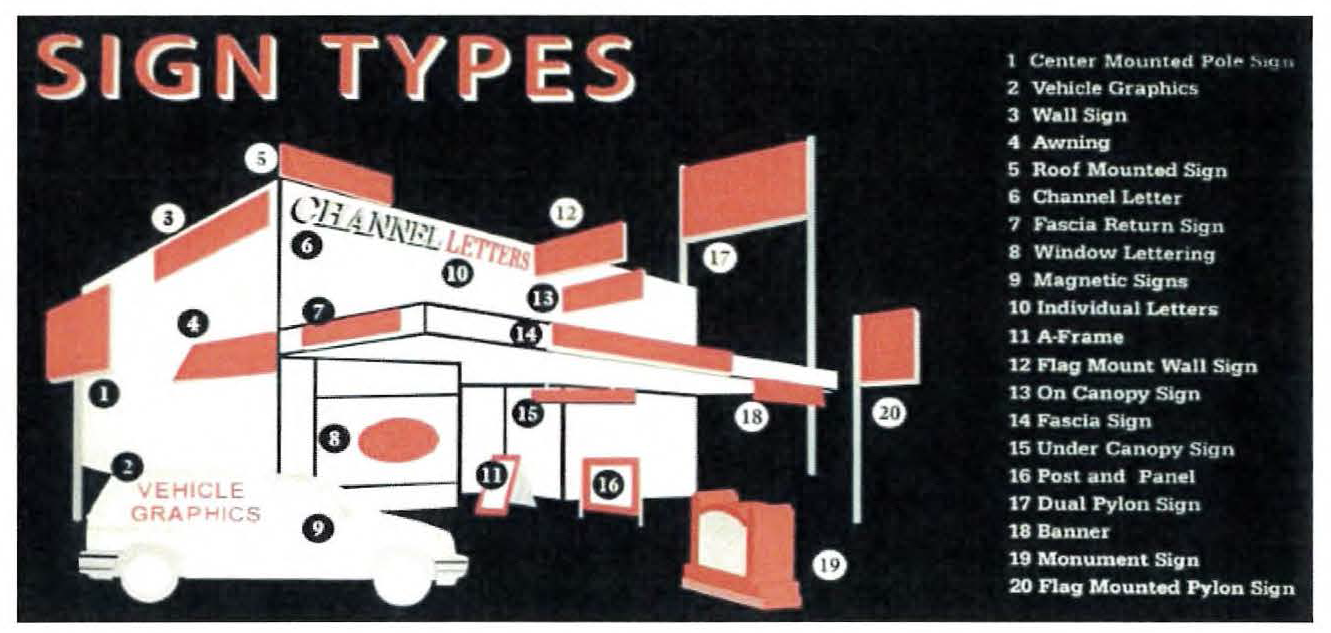
Graphic Illustrations of Selected Prohibited Signs*
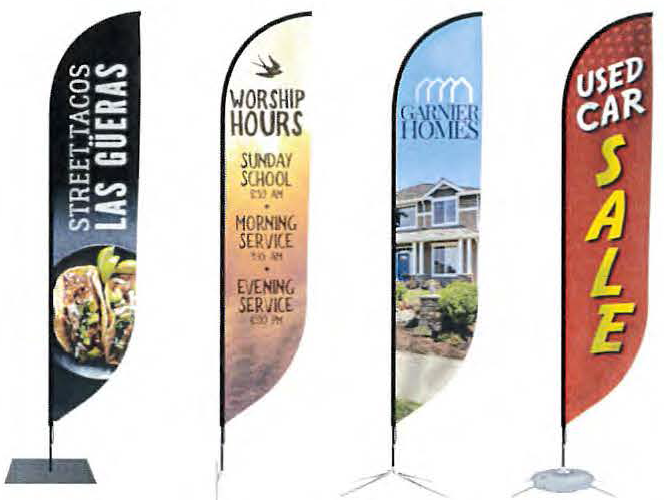
Feather flag signs
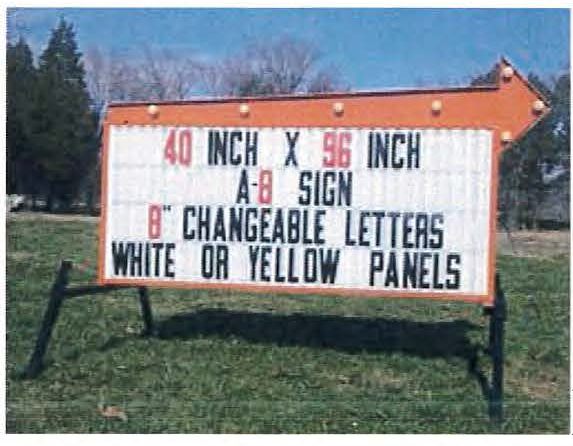
Portable Display Signs
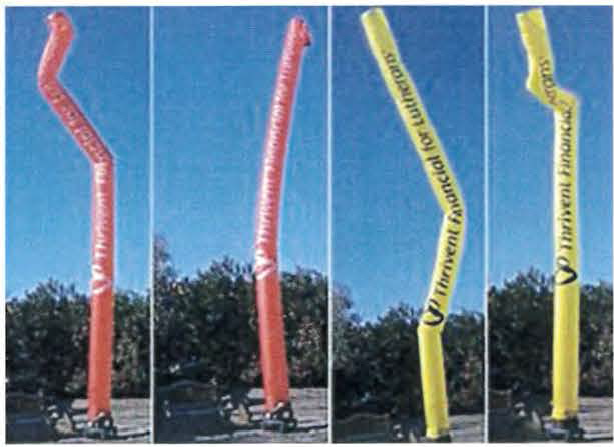
Wind activated signs

Pennant string signs

Mannequin sign holder

Bootleg signs
Pylon signs
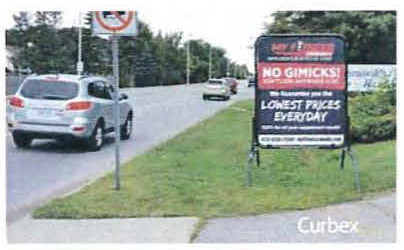
Freestanding temporary signs
* The omission of an illustration for prohibited signs not identified and depicted herein does not convert an otherwise prohibited sign to a permitted sign
Graphic illustration
Roof signs (allowed and not allowed):
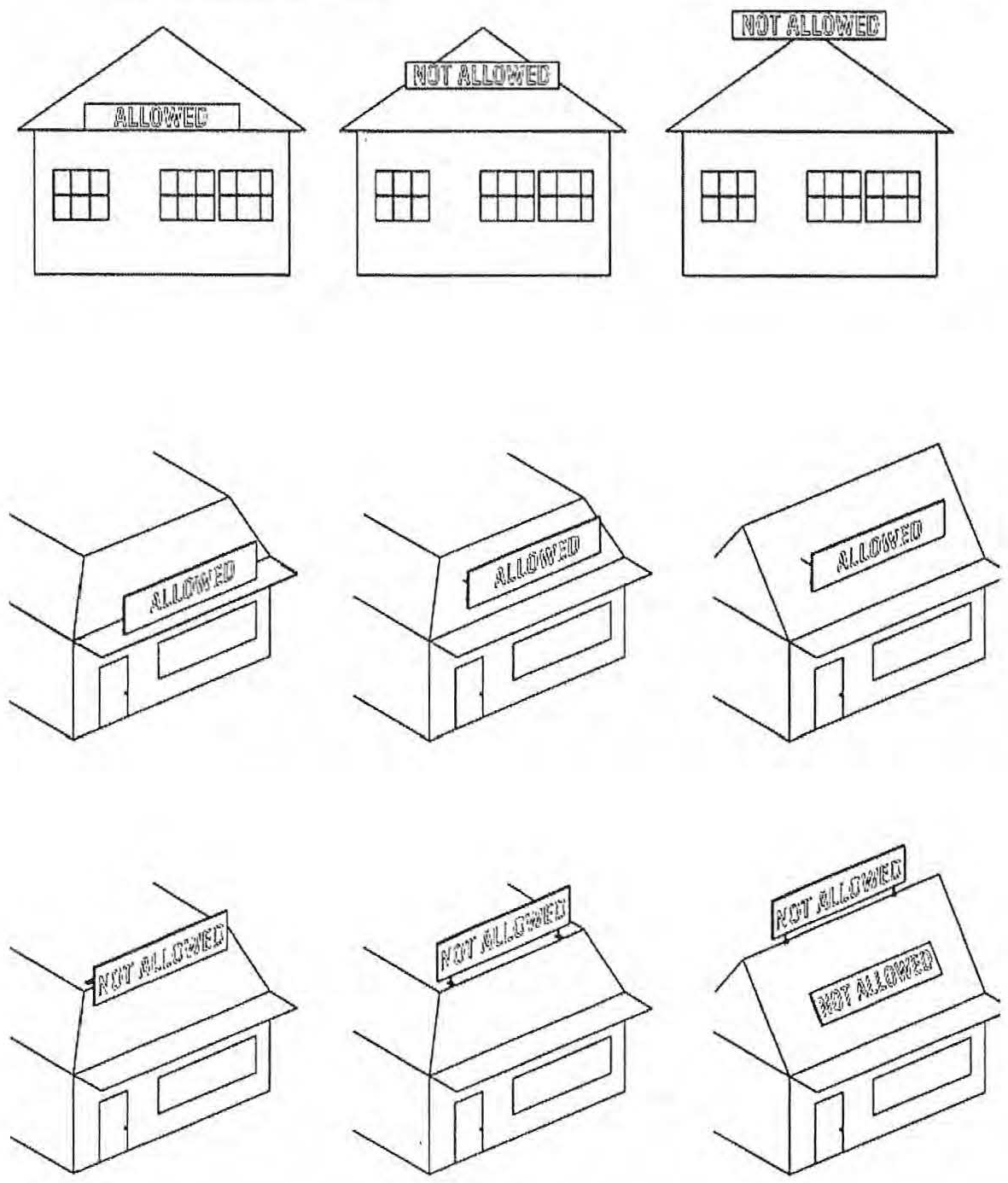
(Ord. No. 2019-05, § 2(Exh. B), 9-16-19)
5.04.01 - Purpose and Intent
The purpose of this ordinance is to establish guidelines for the siting of all wireless communications towers and antennas that will encourage the development of a competitive wireless communications marketplace while protecting the health, safety and welfare of the public and maintaining the aesthetic integrity of the community. The goals of this ordinance are:
A.
To comply with 47 U.S.C.A. § 332 Federal Telecommunications Act;
B.
To protect residential areas and land uses from the potential adverse impact of telecommunications towers, antenna support structures and wireless communications facilities;
C.
To minimize the total number of towers and antennas within the community necessary to provide adequate personal wireless services to residents and businesses of the City of Kennesaw;
D.
To promote and encourage the joint use of new and existing tower sites among service providers;
E.
To locate telecommunications towers and antennas in areas where adverse impacts on the community are minimized;
F.
To encourage the design and construction of towers and antennas to minimize adverse visual impacts;
G.
To avoid potential damage to property caused by wireless communications facilities by insuring that such structures are soundly and carefully designed, constructed, modified, maintained and removed when no longer used or when determined to be structurally unsound;
H.
To enhance the ability of the providers of wireless communications services to deliver such services to the community effectively and efficiently; and
I.
To preserve those areas of significant scenic or historic merit.
5.04.02 - Applicability
All new towers and antennas shall be subject to the regulations contained within this article except as provided in subsections A., B., and C. of this section:
A.
Public Property. Nothing in this article shall be read to prohibit a government-owned tower from being located at a specific site when the tower is required to protect the public welfare or safety.
B.
Amateur Radio; Receive-Only Antennas. This ordinance shall not govern any amateur radio tower, or the installation of any antenna, that is under seventy (70) feet in height and is owned and operated by a federally licensed amateur radio station operator or is used exclusively for receive only antennas.
C.
Preexisting Towers and Antennas. Any tower or antenna for which a permit has been properly issued prior to the effective date of this ordinance shall not be required to meet the provisions of this ordinance, other than the requirements of Chapter 5.04.07 of this UDC "Maintenance of Facilities." Any such towers or antenna shall be referred to in this ordinance as "preexisting towers" or "preexisting antenna." If additional antennas are co-located upon a preexisting tower after adoption of this ordinance, then fencing and landscaping requirements shall be met as part of the permitting process.
5.04.03 - General Requirements
A.
An application shall be required for the construction or placement of all new wireless transmission facilities, whether alternative or non-alternative structures, within the jurisdictional limits of the City of Kennesaw. Approval of any application for the construction of a tower or placement of an antenna shall be based on consideration of the following factors:
1.
The proposed height of any component of the facility in relation to the height of buildings, trees or other structures in the area;
2.
Proximity to residential structures and residential district boundaries;
3.
Nature of uses on adjacent and nearby properties;
4.
Surrounding topography, tree coverage and foliage;
5.
Design of the facility, with particular reference to design characteristics which have the effect of reducing or eliminating visual obtrusiveness;
6.
Proposed ingress and egress;
7.
Availability of suitable existing towers, other structures, or alternative technologies (microcells) not requiring the use of towers or structures;
8.
Demonstrated need for the telecommunications facility at the specified site;
9.
Capability of co-location on existing wireless facilities;
10.
Proposed landscaping necessary to ensure that the visual obtrusiveness of all accessory structures will be virtually eliminated;
11.
Proximity to historic districts or structures;
12.
Historic and/or scenic views when non alternative structures are proposed.
B.
All applications submitted to the community development department shall include a complete inventory of the applicant's existing wireless transmission facilities including towers and receivers/transmitters located within the City of Kennesaw and within one and one-half (1½) miles surrounding the city limits, including each asset's location (plane coordinates), height and co-location usage or capabilities, as well as the nature of any alternative structure or designed being utilized. The community development department shall utilize such information to promote co-location alternatives for other applicants.
C.
At the time of filing the application for construction or placement of a wireless transmission facility, the applicant shall provide a site plan and information regarding the tower, accessory structure location, neighboring uses, proposed architectural design and proposed landscaping. Additional documentation to be submitted with the site plan and certified by an experienced radio frequency engineer licensed to do business in the State of Georgia shall delineate coverage and propagation zones, identify types of antenna and mounting location, specify the type of band currently in use and state co-location capabilities.
1.
The scaled site plan shall clearly indicate the location, type and height of the proposed tower or accessory structure to be utilized, on-site land uses and zoning, adjacent land uses and zoning including proximity to historic or scenic view corridors, adjacent roadways, proposed means of access, setbacks from property lines, elevation drawings of the proposed tower, accessory structure and any other structures, topography, parking and other information deemed necessary by the director of community development or his/her designee to assess compliance with this ordinance.
2.
Legal description of the parent tract and leased parcel (if applicable).
3.
A definition of the area of coverage and radio frequency goals to be served by the antenna or tower and the extent to which such antenna or tower is needed for coverage and/or capacity.
4.
The setback distance between the proposed wireless transmission facility and the nearest residential unit or residentially used structure if less than 500 feet.
5.
Structural integrity analysis where antennas and equipment will be attached to an existing structure.
6.
Landscaping shall be designed in such a way as to preserve existing mature growth and to provide in the determination of the Mayor and Council, a suitable buffer of plant materials that mitigates the view of the telecommunications facility and accessory structures from surrounding property.
D.
Each application shall be accompanied by a fee, determined by the Mayor and Council, to offset the costs associated with processing such application. In addition, applicants shall be responsible for any fees commonly charged for a rezoning if one is required, or for any other required permit fees.
E.
The director of community development may elect to retain outside consultants or professional services to review an application for any wireless communication facility and to make recommendations on relevant issues including, but not limited to, verification of the applicant's due diligence, analysis of alternatives, conditions of approval and compliance with state and federal rules and regulations, at the applicants expense. An application shall not be deemed complete until the applicant had posted a $5,000.00 cash bond, or other security satisfactory to the city guaranteeing payment of such expenses.
F.
Landscaping plans and the design and placement of the wireless transmission facility on an approved site plan shall require the review and approval of the Mayor and Council prior to issuance of a building permit to insure compliance with this ordinance.
G.
Prior to issuance of the permit, compliance with section 106 of the National Historic Preservation Act, 16 U.S.C. § 461 et. seq. shall be demonstrated. In addition wireless communications facilities proposed to be located within the downtown Kennesaw Historic District shall receive a certificate of approval from the Historic Preservation Commission and said certificate shall be submitted with the permit application.
H.
In approving any application, the Mayor and Council may impose additional conditions to the extent determined necessary to minimize adverse effects on adjoining properties.
I.
The City of Kennesaw reserves the right to conduct a height trial to identify the visual impact of the proposed facility upon the surrounding area.
J.
Prior to the issuance of the permit that applicant shall post a $25,000.00 per tower and $5,000.00 per antenna cash bond or other security satisfactory to the city to guarantee the removal of the permitted wireless communication facility upon its abandonment.
5.04.04 - Development Requirements for Non-Alternative Wireless Communications Facilities and Towers
A.
Wireless communication facilities are permitted on top of buildings and other existing structures that do not require an increase in height to accommodate the facility. Parapet walls may be required in order to conceal such facilities from view.
B.
These facilities, when mounted on a building or other existing structure, shall be flush mounted against the side of the building or structure and camouflaged to match or complement the color and architectural treatment of the surface on which they are mounted.
C.
In those instances where simulated trees are proposed within residential zoning districts, said trees shall be located within an existing stand of trees and set back from neighboring property boundaries a distance of twice the full height of the proposed simulated tree. In addition, the height of said trees shall be no more than ten (10) feet above the vegetative canopy in the immediate vicinity of the structure.
5.04.05 - Development Requirements for Alternative Wireless Communications Facilities and Towers
A.
Non-alternative towers shall be located only in the following zoning districts as shown in the following table subject to the restrictions and standards contained herein. Wireless transmission facilities in any other zoning districts shall be accessory uses or alternative tower structures only; provided however, non-alternative towers may be allowed on publicly owned property regardless of zoning district.
TABLE 5.04.05A:
B.
Separation. Except in cases of co-location on the same tower or accessory structure, no wireless transmission facilities shall be located within 2,500 feet of any preexisting tower or preexisting antenna within the City of Kennesaw unless such facility or preexisting tower or antenna is concealed through use of alternative tower structures or otherwise camouflaged in such a way that the presence of telecommunications equipment is virtually undetectable from any adjoining property.
C.
All applicants seeking to erect a tower must demonstrate that no existing tower or structure can accommodate the proposed antenna(s). Evidence of an engineering nature shall be documented by the submission of a certification by an engineer licensed in the State of Georgia. Such evidence may consist of the following:
1.
No existing towers or structures are located within the geographic area required to meet applicant's engineering requirements.
2.
No existing structure is of sufficient height to meet the applicant's engineering requirements.
3.
No existing tower or structure has sufficient structural strength to support applicant's proposed antenna(s) and related equipment.
4.
Applicant's proposed antenna(s) would cause electromagnetic interference with the antenna(s) on the existing tower or structure.
5.
That the cost or contractual provisions required by the tower owner to share an existing tower or structure or to adapt an existing tower or structure for sharing are unreasonable. Costs exceeding new tower development are presumed to be unreasonable.
6.
Such other limiting factor(s) as may be demonstrated by the applicant.
7.
All evidence submitted shall be signed and sealed by appropriate professionals or qualified industry experts licensed in the State of Georgia. Such evidence shall be subject to independent verification by an engineer of the city's choosing. The cost of such independent verification shall be the responsibility of the applicant.
D.
Setbacks: Setbacks for towers and above-ground transmission facilities shall be as follows:
1.
All transmission facilities, except buried portions, shall be set back from all adjoining properties the distance required for the zoning district in which the wireless communications facility is located.
2.
When a tower is adjacent to a residential use, the tower and entire transmission facility must be set back from the nearest residentially zoned lot line a distance equal to the twice the height of the tower.
E.
Unless otherwise specified by the director of community development or his/her designee, towers shall be enclosed by vinyl chain link security fencing or other approved alternative not less than six (6) feet in height and shall be equipped with an appropriate anti-climbing device.
F.
All new towers that do not incorporate alternative design features must be designed and built in a manner that allows other entities to co-locate on the structures. The maximum allowable height of all non-alternative towers in any zoning district shall be 125 feet.
G.
Co-located wireless communication facilities shall be designed to meet the following standards:
1.
Use of dual band/multi band antenna (to allow sharing of antennas or antenna arrays by wireless providers using different frequency bands) or by using combiners (to allow antenna sharing by users of the same frequency band) is encouraged in order to minimize the height of support structures and the visual impact of multiple co-located antennas or antenna arrays.
2.
Antenna associated with a co-located wireless communication facility shall be mounted so as to present the smallest possible silhouette, profile, or cross section. Preferred antenna mounting scenarios are, in order of descending preference:
a.
Compact dual polarized antennas in a cylindrical unicell arrangement extending less than two (2) feet from the structure, and mounted atop the tower;
b.
Panel antennas flush mounted against the tower; and
c.
Antennas mounted at the end of a straight or curved davit arms or brackets extending from the sides of the tower.
3.
No co-located wireless communication facility located on a non-alternative tower shall have constructed thereon, or attached thereto in any way, any platform, catwalk, crow's nest, triangular framework, or like structures or equipment, except during periods of construction or repair. Curved or straight davit arms or brackets used for antenna mounting shall be connected to the tower at the base of the arms or brackets only and such arms and brackets (and any antennas or hardware mounted thereon) shall not be physically interconnected with any similar arm or bracket.
4.
Where economically and technically feasible and viable, Chapter 5.04.05 shall also be construed to regulate co-locations that may occur on preexisting non-alternative wireless communication facilities and towers.
H.
All towers and their related facilities shall maximize the use of building materials, colors, textures, screening and landscaping that effectively blend the tower and accessory facilities within the surrounding natural setting and built environment and to provide a visual barrier between the accessory equipment and adjacent properties. Where appropriate, towers shall be painted so as to reduce their visual obtrusiveness, subject to any applicable standards of the Federal Aviation Administration (FAA).
I.
If upon receipt of an application for the erection of any tower or alternative tower structure governed by this ordinance, the director of community development or his/her designee deems that the proposed structure may interfere with the use of the airways of the City of Kennesaw by the public or interfere with the operation of existing or proposed airport facilities, a copy of the application shall be submitted by the community development department to the aviation division of the Cobb County Department of Transportation for review and recommendation.
J.
Any parcel of property proposed to be the location of a new non-alternative tower that directly abuts a residentially zoned property shall have a minimum 100 ft. landscaped buffer with a solid fence or wall no less than six (6) feet in height.
K.
A registered landscape architect licensed in the State of Georgia shall prepare all landscaping plans. The property shall be landscaped in accordance with city standards.
L.
All non-alternative towers shall be monopole in design except those located in heavy industrial zoning districts that are greater than 150 feet in height.
M.
All towers shall meet or exceed current standards and regulations of the Federal Communications Commission (FCC) and the Federal Aviation Administration (FAA).
5.04.06 - Approval Process
A.
Uses subject to administrative approval. Subject to certification by the Planning and Zoning Administrator or his/her designee of compliance with the general requirements, development requirements and standards enumerated above, the following uses may be administratively approved by staff without further review by the Planning Commission or Mayor and Council after receipt of a complete application, supporting engineering certification and lease approval, if any, without the necessity of public hearing.
1.
Placement of additional transmission equipment on existing, permitted towers by additional users shall be exempted from special land use permits, advertising, posting and hearing requirements and shall not require placement of signs or any other such public notice, so long as the structure or height of such existing tower is not altered. Additional users and equipment are subject to the following conditions:
a.
Application for such approval must be made to the community development department staff at least five working days prior to the last date by which a request can be made to the Planning Commission (i.e. second Friday of each month).
b.
Applications for such approval must include all information normally required by the special land use permit process including site plan amendments necessitated by the placement of such additional equipment. All other applicable requirements of this ordinance shall apply to any site plan so amended. The community development director or his/her designee shall be authorized to grant administrative approval for such plans.
c.
An application fee equivalent to that normally assessed for a special land use permit application shall be required.
2.
If the Planning and Zoning Administrator or his/her designee determine that any application for an administratively approved use does not meet the general application requirements, development requirements and/or standards enumerated herein, administrative approval of the application shall be denied provided substantial evidence exists to support such denial. Such evidence shall be summarized in writing for the applicant along with a recommendation as to whether the applicant should pursue a variance or proceed to a public hearing as specified in subsection (B) below. Applicants may appeal the administrative denial to the Mayor and Council of the City of Kennesaw. Any other party aggrieved by the decision of the director of community development or his/her designee may file an appeal to the Mayor and Council. For purposes of this section an aggrieved party is one who demonstrates that his or her property will suffer special damage as a result of the decision complained of rather than merely some damage that is common to all property owners and citizens similarly situated. The Mayor and Council shall dispense with the appeal by either:
a.
A determination the application is valid and meets all applicable criteria for an administratively approved use under this ordinance, which shall result in the issuance of a permit.
b.
A determination the application does not satisfy all applicable criteria for an approved administratively approved use under this ordinance, but, owing to special conditions, a variance as to separation or setback requirements:
i.
Will not be contrary to the public interest;
ii.
Will relieve unnecessary hardship; and
iii.
Shall preserve the intent and spirit of this ordinance.
c.
A determination the application does not satisfy all applicable criteria for an administratively approved use under this ordinance and the deficiencies cannot, subject to the conditions listed above, properly be cured by a variance.
3.
Applications that do not satisfy all applicable criteria must, as a result, apply for a public hearing before the Mayor and Council as specified in subsection (B) below.
B.
Other uses—Special land use permit required.
1.
If the proposed tower or antenna is not included under the above described administratively approved uses, or the application does not on its face satisfy the development standards and other criteria specified herein, then a special land use permit as outlined in Chapter 4.04.06, Standards for SLUP, shall be required for the approval of the construction of any wireless transmission facility in all zoning districts. Applicants shall apply for a special land use permit through the community development department and pay the required fee at such time. Applications, when complete, shall be placed on the next available agenda of the Planning Commission. Once the Planning Commission has held a hearing they shall make a recommendation on the application to the Mayor and Council. The Mayor and Council shall then conduct their own public hearing and based on evidence presented at that hearing, the recommendation of the Planning Commission and the recommendations of staff approve or deny the application. At least thirty (30) days prior to any scheduled hearing, the Planning and Zoning Department shall follow the public notification procedure as outlined in Chapter 10.
2.
When approving an application for a use for which a special land use permit is required the Mayor and Council may impose conditions to the extent necessary to buffer or otherwise minimize any adverse effect of the proposed tower on adjoining properties. The factors considered in granting such a permit include those enumerated in Chapter 5. The Mayor and Council may waive or reduce the burden on the applicant of one or more of these criteria, if, in their discretion doing so will advance the goals of this article as stated in Chapter 5.
5.04.07 - Maintenance of Facilities
A.
All wireless transmission facilities and related landscaping shall be maintained by the facility owner in good condition, order, and repair so that they shall not endanger the life of property of any person, nor shall they be a blight upon the property.
B.
To ensure the structural integrity of towers, the applicant of a tower or alternative tower structure shall ensure that it is maintained in compliance with standards contained in applicable local building codes and the applicable standards for towers that are published by the Electronic Industries Association, as amended from time to time. If, upon inspection, the director of community development of the City of Kennesaw concludes that a tower fails to comply with all applicable codes and standards, or constitutes a danger to persons or property, then upon receipt of written notice by the applicant, said applicant shall have fifteen (15) days to bring the tower into compliance with such standards. If the applicant fails to bring the tower into compliance within the fifteen (15) days, the City of Kennesaw may remove the tower at the applicant's expense. Prior to removal of any tower, the director of community development may consider detailed plans submitted by the applicant for repair of substandard towers, and may grant a reasonable extension of the above referenced compliance period. Any such removal by the City of Kennesaw shall be in the manner provided in O.C.G.A. §§ 41-2-7—41-2-17.
C.
All towers must meet or exceed current standards and regulations of the FAA, the FCC, and any other agency of the federal government with the authority to regulate towers and antennas. If such standards and regulations are changed, the owners of the towers and antennas governed by this ordinance shall bring such towers and antennas into compliance with such revised standards and regulations within six (6) months of the effective date of such standards and regulations unless a more or less stringent compliance schedule is mandated by the controlling federal agency. Failure to bring towers and antennas into compliance with such revised standards and regulations shall constitute grounds for the removal of the tower or antenna at the owner's expense. Any such removal by the city shall be in the manner provided in O.C.G.A. §§ 41-2-7—41-2-17.
D.
All maintenance or construction on wireless transmission facilities shall be performed by persons employed by or under contract to the owner between the hours of 6:00 AM and 6:00 PM Monday through Friday except in cases of emergency. Access to facilities on city owned property shall be determined on a case-by-case basis by the city department responsible for such property. The hours of access to city sites shall not exceed those specified above. Persons may not be present on site unless performing construction or maintenance at such site.
E.
The owner or user of any telecommunications facility shall be required to submit a "facility in use certification" annually to the license and permits department. Any antenna or tower that is not operated for a continuous period of twelve (12) months or is not properly maintained shall be considered abandoned, and the owner of such antenna or tower shall remove same and any structures housing supporting equipment within ninety (90) days of receipt of notice from the governing authority of such abandonment. If such antenna or tower is not removed or returned to good condition within said ninety (90) days, the governing authority may remove such antenna or tower at the owner's expense. If there are two (2) or more users of a single tower, then this provision shall not become effective until all users cease using the tower.
5.04.08 - Waiver of Requirements
No exception, waiver or variance to the conditions and requirements contained herein shall be granted unless expressly provided for in this ordinance, or the Mayor and Council find that the proposed tower or wireless transmission facility is necessary and essential to providing the applicant's service.
5.04.11 - Facilities Lease
A.
The Mayor and Council may, in its sole discretion, which is hereby reserved, approve facilities leases for the location of wireless transmission facilities and other telecommunications facilities upon city owned property. Neither this section, nor any other provision of this article shall be construed to create an entitlement or vested right in any person or entity of any type.
B.
All such leases shall comply with the requirements of O.C.G.A. § 36-60-13.
5.04.12 - Lease Application
Any person that desires to solicit the Mayor and Council's approval of a facilities lease pursuant to this article shall file a lease proposal with the city's community development department which, in addition to the information required by Chapter 5.04.03 shall include the following:
A.
A description of the wireless transmission facilities or other equipment proposed to be located upon City of Kennesaw property;
B.
A description of the city property upon which the applicant proposes to locate wireless transmission facilities or other equipment;
C.
Preliminary plans and specifications in sufficient detail to identify;
1.
The location(s) of existing wireless transmission or telecommunications facilities or other equipment upon the city's property, whether publicly or privately owned.
2.
The location and source of electric and other utilities required for the installation and operation of the proposed facilities.
D.
Accurate scaled conceptual drawings and diagrams of sufficient specificity to analyze the aesthetic impacts of the proposed wireless transmission facilities or other equipment;
E.
Whether the applicant intends to provide cable service, video dial tone service or other video programming service from the facility, and sufficient information to determine whether such service is subject to cable franchising;
F.
An accurate map showing the location of any wireless transmission or telecommunications facilities in the city that applicant intends to use or lease;
G.
Such other and further information as may be requested by the city; and
H.
An application fee for lease negotiation in the amount consistent with fee schedule adopted by the Mayor and Council.
5.04.13 - Determination by Mayor and Council
Recognizing that the Mayor and Council is under no obligation to grant a facilities lease for the use of city property, the Mayor and Council shall strive to consider and take action on application for facilities leases within sixty (60) days after receiving a complete application for such a lease. When such action is taken, the Mayor and Council or their designee shall issue a written determination granting or denying the lease in whole or in part, applying the standards set forth below, or any other such criteria as the Mayor and Council may choose to apply. If the lease application is denied, the determination shall include the reason for denial following review of these factors:
A.
The capacity of the city property and public rights-of-way to accommodate the applicant's proposed facilities.
B.
The capacity of the city property and public rights-of-way to accommodate additional utility and wireless transmission or telecommunications facilities if the lease is granted.
C.
The damage or disruption, if any, of public or private facilities, improvements, service, travel or landscaping if the lease is granted.
D.
The public interest in minimizing the cost and disruption of construction upon city property and within the public ways.
E.
The service that applicant will provide to the community and region. The effect, if any, on public health, safety and welfare if the lease requested is approved. The availability of alternate locations for the proposed facilities.
F.
Whether the applicant is in compliance with applicable federal and state telecommunications laws, regulations and policies, including, but not limited to, the registration requirements administered by the Georgia Public Service Commission.
G.
The potential for radio frequency and other interference with existing public and private telecommunications or other facilities located upon the city property.
H.
The potential for radio frequency and other interference or impact upon residential, commercial and other uses located within the vicinity of the city property.
I.
Recommendations of the recreation department with respect to impact on park and recreation activities.
J.
Recommendations of the Public Works Department with respect to maintenance and security of water towers. Such other factors, such as aesthetics, as may demonstrate that the lease to use the city property will serve the community interest.
K.
The maximization of co-location opportunities with other similar uses.
5.04.14 - Agreement
No facilities lease shall be deemed to have been granted hereunder until the applicant and the Mayor and Council have executed a written agreement setting forth the particular terms and provisions under which the lessee has been granted the right to occupy and use the city property.
5.04.15 - Nonexclusive Lease
No facilities lease granted under this ordinance shall confer any exclusive right, privilege, license or franchise to occupy or use city property for delivery of telecommunications services or any other purposes nor shall approval of a lease entitle the applicant to a permit to construct or place a wireless transmission facility.
5.04.16 - Term of Facilities Lease
Unless otherwise specified in a lease agreement, a facilities lease granted hereunder shall be valid for an initial term of one (1) year, with the lessee granted a maximum of four (4) one-year renewal options which options shall also be subject to approval of the Mayor and Council. The term of any such agreement shall not exceed five (5) years unless approved by the Mayor and Council on a case-by-case basis.
5.04.17 - Rights Granted
No facilities lease granted under this ordinance shall convey any right, title or interest in the city property, but shall be deemed a license only to use and occupy the city property for the limited purposes and term stated in the lease agreement. Further, no facilities lease shall be construed as any warranty of title.
5.04.18 - Interference with Other Users
A.
No facilities lease shall be granted under this ordinance unless it contains a provision that is substantially similar to the following:
1.
The Mayor and Council has previously entered into leases with other tenants for their equipment and wireless transmission facilities. Lessee acknowledges that the Mayor and Council is also leasing the city property for the purposes of transmitting and receiving telecommunications signals from the city property. The Mayor and Council, however, is not in any way responsible or liable for any interference with lessee's use of the city property that may be caused by the use and operation of any other tenant's equipment, even if caused by new technology. In the event that any other tenant's activities interfere with the lessee's use of the city property, and the lessee cannot work out this interference with the other tenants, the lessee may, upon thirty (30) days notice to the Mayor and Council, terminate this lease and restore the city property to its original condition, reasonable wear and tear excepted. The lessee shall cooperate with all other tenants to identify the causes of and work towards the resolution of any electronic interference problem. In addition, the lessee agrees to eliminate any radio or television interference caused to city-owned facilities or surrounding residences at lessee's own expense and without installation of extra filters on city-owned equipment. Lessee further agrees to accept such interference as may be received from city operated telecommunications or other facilities located upon the city property subject to this lease.
5.04.19 - Ownership and Removal of Improvements
No facilities lease shall be granted under this ordinance unless it contains a provision that states that all buildings, landscaping and all other improvements, except telecommunications equipment, shall become the property of the City of Kennesaw upon expiration or termination of the lease. In the event that the Mayor and Council requires removal of such improvements, such removal shall be accomplished at the sole expense of the lessee and completed within ninety (90) days after receiving notice from the city manager requiring removal of the improvements. In the event that wireless transmission facilities or other equipment are left upon city property after expiration or termination of the lease, they shall become the property of the City of Kennesaw, unless otherwise notified. The Mayor and Council may require removal of wireless transmission facilities or other equipment by the lessee upon thirty (30) days written notice from the city manager.
5.04.20 - Compensation to the City of Kennesaw
A.
Each facilities lease granted under this ordinance is subject to the Mayor and Council's right, which is expressly reserved, to annually fix a fair and reasonable compensation to be paid for the rights granted to the lessee; provided, nothing in these sections shall prohibit the Mayor and Council and a lessee agreeing to the compensation to be paid. Such compensation shall be payable in advance of the effective date of the lease and on or before January 31 of each calendar year. Any payments received after the due date shall include a late payment penalty of two (2) percent of the annual rental fee for each day or part thereof past the due date. The compensation shall be negotiated by the city manager or designee, subject to the Mayor and Council's final approval, based on the following criteria:
1.
Comparable lease rates for other public or private property.
2.
In the case land is leased, an appraisal opinion upon which the land and airspace is rented.
3.
If structure of another user is involved, any amount needed to reimburse that user, in addition to the above.
4.
A yearly escalator rate commonly used in comparable leases.
5.
The additional rent such structure may generate if leased to additional users.
B.
The city manager is authorized to accept telecommunications services in lieu of cash rental payment; however, such services must constitute substantial benefit to the City of Kennesaw over retail purchases of said telecommunications services under any applicable government rates offered by the wireless services provider.
C.
Additional fees or charges may be established by the Mayor and Council to cover actual costs of processing the application, including engineering review, inspection and appraisal cost, legal, administration of the agreement, providing on-site services and/or other direct or indirect costs.
5.04.21 - Amendment of Facilities Lease
Except as provided within an existing lease agreement, a new lease application and lease agreement shall be required of any telecommunications carrier or other entity that desires to significantly expand, modify or relocate its telecommunications facilities or other equipment located upon city property. If ordered by the Mayor and Council to locate or relocate its telecommunications facilities or other equipment on the city property, the Mayor and Council shall grant a lease amendment without further application.
5.04.22 - Renewal Application
A lessee that desires to exercise a renewal option in its facilities lease under this ordinance shall, not more than ninety (90) days nor less than sixty (60) days before expiration of the current facilities lease term, file an application with the Mayor and Council for renewal of its facilities lease which shall include the following:
A.
The information required pursuant to Chapter 5.04.11 of this UDC;
B.
Any information required pursuant to the facilities lease agreement between the Mayor and Council and the lessee;
C.
A report certified by a radio frequency engineer that the site is in compliance with current FCC radio emission standards;
D.
All deposits or charges required pursuant to the ordinance; and
E.
An application fee that shall be set by the Mayor and Council by resolution.
5.04.23 - Renewal Determination
Recognizing that the Mayor and Council is under no obligation to grant a renewal of a facilities lease for the use of city property, the Mayor and Council shall strive to consider and take action on applications for renewal of such leases within thirty (30) days after receiving a complete application for such a lease renewal. When such action is taken, the city manager shall issue a written determination granting or denying the lease renewal in whole or in part, applying the standards set forth below, or any other such criteria as the Mayor and Council may choose to apply. If the renewal application is denied, the written determination shall include the reason for denial, if any after review of these factors:
A.
The financial and technical ability of the applicant.
B.
The legal ability of the applicant.
C.
The continuing capacity of the city property to accommodate the applicant's existing facilities.
D.
The applicant's compliance with the requirements of this ordinance and the lease agreement.
E.
Applicable federal, state and local telecommunications laws, rules and policies.
F.
Continued need for the facility in light of technological advances and current industry standards.
G.
Such other factors as may demonstrate that the continued grant to use the city property will serve the community interest.
5.04.24 - Obligation to Cure as a Condition of Renewal
No facilities lease shall be renewed until any ongoing violations or defaults in the lessee's performance of the lease agreement, or of the requirements of these sections, have been cured, or a plan detailing the corrective action to be taken by the lessee has been approved by the director of community development or his/her designee.
5.04.25 - Legal Status Provisions
A.
Conflict with other laws. Whenever the regulations of this ordinance require a greater width, depth or size of yard or impose other more restrictive standards than are required in or under any other statue or covenants, the requirements of this ordinance shall govern.
B.
Severability. In the event any article, section, subsection, sentence, clause or phrase of this ordinance shall be declared or adjudged invalid or unconstitutional, such adjudication shall in no manner affect the other articles, sections, subsections, sentences, clauses or phrases of this ordinance, which shall remain in full force and effect, as if the article, section, subsection, sentence, clause or phrase so declared or adjudged invalid or unconstitutional were not originally a part thereof. The Mayor and Council hereby declares that it would have adopted the remaining parts of the ordinance if it had known that such part or parts thereof would be declared or adjudged invalid or unconstitutional.
C.
Repeal of conflicting resolutions. All resolutions and ordinances or portions thereof in conflict with this ordinance are hereby repealed.

