
Kentwood City Zoning Code
CHAPTER 16
- SIGNS
Section 16.01.- Intent and purpose.
A.
This chapter is intended to regulate the use, construction, reconstruction, placement and design of signs in order to protect the public health, safety, peace and general welfare. Specifically, this chapter seeks to establish reasonable regulations regarding the size, type of construction and manner of anchoring signs and to regulate the time, place and manner of their display.
B.
This chapter involves a determination by the city that the individual user's rights to convey a message must be balanced against the public's right to be free of signs which unreasonably compete, distract drivers and pedestrians, and produce confusion. In balancing the individual user's desire to attract attention with the public's right to be free of unreasonable distractions, it is recognized that sign regulations should afford businesses a reasonable opportunity to attract the public. It is also determined; however, oversized, projecting or crowded signs can lead to pedestrian and driver confusion and distraction, and endanger the public health, safety and welfare. To lessen such adverse consequences, reasonable limitations are appropriate with respect to the placement, construction, size, and design of signs particularly in relation to the location of buildings and the availability of other means of communication. In addition, new advanced sign display technologies may have adverse impacts that must be minimized by reasonable restrictions on size and permitted locations.
C.
The city further determines that overall regulations for signs, especially number, size and placement, are desirable in order to:
1.
Prevent or limit traffic or pedestrian accidents, injuries, deaths, and property damages resulting from obstructed vision, distraction or confusion to the public or to emergency safety personnel;
2.
Minimize the risk of damage and injuries from signs that are dilapidated, wind blown, electric shock hazards, etc.;
3.
Achieve some uniformity and balance in the size, number and placement of signs;
4.
Enhance the aesthetics of the community;
5.
Prevent blight;
6.
Encourage equality among business and property;
7.
Otherwise protect the public health, safety, peace and general welfare; and
8.
Accommodate special circumstances or events that may create a need for portable signs for a limited and reasonable period of time.
(Ord. No. 1-11, § 4, 2-11-2011)
Section 16.02. - Definitions.
In addition to the definition of a sign in chapter 2, the following definitions shall apply to specific types of signs.
A.
Balloon sign. A portable sign that is inflated by air or any gas.
B.
Banner. A sign having characters, letters or illustrations applied to cloth, paper, flexible plastic, or fabric of any kind, with only nonrigid material as background
C.
Banner, promotional. A banner that promotes an on-premises business, product or service.
D.
Banner, shopping center. A banner that uses any of a variety of images or colors of an ornamental nature with its advertisement function limited to no more than an emblem of the shopping center.
E.
Billboard. A sign that directs attention to commercial or noncommercial goods, services, uses/ideas not located on site.
F.
Commercial sign. A sign advertising commerce, trade or location.
G.
Construction sign. A sign that identifies the name, owners, financiers, contractors, architects, or engineers of a project under construction.
H.
Directional sign. Any on-premises sign that includes information assisting the flow of pedestrian or vehicular traffic such as enter, exit and one-way.
I.
Flag, public. A flag displaying the name, insignia, emblem, or logo of any nation, state, municipality, or noncommercial organization.
J.
Freestanding sign. A sign supported by one or more up-rights, poles or braces placed in or upon the ground surface and not attached to any building.
K.
Identification sign. A sign that identifies the business, owner or resident.
L.
Illuminated sign. A sign illuminated by internal lighting or by reflected light from an external source.
M.
Incidental signs. Signs which, in the opinion of the zoning administrator, are necessary to indicate building entrances and exits, safety precautions, including identifying logos without text, and other incidental language.
N.
Institutional bulletin board. A sign containing a surface area upon which is displayed the name of a religious institution, school, library, community center or similar institution and the announcement of its institutional services or activities.
O.
Legal notices. Notices regarding hearings, legal rights, public sales or other matters which are required to be posted by a court or governmental agency or entity of competent jurisdiction or by an applicable statute, ordinance, rule or regulation.
P.
Marquee sign. Identification sign attached to a marquee, canopy or awning projecting from and supported by the building.
Q.
Monument sign. A sign where the base of the sign structure is on the ground or a maximum of 12 inches above the adjacent grade.
R.
Noncommercial sign. A sign not advertising commerce, trade or location.
S.
Nonconforming sign. A sign lawfully existing at the effective date of this ordinance or amendments thereto, and which does not conform to the current sign regulations.
T.
Official sign. Identification, informational, or directional sign erected, accredited, or required by the city and approved by the city commission with recommendation from the planning and police departments.
U.
On-site identification sign. An advertising sign relating in its subject matter to the premises on which it is located, or to products, accommodations, services or activities on the premises or the idea or political candidates supported by the owner or occupant of the premises. It does not include any sign leased, rented or used by or to advertise the products, accommodations or activities not conducted or available on the premises.
V.
Plat entry sign. A sign or pair of signs placed at the primary entrance to a subdivision, containing only the name of the subdivision. This term also refers to signs at the primary entrance to a manufactured home park.
W.
Reserved.
X.
Regional commercial center identification sign. A sign to identify a regional commercial center in excess of 500,000 square feet of gross leasable area.
Y.
Portable sign. A sign not permanently anchored or secured to either a building or the ground, such as, but not limited to, "A" frame, "T" or inverted "T" shaped sign structures and signs on movable trailers. Promotional banners, balloon signs, or sign's objects or devices shall also be considered portable signs. Streamers and pennants are not considered portable signs.
Z.
Window sign. Any sign placed inside or upon a window which is intended to be seen from the exterior.
AA.
Electronic message center. A sign or portion of a sign whose message content or display may be changed by means of electrical, electronic or computerized programming without physically altering the face of the surface of the sign.
BB.
Tri-vision billboard. The tri-vision sign is an off-premises sign composed of a series of vertical or horizontal cylinders each of which has a triangular cross section. Each partial rotation of the group of triangular cylinders produces a different image. A single tri-vision sign may display no more than three images in total. Although the final composite image does not provide motion, there is movement due to the transition from one image to another as the cylinders rotate.
CC.
Dynamic display. A type of sign that has or appears to have movement or that appears to change, caused by any method other than physically removing and replacing the sign or its components, whether the real or apparent movement or change is in the display, the sign structure itself, or any other part of the sign. This includes a type of sign that incorporates a technology or method allowing the sign face to change the image without having to physically or mechanically replace the sign face or its components. A dynamic display sign also includes any rotating, revolving, moving, flashing, blinking, or animated display and any display that incorporates rotating panels, LED lights manipulated through digital input, "digitalink," electronic message centers, or any other method or technology that allows the sign face to present different images or displays.
DD.
Flags, Commercial. A flag displaying the name, insignia, emblem or logo of the commercial entity located on the premises.
(Ord. No. 12-08, § 2, 9-26-2008; Ord. No. 3-09, § 3, 6-26-2009; Ord. No. 10-09, § 1, 12-25-2009; Ord. No. 9-16, § 12, 12-20-2016; eff. 12-30-2016)
Section 16.03. - Signs permitted or prohibited.
A.
Nonconforming signs.
1.
Nonconforming signs may not be converted, altered, expanded, enlarged, or extended; however, nonconforming signs may be maintained and repaired so as to continue the normal useful life of the sign.
2.
Any nonconforming sign destroyed by fire or other casualty loss shall not be restored or rebuilt if reconstruction will constitute more than 50 percent of the value of the sign on the date of loss.
3.
Any sign which for a period of one year or more no longer advertises a bona fide business conducted or product sold shall be deemed abandoned and removed by the owner of the building, structure or property on which the sign is located.
B.
Flagpoles and Flags.
1.
Height. Flagpoles shall not exceed the maximum permitted building height for buildings within the zoning district in which the flagpole is located.
2.
Number. One commercial identification flag and not more than three noncommercial flags, exclusive of the display of one United States flag shall be permitted on any lot. The commercial and noncommercial flags may not exceed the size of any United States flag if also displayed or 32 square feet, whichever is less.
C.
Official signs.
1.
Area. Official signs not exceeding 75 square feet in area are allowed in all zoning districts and are permitted in addition to other on-site advertising provisions.
2.
Location. Official signs placed within the public right-of-way, directly on the ground shall not exceed 30 inches in height from the mean grade unless it can be shown not to interfere with vehicular, bike, or pedestrian clear vision.
3.
Lighting. Official signs may be illuminated.
D.
Noncommercial signs.
1.
Location. Noncommercial signs are allowed in all zoning districts subject to the size and placement requirements set forth in the different districts.
2.
Billboard. Noncommercial signs erected on billboards may be permitted as a principal use after approval as a special land use in accordance with this ordinance.
3.
Duration. Noncommercial signs may remain until the signs are in disrepair and are deemed no longer to be in compliance with section 16.06 of this ordinance.
E.
Signs for PUDs and use variances.
1.
PUDs. Signs for uses or buildings located in PUDs shall be subject to the sign limitations allowed for buildings or uses of a similar type built in the respective zoning districts, as determined by the zoning administrator.
2.
Use variances. Signs for use variances granted by the zoning board of appeals shall be subject to the size limitations of the district in which the use is located.
F.
Construction signs. Construction signs are permitted within any zone district but shall not be erected until a building permit has been issued for the project that is the subject of the proposed sign and construction activity has begun, subject to the following restrictions:
1.
Number. One construction sign may be placed on the lot where the construction is taking place.
2.
Size. A construction sign shall be no larger than 100 square feet in area.
3.
Height. A construction sign shall not exceed eight feet in height.
4.
Location. Construction signs must be setback at least 15 feet from the front and side property lines.
5.
Duration. Construction signs shall be displayed for not more than 12 months, or until issuance of the initial occupancy permit, whichever shall occur first.
G.
Incidental signs. Incidental signs pertaining to any conforming accessory activity being conducted on the premises are permitted in any district.
H.
Shopping center banner signs.
1.
Banners must be stationary, properly maintained and not allowed to become unsightly through disrepair or action of the elements.
2.
Banner signs are restricted to vertical pole mountings.
I.
Balloon signs.
1.
A balloon sign shall not be more than 35 feet high from the point where the balloon rests on any surface if the balloon rests on a surface, or from the point of tie-down if it does not rest on a surface.
2.
All balloon signs shall be securely anchored to the ground or to a building in accordance with the requirements of the Kentwood codes as amended. All anchoring devices shall be inspected and approved by the Kentwood Building Inspection Department. Balloon signs over 15 feet high shall be anchored with a minimum of six ropes or similar tie-down devices. Additional ropes or tie-down devices may be required by the Building Inspector to ensure proper anchoring.
3.
Any electrical motor, pump or similar device used to inflate the balloon sign shall be installed in accordance with the requirements of the Kentwood codes as amended.
4.
A balloon sign shall be setback a minimum distance of one and one-half times its height from all property lines.
5.
A balloon sign placed on the ground shall not, in the opinion of the Zoning Administrator, interfere with on-site or off-site traffic circulation, utility lines, hamper visibility of drivers or obstruct fire lanes. The placement of a balloon sign on the ground shall not result in a reduction of the number of parking spaces required herein for that site on which the balloon sign is located.
6.
A barricade shall be installed completely around a balloon sign to deter easy access. This barricade must be clearly visible and be rope, portable fence or other similar materials excluding barbed wire.
7.
A balloon sign, if mounted on top of a building, shall not protrude over the edge of that building.
8.
All balloon signs shall be equipped with a quick deflation system so that the balloon sign will deflate instantly if it breaks loose from its anchor. The Kentwood Building Inspections Department shall inspect the balloon sign to ensure that this system is installed properly.
9.
All balloon signs shall be taken down if wind speeds exceed 30 knots (35 mph). The installer of the sign shall be responsible for monitoring weather conditions.
10.
Balloon signs are considered portable signs and shall comply with the portable sign regulations in each zoning district in which they are permitted, but shall not be permitted on a site for more than a total of 30 days in any calendar year.
11.
Balloons signs may be illuminated from the inside or by exterior lights placed to direct the glare away from adjacent roadways and properties. Balloon signs shall not have any flashing, colored or glaring lights.
12.
A balloon sign installer shall carry at least $1,000,000.00 in liability insurance coverage and shall provide proof of this to the Zoning Administrator prior to the issuance of the sign permit.
13.
Balloon signs shall be installed so as not to interfere with utility lines, flight paths or radio and television reception.
J.
Billboards.
1.
Billboards are only allowed as the principal use of a lot meeting the standards of the relevant zoning district.
2.
Billboards must be located at least 200 feet from any freeway right-of-way line and 100 feet from any other street right-of-way line.
3.
A maximum sign area of up to 300 square feet is permitted for billboards.
4.
Billboards must be continuously and properly maintained at all times. A billboard which is not maintained or utilized for a period of six months is deemed abandoned.
5.
One billboard per lot may be approved except that no billboard shall be located within 600 feet (measured radially) of any other billboard, regardless of jurisdiction.
6.
Except for time and temperature signs or dynamic display signs as otherwise regulated herein, all signs must be stationary and may not contain any visible moving parts, alternating or moving messages or have the appearance of having moving parts or messages. Under no circumstances may any type of sign contain a message or display that appears to flash, undulate, pulse, or portray explosions, fireworks, flashes of light, or blinking lights or otherwise appears to move toward or away from the viewer, expand or contract, bounce, rotate, spin, twist or make other comparable movements.
7.
Billboards are limited to 25 feet in height.
8.
No billboard may be installed or utilized within 1,000 feet (measured radially) of a residential structure.
9.
Dynamic display billboards are not permitted and existing billboards may not be converted or otherwise modified to become a dynamic display billboard.
K.
Menu boards and companion display for drive-through and vehicle wash establishments.
1.
Menu board shall not exceed 64 square feet in area nor exceed a height of ten feet.
2.
Menu board shall be located within ten feet of where the order is placed.
3.
Companion display shall not exceed 16 square feet in area nor exceed a height of ten feet.
4.
Companion display shall be located adjacent to a menu board to communicate special pricing and services.
(Ord. No. 7-03, § 13(16.03), 4-1-2003; Ord. No. 10-09, § 2, 12-25-2009; Ord. No. 1-11, § 4, 2-11-2011; Ord. No. 2-23, § 6, 2-21-2023)
Section 16.04. - Sign measurements.
A.
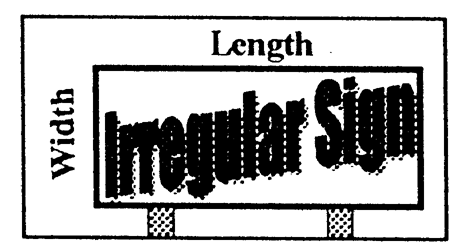
Sign area shall be the entire area within a circle or four sided polygon enclosing the extreme limits of writing, representation, emblem, or any figure of similar character. This area shall also include any frame or other material or color forming an integral part of the display or used to differentiate the sign from the background against which it is placed; excluding the necessary supports or uprights on which the sign is placed. The maximum width of necessary supports shall be two feet.
B.
Where a sign has two or more faces, the area of all faces shall be included in determining the area of the sign, except that where two faces are placed back to back and are at no point more than two feet from one another, the area of the sign shall be taken as the area of one face if the two faces are of equal area, or as the area of the larger face if the two faces are of unequal area.
C.
In the case of a sphere, the total area of the sphere is divided by two for purposes of determining the maximum permitted sign area.
D.
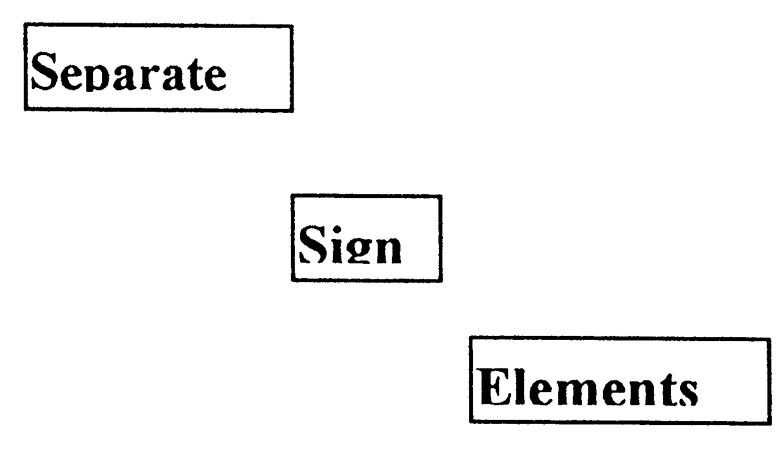
Separated sign elements, not part of any frame, or separated by other material or color forming an integral part of the display that may be used to differentiate such sign from the background against which it is placed, shall have each element of the sign calculated separately and summed for the purposes of determining the total area. The signs elements shall not exceed the total sign display permitted by the district in which it is located.
E.
Height.
1.
No sign shall exceed the maximum height of 25 feet (except for balloon signs, wall signs, and dynamic display billboards in the C-4 zone district along I-96 as provided in this chapter).
2.
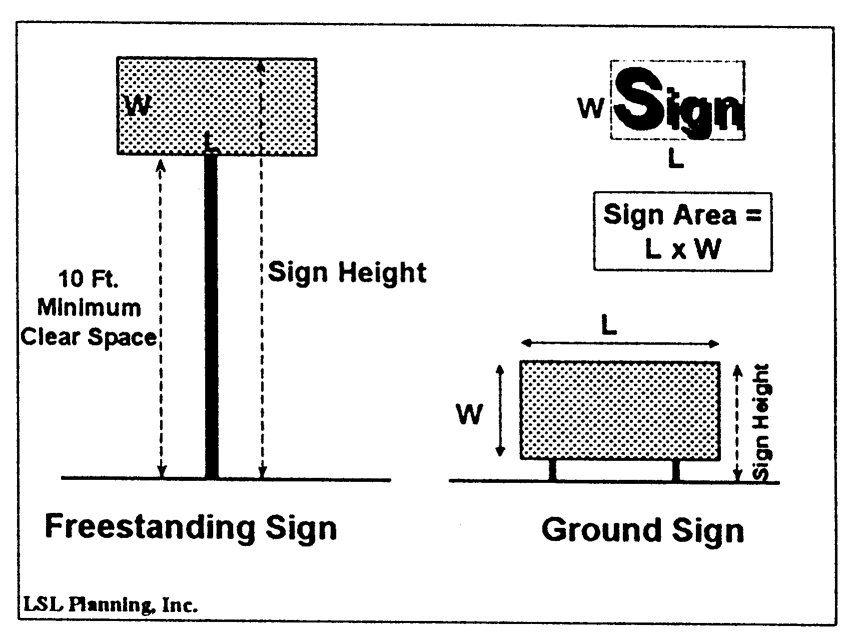
The height of a sign shall be measured as the vertical distance from the highest point of the sign to the grade of the adjacent street or the average grade of the ground immediately beneath the sign, whichever is less.
3.
Any freestanding sign shall maintain a minimum clear space of ten feet from the bottom of the sign to the ground.
F.
Sign area calculation for buildings with multiple tenants:
1.
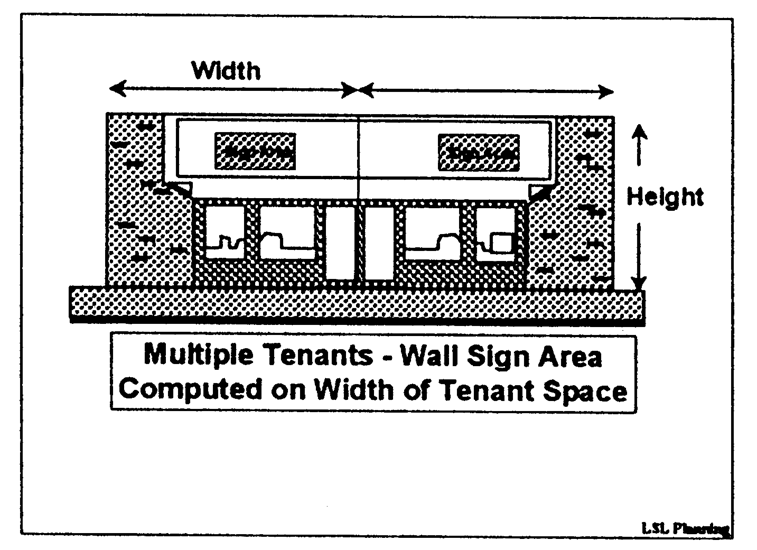
The sign areas for wall signs, marquee signs, projecting signs, and awning signs shall be determined by taking that portion of the front wall of the building applicable to each tenant space, and computing sign requirements for that portion of the total wall.
2.
For buildings with more than one street frontage, the wall area related to the tenant space on the second street frontage shall be used to calculate the sign area for the second wall sign, awning sign, or projecting sign, where the signs are otherwise permitted.
3.
Permitted wall signs shall be attached to the same wall used to determine its size.
(Ord. No. 7-03, § 13(16.04), 4-1-2003; Ord. No. 3-09, § 4, 6-26-2009)
Section 16.05. - General standards and requirements.
A.
General.
1.
A sign not expressly permitted by this ordinance is prohibited.
2.
With the exception of billboards, official signs, and noncommercial signs, all signs shall pertain only to the business or activity conducted on the premises.
3.
Signs are permitted according to the district in which they are located or intended to be located. Specific sign requirements for each zoning district may be found in the development requirements of each district.
4.
Signs meeting the requirements of this ordinance are allowed as a matter of right but shall be required to obtain a permit from the zoning administrator in accordance with the requirements of section 16.06.
5.
With the exception of official signs, directional signs, and plat entry signs placed within a boulevard, no sign shall be permitted within the public right-of-way or upon any utility pole. Signs must be placed at a location where the minimum lot width required by the zone district is attained. If any sign is placed on any public right-of-way including, but not limited to, the parkway, or on any other public property, the city shall have the right to remove the sign immediately. Any sign removed by the city shall be claimed within ten days, otherwise the sign will be destroyed. If the owner or person responsible for the sign wishes it returned, a fee set by resolution of the city commission shall be charged for each sign.
6.
All wall signs shall be placed flat against the building and shall not project beyond a wall or architectural feature by more than one foot.
7.
A plat entry sign of up to 20 square feet in area and up to 30 inches in height from the mean grade is permitted within the boulevard of a collector street. Such boulevard signs shall be set back a minimum of 17 feet from an arterial street right-of-way. A sign permit and highway permit are required in order to place a plat entry sign within a boulevard. Plat entry signs placed within the boulevard and improperly maintained may be removed by the city.
B.
Movement. Except for electronic message centers as otherwise permitted herein, and a minimum one minute interval between time and temperature changes, all signs must be stationary and may not contain any visible moving parts, alternating messages or moving messages or have the appearance of having moving parts or moving messages. The display may not and shall not appear to, flash, undulate, pulse, or portray explosions, fireworks, flashes of light, or blinking or chasing lights or otherwise appear to move toward or away from the viewer, expand or contract, bounce, rotate, spin, twist or other comparable movements.
C.
Illumination and depictions.
1.
Except for electronic message centers there shall be no flashing, moving or intermittent illumination of any sign.
2.
If permitted, signs may be illuminated only by continuous indirect white light. Only the sign face shall be illuminated.
3.
The illumination of any sign shall not be detrimental or annoying to occupants of surrounding property as set forth in chapter 20 nor constitute a safety hazard, as determined by the zoning administrator.
4.
No sign shall contain any photograph, silhouette, drawing or pictorial representation, or description of specified anatomical areas or specified sexual activities (as those terms are defined in chapter 2).
D.
Dynamic display signage.
1.
The content of a dynamic display sign, of any type, may change no more than once every one minute except for dynamic display signs within the C-3 Regional Commercial zone district, where the minimum interval between message changes is 30 seconds. The display or message must otherwise comply with section 16.05.B. and must have installed ambient light monitors which shall continuously monitor and automatically adjust the brightness level of the display based on ambient light conditions consistent with this section.
2.
Maximum brightness levels for dynamic display signs shall not exceed two-tenths foot-candles over ambient light levels measured within 150 feet of the sign. To obtain a sign permit, certification must be provided to the city demonstrating that the sign has been pre-set to automatically adjust the brightness to these levels or lower. Reinspection and recalibration may be required by the city to ensure that the specified brightness levels are maintained at all times.
3.
The dynamic display portion of an on-premises sign shall not exceed 60 percent of the total sign area or 100 square feet whichever is smaller.
(Ord. No. 5-04, § 6, 5-2-2004; Ord. No. 11-05, § 8, 7-17-2005; Ord. No. 12-08, § 2, 9-26-2008; Ord. No. 3-09, §§ 5, 6, 6-26-2009; Ord. No. 1-11, § 4, 2-11-2011; Ord. No. 9-16, § 3, 12-20-2016; eff. 12-30-2016; Ord. No. 4-20, § 3, 9-1-2020)
Section 16.06. - Permits, construction, and maintenance.
A.
Permits.
1.
A sign permit shall be required for the erection, use, construction or alteration of any sign exceeding six square feet. The zoning administrator shall issue a permit if the sign conforms to the requirements of this chapter and the zoning district in which it is located.
2.
Portable sign permits:
a.
Sign permits are required for all portable signs regardless of size.
b.
The portable sign permit will specifically state the date by which the sign must be removed based upon the applicant's representation as to the existence of a special circumstance or event.
c.
If there has already been a portable sign on the premises, the sign must be removed on a date so that, except as is otherwise expressly provided in this chapter, the total number of days portable signs are located on the premises within a calendar year does not exceed the allowance specified for the zoning of the property.
B.
Construction. The construction of any sign shall withstand all wind and vibration forces that can be normally expected to occur in the vicinity.
C.
Maintenance. All signs shall be properly maintained and shall not be allowed to become unsightly or hazardous through disrepair or action of the elements. For purposes of this chapter, properly maintained shall mean that no part of the sign or supporting structure is broken, punctured, or contains loose parts or elements, or has any other condition deemed by the zoning administrator to constitute a hazard or nuisance.
(Ord. No. 10-17, § 12, 9-19-2017)
Section 16.07. - Special exceptions for signs in regional.
A.
As a part of its approval of a site development plan for a regional shopping center in the C-3 district, the Planning Commission may approve special exceptions from the provisions for signs as otherwise provided in the C-3 district, in accordance with this section.
B.
Such special exceptions may include variations in the required size, placement, number and height of signs in commercial developments.
C.
Any such special exceptions shall comply with the following requirements:
1.
The need or suitability of the special exception shall be based upon the nature, size, density, location or design of the commercial development.
2.
The special exception shall result in an enhancement or improvement of a sign function or purpose, by reason of improved aesthetics, more convenient identification, improved pedestrian or vehicular safety or other sign improvement within the development.
3.
The special exception shall not have a serious adverse effect upon other lands or the public streets or the use thereof.

