Zoneomics Logo
search icon

Kentwood City Zoning Code

CHAPTER 6

- TWO-FAMILY AND MULTIPLE-FAMILY RESIDENTIAL DISTRICTS

Section 6.01.- Intent and purpose.

These districts are intended to provide a sound and stable environment for various types of residential buildings and group housing developments. It is further intended to accommodate a mixture of housing types, including two-family and single-family homes, and to serve the limited needs for townhouses, row houses or other attached single-family housing facilities similar in character and density, but generally somewhat more dense than detached single-family developments. These districts may also act as buffers between other detached single-family developments and certain nonresidential or multiple-family developments.

Section 6.02. - Table of uses.

A.

The following abbreviations apply to the table of uses:

P: Land and/or buildings in this district may be used for the purposes listed by right.
SLU: The following uses may be permitted by obtaining special land use approval when all applicable standards as cited in chapter 15 and elsewhere are met.
NP: Use is not permitted in the district.


Use R-2 R-3 R-4
Residential
Attached single-family dwellings (townhouses or row houses) NP SLU P
Detached single-family dwellings P P NP
Elderly housing NP SLU SLU
Manufactured and modular, single-family detached dwellings, subject to section 3.22 P P NP
Multiple-family dwellings NP SLU P
Residential child and adult care facilities Refer to section 3.20
Two-family dwellings P P P
Zero lot line, single-family detached dwellings SLU SLU NP
Nonresidential
Accessory buildings and uses as defined in chapter 2 and subject to sections 3.15 and 3.16 P P P
Assisted living group facility SLU SLU SLU
Assisted living family facility P P P
Cemeteries P P P
Clinics SLU SLU SLU
Colleges and universities SLU SLU SLU
Convalescent homes SLU SLU SLU
Elementary and secondary schools SLU SLU SLU
Golf courses or country clubs SLU SLU SLU
Home occupations subject to section 3.18 P P P
Hospitals SLU SLU SLU
Municipal and public service activities P P P
Nursing home SLU SLU SLU
Parks, playgrounds and community centers P P SLU
Places of religious worship SLU SLU SLU
Recreation facilities, indoor or outdoor SLU SLU SLU
Utility substations, transmission lines and switching stations SLU SLU SLU
Exempt wireless communication equipment (attached to a lawful existing wireless support structure) in accordance with Act 366 of 2018 Refer to section 3.21
Exempt small cell wireless support structure in accordance with Act 365 of 2018 Refer to section 1.07F
Non-exempt small cell wireless facility (outside of the ROW) in accordance with Act 365 of 2018
Non-exempt small cell wireless facility in the ROW (exceeds height, width, etc. standards) in accordance with Act 365 of 2018
New wireless communication support structure Refer to section 3.21
Non-exempt wireless communication equipment or support structure (exceeds height, width, etc. standards) in accordance with Act 366 of 2018


(Ord. No. 7-03, § 5(6.02), 4-1-2003; Ord. No. 12-08, § 1, 9-26-2008; Ord. No. 1-19, §§ 7, 8, 3-18-2019)

Section 6.03. - Development requirements.

A.

Site plan review requirements. The following chart provides requirements for site plan review. A site plan shall be submitted for Planning Commission review in connection with the following, unless specifically exempted in section 14.02:

District Site Plan Review Requirements Other Requirements
R-2 Special land uses, plats and site condominium developments Any new building with a permitted use shall be subject to approval by the staff review team in accordance with the requirements of section 13.05. See section 3.25 for site condominium requirements and procedures.
R-3, R-4 Permitted uses and special land uses, plats and site condominium developments Single- or two-family dwellings as a principal use on a single lot shall be subject to approval by the staff review team in accordance with the requirements of section 13.05.
See chapter 14 for site plan requirements.
See chapter 15 for special land use requirements.


B.

Lot, yard and building requirements.

Requirement R-2 R-3 R-4 Other
Requirements
Minimum Lot Area Single family 6,500 sq. ft. 8,400 sq. ft. Not permitted Maximum densities permitted:
R-3 seven units per acre
R-4 12 units per acre
Two family 13,000 sq. ft. >
Multiple family Not applicable 4,000 sq. ft. for first dwelling unit and 2,200 sq. ft. for each additional unit
All 20,000 sq. ft. without public water and sanitary sewer Minimum 20 acre site for cemeteries
16,800 sq. ft. with public water but not sanitary sewer
Minimum lot width Single family 70 ft. 65 ft. Not permitted Lot width is measured at front building setback line. See section 3.05.
Two family 100 ft.
Front yard 35 ft.
Side yard Seven ft. one side/15 ft. total 15 ft. one side/30 ft. total In cases of non-parallel lot lines, nearest wall shall be no closer than four feet to nearest point of side lot line. See definition of Yard, side in section 2.02.Y.
Rear yard Side street—corner lot—25 ft.
Nonresidential principal use buildings—20 ft.
35 ft. 35 ft. 30 ft.
Nonresidential principal use buildings—50 ft.
Maximum lot coverage 30 percent 40 percent Including buildings and structures
Minimum (finished living area) Two family 850 sq. ft. minimum 600 sq. ft. on main floor
Attached single family See chapter 2, floor area, main definition for split level buildings.
Multiple family Not applicable Efficiency 375 sq. ft.
1 BR 600 sq. ft.
2 BR 780 sq. ft.
3 + BR 940 sq. ft. + 80 sq. ft. for any bedroom over three
Maximum building height Two stories or 25 ft. Three stories or 35 ft.
Sites over five acres—Building height for nonresidential main buildings may be increased by one foot for each ten ft. of additional setback provided beyond 50 ft. from building wall to nearest property line, to a maximum height of 35 ft. See chapter 2, definition for building height. See section 3.03.


C.

Site development requirements. All lots in the R-2, R-3 and R-4 districts must be served by public sanitary sewer and public water.

D.

Development requirements for parking.

1.

The amount of required off-street parking spaces for individual uses shall be determined in accordance with the following table and shall meet the dimensional requirements of chapter 17.

Use Parking Requirement
Spaces per Unit of Measurement
Residential
Attached single-family dwellings (townhouses or row houses) Two per dwelling unit
Detached single-family dwellings Three per dwelling unit
Elderly housing One per dwelling unit, of which 25 percent shall be designated for visitor parking
Family child day care home, group child day care home Parking operations plan or one per each three children computed on the basis of the greatest number of children on site at a given time
Foster family home, adult foster care small group home, adult foster care family home, foster family group home One per each three beds or two rooms, whichever is less, plus one per each on duty shift staff
Multiple-family dwellings Two per dwelling unit
Two-family dwellings Three per dwelling unit
Zero lot line, single-family detached dwellings Three per dwelling unit
Nonresidential
Assisted living facilities, convalescent homes, nursing homes One per each three beds or two rooms, whichever is less, plus ten spaces signed for visitors
Cemeteries Sufficient parking shall be provided within the site through the submission by the owner of a operations plan submitted with a site plan
Child care institutions and adult care institutions One per each four beds, plus one per each on duty shift staff plus one per each four off-site visiting staff
Clinic Three per each exam or outpatient procedure room or station plus one per each lab or recovery room
Colleges, universities and high schools Eight per classroom or amount required for the auditorium or place of assembly, whichever is greater; separate areas for student drop off and pickup areas for buses must be provided
Day care centers, adult day care facility Parking operations plan or one per each three clients computed on the basis of the greatest number of clients
Elementary and middle schools Four per classroom or amount required for the auditorium or place of assembly, whichever is greater; separate areas for student drop off and pickup areas for buses must be provided
Golf courses or country clubs Two per each hole for a par three course; six per hole for other courses plus those required for accessory uses
Hospitals Two per each in patient bed plus one per 150 sq. ft. GFA for offices and administrative uses, plus required out patient parking (see clinic). Total parking needs shall be based on a parking needs study submitted with the site plan
Municipal and public service activities One per each 300 sq. ft. GFA, not including parking areas for municipal vehicles (police cars, public works vehicles, etc.), plus spaces required for assembly areas
Parks, playgrounds and community centers Ten per each athletic field plus one per each ten sq. ft. of indoor or outdoor play area
Places of religious worship Two per each five seats based on the maximum seating capacity of the main place of assembly up to 2,500 persons
One per each two seats, based on the maximum seating capacity of the main place of assembly exceeding 2,500 persons
Recreation facilities, indoor or outdoor Four per court or other recreational facility use plus parking required for any accessory uses, including restaurants, offices, or other similar activities. If athletic fields are included, there shall be provided ten spaces per field


2.

Location of parking.

a.

Single-family dwellings. The off-street parking facilities required for single- and two-family dwellings shall be located on the same lot as the building they are intended to serve. Parking is limited to the garage and driveway only. One additional parking lane may be allowed with zoning administrator approval.

b.

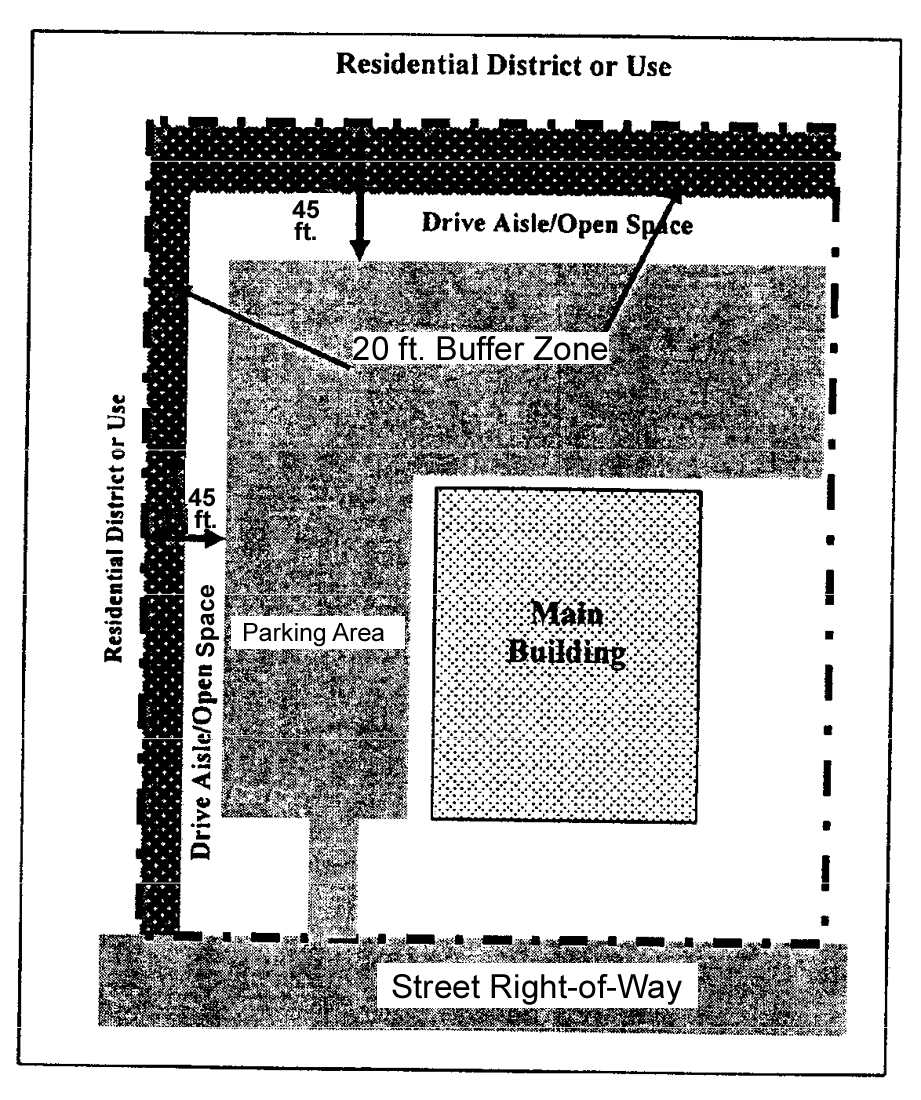
Nonresidential uses. The off-street parking facilities required for nonresidential uses shall not be located in the required front yard area and the respective side and rear yard setback common to an adjacent residential use or district shall be a minimum of 45 feet of which 20 feet nearest the respective property line is developed as a buffer zone. No accessory buildings or storage allowed within the 45-foot setback. Such buffer zone shall extend the entire depth of the side of the lot in the case of the side yard parking adjoining residential use, or the width of the rear of the lot in the case of rear yard parking adjoining the residential use. The required buffer zone shall incorporate a minimum six-foot high vertical screen.
Residential District or Use

Residential District or Use

c.

The off-street parking facilities for multiple-family dwellings shall be located on the same lot as the dwellings they are intended to serve, and shall consist of a parking lot as defined elsewhere in this chapter. In no event shall any uncovered parking space for a multiple-family dwelling be located nearer than ten feet to any main building. The required front yard setback area shall be maintained as a green area. In cases of difficult topography, the zoning administrator may allow the parking lots to extend into the front setback area, provided that the average of front setback areas totals at least 30 feet from any public street right-of-way. In no case shall the parking lot be any closer than ten feet to a public street right-of-way.

E.

Development requirements for signs. See also chapter 16, signs for general requirements. Directional sign provision of up to six square feet only to the extent necessary as determined by the zoning administrator for traffic safety, subject to approved plan for design, number and location.

Signs Permitted R-2 through R-4 Districts Other Requirements
Size Number Height Location
Home occupation sign Two sq. ft. One/dwelling unit N/A Attached to dwelling unit or mailbox May not be illuminated
Noncommercial Six sq. ft. One/issue or candidate or issue per lot Four ft. Behind the ROW Signs may remain until deemed unsightly through disrepair or action of the elements
May not be illuminated
Real estate Six sq. ft. One/premises/building/or use Four ft. Behind the ROW Permitted only when property/units are for sale, rent, or lease
Plat entry 75 sq. ft. (unless located within a boulevard) One/subdivision entrance Eight ft. (unless located within a boulevard) At least 17 ft. from public street ROW line (unless located within a boulevard) See section 16.05.A.7 for restrictions on boulevard signs
Portable (1) Four sq. ft. (32 sq. ft. if advertising a special event of community activity One/lot Four ft. Behind the ROW and in a location where driver visibility is not impaired Maximum 30 days of display/calendar year
Institutional bulletin board 50 sq. ft. One/public or semipublic institution Six ft. 25 ft. from front property line
Institutional wall sign 50 sq. ft. One/street frontage N/A N/A
On-site identification 50 sq. ft. One/use Four ft. Setback ½ of required front yard; not permitted in side yard setback Only for nonresidential principal uses
Freestanding (R-3 and R-4 only) 50 sq. ft. One/major entrance; total of two Four ft. above mean grade
If less than ten feet from ROW line
Six ft. above mean grade
If ten ft. or more from ROW line
Wall 50 sq. ft. Permitted if no freestanding sign is used
Directional sign Six sq. ft. only To the extent necessary as determined by the zoning administrator for traffic safety, subject to approved plan for design, number and location


(1)

For multiple-family developments a one-time six-month display period is permitted during initial opening. No other portable sign is permitted for six months after the initial display period has elapsed.

(Ord. No. 7-03, § 5(6.03), 4-1-2003; Ord. No. 11-05, § 3, 7-17-2005)

