
Kentwood City Zoning Code
CHAPTER 19
- LANDSCAPING/SCREENING REGULATIONS
Section 19.01.- Intent and purpose.
The intent of this chapter is to promote the public health, safety and welfare by establishing minimum standards for the design, installation, and maintenance of landscape improvements. Landscaping is viewed as a critical element contributing to the aesthetics, development quality, stability of property values, and the overall character of the city. The standards of this section are intended to help achieve a number of functional and environmental objectives such as:
A.
Promote the implementation of the master plan.
B.
Define, articulate, and integrate outdoor spaces, architectural elements, and various site elements.
C.
Reduce the physical impact between adjacent land uses by requiring complementary landscape treatments and providing a transitional area adjacent to natural areas.
D.
Screen headlights to reduce glare and incidental pollution.
E.
Control soil erosion by slowing the effects of erosive winds and water.
F.
Respond to the varied and unique conditions throughout the city.
G.
Provide reasonable standards to bring developed sites, which existed prior to the adoption of these standards, into compliance with the requirements contained herein.
H.
Recognize and preserve the aesthetic value of natural areas such as woodlands, wetlands and floodplains within and adjacent to a development site.
Section 19.02. - Landscape plan specifications.
A separate detailed landscape plan shall be submitted as part of all site plan reviews. Planting plans shall be prepared by a licensed landscape architect. The landscape plan shall demonstrate that all requirements of this chapter are met and shall be prepared in accordance with the following:
A.
Illustrate location, spacing, species, and size of proposed plant material;
B.
Separately identify compliance with the minimum numeric requirements for greenbelts, buffer zones, parking lot trees, detention ponds, and other required interior landscaping. Required trees or materials can not be double counted;
C.
Provide, where required by the Planning Commission, typical cross sections to illustrate views from adjacent land uses, and the slope, height, and width of proposed berms or landscape elements;
D.
Identify trees and other landscape elements to be preserved;
E.
Delineate the location of tree protection fence and limits of grading at the perimeter of areas that are to be preserved. Tree preservation fencing shall be established at the drip line of the tree, or a detail of the fence provided;
F.
Provide significant construction details to resolve specific conditions such as limits of grading adjacent to areas with trees and vegetative cover to be preserved, tree wells to preserve existing trees or culverts to maintain natural drainage patterns;
G.
Provide details to ensure proper installation and establishment of proposed plant material;
H.
Identify grass areas and other methods of ground cover; and
I.
Identify a landscape maintenance program including a statement that all diseased, damaged or dead materials shall be replaced in accordance with standards of this ordinance.
(Ord. No. 9-16, § 10, 12-20-2016; eff. 12-30-2016)
Section 19.03. - Required landscaping.
A.
Greenbelt along street frontage. Within any R-2, R-3, R-4, R-5 district, commercial/office districts, industrial districts, and the OS district the following minimum greenbelt is required along each public street right-of-way or private road easement on which the site has frontage:
1.
Ten-foot wide greenbelt.
2.
One canopy tree, rounded upward, for every 40 linear feet of frontage.
3.
Seven shrubs for every 40 linear feet of frontage.
4.
The provision of a planting berm may be required at least three feet in height in addition to the plant materials required along and outside the public right-of-way parallel to a major arterial street.
5.
The Planning Commission and planning staff may approve substitution of evergreen trees for up to 50 percent of the required trees.
B.
Street trees in residential projects. Street trees are required within all residential projects in accordance with the following:
1.
One canopy street tree shall be provided for every 80 feet of lot frontage along a public or private street.
2.
Single and two family and site condominium lots. Where possible, street trees shall be provided between the sidewalk and the curb, but at a minimum within the front yard on each lot.
3.
Multiple family developments. Where possible, street trees shall be provided within the front yard area of the units.
4.
Existing trees three-inch caliper or greater, preserved in good condition, may be allowed to be counted towards this requirement.
5.
Where the installation of street trees is deferred until after construction of housing units, the city shall require a performance guarantee for street tree planting.
6.
Where overhead power lines exist, the type and/or location of street trees shall be adjusted to avoid conflict as the trees mature.
C.
Buffer zones.
1.
A buffer is an area intended to provide visual barrier and noise abatement between specified land uses.
2.
The Planning Commission shall determine whether landscaping, a wall, berm, decorative fence or combination thereof is needed to attain the intended screening.
3.
The landscape buffer yard requirement is waived where adjacent commercial and/or office developments share a common drive or parking lot on the common lot line.
4.
Buffers shall be provided in accordance with the following requirements unless otherwise exempted within this section.
D.
Parking area landscaping. All sites that provide parking shall comply with the following requirements, as applicable.
1.
Off-street parking areas containing ten or more parking spaces shall be provided with landscaping in accordance with the following table.
2.
A minimum of one-third of the trees shall be placed on the interior of the parking area, defined as the area within 18 feet surrounding the parking lot.
3.
Parking lot landscaping shall be dispersed throughout the parking lot in order to break up large expanses of pavement.
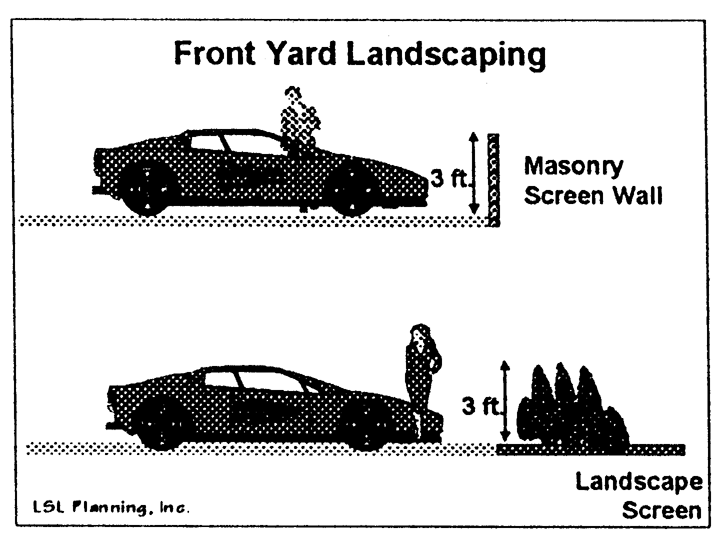
Front Yard Landscaping
4.
Where off-street parking areas are located within the front yard, a hedgerow, three-foot tall masonry wall or berm shall be provided between the parking spaces and the public or private right-of-way. The hedgerow shall be planted with two-foot tall evergreen or deciduous shrubs, 2½ feet on center.
5.
The respective side and rear yard setback for the off-street parking for nonresidential uses common to an adjacent residential use or district shall be a minimum of 45 feet of which 20 feet nearest the respective property line is developed as a buffer zone. No accessory buildings or storage is allowed in this 45-foot setback. Such buffer zone shall extend the entire depth of the side of the lot in the case of the side yard parking adjoining residential use, or the width of the rear of the lot in the case of rear yard parking adjoining the residential use. The required buffer zone shall incorporate a minimum six-foot high vertical screen.
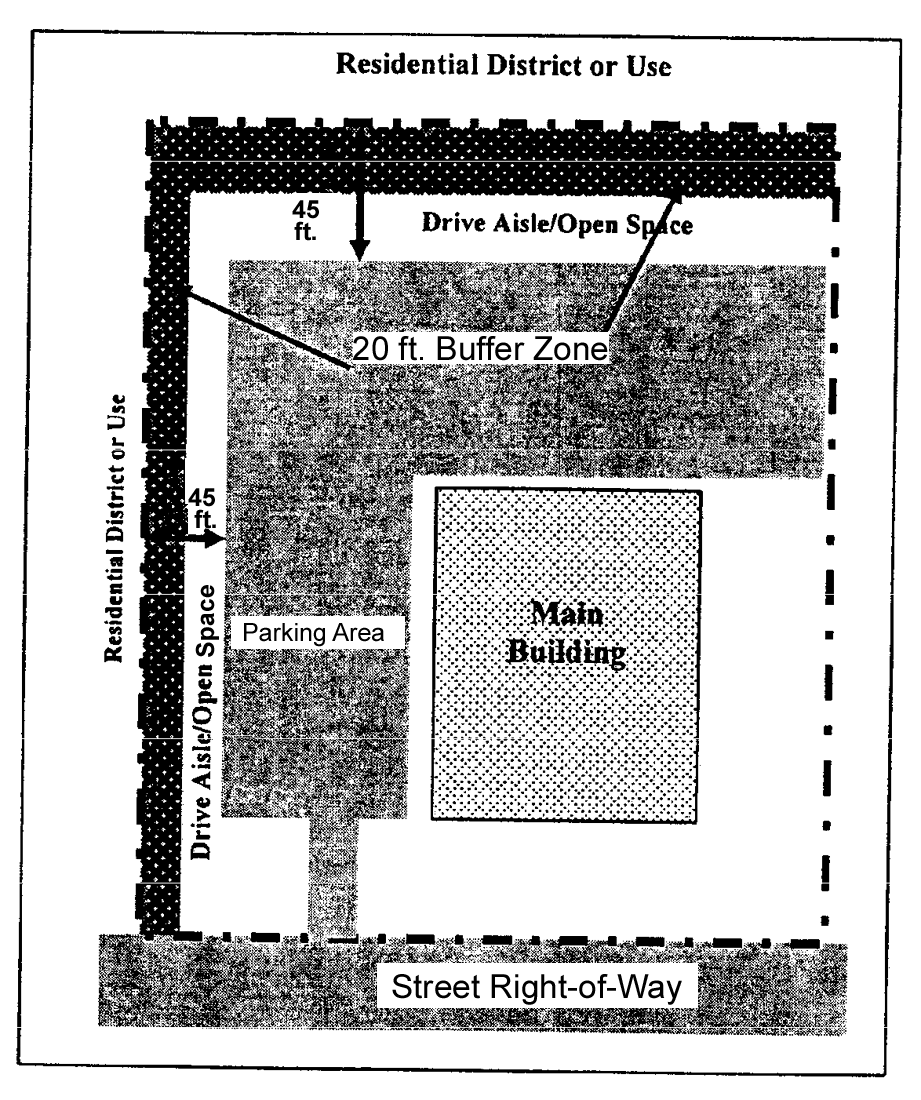
Residential District or Use
E.
Detention/retention pond landscaping. Ponds shall be designed to provide a natural appearance through the use of gradual side slopes, rock walls, and plant material. Detention and retention ponds shall be provided in accordance with the following standards:
1.
Side slopes shall not exceed requirements that require the perimeter of the pond to be fenced.
2.
One canopy or evergreen tree and nine shrubs are required per 50 feet of pond perimeter, as measured along the top of the bank elevation. The required landscaping shall be planted in a random pattern, not limited to the top of the pond bank.
3.
Where a natural landscape is found not to be particular or desirable, the Planning Commission may require some type of decorative fencing.
F.
Dumpsters. Dumpsters, including waste receptacles and compactors, shall be designed, constructed and maintained according to the following:
1.
Dumpster location and details of construction shall be shown on site plans.
2.
A change in dumpster location or size shall require modification to the enclosure, as warranted by this subsection.
3.
Dumpsters shall be located in the rear yard or nonrequired side yard, unless otherwise approved by the Planning Commission and shall be as far as practical, and in no case be less than, 20 feet from any adjacent residential district.
4.
Dumpsters shall be easily accessed by refuse vehicles without potential damage to automobiles parked in designated parking spaces.
5.
Dumpsters shall have an enclosing lid or cover.
6.
Dumpsters shall be located within an enclosure that meets the following design standards barring a security consideration raised by the police department and affirmed by the staff review team.
(a)
The enclosure shall be a minimum of 12 feet by 12 feet in size.
(b)
The base of the enclosure shall be constructed of six inches of reinforced concrete pavement that shall extend six feet beyond the base or gate to support the front axle of a refuse vehicle.
(c)
The enclosure shall be a minimum of three sides with a gate on the fourth side.
(d)
The minimum height of the enclosure walls shall be six feet.
(e)
The enclosure shall be constructed of brick or decorative concrete material that complements the material of the principal structure.
(f)
A wooden enclosure may be used provided the lumber is treated to prevent decay or is determined to be durable and suitable for outdoor use. Suggested timber materials include Cedar, No. 2 Cedar rough sawn seasoned, Redwood, No. 2 Common Finish (S4S), Douglas Fir-larch or Southern Pine.
(g)
Landscape plantings may be required, where appropriate, along the wall of the enclosure to better screen the dumpster and enhance the view of the site.
G.
Accessory site components. In addition to required screens or walls, necessary site elements such as air conditioner units, utility boxes, road medians, site entrances and other similar components shall be appropriately screened or landscaped with plant material.
H.
Minimum landscaping. Seeding or sodding shall be the minimum acceptable landscaping of any lot or parcel of land within the city. This minimum landscaping shall be completed within one year of the completion of the construction project or occupancy, which occurs first, and shall be reasonably maintained and replaced thereafter.
I.
Right-of-way landscaping. The area between the street paving or curb line and the property line or sidewalk, with the exception of driveways and walkways, shall be used exclusively and maintained as landscaped area with grass, trees and other plants and materials as approved by the city.
(Ord. No. 7-03, § 15(19.03), 4-1-2003; Ord. No. 5-04, § 7, 5-2-2004; Ord. No. 11-05, § 9, 7-17-2005; Ord. No. 6-06, § 6, 4-30-2006)
Section 19.04. - Required landscape general provisions.
A.
Waiver from landscaping and screening requirements. Existing landscaping or screening intended to be preserved may be determined to provide adequate landscaping and screening. Dimensional conditions unique to the parcel may also be determined to prevent development of required buffer zones, off-street parking area landscaping, greenbelts or required buffer zones. If such determination is made, in whole or in part, the landscaping provisions of this chapter may be waived. Criteria which shall be used when considering a waiver shall include, but shall not be limited to:
1.
Existing natural vegetation;
2.
Topography;
3.
Existing wetland, floodplain and poor soils areas;
4.
Existing and proposed building placement;
5.
Building heights;
6.
Adjacent land uses;
7.
Distance between land uses;
8.
Dimensional conditions unique to the parcel;
9.
Traffic sight distances;
10.
Traffic operational characteristics on and off site;
11.
Visual, noise and air pollution levels; and
12.
Health, safety and welfare of the city.
B.
Unless approved as stipulated in section 19.04.A. above, all landscape plans shall meet each required calculation individually and in no case shall any required plantings and planting areas be counted towards other landscape requirements.
C.
When units of measurements, utilized in determining the number of required plantings, result in a fractional planting, any fraction shall be rounded upwards and counted as one additional planting.
D.
Landscaping shall be installed such that, when mature, it does not obscure traffic signs, fire hydrants, lighting, drainage patterns on site or adjacent properties, or obstruct vision for safety of ingress or egress.
E.
A raised standard or rolled concrete curb shall protect all landscaped areas.
F.
All landscaped areas shall be arranged to simulate a natural setting such as staggered rows or massings.
G.
Remaining lawn areas shall include only living materials with the exception of permitted driveways, sidewalks, signs, and utilities.
H.
All landscaping shall be maintained in a healthy, neat and orderly state free from refuse and debris. Any dead or diseased plants shall be removed and replaced within six months.
I.
The Planning Commission may require a performance guarantee in accordance with the requirements of section 22.06 of sufficient amount to ensure the installation of all required landscaping.
J.
All deciduous trees and evergreens must have a heavy soil type root ball.
K.
Slopes 3 on 1 or less can be grassed. Slopes greater than 3 on 1 should be planted with ground cover perennials or course grass.
Section 19.05. - Minimum landscape material standards.
A.
Plant material.All plant material shall be hardy to Kent County, be free of disease and insects and conform to the American Standard for Nursery Stock of the American Association of Nurserymen.
B.
Plant sizes. Minimum plant sizes at time of installation shall be according to the following:
C.
Mixing of species. The overall landscape plan shall not contain more than 25 percent of any one plant species.
D.
Berm. Where a berm is provided for the purposes of screening and buffering, it shall have a maximum slope of one foot of vertical rise to three feet of horizontal distance (1:3) with a crest area at least four feet wide.
E.
Wall. Where a wall is provided for the purposes of screening and buffering, it shall have a maximum height of six feet and shall be constructed of brick, stone or decorative masonry material.
1.
The colors and materials of the wall shall complement that of the main building or structure.
2.
A residential privacy fence may be approved in place of a solid wall if it is more compatible with the character of the area. The privacy fence must be six feet tall, completely opaque and, if wooden, treated to prevent decay. Cyclone fencing with plastic covering is not permitted.
F.
Suggested plant material. Botanical species containing trees native to west Michigan are identified with an asterisk (*). The use of trees native to the area, and mixture of trees from the same species association, is encouraged.
1.
Canopy trees. Oaks*, Hard Maples*, Hackberry*, Sycamore*/Plane Tree, Birch*, Ginko (male), Honeylocust* (thornless varieties), Sweetgum, Hophornbeam*, Linden*, Ash*, Hickory* and Hornbeam*.
2.
Evergreen trees. Fir, Hemlock, Pine* and Spruce.
3.
Narrow evergreens. Red Cedar, Arborvitae and Juniper.
4.
Ornamental trees. Serviceberry*, Redbud*, Dogwood*, Hawthorn*, Flowering Crab, Flowering Pear, Magnolia and Rose of Sharon.
5.
Large shrubs. Northern Bayberry, Dogwood*, Cotoneaster, Forsythia, Mock-Orange, Sumac*, Lilac, Viburnum*, Witchhazel*, Euonymus, Sargent Crab and Ninebark*.
6.
Small shrubs. Bayberry, Quince, Cotoneaster, Euonymus*, Forsythia, Hydrangea, Holly*, Privet, Potentilla*, Lilac, Viburnum* and Weigela.
7.
Evergreen shrubs. Juniper, Yew, Dwarf Mugo Pine, Euonymus varieties and Winter Creeper.
G.
Prohibited species. The following trees are not permitted as they split easily; their wood is brittle and breaks easily; their roots clog drains and sewers; and they are unusually susceptible to disease or insect pests:
H.
Planting beds. Clusters of plantings should be located in planting beds. Planting beds shall be edged with either plastic or metal edging in residential districts, and metal edging in all other zoning districts. Bark used as mulch shall be maintained at a minimum of two inches deep.
I.
Topsoil. Topsoil shall consist of a four-inch base for lawn areas and an eight—12 inch base within planting beds.
J.
Lawn grasses. Lawn grasses shall be planted in species normally grown as permanent lawns in Kent County. Grasses may be plugged, sprigged, seeded or sodded. Rolled sod, erosion reducing net or suitable mulch shall only be used in swales or other areas susceptible to erosion and shall be staked where necessary for stabilization. When complete sodding or seeding is not used, nursegrass seed shall be sown and mulched for immediate protection until permanent coverage is achieved. Grass sod and seed shall be free of weeds and noxious pests or disease.

