
Kentwood City Zoning Code
CHAPTER 2
- DEFINITIONS
Section 2.01.- Interpretation of terms.
A.
Purpose.
For the purposes of interpreting this ordinance, certain words and terms shall have the meaning provided in this chapter. Terms and words not defined in this ordinance shall have the meanings customarily accepted.
B.
Interpretation of terms.
1.
All words used in this zoning ordinance indicating the present tense shall not be limited to the time of the adoption of this ordinance but shall include the time of an event or requirement for which provision is applied.
2.
The singular number shall include the plural and the plural number shall include the singular.
3.
References to the masculine gender shall include, extend and apply to females as well as males.
4.
All references to statutes shall be considered to be references to the statutes as amended from time to time.
5.
All references to section numbers shall refer to sections of this zoning ordinance.
6.
Unless the context clearly indicates the contrary, the conjunctions noted below shall be interpreted as follows:
a.
"And" indicates that all connected items, conditions, provisions, or events shall apply.
b.
"Or" indicates that the connected items, conditions, provisions or events may apply singularly or in any combination.
c.
"Either…or" indicates that the connected items, conditions, provisions or events shall apply singularly but not in combination.
C.
Meaning of words.
1.
The word "building" includes the word "structure."
2.
The word "city" shall mean the city of Kentwood.
3.
Unless otherwise identified, the word "law" shall mean federal law, the Constitutions of the United States and State of Michigan, state law, common law, this zoning ordinance, and any Charter, ordinances or lawfully adopted acts of the city.
4.
The word "person" shall include governmental entities, corporations, partnerships, associations and individuals.
5.
The word "shall" is always mandatory and not merely directory.
6.
The word "day" shall mean calendar day.
Section 2.02. - Definitions.
A.
Definitions "A."
Accessory building. A building or portion of a building supplementary and/or subordinate to a main building on the same lot, occupied by or devoted exclusively to an accessory use. Where an accessory building is attached to a main building in a substantial manner, such as a wall or roof, the accessory building shall be considered a part of the main building.
Accessory use. A use incidental and subordinate to the principal use of the land or building.
Adult care facilities. A facility for the care of adults, over 18 years of age, as licensed and regulated by the State under Michigan Public Act 218 of 1979, as amended, and rules promulgated by the State Department of Consumer and Industry Services. The organizations shall be defined as follows:
1.
Adult foster care facility: A governmental or non-governmental establishment that provides foster care to adults. It includes facilities and foster care homes for adults who are aged, mentally ill, developmentally disabled, or physically handicapped who require supervision on an ongoing basis but who do not require continuous nursing care. An adult foster care facility does not include nursing homes, homes for the aged, hospitals, alcohol or substance abuse rehabilitation center, or a residential center for persons released from or assigned to a correctional facility.
2.
Adult foster care small group home: A adult foster care facility with the approved capacity to receive six or fewer adults who are provided supervision, personal care, and protection in addition to room and board, for 24 hours a day, five or more days a week and for two or more consecutive weeks for compensation.
3.
Adult foster care medium group home: A adult foster care facility with the approved capacity to receive seven to 12 adults who are provided supervision, personal care, and protection in addition to room and board, for 24 hours a day, five or more days a week and for two or more consecutive weeks for compensation.
4.
Adult foster care large group home: A adult foster care facility with the approved capacity to receive 13 to 20 adults who are provided supervision, personal care, and protection in addition to room and board, for 24 hours a day, five or more days a week and for two or more consecutive weeks for compensation.
5.
Adult foster care family home: A private home with the approved capacity to receive six or fewer adults to be provided with foster care for five or more days a week and for two or more consecutive weeks. The adult foster care family home licensee must be a member of the household and an occupant of the residence.
Adult caring institution. A state licensed adult residential facility which provides care and supervision on a 24-hour basis for the treatment of mental health, alcohol or substance abuse or other longterm illness or rehabilitation program. The terms "institutions for mentally handicapped," "drug or alcohol patients," "correctional institutions" or "mental health facilities" shall mean the same, with regard to persons 18 years of age or older.
Adult day care facility. An unlicensed facility which provides care for elderly and/or functionally impaired adults in a protective setting for a portion of a 24-hour day.
Agriculture. The commercial use of land for tilling of the soil, raising of tree or field crops, or animal husbandry. The words agriculture and farming shall be considered synonymous.
Alley. A public way not more than 30 feet in width which affords a secondary means of access to abutting property but not intended for general traffic circulation.
Alterations. Any change, addition or modification in construction or type of use or occupancy; any change in the supporting structural members of a building, such as walls, columns, beams, girders or any change which may be referred to herein as "altered" or "reconstructed".
Animal hospital. A place where animals or pets are given medical or surgical treatment and the boarding of animals is limited to shortterm care incidental to the hospital use. This term does not include a stable, kennel or a farm.
Architectural features. Architectural features of a building shall include cornices, eaves, gutters, belt courses, sills, lintels, bay windows, chimneys and decorative ornaments.
Art display venue. Private use of an outdoor space, area or setting, visible from the public right-of-way, intended for the display of art.
Art gallery. A room, building or other enclosed space within which art is displayed.
Art, public. Publicly-owned art and memorials, artistic enhancement of public infrastructure, temporary art exhibitions or displays on public property.
Assembly building. A building or structure designed and intended for use [as] a place of public assembly, with or without fixed seats, for entertainment, business, social, religious, educational, or other purposes.
Assisted living family facility. An unlicensed residential facility housing six or fewer people per building, and providing housing, two or more group meals a day, incidental nursing or medical services, and some or all of the following services: transportation, ambulatory assistance, prescription scheduling, laundry, housekeeping or shopping.
Assisted living group facility. An unlicensed residential facility that houses more than six people per building, and providing housing, two or more group meals a day, incidental nursing or medical services, and some or all of the following services: transportation, ambulatory assistance, prescription scheduling, laundry, housekeeping or shopping.
B.
Definitions "B."
Basement. A portion of a building partly underground with more than one-half of its height below grade and with the finished surface of the floor above more than six feet above grade plane.
Bed and breakfast. A house, or portion thereof, where short-term lodging rooms and meals are provided for up to three days duration as a commercial operation.
Bedroom. A dwelling room used or intended to be used by human beings for sleeping purposes.
Block. The property abutting one side of a street and lying between the two nearest intersecting streets, or between one intersecting street and railroad right-of-way, unsubdivided acreage, canal, levee, river or live stream; or between any of the foregoing and any other physical (natural and artificial) barrier to the continuity of development. An area bounded on all sides by streets or highways.
Board of appeals. The city of Kentwood Zoning Board of Appeals (ZBA).
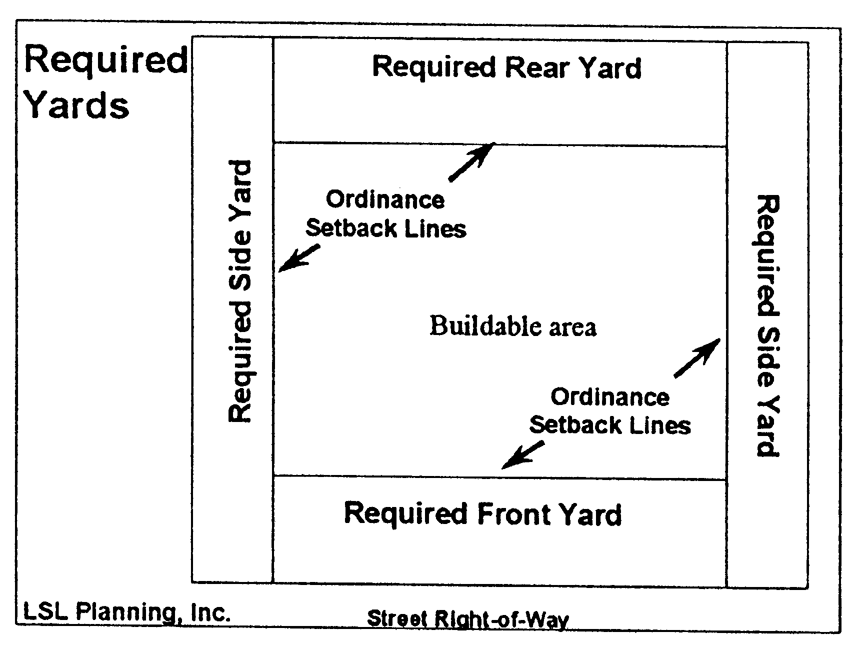
Buildable area. The space of a lot remaining after the setback and the open space requirements of
this ordinance have been satisfied.
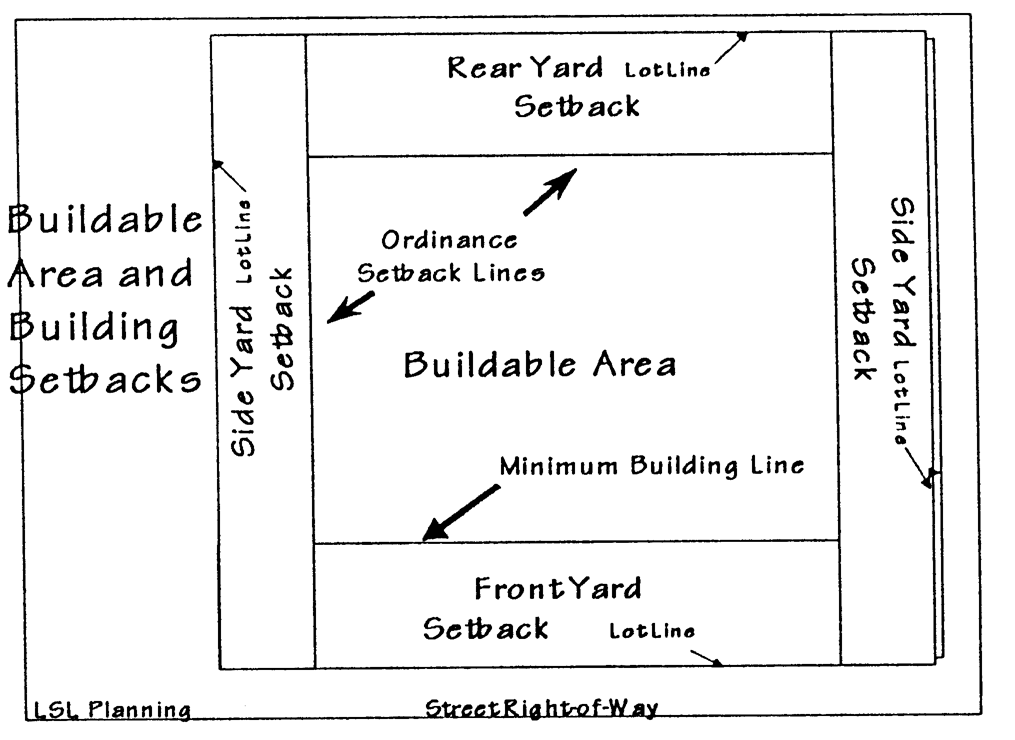
Buildable Area and Building Setbacks
Building. An independent structure, either temporary or permanent, having a roof supported by columns, or any other support used for the enclosure of persons, animals, or chattels, or carrying on business activities or other uses. When any portion of a building is completely separated from every other part of the building by division of walls from the ground up, and without openings, each portion of the building shall be deemed a separate building.
Building envelope. The area of a condominium site within which the main building or structure may be constructed as described in the master deed for the site condominium project.
Building height. The vertical distance measured from the established grade to the highest point of
the roof surface of a flat roof; to the deck of mansard roofs, and to the mean height
level between eaves and ridge of gable, hip and gambrel roofs. When the terrain is
sloping, the established grade shall be the mean level at the building wall perimeter.
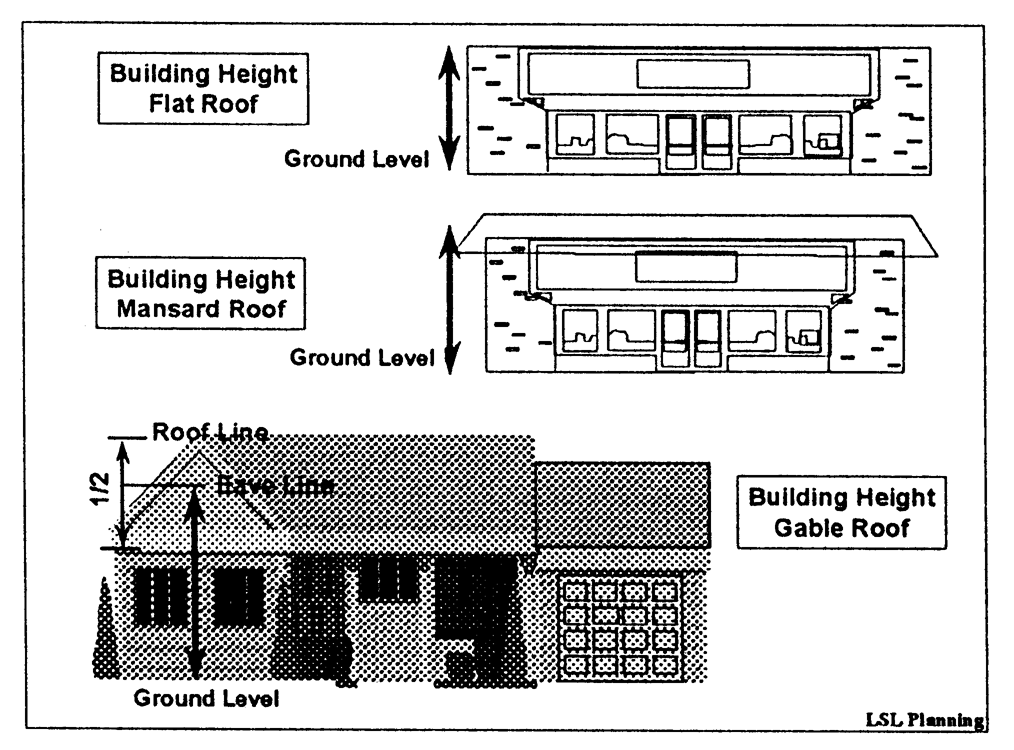
Building Height Gable Roof
Building, main. A building in which is conducted the main or principal use of the lot on which it is situated.
Building permits. The written authority as issued by the Building Inspector on behalf of the city permitting the construction, moving or alteration of a building in conformity with the provisions of this ordinance and the city's adopted building code.
Building setback. The area pertaining to the minimum setback distance required by the zoning district in which it is located, established from the front street right-of-way or property line, thus defining an area of the lot adjacent to the front, side or rear lot line in which no part of a building shall project or be located, except as otherwise provided for in this ordinance.
C.
Definitions "C."
Child care organization: An organization having as its principal function the receiving of minor children for care, maintenance, training, and supervision notwithstanding that educational instruction may be given. Child care organizations are licensed and regulated under the State of Michigan Act 116 of 1973, as amended, and include the following:
1.
Child care center (or day care center): A facility, other than a private residence, receiving one or more preschool or school age children for care for periods of less than 24 hours a day and for not less than two consecutive weeks and where the parents or guardians are not immediately available to the child.
2.
Foster family home: A private home in which one but not more than four minor children, who are not related to an adult member of the household by blood, marriage or who are not placed in the household pursuant to the adoption code, are given care and supervision for 24 hours a day, for four or more days a week for two or more consecutive weeks, unattended by a parent or legal guardian.
3.
Foster family group home: A private home in which more than four but fewer than seven minor children, who are not related to an adult member of the household by blood, marriage, or who are not placed in the household pursuant to the adoption code, are provided care for 24 hours a day, for four or more days a week for two or more consecutive weeks, unattended by a parent or legal guardian.
4.
Family child day care home: A private home in which one but fewer than seven minor children are received for care and supervision for periods of less than 24 hours a day, unattended by a parent or legal guardian, except children related to an adult member of the family by blood, marriage, or adoption. Family day care home includes a home that gives care to an unrelated minor child for more than four weeks during a calendar year. Family child day care home includes a private home with increased capacity as defined by the State of Michigan.
5.
Group child day care home: A private home in which more than six but not more than twelve minor children are given care and supervision for periods of less than 24 hours a day unattended by a parent or legal guardian, except children related to the adult member of the family by blood, marriage, or adoption. Group day care home includes a home that gives care to an unrelated minor child for more than four weeks during a calendar year. Group child day care home includes a private home with increased capacity as defined by the State of Michigan.
6.
Child caring institution: A child care facility which is organized for the purpose of receiving children for care, maintenance, and supervision usually on a 24-hour basis to more than six children in a building maintained for that purpose and operates throughout the year. It includes a maternity home for the care of un-married mothers and institutions for orphaned, mentally, emotionally, or developmentally challenged or disturbed children.
Clear vision area. An area described by section 3.06.
Clinic. A building or group of buildings where human patients are admitted for examination and treatment by a professional, such as a physician, dentist, or the like, except that human patients are not lodged therein overnight. This term is synonymous with the term "medical office."
Club. An organization of persons for specific purposes or the promotion of enterprises such as agriculture, sports, arts, science, literature, politics, or the like, but not operating for profit.
Commercial. This term relates to the use of property in connection with the purchase, sale, barter, display or exchange of goods, wares, merchandise or personal services or the maintenance of service offices or recreation or amusement enterprise. A garage/basement/yard sale operating more than four days during one three-month period is considered a commercial use.
Commercial establishment. Examples of a "commercial establishment" in various contexts would include, without limiting, the following: A business operating independent of any other business located in a freestanding building; in a strip mall, a business completely separated from other businesses by walls with a door which may regularly be used by the public for exclusive ingress and egress to that business; and, in an office building, a business holding itself out to the public as a single entity, independent of other businesses or persons.
Commercial vehicle. A motor vehicle designed, maintained or used to transport passengers for hire, constructed or used to transport goods, wares, or merchandise, or a motor vehicle designed and used for towing other vehicles for business purposes. A commercial vehicle does not include a vehicle used exclusively for non-business purposes.
Commission, city. The Kentwood City Commission.
Commission, planning. See Planning Commission.
Condominium Act. Public Act No. 59 of 1978, as amended (MCL 559.101 et seq.), of the State of Michigan.
Condominium project or site condominium project. A plan or project consisting of not less than two condominium units established in conformance with the Condominium Act (MCL 559.101 et seq.).
Condominium unit. That portion of a condominium project designed and intended for separate ownership
and use, as described in the master deed, regardless of whether it is intended for
residential, office, industrial, business, recreation, use as a time share unit or
any other type of use.
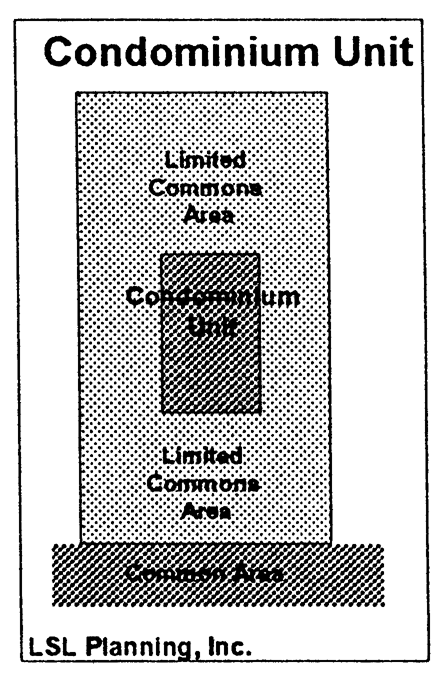
Condominium Unit
Contractible condominium. A condominium project from which any portion of the submitted land or buildings may be withdrawn in accordance with the Condominium Act (MCL 559.101 et seq.).
Convalescent home. A long-term recuperative care facility providing room and board and supervised personal care by facility staff on a 24-hour basis for the aged, the infirm or persons recovering from illness. An unlicensed extended care facility or chronic care facility providing 24-hour nursing care shall mean the same.
Convenience store. A retail food establishment of less than 10,000 square feet GFA which may supply groceries, fruits, vegetables, dairy products, baked goods, general interest newspapers, general interest magazines, confections, or similar commodities for consumption off the premises.
Conversion condominium. A condominium project containing condominium units some or all of which were occupied before the filing of a notice of taking reservations under Section 71 of the Condominium Act (MCL 559.171)
Convertible area. A unit or portion of the common elements of the condominium project referred to in the condominium documents within which additional condominium units or general or limited common elements may be created in accordance with the Condominium Act (MCL 559.101 et seq.).
Cul-de-sac. A street having one terminus open for vehicular or pedestrian access and the other terminated by a vehicular turnaround.
D.
Definitions "D."
Day care center. See "child care organizations."
Density. The number of dwelling units that may be erected on a described lot or parcel, expressed in dwelling units per acre.
Density, gross. The numerical value obtained by dividing the total number of dwelling units in a development by the gross area of the tract of land (in acres) within a development. Gross density is calculated using all land as well as rights-of-way of streets; the result being the number of dwelling units per gross acre of land.
Density, net. The numerical value obtained by dividing the total number of dwelling units in a development by the area of the actual tract of land (in acres) upon which the dwelling units are proposed to be located and including common open space and associated recreational facilities within the area; the result being the number of dwelling units per net residential acre of land. Net density calculations exclude rights-of-way of publicly dedicated streets and utilities, private road easements, and floodplain (see section 12.03.C.1 for the computation of up to 25 percent of preserved floodplain in PUD zones).
District. A portion of the city within which certain specified uses of land and/or buildings are permitted and within which certain specified regulations and requirements apply under the zoning district provisions of this ordinance.
Drive-through establishment. An establishment that furnishes the patron with a product or services from a drive-up window or other similar arrangement to be utilized or consumed outside the building. Drive-through establishments retail and/or service character are dependent on providing a driveway approach and/or parking space for motor vehicles so as to serve patrons while in or momentarily away from their motor vehicles.
Dwelling, multiple family: A building or portion of a building, used or designated for use as a residence for more than two families living independently of each other. This definition does not include manufactured homes, single family attached dwellings or two family dwellings.
Dwelling, single-family attached. A group of three or more independently owned dwelling units which are joined to one another by a common party wall, but not a common floor-ceiling. Each unit shall have its own outside entrance. For the purposes of this ordinance, dwellings such as semi-detached, rowhouses, patio-house and townhouse shall be deemed single-family attached dwellings.
Dwelling, single-family detached. A unit exclusively for use by one family which is entirely surrounded by open space or yards on the same lot.
Dwelling, two-family. A building used or designed for two dwelling units. It may also be termed a duplex.
Dwelling unit. A single unit providing complete, independent living facilities for one or more persons, including permanent provisions for living, sleeping, eating, cooking, and sanitation. In no case shall a motor home, trailer coach, automobile chassis, tent or portable building be considered a dwelling. In case of mixed occupancy, where a building is occupied in part as a dwelling unit, the part so occupied shall be deemed a dwelling unit for the purpose of this ordinance and shall comply with the provision relative to dwellings. In residential child and adult care facilities, every six beds shall be equivalent to one dwelling unit.
Bi-level is a dwelling consisting of two stories, one of which may be a basement having a vertical distance from the grade to the ceiling of four feet or more.
Split level or tri-level means a dwelling consisting of more than two levels of living space of which any two shall be at or 75 percent above the grade.
E.
Definitions "E."
Efficiency unit. A dwelling unit consisting of one room, exclusive of bathroom, hallway, closets and the like.
Electrical distribution substation. An electrical substation that steps voltage up or down and to or from electrical lines of under 69kV.
Electrical substation. A system of electrical equipment that facilitates the stepping up or down of electrical voltage. For the purposes of this ordinance, electrical substations shall include transmission substations and distribution substations.
Electrical switching station. A system of electrical equipment that interconnects several electrical transmission lines for the purpose of allowing the transmission lines to be serviced and maintained without disruption of power.
Electrical transmission lines. Electric utility wires that are generally strung on large metal or wooden towers including the towers or poles themselves whose function is the transportation of at least 69kV of electricity.
Electrical transmission substation. An electrical substation that steps voltage up or down and to or from an electrical transmission line.
Erected. The word "erected" includes built, constructed, reconstructed, moved upon or any other physical operations on the premises required for the building. Excavations, fill, drainage, and the like, shall be considered a part of erection.
Essential public services. The erection, construction, alteration or maintenance by regulated public utilities or the city of underground, surface or overhead gas, electrical, steam or water transmission or distribution systems, collection, communication supply or disposal systems shall be considered essential public services. This includes, but is not limited to, mains, drains, sewers, pipes, conduits, wires, cables, electrical switching stations and substations, fire alarm boxes, traffic signals, hydrants, towers, poles and other similar equipment and accessories reasonably necessary for the furnishing of adequate service by the public utility or city. Wireless communication towers, poles, antenna and related equipment are not essential public services.
Excavating. Excavating shall be the removal of sand, stone, gravel or fill dirt below the average grade of the surrounding land and/or street grade, whichever shall be highest, excepting common household gardening.
F.
Definitions "F."
Family means either of the following:
1.
Domestic family. One or more persons related by the bonds of blood, marriage, guardianship, or adoption who reside together as a single, domestic, housekeeping unit.
2.
Functional equivalent. One or more persons whose relationship is of a permanent, enduring, or long-term nature who reside together as a single, domestic, housekeeping unit.
Farm. The land, plants, animals, buildings, structures, including ponds used for agricultural or aquacultural activities, and the associated use of machinery, equipment, and other appurtenances in the commercial production of farm products; provided, that land to be considered a farm hereunder shall include a contiguous parcel of not less than ten acres in area.
Fence. Any permanent fence, partition, structure or gate erected as a dividing structure, barrier or enclosure, and not part of a structure requiring a building permit.
Financial institution. A commercial use operated primarily for financial transactions and other similar activities, including but not limited to, personal and business banks, credit unions, savings and loan institutions.
Finished living area. The sum of the finished horizontal areas of each story of a dwelling unit measured from the exterior faces of the exterior walls. In order for below grade square footage to constitute finished living area proper egress must be provided according to the currently adopted building code of the city. The finished living area measurement is otherwise exclusive of areas of basements lacking proper egress, unfinished attics, attached garages, breezeways, common halls, and stairways in the two family or multiple-family structures, and enclosed and unenclosed porches.
Floodplain. The area adjoining a river, stream, watercourse, or lake subject to a 100-year recurrence-interval flood as delineated by the flood boundary and floodway map prepared by the Federal Insurance Administration of the Federal Emergency Management Agency and on file with the city or the Michigan Department of Natural Resources.
Floor area, gross (GFA). The sum of the gross horizontal areas of the several floors of the building measured
from the interior faces of the exterior walls or from the centerline of wall separating
two buildings. The floor area of a building shall include the basement floor area
when more than one-half of the basement height is above the established curb level,
or finished lot grade, whichever is higher. (See Basement)
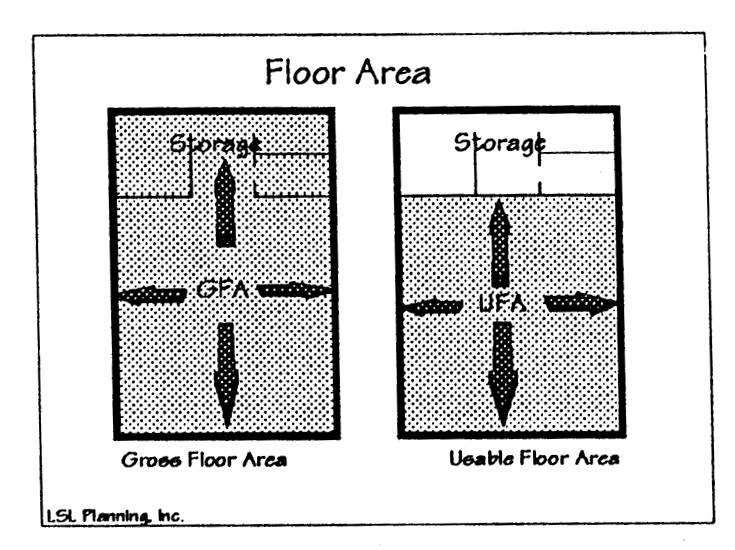
Floor Area
Floor area, main. The square foot area of a building within its largest outside dimensions computed on a horizontal plane at the main floor level, exclusive of breezeways, attached garages, enclosed and unenclosed porches, exterior stairways and interior stairways in the two family or multiple family structures. A split-level building may include as part of the square foot area requirement, a half level adjoining the main floor level.
Floor area, usable (UFA). The usable floor area shall be the gross floor area less elevator shafts and stairwells at each floor, floor space used for mechanical equipment (except equipment, open or enclosed, located on the roof), attic space having headroom of seven feet or less, or interior balconies or mezzanines. Areas of basements, utility rooms, breezeways, porches or attached garages are not included in usable floor area.
Fuel depot. A facility dealing in the sale of petroleum fuels and motor oils through an automated dispense system to motor vehicles.
Fuel stations. A building design used for the retail sale of fuel (stored only in underground tanks), lubricants, air, water and other operating commodities for motor vehicles.
G.
Definitions "G."
Garage, carport, private. A building used primarily for the storage of self-propelled vehicles for the use of the occupants of a lot on which the building is located and with a capacity of not more than three vehicles.
Garden. An accessory use which is the growing of plants for landscaping purposes which may consist of any plant (flowers, bushes, hedges, arbors, trees, groundcover, manicured lawn); food (vegetables, fruits, herbs); fibers; garden maintenance facilities (potting work area, composting); greenhouse, and other structures subject to applicable setback, height, parcel coverage, and other regulations; and including other landscape features such as but not limited to paths, walls, rocks. A garden is not commercial. A garden is not agriculture.
Garden, community. A use in which land managed by a public or nonprofit organization or group of individuals is used to grow plants and harvest food or ornamental crops for donation or for personal use by those cultivating the land.
General common elements. The common elements other than the limited common elements defined herein.
Grade. A reference plane representing the finished ground level adjoining a building at all exterior walls.
Greenhouse. A building or structure constructed chiefly of glass, glasslike or translucent material and which is devoted exclusively to the protection or cultivation of flowers or other tender plants.
H.
Definitions "H."
Home occupation. A use conducted entirely within an enclosed residential building employing only the inhabitants of the building, which is clearly incidental and secondary to residential occupancy and does not change the character of the building. Instruction in a craft, music, or fine art within a dwelling, by a resident member of the family residing in the dwelling, shall be considered a home occupation and shall be subject to the requirements for a home occupation.
Hoop house. A type of greenhouse that's built using a hooping or bending system. A hoop house can be as small as a cold frame structure hooped over a few garden rows in a backyard, or as big as a full sized, fully functional, commercial greenhouse.
Hospital. An institution providing health services, primarily for in-patients and medical or surgical care of the sick or injured, including as an integral part of the institution, the related facilities as laboratories, out-patient departments, training facilities, central service facilities and staff offices.
Hotel. A building occupied or used as a temporary abiding place by individuals or groups of individuals, with or without meals.
Housing for the elderly. An unlicensed multiple-family residential development for elderly persons (primarily for persons 60 years or older) needing little or no personal assistance, which provides independent living dwelling units for the exclusive use of the occupants, whether or not group meals or other convenience services for the elderly are provided. The terms "senior housing" and "elderly housing" shall mean the same.
I.
Definitions "I."
Industry. The manufacturing, compounding, processing, packaging, treating or assembly of products and materials in a manner which complies with all requirements of chapter 10.
J.
Definitions "J."
Junk. Any motor vehicles, machinery, appliances, products or merchandise with parts missing, scrap metals or materials that are damaged or deteriorated, vehicles or machines in a condition which precludes their use for the purpose for which they were manufactured, or inoperable motor vehicles.
Junkyard. The term "junkyard" includes automobile wrecking yards and salvage areas and includes any area of more than 200 square feet for the storage, sale, processing, keeping or abandonment of junk, including scrap metals, other scrap materials or reclaimed materials, or for the dismantling, demolition or abandonment of automobiles or other vehicles or machinery or parts of automobiles or other vehicles for profit.
K.
Definitions "K."
Kennel. Any lot or premises on which more than three dogs or cats, six months of age or older are kept.
L.
Definitions "L."
Limited common elements. A portion of the common elements reserved in the master deed for the exclusive use of less than all of the co-owners.
Loading space. An off-street space on the same lot with a building or group of buildings, for temporary parking for a commercial vehicle while loading or unloading merchandise or materials. Off-street loading space is not to be included as off-street parking space in computation of required off-street parking.
Lot. An individual portion of platted or unplatted land of at least sufficient size to meet minimum zoning requirements for use, buildings, structures, lot coverage, yards and other open spaces as may be present or required under the provisions of this ordinance. The lot shall have frontage on an improved public street, or an approved private street, and may consist of: a single lot of record, a portion of a lot of record, a combination of contiguous lots of record, or a parcel of land described by metes and bounds or a condominium unit and any limited common element under and surrounding the condominium unit, which together meet the minimum yard and area requirements required by this ordinance.
Lot area. The total horizontal area within the lot lines of a lot.
Lot corner. A lot located at the intersection of two streets or a lot bounded on two sides by a curving street, any two chords of which form an angle of 135 degrees or less.
Lot coverage. The part or percent of the lot occupied by buildings or structures, including accessory buildings or structures.
Lot depth. The mean horizontal distance from the front lot line to the rear lot line, or in the case of an acreage lot, from the front right-of-way line to the rear property line.
Lot, double frontage, through. A lot other than a corner lot having frontage on two more or less parallel streets. In the case of a row of double frontage lots, one street will be designated as the front street for all lots. If there are existing structures in the same block fronting on one or both of the streets, the required front yard setback shall be observed on those streets where the structures presently front.
Lot, interior. A lot other than a corner lot with only one lot line fronting on a street.
Lot, irregular. A lot with nonparallel lot lines and/or nonuniform lot width.
Lot lines. The property lines bounding the lot.
1.
Front lot line. In the case of an interior lot, abutting upon one public or private street, the front lot line shall mean the line separating the lot from the right-of-way. In the case of a corner or through lot, the front lot line shall be that line separating the lot from that street which is designated as the front street. (See Lot, double frontage)
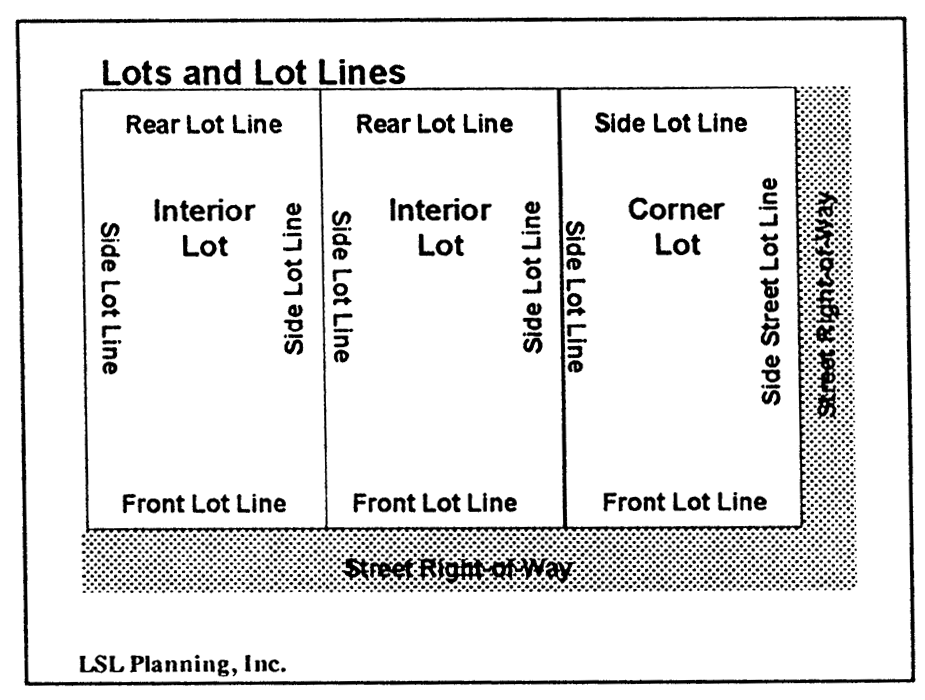
Lot Lines
2.
Rear lot line. Ordinarily, that lot line opposite and most distant from the front lot line of the lot. In the case of an irregular or triangular shaped lot, a line at least ten feet in length entirely within the lot parallel to and at the maximum distance from the front lot line of the lot shall be considered to be the rear lot line for the purpose of determining depth of rear yard. In case where none of these definitions are applicable, the zoning administrator shall designate the rear lot line. (See Lot, double frontage)
3.
Side lot line. Any lot line not a front line or a rear lot line. A side lot line separating a lot from a street is a side street lot line. A side lot line separating a lot from another lot or lots is an interior side lot line.
4.
Street or alley lot line. A lot line separating the lot from the right-of-way of a street or an alley.
Lot, nonconforming. See Nonconforming lot.
Lots of record. A lot which actually exists in a subdivision plat as shown on the records of the county register of deeds, or a lot or parcel described by metes and bounds, the description of which has been recorded as required by law.
Lot width. The distance between lot lines, at the building setback line measured parallel to
the street or street tangent line.
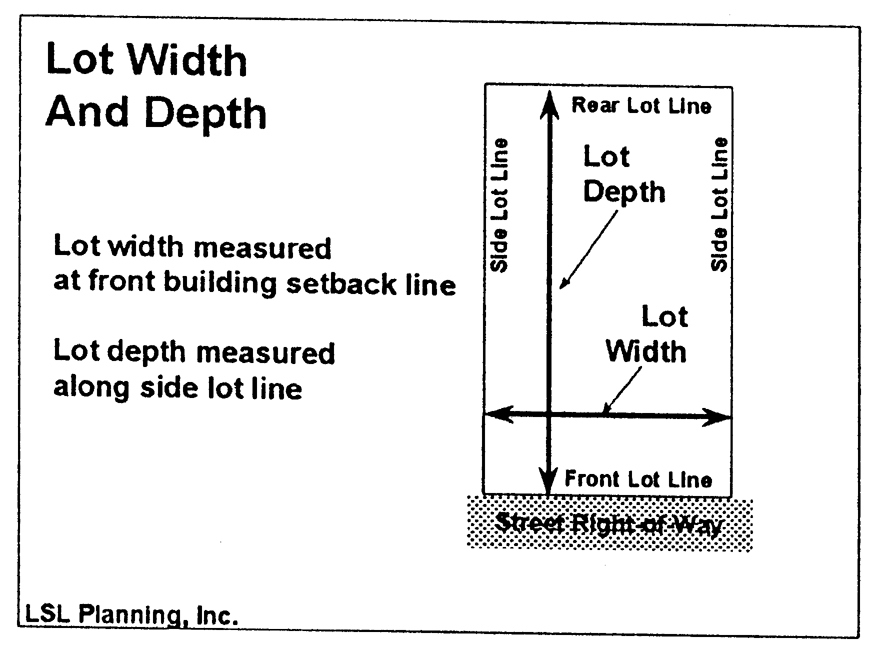
Lot Widths
M.
Definitions "M."
Main building. The building(s) in which the principal use of a lot is located.
Manufactured home (i.e., mobile home). A structure transportable in one or more sections, connected to required utilities which includes the plumbing, heating, air conditioning and electrical systems contained in the structure, built on a chassis and designed to be used as a single dwelling unit with or without permanent foundation.
Manufactured housing development. A parcel or tract of land which is under the control of one person, group or firm upon which three or more manufactured homes have been located on a continual nonrecreational basis and which is offered to the public for that purpose regardless of whether a change is made therefore, together with any building, structure, enclosure, street, equipment, or facility used or intended for use incident to the occupancy of a mobile home.
Master deed. The condominium document recording the condominium project to which are attached as exhibits and incorporated by reference the bylaws for the project and the condominium subdivision plan for the project.
Master plan. The master plan of the city which is intended to guide the physical development of all portions of the city, The plan including maps, plats, charts, policy statements and/or descriptive material, shall be that adopted in accordance with the Municipal Planning Act, Michigan Public Act No. 285 of 1931, as amended (MCL 125.31 et seq.)
Mechanical work. This term shall be synonymous with the terms vehicle repair, major and minor, and shall include any work done to repair or maintain a vehicle's mechanical and electrical components, including, but not limited to, the replenishment or addition of fluids, lubrication of parts and components, collision repair, or painting.
Medical marihuana dispensary. Any business, facility, association, cooperative, location, or operation, whether fixed or mobile, where medical marihuana (also commonly known as marijuana or cannabis) is made available to, sold, used, grown, processed, delivered, or distributed by or to one or more of the following:
1.
A primary caregiver (i.e., a person who is at least 21 years old and who has agreed to assist with a patient's medical use of marihuana and who has never been convicted of a felony involving illegal drugs, as provided for in Initiated Law No. 1 of the Public Acts of 2008, as amended).
2.
A qualifying patient (i.e., a person who has been diagnosed by a physician as having a debilitating medical condition, as provided for in Initiated Law No. 1 of the Public Acts of 2008, as amended).
3.
Members of the public.
A medical marihuana dispensary shall also include any place, location, facility, or operation, whether fixed or mobile, where medical marihuana is smoked or consumed by three or more persons at one time.
A medical marihuana dispensary shall not include the dispensation of medical marihuana by a primary caregiver personally dispensing to not more than five qualified patients in strict accordance with Michigan Initiated Law 1 of 2008, as amended, so long as the lawful amount of medical marihuana is delivered to the qualifying patient where the qualifying patient resides and it is done in full compliance with this Ordinance as well as all other applicable city ordinances and applicable Michigan and federal laws, rules and regulations.
Medical office. (See Clinic).
Motel. A series of attached, semi-attached or detached rental units with separate private entrances providing overnight lodging for transients, open to the traveling public for compensation.
Motor freight terminal. A building or area in which freight brought by truck is assembled and/or stored for routing or reshipment, or in which semitrailers, including tractor and/or trailer units and other trucks, are parked or stored.
Motor home. A motorized vehicular unit primarily designed as a temporary dwelling in connection with travel and/or recreational usage. This term does not include manufactured homes.
N.
Definitions "N."
Nonconforming lot. A lot with area or dimension lawfully existing at the effective date of this ordinance or amendments thereto with less than the minimum required for the zoning district in which it is located. This includes, but is not limited to minimum area, dimension or access requirements.
Nonconforming structure. A structure or portion of a structure lawfully existing at the effective date of the zoning ordinance or amendments thereto, and which does not conform to the current provisions of the zoning district in which it is located.
Nonconforming use. A use which lawfully occupied a building or land at the effective date of this ordinance or amendments thereto, and that does not conform to the use regulations of the zoning district in which it is located.
Nonresidential district. The C-2, C-3, C-4, CPUD, OPUD, IPUD, I-1, I-2, and OS zoning districts.
Nonresidential private street. Private street that provides ingress or egress from a public street or another private street to a nonresidential use.
Nursing home. A state licensed longterm facility providing room and board and supervised personal care by facility staff on a 24-hour basis for seven or more aged or infirm persons or persons recovering from illness which is regulated under Public Act No. 368 of 1978 (MCL 333.1101 et seq.). A state licensed sub-acute care facility, state licensed home for the aged, a state licensed nursing home, or state licensed hospice facility providing 24-hour nursing care shall mean the same.
O.
Definitions "O."
Office. A room, studio, suite or building occupied for office uses only.
Off-street parking lot. A facility providing vehicular parking spaces, along with adequate drives, aisles, and maneuvering space to allow unrestricted ingress and egress for four or more vehicles.
Open air business. Uses operated substantially in the open air including, but not limited to:
1.
Bicycle, utility truck or trailer, motor vehicle, boat, or home equipment sale, repair or rental services.
2.
Outdoor display and sale of garages, motor homes, manufactured homes, snowmobiles, farm implements, swimming pools and similar activities (either as a principal or accessory use conducted on a lot).
3.
Retail sales of trees, fruits, vegetables, shrubbery, plants, seeds, top-soil, humus, fertilizer, trellises, lawn furniture, playground equipment and other home garden supplies and equipment.
Open air business, short-term. Uses operated for a period of less than 61 days in a calendar year substantially in the open air or under a tent as an accessory use to an existing principal use conducted on the lot, which accessory uses shall be limited to:
1.
Outdoor display and sale of trees, flowers and homemade foods; or
2.
Items produced or sold by the existing principal use.
P.
Definitions "P."
Parking space. An off-street space exclusive of necessary driveways, aisles or maneuvering areas suitable to accommodate one motor vehicle and having direct unobstructed access to a street or alley.
Pawnbrokers and pawnshops. The term "pawnbroker" as used herein is defined as any person, who loans money on deposit, or pledge of personal property, or other valuable thing, other than securities or printed evidence of indebtedness, or who deals in the purchasing of personal property or other valuable thing on condition of selling the same back again at a stipulated price. The term "pawnshop" is defined as any location where a pawnbroker conducts business.
Personal service establishment. A commercial business conducting services involving the care of a person or a person's apparel that are performed primarily on the premises such as barber or beauty shops and photographic studios.
Planned unit development. A zoning district which permits integrated and coordinated residential dwellings and/or certain nonresidential uses, all to be developed according to approved area and site plans as provided in chapter 12 of this ordinance.
Planning commission. The city of Kentwood Planning Commission created under the Municipal Planning Act, being Public Act No. 285 of 1931 (MCL 125.31 et seq.), as amended. (Refer to City Code chapter 86.)
Porch, enclosed. A covered entrance to a building or structure that is totally enclosed, and projects out from the wall of the building or structure and has a separate roof or integral roof with the principal building or structure to which it is attached.
Porch, open. A covered entrance to a building or structure which is unenclosed except for columns supporting the porch roof that projects out from the wall of the building or structure.
Public service activities. Any authorized activity conducted by a person, firm, or corporation, municipal department, board or commission duly authorized to furnish to the public under federal, state or municipal regulations, gas, steam, electricity, sewage disposal, communication, telegraph, transportation, or water in furtherance of their duties and responsibilities.
Public utility. Any person, firm, corporation, or city department duly authorized to furnish, under federal, state or municipal regulations, within the city, electricity, gas, steam, sewer, transportation or water services.
Q.
Reserved for future use.
R.
Definitions "R."
Recreational equipment and vehicles. Portable structures, machines or devices, self propelled or towable by another vehicle, capable of moving upon the highways without special movement permits; primarily designed, constructed or modified to provide temporary living quarters or for recreational camping, or travel use and the trailers and other devices as shall be primarily intended for the transporting of all the structures, machines, or devices. Motorcycles, bicycles, minibikes and the vehicles such as jeeps, four-wheel drives and pickup trucks with attached cabs that do not exceed the roofline of the vehicle are specifically excluded from the provisions of this definition. This does not include a temporary building, structure or use, permitted to exist during periods of construction of the principal building, structure or use. Various types of recreational equipment and vehicles include:
1.
Travel trailer. A portable vehicle on a towing chassis, which is designed to be used as a temporary dwelling during travel, recreational, and vacation uses, and which may be identified as a "travel trailer" or a "fifth wheel" by the manufacturer. Travel trailers generally include self-contained sanitary, water, and electrical facilities. On an industry-wide basis, this type of recreational vehicle is classified as a nonmotorized recreational vehicle.
2.
Pickup camper. A structure designed to be mounted on a pickup or truck chassis with sufficient equipment to render it suitable for use as a temporary dwelling during the process of travel, recreational, and vacation uses. On an industry-wide basis, this type of recreational vehicle is classified as a nonmotorized recreational vehicle.
3.
Motor home. A recreational vehicle intended for temporary human habitation, sleeping, and/or eating, mounted upon a chassis with wheels and capable of being moved from place to place under its own power. Motor homes generally contain sanitary, water, and electrical facilities. On an industry-wide basis, this type of recreational vehicle is classified as either a class A or class C recreational vehicle. A class A or bus type recreational vehicle has the luggage compartment below the living quarter. The class C recreational vehicle is a van with the bed over the cab and is much larger than a passenger van due to the bed over the cab.
4.
Van/camper. A motorized recreational vehicle intended for temporary human habitation, sleeping and/or eating. This class of recreational vehicles includes conversion vans and camper vans that may contain refrigerator as well as water and electrical facilities. This class closely resembles passenger vans, but some models may be taller to allow for extra headroom. On an industry-wide basis, this type of recreational vehicle is classified as a class B recreational vehicle.
5.
Folding tent trailer. A folding structure, mounted on wheels for towing and designed for travel and vacation use.
6.
Boats and boat trailers. Boats, floats, rafts, canoes, plus the normal equipment to transport them on the highway.
7.
Other recreational equipment includes snowmobiles, jet skis, all terrain or special terrain vehicles, utility trailers, plus the normal equipment used to transport them on the highway.
Recreational facility. Any public or private facility designed and equipped for the conduct of sports, leisure time activities and other customary and usual recreational activities, including indoor and outdoor facilities. Such facilities may include, but are not limited to recreational fields, courts, and other similar facilities. Spectator events may be conducted at the recreational facilities provided accommodations are made for well-designed seating, parking and traffic circulation.
Recycling facility. A facility dedicated to the processing of recyclables for conversion into raw materials or new products. This definition does not include recycling stations, landfills, junkyards, or incinerators.
Recycling station. A location solely dedicated to the collection of recyclable materials for hauling to another site for processing.
Redevelopment. The substantial reinvestment in the restoration and reuse of a vacant building or area that has deteriorated and/or has been substantially unoccupied for at least five years.
Repair establishment. Any building or grounds used, or intended to be used, for the repair of vehicles, equipment, or other similar materials, including, but not necessarily limited to engine repair, maintenance, reconstruction, renovation, or other repair or refurbishing activity.
Residential district. The R-1A-D, R-2, R-3, R-4, R-5, RPUD-1 and RPUD-2 zoning districts.
Restaurant. A business establishment or use providing food service to patrons for consumption on the premises.
Restaurant, drive-through. A business establishment or use so developed that it provides a driveway approach or parking spaces for motor vehicles to serve patrons while in the motor vehicle either exclusively or in addition to service within a building or structure, or to provide self-service for patrons and food carry-out.
Restaurant, freestanding. A business establishment providing food service to patrons for consumption on the premises operated exclusively and entirely within a separate building.
Restaurant, within a shopping center. A business establishment or use providing food service to patrons for consumption on the premises operated within a retail center, with or without a separate entrance.
Retail. Any establishment or use operated primarily for the purpose of providing goods, materials, or products for sale to the public. See also "commercial" and "commercial establishment."
S.
Definitions "S."
Setback. The minimum horizontal required distance measured from the front, side or rear lot line, as the case may be, which describes a distance termed the required setback area on a lot or parcel. Setbacks for lots containing or adjoining private streets shall be measured from the pavement edge or lot line, whichever is less.
Shopping center. A group (more than one) of primary retail and/or service commercial establishments constructed as one development.
Shopping center, regional. A commercial shopping center offering merchandise for sale and providing services, that (1) consists of multiple commercial establishments located within an enclosed building (whether or not the building is constructed as a series of adjacent buildings); (2) is designated by a single name; (3) has frontage on at least two major streets; and (4) is located on a parcel or parcels of land of at least 50 acres in total area. A regional shopping center may be located on multiple parcels of land that are titled in the names of different owners, and which may be numbered differently for property tax assessment purposes, but all of such parcels shall nevertheless be deemed to constitute a single regional shopping center, so long as the aggregate area of the parcels is at least 50 acres.
Short-term rental is defined as the letting or subletting of an attached single-family dwelling, detached single-family dwelling, two-family dwelling, or any portion thereof for a period of 27 consecutive days or less. The term does not include the following:
1.
The letting of an owner-occupied or tenant-occupied attached single-family dwelling, detached single-family dwelling, two-family dwelling, or any portion thereof to a member of the owner or tenant's family.
2.
The letting of an owner-occupied or tenant-occupied attached single-family dwelling, detached single-family dwelling, two-family dwelling, or any portion thereof to a caregiver who is providing services to the owner, tenant, or a member of the owner or tenant's family who resides at the attached single-family dwelling, detached single-family dwelling, or two-family dwelling; or
3.
The letting of an attached single-family dwelling, detached single-family dwelling, or two-family dwelling by a previous owner or owner's family after closing and prior to the transfer of possession.
For the purpose of this definition, the term tenant means an individual letting or subletting an attached single-family dwelling, detached single-family dwelling, two-family dwelling, or any portion thereof for a period greater than 27 consecutive days.
Sign. Any object, device, display or structure, situated outdoors or indoors, which is used to advertise, identify, display, direct or attract attention to an object, person, institution, organization, business, product, service, event or location by any means, including words, letters, figures, design, symbols, fixtures, colors, illumination or projected images. Specific definitions for different sign types regulated by this ordinance are contained in chapter 16.
Site condominium development. A development of condominium units on an unplatted tract of land, in which each individual lot conforms to the requirements of the zoning district in which it is established.
Small group fitness and rehabilitation training facility. A training facility restricted to prearranged individual or small group fitness and rehabilitation training with instructor to trainee ratios of no more than 1:4. The small group fitness and rehabilitation training facility shall not exceed 25 percent of a building or 10,000 square feet in area (whichever is smaller) and shall be located entirely within an enclosed building.
Story. That portion of a building, other than a basement or mezzanine, included between the surface of any floor and the floor next above it, or if there is no floor above it, then the space between the floor and the ceiling next above it.
1.
A mezzanine floor shall be deemed a full story only when it covers more than 50 percent of the area of the story underneath the mezzanine, or, if the vertical distance from the floor next below it to the floor next above it is 24 feet or more.
2.
A basement or cellar shall be counted as a story only if over 50 percent of its height is above the level from which the height of the building is measured and the finished surface of the floor above the basement is more than six feet above grade plane, or, if it is used for business purposes.
Story, half. The part of a building between a pitched roof and the uppermost full story having a floor area which does not exceed one-half the floor area of the full story, provided the area contains at least 200 square feet with a clear height of at least 7½ feet.
Street, dead-end. Street that has one terminus open for vehicular or pedestrian access and the other terminated on a temporary basis without a permanent vehicular turnaround.
Street, private. A roadway contained within a private street easement which is privately owned and maintained and which provides the principal means of access to one or more abutting lots.
Private street easement. An easement that is granted exclusively for private access to one or more parcels of land that contains a private street.
Private street, minor. A private street that provides exclusive access for between two and four lots within a portion of a development.
Private street, local. A private street that provides exclusive access for between five and 15 lots.
Private street, major. A private street that provides exclusive access for 16 or more lots.
Street, public. A public, dedicated thoroughfare that affords traffic circulation and principal means of access to abutting property, e.g., avenue, place, way, drive, lane, boulevard, highway, road, and other thoroughfare, except an alley.
Public street, arterial. A public street designed to increase mobility by limiting access and increasing speed.
Public street, collector. A public street which collects traffic from local streets and connects with arterial streets.
Public street, local. A public street designed to improve access by limiting speed and maximizing the number of access points.
Street frontage. The borders or boundaries of a lot or parcel of land which abut an improved public street or an improved private street.
T.
Definitions "T."
Temporary building and use. A structure used during periods of construction of the main building.
Training facility. A specialized indoor facility devoted to physical fitness training. The training may include cardiovascular and strength training utilizing machines and equipment as well as group and individual fitness training. Training facilities are primarily for the prearranged use of specific groups and programs, rather than for general public walk-in use. This use includes specialized facilities such as pools, weight rooms, gymnasiums, classrooms and workout space. Activities may include sports training sessions and workouts with no spectator events.
U.
Definitions "U."
Use, principal. The principal purpose for which land or premises, or a building thereon, is designed, arranged or intended, for which it is occupied or maintained, let, or leased.
V.
Definitions "V."
Vehicle rental establishment. A business that deals in the rental of motor vehicles, excluding trucks and recreational vehicles.
Vehicle repair, major. Any activity involving the general repair, rebuilding or reconditioning of motor vehicles, engines or trailers; collision service, such as body, frame or fender straightening and repair; overall painting and vehicle rust-proofing; or steam cleaning.
Vehicle repair, minor. Any activity involving minor repair and maintenance of passenger vehicles and light trucks and vans, including, but not limited to vehicle detailing, oil change establishments, audio or cellular installation, and auto glass installation and repair.
Vehicle fuel station. A building and surfaced area where automotive vehicles may be refueled.
Vehicle wash establishment. A building, or portion of a building, the primary purpose of which is washing motor vehicles.
W.
Definitions "W."
Waste disposal facility. A facility for end-of-the-line storage or incineration of solid and/or liquid waste including but not limited to household garbage, yard waste, and nonhazardous industrial byproducts.
Wireless communication equipment. The set of equipment and network components used in the provision of wireless communication services, including, but not limited to, antennas, transmitters, receivers, base stations, equipment shelters, cabinets, emergency generators, power supply cables, coaxial and fiber optic cables, but excluding wireless communications support structures.
Wireless communication support structure. A structure that is designed to support, or is capable of supporting, wireless communication equipment. A wireless communication support structure may include a monopole, lattice tower, guyed tower, water tower, utility pole or building.
Wireless facility, small cell. A wireless facility that meets both of the following requirements:
(i)
Each antenna is located inside an enclosure of not more than six cubic feet in volume or, in the case of an antenna that has exposed elements, the antenna and all of its exposed elements would fit within an imaginary enclosure of not more than six cubic feet.
(ii)
All other wireless equipment associated with the facility is cumulatively not more than 25 cubic feet in volume. The following types of associated ancillary equipment are not included in the calculation of equipment volume: electric meters, concealment elements, telecommunications demarcation boxes, grounding equipment, power transfer switches, cut-off switches, and vertical cable runs for the connection of power and other services.
X.
Reserved for future use.
Y.
Definitions "Y."
Yard. A yard is an open space of prescribed width or depth on the same land with a building or group of buildings, which open space lies between the building or group of buildings and the nearest lot line and is unoccupied and unobstructed from the ground upward, except as otherwise provided herein.
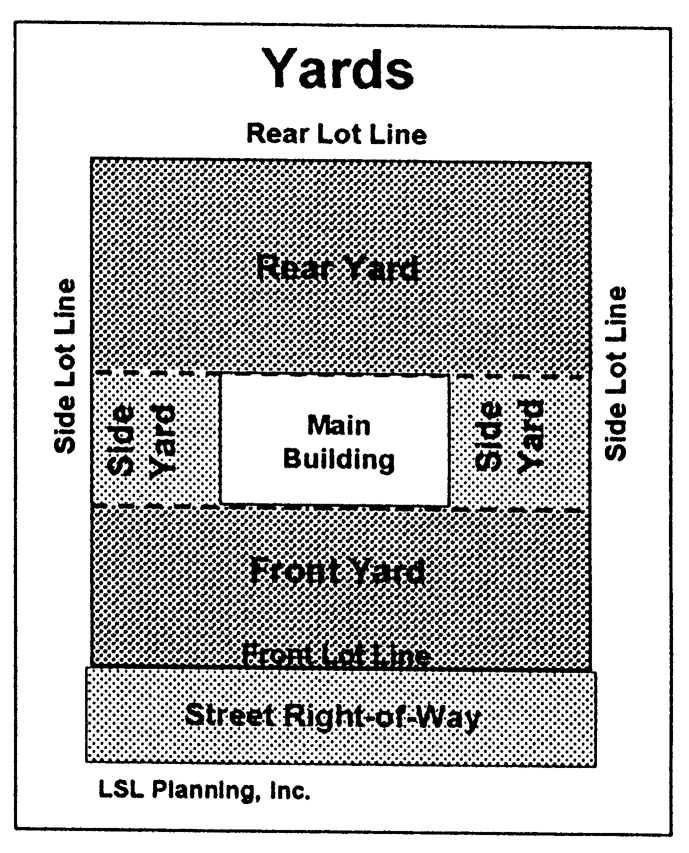
1.
Front yard. A front yard is an open space extending the full width of the lot, the uniform depth of which is the minimum prescribed horizontal setback distance measured at right angles to the front lot line and is unoccupied space between the front lot line and the nearest line of the main building, excepting steps and unenclosed porches.
2.
Rear yard. A rear yard is an open area extending across the full width of the lot, the uniform depth of which is the minimum prescribed horizontal setback distance measured at right angles to the rear lot line, describing an unoccupied space between the rear lot line and the nearest line of the main building.
3.
Side yard. A side yard is an open unoccupied area between a main building and the side lot lines, extending from the front yard area to the rear yard area. The width of the required side yard shall be measured from the center of the nearest wall of the building or structure to the nearest point of the side lot line.
Yard, required. A required yard is an open space on a lot prescribed by the requirements of the zoning district in which it is located.
Z.
Definitions "Z."
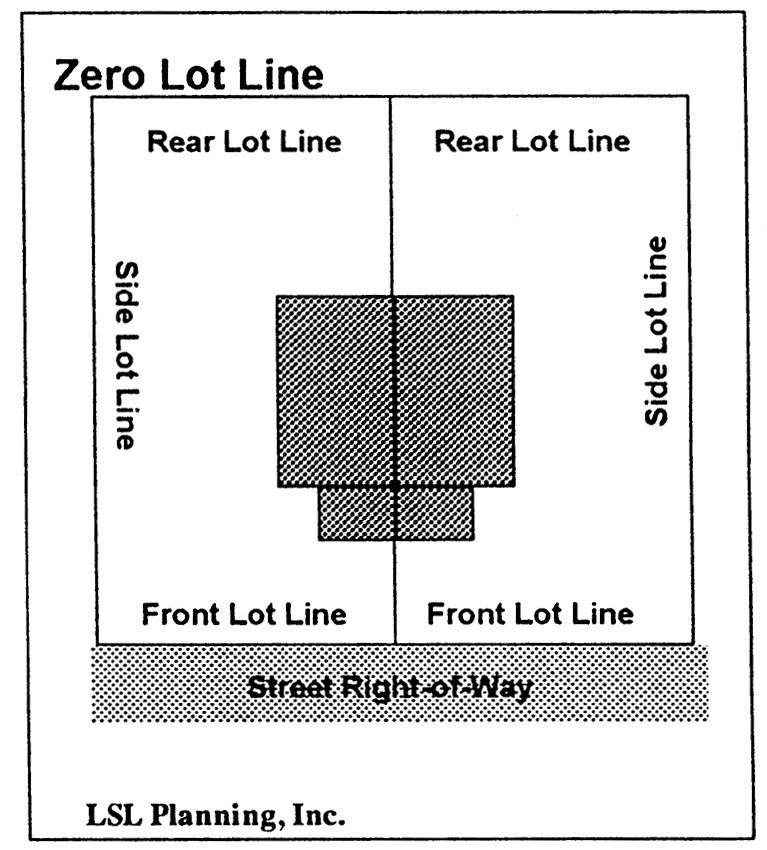
Zero lot line, single-family detached dwelling. A unit exclusively for use by one family which is constructed so that one wall is sited directly, or nearly directly, on a side lot line.
Zoning Act. The city and Village Zoning Act of Michigan, Public Act 207 of 1921, as amended (MCL 125.581 et seq.).
Zoning Administrator. The person or persons designated by the city to interpret and enforce the provisions of this ordinance.
(Ord. No. 7-03, § 2(2.02), 4-1-2003; Ord. No. 5-04, § 1, 5-2-2004; Ord. No. 6-06, § 1, 4-30-2006; Ord. No. 11-08, § 1, 8-29-2008; Ord. No. 12-08, § 1, 9-26-2008; Ord. No. 4-10, § 1, 10-22-2010; Ord. No. 3-13, §§ 1, 2, 3-13-2013; Ord. No. 4-14, §§ 1—3, 5-14-2014; Ord. No. 6-14, § 4, 8-19-2014; Ord. No. 9-16, § 13, 12-20-2016; eff. 12-30-2016; Ord. No. 2-17, § 2, 2-7-2017, eff. 2-17-2017; Ord. No. 10-17, § 1, 9-19-2017; Ord. No. 2-18, § 1, 1-16-2018; Ord. No. 7-18, § 1—5, 5-1-2018; Ord. No. 1-19, §§ 2, 3, 3-18-2019; Ord. No. 1-21, § 4, 3-22-2021, eff. 4-1-2021; Ord. No. 9-21, § 2, 11-16-2021; Ord. No. 6-22, § 2, 12-20-2022; Ord. No. 2-23, §§ 1, 2, 2-21-2023; Ord. No. 7-23, § 1, 6-20-2023)

