
Kentwood City Zoning Code
CHAPTER 17
- OFF-STREET PARKING AND LOADING8
Cross reference— Stopping, standing and parking, § 66-61 et seq.
Section 17.01.- Scope.
In all zoning districts, off-street parking facilities for the storage and parking of self-propelled motor vehicles for the use of occupants, employees and patrons of the buildings hereafter erected, altered or extended after the effective date of this ordinance, shall be provided as prescribed in this chapter. This space shall be maintained and shall not be encroached upon so long as the main building or structure remains, unless an equivalent number of spaces are provided elsewhere in conformance with this ordinance.
Section 17.02. - Location of parking.
A.
Accessory uses. Off street parking and loading spaces are considered accessory uses and shall be located in accordance with the provisions of this chapter.
B.
Zoning district. Unless otherwise permitted by this ordinance, all parking spaces and structures serving the primary use of the parcel must be in the same zoning district as the primary use.
C.
Shared parking.
1.
In the case of mixed uses in the same building, the total requirements for off-street parking and loading shall be the sum of the requirements for the separate individual uses computed separately.
2.
Joint or collective provision of off-street parking for buildings or uses on two or more properties shall not be less than the sum of the requirements for the participating individual uses computed separately.
D.
Deferred parking.
1.
Where it is determined by the city that the parking requirements for a particular proposed use would be excessive a parking lot plan shall be prepared and approved designating portions of required parking spaces and paving reserved for future use. Likewise, a parking deferment may be imposed upon a finding that parking in excess of the standard parking requirements would be initially excessive.
2.
The approval shall require reserved areas to be covered with lawn and shall include conditions under which the reserved parking areas must be paved.
3.
Alterations to the deferred parking area to add parking spaces may be initiated by the owner or required by the zoning administrator, based on parking needs, and shall require the submission and approval of an amended site plan, as required by chapter 14.
4.
The zoning administrator may require construction of additional parking within the deferred parking area if a change of use occurs for the building or property for which the deferred parking was approved.
E.
Other land uses. The off-street parking required may be located on each site or in parking lots conveniently located and readily accessible to each site. The consideration of convenience and accessibility shall include:
1.
Parking spaces located within 300 feet of building entrances.
2.
Access to parking does not involve crossing a public or private street.
3.
Defined pedestrian route provided through the parking area.
Section 17.03. - Parking lot plans.
A.
The construction of any parking lot shall comply with the requirements of this ordinance. Construction shall be completed and approved by the staff review team before actual use of the property as a parking lot and before a certificate of occupancy is issued. Each parking space must meet the minimum area requirements and meet any other engineering standards as deemed necessary by the Planning Commission.
B.
Parking lot plans.
1.
All parking lots exceeding ten percent coverage of any lot shall require a permit. The plans are to be prepared in a presentable form by person or persons competent in parking lot design.
2.
Plans for the layout of the proposed parking lot must be submitted to the zoning administrator, prepared at a scale of not less than one inch equals 50 feet and indicating:
a.
existing and proposed grades;
b.
drainage, including pipe sizes;
c.
dimensions of parking spaces (including barrier free), drives and aisles;
d.
type and locations of curbing;
e.
lighting, including fixture types and pole heights;
f.
adjacent main buildings;
g.
sidewalks;
h.
landscaping (in accordance with the requirements of chapter 19);
i.
surfacing and base materials to be used; and
j.
transit access and stop locations.
Section 17.04. - Parking spaces.
A.
The number of parking spaces required for individual uses are contained in the development requirements of the zoning district in which the use is located. Parking requirements for a use not mentioned within the zoning district shall be the same for that use which is most similar to the use not listed, as determined by the zoning administrator.
B.
Each parking space shall have a reasonably direct means of ingress and egress from an alley or a street.
C.
The minimum parking space dimensions for a layout not provided for in this section shall be nine feet in width, 18 feet in length, and 162 square feet in area.
D.
For the purpose of this chapter the average parking area consisting of a parking space and adjacent maneuvering aisle space, shall be deemed to be 300 square feet.
E.
Parking and maneuvering areas must be designed in accordance with the following schedule:
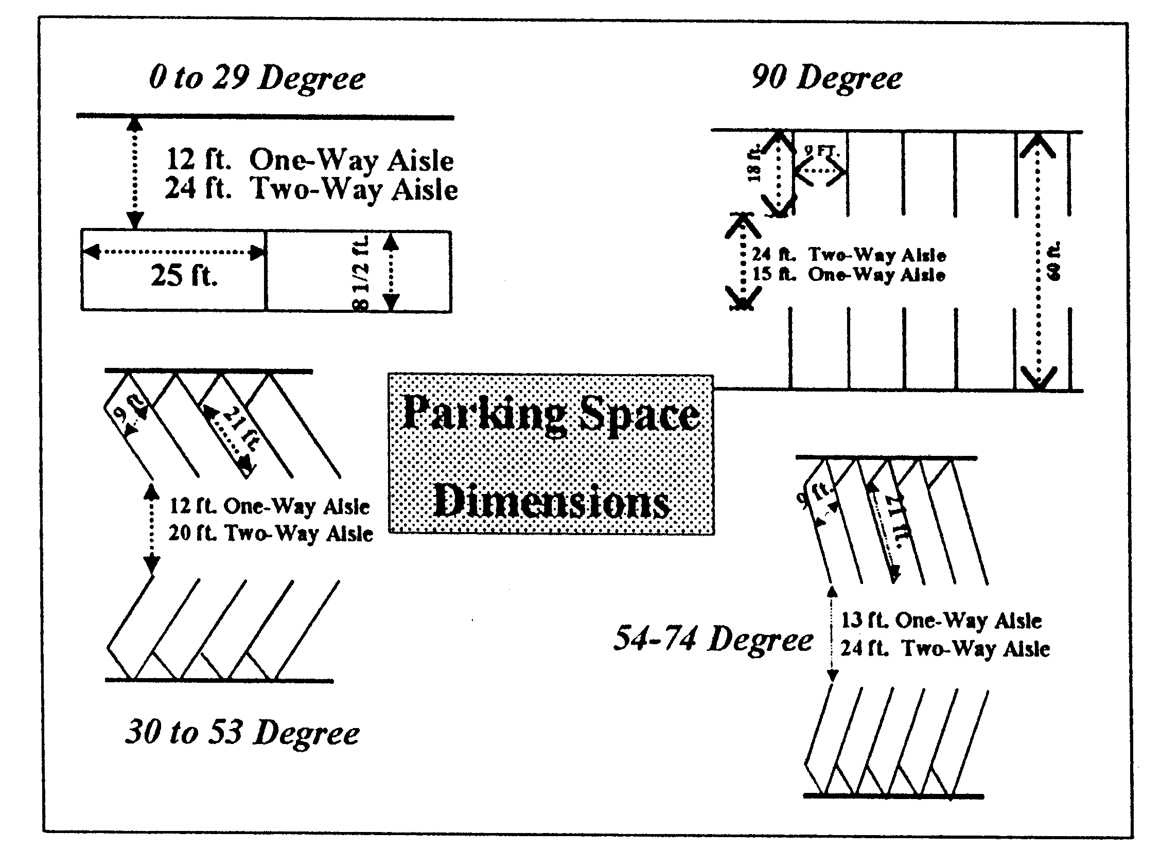
Parking Space Dimensions
Section 17.05. - Units of measure.
A.
Fractional requirements. When units or measurements determining number of required parking spaces result in requirement of a fractional space, any fraction up to, and including one-half may be disregarded and fractions of one-half or more shall require one parking space.
B.
For purposes of parking computations for nonresidential uses the following floor area definitions shall apply:
1.
Usable floor area (UFA) shall mean the floor area used for service to the public. It shall not include floor area used for storage or the processing and packaging of merchandise where it is carried on in a room in which service to the public is not involved.
2.
Gross floor area (GFA) shall include usable floor area and that devoted to storage, processing, packaging and utilities.
C.
In hospitals, bassinets shall not be counted as beds.
D.
Where benches, pews or other similar seating facilities are used as seats, every 24 inches of these seating facilities shall be counted as one seat.
E.
In the cases of mixed uses in the same building, the total requirements for off street parking and loading shall be the sum of the requirements for the separate individual uses computed separately.
Section 17.06. - General requirements.
A.
Construction requirements.
1.
All parking facilities, including driveways and maneuvering areas, required for uses located within each zoning district shall be hard-surfaced with a pavement having an asphalt or concrete binder, shall be graded and drained so as to dispose of surface water which might accumulate within or upon the paved area, and shall be completely constructed prior to a certificate of occupancy being issued.
2.
No surface water from the parking area shall be permitted to drain onto adjoining property unless a watershed easement has been obtained.
3.
Adequate ingress and egress to the parking lot, by means of limited and clearly defined drives, shall be provided for all vehicles.
4.
Wheel stops shall be provided and so located as to prevent any vehicle from projecting over walkways or the lot or setback lines. All parking areas providing more than five parking spaces shall be designed so as to not make it necessary for vehicles to back directly onto a street.
B.
Illumination.
1.
All illumination for or on parking lots shall be deflected away from adjacent residential areas and roadways and shall be installed in a manner to allow the reduction of the amount of light on other than normal parking hours each day.
2.
The source of illumination in all parking lots abutting or within 100 feet of a residential district or use shall not be more than 20 feet above the parking lot surface.
3.
Light fixtures shall be provided with light cut-off fixtures that direct light downward.
4.
Lighting shall not be attached to buildings or other structures that permit light to be directed horizontally. Lighting shall also comply with the requirements of chapter 20.
C.
Nonresidential parking area abutting residential district or use:
1.
Except for the C-5 zone district, the respective side and rear yard setback in which the parking is located shall be a minimum of 45 feet of which 20 feet nearest the respective property line is developed as a buffer zone. In the C-5 zone the respective side and rear yard setback in which parking is located shall be consist of a minimum of a 15-foot buffer zone C along the respective property line equipped with a six-foot high vertical screen.
2.
The buffer zone shall extend the entire depth of the side of the lot in the case of the side yard parking adjoining residential use, or the width of the rear of the lot in the case of rear yard parking adjoining the residential use.
3.
The required buffer zone shall incorporate a minimum six-foot high vertical screen except in required front yard areas or within 17 feet of a side lot line fronting a street.
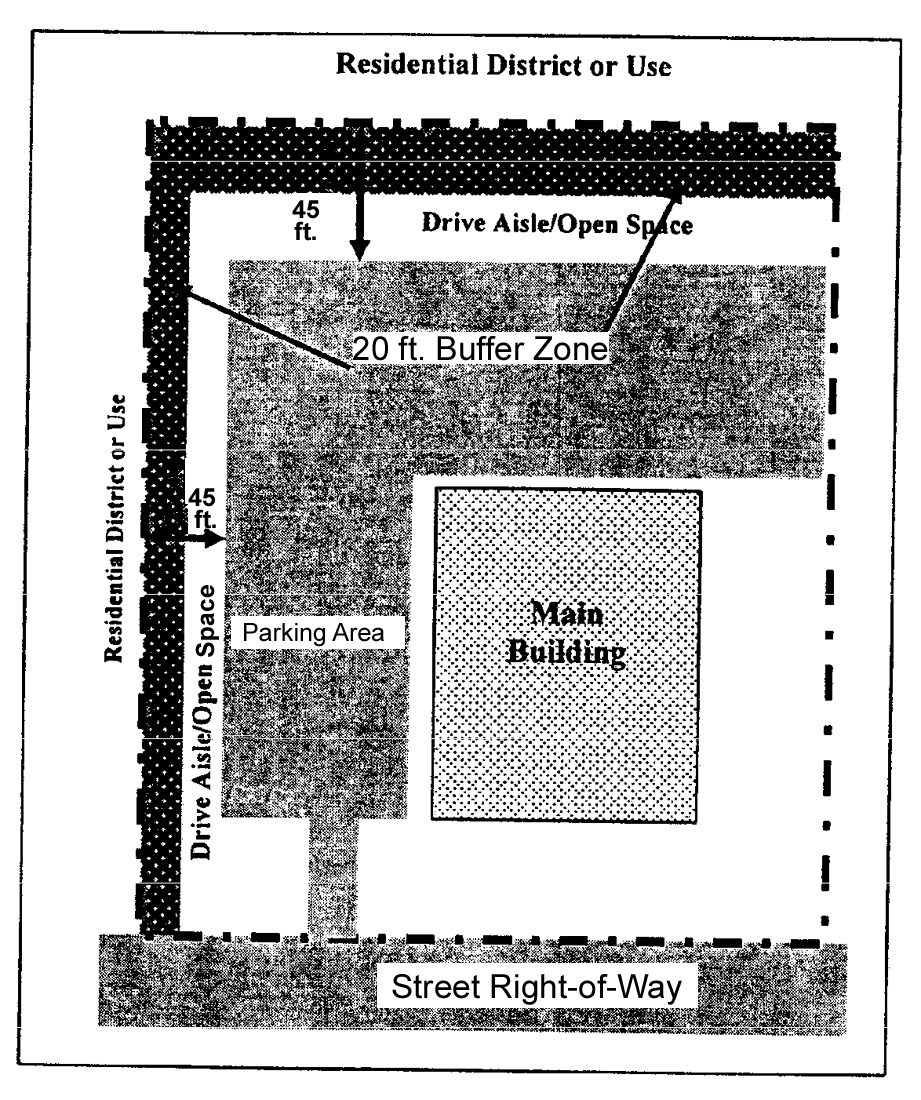
Residential District or Use
D.
Maintenance. All paved areas shall be continuously maintained including striping, labeling, patching and snow removal.
(Ord. No. 11-08, § 10, 8-29-2008)
Section 17.07. - Existing off-street parking at effective date of ordinance.
A.
Off-street parking existing at the effective date of this ordinance serving an existing use shall not be reduced in size to less than that required under the terms of this ordinance.
B.
Additional parking shall be provided and maintained in proper ratio to any increase in floor area or building use capacity.
Section 17.08. - Parking restrictions.
A.
After the effective date of this ordinance it shall be unlawful for the owner, tenant or lessee of any lot, parcel or tract of land in a residential district or in the residential area of any other district, to permit or allow the open storage or parking, either day or night, thereon of heavy equipment, semi-tractors and/or semi-trailers or other commercial vehicles with a gross vehicle weight rating of more than 10,000 pounds. It is provided, however, that the owner, tenant or lessee of a farm may openly store the machinery and equipment used on his farm; and it is further provided that equipment necessary to be parked overnight on a lot, parcel or tract of land during construction work thereon shall be exempted from this restriction. The zoning administrator may issue up to a one week temporary special exception permit to park a semi-trailer in the parking lot of an institutional use located in a residential area.
(Ord. No. 4-10, § 5, 10-22-2010; Ord. No. 9-16, § 4, 12-20-2016; eff. 12-30-2016)
Section 17.09. - Off-street loading requirements.
A.
On the same premises with every building or part thereof, erected and occupied for commercial, industrial or other similar use involving the receipt or distribution of vehicles, material or merchandise, there shall be provided and maintained on the lot adequate space for standing, loading or unloading services in order to avoid undue interference with street or parking areas.
B.
Off-street loading space areas shall not be construed, as, or counted towards, the supplying of area required as off-street parking space area.
C.
The loading and unloading space, unless completely and adequately provided for within a building, shall be a minimum area of ten feet by 25 feet with 14-foot height clearance, and shall be provided according to the following schedule:
D.
Loading deferment.
1.
Where an applicant demonstrates that the loading requirements for a particular proposed use would be excessive a parking lot plan can be approved designating portions of required loading spaces and paving reserved for future use. Likewise, a loading deferment may be imposed upon a finding that the standard loading requirements would be initially excessive.
2.
The approval shall include conditions under which the reserved loading areas must be provided.
3.
Alterations to the deferred loading area to add loading spaces may be initiated by the owner or required by the zoning administrator, based on loading needs, and shall require the submission and approval of an amended site plan, as required by chapter 14.
4.
The zoning administrator may require construction of additional loading within the deferred loading area if a change of use occurs for the building or property for which the deferred loading was approved.
Section 17.10. - Access management and driveway spacing standards.
A.
Purpose.
1.
The purpose of this section is to establish standards for driveway spacing and the number of driveways along arterial roads for application during the site plan review process. The need for these standards is based on findings through several national studies (which studies are on file with the city) that the number of driveways has a direct relationship to the number of crashes and efficiency of traffic flow. Recommendations on access management have also been included in several studies and plans in which the city was a participant.
2.
The standards of this section are intended to promote safe and efficient travel, reduce potential for vehicle crashes, minimize disruptive and potentially hazardous traffic conflicts; separate traffic conflict areas; protect the substantial public investment in the street system; improve accessibility to help maintain economic prosperity, and ensure reasonable access to land uses, through not always the most direct access.
B.
Applicability.
1.
These standards apply to site plans and subdivisions along arterial streets as defined in the master plan. Some of these streets are under the jurisdiction of the Kent County Road Commission or Michigan Department of Transportation (MDOT). Construction within the public right-of-way still must also meet the permit requirements of the road agency. Where any conflicts arise, the more stringent standard shall apply. Applicants should first obtain site plan approval prior to a request for an access permit from the road agency.
2.
Major and minor arterials as classified in the city master plan include:
a.
28th Street
b.
29th Street
c.
32nd Street
d.
36th Street
e.
44th Street
f.
52nd Street
g.
60th Street
h.
Breton Avenue
i.
Burton Street
j.
Division Avenue
k.
East Beltline (M-37)
l.
Eastern Avenue
m.
East Paris Avenue
n.
Kalamazoo Avenue
o.
Patterson Street
p.
Shaffer Avenue
Section 17.11. - Standards for access location, spacing and design.
A.
General. Driveways shall be located so as to minimize interference with the free movement of traffic, to provide adequate sight distance, and to provide the most favorable driveway grade.
B.
Number. The number of driveways shall be the minimum necessary to provide reasonable access for regular traffic and emergency vehicles. Typically one access point may be provided per lot.
C.
Spacing from median crossovers. Driveways along arterials with a median shall be located to ensure proper distance for vehicles to weave between the median crossover and the driveway. The location shall be based on consideration of existing traffic conditions, expected number of movements associated with the driveway, types of vehicles (autos versus trucks), topographic constraints and similar operational factors. The city may seek recommendations from other agencies, as applicable, prior to site plan approval.
D.
Offsets. To reduce left-turn conflicts, new commercial/industrial driveways should be aligned with driveways or streets on the opposite side the roadway where possible. If alignment is not possible, driveways should be offset a minimum of 250 feet (spacing measured between centerlines). Longer offsets may be required depending on the expected inbound left-turn volumes of the driveways.
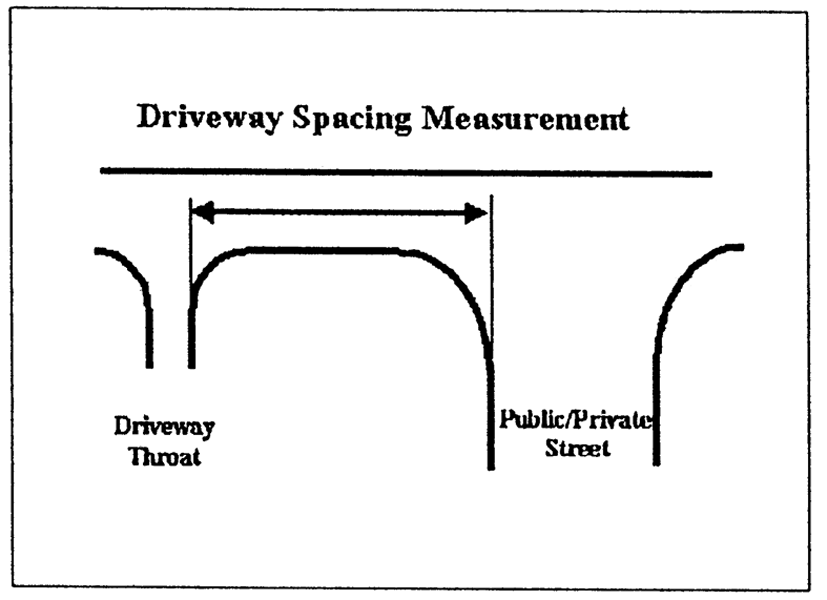
Driveway Spacing Measurement
E.
Spacing from intersections along arterial streets.
1.
Minimum spacing requirements between a proposed driveway and an intersection shall be established on a case-by-case basis during site plan review. Consideration will be given to: present traffic conditions; typical length of queuing (vehicles stopped waiting at the intersection) during peak times; and relationship to other access points provided that the spacing shall not be less than the distance listed below. Spacing at signalized intersections in particular may need to be greater than the minimum listed. The following measurements are from the near edge of the proposed driveway, measured at the throat perpendicular to the street, to the near lane edge of the intersecting street or pavement edge for uncurbed sections.
2.
For sites with insufficient street frontage, construction of a driveway along a side street, a shared driveway with an adjacent property, construction of a driveway along the property line farthest from the intersection, or a service/frontage road may be required.
F.
Spacing from intersections along nonarterial streets. When a site has frontage along a nonarterial road, that access shall be a minimum of 150 feet from the intersection, provided a longer distance may be required based on traffic conditions at a particular intersection.
G.
Service drives.
1.
Access from a side street, connections between uses to create a shared driveway, a frontage road or a rear service drive connecting two or more properties or uses may be required, in the following cases:
a.
Where recommended in a corridor plan.
b.
When the driveway could potentially interfere with traffic operations at an existing or potential traffic signal location.
c.
The property frontage has limited sight distance.
d.
The fire department recommends a second means of emergency access.
2.
Service roads shall generally be parallel or perpendicular to the front property line and may be located either in front of, adjacent to, or behind, principal buildings and may be placed in required yards. In considering the most appropriate alignment for a service road, setbacks of existing or proposed buildings and anticipated traffic flow for the site shall be considered. Each property owner shall be responsible for maintaining the service/frontage road and a shared access and maintenance agreement shall be submitted to the city recorded with the Kent County Register of Deeds. The burden for recording shall lie with the property owners.
H.
Elevation. Service drives shall have a minimum width of 24 feet and be designed to facilitate extensions or connectors in the future, where appropriate. The site plan shall indicate the proposed width and elevation of the service/frontage road at the property line. The planning department shall maintain a record of service road elevations so design grades can be coordinated for connections and extensions.
I.
Temporary access. Temporary access points may be approved where a continuous service road is not yet available and a performance bond or escrow is created to assure elimination of temporary access when the service road is continued.
J.
Driveway width. For high traffic generators, or for commercial/industrial driveways along roadways experiencing or expected to experience congestion, two egress lanes may be required (one as a separate left turn lane).
K.
Modification of standards for special situations. During site plan review the standards of this chapter may be modified upon consideration of the following without review by the zoning board of appeals. The city may require submittal of a traffic impact study, and a concurring report from the city Engineer to demonstrate a public benefit if the modification is approved.
1.
The standards of this section would prevent reasonable access to the site.
2.
Access via a shared driveway or service/frontage road is not possible due to the presence of existing buildings or topographic conditions.
3.
Roadway improvements (such as the addition of a traffic signal, a center turn lane or bypass lane) will be made to improve overall operations prior to project completion, or occupancy of the building.
4.
The use involves the redesign of an existing development or a new use, which will generate less traffic than the previous use.
5.
The modification shall be of the minimum amount necessary.
L.
Closure of preexisting curb cuts. As part of a zoning review, the city shall order the closure of preexisting curb cuts where necessary to accomplish the purposes of this chapter.

