
Kentwood City Zoning Code
CHAPTER 20
- LIGHTING STANDARDS
Section 20.01.- Intent and purpose.
The purpose of this chapter is to protect the health, safety and welfare of the public by recognizing the need for buildings and sites to be illuminated for safety, security and visibility for pedestrians and motorists balanced against the often detrimental affects associated with the use of outdoor lighting. This chapter provides standards for various forms of lighting that will: minimize light pollution; reduce the potential for off-site impacts; preserve the restful quality of nighttime by eliminating intrusive artificial light and lighting that unnecessarily contributes to sky glow; reduce light pollution and light trespass from light sources onto adjacent properties; enhance customer and employee safety; contribute to improving visibility by requiring illuminated areas to have uniform light; and curtail the degradation of the nighttime visual environment.
Section 20.02. - Applicability.
The standards in this chapter shall apply to any light source visible beyond the property from which it is emanating. The zoning administrator may review any building or site to determine compliance with the requirements under this chapter. Whenever a person is required to obtain a building permit, electrical permit for outdoor lighting or illuminated signs, a special land use approval, subdivision approval or site plan approval from the city, the applicant shall submit sufficient information to enable the zoning administrator or his/her designee and/or Planning Commission to determine whether the proposed lighting will comply with this chapter.
Section 20.03. - Lighting definitions.
The following words, terms and phrases, when used in this chapter, shall have the meanings ascribed to them in this section, except where the context clearly indicates a different meaning:
A.
Average illumination. The overall average of all points on the surface of the illuminated area including the brightest and dimmest points.
B.
Canopy structure. Any overhead protective structure, which is constructed in a manner to allow pedestrians/vehicles to pass under.
C.
Flood light. A fixture designed to "flood" a well-defined area with light.
D.
Footcandle (fc). A unit of illumination produced on a surface all points of which are one foot from a uniform point source equivalent to one candle in brightness of illumination.
E.
Glare. The sensation produced by a bright source within the visual field that is sufficiently brighter than the level to which the eyes are adapted to cause annoyance, discomfort, or loss in visual performance and visibility; blinding light. The magnitude of glare depends on factors such as the size, position, brightness of the source, and on the brightness level to which the eyes are adapted.
F.
Lamp. The component of the luminaire that produces the actual light including luminous tube lighting.
G.
Lamp lumen depreciation (LLD). Factor (between 0.0 and 1.0) used to describe how the lamp output changes with time compared to the initial output. Depends principally on lamp type. Typical LLD factors for outdoor lighting types are as follows: metal halide: 0.84, compact fluorescent: 0.85, high pressure sodium: 0.91 and mercury vapor: 0.79.
H.
Light loss factor (LLF). Factor (between 0.0 and 1.0) describing light output of a luminaire after losses due to dirt accumulation (luminaire dirt depreciation, LDD) and lamp lumen depreciation (LLD), relative to the output when the lamp and luminaire are new. LLF = LDD x LLD
I.
Light fixture. The assembly that holds a lamp and may include an assembly housing, a mounting bracket or pole socket, a lamp holder, a ballast, a reflector or mirror, and a refractor or lens. A light fixture also includes the assembly for luminous tube and fluorescent lighting.
J.
Light pollution. Artificial light which causes a detrimental effect on the environment, enjoyment of the night sky or causes undesirable glare or unnecessary illumination of adjacent properties.
K.
Light trespass. The shining of light produced by a luminaire beyond the boundaries of the property on which it is located.
L.
Luminaire. The complete lighting system including the lamp and light fixture.
M.
Luminaire dirt depreciation (LDD). Factor (between 0.0 and 1.0) used to describe how much light produced by the lamp is lost to dirt accumulation and other changes in the optical characteristics of the luminaire, relative to the value when the luminaire is new. Depends on the quality of the luminaire, materials used, maintenance, environment.
N.
Mounting height. The vertical distance between the surface to be illuminated and the bottom of the light source.
O.
Outdoor light fixtures. Outdoor artificial illuminating devices, outdoor fixtures, lamps and other similar devices, permanently installed or portable, used for flood lighting, general illumination or advertisement.
P.
Shielded fixture. Outdoor light fixtures shielded or constructed so that light rays emitted by the fixture are projected below the horizontal plane passing through the lowest point on the fixture from which light is emitted, i.e. a shoebox-type fixture or a cutoff fixture as defined by the Illuminating Engineering Society of North America. The fixtures almost always have a flat, horizontally oriented lens and opaque (usually metal) sides. A luminaire mounted in a recessed fashion under a canopy or other structure so that the surrounding structure effectively shields the light in the same manner is also considered fully shielded for the purposes of this chapter.
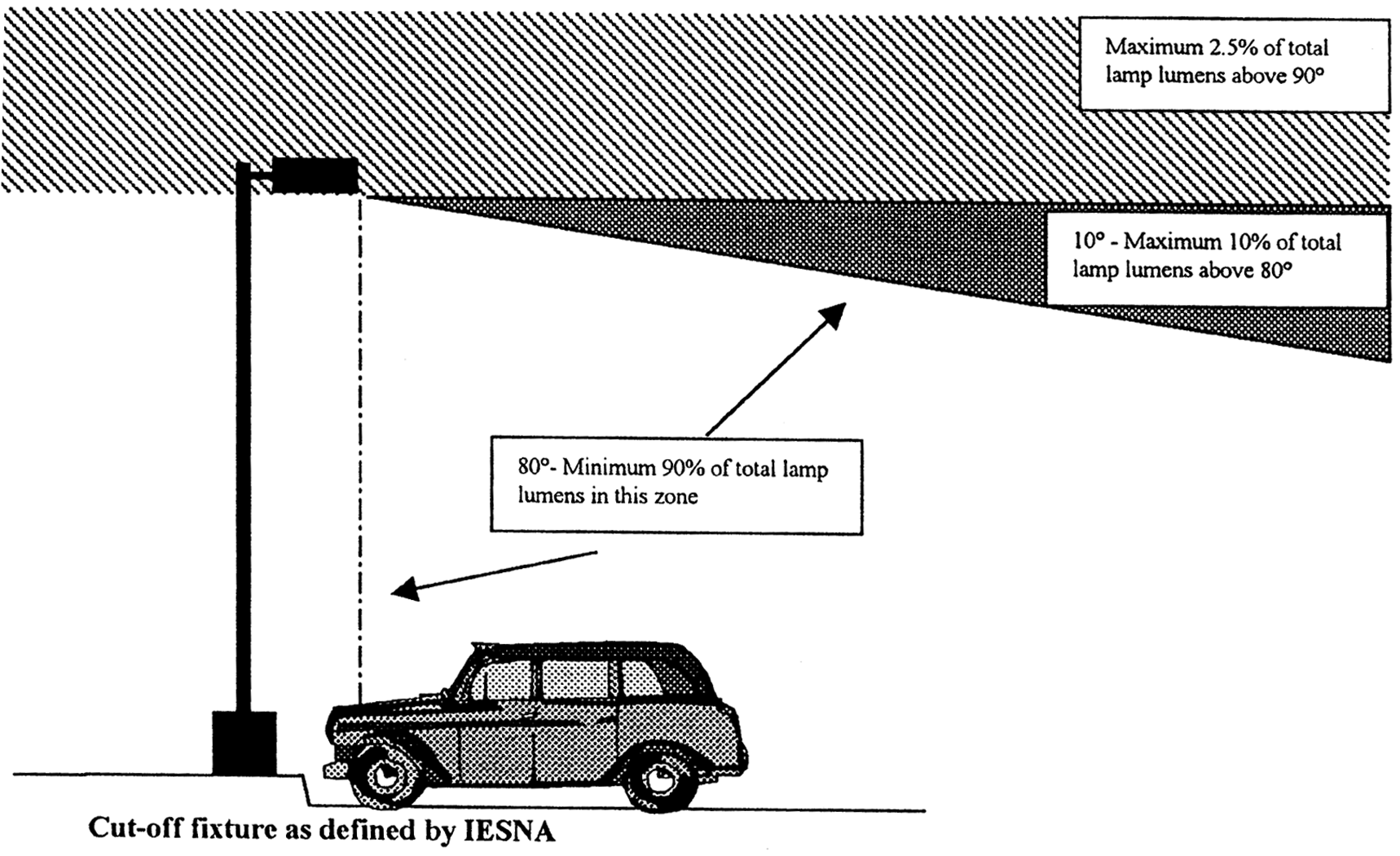
Lamp Lumens
Q.
Spot light. A lighting assembly designed to direct the output of a contained lamp in a specific tightly focused direction (a beam) with a reflector located external to the lamp.
R.
Uniformity. In outdoor lighting, uniformity is a measure indicating how evenly light is distributed across a surface. Typically the measure is expressed as a ratio of one value to another, such as average to minimum, or maximum to minimum. Using ratios, perfect uniformity would be 1:1.
Section 20.04. - Submittal requirements.
The following information must be included for all site plan submissions which include any new exterior lighting and where site plan approval is not required, some or all of the items may be required by the zoning administrator prior to lighting installation:
A.
Location of all outdoor lighting fixtures, including but not limited to freestanding pole fixtures, building-mounted and canopy light fixtures on the site plan and building elevations;
B.
Photometric grid overlaid on the proposed site plan indicating the light intensity throughout the site (in footcandles). Measurements must be at ground level and shown at ten-foot spacing;
C.
Manufacturer's specification sheets and details for the type of fixture being proposed including but not limited to the total lumen output, type of lamp, distribution type and method of shielding;
D.
Maximum footcandle calculation, minimum footcandle calculation, minimum to maximum and minimum to average uniformity ratios and light loss factor used. These statistics shall be provided for areas where vehicular and pedestrian movement is provided for and for other areas as necessary to show compliance with standards of section 20.06;
E.
Use of fixture(s) proposed; and
F.
Any other information deemed necessary by the zoning administrator in accordance with the intent and purpose of this chapter.
Section 20.05. - General standards.
A.
Unless otherwise permitted within section 20.06 or 20.08, only shielded fixtures as defined in section 20.03 may be used. Any interior light fixtures that are deemed to be causing glare and therefore not meeting the purpose or intent of this ordinance shall be shielded to prevent glare at the property line.
B.
Decorative fixtures using lamps with low wattages do not have to be shielded; these include incandescent lamps of 60 watts or less, glass tubes filled with neon, argon and krypton and any other light source of 50 watts or less. Decorative luminaries above 50 watts shall have internal and/or external reflectors that shield the light source.
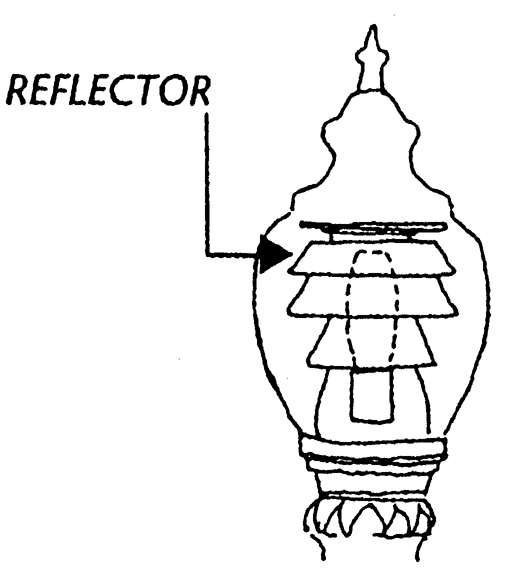
Reflector
C.
It is recognized that metal halide and fluorescent lamps are superior lights for color and object recognition when compared to other lamp types such as low and high pressure sodium or mercury vapor. Therefore, use of metal halide and fluorescent lamps is highly encouraged over low or high pressure sodium or mercury vapor lamps. It is also recognized that as the lighting industry develops, new lamp types are occasionally introduced that may have similar characteristics as the currently preferred types that may also be desirable for use in outdoor lighting.
D.
The intensity of light on a site shall not exceed three-tenths (0.3) footcandles at any property line that abuts a residential zoned property or 0.5 footcandles for any other zoned property. To encourage energy conservation, it is recognized that some commercial, office and industrial sites may desire to share fixtures along property lines or allow light to trespass onto adjacent sites. Such light trespass shall be allowable if a letter of permission is provided by the property owner where the light trespass is occurring and if the footcandle intensities meet the intent and purpose of this ordinance.
E.
All exterior lighting shall be designed in a consistent and coordinated manner for the entire site.
F.
Indirect internal illumination of signs and canopies is permitted provided a maximum 125 watt bulb is utilized and the transmittal surface is of a color and material that effectively shields lamps.
Section 20.06. - Lighting intensity and uniformity standards.
The following lighting intensity and uniformity standards shall be used in designing an outdoor lighting plan as required within section 20.04.
Footnotes to chart:
1 The above statistics should only be applied to the area of each site devoted to the particular use. For example, a gas station/restaurant combination may have an area dedicated as a parking lot for the restaurant patrons and in addition have a pump island canopy. In this scenario two sets of statistics would need to be generated; one set for the parking lot and the other set for the canopy area.
2 Measurements for average to minimum uniformity ratio, required minimum footcandle reading, maximum allowable average illumination and maximum allowable footcandle reading shall be generated at the surface intended to be illuminated; e.g., pavement or area surface. These statistics shall be provided for areas where vehicular and pedestrian movement is provided for and other areas as necessary to show compliance with standards.
3 Building facades and signs shall not be illuminated if they are of glass, polished metal or other glossy surface including painted surfaces. Building facades shall also not be entirely illuminated, illumination shall be for architectural ornament and/or the illumination of small areas for visibility and security. For spotlight fixtures, no less than 90 percent of the light beam must be concentrated on the surface intended to be illuminated. For fixtures mounted directly to a wall surface or sign, external shields or dark colored nonreflective surface materials or other appropriate methods shall be used to minimize reflectance glare.
4 The maximum height of parking lot light fixtures shall be 20 feet when within 150 feet of a residential zone or public or private roadway, fixture heights may be as high as 25 feet on commercial, office and industrial sites when not within 150 feet of a residential zone or public or private roadway. For large developments such as a regional mall, the zoning administrator may approve fixtures mounted as high as 35 feet.
A.
Exterior recreational facilities. For exterior recreational facilities, sufficient information must be submitted in addition to that required in section 20.04 that demonstrates that the location, selection and aiming of all lighting fixtures will focus light on the playing areas, minimize glare and visibility from adjacent and nearby properties and roadways and minimize sky glow. A written explanation and statements shall be supplied explaining why locations, fixtures types, intensities, orientation of fixtures and other decisions were made. Lighting of sports facilities shall not be operated except during and turned off no later than 45 minutes after the event is over.
B.
Uses not specifically listed. For uses not specifically listed within this subsection, but determined to be of a type, use and or intensity that may be detrimental to achieving the purpose of this ordinance, the zoning administrator, depending on the purpose of the lighting, shall classify lighting into one of the categories contained in section 20.06. An applicant may appeal an initial classification to the zoning administrator, in writing, detailing why more intense lighting or less lighting is necessary. The zoning administrator shall either approve or deny the appeal based on whether or not sufficient justification has been submitted and whether the proposal meets the intent of city ordinances. Final determinations of the zoning administrator may be appealed to the zoning board of appeals.
Section 20.07. - Prohibited outdoor lighting.
A.
The use of laser light source, searchlights or any similar high intensity light for outdoor advertisement or entertainment is prohibited.
B.
Lighting shall not be of a flashing, moving or intermittent type.
Section 20.08. - Exemptions.
The following are exempt from the lighting requirements of this chapter, provided that they have no glare or other detrimental effects on adjoining streets or property owners:
A.
Private swimming pools;
B.
Holiday decorations;
C.
Window displays;
D.
Pedestrian walkway lighting;
E.
Residential lighting; and
F.
Street lights.
Section 20.09. - Lamp or fixture substitution.
Should any light fixture regulated under this chapter, or the type of light source therein, be changed after the permit has been issued, a change request must be submitted to the zoning administrator for his approval, together with adequate information to assure compliance with this code, which must be received prior to substitution.
Section 20.10. - Administration.
A.
An outdoor lighting permit shall be issued on a form from the planning department if it is determined by the Planning Commission and/or staff that a proposal fulfills the requirements and intent and purpose of this ordinance. The permit shall list what is being approved and contain copies of relevant documents.
B.
The zoning administrator has the discretion to require the re-direction of existing light fixtures when it is determined that the fixture is creating off-site glare.

