
Kentwood City Zoning Code
CHAPTER 3
- GENERAL PROVISIONS
Section 3.01.- Intent and purpose.
The general regulations contained in this chapter shall apply to all zoning districts except as otherwise noted. The regulations apply to multiple zoning districts and are not repeated within the individual chapters.
Section 3.02. - Essential public services.
A.
The erection, construction, alteration or maintenance of essential public services shall be permitted as authorized or regulated by law and other ordinances in any use district, except as otherwise provided for in this ordinance.
B.
New electrical substations, and electrical switching stations in any zoning district except the I-1 and I-2 districts must receive special land use approval from the Planning Commission.
C.
Commercial wireless telecommunication services are not an essential public service.
(Ord. No. 2-17, § 3, 2-7-2017, eff. 2-17-2017)
Section 3.03. - Building and structure height exceptions.
A.
Height requirements may be exceeded by no more than 15 feet for the following: chimneys, cooling towers, elevator bulkheads, fire towers, gas tanks, grain elevators, silos, stacks, stage towers and scenery lofts, water tanks, public monuments, church spires, radio and television antennas and towers, and penthouses or roof structures housing necessary mechanical appurtenances. Parapet walls may not exceed four feet in height. Height of amateur radio antennas and supporting structures shall be governed by section 3.28 of this ordinance. The provisions of section 3.28 do not apply to citizen band radio operators.
B.
Height exceptions are not permitted for towers or structures used in the support of commercial wireless telecommunication services. These towers and structures may be permitted by the Planning Commission as a special land use governed by the provisions of this ordinance.
(Ord. No. 7-03, § 3(3.03), 4-1-2003; Ord. No. 5-04, § 2, 5-2-2004)
Cross reference— Buildings and building regulations, ch. 74.
Section 3.04. - Required area or space.
A.
No lot or lots in common ownership and no yard, court, parking area or other space shall be so divided, altered or reduced as to make the area or dimension less than the minimum required under this ordinance. If already less than the minimum required under this ordinance, the area or dimension shall not be further divided or reduced.
B.
Accessory buildings, including enclosed porches and garages, attached to a dwelling or to other main buildings shall be deemed a part of the main buildings for the purpose of determining yard space, areas and setbacks.
Section 3.05. - Basis for determining yard requirements.
A.
The required front yard shall be measured from the right-of-way line to the nearest foundation or building wall of the building or structure; provided that where an existing setback line has been established by existing buildings occupying 50 percent or more of the frontage within the same block or where unplatted, within 200 feet of the proposed building, such established setback shall apply.
B.
A corner lot shall have a front lot line and a street side lot line.
C.
Projections into yards.
1.
Architectural features, as defined, not including vertical projections, may extend or project into a required side yard not more than four inches for each one foot of width of the side yard and may extend or project into a required front yard not more than four feet.
2.
Unenclosed porches, steps, patios or similar construction may not project into a required front or rear yard setback for a distance to exceed ten feet. No projection is allowed into a required side yard.
D.
Irregular lots.
1.
The minimum distance between side lot lines at the street right-of-way shall be 40 feet measured in a straight line.
2.
The minimum required lot width shall be measured at a straight line drawn between the two side lot lines. This line will be drawn from the points along the side lot lines at which the required front setback distance for the district is met. If the minimum lot width is not met at the required setback distance, the minimum required setback line shall be moved further into the lot to the point at which the minimum lot width is met.
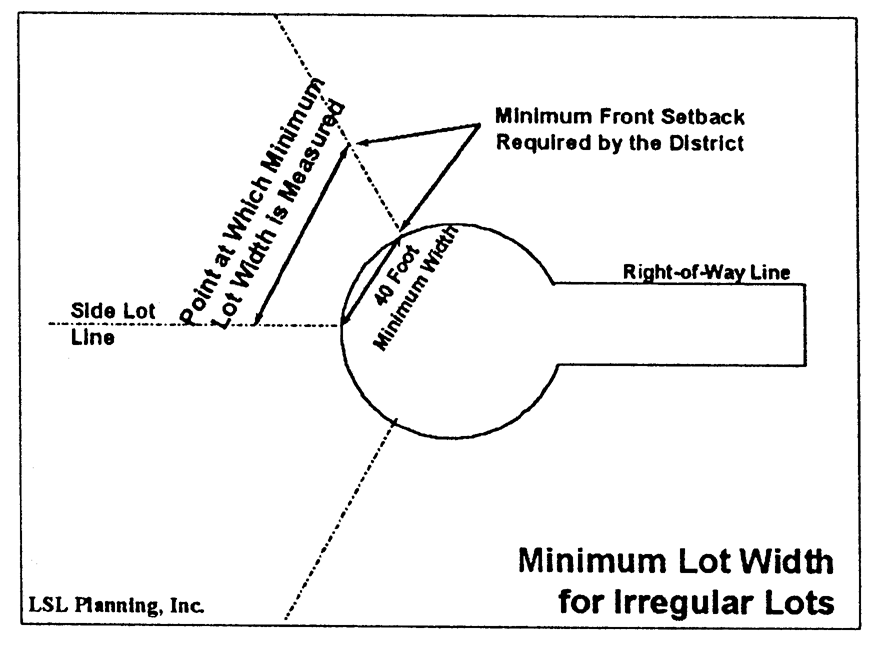
(Ord. No. 9-16, § 6, 12-20-2016; eff. 12-30-2016)
Section 3.06. - Clear vision area.
A.
No plantings or structures shall be established or maintained on any corner lot or along any driveway that will likely result in obstructing the view of a vehicle driver approaching the intersection or entering or exiting the driveway.
B.
On corner lots, the clear vision area shall mean a triangular area formed by the street property lines and a line connecting them at points 25 feet from the intersection of the street lines or in the case of a rounded property corner from the intersection of the street property lines extended.
C.
This shall not prohibit the maintaining of shrubbery less than 30 inches in height in this area.
D.
Tree branches shall be a minimum of ten feet above the adjoining street level within the clearance corner.
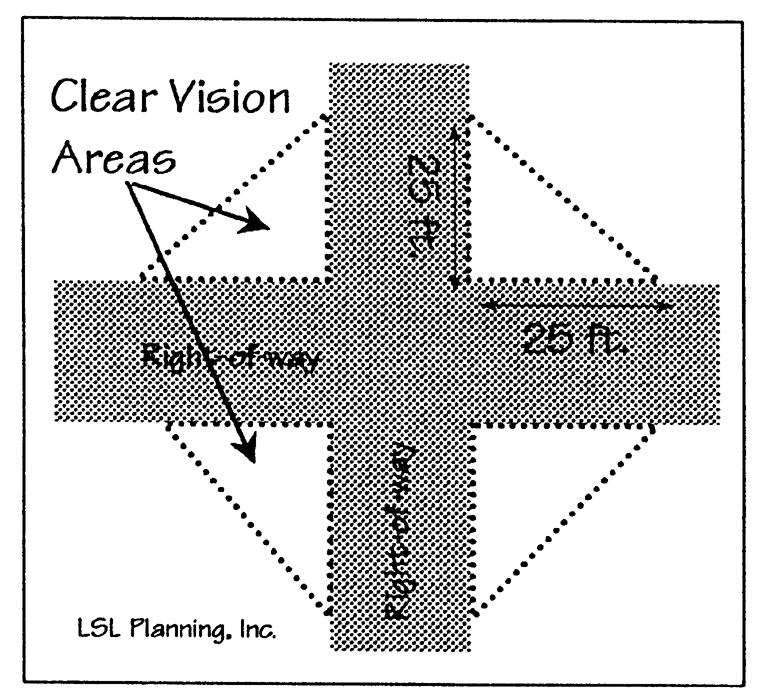
Clear Vision Areas
(Ord. No. 11-05, § 1, 7-17-2005)
Section 3.07. - Street access.
Any lot of record created after the effective date of this ordinance shall have the minimum lot width as required by this ordinance upon a public street or lawful private street right-of-way or easement.
Section 3.08. - Principal use.
No lot may contain more than one main building or principal use, with the following exceptions: groups of apartment buildings, retail business buildings, within those areas of the community regulated under chapter 23, Form Based Code, or other groups of buildings contained within a single integrated complex. An integrated complex may share parking, signs, access, and other similar features which together form a unified function and appearance that the Zoning Administrator deems to be a principal use collectively.
(Ord. No. 10-17, § 2, 9-19-2017)
Section 3.09. - Mechanical appurtenances.
Mechanical appurtenances such as blowers, ventilating fans, and air conditioning units shall be placed not closer than five feet to adjoining properties or buildings and shall not be located in the front yard of any lot.
Section 3.10. - Sidewalk requirements.
Unless provided for elsewhere within City Ordinance, any new development in a residential, commercial, industrial, or planned unit development must provide sidewalks conforming to city standards along all portions of its property which border a public street. The city commission, upon the recommendation of the Planning Commission, may adopt by resolution a list of streets exempted from this sidewalk requirement.
(Ord. No. 1-21, § 14, 3-22-2021, eff. 4-1-2021)
Cross reference— Streets, sidewalks and other public places, ch. 54.
Section 3.11. - Swimming pools and other similar structures.
A.
A fence approved by the zoning administrator shall be erected on any lot on which there is located a commercially manufactured swimming pool, hot tub, or other similar structure (below ground or above ground) which contains 24 inches or more of water in depth at any point. The approved fence shall be erected and maintained either surrounding the property or pool area in a manner sufficient to make the swimming pool inaccessible to small children. The fence will not be required if a motorized pool cover is installed in accordance with the current State of Michigan Residential Building Code.
B.
The fence, including the gates, must not be less than four feet above ground level. All gates must be self-latching with latches placed four feet above ground level or otherwise made inaccessible from the outside to small children.
1.
For above ground pools or other similar structures, if the walls enclosing or making up the structures are four feet or greater in height, the wall shall be considered as meeting the requirements of this section.
2.
If steps are included for access to above ground pools or other similar structures, the steps must be gated, as required by this section, or otherwise removed or secured from the pool wall when the pool is not in use so as to be inaccessible to small children.
C.
Any part of the pool or other similar structures shall be set back a minimum of six feet from any side or rear property line. Pools or other similar structures are not permitted in the front yard.
(Ord. No. 9-16, § 8, 12-20-2016; eff. 12-30-2016)
Section 3.12. - Animal keeping.
A.
The keeping of up to three of any combination of the following domestic animals is allowed by right in all zone districts: dogs and cats.
B.
Except as provided for in Appendix A, section 3.12.A., the keeping of other domestic animals, fowl or insects including ducks, rabbits, pigeons, chickens, goats and bees in residential districts is allowed only with a permit from the zoning administrator after notification of the adjacent property owners.
1.
Poultry and other fowl. Single and two family lots of less than one acre allowed up to six and single and two family lots of one acre or more six per acre not to exceed a maximum of 20.
a.
No roosters, no outdoor slaughter, personal consumption only, no commercial sales.
b.
Kept in fully enclosed shelter and fully fenced (sides and top) run located in the rear yard at all times.
c.
Shelter and/or run shall be setback at least 20 feet from any adjacent residence or business structure and no closer than ten feet to any lot line (for six or fewer). Shelter and/or run shall be setback at least 35 feet from any adjacent residence or business structure and 20 feet to any lot line (for more than six).
d.
Shelter area shall be no less than one square foot per poultry or fowl nor greater than four square feet per poultry or fowl up to a maximum of 240 square feet in area with a maximum height of six feet.
e.
Maximum area of the run shall not exceed 64 square feet for six or fewer poultry or fowl. For more than six the run shall not exceed ten square feet per poultry or fowl.
f.
Coops and runs must be tended daily. Accumulation of waste materials (feed, manure and litter) is prohibited. All waste materials shall be disposed of so as not to create a nuisance.
2.
Honeybees. Maximum of two hives on lots of one acre or less. Up to two hives per acre (maximum of 20 active hives) for lots greater than one acre. No commercial sales.
a.
Hives must be located in the rear yard and setback a minimum of ten feet from any property line.
b.
A hive must be enclosed on four sides by a barrier at least six feet in height. Maximum height for a hive is five feet. Maximum area for a hive is 20 cubic feet.
c.
An adequate supply of water for the bees shall be located close to each hive. In any instance in which a hive exhibits aggressive or swarming behavior, the beekeeper must ensure that the colony is re-queened. Aggressive behavior is any instance in which unusual aggressive characteristics such as stinging or attacking without provocation occurs.
3.
Rabbits and goats. Maximum of three rabbits on lots of one acre or less and up to six rabbits per acre for lots greater than one acre (maximum of 20 rabbits). Maximum of one goat allowed only on a lot of over one acre. No commercial sales.
a.
Rabbits and goats must be kept in fully fenced run at all times. Shelter and fenced area for rabbits and goats run shall be setback at least 20 feet from any adjacent residence or business structure and at least ten feet from any lot line.
b.
Shelter and fenced run must be tended daily. Accumulation of waste materials (feed, manure and litter) is prohibited. All waste materials shall be disposed of so as not to create a nuisance.
C.
Subject to zoning administrator approval, in the R1-A estate residential or R1-B single-family residential zones, up to two horses on a noncommercial basis are permitted when adequately housed and fenced on a parcel of land not less than two acres in area. The zoning administrator may allow for one additional horse to be kept per each additional acre over two acres up to a maximum of four horses.
(Ord. No. 7-03, § 3(3.12), 4-1-2003; Ord. No. 7-18, § 6, 5-1-2018)
Section 3.13. - Repair and/or sale of motor vehicles.
A.
Mechanical work on trucks or race cars, stock or otherwise, owned by the occupant of a dwelling or on any vehicles not owned by an occupant of the premises is prohibited in residential zones. Mechanical work on owner-operated vehicles may be performed by the occupant-owner but must be performed entirely within an enclosed building. Parts or vehicles not in a legally operative condition shall be stored inside.
B.
Section 3.13.B. The display of vehicles for sale on private property is addressed by Section 66-63 of the Code of Ordinances City of Kentwood, Michigan.
(Ord. No. 9-16, § 9, 12-20-2016; eff. 12-30-2016)
Section 3.14. - Storage outdoors in residential district.
A.
The outdoor storage or parking of recreational vehicles including, but not limited to, special purpose automobiles, boats, floats, rafts, camping or travel trailers, motorized homes or detachable travel equipment adaptable to light duty trucks is prohibited anywhere on any street right-of-way or public utility easement or rights-of-way. These provisions also apply to utility trailers or trailers used for storage, transport, display or demonstration purposes.
B.
Parking of utility trailers and recreational equipment in a residential district, including but not limited to boats, boat trailers, camping trailers, motorized dwellings, tent trailers, houseboats and house vans is permitted, subject to the limitations set forth by City Code chapter 86.
(Ord. No. 10-09, § 3, 12-25-2009)
Section 3.15. - Accessory buildings.
Except as otherwise permitted in this ordinance, accessory buildings shall be subject to the following regulations:
A.
General requirements.
1.
Accessory buildings are permitted only in connection with, incidental to and on the same lot with a principal use or main building permitted in the particular zoning district.
2.
No accessory building shall be occupied or utilized unless the main building to which it is an accessory is occupied or utilized.
3.
All accessory buildings shall comply with the use limitations applicable in the zoning district in which it is located.
4.
No detached accessory building shall be used in any part for residential purposes.
5.
If an accessory building is attached to a main building by any wall or roof construction, it shall be subject to and must conform to all regulations of this ordinance applicable to main buildings.
6.
All accessory buildings and use combined shall cover no more than 30 percent of the rear yard. Swimming pools shall not count towards this restriction.
B.
Height restrictions. No detached accessory building in a residential district shall exceed one story or 14 feet in height. Accessory buildings in nonresidential districts shall not exceed the height requirements of the district in which they are located.
C.
Location regulations.
1.
Yard locations.
a.
In the R1 and R2 Residential Districts, an accessory building shall be located in the rear yard of the lot except when attached to the main building; except, an accessory building of 250 square feet or less may be located in a non-street side yard when it is setback at least 15 feet from the front wall of the main building, setback at least five feet from any main building, and setback at least five feet from any side lot line.
b.
In the case of multiple family developments, parking garage or covered bays may be permitted in any yard, but not within any required yard.
2.
Setbacks.
a.
No detached accessory building shall be located closer than five feet to any main building or closer to any street right-of-way line than permitted for a main building.
b.
The drip edge of any detached accessory building 576 square feet or less in area shall be located no closer than three feet to any side or rear lot line. Detached accessory buildings between 576 square feet and 960 square feet in area shall be located no closer than five feet to a side lot line and 30 feet to a rear lot line. Detached accessory buildings in excess of 960 square feet in area shall meet the rear yard and side yard setback requirements for main use buildings of the zoning district in which they are located.
c.
When an accessory building is located on a corner lot it shall meet the front yard setback of both streets.
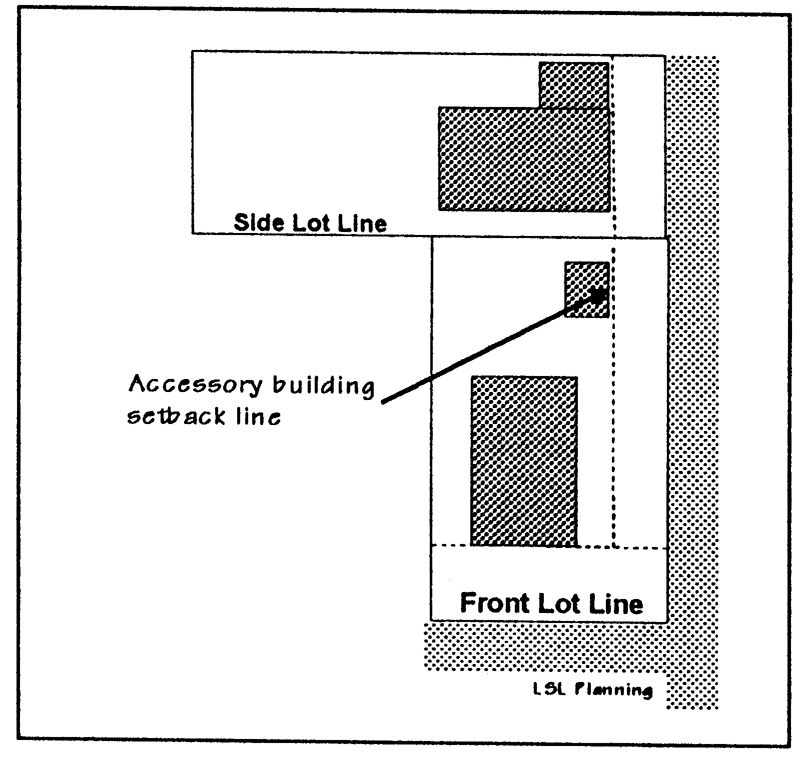
Front Lot Line
D.
Number and size limitations.
1.
With the exception of multiple family developments, in no case shall the number of attached or detached accessory buildings, in combination, exceed two.
2.
Accessory buildings in single family and two-family residential developments are subject to the following area restrictions.
a.
* If the home has at least 3,000 square feet of finished living area then an attached accessory building of up to 1,200 square feet in area is permitted.
b.
A garage accessory to a multiple family dwelling unit shall be designed for not more than two vehicles per dwelling unit.
c.
Multiple family developments may have one detached accessory building for use as a maintenance/storage facility subject to the following restrictions:
3.
Detached accessory buildings in commercial and industrial districts are subject to the following area restrictions:
a.
4.
Carports are to be considered as an accessory building subject to these provisions.
5.
A stable for horses, which shall not be subject to the size limitations of this section may be permitted on a lot of two acres or more where a horse is kept in accordance with the provisions of the R1-A, B Districts in accordance with the requirements of section 5.02 or section 3.12.
6.
The following accessory buildings or structures are permitted, and shall not be subject to a number limitation unless as expressly noted below:
a.
A child's playhouse or treehouse, not to exceed 100 square feet in gross floor area.
b.
Doghouses, pens and other similar structures for the housing of household pets, but not including kennels as defined in chapter 2.
c.
Fallout shelters.
d.
Swimming pool and/or bathhouse, private.
e.
Decks, porches, gazebos and similar structures.
f.
Recreation, storage and service structures in a manufactured home park, as regulated by chapter 7.
(Ord. No. 7-03, § 3(3.15), 4-1-2003; Ord. No. 3-12, §§ 1, 4, 6-24-2012; Ord. No. 16-18, § 1—5, 11-20-2018; Ord. No. 4-20, § 1, 9-1-2020)
Section 3.16. - Accessory uses.
Except as otherwise permitted in this ordinance, accessory uses shall be subject to the following regulations:
A.
Permitted accessory uses: Accessory uses and structures shall include, but are not limited to, the following uses and structures provided that the use or structure shall be in accordance with the definition of accessory use contained in chapter 2.
1.
In Nonresidential Districts a dwelling unit is permitted for a proprietor or storekeeper and their families, located in the same building as their place of occupation, and for a watchman or caretaker. The size for the proprietor or storekeeper dwelling unit shall be at least 375 square feet in area.
2.
Signs as permitted by this Ordinance unless otherwise designated as a principal use.
3.
Statuary, arbors, trellises, barbeque stoves, flagpoles, walls and hedges.
4.
Compost piles of less than 100 cubic feet, located on rear yard, set back at least five feet from any lot line.
5.
Parking and loading spaces, off-street, as regulated in chapter 17.
6.
Private tennis, basketball or volleyball courts, and similar outdoor private recreation uses.
7.
Private swimming pools and/or bathhouses.
8.
Private streets.
9.
Short term open air business.
10.
Other accessory uses as may be provided for by this ordinance.
11.
In a residential area, the open off street parking of one commercial vehicle which is operated by the occupant of the lot.
12.
Art venue display subject to Art Commission approval.
13.
Vegetable/fruit gardens.
B.
Accessory uses not permitted. The following shall not be considered accessory uses but shall be regulated as otherwise required by this ordinance or other applicable city ordinances.
1.
Junkyards, scrap heaps or refuse piles, not including compost piles of less than 100 cubic feet.
2.
The selling of motor vehicles other than the property owner's in residential districts or on properties of residential uses.
3.
The outside repair of motor vehicles.
4.
Manufactured homes shall not be considered as accessory to a permitted use.
C.
Requirements for accessory uses.
1.
All accessory uses and structures combined shall cover no more than 30 percent of the required rear yard, except that swimming pools shall not count toward this restriction.
2.
Except for approved parking in commercial and industrial zones, accessory uses are permitted only in connection with, incidental to and on the same lot with a principal use or main building which is permitted in the particular zoning district.
3.
An accessory use shall not be occupied or utilized unless the main building to which it is an accessory is occupied or utilized.
4.
An accessory use must be in the same zoning district as the principal use on a lot or parcel.
5.
Private streets, as regulated in this ordinance, may cross zoning districts and lots or parcels to access a principal use. Private streets serving nonresidential uses shall not cross residential districts unless authorized by the Planning Commission.
6.
When an accessory use is located on a corner lot, the side lot line of which is substantially a continuation of the front lot line of the lot to its rear, the accessory use shall not project beyond the front yard set-back line required on the lot in the rear of the corner lot.
7.
Unless otherwise permitted by this ordinance, an accessory use in a residential district shall be located in the rear yard of the lot except when attached to the main building.
8.
Short term open air businesses may be allowed by the Zoning Administrator by way of a zoning permit for a period of not more than 30 consecutive days after submitting a simple site plan sketch determined by the Zoning Administrator to be in conformance with the zoning ordinance. Written permission is required from the owner of the lot, parcel or tract intended for the site of operations and not more than two approvals may be allowed to a business or property within a twelve-month period. A performance guarantee shall be filed with the city Clerk to ensure that clean-up of site is accomplished following the expiration of the sales permit. If the clean-up is not completed in that time, the performance guarantee is forfeited.
9.
The Art Commission may allow front, side or rear yard area art venue display placement.
D.
Subject to the provisions of this section, the City Commission, after recommendation by the Economic Development Corporation (EDC), shall have the power to temporarily waive or alter the specific accessory use provisions set forth in sections 3.16.A and 3.16.C (and additional requirements relating to the allowable number, size, location and, in some cases, the duration and the frequency of the accessory use provisions within the Zoning Ordinance), where all of the following conditions are met:
1.
The City of Kentwood, County of Kent, State of Michigan and/or the United States Federal Government is experiencing a recognized state of emergency; and
2.
The Kentwood City Commission determines the following, in the Commission's sole, but reasonable discretion:
(i)
That the city is amid a crisis threatening public health, safety and/or welfare; and
(ii)
The temporary waiver or alteration will not be detrimental to adjacent property and the surrounding neighborhood.
The City Commission shall be permitted to extend the duration of the temporary waiver or alteration beyond the termination of longest active state of emergency so long as the Commission determines that such continued waivers or alterations are necessary to aid affected businesses or other applicants to return to, or move towards, their economic position prior to the state of emergency. Notwithstanding the foregoing, the duration of such temporary waivers or alterations may not exceed three months.
(Ord. No. 11-08, § 2, 8-29-2008; Ord. No. 3-12, §§ 2, 3, 6-24-2012; Ord. No. 9-16, § 5, 12-20-2016; eff. 12-30-2016; Ord. No. 10-17, § 3, 9-19-2017; Ord. No. 2-18, § 2, 1-16-2018; Ord. No. 7-18, § 7, 5-1-2018; Ord. No. 4-20, § 2, 9-1-2020)
Section 3.17. - Satellite dish antennas.
A.
Applicability.
1.
These regulations are formulated to ensure that adequate protection measures are provided in the ordinance for ensuring that sight distance is not impaired, that the dish antennas are located and constructed in a manner that will not afford the potential for injury, and to ensure that the intent and purposes of this ordinance are met.
2.
Satellite dish antennas and other similar structures may be permitted as accessory structures.
3.
Any person who proposes to construct a satellite dish antenna subject to these requirements must first obtain a permit from the community development department. The person seeking the permit, if not the owner of the lot or parcel of land, must provide evidence to the community development department that the owner of the lot or parcel of land consents to its construction and assumes all liability for its construction, operation and use.
4.
In residential districts, satellite dish antennas or other similar devices one meter or less in diameter, or in nonresidential districts satellite dish antennas or other similar devices two meters or less in diameter may be attached to a roof structure and shall not be subject to the regulations of this section.
5.
The zoning administrator may vary any provision of this section if its enforcement inhibits or prevents the proper operation of the satellite dish antenna. In these instances, the zoning administrator may require additional screening or impose other reasonable conditions intended to reduce the visual effects from adjacent properties.
B.
Roof-mounted satellite dish antennas or other similar roof-mounted devices over two meters in diameter are permitted in commercial and industrial districts only, provided that the antenna complies with the height standards for the district in which they are located.
C.
Ground-mounted satellite dish antennas or other similar devices (exceeding one meter in diameter in residential districts, or in nonresidential districts between two and three meters in diameter) are permitted in all zoning districts subject to the following conditions:
1.
Maximum height shall be 15 feet.
2.
Satellite dish antennas or other similar devices shall comply with setback requirements for the district in which they are located and shall not be permitted in front or side yards.
3.
All electrical and antenna wiring shall be placed underground.
4.
The site of the antenna shall be screened from view through the planting of evergreens of sufficient concentration to reasonably conceal the antenna. Alternative screening is acceptable if approved by the zoning administrator.
5.
Any ground-mounted antenna shall be so located and designed to withstand a wind force of 90 miles per hour. The satellite dish antenna or other similar device shall be securely mounted and anchored to a pole and secured in accordance with the requirements of the manufacturer and the building code.
6.
The surface of the dish shall be painted or treated as not to reflect glare from sunlight and shall not be used as a sign or message board. All installations shall employ (to the extent possible) materials and colors that blend with the surroundings.
(Ord. No. 5-04, § 2, 5-2-2004)
Section 3.18. - Home occupations.
Home occupations are permitted as residential accessory uses in any residential district, subject to the following requirements:
A.
Home occupations shall be approved by the zoning administrator, who may issue an approval upon receipt of a letter from the applicant stating an intent to comply with the requirements of this section and the specific measures by which compliance will be maintained.
B.
No person other than members of the immediate family residing on the premises shall be engaged in the home occupation.
C.
The use of the dwelling unit for the home occupation shall be clearly incidental and subordinate to its use for residential purposes by its occupants, and not more than 20 percent of the floor area of the dwelling unit shall be used in the conduct of the home occupation.
D.
There shall be no change in the outside appearance of the building or premises, or other visible evidence of the conduct of the home occupation other than one sign not exceeding two square feet in area, nonilluminated, and mounted flat against the wall of the main building.
E.
The home occupation shall be operated in its entirety within the main building.
F.
There shall be no sale of products or services except as are produced on the premises by the home occupation.
G.
No traffic shall be generated by the home occupation in greater volumes than would normally be expected in the residential district in which it is located, and any need for parking generated by the conduct of the home occupation shall be met off the street on the property's driveway.
H.
No equipment or process shall be used in the home occupation which creates noise, vibration, glare, fumes, odors, or electrical interference detectable to the normal senses off the premises, if the occupation is conducted in a single-family dwelling, or outside the dwelling unit if conducted in other than a single-family residence. In case of electrical interference, no equipment or process shall be used which creates visual or audible interference in any radio or television receivers off the premises, or cause fluctuation in line voltage off the premises.
State Law reference— Home occupations, MCL 125.583c.
Section 3.19. - Fences and walls.
A.
General Requirements
1.
It shall be unlawful to construct any fence in any public right-of-way, floodway easement, or drainage easement without the consent of the City Engineer. (Refer to City Ordinance No.9-84, as amended, the Stormwater Management Ordinance.)
2.
No fence shall be erected on any corner lot or parcel or adjacent to any driveways, which will, in the opinion of the Zoning Administrator, obstruct the view of a vehicle driver approaching the intersection or driveway. Fencing is not permitted within the clear vision area, as provided in Section 3.06.
3.
It shall be unlawful to install, construct or maintain electric fences in any zoning district.
4.
All fences and walls exceeding thirty (30) inches in height shall require a zoning permit and shall be reviewed and approved by the Zoning Administrator prior to construction.
B.
Fences in All Residential and Commercial/Office Zoning Districts
1.
Solid-type fences in the front yard shall not exceed a height of three (3) feet. A decorative open-type fence with spacing between boards equivalent to the board width of the fence may be permitted within the front yard area provided it does not exceed a height of four (4) feet. No chain link or wire fencing shall be located within any residential, commercial, or office front yard. Fencing in any other portion of a lot shall not exceed six (6) feet if in or immediately adjacent to a residential zoning district or use.
2.
Fences in the street side yard of a corner lot may be erected in the side yard but may not exceed a height of three (3) feet if solid, or four (4) feet if a decorative open-type fence. A solid fence of over three (3) feet must be set back at least seventeen (17) feet from the street side lot line. No chain link or wire fence shall be located in the street side yard of a corner lot.
3.
The finished side of a fence must be oriented to the closest property line. Fences constructed with alternating boards on opposite sides of the fence are determined to be finished on both sides.
4.
Fences of up to eight (8) feet in height may be used to enclose public services and installations with Zoning Administrator approval. Barbed wire may be used if the strands are restricted to the uppermost portion of the fence, which shall be set back at least ten (10) feet from a public right of way or perimeter property line abutting a residential district and shall not extend lower than a height of six (6) feet from the nearest ground level.
C.
Fences in Industrial Districts.
1.
Solid type fences in the front yard shall not exceed a height of three (3) feet. A decorative open-type fence may be permitted in the required landscape setback of the front yard provided it does not exceed a height of four (4) feet. Chain link fences are not permitted in the required front yard landscape setback.
2.
No chain link fences shall be permitted in the landscape setback of the front yard. A chain link fence of up to four (4) feet is permitted behind the landscape setback. A decorative metal fence of up to six (6) feet is permitted behind the landscape setback.
3.
Chain link fences of up to eight (8) feet in height may be permitted behind the front of a main use building. On a corner lot, chain link fences of up to eight (8) feet in height may be permitted outside of the required side yard building setback.
4.
Barbed wire strands may be used to enclose public services and installations, storage areas or other similar areas in industrial zoning districts. The strands shall be restricted to the uppermost portion of the fence, which shall be setback at least ten (10) feet from the public right-of-way or perimeter property line abutting a Residential District and shall not extend lower than a height of six (6) feet from the nearest ground level.
5.
No fence in an industrial zoning district shall exceed an eight (8) foot height.
(Ord. No. 4-10, § 4, 10-22-2010; Ord. No. 6-14, § 5, 8-19-2014; Ord. No. 15-24, § 2, 10-1-2024)
Section 3.20. - Residential child and adult care facilities.
A.
Requirements pertaining to group child day care homes.
1.
There shall be sufficient on-site outdoor play area to meet state regulations. All required outdoor play areas shall be fenced with a minimum of four-foot tall fence, provided that no such fence shall be located in the front yard.
2.
Ingress and egress shall be provided as far as possible from two intersecting streets and shall be at least 100 feet from two through streets.
3.
A group child day care shall not be located within 1,200 feet of any other group child day care.
4.
For the purpose of this section, the measurement shall be measured along a street, road, or other public throughfare from the actual location of the use to the nearest property line of the other group day care home.
5.
An on-site drive shall be provided for drop offs/loading. This drive shall be arranged to allow maneuvers without creating a hazard to traffic flow on the public street.
B.
Requirements pertaining to group child day care homes.
1.
There shall be sufficient on-site outdoor play area to meet state regulations. All required outdoor play areas shall be fenced with a minimum of four (4) foot tall fence, provided that no such fence shall be located in the front yard.
2.
Ingress and egress shall be provided as far as possible from two (2) intersecting streets and shall be at least one hundred (100) feet from two through streets.
3.
A group child day care shall not be located within a twelve hundred (1,200) foot radius of any other group child day care.
4.
For the purpose of this Section, the measurement of a radius shall be measured in a straight line from the actual location of the use to the nearest property line of the other group day care home.
5.
An on-site drive shall be provided for drop offs/loading. This drive shall be arranged to allow maneuvers without creating a hazard to traffic flow on the public street.
(Ord. No. 7-03, § 3(3.20), 4-1-2003; Ord. No. 10-17, § 4, 9-19-2017; Ord. No. 9-21, § 3, 11-16-2021; Ord. No. 2-23, § 3, 2-21-2023)
Section 3.21. - Wireless communication equipment.
Wireless communication equipment (but not a wireless communication support structure) is a permitted use and allowed in all zoning districts. Wireless communication equipment does not have to be related to the principal use of the site. Wireless communications equipment is not subject to zoning review and approval if all of the following requirements are met:
(a)
The wireless communications equipment will be co-located on an existing wireless communications support structure or in an existing equipment compound.
(b)
The existing wireless communications support structure or existing equipment compound is in compliance with the city's zoning ordinance or was approved by the appropriate zoning body or official for the city.
(c)
The proposed collocation will not do any of the following:
(i)
Increase the overall height of the wireless communications support structure by more than 20 feet or ten percent of its original height, whichever is greater.
(ii)
Increase the width of the wireless communications support structure by more than the minimum necessary to permit co-location.
(iii)
Increase the area of the existing equipment compound to greater than 2,500 square feet.
(d)
The proposed co-location complies with the terms and conditions of any previous final approval of the wireless communications support structure or equipment compound by the appropriate zoning body or official of the city.
Notwithstanding the foregoing, wireless communications equipment otherwise exempt must still comply with all other applicable city codes including a requirement that the building inspector determines that the co-location will not adversely impact the structure to which it is attached.
A co-location that does not meet subsections (c) or (d), above, is subject to special land use review by the planning commission in accordance with Chapter 15 and Section 514 (2-6) of Act 366. Subject to Federal Aviation Administration Standards, any equipment placed in a residential district shall not be erected at a height that requires lighting. Any equipment placed adjacent to a residential district or use that requires lighting shall be a continuous red beacon at night.
Wireless communication equipment that is not attached to an existing structure (thus requiring the installation of a new wireless communications support structure), is subject to special land use review consistent with Section 15.04 and the Kentwood Master Plan.
(Ord. No. 1-19, § 4, 3-18-2019)
Section 3.22. - Regulations applicable to all residential dwellings
The following provisions shall not apply to dwellings located in manufactured home communities or Form Based Code districts. Provisions specific to a particular housing type shall apply in addition to the general provisions applicable to all housing types contained in Part B.
A.
The purpose and intent of these provisions is:
1.
To create neighborhoods that are safe, livable, attainable, and sustainable, and create a sense of community for Kentwood's varied households. Each home will contribute to a neighborhood's context. Building placement, design, and parking location are all components that affect how walkable and safe a neighborhood is for children, the elderly, and the general community. Front porches, windows, and entries provide "eyes on the street" that contributes to the safety and security of a neighborhood.
2.
Many of the following provisions have been used within residential Planned Unit Developments but were not formally codified as general provisions. The intent of codifying these rules is to increase transparency in the development process, provide greater predictability for the development community, and increase consistency in decision-making.
3.
It is recognized that not every home and building site is the same. To that end, these provisions seek to provide flexibility for builders, homeowners, and City staff by instructing where administrative departures may be granted in lieu of the need for a zoning variance process.
4.
It is recognized that the Building Code regulates appropriate construction materials to be used in residential construction. That Code, however, does not consider how all the various components contribute to building a neighborhood and a community. It is expected that materials will be compatible in character and scale with the structure on which it is being installed, have no visible fasteners, and be uniform in type and appearance. Building materials shall be durable and installed in simple configurations with solid craftsmanship, according to the manufacturer's specifications such that no warping or buckling, cracking, molding, fading, or oil canning is expected.
B.
All housing types. These general provisions are applicable to all housing types.
1.
Transparency.
a.
Residential dwellings shall have windows on the front walls and side walls of the structure that face a street. The size and placement of windows on the facade shall be generally consistent.
i.
For all residential dwellings at least twelve percent (12%) of the area of the front façade shall consist of clear glass windows and may include the primary entrance door, which permits a view from the dwelling to the street. Garage door windows may count towards the percentage.
If the front façade of the residential dwelling has between 10%-12% clear glass windows, an additional design element must be provided from the list provided in Section 2.22 B. The design element shall be specific to the façade of the house and provided in addition to that required in Section 3.22 B 3.
If the front facade of a residential dwelling has less than 10% clear glass windows, an additional two design elements must be provided, specific to the façade of the house, and selected from the list outlined in Section 3.22 B. The 2 design elements shall be specific to the façade of the house and provided in addition to the 4 design elements required in Section 3.22 B 3.
ii.
At least three (3) windows with a minimum of six (6) square feet each are required on side walls (those adjoining the front façade) that face a street.
iii.
Lightwell facades shall have twelve percent (12%) minimum clear glass between the finish floor line of the lightwell and the finish floor line of the first floor.
iv.
Administrative Departures. The following shall be eligible for an administrative departure request:
a.
Side wall transparency for single-story dwellings where it is determined that the standard cannot be met due to the interior design of the dwelling.
b.
Placement is limited by the presence of a garage. If the garage is facing the street, a departure cannot be provided to the facade.
c.
Building code requirements make adherence to this requirement infeasible.
2.
Exterior Materials.
a.
Exterior cladding may consist of brick, stone, vinyl or aluminum siding, glass, fiber cement siding, wood lap, stucco, or decorative split-faced block. Installation shall include trim.
b.
EIFS shall only be used for building accents and shall not be permitted at grade level.
c.
Where more than one (1) façade material is proposed, the heavier material in appearance shall be incorporated below the lighter material (e.g. masonry below siding).
d.
Administrative Departure. Other materials of equivalent or better quality, including high quality synthetic material, may be approved, if determined appropriate for the building, site, and area with an approved sample and examples of successful, high quality local installations.
3.
Design Elements. The intent of this Section is to encourage the use of various design elements on residential lots and structures to create visual interest and support walkable neighborhoods. The menu of design elements is intended to provide a variety of choices for potential design compositions. A number of the design elements represent a standard of quality and durability that can decrease future maintenance responsibilities for the homeowner or limit deterioration of the exterior of the home(s). It is also the intent of this Section to maintain the affordability, livability, and safety of housing in the City. A minimum of four (4) elements or sub-elements from the menu are required. Implementation of these design elements should demonstrate thoughtful design; considering scale, symmetry, balance and compatibility.
A minimum of one (1) design element must be different among adjacent detached dwelling units, or for each multi-family building. Landscaping and front porches shall be exempted from this requirement.
a.
Landscaping.
i.
Three (3) trees measuring 2.5" caliper or greater on the lot. A minimum of five hundred (500) cubic feet of soil volume shall be provided per tree. Retained trees on the property can be credited towards this option.
ii.
Planted landscape area/s of a minimum of one hundred fifty (150) square feet in the front yard.
iii.
A sod grass lawn provided in the front, back, and side lawn.
b.
Front Porch.
Front porch, as defined in Chapter 2, not including steps, that is at least five (5) feet in depth to provide for usable seating and circulation and is at least one-third (1/3) the width of the front façade of the residential structure (not including the garage) but in no case is it less than nine (9) feet wide.
c.
Structural Modifications.
i.
Dormers, the placement of which is balanced with the dwelling's façade.
ii.
Room bump-out (e.g. sunroom, bay window, etc.) on the façade of the building with minimum depth of two (2) feet.
iii.
Dwelling is designed and constructed to meet the Type B Unit accessibility requirement of the ANSI A117.1 standard.
d.
Windows and Window Detailing.
i.
Increased percentage of clear glass windows on the front facade of fifteen percent (15%) or higher on front façade.
ii.
Exterior trim not less than three (3) inches in width.
iii.
Shutters that are one-half the width of the window on each side and of a high-quality material that will not fade or peel.
iv.
Other enhancements, such as awnings.
e.
Roof Detailing.
i.
Eaves with a minimum of twelve-inch (12") overhang on all eaves.
ii.
Exterior soffit detailing such as brackets, moldings, or changes in materials.
iii.
Gable end (rakes) with a minimum eight-inch (8") overhang on all gable ends.
iv.
Eavestroughs with downspouts.
f.
Materials.
i.
Brick, stone, or other decorative materials used on the façade of the building and wrap the sides of the structure with the same materials for a depth of at least two (2) feet.
ii.
Hardie Plank/fiber cement siding.
iii.
Metal siding, roofing, or paneling of 24 gauge or better with no visible fasteners. Any change in profile is non-corrugated and has a minimum rib depth of 1-inch.
iv.
A change in exterior building materials used as an accent on the façade of the building.
g.
Columns
i.
Porch columns of 8 inches or more with a substantial base and capital.
h.
Administrative Departures: The Zoning Administrator may accept alternative options that meet the intent of this provision to increase the visual diversity of residential structures within a neighborhood.
C.
Detached single-family. A detached single-family dwelling and any additions or alterations thereto, shall meet the requirements of this Section in addition to all other regulations of this Chapter.
1.
Garages. The following provisions shall apply to provide safe, unobstructed pedestrian through-movement on sidewalks, encourage the visibility of street activities from dwellings, ensure sufficient space for the parking of vehicles to avoid front-yard parking and street congestion, and reduce the visual dominance of garages and parking in neighborhoods.
a.
For the purposes of this Section, the garage setback shall be considered independently from that of the residential dwelling.
b.
Garages that are accessed from a public street through the front yard shall be placed a minimum of thirty-five (35) feet from the front lot line. Garages that are accessed from a private street through the front yard shall be placed at a minimum of 25' from the edge of the right-of-way easement. Administrative departures for private roads may be approved by the Zoning Administrator.
c.
Where garages are rear loaded, off an alley or common drive through a rear yard, the minimum distance from the face of the garage to the edge of pavement is twenty (20) feet.
d.
The placement and size of attached garages shall be determined by the following:
i.
Attached garages cannot exceed 50% of the total width of the front façade of a dwelling unit. Attached garages that are set back at least 15 feet behind the front of the dwelling unit are permitted and shall not be counted against front façade calculations.
ii.
Garages that comprise 50% or less of the front façade of the dwelling may align with the front façade.
iii.
Attached garages comprising 33% to 50% of the total width of the front facade may project up to 8 feet forward of the front of the dwelling unit, or up to 10 feet forward of the front of the dwelling unit if a front porch is provided in compliance with Section 3.22.B.3.b. Front yard setbacks still apply.
iv.
Attached garages that are less than 33% of a dwelling unit's front facade may be placed fully forward of the dwelling unit.
e.
Where a third, single garage stall is desired, it shall be located at least two (2) feet behind the main façade of a two-stall garage. A third, single garage stall set back more than 5' shall not count toward the width of garage for the for the purposes of determining compliance with Section 3.22 C.1.d.
f.
Administrative Departure. An administrative departure may be granted where seventy-five percent (75%) of existing dwelling units within three hundred (300) feet on the same block have a dwelling to garage façade ratio that does not meet the above requirements.
2.
The roof of any dwelling unit shall have a minimum pitch of three (3) inches height to one foot of run.
3.
Dwelling units shall be permanently anchored to wood, masonry, concrete, or other approved foundation. Access to the basement or crawl space shall be from inside the dwelling unit.
4.
Dwelling units shall meet all the requirements and specifications of the currently adopted Building Code, Housing Code, Electric Code, Plumbing Code, Energy Code, and the One and Two Family Code.
5.
If the dwelling unit was transported to the building site, all wheels, axles, and towing devices shall be removed from the dwelling unit once placed on the lot.
D.
Attached single-family, duplexes, and multi-family. Attached single-family dwellings, duplexes, and multi-family dwellings (3 or more units) and any additions or alterations thereto, shall meet the requirements of this Section in addition to all other regulations of this Chapter.
1.
Parking Areas, Garages, and Carports.
a.
Garages for duplexes are not allowed to be placed in the center of the front façade. Drive areas shall be separated to allow for a common green. A circular drive may be permitted for access management purposes.
b.
For multi-family developments unenclosed parking areas and freestanding parking structures (detached garages or carports) shall not occupy more than thirty percent (30%) of any public street frontage.
c.
For multi-family developments parking areas visible from the public street shall be sited to be perpendicular to the street to reduce visual impacts on the streetscape.
d.
Administrative Departure. An administrative departure may be granted to allow up to fifty percent (50%) of unenclosed parking areas or to adjust parking area orientation along a street frontage when a dense year-round landscape screen is provided.
(Ord. No. 9-24, § 2, 7-9-2024)
Section 3.23. - Lot width to depth ratio.
A.
Except as may be permitted in B, below, no lot created after the adoption date of this ordinance shall have a depth exceeding four times its width, as measured at the front lot line.
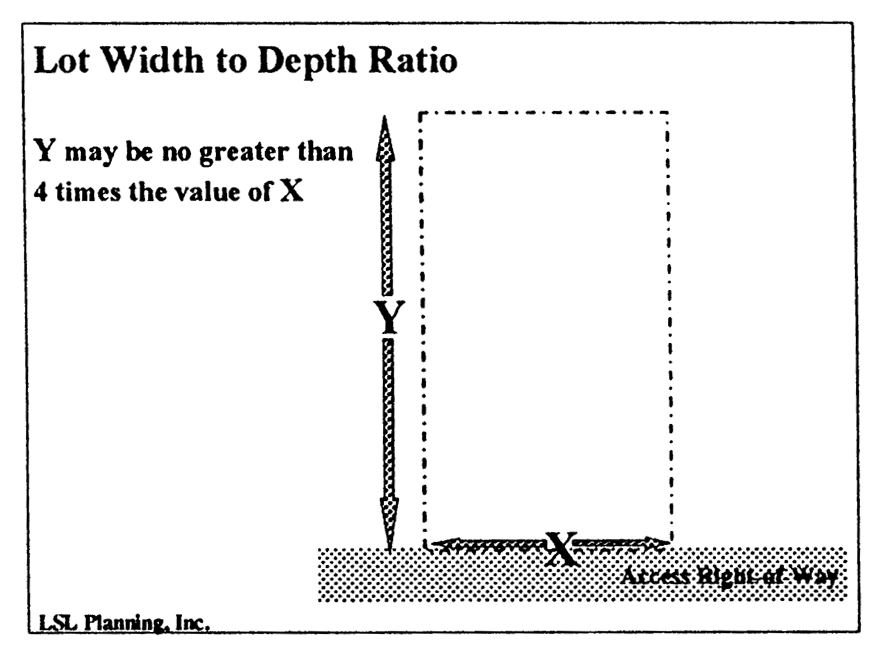
Lot Width to Depth Ratio
B.
Where steep topography, unusual soil conditions, or drainage problems exist, the Planning Commission, upon application for a land division in accordance with the city land division ordinance, may permit a greater width to depth ratio. The permit may be issued when a division meeting the requirements of section 3.23.A would result in an unnecessary waste of land or otherwise create an unusual or odd-shaped lot.
Section 3.24. - Nonconforming uses, buildings, and lots.
A.
Intent.
1.
It is recognized that there exists within zoning districts certain buildings and structures, uses, and lots which were lawful before this ordinance was adopted, and which would be prohibited, regulated, or restricted under the terms of this ordinance. It is the intent of this ordinance to permit nonconforming lots, buildings and structures, and uses to continue until they are removed, but not to encourage their survival.
2.
Nonconforming lots, buildings, structures, and uses are declared by this ordinance to be incompatible with permitted uses in the districts in which they are located. It is the intent of this ordinance that these nonconformities shall not be enlarged upon, expanded, or extended, nor be used as grounds for adding other buildings, structures or uses prohibited elsewhere in the district.
B.
General requirements.
1.
No structure or part thereof shall be constructed, erected, moved, placed, maintained, reconstructed, used, extended, enlarged or altered, except in conformity with the regulations herein specified for the zoning district in which it is located.
2.
No use shall be established on any lot, land or premises except in conformity with the use regulations of the zoning district in which it is located.
3.
No building shall be established on any lot, land or premises except in conformity with the regulations of the zoning district in which it is located.
4.
Nothing in this ordinance shall be deemed to require a change in the plans, construction, or designated use of any building on which actual construction was lawfully begun prior to the effective date of adoption or amendment of this ordinance and upon which actual building construction has been diligently conducted.
5.
The city may acquire, through purchase or condemnation, private nonconforming lots, buildings and structures. The city commission may take these actions in the manner provided for by law.
C.
Nonconforming uses.
1.
The lawful use of any land or premises exactly as it existed at the time of enactment of the zoning ordinance, or amendment thereto, may be continued although the use does not conform to the current provisions of the zoning ordinance.
2.
If a nonconforming use is abandoned for any reason for a period of not less than six months, any subsequent use shall conform to the requirements of this ordinance.
3.
A nonconforming use shall be considered abandoned if one or more of the following conditions exists, and shall be deemed to constitute intent on the part of the property owner to abandon the nonconforming use:
a.
Utilities, such as water, gas and electricity to the property, have been disconnected;
b.
The property, buildings, and grounds, have fallen into disrepair;
c.
Signs or other indications of the existence of the nonconforming use have been removed;
d.
Removal of equipment or fixtures that are necessary for the operation of the nonconforming use; or
e.
Other actions, which in the opinion of the zoning administrator constitute an intention on the part of the property owner or lessee to abandon the nonconforming use.
4.
Uses nonconforming solely because of height, area, parking or loading provisions only may be expanded provided that the zoning administrator determines that all three of the following occur. For the purposes of this subsection expansion shall include extension or enlargement of the use.
a.
All zoning district requirements are satisfied with respect to the expansion;
b.
The expansion shall not substantially extend the life of any nonconforming use by reason of parking and loading provisions; and
c.
The nonconforming use is made conforming or less nonconforming by the addition of parking and/or loading space. Thereafter any subsequent expansion of the nonconforming use or change in use will not be allowed if it requires even greater parking and/or loading space.
D.
Nonconforming structures.
1.
Any structure existing and lawful at the time of enactment of the zoning ordinance, or amendments thereto, may be continued although the structure does not conform with the current provisions of the zoning ordinance.
2.
Repairs and maintenance work may be made as are required to keep a nonconforming building or structure in a sound condition.
3.
In the event fire, wind or an act of God or the public enemy shall damage any nonconforming building(s) or structure(s), it may be rebuilt or restored provided the cost thereof shall not exceed the state equalized value of the building or structure after the rebuilding or restoration. The Building Inspector shall determine the cost of reconstruction.
4.
In the event any nonconforming building(s) or structure(s) shall be damaged by fire, wind or an act of God or the public enemy and the cost of rebuilding or restoration exceeds the state equalized value of the building(s) or structure(s) after rebuilding or restoration, the buildings or structures shall be built in conformance with the requirements of the zoning district in which they are located, unless the zoning board of appeals permits the rebuilding or restoration of the building or structure. The approval of the zoning board of appeals shall be granted only upon finding that at least one of the following is true:
a.
That the rebuilding or restoration will not substantially extend the probable duration of the nonconforming building or structure; or
b.
There are circumstances that the land previously occupied by the nonconforming use does not permit the reasonable construction of the nonconforming building or structure.
5.
Structures nonconforming solely because of height, area, parking or loading provisions only may be expanded provided that the zoning administrator determines that all three of the following occur. Expansion shall include extension, enlargement, alteration or modernization.
a.
All development requirements are satisfied with respect to the expansion;
b.
The expansion shall not substantially extend the life of any nonconforming structure by reason of parking and loading provisions; and
c.
The nonconforming structure is made conforming or less nonconforming by the addition of parking and/or loading space. Thereafter any subsequent expansion of the nonconforming structure or change in use will not be allowed if it requires even greater parking and/or loading space.
E.
Nonconforming lots.
1.
If a lot in use already has less than the minimum required area or dimension required for the zoning district in which it is located, the area or dimension may be maintained but shall not be further divided or reduced.
2.
Existing platted lots.
a.
Where a nonconforming platted lot has an area of not less than 90 percent of its zoning district requirements and where the lot can provide the side and front yard requirements of its zone, the permitted uses of the district shall be allowed.
b.
A nonconforming platted lot, in single ownership, of less than 90 percent of its zoning district requirements may be utilized for permitted uses, and the required side yards may be reduced by the same percentage the area of the lot bears to its zone district requirements, provided that no side yard provision may be reduced to less than five feet and that off-street parking requirements are also met.
3.
Adjacent lots in common ownership.
a.
No lot or lots in common ownership shall be so divided, altered or reduced as to make the area or dimension less than the minimum specified for the zoning district in which it is located.
b.
Where three or more adjacent lots are in single ownership and where these lots individually contain less than 90 percent of the zoning district requirements, the lots shall be utilized only in complete conformance with the zoning district's minimum requirements.
c.
In the event two adjacent lots are in single ownership, the zoning board of appeals may permit their use as separate lots having less than the required lot area if it shall determine that all of the following are met:
(1)
There is no practical possibility of obtaining additional land.
(2)
The lots can be so used without adversely affecting the character of the neighborhood.
(3)
No side yard provision is reduced to less than five feet.
(4)
Off-street parking requirements are met.
d.
A nonconforming lot may only be expanded if it is brought into closer conformity with the regulations specified for the zoning district in which it is located.
State Law reference— Nonconformities, MCL 125.583a.
Section 3.25. - Site condominiums.
A.
A site condominium unit shall be a unit created by the division of land on the basis of condominium ownership that is not subject to the platting provisions of the Land Division Act, Public Act No. 288 of 1967, as amended (MCL 560.101 et seq.).
B.
A site condominium unit shall be treated as a separate lot or parcel and may have buildings constructed on it and uses conducted within it as allowed in its zoning district provided the unit meets the development requirements for the zoning district in which it is located.
C.
Site plan approval:
Preliminary site plan:
1.
A preliminary site plan shall be reviewed and approved by the Planning commission and city commission in accordance with chapters 13 and 14.
2.
Approval of a preliminary site plan shall for a period of two years confer upon the proprietor approval of lot sizes, lot orientations, and street layouts.
3.
Three separate one-year extensions may be granted by the city commission if applied for in writing prior to the date of expiration of approval of the preliminary site plan.
4.
After a period of two years from approval, unless extensions as provided for in this chapter have been granted, the preliminary site plan approval shall become null and void if substantial construction has not commenced and proceeded in a meaningful manner.
Final site plan:
5.
A final site plan for the site condominium project must be approved by the city commission prior to the issuance of any building permit for any structures on the proposed site, unless they already exist.
6.
At its regular meeting or at a meeting called within 20 days of the date of submission, the city commission shall examine the final plan for general compliance with this ordinance. The proprietor or his designated representative may request an extension of the 20-day time limit, which the city commission may grant at its discretion.
7.
To receive final approval for the site condominium project, the owner shall submit ten copies of the plan to the city Engineer who shall place the final plan on the agenda of the city commission, said plan to contain the information required by this ordinance. Copies of the final plan shall be distributed to the appropriate city departments for their review and comment to the city commission.
Building permit:
8.
Prior to the issuance of a building permit for any building in the proposed site condominium project, the following items must be fulfilled, unless waived by the appropriate city department. The city commission may consider the issuance of building permits prior to the approval of the final site plan in exceptional or unusual circumstances beyond the ability of the applicant to control.
a.
Proposed master deed.
b.
Articles of incorporation for the condominium association.
c.
Improvement plan approval.
d.
Block grading, floodway, soil erosion approval.
e.
Basement elevation and building restriction approval.
f.
Construction of hydrant water, adequate fire access, stormwater detention, floodways, and soil erosion controls.
D.
Monuments shall be set at all boundary corners and deflection points and at all street right-of-way intersection corner and deflection points. Lot irons shall be set at all condominium site corners and deflection points of condominium site lines.
E.
The city Engineer may grant a delay in the setting of required monuments or irons for a reasonable time, but not to exceed one year from the date of approval by the city commission, on condition that the developer deposit with the city Clerk cash, a certified check, or an irrevocable bank letter of credit running to the city, whichever the developer selects, in an amount as determined from time to time by resolution of the city commission.
1.
The deposit shall be returned to the developer upon receipt of a certificate by a surveyor registered in the State of Michigan that the monuments and irons have been set as required, within the time specified.
2.
If the developer defaults, the city commission shall promptly engage a registered surveyor to set the monuments and irons in the ground as shown on the condominium site plan, at the developer's expense.
F.
All rights-of-way and utility easements shall be described separately from individual condominium sites and shall be accurately delineated by bearings and distances on the condominium subdivision plan and the final site plan.
1.
The rights-of-way and utility easements shall be separately designed for their individual purpose, such as access, roadway, location, installation, maintenance and replacing of public utilities.
2.
The developer shall dedicate to the city all easements for utilities. Water, sewer and electrical easements may be placed within streets, subject to the approval of the city Engineer and the standards of the city.
3.
All streets proposed for any site condominium shall be developed within the minimum design, construction, inspection, approval, and maintenance requirements of this ordinance, and the subdivision control ordinance (ordinance no. 21-84, as amended).
(Ord. No. 7-03, § 3(3.25), 4-1-2003)
Section 3.26. - Regulated uses.
A.
Uses subject to controls. Uses subject to the controls of this section are as follows:
1.
Adult-oriented businesses.
2.
Massage establishments.
B.
Definitions. As used in this section, the following terms shall have the indicated meanings:
1.
Adult-oriented business means a business or commercial establishment engaging in one or more of the following enterprises (these enterprises are defined in the adult-oriented businesses regulatory ordinance): (1) adult cabaret; (2) adult merchandise store; (3) adult motel; (4) adult theater; (5) escort agency; (6) nude model studio; and (7) sexual encounter center.
2.
Massage establishment means any building, room, place or establishment where body massage is regularly practiced on the human body, to club members or to the general public for a charge. The term "massage establishment" shall not include:
a.
Hospitals, nursing homes, medical clinics;
b.
The office of a state-licensed physician, surgeon, osteopath or chiropractor;
c.
The establishment of a barber, manicurist, beautician or cosmetologist who is duly licensed under the laws of this state, or another state within the United States, or the federal government, and who practices within the established limits of his or her license, and who administers a massage in the normal course of his or her duties in which massages are administered only to the scalp, face, neck, hands, feet, or shoulders; or
d.
The establishment of a myomassaologist who is a current member of the American Massage Therapy Association or other national massage therapy organization with comparable prerequisites for certification.
3.
Massage means any method of applying pressure on, friction against, stroking, kneading, rubbing, tapping, pounding, vibrating or stimulating the external parts of the body, for remedial or hygienic or other purposes, with the hands, with or without the aid of any mechanical, magnetic or electrical apparatus or appliances, with or without supplementary aids such as rubbing alcohol, liniments, antiseptics, oils, powders, creams, lotions, ointments or other similar preparations.
4.
Specified anatomical area and specified sexual activities shall have the same meaning for the purposes of this chapter as those terms have in the adult-oriented businesses regulatory ordinance.
C.
Requirements. Permitted regulated uses shall meet each of the following requirements:
1.
A regulated use may be located only within a zone district where the use is normally permitted.
2.
Except as provided in section 3.26C.3 below, a regulated use shall not be located within a 1,000-foot radius of any residential district or use, or upon which is located a school, public park, library, child care facility, or place of religious worship.
3.
In accordance with the procedures in this subsection, the Planning Commission may permit a regulated use within a 1,000-foot radius, but not within a 500-foot radius, of a residential district or use, or upon which is located a school, public park, library, child care facility, or place of religious worship. An applicant seeking approval pursuant to this subsection shall file a completed application on an application form prepared and made available by the city. The Planning Commission shall make a final determination on the application within 60 days after the applicant submits the final application. The Planning Commission shall approve the application if the Planning Commission determines that each of the following criteria is met:
a.
That the establishment of a regulated use in the proposed location will not adversely affect the public interest;
b.
That the establishment of a regulated use in the proposed location will not be injurious to nearby uses, particularly lots zoned or occupied for residential purposes or the school, public park, library, child care facility, or place of religious worship;
c.
That the establishment of a regulated use in the area will not be inconsistent with the spirit and intent of this ordinance; and
d.
That the establishment of a regulated use in the proposed location would comply with all applicable regulations of this ordinance and other applicable statutes, ordinances, rules and regulations.
4.
Within ten days after the Planning Commission makes its decision, any person aggrieved by the decision of the Planning Commission under this section may appeal the decision to the city commission which shall decide the appeal within thirty days after the Planning Commission makes its decision. The decision of the city commission (or of the Planning Commission, if a timely appeal to the city commission is not taken) shall be a final, nonappealable decision.
5.
A regulated use shall not be located within a 1,000-foot radius of any other regulated use.
6.
For the purpose of this section, the measurement of a radius shall be measured in a straight line from the actual location of the use to the nearest property line of the residential district or use, public park, school, child care facility, or place of religious worship, or other regulated use.
7.
A regulated use shall not be located in the same structure or on the same parcel as another regulated use.
8.
All on site parking areas shall comply with the requirements of this ordinance and additionally shall be illuminated on any days the business is open from sunset until at least 60 minutes after closing.
Section 3.27. - Restoration of unsafe buildings.
Nothing in this ordinance shall prevent the strengthening or restoring to a safe condition of any building or structure, or part thereof, declared unsafe by the Building Inspector, or required to comply with his lawful order.
Section 3.28. - Amateur radio services.
A.
Intent and purpose. This section is intended 1) to provide reasonable accommodation for amateur radio antenna and amateur radio antenna support structures in the city of Kentwood and 2) to constitute minimum practicable regulation to accomplish the city's legitimate purposes consistent with state and federal laws including Federal Communication Commission regulations pertaining to amateur radio services, as noted in PRB-1 (1985), as amended and reconsidered. Legitimate purposes include but are not limited to preserving residential areas as livable neighborhoods and preserving public health, safety and welfare.
B.
Definitions. As used in this section, the following terms shall have the indicated meanings:
Amateur radio antenna: Any combination of materials or equipment used exclusively for the purpose of sending and/or receiving electromagnetic waves for amateur radio services.
Amateur radio antenna support structure (or antenna support structure): Any structure, such as a mast, pole, tower or any combination thereof, whether ground or roof mounted, freestanding or guyed, used exclusively for supporting amateur radio antenna(e).
Amateur radio service: A federally licensed radio-communication service for the purpose of self-training, intercommunication and technical investigations carried out by amateurs, that is, duly authorized persons interested in radio technique solely with a personal aim and without pecuniary interest particularly with respect to providing emergency communications. (As per Code of Federal Regulations, Title 47, Part 97.)
Ground-mounted amateur radio antenna and/or amateur radio antenna support structures: Amateur radio antenna and/or amateur radio antenna support structures that are not fixed to any building or accessory structure.
Overall height: The total height of the amateur radio antenna and/or antenna support structure as measured from mean grade to the highest point of the antenna, the antenna support Structure or the combination thereof. For roof-mounted antenna and/or antenna support structures, the mean grade is measured from the established grade adjoining the exterior walls of the structure upon which the antenna or support structure is affixed. For ground-mounted amateur radio antennas and/or antenna support structures, the mean grade is measured at the established grade adjoining such antenna and/or support structure.
Roof-mounted amateur radio antenna and/or amateur radio antenna support structures: Amateur radio antenna and/or amateur radio antenna support structures that are fixed to any building or accessory structure.
C.
General requirements.
1.
Amateur radio antenna and/or amateur radio antenna support structure may be permitted in all zoning districts as long as they are in compliance with the provisions of this section. In addition unobtrusive wire antenna(e) not supported by a structure(s) that is (are) otherwise not in compliance with the provisions of this section are permitted in all zoning districts and are exempt from these provisions to the extent that they do not interfere with public utilities or can be otherwise deemed unsafe in any respects.
2.
In residential districts, amateur radio antennae and/or amateur radio antenna support structures shall not be used for collection of commercial antennae. In nonresidential districts, co-location of commercial antenna must comply with zoning ordinance requirements applicable to wireless communication towers. an otherwise lawful amateur radio antenna may be installed on commercial antenna structures by agreement with the owner of such commercial antenna structures.
3.
All amateur radio antennae and amateur radio antenna support structures shall be in compliance at all times with the FCC regulations pertaining to amateur radio services.
4.
All amateur radio antennae and amateur radio antenna support structures shall be in compliance with the requirements of the Gerald R. Ford International Airport and Federal Aviation Administration.
5.
In residential zoning districts, amateur radio antenna and amateur radio antenna support structures do not require any permit from the city's Community Development Department as long as the overall height, defined herein, does not exceed the maximum building height permitted in the respective zoning district by more than 15 feet. In nonresidential districts, amateur radio antenna and antenna support structures do not require any permit from the city's Community Development Department as long as the overall height does not exceed the maximum building height permitted in the respective zoning district.
6.
In residential zoning districts, amateur radio antenna and amateur radio antenna support structures with an overall height exceeding the allowable maximum building height permitted in the zoning district where the property is located by more than 15 feet, shall require an amateur radio antenna/antenna support structure permit from the city's Community Development Department. In residential districts, no amateur radio antenna and/or antenna support structures shall be erected to a height that requires the installation of lighting per Federation Aviation Administration rules and/or regulations.
7.
In nonresidential districts, amateur radio antennae and amateur radio antenna support structures an overall height exceeding the allowable maximum building height permitted in the respective zoning district, shall require an amateur radio antenna/antenna support structure permit from the city's Community Development Department.
8.
No more than two amateur radio antennae and/or amateur radio antenna support structure requiring a permit under this section shall be permitted on a single lot.
9.
All amateur radio antenna and/or amateur radio antenna support structures with an overall height exceeding 70 feet (but not exceeding 100 feet in height) shall require the approval of the zoning administrator.
10.
No amateur radio antenna and/or amateur radio antenna support structures shall have an overall height exceeding 195 feet. All amateur radio antenna and/or amateur radio antenna support structures with an overall height exceeding 100 feet shall require a variance. The applicant for such a variance shall submit to the city's Community Development Department a certification by a licensed professional engineer confirming the structural stability and soundness of the antenna and/or antenna support structure prior to final approval.
11.
No roof-mounted amateur radio antenna and/or amateur radio antenna support structures shall be fixed to the side of a structure that faces a street. Roof-mounted amateur radio antenna and/or amateur radio antenna support structures may be allowed on the roof as long as such antennas are not entirely on the front half of the roof facing a street.
12.
Ground-mounted amateur radio antenna and/or amateur radio antenna support structures shall not be allowed in the front yard or a side yard facing a street.
13.
No part of amateur radio antenna and/or amateur radio antenna support structures shall encroach within one foot of any property line. Guy wires may be permitted in the side yards provided no part of the anchors and/or the foundations shall encroach within one foot of any lot line.
14.
Ground-mounted amateur radio antenna and/or amateur radio antenna support shall be set back at least ten feet of any property line at its base (measured up to four feet from the mean grade). Guy wire may be permitted in the side yards provided no part of the anchors and/or the foundations shall encroach within one foot of any lot line.
15.
Climbable ground-mounted amateur radio antenna and antenna support structures shall be completely enclosed by a fence at least five feet and no more than seven feet in height or shall have appropriate anti-climb devices attached up to a height of five feet or more.
16.
Antenna and/or antenna support structures requiring a permit under this section shall require filing with the city's Community Development Department, a copy of the manufacturer's specifications for construction, assembly and erection and a certification from the owner and/or licensee that such specifications have been followed in erecting the subject structure. In the event of unavailability of manufacturer's specifications, certification by a licensed professional engineer must be filed with the city confirming the structural stability and soundness of the antenna and/or support structure. If neither the manufacturer's specifications nor the certification can be made available, the antenna and/or support structure shall be set back a distance of at least 50 percent of its total height from the property line.
17.
All ground-mounted amateur radio antenna and antenna support structures shall be structurally sound enough and so designed and installed as to withstand a wind speed of at least 90 miles per hour.
18.
No amateur radio antenna and/or antenna support structures shall be erected on cemetery sites.
D.
Permits, construction, maintenance and removal.
1.
Amateur radio antenna and amateur radio antenna support structures shall be erected within one year of issuance of the permit. In the event of failure on the part of the applicant to complete the installation within one year, a renewal of the permit shall be required.
2.
Permits shall be required to be renewed if alterations affecting the overall height and structural capacity of the permitted amateur radio antenna and/or amateur radio antenna support structures are to be made.
3.
The owner and/or licensee shall maintain a log that documents any and all alterations, maintenance measures, structural condition and routine inspection reports of the amateur radio antennae or amateur radio antenna support structures. The maintenance log shall also include the manufacturer's specifications where available and details of construction and erection.
4.
All amateur radio antenna and amateur radio antenna support structures are subject to inspection by the city staff. The owner and/or licensee shall provide the city staff upon request with a copy of the permit where applicable and the maintenance log.
5.
In case the amateur radio antenna and amateur radio antenna support structures no longer meet FCC required safety standards or the requirements of this section 3.28, the owner and/or licensee shall immediately notify the same to the city's Community Development Department along with the measures being taken to restore the same. The owner and/or licensee shall be responsible for the removal/replacement of the amateur radio antenna and amateur radio antenna support structures as reasonably necessary to meet the requirements of this section.
6.
The owner and/or licensee shall notify the city staff at least 30 days in advance of cessation of ownership or leasehold rights on the subject property and remove the amateur radio antenna and amateur radio antenna support structures within 60 days of termination of such rights. If the amateur radio antennae and amateur radio antenna support structures are transferred to the ownership of a different individual, such individual shall need to renew the permit with the city's Community Development Department.
E.
Zoning administrator's approval standards for amateur radio antennas and support structures. As per subection 3.28.C.9, the zoning administrator shall approve all amateur radio antenna and/or amateur radio antenna support structures where the overall height exceeds 70 feet but does not exceed 100 feet. The zoning administrator shall base his/her decision on the following standards:
1.
Structural stability and soundness: The applicant shall demonstrate structural stability and soundness of the proposed amateur radio antenna and/or amateur radio antenna support structures at his own expense. This can be achieved through either of the following:
a.
Providing a copy of the manufacturer's specification on assembly, construction and erection, and a certification that such specification has been followed.
b.
A certification by a licensed professional engineer confirming the structural stability and soundness of the proposed amateur radio antenna and/or amateur radio antenna support structures.
2.
Location: The proposed amateur radio antenna and/or amateur radio antenna support structures shall be so located and installed as to be safe and to create minimum impact to the surrounding properties. In addition, the amateur radio antenna and/or amateur radio antenna support structures shall be set back from all lot lines a distance greater than or equal to 50 percent of its overall height.
3.
The zoning administrator may attach reasonable conditions of approval pursuant to the intent and purpose set forth in subsection 3.28.A, including measures that would help reduce the impact of such amateur radio antennae and/or amateur radio antenna support structures on the surrounding properties including but not limited to appropriate landscaping.
(Ord. No. 5-04, § 2, 5-2-2004)
Section 3.29. - Conditional zoning.
A.
Intent and purpose.
1.
The city finds that there are certain instances where it may be in the best interests of the city and property owners seeking rezonings to allow property owners to voluntarily impose use and development restrictions as part of a rezoning application. It is the intent of this section to provide a process by which an applicant seeking a rezoning may submit a conditional rezoning agreement, with proposed use and development restrictions, as part of the application for a requested rezoning. This section shall be read in a manner consistent with the provisions of the city and Village Zoning Act, as amended.
2.
Whenever this section refers to the owner of land or a landowner, it shall mean all of the owners of the land involved capable of restricting the use and development of the property.
B.
Application and offer of conditions.
1.
An owner of land may voluntarily offer in writing, and the city may approve at the city's discretion, use and development restrictions regarding the land as a condition of rezoning (including a planned unit development involving a rezoning). Such stipulation or agreement shall be referred to in this ordinance as a "conditional rezoning agreement."
2.
The required application and process for considering a rezoning request with conditions shall be the same as that for considering rezoning requests without any offer of conditions, except as modified by the requirements of this section.
3.
The city shall not require a landowner to execute a conditional rezoning agreement as a requirement for rezoning. The lack of an offer by a landowner to enter into a conditional rezoning agreement shall not otherwise affect a landowner's rights.
4.
The restrictions and conditions contained in a conditional rezoning agreement shall be in addition to any other requirements associated with a zoning approval granted by the city.
5.
The owner's offer of conditions may not claim to authorize uses or developments not permitted in the requested new zoning district.
6.
Any use proposed as part of an offer of conditions that would require a special land use permit under the terms of this ordinance may only be commenced if a special land use permit for such use is granted in accordance with the provision of this ordinance.
7.
Any use or development proposed as part of an offer of conditions that would require a variance under the terms of this ordinance may only be commenced if a variance for such use or development is granted by the zoning board of appeals in accordance with the provisions of this ordinance.
8.
Any use or development proposed as part of an offer of conditions that would require site plan approval under the terms of this ordinance may only be commenced if site plan approval for such use or development is granted in accordance with the provisions of this ordinance.
9.
The offer of conditions may be amended during the rezoning review process provided that any amended conditions are entered voluntarily by the owner. An owner may withdraw all or part of its offer of conditions any time prior to final rezoning action of the city commission provided that, if such withdrawal occurs subsequent to the Planning Commission's public hearing on the original rezoning request, then the rezoning application shall be referred to the Planning Commission for a new public hearing with appropriate notice and a new recommendation.
10.
Nothing herein shall be interpreted to limit the ability of the city to enter into a planned unit development, development agreement, or other agreement with a property owner. Such agreements are different than a conditional rezoning agreement. The terms and provisions of a conditional rezoning agreement may be combined in the same document with a development agreement or similar agreement between the parties.
11.
All costs associated with the negotiation and drafting of a conditional rezoning agreement shall be reimbursed to the city by the landowner (including, but not limited to, the reasonable attorney fees of the city and similar fees and costs).
C.
Approval.
1.
If the city commission finds the rezoning request and offer of conditions acceptable, the offered conditions shall be incorporated into a formal written conditional rezoning agreement acceptable to the owner and conforming in form to the provisions of this [ordinance].
2.
The conditional rezoning agreement shall:
a.
Contain a legal description of the land to which it pertains.
b.
Contain a statement acknowledging that the conditional rezoning agreement runs with the land and is binding upon successors.
c.
Incorporate by attachment or reference any diagram, plans or other documents submitted or approved by the owner that are necessary to illustrate the implementation of the conditional rezoning agreement. If any such documents are incorporated by reference, the reference shall specify where the documents may be examined.
d.
Contain a statement acknowledging that the conditional rezoning agreement may be recorded by the city with the Register of Deeds.
e.
Contain the notarized signatures of all of the owners of the subject land preceded by a statement attesting to the fact that they voluntarily offer and consent to the provisions contained within the conditional rezoning agreement.
3.
The city shall not add to or alter the conditions contained in an executed conditional rezoning agreement during the time period covered by such conditional rezoning agreement, unless any such change is expressly agreed to in writing by the landowner. Such prohibition shall not apply to any restrictions or conditions contained in the zoning regulations which are otherwise applicable to the rezoning or proposed use or activity.
4.
Without limitation, a conditional rezoning agreement may establish a time period during which the conditions and restrictions contained in the conditional rezoning agreement shall be met. Unless an extension is granted by the city or the city elects to take other legal action as specified in subsection 5, if the conditions are not met, the land shall automatically revert to its former zoning classification without the need for further action by the city. The time period imposed in the conditional rezoning agreement may be extended upon the application of the landowner and with the written approval of both the landowner and the city.
5.
If a condition is not satisfied within the time period specified in the conditional rezoning agreement, rather than have the land automatically revert to its former zoning classification, the city, at its sole option and discretion, can take appropriate legal action to enforce the condition (whether by a lawsuit or other enforcement action) in lieu of a zoning revision. With regards to a restriction (rather than a condition), there shall be no reverting to the former zoning classification if such restriction is breached or violated, and the city may pursue appropriate legal action for violation of the restriction (including a civil lawsuit or other enforcement). A violation of a conditional rezoning agreement (whether by the landowner or successors) shall also be deemed a violation of the city Zoning Ordinance. All the foregoing remedies and enforcement mechanisms available to the city (including any additional ones authorized by law) shall be deemed cumulative and, by pursuing one remedy for a breach or violation of a conditional rezoning agreement, the city shall not be deemed to have waived the other remedies or enforcement mechanisms.
6.
The Zoning Board of Appeals shall be without authority to grant variances or otherwise change or vary any aspect of a conditional rezoning agreement. A conditional rezoning agreement can only be changed with the written consent of the landowner and the city as specified in subsection 3.
7.
The city Zoning Administrator is authorized to render final interpretations with respect to provisions in conditional rezoning agreements. If either the landowner or the city disagrees with the interpretation of a provision by the city Zoning Administrator, either party may appeal that determination in writing to the zoning board of appeals within 30 days of the date when the city Zoning Administrator renders his/her determination.
8.
The city commission may adopt policies to implement the provisions of this section, including developing a checklist for city officials to follow when reviewing and executing a conditional rezoning agreement.
9.
A conditional rezoning agreement can impose restrictions and requirements which are more restrictive than the provisions of the city's Zoning Ordinance, but a conditional rezoning agreement cannot lessen or waive applicable restrictions or requirements contained in the Zoning Ordinance or other city ordinance. A conditional rezoning agreement shall not permit any use, activity, or other action that would not otherwise be permissible under the new zoning district classification.
10.
Provisions which may be contained in a conditional rezoning agreement include, but are not limited to, the following:
a.
Language regarding whether or not all or part of the land reverts to the prior zoning classification should a condition be violated or not satisfied within the time period specified in the conditional rezoning agreement.
b.
A process to utilize should an apparent violation of a restriction occur or a condition is not satisfied within the time period specified.
c.
Specifying how and when an existing building or use are deemed lawful nonconforming uses should a condition be violated or not satisfied within the time period specified in the conditional rezoning agreement and the land involved reverts back to its former zoning classification.
d.
Provisions identifying the result of a breach or violation of a restriction.
e.
Defining a material nonsatisfaction of a condition.
f.
The extent and nature of offsite improvements that may be included or implemented pursuant to a conditional rezoning agreement.
g.
An indemnification provision in favor of the city.
h.
Language governing the dedication, granting or transfer of any property or easements to the city or other governmental units.
i.
Language providing for posting adequate security pursuant to a bond, letter of credit or cash deposit.
j.
Specifying what occurs if an applicable provision of the city's Zoning Ordinance changes before a condition in a conditional rezoning agreement has been met or satisfied.
k.
Language identifying what portions of the conditional rezoning agreement shall survive (including restrictions, security agreements, indemnification clauses) should a condition not be satisfied within the time period specified.
11.
If a conditional rezoning agreement has been executed by both the landowner and the city, as a condition to the same, the landowner shall be deemed to have waived all objections regarding compliance of the conditional rezoning agreement with Michigan law and enforceability of the agreement.
12.
A conditional rezoning agreement shall be null and void if the rezoning to which the conditional rezoning agreement applies is not approved by the city or does not become effective.
(Ord. No. 6-06, § 2, 4-30-2006)
Section 3.30. - Wind energy.
A.
Intent and purpose.
1.
It is the intent and purpose of this regulation to promote the safe, effective and efficient use of small wind energy systems installed to reduce the on-site consumption of utility supplied electricity.
B.
Definitions. As used in this section, the following terms shall have the indicated meanings:
Anemometer: A device to measure wind speed.
Small wind energy system: A wind energy conversion system consisting of a wind turbine, a tower and associated control or conversion electronics, which has a rated capacity of not more than 100 kW and which is intended to primarily reduce on-site consumption of utility power.
Tower height: The height above grade of the fixed portion of the tower, excluding the wind turbine itself.
Wind energy system height: The total height of the entire wind energy system including the top of the blade in its vertical position.
C.
General requirements.
1.
Small wind energy systems are permitted as an accessory use in all zoning districts.
2.
Height.
a.
In residential and open space districts, towers of up to 30 feet would be permitted uses. Towers greater than 30 feet in height up to a maximum of 60 feet would be a special land use (see Section 13.04).
b.
In commercial and office districts, towers of up to 45 feet in height would be permitted uses. Towers greater than 45 feet in height up to a maximum of 60 feet would be a special land use (see Section 13.04).
c.
In industrial districts, towers up to 60 feet in height would be permitted uses. Towers greater than 60 feet in height up to a maximum of 120 feet would be a special land use (see Section 13.04).
d.
In all zoning districts, rooftop mounted systems extending not more than 15 feet above the existing roofline are permitted uses. Any rooftop system extending more than 15 feet above and existing roofline would be a special land use (see Section 13.04).
3.
Setback. The tower setback shall be the height of the system, including the top of the blade in its vertical position; no other part of the system, guy wires for example, can extend closer than ten feet to a lot line.
4.
Location. In residential districts small wind energy systems mounted on towers are restricted to the rear yard. In commercial and industrial districts small wind energy systems mounted on towers are be permitted in rear or side yards.
Towers located in the front yard of commercial or industrial district may be permitted as a special land use.
5.
Anemometer towers. The same restrictions for height, location and setback that apply to wind energy systems also apply to anemometer towers (MET) which are used to conduct a wind site assessment for possible installation of a small wind energy system.
6.
Noise. Small wind energy systems shall not exceed 60dBA, as measured at the closest neighboring inhabited dwelling. This level may be exceeded during short-term events such as utility outages and/or severe wind storms.
7.
Construction codes. Utility systems including towers shall comply with all applicable state construction and electrical codes and local building permit requirements, Federal Aviation Administration requirements, the Michigan Airport Zoning Act (Public Act 23 of 1950, MCL 259.432 et seq.), the Michigan Tall Structures Act (Public Act 259 of 1959, MCL 259.481 et seq.), the Gerald R. Ford International Airport Zoning Ordinance height and lighting requirements, applicable utility, Michigan Public Service Commission, and Federal Energy Regulatory Commission interconnection standards. The minimum FAA lighting standards shall not be exceeded. All tower lighting required by the FAA shall be shielded to the extent possible to reduce glare and visibility from the ground.
8.
Safety. All small wind energy systems shall have an automatic braking, governing, or feathering system to prevent uncontrolled rotation or over speeding. All wind towers shall have lightning protection. If a tower is supported by guy wires, the wires shall be clearly visible to a height of at least six feet above the guy wire ground anchors. The minimum vertical blade tip clearance from grade shall be 20 feet for a wind energy system employing a horizontal axis rotor.
9.
Number. Properties in residential district are limited one small wind energy system. Properties in commercial, office and industrial districts are limited to two small wind energy systems per building.
(Ord. No. 11-08, § 3, 8-29-2008)
Sec. 3.31. - Prohibition on marihuana establishments and facilities.
(a)
Pursuant to Section 6 of the Michigan Regulation and Taxation of Marihuana Act, 2018 IL 1, as amended, marihuana establishments are prohibited within the boundaries of the city.
(b)
Marihuana facilities are prohibited within the boundaries of the city.
As used in this section, "marihuana establishment(s)" means that term as defined in the Michigan Regulation and Taxation of Marihuana Act, 2018 IL 1, as amended, and "marihuana facility(ies)" means that term as defined in the Medical Marihuana Facilities Licensing Act, 2016 PA 281, as amended.
(Ord. No. 4-10, § 2, 10-22-2010; Ord. No. 17-18, § 1, 12-4-2018)
Section 3.32. - Short-term rentals.
(a)
Short-term rentals are prohibited within the city.
(Ord. No. 6-22, § 2, 12-20-2022)
Section 3.33. - Solar energy systems.
A.
Intent and purpose.
1.
The intent of this section is to provide for the safe, effective and efficient utilization of solar energy systems while protecting the rights, health, safety and welfare of adjoining land uses and landowners through appropriate zoning and land use controls.
B.
Definitions. As used in this section, the following terms shall have the indicated meanings:
1.
Accessory Use: A solar collection system consisting of one or more roof- and/or ground-mounted solar collection devices and associated supporting equipment that is primarily intended to reduce on-site consumption of utility power by generating electricity solely for the use and/or benefit of the individual property owner upon whose property the device is situated. A system is considered an "accessory" facility only if it supplies power strictly for on-site use, except that when a property upon which the facility is situated also receives electrical power supplied by a utility company, incidental excess power generated, and not immediately utilized for on-site use, may be provided to the utility company in exchange for a credit. All cases subject to Sections 3.15 & 3.16.
2.
Building Integrated Solar: A solar energy system that is an integral part of a primary or accessory building or structure (rather than a separate mechanical device), replacing or substituting for an architectural or structural component of the building or structure. Building-integrated systems include, but are not limited to, photovoltaic or hot water solar energy systems that are contained within roofing materials, windows, skylights, and awnings. Also includes wall-mounted systems.
3.
Community Solar: Any solar project or purchasing program, within a geographic area, in which the benefits of a solar project flow to multiple customers such as individuals, businesses, nonprofits, and other groups.
4.
Ground-Mounted: A ground-mounted SES has solar panels affixed to a racking system on support posts. These posts are commonly driven into the ground, without requiring excavation for a concrete foundation. However, in cases where the soil cannot be penetrated, such as with a brownfield or capped landfill, ground-mounted SES can also be designed with ballasted supports that sit atop the ground. A ground-mounted SES may be fixed (i.e., stationary) or have single- or double-axis trackers to follow the sun throughout the day. While nearly all principal-use SES are ground-mounted, some accessory SES may be ground-mounted, too.
5.
Inverter: An apparatus which converts direct current into alternating current.
6.
Maximum Tilt: The maximum angle of a solar array (i.e., most vertical position) for capturing solar radiation as compared to the horizon line.
7.
Photovoltaic (PV) System: A semiconductor material that generates electricity from sunlight.
8.
Principal Use: Principal-use SES developments generate electricity distributed off-site through the grid and exported to a wholesale utility market. These projects occupy single or multiple large parcels of land and are typically the primary use on the site. These SES vary greatly in size, covering as little as an acre to thousands of acres. In addition, SES have two primary configurations: ground-mounted and roof-mounted.
9.
Roof-Mounted Solar Energy System: A solar energy system mounted on racking that is attached to or ballasted on the roof of a building or structure.
10.
Solar Energy System (SES): Solar energy is radiant light and heat from the Sun that is harnessed using a range of technologies. Solar energy systems typically use solar panels to generate electricity. When the sun shines onto a solar panel, energy from the sunlight is absorbed by the PV cells in the panel. This energy creates electrical charges that move in response to an internal electrical field in the cell, causing electricity to flow. Solar cells connected in photovoltaic modules (or solar panels) are the main mode of producing power with sunlight.
11.
Substation: A set of equipment reducing the high voltage of electrical power transmission to that suitable for supply to consumers.
P= Permitted, SLU= Special Land Use
C.
Solar Energy Systems, Accessory Use.
1.
This use shall be permitted in all districts.
2.
Size limits.
a.
In Residential and Commercial Districts, the physical size of the system shall be limited to the size of the roof, or roofs of structures, situated on the subject property, when roof mounted. Ground-mounted systems shall be no larger than the square footage of solar panel surface area allowed based on the size of the lot as shown below. If a combination of roof-mounted and ground-mounted systems is utilized, the total solar panel surface area cannot exceed the aggregate square footage of the roof areas on the property on which the system is installed.
b.
In Industrial Districts, the physical size of the system shall be limited to the size of the roof, or roofs, of structures situated on the subject property, when roof-mounted, or no larger than the aggregate of the roof area of all permitted structures on site, when ground-mounted. Outside these guidelines will require a special land use review.
c.
Building integrated solar is permitted in all districts. Applicable administrative permit review is required.
D.
Solar Energy Systems, Principal Use
1.
This use is subject to a special land use review, pursuant to the requirements, conditions, and limitations in Section C: General Requirements, as well as the following:
a)
Fencing. A principal-use SES shall be secured with perimeter fencing to restrict unauthorized access. Perimeter fencing shall be a maximum of eight feet, and comply with requirements set forth in Kentwood's Zoning Ordinance, Section 3.19 C.
b)
Land Clearing. Land disturbance or clearing shall be limited to what is minimally necessary for the installation and operation of the system and to ensure sufficient all-season access to the solar resource given the topography of the land. Topsoil distributed during site preparation (grading) on the property shall be retained on site.
c)
Access Drives. Access drives within the SES shall be designed to minimize the extent of soil disturbance, water runoff, and soil compaction on the premises. The use of geotextile fabrics and gravel placed on the surface of the existing soil for temporary roadways during the construction of the SES is permitted, provided that the geotextile fabrics and gravel are removed once the SES is in operation.
d)
Wiring. SES wiring (including communication lines) may be buried underground. Any above-ground wiring within the footprint of the SES shall not exceed the height of the solar array at maximum tilt.
e)
Lighting. Lighting shall be limited to inverter and/or substation locations only. Light fixtures shall have downlit shielding and be placed to keep light on-site and glare away from adjacent properties, bodies of water, and adjacent roadways. Flashing or intermittent lights are prohibited.
f)
Signage. A site identification sign up to 50 square feet in area is allowed. Any signage shall meet the setback, illumination, and materials/ construction requirements of the zoning district for the project site.
g)
Sound. The sound pressure level of a Principal-Use SES and all ancillary solar equipment shall not exceed 45 dBA at the property line of an adjoining non-participating lot. The site plan shall include modeled sound isolines extending from the sound source to the property lines to demonstrate compliance with this standard.
h)
Project Infrastructure and Utility Lines. All on-site utility lines shall be placed underground to the extent feasible and as permitted by the serving utility, with the exception of the main service connection at the utility company right-of-way and any new interconnection equipment, including without limitation any poles, with new easements and right-of-way.
i)
Abandonment and Decommissioning. A decommissioning plan for ground-mounted systems must be submitted to ensure that the owner or operator properly removes the equipment and facilities upon the end of project life or after the useful life. The owner or operator shall decommission the solar panels in the event they are not in use for 180 consecutive days. The decommissioning plan shall include:
1.
Defined conditions upon which decommissioning will be initiated (i.e. end of land lease, no power production for 12 months, abandonment, etc.)
2.
Removal of all non-utility owned equipment, conduit, structures, fencing, roads, solar panels, and foundations.
3.
Restoration of property to condition prior to development of the system.
4.
The timeframe for completion of decommissioning activities.
5.
Description of any agreement (e.g. lease) with landowner regarding decommissioning, if applicable.
6.
The entity or individual responsible for decommissioning.
7.
Plans for updating the decommissioning plan.
8.
A performance guarantee shall be posted in the form of a bond, letter of credit, cash, or other form acceptable to the city to ensure removal upon abandonment. As a part of the decommissioning plan, the responsible party shall provide at least two (2) cost estimates from qualified contractors for full removal of the equipment, foundations, and structures associated with the facility. These amounts will assist the city when setting the performance guarantee valid throughout the lifetime of the facility. Bonds and letters of credit shall be extended on a bi-annual basis from the date of special use permit approval.
E.
General Requirements.
1.
Setbacks.
a)
In Residential Zones ground-mounted facilities shall satisfy the minimum side and rear yard accessory building setback requirements for the district in which the use is situated. No facilities in the front yard shall be permitted.
b.
In Commercial and Industrial Districts ground-mounted facilities shall satisfy the minimum side, front, required front, and rear yard setback requirements for the district in which the use is situated.
c.
In Commercial Districts adjacent to residential a 45-foot setback is required, of which 20 feet nearest the respective property line is developed as a buffer zone, citing Kentwood Zoning Ordinance Section 8.03 C2.
d.
In Industrial Districts adjacent to residential a 100-foot setback is required but may be permitted as close as 50 feet if the area between the SES and the boundary is an unlighted landscaped buffer used for no other purpose, citing Kentwood Zoning Ordinance Section 10.03 C4.
e.
The Planning Commission may reduce the required setback if a buffer zone is provided that supplements landscaping, as may be determined by the Planning Commission citing Kentwood Zoning Ordinance Section 19.03.
2.
Height limits.
a)
Ground-mounted systems may not exceed a total height of fourteen feet above existing grade at maximum tilt. Roof-Mounted SES in residential and commercial districts shall not exceed 2 feet above the finished roof and are exempt from any rooftop equipment or mechanical system screening. Roof-mounted systems in industrial districts shall not exceed 10 feet above the roof deck at maximum tilt.
3.
Electrical Connections.
a)
If interconnected to the local utility grid, a copy of the conditional approval from Consumers Energy or DTE Energy must be provided prior to, or at the time of, permit application.
1.
All systems must meet all applicable construction and electrical codes.
2.
Systems that connect to the electric utility power grid shall comply with all utility notification requirements.
3.
A copy of the signed certificate of completion from the utility company shall be provided prior to occupancy permit issuance.
4.
When batteries are included, they must be placed in a secure container or enclosure per manufacturer's specifications.
4.
Applicable Permits and Codes.
a.
All solar construction must meet current codes set forth by national utility regulators and the State of Michigan, including the National Electric Code (NEC), Michigan Building Code (MBC), Michigan Residential Code (MRC), and all state and local fire, building, and electrical codes.
b.
The system must have approval from a licensed professional engineer and obtain all applicable building and electrical permits.
c.
Details including a site plan, roof plan, structural information, electrical diagrams and specifications, placement of labels, and SES manufacturer specifications must be submitted prior to installation.
5.
Appearance.
1.
Color must remain as it was originally provided by the manufacturer or match the exterior of the principal structure.
2.
No signs other than the manufacturers or installer's identification and appropriate warning signs may be on the system.
3.
All panels shall have tempered, non-reflective surfaces.
4.
The system cannot unreasonably interfere with the view of, or from, a site of significant public interest (Historic or natural resources).
5.
Ground-mounted systems may not be affixed to a wall or a fence.
6.
Roof-mounted systems shall be installed in such a manner that there is no change in relief or projection, with the exception that roof-mounted systems in industrial districts may extend 10 feet above the roof deck at maximum tilt.
7.
Environmental Resources. No significant forested areas shall be removed from the site for installation of the facility. No portion of the facility shall be located within or impede upon a stream buffer, floodplain, or wetland.
8.
Landscaped Buffer. Freestanding ground mounted SES shall include a landscaped buffer to screen the SES from residential uses on contiguous properties and public rights-of-way. A detailed landscaping plan shall be submitted with the site plan, which includes the type of plantings, location, and spacing to result in year-round screening from the time of installation. Part or all of the plantings shall consist of a compact hedgerow and/or native vegetation and/or earth berms. First preference is given to the use of existing or created topography and/or vegetation to reduce visual impacts. The landscaped buffer may be placed within the setback. Any perimeter fencing should be on the side of the landscaping buffer with the solar panels. Consideration will be given so that the required landscaping will not impede solar energy generation
(Ord. No. 15-24, § 1, 10-1-2024)
Section 3.34. - Moratorium on billboards.
A.
Definitions. The following definitions will apply throughout this section unless the context clearly indicates or requires otherwise:
Billboard - Shall mean a sign that directs attention to commercial or noncommercial goods, services, uses/ideas not located on site.
B.
Findings and Purpose. The city commission finds as follows:
a.
The city has adopted regulations for the use, construction, reconstruction, placement, and design of signs, including billboards, to protect the public health, safety, peace, and general welfare.
b.
The city is in the process of reviewing and revising its regulations related to signs and billboards to ensure compliance with recent legal developments that have clarified the permissible scope of sign regulations.
c.
Questions exist regarding how to best regulate billboards in a manner that protects the general health, safety, and welfare of the public. Unless reasonably regulated, billboards can create potential nuisances for a community, including, but not limited to, visual blight, aesthetic concerns, safety issues, and distractions for drivers of vehicles.
d.
Proper regulation of billboards is necessary to protect the general health, safety, and welfare of the public.
e.
The city commission requires further time to study and develop regulations for billboards.
f.
Permitting billboards during the moratorium that are inconsistent with the law or the city's standards would undermine and potentially destroy uniformity in regulation of billboards and create conflicts with future standards.
g.
A temporary moratorium on billboards within the city is reasonable and necessary to protect the health, safety, and welfare of the public while the city commission develops more permanent regulations regarding billboards.
h.
This section will supplement and be interpreted consistently with City of Kentwood Ordinance No. 1-25.
C.
Administrative action; prohibition. A moratorium is hereby imposed upon the processing or issuance of any city application, permit, license, approval, variance, or other approval of billboards within the city. During the moratorium term specified in this section, no city official, board, employee, body, commission or agent shall process, issue, or approve any permit, license, approval, variance, or other approval permitting or authorizing any billboard within the city (whether any such request is pending or is requested hereafter).
D.
Appeals. Any applicant seeking a permit or approval to which this moratorium applies may appeal the application of the moratorium to the city commission. The appeal shall be in writing and identify in detail why the moratorium should not apply due to unique circumstances affecting the subject property. The city commission shall schedule and hold a hearing to consider the appeal and its decision shall be issued in writing within a reasonable time thereafter.
E.
Term of this Ordinance. The moratorium imposed by this section shall remain in effect for six (6) months following the effective date of this section.
F.
Savings clause. The provisions of this section are severable. If any part of this section is declared void or inoperable for any reason, such declaration does not void any or render inoperable other part or portion of this section.
(Ord. No. 4-25, § 1, 4-1-2025)

