
Knox City Zoning Code
TITLE I
GENERAL PROVISIONS
Section 1. - Purpose.
An ordinance to regulate and restrict the location and use of buildings, structures, and land for trade, industry, residence, and for public and semipublic or other specified uses; and to regulate and limit the height and bulk of buildings and other structures; to regulate and to determine the size of yards, courts, and open spaces; to regulate and limit the density of population; and for said purposes to divide the city into districts and establishing the boundaries thereof; providing for changes in the regulations, restrictions, and boundaries of such districts, defining certain terms used herein; providing for enforcement; establishing a board of zoning appeals; and imposing penalties for the violation of this ordinance.
(Ord. No. 958, 2-10-98)
Section 2. - Preamble.
Pursuant to the authority conferred by IC 36-7-4 of the State of Indiana, made and provided and for the purpose of promoting and protecting the public health, safety, and general welfare of the inhabitants of the City of Knox by protecting and conserving the character and social and economic stability of the residential, commercial, industrial, and other use areas; by securing the most appropriate use of land; providing adequate light, air, and reasonable access; and facilitating adequate and economical provision of transportation, water, sewer, schools, recreation, and other public requirements, and by other means all in accordance with a comprehensive plan; now therefore.
(Ord. No. 958, 2-10-98)
Section 3. - Short title.
This ordinance shall be known and may be cited as the City of Knox Comprehensive Zoning Ordinance amendment.
(Ord. No. 958, 2-10-98)
Section 4. - Interpretation.
A.
In their interpretation and application, the provisions of this ordinance shall be held to be the minimum requirements for the promotion of health, safety, morals, comfort, prosperity or general welfare.
B.
Where the conditions imposed by any provision of this ordinance, upon the use of land or buildings, or upon the bulk of buildings, are either more restrictive or less restrictive than comparable conditions imposed by any other provision of this ordinance or of any other law, ordinance, resolution, rule or regulation of any kind, the regulations which are more restrictive or which impose higher standards or requirements shall govern.
C.
This ordinance is not intended to abrogate any easement, covenant or any other private agreement, provided that where the regulations of this ordinance are more restrictive or impose higher standards or requirements than such easements, covenants or other private agreements, the requirements of this ordinance shall govern.
D.
The provisions of this ordinance are cumulative [in addition to] all other laws and ordinances, heretofore passed or which may be passed hereafter, governing any subject matter addressed in this ordinance.
E.
This ordinance replaces Ordinance 335, 1973, passed by the common council on October 9, 1973, in its entirety.
(Ord. No. 958, 2-10-98)
Section 5. - Separability.
It is hereby declared to be the intention of the City of Knox that the several provisions of this ordinance are separable, in accordance with the following:
A.
If any court of competent jurisdiction shall adjudge any provision of this ordinance or amendments thereto to be invalid, such judgement shall not affect any other provisions of this ordinance or amendment thereto, not specifically included in said judgement.
B.
If any court of competent jurisdiction shall adjudge invalid the application of any provision of this ordinance or amendments thereto to a particular property, building or other structure, such judgement shall not affect the application of said provision to any other property, building or structure not specifically included in said judgement.
(Ord. No. 958, 2-10-98)
Section 6. - Scope of regulations.
A.
All buildings or structures erected hereafter, all uses of land, buildings or structures established hereafter, all structural alteration, enlargement or relocation of existing buildings or structures occurring hereafter shall be subject to all regulations of this ordinance which are applicable to the zoning districts in which such building, structure, uses or land shall be located. A lot of record existing on or before October 9, 1973, located in a residential district, even though such lot of record does not conform with the area and width requirements for the district, may be used for permitted building and accessory use structures, provided all criteria of this ordinance is met. In all other cases, the board of zoning appeals, in accordance with the procedure set forth in this ordinance, shall decide that a hardship to the owner is involved.
B.
Where a use exists on the effective date of this ordinance and it is classified as a special use by said ordinance, it shall be considered to be a lawful special use. Additions or alterations to existing buildings or land improvements for expansion of lawful special uses may be made within the area of the lot included in the ownership existing at the time of adoption of this ordinance, and they shall be subject to yard, floor area ratio and building height requirements set forth in this ordinance for permitted uses in the districts in which they are located.
(Ord. No. 958, 2-10-98; Ord. No. 958D, 9-25-07)
Section 7. - Establishment of districts.
In order to carry out the purpose and provision of this ordinance, the following districts are hereby established:
A.
Floodplain overlay district.
B.
Agricultural district.
C.
Residential districts:
RR rural residential district.
R-1 single-family residential district.
R-2 two-family residential district.
R-3 multi-family residential district.
D.
Commercial districts:
C-1 downtown commercial district.
C-2 general commercial district.
E.
Manufacturing districts:
M-1 light manufacturing district.
M-2 heavy manufacturing district.
F.
Planned unit development district.
(Ord. No. 958, 2-10-98; Ord. No. 1157, 1-27-15)
SCHEDULE OF DISTRICTS REGULATIONS LOT, YARD, HEIGHT, AND BULK REGULATIONS
CITY OF KNOX, INDIANA
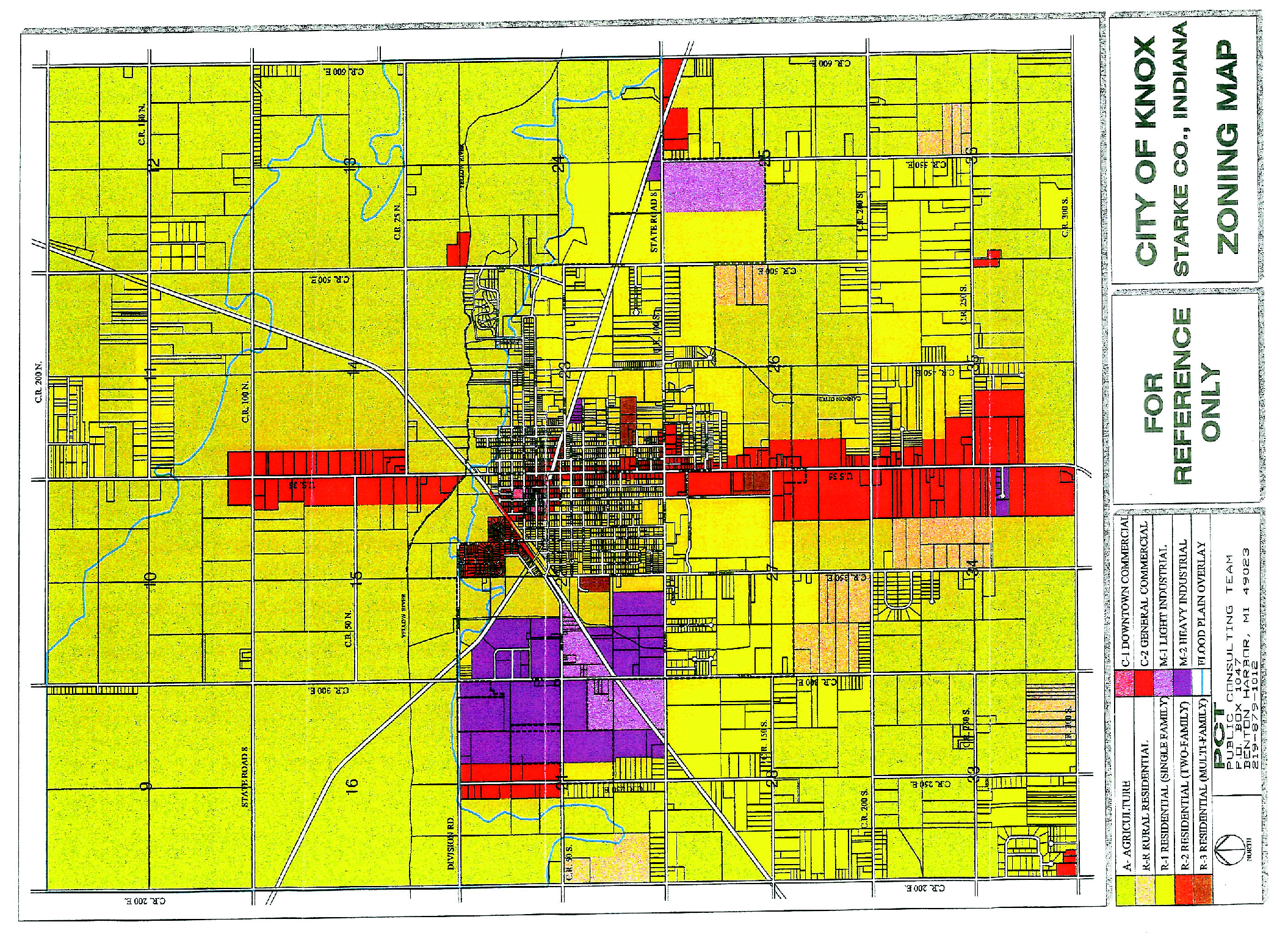
Section 8. - Incorporation of maps.
The location and boundaries of the districts established by this ordinance are shown upon the zoning map(s), which are hereby incorporated into the provisions of this zoning ordinance and which map in its entirety, including all amendments thereto, shall be as much a part of this resolution as if fully set forth and described herein.
The zoning map, and amendments thereto, shall be maintained by the Knox Advisory Plan Commission.
A.
Unless shown otherwise, the boundaries of the districts are lot lines, the centerlines of streets, alleys, roads or such lines extended, and the limits of the City of Knox and/or its extra territorial jurisdictional area.
B.
Where, due to the scale, lack of detail or illegibility of the zoning map accompanying this ordinance, there is any uncertainty, contradiction or conflict as to the intended location of any district boundaries shown thereon, interpretation concerning the exact location of district boundary lines shall be determined upon written application to, or upon its own motion, by the board of zoning appeals.
If, in accordance with the provisions of this ordinance, changes are made in district boundaries or other matter portrayed on the zoning map, such changes shall be entered on the zoning map within five city hall business days after the amendment has been approved by the city council. No amendment to this ordinance which involves matter portrayed on the zoning map shall become effective until after such change and entry has been made on said map.
No changes of any nature shall be made in the zoning map or matter shown thereon except in conformity with the procedures set forth in this ordinance.
Regardless of the existence of purported copies of the zoning map which may from time to time be made or published, the zoning map which shall be located in the plan commission's office signed by the mayor or city council president and city clerk shall be the final authority as to the current zoning status of land and water areas, buildings, and other structures in the city.
(Ord. No. 958, 2-10-98)
Section 9. - Replacement of zoning map.
In the event that the zoning map becomes damaged, destroyed, lost or difficult to interpret because of the nature or number of changes and additions, the city council may by resolution adopt a new zoning map which shall supersede the prior zoning map. The new zoning map may correct drafting or other errors or omissions in the prior zoning map, but no such correction shall have the effect of amending the original zoning map or any subsequent amendment thereof. The replacement zoning map shall bear the following citation: "This is to Certify that this Official Zoning Map supersedes and replaces the Official Zoning Map, adopted (enter date of ordinance adoption) as provided in Title I of the City of Knox Comprehensive Zoning Ordinance Amendment, Ordinance Number (enter ordinance number), as amended" and certified by the signature of the Mayor or City Council President and Clerk of the City of Knox.
(Ord. No. 958, 2-10-98)
Section 10. - Zoning of vacated areas.
Whenever any street, alley or other public way within the City of Knox shall be vacated, such street, alley or other public way or portion thereof shall automatically be classified in the same zone districts as the property to which it attaches. In the case of a vacating of land abutting two zoning classifications, abutting zoning shall extend to the mid-point of the property vacated.
(Ord. No. 958, 2-10-98)
Section 11. - Zoning of annexed areas.
Any area annexed to the City of Knox shall immediately upon such annexation be classified as an R-1 residential district until a zoning map for said area has been adopted by the city council. The plan commission shall recommend appropriate zoning for such area within three months after the matter is referred to it by the city council.
(Ord. No. 958, 2-10-98)
Section 12. - Uses of terms and interpretation of words.
For the purpose of this ordinance, certain terms or words used herein shall be interpreted or defined as follows:
A.
The present tense shall include the future tense.
B.
The singular includes the plural.
C.
The word "person" includes a corporation as well as an individual.
D.
The word "lot" includes the word "plot" or "parcel".
E.
The terms "shall, will and must" are always mandatory.
F.
The word "used" or "occupied" as applied to any land or building shall be construed to include the words "intended, arranged or designed to be used or occupied".
(Ord. No. 958, 2-10-98)
Section 13. - Definitions.
Accessory use. An accessory use is:
a.
A use conducted on the same zoning lot as the principal use to which it is related (whether located within the same or an accessory building or other structure, or as an accessory use of land), except that, where specifically provided in the applicable district regulations, accessory off-street parking or loading need not be located on the same zoning lot; and
b.
A use which is clearly incidental to, and customarily found in connection with, such principal use; and
c.
A use either in the same ownership as such principal use, or is operated and maintained on the same zoning lot substantially for the benefit or convenience of the owners, occupants, employees, customers or visitors of the principal use.
d.
Accessory use includes:
1.
Living or sleeping accommodations for servants.
2.
Living or sleeping accommodations for caretakers in connection with any use.
3.
Living or sleeping accommodations for employees in connection with commercial or manufacturing uses.
4.
Keeping of no more than four adult animals (household pets), but not for sale or hire. A commercial stable or kennel is not an accessory use.
5.
Swimming pools not located within a building, provided that:
a)
The use of such pools shall be restricted to occupants of the principal use and guests for whom no admission or membership fees are charged;
b)
Swimming pool clubs are not accessory uses.
6.
Farm animals or agricultural storage in a barn, shed, tool room or similar building or other structure as provided for in the agriculture or rural residential districts.
7.
Home occupations.
8.
In connection with commercial or manufacturing uses, the storage of goods normally carried in stock, used in or produced by such uses, unless the storage is expressly prohibited under the applicable district regulations.
9.
In connection with commercial and manufacturing uses, incidental repairs, unless expressly prohibited under the applicable district regulations.
10.
Off-street parking spaces, open or enclosed.
11.
Off-street loading docks.
12.
Radio or television towers.
Alley. Any dedicated public way affording a secondary means of access to abutting property, and not intended for general traffic circulation.
Alterations, incidental or to alter incidentally. Incidental alterations, to alter incidentally, or to make an incidental alteration include:
a.
Changes or replacements in the nonstructural parts of a building or other structure, without limitation to the following examples:
1.
Alteration of interior partitions to improve livability in a nonconforming residential building, provided that no additional dwelling units are created thereby.
2.
A minor addition on the exterior of a residential building, such as an unroofed, unenclosed porch.
3.
Alteration of interior nonload bearing partitions in all other types of buildings or other structures.
4.
Replacement of, or minor changes in, the capacity of utility pipes, ducts or conduits.
b.
Changes or replacements in the structural parts of a building or other structure, limited to the following examples or others of similar character or extent:
1.
Making windows or doors in exterior walls.
2.
Replacement of building facades.
3.
Strengthening the load bearing capacity, in not more than ten percent of the total floor area, to permit the accommodation of a specialized unit of machinery or equipment.
Animals. Household pets, farm livestock and wild (dangerous) animals shall only be allowed upon a zoning lot in accordance with the terms of this ordinance. Reference is made to the Knox City Code sections of which are incorporated herein by reference and are applicable to the jurisdictional area as follows:
Apartment. A room or group of rooms in an apartment house designed to be occupied exclusively as a residence for only one family.
Apartment house. A building designed to be occupied exclusively by three or more families, living independently from one another.
Automotive service station. An automotive service station is a building or other structure or a tract of land used exclusively for the storage and sale of gasoline or other motor fuels and for any uses accessory thereto. The sale of lubricants, accessories or supplies, the lubrication of motor vehicles, the minor adjustment or repair of motor vehicles with hand tools only, or the occasional washing of motor vehicles are permitted accessory uses. Automotive service stations may include commercial uses such as food services and retail sales. A public parking lot or public parking garage is not a permitted accessory use.
The location of a service station building and its equipment, (including: dispensing pumps, light stand, air tower, water outlet or similar installations) shall be governed by the specifications approved in a development plan as provided in title XX.
Basement (cellar). A basement is a story (or portion of a story) partly below curb level, with at least one-half of its height (measured from floor to ceiling) below curb level. On a double-frontage lot the curb level nearest to a story (or portion of a story) shall be used to determine whether such story (or portion of a story) is a basement.
Block. A block is a tract of land bounded by:
a.
Streets;
b.
Public parks;
c.
Railroad rights-of-way;
d.
Corporate boundary lines of Knox.
Bed and breakfast operation. A use which is subordinate to the principal use as a single-family dwelling and a use in which a sleeping room and breakfast are provided in return for payment.
Buffer area. A strip of land in any district at the point where the district touches any other district where a buffer or the separation of the uses are required. Yard requirements may be included in the buffer area requirements.
Building. A building is any structure which:
a.
Is permanently affixed to the land;
b.
Has one or more floors and a roof; and
c.
Is bounded by either open area or the lot lines of a zoning lot.
A building shall not include such structures as billboards, fences or radio towers or structures with interior surfaces not normally accessible for human use, such as gas holders, tanks, smoke stacks, grain elevators, coal bunkers, oil cracking towers or similar structures.
A building may, for example, consist of a one-family detached residence, a two-family residence, either a row house or a series of row houses (depending on location of lot lines), a row of apartments with individual entrances, or an apartment house; a single store or a row of stores (depending on location of lot lines); or a single factory.
A.
Detached. A building which has no party wall (e.g., a single-family dwelling).
B.
Semi-detached. A building which has only one party wall in common with another building (e.g., a two-family duplex dwelling unit).
C.
Attached. A building which has two party walls in common with adjacent buildings (e.g., row houses having three or more dwelling units).
Building area. The total square footage measured along the width and length of the building at the building foundation line. The building area excludes steps, cornices, eaves, gutters, patios, breezeways and roofed/unroofed porches attached to the building foundation.
Building height. A building's vertical measurements from the mean level of the ground abutting the building to a point midway between the highest and lowest points of the roof; excluding chimneys, spires, towers, elevator penthouses, tanks, flagpoles, aerials, stacks, beacons, and similar projection of the building.
Building line. A line parallel to the right-of-way line at a distance therefrom equal to, or greater than, the depth of the front yard required for the district in which the lot is located. (The front of the principal building is the building line.)
Building, mixed. A mixed building is a building in a commercial district used partly for residential use and partly for a community facility or commercial use.
Building width. The building width shall be the dimension measured perpendicularly from the exterior wall to exterior wall along not less than 60 percent of the distance of the longest side wall of the building.
Clinic. An institution providing diagnostic, therapeutic or preventive outpatient treatment by a group of doctors or other health care providers in the same building.
Club. An organization of persons for special purposes or for the promulgation of sports, arts, science, literature, politics or the like.
Court. An open unoccupied space, other than a yard, and bounded on at least two sides by a building. A court extending to the front yard or front lot line or to the rear yard or rear lot line is an outer court. Any other court is an inner court.
Curb line. A line (sometimes containing a raised structure) located on either edge of the roadway or street but within the right-of-way line.
Development plan. A plan and supporting information for the development of real property in a zoning district for meeting the requirements of Section 1403 [IC 36-7-4-1403] and the terms of the City of Knox Comprehensive Zoning Ordinance amendment.
District. A portion of the jurisdictional area of the Zoning Ordinance of the City of Knox within which certain regulations and requirements or various combinations thereof apply under the provisions of this ordinance.
Drive-in. A business establishment so developed that its retail or service character is dependent upon providing a driveway approach or parking spaces for motor vehicles so as to serve patrons while in the motor vehicle rather than within a building or structure, regardless of whether self-servicing is involved.
Dwelling unit. A dwelling unit consists of one or more rooms in a residential building, or residential portion of a building, which are arranged, designed, used or intended for use by one or more persons living together and maintaining a common household, and which include lawful cooking space and lawful sanitary facilities reserved for the occupants thereof.
A.
Single-family. A building on a single lot designed and occupied exclusively as a residence for one family.
B.
Two-family. A building on a single lot occupied by two families where each dwelling unit is designed as a separate dwelling unit with an individual entryway but shares a common wall.
C.
Multiple-family. A building on a single lot occupied exclusively as a residence for three or more families where each dwelling unit is designed as a separate dwelling unit with an individual entryway to each unit but shares one or more common walls.
Enlargement, or to enlarge. An enlargement is an addition to the floor area of an existing building, an increase in the size of any other structure, or an increase in that portion of a tract of land occupied by an existing use. To enlarge is to make an enlargement.
Erected. Built, constructed, altered, reconstructed, moved upon, or any physical operations on the premises required for the construction. Excavation, fill, drainage, and the like, shall be considered a part of erection.
Extension, or to extend. An extension is an increase in the amount of existing floor area used for an existing use, within an existing building. To extend is to make an extension.
Family. A single individual doing his/her own cooking and living upon the premises as a separate, nonprofit housekeeping unit, or a collective body of persons doing their own cooking and living together upon the premises as a separate, nonprofit housekeeping unit in a domestic relationship based upon birth, marriage or other domestic bond as distinguished from a group occupying a boarding house, lodging house, club, fraternity or hotel. This definition shall not include any society, club, fraternity, group, or organization which is not a recognized religious order, nor include a group of individuals whose association is temporary and resort-seasonal in character or nature.
Fences. A structure or natural growth used as a boundary or screen, separation, means of privacy, protection or confinement. There are three types of fences:
A.
Natural fence. A natural fence is a fence of natural growth, such as trees, deciduous shrubs, evergreens and similar plant materials.
B.
Open fence. An open fence is one where visibility at right angles to any surface thereof is not reduced by more than 50 percent opacity.
C.
Solid fence. A fence, including gates, which conceals from view of adjoining properties the open storage of materials and/or operations conducted behind the fenced area, at not less than 100 percent opacity. Less than 50 percent of the face area should consist of openings. A block wall meeting the definition herein shall be considered a solid fence.
Floor area - commercial, (usable area for computing parking). That area used for, or intended to be used for, the sale of merchandise or services or for use to serve patrons, clients or customers. Such floor area which is used or intended to be used principally for the storage or processing of merchandise, or for utilities, shall be excluded from this computation of usable floor area. Measurement of floor area shall be the sum of the gross horizontal areas of the several floors of the building measured from the interior faces of the exterior walls. For the purposes of computing parking for those uses not enclosed within a building, the area used for the sale of merchandise, display of merchandise, and/or area used to serve patrons or clients shall be measured to determine necessary parking spaces.
Floor area - residential. For the purposes of computing the minimum allowable floor area in a residential dwelling unit, the term "floor area" shall mean the sum of the horizontal areas of each story of the building measured from the exterior faces of the exterior walls. The floor area measurement is exclusive of areas of basements, unfinished attics, attached garages, breezeways, and unenclosed porches.
Fraternity or sorority. A building occupied by and maintained exclusively for students affiliated with either an academic or professional college or university or other recognized institution of learning, and when regulated by such institution.
Garage.
A.
Private. A building accessory to a single-family or two-family dwelling for the storage of motor vehicles owned and used by the owner, or tenant, of the lot on which it is erected.
B.
Public. A building used for the storage of more than four motor vehicles. Repairing and servicing of vehicles may be carried on in conjunction with the primary function of vehicular storage.
Golf course. An organized area containing nine, 18 or more holes developed in general conformance to professional golf association standards.
Grade. The ground elevation established for the purpose of regulating the number of stories and the height of the building. The building grade shall be the level of the ground adjacent to the walls of the building if the finished grade is level. If the ground is not entirely level, the grade shall be the average elevation of the ground for each face of the building.
Greenbelt. A strip of land of definite width and location reserved for planting of shrubs and/or trees to serve as an obscuring screen or buffer strip in carrying out the requirements of this ordinance.
Home occupation. A home occupation is an accessory use which:
a.
Is clearly incidental to or secondary to the residential use of a dwelling unit or rooming unit; and
b.
Is carried on within a dwelling unit, or accessory building by one or more occupants of such dwelling unit; and
c.
Occupies not more than 25 percent of the total floor area of such dwelling unit.
In connection with the operation of a home occupation it shall not be permitted:
a.
To sell articles produced elsewhere than on the premises, other than products permitted by the terms of the special use permit issued in accordance with title XVIII.
b.
To install, maintain or use any mechanical or electrical equipment which is not customarily incidental to domestic use.
c.
To have exterior displays, or a display of goods visible from the outside.
d.
To store materials or products outside of a principal or accessory building or other structure.
e.
To display in any district, a nameplate or other sign not in accordance with the requirements of title XIII, section 13.
f.
To make external structural alterations which are not customary in residential buildings.
g.
To produce offensive noise, vibration, smoke, dust or other particulate matter, odorous matter, heat, humidity, glare or other objectionable effects.
h.
To store or handle materials which are explosive or flammable.
Home occupations include owner-occupied single-operator hair styling shops, outside salespersons offices, telephone services, or consultants located within single-family residences.
Hospital, general. An institution providing health services primarily for inpatient medical or surgical care of the sick or injured and including related facilities, e.g., laboratories, outpatient departments, training facilities, central service or facilities, and staff offices which are an integral part of the facilities.
Hotel, transient. A transient hotel is a building or part of a building in which:
a.
Living or sleeping accommodations are used primarily for transient occupancy, and may be rented on a daily basis;
b.
One or more common entrances serve all such living or sleeping units; and
c.
Twenty-four hour desk service is provided, in addition to one or more of the following services: maid, telephone or bellboy service, or the furnishing of laundering of linens.
Permitted accessory uses include restaurants, swimming pools, public banquet halls, ballrooms or meeting rooms.
Household pets. Household pets include any pets not specifically prohibited by the terms of other city codes (reference animals) but does not include horses, donkeys, pigs (of any type), rabbits, chickens, or miniature farm animals of any type.
Junk. The miscellaneous waste material resulting from housekeeping, mercantile enterprises, trades, manufacturing and offices, including ashes, tin cans, glass, scrap metals, rubber, paper, and rags.
Junkyards. A fenced area where waste, used or secondhand materials are bought and sold, exchanged, stored, baled, packed or disassembled, or handled. Junk shall include, but not be limited to, rubbish, scrap iron and other metals, paper, rags, rubber tires, and bottles. A junkyard includes automobile, equipment or similar wrecking yards and any storage, keeping or abandonment of junk, but does not include uses established entirely within enclosed buildings.
Jurisdictional area. The land area including the incorporated boundary of the City of Knox plus the land area surrounding the boundary, not to exceed two miles in distance from the incorporated boundary, as defined on the Official Zoning Map of the City of Knox.
Kennel, commercial. Any lot or premises or portion thereof on which more than four dogs, cats, or other household pets are kept, or where animals are boarded for compensation or offered for sale.
Loading space. An off-street space on the same lot with a building, or group of buildings, for temporary parking of a commercial vehicle while loading and unloading merchandise or materials.
Lot. A parcel of land occupied, or to be occupied, by a main building or a group of such buildings and accessory buildings, or utilized for the principal use and uses accessory thereto, together with such open spaces as required under the provisions of this ordinance. A lot may or may not be specifically designated as such on public records.
Lot area. The total horizontal area within the lot lines of the lot.
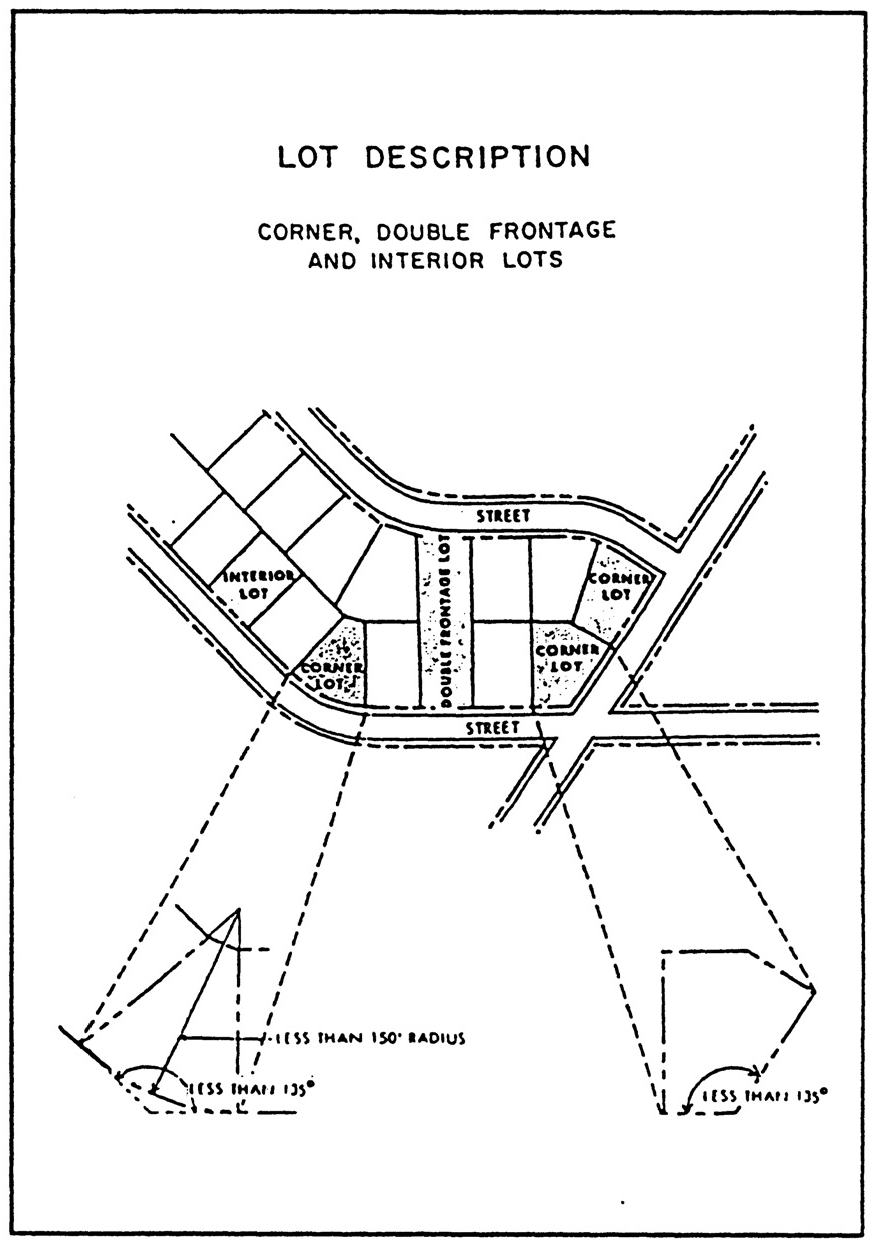
Lot, corner. A lot where the interior angle of two adjacent sides at the intersection of two streets is less than 135 degrees. A lot abutting upon a curved street or streets shall be considered a corner lot for the purposes of this ordinance if the arc is of less radius than 150 feet and the tangents to the curve, at the two points where the lot lines meet the curve or the straight street line extended, form an interior angle of less than 135 degrees.
Lot coverage. The part or percent of the lot occupied by buildings, including accessory buildings.
Lot depth. The horizontal distance between the front and rear lot lines, measured along the median between side lot lines.
Lot, double frontage. Any interior lot having frontages on two more or less parallel streets as distinguished from a corner lot. In the case of a row of double frontage lots, all sides of said lots adjacent to streets shall be considered frontage, and front yards shall be provided as required.
Lot, interior. Any lot other than a corner lot.
Lot lines. The lines bounding a lot as defined herein:
A.
Front lot line. In the case of an interior lot, the line separating said lot from the street. In the case of a corner lot, or double frontage lot, is that line separating said lot from that right-of-way line which is designated as the front street in the plat and in the application for a building permit.
B.
Rear lot line. The lot line opposite the front lot line. In the case of a lot pointed at the rear, the rear lot line shall be an imaginary line parallel to the front lot line not less than ten feet long lying farthest from the front lot line and wholly within the lot.
C.
Side lot line. Any lot line other than the front lot line or rear lot line. A side lot line separating a lot from a street is a side street lot line. A side lot line separating a lot from another lot or lots is an interior side lot line.
Lot of record. A parcel of land, the dimensions of which are shown on a document or map on file with the county recorder.
Lot width. The horizontal distance between the two side lot lines measured on the building set back line, where the building set back line intersects the side lot lines.
Major thoroughfare. An arterial street which is intended to serve as a large volume trafficway for both the immediate city area and the region beyond, and designated as a freeway, major thoroughfare, major collector or minor collector on the land use plan.
Mini-warehouse. A structure in which individually securable and accessible spaces are rented primarily for the temporary storage of personal property by individual owners.
Mobile home or manufactured home. A structure, transportable in one or more sections, which is built on a chassis and designed to be used as a dwelling with or without permanent foundation, when connected to the required utilities, and includes the plumbing, heating, air conditioning, and electrical systems contained in the structure. Mobile home does not include a recreational vehicle. Mobile or manufactured homes shall be constructed to specification issued by the U.S. Department of Housing and Urban Development and bear a certificate of inspection as required by law.
Mobile home park. Any plot of ground in excess of ten acres of land area, upon which two or more mobile homes, occupied as dwelling units, are located.
Motel. A building or buildings used for the purpose of furnishing lodging, with or without meals, to the transient public, having lodging accommodations for ten or more paying families or individuals, and having off-street parking provided contiguous to the lodging accommodations.
Nonconforming. A lawful building, use or lot, which by reason of design, size or use does not conform with the requirements of this ordinance at the date of adoption.
Nursing home. A building to house and within which services are provided for ill and aged persons.
Off-street parking lot. A facility providing vehicular parking spaces along with adequate drives and aisles, for maneuvering so as to provide access for entrance and exit for the parking of more than two automobiles.
Parking space. An area of definite length and width, exclusive of drives, driveways, aisles or entrances giving access thereto, and fully accessible for the storage or parking of permitted vehicles.
Planned unit development. A parcel or tract of land containing two or more acres of land area, initially under single ownership or control, which contains two or more principal buildings and one or more principal uses, planned and constructed as a unified development, and where certain regulations of the ordinance for the district where it is located are modified. A planned unit development requires a special use permit issued in accordance with procedures set forth in this ordinance.
Porch. A terrace, platform, or land mass including steps and decks designed to provide access to or from the structure housing the principal permitted use, either covered or uncovered or attached or nonattached to the structure housing the principal permitted use.
Public utility. Any person, firm or corporation, municipal department, board or commission duly authorized to furnish and furnishing under federal, state or municipal regulations to the public: gas, steam, electric utility, sewage disposal, communication, telegraph, transportation or water.
Recreational vehicle. A vehicle primarily designed and used as temporary living quarters for recreational, camping, or travel purposes, including a vehicle having its own motor power or a vehicle mounted on or drawn by another vehicle.
Reservoir parking. Those off-street parking spaces allocated to automobiles awaiting entrance to a particular establishment.
Right-of-way line. The dividing line between a lot and public street, legally open or officially plotted by the city, county or state, or over which the owners or tenants of two or more lots held in single or separate ownership have the right-of-way.
Rummage or yard sale. Any temporary, commercial enterprise carried out by a home owner or a tenant of a residential dwelling unit with permission of the property owner in any noncommercial district, either within or without a structure. Rummage, garage and yard sales shall be limited to five, two-day permits within one calendar year. A permit must be obtained from the building official prior to the occurrence of each sale and visibly displayed for the duration of the sale.
Setback. The minimum horizontal distance between the property line and the nearest wall of a building, or the side of a structure or the edge of the area of operation of a principal use when no building or structure is involved.
Sign. The use of any words, numerals, figures, devices, designs or trademarks by which anything is made known, such as is used to show an individual, firm, profession or business, and is visible to the general public.
A.
On-site sign. A sign which is accessory to the principal use of the premises.
B.
Off-site sign. A sign which is not accessory to the principal use of the premises, such as but not limited to, a billboard.
C.
Temporary sign. A sign deemed to be necessary for the direction of the public for a short duration, such as construction, real estate, for sale, for rent and political.
1.
Construction sign: A sign listing the names of the architect, engineer, builder, etc., involved with the construction project on the premises.
2.
Real estate sign: A sign pertaining to the sale or lease of the lot or tract of land and/or structures located on such lot or tract of land on which the sign is located.
3.
"For Sale" or "For Rent" sign: A sign pertaining to the sale or rent of the property on which the sign is located.
4.
Political campaign sign: A sign giving notice that an individual is a candidate for a political office.
5.
Promotional sign: A sign promoting a community or not-for-profit organization's event.
Single and separate ownership. The ownership of a lot by one or more persons, partnerships or corporations which ownership is separate and distinct from that of any abutting or adjoining use.
Special use. Permission or approval granted by the board of zoning appeals in accordance with title XVIII, section 2, hereof in situations where provision thereof is made by the terms of this ordinance.
Story. That part of a building (except a mezzanine) included between the surface of one floor and the surface of the next floor, or if there is no floor above, then the ceiling next above. A story thus defined shall not be counted as a story when more than 50 percent by cubic content is below the height level of the adjoining ground.
Street. A public thoroughfare which affords the principal means of access to abutting property.
Structure. Anything constructed or erected, requiring attachment to a permanent foundation meeting the requirements of the city building code.
Temporary building or use. A structure or use permitted by the board of zoning appeals to exist during periods of construction of the main building or use, or for special events, such as tent sales, circus, festivals, etc.
Use. The purpose for which land or a building is designed, arranged or intended, or for which land or a building is or may be occupied.
Use, accessory. A use subordinate to the main use of a lot and used for purposes clearly incidental to those of the main use.
Use, main. The principal use to which the premises are devoted and the principal purpose for which the premises exist.
Variance. Permission or approval granted by the board of zoning appeals in accordance with title XXI, section 4, hereof, constituting a modification of, or deviation from the exact provisions of this ordinance as applied to a special property.
Wall. An obscuring structure of definite height and location to serve as an obscuring screen in carrying out the requirements of this ordinance.
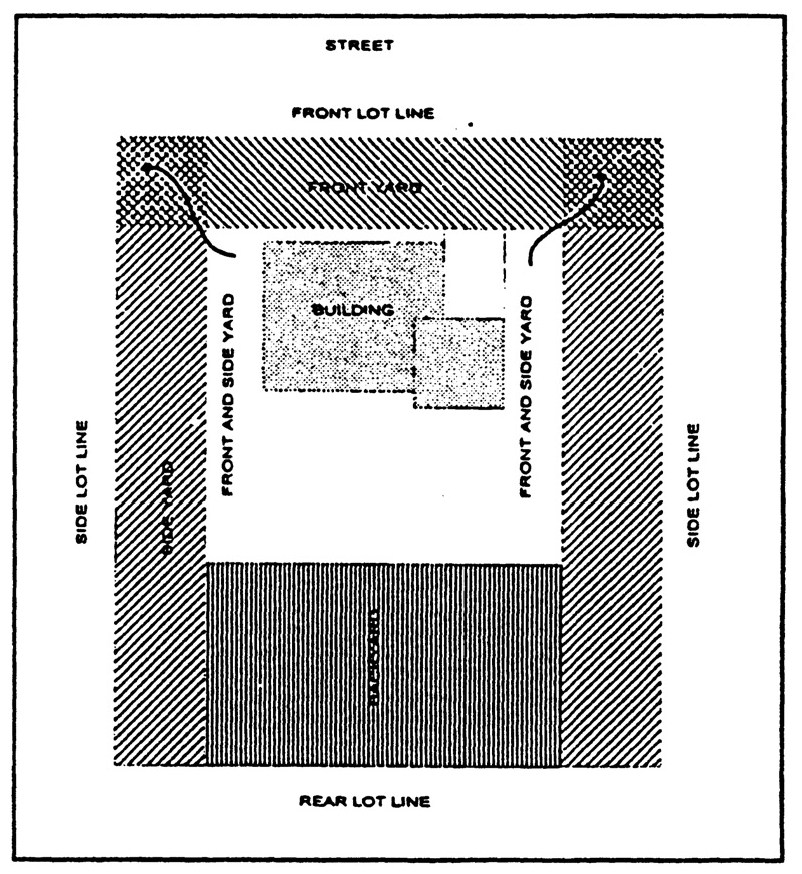
Yards. The area around the inner periphery of each lot in which the principal building, including steps, porches, overhanging eaves, gutters and cornices, shall not be constructed. The size of such area is determined by the distance from the property lines and right-of-way lines set forth in the various zoning districts to any portion of the building and/or steps, porches, overhanging eaves, gutters and cornices unless otherwise provided for in this ordinance.
A.
Front. The minimum required open space, extending the full width of the lot from the right-of-way line to the nearest point on the nearest building or structure.
B.
Side. The minimum required open space extending the full depth of the lot and extending from the side lot line to the nearest point of the main building.
C.
Rear. The minimum required open space measured horizontally with the front setback or building line between the two side yard setback lines of the building housing the principal permitted use.
Zoning lot. A zoning lot is either:
a.
A lot of record existing on the effective date of this ordinance or any applicable subsequent amendment thereto; or
b.
A tract of land, either unsubdivided or consisting of two or more contiguous lots of record, located within a single block which, on the effective date of this ordinance or any applicable subsequent amendment thereto, was in single ownership; or
c.
A tract of land, located within a single block, which at the time of filing for a building permit (or, if no building permit is required, at the time of filing for a certificate of occupancy), is designated by its owner or developer as a tract all of which is to be used, developed or built upon as a unit under single ownership.
A zoning lot therefore may or may not coincide with a lot as shown on the official tax maps of the City of Knox, or on any recorded subdivision plat or deed.
(Ord. No. 958, 2-10-98)
Section 14. - Telecommunication regulation.
A.
Short title. This section shall be known and may be cited as the "Knox Telecommunications Regulation Ordinance" of the City of Knox, Starke County, Indiana.
B.
Purpose and intent. In order to accommodate the communication needs of residents and businesses while protecting the public health, safety, and general welfare of the City of Knox and that part of the contiguous unincorporated areas lying within two miles of the corporate limits of the City of Knox over which the City of Knox and the Knox Planning Commission, have extended zoning jurisdiction, the Common Council of the City of Knox following recommendation of Knox Planning Commission finds that regulations relating to the location and design of wireless telecommunication facilities are necessary to:
(1)
Facilitate the provisions of wireless telecommunication services to the residents and businesses of the city;
(2)
Minimize the visual effects of towers and associated buildings or structures through proper design and siting standards;
(3)
Maximize the use of existing and approved towers and buildings to accommodate multiple antennas in order to reduce or keep to a minimum the number of towers needed to serve the community; and
(4)
Avoid damage to adjacent properties from tower failure through structural standards and setback requirements.
C.
Definitions. For the purpose of this section, the following terms, phrases, words, and their derivations shall have the meaning given herein. When not inconsistent with the context, words used in the present tense include the future, words in the plural include the singular, and words in the singular include the plural. The word "shall" is mandatory and not merely directory.
Accessory equipment structure. A building or cabinet-like structure located adjacent to or in the immediate vicinity of a wireless telecommunications tower or antenna to accommodate, hold, or contain equipment customarily incidental to the receiving or transmitting or wireless broadcasts, cellular telephone calls, voice message and paging services.
Antennae. Equipment used for transmitting or receiving radio frequency signals which are attached to a tower, building or other structure, usually consisting of a series of directional panels, microwave or satellite dishes, or omnidirectional "whip" antennas.
Antenna support structure. Any building, pole telescoping mast, tower, tripod, or any other structure which supports an antenna.
Base transceiver station. Equipment that provides the link between wireless communications and land-based public telephone switching networks, including radio, frequency transceivers, back-up power amplifiers, and signal processing hardware, typically contained in an accessory equipment structure.
Co-location. The location of wireless telecommunications equipment from more than one provider on a common tower, building or structure.
Commercial receiving and/or transmitting antenna. Any antenna erected to transfer information for commercial use.
Fail area. The structurally designed area surrounding a tower quantified as linear distance from the base of the tower to the outer edge of this perimeter area in which a tower could fall, should it fall as designed.
Mast. The vertical pole portion to which the antenna, transmitter, or other type of installation is attached.
Personal wireless facilities. The transmitters, antenna structure and other type of installations used for the provision of personal wireless services.
Personal wireless services. Licensed commercial wireless communication services including cellular telephones, personal communication services (PCS), enhanced specialized mobilized radio (EMR), paging and similar services.
Public property. Land and/or building structures owned or operated by a municipal government.
Public utility. Persons, corporations, or governments supplying gas, electric, transportation, water, sewer, or land line telephone services to the general public. For the purposes of this section, personal wireless services shall not be considered public utility uses, and are defined separately.
Search area. A telecommunications company's service area.
Stealth antenna. A camouflaged antenna not readily visible.
Tower. Any pole, spire, structure, or combination thereof, to which antennas could be attached, or which is designed for any antenna to be attached, and all supporting lines, cables, wires and braces. Types of towers:
1.
Guy tower: A tower, 100—400 feet high, anchored by cables.
2.
Lattice towers: A freestanding tower, 60—400 feet high, with three to four support legs.
3.
Monopoles: A single pole, freestanding tower, larger in diameter at its base tapering at the top.
Tower height. The vertical distance from the ground to the highest point of the tower assembly including antenna, devices, ground or building connections, and any other communication facility.
Tower setback or setback. The horizontal distance from the limit of the fail area of a tower to an abutting property line, right-of-way, road, easement or structure.
Uniform Building Code (UBC). Published by the International Conference of Building Officials and referenced by the State of Indiana to provide jurisdictions with building-related standards and regulations.
D.
Existing antennas and towers. Antennas, towers, and accessory structures as of the date of adoption of the ordinance codified in this section that do not meet or comply with this subsection D are subject to the following provisions:
(1)
Legal nonconforming towers:
a.
Towers may continue in use for the purpose now-used and as now-existing, but may not be replaced or structurally altered without complying in all respects with the ordinance from which this section derives.
b.
If such towers are damaged or destroyed due to any reason or cause at all (unless the user or owner voluntarily removes the tower), the tower may be repaired and restored to its former use, location, and physical dimensions upon obtaining a building permit. The location and physical dimensions shall remain as they were before the damage or destruction. If extensive major repairs are required which, in effect, entail more than a 50 percent replacement cost of the tower, the remaining tower structure must be removed.
E.
Interpretation and applicability.
(1)
This section shall be interpreted consistent with the provisions of the Federal Communications Act of 1934, as amended by the Telecommunications Act of 1996, as amended and supplemental from time to time.
(2)
This section shall apply to all persons, partnerships, corporations and other entities seeking to locate, site, place, modify or construct wireless telecommunications facilities within the corporate boundaries of the city.
(3)
This section reserves to the city all authority contained in state law and existing city ordinance regarding land use, zoning, and regulation which has not been preempted by the federal government pursuant to Section 704 of the Telecommunications Act of 1996 as to the placement, construction, and modification of personal wireless service facilities.
(4)
This section exempts and does not apply to the use or location of private residential citizen band radio towers and amateur radio towers or City of Knox owned towers.
F.
Inspections and violations.
(1)
All applicants for monopoles, guy towers, lattice towers, antennas and the like must obtain a building permit and are subject to inspection by the City of Knox Building Commissioners to enforce compliance with Uniform Building Code (UBC) construction standards.
(2)
Notice of violations will be sent by registered mail or certified mail, return receipt, to the owner of the tower. The owner will have 30 days from the date the notification is issued to make repairs. The owner will notify the building commissioner that the repairs have been made, and as soon as possible thereafter, another inspection will be made and owner notified of the results.
G.
Allowance for towers and antennas by zoning district.
(1)
Permitted uses—All districts. Wireless telecommunication towers and antennas, including accessory equipment structures, shall be allowed in all zoning districts as a permitted use only in the following circumstances as provided:
a.
City-owned tower and/or structure facilities. Upon issuance of Federal Communications Commission (FCC) permits and licenses, wireless telecommunication antennas shall be permitted upon a city-owned tower and/or structure facility provided that an applicant has:
1.
Incorporated the applicable performance standards of subsection I of this section;
2.
An approved lease agreement with the city;
3.
Obtained a building permit from the city; and
4.
Paid all applicable fees.
b.
Co-location on existing towers. Wireless telecommunication antennas shall be permitted to be attached to existing towers within the city in accordance with the applicable siting guidelines and performance standards of subsection I of this section only after an applicant has:
1.
A written statement of approval from the tower owner or lessor;
2.
Obtained a building permit from the city; and
3.
Paid all applicable fees.
c.
Utility poles.
1.
Wireless telecommunication antenna shall be permitted to be attached to utility poles and lattice utility poles only after an applicant has:
(i)
A written statement of approval from the utility pole owner or lessor;
(ii)
Obtained a building permit from the city; and
(iii)
Paid the applicable fees.
2.
The height of the antenna shall not extend more than six feet above the existing utility pole.
(2)
Special exceptions—Specific districts.
a.
Wireless telecommunication towers and antennas shall be allowed in as a special exception in zoning districts as follows:
1.
R-l, R-2: Not allowed on residential developed lots.
2.
R-3: Allowed six feet above the height of the roof only, mounted on educational facilities, religious institutions, government or public utility buildings, or in "upward thrusting elements" such as church steeples, bell towers or smokestacks.
3.
C-1, C-2: 100 feet above ground level.
4.
M-1, M-2: 150 feet above ground level. A variance from the height limitations in zoning districts M-1 and M-2 may be sought by an applicant to a maximum height of 300 feet above ground level. Any variance sought shall be in addition to the requirement that the applicant obtain a special exception permit.
b.
Such provisions are made with co-location requirements stated in subsection H of this section; performance standards in subsection I of this section; and specific procedural requirements in subsection J of this section.
c.
Special exemptions are not required for towers and/or antennas used by the City of Knox, any municipal agency, or other public agency for public safety purposes.
d.
The height limitations listed in subsection G.(2)a shall include all parts of the wireless telecommunications tower and antenna structure.
e.
As applicable, all FAA regulations must be met, and proof thereof supplied to the city prior to granting any permit or the commencement of any construction.
H.
Co-location requirements. Where an existing tower is located within three miles of the site of a proposed tower an application for new wireless telecommunication tower shall not be approved unless the applicant documents to the satisfaction of the city that the antenna planned for the proposed tower cannot be accommodated on an existing or approved tower or commercial or industrial building within the applicant's search area, transcending municipal borders, due to one or more of the following:
(1)
The antenna would exceed the structural capacity of the existing or approved tower or commercial building;
(2)
The antenna would cause interferences with other existing or planned equipment at the tower or building;
(3)
Existing or approved towers and commercial buildings cannot reasonably accommodate the antenna at a height necessary for the proposed antenna to function;
(4)
Existing or approved towers and commercial buildings are outside of the documented search area; and
(5)
The owners or lessors of the existing or approved towers and commercial buildings are unwilling to allow co-location upon their facilities.
I.
Performance standards.
(1)
The requirements of this section apply to all wireless telecommunications towers and antennas erected, constructed, placed, or replaced in the City of Knox.
(2)
All wireless telecommunication towers and antennas shall be designed and situated to be visually unobtrusive to minimize the impact upon adjacent, contiguous land uses and shall conform to the following designand siting criteria:
a.
Setbacks.
1.
The minimum tower setback (see definitions) from any property line or public right-of-way for a wireless telecommunication tower is 30 feet, unless abutting a residential district.
2.
If a wireless telecommunication tower abuts, a residential district, the tower setback distance shall be at least half the height of the proposed tower.
3.
Setbacks for all accessory buildings and equipment structures associated with wireless telecommunication towers and antennas shall comply with the zoning district in which the facility is located.
b.
Accessory building and equipment structures. All buildings and structures accessory to an antenna system and/or tower shall be architecturally designed to blend in with the surrounding building character and the environment.
c.
Fencing. The tower and accessories shall be surrounded by a fence, six feet in height. The anchors of guy towers shall be surrounded by fence, six feet in height. The fence shall be chain link or some other fence approved by the plan commission.
d.
Landscaping and screening. When deemed applicable by the Knox Building Commissioner, proper landscaping and screening shall be incorporated into the site accommodating a tower, accessory building, or equipment structure.
e.
Color.
1.
Wireless communication towers and antennas shall be of a neutral color such as light gray, brown, shades of vegetative green, or sky blue except as directed by the Federal Aviation Administration (FAA).
2.
Wireless communication towers and antennas shall be designed to minimize visibility and to blend into the surrounding character of the neighborhood and its adjacent environment.
f.
Construction type and materials.
1.
Towers with antennas shall be designed to withstand applicable wind load requirements as prescribed in the Uniform Building Code.
2.
Towers and/or antenna systems shall be constructed of or treated with only corrosion-resistant materials.
g.
Roof-mounted wireless communication antennas.
1.
Pitched roof-mounted wireless telecommunication antennas shall not be permitted on buildings unless they are stealth antennas incorporated into upward thrusting architectural elements, such as but not limited to:
(i)
Church steeples;
(ii)
Spire or bell-towers; or
(iii)
Smokestacks.
2.
Flat roof-mounted wireless telecommunication antennas may not be more than six feet (the height of the antenna and mounting hardware) above the highest point of the roof to which the antenna is attached.
h.
Structurally-mounted wireless communication antennas.
1.
Telecommunication antennas mounted on sides of buildings shall be attached as close as possible to the building side; however, it shall not protrude no more than the length of the antenna.
2.
Structurally-mounted antennas not affixed to towers shall be installed to blend into the design and contours of the structure.
i.
Lights. Neither towers nor antennas shall have affixed or attached to them in any way lights, reflectors, flashers, daytime strobes, steady nighttime light, or other illuminating devises, except as required by the Federal Aviation Agency (FAA) or the Federal Communications Commission (FCC). It is the intent of this section that in instances where the applicable federal agency permits either a strobe light or a nonstrobe light on a tower, the City of Knox through its common council, planning commission, board of zoning appeals or zoning commissioner shall determine which type of light is to be placed on the tower. Any strobe light placed on a tower shall be hooded on the ground side of the light so that the light from the strobe does not radiate directly upon the ground and neighbors below.
j.
Signs and advertising.
1.
Any signs and/or, advertising messages shall be prohibited from being affixed to a tower or antenna structure.
2.
An unobtrusive indicator sign detailing emergency and safety information of a size no larger than two feet by two feet shall be exempt for the purposes of public safety.
k.
Other attachments. No tower or antenna shall have constructed thereon or attached thereto any platform, catwalk, crow's nest, or like structure for the purpose of human support, except during periods of construction and repair.
J.
Procedural requirements.
(1)
Applicants proposing to erect wireless telecommunication towers and/or antennas that require a special exception shall follow the procedures set forth in the Knox Zoning Ordinance for special exceptions.
(2)
Additional application materials shall include the following:
a.
A document from the property owner or lessor that allows the applicant to apply for a special exception and building permit to erect a wireless telecommunications tower and/or antenna;
b.
A site plan to scale which shows:
1.
Property lines;
2.
Location of the wireless telecommunications tower or antenna on the property;
3.
Any accessory buildings or equipment structures;
4.
All setback distances;
5.
All fencing including the type;
6.
Proposed landscaping for screening; and
7.
Fail area.
c.
Sufficient information to show that the construction, installation, and the maintenance schedule of the wireless telecommunication tower and/or antenna will not create a safety hazard or damage the property or other persons.
K.
Building permits.
(1)
Applicants proposing to erect wireless telecommunication towers and/or antennas shall obtain a building permit from the City of Knox as approved by the Knox Building Commissioner.
(2)
Building permits shall be issued by the city only after recommendation by the building commissioner and, as applicable, upon favorable recommendation by the Knox Board of Zoning Appeals of a special exception to the Knox Common Council.
(3)
Towers and antennas are subject to plan review and inspection by the City of Knox Building Commissioner (or designated consultant) to determine compliance with Uniform Building Code (UBC) construction standards.
(4)
In addition to performance standards information as required in subsection I of this section, necessary information accompanying the application for a building permit shall include:
a.
A report and plan from a registered professional engineer (P.E.) that specifies the following information:
1.
Site and landscape plans drawn to scale;
2.
A description of the tower with technical reasons for its design;
3.
The tower height and design, including cross-section and elevation;
4.
The height above ground level for all potential mounting positions for co-located antennas and the minimum separation distances between antennas;
5.
Structural integrity for the tower's proposed uses including mounting designs and materials list;
6.
The general capacity of the tower, including the number and type of antennas to insure ANSI standards are met;
7.
A statement of intent on whether excess space will be leased;
8.
Proof of ownership of the proposed site or authorization to utilize it;
9.
Copies of any easements necessary;
10.
A visual study depicting "where within a mile radius any portion of the proposed tower could be seen";
11.
The registered professional engineer's (P.E.) stamp and registration number; and
12.
The fail area of the proposed tower.
L.
Non-interference. All new or existing telecommunication's services shall comply with all relevant Federal Communication Commission (FCC) standards and shall not interfere with public safety and other city and private telecommunications operation.
M.
Insurance. The applicant shall provide the City of Knox with proof that applicant has an appropriate level of liability insurance which protects against losses due to personal injury or property damage resulting from the construction or collapse of the tower, antennas or accessory equipment.
N.
Obsolete or unused towers.
(1)
All obsolete or unused towers and accompanying accessory facilities shall be removed within 180 days of the cessation of operations unless a time extension is approved by the Knox Plan Commission.
(2)
If the tower is not removed, it shall be deemed a nuisance.
(3)
In the event a tower is determined to be a nuisance, the city may act to abate such nuisance and require the removal of the tower at the property owner's expense. The owner shall provide the city with a copy of the notice of the Federal Communication Commission's (FCC) intent to cease operations. The owner shall remove the tower and all accessory structures with 180 days from the date of ceasing operations. In the case of multiple operators sharing the use of a single tower, the owner shall provide the city with a copy of the notice of the Federal Communication Commission's (FCC) intent to cease operations and shall be given 180 days from the date of the final user ceasing operations to remove the obsolete tower and all accessory structures.
(4)
The equipment on the ground shall not be removed until the tower structure has first been dismantled. After all facilities are removed, the site shall be restored to its original condition or to an improved state.
O.
Removal of abandoned towers.
(1)
Any wireless telecommunication tower and/or antenna that ceases to be used for a period of 180 days shall be deemed abandoned.
(2)
The property owner and/or lessee of an abandoned wireless telecommunication tower and/or antenna shall remove the tower and/or antenna.
(3)
If the owner and/or lessee fails to remove a wireless telecommunication tower and/or antenna after it has been abandoned or determined to be abandoned, it may be removed by the city (or designated agent) with the costs of such removal assessed against the owner or lessee of the tower.
(4)
After all facilities have been removed, the site shall be restored to its original condition or to an improved state.
(Ord. No. 1007, 10-8-02)
Section 15. - Driveway standards.
A. All new driveways located on roads which are at least one intersection away from State Road 8 or U.S. 35, in a commercial or residential zoned area, shall be set back at least 12 feet from the adjoining property line.
B. All new driveways which are:
(1)
On a road intersecting State Road 8 or U.S. 35 and
(2)
Which have no intersection between the highway and the driveway location, or which are less than one-half mile from the highway, must receive approval of the planning commission administrator prior to construction.
C. In the event the planning commission administrator determines that the proposed driveway cannot be done safely and cannot meet the guidelines set forth in Table A, the landowner or the landowner's agent may petition the board of zoning appeals to establish a location for the driveway.
Table A
(Ord. No. 2021-OR-1, 1-26-21)

