
Knox City Zoning Code
TITLE XIII
SUPPLEMENTAL DISTRICT REGULATIONS
Section 1. - Minimum lot sizes and widths with respect to sewage disposal.
The following regulations shall apply, notwithstanding the district area and width regulations of this ordinance:
A.
In the A agriculture district and any residential district lying outside the incorporated boundary of the city, which are served neither by sanitary sewer, nor with public water supply, lots shall have a minimum area of one acre, and a minimum width at the building line of 150 feet.
B.
In all residential districts of the city which are not served with sanitary sewers, but which are served with public water supply, lots shall have the minimum area as prescribed by the county or state health department for on-site wastewater disposal, and a minimum width at the building line of 100 feet.
Providing that smaller lot sizes and widths than specified in subsections A and B above, but not less than prescribed in the district regulations, may be permitted when authorized as a special use upon submission of satisfactory evidence that smaller lot area or width will provide safe and effective sanitary sewage disposal in the particular location in question. Such evidence may include, but shall not be limited to, a specific recommendation from the official representative of the state and/or county agency having jurisdiction.
(Ord. No. 958, 2-10-98)
Section 2. - Modification of front yard requirements.
A.
Where an unimproved lot is situated between two improved lots having on each a principal building within 25 feet of the side boundary line of such unimproved lot, and where the principal building extends into the required front yard of each improved lot, and where such unimproved lot has been maintained since October 9, 1973, the front yard depth of such unimproved lot may be the average depth of the front yard of the two adjacent improved lots, notwithstanding the yard requirements of the district in which it is located.
B.
Where an unimproved lot adjoins only one improved lot having a principal building thereon, and where the principal building is located within 25 feet of the common side lot line, and where the principal building extends into the required front yard of such improved lot and has been maintained since October 9, 1973, the front yard depth of such unimproved lot may be the average depth of the front yard of such adjacent improved lot and the front yard required for the district in which such unimproved lot is located, notwithstanding the yard requirements for such district.
(Ord. No. 958, 2-10-98)
Section 3. - Dwellings in industrial districts.
One single-family detached dwelling may be erected and used on an industrially zoned lot for the purposes of housing a full-time security guard when approved as a special use in accordance with title XVIII.
(Ord. No. 958, 2-10-98)
Section 4. - Projections into required yards.
No building and no part of a building shall be erected within or shall project into any required yard in any district except that:
A.
A covered canopy may be erected over a driveway in a required side yard, provided that such structure is:
(1)
Not more than 14 feet in height and 20 feet in length;
(2)
Entirely open on at least three sides, exclusive of the necessary supporting columns and customary architectural feature; and
(3)
At least three feet from the side lot line.
B.
A buttress, chimney, cornice, pier, or pilaster of a building may project not more than 18 inches into a required yard.
C.
Bay windows, open and unenclosed/unroofed fire escapes, and steps, may project not more than three feet into a yard setback area.
(Ord. No. 958, 2-10-98)
Section 5. - Corner vision obstruction.
On any corner lot no wall, fence or other structure, shall be erected or altered and no hedge, tree or shrub or other growth, shall be maintained which may cause danger to traffic on a street by obscuring the view.
(Ord. No. 958, 2-10-98)
Section 6. - Regulations of fences and walls used as fences.
All fences enclosing a zoning lot shall be erected and maintained in conformance to the following limitations:
1.
A front yard may include a natural or open fence including posts, not to exceed 42 inches in height above the natural grade of the land. An open fence may include wood, plastic, wire or other material, but does not include wire-bound wood picket fences such as snow fencing or farm and poultry fencing. A solid fence is prohibited in a front yard.
2.
A rear yard and side yard may include a natural or open fence as described in subsection 1 above, not to exceed 72 inches in height above the natural grade of the land.
3.
A concrete base or curb for a fence shall not exceed a height of four inches above the natural grade of the land.
4.
A fence, where required for the screening of storage or other uses from adjoining properties, shall meet the definition of a solid fence.
5.
For fences outside of the Knox City Limits, a fence in agricultural zoning used to contain animals must be an open fence, but shall not be restricted in height, provided that no safety hazard is created.
(Ord. No. 958, 2-10-98; Ord. No. 971A, 5-25-99)
Section 7. - Accessory buildings.
Accessory buildings, except as otherwise permitted in this ordinance, shall be subject to the following regulations:
A.
Where the accessory building is structurally attached to a main building, it shall be subject to and must conform to, all regulations of this ordinance applicable to main buildings.
B.
In residential districts accessory buildings shall not be erected in any yard, except a rear yard.
C.
An accessory building not exceeding one story or 18 feet in height may occupy not more than 25 percent of a required rear yard, but no larger than 720 square feet in size, except as follows: Residential districts, see table below; in agricultural zoning the square footage of an accessory building is not limited, provided that all other provisions of the ordinance are met regarding area, yards, set-backs, etc.; in rural residential zoning, if the lot size is five acres or more, an accessory building shall be no larger that 2,000 square feet in size.
A parcel may have two accessory use structures, provided maximum ground floor area of any accessory use structure and cumulative for all accessory use structures on the property in residential districts shall not exceed:
D.
No detached accessory building shall be located closer than ten feet to any main building nor shall it be located closer than ten feet to the rear lot line. An accessory building shall conform to the setback requirements of the side yard, as set forth in the zoning district in which the property is located.
(Ord. No. 958, 2-10-98; Ord. No. 958D, 9-25-07; Ord. No. 971A, 5-25-99)
Section 8. - Exceptions to height regulations.
The height limitations contained in the schedule of district regulations do not apply to spires, belfries, cupolas, antennas, water tanks, ventilators, chimneys, or other structures including those required to be placed above the roof level and not intended for human occupancy. The maximum height of any structure, not limited by other sections of this ordinance, shall be 150 feet, unless authorized by the board of zoning appeals.
(Ord. No. 958, 2-10-98)
Section 9. - Structures to have access.
Every building hereafter erected or moved shall be on a lot adjacent to a public street, or with access to an approved private street, and all structures shall be so located on lots as to provide safe and convenient access for servicing, fire protection, and required off-street parking.
(Ord. No. 958, 2-10-98)
Section 10. - Parking, storage, or use of recreational equipment.
For purpose of this ordinance, major recreational equipment is defined as including boats and boat trailers, trailers, pick-up campers, or coaches (Designed to be mounted on automotive vehicles), motorized dwellings, tent trailers and the like, and cases or boxes used for transporting recreational equipment, whether occupied by such equipment or not. No major equipment shall be parked or stored on any lot in a commercial, manufacturing, industrial except:
1.
In the A agriculture, RR rural residential, C-2 general commercial, M-1 light or M-2 heavy manufacturing districts if a special use permit for outside display has been approved.
2.
In an enclosed building; or
3.
In a residential district where recreational equipment is stored on property owned or rented and occupied by the owner of the recreational equipment. Recreational equipment must be stored 20 feet from the edge of the roadway and ten feet from the alleyway. Total of three recreational equipment on property owned by the same person, including property that is connected. No two recreational equipment shall be of the same type.
Example of types:
1.
Used for sleeping.
2.
Boat w/trailer
3.
Open trailer
4.
Enclosed trailer
No such major recreational equipment shall be used for living, sleeping, or housekeeping purposes when parked or stored on a residential lot or in any location not approved for that use.
A temporary permit, valid for a period of nine days, may be obtained at the office of the City of Knox, Clerk-Treasurer's Office. This permit may only be obtained two times in one calendar year, a minimum of 30 days must separate the two permits. It is a violation for wastewater to be discharged within city limits without inspection prior to water and sewer connection.
Inspection is required for the following,
1.
To ensure that water supply lines are drinking water safe.
2.
To ensure that wastewater connection is secure, and no chemicals will be discharged into the city's sanitary sewer system.
Permit fees for connections:
1.
Recreational vehicles permit without sewer .....$5.00.
2.
Recreational vehicles permit w/sewer .....$25.00
(Ord. No. 958, 2-10-98; Ord. No. 2023-OR-5, 10-24-23)
Editor's note— Ord. No. 2023-OR-5, adopted Oct. 24, 2023, amended § 10 and in doing so changed the title of said section from "Parking, storage or use of major recreational equipment" to "Parking, storage or use of recreational equipment," as set out herein.
Section 11. - Parking and storage of certain vehicles.
Automotive vehicles, including trucks, semi-tractors, tractor trailer combinations or trailers of any kind or type (which shall be operable in accordance with city ordinance provisions) without current license plates shall not be parked or stored on any RR, R-1, R-2, or R-3 residentially zoned property other than in completely enclosed buildings. The number of operable automotive or other vehicles which can be parked or stored, nonenclosed, on a residentially zoned lot shall not exceed the number of licensed vehicle operators residing in the dwelling unit(s), other than commercial business vehicles owned or assigned to vehicle operators residing on the premises.
(Ord. No. 958, 2-10-98)
Section 12. - Topsoil—Excavation and removal by permit.
Excavations of or the removal of topsoil in any district is prohibited except as such excavations, or removal of topsoil, is incidental to the erection and maintenance of structures or appurtenances thereto or the use of property permitted by this and other ordinances. All activity permitted by the terms of this section shall be by permit issued by the zoning administrator.
(Ord. No. 958, 2-10-98)
Section 13. - Signs.
All permanent signs hereafter erected, installed or attached to any existing or proposed building or structure, or painted onto a window and any permanent interior sign installed in a window designed to be viewed from outside of the building or exterior wall surface of an existing or proposed building or structure, shall obtain a sign permit from the zoning administrator.
A.
Signs in residential districts.
1.
Illuminated nameplates are permitted subject to the following regulations:
a.
In RR, R-1 and R-2 districts, a nameplate shall not exceed two square feet in total area, and shall indicate only the name or name and address of the occupant, and home occupation as provided by the defined home occupation, if authorized as a special use and a permit obtained. There shall be not more than one such nameplate for each dwelling.
b.
In R-3 districts, a nameplate may be not more than three square feet in total area, provided it indicates only the name or name and address of the dwelling; such a nameplate may be located in a front yard not less than four feet from the front lot line, or one-half the depth of the front yard, whichever is greater nor be higher than one story, or ten feet above curb level, whichever is lower.
2.
Temporary, unilluminated "for sale" and "for rent" signs are permitted, subject to the following:
a.
There shall be not more than one sign per lot, except that on a corner lot two signs - one facing each street - shall be permitted. No sign shall exceed four square feet in area; nor be closer than eight feet to any side and rear lot line, and ten feet to the front lot line, or one-half the depth of the front yard, whichever is greater; nor project higher than one story, or ten feet above curb level, whichever is lower. All "for sale" and "for rent" signs permitted in this section shall be removed seven days after the closing.
3.
Temporary, unilluminated real estate signs are permitted, not to exceed five square feet in area, and shall be placed within the lot lines. Real estate signs shall not be permitted in the public right-of-way, over sidewalks, or in any location obstructing the view of motorists. Signs shall be removed within seven days after the property is sold. No permit is required for real estate signs five square feet or less in size.
4.
Temporary, unilluminated construction signs are permitted, when authorized by the zoning administrator in connection with construction operations for a specific project. Such signs shall be removed within seven days after completion of construction operations. No sign permit shall be required.
5.
Garage and yard sale signs are permitted, provided that the signs shall be placed only in locations authorized by this ordinance, and such signs shall be removed within 24 hours after the sale. A permit is required for the sale. City-issued signs are allowed.
6.
Temporary political campaign signs and signs promoting community or not-for-profit events are permitted, subject to the following conditions, (no permit required):
a.
No sign, poster or other outdoor advertisement advocating the election of a particular candidate, group or political party shall be permitted except within 90 days prior to the primary and/or general election. Promotional signs shall be permitted within 30 days of the event In addition, all such signs, posters, and other outdoor advertisements must be removed no later than seven days after the primary and/or general elections.
b.
No political or promotional sign, poster, or advertisement shall be permitted on any parkway, alley, public street, easement, or road right-of-way.
c.
Whenever any political or promotional sign, poster, or advertisement is found to be in violation of this section of the ordinance, the candidate or organization shall be notified in writing of the violation. The candidate or organization shall correct the violation within three days.
d.
If any violation is not corrected within three days after notification by the zoning administrator, then a fine of $25.00 per day shall be assessed the candidate or organization for each sign not removed after notification by the zoning administrator.
7.
Illuminated, nonflashing and nonblinking (defined as intermittent illumination) church bulletin signs are permitted subject to the following regulations:
a.
There shall be not more than one sign per lot, except that on a corner lot two signs - one facing each street - shall be permitted. No sign shall exceed 16 square feet in area, nor be closer than eight feet to any side and rear lot line, and four feet to the front lot line, or one-half the depth of the front yard, whichever is greater; nor project higher than one story, or ten feet above curb level, whichever is lower.
B.
Signs in agriculture, commercial and manufacturing districts. In addition to sign(s) mounted to the building or painted onto a window, one elevated or ground nonflashing and nonblinking (defined as intermittent illumination) but illuminated business sign with no moving parts, awnings, and/or marquees is permitted subject to regulations set forth elsewhere in the ordinance of the City of Knox and the following:
1.
Where a sign is illuminated by light reflected upon it, direct rays of light shall not beam onto any adjoining property or onto any street. A sign in any direct line of vision of any traffic signal shall not have red, green, or amber illumination.
2.
The gross surface area in square feet of all marketing signs on a lot shall not exceed 2.5 times the lineal feet of frontage of the lot, and for lots fronting on more than one street, only the established front lot line shall be considered as frontage of the lot. Where a sign has two or more faces, ant area of all faces shall be included in determining the area of the sign.
3.
A sign affixed to a building shall not project therefrom nearer than two feet from the abutting curb.
4.
An elevated sign shall be not nearer than two feet from the nearest street right-of-way line and not nearer than five feet from a side or rear lot line. The leading edge of the sign shall be the point of measurement for determination of the set back.
5.
A sign affixed to a building shall not project higher than four feet above building height, and a sign projecting more than 15 inches from a building wall shall have its lowest level not less than 12 feet above the grade below it.
6.
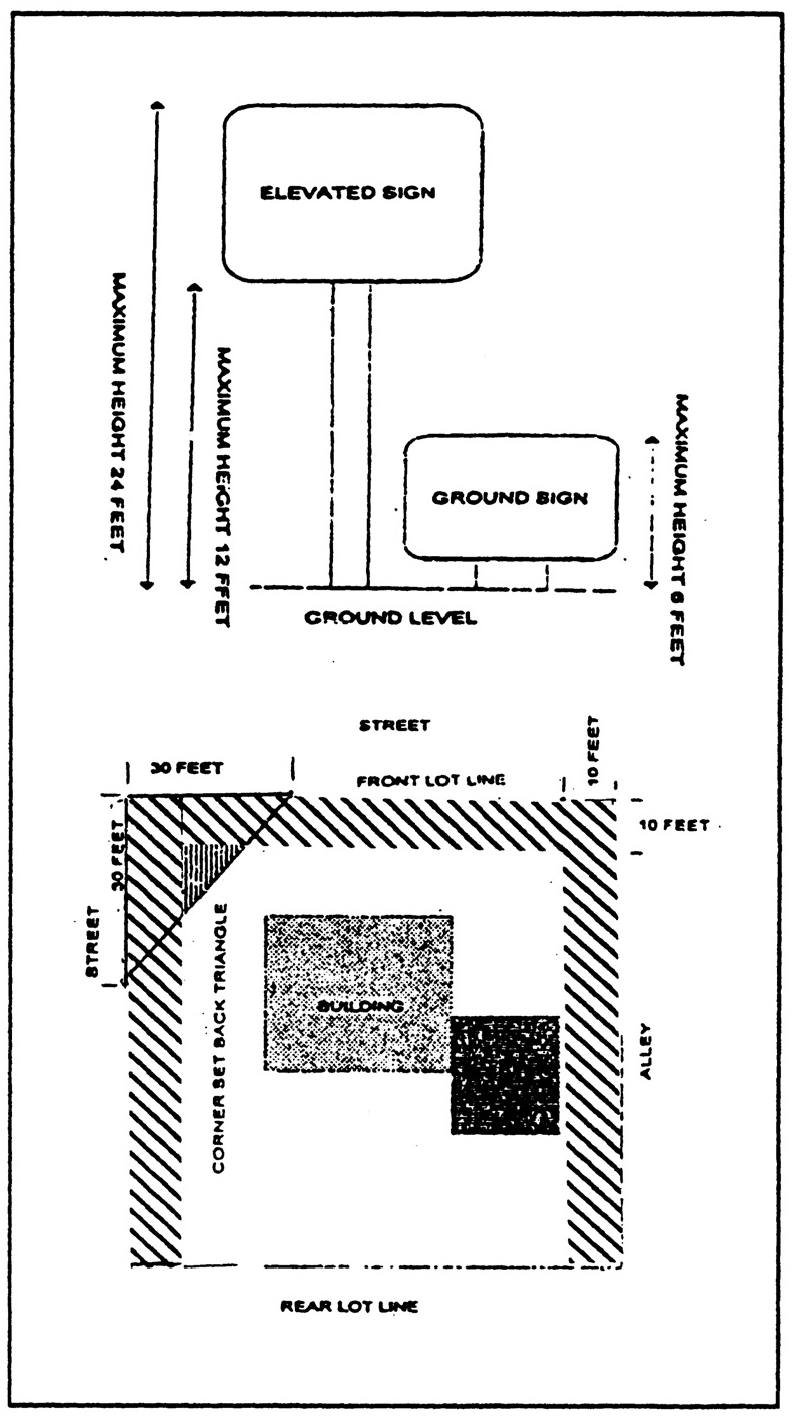
An elevated sign shall not project higher than 24 feet above the grade below it, and shall have its lowest levels not less than 12 feet from the natural grade below. Such signs may be constructed with or supported by not more than two columns, each having a width not greater than eight inches in width. Nothing shall be added to the columns which exceeds the width dimension.
7.
A ground-mounted sign shall not exceed six feet in height measured from the surrounding natural grade and shall not be located closer than ten feet to the right-of-way line of a front yard or side yard abutting a street, measured perpendicular to the street. On a corner lot a ground-mounted sign near the intersection of two streets shall not be located within the triangle formed by measuring 30 feet from each street along the right-of-way lines and connecting the points (see illustration). A ground sign may not be located closer than ten feet from the edge of the usable surface of any driveway, alley, or other "curb cut" which provides vehicular access to the lot. The leading edge of the sign shall be the point of measurement for determination of the set back.
8.
In a unified shopping center, in single ownership or control, one additional sign may be erected for it; the sign shall not exceed 150 square feet in area nor display more than the name and location of the shopping center; such sign shall be set back at least half the required yard depth distance from each abutting street and its bottom edge shall be at least 12 feet above the level of the ground, and its overall height shall not exceed 24 feet above the curb level.
9.
No additions, modifications or attachments shall be permitted inconsistent with an approved sign permit without amendment of the sign permit using the same procedures as provided by the issuance of the original sign permit.
10.
The board of zoning appeals is hereby granted the authority to grant a variance from the setback and size dimensions, set forth in this section, title XIII, section 13, based on the finding that such a variance will not adversely affect adjacent property owners or inhibit visual sight lines required along streets and road rights-of-way.
11.
Temporary signs, including "for sale" and "for rent" signs, real estate signs, construction signs, garage and yard sale signs and political campaign and promotional signs are permitted, subject to the same conditions as in residential districts. (See section 13, A.2. through A.6.)
12.
An inflatable balloon used for the purpose of product advertising shall be permitted as a temporary sign in the C-2 zoning district for a period not to exceed seven days. A sign permit is required from the zoning administration who shall determine that the usage and placement of the balloon will meet safety standards.
C.
Prohibited signs. Signs prohibited in all districts:
1.
Any sign which is in need of maintenance, or which is no longer functional or is abandoned. Signs shall be considered no longer functional and abandoned when such sign is materially obstructed from view, when its essential elements are no longer readable, when a sign has been left by a business or other use which has ceased to operate, or when a condition of deterioration or dilapidation of the sign face or structure is in evidence. All signs shall be repaired, removed or relocated in compliance with the regulations of this ordinance within 30 days after official notification by the zoning administrator.
2.
Any sign which is constructed, altered, located or illuminated in any manner which causes undue glare, distraction, confusion, nuisance, noise, or hazard to traffic or to other properties. No sign may be illuminated after 11:00 p.m. if it is located within or adjacent to any residential district, except those businesses remaining open beyond that time, in which case illumination shall cease upon closing.
3.
No sign which has rotating beam, beacon, flashing or alternating illumination shall be permitted for advertising or identification purposes where no hazard or need for caution exists. This section shall not be construed as prohibiting time or temperature devices customarily identified with banks or lending institutions or barber poles, provided such devices meet all other applicable provisions of the ordinance. Scrolling signs are prohibited.
4.
Any sign that is attached to a tree or other living vegetation, utility pole, rock, curbstone, sidewalk, lamppost, hydrant, bridge, highway marker, or other sign, except for public informational signs.
5.
Any sign displayed on a stationary vehicle or trailer when said vehicle or trailer is used primarily for the purpose of and serving the function of a sign.
6.
Any sign so placed that it obstructs any window, door, fire escape, stairway, ladder, opening, or access intended for light, air, ingress to, or egress from any building.
7.
Signs advertising activities which are illegal under federal, state, or county laws or regulations or city ordinances.
8.
Any sign which makes use of a word such as "stop," "look," "danger," or similar words, phrases, symbols, or characters in such manner as to imply the need or requirement of stopping or the existence of danger.
(Ord. No. 958, 2-10-98; Ord. No. 971A, 5-25-99)
Section 14. - Mobile home parks.
In the R-3 residential district, mobile home parks are permitted subject to the following minimum requirements:
A.
The minimum area of a mobile home park shall be ten acres.
B.
No mobile home site shall be rented in any park except for periods of six months or longer.
C.
No mobile home shall be nearer than 75 feet to the right-of-way line of any county road, nor nearer than 75 feet to the right-of-way line of any federal or state highway.
D.
A dense green belt of evergreen trees and/or shrubs, not less than six feet high after one full growing season and which at maturity is not less than 12 feet high, shall be located and effectively maintained at all times along all park boundary lines except at established entrances and exits serving the park.
The park shall provide front, side, and rear yards having a depth or width of no less than 40 feet and containing no obstructions except trees and shrubs.
E.
Each park shall provide a recreational area or areas equal in size to at least eight percent of the area of the park. Streets, parking areas, and park service facility areas shall not be included in the required recreational area.
F.
Coin-operated laundries, laundry and dry cleaning pickup stations and other commercial convenience establishments may be permitted in mobile home parks provided:
1.
They are subordinate to the residential character of the park;
2.
They are located, designed and intended to serve only the needs of persons living in the park;
3.
The establishments and the parking areas related to their use shall not occupy more than ten percent of the total area of the park; and
4.
The establishments shall present no visible evidence of their commercial nature to areas outside the park.
G.
Each park shall provide either one central waterproof structure available to all mobile home sites or a single waterproof structure for each mobile home site suitable for storage of goods and the usual effects of persons occupying the park.
H.
All exterior park lights shall be so located and shielded as to prevent direct illumination of any areas outside the park.
I.
Mobile home sites shall be a minimum of 4,000 square feet in area.
J.
Each mobile home site shall have a minimum width of 40 feet and a minimum depth of 100 feet.
K.
The minimum distance between a mobile home and another mobile home or structure shall be 20 feet. Each mobile home shall be located at least ten feet from the greenbelt.
L.
Each mobile home site shall be provided with a pad consisting of either a solid concrete slab or two concrete ribbons of a thickness and size adequate to support the maximum anticipated loads during all seasons. When concrete ribbons are used, the area between the ribbons shall be filled with a layer of crushed rock. An anchor system shall be provided in connection with the placement of each mobile home. The minimum thickness of the concrete slab or ribbon shall be six inches. All refuse containers shall be screened from view.
M.
All improvements within the mobile home park will conform to the standards delineated in the city's subdivision regulation ordinance. Wastewater, storm sewers, water systems, service drives, off-street parking equal to at least 1½ spaces for each mobile home, grading, landscaping, buildings, and other improvements shall be constructed in accordance with the development plans and specifications approved by the plan commission. Streets shall be paved with all-weather, hard-surface material, being concrete or asphalt and satisfactorily maintained, all improvements within the mobile home park to conform to the standards delineated in the city subdivision regulation ordinance together with any interpretations thereof by the city plan commission.
(Ord. No. 958, 2-10-98)
Section 15. - Manufactured homes.
A.
Permitted placement. The establishment, location, and use of manufactured homes which have been constructed according to U.S. Department of Housing and Urban Development specifications and containing a HUD inspection certificate as permanent residences shall be permitted in any district permitting installation of a dwelling unit, subject to the requirements and limitations applying generally to such residential use in the district, and provided such manufactured homes shall meet the following requirements and limitations:
1.
The manufactured home shall meet all requirements applicable to single-family dwellings and shall possess all necessary improvement location, building and occupancy permits and other certifications required by the zoning ordinance.
2.
The home shall be in a double section or larger multi-section unit and larger than 1,000 square feet of space as defined in IC 36-7-4-1106, and meet the minimum width requirements of the residential zoning district.
3.
The home shall be attached and anchored to a permanent foundation as a permanent residence in conformance with the regulations of the Indiana One- and Two-Family Dwelling Code, and with manufacturer's installation specifications.
4.
The home shall be covered with an exterior material customarily used on site built residential dwellings; such material shall extend over the top of the foundation, and shall be of a type included on the approved siding and roofing materials customarily is use as determined by the zoning administrator.
5.
The home shall have a roof composed of a material customarily used on site built residential dwellings, with a roof slope ratio or pitch not less than three inches for each 12 inches of roof, material of which shall be installed on to a surface appropriately pitched for the materials used.
6.
The home shall have wheels, axles, and hitch mechanisms removed.
7.
The home must be set on to an excavated area, with permanent perimeter enclosure, foundations, footings, and crawl space or basement walls constructed in accordance with the terms of the one- and two-family dwelling code. The space between the floor joists of the home and the excavated under floor grade shall be completely enclosed with the permanent perimeter enclosure (except for required openings).
8.
The home shall be in substantial conformity with the architectural integrity of the neighborhood, and architecturally compatible with those homes within five hundred feet of the manufactured home, as determined by the zoning administrator.
B.
Structural alterations. Due to its integral design, any structural alteration or modification of a mobile or manufactured home after it is placed on the site must be approved by the building official, pursuant to all city and state ordinances and codes.
(Ord. No. 958, 2-10-98; Ord. No. 971A, 5-25-99)
Section 16. - Submission of permits prior to issuance of building permit.
A.
Where wastewater disposal methods other than a municipal system will be provided for any lot, evidence of approval by the Starke County Board of Health shall be submitted to the building official together with the application for a building permit.
B.
Where state, county or city regulations require building code approval, evidence of approval from those agencies shall be submitted to the building official together with the application for a building permit.
C.
No building permit shall be issued until proper evidence of the above requirements has been submitted to the building official.
(Ord. No. 958, 2-10-98)
Section 17. - Landscaping requirements, residential and in commercial/industrial districts.
A.
Residential districts. In the R-1, R-2 and R-3 residential districts one, 2½-inch diameter tree measured 18 inches above the ground shall be planted for every 30 feet of street frontage. Each tree shall be planted within any portion of the front yard of the zoning lot.
In the R-3 multifamily residential district, a planting strip shall be provided along the rear lot line to serve as a visual barrier to adjoining properties, the landscaping plan to be approved by the plan commission as part of the site plan review requirements.
B.
Commercial and industrial districts. In the C-2 general commercial, the M-1 light and M-2 heavy manufacturing districts, a minimum of 15 percent of the total lot area shall be landscaped containing one tree or shrub for every 1,000 square feet or portion thereof, plus one tree for every 1,500 square feet of landscaped area or portion thereof shall be required. (Plant materials existing on the site prior to the development may be included as part of the requirement.) Groundcover is required in all landscaped areas. Landscaping of adjacent rights-of-way areas shall not be included in satisfying the minimum on-site requirement if it is maintained by the adjacent property owner. A minimum of 33 percent of required landscape area shall be located between any building and the street. The landscaping plan shall be approved by the plan commission as part of the site plan review requirements.
(Ord. No. 958, 2-10-98)
Section 18. - Satellite receiving dishes.
The purpose of this section is to regulate the use and location of satellite receiving dishes, as follows:
A.
This section shall not apply to any satellite dishes 24 inches in diameter or less which shall be considered accessory uses under the present ordinance.
B.
Satellite receiving dishes larger than 24 inches in diameter shall not be considered accessory uses under the Knox Zoning Ordinance, and may only be used and installed in accordance with the terms of this section.
C.
No satellite receiving dish larger than 24 inches may be installed on the roof of any structure, nor attached or installed on any radio tower.
D.
Satellite dishes may be installed in the rear yard in any residential district upon obtaining a building permit from the building official.
E.
No satellite dishes larger than 24 inches may be installed in the front or side yards of the property without first obtaining a special use permit from the board of zoning appeals. The board of zoning appeals may grant variances to these specifications only upon the showing of undue hardship, and the impossibility of installing and using a satellite dish in a rear yard.
F.
Landowners shall provide suitable screening to any satellite dishes installed. Such screening shall consist of dense evergreens or similar live growth to screen the satellite dish from view from adjacent yards as determined by the building official.
(Ord. No. 958, 2-10-98)
Section 19. - Bed and breakfast operations.
Bed and breakfast operations shall be subject to the following special provisions:
A.
Because many older, single-family homes are larger and represent sizeable maintenance and energy costs for a single-family, it is feared that restriction to only single-family use may foster inadequate maintenance or even abandonment. The possible consequences may be a general appearance of blight which, if allowed to proceed in a downward trend, could erode the social stability of a neighborhood. Based upon the above, some areas are regarded as conducive for limited use for bed and breakfast purposes; but only when certain conditions as may be required by the plan commission in order to preserve the character, as well as health, safety and welfare of the neighborhood are met.
B.
A residential structure shall not have or be converted to more rental rooms than the number of bedrooms which exist at the time of enactment of this amendment and adequate living space must be preserved for manager or owner's quarters. A common room for guest relaxation is required in these facilities. Unless owner occupied, the manager must reside on and have more than a nominal equity interest in the premises.
C.
Off-street parking for one vehicle for each bedroom to be rented must be available in addition to requirements for residential family vehicles.
D.
Bathrooms must be furnished for guestrooms - One bathroom to serve not more than two guestrooms.
E.
No separate cooking facilities are permitted for a bed and breakfast operation if continental breakfast is served.
F.
One sign in residential areas shall be permitted in accordance with title XIII, section 13.
G.
Inspection and approval by building official are required prior to occupancy of bed and breakfast. Health department approval is required if other than Continental breakfast is planned. Thereafter, the building official shall conduct an annual inspection for compliance with city ordinances.
H.
Bed and breakfast shall be limited to short-term occupancy, not to exceed 30 continuous days.
I.
A residence must contain a minimum of 2,400 square feet of liveable floor space to be converted into a bed and breakfast.
J.
Parking shall be provided according to the following formula: two spaces, plus one space for each guest room, plus one space for each employee on duty at any one time.
(Ord. No. 958, 2-10-98)
Section 20. - Measurement of yards abutting streets and roads.
Measurement for yard setback and all other requirements of this ordinance begin at the property line to the building surface. For properties having sectional or metes and bounds property descriptions, the measurement shall begin at the right-of-way line.
(Ord. No. 958, 2-10-98)
Section 21. - Restriction concerning off-site illumination.
Illumination of any type shall be arranged to prevent illumination of abutting properties.
(Ord. No. 958, 2-10-98)

