
Knoxville City Zoning Code
ARTICLE 11
- OFF-STREET PARKING
11.1 - APPLICABILITY
A.
General Applicability
1.
These regulations are applicable in all zoning districts. If a district has specific off-street parking requirements, those requirements control.
2.
The City of Knoxville Department of Engineering may require redesign of parking lots if a traffic safety hazard can be eased or eliminated. Loss of parking spaces resulting from the required redesign will be considered by the Department of Plans Review and Inspections in determining the minimum parking requirements.
3.
If the recalculation of parking requirements under Section 11.5 results in parking spaces that exceed any maximums set forth in this Article, the excess parking spaces may continue to be used and are subject to Article 11.1.B.
4.
All parking lots must meet the requirements of sections 11.2 and 11.11.
5.
Required parking will be recalculated with a change of use or new addition.
B.
Required Parking for Previously Developed Property
1.
Existing legal parking may be continued and maintained.
a.
With a change of use or new addition, when existing parking exceeds the maximum number of spaces permitted, one landscaped parking lot island must be provided between every 10 parking spaces in accordance with Article 12.6.C.
2.
All new parking required with a change of use, or new addition must be constructed to comply with the current requirements while remaining functional and safe as determined by the City of Knoxville Department of Engineering.
a.
Exception - Existing parking lots can be expanded based on their existing standards, but cannot create any new non-conformities.
i.
When an existing parking lot is expanded to a size 10,000 square feet or more, the parking lot shall be required to provide perimeter landscaping in accordance with Article 12.5.B, 12.5.C, 12.5.D, 12.5.E. This requirement does not apply to perimeter landscape yards that are less than three feet wide.
3.
If the primary building is razed, all parking must comply with the current requirements.
(Ord. No. O-96-2022, § 1, 7-26-22; Ord. No. O-104-2023, § 1, 7-25-23)
11.2 - GENERAL REQUIREMENTS
A.
The storage of merchandise, the storage of automobiles or other motor vehicles for sale, or the repair of automobiles or other motor vehicles on required off-street parking facilities is prohibited.
B.
Wherever parking is required by this Article, no building permit will be issued prior to approval of access to affected City streets and/or state highways by the appropriate City and/or state official.
11.3 - LOCATION AND SETBACKS
A.
Off-street parking for uses other than residential uses may be provided on a lot other than that on which the principal use is located if the required number of parking spaces for any land use cannot be provided on the same lot on which the principal use is located, according to the requirements of Section 11.8 below.
B.
Parking lots with common frontage on the same block with residentially zoned property and located on roads with less than four existing travel lanes must be setback 25 feet from the street line. However, this setback does not apply to multi-family dwellings.
C.
An interior side or rear setback is required in parking lots, as measured from the edge of parking lot to the lot line, as follows. Required site landscape per Article 12 may be located in this setback.
1.
Industrial districts abutting agricultural or residential districts: 20 feet
2.
Office or commercial districts abutting agricultural or residential districts: 20 feet
3.
Multi-family dwellings abutting agricultural or single-family districts: 10 feet
4.
Non-residential use in residential district: 10 feet
D.
For single-family, single-family attached and two-family dwellings, parking is prohibited in the front and corner side yard except as follows:
1.
On approved driveways and in approved parking spaces.
2.
A maximum of two vehicles with a current and properly displayed accessible/disabled parking license plate or placard/hang tag.
3.
Temporary loading or unloading.
4.
When construction, remodeling, maintenance, or repairs are being performed on the property, temporary front yard parking cannot exceed the period for which the permit is valid or as necessary to complete the work.
5.
Parking for isolated, non-recurring gatherings, parties, or visitors. This exception is not intended to provide permanent or semi-permanent parking for extra cars.
6.
Areas within a two-mile radius of Neyland Stadium during University of Tennessee-Knoxville home football games and areas within a one-mile radius of Chilhowee Park and Exposition Center during city-approved events.
E.
For single-family, single-family attached and two-family dwellings, approved parking and driveway(s) in the front and corner side yard are limited to the following:
1.
On lots with a carport or garage:
a.
The driveway leading to a carport or enclosed garage, not to exceed the maximum width allowed, except for flares adequate to access the carport or garage.
b.
A connector driveway may extend from a circular driveway to beyond the front wall of the structure. Connector driveways must comply with driveway width requirements.
2.
On lots with no carport or garage:
a.
With lot frontage of 75 feet or less, the driveway must be within ten feet of the side lot line.
b.
For lot frontage greater than 75 feet, no driveway, other than a circular driveway, may be constructed in the area between the front wall of the principal structure and the front property line.
c.
For lot frontage greater than 75 feet, a connector driveway may extend from a circular driveway to beyond the front wall of the principal structure. Connector driveways must comply with driveway width requirements.
DRIVEWAYS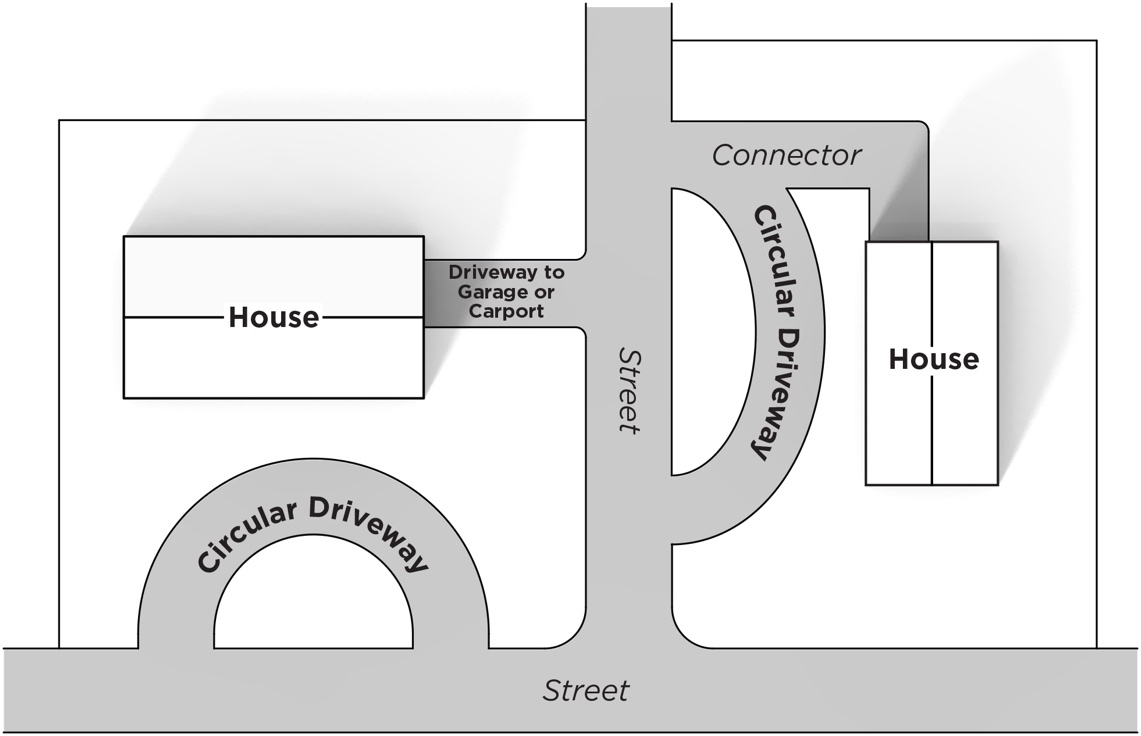
3.
In addition to any of the above, a branch type turnaround not to exceed 200 square feet is permitted on any lot where City engineering standards can be met.
BRANCH TYPE TURNAROUND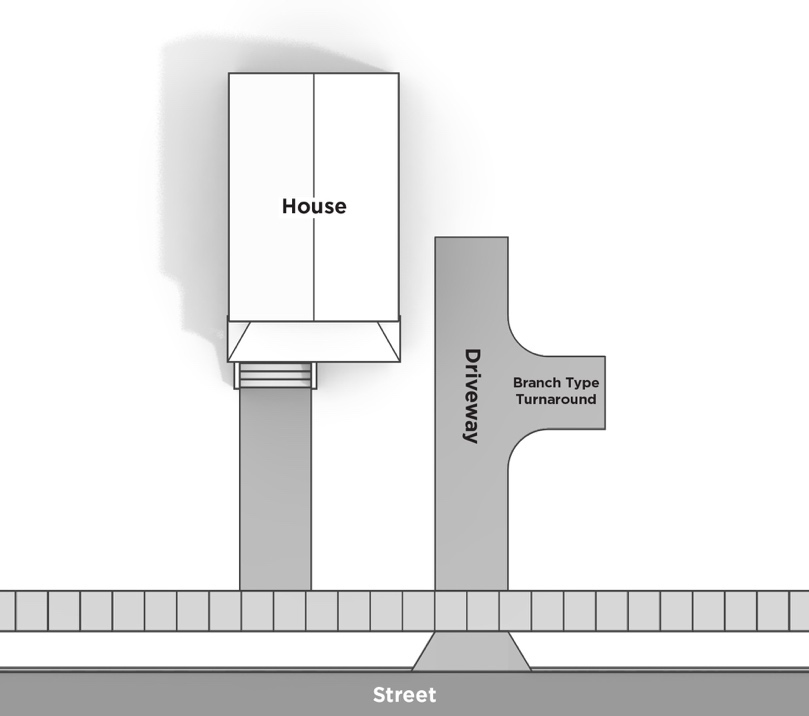
F.
For single-family attached dwellings, a single driveway shared by both units is permitted with dimensions consistent with the individual driveway width and curb cut length standards of Table 11-7.
G.
For the purpose of this section, lot frontage for any lot except a small lot of record that does not have 75 feet or greater frontage on any street, private right-of-way (joint permanent easement), or access easement, is measured at the front building line.
(Ord. No. O-143-2025, § 1, 11-25-25)
11.4 - REQUIRED OFF-STREET PARKING SPACES
A.
General Application
1.
The minimum and maximum number of off-street vehicle parking spaces shall be determined in accordance with Table 11-2: Required Off-Street Parking, unless otherwise specified in the zoning district.
2.
In determining the number of parking spaces, when the result contains a fraction, any fraction less than one-half is disregarded and any fraction of one-half or more is counted as one parking space.
3.
Structured parking is not subject to the maximum number of parking spaces set forth in Table 11-2.
4.
All parking lot elements required by the Americans with Disabilities Act (ADA) must be accessible. All off-street parking lots must have a number of accessible parking spaces as required by Table 11-3: Required Accessible Parking Spaces, or as amended by ADA:
B.
Exemptions and Flexibilities
1.
The DK District is exempt from required parking. If parking is provided, then the maximum number of spaces applies in all subdistricts.
2.
Minimum vehicle parking reductions apply in the following districts. Bicycle parking requirements may not be reduced.
a.
Required minimum vehicle parking may be reduced by 40% in the C-N District.
b.
Required minimum vehicle parking may be reduced by 20% in the C-G-2 and C-G-3 District.
3.
Off-street parking requirements in any district may be reduced up to 30% from the minimum requirements in Table 11-2, provided the development is located within one-fourth of a mile of a transit route. A Knoxville Area Transit approved shelter may be required on or within one-fourth of a mile of the development site. Bicycle parking requirements may not be reduced. This reduction cannot be coupled with any other parking reduction, such as the reductions offered in items 1 and 2 above.
4.
Parking lots may exceed the maximum number of spaces in Table 11-2 by up to 20% provided that the spaces exceeding the maximum number and the access aisles accessing those spaces are constructed of pervious materials approved by the Department of Engineering. Parking spaces exceeding the identified maximum may be approved by the Department of Engineering upon submittal of a parking study justifying the need for additional spaces, and the approval of the parking study by Department of Engineering. All excess spaces and their access ways must be constructed of pervious materials. Pervious paving materials may not be required for excess parking on sites with brownfield agreements upon approval by the Department of Engineering.
5.
Upon approval by the Department of Engineering of a parking study for the proposed use(s), the minimum number of parking spaces in Table 11-2 may be reduced.
6.
For uses not specifically mentioned herein, off-street parking requirements shall be interpreted by the director of plans review and inspections.
C.
Mixed-Use Multi-Tenant Structure Requirements
A mixed-use multi-tenant structure is not subject to the individual use calculations for required vehicle parking in Table 11-2. Minimum and maximum parking is calculated as follows:
1.
Non-residential gross floor area—minimum parking required: 3 per 1,000 sf GFA;
2.
Non-residential gross floor area—maximum parking allowed: 8 per 1,000 sf GFA;
3.
Residential units: requirements for "dwelling—above the ground floor" per Table 11-2.
(Ord. No. O-76-2020, § 1, 5-19-20; Ord. No. O-87-2020, § 1, 5-19-20; Ord. No. O-143-2025, § 1, 11-25-25)
11.5 - DIMENSIONS OF OFF-STREET PARKING FACILITIES
Off-street parking facilities must be laid out in accordance with the following regulations:
A.
Accessible Spaces
1.
Accessible vehicle spaces must be at least eight feet wide with an adjacent pedestrian access aisle of at least five feet in width.
2.
Van accessible spaces must be either:
a.
At least 11 feet wide with an adjacent pedestrian access aisle of at least five feet in width.
b.
At least eight feet wide with an adjacent pedestrian access aisle of at least eight feet in width.
3.
Pedestrian access aisles must be hatched and include a painted "No Parking" designation.
B.
Stall and Aisle Dimensions
1.
The minimum dimensions for parking stalls and aisles is specified in Table 11-4: Minimum Stall and Aisle Dimensions. Maximum dimensions are the minimum value plus four feet.
2.
Up to 20% of the total number of parking spaces provided may be designed for compact vehicles. Where possible, these spaces must be clustered together and marked with signs restricting their use to compact vehicles. Compact spaces with a parking angle of 90 degrees must have the following minimum dimensions: eight feet in width, 13.5 feet in depth to curb, and 15.5 feet in depth to a wall or interlock. Other angles will be reviewed on a case by case basis and are subject to the approval of the Department of Engineering.
3.
Stall lengths, stall depths, and aisle widths for parking angles, other than those indicated in Table 11-4, shall be consistent with the above values and are subject to the approval of the Department of Engineering.
STALL AND AISLE DIMENSIONS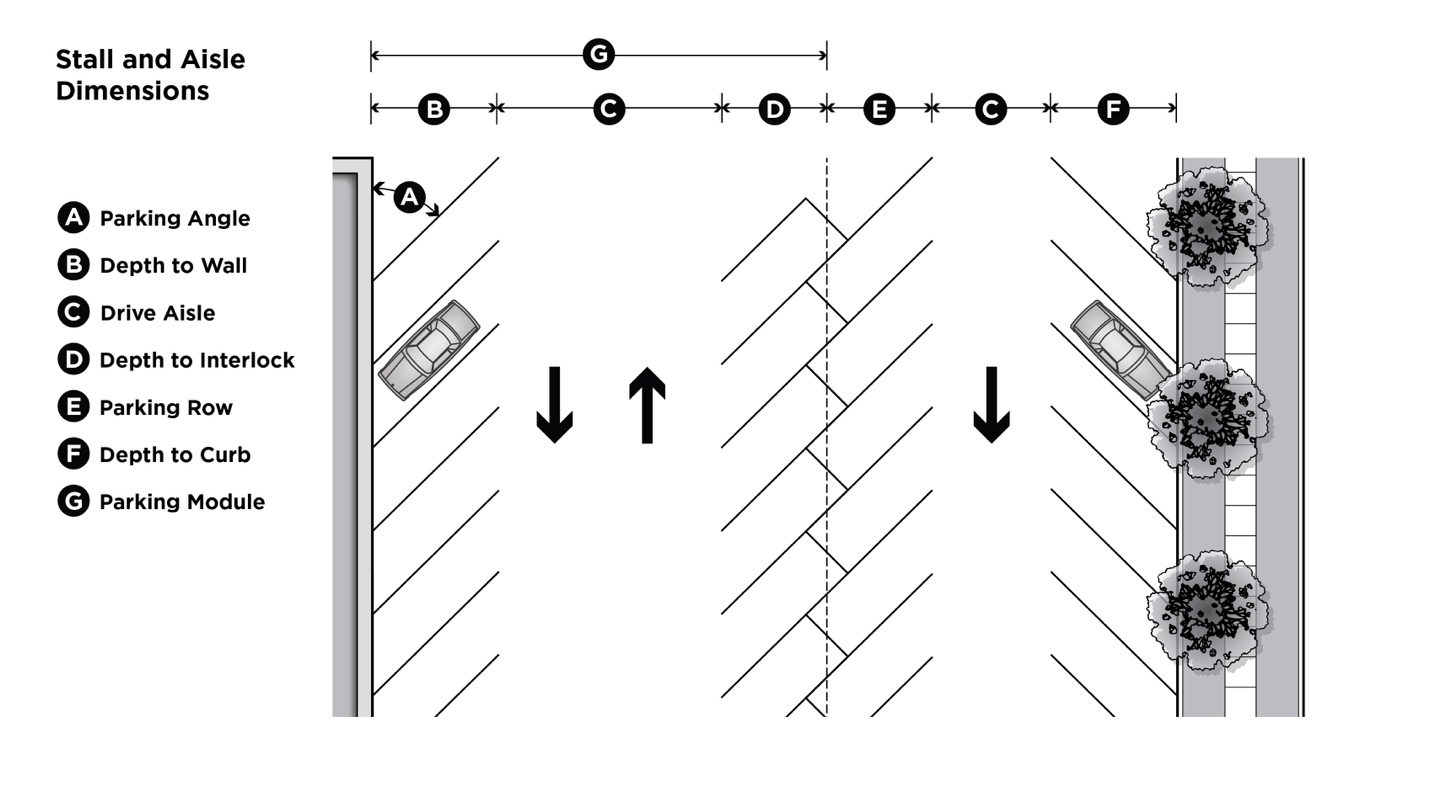
C.
Pedestrian Access Aisles
Pedestrian access aisles shall be clearly marked (or indicated).
D.
Encroachments
Columns, light poles, and/or other protrusions may encroach into a parking module up to a maximum of one foot for modules with parking on one side or a maximum of two feet for modules with parking on two sides, one-foot protrusion into each parking row. The protrusions cannot affect more than 25% of spaces in the entire parking lot.
E.
Structured Parking
Structured parking must comply with the following requirements:
1.
Parking spaces must comply with Table 11-4. The City of Knoxville Department of Engineering may approve adjustments to the dimensions while maintaining safety and function.
2.
The maximum approach, departure, and ramp angles are subject to the review and approval of the Department of Engineering.
(Ord. No. O-87-2020, § 1, 5-19-20; Ord. No. O-96-2022, § 1, 7-26-22)
11.6 - DESIGN OF OFF-STREET PARKING FACILITIES
A.
All areas devoted to off-street parking must be designed so that no vehicle is required to back into a public street or alley to obtain ingress or egress, except for the following:
1.
Off-street residential parking for single-family, single-family attached, two-family, and townhouse dwellings when the lot is accessed from a local street or alley.
2.
Egress directly from parking spaces to alleys may be allowed when the aisle width, including the alley width, meets the minimum aisle width specified in Table 11-4.
B.
The maximum grade in a parking lot is 10%.
C.
Surface drainage must be collected so as to preclude uncontrolled drainage onto the paved portion of street rights-of-way as verified by the Department of Engineering.
D.
All areas devoted to permanent off-street parking must be surfaced and maintained as to control dust, rutting, erosion as a result of continuous use, and migration of surface materials. Parking spaces must be clearly delineated.
E.
Vehicular and pedestrian signs must be MUTCD compliant and approved by the City of Knoxville Department of Engineering.
F.
An accessible pathway must be provided from the accessible parking space(s) to the destination that the parking space(s) are intended to serve. The accessible pathway must be located along the shortest accessible route to the accessible door/entrance.
G.
In an effort to reduce vehicle/pedestrian conflicts:
1.
Parking lots serving a building and having more than one parking row between the fronting street and the building's front entrance should have sidewalks or clearly defined and designated routes connecting the building's main entrance or a central location to the parking lot.
2.
A clearly defined and designated accessible route must connect a building's main entrance or central location to a sidewalk in the right-of-way where the cost of providing this route does not exceed 20% of the parking lot improvement cost.
3.
Landscaped islands and divider medians must be arranged so as to channel traffic and minimize vehicular and pedestrian conflicts within parking areas. A divider median must be provided at a minimum interval of one median per every six parking rows to channel traffic and minimize vehicular and pedestrian conflicts within interior parking lots.
4.
Parking rows must be terminated at both ends with terminal islands that have a minimum of 120 square feet per island.
5.
Interior islands must have a minimum area of 120 square feet for each parking row that they interrupt. Islands may be combined for double-parking rows, resulting in an interior island with a minimum area of 240 square feet.
6.
In the industrial districts and the DK District, terminal islands, interior islands, and divider medians are not required. This exemption does not apply to parking in industrial districts designated for employees and visitors where the principal building is over 40,000 square feet in gross floor area.
H.
Terminal islands, interior islands, and divider medians are not required for structured parking facilities or for parking facilities less than 20,000 square feet.
(Ord. No. O-96-2022, § 1, 7-26-22; Ord. No. O-143-2025, § 1, 11-25-25)
11.7 - ACCESS AND DRIVEWAY DESIGN
These regulations are applicable in zoning districts without access and driveway requirements specific to the zoning district. If the district specifically requires access and driveway design, those requirements control. The Department of Engineering is authorized to develop and implement such policies and procedures as may be necessary and desirable to control the design and construction of driveways that are consistent with this Code.
A.
The number of driveways on a given street or access easement is based on the following:
1.
Typical developments per Table 11-5: Maximum Number of Driveways for Lot Frontages:
2.
Gas stations and establishments where services are normally provided to customers without leaving their vehicles may have two driveways.
3.
Projects required to prepare a Traffic Impact Study are considered individually based on the recommendation of the study and the approval of the Department of Engineering.
4.
Boulevard driveways (with raised median separation), one way driveways, and right-in/right-out driveway pairs will be considered one driveway
5.
The Department of Engineering may impose other access and driveway requirements as necessary based on specific site conditions.
B.
The minimum distance between a driveway and the intersecting street is described in Table 11-6: Corner Clearance Requirements.
CORNER CLEARANCE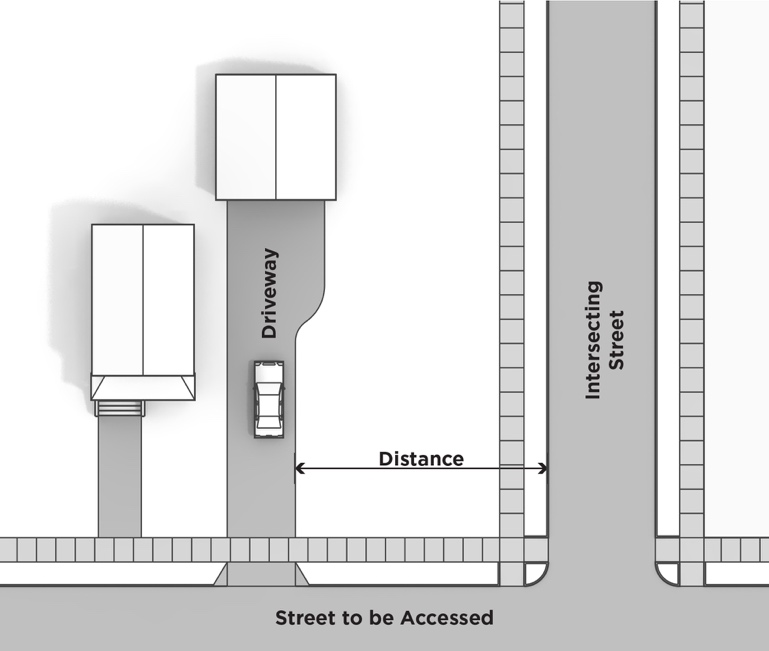
1.
If the required distance cannot be met due to lot size or other constraint as verified by the Department of Engineering, the driveway must be located as far as possible from the intersecting street.
2.
All driveways in a development must be separated by a minimum distance equal to the width of the wider driveway.
3.
No curb cut may encroach on the frontage of adjacent property without the written consent of the owner for such encroachment, except where a joint use driveway with the adjacent property is established at the request of both owners.
C.
Table 11-7: Driveway Width and Curb Cut Length Standards provides minimum and maximum driveway widths and curb cut lengths.
1.
Gas stations may have driveways up to 40 feet wide.
2.
Boulevard driveways (with raised median separation), one way driveways, and right-in/right-out driveway pairs are not subject to Table 11-7 and will be reviewed on a case-by-case basis by the Department of Engineering.
3.
Access to cell towers, electrical substations, pump stations, etc., defer to the Department of Engineering's Utility Driveway standards.
4.
Major traffic generators will be considered as individual cases and are not subject to Table 11-7. A major traffic generator is defined as any facility that is required by this Article to provide 400 or more parking spaces.
5.
On state roads, adjustments to the dimensions in Table 11-7 may be granted based on Tennessee Department of Transportation specifications.
D.
When a change in use, redevelopment, or alteration of any land or building makes any or all of the driveways unnecessary or noncompliant, the owner of the property must, at their expense, replace all necessary curbs, gutters, sidewalks, and landscape to a condition consistent with current City of Knoxville standards.
(Ord. No. O-87-2020, § 1, 5-19-20; Ord. No. O-96-2022, § 1, 7-26-22; Ord. No. O-143-2025, § 1, 11-25-25)
11.8 - SHARED PARKING
The Director of the City of Knoxville Department of Plans Review and Inspections, or his/her designee, may consider and approve a shared parking plan for uses that are located near one another and that have different peak parking demands and operating hours. All off-site parking arrangements must comply with the following provisions at a minimum. Additional requirements may be imposed by the Director of the City of Knoxville Department of Plans Review and Inspections, or the Director of the City of Knoxville Department of Plans Review and Inspections may deny the shared parking plan for good cause.
A.
The uses will not overlap in hours of operation or in demand for the shared spaces.
B.
The person or entity requesting the shared parking must submit a shared parking study and site plan to the Department of Engineering for approval.
C.
The lot upon which the shared or off-site parking is located is no greater than 500 feet walking distance as measured from the boundary of the property on which the principal use is located to the boundary of the property where the shared parking is located.
D.
Any crossing of a roadway at grade with a classification higher than local roadway must be marked per the most recent edition of MUTCD.
E.
The off-site parking must be located on land owned by the owner(s) of the principal use it is intended to serve, or under lease or license to the owner(s) of the principal use it is intended to serve, in accordance with the following:
1.
If the shared parking accounts for 50% or less of the parking spaces required for the principal use that is unable to meet its requirements on-site, the shared parking agreement must be a parking license with a minimum term of two years. The shared parking license may be revocable and is not required to be recorded; however, a copy of the license must be provided to the City of Knoxville Department of Plans Review and Inspections after approval of parking plans and before issuance of building permit.
2.
If the shared parking accounts for more than 50% of the parking spaces required by the principal use that is unable to meet its requirements on-site, the shared parking agreement must be a lease agreement with a minimum term of five years. Such lease agreement is subject to approval by the City of Knoxville Law Department. Where such a lease is involved, a memorandum of lease must be recorded with the Register of Deeds of Knox County with copies furnished to the City of Knoxville City Law Director and City of Knoxville Department of Plans Review and Inspections after approval of parking plans and before issuance of building permit.
F.
Off-site parking must be in a zoning district that permits the principal use it will serve and off-site parking is not located in a residential district.
G.
The shared parking spaces must be maintained as long as the uses they serve are in operation.
H.
Accessible parking cannot be shared.
11.9 - BICYCLE PARKING PROVISIONS
A.
Bicycle parking must be provided for all uses where vehicular off-street parking is required and/or provided, with the exception of single-family, single-family attached, and two-family dwellings. Bicycle parking must be provided for uses in the amount indicated in Table 11-8: Required Bicycle Parking. In determining the number of bicycle spaces, when the result contains a fraction, any fraction less than one-half is disregarded and any fraction of one-half or more is counted as one space.
B.
In the DK District, bicycle parking is required. The number of bicycle parking spaces required is based on the minimum number of vehicle parking spaces that the proposed use(s) would be required to provide in Table 11-2. For non-residential uses with adequate site constraints, the required minimum bicycle parking may be reduced subject to the review and approval of the Department of Engineering.
C.
One required vehicle parking space may be used as a space for providing required bicycle parking.
D.
The required bicycle parking spaces must be located in a convenient and visible area within 50 feet of a principal entrance or other location approved by the Department of Engineering. Bicycle parking facilities must be sufficiently separated from motor vehicle parking areas to protect parked bicycles from damage by motor vehicles. The separation may be accomplished through grade separation, distance or physical barrier, such as curbs, wheel stops, poles or other similar features.
E.
Users cannot be required to climb or descend stairs in order to access the bicycle parking facility unless there is a bicycle wheel trough parallel to the stairs.
F.
Connections to bicycle networks may be required by the Department of Engineering.
G.
Bicycle parking cannot impede pedestrian or accessible routes.
H.
Bicycle parking spaces must include a rack which permits the locking of the bicycle frame and one wheel to a rack or fixture and must support a bicycle in a stable position without damage to the wheels, frame, or components. Racks must be securely anchored to prevent the racks from being removed from the location.
I.
Bicycle racks must be installed according to the following minimum standards:
1.
Three feet from the side of the rack to any obstruction.
2.
Three feet forwards or backwards from the centerline of the rack to any obstruction.
3.
Four feet from the side of the rack to another bike rack.
4.
Ten feet forwards or backwards from the centerline of the rack to the centerline of another bike rack.
5.
Alternatives to these standards may be approved by the Department of Engineering.
J.
Bicycle parking and access to bicycle parking must be constructed in accordance with the applicable standards of Section 11.6.D.
BICYCLE RACK INSTALLATION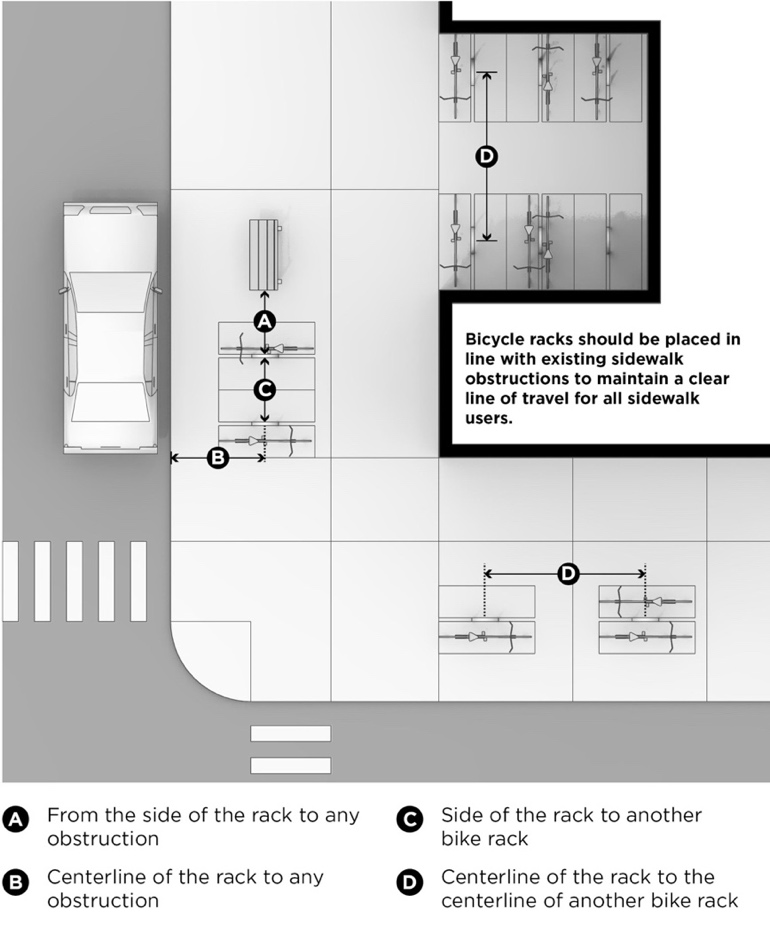
(Ord. No. O-87-2020, § 1, 5-19-20; Ord. No. O-96-2022, § 1, 7-26-22; Ord. No. O-143-2025, § 1, 11-25-25)
11.10 - REQUIRED OFF-STREET LOADING SPACES
A.
Off-street loading spaces must be provided for any use that distributes or receives materials or merchandise by trucks or other commercial vehicles in accordance with Table 11-9: Off-Street Loading Requirements. In the case of multi-tenant developments, required loading spaces are calculated on the basis of each individual tenant.
B.
No structure is required to provide more than five loading spaces.
C.
All multi-family dwellings, regardless of size, are required to provide a site plan that shows ingress/egress for moving trucks.
D.
Off-street loading spaces must be designed as follows:
1.
All required off-street loading spaces must be a minimum of 12 feet in width, a minimum of 35 feet in length, exclusive of aisle and maneuvering space, and have a minimum vertical clearance of 15 feet.
2.
All areas devoted to permanent off-street loading must be surfaced and maintained as to control dust, rutting, erosion as a result of continuous use, and migration of surface materials.
3.
Off-street loading facilities must be drained to eliminate standing water and prevent damage to abutting property and/or public streets and alleys.
4.
Each required off-street loading space must be designed with adequate means of vehicular access to a street or alley and in a manner that will minimize interference with traffic movement.
(Ord. No. O-87-2020, § 1, 5-19-20; Ord. No. O-96-2022, § 1, 7-26-22)
11.11 - STORAGE AND PARKING OF TRAILERS, RECREATIONAL VEHICLES, COMMERCIAL VEHICLES, AND SCHOOL BUSES
Commercial vehicles hauling trailers, boat trailers, recreational vehicles, and school buses shall not be parked or stored on any lot improved with a dwelling or on any lot zoned residential, except in accordance with the following provisions:
A.
One each lot, only one of the following vehicles may be parked or stored per household living on the premises:
1.
A commercial vehicle, which does not exceed 26,000 pounds, gross vehicle weight.
2.
A school bus.
B.
On property on which a church or school is located, operable buses may be parked in accordance with the following provisions:
1.
Buses shall not be parked so as to block emergency access drives.
2.
Buses shall not be parked so as to block line of sight at any drive or street intersection.
3.
Areas in which buses are continually parked shall be screened from adjacent residential uses and from public streets with a Class A buffer. For the purposes of this requirement "continually parked" shall mean buses are parked on a regular and on-going basis, or are parked overnight.
C.
The following vehicles are prohibited:
1.
A three-axle combination commercial vehicle cab.
2.
Any commercial vehicle used for hauling explosives, gasoline, or liquefied petroleum products.
D.
On each lot, a total of two (one from any two of the subsections listed below) of the following vehicles may be parked or stored per household living on the premises, and said trailer, or recreational vehicle, shall not exceed 45 feet in length or nine feet in width; and further provided that said trailer, or recreational vehicle, shall not be parked or stored for more than 48 hours unless it is located behind the front of the primary structure on the lot:
1.
Recreational vehicle.
2.
Hauling trailer.
3.
Boat trailer.
E.
A recreational vehicle shall not be occupied either temporarily or permanently while it is parked or stored in any area except in a travel trailer court or other location authorized under this ordinance.
(Ord. No. O-43-2020, § 1, 3-24-20; Ord. No. O-96-2022, § 1, 7-26-22)

