
Knoxville City Zoning Code
ARTICLE 2
- GENERAL DEFINITIONS AND MEASUREMENT METHODOLOGIES
2.1 - RULES OF INTERPRETATION
The terms in the text of this Code are interpreted in accordance with the following rules of construction:
A.
The singular number includes the plural, and the plural the singular.
B.
The present tense includes the past and future tenses, and the future tense includes the present.
C.
Any gender includes all genders.
D.
The terms "must," "shall," and "will" are mandatory, while the word "may" is permissive.
E.
The terms "must not," "will not," "shall not," "cannot," and "may not" are prohibiting.
F.
Whenever a defined word or term appears in the text of this Code, its meaning must be construed as set forth in the definition. Words not defined must be interpreted in accordance with the definitions considered to be normal dictionary usage.
G.
To the extent that a conflict exists between the text of this Zoning Code and any image, chart, or table, the text of this Zoning Code shall be controlling.
2.2 - GENERAL ABBREVIATIONS
The following abbreviations may be used within this Code:
A.
"BTL" is an abbreviation for "build-to line."
B.
"BTZ" is an abbreviation for "build-to zone."
C.
"GFA" is an abbreviation for "gross floor area."
D.
"ft" is an abbreviation for "feet."
E.
"max." is an abbreviation for "maximum."
F.
"min." is an abbreviation for "minimum."
G.
"N/A" is an abbreviation for "not applicable."
H.
"sf" is an abbreviation for "square feet."
I.
"SF" is an abbreviation for "single-family."
J.
"2F" is an abbreviation for "two-family."
K.
"SF-A" is an abbreviation for "single-family attached."
L.
"TH" is an abbreviation for "townhouse."
M.
"MF" is an abbreviation for "multi-family."
(Ord. No. O-143-2025, § 1, 11-25-25)
2.3 - DEFINITIONS
Abandoned Sign. Any sign, including its supporting structure, erected in conjunction with a particular use, for which the use has been discontinued for a period of 60 days or more, or a lawfully erected temporary sign for which the time period allowed for display of the sign has expired.
Abut. To share a common wall or lot line without being separated by a street or alley.
Accessibility Ramp. A ramp or similar structure that provides wheelchair or similar access to a structure.
Accessory Dwelling Unit (ADU). An additional dwelling unit located on the same lot with and is incidental to, a principal single-family dwelling. An accessory dwelling unit may be attached or detached and must include separate cooking and sanitary facilities, with its own means of ingress and egress.
Accessory Structure. A minor structure which is subordinate in area, extent, and purpose to a principal building, the use of which is customarily incidental to that of a main building and located on the same lot therewith.
Accessory Use. A use customarily incidental, appropriate, and subordinate in area, extent, and purpose to the principal use of land or buildings and located on the same lot therewith.
Accessory Services. Additional services that support, are complimentary to, and/or integral to a principal use, occurring within the same principal structure or on the same property.
Actively Marketed. A property is considered to be actively marketed when it is marketed continuously online through professional multiple listing services such as, but not limited to, Realtor.com, FlexMLS, Knoxville Area Association of Realtors Commercial Information Exchange, LoopNet, CoStar, and Zillow, and/or has signs indicating the property is for sale or lease.
Addition. Construction that increases the size of a structure in terms of building footprint, height, or floor area.
Adjacent. Immediately nearby and separated by nothing of the same or similar kind in between.
Advertising. Any writing, printing, painting, display, emblem, drawing, sign, or other device designed, used or intended for advertising, which placed on the ground, rocks, trees, tree-stump, or other natural structures or on a building, structure, milestone, signboard, billboard, wallboard, roofboard, frame, support, fence or other manmade structure.
Agriculture. Land and associated structures used to grow crops and/or raise livestock for sale, personal food production, donation, and/or educational purposes. The agriculture use includes single-family dwellings and any additional dwellings that are accessory to the principal activity of agriculture. Agriculture also includes the use of farmstands for the sale of crops grown on the premises.
Airport. Land, water, and/or structures used for the landing and takeoff of aircraft, including airport buildings, airport structures, or airport rights-of-way. An airport includes passenger terminals for that airport and any accessory services within the passenger terminal, such as restaurants and retail goods establishments.
Alley. A public right-of-way that normally affords a secondary means of access to abutting property.
Alternative Correctional Facility. A housing facility for adults or minors that is required by the courts or otherwise available as an alternative to incarceration.
Amateur (HAM) Radio Equipment. An amateur (HAM) radio station licensed by the Federal Communications Commission (FCC), including equipment such as, but not limited to, a tower or building-mounted structure supporting a radiating antenna platform and other equipment.
Amusement Facility—Indoor. A facility for spectator and participatory uses conducted within an enclosed building, such as movie theaters, sports arenas, bowling alleys, tumbling centers, skating centers, roller rinks, escape room/physical adventure game facilities, and pool halls. Indoor amusement facilities do not include live performance venues. An indoor amusement facility may include uses such as, but not limited to, concession stands, restaurants, and retail sales as accessory services.
Amusement Facility—Outdoor. A facility for spectator and participatory uses conducted outdoors or within partially enclosed structures, such as outdoor stadiums, fairgrounds, batting cages, and miniature golf courses. An outdoor amusement facility may include uses such as, but not limited to, concession stands, restaurants, and retail sales as accessory services.
Animal Breeder. An establishment where five or more animals over six months of age are boarded, bred, raised, and/or trained. Animal breeder does not include animal care facilities or shelter and training facilities for canine or equine units of public safety agencies.
Animal Care Facility—Large Animal. An establishment that provides care for large animals, such as horses and cattle, including veterinary offices for the treatment of animals, where animals may be boarded during their convalescence. Animal care facilities do not include animal breeders.
Animal Care Facility—Small Animal. An establishment which provides care for domestic animals, including veterinary offices for the treatment of animals, where animals may be boarded during their convalescence, pet grooming facilities, animal training centers and clubs, and facilities where animals are boarded. Animal care facilities do not include animal breeders or kennels.
Antenna. One or more rods, panels, discs or similar devices used for wireless communication, which may include, but is not limited to, omni-directional antenna (whip), directional antenna (panel), and parabolic antenna (dish).
Antenna Array. A single or group of antenna elements and associated mounting hardware, transmission lines, or other appurtenances which share a common attachment device such as a mounting frame or mounting support structure for the sole purpose of transmitting or receiving electromagnetic waves.
Apiary. A collection of one or more colonies of bees in beehives at a location.
Aquaponics. The cultivation of fish and plants together in a constructed, re-circulating system utilizing fish culture to increase nutrient concentrations of irrigation water for the purpose of producing food or non-food crops.
Arcade. A frontage type where the building façade is close to the property line and the ground floor is recessed from the building façade to allow for a continuous, covered passageway.
Arcade and Hanging Sign. A type of attached sign which hangs from a porch roof, awning, canopy, colonnade, or similar feature, the surface area of which is not to exceed six square feet.
ARCADE AND HANGING SIGN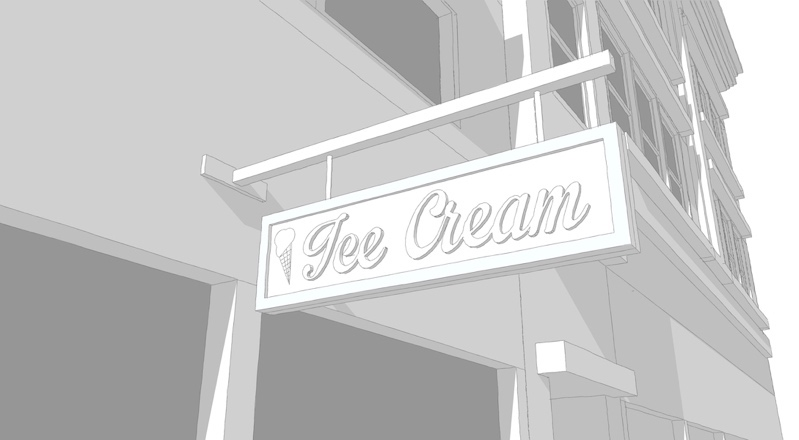
Architectural Feature. A part or projection that contributes to the aesthetics of a structure, exclusive of signs, that is not necessary for the structural integrity of the structure or to make the structure habitable.
Art Gallery. An establishment that sells, loans and/or displays paintings, sculpture, photographs, video art, or other works of art. Art gallery does not include a cultural facility, such as a library or museum, which may also display paintings, sculpture, photographs, video art, or other works.
Art and Fitness Studio. An establishment where an art or activity is taught, studied, and/or practiced such as dance, martial arts, photography, music, painting, gymnastics, sports lessons, pilates, or yoga. An art and fitness studio also includes private exercise studios for private sessions with trainers and/or private classes.
Attached Sign. A sign that is permanently affixed to or painted on a building, canopy, or wall, and has a permanent or changeable copy face.
Awning. A roof like structure typically made of cloth, metal, or other material attached to a frame that extends from and is supported by a building. Awnings are typically erected over a window, doorway, or building front and they may be raised or retracted to a position adjacent to the building.
Awning Sign. A type of attached sign upon which words, pictures, symbols, graphics, or logos are painted, sewn, or otherwise adhered or affixed to the awning material as an integrated part of the awning.
AWNING SIGN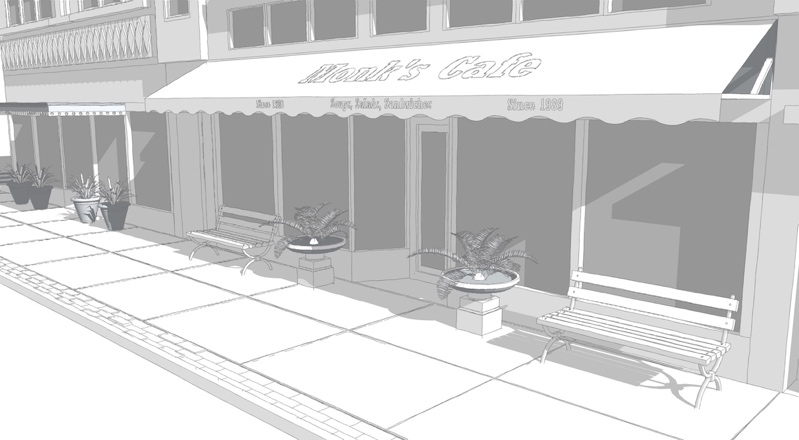
Balcony. A roofed or unroofed platform that projects from the exterior wall of a structure above the ground floor, which is exposed to the open air, has direct access to the interior of the building, and is not supported by posts or columns extending to the ground.
Base Station. A perimeter boundary (often fenced) containing the tower and equipment shelters, and associated equipment that enables wireless communications between user equipment and a communications network.
Base or Underlying Zone. The primary zoning classification which determines the uses permitted on a property over which a second zoning classification is placed (e.g., historical zoning district placed on commercially zoned property; the commercial zoning is the base zone).
Bay Window. A window that projects outward from the structure, which does not rest on the building foundation or on the ground.
Bed and Breakfast. A single-family dwelling where an owner, who lives on the premises, provides lodging for a daily fee in guest rooms with no in-room cooking facilities, and prepares breakfast meals for guests.
Bike Lane. A dedicated bicycle lane running with moderate-speed vehicular thoroughfare demarcated by striping or other means.
Billboard. A type of off-premise sign having more than 100 square feet of display surface which is either erected on the ground or attached to or supported by a building or structure.
Body Modification Establishment. An establishment that offers tattooing services, body piercing, and/or non-medical body modification. Body modification establishment does not include an establishment that offers only ear piercing.
Blank Wall. Defined in Section 2.4.
Block. Defined in Section 2.4.
Blockface. Defined in Section 2.4.
Broadcasting Facility. Commercial and public communications facilities, including radio, internet, television broadcasting and receiving stations, and studios.
Buffer Yard. Land area with landscape plantings and other components used to separate one use from another and to shield or block noise, lights, or other nuisances.
Build-To Line (BTL). Defined in Section 2.4.
Build-To Zone (BTZ). Defined in Section 2.4.
Build-To Percentage. Defined in Section 2.4.
Buildable Area. The portion of a lot, excluding required setbacks, where a structure or building improvements may be erected.
Building. Any structure used or intended for supporting or sheltering any use or occupancy which has a roof and enclosing wall for at least half of its perimeter.
Building Envelope. The three-dimensional space within which a structure is permitted to be built on a lot and which is defined by regulations governing building setbacks, maximum height, and bulk, by other regulations, and/or by any combination thereof.
Building Coverage. Defined in Section 2.4.
Building Height. Defined in Section 2.4.
Building Façade Line. A line measured at the building wall of a structure between parallel lot lines, or opposing or opposite lot lines for odd shaped lots. For the purposes of establishing a building façade line, the building wall does not include permitted encroachments of architectural features, such as bay windows, eaves, and steps and stoops.
BUILDING FAÇADE LINE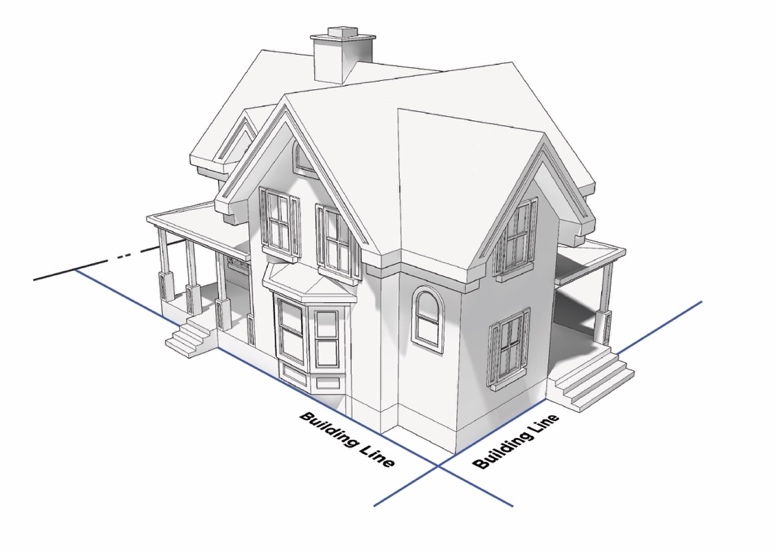
Bulletin Board. A type of wall or ground sign used to identify the premises and announce meetings or programs to be held on the premises of a church, school, community recreation center, hospital, medical clinic or similar place.
Campground. Land used for transient occupancy by camping in tents, camp trailers, travel trailers, motor homes, or similar movable temporary sleeping quarters.
Candela. A unit which expresses the luminous intensity of a light source.
Canopy. A permanent structure, other than an awning, made of cloth, metal or other material for the purpose of providing shelter to patrons or automobiles, or as a decorative feature on a building wall. A canopy is not a completely enclosed structure. A mansard roof is not considered a canopy.
Canopy Sign. A type of attached sign placed on a canopy.
CANOPY SIGN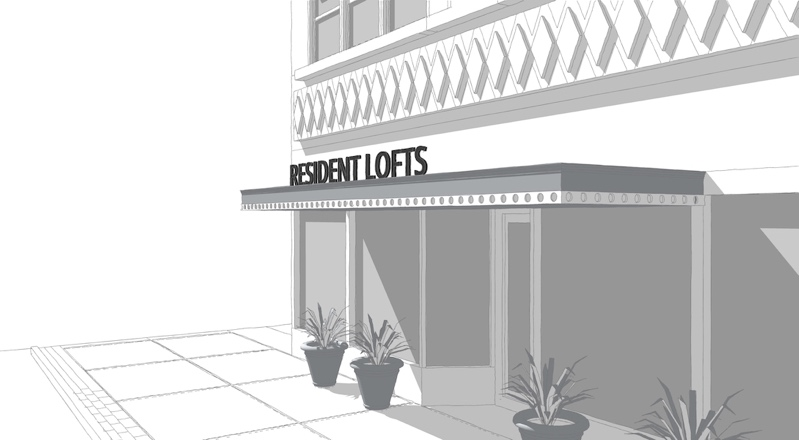
Car Wash. An establishment for the washing and cleaning of vehicles or other light duty equipment, whether automatic, by hand, or self-service. The car wash facility may be within an enclosed structure, an open bay structure, or similar configurations.
Carport. An open-sided roofed structure, either formed by extension of the roof from the side of a building or freestanding located above a driveway.
Cemetery. Land and structures reserved for the interring of human remains or the interring of animal remains. Cemeteries may include structures for performing religious ceremonies related to the entombment of the deceased, mortuaries, including the sales of items related to the internment of remains, and related accessory structures, such as sheds for the storage of maintenance equipment. Cemeteries may also include crematoriums and embalming facilities.
Changeable Letter Reader Board Sign. A sign on which message copy is displayed through the utilization of attachable or affixed letters, numbers, symbols and other similar character of changeable pictorial panes, which are changed manually or electronically.
CHANGEABLE LETTER READER BOARD SIGN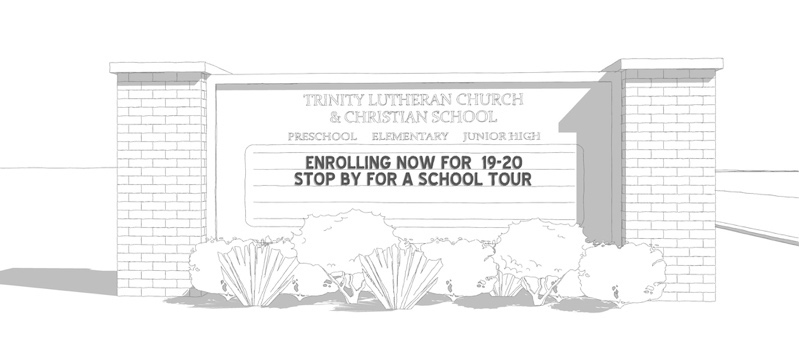
Changeable Price Sign. A sign that shows a product or service, such as fuel or hotel/motel room rates as an unchanging element of the sign and includes an EMC component to the sign wherein the price is changeable.
CHANGEABLE PRICE SIGN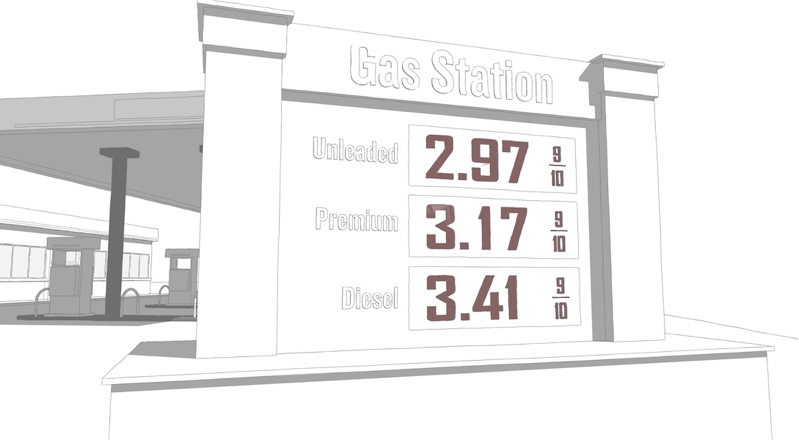
Chimney. A vertical shaft of reinforced concrete, masonry or other approved material enclosing one or more flues, for the purpose of removing products of combustion from solid, liquid, or gaseous fuel.
Cold Frame. A four-sided enclosure with a transparent or translucent and removable or adjustable roof, built low to the ground to house and protect food or non-food crops outside the typical growing season.
Collocation. The mounting or installation of transmission equipment on an eligible support structure for the purpose of transmitting and/or receiving radio frequency signals for communications purposes.
Column Sign. A type of detached sign which is supported by and integrated with columns or posts.
COLUMN SIGN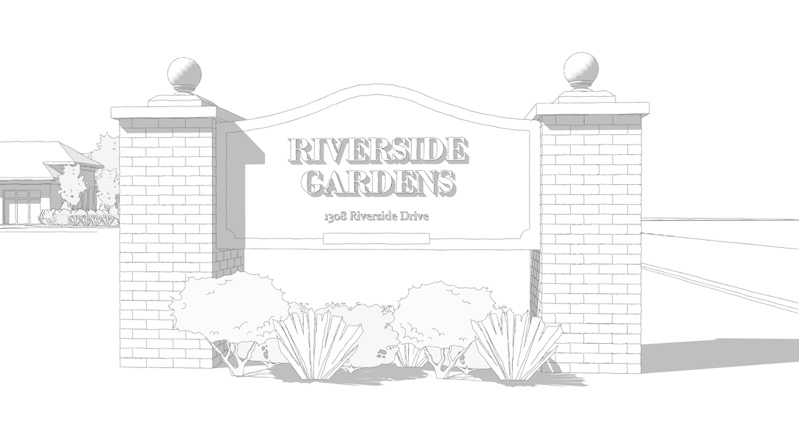
Common Yard. A frontage where the building is setback substantially from the property line. The front yard is visually continuous with adjacent yards.
Community Center. A facility used as a place of meeting, recreation, or social activity, that is open to the public and is not operated for profit, and offers a variety of educational and community service activities. A community center may serve as a local "food hub" where regionally grown food, including value added food, can be grown and/or brought for distribution and sale.
Compost, Backyard. The composting of organic solid waste, such as grass, clippings, leaves, or food waste (excluding meat and dairy), generated on-site by a property owner or other person with an interest in the property, where composting occurs at the site of origin and the resulting product is for on-site use only.
Conforming Sign. Any permanent sign or sign structure which conforms to the provisions of this Article.
Conservation Area. Designated open space that preserves and protects natural features, wildlife, and critical environmental features, as well as undeveloped sites of historical or cultural significance. A conservation area may include opportunities for passive recreation, such as hiking trails and lookout structures, and environmental education.
Contiguous. See "abut."
Country Club. An establishment open to members, their families, and invited guests organized and operated for social and recreation purposes and which may have indoor and/or outdoor recreation facilities, eating and drinking establishments, meeting rooms, and similar uses.
Crematory. A facility where the deceased are burned.
Cross-Access. A vehicular and/or pedestrian connection between abutting properties that connects the sites and allows vehicles and/or pedestrians to travel between sites without the having to exit to the street.
Cultural Facility. A facility open to the public that provides access to cultural exhibits and activities including, but not limited to, museums, cultural or historical centers, non-commercial galleries, historical societies, and libraries. A cultural facility may include typical accessory services such as, but not limited to, retail sales of related items and restaurants.
Day. A calendar day.
Day Care Center. A facility where, for a portion of a 24-hour day, care and supervision is provided for minors, the elderly, and/or functionally-impaired adults in a protective setting.
Day Care Home. A residential dwelling where a permanent occupant of the dwelling provides care for minors, the elderly, and/or functionally-impaired adults from outside households in a protective setting for less than 24 hours per day. A day care home does not include facilities that only receive children from a single household.
Deck. A roofless outdoor space built as an aboveground platform projecting from the wall of a structure and connected by structural supports at grade or by the structure.
Detached Sign. Any sign that is not affixed or attached to a building and is securely and permanently mounted in or on the ground.
Development. The construction, reconstruction, conversion, structural alteration, relocation, or enlargement of any structure, any mining, excavation, landfill or land disturbance, or any alteration of land.
Development Directory Sign. A type of detached sign identifying a shopping center, office park, commercial subdivision, or similar mixed-use or commercial development, and listing individual businesses or tenants within the unified development, including businesses not located on the lot on which the sign is located. A development directory sign is not classified as an off-premise sign.
Dimmer. A device which changes the brightness of a display or which creates the capacity of increasing or decreasing the overall brightness/intensity of a display.
Directional Sign. A type of incidental sign located on a site designed to guide vehicular and/or pedestrian traffic on a lot or parcel by using such words as "Entrance," "Exit," "Parking," "One-Way," or similar directives, but not including any advertising message. A name or logo of a business, use or place may also be included on the sign.
Directory Sign, On-Site. A type of incidental sign located on a site designed to identify specific businesses, offices, tenants or other uses of a lot or parcel, but not including any advertising message. A name or logo of a business, use or place may also be included on the sign.
Distributed Antenna System (DAS). A network consisting of transceiver equipment at a central hub site to support multiple antenna locations throughout the desired coverage area.
Dock. A fixed or floating decked structure where a vessel or vessels may be secured either temporarily or indefinitely.
Domestic Violence Shelter. A facility that provides temporary shelter, protection, and support for victims of domestic violence, intimate partner violence, sexual assault, and/or human trafficking. A domestic violence shelter also accommodates the minor children of such individuals. The facility may also offer a variety of services to help individuals and their children, including, but not limited to, counseling and legal guidance.
Donation Box. A container used for the purpose of collecting donated items for resale or for use by an organization or institution.
Drive-Through Facility. That portion of a business where business is transacted directly with customers via a service window that allows customers to remain in their vehicle. A drive through facility must be approved separately as a principal use when in conjunction with another principal uses such as restaurants and financial institutions. A standalone drive-through ATM is considered a drive-through facility for the purposes of this Code.
Driveway. A pathway for motor vehicles from a street to a lot used only for service purposes or for access to the lot.
Drug/Alcohol Treatment Facility, Residential. A licensed care facility that provides 24-hour medical, non-medical, and/or therapeutic care of persons seeking rehabilitation from a drug and/or alcohol addiction. Such facilities include medical detoxification. This includes institutions that are located in one or more buildings on contiguous property with one administrative body.
Drug Treatment Clinic. A facility licensed by the state to administer drugs, such as, but not limited to, methadone or suboxone, in the treatment, maintenance, and/or detoxification of persons.
Dwelling—Above the Ground Floor. Dwelling units located within a single multi-story building located above nonresidential uses on the ground floor or to the rear nonresidential uses on the ground floor. In the case of dwelling units located behind non-residential uses on the ground floor, nonresidential uses must front on the primary street frontage.
Dwelling—Cottage Court. A group of small, detached, house-scale buildings arranged to define a shared court open to and visible from the street. The shared court is common open space, thus becoming an important community-enhancing element. The type has a one-sided version with cottages on one side of the court and a two-sided version with cottages on both sides of the court.
Dwelling—Manufactured Home. A manufactured home dwelling is a prefabricated structure that is regulated by the U.S. Department of Housing and Urban Development (HUD), via the Federal National Manufactured Housing Construction and Safety Standards Act of 1974, rather than local building codes. Manufactured homes include those transportable factory-built housing units built prior to the Federal National Manufactured Housing and Safety Standards Act (HUD Code), also known as mobile homes. A manufactured home in the traveling mode, is eight body feet or more in width, or 40 body feet or more in length, or when erected on site is 320 or more square feet, and which is built on a permanent chassis and designed to be used as a dwelling with or without a permanent foundation.
1.
Multi-sectional manufactured home is defined as two or more manufactured home sections designed to be attached to each other on a site and used as a dwelling unit.
2.
Single-wide manufactured home is defined as a one-section manufactured home designed to be occupied as a single living unit.
3.
Modular homes are not considered manufactured homes, but rather dwellings, and refer to a method of construction.
Dwelling—Multi-Family. A structure containing three or more attached dwelling units used for residential occupancy. A multi-family dwelling does not include a townhouse dwelling.
Dwelling—Single-Family. A structure containing only one dwelling unit.
Dwelling—Single-Family Attached. A structure containing one dwelling unit attached at an interior side lot line by a vertical party wall to one other dwelling unit, for a maximum of two units. Each dwelling is located on a separate lot. A single-family attached dwelling is not a townhouse.
Dwelling—Townhouse. A structure consisting of three or more dwelling units, the interior of which is configured in a manner such that the dwelling units are separated by a party wall. A townhouse is typically designed so that each unit has a separate exterior entrance and yard area. A townhouse dwelling does not include a multi-family dwelling.
Dwelling—Two-Family. A structure containing two dwelling units on one lot. Also called a "duplex."
Dwelling Unit. A structure, or portion thereof, designed or used exclusively for human habitation, including permanent provisions for living, sleeping, eating, cooking, and sanitation.
Easement. Land designated by lawful agreement between the owner(s) of the land and a person(s) or entity for a specified use only by such person(s).
Eating and Drinking Establishment. An establishment where food and/or drinks are prepared and provided to the public for on-premises consumption by seated patrons or for carry-out service. Eating and drinking establishments may have outdoor dining/seating areas. Restaurants and bars are considered eating and drinking establishments.
Eave. The projecting lower edges of a roof overhanging the wall of a structure.
Educational Facility—Primary or Secondary. A public, private, or parochial facility that offers instruction at the elementary, junior high, and/or high school levels.
Educational Facility—University or College/Vocational. A facility for post-secondary higher learning that grants associate or bachelor's degrees. The institution may also have research facilities and/or professional schools that grant master and doctoral degrees. "Educational facilities—university or college" include typical accessory services such as dormitories, cafeterias, restaurants, retail sales, indoor or outdoor recreational facilities, and similar uses. "Educational facility—university or college/vocational" includes facilities that offer instruction in industrial, clerical, computer, managerial, automotive, repair (electrical, plumbing, carpentry, etc.), or commercial skills, or a business conducted as a commercial enterprise, such as a school for general educational development or driving school. "Educational facility—vocational" also applies to privately operated schools that do not offer a complete educational curriculum.
Electronic Message Center (EMC) Sign. A sign which uses a bank of lights, light-emitting diodes, or other materials that can be lit or activated to form copy such as words, letters, logos, figures, symbols, illustrations, or patterns to form a message without altering the sign face.
ELECTRONIC MESSAGE CENTER (EMC)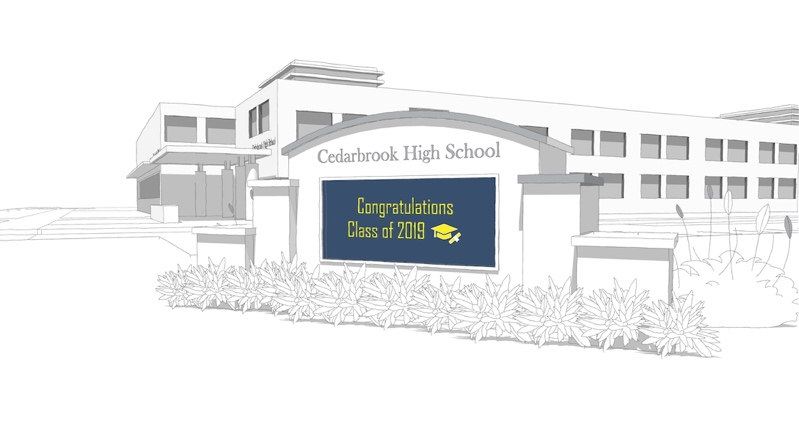
Encroachment. The extension or placement of any structure, or a component of such, into a required setback or right-of-way.
Equipment Shelter. A building that contains ground related WCF equipment. The shelters are often located in base station areas.
Erect. To build, construct, attach, hang, place, suspend, or affix. When used in connection with signs it means to build, construct, attach, hang, place, suspend, or affix and also includes the painting of wall signs.
Exterior Lighting. The illumination of an outside area or object by any man-made device that produces light by any means.
Exterior Stairwell. One or more flights of stairs, and the necessary landings and platforms connecting them, to form a continuous passage from the entryway of a floor or level to another in a structure located on the exterior of a building.
Farmers Market. Temporary use of structures and/or land for the sale of a variety of fresh fruits, flowers, vegetables, or ornamental plants, and other locally produced farm and food products, including value-added products, directly to consumers from famers or from vendors that have taken such items on consignment for retail sale.
Farmstand. A temporary structure for the sale of food or non-food crops grown on the premises.
Federally Designated Highway. Those highways that are United States Numbered Highways, an integrated network of roads and highways in the United States with route numbers and locations coordinated by the American Association of State Highway and Transportation Officials (AASHTO).
Fence. A structure used as a boundary, screen, separation, means of privacy, protection or confinement, and is constructed of wood, plastic, metal, wire mesh, masonry, or other similar material.
Fence—Open. A fence that has, over its entirety, more than 50% of the superficial surface consisting of regularly distributed openings.
Fence—Privacy. A fence that has, over its entirety, no distributed openings. A shadowbox design fence is considered a privacy fence. A chain link fence with slats is not considered a privacy fence.
Financial Institution. A bank, savings and loan, credit union, investments, or mortgage office.
Financial Service, Alternative (AFS). Establishments that meet one or more of the criteria:
1.
Not licensed by an appropriate state or federal agency as a bank, savings and loan association, or credit union, industrial loan and thrift offices, insurance premium finance companies, or mortgage companies.
2.
Regulated by the state department of financial institutions.
3.
Categorized for purposes of this Ordinance as the following:
a.
"Pawnbrokers" as defined at T.C.A. § 45-6-203.
b.
"Title pledge lenders" as defined at T.C.A. § 45-15-103.
c.
"Deferred presentment services" as defined at T.C.A. § 45-17-102.
d.
"Check cashers" as defined at T.C.A. § 45-18-102 except that check cashers do not include check cashers exempt from state regulation pursuant to T.C.A. § 45-18-103.
e.
Any combination of alternative financial services, which include, but are not limited to, pawnbrokers, title pledge lenders, deferred presentment services, and/or check cashers as defined herein.
Flag. Flags of any nation, state, municipality, or political subdivision, flags officially designated as a national, state, or local symbol, or flags of fraternal, religious, and civic organizations. Pennants and sails are not considered flags.
Flag or Banner Sign. Any cloth, bunting, plastic, paper, or similar non-rigid material used for advertising purposes and attached to any structure, staff, pole, line, framing, or vehicle.
Floodlight. A powerful light, typically in a grouping of several lights, used to illuminate the exterior of a building or sign.
Floor Area Ratio (FAR). Defined in Section 2.4.
Food Bank. A non-profit organization that collects and distributes food to hunger relief organizations. Food is not distributed to those in need from a food bank.
Food Pantry. A non-profit organization that provides food directly to those in need. Food pantries receive, buy, store, and/or distribute food. Food pantries may also prepare meals to be served at no cost to those who receive them. A food pantry may be accessory to a place of worship, social service center, and/or homeless shelter.
Food Truck Park. The use of land designed to accommodate two or more mobile food units (MFUs) and mobile food vendors offering food and/or beverages for sale to the public as a primary use of the property, which may include seating areas for customers.
Footcandle. A unit of illuminance (light falling on a surface). One lumen falling on one square foot equals one footcandle.
Forecourt. An open area at grade, or within an average 30 inches of grade, that serves as an open space or plaza.
Fraternity/Sorority. A structure used by a chartered fraternal or sororal membership organization or association, used as a residence and/or a dining and recreational facility for members of organizations or associations who are students at a university, which permits the organization or association to use its facilities because of the relationship of such organization or association to the body of students enrolled in such institution.
Frontage. The relationship of a building to the public way. The frontage line refers that part of a building along a front and corner side setback line, build-to line, or build-to zone.
Full summer pool. The targeted elevation to which the Tennessee Valley Authority plans to fill each reservoir during its annual operating cycle.
Funeral Home. An establishment where the dead are prepared for burial display and for rituals before burial or cremation, including chapels for the display of the deceased and the conducting of rituals before burial or cremation.
Gallery. A covered passage extending along the outside wall of a building supported by arches or columns that is open on three sides.
Garage. A structure, either attached or detached, used for the parking and storage of vehicles as an accessory use to a residence. For the purposes of this definition, garage does not include a commercial parking structure.
Garden, Market. An area of land managed and maintained by an individual, group, or business to grow and harvest food and non-food crops to be sold for profit on-site, off-site, or both.
Garden, Personal. An area of land on which food or non-food crops are grown by the property owner or other person with an interest in the property for personal or family consumption and enjoyment. On-site sales may be allowed through a temporary use permit issued for a farmstand.
Garden, Community. An area of land managed and maintained by a nonprofit or group of individuals to grow and harvest food and non-food crops for personal or group use, consumption, or donation.
Gas Station. An establishment where fuel for vehicles is stored and dispersed from fixed equipment into the fuel tanks of motor vehicles. A gas station may also include accessory services such as retail, a car wash bay, and solar and/or electric charging stations.
Glare. Light emitting from a luminaire with an intensity great enough to reduce a viewers' ability to see, cause discomfort, and, in extreme cases, cause momentary blindness.
Golf Course/Driving Range. A tract of land design with at least nine holes for playing a game of golf and improved with tees, greens, fairways, and hazards. A golf course may include a clubhouse, restrooms, snack-bar, and pro-shop as accessory services. A driving range may be designed as a standalone facility or included as part of a golf course, which is defined as a tract of land equipped with distance markers, clubs, balls, and tees for practicing the hitting of golf balls.
Government Office/Facility. Offices owned, operated, or occupied by a governmental agency to provide a governmental service to the public, such as city offices and post offices. Government offices do not include public safety or public works facilities.
Grade. A reference plane representing the average of finished ground level adjoining the building at all exterior walls.
Greenhouse. A type of freestanding covered structure that has a supported framework and covered with a translucent material such as plastic or glass. A greenhouse may use generated or electrical heat or power and its purpose is to house and protect food or non-food crops during all seasons of the year.
Greenhouse/Nursery—Retail. An establishment where flowers, shrubbery, vegetables, trees, and other horticultural and floricultural products are propagated and sold, and may include gardening and landscape supplies and products, such as hardware, garden tools and utensils, paving stones and bricks, and other related items for sale.
Gross Floor Area (GFA). Defined in Section 2.4.
Ground Sign. A type of detached sign supported by a pole, uprights, or braces on the ground.
GROUND SIGN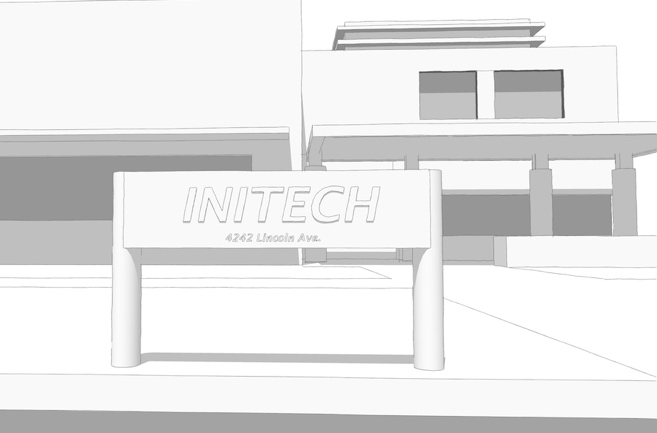
Group Home. A group care facility, operated on a for-profit basis, in a residential dwelling for: 1) care of persons in need of personal services or assistance essential for activities of daily living; or 2) care of persons in transition or in need of supervision, including drug and alcohol rehabilitation (excluding medical detoxification).
Halfway House. A residential facility for persons who have been institutionalized for criminal conduct and who either: 1) require a group setting to facilitate the transition to society; or 2) have been ordered to such facilities by the court as a condition of parole or probation.
Healthcare Facility. Facilities for primary health services and medical or surgical care to people, primarily in-patient, and including, as an integral part of the institution, related facilities such as laboratories, outpatient facilities, dormitories, or educational facilities, and typical accessory services such as, but not limited to, cafeterias, restaurants, retail sales, and similar uses.
Heavy Retail, Rental, and Service. Retail, rental, and/or service establishments of a heavier and larger-scale commercial character typically requiring permanent outdoor service or storage areas and/or partially enclosed structures. Examples of heavy retail, rental, and service establishments include large-scale home improvement centers with outdoor storage, display, and rental components, lumberyards, recreational vehicle dealerships, boat sales, rental, and service, truck rental establishments, and sales, rental, and repair of heavy equipment. Wholesale establishments that sell to the general public, including those establishments where membership is required, are considered heavy retail, rental, and service establishments.
Hedge. A row of closely planted shrubs, bushes, or any kind of plant forming a boundary.
Heliport. Land, water, and/or structures used for the landing and take-off of helicopters, and having service facilities for such aircraft or providing for permanent basing of such aircraft.
High Tunnel. A type of freestanding, covered structure that has a supported framework, typically made with metal piping and covered with a translucent material such as plastic or glass. Crops can be grown either in the natural soil profile or by installing permanent beds. A high tunnel does not have heat or electrical power and its purpose is to house and protect food or non-food crops outside the typical growing season. Also known as a hoop house.
Historic Sign. An existing, nonconforming, historically significant sign that contributes to the historical or cultural character of the community at large which has been removed from its original location within the city and is to be reused and relocated to a different location on its original site or relocated to another location within the community.
Hive. A container or structure used by a beekeeper to provide a cavity in which a colony of bees is expected to establish a permanent nest. Also known as a beehive.
Home Occupation. Any activity carried out for economic gain by a resident, conducted as an accessory use in the resident's dwelling unit.
Homeless Shelter. A facility that provides temporary shelter to the homeless in general.
Hotel. A commercial facility that provides sleeping accommodations for a fee and customary lodging services. Related accessory services include, but are not limited to, meeting facilities, eating and drinking establishments, and gyms for the use of guests.
Hydroponics. The propagation of plants using a mechanical system designed to circulate a solution of minerals in water and without soil.
Identification Sign. A sign displaying only the name, address, and/or crest, insignia, trademark, occupation, or profession of an occupant or the name of any building on the premises.
Impervious Surface Coverage. Defined in Section 2.4.
Impound Lot. A facility that provides temporary outdoor storage for vehicles that are to be claimed by titleholders or their agents. An impound lot is typically used for the storage of wrecked motor vehicles usually awaiting insurance adjustment or transport to a repair shop. Impound lot does not include impound facilities owned and used by governmental authorities.
Incidental Sign. A sign, generally directional or informational, that has a purpose secondary to the use of the lot on which it is located, such as "no parking," "entrance," "loading only," "office," "gymnasium," and other similar directives. No sign with an advertising message, other than a name or logo of a business, use or place, is considered incidental.
Independent Living Facility. A residential development which typically includes common areas for meals and socializing and may offer convenience services, but does not provide health care or assistance with activities of daily living. Units may include cooking facilities. Independent living facilities are subject to the dimensional and design standards for a multi-family dwelling in the district in which they are located. When a district permits dwellings above the ground floor, independent living facilities may also be developed and designed as such, subject to the design standards of the district for the structure.
Industrial—Craft. Artisan-related crafts and industrial processes that are more intensive uses, such as small-scale metalworking, glassblowing, furniture making, and small-scale food production that includes preparation, processing, canning, or packaging of food products, and a contractor's or tradesperson's business such as building, mechanical, electrical, painting, or plumbing professionals and related services such as showrooms and points of sale. Light assembly activity unrelated to manufacturing operations may occur. Micro-breweries, micro-distilleries, and micro-wineries are regulated separately from craft industrial.
Industrial—General. Research and development activities, and the manufacturing, compounding, processing, packaging, storage, assembly, and/or treatment of finished or semi-finished products from previously prepared materials, where such activities are conducted wholly within an enclosed building. A general industrial use may also include a showroom, accessory sales of products related to the items manufactured or stored on-site, and/or outdoor storage for materials related to processes on-site.
Industrial—Heavy. Manufacturing from processed or unprocessed raw materials, including processing, fabrication, assembly, treatment, and packaging of such products, and incidental storage, sales, and distribution of such products. This manufacturing may produce noise, vibrations, illumination, or particulate that is perceptible to adjacent land users. These industrial uses typically have outdoor storage areas.
Industrial Design. An establishment where the design, marketing, and/or brand development of various products are researched and developed typically integrating the fields of art, business, science, and/or engineering. An industrial design establishment may create prototypes and products, but cannot mass manufacture products on the premises.
Information Sign. A type of incidental sign located on a site designed to convey information or instructions, but not including any advertising message, for the safe and convenient use of a lot or parcel. A name or logo of a business, use or place may also be included on the sign.
Infrastructure. Facilities and services needed to sustain residential, commercial, industrial, institutional, and other activities, including, but not limited to, water lines, sewer lines, and rights-of-way.
Interstate. A divided highway, designated under the Interstate Highway System, designed for the safe, unimpeded movement of large volumes of through traffic with full access control and grade separation at intersections.
Interstate Interchange. An interchange that connects an interstate to a lesser facility, such as a federally designated highway or an arterial or collector street.
Kennel. Any lot or premises on which five (5) or more animals, more than six (6) months of age, are kept.
Knoxville-Knox County Planning Commission. The Knoxville-Knox County Planning Commission is the equivalent of the Metropolitan Planning Commission.
Knoxville-Knox County Planning Staff. The Knoxville-Knox County Planning staff is the equivalent of the Metropolitan Planning Commission staff.
Landmark Sign. An existing, nonconforming, on-premise sign, which exhibits unique characteristics, enhances the streetscape or identity of a neighborhood and contributes to the historical or cultural character of the streetscape or the community at large.
Light Detector, Light Sensor. An electronic component used to detect the amount or level of ambient light surrounding an EMC cabinet.
Light Pole. Pole on which a luminaire is mounted.
Light Pole Banner. Banners mounted on and with arms installed perpendicular to light poles.
Live Entertainment—Secondary Use. A live performance, performed live by one or more persons including, but not limited to, musical acts, including disc jockeys (DJs), theatrical plays, performance art, stand-up comedy, and magic, included as part of the operation of a eating and drinking establishment, amusement facility, or similar use. As a secondary use, the other principal use operating on the site is open to the public during hours when no performance is scheduled. Live entertainment—secondary use is approved separately as a principal use. Live entertainment—secondary use does not include:
1.
Any adult use, as defined by the City Code.
2.
Live performance venue or nightclub.
3.
Periodic performances or entertainment at educational facilities, places of worship, cultural facilities, reception facilities, and performances at weddings and similar events.
4.
Incidental entertainment, which is defined as background music provided at an eating and drinking establishment.
Live Performance Venue. A facility for the presentation of live entertainment, including musical acts, including disc jockeys (DJs), theatrical plays, stand-up comedy, and similar performances. Performances are scheduled in advance and tickets are required for admission and available for purchase in advance, though tickets may be purchased at the venue's box office on the day of the performance. A live performance venue is only open to the public when a live performance is scheduled. A live performance venue may include classroom and/or rehearsal space utilized during hours it is not open to the public for a performance. A live performance venue may include concession stands, including sale of alcohol, but only when it is open to the public for a performance. A live performance venue does not include any adult use as defined by the City Code and does not include a nightclub.
Live/Work. A structure where residential and commercial uses are integrated, that permits businesses, professions, occupations, or trades within a residential dwelling that requires employees, customers, clients, and/or patrons to visit the unit.
Loading Berth. A space within a loading facility exclusive of driveways, aisles, maneuvering areas, ramps, columns, landscape, and structures for the temporary parking of a commercial delivery vehicle while loading or unloading goods or materials.
Lodge/Meeting Hall. A facility operated by an organization or association for a common purpose, such as, but not limited to, a meeting hall for a fraternal or social organization or a union hall, but not including clubs organized primarily for-profit or to render a service which is customarily carried on as a business.
Logo Sign. A business, informational, or directional sign located on an interstate or off-ramp, which is regulated by the Tennessee Department of Transportation (TDOT).
Lot. Defined in Section 2.4.
Lot Area. Defined in Section 2.4.
Lot, Corner. Defined in Section 2.4.
Lot Depth. Defined in Section 2.4.
Lot, Interior. Defined in Section 2.4.
Lot Line. Defined in Section 2.4.
Lot, Through. Defined in Section 2.4.
Lot of Record. A lot which has been platted and recorded with the Knox County Register of Deeds.
Lot Width. Defined in Section 2.4.
Low Tunnel. A temporary, freestanding structure that has a supported framework, typically made with hooped PVC pipe or wire and covered with plastic. A low tunnel does not have heat or electrical power and its purpose is to house and protect food or non-food crops outside the typical growing season.
Mansard Roof. A roof or portion of a roof containing two sloping planes of different pitch. The lower plane has a much steeper pitch, often approaching vertical, than the upper plane, which is usually not visible from the ground. It contains no gables.
Marina. A facility with navigable water access for docking or storage of boats or providing services to boats and the occupants thereof, including minor servicing and repair to boats while in the water, sale of fuel and supplies, or provision of lodging, food, beverages, and entertainment as accessory uses. A yacht club is considered a marina.
Marquee Sign. A type of attached sign integrated into or hung from a marquee. A marquee is a type of canopy or covered structure projecting from and supported by a building, when such canopy or covered structure extends beyond the building, building line, or property line for the purpose of providing shelter to pedestrians at an entrance to a building.
MARQUEE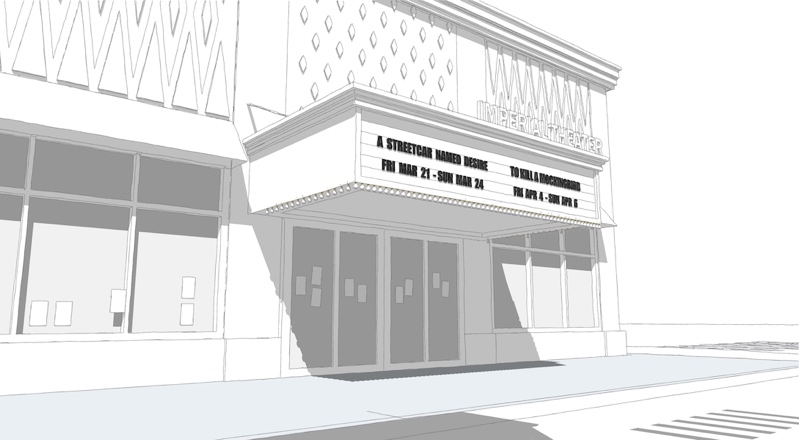
Master Sign Plan. A site plan and associated text and illustrations of a sign system for a proposed or existing development submitted to the Knoxville-Knox County Planning Commission for consideration for approval.
Medical/Dental Office/Clinic. A facility operated by one or more physicians, dentists, chiropractors, psychiatrists, physiotherapists, or other licensed practitioners of the healing arts for the examination and treatment of persons solely on an outpatient basis. Medical/dental offices/clinics also include alternative medicine clinics, such as acupuncture and holistic therapies, and physical therapy offices for physical rehabilitation. Urgent care facilities, "minute clinics," and medical spas are considered medical/dental offices/clinics.
Memorial Sign. A plate, plaque, or engraving cut into or attached to a building surface, which designates the name of a building, the date of erection, or individuals involved in the building's creation.
Menuboard. A type of attached or detached sign primarily designed for the display of menu items and prices for the purpose of placing orders for such items in conjunction with a restaurant utilizing drive-through or curbside service.
MENUBOARD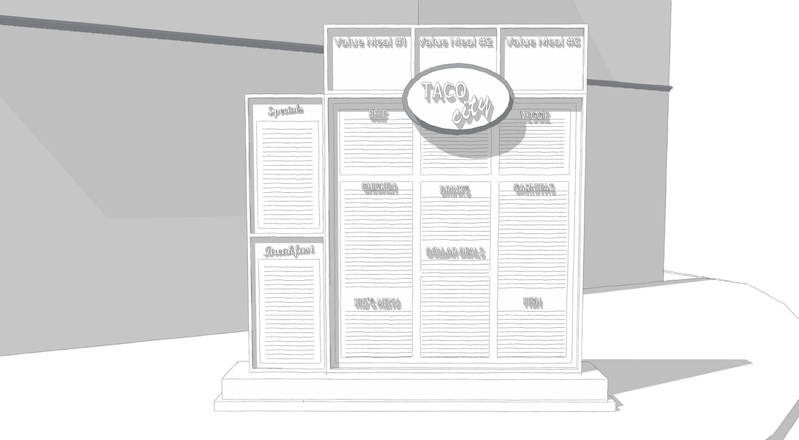
Micro-Brewery. A facility for the production and packaging of malt beverages of alcoholic content for wholesale distribution, where the area of the establishment devoted to the production of malt alcoholic beverages does not exceed 25,000 square feet in commercial districts or 40,000 square feet in industrial zone districts, and may include a tasting room for consumption on-premises. A tasting room allows customers to taste/consume products manufactured on site and purchase beverages manufactured on site and related items. Brewery facilities that exceed this capacity are considered light industrial uses.
Micro-Distillery. A facility for the production and packaging of alcoholic spirits, where the area of the establishment devoted to the production of spirits does not exceed 25,000 square feet in commercial districts or 40,000 square feet in industrial zone districts, and may include a tasting room for consumption on-premises. A tasting room allows customers to taste/consume products manufactured on site and purchase beverages manufactured on site and related items. Distillery facilities that exceed this capacity are considered light industrial uses.
Micro-Winery. A facility for the production and packaging of any alcoholic beverages obtained by the fermentation of the natural contents of fruits or vegetables, containing sugar, including such beverages when fortified by the addition of alcohol or spirits, where the area of the establishment devoted to such production does not exceed 25,000 square feet in commercial districts or 40,000 square feet in industrial zone districts, and may include a tasting room for consumption on-premises. A tasting room allows customers to taste/consume products manufactured on site and purchase beverages manufactured on site and related items. Wineries that exceed this capacity are considered light industrial uses.
Middle Housing. Middle Housing types are house-scale buildings with multiple units in walkable neighborhoods. These building types can include duplexes, triplexes, fourplexes, townhouses, and small multiplexes, and provide diverse housing options and support locally-serving retail and public transportation options. Specific types and forms located in Section 4.6.
Mobile Food Sales. A vehicle or a food trailer towed by another vehicle, designed and equipped to sell food and/or beverages directly to consumers. It does not include wholesale food distributors. The vendor physically reports to and operates from an off-site kitchen for servicing, restocking, and maintenance each operating day.
Monument Sign. A type of detached sign which is supported by and integrated with a solid base, as opposed to poles, posts, or other such supports. A monument sign is horizontally oriented or is square.
MONUMENT SIGN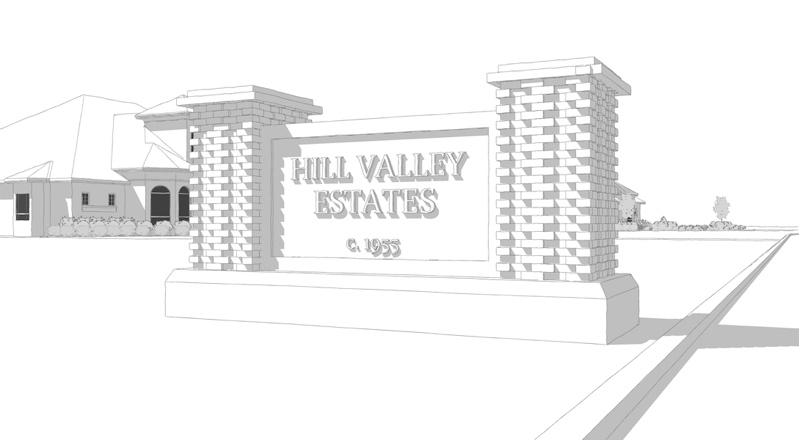
Nameplate. A plate, plaque, or engraved name attached to a door or wall, or integral to a wall of a building, bearing a name associated with an occupant or use in the building to which the plate is affixed.
Neighborhood Nonresidential Reuse. A nonresidential use, subject to special approval, within a residential neighborhood that is nonresidential in its original construction and/or use.
Nightclub. A commercial establishment, whether or not open to the public, which:
1.
Primarily serves alcohol or tobacco, or allows on-site consumption of the same.
2.
May operate with a permit from the City of Knoxville or with a state license either to serve alcohol or to allow alcohol to be consumed on the premises.
3.
Stays open at night, until up to 6:00 a.m. Eastern Standard Time, or later in the daylight hours.
4.
Is operated as a place of entertainment at night.
5.
Typically provides live or recorded entertainment in which patrons may or may not participate, and which includes music, singing, performing, dancing, and the like.
6.
Typically restricts entry to those 18 years of age or older.
7.
May or may not serve tobacco or food, or allow on-site consumption of the same.
8.
May or may not include an outdoor area, including a patio or rooftop bar, where alcohol or tobacco may be consumed or served.
If an establishment meets this definition and another in this Code, this definition controls.
Nonconforming Sign. Any existing permanent sign or sign structure which does not conform to the provisions of this Article, but was lawfully erected and complied with the sign regulations in effect at the time it was erected.
Nit. One candela per square meter.
Off-Street Parking. The storage space for an automobile on premises other than streets or rights-of-way.
Off-Premise Sign. A sign that directs attention to a business, commodity, service or entertainment conducted, sold or offered elsewhere than on the premises and only incidentally on the premises if at all.
Office. An establishment that engages in the processing, manipulation, or application of business information or professional expertise. Such an office may or may not offer services to the public. An office is not materially involved in fabricating, assembling, warehousing, or on-site sales of physical products for the retail or wholesale market, nor engaged in the repair of products. An office does not include financial institution, alternative financial service, government office/facility, or industrial design.
On-Premise Sign. A sign that directs attention to a business, commodity, service or entertainment conducted, sold or offered on the premises on which the sign is erected. A "for sale," "to let," or "information" sign is deemed an on-premise sign.
Open Space. That portion of land, either landscaped or left unimproved, which is used to meet active or passive recreation or spatial needs, and/or to protect water, air, or plant resources.
Outdoor Display and Sales Area (Accessory). Part of a lot used for outdoor sales and/or display of goods accessory to the principal use.
Outdoor Storage (Accessory). The keeping of property accessory to the principal use in an area outside of any principal or accessory structure.
Outlot. An area of land set aside within a larger development for a separate principal building that shares a circulation system and may share common parking with the larger development but is separated from the principal building or buildings, typically located along the property line.
Owner. Any person or entity, including the owner of the title or a mortgage whose interest is shown of record in the mortgage and conveyance records or a person shown as owner in the records of the tax assessor of the county in which the property is situated, either of whom may be represented by an agent.
Parapet. The extension of a false front or wall above a roof-line.
Parcel. A piece of land created by a partition, subdivision, deed, or other instrument recorded with the appropriate recorder.
Parking Lot. An area, excluding a street or public way, used for the parking/storage of six or more operable vehicles, whether for compensation or at no charge.
Parking Structure. A structure used only for the parking or storage of operable vehicles, whether for compensation or at no charge. A roofed structure of one level of parking is also considered a parking structure.
Party Wall. A wall starting from the foundation and extending continuously through all stories to or above the roof that separates one building from another, but is in joint use by each building.
Performance Standards. A set of criteria or limits relating to elements that a particular use or process must either meet or may not exceed.
Permeable Pavement. A pavement system designed to achieve water quality and quantity benefits by allowing movement of stormwater through the pavement surface into base/sub-base storage. Examples include, but are not limited to, pervious concrete, porous asphalt, and permeable paving blocks.
Person. An individual, heirs, executors, administrators or assigns, and includes a firm, partnership or corporation, its or their successors or assigns, or the agent of any of the aforesaid.
Personal Service Establishment. An establishment that provides frequent or recurrent needed services of a personal nature. Typical uses include, but are not limited to, beauty shops, barbershops, tanning salons, electronics repair shops, nail salons, laundromats, health clubs, dry cleaners, and tailors.
Place of Worship. A facility where persons regularly assemble for religious purposes and related social events, and may include group housing for persons under religious vows or orders. Places of worship may also include accessory services uses such as day care facilities, meeting rooms, auditoriums, and/or classrooms for weekly religious instruction. Places of worship may also have cemeteries on-site.
Plaza. Public open space located within urban areas designed primarily with hardscape and typically framed by surrounding buildings.
Pocket Neighborhood. A development consisting of a cluster of dwellings of various types arranged around a common courtyard or open space, rather than all dwellings oriented to the street, designed as a cohesive whole.
Pole Sign. A type of ground sign at least ten feet above the ground supported on a single post or pole.
POLE SIGN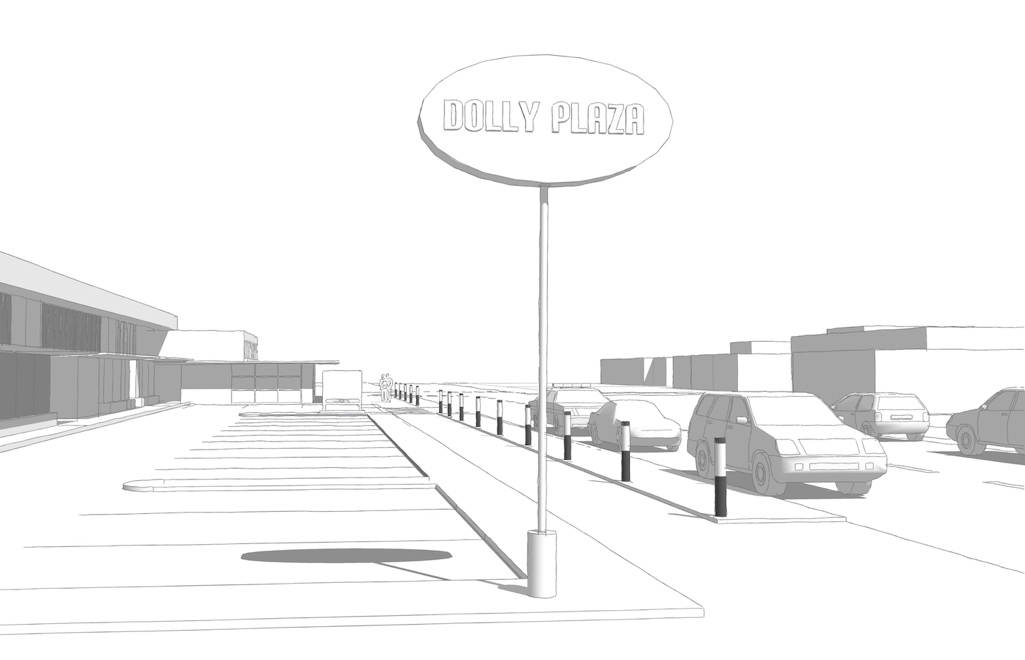
Porch. An architectural feature that projects from the exterior wall of a structure, and is covered by a roof or eaves.
Porch—Unenclosed. A porch that is open on all sides that do not abut a principal building wall.
Porch—Enclosed. A porch enclosed by walls, screens, lattice or other material. A screened-in porch is an enclosed porch.
Portable Sign. All moveable or portable off-premise or on-premise signs mounted upon trailers or other structure(s) or device(s) designed to be transported by or on a motor-driven vehicle with only incidental parking and assembling for reuse, unless otherwise permitted by these regulations.
PORTABLE SIGN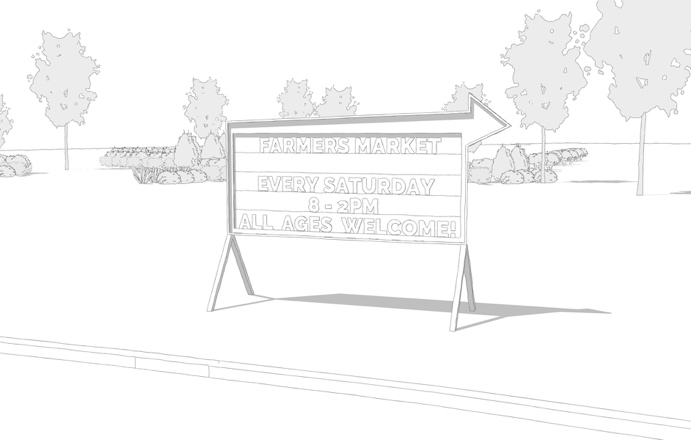
Pre-School/Kindergarten. An educational establishment that offers early childhood education prior to the start of required education at the primary school level.
Project Directional Sign. A type of detached sign used to direct traffic from a collector or arterial street (as designated in the Major Road Plan for Knoxville—Knox County, Tennessee) to businesses located on the same or lower classification streets within the same unified development. A project directional sign is not classified as an off-premise sign.
Projecting Sign. A type of attached sign that is wholly or partly dependent upon a building for support, that projects at an angle away from the building, and that extends more than one foot from the building.
PROJECTING SIGN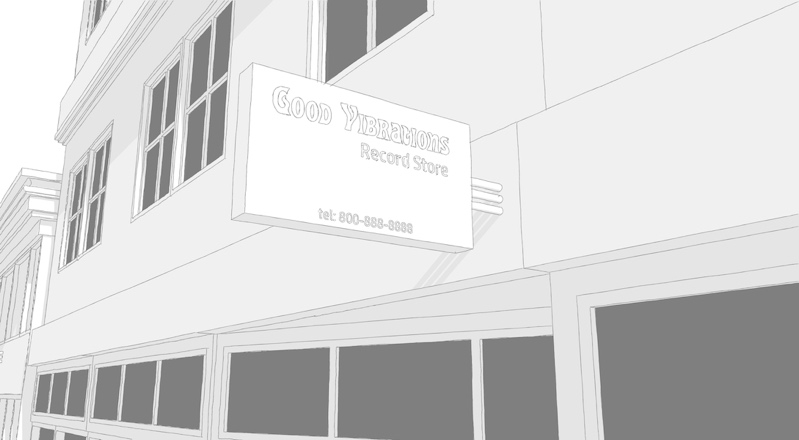
Property Line. For the purposes of this Code, a property line is a lot line. (See lot line definition.)
Principal Building. A non-accessory structure in which a principal use of the lot on which it is located is conducted.
Principal Use. The main use of land or structures as distinguished from an accessory use.
Public Park. A facility that serves the recreational needs of residents and visitors. Public park includes, but is not limited to, playgrounds, ballfields, football fields, soccer fields, basketball courts, tennis courts, dog parks, skateboard parks, passive recreation areas, and gymnasiums. Public parks may also include non-commercial indoor or outdoor facilities, including zoos and amphitheaters, accessory services such as, but not limited to, restaurant and retail establishments, and temporary outdoor uses such as festivals and performances.
Public Safety Facility. A facility operated by and for the use of public safety agencies, such as the fire department and the police department, including the dispatch, storage, and maintenance of police and fire vehicles. Public safety facilities include shelter and training facilities for canine and equine units of public safety agencies.
Public Works Facility. A facility operated by the municipal public works departments to provide municipal services, including dispatch, storage, and maintenance of municipal vehicles.
Real Estate Project Sales Office/Model Unit. A residential unit or other structure within a development that is temporarily used for display purposes as an example of dwelling units available for sale or rental in a residential development and/or sales or rental offices for dwellings within the development.
Reception Facility. A facility that provides hosting and rental services of a banquet hall or similar facilities for private events including, but not limited to, wedding receptions, holiday parties, and fundraisers, with food and beverages that are prepared and served on-site or by a caterer to invited guests during intermittent dates and hours of operation. Live entertainment may be provided as part of an event. A reception facility is not operated as a restaurant with regular hours of operation.
Recreational Vehicle. Any vehicle or boat designed for temporary living quarters, recreation, or temporary human habitation and not used as a commercial vehicle including, but not limited to, the following: boat/watercraft, camper trailer, motorized trailer, off-road vehicle, racing car or cycle, travel trailer, and truck camper.
Research and Development. A facility where research and development is conducted in industries that include, but are not limited to, biotechnology, pharmaceuticals, medical instrumentation or supplies, communication, and information technology, electronics and instrumentation, and computer hardware and software. A research and development establishment may create prototypes of products, but may not manufacture products for direct sale and distribution from the premises.
Residential Care Facility. A licensed group care facility that provides medical or non-medical care of persons in need of personal services, supervision, or assistance essential for sustaining the activities of daily living. A residential care facility includes nursing homes, assisted living, hospice care, and continuum of care facilities. Continuum of care facilities may also include independent living facilities as part of the continuum. Residential care facilities must meet all district design and dimensional standards for multi-family dwellings unless specific standards are cited for such housing. When a district permits dwellings above the ground floor, residential care facilities may also be developed and designed as such, subject to the design standards of the district for the structure.
Retail Goods Establishment. An establishment that provides physical goods, products, or merchandise directly to the consumer, where such goods are typically available for immediate purchase and removal from the premises by the purchaser. Retail goods establishment do not include specialty food service or retail liquor stores.
Retail Liquor Stores. An establishment, which requires a license under the provisions of Tennessee Code Annotated, Title 57, Chapter 3, Part 2, to sell liquor, as well as wine and beer.
Right-of-Way. A strip of land dedicated for use as a public way. In addition to the roadway, it typically incorporates the curbs, parkways, sidewalks, and shoulders.
Roof Sign. A type of attached sign that is mounted on the roof of a building or which is wholly dependent upon a building roof for support.
ROOF SIGN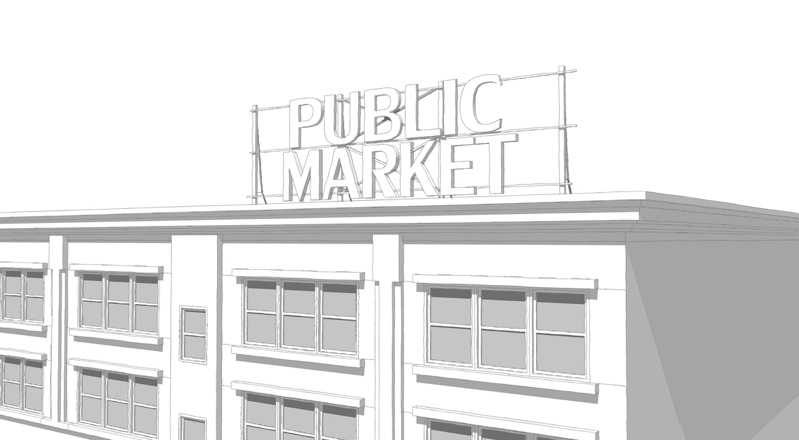
Roofline. The top edge of a roof or building parapet, whichever is higher, excluding any cupolas, pylons, chimneys or minor projections.
Salvage Yard. A facility where used and/or damaged vehicles, appliances, building fixtures, architectural features from structures, and similar commodities are sorted, dismantled, and/or offered for sale.
Satellite Dish Antenna. A dish antenna designed for transmitting signals to a receiver or receiving station or for receiving television, radio, data, communication or other signals from other antennas, satellites or other services.
Searchlight. An attention-getting device where an artificial light of high intensity is shined upward in a focused beam and can turn in any direction to attract attention to a location. Also known as sky-beams or sky spotlights.
Self-Storage Facility: Enclosed. A facility for the storage of personal property where individual renters control and access individual storage spaces located within a fully enclosed building that is climate controlled. Retail sales of related items, such as moving supplies, and facility offices may also be included. Rental of vehicles and other equipment for moving is a separate use from self-storage facility. A heavy retail, rental, and service use in conjunction with a self-storage use is allowed only when the district allows the heavy retail, rental, and service use and such use requires separate approval.
Self-Storage Facility: Outdoor. A facility for the storage of personal property where individual renters control and access individual storage spaces and where each storage unit has individual access from the outdoors. Retail sales of related items, such as moving supplies, and facility offices may also be included. Rental of vehicles and other equipment for moving is a separate use from self-storage facility. A heavy retail, rental, and service use in conjunction with a self-storage use is allowed only when the district allows the heavy retail, rental, and service use and such use requires separate approval.
Setback. Defined in Section 2.4.
Setback, Front. Defined in Section 2.4.
Setback, Interior Side. Defined in Section 2.4.
Setback, Corner Side. Defined in Section 2.4.
Setback, Rear. Defined in Section 2.4.
Setback, Reverse Corner Side. Defined in Section 2.4.
Shed. An accessory structure intended for storage.
Sidewalk Sign. A type of moveable, detached sign not secured or attached to the ground or surface upon which it is located.
SIDEWALK SIGN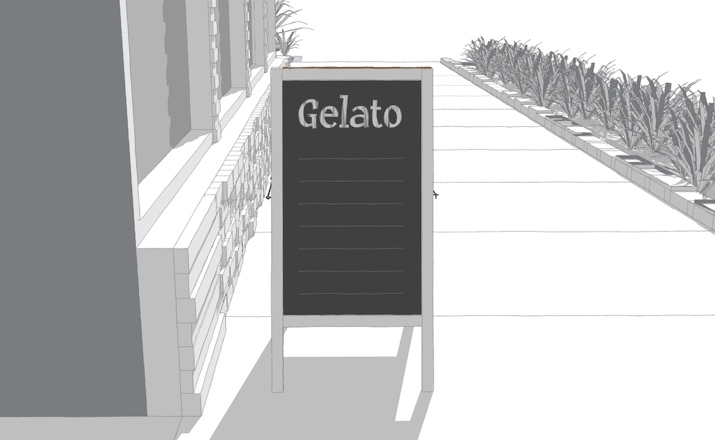
Sign, Billboard, or Other Advertising Device. Any structure or part thereof or device attached thereto or represented thereon, which displays or includes any letter, words, model, banner, flag, pennant, insignia or representation used as, or which is in the nature of an announcement, direction or advertisement. The word sign includes the word billboard or any other type of advertising device, but does not include the flag, pennant, or insignia of any nation, state, city, or other political unit.
Sight Triangle (or Visibility Triangle). The area located at the intersection of two streets, whether public or private, or a street and private driveway through which an unobstructed view of approaching traffic is necessary for motorists.
Sign Illumination, Internal. Lighting of a sign from internal sources, such as in light source within the framework of a sign cabinet and behind the face of the sign so that light is transmitted through the face of the sign.
Sign Illumination, External. Lighting of a sign from a light source external to the body of the sign, so that light is directed on to the face of the sign or directed in a manner so as to create silhouettes of letters or symbols that are placed in front of the light.
Small Cells. Compact wireless base stations containing their own transceiver equipment and function like cells in a mobile network but provide a smaller coverage area than traditional cell towers.
Social Service Center. A service establishment that provides assistance for those recovering from drug or alcohol dependency; survivors of abuse seeking support; those transitioning from homelessness or prior incarceration; and those with health and disability concerns. It does not include in-patient, overnight, or living quarters for recipients of the service or for the staff. Such service does not include medical examinations or procedures, or medical detoxification, dispensing of drugs or medications, or other treatments normally conducted in a medical office.
Solar Farm. An energy system operated as a principal use by a public, private, or cooperative company for the generation, transmission, distribution, storage, or processing of solar energy for the purposes of heating and cooling, electricity generation, and/or water heating.
Stepback. In building height, a stepback is the required additional distance that upper stories of a structure must be recessed from the façade of the stories below. A required stepback must continue through all upper stories once established, though it may be increased from the required minimum on any of the above stories.
Stoop. An exterior floor typically constructed of stone, concrete, and/or masonry, with a finished floor elevation higher than the adjacent ground level, often with steps leading up to it, and utilized primarily as an access platform to a structure. A stoop may be roofed and designed with railings, but cannot be enclosed.
Storage Yard—Outdoor. The storage of materials outdoors as a principal use of land for more than 24 hours. When an outdoor storage yard is allowed as a secondary use, such storage yard must be associated with the principle use on the lot and materials and/or equipment stored outdoors must be related to the principal use.
Storage Yard—Outdoor, Secondary. An outdoor storage yard containing materials and/or equipment that serves another principle use on the same lot. The "Storage Yard, Outdoor—Secondary Use" may be larger than the principle use it serves.
Storefront. A frontage type where the building meets the property line and a shopfront extends into the setback space, which may also include an awning.
Street. A public or private right-of-way that affords a primary means of vehicular access to abutting property, but does not include alleys or driveways.
Structural Alteration. Any change, other than incidental repairs, which would prolong the life of supporting members of a structure, such as the addition, removal, or alteration of bearing walls, columns, beams, girders or foundations.
Structure. A combination of materials to form a construction for use or occupancy, whether installed on, above, or below, the surface of land or water.
Temporary Contractor Office and Contractor Yard. A short-term, portable, or modular structure utilized as a watchman's quarters, construction office, or equipment shed during the construction of a new development. This may include a contractor's yard where materials and equipment are stored in conjunction with a construction project.
Temporary Outdoor Entertainment. A short-term live entertainment event, such as the performance of live music, revue, or play within an outdoor space.
Temporary Outdoor Sales. Short-term uses, which may include short-term structures, where goods are sold, such as consignment auctions, arts and crafts fairs, flea markets, rummage sales, temporary vehicle sales, and holiday sales, such as Christmas tree lots and pumpkin sales lots. This short-term use category does not include outdoor sales related to a retail goods establishment where such goods are part of the establishment's regular items offered for purchase.
Temporary Outdoor Storage Container. Short-term self-storage containers delivered to a residence or business owner to store belongings, and then picked up and returned to a warehouse until called for.
Temporary Recreational Vehicle (RV) Park. An existing parking lot or structure used on a short-term basis for the accommodation of recreational vehicles for short-term accommodations.
Temporary Sign. Any sign, banner, pennant, valance, or advertising display constructed of wood, metal, cloth, canvas, light fabric, cardboard, wallboard, or other light material, with or without frames, where either by reason of construction or purpose the sign is intended to be displayed for a short period of time consistent with the terms of these regulations.
Temporary Warehouse Sales (Indoor). The short-term sales of the items manufactured on-site and only an accessory activity to principal use of industry.
Tent. A structure, enclosure, or shelter, with or without sidewalls or drops, constructed of fabric or pliable material supported in any manner except by air or the contents it protects.
Tower. Any structure built for the sole or primary purpose of supporting any FCC licensed or authorized antennas and their associated facilities, including structures that are constructed for wireless communications services including, but not limited to, private, broadcast, and public safety services, as well as unlicensed wireless services and fixed wireless services such as microwave backhaul, and the associated site.
Tower Height. The vertical distance measured from the base of the tower structure at grade to the highest point of the structure, not including lightning rods or antennas.
Transmission Equipment. Equipment that facilitates transmission for any authorized wireless communication service, including, but not limited to, radio transceivers, antennas, coaxial or fiber- optic cable, and regular and backup power supply. The term includes equipment associated with wireless communications services including, but not limited to, private, broadcast, and public safety services, as well as unlicensed wireless services and fixed wireless services such as microwave backhaul.
Umbrella Sign. A sign integrated into the body of an umbrella, either on its protective covering or support structure.
UMBRELLA SIGN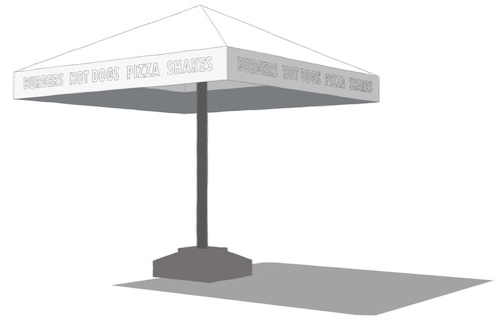
Unified Control. The combination of two or more tracts of land wherein each owner has agreed that his tract of land will be developed under the same development approvals.
Use. The purpose or activity for which the land or structure is designed, arranged, or intended, or for which it is occupied or maintained.
Vehicle Dealership. An establishment that sells or leases new or used automobiles, vans, motorcycles, and/or all-terrain vehicles (ATV) vehicles, or other similar motorized transportation vehicles. A motor vehicle dealership may maintain an inventory of the vehicles for sale or lease either on-site or at a nearby location, and may provide on-site facilities for the repair and service of the vehicles sold or leased by the dealership. Vehicle dealerships do not include truck, trailer, boat, or heavy equipment sales, which are considered heavy retail, rental, and service.
Vehicle Operations Facility. A facility for the dispatch, storage, and maintenance of emergency medical care vehicles, taxicabs and similar vehicles for hire, school buses, utility vehicles, and similar vehicles. Vehicle operations facility does not include a public works or public safety facility.
Vehicle Rental. An establishment that rents automobiles and vans, including incidental parking and servicing of rental vehicles. A motor vehicle rental establishment may maintain an inventory of the vehicles for sale or lease either on-site or at a nearby location, and may provide on-site facilities for the repair and service of the vehicles sold or leased by the dealership. Vehicle rental does not include truck rental establishments or rental of heavy equipment, which is considered part of heavy retail, rental, and service.
Vehicle Repair/Service. A business that provides repair services to motor vehicles, motorcycles, and all-terrain vehicles (ATV) vehicles.
Wall Sign. A type of attached sign fastened to or painted on the wall of a building in such a manner that the wall becomes the supporting structure for, or forms the background surface of, the sign and which does not project more than one foot from the building or structure. A wall sign may not project above the wall or parapet.
WALL SIGN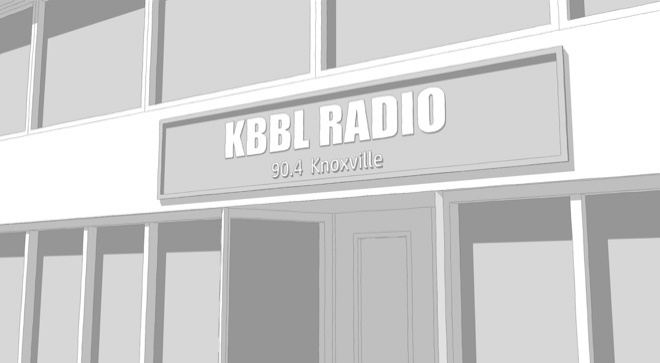
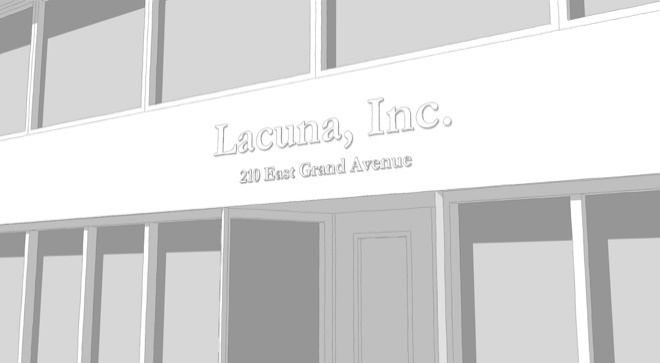
Warehouse and Distribution. An enclosed facility for the storage and distribution of manufactured products, supplies, and/or equipment.
Waste Transfer Station. A facility where recyclables and/or refuse are collected and sorted in preparation for processing or landfill.
Wholesale Establishment. A business where goods are sold to either retailers, or to industrial, commercial, institutional, or other professional business users, or to other wholesalers and related subordinated services.
Wind Energy System. An energy system as a principal use operated by a public, private, or cooperative company for the generation, transmission, distribution, or processing of wind energy.
Window Sign. A type of attached sign placed within a window facing the street or thoroughfare placed in a window for the purpose of advertising products, services or the business, and may be composed of applied letters, symbols, neon or similar lighting, but may not obscure the view of the interior of the building.
WINDOW SIGN
Wireless Communication Facilities (WCF). A staffed or unstaffed facility or location for the transmission and/or reception of radio frequency (RF) signals or other wireless communications or other signals for commercial communications purposes, typically consisting of one or more antennas or group of antennas, a tower or attachment support structure, transmission cables and other transmission equipment, and an equipment enclosure or cabinets.
Yard. Defined in Section 2.4.
Yard, Front. Defined in Section 2.4.
Yard, Interior Side. Defined in Section 2.4.
Yard, Corner Side. Defined in Section 2.4.
Yard, Rear. Defined in Section 2.4.
Yard, Reverse Corner Side. Defined in Section 2.4.
Zoning Administrator. The title refers to the Building Official, Director of Plans Review and Building Inspections, officer or other designated authority charged with the administration and enforcement of this Code, or his/her duly authorized representative.
Zoning Map. The map or maps that are a part of this Code and which delineate the boundaries of all mapped zoning districts within the physical boundary of the City.
(Ord. No. O-77-2020, § 1, 5-19-20; Ord. No. O-92-2022, § 1, 7-26-22; Ord. No. O-102-2023, § 1, 7-11-23; Ord. No. O-10-2024, § 1, 2-6-24; Ord. No. O-127-2024, § 1, 10-29-24; Ord. No. O-95-2025, § 1, 8-19-25; Ord. No. O-143-2025, § 1, 11-25-25)
2.4 - RULES OF MEASUREMENT
This section provides the rules of measurement for the dimensional standards and locational characteristics within the Code.
A.
Blank Wall
1.
Blank Wall—Ground Floor
The horizontal linear dimension of contiguous building wall that does not contain fenestration, doors, or decorative elements such as banding, medallions, artwork such as murals and mosaics, change in wall plane, or other architectural or material embellishment. Any wall less than five feet in height is not considered to be a blank wall.
BLANK WALL—GROUND FLOOR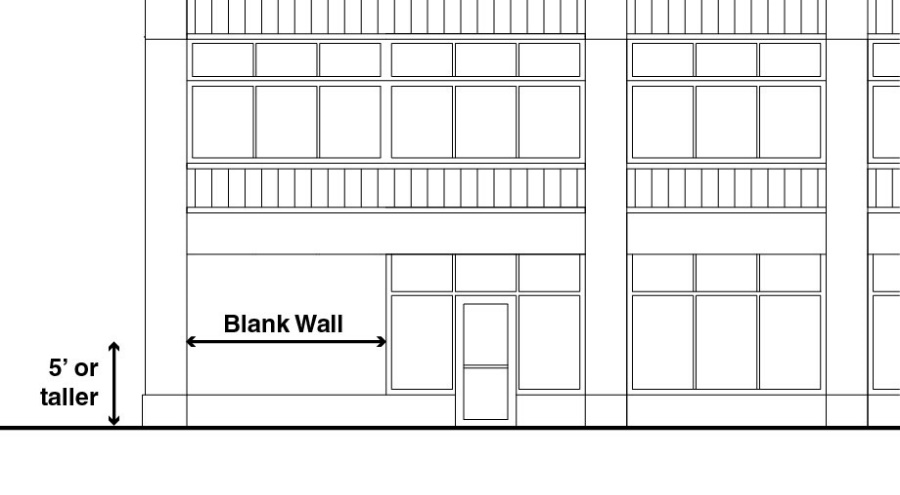
2.
Blank Wall, Upper Floor
The horizontal or vertical linear dimension of contiguous building wall that does not contain fenestration, doors, or decorative elements such as banding, medallions, artwork such as murals and mosaics, change in wall plane, or other architectural or material embellishment. Any wall with a minimum dimension of less than five feet (height or width) is not considered to be a blank wall.
BLANK WALL, UPPER FLOOR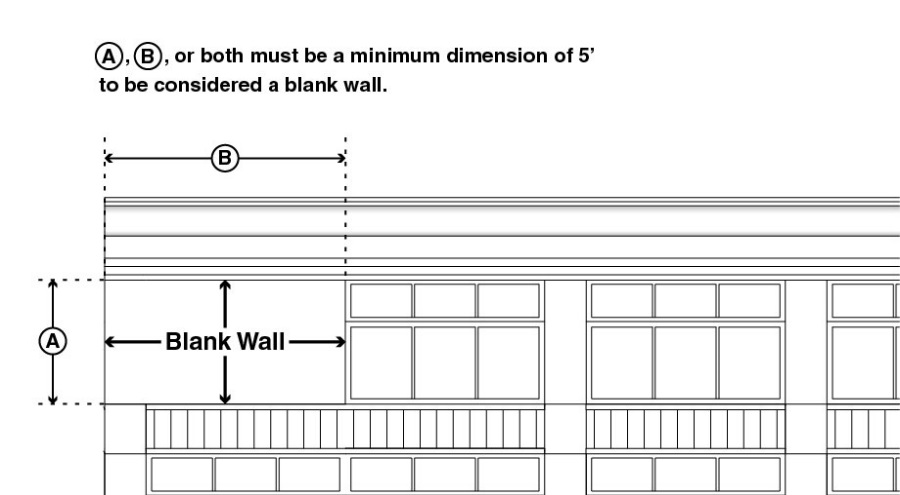
B.
Block and Blockface
1.
A block is a tract of land bounded by streets, or a combination of streets and railroad rights-of-way, municipal boundary lines, and/or waterways.
2.
Blockface is measured as that portion of a block or tract of land facing the same side of a single street and lying between the closest intersecting streets.
BLOCK AND BLOCKFACE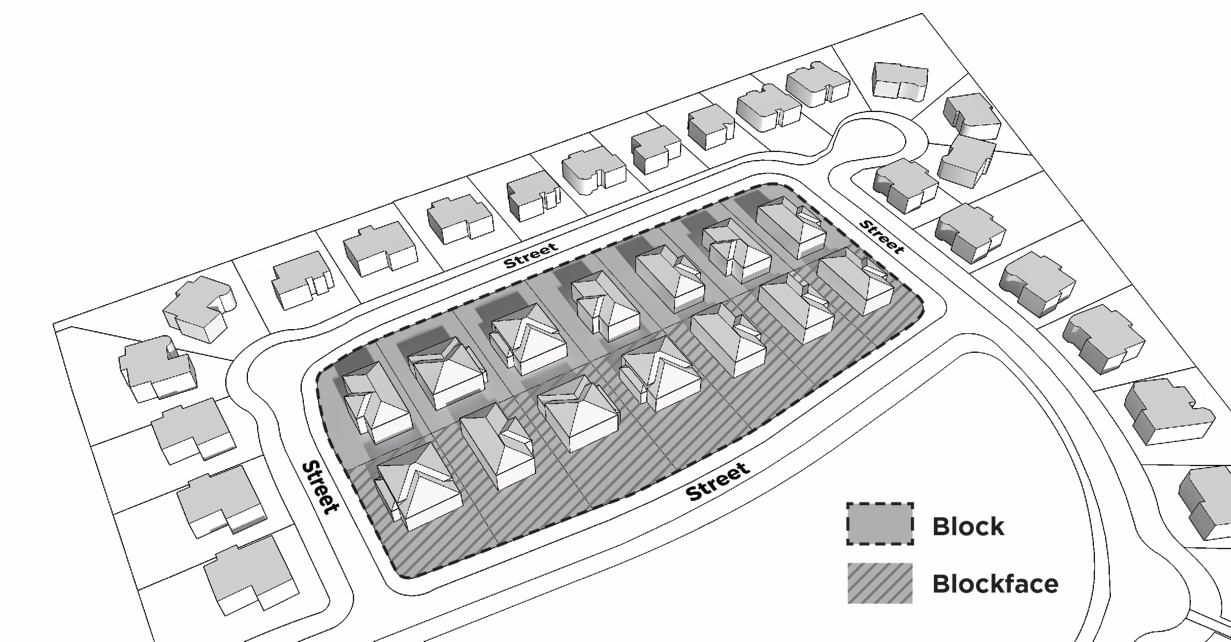
BLOCK AND BLOCKFACE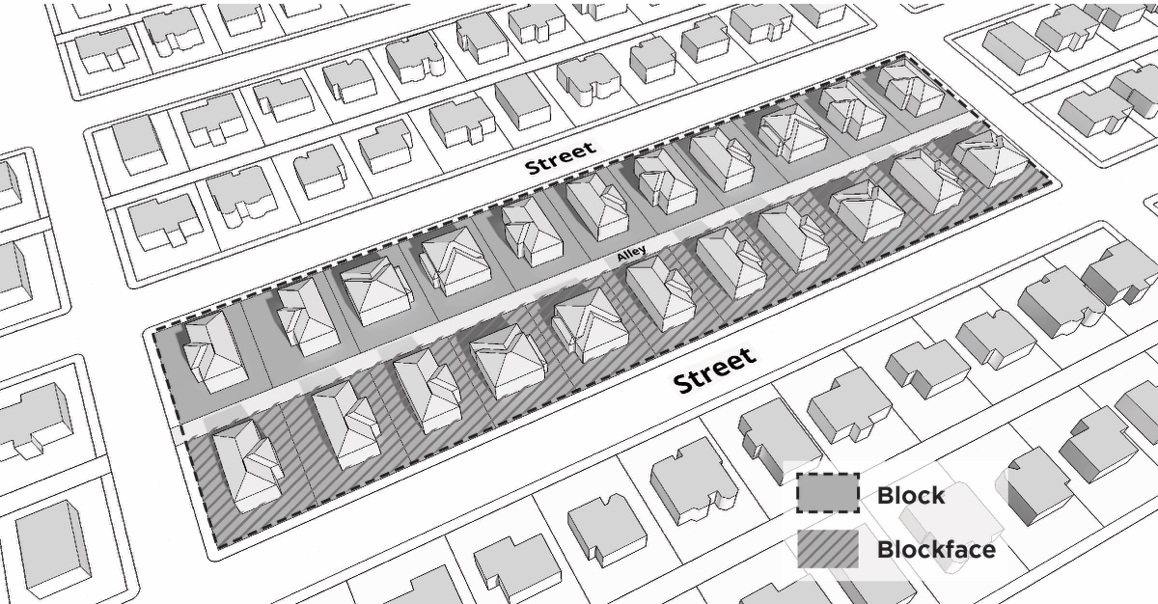
C.
Build-To Dimensions. Certain dimensional requirements with the district require structures to be constructed at a build-to dimension. A build-to requirement is a boundary or alignment, parallel to a lot line, where a structure must be placed. This Code includes three types of build-to dimensions:
1.
A build-to line (BTL) is a set building line on a lot, measured parallel from the front and/or corner side lot line, where the structure must be located. The building façade must be located on the build-to line. Façade articulation, such as window or wall recesses and projections are not counted as the building façade line, which begins at the applicable façade wall. Placement of a building at a build-to line must not violate line of sight requirements. In such case, where the City Engineer determines that line of sight would be encroached upon, the build-to line must be that point on the lot where the line of sight requirement is no longer violated.
2.
A build-to zone (BTZ) is the area on a lot, measured parallel from the front and/or corner side lot line, where a structure must locate within the minimum and maximum range of setback provided. The building façade must be located within the build-to zone. Façade articulation, such as window or wall recesses and projections are not counted as the building façade line, which begins at the applicable façade wall. Placement of a building at a build-to zone must not violate line of sight requirements. In such case, where the City Engineer determines that line of sight would be encroached upon, the maximum dimension of the build-to zone range must be that point on the lot where the line of sight requirement is no longer violated.
3.
A build-to percentage specifies the percentage of the building façade that must be located within a build-to line or build-to zone. Façade articulation, such as window or wall recesses and projections, do not count against the required build-to percentage. Plazas and other open space features are counted as meeting the build-to percentage. Build-to percentage is calculated by building façade, not lot width.
BUILD-TO LINE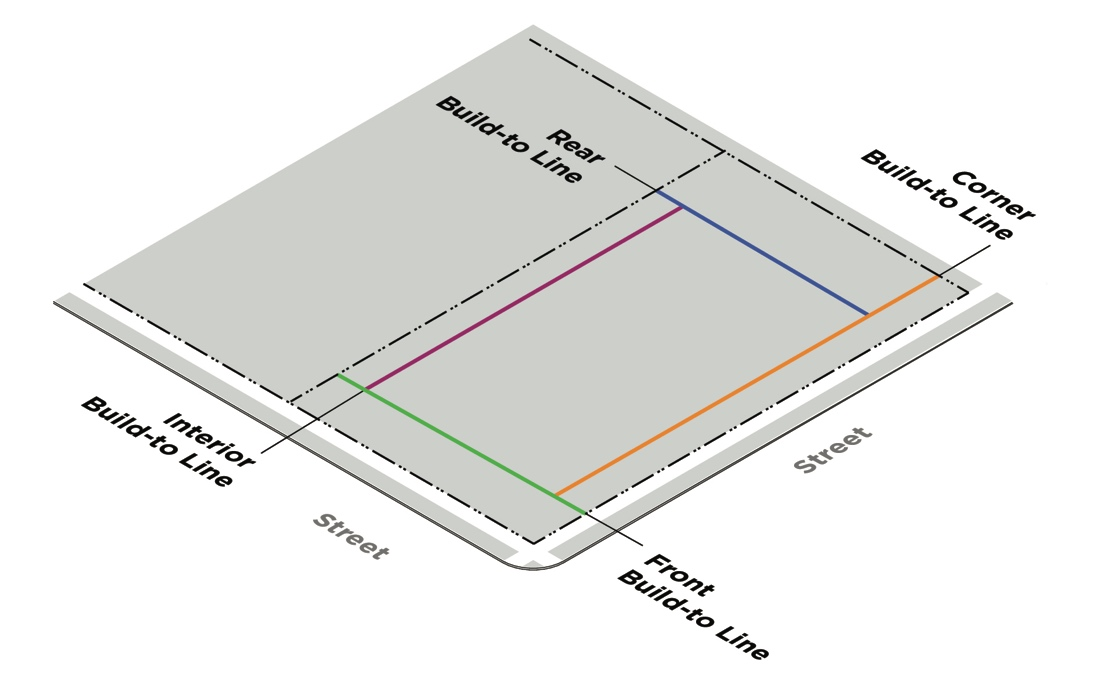
BUILD-TO ZONE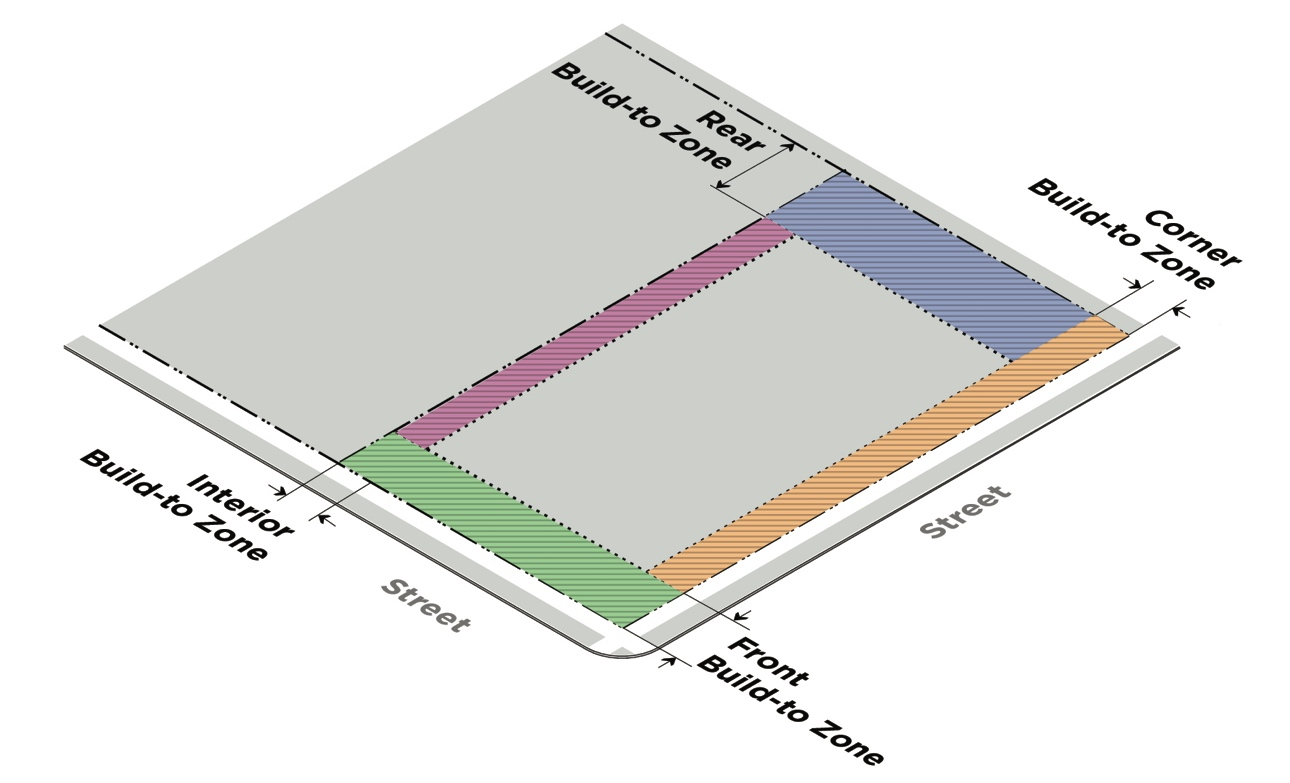
BUILD-TO PERCENTAGE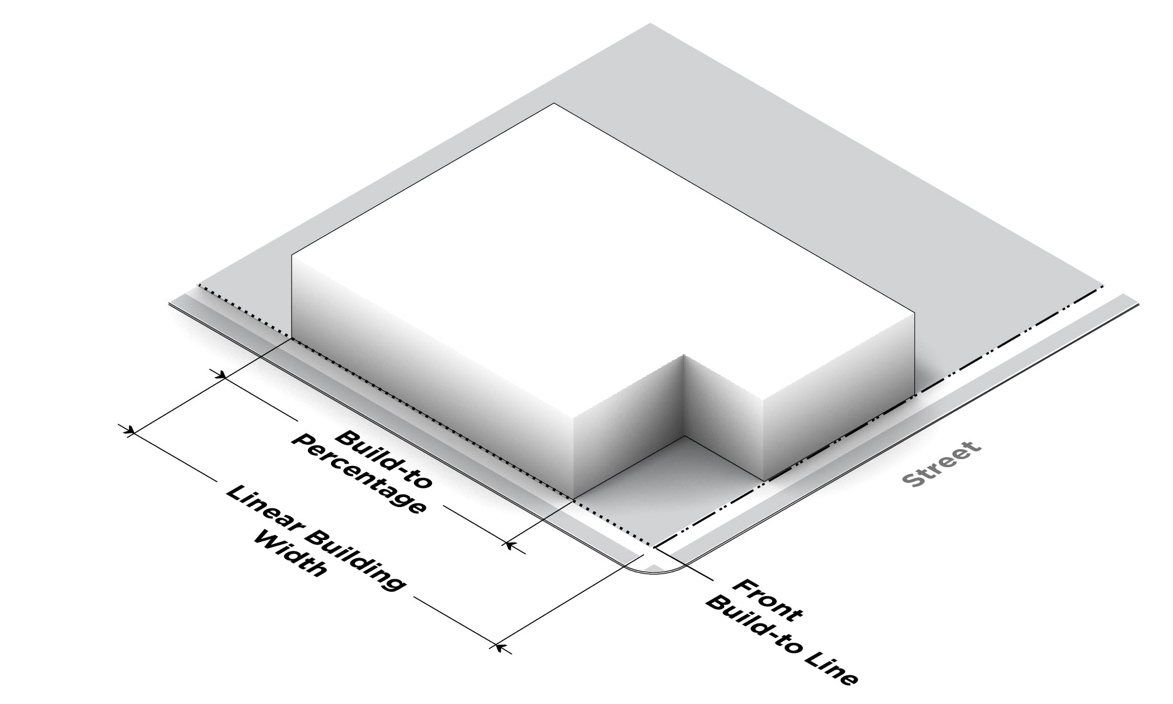
The following are examples of how build-to lines (BTL) and build-to zones (BTZ) are applied. When the front setback BTL is indicated as 5', the structure must be built at 5' from the front lot line. When the front setback BTZ is indicated as 0' to 10', the structure must be built within that range, shown in the example below as 5'; the property owner may choose any setback within that range.
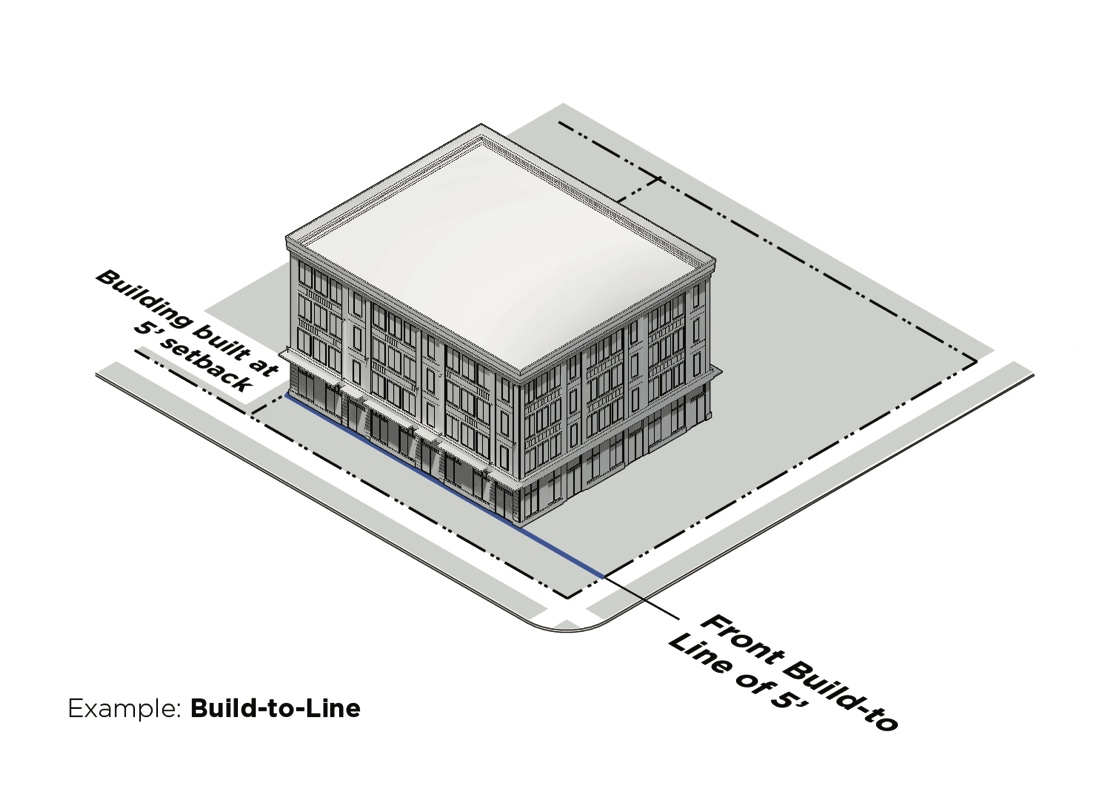
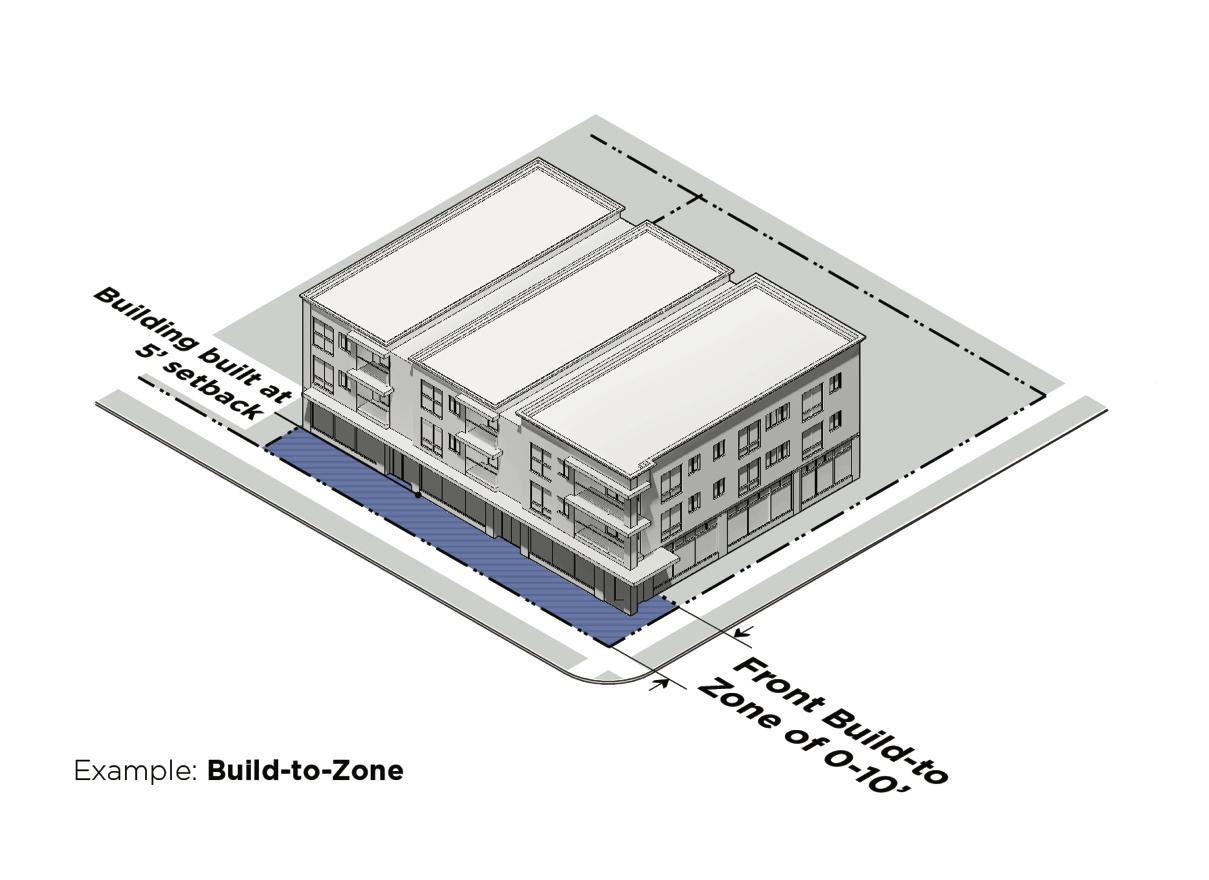
D.
Building Coverage
That portion of the lot determined by building footprint, exclusive of eaves and other overhangs, that is or may be covered by buildings and accessory structures.
E.
Building Height
1.
Maximum building height is measured as the vertical distance from grade at the front building line or, when on the Tennessee River, measured from the elevation of 813 feet above sea level to:
a.
The top of a flat roof, including structures designed with a decorative mansard roof concealing a flat roof.
b.
The deck line of a mansard or gambrel roof.
c.
The midpoint height between the eaves and the ridge in the case of a pitched roof.
d.
Any dormers that extend past the roofline cannot exceed the maximum building height permitted in the district, as measured from the adjacent average grade, or its equivalent, to the top of the dormer.
2.
For the purposes of building height measurement, roof types are defined as follows:
a.
Flat Roof: A roof that is not pitched and where the surface of the roof is generally parallel to the ground. A mono-pitched roof, also called a shed roof, is a single-sloping roof surface, and is also considered a flat roof.
b.
Mansard or Gambrel Roof: A two-sided roof with two slopes on each side. The upper slope is positioned at a shallow angle, while the lower slope is steep. A gambrel roof has vertical gable ends, while a mansard roof is hipped at the four corners of the building.
c.
Pitched Roof: A gable or hip roof having a slope or pitch of at least one foot rise for each four feet of horizontal distance in the direction of the slope or pitch of the roof. A hipped roof is sloped in two pairs of directions compared to the one pair of direction for a gable roof.
BUILDING HEIGHT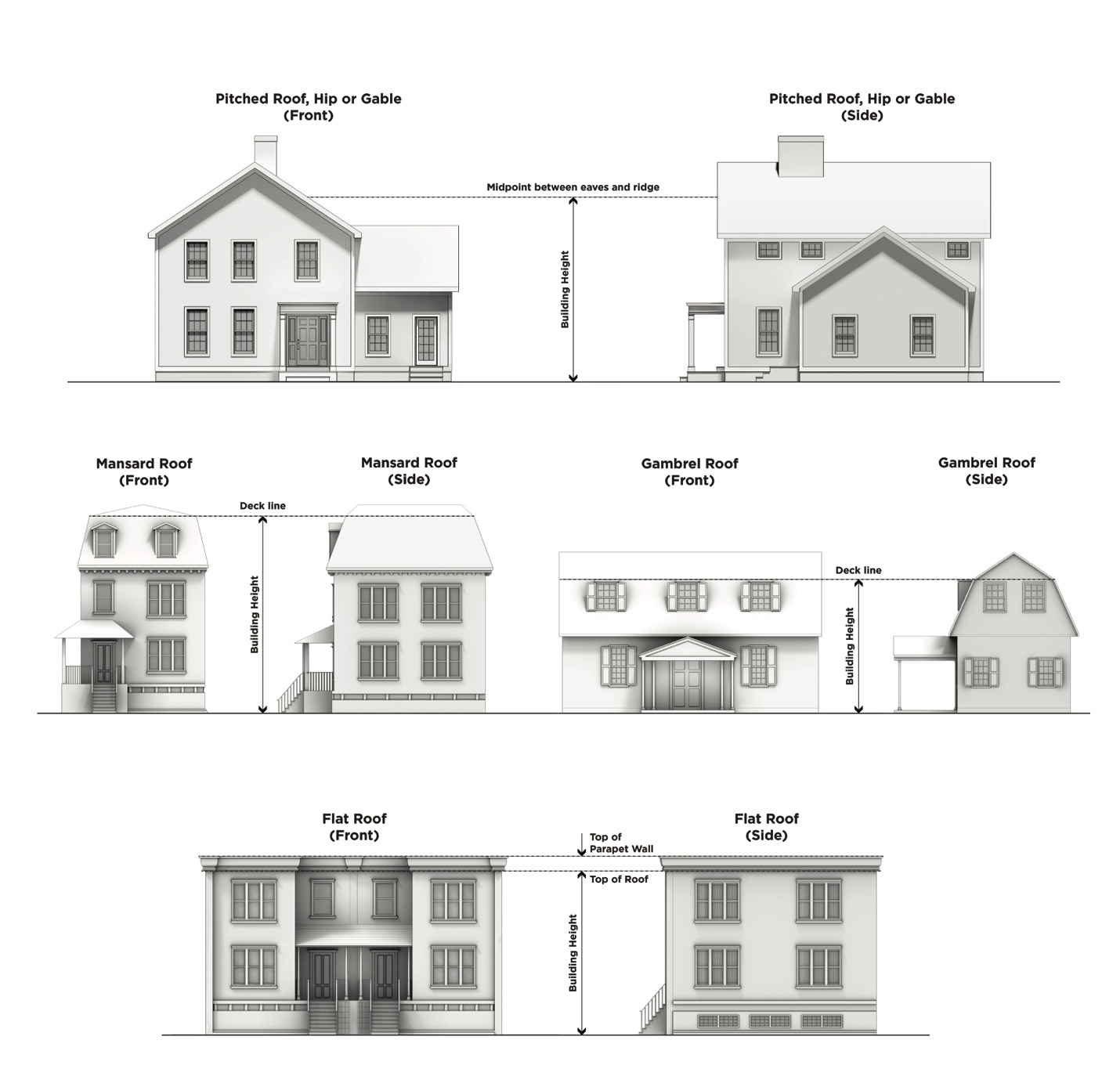
3.
The following structures or parts thereof are exempt from maximum height limitations, unless otherwise limited by any height restriction imposed by any airport authority, or other similar federal, state, or local authority.
a.
Public utility poles, towers, and wires. This does not include wireless telecommunication towers and wind turbines that are regulated separately by this Code.
b.
Water tanks and standpipes.
c.
Building appurtenances such as chimneys, parapet walls, skylights, steeples, flag poles, smokestacks, cooling towers, elevator bulkheads, fire towers, water towers, stacks, stage towers, or scenery lofts, tanks, ornamental towers and spires, rooftop accessory structures, recreational facilities, necessary mechanical appurtenances, or penthouses to house mechanical appurtenances.
F.
Floor Area Ratio (FAR)
The ratio of building area to parcel area. FAR is calculated by adding all of the areas of each floor of the building together and dividing by the gross area of the parcel on which the building is sited.
G.
Gross Floor Area (GFA)
The gross floor area (GFA) of a structure is the sum of the gross horizontal areas of all floors of the structure as measured from the exterior faces of the exterior walls or from the centerline of walls separating two buildings.
H.
Impervious Surface Coverage
Impervious surface coverage is a measure of intensity of land use that represents the portion of a site that is occupied by structures, pavement, and other impervious surfaces that do not allow for the absorption of water into the ground. Maximum impervious surface of a lot is calculated as the percentage of all impervious surface area against the total area of the lot. When a permeable pavement system is used, it is calculated as 50% impervious surface subject to approval by the Department of Engineering.
I.
Lot
A lot is the basic development unit for determination of lot area, depth, and other dimensional regulations. The following describes the types of lot configurations:
1.
An interior lot is a lot other than a corner or through lot, bounded by two interior side lot lines.
2.
A corner lot is a lot situated at the junction of, and abutting on, two or more intersecting streets.
3.
A through lot is a lot that fronts upon two parallel streets, or which fronts upon two streets which do not intersect at the boundaries of the lot. A through lot is also called a double frontage lot.
4.
A flag lot is platted so that the main building site area (the "flag") is set back from the street on which it fronts and includes an access strip (the "pole") connecting the main building site with the street.
LOT TYPE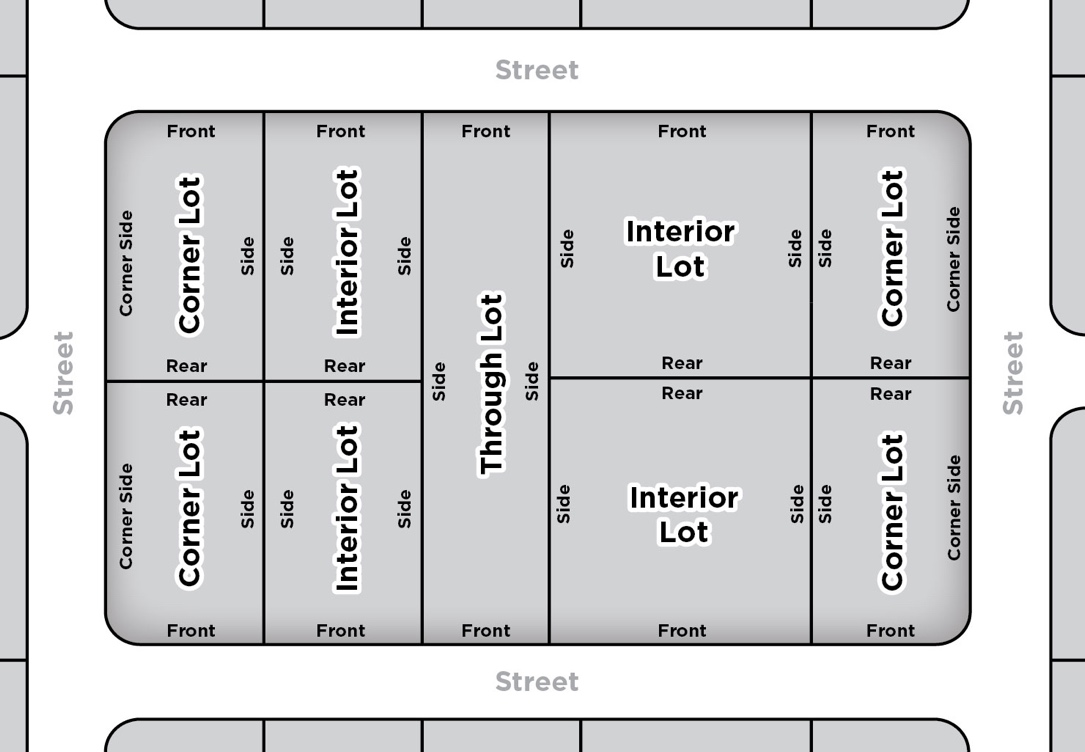
J.
Lot Area
The total area within the boundaries of a lot, excluding any street right-of-way, usually defined in acres or square feet. When applicable, lot area must be calculated above the full summer pool mark.
K.
Lot Depth
The distance measured from the front lot line to the rear lot line. For lots where the front and rear lot lines are not parallel, the lot depth is the depth calculated at the deepest part of the lot.
L.
Lot Line
A line of record bounding a lot, as indicated on an approved, filed, and recorded subdivision plat, which divides one lot from another lot or from a public or private street or any other public or private space.
1.
Any lot line that is not a front, corner side, or rear lot line is an interior lot line.
2.
A rear lot line on a pointed lot is an imaginary line parallel to and farthest from the front lot line, not less than ten feet long and wholly within the lot.
M.
Lot Width
1.
For regular lots, lot width is the horizontal distance between the side lot lines measured at right angles to its depth along a straight line parallel to the required front setback, build-to line, or farthest build-to line comprising a build-to zone.
2.
On a lot with a radial (curved) front lot line, lot width is measured as follows:
a.
A line is drawn at the midpoint of the lot between the side lot lines, extending from the front lot line to the rear lot line.
b.
Where the required front setback intersects the midpoint line at a right angle, a line is drawn perpendicular to the midpoint line.
c.
Lot width is determined as the length of the line between side lot lines.
d.
Where the side lot lines angle to increase width towards the rear, the required lot width measured at the required setback is 75 percent of the lot width required by the zoning district.
3.
For flag lots, lot width is measured at the required front setback as defined in this section.
LOT WIDTH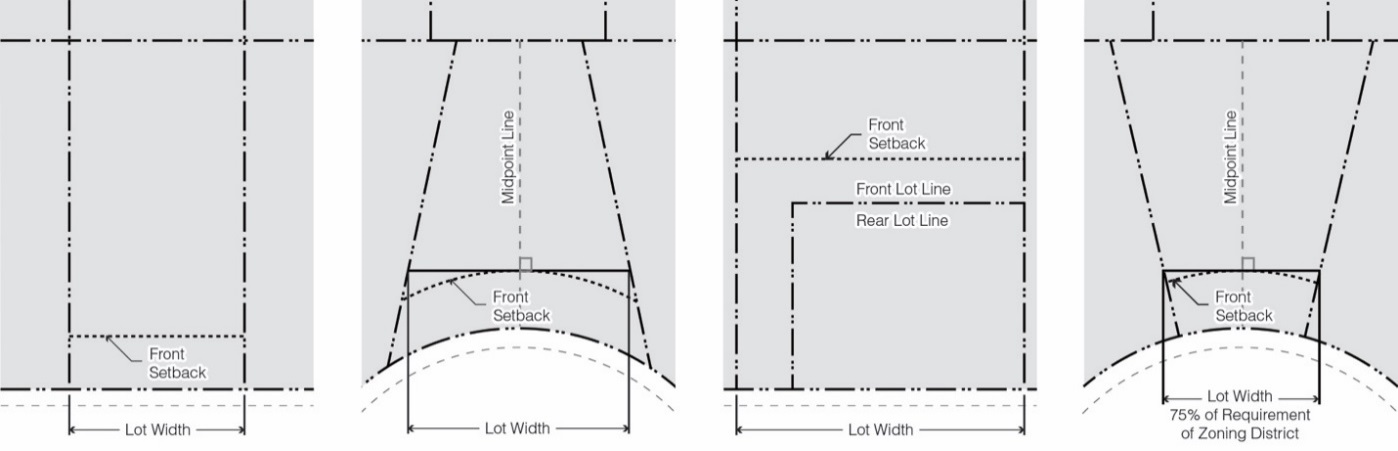
N.
Sign Measurements
1.
Sign Area
a.
For detached signs, the total sign area is measured by calculating the entire area enclosed by the perimeter of the extreme limits of the sign cabinet or module, exclusive of embellishments such as pole coverings, framing, decorating roofing, and any appurtenances required by the Building Code.
b.
For attached signs, the total sign area is measured by calculating the entire area enclosed by the perimeter of the extreme limits of the sign cabinet, or, if the sign face is not a part of a sign cabinet, the sign copy, including vertical and horizontal spacing between letters and logos on the sign face.
c.
A sign designed to be viewed from two different directions is considered as one sign, provided that the two sign faces cannot be more than 42 inches apart if parallel, nor form an angle of more than 90 degrees.
d.
If the attached or detached sign or sign structure is internally illuminated or back lit by any means, the entire area is included within the allowable sign area calculation for the site.
e.
The area of a three-dimensional sign is calculated as the total area of the smallest rectangle, circle or square that fully encloses the largest profile of the three-dimensional sign.
2.
Maximum Allowed Sign Area
a.
Primary Building Elevation
For the purposes of determining maximum allowed sign area for attached signs:
i.
The primary building elevation is any elevation that faces onto a street right-of-way to which the parcel has street frontage and has the principal entrance to the building, or has an entry used primarily for customers or clients.
ii.
The wall area of the primary building elevation is determined as follows:
(A)
When architectural elevations are provided that accurately and to scale depict the elevation of the structure, the wall area of the elevation is the area of the vertical wall surface of the building elevation exclusive of roofs, parapets, and false facia; except that a parapet on the primary building elevation, if it is part of a parapet of a uniform height on three sides of a structure and of a similar and uniform building material may be included in the elevation area, but decorative parapet extensions of irregular height on one or two sides of a structure are excluded from the calculation.
(B)
When architectural plans are not provided, it is assumed that the height of the elevation of the first floor is 12 feet and that the height of the elevation of all floors above the first floor is ten feet per floor. The area of the elevation is then calculated based on the formula:
[building length × 12 ft. (first floor)] + [building length × 10 ft. per each additional floor] = elevation area.
b.
Canopies Over Gasoline Pumps
For the purposes of determining maximum allowed sign area, the vertical surface of canopies over gasoline pumps is considered as part of the wall surface of an elevation.
3.
Sign Height
a.
Sign height is computed as the distance from the base of the sign structure to the top of the highest attached component of the sign, using as the base of the sign structure either of the following provisions:
i.
The finished grade of the property below the sign; or
ii.
The roadway surface at the nearest edge of pavement of the street that provides primary access to the site.
b.
The finished grade of the property is construed for this purpose to be the final established grade after development, exclusive of any filling, berming, mounding, or excavating primarily for the purpose of locating a sign.
c.
For detached signs subject to the provisions of Section 13.9.F. on property that shares a common property line with an interstate highway or for detached signs on property that does not share a common property line but such signs are located within 100 feet of the right-of-way of an interstate highway, the highest interstate roadway surface as measured from the sign to the crown of the roadway surface on a line perpendicular to the interstate right-of-way, or radial to the right-of-way when the subject sign is located in proximity to a curved interstate right-of-way may be used to determine the greatest allowable height.
4.
Sign Spacing
All distances related to spacing of signs are measured along a straight line between the two closest points of the sign structures.
5.
Setback for Detached Signs
The setback is measured from the farthest most protrusion of the sign to the nearest point of a property line, street right-of-way or edge of pavement. The interstate highway right-of-way is considered a side or rear lot line for the purposes of determining the minimum setback required.
O.
Yards and Setbacks
1.
General Definitions
a.
A yard is the open space area between the building line, of a principal building and the adjoining lot lines, exclusive of façade articulation, such as window or wall recesses and projections.
b.
A required setback is the required minimum distance a principal building must be located from a lot line, which is unoccupied and unobstructed by any projections of a principal building, unless permitted by this Code.
i.
A build-to zone or build-to line is considered a required setback.
ii.
In the case of a build-to line it is where the principal building must be located.
iii.
In the case of a build-to zone, it is the defined area (defined by minimum and maximum build-to lines) where the principal building must be located.
c.
A setback may be equal to or lesser than a yard.
d.
A setback is located along the applicable lot line for the minimum depth specified by the zoning district in which such lot is located.
2.
Front Yard and Front Setback
The front yard and front setback extend the full width of the lot between side lot lines measured perpendicular to the front lot line.
a.
Front Yard: A front yard is located between a principal building line and the front lot line.
b.
Front Setback: A front setback is the required minimum distance per the zoning district that a principal building must be located from the front lot line.
c.
A front setback is measured from the front lot line.
d.
Front setbacks on irregular lots are subject to the additional provisions:
i.
On a lot with a radial (curved) front lot line, the required front setback, as measured from the right-of-way line follows the curve of the lot line.
ii.
For flag lots, the front yard and setback is measured from the rear lot line of the lot that separates the flag portion of the lot from the street.
e.
Where front yard averaging is permitted, the average front setback of lots on the same side of the blockface are used to establish the required front setback.
3.
Interior Side Yard and Interior Side Setback
The interior side yard and interior side setback extend along the interior side lot line between the front and rear yard or setback, measured perpendicular to the interior side lot line.
a.
Interior Side Yard: An interior side yard is located between a principal building line and the interior side lot line.
b.
Interior Side Setback: An interior side setback is the required minimum distance per the zoning district that a principal building must be located from the interior side lot line.
c.
For townhouse developments, the interior side yard and interior side setback are applicable to end units only.
d.
For single-family attached dwellings, the interior side yard and interior side setback are only applicable to the side of the unit with no shared wall attachment to another unit.
4.
Corner Side Yard and Corner Side Setback
The corner side yard and corner side setback extend along the corner side lot line between the front yard or front setback and the rear lot line, measured perpendicular to the corner side lot line.
a.
Corner Side Yard: A corner side yard is located between a principal building line and the corner side lot line.
b.
Corner Side Setback: A corner side setback is the required minimum distance per the zoning district that a principal building must be located from the corner side lot line.
5.
Rear Yard and Rear Setback
The rear yard and rear setback extend between interior side lot lines, measured perpendicular to the rear lot line.
a.
Rear Yard: A rear yard is located between a principal building line and the rear lot line.
b.
Rear Setback: A rear setback is the required minimum distance per the zoning district that a principal building must be located from the rear lot line.
c.
In the case of a corner lot, the rear yard and rear setback extend between the interior side lot line to the required corner side setback for the [corner lot], measured perpendicular to the rear lot line.
SETBACKS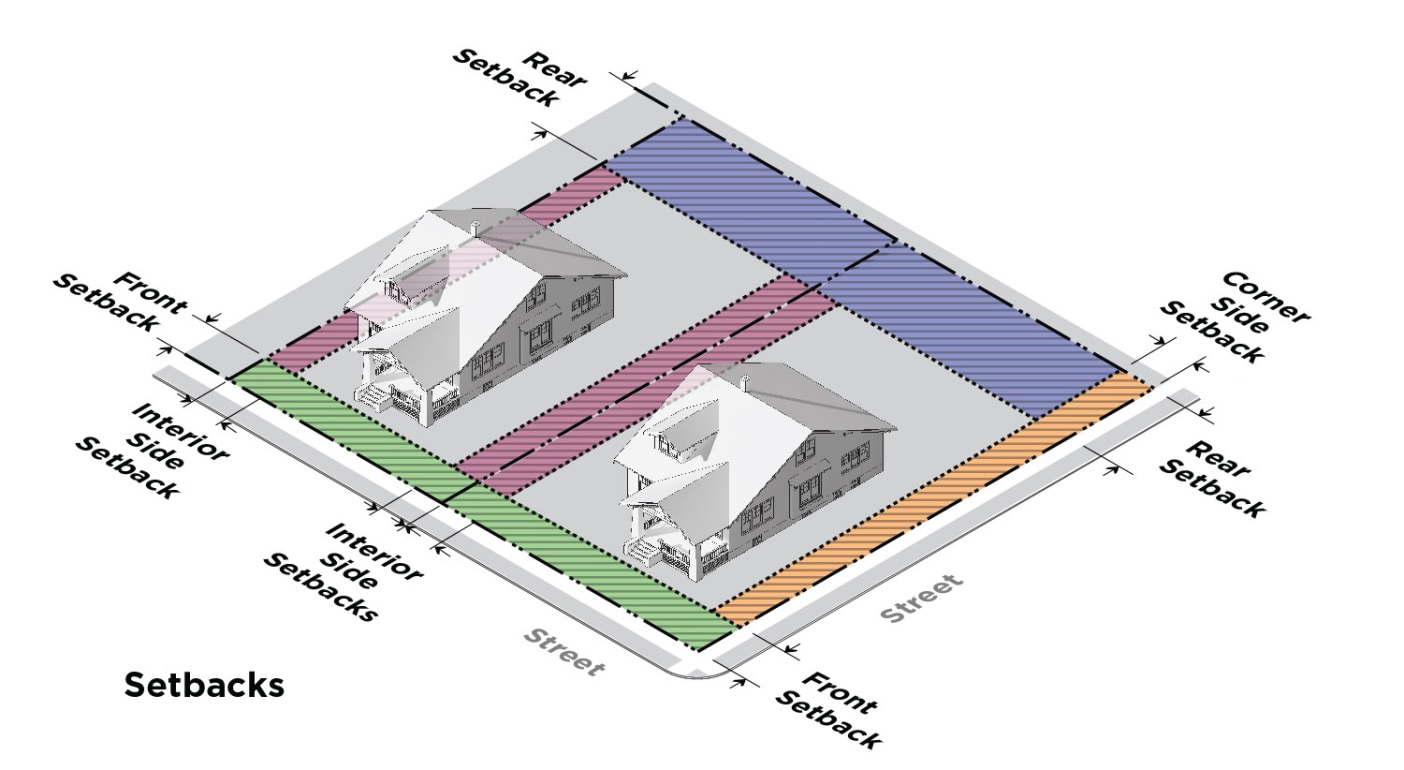
YARDS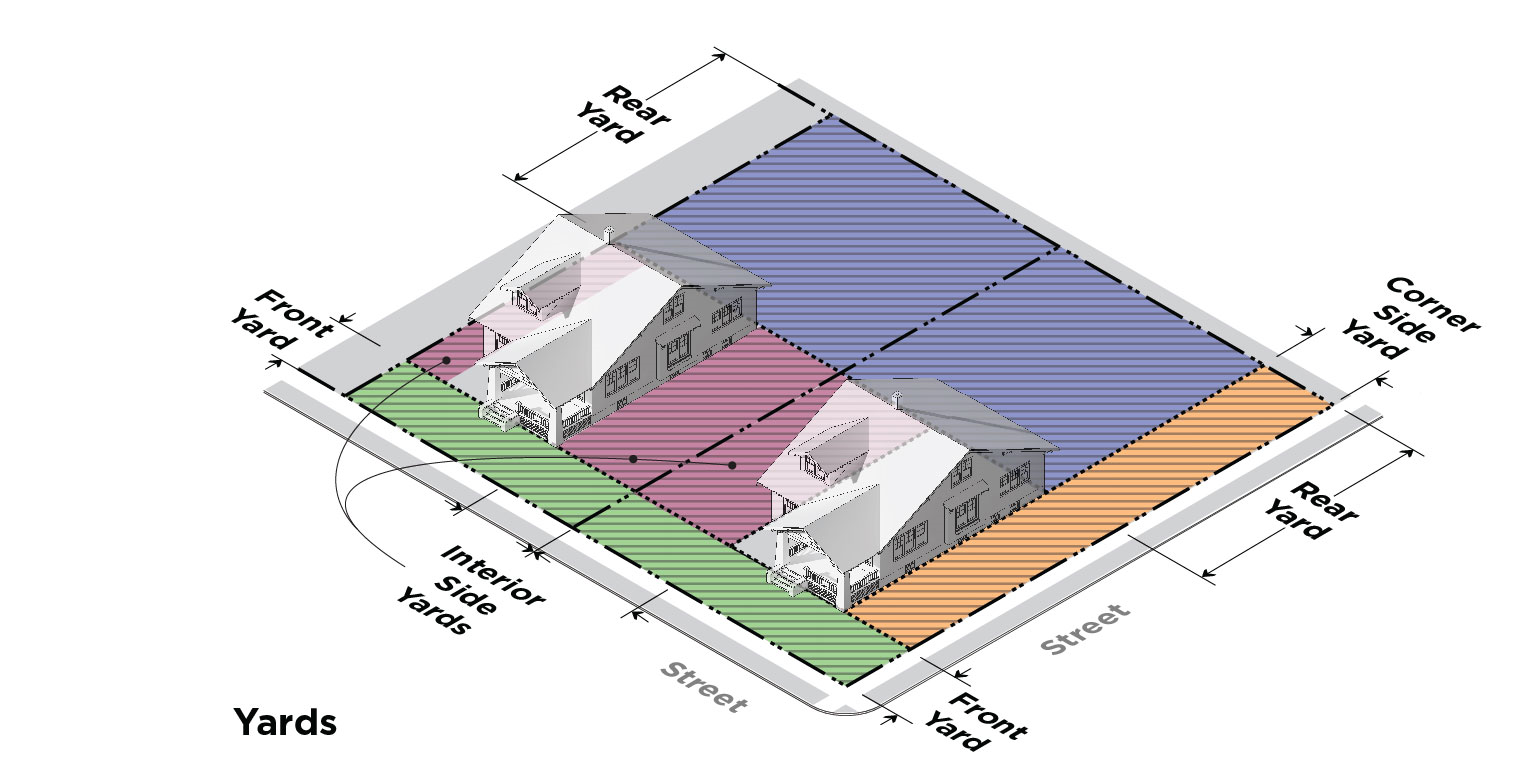
(Ord. No. O-77-2020, § 1, 5-19-20; Ord. No. O-94-2022, § 1, 7-26-22; Ord. No. O-143-2025, § 1, 11-25-25)

