
Knoxville City Zoning Code
ARTICLE 4
- RESIDENTIAL NEIGHBORHOOD DISTRICTS
4.1 - PURPOSE STATEMENTS
A.
EN Established Residential Neighborhood Zoning District
The EN Established Residential Neighborhood Zoning District is intended to accommodate Knoxville's older neighborhoods, which exhibit a uniform character and have a development pattern of complex, intricately designed homes on a highly connected street network. The EN District provides for the stability of these established neighborhoods, while allowing for continued development that is compatible with the existing development pattern. Limited nonresidential uses that are compatible with the character of the district may also be permitted.
B.
RN-1 Single-Family Residential Neighborhood Zoning District
The RN-1 Single-Family Residential Neighborhood Zoning District is intended to accommodate traditional low density residential neighborhoods in the City of Knoxville, exhibiting a predominant development pattern of single-family homes on relatively large lots and with generous setbacks. Two-family dwellings may also be allowed by special use approval. Limited nonresidential uses that are compatible with the character of the district may also be permitted.
C.
RN-2 Single-Family Residential Neighborhood Zoning District
The RN-2 Single-Family Residential Neighborhood Zoning District is intended to accommodate low density single-family residential development on relatively small lots with smaller setbacks within the City of Knoxville. Two-family dwellings may also be allowed by special use approval. Limited nonresidential uses that are compatible with the character of the district may also be permitted.
D.
RN-3 General Residential Neighborhood Zoning District
The RN-3 General Residential Neighborhood Zoning District is intended to accommodate medium density residential neighborhoods in the City of Knoxville characterized by single-family, single-family attached, and two-family homes. Townhouse dwellings may be allowed by special use approval to facilitate a more urban development form. Limited nonresidential uses that are compatible with the character of the district may also be permitted.
E.
RN-4 General Residential Neighborhood Zoning District
The RN-4 General Residential Neighborhood Zoning District is intended to accommodate mixed medium density residential development within the City of Knoxville. Single-family, single-family attached, two-family, and townhouse dwelling residential development is permitted with low-rise multi-family dwellings and new development forms such as pocket neighborhoods allowed by review and in some cases with special use approval. The RN-4 District is intended to be applied to neighborhoods that are characterized by such mixed residential development, or that have been identified as areas where such development would be suitable in the future. Limited nonresidential uses that are compatible with the character of the district may also be permitted.
F.
RN-5 General Residential Neighborhood Zoning District
The RN-5 General Residential Neighborhood Zoning District is intended to accommodate medium density residential neighborhoods in the City of Knoxville comprising a heterogeneous mix of single-family, single-family attached, two-family, townhouse, and multi-family dwellings. The RN-5 District may also serve as a functional transition between traditionally single-family and two-family residential neighborhoods within the City, and more intensely developed residential or commercial areas. Limited nonresidential uses that are compatible with the character of the district may also be permitted.
G.
RN-6 Multi-Family Residential Neighborhood Zoning District
The RN-6 Multi-Family Residential Neighborhood Zoning District is intended to accommodate high density neighborhoods in the City of Knoxville characterized by a mixture of all housing types including single-family, single-family attached, two-family, townhouse, and multi-family. Limited nonresidential uses that are compatible with the character of the district may also be permitted.
H.
RN-7 Multi-Family Residential Neighborhood Zoning District
The RN-7 Multi-Family Residential Neighborhood Zoning District is intended to accommodate the most intense high density residential development in the City of Knoxville in townhouse and multi-family development forms. Limited nonresidential uses that are compatible with the character of the districts may also be permitted.
(Ord. No. O-38-2020, § 1, 2-25-20; Ord. No. O-143-2025, § 1, 11-25-25)
4.2 - USES
A.
Article 9 lists permitted and special principal uses and temporary uses for the residential districts.
B.
In the RN-4 District, townhouse and multi-family dwellings may be permitted or may require a special use approval based upon the development form and number of dwelling units:
1.
Permitted uses, which require review by Knoxville-Knox County Planning staff:
a.
One or more townhouse buildings on a lot that total no more than eight dwelling units.
b.
Multi-family developments of no more than four dwelling units within one multi-family structure and no more than a total of eight dwelling units on the lot.
2.
Special uses, which require review by the Knoxville-Knox County Planning Commission:
a.
Nine or more dwelling units in one or more townhouse buildings on a lot.
b.
A single multi-family building on a lot of five or more dwelling units or a development with multiple multi-family buildings, with nine or more total dwelling units on the lot.
Table 4-1: RN-4 Development Types
C.
Residential Occupancy Standards
Minimum Space Requirement. It shall be unlawful for any person to occupy or let to another for occupancy any dwelling unit which does not contain at least 150 square feet of floor space for each occupant thereof, including at least 50 square feet of bedroom floor space for each occupant thereof. The floor space shall be calculated on the basis of total enclosed habitable space within the dwelling. No attached garage, basement, or cellar space shall be used for floor space under this section unless such space was lawfully improved and finished for occupancy in compliance with all applicable requirements of the city code as it existed at the time of the improvement. Accessory Structures, except those that are Accessory Dwelling Units (ADUs), shall not be used for occupancy.
(Ord. No. O-10-2024, § 1, 2-6-24)
4.3 - DIMENSIONAL STANDARDS
B.
All residential lots that are not served by a sanitary sewer system must be a minimum of 20,000 square feet in lot area. If the minimum lot area requirement is greater than 20,000 square feet, such requirement controls.
C.
A pocket neighborhood design is permitted in the RN-4 District per the standards of Section 4.5.
(Ord. No. O-10-2024, § 1, 2-6-24; Ord. No. O-143-2025, § 1, 11-25-25; Ord. No. O-147-2025, § 1, 11-25-25)
4.4 - EN DISTRICT STANDARDS
A.
EN District Design Standards
The following design standards apply to the EN District, and are intended to promote the development of new primary structures that reflect the character of existing development within the district.
1.
Foundations
a.
All primary structures must be attached to a permanent foundation, such as a slab-on-grade, piles, piers, concrete footing or other form designed to give permanent and un-movable stability to a structure.
b.
The foundation system must be surrounded by a perimeter wall of solid masonry, concrete or other approved material.
2.
Orientation of Structure to Street
a.
The front façade of any primary structure must be parallel to the street or tangent to the curve of the street.
b.
The primary entrance to a structure must face the street and provide a hard-surfaced pedestrian connection of driveway and/or sidewalk from the street to the entry. Alternatively, the primary entrance to a structure must open upon a covered porch or courtyard that faces the street and that is at least 60 square feet with a minimum depth of six feet and provides a hard surface pedestrian connection of driveway and/or sidewalk from the street to the porch or courtyard.
3.
Garages
a.
Front-loaded attached garages are limited to 40% of the width of the front building line. Garage width is measure between garage doors; in the case of garages designed with multiple garage doors the distance is measure between the edges of the outmost doors.
b.
Attached garages with front facing garage door openings must be set back from the front façade of the structure no less than four feet.
c.
Detached garages may not be located in front of the front building line.
4.
Building Mass and Shape
To increase architectural variation within neighborhoods and increase visual interest, yet allow for flexibility in design, primary structures must meet two of the following three requirements.
a.
Roofs must be either:
i.
Flat, with roof pitch of less than 1/12 and a single plane;
ii.
Steep, with roof pitch of 6/12 or more;
iii.
Articulated, with multiple pitches, planes, ridge line directions or heights, or displaying hips and valleys;
b.
Primary structures must contain more than one finished floor level.
c.
The shape of habitable and attached garage space must have no less than eight sides. For the purpose of this requirement, a side is an exterior wall segment, from change of direction to change of direction, no less than four feet in length.
5.
Elevations Facing a Street
To increase architectural variation within neighborhoods and increase visual interest, yet allow for flexibility in design, the following requirements apply to all elevations that face a street, except for a rear elevation if a property abuts a street to the rear of the lot.
a.
Street-facing elevations must contain window and door systems for no less than 25% of the surface area of the façade.
b.
The front façade must contain wall articulation so that no more than 24 feet of wall is continuous without one of the following features:
i.
A wall recess or projection of 18 inches or more;
ii.
A recessed or projected entry feature of 18 inches or more;
iii.
A covered porch with roof integrated into the primary structure.
c.
The front façade must contain at least three of the following design elements:
i.
Dormers;
ii.
Projected wall features that include gabled or hipped roof designs;
iii.
A recessed or projected entry feature of 18 inches or more in depth, and of at least eight feet in width;
iv.
A covered porch of at least six feet in depth, composing a minimum of 25% of the width of the street-facing elevation;
v.
Architectural columns supporting a porch roof;
vi.
A bay window projecting a minimum of 12 inches from the front façade;
vii.
Window and door trim a minimum of four inches in width;
viii.
A balcony, projecting a minimum of 12 inches from the front façade and enclosed by a railing or parapet;
ix.
Masonry composing no less than 25% of the surface area of the front façade
x.
Habitable space above the garage equal to no less than 50% of the garage space below
6.
Exceptions for Irregular Lots
On irregular lots where it is determined by Knoxville-Knox County Planning Commission staff that a proposed building site is not visible from the street, the requirements of this section may be waived.
B.
EN District Off-Street Parking
Off-street parking must be provided in accordance with the requirements of Article 11, with the following exceptions:
1.
Required off-street parking spaces in the EN District must be located behind the front building line.
2.
Paved vehicle parking and access facilities in the front yard and corner side yard must be limited to a maximum of the greater of the following:
a.
25% of total area of the front or corner side yard;
b.
The hard surface area leading directly to a carport or enclosed garage; or
c.
400 square feet.
EN DISTRICT DESIGN STANDARDS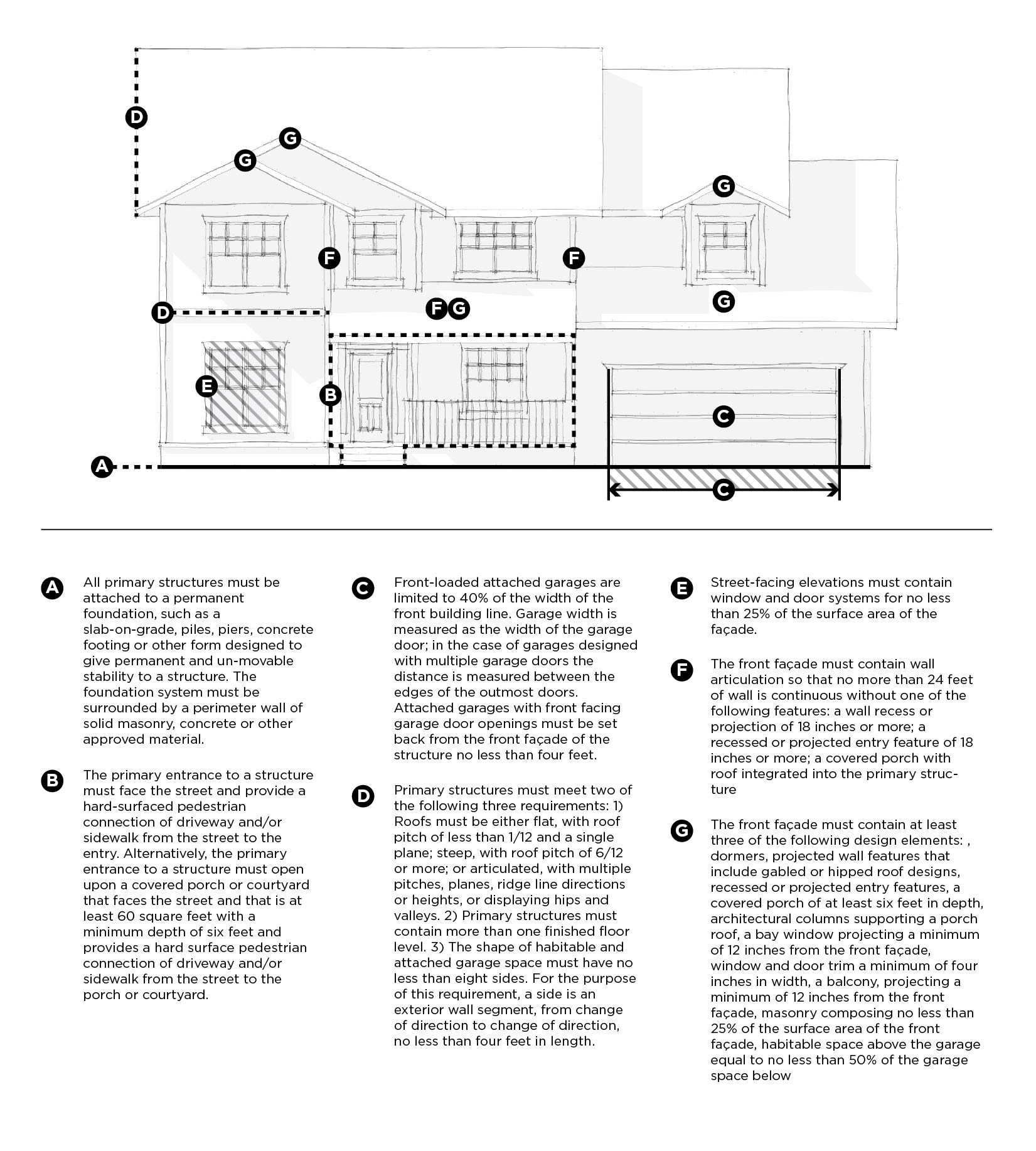
4.5 - POCKET NEIGHBORHOOD DESIGN STANDARDS
A pocket neighborhood is a clustered group of dwellings gathered around a common courtyard or open space which are maintained in a shared stewardship by residents. Pocket neighborhoods must meet the following standards and which may be permitted in RN-4, RN-5, RN-6, and RN-7. Site plan review by the Knoxville-Knox County Planning staff is required.
A.
The minimum total lot area required for a pocket neighborhood is the cumulative area required for each dwelling type in the pocket neighborhood.
B.
Where a dwelling fronts on the common area, it is considered to meet the requirement for frontage on a public or private street.
C.
The zoning district standards apply to each individual dwelling within the pocket neighborhood with the following exceptions:
1.
The maximum building height is limited to 35 feet for all dwellings.
2.
For single-family, single-family attached, two-family, and townhouse dwellings that front on the common open space, the minimum front setback required is ten feet.
3.
For single-family, single-family attached, two-family, and townhouse dwellings that front on the common open space, the minimum interior side setback required is five feet.
D.
The design standards for each dwelling type apply with the following exceptions:
1.
For any dwelling abutting a public or private street, an entrance to the dwelling must face the street. Front façades of other dwellings and entrances must be oriented to the common area.
E.
Common areas must meet the following standards:
1.
The minimum area of the common area is 3,000 square feet or 500 square feet per dwelling unit, whichever is greater.
2.
70% of the centrally located common area must have a minimum width of 40 feet.
3.
Of the required amount of common area space, 65% must be centrally located.
4.
All common area space must be accessible to all residents.
5.
A maximum of 30% of any contiguous common area may be hardscape.
6.
Yards for dwellings are not counted toward the required amount of common area. However, such yards may be in addition to the required amount of common area.
POCKET NEIGHBORHOOD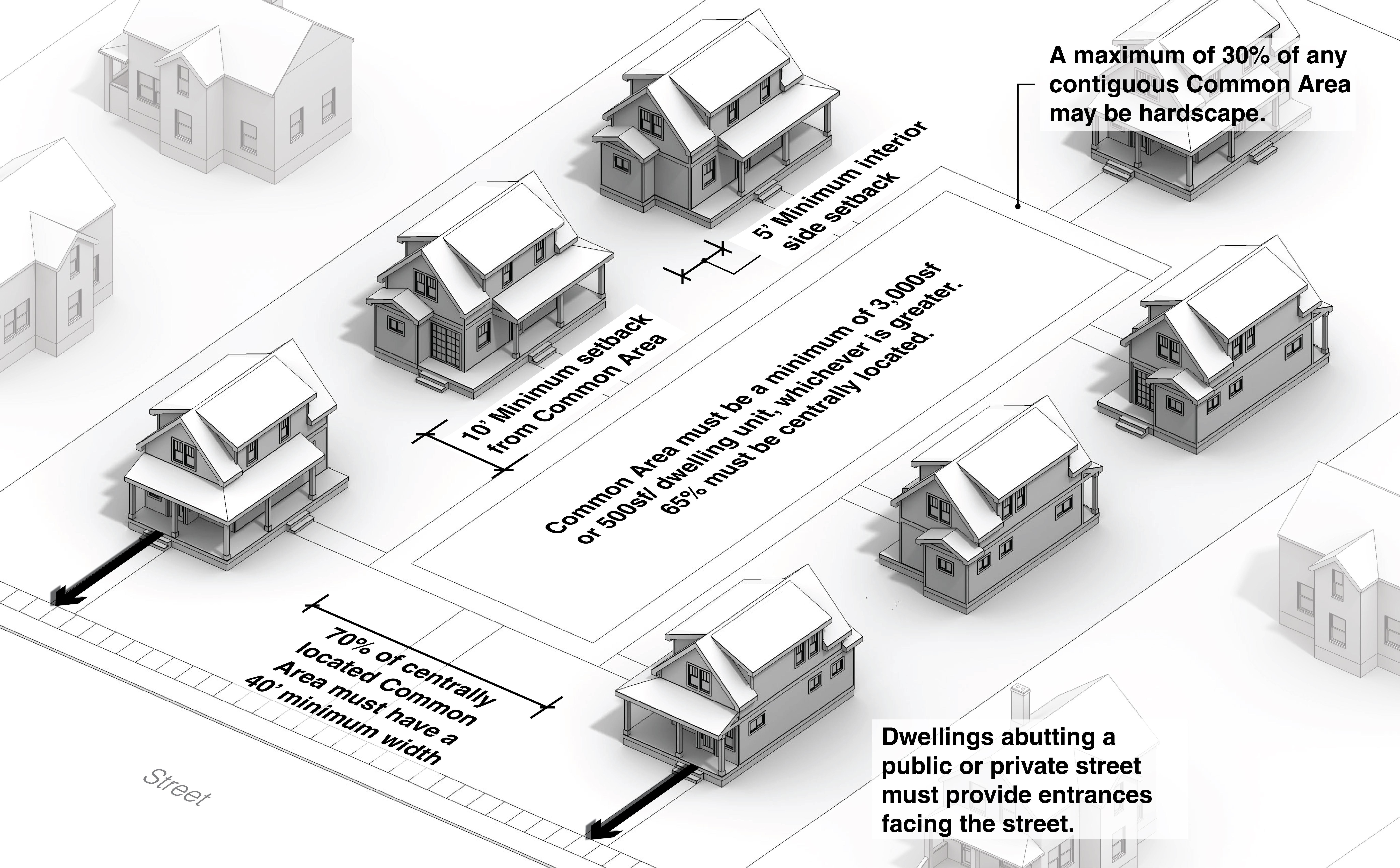
(Ord. No. O-143-2025, § 1, 11-25-25)
4.6 - MIDDLE HOUSING STANDARDS
Middle Housing types are residential structures containing more than one unit, with building footprints and overall scales comparable to single-family houses. Middle Housing types are permitted in RN-1, RN-2, RN-3, and RN-4 zoning districts, and shall be located in land use areas designated Traditional Neighborhood Residential (TDR). The standards in this Article are intended to promote the development of neighborhood-scale housing forms which are compatible with existing housing in the surrounding area. To help increase housing options within the City, Middle Housing standards are intended to allow more flexible development of land than is possible under the base district zoning regulations. The dimensional, design, and parking standards of Article 4.6 apply to new construction of Middle Housing types. Standards for conversions of existing buildings to Middle Housing types are subject to the requirements in Article 4.6.F. Flexibility and/or relief from certain standards is provided in Article 4.6.G. The standards of Article 4.6 may not be combined with those of the base zone of the property for principal uses; new principal use projects must either be submitted under Article 4.6 subject to Middle Housing Standards or under the base zone subject to the base zone requirements.
4.6.A.
Middle Housing Types
Projects using the Middle Housing standards and review process are required to use only the Middle Housing types as defined below:
Duplex, side-by-side: a structure up to two stories, containing two dwelling units next to each other with one shared wall. This type of duplex has a building depth, width, and height similar to a typical single-family house. Both units may share a stoop or porch at the center of the building; or each unit may have its own stoop or porch. One unit may face the street with another facing the corner side or rear yard.
Duplex, stacked: a structure up to two stories, containing two dwelling units, with one on the ground floor and the other on top. This type of duplex has a building depth, width, and height similar to a typical single-family house. Both entries may face the street, or one unit may face the street with another facing the corner side or rear yard.
Triplex: a structure up to three stories, containing three dwelling units typically stacked on top of each other, in locations where there is a transition from a commercial corridor and/or higher intensity area into single-family neighborhoods. Within neighborhoods, away from transition areas adjacent to corridors, a triplex with up to 2.5 stories may feature other configurations to accommodate three units. A triplex does not include a townhouse type.
Fourplex: a structure up to 2.5 stories, containing two units on the ground floor and two units stacked directly above. The type has a building depth, width, and height similar to a single-family house.
Townhouse (small): a small-to-medium sized structure up to two stories with three or four attached units, featuring shared side walls between units. The narrow sides of the units face the street, with all entries oriented towards the street, and the larger attached sides along the depth of the lot.
Townhouse (large): a medium-sized structure up to 2.5 stories containing between five and eight units, featuring shared side walls between units. The narrow sides of the units face the street, with all entries oriented towards the street, and the larger attached side along the depth of the lot.
Multiplex (small): a small-to-medium-sized structure that consists of five to ten units arranged side-by-side and stacked, often with a shared entry on the ground floor. A multiplex does not include a townhouse type.
4.6.B.
Middle Housing Uses
1.
Middle Housing types are permitted based on the zoning district and housing type in Table 4-3, and conformance to the applicable standards in Article 4.6. Proposals which do not meet the dimensional standards in Table 4-4 default to the dimensional standards of the base zoning district, subject to the requirements in Article 4.6.G.
Table 4-3: Middle Housing Development Types
2.
Location criteria:
a.
Middle Housing types are not permitted on flag lots or lots that are accessed by access easements instead of having direct frontage on a street.
b.
Three-story triplexes are only permitted on lots with frontage on arterial roads as defined in the Major Road Plan. Three-story triplexes are not permitted on flag lots.
4.6.C.
Middle Housing Dimensional Standards
1.
The dimensional standards of this Article supersede the base zoning district dimensional standards as defined in Article 4.
2.
Table 4-4: Middle Housing Dimensional Standards establishes the dimensional standards for new construction of Middle Housing types within the permitted area.
3.
Building setbacks:
a.
Front setbacks for Middle Housing types shall be the average of the blockface, plus or minus five feet, in no case less than 10 feet.
b.
Rear setbacks for Middle Housing types shall be no less than 15 feet.
4.
Building heights shall not exceed the maximum building height of the base zoning district, or the maximum height in stories as noted in Table 4-4, whichever is less. For Middle Housing types, story and half-story are defined below.
a.
Story: the portion of a building included between the surface of any floor and the surface of the next floor above it, or if there is no floor above, the space between the floor and the ceiling above. If the finished floor level directly above a basement or cellar is more than six feet above grade for more than 50 percent of the total perimeter, such basement or cellar shall be considered a story.
b.
Half-Story: conditioned space that rests primarily underneath the slope of the roof, usually having dormer windows. The half story is identified by the ".5" in the description of maximum height (e.g., 2.5). A half-story is considered a story when its top wall plates, on at least two opposite exterior walls, are four feet or more above the floor of such story.
5.
Dormers:
a.
The combined width of dormers shall not exceed 50% of the width of the wall area beneath.
b.
Dormers shall be set back from the nearest rake or eave by at least two feet.
6.
Porches/stoops: The following standard supersedes the permitted encroachment standards as defined in Table 10-1, Article 10.4. A porch or stoop is permitted to encroach into the minimum allowed front setback (five feet less than the average of the blockface) up to eight feet. Porches or stoops shall be set back from the front lot line by at least five feet.
7.
Building width for Middle Housing types is defined as follows: the length of the building façade wall that does not include permitted encroachments, as measured along the foundation that generally faces the front lot line or a public space.
8.
Building depth for Middle Housing types is defined as follows: the length of the building façade wall that does not include permitted encroachments, as measured along the foundation that generally faces an interior or corner side lot line or a public space.
Table 4-4: Middle Housing Dimensional Standards
4.6.D.
Middle Housing Parking Standards
1.
The parking requirements below apply to Middle Housing types. Where applicable, the below parking requirements supersede the off-street parking requirements in Table 11-2.
2.
No off-street vehicle parking is required within one-fourth of a mile of a transit route.
3.
Off-street vehicle parking: each dwelling unit requires 0.70 spaces.
4.
Specific to triplex, fourplex, townhouse, and multiplex developments: parking areas must be set a minimum of five feet from the interior side and rear lot lines, and may be grouped in shared parking areas per Article 11.8.
a.
Where applicable, landscape buffers required by Article 12.8 may be reduced to five feet with the use of a wall or solid fence.
5.
Location:
a.
Parking must be located in the interior side or rear yards.
b.
Where operable alleys are present, the alley must serve as the primary means of vehicular ingress and egress unless staff determines that special site circumstances or conditions prohibit alley access.
c.
Middle Housing types may be designed to back into an alley. Egress directly from parking spaces to alleys may be allowed when the aisle width, including the alley width, meets the minimum aisle width specified in Table 11-4.
d.
Where parking is located in a side yard, the spaces must be located behind the front building façade line of the principal building. When a driveway extends through a front yard, the driveway must extend at least 20 feet behind the building façade line, to provide parking behind the street-facing elevation of the structure.
e.
Front-facing garages are not permitted as part of the primary structure on Middle Housing types.
f.
Circular driveways located in a front yard are not permitted.
g.
Driveway access: the driveway shall be at least 10 feet wide and not more than 14 feet wide.
4.6.E.
Middle Housing Design Standards
1.
The following standards apply only to new construction of Middle Housing types and are intended to promote the development of neighborhood-scale housing forms which are compatible with existing housing in the surrounding area.
2.
New construction and certain expansion and exterior alteration actions within the IH, NC, and H overlays, as described in Articles 16.6 and 16.8, are subject to review and approval by the Design Review Board or Historic Zoning Commission, per Articles 16.6 and 16.8.
3.
The principal use standards for two-family, multi-family, and townhouse dwellings, as described in Articles 9.3.I and 9.3.J, apply alongside the below design standards.
4.
In order to generate new Middle Housing buildings that are similar in footprint, height, and setbacks with the existing neighborhood and increase visual interest, yet allow for flexibility in design, the following requirements apply to all Middle Housing types:
a.
Rooflines must be either:
i.
Flat, featuring a cornice, parapet, or decorative band to serve as a building cap for portions of the roof visible from the street;
ii.
Steep, with a roof pitch of 6/12 or more;
iii.
Articulated, with at least two pitches, planes, or ridge line directions, or displaying hips and valleys.
b.
When a front or side elevation exceeds a length of 50 feet, vertical breaks or offsets to reduce visual mass are required for 20% of the building elevation.
c.
The front façade must contain (1) a porch or stoop, and (2) at least three of the following design elements:
i.
Dormer(s);
ii.
Eave overhangs, a minimum of 12 inches;
iii.
Decorative cornice;
iv.
Covered porches at least eight feet in depth, composing a minimum of 25% of the width of the street facing elevations (this item may satisfy the requirement for a porch or stoop, and one design element);
v.
A recessed or projecting entry feature of 18 inches or more in depth, and of at least six feet in width;
vi.
A bay window projecting a minimum of 12 inches from the front façade;
vii.
Articulated window and door trim, a minimum of 3.5 inches in width, to include projecting window sills;
viii.
Brick masonry composing at least 25% of any street-facing elevation.
5.
Building Orientation to Street
a.
Middle Housing types shall be oriented with their front elevations facing the street. At least one ground-level entrance must be oriented towards the street.
b.
Townhouses shall not be oriented so the fronts of units face the rear elevations of units.
c.
Townhouses shall not be oriented perpendicular to the street. The narrow side of townhouse units must face the street.
4.6.F
Middle Housing Conversion Standards
1.
To retain existing housing stock and neighborhood character, while facilitating the creation of additional housing units, existing buildings may be converted to Middle Housing types via interior renovation or additions.
2.
Conversions to Middle Housing types must comply with Table 4-3.
3.
Middle Housing Conversion Design Standards
a.
Additions must comply with the dimensional standards in Article 4.6.C and Table 4-4.
b.
Additions to the front façade are not permitted. Additions may be made to the rear and side elevations where setbacks permit.
c.
Additions may also be made to the roofline via an additional half story (the addition of dormers). Roofline additions shall be proportionally consistent with the existing house and shall not be so large as to dramatically alter scale of the original building mass.
d.
Additions to rear and side elevations must not be taller in height than the existing building.
4.6.G.
Administrative Variations, Variances, and Appeals
1.
In some instances, it may be practical to provide relief from certain standards due to existing conditions on the site. A project may receive an administrative variation during staff review based on the below criteria only.
a.
Allowable administrative variations are as follows:
i.
Corner side, side, and rear setbacks: a decrease in minimum setbacks, up to 20 percent, provided the reduction receives approval from the Department of Engineering;
ii.
Design standards: a variation on the design standards in Article 4.6.E.4.c to allow for other qualifying design elements may be permitted, provided the project meets all applicable dimensional standards of Article 4.6, and variation from the design standards is necessary to achieve a architectural design which is compatible in style and similar in scale with the buildings on the subject block face and the block face directly across the street.
b.
No other administrative variations to Article 4.6 are allowed.
2.
The intent of Article 4.6 is to allow Middle Housing types which are in harmony with the character of the surrounding neighborhood and will not be injurious to it or to the public welfare. Therefore, variances which would allow developments which are larger scale, allow for greater density, or otherwise are out of character with the surrounding neighborhood are discouraged, unless there is a legal hardship and all standards and requirements for variances are met as set forth in Article 16.3.
3.
Any person may appeal a staff approval or denial under Article 4.6 to the Knoxville Design Review Board as provided in Article 14.6.C, using the process outlined in Article 16.12.A.4.b. Requests for variances follow the procedure under Article 16.3.
(Ord. No. O-10-2024, § 1, 2-6-24; Ord. No. O-118-2025, § 1, 9-16-25)
4.7 - COTTAGE COURT
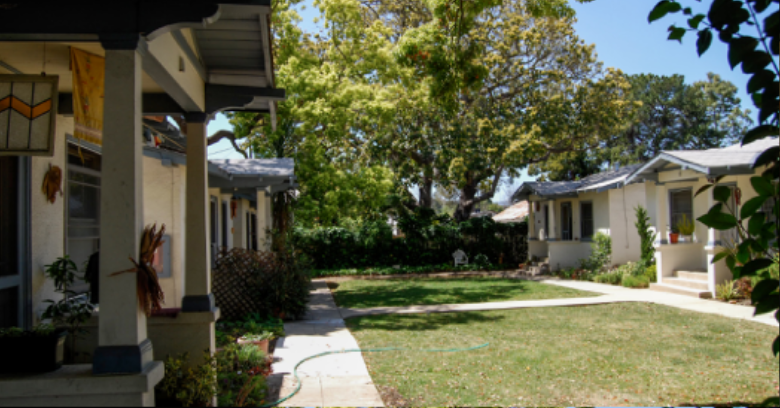
Example of Cottage Court
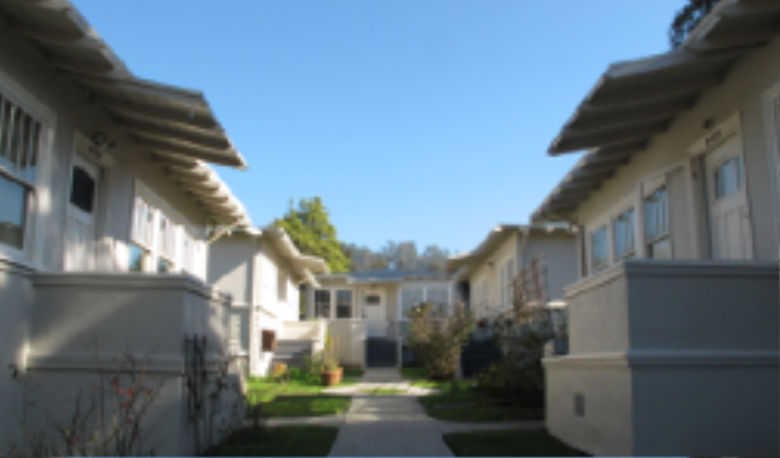
Example of Cottage Court
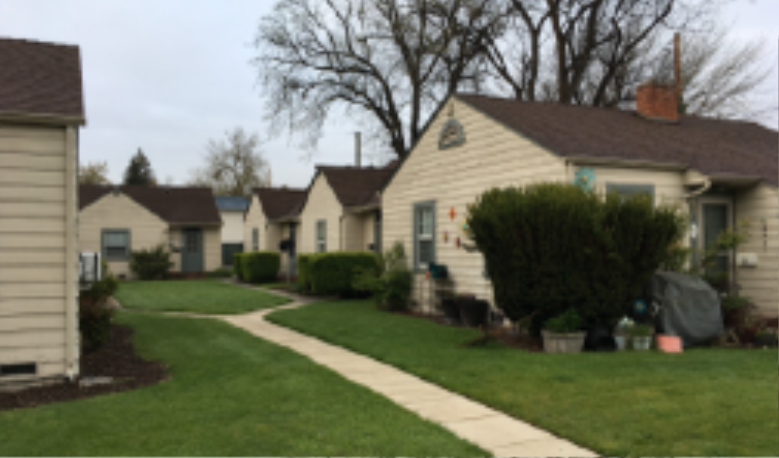
Example of Cottage Court
| A. Description | |
| A group of small, detached, house-scale buildings arranged to define a shared court open to and visible from the street. The shared court is common open space, thus becoming an important community-enhancing element. The type has a one-sided version with cottages on one side of the court and a two-sided version with cottages on both sides of the court. | |
| Synonym: Bungalow Court | |
| B. Lot Size | |
| Width |
75' min. for 1-sided Cottage Court;
120' min. for 2-sided Cottage Court; 150' max. |
| Depth | 100' min. |
| C. Impervious Surface | |
| Total for Lot | 60% max. |
| D. Number of Dwelling Units | |
| Court Side Building | 1 max. |
| Court End Building | 2 max. 1 |
| Dwelling Units per Lot | Maximum as allowed in compliance with all standards |
1
At least 2/3 of the building facade shall front the shared court.
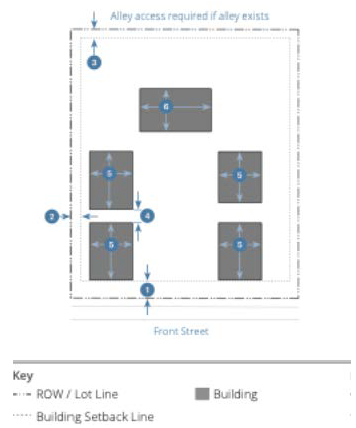 | |
| E. Building Setbacks | |
| Front Street | Refer to base zone |
| Side Street | 10' min. |
| Interior Side | 5' min. |
| Rear | 10' min. |
| Building Separation | 8' min. |
| F. Building Form | |
| Height | |
| Stories | |
| Court Side Building | 1 max. |
| Court End Building | 2 max. |
| Midpoint of Roof | |
| Court Side Building | 14' max. |
| Court End Building | 25' max. |
| Main Body | |
| Size | |
| Court Side Building | 24' by 32' max. |
| Court End Building | 30' by 42' max. |
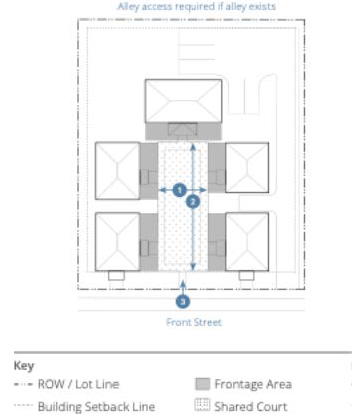 | |
| G. Shared Court | |
| Width, Clear | 20' min. |
| Depth, Clear |
30' min. (3—4 dwelling units);
50' min. (≥5 dwelling units) |
| All buildings shall abut the shared court. | |
| Required setback areas, driveways, and surface parking shall not be included in the shared court area calculation. | |
| Frontage Area along Shared Court | |
| A frontage area at least 8' deep is required for the full length of the building along facades abutting the shared court. At least 2/3 of the associated building length shall abut the frontage area. | |
| H. Pedestrian Access | |
| Shared court shall be accessible from primary street. | |
| Main entrance to dwelling units required from shared court, except that the frontmost building(s) may be accessed from pedestrian path along primary street. | |
| Pedestrian connections shall connect all buildings to the public ROW, shared court, and parking areas. | |
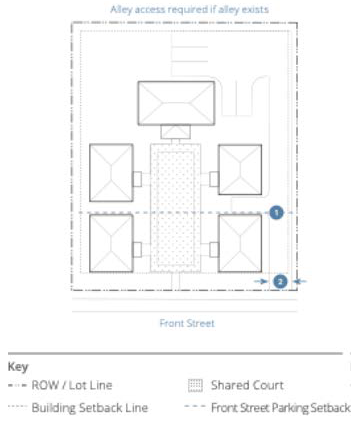 | |
| I. Vehicle Parking and Access | |
| Parking | |
| Front Street Setback | 3' min. behind frontmost building(s) |
| Side Street Setback | 10' min. |
| Side Setback | 2' min. |
| Rear Setback | 5' min.; 0' min. abutting an alley |
| Setback from Buildings | 3' min. |
| Setback from Shared Court | 15' min. |
| Required Off-Street Parking | 1 space per dwelling unit (min.) Reductions possible per Article 11.4.B.3. |
| Parking may be enclosed, covered, or open. | |
| Parking is prohibited within the building footprint. | |
| Space(s) may be grouped or distributed as allowed by the standards. Max. 1 space allowed between buildings. | |
| Driveway Width | |
| Local Street | 10' min. 1 |
| Other Road Classifications | 15' min. 1 |
| 1 Min. driveway width, or as determined by City Engineering | |
| J. Fencing and Low Walls | |
| Fencing or low walls are prohibited in the shared court. | |
| Fencing and/or low walls are allowed within frontage areas, around or between individual buildings, and/or for parking screening. See 4.7.L.4 for height standards. | |
| A fence or low wall up to 42" in height placed between the property line and the building setback is allowed to physically define the streetscape. | |
| K. Building Frontage | |
| All cottages shall include one of the following building frontage types at all building entries. | |
| Porch | Article 4.6.E.4.c.iv |
| Stoop | Article 4.6.E.4.c.iv |
| Dooryard | Article 4.7.L |
| Building frontage types are allowed to encroach into the frontage area in compliance with the minimum required clear width. See Subsection G, item G. | |
| A minimum transparency of 15% of applies to any elevation facing the street. | |
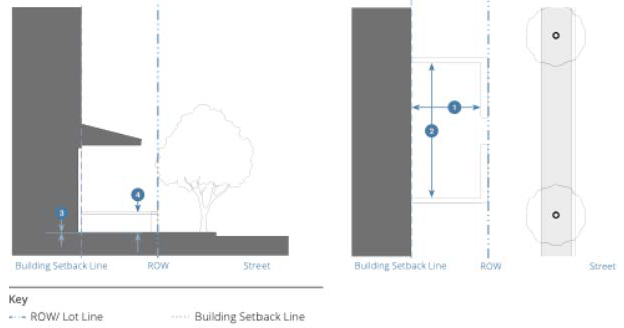 | |
| L. Dooryard | |
| Description | |
| The main facade of the building is set back from the front lot line, which is defined by a low wall or hedge, creating a small private area between the sidewalk and the facade. Each Dooryard is separated from adjacent Dooryards. The Dooryard is at grade. | |
| Standards | |
| Depth, Clear | 6' min. |
| Length, Clear | 10' min. |
| Finished Floor Level above Sidewalk | 0" min.; 12" max. |
| Solid 1 Wall/Fencing above Finished Grade | 24" max. |
| Non-solid 1 Wall/Fencing above Finished Grade | 36" max. |
| 1 Subject to City review and approval. | |
| Entry doors to the building are required to face the street or shared court. | |
| A Dooryard may be utilized to group two entries at a common elevation. | |
| Dooryards are allowed to encroach into the front, side, and side street setbacks up to within 5 feet of the nearest property line. | |
(Ord. No. O-95-2025, § 1, 8-19-25)
4.8 - GENERAL STANDARDS OF APPLICABILITY
A.
Site Development Standards
See Article 10 for additional on-site development standards and requirements, such as exterior lighting, accessory structures and uses, and permitted encroachments.
B.
Off-Street Parking and Loading
See Article 11 for off-street parking and loading standards and requirements.
C.
Landscape
See Article 12 for landscape, buffering, and screening standards and requirements.
D.
Signs
See Article 13 for sign regulations.
(Ord. No. O-10-2024, § 1, 2-6-24; Ord. No. O-95-2025, § 1, 8-19-25)
Editor's note— Article 4.8 was initially added as § 4.6 by Ord. No. O-107-2019, § 2, adopted on August 13, 2019. Subsequently, it was renumbered as 4.7 by Ord. No. O-10-2024, adopted February 6, 2024 and then 4.8 by Ord. No. O-95-2025, adopted August 19, 2025.

