
Knoxville City Zoning Code
ARTICLE 12
- LANDSCAPE
12.1 - PURPOSE
The landscape standards of this Article are intended to:
A.
Create a desirable and functional open space environment for all site users, including pedestrians, bicyclists, and motorists.
B.
Preserve unique natural resources, including measures to preserve and protect existing healthy plantings.
C.
Design drainage facilities to promote the use and preservation of natural watercourses and patterns of drainage.
D.
Establish trees and tree canopy within the City that provides environmental, economic, and social benefits for the community.
E.
Establish a natural environment within the City that provides a variety of benefits, including absorbing carbon dioxide and producing oxygen; intercepting stormwater, reducing surface runoff, curtailing erosion, and improving water quality; providing critical wildlife habitat to promote urban biodiversity; and providing shade to aid in passive cooling and the reduction of urban heat island effect.
F.
Utilize plant materials suitable to withstand the climatic conditions of the City and microclimate of the site. The use of invasive species is prohibited.
G.
Use of screening to minimize the impact of the development on adjacent uses and impact of incompatible uses and certain site elements, and creating a logical transition to adjoining lots and developments.
H.
This Article does not apply to routine landscaping or routine maintenance of existing landscaping.
(Ord. No. O-87-2020, § 1, 5-19-20; Ord. No. O-94-2025, § 1, 8-19-25)
12.2 - LANDSCAPE PLAN
A.
Landscape Plan Required
A landscape plan is required as part of a site plan review application for multi-family and townhouse development, nonresidential (including mixed-use) development, parking lots, and planned developments. The landscape plan must be approved prior to the issuance of a building permit.
B.
Content of Landscape Plan
1.
North arrow and graphic scale, the location and dimensions of all existing and proposed structures, property lines, easements, parking lots and drives, rights-of-way, refuse disposal and recycling areas, pedestrian and bicycle paths, fences, mechanical equipment, overhead utility wires, underground utilities, retention/detention facilities, and other drainage facilities, such as drainage swales. Identify lines of sight at all access points and at locations adjacent to intersections.
2.
The location, quantity, size, name, and condition, both botanical and common, of all existing trees equal to or greater than 2.5 inches in caliper, indicating trees to be retained and to be removed.
3.
The location, quantity, size, and name, both botanical and common, of all proposed plant material. This includes lawn and turf applications.
4.
The existing and proposed grading of the site indicating contours at two-foot intervals. Any proposed berming, earthwork, or stormwater management basins must also be indicated using two-foot contour intervals.
5.
Elevations of all existing and proposed fences, stairs, and retaining walls.
6.
Existing and proposed plantings in the right-of-way.
7.
Any proposed irrigation plan, if irrigation is provided.
8.
Any other details as determined necessary by the review body.
C.
Minor Changes to Approved Landscape Plans
Minor changes to the landscape plan that do not result in a reduction in the net amount of plant material as specified on the approved landscape plan may be approved by the Zoning Administrator. Changes that reduce the amount of plant materials contained within an approved landscape plan must be approved as an alternative landscape design.
D.
Alternative Landscape Design
1.
These landscape requirements are intended to set minimum standards for quality development and environmental protection. Site conditions or other reasons may justify the need to request an alternate method of compliance. Alternative landscape plans may be considered when an applicant cannot meet one or more of the specific requirements of this Article because:
a.
Strict application of the landscaping requirements would require unreasonable or unnecessary compliance. Such situations could include water features, topography, lot configurations, utility maintenance zones, or unusual site conditions.
b.
The applicant envisions a more creative means to meet the spirit and intent of these requirements.
c.
A comprehensive landscaping plan involving several properties is proposed.
2.
The applicant must submit an alternative landscape design sealed by a licensed landscape architect that includes a written explanation as to the need for the approval of a landscaping alternative. The applicant should explain how the proposed landscape plan meets or exceeds what is required in this code in an alternative manner. The proposed landscape plan shall clearly indicate all areas for which alternative compliance is requested. This includes a list of landscaping requirements not met, a description of the alternatives proposed, and a written explanation of how the proposed plan fulfills the spirit and intent of the landscape requirements. In order to qualify for an alternative landscape design, one or more of the following conditions must be present:
a.
The subject site has existing physical conditions such as unusual shape, space limitations, topography, soils, vegetation or existing structures or utilities making strict compliance impossible, impractical or of no value in terms of advancing the purposes of this article.
b.
Safety considerations such as intersection visibility, utility locations, etc., make alternative compliance necessary.
3.
The Alternative Landscape Design must be submitted to and approved by the Zoning Administrator who may consult with City Engineering, the City Urban Forester, and Knoxville Knox County Planning staff. The Zoning Administrator must find that:
a.
The proposed alternative will not present a safety hazard.
b.
The proposed alternative will, upon maturity, provide landscaping that is equal to or better than the standard requirements and will not result in a reduction of tree plantings unless contributing to the city's tree mitigation bank.
c.
The proposed alternative is reasonably compatible with the natural and topographic features of the site.
4.
Anyone aggrieved by a final determination of the Zoning Administrator may file an appeal in accordance with Article 16.12.
(Ord. No. O-87-2020, § 1, 5-19-20; Ord. No. O-94-2025, § 1, 8-19-25)
12.3 - SELECTION, INSTALLATION AND MAINTENANCE
A.
Selection
1.
All plant materials must be of good quality and meet American Horticulture Industry Association (AmericanHort) or its ANSI accredited successor's standards for minimum acceptable form, quality, and size for species selected.
2.
Species must be selected based on those that will survive and thrive in East Tennessee. Trees should be selected from the City of Knoxville's Tree List maintained by the City.
3.
The use of native species and drought tolerant species is encouraged.
4.
Invasive species are prohibited.
B.
Installation
1.
All landscape materials must be installed in accordance with current nursery industry standards, and must be properly supported to ensure survival. Support devices such as guy wires or stakes must not interfere with pedestrian or vehicular movement.
2.
All plant materials must be free of disease and installed so that soil of sufficient volume, composition, organics and nutrient balance are available to sustain healthy growth. Installation of plant materials during the appropriate growing season is encouraged.
3.
Landscape materials should not conflict with existing overhead and underground utility infrastructure and maintenance zones. Landscape plans should reference the City of Knoxville's Tree List for appropriate species and their respective planting distances from adjacent utility infrastructure. Landscaping should not be selected that at maturity would grow into conflict with the utility maintenance zone. Alternative landscape plans (Article 12.1.D) may be considered when an applicant demonstrates that requirements may conflict with the utility maintenance zones.
a.
Overhead utilities: At maturity, landscaping should not grow within ten feet of primary distribution lines and 25 feet within 69 kV sub-transmission lines. Smaller growth trees should be substituted for larger growth trees to meet this requirement.
b.
Utility poles: Trees should not be planted within ten feet of primary distribution poles and 25 feet within 69 kV sub-transmission poles.
c.
Support wires: Trees should not be planted within five feet of supporting guy wires.
d.
Underground utility lines: The minimum distance of tree planting from the utility center line should be a minimum of ten feet. Shrubs and other landscaping vegetation are permitted in this area.
e.
Pad mount transformers: Landscaping should be planted a minimum of six feet away from the side with doors and three feet away from the other sides.
4.
If landscape material is located within a utility easement and repair or replacement of the utility is needed, the City or utility is not responsible for the replacement of any landscape that may be damaged.
C.
Curbing
1.
Landscaped areas may be recessed if flush curbs are utilized. If recessed, the landscaped areas must be designed for stormwater management and to prevent erosion and tracking.
2.
Landscaped areas must be protected from encroachment of vehicles through use of curbs or wheel stops where necessary.
D.
Maintenance
1.
Landscape materials depicted on approved landscape plans are considered a required site element in the same manner as structures, required parking, lighting, and other improvements. As such, the owner of record or the business or homeowner's association is responsible for the maintenance, repair, and replacement of all landscape plants, materials, fences, steps, retaining walls, and similar landscape elements.
2.
All landscape materials must be maintained in good condition, present a healthy appearance, and be kept free of refuse and debris. Any dead, unhealthy, or missing plants must be replaced within 30 days of notification, unless an extension is approved by the City.
3.
Trees installed as part of these landscape requirements shall be maintained and/or pruned in accordance with ANSI A-300 (American National Standard Institute) and enforced according to the City of Knoxville Tree Protection Ordinance.
(Ord. No. O-87-2020, § 1, 5-19-20; Ord. No. O-94-2025, § 1, 8-19-25)
12.4 - LANDSCAPE DESIGN STANDARDS
A.
Minimum Planting Sizes
Minimum planting sizes are as follows. For the purposes of determining trunk size, the caliper is measured at six inches above ground level, unless otherwise specified in current American Standard for Nursery Stock (ANSI Z60.1).
1.
Evergreen trees and multi-stem trees must have a minimum height of eight feet at installation.
2.
Shade and ornamental trees must have a minimum two-inch caliper.
3.
Shrubs must have a minimum size of one gallon or similar.
B.
Tree Species Diversity
The benefits of trees are not easily replaceable without extensive time. Tree Diversity reduces the risk of losing a large population of trees due to disease. Table 12-1: Tree Diversity Requirements indicates the percentage of diversity required based on the total quantity of trees being used. (For example, if a development requires 45 shade trees, no more than 18 trees (40%) can be of one species, and there must be a minimum of five different species within the 45 trees.) When the calculation of tree diversity requirements results in a fraction, the fraction is rounded up. The tree species diversity requirement is calculated by counting all trees planted on the submitted landscape plan.
C.
Minimum Tree Density Requirement
Reference the Tree Protection Ordinance 14.34, 14.36, and 14.38 related to tree preservation options to help meet other requirements.
(Ord. No. O-87-2020, § 1, 5-19-20; Ord. No. O-123-2020, § 1, 8-25-20; Ord. No. O-94-2025, § 1, 8-19-25)
12.5 - PARKING LOT PERIMETER LANDSCAPE YARD
A perimeter landscape yard, which is established where the parking lot abuts a street right-of-way, is required for all new parking lots of 10,000 square feet or more in area and for any expansions of existing parking lots when required by Article 11.1.B of 10,000 square feet or more in area. The perimeter landscape yard must be established along the edge of the parking lot to screen vehicle parking from the right-of-way. The landscaped area must be improved as follows:
A.
Parking lots 20,000 square feet or greater in area require a perimeter yard at least ten feet wide. The width of the perimeter yard may be reduced to six feet for parking lots, including vehicular use areas, of less than 20,000 square feet.
B.
The perimeter yard must be planted with a minimum of three shade trees and ten shrubs for every 100 linear feet. A minimum of 50% of the shrubs must be evergreen.
C.
The landscape area outside of trees must be permeable using organics and planted with shrubs, live groundcover, perennials, or ornamental grasses to screen the vehicle parking from the right-of-way
D.
Parking lots located on properties developed under a common or unified development plan and/or which have a shared access agreement are not required to provide the perimeter screening area along common property lines where parking areas abut.
E.
Areas of off-street parking areas that abut an alley are not required to install a perimeter landscape yard along the alley frontage.
PARKING LOT PERIMETER LANDSCAPE YARD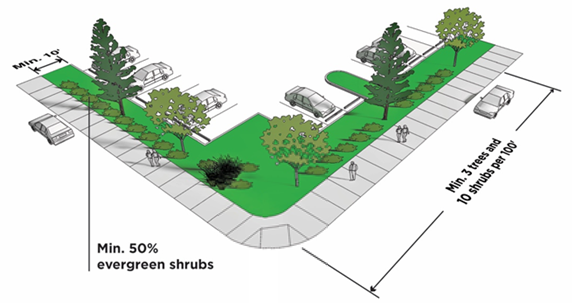
(Ord. No. O-87-2020, § 1, 5-19-20; Ord. No. O-123-2020, § 1, 8-25-20; Ord. No. O-105-2023, § 1, 7-25-23; Ord. No. O-94-2025, § 1, 8-19-25)
12.6 - INTERIOR PARKING LOT LANDSCAPE
Interior parking lot landscape is required for all new parking lots and vehicular use areas of 20,000 square feet or more in area, and for any expansions of existing parking lots of 20,000 square feet or more. The landscape required is as follows:
A.
Where more than 15 parking stalls are provided in a row, one parking lot island must be provided between every 15 parking spaces. As part of the landscape plan approval, parking lot island locations may be varied based on specific site requirements or design scheme, but the total number of islands must be no less than the amount required of one island for every 15 spaces.
B.
Parking lot islands must be a minimum of 120 sf in single rows. Double rows of parking must provide parking lot islands that are a minimum of 240 sf.
C.
A minimum of one shade tree must be provided in every parking lot island or landscape area for single row parking lot islands and two shade trees for double row parking lot islands. In addition to the required shade trees, every parking lot island must be planted in shrubs, live groundcover, perennials, or grasses, unless the parking lot island or landscape area is designed to capture stormwater from the parking lot or facilitate pedestrian access through the parking lot as approved in landscape plan review. Stone, or other inorganic landscape materials may not be used for over 20% of any remaining area.
D.
Reference Parking Code 11.5 for details on parking space reduction options.
INTERIOR PARKING LOT LANDSCAPE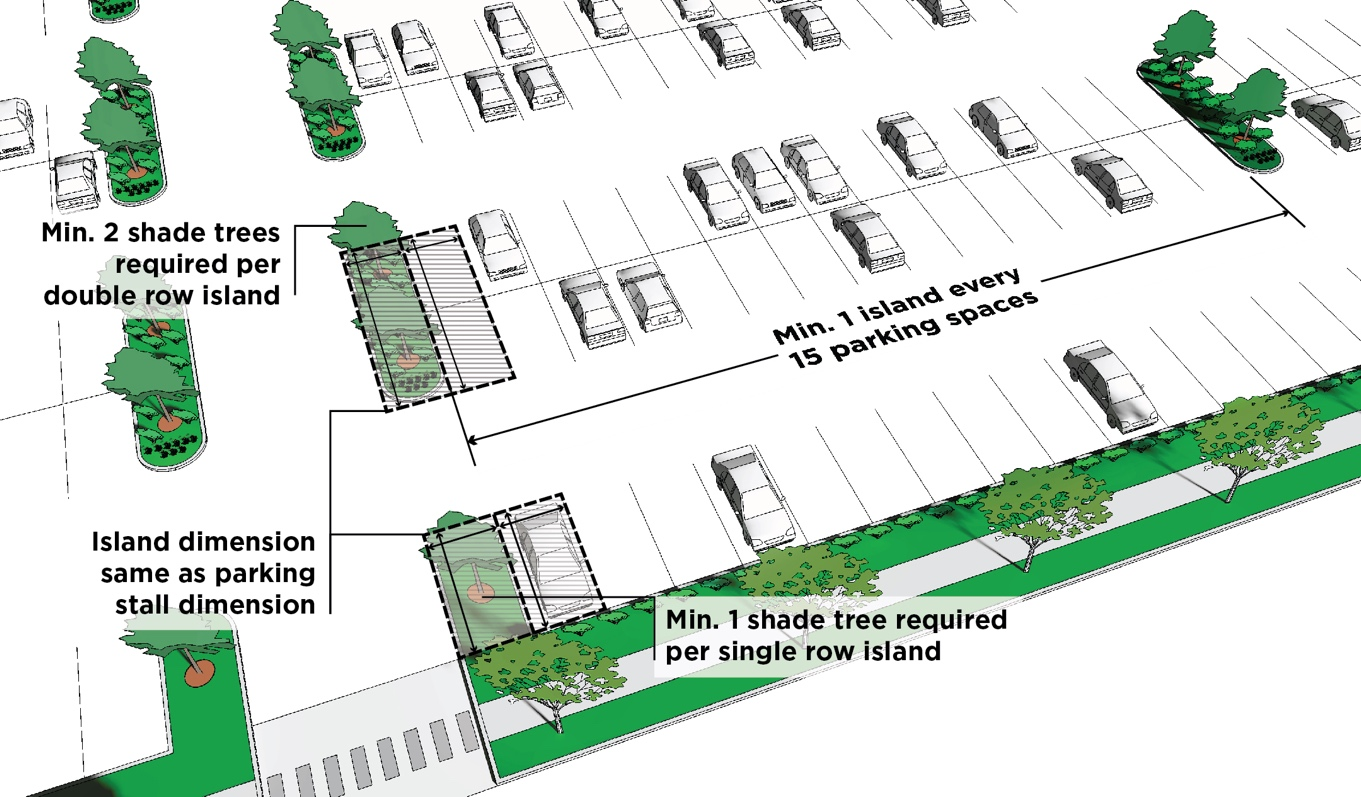
(Ord. No. O-105-2023, § 1, 7-25-23; Ord. No. O-94-2025, § 1, 8-19-25)
12.7 - SITE LANDSCAPE
Site landscape requirements apply to new construction and to any additions to a structure existing as of the effective date of this Code of 30% or more in square footage.
A.
Areas of any lot that are not covered by structures, pavement, and vehicle parking areas must be planted with live landscaping in accordance with 12.3.B. Stone or other inorganic landscape materials may be used to satisfy this requirement, but must not cover more than 20% of the landscape area unless designed to retain stormwater. Mulch and other organics can be used as needed.
B.
Where multi-family and nonresidential (including mixed-use) developments are located ten feet or more from a street lot line and no parking is located in front of the structure or development and where any façade abuts any parking area, foundation landscape must be planted as described below. This planting area is required along 60% of the linear façade area. This percentage may be reduced to accommodate entry design and other building functional operations during landscape plan review.
1.
Site landscape requires one shrub for every three feet. Shrub locations within the planting area may be varied, but the total number of shrubs must be no less than as required in this section.
2.
Trees are required in the amount of one tree every 50 feet. Tree locations within the planting area may be varied, but the total number of trees must be no less than as required in this section.
3.
The landscape area outside of shrub and tree masses must be planted in live groundcover, perennials, or grasses with inorganic landscape materials, such as stone, only covering 20% of the area.
4.
Planted pots and/or planter boxes may be used to satisfy up to 30% of the total landscape area requirement.
5.
Perimeter landscape yards, interior parking lot landscaping, and buffer yard landscaping located between the street lot line and a building can be used to meet these requirements.
SITE LANDSCAPE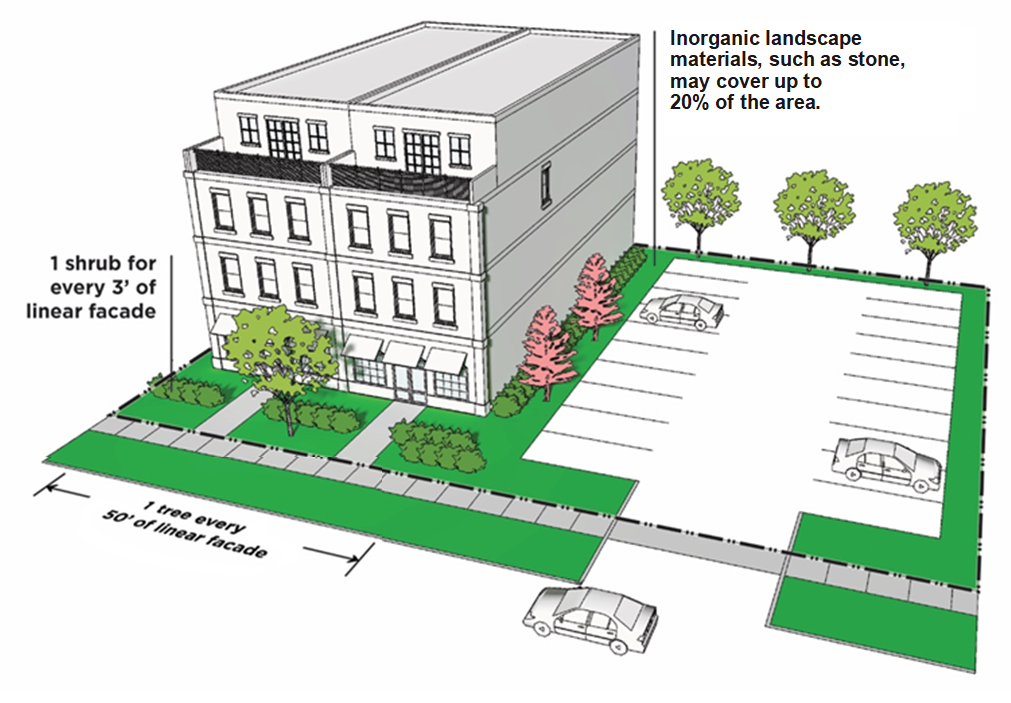
(Ord. No. O-94-2025, § 1, 8-19-25)
12.8 - BUFFER YARDS
This section establishes standards for the dimension and required landscape for buffer yards between land uses and/or zoning districts within the rear and/or side yards. Nothing in this section prevents the applicant's voluntary installation of buffer yards where they are not required. Buffer yard requirements apply to new construction and to any additions to a structure existing as of the effective date of this Code of 30% or more in square footage.
A.
Buffer yards may be located within required setbacks but must be reserved for the planting of material and installation of screening as required by this section. No parking, driveways, sidewalks, accessory structures, or any impervious surfaces are permitted within the buffer yard area.
B.
The three types of buffer yards are as follows:
1.
Class A Buffer
a.
Minimum Width: Ten feet.
b.
Minimum Required Shrubs: One shrub every five feet. A minimum of 50% of the shrubs must be evergreen.
c.
Minimum Required Trees: One evergreen tree for every 25 feet and one shade tree for every 50 feet.
d.
Planting locations may be varied, but the total number of trees must be no less than as required in this section.
e.
The landscape area outside of shrub and tree masses must be planted in live groundcover, perennials, or grasses with inorganic landscape materials, such as stone, only covering 20% of the area.
2.
Class B Buffer
a.
Minimum Width: Twenty feet.
b.
Minimum Required Shrubs: One shrub every three feet. A minimum of 50% of the shrubs must be evergreen.
c.
Minimum Required Trees: One evergreen tree for every 20 feet and one shade tree for every 30 feet.
d.
Planting locations may be varied, but the total number of trees must be no less than as required in this section.
e.
The landscape area outside of shrub and tree masses must be planted in live groundcover, perennials, or grasses with inorganic landscape materials, such as stone, only covering 20% of the area.
3.
Class C Buffer
a.
Minimum width: Five feet.
b.
Minimum Required Shrubs: One shrub every five feet. A minimum of 50% of the shrubs must be evergreen.
c.
Minimum Required trees: One evergreen tree for every 25 feet and one shade tree for every 50 feet.
d.
Planting locations may be varied, but the total number of trees must be no less than as required in this section.
e.
The landscape area outside of shrub and tree masses must be planted in live groundcover, perennials, or grasses with inorganic landscape materials, such as stone, only covering 20% of the area.
f.
When a Class C Buffer abuts pavement within the development, the pavement must be permeable for a width not less than 15'.
C.
Where the Class A or Class B buffer yard incorporates a wall or solid fence, or combination of such, the buffer yard width may be reduced by 30%.
D.
When a wall or solid fence is incorporated into a buffer yard, it must be a minimum of six feet up to a maximum of eight feet. When a wall or solid fence is combined with a berm, the combined height of the wall or solid fence and any berm cannot be less than six feet or exceed eight feet.
E.
Where existing native trees and shrubs are properly preserved on site per Article 12.9.C of this code, they must be preserved in perpetuity or until a new landscape plan has been accepted. If existing vegetation provides a 25-foot buffer between land uses and/or zoning districts, the installation of a buffer yard is not required. Invasive trees and shrubs shall not be counted towards screening requirements.
F.
Parking lots located on properties developed under a common or unified development plan and/or which have a shared access agreement are not required to provide the buffer yard screening area along common property lines where parking areas abut.
G.
Buffer yards are required as described in Table 12-2: Buffer Yard Requirements:
H.
Exemptions and Flexibilities
1.
A Class B Buffer is not required when a nonresidential district abuts a residential district if the principal use is a residential development not exceeding 35' in height. A Class B Buffer may be substituted with a Class A Buffer if the principal use of a residential development does not exceed 45 feet in height.
2.
For a nonresidential use in a nonresidential district with a lot width no greater than 50 feet and/or a lot area no greater than 7,500 square feet, a Class C Buffer may be substituted for the required Class B Buffer. This Buffer substitution does not apply to requirements specified by the Use Standards of Article 9.
CLASS A BUFFER YARD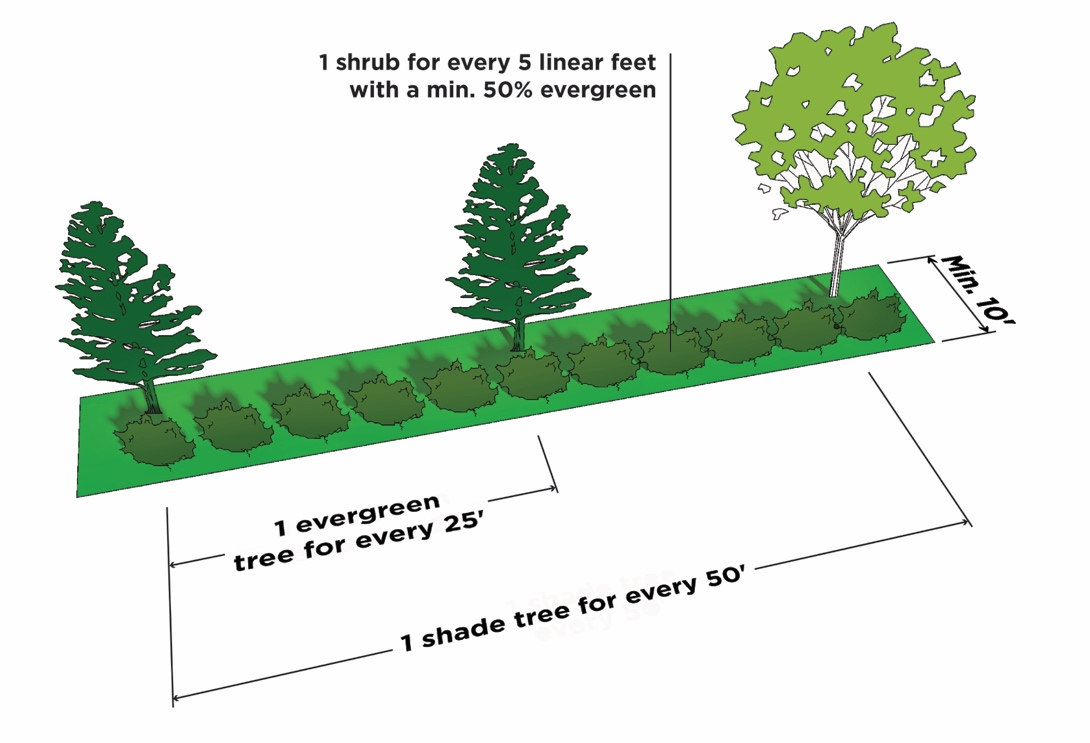
CLASS B BUFFER YARD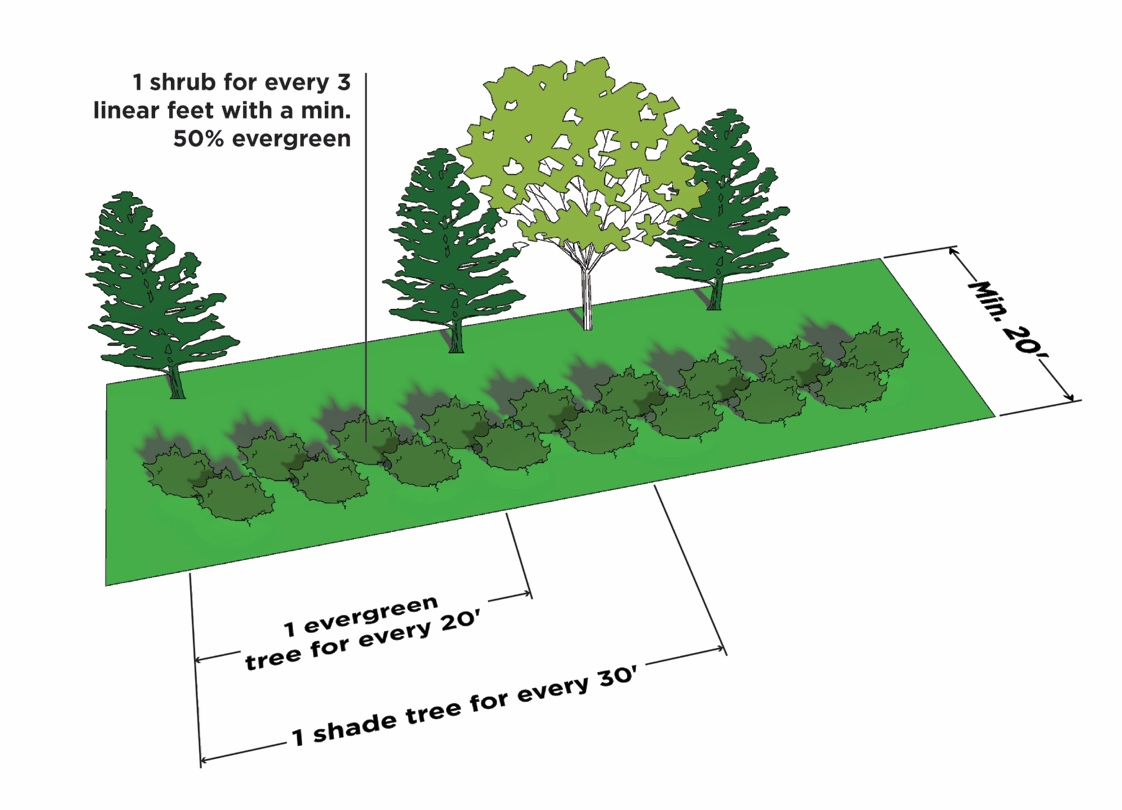
CLASS C BUFFER YARD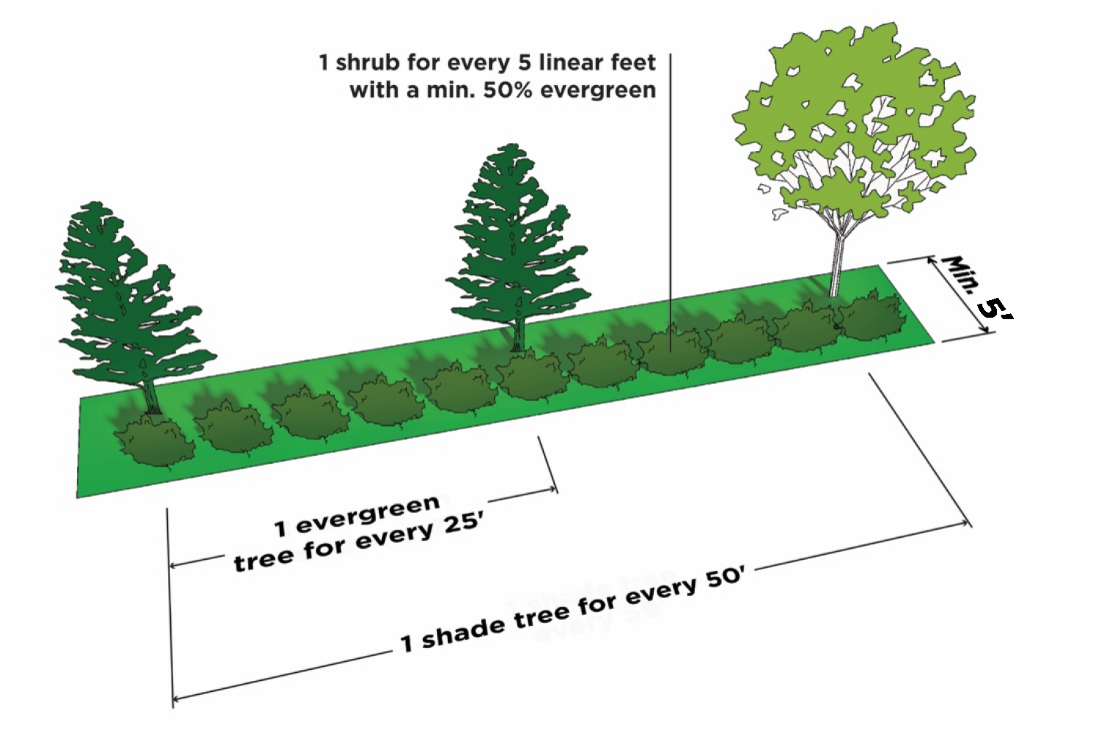
(Ord. No. O-88-2020, § 1, 5-19-20; Ord. No. O-40-2025, § 1, 5-27-25; Ord. No. O-94-2025, § 1, 8-19-25)
12.9 - TREE PRESERVATION
Existing healthy trees must be conserved when possible and will be credited toward landscaping requirements, when they are comparable in terms of species to new trees that would be permitted in the proposed location.
A.
Credit for preserving existing, healthy trees is subject to Urban Forester approval. The credit approved for each conserved tree is based on a tree's diameter, measured 4.5 feet above the ground, and may be up to the amount indicated below:
1.
Four to eight inches: Two trees credited
2.
Eight to twelve inches: Three trees credited
3.
Twelve to eighteen inches: Four trees credited
4.
Eighteen inches or greater: Five trees credited
B.
Existing trees may be used to fulfill the perimeter screening requirements, subject to approval by the Zoning Administrator. Existing trees are credited as set forth in this section. Trees to be preserved must be identified on the required landscaping plan
C.
If existing trees are being used as credit toward meeting the tree planting standards, a grading permit will not be issued until the following tree preservation protections are installed. Tree preservation includes the preservation of the tree's root system within the tree protection zone.
1.
The tree protection zone is determined by measuring one foot in radius away from the trunk of the tree for every one inch in diameter at 4.5 feet in height. No more than 10% of the tree protection zone may be disturbed with fill or grading work. Any impervious area within the existing tree protection zone does not need to be included in preservation measures.
2.
Within the tree protection zone of a tree, there may be no cut or fill material unless a Certified Arborist has evaluated and determined that the disturbance will not impact the health of the tree.
3.
Prior to and during construction, temporary barriers must be erected around all protected trees with barriers a minimum of four feet in height. There may be no storage or movement of equipment, material, debris, or fill within the fenced, tree-protection zone.
4.
During construction, the applicant must prevent the cleaning of equipment or material or the storage and disposal of waste material, such as paints, oils, solvents, asphalt, concrete, motor oil, or any other material, potentially harmful to the tree within the drip line of any protected tree. Nothing within this section is interpreted as an authorization to ignore or violate applicable federal or state hazardous waste laws.
5.
No damaging attachment, wires, signs, or permits may be fastened to any protected tree.
(Ord. No. O-94-2025, § 1, 8-19-25)

