
Lady Lake City Zoning Code
CHAPTER 9
MISCELLANEOUS REGULATIONS
Sec. 9-1. - Impervious surfaces.
a)
Impervious surfaces are allowed within building setbacks and easements. The impervious surface may abut the adjoining property line only if the lot size is equal to or less than six thousand nine hundred (6,900) square feet provided that a curb (three (3) inches high, six (6) inches wide) is constructed along the adjacent property line to direct water from adjacent property.
b)
A covenant of removal will be required from the applicant prior to permit application if placement of impervious surface is within a utility easement, and the property owner will be held responsible for any replacement or repair of impervious surface if maintenance within the easement is required.
(Ord. No. 2009-14, § 1(Exh. A), 6-1-2009)
Sec. 9-2. - Accessory uses and structures.
a)
In general. Specific accessory uses and structures shall comply with the following regulations.
b)
Principal use required. No accessory structure or use shall be permitted on any lot without an established principal use on the same lot within the applicable zoning district. Accessory uses and structures shall:
1)
Be customarily incidental to the principal use established on the same lot.
2)
Be subordinate to and serve such principal use.
3)
Be subordinate in area, extent and purpose to such principal use.
4)
Contribute to the comfort, convenience or necessity of users of such principal use.
c)
Permit required. No accessory structure shall be authorized on any lot without the appropriate building permit.
d)
General provisions.
1)
Outside storage is generally prohibited, except as permitted herein. For purposes of this section, carports shall not be considered outside storage.
2)
Signs, fences, walls, parking and loading areas, and other such features which are typically located within required yard areas shall comply with the applicable provisions of this Code for such uses and structures.
3)
Any specific accessory use or structure which is not addressed within this chapter shall not be located on any lot.
e)
Size limitations. No enclosed, unattached accessory buildings, including accessory structures and guest quarters, shall cause the impervious coverage to exceed the maximum allowed for the specific district per the Zoning chapter.
f)
Setbacks. This section provides for accessory structures to be located per required building setback areas according to the zoning district in which the principal use is located. Recorded easements and required landscape buffers may supersede the minimum dimensions permitted. However, in residential zoning districts where accessory structures are less than two hundred (200) square feet, setbacks shall be set a minimum of ten (10) feet two-tenths (.2).
g)
Structure height.
1)
In general. Unless otherwise described in this section, the maximum permitted height for any structure shall be as outlined in the Schedule of Dimensional Requirements in the Zoning District Regulations chapter.
2)
Established height for specific structures.
h)
Outside storage. Outside storage of new and used equipment and materials shall be regulated as follows:
1)
Residential uses. Outside storage of materials and equipment shall be restricted to the rear yard, screened and not visible from any public right-of-way or adjoining lot. This provision shall not apply to the regular parking or storage of licensed and operable motor vehicles, boats, recreational vehicles and other such vehicles which are regulated by other Town codes. Specifically prohibited is the outside storage of appliances, unlicensed or inoperable motor vehicles, motor vehicle parts, and equipment and materials used as part of a business conducted off-site.
2)
Office uses. Outside storage of equipment or materials shall not be permitted for office uses.
3)
Commercial uses. Outside storage of equipment and materials shall be permitted for commercial uses as specified below:
A)
Display of landscape or garden supplies, outdoor recreational equipment, and lawn equipment located in designated areas approved for such display as part of a development plan.
B)
Display of new and used motor vehicles, boats, recreational vehicles, mobile homes, and other such vehicles located in designated area approved for such display as part of a development plan.
C)
Storage of licensed and operable motor vehicles, boats, recreational vehicles and other such vehicles located in designated areas approved for such storage as part of a development plan.
D)
Display setups of products customarily used out of doors such as pools, spas, lawn furniture, concrete fixtures and other similar items.
E)
Special sales events and other such uses when permitted by special exception or approved as part of a development plan.
F)
Storage of licensed and inoperable motor vehicles awaiting repair within screened areas on the site of motor vehicle repair facilities and motor vehicle service centers, provided that no such vehicle shall be stored for more than forty-five (45) consecutive days.
4)
Industrial uses. Outside storage of equipment or materials shall be permitted for industrial uses, when in compliance with the following requirements.
A)
All storage areas shall be screened or landscaped with materials of sufficient maturity, density and height to screen such areas from any public right-of-way or adjoining property, unless the property is an industrial use.
B)
Screening shall not be required around storage areas for licensed, operable motor vehicles and landscape materials.
(Ord. No. 2009-14, § 1(Exh. A), 6-1-2009)
Sec. 9-3. - Home occupations.
a)
Intent. The purpose of this section is to accomplish the following:
1)
Permit residents of the Town a broad choice in the use of their homes as a place of livelihood and in the production or supplementing of personal and family income.
2)
Protect residential areas from adverse impacts of activities associated with home occupations.
3)
Establish criteria and development standards for home occupations conducted in residential uses.
b)
Permitted home occupations.
1)
Office uses. Professional and business office activities that do not involve clients, customers, or employees visiting the premises.
2)
Off-site sales. Customary hobby crafts produced at hobbyist volumes in the home by family members.
3)
Off-site services. Services to other homeowners that does not involve the use of tools or machinery in size or numbers beyond that customarily found in a residence of that size.
4)
Family child care home. No more than five (5) children including those related to the resident care giver and child care is provided for a period of less than twenty-four (24) hours a day on a regular basis.
c)
Prohibited home occupations.
1)
Motor vehicle and boat repair or painting; vehicle customization to include but not be limited to installation of accessories such as lights, sirens, car phones, etc.
2)
Beauty and barber shop, nail technician, massage parlor or any other personal service.
3)
Child care center or nursery school (except where a Family Child Care Home is permitted per Zoning District Use).
4)
Amplified musical instrument instruction.
5)
Dance and non-amplified musical instrument instruction (except private tutoring of no more than one (1) student per session).
6)
Photography studio (except the development of pictures or films off-site services where clients or employees do not visit the premises at any time).
7)
Real estate sales and brokerage.
8)
Retail sales (except garage sales).
9)
Upholstering/furniture re-finishing.
10)
Welding.
11)
Taxidermy.
d)
Restrictions. Home occupations are permitted as accessory uses in all residential zones and subject to the following restrictions.
1)
No persons other than members of the family residing on the premises shall be engaged in the home occupation.
2)
The use of the dwelling for a home occupation shall be clearly incidental and subordinate to its residential use, and there shall be no change in the appearance of the dwelling or outside evidence of non-residential use.
3)
Any business that involves storage, processes, employees, equipment or any other activity not permitted by this section shall provide proof of a properly zoned and licensed business location housing those activities.
4)
No home occupation shall constitute the majority of the air conditioned area of the residence. New construction of additional air conditioned floor space shall not be eligible for this definition for two (2) years after its completion according to the date of the Certificate of Occupancy.
5)
There shall be no display of products visible in any manner from the outside of the dwelling.
6)
No equipment or process shall be used which creates visual or audible electrical interference in any radio or television receiver off the premises or causes fluctuations in line voltage off the premises.
7)
No home occupation shall generate traffic on a regular basis greater than that customarily generated by the type of residence involved.
8)
No equipment or process shall be used in a home occupation which creates excessive noise, vibration, glare, fumes, or odor detrimental to the health, safety, morals, comfort, and general welfare of persons residing in the neighborhood.
9)
No home occupation shall cause an increase in the use of any one or more public utilities (water, sewer, electricity and garbage collection) or any facility subject to concurrency so that the combined total use for dwelling and home occupation purposes exceeds the customary average for similar type residences within the Town.
(Ord. No. 2009-14, § 1(Exh. A), 6-1-2009; Ord. No. 2022-03, § 1, 6-20-2022)
Sec. 9-4. - Fences and walls.
a)
Permit required. A building permit is required prior to construction of a wall or a fence.
b)
In general. All fences and walls shall be constructed in compliance with applicable building codes and in accordance with the following dimensional and use regulations.
c)
General provisions.
1)
Restrictions.
A)
No electrified fences, barbed wire, razor wire or similar material shall be allowed in residential districts except as required per federal, state, or local regulations for facilities that provide utility services, including but not limited to Wastewater Treatment plants located within residential districts. Temporary security fencing may be allowed for construction sites or perimeter fencing for undeveloped land in residential zones.
B)
Barbed wire, razor wire, hog wire and chicken wire shall be prohibited for non-residential uses, except as required per federal, state, or local regulations for facilities that provide utility services, including but not limited to Wastewater Treatment plants, installation associated with Lift Station requirements or Wireless Telecommunication Facilities.
2)
Height.
A)
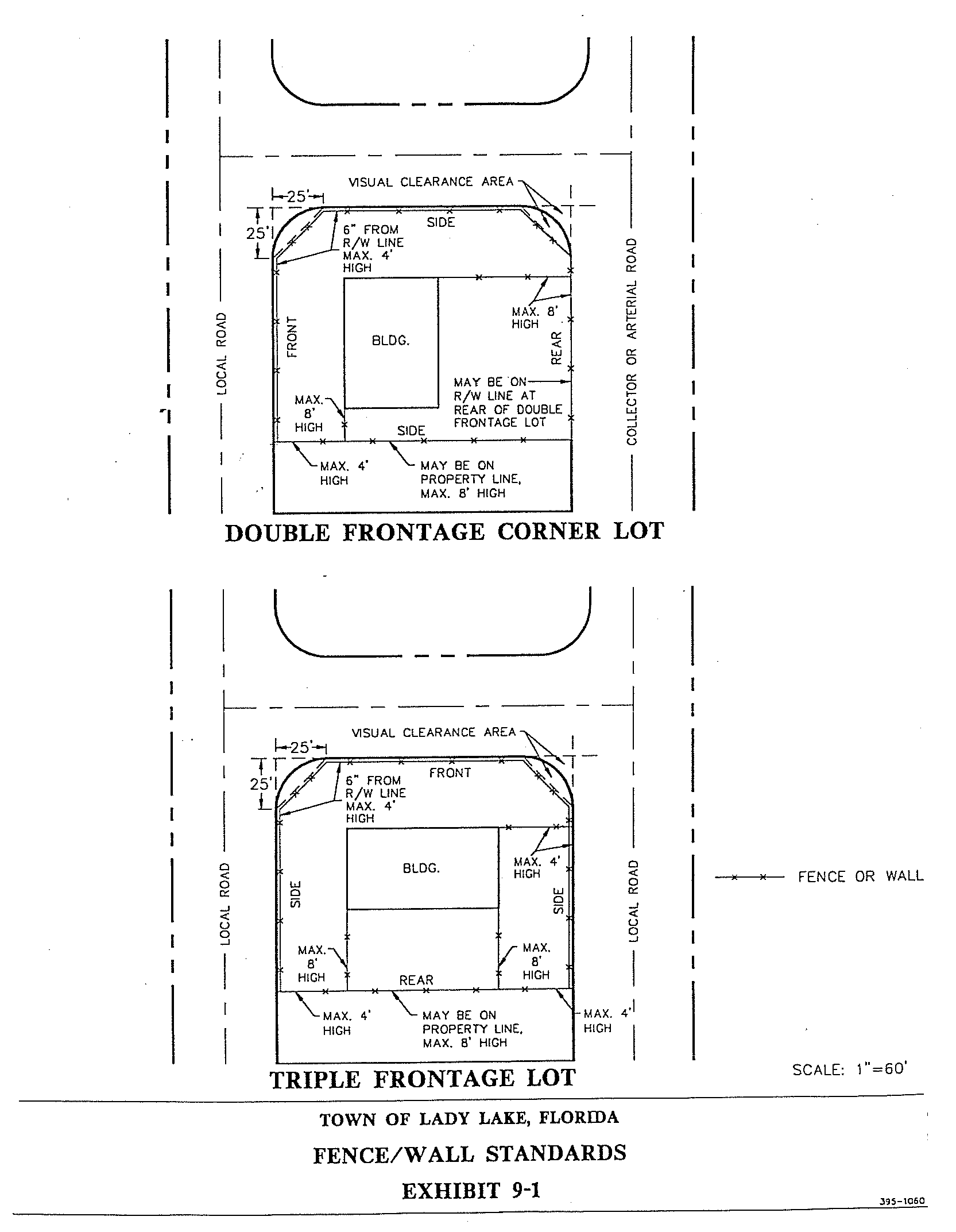
For residential uses, no permanent fence or wall shall exceed eight (8) feet in height in rear or side yards.
B)
For residential, no permanent fence or wall shall exceed four (4) feet in height in front setback, front yard, or side yards abutting rights-of-way unless part of a PUD.
C)
For commercial and industrial uses, no permanent fences or wall shall exceed ten (10) feet in height in side and rear yards unless approved as part of a development plan.
3)
Location.
A)
No permanent fence or wall, including subdivision perimeter walls, shall be located closer than six (6) inches from any right-of-way line, except as allowed in PUD as described below. Town of Lady Lake holds property owner(s) responsible for the proper location and installation of fences.
B)
No permanent fence or wall shall be located within areas required to provide clearance for visibility in accordance with section later in this chapter.
C)
Location of fence or wall shall be the responsibility of the owner and in no way encroach onto another property or public right-of-way.
4)
Exemptions.
A)
Customary fencing around tennis courts and other approved recreational amenities shall be exempt from height restrictions.
B)
Fences required or installed to provide rear lot screening of double frontage lots shall be exempt from right-of-way setback requirements. However, such fences shall comply with requirements to provide visibility clearance at intersections as described in sections later in this chapter.
C)
Agricultural fences shall be exempt from requirements.
D)
Any PUD shall be exempt from all requirements except those which are a part of the approval.
(Ord. No. 2009-14, § 1(Exh. A), 6-1-2009)
Sec. 9-5. - Visual clearance.
The following areas shall be designed and maintained to allow visibility between four (4) feet and eight (8) feet above the grade of the road. Tree trunks trimmed of foliage to eight (8) feet, and newly planted landscape material with immature crown development shall be exempt.
1)
At the intersection of two public rights-of-way, a triangle described by the intersection of the right-of-way lines extended, and a line joining points on those lines twenty-five (25) feet from said intersection.
2)
At the intersection of a private driveway and a public right-of-way, a triangle described by the intersection of the edge of the driveway and the edge of pavement and a line joining points on those lines ten (10) feet from said intersection.
3)
In cases of county or state roads, minimum sight distances necessary to satisfy the requirements of the Manual of Uniform Traffic Control Devices (MUTCD) and FDOT Manual of Uniform Standards for Design, Construction and Maintenance For Streets and Highways, latest edition, shall be maintained. Additional clear zone areas may be required based on the specific geometry of a particular location.
(Ord. No. 2009-14, § 1(Exh. A), 6-1-2009)
Sec. 9-6. - Underground utilities.
a)
Requirements.
1)
All utilities including, but not limited to, gas, water, sewer, electric, telephone and television cables, for all new construction and redevelopment of existing properties, both residential and commercial, shall be provided by underground cables, installed in accordance with the prevailing industry standards and practices of the utility and other companies providing such services. Redevelopment is hereby defined as additions or alterations to existing structures, over a three (3) year period, that result in an increase equal to, or greater than, fifty (50) percent of the assessed value of the property according to the most current property tax roll available prior to that time for which building permits are issued for such improvements.
2)
Where practicable as determined by Town Staff in its sole discretion, all utility shall be located within the public right-of-way; otherwise, easement or rights-of-way of sufficient width for installation and maintenance shall be provided.
3)
Site plans and subdivision improvement plans shall show locations of all utilities and shall be coordinated with required Landscaping improvements required per Chapter 10.
4)
As-built utility plans indicating the presence and location of installed utilities shall be provided to the Town of Lady Lake in digital format within sixty (60) days following receipt of Certificate of Completion for the site.
5)
Subject to F.S. § 337.404, whenever it shall be necessary for the city to remove or relocate any telecommunications facility, the owner of the telecommunications facility, or the owner's chief agent, shall be given written notice of such removal or relocation and requiring the payment of the costs thereof, and shall be given reasonable time, which shall not be less than twenty (20) nor more than thirty (30) days, in which to file an appeal with the Town Commission to contest the reasonableness of the order. Upon receipt of a written appeal, the Town Commission shall place the matter on the Commission's agenda for consideration within forty-five (45) working days. Should the owner or the owner's representative not appear, the determination of the cost to the owner shall be final, in accordance with F.S. § 337.404.
b)
Exemptions.
1)
Single-family lots in existing subdivisions currently served by overhead utility shall be exempt from the requirements as stated above.
2)
The Town recognizes that certain physical elements such as existing buildings, swimming pools, large trees, natural disasters (fire, hurricanes, etc.) and such may impose unreasonable hardships on property owner's compliance with the placement of utilities underground. Upon written confirmation of these hardships by the appropriate utility companies or from the applicant, the Town Commission may waive the requirement until such time as the hardship is no longer in existence.
3)
Each new construction site shall per permitted one (1) temporary, overhead electrical and telephone drop for a period of not to exceed one (1) year. This section shall not apply to high voltage primary lines serving a transformer station maintained by an electrical utility, or to trunk and feeder lines serving a cable television, data, telephone or other telecommunications distribution point maintained by a telecommunication utility.
4)
The underground installation of incidental appurtenances such as transformer boxes, pedestal-mounted boxes for electricity, or similar service hardware necessary for the provision of electric and communication utilities shall not be required, but shall be of such size and design and shall be so located as not to be unsightly or unsafe.
(Ord. No. 2008-11, § 1(Exh. A), 8-25-2008; Ord. No. 2009-14, § 1(Exh. A), 6-1-2009)
Sec. 9-7. - Wireless telecommunication facilities: Antennas, towers, and related equipment.
a)
Purpose and intent.
1)
Accommodate the growing need for Wireless Telecommunication Facilities (WTF) by allowing for Wireless Telecommunications competition in accordance with the Telecommunications Act of 1996 and providing for the sitting, erection and placement of the WTF within Town of Lady Lake consistent with public health, safety and welfare, and reasonable aesthetic guidelines;
2)
Encourage users of towers and antennas to configure them in a way that minimizes the adverse visual impact of the towers and antennas through careful design, siting, landscape screening, and innovative camouflaging techniques;
3)
Minimize the total number of towers throughout the community by encouraging the joint use of new and existing tower sites as a primary option rather than construction of additional single-use towers;
4)
Avoid potential damage to adjacent properties from tower failure through engineering and careful siting of tower structures. In furtherance of these goals, the Town shall give due consideration to the comprehensive plan, official zoning map, existing land uses, and environmentally sensitive areas in approving sites for the location of towers and antennas.
b)
General requirements.
1)
Applicability.
A)
New construction. All new telecommunication towers and antennas within Town of Lady Lake jurisdiction shall be subject to these regulations and all other applicable regulations. For purposes of measurement, telecommunication tower setbacks and separation distances shall be calculated and applied irrespective of municipal and county jurisdictional boundaries.
B)
Pre-existing WTF. All telecommunication towers legally existing prior to the effective date of this chapter shall be considered permitted uses, allowed to continue their usage as they presently exist; provided however, anything other than routine maintenance, including without limitation, structural modifications including provisions for additional antennas or additional providers and/or new construction on an existing telecommunication tower, shall comply with the new construction requirements of section.
2)
Locations.
A)
A WTF shall be permitted in Industrial and Public Facilities District (PFD) zoning district uses.
B)
A WTF may be permitted as a special exception use in Heavy Commercial/Wholesale Commercial (HC), Planned Commercial (CP), Commercial Planned Unit Developments (PUD), and Agricultural zoning district uses.
C)
Camouflaged towers that are equal or less than one hundred fifty (150) feet may be permitted as a Special Exception Use (SEU) in the following residential zoning district uses: RS-1, MX-8, and Residential PUD. In addition, tower antennas can be located within residential districts on established structures (i.e. buildings, water tanks, utility poles, broadcast towers) where antenna additions do not account for more than twenty-five (25) percent of the height of the existing structure upon SEU approval.
3)
Compliance with other laws and regulations. All telecommunications towers, antennas, and equipment shall comply with:
A)
Town of Lady Lake Comprehensive Plan and Land Development Regulations.
B)
All applicable fire safety codes, building codes, and technical codes adopted by Town of Lady Lake.
C)
All applicable federal and state regulations. Evidence of compliance with FAA requirements shall be submitted where applicable. This evidence shall include a copy of the submitted FAA Form 7460-1, attachments submitted with the form, and a copy of any FAA responses. All towers must meet or exceed current standards and regulations of the FAA, the FCC, and any other agency of the state or federal government with the authority to regulate towers and antennas. If such standards and regulations are changed, then the owners of the towers and antennas governed by this article shall bring such towers and antennas into compliance with such revised standards and regulations within six (6) months of the effective date of such standards and regulations, unless a different compliance schedule is mandated by the controlling state or federal agency. Failure to bring towers and antennas into compliance with such revised standards and regulations shall constitute grounds for the removal of the tower or antenna at the owner's expense.
4)
Application review process.
A)
All new wireless telecommunication towers and antennas within Town of Lady Lake jurisdictional boundaries shall be subject, in accordance with the standards set forth in this chapter, to the Site Plan Application review process as established per Land Development Regulations, Chapter 7 Section 8.
B)
Use of existing conforming WTF structures. Wireless Telecommunication Antenna placement is permitted with site plan review and approval by the Town Commission on any existing conforming non-residential structure other than telecommunication towers if the telecommunication antenna does not cause the combined height of the structure and antenna to exceed one hundred twenty-five (125) percent of the height of the structure. No SEU or rezoning to industrial and public facilities district zoning district uses is required for this type of placement. As per section 9-7b)2) of this chapter, antennas and accessory equipment are permitted in the above mentioned zoning districts when located on any existing structure, including, but not limited to, buildings, water tanks, utility poles, broadcast towers or any existing support structure in accordance with the requirements of this part.
C)
Use of existing towers. Town of Lady Lake encourages the use of existing towers. Additional antennas may be placed on existing conforming towers without site plan review provided there is not increase in height. Applications shall include written permission from the tower owner accompanied by sealed and verified testimony by an engineer licensed in the State of Florida that the tower can hold the additional equipment and maintain compliance with the adopted structural codes in effect at the time of said improvement or addition.
D)
Use of non-conforming towers. In the event that rezoning or other similar land use change creates existing non-conforming towers, these towers may be modified or rebuilt to accommodate co-location of additional telecommunications antennas without a public hearing provided there is no increase in height. The tower must be the same type as previously existing and there must be an executed written agreement showing there will be at least one (1) additional user utilizing the tower upon rebuild or modification.
E)
Exempt. Ordinary maintenance of existing WTF, as defined herein, shall be exempt from zoning and permitting requirements. In addition, the following facilities are not subject to the provisions of this chapter: (1) antennas used by residential households solely for broadcast radio and television reception; (2) satellite antennas used solely for residential or household purposes; and (3) COWs placed for a period of not more than one hundred twenty (120) days at any location within Town of Lady Lake after a declaration of an emergency or a disaster by the Governor or by the responsible official of Town of Lady Lake. Furthermore, COWs require the submittal and approval of a building permit before installation.
c)
Design guidelines.
1)
Measurement and lot size.
A)
Measurement. For purposes of measurement, tower setbacks and separation distances shall be calculated and applied to facilities located within Town of Lady Lake irrespective of municipal and county jurisdictional boundaries.
B)
Lot size. For purposes of determining whether the installation of a tower or antenna complies with district development regulations, including but not limited to setback requirements, lot-coverage requirements, and other such requirements, the dimensions of the entire lot shall control, even though the antennas or towers may be located on leased parcels within such lot.
2)
Structural design.
A)
All telecommunications towers must be designed so that in the event a telecommunications tower falls, it shall collapse only within the property lines of the lot on which the telecommunications tower is located. No building permit shall be issued unless the applicant provides verification of compliance of this policy from an engineer registered by the State of Florida. Please refer to item d)1)B), of this section.
B)
To ensure the structural integrity of telecommunications towers, the owner of a Wireless Telecommunications Antenna and/or tower shall ensure that it is constructed and maintained according to TIA/EIA-Standard 222, as amended from time to time, ASCE-7, as amended from time to time, and all Town of Lady Lake adopted construction/building codes. No building permit shall be issued unless the applicant submits site plans sealed and verified by an engineer licensed in the State of Florida that proves compliance with the adopted structural codes in effect at the time of said improvement or addition.
3)
Fencing requirement.
A)
A chain link fence or wall not less than six (6) feet from finished grade shall be provided around each telecommunications tower and support facilities. In zoning districts uses where WTF are allowed, barbed wire or other appropriate anti-climbing device shall be used along the top of the fence or wall. The area to be fenced shall surround and enclose as a single entity or individually, the tower, all supporting structures including guyed grounding points, and equipment facilities. Access to the telecommunications tower shall be through a locked gate.
4)
Landscaping.
A)
The visual impact of a telecommunications tower shall be mitigated for nearby viewers through landscaping at the base of the telecommunications tower and ancillary structures. Landscaping shall be installed on the outside of fences or walls except in agricultural areas where the sides that are within the pasture or grazing area at livestock's reach.
B)
Existing vegetation shall be preserved to the maximum extent practicable and may be used as a substitute of or in supplement toward meeting the following landscaping requirements:
1.
A row of shade trees a minimum of ten (10) feet tall, two and one-half (2½) inches in diameter measured at breast height and a maximum of twenty (20) feet apart shall be planted around the perimeter of the fence.
2.
A continuous hedge of at least twenty-four (24) inches high at planting of sufficient health and quality capable of growing at least thirty-six (36) inches in height within eighteen (18) months shall be planted in front of the tree line referenced above.
C)
All landscaping shall be of the evergreen variety. All landscaping shall be drought tolerant and suited to the site soil conditions (Xeriscape) or irrigated and properly maintained to ensure good health and viability. At the public hearing Town Commission may waive all or part of the landscaping requirements if it finds it is not necessary to mitigate the visual impact for nearby viewers.
5)
Illumination. Telecommunications towers shall not be required to be artificially lighted except to assure human safety or as required by the Federal Aviation Administration. If the FAA requires lighting and there are residential uses found within a distance that is three hundred (300) percent of the height of the telecommunications tower, dual mode lighting shall be requested from the FAA.
6)
Signage. Signage unless otherwise required by law on perimeter fences shall be limited to:
A)
FCC registration.
B)
Trespassing, danger/warning, or emergency directions.
C)
One (1) sign not to exceed four (4) square feet in size providing tower owner and leasing information.
D)
Each user shall be permitted two (2) square feet of signage on equipment facilities providing ownership information and/or emergency directions.
E)
No signage shall be permitted on towers or antennas.
F)
All signage is subject to review by Lady Lake Police Department.
d)
Setbacks and separation between towers.
1)
Setbacks.
A)
Telecommunication tower/antenna setbacks shall be measured from the base of the tower/antenna, or protruding building structure at the base of the tower, whichever is closest to the property line, to the property line of the parcel on which it is located.
B)
Property diameter must allow falling distance plus twenty-five (25) feet to maintain minimum setback from the property line. Property line shall be measured using Global Position System coordinates for the center of the tower, and if applicable, shall meet both the requirements below:
If the owner of the property where the tower is to be located owns residential units thereon or on surrounding properties (or if such properties are owned by his or her parents or children and they have consented in writing), those units shall not be taken into consideration when calculating the setback requirements of this section.
2)
Separation between towers.
A)
Wireless telecommunications tower separation shall be measured using Global Position System (GPS) coordinates for the center of the tower. Wireless telecommunications towers shall meet the following separation requirements:
Wireless telecommunications tower separation.
Proposed tower type.
Exempt from this requirement are antennas and towers that are recognized camouflaged structures.
B)
Wireless telecommunications towers designed to accommodate four (4) or more service providers shall be granted a reduction in the separation distances between telecommunications towers as shown below:
Co-location reduction.
Prior to issuance of building permit, the owner/operator shall submit executed co-location agreements for each additional co-location in a form acceptable to the Town Manager or designee that shall provide that each of the additional users will be utilizing the tower upon its completion.
e)
Environmental regulations and maintenance performances.
1)
Radiation.
Emission standards. The telecommunications tower and antennae must meet the radiation emission standards set by the FCC. The applicant shall provide evidence that the telecommunications tower and telecommunication antennae meet the FCC standards where applicable.
2)
Alteration or reconstruction. Existing conforming telecommunications towers may be modified or rebuilt to accommodate co-location of additional telecommunications antennas without a public hearing provided there is not increase in height. The tower must be the same type as previously existing and there must be an executed written agreement showing there will be at least one (1) additional user utilizing the tower upon rebuild or modification. Please refer to item [b)]4)c), of this section for co-location requirements.
3)
Abandoned antenna and tower structure. Any antenna or tower that is not operated for a continuous period of twelve (12) months shall be considered abandoned, and the owner of such antenna or tower shall remove the same within ninety (90) days of receipt of notice from Town of Lady Lake notifying the owner of such abandonment. Failure to remove an abandoned antenna or tower within said ninety (90) days shall be grounds to remove the tower or antenna at the owner's expense. If there are two (2) or more users of a single tower, then this provision shall not become effective until all users cease using the tower.
(Ord. No. 2009-14, § 1(Exh. A), 6-1-2009)
Sec. 9-8. - Seasonal vendors/temporary use permits.
A)
Purpose. The Town recognizes that certain types of land use, due to the nature of the use, require special individual review. The intent of this section is to accommodate reasonable requests for interim, temporary or seasonal uses within any zoning district, when such activities are desirable for the community in the short term but would have detrimental effects if allowed to continue on a permanent basis, within the Light Commercial (LC), Heavy Commercial (HC), Planned Commercial (CP), Industrial, Planned Unit Development (PUD), and Public Facilities District (PFD). Temporary uses allowed under this section shall be sensitive to the health, safety and general welfare of persons residing and working in the community and shall be conducted so as not to cause any long term detrimental effects on surrounding properties and the community.
B)
Applicability. This section shall apply to all Seasonal Vendors within the Town limits, which includes but it's not limited to:
1.
Off-site agricultural sales such as Christmas tree lots, pumpkin patches, and produce or farm stands (such as watermelon/strawberry/orange stands):
a.
Farm stands operating as a temporary use shall be open for no more than three (3) months per year.
b.
All temporary signs shall be affixed to the stand and when added together, shall not exceed thirty-two (32) square feet in area. The sign(s) may contain the name of the stand, but shall only contain advertising that pertains to the produce sold at the stand. This type of sign will not require the issuance of a sign permit.
c.
The stand shall neither block nor be located within any right-of-way and shall be a minimum of ten (10) feet from the paved surface of the road. When located at intersecting roads, the stand shall conform to visibility triangle requirements.
d.
Temporary holiday storage containers/trailers and outdoor storage containers/trailers ancillary to an existing permitted use.
e.
Other annual, seasonal or recurring temporary uses of a similar nature as determined by the Growth Management Director.
C)
Requirements. The Growth Management Director or designee may approve the sale of merchandise or food by a Seasonal Vendor for a period not to exceed forty-five (45) days upon receipt of the following:
1.
A letter from the owner of the property upon which the vendor proposes to locate giving permission to locate on said property and indicating that sanitary facilities shall be available to vendor customers.
2.
A site plan showing the proposed location of the vendor. Open Air/Seasonal Vendors shall be located only in areas of commercial zoning. The vendor stall or area shall be placed only in areas where there is sufficient parking to accommodate customers and shall not be located in an area that will interrupt the normal flow of traffic.
3.
Documentation that the additional standards of (d), below, have been met, as applicable.
D)
Additional standards.
1.
All pyrotechnical items sold must be consistent with state laws regulating same and all persons selling pyrotechnical merchandise must be licensed by the State Fire Marshall.
2.
The location and sales of proposed sale of pyrotechnical items must be approved by the County Fire Marshall.
3.
Electrical hook-up or fixtures shall meet the Town's adopted National Electrical Code.
E)
Criteria for rview. The Growth Management Department Director shall consider the following criteria in granting a temporary use permit:
1.
That the temporary use permit is compatible with the various provisions of this chapter.
2.
That the temporary use is a reasonable use of land compatible with the land use designation and zoning classification.
3.
That the temporary use will not impede the reasonable use of land or the orderly development of land in the immediate vicinity.
4.
The temporary use will not adversely affect the adjacent uses, buildings or other structures.
5.
That the temporary use will not endanger the public health, safety or general welfare.
6.
Provisions for adequate traffic access/circulation, off-street parking and pedestrian safety have been provided and will be maintained during the operation of the use or activity.
7.
That the granting of the temporary use permit is made subject to those conditions necessary to preserve the general welfare, not the individual welfare of any particular applicant.
F)
Mobile units. Mobile units, including mobile medical units/mobile clinic units, trailers or other portable devices, shall not be allowed to set up except as meeting the provisions of section (c) of this regulation and under the following additional provisions:
1.
Such mobile units shall be limited to up to two (2) exhibits/set ups per month. Mobile units shall not be allowed more than twelve (12) exhibits/set ups per calendar year. Such mobile units set up shall not exceed forty-eight (48) consecutive hours on premises per event.
2.
Operator must meet all state and county licensing requirements and health department regulations associated with the nature of the business operations.
(Ord. No. 2012-19, § 1(Exh. A), 11-5-2012)
Sec. 9-9. - Open air gatherings and temporary sales operations.
A)
Purpose. The purpose of this section is to allow for ancillary retail operations and similar promotional activities by establishing an application process for events held on non-public property, that because of their nature, create traffic control, crowd-control, public safety, sanitation and other public health, safety and welfare issues of a nature sufficient to require review by Town Staff. Temporary sales operations may include, but not be limited to, conventions, exhibitions, fundraisings, trade shows, and retail shows.
B)
Applicability. This section shall apply for all open air gatherings and temporary sales operations to be held upon private property within the Town.
C)
Permit requirement. No person shall advertise, engage in, organize or otherwise hold any ancillary retail operations and similar promotional activities within the Town unless an application has first been obtained as required by this ordinance and approved by the Growth Management Department. The following must be provided:
1.
Open Air Gathering/Temporary Sales Operation application shall state, at the minimum, the following information:
a.
The name of the event.
b.
The name, address and telephone number of the event organizer.
c.
The date of the Open Air Gathering or Temporary Sales Operation and the hours of operation.
d.
A general description of the activities to be conducted at the event together with attendance estimates.
2.
A letter from the property owner indicating that sanitary facilities are available to those in attendance of the gathering.
3.
A site plan showing at least the following:
a.
The dimensions and locations of all permanent and proposed temporary structures to be located on the property. Should any temporary structures, such as tents, be required for the event, the applicants will be responsible for obtaining all necessary building permits and meeting all requirements of applicable building codes.
b.
That adequate improved ingress and egress exists on site so as not to impede normal traffic flow on adjacent roadways.
c.
The capacity and location of restroom facilities (either permanent or temporary) sufficient to meet the anticipated demand at the event.
1)
That adequate provision has been made for solid waste collection and disposal.
2)
A parking plan which clearly shows all on-site and overflow parking (if necessary) and proposed traffic flow and any necessary traffic control devices at the event location.
3)
A list of all concessionaires and vendors in addition to the event organizer, if any.
4.
Any other applicable permit(s) issued by Lady Lake Building Department.
5.
Copies of all fliers, handbills, newspaper advertisements and other advertising that the event organizer anticipates using to promote or advertise the open air gathering or temporary sales operation (if applicable).
6.
Written proof of permission from the property owner for the use of the property owner's property by the event organizer for the open air gathering or temporary sales operation. The property owner shall be required to sign the application and agree to any conditions placed on the event by the Town Commission (if applicable).
7.
Copies of all required federal, state and local business or regulatory licenses required to be held by the event organizer.
8.
Any other documentation or information that Town staff or the Town Commission, upon appeal, determines to be reasonably necessary to properly evaluate the application.
D)
Time frame. The Growth Management Director or designee may approve open air gatherings or temporary sales operations for a period not to exceed twelve (12) days per calendar year on any given site.
E)
Departmental review. In considering whether to grant or deny an application, the Growth Management Director shall consider:
1.
The suitability of the event site to host the open air gathering or temporary sales operation.
2.
The potential adverse or negative effect granting the event could have on surrounding properties or businesses; including, but not limited to noise, vibration, air pollution, glare, odor and reduction in parking.
3.
Whether the open air gathering or temporary sales operation is being held primarily for private financial gain or for charitable purposes.
4.
Disturbances, complaints or problems associated with the open air gathering or temporary sales operation of a similar character or nature as the proposed event, or disturbances, complaints or problems associated with the event(s) organized by the event organizer in the past.
5.
Whether the open air gathering or temporary sales operation will require additional staffing of public safety/police department personnel by the Town.
6.
Any other criteria or fact considered relevant by the Growth Management Director.
7.
In granting a permit, the Growth Management Department may attach any conditions it determines to be reasonably necessary to protect the public health, safety and welfare.
8.
Any party directly affected by the decision may appeal the decision to the Town Commission by submitting written notice of intent to appeal within five days of the department's decision. Upon receipt of a written notice of intent to appeal, the Growth Management Director shall place the open air gathering or temporary sales operation application on the agenda for the next regularly scheduled Town Commission meeting.
F)
Appeal to the Town Commission. In the event of an appeal of the decision of the growth management department regarding an application, the Town Commission shall review the application together with all supporting documentation and departmental comments, if any, and shall either uphold or overturn the decision of the growth management department.
G)
Limitations.
1.
No application issued under this section shall exceed a period from 12:00 noon on the day preceding the event (allowed for set up) until 12:00 noon on the day following the event (for take down and restoration), inclusive of the three (3) day period in between for the event itself.
2.
The display/sales area shall not be open to the public, nor sales made during set up and take down. The display/sales area shall be available to the public, and hours of sale shall not exceed the hours of 7:00 a.m. to 10:00 p.m. during the sale days.
3.
Any break in the event shall require the issuance of a separate application.
4.
An event organizer shall be limited to four (4) events during any calendar year, and no more than one (1) open air gathering or temporary sales operation may be issued in any one (1) calendar quarter.
5.
No lot or parcel within the Town shall be used to host an event more than four (4) times during any calendar year, and no more than one (1) open air gathering or temporary sales operation may be held on a particular lot or parcel during any one (1) calendar quarter.
(Ord. No. 2012-19, § 1(Exh. A), 11-5-2012)
Sec. 9-10. - Façade improvement program.
A)
Purpose. Through this program, business owners and tenants are eligible for a grant match of up to fifty (50) percent of the cost of their exterior improvements, with a maximum reimbursement of two thousand five hundred dollars ($2,500.00) per property. Two (2) grants are awarded per fiscal year, and are allocated on a first come, first served basis provided all eligibility requirements are satisfied; no award shall be granted to the same structure within a three (3) year period.
B)
Eligibility requirements. To participate in the Façade Improvement Program, the structure must be:
1.
Located within the Downtown Redevelopment Area Boundary (see Figure A below). (Applicants within the Downtown Redevelopment Area will be given priority to the grant award; however, the Town Commission may award the grant to applicants outside of the Downtown Redevelopment Area on a case-by-case basis, provided they meet all other eligibility requirements); and
2.
Used for a business operating at minimum twenty (20) hours a week; and
3.
Have a commercial zoning designation (HC, LC, CP, CT).
C)
Qualifying as an applicant. To participate in the Façade Improvement Program, the applicant may be the property owner or the operating tenant. If the tenant is applying for the grant, the property owner must also sign an owner's affidavit to approve the proposed work. The business must also employ no more than fifteen (15) full time employees at time of the grant award.
D)
Grant review and approval procedures.
1.
Submit completed application form with all required documentation to the Growth Management Department. Applicants may choose to schedule a pre-application meeting with the Growth Management Department if they would like a determination regarding whether their proposed improvements would be eligible for the grant.
2.
Application will be reviewed by the Growth Management Department to assure that it is complete and consistent with all Land Development Regulations.
3.
After staff approval, the applicant can proceed with presenting the application to the Economic Development Advisory Committee for recommendation to the Town Commission.
4.
Applicant must complete the project and satisfy all inspection requirements. Changes to scope of the job after it has been approved without consent of the Economic Development Advisory Committee, and subsequently the Town Commission, shall result in forfeiture of the grant funds. Reimbursement shall occur after all work has been completed and the necessary inspections have been approved. The applicant will be reimbursed for costs based upon the actual expenses shown on the invoices submitted to the Growth Management Department following completion of all improvements.
E)
Eligible façade improvements. The Façade Improvement Program is limited to reimbursement for improvements made only to the exterior of commercial structures. Eligible improvements are those on the building elevations that front rights-of-way and are visible to the passers-by on the street. Signs and sign improvements are not eligible for this program. Routine maintenance such as painting, pressure washing, and minor repairs to existing materials alone will not be eligible for reimbursement, but may be an element of the scope of the project. Project components that may qualify for a façade grant include, but are not necessarily limited to:
1.
Exterior improvement, restoration, including removal of decayed materials.
2.
Repair, replacement, or installation of new:
a)
Exterior windows.
b)
Exterior doors.
c)
Awnings.
d)
Exterior lighting.
e)
Painting (only if entire façade is repainted).
f)
Roofing materials.
F)
Façade design guidelines. Façade grant applications used in conjunction with an improvement that would cause more than fifty (50) percent of the building area to be replaced; or if the existing building is being redeveloped and the cost of redevelopment is greater than fifty (50) percent of the assessed value of the building, the applicant shall meet the Town's Commercial Design Standards.
G)
Application submittals. Required application submittals shall include:
1.
Completed application form.
2.
Documentation that property taxes are current.
3.
Documentation of no outstanding liens or active Code Enforcement cases within the Town of Lady Lake.
4.
Detailed budget including three (3) written estimates from licensed contractors to verify costs are within reasonable parameters. Invoice of project costs will have to be submitted.
5.
Photo of current façade (a photo of the completed façade showing all improvements will be required to close the project as well).
6.
Scaled drawings clearly illustrating proposed improvements.
Exhibit 9-10
Figure A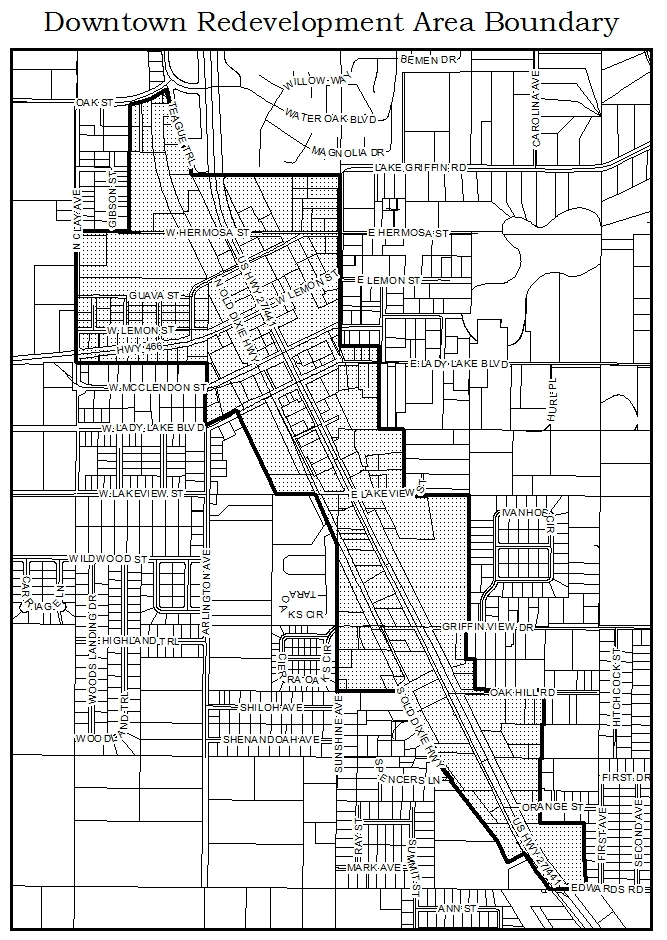
(Ord. No. 2016-07, § 1, 2-1-2016; Ord. No. 2022-03, § 1, 6-20-2022)

