
Lady Lake City Zoning Code
CHAPTER 2
DEFINITIONS AND INTERPRETATIONS1
Editor's note— Ord. No. 2008-33, § 1(Exhibit "A"), adopted Jan. 21, 2009, repealed Chapter 2 in its entirety and enacted new provisions to read as herein set out. Prior to amendment, Chapter 2 pertained to similar subject matter and derived from the original Land Development Regulations.
Sec. 2-1.- Interpretations of certain terms and words.
a)
The singular includes the plural and vice versa.
b)
The masculine includes the feminine and neuter and vice versa.
c)
The present tense includes the future.
d)
The word "shall" is mandatory and the word "may" is permissive.
e)
The word "person" includes an individual, child, firm, association, joint venture, partnership, estate, trust, syndicate, fiduciary, corporation, and all other groups or combinations.
f)
The word "writing" includes handwriting, printing, typewritten, and all other methods and means of forming letters and characters upon paper.
g)
The word "lot" includes the words parcel of land, plot, or tract.
h)
The word "land" includes the words water, marsh, swamp, gross land area, and gross acre of land.
i)
The word "street" includes the words avenue, highway, road, boulevard, thoroughfare, ingress/egress easement, public right-of-way, private right-of-way, or other similar words.
j)
All words and terms defined in any Code adopted by reference are hereby incorporated in this Code. However, if a word is also defined in this Chapter, the latter definition shall apply in all cases except when interpreting the referenced Code.
k)
All words not defined in this Code shall carry their customary meaning as found in Webster's latest published edition unabridged Dictionary.
(Ord. No. 2008-33, § 1(Exh. A), 1-21-2009; Ord. No. 2010-14, § 1(Exh. A), 7-19-2010; Ord. No. 2011-26, § 1(Exh. A), 11-7-2011)
Sec. 2-2. - Definitions.
Abandon: To cease actively using a structure for a period of six (6) months or more.
Abutting property: Any property that is immediately adjacent or contiguous to property or that is located immediately across any road or public right-of-way.
Accessory buildings: A subordinate detached building, on the same lot as the principal building or use, occupied or devoted to a use incidental to the principal use. Accessory buildings may constitute guest/servant quarters, including but not limited to mother-in-law buildings.
Administrative official: The municipal official appointed by the Town Manager to administer the Land Development Code.
Adult care facility: A facility which provides, for any portion of the day, care-giving services to three (3) or more persons over the age of eighteen (18), who are not related to the owner or operator.
Adult congregate living facilities (ACLF): A caretaking arrangement, whether operated for profit or not, where care is provided for a part of the twenty-four (24) hour day to three (3) or more adults that are unrelated by blood or marriage to the owner/operator of the facility. This care may include, but is not limited to, providing a protective setting, social activities, leisure time activities, self-care training, rest, nutritional services, and speech or physical therapy. Residents shall not be under in-house nursing/medical care. Such a facility must be licensed by the Florida Department of Health and Rehabilitative Services, in accordance with F.S. § 400.55, or as amended.
Adult entertainment: An establishment where a substantial portion of the stock-in-trade and/or presentation time offered for any form of consideration, are devoted to materials which are distinguished or characterized by the emphasis in depicting, describing, or relating sexual matters from which minors would be excluded by virtue of their age, pursuant to the Florida Statutes. This term may include, but is not limited to, adult bookstore, adult cabaret, and adult theater.
Adult/vocational education: An establishment for the instruction or guidance in an occupation, profession, civic activity or art form, and may include, but not limited to, the teaching of a trade apprenticeship, acting-drama, citizenship, cooking, and music and voice.
Affordable housing: A dwelling unit which has a market value less than two (2) times eighty (80) percent of the median annual household income of Lake County, Florida; or, has a monthly rent less than or equal to 1/12 x twenty-five (25) percent of eighty (80) percent of the median annual household income of Lake County, Florida.
Agricultural lands: Shall mean those lands in any agricultural use including forestry.
Agriculture: The production, keeping, grazing, or maintenance for sale, lease, or personal use, of plants and animals useful to man, and may include, but not be limited to, forage and sod crops, grain and seed crops, fruits of all kinds, vegetables, and nursery, floral, ornamental, and greenhouse products.
Agriculture: Processing (except for packing and slaughter houses): The processing for sale, lease, or personal use, of plants and poultry products useful to man, which may include, but not be limited to, citrus, dairy, grain mill and poultry products. This definition shall not include the butchering, processing and packing of animals or poultry for food.
Agriculture: Processing (Packing and slaughter houses): The butchering, processing, or packing of animals or poultry for food.
Airport: Any area of land or water located, in whole or in part, designed and set aside for the landing and taking off of aircraft and licensed by the State of Florida for public use.
Alley: A public or private way which is not designed for general travel but is used primarily as a means of secondary access to a lot abutting thereon.
Alteration of a watercourse: As it relates to the Floodplain Management Ordinance, a dam, impoundment, channel relocation, change in channel alignment, channelization, or change in cross-sectional area of the channel or the channel capacity, or any other form of modification which may alter, impede, retard or change the direction and/or velocity of the riverine flow of water during conditions of the base flood.
Altered wetlands: Wetlands which have been substantially affected by man, but which continue to be dominated by wetland or transitional vegetation.
Anaerobic: Conditions where there is no free oxygen available for use.
Appeal: A request for a review of the Floodplain Administrator's interpretation of any provision of this Code or any decision or action of the Town.
Appliance/electronic repair shop: A retail establishment offering for compensation the repair services of small appliances and electronic equipment, with such repair generally occurring on the premises.
Applicant: Shall mean any person applying for or who has been granted a permit to proceed with a project. The term applicant shall include a developer, public or private individual, partnership, corporation, association, group, company, firm, society or other legal entity of human beings, whether natural or artificial, including the Town of Lady Lake and all other municipal, state and federal governments, and shall include the plural as well as the singular.
Aquifer: An underground formation, group of formations, or part of a formation that is permeable enough to transmit, store, or yield usable quantities of water.
Arcade: A series of arches supported by columns or pillars; a covered passageway; a recessed gallery with columns or piers open to the street.
Artesian well: An artificial hole in the ground from which water supplies may be obtained and which penetrates any water-bearing rock, the water in which is raised to the surface by natural flow, or which rises to an elevation above the top of the water-bearing bed. Artesian wells are defined further to include all holes, drilled as a source of water, that penetrate any water-bearing beds that are a part of the artesian water system of Florida, as determined by representatives of the Florida Geological Survey or the Department of Environmental Protection.
ASCE 24: As it relates to the Floodplain Management Ordinance, a standard titled Flood Resistant Design and Construction that is referenced by the Florida Building Code. ASCE 24 is developed and published by the American Society of Civil Engineers, Reston, VA.
Assisted living facility (ALF): Any facility which provides housing, meals and care-giving services to one (1) or more live-in adults who are not relatives of the owner or operator.
Athletic/sports facility: A site or building where competitive athletic pursuits are carried out, through direct participation, generally on a scheduled basis. This type of facility may include, but is not limited to, a golf course, golf driving range, handball or racquetball court, swimming club, and tennis club.
Auction house: Land or a building where items are sold to the highest bidder. Such activity could be private or public and may include, but not be limited to, the sale of antiques, art and jewelry.
Awning: A roof-like cover, securely fastened on one side or end to a building, and the balance of which extends over or before a place (as a walkway or before a window) as a shelter and whose bottom edge is at least seven (7) feet above the highest grade level beneath it.
Awning/illuminated: A structure, as described above, which is illuminated from the reverse side with artificial light emanating from a minimum eight hundred (800) milliampere high outpost florescent fixture, to the extent that such artificial light is visible through to the exterior.
Bank: An establishment where the principal use is receiving or lending money, including savings and loan companies.
Bars, lounges, and night clubs: An establishment devoted primarily to the selling, dispensing, serving or providing of alcoholic beverages for consumption on the premises, where dancing or floor shows may be permitted. The term bars, lounges, and night clubs may include, but not be limited to, the terms barroom, cabaret, cocktail lounge, discotheque, pub, saloon, and tavern, but shall not include those premises where alcoholic beverages are sold in conjunction with the sale of food for consumption on the premises, and the sale of said beverages comprises less than forty-nine (49) percent of the gross receipts.
Base flood: A flood having a one (1) percent chance of being equaled or exceeded in any given year. [Also defined in FBC, B, Section 202] The base flood is commonly referred to as the "100-year flood" or the "1-percent-annual chance flood."
Base flood elevation: The elevation of the base flood, including wave height, relative to the National Geodetic Vertical Datum (NGVD), North American Vertical Datum (NAVD) or other datum specified on the Flood Insurance Rate Map (FIRM). [Also defined in FBC, B, Section 202]
Basement: The portion of a building having its floor subgrade (below ground level) on all sides. [Also defined in FBC, B, Section 202; see "Basement (for flood loads)".]
Bed and breakfast inn: A house or portion thereof where short-term lodging rooms are provided, and breakfast may be provided. The operator of the inn shall live on the premises.
a)
Bed and breakfast small homestay: A private residence, including related buildings, with one (1) to three (3) guest rooms in which the owner occupies the primary building.
b)
Bed and breakfast medium homestay: A private residence, including related buildings, with up to five (5) guest rooms in which the owner occupies the primary building.
Best management practices: Accepted, best technology within acceptable industry standards for cost efficiency to manage either land development, pollution abatement, or treatment processes.
Block: A group of lots existing within well-defined and fixed boundaries, usually being an area surrounded by streets or other physical barriers and having an assigned number, letter, or other name through which it is identified.
Block face: That portion of a block which abuts an individual street.
Block layout: The arrangement of lots and alleys contained within a city block.
Boardwalk: An elevated structure made of boards usually placed over land or wetlands.
Bubble plan: A map of a proposed site, or site map of sufficient accuracy, to be used to supplement zoning applications for the purposes of representing the adjacent zoning districts, boundaries, natural features, and other characteristics of a property under consideration of zoning change in accordance with Chapter 5 of the Land Development Regulations. The bubble plan is less descriptive in than the "Conceptual Plan"; however, does require a Memorandum of Agreement to be concurrently submitted when it is used in the zoning application process.
Buffer: An area of land, landscape materials, wall or combination thereof between two (2) parcels of land intended to reduce the impacts between the two (2) parcels.
Buildable area: That portion of a lot remaining after required building setbacks have been established in the lot's front, rear and side yards.
Building coverage: That portion of a lot which is occupied by principal and accessory buildings.
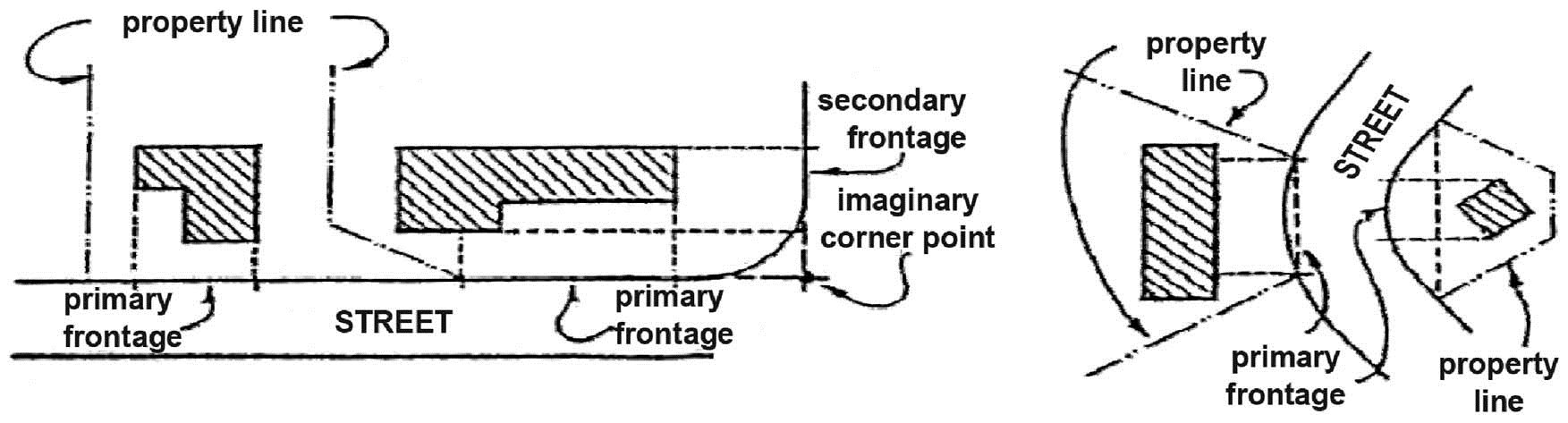
Building frontage: The part of the building facing a road, street, highway or easement serving the building. For the purpose of calculating sign area, building frontage shall be measured as follows:
Building height: The vertical distance measured from the average grade of the building to the highest point of a flat roof, or to the deck line of a mansard roof, or to average height level between eaves and ridge for gable, hip and gambrel roofs.
Building setback: The minimum required distance a building must be set back from the property line, as measured perpendicular to the property line, or from mean high water along rivers, lakes, or other water bodies.
Building setback lines: The lines established by setback requirements beyond which no principal building shall extend.
Building site: Any group of one (1) or more lot(s) or parcel(s) occupied or intended for development as a unit, whether or not as part of a larger Development Site.
Bulkhead: A man-made wall or encroachment, parallel to the shoreline, made to protect the shore from erosion and to retain the earth or fill behind it.
Business service: An establishment where the performance of duties related to business operations are provided within or outside of the confines of such an establishment any may include, but not be limited to, business machine repair, computer service and repair, microfilming, secretarial and typing service, and telephone answering service.
Campground: The area or place (as a field or grove) used for a camp, for camping, or for a camp meeting, campgrounds may permit camping via trailer, tent, tent trailer, pickup camper, cabin, or other similar devices.
Canal: An artificial waterway for transportation, irrigation, or stormwater conveyance.
Capacity: The ability or availability of a public service or facility to accommodate users, expressed in an appropriate unit of measure, such as gallons per day or peak hour traffic volumes.
Car (auto) detailing: the practice of performing an extremely thorough cleaning, polishing and waxing of an automobile, both inside and out.
Car wash: An establishment for the washing, cleaning, waxing and polishing of the exterior surface of passenger vehicles; and for the incidental cleaning and vacuuming of the interior passenger sections.
Carport: An attached or freestanding unenclosed structure primarily used to shelter motor vehicles, having a roof structure supported by two (2) or four (4) posts or a combination of posts and wall structure.
Cemetery: Land where burial of the deceased occurs, whether persons or pets. This term shall include mausoleums where they are within the boundaries of a cemetery.
Change of use: A discontinuance of an existing use and the substitution of a different kind or class of use. Change of use is not intended to include a change of tenants or proprietors.
Church (or religious institution): A facility primarily intended for the conducting of organized religious worship services and permitted associated accessory uses.
Clearing: The removal of any trees or vegetation from the land by digging, pushing or cutting, or the effective removal by damage. This shall not include mowing of lawn and field grasses.
Clubs, lodges, and fraternal organizations: A building or facility owned or operated by a corporation or association for a social, educational, civic, or recreational purpose, but which is not primarily for profit or to render a service that is customarily carried on as a business.
Cluster development: A development approach which permits reduction in the minimum lot size requirements and other zoning district regulations for certain residential uses while keeping overall project density the same as in conventional development.
Commercial/industrial equipment and supplies: An establishment which offers the wholesale or retail sale or rental of goods and merchandise used in commerce or industry, and not generally purchased by the individual consumer, and may include, but not be limited to, air or gas compressors, backhoes, bricks, chemicals, food processing equipment, hoists, manufactured building components, medical supplies, traffic signs, valves, and waterproofing material.
Commercial/industrial service: An establishment which provides work performance related to commerce and industry, and may include, but not be limited to, linen supply, machine shop, medical waste removal service, publishing plant, screen printing, tool and die shop and welding.
Commercial/industrial warehouse: A building used primarily for the dead space storage of goods and materials used by or in association with commerce and industry.
Commercial recreation facility: An establishment which provides indoor or outdoor opportunities for casual entertainment by patrons of all ages, and may include, but not be limited to, an amusement park, bingo club, bowling alley, game room, go-kart track, miniature golf, pool hall, skateboard park, skating rink and video games; however, if the facility includes a video arcade, it may not constitute more than forty (40) percent of the included activities.
Commercial stable: A facility where horses are boarded and cared for and may include, but not be limited to, provision for instruction of riding, jumping, and showing, and the hiring to the public of riding horses for a fee.
Communication tower: A building or ground-mounted tower which is greater than thirty-five (35) feet in height, as measured from the finished grade of the property, and is principally intended to support communication (transmission or receiving) equipment for radio, TV, microwave, cellular and similar communication purposes. The term communication tower shall not include amateur radio operators' equipment licensed by the Federal Communications Commission (FCC). Communication towers are generally described as either Monopole (free standing), Guyed (anchored with guy wires), or Self Supporting (square, triangular or pyramidal in plain view and constructed of steel lattice, tubular steel, reinforced concrete, or wood).
Community residential homes: A dwelling unit providing a living environment for one (1) to six (6) residents, if unlicensed, or seven (7) or more residents, if licensed, that have no family to live with or are in need of assistance with daily living, if the facility operates as the functional equivalent of a family. Supervision and care by support staff may be necessary to meet the physical, emotional and social needs of the residents. These facilities are licensed by the Florida Department of Health and Rehabilitative Services and include residential treatment facilities - levels II and IV, residential child care agency facilities, intermediate care facilities for the mentally retarded/developmentally disabled, foster care facilities, and group homes pursuant to Chapter 419 of the Florida Statutes, but may not include transitional facilities for ex-correction inmates.
Compensating storage: Shall mean equivalent floodplain storage provided to counterbalance floodplain filling.
Comprehensive plan: The "Town of Lady Lake Comprehensive Plan Update" adopted by the Town Commission and amendments thereto in compliance with the requirements of the Local Government Comprehensive Planning and Land Development Regulation Act, Chapter 163, Florida Statutes.
Conceptual plan: A map of a proposed site, or site map of sufficient accuracy, to be used to supplement zoning applications for the purposes of describing and visually representing the proposed uses, densities, boundaries, natural features, and other characteristics of a property under consideration of zoning change in accordance with Chapter 5 of the Land Development Regulations.
Cone of influence: A roughly conical concavity in the potentiometric surface around a pumping well.
Confined aquifer: An aquifer that is overlain by a confining bed which has a singularly lower hydraulic conductivity than the aquifer.
Confining bed: A body of relatively "impermeable" material stratigraphically adjacent to one (1) or more aquifers. In nature, however, its "hydraulic conductivity" may range from nearly zero to some value distinctly lower than that of the aquifer.
Conservation easement: A right or interest in real property which is appropriate to retaining land or water areas predominately in their natural, scenic, open or wooded condition; retaining such areas as suitable habitat for fish, plants, or wildlife; or maintaining existing land uses; and which prohibits or limits the activities as described in the Florida Statutes.
Conservation plan (Erosion Control Plan): A formal document which outlines a system of management practices to control soil erosion and to improve water quality for a specific parcel of property related to stormwater facilities for agricultural lands approved by the Town, and which has been either:
a)
Prepared by the United States Department of Agriculture Soil and Water Conservation Service (SCS) in conjunction with a local Soil and Water Conservation District, organized pursuant to F.S. Ch. 582, or as amended;
b)
Prepared by a private consultant to standards, specifications, and guidelines developed by the SCS; or
c)
Prepared by a private consultant based on SCS guidelines using guidelines for Conservation Plans using accepted engineering principals, and which provides an equivalent level of treatment.
Construction: Shall mean the alteration of the existing contours of the site, land clearing, or the building, assembling, expansion, modification, erection or alteration of buildings or other structures, or any part thereof.
Construction contractor's yard and storage: Land or building where construction materials are kept in association with such contracting businesses and may include, but not be limited to, air conditioning and heating, aluminum, building construction, hauling, machine construction, roofing, solar energy systems, utility system installation, and wall covering.
Consumptive use: Any use of water which reduces the supply from which it is withdrawn or diverted.
Convenience store: An establishment which offers for sale a limited line of food and household goods and is designed for quick service to customers with small purchases. Such an establishment may or may not offer for sale fuel by way of self-service gasoline/diesel pumps or LP gas tanks.
Crematorium: An establishment in which a deceased body is reduced to ashes in a furnace. This type of facility must be licensed with the Florida Department of Professional Regulation and meet the criteria of the Florida Department of Health and Rehabilitative Services and the Florida Department of Environmental Protection, pursuant to F.S. § 470.025, or as amended.
Critical habitat: Habitat which, if lost, would result in elimination of listed species individuals from the area in question. Critical habitat typically provides functions for the listed species during restricted portions of that species' life cycle. Habitat includes the place or type of site where a species naturally or normally nests, feeds, resides, or migrates, including for example, characteristic topography, soils and vegetative cover.
Cul-de-sac: A street terminated at the end by a vehicular turn-around.
Cultural facility: Land, a building, or a group of buildings which affords the pursuit of arts, professional and scholarly matters, and may include, but is not limited to, an auditorium, convention/lecture hall, and museum.
Dairy: A farm devoted to the production of milk, butter, and/or cheese.
Day care center: An arrangement or establishment which provides child care for more than five (5) children unrelated to the operator, for compensation, and for a period of less than twenty-four (24) hours. Such a facility must be licensed by the Florida Department of Health and Rehabilitative Services and comply with their requirements, pursuant to F.S. § 402.305, or as amended. This term may include, but not be limited to, a child-care center, day-care services, day nurseries, kindergartens, nursery school, play-school and preschool.
Design flood: The flood associated with the greater of the following two (2) areas: [Also defined in FBC, B, Section 202]
1.
Area with a floodplain subject to a one (1) percent or greater chance of flooding in any year; or
2.
Area designated as a flood hazard area on the community's flood hazard map, or otherwise legally designated.
Design flood elevation: The elevation of the "design flood," including wave height, relative to the datum specified on the community's legally designated flood hazard map. In areas designated as Zone AO, the design flood elevation shall be the elevation of the highest existing grade of the building's perimeter plus the depth number (in feet) specified on the flood hazard map. In areas designated as Zone AO where the depth number is not specified on the map, the depth number shall be taken as being equal to two (2) feet. [Also defined in FBC, B, Section 202]
Design guidelines: Criteria developed by a preservation commission, board, or review body to identify design concerns in an area or historic district, and to help property owners ensure that rehabilitation and new construction respect the character of designated buildings or districts.
Density: The total number of dwelling units per acre within a project site.
Detention: The collection and temporary storage of stormwater in such a manner as to provide treatment through physical, chemical, or biological processes and/or attenuation of the peak rate of flow.
Developer: Any person who engages in or proposes to engage in the development of property either as the owner or as the agent of an owner of property.
Development: Any significant man-made change to improved or unimproved real estate, including, but not limited to, buildings or other structures, mining, dredging, filling, grading, paving, excavating, permanent storage of materials, or the dividing of land into two (2) or more parcels. Development includes, but is not limited to, the following:
a)
A reconstruction, alteration of the size, or structural change in the external appearance of a structure on land.
b)
A change in density or intensity of use of the land, such as an increase in the number of dwelling units in a structure or on land, or a material increase in the number of businesses, manufacturing establishments, offices, or dwelling units on the land as may be determined by the local government.
c)
Alteration of a shore or bank of a river, stream, lake, pond, canal, or stormwater management facility.
d)
Mining or excavation on a parcel of land.
e)
Demolition or removal of a structure.
f)
Clearing of land as an adjunct of construction.
g)
Deposit of refuse, solid or liquid waste, or fill on a parcel of land.
Development: As it relates to the Floodplain Management Ordinance, any man-made change to improved or unimproved real estate, including but not limited to, buildings or other structures, tanks, temporary structures, temporary or permanent storage of equipment or materials, mining, dredging, filling, grading, paving, excavations, drilling operations or any other land disturbing activities.
Development site: The property under consideration for a development, which may contain one (1) or more Building Sites and shall be under single ownership at the time of application. Should the Development Site contain more than one (1) Building Site, any applicable Development, Site setback requirements shall be established from the Development Site Perimeter.
Diameter at breast height (DBH): The diameter, in inches, of the trunk of the tree measured at four and one-half (4½) feet above the existing grade.
Directly connected impervious areas: Those impervious areas which are connected to the surface water management system by a drainage improvement such as a ditch, storm sewer, paved channel, or other man-made conveyance.
Director: Shall mean Department Head.
Discharge: The outflow of water from a project, site, aquifer, drainage basin or facility.
Ditch: An artificial waterway for irrigation or storm water conveyance.
Dock: A fixed or floating structure, including moorings, used for the purpose of harboring boats.
Drainage facility: Any component of the stormwater management system.
Drainage system: All facilities used for the movement of stormwater through and from a drainage area including, but not limited to, any and all of the following conduits and appurtenant features: canals, channels, ditches, flumes, culverts, and streets, as well as all watercourses, waterbodies and wetlands.
Dredging: Excavation by any means in water or wetlands. It also means the excavation or creation of a water body which is, or is to be, connected to waters, directly or via excavated water bodies or a series of excavated water bodies.
Dripline: A vertical line running through the outer most portion of the tree crown extending to the ground.
Driveway or drive: A vehicular accessway, serving one (1) or more properties.
Dude ranch: A ranch operating as a vacation resort including horseback riding and related activities, with living quarters for temporary occupation by vacationing clients of the resort. This shall not include recreational vehicle or campground facilities.
Duplex: A single structure on a single lot containing two (2) dwelling units, each of which is totally separated from the other by a wall or ceiling, unpierced for any purpose including access, communication, or utility connection. The minimum height of the wall between the two (2) units shall be at least eight (8) feet, and the space on either side of this wall shall contain heated living space and/or a garage.
Dwelling: A building or part thereof with cooking, sleeping, and sanitary facilities that is designed in whole or part as the separate and independent residence or living quarters for one (1) or more persons, but which does not include the terms bed and breakfast inn, hotel, mobile home, motel, recreational vehicle, or tent. This term does include the following categories:
a)
Dwelling, Single Family: A building containing one (1) dwelling unit which would include the following types:
• Single Family Attached;
• Single Family Detached;
• Modular Housing;
• Manufactured Home, Residential Design (RDMH): Shall not be construed as including a standard design manufactured housing (SDMH), mobile home, travel trailer, or portable housing.
b)
Dwelling, Two Family: A building containing two (2) dwelling units which would include the following types:
• Single Family Attached (two (2) units per building);
• Duplex.
c)
Dwelling, Multi-Family - A building containing three (3) or more dwelling units which would include the following types:
• Single Family Attached;
• Apartments, Low and Mid-Rise;
• Townhouses;
• Duplex.
Easement: A grant by a property owner for the public or private use of a specified portion of land for a specified purpose.
Encroachment: The placement of fill, excavation, buildings, permanent structures or other development into a flood hazard area which may impede or alter the flow capacity of riverine flood hazard areas (as it relates to the Floodplain Management Ordinance).
Erect: Shall mean to build, construct, attach, hang, place, suspend, or affix and shall include the painting of wall signs.
Erosion: The wearing or washing away of soil by the action of water or wind.
Essential services: Public utility facilities either underground or overhead and related to the transmission or distribution system of water, sanitary sewer or storm sewer, telephone, gas, electricity, public safety, including poles, wires, mains, hydrants, drains, pipes, conduits, police or fire callboxes, traffic signals and other similar equipment necessary for the furnishing of adequate service, but not including buildings.
Excavation: The removal of soil, earth, etc. by digging.
Existing building and existing structure: Any buildings and structures for which the "start of construction" commenced before August, 15, 1984. [Also defined in FBC, B, Section 202] (As it relates to the Floodplain Management Ordinance).
Existing manufactured home park or subdivision: A manufactured home park or subdivision for which the construction of facilities for servicing the lots on which the manufactured homes are to be affixed (including, at a minimum, the installation of utilities, the construction of streets, and either final site grading or the pouring of concrete pads) is completed before August, 15, 1984 (as it relates to the Floodplain Management Ordinance).
Expansion to an existing manufactured home park or subdivision (as it relates to Floodplain Management Ordinance): Means the preparation of additional sites by the construction of facilities for servicing the lots on which the manufactured homes are to be affixed, including the installation of utilities, the construction of streets, and either final site grading or the pouring of concrete pads.
Facade: The entire building wall, including wall face, parapet, fascia, windows, doors, canopy and roof of any complete elevation.
Family: A family is a group of two (2) people or more (one of whom is the householder) related by birth, marriage, or adoption and residing together; all such people (including related subfamily members) are considered as members of one family (U.S. Census).
Family child care home: An occupied residence in which child care is provided for a period of less than twenty-four (24) hours a day on a regular basis, for no more than five (5) preschool children including those related to the resident care giver. An additional five (5) elementary school age children may also be cared for during after-school hours.
Farmers market: An occasional or periodic sales activity held within a building or structure where groups or individual sellers offer farm products, food, plants and similar type items for sale to the public.
Fascia: A flat strip or band.
FDCA (or DCA): the Florida Department of Community Affairs.
FDEP: The Florida Department of Environmental Protection.
FDNR: The Florida Department of Natural Resources.
FDOT: The Florida Department of Transportation.
Federal Emergency Management Agency (FEMA): The federal agency that, in addition to carrying out other functions, administers the National Flood Insurance Program.
Financial service: An establishment engaged in the management of money and credit, and whose services may include, but not limited to, accounting, bookkeeping, investment securities, money transfer, mortgage loans, pension plans, stocks and bond brokerage and tax planning. This term would not include the term bank.
Finished grade: The completed elevation of lawns, walks, and driveways brought to grade as shown on building plans or designs relating thereto.
Fire flow: The quantity of water measured in gallons per minute (gpm) and pounds per square inch (psi) that is needed to fight a fire involving a particular density of buildings or type of uses as defined by the NFPA.
Flag: A fabric of distinctive design that is used as a symbol (as of a nation, state or city), or is displayed to show affiliation with a specific recognized organization (such as fraternal, religious or charitable organization).
Flag lot: A lot or building site which has a minimum frontage on a public or private street, which is reached via a private drive or lane, and whose width some distance back from the street boundary line meets all ordinance requirements.
Flea market: An occasional or periodic sales activity held in an open area where groups or individual sellers offer goods - new and used, for sale to the public, not to include private garage sales or similar activities held by churches or other non-profit organizations.
Flood or flooding:
(a)
A general and temporary condition of partial or complete inundation of normally dry land areas from: [Also defined in FBC, B, Section 202]
(1)
The overflow of inland or tidal waters;
(2)
The unusual and rapid accumulation or runoff of surface waters from any source.
Flood damage-resistant materials: Any construction material capable of withstanding direct and prolonged contact with floodwaters without sustaining any damage that requires more than cosmetic repair. [Also defined in FBC, B, Section 202]
Flood hazard area: The greater of the following two (2) areas: [Also defined in FBC, B, Section 202] (as it relates to the Floodplain Management Ordinance):
1.
The area within a floodplain subject to a one (1) percent or greater chance of flooding in any year.
2.
The area designated as a flood hazard area on the community's flood hazard map, or otherwise legally designated.
Flood Insurance Rate Map (FIRM): The official map of the community on which the Federal Emergency Management Agency has delineated both special flood hazard areas and the risk premium zones applicable to the community. [Also defined in FBC, B, Section 202]
Flood Insurance Study (FIS): The official report provided by the Federal Emergency Management Agency that contains the Flood Insurance Rate Map, the Flood Boundary and Floodway Map (if applicable), the water surface elevations of the base flood, and supporting technical data. [Also defined in FBC, B, Section 202]
Floodplain administrator: The office or position designated and charged with the administration and enforcement of this ordinance (may be referred to as the Floodplain Manager).
Floodplain development permit or approval: An official document or certificate issued by the community, or other evidence of approval or concurrence, which authorizes performance of specific development activities that are located in flood hazard areas and that are determined to be compliant with this ordinance.
Floodway: The channel of a river or other riverine watercourse and the adjacent land areas that must be reserved in order to discharge the base flood without cumulatively increasing the water surface elevation more than one (1) foot. [Also defined in FBC, B, Section 202]
Floodway encroachment analysis: An engineering analysis of the impact that a proposed encroachment into a floodway is expected to have on the floodway boundaries and base flood elevations; the evaluation shall be prepared by a qualified Florida licensed engineer using standard engineering methods and models.
Floor: The top surface of an enclosed area in a building (including basement), i.e., top of slab in concrete slab construction or top of wood flooring in wood-frame construction. The term does not include the floor of a garage used solely for parking vehicles.
Floor area, gross: The sum of the gross horizontal area of all floors of a building measured from the exterior faces of the exterior walls or from the centerline of walls separating two (2) buildings.
Florida Building Code: The family of codes adopted by the Florida Building Commission, including: Florida Building Code, Building; Florida Building Code, Residential; Florida Building Code, Existing Building; Florida Building Code, Mechanical; Florida Building Code, Plumbing; Florida Building Code, Fuel Gas.
FLUCFCS: Florida Land Use, Cover and Forms Classification System, latest edition, published by the Florida Department of Transportation.
Front-foot, building: Each lineal foot, or major portion thereof, measured along the main entry side of a building.
Front-foot, property: Each lineal foot, or major portion thereof, measured along the public right-of-way where the subject property abuts said right-of-way.
Front-foot, tenant: Each lineal foot, or major portion thereof, of the front of the rented or leased space.
Functionally dependent use: A use which cannot perform its intended purpose unless it is located or carried out in close proximity to water, including only docking facilities, port facilities that are necessary for the loading and unloading of cargo or passengers, and ship building and ship repair facilities; the term does not include long-term storage or related manufacturing facilities.
Funeral home: A building used for the preparation of the deceased for burial, for the display of the deceased, and for ceremonies connected therewith before burial or cremation.
Game room (video arcade): An establishment in which the principal use is the provision of coin-operated games and similar devices.
Gaming center: A place where people can play online games or network games. The gaming center may also make available a PlayStation or Xbox that is available for public use. Although gaming centers are connected to the Internet, people usually cannot browse the web or use emails.
Geographic Information System (GIS): Integrates hardware, software, and data for capturing, managing, analyzing, and displaying all forms of geographically referenced information. GIS allows people to view, understand, question, interpret, and visualize data in many ways that reveal relationships, patterns, and trends in the form of maps, globes, reports, and charts.
Geotechnical engineer: Shall mean a licensed Professional Engineer in the State of Florida whose expertise or experience is in the field of geotechnical engineering.
Green space: See Open space.
Gross density: The total land area of the subject property excluding natural water bodies divided by the proposed number of dwelling units.
Ground cover: A small, low-growing plant, such as ivy, used as a ground covering in place of grass, normally reaching an average maximum height of not more than eighteen (18) inches at maturity.
Groundwater: Water below the surface of the ground whether or not flowing through known or defined channels.
Guest/servant quarters: Living quarters located on the same lot or parcel of land as the principal building, to be used exclusively for housing members of the family occupying the principal building, their nonpaying guests, or their employees.
Gun and archery range: A facility, including accessory buildings, for shooting by sportsmen. The gun range must be located indoors.
Habitat management plan: A plan prepared to address conservation and management of listed species found onsite and their habitat, which is approved by the Florida Game and Fresh Water Fish Commission and the U.S. Fish and Wildlife Service, if applicable.
Harmful to minors: With regard to sign content, any description or representation, in whatever form, of nudity, sexual conduct, or sexual excitement, when it:
a)
Predominately appeals to the prurient, shameful, or morbid interest of minors in sex.
b)
Is patently offensive to contemporary standards in the adult community as a whole with respect to what is suitable sexual material for minors.
The term "harmful to minors" shall also include any non-erotic work or picture when it is patently offensive to contemporary standards in the adult community as a whole with respect to what is suitable for viewing by minors.
Hazardous material: Any material defined, listed, characterized, or classified as a hazardous material, hazardous substance, hazardous waste, or toxic substance according to any of the following State or Federal codes or regulations:
a)
Chapter 38F-41, Florida Administrative Code (Florida Substance List), or as amended.
b)
Title 40 Code of Federal Regulation part 261 (Identification and Listing of Hazardous Wastes), or as amended.
c)
Title 40 Code of Federal Regulations part 302.4 (Designation of Hazardous Substances), or as amended.
d)
Title 40 Code of Federal Regulations part 355, Appendices A and B (List of Extremely Hazardous Substances), or as amended.
e)
Title 49 Code of Federal Regulations parts 172.101 and 172.102 (Hazardous Materials Tables), or as amended.
The term includes, but is not limited to, explosives, radioactive materials, petroleum products, gases, poisons, biologic agents, flammables and corrosives.
Health/exercise club: An establishment which provides for athletic and physical force training or health and recreational exercise. This term may include, but is not limited to, the terms aerobics instruction, dance instruction, fitness center, gymnasium (private), gymnastics school, karate, martial arts, self-defense instruction, and weight room.
Height (of a building or structure): The vertical distance from the ground level to the highest point of a structure. When applied to a building, height shall be measured to the highest point of the coping of a flat roof or to the mean height level between eaves and ridge for gable, hip or gambrel roofs. Where no ground level has been established the height may be measured from the mean elevation of the finished lot grade at the front of the building or structure.
Highest adjacent grade: The highest natural elevation of the ground surface, prior to construction, next to the proposed walls or foundation of a structure.
Historic structure: Any structure that is determined eligible for the exception to the flood hazard area requirements of the Florida Building Code, Existing Building, Chapter 12, Historic Buildings.
Home occupation: Any use conducted entirely within a dwelling and carried on by an occupant thereof, which use is clearly incidental and secondary to the use of the dwelling thereof.
Hotel: An establishment that provides lodging and usually meals, entertainment, and various personal services for the public.
Hydrograph: A graph of stormwater discharge versus time for a selected point in the drainage system.
Hydroperiod: The sum total of water that occurs in an area on average during a given period.
Impervious surface: A surface which has been compacted or covered with a layer of material so that it is highly resistant to infiltration by water. It includes surfaces such as compacted clay, as well as most conventionally surfaced streets, roofs, sidewalks, parking lots, and other similar surfaces.
Intensity: Pertaining to stormwater calculations, it is the depth of accumulated rainfall per unit of time.
Internet/cyber cafe: A place where people can connect to the Internet using a publicly accessible computer. While the main activity in the cyber cafe is the Internet, such as email, newsgroup and web site surfing, other applications usually available are office suite to type document, spreadsheet, and other utilities such as printing service, scanning and digital photo service. The café may also have wireless connection in their local area networking (LAN), where people can bring their own laptop and get connected to the Internet by paying a small fee.
Irrigation: The process of artificially applying water to living plant material.
Isolated wetlands: Wetlands that have no hydrological or vegetative connection with "waters of the state" as defined in Section 403.031(3), Florida Statutes, or as amended.
Junk yard: Any area, lot, land, parcel, building or structure or part thereof used for the storage, collection, processing, purchase, sale or abandonment of wastepaper, rags, scrap metal or other scrap or discarded goods, materials, machinery or two (2) or more unregistered, inoperable motor vehicles or other type of junk. This term includes auto wrecking yards and salvage yards and towing services where inoperable vehicles are stored over twenty-four (24) hours.
Kennel: An intensive service use facility which is operated primarily for the purpose of providing overnight lodging for domesticated animals.
Kennel, boarding: A premises which provides for the boarding of more than three (3) domesticated animals, whether for profit or personal use.
Kennel, breeding: A premises which provides for the breeding, buying, raising or selling of more than three (3) domesticated animals, whether for profit or personal use.
Laboratory/research and development: An establishment engaged in the investigation, testing and experimentation of the natural, physical or social sciences, or engaged in engineering and development as an extension of investigation with the objective of creating products. This type of facility may include, but not be limited to, asphalt and concrete testing, foundation testing, material testing, and soils, geology and groundwater testing.
Land-locked area: An area which does not discharge runoff from the ten (10) year, twenty-four (24) hour storm event; also, an area which does not possess proper access to public roads and/or right-of-way and/or ingress-egress easements.
Landscape: To plant vegetation such as trees, shrubs, ground cover, etc. so as to make an area more attractive.
Landscape area: Areas designated for vegetation.
Landscape plan: A plan to be submitted with the site development plan. The plan will identify the trees that are to be preserved as part of the landscaping design. The plan shall also indicate the location and description of replacement landscape plants.
Landscaping: Landscaping shall consist of, but not be limited to, grass, ground covers, shrubs, vines, hedges, trees, berms and architectural landscape features and material.
Laundry and dry cleaning plant: A building where the washing, drying, ironing, and/or dry cleaning of laundry occurs on a large scale and without retail transactions on the premises.
Laundry and dry cleaning retail service: An establishment where washing, drying, ironing, and/or dry cleaning machines are available for rental by the public for their use on the premises, or are available for use by the establishment's personnel in cleaning laundry for the public patrons. Such an establishment might also involve the intake of laundry from public patrons to be sent off the premises to a laundry and/or dry cleaning plant.
LEED (Leadership in Energy and Environmental Design): An ecology-oriented building certification program run under the auspices of the U.S. Green Building Council (USGBC). LEED concentrates its efforts on improving performance across five (5) key areas of environmental and human health: energy efficiency, indoor environmental quality, materials selection, sustainable site development and water savings.
Letter of Map Change (LOMC): An official determination issued by FEMA that amends or revises an effective Flood Insurance Rate Map or Flood Insurance Study. Letters of Map Change include:
Conditional Letter of Map Revision (CLOMR): A formal review and comment as to whether a proposed flood protection project or other project complies with the minimum NFIP requirements for such projects with respect to delineation of special flood hazard areas. A CLOMR does not revise the effective Flood Insurance Rate Map or Flood Insurance Study; upon submission and approval of certified as-built documentation, a Letter of Map Revision may be issued by FEMA to revise the effective FIRM.
Letter of Map Amendment (LOMA): An amendment based on technical data showing that a property was incorrectly included in a designated special flood hazard area. A LOMA amends the current effective Flood Insurance Rate Map and establishes that a specific property, portion of a property, or structure is not located in a special flood hazard area.
Letter of Map Revision (LOMR): A revision based on technical data that may show changes to flood zones, flood elevations, special flood hazard area boundaries and floodway delineations, and other planimetric features.
Letter of Map Revision Based on Fill (LOMR-F): A determination that a structure or parcel of land has been elevated by fill above the base flood elevation and is, therefore, no longer located within the special flood hazard area. In order to qualify for this determination, the fill must have been permitted and placed in accordance with the community's floodplain management regulations.
Light-duty truck: As defined in 40 C.F.R. 86.082-2, any motor vehicle rated at eight thousand five hundred (8,500) pounds Gross Vehicular Weight Rating or less which has a vehicular curb weight of six thousand (6,000) pounds or less and which has a basic vehicle frontal area of forty-five (45) square feet or less, which is (as it relates to the Floodplain Management Ordinance):
1.
Designed primarily for purposes of transportation of property or is a derivation of such a vehicle; or
2.
Designed primarily for transportation of persons and has a capacity of more than twelve (12) persons; or
3.
Available with special features enabling off-street or off-highway operation and use.
Listed species: Any plant species or animal species (vertebrate) indicated as endangered, threatened, or species of special concern as found in the most recent lists of the Regulated Plan Index of F.S. § 581.185(5), Florida Statutes, the Designation of Endangered Species, Designation of Threatened Species and the Designation of Species of Special Concern of Sections 39-27.003—27.005, Florida Administrative Code, or the Federally Listed Species by State-Florida issued by the United States Fish and Wildlife Service.
Listed species evidence: Indication of the presence of a listed species, including sightings, signs, tracks, trails, or suggestions of feeding.
Livestock: Includes all animals of the equine, bovine or swine class, including, but not limited to, goats, sheep, mules, horses, hogs, cattle and other grazing animals.
Living area: Space in a structure in which the air is designed to be conditioned by heating and/or air conditioning and the space is habitable and enclosed.
Lot: A designated parcel, tract, or area of land established by plat, subdivision or otherwise permitted by law, to be used, developed or built upon as a unit.
Lot area: The size of a lot measured within the lot lines and expressed in terms of acres or square feet.
Lot depth: The distance between the midpoints of the front and rear lot lines.
Lot line: A line of record bounding a lot which divides one lot from another lot, from a public or private street or any other public space.
Lot line, front: Any side of a lot which fronts upon a street, be it public or private. The primary front lot line is that frontage on which the address is given.
Lot line, rear: The lot line(s) most distant from and most nearly parallel to the primary front lot line.
Lot of record: A lot in a recorded plat or in an unrecorded plat, that is recognized by Lake County and identified on the official zoning map; a lot created by a deed or Contract for Deed, which is recorded in the Public Records of Lake County and legally describes a parcel of land by metes and bounds.
Lot width: Distance from a side line of the lot to its opposite side line, measured in the mean general direction of the front and rear lines of the lot.
Low volume pressure cleaning: Cleaning by means of equipment specifically designed to reduce the flow volume as accepted by industry standards.
Lowest floor: The lowest floor of the lowest enclosed area of a building or structure, including basement, but excluding any unfinished or flood-resistant enclosure, other than a basement, usable solely for vehicle parking, building access or limited storage provided that such enclosure is not built so as to render the structure in violation of the non-elevation requirements of the Florida Building Code or ASCE 24. [Also defined in FBC, B, Section 202]
Maintenance. The action taken to restore or preserve the functional design or intent of any facility, system or structure.
Maintenance contractor: An establishment which provides routine business and residential maintenance activities at the place of business or residence needing such treatment. This type of contractor may include, but is not limited to, exterminators, janitors, house cleaners, and swimming pool services.
Management: Regarding listed species, it is a series of techniques applied to maintain the species diversity and viability of a listed species in a location. These techniques include, but are not limited to, controlled burning, planting or removal of vegetation, exotic species control, maintaining hydrologic regimes and monitoring.
Manufactured building: A building made or assembled in manufacturing facilities away from a building site for the installation or the assembly and installation on the building site. These buildings must meet all of the Building Code requirements of the Town of Lady Lake and may include residential, commercial, industrial, institutional and storage structures, but shall not include mobile homes.
Manufactured home: A structure, transportable in one (1) or more sections, which is eight (8) feet or more in width and greater than four hundred (400) square feet, and which is built on a permanent, integral chassis and is designed for use with or without a permanent foundation when attached to the required utilities. The term "manufactured home" does not include a "recreational vehicle" or "park trailer." [Also defined in 15C-1.0101, F.A.C.] (as it relates to the Floodplain Management Ordinance.)
Manufactured home park or subdivision: A parcel (or contiguous parcels) of land divided into two (2) or more manufactured home lots for rent or sale (as it relates to the Floodplain Management Ordinance).
Manufactured home rental park: Any tract or parcel of land which has been planned and improved for the renting or leasing of spaces for the placement of manufactured homes of nontransient use.
Manufactured home, residential design (RDMH): A single family dwelling unit fabricated in an off-site manufacturing facility for installation or assembly at the building site, bearing a label certifying that it is built in compliance with the Federal Manufactured Housing Construction and Safety Standards (24 CFR 3280) HUD Code, or as amended.
Manufactured home, standard design (SDMH): A single family dwelling unit fabricated in an off-site manufacturing facility for installation or assembly at the building site. Standard design manufactured homes (SDMH) are manufactured housing certified as meeting the HUD code, but not meeting the residential design standards. Standard design manufactured homes shall only be placed as allowed in the Zoning District Regulations Chapter of this Code.
Manufacturing, craftsman shop: A trade type of establishment where products are made based on a specific manual skill or art, and may include, but not limited to, cabinetmaking, fireworks, painting, pottery, stained glass, upholstery and woodworking.
Manufacturing, fabrication: An establishment engaged in the making of a finished product by means of the assembly of standard parts or sections, and may include, but not be limited to, audio/video equipment, boxes, fiberglass materials, hardware, home furnishings, robots, septic tanks, and telephone equipment and supplies.
Manufacturing, processing: An establishment engaged in the making of a finished product by means of changing materials into a different form through a series of actions and may include, but be not limited to, chemical production, fish cleaning and preparation, food products (packaging, canning, bottling, or processing), paint production and tire production.
Market value: The price at which a property will change hands between a willing buyer and a willing seller, neither party being under compulsion to buy or sell and both having reasonable knowledge of relevant facts. As used in the Floodplain Management Ordinance, the term refers to the market value of buildings and structures, excluding the land and other improvements on the parcel. Market value can be established by an independent certified appraisal (other than a limited or curbside appraisal, or one based on income approach), Actual Cash Value (replacement costs depreciated for age and quality of construction of building), or adjusted tax-assessed values.
Marina: An establishment with a waterfront location for docking pleasure boats or providing services to pleasure boats and the occupants thereof, including minor servicing and repair to boats while in the water, sale of fuel and supplies, and provisions for food, beverages, and entertainment as accessory uses. Boat docks associated with a private residence shall not be considered a marina.
Martial arts studio: An establishment engaged in the various methods of unarmed combat, originally used in warfare in East Asia and shaped by East Asian philosophical concepts such as, but not limited to, karate, kung fu, jujutsu, judo, aikido, tai chi chuan, tae kwon do, sumo wrestling, and kendo.
Massage parlor: An establishment whose practice is limited to the manipulation of tissues (as by rubbing, kneading, or tapping) with the hand or an instrument for therapeutic purposes; any attempt to engage the patient in sexual activity outside the scope of practice or the scope of generally accepted examination or treatment of the patient is prohibited. Massage parlors may include any form of consideration or gratuity, massage, alcohol rub, the administration of fomentations, electric or magnetic treatments, or any other treatment or manipulation of the human body occurs not in part of and not in connection with specified sexual conduct or for any person providing such treatment, manipulation or service related thereto does not expose Specified Anatomical Areas.
Massing: The width, volume and proportions of a building and its parts.
Medical office/clinic: An establishment where the diagnosis and treatment of human patients occurs without the provision of overnight care facilities and may include, but not be limited to, the services of acupuncture, alcoholism counseling, chiropractor, dental office and clinic, family planning, medical doctor office, mental health clinic, occupational therapist, speech and language pathologist, walk-in medical center, and weight control service.
Memorandum of agreement: A written explanation of the proposed development including, but not limited to, existing and proposed land use, traffic, stormwater and utilities and any other pertinent information concerning the proposed development.
Metropolitan Planning Organization (MPO): The lead agency for regional transportation planning and cooperative decision making concerning transportation issues throughout the urbanized area of Lake and Sumter counties in Florida.
Mini-storage warehouse: A self-service storage facility in a building consisting of individual self-contained units of varying sizes that are leased or owned for the storage of business and household goods, or for contractor's supplies.
Mitigation: Actions taken to reduce, eliminate, or offset the impacts associated with development activities.
Mobile home: A manufactured housing unit built on a chassis, subject to all regulations applying thereto, including vehicle registration and title issued by the Florida Department of Motor Vehicles, whether wheels, axles, hitch, or other appurtenances of mobility are removed, and regardless of the nature of the foundation provided. A mobile home shall not be construed to be a travel trailer or other form of recreational vehicle built prior to the enactment of the Manufactured Home Construction and Safety Standards Act.
Motel: An establishment consisting of a group of attached or detached lodging units having bathrooms and designed primarily for transient automobile tourists. A motel generally provides automobile parking facilities convenient to the lodging rooms and may or may not furnish customary hotel services such as restaurants, dining rooms, meeting rooms, cocktail lounges and similar uses.
Motor vehicle: An automobile, motorcycle, truck, tractor and semi-trailer combination, or any other vehicle legally operated on the roads of this State, used to transport persons or property, and propelled by power other than muscular power, but not including tractor engines, road rollers, such vehicles as run only upon a track, bicycles, or mopeds, in accordance with F.S. Ch. 320, or as amended.
Motor vehicle and boat storage facility: Land where the long term parking of motor vehicles and boats is accommodated.
Motor vehicle, boat sales: An area used for the display, sale, or rental of new or used motor vehicles and boats in operable condition and where no repair work is done.
Motor vehicle dealer sales: An establishment for the sale of new or used vehicles together with on premises repair facilities, including paint and body shop.
Motor vehicle repair facility: An establishment where major mechanical overhaul and repairs, paint and body work, or rebuilding of vehicle components is done.
Motor vehicle service center: An establishment engaged in the servicing of motor vehicles including minor adjustments, oil change, tune-ups, wheel alignment and balancing, tire changing and repair, installation of exhaust systems parts, brake linings, electrical repairs, and the like and allowing over the counter sale and installation of new replacement parts, equipment and accessories. Engine rebuilding, body service work or repainting, sale of vehicles or the outside storage of same, or the outside storage of parts and equipment other than for temporary display purposes shall be prohibited.
Motor vehicle service station: An establishment primarily engaged in the fueling, servicing, and washing of motor vehicles which may include the sale of refreshments from vending machines, fuel, lubricants, and products necessary to the operation and maintenance of motor vehicles, and may include the sale and installation of accessories, tires, batteries, minor engine tune-ups, wheel balancing and alignment, brake service, but not including major mechanical or body repair or the sale of motor vehicles.
Motor vehicle towing and impoundment facility: An establishment for the temporary storage of wrecked or disabled vehicles which have been towed.
Museum (or art gallery): A building or structure used for the housing and display of historical objects, artifacts and visual arts.
Native vegetation: Plants that are indigenous to the State of Florida.
Natural community: A distinct and reoccurring assemblage of populations of plants, animals, fungi and microorganisms naturally associated with each other and their physical environment.
Natural upland communities: These communities are upland habitats dominated by plants which are not adapted to anaerobic soil conditions imposed by saturation or inundation for more than ten (10) percent of the growing season.
Neighborhood recreational facilities: Recreational facilities, including parks, open space, buildings, etc., which will be owned, maintained and used by a specific development or organization and will not be open to the general public, whether for compensation or not.
New construction (for floodplain management purposes and the flood resistant construction requirements of the Florida Building Code): Any structure for which the "start of construction" commenced on or after the 15th day of August, 1984. The term also includes any subsequent improvements to such structures.
New manufactured home park or subdivision: A manufactured home park or subdivision for which the construction of facilities for servicing the lots on which the manufactured homes are to be affixed (including at a minimum, the installation of utilities, the construction of streets, and either final site grading or the pouring of concrete pads) is completed on or after August, 15, 1984.
Noise: Evaluation of sources of noise and allowable levels shall be regulated in accordance with Chapter 7 upon the comprehensive criteria approved, and set forth by the Town Commission.
Non-residential activity: Any commercial or industrial activity occurring on any described parcel of land, whether or not within a structure. All activity other than residential activity.
Nursing home: An extended or intermediate care facility which provides full time convalescent or chronic care to individuals who, by reason of advanced age, chronic illness or infirmity, are unable to care for themselves. This type of facility shall be licensed by the Florida Department of Health and Rehabilitative Services and meet their criteria, pursuant to F.S. Ch. 400, or as amended, and shall provide nursing services as defined in F.S. Ch. 464, or as amended. This term may include, but not be limited to, the terms extended care facility, intermediate care facility and long term care facility.
Office: An establishment where services are performed involving predominantly administrative, professional, or clerical operations for a business, government, industry, profession or service.
Office complex: Any office development containing three (3) or more tenant spaces that are under common land ownership or that share common property frontage.
Office supply: An establishment which offers the sale of materials predominately used by the office community and may include, but not be limited to, the sale of accounting and bookkeeping materials, business forms, systems, and machines, computer equipment and supplies, inserting and mailing machines, office furniture, and typewriters.
Office/warehouse facility: An establishment where an office building will provide an attached warehouse to accommodate the office use.
Offset printing: An establishment for lithographic printing in which the inked impression is first made on a rubber-covered roller, then transferred to paper.
Open channel: A canal, ditch, or swale used to safely convey stormwater runoff.
Open space: Any parcel of land set aside, dedicated, designated or reserved for public or private use or enjoyment or for the use and enjoyment of owners and occupants of land adjoining or neighboring such open space. Open space includes golf courses, parks, passive recreation areas, landscaped areas, natural floodways, wetlands, conservation and preservation areas, unfenced stormwater retention areas, and non-activity-based, non-man-made lakes wholly within the property. Open space does not include rights-of-way, above-ground utilities, parking areas, side or rear lots, street surfaces, activity-based recreation facilities (except golf courses), and fenced in stormwater retention areas.
Outparcel: A parcel of land generally related to and subdivided from a larger surrounding tract, which contains a freestanding structure when developed and is primarily accessed within the surrounding tract.
Owner: The person in whom is vested the fee ownership, dominion, or title of property (i.e., the proprietor). This term may also include a tenant, if chargeable under his lease for the maintenance of the property, and any agent of the owner or tenant including a developer.
Parapet: A parapet is a low wall projecting from the edge of a platform, terrace, or roof.
Parcel or parcel of land: A contiguous quantity of land in possession of, owned by, or recorded as property of the same claimant person in the Public Records of Lake County, Florida, as of the effective date of this Code or as may be subsequently recorded pursuant to the Code.
Park trailer: A transportable unit which has a body width not exceeding fourteen (14) feet and which is built on a single chassis and is designed to provide seasonal or temporary living quarters when connected to utilities necessary for operation of installed fixtures and appliances. [Defined in section 320.01, F.S.]
Peak rate of flow: The maximum rate of discharge resulting from a given storm event.
Pedestrian alleyways: Corridors or courtyards used primarily for the purpose of providing a pedestrian connection between the public sidewalks and the parking areas located behind the businesses.
Pennant: Any flag like piece of cloth, plastic, or paper attached to any staff, cord, building or other structure that hangs loosely for the purpose of attracting attention to the site.
Permittee: Any person who has been granted approval to proceed with a project.
Person: Any and all persons, natural or artificial, and includes any individual, firm, corporation, governmental agency, business trust, estate, trust, partnership, association, two (2) or more persons having a joint or common interest, or any other legal entity.
Personal service: An establishment which provides for the care of a person or a person's apparel, and may include, but not be limited to, beauty/barber shop, nail salon, tanning salon, laundry, dry cleaning, garment service and shoe repair.
Plat, final: The final map of all or a portion of the subdivision which is presented to the appropriate reviewing authority for final approval in accordance with Chapter 8 and which, if approved, shall be filed with the Clerk of the Court of Lake County.
Plat (or subdivision plat): A map or delineated representation of the subdivision of lands, being a complete, exact representation of the subdivision and other information in compliance with the requirement of all applicable sections of Chapter 8. This term includes Replats, Amended Plats and Revised Plats.
Positive outlet: A gravity discharge from a basin via overland flow, artificial waterway, natural waterway, or pipe.
Post-development: The average conditions as of the completion of the development for which a permit has been applied.
Potable water: Water that is satisfactory for drinking, culinary and domestic purposes meeting current state and federal drinking water standards.
Potable water supply well: A potable water well to supply water which has been permitted for consumptive use by the Water Management District and whose casing diameter is six (6) inches or greater.
Pre-development: The condition of the project site immediately prior to development or start of construction.
Premises: The lot or lots, plots, portions of parcels of land considered as a unit for a single development or activity.
Principally above ground: At least fifty-one (51) percent of the actual cash value of the structure is above ground.
Primary containment: The first level of product-tight containment, i.e., the inside portion of that container which comes into immediate contact on its inner surface with the hazardous substance being contained.
Primary wellfield protection zone: The surface and subsurface area surrounding the potable water well field which is the groundwater source for the community water system and is designated by the local government to be protected from contaminants which have historically degraded or are likely to degrade the quality of the potable water supply below the groundwater standards established by the Florida Department of Environmental Protection.
Principal use of structure: The primary use of a structure on any land which is allowed as a permitted use, special exception or conditional use in the zoning district, or allowed as a continuing non-conforming use under the provisions of this Code.
Product tight: Impervious to the hazardous substance which is or could be contained so as to prevent the seepage of the hazardous substance from the containment system. To be product-tight, the containment system shall be made of a material that is not subject to physical or chemical deterioration by the hazardous substance being contained.
Professional engineer: A State of Florida Registered Professional Engineer of record for the project under consideration.
Professional geologist: Shall mean the State of Florida Registered Professional Geologist of record for the project under consideration whose expertise and experience allows for the performance of the tests and preparation of evaluations and reports required in this Code.
Professional land surveyor: A State of Florida Licensed Professional Land Surveyor for the project under consideration.
Project engineer: Shall have the same meaning as Professional Engineer.
Property: Land which is the subject of the specific development application.
Public safety and nuisance: Anything which is injurious to safety of health of the entire community or a neighborhood, or any considerable number of persons, or unlawfully obstructs the free passage or use, in the customary manner, of any navigable lake, or river, bay stream, canal, or basin.
Public use recreational facilities: Recreational facilities, including parks, open space, buildings, etc., which are not owned or maintained by the Town, but which are open to the general public, either for compensation or not.
Public utility station: Equipment and structures necessary for the conducting of service by a publicly owned or regulated agency, and may include, but not be limited to, electric power plants, stations, and substations, gas transfer stations, municipal water system wells and tanks, sewage and water treatment plants, buildings and lift stations, and telephone exchanges and repeater stations.
Rate: The volume per unit of time.
Receiving waters: Any waterbody, watercourse or wetlands into which surface waters flow.
Recharge: The inflow of water into an aquifer, that inflow which meets state aquifer and water quality requirements contained in Chapters 17-3 and 17-4, Florida Administrative Code, or as amended.
Reclaimed water: Water reused for reasonable and beneficial purposes after flowing out of any domestic wastewater treatment facility that has received at least secondary treatment.
Record drawings: The final plans amended by the engineer-of-record and the surveyor-of-record so as to include all locations, dimensions, elevations and materials as constructed and installed. The term record drawings does not denote any guarantee as to the above, only due diligence in the preparation of the documents.
Recreational vehicle: A vehicular type portable structure without permanent foundation, which can be towed, hauled or driven, and primarily designed as temporary living accommodations for recreational, camping and travel use; built on a single chassis, with four hundred (400) square feet or less when measured at the largest horizontal projection, and may include, but not be limited to:
a)
Travel trailer: A vehicular portable structure built on a chassis, designed and constructed to provide temporary living quarters for recreation, travel or camping purposes, of such size and weight not to require special highway movement permits when drawn by a passenger vehicle, but does not exceed eight (8) feet in width.
b)
Camping trailer: A vehicular portable structure mounted on wheels, constructed with collapsible partial side walls of fabric, plastic or other material for folding compactly while being drawn by another vehicle, and when unfolded at the site or location, providing temporary living quarters, and which is designed for recreation, travel or camping purposes.
c)
Truck camper: A portable structure, designed to be loaded onto, or affixed to, the bed or chassis of a truck, constructed to provide temporary living quarters for recreation, travel or camping purposes.
d)
Motor home: A structure built on, and made an integral part of, a self- propelled motor vehicle chassis, designed to provide temporary living quarters for recreation, travel or camping purposes.
Recreational vehicle: As it relates to the Floodplain Management Ordinance, a vehicle, including a park trailer, which is: [See F.S. § 320.01]
1.
Built on a single chassis;
2.
Four hundred (400) square feet or less when measured at the largest horizontal projection;
3.
Designed to be self-propelled or permanently towable by a light-duty truck; and
4.
Designed primarily not for use as a permanent dwelling but as temporary living quarters for recreational, camping, travel, or seasonal use.
Recreational vehicle park (or RV park): A parcel of land under single ownership, where sites are offered for rent for the temporary placement of recreational vehicles being used for travel, recreation or vacation purposes.
Registered landscape architect: A State of Florida licensed landscape architect for the project under consideration.
Religious facilities: Includes churches, synagogues, temples, mosques and other public places for worship such as parsonages, friaries, convents, fellowship halls, Sunday schools and rectories, owned by any religious association or organization at which non-profit religious services are regularly conducted at least monthly and is exempt from the payment of ad valorem taxes and is exempt from payment of state sales taxes as provided.
Restaurant: An establishment where meals are prepared and food, including beverages and confections, are served to customers, with the food and non-alcoholic beverage sales amounting to at least fifty-one (51) percent of the total sales.
Retail home building materials: An establishment which offers for retail sale materials and equipment for home and garden construction and maintenance and may include, but not be limited to, aluminum, cabinets, caulking material and equipment, garden supplies, and topsoil. Plant materials sold at such an establishment could be grown on the premises in a field or greenhouse.
Retail nurseries and garden supplies: An establishment which offers to the public for retail sale, plants and/or associated materials and may include, but not be limited to, fences, fill material, firewood, gravel, sand, rock products, lawn and garden supplies, and topsoil. Plant materials sold at such an establishment could be grown on the premises in a field or greenhouse.
Retail sales and services: An establishment engaged in the selling of products and services to the public for personal or household consumption including, but not limited to, newsstand/bookstore, xerographic printing, clothing stores, drug stores, home electronic equipment, food/grocery stores, and sporting goods.
Retention: The prevention of the discharge, directly or indirectly, of a given volume of stormwater runoff into surface water by complete on-site storage.
Right-of-way: A strip of land over which facilities such as public or private easements, streets, highways, sidewalks, railroads or utilities are constructed thereon.
Riprap: A retaining wall made to reduce the force of waves as well as to protect a shore from erosion and consisting of unconsolidated boulders, rocks, or clean concrete rubble with no exposed reinforcing rods or similar protrusions.
Road: All roads and public or private easements within the Town shall be classified as follows:
a)
Local Road: A route of relatively low traffic volume and travel speed that provides primary access to the majority of individual lots in the subdivision, and connects those lots to the collector or arterial system.
b)
Minor collector road: A route that provides primary access to or through a subdivision or subdivisions, and connects those developments to the major collector and arterial system.
c)
Major collector road: A route providing service which is of relatively moderate average traffic volume, moderately average trip length, and moderately average operating speed. Such a route also collects and distributes traffic between local roads or arterial roads and serves as a linkage between land access and mobility needs.
d)
Arterial road: A route providing service which is relatively continuous and of relatively high traffic volume, long average trip length, high operating speed and of high mobility importance.
e)
Public or private easements: A route of relatively low traffic volume and travel speed that provides primary access to individual lots within a development and connects those lots to the local road, collector or arterial system.
Roof-mounted: Any appurtenance or equipment attached to any building in such a manner that the height of the appurtenance or equipment exceeds the height of the wall elevation of the structure.
Screen room: An addition to a structure or integral part of a structure which is enclosed with screen, permitting unobstructed flow of air in and out of the addition. A screen room may have a permanent floor and roof structure integral to the principal structure, however, for purposes of this Code, no elevation of any screen wall of the room shall have less than sixty (60) percent open screen area.
Secondary containment: The level of product-tight containment external to and separate from the primary containment.
Secondary wellfield protection zone: The land area surrounding the Primary Wellfield Protection Zone as depicted on the Water Well map, and extending a radial distance from said Primary Wellfield Protection Zone or that area within the cone of influence, exclusive of the Primary Zone.
Sediment: Solid material, whether mineral or organic, that is in suspension, is being transported, or has been moved from its site of origin by water.
Semi-confined aquifer: A completely saturated aquifer that is bounded above by a semi-pervious layer and below by a layer that is either impervious or semi-pervious. A semi-pervious layer is defined as a layer which has a low, though measurable, permeability.
Shared (collective) parking: Where two (2) or more uses share the use of a parking facility.
Shopping center: Any commercial building or development housing two (2) or more tenants on a single ownership parcel.
Shoreline: A line marking the edge of a body of water.
Sidewalk: An improved walkway intended primarily for pedestrians, usually running parallel to one or both sides of the pavement of a street.
Sign: Any letters, numbers, symbols, graphics, pictures, three-dimensional objects, figures or combination thereof which is erected, constructed, placed, attached or painted on a structure or the ground, which identifies, advertises or directs attention to a product, business, institution, place, person or event, and which can be seen from the public right-of-way. When not modified by the terms "structure" or "face" the term "sign" shall include all parts of the sign and its supporting structure.
Abandoned sign:
a)
Any sign face which advertises a business no longer conducted or product no longer sold. In making the determination that a sign advertises a business no longer being conducted, the Town shall consider the existence or absence of a utility service deposit or account, use of the premises, and relocation of the business.
b)
Any sign structure which has not been used for business purposes for over six (6) months, and that is non-conforming according to existing codes regarding height, setback or sign area.
c)
Any previously permitted portable or temporary sign for which permitted time has expired.
Animated sign: Any sign of which all or any part thereof revolves or moves in any fashion whatsoever; and any sign which contains or uses for illumination any light, lights or lighting device or devices which change color, flash or alternate, show movement or motion, or change the appearance of said sign or any part thereof automatically. Animated signs include electronic, LCD and LED signs.
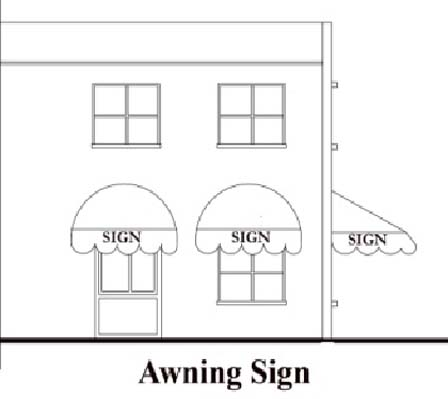
Awning sign: Any metal, canvas or plastic cover, hood, or canopy projecting from and supported by a building when such device extends beyond the building, building line, setback line or property line.
Banner sign: Signs either with or without frames, possessing characters, letters, illustrations or ornamentations applied to cloth, paper or fabric of any kind. For the purposes of this ordinance national flags, flags of political subdivision and symbolic flags of any institution or business shall not be considered banners. See Promotional Signs definition.
Billboard sign: Any outdoor advertising sign upon which advertising matter may be displayed and which generally advertises firms and organizations that, along with their goods and services, are not located on the same premises as the sign.
Canopy sign: Any sign installed on any ornamental roof-like structures of cloth or otherwise that provides or suggests shelter and projects from a wall or is supported by columns; or any temporary or permanent cover providing shelter or decoration (as over a door or window), including an awning.
Changeable copy sign: Any poster board, bulletin board, billboard, sign, screen, surface or wall, with characters, letters or illustrations affixed thereto or thereon, by any method or means whatsoever, that can be changed, rearranged or altered without changing the face of the poster board, bulletin board, sign, screen, surface or wall. Animated/electronic signs shall not be considered changeable copy signs for the purposes of this definition.
Cluster sign: See Off-Site Municipal Directory Sign.
Commemorative signs: Signs for commemoration of seasonal holidays.
Construction sign: A sign announcing and identifying the construction project scheduled or underway on the site where the sign is located.
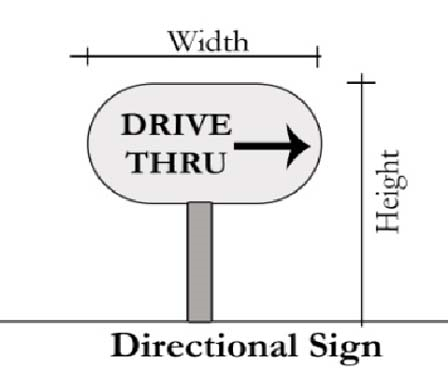
Directional sign: Any sign intended to provide direction of the public, including signs which direct traffic onto or within a premises, identify restrooms, parking areas or spaces, freight entrances, or other facilities for the convenience of the public.
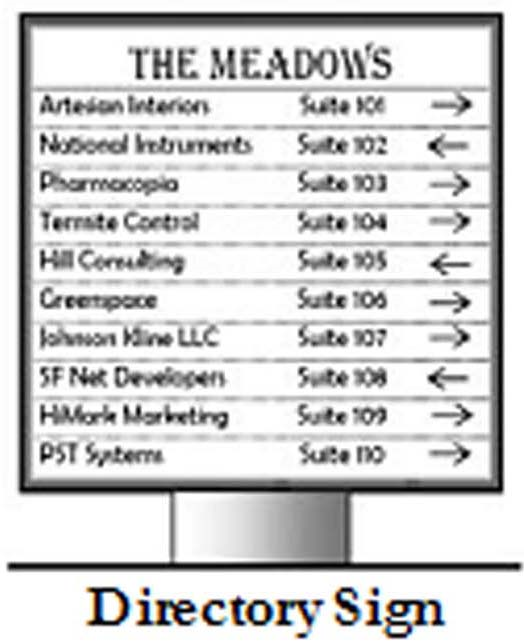
Directory sign: A sign that provides a listing of the occupants of a multi-tenant center and their suite/building numbers. Directory signs are not intended to be visible from the public right-of-way but to give direction to customers already within the site.
Double faced sign: A sign with two (2) faces that are no more than three (3) feet apart at their closest point, or that are placed at an angle of thirty degrees (30 o ) or less (see definition of V-shape sign).
Fascia sign: A sign located on the fascia of a roof or canopy, or affixed to the front plane of a mansard roof that is a maximum of thirty (30) degrees from vertical, including signs that extend the plane of the structural fascia such that the vertical dimensions of the sign is no more than one third (⅓) the distance from the ground to the bottom of the fascia and no lateral supports are used.
Flashing sign: Shall mean a sign or any part thereof, the electrical lighting device or devices of which go on and off alternately.
Freestanding sign: A sign supported by a sign structure in the ground and which is wholly independent of any building, fence, vehicle or object other than the sign structure for support. The term includes monument and pole signs.
Ground sign: See Sign, Freestanding.
Identification sign: A sign that indicates the name and type of business or service, or the name of the development located on the site where the sign is located.
Illuminated sign: A sign that uses artificial light, either internal or external to the sign faces, to draw attention to the sign or otherwise increase its visibility.
Instructional sign: A sign conveying non-advertising information relating to the use of the premises, such as no parking, no trespassing and warning signs.
Lighted sign: Any sign whose characters, letters, figures, designs, or outlines are affixed thereto and which is illuminated by an electric light or luminous tubes constituting an integral part of the sign proper, or fixed ground mounted lights directed at the sign.
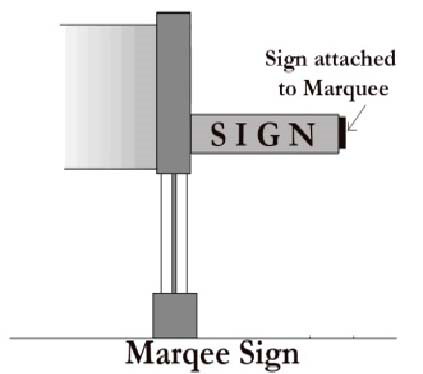
Marquee sign: A projecting sign attached to or hung from a marquee and such marquee shall be known to mean a canopy or covered structure projecting from and supported by a building, when such canopy or covered structure extends beyond the building, building line or property line.
Membership sign: A sign identifying affiliation with a travel club, business association, credit card company, or professional association.
Memorial sign: A permanent sign, plaque, inscription or similar group of symbols recording historical data relating to the construction of the building to which it is affixed or a sign which commemorates events or persons of historical significance.
Menu board: A wall sign designed and intended to provide information about the menu served in a restaurant.
Monopoly sign: Any sign erected on a single pole, and which is wholly or partially independent of any building for support.
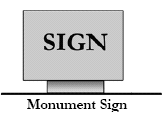
Monument sign: A freestanding sign which is in contact with or in close proximity, to the ground for about forty (40) percent of the sign width.
Non-conforming sign: Any sign which is in violation of this Code at the time of its effective date.
Off-premises sign: Any sign or street graphic (other than a vehicle street graphic or a governmental public service street graphic) which advertises a business, goods, products, services or facilities which are not manufactured, produced, sold, provided, or located on the premises on which the sign or street graphic is erected or maintained, or a sign or street graphic which directs persons to a different location than the one on which the sign or street graphic is erected or maintained.
On-premises sign: Any structure, poster board, bulletin board, neon sign, screen, surface or wall with characters, letters or illustrations affixed thereto, thereon, or thereunder, by any method or means whatsoever, which is used for the purpose of publicly advertising the legal or exact firm or organization name or the name of the business carried on therein or thereat, or for advertising any service or product actually and actively being offered for sale therein or thereon; but shall not include street or directional signs, occupancy identification signs, or real estate signs.
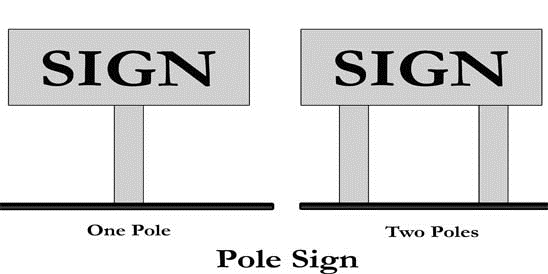
Pole sign: A freestanding sign supported by one (1) or two (2) poles, columns, or other fabricated support member without any type of secondary support. Pole/pylon signs typically provide clear view between the sign and the ground.
Political sign: Any sign used solely to present information suggesting a candidacy for elected public office or presenting an issue to be voted upon in the upcoming election.
Portable sign: Any sign not permanently affixed to a permanent base, whether on its own trailer, wheels, or otherwise, which is capable of being transported from one place to another.
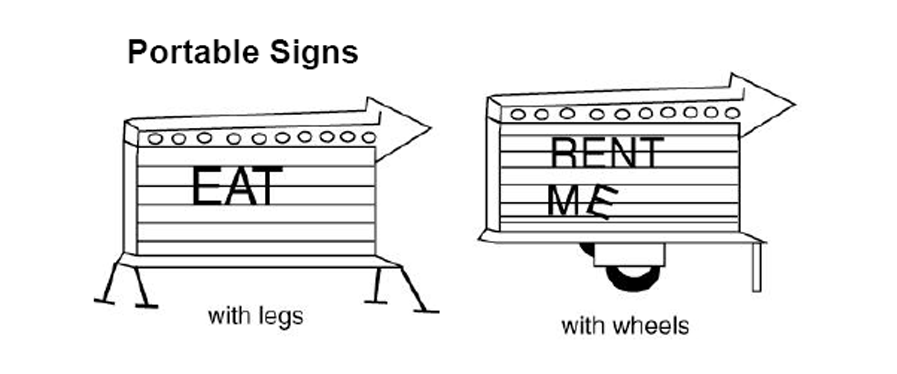
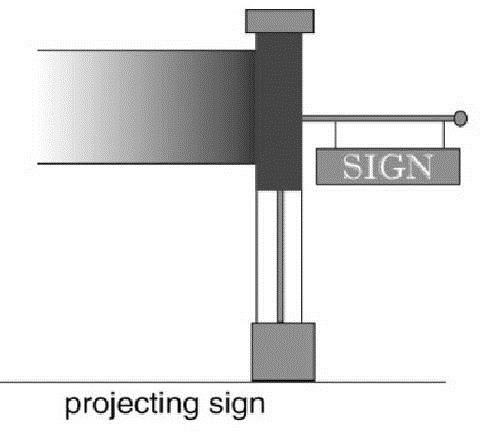
Prohibited sign: Any type sign which is prohibited in a particular zoning district or in the Town at large.
Projecting sign: An outdoor advertising display sign which is affixed to any building wall or structure and extends beyond the building wall, structure, building line or property line more than twelve (12) inches.
Promotional sign: A sign designed and intended to attract attention to a commercial establishment, advertise a special promotion or holiday, or a special activity such as a grand opening or going-out-of-business.
Public information sign: Any sign located wholly on public property and used for public information or direction.
Real estate sign: Any structure, device, display board, screen, surface or wall, with characters, letters or illustrations placed thereto, thereon, or thereunder, by any method or means whatsoever, where the matter displayed shall be used solely for the purpose of offering for sale, lease, or for rent the exact property upon which the sign is placed.
Roof-mounted sign: A sign erected over or on, and wholly or partially dependent upon the roof of any building for support, or attached to the roof in any way. Includes any appurtenance or equipment attached to any building in such a manner that the height of the appurtenance or equipment exceeds the height of the wall elevation of the structure.
Sandwich sign: A freestanding, portable, two-sided sign that is connected at the top, open at the bottom, and forms an inverted "V" when viewed from the side.
Shopping center sign: Shopping center identification/directory sign located on the shopping center site and limited to the names of the center and/or the names of occupants of the center.
Sign area: The total surface of the sign including the background and frame but not structural supporting elements outside the frame.
Sign face: Any plane, surface, curve or other area containing a sign.
Sign height: The distance between the top of a sign and the average grade elevation below it, or centerline grade of the adjacent roadway, whichever is less.
Sign structure: The uprights, supports, braces and framework supporting a sign.
Snipe sign: Any small sign of any material, including paper, cardboard, wood and metal, which does not apply to premises where it is located, or which is attached to a tree, shrub or utility pole.
Special event: A sign which announces or advertises temporary activities fairs, carnivals, circuses, revivals, or sporting, charitable or educational events.
Subdivision entrance sign: Any sign designed either as a temporary or permanent structure to identify the subdivision, neighborhood, apartment or condominium development or commercial complex but which shall not be designed or displayed for development or promotional purposes and shall not contain or be more than a single purpose sign.
Temporary sign: Any sign intended to be displayed for a limited period of time.
Trivision: A billboard sign having two (2) or more moveable, motor-driven faces which alternate at brief intervals.
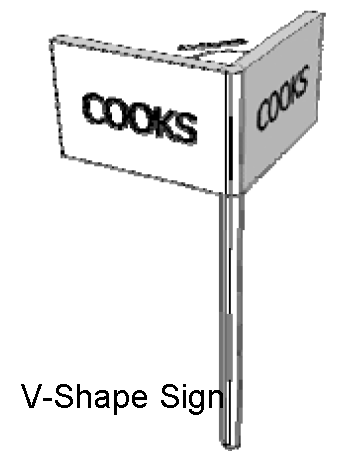
V-shape sign: A sign with two (2) faces forming a 'V' shape with an angle that exceeds thirty degrees (30 o ).
Wall sign: Any sign installed parallel to and flush against the face of the outside wall of a building, supported by the building and which has only one (1) advertising surface.
Window sign: A permanent sign affixed to, suspended within three (3) feet behind or painted on either face of a window or glass door that leads to the exterior of the building.
Silviculture: A process, following accepted forest management principles, whereby forests constituting crops are tended, harvested, and reforested.
Site: Any tract, lot, or parcel of land or combination of tracts, lots, or parcels of land which is in one ownership, or contiguous and in diverse ownership, where development is to be performed as part of a unit, subdivision, or project.
Skilled nursing facility: A facility which provides nursing, personal, custodial, and rehabilitative care. Skilled nursing facilities are freestanding, which means they are not part of a hospital. Skilled nursing facilities are licensed and surveyed by the State of Florida.
Special flood hazard area: An area in the floodplain subject to a one percent or greater chance of flooding in any given year. Special flood hazard areas are shown on FIRMs as Zone A, AO, A1-A30, AE, A99, AH, V1-V30, VE or V. [Also defined in FBC, B Section 202]
Spill: The unpermitted release or escape of a hazardous substance, directly or indirectly to soils, surface waters or ground waters.
Start of construction: The date of issuance of permits for new construction and substantial improvements, provided the actual start of construction, repair, reconstruction, rehabilitation, addition, placement, or other improvement is within one hundred eighty (180) days of the date of the issuance. The actual start of construction means either the first placement of permanent construction of a building (including a manufactured home) on a site, such as the pouring of slab or footings, the installation of piles, the construction of columns. Permanent construction does not include land preparation, such as clearing, grading, and filling; nor does it include the installation of streets and/or walkways; nor does it include excavation for a basement, footings, piers or foundations or the erection of temporary forms; nor does it include the installation on the property of accessory buildings, such as garages or sheds not occupied as dwelling units or not part of the main building. For substantial improvement, the actual start of construction means the first alteration of any wall, ceiling, floor, or other structural part of a building, whether or not that alteration affects the external dimensions of the building [Also defined in FBC, B Section 202].
State water quality standards: Criteria set forth in Chapter 17-3 of the Florida Administrative Code as the minimum levels of ambient water quality parameters permissible in surface and groundwater to protect the designated uses of these waters.
Storage system: Any one (1) or combination of tanks, sumps, wet floors, waste treatment facilities, pipes, vaults, or other portable or fixed containers used, or designed to be used, for the storage of hazardous substances at a facility.
Storefronts: The type of facade a Commercial style building would have at the street level. Storefronts emphasize transparency, and normally include large display windows with framing; a recessed entrance; a cornice or a horizontal sign panel at the top of the storefront to separate it from the upper facade; and, low bulkheads at the base to protect the windows and define the entrance.
Storm cellar: A place below grade used to accommodate occupants of the structure and emergency supplies as a means of temporary shelter against severe tornadoes or similar windstorm activity.
Storm event: The storm of a specific duration, intensity and frequency.
Stormwater management system/facilities: The designed or constructed features of the property which collect, convey, channel, store, inhibit, or divert the movement of stormwater.
Stormwater runoff: The flow of water which results from and which occurs during and immediately following a rainfall event.
Streetwall: A low, solid or semi-solid wall that provides a defined urban edge along an alley or street.
Structure: A walled and roofed building that is principally above ground, a manufactured home, a gas or liquid storage tank that is principally above ground, utility shed or other man-made facilities or infrastructures.
Subdivision entrance sign: Any sign designed either as a temporary or permanent structure to identify the subdivision, neighborhood, apartment or condominium development or commercial complex but which shall not be designed or displayed for development or promotional purposes and shall not contain or be more than a single purpose sign.
Substantial damage: Damage of any origin sustained by a building or structure whereby the cost of restoring the building or the structure to its before damage condition would equal or exceed fifty (50) percent of the market value of the building or structure before the damage occurred. [Also defined in FBC, B Section 202] (as it relates to the Floodplain Management Ordinance).
Substantial improvement: Any combination of repairs, reconstruction, rehabilitation, addition or improvements to a building or structure, taking place during a three (3) year period, in which the cumulative cost equals or exceeds fifty (50) percent of the market value of the building or structure before the improvement or repair is started. For each building or structure, the three (3) year period begins on the date of the first improvement or repair of that building or structure subsequent to the effective date of the Floodplain Management Ordinance. If the structure has sustained substantial damage, any repairs are considered substantial improvement regardless of the actual repair work performed. The term does not, however, include:
1)
Any project for improvement of a building required to correct existing health, sanitary or safety code violations identified by the Building Official and that are the minimum necessary to assure safe living conditions.
2)
Any alteration of a historic structure, provided that the alteration will not preclude the structure's continued designation as a historic structure.
Swale: An artificial waterway which has side slopes equal to or flatter than three (3) feet horizontal to one (1) foot vertical.
Sweepstakes: Establishments housing simulated gaming devices defined as any device that, upon connection with an object, is available to play or operate a computer simulation of any game, and which may deliver or entitle the person or persons playing or operating the device to a payoff.
Swimming pool: Any constructed pool over twenty-four (24) inches in depth or with a surface area exceeding two hundred fifty (250) square feet used for swimming.
Tailwater: The water into which a spillway or outfall discharges.
Tattoo parlor: An established place of business for creating tattoos and sometimes also piercings. An established business where tattoo artists apply permanent marks or designs on the skin by a process of pricking and ingraining an indelible pigment or by raising scars, for artistic, ritualistic or other reasons.
Taxidermy: The technique of preparing lifelike representations of animals by stuffing the skin or molding it around a model of the specimen.
Tenant: One who is in possession of a premises under title, lease, or rental plan. Such premises, for purposes of this Code, is referred to as a tenant space.
Towing service: An establishment primarily engaged in the towing and storage of vehicles. This term does not include the storage of inoperable vehicles for more than twenty-four (24) hours.
Town: The Town of Lady Lake, Florida.
Townhouse: A one-family dwelling in a row of at least three (3) such units in which each unit has its own front and rear access to the outside, no unit is located over another unit, and each unit is separated from any other unit by one or more common fire resistant walls.
Translucent: A material that admits diffused light so that objects beyond cannot be clearly distinguished. Examples include: tinted glass, smoked glass and glass block.
Transparent: A material that admits light without appreciable diffusion or distortion so that objects beyond are entirely visible. Examples include: clear glass and Plexiglas.
Transportation service: An establishment which provides transportation for animals, automobiles and other motor vehicles, or persons, and may include, but not be limited to, air ambulance, airport and motel transport, armored car security transport, boat transport, bus line service, horse and pet transport, and limousine service. The parking and storing of vehicles associated with the business shall occur on the premises.
Tree: Any living, self-supporting, woody perennial plant which has a trunk diameter of at least three-quarter (¾) inches and is normally grown to an overall height of a minimum of fifteen (15) feet.
Trucking terminal: Land or buildings where trucks, including tractor or trailer units, are parked, stored, or serviced (to the extent permitted at a Motor Vehicle Service Center) including the transfer, loading or unloading of goods. A trucking terminal may include facilities for the temporary storage of loads prior to transshipment, and may include, but not be limited to, businesses of armored truck delivery and pick up, freight forwarding, motor freight and local cartage trucking, and parcel shipping.
Unconfined aquifer: A permeable bed only partly filled with water and overlying a relatively impervious layer. Its upper boundary is formed by a free water table or phreaetic level under atmospheric pressure.
USACOE (or ACOE): The United States Army Corp. of Engineer.
Use: Function, purpose or service.
Used motor vehicle parts yard: Land on which inoperative motor vehicles and parts are stored, salvaged, or sold.
Variance: A grant of relief from the requirements of this Code which permits construction in a manner otherwise prohibited by this Code where the specific enforcement would result in unnecessary hardship.
Variance: As it relates to the Floodplain Management Ordinance, a grant of relief from the requirements of this ordinance, or the flood resistant construction requirements of the Florida Building Code, which permits construction in a manner that would not otherwise be permitted by this ordinance or the Florida Building Code.
Vehicular use area: An area used for circulation, parking and/or display of motorized vehicles.
Veterinary clinic: An establishment for the medical and surgical treatment of sick or injured animals, where limited overnight facilities are provided in association with such treatment. This term may include, but not be limited to, veterinarian office, veterinary hospital, and animal clinic, but shall not include the term kennel.
Water conservation plan: A combination of goals, objectives, methods, and an implementation schedule of actions specifically designed to maximize water use efficiency.
Water management district: The St. Johns River Water Management District.
Water table: That surface of a body of unconfined ground water at which the pressure is equal to that of the atmosphere; defined by the level at which water within an unconfined aquifer stands in a well that penetrates the aquifer far enough to hold standing water.
Waterbody: Any natural or artificial pond, lake, reservoir, or other area which ordinarily or intermittently contains water and which has a discernible shoreline.
Watercourse: A river, creek, stream, channel or other topographic feature in, on, through, or over which water flows at least periodically.
Weir: An obstruction placed in a stream, channel or other discharge point which diverts the water through a prepared aperture for controlling the rate of flow.
Well: Any excavation that is drilled, cored, bored, washed, driven, dug, jetted, or otherwise constructed when the intended use of such excavation is for the location, acquisition, or artificial recharge of ground water, but such term does not include any well for the purpose of obtaining or prospecting for oil, natural gas, minerals, or products of mining or quarrying, for inserting media to dispose of oil brines or to repressure oil-bearing or natural gas-bearing formations or for storing petroleum or natural gas or other products or for temporary dewatering of subsurface formation for mining, quarrying or construction purposes.
Wellfield: An area of land which contains or is designated for future use for one or more potable water supply wells.
Wet detention: A detention basin, designed to specific geometric criteria that contains a permanent pool of water that will retain runoff for a minimum number of days for an average rainfall summer, and which may have a littoral zone required over a substantial portion of the pond surface area. The specific design criteria is as described in SJRWMD Stormwater Rule Chapter 40C-42.
Wetlands: Lands which are identified by being inundated or saturated by surface water or ground water at a frequency and duration sufficient to support, and that under normal circumstances do or would support, a prevalence of vegetation typically adapted for life in saturated soil conditions. The definition includes all contiguous and non-contiguous or isolated wetlands to waters, water bodies, and watercourses. Wetlands include, but are not limited to, swamp hammocks, hardwood hybrid hammocks, riverine cypress, cypress ponds, bayheads, bogs, wet prairies, and freshwater marshes. Dominant wetland vegetation shall be determined as provided in Rule 17-3.022, Florida Administrative Code, or as amended.
Wheel stops or curbs: Permanently secured, durable devices no less than four (4) inches in height, designed to restrict vehicular encroachment.
Wholesalers and distributors: An establishment engaged in the storage, wholesale, and distribution of manufactured projects, supplies, and equipment, and incidental retail sales, exclusive of bulk storage of materials that are flammable or explosive or that create hazardous or commonly recognized offensive conditions.
Xeriscape: A set of horticultural principles which promote quality landscapes and the efficient use of water through the protection of existing vegetation, the use of appropriate plant material, the grouping of plants according to similar water requirements and other techniques. "Xeriscape" is a registered trademark of the National Xeriscape Council.
Xeriscaping: A landscaping method that maximizes the conservation of water by using an efficient irrigation system and site-adapted plants.
Yard: The open space between the primary structure and lot line that may include pavement, landscaping, accessory structures or other improvements as allowed by this Code. The terms front, side and rear yards refer to the yards adjacent to the front, side and rear property lines.
Yard, Front: A yard extending the full width of a lot between any building and front lot line.
Yard Line: A line drawn parallel to a lot line at a distance equal to the minimum front, side or rear setback in the case of a front, side or rear yard, respectively.
Yard, Rear: A yard extending across the full width of a lot between any building and the rear lot line, measured perpendicular to the rear lot line.
Yard, Required: A yard between a lot line and the setback line or building line within which no structure shall be located except as provided in the zoning ordinance.
Yard, Side: A yard extending from the front yard to the rear yard between any building and the side lot line measured perpendicular to the side lot line.
Zone of contribution: The area surrounding a pumping well that encompasses all areas or features that supply recharge to the well.
(Ord. No. 2012-04, § 1(Exh. B), 11-5-2012; Ord. No. 2012-08, § 1(Exh. A), 5-7-2012; Ord. No. 2014-05, § 1(Exh. A), 8-4-2014; Ord. No. 2016-44, § 1(Exh. B), 2-6-2017; Ord. No. 2022-03, § 1, 6-20-2022)
Editor's note— Ord. No. 2012-04, § 1, Exhibit B, adopted Nov. 5, 2012, repealed § 2-2, in its entirety and enacted new provisions to read as herein set out. Prior to this amendment, § 2-2 pertained to similar subject matter. See Code Comparative table for derivation.

