
Lady Lake City Zoning Code
CHAPTER 7
SITE DEVELOPMENT PLAN REGULATIONS
Sec. 7-1.- Purpose and intent.
The purpose of this chapter is to establish uniform requirements and procedures for reviewing applications for site plan approval. It is further the intent of this chapter to establish procedures and standards to implement the goals and policies of the Town of Lady Lake Comprehensive Plan and to ensure compliance with the intent, standards and procedures of all applicable land development regulations.
(Ord. No. 2009-05, § 1(Exh. A), 4-20-2009; Ord. No. 2010-15, § 1(Exh. A), 8-2-2010)
Sec. 7-2. - Applicability.
All construction, including site improvements (except those required to meet Subdivision regulations), building improvements for new structures, increases in the size of a structure, or changing the use of a structure, shall be required to comply with the requirements of this chapter; except where exempted in the Developmental Procedures and Regulations chapter.
(Ord. No. 2009-05, § 1(Exh. A), 4-20-2009; Ord. No. 2010-15, § 1(Exh. A), 8-2-2010)
Sec. 7-3. - Designation of plans as major or minor development.
For purposes of review and approval under the Code, all plans shall be designated as minor development or major development as outlined below:
a)
Major development. A development plan shall be designated as a major development if it meets one or more of the following criteria:
1)
The plan proposes the development of seven (7) or more dwelling units; or
2)
The plan proposes the development of two thousand (2,000) or more square feet of non-residential floor space; or
3)
The plan proposes to add more than forty (40) percent new impervious area to that which is already existing on the site; or
4)
The plan meets the requirement for Conceptual Plan submittal for rezoning to either a PFD or PUD district; or
5)
The plan is part of a larger development proposal or poses special development issues that, in the opinion of the Town Manager, require the additional review of a major development; or
6)
Where two (2) or more minor site plan requests or administrative approval requests for a single project area/site have been submitted and approved over any one (1) year period, the Town Manager may require any subsequent request to be reviewed pursuant to the criteria of a major development.
b)
Minor development. A development plan shall be designated as a minor development if it fails to meet the criteria for major development.
c)
Exemptions.
1)
Single-family and duplex dwelling units or minor appurtenances thereto, such as residential swimming pools, fences, yard, etc. are exempt from site plan review.
2)
The construction of an accessory structure not exceeding two hundred (200) square feet on a non-residential lot previously granted site plan approval.
3)
ADA accessibility improvements on non-residential lots.
(Ord. No. 2006-77, § 1B.(Exh. B), 12-22-2006; Ord. No. 2009-05, § 1(Exh. A), 4-20-2009; Ord. No. 2010-15, § 1(Exh. A), 8-2-2010)
Sec. 7-4. - Parking requirements.
a)
General provisions.
1)
Off-street parking required. Off-street parking facilities shall be provided for all development within the Town pursuant to the requirements of this Code. The facilities shall be maintained as long as the use exists that the facilities were designed to serve.
2)
Computation.
A)
Fractional spaces. When the number of off-street spaces required by this Code results in a fractional space, the fraction shall be counted as one (1) parking space.
B)
Fixed seats and assembly areas. In cases where a place of assembly has both fixed seats and open assembly area, requirements shall be computed separately for each type and added together.
C)
Benches. In stadiums, sports arenas, churches, and other places of assembly in which those in attendance occupy benches, pews or other similar seating facilities, each twenty (20) inches of seating facilities shall be counted as one (1) seat.
D)
Gross floor area. Unless otherwise stated herein, square feet shall be defined as gross floor area. Gross floor area shall be the sum of the gross horizontal area of all floors of a building measured from the exterior faces of the exterior walls.
b)
Required off-street parking spaces.
1)
Minimum requirements. The matrix below specifies the required minimum number of off-street motor vehicle and bicycle parking spaces and, in the notes, any special requirements that may apply.
2)
Uses not listed. The number of parking spaces required for uses not listed in the matrix shall be determined by the Town based upon information provided by the applicant and the current ITE Parking Generation Manual. Applicable information shall include requirements for similar uses and appropriate traffic engineering and planning data necessary to establish a minimum number of parking spaces based upon the principles of this Code.
3)
Multiple uses. Where a combination of uses is proposed for development, parking shall be provided for each of the uses as prescribed by the matrix unless a reduction is granted as specified later in this section.
4)
Matrix.
c)
Special parking spaces.
1)
Parking for handicapped persons. Any parking area to be used by the general public shall provide suitable, marked parking spaces for handicapped persons. The number, design and location of these spaces shall be consistent with the requirements of the applicable Florida Statutes or succeeding provisions. Parking spaces required for the handicapped may be counted as parking spaces in determining compliance with this chapter. All spaces for the handicapped shall be paved.
2)
Compact spaces. Compact parking spaces are prohibited.
3)
Bicycle parking. Bicycle racks or other acceptable bicycle parking devices shall:
A)
Be designed to allow each bicycle to be supported by its frame.
B)
Be designed to allow the frame and wheels of each bicycle to be secured against theft.
C)
Be anchored to resist removal and solidly constructed to resist damage by rust, corrosion, and vandalism.
D)
Be located to prevent damage to bicycle by cars.
E)
Be located in convenient, highly-visible, active, well-lighted areas.
F)
Be located so as not to interfere with pedestrian movements.
G)
Be located as near the principal entrance of the building as practical.
H)
Provide safe access from the spaces to the right-of-way or bikeway.
I)
Computation for requirement must meet the minimum of one space - not fractions.
d)
Adjustments to requirements.
1)
Vehicle parking deferral.
A)
To avoid requiring more parking spaces than actually needed to serve a development, the Town may defer the provision of some portion of the off-street parking spaces required by this Code if previous experience within the Town for such a use or information supplied by the developer suggests that the required number of parking spaces may not be necessary. In such a case, the developer shall provide a deferred parking plan in accordance with criteria below.
B)
A deferred parking plan:
1)
Shall be designed to contain sufficient space to meet the full parking requirements of this Code, shall illustrate the layout for the full number of parking spaces, and shall designate which are to be deferred.
2)
Shall not assign deferred spaces to areas required for landscaping, transition zones, setbacks, or areas that would otherwise be unsuitable for parking spaces because of physical characteristics of the land or other requirements of this Code.
3)
Shall include a landscaping plan for the deferred parking area.
4)
Shall include a written agreement with the Town that, one (1) year from the date of issuance of the certificate of occupancy, the deferred spaces will be converted to parking spaces that conform to this Code at the developer's expense should the Town determine from experience that the additional parking spaces are needed.
5)
Shall include a written agreement that the developer shall incur the expense of a traffic study to be undertaken by a registered transportation engineer to determine the advisability of providing the full parking requirement should the Town determine from experience that the additional parking spaces are needed.
C)
Upon a preliminary finding that the parking is inadequate, but not sooner than one (1) year after the date of issuance of the certificate of occupancy for the development, the Town shall request a study to determine the need for providing the full parking requirement to satisfy the observed demand for parking as discussed above.
D)
Based upon the study and the recommendations of the transportation engineer and the Town Manager, the Town shall determine if the deferred spaces shall be converted to operable parking spaces by the developer or retained as deferred parking area.
E)
The developer may at any time request that the Town approve a revised development plan to allow converting the deferred spaces to operable parking spaces.
2)
Bicycle parking deferral. The Town may authorize deferral of required bicycle parking spaces when the nature of the use, information supplied by the developer or previous experience for similar uses in the Town suggests that the bicycle parking is not necessary. The developer shall note on the development plan the number and location of spaces to be deferred and an obligation to provide the bicycle parking when its need has been determined by the Town. Deferred bicycle parking spaces shall comply with requirements of this Code at the time of installation.
3)
Reduction for mixed or joint use of parking spaces. The Town may authorize a reduction in the total number of required parking spaces for two or more uses jointly providing off-street parking when their respective hours of need of maximum parking do not normally overlap. Reduction of parking requirements because of joint use may be approved if the following conditions are met:
A)
The developer submits sufficient data to demonstrate that hours of maximum demand for parking at the respective uses do not normally overlap.
B)
The developer submits a legal instrument approved by the Town Attorney guaranteeing the joint use of the off-street parking spaces as long as the uses' required parking are in existence or until the required parking is provided elsewhere in accordance with the provisions of this Code.
C)
The structures and facilities provided for one or both of the uses are specialized to the degree that no change in use resulting in greater parking demand could take place without expensive reconstruction necessitating a development permit and development plan review.
D)
If the properties are under separate ownership and control, a written easement and agreement shall be recorded at the applicant's expense specifying the conditions of such joint use. This agreement shall be approved by the Town Attorney.
(Ord. No. 2009-05, § 1(Exh. A), 4-20-2009; Ord. No. 2010-15, § 1(Exh. A), 8-2-2010)
State Law reference— Provisions required to ensure safe and convenient on-site traffic flow, considering needed vehicle parking, F.S. § 163.3202(2)(a).
Sec. 7-5. - Loading areas.
Spaces to accommodate off-street loading of business vehicles shall be provided as required below.
(Ord. No. 2009-05, § 1(Exh. A), 4-20-2009; Ord. No. 2010-15, § 1(Exh. A), 8-2-2010)
Sec. 7-6. - Design standards for off-street parking and loading areas.
a)
Location.
1)
Except as provided herein, all required off-street parking spaces and the use they are intended to serve shall be located on the same parcel.
2)
The Town may approve a special exception for off-site parking facilities as part of the parking required by this Code if:
A)
The location of the off-site parking spaces will adequately serve the use for which it is intended. The following factors shall be considered:
1)
Proximity of the off-site spaces to the use that they will serve.
2)
Ease of pedestrian access to the off-site parking spaces.
3)
Whether off-site parking spaces are compatible with the use intended to be served, e.g., off-site parking is not ordinarily compatible with high turnover uses such as retail.
B)
The location of off-site parking spaces will not create unreasonable:
1)
Hazards to pedestrians.
2)
Hazards to vehicular traffic.
3)
Traffic congestion.
4)
Interference with access to other parking spaces in the vicinity.
5)
Detriment to any nearby use.
C)
The developer supplies a written agreement or attaches off-site parking by deed to the parcel to which such parking is designed to serve, approved in form by the Town Attorney, assuring the continued availability of the off-site parking facilities for the use they are intended to serve.
3)
All parking spaces required by this Code for residential uses should be located no further than the following distances from the units they serve:
Resident parking: One hundred (100) feet
Visitor parking: One hundred fifty (150) feet
Distances shall be measured from the dwelling unit's entry to the parking space. Where a stairway or elevator provides access to dwelling units, the stairway or elevator shall be considered to be the entrance to the dwelling unit. For purposes of measuring these distances, each required parking space shall be assigned to a specific unit on the development plan, whether or not the developer will actually assign spaces for the exclusive use of the specific unit.
4)
Each required loading space shall be accessible to street, service drive, or alley in a manner that will not interfere with the movement of vehicles passing the loading space.
5)
No loading space shall be located so that a vehicle must back onto a public street or extend into any street right-of-way while being loaded or unloaded.
b)
Size.
1)
Parking spaces.
A)
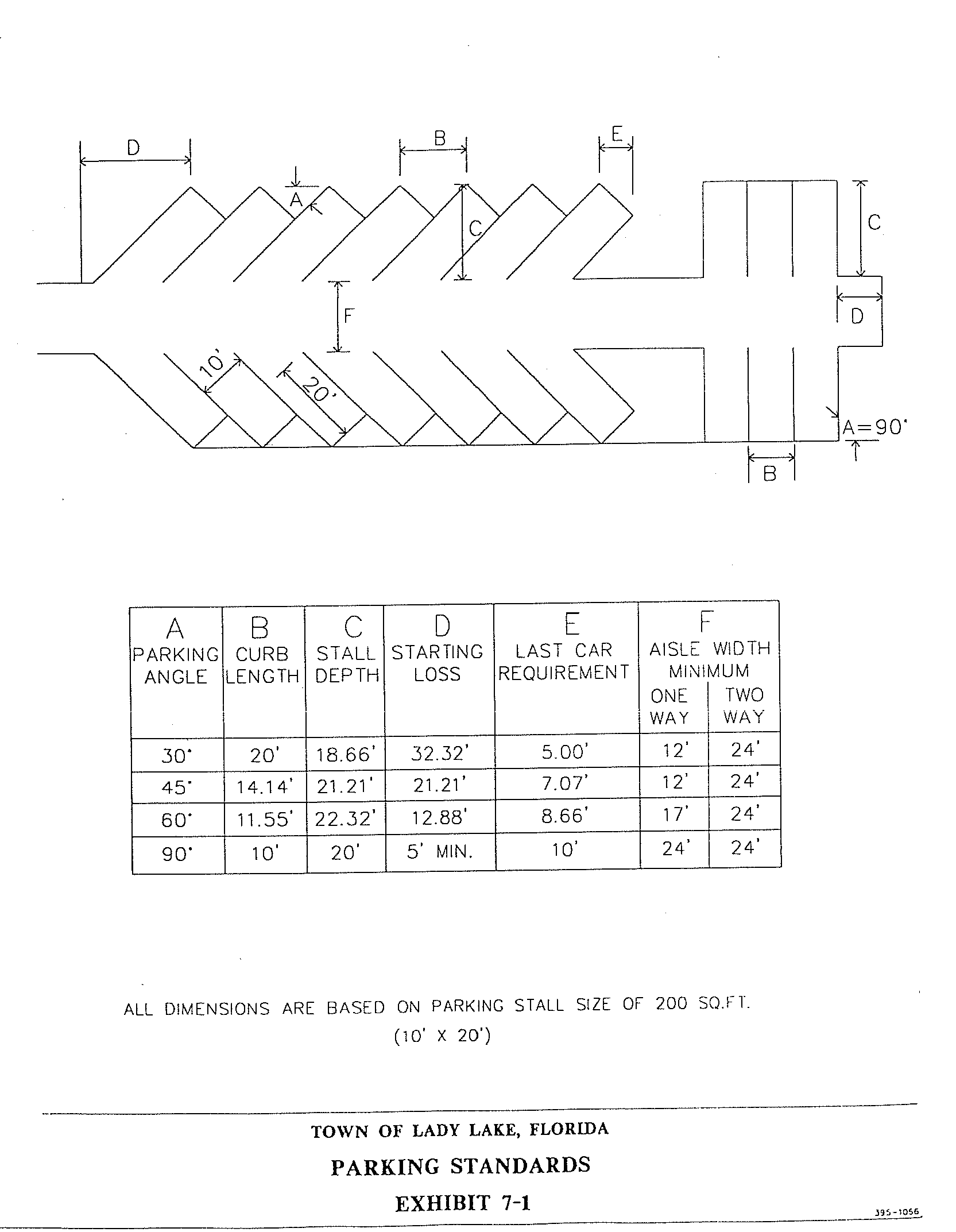
A standard parking space shall be ten (10) feet wide and twenty (20) feet long.
B)
Parallel parking spaces shall be a minimum of ten (10) feet wide and twenty-two (22) feet long.
C)
A standard motorcycle parking space shall be four and one-quarter (4¼) feet long.
D)
Spaces for handicapped parking shall be the size specified by the applicable Florida Statutes.
E)
A tandem parking space is a parking space that abuts a second parking space in such a manner that vehicular access to the second space can be made only through the abutting (tandem) space. Tandem parking spaces shall be a minimum of eight (8) feet wide and twenty (20) feet long, and may only be used for residential uses in accordance with requirements of this chapter.
2)
Loading spaces. The standard off-street loading space shall be twelve (12) feet wide, twenty-five (25) feet long, provide vertical clearance of fifteen (15) feet, and provide adequate area for maneuvering, ingress and egress. The Town may require the length of one (1) or more of the loading spaces to be increased up to fifty-five (55) feet if full-length tractor trailers are anticipated to be accommodated. Developers may install spaces that are larger than the standard, but the number of spaces shall not be reduced on that account. Other provisions may be approved by the SRP.
c)
Layout.
1)
General requirements.
A)
Roadways, driveways, off-street parking and loading areas and pedestrian and bicyclist circulation facilities shall be designed to be safe and convenient.
B)
Parking and loading areas, aisles, pedestrian walks, bikeways, landscaping, and open space shall be designed as integral parts of an overall development plan and shall be properly related to existing and proposed buildings.
C)
Buildings, parking and loading areas, landscaping and open space shall be designed so that pedestrians moving from parking areas to buildings and between buildings are not unreasonably exposed to vehicular traffic.
D)
Each off-street parking space shall open directly onto an internal aisle or driveway that, except for single family and two family residences, is not a public or private street or easement.
E)
Aisles and driveways shall not be used for parking vehicles, except that the driveway of a single family or two family residence or townhouse with an attached garage shall be counted as a parking space for the dwelling unit, or as a number of parking spaces as determined by the Town based on the size and accessibility of the driveway.
F)
The design shall be based on a definite and logical system of drive lanes to serve the parking and loading spaces. A physical separation or barrier, such as vertical curbs, may be required to separate parking spaces from travel lanes.
G)
Parking spaces for all uses, except single family and two family residences and townhouse units with attached garages, shall be designed to permit entry and exit without moving any other motor vehicles.
H)
No parking space shall be located so as to block access by emergency vehicles.
I)
Dead end aisles with adjoining parking spaces shall have an extension of the aisle a minimum of five (5) feet beyond the last space to provide for vehicular maneuvering.
J)
Perpendicular ninety degree (90º) parking along all easements, streets, roads, and highways is prohibited.
K)
On-street parking shall be parallel or divided from the easement, street, road or highway via curbed landscaping aisles with diagonal forty-five degree (45º) parking.
2)
Reductions in required width and length may be permitted under the following conditions. Such reductions shall be utilized to reduce pavement area or preserve significant trees or vegetation.
A)
Reduced width. An unlimited number of spaces may be approved by Commission to be reduced to nine (9) feet wide for the reduction of pavement area or, to preserve existing significant trees or vegetation.
B)
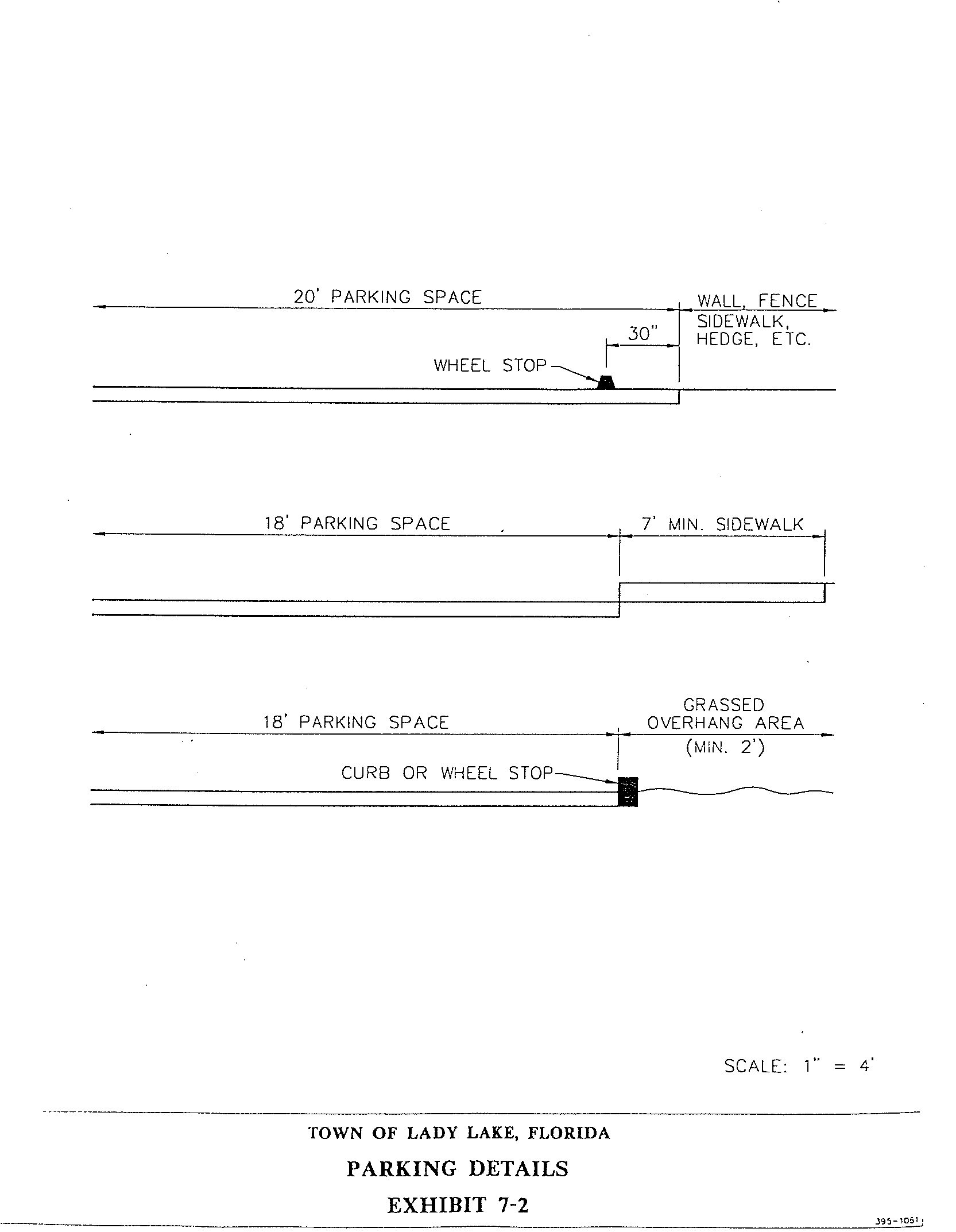
Reduced length. Designers are encouraged to reduce paved areas by reducing the length of standard parking spaces to eighteen (18) feet of pavement with two (2) feet of grassed overhang area. Continuous curbing or wheel stops shall be used at the end of the eighteen (18) foot dimension.
d)
Grass parking. Designers are encouraged to provide grassed overflow parking areas where the number of spaces desired is greater than the Code minimums. Additionally, those uses that anticipate less parking demand than the Code minimum requires may utilize grassed overflow parking areas for up to twenty-five (25) percent of the requirements for general office, commercial, and industrial uses, and up to fifty (50) percent for recreational or institutional uses with weekly or less frequent peak demand. The provision for grassed parking to satisfy minimum parking requirements shall comply with the following standards:
1)
Grassed parking shall be shown on the development plan. Stormwater, landscaping, buffer, setback and other applicable provisions of this Code shall be complied with as though the area was being paved.
2)
No grassed parking area shall be established within any required open space or landscape area, and no such area shall be credited toward required buffers and landscaping.
3)
Grass may be substituted with bark, gravel or other similar material provided such material is a minimum of two (2) inches deep, placed upon porous weed barrier and effectively contained within a border of concrete, railroad ties, or other rigid material. Cypress mulch is prohibited.
4)
If grassed parking areas utilized to satisfy the minimum number of parking spaces are regularly used so as to become rutted, uneven, unable to drain properly, unsightly or unmaintained, the Town may require that the area be paved as specified in this chapter.
e)
Surfacing.
1)
In general. All parking and loading spaces, drives, access, aisles, and other means of vehicular access required under this Code shall be graded and paved in accordance with the specifications.
2)
Alternative surfaces.
A)
The Town may allow specified parking spaces or areas to be surfaced with paver blocks, aggregate concrete, or other semi-impervious material in order to reduce adverse impacts to existing vegetation and trees shown to be preserved on a development plan.
B)
The Town may allow grass parking in accordance with provisions stated above.
C)
The Town may allow alternative surfaces such as brick, decorative block, or other material for decorative purposes provided such materials are determined to be an acceptable substitute by the Town Manager or designee. Cypress mulch is prohibited.
f)
Curbing and wheel stops.
1)
Curbing, wheel stops, or barriers to protect sidewalks, walls, fences, or landscaped areas, and to prevent parking or loading where not permitted, shall be provided in accordance with the Code except for parking areas for single family or two family dwellings.
2)
Wheel stops shall be installed at least thirty (30) inches from an adjacent sidewalk, fence, wall or hedge. The stops shall be of the standard concrete curb type or other appurtenance or design feature that keeps a vehicle from obstructing a sidewalk or making contact with a wall, hedge, or fence. A sidewalk may be used for vehicle overhang if the sidewalk is not less than seven (7) feet wide.
g)
Marking.
1)
Designated parking and loading spaces shall be marked on the surface of the parking space with paint or permanent marking material in accordance with the Manual of Uniform Traffic Control Devices (MUTCD), latest edition, and maintained in a clear and visible condition.
2)
In parking facilities containing twenty (20) spaces or more, all aisles, approach lanes, and maneuvering areas shall be clearly marked with directional arrows and lines to expedite traffic movement in accordance with the Manual of Uniform Traffic Control Devices (MUTCD).
h)
Signs. The Town may require a developer to install signs in addition to directional arrows and consistent with sign regulations in this Code and the Manual of Uniform Traffic Control Devices (MUTCD), latest edition, to ensure the safe and efficient flow of vehicles, both on-site and off-site as warranted.
i)
Lighting. Parking lots that are to be used after dark shall be adequately lighted. The lighting shall not shine directly upon any adjacent residence or street and shall not produce excessive glare. A photometric plan shall be submitted with the site plan.
j)
Speed tables and speed limits. Speed tables shall be installed every one thousand (1,000) lineal feet, or in coordination with driveways, of a public or private easement. A speed limit of ten (10) M.P.H. shall be established and posted for all public and private easements.
(Ord. No. 2009-05, § 7, 4-20-2009; Ord. No. 2010-15, § 1(Exh. A), 8-2-2010)
Sec. 7-7. - Required stacking area for drive-through facilities.
All commercial and office uses utilizing drive through facilities shall provide vehicle stacking area based on the following criteria:
a)
Size of space. Stacking area shall be designed on a ten (10) foot by twenty-two (22) foot space per required vehicle.
b)
Design of stacking area. The stacking area required below shall be designed so as to operate independently of other required parking and circulation areas. The required number of vehicle spaces shall include the vehicle served.
(Ord. No. 2009-05, § 1(Exh. A), 4-20-2009; Ord. No. 2010-15, § 1(Exh. A), 8-2-2010)
Sec. 7-8. - Site development submittal requirements.
The following information and documentation shall be shown on or enclosed with the plans submitted for approval.
a)
The plans shall be drawn on twenty-four inch by thirty-six inch (24" x 36") sheets as a minimum, at the largest scale feasible, for review.
b)
Site development plans or any portion thereof involving engineering shall be certified by a professional engineer or landscape architect as required by SJRWMD.
c)
The plans shall include the following:
1)
General information.
A)
Name of project.
B)
General statement of intended use of site.
C)
Legal description of the property and size of parcel in acres or square feet.
D)
Name and address of owner.
E)
Name, address and phone number of owner's agent.
F)
Name, address, signature and registration of the professionals preparing the plans.
G)
Date, north arrow and scale shall be designated and, where appropriate, the same scale shall be used on all sheets.
H)
Vicinity map, showing relationship of proposed development to the surrounding streets and thoroughfares, shall be at a scale no smaller than one inch equals five thousand two hundred eighty feet (1" = 5,280' or 1" = Mile).
I)
Linear dimensions of the site.
J)
Existing topography with a maximum of one (1) foot contour intervals for the proposed site.
K)
Finished grading elevations.
L)
Zoning of the site and of all adjacent parcels.
M)
All existing and proposed building restriction lines (i.e., highway setback lines, easements, covenants, rights-of-way, and building setback lines).
N)
Percent of open space of site.
O)
Location of proposed signs.
2)
Building and structure.
A)
Existing and proposed structures.
B)
Intended use.
C)
Number of stories.
D)
Height of building.
E)
Number of dwelling units and density.
F)
Projected number of employees, if applicable.
G)
If restaurant, show number of seats and occupancy load.
H)
Square footage for proposed development - Gross square footage, nonstorage area, square footage of each story, gross square footage of sales area, etc.
I)
Photograph or sketch of proposed sign with dimensions and material type.
3)
Street, sidewalks, driveways, parking areas and loading spaces.
A)
Engineering plans and specifications for streets, alleys, sidewalks and driveways to include soil borings, if necessary.
B)
All parking spaces delineated.
C)
Number of parking spaces.
D)
Number and location of handicapped spaces.
E)
Number of square feet of paved parking and driveway area.
F)
Surface materials and cross-section of proposed paved areas.
G)
Fire lanes per the "Standard Fire Prevention Code" adopted in the "Building and Fire Codes" chapter.
H)
Description/location of proposed driveway(s) and median cut(s).
I)
Internal traffic control circulation plan, including directional arrows and signs to direct traffic flow, as necessary.
J)
Location of traffic-control signs and signalization devices, if required.
4)
Drainage and stormwater.
A)
Soil classifications, cross-sections and details of proposed retention/detention ponds, swales, berms, etc., as required by SJRWMD.
B)
Size, material and location of stormwater structures and pipes.
C)
Indicate flood elevation for 100-year flood and any other information required in "Environmental Regulations" chapter.
5)
Proposed water, sewer, and solid waste facilities.
A)
Size, material, specifications and location of water mains, valves, services and fire hydrants.
B)
Size, material, specifications and location of sanitary sewer lines and laterals with submittal of a profile, if necessary.
C)
Size and location of septic tank and drainfield, if applicable.
D)
Grease separation system, if applicable: Size, location and materials.
E)
Location(s) and access provisions for refuse service, including pad, screening, fencing and landscaping, if applicable.
6)
Landscaping. Landscaping plan and provisions for maintenance including size, type and location of all landscaping, screens, walls, fences, and buffers per the requirements in the "Landscaping and Tree Protection" chapter. If water efficient landscaping is used, the information required in that chapter should be included.
7)
Environmental protection.
A)
Natural features such as waterbodies, wetlands, native vegetative communities, etc. as required in the "Environmental Regulations" chapter.
B)
Conservation easements per the requirements.
C)
Provisions for the adequate control of erosion and sediment, indicating the location and description of the methods to be utilized during and after all phases of clearing, grading and construction.
8)
Irrigation.
A)
Calculations for average monthly water usage based on the type of irrigation heads used, landscape material and recommended watering rate by St. Johns River and Water Management District.
B)
Statement that "Reclaim Water is or may be available to the property. Reclaim irrigation pipe shall be used in the installation."
d)
In addition to the plans the following information shall be provided:
1)
An application of concurrency.
2)
Drainage calculations as required in the "Stormwater Management" chapter.
3)
Fire flow calculations, if applicable.
4)
Lift station calculations, where required.
5)
Copy of HRS permit, where required.
6)
A construction cost estimate prepared by the engineer of record, which shall delineate any proposed improvements to be maintained by the Town.
7)
Environmental assessment per the requirements, if applicable.
8)
Any additional data, maps, plans or statements, as may be required, which is commensurate with the intent and purpose of the Code.
9)
Copies of all regulatory permits such as, but not limited to, FDOT Drainage Connection, FDOT Driveway, Lake County Driveway, St. Johns, DEP Water and Wastewater Facility Construction Permit, FFWCC permit, and any other regulatory agency permit as required.
10)
Noise study pursuant to section 12 of this chapter.
(Ord. No. 2009-05, § 1(Exh. A), 4-20-2009; Ord. No. 2010-15, § 1(Exh. A), 8-2-2010)
Sec. 7-9. - Site development plan approval.
a)
Pre-application conference. Prior to filing for site development plan approval, the developer or the developer's representative may meet with the Growth Management Director or designee in order to verify the steps necessary for application and review and to discuss potential issues regarding the development proposal.
1)
Scheduling. Arrangements for the pre-application conference are to be made through the Growth Management Office.
2)
Items required. The applicant shall bring one (1) copy of the conceptual sketch plan of the proposed development. A general description of the proposed development must be noted including the approximate building size, type and use, proposed parking areas, location map, provisions for water and wastewater, proposed phasing of development, parcel size and proposed uses, environmentally sensitive areas, and existing zoning and comprehensive land use classification of the subject site and adjacent sites, and any other relevant information that pertains to the proposed project.
b)
Application for development plan approval. Application for site development plan approval shall be made to the Growth Management Department utilizing the form provided by the Department for that purpose and accompanied by the appropriate review fee. Application shall be accompanied by three (3) twenty-four-inch by thirty-six-inch (24" x 36") copies and one (1) eleven-inch by seventeen-inch (11" x 17") size copies, and a full digital copy via a Town-approved media format of the proposed plans, signed and sealed by a registered engineer, architect, and/or landscape architect, as required by the Code. Plans shall be prepared as outlined in the previous sections of this chapter.
c)
Development review process.
1)
Staff review. All applications shall be reviewed upon receipt of the application by Town staff and consultants as applicable.
2)
Resubmittals.
A)
Minor development approval. Minor development projects may resubmit plans in response to staff comments at any time following receipt of the first round of comments from the Town. The plans shall be reviewed by appropriate staff members, based on original findings. Based on the outcome of this second review, the Town Manager shall take one of the following actions:
1)
If previous comments were not addressed or the plan modifications result in additional Code discrepancies, such comments shall be transmitted to the applicant. Resubmittal shall be made within thirty (30) days after the transmittal of comments.
2)
If all comments are satisfactorily addressed, a development order shall be issued by the Town Manager or designee within five (5) working days after approval.
B)
Major development approval. Revised plans must be submitted no later than sixty (60) days following the first review by Town staff and consultants, if applicable. The plans shall be reviewed by the appropriate staff members with findings reported to the Town Manager for his/her consideration.
Upon consideration of the comments of Town staff and consultants as applicable, the Town Manager shall take one of the following actions:
1)
Deny the proposed site development plan upon a determination that the applicant has not satisfied the necessary requirements of the Land Development Regulations and has failed to demonstrate compliance with the zoning entitlements and future land use classification of the subject property.
2)
Approve the proposed site development plan provided a determination that the applicant has satisfied all requirements of the Land Development Regulations and demonstrated compliance the zoning entitlements and future land use classification of the subject property.
3)
Approve the proposed site development plan with conditions.
The Town Manager or designee shall issue a development order within five (5) working days of unconditional approval or verification that conditions have been met.
C)
Timely plan resubmission. Failure to meet any of the resubmission deadlines cited above shall require the filing of a new application, including the appropriate review fees.
D)
Extension of resubmittal deadlines. The Town Manager or designee may extend the deadlines cited above when warranted by unforeseeable events. A request for an extension must be filed in writing with the Town Manager explaining the circumstances justifying the extension.
d)
Appeals. Appeals of decisions from the Town Manager for a Development may be made to the Town Manager and will be considered within thirty (30) days. The Town Manager shall approve the appeal if the application is found to meet all requirements of the Town Land Development Regulations and the Comprehensive Plan. Upon consideration of the comments of the Town staff and the Town's consultants, if applicable, the Town Manager shall take one of the following actions:
1)
Disapprove the plan upon a determination that the applicant has not satisfied the necessary requirements of the Land Development Regulations and has failed to demonstrate compliance with the zoning entitlements and future land use classification of the subject property.
2)
Approve the plan provided a determination that the applicant has satisfied all requirements of the Land Development Regulations and demonstrated compliance with the zoning entitlements and future land use classification of the subject property.
3)
Approve the site plan with conditions.
(Ord. No. 2009-05, § 1(Exh. A), 4-20-2009; Ord. No. 2010-15, § 1(Exh. A), 8-2-2010; Ord. No. 2024-01, § 1(Exh. A), 2-21-2024)
Sec. 7-10. - Time limitations on site plan approval.
a)
Time limit. All site development plan approvals shall terminate and become null and void automatically without notice if construction has not commenced within twelve (12) months from the date of approval.
b)
Extensions of approval. All requests for extensions must be in writing and must be submitted to the Town Manager prior to the expiration of the site development plan.
1)
Where initial development construction has commenced pursuant to the development order, and development is continuously proceeding, the Town Manager may grant one or more extensions not to exceed two (2) years.
2)
Where an extension is desired but no construction has been initiated, the request for extension shall be reviewed and considered by the Town Manager, which may grant one or more extension not to exceed two (2) years, with special consideration to:
A)
The effects any delay in proposed project construction and completion has on the concurrency management system.
B)
The impacts of having any new and existing regulations applied to the project.
C)
Changes in surrounding land use, development, or other conditions that may require modification of the plans to meet the requirements of the Code.
3)
When an extension is desired, but no construction has been initiated and any of the above special considerations have been deemed to exist, the Town Manager shall review the site plan with Town Staff and consultants, if applicable. Upon review of the justification for an extension by the applicant, the Town Manager may grant one or more extensions not to exceed two (2) years. Town Manager may:
A)
Deny the site development plan extension.
B)
Approve the site development plan extension.
C)
Approve the site development plan extension with conditions.
(Ord. No. 2009-05, § 1(Exhibit. A), 4-20-2009; Ord. No. 2010-15, § 1(Exhibit. A), 8-2-2010; Ord. No. 2024-01, § 1(Exh. A), 2-21-2024)
Sec. 7-11. - Modification of a site development plan.
a)
Minor modifications. Minor modifications to development orders may be approved by the Town Manager, when such modifications are consistent with the requirements of the Code and do not have a substantial impact on the overall intent of the development order or Memorandum of Agreement (in the case of a PUD, PFD or CP), such as:
1)
Dimensional changes to accommodate unanticipated field conditions, including relocation of a connection to existing utilities due to conflict and the preservation of existing vegetation.
2)
Changes of landscape or construction materials that are deemed to be similar or equivalent to those approved.
3)
Technical changes to construction details that do not alter the site.
b)
Major modifications. When the proposed modifications represent a major or fundamental change in the overall impact and intent of the original development order, the resubmittal shall follow the same approval process as required for the original submittal. Major modifications shall include one (1) or more of the following:
1)
A ten (10) percent or more change in the project acreage or square footage, number or mix of units, or any improvements onsite.
2)
Any proposed major change to the water or sewer systems such as construction of a lift station, manhole, force main, or gravity line to be connected to Town utilities.
3)
Any proposed change to the site which requires any regulatory agency permit or modification to a permit.
(Ord. No. 2009-05, § 1(Exh. A), 4-20-2009; Ord. No. 2010-15, § 1(Exh. A), 8-2-2010)
Sec. 7-12. - Noise protection standards.
a)
Purpose and applicability. The purpose of this section is to require new development to consider noise impacts to different land uses. This section shall be implemented so as to promote noise compatibility between existing and proposed land use and to provide for mitigation measures in the design and layout of proposed development to avoid conflicts with different land uses. This section shall apply to all site plans.
b)
Noise standards. The allowable decibel level for new development shall be determined by an acceptable noise study, as described below.
c)
Determination of need for noise study.
1)
Adjacent property. At the time of application for a site plan an applicant shall identify the uses on all property within three hundred (300) feet of the property to be developed. If the use on such neighboring property is a different use, as defined below, than that proposed on the applicant's property, the applicant shall be required to submit a noise study. The noise study shall identify the sound level and quality of noise coming from the neighboring property as well as the sound level and quality of noise proposed to come from the development of the applicant's property. If existing noise impacts from neighboring property are greater than expected from the proposed development, or if the noise impact expected from the proposed development is greater than exists on the neighboring property, the noise study shall include recommendations to mitigate the noise impacts and all plans for development shall incorporate such recommendations in their design and implementation.
2)
Mixed use projects. In addition to the noise study required by (1) above, any application for a site plan for property located in a mixed use development shall include a noise study. The noise study shall identify the sound level and quality of noise for each use expected from the development of the applicant's property. If the noise impacts expected from any of the uses will exceed the noise impacts expected from adjacent uses within three hundred (300) feet, the noise study shall include recommendations to mitigate the excessive noise impacts and all plans for development shall incorporate such recommendations in their design and implementation.
d)
Definition of different use.
1)
The "District Zoning Uses" pursuant to chapter 5, "Zoning District Regulations" of the Land Development Regulations shall be used to determine whether a use is different. For purposes of this section, whether a use on an adjacent property is different from the proposed use shall be determined as follows:
A)
If the neighboring property is developed the actual neighboring use shall be used for the comparison.
B)
If the neighboring property is undeveloped, the most restrictive neighboring use allowed by the current zoning district which do not require a conditional use permit shall be used for this comparison.
e)
Requirements for noise study.
1)
Terminology and standards. All technical acoustical terminology and standards used to comply with this section shall be read or construed in conformance with applicable publications of the American National Standards Institute, Inc. (ANSI), Housing and Urban Development (HUD) Noise Guidelines, or similar comprehensive criteria approved by the Town Commission.
2)
Standardized measurements. Sound measurements shall conform to standardized practices and must be completely delineated in any submitted noise study. Measurements shall be taken so as to present an accurate representation of the sound.
3)
Required measurement procedures. Calibration of all instruments, components, and attachments used in the noise study shall conform to the latest ANSI standards, HUD standards, or similar authoritative noise study standards approved by the Town Commission.
f)
Standard for noise criteria.
1)
Residential standards.
A)
In order to facilitate the creation of suitable living environments, HUD has developed a residential standard for noise criteria. The basic foundation of the HUD noise program is set out in the noise regulation 24 CFR 51B.
B)
HUD Regulations set forth the following exterior noise standards for residential:
1)
Sixty-five (65) L dn * or less - Acceptable
2)
Exceeding sixty-five (65) L dn but not exceeding seventy-five (75) L dn - Normally Unacceptable (To achieve an acceptable status, appropriate sound attenuation measures must be provided)
3)
Exceeding seventy-five (75) L dn - Unacceptable.
C)
Measure of external noise environments. The magnitude of the external noise environment at a site is determined by the value of the day-night average sound level produced as the result of the accumulation of noise from all sources contributing to the external noise environment at the site. Day-night average sound level, abbreviated as DNL and symbolized as Ldn, is the twenty-four-hour (24-hour) average sound level, in decibels, obtained after addition of ten (10) decibels to sound levels in the night from 10:00 p.m. to 7:00 a.m.
D)
Loud impulsive sounds. On an interim basis, when loud impulsive sounds, such as explosions or sonic booms, are experienced at a site, the day-night average sound level produced by the loud impulsive sounds alone shall have eight (8) decibels added to it in assessing the acceptability of the site. Alternatively, the C-weighted day-night average sound level (LCdn) may be used without the 8 decibel addition.
E)
The degree of acceptability of the noise environment at a site is determined by the sound levels external to buildings or other facilities containing noise sensitive uses. The standards shall usually apply at a location two (2) meters six and one-half (6.5 feet) from the building housing noise sensitive activities in the direction of the predominant noise source. Where the building location is undetermined, the standards shall apply two (2) meters six and one-half (6.5 feet) from the building setback line nearest to the predominant noise source. The standards shall also apply at other locations where it is determined that quiet outdoor space is required in an area ancillary to the principal use on the site.
2)
Non-residential standards.
A)
Acceptable daytime levels in industrial and commercial areas are typically based on a combination of health and nuisance considerations and typically do not exceed eighty-five (85) dBA.
B)
Measure of external noise environments. The magnitude of the external noise environment at a site is determined by the value of the day-night average sound level produced as the result of the accumulation of noise from all sources contributing to the external noise environment at the site. Day-night average sound level, abbreviated as DNL and symbolized as Ldn, is the twenty-four-hour (24-hour) average sound level, in decibels, obtained after addition of ten (10) decibels to sound levels in the night from 10:00 p.m. to 7:00 a.m.
C)
Loud impulsive sounds. On an interim basis, when loud impulsive sounds, such as explosions or sonic booms, are experienced at a site, the day-night average sound level produced by the loud impulsive sounds alone shall have eight (8) decibels added to it in assessing the acceptability of the site. Alternatively, the C-weighted day-night average sound level (LCdn) may be used without the eight (8) decibel addition.
D)
The degree of acceptability of the noise environment at a site is determined by the sound levels external to buildings or other facilities containing noise sensitive uses. The standards shall usually apply at a location two (2) meters six and one-half (6.5 feet) from the building housing noise sensitive activities in the direction of the predominant noise source. Where the building location is undetermined, the standards shall apply two (2) meters six and one-half (6.5 feet) from the building setback line nearest to the predominant noise source. The standards shall also apply at other locations where it is determined that quiet outdoor space is required in an area ancillary to the principal use on the site.
E)
The maximum exterior noise standards for non-residential districts are:
F)
The day/night average (Ldn) obtained in a study may be mitigated to meet the above acceptable standards.
g)
Noise study mitigation.
1)
The Town Manager, or designee, shall review findings and recommendations of the noise study. If it is determined by the Town Manager, or designee, that the proposed recommendations do not adequately mitigate expected noise impacts, then the application shall be denied.
2)
If the mitigation of noise impacts is not sufficient it may still constitute a nuisance and be subject to code enforcement action that may require further mitigation.
h)
Exemptions. Normal operation of everyday equipment such as the below shall be exempt:
1)
Air conditioners when the equipment is operating per manufacturers standards.
2)
Construction operations in which a building permit has been issued or construction operations not requiring a permit due to ownership by a governmental agency.
3)
Safety signals, warning devices, emergency pressure relief valves, and bells and chimes of churches.
4)
Emergency vehicles and/or emergency work.
5)
Normal operation of aircraft (not include scale model aircraft).
6)
Motor vehicles as defined by F.S. § 316.293.
7)
Lawn mowers and agricultural equipment.
(Ord. No. 2010-15, § 1(Exh. A), 8-2-2010)
Editor's note— In keeping with the numbering style of this Land Development Regulations Code, provisions herein set out as section 7-12 have been renumbered to read as herein set out.
Sec. 7-13. - Limitation of hours of construction.
Construction within residential districts. No person shall engage in construction, drilling, repair, alteration, or site demolition work between the hours of 8:00 p.m. and 7:00 a.m. of the following day. Work performed by a public service utility in the event of an emergency and/or work performed by a government agency for road construction performed in the overnight hours which is required by the operations plan of the project shall be exempt from this section. This prohibition does not apply to construction taking place in commercial or industrial zoning categories which do not directly abut residential zoning districts. Activities pertaining to the delivery and installation of concrete and other materials associated with residential slab installation are not subject to this prohibition, provided that the abutting property owners are given a 48-hour notice of such activity.
(Ord. No. 2022-07, § 1(Exh. A), 7-18-2022)

