
Lady Lake City Zoning Code
CHAPTER 10
LANDSCAPING AND TREE PROTECTION1
Editor's note— Ord. No. 2012-10, § 1, adopted May 21, 2012, repealed Ch. 10, §§ 10-1—10-10 and Exhibits 10-1—10-6, in its entirety. Exhibit A, of said ordinance, enacted new provisions to read as herein set out. Prior to this amendment, Ch. 10 pertained to similar subject matter. See Code Comparative Table for derivation.
Sec. 10-1.- Purpose and intent.
The purpose of this chapter is to establish minimum standards for landscaping, buffers, and tree protection within the Town as stated in the Comprehensive Plan and to achieve the following intents and purposes of the Town Commission:
a)
To improve the appearance of the community;
b)
To provide shade for the ground surfaces;
c)
To buffer adjacent land uses;
d)
To preserve natural and native vegetation;
e)
To screen vehicular movement from pedestrian and public view;
f)
To provide for the protection and preservation of trees and vegetation within the Town; and
g)
To provide for aesthetic landscaping which complements proposed developments and encourages the use of plants that promote Florida-Friendly Landscaping.
(Ord. No. 2012-10, § 1(Exh. A), 5-21-2012)
Sec. 10-2. - Definitions.
The following definitions pertain to words specifically pertinent to this chapter and are in addition to those listed in the "Definitions" sections of this Code.
a)
Acceptable plants. A tree, shrub or ground cover listed in this chapter as acceptable for landscaping credit.
b)
Caliper. The trunk diameter of planted trees measured six (6) inches above the ground for trees up to and including four (4) inches in caliper, and measured twelve (12) inches above the ground for trees exceeding four (4) inches in caliper. If the tree has an irregular enlarged base, then the caliper shall be taken up where the trunk has a regular circumference, but in no case higher than four and one-half (4½) feet above ground. Caliper for multi-trunk trees shall be determined by measuring each trunk immediately above the fork and adding the total caliper.
c)
Canopy tree. A self-supporting woody tree which has an average mature crown of greater than thirty (30) feet and have trunks that can be maintained with over six (6) feet of clear wood.
d)
Conservation area. Lands which have unsuitable or non-rated soils or wetland vegetative species, are seasonably flooded, and perform an environmental function as described in the Town of Lady Lake Comprehensive Plan.
e)
Continuous edge. Plants having a minimum height of twenty-four (24) inches at the time of planting and thirty-six (36) inches within two (2) years of planting and planted at a maximum spacing of thirty-six (36) inches unless otherwise approved per individual species. Note that the hedge does not have to be planted in a straight line.
f)
Critical Protection Zone (CPZ). That area surrounding a tree within a circle described by a radius of one (1) foot for each inch of the tree's DBH. (e.g. 12" DBH tree = 12' radius or 24' diameter CPZ).
g)
Diameter Breast Height (DBH). The diameter, in inches, of a tree measured at four and one-half (4½) feet above the existing grade. When a tree has grown with cluster stems at breast height, DBH shall be equal to the sum or aggregate of the individual stems measured at four and one-half (4½) feet above grade.
h)
Dripline. An imaginary line on the ground defined by vertical lines which extend from the uttermost tips of the tree branches to the ground (see illustration under "Tree Protection" in section 10-5).
i)
Florida-Friendly Landscaping (University of Florida/Institute of Food and Agriculture Science). Describes practices, materials, or actions that help to preserve Florida's natural resources and protect the environment. Promotes nine (9) essential principals:
1.
Right plant, right place;
2.
Water efficient;
3.
Appropriate use of fertilizer;
4.
Utilizes mulch;
5.
Attracts wildlife;
6.
Controls yard pests responsibly;
7.
Recycles organic material;
8.
Reduces stormwater runoff; and
9.
Protects the waterfront.
j)
Ground cover. A small, low-growing plant, such as ivy, used as a ground covering in place of grass, normally reaching an average maximum height of not more than eighteen (18) inches at maturity.
k)
Heavy machinery. Mechanical land clearing, earth-moving, or earth-working equipment with a gross weight in excess of five thousand (5,000) pounds. For purposes of this ordinance all machinery which utilizes steel tracks for traction shall be considered to be heavy machinery.
l)
Historic tree. Any tree, except undesirable trees, with a DBH height of thirty-six (36) inches or larger.
m)
Land clearing. The removal or grubbing, by any means, of any type of vegetation from land not including activities governed by tree removal permits.
n)
Person. Any individual, firm, corporation, partnership, joint venture, association, principal, trustee, municipal corporation, political subdivision, or special district, or any agent or representative thereof.
o)
Multi-trunk tree. Trees that have more than one trunk attached at the base or separated by less than six (6) inches of soil. Tree trunks separated by more than six (6) inches of soil shall be considered separate trees.
p)
Native vegetation. Plants that are indigenous to the State of Florida.
q)
Non-preferred plants. Any tree, shrub or ground cover not listed in this chapter as preferred for landscaping. These plants may be planted onsite, but no credit towards required landscaping will be given for them unless previously approved. These plants may be considered by the Town, on an individual basis, if they are not on the Prohibited Plant List.
r)
Protected tree. Any tree, except undesirable and unprotected trees, which is at least six (6) inches DBH. This designation includes trees native to Florida or Florida-Friendly Trees, including, but not limited to those identified within in the Acceptable Plant List.
s)
Protected area. An area surrounding a protected, historic, or specimen tree within which physical intrusion is prohibited in order to prevent damage to the tree, roots and soil around the tree base, the dimensions of which shall be established by the Town and set forth in the tree removal permit, in accordance with Chapter 10.
t)
Protective barrier. A barrier forming the protected area. See detail in Chapter 10.
u)
Replacement trees. Replacement trees shall have a height of fifteen (15) feet and a minimum caliper of four (4) inches at the time of planting. They shall, at a minimum, comply with the provisions of section 10-5, (Tree Protection).
v)
Shrub. A low, woody, perennial plant with one or more permanent woody stems dividing from the base that grows to a height of at least three (3) feet.
w)
Site plan. Proposed plan of structure(s), parking, landscape buffers and general layout of development, provided to the Town in order to obtain a building permit.
x)
Specimen tree. Any tree, except undesirable trees, with a DBH of twenty (20) inches or larger.
y)
Tree. Self-supporting, wood perennial plants of species which normally at maturity have a trunk with a diameter of at least three (3) inches DBH above grade and have an overall height of a minimum of fifteen (15) feet. (See definition of "Approved Tree").
z)
Tree removal. Shall mean any act which will cause a tree to die within a period of two (2) years, e.g. damage inflicted upon the root system by heavy machinery, changing the natural grade above the root system or around the trunk; damage inflicted on the tree permitting infection or pest infestation or application of any chemical; paving with concrete, asphalt, or other impervious material to within ten (10) feet of the outside diameter of trees, without prior approval from the Planning and Zoning Board.
aa)
Understory tree. A tree that is a minimum of six (6) feet high with a minimum caliper of two and one-half (2½) inches measured six (6) inches above the ground, as listed in this chapter under Acceptable Plants.
bb)
Unprotected tree. Any tree on the Undesirable (Prohibited) List, Camphor, citrus or non-native fruit trees of any species. All trees that are not greater than six (6) inches DBH, and not designated as a tree or tree group to be preserved onsite.
cc)
Undesirable trees. All types of trees set forth in this chapter as undesirable, non-approved, and/or prohibited. These plants are prohibited from being planted in the Town.
dd)
Vehicle use area. All parking spaces, aisles and access drives forming a parking lot. This also includes drive through lanes.
(Ord. No. 2012-10, § 1(Exh. A), 5-21-2012)
Sec. 10-3. - Landscaping requirements.
All planting requirements must be completed prior to issuance of a certificate of occupancy. "A Guide to Florida Friendly Landscaping" design principals shall be utilized in landscape and irrigation design to help create a Florida Friendly yard. Please note that water conservation designs do not resemble desert landscapes, but reflect the lush traditional appearance of Florida gardens.
a)
Tree requirements. The purpose of this subsection is to recognize the importance of trees and vegetation and their meaningful contribution to a healthy, beautiful, and safer community attributable to their carbon dioxide absorption, oxygen production, dust filtration, wind and noise reduction, soil erosion prevention, lakeshore erosion protection, wildlife habitat, surface drainage improvement, beautification and aesthetic enhancement of improved and vacant lands and the general promotion of the health, safety, welfare and well-being of the community.
1)
Residential.
A)
All residential lots (single-family or duplex) must have canopy trees on-site as follows:
6,500 sq. ft. or less: One (1) tree
6,501—13,000 sq. ft.: Two (2) trees
13,001—19,500 sq. ft.: Three (3) trees
19,501—26,000 sq. ft.: Four (4) trees
One tree shall be required for each additional five thousand (5,000) square feet, or portion thereof, in excess of twenty-six thousand (26,000) square feet.
Palm trees may be planted at a 2:1 ratio (Sabal Palms, Washingtonia Palms or others of similar size at maturity) in lieu of a canopy tree with the exception of large canopy palms (Canary Island Palms, Date Palms, Paurotis Palms or others of similar size at maturity) which may be planted at a 1:1 ratio. One (1) canopy tree must be planted on each lot; substitution with palm trees as noted above is valid for those trees planted in excess of one (1) canopy tree.
B)
Grass, seed, or ground cover shall be placed on the front and side yards and fifteen (15) feet from the back of house. No foundation plants are required in back of house. Beds and hedges with rock are permitted around the exterior of the home; however they shall be no wider than fifty (50) percent of the side setback distance or five (5) feet (whichever is less), and no wider than five (5) feet into the front and rear setback.
C)
For single family or duplex dwellings within a new subdivision, additional trees may be required pursuant to the replacement requirements as stated within the clearing and tree permit. In such cases, the required number of replacement trees shall be divided by the number of lots approved for the subdivision. The resulting number shall be added to the minimum tree requirements for each lot.
D)
The required number of trees shall be planted prior to the issuance of a certificate of occupancy for new residences. Each lot owner where a residential unit is located must maintain on the lot a sufficient number of trees to comply with the requirements in this section. Any tree which dies must be replaced as defined in section 10-3 (Maintenance).
E)
All single family and multi-family developments shall provide internal canopy tree lined roads. Street trees shall be selected from the Acceptable Plants list in this section, at an average spacing of fifty (50) feet on center spacing along both sides of roads. The canopy trees required for residential lots may also be used as required street trees as long as they are no more than fifteen (15) feet away from the right-of-way line unless prohibited by an easement. See (Canopy Street Trees) in this section for additional information.
2)
All other properties. All properties, except as noted in Section 1 above, must retain/provide a minimum of one hundred sixty (160) tree inches per acre on the site.
A)
Emphasis shall be placed on the preservation of existing trees. Proposed buildings, parking lots, and stormwater ponds shall be altered as reasonable to preserve existing trees. However, where the existing trees cannot feasibly be retained, or if the parcel already has less than the required amount, new trees must be planted on the site to meet the requirement.
B)
In no event shall the number of retained trees be less than twenty-five (25) percent of the total existing trees. Refer to section 10-5 (Credit for Preservation of Existing Trees) to determine credit values for existing trees.
C)
If planting of new trees is necessary to meet the requirements of this section, the trees must meet the specifications for acceptable canopy trees detailed in this chapter.
D)
The caliper inches of all proposed trees (canopy, understory and palms) may be counted toward this "inches per acre" requirement. Palms may count up to a maximum of eight (8) inches each provided no more than twenty-five (25) percent of the required canopy trees or required vehicle use area trees are palms.
b)
Buffer landscaping requirements. Buffers shall be provided along the outer parcel lines that abut other parcels. The requirements for buffers are based on the proposed use of the subject site and the zoning of the contiguous parcels or parcel across the adjacent right of way.
A)
Buffer class determination. The buffer class required is determined by using Table 10-1 and Table 10-2.
B)
Buffer class planting requirements. The plant material specified below for each buffer class is required per each one hundred (100) linear feet (LF) of parcel or property line. (Calculation Example: 125' of property line with a Class A buffer requirement would require the following: CANOPY TREES: 125'/100 = 1.25 x 3 per 100 feet = 3.75 = 4 Canopy Trees; SHRUBS: 125'/100 = 1.25 x 10 per 100 feet = 12.5 = 13 Shrubs (round up if 0.5 or greater, round down if under 0.5)). The total required materials may then be planted evenly along the entire buffer length. As an option, plant material may be grouped in clusters as long as the minimum number per 100 LF is met. All remaining areas within the buffer shall be planted with grass and/or ground cover.
1)
Buffer Class "A".
a.
Ten (10) feet minimum width with two (2) canopy trees, three (3) understory trees and a continuous hedge.
2)
Buffer Class "B".
a.
Twenty (20) feet minimum width with four (4) canopy trees, three (3) understory trees and a continuous hedge or an approved fence or wall.
3)
Buffer Class "C".
a.
Thirty (30) feet minimum width with six (6) canopy trees, four (4) understory trees and a continuous hedge or an approved fence or wall.
4)
Buffer Class "D".
a.
Forty (40) feet minimum width with eight (8) canopy trees, five (5) understory trees and a continuous hedge or an approved fence or wall.
C)
Credit for utilizing existing vegetation. The applicant may utilize existing vegetation within the property for buffer landscaping in lieu of planting required materials if the size and type of vegetation preserved meet the minimum specifications of this section.
TABLE 10-1
BUFFER CLASS REQUIREMENTS - CONTIGUOUS PARCEL
*No buffer is required; however, the site must still meet all other requirements for onsite planting or tree replacement as specified in this chapter.
**To be reviewed individually with each application; however, no buffer shall be less than a Class "A" Buffer.
CTY = Lake County zoning designation.
TABLE 10-2
BUFFER CLASS REQUIREMENTS - RIGHT OF WAY
*No buffer is required; however, the site must still meet all other requirements for onsite planting or tree replacement as specified in this chapter.
**To be reviewed individually with each application; however, no buffer shall be less than a Class "A" Buffer.
CTY = Lake County zoning designation.
D)
Uses within buffer areas.
1)
The use within the buffers shall be limited to passive recreation, or as permitted in subsection 2) below. The buffer may contain pedestrian, bike, or equestrian trails constructed of pervious material. The additional use within the buffer is allowed only if no plant material is eliminated and the total width of the buffer is maintained. If any impervious surface is located within the buffer, the buffer width shall be increased until the additional area added to the buffer equals the area of the impervious surface within the buffer.
2)
A maximum of twenty-five (25) percent of the buffer area may be utilized for stormwater retention; however, no required plant material may be eliminated.
3)
Parking areas are not allowed within the buffer.
4)
Buffers are required along all streets for all zoning classifications, except as indicated in Table 10-2 BUFFER CLASS REQUIREMENTS - RIGHT OF WAY.
5)
Buffers may be crossed perpendicularly to allow vehicular and/or pedestrian connections into and between parcels. The plant material may be eliminated from the areas immediately affected by the crossing.
E)
Exemptions to buffer requirements.
1)
Any portion of a property line adjacent to wetlands will be exempt from the buffer requirements except as required in the Environmental Regulations chapter.
2)
If a parcel is part of a Commercial Center as described in the Town of Lady Lake Commercial Design Guidelines the landscape buffer requirements may be reviewed individually with each application.
3)
In some cases a parcel's landscape buffer may be affected by adjacent trees on neighboring or parent parcels. If installing the required landscape buffer will cause overcrowding and prevent mature tree canopy growth, a waiver may be requested provided the following material is submitted:
a.
A tree survey delineating the location of the tree(s) on the adjacent property;
b.
A performance bond that will be implemented to ensure that the applicant will install the required buffer at their expense if the adjacent buffer is cleared in the future;
c.
A Landscape Plan with a note explaining the waiver and with the location of the tree(s) shown.
c)
Vehicle use areas. Landscape requirements for vehicle use areas on multifamily, commercial, institutional, and industrial sites are as follows:
1)
Maximum number of uninterrupted parking spaces between landscaping shall be ten (10). The landscape areas will be a minimum of two hundred (200) square feet and shall contain a minimum of one (1) acceptable canopy tree or three (3) acceptable understory trees, five (5) acceptable shrubs, and ground cover and/or grass.
2)
A landscape area shall be provided at the end of all single parking rows. The landscape area will be a minimum of two hundred (200) square feet and shall contain a minimum of one (1) acceptable canopy tree or three (3) acceptable understory trees or palms, five (5) acceptable shrubs, and ground cover and/or grass. Palm trees used in parking lots shall be planted at a 2:1 ratio (Sabal Palms, Washingtonia Palms or others of similar size at maturity) in relation to canopy trees with the exception of large canopy palms (Canary Island Palms, Date Palms, Paurotis Palms or others of similar size at maturity) which may be planted at a 1:1 ratio.
3)
A landscape area shall be provided at the end of all double parking rows. The landscape area will be a minimum of four hundred (400) square feet and shall contain a minimum of two (2) acceptable canopy tree or five (5) acceptable understory trees or palms, ten (10) acceptable shrubs, and ground cover and/or grass.
4)
All vehicular use areas unless adjacent to a landscape buffer shall be landscaped on all sides of a parking lot with a minimum of one (1) acceptable canopy or three (3) acceptable understory trees for every fifty (50) feet of length and a continuous hedge planted at a minimum of thirty-six (36) inches on center. In addition to the required trees and continuous hedge requirements, forty (40) percent of the total area of the buffer shall be planted with approved shrubs and/or groundcover other than grass. This buffer shall not be less than six (6) feet in width.
5)
Light poles shall not be placed in landscape islands that will interfere with the mature canopy of the tree and require excessive pruning. Shorter light poles in landscape islands, and/or building mounted lights are viable options. Islands shall be enlarged beyond the minimum requirements if necessary to accommodate light poles, fire hydrants, or other necessary features. Light poles may be located within the parking area rather than in landscape islands if necessary to ensure that the lighting placement does not conflict with the location or normal growth of landscape island trees.
6)
Landscaping of the vehicular use area shall be equal to or greater than ten (10) percent of gross SF of the paved parking area.
7)
Dumpster screens: Refuse facilities and service areas shall be screened by a six (6) foot masonry wall or an eight (8) foot high landscape buffer with berms. Landscaping shall be a minimum of thirty-six (36) inches in height upon planting and attain a height of forty-eight (48) inches within twelve (12) months of planting. Refuse containers shall be screened on three (3) sides with the access side oriented toward the interior of the site and away from areas visible to patrons of the site or adjacent properties. The access side shall be screened with opaque doors or gates.
8)
The design choice and placement of landscape material shall not obstruct the cross-visibility of street traffic, on-site traffic, or pedestrian circulation.
9)
Pervious parking: Parking spaces provided in excess of the minimum required shall be constructed of pervious materials, including grassed parking areas. Additional pervious parking may be provided, if not otherwise prohibited by other provisions of the Town Code, in the following areas:
A)
Adjacent to parking lot landscape islands to allow for the percolation of water and the exchange of oxygen for the tree roots.
B)
Grass paving or turf block areas may be utilized in low impact areas or infrequent use areas such as churches or the outlying parking areas of malls or other shopping areas.
10)
Internal access roads: Site plans and plats having an internal access road shall be required to plant an average of one (1) canopy tree on each side of the road for every fifty (50) feet of the road deemed an internal access road for both sides of the roadway. An internal access road is a collector road that occurs within any development either at the perimeter or internal to the development. Access roads immediately in front of commercial structures and other buildings do not have to meet the access road tree requirement but do have to meet other parking landscape requirements. Parking lot island canopy trees may be used to meet this requirement if they fall within twenty-five (25) feet from the edge of the pavement along the internal access road.
11)
Rain gardens: In parking lot islands owners are encouraged to use curb breaks and create swales or depression areas to allow for the percolation of rainwater. Attention shall be given to the selection, placement and durability of landscape material within rain garden areas to ensure their long-term viability. Any proposed rain garden areas must comply with all stormwater requirements. Smaller rain gardens that serve as landscape islands shall adhere to all canopy and understory requirements for landscape islands.
d)
Stormwater ponds. Stormwater ponds shall be planted with a minimum of three (3) canopy trees for every two hundred fifty (250) linear feet of pond bank determined by measuring the top of pond bank. The trees shall be planted within forty (40) feet from the top of bank line and not within the maintenance shelf. No less than three (3) canopy trees shall be required at retention ponds. Required stormwater pond trees may be used to meet the tree inch per acre requirement of this section.
e)
Plant specifications.
1)
Plant material. All plant material used shall be equal to or exceed the grade of Florida #1 as given in Grades and Standards for Nursery Plants, State of Florida, Department of Agriculture and Consumer Services, Tallahassee, latest edition.
2)
Landscaping (or installation). All landscaping is to be installed in a professional manner following good nursery practices as set by the Florida Nurserymen Landscape and Growers Association (FNLGA).
3)
Size.
A)
Canopy trees: Trees shall have a minimum height of fifteen (15) feet at time of planting or shall have a minimum caliper of four (4) inches and be no less than twelve (12) feet at time of planting.
B)
Understory trees: Trees shall have a minimum caliper of two and one-half (2½) inches.
C)
Shrubs and hedges: Shrubs shall have a minimum height of twenty (20) inches at the time of planting and shall be thirty-six (36) inches within two (2) years of the time of planting. When a continuous hedge is called for in this section, the plants shall be planted at a maximum spacing of thirty-six (36) inches unless otherwise approved per individual species.
D)
Lawn: Grass areas may be sodded, plugged, sprigged or seeded except that solid sod shall be used in swales or other areas subject to erosion. When grass seed is sowed it shall be a variety of seed that produces complete coverage within ninety (90) days from sowing.
4)
Spacing: Canopy trees with broad maturing canopies (Oaks, Magnolias, etc.) shall not be spaced closer than thirty (30) feet on center. Canopy trees with tall maturing canopies (Pines, Bald Cypress, etc.) shall not be spaced closer than fifteen (15) feet on center.
5)
Ratios: Fifty (50) percent of the trees shall be native and drought tolerant species. No tree species shall account for more than seventy-five (75) percent of the total number of trees. The Town Manager or his/her designee may allow exceptions to this subsection where trees are used as a design element such as Bosques or Allees or based on landscape design intent.
6)
Authenticity: Artificial plants (trees, shrubs, flowers) shall be prohibited from use in lieu of required landscape material. Synthetic turf shall be allowed in the landscape islands and/or around the footprint of the building. No more than tweny (20) percent of the required total landscape area may be synthetic turf. If the applicant wishes to provide more than twenty (20) percent synthetic turf the Tree and Beautification Committee must agree and recommend approval to the Town Commission. Synthetic turf shall not be used in lieu of required hedges, shrubs or trees.
f)
Canopy street trees. For every fifty (50) linear feet of right-of-way adjacent to a development order parcel, a minimum of one (1) canopy tree shall be provided by the developer unless prohibited by the jurisdictional authority.
1)
Existing trees may be counted toward meeting this requirement if the minimum distance to impervious surfaces is maintained as defined in section 10-5, (Tree Protection).
2)
Native and/or drought resistant trees are required unless adequate irrigation is to be provided.
3)
Street trees shall preferably be located between the roadway and the pedestrian sidewalk or bicycle path and shall be no closer to the roadway than allowed by adopted safety standards.
4)
Street trees that are planted closer than six (6) feet to a street sidewalk or street curb shall be planted with a root barrier control method that is approved by the Town Public Works Director.
5)
Required canopy trees may be provided in landscape buffer areas, interior landscaped parking areas or perimeter parking buffer yards if they cannot be planted in the right-of-way due to site constraints. Understory trees may be substituted for canopy street trees if overhead wires exist over the right-of-way.
6)
The caliper inches of new street trees and the DBH of existing trees may count towards the "tree inch per acre" requirements of section 10-3.
7)
If the presence of overhead or underground utilities prevents the installation of canopy trees, understory trees or palms (mature height of twenty-five (25) feet or less) may be installed instead.
8)
If street trees are prohibited by the jurisdictional authority or utilities prevent tree installation, the tree(s) may be planted within the site and designated as such on the Landscape Plan. The applicant may also chose to pay a fee to the Town Tree Bank equal to the cost of providing and installing said tree(s).
9)
Any tree planted within the right-of-way shall comply with the latest F.D.O.T. Green Book Standards.
g)
Building foundations. A landscape area shall be provided around the base of all buildings oriented toward public rights-of-way or public parking areas. The back of the building is not required to be landscaped unless oriented to a public right-of-way or a public parking area. Building landscape areas shall be equal to seventy (70) percent of the length of the building base oriented toward public rights-of-way or public parking areas. The width of the areas shall be four (4) feet minimum. At least sixty (60) percent of the required landscape area shall contain landscape material other than ground cover with trees provided at a ratio of one (1) tree per five hundred (500) square feet of required landscaped area or fraction thereof.
The use of permanent or moveable architectural planters may be permitted in fulfillment of landscape requirements upon approval of the Town Manager or his/her designee. The planters shall be adequately sized for palms, ornamental trees and shrubs and shall permit water to drain through the base of the planter. The weight and size of the planters shall be enough so that it does not blow over in mild to moderate winds. Required canopy trees are prohibited from being planted in moveable planters.
h)
Acceptable plants. The following are considered to be acceptable plants for use in the required landscape areas. Plants other than these may be considered by the Town, on an individual basis, if they are not on the Prohibited Plant List.
The use of St. Augustine grass is prohibited on commercial sites due to its higher water requirements. See "Water conservation" (this section) for the maximum high water use zone allowed.
i)
Undesirable (prohibited) trees.
1)
All undesirable exotic vegetation must be removed by the developer or property owner at the time of clearing, construction or redevelopment. Undesirable exotic vegetation shall not be used in any way to meet the tree or landscape requirements of the land development code. Undesirable exotic vegetation may be removed without a permit after receiving verification from the Town Manager or his/her designee.
2)
Prohibited vegetation shall not be removed from wetlands or natural water bodies that are regulated or protected by the St. Johns Water Management Districts or other regulatory agency without an approval for invasive exotic plant removal.
3)
The following tree species shall not be deliberately introduced into the Town and planted on public or private property. Any such action shall be deemed a violation of this article and shall also be deemed a public nuisance.
A.
Australian Pine (Casuarina spp.).
B.
Cajeput, Punk tree (Melaleuca quinquenervia).
C.
Chinaberry (Melia azedarch).
D.
Ear Tree (Enterlobium cyclocarpum).
E.
Carrot Wood (Cupanoipsis anacardioides).
F.
Florida Holly, Brazilian Pepper (Schinus terebinthifolius).
G.
Paper Mulberry (Broussonetia papyrifora).
H.
Silk Oak (Grevillea robusta).
I.
Jacaranda (Jacaranda acutifolia).
J.
Chinese Tallow, Popcorn Tree (Sapium sebiferum).
K.
Mimosa (Albizzia julibrissin).
L.
Woman's Tongue (Albizzia lebbeck).
M.
Poisonwood, Florida poison tree (Metopium toxiferum).
N.
Winged Yam, Air Potatoe (Discorea spp.).
O.
Ear Leaf Acacia (Acacia auriculiformis).
P.
Onion Vine, Skunk Vine (Paederia spp.).
Q.
Kudzu Vine (Pueraria Montana).
R.
Castro Bean (Ricinus communis).
S.
Soda Apple (Solanum spp.).
T.
Arrowhead Vine (Syngonium podophyllum).
U.
Hydrilla (Hydrilla verticillata).
V.
Green Hygro (Hygrophila polysperma).
j)
Maintenance.
1)
The owner is responsible for the maintenance of the landscaping on-site and in grassed rights-of-way adjoining landscape areas.
2)
The Town may conduct periodic inspections to assure compliance with the maintenance requirements of this chapter. One year from issuance of CO, the Town will inspect landscape. Should the applicant fail inspection the owner will be required to replace dead or missing plant material within thirty (30) days of the inspection date.
3)
The Town may conduct periodic inspections to observe the health of relocated trees up to three (3) years from issuance of CO. Should the applicant fail inspection the owner will be required to replace dead or missing plant material within thirty (30) days of the inspection date (except single family residential).
4)
Any owner with landscaping as required under this chapter, not being maintained in a neat and healthy manner will be notified that they are in violation and will be reinspected in thirty (30) days. Continued violation after the thirty (30) days will be referred to the Code Enforcement Board.
5)
The owner shall manage pest responsibly by:
A.
Avoiding over-fertilization and over-watering, which can make plants more susceptible to pests and disease,
B.
Avoiding routine applications of pesticides; apply pesticides only if and when needed.
6)
The owner shall fertilize appropriately by:
A.
Fertilizing only as needed,
B.
Choosing fertilizers that contain thirty (30) percent or more slow-release nitrogen.
[7)]
The owner shall not unlawfully prune trees as described in the Prohibitions part of section 10-5, (Tree Protection). Pruning shall be in accordance with Standard Practice for Trees, Shrubs and Other Woody Plant Maintenance, ANSI 300 of the National Tree Care Association.
k)
Irrigation.
1)
The intent of this subsection is to recognize the need for the protection of groundwater as a natural resource through the application of enhanced landscape practices, that water-efficient landscaping maximizes the conservation of water by using site appropriate plants and efficient watering methods that will generally result in a reduction of irrigation requirements, costs, energy and maintenance. Irrigation should endeavor to follow Florida Irrigation Society standards and Florida WaterStar standards maintained by the St. Johns Water Management District and comply with the Florida Building Code.
2)
All landscaping required under this section will be required to provide an adequate irrigation system as required for the maintenance of the plant material (irrigation system, hose, etc.). On commercial sites, the irrigation systems shall meet the Florida Building Code specifications and F.S. § 373.62 for rain sensor shut-off devices for landscape irrigation installation as outlined in Appendix F of the Plumbing Code, and/or meet the current requirement standards as published by the Florida Irrigation Society. Micro-irrigation may be utilized to conserve water resources provided it is in compliance with the Florida Building Code. Watering for new landscapes shall comply with the St. Johns Water Management District Guidelines. All irrigation systems installed within the Town shall maintain the following as minimum guidelines for installation and maintenance:
A)
Properly installed and functioning automatic rain and soil moisture sensors shut off devices;
B)
Back flow prevention value;
C)
Separate irrigation zones for turf and non-turf areas;
D)
Matching precipitation rates on head within a zone (i.e., rotors and spray heads on separate zones);
E)
Use of pressure regulated valve heads;
F)
Head to head coverage;
G)
Maximum velocity of five (5) gallons per second;
H)
Check valves in low topographic areas on rotor and spray heads;
I)
Appropriate irrigation scheduling that supplements rainfall so turf areas receive no more than one and one-half (1½) inches of total moisture (rain and irrigation) per week for turf areas and less in planting areas;
J)
Regular inspection and maintenance to detect leaks, clean filters, and realign or replace rotors and spray heads as needed.
3)
All lawn sprinkler systems must contain a rain sensor device or switch which will over-ride the irrigation cycle of the sprinkler system pursuant to Chapter 373, Florida Statutes, or as amended.
4)
If Xeriscape principles are used in the design of the landscape, a reduction in the amount of irrigation required will be permitted and encouraged. All landscaping required in this chapter will be required to have an adequate watering facility (irrigation system, etc.) as required to insure the survival of the plant material.
5)
In order to conserve potable water, reclaimed water, stormwater ponds and cistern collection may be utilized for irrigation water if the water quality will meet the needs of the landscape. Any reuse irrigation water or stormwater used for irrigation shall be marked with appropriate signage to let the public know about the non-potable nature of the water source in conformance with the Florida Building Code. Purple pipe and irrigation heads shall be used in conformance with the Florida Building Code and shall be installed on all new commercial sites. Developments seeking to use water from retention ponds or natural lakes shall comply with all requirements of the appropriate Water Management District.
6)
Golf Course Fairways and Greens, greenhouses, landscape nurseries, retail nurseries and agricultural production systems are exempt from meeting these irrigation requirements. Landscape production and retail centers shall comply with the watering restrictions for any landscape that is required as a part of landscape buffering, parking or other required landscape not related to the production or selling of landscape material on site.
l)
Plan approval.
1)
The applicant shall submit a site plan, landscape plan and irrigation plan at the time of submittal of construction plans for the proposed structure. If building construction is not proposed, the landscape plan shall be submitted as part of the site plan review for the project. If the site plans are submitted for site plan review only they should contain all the landscape information.
2)
The landscape plan shall contain the following information:
A)
Name, address, and telephone number of the owner/developer.
B)
Name, address, and telephone number of the person/firm preparing the plan.
C)
Signature and raised seal of a landscape architect or civil engineer registered in the State of Florida. This registrant's license must be in good standing with the State of Florida Department of Business and Professional Regulation.
D)
Scale of the plans (generally twenty (20) or thirty (30) scale or a scale that is legible).
E)
Indication of north.
F)
All dimensions, property lines.
G)
Indication of all existing trees six (6) inches DBH and larger to remain on the site by species and size. Trees proposed to be removed should be designed with an "X" over the tree symbol. Sites that are over fifty (50) acres may use a Tree Sampling Method which is based on sample plots and extrapolate tree calipers to be removed as follows:
1.
Minimum of fifty (50) acres impacted by development shall be surveyed by accounting for all qualifying trees to be removed within the first fifty (50) acres. After the first fifty (50) acres for development the developer may sample survey qualifying trees to be removed with sample plots. The sample plots shall be a minimum area of twenty (20) percent of the remaining part of the site to be developed and twenty (20) percent of each vegetative community within the remaining part of the site to be developed. Each of the sample survey plots shall be a minimum of one hundred feet by one hundred feet (100 x 100) in size and shall conform to current forestry practices.
2.
The tree survey shall be conducted by a qualified professional, landscape architect, arborist or forester that is certified and acceptable to the Town. A tree survey report detailing all findings, including the number and caliper of trees surveyed, the size and location of vegetative communities, estimates of total tree coverage based on survey plots, and the size and location of specimen trees, shall be prepared and submitted to the Town as part of the site plan review process. The means and methods of the tree survey shall be clearly detailed in a written report.
3.
The Town reserves the right to require more detailed tree sampling if the Town Manager or his/her designee determines that the information provided is insufficient or that site-specific considerations warrant additional information.
4.
The locations of all historic and specimen trees protected or proposed for removal shall be located on a site plan.
5.
Qualifying trees that are sampled shall be a minimum of three (3) inch DBH Caliper, unless the trees are part of a wetland, sand pine or xeric oak scrub community in which case trees two (2) inches DBH and larger will be counted as part of the tree sampling.
H)
Delineation of swales and retention areas.
I)
Designation of existing and proposed parking.
J)
Zoning of parcel and surrounding parcels including those across rights-of-way.
K)
Location, size, specifications of all proposed plant materials including botanical and common names, and water use criteria.
L)
Indication of the class of landscape buffer being shown, Class A-1, Class D-2, etc.
M)
Landscape buffer calculations. Tabulate the length, width and number of required trees and shrubs.
N)
Square footage and foot print of existing and proposed paved area and building.
O)
Setback lines.
P)
A complete inventory of the trees to be removed. The inventory shall be sorted by protected trees, specimen trees and historic trees.
Q)
Indication of land use, both for lot and surrounding lots.
R)
Additional tabulations as necessary for evaluation of the development's compliance with this chapter.
3)
Irrigation plan: The irrigation plan shall contain the following information:
A)
Name, address, and telephone number of the owner/developer.
B)
Name, address, and telephone number of the designer.
C)
Signature and raised seal of a landscape architect or civil engineer registered in the State of Florida. This registrant's license must be in good standing with the State of Florida Department of Business and Professional Regulation.
D)
Scale of the plans.
E)
Indication of north.
F)
Existing and proposed parking.
G)
Location and type of all irrigation controllers, valves, pipes, and other irrigation equipment to be used on the site.
H)
Indicate water use zones.
I)
Source of water (reclaimed, well, city surface water).
J)
Point of connection (P.O.C.) to plan.
K)
Gallons per day (G.P.D).
m)
Water conservation.
1)
Purpose. Water conservation can be accomplished through a set of landscape design and maintenance principles that promote good horticultural practice and the economic and efficient use of water. The term xeriscape is the registered trademark of Denver Water and means water conserving, drought tolerant landscaping or simply the use of appropriate plant materials that do not require special attention and which require little supplemental water to grow properly. Water conservation designs do not resemble desert landscapes, but reflect the lush traditional appearance of Florida gardens. Because water restrictions have become a common occurrence in Central Florida, the Town is incorporating water conserving landscape standards into this chapter.
2)
Design requirements. All new development including single and multi-family residential buildings permitted after the adoption date of this section shall be subject to these requirements. The water conservation principles shall be implemented through the following standards:
A)
Design. Retain and incorporate into the site plan any qualifying existing trees as required by this chapter. Installed trees and plant materials shall be grouped together with plants of the same water use needs into zones utilizing design principals outlined in "A Guide to Florida Friendly Landscaping." The water use zones shall correlate to the water use zone designations of plants listed as acceptable plants in this code. Water conservation designs do not resemble desert landscapes, but reflect the lush traditional appearance of Florida gardens. Plant species may be grouped with other plants of the same water use zone. Plant species of a higher water use zone shall not be grouped with plants from a lower water use zone. All newly installed plants require regular, moderately applied watering for the first year to become established. Installed trees and vegetation shall be spaced and located to accommodate their mature size on the site. The Water Use Zones are as follows:
High water use zone. Plants that are associated with moist soils and require supplemental water in addition to natural rainfall to survive. Generally, watering is limited to twice a week or as determined by the St. Johns Water Management District. Watering shall not exceed three-quarter (¾) of an inch of water per application. High water use plants shall be limited to a maximum of ten (10) percent of the landscaped area of each lot.
Moderate water use zone. Plants that survive on natural rainfall with supplemental water during seasonal dry periods. This zone includes Bahia, Bermuda, Centipede, and Zoysia grass areas. Generally, watering will not exceed once per week with a maximum of three-quarter (¾) of an inch per week. Moderate water use plants shall be limited to a minimum of forty (40) percent of the landscaped area of each lot.
Low water use zone. Plants that survive on natural rainfall without supplemental water. Generally, watering will not exceed once every two weeks with a maximum of three-quarter (¾) of an inch per application. This zone is also characterized by low flow irrigation heads or micro-irrigation systems. Low water use plants shall be limited to a minimum of fifty (50) percent of the landscaped area of each lot.
B)
Plant selection. Plant material shall be selected that is best suited to withstand the physical growing, and soil conditions which are found in the microclimate of each particular location on a site. Plant species that are freeze and drought tolerant are preferred. Plants required by this chapter shall be selected from the approved plant list found in this section. Plants other than these may be considered on an individual basis, if they are not on the Prohibited Plan List.
C)
Grass. Grass areas shall be consolidated and limited to those areas on the site that receive pedestrian traffic, provide for recreational uses, provide soil erosion control such as on slopes or in swales, where grass is used as a design unifier, or other similar practical use. The landscape plan shall label the use of grass areas. Nothing herein shall be construed to prevent a landowner from converting existing lawn grass areas to Florida-Friendly landscapes that require less water or synthetic turf as outlined in section 10-3e)6).
D)
Mulch. A layer of organic mulch to a minimum depth of three (3) inches shall be specified on the landscape plans in plant beds and around individual trees in grass areas. Mulch shall not be required in annual beds. The use of Cypress mulch is prohibited as this tree is not a rapidly renewable resource. Favored mulches shall include Pine Straw, Pine Bark, and shredded Melaleuca wood. Shredded hardwood mulch shall only be used if it is not made from trees harvested for the express purpose of making the mulch. Leave two—three (2—3) inches of clear space around the base of trees when applying mulch.
E)
Irrigation. The irrigation system shall be designed to correlate to the organization of plants into zones as described above. The water use zones shall be shown on the irrigation plan. Irrigation shall be required as follows:
High water use zone. All portions of high water use zones shall be provided with central automatic irrigation systems.
Moderate water use zone. All portions of moderate water use zones shall be provided with a readily available water supply within twenty-five (25) feet.
Low water use zone. All portions of low water use zones shall be provided with a readily available water supply within fifty (50) feet.
Retained trees, shrubs and native plant communities shall not be required to be irrigated. Grass areas shall be irrigated on separate irrigation zones from tree, shrub, and groundcover beds. Reclaimed or non-potable water shall be used for irrigation if a source is determined to be available by the Town Engineer. The use of low volume, emitter, or target irrigation is preferred for trees, shrubs and groundcovers. No significant irrigation overthrow shall be allowed onto impervious surface.
(Ord. No. 2012-10, § 1(Exh. A), 5-21-2012)
Sec. 10-4. - Site development and tree removal.
The following guidelines must be adhered to in the design and development of a site:
a)
To understand the location of existing trees, review an aerial photograph of the subject site or a tree survey before proposing site improvements. Attending a pre-application meeting with the Town is encouraged as this could save the applicant review time and money if the preservation of existing trees is considered at the onset of the design process.
b)
Lots and roadways shall not be sited so as to place a historic tree in a location that will require the removal of that tree for construction of a building or road and associated utilities.
c)
In a situation where the loss of such a tree for installation of infrastructure is unavoidable, or will enable the permanent protection of other trees that are deemed to be a more valuable resource, the Planning and Zoning Board and then the Town Commission may authorize the removal of a historic tree for this purpose at the time of preliminary plat approval.
d)
Replacement will be calculated as specified in section 10-5 below.
e)
On single-family residential properties, significant and historic trees shall be protected. Structures shall be located to avoid removing or damaging protected trees to the maximum extent possible.
f)
On all properties, the removal of historic trees, except as provided below, shall require a variance from the Planning and Zoning Board and then Town Commission following the variance procedure outlined in Chapter 3, Section 14, Variances.
g)
Prior to removal of any trees as specified below, the applicant must obtain an approved Tree Removal Permit or Development order. Approval shall be issued by the Town Manager or his/her designee.
h)
In building design stem wall construction shall be recommended where necessary to preserve protected trees near the proposed structure.
i)
Nothing in this chapter shall be construed to require the removal of existing trees.
(Ord. No. 2012-10, § 1(Exh. A), 5-21-2012)
Sec. 10-5. - Tree protection.
a)
Prohibitions. Unless exempted herein, it shall be unlawful and subject to the penalties provided herein for any person, directly or indirectly by another on his behalf, to:
1)
Remove, relocate, destroy or damage any protected tree as defined herein on any site or tract (including single-family, residential lots) without first obtaining a clearing and tree permit or development order;
2)
Perform any land clearing or grubbing unless a clearing and tree permit, if required, has been issued and is posted onsite;
3)
Perform tree removal, land clearing, grubbing, grading, excavation, construction, or to make or install any improvement upon any site or tract, regardless of the existence of valid permits or approvals for the given activity, unless each protected tree to be preserved pursuant to this chapter has been marked by a highly visible band, and unless all protected areas established pursuant to this chapter have been surrounded by a protective barrier;
4)
Attach anything to a protected, historic, or specimen tree other than supportive wires, braces or other similar non-injurious materials;
5)
Cause or allow the disposal of waste material such as paint, oil, solvents, asphalt, concrete, mortar or any other material harmful to the life of a protected, specimen or historic tree within the dripline of such tree or groups of trees;
6)
Use climbing spurs or other similar device to aid in the climbing of a live protected tree, where such device causes the puncture or tearing of tree bark;
7)
Introduce any type of poison or reactive material to a protected tree for the purpose of causing it to die or become weakened; or
8)
Prune a protected canopy tree in a manner which will not allow the tree to reach a mature canopy spread. Excessive shearing, pruning or shaping includes but is not limited to hat racking, topping, poodle trimming, lion's tailing and pollarding. Code enforcement shall cite property owners who are found to have improperly trimmed or pruned protected canopy species upon a determination and report by the Town Arborist, or other designated arborist, the tree has indeed been improperly trimmed and sustained substantial injury and is not likely to recover. A Citation shall require that the tree be removed within thirty (30) days of the determination of the violation and replaced in accordance with the after the fact tree permitting criteria based upon the specie and size of the tree which was removed. If the property owner wishes to appear before the Special Magistrate to contest the violation, an administrative fee of eighty-seven dollars ($87.00) shall be assessed and the violation will be heard by the Special Magistrate. Upon a finding that the violation stands, the administrative fee shall be paid in addition to satisfying the tree replacement criteria, and additional liens may also begin to accrue for non-compliance with the order of the Special Magistrate's order. If the violation is dismissed, no administrative fees shall be paid to the Town.
These regulations apply to newly installed trees as well as established trees.
b)
Exemptions. None of the following exemptions shall apply to any upland native plant community conservation area or wetland conservation area. The burden of proving entitlement to any particular exemption shall lie with the person claiming use of the exemption, in the event the exempted activity ever becomes subject to an enforcement action. Notwithstanding anything to the contrary within this Code, the following activities shall be lawful without application or issuance of a clearing and tree permit:
1)
The removal, trimming, pruning or alteration of any unprotected tree as defined herein or other vegetation as necessary for:
A)
The clearing of a path, not to exceed four (4) feet in width, to provide access or view necessary to conduct a survey or site examination for the preparation of subdivision plats, site plans, or tree surveys; or
B)
The clearing of a path, not to exceed ten (10) feet in width, to provide vehicular access necessary to conduct soil testing, provided that the clearing or removal is conducted under the direction of a Florida registered surveyor or engineer.
2)
Routine landscape maintenance, such as trimming or pruning of vegetation, which is not intended to result in the eventual death of the plants, mowing of yards or lawns, or any other landscaping or gardening activity which is commonly recognized as routine maintenance or replacement.
3)
The removal, trimming, pruning or alteration of any tree or vegetation in an existing utility easement or right-of-way, provided such work is done by or under the control of the operating utility company and said company has received all necessary licenses or permits to provide utility service within the easement.
4)
The removal, pruning, trimming or alteration of any tree or vegetation for the purpose of maintaining existing access to a property.
5)
Any activity conducted by a lawfully operating and bona fide commercial nursery, tree farm, agricultural operation, silvicultural operation, ranch, or similar operation pursuant to State and Town requirements, when the activity occurs on property owned or lawfully occupied by the person conducting said activity and is done in pursuit of said activity. This exemption shall include the purposeful removal of a tree or trees for their permanent relocation at another site undergoing development. When land clearing or tree removal has been performed under this exemption based upon the use of property for an agricultural or silvicultural operation, the following shall apply:
A)
No land development order shall be approved for any non-agricultural or non-silvicultural use or improvement on the same site within two (2) years of the completion of such land clearing or tree removal.
B)
Pertaining to silviculture, operations are encouraged to implement a State Division of Forestry approved management plan, including a reforestation plan for harvested lands.
C)
Pertaining to silviculture and agriculture, operations within wetlands will need to secure a Notice of Intent from the St. Johns River Water Management District before any clearing or harvesting is initiated.
D)
Pertaining to agriculture, operations are encouraged to implement a Soil and Water Conservation District approved conservation plan, including the use of Best Management Practices, as applicable to the specific area being cleared.
E)
Trees proposed to be removed in order to construct improvements not reasonably related to bona fide agricultural and silvicultural purposes regardless of when or by whom construction is planned, are not exempt from these provisions.
6)
Hazardous trees: If any tree is determined to be in a hazardous or dangerous condition so as to endanger the public health, safety or welfare and requires immediate removal authorization may be given by the Town Manager or his/her designee pursuant to the following procedures:
A)
A report by a certified arborist or registered landscape architect stating the tree is in a hazardous or dangerous condition through disease or damage is required prior to removal and shall be submitted to the Town Manager or designee.
B)
Replacement requirements herein required apply to any tree or group of trees removed.
C)
Upon approval of the Town Manager or designee that the tree is in a hazardous or dangerous condition, the tree may be removed, however, the lot owner must continue to fulfill permit requirements.
7)
Any tree listed within the Undesirable (Prohibited) Tree list, regardless of size.
8)
Trees six (6) inches DBH or less, including those listed as Acceptable Plants in this chapter.
9)
Trees may be removed without a permit in an emergency situation, as determined by the Town Manager or his/her designee, when a tree is damaged by a hurricane, tornado, tropical storm or other weather event and the tree presents a danger to the public. Trees damaged in a hurricane, tornado, tropical storm or other weather event must be removed immediately after the event. Any tree damaged under this item that has not been removed within sixty (60) days of the event will be required to obtain a permit under item No. 6) above.
10)
Stands of pine (Pinus spp.) planted or occurring naturally which would be used in a silvicultural activity are subject to compliance with the most current edition of the Florida Department of Agriculture and Consumer Services silvicultural best management practices (BMP's) described in Silviculture Best Management Practices published by the Florida Department of Agriculture and Consumer Services. This publication is hereby adopted and included by reference herein.
11)
The removal of any tree, historic or non-historic, in which the trunk of the tree measured at ground level is within ten (10) feet to the nearest adjacent wall of a permitted structure on the property, however, the lot owner still must obtain a permit in the amount of twenty-five dollars ($25.00). A root barrier shall be installed in lieu of the removal of trees near to sidewalks, driveways, and unscreened/non-enclosed patios. Where substantial damage has already occurred to such areas, a report from a Certified Arborist may be provided as justification for the removal of the tree if it is the recommendation of the arborist to remove the tree to avoid further damage.
c)
Clearing and tree permit.
1)
Purpose. The purpose of these permits are to prohibit the destruction of natural vegetation and the changing of natural grades and drainage problems until a development order or development permit has been approved. Additionally, this section provides for protective measures for both vegetation and soils to be implemented prior to construction. All permits issued for tree removal shall require grinding of the stump to a level at or below grade.
2)
Removal of Historic Trees on Residentially Zoned Lots.
A)
Residential single family lot and manufactured home lot owners shall be required to pay a fee of five hundred dollars ($500.00), or as amended, to remove any historic tree on their property that will result in a total of the historic trees numbering less than the required amount of canopy trees for the lot size. Historic trees shall be given priority as the first to satisfy the minimum canopy tree requirements on all residential lots. If the property owner retains a number of historic trees equivalent to the minimum canopy tree requirements, historic trees in excess of the minimum requirements may be removed through a general tree removal permit in accordance with the fee schedule for the size of the tree, or as amended. Trees accommodated by an arborist report documenting that the tree is diseased or dying shall incur a twenty-five dollars ($25.00) fee (per tree), or as amended, for removal, regardless of the DBH measurement of the tree. Report shall be provided to Town Staff prior to removal. If the tree has been removed before Town Staff has received the report, fees and replacement of trees shall be done in accordance with the after the fact permit policy.
3)
Commercial/Non-Residential Removal of Historic Trees.
A)
Commercial/non-residential property owners who desire to remove a historic tree shall file an application for a variance. If the applicant seeks a variance to remove more than one (1) tree, the applicant may include as many trees as the applicant desires in one (1) application. Should the applicant include more than one (1) tree in the variance application, the variance fee is sufficient to cover all trees the applicant requests be approved for removal in the one (1) application. Applications shall be brought before the Planning and Zoning Board for recommendation and then to the Town Commission for a final decision. An application for a variance shall not be required if the Town Manager or designee determines that based on an ISA (International Society of Arboriculture) certified or FAA (Florida Arborist Association) certified arborist's report that the tree is dead or so diseased that there is no likelihood of recovery.
B)
Should the Town Commission approve the applicant's request for tree removal, the applicant, shall at time of application for tree removal pay to the Town Tree Bank, three thousand six hundred dollars ($3,600.00) for each thirty-six (36) inch DBH tree plus one hundred dollars ($100.00) per additional inch over the thirty-six (36) DBH tree. This mitigation fee is to offset the loss of each historic tree.
C)
Developers of any non-residential or multi-family developments, requiring site plan approval are not required to submit an application for a clearing and tree permit but are required to submit a tree survey and landscape plans at the time of site plan submittal so that consideration may be given to the protection of native trees, historic trees, and vegetation.
D)
Developers of all new subdivisions shall be required to submit an application for a clearing and tree permit along with a tree inventory at the time of initial submittal of the preliminary subdivision plan so that consideration may be given to the protection of native trees, historic trees and vegetation.
E)
The tree removal permit, if issued, shall specifically identify which trees shall be permitted to be removed. Each tree permitted for removal shall be physically marked with an "X" on the bark being clearly visible from the public right-of-way, using brightly colored paint; or if a group of trees are permitted for removal, the outside perimeter trees of the group may be designated with red tape in lieu of each tree marking.
F)
Such permit shall automatically expire six (6) months after issuance. Trees not removed during the life of the permit may not be removed without the issuance of a new permit based upon a new application.
4)
Tree Permit Fees.
Six (6) inches through twenty (20) inches DBH—$25.00 per tree (or group of trees on same property totaling twenty (20) inches), or as amended.
Greater than twenty (20) inches though thirty-six (36) inches DBH—$50.00 per tree, or as amended.
Greater than thirty-six (36) inches DBH—$100.00 per tree, or as amended.
*For lots which meet or exceed replacement requirement, replacement is not necessary if permits have been issued prior to removal.
5)
After the Fact Permits.
A)
If a specimen tree (greater than twenty (20) inches) is removed each tree shall be replaced at a ratio of 2:1, in addition to the fee per tree removed.
B)
If a historic tree (greater than thirty-six (36) inches) is removed each tree shall be replaced at a ratio of 3:1, in addition to the fee per tree removed.
C)
Where replacement cannot be accommodated on-site, or desired, the property owner may contribute one hundred fifty dollars ($150.00) per tree to be replaced to the tree bank in lieu of onsite planting, provided the minimum lot requirement is satisfied.
6)
Submittal requirements.
A)
An application for a clearing and tree permit shall be filed on the application provided by the Building Department. Completed applications shall be returned to the Building Department along with the appropriate permit fee, reasons for removal of trees and a scaled site plan.
B)
Provisions for replacement trees, as required in section 10-3, shall also be specified, including landscaping plans where required for site plans.
7)
Criteria for issuance. No clearing and tree permit shall be issued unless the reviewer finds that at least one (1) of the following criteria has been satisfied with respect to each existing tree over six (6) inch DBH that is to be designated for removal under the permit:
A)
The tree is located within an existing or proposed right-of-way. Note-Streets and rights-of-way shall be located to avoid and minimize the loss of trees. See Site Development guidelines in section 10-4.
B)
The tree is located within an existing easement or stormwater maintenance shelf.
C)
The tree is located where its continued existence would unreasonably interfere with the physical construction of the improvements on-site or interfere with access to the site by construction equipment. See Site Development guidelines in section 10-4.
D)
The tree is located where it creates or will create a safety or health hazard, or a nuisance with respect to existing or proposed structures or vehicle or pedestrian routes, and relocation of the tree on the site is not a feasible alternative.
E)
The tree is located where it interferes with the repair, or maintenance of existing utility services to the site.
F)
Applicant has proved through multiple site plan alternatives that there is no alternate route or way of developing the site without the removal of the tree(s).
G)
The tree is dying or dead so that its restoration to sound condition is not practical, or it has a disease which can be expected to be transmitted to other trees and to endanger their health.
H)
The tree is located on a portion of the site to be used for construction of required parking areas or vehicular and pedestrian ingress and egress areas, provided reasonable effort has been made to preserve existing trees over six (6) inches DBH to the extent feasible under this criteria.
I)
The tree is located on a portion of the site where structural development is proposed, provided reasonable effort has been made to preserve existing trees over six (6) inches DBH to the extent feasible under this criteria.
J)
For all proposed improvements above, the owner shall demonstrate that no reasonable alternative route or development pattern exists through multiple site plan alternatives.
8)
Permit Expiration. The clearing and tree permit, when issued, shall specifically identify which trees shall be permitted to be removed. Such permit shall expire either at the time of the issuance of the last certificate of occupancy for the subdivision or at the time of issuance of the certificate of occupancy for any commercial, industrial, multifamily or other structure. Trees not removed during the life of the permit may not be removed without the issuance of a new permit based upon a new application.
9)
Tree removal requirements. A clearing and tree permit authorizes the removal of trees specified within the permit; however, it is not required that all trees specified within the clearing and tree permit be removed by the applicant.
10)
It shall also be stated within the clearing and tree permit that all replacement trees shall be planted prior to issuance of the certificate of occupancy.
11)
Replacement trees shall be located onsite. However, if not feasible, the Town Manager or his/her designee may allow planting off-site as a condition of the clearing and tree permit.
12)
If a property has not begun development within nine (9) months of receiving development approval, re-vegetation shall be required to achieve the Landscaping Requirements of section 10-3.
d)
Replacement size criteria.
1)
A replacement tree shall be an acceptable canopy tree as defined herein.
2)
All trees transplanted or planted pursuant to this ordinance and noted on a tree replacement plan shall be maintained in a healthy, living condition. Any such trees which die shall be replaced by the applicant within three (3) months of Town notification. The Town shall retain perpetual jurisdiction to ensure compliance with this section, and failure to maintain the landscaping shall constitute a violation of the code.
3)
Palm trees shall not account for more than twenty-five (25) percent of the required replacement trees.
e)
Offsite tree replacement option. If replacement cannot be made on the subject property, the owner or applicant may be allowed to mitigate with replacement of the required trees on a designated recipient conservation or park property within the Town limits. The recipient property shall be acceptable to the Town and shall be suitable for the replacement trees. Mitigated replacement trees shall not count toward meeting minimum requirement of the recipient site for development purposes. The request to utilize this option shall be submitted to the Town Manager or his/her designee in writing and shall include the following justifications and information:
1)
Explanation why the trees cannot be replaced on site;
2)
A legal description and a copy of the property record information from the Lake County Property Appraiser for the proposed recipient site; and
3)
An Affidavit from the owner of the recipient site agreeing to the terms of accepting the mitigated trees as listed above. A conservation easement or similar legally-binding instrument approved by the Town shall be required to ensure that mitigation trees planted at the recipient site will be protected and maintained in perpetuity.
f)
Tree bank option. In cases where any or all replacement trees cannot be adequately accommodated on a site, or off-site where applicable, and demonstration of this fact has been confirmed, the developer/owner shall, in lieu of planting the trees, pay a fee to the Town to be placed in a tree replacement fund. Tree replacement and mitigation fees shall be established by Town Commission and shall be updated as necessary to cover the cost of replacing trees, including materials and labor. The payment to the Tree Bank is only for the portion of the required replacement trees that cannot be planted onsite. At a minimum, the replacement fee per tree shall be the average retail, installed cost as quoted by three (3) local landscape contractors or plant nurseries plus an allowance for maintenance for one (1) year.
1)
Establishment. A Town of Lady Lake Tree Replacement Trust fund is hereby established as a depository for tree replacement and mitigation fees and monies. All monies deposited in the Tree Replacement Trust shall be deposited in a separate account established and maintained apart from the Town's general revenue funds and accounts.
2)
Dispersal of assets. The funds in said account shall be expended, utilized and disbursed for the planting of public trees, and to cover any other ancillary costs including but not limited to, landscaping, sprinkler systems and other items or materials necessary and proper for the preservation, maintenance, relocation or restoration of trees on any public or private conservation areas in Town of Lady Lake or its immediate environs. These monies may also be used to engage support staff such as landscape architects and additional personnel, if deemed necessary by the Town Commission, following established Town procedures.
g)
Tree protection during construction. The protection measures described in this subsection are based on those in the Tree City USA Bulletins published by The National Arbor Day Foundation: "How to Save Trees During Construction" (No. 8, 1998), "A Systematic Approach to Building with Trees" (No. 20, 1998), and "How to Protect Trees During Underground Work" (No. 35, 1998). These publications are hereby adopted and included by reference herein. These publications shall be used to supplement the required protection measures. They also provide information on the economic value of trees to developments and their incorporation into designs as well as guidelines on professional tree care, tree planting and tree transplanting.
1)
Within the Town, it shall be unlawful for any person, during the construction of any structures or other improvements to place solvents, material, construction machinery or temporary soil deposits within the drip line of any tree not permitted to be removed and/or all trees that are retained or replaced pursuant to the clearing and tree permit. This provision includes soil that is placed in the drip-line permanently for the purpose of a grade change, unless the grade is changed according to the guidelines described in the publication Tree Protection Manual for Builders and Developers, Florida Division of Forestry, Department of Agriculture and Consumer Services Publications.
2)
Protective barricades shall be constructed (prior to any clearing, grading or filling) around all trees and vegetation designated to remain. These barricades shall be located at the Critical Protection Zone (CPZ) of the trees or vegetation and shall meet the requirement of the Tree Protection Detail provided in this chapter. Where this cannot reasonably be accomplished, the applicant will locate the barricade as close to one (1) foot away from the tree trunk for every inch DBH as is practical or reasonable, when approved by the Town Manager or his/her designee, (e.g. twelve (12) inches DBH tree = twelve (12) feet radius tree protection circle, or twenty-four (24) foot diameter). The barricade should be rigid and sturdy enough to survive the construction period.
3)
In lieu of constructing the barriers, large areas containing protected trees where no land preparation or other development activities of any kind will occur, may be designated on a tree removal application. The designated area shall be protected by placing stakes a maximum of twenty-five (25) feet apart along the outside perimeter of the area and tying clearly visible plastic tape, ribbon or rope, from stake to stake. The perimeter line shall be outside of the drip line of any protected tree within the designated area.
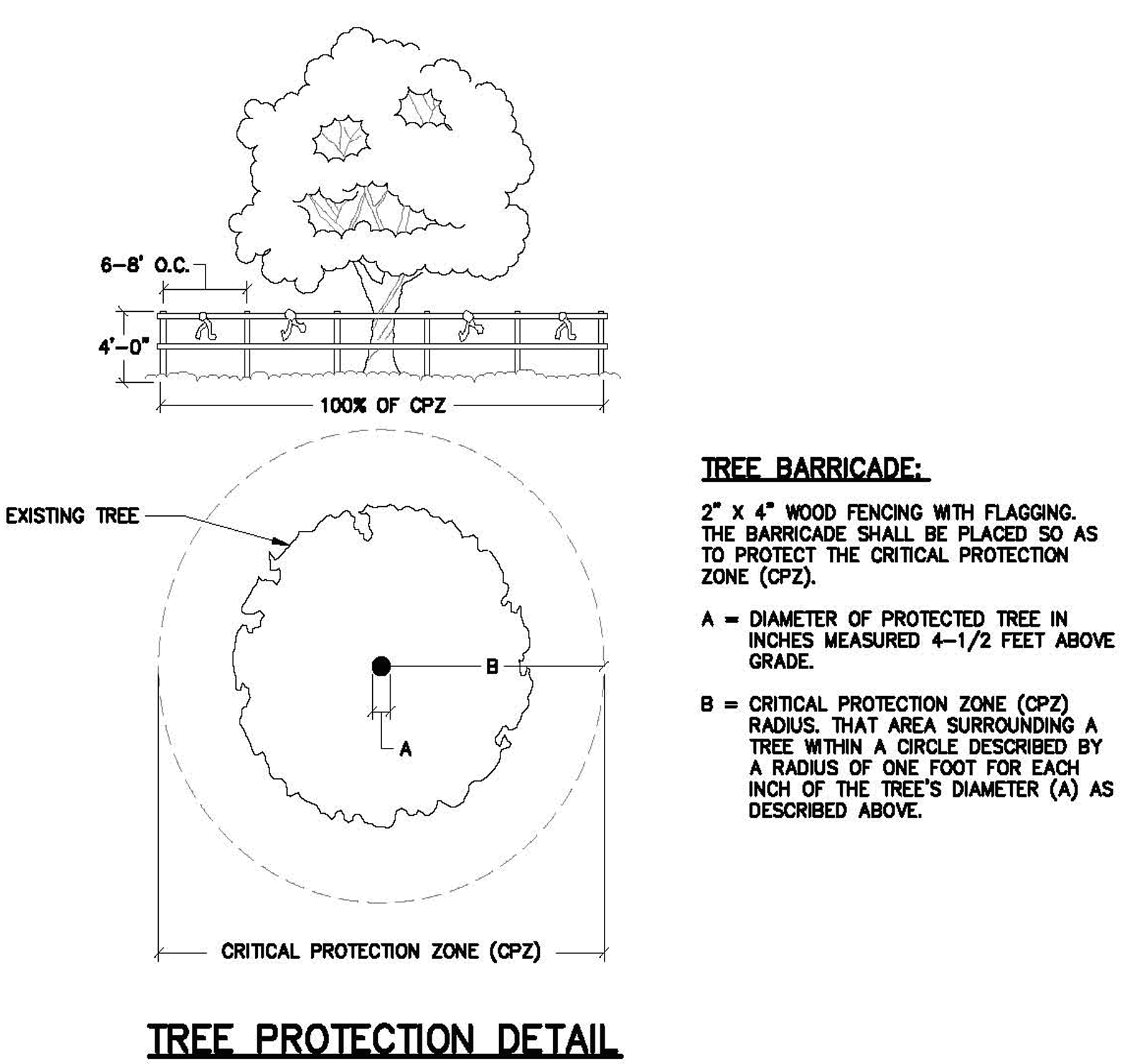
4)
Absolutely no fill, building materials, trash or other objects shall be placed inside these barriers. If fill is deposited adjacent to these areas, a suitable silt fence shall be constructed to prevent siltation of the barricaded area.
5)
Barricades are to be adequately maintained and shall remain in place until their removal or modification is approved in writing. Failure of the applicant to properly locate and/or maintain the barricade may result in the issuance of a class I or class II citation (depending on the magnitude of the violation). Issuance of a stop work notice ("red tag") and the requirement that the applicant provide a restoration plan to the Town Commission (or some combination of these, as determined appropriate by the Town Manager or his/her designee).
6)
No equipment, construction materials or debris shall be placed within the protective barrier.
7)
No equipment shall be cleaned within a protective barrier or perimeter line.
8)
Protective barriers shall remain in place until all construction activity is terminated.
9)
No fuel, paint, solvent, oil, thinner, asphalt, cement, grout or any other construction chemicals of any kind shall be stored or be placed within the protective barrier.
10)
No attachments or wires other than those of a non-damaging nature shall be attached to any tree.
11)
To assure the protection of trees during construction activities, the developer shall avoid the following kinds of activities:
A)
Mechanical injury to tree roots, trunks, and branches;
B)
Injuries by chemical poisoning;
C)
Injuries due to grade changes; or
D)
Injuries due to paving.
12)
Swaling and minor negative grade changes should always be designed around the dripline area as much as possible. Any exposed roots shall be trimmed and painted. Piping should be used where deep swales or ditches would require significant grade adjacent to trees.
13)
Trenching of any type should be avoided in the dripline area. Where underground installations are required adjacent to the trunks of specimen trees, tunneling should be used. When trenching or tunneling near trees to remain, protective measures should be taken as specified in Tree Protection Manual for Builders and Developers.
14)
Tree wells of an approved design shall be constructed around all trees where over four (4) inches of fill is proposed within the dripline area. Design shall generally be as specified in Tree Protection Manual for Builders and Developers; published by the Florida Department of Agriculture and Consumer Services, Division of Forestry, latest edition. Specific details shall be approved by the Town Manager or their designee and where the Town deems appropriate.
15)
For palm trees, the posts shall be placed at points not closer than six (6) feet from the trunk.
h)
Remedial procedures.
1)
Remedial site reclamation and tree care procedures shall be implemented by a certified arborist, when development activities have caused damage to either the tree or the tree's growing site, and that damage is repairable.
2)
Remedial site reclamation and tree care procedures shall be implemented by a certified arborist, when an existing tree is relocated and used to meet requirements of this chapter.
3)
If encroachment is anticipated or has happened, the following practices shall be employed to improve survivability.
A)
Pruning.
1.
The pruning of a tree in anticipation of construction damage may provide compensation for potential root loss and produce an invigorating response.
2.
A tree that has suffered root damage becomes stressed because the root system no longer provides sufficient water and nutrients for the existing crown. This stress becomes evident with the appearance of "staghorns" or deadwood within the tree's crown. Once a tree has had construction damage, it is advisable to delay pruning one (1) to three (3) years until the deadwood becomes evident. Pruning for deadwood removal is then recommended.
3.
The removal of live plant tissue from a construction-damaged tree can accelerate the tree's decline.
4.
Pruning of root-severed trees may reduce the possibility of wind throw.
5.
Trees that have not been affected by construction activities can be pruned for maintenance of the tree's health, appearance, and safety, utilizing acceptable arboricultural practices.
6.
Pruning specifications as provided in the latest version of ANSI A300 shall be used in all pruning cases.
7.
The pruning of specimen trees may be subject to Planning and Development approval.
8.
All cabling work and other structural support supplemental systems shall be installed in accordance with the latest edition of ANSIA 300 American National Standard for Tree Care Operations - Trees, Brush, and Other Woody Plant Maintenance - Standard Practices on Support Systems and Cabling.
9.
Any lightning rod protection shall be installed in accordance with American National Standard for Tree Care Operations - Trees, Brush and Other Woody Plant Maintenance Standard Practices on Lightning Protection.
B)
Roots outside barricade. All roots outside of the protective barricade to be removed during the development shall be severed clean, and a two-inch layer of mulch shall be applied over the surface of exposed roots during development.
C)
Fertilizer.
1.
Fertilizer applications will enhance the vigor of trees stressed by site disturbances, thereby promoting root development.
2.
Information regarding appropriate fertilizers and application rates may be obtained in the latest edition of ANSI A 300 - American National Standard for Tree Care Operations - Trees, Brush and Other Woody Plant Maintenance - Standard Practices on Fertilization.
D)
Soil.
1.
A tree's ability for adequate root development, and ultimately its chances for survival, is improved with reclamation of the growing site.
2.
Wherever possible, the soil should be brought back to its natural grade.
3.
Unnecessary fill, compaction, erosion sedimentation, concrete washout, and construction debris should be removed.
4.
When machinery is required for site improvement, it is recommended that a "Bobcat" or similar lightweight, rubber-tired vehicle be used so as to minimize soil compaction.
5.
Compacted soil within the tree protection zone of trees should be aerated.
a.
This is best accomplished with a two-inch-diameter auger.
b.
Holes should be drilled to a depth of six (6) to twelve (12) inches, approximately two (2) to three (3) feet apart and radiating outward from the tree's trunk in a bicycle-spoke configuration.
c.
This aeration technique is also recommended for areas affected by minor fill or the sedimentation of erosion materials.
6.
The air exchange, nutrient, and water-holding capacities of soils can be improved with soil amendments. This is best accomplished by backfilling holes from aeration, with mineral amendments such as perlite, vermiculite, isolite, and the like.
E)
A four (4) to six (6) inch layer of mulch material, such as pine straw, pine bark, or wood chips, spread within the tree protection zone of trees on construction sites is extremely beneficial. Benefits include:
1.
Conservation of soil moisture;
2.
Reduced rainfall runoff and erosion;
3.
Reduced soil compaction from construction activities;
4.
Reduced competition from grasses and weeds;
5.
Increased soil fertility;
6.
Improved soil structure;
7.
Moderation of soil temperature, with a subsequent increase in root development activity.
i)
Tree preservation credit eligibility. To receive credit for the preservation of an existing protected tree, the following requirements must be met:
1)
Fifty (50) percent of the land surface area within the dripline of the tree shall be naturally preserved or provided with pervious landscape material and shall be maintained at its original grade with no trenching or cutting of roots in this area.
2)
The tree shall not be damaged from skinning, barking or bumping which is potentially lethal to the tree.
3)
There shall be no evidence of active insect infestation potentially lethal to the trees.
4)
Impervious surfaces shall maintain minimum clearance from the bases of all trees to be protected. Trees fifteen (15) inches DBH or less shall have a minimum clearance of six (6) feet. Trees over fifteen (15) inches DBH up to twenty (20) inches DBH shall have a minimum clearance of nine (9) feet. Historic and trees over twenty (20) inches DBH shall have a minimum clearance of twelve (12) feet.
j)
Credit for preservation of existing trees. Credit shall be given for the preservation of existing trees which are properly protected and which meet the following criteria:
1)
Such trees must meet the requirements of this chapter for location, spacing and type of tree.
2)
Any existing canopy trees which have a minimum six (6) inch DBH shall provide credit on a one tree inch-for-one tree inch basis for any tree requirements found herein. Groups of trees smaller than six (6) inch DBH are encouraged to be preserved as well. The total of all tree inches in the group shall be shown on the tree survey to receive the preservation credit.
3)
Each one (1) inch DBH of specimen canopy tree preserved shall correspond to a one (1) inch caliper per tree credit toward replacement tree stock. Regardless of caliper inch credit, the requirements of this chapter must be met.
4)
Each one (1) inch DBH of specimen canopy tree relocated shall correspond to a one (1) inch caliper per tree credit toward replacement tree stock. The tree(s) must receive remedial procedures as specified in this chapter (Remedial Procedures). The tree(s) are also subject to inspections by the Town and replacement if necessary as specified in this chapter (Maintenance).
k)
Violations and enforcement.
1)
If the Town Manager or their designee finds that any of the provisions of this chapter are being violated, he or she may issue a stop work order and shall, in writing, notify the owner of the property and/or the general building contractor.
2)
Written notification shall indicate the nature of the violation and/or the action necessary to correct the violation.
3)
Such remedial action shall be in accordance with this section.
4)
The issuance of a clearing and tree permit, and the failure to substantially erect building improvements within twelve (12) months, combined with removal of trees in the buildable area and the building site, shall be deemed as violations of this chapter.
5)
Removal of a protected tree without approval is unlawful and is a second degree misdemeanor. In addition to code enforcement proceedings and criminal prosecution for a violation of this ordinance the Town may sue the violator for damages and injunctive relief. Any and all attorney's fees and costs incurred improving a violation in a civil proceeding shall be recoverable by the Town of Lady Lake.
6)
However, no penalty shall exceed the penalty provided by state law for similar offenses.
7)
Each tree removed or destroyed in violation of this chapter represents a separate offense.
8)
Each day of violation also represents a separate offense.
9)
Any person, firm, organization, society, association or corporation, or any agent or representative thereof, who commits, participates, or assists in such violation may each be found guilty of a separate offense and suffer the penalties herein provided.
10)
Notwithstanding the requirements of this section, tree replacement is a separate matter governed by Section 5 (Tree Protection).
l)
Waivers and appeals.
1)
Waivers. Town Commission may grant a waiver to provisions of this chapter where the applicant demonstrates that the literal interpretation of the ordinance will deny the applicant reasonable use of property or where such waiver can be demonstrated to be consistent with purpose and intent of the ordinance.
2)
Waivers. Town Commission may grant a waiver to provisions of this chapter where the applicant demonstrates that existing trees will be protected and preserved to become a public benefit.
3)
Appeals. Any person adversely affected by the enforcement or interpretation of this article may appeal to the Town Commission within thirty (30) days, and all procedures specified in the zoning provisions of the Code shall be used for such appeal.
m)
Contractor Registry. Landscapers and Tree Trimming/Removal Contractors may register with the Town of Lady Lake on an annual basis. The fee shall be thirty dollars ($30.00) per year, or as amended, to maintain registry. Decals shall be issued and affixed to each vehicle performing work in association with the company. There shall be a charge of five dollars ($5.00) per decal in excess of one (1) for the company's fleet. Decals shall be conspicuously displayed on the driver's side windshield for identification.
(Ord. No. 2012-10, § 1(Exh. A), 5-21-2012; Ord. No. 2015-19, § 1(Exh. A), 12-7-2015)
Sec. 10-6. - Alteration of existing development.
a)
Nonconforming development.
1)
Parcels of land or developments that are nonconforming must be brought into full compliance with this chapter in conjunction with the following activities:
A)
Any additional structure or addition to an existing structure greater than four thousand (4,000) cumulative square feet shall require all landscaping to be brought into compliance with this chapter.
B)
When any additional structure or addition to an existing structure, other than a shopping center, is expanded so that the expansion equals twenty-five (25) percent or more of the building's square footage before the expansion occurs. The building's square footage is defined as that area which is under a roof whether air-conditioned and heated or not. If more than one expansion is constructed after the effective date of this Code, the total of all the expansions will be combined in determining if the twenty-five (25) percent has been reached.
C)
When the use of the development changes from residential to nonresidential.
D)
When a structure is destroyed by fire or other calamity. Destroyed means when more than fifty (50) percent of the structure cannot be salvaged and is unsuitable for the purposes for which it was built.
E)
When an existing building is being redeveloped and the cost of redevelopment is greater than fifty (50) percent of the assessed value of the building.
2)
No building existing on the date of the enactment of this chapter shall be required to be altered or moved in order to comply with this chapter.
3)
When repeated expansions occur on a site, the total combined expansion shall be used in determining whether the threshold for compliance has been reached.
b)
Vehicle use areas.
1)
When only a parking area is expanded and it is by less than ten (10) percent, only the new area is required to be brought into compliance with this chapter.
2)
When a parking area is expanded by ten (10) percent or more, the entire parking area shall be brought into compliance with this chapter.
(Ord. No. 2012-10, § 1(Exh. A), 5-21-2012)
Sec. 10-7. - Authorization to adopt rules and regulations for implementation.
The Town Commission is hereby authorized to adopt, by resolution, such rules and regulations as are necessary or proper to implement this chapter.
(Ord. No. 2012-10, § 1(Exh. A), 5-21-2012)
Sec. 10-8. - Superseding Town of Lady Lake Commercial Design Guidelines.
Should any provision of this chapter conflict with the Town of Lady Lake Design Guidelines, the Town of Lady Lake Design Guidelines shall supersede and control.
(Ord. No. 2012-10, § 1(Exh. A), 5-21-2012)
Sec. 10-9. - Water conservation ordinance for landscape irrigation.
a)
Intent and purpose. It is the intent and purpose of this ordinance to implement procedures that promote water conservation through more efficient landscape irrigation.
b)
Definitions. For the purpose of this article the following terms, phrases, words and their derivatives shall have the meaning given herein. When not inconsistent with the context, words used in the present tense include the future, words in the plural include the singular, and words in the singular include the plural.
Address means the house number of a physical location of a specific property. This includes "rural route" numbers but excludes post office box numbers. If a lot number in a mobile home park or similar community is used by the U.S. Postal Service to determine a delivery location, the lot number shall be the property's address. An "even numbered address" means an address ending in the numbers 0, 2, 4, 6, 8 or the letters A-M. An "odd numbered address" means an address ending in the numbers 1, 3, 5, 7, 9, or the letters N-Z.
District means the St. Johns River Water Management District.
Person means any person, firm, partnership, association, corporation, company, or organization of any kind.
Landscape irrigation means the outside watering of plants in a landscape such as shrubbery, trees, lawns, grass, ground covers, plants, vines, gardens and other such flora that are situated in such diverse locations as residential areas, public, commercial, and industrial establishments, and public medians and rights-of-way. "Landscape irrigation" does not include agricultural crops, nursery plants, cemeteries, golf course greens, tees, fairways, primary roughs, and vegetation associated with recreational areas such as playgrounds, football, baseball and soccer fields.
Residential landscape irrigation means the irrigation of landscape associated with any housing unit having sanitary and kitchen facilities designed to accommodate one or more residents, including multiple housing units and mobile homes.
Non-residential landscape irrigation means the irrigation of landscape not included within the definition of "residential landscape irrigation," such as that associated with public, commercial and industrial property, including commercial or transient housing units, hotel and motel units, and public medians and right-of-way.
c)
Landscape irrigation schedules.
1)
When Daylight Savings Time is in effect, landscape irrigation shall occur only in accordance with the following irrigation schedule:
A)
Residential landscape irrigation at odd numbered addresses or no address may occur only on Wednesday and Saturday and shall not occur between 10:00 a.m. and 4:00 p.m.; and
B)
Residential landscape irrigation at even numbered addresses may occur only on Thursday and Sunday and shall not occur between 10:00 a.m. and 4:00 p.m.; and
C)
Non-residential landscape irrigation may occur only on Tuesday and Friday and shall not occur between 10:00 a.m. and 4:00 p.m.; and
D)
No more than three-fourths (¾) inch of water may be applied per irrigation zone on each day that irrigation occurs, and in no event shall irrigation occur for more than one (1) hour per irrigation zone on each day that irrigation occurs.
2)
When Eastern Standard Time is in effect, landscape irrigation shall occur only in accordance with the following irrigation schedule:
A)
Residential landscape irrigation at odd numbered addresses or no address may occur only on Saturday and shall not occur between 10:00 a.m. and 4:00 p.m.; and
B)
Residential landscape irrigation at even numbered addresses may occur only on Sunday and shall not occur between 10:00 a.m. and 4:00 p.m.; and
C)
Non-residential landscape irrigation may occur only on Tuesday and shall not occur between 10:00 a.m. and 4:00 p.m.; and
D)
No more than three-fourths (¾) inch of water may be applied per irrigation zone on each day that irrigation occurs, and in no event shall irrigation occur for more than one (1) hour per irrigation zone on each day that irrigation occurs.
3)
All landscape irrigation shall be limited in amount to only that necessary to meet landscape needs.
d)
Exceptions to landscape irrigation schedules. Landscape irrigation shall be subject to the following irrigation schedule exceptions:
1)
Irrigation using a micro-spray, micro-jet, drip or bubbler irrigation system is allowed anytime.
2)
Irrigation of new landscape is allowed at any time of day on any day for the initial thirty (30) days and every other day for the next thirty (30) days for a total of one sixty (60) day period, provided that the irrigation is limited to the minimum amount necessary for such landscape establishment.
3)
Watering in of chemicals, including insecticides, pesticides, fertilizers, fungicides, and herbicides when required by law, the manufacturer, or best management practices is allowed at any time of day on any day within twenty-four (24) hours of application.
Watering in of chemicals shall not exceed one-quarter (¼) inch of water per application except as otherwise required by law, the manufacturer, or best management practices.
4)
Irrigation systems may be operated at any time of day on any day for maintenance and repair purposes not to exceed twenty (20) minutes per hour per zone.
5)
Irrigation using a hand-held hose equipped with an automatic shut-off nozzle is allowed any time of day on any day.
6)
Discharge of water from a water-to-air air-conditioning unit or other water-dependent cooling system is not limited.
7)
The use of water from a reclaimed water system is allowed anytime. For the purpose of this paragraph, a reclaimed water system includes systems in which the primary source is reclaimed water, which may or may not be supplemented from another source during peak demand periods.
8)
The use of recycled water from wet detention treatment ponds for irrigation is allowed anytime provided the ponds are not augmented from any ground or off-site surface water, or public supply sources.
e)
Additional requirement. Any person who irrigates landscape with an automatic lawn sprinkler system installed after May 1, 1991, shall install, maintain and operate a rain sensor device or switch that overrides the irrigation system when adequate rainfall has occurred.
f)
Variance from specific day of the week limitations. A variance from the specific landscape irrigation days or day set forth in section 10-3 may be granted if strict application of that schedule days or day would lead to unreasonable or unfair results in particular instances, provided that the applicant demonstrates with particularity that compliance with the scheduled days or day will result in a substantial economic, health or other hardship on the applicant requesting the variance or those served by the applicant. Where a contiguous property is divided into different zones, a variance may be granted hereunder so that each zone may be irrigated on different days or day than other zones of the property. However, in no event shall a variance allow a single zone to be irrigated more than two days per week during Daylight Savings Time or more than one day per week during Eastern Standard Time.
g)
Application of ordinance. The provisions of this ordinance shall apply to each person located within the Town of Lady Lake.
h)
Enforcement officials. Law enforcement officials having jurisdiction in the area governed by this ordinance are hereby authorized to enforce the provisions of this ordinance. In addition, the Town of Lady Lake Code enforcement may also delegate enforcement responsibility for this ordinance to agencies and department of Town of Lady Lake government.
i)
Penalties. Violation of any provision of this ordinance shall be subject to the following penalties:
First violation: Written Warning
Second violation: Fifty dollars ($50.00)
Subsequent violations: Fine not to exceed five hundred dollars ($500.00)
Each day in violation of this ordinance shall constitute a separate offense. Enforcement officials shall provide violators with no more than one written warning. In addition to the civil sanctions contained herein, the Town of Lady Lake may take any other appropriate legal action, including, but not limited to, injunctive action to enforce the provisions of this article.
(Ord. No. 2012-10, § 1(Exh. A), 5-21-2012)
Sec. 10-10. - Severability.
If any section, subsection, sentence, clause, phrase, word or provision of this ordinance is for any reason held invalid or unconstitutional by any court of competent jurisdiction, whether for substantive, procedural, or any other reason, such portion shall be deemed a separate, distinct and independent provision, and such holding shall not affect the validity of the remaining portions of this chapter.
(Ord. No. 2012-10, § 1(Exh. A), 5-21-2012)

