
Linn County Unincorporated
City Zoning Code
City Zoning Code
ARTICLE V
- GENERAL REGULATIONS
Sec. 107-91. - General provisions.
(a)
Compliance required. All uses, activities and creation of lots shall comply fully with the provisions of this chapter, including but not limited to, the general regulations in this article, as a precondition to being permitted under article IV of this chapter.
(b)
Airport overlay zones. The county has adopted airport overlay zones in chapter 103. The airport overlay zones limit uses and height of structures within the overlay zones. The provisions of the airport ordinance shall be in addition to the provisions of this chapter. Where requirements in the airport ordinance impose greater restrictions than this chapter, the provisions of the airport ordinance shall apply.
(c)
Double-counting prohibited. No part of a yard or other open space, or off-street parking or loading space required in connection with any structure for the purpose of complying with this chapter, shall be included as a part of a yard, open space, or off-street parking or loading space similarly required for any other structure.
(d)
Minimum lot size variances prohibited. No yard or lot existing on the effective date of this chapter shall be reduced in dimension or area below the minimum requirements set forth herein. Yards or lots created after the effective date of this chapter shall meet at least the minimum requirements established by this chapter.
(e)
Minimum road frontage required. No newly created lot shall contain any building used in whole or in part for residential purposes unless such lot abuts for at least 66 feet on at least one street, road or private lane, except 50 feet minimum may be allowed where no further division or parcels or lots can be created, or if fronting on a private lane. Where a lot that meets qualifications of a legal lot of record as of the effective date of the ordinance from which this chapter is derived does not abut a street, road, or private lane, access may be provided to a public road by an exclusive, unobstructed private easement of access with a minimum width of 20 feet.
(f)
Measurement of distances. Unless otherwise stated, distances shall be measured as follows:
(1)
Fire service. Distance for fire service shall be measured from the approximate center of the fire station as the center of the maximum fire service radius.
(2)
Road access. Distance for purposes of road access shall be measured from the nearest boundary of the development tract to the nearest hard surfaced or paved road, as measured along the approximate road centerlines.
(3)
LESA, nearby development. Distance for purposes of assessing the percentages of like-development and lot size within a specified radius, shall be measured from the perimeter of the parent parcel proposed for development.
(4)
Other. All other distances shall be measured between nearest property lines.
(g)
RLUIPA. This chapter is written with the intent that no land use regulation or requirement of this chapter shall be enforced in a manner that violates the federal Religious Land Use and Institutionalized Persons Act (RLUIPA) of 2000, or subsequent amendments or reauthorizations.
(h)
Agricultural land use notification. No zoning verification permit, site plan review approval for a new single-family dwelling, nor subdivision approval in the agricultural areas of the rural land use map, or within the AG Agricultural Zoning District shall be issued until the landowner, or the landowner's agent, signs an agricultural land use notification on a form provided by the zoning administrator. This requirement shall also apply to land proposed to be rezoned from the agricultural district to another district as part of a development application. The landowner shall insure that such notification shall be attached to the deed and shall become a separate entry on the abstract of title for all the property that is the subject of the permit or development. If the notification is issued in conjunction with a building permit for a new dwelling, the zoning site plan review will not be released until the notification form has been recorded. Agricultural land use notification forms shall inform the landowner that:
(1)
The land that is the subject of the permit or development is located in an agricultural area where the county has determined that agricultural uses are primary uses.
(2)
Agricultural practices may be accompanied by noise, dust, odor, light, smoke, and other off-site impacts at any time of day and year.
(3)
Agricultural practices may include new or expanded feedlots that conform to all state or federal standards, operation of machinery, storage and disposal of manure, and application by spraying or otherwise of chemical fertilizers, soil amendments, herbicides and pesticides.
(4)
Agricultural uses are given preference over other uses in agricultural areas.
(5)
If you live near an agricultural area, you should be prepared to accept inconveniences or discomfort associated with agricultural practices as a normal and necessary aspect of living in an agricultural area.
(6)
If a parcel of land subject to the agricultural land use notification provisions is subsequently annexed into a municipality, the notification shall become null and void.
(i)
Planned unit development overlay district: conflict with other regulations. An approved planned unit development, and associated governing plan prevails over any conflicting regulations in this section.
(Code 2006, ch. 41, art. 5, § 1; Ord. No. 3-3-2006, 4-1-2006; Ord. No. 1-3-2011, 6-1-2011; Ord. No. 11-9-2020, § 1(Att. A), 9-9-2020)
Sec. 107-92. - Agricultural exemption.
(a)
Agricultural use exempt. No regulation or requirement contained in this chapter, other than regulations related to land division, shall be construed to apply to land, farm houses, farm barns, farm outbuildings, or other buildings, structures, or erections which are primarily adapted, by reason of nature and area, for use for agricultural purposes, but only while so used. However, regulation or requirements that relate to any structure, building, dam, obstruction, deposit or excavation in or on the floodplains of any river or stream shall apply.
(b)
Agricultural areas. All agricultural areas created pursuant to I.C.A. § 352.6 and the activities conducted thereon, are and shall remain exempt from county zoning and building regulations. However, regulation or requirements that relate to any structure, building, dam, obstruction, deposit or excavation in or on the floodplains of any river or stream shall apply.
(Code 2006, ch. 41, art. 5, § 2)
Sec. 107-93. - General regulations for uses.
(a)
Conditional uses. Any use lawfully established prior to the effective date of this chapter, which is included herein as a conditional use allowed in the district within which such use is located as shown in article VII of this chapter, Table 107-147-1, shall be considered a lawful conditional use under this chapter. Conditional use permits, following commencement, can continue indefinitely unless an expiration date has been specifically stated as a condition of the permit. The use automatically expires if it has been discontinued for a period of one year or longer.
(b)
Accessory uses. Uses and structures accessory to a principal permitted use or a conditional use are permitted and shall be located on the same lot as the principal or conditional use subject to the provisions of section 107-94. Exceptions to the same lot requirement listed in subsection (c) of this section may be permitted on a lot adjacent to the lot containing the principal or conditional use.
(1)
A mobile home shall not be an accessory use.
(2)
Travel trailers, mobile homes, movable containers, or similar structures intended to be movable shall not be considered accessory structures.
(3)
Exceptions to same lot requirement:
a.
Buildings or structures used for agricultural purposes;
b.
Geothermal loop fields;
c.
Stormwater management installations;
d.
Well or septic systems;
e.
SWECS;
f.
Solar panels;
g.
Accessory structures to an approved conditional use;
h.
Other similar structures and appurtenances.
(c)
Temporary uses. The county board of supervisors may, by resolution, permit the temporary establishment in any zoning district such uses as specified in the list below. Such permission shall be in accordance to an approved minor site plan and shall contain a commencement and a termination date and any other conditions deemed necessary and proper by the technical review committee to protect the surrounding properties. Temporary uses that occur on an annual basis may thereafter be administratively renewed without board of supervisors action, provided there are no new discernable impacts from the original approved use. An annual application for renewal with a minor site plan are required. The technical review committee shall review the application for renewal. If the technical review committee determines that the proposed renewal of a temporary use permit results in new discernable impacts, the application will be treated as a new application. Applications for activities or uses shown in subsection (2) below that are submitted 14 days or less from the start date of the use shall be subject to an increased application fee for an expedited request. The uses subject to such temporary use provisions include:
(1)
Portland cement or asphaltic concrete mixing plant in conjunction with the construction of a highway or other large-scale project.
(2)
Carnival; circus; farm show; haunted house; haunted trail; crop maze; live nativity or other performance, concert or temporary assembly; farm winery or winery event at which alcohol will be sold for consumption on-site; or other similar temporary or transient attraction, activity or use.
(d)
Buffers for commercial and industrial uses. The use of buffers is considered a necessary requirement to allow for the transition from commercial and industrial zoning districts and land uses to non-commercial or non-industrial zoning districts and land uses. The following provisions apply to buffers for commercial and industrial uses and structures.
(1)
When required. A buffer shall be provided when commercial or industrial land uses abut non-commercial or non-industrial land uses or zoning districts.
(2)
Buffer width. The buffer shall be a minimum of 50 feet. The buffer width may be reduced up to ten percent through an administrative exception approved by the zoning administrator. An administrative exception may be granted when, because of an exceptional situation, topographical condition, surroundings, size, shape or other condition of the property, the strict application of the buffer width provision would result in peculiar and exceptional practical difficulties or particular hardship upon the owner of such property.
(3)
Buffer composition and landscaping. All buffer areas shall be landscaped or fenced so as to provide a complete visual screen, and shall not include any structures other than allowed fencing, parking areas, storage areas, playgrounds, or other similar facilities.
a.
Fencing. Fencing may be used to meet the buffer requirement but shall not exceed 50 percent of the total buffer distance required. In addition, fencing used for buffering shall meet the general requirements for fencing in section 107-94(d).
b.
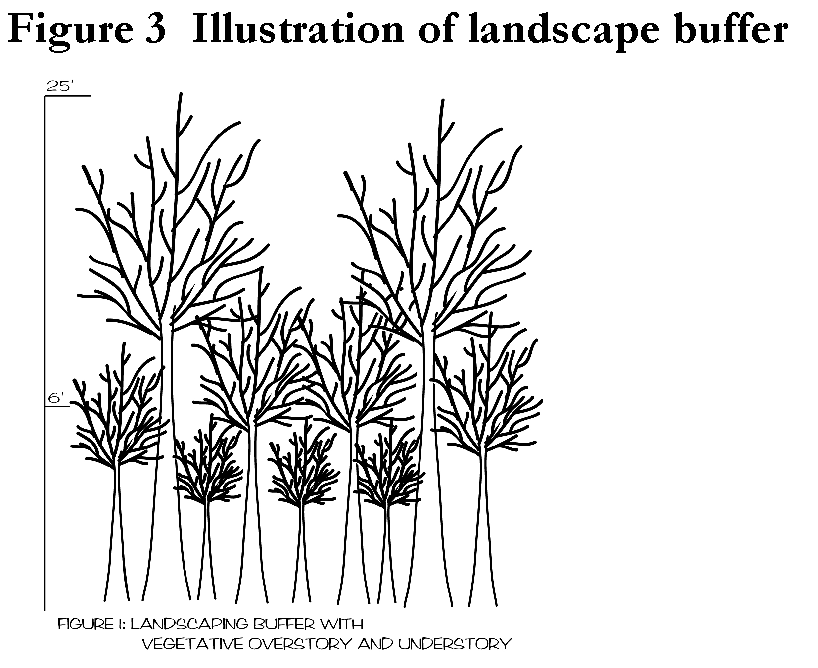
Landscaping. Landscaping shall use native plant and tree species. A combination of plant and tree species shall be used to create a vegetative overstory and understory. Tree species shall have a minimum mature height of 25 feet, and shall have a height of at least six feet within three years of installation.
c.
Screening. Visual screening shall be measured under leaf-on conditions and shall be measured from the elevation of the shared property line.
d.
Stormwater management. Buffer areas may include drainage swales, stormwater retention or infiltration areas, or other stormwater management areas only if landscaping and visual screening requirements can also be met.
e.
Berms. Berms may only be used if native plant and tree landscaping requirements can also be met. Berms must be vegetated to minimize erosion and to slow stormwater runoff.
(4)
Maintenance. All buffer areas shall be kept free of litter, debris, noxious weeds, and species of plants identified by the state DNR as exotic or invasive. Landscaping vegetation in buffer areas shall meet the screening requirements of subsection (d)(3) of this section on a continual basis for as long as the commercial or industrial use and structure continues.
(e)
Off-street parking and loading. Off-street parking and loading areas shall be required according to the following provisions.
(1)
Off-street loading areas, commercial and industrial uses. The following off-street loading areas shall be provided and maintained in any district in which there is a building that is to be occupied in whole or in part by an allowed commercial or industrial use:
a.
For a building having a gross floor area of 10,000 square feet or less there shall be at least one off-street loading berth; and
b.
One additional loading berth shall be provided for each additional 20,000 square feet or fraction thereof of gross floor area.
(2)
Off-street loading area design standards. Required off-street loading areas shall meet the following design standards:
a.
Size. Each loading berth shall be not less than 15 feet in width, 60 feet in length, and 15 feet in height.
b.
Location. Such berth may occupy part of a required yard space, however, required off-street loading areas shall not occupy required buffer areas between commercial or industrial lots and adjacent non-commercial or non-industrial lots, and no berth shall be constructed in the required side yard of a building that is adjacent to a residential district.
(3)
Off-street parking areas required. In all districts, off-street parking shall be required based on the principal use of the lot. Where there is a combination of uses on the lot or, where a principal use includes a combination of clearly distinct functions, the required number of parking spaces may be the sum calculated for each use or district function.
(4)
Administrative exception for off-street parking area. The required off-street parking area may be reduced through an administrative exception approved by the zoning administrator. An administrative exception reducing the number of required off-street parking spaces may be granted if the applicant submits a parking needs analysis which demonstrates that a sufficient level of off-street parking for the proposed use will be provided.
Table 107-93 Off-street parking requirements by use group or use category
(5)
Off-street parking area design standards. Required off-street parking areas shall meet the following design standards:
a.
Parking space size. Each parking space shall contain a minimum area of not less than 300 square feet including parking stall area, backup area and aisle area. Parking stalls shall have a width of not less than nine feet, and a depth of not less than 18 feet.
b.
Handicapped parking. Off-street parking areas shall be designed to meet the number, placement, size and marking and identification requirements for handicapped parking contained in 42 USC 12181-9 and I.C.A. § 321L.5.
c.
Computation. When determination of the number of off-street parking spaces required by this chapter results in a requirement of a fractional space, any fraction of less than one-half may be disregarded, while a fraction of one-half or more, shall be counted as one parking space. Parking spaces required on an employee basis shall be based on the maximum number of employees on duty or residing, or both, on the premises at any one time.
d.
Access. Where a lot does not abut a public or private alley or easement of access there shall be provided an access drive not less than nine feet in width in the case of a dwelling, and not less than 18 feet in width in all other cases leading to the loading and unloading space and parking or storage areas required hereunder in such manner as to secure the most appropriate development of the property in question; except where provided in connection with a use permitted in a residence district, such easement of access or access drive shall not be located in any residential district.
e.
Surfacing, grading, drainage.
1.
In the urban service area, all commercial drives and parking areas are to be paved with an asphaltic or Portland cement binder pavement, or such other hard but permeable surfaces.
2.
In all other land use areas, dust-controlled gravel parking areas shall be permitted. In those instances where the access is onto a hard surfaced road, the driveway shall be hard surfaced at a minimum to the property line. In all cases where handicapped parking is required, the handicapped space shall be paved, along with the most direct route to public areas. Parking areas and drives shall be so graded and drained as to dispose of or infiltrate all surface water accumulation within the area; and shall be so arranged as to provide for orderly and safe loading or unloading and parking and storage of motor vehicles.
f.
Marking and delineation. Marking and delineation of off-street parking areas may be required as part of a site development plan or subdivision approval.
g.
Lighting. Any lighting used to illuminate off-street parking areas shall be directed downward and away from residential properties and public streets in such a way as not to create a nuisance.
h.
Maintenance. Off-street parking areas shall be maintained in good condition and any required marking, surfacing, grading and drainage shall be meet the conditions of approval on an on-going basis.
i.
Location. Off-street parking areas, including access driveways, may occupy part of a required yard space, however, required off-street parking areas:
1.
Shall not occupy required buffer areas between commercial or industrial lots and adjacent non-commercial or non-industrial lots, and no parking area shall be constructed in the required side yard of a building that is adjacent to a residential district.
2.
Shall not be located in the required front yard of any agricultural or residential district; except that parking is allowed in any legal driveway within the front yard in an agricultural or residential district, and provided further that all parking areas shall be set back a minimum of five feet from all property lines.
(Code 2006, ch. 41, art. 5, § 3; Ord. No. 3-3-2006, 4-1-2006; Ord. No. 7-6-2006, 7-1-2006; Ord. No. 1-2-2008, 4-1-2008; Ord. No. 2-5-2009, 5-20-2009; Ord. No. 10-10-2013, 10-14-2013; Ord. No. 4-5-2014, 5-19-2014; Ord. No. 13-8-2015, 8-17-2015; Ord. No. 8-11-2019, Att. A, Pt. II, § 1, 11-13-2019; Ord. No. 14-9-2021, § 1(Att. A(1)), 9-8-2021; Ord. No. 12-11-2023, §§ 1, 2, 11-15-2023)
Sec. 107-94. - General regulations for structures.
(a)
Number of principal structures permitted on a lot or parcel. No more than one principal structure may be placed on a residential lot or parcel. More than one industrial, commercial, multiple-family dwelling including single-family attached and multiple detached single-family, condominium, dwellings or institutional building or use may be established upon a single lot or tract in a district allowing these uses, provided that the yards and open space required around the boundaries of the lot or tract shall be met.
(b)
Temporary continuance of original dwelling while replacement new dwelling is being constructed subject to a development agreement. Within those districts that allow one single-family dwelling on a lot or parcel, a replacement single-family dwelling may be constructed without first removing the original dwelling. The original dwelling must be demolished, removed or converted in accordance with all the county building regulations to a non-residential structure within six months of the issuance of a certificate of occupancy by the county building official. An extension of this time frame may be granted administratively upon demonstration of a practical difficulty by the applicant. If an extension is granted, an amended development agreement stipulating the terms of the extension shall be executed and recorded in the office of the county recorder.
(c)
Accessory structures. Accessory structures shall meet the following requirements:
(1)
Attached. Attached accessory structures shall meet all the requirements of this chapter which apply to the principal structure to which they are attached.
(2)
Detached. Detached accessory structures shall meet all of the following requirements:
a.
Maximum lot coverage. Detached structures in the following zoning districts shall not exceed the size limitations/maximum lot coverage allowances shown in Table 107-94(c)(2): RR1 rural residential one-acre, RR2 rural residential two-acre, RR3 rural residential three-acre, USR urban services residential, USR-MF urban services residential multi-family, VR village residential and VM village mixed-use zoning districts.
Table 107-94 Detached Accessory Structure Limitations
b.
Setbacks. For detached accessory structures in AG agricultural, CNR critical natural resources, and residential zoning districts RR1, RR2, RR3, USR, USR-MF and VR, and for agricultural and residential uses in the VM district:
1.
Maintain corner side yard setback requirements.
2.
Maintain ten feet to any side lot line when the accessory structure is located beside the principal structure; when located behind the principal structure the setback may be reduced to no less than three feet from any side or rear lot line with any overhang not closer than one foot from the lot line.
c.
Allowance for detached accessory structure in front of principal structure. For detached accessory structures in AG, CNR and residential zoning districts RR1, RR2, RR3, USR, USR-MF and VR, and for agricultural and residential uses in the VM district
1.
Detached accessory structures may be allowed to the front of the principal structure provided the detached accessory structure maintains front yard, side yard and corner side yard principal structure setbacks for the zoning district where the structure is located. An accessory structure shall be considered to be located in front of the principal structure if any portion of the exterior wall of the accessory structure is closer to the front lot line than the exterior wall of the principal structure.
2.
On parcels smaller than one acre in area, no more than one accessory structure may be located in front of the principal structure. Such accessory structure shall not exceed 864 square feet of floor area. This restriction shall not apply to ground mounted solar panels and arrays.
d.
Maximum height. Maximum height for all detached accessory structures in the RR1, RR2, RR3, USR, USR-MF, VR and VM zoning districts: 25 feet. For all other zoning districts, height limitations for detached accessory structures shall adhere to maximum height requirements for principal structures.
e.
Requirements in all other districts. Detached accessory buildings located in any zoning district not listed in section 107-94(c)(2) shall meet all the requirements of this chapter which apply to principal structures in that zoning district.
(6)
Construction limited. No accessory building shall be constructed prior to the application and payment for a building permit for the principal building, structure or use to which it is accessory without a recorded agreement between the county and the property owner. The single-family dwelling shall begin construction within six months of application for the single-family dwelling. An extension may be granted administratively upon demonstration of a practical difficulty by the applicant. If an extension is granted, an amended development agreement stipulating the terms of the extension shall be executed and recorded in the office of the county recorder.
(d)
Fences and freestanding walls. On any parcel or lot, fences and freestanding walls are permitted accessory structures provided such fences and walls meet all of the requirements in the following list:
(1)
Setback. Setback requirements shall not apply to fences and freestanding walls.
(2)
Measurement. Height, for the purpose of meeting the requirements of this subsection, shall be measured from the ground surface to the highest point of the fence.
(3)
Height. Fences and freestanding walls for residential uses shall not exceed the following height limitations:
a.
In AG, CNR and RR districts: eight feet in height.
b.
In VR, VM and USR, USR-MF and MH districts: seven feet in height.
(4)
Permit required. A zoning permit is required for fences and freestanding walls for which a building permit is required.
(e)
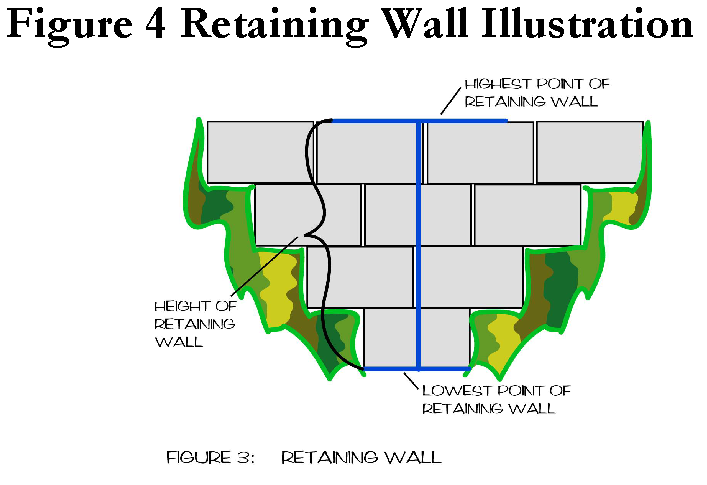
Retaining walls. A zoning permit shall be required for retaining walls that are greater than six feet in height and for which a building permit is required. Height of retaining walls for the purpose of meeting the requirements of this subsection shall be measured from the lowest grade adjacent to any point of the wall. Retaining walls can include, but are not limited to, structures of timbers, boulders, concrete or stone blocks, or other materials.
(f)
Exceptions to height limitations. Height limitations specified for structures in various zoning districts in article V and article VII of this chapter shall not apply to the following appurtenances and structures:
(1)
Church spires and church towers that are an architectural element of the church building and not a communication tower, and provided no communications device co-located on the spire or tower is higher than the spire or tower.
(2)
Belfries.
(3)
Public monuments.
(4)
Typical residential telephone and television antennas and aerials not mounted on towers.
(5)
Chimneys.
(6)
Smoke stacks.
(7)
Flag poles.
(8)
Silos and storage elevators in an agricultural, village mixed, highway commercial, general commercial or industrial zoning district.
(9)
Windmills, or wind turbines as part of a utility scale wind energy conversion system.
(10)
Emergency sirens and similar devices.
(11)
Elevator and stairway bulkheads and air conditioning equipment.
(12)
Water towers, cooling towers, and fire towers.
(13)
Utility poles.
(14)
Communication towers that conform to the regulations in subsection (k) of this section.
(15)
Fences for non-residential uses.
(16)
Roof mounted solar panels.
(g)
Temporary structures. Temporary structures shall meet the following general development standards:
(1)
For construction work. Temporary structures or mobile homes, that are used solely for office or storage purposes in conjunction with construction work only, may be permitted in any zoning district during the period that the construction work is in progress, but such temporary structures shall be removed upon completion of the construction work.
(2)
For sale of property. Temporary offices, both incidental and necessary for the sale or rental of real property within an approved residential subdivision or residential development in which such offices are located, may be permitted in any zoning district until such time as the real property has been sold or rented, provided the office is located within a model home.
(3)
Associated with an allowed temporary use. Any temporary structure associated with a temporary use allowed under section 107-93(c), need not comply with district yard requirements but shall be set back from all lot lines and otherwise be located on the property as may be required by the county to reduce any potential safety hazards to vehicles and pedestrian traffic on adjacent public ways, and to also reduce any adverse effects on adjacent properties. No permanent structures shall be erected except in conformance with the regulations of the zoning district within which the property is located.
(h)
General standards for setbacks and building lines. All structures shall meet the following requirements for yard setbacks and building lines:
(1)
Building lines on approved plats. Whenever an approved and recorded plat of subdivision shows a building line along any frontage for the purposes of creating a front yard or side street yard line, the building line thus shown shall apply along such frontage in place of any other yard line required in this chapter unless specific yard requirements in this chapter require a greater setback.
(2)
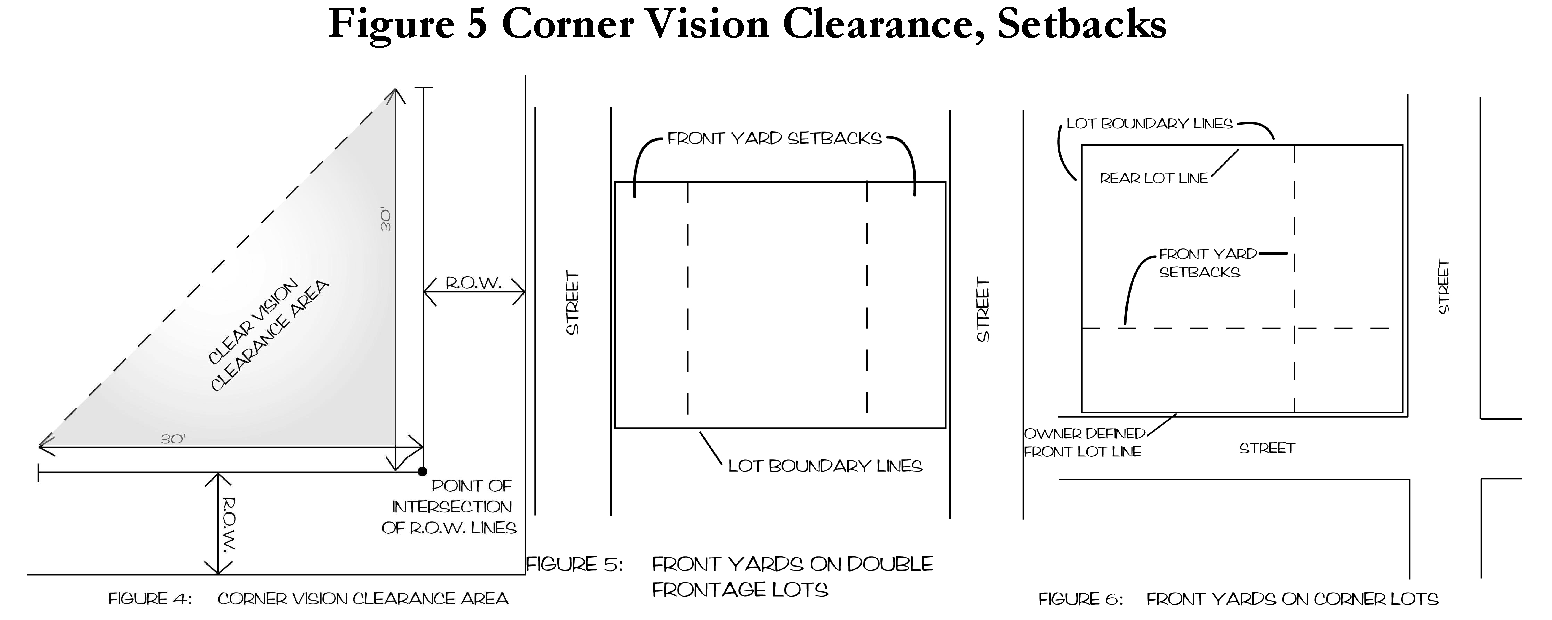
Corner vision clearance. On a corner lot except as provided for elsewhere in this chapter, nothing shall be erected, placed, planted or allowed to grow in such a manner as to impede vision between a height of 2½ feet and ten feet above the centerline grades of the area described as follows: that triangular shaped area bounded by the street, road, railroad, or other public right-of-way lines of a corner lot or tract and a straight line joining points on said right-of-way lines that are 30 feet from the point of intersection of said right-of-way lines.
(3)
Front yard requirements. In any district there shall be a minimum front yard required as stated in the yard requirements for that particular district. The minimum front yard depth as specified in any district shall be measured from the established or proposed right-of-way line of the street on which the lot fronts.
(4)
Front yards on double frontage lots. In any district where a double frontage lot runs through from street to street and where a front yard is required, such front yard shall be provided along each street lot line. Allowed accessory structures, such as a garage may be located in one front yard, and the front yard chosen shall be the front yard where similar structures are located on a majority of the lots on the block, or if there is no majority trend, then on the yard fronting the street of lower classification, provided the setback requirements in subsection (c) of this section are met.
(5)
Front yards on corner lots. The front yard setback for all corner lots shall apply to one street side of the lot. The owner of the lot may determine the front lot line for setback requirements at the time of an application for a zoning permit. Once the front line is established the rear lot line shall then be opposite and most distant from the front lot line. If principal and accessory structures are established, and the front is uncertain, the zoning administrator will determine the front yard by one of the following: the location of accessory structures, access, configuration of the principal structure on the lot, original platting, intent, or other relevant site specific conditions.
(6)
Rear yards on triangular shaped lots. Rear setbacks on triangular shaped lots shall be determined by using the rear setback distance for the zoning district drawn along each leg of the triangle and then connected by a straight line.
(7)
Exceptions to yard setback requirements. A required yard setback shall be kept open except for the following:
a.
Fences or freestanding walls.
b.
Ordinary projections from buildings not to exceed 24 inches including roof overhang.
c.
For commercial and industrial buildings, up to 20 percent of the required front yard area may be covered by arcades, canopies, roofs, solar power systems, or similar architectural features.
(i)
Separation distance requirements for structures from feedlots. At the time of application, any proposed development shall be separated from any state department of natural resources (IDNR) permitted animal feeding operation by the distance required for the type of structure as provided for in appendix C of this chapter.
(j)
Sign regulations. The purpose of this section is to establish minimum requirements to regulate the location, use and bulk of signs within the various zoning districts provided for in this chapter. All signs in any district shall be located, erected and maintained in compliance with the following regulations, in addition to other local, state or federal regulations:
(1)
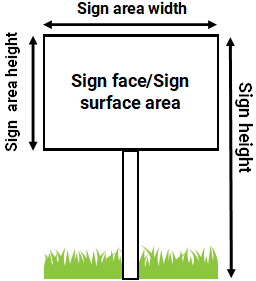
Sign area. Sign area shall include the combination of the writing, copy, message, emblem, illustrations or other display, together with any background material or color forming an integral part of the display, but not including the supporting framework. A sign face's surface area is typically computed by measuring the square footage of all the space enclosed within the extreme edges of a sign's face(s).
a.
Multiple-faced signs. One face of a multiple-faced sign is used in the calculation of the allowed cumulative sign area. If connecting sign faces are separated by more than 45 degrees, both sign faces shall count towards the cumulative sign area.
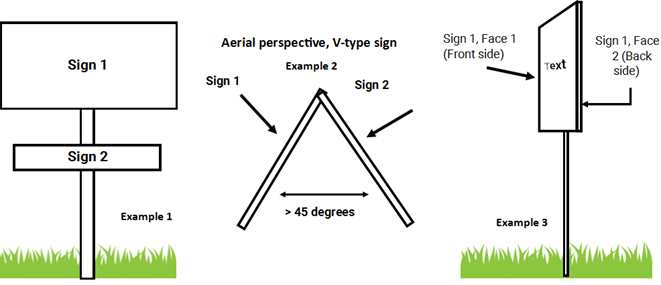
Example 1: Two separate signs on the same pole.
Example 2: The signs are separated by more than 45 degrees, so both sign 1 and sign 2 count towards maximum cumulative signage.
Example 3: Sign faces are separated by less than 45 degrees, therefor only sign 1, face 1 counts towards the maximum cumulative signage.
b.
Cumulative sign area. Cumulative sign area is the sum of the sign area of all signs on a parcel.
(2)
Height. Height shall be measured as the vertical distance from average ground level, exclusive of any filling, berming, mounding, or excavating solely for the purpose of locating the sign, to the highest point of the sign or support structure, whichever is tallest. If the average grade is more than two feet lower than the average grade of the nearest abutting street (if two streets are equidistant, the higher of the two), then the height of the detached sign shall be measured from the elevation of the street to the top of the higher of the sign face or sign structure.
(3)
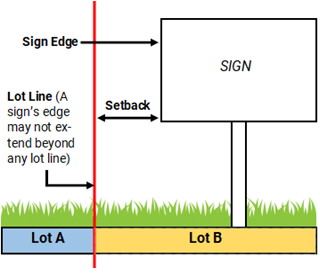
Sign location. No part of a sign, including the furthest edge of a sign, shall encroach upon or extend beyond any lot line or required setback.
(4)
Zoning approval required. All new accessory and advertising signage requires a zoning site plan approval.
(5)
Exempt signs. The following signs are exempt from the regulations of this section:
a.
Miscellaneous traffic or other signs of a public agency, such as railroad crossing signs, and signs warning of danger, hazards, or unsafe conditions.
b.
Any sign which is located within a building but not visible from outside.
c.
Signs and notices required to be displayed, maintained, or posted by law or by any court or governmental order, rule, or regulation.
d.
Incidental signs, including no spraying, no hunting, seed variety, warning signs, and no trespassing signs.
(6)
Prohibited signs.
a.
In rights-of-way. Signs shall not be allowed on any road, street, or highway right-of-way except for official traffic, street, or related signs and structures approved for placement by the public agency controlling the right-of-way.
b.
Traffic hazard. No sign or sign structure shall be erected at any location where it may, by reason of its size, shape, design, location, content, coloring, or manner of illumination, constitute a traffic hazard or a detriment to traffic safety by obstructing the vision of drivers, by obscuring or otherwise physically interfering with any official traffic control device, or which may be confused with an official control device.
(7)
Signs within intersection sight triangles. Signs must be located in accordance with the corner vision clearance provisions of section 107-94(h)(2) and shall be so erected and maintained that an unobscured visual sight area is provided. Such unobscured area, at a minimum, shall extend from a distance of two feet above finished street grade to ten feet above said grade. No more than two pole or post supports no greater than ten inches in diameter shall be permitted within such unobscured area.
(8)
Home occupations. Lots where a conditional use home occupation has been approved by the board of adjustment are allowed one additional sign for the onsite home occupation use in accordance with the regulations in section 107-113(h).
(9)
Nonconforming signs. No nonconforming sign shall be altered or reconstructed, unless the alteration or reconstruction is in compliance with the provisions of this subsection (j). For the purpose of this subsection only, the term "altered or reconstructed" shall not include minor maintenance, minor repair, landscaping around the sign, or the replacement of bulbs, changeable letters or figures, or other embellishments if such changes do not increase the size of the sign or the degree of its nonconformance.
(10)
Temporary signs.
a.
Temporary signs shall not exceed 32 square feet in surface area or exceed 12 feet in height or eight feet in width on a lot in any zoning district. There shall be no more than five such signs for each lot street frontage, and such signs shall be removed no later than 30 days following the accomplishment of activities indicated by such sign. Such signs may be located in a required setback in any district, except that none shall be within the required corner vision clearance provisions of section 107-94(h).
b.
Portable signs are only permitted as temporary signs.
c.
Temporary signs shall not be illuminated.
d.
Vehicles may not be used as temporary signs.
e.
Wall signs are permitted as temporary signs.
(11)
Roof signs. The following regulations apply to roof signs.
a.
Roof signs shall only be permitted for properties with land use areas that are assigned to abide by Class 5 accessory sign regulations. Roof signs may be permitted as advertising signs in HC, GC, and I zoning districts.
b.
Roof signs shall not project or extend beyond or overhang any exterior wall or parapet line of any roof.
c.
No roof sign shall exceed the district height limit established for principal structures.
(12)
Illuminated signs. Illuminated sign shall conform to the following regulations.
a.
Shielding. Illuminated signs shall be shielded so that no direct light or significant glare shall be cast onto surrounding properties or contribute light pollution.
b.
Mounting. All lighting fixtures used to illuminate an outdoor sign shall be mounted on the top of the sign structure to minimize light pollution. An exception to this requirement may be allowed for ground mounted, monument signs. Ground mounted, monument signs (if permitted) may be illuminated with a ground mounted or a bottom mounted lighting fixture, provided that the light output shall be directed totally to the monument sign surface to prevent up-lighting and glare. Moving lights and non-stationary lights are not permitted.
c.
Flashing. Flashing lights and beacons are prohibited.
(13)
Digital signs. Digital signs are permitted as accessory or advertising signs and shall conform to the following regulations;
a.
No on-premises sign located outside an area zoned and used for commercial or industrial purposes shall include any intermittent or moving light, except those signs giving public service information such as time, date, temperature, weather and news. Any variation or addition to the stated service information is subject to administrative approval;
b.
Each change of message is accomplished in one second or less;
c.
No full-motion video shall be allowed;
d.
Be designed to either freeze the display in one static position, display a full black screen, or turn off in the event of a malfunction;
e.
Not more than one sign per property may incorporate a digital sign.
(14)
Accessory signs. Accessory signs shall conform to the following regulations.
a.
Location and size. No such signs shall be placed on public property. Such signs may be located in a required yard in any district, except that none shall be within 30 feet of a corner street lot line intersection. No such sign shall exceed 32 square feet in surface area except as provided otherwise in this subsection (j).
b.
Wall signs. Where permitted, an accessory wall sign shall not project more than 12 inches from the wall to which it is attached, and shall be contained within the outline of the wall to which it is attached.
c.
Subdivisions, multiple-family development and mobile home parks. In zoning districts where residential subdivisions, multiple-family developments, and mobile home parks are permitted, not more than two signs located at the entrance to a subdivision, multiple-family development or mobile home park shall be permitted. The total of any such sign shall not exceed 64 square feet in surface area and no sign shall exceed 12 feet in height. Said signs may be located in the required yard of such development. This shall not preclude individual residences within subdivisions, multiple-family developments, and mobile home parks from having accessory or temporary signs.
d.
Setbacks. Freestanding accessory signs shall be located on the lot so that the distance from the base of the sign to any adjoining property line is a minimum of 100 percent of the sign's height.
e.
Accessory signs, Class 1. Accessory signs for specified uses within zoning districts as detailed in Table 107-94(j)(10) may be allowed provided the following requirements are met:
1.
Surface area.
(i)
The maximum cumulative sign area of all permitted signs, other than wall signs, for any lot shall not exceed 32 square feet;
(ii)
One wall sign shall be permitted which does not cumulatively exceed one-third of the surface area of the wall to which the sign is attached and shall not extend above the wall to which they are attached.
2.
Projecting signs. Projecting signs are not permitted.
3.
Height. Freestanding signs shall not exceed a height of ten feet. Attached signs shall not extend above the wall to which they are attached.
4.
Illumination. Not more than one accessory sign may be illuminated in accordance with section 107-94(j)(12).
5.
Digital signs. Digital signs are prohibited in accordance with section 107-94(j)(13).
6.
Roof signs. Roof signs are not permitted.
f.
Accessory signs, Class 2. Accessory signs for uses specified uses within zoning districts as detailed in Table 107-94(j)(10) may be allowed provided the following requirements are met:
1.
Surface area.
(i)
The maximum total surface area of any single sign shall not exceed four square feet;
(ii)
Wall signs shall not exceed four square feet in size and shall not extend above or beyond the wall to which they are attached.
(iii)
The maximum cumulative sign area allowed is 32 square feet.
2.
Projecting signs. Projecting signs are not permitted.
3.
Height. Freestanding signs shall not exceed five feet in height. Wall signs shall not extend above the wall to which they are attached.
4.
Illumination. Not more than one accessory sign may be illuminated in accordance with section 107-94(j)(12).
5.
Digital signs. Digital signs are prohibited in accordance with section 107-94(j)(13).
6.
Roof signs. Roof signs are not permitted.
g.
Accessory signs, Class 3. Accessory signs for specified uses within zoning districts as detailed in Table 107-94(j)(10) may be allowed provided the following requirements are met:
1.
Sign area.
(i)
No more than two non-wall signs shall be permitted for each lot street frontage;
(ii)
The maximum surface area for all signs shall not exceed two square feet for each linear foot of building frontage or one square foot for each linear foot of lot frontage, whichever results in the larger sign area;
(iii)
The maximum cumulative sign area for all such signs shall not exceed 160 square feet for each establishment;
(iv)
No such sign exceeding 50 square feet in surface area shall be located within 40 feet of an adjoining residential lot in the same frontage;
(v)
In addition, one wall sign shall be permitted for each establishment's lot street frontage, providing no such signs exceed one-third of the surface area of the wall to which they are attached.
2.
Projecting signs. No more than one projecting sign for each building frontage shall be permitted.
3.
Height. No sign shall exceed 25 feet in height.
4.
Illumination. Illuminated signs are permitted in accordance with section 107-94(j)(12).
5.
Digital signs. Digital signs may be allowed as part of an approved conditional use.
6.
Roof signs. Roof signs are not permitted.
h.
Accessory signs, Class 4. Accessory signs for specified uses within zoning districts as detailed in Table 107-94(j)(10) may be allowed provided the following requirements are met:
1.
Sign area.
(i)
The total surface area in square feet of all signs on a lot shall not exceed three square feet for each linear foot of building frontage, or two square feet for each linear foot of lot frontage, whichever results in the larger sign area;
(ii)
The maximum cumulative sign area of all permitted signs for each establishment shall not exceed 400 square feet;
(iii)
No such signs with a surface area of 50 square feet or more shall be located within 40 feet of an adjoining residential district;
(iv)
In addition, one wall sign shall be permitted for each establishment's lot street frontage, providing no such sign shall exceed one-third of the surface area of the wall to which they are attached.
2.
Projecting signs. No more than one projecting sign for each building frontage shall be permitted in HC and GC districts or land uses in districts regulated by Class 4 accessory sign provisions.
3.
Height. No sign shall exceed 45 feet in height, except no sign shall exceed 25 feet in height if located within 40 feet of a residential lot.
4.
Illumination. Illuminated signs are permitted in accordance with section 107-94(j)(12).
5.
Digital signs. Digital signs are permitted in accordance with section 107-94(j)(13).
6.
Roof signs. Roof signs are not permitted.
i.
Accessory signs, Class 5. Accessory signs for specified uses within zoning districts as detailed in Table 107-94(j)(10) may be allowed provided the following requirements are met:
1.
Sign area.
(i)
The surface area in square feet of all signs on an establishment's lot frontage shall not exceed two square feet for each linear foot of building frontage or one square foot for each linear foot of lot frontage, whichever results in the larger sign area;
(ii)
The maximum cumulative sign area of all permitted signs, other than wall signs, for any establishment shall not exceed 500 square feet;
(iii)
In addition, up to two wall signs shall be permitted which do not cumulatively exceed one-third of the surface area of the wall to which the signs are attached.
2.
Location. No freestanding sign shall be located less than 15 feet from any property line, except when adjacent to a residential lot, in which case any freestanding sign shall be set back 40 feet from the property line.
3.
Projecting signs. No more than one projecting sign for each building frontage shall be permitted in I districts or land uses in districts regulated by Class 5 accessory sign provisions.
4.
Height. Freestanding signs shall not exceed a height of 45 feet. Attached signs shall not extend above the wall to which they are attached.
5.
Illumination. Illuminated signs are permitted in accordance with section 107-94(j)(12).
6.
Digital signs. Digital signs are permitted in accordance with section 107-94(j)(13).
7.
Roof signs. Roof signs are permitted in accordance with section 107-94(j)(11).
(15)
Regulations for advertising signs.
a.
Where permitted. Advertising signs shall be a permitted use in HC, GC and I districts, and shall not be permitted in any other district.
b.
Maximum number of sign faces. An advertising structure shall contain no more than two signs per side, and the maximum cumulative sign area of each side shall not exceed 672 square feet, with extensions up to 100 square feet and such extensions no more than five feet from the sign structure.
c.
Height. Advertising signs shall be subject to the following requirements:
1.
Maximum height to top of the sign structure shall be 50 feet.
2.
Minimum height from the ground to the bottom of the sign surface shall be five feet for signs with a surface area of less than 50 square feet, or ten feet for signs with a surface area of 50 square feet or more.
d.
Yard requirements. Advertising signs shall be subject to the yard requirements established for principal uses for the district in which they are located. In addition:
1.
No sign shall be erected within 100 feet of an intersection of two roads, highways, or streets.
2.
No sign shall be erected within 200 feet of any residential district (AG, RR, VR, VM, USR, USR-MF, MH and CNR) as measured from the nearest part of the sign to the zoning district boundary line in such residential districts.
3.
No sign shall be erected within 200 feet of any church or school as measured from the nearest part of the sign to the property line where said church or school is located.
e.
Minimum spacing. The minimum spacing between advertising signs shall be as follows:
1.
None required for signs with a surface area of 50 square feet or less.
2.
One hundred feet for signs with a surface area more than 50 square feet but less than 200 square feet measured in either direction along both sides of the highway or street adjoining the proposed structure; except back to back signs facing the opposite direction.
3.
Three hundred feet for all signs with a surface area equal to or over 200 square feet measured in either direction along both sides of the highway or street adjoining the proposed structure, except that back to back signs are permitted, and no more than two signs facing the same direction.
f.
Painting or affixing to wall or fence prohibited. Advertising sign message or copy shall not be painted or affixed directly on a wall or fence.
g.
Nonconforming advertising signs. Any legally established advertising sign which by the adoption of this chapter is made nonconforming as to location, size, height, area, or spacing, shall be allowed to continue, but shall not be altered or reconstructed. However, any nonconforming advertising sign that suffers damage exceeding 65 percent of its market value shall not be rebuilt unless brought into compliance with the provisions of this article.
h.
Illumination. Illuminated advertising signs are permitted in accordance with section 107-94(j)(12).
i.
Digital signs. Digital signs are permitted in accordance with section 107-94(j)(13).
1.
If the advertising device incorporates a digital sign, the advertising device shall not be located within 1,000 feet of another advertising device that incorporates a digital sign when both are visible to traffic proceeding in any one direction.
Table 107-94(j)(10) Summary of sign characteristics by zone and use
Accessory Sign Regulation Class by Use Category and Zoning District
(k)
Communication tower regulations.
(1)
General intent. The general intent of these minimum standards for installation, siting and regulation of communication towers are:
a.
To minimize adverse visual effects of towers through careful design, siting, and vegetative screening;
b.
To avoid potential damage to adjacent properties from tower failure and falling ice through engineering and careful siting of tower structure;
c.
To allow for reasonable location and use for communication towers; and
d.
To address adverse effects on human health and safety.
(2)
Where allowed. Table 107-147-1 lists the zoning districts where communication towers are allowed as a permitted, conditional or accessory use by height.
(3)
Application requirements for communication towers between 35 and 200 feet in height. A building permit and conditional use permit (if applicable) shall be obtained prior to construction of a communications tower. Each application for a permit shall include the following information, supplied by the tower owner, operator, or contractor installing the tower.
a.
A site plan prepared by the owner or his representative drawn in conformance with the requirements for a major or minor site plan.
1.
A major site plan is required for broadcast/common carrier and for private business/government communication towers.
2.
A minor site plan is required for non-commercial communication towers.
b.
Towers shall be subject to all applicable county codes.
c.
Plans and specifications for the tower design as specified by the tower manufacturer or as approved by a registered professional engineer experienced in the design and/or analysis of communication towers shall be submitted to the building department by the tower owner, operator, or contractor installing the tower.
(4)
Establishment of setback easements. The creation of a tower setback easement intended to meet the necessary setback requirements set forth in the subsequent site and structure requirements sections for various tower height ranges is permitted through the creation of a recorded setback easement and must meet the following requirements:
a.
The setback easement must be for the duration of and commensurate with the structural life and use expectancy of the tower for compliance with this chapter.
b.
The tower owner has primary authority and responsibility for the setback easement and lease area of the tower for compliance to this chapter.
c.
No new structures shall be built within the required setback area with the exception of those appurtenances specific to the communications tower. Examples of allowable appurtenances would include, but not be limited to, equipment cabinets and fences. Additionally, existing accessory structures on the parcel where the tower is being constructed may be within the setback area. No residential dwellings shall be permitted within the delineated setback area.
(5)
Site and structure requirements for communication towers at least 35 feet in height to less than 80 feet in height.
a.
Guy anchor installations shall comply with the front and, where applicable, corner side yard setback requirements and shall not be placed closer than three feet from any side or rear property line or closer than ten feet from any principal structure.
b.
Freestanding towers shall be located so that the distance from the base of the tower to any adjoining property line is a minimum of 100 percent of the proposed effective tower height, but not less than the minimum setback requirements for a principal structure.
c.
Guy supported towers shall be located so that the distance from the base of the tower to any adjoining property line is a minimum of 70 percent of the effective tower height from its base, but not less than the minimum setback requirements for a principal structure.
d.
Towers and/or guy anchors may be attached to principal or accessory buildings in accordance with the building code.
e.
No guy anchors or towers shall be located in an easement located on the property. No tower accessories or appurtenances shall defeat the purpose of any easement on the property.
(6)
Site and structure requirements for communication towers at least 80 feet in height to less than 200 feet in height.
a.
Guy anchor installations shall comply with the front and, where applicable, corner side yard setback requirements and shall not be placed closer than three feet from any side or rear property line or closer than ten feet from any principal structure.
b.
Freestanding towers shall be located so that the distance from the base of the tower to any adjoining property line is a minimum of 100 percent of the proposed effective tower height, but not less than the minimum setback requirements for a principal structure.
c.
Guy supported towers shall be located so that the distance from the base of the tower to any adjoining property line is a minimum of 70 percent of the effective tower height from its base, but not less than the minimum setback requirements for a principal structure.
d.
Towers and/or guy anchors may be attached to principal or accessory buildings in accordance with the building code.
e.
No guy anchors or towers shall be located in an easement located on the property. No tower accessories or appurtenances shall defeat the purpose of any easement on the property.
(7)
Regulation of communication towers greater than 200 feet in height.
a.
Application. A building permit and conditional use permit (if applicable) shall be obtained prior to construction of communication towers. Each application for a permit shall include the following information, supplied by the tower owner, operator, or contractor installing the tower:
1.
A site plan, professionally prepared, drawn in conformance with the requirements for a site development plan.
2.
Plans and specifications from a registered professional engineer experienced in the design and/or analysis of communication towers. The plans and specifications shall include:
(i)
Tower height;
(ii)
Type of structure;
(iii)
Type of materials;
(iv)
Specification for materials used for structural elements of the towers;
(v)
Name of tower manufacturer;
(vi)
Soils investigation (where required for footing design);
(vii)
List of the type and location of all antennas, cables and other appurtenances which will be installed at the time the tower is erected;
(viii)
List of the type and location of all antennas, cables and other appurtenances which may or could be installed in the future;
(ix)
The plans and specifications shall include a statement that to the best of the engineer's knowledge, information, and belief, the proposed structure has been designed in accordance with all of the following:
A.
The current the county building code;
B.
Applicable ordinances as adopted by the county;
C.
The current version of EIA-222, "Structural Standards for Steel Antenna Towers and Antenna Support Structures";
D.
A written statement certifying that all FAA and FCC requirements will be met or addressed.
(x)
The tower owner shall supply a report stating that the tower has been constructed and installed according to the design submitted to obtain the building permit. This report shall be accompanied by as-built drawings and test results and submitted to the building department.
b.
Site and structure requirements.
1.
Guy anchor installations shall comply with the front and, where applicable, corner side yard setback requirements and shall not be placed closer than three feet from any side or rear property line or closer than ten feet from any principal structure.
2.
Freestanding towers shall be located on the lot so that the distance from the base of the tower to any adjoining property line is a minimum of 100 percent of the proposed tower height.
3.
Guy supported towers shall be located so that the distance from the base of the tower to any adjoining property line is a minimum of 70 percent of the effective tower height from its base.
4.
No guy anchors or towers shall be located in an easement located on the property. No tower accessories or appurtenances shall defeat the purpose of any easement on the property.
5.
Accessory structures or buildings shall be located on the property according to the setback and structure requirements of the zoning district in which they are located.
(8)
Screening/fencing/signage.
a.
On-site vegetation shall be preserved to the maximum extent practical.
b.
Where the site abuts residentially developed land, residential zoning districts, public land or streets, or is located in a primary residential development area (urban services area, rural residential development area) as designated on the rural land use map, the site perimeter shall be landscaped with at least one row of deciduous trees, not less than 1½ inches in diameter measured three feet above the grade, spaced not more than 20 feet apart and within 25 feet of the site boundary, as well as at least one row of evergreen trees or shrubs, at least four feet high when planted and spaced not more than 15 feet apart and within 40 feet of the site boundary. Alternatives such as walls or fences may be permitted by the county board of adjustment based on security or other reasons.
c.
Eight-foot high security fencing, with barbed wire shall be required around the base and guy anchors of the tower.
d.
Appropriate signage shall be posted indicating that trespassing and/or vandalism to the property may be punishable under local, state, or federal statutes.
(9)
Structurally unsafe or unused towers. Any tower found to be decommissioned, or deemed structurally unsafe and which cannot be brought into compliance within 180 days, must be removed at the expense of the responsible party.
(10)
Compliance with standards. Current or former EIA standards shall apply to the addition of antennas or other appurtenances to communication towers under the following conditions:
a.
Additions to towers constructed prior to the effective date of the ordinance from which this chapter is derived regardless of whether the additions were accounted for in the original design, shall comply with the current EIA standards, and the wind loading specified therein.
b.
Additions to towers constructed subsequent to the effective date of the ordinance from which this chapter is derived shall comply with standards set forth in subsection (k) of this section. If the EIA standards have changed since the tower was designed, a structural analysis must be performed before any appurtenances or equipment are added.
c.
Existing towers which will not have any appurtenances added to them shall at a minimum comply with the EIA standards in existence at the time the tower was erected.
d.
Replacement of antennas or other appurtenances shall at a minimum comply with the EIA standard in existence at the time the tower was erected if the replacement does not add to the original design loading.
e.
If a structural analysis shows a tower is not in compliance with the appropriate EIA standards, the owner shall notify the building department promptly, and provide the building department with a plan to bring the tower into compliance within six months.
f.
The building department shall be notified in writing when a required analysis is complete. A copy of the analysis report shall be made available to the county upon request. That report shall also give details of the net result of any changes made to the tower or its appurtenances since the last inspection.
g.
Retractable towers shall conform to all provisions of subsection (k) of this section, except that a retractable tower must either meet the EIA-222 standards for wind loading when extended or be sited a distance of at least 100 percent of the extended tower height from any adjoining property line. For either case, the retractable tower must meet EIA-222 standards when retracted.
(11)
Non-ionizing electromagnetic radiation (NIER). A source of non-ionizing electromagnetic radiation (NIER), when combined with existing sources of NIER, shall not expose the general public to ambient radiation exceeding standards established by ANSI C-95.1 or most recent version, or any applicable Environmental Protection Agency or Federal Communication Commission regulations.
(12)
Lighting. No permanent lighting is allowed on towers except as required by the FCC or the FAA.
(13)
Interference. Any signal interference complaints associated with communication towers or related equipment shall be addressed in accordance with FCC rules and procedures.
(Code 2006, ch. 41, art. 5, § 4; Ord. No. 3-3-2006, 4-1-2006; Ord. No. 6-5-2006, 5-11-2006; Ord. No. 7-6-2006, 7-1-2006; Ord. No. 13-9-2006, 10-1-2006; Ord. No. 3-3-2007, 4-1-2007; Ord. No. 1-2-2008, 4-1-2008; Ord. No. 1-3-2011, 6-1-2011; Ord. No. 10-10-2013, 10-14-2013; Ord. No. 4-5-2014, 5-19-2014; Ord. No. 5-7-2014, 7-21-2014; Ord. No. 13-8-2015, 8-17-2015; Ord. No. 1-3-2016, 4-1-2016; Ord. No. 8-11-2019, Att. A, Pt. II, § 3, 11-13-2019; Ord. No. 2-2-2021, § 1(Att.A, § 4), 1-27-2021; Ord. No. 14-9-2021, § 1(Att. A(2, 3)), 9-8-2021; Ord. No. 18-10-2022, § 1, 2, 10-12-2022; Ord. No. 8-6-2023, § 4, 6-7-2023; Ord. No. 3-7-2024, § 2, 7-31-2024; Ord. No. 8-12-2024, § 1, 12-11-2024; Ord. No. 5-3-2023, § 1, 3-14-2023; Ord. No. 8-12-2024, § 2, 12-11-2024)
Sec. 107-95. - General environmental regulations.
(a)
Water and sewage requirements. In all cases where a proposed building or proposed use will involve the use of sewage facilities, and public sewer and/or water is not available, the sewage disposal and/or the domestic water supply shall comply with the requirements of the county public health department. No portion of the proposed sewage disposal system shall be located within ten feet of any lot line. The application for a building permit shall be accompanied by a certificate of approval from said board of health, or by a signed affidavit that acknowledges that such permits are required.
(b)
Stormwater. To limit the impact of stormwater runoff, and accompanying sediment, heat, pollutants, and energy, certain development or clearing activities will be required to complete and implement a stormwater pollution prevention plan (SWPPP).
(1)
Activities requiring a SWPPP. All applicants for major subdivisions, and applicants for all other the county permits or approvals that will result in land disturbance activity that meets NPDES Phase II or later requirements shall submit to the county a SWPPP and shall implement the plan.
(2)
Reviewing agency. No building permit, subdivision approval, or any permit allowing land disturbing activities shall be issued until the county soil and water conservation district (SWCD) reviews the SWPPP, when required. The SWCD shall review the SWPPP and shall submit comments to the county planning and development department within 30 days of a SWPPP submittal that meets the requirements in subsection (b)(3) of this section.
(3)
Standards of review.
a.
All plans shall be consistent with National Pollutant Discharge Elimination System (NPDES) Phase II requirements or latest requirements, and mitigation and management techniques, facilities, and practices shall be consistent with stormwater management recommendations of the SWCD and preferred county design and management practices as identified in the UDC.
b.
Stormwater pollution prevention plan information requirements. The stormwater pollution prevention plan must provide all the information required in the state NPDES General Permit No. 2 Part IV, published March, 2003, or most recent update, and shall be consistent with Iowa Rules addressing NPDES permits, including 567 Chapters 60 and 64 of the state administrative code. The SWPPP shall identify and describe the development project or proposed vegetative clearing as described in the IDNR guidance document for stormwater management for construction activities, and shall identify or provide the following information where applicable:
1.
Existing base zoning classifications and overlay zoning districts for land within and adjacent to the development.
2.
All delineated critical natural resources if the project is in the CNR district, described in section 107-142.
3.
Steep slopes, defined as slopes 15 percent or greater as shown on topography data derived from LiDAR remote sensing.
4.
Wooded areas.
5.
Areas of concentrated flow including but not limited to open ditches and grass channels.
6.
Flow distance from the project boundary to the nearest named receiving water.
7.
For major subdivisions, all information required in section 107-72(2).
(4)
Stormwater management performance standards. The applicant shall reduce the need for stormwater conveyance or holding facilities by incorporating the use of natural topography and land cover such as natural swales and depressions as they exist prior to development to the degree that they can accommodate the additional flow of water without compromising the integrity or quality of the receiving waterbody.
(5)
Minimize impact to natural features. The development shall minimize impact to natural features, including steep slopes (greater than 15 percent), wetlands, wooded areas of significance, rare or unique species habitat, areas with delineated critical natural resources, designated or protected greenways, or county parks and open space.
(6)
Maintenance of stormwater facilities. The county requires that stormwater facilities be maintained according to the following standards:
a.
Private stormwater facilities. All private stormwater facilities shall be maintained in proper condition consistent with the performance standards for which they were originally designed.
1.
Maintenance plan required. No private stormwater facilities may be approved unless a maintenance plan is provided that defines who will conduct the maintenance, the type of maintenance and the maintenance intervals. The maintenance plan must identify who will remove settled materials from ponds, sumps, grit chambers, and other devices, including settled solids, and on what interval. All settled materials shall be removed and properly disposed of on at least a five-year interval. The county may grant a one- to five-year waiver from this requirement when the owner presents evidence that the facility has additional capacity to remove settled solids in accordance with the original design capacity.
2.
Maintenance-friendly design. All stormwater facilities must be designed to minimize the need for maintenance, to provide easy vehicle and personnel access for maintenance purposes, and be structurally sound. It shall be the responsibility of the applicant to obtain any necessary easements or other property interests to allow access to the facilities for inspection or maintenance.
3.
Inspection. The county shall have the right to inspect all private stormwater facilities during construction, during the first year of operation, and at least once every five years thereafter.
b.
Maintenance of publicly owned stormwater facilities. The county shall annually perform the maintenance of county-owned stormwater facilities.
(Code 2006, ch. 41, art. 5, § 5; Ord. No. 10-10-2013, 10-14-2013; Ord. No. 13-8-2015, 8-17-2015)

