
Linn County Unincorporated
City Zoning Code
City Zoning Code
ARTICLE IX
- DEFINITIONS
Sec. 107-178. - Introduction.
Definitions for certain terms and words used in this chapter are defined in section 107-180. If not defined in this article, words and terms shall be given the meanings defined in I.C.A. chs. 354 (Platting) and 355 (Land Surveying); and if not defined there, they shall be given their common meaning.
(Code 2006, ch. 41, art. 9, § 1)
Sec. 107-179. - Interpretation of certain terms.
For the purpose of this chapter, certain terms and words shall be interpreted as follows:
(1)
The terms "shall," "will" and "must" are mandatory, not discretionary, and create an obligation or duty to comply with the particular provision.
(2)
The term "may" is permissive.
(3)
The term "person" shall include individuals, businesses, firms, associations, organizations, partnerships, trusts, companies and corporations.
(4)
Words used in the present tense shall include the future.
(5)
Words used in the singular shall include the plural, and the plural the singular, unless otherwise indicated in the text.
(6)
The term "and" used in conjunction with a series of items shall mean all items must occur.
(7)
The masculine gender shall include the feminine.
(8)
The term "used for" shall include the terms "arranged for," "designed for," "intended for," "maintained for" and "occupied for."
(Code 2006, ch. 41, art. 9, § 2)
Sec. 107-180. - Definitions.
The following words, terms and phrases, when used in this chapter, shall have the meanings ascribed to them in this section, except where the context clearly indicates a different meaning:
Access controlled road or facility means a highway or street especially designed for through traffic, and over, from or to which owners or occupants of adjoining land or other persons have no right or easement or only a controlled right or easement of access, light, air or view by reason of the fact that their property abuts upon such controlled access facility or for any other reason. Such road or facility may be a freeway open to use by all customary forms of street and highway traffic.
Accessory building, structure or use means a building, structure, or use which is subordinate to and serves a principal building, structure, or use; is located on the same zoning lot as the principal building, structure, or use served, except as otherwise expressly authorized by the provisions of this chapter; and contributes to the comfort, convenience, necessity or benefit of the occupants, employees, customers, or visitors of or to the principal building, structure, or use served.
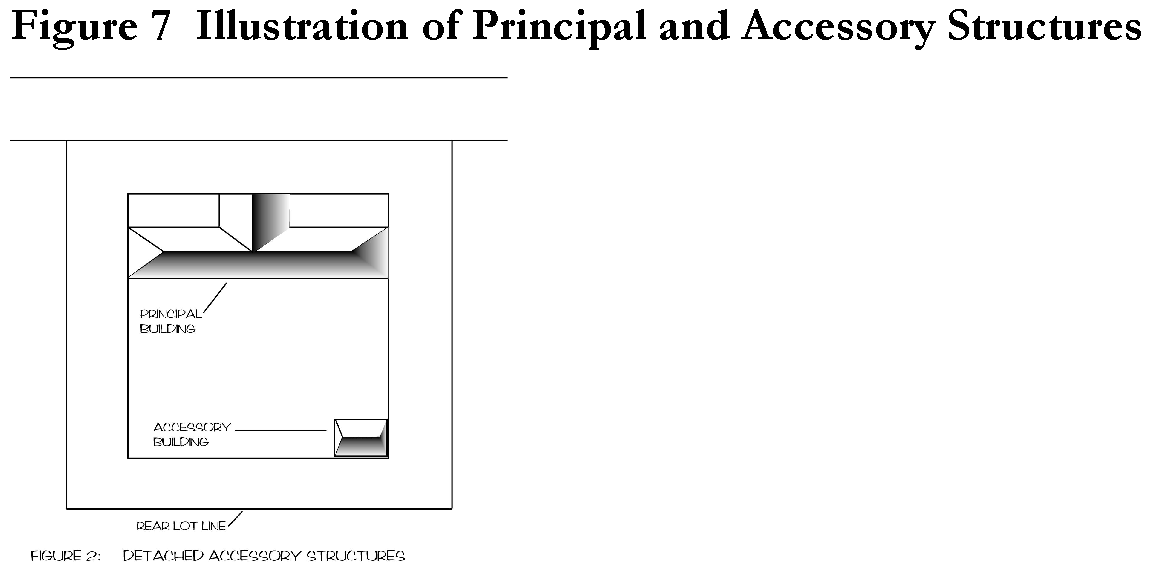
Accessory dwelling unit means a secondary dwelling unit located on the same lot as a principal dwelling, which may take the following forms: a detached unit, a unit that is part of an accessory structure, a unit that is part of a principal dwelling, a tiny house, or a manufactured or mobile home converted to real property by being placed on a permanent foundation and assessed for real estate taxes. The accessory dwelling unit provides complete independent living facilities for one or more persons, which at a minimum includes permanent provisions for living, cooking, and sanitation, including a bathroom and kitchen, and which has an independent access. Accessory building size limitations shall apply as appropriate.
Accessory dwelling unit floor area means the total area of all floors of a building or structure, measured from the exterior face of exterior walls, including, but not limited to, floor area dedicated to living, cooking, and sanitation. Bathrooms, toilet rooms, closets, halls, stairs, breezeways with greater than 100 square feet in floor area, basements, storage or utility spaces and similar areas shall be considered part of the accessory dwelling unit floor area. For rooms with sloped ceilings, the area having a ceiling height of less than seven feet shall not count towards the total floor area. Garages, unenclosed porches and carports, and uncovered steps and fire escapes are not included in the total accessory dwelling unit floor area. For accessory dwelling units in detached structures, accessory structure size limitations of the underlying zoning district shall apply.
Accessory signs means a sign which directs attention to an establishment, business, profession, commodity, service, premises, person or thing which is located, produced, conducted, sold, or offered on the same lot upon which the sign is located. An accessory sign is thus functionally related to a principal use on the same lot.
Accessory use means a use incidental to and customarily associated with a specific principal use, located on the same lot or parcel.
Acreage, gross, means the total area within the boundaries of a parcel of land.
Acreage, net, means a measure of land area within the boundaries of a parcel of land after excluding dedicated road rights-of-way, and any dedicated right-of-way or easement by whatever name known.
Adjoining means adjacent to and sharing common property lines (including a single point of tangency), but not including properties separated by a road or road right-of-way.
Adult entertainment means any adult bookstore, strip club, adult hotel or motel, adult motion picture arcade, adult motion picture theater, cabaret, sexual encounter center, or any other business or establishment that offers its patrons services or entertainment characterized by an emphasis on matter depicting, describing, or related to specific sexual activities or specified anatomical areas, but not including those uses or activities, the regulation of which is preempted by state law. Any establishment in which adult videos comprise more than 50 percent of the video products in stock shall be considered an adult entertainment use.
Advertising signs means a sign which directs attention to an establishment, business, profession, commodity, service, premises, person or thing that may be located, produced, conducted, sold or offered elsewhere than on the lot upon which the sign is located. An advertising sign may be a principal use on a lot.
Affordable housing means affordable housing is generally defined by housing and urban development as housing where the occupant is paying no more than 30 percent of his income for gross housing costs, including utilities.
Agricultural chemicals, fertilizer, liquid propane and other related fuels, or anhydrous ammonia storage and distribution means an establishment engaged in retail sale of supplies directly related to the day-to-day activities of agricultural production.
Agricultural land preservation area means a legally recognized geographic area formed by one or more landowners and approved by one or more government agency, consistent with I.C.A. ch. 352, designed to keep land in agriculture.
Agricultural area means areas of the county that are designated "AA" on the rural land use plan map.
Agricultural building, for purposes of applying this chapter, means and includes, but is not limited to, a building, structure or erection used for agricultural purposes as part of an agricultural unit.
Agricultural experience (agricultural tourism) means any agriculture-related activity, as an annual or recurring, seasonal, secondary-use in conjunction with agricultural production, on a farm which activity is open to the public with the intended purpose of promoting or educating the public about agriculture, agricultural practices, agricultural activities, or agricultural products.
Agricultural feed, mixing and blending, seed and fertilizer sales, means an establishment engaged in retail sale of supplies directly related to the day-to-day activities of agricultural production.
Agricultural implement sales and service means establishments selling, renting, or repairing agricultural machinery, equipment, and supplies for use in soil preparation and maintenance, the planting and harvesting of crops, and other operations and processes pertaining to farming and ranching.
Agricultural purposes. See "Agriculture."
Agricultural research facility means a facility, including associated cultivated areas, whose primary purpose is research in food and agricultural sciences.
Agriculture means the art or science of cultivating the ground, including the harvesting of crops and the rearing and management of livestock.
Agrivoltaics means the simultaneous use of land for solar energy generation and agriculture, specifically designed to produce a commercial product. This system optimizes land use by integrating crop cultivation or livestock grazing with solar panels, thereby enhancing both agricultural productivity and renewable energy output. Commercial products from agrivoltaics can include a range of crops, livestock products, and products such as honey, all cultivated or raised under or around solar panels.
Airport means any area of land or water used, or intended to be used, for the landing and taking off of aircraft, and any appurtenant areas used or intended to be used for airport buildings or other airport facilities or rights-of-way, including all necessary taxi ways, aircraft storage and tie-down areas, hangars, and other necessary buildings and open spaces.
Airport hazard area means any area of land or water, or space above it, lying within the approach, transitional, horizontal, or conical surfaces as defined by an adopted airport hazard-zoning ordinance or FAA Part 77 surface applicable to a publicly controlled airport.
Alcoholic beverage, alcoholic liquor or intoxicating liquor, beer, spirits orwine. As defined by the I.C.A. § 123.3, Definitions, or, as subsequently amended.
Alley means a minor way, dedicated to public use, which is used primarily for vehicular access to the back or the side of properties otherwise adjoining on a street.
Amusement park means a facility, primarily outdoors, that may include structures and buildings, where there are various devices for entertainment, including rides, booths for the conduct of games or sale of items, buildings for shows and entertainment, and restaurants and souvenir sales.
Annexation means the incorporation of land into an existing community that results in a change in the community's boundary. The term "annexation" generally refers to the inclusion of newly incorporated land but can also involve the transfer of land from one municipality to another.
Animal boarding, animal shelter. See "Kennel."
ANSI C-95.1 means the most recently adopted standard of the American National Standards Institute establishing guidelines for human exposure to non-ionizing electromagnetic radiation.
Apartment means a room or suite of rooms designed and arranged for use as a residence by a single-family.
Apartment house. See "Dwelling, multiple-family."
Applicant means the owner of land, or the owner of a leasehold interest therein, or the owner's authorized representative, or a governmental entity proposing an action or development requiring county development review and approval or the issuance of a permit for the development of land.
Application means any application for a development permit or development approval pursuant to this chapter and which application was not complete and filed on or before the date of adoption of the ordinance from which this chapter is derived.
Appurtenant structure means a structure which is on the same parcel of the property as the principal structure to be insured and the use of which is incidental to the use of the principal structure.
Aquifer means unconsolidated material or rock capable of storing water.
Art, crafts, photography or production studio or gallery means the workshop of an artist, sculptor, photographer, or craftsperson; a place for radio or television production; or a place where movies are produced.
Article means a reference to an article of this chapter.
Assisted living center. See "Health care facility."
Auction house means establishments where the property of others is sold by a broker or auctioneer to persons attending scheduled sales periods or events.
Auto salvage yard or scrap yard means a lot or portion thereof where waste, discarded or salvaged materials are bought, sold, exchanged, baled, stored, packed, disassembled or handled, including auto wrecking activities, building wrecking activities, used lumber places and places for storage of salvaged building materials and equipment; but not including such places where such uses are conducted entirely within a completely enclosed building. The presence on any lot, parcel or tract of land of three or more wrecked, scrapped ruined, dismantled or inoperative motor vehicles, including implements or husbandry not a part of a farming operation, shall constitute prima facie evidence of an auto salvage or scrap yard. This shall not include motor vehicles licensed for the current year as provided by law, or motor vehicles legally placed in storage, if kept within a completely enclosed building.
Automobile service station means a commercial establishment for the retail sale of fuel, lubricants, tires, and other similar products and supplies for vehicles, including minor accessory parts. It may also include minor parts installation, towing, servicing, and minor repairs of vehicles; and vehicle washing facilities and trailer rental when accessory to the above activities. Major repairs and sale of vehicles are expressly excluded.
Bait and tackle shop means a business whose primary purpose and revenue is from the sale of fishing supplies including bait and fishing equipment.
Balcony means an unroofed platform, unenclosed except by a railing, which projects from the outer wall of a building above ground level with or without support other than the building.
Bank, credit union, savings and loan, brokerage, means a building, with or without a drive-up window, for the custody, loan, or exchange of money; for the extension of credit; and for facilitating the transmission of funds.
Barber means a fixed establishment or place where one or more persons engage in the practice of barbering.
Base flood means the elevation floodwaters would reach at a particular site during the occurrence of a base flood event the flood having one percent chance of being equaled or exceeded in any given year. (Also commonly referred to as the "100-year flood").
Basement means any enclosed area of a building which has its floor or lowest level below ground level (subgrade) on all sides. See also "Lowest floor."
Bathroom means a room containing plumbing fixtures including a toilet, and bath or shower.
Beauty shop or salon means a fixed establishment or place where one or more persons engage in the practice of cosmetology.
Bed and breakfast means a private residence that offers sleeping accommodations for rent to lodgers in four or fewer rooms, in the innkeeper's (owner or operator) principal residence, and serves breakfasts to its lodgers.
Beginning of construction. See "Start of construction."
Best management practices means the most appropriate technology or practice for controlling or managing air or water emissions, noise, vibrations, stormwater runoff, light, smell, or other emission or event.
Billboard. See "Sign, advertising."
Blade means the aerodynamic surface that catches the wind and drives a rotor in a WECS.
Block means the smallest piece, combination of parcels, or parcel of land entirely surrounded by public highways, streets, streams, railroad rights-of-way, or other features, or a combination thereof.
Bluff areas means areas with steep slopes (greater than 15 percent) that include a minimum of 25 feet of continuous slope greater than 30 percent.
Board of adjustment means a board consisting of members appointed as provided in this chapter.
Board of supervisors (board) means the legislative body of the county.
Boat ramp means a facility to launch and retrieve recreational boats from a trailer. Some ramps are limited to hand launching of canoes. Most ramps have breakwater protection from large waves, parking lots, a courtesy dock to assist in launching, toilets, refuse containers, lighting, and telephones.
Breezeway means passage connecting two buildings (such as a house and garage). For an accessory structure to be considered attached to a principal structure, the breezeway shall consist of an attached roof permanently connected at both ends, fully enclosed walls, and a frost-protected foundation.
Buffers means physical barriers that separate different land uses or mitigate a risk associated with a land use or structure, including vegetated buffers, topographic buffers, setback or distance buffers.
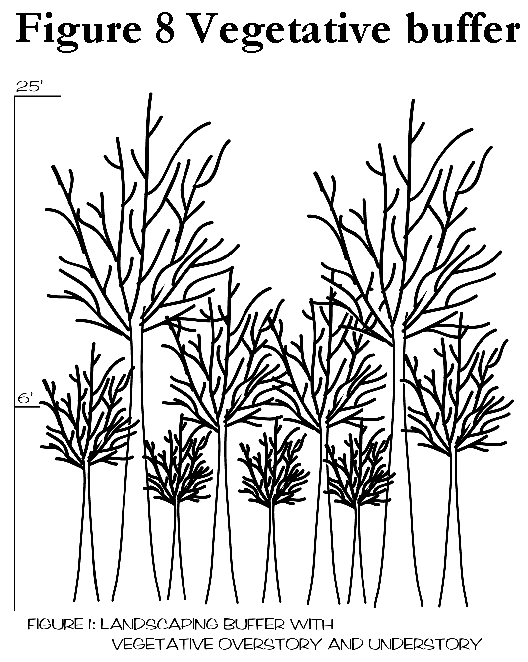
Buildable area means the area of a lot remaining after the minimum open space and/or yard requirements of this chapter have been complied with.
Building means any structure used or intended for supporting or sheltering any use or occupancy.
Building, attached means a building that is joined to another building at one or more sides by a common wall, except that an accessory building, including a garage, shall be considered as attached to the principal building if connected by a roof or by a breezeway.
Building code means the most recently adopted or amended county building code.
Building, detached, means a building entirely surrounded by open space.
Building division means the building division of the county planning department.
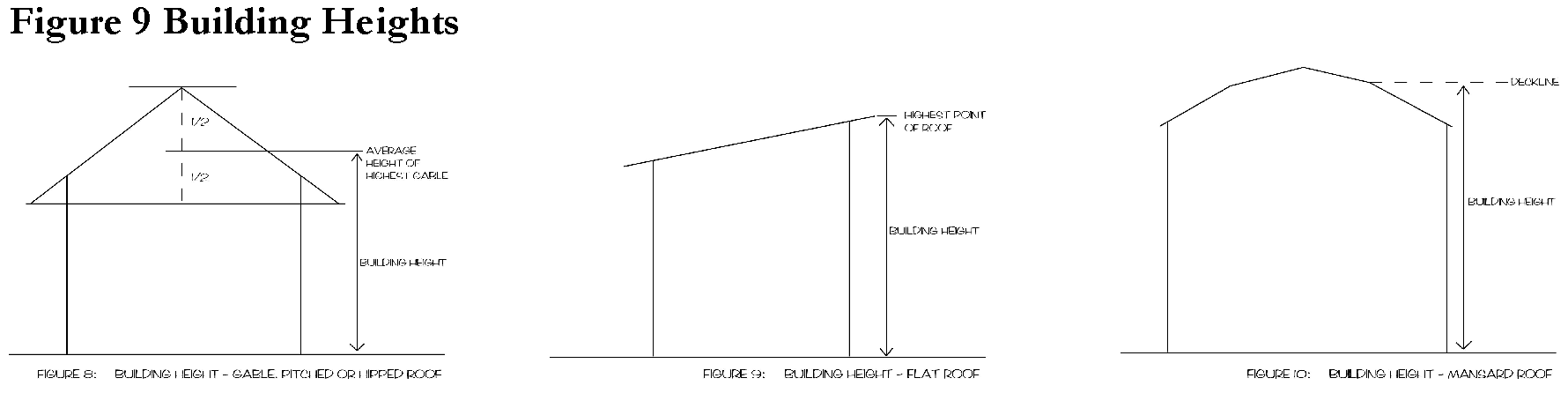
Building, height of, means the vertical distance above a reference datum measured to the highest point of the coping of a flat roof or to the deck line of a mansard roof or to the average height of the highest gable of a pitched or hipped roof. The reference datum shall be selected by either of the following, whichever yields a greater height of building.
(1)
The elevation of the highest adjoining sidewalk or ground surface within a five-foot horizontal distance of the exterior wall of the building when such sidewalk or ground surface is not more than ten feet above lowest grade; or
(2)
An elevation ten feet higher than the lowest grade when the sidewalk or ground surface described in subsection (1) of this definition is more than ten feet above lowest grade. The height of a stepped or terraced building is the maximum height of any segment of the building.
Building line means a line formed by the face of the building which is used to establish the required yards for a building or structure.
Building maintenance, cleaning services, means an establishment providing routine maintenance of buildings. The term "building maintenance, cleaning services" includes, but is not limited to, a window washing, building cleaning, carpet cleaning, pest extermination, or disinfecting service.
Building permit means an official document or certification that is issued by the building official and which authorizes the construction, alteration, enlargement, conversion, reconstruction, remodeling, rehabilitation, erection, demolition, moving, or repair of a building or structure.
Building, principal, means a building in which the main or principal use of the lot is conducted or situated.
Building supplies sales means a commercial premises on which new lumber and related new building materials are sold.
Bulk station means a distributing station, commonly known as a bulk or tank station, used for the storage and distribution to retail outlets of flammable liquids or liquefied petroleum products where the aggregate capacity of all storage tanks is more than 12,000 gallons.
Business means engaging in the purchase, sale, barter, or exchange of goods, wares, merchandise, or services, the maintenance or operation of offices or recreational and amusement enterprises for profit.
Cabin. See "Dwelling seasonal."
Canoe rental, marina, means a business offering for rent, or offering temporary seasonal storage of canoes, kayaks or other watercraft that is primarily propelled in a non-motorized manner using a paddle.
Campground, travel trailer parks, means a campground with two or more camping unit sites, accessible by vehicular traffic and may be provided with one or more service buildings. These sites may have individual water, sewer, or electrical connections.
Carport means a covered motor vehicle parking structure having two or more open walls and is accessory to an existing dwelling unit. It may be freestanding or attached to another structure.
Car wash means a building, or portion thereof, containing facilities for the primary purpose of washing automobiles, using production line methods with a chain conveyor, blower, steam cleaning device, or other mechanical devices; or providing space, water, equipment, or soap for the complete or partial hand-washing of such automobiles, whether by operator or by customer.
Catering service means a service providing meals or refreshments for public or private entertainment for a fee.
Cemetery means any land, excluding private burial sites, used or intended to be used for the burial of human remains and dedicated for cemetery purposes, including columbariums, crematories, mausoleums, and mortuaries if operated in connection with, and within the boundaries of such cemetery.
Cemetery, pet, means land used or intended to be used for the burial of domesticated animal remains and dedicated for pet cemetery purposes.
Centralized utilities means common water and/or wastewater facilities serving two or more dwellings, or other uses, in accordance with state health regulations.
Chemical substance abuse treatment facility, residential, means an institution, a detoxification center, or an installation in a residential setting providing care, maintenance and treatment for substance abusers licensed by the state public health department under I.C.A. § 125.13, or hospitals licensed under I.C.A. ch. 135B.
Cider means the fermentation of apple or pear juice yielding an alcoholic or non-alcoholic beverage.
City/county strategic growth (CCSG) plans. See "Fringe area plans."
Cluster development/clustering. See "Conservation subdivision."
College/university means an educational institution authorized by the state to award baccalaureate or higher degrees.
Commercial stable, riding academy, means a structure in which equines are kept for sale, hire, breeding, boarding, or training.
Commercial use means an occupation, employment, or enterprise that is carried on for profit by the owner, lessee, or licensee.
Commission. See "Zoning commission."
Common area means any area or space designed for joint use of tenants or owners in mobile home parks, housing associations, or common use community.
Communication tower means a structure that is used primarily as a communication antenna or as a communication antenna support structure.
Communications tower, broadcast/common carrier, means a communication tower used for commercial gain or public reception.
Communications tower, non-commercial, means a communication tower used for purposes in which there is no commercial gain, i.e. amateur radio, Civil Air Patrol, or Red Cross.
Communications tower, private business/government means a communication tower used for purposes to augment or facilitate the primary function of a business or governmental agency.
Community center means a building used for recreational, social, educational, and cultural activities, open to the public or a designated part of the public.
Community college means a college granting certificates, associate degrees and less than four-year degrees.
Community water system means a public water system that has at least 15 service connections used by year-round residents or regularly services at least 25 year-round residents.
Comprehensive plan means the plan or series of plans containing a vision of how the county will grow and change, and a set of plans and strategies to guide land use decisions, including applicable plans prepared by the county or the Corridor MPO and adopted by the board of supervisors. The 2013 the county comprehensive plan became effective on July 19, 2013.
Concentrating solar power system (CSP) means systems that use lenses/mirrors and tracking systems to focus or reflect a large area of sunlight onto a small area. The concentrated energy is absorbed by a thermal medium, such as water, salt, or a permanently gaseous fluid, and used as a heat source for a conventional power plant, such as a steam power plant, or for a power conversion unit, such as a sterling engine. Although several concentrating solar technologies exist, the most common types are the solar trough, parabolic dish and solar power tower. Energy storage technologies used by concentrating solar thermal devices (e.g. molten salt storage) are also included within this definition.
Conditional approval means the approval given to an applicant by the board of supervisors or other designated adjudicatory or review body that includes conditions that must be met or maintained for the approval to remain in force, or for final approval to be met in the case of a preliminary approval.
Conditional use means a use which, because of special problems of control the use presents, requires reasonable, but special, unusual, or extraordinary limitations peculiar to the use for the protection of the public welfare and the integrity of the comprehensive plan.
Conditional use permit means a permit issued for a use specified in these regulations identifying specific conditions, limitations or restrictions, and which is subject to review for approval or denial by the board of adjustment as outlined in this chapter.
Conference center means a facility used for conferences and seminars, and may include accommodations for sleeping, food preparation and dining, recreation, entertainment, resource facilities, and meeting rooms.
Congregate living (congregate residences) means apartments and dwellings with communal dining facilities and services, such as housekeeping, organized social and recreational activities, transportation services, and other support services appropriate for the residents.
Conservation easement means legally recorded easements that limit specific parcels or corridors of land to specific uses. Easements may apply to entire parcels of land or to specific parts of the property. Most are permanent. Term easements impose restrictions for a limited number of years. Land protected by conservation easements remains on the tax rolls and is privately owned and managed. Landowners who donate permanent conservation easements are generally entitled to tax benefits.
Conservation subdivision means a development design technique that concentrates buildings on a part of the development site and retains the undeveloped portion of the site as open space. The technique allows the open space land to be used for some limited recreation, common open space, and preservation of environmentally sensitive features. For purposes of this chapter, a conservation subdivision must contain a minimum of three lots purposed for development.
Consumer scale battery energy storage system, (accessory use) means one or more devices attached to or located inside or outside of the principal building footprint, assembled together, capable of storing energy in order to supply electrical energy to serve primarily the energy needs on-site.
Consumer scale solar installation (accessory use) means a solar panel or array mounted on a building, pole or rack that is accessory to the primary use of the parcel on which it is located and which is directly connected to or designed to serve the energy needs of the primary use.
Contiguous means bordering or adjoining, meeting or joining at the border or surface. Contiguous property is property which either adjoins another piece of property or is separated by a public street or roadway not exceeding a right-of-way width of 120 feet.
Contractor's yard means an establishment used for the outdoor repair, maintenance, or storage of a contractor's vehicles, equipment, or materials.
Convenience store means a place where gasoline, motor oil, lubricants, or other minor accessories are retailed directly to the public on the premises in combination with the retailing of items typically found in a convenience market or supermarket.
Copying, mailing and packaging services means a retail establishment that provides duplicating services using photocopying, blueprint, and offset printing equipment and may include the collating and binding of booklets and reports.
Corn suitability rating (CSR) means a numerical system for rating the productivity of farmland. The CSR is calculated based upon the most recent Iowa Soils Properties and Interpretations DataBase. This database was developed by Iowa State University in cooperation with United States Department of Agriculture (Natural Resources Conservation Services), and the state department of agriculture and land stewardship (division of soil conservation). The county's geographic information system (GIS) is used to calculate the CSR for applications.
Correctional facility means publicly or privately operated facility housing persons awaiting trial or persons serving a sentence after being found guilty of a criminal offense.
County means Linn County, Iowa, or the chairperson of the board of supervisors or other official, agency or commission acting on behalf of and authorized to take actions on behalf of the county.
Court means an unoccupied open space, other than a yard, on the same lot with a building and which is bordered on two or more sides by the building.
Crematorium means a mortuary where human corpses are cremated.
Crematorium, pet, means a facility for the cremation and disposal of the remains of domesticated animals.
Critical natural resource means a sensitive or unique natural area or designated cultural or historic resource within the critical natural resource zoning district that meets specific standards for protected status as described in this chapter.
Critical natural resource area means areas designated on the rural land use plan map as a critical natural resource area. These areas were identified by the county conservation department in the county park and outdoor recreation plan (May 1995) and overlaid on the rural land use plan map. The areas delineated are generally floodplains, wetlands, historic landmarks, unique natural areas, steep slopes, woodlands and wildlife habitats.
Crops means and includes, but shall not be limited to, barley, buckwheat, corn, flax, forage, fruits, honey, legumes, milk, millet, oats, popcorn, rye, sod, sorghum, soybeans, sunflowers, syrup, vegetables, wheat, and grasses used for forage or silage. The term "crops" includes products grown as part of tree farms, orchards, or nurseries (excluding greenhouses and nurseries, retail), that do not always produce annual income but require annual operating decisions about maintenance or improvement.
Cul-de-sac means a street having one end open to traffic and being permanently terminated by a vehicular turn-around.
Cumulative sign area means the sum of the sign area of all signs on a parcel.
Data center means a facility consisting of one or more buildings (whether constructed simultaneously or in separate phases) used primarily for the storage, management, processing, and transmission of digital data, which houses computer or network equipment, systems, servers, appliances, and other associated components related to digital data storage and operations. Data center includes commercial cryptocurrency mining operations and processing.
Days means calendar days, unless otherwise specified.
Day care center, preschool, means any facility operated for the purpose of providing care, protection and guidance to six or more individuals during only part of a 24-hour day. The term "day care center, preschool" includes nursery schools, preschools, day care centers for individuals, and other similar uses but excludes any facility offering care to individuals for a full 24-hour period.
Degree of nonconformity means the degree of deviation of a particular nonconformity from uses or structures permitted within a zoning district. The principal use listed under a specific zoning district shall be interpreted to have the same degree of nonconformity for the purposes of this chapter.
Density means the number of dwelling units or persons per gross acre of land. See also "Acreage, gross" and "Acreage, net."
Developed cabin area means a seasonal recreation or cabin area designated by the county planning and development as a seasonal cabin area allowed under the 1959 county zoning ordinance as of the adoption date of the ordinance from which this chapter is derived.
Developer means the owner, or agent under legal authority of the owner, who undertakes to cause a parcel of land to be designed, constructed, or developed.
Development means any division of land into parcels or lots, including single lot splits; any manmade change to improved or unimproved real estate, including, but not limited to, buildings or other structures, mining, dredging, filling, grading, paving, excavation or drilling operations; the deposit of refuse waste; or storage of equipment or materials.
Development agreement means any agreement between the county and applicant or developer approved by the board of supervisors, or their representative, identifying conditions of development, including, but not limited to, density, timing, financial responsibility for the provision of facilities, services and infrastructure, and/or vesting of development rights.
Development approval means any approval of development for which a development permit is required.
Development area or development tract means the portion of the parent tract being used or proposed for development, including buffer areas, in addition to any area taken out of agriculture.
Development permit means any building permit, subdivision plat, zoning verification, site plan approval, zone change, amendment to the rural land use plan, variance, special exception, conditional use permit, grading permit, excavation permit, floodplain permit or certificate of occupancy.
Distillery orbrewery means not only the premises where liquor or spirits are distilled, beer is brewed or similar alcoholic beverage is manufactured, but in addition, means a person owning, representing, or in charge of such premises and the operations conducted there, including the blending and bottling or other handling.
District means any section or area of the county for which the regulations governing the use of buildings and premises, building bulk, and related matters are uniform.
Domestic fowl means and includes ducks, quail, pheasants, and female chickens (excludes roosters). Geese, turkeys, and pea fowl are not considered domestic fowl for the purposes of this ordinance.
Dormitory, student housing, means a building intended or used principally for sleeping accommodations where such building is related to an educational or public institution, including religious institutions.
Drive-through, take-out, or carry-out restaurant means an establishment where some or all of the meals or food are prepared for customers to take off the premises.
Driveway means a private roadway providing access for vehicles to a parking space, garage, dwelling, or other structure.
Dry cleaning establishment means an establishment or business maintained for the pickup and delivery of dry cleaning and/or laundry without the maintenance or operation of any laundry or dry-cleaning equipment or machinery on the premises.
Dwelling means any building or portion thereof which is designated or used exclusively for residential purposes, but not including a garage, tent, cabin, mobile home, trailer, or travel trailer, motor home or bus.
Dwelling, attached, means a dwelling which is joined to another dwelling at one or more sides by a common wall.
Dwelling, condominium, means an individual dwelling unit under individual ownership in a multiple unit development with common elements in which.
(1)
The unit comprises not only the space enclosed by the unit boundaries, but all material parts of the land within the space;
(2)
The common element means all the property within the development except the units;
(3)
The common element is owned by all of the owners as tenants in common, or on a proportional undivided basis, or by a corporation created pursuant to the provisions of the appropriate statute.
Dwelling, detached, means a dwelling which is entirely surrounded by open space on the same lot.
Dwelling, multiple-family, means a building consisting of three or more dwelling units.
Dwelling, seasonal, means a dwelling unit not used as a principal residence that may be occupied weekends and for brief periods during the year, including those structures established prior to the effective date of the 1981 the county zoning ordinance under the provisions of then-applicable D rural district or E summer home district.
Dwelling, single-family, means a building containing one dwelling unit only, including a manufactured home with one dwelling unit. See also "Manufactured home."
Dwelling, two-family means a building containing two dwelling units that doesn't meet the requirements of an accessory dwelling unit. Also "duplex."
Dwelling unit means any room or group of rooms forming a single habitable unit with permanent provisions for living, cooking, and sanitation including, but not limited to a bathroom and kitchen, which is used by one or more persons.
Easement means a vested or acquired right granted by the property owner to another person, the public, a corporation, partnership, proprietorship, or other legal entity, of the use of a designated part of a parcel of land for a designated purpose.
Eastern Iowa Airport means the Eastern Iowa Airport as now exists or as may hereafter be added to or changed, located in Cedar Rapids, Iowa, and Linn County and owned by the City of Cedar Rapids, and under the management and control of the Eastern Iowa Airport Commission by the provisions of I.C.A. ch. 330. The airport includes the area of land designed and set aside for the landing and taking off of aircraft, and utilized or to be utilized in the interest of the public for such purposes. The term "airport" as used in these regulations also means and includes the Eastern Iowa Airport as shown in the Cedar Rapids Municipal Airport Master Plan adopted by the Cedar Rapids Airport Commission on November 25, 1996, which is now on file in the office of the airport director in the administration building at said airport.
Effective tower height means the distance from the highest point of rigid, nonguyed support to the top of the highest appurtenance mounted on the tower.
Efficiency unit means a dwelling unit consisting of one principal room exclusive of bathroom, kitchen, hallway, closets, or dining alcove, directly off the principal room.
EIA-222 means Electronics Industries Association Standard 222, Structural Standards for Steel Antenna Towers and Antenna Support Structures.
Electric service drop means that part of the electric distribution system from the main electrical distribution equipment overhead or underground to the service equipment serving one or more buildings or mobile home spaces.
Enclosed area below lowest floor means the floor of the lowest enclosed area in a building when all the following criteria are met:
(1)
The enclosed area is designed to flood to equalize hydrostatic pressure during flood events with walls or openings that satisfy the provisions in section 107-144(g)(5)e.1 of this chapter; and
(2)
The enclosed area is unfinished (not carpeted, drywalled, etc.) and used solely for low damage potential uses such as building access, parking or storage; and
(3)
Machinery and service facilities (e.g., hot water heater, furnace, electrical service) contained in the enclosed area are located at least one foot above the base flood elevation; and
(4)
The enclosed area is not a "basement" as defined in this section.
Engaged in agriculture means and includes, but shall not be limited to, any of the following.
(1)
Inspect agricultural operations periodically and furnish at least half the direct cost of the operations Regularly and frequently make or take an important part in making management decisions substantially contributing to or affecting the success of the agricultural operation.
(2)
Perform physical work which significantly contributes to the agricultural operation.
Entertainment (accessory to principal use) means music, theater, dancing, or other entertainment offered for a fee or free of additional charge in bars, taverns, or restaurants, where entertainment is not the primary revenue producing activity.
Entertainment business, adult, means any adult bookstore, strip club, adult hotel or motel, adult motion picture arcade, adult motion picture theater, cabaret, sexual encounter center, or any other business or establishment that offers its patrons services or entertainment characterized by an emphasis on matter depicting, describing, or relating to specified sexual activities or specified anatomical areas, but not including those uses or activities, the regulation of which is preempted by state law. Any establishment in which adult videos comprise more than 50 percent of the video products in stock shall be considered an adult entertainment use.
Existing construction means any structure for which the "start of construction" commenced before the effective date of the first floodplain management regulations adopted by the county.
Existing factory-build home park or subdivision means a factory-built home park or subdivision for which the construction of facilities for servicing the lots on which the factory-built homes are to be affixed (including at a minimum, the installation of utilities, the construction of streets, and either final site grading or the pouring of concrete pads) is completed before the effective date of the first floodplain management regulations adopted by the community.
Existing installation means those installations which were constructed before the effective date of the ordinance from which this chapter is derived.
Existing residential parcel split means the act of splitting by minor subdivision a portion of land containing an existing residential site from the parent parcel.
Existing residential site means the farmhouse or site of a previously existing farmhouse and any existing out-buildings that are or were used for farming purposes and adjacent service areas of a farm. Minimum evidence of the existence of the site of a previously existing residential site shall include.
(1)
Previous tax records establishing the existence of the farmhouse; and/or
(2)
Existence of 75 percent or more of the farmhouse's foundation or conclusive evidence from aerial photographs of the farmhouse's previous existence.
Expansion of existing factory-build home park or subdivision means the preparation of additional sites by the construction of facilities for servicing the lots on which the factory-built homes are to be affixed (including at a minimum, the installation of utilities, the construction of streets, and either final site grading or the pouring of concrete pads).
Extended stay hotel means a building or structure intended as, used as, maintained as, or advertised as a place where sleeping accommodations are furnished to the public as regular roomers, primarily for periods of up to 30 days.
FAA means the Federal Aviation Administration.
Factory-built home means a structure, designed for residential use which is wholly or in substantial part, made, fabricated, formed or assembled in manufacturing facilities for installation or assembly and installation, on a building site. For the purpose of this chapter factory-built homes include mobile homes, manufactured homes, and modular homes; and also includes park trailers, travel trailers, and "recreational vehicles" which are placed on a site for greater than 180 consecutive days and not fully licensed for and ready for highway use.
Factory-built structure means any structure, building, component, assembly or system of open or closed construction and which is made or assembled in manufacturing facilities on or off the building site for assembly and/or installation on the building site.
Fairground means a public facility that can include buildings, barns, parking areas, outdoor amphitheater, and related facilities that can be used for local and regional fairs, flea markets, or public gatherings.
Family means one or more persons each related to the other by blood, marriage, adoption, legal guardianship or as foster parent-children who are living together in a single dwelling and maintaining a common household. Not more than five persons not so related or not more than five emotionally and/or developmentally disabled persons along with the persons providing for their care and living together on the premises as a common household may constitute a family. A family may include domestic servants residing with the family.
Family day care means the keeping for part-time care or instruction, whether or not for compensation, of five or less persons at any one time within a dwelling, not including members of the family residing on the premises.
Farm barn. See "Agricultural building."
Farm building means and includes, but shall not be limited to, the building, structure or erection used for agricultural purposes as part of an agricultural unit.
Farm exempt means no regulation or requirement contained in this chapter shall be construed to apply to land, farm houses, farm barns, farm outbuildings, or other buildings, structures, or erections which are primarily adapted, by reason of nature and area, for use for agricultural purposes, but only while so used; provided, however, that such regulations or requirements which relate to any structure, building, dam, obstruction, deposit or excavation in or on the floodplains of any river or stream shall apply thereto. Subject to the above, all agricultural areas created pursuant to I.C.A. § 352.6 and the activities conducted thereon, are and shall remain exempt from county zoning and building regulations.
Farm house means and includes, but shall not be limited to, a house located on land operated as a farm which is or will be occupied by a person engaged in agriculture on that same unit, or by a person retired from agriculture that was performed on that unit of which the house is a part. The house and the land comprising the agricultural unit do not necessarily need to be contiguous.
Farm outbuilding. See" Agricultural building."
Farm stand means a structure used seasonally from which the majority of agricultural products are grown (or made) by the owner of the site, grown locally, or local value-added non-food products.
Farm store means a permanent structure used as a retail location open to the general public, on an operating farm, that sells agricultural products grown on the farm or grown locally, and/or sells local value-added non-food products.
Farm winery or cider mill means a facility in which less than 50,000 gallons per year of wine or cider is manufactured and the farm winery or cider mill must have on-site or contiguous propagated (growth stage) vineyard or orchards of at least two acres. See also "Winery."
Farmland means a parcel of land used for agricultural activities. Also defined in the I.C.A. ch. 352 (county land preservation and use commissions) as those parcels of land suitable for the production of farm products.
Farmstead means the principal center of farming operations and consists of the farmhouse, associated farm buildings and adjacent service areas of a farm.
FCC means the Federal Communications Commission.
Feeder line means any power line that carries electrical energy from one or more wind turbines or individual transformers associated with individual wind turbines to the point of interconnection with the electric power grid, or in the case of interconnection with the high voltage transmission systems the point of interconnection shall be the substation serving the UWECS.
First story means the lowest story in a building which qualifies as a story, as defined herein, except that a floor level in a building having only one floor level shall be classified as a first story, provided such floor level is not more than four feet below grade, as defined herein, for more than 50 percent of the total perimeter, or more than eight feet below grade, as defined herein, at any point.
Five-hundred-year flood means a flood, the magnitude of which has a two-tenths percent chance of being equaled or exceeded in any given year or which, on average, will be equaled or exceeded at least once every 500 years.
Flood means a general and temporary condition of partial or complete inundation of normally dry land areas resulting from the overflow of streams or rivers or from the unusual and rapid runoff of surface waters from any source.
Flood elevation means the elevation floodwaters would reach at a particular site during the occurrence of a specific flood. For instance, the 100-year flood elevation is the elevation of floodwaters related to the occurrence of the 100-year flood.
Flood insurance rate map means the official map prepared as part of, but published separately from, the flood insurance study which delineates both the flood hazard areas and the risk premium zones applicable to the community.
Flood insurance study (FIS) means a report published by FEMA for a community issued along with the county's flood insurance rate map(s). The study contains such background data as the base flood discharge and water surface elevations that were used to prepare the FIRM.
Floodplain is any land area susceptible to being inundated by water as a result of a flood.
Floodplain, 100-year, means the relatively flat lowlands adjoining a watercourse or other body of water subject to overflow from there during 100-year frequency flood periods as defined by the department of natural resources or other agency.
Floodplain management means an overall program of corrective and preventive measures for reducing flood damages and promoting the wise use of floodplains, including, but not limited to, emergency preparedness plans, flood control works, floodproofing and floodplain management regulations.
Floodproofing means any combination of structural or non-structural additions, changes, or adjustments to structures, including utility and sanitary facilities, which will reduce or eliminate flood damage to such structures.
Floodway means the channel of a river or stream and those portions of the floodplains adjoining the channel, which are reasonably required to carry and discharge floodwaters or flood flows so that confinement of flood flows to the floodway area will not cumulatively increase the water surface elevation of the base flood by more than one foot.
Figure 10 Illustration of Flood Hazard Areas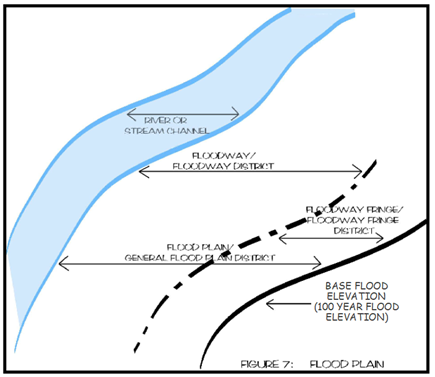
Floodway fringe means those portions of the special hazard area outside the floodway.
Floor area means the total area of all floors of a building, measured from the exterior face of the exterior walls of the building. Floor area shall also include all overhangs more than two feet from the exterior walls as measured horizontally from the exterior of the wall face. For rooms with sloped ceilings, the area having a ceiling height of less than seven feet shall not count towards the total floor area.
Food service, limited, coffee shop, deli, means an informal restaurant primarily offering coffee, tea, and other beverages, and where light refreshments and limited menu items may also be sold.
Forest preserve, nature preserve, other protected open space, means areas intended to remain in a predominately natural or undeveloped state to provide resource protection and possible opportunities for passive recreation and environmental education for present and future generations.
Forest reserve means a parcel or portion of a parcel of land that meets the minimum definitions of I.C.A. ch. 427C, has been registered with the county assessor and the county conservation board as a forest reserve, and has been managed consistent with the state code and county conservation board standards.
Fringe area plans, formerly known as city/county strategic (CCSG) plans, means long-range strategic growth plans developed and adopted between the county and incorporated cities located within the county. These plans are intended to provide for the coordinated implementation of both the county and the cities' comprehensive plans. Fringe area plans are explained and outlined in section three of the county comprehensive plan.
Frontage means all the property on the side of a road between two intersecting roads (crossing or terminating), measured along the adjacent right-of-way line of the road, or if the road is dead-ended, the length of all the property adjoining on one side between an intersecting road and the dead-end road.
Funeral home, mortuary, means a building used for the preparation of the human deceased for burial and display of the deceased and rituals connected therewith before burial or cremation. The term "funeral home," as defined for purposes of this chapter, includes a funeral chapel.
Garage, attached, means a private garage which is integral with, and an accessory portion of, the principal or main building, which is connected by a roofed, enclosed and walled structure, and by a common foundation.
Garage, private, means an accessory building housing non-commercial motor driven vehicles that are the property of and for the private use of the occupants of the lot on which the private garage is located.
Gas station means an establishment selling fuel, lubricants, coolants, and similar commodities, but not including the performance of vehicle repair or maintenance of any kind.
Gas-fired electric generating facility means a facility that generates electricity for off-site distribution using the combustion of natural gas in turbines or reciprocating engines, with or without heat-recovery steam generation; includes associated stacks, cooling systems, emissions-control equipment, electrical interconnection infrastructure (including substations/switchyards), on-site water treatment, and plant control/maintenance buildings.
General administrative or professional office means the office of a member of a recognized profession maintained for the conduct of business in any of the following related categories: architectural, engineering, planning, law, interior design, accounting, insurance, real estate, medical, dental, optical, or any similar type of profession.
General industrial uses means research and development activities, the manufacturing, compounding, processing, packaging, storage, assembly, and/or treatment of finished or semi-finished products from previously prepared materials, which activities are conducted wholly within an enclosed building. Finished or semi-finished products may be temporarily stored outdoors pending shipment.
General retail means the selling of goods, wares, or merchandise directly to the ultimate consumer or persons without a resale license.
Generally accepted agricultural and management practices (GAAMPS) means agricultural practices that are widely used by farmers, promoted by agricultural institutions such as extension and comply with federal and state environmental, health and the safety laws and regulations.
Geographic information system (GIS) means a method of storing data based on geographic coordinates on computers, including topographical maps, soil maps, aerial and satellite photographs, and data from remote sensing technology.
Government office means a building or structure owned, operated, or occupied by governmental agency to provide a governmental service to the public.
Golf course means a tract of land laid out with at least nine holes for playing a game of golf and improved with tees, greens fairways, and hazards. A golf course includes a clubhouse and shelters as accessory uses.
Golf course, miniature, means a theme-oriented recreational facility, typically comprised of nine or 18 putting greens, each with a cup or hole, where patrons in groups of one to four pay a fee to move in consecutive order from the first hole to the last.
Governing plan means a document providing detailed development requirements related to a planned unit development overlay district based on the depiction of the PUD master plan. The governing plan may include proposed land uses, streets and traffic circulation, utilities, open spaces, possible building locations, and other site development features. The intent of the governing plan is to provide the detailed development design criteria to be followed by the developer, and to serve as a tool to promote communication and cooperation between adjacent property owners and the developer to ensure a cohesive and unified development.
Grade means the lowest point of elevation of the finished surface of the ground, paving or sidewalk within the area between the building and the property line, or when the property line is more than five feet from the building, between the building and a line five feet from the building.
Grain elevators/storage structures means any structure that is used for storage and does not have a door or other entranceway into a dwelling unit and that does not have water fixtures within its confines, the use of which is limited solely to storage of inanimate objects.
Greenhouses and nurseries, retail, means land, buildings, structures, or combinations thereof for the storage, cultivation, and transporting of live trees, shrubs, or plants, a portion of which are offered for retail sale on the premises, and including products used for gardening and landscaping.
Grocery, supermarket, means a market having 10,000 square feet or more of floor area devoted principally to the sale of food.
Ground clearance means the distance from the turbine blades to the ground when measured at the lowest point of rotation.
Groundwater means water contained below the surface of the earth in the saturated zone including, without limitation, all water, whether under confined, unconfined, or perched conditions, in near-surface unconsolidated sediment or regolith, or in rock formations deeper underground.
Group home, family group home for eight persons or fewer, means a community-based residential home that is licensed as a residential care facility under I.C.A. ch. 135C or as a child foster care facility under I.C.A. ch. 237 to provide room and board, personal care, habilitation services, and supervision in a family environment exclusively for not more than eight persons with a developmental disability or brain injury and any necessary support personnel. A family home does not mean an individual foster family home licensed under I.C.A. ch. 237.
Gun clubs, rifle, archery range, means any organization whether operated for profit or not, and whether public or private, which caters to or allows the use of firearms.
Hard surfaced road means and includes any Portland cement concrete (PCC) or asphalt cement concrete (ACC) paved surface or seal coated surfaced road and committed to be maintained by a public entity. See also "Paved road."
Hazard to air navigation means an obstruction determined to have a substantial adverse effect on the safe and efficient utilization of the navigable airspace.
Health authority means the legally designated health authority or its authorized representative of the county.
Health care facility means an establishment for provision of care to persons suffering from illness, injury or disability and includes hospital, custodial home, nursing homes, convalescent home, extended care facility, hospice, and similar facilities.
Health clinic, medical office, health care office, means a building, other than a hospital as herein defined, used by one or more licensed physicians, chiropractors, or alternative health care practitioners for the purpose of receiving and treating patients.
Health club means a non-medical service establishment intended to maintain or improve the physical condition of persons, and that contains exercise and game equipment and facilities, steam baths and saunas, or similar equipment and facilities.
Heavy industrial uses means manufacturing or other enterprises with significant external effects, or which pose significant risks due to the involvement of explosives, radioactive materials, poisons, pesticides, herbicides, or other hazardous materials in the manufacturing or other process.
Height means for the purpose of determining the height limits in all zones set forth in this chapter and shown on the zoning map, the datum shall be mean sea level elevation unless otherwise specified.
Highest adjacent grade means the highest natural elevation of the ground surface prior to construction next to the proposed walls of a structure.
Historic schoolhouse means a building that was used as a school as documented in state and/or county historic records, and which may be eligible for listing on the National Register of Historic Places.
Historic structure means any structure that is:
(1)
Listed individually in the National Register of Historic Places (a listing maintained by the department of Interior) or preliminarily determined by the Secretary of the Interior as meeting the requirements for individual listing on the National Register;
(2)
Certified or preliminarily determined by the Secretary of the Interior as contributing to the historical significance of a registered historic district or a district preliminarily determined by the Secretary to qualify as a registered historic district;
(3)
Individually listed on a state inventory of historic places in states with historic preservation programs which have been approved by the Secretary of Interior; or
(4)
Individually listed on a local inventory of historic places in counties and communities with historic preservation programs that have been certified either:
a.
By an approved state program as determined by the Secretary of the Interior;
b.
Directly by the Secretary of the Interior in states without approved programs.
Home occupation means any occupation, profession, activity or use carried out by a resident with the intention for economic gain in the resident's own dwelling unit and/or accessory structure on the property. The home occupation must be clearly subordinate to the residential or agricultural use of the property.
Hospital means an establishment providing health services and medical or surgical care, primarily for temporary inpatients, to persons suffering from mental or physical illness, disease, injury, or disability, and including any related facilities such as laboratories, outpatient care, obstetrics, central service, staff offices, or training facilities. The term "hospital" does not include establishments that are intended primarily for permanent or long-term care or custodial care.
Host community means the local governmental unit that has zoning and/or siting approval of an exclusive use zoning reclassification.
Hotel means an establishment which is open to transient guests in contra-distinction to a boarding, roominghouse or lodginghouse; and which provides customary hotel services such as maid service, the furnishing and laundering of linens, telephone and desk service, the use and upkeep of furniture, and valet service.
Human scale means the proportional relationship of a particular building, structure, or streetscape element to the human form and function. Human scale design is important to the success of streets and paths as preferred routes for pedestrians, cyclists, and motorists alike. In general, smart street design considers the role of pedestrians along with that of vehicular traffic, emphasizing the quality of the walking environment.
Hub means the central part of a wind turbine or the section which supports the blades on the outside and connects to the low-speed rotor shaft inside the nacelle.
Hub height means the vertical distance between the surface of the tower foundation and the center of the turbine hub, where the blades are attached.
Hydrological feature means a perennial or intermittent watercourse, water body, spring, sinkhole or delineated wetland.
Improvements means changes and additions to land necessary to prepare it for building sites; and including, but not limited to, street paving and curbing, grading, monuments, drainage ways, sewers, fire hydrants, water mains, sidewalks, pedestrian ways, and other public and private works and appurtenances.
Indoor recreation (billiards, game room, etc.) means a commercial recreational land use conducted entirely within a building, including, but not limited to, video or game arcade, bowling alley, gymnasium, pool or billiard hall, skating rink, tennis court, paintball course, laser tag, go-cart track, or golf simulator.
Infiltration area means constructed stormwater management area engineered to collect stormwater and infiltrate stormwater into the ground rather than convey stormwater to another location, and distinct from a natural wetland area or water body. Infiltration areas can be designed with overflow conveyance systems.
Inoperable motor vehicle means a vehicle which cannot be driven upon the public streets for reasons including, but not limited to, being unlicensed, wrecked, abandoned, in a state of disrepair or incapable of being moved under its own power.
Institution means an establishment occupied or operated by a private or public non-profit corporation, association, organization, or group for use or benefit of the general public.
Interconnection agreement means interconnection standards which specify the technical and procedural process by which a customer connects an electricity generating facility to the electric power grid. Such standards include the technical and contractual terms that system owners and utilities must abide by.
Interior decorating/upholstery means a commercial establishment from where professional home interior decorating services are provided. The on-site retail sale of furniture and other home furnishings to the general public shall not be offered; however, cloth, wallpaper, and paint samples may be provided.
Junk or scrap means old and dilapidated automobiles, trucks, tractors, and such other vehicles and parts thereof, wagons and other kinds of vehicles and parts thereof, scrap, used building materials, scrap contractor's equipment, tanks, casks, cans, barrels, boxes, drums, piping, bottles, glass, old iron, machinery, rags, papers, hair, mattresses, beds, or bedding or any other kind of scrap or waste materials which is stored, kept, handled or displayed for barter, resale, reuse, salvage, stripping or trade.
Junkyard. See "Auto salvage yard orscrap yard."
Karst terrain means areas where karst topography, with its characteristic surface and subterranean features, has developed as the result of dissolution of limestone, dolomite, or other soluble rock. Characteristic physiographic features present in karst terrain include, but are not limited to, sinkholes, sinking streams, caves, large springs, and blind valleys.
Kennel means a building, structure, or use where six or more dogs, cats or other small domesticated animals are kept for sale, breeding, or boarding.
Kitchen means an area intended, arranged, designed or used for preparing, cooking, or warming of food.
Land evaluation-site assessment (LESA) means a numerical system that evaluates the suitability of land for development based on various conditions of the site and surrounding property.
Land use map means the land use map (rural land use map) which is a part of the comprehensive plan, as amended from time to time.
Land value assurance program means a program in which affected property owners, the host communities and other affected taxing bodies, are provided an assurance that property, in the defined assurance area, is not devalued due to perceived or real negative impacts of siting an exclusive use facility or be compensated for such devaluation. Such a program:
(1)
Specifies the period of time during which the assurance program applies;
(2)
Provides compensation on a one time only basis and only after the facility has been in operation for at least six months;
(3)
Is made available to only property owners who owned affected properties prior to submission of an application for zoning and or siting approval; and
(4)
May provide compensation to the host community for the present value of any lost taxes that result from a decline in property tax assessments.
Landfill, solid waste disposal facility. See "Sanitary landfill site."
Large-scale data center means a data center that has an electrical design capacity greater than 20 MW or that uses more than 50 gallons per minute of water on an annualized basis. For the purposes of determining compliance with power and water usage thresholds in this ordinance, all data center buildings that are part of a phased or multi-building campus shall be evaluated in the aggregate, regardless of whether such buildings are constructed simultaneously or in separate phases.
Lateral expanded sanitary landfill means expansion of an existing permitted sanitary landfill where additional contiguous and adjoining land, which is outside of the property boundary stated in the existing permit, is procured and intended for disposal of solid waste. A lateral expansion is without regard to size of the existing permitted landfill, the size of the proposed expansion, or the location of the proposed fill area on the property to be acquired.
Laundromat means a facility where patrons wash, dry, or dry clean clothing or other fabrics in machines operated by the patron.
Legal lot of record means a lot created prior to the effective date of the ordinance from which this chapter is derived that may be buildable if it meets all the requirements in section 107-49.
Library means a public facility for the use, but not sale, of literary, musical, artistic, or reference materials.
LiDAR (light detection and ranging) means a remote sensing method that uses light in the form of a pulsed laser to measure ranges (variable distances) to the Earth. These light pulses, combined with other data recorded by the airborne system, generate precise, three-dimensional information about the shape of the Earth and its surface characteristics.
Limited industrial services or uses means establishments providing industrial services to individuals or businesses. This classification includes dry cleaning plants; metal, machine, and welding shops; cabinetry and woodworking shops; furniture upholstery shops; and similar business engagements in custom fabrication and repair.
Limited production and processing means to subject a good or material to some special process or treatment, as in the course of manufacture, change in the physical state or chemical composition of matter, or the second step in use of a natural resource. Examples include petroleum refining, oil shale crushing, retorting and refining, ore smelting, coal crushing and cleaning, saw mill, alfalfa pellet mills, food canning or packing, creation of glass, ceramic, or plastic materials, gravel crushing, cement manufacture, or concrete batch plants.
Limited storage means for enclosures in a special flood hazard area, limited storage shall mean a minimum amount of material typically associated with the permitted primary use of the structure. Items or materials that cannot withstand exposure to the elements, do not have low flood damage potential, or cannot be readily moved to the elevated portion of the structure before or during a flood event are not considered to be limited storage.
Liquor store means establishments engaged in the sale of alcoholic beverages for off-premises consumption.
Live-work unit or dwelling means a dwelling unit used for both dwelling purposes and any nonresidential use permitted in the zoning district in which the unit is located, provided that not more than two persons who do not reside in the unit are employed on the premises.
Livestock means and includes, but shall not be limited to, animals or domestic fowl which are being produced primarily for sale or use as food or food products, such as: cattle, pigs, sheep, goats, poultry, and farm deer as defined in Iowa Code.
Loading space, off-street, means an unobstructed area no part of which is located in any public right-of-way and the principal use of which is for the standing, loading, or unloading of trucks and trailers.
Lot means a portion of a subdivision, or other parcel of land, intended as a unit for transfer of ownership or for building development.
Lot area means the total horizontal area included within the lot lines, exclusive of street, highway, alley or other rights-of-way.
Lot, corner, means a lot adjoining upon two or more streets at their intersection or junction or a lot bounded on two sides by a curving street where the angle of intersection of such street right-of-way lines, or in the case of curved right-of-way lines, the extension of tangents drawn from each of the points of intersection of the side lot lines and the street right-of-way line, intersect with each other to form an interior angle of less than 135 degrees.
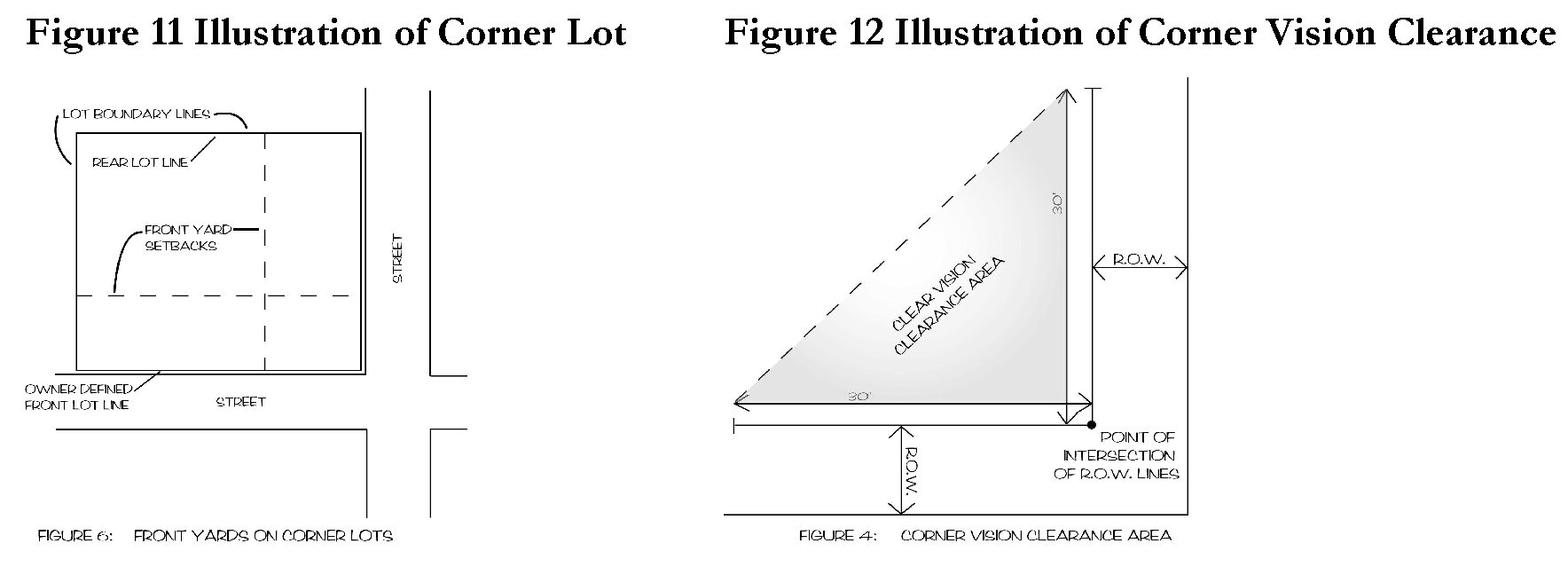
Lot coverage means the cumulative area of a parcel (sq. ft.) which is covered by any and all detached accessory structures. In computing the amount of lot coverage, the amount of coverage shall include the total area of all accessory structures as measured along the outside wall at ground level or above as viewed from above and includes all projections other than open porches, fire escapes, canopies or the first two feet of a roof overhang. Principal structures, ground mounted solar, roads, driveways, parking lots and swimming pools shall not be included in maximum lot coverage requirements.
Lot depth means the mean horizontal distance between the front lot line and the rear lot line of a lot measured within the lot boundaries.
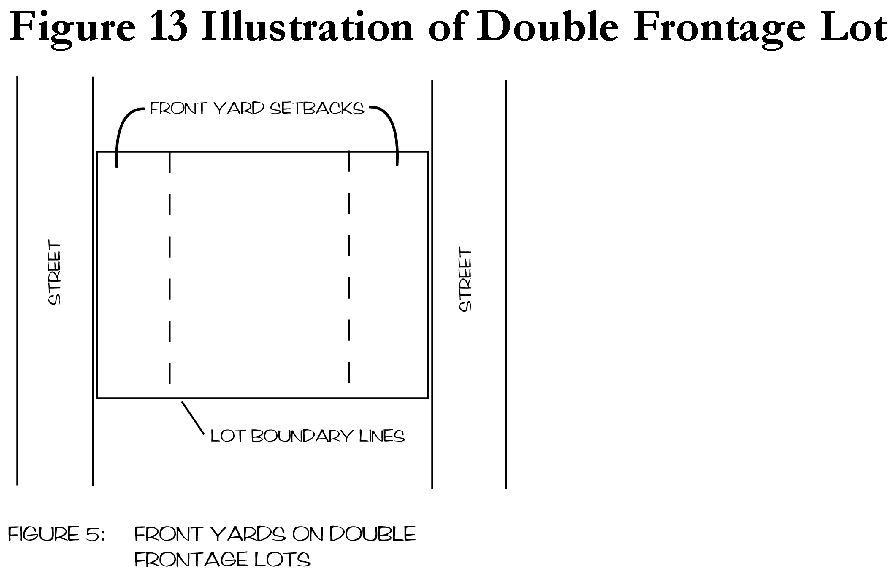
Lot, double frontage, means a lot having a frontage on two non-intersecting streets, as distinguished from a corner lot. Exception for double frontage along highways, area along highways to be considered rear yard using rear yard requirements when site distance is not applicable and access is not onto the state and federal highways.
Lot, interior, means a lot other than a corner or reversed corner lot.
Lot line means a boundary of a lot.
Lot line, front, means the boundary between the lot and the street on which it fronts.
Lot line, rear, means the lot boundary opposite and most distant from the front lot line.
Lot line, side, means any lot line other than a front or rear lot line.
Lot of record means a lot which is part of a subdivision, the plat of which has been recorded in the office of the recorder of the county or a parcel of land, the deed to which was recorded in the office of said recorder prior to the adoption of this chapter in compliance with I.C.A. ch. 354.
Lot, reversed corner, means a corner lot in which the street side lot line is substantially a continuation of the front lot line of the first lot to its rear. The rear of the corner lot is adjacent to the side of the lot to the rear, whether across an alley or not.
Lot width means the distance between the side lot lines measured at the rear of the required front yard on a line parallel to the front lot line or to a proposed front yard setback of greater distance if approved by the board of supervisors as part of the platting process providing that all other yard requirements of this chapter are complied with.
Lowest floor means the floor of the lowest enclosed area in a building including a basement except when all the criteria listed in the definition of enclosed area below lowest floor are met.
Major automotive repairs/body work means general repair, rebuilding, or reconditioning of engines, motor vehicles, or trailers, including body work, framework, welding, and major painting service.
Manufactured home means a factory-built single-family structure, which is manufactured or constructed under the authority of 42 U.S.C. § 5403, National Manufactured Home Construction and Safety Standards Act of 1974, and is to be used exclusively as a place for human habitation, but which is not constructed with permanent hitch or other device allowing it to be moved other than for the purpose of moving to a permanent site, and which does not have permanently attached to its body or frame any wheels or axles. A mobile home is not a manufactured home unless it has been converted to real property and is taxed as a site dwelling. For the purpose of these regulations, a manufactured home shall be built after June 15, 1976, and bear a seal certifying that it is in compliance with the National Manufactured Home Construction and Safety Standards Act of 1974. A manufactured home meeting the preceding requirements shall be considered the same as a site built single-family detached dwelling.
Manufacturing means to bring something into being by forming, shaping, combining, or altering materials.
Master plan means a visual representation, or map, of a comprehensively designed development project in a planned unit development overlay district. It is included with a governing plan, showing how an area is proposed to develop over time.
Master planned residential development means an area of a minimum contiguous size, as specified by this chapter, to be planned, developed, operated, and maintained as a single entity and containing one or more residential clusters; appropriate commercial, public, or quasi-public uses may be included if such uses are primarily for the benefit of the residential development.
Mature woodland means a wooded area of at least five acres in which half (50 percent) of the trees are mature, according to county conservation board standards.
Maximum damage potential uses, structures and facilities means the flood damage potential associated with health care facilities and like institutions likely to have occupants who may not be sufficiently mobile to avoid injury or death during a flood; buildings or building complexes containing documents, data, or instruments of great public value; structures, buildings, building complexes or facilities that produce, use or store highly volatile, flammable, explosive, toxic and/or water-reactive materials dangerous to the public; public and private utility facilities that are vital to maintaining or restoring normal services to flooded areas before, during and after a flood including power installations needed in an emergency; communication towers and equipment cabinets; police stations, fire stations, and emergency operations centers that are needed for flood response activities before, during and after a flood and buildings or building complexes similar in nature or use to those listed above.
Meteorological tower (MET tower) means and includes the tower, base plate, anchors, guy wires and hardware, anemometers (wind speed indicators), wind direction vanes, booms to hold equipment for anemometers and vanes, data loggers, instrument wiring, and any telemetry devices that are used to monitor or transmit wind speed and wind flow characteristics over a period of time for either instantaneous wind information or to characterize the wind resource at a given location.
Minor automotive repair means the replacement of any part or repair of any part that does not require removal of the engine head or pan, engine transmission or differential; incidental body and fender work, minor painting and upholstering service. Above stated is applied to passenger automobiles and trucks not in excess of 7,000 pounds gross weight.
Minimum level of service (MLS) means the minimum level or type of public improvements or services as contained herein that are required to be provided in accordance with a development agreement.
Mini-warehouse, self-service storage, means an area used or intended for the storage of materials, refuse, or vehicles and equipment not in service. Storage areas shall not incorporate any other areas of project development such as parking areas, landscaping, and yard areas unless specifically authorized by the applicable land use regulations.
Mixed-use development means the development of a tract of land, building, or structure with a variety of complementary and integrated uses, such as, but not limited to, residential, office, retail, public, or entertainment, in a compact urban form.
Mobile home and/or factory-built home park means any site, lot, field, or tract of land upon which two or more occupied mobile or factory-built homes are harbored, either free of charge or for revenue purposes, and shall include any building, structure, tent, vehicle or enclosure used or intended for use as part of the equipment of such mobile home park.
Mobile home, appurtenance, means an attached or detached enclosed addition to a mobile home, situated on the mobile home lot for the use of its occupants, such as an enclosed carport, garage, storage shed, or items of a similar nature.
Mobile home, electric park receptacle, means the waterproof, attachment receptacle device located adjacent to the water and sewer outlets to receive the flexible cable from a mobile home or, where required, the permanently installed conductors.
Mobile home, front, means that part of the mobile home facing toward the approved street or right-of-way as required by this chapter.
Mobile home lot means a parcel of land for the placement of a single mobile home and the exclusive use of its occupants.
Mobile home park means any site, lot, field, or tract of land upon which two or more occupied mobile homes are harbored, either free of charge or for revenue purposes, and shall include any building, structure, tent, vehicle or enclosure used or intended for use as part of the equipment of such mobile home park.
Mobile home park development plan means a custom-made design for a specific site or area consisting of drawings, maps, and engineering details to set forth the boundary, topography and overall park design, including streets, parking facilities, mobile home lot locations and service facilities.
Mobile home park license means a written license issued by the health authority, allowing a person to operate and maintain a mobile home park under the provisions of the state code, this chapter, and regulations issued by the county.
Mobile home park roadway means that portion of the mobile home park street system that is surfaced for the actual travel or parking of vehicles, and including curbs.
Mobile home park, single ownership, means an individual, partnership, corporation, or other entity owning the whole park.
Mobile home sewer connection means the connection consisting of all pipes, fittings, and appurtenances from the drain outlet of the mobile home to the inlet of the corresponding sewer riser pipe of the sewerage system serving the mobile home park.
Mobile home sewer riser pipe means that portion of the sewer lateral which extends vertically to the ground elevation and terminates at each mobile home lot.
Mobile home skirting means the materials and construction around the perimeter of a mobile home floor between the bottom of the mobile home floor and the grade level of the mobile home stand.
Mobile home stand means that part of an individual mobile home lot which has been reserved for the placement of the mobile home and any appurtenances thereto.
Mobile home, transient use, means the occupancy of a mobile home lot by a mobile home for a period of 14 days or less.
Mobile home, water connection, means the connection consisting of all pipes and fittings from the water riser pipe to the water inlet pipe of the distribution system within the mobile home.
Mobile home, water riser pipe, means that portion of the water supply system serving the mobile home park which extends vertically to the ground elevation and terminates at a designated point at each mobile home lot.
Motel means a building or group of attached or detached buildings containing individual sleeping or living units primarily for transient occupancy. A motel furnishes customary services such as maid service and linen laundering and desk service, and with parking facilities conveniently located to each unit.
Motor freight terminal, freight handling facility, means terminals with the capability of handling a large variety of goods involving various forms of transportation and providing multimodal shipping capabilities, such as rail to truck and truck to air.
Motor home, motorized home, means a vehicle with motive power designed for use customarily and ordinarily for vacation or recreational purposes as a temporary habitation.
Motor vehicle sales, rental means a retail business primarily housed in a structure and characterized by a mixture of related uses upon a commercial site; however, the principal use of the site shall be the marketing of new or used automobiles, whether by sale, rent, lease, or other commercial or financial means. Secondary supporting uses may also exist upon the same site, such as maintenance, repair and service areas, parts storage areas, and financial service areas.
Multiple-faced sign means a free-standing and projecting signs may have multiple faces or contain three-dimensional objects. A back-to-back, multiple signs on one freestanding pole, double-faced or Vtype sign are considered as one sign unless the separation between them exceeds 45 degrees.
Multiple-family dwelling means a building consisting of three or more dwelling units.
Museum means an institution devoted to the procurement, care, study, and display of objects of lasting interest or value.
Music, dance, or martial arts studio means a building, structure or use where music, dance, martial arts, or similar activities are taught, rehearsed, or practiced as the primary activity, excluding public performances.
Nacelle means the structure at the top of the wind turbine tower just behind (or, in some cases, in front of) the wind turbine blades. It houses the key components of the wind turbine, including the rotor shaft, gearbox and generator. Sometimes described as the cowling.
Natural resources conservation service (NRCS) means formerly known as the soil conservation service, NRCS is a federal agency within the U.S. Department of Agriculture that provides leadership and administers programs to help people conserve, improve and sustain our natural resources and environment. The agency provides technical assistance to farmers, funds soil conservation and farmland protection programs, and maintains statistics on farmland conversion.
New construction (new buildings, factory-built home parks) means those structures or development for which the start of construction commenced on or after the effective date of the first floodplain management regulations adopted by the county.
New factory-built home park or subdivision means a factory-built home park or subdivision for which the construction of facilities for servicing the lots on which the factory-built homes are to be affixed (including at a minimum, the installation of utilities, the construction of streets, and either final site grading or the pouring of concrete pads) is completed on or after the effective date of the effective date of the first floodplain management regulations adopted by the county.
Non-commercial livestock, horse stable, means an area which may include a building or structure used or intended to be used for housing horses or other livestock belonging to the owner of the property only for non-commercial hobby purposes.
Nonconforming use, legal, means a building, structure, or use lawfully erected and/or used prior to the adoption of the ordinance from which this chapter is derived, or amendments thereto, and which does not conform to the provisions of this chapter, or amendments thereto, for the zoning district within which such building, structure, or use is located.
Nonconforming, degree of. See "Degree of nonconformity."
Nonparticipating landowner means a landowner not under lease or other agreement with the owner or operator of a utility scale WECS or solar installation.
Non-residential use means all uses except agricultural, public parks, residential and accessory uses thereto.
Nuclear energy generating facility means any facility designed or used for the generation of electricity or power through nuclear fission or fusion. This includes but is not limited to commercial nuclear power plants, Small Modular Reactors (SMRs), and any associated reactors, modules, support structures, cooling systems, control buildings, electrical interconnection infrastructure, including but not limited to transmission lines, and safety or containment systems. It also includes the on-site handling, processing, or temporary storage of nuclear fuel and byproduct materials, provided such activities are conducted in compliance with applicable federal and state regulatory requirements, including those administered by the U.S. Nuclear Regulatory Commission (NRC) or its authorized representatives.
Nuclear waste storage means a facility or designated area located on or adjacent to the site of a nuclear power generation facility, used for the storage of spent nuclear fuel or high-level radioactive waste produced by that facility. This includes Independent Spent Fuel Storage Installations (ISFSIs) licensed by the U.S. Nuclear Regulatory Commission (NRC) under 10 CFR Part 72, provided they store only waste generated in Linn County. This definition does not include Consolidated Interim Storage Facilities (CISFs) designed to accept waste from multiple nonlocal sources.
Nursing home. See "Health care facility."
Obstruction means any structure, growth, or other object, including a mobile object, which exceeds a limiting height set forth in this chapter.
Occupied community building means a residence, school, hospital, church, public library or other building used for public gathering that is occupied or in use when the permit application is submitted.
Office means non-residential space that is used primarily for administrative, clerical, professional or similar activities.
Office, accessory to industrial use, means office space or buildings that provide administrative areas for a business whose primary use of the site is an industrial land use.
On-site sales means retail sale of wine for off-premises consumption by a winery or farm winery.
One hundred (100) year flood means a theoretical flood, model based on FEMA standards, the magnitude of which has a one percent chance of being equaled or exceeded in any given year or which, on the average, will be equaled or exceeded at least once every 100 years.
Open dump means any exposed accumulation of solid waste at a site other than a sanitary disposal project operating under a permit from the state department of natural resources. An open dump is characterized as a site which, due to lack of control, may create a breeding place for insects and vermin, and which may cause air or water pollution or may catch fire.
Other public recreational facilities means publicly owned or operated recreation facilities except for dog parks, parks, playgrounds, aquatic centers, swimming pools, and playing fields.
Other terms means all other terms used in these regulations shall have their normal meaning, except that terms common to engineering and surveying shall be used in their professional sense.
Outdoor amphitheater, stadium, means a permanent, freestanding structure, open or partially enclosed, including a stage and tiered and/or sloped seating, and which may include outdoor lights for night time performances.
Outdoor recreation and entertainment means a commercial recreational land use conducted primarily outside of a building with the potential to generate significant impacts on traffic, the natural environment, or the surrounding neighborhood. These uses include, but are not limited to, amusement parks, campgrounds, travel trailer parks, canoe rental, marinas, golf courses, driving ranges, gun clubs, rifle or archery ranges, amphitheaters, stadiums, race tracks, go-cart tracks, drag strips, baseball fields, soccer fields, tennis courts, paintball course, skateboard park, basketball courts; and associated equipment rental, retail sales and concessions.
Outdoor storage in connection with a permitted use means land used for storage of goods, materials, vehicles, or other items needed and directly associated with the permitted primary use of the site.
Outlot means a parcel of land not to be used for building purposes, so designated on a plat.
Owner means the owner of record in the land records of the county.
Package delivery and mail service means a commercial business which conducts the retail sale of stationery products, provides packaging and mail services both U.S. Postal and private service, and provides mail boxes for lease.
Parent tract means a parcel or parcels proposed for development that includes any portion of the development area. A parent tract must be either a legal lot of record or a legal zoning lot of record.
Parking lot means a parcel of land or lot or portion thereof devoted to unenclosed parking spaces.
Parking space means a surface area enclosed in the main building or in an accessory building, or unenclosed, having an area of not less than 180 square feet exclusive of driveways, permanently reserved for the temporary storage of one automobile and connected with a street or alley by a surfaced driveway which affords satisfactory ingress and egress for automobiles.
Park or playground, aquatic center, swimming pool, playing field, means a noncommercial, not-for-profit facility designed to serve the recreation needs of the residents of the community. Such facilities include subdivision recreation facilities, neighborhood parks, community parks, regional parks, and special use facilities, all as described in the county comprehensive plan. Such facilities may also include, but shall not be limited to, school and religious institution ball fields, football fields, and soccer fields, if they meet the above definition. Commercial amusement facilities, such as water slides, go-cart tracks, and miniature golf courses shall not be considered parks.
Participating landowner means a landowner under lease or other agreement with the owner or operator of a utility scale WECS or solar installation to place energy production components on their property.
Patio means a surfaced outdoor living space designed to supplement the living area of a dwelling, mobile home, or apartment.
Paved road means and includes any Portland cement concrete (PCC) or asphalt cement concrete (ACC) paved road. See also "Hard surfaced road."
Pedestrian way means a right-of-way dedicated or an easement granted for public use to facilitate pedestrian access to adjacent street and properties.
Permit means a written permit issued by a legally recognized permitting agency or authority permitting construction, structure alteration and extension, development, use, legal recording or designation, or other activity regulated under the provisions of this ordinance and regulations issued hereunder.
Permitted use means any use which complies with the applicable regulations of this chapter governing permitted uses in the zoning district in which such use is located.
Person means any individual, firm, trust, partnership, public or private association or corporation.
Pet cemetery. See "Cemetery, pet."
Pet crematorium means a facility for the cremation and disposal of the remains of domesticated animals.
Pet grooming means a building, structure, or use in which the primary service is cleaning, styling, trimming, or maintaining appearance of pet animals, and does not include keeping the pet overnight.
Pet training means a building, structure, or use where the primary activity is training pet animals, or which provides pet training as an additional service to pet boarding.
Photovoltaic means the technology that uses a semiconductor to convert light directly into electricity.
Pipeline inspection gauge launching/receiving station means a funnel shaped Y section of a pipeline equipped with a ball value for the purpose of launching and receiving pipeline inspection gauges.
Pipeline inspection gauge means a tool that is sent down a pipeline and propelled by the pressure of the product in the pipeline itself and are used for four main purposes; physical separation between different liquids being transported in pipelines, internal cleaning of pipelines, inspection of pipeline walls, and capturing and recording geometric information relating to pipelines.
Places of public assembly means buildings or facilities where people gather for civic, educational, religious, or cultural purposes, including, but not limited to retirement and nursing homes, family homes, schools, childcare homes and centers, group homes, hospitals, detention facilities, or human service facilities, not including facilities allowed as an accessory use to the principal use in question.
Plan. See "Comprehensive plan."
Planning and zoning commission means the legally constituted zoning commission, as organized under the provisions of I.C.A. ch. 335 for the county.
Plant nursery means an enterprise that conducts the retail and/or wholesale sale of plants grown on the premises, as well as accessory items (but not power equipment, such as gas or electric lawn mowers and farm implements) directly related to plant care and maintenance.
Plat means a map, plan, or chart of a county section, or subdivision, indicating the location and boundaries of individual properties.
Plat, final, means a final map, prepared by a registered Iowa land surveyor meeting the requirements of section 107-72(2), along with all certificates and statements set forth herein, for the purpose of recording as a subdivision of land.
Plat, preliminary, means a preliminary map prepared by a registered Iowa land surveyor meeting the requirements of section 107-72(2).
Plattor means that person causing a plat to be prepared, submitting an application, and shall be either the owner or his authorized agent.
Population center means the corporate limits of any incorporated city, or any U.S. Census defined Urban Area.
Projecting signs means a sign attached to a wall and projecting away from the wall more than 12 inches, but not more than five feet.
Porch, unenclosed, means a roofed projection from a building that has no more than 50 percent of each outside wall area enclosed other than by meshed screens.
Portable sign means a sign that is not permanently affixed to a structure or the ground.
Power purchase agreement means a contract entered into by an independent power producer and an electric utility. The power purchase agreement specifies the terms and conditions under which electric power will be generated and purchased. Power purchase agreements require the independent power producer to supply power at a specified price for the life of the agreement.
Principal building or structure. See "Building, principal."
Printing shop, printing and publishing business, means an establishment in which the principal business consists of duplicating and printing services using photocopy, blueprint, or offset printing equipment, including publishing, binding, and engraving.
Private burial site means any area, except a cemetery, that is used to inter or scatter remains. A private burial site is either restricted to members of a family, or to a narrow segment of the public, and only if the interment rights are conveyed without monetary payment, fee, charge, or other valuable forms of compensation or consideration.
Private road right-of-way means any private way that is approved by the board of supervisors after recommendation by the zoning commission.
Private street means a private way that affords principal means of access to adjoining properties.
Projecting signs means a sign attached to a wall and projecting away from the wall more than 12 inches, but not more than five feet.
Property line means a recorded boundary of a property.
Public safety facility means facilities operated by public agencies including fire stations, other fire prevention and firefighting facilities, police and sheriff substations and headquarters, including interim incarceration facilities.
Public street means a public way that affords principal means of access to adjoining properties.
Public system, water or sewer, means a system that is owned and operated by a local governmental authority or by an established public utility company which is adequately controlled by governmental authority. Such systems are usually existing systems serving the county or a water or sewer district established and directly controlled under the laws of the state.
Public utility means an enterprise, publicly or privately owned, which provides an essential commodity or service to the community such as wastewater treatment, water, electricity, natural gas, transportation, or communications networks.
Public water supply system means a system for the provision to the public of piped water for human consumption, if the system has at least 15 service connections or regularly serves at least 25 individuals. The term "public water supply system" includes any source of water and any collection, treatment, storage, and distribution facilities under control of the operator of the system and used primarily in connection with the system, and any collection or pretreatment storage facilities not under such control which are used primarily in connection with the system. See also "Community water system."
Public way means any sidewalk, street, alley, highway, or other thoroughfare established for travel by vehicles or persons and open or available for use by the general public, and may be in either public or private ownership.
Publicly controlled airport means an airport owned or controlled by a municipality as referenced in Iowa Code chapter 329. Qualified geologist means a qualified geologist having a masters degree in geology from an accredited university or college and having professional experience in hydrogeology.
Quarries, mining and other extractive uses, means a place where sand, soil, rock, ore, stone, and similar materials are excavated for sale or for off-tract use.
Race tracks, go-cart tracks, drag strips, means a measured course where animals or machines are entered in competition against one another or against time, including tracks used only in the training of animals.
Railroad switching yards and freight terminals means a heavy rail facility for freight pick-up or distribution; may include intermodal distribution facilities for truck or shipping transport.
Recreational facility, public, means publicly owned or operated recreation facilities.
Recreational vehicle means a vehicle that is:
(1)
Built on a single chassis;
(2)
Designed to be self-propelled or permanently towable by a light duty truck;
(3)
Designed primarily not for use as a permanent dwelling but as a temporary living quarters for recreational, camping, travel, or seasonal use; and
(4)
Four hundred square feet or less when measured at the largest horizontal projection.
Recreation camp means premises and facilities used occasionally or periodically where seasonal accommodations are provided for members or groups or associations for outdoor educational or recreational activities.
Recycling facility means a site in which waste or materials which otherwise become waste are collected, separated, or processed and reused or returned to use in the form of raw materials or products. Recycling includes, but is not limited to, the composting of yard waste which has been previously separated from other waste and collected by a sanitary facility, but does not include any form of energy recovery.
Refuse means wastes including, but not limited to, garbage, rubbish, ashes, street cleans, market and industrial solid wastes and sewage treatment wastes in dry or semisolid form.
Religious assembly means a site used by a religious group primarily or exclusively for religious worship and related religious services. The term "religious assembly" includes churches, chapels, temples, mosques, or other buildings whose primary purpose is religious assembly. The term "religious assembly" does not include living quarters except for an accessory single-family residential use on the same lot as the religious assembly principal use. The term "religious assembly" does not include an educational facility.
Replat, subdivision, means a plat representing land that has previously been included in a recorded plat.
Research and development facility means research, development, and testing laboratories that do not involve the mass manufacture, fabrication, processing, or sale of products. Such uses shall not violate any odor, dust, smoke, gas, noise, radiation, vibration, or similar pollution standard as specified herein.
Residential retirement complex, retirement community, means any age-restricted development, which may be in any housing form, including detached and attached dwelling units, apartments, and residences, offering private and semiprivate rooms.
Restaurant, full-service, no alcohol, means an establishment serving food in or on nondisposable dishes to be consumed primarily while seated at tables or booths within a building or outdoor patio and which has no on-sale liquor service.
Restaurant, full-service, with alcohol, means any establishment where food and drink are prepared, served, and consumed and whose design or principal method of operation is characterized by customers being provided with an individual menu and being served their food and drink by a restaurant employee at the same table or counter at which said items are consumed. A minimum of 51 percent of gross sales must be created by the sale of food.
Retractable tower means a tower whose height can be changed by extension or retraction without structural modification. Tower height of a retractable tower shall be determined in the extended position.
Right-of-way means the area, either public or private, over which the right of passage exists.
Riparian area means land above the ordinary high water line in which the natural vegetative habitat or regime is affected by the flow and ebb of the water body, including, but not limited to, the floodplain.
Road right-of-way means a tract or strip of land which has been dedicated to and accepted by the county, the state, or the United States, and is to be used by the public for circulation and service for road purposes.
Road right-of-way line means a dividing line between a lot, tract or parcel of land and a contiguous road or right-of-way designated to include a road.
Roof sign means a sign on a roof that has a pitch of less than one-to-four.
Rooming unit means any habitable room or group of rooms forming a single habitable unit, used or intended to be used for living and sleeping but not for cooking or eating.
Rotor means the rotating part of a wind turbine, including either the blades and blade assembly or the rotating portion of a generator.
Rotor diameter means the diameter of the circle swept by the rotor.
Routine maintenance of existing buildings and facilities means repairs necessary to keep a structure in a safe and habitable condition that do not trigger a building permit, provided they are not associated with a general improvement of the structure or repair of a damaged structure.
Rural residential development areas means areas of the county that are designated ""RRDA" on the rural land use plan map.
Sale of alcohol for on-site consumption at a winery means sale of wine, or other alcoholic beverage that is regulated under the state liquor license requirements, for consumption at a winery or farm winery.
Sanitarium means a licensed private hospital or asylum.
Sanitary landfill site means a state licensed site used for disposing of solid wastes, including organic materials such as garbage in an excavation and covered daily with earth in accordance with the county board of health regulations and the state department of natural resources.
School building and grounds maintenance facility, freestanding, means offices, warehousing, equipment storage, and associated facilities and areas to house school district building and grounds maintenance operations.
School sports complex, freestanding, means a complex of facilities, parking areas, and associated uses for sports activities associated with a public or private secondary (K-12) schools and public or private colleges. A school sports complex may include any combination of indoor and outdoor sports facilities.
School transportation center, public or private, freestanding, means a facility for the storage, maintenance and dispatch of school buses. A school transportation center may include areas for surface parking of school buses, employee vehicles, and other required parking areas; office facilities; and facilities for bus maintenance and repair including indoor and outdoor wash bays but not including paint or body repair.
Seasonal dwelling (cabin) means a dwelling unit not used as a principal residence that may be occupied weekends and for brief periods during the year, including those structures established prior to the effective date of the 1981 the county zoning ordinance under the provisions of then-applicable D rural district or E summer home district.
Secondary school (K-12), public or private, means any school licensed by the state and that is authorized to award diplomas for secondary education.
Self-serve storage or storage facility means an area used or intended for the storage of materials, refuse, or vehicles and equipment not in service. Storage areas shall not incorporate any other areas of project development such as parking areas, landscaping, and yard areas unless specifically authorized by the applicable land use regulations.
Septic tank cleaning services means a business providing services to remove and dispose of accumulated materials from and clean the interior of a septic tank.
Setback means the minimum horizontal distance between a lot line and a building or structure located upon such lot required by the provisions of this chapter.
Sewage treatment plant means any facility designed for the treatment of sewage that serves in excess of two structures or dwelling units.
Shadow flicker means the alternating changes in light intensity, or visual effect, that can occur at times when the rotating blades of wind turbines case moving shadows on the ground or structures.
Shall means and indicates that which is required.
Shoe repair means a business whose primary activity is repairing, modifying, or enhancing shoes for the end-user or owner. Manufacturing shoes for retail or wholesale markets does not constitute shoe repair.
Should means and indicates that which is recommended but not required.
Sign, accessory, means a sign which directs attention to an establishment, business, profession, commodity, service, premises, person or thing which is located, produced, conducted, sold, or offered on the same lot upon which the sign is located. An accessory sign is thus functionally related and subordinate to a principal use on the same lot.
Sign, advertising, means a sign which directs attention to an establishment, business, profession, commodity, service, premises, person or thing which may be located, produced, conducted, sold, or offered elsewhere than on the lot upon which the sign is located. An advertising sign may be a principal use on a lot.
Sign area means the combination of the writing, copy, message, emblem, illustrations or other display, together with any background material or color forming an integral part of the display, but not including the supporting framework. A sign face's surface area is typically computed by measuring the square footage of all the space enclosed within the extreme edges of a sign's face(s).
Sign face means the entire display surface area of a sign upon, against or through which copy is placed.
Sign, freestanding, means a sign erected and maintained on a freestanding frame, mast or pole not attached to any building, and not including ground mounted signs.
Sign, two-faced, means a sign on which more than one surface of the sign is used to convey information to the general public, including signs that have a front and back side that meets the definition of an advertising or accessory sign.
Sign, portable, means a sign that is not permanently affixed to a structure or the ground.
Sign, projecting, means a sign attached to a wall and projecting away from the wall more than 12 inches, but not more than five feet.
Sign, roof, means a sign on a roof that has a pitch of less than one-to-four.
Sign, wall, means a sign attached to a wall and not projecting away from the wall more than 12 inches.
Single-family attached dwelling means a one-family dwelling in a row of at least three such units in which each unit has its own front and rear access to the outside, no unit is located over another unit, and each unit is separated from any other unit by one or more vertical common fire-resistant walls.
Single-family detached dwelling means a building containing one dwelling unit only, including a manufactured home with one dwelling unit. See also "Manufactured home."
Single-family manufactured home means factory-built, single-family structures that meet the National Manufactured Home Construction and Safety Standards Act, commonly known as the HUD code.
Site plan review means the review of a site plan and other studies to assist in determining the manner in which the applicant intends to make use of his property.
Small Modular Reactor (SMR) means a nuclear fission reactor that is designed to generate electric power on a smaller scale than traditional nuclear power reactors, typically producing 300 megawatts electric (MWe) or less per unit. SMRs are characterized by modular construction, advanced safety features, and the ability to be deployed individually or as a series of units. SMRs must be licensed and regulated by the NRC or its duly authorized successor.
Small wind energy conversion system (SWECS) means a small wind energy conversion system that is accessory to the principal use of the lot or parcel, consisting of a wind turbine, a tower, and associated control or conversion electronics, which has a rated capacity of not more than 100 kilowatts (kW) and which is intended to primarily reduce on-site consumption of utility power.
Small-scale data center means a data center that has an electrical design capacity of 20 MW or less, and that uses less than 50 gallons per minute of water or less on an annualized basis. For the purposes of determining compliance with power and water usage thresholds in this ordinance, all data center buildings that are part of a phased or multi-building campus shall be evaluated in the aggregate, regardless of whether such buildings are constructed simultaneously or in separate phases.
Smart growth means promoting development that provides for the efficient use of land resources, promotes the full use of urban services, mixes different types of land uses, provides transportation options and provides a human scale to development.
Solar access easement means a recorded easement which provides continued access to incident sunlight necessary to operate a solar collector.
Solar array means a group of solar panels connected together.
Solar collector means a device or structural feature of a building that collects solar energy and that is part of a system for the collection, storage and distribution of solar energy.
Solar glare means the effect produced by light reflecting from a solar panel with intensity sufficient to cause annoyance, discomfort or loss in visual performance and visibility.
Solar panel means a device composed of groups of individual solar cells used to convert solar energy into electrical current.
Solid waste means garbage, refuse, rubbish, and other similar discarded solid or semisolid materials, including, but not limited to, such materials resulting from industrial, commercial, agricultural, and domestic activities. The term "solid waste" does not include hazardous waste as defined in I.C.A. § 455B.411, or special nuclear or by-product material as defined in the Atomic Energy Act of 1954, as amended to January 1, 1979, or petroleum contaminated soil which has been remediated to acceptable state or federal standards.
Solid waste hauling services means the movement of solid waste from one location to another.
Solid waste management means a planned program providing for the collection, storage, and disposal of solid waste, including, where appropriate, recycling and recovery.
Solid waste transfer station means a fixed facility where solid waste from collection vehicles is consolidated and temporarily stored for subsequent transport to a permanent disposal site. This does not include an infectious waste incineration facility.
Special flood hazard area (SFHA) means the land within the county subject to the "base flood". This land is identified on the county's flood insurance rate map as zone A, A1-30, AE, AH, AO, AR, and/or A99.
Sprawl means uncontrolled growth in rural or urban areas that is geographically scattered or linearly based along major thoroughfares. The term "sprawl" is characterized by poor accessibility, low density, lack of infrastructure support systems or costly infrastructure support systems that do not pay for themselves, lack of common open space, and poor definition of neighborhood or sense of place.
Special exception means a minor modification or variation of the setback, frontage, height, or other bulk provisions of this chapter as applied to a specific piece of property, as distinct from a variance.
Standard specifications, road, means specifications for road and related improvements to be carried out in subdivisions, as adopted by the county board of supervisors for the county.
Start of construction includes substantial improvement, and means the date the building permit was issued, provided the actual start of construction, repair, reconstruction, rehabilitation, addition, placement, or other improvement was within 180 days of the permit date. The actual start means either the first placement of permanent construction of a structure on a site, such as the pouring of a slab or footings, the installation of piles, the construction of columns, or any work beyond the stage of excavation; or the placement of a manufactured home on a foundation. Permanent construction does not include land preparation, such as clearing, grading and filling; nor does it include the installation of streets and/or walkways; nor does it include excavation for a basement, footings, piers, or foundations or the erection of temporary forms; nor does it include the installation on the property of accessory buildings, such as garages or sheds not occupied as dwelling units or not part of the main structure. For a substantial improvement, the actual start of construction means the first alteration of any wall, ceiling, floor, or other structural part of a building, whether or not that alteration affects the external dimensions of the building.
Steep slopes means land with a slope of at least 15 percent over a contiguous distance of at least 50 feet.
Storage, in connection with a permitted use, means a building or land used for storage of goods, materials, vehicles, or other items needed and directly associated with the permitted primary use of the site.
Stormwater pollution prevention plan (SWPPP) means a plan for stormwater discharge that includes erosion prevention measures and sediment controls that, when implemented, will decrease soil erosion on a parcel of land and decrease off-site nonpoint pollution.
Story means that portion of a building included between the upper surface of any floor and the upper surface of the floor next above, except that the topmost story shall be that portion of a building included between the upper surface of the topmost floor and the ceiling or roof above. If the finished floor level directly above a basement, or unused under-floor space is more than six feet above grade as defined herein for more than 50 percent of the total perimeter or is more than 12 feet above grade as defined herein at any point, such basement, or unused under-floor space shall be considered as a story.
Street, arterial, means a street or road used primarily for fast or heavy traffic.
Street, collector, means a street designed to carry traffic from minor streets to the major street system of arterial streets and highways, including principal entrance streets of a residential development and streets for circulation within such a development.
Street, county road, means a street or road established as part of the county road system and classified as either a county trunk, trunk collector, rural subdivision service, or land access service in the county standard specifications.
Street, dead end, means a street having only one end open to traffic.
Street, frontage road, means a minor street that is generally parallel to and adjacent to major streets or roadways, or highway, and which provides access to adjoining properties and protection from through-traffic. Frontage roads may be dedicated streets, private streets, or access easements.
Street, major, means a street or road of considerable continuity serving or intended to serve as the principal traffic-way between separated areas or districts and which is the main means of access to the primary street or road system. Said major streets or roads are those identified by the county regional planning commission major street plan and roads classified by the county as trunk or trunk collector roads.
Street, minor, means a street of limited continuity serving or intended to serve the local needs of a subdivision and classified as a rural subdivision service road in the county standard specifications.
Street, public or private, means a right-of-way, dedicated as public property for public use or a private right-of-way serving more than one ownership, which provides principal vehicular and pedestrian access to adjacent properties. The term "public or private street" may be used synonymously with road or roadway.
Structure means that which is built or constructed.
Structure footprint means the border of a structure drawn along the exterior walls representing the total area of the building. Only considers area of the first floor of a structure.
Structure, temporary, means a structure without any foundation or footing and removed when the designated time period, activity, or use for which the temporary structure was erected has ceased. The permit for a temporary structure shall not exceed 180 days. The county building official is authorized to grant an extension for a demonstrated cause.
Structural alteration means any change in the supporting members of a building, such as bearing walls or partitions, columns, beams or girders, or any substantial change in the roof or in the exterior walls beyond ordinary repairs and maintenance.
Subdivider means a person undertaking the subdividing of land into lots or other divisions of land for the purpose of transfer or building.
Subdivision means a division of a lot, tract, or parcel of land into two or more parcels for the purpose of sale or building development. Usually there is included in a subdivision the dedication of public rights-of-way and the granting of easements. The term "subdivision" includes the resubdivision of previously platted land tracts.
Subdivision, major, means a subdivision where the proposed land division would result in four or more lots; or in two or more lots with an internal road or other public improvement.
Subdivision, minor, means a subdivision where the proposed land division would result in no more than three lots and does not include a road or other public improvement.
Subdivision plat means the schematic representation of land divided or to be divided.
Subdivision regulations means article IV of this chapter.
Substantial damage means flood-related damages sustained by a structure on two separate occasions during a ten-year period for which the cost of repairs at the time of such flood event, on the average, equals or exceeds 25 percent of the market value of the structure before the damage occurred. Volunteer labor and donated materials shall be included in the estimated cost of repair. Substantial damage also means damage of any origin sustained by a structure whereby the cost of restoring the structure to its before damaged condition would equal or exceed 50 percent of the market value of the structure before the damage occurred. Volunteer labor and donated materials shall be included in the estimated cost of repair at market rate.
Substantial improvement means:
(1)
Any repair, improvement, reconstruction or improvement of a structure, structure taking
place during a ten-year period, the cumulative cost of which, equals or exceeds 50
percent of the market value of the structure either (i) before the "start of construction"
of the first improvement of the structure, or (ii) if the structure has been "substantially
damaged" and is being restored, before the damage occurred.
This term does not, however, include any project for improvement of a structure to
correct existing violations of state or local health, sanitary, or safety code specifications
which have been identified by the local code enforcement official and which are the
minimum necessary to assure safe living conditions. The term also does not include
any alternation of an "historic structure", provided the alteration will not preclude
the structure's designation as an "historic structure".
(2)
Any addition which increases the original floor area of a building by 25 percent or more. All additions constructed after September 1, 1987, shall be added to any proposed addition in determining whether the total increase in original floor space would exceed 25 percent.
Subwatershed means that portion of a specific waterbody's watershed where stormwater runs directly into the water body without first entering a tributary. The subwatershed is the land on which stormwater flows directly into the riverbank or via intermittent streams or drainage ways.
Swimming pool, private, means an accessory use established or maintained on any premises by an individual for personal or family use or for guests of the individual or family.
Swimming pool, public, means a swimming pool, admission to which may be gained by the general public with or without payment of a fee.
Swimming pool, semi-private, means a swimming pool on the premises of, or part of, a hotel, motel, mobile home or travel trailer park, apartment house, private club, association or similar establishment, where admission to the use of the pool is included in the fee, or consideration paid or given for the general use of the premises.
Tailoring means a business whose primary activity is repairing, modifying, or enhancing clothes that are not for sale. Manufacturing clothes for retail or wholesale markets does not constitute tailoring.
Tanning salon, studio, means any business that uses artificial lighting systems to produce a tan on an individual's body. This use specifically excludes spas, gymnasiums, athletic clubs, health clubs, beauty shops and any exercise equipment.
Tasting room means a room or portion of room at a brewery, cider mill, distillery, farm winery or winery in which alcoholic beverage is consumed by either sample or sale. Samples and sales shall comply with the state code.
Tavern means an establishment devoted primarily to the serving of beer and other alcoholic beverages to be consumed on the premises and where food may be served.
Technical review committee (TRC) means the county technical review committee as established by the board of supervisors, through resolution. This committee reviews all development proposals for conformance to standards, regulations, guidelines and applicable plans. The TRC provides findings and recommendations for development proposals that are considered by the county planning and zoning commission, board of adjustment and board of supervisors.
Temporary sign means a banner, pennant, poster or advertising display constructed of paper, cloth, canvas, plastic sheet, cardboard, wallboard, plywood or other like materials and that appears to be intended or is determined by the code official to be displayed for a limited period of time (rather than permanently attached to the ground or a structure).
Temporary use means those land uses and structures that are needed or are in place for only short periods of time.
Tenant storage means an enclosed space designed to provide auxiliary general storage space.
Theater, indoor, means a building or part of a building devoted to showing motion pictures or for drama, dance, musical, or other live performances.
Tiny house means a dwelling unit with 400 square feet or less in floor area, excluding lofts, placed on a permanent foundation, assessed as real property, and taxed as real estate.
Travel trailer means a vehicular, portable structure on a chassis, designed to be used as a temporary dwelling.
Total turbine height means the vertical distance measured from the ground level at the base of the tower to the tip of the turbine blade (rotor) when at its maximum height.
Tower means the base structure that supports and elevates a wind turbine rotor and nacelle.
Tower, freestanding, means a tower which has the tower base as the only or primary means of resisting the designed tower loads.
Tower, guy supported, means a tower requiring the use of flexible guying cables or wires as the only or principal means of resisting the designed tower loads.
Tower height means the distance between the ground upon which the tower or tower base sits and the top of the highest appurtenance mounted on the tower.
Tower height, effective, means the distance between the lowest point of the roof of a structure to which a tower is attached or to which the tower is adjacent and the top of the highest appurtenance mounted on the tower.
Tower site means a lot, parcel or combination of lots and parcels owned and/or leased for the purpose of erection and operations of a communication tower.
Townhouse. See "Single-family attached dwelling."
Transmission line means the electrical power lines that carry voltages of at least 69,000 volts (69 KV) and are primarily used to carry electric energy over medium to long distances rather than directly interconnecting and supplying electric energy to retail customers.
Travel trailer park means any lot, tract or parcel of land used or offered for use in whole or in part with or without charge, for the parking of occupied travel trailers, pickup campers, converted buses, motor homes, tent trailers, tents or similar devices used for temporary portable housing of short term duration and used solely for living and/or sleeping purposes and not used as a place of permanent habitation.
Tree farm means a parcel of land formally certified by a state tree farm committee-approved professional forester, and approved by the state tree farm committee, to meet the minimum qualifications of the state tree farm program. Iowa Tree Farm management performance standards must be met to maintain certification.
Two-family dwelling means a building containing two dwelling units that doesn't meet the requirements of an accessory dwelling unit. Also "duplex."
Unconfined aquifer means an aquifer that does not have a confining bed above it. The level of water in a well in an unconfined aquifer is below the top of the aquifer formation.
Unique natural area means an area where rare or infrequently occurring natural phenomenon occurs, which is typified by the occurrence of plants, animals and/or, habitat type that is unusual for the county, and that are nearly impossible to replicate or mitigate.
Unstable area, landfill, means a location that is susceptible to natural or human-induced events or forces capable of impairing the integrity of some or all of the landfill structural components responsible for preventing releases from a landfill. Unstable areas can include poor foundation conditions, areas susceptible to mass movements, and karst terrain.
Urban development means a platted subdivision or lot within an urban service area as designated on the rural land use plan map and served by a centralized water system or by municipal wastewater service. Urban development also includes residential and non-residential uses located inside the incorporated limits of a city.
Urban service areas, rural land use plan, means areas of the county that are designated USA on the rural land use plan map.
Urban service residential district means a residential zoning district within the urban service area.
Urban service residential district with fringe area plan (previously city/county strategic growth (CCSG) plan means urban service residential districts where the county has entered into a 28E Agreement with a municipality describing desired growth, development or regulatory standards.
Use, accessory, means a use incidental to and customarily associated with a specific principal use, located on the same lot or parcel.
Use, conditional, means a use which, because of special problems of control the use presents, requires reasonable, but special, unusual, or extraordinary limitations peculiar to the use for the protection of the public welfare and the integrity of the rural land use plan.
Use, permitted, means any use which complies with the applicable regulations of this chapter governing permitted uses in the zoning district in which such use is located.
Use, principal use, means the main or primary use for which land or a structure is designed, arranged, or intended, or to which purpose land or a structure is occupied, maintained, leased, or operated.
Use, temporary, means those land uses and structures that are needed or are in place for only short periods of time.
Utility generating plants, facilities, means a building or structure used or intended to be used by any public utility, including, but not limited to, any gas treatment plant reservoir, tank, or other storage facility; water treatment plant, well, reservoir, tank, or other storage facility; electric generating plant, distribution, or transmission substation; telephone switching or other communications plant, earth station, or other receiving or transmission facility; any storage yard for public utility equipment or vehicles; and any parking lot for parking vehicles or automobiles to serve a public utility.
Utility scale battery energy storage system means one or more devices, assembled together, capable of storing energy in order to supply electric energy for the primary purpose of wholesale or retail sales of generated electricity, and which is proposed either as part of a utility scale solar project or utility scale wind energy project or that is proposed as a standalone project that requires rezoning to the renewable energy overlay zoning district. This includes all accessory equipment necessary for energy storage, including, but not limited to, inverters, transformers, cooling equipment, switching gear, metering equipment, transmission tie-lines, other power interconnection facilities and/or a project substation.
Utility scale solar installation, primary use, means a group of interconnected solar panels/arrays that convert sunlight into electricity for the primary purpose of wholesale or retail sales of generated electricity. This definition does not apply to consumer scale solar installations that are constructed primarily to provide power for use on-site.
Utility scale wind energy conversion system (UWECS) means an electrical generating facility comprised of one or multiple WECS's, and accessory structures, including substations, meteorological towers, electrical infrastructure, transmission lines and other appurtenant structures and facilities, and all property of participating landowners intended for interconnection into the local utility electrical grid and designed to produce energy for on-grid utility customers located off the property.
Utility substation means a subsidiary station operated by a public utility containing equipment necessary for the delivery of essential services to the community (i.e. electrical utility substations, pipeline inspection gauge launching and receiving stations, water tower installations, etc.).
UWECS facility operator (Operator) means the entity or entities responsible for the day-to-day operation and maintenance of the Utility Scale WECS facility.
UWECS facility owner (Owner) means the entity or entities having controlling or majority equity interest in the UWECS facility, including their respective successors or assigns.
Variance means to authorize upon appeal in specific cases, such variance from the terms of this chapter as will not be contrary to the public interest, where owing to special conditions a literal enforcement of the provisions of this chapter will result in unnecessary hardship, and so that the spirit of this chapter shall be observed and substantial justice done.
Vehicle service station means a commercial establishment for the retail sale of fuel, lubricants, tires, and other similar products and supplies for vehicles, including minor accessory parts. It may also include minor parts installation, towing, servicing, and minor repairs of vehicles; and vehicle washing facilities and trailer rental when accessory to the above activities. Major repairs and sale of vehicles are expressly excluded.
Vehicle salvage and wrecking. See "Salvage yard."
Vehicle repair/body work, major, means general repair, rebuilding, or reconditioning of engines, motor vehicles, or trailers, including body work, framework, welding, and major painting service.
Vehicle repair, minor, means the replacement of any part or repair of any part that does not require removal of the engine head or pan, engine transmission or differential; incidental body and fender work, minor painting and upholstering service. The above stated is applied to passenger automobiles and trucks not in excess of 7,000 pounds gross weight.
Vested right means a right that has been legally established and cannot be revoked by subsequent conditions or changes in law without due process of law. In context of article IV of this chapter, a vested right is the right to undertake and complete the development and use of property under the terms and conditions of a development permit or development agreement granted prior to the effective date of the ordinance form which this chapter is derived.
Veterinary clinics/hospitals means a place where animals are given medical care and the boarding of animals is limited to short-term care incidental to the hospital use.
Village means a small, compact center of predominantly residential structures with an existing or former core of commercial, residential and community uses. The term "village" does not refer to any legal form of incorporation under the state code.
Violation means the failure of a structure or other development to be fully compliant with Linn County's Unified Development Code.
Vocational school, trade school, means a secondary or higher education facility primarily teaching usable skills that prepare students for jobs in a trade and meeting the state requirements as a vocational facility.
Warehouse club sales, warehouse retail, means an off-price or wholesale retail/warehouse establishment exceeding 30,000 square feet of gross floor area and offering a limited range of merchandise, serving both wholesale and retail customers.
Warehouse, distribution facility, means a use where goods are received and/or stored for delivery to the ultimate customer at remote locations.
Watch and other small goods repair means establishments primarily engaged in the provision of repair services to individuals and households, rather than businesses, but excluding automotive and equipment repair use types. Typical uses include appliance repair shops, watch or jewelry repair shops, or repair of musical instruments.
Wellhead protection (WHP) means a method of preventing well contamination by effectively managing potential contaminant sources in all or a portion of a well's recharge area. This recharge area is known as the wellhead protection area.
Wetland means an area of two or more acres in a natural condition that is mostly underwater or waterlogged during the spring growing season and is characterized by vegetation of hydric soils.
Wetland, protected, means type 3, type 4, and type 5 wetlands as described in circular 39, Wetlands of the United States, 1971 edition, published by the department of the Interior. A protected wetland does not include land where an agricultural drainage well has been plugged causing a temporary wetland or land within a drainage district or levee district.
Wholesale operations means a business primarily engaged in selling and/or distributing merchandise to retailers; to industrial, commercial, institutional, or professional business users, or to other wholesalers; or acting as agents or brokers and buying merchandise for, or selling merchandise to, such individuals or companies. Wholesale sales is not considered a general commercial use.
Wildlife corridor means an area or strip of land acting as a pathway for animals to travel between areas of fragmented habitat.
Wind energy conversion system (WECS) means any device, such as a wind turbine, which converts wind to a form of usable electric energy. For the purposes of this code, there are two types of WECS. (See UWECS and SWECS)
Wind farm means one or more wind turbines on a single parcel of land, under a contiguous easement, or interconnected upstream of a busbar and that are intended to produce power for sale to an off-site energy user other than the owner of the turbines or for sale to a regulated electric utility, municipal utility, or electric cooperative.
Wind turbine means a single wind energy conversion system that converts the kinetic energy of wind into electrical energy through the use of wind turbine generator and includes but is not limited to the nacelle, rotor, tower, and pad transformer.
Wind turbine, accessory, means a wind energy conversion system that is accessory to the principal use of the lot or parcel, consisting of a wind turbine, a tower, and associated control or conversion electronics that is intended to primarily reduce on-site consumption of utility power.
Wind turbine rotor means the rotating component of the wind turbine which includes the turbine blades for converting wind energy to low speed rotational energy.
Wine means as defined by the I.C.A. § 123.3, Definitions, or, as subsequently amended.
Winery means a facility where commercial production of wine is not associated with agriculture/viticulture on the same tract or adjoining tracts, or where commercial production is 50,000 gallons or more per year. See also "Farm winery."
Wireless communication facility means any facility that transmits and/or receives signals by electromagnetic or optical means, including antennas, microwave dishes, horns, or similar types of equipment, towers or similar structures supporting such equipment, and equipment buildings.
Woodland means an area of at least one contiguous acre on which the primary land cover is trees and associated forest ground cover and which does not have any buildings.
Yard means a required open space on a lot between a lot line and a building, structure, or mobile home located on the lot, unoccupied and unobstructed from ground to sky, except as otherwise provided herein. In measuring a yard for the purpose of determining the width of a side yard, the depth of a front yard or the depth of the rear yard, the minimum horizontal distance between the lot line and the main building shall be used.
Yard, front, means a yard extending across the full width of the lot, between the front lot line and the main building or structure.
Yard, rear, means a yard extending across the full width of the lot between the rear lot line and the rear of the main building or structure.
Yard, side, means a yard between the side lot line and the main building on the lot and extending from the front yard to the rear yard.
Zone of visual influence (ZVI) means the area of land around a WECS from where one or multiple wind turbines can be seen.
Zone of visual influence (ZVI) means the area of land around a WECS from where one or multiple wind turbines can be seen.
Zoning commission means the legal constituted zoning commission, as organized under the provisions of I.C.A. ch. 335, for the county. Also referred to as the planning and zoning commission.
Zoning district means a part, zone, or geographic area within the county within which certain zoning or development regulations apply.
(Code 2006, ch. 41, art. 9, § 3; Ord. No. 3-3-2006, 4-1-2006; Ord. No. 13-9-2006, 10-1-2006; Ord. No. 3-3-2007, 4-1-2007; Ord. No. 1-2-2008, 4-1-2008; Ord. No. 6-2-2008, 4-1-2008; Ord. No. 2-5-2009, 5-20-2009; Ord. No. 3-3-2010, 4-1-2010; Ord. No. 4-6-2011, 7-1-2011; Ord. No. 10-8-2011, 9-1-2011; Ord. No. 4-3-2012, 5-1-2012; Ord. No. 10-10-2013, 10-14-2013; Ord. No. 1-3-2014, 3-17-2014; Ord. No. 4-5-2014, 5-19-2014; Ord. No. 5-7-2014, 7-21-2014; Ord. No. 13-8-2015, 8-17-2015; Ord. No. 1-3-2016, 4-1-2016; Ord. No. 14-9-2018, § 1(Att. A, § 13), 9-12-2018; Ord. No. 8-11-2019, Att. A, Pt. II, § 2, 11-13-2019; Ord. No. 2-2-2020, Att. A, 2-12-2020; Ord. No. 11-9-2020, § 1(Att. A), 9-9-2020; Ord. No. 2-2-2021, § 1(Att.A, § 8), 1-27-2021; Ord. No. 6-4-2021, § 1(Att. A), 4-7-2021; Ord. No. 18-10-2022, § 6, 10-12-2022; Ord. No. 6-4-2023, § 1, 4-12-2023; Ord. No. 8-6-2023, § 1, 6-7-2023; Ord. No. 10-9-2023, § 1, 9-20-2023; Ord. No. 12-11-2023, §§ 1, 2, 11-15-2023; Ord. No. 3-7-2024, §§ 7, 8, 7-31-2024; Ord. No. 6-9-2024, § 3, 9-11-2024; Ord. No. 7-11-2024, § 12, 11-20-2024; Ord. No. 8-12-2024, § 4, 12-11-2024; Ord. No. 3-7-2025, § 4, 7-9-2025; Ord. No. 6-9-2025, § 4, 9-3-2025; Ord. No. 3-2-2026, § 5, 2-18-2026; Ord. No. 4-3-2026, § 4, 3-23-2026)
Sec. 107-181. - Acronyms.
The following words, terms and phrases, when used in this chapter, shall have the meanings ascribed to them in this section, except where the context clearly indicates a different meaning:
AA means agricultural areas designated on the rural land use map.
ANSI means American National Standards Institute.
BOA means the county board of adjustment.
BOS means the county board of supervisors (board).
CSP means concentrating solar power (systems).
CUP means conditional use permit.
CSR means corn suitability rating.
CNRA means critical natural resource areas designated on the rural land use map.
CNR means critical natural resource.
EIA-222 means Electronics Industries Association Standard 222.
FAA means Federal Aviation Administration.
FCC means Federal Communications Commission.
FEMA means Federal Emergency Management Agency.
DNR means the state department of natural resources.
GAAMPS means generally accepted agricultural and management practices.
GIS means geographic information system.
HUD means Federal Department of Housing and Urban Development.
LESA means land evaluation and site assessment.
LiDAR means light detection and ranging.
LPPS means land preservation parcel split.
MUSA means metro area urban service areas designated on the rural land use map.
MLS means minimum levels of service.
NMUSA means non-metro urban service area as designated on the rural land use map.
NRCS means natural resources conservation service.
OHWL means ordinary high water level.
ROW means right-of-way.
RRDA means rural residential development areas designated on the rural land use map.
SWECS means small wind energy conversion system.
SWPPP means storm water pollution prevention plan.
TRC means technical review committee.
USA means urban service areas designated on the rural land use map.
WHP means wellhead protection.
Zoning districts:
AG Agricultural District.
RR1 Rural Residential One-Acre District.
RR2 Rural Residential Two-Acre District.
RR3 Rural Residential Three-Acre District.
VR Village Residential District.
VM Village Mixed-Use District.
USR Urban Services Residential District.
USR-MF Urban Services Residential Multi-Family District.
HC Highway Commercial District.
GC General Commercial District.
I Industrial District.
CNR Critical Natural Resources District.
REC Seasonal Cabin and Recreation Areas Overlay District.
FP Floodplain Overlay District.
EU-1 Exclusive Use 1, Sanitary Landfill District.
MH Mobile Home District.
(Code 2006, ch. 41, art. 9, § 4)

