
Los Altos City Zoning Code
CHAPTER 14
24 - R3-1 MULTIPLE-FAMILY DISTRICT
Sections:
14.24.010 - R3-1 Districts.
The regulations, general provisions, and exceptions set forth in this chapter and Chapter 14.66 shall apply in all R3-1 Districts.
(Prior code § 10-2.1101)
14.24.020 - Permitted uses (R3-1).
The following uses shall be permitted in R3-1 Districts:
A.
Residential only development(s); and
B.
Animals as provided in Chapter 5.10 of this code.
(Prior code § 10-2.1102)
(Ord. No. 2023-501, § 5(App. E), 10-10-2023)
14.24.030 - Maximum density development requirement.
The maximum density permitted shall be constructed unless it is determined by the city council that a less dense project would be in the best interests of the community. In approving a less dense project, the city council shall make at least one of the following findings:
A.
That a maximum density project would be detrimental to the health, safety, comfort, convenience, prosperity, or welfare of persons residing or working in the vicinity or injurious to property or improvements in the vicinity;
B.
That the development of fewer units would enhance opportunities for the development of affordable housing within the project.
(Prior code § 10-2.1102.1)
14.24.040 - Site area (R3-1).
The minimum site area shall be five thousand one hundred (5,100) square feet.
(Prior code § 10-2.1103)
(Ord. No. 2023-501, § 5(App. E), 10-10-2023)
14.24.050 - Coverage (R3-1).
The maximum coverage for all structures shall be sixty-five (65) percent of the total area of the site, including garages (not including driveways or off-street parking areas).
(Prior code § 10-2.1104)
(Ord. No. 2023-501, § 5(App. E), 10-10-2023)
14.24.060 - Front yard (R3-1).
The minimum depth of front yards shall be twenty (20) feet.
(Prior code § 10-2.1105)
(Ord. No. 2023-501, § 5(App. E), 10-10-2023)
14.24.070 - Side yards (R3-1).
The minimum width of side yards shall be seven and one-half feet, except that on a corner lot, the minimum width of the side yard adjoining the street shall be fifteen (15) feet.
(Prior code § 10-2.1106)
(Ord. No. 2023-501, § 5(App. E), 10-10-2023)
14.24.080 - Rear yard (R3-1).
The minimum depth of rear yards shall be twenty-five (25) feet.
(Prior code § 10-2.1107)
(Ord. No. 2023-501, § 5(App. E), 10-10-2023)
14.24.090 - Off-street parking (R3-1).
(As provided in Chapter 14.74 of this title.)
(Prior code § 10-2.1108)
14.24.100 - Height of structures (R3-1).
A.
Residential only development(s) building height shall be a maximum of forty (40) feet and four (4) stories as measured from the existing natural grade immediately adjacent to the proposed structure.
(Prior code § 10-2.1109)
(Ord. No. 2023-501, § 5(App. E), 10-10-2023)
14.24.110 - Design control (R3-1).
A.
Building Placement. A minimum eighty-five (85) percent of the building frontage must be built at the minimum setback line. This standard applies to the building frontage only (exclusive of side setbacks).
B.
Building Massing and Articulation.
1.
Upper-story step-backs.
a.
Front: Minimum five feet from ground floor façade for fourth story and above for building façades fifty (50) feet or greater in width.
b.
Street Side: Minimum five feet from ground floor façade for fourth story and above for building façades fifty (50) feet or greater in width.
c.
Interior Side and Rear Abutting an R-1 District: Minimum five feet from ground floor façade for fourth story and above.
d.
For buildings exceeding the height limit established in the applicable base and overlay zone, the right-of-way-facing façades of the uppermost floor must be embedded in a sloped roof form as allowed by Section 14.24.110.A.5.
2.
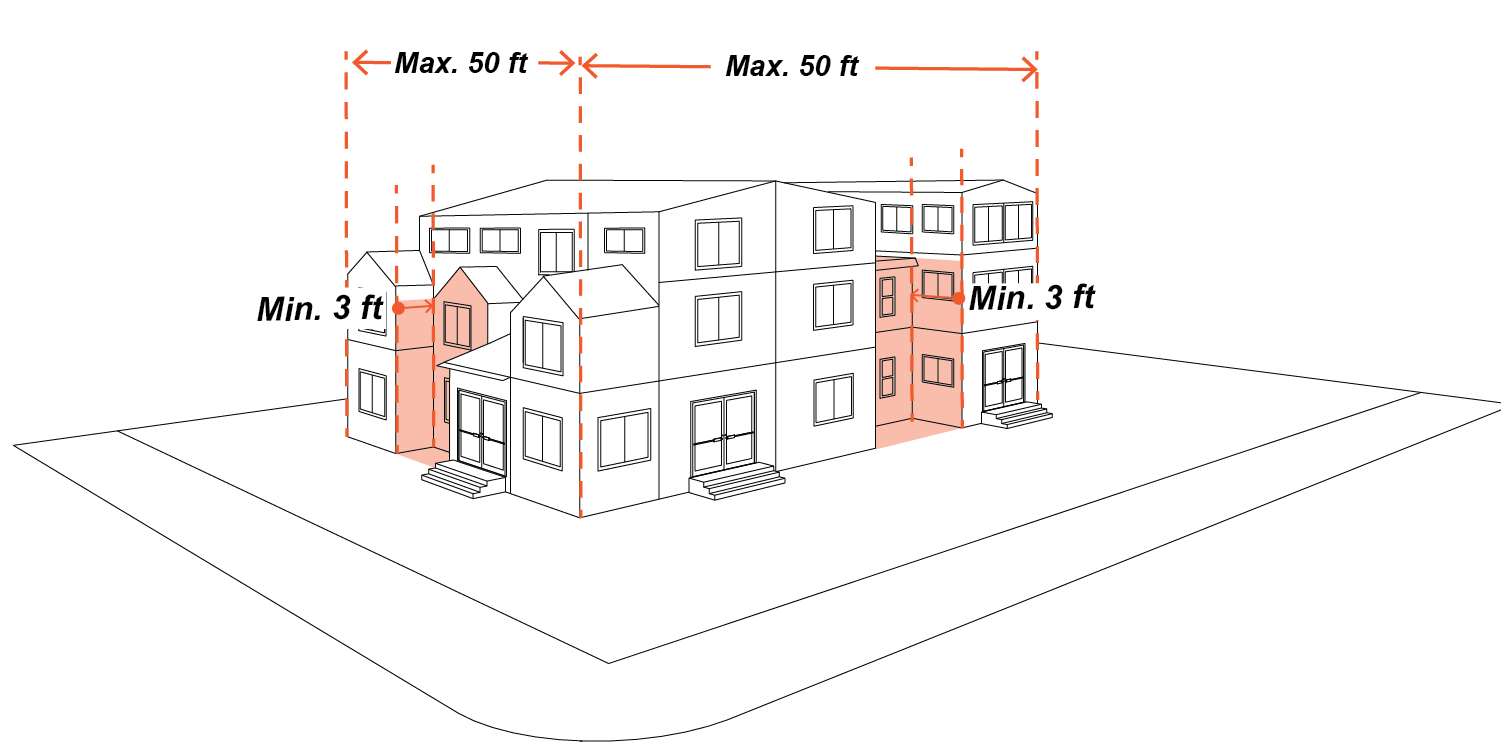
Vertical Articulation. When a building façade exceeds fifty (50) feet in length along a right-of-way, it must be separated into primary façade bays no greater than fifty (50) feet and secondary façade bays defined by a recess a minimum three feet deep and ten (10) feet wide.
3.
R-1 Adjacencies.
a.
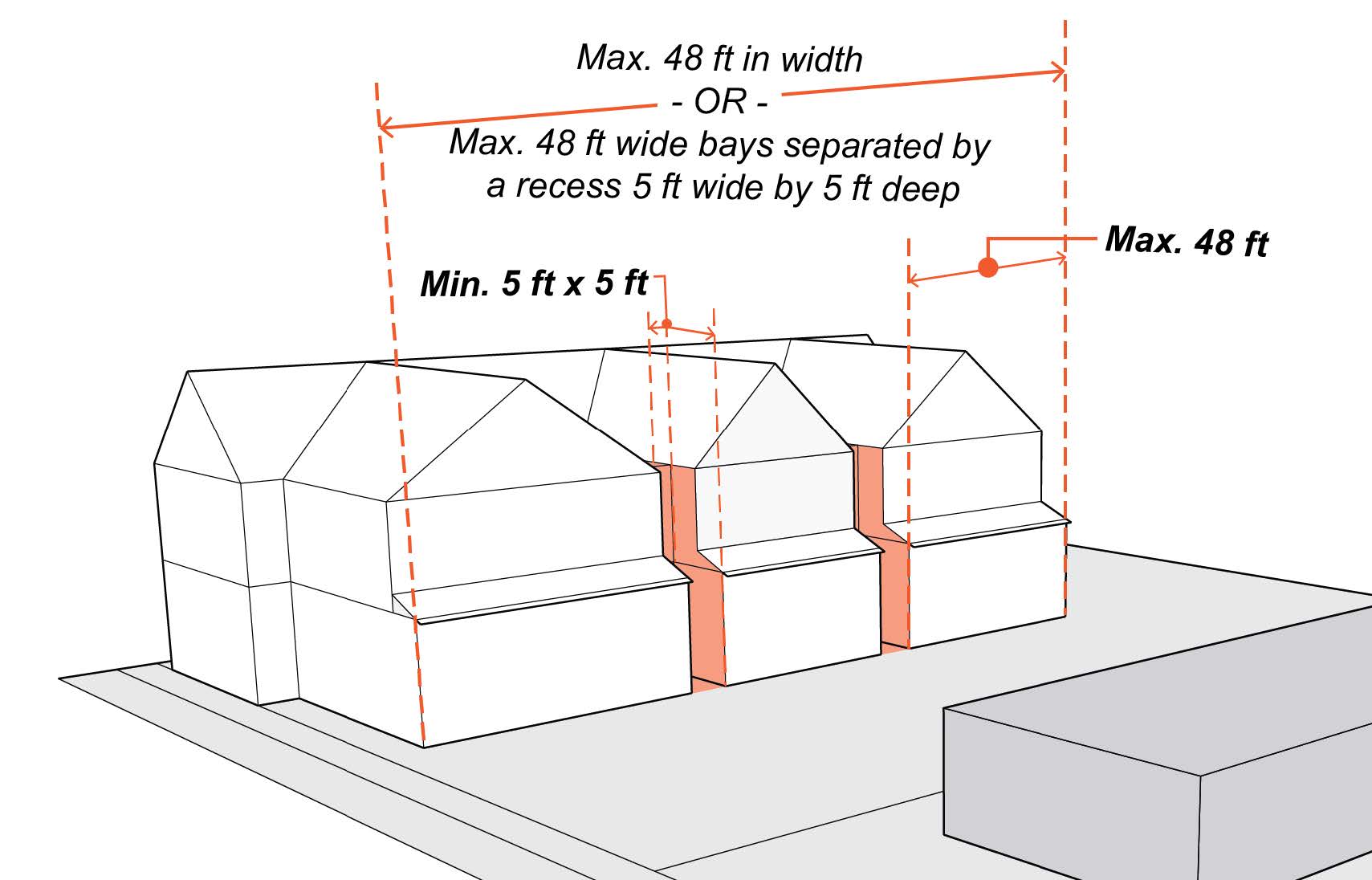
Building façade planes abutting an R-1 district may not exceed forty-eight (48) feet in width.
b.
When a building façade abutting an R-1 district exceeds forty-eight (48) feet in width, it must be separated into façade bays no greater than forty-eight (48) feet by a recess five feet wide and five feet deep.
c.
Balconies, roof decks and other habitable outdoor space is not allowed on upper-story façades abutting R-1 zones.
d.
Sliding glass doors, French doors, and floor-to-ceiling windows are not allowed on upper-story façades abutting R-1 zones.
4.
Privacy and Line of Sight.
a.
Primary living spaces and balconies located along a side setback shall orient principal windows and balconies toward the front and rear of the building.
b.
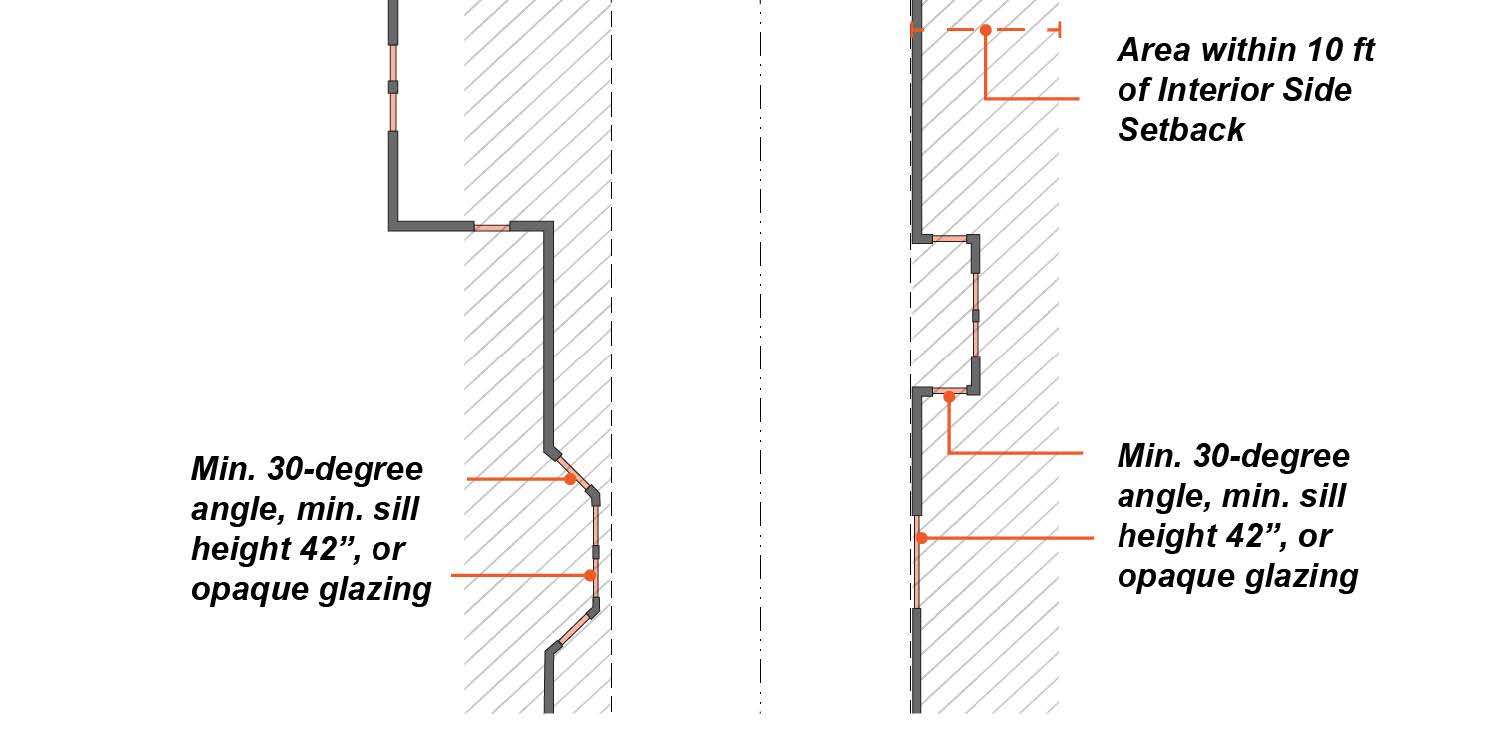
Where windows are within ten (10) feet of and oriented toward an interior side setback, glazing shall either be a minimum thirty (30) degree angle measured perpendicular to the adjacent side setback line, have minimum sill height of forty-two (42) inches, or be opaque.
c.
The maximum sill height for an ingress/egress window is forty-four (44) inches from finished floor.
5.
Roofline and Roof Design.
a.
Roof designs shall be limited to:
i.
Hipped.
ii.
Gable.
iii.
Dormer.
iv.
Parapet.
(a)
When used on the first or second floor, a parapet longer than twenty-five (25) feet in length must include at least one but not more than two of the following design elements to break up the length of the parapet:
(1)
Steps.
(2)
Curves.
(3)
Angled surfaces.
(b)
Parapet limited to twenty-five (25) percent of cumulative roof perimeter on the third floor and above.
(c)
The length of a parapet segment on the third floor and above may not exceed twenty-five (25) feet.
b.
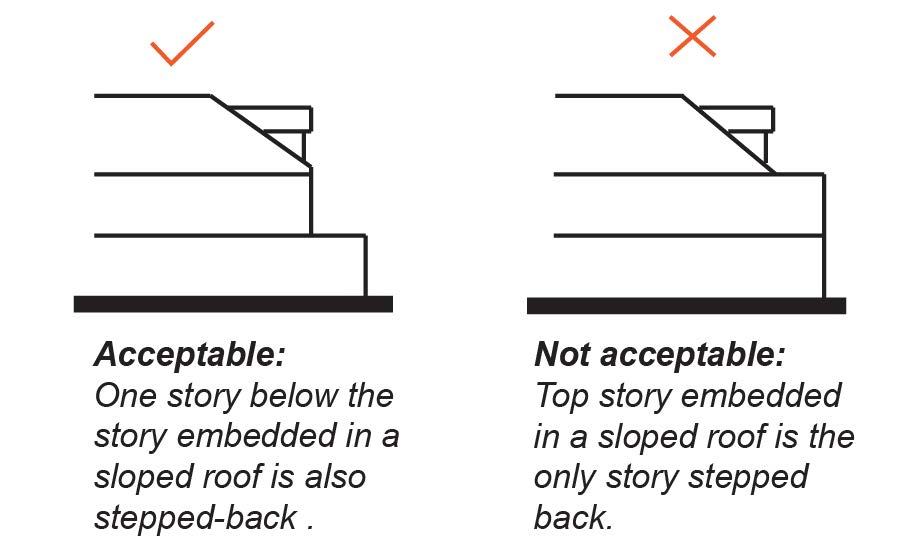
When the top story is stepped back and embedded in a sloped roof form such as a mansard roof or a hipped and/or gabled roof with dormers, the floor below must (and other floors may) be stepped back to meet the slope of the top story.
c.
Façade facing R-1 Zone must utilize a hipped or gable roof and may incorporate dormers.
d.
Corner Treatment. Roofline/parapet at corners shall not exceed roofline/parapet of adjacent wallplanes by more than twenty-four (24) inches.
C.
Building Design.
1.
Façade Composition.
a.
Building façades must continue the pattern established by existing buildings in Downtown Los Altos by reinforcing the underlying maximum twenty-five (25) foot module along all street frontages through the use of the following techniques:
i.
Building façades shall be arranged in an orderly composition of bays, defined by vertically aligned openings alternating horizontally with solid walls or columns.
ii.
The pattern shall be visually expressed through the spacing of openings, recesses, eaves, cornices, overhangs, trellises, exposed rafters, columns, or bay windows.
iii.
Façades shall incorporate at least one element that signals habitation, such as porches, bay windows, or balconies.
iv.
Non-glazed wall areas (blank walls) must be enhanced with architectural details, landscaping, and/or landscaped trellises or lattices.
b.
At least two of the following strategies must be used in a manner that reinforces the maximum twenty-five (25) foot module:
i.
Change in roof parapet height or shape.
ii.
Change in roof style.
iii.
Change in materials palette.
iv.
Change in building height, minimum eight-foot difference.
v.
Change in frontage type or change in details of shopfront frontage type if used.
vi.
Use of upper floor projections such as bay windows or balconies.
2.
Building Entrances. Building entrances must incorporate one of the following entry features. See Section 14.66.275 (Entrance Type Standards) for design standards applicable to each entrance type listed.
a.
Stoop.
b.
Porch.
c.
Dooryard.
d.
Gallery.
e.
Arcade.
f.
Forecourt.
i.
Forecourts must feature at least one entry to a shop and/or second floor use.
ii.
Forecourts for buildings more than seventy (70) feet in length along a right-of-way must have a minimum width and depth of fifteen (15) feet from front façade. Width of forecourt shall be equal to or greater than depth.
iii.
The size of the forecourt must be appropriate relative to the size of the building. The maximum ratio of building height to forecourt is 2:1 (height < 2 x width).
iv.
Forecourt must be enclosed on at least three sides by buildings.
v.
Forecourt must remain open to the sky (arbors and trellises are allowed).
g.
Terrace.
3.
Primary Entrance Location(s). Locate primary entrance on the front ROW and/or interior courtyard.
4.
Individual Entries. Ground floor residential units facing a street must provide individual entries along the street frontage.
5.
Interior Courtyard. Interior courtyards must be:
a.
Enclosed on at least two sides by buildings.
b.
Open to the sky (arbors and trellises are allowed).
c.
A minimum width of twenty (20) feet and a minimum area of four hundred (400) square feet.
6.
Paseos. Paseos must be:
a.
A minimum width of ten (10) feet for through-block paseos.
b.
A minimum width of four feet for entries to courtyards or individual single businesses.
7.
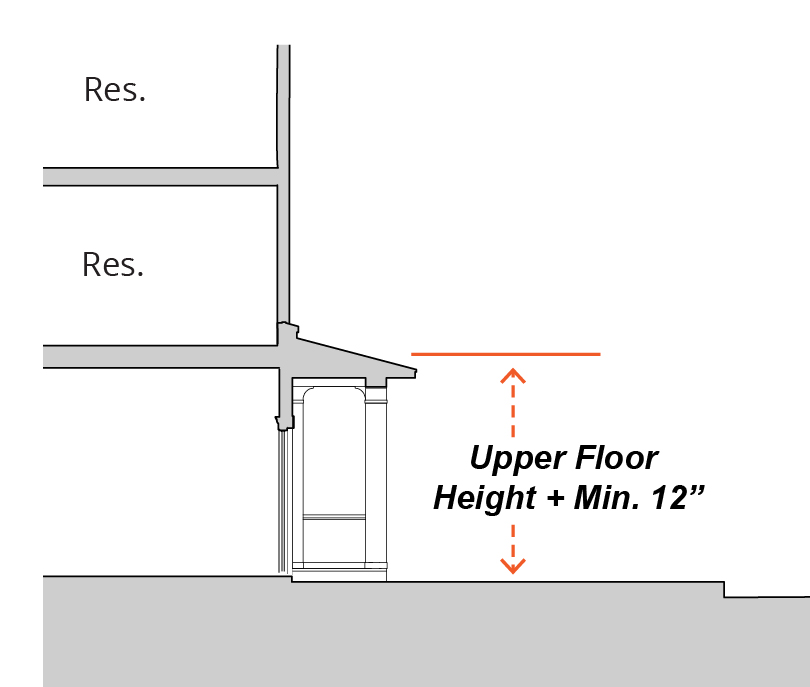
Ground Floor Floor-to-Ceiling Height. Minimum twelve (12) inches taller than typical upper floor floor-to-ceiling height.
D.
Window Design.
1.
All windows must have a sill.
2.
Vinyl sliding windows are prohibited on façades visible from a right-of-way.
E.
Building Materials.
1.
Primary shall mean fifty (50) percent or more of a façade surface area excluding transparent surfaces. Permitted primary cladding materials are limited to:
a.
Stucco (minimum two-coat stucco; synthetic stucco or EIFS not allowed).
b.
Siding (lap, vertical, or shingle).
i.
All siding shall be wood, composite wood, or cement fiberboard.
ii.
Wood siding shall be painted or stained.
iii.
Vinyl and aluminum siding are not permitted.
c.
Stone.
d.
Brick.
2.
Secondary shall mean less than fifty (50) percent of a façade surface area excluding transparent surfaces. Permitted secondary cladding materials are limited to:
a.
Stucco (minimum two-coat stucco; synthetic stucco not allowed, EIFS not allowed).
b.
Siding (lap, vertical, or shingle).
i.
All siding shall be wood, composite wood, or cement fiberboard.
ii.
Wood siding shall be painted or stained.
iii.
Vinyl and aluminum siding are not permitted.
c.
Stone (watertable and building base only).
d.
Brick (watertable and building base only).
e.
Tile.
f.
Metal (matte finish or Cor-ten).
i.
Ribbed metal, titanium, and mirrored finishes not allowed.
g.
Concrete Masonry Units (watertable and building base only, and not allowed on any façade facing a right-of-way or a single-family zone).
h.
Concrete (watertable and building base only, board-form only, cast concrete not permitted).
F.
Landscaping and Paving.
1.
Landscaping must be placed on each side of a driveway at grade or in raised planters.
2.
Low walls and/or hedges must screen the parking along the sidewalk. When walls are used, the materials and design must be compatible with and not obscure the architectural style of the building.
3.
A minimum seventy-five (75) percent of on-site paving material must be pervious/permeable.
G.
Screening.
1.
Service areas must be located at the rear of lot or along a parking plaza.
2.
Screening must be architecturally consistent with primary building in terms of materials, colors, and style.
H.
Additional Design Standards. See Section 14.66.280 for additional design standards applicable to all multi-family development in the R3-1 District.
(Amended during 2/06 supplement; prior code § 10-2.1110)
(Ord. No. 2021-478, § 1, 9-14-2021)
14.24.120 - Signs (R3-1).
(As provided in Chapter 14.68 of this code.)
(Prior code § 10-2.1111; Ord. No. 2015-414, § 12, 9-8-2015)
14.24.130 - Fences (R3-1).
(As provided in Chapter 14.72 of this title.)
(Prior code § 10-2.1112)
14.24.140 - Nonconforming use regulations (R3-1).
(As provided in Chapter 14.66 of this title.)
(Prior code § 10-2.1113)
14.24.150 - Conditional uses (R3-1).
Upon the granting of a use permit in accord with Chapter 14.80 of this title, hotels shall be permitted in the R3-1 District.
(Prior code § 10-2.1115)
14.24.160 - Accessory structures.
As provided in Chapter 14.15 of this title.
(Ord. No. 2018-440, § 3, 3-13-2018)

