
Los Altos City Zoning Code
CHAPTER 14
72 - FENCE REGULATIONS
Sections:
14.72.010 - Short title.
This chapter shall be known and cited as the fence regulations of the city.
(Prior code § 10-2.2601)
14.72.020 - Maximum fence heights.
The maximum height of any fence, wall, or other similar structure erected, constructed, or maintained in the city shall not exceed six feet, with the following exceptions:
A.
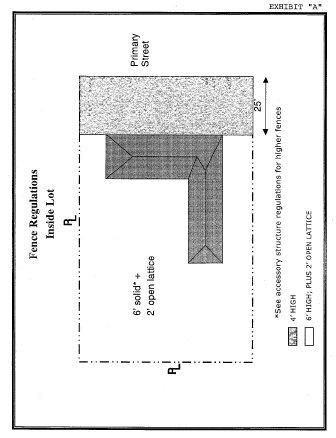
No fence located within the required front yard setback and no fence located within five feet of the exterior side property line of a corner lot shall exceed four feet in height.
B.
The city planner may approve an exception to allow the exterior side yard of a corner lot to be considered the front yard, and adjust the other yard orientations accordingly, for the purposes of fencing. This exception may be granted only when it is clear that this alternative orientation is consistent with the orientation of the home itself.
C.
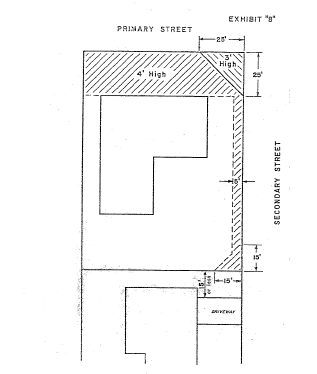
In order to ensure visibility, no fence exceeding three feet in height shall be located within a twenty-five (25) foot triangle at the intersection of two streets as outlined in Exhibit "A" of this chapter.
D.
In order to ensure visibility, no fence exceeding four feet in height shall be located within a fifteen (15) foot triangle on either side of a driveway where it intersects with a street as outlined in Exhibit "A" of this chapter.
E.
The provisions of subsection D of this section shall apply in those instances where a driveway on an adjoining property is located within fifteen (15) feet of the intersection of a rear property line and a secondary street property line of a corner lot or where such adjoining property is vacant as outlined on Exhibit "B" of this chapter.
F.
Fences or walls may exceed six feet in height:
1.
For the purposes of providing noise attenuation and screening between residential and commercial properties as required by the Los Altos general plan and as provided for in Chapters 14.32, 14.34, 14.36, 14.38, 14.40, 14.46, 14.48, 14.50 and 14.54 of this title;
2.
In conjunction with an assessment district for the purposes of attenuating noise as determined by an acoustical analysis;
3.
In conjunction with city, county, state, or federal road projects for the purpose of attenuating noise as determined by an acoustical analysis;
4.
To allow up to two feet of lattice, or material other than lattice that is typically at least fifty (50) percent open to the passage of light and air when viewed horizontally, to be added to the top of a fence or wall in the rear or side yards, and provided the lattice is determined by the city planner to be substantially open to the passage of light and air and compatible with the design and materials of the fence or wall.
G.
Decorative columns, post caps, or similar features not more than one foot in height may be added on top of fences or walls which adjoin a street or public walkway, or those fences or walls which the city planner determines to be physically detached from an adjoining residential property. Such features would typically not be less than eight feet apart, and must be consistent with the design and materials of the fence or wall.
H.
A single arbor-style entry element, substantially open to the passage of light and air, may be allowed on a residential property provided the entry element is located over a walkway or pathway, and does not exceed eight feet in height, five feet in width, and three feet in depth. The entry element shall not be considered as lot coverage.
(Ord. 04-267 § 7)
14.72.030 - Barbed wire and electrified fences.
Barbed wire, electric, or other fences or walls dangerous to persons or property shall not be constructed within ten (10) feet of any property line which adjoins a street or public walkway.
(Prior code § 10-2.2604)
14.72.040 - Public nuisances.
A fence, wall, or other structure maintained in violation of the provisions of this chapter shall constitute a public nuisance.
(Prior code § 10-2.2606)
14.72.050 - Fencing of private swimming pools.
A.
A private swimming pool is defined for the purposes of this section as a swimming pool, wading pool, fish pond, or other outside body of water created by artificial means and maintained in connection with a single-family or multifamily residence, apartment house, motel, hotel, or any other type of building, which pool has any depth in excess of twenty-four (24) inches, whether above or below grade, and whether intended to be temporary or permanent in nature.
B.
Every person who shall own or be in possession of any premises, whether as purchaser under contract, lessee, tenant, or licensee, on which there is situated a private swimming pool, as defined in subsection A of this section, shall maintain on such premises and completely enclosing such private swimming pool a fence, wall, or other structure not less than five feet in height; provided, however, there shall be no holes or gaps in the enclosure or gate, which normally should be solid, except as may be approved by the building inspector, who shall be guided in approving or disapproving the same by the principle that the construction of the enclosure should not be such that the enclosure would be readily climbable by children; and provided, further, that a dwelling house or accessory building or any other type of building may be used as a part of such enclosure. Any gate or door in such enclosure shall be equipped with a self-closing and self-latching device designed to keep such gate or door (except a door leading to the interior of a building) securely closed at all times, with the latching device either placed at least four feet nine inches above ground level or otherwise made inaccessible from the outside to children.
C.
Existing private swimming pools shall, on or before June 1, 1962, comply with the requirements of subsection B of this section.
D.
The enclosure referred to in this section shall be deemed to be a structure within the meaning of the Building Code of the city. The final inspection and approval of all private swimming pools constructed shall be withheld until all the requirements of subsection B of this section have been complied with.
(Prior code § 10-2.2607)

