
Los Altos City Zoning Code
CHAPTER 14
66 - GENERAL STANDARDS AND EXCEPTIONS
Sections:
14.66.020 - Conformity with district regulations.
A.
No structure shall be erected and no existing structure or use shall be moved, altered, or enlarged except in conformity with the regulations for the district within which the structure or use is located.
B.
No site or structure shall be used or designated for use for any purpose or in any manner other than in conformity with the regulations for the district within which the site or structure is located.
C.
No yard or other open space surrounding any structure or use shall be used, encroached upon, or reduced in any manner except in conformity with the regulations for the district in which the yard or open space is located.
D.
No site, lot, or other parcel of real property held in one ownership on February 4, 1958, or at any time thereafter, shall be reduced in any manner below the minimum area or dimensions prescribed for the district within which the site, lot, or parcel of real property is located.
(Ord. 04-267 § 6 (part); prior code § 10-2.2701)
14.66.030 - Nonconforming lots.
A site, lot, or other parcel of real property having an area or dimensions less than the minimum site area or dimensions prescribed for the district within which the site, lot, or other parcel of real property is located which either (1) is shown on a duly approved and recorded map, and for which a deed or valid contract of sale was of record in the office of the county recorder prior to February 4, 1958, and which had a legal area or dimensions at the time the deed or contract of sale was recorded, or (2) is shown on a duly approved and recorded map which was approved by the city or another authorized legislative body, may be used but shall be subject to the regulations for the district within which the site, lot, or other parcel of real property is located.
(Ord. 04-267 § 6 (part); prior code § 10-2.2702)
14.66.040 - Nonconforming structures.
A nonconforming structure which conforms to the use regulations for the district within which it is located may be used but shall not be so moved, altered, or enlarged as to increase the discrepancy between the existing conditions and the standards prescribed for the district within which the structure is located.
(Ord. 04-267 § 6 (part); prior code § 10-2.2703)
14.66.050 - Nonconforming structures—Continuation.
A nonconforming structure lawfully occupying a site on March 6, 1958, may be continued as such, subject to the provisions of this chapter.
(Ord. 04-267 § 6 (part); prior code § 10-2.2703)
14.66.060 - Nonconforming structures—Repairs, alterations, and additions.
A.
No nonconforming structure shall be moved, altered, or enlarged unless required by law or unless the moving, alteration, or enlargement will result in the elimination of the structure's nonconformity, except that such a residential structure may be altered or enlarged if such change does not increase the nonconformity. If the nonconforming portion of the structure is removed, it shall no longer retain its nonconforming status and shall only be replaced in full conformity with the provisions of this chapter.
B.
Routine maintenance and repairs may be performed on a nonconforming structure. Maintenance shall be only to the extent determined by the building and planning department.
(Ord. 05-278 § 2 (part): Ord. 04-267 § 6 (part); prior code § 10-2.2705)
14.66.070 - Nonconforming structures—Damaged—Restoration.
A.
Whenever a nonconforming structure shall be damaged by fire or other calamity, by act of God, or by a public enemy to the extent of fifty (50) percent or less, the structure may be restored, provided that restoration is started within six months and diligently pursued to completion.
B.
Whenever a nonconforming structure shall be damaged by fire or other calamity, by act of God, or by a public enemy to an extent greater than fifty (50) percent, the structure shall not be restored except in full conformity with the provisions of this chapter.
C.
The extent of damage or partial destruction shall be based upon the ratio of the estimated cost of restoring the building to its condition, prior to such damage or partial destruction, to the estimated cost of duplicating the entire building as it existed prior thereto. Estimates for this purpose shall be made or shall be reviewed and approved by the building inspector.
(Ord. 05-278 § 2 (part): Ord. 04-267 § 6 (part); prior code § 10-2.2706)
14.66.080 - RESERVED.[13]
Editor's note— Ord. No. 2015-414, § 9, adopted September 8, 2015 repealed § 14.66.080, which pertained to nonconforming structures—elimination and derived from Ord. 04-267 § 6 (part); prior code § 10-2.2707.
14.66.090 - Nonconforming uses—Continuation.
A lawful conforming use occupying a structure or a site, which use no longer conforms to the use regulations for the district in which it is located, shall be deemed to be a nonconforming use and may be continued as such, subject to the provisions of this chapter.
(Ord. 04-267 § 6 (part); prior code § 10-2.2708)
14.66.100 - Nonconforming uses—Repairs, alterations, and additions.
A.
No nonconforming use may be enlarged or expanded in such a manner as to occupy any part of a structure or site which it did not occupy at the time such use became nonconforming or in such a way as to displace any conforming use occupying a structure or site.
B.
Alterations and routine maintenance and repairs may be performed on a structure, the use of which is nonconforming.
(Ord. 04-267 § 6 (part); prior code § 10-2.2709)
14.66.110 - Nonconforming uses—Abandonment/discontinuance.
An abandoned or discontinued nonconforming use in any district may resume if occupancy reoccurs within one hundred twenty (120) days of the date the use was originally abandoned or discontinued. A nonconforming use which had been abandoned or discontinued for more than one hundred twenty (120) days may resume upon the granting of a use permit in accordance with the provisions of Chapter 14.80 of this title. Whenever a nonconforming use changes to a conforming use, the use of the structure and/or site thereafter shall be conforming.
(Ord. 07-306 § 6 (part): Ord. 04-267 § 6 (part); prior code § 10-2.2710)
14.66.120 - Nonconforming uses—Restoration of damaged structures.
A.
Whenever a structure located in a residential district, the use of which does not conform to the regulations for the district within which it is located, is damaged by fire or other calamity, or by act of God, or by a public enemy to the extent of fifty (50) percent or less, the structure may be restored, and the nonconforming use may be resumed provided restoration is started within six months and diligently pursued to completion.
B.
Whenever a structure located in a residential district, the use of which does not conform to the regulations for the district within which it is located, is damaged by fire or other calamity, or by act of God, or by a public enemy to an extent greater than fifty (50) percent, or is voluntarily razed, or is required by law to be razed, the structure shall not be restored except in full conformity with the provisions of this chapter, and the nonconforming use shall not be resumed.
C.
The extent of damage or partial destruction referred to in subsections A and B of this section shall be based upon the ratio of the estimated cost of restoring the building to its condition, prior to such damage or partial destruction, to the estimated replacement cost for the entire building. Estimates for this purpose shall be reviewed and approved by the building inspector.
D.
Whenever a structure located in a commercial district, the use of which is nonconforming, is damaged to any extent by fire or other calamity, or by act of God, or by a public enemy, or is voluntarily razed or is required by law to be razed, the structure may be restored in accordance with the provisions of Section 14.66.080 of this chapter, and the nonconforming use may resume provided restoration is started within six months and diligently pursued to completion. If restoration of such a damaged or demolished structure has not commenced within six months, the nonconforming use may not resume unless and until a use permit has been granted in accordance with the provisions of Chapter 14.80.
(Ord. 04-267 § 6 (part); prior code § 10-2.2711)
14.66.130 - Yard spaces.
No yard space or other open space provided about any structure in compliance with the regulations for the district in which it is located shall be deemed to provide a yard space or open space for any other structure, and no yard or other open space on one site shall be deemed to provide a yard space or open space for a structure on any other site.
(Ord. 07-306 § 6 (part); Ord. 04-267 § 6 (part); prior code § 10-2.2713)
14.66.140 - Off-street parking and loading spaces.
(As provided in Chapter 14.74 of this title.)
(Ord. 07-306 § 6 (part); Ord. 04-267 § 6 (part); prior code § 10-2.2714)
14.66.150 - Reduction of off-street parking and loading spaces.
(As provided in Chapter 14.74 of this title.)
(Ord. 07-306 § 6 (part); Ord. 04-267 § 6 (part); prior code § 10-2.2715)
14.66.160 - Standards for off-street parking spaces.
(As provided in Chapter 14.74 of this title.)
(Ord. 07-306 § 6 (part); Ord. 04-267 § 6 (part); prior code § 10-2.2716)
14.66.170 - Standards for off-street loading spaces.
(As provided in Chapter 14.74 of this title.)
(Ord. 07-306 § 6 (part); Ord. 04-267 § 6 (part); prior code § 10-2.2717)
14.66.180 - Maintenance of landscaped areas.
A landscaped strip or other landscaped area provided in compliance with district regulations or as a condition approval shall be planted with fast growing materials as identified by a landscape architect licensed in California suitable for screening or ornamenting the site, whichever is appropriate, and plant materials shall be replaced as needed to screen or ornament the site. Landscaped strips and other landscaped areas shall be watered, weeded, pruned, fertilized, sprayed, or otherwise maintained as deemed necessary by the building inspector.
(Ord. 07-306 § 6 (part); Ord. 04-267 § 6 (part); prior code § 10-2.2718)
(Ord. No. 2021-478, § 1, 9-14-2021)
14.66.190 - Reserved.
Editor's note— Ord. No. 2018-440, § 4, adopted March 13, 2018 repealed § 14.66.190, which pertained to distances between structures and derived from Ord. 07-306 § 6 (part); Ord. 04-267 § 6 (part); prior code § 10-2.2719; and Ord. No. 2012-375, § 7, adopted Jan. 24, 2012.
14.66.200 - Yard requirements—Measurement.
Required yards shall be measured horizontally from the nearest point of the property line of the site or the nearest point of the street line, whichever shall be nearer, to the nearest line of the structure; provided, however, where a setback line has been set by action of the council or any other duly authorized body, required yards shall be measured from the setback line, and no provision of this chapter shall be construed to permit a structure to extend beyond the setback line; and provided, further, where a site abuts on a street having only a portion of its required width dedicated or reserved for street purposes as designated on an official plan line adopted by the council, required yards shall be measured from a line drawn on the boundary of the additional width required for street purposes abutting the site.
(Ord. 07-306 § 6 (part); Ord. 04-267 § 6 (part); prior code § 10-2.2720)
14.66.210 - Yard requirements—Exceptions.
A.
Canopies, chimneys, cornices, eaves, overhangs, and similar architectural features may extend into any required side yard not more than four feet and may extend into any required front or rear yard not more than four feet.
B.
Window surfaces, such as bay windows and greenhouse windows having no foundation or other connection to the surface of the ground below, may extend into any required side yard not more than eighteen (18) inches and may extend into any required front or rear yard not more than eighteen (18) inches, provided such projections do not extend vertically between stories.
C.
Fire escapes, landings, and uncovered decks and porches may extend into a required rear yard up to six feet, but shall be no closer to the side property line as the side yard setback prescribed for that lot. Decks, walkways and other hardscape surfaces no more than six inches above grade may go up to any property line.
D.
Fences, walls, hedges, walks, driveways, or necessary retaining walls may occupy any required yard or other open space, subject to the provisions of Chapter 14.72 regulating fences.
(Ord. 07-306 § 6 (part); Ord. 04-267 § 6 (part))
14.66.220 - Reserved.
Editor's note— Ord. No. 2018-440, § 4, adopted March 13, 2018 repealed § 14.66.190, which pertained to lot coverage—exception for arbor (gazebo) and pergola (trellis) structures and derived from Ord. 07-306 § 6 (part); Ord. 04-267 § 6 (part); and prior code § 10-2.2721.1.
14.66.230 - Height limitations—Measurement.
The vertical dimension shall be measured from the average elevation of the finished lot grade at the front, rear, or side of the building, whichever has the greater height, to the highest point of the roof deck of the top story in the case of a flat roof or a mansard roof; and to the average height between the plate and ridge of a gable, hip, or gambrel roof. A mansard roof is defined as any roof element with a slope of sixty (60) degrees or greater.
(Ord. 07-306 § 6 (part); Ord. 04-267 § 6 (part); prior code § 10-2.2722)
(Ord. No. 2012-388, § 2, 11-13-2012)
14.66.240 - Height limitations—Exceptions.
A.
Spires, flagpoles, radio and television antennas, and transmission towers, except as noted below, may be erected to a height not more than fifteen (15) feet above the height limit prescribed by the regulations for the district in which the site is located, excluding R1 districts, provided no such structure shall be used for dwelling purposes or for commercial or advertising purposes.
B.
Antenna support structures for amateur radio transmitting or receiving antennas shall be subject to the following requirements:
1.
No portion of antennas, support structures, and/or guy wires shall be located in the required front yard setback and/or in front of the main structure;
2.
The prohibitions relating to antennas, support structures, and/or guy wires set forth in subsection (B)(1) of this section shall apply to the secondary street side yards of corner lots;
3.
No portion of antennas shall be located within the required first-floor side yard setback for main structures;
4.
No portion of antennas, support structures, and/or guy wires shall overhang property lines;
5.
The prohibitions relating to antennas set forth in subsections (B)(1) through (B)(4) of this section shall apply as the antenna rotates;
6.
Ground-mounted antenna support structures located within the required rear yard setback, as well as all roof- and chimney-mounted support structures, shall not exceed a height of fifteen (15) feet above the main structure's height limit prescribed by the regulations for the district in which the site is located;
7.
Ground-mounted antenna support structures located within the buildable area of the main structure shall not exceed a height of: (i) sixty-five (65) feet for self-supporting, retractable or crank-up towers or masts, which must retract to less than seventy (70) percent of the fully-extended height; and (ii) fifty-five (55) feet for non-self-supporting towers or masts which require guy wires;
8.
Not more than one antenna support structure in excess of fifteen (15) feet above the main structure's height limit set for the zoning district shall be permitted per parcel or lot. Additionally, not more than three antenna support structures up to a height of fifteen (15) feet above the main structure's height limit set for the zoning district shall be permitted per parcel or lot;
9.
Antennas, support structures, and guy wires shall be maintained with no structural defects or visible damage.
C.
Antenna support structures in existence prior to January 7, 1993 (the effective date of the ordinance codified in this section) which are nonconforming may continue to be used. Rather than Sections 14.66.070 and 14.66.080 of this chapter, the following shall apply:
1.
Such a nonconforming structure may be repaired, maintained, or altered but shall not be enlarged, expanded, relocated, or modified as to increase the discrepancy between the existing conditions and the standards prescribed for the district within which the structure is located.
D.
Public utility distribution and transmission lines shall be allowed in all districts and to greater heights than allowed for the district if required in order to conform to California Public Utility Commission General Order No. 95. Prior to the acquisition of rights-of-way, recommendations shall be secured from the commission and the council for the route of proposed transmission lines of fifty (50) kilovolts or more.
E.
Cupolas, chimneys, tanks, or electrical or mechanical equipment required to operate and maintain the building, solar thermal and photovoltaic panels, parapet walls and skylights may project not more than twelve (12) feet above the roof and the permitted building height, provided the combined area of all roof structures, excluding solar thermal and photovoltaic panels, does not exceed four percent of the gross area of the building roof.
F.
An enclosed penthouse or roof structure, housing an elevator or stairwell that provides access to a roof top, or a tower may exceed the allowed height limit by no more than twelve (12) feet and shall be integrated into the exterior architectural style of the building provided such structure shall not exceed the minimum size required by Title 12 of the Municipal Code (Buildings and Construction). However, none of these structures shall be allowed for the purpose of providing additional usable floor space for dwellings, commercial space, or storage of any type.
(Ord. 07-306 § 6 (part); Ord. 04-267 § 6 (part); prior code § 10-2.2723; Ord. No. 2015-414, § 10, 9-8-2015; Ord. No. 2016-427, § 1, 11-8-2016; Ord. No. 2017-436, § 1, 10-10-2017)
14.66.250 - Public utility lines and poles.
The provisions of this chapter shall not be applicable to public utility transmission and distribution lines and poles.
(Ord. 07-306 § 6 (part); Ord. 04-267 § 6 (part); prior code § 10-2.2726)
14.66.260 - Storage in yards.
A.
No portion of any required front yard shall be used for the storage of motor vehicles (except automobiles in fully operational condition), airplanes, boats, detachable camping apparatus, other miscellaneous mobile equipment, parts of any of the foregoing, or building materials (except building materials reasonably required for construction work on the premises pursuant to a valid and existing building permit issued by the city); provided, however, the property described in this subsection may be placed in the required front yard area for the purposes of loading, unloading, or other acts incidental to preparation for subsequent use for a period not to exceed three days in any one week.
B.
The prohibitions relating to storage set forth in subsection A of this section shall apply to required side yards of corner lots except when a fence has been legally constructed, pursuant to city regulations, of sufficient height and of a type which reasonably screens the stored property from public view and reasonably prevents it from becoming a nuisance by attraction to children.
C.
"Storage," as used in this section, shall mean the physical presence of the prescribed property, or any portion thereof, within the required front or side yard area for property within any zoned area, as the same is set forth and delineated in this chapter.
D.
"Week" as used in this section, shall mean the period from midnight Sunday to midnight the following Sunday.
E.
"Day," as used in this section, shall mean the period of time from any midnight to the following midnight.
F.
A fraction of a day shall be deemed an entire day for the purposes of computing time pursuant to the provisions of this section.
(Ord. 07-306 § 6 (part); Ord. 04-267 § 6 (part); Ord. 03-248 § 3, 2003: Ord. 02-408 § 2: prior code § 10-2.2727)
14.66.270 - Temporary uses.
A.
The planning director may approve the following temporary uses of property:
1.
Office uses which are commonly recognized as temporary in nature, including but not limited to, political campaign offices and interim office space during building remodeling projects, on the first floor of a building located within any commercial zoning district. Temporary offices shall be used for the minimum time period required to achieve the purpose of the temporary use, but not to exceed one year. The planning director may approve an extension of the maximum time period, up to an additional six months, upon a showing of good cause. A temporary first floor office use shall not cause a significant disruption of continuous retail business.
2.
Temporary real estate sales office used exclusively for and located within a new residential project with at least fifteen (15) units. Temporary real estate sales offices shall be used for the minimum time period required, but not to exceed one year. The planning director may approve an extension of the maximum time period, consistent with the actual construction period, upon a showing of good cause.
3.
Seasonal holiday retail sales lots, including Christmas tree lots and Halloween pumpkin lots within any zoning district except those districts which are designated as single-family residential in the Los Altos general plan. Seasonal holiday retail sales lots shall be used for the minimum time period necessary, but not to exceed forty-five (45) days.
4.
Other uses which are determined by the planning director to be of the same general character as the above temporary uses.
B.
Temporary land use may be approved by the planning director if, from the application and the facts presented, he or she will find:
1.
The temporary use will not be detrimental or injurious to property or improvements in the vicinity, and will not be detrimental to the public health, safety, general welfare, or convenience;
2.
The temporary use will be located and conducted in a manner in accord with the Los Altos general plan and the purposes of this title;
3.
The temporary use will not cause a significant disruption of continuous retail businesses;
4.
The potential benefits to the community have been considered with regard to determining the appropriateness of the temporary use and its location; and
5.
The temporary use includes appropriate conditions for the nature and duration of the temporary use to ensure compatibility with the surrounding neighborhood.
C.
Temporary land uses shall be subject to the following requirements:
1.
Application shall be made to the planning director and shall be accompanied by a fee as set by resolution of the city council.
2.
A temporary use, if approved, shall be limited to a specifically stated time period. The planning director may impose such reasonable restrictions as he or she deems necessary to achieve the purposes of this title and to assure operation of the use in a manner compatible with existing and potential uses on adjoining properties and in the general vicinity.
3.
After the premises are vacated by a temporary use, the tenant space shall revert to a permitted use, or a conditional use with a use permit, in the zoning district within which the property is located.
4.
Only those uses found to be of the same general character as the temporary uses permitted by this section may be approved by the planning director under the provisions of this section. If, from the application and the facts presented, the planning director is unable to make the required findings, the proposed temporary use shall be processed as a conditional use in accordance with the provisions of Chapter 14.80 of this title.
(Ord. 07-306 § 6 (part); Ord. 04-267 § 6 (part); prior code § 10-2.2730)
14.66.271 - Voter approval required for sale, transfer, or re-designation of city owned "parks" and "other open space" lands.
A.
Voter approval shall be required for any of the following:
1.
The sale or transfer of title of any city-owned land to another party, whether public or private, with a General Plan land use designation of "Parks" or "Other Open Space;" and
2.
The re-designation of city-owned land with a General Plan land use designation of "Parks" or "Other Open Space" to a different land use designation, except that the re-designation of any city-owned land from "Parks" to "Other Open Space," and vice versa, shall not require voter approval.
B.
For purposes of this policy, approval by a vote of the people is accomplished when an action is placed on the ballot at a general or special election through any procedure authorized in the California Elections Code, and a majority of the voters voting on the measure vote in favor of it.
C.
The voter approval requirement may be waived by the city council where necessary to comply with State or Federal law governing the provision of housing, including but not limited to affordable housing requirements.
(Ord. No. 2018-450, § 2, 10-9-2018)
14.66.275 - Entrance type standards.
A.
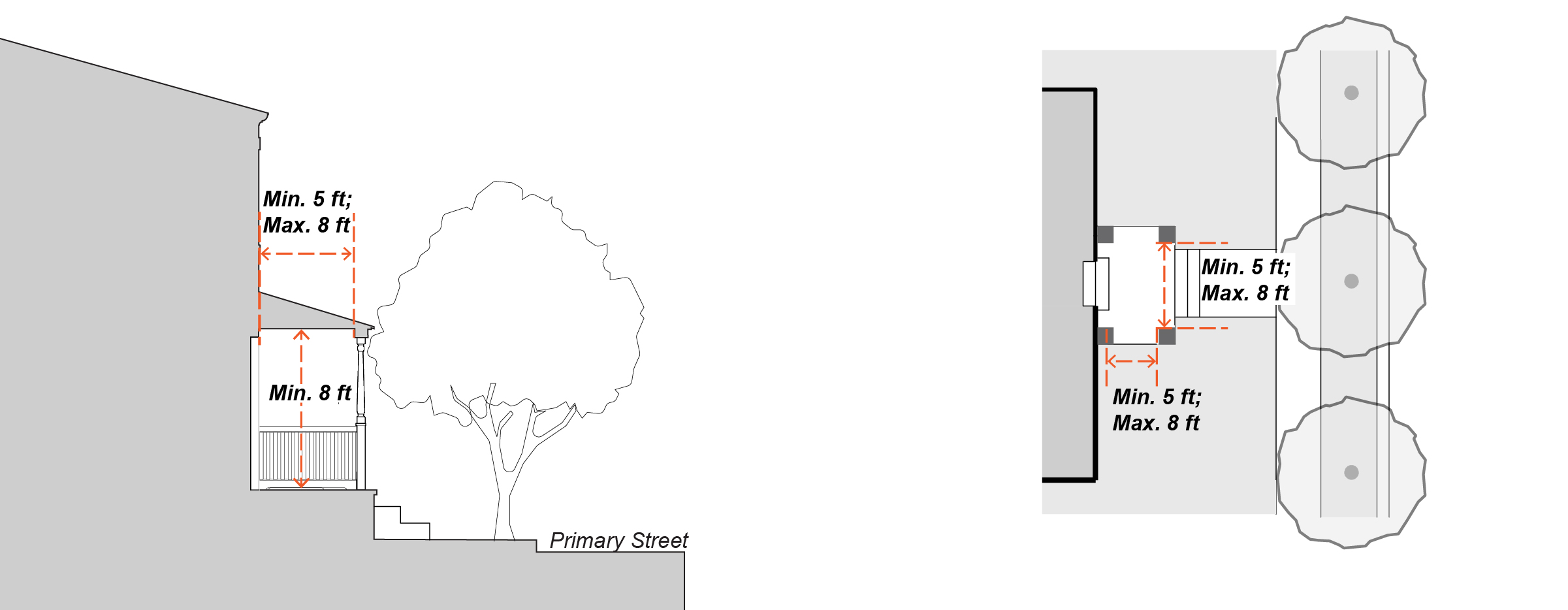
Stoop.
B.
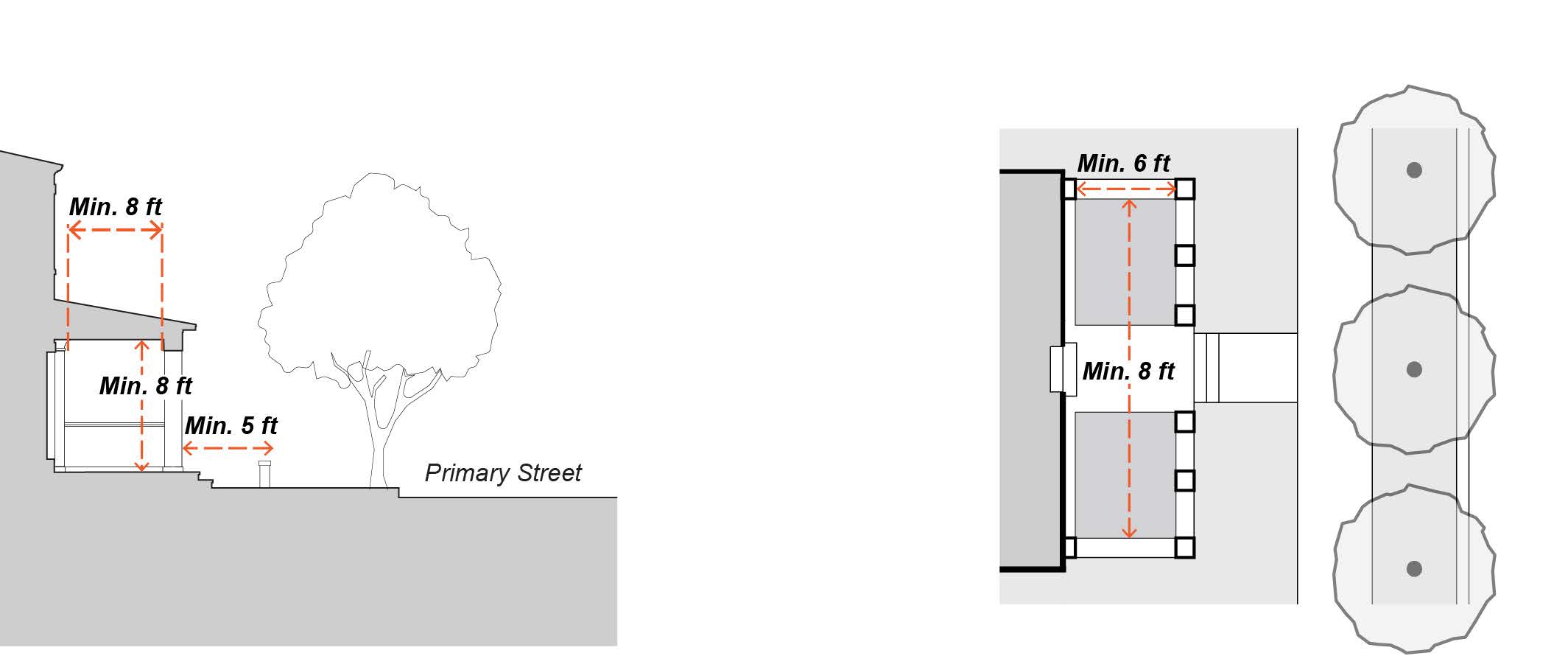
Porch.
C.
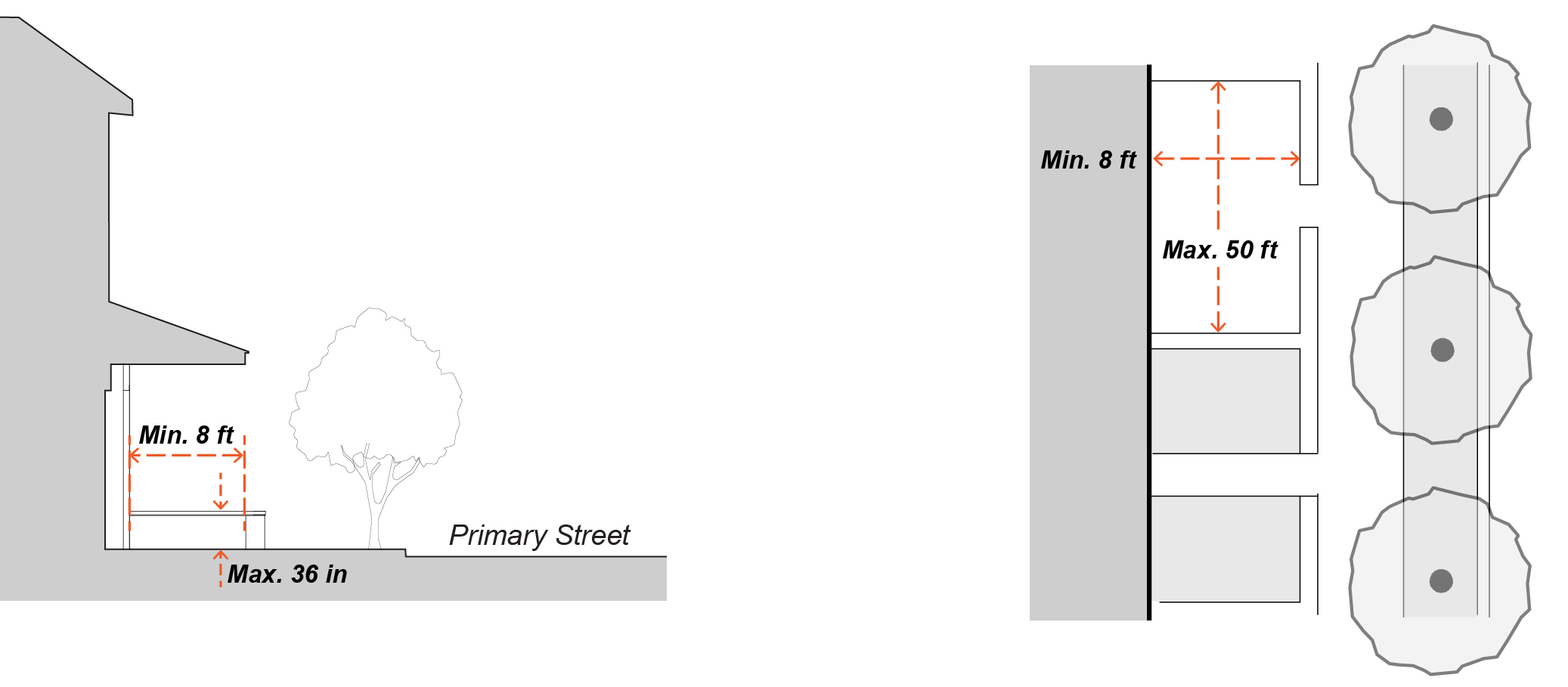
Dooryard.
D.
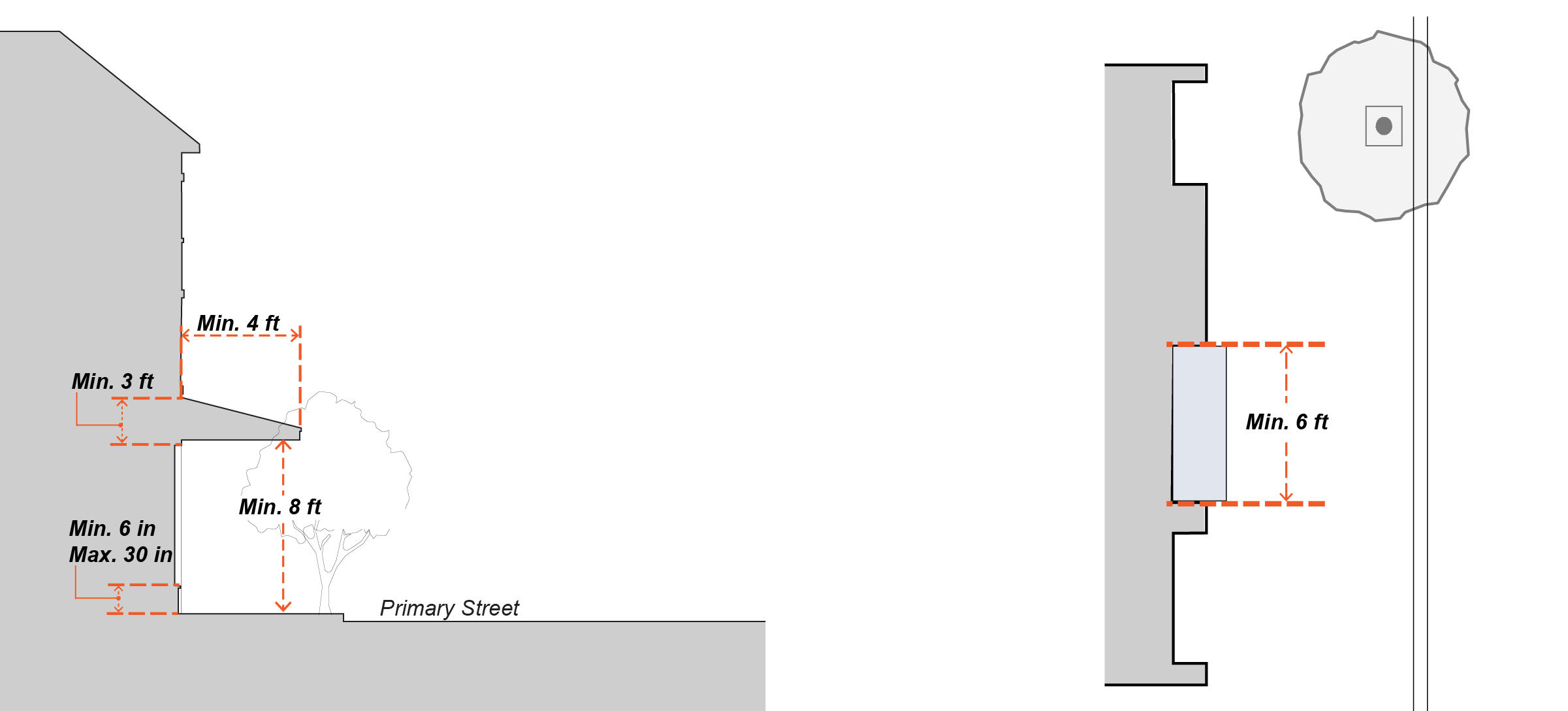
Shopfront.
E.
Gallery.
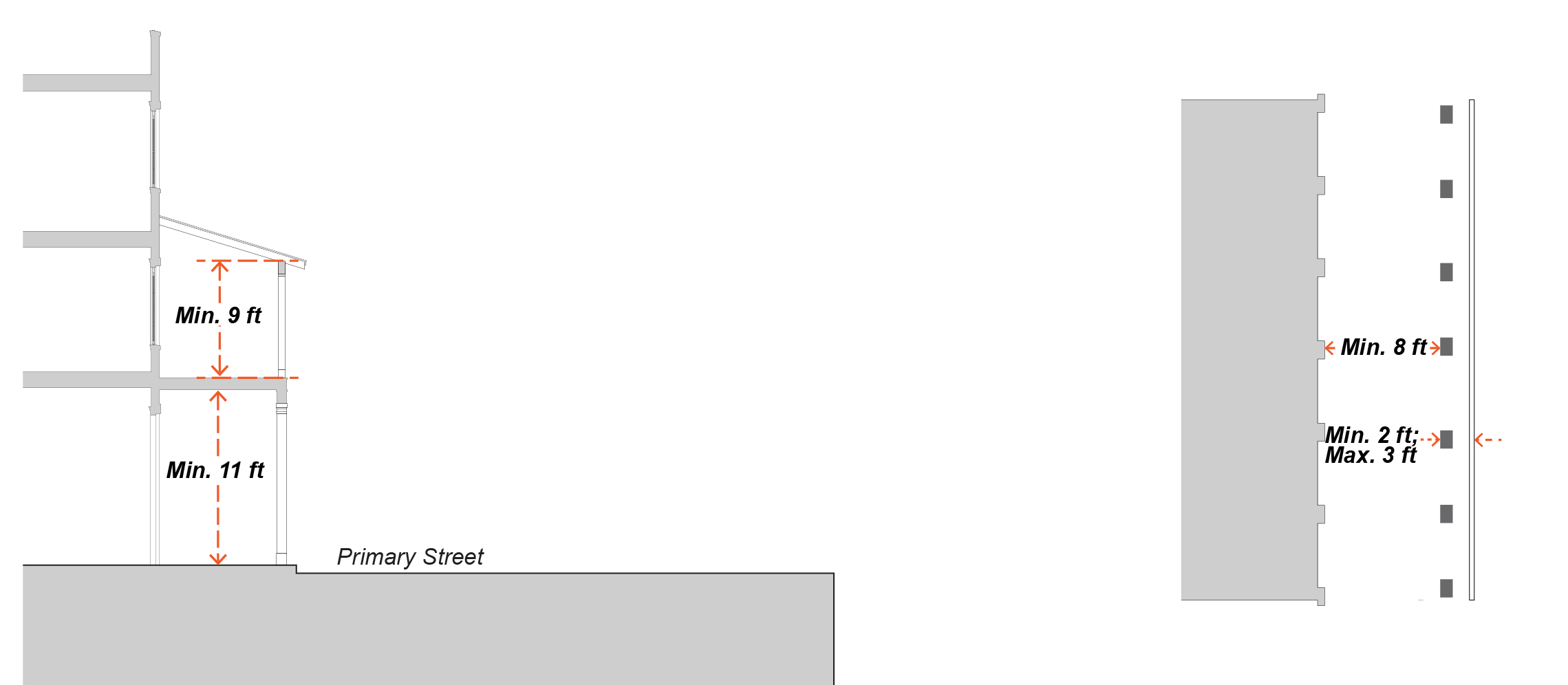
F.
Arcade.
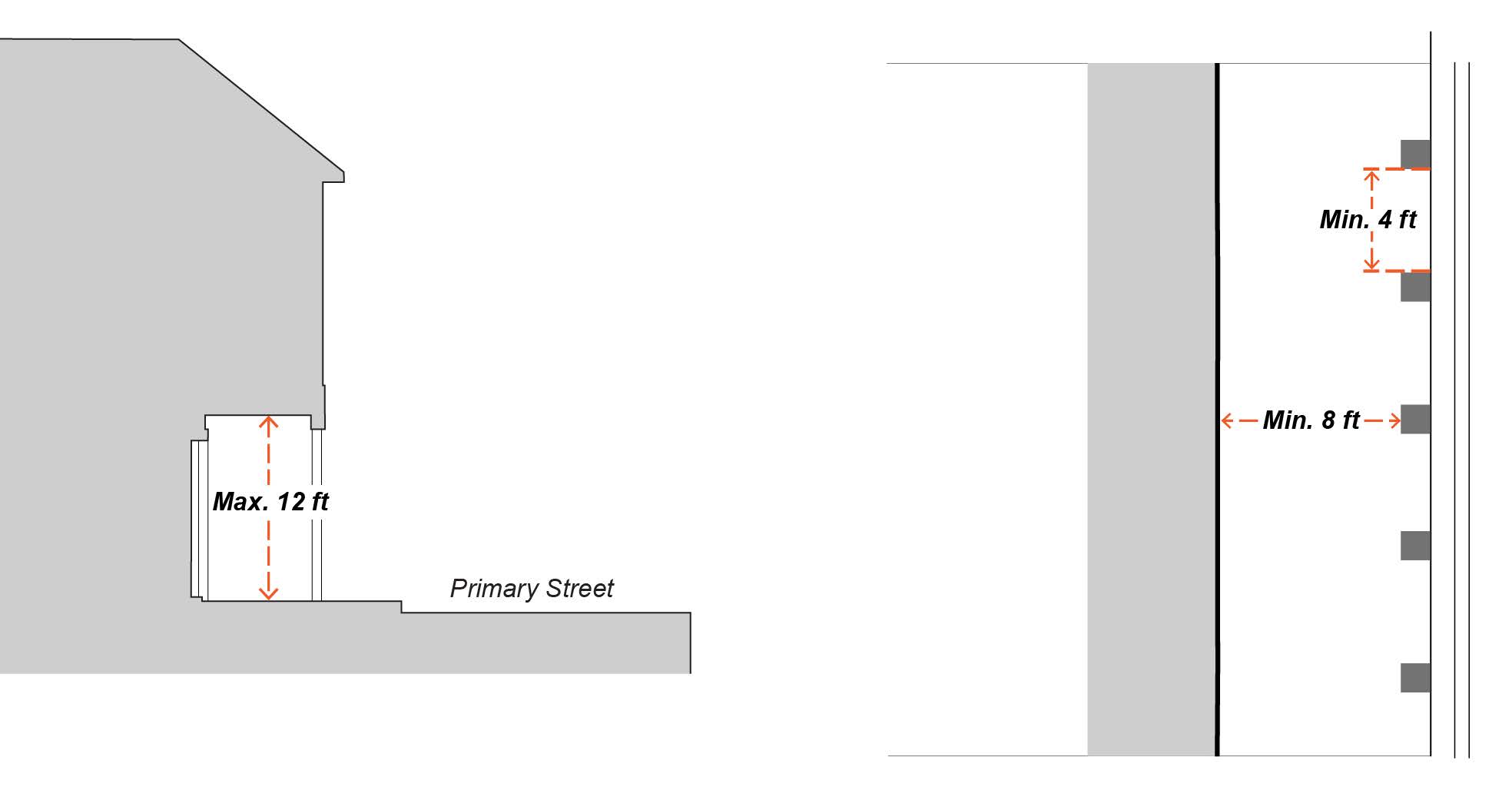
G.
Forecourt.
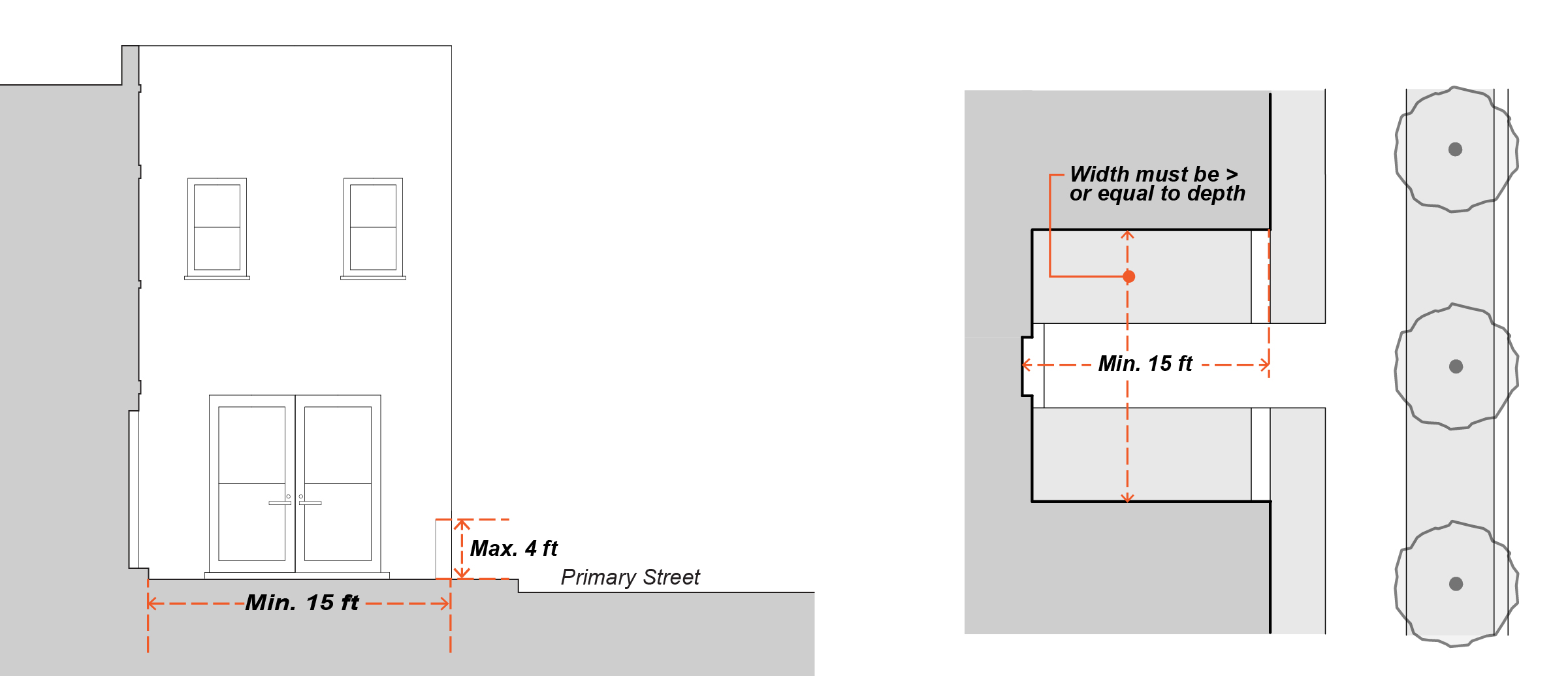
H.
Terrace.
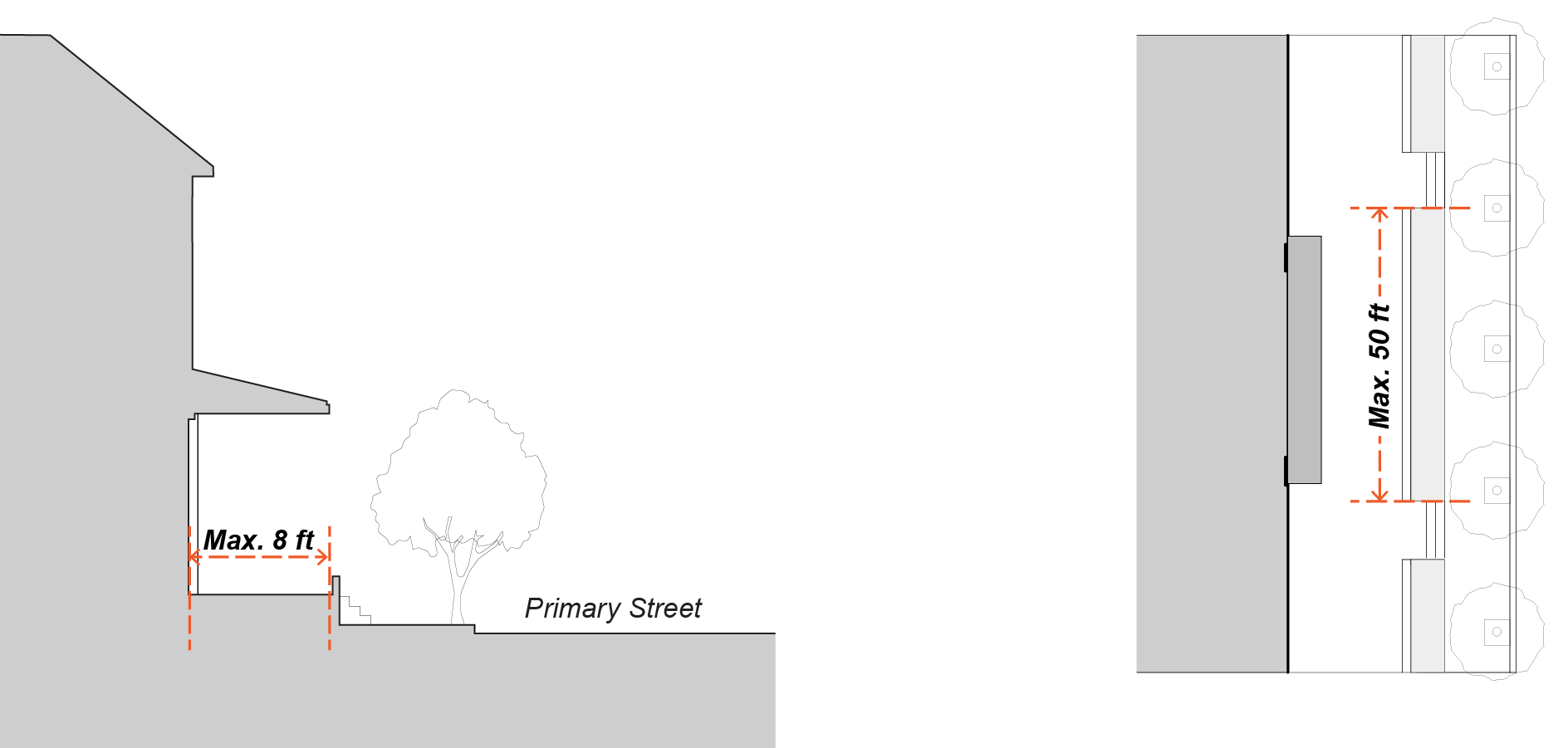
(Ord. No. 2021-478, § 1, 9-14-2021)
14.66.280 - Design standards applicable to all multi-family and residential mixed-use development.
A.
Architectural Integrity.
1.
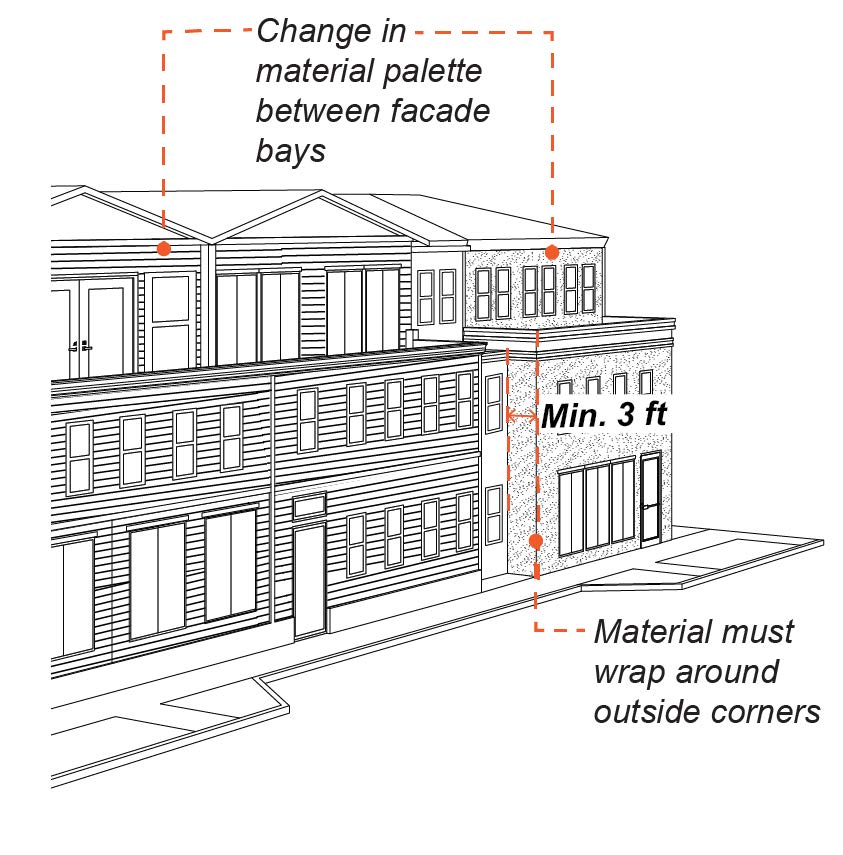
Material palette on all floors above the ground floor, not including floors contained within a sloped roof form, must be consistent.
2.
Change in material may occur only at the inside corner of a change in wall plane. Material must wrap around outside corners.
B.
Firewalls and Visible Sidewalls.
1.
Any exposed surfaces shall be consistent with and expressive of the overall building design and shall be finished in the same palette of materials as the rest of the building. Front façade finished materials, façade cornices, wall top projections, decorative details, and moldings must be carried and repeated on the side wall.
2.
At least one of the following techniques must be employed on firewalls/visible sidewalls:
a.
Incorporation of windows where code allows and adequate fire protection can be provided.
b.
Gable and hip roofs to vary the height and appearance of sidewalls.
c.
Inset panels.
d.
Stepped-back front façade of upper floor(s) to vary the sidewall profile.
C.
Durability. Exterior finish materials shall have an expected lifespan of no less than thirty (30) years.
1.
Features to direct rainwater away from exterior walls shall include one or more of the following:
a.
Cornice, with drip at outer edge of corona (minimum twelve (12) inch projection).
b.
Projecting eaves (minimum twelve (12) inch projection).
c.
Scuppers, with or without downspouts (minimum twelve (12) inch projection if no downspouts are used).
d.
Gutters, with downspouts or rain chains.
i.
Downspouts shall be one color and shall not change colors to match the wall behind them.
ii.
Downspouts shall be round or rectangular, made of copper or metal.
iii.
Downspouts shall not break façade profiles (such as a cornice) but shall wrap around projecting profile.
2.
Exterior timber shall be protected from decay by one or more of the following:
a.
Material properties (e.g., cedar).
b.
Staining and sealing.
c.
Painting.
3.
Exterior ferrous metals shall be protected from corrosion by one or more of the following:
a.
Metallurgical properties (e.g., galvanized, stainless, or weathering steel).
b.
Painting or other impermeable coating.
4.
Windows.
a.
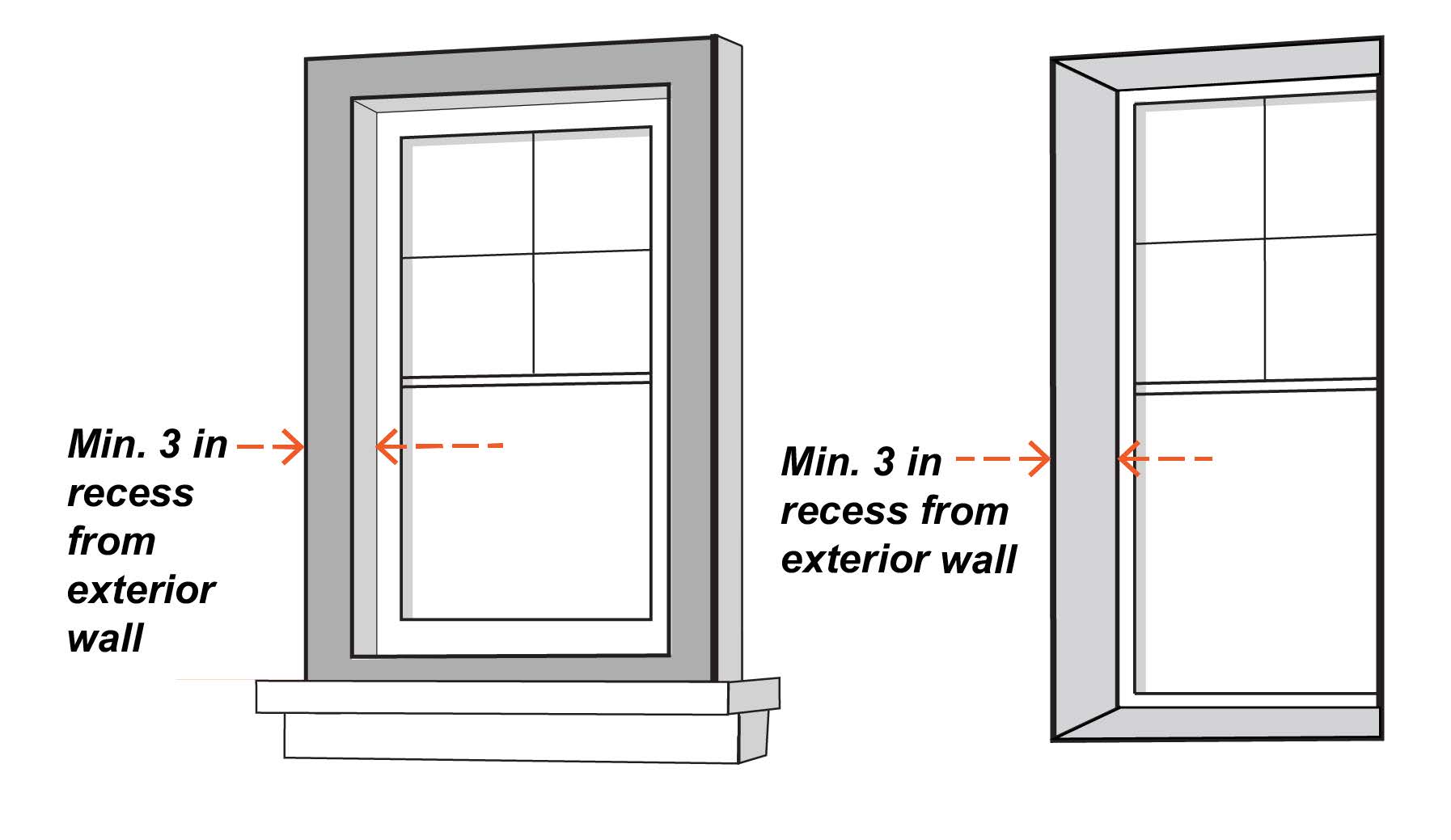
All windows must be recessed a minimum of three inches from the outer wall surface for all commercial and multi-family zones except the CT zone.
b.
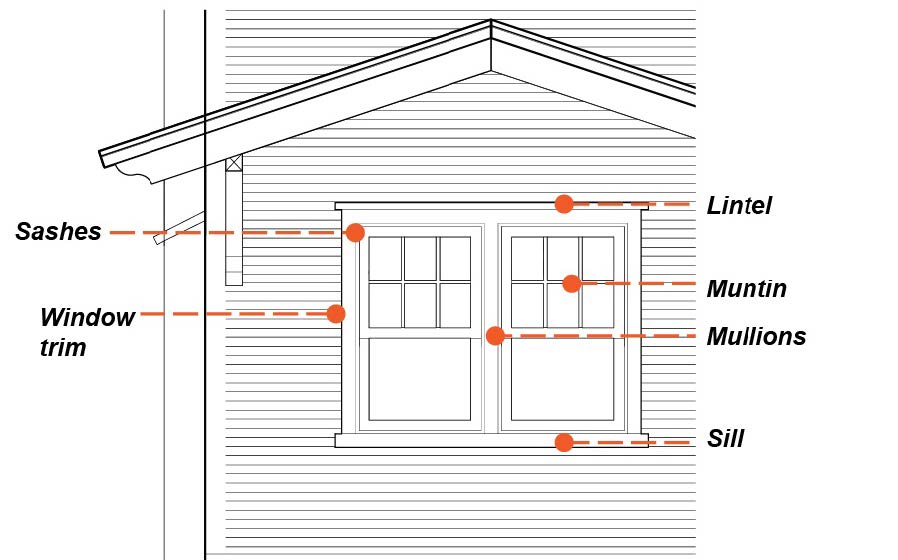
Window openings surrounded by masonry finish materials shall include a lintel that is taller than the sill/apron and proportional to the load it appears to carry.
D.
Materials. Materials shall appear only in places and configurations appropriate to their structural properties.
1.
Where walls use masonry finish materials (e.g. stone, brick, CMU), any openings spanned by the material must be either:
a.
Arched, with each arch defined by a continuous series of voussoirs and a single keystone at the apex; or
b.
Rectangular, with a continuous lintel spanning the opening and extending beyond by four to six inches at each end. Vertical dimension of the lintel shall be no less than one-eighths (⅛) of the clear span. Steel lintels are exempt from this minimum vertical dimension.
2.
When used, exterior timber posts, beams, rafters, purlins, brackets, etc. shall be joined according to structural principles.
3.
Where a change in material is desired, all façade materials shall turn the corner and terminate into a vertical element of the façade composition.
4.
Materials Defining Building Elements.
a.
Base. For multistory buildings, the base of the building shall be defined by a distinct material selected from among the following: Stone, brick, concrete, CMU, or stucco ("base material").
b.
Body. Typical materials for the main body of the building include wood, fiber cement, brick, stone, or stucco. If brick is used, it must extend vertically to the base; if stone is used, it must extend vertically to the foundation.
c.
Parapet. Parapets shall terminate in a parapet cap of stone, concrete, tile, metal, or molded stucco.
d.
Bays. Horizontal changes in finish material shall occur at the boundaries between bays rather than within a bay.
e.
Arcades. Arcades shall be supported by columns or piers in concrete/cast stone, fiberglass, or stucco. Archivolts and imposts shall be expressed using similar materials/appearance.
f.
Structural elements. Structural elements visible on the building exterior (e.g. rafters, purlins, posts, beams, balconies, brackets, trusses, columns, arches, etc.), even when ornamental, shall be sized and spaced according to their corresponding structural role, and materials shall be selected accordingly (see A. Architectural Integrity).
5.
Materials Allowed for Building Details/Ornament.
a.
Wood.
b.
Metal (wrought iron, copper, aluminum, tin).
c.
Glass fiber reinforced concrete (GERS)/fiberglass.
d.
Terra Cotta.
e.
Tile.
f.
Plaster.
E.
Colors.
1.
A maximum of four colors shall be applied to be the building façade:
a.
One primary color comprising fifty (50) percent or more of the façade excluding transparent surfaces.
b.
One secondary color comprising no more than thirty (30) percent of the façade excluding transparent surfaces.
c.
One tertiary color comprising no more than twenty (20) percent of the façade excluding transparent surfaces.
d.
One accent color for use on trim and architectural details.
2.
Materials with intrinsic, naturally-occurring coloration shall not count towards this maximum. Such materials are limited to copper, Corten steel, unpainted wood, tile, and brick. Materials with prefinished color (stucco, cement fiberboard, colorized metal) shall count towards the maximum.
3.
Changes in color may occur:
a.
To articulate changes between base, body, and top portions of a façade, which must be separated by a cornice or profile or a change in material and must remain consistent across the length of the façade bay.
b.
When a portion of the elevation is articulated as a separate building with a break in the roof form and a step back in the façade plane five feet or greater or step up in façade height at least ten (10) feet.
c.
On attached elements, such as bay windows, orioles, and balconies.
F.
Façade Lighting. Façade lighting shall be incorporated into all storefront design and all façades facing an R-1 district. Fixtures shall be:
1.
Shielded and directed onto the building façade.
2.
Consistent in style with the primary building.
G.
Habitable Outdoor Space. Private, habitable outdoor space supported by the building structure, such as balconies or terraces, shall be either uncovered or sheltered. The following patterns are strongly recommended:
1.
Pergola: Posts supporting beams with brackets, which in turn support purlins and/or rafters. Posts shall be no narrower in any dimension than 3.5" or 1/20 of the unbraced post length, whichever is greater.
2.
Trabeation: Posts or columns supporting beams with or without brackets, which in turn support either an additional floor level (for multi-story porches/balconies) or a full roof system based on rafters and/or purlins with decking and finish material. Posts shall be no narrower in any dimension than 3.5" or 1/20 of the unbraced post length, whichever is greater. The distance between posts shall be no wider than the total post height.
3.
Arcuation: Encompassed by walls that are penetrated by arched openings bounded by either columns or piers. The ratio of column diameter [at lowest part of shaft] to column height shall be no less than 1:10 and no greater than 1:7. Width of piers at corners [abutments] shall be no less than 1/3 of the opening width; piers between multiple arched openings may be narrower.
4.
Rectilinear: Bounded by square/rectangular piers framing rectilinear wall openings. If lintels are expressed on the façade, they shall extend over the piers by 4"—6" at each end. Piers shall be no narrower in any dimension than 15.5" or 1/6 of the opening width, whichever is greater. Piers at corners shall be wider than piers between openings.
5.
Fabric Shading: Shaded by fabric elements such as awnings or stretched canvas, secured to the building structure, sheltered by Main Roof Form, supported by other building volumes.
a.
Cantilevered balconies shall be secured architecturally to the wall below by brackets.
b.
Bracket material shall be consistent with that of the balcony's floor structure.
H.
Historic Preservation.
1.
Additions to buildings with historic designation shall be identifiable from original construction. Additions shall employ similar or complementing materials and colors and shall exhibit similar opening proportions, façade rhythms and horizontal elements as the original.
2.
Original transom windows shall be maintained or restored where possible. If the ceiling inside the structure has been lowered, the ceiling shall be stepped up to meet the transom so that light will penetrate building interior.
3.
Deteriorated architectural features shall be repaired rather than replaced wherever possible. If replacement is necessary, new materials shall match the original in design, color, texture, and other visual qualities. If the original was painted, the substitute materials shall be painted as well.
I.
Sustainability in Design.
1.
All new construction shall incorporate landscaping and fenestration to passively cool the building; energy-efficient HVAC; and energy efficient lighting.
2.
All energy generation devices must blend in with the building color.
3.
All on-site landscaping shall be drought-resistant and require minimal irrigation.
J.
On-site landscaping.
1.
Trees proposed within street-facing setbacks must be selected from the Los Altos Street Tree Planting List.
2.
Trees planted on the south side of the building must be deciduous.
3.
Species shall be selected and located according to direct sunlight needs.
4.
Vegetation shall be installed along all exposed east and west facing walls.
5.
Groundcovers shall be planted over a minimum fifty (50) percent of landscaped areas to prevent ground reflection and keep surfaces cool.
6.
When parking is tucked under a building, landscape planters must be provided to break up the continuous paving at the building's edge.
K.
Screening.
1.
Rooftop mechanical equipment must be screened from public view.
2.
Barbed wire, chain-link, and razorwire are not permitted.
(Ord. No. 2021-478, § 1, 9-14-2021)

