
Los Altos City Zoning Code
CHAPTER 14
34 - OA OFFICE-ADMINISTRATIVE DISTRICT
Sections:
14.34.010 - OA Districts.
The regulations, general provisions, and exceptions set forth in this chapter and Chapter 14.66 shall apply in all OA Districts.
(Prior code § 10-2.1301)
14.34.020 - Specific purposes (OA).
Specific purposes for OA Districts are as follows:
A.
Attract new office development to sites suitable for such use;
B.
Allow the integration of residential uses and a variety of housing types;
C.
Allow latitude for creative design and architectural variety within limits established.
(Prior code § 10-2.1302)
(Ord. No. 2023-503, § 1(App. A), 11-28-2023)
14.34.030 - Required conditions (OA).
A.
No use shall be permitted and no process, equipment, or materials shall be employed which are found by the commission to be objectionable by reason of odor, dust, noise, vibration, illumination, glare, unsightliness, or electrical disturbances which are manifested beyond the premises in which the permitted use is located.
B.
No property owner, business owner, and/or tenant shall suffer, permit, or allow operation of a business on his or her property or on property upon which his or her business operates to violate the required conditions of this chapter. Enforcement shall be as provided for in Chapter 1.10 of Title 1.
1.
General screening standard. Every development shall provide sufficient screening to reasonably protect the privacy, safety, and environment of neighboring residential properties and shield them from adverse external effects of that development.
Walls up to twelve (12) feet in height shall be required for the purpose of attenuating noise, (as determined by an acoustical analysis), odor, air pollution, artificial light, mitigation for grade differential between properties, and providing privacy and safety.
2.
Sites for screening of refuse collection. Every development will be required to provide suitable space for solid waste separation, collection, and storage, and shall provide sites for such that are located so as to facilitate collection and minimize any negative impact on persons occupying the development site, neighboring properties, or public rights-of-way.
3.
Lighting. Lighting within any lot that unnecessarily illuminates any other lot and/or substantially interferes with the use or enjoyment of such other lot is prohibited. Lighting unnecessarily illuminates another lot if (i) it clearly exceeds the minimum illumination necessary to provide for security of property and the safety of persons using such roads, driveways, sidewalks, parking lots, and other common areas and facilities, or (ii) if the illumination could reasonably be achieved in a manner that would not substantially interfere with the use or enjoyment of neighboring properties.
4.
Air pollution. Any use that emits any "air contaminant" as defined by the Bay Area air quality management district shall comply with applicable state standards concerning air pollution.
5.
Maintenance of common areas, improvements, and facilities. Maintenance of all common areas, improvements, or facilities required by this chapter or any permit issued in accordance with its provisions shall be required except those areas, improvements, or facilities with respect to which an offer of dedication to the public has been accepted by the appropriate public authority.
6.
Odors. No use may generate any odor that may be found reasonably objectionable as determined by an appropriate agency such as the Santa Clara County Health Department and the Bay Area air quality management district beyond the boundary occupied by the enterprise generating the odor.
7.
Noise. No person shall operate, or cause to be operated, any source of sound at any location within the city or allow the creation of any noise on property owned, leased, occupied or otherwise controlled by such person, which causes the noise level when measured on any other property either incorporated or unincorporated, to exceed standards as set forth in Chapter 6.16 of the Los Altos Municipal Code.
C.
In order to attenuate noise associated with commercial development, walls up to twelve (12) feet in height shall be required at a commercial/residential interface. Other conditions may be applied such as, but not limited to, muffling of exterior air conditioning facilities.
(Prior code § 10-2.1302.5)
14.34.040 - Permitted uses (OA).
The following uses shall be permitted in the OA Districts:
A.
Office-administrative uses;
B.
Residential only development(s);
C.
Mixed use development(s); and
D.
Other uses which are determined by the zoning administrator to be of the same general character.
(Prior code § 10-2.1303)
(Ord. No. 2015-406, § 2, 2-10-2015; Ord. No. 2015-414, § 6, 9-8-2015; Ord. No. 2023-503, § 1(App. A), 11-28-2023)
14.34.050 - Conditional uses (OA).
Upon the granting of a use permit in accordance with the provisions of Chapter 14.80 of this title, the following uses shall be permitted in OA Districts:
A.
Reprographic uses;
B.
Data processing centers;
C.
Medical and dental clinics;
D.
Mortuaries; and
E.
Other uses which are determined by the commission to be of the same general character.
(Prior code § 10-2.1304)
(Ord. No. 2015-406, §§ 3, 4, 2-10-2015; Ord. No. 2023-503, § 1(App. A), 11-28-2023)
14.34.060 - Coverage (OA).
The maximum coverage for all structures shall be seventy-five (75) percent of total gross lot area. Lot coverage measures the portion of a lot that is covered by habitable structures only and excludes all non-habitable exterior improvements or structures.
(Prior code § 10-2.1305)
(Ord. No. 2023-503, § 1(App. A), 11-28-2023)
14.34.065 - Allowed density (OA).
Residential uses will be allowed at a minimum density of twenty (20) dwelling units per acre and a maximum density of thirty (30) dwelling units per acre.
(Ord. No. 2023-503, § 1(App. A), 11-28-2023)
14.34.070 - Front yard (OA).
The minimum depth of front yards shall be five feet, with a minimum of fifty (50) percent of which shall be landscaped.
(Prior code § 10-2.1306)
(Ord. No. 2023-503, § 1(App. A), 11-28-2023)
14.34.080 - Side yards (OA).
The minimum depth of side yards shall be five feet except where immediately abutting an R1-10 District, in which case the side yard shall be twenty-five (25) feet.
(Prior code § 10-2.1307)
(Ord. No. 2023-503, § 1(App. A), 11-28-2023)
14.34.090 - Rear yard (OA).
The minimum depth of rear yards shall be fifteen (15) feet except where immediately abutting an R1-10 District, in which case the rear yard shall be thirty (30) feet.
(Prior code § 10-2.1308)
(Ord. No. 2023-503, § 1(App. A), 11-28-2023)
14.34.100 - Site area (OA).
The minimum site area shall be five thousand one hundred (5,100) square feet.
(Prior code § 10-2.1309)
(Ord. No. 2023-503, § 1(App. A), 11-28-2023)
14.34.110 - Off-street parking (OA).
Parking facilities shall be provided in accordance with Chapter 14.74 of this title. In addition, parking facilities built as part of building projects shall:
A.
Parking structures and surface parking lots shall be located at the rear of the parcel or below ground;
B.
Number of direct entrances to parking facilities from streets to a maximum of two excluding any required emergency access;
C.
Provide a landscaped buffer not less than five feet in width between a parking lot or structure and street frontage or buildings. Where the landscaped strip adjoins a public street or pedestrian walkway, the landscaped strip may be required to include a fence, wall, berm, or equivalent feature;
D.
Provide a minimum of interior landscaping for unenclosed parking facilities as follows: Where the total parking provided is located on one site and is fourteen thousand nine hundred ninety-nine (14,999) square feet or less, five percent of total parking area; where the parking is fifteen thousand (15,000) through twenty-nine thousand nine hundred ninety-nine (29,999) square feet, seven and one-half percent of total parking area; and where the facility is thirty thousand (30,000) square feet or greater, ten (10) percent of total parking area.
E.
Trees in reasonable number shall be provided; ground cover alone is not acceptable. Interior landscaping shall be distributed throughout the paved area as evenly as possible. All landscaping shall be protected with concrete curbs or other acceptable barriers.
F.
Provisions of Section 14.34.110 which differ from Chapter 14.74 can be reduced or waived in its entirety by the authority of the zoning administrator.
(Prior code § 10-2.1310)
(Ord. No. 2023-503, § 1(App. A), 11-28-2023)
14.34.120 - Off-street loading and refuse collection (OA).
A.
Where buildings are sewed by alleys, all service-delivery entrances, loading docks, and refuse collection facilities shall be located to be accessed from the alley. No loading area shall be located at the street frontage or building façade.
B.
A minimum of thirty-two (32) square feet of on-site refuse collection area shall be provided on each lot or premises and shall not be located in any front or street side yard. Where an alley exists, the refuse collection area shall be accessed from the alley.
C.
On sites not served by an alley, service areas shall be located to the rear, side, or at an internal location where visibility from public streets and windows of neighboring buildings will be minimized.
D.
Refuse collection areas and dumpsters shall be enclosed by a screen wall of durable material and planting as necessary to screen views from streets and neighboring properties.
(Prior code § 10-2.1311)
14.34.130 - Height of structures (OA).
A.
Residential only development(s) building height shall be a maximum of forty (40) feet and four stories.
B.
Mixed use development(s) building height shall be a maximum of forty-five (45) feet and four stories.
C.
Non-residential use only development(s) building height shall be a maximum of thirty (30) feet and two stories.
(Prior code § 10-2.1312)
(Ord. No. 2023-503, § 1(App. A), 11-28-2023)
14.34.140 - Design control (OA).
A.
Building Placement. A minimum seventy-five (75) percent of ground-floor building frontages must be built at the minimum setback line. This standard applies to the building frontage only (exclusive of side setbacks).
B.
Building Massing and Articulation.
1.
Upper-story Step-backs, Front and Street Side.
a.
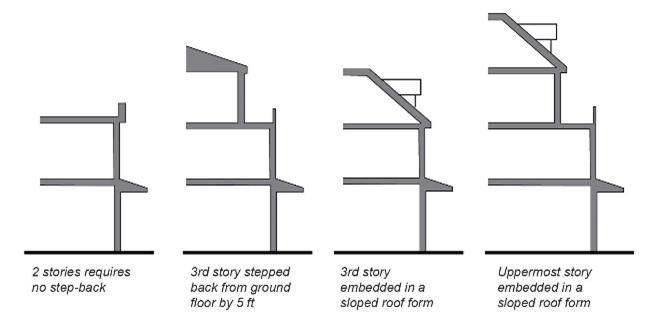
Along all frontages, the third story must be either stepped back a minimum five feet from the ground floor façade or embedded in a sloped roof form such as a mansard roof or a hipped and/or gabled roof with dormers.
b.
For buildings over three stories along all frontages, the uppermost story must be embedded in a sloped roof form.
2.
Upper Story Step-backs, Side Interior and Rear where Abutting an R-1 District.
a.
The third story must be either stepped back a minimum five feet from ground floor façade or embedded in a sloped roof form.
b.
For buildings over three stories, the uppermost story must be embedded in a sloped roof form.
3.
Vertical Articulation.
a.
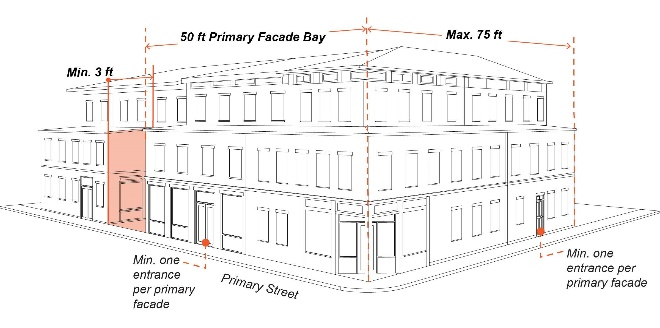
When a building façade exceeds seventy-five (75) feet in length along a right-of-way, it must be separated into primary façade bays no greater than fifty (50) feet and secondary façade bays defined by a recess a minimum three feet deep and ten (10) feet wide.
b.
A minimum one entrance shall be provided per primary façade bay.
c.
The eave/roof of a secondary façade bay shall be no higher than the corresponding elements of the primary façade bay.
4.
Horizontal Articulation. New façades and façade modifications along a street or civic space shall be designed to visually express a base, middle, and top.
a.
One or more of the following patterns shall be used to define the base:
i.
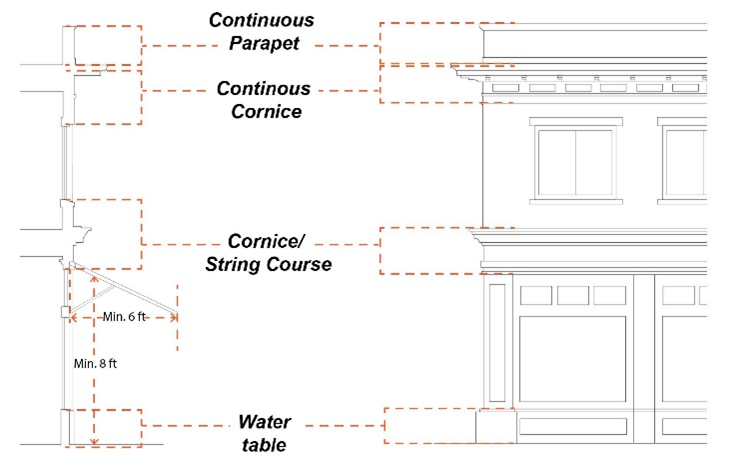
Watertable: Base material extends from grade to between eight and fifty-four (54) inches above grade.
ii.
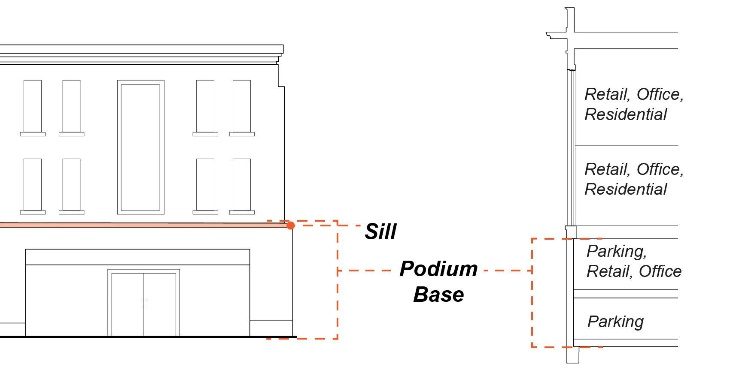
Podium: The base material encompasses the lowest story (or stories) of the building, with or without mezzanine(s), and terminates in a sill, string course, or cornice at its upper bound (multi-story buildings only).
iii.
Watertable and Cornice/String Course: A watertable using the base material is combined with a cornice or string course at the lowest story's upper bound, including any mezzanine (multi-story buildings only).
b.
The top of each building mass/bay shall be defined by elements spanning the full length of the façade of the mass/bay. Such elements may include a cornice, eave and/or gable(s), or other similar elements. These elements shall be consistent with the overall architectural style of the building mass/bay.
5.
Adjacencies.
a.
Façades adjacent to an R-1 District.
i.
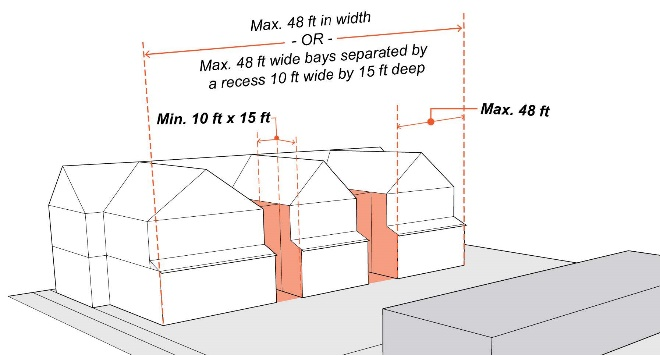
Building façade planes abutting an R-1 district may not exceed forty-eight (48) feet in width.
ii.
When a building façade abutting an R-1 district exceeds forty-eight (48) feet in width, it must be separated into façade bays no greater than forty-eight (48) feet by a recess ten (10) feet wide and fifteen (15) feet deep.
b.
Storefront Façades Adjacent to Storefront Façades.
i.
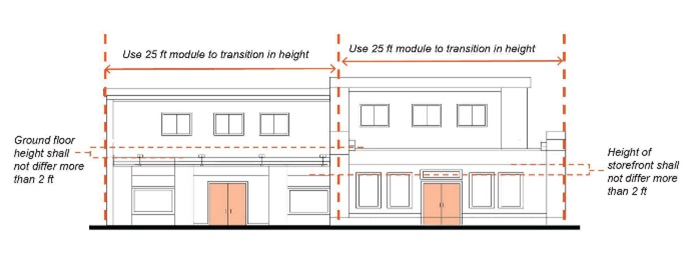
The height of a storefront shall not differ from the height of any adjacent storefront by more than two feet.
ii.
The height of ground story shall not differ from height of any adjacent ground story by more than two feet.
iii.
Storefronts may transition in height using a module of twenty-five (25) feet in length along a right-of-way.
6.
Privacy and Line of Sight.
a.
Primary living spaces and balconies located along a side setback shall orient principal windows and balconies toward the front and rear of the building.
b.
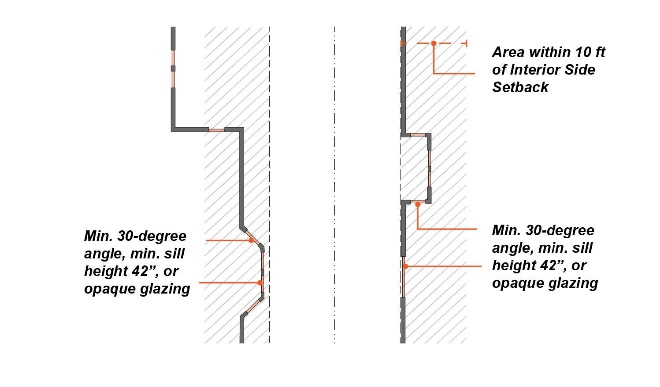
Where windows are within ten (10) feet of and oriented toward an interior side setback, glazing shall either be a minimum thirty (30) degree angle measured perpendicular to the adjacent side setback line, have minimum sill height of forty-two (42) inches, or be opaque.
7.
Roofline and Roof Design.
a.
Roof designs shall be limited to:
i.
Hipped.
ii.
Gable.
iii.
Shed.
iv.
Dormer.
v.
Parapet.
(a)
Not allowed on frontages facing R-1 District.
(b)
When used on the first or second floor, a parapet longer than twenty-five (25) feet in length must include at least one but not more than two of the following design elements to break up the length of the parapet:
(1)
Steps.
(2)
Curves.
(3)
Angled surfaces.
(c)
The length of a parapet segment on the third floor and above may not exceed twenty-five (25) feet.
b.
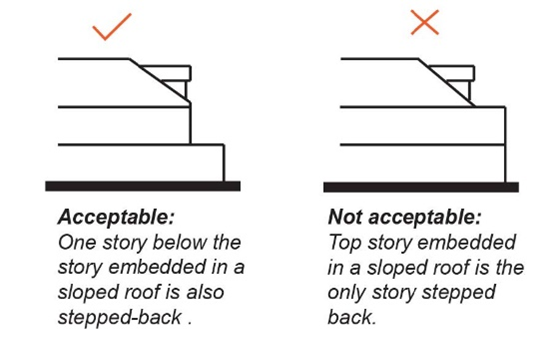
When the top story is stepped back and embedded in a sloped roof form such as a mansard roof or a hipped and/or gabled roof with dormers, the floor below must (and other floors may) be stepped back to meet the slope of the top story.
c.
Building façades facing an R-1 district must have a hipped or gable roof and may incorporate dormers.
d.
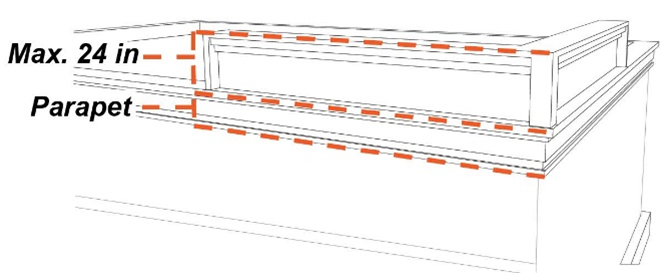
Roofline/parapet at corners shall not exceed roofline/parapet of adjacent wallplanes by more than twenty-four (24) inches.
C.
Building Design.
1.
Façade Design.
a.
Building façades shall be arranged in an orderly composition of bays, defined by vertically aligned openings alternating horizontally with solid walls or columns. The pattern shall be visually expressed through the spacing of openings, recesses, eaves, inset panels, cornices, overhangs, trellises, exposed rafters, columns, or bay windows.
b.
The pattern may be shared between the ground floor and upper stories provided the ground floor exhibits enhanced detail or modulation.
c.
Residential façades shall incorporate at least one element that signals habitation, such as bay windows, or balconies.
d.
Non-glazed wall areas (blank walls) must be enhanced with architectural details, landscaping, and/or landscaped trellises or lattices.
2.
Pedestrian-Scaled Entrances.
a.
Building entrances must incorporate at least one of the following entry features. See Section 14.66.275 (Entrance Type Standards) for design standards applicable to each entrance type listed.
i.
Stoop.
ii.
Dooryard.
iii.
Shopfront.
(a)
Shopfronts more than twenty-five (25) feet in width must incorporate variations in bulkhead, awnings, materials and/or color to visually articulate the shopfront into modules not to exceed twenty-five (25) continuous feet.
iv.
Gallery.
v.
Arcade.
vi.
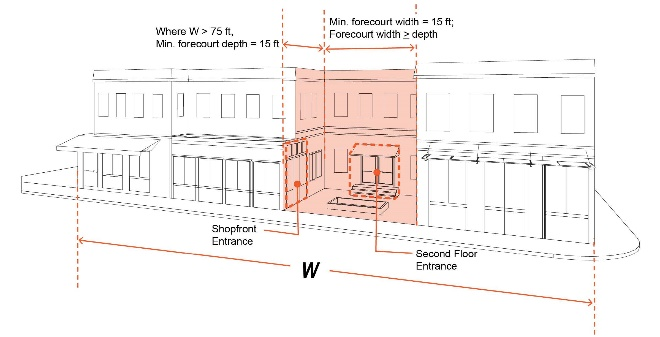
Forecourt.
(a)
Forecourts must feature at least one entry to a shop and/or second floor use.
(b)
Forecourts for buildings more than seventy (70) feet in length along a right-of-way must have a minimum width and depth of fifteen (15) feet from front façade. Width of forecourt shall be equal to or greater than depth.
(c)
The size of the forecourt must be appropriate relative to the size of the building. The maximum ratio of building height to forecourt is 2:1 (height < 2 x width).
(d)
Forecourt must be enclosed on at least three sides by buildings.
(e)
Forecourt must remain open to the sky (arbors and trellises are allowed).
b.
Primary Entrance Location(s). The building entrance shall be located along the primary right-of-way.
c.
Corner Entrances. Chamfered corners must incorporate a building entrance. Any required entrances may be provided on the corner of the building assuming one of the intersecting sides is a primary frontage.
d.
Street-facing Entries to Upper Floors. Street-facing entries to upper floors shall be equal in quality and detail to storefronts. This standard may be satisfied through two or more of the following:
i.
Dedicated awning, canopy, or other roof element.
ii.
Stairs with a single color applied to treads and a contrasting color or pattern applied to risers.
iii.
Dedicated light fixture(s).
iv.
Decorative street address numbers or tiles.
v.
Plaque signs for upper-floor business tenants.
e.
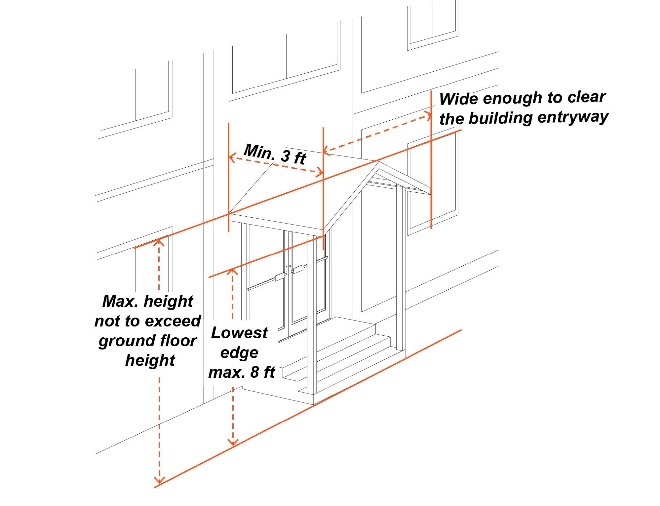
Entry Protection. Primary street-facing entrances shall be protected by a recess in the building frontage at least three feet deep or by a projection extending outward at least three feet measured horizontally from the entrance, and wide enough to clear the building entryway on both sides.
i.
Protection may be coterminous with an accent element.
ii.
Protection may take the form of an extended eave, overhang, awning. door canopy, gallery, arcade frontage, or other element that provides shade and shelter from the elements.
iii.
The lowest edge of a projecting awning or door canopy shall have a vertical clearance of no more than eight feet.
iv.
Recessed entries shall differentiate pavement within the recess through the use of a dedicated paving material or pattern.
f.
Accent elements demarcating building frontage, entrance, and common open space areas shall not exceed the height of the ground floor story. Roof elements are excepted.
3.
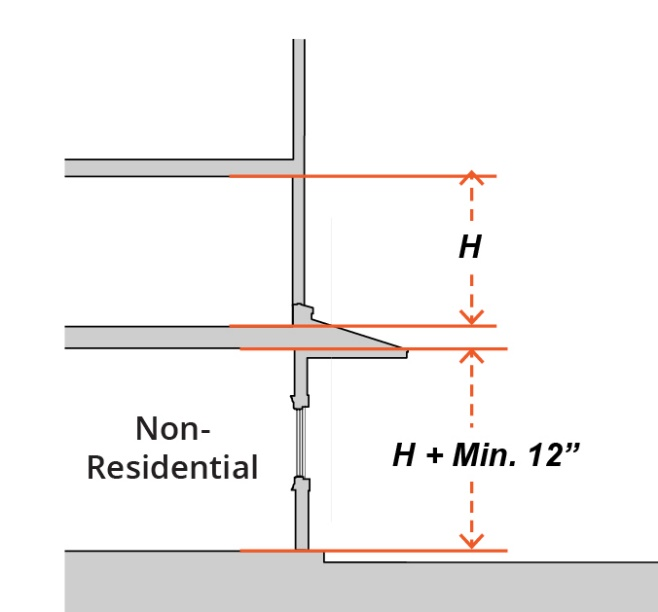
Ground Floor Floor-to-Ceiling Height. Minimum twelve (12) inches taller than typical upper floor floor-to-ceiling.
4.
Interior Courtyard. Interior courtyards must be:
a.
Enclosed on at least two sides by buildings.
b.
Open to the sky (arbors and trellises are allowed).
c.
A minimum width of twenty (20) feet and a minimum area of four hundred (400) square feet.
5.
Paseos. Paseos must be:
a.
A minimum width of ten (10) feet for through-block paseos.
b.
A minimum width of four feet for entries to courtyards or individual single businesses.
D.
Window Design.
1.
Window frames, backbands, and sills.
a.
All windows shall have a sill.
i.
The sill shall extend horizontally beyond the window opening or frame/casing (if present) at each end.
ii.
The sill shall be sloped toward the outside.
iii.
The sill shall have a drip at its outer edge.
2.
Vinyl windows are prohibited on façades visible from a right-of-way.
3.
Tinted glass is not allowed.
E.
Building Materials.
1.
Primary shall mean fifty (50) percent or more of a façade surface area excluding transparent surfaces. Permitted primary cladding materials are limited to:
a.
Stucco (minimum two-coat stucco;).
b.
Siding (lap, vertical, panelized, or shingle).
i.
All siding shall be wood, composite wood, or cement fiberboard.
ii.
Wood siding shall be painted or stained.
iii.
Vinyl and aluminum not permitted.
c.
Stone.
d.
Brick.
2.
Secondary shall mean less than fifty (50) percent of a façade surface area excluding transparent surfaces. Permitted secondary cladding materials are limited to:
a.
Stucco (minimum two-coat stucco; synthetic stucco not allowed, EIFS not allowed).
b.
Siding (lap, vertical, panelized, or shingle).
i.
All siding shall be wood, composite wood, or cement fiberboard.
ii.
Wood siding shall be painted or stained.
iii.
Vinyl and aluminum siding are not permitted.
c.
Stone (building base only).
d.
Brick (building base only).
e.
Tile (for bulkheads below display windows and decorative accents only).
f.
Metal (matte finish or Cor-ten).
i.
Ribbed metal, titanium, and mirrored finishes are not permitted.
g.
Concrete Masonry Units (watertable and building base only, and not allowed on any façade facing a right-of-way or a single-family zone).
h.
Concrete (building base only, board-form only, cast concrete not permitted).
F.
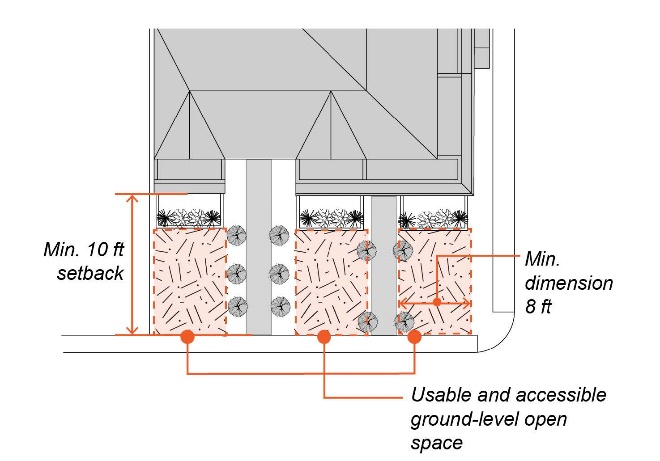
Ground Level Open Space. Where any required front, rear, or side yard setback is ten (10) feet or greater, on-site ground-level open space shall be provided within the setback.
1.
The ground level open space shall be usable and accessible.
2.
The minimum dimension for ground level open space shall be eight feet.
G.
Landscaping, Paving and Pedestrian Amenities.
1.
Landscape elements shall be integrated with the building architecture, parking, and streetscape. Recommended patterns shall include, but are not limited to:
a.
Planters for flowers and shrubs within street frontage.
b.
Landscape buffers between parking spaces and building façades.
c.
Landscaping within and/or on walls adjacent to courtyards, open spaces, and setbacks.
2.
See Sections 14.66.180 (Maintenance of Landscaped Areas) and 14.70.070 (Landscaped Strips) for additional landscaping standards.
H.
Site Circulation and Access.
1.
New development on abutting lots shall be designed to allow cross-access for internal pedestrian, bicycle, and vehicular circulation systems.
2.
Bicycle racks shall be provided:
a.
In or within fifty (50) feet of every parking area; and
b.
Within twenty (20) feet of at least one building entrance.
I.
Service Areas and Screening.
1.
Service areas must be located at the rear of lot.
2.
Service areas must be enclosed in enclosures that are architecturally consistent with primary building in terms of materials, colors, and style.
(Amended during 2/06 supplement; prior code § 10-2.1313)
(Ord. No. 2023-503, § 1(App. A), 11-28-2023)
14.34.150 - Nonconforming use regulations (OA).
(As provided in Chapter 14.66 of this title.)
(Prior code § 10-2.1314)

