
Los Altos City Zoning Code
CHAPTER 14
85 - STANDARDS FOR THE LOCATION OF WIRELESS TELECOMMUNICATIONS FACILITIES
14.85.010 - Purpose.
The purpose of the following siting criteria is to provide for the location of wireless telecommunications facilities within the City of Los Altos in a manner that minimizes the visual intrusiveness of wireless telecommunications facilities and provides for coverage throughout the city.
(Ord. No. 2022-486, § 3, 6-28-2022)
14.85.020 - Definitions.
The definitions called out in Chapter 11.12 shall apply here unless a specific alternative definition is provided.
(Ord. No. 2022-486, § 3, 6-28-2022)
14.85.030 - Wireless Telecommunications Facilities Locational Preferences.
A.
Colocation with Existing Wireless Telecommunications Facilities.
1.
The city's first preference for the location of new wireless facilities is colocation with existing wireless telecommunications facilities.
B.
Preferred Locations for Wireless Telecommunications Facilities following Colocation.
1.
Properties Outside of Public Rights-of-Way and Public Utility Easements.
a.
Following colocation, the preferred location for wireless telecommunications facilities is outside of public rights-of-way and public utilities easements on properties within one of the following Zoning Districts identified in the following subsections of Municipal Code Section 14.04.010 (not shown in order of preference).
K.
Office-Administrative District (OA);
L.
Office-Administrative District (OA-1 and OA-4.5);
N.
Commercial Neighborhood District (CN);
O.
Commercial Downtown District (CD);
P.
Commercial Retail Sales District (CRS);
Q.
Commercial Thoroughfare District (CT);
R.
Commercial Retail Sales/Office District (CRS/OAD); and
V.
Loyola Corners Specific Plan Overlay District (LCSPZ).
2.
Public Rights-of-Way and Public Utility Easements.
a.
Only facilities qualifying for a Section 6409(a) approval and those meeting the definition of a "small wireless facility" shall be permitted within public rights-of-way and public utility easements.
b.
Following colocation and the locations identified in paragraph 14.85.030B.2.a, above, the preferred location for a wireless telecommunications facility is within a public right-of-way or public utility easement fronting or within one of the Zoning Districts identified in the following subsections of Municipal Code Section 14.04.010 (not shown in order of preference).
K.
Office-Administrative District, OA (OA);
L.
Office-Administrative District (OA-1 and OA-4.5);
N.
Commercial Neighborhood District (CN);
O.
Commercial Downtown District (CD);
P.
Commercial Retail Sales District (CRS);
Q.
Commercial Thoroughfare District (CT);
R.
Commercial Retail Sales/Office District (CRS/OAD); and
V.
Loyola Corners Specific Plan Overlay District (LCSPZ).
C.
Less Preferred Locations for Wireless Telecommunications Facilities.
1.
Less preferred locations for wireless telecommunications facilities on properties outside of public rights-of-way and public utilities easements include:
a.
Properties other than schools and parks within one of the following Zoning Districts identified in the following subsections of Municipal Code Section 14.04.010 (not shown in order of preference).
S.
Public and Community Facilities District (PCF); and
T.
Public and Community Facilities/Single-Family District (PCF/R1-10).
b.
Properties located on a property within one of the Zoning Districts identified in the following subsections of Municipal Code Section 14.04.010 that (1) have an existing non-residential use; or (2) are owned by the city or another governmental entity for public facility or utility purposes.
A.
Single-Family District (R1-10);
B.
Single-Family District (R1-H);
C.
Single-Family District (R1-20);
D.
Single-Family District (R1-40);
E.
Single-Story Single-Family Overlay District (R1-S);
F.
Multiple-Family District (R3-4.5);
G.
Multiple-Family District (R3-5);
H.
Multiple-Family District (R3-3);
I.
Multiple-Family District (R3.1.8);
J.
Multiple-Family District (R3-1);
K.
Commercial Downtown/Multiple-Family District (CD/R3);
U.
Planned Community (PC); and
W.
Planned Unit Development (PUD).
2.
Less preferred locations for wireless telecommunications facilities within public rights-of-way and public utility easements are those fronting or within one of the Zoning Districts identified in the following subsections of Municipal Code Section 14.04.010 (not shown in order of preference):
A.
Single-Family District (R1-10);
B.
Single-Family District (R1-H);
C.
Single-Family District (R1-20);
D.
Single-Family District (R1-40);
E.
Single-Story Single-Family Overlay District (R1-S);
F.
Multiple-Family District (R3-4.5);
G.
Multiple-Family District (R3-5);
H.
Multiple-Family District (R3-3);
I.
Multiple-Family District (R3.1.8);
J.
Multiple-Family District (R3-1);
M.
Commercial Downtown/Multiple-Family District (CD/R3);
S.
Public and Community Facilities District (PCF);
T.
Public and Community Facilities/Single Family District (PCF/R1-10);
U.
Planned Community (PC); and
W.
Planned Unit Development (PUD).
a.
Permitted wireless telecommunications facilities within public rights-of-way and public utility easements within the Zoning Districts identified in Municipal Code Sections 14.04.010 A-J, M, S-U, and W are preferred to be located:
(1)
Within a median where one is present;
(2)
Adjacent to a vacant parcel or a parcel where a non- residential use is present;
(3)
In an area that is at least five feet more than the applicable required building setback for the Zoning District of the nearest residential dwelling unit, or twenty-five (25) feet, whichever is greater.
b.
No small wireless facility may be permitted within a public utility easement where it runs across a required front, side, or rear yard setback.
c.
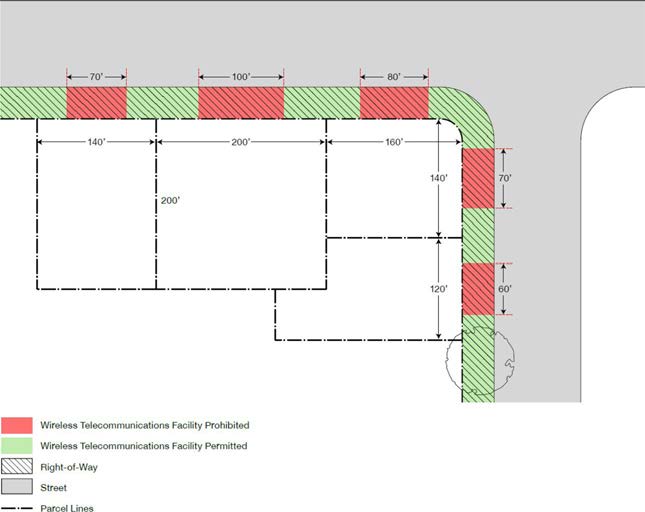
No small wireless telecommunications facility within a roadway right-of-way adjacent to Residential Zoning Districts (Municipal Code Sections 14.04.010 A-J, M, S-U, and W) shall be placed within the central fifty percent (50%) of an immediately adjacent parcel's street frontage unless:
(1)
No feasible alternative exists within five hundred (500) feet of the proposed location.
(2)
Landscaping and/or screening is provided to conceal the facility from view from adjacent dwelling units to the extent feasible.
(3)
For corner lots, this standard shall apply to both roadway frontages.
d.
No small wireless telecommunications facility shall be placed within a public right-of-way or public utility easement adjacent to or within a park or school unless:
(1)
It is located on an existing public utility pole;
(2)
No feasible alternative exists within five hundred (500) feet of the proposed location; and
(3)
Landscaping and/or screening is provided to conceal the facility from view of the adjacent school or park to the extent feasible.
D.
Placement Criteria.
1.
All Wireless Telecommunications Facilities.
a.
Wireless telecommunications facilities and any associated equipment or improvements shall not physically interfere with or impede access to any:
(1)
Worker access to any above ground or underground infrastructure owned or operated by any public or private utility agency;
(2)
Doors, gates, sidewalk doors, passage doors, stoops or other ingress and egress points to any building;
(3)
Fire escape; or
(4)
Public transportation vehicles, shelters, street furniture, or other improvements at any public transportation stop.
b.
Wireless telecommunications facilities shall not be located so as to interfere with access to fire hydrants, fire stations, fire escapes, water valves, underground vaults, valve housing structures, or any other vital public health and safety facility.
2.
Wireless Telecommunications Facilities on Properties Outside of Public Rights-of-Way and Public Utilities Easements.
a.
Pole-mounted wireless telecommunication facilities placed on properties outside of roadway rights-of-way and public utility easements should be located as close as feasible to shared property lines between two adjacent lots and should not be located within twenty (20) feet of an entrance to a building or an individual business.
b.
No portion of a wireless telecommunications facility may be permitted to encroach into any applicable setback for main structures for the zoning district within which it is located unless the facility is designed with a preferred configuration per the City's Design Guidelines.
c.
No wireless telecommunications facility shall be located so as to replace or interfere with parking spaces in such a way as to reduce the total number of parking spaces below the number that is required, nor shall any facility be located so as to interfere with required access to parking spaces.
3.
Small Wireless Telecommunications Facilities Within Public Rights-of-Way and Public Utilities Easements.
a.
No wireless telecommunications carrier shall be permitted to locate a small wireless telecommunications facility within one thousand (1,000) feet of another small wireless telecommunications facility it operates or within two hundred (200) feet of any small wireless telecommunications regardless of its ownership and maintenance.
b.
No portion of any small wireless communications facility within a public right-of-way or utility easement shall overhang a property line.
c.
All components of a small wireless telecommunications facility shall be located so as not to cause any physical or visual obstruction to pedestrian or vehicular traffic, impair the public's use of the right-of-way or create safety hazards to pedestrians and motorists.
d.
Small wireless telecommunication facilities within roadway rights- of-way adjacent to non-Residential Zoning Districts (Municipal Code Sections 14.04.010 K-L, N-T, V) should be located on poles that are as close as feasible to shared property lines between two adjacent lots and not directly in front of commercial and office buildings that have a setback of less than twenty (20) feet from the roadway right-of-way.
e.
Small wireless telecommunication facilities shall be located on poles that are outside of driveways and shall not impair intersection sight lines.
f.
Small wireless telecommunications facilities should be sited at mid-block locations rather than at more visible corners and intersections unless:
(1)
The small wireless telecommunications facility is mounted on a traffic signal control pole or streetlight;
(2)
The small wireless telecommunications facility is designed as a preferred configuration with no visible exterior wires or equipment per the City's Design Guidelines.
g.
Facilities mounted to a telecommunications tower, above-ground accessory equipment, or walls, fences, landscaping or other screening methods shall be set back a minimum of eighteen (18) inches from the front of a curb.
h.
A new pole, if permitted, should be located:
(1)
In alignment with existing trees, utility poles, and streetlights.
(2)
At an equal distance between trees, when possible, with a minimum separation of fifteen (15) feet from the tree's trunk or outside of the tree's drip line, whichever is greater, such that no disturbance occurs within the critical root zone of any tree.
(3)
On a through street rather than along a cul-de-sac, where feasible.
(Ord. No. 2022-486, § 3, 6-28-2022)
14.85.040 - Requirements for Approval of Less Preferred Locations.
A.
Applications that involve a less-preferred location identified in Section 14.85.030.C shall be accompanied by clear and convincing written evidence demonstrating that a preferred location per Section 14.85.030.A or 14.85.030.B is infeasible, and that approval of the proposed location rather than a preferred location is therefore needed.
B.
Applications that involve less-preferred locations may be approved only if the applicant demonstrates that:
1.
It does not own any property or facilities within five hundred (500) feet from the proposed site that could provide service in lieu of the proposed facility;
2.
No preferred location exists within five hundred (500) feet from the proposed site; or
3.
Any preferred location within five hundred (500) feet from the proposed site would be technically infeasible.
C.
The burden of proof for demonstrating compliance with these above noted conditions shall be on the applicant and must be satisfied with clear and convincing evidence.
D.
In reviewing a request for a less-preferred location, the City may hire an independent consultant at the applicant's expense to evaluate the applicant's demonstration of need for the proposed less-preferred location.
(Ord. No. 2022-486, § 3, 6-28-2022)
14.85.050 - Eligible Facilities Requested per Municipal Code Section 12.12.100 and Applications Pursuant to Government Code Section 65850.6
A.
Eligible facilities requested per Municipal Code Section 12.12.100 and applications pursuant to California Government Code Section 65850.6 (see Municipal Code Section 11.12.110), are permitted within all Zoning Districts and within all public rights-of-way.
(Ord. No. 2022-486, § 3, 6-28-2022)

