
Los Angeles County Unincorporated
City Zoning Code
City Zoning Code
Division 11
SPECIFIC PLANS
22.400.010 - Intent and Authority.
This Chapter is established to provide procedures for consideration of Specific Plans as authorized by Article 8, Chapter 3, Division 1, Title 7, and other applicable provisions of the California Government Code. It is also the intent to describe the relation between an adopted Specific Plan and the provisions of this Title 22.
(Ord. 2022-0008 § 161, 2022.)
22.400.020 - Procedure and Adoption.
Specific Plans, including any associated regulations, conditions, programs and proposed legislation shall be adopted by ordinance according to the procedures established in Article 8, Chapter 3, Division 1, Title 7, and other applicable provisions of the California Government Code. Any amendments to such Specific Plans or regulations shall also be adopted in accordance with the applicable Government Code provisions. No amendment to a Specific Plan certified as part of a Local Coastal Program shall be effective in the Coastal Zone until the amendments are certified by the California Coastal Commission, pursuant to section 30514 of the California Public Resources Code.
(Ord. 2022-0008 § 161, 2022.)
22.400.030 - Administration.
A.
General Specific Plans and associated regulations shall be administered in accordance with Article 8, Chapter 3, Division 1, Title 7, and other applicable provisions of the California Government Code. Such plans and regulations may reference existing provisions and procedures of this Title 22, or they may develop different administrative procedures to use in the implementation of the Specific Plan.
B.
Relationship to Other Title 22 Provisions. Except as otherwise expressively provided in a Specific Plan, property within the boundary of a Specific Plan may be subject to all of the standards and requirements of the basic zone and other provisions of this Title 22.
1.
Base Zones. Where the regulations of a Specific Plan differ from the provisions of the basic zone, such regulations shall supersede the provisions of the basic zone, as specified in the Specific Plan.
2.
Planning Area Standards Districts (PASDs) and Community Standards Districts (CSDs). Except as specified otherwise, regulations in a Specific Plan shall supersede any contrary provisions in Division 10.
3.
Supplemental Districts. Except as specified otherwise, regulations in a Specific Plan shall supersede any contrary provisions in a Supplemental District listed in Table 22.06.040-A.
4.
Accessory Dwelling Units and Junior Accessory Dwelling Units. Where the regulations in Section 22.140.640 (Accessory Dwelling Units and Junior Accessory Dwelling Units) are contrary to the provisions in a Specific Plan regulating the same matter, the provisions in the Specific Plan shall prevail, unless specified otherwise in Section 22.140.640 (Accessory Dwelling Units and Junior Accessory Dwelling Units).
5.
Affordable Housing and Senior Citizen Housing. Property within the boundary of a Specific Plan may be subject to Chapter 22.119 (Affordable Housing Replacement), Chapter 22.120 (Density Bonus), Chapter 22.121 (Inclusionary Housing), Chapter 22.128 (Supportive Housing), and Chapter 22.166 (Housing Permits), where applicable.
6.
Compact Lot Subdivisions. Any Specific Plan provisions pertaining to a required yard shall apply to the equivalent perimeter yard of a compact lot subdivision, pursuant to Section 22.140.585.F.18 (Yard Provisions in Specific Plans, Planning Area Standards Districts, and Community Standards Districts).
7.
Green Zone. Where the regulations in Chapter 22.84 (Green Zone) are contrary to the provisions in a Specific Plan, the more restrictive provisions shall prevail, except that any required perimeter identification signs or informational signs shall contain information required by both Section 22.84.040.C.1.j (Perimeter Identification Sign) and the Specific Plan.
8.
Nonconforming Uses and Structures. Except as specified otherwise in a specific plan, the nonconforming use and structure provisions in Chapter 22.172 (Nonconforming Uses, Buildings and Structures) shall apply to all uses and structures in the area governed by a specific plan that were legally established or built prior to the effective date of the specific plan.
(Ord. 2025-0008 § 7, 2025; Ord. 2024-0032 § 32, 2024; Ord. 2022-0008 § 161, 2022.)
22.400.040 - List of Specific Plans.
The following Specific Plans are added by reference, together with all maps and provisions pertaining thereto:
(Ord. 2023-0013 § 3, 2023; Ord. 2022-0008 § 161, 2022.)
22.402.010 - La Vina Specific Plan Introduction.
A.
The La Vina Specific Plan is located in Section 22.402.020.
B.
The La Vina Specific Plan was adopted by the Board on December 26, 1989.
C.
The effective date of the La Vina Specific Plan is January 26, 1990.
(Ord. 2022-0008 § 161, 2022.)
22.402.020 - La Vina Specific Plan.
https://www.municode.com/webcontent/16274/La_Vina_Specific_Plan.pdf
(Ord. 2022-0008 § 161, 2022.)
22.402.030 - Appendix.
A.
References. Unless where specified otherwise, all references to Title 22 are to the current version of Title 22 (Planning and Zoning Code) of the County Code.
B.
Terms. Table 22.402.030-A, below, identifies terms used in the La Vina Specific Plan and the following equivalent terms in this Title 22.
(Ord. 2022-0008 § 161, 2022.)
22.404.010 - Northlake Specific Plan Introduction.
A.
The Northlake Specific Plan is located in Section 22.404.020 (Northlake Specific Plan).
B.
The Northlake Specific Plan was adopted by the Board on February 9, 1993.
C.
The effective date of the Northlake Specific Plan is March 12, 1993.
(Ord. 2022-0008 § 161, 2022.)
22.404.020 - Northlake Specific Plan.
https://www.municode.com/webcontent/16274/Northlake_Specific_Plan.pdf
(Ord. 2022-0008 § 161, 2022.)
22.404.030 - Appendix.
A.
References
1.
Table 22.404.030-A, below, identifies outdated references to Title 22 used in the Northlake Specific Plan and the following equivalent references in this Title 22.
2.
Unless specified in Subsection A.1, above, all other references to Title 22 are to the current version of Title 22 (Planning and Zoning Code) of the County Code.
B.
Terms. Table 22.404.030-B, below, identifies terms used in the Northlake Specific Plan and the following equivalent terms in this Title 22.
(Ord. 2022-0008 § 161, 2022.)
22.406.010 - Newhall Ranch Specific Plan Introduction.
A.
The Newhall Ranch Specific Plan is located in Section 22.406.020 (Newhall Ranch Specific Plan).
B.
The Newhall Ranch Specific Plan was adopted by the Board on May 27, 2003.
C.
The effective date of the Newhall Ranch Specific Plan is June 26, 2003.
(Ord. 2022-0008 § 161, 2022.)
22.406.020 - Newhall Ranch Specific Plan.
https://www.municode.com/webcontent/16274/Newhall_Ranch_Specific_Plan.pdf
(Ord. 2022-0008 § 161, 2022.)
22.406.030 - Appendix.
A.
References
1.
Table 22.406.030-A, below, identifies outdated references to Title 22 used in the Newhall Ranch Specific Plan and the following equivalent references in this Title 22.
2.
Unless specified in Subsection A.1, above, all other references to Title 22 are to the current version of Title 22 (Planning and Zoning Code) of the County Code.
B.
Terms. Table 22.406.030-B, below, identifies terms used in the Newhall Ranch Specific Plan and the following equivalent terms in this Title 22.
(Ord. 2022-0008 § 161, 2022.)
22.408.010 - Universal Studios Specific Plan and Introduction.
A.
The Universal Studios Specific Plan is located in Section 22.408.020 (Establishment of Specific Plan) through Section 22.408.240 (Severability).
B.
The Universal Studios Specific Plan was adopted by the Board on April 30, 2013.
C.
The effective date of the Universal Studios Specific Plan is May 30, 2013.
(Ord. 2022-0008 § 161, 2022.)
22.408.020 - Establishment of Specific Plan.
A.
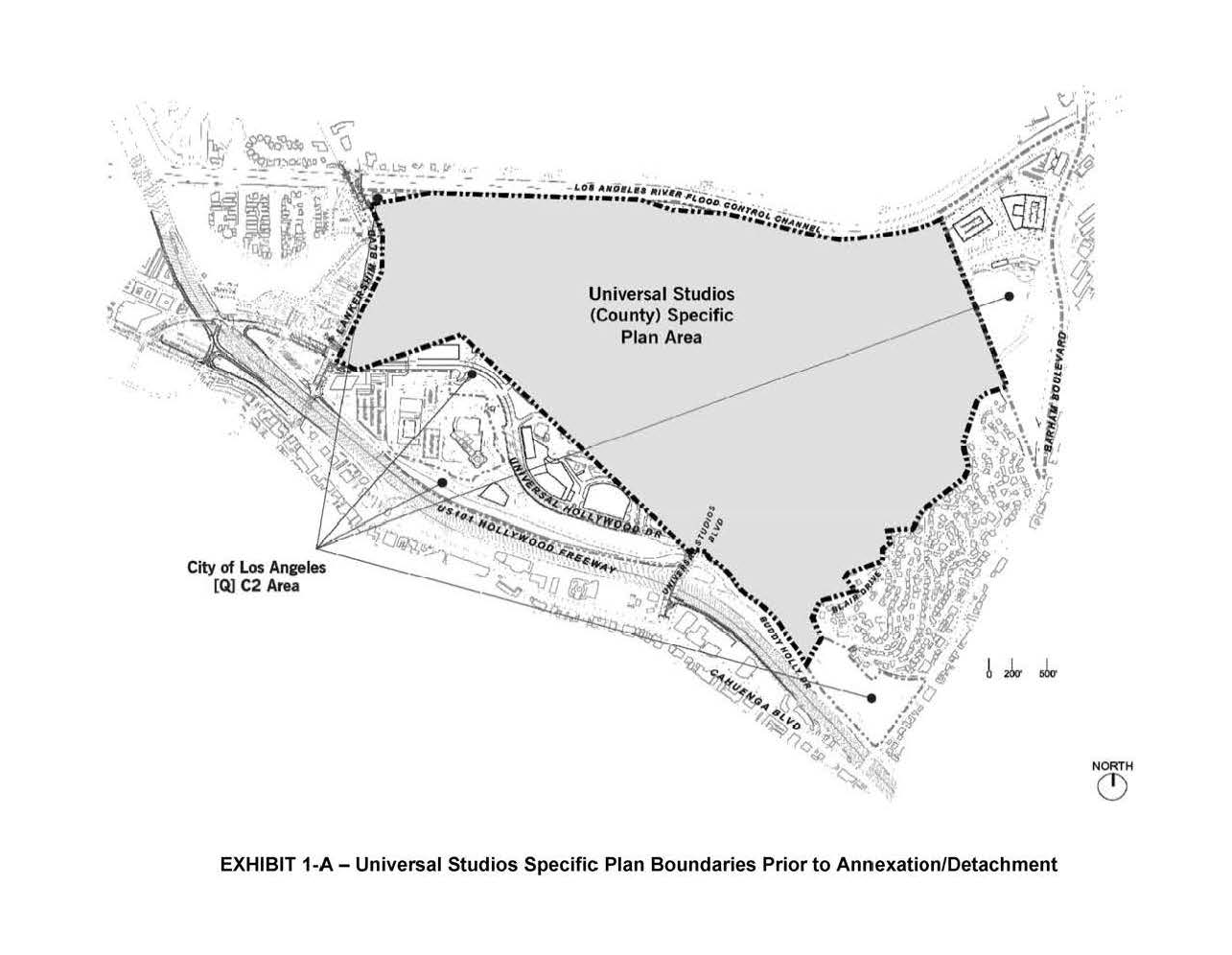
As of the effective date of this ordinance, the Board of Supervisors establishes the Universal Studios Specific Plan pursuant to Chapter 22.400 of Title 22 of the Los Angeles County Code (County Code), for the area generally bounded by the Los Angeles River Flood Control Channel road on the north, the adjacent NBC Universal property and existing residential properties within the City of Los Angeles to the east, the Hollywood Freeway to the south (except for the southwest corner of the area, which abuts hotel and office properties in the City of Los Angeles), and Lankershim Boulevard to the west, as shown upon Exhibit 1-A within the heavy dashed lines. The legal description of the boundaries of the Universal Studios Specific Plan is set forth in the zone change ordinance (Ordinance No. 2013-0013Z). The Specific Plan Guidelines provide guidance to the Department for the implementation of this Specific Plan and are available at Department in the case file.
B.
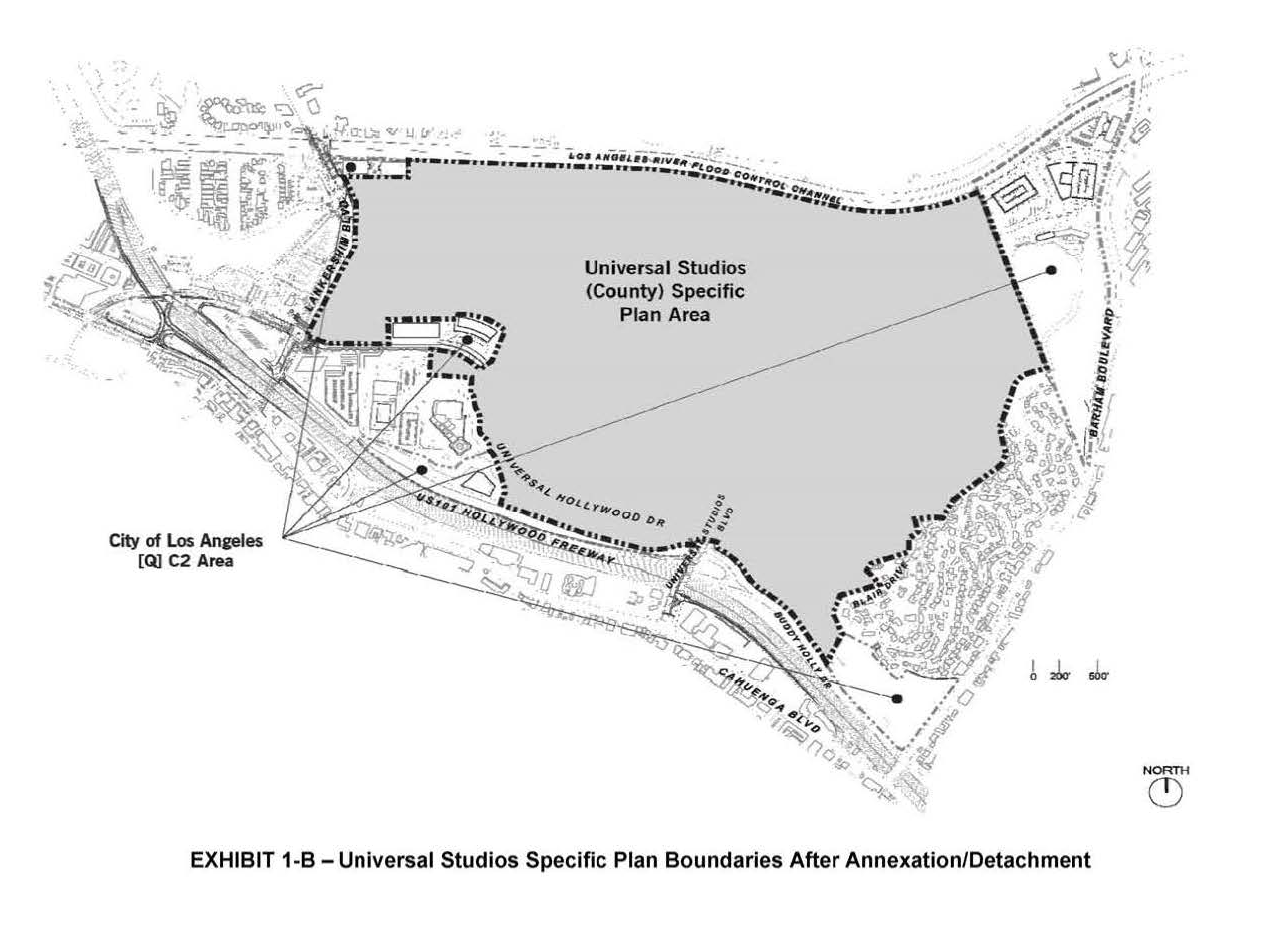
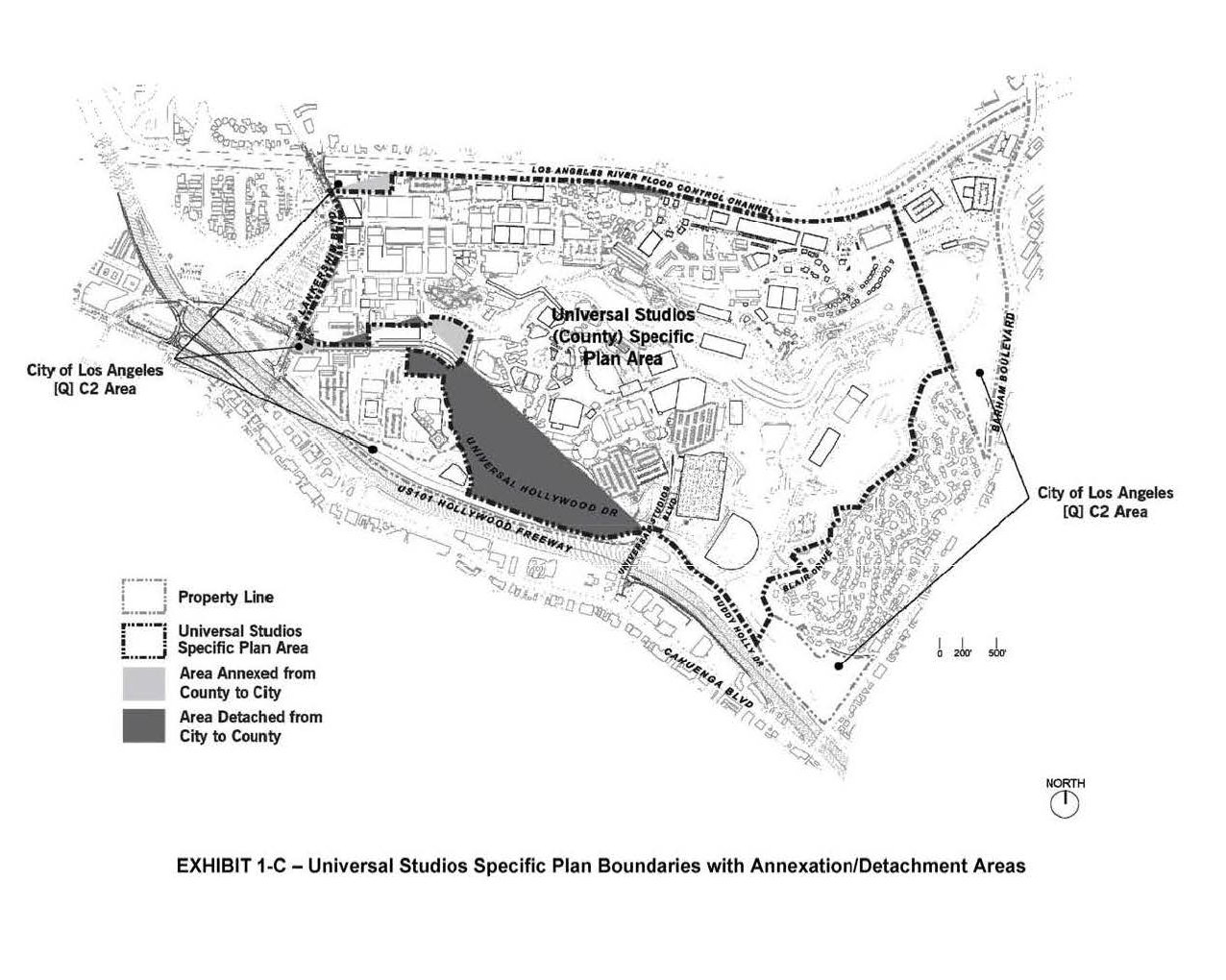
After the effective date of the Universal Studios Specific Plan, portions of the Universal Studios Specific Plan area, existing within the County as of the effective date of this Specific Plan, may be annexed into the City and areas of the NBC Universal properties within the City may be detached from the City and made part of the Universal Studios Specific Plan area, upon approval of the annexation and detachment actions by the Local Agency Formation Commission for the County of Los Angeles. If the proposed annexation and detachment actions are approved by the Local Agency Formation Commission, then the Universal Studios Specific Plan area shall encompass those areas shown within the heavy dashed lines on the Universal Studios Specific Plan Map shown on Exhibit 1-B on the effective date of the annexation and detachment actions. The legal description of the boundaries of the Universal Studios Specific Plan following the proposed annexation and detachment actions is set forth in the zone change ordinance (Ordinance No. 2013-0013Z). Those areas proposed to be detached from the City and returned to the jurisdiction of the County are shown on Exhibit 1-C. If the Local Agency Formation Commission modifies the areas of annexation and detachment shown on Exhibit 1-C, the Director is authorized to modify the exhibits and tables of this Specific Plan consistent with the Local Agency Formation Commission's action pursuant to Section 22.408.220 of this Specific Plan.
(Ord. 2022-0008 § 161, 2022.)
22.408.030 - Purposes.
This Specific Plan is intended to:
A.
Establish eligible uses and/or activities; and to provide a mechanism for implementing the appropriate operational requirements, regulations or other requirements for these uses. The requirements contained herein provide the necessary flexibility to accommodate future development and to achieve compatibility between land uses.
B.
Set forth principles, standards, and general procedures to ensure the orderly development of the Universal Studios Specific Plan area.
C.
Provide a comprehensive planning tool to guide continued development of a regional center recognizing Universal Studios as a comprehensive motion picture/television production facility; entertainment, dining and retail venue; and hotel and business center, creating business and job opportunities to enhance the economic vitality of the County of Los Angeles consistent with the intent, purpose and goals of the County General Plan. This includes, but is not limited to, the continuance and expansion of such uses as: television and motion picture production, cable, satellite, broadcast and telecommunications activities; tourism and entertainment activities, retail, restaurants, hotel, theaters, offices, shopping and dining opportunities; parking facilities; and associated operational activities.
D.
Provide added opportunities to expand this regional center, which is located in immediate proximity to the Universal City Metro Red Line Station and a regional freeway system.
E.
Establish a set of general procedures by which the County can verify that proposed projects comply with the regulations of the Universal Studios Specific Plan.
F.
Recognize the relationship between the adjacent City [Q]C2 Area, the Universal Studios Specific Plan, and other uses surrounding the Universal Studios site such as residences, other studios, and other commercial enterprises.
G.
To allow Additional Permitted Floor Area within the Universal Studios Specific Plan area as set forth in Table 5-1 and Table 5-2, as applicable, and including any additional square feet of Floor Area as may be permitted pursuant to Land Use Equivalency, as set forth in Section 22.408.080 of this Specific Plan.
(Ord. 2022-0008 § 161, 2022.)
22.408.040 - Authority and Scope.
A.
Relationship to Los Angeles County General Plan. The General Plan is a comprehensive long-range policy document that guides the growth and development of the unincorporated areas of the County. The General Plan includes state-mandated elements related to land use, circulation, housing, conservation, open space, noise, and safety. Whereas the General Plan provides a broad general policy directive for the County, a specific plan is a policy statement and implementation tool that is used to address a specified planning area. As stated in the General Plan Introduction: "the General Plan neither guarantees the achievement of a particular goal nor strict adherence to any single policy statement." Pursuant to California Government Code section 65454, a specific plan must be consistent with the General Plan by furthering its overall objectives and policies while not obstructing their attainment, but also need not adhere to every goal and policy.
The Universal Studios Specific Plan area was classified prior to the effective date of this Specific Plan in the Industrial and Commercial categories on the General Plan Land Use Policy Map, which allow a wide variety of uses including motion picture studio, office, restaurants, retail, and entertainment park. As of the effective date of this Specific Plan, the Universal Studios Specific Plan area shall be classified as SP (Specific Plan) on the General Plan Land Use Policy Map. This Specific Plan is generally consistent with the applicable goals and policies in the land use; circulation; conservation and open space; noise; safety; and economic development elements of the General Plan as more fully detailed in Appendix B of the Specific Plan Guidelines.
B.
Relationship to County Code.
1.
The regulations of this Specific Plan are in addition to those set forth in Title 22 of the County Code (Zoning Code), and do not convey any rights not otherwise granted under the provisions and procedures contained in the Zoning Code, except as specifically provided for herein.
2.
Whenever this Specific Plan contains provisions that establish regulations (including, but not limited to, standards such as Heights, uses, parking requirements, noise, lighting, grading, signage, the sale and service of alcoholic beverages, removal and/or encroachment into the Protected Zone of oak trees), which are different from, more restrictive or more permissive than would otherwise be allowed pursuant to the provisions contained in the Zoning Code, this Specific Plan shall prevail and supersede the applicable provision of the Zoning Code. For matters on which this Specific Plan is silent, applicable provisions of the Zoning Code shall control. Whenever this Specific Plan states it supersedes and replaces specific provisions of the Zoning Code, the specified provision(s) of the Zoning Code shall not apply. Whenever this Specific Plan states that it modifies the applicability of specific provisions of the Zoning Code, the specified provision(s) of the Zoning Code shall only apply as modified by this Specific Plan.
3.
Sign Regulations. This Specific Plan shall supersede and replace the regulations in Division 1, Chapter 22.52, Part 10 of the Zoning Code that address types of signs permitted, sign Heights, maximum sign area permitted, sign face, illumination, and location of signs.
4.
Oak Tree Regulations. This Specific Plan shall supersede and replace the regulations in Division 1, Chapter 22.56, Part 16 of the Zoning Code that address removal, replacement, and encroachment into the Protected Zone of oak trees.
5.
Alcoholic Beverages Regulations. This Specific Plan shall modify the applicability of the regulations in Section 22.56.195 of the Zoning Code that address the sale and service of alcoholic beverages for on-site and off-site consumption, and Sections 22.56.1500, 22.56.1540, and 22.56.1550 of the Zoning Code that address the amortization schedule for establishments that existed prior to adoption of Ordinance 92-0097.
6.
Live Entertainment/Public Dancing/Night Clubs. This Specific Plan shall supersede and replace the regulations in Sections 22.52.1110 and 22.56.1754 of the Zoning Code.
7.
Wireless/Communications Facilities. This Specific Plan shall supersede and replace the regulations in Division 1, Chapter 22.52, Part 13 of the Zoning Code that address wireless or other communications facilities, except with regard to free-standing third-party outdoor wireless Communication Facilities.
8.
Parking Requirements. This Specific Plan shall modify the applicability of the regulations in Division 1, Chapter 22.52, Part 11 and shall supersede and replace Division 1, Chapter 22.56, Part 7 of the Zoning Code.
9.
Lighting Requirements. This Specific Plan shall supersede and replace any regulations in Division 1, Chapter 22.52, Part 10 of the Zoning Code that address lighting source intensity and design requirements.
10.
Grading/Off-site Export/Import. This Specific Plan shall supersede and replace the regulations in Sections 22.56.210, 22.56.230, 22.56.1752, and 22.56.1753 of the Zoning Code that address grading, stockpiling, off-site import or export of grading materials, and other grading-related requirements.
11.
Yard Requirements. This Specific Plan shall supersede and replace the regulations in Sections 22.48.050 through 22.48.110 of the Zoning Code that address front, side and rear yard requirements.
12.
Projections Between Buildings. This Specific Plan shall supersede and replace Section 22.48.130.A.3 of the Zoning Code, that addresses projections between buildings.
13.
Green Building Development Standards. This Specific Plan shall modify the applicability of the Green Building Development Standards contained in Division 1, Chapter 22.52, Part 20 of the Zoning Code.
14.
Drought Tolerant Landscaping Requirements. This Specific Plan shall modify the applicability of the Drought Tolerant Landscaping Requirements contained in Division 1, Chapter 22.52, Part 21 of the Zoning Code.
15.
Low Impact Development Standards. This Specific Plan shall modify the applicability of the Low Impact Development Standards contained in Division 1, Chapter 22.52, Part 22 of the Zoning Code.
16.
Director's Review, Hearings and Appeals for Alcohol Sales and Service. This Specific Plan shall supersede and replace the regulations in Division 1, Chapter 22.56, Part 12, Sections 22.56.1660 through 22.56.1754 and Division 1, Chapter 22.60, Parts 4 and 5 of the Zoning Code for new Alcohol Use Establishments allowed pursuant to Section 22.408.110.A—C of this Specific Plan. Any additional establishments requesting to sell or serve alcoholic beverages beyond those permitted by Section 22.408.110.A—C of this Specific Plan, shall be subject to a Conditional Use Permit pursuant to, and the modification, inspection and enforcement requirements of, Sections 22.56 and 22.60 of the Zoning Code, except as modified by Section 22.408.110.D of this Specific Plan.
17.
Director's Review for Temporary Uses. This Specific Plan shall supersede and replace the regulations in Division 1, Chapter 22.56, Part 14, Sections 22.56.1830 through 22.56.1925 of the Zoning Code for Temporary Uses.
C.
Relationship to CEQA. Pursuant to CEQA, the NBC Universal Evolution Plan Environmental Impact Report (EIR) was prepared for the NBC Universal Evolution Plan, which includes the implementation of the Universal Studios Specific Plan. EIR SCH No. 2007071036 identifies potential effects on the environment of the NBC Universal Evolution Plan and sets forth mitigation measures to lessen those impacts.
D.
Relationship to Existing Uses.
1.
The Universal Studios Specific Plan creates a regulatory framework for long-term development of the Universal Studios Specific Plan area. This Specific Plan also recognizes that existing uses within the Universal Studios Specific Plan area will continue as the development permitted by this Specific Plan is implemented. Existing uses include, but are not limited to: Studio Use including Production Activities; Studio Office; Office; Entertainment Use including the Theme Park and Universal Studio Tour; Entertainment Retail Use including all forms of retail and restaurant uses in CityWalk; and Amphitheater.
2.
Replacement of Existing Permits. This Specific Plan shall supersede and replace the following County conditional use permits for grading, alcohol sales and service, and Communication Facilities: Case numbers 90074-(3), 95-047-(3), 99-158-(3), 99-159-(3), 99-160-(3), 99-161-(3), 99-162-(3), 99-163-(3), 99-164-(3), and 92252-(3). Upon the approval of the proposed annexation and detachment actions set forth in Section 22.408.020.B of this Specific Plan by which the establishments with alcohol sales and service permitted pursuant to City of Los Angeles case numbers ZA 93-0292(ZV) and ZA 2001-3714(PAB) are located within the Specific Plan area, this Specific Plan shall also supersede and replace City of Los Angeles case numbers ZA 93-0292(ZV) and ZA 2001-3714(PAB).
(Ord. 2022-0008 § 161, 2022.)
22.408.050 - Definitions.
Whenever the following terms are used in this Specific Plan, they shall be construed as defined in this Section. Words and phrases not defined below or in Sections 22.408.120 and 22.408.180 of this Specific Plan shall be construed as defined in the County Code. The definitions set forth in this Specific Plan are intended to encompass future technologies and materials which may be utilized in the construction, implementation, or uses permitted herein.
Adult Business Establishment. Adult Business Establishment shall include Adult Business, Adult Cabaret, and Adult Hotel and Motel, as those terms are defined in Section 22.62.015 of the Zoning Code.
Alcohol Use Approval. A ministerial process to determine compliance of new establishments seeking approval after the effective date of this Specific Plan of the right to sell and/or serve alcoholic beverages with all applicable provisions of this Specific Plan, pursuant to Section 22.408.110 of this Specific Plan.
Amphitheater. A Land Use Category that allows a venue used for public assembly and/or entertainment including, but not limited to, theatrical performances, concerts, lectures, circuses, sporting events, or other similar events.
Ancillary Support Facility. Ancillary facilities to Studio Uses designed to provide consumer services within the Universal Studios Specific Plan area. Ancillary Support Facilities include, but are not limited to, those facilities used for food services, banking services, hair salons, physical fitness, commuter transportation, security, and the sale of sundries, studio merchandise and memorabilia, if theses uses are designed and operated to be primarily available for on-site employees, guests, and visitors, but are not generally available to the general public.
Applicant. Any person or entity submitting an application for a Substantial Conformance Review, an Alcohol Use Approval, Sign Conformance Review, Internal Sign Review, an administrative clarification, a Specific Plan exception, a Specific Plan interpretation, or similar action related to this Specific Plan.
Back-of-House. The area of an Entertainment Attraction, Universal Studio Tour or other feature of the Theme Park not normally accessible to visitors which contains maintenance and repair facilities, warehouses, storage areas, animal storage facilities, ancillary offices, delivery areas, employee dressing rooms and rest areas, mechanical/electrical equipment, ride track areas within Entertainment Attractions, and other support facilities. Back-of-House areas may be enclosed or unenclosed.
Candela. A measure of light energy from a source at a specific standard angle and distance. A measure of the light energy designed to evaluate the output of light from a lamp or light fixture in terms of both the intensity of light and the direction of travel of the light energy away from the source.
City. The City of Los Angeles, California.
City [Q]C2 Area. The applicable areas of the NBC Universal Evolution Plan project site within the boundaries of the City adjacent to the Universal Studios Specific Plan area, as shown on Exhibit 1-A as of the effective date of this Specific Plan and as shown on Exhibit 1-B on the effective date of the annexation and detachment actions discussed in Section 22.408.020.B of this Specific Plan should those actions be approved. The Director may modify Exhibit 1-B consistent with the Local Agency Formation Commission's action pursuant to Section 22.408.220 of this Specific Plan.
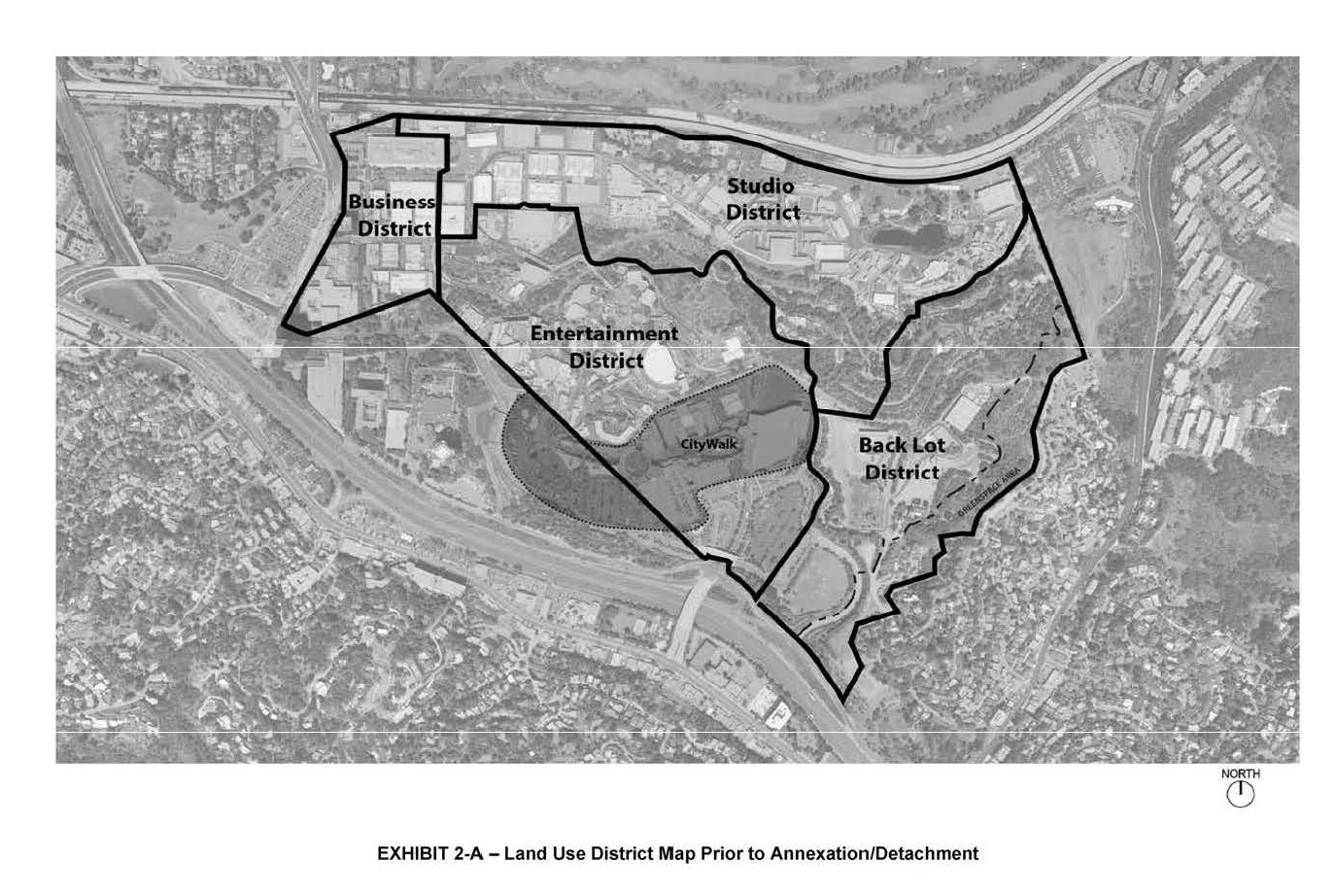
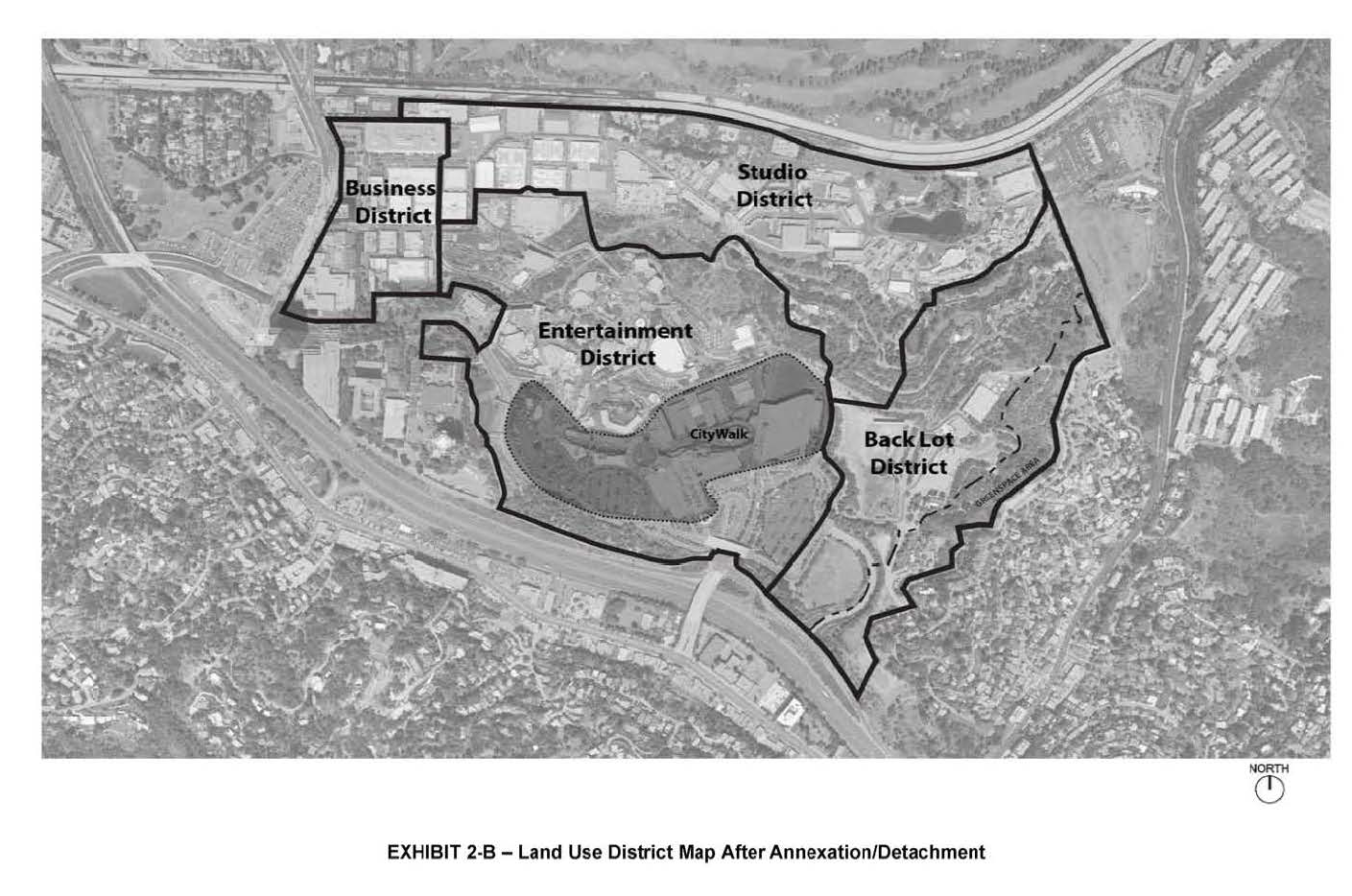
CityWalk. An entertainment venue and entertainment retail venue area that provides retail, restaurant, entertainment and theater uses, including, but not limited to, the cinemas in CityWalk. Within CityWalk, there are also several administrative and employee support offices, along with some Office and Studio Use. The boundaries of CityWalk within the Universal Studios Specific Plan area as of the effective date of this Specific Plan are shown on Exhibit 2-A and are shown on Exhibit 2-B as of the effective date of the annexation and detachment actions discussed in Section 22.408.020.B of this Specific Plan should those actions be approved. The Director may modify Exhibit 2-B pursuant to Section 22.408.220 of this Specific Plan to be consistent with the detachment and annexation actions.
Communication Facilities. Any Non-Occupiable Structure or equipment used for the purpose of sending or receiving data and information communications or housing equipment to support the sending or receiving of communications, and other future technological advances in such communications. Communication Facilities may include, but are not limited to, satellite and microwave dishes, antennae dishes and/or satellite farms, wireless telecommunication facilities such as cellular, WiFi, television and two-way radio transmitters and broadcast communications facilities, communications and data facilities, control and telemetry signals, cable or fiber optic systems, or future technological advances in Communication Facilities. Communication Facilities shall also include necessary support infrastructure, such as electrical, electronic or electromagnetic vaults, cabling, equipment racks, servers, generators, transformers, downlink systems, uninterrupted power supply (UPS) systems, and other related broadcast and communication support equipment and systems.
Conceptual Site Plan. The exhibit depicting, for informational purposes only, existing development and the conceptual plan for proposed development within the Universal Studios Specific Plan area pursuant to this Specific Plan. An initial Conceptual Site Plan is contained in the Plan Description, Chapter 2, of the Specific Plan Guidelines.
Contributing Building. A building listed as a contributing resource in the Historic Preservation Plan.
County. County of Los Angeles, California.
Department. The Department of Regional Planning of the County of Los Angeles.
Director. The Director of the Department of Regional Planning or the Director's designee.
Entertainment Attraction. A building, structure, improvement, device, mechanism or other facility or use, or combination thereof, operated primarily for entertainment purposes as part of the Theme Park, Universal Studio Tour, CityWalk, or related activities, which may include controlled access or controlled capacities. Entertainment Attractions may include, but are not limited to: amusement rides, shows (live, computerized, animated, automated, electronic, video, motion picture, and new technologies), animal shows, outdoor displays, aquarium, parades, tours, exhibitions, assembly areas, pavilions, interactive and active play areas, or other similar activities and facilities, all of which may be outdoors or indoors, or combination thereof.
Entertainment Retail Use. A Land Use Category that includes all forms of retail and restaurant uses in CityWalk, and support facilities, as permitted by this Specific Plan.
Entertainment Use. A Land Use Category that includes all forms of entertainment and recreation uses generally open to the public, as permitted by this Specific Plan. The uses include, but are not limited to, the Universal Studio Tour, events, and uses in the Theme Park, including restaurant and retail uses, Entertainment Attractions, and support facilities.
Existing Off-Site Residential Uses. Residential uses located outside of the combined boundaries of the Universal Studios Specific Plan area and the City [Q]C2 Area. Hotel uses are not included as Existing Off-Site Residential Uses.
Existing Site Plan. The site plan for the existing NBC Universal property showing existing buildings within the current and proposed County portions of the property as it exists on the effective date of this Specific Plan.
Finished Grade. The lowest point of elevation of the finished surface of the ground, paving or sidewalk, excluding a driveway(s) or secondary access stairwell(s), within the area between a structure and the property line or a line five feet from the structure, when the property line is farther than five feet from the structure.
Floor Area. The total of the area in square feet of the floor surfaces confined within the exterior walls of a building. Floor Area does not include exterior patios, decks, balconies, rooftop areas, or other specifically defined exterior space which is designed for use by patrons, tenants or visitors within the Universal Studios Specific Plan area. Floor Area does not include exterior walls, space devoted to stairways and stairwells, basement storage, elevator shafts, mechanical or electrical equipment areas, vertical utility shafts, light courts, parking structures including associated driveways, ramps, loading areas and areas incidental thereto, rooms housing mechanical equipment and machinery incidental to the operation of buildings, temporary trailers used for Production Activities or construction activities, Temporary Uses, seasonal uses, helicopter landing areas, Sets/Façades, Thematic Elements, ride track areas within Entertainment Attractions, queue lines, covered or uncovered general public pedestrian circulation areas, plazas, and similar areas which are intended for public circulation.
Floor Area, Additional Permitted. The net new Floor Area that may be constructed pursuant to this Specific Plan as of the effective date of this Specific Plan as shown in Table 5-1, and the net new Floor Area that may be constructed as shown in Table 5-2 as of the effective date of the annexation and detachment actions discussed in Section 22.408.020.B of this Specific Plan should those actions be approved, and any net new Floor Area as permitted by this Specific Plan pursuant to the Land Use Equivalency provisions of Section 22.408.080 of this Specific Plan, (including repair, replacement, or modification of existing uses which increase Floor Area). The Additional Permitted Floor Area is calculated based on gross new Floor Area minus the demolition of Floor Area of any existing land uses within the Specific Plan area.
Floor Area, Baseline. The existing Floor Area as of the effective date of this Specific Plan as shown in Table 5-1, and the existing Floor Area as shown in Table 5-2 as of the effective date of the annexation and detachment actions discussed in Section 22.408.020.B of this Specific Plan should those actions be approved, located within the existing buildings shown on the Existing Site Plan.
Floor Area, Total Permitted. The total square feet of existing Baseline Floor Area and the Additional Permitted Floor Area, and any additional square feet of net new Floor Area as permitted by this Specific Plan pursuant to the Land Use Equivalency provisions of Section 22.46.2060 of this Specific Plan. The Total Permitted Floor Area includes the repair, replacement, or modification of existing uses within the Specific Plan area.
Footcandle. A unit of light energy incident on a square foot of surface one foot away from a standard candle.
Graphic Treatment. Graphic Treatment is defined in Section 22.408.180 of this Specific Plan, Signage Regulations, of this Specific Plan.
Height. The vertical distance, in terms of feet above Mean Sea Level (MSL), measured to the highest point of the building, structure, roof structure or parapet wall, whichever is highest. For purposes of measuring Height, roof structures shall include rooftop equipment and architectural elements or Thematic Elements. Notwithstanding, the Height of Free-standing Signs, Communication Facilities and maintenance storage buildings shall be measured from Finished Grade, as set forth in this Specific Plan, unless specified otherwise.
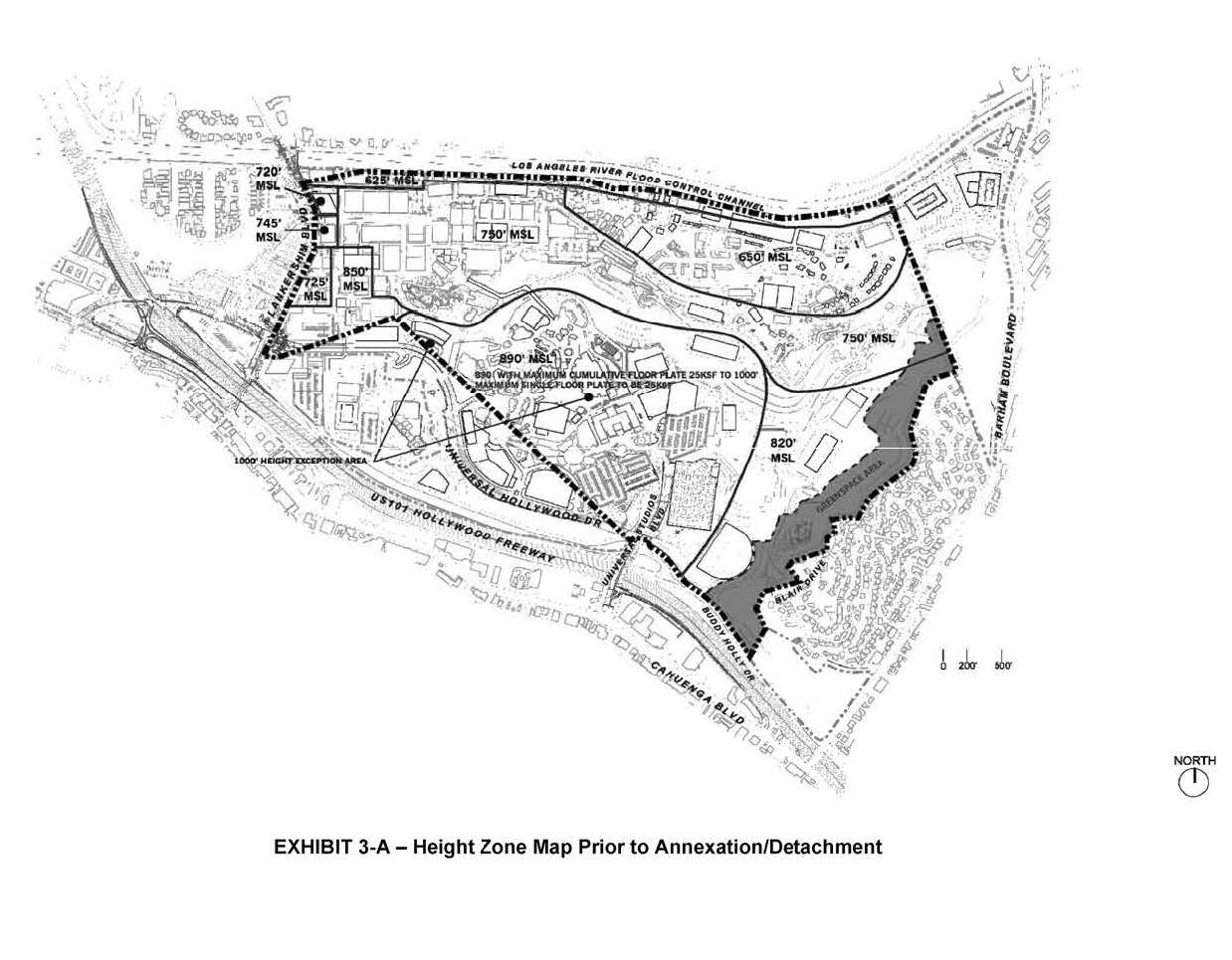
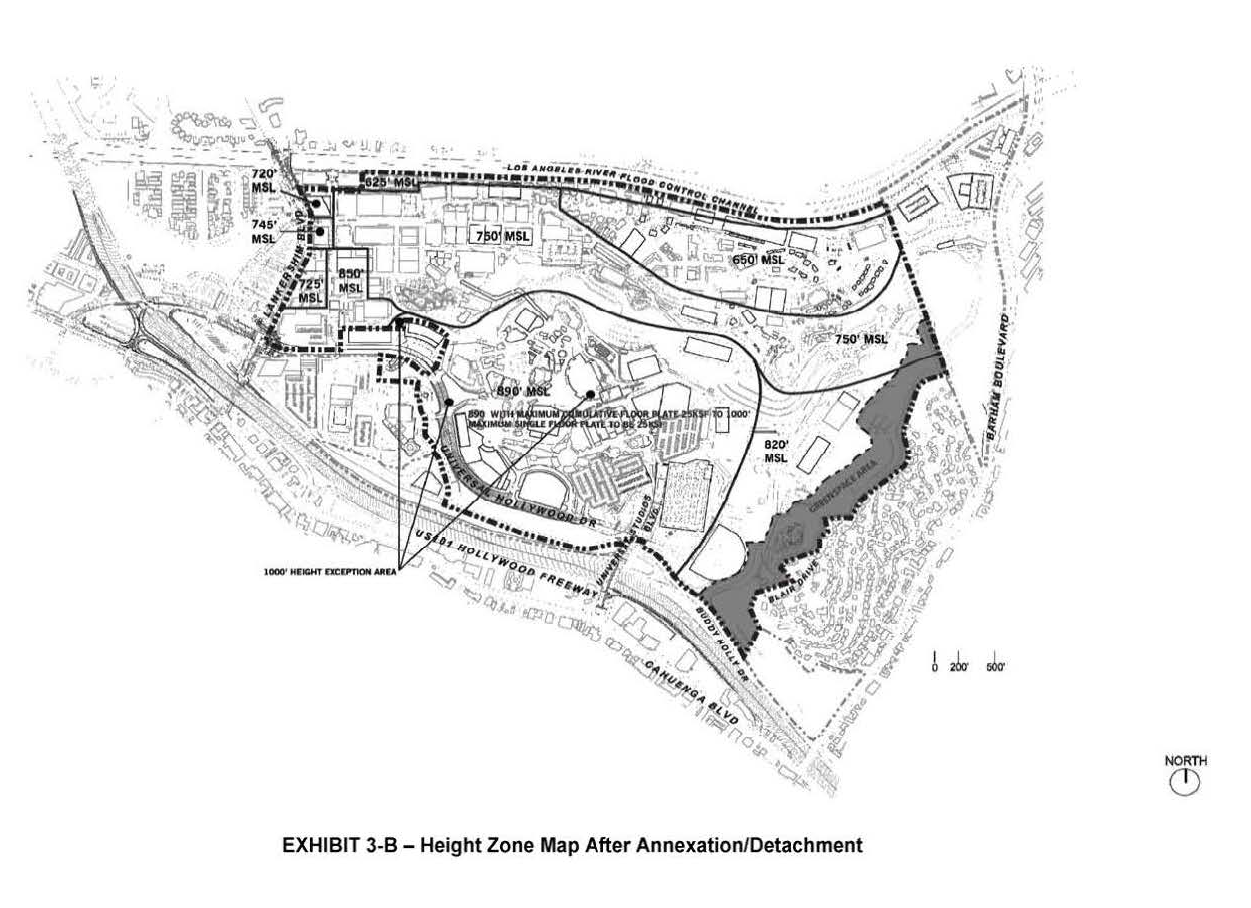
Height Exception. A specified Height, measured in terms of feet above MSL, in which buildings within the 890-foot Height Zone may exceed the maximum Height of the Height Zone up to the maximum stated Height for the Height Exception, as set forth in Section 22.408.070 of this Specific Plan and as shown on Exhibit 3-A as of the effective date of this Specific Plan and as shown on Exhibit 3-B on the effective date of the annexation and detachment actions, should those actions be approved. The Director may modify Exhibit 3-B pursuant to Section 22.408.220 of this Specific Plan to be consistent with the annexation and detachment actions.
Height Zone. A specific limitation on building and structure Heights within the Universal Studios Specific Plan area defined in terms of maximum feet above Mean Sea Level (MSL), as identified on Exhibit 3-A as of the effective date of this Specific Plan and as shown on Exhibit 3-B on the effective date of the annexation and detachment actions, should those actions be approved. The Director may modify Exhibit 3-B pursuant to Section 22.408.220 of this Specific Plan to be consistent with the annexation and detachment actions.
Highly Reflective Building Materials. Exterior building materials, such as polished metal or mirrored glass (glazing with a ratio of 0.20 or higher of visible light reflectance from its exterior surface), that have the potential to cause glare impacts to offsite uses or public rights of way. Visible light reflectance is the ratio of visible light that is reflected from the surface to the sum of that which is transmitted, reflected and absorbed.
Historic Preservation Expert. A person, retained by the Universal Studios Specific Plan area property owner, who has a graduate degree in architectural history or architecture, and at least three years of experience working as a historic preservation professional.
Historic Preservation Plan. The Universal Studios Historic District Historic Preservation Plan, dated March 2010, prepared by Historic Resources Group, LLC and included as Appendix D of the Specific Plan Guidelines.
Hotel. A Land Use Category for hotel related uses, including, but not limited to facilities such as guest rooms and suites; meeting, banquet and ballroom facilities; lobbies; retail; restaurants; bars; nightclubs; offices; gym and fitness rooms; pools and hot tubs; spas including massage treatment facilities; salons; entertainment uses that are ancillary to the operation of a hotel; parking; and other hotel amenities as part of the hotel complex and operations.
Internal Sign Review. See Signage Regulations, Section 22.408.180 of this Specific Plan, for Sign and Sign-related definitions.
Land Use Category. Those seven general categories of land uses within the Universal Studios Specific Plan area, and as set forth in Tables 5-1 and 5-2 in Section 22.408.060 of this Specific Plan. The seven categories are: Studio Use, Studio Office, Office, Hotel, Entertainment Use, Entertainment Retail Use, and Amphitheater.
Land Use Equivalency. The ability to exchange a certain amount of square feet of Floor Area of one type of Land Use Category (e.g., Studio Use) to a certain amount of square feet of Floor Area for a different Land Use Category (e.g., Office Use), based on an equivalency factor established in Section 22.408.080 of this Specific Plan. The procedures for Land Use Equivalency referenced in this Specific Plan are set forth in Section 22.408.080 of this Specific Plan.
Light Source. Device that emits light energy from an electric or alternative power source, i.e. the bulb or lamp. The term Light Source does not include lighting associated with Signs, or with the interiors of buildings and structures.
Mean Sea Level (MSL). Sea level at its mean position midway between mean high and mean low tide. MSL is used in this Specific Plan as the standard for the measurement of Heights of buildings or structures. For purposes of this Specific Plan, the MSL shall be based upon bench mark 08-00180 described as "LACFCD DISC *STMP 12-30 1952* IN WALK 5.3 FT E/O CURB CAHUENGA BLVD 11.7 FT S OF N END BRIDGE OVER LA RIVER."
Nightclub. Any bar, cocktail lounge or restaurant, other than a cabaret, wherein live entertainment is provided, excluding Hotel meeting rooms and ballrooms. Any related alcoholic beverage sales shall be subject to Section 22.408.110 of this Specific Plan.
Non-Occupiable Structure. Any structure not permitted to be occupied by a person.
Oak Tree. Those trees noted on the Master Oak Tree Map, dated February 2013, and included as Appendix E of the Specific Plan Guidelines as that appendix may be modified pursuant to Section 22.408.120.D.2 of this Specific Plan.
Office. A Land Use Category that includes all office uses other than Studio Office.
Off-Site Transport Grading Project. The movement of over 10,000 cubic yards of dirt, soil, sand, gravel, rock, clay, decomposed granite, or other minerals related to Projects within the boundaries of the Universal Studios Specific Plan area and which graded materials are imported into or exported out of the combined boundaries of the Universal Studios Specific Plan area and the adjacent City [Q]C2 Area.
On-Site Grading Project. Grading activities (excavation or fill) within the boundaries of the Universal Studios Specific Plan area involving movement of over 100,000 cubic yards of dirt, soil, sand, gravel, rock, clay, decomposed granite, or other minerals related to Projects.
Outdoor Special Light Effects. On-site lighting effects intended primarily for entertainment of visitors, which may include, but are not limited to, sky beacons, floodlights of Thematic Elements and structures, search lights, laser lights, laser light shows, lighting included in parades, pyrotechnic special effects, xenon lights, or future technological advances in special light effects.
Production Activities. A Studio Use that includes indoor and/or outdoor activities in conjunction with the creation, development, production (on sound stages, Sets/Façades, studios, stages, television facilities and other indoor and outdoor locations), acquisition, reproduction, recording, processing, editing, synchronizing, duplication, transmission, reception, viewing, and other use of visual, digital, print and/or aural and audio works, products, services, rights and communications. Production Activities shall include, but shall not be limited to, the use of any and all vehicles, equipment, machinery (temporary or permanent), materials (including pyrotechnic and other special effects materials), animals, or activities for such purposes. Examples of such activities include, but are not limited to, motion pictures, internet, television and radio programming, video recordings, audio recordings, digital recordings, digital media, computerization, publications, and any derivation or evolution of the foregoing as determined by the Director.
Production Facilities. Facilities used in conjunction with Studio Uses that include buildings, structures, Non-Occupiable Structures, Sets/Façades, equipment, man-made water features, and facilities that are related to Production Activities. Production Facilities may include, but are not limited to, sound stages (including live audience stages), studios, outdoor generators, workshops, garages, storage, mills, tents, trailers, trailer servicing facilities and trailer sanitation stations, paint shops, and paint booths.
Project. The construction, erection, addition to, or structural alteration of, any building or structure, a use of building or land, or change of use of building or land, on a lot located in whole or in part within the Universal Studios Specific Plan area, which requires the issuance of a grading permit, foundation permit, building permit, or land use permit, and which results in a net increase of Floor Area or a change in Land Use Category. For purposes of this Specific Plan, Sets/Façades (temporary or permanent), Production Activities (including outdoor production), Signs, and Temporary Uses are not a Project.
Public Services Facility. A facility occupied by a public agency providing sheriff, fire or other public services including any associated residential quarters for public agency personnel assigned to the facility.
Public Works. The Department of Public Works of the County of Los Angeles.
Sets/Façades. Temporary or permanent structures not intended for permanent occupancy that are constructed and primarily used for motion picture, film, television, or digital production and any derivation or evolution of the foregoing technologies utilized in conjunction with Production Activities.
Signs. See Signage Regulations, Section 22.408.180 of this Specific Plan, for Sign and Sign-related definitions.
Sign Conformance Review. A ministerial process to determine compliance of a proposed Sign with all applicable provisions of Section 22.46.2160 of this Specific Plan, as issued by the Director pursuant to Section 22.408.180.D.1 of this Specific Plan.
Specific Plan Land Use District Map. That map accompanying this Specific Plan which illustrates and categorizes the land use districts of development. The Specific Plan Land Use District Map is Exhibit 2-A as of the effective date of this Specific Plan and shall be as shown on Exhibit 2-B on the effective date of the detachment and annexation actions should those actions be approved, as may be modified by the Director pursuant to Section 22.408.220 of this Specific Plan.
Studio Office. A Land Use Category for work associated with Studio Uses in which the occupants conduct their primary work activity at a desk, or technical or non-technical work station, either within a private office or in an open area. Studio Office includes related support functions and facilities including, but not limited to, conference rooms, reception and waiting rooms, file rooms, copying rooms, coffee rooms, child care, restrooms, and ancillary uses such as food service, physical fitness, sale of sundries, and which are not otherwise designated for Production Activities, Production Facilities, Studio Support Facilities, or Ancillary Support Facilities.
Studio Support Facilities. Studio Use facilities primarily used for storage, utilities, central heating and cooling, manufacturing, equipment maintenance and repair, and other similar uses.
Studio Use. A Land Use Category primarily used for the acquisition, creation, development, production (on sound stages, Sets/Façades, television facilities and other facilities and locations), reproduction, recording, transmission, reception, publicizing, merchandising, marketing, promotion, licensing, sales, leasing, financing, accounting, legal, distribution and other exploitation of visual, print and/or aural works, products, services, rights, communications, and similar Production Activities. Examples of such works include, but are not limited to, motion pictures, television, digital and radio programming, video recordings, audio recordings, digital recordings, internet applications, video gaming, publications and any evolution of the foregoing, as well as the management and administration thereof. Studio Use facilities include Production Facilities, Studio Support Facilities, Ancillary Support Facilities, and related parking.
Substantial Conformance Review. A ministerial process conducted by the Director to determine conformance of a Project with all applicable provisions of this Specific Plan and any other applicable provisions of the County Code, as issued by the Director pursuant to Section 22.408.210 of this Specific Plan.
Temporary Use. A temporary operation of any use that is not expressly permitted or expressly prohibited by this Specific Plan subject to the provisions of Section 22.408.070.C.3 of this Specific Plan.
Thematic Element. A three-dimensional object or non-occupiable structure or portion thereof, freestanding or attached to any building or structure. Thematic Elements may include, but are not limited to, spheres, gateways, towers, sculptures, spires, special effect elements, and architectural features. Thematic Elements may be an appurtenance to a building or structure or function as screening. A Thematic Element may be static or kinetic, may create sound subject to Section 22.408.170 of this Specific Plan, and may be internally or externally illuminated. A Thematic Element is not a Sign.
Theme Park. The area that has controlled access and comprises Universal Studios Hollywood and associated uses, including Entertainment Attractions, related retail, restaurants, food service facilities, and related Back-of-House and accessory uses. The Theme Park includes portions of the Universal Studio Tour and also accessory facilities such as plazas, streets, walkways, promenades, water features, parks, and other landscaped open space areas.
Transportation Demand Management (TDM). A program promoting ridesharing, transit, bicycles, or other measures to reduce the number of vehicles accessing a property.
Transportation Facilities. People mover systems including, but not limited to, multi-passenger diesel, gas or electric vehicles (trams, shuttles, gondolas, etc.), a rail-guided system, escalators and/or moving sidewalk systems, all of which may be at, below, or above the surface of the ground. Transportation Facilities also include bus/shuttle stops and accessory shelters, and facilities.
Transportation Information Center (TIC). A centrally-located information center where employees, patrons, visitors, and guests may obtain information regarding shuttles, transit, metro, ridesharing programs, and real-time information for planning travel without using an automobile. The TIC may be located within the Specific Plan area or within the City [Q]C2 Area.
Transportation Management Association (TMA). An organization comprised of the Universal Studios Specific Plan area property owner(s) and tenants whose function is to promote and implement the Transportation Demand Management program. The goal of the TMA is to promote awareness of the available TDM strategies for the employees, patrons, visitors, and guests of the Universal Studios Specific Plan area. Specific components of the TMA may include: rideshare matching; transit passes; administrative support for formation of vanpools and/or carpools; bike and walk to work promotions; emergency rides home; preferential load/unload for high occupancy vehicles; and operation of a Transportation Information Center.
Universal Studios Historic District. The portion of the Universal Studios Specific Plan area identified on Exhibit 5 that is subject to the Historic Preservation Plan.
Universal Studio Tour. A vehicular tour of Universal Studios for visitors to see and experience Universal Studios Hollywood and associated Entertainment Attractions.
Universal Studio Tour Capacity. The maximum amount of Universal Studio Tour patrons that can be accommodated on the Universal Studio Tour. Universal Studio Tour Capacity consists of 23 tram vehicles, with a maximum of 160 seats per tram vehicle, per hour, or the equivalent.
(Ord. 2022-0008 § 161, 2022.)
22.408.060 - Development Limitations.
A.
Prohibitions.
1.
Except as provided herein, no grading permit, foundation permit, building permit, land use permit, or permit for a change of use shall be issued for any Project in whole or in part within the Universal Studios Specific Plan area until the Director has issued a Substantial Conformance Review approval, Alcohol Use Approval, or Sign Conformance Review approval, whichever is applicable, pursuant to this Specific Plan.
2.
No Substantial Conformance Review application shall be approved for a Project that would result in Additional Permitted Floor Area and Total Permitted Floor Area that exceeds the Additional Permitted Floor Area and Total Permitted Floor Area for a Land Use Category as set forth in Table 5-1 or Table 5-2, as applicable, except as may be adjusted pursuant to the Land Use Equivalency provisions of Section 22.408.080 of this Specific Plan.
3.
No Substantial Conformance Review, Alcohol Use Approval, Sign Conformance Review, or any other application listed in Section 22.408.210.D of this Specific Plan shall be approved unless the Project complies with all applicable provisions of this Specific Plan and with the applicable planning provisions of the Zoning Code.
B.
Additional Permitted Floor Area and Total Permitted Floor Area.
1.
Prior to the effective date of the proposed annexation and detachment actions, the Additional Permitted Floor Area and Total Permitted Floor Area within the Universal Studios Specific Plan area shall not exceed the Additional Permitted Floor Area and Total Permitted Floor Area by Land Use Category in Table 5-1, and as of the effective date of the annexation and detachment actions, should those actions be approved, the Additional Permitted Floor Area and Total Permitted Floor Area shall not exceed the Additional Permitted Floor Area and Total Permitted Floor Area by Land Use Category in Table 5-2, except in each case for Additional Permitted Floor Area and Total Permitted Floor Area allowed pursuant to the Land Use Equivalency Transfer provisions of Section 22.408.080 of this Specific Plan. Within 30 days of the effective date of this Specific Plan, the Universal Studios Specific Plan area property owner shall provide an Existing Site Plan and revised Tables 5-1 and 5-2 reflecting the existing Baseline Floor Area by Land Use Category as of the effective date of the Specific Plan consistent with the Existing Site Plan. The Director may modify Tables 5-1 and 5-2 reflecting the existing Baseline Floor Area existing as of the effective date of the Specific Plan consistent with the Existing Site Plan without an amendment to this Specific Plan. The Director may modify Table 5-2 consistent with the Local Agency Formation Commission's action pursuant to Section 22.408.220 of this Specific Plan. The repair, replacement, or modification of existing facilities within the Additional Permitted Floor Area and Total Permitted Floor Area is allowed.
C.
Exemptions. The following uses and activities shall be permitted, shall not be subject to Substantial Conformance Review under this Specific Plan, and are not otherwise subject to the Zoning Code, except that in each case such activities shall comply with the Oak Tree regulations contained in Section 22.408.120 of this Specific Plan to the extent applicable:
1.
Sets/Façades;
2.
Grading activities involving:
a.
The movement of less than or equal to 100,000 cubic yards of earth material related to Projects within the boundaries of the Universal Studios Specific Plan area (i.e. not an On-Site Grading Project), and
b.
The movement of less than or equal to 10,000 cubic yards of graded materials related to Projects within the boundaries of the Universal Studios Specific Plan area and which graded materials are imported into or exported out of the combined boundaries of the Universal Studios Specific Plan area and the adjacent City [Q]C2 Area (i.e. not an Off-Site Transport Grading Project);
3.
Production Activities; and
4.
Repair or modification of buildings or structures that does not increase the Floor Area of the building or structure by more than 10 percent or 1,000 square feet, whichever is less. The total additional Floor Area in square feet of said uses above the conditions prior to modification shall be counted as Additional Permitted Floor Area.
D.
Prohibited Uses and Facilities. The following uses and facilities shall be expressly prohibited within the Universal Studios Specific Plan area:
Adult Business Establishments
Gun shops
Gambling establishments
Medical Marijuana Dispensaries
Tattoo Parlors
Any other uses and facilities not listed in Section 22.408.070.C of this Specific Plan as permitted uses and facilities or that are determined by the Director not to be similar to permitted uses and facilities under this Specific Plan.
E.
Existing Uses and Facilities.
1.
Any buildings or structures, or any portion thereof, or use of land lawfully existing upon the effective date of this Specific Plan may, without limitation, be continued, maintained, remodeled, renovated, or replaced for any reason, whether conforming or nonconforming with the provisions of the Zoning Code prior to the effective date of this Specific Plan.
2.
Any building or structure, whether existing upon or after the effective date of this Specific Plan, may be demolished and replaced with a new building or structure of equal Floor Area of the same Land Use Category, subject to Substantial Conformance Review as may be required pursuant to Section 22.408.060.A and C, above.
3.
Any building or structure, whether existing upon or after the effective date of this Specific Plan, may be demolished and replaced with a new building or structure of a different Land Use Category, subject to Substantial Conformance Review as may be required pursuant to Section 22.408.060.A and C, above, provided that such building or structure complies with the Land Use Equivalency transfer procedures in Section 22.408.080 of this Specific Plan if the new building or structure would result in exceeding the Total Permitted Floor Area stated in Table 5-1 or 5-2, as applicable.
F.
Large Scale Entertainment Attractions. Any new large scale Entertainment Attraction shall be limited to construction within the Entertainment District and Studio District as those districts are shown on Exhibit 2-A as of the effective date of this Specific Plan, and as shown on Exhibit 2-B as of the effective date of the annexation and detachment actions should those actions be approved (as may be modified by the Director consistent with the Local Agency Formation Commission's action pursuant to Section 22.408.220 of this Specific Plan). New Entertainment Attractions in the Back Lot District shall be limited to Entertainment Attractions associated with the Tram Tour.
a.
The Additional Permitted Floor Area and Total Permitted Floor Area in square feet by Land Use Category may be adjusted pursuant to the Land Use Equivalency provisions of Section 22.408.080 of this Specific Plan.
b.
See Section 22.408.060.E of this Specific Plan regarding demolition of existing buildings and structures.
c.
Includes up to a maximum of 500 guestrooms/suites.
d.
Note: Net Additional Permitted Floor Area is consistent with the net Additional Permitted Floor Area within the County reflected in the analysis of Alternative 10 in the Final Environmental Impact Report for the NBC Universal Evolution Plan (EIR SCH No. 2007071036) less 125,000 square feet of Studio Office Floor Area, less 17,454 square feet of Studio Office demolition and 23,900 square feet of Entertainment Retail demolition that is included in the City portion of the project site rather than within the County portion of the project site with the proposed annexation and detachment actions discussed in Section 22.46.2000.B of this Specific Plan.
(Ord. 2022-0008 § 161, 2022.)
22.408.070 - Land Use and Design Regulations.
A.
Designation of Districts. The Universal Studios Specific Plan area is divided into four Districts, as shown on Exhibit 2-A as of the effective date of this Specific Plan, and as shown on Exhibit 2-B as of the effective date of the annexation and detachment actions should those actions be approved, which are designated as: Studio District; Studio Back Lot District; Business District; and Entertainment District. The Director may modify Exhibit 2-B consistent with the Local Agency Formation Commission's action pursuant to Section 22.46.2200 of this Specific Plan.
B.
Land Use Categories. As set forth in Table 5-1 or Table 5-2, as applicable, of Section 22.46.2040 of this Specific Plan, seven Land Use Categories shall be permitted within the Universal Studios Specific Plan area. The seven Land Use Categories are: Studio Use; Studio Office; Office; Hotel; Entertainment Use; Entertainment Retail Use; and Amphitheater.
C.
Permitted Uses and Facilities.
1.
The following uses and facilities shall be permitted within the Studio, Business, and Entertainment Districts described in Section 22.408.070.A, above:
Amphitheater
Amusement games or arcades
Ancillary Support Facilities
Animal care and boarding facilities, provided said animals are kept or maintained pursuant to and in compliance with all applicable regulations of the County Department of Animal Care and Control
Athletic facilities
Billiard or pool halls
Bowling alleys
Charitable events
Civic events
Communication Facilities
Conference facilities
Construction offices
Educational facilities
Emergency medical facilities (for on-site employees, guests and visitors)
Entertainment Attractions
Entertainment Retail Uses
Entertainment shows
Entertainment Uses
Entry facilities, including but not limited to parking payment booths
Fences/walls
Financial institutions
Fueling stations (for businesses and activities conducted on-site or related to on-site businesses and activities)
Fundraisers
Government facilities
Health and exercise spas and physical fitness centers
Hotels, subject to provisions in Section 22.408.100 of this Specific Plan
Landscape nurseries and related uses
Museums, art displays, art shows, art galleries (indoor/outdoor)
Nightclubs
Offices
Outdoor Special Light Effects
Overnight sleeping quarters for security personnel, fire protection personnel, and on-site managers
Parades and street performers shows
Parking structures and surface parking lots including but not limited to parking payment booths
Pedestrian or vehicular tours
Power facility (to provide power for on-site purposes)
Premieres (film, television, audio, and other media events)
Production Activities (including outdoor production)
Production Facilities
Promotional activities
Public dancing and live entertainment
Public Services Facilities
Pyrotechnic special effects and storage
Recreational facilities
Recycling facilities
Research and development facilities
Restaurants, cafes, coffee shops, bars, dinner theaters and nightclubs (indoor/outdoor)
Retail uses, indoor and outdoor, including the display, rental and sale of new or second-hand goods in shops, retail facilities, carts, kiosks and other facilities
Roads
Sale of alcoholic beverages for on-site and off-site consumption (subject to the provisions of Section 22.408.110 of this Specific Plan)
Seasonal uses (e.g. pumpkin patches, Christmas tree lots)
Security facilities and short-term detention facilities for on-site security purposes
Sets/Façades (permanent and temporary)
Signs
Special events
Stockpiling/On-site storage of graded materials (less than 50,000 cubic yards)
Storage, outdoor and indoor (ancillary to uses on-site)
Storage tanks, underground and above ground (ancillary to uses on-site)
Studio Offices
Studio Support Facilities
Studio Uses
Temporary Uses
Theaters, motion picture theaters, live performance theaters
Thematic Elements
Theme Park, Universal Studio Tour and related activities
Trailers (non-residential)
Transportation Facilities
Utilities, underground and above ground
Vehicle maintenance and repair facilities
Wall Murals
Warehouses
Other uses, which are similar, accessory or incidental to permitted uses, as determined by the Director.
2.
The following uses and facilities shall be permitted within the Studio Back Lot District described in Section 22.408.070.A, above:
Ancillary Support Facilities
Animal care and boarding facilities, provided said animals are kept or maintained pursuant to and in compliance with all applicable regulations of the County Department of Animal Care and Control
Charitable events
Civic events
Communication Facilities
Construction offices
Emergency medical facilities (for on-site employees, guests and visitors)
Entertainment Attractions
Entertainment shows
Entertainment Uses
Entry facilities, including but not limited to parking payment booths
Fences/walls
Fueling stations (for businesses and activities conducted on-site or related to on-site businesses and activities)
Fundraisers
Landscape nurseries and related uses
Offices
Outdoor Special Light Effects
Overnight sleeping quarters for security personnel, fire protection personnel, and on-site managers
Parking structures and surface parking lots including but not limited to parking payment booths
Pedestrian or vehicular tours
Power facility (to provide power for on-site purposes)
Premieres (film, television, audio, and other media events)
Production Activities (including outdoor production)
Production Facilities
Promotional activities
Pyrotechnic special effects and storage
Recycling facilities
Roads
Seasonal uses (e.g. pumpkin patches, Christmas tree lots)
Security facilities and short-term detention facilities for on-site security purposes
Sets/Façades (permanent and temporary)
Signs
Special events
Stockpiling/On-site storage of graded materials (less than 50,000 cubic yards)
Storage, outdoor and indoor (ancillary to uses on-site)
Storage tanks, underground and above ground (ancillary to uses on-site)
Studio Offices
Studio Support Facilities
Studio Uses
Temporary Uses
Thematic Elements
Theme Park, Universal Studio Tour and related activities
Trailers (non-residential)
Transportation Facilities
Utilities, underground and above ground
Vehicle maintenance and repair facilities
Wall Murals
Warehouses
Other uses, which are similar, accessory or incidental to permitted uses, as determined by the Director.
3.
Temporary Uses. Notwithstanding Section 22.408.070.C.1 and C.2, above, a Temporary Use may be permitted for up to 60 consecutive days per individual Temporary Use, which may be extended by the Director for an additional 30 days for a total of 90 days permitted for an individual Temporary Use; provided, however, that in no event shall the cumulative time for all Temporary Uses within the Universal Studios Specific Plan area during a calendar year exceed 120 days in the aggregate for all Temporary Uses.
a.
Application. The Applicant shall file a Temporary Use application using the County's standard Temporary Use application form accompanied by the filing fee applicable to a Temporary Use Permit not requiring a public hearing as established in Section 22.60.100 of the Zoning Code. The Temporary Use application shall contain the following information:
i.
The name and address of Applicant and the operator of the proposed Temporary Use, if different;
ii.
Site address for proposed Temporary Use;
iii.
The precise nature of the proposed Temporary Use;
iv.
A site plan of the proposed Temporary Use drawn to a scale satisfactory to, and in the number of copies prescribed by the Director, indicating:
(a)
The area and dimensions of the proposed Temporary Use;
(b)
Hours of operation of the proposed Temporary Use; and
(c)
Plan and elevation of temporary structure(s), if any.
v.
Access and parking provisions;
vi.
Duration of the Temporary Use;
vii.
Unique operational conditions of the proposed Temporary Use, if any;
viii.
Summary table of duration of prior Temporary Uses in the same calendar year; and
ix.
Other information that the Director deems necessary to process the application.
b.
Burden of proof. The Applicant shall substantiate to the satisfaction of the Director that:
i.
The operation of the proposed Temporary Use at the location proposed and within the time period specified will not jeopardize, endanger or otherwise constitute a menace to the public health, safety or general welfare; and
ii.
The proposed location for the Temporary Use is adequate in size and shape to accommodate such Temporary Use without material detriment to the use or enjoyment of the property of other persons located in the vicinity of the proposed Temporary Use location.
c.
Findings. The Director shall not approve a Temporary Use unless the Director finds that:
i.
The proposed use is consistent with the definition of Temporary Uses in Section 22.408.070 of this Specific Plan;
ii.
Adequate temporary parking to accommodate vehicular traffic to be generated by such Temporary Use will be available either on-site or at alternate locations acceptable to the Director in any case where such Temporary Use is proposed for a period longer than one weekend or three consecutive days;
iii.
Approval of the Temporary Use will not exceed the time limitations for Temporary Uses set forth in this Subsection;
iv.
The Applicant has substantiated the facts required in Section 22.46.2050.C.3.b, above.
d.
Conditions. In approving an application for a Temporary Use, the Director may impose such conditions as the Director deems necessary to ensure that the Temporary Use will be in accordance with the findings required by Section 22.408.070.C.3.c, above.
e.
Time for review. Within seven calendar days of receipt of a complete Temporary Use application, the Director shall either approve the application or indicate how the application is not in substantial compliance with this Specific Plan.
D.
Designation of Height Zones.
1.
Height Zones. Within the Universal Studios Specific Plan area, nine Height Zones are designated that establish the maximum permitted Height of buildings and structures measured in terms of feet above Mean Sea Level (MSL) as shown on Exhibit 3-A as of the effective date of this Specific Plan and as shown on Exhibit 3-B as of the effective date of the annexation and detachment actions should those actions be approved. The Director may modify Exhibit 3-B consistent with the Local Agency Formation Commission's action pursuant to Section 22.408.220 of this Specific Plan to be consistent with the annexation and detachment actions. The Height Zones are designated as follows:
a.
625 feet MSL
b.
650 feet MSL
c.
720 feet MSL
d.
725 feet MSL
e.
745 feet MSL
f.
750 feet MSL
g.
820 feet MSL
h.
850 feet MSL
i.
890 feet MSL
These Height Zones and the corresponding approximate building heights above existing and future grade are summarized in Table 2.8a, Chapter 2 of the Specific Plan Guidelines.
2.
Height of buildings or structures. Notwithstanding Zoning Code height provisions to the contrary, for purposes of this Specific Plan, the Height of any building or structure shall be the vertical distance, in terms of feet above MSL, measured to the highest point of the building or structure or roof structure or parapet wall, whichever is highest.
For the purposes of measuring Height, roof structures shall include rooftop equipment, architectural elements and Thematic Elements. Rooftop equipment shall not include Communication Facilities, which are located on high-rise buildings containing ten (10) or more stories.
3.
Height Exception. A Height Exception is the Height, measured in terms of feet above MSL, in which buildings (including roof-top equipment, other than Communication Facilities, architectural elements and Thematic Elements) may exceed the maximum Height of the 890-foot Height Zone up to the maximum stated Height of 1000-feet above MSL, as shown on Exhibit 3-A as of the effective date of this Specific Plan and as shown on Exhibit 3-B on the effective date of the annexation and detachment actions should those actions be approved (as may be modified by the Director consistent with the Local Agency Formation Commission's action pursuant to Section 22.408.220 of this Specific Plan). There shall be no more than 25,000 square feet of total building floorplate(s) utilizing the Height Exception. For purposes of calculating the building floorplate, roof top equipment, architectural elements and Thematic Elements shall not be included in the calculation of the total building floorplate permitted to use the Height Exception.
4.
Existing Buildings/Structures—Height. The Lew R. Wasserman Building (Building No. 1280), which exists prior to the effective date of this Specific Plan shall be permitted to exceed the Height Zone to its existing Height of approximately 770 feet MSL.
a.
In the event of any damage or destruction to Building No. 1280, it may be rebuilt up to the Height that existed as of the effective date of this Specific Plan.
b.
Any horizontal additions or enlargements in excess of 10 percent of Building No. 1280's Floor Area shall be subject to the Height Zone requirements of this Specific Plan. No vertical additions to the top of the existing Building No. 1280 shall be permitted.
5.
Height of Fences. The height of any non-structural fence shall be permitted up to 15 feet in height above highest Finished Grade. The height of a fence shall be measured at the highest grade within three feet of either side of said fence. In order to allow for variation in topography, the height of a fence may vary an amount not to exceed six inches.
6.
Retaining Walls/Engineered Walls. Retaining walls and specially-engineered or structural walls shall be allowed in conformance with County Code requirements.
E.
Design Standards for Buildings and Other Structures. All Projects shall comply with the following design requirements, as applicable.
1.
Screening of buildings along the Los Angeles River Flood Control Channel edge. Any new buildings within the 625-foot Height Zone located along the Los Angeles River Flood Control Channel, as shown on Exhibit 3-A as of the effective date of this Specific Plan and as shown on Exhibit 3-B on the effective date of the annexation and detachment actions should those actions be approved (as may be modified by the Director consistent with the Local Agency Formation Commission's action pursuant to Section 22.408.220 of this Specific Plan), shall incorporate, to the satisfaction of the Director, visual treatment along the north-facing building plane that may include, but shall not be limited to, such measures as: articulation of building plane; use of varying building materials to create visual interest; or installation of landscaping to visually buffer the building façade.
2.
Screening/enclosing of rooftop equipment. All rooftop equipment, including Communication Facilities, shall be vertically screened from the view of public pedestrian locations within 500 feet of the combined boundaries of the Universal Studios Specific Plan area and the adjacent City [Q]C2 Area, except such screening shall not be required where it would interfere with the operation or transmission of such Communication Facilities. Screening may include landscaping, walls, or fences to visually buffer the rooftop equipment. Screening shall be maintained. Non-vegetative screening materials shall complement the architecture of the structure. Screening of rooftop equipment from view from above is not required.
3.
Screening of outdoor storage areas. With the exception of Sets/Façades and Production Activities, all outdoor storage shall be screened, to the satisfaction of the Director, from the view of public pedestrian locations within 500 feet of the combined boundaries of the Universal Studios Specific Plan area and the adjacent City [Q]C2 Area. Screening may include landscaping, walls, or fences to visually buffer the outdoor storage areas. Non-vegetative screening shall be comprised of materials complementary to nearby buildings. Chain link fence shall only be used as screening in conjunction with the use of slats, mesh, fabric, or vegetation. Screening of outdoor storage areas from view from above is not required.
4.
Yards, building projections and building separation requirements. No front, side or rear yards, limitations on building projections or building separations shall be required for any lot or building within the Universal Studios Specific Plan area, except as required by Titles 26 (Building) and 32 (Fire) of the Los Angeles County Code, respectively, or other applicable County Building and Safety or Fire Department regulations.
5.
Highly Reflective Building Materials. Projects shall not utilize mirrored glass or other Highly Reflective Building Materials as defined by this Specific Plan.
6.
Building façades. Building façades within 40 feet of and facing public rights-of-way shall include articulation of building plane; use of varying building materials to create visual interest, and/or the regular placement of windows, or other similar architectural treatments.
7.
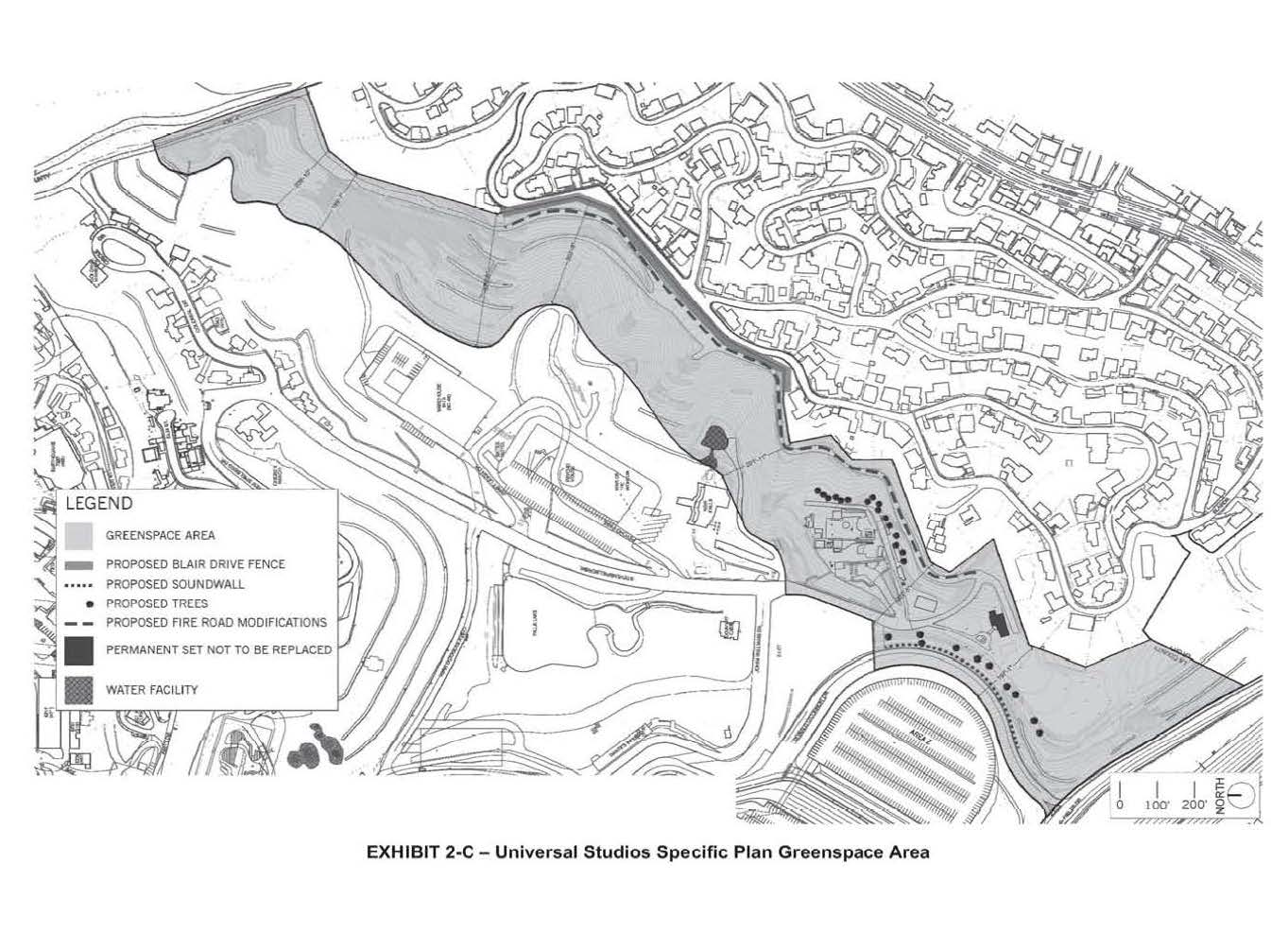
Greenspace Area. A greenspace area shall be maintained along the eastern boundary of the Universal Studios Specific Plan area adjacent to the Existing Off-Site Residential Uses to the east as shown on Exhibit 2-C. The western boundary of the greenspace area shall be marked approximately every 300 feet and the boundary markers shall be maintained. The following standards shall apply to the designated greenspace area:
a.
Other than the use of existing roadways and security and/or maintenance access, utilities, and as provided in Section 22.408.070.E.7.c, below, no new activities or new buildings or structures shall occur within the greenspace area, except that the existing roadways may be modified and utilities, including recycled water storage and distribution facilities, may be added or modified;
b.
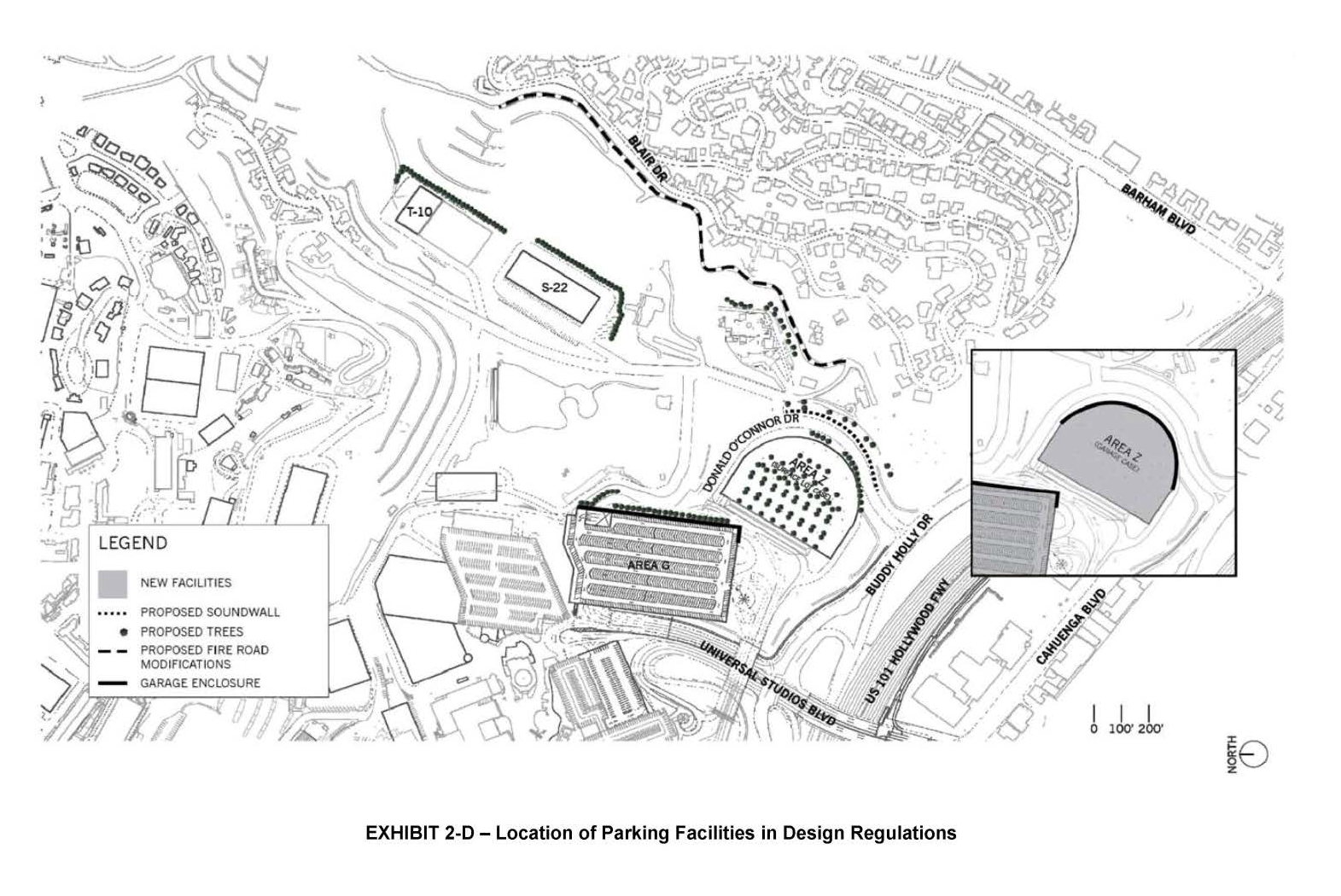
The portions of the existing fire road shown on Exhibit 2-C, and any modifications to such portions of the fire road, shall be improved with decomposed granite or other suitable material to control dust prior to the issuance of the certificate of occupancy for the new warehouse facility identified as S-22 on Exhibit 2-D, and the decomposed granite or other suitable material shall be properly maintained;
c.
Those Sets/Façades or other structures existing within the greenspace area as of the effective date of this Specific Plan as shown on Exhibit 2-C may remain and continue to be utilized for Production Activities, including use of vehicles and trailers related to Production Activities, and in the event of any destruction of the Sets/Façades or other structures, such Set/Façades or other structures may be rebuilt up to substantially the same size and in substantially the same location that existed as of the effective date of this Specific Plan;
d.
No new Sets/Façades shall be developed in this area and the permanent Set/Façade shown on Exhibit 2-C shall not be replaced;
8.
Fencing at Specific Plan Eastern Boundary.
a.
A new painted metal fence, 12 feet in height including a security section, shall be installed and maintained along the Specific Plan eastern boundary within the area shown on Exhibit 2-C prior to the issuance of the certificate of occupancy for the new warehouse facility identified as S-22 on Exhibit 2-D;
b.
Any fencing required under this Specific Plan located along the eastern boundary of the Specific Plan area shall be properly maintained at all times.
9.
Access for new buildings developed pursuant to this Specific Plan shall be designed consistent with the applicable provisions of Titles 26 (Building) and 32 (Fire) of the County Code, respectively, or other applicable County Building and Safety or Fire Department regulations.
10.
See Section 22.408.150.H of this Specific Plan for Design Standards for Permanent Parking Facilities and Section 22.408.190.C of this Specific Plan for Design Standards for new Communication Facilities.
11.
Prior to the Universal Studios Specific Plan area property owner using Donald O'Connor Drive after 11:00 p.m. or prior to 7:00 a.m., a 10-foot high painted block sound wall shall be constructed along the eastern edge of Donald O'Connor Drive in the location shown on Exhibit 2-D.
12.
For any new warehouse facilities developed at the locations shown on Exhibit 2-D:
a.
Parking areas and loading docks shall not be developed on the east side of such new warehouse facilities;
b.
New trees shall be installed and maintained as shown on Exhibit 2-D to screen the eastern and southern sides of the new warehouse structure identified as S-22 on Exhibit 2-D prior to the issuance of the certificate of occupancy for that structure;
c.
New trees shall be installed and maintained as shown on Exhibit 2-D to screen the eastern side of the expansion of the warehouse structure identified as T-10 on Exhibit 2-D prior to the issuance of the certificate of occupancy for that structure.
13.
For any new building developed within the 720-foot MSL Height Zone, those portions of the building above 696-foot MSL shall be terraced back from the north façade of the building by 50 feet as shown on Figure 6-1, below.
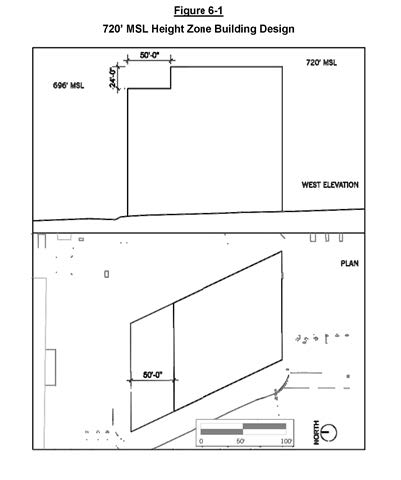
14.
For any new building developed within the 745-foot MSL Height Zone, those portions of the building above 721-foot MSL shall be terraced back from the west façade of the building by 20 feet as shown on Figure 6-2, below.
15.
Southern Landscape Buffer Area. The southern landscape buffer area shown on Exhibit 2-E shall be retained as a landscaped area. Any existing structures and signs existing in this area as of the effective date of this Specific Plan may be retained and maintained.
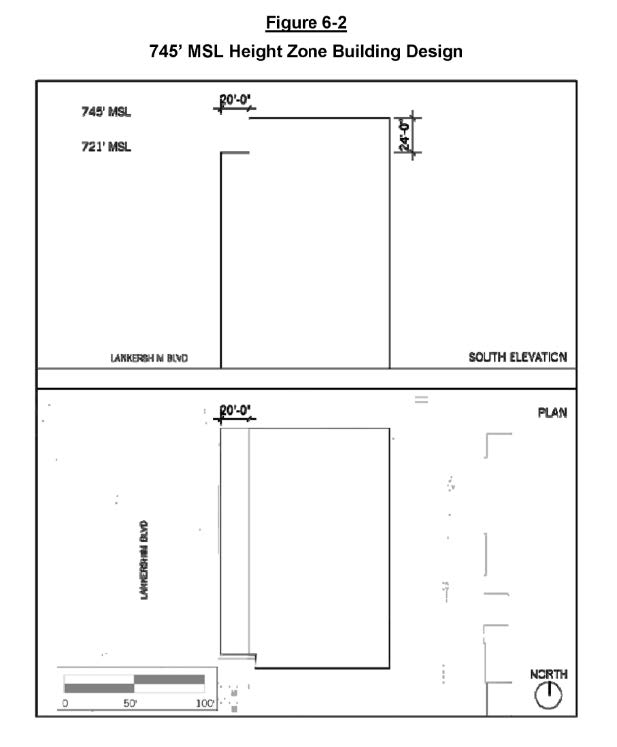
F.
Sustainable Development Measures.
1.
General requirements. All Projects shall comply with Green Building regulations, as applicable, in Sections 22.52.2100—22.52.2160 of the Zoning Code, except that in addition to the exemptions in the Green Building regulations, the following shall be exempt from such requirements:
a.
Production Activities (which does not include construction of stages or television facilities within which Production Activities may occur), Sets/Façades, and amusement rides, shows, tour attractions, exhibitions or play areas associated with the Theme Park or Universal Studios Tour.
2.
Additional sustainable standards. In addition to the requirements of Section 22.52.2130 of the Zoning Code, Projects within the Universal Studios Specific Plan area shall also comply with the following standards:
a.
All new buildings shall be designed to exceed Title 24, Part 6 of the California Code of Regulations (2005) energy requirements by at least 15 percent. In the event Title 24 is amended such that the energy conservation requirements in the amended Title 24 exceed Title 24 (2005) by 15 percent or greater, the building shall comply with the amended Title 24.
b.
Outdoor water conservation. Project landscaping shall include the following:
i.
Use of reclaimed water for landscape irrigation;
ii.
Installation of the infrastructure to deliver the reclaimed water, if necessary; and
iii.
Use of high efficiency irrigation systems, including weather-based irrigation controllers that use sensors and weather information to automatically adjust watering times and frequency in response to weather changes.
c.
Indoor water conservation. Water fixtures in new buildings shall meet or exceed the following water conservation standards:
i.
High Efficiency Toilets: 1.28 gallons/flush or less;
ii.
High Efficiency Urinals: 0.5 gallons/flush or less;
iii.
Restroom Faucets: 1.5 gallons/minute or less;
iv.
Pre-rinse Spray Valves: 1.6 gallons/minute or less for Commercial Kitchens; and
v.
Public Restroom: self-closing faucets.
d.
Education on water conservation shall be provided to the Universal Studios Specific Plan area property owner's employees through new employee orientation materials and three times annually through company website, exhibits, or meetings on energy conservation.
e.
Resource conservation. During new construction, a minimum of 65 percent of the non-hazardous construction and demolition debris from construction of new Project buildings shall be recycled and/or salvaged for reuse. During occupancy and operations, the Project shall have a solid waste diversion target of 65 percent of the non-hazardous waste generated.
G.
Landscape Standards.
1.
General requirements. All Projects shall comply with the Drought-Tolerant Landscaping design regulations, as applicable, in Sections 22.52.2200—22.52.2270 of the Zoning Code, except that in addition to the exemptions in the Drought-Tolerant Landscaping design regulations the following shall be exempt from such requirements.
a.
Outdoor Production Activities, Sound Stages, Sets/Façades, amusement rides, shows, tour attractions, exhibitions or play areas associated with the Theme Park, CityWalk or Universal Studios Tour, and visitor entry points to the Theme Park and CityWalk.
2.
With each Substantial Conformance Review application for a Project facing Lankershim Boulevard, the Applicant shall prepare and submit to the Director for review and approval a landscape design plan in substantial conformance with the Conceptual Lankershim Streetscape Plan in the Specific Plan Guidelines.
H.
Low Impact Development.
1.
General requirements. All Projects shall comply with Low Impact Development regulations, as applicable, in Section 22.52.2310 of the Zoning Code, except that in addition to the exemptions in the County Code Low Impact Development regulations, the following shall be exempt from such requirements to the extent the exemption is not in violation of any applicable Federal and State regulatory water quality requirements.
a.
Sets/Façades.
b.
The temporary addition, modification, or replacement of impervious surface area for Production Activities during the duration of the Production Activity.
c.
The modification or replacement of impervious surface area associated with repurposing of amusement rides, shows, tram tour attractions, exhibitions, and open air areas with facilities for play/games associated with the Low Impact Development Theme Park and CityWalk areas shown on Exhibit 4.
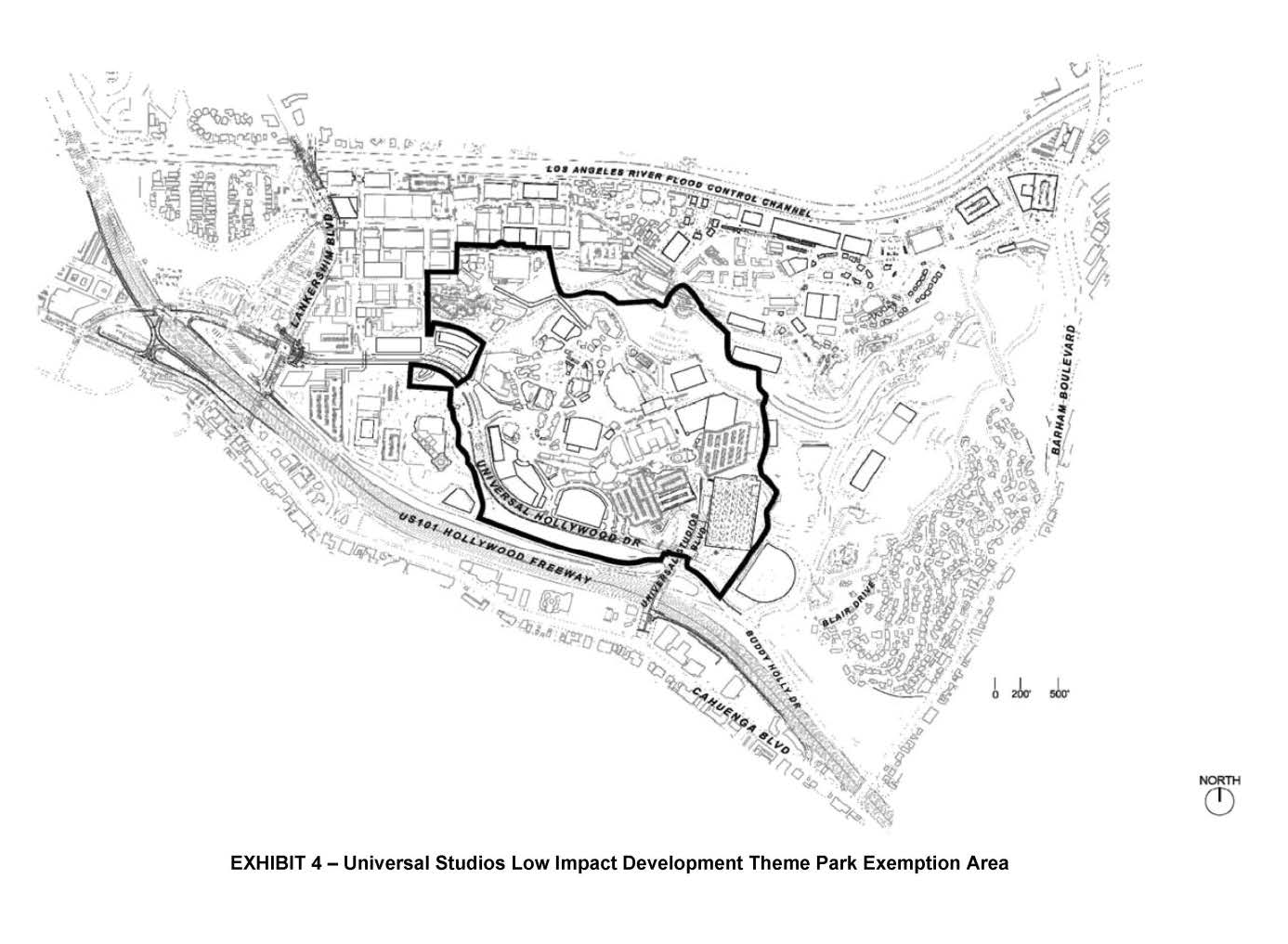
(Ord. 2022-0008 § 161, 2022.)
22.408.080 - Land Use Equivalency.
A.
Purpose. The Land Use Equivalency procedure is established to provide development flexibility by permitting shifts of permitted Floor Area between certain Land Use Categories over the life of this Specific Plan, while maintaining the intent and regulatory requirements of this Specific Plan, and the overall character of the Universal Studios Specific Plan area and each District. The Land Use Equivalency Conversion Table 7-1 allows for Floor Area reallocations between the Land Use Categories utilizing conversion factors in the Table.
B.
Procedure. Projects within the Universal Studios Specific Plan area may be developed consistent with this Specific Plan and pursuant to the Substantial Conformance Review procedures set forth in Section 22.408.210 of this Specific Plan up to the Total Permitted Floor Areas set forth in Table 5-1 or Table 5-2, as applicable, for each Land Use Category. At such time as a Project will exceed the Total Permitted Floor Area for a Land Use Category stated in Table 5-1 or Table 5-2, as applicable, the Project, and all subsequent Projects of the same Land Use Category, shall comply with the following Land Use Equivalency procedures.
1.
A Land Use Category may be exchanged for another Land Use Category, so long as the new use is otherwise permitted by this Specific Plan and the Floor Area of the new use is in conformance with the applicable conversion factor in the Land Use Equivalency Conversion Table 7-1.
2.
The Applicant shall submit the Land Use Equivalency calculation along with the Substantial Conformance Review application. The application shall include the following information:
a.
A statement as to which Land Use Category's Total Permitted Floor Area set forth in Table 5-1 or Table 5-2, as applicable, the Applicant wishes to draw against for the Land Use Equivalency transfer and the amount of the reduction of the selected Land Use Category Total Permitted Floor Area based upon the applicable Land Use Equivalency Conversion Table 7-1.
b.
Calculations to demonstrate compliance with the applicable Land Use Equivalency Conversion Table 7-1 conversion factors.
c.
A description of how the Project is fully consistent with all applicable provisions of this Specific Plan and mitigation measures in the NBC Universal Evolution Plan Mitigation Monitoring and Reporting Program (MMRP).
3.
The Applicant shall submit a revised Table 5-1 or 5-2, as applicable, reflecting the change in Additional Permitted Floor Area and Total Permitted Floor Area based on the Land Use Equivalency.
4.
The combined Total Permitted Floor Area of all Land Use Categories as adjusted pursuant to these Land Use Equivalency procedures shall not exceed 10 percent of the overall Total Permitted Floor Area set forth in Table 5-1 or Table 5-2, as applicable, and the Total Permitted Floor Area for each individual Land Use Category shall not exceed 10 percent of the Total Permitted Floor Area set forth in Table 5-1 or Table 5-2, as applicable, except for Studio Use that shall not exceed 30 percent of the Total Permitted Floor Area for Studio Use set forth in Table 5-1 or Table 5-2, as applicable.
C.
Director's Review. The Director's review of the Land Use Equivalency transfer shall be limited to verifying that the proposed Project is within the applicable conversion factors set forth in the Land Use Equivalency Conversion Table 7-1. The Director shall not impose additional conditions or mitigation measures on the Project. The time periods for review shall be the same as those set forth in the Substantial Conformance Review procedures in Section 22.408.210.C of this Specific Plan.
D.
A Specific Plan Amendment shall not be required for the updated Table 5-1 or Table 5-2, as applicable, stating the revised Additional Permitted Floor Area and Total Permitted Floor Area with the Land Use Equivalency provided the overall Total Permitted Floor Area of all Land Use Categories does not exceed 10 percent of the Total Permitted Floor Area set forth in Table 5-1 or Table 5-2, as applicable, and the Total Permitted Floor Area for each individual Land Use Category shall not exceed 10 percent of the Total Permitted Floor Area set forth in Table 5-1 or Table 5-2, as applicable, except for Studio Use that shall not exceed 30 percent of the Total Permitted Floor Area for Studio Use set forth in Table 5-1 or Table 5-2, as applicable.
E.
Limitation. If the Project would not be within the Total Permitted Floor Area limitations in Section 22.408.080.B.4, above, then the Land Use Equivalency shall not be used, and additional analysis pursuant to the California Environmental Quality Act shall be undertaken for the Project, and a Specific Plan Amendment shall be required to revise the development limits set forth in this Specific Plan.
TABLE 7-1
LAND USE EQUIVALENCY CONVERSION TABLE
(Ord. 2022-0008 § 161, 2022.)
22.408.090 - Historic Resources.
A.
Application. This Section regulates the alteration, preservation, relocation, or demolition of Contributing Buildings, and the construction of new structures within the potential Universal Studios Historic District as shown on Exhibit 5, with respect to their effect within and upon the potential Universal Studios Historic District. The requirements of this Section and the Historic Preservation Plan (Appendix D of the Specific Plan Guidelines) shall be the exclusive Historic Preservation requirements applicable to the Universal Studios Specific Plan area.
B.
Requirement. Prior to the issuance of a building permit or demolition permit for any structure within the potential Universal Studios Historic District, the Applicant shall submit to the Director written verification from a Historic Preservation Expert of compliance with the Historic Preservation Plan.
(Ord. 2022-0008 § 161, 2022.)
22.408.100 - Hotel.
A.
Requirements. Hotel use shall be permitted within the Universal Studios Specific Plan area in accordance with the requirements of this Section and subject to the conditions listed in Exhibit 6. The Director, through the Substantial Conformance Review process set forth in Section 22.408.210 of this Specific Plan, shall determine compliance with this Section and Exhibit 6, including the limitation of potential locations of any Hotel(s) to those locations depicted on Exhibit 7-A as of the effective date of this Specific Plan and those locations depicted on Exhibit 7-B as of the effective date of the annexation and detachment actions should those actions be approved (as may be modified by the Director consistent with the Local Agency Formation Commission's action pursuant to Section 22.46.2200 of this Specific Plan).
B.
Location. Hotel(s) shall be permitted in those locations depicted on Exhibit 7-A as of the effective date of this Specific Plan and those locations depicted on Exhibit 7-B as of the effective date of the annexation and detachment actions should those actions be approved (as may be modified by the Director consistent with the Local Agency Formation Commission's action pursuant to Section 22.408.220 of this Specific Plan).
C.
Size. Hotel use shall be limited to a maximum of 450,000 square feet of Floor Area and a maximum of 500 hotel guest rooms/suites as may be modified by Land Use Equivalency as set forth in Section 22.408.080 of this Specific Plan.
D.
Uses. Hotel use may include ancillary uses including but not limited to: meeting, banquet and ballroom facilities; lobbies; retail; restaurants; bars; nightclubs; offices; gym and fitness rooms; pools and hot tubs; spas including massage treatment facilities; salons; entertainment uses that are ancillary to the operation of a hotel; parking; and other hotel amenities as part of the hotel complex and operations.
E.
Parking. Parking for any Hotel shall be provided as set forth in Section 22.408.150 of this Specific Plan.
F.
Alcoholic Beverages. The sale and/or service of alcoholic beverages in connection with any Hotel shall be subject to the provisions set forth in Section 22.408.110 of this Specific Plan.
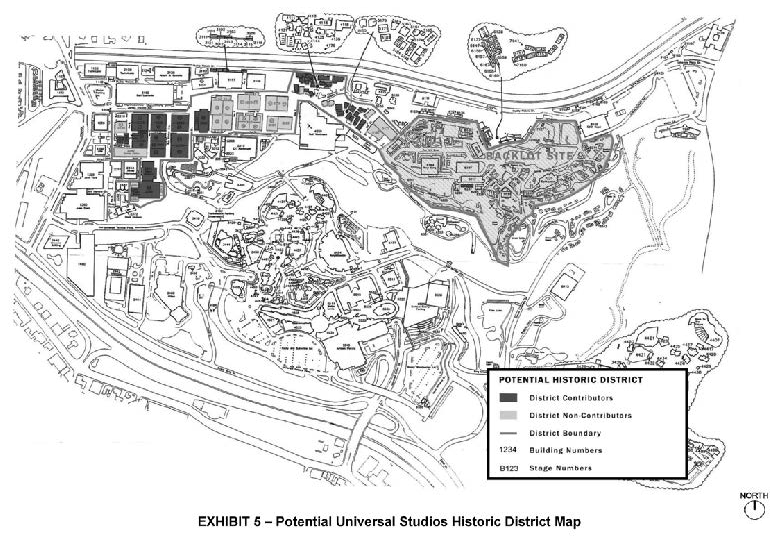
EXHIBIT 6
Conditions for Hotel Use
1.
The Hotel operator, if other than the owner of the subject property, shall file at the office of the Department an affidavit stating that the Hotel operator is aware of and agrees to comply with all of the Hotel regulations and conditions of the Universal Studios Specific Plan.
2.
All structures, walls, and fences open to public view shall remain free of graffiti. In the event graffiti occurs, the Hotel shall remove or cover the graffiti within 24 hours of such occurrence, weather permitting. Paint utilized in covering such markings shall be of a color that matches, as closely as possible, the color of the adjacent surfaces.
3.
The Hotel shall be maintained in a neat and orderly fashion, free of litter and debris. All required landscaping shall be continuously maintained in good condition, including proper pruning, weeding, removal or litter, fertilizing and replacement of plants when necessary.
4.
The Hotel use authorized hereby shall be conducted at all times with due regard for the character of the surrounding neighborhood.
5.
Amplified sound equipment, music or public address systems intended to be audible outside the Hotel boundaries are prohibited, except for an emergency address system.
6.
Security lighting shall be low intensity, shielded, at low height, and directed downward.
7.
The Hotel shall be operated in manner such that guest rooms and suites will be occupied and rented on a temporary basis and no commercial apartments shall be permitted on the Hotel site consistent with Section 8.52.020 of the County Code.
8.
Hotel guest rooms shall not be rented for a period of less than one night's stay, and rent for each guest room shall not be collected more frequently than once daily.
9.
The Hotel operator shall maintain a current contact name, address, and phone number on file with the Department at all times.
10.
The Department shall inspect the Hotel on an annual basis to determine compliance with these conditions and Hotel regulations of this Specific Plan.
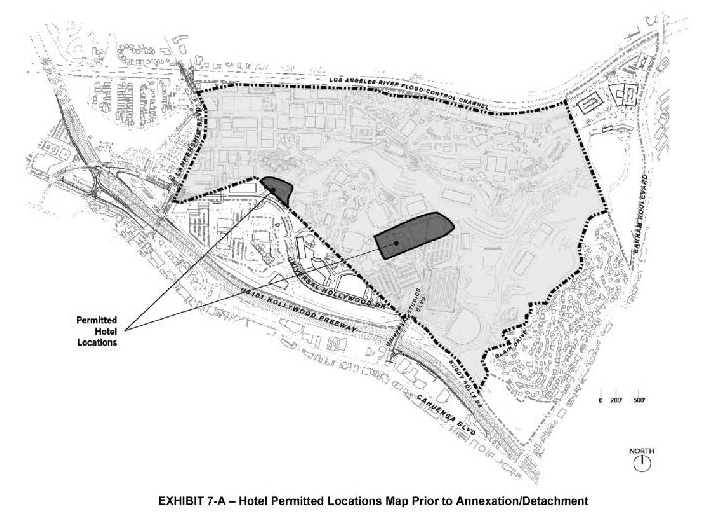
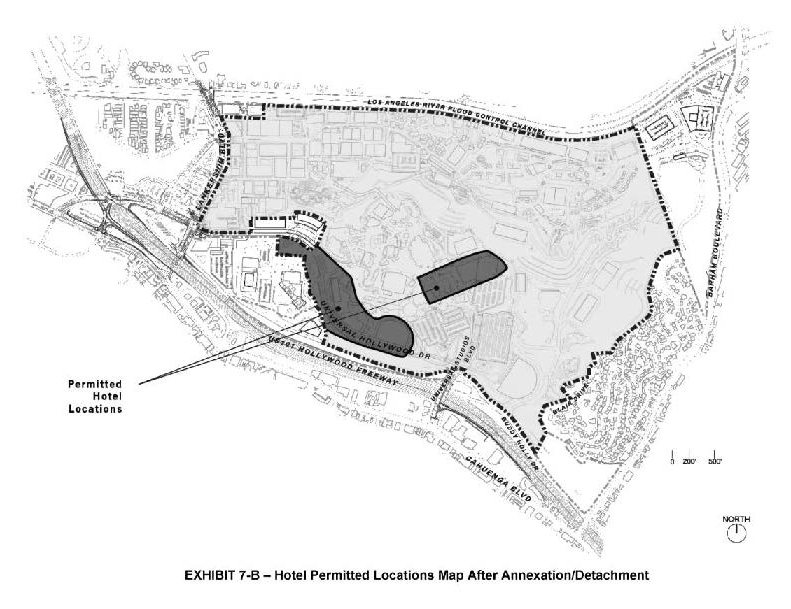
(Ord. 2022-0008 § 161, 2022.)
22.408.110 - Alcoholic Beverages Regulations.
The sale and service of alcoholic beverages for on-site and off-site consumption shall be permitted subject to the provisions of this Section. Entities that sell and serve alcoholic beverages for on-site consumption and off-site consumption shall obtain approvals from other agencies, as required, including licenses or permits from the State Department of Alcoholic Beverages Control (ABC).
A.
Existing Establishments/Uses. There are 20 establishments existing as of the effective date of this Specific Plan as shown on Exhibit 8-A that are permitted to sell and serve alcoholic beverages for on-site consumption including one that also is permitted for off-site consumption sales within the Universal Studios Specific Plan area. Within 30 days of the effective date of this Specific Plan, the Universal Studios Specific Plan area property owner shall provide the Director a list of the existing establishments including the address and the type of alcohol permit of each establishment and their respective floor plan(s). An additional 15 new establishments for the sale and/or service of alcoholic beverages for on-site and/or off-site consumption may be permitted within the Universal Studios Specific Plan area pursuant to the regulations set forth below.
1.
Establishments existing as of the effective date of this Specific Plan, which sell and/or serve alcoholic beverages.
a.
Establishments existing as of the effective date of this Specific Plan, and which were authorized by issuance of a conditional use permit for alcohol sales. Those eight establishments identified on Exhibit 8-A, which exist upon the effective date of this Specific Plan and have been authorized by issuance of a conditional use permit from the County, are hereby authorized to continue in operation under this Specific Plan. Those eight establishments shall be subject to Section 22.408.110.A.1.d, below, and the applicable provisions and conditions as set forth in Exhibit 8-B of this Specific Plan upon the effective date of this Specific Plan.
b.
Establishments existing as of the effective date of this Specific Plan and which were established prior to adoption of Ordinance 92-0097. Those 10 establishments identified on Exhibit 8-A, which exist upon the effective date of this Specific Plan and which existed prior to the County's requirement to obtain a conditional use permit are hereby authorized to continue in operation under this Specific Plan. Those ten establishments, which include the Theme Park, Amphitheater, and eight restaurants, shall be subject to Section 22.408.110.A.1.d, below, and the applicable provisions and conditions as set forth in Exhibit 8-B and 8-C of this Specific Plan, as applicable, upon the effective date of this Specific Plan.
c.
Establishments that were originally authorized by the City of Los Angeles and which are located in areas which will become part of the Universal Studios Specific Plan area. Those two establishments identified on Exhibit 8-A, which exist upon the effective date of this Specific Plan and that were authorized by the City of Los Angeles, one pursuant to a conditional use permit and one pursuant to a variance, are hereby authorized to continue in operation under this Specific Plan as of the effective date of the annexation and detachment actions as described in Section 22.408.010.B of this Specific Plan should those actions be approved. Those two establishments, which include a restaurant and a restaurant/club, shall be subject to Section 22.408.110.A.1.d, below, and the applicable provisions and conditions as outlined in Exhibit 8-B of this Specific Plan as of the effective date of the annexation and detachment actions should those actions be approved.
d.
The existing establishments authorized pursuant to Section 22.408.110.A.1.a—c, above, shall require a new approval pursuant to Section 22.408.110.D, below, if:
i.
The establishment proposes to substantially change the type of alcohol permit (e.g. from on-site to off-site consumption);
ii.
There is a substantial change in the type of establishment (e.g. from a restaurant to a bar);
iii.
There is a cumulative increase of greater than 10 percent in Floor Area devoted to the sale or service of alcoholic beverages or a cumulative increase of greater than 25 percent in facing used for the display of alcoholic beverages; and
iv.
The establishment abandons operations for three months or more. Notwithstanding the foregoing, abandonment shall not include closures for change of tenant or operator, reconstruction, refurbishing or modifications to the existing establishments, however, abandonment shall include a change of tenant or operator that results in the establishment no longer selling or serving alcoholic beverages.
e.
The provisions of Section 22.408.110.A.1.d, above, shall apply to the establishments described in Section 22.408.110.A.1.c, above, as of the effective date of the annexation and detachment actions should those actions be approved.
2.
Modifications to Existing Establishments. Cumulative changes of 10 percent or less in Floor Area devoted to the sale or service of alcoholic beverages, or change of owner/operator, shall not require a new approval.
3.
New Establishments/Uses. Following the effective date of this Specific Plan, in addition to the establishments selling and serving alcoholic beverages existing as of the effective date of this Specific Plan as provided for in Section 22.408.110.A.1.a, A.1.b and A.1.c, above, a maximum of 15 new establishments shall be permitted to sell and serve a full line of alcoholic beverages as provided in Section 22.408.110.B, C, and D, below.
B.
Alcohol Use Approval Process for Hotel Use.
1.
Procedure. A Hotel shall be considered a single establishment and shall be permitted to sell and serve a full line of alcoholic beverages for on-site consumption: (a) as part of its banquets, lobbies, meeting rooms, pool areas and room services; (b) within mini-bars located in each guest room; and (c) within a restaurant establishment(s) physically located within the Hotel that does/do not exceed a combined seating capacity of 500. Additional establishments within the Hotel seeking to sell and/or serve alcoholic beverages shall be subject to Section 22.408.110.D, below. The operator of the Hotel shall apply to the Director for an Alcohol Use Approval following the same procedures as a Substantial Conformance Review. The Director's review of the Alcohol Use Approval application for the Hotel shall follow the same procedures as required for a Substantial Conformance Review as set forth in Section 22.408.210 of this Specific Plan, except that the Director's review of the Alcohol Use Approval application shall be limited to review of substantial compliance with the conditions set forth in the Alcoholic Beverages Regulations of this Specific Plan.
2.
Exception. Cumulative changes of 10 percent or less in Floor Area devoted to the sale or service of alcoholic beverages, or change of owner/operator, shall not require a new Alcohol Use Approval.
3.
Conditions. A Hotel shall comply with the conditions for on-site alcohol consumption listed in Exhibit 8-B.
C.
Alcohol Use Approval Process for Cinemas.
1.
Procedure. The cinemas in CityWalk (a multi-screen theater complex) shall be considered a single establishment and shall be permitted to sell and serve a full line of alcoholic beverages for on-site consumption only within the upper floors and balconies that are accessed separately from the main theaters on the ground level. The operator of the cinemas shall apply to the Director for an Alcohol Use Approval following the same procedures as a Substantial Conformance Review. The Director's review of the Alcohol Use Approval application for the cinemas shall follow the same procedures as required for a Substantial Conformance Review as set forth in Section 22.408.210 of this Specific Plan, except that the Director's review of the Alcohol Use Approval application shall be limited to review of substantial compliance with the conditions set forth in the Alcoholic Beverages Regulations of this Specific Plan.
2.
Exception. Cumulative changes of 10 percent or less in Floor Area devoted to the sale or service of alcoholic beverages, or change of owner/operator, shall not require a new Alcohol Use Approval provided that the sale of alcoholic beverages is limited to the upper floors and balconies of the cinemas.
3.
Conditions. The cinemas shall comply with the conditions for on-site alcohol consumption listed in Exhibit 8-B.
D.
Approval Process for Other New Alcohol Use Establishments. Any additional establishments requesting to sell or serve alcoholic beverages for either on-site or off-site consumption beyond those permitted by Section 22.408.110.A—C, above, shall be subject to a Conditional Use Permit pursuant to, and the modification, inspection and enforcement requirements of, Chapters 22.56 and 22.60 of the Zoning Code, except that:
1.
The Hearing Officer shall preside over the initial public hearing for the Conditional Use Permit. The Hearing Officer's decision shall only be appealed to the Board of Supervisors. The decision of the Hearing Officer may be called up for review by the Board of Supervisors.
2.
Notwithstanding any other provision of Chapter 22.60 of the Zoning Code, upon receiving an appeal or initiating a call for review, the Board of Supervisors may:
a.
Affirm the action of the Hearing Officer; or
b.
Refer the matter back to the Hearing Officer for further proceedings with or without instructions; or
c.
Require a transcript of the testimony and any other evidence relevant to the decision and take such action as in its opinion is indicated by the evidence. In such case, the Board of Supervisors' decision need not be limited to the points appealed, and may cover all phases of the matter, including the addition or deletion of any conditions.
3.
Conditions. Other new alcohol use establishments shall comply with the conditions for on-site alcohol consumption listed in Exhibit 8-B and/or conditions for off-site alcohol consumption listed in Exhibit 8-C, as applicable.
E.
Alcohol Use Approval Applications.
1.
In addition to the Substantial Conformance Review application requirements set forth in Section 22.408.210 of this Specific Plan, each application for an Alcohol Use Approval under Section 22.408.110.B and C, above, shall include:
a.
A site plan, depicting floor plan, seating areas, and alcohol shelf space for the subject establishment;
b.
A table including the proposed establishment and existing establishments that sell and serve alcohol within the Universal Studios Specific Plan area existing as of the time of the Alcohol Use Approval application indicating the type of permit (e.g. on-site or off-site), type of establishment (e.g. restaurant, nightclub, or retail), and District (Business, Studio, or Entertainment) location as of the time of the Alcohol Use Approval application; and
c.
A copy of the State Alcohol Beverage Control violation report for establishments within the Universal Studios Specific Plan area.
F.
Inspection and Enforcement of Alcohol Use Establishments Permitted Pursuant to Section 22.408.110.A, B, and C, above.
1.
Zoning Enforcement may inspect each alcohol use establishment at least once per year to determine compliance with the alcohol regulations and conditions of this Specific Plan. The Universal Studios Specific Plan area property owner shall compensate the Department for the reasonable expenses incurred in conducting the inspection pursuant to Section 22.408.200.E of this Specific Plan.
2.
If the Director believes that an alcohol use establishment is in violation of the Alcoholic Beverages Regulations of this Specific Plan, or is detrimental to public health or safety or is a nuisance, the Director may provide written notification to the operator of the establishment and the Universal Studios Specific Plan area property owner requiring that the alleged violation be remedied. If the alleged violation is not remedied within the time specified by the written notification, and the Director makes written findings that the establishment violates the Alcoholic Beverages Regulations of this Specific Plan or is detrimental to public health or safety or is a nuisance, then the Director shall comply with the following:
a.
The Director shall give notice to the operator of the establishment and the Universal Studios Specific Plan area property owner to appear at a public hearing before the Hearing Officer at a time and place fixed by the Director and the Hearing Officer to determine whether the Alcohol Use Approval should be modified or revoked, and the operator and owner shall show cause why the Alcohol Use Approval should not be modified or revoked by the Hearing Officer.
b.
Not less than 30 days prior to the date of the hearing, the Director shall cause a copy of a notice of the time and place of such hearing to be (i) published once in a newspaper of general circulation in the County and (ii) mailed by first class mail, postage prepaid, to owners of land within a distance of 500 feet from the exterior boundaries of the subject parcel, and to any person who has filed a written request therefore with the Director.
c.
Within 10 days of the hearing, the Director shall serve notice of the Hearing Officer's action upon (i) the operator of the establishment, (ii) the owner of the property and (iii) any person testifying or speaking at the public hearing, by registered or certified mail, postage prepaid, return receipt requested.
3.
The decision of the Hearing Officer may be appealed to the Board of Supervisors by filing a written request with the executive officer of the Board within ten days after the Hearing Officer serves notice of his/her action. The Board of Supervisors shall hear the matter within 60 days following receipt of the written request for a hearing by the Board. Notice of the hearing shall be provided to the persons set forth in Section 22.408.110.F.2.b, above. The Board of Supervisors may approve, modify or disapprove the action of the Hearing Officer. The Board of Supervisors' action shall be supported by written findings. The Board of Supervisors shall serve notice of its action upon (i) the operator of the establishment, (ii) the owner of the property and (iii) any person testifying or speaking at the public hearing who wished to be notified, by registered or certified mail, postage prepaid, return receipt requested.
(Ord. 2022-0008 § 161, 2022.)
22.408.120 - Oak Tree Regulations.
A.
Removal Permitted. Oak Trees may be removed, or the Protected Zone (as defined below) encroached upon, in accordance with the requirements of this Section. Removal or encroachment upon the Protected Zone of Oak Trees may be requested by filing a Substantial Conformance Review application in accordance with the procedures set forth in Section 22.408.210 of this Specific Plan. Removal of Oak Trees shall include cutting, destroying, removing, relocating, inflicting Damage (as defined below) or encroaching into the root zone or grading/filling within the drip line area of an Oak Tree; provided however, that pruning of branches up to two inches in diameter, deadwood, stubs, and no more than 15 percent of the tree canopy of any one tree, conducted under the supervision of a registered consulting arborist shall not be considered a removal or encroachment and shall not require a Substantial Conformance Review.
B.
Definitions. Whenever the following terms are used in this Section, they shall be construed as defined in this Section. To the extent that other terms used in this Section are not defined herein or in Section 22.408.050 of this Specific Plan, but are defined in the County Code, those definitions shall apply.
Damage. Any act causing or tending to cause injury to the root system or other parts of a tree, including, but not limited to, burning, application of toxic substances, operation of equipment or machinery, or by paving, changing the natural grade, trenching or excavating within the Protected Zone of an Oak Tree.
Protected Zone. That area within the drip line of an Oak Tree and extending there from to a point at least five feet outside the drip line, or 15 feet from the trunks of a tree, whichever distance is greater.
C.
Oak Trees Subject to this Specific Plan.
1.
Removal or encroachment upon the Protected Zone of those Oak Trees indicated on the Master Oak Tree Maps, dated February 2013, and included in the County file, and identified in the NBC Universal Evolution Plan Tree Report dated September 2010 (Oak Tree Report), and any trees identified per Section 22.408.120.C.2, below, shall be subject to this Specific Plan and shall not be otherwise subject to Oak Tree regulations contained in the Zoning Code.
2.
Exemptions.
a.
Cases of emergency caused by an Oak Tree being in a hazardous or dangerous condition, or being irretrievably Damaged or destroyed through flood, fire, wind or lightning as determined after visual inspection by a Forester with County Forester or the County Fire Marshall;
b.
Emergency or routine maintenance by a public utility necessary to protect or maintain an electric power or communication line or other property of a public utility;
c.
Trees, including tree canopies, within existing road rights-of-way where pruning is necessary to obtain adequate line-of-sight distances and/or to keep street and sidewalk easements clear of obstructions or to remove or relocate trees causing damage to roadway improvements or other public facilities and infrastructure within existing road rights-of-way as required by the Director of Public Works.
d.
All trees, other than those identified on the Master Oak Tree Map or as provided in Section 22.408.120.D.2 and D.6, below, shall be exempt from the Oak Tree requirements of this Specific Plan and shall not be subject to any other tree regulations established by the Zoning Code. Trees that are exempt may be removed by the Universal Studios Specific Plan area property owner without any review or approval by the County.
D.
Requirements. Prior to the removal or encroachment upon the Protected Zone of any Oak Tree indicated on the Master Oak Tree Maps, dated February 2013, the Applicant shall provide a map, which corresponds to the Master Oak Tree Map, indicating the specific Oak Tree and its tag number to be removed. Copies of the original Oak Tree Report, Master Oak Tree Map, and Oak Tree Substantial Conformance Review application and approval shall be kept on the Project site and available for review, and all individuals associated with the Project as it relates to the oak resource shall be familiar with said documents. The Applicant shall suitably guarantee, to the satisfaction of the Director and County Forester, compliance with Section 22.408.120.D.1.a, D.1.b, D.1.c, or D.1.d, below, in connection with the removal of an Oak Tree or an encroachment upon the Protected Zone that results in Damage to an Oak Tree.
1.
The Applicant shall either:
a.
Provide and plant two replacement oak trees at an on-site location for each single Oak Tree removed within one year of the Oak Tree removal unless otherwise specifically stated or extended by the County Forester. The replacement tree(s) shall be a minimum of fifteen gallon in size, measure at least one inch in diameter one foot above the base, and shall consist exclusively of indigenous oak trees and certified as being grown from a seed source collected from an indigenous oak woodland within valley regions of Los Angeles County where feasible; or
b.
Provide and plant two replacement oak trees at an off-site location within one year of the Oak Tree removal unless otherwise specifically stated or extended. The off-site replacement tree location shall be approved by the Director and County Forester. The replacement tree(s) shall be a minimum of fifteen gallon in size, measure at least one inch in diameter one foot above the base, and shall consist exclusively of indigenous oak trees and certified as being grown from a seed source collected from indigenous oak woodland within valley regions of Los Angeles County where feasible; or
c.
Pay an in lieu fee of $2,700 for each removed Oak Tree. This fee shall be adjusted by the County Forester consistent with the Consumer Price Index for the Los Angeles-Long Beach metropolitan statistical area on the annual anniversary of the effective date of this Specific Plan. If the Applicant provides an in lieu fee, it shall be deposited into a segregated trust fund maintained or selected by the County for the planting of replacement Oak Trees and the deposit shall be made prior to issuance of a grading or building permit involving construction within the area of any Oak Tree removal; or
d.
Any combination of Subsections (a), (b), and (c), above.
2.
Removal of any Oak Tree, which is eight inches, or more, in diameter as measured four and one-half feet above mean natural grade or in the case of Oak Trees with multiple trunks a combined diameter of twelve inches or more of the two largest trunks, that is not identified on the Master Oak Tree Map shall comply with Section 22.408.120.D.1, above. In addition, the Master Oak Tree Map shall be amended to include the subject tree(s) including the additional tag number and tree data.
3.
In addition to the Substantial Conformance Review application requirements set forth in Section 22.408.120 of this Specific Plan, each application for Substantial Conformance Review for removal of an Oak Tree shall include:
a.
The location of all Oak Trees proposed to be removed and/or relocated, and/or within 200 feet of proposed construction and/or grading activity. Each tree shall be identified by the corresponding permanent identifying tag as listed on the Master Oak Tree Map. The Protected Zone shall be shown for each plotted tree;
b.
Where a change in grade is proposed, the change in grade within the Protected Zone of each Oak Tree within the grading area;
c.
Location and size of all proposed replacement trees or statement of the in-lieu fee amount to be paid calculated based on Section 22.408.120.D.1.c, above;
d.
Proposed and existing land uses in the immediate vicinity of the proposed Oak Tree to be removed and location of proposed replacement trees;
e.
A letter from the Applicant to the Director and the County Forester stating that a registered consulting arborist has been retained to perform or supervise the Oak Tree work; and
f.
Other information that the Director deems necessary to process the application.
4.
The registered consulting arborist shall monitor the replacement trees for a minimum of seven years, to evaluate the growth, health and condition of the replacement trees. The seven-year maintenance period will begin upon receipt of a letter from the Applicant or registered consulting arborist to the Director and the County Forester indicating that the replacement trees have been planted.
5.
The Applicant shall properly maintain each replacement tree and shall replace any tree failing to survive due to a lack of proper care and maintenance with a tree meeting the specifications set forth in Section 22.408.120.D.1, above. If a new replacement tree is required, the new replacement tree shall also be monitored for a period of seven years commencing upon the receipt of a letter from the Applicant or registered consulting arborist to the Director and the County Forester indicating that the new replacement tree has been planted.
6.
The removal or encroachment into the Protected Zone of any replacement trees located within the Universal Studios Specific Plan area, regardless of size, shall be subject to the requirements of Section 22.408.120.D.1, above.
7.
The Applicant shall design landscapes and irrigation systems that are adjacent to the replacement trees in a manner that is compatible for the survival of the replacement trees.
8.
The Applicant shall remove mistletoe infestations, insect infestations and other pathogens within existing Oak Trees as directed by a registered consulting arborist.
9.
No planting or irrigation system shall be installed within the drip line of any Oak Tree.
10.
Trenching, excavation, or clearance of vegetation within the Protected Zone of an Oak Tree shall be accomplished by the use of hand tools or small hand-held power tools. Any major roots encountered shall be conserved to the extent possible and treated as recommended by the registered consulting arborist.
11.
Oak Trees which are determined to be healthy, structurally sound, and located on accessible terrain shall be considered as candidates for relocation, to the extent feasible, as determined by a registered consulting arborist retained by the Applicant.
E.
Mitigation Banking. The Applicant may plant blocks of trees either on- or off-site to the satisfaction of the Director and the County Forester as provided in Section 22.408.120.D.1.a, and D.1.b, above, which may be used as mitigation for future removals. This would create a more efficient and consolidated monitoring effort for both the Applicant and the County Forester. Any replacement trees planted pursuant to this Subsection shall meet the minimum requirements outlined in Section 22.408.120.D.1.a and/or D.1.b, above, as applicable.
F.
Forester Inspection and Monitoring Fee. In addition to the Substantial Conformance Review fee required pursuant to Section 22.408.210.C, the Applicant shall, prior to commencement of the use of the Substantial Conformance Review approval under this Section, deposit with the County Fire Department, Forestry Division an inspection and monitoring fee in a manner and amount as determined by the County Forester.
G.
Violations and Enforcement. If the provisions of this Section are violated, the County Forester may issue a notice of correction. A reasonable time frame within which deficiencies must be corrected shall be indicated on the notice of correction. Should an inspection disclose the removal or encroachment upon the Protected Zone of an Oak Tree in violation of this Specific Plan, the Universal Studios Specific Plan area property owner shall pay $2,700 (as may be adjusted for inflation annually from the effective date of this Specific Plan based upon Section 22.408.120.D.1.c, above) for each such removed or Damaged Oak Tree and shall reimburse the County of Los Angeles Fire Department, Forestry Division for all enforcement efforts necessary to bring the subject property into compliance with this Specific Plan.
(Ord. 2022-0008 § 161, 2022.)
22.408.130 - Grading and Construction Regulations.
A.
Maximum import or export. A total of 530,000 cubic yards of import or export of earth shall be permitted within the Universal Studios Specific Plan area. Movement of earth within the combined boundaries of the Universal Studios Specific Plan area and the adjacent City [Q]C2 Area shall not count toward this total.
B.
Cross-lot authorization. Movement of earth related to projects within the boundaries of the Universal Studios Specific Plan area shall be permitted regardless of lot lines. The grading of and import or export of earth shall also be subject to the applicable provisions of Title 26 of the County Code.
C.
Approval required for Off-Site Transport Grading Project. An Off-Site Transport Grading Project shall be subject to the Substantial Conformance Review process as outlined in Section 22.408.210 of this Specific Plan.
1.
In addition to the Substantial Conformance Review application requirements set forth in Section 22.408.210 of this Specific Plan, each application for Substantial Conformance Review involving an Off-Site Transport Grading Project shall include:
a.
The names and addresses of all persons owning all or any part of the property from which Off-Site Transport Grading material is proposed to be removed from and transported to;
b.
The names and addresses of the persons who will be conducting the Off-Site Transport Grading operations;
c.
A map showing in sufficient detail the location of the property from which such material is proposed to be removed, the proposed route over streets and highways, and the location to which such material is to be transported.
D.
Approval required for On-Site Grading Project. An On-Site Grading Project shall be subject to the Substantial Conformance Review process as outlined in Section 22.408.210 of this Specific Plan. Cumulative On-Site Grading shall not exceed 4,600,000 cubic yards of cut and 3,700,000 cubic yards of fill.
E.
Standard County requirements. Any grading shall be subject to the applicable provisions of Title 26 of the County Code, and any import or export of earth shall be subject to the applicable requirements of Public Works.
F.
Construction liaison. At the time of application for a grading permit, a construction relations officer shall be designated to serve as a liaison with surrounding property owners, with the responsibility of responding to concerns regarding construction activity. The liaison's telephone number(s) shall be prominently displayed at multiple locations along the perimeter of the Project site.
(Ord. 2022-0008 § 161, 2022.)
22.408.140 - Transportation/Transportation Demand Management Regulations.
A.
Transportation Demand Management. Prior to the issuance of the first Substantial Conformance Review for the first Project developed under this Specific Plan, the Applicant shall provide documentation satisfactory to the Director that a Transportation Demand Management program has been prepared to the satisfaction of the City of Los Angeles Department of Transportation. The program shall include implementation of several Transportation Demand Management strategies satisfactory to the Director in consultation with Public Works Traffic and Lighting Division, which may include, but are not limited to, the following:
1.
Flexible work schedules and telecommuting programs
2.
Alternative work schedules
3.
Pedestrian friendly environment
4.
Bicycle amenities (bicycle racks, lockers, etc.)
5.
Rideshare/carpool/vanpool promotion and support
6.
Mixed-use development
7.
Education and information on alternative transportation modes
8.
Transportation Information Center
9.
Guaranteed Ride Home program
10.
Join an existing or form a new Transportation Management Association
11.
Participation in a flex car program in the vicinity of the Universal Studios Specific Plan area
12.
Discounted employee transit passes
13.
Financial mechanisms and/or programs to provide for the implementation of the Transportation Demand Management program.
B.
Required Traffic Improvements.
1.
Phasing plan. Prior to the issuance of the first Substantial Conformance Review approval for the first Project developed under this Specific Plan, the Applicant shall provide documentation satisfactory to the Director that a Traffic Mitigation Phasing Plan (TMPP) has been approved by the City of Los Angeles Department of Transportation.
2.
Guarantee of traffic improvements.
a.
Prior to the issuance of a building permit for a Project, the Applicant shall provide documentation satisfactory to the Director that all transportation improvements and associated traffic signal work required by the TMPP for the Project has been guaranteed to the satisfaction of the City's Department of Transportation.
b.
Any guarantee required pursuant to this Subsection may be satisfied by a letter of credit, surety bond or other suitable guarantee satisfactory to the City's Department of Transportation.
c.
Prior to the issuance of the Certificates of Occupancy for a Project, all transportation improvements required by the TMPP for the Project shall be completed or suitably guaranteed to the satisfaction of the City of Los Angeles Department of Transportation. Temporary Certificates of Occupancy may be granted in the event of any delay through no fault of the Applicant, provided that, in each case the Applicant has demonstrated reasonable efforts and due diligence to the satisfaction of the City of Los Angeles Department of Transportation.
3.
Traffic Improvement Modifications. The City's Department of Transportation, at the request of the Applicant, may determine the implementation of a transportation improvement is infeasible and should be substituted with a comparable transportation improvement of equivalent effectiveness. In that situation, the City's Department of Transportation, in consultation with the Director (in consultation with Public Works Traffic and Lighting Division) and the City's Director of Planning, may modify or substitute the traffic improvement; provided the City's Department of Transportation determines the alternative mitigation measure(s) to be implemented by the Applicant shall provide equivalent effectiveness.
(Ord. 2022-0008 § 161, 2022.)
22.408.150 - Parking Regulations.
A.
General Requirements.
1.
Pursuant to the Substantial Conformance Review procedures set forth in Section 22.408.210 of this Specific Plan, parking for Projects which are subject to this Specific Plan shall be provided in accordance with the requirements of this Section. Where this Specific Plan contains language or standards which require more parking or permit less parking than the Zoning Code, this Specific Plan shall supersede the Zoning Code.
2.
Within 30 days of the effective date of this Specific Plan, the Universal Studios Specific Plan area property owner shall provide a table summarizing the existing parking supply for the Universal Studios Specific Plan area. With each Substantial Conformance Review submittal, the Applicant shall provide a table summarizing the existing parking and any changes in parking required pursuant to this Section and proposed by the Project as well as information regarding the location of any new bicycle amenities pursuant to Section 22.408.140.A of this Specific Plan as may be required for the Project.
3.
The Department shall be responsible for monitoring the Applicant's compliance with the parking requirements of this Specific Plan.
B.
Required. On-site parking shall be provided as follows:
1.
Retail. Parking for retail establishments that are not located within the Theme Park or Hotel shall be provided at a rate of four parking spaces per 1,000 square feet of Floor Area.
2.
Restaurant. Parking for restaurant establishments that are not located within the Theme Park or Hotel shall be provided at a rate of one parking space per three seats.
3.
Theme Park. Parking for Theme Park Entertainment Attractions shall be provided at a rate of 7.9 parking spaces per 1,000 square feet of net new Floor Area. Change-out of existing Entertainment Attractions shall not require additional parking. Parking shall not be required for Theme Park restaurant, retail and Back-of-House areas. Additional parking shall not be required for new Universal Studio Tour Entertainment Attractions provided that the new Universal Studio Tour Entertainment Attraction will not increase Universal Studio Tour Capacity, as certified by the Applicant.
4.
Hotel. Parking shall be provided at the rate of one parking space for each two guest rooms and one parking space for each guest suite. No additional parking spaces shall be required for Hotel related ancillary uses such as meeting, banquet and ballroom facilities; lobbies; retail; restaurants; bars; nightclubs; offices; gym and fitness rooms; pools and hot tubs; spas including massage treatments; salons; entertainment uses that are ancillary to the operation of a hotel; and other hotel amenities as part of the hotel complex and operations.
5.
Office. Parking shall be provided at the rate of one parking space for each 400 square feet of Floor Area.
6.
Studio Office. Parking shall be provided at the rate of one parking space for each 400 square feet of Floor Area.
7.
Studio Use (other than Ancillary Support Facilities, Studio Support Facilities, sound stage or warehouse). Parking shall be provided at the rate of one parking space for each 500 square feet of Floor Area.
8.
Sound stage. Parking shall be provided at the rate of one parking space for each 1,000 square feet of Floor Area.
9.
Warehouse. Parking shall be provided at the rate of one parking space for each 1,000 square feet of Floor Area.
10.
Theater/Cinema/Amphitheater/Performance Venue/Assembly (other than Theme Park). Parking shall be provided at the rate of one parking space for each three seats.
11.
Ancillary Support Facilities and Studio Support Facilities. No parking shall be required unless otherwise provided herein.
12.
Parking for any land use categories not addressed by this Section shall be provided at a parking rate in accordance with the Zoning Code.
C.
Modifications to Minimum Parking Required. The minimum parking requirements established by this Specific Plan or the Zoning Code, where this Specific Plan is silent, may be modified upon request and application by the Applicant as part of a Substantial Conformance Review request pursuant to Section 22.408.210 of this Specific Plan. Such request shall be accompanied by a parking analysis, prepared by a qualified transportation/parking engineer to the satisfaction of the Director, and shall demonstrate justification for the modification request.
D.
Location of Parking. Parking for each use or activity may be located at any location within the combined boundaries of the Universal Studios Specific Plan area or the adjacent City [Q]C2 Area. Parking for each use or activity may be located outside the combined boundaries of the Universal Studios Specific Plan area and City [Q]C2 Area upon submittal of a parking agreement or covenant satisfactory to the Director. Such parking agreement or covenant shall be provided to the Director for review when a Project seeks to rely on parking outside the combined boundaries of the Universal Studios Specific Plan area or the adjacent City [Q]C2 Area. In the event that separate legal lots are created within the Universal Studios Specific Plan area, parking may be provided within any lot within the Universal Studios Specific Plan area upon submittal of a parking agreement or covenants satisfactory to the Director.
E.
Tandem and Valet Parking. Vehicles may be parked in tandem or by valet, provided that attendants are available to move vehicles at the times the parking area using tandem or valet parking is open for use. If the attendant requirement is met, each tandem or valet stall shall constitute the number of parking spaces equivalent to the number of cars it can accommodate.
F.
Parking for Existing Uses, Buildings or Structures. Any use, building or structure established or constructed prior to the effective date of this Specific Plan may be continuously maintained with parking as provided as of the effective date of this Specific Plan with no change in parking requirements.
1.
Alterations or Modifications. Such existing uses, buildings or structures shall not be required to provide additional parking in connection with alterations or modifications to such uses, buildings or structures provided that such alterations or modifications do not increase the Floor Area by greater than ten percent or 1,000 square feet, whichever is less. In the event that the alteration or modification increases the Floor Area by greater than ten percent or 1,000 square feet, additional parking shall be provided for the additional square footage only.
2.
Damage or Destruction. In the event of any damage or destruction to such uses, buildings or structures, such existing uses, buildings and structures may be rebuilt to the Floor Area existing as of the effective date of this Specific Plan without providing any additional parking in excess of that provided by such uses, buildings or structures as of the effective date of this Specific Plan.
G.
Credit for Parking Provided. In the event that a use, building or structure is demolished, removed, or repurposed, the amount of parking that was provided for such use, building or structure shall be credited and considered surplus parking. Such surplus parking may be allocated to satisfy the parking requirements for new uses, buildings or structures as developed in accordance with this Specific Plan.
H.
Design Standards for Permanent Parking Facilities.
1.
Parking structures.
a.
The exterior design of a parking structure shall utilize architectural styles or techniques that enhance their visual compatibility with surrounding buildings, structures and terrain, which architectural styles or techniques may include but not be limited to the following features: façade articulation; step backs or terracing of the parking levels; landscaping and Graphic Treatments; use of compatible building materials and colors.
b.
Rooftop parking shall be vertically screened from view when located within 500 feet of Existing Off-Site Residential Uses located outside the combined boundaries of this Specific Plan and the adjacent City [Q]C2 Area. Screening may include landscaping or "headlight" parapet walls.
c.
The use of Highly Reflective Building Materials is prohibited.
d.
The paving surfaces within parking structures shall be designed to reduce tire squeal.
e.
Parking structures shall comply with Zoning Code provisions related to parking space dimensions, aisle width, and access to parking spaces that are applicable to such parking structures.
f.
Parking facilities shall comply with the applicable lighting requirements set forth in Section 22.408.160 of this Specific Plan.
2.
Surface parking lots.
a.
The use of highly reflective paving materials is prohibited.
b.
Parking lots shall comply with Zoning Code provisions related to parking space dimensions, aisle width, landscaping, and access to parking spaces that are applicable to such parking lots.
3.
Any parking structure, including any associated parking payment booths, constructed in Area G as shown on Exhibit 2-D shall include the following design features:
a.
The east façade and the easterly 60 feet of the south façade of the parking structure where there are no access driveways or ramps shall be enclosed as shown on Exhibit 2-D and shall be painted;
b.
If the parking structure is constructed with roof-top parking, a minimum six-foot high parapet with an additional six-foot high visual screen on the parapet (12 feet total above roof level) shall be provided along the east and south side of the roof where there are no access driveways or ramps.
c.
The roof surface shall be a non-reflective finish.
4.
Any parking facility, including any associated parking payment booths, constructed in Area Z as shown on Exhibit 2-D shall include the following design features:
a.
If a parking structures is developed:
i.
The east façade of the parking structure shall be enclosed as shown on Exhibit 2-D and shall be painted;
ii.
No parking shall be permitted on the roof of the structure;
iii.
The roof surface shall be a non-reflective finish.
b.
If an at-grade surface parking lot is developed:
i.
The parking area, not including driveways or roadways, shall be a concrete material that allows for growth of grass (e.g. grasscrete), or other suitable material;
ii.
A 10-foot high painted block sound wall shall be constructed in the location shown on Exhibit 2-D.
c.
Landscaping as shown on Exhibit 2-D shall be installed and maintained along the eastern perimeter of any parking facility developed at this location.
5.
Any parking structures constructed in the locations shown on Exhibit 2-E shall include the following design features:
a.
If the parking structures are constructed with roof-top parking, a minimum six-foot high parapet with an additional six-foot high visual screen on the parapet (12 feet total above roof level) shall be provided along the south side of the roof where there are no access driveways or ramps.
b.
The roof surface shall be a non-reflective finish.
I.
Fire Lane Enforcement. The Applicant shall designate on-site fire lanes in consultation with the Los Angeles County Fire Department. The Applicant shall prohibit parking within designated fire lanes by installing surface painting and signage.
J.
Shared Parking Plan. The parking requirements listed in Section 22.408.150.B above may be modified for shared parking between two or more uses within the Universal Studios Specific Plan area and/or the adjacent City [Q]C2 Area if the Director determines that a lower total number of parking spaces will provide adequate parking for these uses. A Shared Parking Plan shall not be required for special events or Temporary Uses that utilize shared parking with other uses for the duration of the special event or Temporary Use. An application for and consideration of a Shared Parking Plan shall be processed pursuant to the following requirements:
1.
Contents of Shared Parking Plan. The Shared Parking Plan shall contain the following information:
a.
An analysis of parking demand. This analysis shall be conducted by a qualified traffic/parking engineer on an hourly basis, 24 hours per day, for seven consecutive days or by other means acceptable to the Director;
b.
A description of the portion of the Universal Studios Specific Plan area and/or the adjacent City [Q]C2 Area subject to the Shared Parking Plan;
c.
A description of the uses, hours of operation, parking requirements, and allocation of parking spaces that demonstrates that adequate parking for each use will be available, taking into account their hours of operation; and
d.
A description of the characteristics of the affected uses and/or special programs that will reduce the need for the required number of parking spaces, which may include the availability of alternative transportation modes.
2.
Review. The Shared Parking Plan application shall be deemed complete within 30 days of submittal unless the Director advises the Applicant in writing that the application is considered incomplete and the specific reasons therefore. Within 30 days of receipt of a complete application for a Shared Parking Plan, the Director shall either approve the Shared Parking Plan application or indicate how the Shared Parking Plan would not provide adequate parking. This time period may be extended by the mutual consent of the Applicant and Director. If the Director does not act within such 30 day period, the Shared Parking Plan application shall be deemed approved. The decision of the Director shall not be appealable.
3.
Findings. The Director shall grant a Shared Parking Plan application if he/she makes the following findings:
a.
The peak hours of operations are different or other operational characteristics warrant such a reduction; and
b.
The joint use or shared parking shall not create a negative parking impact on the surrounding public streets.
(Ord. 2022-0008 § 161, 2022.)
22.408.160 - Lighting Regulations.
A.
Applicability. Except as provided herein, all new lighting within the Universal Studios Specific Plan area shall comply with the following regulations. New lighting fixtures shall be constructed and installed in conformance with applicable provisions of the Los Angeles County Building Code.
B.
Existing lighting. All lighting which exists on the effective date of this Specific Plan shall be permitted and shall not be required to comply with this Section. Additions or alterations to existing lighting shall be permitted provided that such additions or alterations do not materially change the location, type, or orientation of the existing lighting. In the event of any damage or destruction to existing lighting, such existing lighting may be replaced with lighting comparable in location, type, orientation and illumination.
C.
Light Sources Requirements and Limitations.
1.
Light Sources shall be designed and maintained so as to produce not more than two footcandles of illumination as measured at the property line of the nearest residentially zoned property outside of the combined boundaries of the adjacent City [Q]C2 Area and Universal Studios Specific Plan area.
2.
Light Sources (i.e. bulb or lamp) which exceed 300 Candelas (approximately equivalent to a 200-watt incandescent light bulb) within the range from 45 degrees above horizontal to 21 degrees below horizontal as measured at the Light Source shall not be visible from Existing Off-Site Residential Uses located outside of the combined boundary of the Universal Studios Specific Plan area and the adjacent City [Q]C2 Area. For purposes of this Subsection, "not visible" shall mean: i) that the Light Source shall not be directly visible from the lot on which the residential use is located; or ii) that the Light Source is a minimum of 2000 feet in distance from the residential use. Various forms of screening measures, which may or may not be physically attached to the Light Source, may be utilized in order to comply with this regulation. Such screening measures of the Light Source may include, but are not limited to, shielding measures attached to the Light Source or structure, other buildings or structures, and non-deciduous landscaping or landscape trellises and louver systems.
3.
Light Sources, which emit no more than 300 Candelas (approximately equivalent to a 200-watt incandescent light bulb) within the range from 45 degrees above horizontal to 21 degrees below horizontal as measured at the Light Source shall comply with Section 22.408.160.C.1, above, but shall not otherwise be regulated.
4.
In addition to the requirements set forth in Section 22.408.160.C.1, C.2, and C.3, above, Light Sources greater than 10,000 Candela, as determined by the manufacturer, shall be full cut-off type.
5.
Light Sources which do not meet Section 22.408.160.C.2, above, or the exceptions in Section 22.408.160.C.9, below, shall be subject to a conditional use permit, pursuant to Chapter 22.56 of the Zoning Code.
6.
The transitions (modulations) of Light Sources that provide animated, moving, programmed, flashing, color changing or variable lighting effects shall take a minimum of 30 seconds prior to being queued for a subsequent transition. Non-stroboscopic lighting transitions that are perceived as linear dimming, or linear color changing, are required.
7.
New surface parking lot lighting shall be installed with cut-off fixtures.
8.
Exceptions.
a.
Production Activities. Light Sources associated with Production Activities shall not be subject to the lighting regulations contained in this Specific Plan or in the Zoning Code.
b.
Outdoor Special Light Effects. Light Sources associated with Outdoor Special Light Effects shall not be subject to the lighting regulations contained in Section 22.408.160.C.1 through C.7, above, or in the Zoning Code.
c.
Decorative lights, other than those installed along the Lankershim Boulevard property boundary and the northern property boundary of the Universal Studios Specific Plan area, which are temporarily installed between September 1 and January 15 of the next year shall not be subject to the lighting regulations contained in this Specific Plan or in the Zoning Code. Decorative lights temporarily installed between September 1 and January 15 of the next year along the Lankershim Boulevard property boundary and the northern property boundary of the Universal Studios Specific Plan area shall be subject to any applicable lighting regulations in this Specific Plan or the Zoning Code.
d.
Emergency Light Sources or temporary Light Sources used for repair or construction as required by governmental agencies shall not be subject to the lighting regulations contained in this Specific Plan or in the Zoning Code.
e.
Light Sources owned or controlled by any public agency for the purpose of directing or controlling navigation, traffic or for highway or street illumination shall not be subject to the lighting regulations contained in this Specific Plan or in the Zoning Code.
f.
Signs. Lighting associated with Signs shall not be subject to the lighting regulations contained in this Section and shall be subject to the lighting regulations contained in Section 22.408.180 of this Specific Plan.
g.
Hotel. Hotel rooftop lighting for sports/recreational uses, such as recreation areas, pools, tennis or paddle courts, which would not comply with Section 22.408.160.C.1, C.2, C.3, or C.4, above, shall comply with the following lighting standard: Such uses shall be lighted by horizontally mounted, rectilinear-type, cut-off fixtures shielded in such a manner that the bulb or lamp cannot be viewable from Existing Off-Site Residential Uses outside of the combined boundaries of the Universal Studios Specific Plan area and the adjacent City [Q]C2 Area. Such Light Sources shall be mounted at a height of 20 feet or less above the roof top surface.
h.
Construction lighting. Light Sources related to construction activities, which would not comply with Section 22.408.160.C.1, C.2, C.3 or C.4, above, shall be shielded or directed to restrict any direct illumination onto property located outside of the combined boundaries of the Universal Studios Specific Plan area and the adjacent City [Q]C2 Area.
9.
Current and future technologies of Light Sources such as neon, LED, LCD, projected images and similar lighting displays or installations shall be permitted provided they comply with the applicable regulations in this Section or Section 22.408.180 of this Specific Plan. Animated, moving, programmed, flashing, neon, LCD, and similar technologies of lighting displays or installations also shall be permitted as determined by the Director.
10.
In office buildings greater than four stories in height and abutting Lankershim Boulevard, the property owner shall implement, at the property owner's election, one or a combination of the following features to reduce the visibility of all interior lights of offices facing north or west after 10:00 p.m.:
a.
Installing and maintaining an electronic or mechanical device, such as motion sensors, that turn off the interior lights of offices facing north or west that are not in use;
b.
Installing and maintaining opaque window shades in offices facing north or west that are lowered by 10:00 p.m.; or
c.
On-site personnel walking through the building by 10:00 p.m. each night to turn off any interior lights of offices facing north or west that are not in use.
(Ord. 2022-0008 § 161, 2022.)
22.408.170 - Sound Attenuation Regulations.
A.
General Requirements. For operational and construction noise, Project sound sources within the Universal Studios Specific Plan area shall comply with Title 12 of the County Code as applicable.
B.
Additional Operational Noise Requirements. In addition to compliance with Section 22.408.170.A, above, all operational sound sources, including existing (e.g. Waterworld) and future sound sources, shall comply with the following provisions except as provided in Section 22.408.170.C and D, below:
1.
From 7:00 a.m. to 7:00 p.m. the allowable noise level shall not exceed the greater of (i) a L 50 of 50 dBA or (ii) ambient, as measured at the six designated monitoring sites shown on Figure 16-1.
2.
From 7:00 p.m. to 1:00 a.m. the allowable noise level shall not exceed the greater of (i) a L 75 of 47 dBA or (ii) ambient, as measured at the six designated monitoring sites shown on Figure 16-1.
3.
From 1:00 a.m. to 7:00 a.m. the allowable noise level shall not exceed the greater of (i) a L 90 of 44 dBA or (ii) ambient, as measured at the six designated monitoring sites shown on Figure 16-1.
4.
From 7:00 a.m. to 10:00 p.m. the L 0 (otherwise known as the L max) shall not exceed the greater of (i) 67 dBA or (ii) ambient, as measured at the six designated monitoring sites shown on Figure 16-1. For sound sources that emit a pure tone or impulsive noise (e.g. gunshot) from 7:00 a.m. to 10:00 p.m., the L 0 shall not exceed the greater of (i) 62 dBA or (ii) ambient, as measured at the six designated monitoring sites shown on Figure 16-1. Consistent with Title 12 of the County Code, from 10:00 p.m. to 7:00 a.m. the L 0 shall not exceed the greater of (i) 65 dBA or (ii) ambient, as measured at the six designated monitoring sites shown on Figure 16-1, and for sound sources that emit a pure tone or impulsive noise (e.g. gunshot) from 10:00 p.m. to 7:00 a.m., the L 0 shall not exceed the greater of (i) 60 dBA or (ii) ambient, as measured at the six designated monitoring sites shown on Figure 16-1.
C.
Compliance. Operational sound sources existing upon the effective date of this Specific Plan shall have 18 months from the effective date of this Specific Plan to bring the operational sound sources into compliance with the provisions in Section 22.408.170.B, above. New sound sources, developed or installed after the effective date of this Specific Plan, shall comply with the provisions in Section 22.408.170.B, above, upon commencing operations.
1.
In order to comply with Section 22.408.170.B and C, above, the following modifications to the Waterworld attraction shall be commenced within 60 days of the effective date of this Specific Plan and shall be completed within 120 days of the effective date of this Specific Plan:
a.
The conventional loud speaker system shall be replaced with directional audio technology capable of delivering digital processed sound; and
b.
The live action special effects (i.e. gunshots and pyrotechnics) shall be modified with prerecorded digital sound track.
D.
Exemptions. The following shall be exempted from the sound attenuation provisions of Section 22.408.170.B, above:
1.
Those activities identified in Section 12.08.570 of the County Code;
2.
Motion picture, television, video, digital and other media related production activities (which does not include construction of stages or television facilities within which Production Activities may occur); and
3.
Firework displays associated with special events subject to Section 326.2 of Title 32 of the County Code requiring a permit from the County Fire Department.
E.
Construction and Grading Sound Requirements. Prior to the issuance of a grading permit for a Project, the Applicant shall provide proof satisfactory to Public Works that all construction contractors have been required in writing to comply with Section 22.408.170.A, above. The contractor or Applicant shall prepare a Construction Noise Mitigation Plan. The Construction Noise Mitigation Plan shall include a noise hotline to enable the public to call to report specific construction noise issues or activities that may be causing problems at offsite locations. The Construction Noise Mitigation Plan also shall provide a telephone number for the adjacent homeowner associations and Forest Lawn Memorial-Park Association to contact construction management personnel during normal business hours. The Construction Noise Mitigation Plan also shall include measures to mitigate construction noise to comply with Section 22.408.170.A, above. Such measures may include:
1.
Use of the most current methods of equipment noise control.
2.
Ensure that construction equipment is fitted with modern sound-reduction equipment.
3.
Use of highly efficient mufflers.
4.
Use of air inlet silencers on motors.
5.
Enclosures on motor compartments.
6.
Staging certain high noise-generating activities to take place during mid-day when less people are at home or ambient noise levels in the receptor areas are at their highest levels.
7.
Scheduling construction and demolition activities to the extent feasible so as to avoid operating several pieces of high noise generating equipment simultaneously.
8.
Provide for the location of construction staging areas to be situated and operated in manners which will avoid direct interference with and impact upon Existing Off-Site Residential streets outside of the combined boundaries of the Universal Studios Specific Plan area and the adjacent City [Q]C2 Area.
9.
Comply with all applicable requirements to shield and screen staging areas to minimize any associated noise impacts.
10.
Use best efforts to minimize the sound of backup bells during nighttime construction in the Back Lot District.
F.
Monitoring.
1.
Noise Monitoring. The Director shall retain a qualified third-party acoustical consultant, mutually acceptable to the Universal Studios Specific Plan area property owner and the Director, in consultation with the County Director of Public Health, to monitor the noise levels at the six designated monitoring sites shown in Figure 16-1. Following selection of a third-party acoustical consultant, the acoustical consultant, the Director and the Universal Studios Specific Plan area property owner shall agree upon the procedures for conducting the monitoring, including the manner for documenting the sound monitoring, to identify noises not associated with the Universal Studios Specific Plan area for purposes of calculating the L 0 (otherwise known as the L max). The third-party acoustical consultant shall use the latest technology generally accepted by qualified acoustical consultants as applicable to the required monitoring, if available to the acoustical consultant. The monitoring shall be conducted, without prior notice to the Universal Studios Specific Plan area property owner, for a 24-hour period every quarter. In addition, the Director may require monitoring of noise levels during special events. The Universal Studios Specific Plan property owner shall give the Director at least 48 hours notification prior to any outdoor special event that will have more than 250 attendees and amplified sound in the Studio or Back Lot District. Notwithstanding the foregoing, nothing herein shall limit the ability of the Director to require additional monitoring for determining compliance and enforcement of the regulations in this Specific Plan. Upon completion of the monitoring, the acoustical consultant shall prepare a monitoring and compliance report with the monitoring data. The monitoring and compliance report shall be provided to the Director and the Universal Studios Specific Plan area property owner. The Universal Studios Specific Plan area property owner shall post the report to the Universal Studios Specific Plan area web site as provided in Section 22.408.200.F.6 of this Specific Plan. A copy of the monitoring and compliance report shall also be provided to the Community Advisory Panel as set forth in Section 22.408.200.F.1 of this Specific Plan.
2.
Pursuant to Section 22.408.200.E of this Specific Plan, the Universal Studios Specific Plan area property owner(s) shall be responsible for all reasonable costs and expenses incurred by the County in implementing, monitoring, or enforcing this Section, including but not limited to, costs for monitoring, reviewing and verifying information contained in reports, undertaking inspections, and administrative support.
3.
The Universal Studios Specific Plan area property owner(s) shall conduct community outreach regarding noise generating operations within the Universal Studios Specific Plan area as set forth in Section 22.408.200.F of this Specific Plan.
G.
Ombudsperson(s). As more fully set forth in Section 22.408.200.F of this Specific Plan, the Universal Studios Specific Plan area property owner(s) shall designate an employee or employees to serve as ombudsperson(s) to respond to questions and concerns regarding operations including noise within the Universal Studios Specific Plan area.
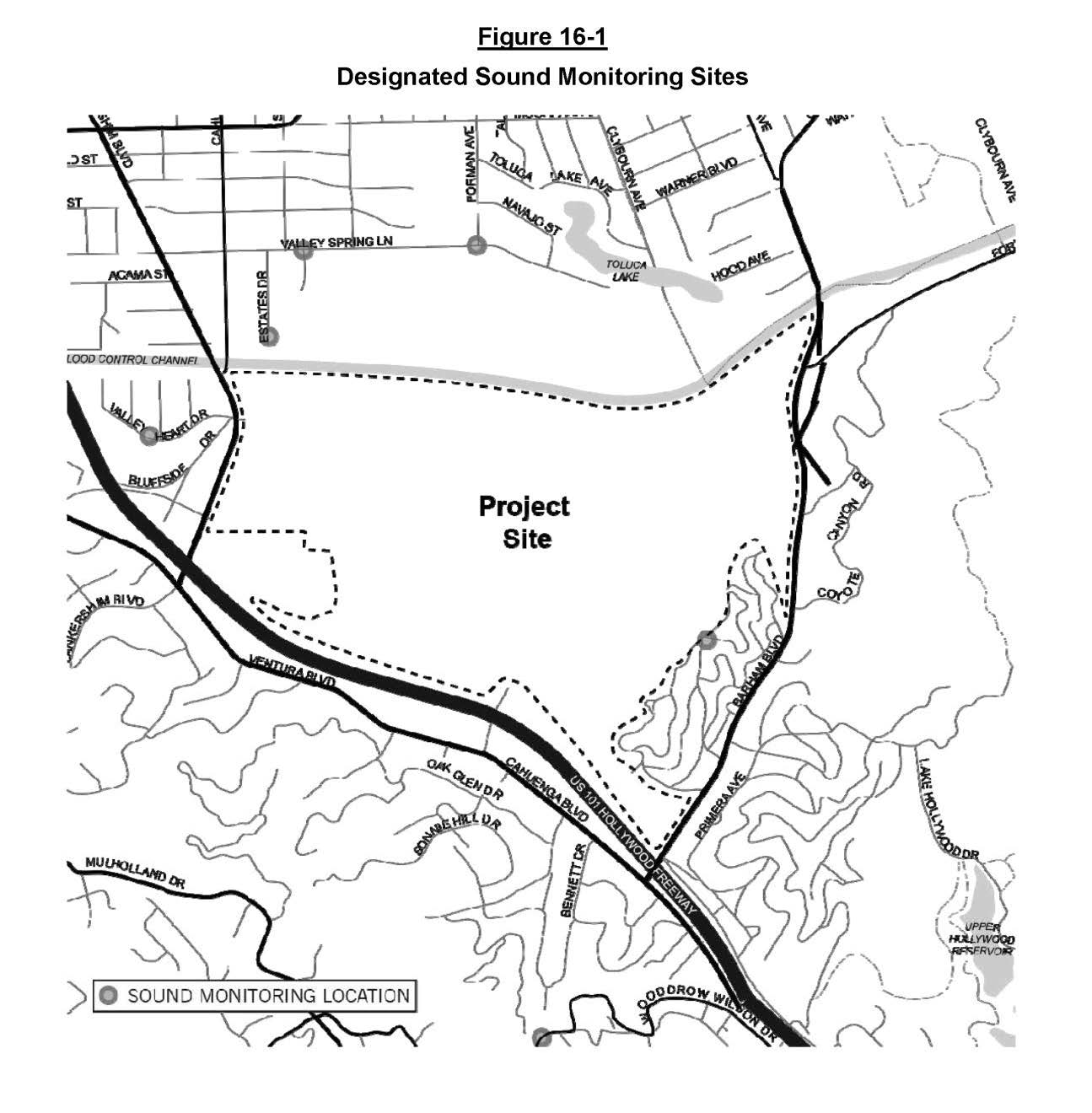
(Ord. 2022-0008 § 161, 2022.)
22.408.180 - Signage Regulations.
A.
General requirements.
1.
Purpose. The intent of the signage program in this Specific Plan is to create vibrant, clear, attractive signage and graphics that enhance the Universal Studios Specific Plan area while complementing and protecting the character of the surrounding neighborhoods by limiting visual clutter through regulation of the location, size, shape, density, and types of Signs allowed within the Universal Studios Specific Plan area.
2.
Permitted Signs. All Signs defined in Section 22.408.180.B, below, which are not otherwise allowed by the Zoning Code, shall be permitted, as set forth in this Specific Plan.
3.
Sign Review.
a.
Sign Conformance Review. New Signs, other than Internal Signs, shall require a Sign Conformance Review as set forth in this Subsection.
b.
The Sign Conformance Review procedure for applicable Signs is in lieu of the Substantial Conformance Review set forth in Section 22.408.210 of this Specific Plan.
c.
Internal Sign Review. New illuminated Internal Signs in Sign Districts 1, 2, 4, and 5 shall require an Internal Sign Review to verify that the Sign meets the definition and qualifies as an Internal Sign for location, height and orientation. No other review shall be required. A Sign determined not to qualify as an Internal Sign in Sign Districts 1, 2, 4, or 5 shall be subject to Sign Conformance Review.
4.
Compliance. All new Signs shall comply with the requirements of this Section, as determined by the Director pursuant to Section 22.408.180.D, below. All new Signs shall comply with the provisions of Title 26, Chapter 65 of the County Code, related to the construction and installation of Sign structures.
5.
Existing Signs. Signs and/or Sign support structures that lawfully exist on the effective date of this Specific Plan shall be permitted to continue and shall not be required to comply with this Specific Plan, but shall comply with the County Code related to the construction, installation and maintenance of Sign structures.
a.
In the event of any damage, dilapidation, destruction, or structural upgrade to an existing Sign, such existing Sign may be replaced with a Sign with comparable Height, Sign Area, location, type, and orientation existing as of the effective date of this Specific Plan; and
b.
Except as set forth in Section 22.408.180.C.6.d.vi and C.6.d.vii, below, additions or alterations of existing Signs which increase the Sign Area or Height or which materially change the location or orientation of the existing Sign shall comply with the requirements of this Specific Plan and shall be subject to Sign Review.
c.
Existing Sign Inventory. Upon submittal of the first Sign Conformance Review application for an Area Identification Sign, Electronic Message Sign, On-Site (Business) Sign and/or Group 'A' Wall Sign, the Applicant shall provide a baseline inventory of existing Area Identification Signs, Electronic Message Signs, On-Site (Business) Signs and/or Group 'A' Wall Signs that are not Internal Signs. The inventory shall include location, type, Height, and Sign Area. Inventory of such existing Signs permitted during the subject year shall be provided annually along with a copy of the baseline inventory of such existing Signs at the time of the Specific Plan annual report.
6.
Sign Area Calculation. Sign Area shall be calculated in accordance with the Sign Area definition set forth in Section 22.408.180.B, below.
7.
Backs of Signs. All Signs which are located within 500 feet of this Specific Plan boundary and which are oriented so as to expose the unimproved back of the Sign toward a location outside of the combined boundaries of the Universal Studios Specific Plan area and adjacent City [Q]C2 Area shall be improved or screened with landscaping or other aesthetic treatment(s) to buffer the view of the back of the Sign to the satisfaction of the Director.
8.
Internal Electronic Message Signs. Any Internal Sign that is an Electronic Message Sign shall be limited in orientation to the Specific Plan boundary as shown on Figures 17-1 and 17-2.
9.
Sign Illumination Standards. The following lighting and illumination standards shall apply to Signs within the Specific Plan area:
a.
Animated Area Identification Signs. (i) The light source (i.e. the bulb or lamp) illuminating an Animated Sign shall be shielded from view outside of the combined boundaries of the Specific Plan area and the adjacent City [Q]C2 Area; (ii) The lighting on the Sign shall be turned off from 2:00 a.m. to 7:00 a.m.
b.
Building Identification Signs. The brightness of any Building Identification Sign located at the top 10 percent of a Building Face shall not exceed the following:
•
During Standard Time
(1st Sunday in November to 2nd Sunday in March)
•
7:00 a.m. to 7:30 p.m.: 300 Candelas/meter sq.
•
7:30 p.m. to 7:00 a.m.: 150 Candelas/meter sq.
•
During Daylight Savings Time
(2nd Sunday in March to 1st Sunday in November)
•
7:00 a.m. to 10:00 p.m.: 300 Candelas/meter sq.
•
10:00 p.m. to 7:00 a.m.: 150 Candelas/meter sq.
c.
Group 'A' Wall Signs. (i) Group 'A' Wall Signs shall be externally lit with light sources (i.e. the bulb or lamp) shielded from view outside of the combined boundaries of the Specific Plan area and the adjacent City [Q]C2 Area; (ii) The brightness of any Group 'A' Wall Sign shall not exceed 300 Candelas per square meter; (iii) Illumination of Group 'A' Wall Signs shall be turned off from 2:00 a.m. to 7:00 a.m.
d.
Electronic Message Signs. (i) Instantaneous image changes shall not be allowed; (ii) The image refresh shall occur through a seamless transition from one image to the next with no strobing effect; (iii) The brightness of the Electronic Message Sign shall not exceed the following:
•
During Standard Time
(1st Sunday in November to 2nd Sunday in March)
•
7:00 a.m. to sunset: 7,500 Candelas/meter sq.
•
Sunset to 7:30 p.m.: 600 Candelas/meter sq.
•
7:30 p.m. to 2:00 a.m.: 450 Candelas/meter sq.
•
2:00 a.m. to 7:00 a.m.: Turned off
•
During Daylight Savings Time
(2nd Sunday in March to 1st Sunday in November)
•
7:00 a.m. to sunset: 7,500 Candelas/meter sq.
•
Sunset to 10:00 p.m.: 600 Candelas/meter sq.
•
10:00 p.m. to 2:00 a.m.: 450 Candelas/meter sq.
•
2:00 a.m. to 7:00 a.m.: Turned off
Beginning 45 minutes prior to sunset and concluding 45 minutes after sunset, the Electronic Message Signs shall transition smoothly at a consistent rate from the permitted daytime brightness level to the permitted brightness level during the Sunset to 7:30 p.m. or Sunset to 10:00 p.m. period as applicable. Beginning 15 minutes prior to the required time, the Electronic Message Sign shall also transition smoothly at a consistent rate from the permitted brightness for the Sunset to 7:30 p.m. or Sunset to 10:00 p.m. period to the 7:30 p.m. to 2:00 a.m. or 10:00 p.m. to 2:00 a.m. period as applicable.
e.
Measurement of Brightness. The brightness of Electronic Message Signs, Group 'A' Wall Signs and Building Identification Signs shall be measured from ground level at the nearest residential property outside of the combined boundaries of the Universal Studios Specific Plan area and the City [Q]C2 Area. The measured maximum brightness shall be based on the luminance levels of the white display portion of the Sign. For Electronic Message Signs, the red, green and blue outputs shall be turned to full ON at the time of testing. A calibrated luminance meter shall be used to measure the luminance intensity of the Sign in Candela per meter squared (nits) in accordance with the luminance meter manufacturer's operational instructions. The luminance measurements should not be taken at oblique angles that exceed 60 degrees off-axis from the face of the Sign.
f.
Sign Illumination Limitations. Illuminated Signs shall not generate light intensity levels of greater than two footcandles as measured at the property line of the nearest residentially zoned property outside the combined boundaries of the Universal Studios Specific Plan area and the City [Q]C2 Area, and illuminated Signs shall not cumulatively generate light intensity levels of greater than three footcandles as measured at the property line of the nearest residentially zoned property outside of the combined boundaries of the Universal Studios Specific Plan area and the City [Q]C2 Area. A calibrated illuminance meter shall be used to measure the maximum incident illuminance resultant from the illuminated Sign in footcandles, in accordance with the illuminance meter manufacturer's operational instructions. The meter shall be mounted to a tripod at eye level, and aimed at the Sign. A measurement shall be taken with the Sign turned on, and again with the Sign turned off. The difference of the two measurements shall be considered the resultant illuminance generated by the Sign.
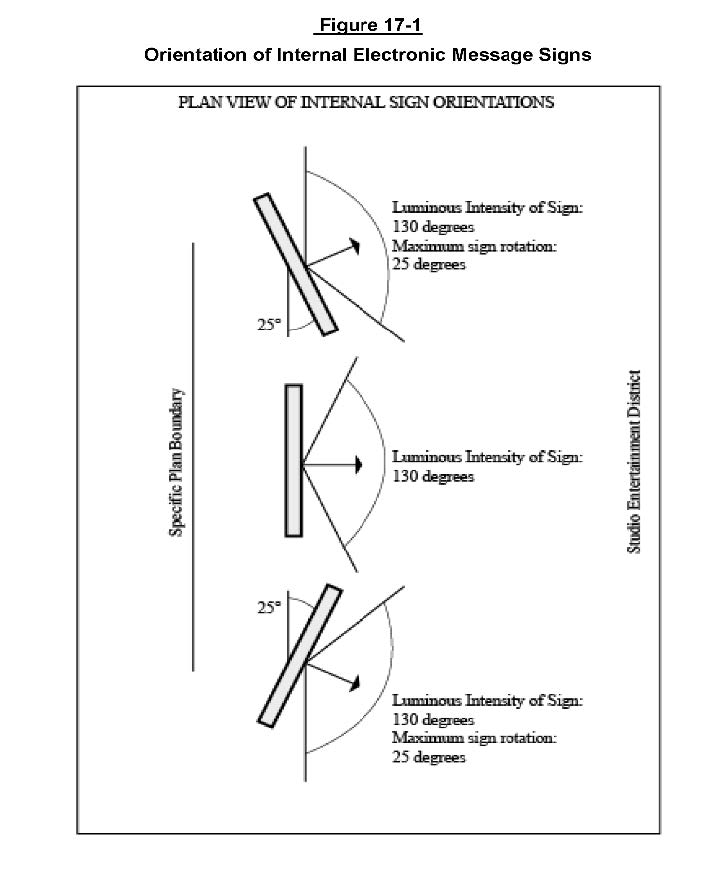
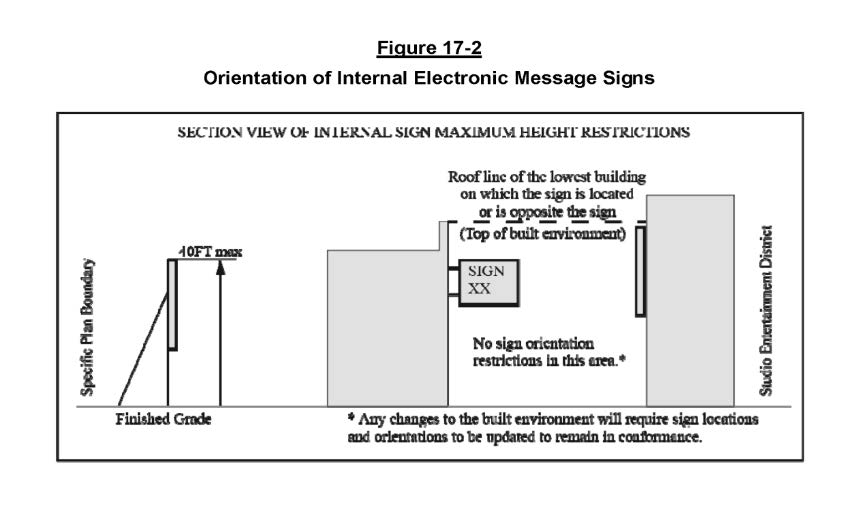
B.
Definitions. Whenever the following terms are used in this Specific Plan, they shall be construed as defined in this Subsection. To the extent that other terms used in this Section are not defined herein or in Section 22.408.050 of this Specific Plan, but are defined in the Zoning Code, those definitions shall apply.
Aerial View Sign. A type of Sign that is applied or placed upon the roof surface, approximately parallel with the roof plane, intended to be viewed from the sky.
Animated Sign. A Sign that contains parts that change, move, rotate or otherwise incorporate physical motion that is not an Electronic Message Sign.
Architectural Ledge Sign. A Sign with individual channel letters, numbers, symbols or icons, which stand atop a horizontal projection forming a narrow shelf on a wall or architectural projection.
Area Identification Sign. A category of Sign intended to identify an area by the common place name of the area or business.
Awning Sign. A Sign affixed to an awning or removable canopy not permanently attached to or built as part of a building or structure that projects over a deck, door, or window of a building or structure.
Banner Sign. (See also Street Banner Sign) A Sign that is generally constructed of fabric, canvas, metal or similar material and that is attached to a pole, building, or hung by wire, and is fixed in place.
Blade Sign. A Sign that projects perpendicularly from a Building Face, not exceeding five (5) feet in width, which has a vertical dimension that exceeds the horizontal dimension and may or may not extend above a roof line.
Building Face. The general outer surface, not including cornices, bay windows, or architectural projections, of any wall of a building.
Building Identification Sign. A category of Sign that is limited to a company logo, name of building, business, or destination that may include the building address.
Channel Letters Sign. Multi-dimensional, individually cut letters, numbers, or figures, illuminated or un-illuminated, which are affixed to a building or structure.
Construction/Contractor Sign. A category of Sign located on the site of a building that states the name of the contractor(s) working on the site and any owners, building-related architectural, engineering, financial firms, future tenants, and others associated with a construction project, but which contains no other advertising matter.
Construction Fence/Wall Sign. A type of Construction/Contractor Sign located on a fence or wall securing a construction site. Signs shall be limited to the names of the developer, building owner and contractor(s) working on the site and any building-related architectural, engineering or financial firms involved with the building on that site and may include a Graphic Treatment.
Electronic Message Sign. A Sign that displays still images, scrolling images, or moving images, including video and animation, utilizing a series or grid of lights that may be changed by electronic means, including cathode ray, light emitting diode display (LED), plasma screen, liquid crystal display (LCD), fiber optic, or other electronic media or technology.
Exempt Sign. The following are exempt from Sign Review:
a.
Regulatory signs, information signs or warning signs required or authorized by law or by federal, State, or County authority;
b.
Official and legal notices issued by any court, public body, person, or officer in performance of a public duty or in giving any legal notice;
c.
Official flags of the United States of America, the State of California, and other states of the United States, counties, municipalities, official flags of foreign countries, and flags of internationally and nationally recognized organizations; and
d.
Internal Signs. Internal Signs in Sign District 3 and Internal Signs that are not illuminated shall be exempt from Sign Review.
e.
Graphic Treatments are not Signs and are permitted and not regulated by this Section.
Free-standing Sign. A Sign that is placed on the ground or has as its primary structural support one or more columns, poles, uprights or braces in or upon the ground. Free-standing Signs includes Monument and Pole Signs.
Graphic Treatment. An image or pattern which is applied to a fence, wall or structure and does not constitute a Sign. A Graphic Treatment may function as a screening device. Thematic Elements may be combined with Graphic Treatments.
Inflatable Sign. An object that is inflated with cold air, hot air, helium, or a lighter-than-air substance. It may be of various shapes, made of flexible fabric, and may be equipped with a portable blower motor that provides a constant flow of air into the device. Inflatable Signs are restrained, attached, or held in place by a cord rope, cable, or similar method. Inflatable Signs shall be limited to Internal Signs.
Information Sign (Directional Sign). A category of Sign that is limited to a message giving directions, instructions, menus, selections, or address numerals. Information Signs are often referred to as "directional signs."
Internal Sign. A category of Sign that includes:
a.
Signs that are below 40 feet in Height above Finished Grade located in the Lankershim Edge and Northern Edge Sign Districts provided the Signs directly face the Studio District; or
b.
Signs that are below rooflines if within CityWalk or below 40 feet Height above Finished Grade if within other areas of the Studio and Entertainment Sign District; or
c.
Signs that are below 40 feet in Height above Finished Grade located in the Visitor Gateway Sign District provided the Signs directly face the Entertainment District; or
d.
Signs that are below 40 feet in Height above Finished Grade located in the Studio Back Lot Sign District provided the Signs directly face the Entertainment District or Studio District; and
e.
Internal Signs may be On-site or Off-site Signs and consist of any other Sign category (e.g. Area Identification) or Sign type (e.g. Wall Sign).
Internal Sign Review. A ministerial process conducted by the Director to determine that a Sign qualifies as an Internal Sign as defined in this Subsection.
Marquee Sign. A type of Sign painted on or affixed to the perimeter or border of a permanently roofed structure constructed as part of a building and protruding over the sidewalk, plaza or roadway.
Monument Sign. A Free-standing Sign that is erected directly upon the existing or Finished Grade, or that is raised no more than 12 inches from the existing or Finished Grade to the bottom of the sign, and that has a horizontal dimension equal to or greater than its vertical dimension.
Off-site Sign (Outdoor Advertising Sign). A category of Sign that is other than an On-Site (Business) Sign, Area Identification Sign, Building Identification Sign, Information Sign, Tenant Identification Sign, Construction/Contractor Sign, or Real Estate Sign. Off-site does not refer to the physical location of the Sign.
On-site (Business) Sign. A category of Sign that identifies or promotes (1) media and entertainment industry products of NBC Universal or its affiliates, (2) products related to the media and entertainment industry that are produced, distributed, or sold within the combined boundaries of the Universal Studios Specific Plan area and the adjacent City [Q]C2 Area, not including products solely displayed in commercials produced therein, (3) media and entertainment industry businesses, services, activities, or events located or conducted within the combined boundaries of the Universal Studios Specific Plan area and the adjacent City [Q]C2 Area, and (4) businesses, services, activities or events conducted or located on a lot in which the Sign is located. On-Site (Business) Signs may take the form of the Sign types listed in the Sign definitions as allowed by the Sign District.
Pillar (Pylon) Sign. A type of Monument Sign that is mounted directly on the ground, consisting of rectangular sign faces or a sculptural themed shape, with a vertical dimension that exceeds its horizontal dimension.
Pole Sign. A Free-standing Sign that is erected or affixed to one or more poles or posts and that does not meet the requirements of a Monument Sign.
Projected Image Sign. A still image projected on the face of a wall from a distant electronic device, such that the image does not originate from the plane of the wall.
Projecting Sign. A Sign, other than a Wall Sign, that is affixed to and wholly supported by an exterior wall of a building or structure and projects outward and/or upward there from with one or more sign faces, other than a Wall Sign.
Real Estate Sign. A category of Sign indicating that a property, building, or any portion thereof is available for inspection, sale, lease, or rent.
Roof Sign. A Sign erected upon or above and wholly supported by a roof or parapet of a building or structure.
Sign. Any display board, wall, screen, projected image, object or part thereof, or any other material or medium used to announce, declare, demonstrate, display or otherwise present a message and attract the attention of the public outdoors.
Sign Area. An area circumscribed by the smallest geometric shape created with a maximum of eight straight lines, which enclose all words, letters, figures, symbols, designs, and pictures, together with framing, background material, colored or illuminated areas and attention-attracting devices forming an integral part of an individual message except that:
a.
Wall Signs having no discernible boundary shall have areas between the letters and/or words intended to be read together and device intended to draw attention to the sign message included in any computation of Sign Area;
b.
For spherical, cylindrical, or other three-dimensional Signs, the Sign Area shall be computed from the two-dimensional geographical shape or shapes that will best approximate the greatest actual surface area visible from any one direction;
c.
Sign support structures are excluded if neutral in color; and
d.
"Time and temperature" sign copy is excluded from computation of Sign Area if such copy is less than 56 square feet in area. An explanatory graphic "Calculating Sign Area" is provided below.
EXPLANATORY GRAPHIC
Calculating Sign Area

Sign Area: An area circumscribed by the smallest geometric shape created with a maximum of eight straight lines which enclose all words, letters, figures, symbols, designs and pictures, together with framing, background material, colored or illuminated areas and attention-attracting devices forming an integral part of an individual message.
Sign Conformance Review. A ministerial process to determine compliance of a Sign with all applicable provisions of this Section, as issued by the Director pursuant to Section 22.408.180.D, below.
Street Banner Sign—Private. An On-Site Banner Sign that is generally constructed of fabric, canvas, metal or similar material and that is attached to a street light fixture or other such fixture on a Private Street.
Temporary Sign. Any Sign that is to be maintained for a limited duration, not to exceed 60 days in duration, and not to exceed a total of 90 days per year on a single Building Face, and which is not permanently affixed to the ground, or a building or structure. Temporary Signs include Inflatable Signs, but shall not include Electronic Message Signs, or Group 'A' Wall Signs.
Tenant Identification Sign. A category of Sign that is limited to a company logo or the name of a business used to identify the tenant(s) or establishment located on the same lot or premises.
Wall Mural. A painted or digitally produced image generally large in scale that is incorporated onto the wall and/or parapet of a building or a structure and does not constitute a Sign.
Wall Sign. A Sign, other than a Roof Sign, that is attached to, painted on or erected against the wall and/or parapet of a building or a structure, with the exposed face of the Sign on a plane approximately parallel to the plane of the wall. Group 'A' Wall Signs are all Walls Signs greater than 1,000 square feet in Sign Area. Group 'B' Wall Signs are all Wall Signs 1,000 square feet or less in Sign Area. Group 'A' Wall Signs may consist of an image, with or without written text, which is applied to and architecturally and compositionally integrated with a wall. The Group 'A' Wall Sign may be printed on vinyl, mesh, window film, or other material supported and attached to a wall or window by an adhesive and/or by using stranded cable and eye-bolts and/or other materials or methods provided the Sign is architecturally and compositionally integrated with the wall.
Window Sign. A Sign, other than a Group 'A' Wall Sign, that is attached to, affixed to, leaning against, or otherwise placed inside of a building within six feet of any window or door in such a manner that it is visible from outside the building, but not including the display of merchandise in store windows.
C.
Sign Districts.
1.
Sign Districts. There shall be five Sign Districts in the Universal Studios Specific Plan area as shown on Exhibit 9-A as of the effective date of this Specific Plan and as shown on Exhibit 9-B as of the effective date of the annexation and detachment actions should those actions be approved. The Director may modify Exhibit 9-B consistent with the Local Agency Formation Commission's action pursuant to Section 22.408.220 of this Specific Plan.
a.
Sign District 1 — Lankershim Edge Sign District.
b.
Sign District 2 — Northern Edge Sign District.
c.
Sign District 3 — Studio and Entertainment Sign District.
d.
Sign District 4 — Visitor Gateway Sign District.
e.
Sign District 5 — Studio Back Lot Sign District.
2.
Permitted and Prohibited Signs by Sign District. Table 17-1 summarizes the Sign categories and Sign Type allowed in each Sign District.
3.
Wall Murals. Wall Murals, which do not constitute a Sign, shall be permitted in Sign District 3. Wall Murals shall be prohibited in Sign Districts 1, 2, 4, and 5.
4.
Graphic Treatments. Graphic Treatments, which do not constitute a Sign, shall be permitted generally within Sign District 3, shall be permitted in Sign Districts 1, 2, 4, and 5 only as a screening device, and in Sign District 1 shall not be on building façades facing Lankershim Boulevard.
5.
Overall Specific Plan Limitations. The following is a summary of the On-Site (Business) Signs permitted by Section 22.408.180.C.6 to C.10, below.
a.
A maximum of 36 new On-Site (Business) Signs shall be permitted within the entire Universal Studios Specific Plan area including a maximum of: 10 new On-Site (Business) Signs within the Lankershim Edge Sign District, 17 new On-Site (Business) Signs within the Studio and Entertainment Sign District, 22 new On-Site (Business) Signs within the Visitor Gateway Sign District, and no On-Site (Business) Signs in the Northern Edge and Studio Back Lot Sign Districts.
b.
Of the 36 On-Site (Business) Signs permitted in the Universal Studios Specific Plan area, a maximum of one new Electronic Message Sign shall be permitted within the entire Specific Plan area with such Electronic Message Sign located within the Studio and Entertainment Sign District, and no new Electronic Message Signs in the Lankershim Edge, Northern Edge, Visitor Gateway and Studio Back Lot Sign Districts.
c.
Of the 36 On-Site (Business) Signs permitted in the Universal Studios Specific Plan area, a maximum of three new Group 'A' Wall Signs shall be permitted within the entire Specific Plan with all three Group 'A' Wall Signs located within the Studio and Entertainment Sign District, and no Group 'A' Wall Signs in the Lankershim Edge, Northern Edge, Visitor Gateway and Studio Back Lot Sign Districts.
d.
One existing On-Site Pole Sign located in the Lankershim Edge Sign District may be relocated as set forth in Section 22.408.180.C.6.d.vi, below.
e.
One existing Area Identification Sign (with an On-Site Electronic Message Sign component) located in the Lankershim Edge Sign District may be replaced as set forth on Section 22.408.180.C.6.d.vii, below.
6.
Sign District 1 — Lankershim Edge Sign District.
a.
Permitted Sign Categories: The following categories of Signs are permitted within the Lankershim Edge Sign District:
i.
Internal Signs
ii.
Area Identification Signs
iii.
Building Identification Signs
iv.
Tenant Identification Signs
v.
On-Site (Business) Signs
vi.
Information (Directional) Signs
vii.
Temporary Signs
viii.
Construction Signs
ix.
Real Estate Signs
b.
Permitted Sign Types: Any Sign, whether or not listed herein, is permitted as an Internal Sign within the Lankershim Edge Sign District. For all other Sign categories identified in Section 22.408.180.C.6.a.ii—ix, above, the following types of Signs are permitted within the Lankershim Edge Sign District:
i.
Animated Signs
ii.
Architectural Ledge Signs
iii.
Awning Signs
iv.
Banner Signs
v.
Blade Signs
vi.
Channel Letters Signs
vii.
Construction Fence/Wall Signs
viii.
Electronic Message Signs (limited to one replacement Sign)
ix.
Monument Signs
x.
Pillar (Pylon) Signs
xi.
Pole Signs (limited to Information Signs)
xii.
Projecting Signs
xiii.
Street Banner Signs—Private
xiv.
Wall Signs (limited to Group 'B' Wall Signs)
xv.
Window Signs
c.
Prohibited Signs. The following types of Signs are prohibited within the Lankershim Edge Sign District:
i.
Aerial View Signs
ii.
Off-Site Signs, other than Internal Signs
iii.
Group 'A' Wall Signs
iv.
Signs that emit audio sounds
d.
District Provisions for the Lankershim Edge Sign District:
i.
General Provisions. (i) Area Identification Signs, Building Identification Signs and Tenant Identification Signs shall be limited to Architectural Ledge, Channel Letters, Monument, Pillar, Projecting, Wall, or Window Signs; (ii) Any Wall Signs shall be limited to Group 'B' Wall Signs.
ii.
Internal Signs. (i) There shall be no limitation on the number or total Sign Area of Internal Signs; (ii) Signs shall not exceed 40 feet in Height above Finished Grade.
iii.
Area Identification Signs: (i) A maximum of three new Area Identification Signs shall be permitted within the Lankershim Edge Sign District and a maximum of five new Area Identification Signs shall be permitted in the Universal Studios Specific Plan area; (ii) Individual Area Identification Signs shall not exceed 500 square feet in Sign Area; (iii) Area Identification Signs shall be located below the edge of the highest roof, parapet or similar architectural feature of the building if affixed to a building; (iv) Area Identification Signs shall not exceed 100 feet in Height above Finished Grade if Free-standing, and shall not exceed the applicable Height Zone; (v) Area Identification Signs may be Animated Signs subject to the additional limitations in Subsection (xiii), below.
iv.
Building Identification Signs: (i) A maximum of one Building Identification Sign per Building Face and a maximum of four Building Identification Signs per building shall be permitted; (ii) Individual Building Identification Signs shall not exceed 500 square feet in Sign Area; (iii) Building Identification Signs shall not exceed 75 feet in Height above Finished Grade if affixed to a building; (iv) Building Identification Signs shall not exceed 40 feet in Height above Finished Grade if Free-standing, and shall not exceed the applicable Height Zone; and (v) Building Identification Signs shall comply with the Sign illumination standards in Section 22.408.180.A.9, above.
v.
Tenant Identification Signs: (i) A maximum of one Tenant Identification Sign per tenant space shall be permitted; (ii) Individual Tenant Identification Signs shall not exceed a Sign Area equal to three square feet per lineal foot of commercial tenant frontage when affixed to a building or 25 square feet maximum if Free-standing; (iii) Tenant Identification Signs shall be located below the edge of the highest roof, parapet or similar architectural feature of the building if affixed to a building; (iv) Tenant Identification Signs shall not exceed 40 feet above Finished Grade if Free-standing, and shall not exceed the applicable Height Zone.
vi.
On-Site (Business) Signs—General: (i) A maximum of 10 new On-Site (Business) Signs shall be permitted within the Lankershim Edge Sign District; (ii) New individual On-Site (Business) Signs shall not exceed 600 square feet in Sign Area; (iii) On-Site (Business) Signs facing north and west shall not exceed 40 feet in Height above Finished Grade; (iv) new On-Site (Business) Signs may take the form of Banner Signs, Blade Signs, and Group 'B' Wall Signs; (v) new On-Site (Business) Signs shall not be Pole Signs or Free-standing Signs; (vi) The existing On-Site (Business) Free-standing Sign located adjacent to Muddy Waters Drive may be relocated southeastwardly to accommodate improvements to Muddy Waters Drive; (vii) On the existing Jules Stein (Bldg. No. 1360) and John Ford (Bldg. No. 1320) Buildings at the locations shown on Figure 17-3, west-facing Group 'B' Wall Signs shall be prohibited from facing the Campo de Cahuenga and a maximum of two west-facing Group 'B' Wall Signs facing the Campo de Cahuenga shall be permitted at the locations shown on Figure 17-3; (viii) the limitations in Section 22.408.180.C.6.d.vi(vii), above, shall only apply to the existing Jules Stein and John Ford Buildings.
vii.
Replacement Area Identification Sign/On-site Electronic Message Sign: (i) The existing Area Identification Sign that contains a double sided Electronic Message Sign located in the median of Universal Hollywood Drive at the intersection with Lankershim Boulevard may be replaced with a re-designed Area Identification Sign/On-Site double sided Electronic Message Sign; (iii) The Area Identification Sign shall not exceed 500 square feet in Sign Area and the double sided Electronic Message Sign shall not exceed 1,000 square feet in Sign Area per face; (iv) The Thematic Element of the Area Identification Sign shall not exceed 60 feet in Height and the Electronic Message Sign portion of the Sign shall not exceed 30 feet in Height above Finished Grade; (v) The replacement Area Identification/On-Site double sided Electronic Message Sign shall be located in substantially the same location as the existing Area Identification Sign/Electronic Message Sign near the intersection of Lankershim Boulevard and Universal Hollywood Drive; (vi) The Sign shall comply with the Sign illumination standards in Section 22.408.180.A.9, above.
viii.
Information Signs: (i) There shall be no limitation on the number of Information Signs; (ii) Individual Information Signs shall not exceed 25 square feet in Sign Area; (iii) Information Signs shall not exceed the maximum Height permitted within the applicable exceed Height Zone.
ix.
Temporary Signs: (i) There shall be no more than a maximum of two Temporary Signs at any one time in the Lankershim Edge Sign District; (ii) Individual Temporary Signs shall not exceed 125 square feet in Sign Area; (iii) Temporary Signs shall not exceed the maximum Height permitted within the applicable Height Zone.
x.
Construction/Contractor Signs: (i) A maximum of one Construction/Contractor Sign per Building Face and a total of two Construction/ Contractor Signs per building under construction shall be permitted; (ii) Individual Construction/Contractor Signs shall not exceed 500 square feet in Sign Area; (iii) Construction/Contractor Signs shall not exceed the Height of the building; (iv) Animated and Electronic Message Signs are prohibited; (v) Construction/Contractor Signs shall be limited to the names of the building developer, building owner and contractor(s) working on the building and any building-related architectural, engineering or financial firms involved with the building on the site.
xi.
Real Estate Signs: (i) A maximum of one Real Estate Sign per Building Face and a maximum of four Real Estate Signs per building shall be permitted, however, multiple listings may be shown on one Real Estate Sign; (ii) Individual Real Estate Signs shall not exceed 500 square feet in Sign Area; (iii) Real Estate Signs shall not exceed the Height of the building; (iv) Real Estate Signs shall be limited to the sales, lease or rent of building(s) and unit(s) or directing people to the building.
xii.
Street Banners—Private: (i) A maximum of two double-sided Street Banners—Private Signs per private street light fixture shall be permitted; (ii) Individual Street Banners—Private Signs shall not exceed 24 square feet in Sign Area; (iii) Street Banners—Private Signs shall not obstruct traffic signals or warning devices in compliance with State and County Codes; (iv) Street Banners—Private Signs shall not be allowed along Lankershim Boulevard where County jurisdiction applies, but are otherwise allowed on other roadways within the Lankershim Edge Sign District.
xiii.
Additional Limitations on Animated Signs: (i) Animated Signs may contain parts that change, move, or rotate provided the Animated Sign is limited to physical rotation motion not to exceed six revolutions per minute; (ii) The rotating portion of any Animated Sign shall not be an Electronic Message Sign; (iii) Animated Signs shall comply with the Sign illumination standards in Section 22.408.180.A.9, above.
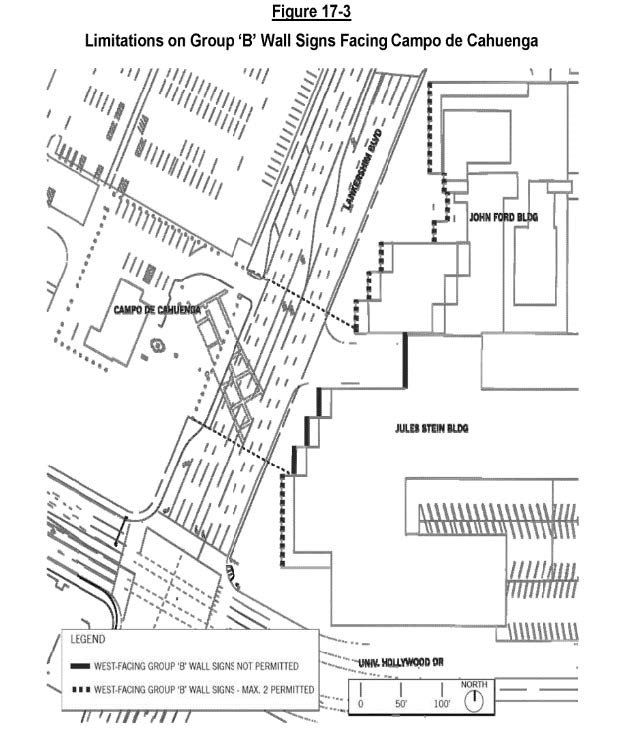
7.
Sign District 2 — Northern Edge Sign District.
a.
Permitted Sign Categories: The following categories of Signs are permitted within the Northern Edge Sign District:
i.
Internal Signs
ii.
Building Identification Signs
iii.
Information (Directional) Signs
b.
Permitted Sign Types: Any Sign, whether or not listed herein, is permitted as an Internal Sign within the Northern Edge Sign District. For all other Sign categories identified in Section 22.408.180.C.7.a.ii—iii, above, the following types of Signs are permitted within the Northern Edge Sign District:
i.
Architectural Ledge Signs
ii.
Awning Signs
iii.
Blade Signs
iv.
Channel Letters Signs
v.
Monument Signs
vi.
Pillar (Pylon) Signs
vii.
Pole Signs (limited to Information Signs)
viii.
Projecting Signs
ix.
Wall Signs (limited to Group 'B' Wall Signs)
x.
Window Signs
c.
Prohibited Signs. The following Sign Types are prohibited in the Northern Edge Sign District:
i.
Aerial View Signs
ii.
Animated Signs, other than Internal Signs
iii.
Off-Site Signs, other than Internal Signs
iv.
Electronic Message Signs, other than Internal Signs
v.
Group 'A' Wall Signs, other than Internal Signs
vi.
Signs that emit audio sounds
vii.
Temporary Signs, other than Internal Signs
d.
District Provisions for the Northern Edge Sign District:
i.
General Provisions. (i) Building Identification Signs shall be limited to Architectural Ledge, Channel Letters, Monument, Pillar, Projecting, Wall, or Window Signs; (ii) Any Wall Signs shall be limited to Group 'B' Wall Signs.
ii.
Internal Signs: (i) There shall be no limitation on the number or total Sign Area of Internal Signs; (ii) Internal Signs shall not exceed 40 feet in Height above Finished Grade.
iii.
Building Identification Signs: (i) A maximum of one Building Identification Sign per Building Face and a maximum of four Building Identification Signs per building shall be permitted; (ii) Individual Building Identification Signs shall not exceed 500 square feet in Sign Area; (iii) Except for Building Identification Signs facing north, Building Identification Signs shall be located below the edge of the highest roof, parapet or similar architectural feature of the building if attached to a building; (iv) Except for Building Identification Signs facing north, Building Identification Signs shall not exceed 40 feet in Height above Finished Grade if Free-standing, and shall not exceed the applicable Height Zone; (v) Building Identification Signs facing north shall be limited to 20 feet in Height above Finished Grade and shall not be internally lit; (vi) Except for Building Identification Signs facing north, Building Identification Signs shall comply with the Sign illumination standards in Section 22.408.180.A.9, above.
iv.
Information Signs: (i) There shall be no limitation on the number of Information Signs; (ii) Individual Information Signs shall not exceed 25 square feet in Sign Area; (iii) Except for Information Signs facing north, Information Signs shall not exceed the maximum Height permitted within the applicable Height Zone; (iv) Information Signs facing north shall be limited to 20 feet in Height above Finished Grade and shall not be internally lit.
8.
Sign District 3 — Studio and Entertainment Sign District.
a.
Permitted Sign Categories: The following categories of Signs are permitted within the Studio and Entertainment Sign District:
i.
Internal Signs
ii.
Area Identification Signs
iii.
Building Identification Signs
iv.
Tenant Identification Signs
v.
On-Site (Business) Signs
vi.
Information (Directional) Signs
vii.
Temporary Signs
viii.
Construction Signs
ix.
Real Estate Signs
b.
Permitted Sign Types: Any Sign, whether or not listed herein, is permitted as an Internal Sign within the Studio and Entertainment Sign District. For all other Sign categories identified in Section 22.408.180.C.8.a.ii—ix, above, the following types of Signs are permitted within the Studio and Entertainment Sign District:
i.
Aerial View Signs
ii.
Animated Signs
iii.
Architectural Ledge Signs
iv.
Awning Signs
v.
Banner Signs
vi.
Blade Signs
vii.
Channel Letters Signs
viii.
Construction Fence/Wall Signs
ix.
Electronic Message Signs
x.
Marquee Signs
xi.
Monument Signs
xii.
Pillar (Pylon) Signs
xiii.
Pole Signs
xiv.
Projecting Signs
xv.
Street Banners—Private
xvi.
Wall Signs (Group 'A' and Group 'B')
xvii.
Window Signs
c.
Prohibited Signs. The following types of Signs are prohibited in the Studio and Entertainment Sign District:
i.
Off-Site Signs, other than Internal Signs.
ii.
Signs that emit audio sounds, other than Internal Signs subject to Section 22.408.170 of this Specific Plan.
d.
District Provisions for the Studio and Entertainment Sign District:
i.
General Provisions. Area Identification Signs, Building Identification Signs and Tenant Identification Signs shall be limited to Aerial View, Architectural Ledge, Channel Letters, Monument, Pillar, Projecting, Wall or Window Signs.
ii.
Internal Signs. (i) There shall be no limitation on the number or total Sign Area of Internal Signs; (ii) Internal Signs shall not exceed 40 feet in Height above Finished Grade or shall be below rooflines if within CityWalk.
iii.
Area Identification Signs: (i) A maximum of two Area Identification Signs shall be permitted within the Studio and Entertainment Sign District and a maximum of five Area Identification Signs shall be permitted in the entire Specific Plan area; (ii) Individual Area Identification Signs shall not exceed 500 square feet in Sign Area except for Aerial View Area Identification Signs; (iii) Area Identification Signs shall be located below the highest roof, parapet or similar architectural feature of a building if affixed to a building; (iv) Area Identification Signs shall not exceed 55 feet in Height above Finished Grade if Free-standing, and shall not exceed the applicable Height Zone; (v) Aerial View Area Identification Signs shall be limited to Sign District 3 within the Studio and Business Districts as shown on Exhibit 2-A as of the effective date of this Specific Plan, and as shown on Exhibit 2-B as of the effective date of the annexation and detachment actions should those actions be approved; (vi) Aerial View Area Identification Signs shall be limited to 50 percent of the flat roof area of the building on which it is located; (vii) Area Identification Signs may be Animated Signs subject to the additional limitations in Section 22.408.180.C.8.d(xiii), below; (viii) One Area Identification Sign may be combined with a double sided Electronic Message Sign in the configuration, Sign Area, Height and location as shown on Exhibit 9-C with the combined Sign counting as one Area Identification Sign and one Electronic Message Sign.
iv.
Building Identification Signs: (i) A maximum of one Building Identification Sign per Building Face and a maximum of four Building Identification Signs per building shall be permitted; (ii) Individual Building Identification Signs shall not exceed 500 square feet in Sign Area; (iii) Building Identification Signs shall be located below the highest roof, parapet or similar architectural feature of a building if affixed to a building; (iv) Building Identification Signs shall not exceed 40 feet in Height above Finished Grade if Free-standing, and shall not exceed the applicable Height Zone; (v) Building Identification Signs shall comply with the Sign illumination standards in Section 22.408.180.A.9, above.
v.
Tenant Identification Signs: (i) A maximum of one Tenant Identification Sign per tenant space shall be permitted; (ii) Individual Tenant Identification Signs shall not exceed a Sign Area equal to three square feet per lineal foot of commercial tenant frontage when affixed to building or 25 square feet maximum if Free-standing; (iii) Tenant Identification Signs shall be located below the highest roof, parapet or similar architectural feature of a building if affixed to a building; (iv) Tenant Identification Signs shall not exceed 40 feet in Height above Finished Grade if Free-standing, and shall not exceed the applicable Height Zone.
vi.
On-Site (Business) Signs—General: (i) A maximum of 17 new On-Site (Business) Signs shall be permitted within the Studio and Entertainment Sign District; (ii) Except as provided in Section 22.408.180.C.8.d(viii), below, individual On-Site (Business) Signs shall not exceed 1,000 square feet in Sign Area; (iii) On-Site (Business) Signs shall be located below the highest roof, parapet or similar architectural feature of a building if affixed to a building; (iv) On-Site (Business) Signs shall not exceed 40 feet in Height above Finished Grade if Free-standing; (v) Additional limitations on Electronic Message and Group 'A' Wall Signs are contained in Section 22.408.180.C.8.d(vii) and (viii), below.
vii.
On-Site (Business)—Electronic Message Sign: (i) Of the 17 new On-Site (Business) Signs permitted in the Studio and Entertainment Sign District, a maximum of one new double sided Electronic Message Sign shall be permitted within the Studio and Entertainment Sign District; (ii) The Electronic Message Sign may be double sided and shall not exceed 1,000 square feet in Sign Area per face; (iii) The Electronic Message Sign may be combined with one Area Identification Sign and located in the area shown on Exhibit 9-C with the combined Sign counting as one Area Identification Sign and one Electronic Message Sign; (iv) The Electronic Message Sign shall not exceed 30 feet in Height above Finished Grade; (v) The Electronic Message Sign shall not be more than incidentally visible from Existing Off-Site Residential Uses; (vi) The Electronic Message Sign shall comply with the Sign illumination standards in Section 22.408.180.A.9, above.
viii.
On-Site (Business)—Group 'A' Wall Signs : (i) Of the 17 new On-Site (Business) Signs permitted in the Studio and Entertainment Sign District, a maximum of three new Group 'A' Wall Signs shall be permitted within the Studio and Entertainment Sign District; (ii) Individual Group 'A' Wall Signs shall not be limited in Sign Area, however, the total combined Sign Area for all three Group 'A' Wall Signs shall not exceed 9,000 square feet; (iii) Group 'A' Wall Signs shall not exceed 150 feet above Finished Grade and shall not exceed the Height of the building; (iv) Group 'A' Wall Signs shall be architecturally and compositionally integrated into the building's façade; (v) Group 'A' Wall Signs shall comply with the Sign illumination standards in Section 22.408.180.A.9, above.
ix.
Information Signs: (i) There shall be no limitation on the number of Information Signs; (ii) Individual Information Signs shall not exceed 25 square feet in Sign Area; (iii) Information Signs shall not exceed the maximum Height permitted within the applicable Height Zone.
x.
Temporary Signs: (i) There shall be maximum of two Temporary Signs at any one time within the Studio and Entertainment Sign District; (ii) Individual Temporary Signs shall not exceed 125 square feet in Sign Area; (iii) Temporary Signs shall not exceed the maximum Height permitted within the applicable Height Zone.
xi.
Construction/Contractor Signs: (i) A maximum of one Construction/Contractor Sign per Building Face and a total of two Signs per building under construction shall be permitted; (ii) Individual Construction/Contractor Signs shall not exceed 500 square feet in Sign Area; (iii) Construction/Contractor Signs shall not exceed the Height of the building; (iv) Animated and Electronic Message Signs are prohibited; (v) Construction/Contractor Signs shall be limited to the names of the building developer, building owner and contractor(s) working on the building and any building-related architectural, engineering or financial firms involved with the building on the site.
xii.
Real Estate Signs: (i) A maximum of one Real Estate Sign per Building Face and a maximum of four Real Estate Signs per building shall be permitted, however, multiple listings may be shown on one Real Estate Sign; (ii) Individual Real Estate Signs shall not exceed 500 square feet in Sign Area; (iii) Real Estate Signs shall not exceed the Height of the building; (iv) Real Estate Signs shall be limited to the sales, lease or rent of building(s) and unit(s) or directing people to the building.
xiii.
Additional Limitations on Animated Signs: (i) Animated Signs may contain parts that change, move, or rotate provided the Animated Sign is limited to physical rotation motion not to exceed six revolutions per minute; (ii) The rotating portion of any Animated Sign shall not be an Electronic Message Sign; (iii) Animated Signs shall comply with the Sign illumination standards in Section 22.408.180.A.9, above.
9.
Sign District 4 — Visitor Gateway Sign District.
a.
Permitted Sign Categories: The following categories of Signs are permitted within the Visitor Gateway Sign District:
i.
Internal Signs
ii.
Area Identification Signs
iii.
Building Identification Signs
iv.
Tenant Identification Signs
v.
On-Site (Business) Signs
vi.
Information (Directional) Signs
vii.
Temporary Signs
viii.
Construction Signs
b.
Permitted Sign Types: Any Sign, whether or not listed herein, is permitted as an Internal Sign within the Visitor Gateway Sign District. For all other Sign categories identified in Section 22.408.180.C.9.a.ii—viii, above, the following types of Signs are permitted within the Visitor Gateway Sign District:
i.
Animated Signs
ii.
Architectural Ledge Signs
iii.
Awning Signs
iv.
Banner Signs
v.
Blade Signs
vi.
Channel Letters Signs
vii.
Construction Fence/Wall Signs
viii.
Marquee Signs
ix.
Monument Signs
x.
Pillar (Pylon) Signs
xi.
Pole Signs
xii.
Projecting Signs
xiii.
Street Banner Signs—Private
xiv.
Wall Signs (limited to Group 'B' Wall Signs)
xv.
Window Signs
c.
Prohibited Signs. The following Sign types are prohibited in the Visitor Gateway Sign District:
i.
Off-Site Signs, other than Internal Signs
ii.
Aerial View Signs
iii.
Electronic Message Signs, other than Internal Signs
iv.
Group 'A' Wall Signs, other than Internal Signs
v.
Signs that emit audio sounds
d.
District Provisions for the Visitor Gateway Sign District:
i.
General Provisions. (i) Area Identification Signs, Building Identification Signs and Tenant Identification Signs shall be limited to Architectural Ledge, Channel Letters, Monument, Pillar, Projecting, Wall or Window Signs; (ii) Any Wall Signs shall be limited to Group 'B' Wall Signs.
ii.
Internal Signs. (i) There shall be no limitation on the number or total Sign Area of Internal Signs; (ii) Internal Signs shall not exceed 40 feet in Height above Finished Grade or shall be below rooflines if within CityWalk.
iii.
Area Identification Signs: (i) A maximum of two Area Identification Signs shall be permitted within the Visitor Gateway Sign District and a maximum of five Area Identification Signs shall be permitted in the entire Specific Plan area; (ii) Individual Area Identification Signs shall not exceed 500 square feet in Sign Area; (iii) Area Identification Signs shall be located below the highest roof, parapet or similar architectural feature of a building if affixed to a building; (iv) Area Identification Signs shall not exceed 100 feet in Height above Finished Grade if Free-standing, and shall not exceed the applicable Height Zone; (v) Area Identification Signs may be Animated Signs subject to the additional limitations in Section 22.408.180.C.9.d(xi), below.
iv.
Building Identification Signs: (i) A maximum of one Building Identification Sign per Building Face and a maximum of four Building Identification Signs per building shall be permitted; (ii) Individual Building Identification Signs shall not exceed 500 square feet in Sign Area; (iii) Signs shall be located below the highest roof, parapet or similar architectural feature of a building if affixed to a building; (iv) Building Identification Signs shall not exceed 40 feet in Height above Finished Grade if Free-standing, and shall not exceed the applicable Height Zone; (v) Building Identification Signs shall comply with the Sign illumination standards in Section 22.408.180.A.9, above.
v.
Tenant Identification Signs: (i) A maximum of one Tenant Identification Sign per tenant space shall be permitted; (ii) Individual Tenant Identification Signs shall not exceed a Sign Area equal to three square feet per lineal foot of commercial tenant frontage when affixed to a building or 25 square feet maximum if Free-standing; (iii) Tenant Identification Signs shall be located below the highest roof, parapet or similar architectural feature of a building if affixed to a building; (iv) Tenant Identification Signs shall not exceed 40 feet in Height above Finished Grade if Free-standing, and shall not exceed the applicable Height Zone.
vi.
On-Site (Business) Signs—General: (i) A maximum of 22 new On-Site (Business) Signs shall be permitted within the Visitor Gateway Sign District; (ii) Individual On-Site (Business) Signs shall not exceed 1,000 square feet in Sign Area; (iii) other than the height of certain southerly facing On-Site (Business) Signs that are set forth in Section 22.408.180.C.9.d(xii), below, On-Site (Business) Signs shall be located below the highest roof, parapet or similar architectural feature of a building; (iv) On-Site (Business) Signs shall not exceed 40 feet in Height above Finished Grade, if Free-standing; (v) Additional limitations on Animated and southerly facing Signs are contained in Section 22.408.180.C.9.d(xi) and (xii), below.
vii.
Information Signs: (i) There shall be no limitation on the number of Information Signs; (ii) Individual Information Signs shall not exceed 25 square feet in Sign Area; (iii) Information Signs shall not exceed the maximum Height permitted within the applicable Height Zone.
viii.
Temporary Signs: (i) There shall be maximum of two Temporary Signs at any one time in the Visitor Gateway Sign District; (ii) Individual Temporary Signs shall not exceed 125 square feet in Sign Area; (iii) Temporary Signs shall not exceed the maximum Height permitted within the applicable Height Zone.
ix.
Construction/Contractor Signs: (i) A maximum of one Construction/Contractor Sign per Building Face and a total of two Construction/Contractor Signs per building shall be permitted; (ii) Individual Construction/Contractor Signs shall not exceed 500 square feet in Sign Area; (iii) Construction/Contractor Signs shall not exceed the Height of the building; (iv) Animated and Electronic Message Signs are prohibited; (v) Construction/Contractor Signs shall be limited to the names of the building developer, building owner and contractor(s) working on the building and any building-related architectural, engineering or financial firms involved with the building on the site.
x.
Street Banners—Private: (i) A maximum of two double-sided Street Banners—Private Signs per private street light fixture shall be permitted; (ii) Individual Street Banners—Private Signs shall not exceed 24 square feet in Sign Area; (iii) Street Banners—Private Signs shall not obstruct traffic signals or warning devices in compliance with State and County Codes.
xi.
Additional Limitations on Animated Signs: (i) Animated Signs may contain parts that change, move, or rotate provided the Animated Sign is limited to physical rotation motion not to exceed six revolutions per minute; (ii) The rotating portion of any Animated Sign shall not be an Electronic Message Sign; (iii) Animated Signs shall comply with the Sign illumination standards in Section 22.408.180.A.9, above.
xii.
Additional Limitation on Southerly Facing On-Site (Business) Signs. (i) On-Site (Business) Signs located in the area identified on Exhibit 9-A as of the effective date of this Specific Plan, and on Exhibit 9-B as of the effective date of the annexation and detachment actions should those actions be approved (as may be modified by the Director consistent with the Local Agency Formation Commission's action pursuant to Section 22.408.220 of this Specific Plan), shall not be oriented south of the Visitor Gateway Sign District; (ii) South facing On-Site (Business) Signs located along the north-side of Universal Hollywood Drive shall not exceed 40 feet in Height above Finished Grade and shall have trees, other landscaping, or Signs across from such On-Site (Business) Signs on the opposite side of the roadway to buffer the view of the south facing On-Site (Business) Sign to the satisfaction of the Director.
10.
Sign District 5 — Studio Back Lot Sign District.
a.
Permitted Sign Categories: The following categories of Signs are permitted within the Studio Back Lot Sign District:
i.
Internal Signs
ii.
Building Identification Signs
iii.
Information (Directional) Signs
b.
Permitted Sign Types: Any Sign, whether or not listed herein, is permitted as an Internal Sign within the Studio Back Lot Sign District. For all other Sign categories identified in Section 22.408.180.C.10.a.ii—iii, above, the following types of Signs are permitted within the Studio Back Lot Sign District:
i.
Architectural Ledge Signs
ii.
Awning Signs
iii.
Banner Signs
iv.
Blade Signs
v.
Channel Letters Signs
vi.
Monument Signs
vii.
Pillar (Pylon) Signs
viii.
Pole Signs (limited to Information Signs)
ix.
Projecting Signs
x.
Wall Signs (limited to Group 'B' Wall Signs)
xi.
Window Signs
c.
Prohibited Signs. The following types of Signs are prohibited in the Studio Back Lot Sign District:
i.
Aerial View Signs
ii.
Animated Signs, other than Internal Signs
iii.
Electronic Message Signs, other than Internal Signs
iv.
Off-Site Signs, other than Internal Signs
v.
Group 'A' Wall Signs, other than Internal Signs
vi.
Temporary Signs
vii.
Signs that emit audio sounds
d.
District Provisions for the Studio Back Lot Sign District:
i.
General Provisions. (i) Building Identification Signs shall be limited to Architectural Ledge, Channel Letters, Monument, Pillar, Projecting, Wall or Window Signs; (ii) Any Wall Signs shall be limited to Group 'B' Wall Signs.
ii.
Internal Signs. (i) There shall be no limitation on the number or total Sign Area of Internal Signs; (ii) Internal Signs shall not exceed 40 feet in Height above Finished Grade.
iii.
Building Identification Signs: (i) A maximum of one Building Identification Sign per Building Face and a maximum of four Building Identification Signs per building shall be permitted; (ii) Individual Building Identification Signs shall not exceed 500 square feet in Sign Area; (iii) Except for Building Identification Signs facing east, Building Identification Signs shall be located below the highest roof, parapet or similar architectural feature of a building; (iv) Except for Building Identification Signs facing east, Building Identification Signs shall not exceed 40 feet in Height above Finished Grade if Free-standing, and shall not exceed the applicable Height Zone; (v) Building Identification Signs facing east shall not exceed 20 feet in Height above Finished Grade and shall not be internally lit; (vi) Building Identification Signs shall comply with the Sign illumination standards in Section 22.408.180.A.9, above.
iv.
Information Signs: (i) There shall be no limitation on the number of Information Signs; (ii) Individual Information Signs shall not exceed 25 square feet in Sign Area; (iii) Except for Information Signs facing east, Information Signs shall not exceed 40 feet in Height above Finished Grade; (iv) Information Signs facing east shall not exceed 20 feet in Height above Finished Grade and shall not be internally lit.
D.
Sign Review Procedures.
1.
Sign Conformance Review.
a.
Review procedures. The Director shall establish appropriate forms and fees required for the Sign Conformance Review application from among those fees provided in Section 22.60.100 of the Zoning Code. The Sign Conformance Review application shall be deemed complete within 15 calendar days of submittal unless the Director advises the Applicant in writing that the application is considered incomplete and the reason therefore. Within 30 calendar days of the receipt of a complete application, as determined by the Director, the Director shall either approve the application or indicate how the application is not in compliance with this Specific Plan or any applicable County Code regulations, unless the time limit is extended by mutual consent of the Applicant and the Director. Upon any approval, the Director shall stamp, sign, and date an approved Sign plan to be given to Public Works. Public Works shall issue any applicable Sign permit upon receipt of the Director's approval and verification of compliance with this Specific Plan.
b.
Applications. The Applicant shall submit a Sign plan, drawn to scale, in such quantities or electronic form as determined by the Director, indicating the Sign Area, Sign type, Sign Height, placement, lettering styles, materials, colors and lighting methods for the proposed Sign(s). The application also shall identify the location graphically on a map similar to Sign District Map Exhibit 9-A as of the effective date of this Specific Plan, and Exhibit 9-B as of the effective date of the annexation and detachment actions should those actions be approved (as may be modified by the Director consistent with the Local Agency Formation Commission's action pursuant to Section 22.408.220 of this Specific Plan), the proposed location of the Sign and indicate conformance with the requirements of this Specific Plan. For Signs utilizing landscaping as visual screening pursuant to Section 22.408.180.A.7 and C.9.d.xii, above, the application also shall include a landscape design plan. An Applicant may apply for Sign approvals for individual Signs or for a more comprehensive Sign program through the Sign Conformance Review procedure.
c.
Decision. The Director shall approve the Sign Conformance Review application if the application is in compliance with the requirements of this Specific Plan and any applicable County Code regulations. If the application fails to comply with the applicable requirements of this Specific Plan, the Sign Conformance Review shall be denied. If denied, the Director shall set forth the specific reasons for denial in the decision letter.
d.
Re-application. If the Director denies an application for a Sign Conformance Review, the Applicant may file without prejudice, at any time, a new application with a revised sign plan addressing the Director's reasons for denial. Review of the new application shall be in accordance with Section 22.408.180.D.1.a—c, above.
2.
Internal Sign Review.
a.
Application. The Applicant shall submit to the Department a plan drawn to scale indicating the Sign Area, Sign location and Sign Height of the proposed illuminated Internal Sign in Sign Districts 1, 2, 4, or 5 using the County's standard Zoning Conformance Review application form accompanied by the filing fee applicable to a Zoning Conformance Review as established in Section 22.60.100 of the Zoning Code.
b.
Review and Decision. At the time the application is submitted, the Director shall confirm that the proposed illuminated Internal Sign conforms with the definition of Internal Sign in Section 22.408.180.B, above. If the proposed illuminated Internal Sign conforms with the definition of Internal Sign, the Sign is cleared as an Internal Sign and no further review is required. If a proposed illuminated Internal Sign in Sign District 1, 2, 4, or 5 is determined not to conform with the definition of Internal Sign, the Applicant shall submit a Sign Conformance Review application as set forth in Section 22.408.180.D.1, above.
(Ord. 2022-0008 § 161, 2022.)
22.408.190 - Communication Facilities.
A.
Existing Communication Facilities. All Communication Facilities that lawfully exist on the effective date of this Specific Plan shall be permitted to continue and shall not be subject to this Specific Plan. Any alteration or replacement of such existing Communication Facilities that does not enlarge the area occupied and/or the Height of the Communication Facility by more than 10 percent shall not be subject to Substantial Conformance Review as outlined in Section 22.408.210 of this Specific Plan.
B.
New Communication Facilities.
1.
New Communication Facilities 3.9 meters or less in diameter shall be permitted anywhere within the Universal Studios Specific Plan area. No more than eight individual Communication Facilities shall be permitted on any individual building rooftop.
2.
New Communication Facilities greater than 3.9 meters in diameter shall be subject to Substantial Conformance Review pursuant to the procedures set forth in Section 22.408.210 of this Specific Plan. In addition to the Substantial Conformance Review application requirements set forth in Section 22.408.210 of this Specific Plan, each application for a Communication Facility shall contain the following information:
a.
Type of Communication Facility and other related equipment and necessary support infrastructure;
b.
The site plan shall include an elevation showing in sufficient detail the location and materials of the proposed Communication Facility and any related equipment; including distance from edge of roof and/or nearest walkway, if applicable; type of screening material, if applicable; and nearest pedestrian public location within 500 feet of the boundaries of the Universal Studios Specific Plan area and the adjacent City [Q]C2 Area, if applicable.
3.
New Third-Party Communication Facilities. New freestanding third-party outdoor wireless Communication Facilities on the property shall be subject to the permitting requirements applicable to such use as provided in the Zoning Code.
C.
Design Standards for New Communication Facilities.
1.
Communication Facilities shall not occupy more than 50 percent of a building rooftop.
2.
Communication Facilities shall be set back a minimum of 20 feet from the edge of the building rooftop on which it is located.
3.
Screening. Communication Facilities shall be screened by landscaping or fencing in order to minimize visibility of the Communication Facilities from the view of pedestrian public locations within 500 feet of the boundaries of the Universal Studios Specific Plan area and the adjacent City [Q]C2 Area except such screening shall not be required where it would interfere with the operation or transmission of such Communication Facilities. "Minimizing visibility" means that not more than 25 percent of the antenna, exclusive of any structural supports, shall be visible from pedestrian public locations. Screening shall be maintained.
(Ord. 2022-0008 § 161, 2022.)
22.408.200 - Administration.
A.
Implementation. The Director is responsible for the overall administration and enforcement of the provisions of this Specific Plan. Within 30 days of the effective date this Specific Plan, the Universal Studios Specific Plan area property owner shall file at the Department an affidavit in substantially the form attached as Exhibit 10-A.
B.
Enforcement. The regulatory portions of this Specific Plan have been adopted by Ordinance and therefore are subject to the enforcement and penalty provisions of the County Code. Notwithstanding anything to the contrary in the County Code, the monitoring data collected by a third-party consultant retained by the Director pursuant to this Specific Plan, including Section 22.408.170.F of this Specific Plan, may be used as a basis to enforce the sound attenuation regulations of this Specific Plan. Nothing herein shall limit the ability of the Applicant or Universal Studios Specific Plan area property owner(s) to challenge any enforcement action or penalty as provided in the County Code.
C.
Annual Report. An annual report for the prior calendar year prepared by each Universal Studios Specific Plan area property owner shall be submitted by March 31st of each year to the Director for review. The annual report shall contain the following:
1.
Identification of the property;
2.
Name, address and contact information of the property owner;
3.
Summary of Projects that occurred during the prior calendar year and the current Conceptual Site Plan as described in Section 22.408.210.D.3 of this Specific Plan;
4.
Identification of the location and quantity of associated parking, if applicable and a copy of the current parking table as described in Section 22.408.150.A.2 of this Specific Plan;
5.
A summary of any demolition, relocation, alteration, and/or new construction within the potential Universal Studios Historic District and verification of compliance with the Historic Preservation Plan during the prior calendar year;
6.
A summary of any Oak Tree removals within the property during the prior calendar year;
7.
A summary of any Alcohol Use Approvals or Conditional Use Permits for other new alcohol use establishments within the property obtained during the prior calendar year; and
8.
A summary of new Area Identification, Electronic Message Signs, On-site (Business) Signs, and Group 'A' Wall Signs requiring Sign Conformance Review, by locations, during the prior calendar year.
D.
Adopted Mitigation Monitoring and Reporting Program. The Mitigation Monitoring and Reporting Program, including Attachments, adopted by the County applicable to those portions of the NBC Universal Evolution Plan located within the County, is incorporated in full by reference as a condition of this Specific Plan and all activities undertaken pursuant to this Specific Plan shall comply with the Mitigation Monitoring and Reporting Program.
E.
Inspection and Monitoring Fee. Prior to approval of the first Substantial Conformance Review pursuant to Section 22.408.210 of this Specific Plan, the Universal Studios Specific Plan area property owner(s) shall provide an initial deposit with the Department in the amount of $50,000 to be used to compensate the Department for all reasonable expenses incurred while inspecting and monitoring the Universal Studios Specific Plan area for compliance with the applicable provisions of this Specific Plan. The fee shall be placed in a performance fund that shall be used exclusively to compensate the Department for reasonable expenses incurred by the Department or third-party consultants retained by the Department to inspect the property to determine compliance with the provisions and conditions of this Specific Plan. If during the inspection and monitoring process, actual costs or expenses reasonably incurred by the Department reach 80 percent of the amount on deposit, the Universal Studios Specific Plan area property owner(s) shall deposit additional funds sufficient to bring the balance up to the initial deposit amount if requested by the Department. There is no limit to the number of supplemental deposits that may be required throughout the life of this Specific Plan. If there are multiple Universal Studios Specific Plan area property owners in the future, such deposits and costs shall be proportionally paid by each Universal Studios Specific Plan area property owner.
F.
Community Outreach and Feedback.
1.
Community Advisory Panel. A Community Advisory Panel ("CAP") shall be established to foster communication about ongoing operations within the Universal Studios Specific Plan area and to allow the community representatives to provide input to the County and the Applicant concerning ongoing operations within the Universal Studios Specific Plan area.
a.
CAP Members. The CAP shall include two representatives from each of the following community organizations:
•
Cahuenga Pass Neighborhood Association
•
Cahuenga Pass Property Owners Association
•
Hollywood Knolls Community Club
•
Studio City Residents Association
•
Toluca Estates Drive Homeowners Association
•
Toluca Lake Homeowners Association
The CAP shall also include a representative of the Supervisorial District and one representative for each of the City of Los Angeles City Council Districts adjacent to the Universal Studios Specific Plan area.
b.
CAP Meetings. The CAP shall meet quarterly each year. The first quarterly meeting of each year shall be open to all members of the community organizations represented by the CAP as an annual community meeting to provide updates to the community on operations within the Universal Studios Specific Plan area. Notice of all CAP meetings shall be sent the CAP members, the applicable Supervisorial and Los Angeles City Council Districts and the Department. The Department may attend the CAP meetings.
c.
Documents Provided to the CAP. A notice of availability of all monitoring and compliance reports prepared by the County pursuant to Section 22.408.170.F of this Specific Plan shall be provided to all CAP members. Copies of the monitoring and compliance reports shall be provided to CAP members upon request except to the extent information therein may not be legally disclosed. Prior to each CAP meeting, the County shall provide to the CAP a list of any violations of the provisions of Section 22.408.170 this Specific Plan that have occurred since the last CAP meeting.
2.
Community Hotline. The Universal Studios Specific Plan area property owner(s) shall maintain a community hotline and dedicated email address for community members to file comments or complaints concerning the Universal Studio Specific Plan area operations (anonymously, if preferred) — (818) 622-2995 and Community.Hotline@nbcuni.com which may be updated, the Community Hotline shall be answered by a live person 24 hours/7 days a week.
3.
Ombudsperson(s). The Universal Studios Specific Plan area property owner(s) shall designate an employee or employees to serve as ombudsperson(s) to respond to questions and concerns regarding operations including noise within the Universal Studios Specific Plan area. The ombudsperson(s) shall be familiar with all operational provisions of this Specific Plan. It shall be the further responsibility of the ombudsperson(s) to facilitate, to the extent feasible, the prompt resolution of any issues that may arise relating to individual and community concerns regarding operations within the Universal Studios Specific Plan area. The name, title, email address, and telephone number of the ombudsperson(s) shall be posted on the Universal Studios Specific Plan area web site, prominently displayed in the newsletter distributed annually pursuant to Section 22.408.200.F.7, below, and provided to any other persons requesting such information. The ombudsperson(s) also shall meet at reasonable times with interested parties in an attempt to resolve issues regarding operations within the Universal Studio Specific Plan area. The ombudsperson(s) shall have authority to initiate a response on behalf of the Universal Studios Specific Plan area property owner(s) in matters relating to operations within the Universal Studio Specific Plan area.
4.
Comments and Complaints.
a.
The Universal Studios Specific Plan area property owner(s) shall be required to maintain a written log of all calls to the Community Hotline number and emails registering comments or complaints regarding Universal Studios Specific Plan area operations. The log shall include the date, time, nature of the comment or complaint, and the response or resolution offered. A copy of the log shall be provided to the Director and the CAP on a quarterly basis and updated on the Universal Studios Specific Plan area web site on an on-going basis.
b.
The ombudsperson(s) designated pursuant to Section 22.408.200.F.3, above, shall be called promptly to assist in resolving reported conditions regarding Universal Studios Specific Plan area operations.
c.
Each call or email comment or complaint shall be responded to within 24 hours or the next business day, as applicable, with an update on the Applicant's actions to address the comment or complaint.
5.
Community Meetings. The Universal Studios Specific Plan area property owner(s) shall hold a community meeting open to all members of the community organizations represented by the CAP on an annual basis at the first quarterly CAP meeting as provided pursuant to Section 22.408.200.F.1, above, to provide updates on operations within the Universal Studio Specific Plan area.
6.
Universal Studios Specific Plan Area Web Site. The Universal Studios Specific Plan area property owner(s) shall maintain and update on a regular basis a Universal Studios Specific Plan area web site that shall include information on operations within the Universal Studios Specific Plan area.
a.
All monitoring and compliance reports prepared by the County pursuant to Section 22.408.170.F of this Specific Plan (except to the extent they contain information that may not legally be disclosed) shall be posted promptly on the Universal Studios Specific Plan area web site in PDF format. CAP members shall be given password-protected access to all monitoring and compliance reports on the Universal Studios Specific Plan area web site.
7.
Newsletter. The Universal Studios Specific Plan area property owner(s) shall publish an informational newsletter annually, which shall contain updated information on operations within the Universal Studio Specific Plan area and any related effects on the surrounding community. The newsletter shall be mailed by the Universal Studios Specific Plan area property owner(s) to all owners of property within 500 feet of the perimeter of the Universal Studios Specific Plan area as shown in the records of the County Assessor's office and to any person or entity who has filed a written request with the Director. The Universal Studios Specific Plan area property owner(s) also shall make these newsletters available on the Universal Studios Specific Plan area web site. The web site address shall be publicized in each newsletter.
(Ord. 2022-0008 § 161, 2022.)
22.408.210 - Substantial Conformance Review.
A.
General. Except for the activities exempted under Section 22.408.060.C of this Specific Plan, no grading permit, foundation permit, building permit, or land use permit, including a change of use, shall be issued for a Project until a Substantial Conformance Review application has been approved pursuant to the procedures set forth in this Section.
B.
Director's Authority. The Director shall have the authority to review each Project for substantial compliance with the applicable requirements of this Specific Plan and applicable provisions of the Zoning Code not addressed by this Specific Plan. The Director may consult with other County departments as necessary, including, but not limited to, Public Works and the Los Angeles County Fire Department. If the Project is in substantial compliance with the applicable requirements of this Specific Plan, the Director shall grant a Substantial Conformance Review determination conditioned upon the applicable requirements of this Specific Plan and the applicable provisions of the Zoning Code not addressed in this Specific Plan. If the Project fails to be in substantial compliance with the applicable requirements of this Specific Plan, the Director shall deny the application for a Substantial Conformance Review determination.
C.
Procedures. A Substantial Conformance Review application shall be filed by the Applicant using the Ministerial Site Plan Review application form with associated fees from Section 22.60.100 of the Zoning Code. The Substantial Conformance Review application shall be deemed complete within 30 calendar days of submittal unless the Director advises the Applicant in writing that the application is considered incomplete and the specific reasons therefore. Within 60 calendar days of the receipt of a complete application, as determined by the Director, the Director shall either approve the Substantial Conformance Review application or deny the application and indicate how the Substantial Conformance Review application is not in substantial compliance with this Specific Plan or any applicable Zoning Code regulations not addressed in this Specific Plan, unless the time limit is extended by the mutual consent of the Applicant and the Director. The decision of the Director shall be final and not appealable.
D.
Applications. In addition to the forms that may be required under Section 22.408.210.C, above, the following information and documents shall be submitted with an application for Substantial Conformance Review:
1.
All applications for Substantial Conformance Review shall contain the following information: name, signature and address of the Applicant and of all persons owning any or all of the property included in the application; evidence that the Applicant is the owner of the property involved or has written permission of the owner(s) to make such application; location of subject property; legal description of property; and description of the proposed facility or use.
2.
A site plan, in such quantities or electronic form as determined by the Director, illustrating the proposed use, type of operation, and construction boundaries of the Project. Site plans must be drawn to a scale and sufficient detail satisfactory to the Director.
3.
An updated Conceptual Site Plan that identifies the Project that is the subject of the Substantial Conformance Review application and for informational purposes only the existing structures and uses, and other proposed conceptual development distinguished from existing uses and the Project. Each Conceptual Site Plan submitted to the Director shall be numbered sequentially and dated.
4.
With each Substantial Conformance Review application, the Applicant shall prepare and submit to the Director a report containing an inventory of actual cumulative to date and proposed quantities in cubic yards of earth import and export relative to the total 530,000 cubic yards of import or export, and maximum On-Site grading quantities allowed by Section 22.408.130.A and D. of this Specific Plan. The Director shall use said report to compare with the current inventory on file with the Department to monitor compliance with the provisions of Section 22.408.130 of this Specific Plan.
5.
With each Substantial Conformance Review application, the Applicant shall prepare and submit to the Director a report containing a table, in the format shown on Table 20-1, with an inventory of Floor Area for each Land Use Category as follows:
a.
Total Existing Development (square feet);
b.
Proposed Project Demolition (square feet);
c.
Proposed Project Gross New Development (square feet);
d.
Proposed Project Net New Development (square feet); and
e.
Total Development including Proposed Project (square feet).
The Director shall use said report to compare with the current inventory on file with the Department to monitor compliance with the Total Permitted Floor Area provisions of Section 22.408.060.B of this Specific Plan. The Director shall advise Public Works, Building and Safety Division, in writing, whether the proposed Project would be in compliance with the Total Permitted Floor Area provisions of this Specific Plan.
6.
In addition to filing the Substantial Conformance Review application required according to Section 22.408.210.C, above, pursuant to the following Sections and Subsections of this Specific Plan, additional procedures and/or information may be required as applicable:
a.
Landscape design plan for the following:
i.
Projects utilizing landscaping as visual screening: Section 22.408.070.E.1, E.2, and E.3;
ii.
Projects as may be required by Section 22.408.070.G.1;
iii.
Projects directly facing Lankershim Boulevard: Section 22.408.070.G.2;
iv.
Parking facilities: Section 22.408.150.H.1, H.2, and H.4;
v.
Communication Facilities: Section 22.408.190.C.3; and
vi.
As may otherwise be required by this Specific Plan;
b.
Land Use Equivalency: Section 22.408.080.B;
c.
Historic Resources: Section 22.408.090;
d.
Oak Tree removal: Section 22.408.120.C and D;
e.
Parking: Section 22.408.150.A.2;
f.
Shared Parking: Section 22.408.150.J;
g.
Alcohol Use Approval: Section 22.408.110.A, B, and C;
h.
Sign Conformance Review: Section 22.408.180.D.1;
i.
New Communication Facility: Section 22.408.190.B;
j.
Grading Project, Off-Site Transport: Section 22.408.130.C and D;
k.
Temporary Use Review: Section 22.408.070.C.3;
l.
Internal Sign Review: Section 22.408.180.D.2; and
m.
Other information that the Director deems necessary to process the application.
E.
Ministerial Review. The Substantial Conformance Review shall be a ministerial review of the applicable provisions of this Specific Plan and the applicable provisions of the Zoning Code not addressed in this Specific Plan and determination whether a Project is in substantial compliance with the applicable provisions of this Specific Plan and applicable provisions of the Zoning Code not addressed in this Specific Plan.
F.
Decision and Re-application. If the Director denies an application for a Substantial Conformance Review, the Director shall set forth the specific reasons for denial in the determination letter. Following a denial, the Applicant may file without prejudice at any time a new application for a Substantial Conformance Review with a revised Project addressing the Director's reasons for denial. Review of the new Substantial Conformance Review application shall be in accordance with Section 22.408.210.A through F.
G.
Expiration date of unused Substantial Conformance Review Approval.
1.
A Substantial Conformance Review approval issued pursuant to the provisions of Section 22.408.210.E, above, that is not used within two years after the granting of the Substantial Conformance Review approval becomes null, void and of no effect at all.
2.
In all cases of an expiration per Section 22.408.210.G.1, above, the Director may extend such time for a period of not to exceed one year, provided an application in writing with payment of the application fee requesting such extension is filed prior to such expiration date.
3.
A Substantial Conformance Review approval shall be considered used, within the intent of this Subsection, when construction or other development authorized by such permit has commenced that would be prohibited if no Substantial Conformance Review had been granted.
(Ord. 2022-0008 § 161, 2022.)
22.408.220 - Specific Plan Boundaries, Exhibits and Tables Following LAFCO Action.
A.
As of the effective date of this Specific Plan, the boundaries of the Universal Studios Specific Plan area shall be as shown on Exhibit 1-A and the applicable exhibits, tables and figures for this Specific Plan shall be Exhibits 1-A, 1-C, 2-A, 2-C, 2-D, 2-E, 3-A, 4, 5, 6, 7-A, 8-A, 8-B, 8-C, 9-A, 9-C, and 10-A, Tables 5-1, 7-1, 17-1 and 20-1, and Figures 6-1, 6-2, 16-1, 17-1, 17-2, and 17-3.
B.
If the Local Agency Formation Commission for the County of Los Angeles approves the annexation and detachment actions shown on Exhibit 1-C, then the Universal Studios Specific Plan area shall encompass those areas shown on Exhibit 1-B and the applicable exhibits, tables and figures for this Specific Plan shall be Exhibits 1-B, 1-C, 2-B, 2-C, 2-D, 2-E, 3-B, 4, 5, 6, 7-B, 8-A, 8-B, 8-C, 9-B, 9-C, and 10-A, Tables 5-2, 7-1, 17-1, and 20-1, and Figures 6-1, 6-2, 16-1, 17-1, 17-2, and 17-3. If the Local Agency Formation Commission for the County of Los Angeles modifies the annexation and detachment areas shown on Exhibit 1-C, the boundaries of the Specific Plan area shall be modified consistent with the Local Agency Formation Commission's action and the Director is authorized to modify Exhibits 1-B, 2-B, 3-B, 7-B, and 9-B and Table 5-2 of this Specific Plan to be consistent with the Local Agency Formation Commission's action without an amendment to this Specific Plan.
C.
No further Regional Planning Commission or Board of Supervisors action shall be required to modify the boundaries of the Specific Plan area and Exhibits 1-B, 2-B, 3-B, 7-B, 9-B, and Table 5-2 of this Specific Plan to be consistent with the Local Agency Formation Commission's action. These boundary exhibit and table modification procedures shall apply only to modifications for consistency with the Local Agency Formation Commission's action. All other boundary adjustments, exceptions, amendments and interpretations to this Specific Plan shall follow the applicable procedures set forth in the Zoning Code.
(Ord. 2022-0008 § 161, 2022.)
22.408.230 - Interpretations.
Whenever any ambiguity or uncertainty exists related to the uses permitted by this Specific Plan or the application of this Specific Plan so that it is difficult to determine the precise application of these provisions, the Director shall, upon application by the Applicant, issue written interpretations of this Specific Plan requirements consistent with the purpose and intent of this Specific Plan. The Director may consult with County Counsel and other County departments as necessary in evaluating and issuing such interpretations.
(Ord. 2022-0008 § 161, 2022.)
22.408.240 - Severability.
If any provision of this Specific Plan or the application thereof to any person or circumstance is held to be unconstitutional or otherwise invalid by any court of competent jurisdiction, such invalidity shall not affect other Specific Plan provisions, clauses, or applications thereof which can be implemented without the invalid provision, clause or application, and to this end the provisions and clauses of this Specific Plan are declared to be severable.
(Ord. 2022-0008 § 161, 2022.)
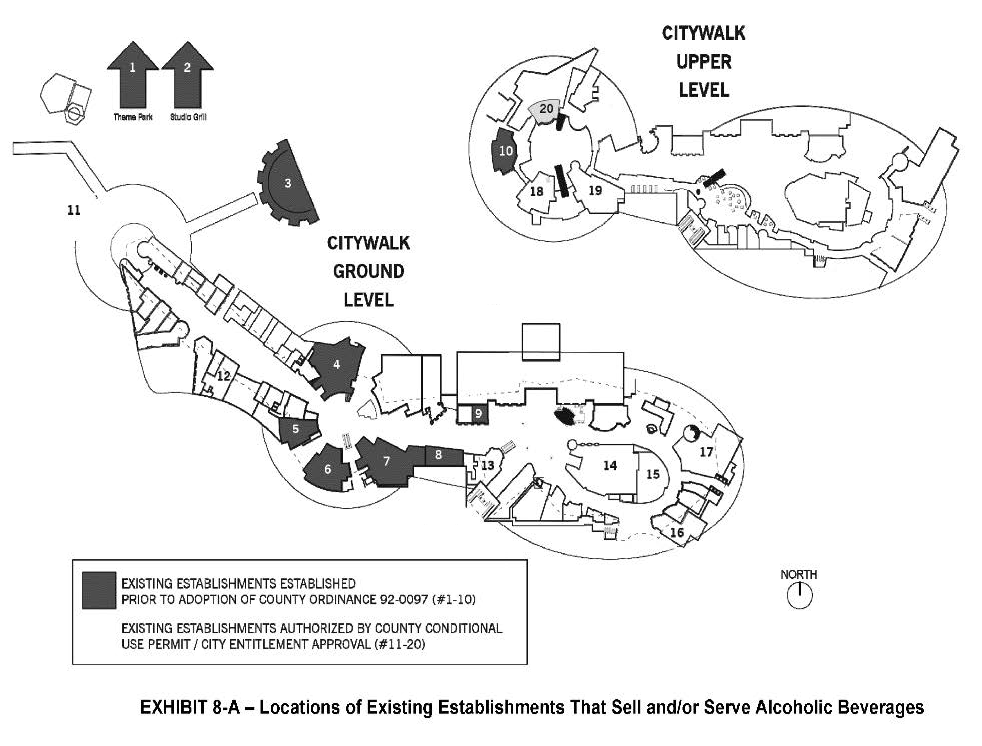
EXHIBIT 8-B
Conditions for Establishments That Sell and/or Serve Alcoholic Beverages
for On-Site Consumption
1.
The sale of alcoholic beverages shall be limited to on-site consumption within the establishment boundaries only.
2.
All regulations of the State of California prohibiting the sale of alcoholic beverages to minors shall be strictly enforced.
3.
The Universal Studios Specific Plan area property owner shall coordinate with the Los Angeles County Sheriff's Substation located within the boundaries of the Universal Studios Specific Plan area in order to monitor and patrol areas and prohibit loitering where establishments selling alcoholic beverages are located during the operating hours of the establishments.
4.
The permittee shall maintain the property in a neat and orderly fashion at all times.
5.
The permittee shall maintain free of litter all areas of the premises over which the permittee has control.
6.
All structures, walls, and fences open to public view shall remain free of graffiti. In the event graffiti occurs, the permittee shall remove or cover the graffiti within 24 hours of such occurrence, weather permitting. Paint utilized in covering such markings shall be of a color that matches, as closely as possible, the color of the adjacent surfaces.
7.
The permittee shall ensure each employee of said establishment/permit who sells or serves alcoholic beverages shall attend training classes in the sale and service of alcoholic beverages within 60 days of the start of employment or opening of the establishment. Such training classes shall be either those provided by the Universal Studios Specific Plan area property owner or permittee, in coordination with the Los Angeles County Sheriff's Department, or shall be a training class approved by the Los Angeles County Sheriff's Department and/or the State Department of Alcoholic Beverages Control. Training shall be renewed annually and record of training shall be maintained on premises and available to Planning Staff upon request.
8.
Posted signs shall include the following information:
a.
No alcohol beyond establishment boundaries;
b.
Contact information for the Sheriff's Substation and Department;
c.
Complimentary non-alcoholic beverages available to designated drivers; and
d.
Hours of alcohol service.
9.
The permittee shall provide adequate lighting above the entrance of the premises. The lighting shall be of sufficient power to illuminate and make easily discernible persons entering or exiting the premises.
10.
A copy of these conditions shall be retained on the premises in each establishment which serves alcoholic beverages and shall be made available upon request by the Director of Planning or County Sheriff.
11.
Restaurants/Cafes/Dinner Theaters:
a.
Hours of sales. Alcoholic beverages may be sold during the following hours: 7 days a week, 9:00 a.m.—2:00 a.m. All alcoholic beverage service and sales must cease 30 minutes prior to closing of the restaurant.
b.
The premises shall be maintained as a bonafide restaurant and shall provide a menu containing an assortment of foods. The quarterly gross sales of alcoholic beverages shall not exceed the gross sales of food and non-alcoholic beverages during the same period.
c.
The perimeter of outdoor eating areas shall be defined by physical barriers and shall be designed to prevent the unrestricted flow of persons to and from the establishment boundaries.
12.
Night Club Establishments/Comedy Clubs/Music Clubs:
a.
Hours of sales. Alcoholic beverages may be sold during the following hours: 7 days a week, 11:00 a.m.—2:00 a.m. All alcoholic beverage service and sales must cease 30 minutes prior to closing of the night club.
13.
Cinemas:
a.
Hours of sales. Alcoholic beverages may be sold during the following hours: 7 days a week, 11:00 a.m.—2:00 a.m.
b.
Food items shall also be offered for sale where alcoholic beverages are sold.
c.
Restricted areas for sale and dispensing. Alcoholic beverages may be sold and dispensed only within a restricted area located within concession areas of the cinema, as determined by the Alcohol Use Approval review. Said area shall be physically separated (via ropes or similar devices) from other circulation areas of the cinema/theater. A uniformed cinema/theater employee shall be stationed at the entrance to any restricted areas.
d.
Theater auditorium use.
i.
At all times that alcoholic beverage sales, dispensing, and consumption is available to the general public, all access to the designated theaters and balconies shall be restricted to patrons who have purchased a reserved and designated seat. Patrons shall provide staff with sufficient identification to confirm that patrons with alcoholic beverages are 21 years of age or older at the entry locations to each theater.
ii.
No sales or dispensing of alcoholic beverages shall take place within any theaters, except that patrons may carry their alcoholic beverages from the restricted areas to the designated theaters and balconies, and for patrons requiring or requesting assistance, servers may transport patrons' alcoholic beverages from the restricted areas to the designated theaters and balconies for them.
iii.
During the period from the initiation of seating until the commencement of the feature presentation (which interval shall not be shorter than 10 minutes), ambient light in the designated theaters shall remain at a level sufficient to allow a reasonable person to observe patrons who may be consuming alcoholic beverages.
e.
There shall be no requirement for an admission charge or a cover charge, nor shall there be a requirement to purchase a minimum number of drinks.
f.
All servers providing alcoholic beverage service within the restricted areas shall be at least 21 years of age.
g.
At such times as a theater is utilized for a private function, alcoholic beverages may be sold, dispensed and consumed in the presence of persons under 21 years of age.
h.
The sale of distilled spirits by the bottle for same day or future consumption is prohibited.
14.
Hotel:
a.
Hours of sales. Alcoholic beverages may be sold as part of banquet or meeting room activities, within lobby, pool and similar guest areas, within restaurants/cafes or night clubs which are physically located within the Hotel or are physically/operationally connected to the Hotel; during the following hours: 7 days a week, 9:00 a.m.—2:00 a.m. Mini-bars located within hotel guest rooms and room service shall not be limited in the hours of alcohol service.
15.
Theme Park:
a.
The Theme Park shall be considered a single establishment with a single permit and shall be permitted to sell a full line of alcoholic beverages at various locations within the boundaries of the Theme Park.
b.
Hours of sales. Alcoholic beverages may be sold during Theme Park operational hours, 7 days a week. All alcoholic beverage service and sales must cease at 2:00 a.m.
c.
Venues that sell and/or serve alcoholic beverages within the Theme Park shall be subject to conditions outlined in this Exhibit.
d.
Alcoholic beverages sold within the Theme Park shall be consumed on-site and shall not be taken or consumed outside the boundaries of the Theme Park.
16.
Amphitheater/Performance Venue:
a.
An Amphitheater/performance venue shall be considered a single establishment with a single permit and shall be permitted to sell a full line of alcoholic beverages.
b.
Hours of sales. Alcoholic beverages may be sold during operational hours of the Amphitheater or performance venue, 7 days a week. All alcoholic beverage service and sales must cease at 2:00 a.m.
c.
Alcoholic beverages sold within the Amphitheater/performance venue shall be consumed on-site and shall not be taken or consumed outside the boundaries of the establishment.
EXHIBIT 8-C
Conditions for Establishments That Sell Alcoholic Beverages
for Off-Site Consumption
1.
All regulations of the State of California prohibiting the sale of alcoholic beverages to minors shall be strictly enforced.
2.
Consumption on the premises of alcoholic beverages sold for off-site consumption is prohibited unless same establishment also has a license for on-site consumption.
3.
Universal Studios Specific Plan area property owner shall coordinate with the Los Angeles County Sheriff's Substation located within the boundaries of the Universal Studios Specific Plan area in order to monitor and patrol areas and prohibit loitering where establishments selling alcoholic beverages are located during the operating hours of the establishments.
4.
The permittee shall maintain the property in a neat and orderly fashion at all times.
5.
The permittee shall maintain free of litter all areas of the premises over which permittee has control.
6.
All structures, walls, and fences open to public view shall remain free of graffiti. In the event graffiti occurs, the permittee shall remove or cover the graffiti within 24 hours of such occurrence, weather permitting. Paint utilized in covering such markings shall be of a color that matches, as closely as possible, the color of the adjacent surfaces.
7.
The permittee shall ensure each employee of said establishment/permit who sells alcoholic beverages shall attend training classes in the sale of alcoholic beverages within 60 days of the start of employment or opening of the establishment. Such training classes shall be either those provided by the Universal Studios Specific Plan area property owner or permittee, in coordination with the Los Angeles County Sheriff's Department, or shall be a training class approved by the Los Angeles County Sheriff's Department and/or the State Department of Alcoholic Beverages Control. Training shall be renewed annually and record of training shall be maintained on premises and available to County Staff upon request.
8.
Sale of alcoholic beverages from drive-up or walk-up windows is prohibited.
9.
Hours of sales. Alcoholic beverages may be sold 7 days a week between the hours of 9:00 a.m. and 2:00 a.m.
10.
A copy of these conditions shall be retained on the premises in each establishment which sells alcoholic beverages and shall be made available upon request by the Director or County Sheriff.
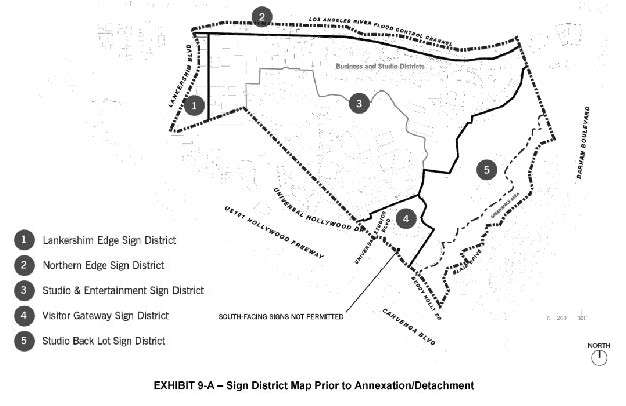
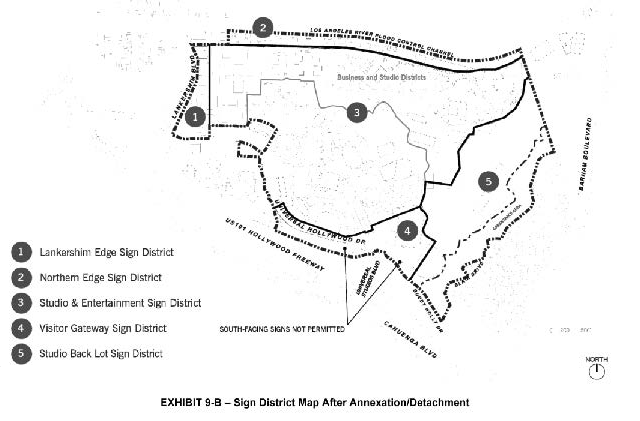
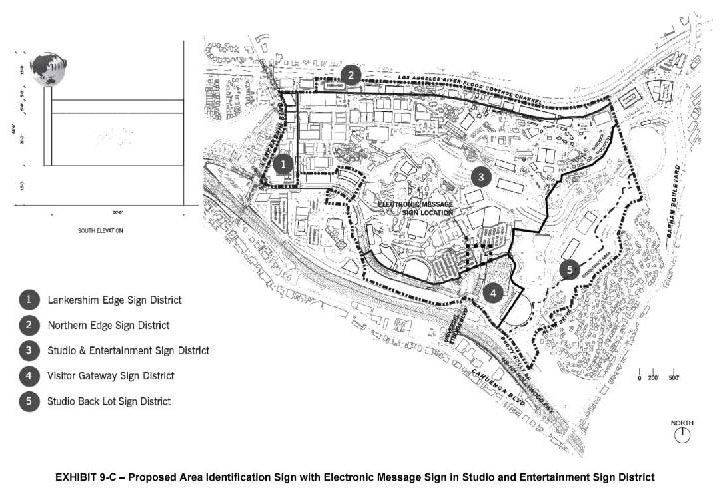
EXHIBIT 10-A
Form of Affidavit of Acceptance
(Ord. 2022-0008 § 161, 2022.)
22.408.250 - Appendix.
All references to Title 22 are to the version of Title 22 (Planning and Zoning Code) of the County Code in effect at the time of this Specific Plan's adoption, which is applicable through April 30, 2038.
(Ord. 2022-0008 § 161, 2022.)
22.410.010 - East Los Angeles Third Street Form-Based Code Plan and Introduction.
A.
The East Los Angeles Third Street Form-Based Code is located in Section 22.410.020 (Establishment of Form-Based Code) through Section 22.410.150 (Block and Subdivision Guidelines).
B.
The East Los Angeles Third Street Form-Based Code was adopted by the Board of Supervisors on November 12, 2014 and was thereafter amended.
(Ord. 2022-0008 § 161, 2022.)
22.410.020 - Establishment of Form-Based Code.
This Form-Based Code Specific Plan (Form-Based Code or ordinance) is established as the primary means to implement the East Los Angeles Third Street Plan, which is applicable to the area shown on the Plan Map (Figure 1) ("Plan Area") set forth in Section 22.46.3006, and may be cited as the Third Street Form-Based Code.
(Ord. 2022-0008 § 161, 2022.)
22.410.030 - Intent and Purpose.
This Form-Based Code is established to:
A.
Update development standards, add prescriptive evaluation standards, and provide implementing options for the Plan Area to ensure that new development exhibits high standards of urban design, architecture, and landscaping.
B.
Establish allowable uses and provide procedures for implementing requirements for these uses. The requirements contained herein provide the necessary flexibility to accommodate future development and to achieve compatibility between land uses.
C.
Identify comprehensive principles, standards, implementing options, and procedures to ensure the orderly development of the Plan Area into a mixed-use and multi-modal community, with residences, offices, entertainment, dining, and retail venues. These mixed uses will allow for the creation of business and job opportunities in the Plan Area so as to enhance the economic vitality of the County consistent with the intent, purpose, and goals of the Countywide General Plan.
D.
Allow for expansion of residential and commercial uses within the Plan Area by increasing the commercial floor area and dwelling units allowed.
(Ord. 2022-0008 § 161, 2022.)
22.410.040 - Applicability.
A.
General Applicability. This Form-Based Code shall apply to all new development projects for which a complete application has been filed on or after the effective date of the ordinance containing these new or revised regulations. Complete applications that were filed before the effective date of this Form-Based Code shall comply with the regulations and applicable Title 22 provisions that were in effect at the time that the respective complete applications were filed.
B.
Additions, Repairs, or Modifications to Existing Development. The provisions of this Form-Based Code shall apply to any addition, repair, or modification to existing development, or to any new use proposed for existing development, except as otherwise provided for in this Section C.2. When an addition, repair, or modification to existing development is subject to this Form-Based Code, only the actual addition, repair, or modification shall be required to comply with this Form-Based Code.
The following types of additions, repairs, or modification to existing development shall be exempt from the provisions of this Form-Based Code.
1.
Projects involving the normal maintenance or repair to an existing building or structure that is necessary to ensure its safe and habitable condition for ordinary and intended use;
2.
Projects involving the remodeling of interior space of a structure that do not cause any of the structure's windows to be removed, and also do not increase the gross square footage of the structure's nonresidential floor area, the number of hotel rooms if the structure is a hotel, or the number of dwelling units in the structure;
3.
Projects involving a modification to a property that, as of the effective date of this Form-Based Code, has an associated conditional use permit ("CUP") that is valid and the applicant holding the CUP is in good standing under the CUP. For these modifications, the applicant shall comply with the CUP provisions for carrying out such modifications;
4.
Projects subject to Section 22.124.140 (Certificate of Appropriateness—When Required) or 22.124.080.D (Certificate of Appropriateness or Certificate of Economic Hardship During Nomination) that comply with Section 22.124.160 (Certificate of Appropriateness - Standards).
C.
Non-conforming Uses, Buildings, or Structures.
1.
Except as otherwise provided for in this Subsection C, the nonconforming use and structure provisions in Chapter 22.172 (Nonconforming Uses, Buildings and Structures) shall apply to all uses and structures in the area governed by this Form-Based Code that were legally established prior to the effective date of this Form-Based Code.
2.
The application of the nonconforming use and structure provisions as described in Subsection C.1 shall be limited as follows:
a.
The termination period or periods set forth in Section 22.172.050 (Termination Conditions and Time Limits) that would otherwise apply to residential dwelling units shall not apply. Any single-, two-, or multi-family residential building or structure nonconforming due to use which is damaged or destroyed may be restored to the condition in which it was immediately prior to the occurrence of such damage or destruction, provided the cost of reconstruction does not exceed 100 percent of the total market value of the building or structure, as determined by the methods set forth in Section 22.172.020.G.1.a and b and provided the reconstruction complies with the provisions of Section 22.172.020.G.2;
b.
Section 22.172.020 (Maintenance of Buildings or Structures Nonconforming Due to Use) shall not apply to any alteration to a nonconforming building or structure that is due to seismic retrofitting as required by Chapters 95 and 96 of Title 26 (Building Code) of the Los Angeles County Code; and
c.
Existing Nonconforming Neighborhood-Serving Commercial Uses in Residential Zones.
i.
Notwithstanding Section 22.172.060 (Review of Amortization Schedule or Substitution of Use), an existing neighborhood-serving commercial use in a residential zone may request extension of time within which said use must be discontinued, and continue operation, subject to a Ministerial Site Plan Review (Chapter 22.186), if the use meets all requirements in Section 22.364.070.A.2.b (Existing Nonconforming Neighborhood-Serving Commercial Uses in Residential Zones).
ii.
Termination by Discontinuance. The right to operate the existing nonconforming neighborhood-serving commercial use, pursuant to this Subsection C.2.c, shall be terminated, subject to the same regulations set forth in Section 22.172.050.A (Termination by Discontinuance).
(Ord. 2024-0032 § 33, 2024; Ord. 2022-0008 § 161, 2022.)
22.410.050 - Administration.
A.
Other Requirements May Apply. No provision in this Form-Based Code shall eliminate the need for: obtaining any other permit, approval, or entitlement required by the County, or any other applicable special district or agency, or the State or federal government or their agencies; or otherwise comply with applicable State and federal regulations or laws.
B.
Prohibited Uses and Facilities. Except as specified otherwise by State law, any uses or facilities not listed or defined in Section 22.410.070 of this Form-Based Code as allowed uses or facilities are prohibited.
C.
Severability. If any provision of this Form-Based Code or the application thereof to any person or circumstance is held to be invalid by a court of competent jurisdiction, such invalidity shall not affect the other Form-Based Code provisions, clauses, or applications thereof which can be implemented without the invalid provision, clause, or application, and to this end the provisions and clauses of this Form-Based Code are declared to be severable.
D.
Relationship to Other Provisions of Title 22.
1.
The provisions contained in this Form-Based Code shall be considered to be in combination with the other applicable provisions of Title 22.
2.
Where provisions of this Form-Based Code conflict with any other provision of Title 22, this Form-Based Code shall govern, with the following exceptions:
a.
Accessory Dwelling Units and Junior Accessory Dwelling Units. Where the regulations in Section 22.140.640 (Accessory Dwelling Units and Junior Accessory Dwelling Units) are contrary to the provisions in this Form-Based Code regulating the same matter, the provisions in this Form-Based Code shall prevail, unless specified otherwise in Section 22.140.640 (Accessory Dwelling Units and Junior Accessory Dwelling Units).
b.
Affordable Housing and Senior Citizen Housing. Chapter 22.119 (Affordable Housing Replacement), Chapter 22.120 (Density Bonus), Chapter 22.121 (Inclusionary Housing), Chapter 22.128 (Supportive Housing), and Chapter 22.166 (Housing Permits) shall supersede any contrary provisions in this Form-Based Code.
3.
Where provisions of this Form-Based Code are silent, the other applicable provisions of Title 22 shall govern.
E.
In this Form-Based Code, the term "shall" means the related action is required; "should" means the related action is recommended; and "may" means the related action is optional.
F.
Capitalized terms used throughout this Form-Based Code are defined herein or in Chapter 22.14 (Definitions).
G.
The metrics contained herein are an integral part of this Form-Based Code. However, the diagrams and illustrations that accompany these metrics should be considered guidelines. When in conflict, numerical metrics shall take precedence over graphic metrics.
H.
Encroachments into the Public Right-of-Way. All design features described in this Form-Based Code, including, but not limited to, canopies, awnings, overhanging roofs, ornamental light fixtures, columns, or any other architectural element, that would encroach into the public right-of-way shall be subject to the applicable provisions of Title 16 (Highways) and Title 26 (Building Code) of the Los Angeles County Code.
(Ord. 2024-0032 § 34, 2024; Ord. 2022-0008 § 161, 2022.)
22.410.060 - Project Review Procedures.
A.
No new development or use shall be established under this Form-Based Code, and no grading or building permits shall be issued for these uses, until an application has been approved for the required permit type listed in Section 22.410.110 and pursuant to the applicable procedures set forth in Subsections B through E. If the new development or use is not covered by this Form-Based Code, the applicable provisions of Title 22 shall apply to the application.
B.
Ministerial Site Plan Review.
1.
Review Authority. The Director shall have the authority to review projects subject to a Ministerial Site Plan Review for compliance with this Form-Based Code and other provisions of Title 22.
2.
Application Requirements. A Ministerial Site Plan Review application shall include all information required by the form provided by the Department, and the payment of the required fee set forth in Section 22.250.010 (Filing Fees and Deposits).
3.
Determination. If the project complies with the provisions of this Form-Based Code and other applicable provisions of Title 22, the Director shall grant the Ministerial Site Plan Review approval. Otherwise, the Director shall deny the application for a Ministerial Site Plan Review.
C.
Modification Review.
1.
Review Authority. The Hearing Officer shall have the authority to review projects requesting a modification to the development standards identified in subsection 4 below, for substantial compliance with the applicable requirements of this Form-Based Code and other provisions of Title 22.
2.
Application Requirements. A modification application shall include all information required by the form provided by the Department, and the payment of the required fee set forth in Section 22.250.010 (Filing Fees and Deposits).
3.
Procedures. A modification request shall be subject to the public hearing procedures and requirements set forth in Section 22.222.120 (Public Hearing Procedure).
4.
Determination. If the Hearing Officer determines that the request for a modification is consistent with the principles and standards of Section 22.222.200 (Findings and Decision), the Hearing Officer may approve the modification. Notwithstanding the foregoing, only the following development standards may be modified pursuant to this Subsection C:
5.
Appeals. The decision of the Hearing Officer may be appealed or called up for review pursuant to the procedures and requirements of Chapter 22.240 (Appeals).
6.
Revisions to Modification. Revisions to a modification grant may be approved by the Director if the revisions do not affect the intent of the original approval. Revisions that would deviate from the intent of the original approval shall require approval of a new modification.
D.
Specific Plan Substantial Conformance Review.
1.
Review Authority. The Hearing Officer shall have the authority to review projects subject to a Specific Plan Substantial Conformance Review for substantial compliance with the applicable standards and implementing options of this Form-Based Code and other applicable provisions of Title 22.
2.
Application Requirements. A Specific Plan Substantial Conformance Review application shall include all information required by the form provided by the Department, and the payment of the fee set forth in Section 22.250 (Applications, Petitions, and Fees).
3.
Procedures. A Specific Plan Substantial Conformance Review shall be subject to the public hearing procedures and requirements set forth in Section 22.222.120 (Public Hearing Procedure).
4.
Burden of Proof. The applicant shall substantiate to the satisfaction of the Hearing Officer that:
a.
Approval of the project conforms with the applicable provisions of this Form-Based Code and other applicable provisions of Title 22;
b.
Approval of the project is in the interest of the public health, safety, and general welfare;
c.
Site layout, open space, orientation and location of buildings, vehicular access, circulation and parking, setbacks, heights, and walls and fences are designed to provide a desirable environment within a unifying context that encourages increased pedestrian activity and promotes compatibility among neighboring land uses;
d.
Architectural character, scale, quality of design, building materials, colors, screening of exterior appurtenances, and signs are designed to ensure compatibility of the development with the Form-Based Code and the character of the neighborhood;
e.
Project landscaping, including its location, type, size, color, texture, and coverage of plant materials at the time of planting are designed and developed to provide visual interest, complement buildings and structures, and provide an attractive environment for the public. The project landscaping shall also include measures to provide for irrigation, maintenance, and protection of the landscaped areas;
f.
Parking areas are designed and developed to buffer surrounding land uses, complement pedestrian-oriented development, enhance the environmental quality of the site such as to minimize stormwater run-off and the heat-island effect, and achieve a safe, efficient, and harmonious development; and
g.
Lighting and lighting fixtures are designed to complement buildings, are of appropriate scale, avoid creating glare, and provide adequate light over walkways and parking areas to foster pedestrian safety.
5.
Appeals. The decision of the Hearing Officer for the Substantial Conformance Review may be appealed or called up for review pursuant to the procedures and requirements of Chapter 22.240 (Appeals).
6.
Revisions to Specific Plan Substantial Conformance Review. Revisions to the Substantial Conformance Review may be approved by the Director if the revisions do not affect the intent of the original approval. Revisions that would deviate from the intent of the original approval shall require the approval of a new Specific Plan Substantial Conformance Review.
E.
Conditional Use Permit. When a conditional use permit is required under this Form-Based Code or otherwise required under Title 22, the review procedures for a conditional use permit shall be the same as those prescribed in Chapter 22.158 (Conditional Use Permits), except that in addition to the required burden of proof in Section 22.158.050 (Findings and Decisions), the burden of proof for a Substantial Conformance Review set forth in Section 22.410.060.D.4 shall also apply.
(Ord. 2022-0008 § 161, 2022.)
22.410.070 - Definitions of Uses and Terms.
The following definitions shall apply in this Form-Based Code.
A.
Definitions of Uses.
1.
Accessory Commercial Unit: See "Accessory Commercial Unit" in Section 22.14.010.
2.
Alcoholic Beverage Sales: Alcoholic Beverage Sales means a place of business selling alcoholic beverages for on-site or off-site consumption, and where the sale of food may be incidental to the sale of such beverages. This includes any establishment that has a valid alcoholic beverage license from the State. Alcoholic beverage sales businesses may include, but are not limited to, restaurants, bars, taverns, liquor stores, cocktail lounges, nightclubs, and supper clubs.
3.
Artisan/Craft Production: Artisan/Craft Production means an establishment that produces and/or assembles small products by hand, including jewelry, pottery, and other ceramics, as well as small glass and metal art and craft products, where any retail sales, if any, are incidental to the production activity.
4.
Auto-Related, Commercial: Auto-Related, Commercial means a place of business serving auto-related needs including, but not limited to, car rental; car wash; gas station; mechanic offering routine minor maintenance, such as fluid replacement, wiper blade replacement, flat tire repair, or similar activities that produce minimal noise, vibration, or fumes and that exclude activities listed under the definition of "auto-related industrial establishment" in this Subsection; consumer retail auto parts; and indoor vehicle sales. Excluded from this definition are auto-related commercial storage facilities and drive-through establishments.
5.
Auto-Related, Industrial: Auto-Related, Industrial means a facility conducting activities associated with: the repair or maintenance of motor vehicles, trailers, and similar large mechanical equipment; paint and body work; major overhaul of engine or engine parts; vehicle impound or wrecking yard; outdoor vehicle sales, storage, or repair; and government vehicle maintenance facilities. This definition includes auto-related uses not otherwise allowed within the Auto-Related, Commercial category.
6.
Commercial, General: Commercial, General means a use where the place of business provides the sale and display of goods or sale of services directly to the consumer with goods available for immediate purchase and removal by the purchaser. General commercial goods include, but are not limited to, clothing, food, furniture, pharmaceuticals, books, antiques, and art. General commercial service includes, but is not limited to, a barber/beauty shop, bicycle rental, travel agency, retail store, bank, retail dry cleaning with limited equipment, express delivery service, photo studio, repair service establishment, employment office, and a veterinary clinic. Excluded from this definition are drive-through establishments. Drive-through establishments are excluded from this definition and are thereby prohibited.
7.
Commercial, Restricted: Commercial, Restricted means a use which, because of its characteristics or location, may be suitable only in specific locations and only if such uses are designed or arranged on the site in a particular manner. For such uses, the Hearing Officer may impose conditions to ensure the purpose and intent of this Form-Based Code are satisfied, including conditions related to, but not limited to, location, construction, maintenance, operation, site planning, traffic control, and time limits for the use. Restricted Commercial may include, but not be limited to, a nail salon, dry cleaning plant, mortuary, tattoo and body piercing, massage parlor, bail bond, pawn shop, and a food and beverage processing uses. Tobacco shops, cigar bars, hookah bars, and alternative financial services, such as, but not limited to, cashless transaction check-cashing stores or auto-title loan stores, are excluded from this definition, and are thereby prohibited.
8.
Community Facility: Community Facility means a non-commercial facility established primarily for the benefit and service of the general public of the community in which it is located. Such facilities may include, but are not limited to, community centers, County field offices, police and fire stations, and cultural facilities, such as libraries and museums.
9.
Community Residence: A Community Residence includes, but is not limited to, the following:
•
Adult day care facility.
•
Adult residential facility.
•
Child care center.
•
Family child care home, large.
•
Family child care home, small.
•
Foster family home.
•
Group home, children, having seven or more children.
•
Group home, children, limited to six or fewer children.
•
Shelters, homeless or domestic violence.
•
Juvenile hall.
•
Small family home, children.
10.
Community Support Facility: Community Support Facility means a facility providing basic services for the benefit and service of the population of the community in which it serves. Such facilities may include, but not be limited to, extended care facilities, nursing homes, convalescent homes, continuing care facilities, and assisted living facilities.
11.
Designated Historic Landmark: Designated Historic Landmark is a property that is either of the following:
a.
Listed in the National Register of Historic Places as defined in Section 1.191-2(b) of Title 26 of the Code of Federal Regulations; or
b.
Listed in any State or County official register of historical or architecturally significant sites, places, or landmarks.
12.
Drive-Through Establishment: See "Drive-through establishments, drive-through facilities, and drive-through services" in Section 22.14.040.
13.
Entertainment: Entertainment means a place of business serving the amusement and recreational needs of the community. This category may include, but not be limited to, cinemas, movie theaters, billiard parlors, cabarets, teen clubs, dance halls, or game arcades.
14.
Food Service: Food Service means a place of business dedicated to the preparation and sale of food and beverage for immediate consumption on- or off-site.
15.
Infrastructure and Utilities: Infrastructure and Utilities means facilities or structures related to the provision of roads, transit facilities, water and sewer lines, electrical, telephone and cable transmission, wireless telecommunication facilities, and all other utilities and communication systems necessary to the functioning of a community.
16.
Learning Center: Learning Center means a facility offering training, tutoring, or instruction to students in subjects including, but not limited to, languages, music, fine arts, or dance. Instruction may include the provision of electronic testing and distance learning.
17.
Major Facility: Major Facility means a facility of an institutional nature including, but not limited to, a hospital, public health and social service facility, medical clinic, research facility, judicial building, ambulance service, and pharmaceutical laboratory.
18.
Manufacturing and Processing Facility: Manufacturing and Processing Facility means a facility primarily engaged in the manufacturing, processing, repair, or assembly of goods.
19.
Office: Office means a building or portion thereof used for conducting a business, profession, service, or government function. This category may include, but not be limited to, offices of attorneys, engineers, architects, physicians, dentists, accountants, financial institutions, real estate companies, insurance companies, financial planners, or corporate offices. A facility for manufacturing activities shall be excluded from this definition.
20.
Place of Assembly: Place of Assembly means a facility for public assembly including, but not limited to, arenas, auditoriums, banquet halls, conference facilities, convention centers, exhibition halls, major sports facilities, performing arts centers, and theaters.
21.
Products and Services Facility: Products and Services Facility means a public or private facility providing industrial and other services to individuals or businesses. This category may include, but is not limited to, laundry/dry cleaning plants, and metal, machine, or welding shops. This category may also include special services such as, but not limited to, pharmaceutical laboratories, animal kennels, government maintenance facilities, and solid waste facilities.
22.
Public Parking: Public Parking means a non-accessory parking facility available to the general public for parking motor vehicles, including parking lots or parking structures. This use does not include parking located in the public right-of-way.
23.
Recreational, Commercial: Recreational, Commercial means a place of business providing group leisure activities, often requiring equipment, and open to the public with or without entry or activity fees. This category may include, but not be limited to, game courts, skating rinks, bowling alleys, and commercial golf facilities, gyms, or sports rooms.
24.
Recreational, Non-Commercial: Recreational, Non-Commercial means a non-commercial facility, primarily an open space, serving the recreational needs of the general public. This category may include, but not be limited to, public golf courses, parks, playfields, and playgrounds.
25.
Religious Facility: Religious Facility means a facility used for regular organized religious worship and related activities.
26.
Research Facility: Research Facility means a facility used primarily for research and development that does not involve the use of human testing, animal husbandry, incinerators, heavy equipment, mass manufacturing, fabrication, processing, or sale of products.
27.
Schools: See "School, public or private" in Section 22.14.190.
28.
Shared Kitchen Complex: See "Shared Kitchen Complex" in Section 22.14.190.
29.
Short-Term Rental: See "Short-Term Rental" in Section 22.14.190.
30.
Special Training/Vocational: Special Training/Vocational means a facility offering instruction or training in trades or occupations such as secretarial, paralegal, business, beauty, barber, bartender, acupuncture, massage, or other similar vocations. This category excludes training or education for any activity that is not otherwise allowed in the zone.
31.
Storage and Distribution Facility: Storage and Distribution Facility means a facility providing long-term or short-term storage, and the selling or distribution of merchandise. This category includes, but is not limited to, container yards, crating, packing and shipping service, heavy equipment sales, service and storage, logistics, warehousing or distribution establishments, public storage facilities, commercial storage facilities, or outdoor storage of building materials.
B.
Definitions of Terms.
1.
Attic: Attic means the space between the ceiling joists and roof rafters of a structure. Attics may be accessible by a staircase or other means.
2.
Arcade: See Frontage Type Standards for Arcade (Section 22.410.130).
3.
Awning Sign: See Sign Standards for Awning Sign (Section 22.410.140).
4.
Bulkhead: Bulkhead means a low partition wall located between the grade and window opening(s) used for the display of merchandise.
5.
Cabinet Sign: Cabinet Sign means a sign in which a removable sign face (usually with translucent sign graphics) is enclosed on all edges by a metal cabinet. A Cabinet Sign may also be multi-sided. Cabinet signs are prohibited in all transect zones.
6.
Civic Space: Civic Space means an open area dedicated for public use, typically for community gatherings.
7.
Clearly Visible From the Street: When a project is "clearly visible from the street," the street includes its sidewalks, squares, plazas, civic greens, parks, and all public space except alleys. A building element more than 30 feet from the building line or street is considered not Clearly Visible From the Street. A common wall is considered not Clearly Visible From the Street.
8.
Colonnade: Colonnade means a series of columns similar to an arcade but spanned by straight lintels rather than arches, linked together, usually as an element of a building.
9.
Compatible: Compatible means that the characteristics of different uses or activities or designs, allow them to be located near or adjacent to each other so as to be in harmony and to avoid abrupt or severe differences. Some elements affecting compatibility include height, scale, mass, and bulk of structures. Other elements affecting compatibility include pedestrian or vehicular traffic routes, circulation, access, parking impacts, landscaping, lighting, noise, odor, and architecture. Compatible does not mean "the same as," but rather, refers to the sensitivity of development proposals in maintaining the character of existing development.
10.
Court: See Building Type Standards for Court (Section 22.410.120).
11.
Discretionary Sign: A creative sign that meets the requirements of Section 22.410.140.F of this Form-Based Code and has a Discretionary Sign permit.
12.
Curb, Curb Line: Curb, Curb Line means a stone, concrete, or other improved boundary, marking the edge of the roadway or paved area.
13.
Duplex/Triplex: See Building Type Standards for Duplex/Triplex (Section 22.410.120).
14.
Façade: Façade means the exterior wall of a building that is set along a frontage line that supports the public realm, and is subject to frontage requirements.
15.
Flex Block: See Building Type Standards for Flex Block (Section 22.410.120).
16.
Flex Space: Flex Space means a ground-level floor area that is structurally built to accommodate both residential and non-residential uses, such as that in a live-work building.
17.
Forecourt: See Frontage Type Standards for Forecourt (Section 22.410.130).
18.
Front Yard/Porch: See Frontage Type Standards for Front Yard/Porch (Section 22.410.130).
19.
Gallery: See Frontage Type Standards for Gallery (Section 22.410.130).
20.
House: See Building Type Standards for House (Section 22.410.120).
21.
Hybrid Court: See Building Type Standards for Hybrid Court (Section 22.410.120).
22.
I-710: I-710 refers to Interstate Highway 710, also known as the Long Beach Freeway.
23.
Lined Block: See Building Type Standards for Lined Block (Section 22.410.120).
24.
Main Entrance: A main building entrance is the widest entrance to a building and the one that most pedestrians are expected to use. In multi-tenant buildings, main entrances open directly into the building's lobby or principal interior ground level circulation space. When a multi-tenant building does not have a lobby or ground level interior circulation space, there shall be no main entrance for purposes of this definition. In single-tenant buildings, main entrances typically open directly into lobby, reception, or sales areas.
25.
Projecting Sign: See Sign Standards for Projecting Sign (Section 22.410.140).
26.
Relief: Relief means an architectural element in which forms or figures are distinguished from a surrounding plane surface or wall. Typical relief may include projecting detail or carved or molded ornamentation that projects from a flat surface.
27.
Rowhouse: See Building Type Standards for Rowhouse (Section 22.410.120).
28.
Setback, Setback Line: Setback, Setback Line means the area of a lot measured from a lot line to a building façade or elevation that must be maintained clear of permanent structures except for an encroachment allowed by an encroachment permit issued in compliance with Title 16 and Title 26 of the Los Angeles County Code.
29.
Shared Parking: Shared Parking means parking space that is available to more than one use.
30.
Shop Front: See Frontage Type Standards for Shop Front (Section 22.410.130).
31.
Stoop: See Frontage Type Standards for Stoop (Section 22.410.130).
32.
Street, Front: Street, Front means a street that is predominately bordered by front lot lines and which the front façade of a structure would normally face.
33.
Street, Side: Street, Side means a street or right-of-way that is not a front street or an alley.
34.
Terrace: See Frontage Type Standards for Terrace (Section 22.410.130).
35.
Transect Zone: Transect Zone means a designated area governed by the regulations set forth in this Form-Based Code.
36.
Wall Sign: See Sign Standards for Wall Sign (Section 22.410.140).
37.
Yard Sign: See Sign Standards for Yard Sign (Section 22.410.140).
(Ord. 2024-0032 § 35, 2024; Ord. 2022-0008 § 161, 2022.)
22.410.080 - Transect Zones.
A.
Purpose. This Section identifies the eight Transect Zones within the Specific Plan Area, as delineated on the Plan Map in Figure 1:
•
3rd Street (TOD)
•
Cesar E. Chavez Avenue (CC)
•
1st Street (FS)
•
Atlantic Boulevard (AB)
•
Neighborhood Center (NC)
•
Low-Medium Density Residential (LMD)
•
Civic (CV)
•
Open Space (OS)
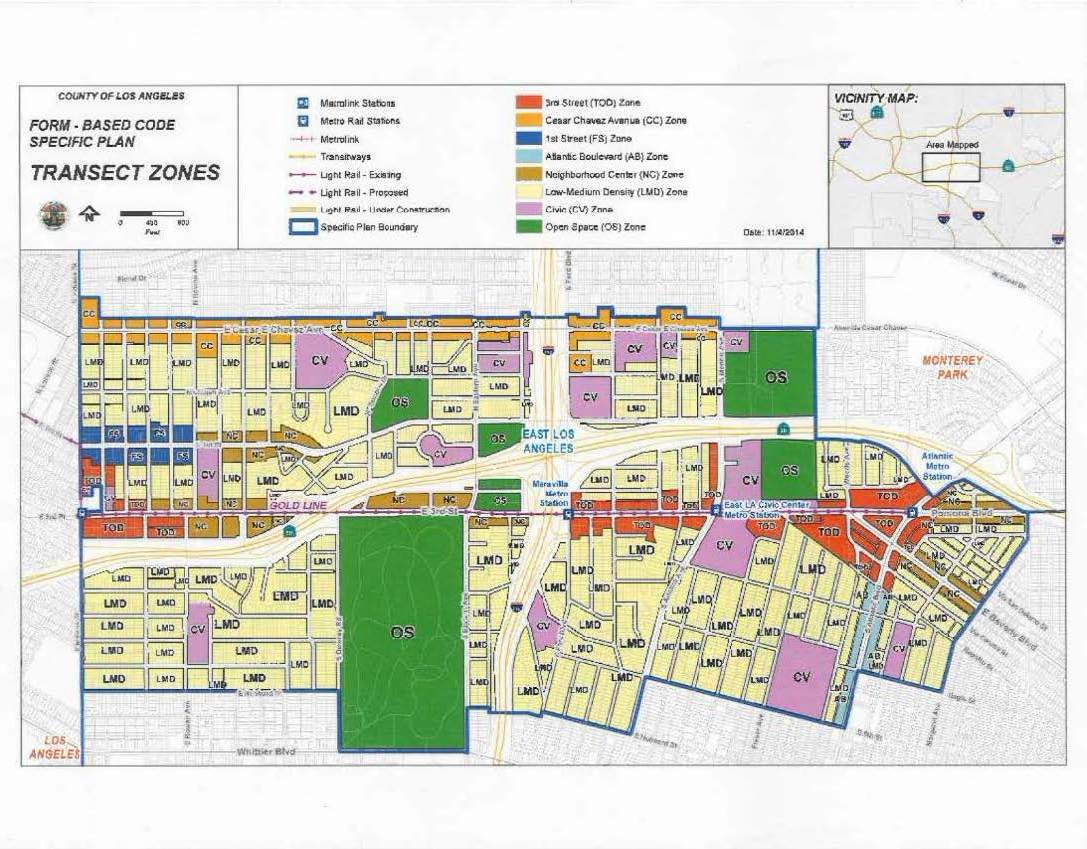
(Ord. 2022-0008 § 161, 2022.)
22.410.090 - General Standards.
A.
Purpose. This Section establishes the general standards and regulations that apply to all Transect Zones.
B.
Standards for Non-Residential Uses. The following standards are applicable to non-residential uses:
1.
Mechanical Equipment and Utility Standards. Mechanical equipment, including air conditioning, piping, ducts, and conduits external to a building, shall be concealed from view from adjacent buildings and the street level by use of landscaping, grills, screens, or other enclosures.
2.
Outdoor Lighting. Defined as lighting equipment or light fixtures used to provide illumination for outdoor areas, objects, or activities, including light fixtures attached to buildings or structures; self-supporting structures to provide lighting for parking lots, walkways, building entrances, outdoor sales areas, recreational fields, or within landscaped areas shall all constitute outdoor lighting. Such lighting shall confine glare and reflections to the boundaries of the site. Each light source shall be shielded and directed away from any adjoining properties and public rights-of-way.
3.
Operational Standards. All non-residential uses shall be conducted and located within an enclosed building, except that the following uses may be conducted outside an enclosed building provided that they comply with all other requirements as provided in Section 22.410.050.A:
a.
Outdoor dining;
b.
A bicycle sharing station;
c.
Seasonal outdoor sales of plants, trees, or produce no more than twice a year for a maximum of five consecutive weeks for each sales period; and
d.
Other outdoor uses allowed by this Form-Based Code within a specific Transect Zone.
4.
Outdoor Structures Allowed. Outdoor fixtures such as tables, chairs, umbrellas, landscape pots, valet stations, bicycle racks, planters, benches, bus shelters, kiosks, and waste receptacles are allowed in connection with all non-residential uses. Fixtures that extend into the public right-of-way require an encroachment permit from Public Works.
5.
Outdoor Structures Prohibited. The following outdoor structures are prohibited when located outdoors of a non-residential use and clearly visible from the street: donation boxes for collecting goods; machines such as, but not limited to, photo booths, penny crunching machines, blood pressure machines, fortune-telling machines, video games, animated characters and other such machines that are internally illuminated, or have moving parts, make noise, and/or have flashing lights; inanimate figures such as statues or sculptures of horses, kangaroos, bears, gorillas, or similar animals, and mannequins, cartoon figures, or human figures.
C.
Parking.
1.
Purpose. This subsection regulates parking for motor vehicles and bicycles, and provides options to adjust parking requirements in a Transect Zone as provided below, except that the standards provided in Section 22.112.040 C (Residential and Agricultural Zones) shall apply to parking in all Transect Zones. These regulations ensure that the parking needs of new land uses and development are met, while ensuring that parking spaces are provided in a manner that promotes the development of a walkable community.
2.
General Parking Standards. The minimum number of parking spaces required by the applicable Transect Zone (see Section 22.410.110) shall be provided, except as follows:
a.
There shall be no minimum non-residential use parking for a property located within 500 feet from any Metro rail station, as measured from that property's closest property line to the rail station's property line, along a thoroughfare right-of-way;
b.
Accessory outdoor dining shall require no additional parking spaces;
c.
For changes in land use, as long as the gross square footage of an existing building or structure is the same or less than the preexisting land use, no new parking or loading spaces are required for that change of land use. In the event that the gross floor area of the building or structure is increased by the change in land use, required parking and loading spaces shall be provided only as they relate to the increased gross floor area.
3.
Off-Site Parking, Non-Residential. Required parking for non-residential uses may be provided off-site if all of the following requirements are met. In addition, off-site non-residential parking is subject to a Specific Plan Substantial Conformance Review, the application for which shall include the materials as provided below in Section 22.410.090.C.4.a-g:
a.
The required parking is provided in an off-street parking facility on another site within 500 feet of the site proposed for development, as measured from that parking facility and the closest property line to the development, along a thoroughfare right-of-way;
b.
Pedestrian access between the site and the off-site parking area is via concrete or paved sidewalk or walkway; and
c.
The owners of the development site and the off-site parking area enter into, and record, a parking agreement or covenant in a form approved by the Director reflecting the terms of the agreement, including, but not limited to, identifying the number of spaces provided, length of time of the agreement, and hours the parking is available, and any time limits on the parking.
4.
Shared Parking, Non-Residential. The shared use of parking spaces may occur where two or more non-residential uses located on the same or separate sites are able to share the same parking spaces because their parking demands occur at different times of the day or because parking demands can be managed in a Shared Parking facility. This shared use of non-residential parking is subject to a Specific Plan Substantial Conformance Review, the application for which shall include all of the following:
a.
The names and addresses of the uses and of the owners or tenants that will share the parking or provide off-site;
b.
The number of parking spaces that will be shared or provided off-site;
c.
Evidence, provided by the applicant, that location of the parking is no more than 500 feet from each use as measured from the parking site's closest property line to the proposed use, along a thoroughfare right-of-way;
d.
If shared parking, an analysis, provided by the applicant, showing that the peak parking times for the separate uses occur at different times of the day and that the amount of available parking spaces shall be sufficient for each use;
e.
A covenant between the property owners that guarantees access to the parking for all of the shared uses or to off-site parking;
f.
Any operational limitations on the parking, including, but not limited to, the time limits or hours of the day for the parking; and
g.
Any designated signage and parking space markings for the shared parking.
5.
Landscaping and Screening for Parking Lots. Parking lots shall be screened for the purpose of minimizing views of parked vehicles from the nearby public right-of-way. If the requirements of this Subsection are determined to be technologically infeasible or impractical, a different landscape configuration or the use of alternative materials may be used, at the discretion of the Hearing Officer, subject to a Specific Plan Substantial Conformance Review.
a.
Adjacent to Residential Zone. Where a parking lot is located on property adjoining a residential zone, in addition to the requirements of this subsection, the applicable provisions of Section 22.112.080.F (Parking Design—Walls) shall apply;
b.
Trees. Parking lots with more than 12 parking spaces shall contain a minimum of one 24-inch box canopy shade tree for every six parking spaces, or as required by Chapter 22.126 (Tree Planting Requirements), whichever is greater. The required trees shall be evenly spaced on the lot and distributed in an "orchard" configuration (placement of trees in uniformly-spaced rows) within the interior parking lot area, and shall be planted within raised curbed planter islands that are at least four feet wide on all sides;
c.
Landscaped Setback and Screening. All required setbacks for parking areas shall be landscaped with living plant material and screened with a continuous landscaped hedge, masonry or stone wall, landscaped berm, or any combination thereof, so that views of parked vehicles are minimized and shielded. The screening of parking areas shall meet the following requirements:
i.
At the time of installation, the screening shall be at least 30 inches in height, and any walls or fences used shall not exceed 36 inches in height;
ii.
Any plant screening established as a screen shall reach a height of 36 inches within two years of planting;
iii.
Walls used for screening shall have the same architectural treatment on both sides of the wall;
iv.
When a wall is used for screening, the wall shall be placed on the interior line of the required setback and the setback shall be landscaped with living plant material and a continuous hedge;
v.
Wood and chain link fences are prohibited for screening parking areas; and
vi.
Irrigation. A permanent and automatic irrigation system shall be installed and maintained for all landscaped areas.
6.
Lighting. Parking lot lighting shall comply with the following:
a.
Outdoor light fixtures for parking lot lighting shall be limited to a maximum height of 15 feet; and
b.
Parking lot lighting shall comply with Section 22.410.090.B.2 (Outdoor Lighting).
7.
Materials.
a.
All parking lots and driveways shall be surfaced with materials approved by the Director of Public Works.
b.
In compliance with Chapter 22.122 (Low Impact Development), the use of pervious or semi-pervious parking area surfacing materials including, but not limited to "grasscrete," or recycled materials such as glass, rubber, used asphalt, brick, block, and concrete, may be approved by the Director for vehicular surface area on a site, provided such area is properly maintained. Where possible, such materials should be used in areas in proximity to, and in combination with, on-site stormwater control devices.
(Ord. 2022-0008 § 161, 2022.)
22.410.100 - Required Form and Articulations.
A.
Purpose. This Section establishes the building forms and articulations for each Transect Zone.
B.
Applicability. All building types, except the building types for a single-family house and duplex or triplex, used exclusively for residential uses, shall be subject to the provisions of this Section.
C.
Architectural Character.
1.
Required Form. Refer to Sections 22.410.120 (Building Types Standards) and 22.410.130 (Frontage Types Standards) for the required form related to architectural character.
2.
Architectural Implementation. To implement the building form requirement in Subsection C.1, proposed buildings should be compatible with the architectural characteristics of surrounding buildings, and allow for a range of architectural expressions that complement the existing urban fabric. The proposed building design should be based upon, and reflect, a thorough analysis of the surrounding patterns with regard to the following:
a.
Building orientation;
b.
Horizontal and vertical building articulation;
c.
Architectural style;
d.
Building scale and proportion;
e.
Roof line and form;
f.
Window pattern and detailing;
g.
Architectural detailing;
h.
Exterior finish materials and colors; and
i.
Lighting and landscape patterns.
Where there is no consistent architectural character or pattern found in the surrounding area, building design and massing should complement the architectural characteristics of neighboring buildings that are consistent with this Form-Based Code. In some cases, where the existing context is not well-defined, or may be undesirable, a proposed project may establish an architectural character and pattern for which future development in the area should be compatible.
D.
Building Massing.
1.
Required Articulation.
a.
Façade Height Articulation Elements. Each building, or portions of a building, with more than one story shall have, at minimum, a distinctive building base, a building middle and building top (eave, cornice, and/or parapet line), all that complement and balance one another. See Figure 2, Façade Height Articulation Elements below.
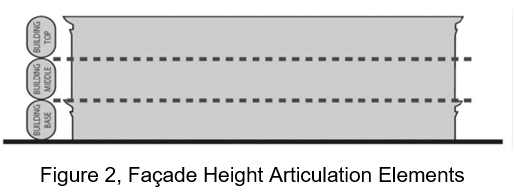
b.
Main building entrances shall be easily identifiable and distinguishable from other ground floor entries. Such main building entrances shall be at least one of the following:
i.
Marked by a taller mass above the entrance, such as a tower, or within a volume that protrudes from the rest of the building surface;
ii.
Located in the center of the façade, as part of a symmetrical overall composition;
iii.
Accented by architectural elements, such as columns, overhanging roofs, awnings, and ornamental light fixtures;
iv.
Marked or accented by a change in the roofline or change in the roof type; or
v.
If a corner building, they shall provide prominent corner entrances for shops or other activity-generating uses.
2.
Building Massing Implementation. To implement the building massing requirement in Subsection D.1, the following principles shall be considered.
a.
Articulation. Horizontal articulations are recommended and may be produced by material changes or applied Façade elements. Vertical articulations should be produced by variations in rooflines, window groupings, bay windows, balconies, entrance stoops, porches, or subtle changes in materials and vertical planes that create shadow lines and textural differences. Vertical elements should break up long, monolithic building façades along the street.
b.
Building base. A building base articulation may consist of a small projection of the wall surface and/or a different material or color. For a building of two or more floors, a building base may be heavier or of a thicker design treatment than the rest of the building, or be setback from the upper floors.
c.
Building middle. The building middle articulation may be created using façade offsets, consisting of slight recesses in the wall plane. This articulation should include multiple architectural rhythms derived through step backs, changes in plane, changes in materials or colors, window types, window sizes, pairing, multiple windows, or other detailing.
d.
Building top. The building top should consist of a horizontal element that crowns the building, and should be aesthetically differentiated from the building middle. The differentiation may be significant or subtle, and possible approaches from this differentiation and include variations in color, materials, ornamentation, or shape.
e.
The location, spacing, materials, and colors of exposed downspouts, gutters, scuppers, and other visible roof drainage components should be incorporated into the architectural composition of the façade and roof. The haphazard placement of such features should be avoided. Downspouts should be concealed within walls.
E.
Wall Surface Materials.
1.
Required Articulation.
a.
Building walls shall be constructed of durable materials, such as brick, natural stone, terra cotta, decorative concrete, metal, glass, or other similar materials.
b.
Standards for using decorative concrete block, stucco or other similar troweled finishes in non-residential, mixed-use, and multi-family residential buildings are:
i.
Decorative concrete block. Decorative concrete block shall be limited to a maximum of 50 percent of the street façade. When decorative concrete blocks are used for the street façade, the building shall incorporate a combination of textures and/or colors to add visual interest. For example, combining split or rock-façade units with smooth stone can create distinctive patterns. Cinder block (concrete masonry unit) is not allowed as an exterior finish.
ii.
Stucco or other similar troweled finishes shall: (a) be smooth to prevent the collection of dirt and surface pollutants; (b) be trimmed or combined with wood, masonry, or other durable material and be limited to a maximum of 50 percent of the street façade; and (c) not extend below two feet above grade of the street façade. Concrete, masonry, natural stone, or other durable material shall be used for wall surfaces within two feet above grade of the street façade.
iii.
If clearly visible from the street, side and rear building façades shall have a level of trim and finish compatible with the front façade.
iv.
Blank wall areas without windows or doors are only allowed on internal-block, side-property line walls. Any blank exterior wall shall also be treated with a graffiti-resistant coating.
v.
Building walls shall have contrasting trim colors. For example, dark colors and saturated hues for accent and ornamental colors may be used with neutral or light walls; white or light window and door trim may be used on a medium or dark building wall; and medium or dark window and door trim may be used on a white or light building wall. Other contrasting wall and trim combinations may also be used.
vi.
All building elements that project from the building wall by more than 16 inches, including, but not limited to, decks, balconies, porch roofs, and bays, shall be visibly supported by pilasters, piers, brackets, posts, columns, or beams that correspond in size to the structure above. This requirement does not apply to cantilevered elements that are typical for a specific style.
2.
Wall Surface Implementation. To implement the wall surface requirement in Subsection E.1, the following principles shall be considered.
a.
Change in wall surface materials should be used to articulate building elements such as base, body, parapets caps, bays, arcades, and structural elements. Not all building elements require a change in material. Change in materials should be integral with building façade and structure, rather than an application.
b.
If the building mass and pattern of windows and doors are complex, simple wall surfaces should be used (such as stucco, terra-cotta veneer, or metal/cement paneling); if the building mass and the pattern of windows and doors are simple, additional wall texture and articulation should be employed (such as bricks or blocks, ornamental reliefs, pilasters, columns, and/or cornices).
c.
Internal blank walls. Wall articulation or surface reliefs, decorative vines, architectural murals (trompe l'oeil), or other surface enhancements should be considered for internal walls and may be approved by the Director.
d.
Bright colors for wall surfaces should be used sparingly to allow display windows and merchandise to catch the eye and stand out in the visual field. Typical and appropriate application of bright colors would be for fabric awnings.
e.
A secondary color for wall surfaces may be used to give additional emphasis to the walls and to architectural features such as a building base (like a wainscot), plaster, cornice, capital, and a band.
F.
Wall Openings.
1.
Required Articulation.
a.
For Shop Front frontages, upper stories shall generally have a window to wall area proportion that is less than that of ground floor shop fronts. Glass curtain walls or portions of glass curtain walls are exempt from this standard;
b.
Window Inset. Glass shall be recessed or projected at least three inches from the exterior wall surface to add relief to the wall surface. Glass curtain walls or portions of glass curtain walls are exempt from this standard;
c.
Glazing. Reflective glazing shall not be used on windows.
2.
Wall Opening Implementation. To implement the wall opening requirement in Subsection F.1, the following principles shall be considered.
a.
Glazing. Clear glazing is strongly recommended for windows. If tinted glazing is used, the tint shall be kept as light as possible. Green, gray, and blue glazing are recommended.
b.
Shop Fronts, Clerestory Windows. Clerestory windows are vertical panels of glass arranged in a row between the first and second story of a storefront. These windows reflect a traditional element of "main street" buildings, and are recommended for all new or renovated shop fronts. Clerestory windows are acceptable locations for neon, painted-window, and other non-obtrusive types of signs.
c.
Shop Front, Recessed Entries. Recessed entries are recommended as another traditional element of a main street storefront. Recommended treatments for this element include:
i.
Special paving materials, such as ceramic or mosaic tile;
ii.
Ornamental ceilings, such as coffering; or
iii.
Decorative light fixtures.
G.
Roofs.
1.
Required Articulation.
a.
To differentiate the roofline from the building and to add visual interest, a horizontal articulation shall be applied at the top of the building by projecting cornices, parapets, lintels, caps, or other architectural expression to cap the building.
b.
Flat roofs are acceptable if a cornice and/or parapet wall is provided.
c.
Metal seam roofing, if used, shall be anodized, fluorocoated, or painted. Copper and lead roofs shall be natural or oxidized.
2.
Roof Implementation. To implement the roof requirement in subsection G.1., the following principles shall be considered:
a.
Roof forms should complement the building mass and match the principal building in terms of style, detailing, and materials.
b.
Parapet walls should have cornice detailing or a distinct shape or profile, such as a gable, arc, or raised center.
(Ord. 2022-0008 § 161, 2022.)
22.410.110 - Transect Zone Standards.
A.
Purpose. This Section establishes the allowable uses and the development standards for each Transect Zone.
B.
Applicability. The standards of this Section shall be considered in combination with the standards and requirements of Sections 22.410.090 (General Standards), 22.410.100 (Required Form and Articulations), 22.410.120 (Building Type Standards), and 22.410.130 (Frontage Type Standards).
C.
Permissible Land Uses and Permit Requirements. Permissible uses for each Transect Zone and the type of review required are identified below in Table 2. Land uses are defined in the Transect Zones specified. Section 22.410.110 sets forth the review procedures for obtaining project approval.
D.
Transect Zone Standards. This Subsection D specifies the requirements of each Transect Zone.
1.
3rd Street (TOD). Property in the TOD Zone shall be subject to the following requirements:
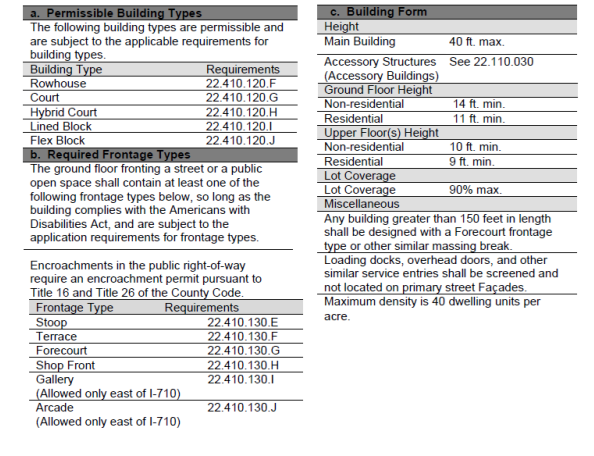
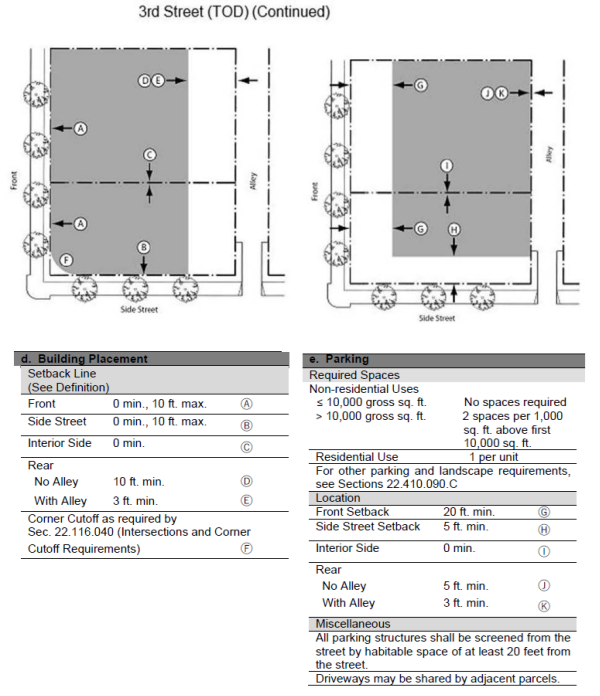
2.
Cesar E. Chavez Avenue (CC). Property in the CC Transect Zone shall be subject to the following requirements:
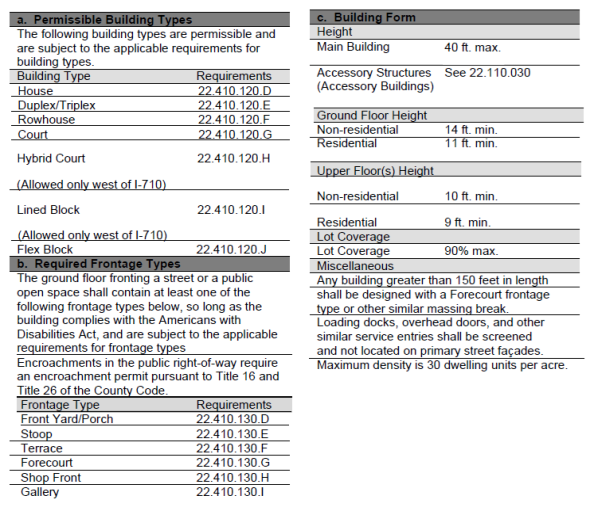
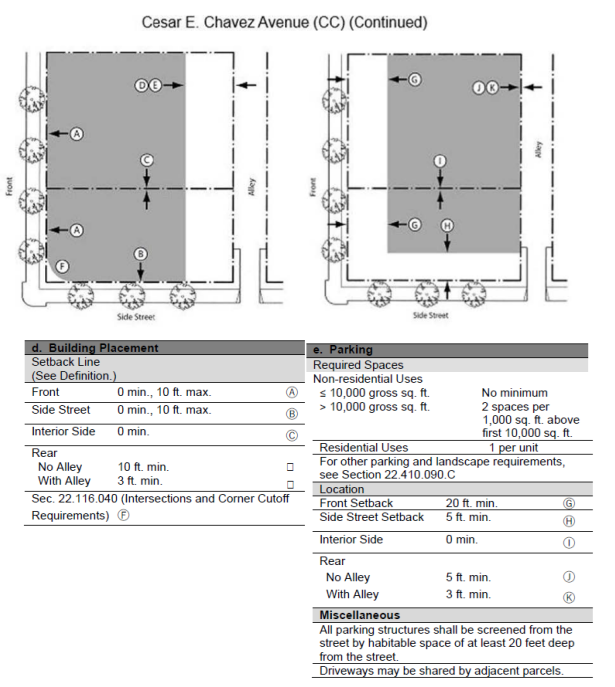
3.
First Street (FS). Property in the FS Transect Zone shall be subject to the following requirements:
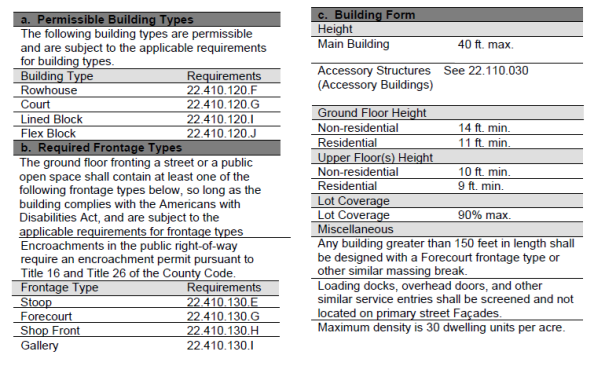
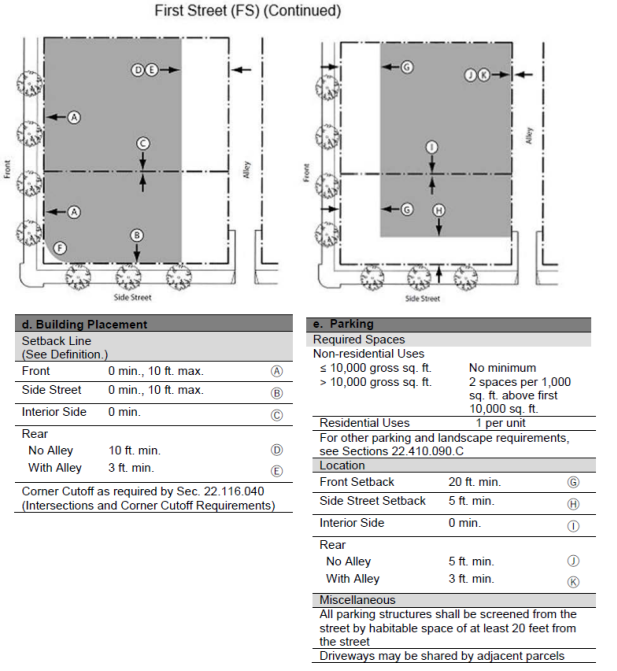
4.
Atlantic Boulevard (AB). Property in the AB Transect Zone shall be subject to the following requirements:
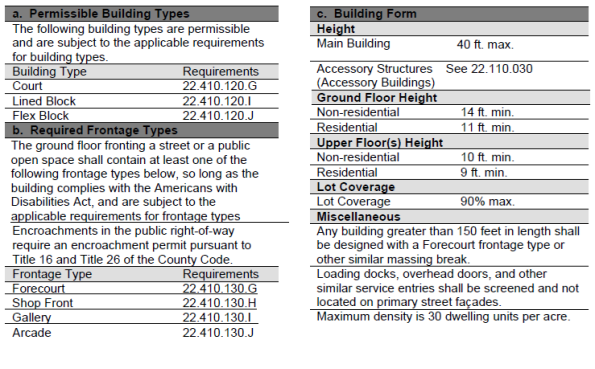
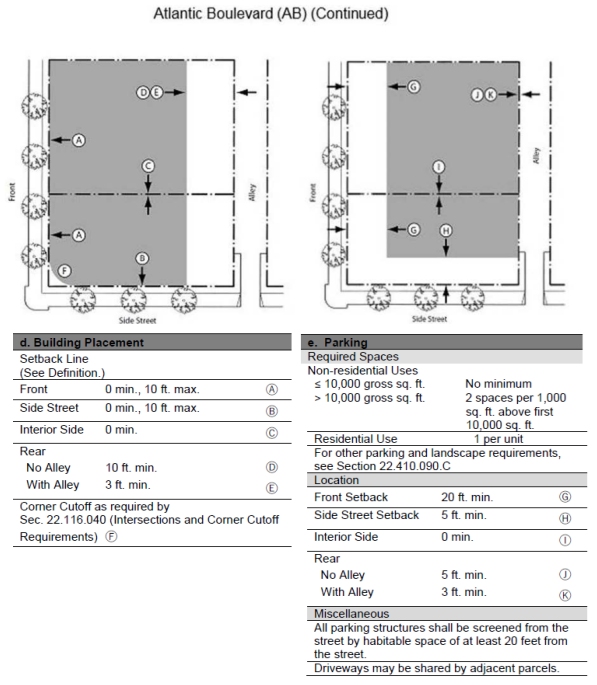
5.
Neighborhood Center (NC). Property in the NC Transect Zone shall be subject to the following requirements:
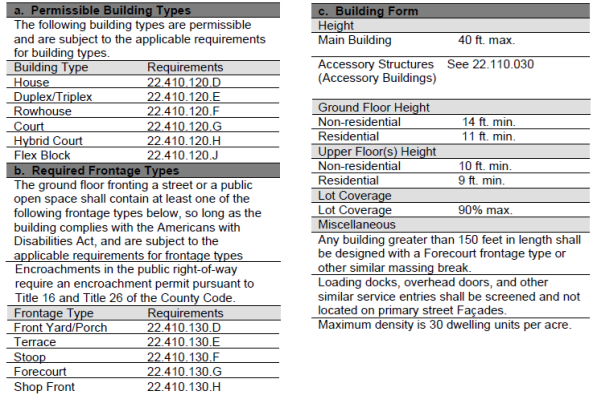
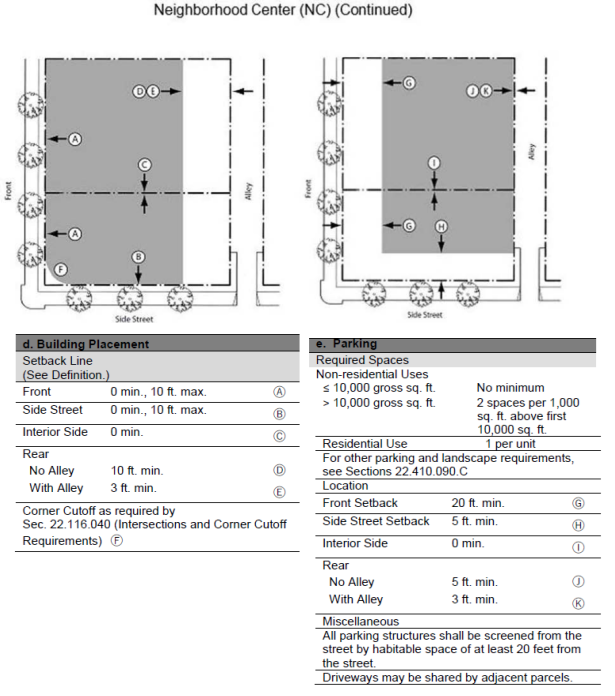
6.
Low-Medium Density Residential (LMD). The regulations for the Low-Medium Density Residential (LMD) Transect Zone shall be the same as those for the R-1 Zone, as prescribed in Chapter 22.18 (Residential Zones), except as specifically provided for herein.
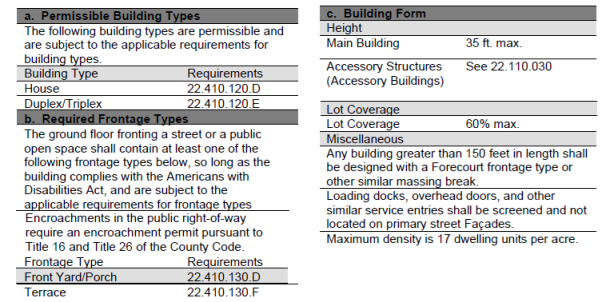
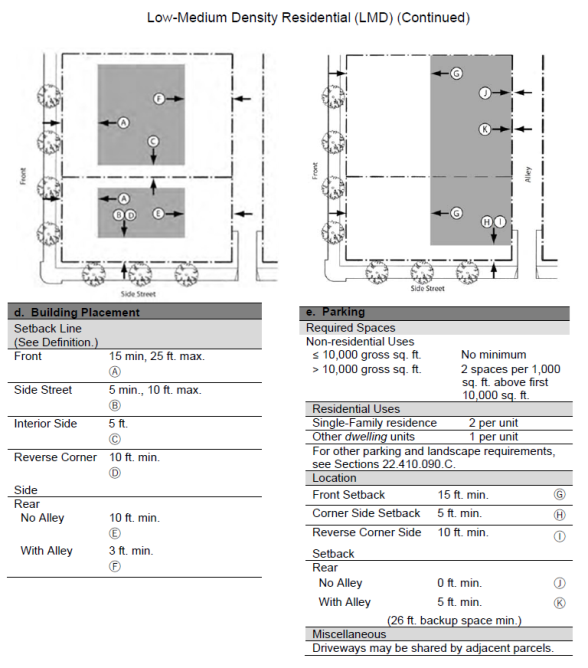
7.
Civic Space (CV). The regulations for the Civic Space Transect Zone shall be the same as those for the Institutional Zone as prescribed in Section 22.26.020 (Institutional Zones), except as specifically provided for herein.
8.
Open Space (OS). The regulations for the Open Space Transect Zone shall be the same as those for the Open-Space Zone as prescribed in Chapter 22.16 (Agricultural, Open Space, Resort and Recreation, and Watershed Zones), except as specifically provided for herein.
(Ord. 2024-0032 § 36, 2024; Ord. 2022-0008 § 161, 2022.)
22.410.120 - Building Type Standards.
A.
Purpose. This Section establishes the building types allowed within the Plan Area and the standards applicable to each building type.
B.
Applicability. The requirements of this Section shall apply to all development and uses within the Transect Zones, and shall be considered in combination with the standards for the applicable Transect Zone in Section 22.410.110 (Transect Zone Standards).
C.
Building Type Overview. Figure 3, Building Types Plan and Diagram below provides an illustrative overview of the permissible building types.
•
House
•
Duplex/Triplex
•
Rowhouse
•
Court
•
Hybrid Court
•
Lined Block
•
Flex Block
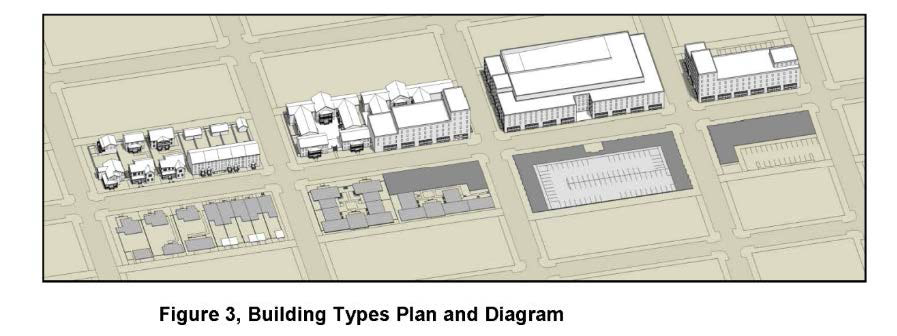
D.
House. This Subsection specifies standards for development of the House building type.
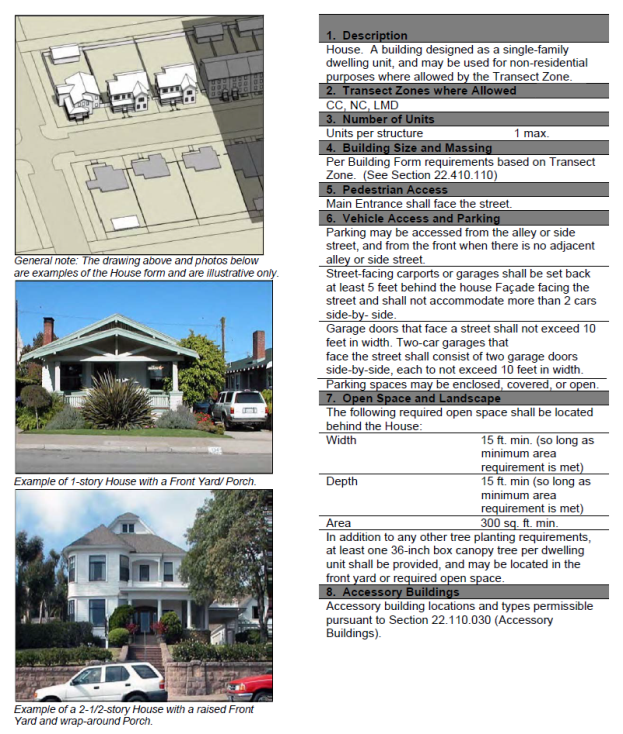
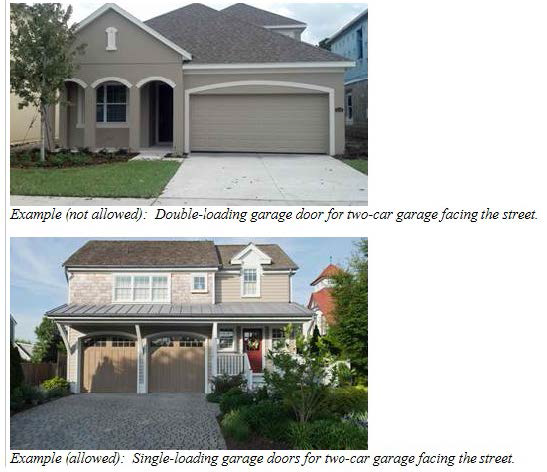
E.
Duplex/Triplex. This Subsection specifies standards for development of the Duplex/Triplex building type.
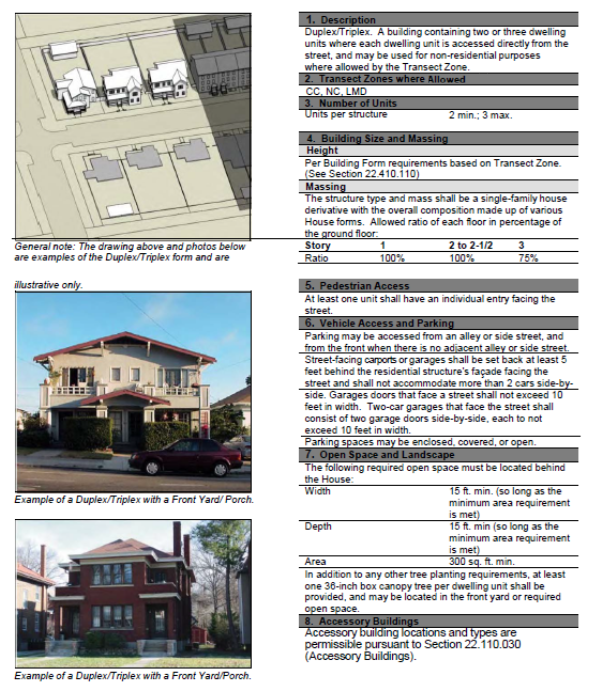
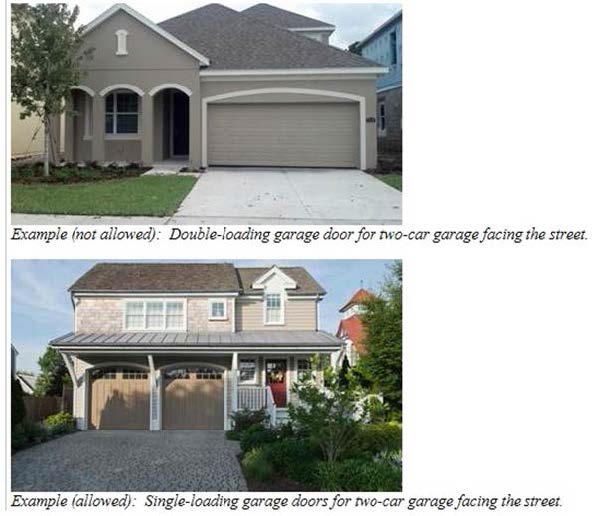
F.
Rowhouse. This Subsection specifies standards for development of the Rowhouse building type.
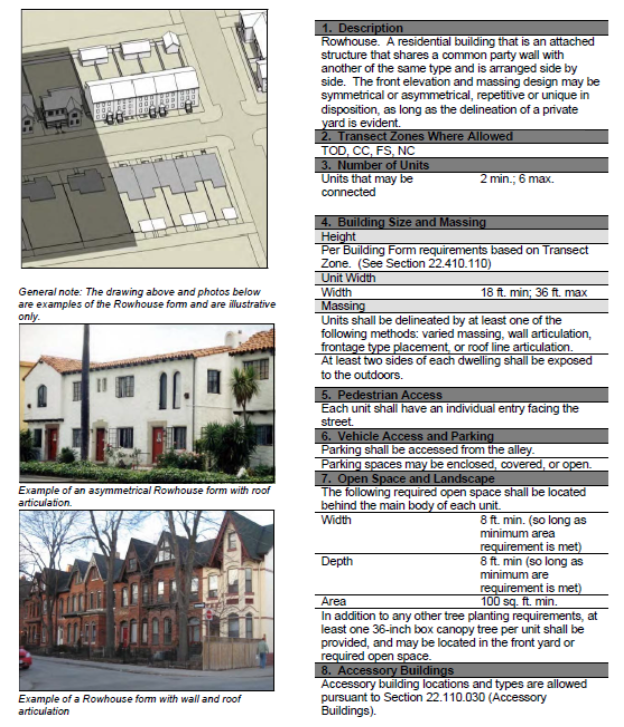
G.
Court. This Subsection specifies standards for development of the Court building type.
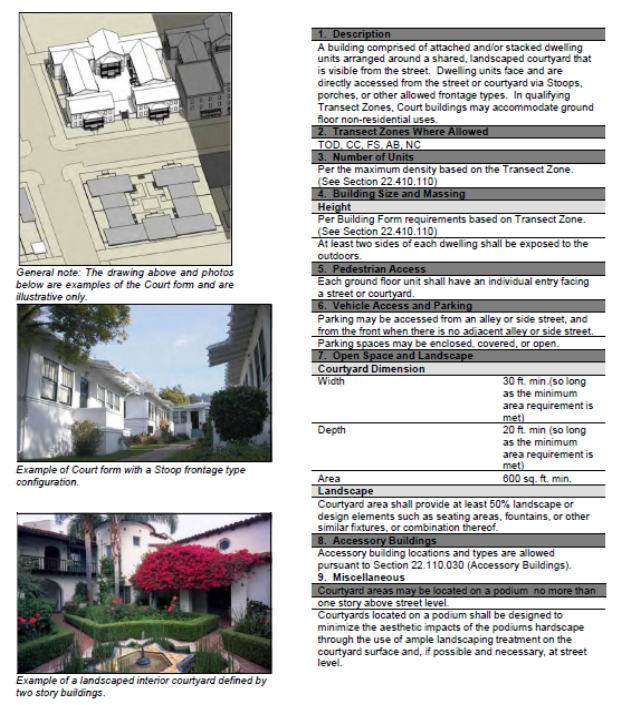
H.
Hybrid Court. This Subsection specifies standards for development of the Hybrid Court building type.
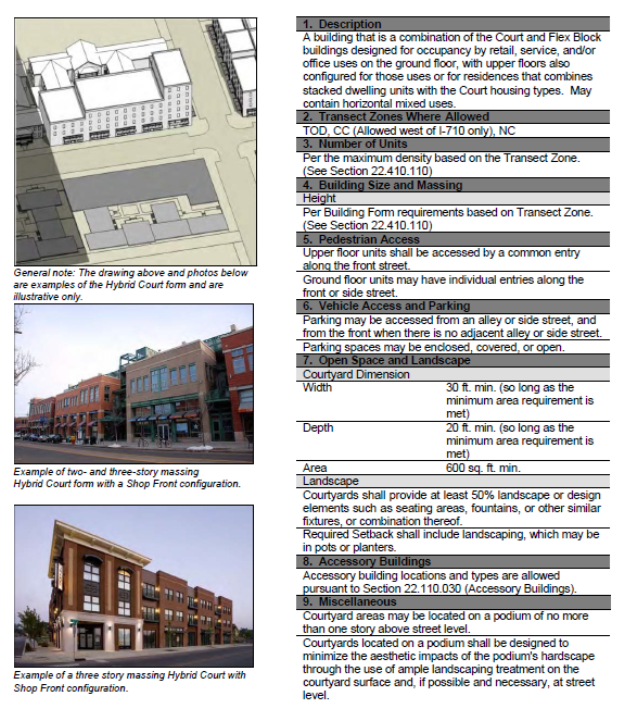
I.
Lined Block. This Subsection specifies standards for development of the Lined Block building type.
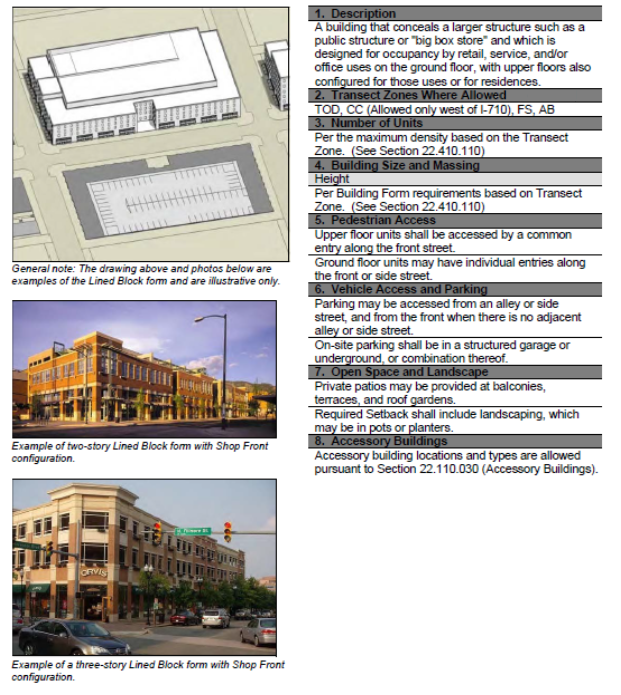
J.
Flex Block. This Subsection specifies standards for development of the Flex Block building type.
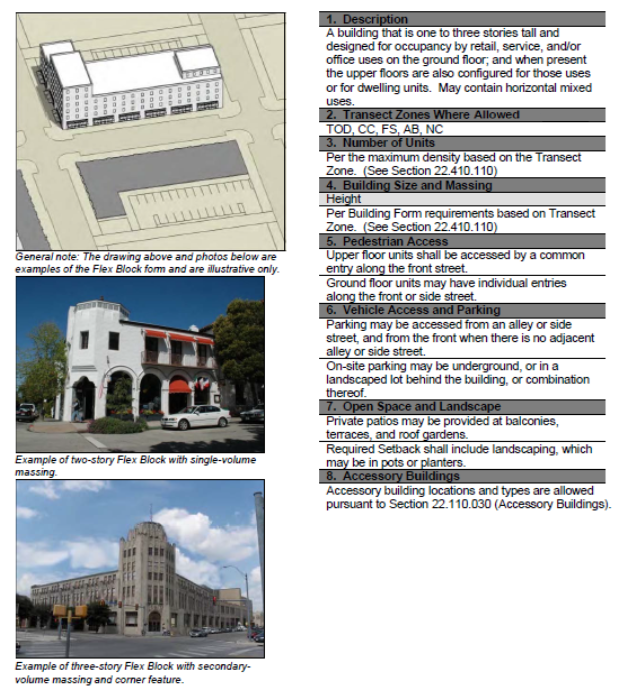
(Ord. 2022-0008 § 161, 2022.)
22.410.130 - Frontage Type Standards.
A.
Purpose. This Section establishes the frontage types allowed within each Transect Zone and the standards applicable to these frontage types. Frontages are the components of a building that provide an important transition and interface between the public realm (street and sidewalk) and the private realm (yard or building).
B.
Applicability. The standards in this Section shall be considered in combination with the standards found in Section 22.46.3009 (Transect Zone Standards) and Section 22.46.3010 (Building Types Standards) and are applicable to the development or alteration of all frontages within the Transect Zones.
C.
Frontage Type Overview. Figure 4, Frontage Types Illustrative Diagram below provides an illustrative overview of the allowed frontage types.
•
Front Yard/Porch
•
Terrace
•
Stoop
•
Forecourt
•
Shop Front
•
Gallery
•
Arcade
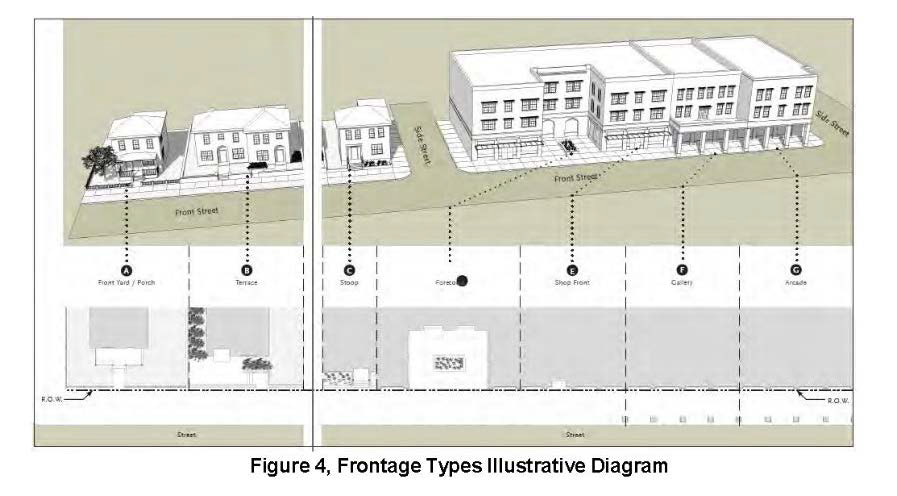
D.
Front Yard/Porch. This Subsection specifies standards applicable to the Front Yard/Porch frontage type.
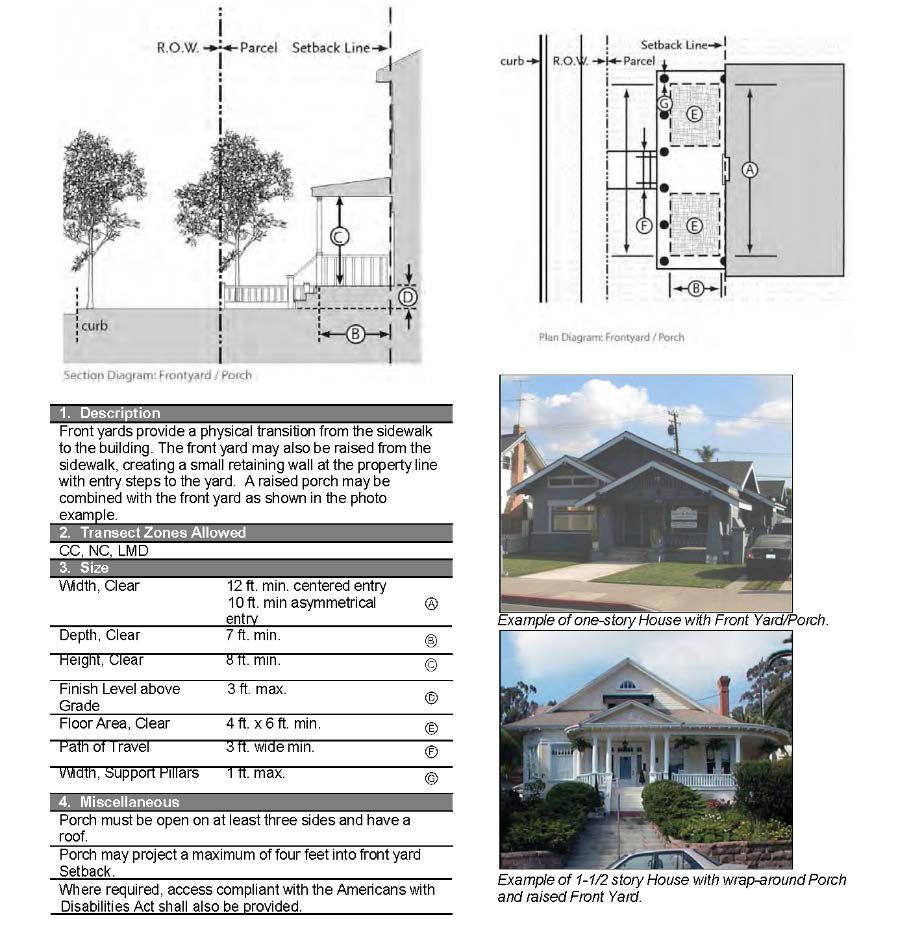
E.
Stoop. This Subsection specifies standards applicable to the Stoop frontage type.
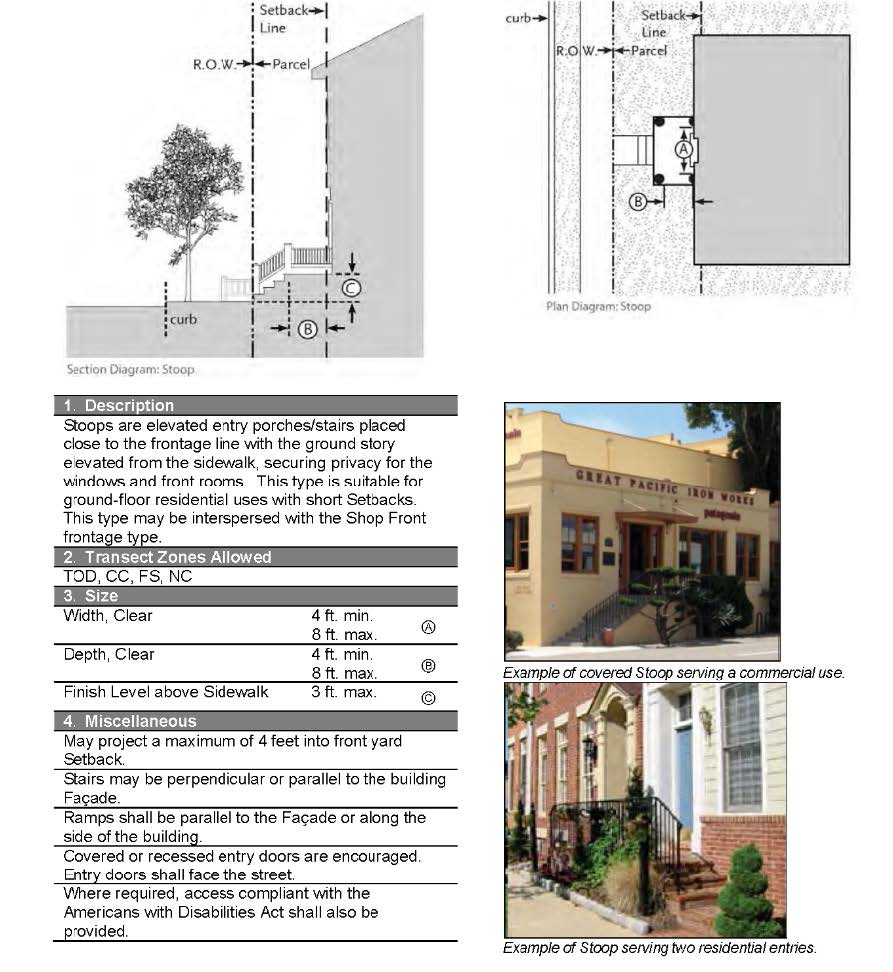
F.
Terrace. This Subsection specifies standards applicable to the Terrace frontage type.
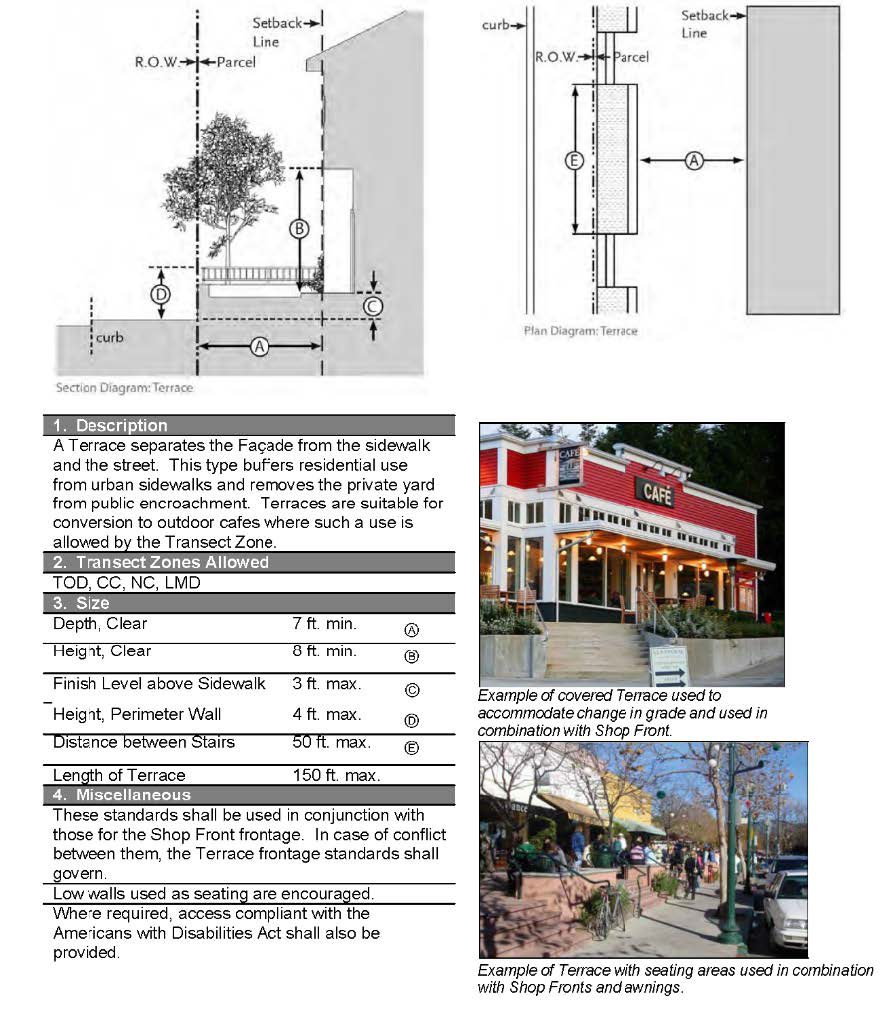
G.
Forecourt. This Subsection specifies standards applicable to the Forecourt frontage type.
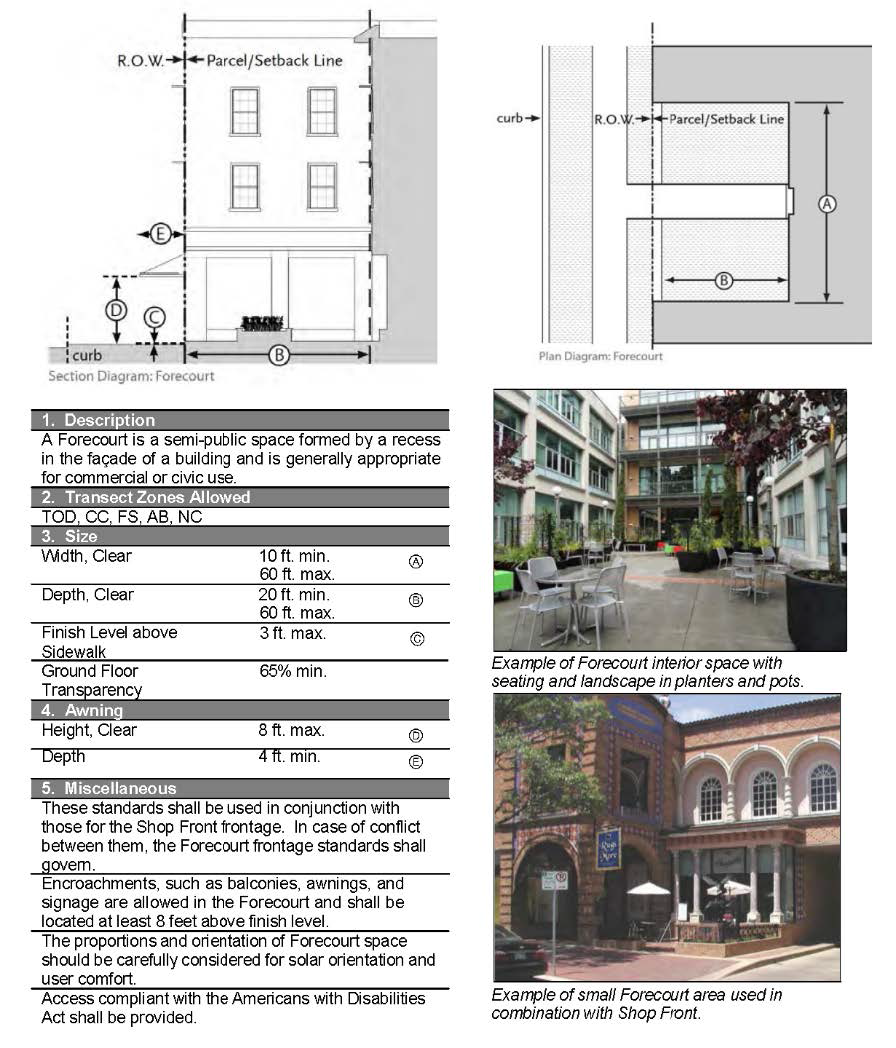
H.
Shop Front. This Subsection specifies standards applicable to the Shop Front frontage type.
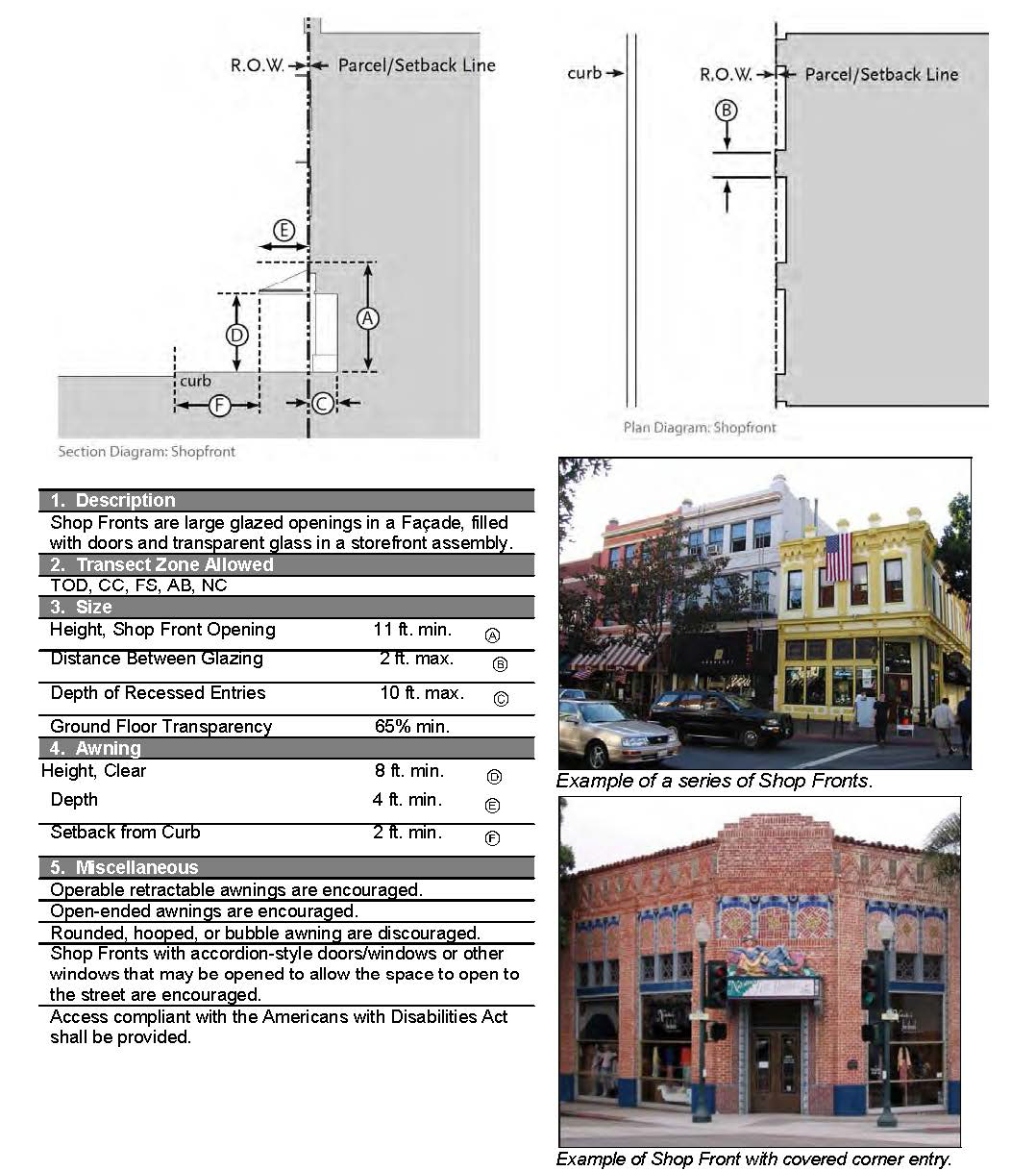
I.
Gallery. This Subsection specifies standards applicable to the Gallery frontage type.
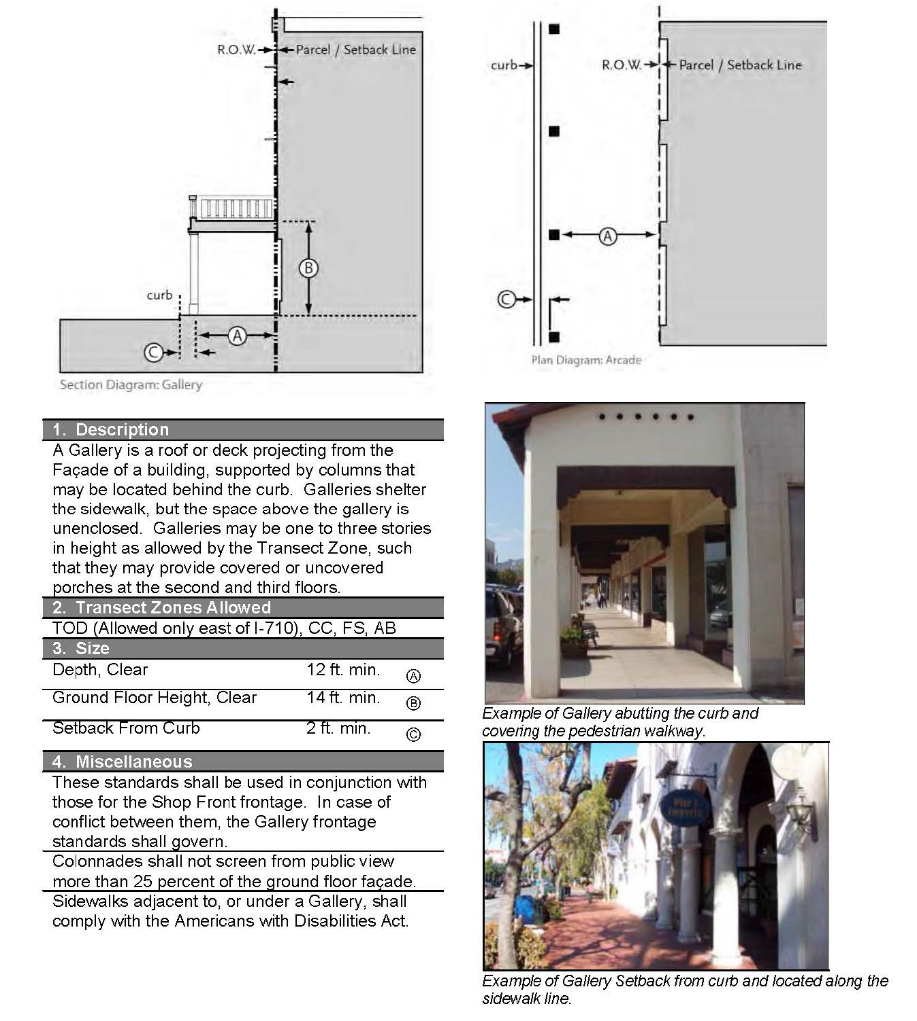
J.
Arcade. This Subsection specifies standards applicable to the Arcade frontage.
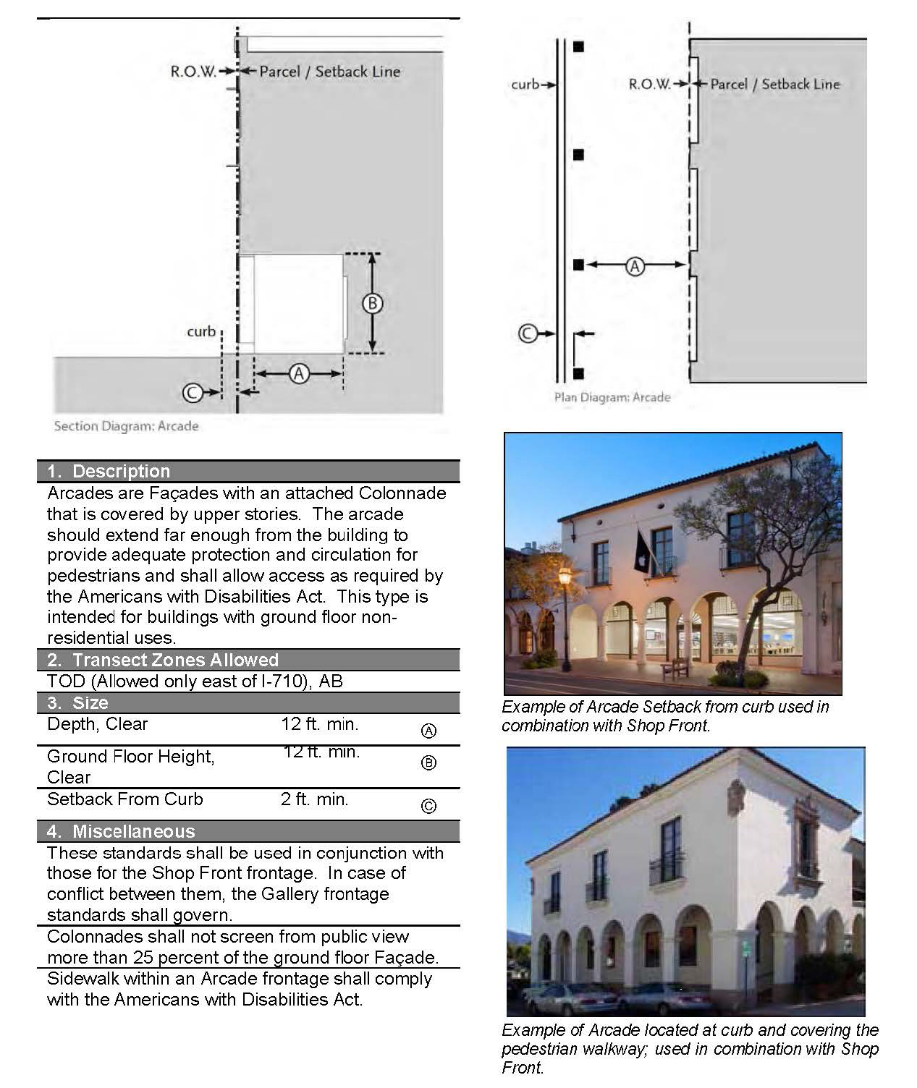
(Ord. 2022-0008 § 161, 2022.)
22.410.140 - Signs.
A.
Purpose. The purpose of these sign regulations is to:
1.
Allow property owners and occupants an opportunity to have effective signage in all Transect Zones subject to reasonable conditions related to identifying goods sold or produced, or services rendered.
2.
Maintain and enhance the quality of the community's appearance by:
a.
Regulating the size, location, and design of temporary and permanent signs so that the appearance of such signs will reduce sign clutter, be aesthetically harmonious with their surroundings, and enhance the overall appearance of the built environment;
b.
Preserving and perpetuating uncluttered views, and significant architectural and cultural resources; and
c.
Protecting residential neighborhoods from adverse impacts of excessive signage.
3.
Ensure that signs are located and designed to:
a.
Maintain a safe and orderly pedestrian and vehicular environment; and
b.
Reduce potentially hazardous conflicts between commercial or identification signs and traffic control devices and signs.
B.
Applicability.
1.
The requirements of this Section apply to all on-site signs in the Transect Zones.
2.
Signs regulated by this Form-Based Code shall not be erected or displayed unless a building permit is first obtained, unless the sign is exempt as set forth in Subsection C, below.
C.
Exempt Signs. In addition to the exemptions for signs described in Section 22.114.030 (Exemptions), the following types of signs are exempt from this Form-Based Code, provided the signs conform to the following and are located in the TOD, CC, FS, AB, or NC Transect Zones.
1.
Future Tenant Signs. Temporary signs that identify the name of future businesses. Only one such sign is allowed per street frontage of the building with a maximum of 32 square feet of sign area. Such a sign may only be displayed after tenant improvements for the site have begun and may not be displayed after the first occupancy of the tenant space.
2.
Grand Opening Sign. A temporary promotional sign used by newly established businesses to inform the public of their location and services. Such signs are permitted only until 90 days after initial occupancy of the new business and shall be removed no later than the 91st day after such initial occupancy. One such sign is allowed per street frontage with a maximum of 32 square feet of sign area. A "Grand Opening" sign does not include an annual or occasional promotion by a business.
3.
Window Sign. Two window signs per tenant are allowed consisting of permanently fixed individual lettering and/or logos not exceeding six inches in height and a total maximum sign area of three square feet. If illuminated, a window sign shall only be externally illuminated.
4.
Temporary Window Sign. In addition to the signage allowed in Subsection C.3, above, a tenant may display one additional temporary window sign, provided the sign does not exceed 25 percent of the area of any single window or adjoining windows on the same street frontage. Display of such temporary window sign shall not exceed 30 days and there shall be a minimum of 30 days between use of temporary window signs. Temporary window signs are permitted a maximum of four times per calendar year, and, if illuminated, shall only be externally illuminated.
5.
Directory Sign. A directory sign for a building providing a list of the names of business establishments within the building or series of buildings is allowed provided the sign area for the directory sign is no larger than six square feet. Such directory sign may be wall mounted, provided it is no higher than eight feet from the finished level. The directory sign may also be freestanding, provided it is no higher than three feet from the finished level, and does not cause entrances and walkways to violate ADA.
6.
Affiliation Sign. Affiliation signs that provide notice of services within an establishment (e.g., credit cards accepted, trade affiliations, etc.) are allowed provided such signs shall not exceed one square foot in area for each sign, and no more than three such signs shall be allowed for each business. If illuminated, affiliation signs shall only be externally illuminated.
D.
Prohibited Signs. Signs prohibited by Section 22.114.040 (Prohibited Signs Designated) and any sign type or sign size not expressly provided for in this Form-Based Code are prohibited.
E.
Permitted Signs.
1.
The signs identified in Sections 22.114.140 (Incidental Business Signs), 22.114.170 (Temporary Real Estate Signs), 22.114.180 (Temporary Construction Signs), and 22.114.210 (Temporary Subdivision Sales, Entry, and Special-Feature Signs) are permitted, subject to the requirements of those sections.
2.
The signs described in Sections 22.410.140.E.3 through 22.410.140.E.6 shall be permitted in the TOD, CC, FS, AB, and NC Transect Zones, subject to the following procedures:
a.
Application Requirements. A sign application shall be submitted and shall include all information, materials, and fees required by Section 22.410.060.B of this Form-Based Code;
b.
Review and Approval. The application shall be subject to the review and approval of the Director under a Ministerial Site Plan Review pursuant to Section 22.410.060.B.
3.
Yard Sign. This Subsection specifies standards for Yard Signs.
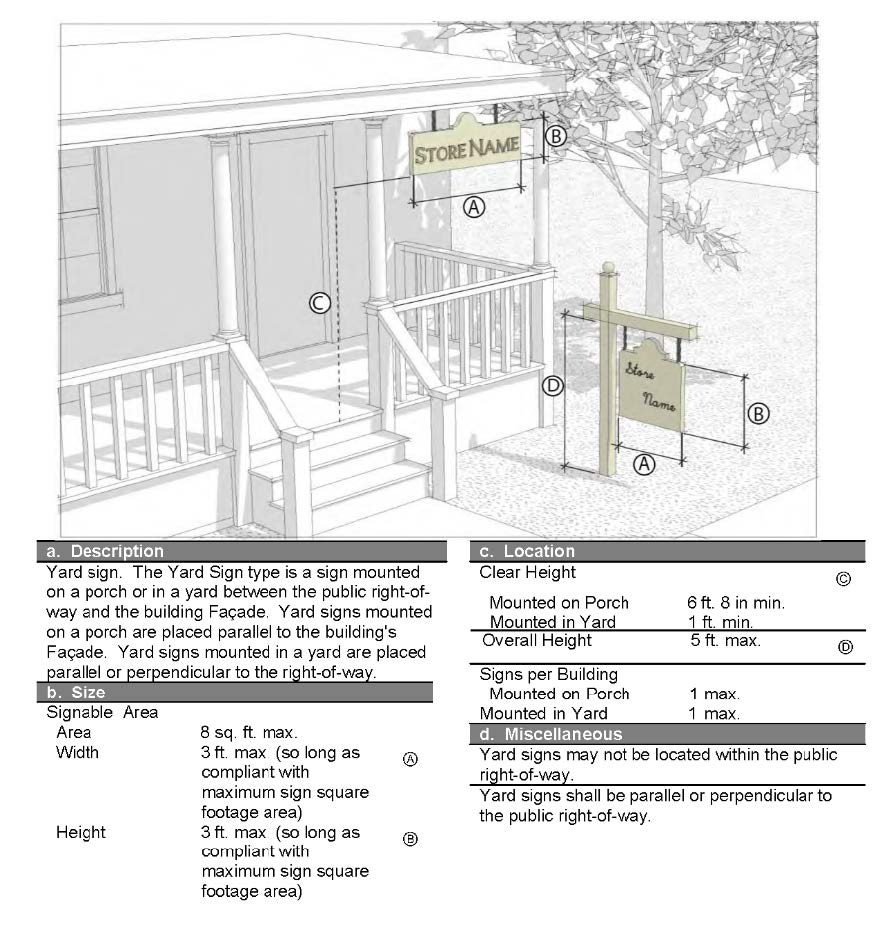
4.
Projecting Sign. This Subsection specifies standards for Projecting Signs.
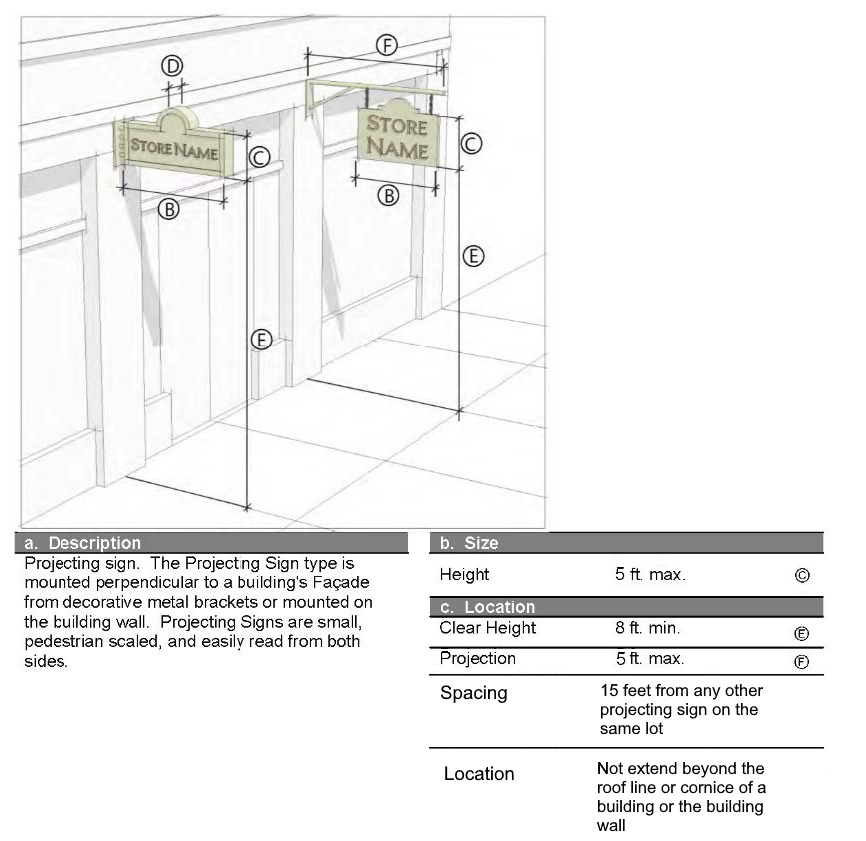
5.
Awning Sign. This Subsection specifies standards for Awning Signs.
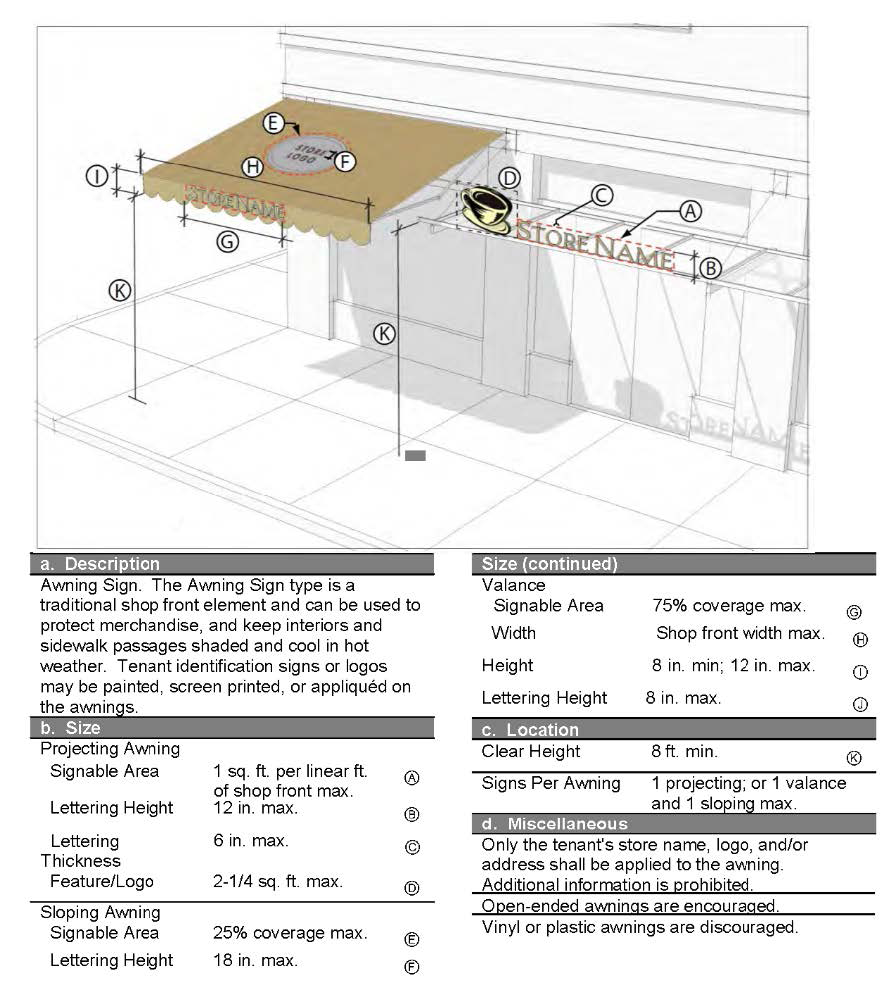
6.
Wall Sign. This Subsection specifies standards for Wall Signs.
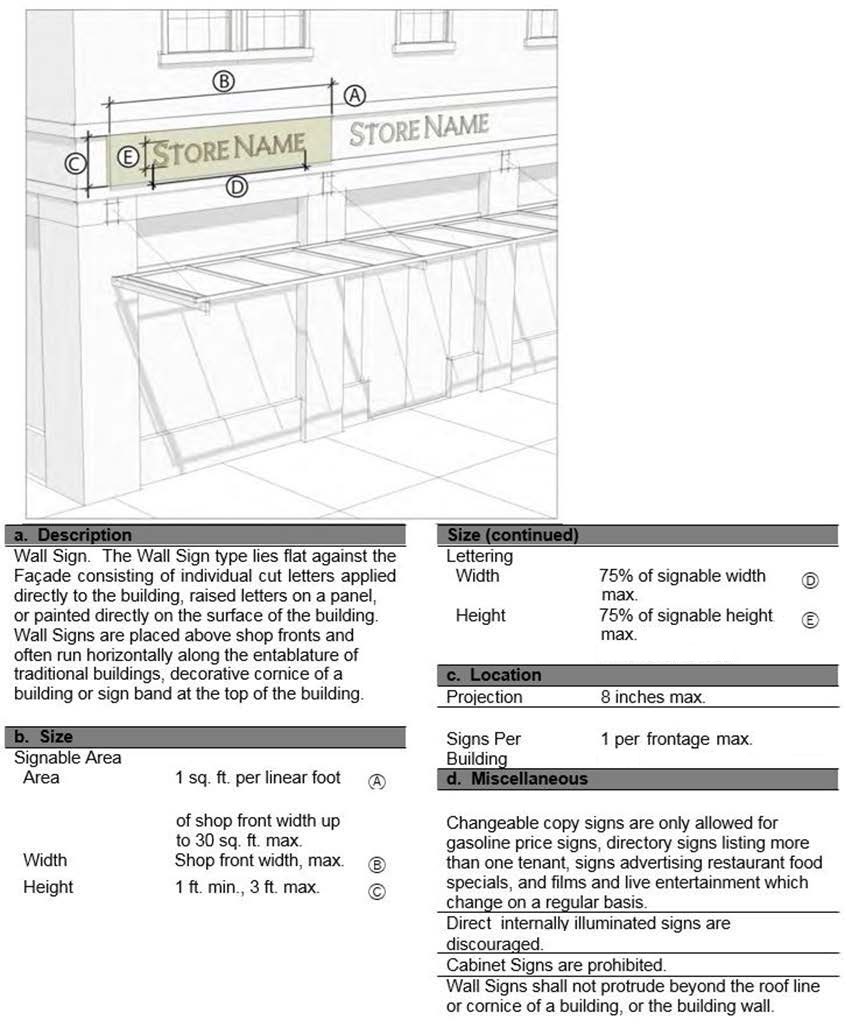
F.
Discretionary Signs.
1.
Purpose. This Subsection establishes standards and procedures for the design, review, and approval of signs that exhibit a unique design, a high degree of thoughtfulness, imagination, inventiveness, or spirit, and that make a positive visual contribution to the overall image of East Los Angeles.
2.
Applicability. A property owner or applicant may request a Discretionary Sign Permit to authorize an on-site sign that employs standards that differ from the other provisions of this Section 22.410.140, but otherwise comply with the provisions of this Section 22.410.140.F.
3.
Application Requirements. A Discretionary Sign permit application shall include all information, materials, and fees as required for a Substantial Conformance Review pursuant to Section 22.410.060.D of this Form-Based Code.
4.
Review and Approval. The Hearing Officer may approve a Discretionary Sign permit under a Specific Plan Substantial Conformance Review pursuant to Section 22.410.060.D of this Form-Based Code, except that the burden of proof findings for a Specific Plan Substantial Conformance Review set forth in Section 22.410.060.D.4 of this Form-Based Code shall not be required.
5.
Burden of Proof. The applicant shall substantiate to the satisfaction of the Hearing Officer the following:
a.
Design Quality. That the sign is designed with graphics, color, texture and quality materials that has a positive visual impact on the site and surrounding area.
b.
Contextual Criteria. That the sign is compatible, and is to scale and proportion with the surrounding area.
c.
Architectural Criteria. That the sign utilizes or enhances the architectural elements of the building and does not cover any key architectural features or details of the façade.
d.
Neighborhood Impact Criteria. That the sign is located and designed so as to not cause light and glare impacts on neighboring uses.
6.
Revisions to Discretionary Sign Permit. Revisions to a Discretionary Sign permit may be approved by the Director if the intent of the sign's original approval is not affected. Revisions to a discretionary sign that deviate from the intent of the original approval shall require a new Discretionary Sign permit.
G.
Master Sign Program. This Subsection allows for a master sign program within the Plan Area.
1.
Purpose. A master sign program is intended to:
a.
Integrate the design of multiple signs proposed for a development project with the design of the project's structures so that the multiple signs create a unified architectural statement; and/or
b.
Provide a means for applying common sign regulations for multi-tenant projects and to allow latitude in the design and display of multiple sign for the projects. A master sign program is intended to achieve, not circumvent, the intent of this Form-Based Code and the vision of the East Los Angeles Third Street Plan.
2.
Applicability. A master sign program permit shall be required whenever any of the following circumstances exist:
a.
The property owner or applicant requests a master sign program;
b.
A project is proposed to include four or more non-exempt signs on the same lot or parcel or building; or
c.
A non-exempt sign is proposed at a location where a non-conforming sign exists on the property, and the property has four or more tenants or tenant spaces.
3.
Application Requirements. A master sign program application shall include all information, materials, and fees required for a Specific Plan Substantial Conformance Review application pursuant to Section 22.410.060.D of this Form-Based Code.
4.
Review and Approval. The Hearing Officer may approve a master sign program under a Specific Plan Substantial Conformance Review pursuant to Section 22.410.060.D of this Form-Based Code, except that the burden of proof findings for a Specific Plan Substantial Conformance Review set forth in Section 22.410.060.D.4 of this Form-Based Code shall not be required.
5.
Burden of Proof. The applicant shall substantiate to the satisfaction of the Hearing Officer all of the following:
a.
That the master sign program is consistent with the purposes of this Form-Based Code and the overall intent and vision of the East Los Angeles Third Street Plan;
b.
That the master sign program enhances the overall development, is harmonious with, and relates visually to, other signs included in the master sign program, to the structures or developments they identify, and to surrounding development; and
c.
That the master sign program accommodates future revisions that may be required because of changes in use or tenants in the development.
6.
Revisions to Master Sign Programs. Revisions to a master sign program may be approved by the Director if the intent of the program's original approval is not affected. Revisions to a master sign program that would deviate from the intent of the sign's original approval shall require the approval of a new master sign program.
H.
Sign Design Recommendations. While the County does not regulate the message content, or copy, of a sign, the following principles of copy design and layout can enhance the readability and attractiveness of signs and are therefore encouraged.
1.
Sign copy should relate only to the name and/or nature of the business or building.
2.
Permanent signs that advertise information such as continuous sales, special prices, or include phone numbers, should be avoided.
3.
Information on signs should be conveyed briefly or by logo, symbol, or other graphic manner. The intent of the sign should be to increase the readability of the sign and thereby enhance the identity of the business.
I.
Sign Maintenance Requirements. A sign that is not properly maintained or is dilapidated shall be deemed a public nuisance, and shall be abated in compliance with Chapter 22.242 (Enforcement Procedures).
J.
Non-conforming Signs.
1.
Applicability. The provisions of this Subsection shall apply to all nonconforming signs.
a.
In addition to all other applicable provisions of this Section, non-conforming signs shall not be:
i.
Modified, relocated, replaced, repaired or re-stablished unless the sign is brought into conformance with the provisions of this Section;
ii.
Re-built or re-constructed after damage or destruction of more than 50 percent of the replacement value of the sign prior to said damage or destruction.
2.
Removal and Amortization Schedule. Any sign which is nonconforming due to the requirements of this Form-Based Code or to the requirements of Title 22, shall be removed or made to comply with this Form-Based Code within 15 years from the effective date of this Form-Based Code.
(Ord. 2024-0032 § 37, 2024; Ord. 2022-0008 § 161, 2022.)
22.410.150 - Block and Subdivision Guidelines.
A.
Purpose. This Section establishes guidelines for maintaining the existing interconnected street and block network in the Plan Area as well as for subdividing blocks into pedestrian-scaled blocks. These guidelines are intended to generate an urban infrastructure of small-scale, walkable blocks defined by an interconnected street network that is punctuated by a variety of public open space types.
B.
Applicability. An applicant for any new development that exceeds two acres in area should review and consider the guidelines in this Section.
C.
Design Objectives and Subdivision Guidelines for Existing Blocks. Each site subject to this Section should be designed to:
1.
Maintain the existing street network.
2.
Enhance circulation and access.
3.
Develop lots within the block that facilitate pedestrian-oriented building design.
4.
Develop buildings with their entrances facing bordering streets.
D.
Existing Right-of-Way and Alley Guidelines.
1.
Realignment of Right(s)-of-Way. Existing rights-of-way may be realigned provided that the resulting block and private property meet the guidelines of this Section and the applicable building type standards of Section 22.410.120 of this Form-Based Code.
2.
Existing Alley-Access. In all cases, blocks with alleys should maintain alley access. Existing alley-access may be modified through realignment (shift, deflection, etc.) provided the realigned alley results in a minimum of 100 feet of net lot depth on both sides of the realigned alley.
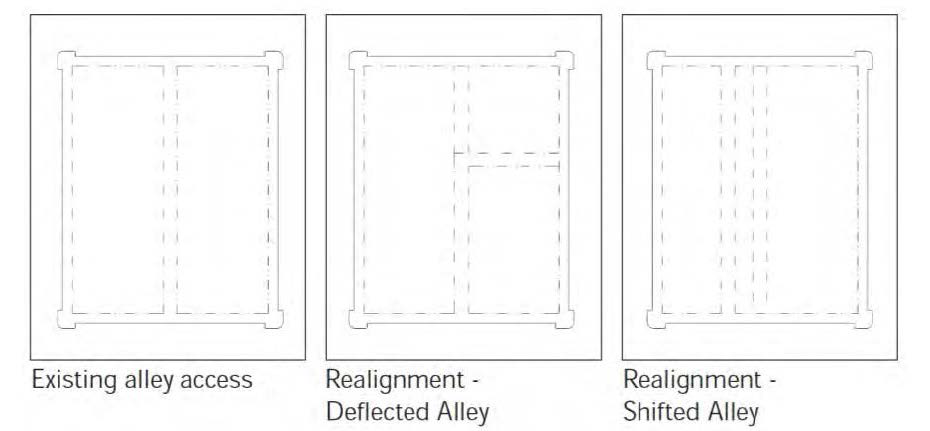
E.
Design Objectives and Subdivision Guidelines for New Blocks. Each site should be designed to be divided into smaller blocks with:
1.
Internal streets, where appropriate, to connect with off-site streets and/or to create a series of smaller, walkable blocks.
2.
Service alleys within the new blocks.
3.
Lots established within the block(s) for the purpose of facilitating pedestrian-oriented building design so that buildings can have their main entrances on the front street, rather than the side street.
4.
Corner buildings with a frontage on both streets may have entrances on both streets.
F.
Proposed New Block Guidelines. The dimensional and required lot width guidelines are summarized below:
1.
Orthogonal Block Guidelines. Orthogonal blocks are rectilinear and consist of square or rectangular designs. The following apply to such proposed blocks:
a.
Block Length. Orthogonal blocks of various designs and functions are allowed as diagrammed in this Section and pursuant to the following guidelines implementation options. Minimum length of the block is 150 feet. Maximum length of the block is 400 feet.
b.
Lot Width. All buildings shall be designed to a lot with a minimum width of 50 feet or as allowed by building type, whichever is less. Maximum lot width is 300 feet.
Note: The lot is primarily for design purposes and may be made permanent through the regular process for lot line adjustments, parcel maps and/or tract maps.
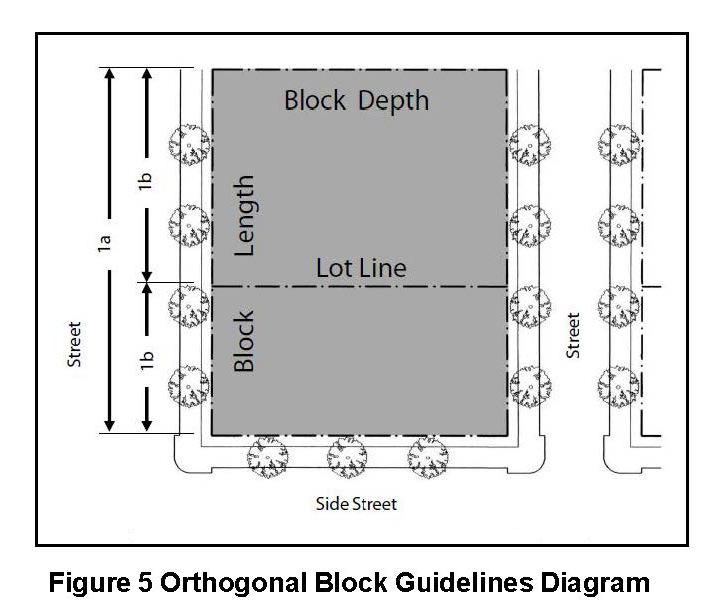
2.
Trapezoidal Block Implementation Options. Trapezoidal blocks are irregular in shape and consist of various designs. Blocks of various designs and functions are allowed as identified in the diagram below and pursuant to the following guidelines.
a.
Block Length. Minimum length/width of a block is 100 feet. Maximum length of a block is determined by allowing an average of 500 feet for the two longest sides of the block.
b.
Block Width. All buildings should be designed with a minimum width of 50 feet or as allowed by building type, whichever is less. Maximum width of a lot is 300 feet.
Note: The lot is primarily for design purposes and may be made permanent through the regular process for lot line adjustments, parcel maps and/or tract maps.
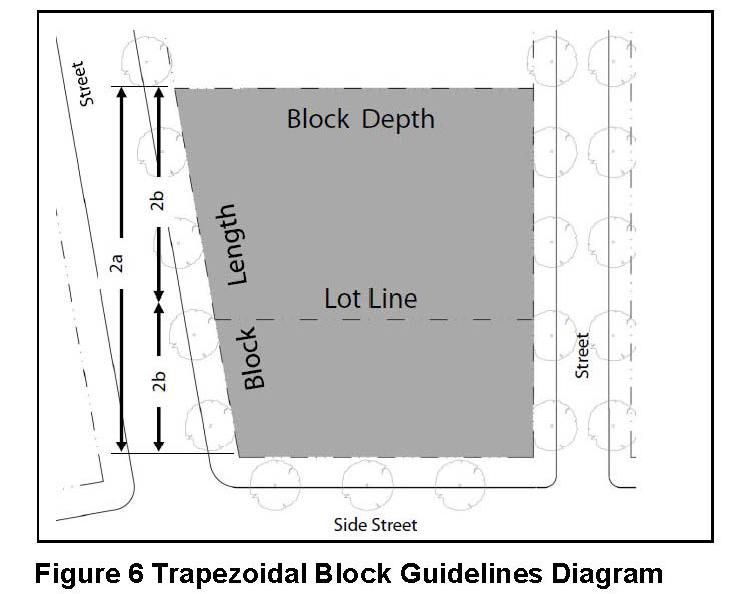
3.
Streets/Rights-of-Way. All blocks should be designed to support a pedestrian-oriented environment pursuant to the goals and policies of the East Los Angeles Third Street Plan.
G.
Illustrative Sequence: Applying Subdivision Guidelines to Achieve Pedestrian-Scaled Buildings. The series of diagrams below identifies the sequence of creating and maintaining walkable and multi-modal blocks to be developed in a variety of ways pursuant to the provisions of this Form-Based Code. This information illustrates the intent of the subdivision guidelines of this Section 22.410.150, combined with the building type standards of Section 22.410.120. Title 21 of the Los Angeles County Code provides direction and options regarding subdividing large lots.
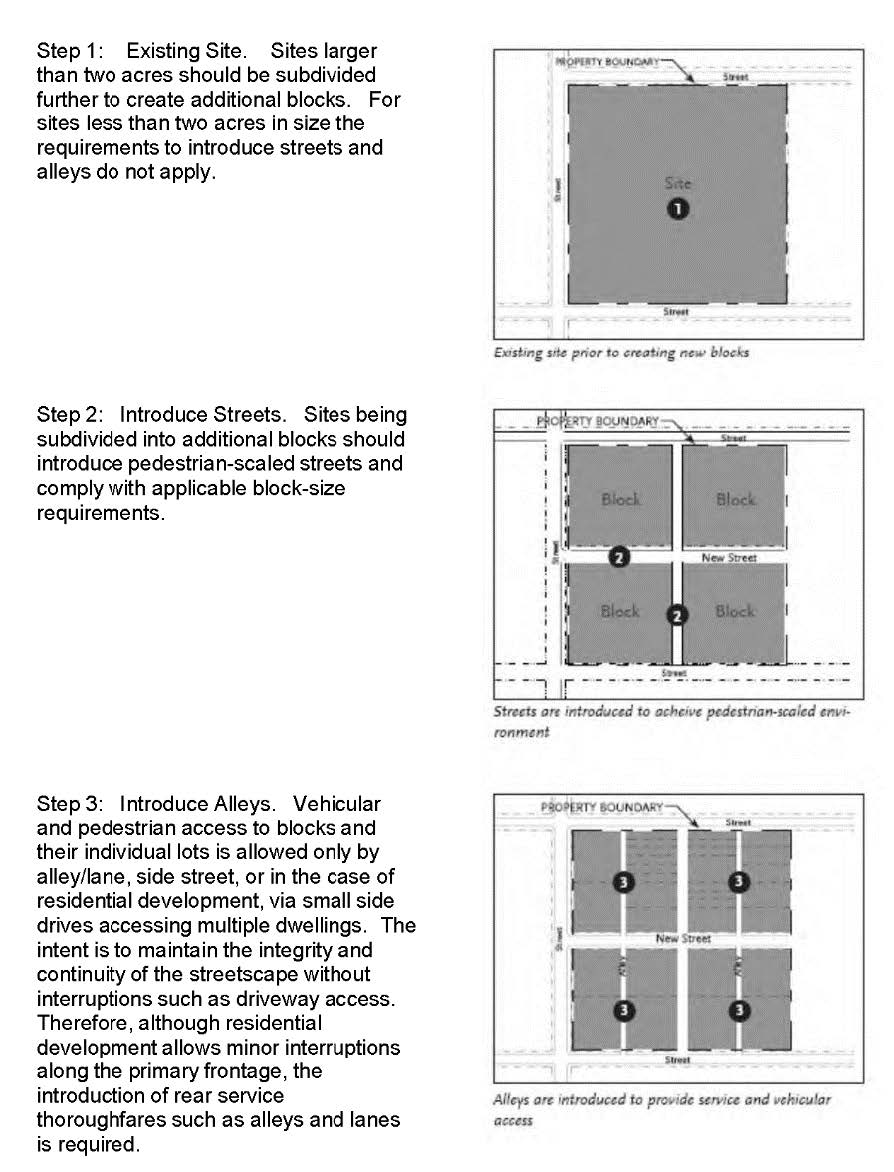
(Ord. 2022-0008 § 161, 2022.)
22.412.010 - Purpose.
This Chapter establishes the zones, use regulations, and development standards for the Willowbrook Transit-Oriented District Specific Plan Area (Plan Area). The zones with accompanying use regulations, and development and design standards, are intended to provide property owners, business owners, developers, and their designers with basic development and design criteria that are intended to reinforce the desired building and district character.
(Ord. 2024-0032 § 38, 2024.)
22.412.020 - Applicability.
A.
General. The provisions of this Chapter 22.412 shall apply to all properties included in the Plan Area. Except as specified otherwise, no construction, modification, addition, placement or installation of any building or structure shall occur, nor shall any new use commence on any lot, on or after October 18, 2018, that is not in conformity with the provisions of the Willowbrook TOD Specific Plan.
B.
Pending Applications and Modifications to Approved Permits. Pending applications filed prior to October 18, 2018, and modifications to approved permits requested after October 18, 2018, shall be subject to Section 22.246.020 (Applicability of Zone Changes and Ordinance Amendments).
C.
Relationship to Other Provisions in Title 22. The provisions of this Chapter 22.412 shall be administered in conjunction with other provisions of this Title 22, in accordance with Section 22.400.030 (Administration).
(Ord. 2024-0032 § 38, 2024.)
22.412.030 - Specific Plan Zones.
Figure 22.412.030-A, below, identifies the zones within the Specific Plan Area.
FIGURE 22.412.030-A: WILLOWBROOK TRANSIT-ORIENTED DISTRICT SPECIFIC PLAN ZONES
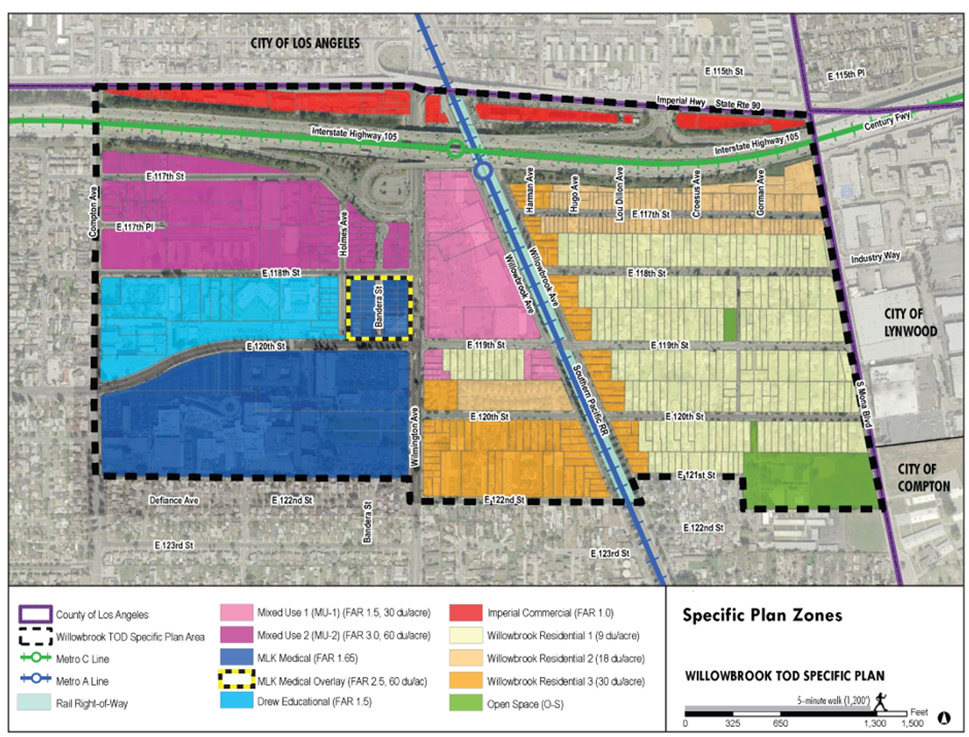
(Ord. 2024-0032 § 38, 2024.)
22.412.040 - Mixed Use Zones.
A.
Purpose.
1.
Mixed Use 1 (MU-1) Zone. The Mixed Use 1 (MU-1) Zone is intended to provide commercial and residential development, with an emphasis on neighborhood serving retail, restaurant, and service uses. The area is appropriate for a large retail or mixed use center, with a neighborhood plaza or community gathering space as a focal point and strong pedestrian connections to the Willowbrook/Rosa Parks Station, as well as the educational and medical campuses to the west.
2.
Mixed Use 2 (MU-2) Zone. The Mixed Use 2 (MU-2) Zone is intended to provide commercial and residential development, with an emphasis on employment-generating uses and residential infill development. The area is appropriate for office, business park, or mixed use developments, with open space components and pedestrian connections to the Willowbrook/Rosa Parks Station and the educational and medical campuses to the south.
B.
Land Use Regulations.
1.
Table 22.412.040-A, below, identifies the permit or review required to establish each use.
2.
Principal Uses. Table 22.412.040-B, below, identifies the principal uses and the permit or review required to establish each use in the Mixed Use Zones. Additional regulations contained in this Title 22 are also identified. Principal uses may be established on a single site, either as an integrated project or as stand-alone use, subject to the provisions of this Chapter.
3.
Accessory Uses. Table 22.412.040-C, below, identifies the permit or review required to establish each accessory use in the Mixed Use Zones.
4.
Temporary Uses. Table 22.412.040-D, below, identifies the permit or review required to establish each temporary use in the Mixed Use Zones.
5.
Prohibited Uses. Table 22.412.040-E, below, identifies the prohibited uses in the Mixed Use Zones:
C.
Development Standards.
1.
General. Table 22.412.040-F, below, identifies the development standards applicable to all development in the Mixed Use Zones. Additional regulations contained are also identified.
2.
Building Height Adjacent to Residential Zone or Use.
a.
New development in the MU-1 Zone fronting East 119th Street shall not exceed 40 feet for a depth of 50 feet from East 119th Street property line.
b.
New development in the MU-2 Zone fronting Compton Avenue shall step back the fourth story of the building by a minimum of 10 feet.
c.
New development sharing an interior property line with an existing single- or two-family residence shall step back the fourth story of the building by a minimum of 10 feet. See Figure 22.412.040-A, below.
FIGURE 22.412.040-A: BUILDING HEIGHT STEP BACK ABUTTING
RESIDENTIAL ZONE OR USE
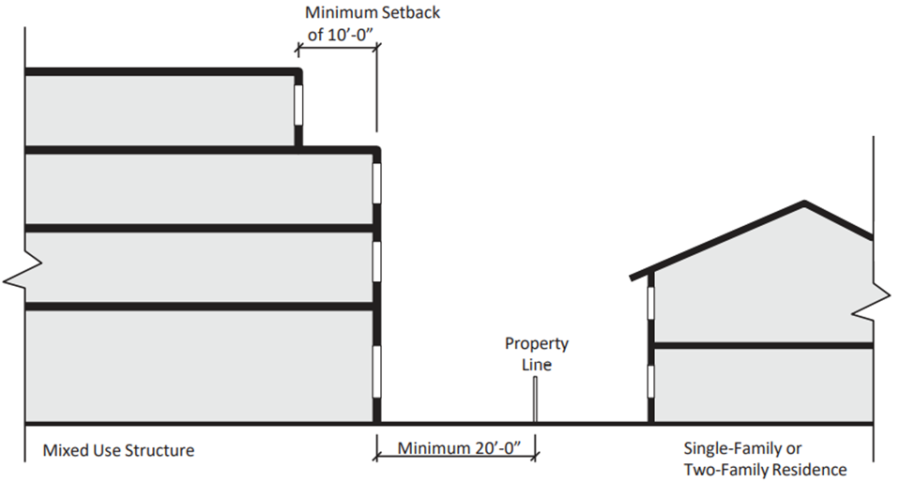
3.
Minimum Transparency Requirements.
a.
Windows and openings of nonresidential uses facing streets shall constitute a minimum of 50 percent of street-level building façades.
b.
Residential Units with Individual Entries. Windows and openings facing streets shall constitute a minimum of 30 percent of street-level building façades.
c.
On upper-floors, windows and openings facing streets shall constitute a minimum of 40 percent of building façades for commercial uses, and 20 percent of building façades for residential uses.
4.
Minimum Floor-to-Ceiling Height. Ground floor retail shall be a minimum of 15 feet.
5.
Signs. Chapter 22.114 (Signs) for signs in the C-3 Zone shall apply in the Mixed Use Zones, with the following prohibited:
a.
Roof signs shall be prohibited.
b.
Signs on perimeter fences shall be prohibited.
6.
Standards for Outdoor Dining. Outdoor dining is encouraged in the Mixed Use Zones and may be permitted within private property adjacent to the streets or public alley rights-of-way.
a.
Patio dining spaces may be open or covered with temporary or permanent structures.
b.
The patio dining spaces shall be separated from adjacent rights-of-way by either temporary or permanent railings, fencing, planter boxes, or movable bollards.
c.
Amplified sound or music is prohibited.
7.
Residential Open Space.
a.
Required side or rear yard areas may be included in the calculated open space area, but a required front yard area shall not be included.
b.
Open space areas shall have no parking, driveway, or right-of-way encroachments.
c.
Private open space shall be contiguous to the residential unit served.
d.
All patios that front a public street shall be substantially enclosed with solid walls or fencing for screening and privacy.
e.
All balconies shall have solid railings for screening and privacy.
f.
Open space areas for use by residents shall not be accessible from the commercial portion of the mixed use development.
8.
Site Landscaping. A minimum of 10 percent of the lot shall be landscaped with trees, ground cover, shrubbery, and flowers and shall be continuously maintained in good condition. Parking lot landscaping does not count towards this requirement. Incidental walkways may be developed in the landscaped area.
9.
Pedestrian Circulation.
a.
Pedestrian walkways shall be a minimum of four feet in width.
b.
The use of asphalt for paving walkways is prohibited.
10.
Vehicular Circulation. Vehicular access, drives, and circulation routes shall be designed so that all movements involved in parking, turning, or loading shall occur on-site and not within the public right-of-way.
11.
Parking lots shall be designed with end-stall turnarounds or a continuous circulation pattern.
a.
Parking is not permitted in the required street-fronting yard.
b.
Concrete curbs shall be provided as wheel stops where parking adjoins landscaping.
c.
Parking areas shall be separated from buildings by a pedestrian walkway or landscape strip.
d.
Separate parking facilities shall be provided for residential uses and commercial uses.
12.
Fences, Walls, Gates, and Hedges. Sections greater than 50 feet in length fronting a street shall incorporate at least two of the following design features in proportion to the length:
a.
A minimum two-foot change in horizontal plane for at least 10 feet;
b.
A minimum 18-inch change in height for at least 10 feet;
c.
A minimum 18-inch-high raised planter for at least half the length; and/or
d.
Use of pilasters at 25-foot maximum intervals and at changes in planes.
13.
Utility and Mechanical Equipment.
a.
All ground-, wall-, and roof-mounted equipment shall be screened from public view.
b.
Screening elements shall be an integral part of the building; no screening method shall give the appearance of being "tacked on." See Figure 22.412.040-B, below, for example.
FIGURE 22.412.040-B: EQUIPMENT SCREENING
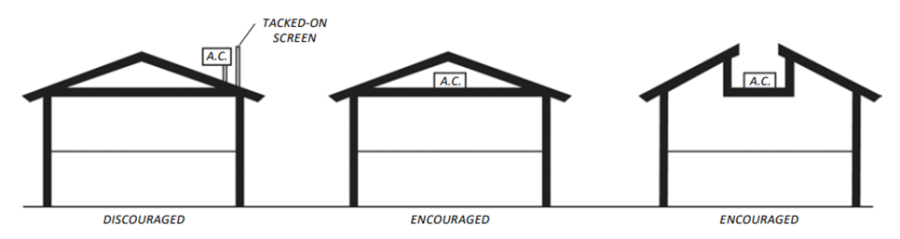
14.
Refuse and Recyclable Collection Facilities. Separate refuse collection facilities shall be provided and maintained for residential and commercial uses.
D.
Performance Standards.
1.
Hours of Operation - Including Loading. 6:00 a.m. to 11:00 p.m. daily, unless modified by a conditional use permit.
2.
Loading. Loading, unloading, and all maintenance activities shall be conducted within the hours of operation noted above and in such a fashion so as to prevent annoyance to adjacent residents and tenants.
3.
Noise. Common walls between residential and nonresidential uses shall be constructed to minimize the transmission of noise and vibration.
4.
Light and Glare. Trespass of all outdoor lighting shall be prevented and minimized.
5.
Prohibited Activities.
a.
Storage or shipping of flammable liquids or hazardous materials beyond that normally associated with a residential use;
b.
Welding;
c.
Machining; and
d.
Open flame work.
6.
Security. Residential uses shall have separate and secured entrances and exits directly accessible to secured parking areas. Nonresidential and residential uses located on the same floor shall not have common entrance hallways or common balconies.
a.
Chain link, barbed, and concertina wire fences are prohibited.
b.
Exterior security bars, grilles, or grates on windows and doors are prohibited.
c.
Exterior roll-up or folding accordion shutters, security gates, or grilles are prohibited.
d.
Roll-up or folding security gates or grilles shall be concealed within the interior architectural elements of the building during business hours. Solid roll-up or folding shutters and gates are prohibited.
(Ord. 2024-0032 § 38, 2024.)
22.412.050 - MLK Medical Zone and MLK Medical Overlay.
A.
Purpose. The Martin Luther King, Jr. (MLK) Medical Zone and MLK Medical Overlay are established to meet the existing and future needs of the MLK Medical Center campus, while ensuring compatibility with adjacent land uses. The intent is to maintain and promote medical, clinic, medical office, and associated supportive uses, such as incidental retail, supportive residential and parking, and expand pedestrian linkages and connectivity between the MLK Medical Center, Charles R. Drew University of Medicine and Science (CDU), Willowbrook/Rosa Parks Station, and the Willowbrook community. The MLK Medical Overlay applies to the two blocks bounded by Wilmington Avenue, East 120th Street, Holmes Street and East 118th Street. The properties within this Overlay are suitable for more intensive uses because of their proximity to Willowbrook/Rosa Parks Station. Besides continuing to allow existing medical and public service uses, additional medical and new residential development are permitted on properties within this Overlay.
B.
Land Use Regulations. The land use regulations for the Institutional (IT) Zone contained in Chapter 22.26 (Special Purpose Zones) shall apply to all development in the MLK Medical Zone and MLK Medical Overlay with the following modifications:
1.
Senior citizen housing developments shall be permitted in the MLK Medical Zone and MLK Medical Overlay;
2.
Multi-family residential uses shall be permitted in the MLK Medical Overlay; and
3.
Short-term rentals are permitted as accessory use of a residence, subject to Section 22.140.700 (Short-Term Rentals).
C.
Development Standards. The standards for the IT Zone contained in Chapter 22.26 (Special Purpose Zones) shall apply to all development in the MLK Medical Zone and Overlay with the following modifications:
1.
Maximum Height. The maximum building height of multi-family residential buildings in the MLK Medical Overlay shall be 75 feet;
2.
Maximum Floor Area Ratio (FAR):
a.
The maximum FAR in the MLK Medical Zone shall be 1.65; and
b.
The maximum FAR in the MLK Medical Overlay shall be 2.5; and
3.
Maximum Density. The maximum residential density in the MLK Medical Overlay shall be 60 dwelling units per acre.
(Ord. 2024-0032 § 38, 2024.)
22.412.060 - Drew Educational Zone.
A.
Purpose. The Drew Educational Zone is established to meet the existing and future needs of CDU and King Drew Magnet High School, while ensuring compatibility with adjacent land uses. The intent is to create a medical university campus for CDU by maintaining and promoting educational and associated support uses, while maintaining sensitivity to surrounding development.
B.
Land Use Regulations. The land use regulations for the Institutional (IT) Zone contained in Chapter 22.26 (Special Purpose Zones) shall apply to all development in the Drew Educational Zone with the following additions:
1.
Student and faculty housing, including dormitories, shall be permitted in the Drew Educational Zone; and
2.
Restaurant and supportive retail uses shall be permitted in the Drew Educational Zone as an ancillary use providing necessary support to CDU's primary activities or operations.
C.
Development Standards. The standards for the IT Zone contained in Chapter 22.26 (Special Purpose Zones) shall apply to all development in the Drew Educational Zone, with the following modifications:
1.
Maximum Height. The maximum building height shall be 75 feet. New development fronting Compton Avenue shall be limited to 50 feet for the first 100 feet from the property line fronting Compton Avenue. Development standards related to height, pursuant to Chapter 22.110 (General Site Regulations) of this Title 22, shall also apply.
2.
Maximum Floor Area Ratio (FAR). The maximum FAR in the Drew Educational Zone shall be 1.5.
3.
Required Yard. The minimum street-fronting yard depths shall be 15 feet from Compton Avenue and 10 feet from East 118th Street, East 120th Street, and Holmes Avenue.
4.
Residential Open Space.
a.
The minimum open space area requirements for multi-family developments in the Drew Educational Zone shall be as follows:
i.
50 square feet per dwelling unit of common open space area with a minimum dimension of 25 feet; and
ii.
50 square feet per dwelling unit of private open space area with a minimum dimension of five feet;
b.
Open space areas shall have no parking, driveway, or right-of-way encroachments.
c.
Private useable open space shall be contiguous to the residential unit served and screened from public view for privacy. All patios shall be walled for screening and privacy. All balconies that front a public street shall have a solid railing for screening and privacy.
d.
Private open space areas intended for use by residents only shall not be accessible from the nonresidential portion of the development.
5.
Landscaping.
a.
A minimum of 20 percent of the lot shall be landscaped with trees, ground cover, shrubbery, and flowers and shall be continuously maintained in good condition.
b.
Parking lot landscaping does not count towards this requirement.
c.
Incidental walkways may be developed in the landscaped area.
6.
Pedestrian Circulation.
a.
Pedestrian walkways shall be a minimum of four feet in width.
b.
The use of asphalt for paving walkways is prohibited.
7.
Vehicular Circulation. Vehicular access, drives, and circulation routes shall be designed so that all movements involved in parking, loading, or turning shall occur on-site and not within the public right-of-way.
8.
Parking Lots.
a.
Parking areas shall be designed with end-stall turnarounds or a continuous circulation pattern.
b.
Parking is not permitted in the required street-fronting yard.
c.
Continuous concrete curbs shall be provided as wheel stops where parking adjoins landscaping.
d.
Parking areas shall be separated from buildings by a pedestrian walkway and/or landscape strip.
e.
Separate parking facilities shall be provided for residential uses and institutional uses.
9.
Fences, Walls, Gates, and Hedges. Wall sections greater than 50 feet in length fronting a street shall incorporate at least two of the following design features in proportion to the length:
a.
A minimum two-foot change in horizontal plane for at least 10 feet;
b.
A minimum 18-inch change in height for at least 10 feet;
c.
A minimum 18-inch-high raised planter for at least half the length; and
d.
Use of pilasters at 25-foot maximum intervals and at changes in planes.
10.
Utility and Mechanical Equipment.
a.
All ground, wall, and roof-mounted equipment shall be screened from public view.
b.
Screening elements shall be an integral part of the building; no screening method shall give the appearance of being "tacked on."
(Ord. 2024-0032 § 38, 2024.)
22.412.070 - Imperial Commercial Zone.
A.
Purpose. The Imperial Commercial Zone is established to meet the commerce and service needs of the resident and business communities, while ensuring compatibility with adjacent land uses. The intent is to maintain and promote commercial uses between Imperial Highway and the I-105 Freeway. The Imperial Commercial Zone provides for the development of a broad range of retail and service uses, as well as freeway-oriented, regional-serving retail, office complexes, and light manufacturing businesses.
B.
Land Use Regulations. The land use regulations for the Unlimited Commercial (C-3) Zone contained in Chapter 22.20 (Commercial Zones) shall apply to all development in the Imperial Commercial Zone, with the following additions and exceptions:
1.
A self-service storage facility shall be permitted in the Imperial Commercial Zone with a conditional use permit application (Chapter 22.158), and subject to the provisions of Section 22.140.560 (Self-Storage Facilities); and
2.
The following uses shall be prohibited in the Imperial Commercial Zone:
a.
Liquor stores;
b.
Tobacco and vape shops; and
c.
New residential uses, except as specified otherwise by State law.
C.
Development Standards. The standards for the C-3 Zone contained in Chapter 22.20 (Commercial Zones) shall apply to all new development in the Imperial Commercial Zone, with the following modifications:
1.
Lot Coverage. The maximum lot coverage by structures of any type in the Imperial Commercial Zone shall be 50 percent.
2.
Maximum Height. The maximum building height in the Imperial Commercial Zone shall be 35 feet.
3.
Maximum FAR. The maximum FAR in the Imperial Commercial Zone shall be 1.0.4. Landscaping.
a.
A minimum of 10 percent of the lot shall be landscaped with trees, ground cover, shrubbery, and flowers, and shall be continuously maintained in good condition. Parking lot landscaping does not count towards this requirement.
b.
Incidental walkways may be developed in the landscaped area. Pedestrian walkways shall be a minimum of four feet in width. The use of asphalt for paving walkways is prohibited.
5.
Vehicular access, drives, and circulation routes shall be designed so that all movements involved in parking, loading, or turning shall occur on-site and not within the public right-of-way.
6.
Parking Lots.
a.
Parking areas shall be designed with end-stall turnarounds or a continuous circulation pattern.
b.
Parking is not permitted between the building and street.
c.
Continuous concrete curbs shall be provided as wheel stops where parking adjoins landscaping.
d.
Parking areas shall be separated from buildings by a pedestrian walkway and/or landscape strip.
7.
Utility and Mechanical Equipment.
a.
All mechanical ground, wall, and roof-mounted equipment shall be screened from public view.
b.
Screening elements shall be an integral part of the building; no screening method shall give the appearance of being "tacked on."
(Ord. 2024-0032 § 38, 2024.)
22.412.080 - Willowbrook Residential 1 Zone.
A.
Purpose. The Willowbrook Residential 1 Zone is established to preserve and enhance desirable characteristics of single-family residential areas.
B.
Land Use Regulations. The land use regulations for the Single-Family Residence (R-1) Zone contained in Chapter 22.18 (Residential Zones) shall apply to all development in the Willowbrook Residential 1 Zone, except that the noncommercial keeping of chickens shall be permitted as an accessory use in the Willowbrook Residential 1 Zone, subject to the following provisions:
1.
No more than five chickens per residence are allowed, located within the rear yard and kept outside the dwelling unit;
2.
All such chickens shall be kept in an enclosure within the rear yard and located a minimum of 35 feet from any habitable building;
3.
Roosters shall not be permitted; and
4.
The occasional sale of eggs or chicken incidental to the keeping of chicken as a hobby shall not constitute a commercial use.
C.
Development Standards. The standards for the R-1 Zone contained in Chapter 22.18 shall apply to all development in the Willowbrook Residential 1 Zone, with the following modifications:
1.
Driveways and Walkways. The use of asphalt for paving driveways and walkways is prohibited.
2.
Landscaping. With the exception of the required paved driveway and a walkway having a width not to exceed four feet, all areas within the street-fronting yard shall be landscaped with drought tolerant or low water use native or non-invasive plants, grasses, shrubbery, or trees, and regularly maintained.
3.
Fences, Walls, Gates, and Hedges.
a.
Wrought iron style fences which do not obscure views may be permitted to the maximum height of six feet within front yards and corner side yards, subject to a Yard Modification (Chapter 22.196) application.
b.
The portions of fences more than three and one-half feet high shall not cause a significant visual obstruction.
c.
Barbed wire and chain link fencing are prohibited.
d.
Hanging, displaying, or drying clothes on fencing is not permitted.
4.
Clotheslines are permitted at the rear of the structure and shall not be visible from adjoining the streets.
5.
Utility and Mechanical Equipment.
a.
All utility and mechanical equipment shall be placed in locations not exposed to view from the street or shall be screened from view. Satellite dishes shall also be located out of public view.
b.
Screening elements shall be an integral part of the building; no screening method shall give the appearance of being "tacked on."
(Ord. 2024-0032 § 38, 2024.)
22.412.090 - Willowbrook Residential 2 Zone.
A.
Purpose. The purpose of the Willowbrook Residential 2 Zone is to preserve and enhance single-family neighborhood characteristics while also providing opportunities for two-family residences. The intent is to promote desirable characteristics of low to medium density neighborhoods.
B.
Land Use Regulations. The land use regulations for the Two-Family Residence (R-2) Zone contained in Chapter 22.18 (Residential Zones) shall apply to all development in the Willowbrook Residential 2 Zone.
C.
Development Standards. The standards for the R-2 Zone contained in Chapter 22.18 shall apply to all development in the Willowbrook Residential 2 Zone, with the following modifications:
1.
Driveways and Walkways. The use of asphalt for paving driveways and walkways is prohibited.
2.
Landscaping. With the exception of the required paved driveway and a walkway having a width not to exceed four feet, all areas within the street-fronting yard shall be landscaped with drought tolerant or low water use native or non-invasive plants, grasses, shrubbery, or trees and regularly maintained.
3.
Fences, Walls, Gates, and Hedges.
a.
Wrought iron style fences may be permitted to the maximum height of six feet within front yards and corner side yards, subject to a Yard Modification (Chapter 22.196) application.
b.
The portion of fences more than three and one-half feet shall not cause a significant visual obstruction.
c.
Barbed wire and chain link fencing are prohibited.
d.
Hanging, displaying, or drying clothes on fencing is not permitted.
4.
Clotheslines are permitted at the rear of the structure and not visible from adjoining streets.
5.
Utility and Mechanical Equipment.
a.
All utility and mechanical equipment shall be placed in locations not exposed to view from the street or they shall be screened from view. Satellite dishes shall also be located away from public view.
b.
Screening elements shall be an integral part of the building; no screening method shall give the appearance of being "tacked on."
(Ord. 2024-0032 § 38, 2024.)
22.412.100 - Willowbrook Residential 3 Zone.
A.
Purpose. The Willowbrook Residential 3 Zone is established to provide opportunities for developments containing multiple units, such as apartments or condominiums. The intent is to promote desirable characteristics of medium density neighborhoods and provide a variety of housing options to serve the needs of the Willowbrook community.
B.
Land Use Regulations. The land use regulations for the Limited Multiple Residence (R-3) Zone contained in Chapter 22.18 (Residential Zones) shall apply to all development in the Willowbrook Residential 3 Zone.
C.
Development Standards. The standards for the Limited Multiple Residence (R-3) Zone contained in Chapter 22.18 (Residential Zones) shall apply to all development in the Willowbrook Residential 3 Zone, with the following modifications:
1.
Residential Open Space.
a.
The minimum open space area requirements for multi-family developments in the Willowbrook Residential 3 Zone shall be as follows:
i.
50 square feet per dwelling unit of common open space area with a minimum dimension of 25 feet; and
ii.
50 square feet per dwelling unit of private open space area with a minimum dimension of five feet.
b.
Required side or rear yard areas may be included in the calculated open space area, but a required front yard area shall not be included.
c.
Open space areas shall have no parking, driveway, or right-of-way encroachments.
d.
Private useable open space shall be contiguous to the residential unit served and screened from public view for privacy. All patios shall be walled for screening and privacy. All balconies shall have solid railing for screening and privacy.
2.
Landscaping.
a.
A minimum of 20 percent of the lot shall be landscaped or hardscaped with open, usable outdoor space. Required common open space areas may be counted in the calculated landscaped area.
b.
With the exception of the required paved driveway and walkway(s) having a width not to exceed four feet, all areas within the street-fronting yard shall be landscaped with drought tolerant or low water use native or non-invasive plants, grasses, shrubbery, or trees, and regularly maintained.
3.
Pedestrian Circulation.
a.
Pedestrian walkways shall be a minimum of four feet in width.
b.
The use of asphalt for paving walkways is prohibited.
4.
Vehicular Circulation.
a.
Vehicular access, drives, and circulation routes shall be designed so that all movements involved in loading, parking, or turning shall occur on-site and not within the public right-of-way.
b.
Principal vehicular access into multi-family developments shall be through an entry driveway, rather than a parking aisle. Entry driveways lead to designated parking and shall not be lined with or offer direct access to parking spaces.
5.
Parking.
a.
Parking for multi-family developments shall be provided on-site in on-grade or underground structures, surface parking lots, carports, or attached garages.
b.
Parking shall be located proximate to the building and located to the rear of the lot wherever possible. Parking areas shall be designed with end-stall turnarounds or a continuous circulation pattern.
c.
Parking shall not occupy more than 30 percent of any linear street frontage.
d.
Parking is not permitted in the street-fronting yard.
e.
Continuous concrete curbs shall be provided as wheel stops where parking adjoins landscaping.
f.
Parking areas shall be separated from buildings by a pedestrian walkway and/or landscape strip.
g.
Carports and parking structures shall be architecturally compatible with the design of the main structures in the project.
6.
Fences, Walls, Gates, and Hedges.
a.
Wrought iron style fences may be permitted to the maximum height of six feet within front yards and corner side yards, subject to a Yard Modification (Chapter 22.196) application.
b.
The portions of fences more than three and one-half feet high shall not cause a significant visual obstruction.
c.
Barbed wire and chain link fencing are prohibited.
d.
Hanging, displaying, or drying clothes on fencing is not permitted.
e.
Wall sections greater than 50 feet in length fronting a street shall incorporate at least two of the following design features in proportion to the length:
i.
A minimum two-foot change in horizontal plane for at least 10 feet;
ii.
A minimum 18-inch change in height for at least 10 feet;
iii.
A minimum 18-inch-high raised planter for at least half the length; and
iv.
Use of pilasters at 25-foot maximum intervals and at changes in planes.
7.
Utility and Mechanical Equipment.
a.
All ground, wall, and roof-mounted utility and mechanical equipment shall be screened from public view. Satellite dishes shall also be located away from public view.
b.
Screening elements shall be an integral part of the building; no screening method shall give the appearance of being "tacked on."
8.
Refuse and Recyclable Collection Facilities. Refuse enclosures shall be located for the convenience of the residents and collection.
(Ord. 2024-0032 § 38, 2024.)
22.412.110 - Open Space (O-S) Zone.
The provisions of Chapter 22.16 (Agricultural, Open Space, Resort and Recreation, and Watershed Zones) shall apply to all development in the Open Space (O-S) Zone in the Plan Area.
(Ord. 2024-0032 § 38, 2024.)
22.412.120 - TOD Parking Reduction Overlay Zone.
Except as specified otherwise by State law, the standards for parking requirements contained in Chapter 22.112 (Parking) shall apply to all development in the Plan Area, except that lots within the TOD Parking Reduction Overlay Zone, shown in Figure 22.412.120-A, below, shall be subject to this Section.
FIGURE 22.412.120-A: TOD PARKING REDUCTION OVERLAY ZONE
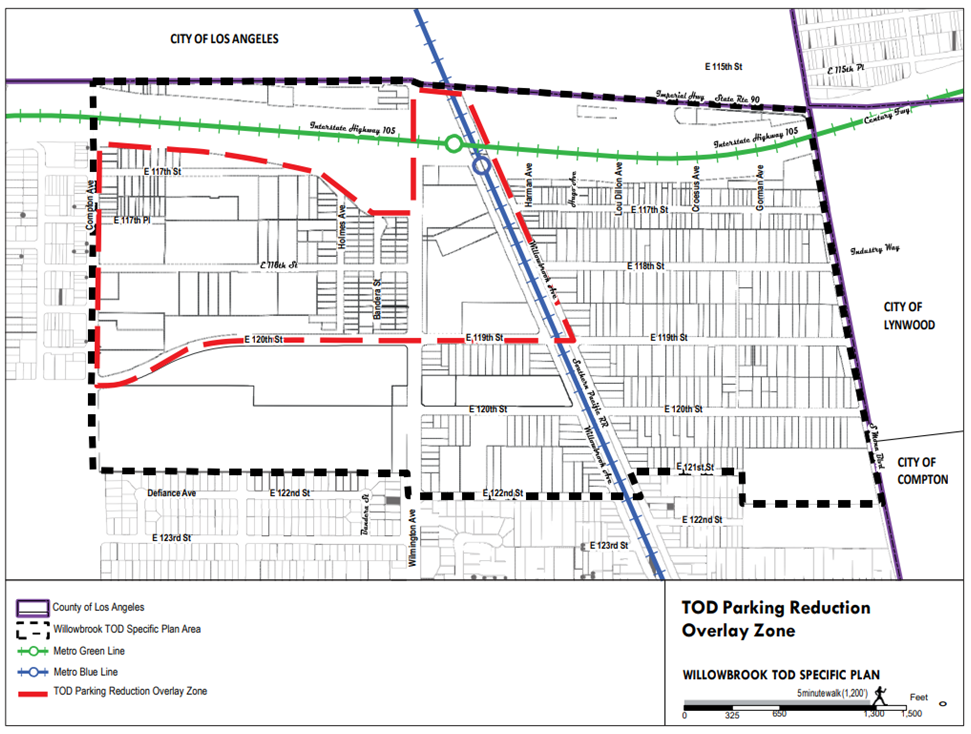
A.
Residential Uses. Maximum parking standards for residential uses are established in Table 22.412.120-A, below.
B.
Nonresidential Uses.
1.
Except as specified otherwise by State law, the minimum parking required for nonresidential uses shall be 40 percent of the required parking spaces specified in Section 22.112.070.
2.
Off-Site Parking. Off-site parking facilities may be proposed for nonresidential uses, subject to Chapter 22.178 (Parking Permits), provided such facilities are located within 1,500 feet from the site of the development.
(Ord. 2024-0032 § 38, 2024.)
22.414.010 - Purpose.
This Chapter establishes the zones, use regulations, and development standards as part of the West Carson Transit-Oriented District Specific Plan ("Specific Plan").
(Ord. 2025-0009 § 1, 2025.)
22.414.020 - Administration and Review.
A.
Applicability. This Chapter shall apply to all properties within the boundaries of the Specific Plan area, which is delineated in Figure 22.414.040-A: West Carson TOD Specific Plan Zones, below. No new construction, reconstruction, or alteration of any building or structure shall occur, nor shall any new use, expansion of an existing use, or change of use occur on any property within the Specific Plan area, unless in compliance with the provisions of this Chapter.
B.
Relationship to Other Provisions of Title 22. The provisions of this Chapter shall be administered in conjunction with other provisions of this Title 22, in accordance with Section 22.400.030 (Administration). Where the provisions of the Specific Plan conflict with any other applicable provisions of Title 22, the Specific Plan shall govern. Where the standards of this Specific Plan are silent, the provisions of Title 22 shall apply.
C.
Interpretation. In accordance with Chapter 22.234 (Interpretations), the Director is granted the authority to interpret any provisions of this Specific Plan.
D.
Amendment to the Specific Plan. A Specific Plan amendment may be initiated by the Board, Commission, Director, or upon application by a property owner or their designated representative. An amendment to the Specific Plan shall be processed in accordance with Chapter 22.222 (Administrative Procedures).
E.
Minor Modification Review.
1.
Review Authority. The Hearing Officer shall have the authority to review projects requesting a minor modification to the development standards identified in Subsection E.4, below, for substantial compliance with the applicable requirements of this Specific Plan and other applicable provisions of Title 22. When the requested modification is not listed or exceeds the thresholds in Table 22.414.020-A: Minor Modifications, below, a Variance (Chapter 22.194) shall be required.
2.
Procedures. A minor modification request shall require a Specific Plan Substantial Conformance Review, which shall be subject to the public hearing procedures and requirements outlined in Section 22.222.120 (Public Hearing Procedure).
3.
Application Requirements. A Specific Plan Substantial Conformance Review application shall include all information specified in the checklist provided by the Department, along with payment of the required fee, as set forth in Section 22.250.010 (Filing Fees and Deposits).
4.
Determination. If the Hearing Officer determines that the request for a minor modification is consistent with the principles and standards of Section 22.222.200 (Findings and Decision) and the findings per Subsection E.5, below, the Hearing Officer may approve the modification. Table 22.414.020-A: Minor Modifications, below, specifies the development standards and maximum modifications that may be permitted, pursuant to this Subsection E.
5.
Required Findings. Findings and decision for minor modifications shall be made in compliance with Section 22.222.200 (Findings and Decision) and include the following findings:
a.
The use, development of land, and application of development standards comply with all applicable provisions of Title 22.
b.
The use, development of land, and application of development standards, when considered on the basis of the suitability of the site for the particular use or development intended, are arranged to avoid traffic congestion; to provide for the safety and convenience of bicyclists and pedestrians; to protect public health, safety, and general welfare; to prevent adverse effects on neighboring property; and to conform with good zoning practice.
c.
The use, development of land, and application of development standards are suitable from the standpoint of functional developmental design.
d.
The application of these standards would alleviate practical difficulties or unnecessary hardships inconsistent with the goals of this Specific Plan.
e.
There are exceptional circumstances or conditions applicable to the subject property or to the intended development of the property that do not apply to other properties within the Specific Plan area.
f.
Granting the requested minor modification will not be materially detrimental to properties or improvements in the area or contrary to the goals of this Specific Plan.
6.
Appeals. The decision of the Hearing Officer may be appealed or called up for review, pursuant to the procedures and requirements of Chapter 22.240 (Appeals).
7.
Revisions to Specific Plan Substantial Conformance Review. Revisions to the Specific Plan Substantial Conformance Review may be approved by the Director with a Revised Exhibit "A" (Chapter 22.184) application, if the revisions do not affect the intent of the original approval. Revisions that would deviate from the intent of the original approval shall require the approval of a new Specific Plan Substantial Conformance Review.
(Ord. 2025-0009 § 1, 2025.)
22.414.030 - Definitions.
For the purposes of regulating this Specific Plan and development within the West Carson Transit-Oriented District Specific Plan area, the following definitions are used:
Frontage zone. The area of the sidewalk that separates pedestrians from the property line or building and store fronts. It typically accommodates outdoor seating, store entrances, and street vendors, and acts as a buffer for pedestrians from opening door and other architectural elements.
Pedestrian zone. The area of the sidewalk specifically reserved for pedestrian travel.
(Ord. 2025-0009 § 1, 2025.)
22.414.040 - Specific Plan Zones.
A. Zones Established. Figure 22.414.040-A: West Carson TOD Specific Plan Zones, below, identifies the Specific Plan zones.
FIGURE 22.414.040-A: WEST CARSON TOD SPECIFIC PLAN ZONES
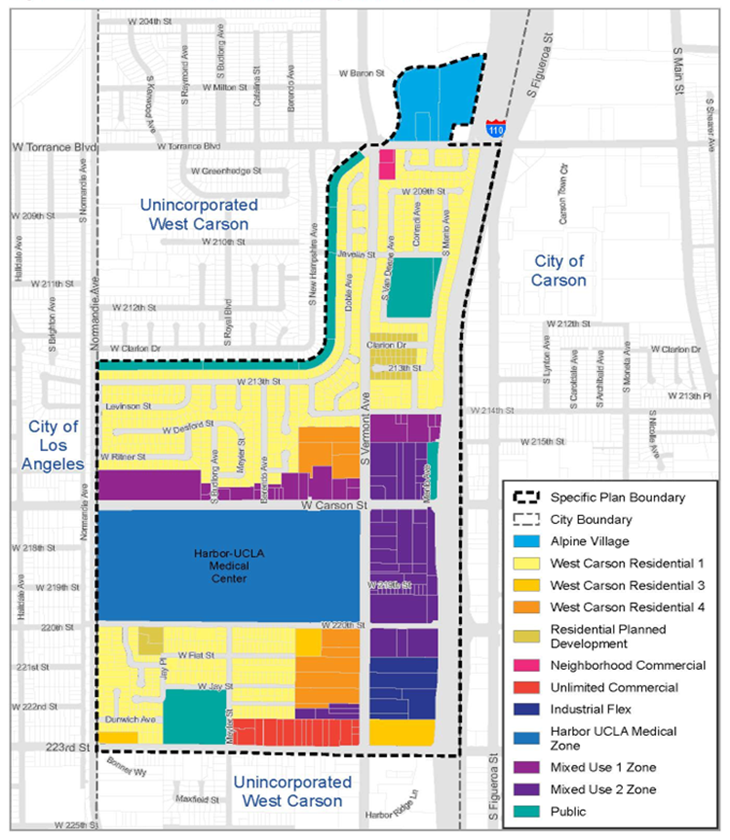
B.
Permit and Review Types in Specific Plan Zones. Table 22.414.040-A: Permit and Review Requirements, below, identifies the permit or review required to establish each use as regulated by the applicable zone.
(Ord. 2025-0009 § 1, 2025.)
22.414.050 - Residential Zones.
A.
Purpose. The general purpose of the Residential Zones is to provide diverse housing options in the Specific Plan area.
B.
Land Use Regulations for Residential Zones. Table 22.414.050-A: Principal and Accessory Use Regulations for Residential Zones, below, prescribes the land use regulations for the West Carson Residential 1 (WC R-1), West Carson Residential 3 (WC R-3), West Carson Residential 4 (WC R-4), and West Carson Residential Planned Development (WC RPD) Zones. These regulations specify permitted, conditionally permitted, and prohibited uses for the Residential Zones. Refer to Table 22.414.040-A: Permit and Review Requirements, above, for the permit or review required to establish each use listed in Table 22.414.050-A: Principal and Accessory Use Regulations for Residential Zones, below. Unless otherwise specified in Table 22.414.050-A, below, the use regulations for Zones R-1, R-3, R-4, and RPD in Chapter 22.18 (Residential Zones) apply to Zones WC R-1, WC R-3, WC R-4, and WC RPD, respectively.
C.
Development Standards for Residential Zones.
1.
Standards. All structures and uses in Zones WC R-1, WC R-3, and WC R-4 shall be subject to the regulations of Table 22.414.050-B: Development Standards for Residential Zones WC R-1, WC R-3, and WC R-4, below. All structures and uses in Zone WC RPD shall be subject to Section 22.18.060 (Development Standards and Regulations for Zone RPD).
2.
Other Applicable Standards. All development in Zones WC R-1, WC R-3, and WC R-4 shall also be subject to applicable standards in Section 22.414.120 (Specific Plan Urban Design Standards) and Subsections D and E, below. Unless otherwise specified in this Chapter, the development standards for Zones R-1, R-3, and R-4 in Chapter 22.18 (Residential Zones) apply to Zones WC R-1, WC R-3, and WC R-4, respectively.
D.
Additional Development Standards for Zones WC R-3 and WC R-4.
1.
Circulation and Parking.
a.
Bicycle and pedestrian circulation facilities shall establish connections to surrounding uses in the Specific Plan area networks and to regional bicycle facilities, where applicable.
b.
On-site parking shall not occupy more than 30 percent of any linear street frontage.
c.
Garages and carports shall be architecturally compatible with the design of the main structures in the project.
d.
Parking structures shall be screened from street-level view by using at least one of the following methods: architectural detailing (e.g., decorative panels, perforated metal screens), façade treatment (e.g,. cladding materials, textured finishes), artwork (e.g., murals, sculptures), landscaping (e.g., green walls, planters), or similar screening features.
2.
Required Open Space. For multi-family housing developments with at least five units, a minimum of 200 square feet per dwelling unit shall be allocated for common recreational spaces, private recreational spaces, or a combination of both as follows:
a.
Minimum dimension in one direction for private recreational spaces shall be seven feet.
b.
Minimum dimension in one direction for common recreational spaces shall be 20 feet.
c.
Side and rear yards may be included in the calculation of open space, but not the required front yard setback area.
d.
Open space areas shall not contain any parking, driveway, or public right-of-way encroachments.
e.
All common areas shall be improved with either active facilities (e.g., playgrounds, sports courts, or fitness stations) or passive facilities (e.g., gardens, walking paths, or seating areas) and include landscaping or hardscape elements. These areas shall be developed and maintained according to approved landscape and irrigation plans.
f.
Pedestrian walkways within a development shall be a minimum of four feet wide.
g.
Private useable open space shall adjoin the residential units served and must have solid, non-transparent screening for privacy.
h.
Courtyards internal to a development, or enclosed on at least three sides, shall have a minimum dimension of 40 feet in one direction.
E.
Additional Development Standards for Zone WC R-4.
1.
Site Landscaping.
a.
At least 20 percent of the project site shall be landscaped or hardscaped with open, usable outdoor space.
b.
Post-construction landscape designs shall adhere to the following:
i.
Turf areas shall not exceed 25 percent of the total landscaped area.
ii.
Non-invasive drought-tolerant plant and tree species appropriate for the climate zone region shall constitute at least 75 percent of the total landscaped area.
iii.
Hydrozoning irrigation techniques shall be incorporated into the landscape design.
2.
Frontages. Developments within Zone WC R-4 adjacent to South Vermont Avenue shall feature a primary building façade and entry facing South Vermont Avenue. These developments shall adhere to the frontage design standards outlined in Section 22.414.120.C.1 (Frontages), below. Additionally, they shall comply with the following specifications:
a.
Building orientation shall be determined by the location of the primary entrance, which defines the front of the building;
b.
Architectural treatment shall be required for all building sides facing South Vermont Avenue; and
c.
Pedestrian access to South Vermont Avenue shall be provided through common corridors or courtyards.
(Ord. 2025-0009 § 1, 2025.)
22.414.060 - Commercial Zones.
A.
Purpose. The general purpose of the Commercial Zones is to facilitate a wide range of commercial developments, including retail, dining, and service establishments to meet the needs of residents and promote economic vitality within the Specific Plan area.
B.
Land Use Regulations for Commercial Zones. Table 22.414.060-A: Principal Use Regulations for Commercial Zones, below, prescribes the land use regulations for Neighborhood Commercial (NC) and Unlimited Commercial (UC) Zones. Refer to Table 22.414.040-A: Permit and Review Requirements, above, for the permit or review required to establish each use listed in Table 22.414.060-A, below. Unless otherwise specified in Table 22.414.060-A, below, the use regulations for Zones C-2 and C-3 in Chapter 22.20 (Commercial Zones) apply to Zones NC and UC, respectively.
C.
Development Standards for Commercial Zones.
1.
Standards. All structures and uses in the Specific Plan Commercial Zones (NC and UC) shall be subject to the regulations of Table 22.414.060-B: Development Standards for Commercial Zones, below.
2.
Other Applicable Standards. All developments in Zones NC and UC shall also be subject to applicable standards in Section 22.414.120 (Specific Plan Urban Design Standards) and Subsections D and E, below. Unless otherwise specified in this Chapter, the development standards for Zones C-2 and C-3 in Chapter 22.20 (Commercial Zones) apply to Zones NC and UC, respectively.
D.
Additional Development Standards for Zone NC.
1.
Site Landscaping.
a.
At least 20 percent of the lot shall be landscaped with trees, shrubs, ground cover, and flowering perennials and biennials, and shall be continuously maintained. Parking lot landscaping shall not count toward meeting this requirement. Pedestrian walkways, plazas, and outdoor dining areas may be developed in the landscape area. Setback areas may be included in this requirement.
b.
Tree planting and maintenance requirements shall comply with Chapter 22.126 (Tree Planting Requirements).
2.
Built Form.
a.
Sites with multiple buildings shall be clustered with shared outdoor spaces and direct pedestrian access between uses, parking areas, and the street.
b.
Buildings shall be oriented towards the street.
E.
Additional Development Standards for Zone UC.
1.
Built Form.
a.
When sharing an interior property line with Zone WC R-1, the following requirements shall apply:
i.
Windows, balconies, or similar openings shall be oriented to minimize any direct line of sight into adjacent units onto private patios or backyards adjoining the property line.
ii.
The third floor shall be stepped back by a minimum of 10 feet.
b.
Development fronting West 223rd Street shall not exceed a height of 40 feet and three stories. Additionally, development shall not extend more than 50 feet in depth from the property line along the street, including setbacks and step-backs.
2.
Site Landscaping.
a.
At least 20 percent of the lot shall be landscaped with trees, shrubs, ground cover, and flowering perennials and biennials, and shall be continuously maintained. Parking lot landscaping shall not count toward meeting this requirement. Pedestrian walkways, plazas, and outdoor dining areas may be developed in the landscape area. Setback areas may be included for this requirement.
b.
Tree planting and maintenance requirements shall comply with Chapter 22.126 (Tree Planting Requirements).
c.
Except for the required paved driveway and walkway, all areas within the street-fronting setback area shall be landscaped and maintained.
3.
Required Open Space. For multi-family housing developments, a minimum of 200 square feet per dwelling unit shall be allocated for common recreational spaces, private recreational spaces, or a combination of both as follows:
a.
Minimum dimension in one direction for private recreational spaces shall be seven feet.
b.
Minimum dimension in one direction for common recreational spaces shall be 20 feet.
c.
Side and rear yards may be included in the calculation of open space, but not the required front yard setback area.
d.
Open space areas shall not contain any parking, driveway, or right-of-way encroachments.
e.
All common areas shall be improved with active facilities (e.g., playgrounds, sports courts, or fitness stations) or passive facilities (e.g., gardens, walking paths, or seating areas) and include landscaping or hardscape elements. These areas shall be developed and maintained according to approved landscape and irrigation plans.
(Ord. 2025-0009 § 1, 2025.)
22.414.070 - Industrial Flex Zone.
A.
Purpose. The Industrial Flex (IF) Zone is established to allow for a smaller range of cleaner industrial uses that are more compatible with the surrounding single-family and multi-family residential areas.
B.
Land Use Regulations for Industrial Flex Zone. Table 22.414.070-A: Principal and Accessory Use Regulations for Industrial Flex Zone, below, prescribes the land use regulations for Zone IF. Refer to Table 22.414.040-A: Permit and Review Requirements, above, for the permit or review required to establish each use listed in Table 22.414.070-A, below. Unless otherwise specified in Table 22.414.070-A, below, use regulations for Zone M-1 in Chapter 22.22 (Industrial Zones) apply to Zone IF.
C.
Development Standards for Industrial Flex Zone.
1.
All structures and uses in Zone IF shall be subject to the regulations of Table 22.414.070-B: Development Standards for Industrial Flex Zone, below.
2.
Other Applicable Standards. Zone IF shall also be subject to applicable standards in Section 22.414.120 (Specific Plan Urban Design Standards) and Subsection D, below. Unless otherwise specified in this Chapter, the development standards for Zone M-1 in Chapter 22.22 (Industrial Zones) apply to Zone IF.
D.
Additional Development Standards for Industrial Flex Zone.
1.
Frontages. Developments adjacent to South Vermont Avenue shall feature a primary building façade and entry facing South Vermont Avenue. These developments shall adhere to the frontage design standards outlined in Section 22.414.120.C.1 (Frontages). Additionally, they shall comply with the following specifications:
a.
Building orientation shall be determined by the location of the primary entrance, which defines the front of the building;
b.
Architectural treatment shall be required for all building sides facing South Vermont Avenue;
c.
Pedestrian access to public right-of-way shall be provided through common corridors or courtyards; and
d.
The maximum height of a fence shall be 42 inches. Fifty percent of the fence shall be open and unobstructed.
2.
Circulation and Parking.
a.
Bicycle and pedestrian circulation facilities shall provide connections to surrounding uses and to the bicycle and pedestrian networks within the Specific Plan area.
b.
Provisions for common vehicular access points and shared parking shall be coordinated with any adjacent/proximate development plans where practical.
3.
Site Landscaping.
a.
At least 20 percent of the lot shall be landscaped with trees, shrubs, ground cover, and flowering perennials and biennials, and shall be continuously maintained. Parking lot landscaping shall not count toward meeting this requirement. Pedestrian walkways, plazas, and outdoor dining areas may be developed in the landscape area. Setback areas may be included for this requirement.
4.
Tree Planting and Maintenance. Tree planting and maintenance requirements shall comply with Chapter 22.126 (Tree Planting Requirements), except that all areas within the street-fronting setback area shall be landscaped and maintained with the exception of the required paved driveway and walkway.
5.
Special Requirements.
a.
Interior Property Line with Zone WC R-1. When sharing an interior property line with Zone WC R-1, the following requirements shall apply:
i.
Windows, balconies, or similar openings shall be oriented to minimize any direct line of sight into adjacent units or onto private patios or backyards adjoining the property line.
ii.
The third and/or fourth floors shall be stepped back by a minimum of 10 feet.
b.
Abutting a Residential Use. If an industrial use abuts a residential use, it shall comply with the following requirements:
i.
Building Height. Any new industrial building or structure shall be within an encroachment plane sloping upward and inward at a 45 degree angle, commencing 20 feet above the existing grade at the inside line of the side-yard setback. This requirement is illustrated in Figure 22.414.070-A: Encroachment Plane for Industrial uses Abutting Residential Uses, below.
FIGURE 22.414.070-A: ENCROACHMENT PLANE FOR INDUSTRIAL USES ABUTTING RESIDENTIAL USES
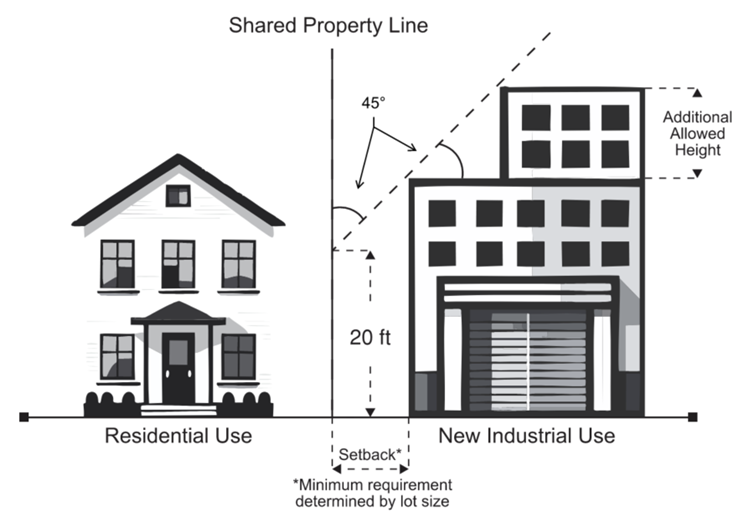
ii.
Enclosure. Materials and equipment that emit dust, smoke, gas, fumes, cinder, or refuse matter shall be fully enclosed and mechanically ventilated to prevent fugitive emissions, unless natural ventilation is required by another regulatory agency. Stacks, vents, and flares are exempt from the enclosure requirement.
iii.
Yard Setback. Any new industrial building, structure, or addition shall provide the yard setbacks identified in Table 22.414.070-C: Yard Setback for Industrial Uses Abutting a Residential Use, below, when abutting a residential use.
(Ord. 2025-0009 § 1, 2025.)
22.414.080 - Alpine Village Zone.
A.
Purpose. Due to the complex history of the German cultural shops adjacent to a closed landfill, the Alpine Village (APV) Zone is established to facilitate the repurposing of the Alpine Village area. The APV Zone is intended to protect the history of the site while also accommodating commercial and non-residential uses.
B.
Land Use Regulations for Alpine Village Zone. Table 22.414.080-A: Principal and Accessory Use Regulations for Alpine Village Zone, below, prescribes the land use regulations for Zone APV. Refer to Table 22.414.040-A: Permit and Review Requirements, above, for the permit or review required to establish each use listed in Table 22.414.080-A, below. Unless otherwise specified in Table 22.414.080-A, below, use regulations for Zone M-1 in Chapter 22.22 (Industrial Zones) apply to Zone APV. For temporary use regulations, refer to Zone M-1 in Chapter 22.22 (Industrial Zones).
1.
All lots within Zone APV shall be subject to the provisions of Chapter 22.84 (Green Zone).
2.
Where the regulations in Chapter 22.84 (Green Zone) are contrary to the regulations for Zone APV, the more restrictive provisions shall prevail.
C.
Development Standards for Alpine Village Zone.
1.
All structures and uses in Zone APV shall be subject to the regulations of Table 22.414.080-B: Development Standards for Alpine Village Zone, below.
2.
Other Applicable Standards. Zone APV shall also be subject to applicable standards in Section 22.414.120 (Specific Plan Urban Design Standards) and Subsection D, below. Unless otherwise specified in this Chapter, the development standards for Zone M-1 in Chapter 22.22 (Industrial Zones) apply to Zone APV.
D.
Additional Development Standards for Zone APV.
1.
Circulation and Parking.
a.
Bicycle and pedestrian circulation facilities shall provide connections to surrounding uses and to the bicycle and pedestrian networks within the Specific Plan area.
b.
Provisions for common vehicular access points and shared parking shall be coordinated with any adjacent/proximate development plans, where practical.
2.
Landscaping on Street Frontage. Required solid walls along street frontages shall be set back by landscaping of a minimum of five feet in depth, as described below, unless the landscaping encroaches into the required existing parking spaces and associated maneuvering areas or existing building or structures. The landscaping shall be verified on a landscaping plan submitted to the Department and consist of the following:
a.
One 15-gallon tree for every 100 square feet of landscaped area shall be planted and spaced 10 feet apart. The remaining area shall also be landscaped with grass, shrubs, or bushes, etc. All plants provided for required landscaping shall be drought-tolerant and include only non-invasive plant species.
b.
The landscaping shall be maintained in a healthy condition with appropriate watering, pruning, weeding, fertilizing, and littering removal. Trees shall be planted in locations that maintain the required lines of sight for safe pedestrian and vehicular movement and shall not cause root damage to the sidewalk or other public infrastructure, to the satisfaction of Public Works.
c.
Trees planted near buildings or fire lanes shall be placed in locations that do not adversely impact the Fire Department operations or response times, to the satisfaction of the Fire Department.
d.
Trees shall be selected from the Tree Species List maintained by the Director.
e.
Landscaping equipment used for maintenance, such as lawn mowers and leaf blowers, shall be electric and non-combustion powered.
f.
Notwithstanding Chapter 12.84 (Low Impact Development Standards) of the County Code, parcels subject to this Chapter 22.84 (Green Zone Districts) and less than one acre in size shall not be exempt from Low Impact Development requirements.
3.
Tree Planting and Maintenance. Tree planting and maintenance requirements shall comply with Chapter 22.126 (Tree Planting Requirements), except that all areas within the street-fronting setback area shall be landscaped and maintained with the exception of the required paved driveway and walkway.
(Ord. 2025-0009 § 1, 2025.)
22.414.090 - Harbor-UCLA Medical Zone.
A.
Purpose. The Harbor-UCLA Medical Zone is established to support the existing and future needs of the Harbor-UCLA Medical Center campus while ensuring compatibility with adjacent land uses. This zone works with the Harbor-UCLA Campus Master Plan, which seeks to maintain, enhance, and expand various facilities, such as hospitals, clinics, medical offices, bioscience research and development centers, community-serving amenities, and associated supportive uses, such as transitional housing, incidental retail, parking, and public open spaces. Additionally, the Campus Master Plan incorporates transportation infrastructure enhancements to improve mobility and connectivity within the campus and the surrounding community.
B.
Land Use Regulations for Harbor-UCLA Medical Zone. Uses shall be consistent with the approved Harbor-UCLA Medical Center Campus Master Plan.
C.
Development Standards for Harbor-UCLA Medical Zone. The following development standards have been developed to accommodate the mix of commercial, office, and other hospital-supportive uses.
1.
Built Form and Landscaping.
a.
Site, building, and landscaping design shall be consistent with the Harbor-UCLA Medical Center Campus Master Plan and as follows:
b.
Landscaping.
i.
Large façades or walls of structures within 20 feet of a roadway, such as parking structures, operational plants, or other buildings, shall be screened with vertical landscaping, trees, large shrubs, and other vegetation to soften and buffer massing from the surrounding community.
ii.
Landscaping along West Carson Street shall be permeable and open to the street to allow visibility; encourage access and connectivity to and from the walking path along West Carson Street and hospital campus; and create an attractive, inviting pedestrian experience.
(Ord. 2025-0009 § 1, 2025.)
22.414.100 - Mixed Use Zones.
A.
Purpose. The Mixed Use Zones are established to facilitate mixed use developments that integrate residential, office, and commercial spaces in a transit-supportive, pedestrian-friendly environment.
B.
Land Use Regulations for Mixed Use Zones. Table 22.414.100-A: Principal and Accessory Use Regulations for Mixed Use Zones, below, prescribes the land use regulations for Mixed Use 1 (MU-1) and Mixed Use 2 (MU-2) Zones. Refer to Table 22.414.040-A: Permit and Review Requirements, above, for the permit or review required to establish each use listed in Table 22.414.100-A, below. Uses requiring a Ministerial Site Plan Review (Chapter 22.186) or a Conditional Use Permit (Chapter 22.158) shall be permitted in a stand-alone or mixed-use configuration, with the exception of alcoholic beverage sales for off-site consumption uses, which are not permitted in a stand-alone configuration.
C.
Development Standards for Mixed Use Zones.
1.
All structures and uses in Zones MU-1 and MU-2 shall be subject to the regulations of Table 22.414.100-B: Development Standards for Mixed Use Zones, below.
2.
Other Applicable Standards. All development in Zones MU-1 and MU-2 shall also be subject to applicable standards in Sections 22.414.110 (Specific Plan Urban Design Standards) and Subsections D, E, and F, below.
D.
Additional Development Standards for Zones MU-1 and MU-2.
1.
Design Features.
a.
All primary ground-floor common entries or individual dwelling unit or commercial entries fronting on streets shall be oriented toward the street, rather than the interior or a parking lot.
b.
Buildings with 100 feet or more of street frontage shall incorporate varied façade articulation and roof heights.
c.
All glass windows or entrances on the first two stories, with the exception of residential-only uses, shall be either clear or lightly tinted to optimize pedestrian visibility into building interiors from the sidewalk area. The use of mirrored, highly reflective, or densely tinted glass in windows and entrances shall be prohibited.
2.
Façades.
a.
Street wall façades shall integrate architectural elements, such as arcades, colonnades, recessed entrances, window details, bays, a variety of building materials, or other design features, to diminish building bulk and mass. The maximum total blank wall area (without windows or entrances) on the first story shall not exceed 30 percent for non-residential buildings and 50 percent for residential buildings. Any blank exterior wall shall also be treated with a graffiti-resistant coating.
b.
The façade design of mixed-use buildings shall visually differentiate ground-floor uses from upper-story uses. The base shall visibly anchor the building to the ground with a small projection of the wall surface and/or a different material or color.
c.
Commercial or retail entries shall have distinct façade detailing that differentiate them from residential entries.
3.
Frontages. Non-residential and residential-only developments adjacent to West Carson Street or South Vermont Avenue shall have a primary building façade and entry facing the respective street. They shall adhere to the frontage design standards outlined in Section 22.414.120.C.1 (Frontages) and comply with the following specifications:
a.
Building orientation shall be determined by the location of the primary entrance, which defines the front of the building.
b.
Architectural treatment (e.g., façade articulation), use of durable materials (e.g., brick, stone, or glass), incorporation of decorative elements (e.g., cornices or moldings), and attention to design details (e.g., window placement and proportions) shall be applied to all building sides abutting West Carson Street or South Vermont Avenue.
c.
Pedestrian access to public right-of-way shall be provided through common corridors or courtyards.
d.
The maximum height of a fence shall be 42 inches. Fifty percent of the fence shall be open and unobstructed.
4.
Required Residential Recreational Space. A minimum of 100 square feet per dwelling unit shall be allocated for common recreational spaces, private recreational spaces, or a combination of both as follows:
a.
Minimum dimension in one direction for private recreational spaces shall be seven feet.
b.
Minimum dimension in one direction for common recreational spaces shall be 20 feet.
c.
Side and rear yards may be included in the calculation of open space, but not the required front yard setback area.
d.
All common recreational space areas shall not contain any parking, driveway, or right-of-way encroachments.
e.
All common areas shall be improved with either active facilities (e.g., playgrounds, sports courts, or fitness stations) or passive facilities (e.g., gardens, walking paths, or seating areas) and include landscaping or hardscape elements. Applicants shall provide landscape and irrigation plans to be reviewed. These areas shall be developed and maintained according to approved landscape and irrigation plans.
f.
Common recreational space shall be located on the same property as the residential units it serves and be accessible to all residents of the development.
g.
Rooftop spaces designated for common recreational space shall incorporate landscaping, decorative paving, (e.g., tiles and stamped concrete), and various amenities (e.g., seating areas, dining areas), and shade structures, to provide comfort, entertainment, and relaxation for residents. Mechanical equipment storage areas shall not be counted toward meeting the requirement.
h.
Pedestrian walkways within a project shall be a minimum of four feet wide.
i.
Private useable recreational space shall adjoin the residential units served and must have solid, non-transparent screening for privacy.
j.
Courtyards internal to a project, or enclosed on at least three sides, shall have a minimum dimension in one direction of 40 feet.
5.
Required Non-Residential Open Space.
a.
Non-residential open space requirement may be satisfied by outdoor dining areas, plazas, or other useable outdoor spaces.
b.
Developments less than two acres in size shall require a minimum of 500 square feet of non-residential open space.
c.
Developments greater than two acres in size shall require a minimum of 2,500 square feet of non-residential open space.
E.
Built Form and Landscaping for Zone MU-1.
1.
When sharing a property line with Zone WC R-1, the following requirements shall apply:
a.
Windows, balconies, or similar openings shall be oriented to minimize direct line of sight into adjacent units or onto private patios or backyards adjoining the property line.
b.
Required interior yards (side or rear) shall include a landscaped buffer designed and continuously maintained to maximize the privacy of adjoining single-family homes. Plant materials, upon planting, shall be of a size such that maturity and maximum privacy are achieved within five years.
c.
The third floor shall be stepped back by a minimum of 10 feet.
d.
Development fronting South Vermont Avenue or 214th Street shall not exceed 40 feet and three stories in height. Additionally, development, including setbacks and step-backs, shall be a maximum of 50 feet in depth from the property line along the street.
e.
Any development containing dwelling units shall be set back a minimum of 100 feet from Interstate 110.
F.
Built Form for Zone MU-2.
1.
Development at the corner of the intersection of West Carson Street and South Vermont Avenue shall provide the following:
a.
A prominent corner entrance or an entrance oriented toward each street.
b.
Buildings shall include at least two of the following architectural elements: ground-floor display windows covering at least 50 percent of the façade length with clear views into the interior space; at least three different high-quality façade materials (e.g., brick, stone, wood, stucco, decorative concrete, glass, or metal panels, with complementary colors), integrated art features (e.g., murals, reliefs, sculptures, or other artistic designs covering a minimum of five percent of the façade area), distinctive rooftop elements (e.g., parapets, cornices, green roofs, or rooftop gardens), and building step-backs at upper levels, in which the building recedes at least 10 feet from the primary façade line to reduce the perceived mass of the building.
(Ord. 2025-0009 § 1, 2025.)
22.414.110 - Public Zone.
A.
Purpose. The Public (P) Zone is designated to accommodate various established public uses, including schools, parks, 208th Street Drain channel, the Carson Street Transit Station park-and-ride, and other public facilities.
B.
Land Use Regulations for Public Zone. Table 22.414.110-A: Use Regulations for Public Zone, below, prescribes the land use regulations for Zone P. See Table 22.414.040-A: Permit and Review Requirements, above, for the permit or review required to establish each use listed in Table 22.414.110-A, below.
C.
Development Standards for Public Zone. All structures and uses in Zone P shall be subject to the regulations of Table 22.414.110-B: Development Standards for Public Zone, below. Additionally, Zone P shall be subject to the applicable standards in Section 22.414.120 (Specific Plan Urban Design Standards).
(Ord. 2025-0009 § 1, 2025.)
22.414.120 - Specific Plan Urban Design Standards.
A.
Purpose. Urban design standards in this Section establish a regulatory framework for the physical design of the Specific Plan area.
B.
Site Design.
1.
Building Placement and Orientation.
a.
Buildings shall be oriented toward public streets, pedestrian pathways, or public open spaces to create a strong presence and promote activity along the street frontage.
b.
Developments in zones with street frontage requirements, as specified in this Chapter, shall comply with the specified frontage type requirement outlined in Subsection C.1, below.
c.
A clearly marked and illuminated travel path of at least four feet in width shall be provided between parking areas, buildings, and sidewalks.
2.
Site Access.
a.
Vehicular access points shall be designed to minimize conflicts with pedestrians with curb-cut locations, widths, sight lines, and lighting. Entrance and exit points shall be clearly marked and illuminated.
b.
Design features, such as colored or textured paving treatments, landscaping, signage, and monuments, shall be incorporated at site entry and edges to slow traffic and enhance overall site aesthetics.
c.
Safe, convenient, and accessible pedestrian and bicycle facilities shall link areas between buildings and open spaces, facilitating connectivity within the site.
d.
Non-residential uses shall utilize shared driveways to reduce conflicts with pedestrians.
3.
Bicycle Parking Standards. All bicycle parking facilities shall be subject to the requirements in Section 22.112.100 (Bicycle Parking Spaces and Bicycle Facilities).
4.
Parking Access.
a.
Parking shall be located behind, at the side, or at the rear of buildings, away from the street. This can be achieved through underground or above-ground garages, as well as interior parking courts.
b.
Parking areas and driveways adjacent to streets and pedestrian pathways shall be screened with a continuous landscaped hedge, masonry or stone walls, landscaped berms, or a combination thereof, so that street views of parked vehicles and driveways are minimized and shielded. The screening shall be a minimum of 30 inches to a maximum of 36 inches in height.
c.
Developments shall provide accessible, clearly illuminated, and secure bicycle parking that is visible from buildings, right-of-way, or public open spaces.
d.
Surface parking lots shall utilize adjacent building shade and/or provide adequate tree coverage to shade vehicles and pedestrians.
5.
Parking Structures.
a.
Above-ground parking structures along public streets shall be internalized within larger building complexes (either fully enclosed or surrounded by other buildings or structures), wrapped with active ground-floor uses (e.g., retail, office, or residential) or screened to minimize their visibility from major streets.
b.
The façades of parking structures that are not internalized within larger building complexes or wrapped with active ground-floor uses shall be screened using architectural features and/or landscaping integrated into the design of the structures. Acceptable screening elements include perforated panels, green screens with climbing vines, columnar trees, vertical gardens, or public art installations.
c.
Parking structures shall be designed with materials, colors, and details compatible with the principal building.
d.
Parking structures shall screen night lighting to avoid spillover and glare on nearby properties.
6.
Service and Loading Areas.
a.
Service and loading areas shall be located behind primary structures or properly shielded with fences, gates, landscaping berms, or other appropriate screening.
b.
Access to service and loading areas shall be clearly marked and shall not obstruct adjacent vehicular or pedestrian circulation.
C.
Building Design.
1.
Frontages. These frontage standards shall be used along with other development and design standards of this Chapter as applicable.
a.
General Standards for all Frontage Types.
i.
Primary building façades shall align with the right-of-way, property lines, or easement line, unless setbacks are allowed.
ii.
Non-primary building walls shall be consistent in design with the primary building frontage to the extent feasible. Non-primary building walls are not required to follow the frontage types outlined in this Section.
iii.
The term "clear" denotes an area free of encroachments.
iv.
Architectural projections, such as canopies, awnings, signs, and balconies, shall clear eight feet above the adjacent sidewalk and may encroach into the pedestrian zone up to a maximum of four feet, provided a minimum six-foot-wide clear and unobstructed path is provided, unless approved by the Director or the Director of Public Works.
v.
Building orientation shall be determined by the location of the primary entrance, which defines the front of the building.
vi.
Modification of design standards due to utility conflicts or other unforeseen site-specific factors shall adhere to the procedures specified in this Chapter.
b.
Specific Standards for Individual Frontage Types.
i.
Shopfront Frontage. This frontage type features building façades and entrances at sidewalk grade, positioned close to the pedestrian zone. Shopfront frontage designs shall adhere to the following:
(1)
Shopfront façade shall have a minimum height of 15 feet, as measured from the adjacent sidewalk, and a minimum width of 10 feet.
(2)
If shopfronts are recessed from the primary building façade, the recess shall not exceed five feet.
(3)
If canopies or awnings are used, they shall be integrated with the shopfront openings.
(4)
Any remaining open areas within the frontage zone shall be landscaped according to Section 22.414.120.D (Public Realm Design).
ii.
Forecourt Frontage. This frontage type features a portion of the building façade recessed from the primary building façade. Forecourt frontage designs shall adhere to the following:
(1)
Frontage depth shall be a minimum of 10 feet to a maximum of 40 feet.
(2)
Frontage width shall be a minimum of 20 feet to a maximum of 50 feet, or 50 percent of the lot width, whichever is less.
(3)
One building entry shall front onto the forecourt.
(4)
If a forecourt is raised from the sidewalk, it shall not exceed three feet in height from the adjacent sidewalk grade to accommodate entry steps, provided it is ADA compliant.
(5)
Any remaining open areas within the frontage zone shall be landscaped according to Section 22.414.120.D (Public Realm Design).
iii.
Gallery Frontage. This frontage type features a building façade with an attached, cantilevered shed, or lightweight colonnade extending over the sidewalk. Gallery frontage designs shall adhere to the following:
(1)
Frontage depth shall be a minimum of 10 feet to a maximum of 15 feet. The frontage may overlap the whole width of the sidewalk within the pedestrian zone but shall not encroach into the landscape area.
(2)
Frontage shall be at least 12 feet wide and 10 feet tall.
(3)
Spacing between openings and/or columns shall be a minimum of 10 feet.
(4)
Shopfront openings within galleries shall be at least 10 feet tall and provide clear views of merchandise displays within the space.
(5)
Any remaining open areas in the frontage zone shall be landscaped according to Section 22.414.120.D (Public Realm Design).
iv.
Arcade Frontage. This frontage type features a building façade aligned close to the pedestrian zone with a colonnade recessed into the building. The arcade frontage designs shall adhere to the following:
(1)
Frontage depth shall be a minimum of 10 feet to a maximum of 15 feet.
(2)
Frontage shall be at least 12 feet wide and 10 feet tall.
(3)
Spacing between openings and/or columns shall be a minimum of 10 feet.
(4)
Shopfront openings within arcades shall be at least 10 feet tall and provide clear views of merchandise displays within the space.
(5)
Any remaining open areas within the frontage zone shall be landscaped according to Section 22.414.120.D (Public Realm Design).
v.
Terrace Frontage. This frontage type features a building façade set back from the street, paseo, or open space by an elevated open area that is paved or planted. Terrace frontage designs shall adhere to the following:
(1)
Frontage depth shall be a minimum of five feet to a maximum of eight feet. Terrace design should consider landscape areas, especially those adjacent to public landscape easement, to the greatest extent possible.
(2)
A minimum of six feet wide clear entry landing.
(3)
Fences defining the terrace shall not exceed three feet in height from the highest adjacent grade of the terrace and comply with Section 22.414.120.D (Public Realm Design).
(4)
Planted terraces and remaining open areas within the frontage zone shall be landscaped according to Section 22.414.120.D (Public Realm Design).
vi.
Stoop Frontage. This frontage type features a building façade that is separated from the street, paseo, or open space by an entrance to the elevated ground floor of the building. The entrance is usually an exterior stair and landing and may be covered. Stoop frontage designs shall adhere to the following:
(1)
A minimum depth of three feet to a maximum of five feet.
(2)
Fences or walls defining the stoop shall not exceed three feet from the highest adjacent grade of the stoop and shall comply with Section 22.414.120.D (Public Realm Design).
(3)
The ground story entry shall not be elevated more than three feet above the adjacent sidewalk, to accommodate entry steps, provided that it is ADA accessible.
(4)
Stoops shall correspond directly with the building entries and be at least three feet wide (perpendicular to or parallel with the adjacent walk).
(5)
Any remaining open areas within the frontage zone shall be landscaped, pursuant to Section 22.414.120.D (Public Realm Design).
2.
Corner Treatment. Buildings at prominent intersections shall have a corner entrance or an entrance oriented toward each adjacent street.
3.
Building Entrances.
a.
Primary building entrances shall be located along major corridors and corners (South Vermont Avenue, West Carson Street, West Torrance Boulevard, West 223rd Street, and Normandie Avenue).
b.
Secondary building entrances shall be designed with similar style and material as primary entrances to the extent possible.
c.
In mixed-use buildings, entrances to residential units shall use a separate main entrance located on the primary street.
d.
Residential uses shall have secured entrance areas that are separate from non-residential uses, but accessible from pedestrian pathways and residential parking areas.
e.
Entryways shall be well-lit. Security features, such as window grills or spiked gates, shall be prohibited.
4.
Scale, Mass, and Articulation.
a.
Building design shall avoid sprawling, monotonous façades, long straight-line building fronts, boxy shapes, and lackluster exterior treatments.
b.
For single-family residential buildings, entrances and windows, rather than garages, shall be the primary elements of the front façades.
c.
Multiple buildings on a site shall be designed and grouped to provide a cohesive, visual relationship among buildings, while providing pedestrian plazas, open space, and views.
d.
Massing breaks, such as entry courts and stepped-back corners, shall be required for visibility and block transparency.
e.
Buildings shall reflect the human scale by using inset windows, prominent rooflines, articulation, and highlighted entryways.
5.
Façades. Façade, facing streets or open space, is a building's external wall. Its design involves arranging architectural elements like doors, windows, balconies, caps, and pilasters.
a.
Building façades shall have a distinct base, body, and roof or parapet.
b.
Façade elements, such as materials, textures, patterns, colors, and detailing, shall be used to diminish the perceived mass of larger buildings.
c.
Along major corridors, such as South Vermont Avenue and West Carson Street, breaks in the street walls shall be restricted to activate the pedestrian realm.
6.
Awnings, Canopies, and Marquees.
a.
The minimum vertical clearance between the ground or street level and these encroachments shall be eight feet. In zero setback areas, their projections shall not exceed two-thirds the sidewalk width, subject to the California Building Code. At least two feet of clearance shall be maintained between the encroachment and the street curb line.
b.
Awnings or canopies that require ground support shall be prohibited on sidewalks. In areas where setbacks are required, awnings, canopies, and marquees shall not extend beyond the setback line.
c.
Materials, shape, dimensions, rigidity, reflectance, color, lighting, and signage of awnings and canopies shall relate to the architectural design of the building.
7.
Architectural Lighting.
a.
Lighting shall not directly project into the open sky or onto adjacent properties.
b.
Architectural lighting shall highlight main building entrances and special architectural elements along the building façade.
c.
Secondary building entrances shall be adequately illuminated to ensure a safe environment.
d.
Blinking, flashing, and oscillating lights are prohibited.
e.
Automatic timers shall be used, where possible, for safety and energy conservation.
8.
Colors and Materials.
a.
Buildings shall use durable, high-quality materials capable of withstanding weather and harsh external factors, facilitating easy maintenance, and enhancing the public realm. Where feasible, employ natural and local materials, including natural stone, brick, and precast concrete.
b.
Colors and materials shall be consistent with the overall architectural theme and compatible with the adjacent landscape and development.
c.
Continuity of material around building corners shall extend at least four feet around the corners.
d.
Variation in materials and colors shall be used to distinguish form changes at entrances, different uses or tenants, and between stories.
e.
Concrete and similar finishes are permitted, if they are properly finished and integrated into the overall architectural design.
9.
Windows, Doors, and Balconies.
a.
Ground floor windows in non-residential buildings shall feature clear glass with minimal obstructions. A minimum of 30 percent of the ground floor façade-facing streets shall consist of windows with minimal obstruction from signs or interior displays, provided that such signs do not exceed 25 percent of the area of any single window or of adjoining windows on the same frontage.
b.
"Eyes on the street" along major corridors shall be emphasized by placing balconies and bay windows along upper stories.
10.
Roofs.
a.
Roof style shall complement the overall architectural style of the building, incorporating a variety in planes, heights, and styles.
b.
Roof access shall be provided from the interior of the building and not through exterior ladders.
c.
Rooftop mechanical equipment shall be located below the highest vertical element of the building and concealed from public view by use of screens or other enclosures.
11.
Green/Sustainable Building Design.
a.
Energy efficient, non-toxic, and recycled-content building materials shall be used whenever possible, such as EPA "Energy Star" labeled windows.
b.
Maximize natural lighting to reduce cooling and heating requirements.
c.
Utilize materials that minimize heat transfer into and out of the building, such as cool roofs.
D.
Public Realm Design.
1.
Landscaping. Landscaping in all zoning areas shall adhere to the landscape standards contained in this Chapter. For matters not covered in this Chapter, compliance with other applicable provisions of the County Code shall be required. Specific provisions include:
a.
All commonly-owned property and landscaped setback areas, except structural improvements, shall be landscaped and maintained free of weeds, incorporating a mix of trees, shrubs, and ground cover.
b.
Landscaping at intersections shall be designed and maintained to provide clear sight lines for drivers to facilitate safe driving conditions.
c.
Developments shall incorporate drought-tolerant, native, and low-water-use plants and grasses, where possible.
d.
Permeable surfaces shall be used, where feasible, to enhance water infiltration and reduce runoff. Lawns shall be limited to areas that serve specific functional purposes, such as recreational spaces, play areas, or designated green spaces, that support the intended use of the development.
e.
Landscaping shall highlight building façades; screen unattractive elements; add color, texture, and visual interest; provide shade; and define the spatial organization of the site.
f.
Plant species and design layout shall avoid creating concealed and potentially unsafe areas hidden to the public.
g.
Landscaping requiring irrigation systems shall utilize highly efficient methods, including drip and bubbler irrigation, as well as low-angle, low-flow spray heads.
h.
Green roofs may contribute to landscaping requirements.
2.
Screening — Fences, Walls, and Gates. All regulations in the County Code shall apply to the construction of walls, fences, and hedges, with the exception of the following:
a.
The use of barbed wire, electrified fence, and chain-link fence, in conjunction with any fence, wall, roof, or hedge, shall be prohibited, unless required by any applicable laws or regulations.
b.
Walls and fences shall be constructed of durable materials and designed to complement the surrounding architecture.
3.
Outdoor Lighting.
a.
Lighting fixtures shall be compatible with the architectural style of surrounding buildings to reflect the character of the area.
b.
Lighting shall be provided at intervals adequate for safety, while minimizing light spillage and glare onto adjacent uses.
c.
Freestanding light fixtures shall be placed outside of pedestrian and bicycle pathways.
d.
Light fixtures shall provide a warm light and use energy-efficient technology, such as solar-powered lighting.
4.
Signage. All signage shall be subject to Chapter 22.114 (Signs).
5.
Special Treatments — Transit Station Areas and Gateways.
a.
Trademark buildings (franchise architecture) shall be prohibited if they are not consistent with other design principles established in this Chapter.
(Ord. 2025-0009 § 1, 2025.)
22.414.130 - Specific Plan General Development Standards.
The following general regulations shall apply to new development and the reuse of existing structures and facilities, unless specific exceptions are described elsewhere in this Chapter.
A.
Use Regulations.
1.
Outside Storage. All non-residential uses shall be conducted within a completely enclosed building, except for specified purposes, like off-street parking, loading, approved horticultural nursery accessory uses, approved temporary uses, and any permitted outdoor dining with eating establishments. Minor ancillary outdoor storage, such as service vehicle parking, materials storage, or limited equipment assembly associated with a permitted use, may be located outside a building in certain planning areas as an accessory use, provided there is solid screening and no negative noise or aesthetic impacts on adjacent properties.
2.
Mechanical Equipment. Mechanical equipment, such as compressors, air conditioning units, vents, exhausts, or similar items located outside a building, shall comply with the following:
a.
All such equipment shall be screened from view from any abutting street or adjacent use. Screening shall be seamlessly integrated into the overall architectural design of the project. The top of any screening shall be a minimum of six inches above the top of the mechanical equipment.
b.
All mechanical equipment shall be maintained in a clean and proper condition to prevent breakdown.
(Ord. 2025-0009 § 1, 2025.)
22.416.010 - Purpose.
This Chapter establishes the zones, use regulations, and development standards for lots within the boundary of Connect Southwest LA (CSLA): A TOD Specific Plan for West Athens-Westmont (Specific Plan). The zones with accompanying use regulations and development standards are intended to achieve a specific pattern of development in accordance with the future of the West Athens-Westmont community.
(Ord. 2024-0032 § 39, 2024.)
22.416.020 - Applicability.
A.
General. The provisions of this Chapter 22.416 shall apply to all properties within the boundary of the Specific Plan. Except as specified otherwise, no construction, modification, addition, placement, or installation of any building or structure shall occur, nor shall any new use commence on any lot, on or after June 11, 2020, that is not in conformity with the provisions of the Specific Plan.
B.
Pending Applications and Modifications to Approved Permits. Pending applications filed prior to June 11, 2020, and modifications to approved permits requested after June 11, 2020, shall be subject to Section 22.246.020 (Applicability of Zone Changes and Ordinance Amendments).
C.
Relationship to Other Provisions in Title 22. The provisions of this Chapter 22.416 shall be administered in conjunction with other provisions of this Title 22 in accordance with Section 22.400.030 (Administration).
(Ord. 2024-0032 § 39, 2024.)
22.416.030 - Specific Plan Zones.
A.
Zones Established. Figure 22.416.030-A, below, identifies the zones within the Specific Plan.
FIGURE 22.416.030-A: SPECIFIC PLAN ZONES,
CONNECT SOUTHWEST LA
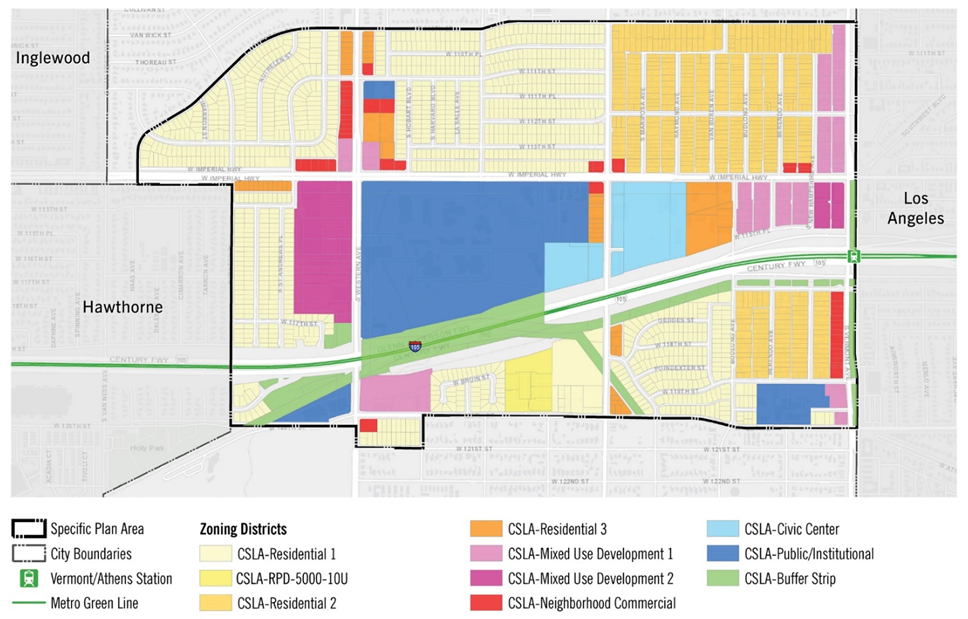
B.
Permit and Review Types in Specific Plan Zones. Except as specified otherwise, the establishment of a use in a Specific Plan zone shall be subject to the permit or review type identified in Table 22.416.030-A, below.
(Ord. 2024-0032 § 39, 2024.)
22.416.040 - CSLA Residential 1 (CSLA R-1) Zone.
A.
Purpose. The CSLA R-1 Zone is applied to preserve the scale and form of the area's existing single-family residential neighborhoods. The CSLA R-1 Zone provides primarily for single-family detached homes, up to nine dwelling units per acre.
B.
Use Regulations for CSLA R-1 Zone. The land use regulations for the Single-Family Residence (R-1) Zone contained in Chapter 22.18 (Residential Zones) shall apply to all development in the CSLA R-1 Zone, unless otherwise specified in this Subsection B.
1.
Principal Uses. Table 22.416.040-A, below, identifies the principal uses generally permitted, conditionally permitted, or prohibited in the CSLA R-1 Zone. All other permitted and conditionally permitted uses shall be subject to the same permit or review application as those in Zone R-1, pursuant to Section 22.18.030 (Land Use Regulations for Zones R-A, R-1, R-2, R-3, R-4, and R-5).
2.
Accessory Uses. All accessory uses in the CSLA R-1 Zone shall be subject to the same permit or review application as those in Zone R-1, pursuant to Section 22.18.030 (Land Use Regulations for Zones R-A, R-1, R-2, R-3, R-4, and R-5).
3.
Temporary Uses. All temporary uses in the CSLA R-1 Zone shall be subject to the same permit or review application as those in Zone R-1, pursuant to Section 22.18.030 (Land Use Regulations for Zones R-A, R-1, R-2, R-3, R-4, and R-5).
C.
Development Standards. Development standards for Zone R-1 contained in Chapter 22.18 (Residential Zones) shall apply to all development in the CSLA R-1 Zone, unless otherwise specified in this Subsection C.
1.
Density, Setbacks, and Height. Table 22.416.040-B, below, identifies the allowable densities, required setbacks, and allowable building height in the CSLA R-1 Zone.
2.
Landscaping. With the exception of the required driveway and a walkway having a width not to exceed four feet, all areas within the street-fronting yard shall be landscaped with drought tolerant or low water use native or non-invasive plants, grasses, shrubbery, or trees, and regularly maintained.
3.
Fences, Walls, Gates, and Hedges.
a.
Wrought iron style fences that do not obscure views may be permitted up to five feet high in front yards and corner side yards, subject to a Ministerial Site Plan Review (Chapter 22.186).
b.
Fence design may include a combination of solid wall and open fencing, as long as over 50 percent of the wall is transparent.
c.
The use of barbed wire, electrified fence, and chain-link fence in conjunction with any fence, wall, roof, or hedge is prohibited.
4.
Lighting. All exterior light fixtures shall be energy efficient; produce warm-white light; avoid light pollution and spill-over; and, with the exception of architectural and landscape lighting, be pedestrian-scaled, shielded, and directed toward the ground.
5.
Utility and Mechanical Equipment. Utility and mechanical equipment shall be subject to Section 22.416.140.D (Utilities and Mechanical Equipment).
(Ord. 2024-0032 § 39, 2024.)
22.416.050 - CSLA Residential 2 (CSLA R-2) Zone.
A.
Purpose. The CSLA R-2 Zone is applied to provide opportunities for medium density housing containing multiple units up to 18 dwelling units per acre. The development standards for this designation promote a variety of attached housing types, including courtyard housing, row homes, townhomes, and garden apartments, to provide a variety of housing options.
B.
Use Regulations for CSLA R-2 Zone. The land use regulations for the Two-Family Residence (R-2) Zone contained in Chapter 22.18 (Residential Zones) shall apply to all development in the CSLA R-2 Zone, unless otherwise specified in this Subsection B.
1.
Principal Uses. Table 22.416.050-A, below, identifies the principal uses generally permitted, conditionally permitted, or prohibited in the CSLA R-2 Zone. All other permitted and conditionally permitted uses shall be subject to the same permit or review application as those in Zone R-2, pursuant to Section 22.18.030 (Land Use Regulations for Zones R-A, R-1, R-2, R-3, R-4, and R-5).
2.
Accessory Uses. All accessory uses in the CSLA R-2 Zone shall be subject to the same permit or review application as those in Zone R-2, pursuant to Section 22.18.030 (Land Use Regulations for Zones R-A, R-1, R-2, R-3, R-4, and R-5).
3.
Temporary Uses. All temporary uses in the CSLA R-2 Zone shall be subject to the same permit or review application as those in Zone R-2, pursuant to Section 22.18.030 (Land Use Regulations for Zones R-A, R-1, R-2, R-3, R-4, and R-5).
C.
Development Standards. Development standards for Zone R-2 contained in Chapter 22.18 (Residential Zones) shall apply to all development in the CSLA R-2 Zone, unless otherwise specified in this Subsection C.
1.
Density, Setbacks, and Height. Table 22.416.050-B, below, identifies the allowable densities, required setbacks, and allowable building height in the CSLA R-2 Zone.
2.
Landscaping. With the exception of the required driveway and a walkway having a width not to exceed four feet, all areas within the street-fronting yard shall be landscaped with drought tolerant or low water use native or non-invasive plants, grasses, shrubbery, or trees, and regularly maintained.
3.
Fences, Walls, Gates, and Hedges.
a.
Wrought iron style fences that do not obscure views may be permitted up to five feet high in front yards and corner side yards, subject to a Ministerial Site Plan Review (Chapter 22.186).
b.
Fence design may include a combination of solid wall and open fencing, as long as over 50 percent of the wall is transparent.
c.
The use of barbed wire, electrified fence, and chain-link fence, in conjunction with any fence, wall, roof, or hedge, is prohibited.
4.
Lighting. All exterior light fixtures shall be energy efficient; produce warm-white light; avoid light pollution and spill-over; and, with the exception of architectural and landscape lighting, be pedestrian-scaled, shielded, and directed toward the ground.
5.
Utility and Mechanical Equipment. Utility and mechanical equipment shall be subject to Section 22.416.140.D (Utilities and Mechanical Equipment).
(Ord. 2024-0032 § 39, 2024.)
22.416.060 - CSLA Residential 3 (CSLA R-3) Zone.
A.
Purpose. The CSLA R-3 Zone accommodates developments containing higher density multiple units, either apartments or condominiums, up to 30 dwelling units per acre. The intent is to promote desirable medium to higher density residential close to transit and other services. The development standards for this designation promote a variety of product types given the range of lot sizes and configurations. This designation is also intended to encourage the development of affordable and workforce housing to serve the needs of the West Athens-Westmont community and especially associated with Los Angeles Southwest College (LASC).
B.
Use Regulations for CSLA R-3 Zone. The land use regulations for the Limited Multiple Density Residence (R-3) Zone contained in Chapter 22.18 (Residential Zones) shall apply to all development in the CSLA R-3 Zone, unless otherwise specified in this Subsection B.
1.
Principal Uses. Table 22.416.060-A, below, identifies the principal uses generally permitted, conditionally permitted, or prohibited in the CSLA R-3 Zone. All other permitted and conditionally permitted uses shall be subject to the same permit or review application as those in Zone R-3, pursuant to Section 22.18.030 (Land Use Regulations for Zones R-A, R-1, R-2, R-3, R-4, and R-5).
2.
Accessory Uses. All accessory uses in the CSLA R-3 Zone shall be subject to the same permit or review application as those in Zone R-3, pursuant to Section 22.18.030 (Land Use Regulations for Zones R-A, R-1, R-2, R-3, R-4, and R-5).
3.
Temporary Uses. All temporary uses in the CSLA R-3 Zone shall be subject to the same permit or review application as those in Zone R-3, pursuant to Section 22.18.030 (Land Use Regulations for Zones R-A, R-1, R-2, R-3, R-4, and R-5).
C.
Development Standards. Development standards for Zone R-3 contained in Chapter 22.18 (Residential Zones) shall apply to all development in the CSLA R-3 Zone, unless otherwise specified in this Subsection C.
1.
Density, Setbacks, and Height. Table 22.416.060-B, below, identifies the allowable densities, required setbacks, and allowable building height in the CSLA R-3 Zone.
2.
Orientation. Developments north of the I-105 Freeway shall be oriented toward Imperial Highway to the extent feasible.
3.
Required Open Space. Two hundred square feet of open space per dwelling unit shall be provided in either common open space, private open space, or a combination of both, subject to the following:
a.
Minimum dimension for private open space shall be seven feet;
b.
Minimum dimension for common open space shall be 20 feet;
c.
Front yard shall be excluded from the calculation of open space. Side and rear yards may be included;
d.
Open space shall have no parking, driveway, or right-of-way encroachments;
e.
Common open space shall be developed for either active or passive use and professionally maintained in accordance with approved landscape and irrigation plans;
f.
Internal courtyards and common open space enclosed on three sides shall have a minimum dimension of 40 feet;
g.
Private open space shall be contiguous to the units served; and
h.
Balconies shall have a solid railing, and patios shall be walled for security and privacy.
4.
Walkways. Pedestrian walkways shall be a minimum of four feet in width.
5.
Landscaping. With the exception of the required driveway and pedestrian walkway, all areas within the street-fronting yard shall be landscaped with drought tolerant or low water use native or non-invasive plants, grasses, shrubbery, or trees, and regularly maintained.
6.
Fences, Walls, Gates, and Hedges.
a.
Wrought iron style fences that do not obscure views may be permitted up to five feet high in front yards and corner side yards, subject to a Ministerial Site Plan Review (Chapter 22.186).
b.
Fence design may include a combination of solid wall and open fencing, as long as over 50 percent of the wall is transparent.
c.
The use of barbed wire, electrified fence, and chain-link fence, in conjunction with any fence, wall, roof, or hedge, is prohibited.
7.
Lighting. All exterior light fixtures shall be energy efficient; produce warm-white light; avoid light pollution and spill-over; and, with the exception of architectural and landscape lighting, be pedestrian-scaled, shielded, and directed toward the ground.
8.
Utility and Mechanical Equipment. Utility and mechanical equipment shall be subject to Section 22.416.140.D (Utilities and Mechanical Equipment).
9.
Circulation and Parking.
a.
Parking shall not be located in required front yards or corner side yards.
b.
Carports and parking structures shall be architecturally integrated in the project design.
c.
Parked vehicles shall be screened from view from public rights-of-way by architectural detailing, façade treatment, artwork, landscaping, or similar visual features to enhance the street façade.
(Ord. 2024-0032 § 39, 2024.)
22.416.070 - CSLA Residential Planned Development - 5000-10U (CSLA RPD-5000-10U) Zone.
This zone was established to accommodate Olive Glen by Williams Homes, a planned unit development on 120th Street. The creation of this zone shall have no effect on the prior project approval beyond including it in the Specific Plan Area.
(Ord. 2024-0032 § 39, 2024.)
22.416.080 - CSLA Neighborhood Commercial (CSLA NC) Zone.
A.
Purpose. The CSLA NC Zone is established to serve the local retail and service needs of the residents, employees, and students in the area. This zone is suited for small-scale retail service developments and restaurants serving the daily needs of adjacent neighborhoods. The intent is to maintain and promote the continuation of the neighborhood-service commercial uses.
B.
Use Regulations for CSLA NC Zone. The land use regulations for the Neighborhood Business (C-2) Zone contained in Chapter 22.20 (Commercial Zones) shall apply to all development in the CSLA NC Zone, unless otherwise specified in this Subsection B.
1.
Principal Uses. Table 22.416.080-A, below, identifies the principal uses generally permitted, conditionally permitted, or prohibited in the CSLA NC Zone. All other permitted and conditionally permitted uses shall be subject to the same permit or review application as those in Zone C-2, pursuant to Section 22.20.030 (Land Use Regulations for Zones C-H, C-1, C-2, C-3, C-M, C-MJ, and C-R).
2.
Accessory Uses. All accessory uses in the CSLA NC Zone shall be subject to the same permit or review application as those in Zone C-2, pursuant to Section 22.20.030 (Land Use Regulations for Zones C-H, C-1, C-2, C-3, C-M, C-MJ, and C-R).
3.
Temporary Uses. All temporary uses in the CSLA NC Zone shall be subject to the same permit or review application as those in Zone C-2, pursuant to Section 22.20.030 (Land Use Regulations for Zones C-H, C-1, C-2, C-3, C-M, C-MJ, and C-R).
C.
Development Standards. Development standards for Zone C-2 contained in Chapter 22.20 (Commercial Zones) shall apply to all development in the CSLA NC Zone, unless otherwise specified in this Subsection C.
1.
Floor Area Ratio (FAR), Setbacks, and Height. Table 22.416.080-B, below, identifies the allowable FAR, required setbacks, and allowable building height in the CSLA NC Zone.
2.
Landscaping.
a.
A minimum of 20 percent of the lot shall be developed and professionally maintained, in accordance with approved landscape and irrigation plans.
b.
Pedestrian walkways, plazas, and outdoor dining areas may be developed in the landscape area.
c.
Landscaping required in parking lots shall not count toward this requirement.
3.
Building Design.
a.
Street-level nonresidential uses shall have a minimum floor-to-ceiling height of 15 feet.
b.
At least 50 percent of a nonresidential street-level frontage shall consist of transparent glass windows or doors with minimal obstruction from window signs, interior walls, or window displays that inhibit views to the interior.
c.
At least 30 percent of a residential street-level frontage shall consist of windows and openings.
d.
On upper floors facing streets, a minimum of 40 percent of building façades for commercial uses, and a minimum of 20 percent for residential uses, shall consist of windows and openings.
e.
All glass in nonresidential windows and doors shall be transparent and either clear or lightly tinted to maximize visibility of building interiors from pedestrian areas.
f.
Mirrored, highly reflective, or densely-tinted glass shall be prohibited.
4.
Lighting. All exterior light fixtures shall be energy efficient; produce warm-white light; avoid light pollution and spill-over; and, with the exception of architectural and landscape lighting, be pedestrian-scaled, shielded, and directed toward the ground. Blinking, flashing, and oscillating lights of any type visible on the exterior are prohibited.
5.
Utility and Mechanical Equipment. Utility and mechanical equipment shall be subject to Section 22.416.140.D (Utilities and Mechanical Equipment).
(Ord. 2024-0032 § 39, 2024.)
22.416.090 - CSLA Civic Center (CSLA CC) Zone.
A.
Purpose. The CSLA CC Zone is intended to allow opportunities for non-civic uses, including commercial, interim, and supportive housing; multi-family residential uses; and public open space, where appropriate, to occur with civic uses located along Imperial Highway. The CSLA CC Zone allows multi-family residential uses as an incentive for the development of affordable housing. Over time, the CSLA CC Zone will integrate the existing civic uses and the multi-family residential areas east toward the station, into a walkable, safe district. Residential uses are intended to provide for housing options and affordability, particularly workforce housing in proximity to both employment uses and transit.
B.
Use Regulations for CSLA CC Zone.
1.
Principal Uses. Table 22.416.090-A, below, identifies the principal uses permitted, conditionally permitted, or prohibited in the CSLA CC Zone.
2.
Accessory Uses. Accessory uses and structures are permitted in the CSLA CC Zone when associated with, and subordinate to, a permitted or conditionally permitted principal use on the same site and may include the uses listed in Table 22.416.090-B, below.
3.
Temporary Uses. All temporary uses in the CSLA CC Zone shall be subject to the same permit or review application as those in Zone MXD, pursuant to Section 22.26.030.B (Land Use Regulations).
C.
Development Standards.
1.
Density, FAR, Setbacks, and Height. Table 22.416.090-C, below, identifies the allowable densities, FAR, required setbacks, and allowable building height in the CSLA CC Zone.
2.
Building Design.
a.
Building Orientation and Location. Developments shall not be oriented toward the freeway. Permanent multi-family residential units shall not be located within 200 feet of the freeway right-of-way, although other uses, such as parking, a commercial-only development, or the nonresidential component of a mixed use development, are allowed. Projects shall be oriented toward Imperial Highway to the extent feasible.
b.
Large façades/walls of structures providing no pedestrian access or only secondary access, such as for a parking structure or operations plant, that are within 20 feet of a street shall be screened with trees, large shrubbery, and other vegetation installed and professionally maintained, in accordance with approved landscape and irrigation plans.
c.
Street-level nonresidential uses shall have a minimum floor-to-ceiling height of 15 feet.
d.
At least 50 percent of a nonresidential street-level frontage shall consist of transparent glass windows or doors with minimal obstruction from window signs, interior walls, or window displays that inhibit views to the interior.
e.
At least 30 percent of a residential street-level frontage shall consist of windows and openings.
f.
On upper floors facing streets, a minimum of 40 percent of building façades for commercial uses and a minimum of 20 percent for residential uses shall consist of windows and openings.
g.
All glass in nonresidential windows and doors shall be transparent and either clear or lightly tinted to maximize visibility of building interiors from pedestrian areas.
h.
Mirrored, highly-reflective, or densely-tinted glass shall be prohibited.
3.
Lighting. All exterior light fixtures shall be energy efficient; produce warm-white light; avoid light pollution and spill-over; and, with the exception of architectural and landscape lighting, be pedestrian-scaled, shielded, and directed toward the ground. Blinking, flashing, and oscillating lights of any type visible on the exterior are prohibited.
4.
Landscaping. Landscaping along Imperial Highway shall not create a barrier for pedestrian or bicycle access into outdoor non-private open spaces.
5.
Circulation and Parking.
a.
Projects shall incorporate pedestrian and bicycle path connections into their project design.
b.
Bicycle parking shall be provided, as specified in Section 22.416.140.E (Bike Parking and Related Facilities).
c.
Parking facilities shall be provided, as specified in Section 22.416.140.F (Parking Facilities).
6.
Utility and Mechanical Equipment. Utility and mechanical equipment shall be subject to Section 22.416.140.D (Utilities and Mechanical Equipment).
(Ord. 2024-0032 § 39, 2024.)
22.416.100 - CSLA Mixed Use Development 1 (CSLA MXD-1) Zone.
A.
Purpose. The CSLA MXD-1 Zone is intended to promote development of a mix of commercial, office, and residential, with emphasis on neighborhood-serving uses. The CSLA MXD-1 Zone provides for a range of smaller to medium scale retail, horizontal and vertical mixed use developments, and multi-family residential uses up to 30 dwelling units per acre. Developments have private/public open space components and strong bicycle and pedestrian connections to the Vermont/Athens Station, LASC campus, and the community.
B.
Use Regulations for CSLA MXD-1 Zone.
1.
Principal Uses. Table 22.416.100-A, below, identifies the principal uses permitted, conditionally permitted, or prohibited in the CSLA MXD-1 Zone.
2.
Accessory Uses. Accessory uses and structures are permitted in the CSLA MXD-1 Zone when associated with, and subordinate to, a permitted or conditionally permitted principal use on the same site and may include the uses listed in Table 22.416.100-B, below.
3.
Temporary Uses. All temporary uses in the CSLA MXD-1 Zone shall be subject to the same permit or review application as those in Zone MXD, pursuant to Section 22.26.030.B (Land Use Regulations).
C.
Development Standards.
1.
Density, FAR, Setbacks, and Height. Table 22.416.100-C, below, identifies the allowable densities, FAR, required setbacks, and allowable building height in the CSLA MXD-1 Zone.
2.
Buffer and Step Back When Abutting Single-Family Residential Lot. When sharing a property line with a single-family residentially zoned lot, the following requirements, illustrated in Figure 22.416.100-A, below, shall apply:
a.
Windows, balconies, or similar openings shall be oriented so as to minimize any direct line of sight into adjacent units or onto private patios or backyards adjoining the property line;
b.
The third floor shall be stepped back by a minimum of 10 feet; and
c.
A minimum 20 feet landscape buffer shall be installed.
FIGURE 22.416.100-A: BUILDING HEIGHT AND SETBACK
REQUIREMENT FOR CSLA MXD-1 ZONE
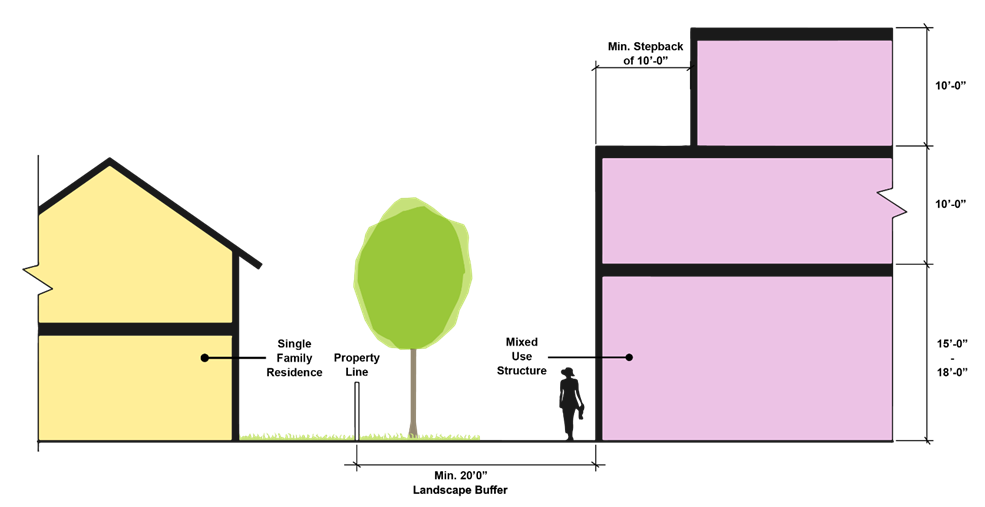
3.
Building Design.
a.
Building Orientation and Location. Developments shall not be oriented toward the freeway. Residential units shall not be located within 200 feet of the freeway right-of-way, although other uses, such as parking, a commercial-only development, or the nonresidential component of a mixed use development, are allowed.
b.
Frontages. Building frontages shall include variations in wall planes (projections and recesses), wall height (vertical relief), and roof forms and heights to reduce the perceived scale of the structure.
c.
Façades.
i.
Street wall façades shall be architecturally enhanced by the use of arcades, colonnades, recessed entrances, window details, bays, and variation in building materials, color, and other details.
ii.
The façade detailing of mixed use buildings shall visually differentiate ground floor uses from upper-story uses. The base shall visibly anchor the building to the ground with a treatment of higher quality materials, excluding stucco.
iii.
Commercial and residential entries shall be clearly identifiable and differentiated from one another.
d.
Design Features.
i.
Buildings having 100 feet or more of street frontage shall be designed to provide roofs of varying heights.
ii.
All primary ground floor entries for individual residential units and commercial units adjacent to the street front shall be oriented toward the street front rather than the interior or to a parking lot.
iii.
Buildings having 100 feet or more of street frontage shall be designed to provide roofs of varying heights.
iv.
Street-level nonresidential uses shall have a minimum floor-to-ceiling height of 15 feet.
v.
At least 50 percent of a nonresidential street-level frontage shall consist of transparent glass windows or doors with minimal obstruction from window signs, interior walls, or window displays that inhibit views to the interior.
vi.
At least 30 percent of a residential street-level frontage shall consist of windows and openings.
vii.
On upper floors facing streets, a minimum of 40 percent of building façades for commercial uses, and a minimum of 20 percent for residential uses, shall consist of windows and openings.
viii.
All glass in nonresidential windows and doors shall be transparent and either clear or lightly tinted to maximize visibility of building interiors from pedestrian areas.
ix.
Mirrored, highly reflective, or densely tinted glass shall be prohibited.
x.
Rough-coat stucco is prohibited.
4.
Lighting. All exterior light fixtures shall be energy efficient; produce warm-white light; avoid light pollution and spill-over; and, with the exception of architectural and landscape lighting, shall be pedestrian-scaled, shielded, and directed toward the ground. Blinking, flashing, and oscillating lights of any type visible on the exterior are prohibited.
5.
Utility and Mechanical Equipment. Utility and mechanical equipment shall be subject to Section 22.416.140.D (Utilities and Mechanical Equipment).
6.
Required Open Space for Residential Uses. One hundred square feet of open space per dwelling unit shall be provided in either common open space, private space, or a combination of both, in a residential development or for the residential component of a mixed-use development, subject to the following:
a.
Minimum dimension for private open space shall be seven feet;
b.
Minimum dimension for common open space shall be 20 feet;
c.
Front yard shall be excluded from the calculation of open space. Side and rear yards may be included;
d.
Open space shall have no parking, driveway, or right-of-way encroachments;
e.
Common open space shall be developed for either active or passive use and professionally maintained, in accordance with approved landscape and irrigation plans;
f.
Common open space shall be located on the same property as the residential use it serves and shall be available exclusively for the use of all residents of the development;
g.
Rooftops used for common open space shall be developed and professionally maintained, in accordance with approved landscape and irrigation plans. Mechanical equipment and/or storage areas shall not count toward open space requirements;
h.
Private open space shall be contiguous to the unit served;
i.
Balconies shall have a solid railing and patios shall be walled for security and privacy; and
j.
Internal courtyards and common open space enclosed on three sides shall have a minimum dimension of 40 feet.
7.
Required Open Space for Nonresidential Uses. Open spaces shall be provided in a nonresidential development or for the nonresidential component of a mixed use development subject to the following:
a.
Minimum 500 square feet of open space shall be provided on a project site containing less than two acres;
b.
Minimum 2,500 square feet of open space shall be provided on a project site containing two acres or more;
c.
Nonresidential open space requirements may be satisfied by outdoor dining areas, pedestrian plazas, pocket parks, promenades, or other outdoor amenities accessible to the public; and
d.
Open space shall have no parking, driveway, or right-of-way encroachments.
8.
Walkways. Pedestrian walkways shall be a minimum of four feet wide.
9.
Circulation and Parking.
a.
Projects shall incorporate pedestrian and bicycle path connections into their project design.
b.
Parking structures shall be underground or architecturally integrated so as to be screened from view.
c.
Bicycle parking shall be provided, as specified in Section 22.416.140.E (Bike Parking and Related Facilities).
d.
Parking facilities shall be provided, as specified in Section 22.416.140.F (Parking Facilities).
(Ord. 2024-0032 § 39, 2024.)
22.416.110 - CSLA Mixed Use Development 2 (CSLA MXD-2) Zone.
A.
Purpose. The CSLA MXD-2 Zone is intended to be developed over time as a transit-supportive environment, providing a higher-intensity mix of retail, office, restaurant uses, and residential development in a compact, walkable setting. This designation encourages multi-family residential, in a vertical mixed use configuration, up to 60 dwelling units per acre. The development standards and design requirements address vital private/public open space components, and pedestrian facilities. The MXD-2 Zone is intended to promote community redevelopment through higher intensity, transit supporting infill development.
B.
Use Regulations for CSLA MXD-2 Zone.
1.
Principal Uses. Table 22.416.110-A, below, identifies the principal uses permitted, conditionally permitted, or prohibited in the CSLA MXD-2 Zone.
2.
Accessory Uses. Accessory uses and structures are permitted in the CSLA MXD-2 Zone when associated with, and subordinate to, a permitted or conditionally permitted principal use on the same site and may include the uses listed in Table 22.416.110-B, below.
3.
Temporary Uses. All temporary uses in the CSLA MXD-2 Zone shall be subject to the same permit or review application as those in Zone MXD, pursuant to Section 22.26.030.B (Land Use Regulations).
C.
Development Standards.
1.
Density, FAR, Setbacks, and Height. Table 22.416.110-C, below, identifies the allowable densities, FAR, required setbacks, and allowable building height in the CSLA MXD-2 Zone.
2.
Buffer and Step Back When Abutting Single-Family Residential Lot. When sharing a property line with a single-family residentially zoned lot, the following requirements, illustrated in Figure 22.416.110-A, below, shall apply:
a.
Windows, balconies, or similar openings shall be oriented so as to minimize any direct line-of-sight into adjacent units or onto private patios or backyards adjoining the property line;
b.
The third floor shall be stepped back by a minimum of 10 feet; and
c.
A minimum 20 feet landscape buffer shall be installed.
FIGURE 22.416.110-A: BUILDING HEIGHT AND SETBACK
REQUIREMENT FOR CSLA MXD-2 ZONE
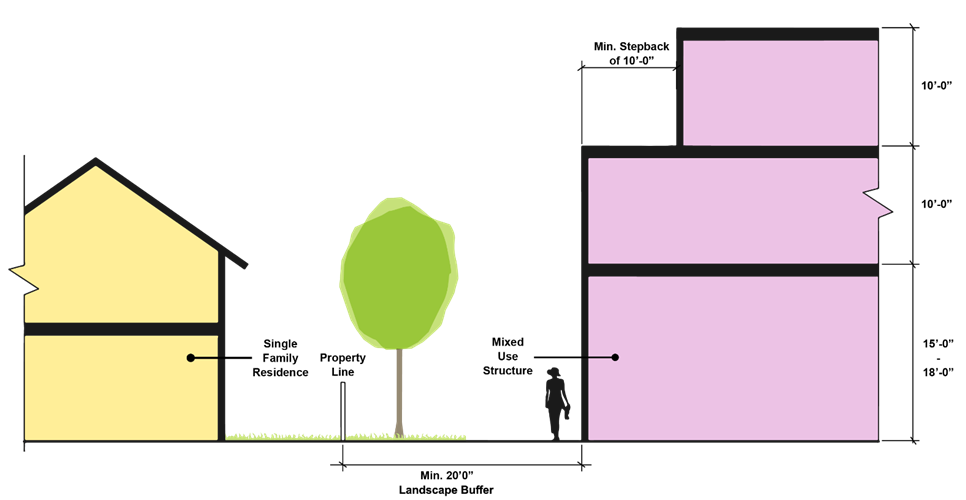
3.
Building Design.
a.
Frontage. Building frontages shall include variations in-wall planes (projections and recesses), wall height (vertical relief), and roof forms and heights to reduce the perceived scale of the structure.
b.
Façades.
i.
Street wall façades shall be architecturally enhanced by the use of arcades, colonnades, recessed entrances, window details, bays, and variation in building materials, color, and other details.
ii.
New development at the intersections of Vermont Avenue and Imperial Highway and Western Avenue and Imperial Highway shall provide an articulated corner entrance or articulated entrances oriented toward each street, that incorporate a tall first story or prominent roof forms.
iii.
The façade detailing of mixed use buildings shall visually differentiate ground floor uses from upper-story uses. The base shall visibly anchor the building to the ground with a treatment of higher quality materials.
iv.
Commercial and residential entries shall be clearly identifiable and differentiated from one another.
c.
Design Features.
i.
All primary ground floor entries for individual residential units and commercial units adjacent to the street front shall be oriented toward the street front rather than the interior or to a parking lot.
ii.
Buildings having 100 feet or more of street frontage shall be designed to provide façade articulation and roofs of varying heights.
iii.
Street-level nonresidential uses shall have a minimum floor-to-ceiling height of 15 feet.
iv.
At least 50 percent of a nonresidential street-level frontage shall consist of transparent glass windows or doors with minimal obstruction from window signs, interior walls, or window displays that inhibit views to the interior.
v.
At least 30 percent of a residential street-level frontage shall consist of windows and openings.
vi.
On upper floors facing streets, a minimum of 40 percent of building façades for commercial uses and a minimum of 20 percent for residential uses shall consist of windows and openings.
vii.
All glass in nonresidential windows and doors shall be transparent and either clear or lightly tinted to maximize visibility of building interiors from pedestrian areas.
viii.
Mirrored, highly reflective, or densely tinted glass shall be prohibited.
ix.
Rough-coat stucco is prohibited.
4.
Utility and Mechanical Equipment. Utility and mechanical equipment shall be subject to Section 22.416.140.D (Utilities and Mechanical Equipment).
5.
Required Open Space for Residential Uses. One hundred square feet of open space per dwelling unit shall be provided in either common open space, private space, or a combination of both, in a residential development or for the residential component of a mixed use development, subject to the following:
a.
Minimum dimension for private open space shall be seven feet;
b.
Minimum dimension for common open space shall be 20 feet;
c.
Front yard shall be excluded from the calculation of open space. Side and rear yards may be included;
d.
Open space areas shall have no parking, driveway, or right-of-way encroachments;
e.
Common open space shall be developed for either active or passive use and professionally maintained, in accordance with approved landscape and irrigation plans;
f.
Common open space shall be located on the same property as the residential use it serves and shall be available exclusively for the use of all residents of the development;
g.
Rooftops used for common open space shall be developed and professionally maintained, in accordance with approved landscape and irrigation plans. Mechanical equipment and/or storage areas shall not count toward open space requirements;
h.
Private open space shall be contiguous to the unit served;
i.
Balconies shall have a solid railing and patios shall be walled for security and privacy; and
j.
Internal courtyards and common open space enclosed on three sides shall have a minimum dimension of 40 feet.
6.
Required Open Space for Nonresidential Uses. Open spaces shall be provided in a nonresidential development or for the nonresidential component of a mixed use development subject to the following:
a.
Minimum 500 square feet of open space shall be provided on a project site containing less than two acres;
b.
Minimum 2,500 square feet of open space shall be provided on a project site containing two acres or more;
c.
Nonresidential open space requirements may be satisfied by outdoor dining areas, pedestrian plazas, pocket parks, promenades, or other outdoor amenities accessible to the public; and
d.
Open space shall have no parking, driveway, or right-of-way encroachments.
7.
Lighting. All exterior light fixtures shall be energy efficient; produce warm-white light; avoid light pollution and spill-over; and, with the exception of architectural and landscape lighting, be pedestrian-scaled, shielded, and directed toward the ground. Blinking, flashing, and oscillating lights of any type visible on the exterior are prohibited.
8.
Walkways. Pedestrian walkways shall be a minimum of four feet wide.
9.
Circulation and Parking.
a.
Projects shall incorporate pedestrian and bicycle path connections into their project design.
b.
Parking structures shall be underground or architecturally integrated so as to be screened from view.
c.
Bicycle parking shall be provided, as specified in Section 22.416.140.E (Bike Parking and Related Facilities).
d.
Parking facilities shall be provided, as specified in Section 22.416.140.F (Parking Facilities).
(Ord. 2024-0032 § 39, 2024.)
22.416.120 - CSLA Public Institutional (CSLA IT) Zone.
A.
Purpose. The CSLA IT Zone provides for established public uses, including schools, parks, and other public uses. This designation is intended to promote the integration of publicly owned land and facilities into the public realm, to the extent feasible, to extend pedestrian open space and provide safe connections to points of destination. The CSLA IT Zone shall accommodate the development, redevelopment, and expansion of accredited schools and colleges and public facilities contemplated in an adopted or approved campus and/or facilities master plan.
B.
Use Regulations for CSLA IT Zone.
1.
Principal Uses. Table 22.416.120-A, below, identifies the principal uses permitted in the CSLA IT Zone.
2.
Accessory Uses. Accessory uses and structures are permitted in the CSLA IT Zone when associated with, and subordinate to, a permitted principal use on the same site and may include the uses listed in Table 22.416.120-B, below.
3.
Temporary Uses. All temporary uses in the CSLA IT Zone shall be subject to an adopted or approved campus and/or facilities master plan.
C.
Development Standards.
1.
FAR, Setback, and Height. Table 22.416.120-C, below, identifies the allowable FAR, required setbacks, and allowable building height in the CSLA IT Zone.
2.
Building Design.
a.
Building Orientation and Location. Developments shall not be oriented toward the freeway. Permanent multi-family residential units shall not be located within 200 feet of the freeway right-of-way, although other uses, such as parking, a commercial-only development, or the nonresidential component of a mixed use development, are allowed. Projects shall be oriented toward Imperial Highway to the extent feasible.
b.
Large façades/walls of structures providing no pedestrian access or only secondary access, such as for a parking structure or operations plant, within 20 feet of a street shall be screened with trees, large shrubbery, and other vegetation installed and professionally maintained, in accordance with approved landscape and irrigation plans.
3.
Landscaping. Landscaping along Imperial Highway shall not create a barrier for pedestrian or bicycle access.
4.
Circulation and Parking.
a.
Projects shall incorporate pedestrian and bicycle path connections into their project design.
b.
Bicycle parking shall be provided, as specified in Section 22.416.140.E (Bike Parking and Related Facilities).
c.
Parking facilities shall be provided, as specified in Section 22.416.140.F (Parking Facilities).
5.
Utility and Mechanical Equipment. Utility and mechanical equipment, as specified in Section 22.416.140.D (Utilities and Mechanical Equipment).
(Ord. 2024-0032 § 39, 2024.)
22.416.130 - CSLA Buffer (CSLA B-1) Zone.
A.
Purpose. The CSLA B-1 Zone provides a buffer from the I-105 freeway by accommodating public infrastructure and open space in the Specific Plan Area.
B.
Use Regulations for CSLA B-1 Zone. Table 22.416.130-A, below, identifies the uses permitted or prohibited in the CSLA B-1 Zone.
C.
Development Standards. Development in the CSLA B-1 Zone shall be subject to the same development standards as in Zone B-1, pursuant to Section 22.22.060 (Development Standards for Industrial Zones), where applicable.
(Ord. 2024-0032 § 39, 2024.)
22.416.140 - General Use Regulations and Standards.
A.
Applicability. This Section shall apply to new development and the reuse of existing structures and facilities.
B.
Alcoholic Beverage Sales. Alcoholic beverage sales, where conditionally permitted, shall be subject to Section 22.140.030 (Alcoholic Beverage Sales).
C.
Outside Storage. All uses shall be conducted within a completely enclosed building, except for off-street parking, loading, approved nursery accessory uses, and any outdoor dining specifically permitted in conjunction with eating establishments.
D.
Utilities and Mechanical Equipment.
1.
All ground mounted utility boxes and satellite dishes shall either be placed in locations not exposed to view from the street or screened from view. Utility screening elements shall be an integral part of the building's design.
2.
Utilities and mechanical equipment shall be screened by landscaping or site-appropriate materials and shall not be located within any front setback areas or adjacent to any public right-of-way or private street or pedestrian/bicycle path, or within 50 feet of a corner.
3.
Mechanical Equipment. Compressors, air conditioning units, vents, exhausts, or similar mechanical equipment located outside a building shall comply with the following:
a.
All such equipment shall be screened from view from any abutting street or adjacent use. Screening shall be an integral part of the overall architectural design of the project. The top of any screening shall be a minimum of six inches above the top of any mechanical equipment.
b.
All mechanical equipment shall be maintained in a clean and proper condition to prevent breakdown that might release noxious or toxic materials or create excessive noise, and to avoid accumulation of litter, filth, and materials that would be noxious or unsafe.
c.
Equipment, including ground mounted air conditioners, may be located within the side and rear yard setbacks, if a three-foot minimum setback to the property line is maintained.
d.
Ground mounted air conditioners are not permitted in any portion of the front yard setback or between the front of the structure and the public right-of-way.
4.
Roof-Mounted Solar Collector Panels. Roof-mounted solar collector panels shall be mounted flush with the surface where possible. Where panels cannot effectively perform if flush mounted, justification in the form of efficiency calculations may be submitted to the Director for consideration of alternative mounting configurations.
5.
Refuse Collection Facilities. All outdoor refuse collection facilities shall be screened from public rights-of-way. Collection areas shall be shielded from view in all directions, either within a building or within a solid masonry wall of sufficient height to conceal materials temporarily accumulated for collection. The enclosure shall be designed to complement the main building materials.
E.
Bike Parking and Related Facilities.
1.
Bike parking and related facilities shall be subject to Section 22.112.100 (Bicycle Parking Spaces and Bicycle Facilities), with the exception of the following specified in Table 22.416.140-A, below. For a combination of uses on a single lot, the number of required bicycle parking spaces shall be equal to the combined total of the required bicycle parking spaces for each of the individual uses.
2.
Showers and Changing Facilities. All new commercial and mixed-use developments shall provide and continually maintain secured, ground floor restrooms accessible to the public and available for changing.
a.
Shower shall be provided as follows:
i.
A minimum of one shower for developments with a gross nonresidential floor area between 10,000 and 24,999 square feet;
ii.
A minimum of two showers for developments with a gross nonresidential floor area between 25,000 square feet and 124,999 square feet; and
iii.
A minimum of four showers for developments with a gross nonresidential floor area over 125,000 square feet.
b.
Accompanying dressing facilities shall be provided with lockers for clothing and personal effects at a rate of one per every long-term bicycle parking space required.
F.
Parking Facilities.
1.
The perimeter of parking areas and driveways adjacent to streets and pedestrian pathways shall be screened from street views with a low street wall, berms, fences, or landscaping.
2.
The façade of parking structures shall include vertical features to break up those façades and horizontal features to separate each floor.
3.
Projecting elements, awnings, lighting, signs, or other features shall be used to highlight pedestrian entrances into parking structures.
4.
Shared parking structures for mixed use developments shall provide secure access and parking areas for residential tenants.
5.
Parking structures shall have shaded structures, preferably photovoltaic arrays, on the top deck to reduce heat island effects.
6.
Off-Street Parking Requirements. Except as specified otherwise by State law, the standards for parking requirements contained in Chapter 22.112 (Parking) shall apply to developments within the boundary of the Specific Plan, except that parking provided shall not exceed the maximum as specified in Table 22.416.140-B, below.
G.
Security.
1.
Chain link, barbed, and concertina wire fences are prohibited.
2.
Exterior security bars, grilles, or grates on windows and doors are prohibited.
3.
Exterior roll-up or folding accordion shutters, security gates, or grilles are prohibited.
4.
Roll-up or folding security gates or grilles shall be concealed within the interior architectural elements of the building during business hours. Solid roll-up or folding shutters and gates are prohibited.
(Ord. 2024-0032 § 39, 2024.)
22.416.150 - Minor Modifications.
Minor modifications, as defined herein, shall be subject to the Substantial Conformance Review described in this Section.
A.
Review Authority. The Hearing Officer shall have the authority to review projects requesting a modification to the development standards identified in Subsection C (Maximum Modifications), below, for substantial compliance with the applicable requirements of the Specific Plan and other provisions of this Title 22.
B.
Application and Review Procedures.
1.
Application Checklist. The application submittal shall contain all of the materials required by the Substantial Conformance Review checklist.
2.
Type II Review. The application shall be filed and processed in compliance with Chapter 22.228 (Type II Review—Discretionary) and this Section.
C.
Maximum Modifications. Table 22.416.150-A, below, specifies the maximum modifications that may be permitted, pursuant to this Section.
D.
Findings and Decision.
1.
Common Procedures. Findings and decision shall be made in compliance with Section 22.228.050 (Findings and Decision) and include the findings in Subsection D.2, below.
2.
Findings.
a.
Approval of the project conforms with the applicable provisions of this Specific Plan and other applicable provisions of this Title 22.
b.
Approval of the project is in the interest of public health, safety, and general welfare.
c.
Site layout, open space, orientation, and location of buildings, vehicular access, circulation and parking, setbacks, heights, and walls and fences that encourage increased pedestrian activity compatible with neighboring land uses.
d.
Architectural character, scale, quality of design, building materials, colors, screening of exterior appurtenances, and signs are compatible with the Specific Plan and neighborhood character.
e.
Project landscaping, including its location, type, size, color, texture, and coverage of plant materials at the time of planting are designed and developed to provide visual interest, complement buildings and structures, and provide an attractive environment through maturity. The project landscaping shall also include measures to provide for irrigation, maintenance, and protection of the landscaped areas.
f.
Parking areas are designed and developed to buffer surrounding land uses; complement pedestrian-oriented development; enhance the environmental quality of the site, such as to minimize stormwater run-off and the urban heat-island effect; and ensure safety.
g.
Exterior lighting and lighting fixtures are designed to complement buildings, are of appropriate scale, avoid creating glare, and provide adequate light over walkways and parking areas to foster pedestrian safety.
E.
Conditions of Approval. The Hearing Officer may impose conditions to ensure the approval will be in accordance with the findings required by Subsection D (Findings and Decisions), above.
F.
All Zone Regulations Apply Unless Permit is Granted. Unless specifically modified by a Substantial Conformance Review, all regulations prescribed in the zone in which such Substantial Conformance Review is granted shall apply.
G.
Appeals. The decision of the Hearing Officer may be appealed or called up for review, pursuant to the procedures and requirements of Chapter 22.240 (Appeals).
H.
Revisions to Modification. Revisions to a modification granted through a Substantial Conformance Review may be approved with a Revised Exhibit A (Chapter 22.184) of the original approval. Revisions that would deviate from the intent of the original approval shall require approval of a new Substantial Conformance Review.
(Ord. 2024-0032 § 39, 2024.)
22.418.010 - Purpose.
The provisions of this Regulating Code include the zone regulations intended to guide development and decision-making to achieve the vision and guiding principles of the Florence-Firestone TOD (FFTOD) Specific Plan. All zones implement the General Plan Land Use designations.
The FFTOD Specific Plan also establishes new zones as outlined in Table 22.418.010-A (Overview of All Specific Plan Zones) in select areas of the Specific Plan Area identified in Figure 22.418.010-1 (FFTOD Specific Plan Zoning Map). The new zones, referred to as FFTOD Zones, are designed to create a TOD Specific Plan for the Slauson, Florence, and Firestone A Line (Blue) Metro Transit Stations, an implementation action included in the General Plan. Each TOD Zone within the Specific Plan Area has an accompanying list of allowed land uses, permit requirements, and required objective development standards for new development. The remainder of the zones in the Specific Plan Area are existing Countywide Zones regulated by Title 22.
A.
TOD Zones. The standards of this Section shall apply to all new development in the FFTOD Zones identified in Table 22.418.010-A (Overview of All Specific Plan Zones); the zone specific standards of this Section shall be used in combination with development standards in Section 22.418.080 (Community-Wide Development Standards) and Section 22.418.090 (TOD Zone Additional Development Standards).
B.
Countywide Zones. All new development in existing Countywide Zones applied within the Florence-Firestone Community identified in Figure 22.418.010-1 (FFTOD Specific Plan Zoning Map) and Table 22.418.010-A (Overview of All Specific Plan Zones) shall be regulated consistent with the applicable Title 22 Chapter unless modified by Section 22.418.120 (Modifications to Countywide Zones) herein.
FIGURE 22.418.010-1: FFTOD SPECIFIC PLAN ZONING MAP
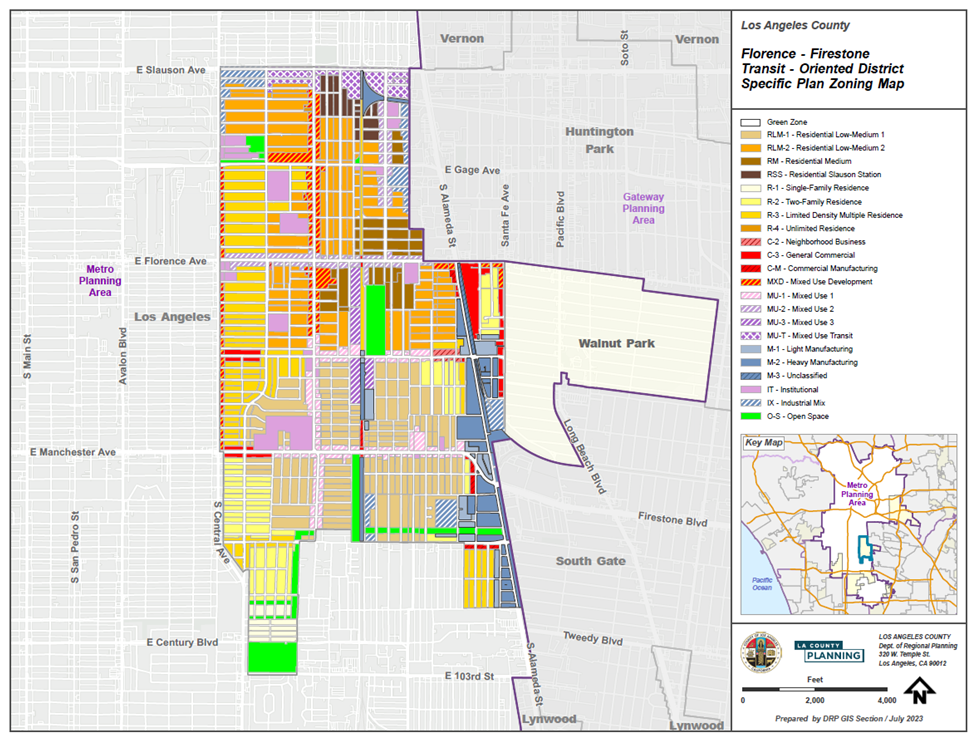
(Ord. 2024-0032 § 40, 2024; Ord. 2023-0013 § 4, 2023.)
22.418.020 - Administration, Review, and Approvals.
A.
Applicability. The Specific Plan shall apply to all new development projects for which a complete application has been filed on or after March 9, 2023. Complete applications filed before March 9, 2023, shall comply with the regulations and applicable Title 22 provisions in effect at the time that the respective complete applications were filed.
1.
Relationship to Other Provisions Within Title 22. The provisions of this Chapter 22.418 shall be administered in conjunction with other provisions of this Title 22, in accordance with Section 22.400.030 (Administration).
2.
Interpretation. The Director or designee has the authority to internally interpret the intent of this Specific Plan if ambiguity arises concerning the meaning or appropriate application of the provisions of the Specific Plan. In so doing, the Director shall consider the following factors (as applicable):
a.
The case is similar to previous interpretations of similar provisions.
b.
The interpretation satisfactorily reflects the vision, intent, and purpose of the Specific Plan.
c.
The resulting project is consistent with the General Plan.
d.
The decision constitutes sound precedent for other similar situations.
3.
Enforcement. The Director is responsible for the overall administration and enforcement of the provisions of this Specific Plan.
4.
Severability. If any provision of this Specific Plan or the application thereof to any person or circumstance is held to be invalid by a court of competent jurisdiction, such invalidity shall not affect the other Specific Plan provisions, clauses, or applications thereof, which can be implemented without the invalid provision, clause, or application, and to this end, the provisions and clauses of this Specific Plan are declared to be severable.
5.
Amendment to the Specific Plan. A Specific Plan Amendment may be initiated by the Board of Supervisors, the Commission, or upon application by a property owner or their designated representative. An amendment to the Specific Plan shall be processed in accordance with Chapter 22.222 (Administrative Procedures).
B.
Review and Approvals.
1.
Applications. No new development or use shall be established under the Specific Plan, and no grading or building permits shall be issued for these uses, until an application has been approved for the required permit type listed in the Use Regulation tables in this Specific Plan, and pursuant to the applicable procedures set forth below.
2.
Project Review. All zones established by this Chapter shall be subject to the Project review and evaluation requirements of Section 22.26.030.C (Project Review and Evaluation).
3.
Type I Review. All applications shall be filed and processed in compliance with Chapter 22.186 (Site Plan Review, Ministerial) and this Section.
a.
Review Authority. For uses that are permitted in the respective Use Regulation table, the Director shall have the authority to review projects subject to a Ministerial Site Plan Review for compliance with the Specific Plan and other provisions of Title 22.
b.
Application Requirements. A Ministerial Site Plan Review application shall include all information required by the Department, and the payment of the required fee established in Title 22.
c.
Determination. If the project complies with the provisions of the Specific Plan and other applicable provisions of Title 22, the Director shall grant the Ministerial Site Plan Review approval. Otherwise, the Director shall deny the application for a Ministerial Site Plan approval.
d.
Conditional Use Permit. When a conditional use permit is required under this Specific Plan or otherwise required under Title 22, the review procedures for a conditional use permit shall be the same as those prescribed in Chapter 22.158 (Conditional Use Permits).
C.
Application Requirements.
1.
Application Checklist Requirements. In addition to all of the materials required by this Chapter, the application submittal shall contain all of the following additional materials:
a.
A site plan of the proposed privately owned public space design, detailing the required elements of this Subsection, including the proposed location, design of the required public space identification signage, and design of the required signage, as required by Section 22.418.080.E (Required Signage);
b.
A lighting plan, showing the location and orientation of lights for the illumination of the privately maintained open space;
c.
A landscaping plan, showing the location and plant palette for the privately maintained open space as may be required;
d.
A maintenance plan, showing trash receptacles and cleaning schedules for elements of the privately maintained open space; and
e.
An applicant's statement describing the proposed design and how the proposed privately owned public space would benefit or enhance the pedestrian character or use of the site by pedestrians and otherwise comply with the standards of Section 22.418.120.A.5 (Open Space and Parking Modifications).
2.
Denial of Inactive Application by Hearing Officer. Notwithstanding the provisions of Section 22.222.100 (Denial of Inactive Application), the Hearing Officer shall deny, without a public hearing, any discretionary application, if such application has been deemed inactive by the Director for three months per Section 22.222.100.A (Inactive Application). Denial of an inactive application shall be issued in accordance with Section 22.222.220 (Notice of Action).
D.
Minor Modifications to Development Standards (Type II Review).
1.
Minor modifications to the standards of this Chapter shall be subject to the provisions below. Minor modifications, as defined herein, shall not require a Specific Plan Amendment, but will be subject to the outlined findings. See Table 22.418.020-A (Minor Modifications) for allowances.
a.
Review Authority. The Hearing Officer shall have the authority to review projects requesting a modification to the development standards identified in Subsection d, below, for substantial compliance with the applicable requirements of the Specific Plan and other provisions of Title 22.
b.
Application Requirements. A modification application shall include all information required by the Department, and the payment of the required fee.
c.
Procedures. A modification request shall be subject to the public hearing procedures and requirements set forth in Title 22.
d.
Determination. If the Hearing Officer determines that the request for a modification is consistent with the principles and standards of Section 22.228.050 (Findings and Decision) and the Findings per Subsection 2, below, the Hearing Officer may approve the modification. Notwithstanding the foregoing, only the following development standards may be modified:
2.
Findings. Findings and decision for minor modifications shall be made in compliance with Section 22.228.050 (Findings and Decision) and include the findings in this Section.
a.
The use, development of land, and application of development standards comply with all applicable provisions of Title 22.
b.
The use, development of land, and application of development standards, when considered on the basis of the suitability of the site for the particular use or development intended, are arranged to avoid traffic congestion; to provide for the safety and convenience of bicyclists and pedestrians, including children, senior citizens, and persons with disabilities; to protect public health, safety, and general welfare; to prevent adverse effects on neighboring property; and to conform with good zoning practice.
c.
The use, development of land, and application of development standards are suitable from the standpoint of functional developmental design.
d.
The application of these standards would alleviate practical difficulties or unnecessary hardships inconsistent with the goals of this Specific Plan.
e.
There are exceptional circumstances or conditions applicable to the subject property or to the intended development of the property that do not apply to other properties within the Florence-Firestone area.
f.
Granting the requested minor modification will not be materially detrimental to properties or improvements in the area or contrary to the goals of this Specific Plan.
3.
Appeals. The decision of the Hearing Officer may be appealed or called up for review, pursuant to the procedures and requirements of Chapter 22.240 (Appeals).
4.
Revisions to Modifications. Revisions to a variation grant may be approved by the Director if the revisions do not affect the intent of the original approval. Revisions that would deviate from the intent of the original approval shall require approval of a new modification.
E.
Specific Plan Modification Review (Type II Review).
1.
Review Authority. The Hearing Officer shall have the authority to review projects subject to a Specific Plan Modification Review for substantial compliance with the applicable standards and implementing options of this Specific Plan and other applicable provisions of Title 22.
2.
Application Requirements. A Specific Plan Modification Review application shall include all information required by the Department, and the payment of required fees established in Title 22.
3.
Procedures. A Specific Plan Modification Review shall be subject to the public hearing procedures and requirements set forth in Section 22.222.120 (Public Hearing Procedure).
4.
Burden of Proof. The applicant shall substantiate to the satisfaction of the Hearing Officer that:
a.
Approval of the project conforms with the applicable provisions of this Specific Plan and other applicable provisions of Title 22.
b.
Approval of the project is in the interest of the public health, safety, and general welfare.
c.
Site layout, open space, orientation and location of buildings, vehicular access, circulation and parking, setbacks, heights, and walls and fences encourage increased pedestrian activity compatible with neighboring land uses.
d.
Architectural character, scale, quality of design, building materials, colors, screening of exterior appurtenances, and signs are compatible with the Specific Plan and neighborhood character.
e.
Project landscaping, including its location, type, size, color, texture, and coverage of plant materials at the time of planting, are designed and developed to provide visual interest, complement buildings and structures, and provide an attractive environment through maturity. The project landscaping shall also include measures to provide for irrigation, maintenance, and protection of the landscaped areas.
f.
Parking areas are designed and developed to buffer surrounding land uses, complement pedestrian-oriented development, enhance the environmental quality of the site such as to minimize stormwater run-off and the urban heat-island effect, and ensure safety.
g.
Exterior lighting and lighting fixtures are designed to complement buildings, are of appropriate scale, avoid creating glare, and provide adequate light over walkways and parking areas to foster pedestrian safety.
5.
Appeals. The decision of the Hearing Officer for the Specific Plan Modification Review may be appealed or called up for review, pursuant to the procedures and requirements of Chapter 22.240 (Appeals).
6.
Revisions to Specific Plan Modification Review. Revisions to the Specific Plan Modification Review may be approved by the Director if the revisions do not affect the intent of the original approval. Revisions that would deviate from the intent of the original approval shall require the approval of a new Specific Plan Modification Review.
(Ord. 2024-0032 § 41, 2024; Ord. 2023-0013 § 4, 2023.)
22.418.030 - Definitions.
For the purposes of regulating this Specific Plan and development within Florence-Firestone, the following definitions are used:
Artisan Production/Custom Manufacturing. Manufacture of small-scale, or artisanal products of finished parts or products primarily from previously prepared materials. Allowed as a primary or accessory use; limited to a maximum gross floor area (GFA) of 5,000 square feet. Typical of independent jewelry manufacturing, custom products. It excludes basic industrial processing from raw materials, food processing, and vehicle/equipment services and commercial bakeries.
Directly Accessible to Pedestrians. Located within 10 feet of the public sidewalk abutting the property and where not more than 20 feet of path of travel is required from said public sidewalk.
Driveway Zone. The triangular areas created on sides of a driveway delineated by the following three points, including the portion of the driveway located between the aforementioned triangular areas.
Point "A" is the point at which the existing edge of the driveway meets the edge of the roadway or top of the curb, if present;
Point "B" is the point along the edge of the driveway located 10 feet back from the right-of-way line towards the property; and
Point "C" is the point at which a line that is extended from Point "B" at a 45-degree angle meets the edge of the roadway or top of curb, if present, as illustrated by Figure 22.418.030-1, below.
FIGURE 22.418.030-1: DRIVEWAY ZONE
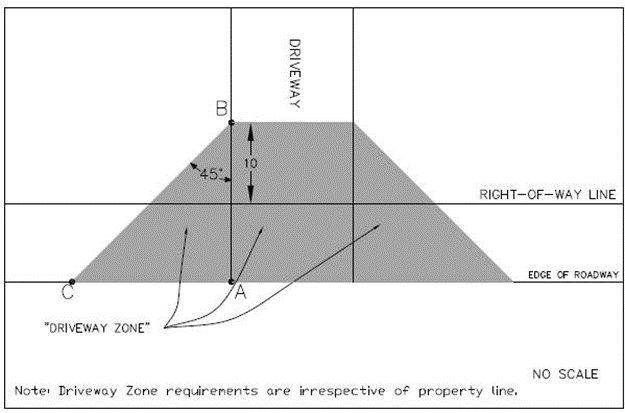
Frontage Zone. The area on private property which abuts the public sidewalk.
Furniture Zone. The portion of the sidewalk which contains street lighting, utilities such as fire hydrants, traffic control equipment, and street trees, and may contain other landscaping or street furniture such as benches and waste receptacles. The Furniture Zone is sometimes referred to as a parkway when landscaped.
Micro-Unit Size. A micro-unit consists of one-room living space designed to include seating, a bed, a bathroom, storage, and a kitchenette.
Pedestrian Zone. The portion of the sidewalk, which is used for pedestrian passage, and should be kept clear of obstructions.
Primary Corridors. All streets identified in Figure 22.418.030-2 (Primary Corridors) shall be considered Primary Corridors. Certain pedestrian and design standards apply to Primary Corridors to improve the walkability of the community and access to the TOD stations.
Public Realm. The publicly-accessible space between the street curb face and the building. This area includes the Sidewalk Zones and the required street setback, if applicable.
Sidewalk Zones. The public sidewalk inclusive of the Frontage Zone, Pedestrian Zone, and Furniture Zone, collectively referred to as "Sidewalk Zones."
Stepback. Measurement of the required upper-story horizontal distance by which a development feature must be separated from the minimum required setback. Regulated as a horizontal distance above a defined vertical distance.
FIGURE 22.418.030-2: PRIMARY CORRIDORS
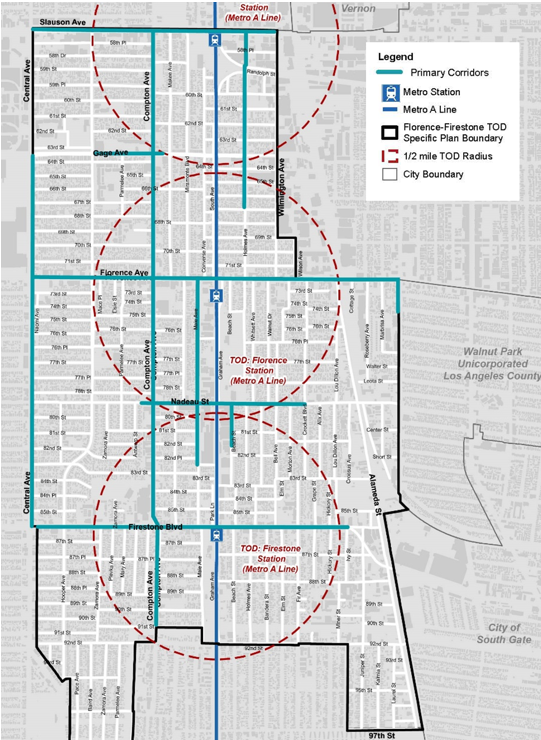
(Ord. 2023-0013 § 4, 2023.)
22.418.040 - TOD Zone Land Regulations.
A.
Applicability. The provisions in this Section are applicable to all parcels in the TOD Zones and shall supersede the provisions in Title 22. Where the development standards differ from provisions in Title 22, the provisions herein shall prevail. Where the standards of this Code are silent, the provisions of Title 22 shall apply.
B.
Permit and Review Requirements. Table 22.418.040-A, below, identifies the permit or review required to establish each use as regulated by the applicable zone.
1.
Principal Uses. Tables 22.418.050-A (TOD Mixed Use Zones Principal Use Regulations), 22.418.060-A (TOD R Zones Principal Use Regulations), and 22.418.070-A (TOD IX Zone Principal Use Regulations) identify the allowed principal uses by zone.
2.
Use Interpretations.
a.
Unlisted Uses.
i.
Prohibited Uses. Those uses not listed are prohibited, except as otherwise provided by Section 22.18.020 (Residential Zones Designated), Section 22.20.020 (Commercial Zones Designated), and Section 22.22.020 (Industrial Zones Designated).
ii.
Unlisted Similar Compatible Uses. Any land use that is not specifically listed in the land use tables for the applicable zone is prohibited. However, the Director shall have the authority to ministerially determine whether the proposed use may be permitted when the use is substantially similar to a listed permitted use, similar in impact to a listed permitted use, or compatible with the purpose and intent of the applicable zone.
b.
Use Modifications. This Specific Plan may modify the uses or development standards of the Countywide Zones listed in Table 22.418.010-A (Overview of All Specific Plan Zones); see Section 22.418.120 (Modifications to Countywide Zones) of this Specific Plan.
3.
Additions, Repairs, or Modifications to Existing Structures. These standards shall apply to any new addition, repair, or modification to existing structures, for which a complete application has been filed on or after the effective date of the Specific Plan containing these new or revised regulations, except as otherwise provided for in this Section. When an addition, repair, or modification to an existing structure is subject to these new or revised regulations, only the actual addition, repair, or modification shall be required to comply with these regulations.
4.
The following types of additions, repairs, or modifications to existing structures shall be exempt from new or revised regulations:
a.
Normal maintenance or repair of an existing building or structure that is necessary to ensure its safe and habitable condition for ordinary and intended use; and
b.
The remodeling of interior space of a structure that does not cause elimination of any of the structure's windows and does not increase the gross square footage of the structure's nonresidential floor area, the number of rooms available for lodging uses, or the number of dwelling units in the structure.
C.
Nonconforming Uses, Buildings, or Structures.
1.
Existing uses that are made nonconforming by this Specific Plan shall not be expanded and are further subject to the provisions of Chapter 22.172 (Nonconforming Uses, Buildings, and Structures).
2.
The nonconforming status of uses that were previously rendered nonconforming, and which will continue to be nonconforming in the Specific Plan zones, shall be considered uninterrupted for the purposes of complying with the nonconforming provisions of Chapter 22.172 (Nonconforming Uses, Buildings, and Structures). Legal single-family and two-family residences rendered nonconforming at any time may continue in perpetuity subject to the nonconforming provisions of Title 22. Nonconforming apartments in MXD Zones are exempt from the nonconforming provisions of Title 22. For the purposes of this Specific Plan, they are considered conforming and, therefore, allowed by right in those zones.
D.
Land Use Operations. All mixed use and non-residential zones within the Specific Plan Area shall comply with the following:
1.
No operations conducted on any property shall create objectionable and/or obnoxious dust, light, matter, mud, noise, odor, refuse, smoke, steam, vibration, maintenance needs of grounds or buildings, or other nuisance(s).
2.
No land use shall be detrimental to the health and welfare of the surrounding community. See applicable use standards for further requirements.
(Ord. 2023-0013 § 4, 2023.)
22.418.050 - TOD Mixed Use Zones.
A.
Purpose. The general purpose of the TOD Mixed Use Zoning Districts (MU Zones), as established by the FFTOD Specific Plan and shown in Figure 22.418.050-1 (TOD Mixed Use Zones), is to provide support for, and encourage, transit-oriented development that locates employment, homes, and services near transit stations. The specific purpose for each TOD MU Zone is as follows:
1.
Mixed Use 1 Zone. The Mixed Use 1 (MU-1) Zone is intended to support mixed use corridors to provide a range of local neighborhood services and homes near transit. This zone implements the Major Commercial General Plan Land Use Designation, which allows 30-150 du/net acre for residential uses and a maximum Floor Area Ratio (FAR) of 3.0 for non-residential uses.
2.
Mixed Use 2 Zone. The Mixed Use 2 (MU-2) Zone is intended to support "main street" retail, employment, and homes for the community near transit along existing commercial corridors surrounding the Slauson and Florence Transit Stations. This zone allows local neighborhood services and homes. The MU-2 Zone encourages more housing and strengthens transit corridors to support transit use and accessibility, as well as business and workforce opportunities. This zone implements the Mixed Use (MU General Plan Land Use Designation, which allows 50-150 du/net acre for residential uses and a maximum FAR of 3.0 for non-residential uses).
3.
The Mixed Use 3 (MU-3) Zone is intended to focus on employment and higher-density residential uses to create more jobs and homes for the community near transit. This zone is focused in existing industrial areas with large sites surrounding the Florence Station. The purpose is to create an employment-focused, high-intensity mixed use transit district that allows for the creation of transitions between industrial uses, such as offices, to buffer homes and support the goals of the County Green Zones Program. The MU-3 Zone encourages the additional business and workforce opportunities, as well as housing focused around the Florence Station. This zone implements the MU General Plan Land Use Designation, which allows 50-150 du/net acre for residential uses and a maximum FAR of 3.0 for non-residential uses.
4.
Mixed Use Transit Zone. The Mixed Use Transit (MU-T) Zone is intended to create a higher-intensity mixed use transit district with a variety of housing, jobs, and neighborhood services within existing commercial and industrial areas surrounding the Slauson Station. This zone allows uses that foster a pedestrian-oriented setting with active uses to encourage walking, biking, and rolling. The MU-T Zone prioritizes multi-modal transportation, which promotes a healthier environment for community members by making it easier, safer, and more comfortable to travel using alternative transportation. This zone implements the MU General Plan Land Use Designation.
B.
Land Use Regulations for TOD MU Zones.
1.
Allowed Uses. Table 22.418.050-A (TOD Mixed Use Zones Principal Use Regulations) prescribes the land use regulations for Zones MU-1, MU-2, MU-3, and MU-T. See Table 22.418.040-A (Permit and Review Requirements) for permit or review required to establish each use listed in Table 22.418.050-A (TOD Mixed Use Zones Principal Use Regulations).
a.
Use permissions shall be the same for mixed use or commercial-only development unless otherwise stated in Table 22.418.050-A (TOD Mixed Use Zones Principal Use Regulations).
b.
Residential uses, as stand alone or in a mixed use configuration, shall be subject to locational standards/limitations.
2.
Accessory Uses. Accessory uses shall be regulated by Table 22.26.030-D (Accessory Use Regulations For Zone MXD).
3.
Temporary Uses. Temporary uses shall be regulated by Table 22.26.030-E (Temporary Use Regulations For Zone MXD).
4.
Project Review and Evaluation. All applications within the MU Zones shall be subject to Section 22.26.030.C (Project Review and Evaluation).
5.
Performance Standards. Structures and uses in the TOD MU zones are subject to the standards of Section 22.418.080 (Community-Wide Development Standards) through Section 22.418.110 (Economic Development Incentives) of this Specific Plan and the performance standards found in Section 22.26.030.F (Performance Standards).
a.
All non-residential uses which are part of a mixed used project in the TOD MU zones shall be exempt from Residential Zone proximity use limitations per Section 22.140.410 (Outdoor Dining) or similar standards.
b.
Ground Floor Residential Limitations. In the TOD MU Zones with parcel frontage along Slauson Avenue, Compton Avenue, Florence Avenue, Firestone Boulevard, and Nadeau Street, the location of residential units shall be limited as follows:
i.
Residential units (with or without entryways) shall not be permitted on the ground floor within first 35 feet of a Primary Corridor, as shown in Figure 22.418.030-2 (Primary Corridors); common space (lobby, amenity space) is allowed where the ground floor height standards of Section 22.418.090.E (Height Regulation) of this Chapter are met.
ii.
Residential units are allowed on upper floors at these locations.
iii.
TOD MU Zones with frontage on any other street shall be permitted to have residential units with entries on the ground floor.
FIGURE 22.418.050-1: TOD MIXED USE ZONES
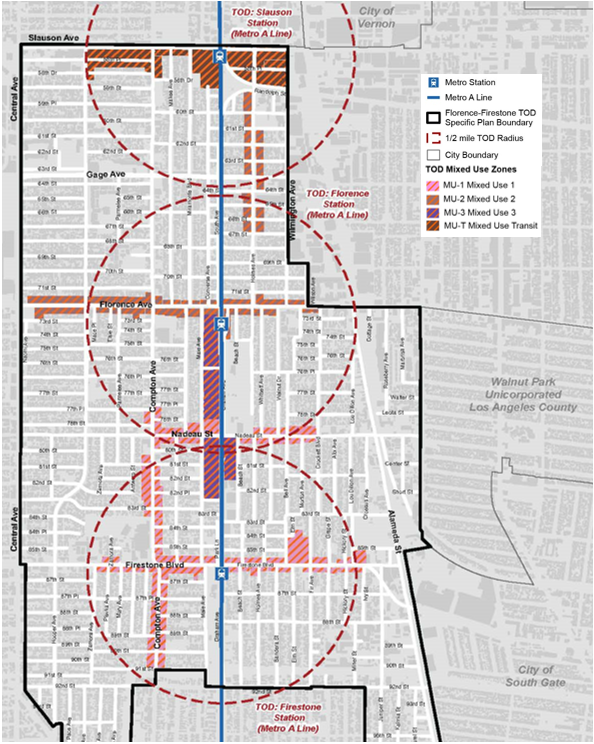
C.
Development Standards for TOD MU Zones.
1.
All structures and uses in all TOD MU Zones (MU-T, MU-3, MU-2, and MU-1) shall be subject to the regulations of Table 22.418.050-B (TOD Mixed Use Zone Development Standards) and Sections 22.418.090 (TOD Zone Additional Development Standards), 22.418.100 (Circulation and Parking Standards), and 22.418.110 (Economic Development Incentives).
a.
Required setbacks from streets are regulated by the locational standards of Table 22.418.090-A (Required Street Setback Ranges); these apply to any zone with frontage along that street. Setback standards for all structures and uses in the TOD Residential Zones are summarized in Figure 22.418.050-2, below.
b.
Required stepbacks are regulated by the locational standards of Table 22.418.090-B (Required Stepbacks).
FIGURE 22.418.050-2: TOD MU-1 AND MU-2 ZONE
STANDARDS SUMMARY
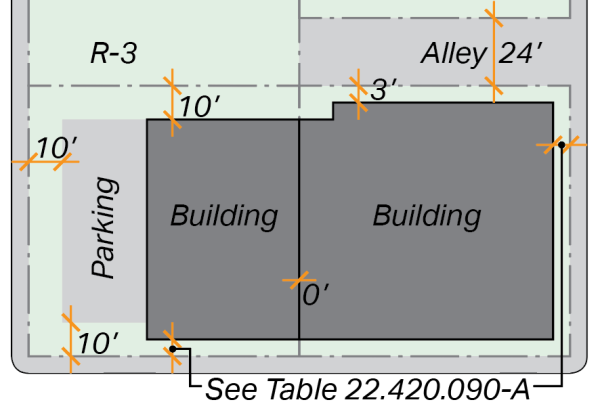
(Ord. 2024-0032 § 42, 2024; Ord. 2023-0013 § 4, 2023.)
22.418.060 - TOD Residential Zones.
A.
Purpose. The general purpose of the TOD Residential Zoning Districts (Residential Zones), as established by the FFTOD Specific Plan and shown in Figure 22.418.060-1 (TOD Residential Zones), is to support a variety of housing options, types, configurations, and affordability levels within proximity to transit.
1.
Residential Low-Medium 1 Zone. The Residential Low-Medium 1 (RLM-1) Zone is intended to maintain the existing residential neighborhood while supporting a broader range of housing types and configurations, such as single-family residential, townhomes, duplexes, and triplexes. The RLM-1 Zone provides individuals and households with affordable options in proximity to transit and services. This zone implements the Residential 18 General Plan Land Use Designation, which allows 0-18 du/net acre for residential uses.
2.
Residential Low-Medium 2 Zone. The Residential Low-Medium 2 (RLM-2) Zone is intended to maintain existing residential neighborhoods while supporting a broader range of housing types and configurations, such as townhomes, duplexes, triplexes, apartments, and multi-family residential. The RLM-2 Zone provides individuals and households with a variety of housing options, including types and configurations which are affordable and accommodating for lifestyles in proximity to transit and services. This zone implements the Residential 30 General Plan Land Use Designation, which allows 20-30 du/net acre for residential uses.
3.
Residential Medium Zone. The Residential Medium (RM) Zone is intended to apply to existing residential neighborhoods where the purpose is to encourage medium density residential near transit. The RM Zone allows multi-family residential homes such as apartments and townhomes. This zone implements the Residential 50 General Plan Land Use Designation, which allows 20-50 du/net acre for residential uses.
4.
Residential Slauson Station Zone. The Residential High (RH) Zone is intended to encourage the establishment of high density residential near transit in existing neighborhoods. The RH Zone seeks to provide a wider range of housing types and densities, supporting transit-oriented development near the Slauson Station. This approach encourages a mixture of housing types. This zone implements the Residential 100 General Plan Land Use Designation, which allows 50-100 du/net acre for residential uses.
B.
Land Use Regulations for TOD R Zones.
1.
Allowed Uses.
a.
Table 22.418.060-A (TOD R Zones Principal Use Regulations) prescribes the land use regulations for the Specific Plan TOD Residential Zones (RSS, RM, RLM-2, RLM-1). Table 22.418.040-A (R Zone Principal Use Regulations) lists the type of review required to establish various land uses.
b.
All residential uses are subject to Chapter 22.120 (Density Bonus), Chapter 22.121 (Inclusionary Housing), or Chapter 22.166 (Housing Permits), where applicable.
2.
Allowed non-residential uses, per Table 22.418.060-A (TOD R Zones Principal Use Regulations), are intended to provide in-neighborhood daily services or needs such as small independent grocers or personal services. All non-residential uses shall be:
a.
Located on a corner lot; non-residential uses are prohibited on interior lots;
b.
Limited to a maximum of 5,000 square feet GFA; and
c.
Designed consistent with the development standards of the applicable zone.
3.
Accessory Uses. Accessory uses for TOD R Zones RLM-1, RLM-2, RM, and RSS shall be regulated by Table 22.18.030-C (Accessory Use Regulations For Residential Zones), pursuant to accessory uses listed for Zones R-2, R-3, R-4, and R-5, respectively.
4.
Temporary Uses. Temporary uses for TOD R Zones RLM-1, RLM-2, RM and RSS shall be regulated by Table 22.18.030-D (Temporary Use Regulations For Residential Zones), pursuant to temporary uses listed for Zones R-2, R-3, R-4, and R-5, respectively.
FIGURE 22.418.060-1: TOD RESIDENTIAL ZONES
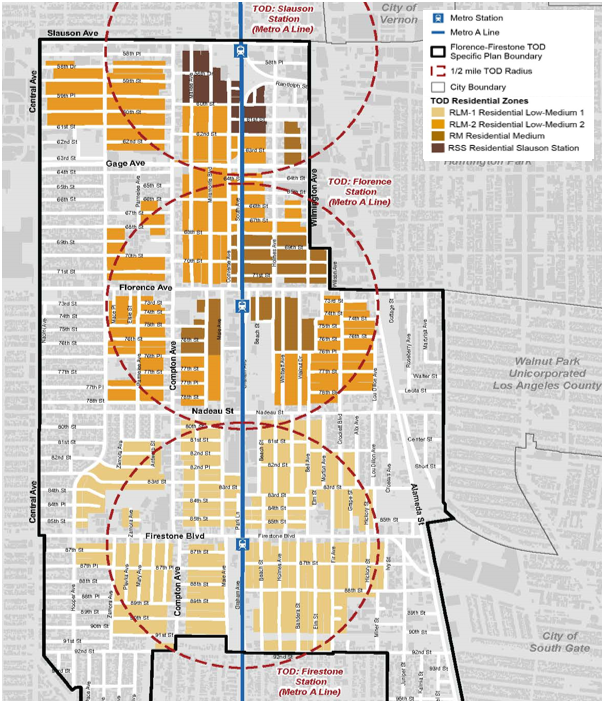
C.
Development Standards for TOD R Zones.
1.
Standards. All structures and uses in the TOD Residential Zones (RSS, RM, RLM-2, RLM-1) shall be subject to the regulations of Table 22.418.060-B (Residential Zone Development Standards), with the exception of single-family residences on compact lots, which shall be subject to Section 22.140.585 (Single-Family Residences on Compact Lots) consistent with R-4 standards.
2.
Setback Standards Summary. Setback standards for all structures and uses in the TOD Residential Zones are summarized in Figure 22.418.060-2, below.
3.
Other Applicable Standards. TOD Residential Zones shall be subject to the standards in Sections 22.418.080 (Community-Wide Development Standards) and 22.418.090 (TOD Zone Additional Development Standards) of this Chapter.
FIGURE 22.418.060-2: TOD RESIDENTIAL ZONE
STANDARDS SUMMARY
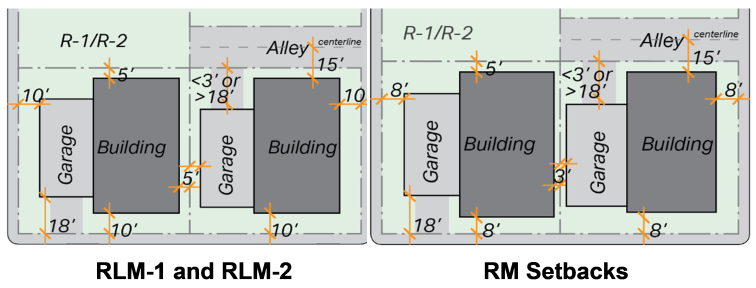
(Ord. 2024-0032 § 43, 2024; Ord. 2023-0013 § 4, 2023.)
22.418.070 - TOD Industrial Mix Zone.
A.
Purpose. The general purpose of the TOD Industrial Mix Zoning District (IX Zone), as established by the FFTOD Specific Plan and shown in Figure 22.418.070-1 (TOD Industrial Mix Zone), is to support a transition to less industrial-intensive, employment-focused uses near transit-oriented development and improve land use compatibility adjacent to residential areas.
1.
Industrial Mix Zone. The IX Zone is intended to maintain neighborhood-appropriate light industrial uses and jobs, while introducing new neighborhood-serving commercial and innovative uses suitable for mixed residential and employment areas. The IX Zone allows for the creation of transitions between employment and residential uses to encourage less noxious uses, such as commercial, adjacent to homes. The IX Zone encourages land use compatibility and a healthy environment where a variety of business and residents can co-exist. This zone implements the Light Industrial General Plan Land Use Designation.
B.
Land Use Regulations for TOD IX Zone.
1.
Primary and Accessory Uses.
a.
Table 22.418.070-A (TOD IX Zone Principal Use Regulations) prescribes the land use regulations for the IX Zones.
b.
See Section 22.418.040 (TOD Land Use Regulations) for permit types and general use regulations.
2.
Temporary Uses. Temporary uses shall be regulated by Table 22.22.030-D (Temporary Use Regulations for Industrial Zones), pursuant to temporary uses listed for Zone M-1.
FIGURE 22.418.070-1: TOD INDUSTRIAL MIX ZONE
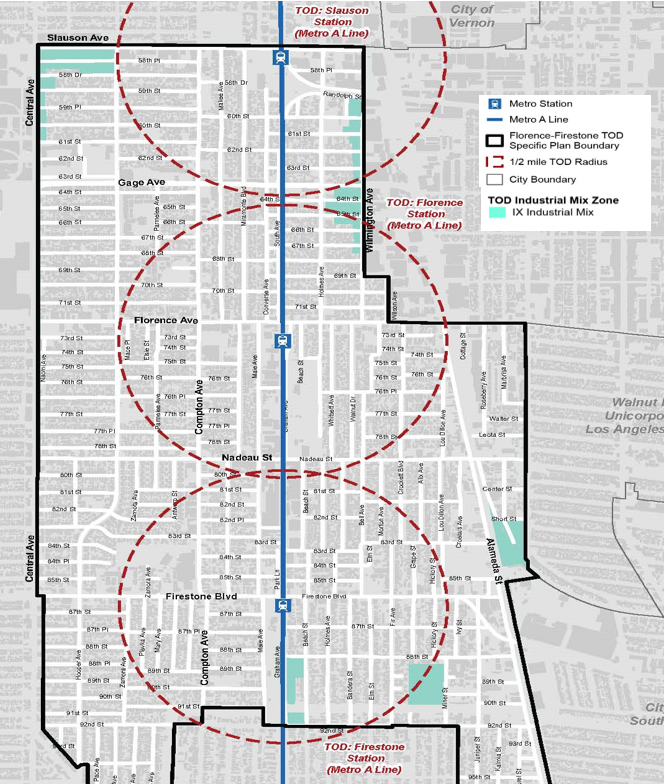
C.
Development Standards for TOD IX Zone.
1.
All structures and uses in the TOD IX Zone shall be subject to the regulations of Table 22.418.070-B, below.
2.
Required setbacks from streets are regulated by the locational standards of Table 22.418.090-A (Street Setback Range Requirements); these apply to any zone with frontage along that street.
3.
Other Applicable Standards. All development within the Specific Plan Area shall be required to meet the applicable standards of Sections 22.418.080 (Community-Wide Development Standards), 22.418.090 (TOD Zone Additional Development Standards), 22.418.100 (Circulation and Parking Standards), and 22.418.110 (Economic Development Incentives) of this Specific Plan.
(Ord. 2024-0032 § 44, 2024; Ord. 2023-0013 § 4, 2023.)
22.418.080 - Community-Wide Development Standards.
A.
Applicability. The standards of this Section are applicable to all structures and uses in the unincorporated area of the Florence-Firestone Community. Additional by-zone development standards apply.
B.
Building and Site Design Requirements.
1.
Building and Maintenance.
a.
Material Colors. Black or other similar dark color shall not be used as the primary or base color for any wall or structure.
b.
Sound Equipment. Sound amplification equipment shall be prohibited outside an enclosed structure.
c.
Graffiti. All structures, walls, and fences that are publicly visible shall remain free of graffiti. Any property owner, lessee, or other person responsible for the maintenance of a property shall remove graffiti within 72 hours of receiving written notice from a Zoning Enforcement Officer that graffiti exists on the property. Paint used to cover graffiti shall match, as near as possible, the color of the surrounding surfaces.
d.
Maintenance. The property, including adjoining sidewalks and rear alleys, shall remain free of trash and other debris. Storage of household appliances, such as refrigerators, stoves, freezers, and similar products, is prohibited in all yard areas.
e.
Outdoor Storage. In addition to the requirements of Section 22.140.430.B (Zones C-3, C-M, C-MJ, C-RU, and MXD-RU), all zones in the Florence-Firestone Community shall screen outdoor storage in a manner as not to be publicly visible to anyone in an adjacent Residential Zone.
f.
Screening.
i.
Façades and Windows. If the building's frontage faces a major or secondary highway, no more than 25 percent of landscaping shall screen from public view the façade or windows on the ground floor of the building's frontage.
ii.
Mechanical Equipment. Mechanical equipment shall be completely screened from view through the use of walls or landscaping.
iii.
Trash/Recycling. Trash enclosures for refuse and recycling bins shall be:
(a)
Located within parking structures, at the rear or side of buildings, or between buildings, and shall not be between a building and a street or highway;
(b)
Located not farther than 150 feet from the building;
(c)
Not placed in any public right-of-way;
(d)
Screened by solid masonry walls between five and six feet in height, if located outside;
(e)
Match the exterior of the building; and
(f)
Have solid doors and be located in the rear of the lot, as far away as possible from any adjoining Residential Zone.
2.
Security.
a.
Concealment. Any exterior or interior security bars shall be designed to be fully hidden from view during business hours with devices such as concealed side pockets and ceiling cavities.
b.
Restrictions.
i.
Chain-link, barbed, and concertina wire fences are prohibited.
ii.
Security bars and accordion folding grilles installed on the exterior of a storefront are prohibited.
iii.
Building security grilles may be placed within the interior of the building if the grilles are concealed so that they are not visible from the exterior of the building when not in use during business hours.
C.
Loading Areas.
1.
Modifications. Loading areas shall comply with the standards and conditions of Section 22.112.120 (Loading Spaces). However, the loading area requirements may be modified or waived for non-residential projects of less than 20,000 square feet in GFA with the approval of a Minor Conditional Use Permit (Chapter 22.160) application.
2.
Location and Screening. In addition to the standards of Section 22.112.120 (Loading Spaces), loading spaces shall be:
a.
Located in the rear of the structure(s), as far as possible from adjoining residentially zoned lots;
b.
Located away from primary pedestrian ingress and egress areas by a minimum of 20 feet;
c.
Completely screened from the street and any adjacent residentially zoned property; screening materials shall include continuous walls and continuous landscaping; and
d.
Loading and unloading operations shall not be conducted between the hours of 10:00 p.m. and 6:00 a.m. in such a manner as to cause a noise disturbance to any adjacent residentially zoned properties.
D.
Off-Site or Shared Parking Areas. Off-site or shared parking arrangements may be provided to meet required parking for commercial uses, provided a site plan has first been approved by the Director and the following standards are met. In the event the applicant does not or cannot comply with the following after approval of the Site Plan Review, approval of said site plan shall be revoked until parking areas are provided as follows, in accordance with Chapter 22.112 (Parking).
1.
Such off-site or shared parking facility shall be located within 1,320 feet (1/4 mile) from any publicly-accessible entrance of the use to which they are provided.
2.
Such off-site or shared parking facility is located on a lot where parking is permitted.
3.
Such area shall be clearly marked as being made available for parking for the subject use(s) at the location of subject use(s) and at the location of the off-site or shared parking area.
4.
The applicant:
a.
Is the owner of the lot where such off-site or shared parking facility is located; or
b.
Has control of such off-site or shared parking facility through leasing or other arrangement in such a way as to prevent multiple leasing for the same spaces or cancellation without provided alternate spaces. Such leasing or other arrangement shall contain other guarantees assuring continued availability of the spaces.
E.
Required Signage. All signage shall be consistent with Chapter 22.114 (Signs) except as modified herein. The following signage standards shall apply to all mixed use and non-residential zones in Florence-Firestone.
1.
Business Signs. Except as herein modified, all business signs shall conform to Chapter 22.114 (Signs). The sign regulations herein shall apply to all the following signs:
a.
New signs.
b.
Signs that have fallen into disrepair, or are more than 50 percent damaged, and have not been repaired within 30 days of notice from the Department.
c.
Signs whose use has ceased or the structure upon which the sign rests has been abandoned by its owner for a period of not less than 90 days.
d.
This Subsection shall not apply to legally established existing signs that are maintained, pursuant to State standards prior to the effective date of this Specific Plan.
e.
Outdoor Advertising. Outdoor Advertising signs shall be prohibited for all parcels with frontage along a Primary Corridor, and all residential uses.
2.
Prohibited Signs. Roof business signs and business or advertising signs painted directly on buildings shall be prohibited.
3.
Damaged Signs.
a.
The display surface of all signs shall be kept clean, neatly painted, and free from rust and corrosion. Any cracks, broken surfaces, malfunctioning lights, missing parts, or other unmaintained or damaged portion of a sign shall be repaired or replaced.
b.
All signs in a state of disrepair shall be repaired to comply with the standards of this Section or removed within 30 days from notification that a state of disrepair exists.
4.
Wall, Projecting, and Awning Business Signs. All businesses shall be permitted the following signs and shall be subject to the following standards, as applicable:
a.
Businesses with less than 40 feet of building frontage: maximum of one wall, projecting, or awning business sign.
b.
Businesses with 40 feet or more of building frontage or multiple frontages: permitted to have one wall, projecting, or awning business sign plus one additional sign for each additional 30 feet or increment thereof of street frontage.
c.
Wall business signs. Wall business signs shall be mounted flush and affixed securely to a building wall, shall extend from the wall a maximum of 12 inches, and shall have the following maximum attributes:
i.
Face area of two square feet for every linear foot of the applicable building frontage;
ii.
Letter sizes of 24 inches in height; and
iii.
A vertical dimension of 36 inches for the frame box or sign cabinet.
d.
Awning business signs. Awning business signs shall have a maximum face area of two square feet for every linear foot of the applicable building frontage and every awning shall be the same color and style for the same business; and complementary in color and style for buildings with multiple storefronts.
e.
Freestanding Business Signs. Freestanding business signs shall be allowed only if the business is located on a lot with a minimum of 100 feet of street frontage and shall not be located on, or extend above, a public right-of-way or public sidewalk. Freestanding business signs shall have the following attributes:
i.
A solid base resting directly on the ground;
ii.
A maximum face area of 60 square feet; and
iii.
A maximum height of 15 feet as measured vertically from ground level at the base of the sign.
5.
Required Informational Signage. Required signage shall inform the public that maintenance, nuisance, or other issues may be reported to the property owner or agent, and the County, if necessary, by the community or public. Such signage shall not be considered business signage.
a.
Posting. Required signage shall be posted on-site for each property and visible to the public from any on-site parking or from the public sidewalk along the frontage of the property.
b.
Content. The following text shall be plainly visible to the public on the sign: "To report any maintenance issues or graffiti on site, please call the property manager at (###) ###-###, or the County of Los Angeles at 211."
6.
Sign Design.
a.
Minimum sign area dimension of 1.5 square feet, and one-foot minimum length in any direction where not located on a window or glass door, subject to Section 22.114.190 (Directional or Informational Signs).
b.
Where located on a window or glass door, or designed as window or glass doorway lettering, such lettering shall be subject to the requirements of Chapter 22.114.150 (Temporary Window Signs).
c.
Alternative sign design, including signage shared among different properties, may be permitted, as approved by the Director.
7.
Public Use Signage. Signage, subject to Section 22.114.190 (Directional or Informational Signs), shall be provided on-site to identify the privately owned public space as available for public use as follows:
a.
Size. Minimum three square feet in size.
b.
Content. Include contact information for the property owner to report any nuisance or maintenance issues.
c.
Include the following minimum language, featured prominently subject to Director approval: "Open to the Public." Signage provided to meet the requirements of this Section shall not be subtracted from the allowed signage for the lot.
F.
Housing Element Implementation.
1.
Pursuant to Government Code section 65583.2, subsections (c) and (h), sites that are rezoned through this Specific Plan or identified in the Housing Element Sites Inventory as sites from previous housing elements to accommodate lower income units, shall require 20 percent of the units in a housing development to be affordable to lower income households.
(Ord. 2023-0013 § 4, 2023.)
22.418.090 - TOD Zone Additional Development Standards.
A.
Purpose. Development standards for the TOD Zones are regulated by this Section in addition to the zone and community-wide specific regulations established by the Specific Plan. The combination of these development standards is intended to promote urban design and form that supports transit-oriented development and creates transitions between neighborhood types.
B.
Applicability. The standards of this Section are applicable to all structures and uses in the Florence-Firestone TOD MU-T, MU-3, MXD, MU-2, MU-1, IX, RSS, and RM Zone areas unless otherwise stated; see Figure 22.418.090-1 (Regulated TOD Zones). The standards of this Chapter are in addition to the allowed uses and development standards of this Chapter and Section 22.26.030 (Mixed Use Development Zone).
FIGURE 22.418.090-1: REGULATED TOD ZONES
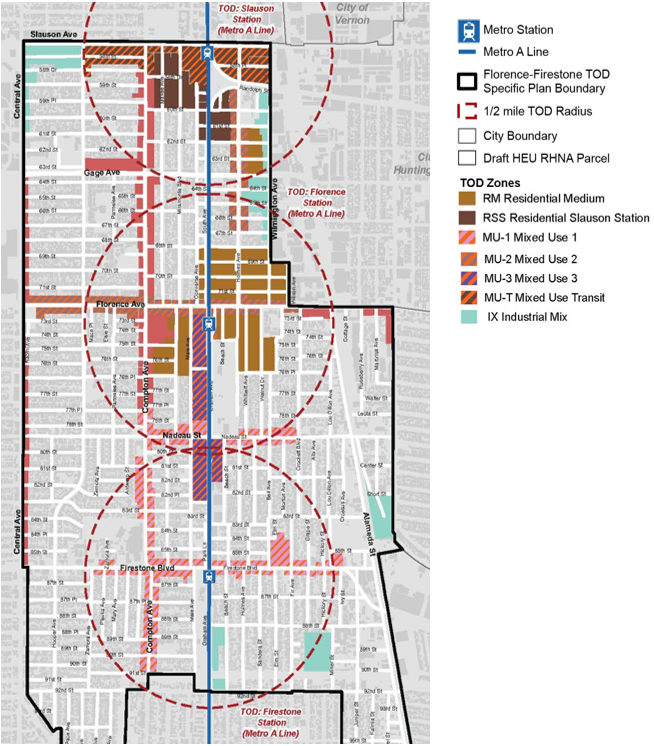
C.
General Requirements for Residential Development.
1.
Density. All proposed densities, not including dwelling units permitted by a density bonus awarded pursuant to Chapter 22.120 (Density Bonus), shall fit within the range of density established for the applicable zone.
2.
Minimum Floor Area for Residential Use in Mixed Use Developments. All mixed use developments shall be subject to Section 22.26.030.D.1.b.
3.
Unit Size and Replacement.
a.
Unit Mix. All RSS Zone residential developments, including 10 or more units, shall be required to provide 20 percent of the total units as 3-bedroom units.
b.
Unit Replacement. All residential and mixed use development shall be required to replace or exceed the number of units on-site for all renovations, conversions, or new development. This shall result in no net loss of units within the Specific Plan Area.
D.
Intensity.
1.
Floor Area Ratio. Projects that include non-residential space, including mixed use development in a horizontal or vertical form, shall not exceed the allowable FAR established for the applicable zone; see exceptions below:
a.
Areas used exclusively for vehicle and bicycle parking and loading shall be excluded from FAR calculations.
b.
In mixed use projects, residential uses shall be included in FAR calculations.
c.
The maximum FAR is based on net site area; a reduction in buildable area due to dedications/easements shall not reduce allowable maximums.
d.
Outdoor dining shall not count toward the FAR.
2.
Modifications. FAR modifications are subject to State Density Bonus law and the lot consolidation incentives of Section 22.418.110 (Economic Development Incentives).
E.
Height Regulation.
1.
Building Height. Except as otherwise modified by Title 22, building or structure shall not exceed the height limit set in the development standards table for the applicable zone.
a.
Building height measurements, exclude chimneys, mechanical equipment, rooftop antennas, and rooftop recreational spaces.
b.
See Section 22.418.090.G (Stepbacks) for additional height regulations.
c.
See Section 22.418.090.H (Active Ground Floor Design) for ground floor height requirements.
2.
Rooftop Location and Exclusions. Maximum building height shall exclude rooftop and recreational space.
a.
Location. Roof decks shall be set back five feet from the building edge on all sides and shall not be located within 50 feet of an R-1 or R-2 Zone.
b.
Area. The sum of all roof decks shall cover no more than one-half of the roof area.
3.
Fifth Story Coverage. The fifth story (where applicable) shall be limited to a percentage of the ground floor area based on the following development types:
a.
Residential Zone developments: limited to 75 percent of ground floor area.
b.
Mixed Use Zone development: limited to 50 percent of the ground floor area.
F.
Setbacks.
1.
Street Setbacks. Setbacks from the street-adjacent property line shall be regulated by street frontage consistent with Table 22.418.090-A (Required Street Setback Ranges) for all structures in the TOD MU and MXD Zones with the Florence-Firestone Community. Residential setbacks for single-family residences on compact lots (where applicable) shall be subject to Section 22.140.585 (Single-Family Residence on Compact Lots) consistent with R-4 standards.
a.
Setback ranges establish a minimum and maximum setback permitted for the first and second story of the structure. These ranges are designed to set an appropriate public realm width for pedestrian-oriented streets; see Figure 22.418.090-2 (Public Realm Width).
b.
Projects shall be required to locate the street-facing façade with the setback range for the specified percentage of linear frontage; see Table 22.418.090-A (Required Street Setback Ranges).
c.
Street setbacks are measured from the property line.
d.
Figures 22.418.090-3 through 22.418.090-6 (Public Realm Conditions) illustrate the required public realm width conditions by dimension; the public realm is composed of the public right-of-way (ROW) and the Frontage Zone provided by private setbacks.
e.
Required street setbacks shall be hardscaped to contribute to the public realm and support pedestrian activity.
i.
Landscaping/planters, 20 percent maximum.
ii.
Minimum of 80 percent of the setback area shall be hardscape (e.g., pavement, stoops, patios).
iii.
Pavement shall be of a visibly different color and/or texture than the public sidewalk maintained by Public Works to differentiate private setback, which shall be maintained by private property owner.
iv.
A maximum of 20 percent of the setback area shall be allowed to be landscaped (e.g., planters, foliage, stormwater features).
f.
All upper stories are permitted to utilize a zero-foot setback from the property line unless a stepback is required; see Section 22.418.090.G (Stepbacks) of this Chapter.
g.
Arcades and recessed ground floors up to 15 feet in depth are allowed when a second story meets the specified minimum setback.
h.
Balconies. Balconies may project up to four feet into a street setback (but not into the public ROW) and no closer than three feet to an interior property line.
i.
Other features allowed within the street setback include:
i.
Shade structures, trellises, and similar;
ii.
Bicycle parking or services;
iii.
Plazas, fountains, outdoor dining;
iv.
Seating/furniture;
v.
Other open space amenities per review authority approval; and
vi.
Other projections allowed within the setbacks are referenced in Section 22.110.090 (Projections into Yards).
2.
Interior Setbacks. All structures shall comply with the interior setbacks in the development standard table for the applicable zone.
a.
Interior setbacks are those abutting other parcels (non-street side and rear) and are measured from the shared property line.
b.
Interior setbacks are not required along other property lines.
FIGURE 22.418.090-2: PUBLIC REALM WIDTH
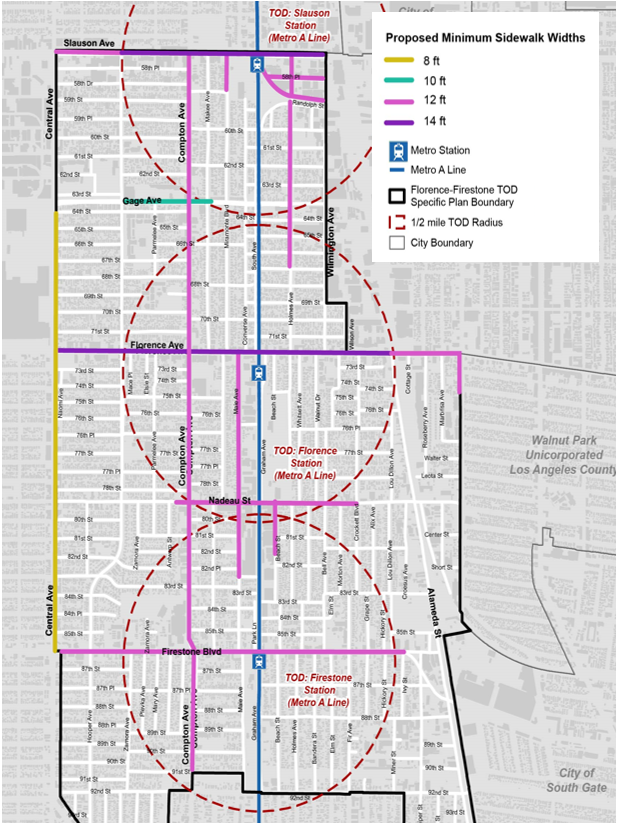
FIGURE 22.418.090-2-A: PUBLIC REALM CONDITION LEGEND
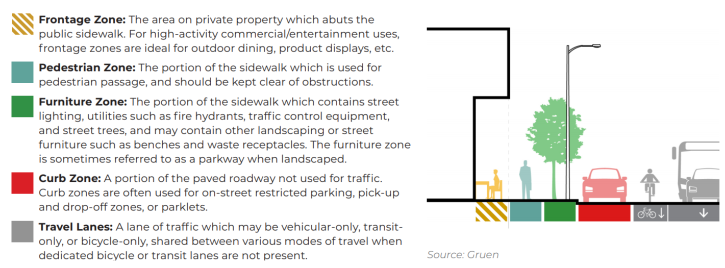
FIGURE 22.418.090-3: PUBLIC REALM CONDITION 12-FOOT
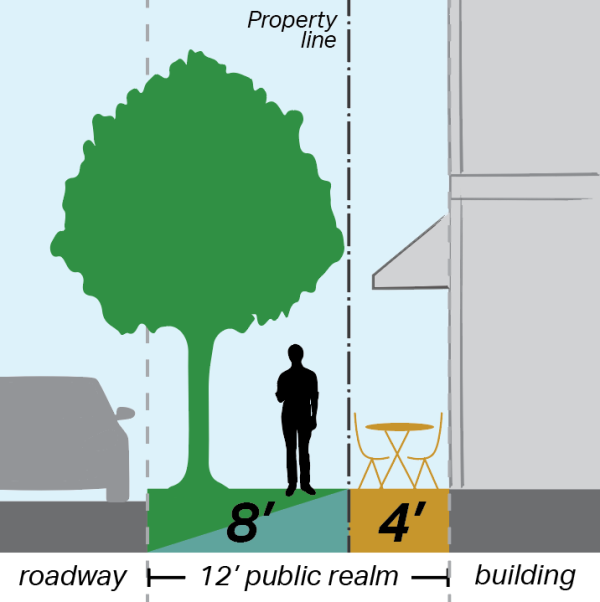
FIGURE 22.418.090-4: PUBLIC REALM CONDITION 14-FOOT
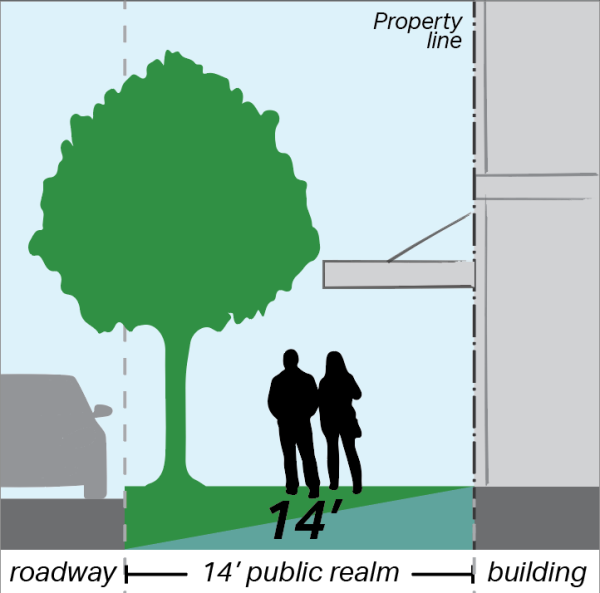
FIGURE 22.418.090-5: PUBLIC REALM CONDITION 10-FOOT
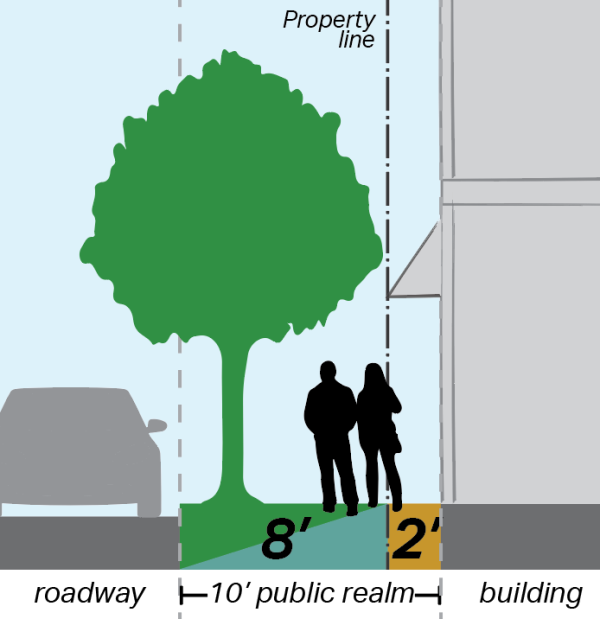
FIGURE 22.418.090-6: PUBLIC REALM CONDITION 8-FOOT
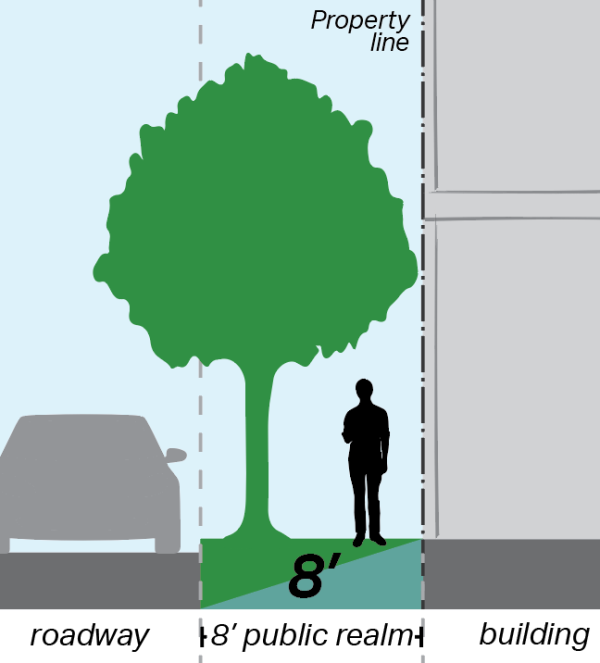
3.
Parking/Garage Street Setbacks. Surface parking and/or garages for Mixed Use (horizontal or vertical) and IX projects shall adhere to the following. See Section 22.418.110 (Circulation and Parking Standards) of this Specific Plan for additional requirements.
a.
Shall be located in the rear of the structures or at the rear of the lot, except that up to 25 percent of required parking may be located along one side of the building if an access driveway is provided.
b.
Shall be completely screened with walls or landscaping so that the parking areas are not visible from a major or secondary highway, unless the parking areas are located along access driveways, in which case, walls or landscaping may be placed only if they do not impede adequate line-of-sight to the public ROW.
G.
Stepbacks.
1.
Required Street Stepback. Stepbacks from the street-adjacent property line shall be regulated by Table 22.418.090-B (Required Stepbacks) for all structures in the MU and MXD Zones subject to the street frontage adjacency. See Figure 22.418.090-7 (Stepbacks Diagram).
a.
Stepbacks shall apply to all development with frontage on the streets identified in Table 22.418.090-B (Required Stepbacks) where the building height exceeds the identified stepback height.
b.
Required stepbacks shall be measured from the built setback of the floor immediately below.
c.
Buildings subject to the standard shall not exceed the specified height (stepback height) specified for the applicable location before stepping back the specified amount (stepback depth).
d.
Uses allowed within the required stepback include balconies, patios, trellises, and green roofs. Other open space features may be allowed per review authority approval.
2.
Required Interior Stepback. All structures shall comply with the upper story stepbacks per Table 22.418.090-B (Required Stepbacks) from the interior property line when adjacent to R-3 residential zoning. See Figure 22.418.090-8 (Interior Stepback Diagram).
FIGURE 22.418.090-7: STEPBACK DIAGRAM
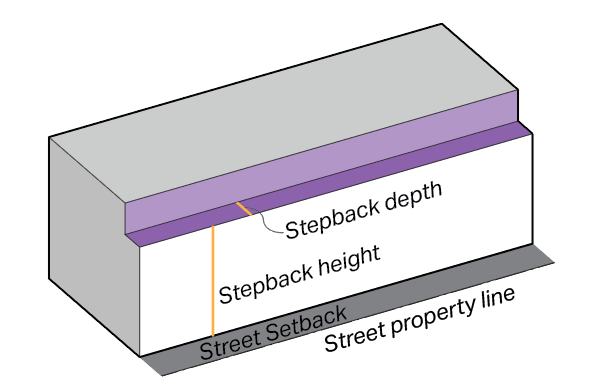
FIGURE 22.418.090-8: INTERIOR STEPBACK DIAGRAM
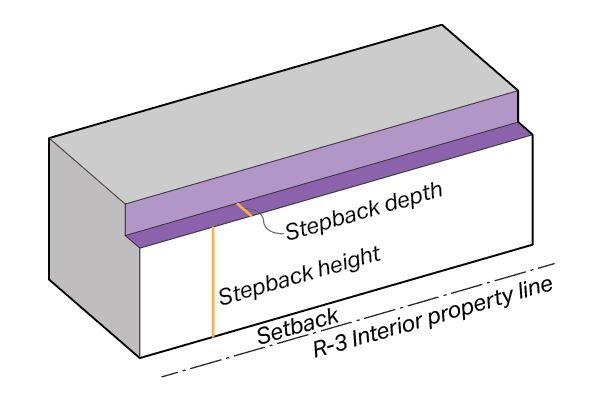
H.
Active Ground Floor Design. The following standards apply to all mixed-use corridors within the Specific Plan to support a walkable, pedestrian character that promotes walking and encourages more trips taken by foot within the community; see Figure 22.418.030-2 (Primary Corridors). All parcels with frontage on a Primary Corridor shall be subject to these standards.
1.
Ground Floor Height. Development in the MU zones (inclusive of the MXD Zone) shall have a minimum ground floor height, measured floor to floor based on the use type, consistent with Table 22.418.090-C (Ground Floor Minimum Heights). See Figure 22.418.090-9 (Ground Floor Requirement Diagram).
2.
Residential Ground Floor.
a.
Residential common space (lobby, amenity spaces, etc.) located on the ground floor, in a mixed use or residential-only configuration where allowed, shall be subject to the non-residential height requirement.
b.
Residential-only projects shall not be required to meet the non-residential height requirement.
c.
For residential units, the ground floor entry may be elevated up to five feet from the sidewalk elevation.
3.
Non-Residential Depth. Non-residential uses on the ground floor shall have a minimum interior depth of 35 feet. See Figure 22.418.090-9 (Ground Floor Requirement Diagram).
4.
Mixed Use Minimum Width. The width of the street-facing retail component of the ground floor within a mixed-use development shall be a minimum of 20 feet.
FIGURE 22.418.090-9: GROUND FLOOR REQUIREMENT DIAGRAM
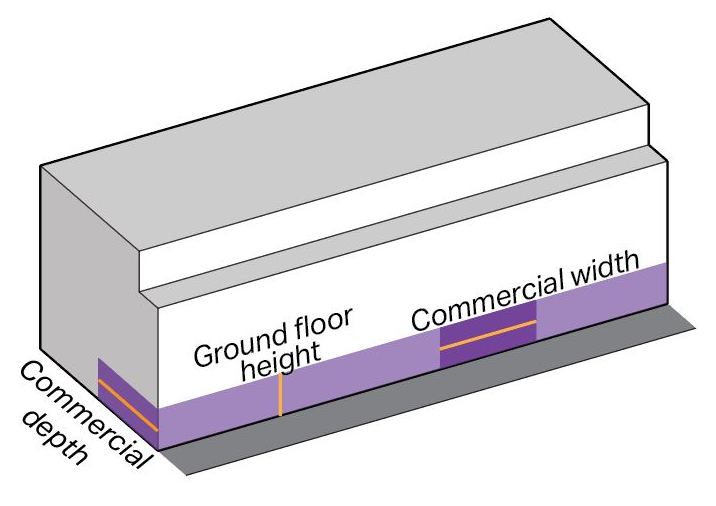
5.
Transparency. All street-facing façades shall be designed consistent with the following requirements:
a.
Mixed use and non-residential buildings shall provide a minimum transparency of 60 percent of the ground floor.
b.
Residential buildings in MU zones shall provide a minimum transparency of 30 percent of the street elevation on all floors; may be composed of windows, doors, porches, and balconies.
c.
Buildings in the IX Zone shall have a minimum transparency of 30 percent of the street elevation.
d.
All buildings shall provide a minimum transparency of 30 percent for all upper stories.
e.
Standards.
f.
Glass. All glass utilized in windows or entrances on the first two stories shall be either clear or lightly tinted to maximize pedestrian visibility of building interiors from the sidewalk area. Mirrored, highly reflective glass or densely tinted glass shall be prohibited for use in windows and entrances.
g.
The use of tinted, mirrored, or highly reflective glazing is highly discouraged. A maximum of 20 percent of the building façade shall consist of mirrored or densely tinted glass.
h.
Ground floor transparency is measured as the percentage of building frontage that consists of transparent openings between a height of two feet and 10 feet above sidewalk elevation for non-residential uses.
i.
Overall façade transparency is measured as the percentage of total building elevation and inclusive of ground floor transparency.
j.
Windows shall be recessed by at least two inches from the façade; flush windows may be allowed per review authority approval.
k.
Blinds, drapes, posters, and shelving for product displays visible to the public ROW shall obscure no more than 10 percent of the transparent areas of each respective storefront.
I.
Building Form Modulation. All buildings in MU zones (including the MXD Zone), regardless of use, shall be designed consistent with the following modulation standards.
1.
Rooflines. All buildings in MU zones with 100 feet or more of street frontage shall be designed to provide roofs of varying heights, materials, textures, or motifs. Rooflines/heights shall vary by a minimum of three feet to satisfy this standard. See Figure 22.418.090-10.A (Building Form Modulations).
2.
Building Length. Buildings that exceed 100 feet in length along any street frontage shall include a break of at least 10 percent of the façade length or 20 feet, whichever is more. This break shall be at least 10 feet deep, open to the sky; see Figure 22.418.090-10.B (Building Form Modulations). Upper-story open space features creating a building break shall satisfy this requirement.
3.
Wall Plane Offsets. Street-facing elevations over 50 feet in length shall include wall plane offsets equal to a minimum of 25 percent of the wall plane area above the ground floor; see Figure 22.418.090-10.C (Building Form Modulations).
a.
The street-facing elevation is defined as the vertical plane with the greatest surface area above the ground floor.
b.
Buildings with two stories or less are exempt.
c.
Wall plane offsets are not required to be continuous or open to the sky, and may be recessed or projected, but not past the property line.
d.
Projected balconies do not count toward the wall plane offset requirement.
FIGURE 22.418.090-10: BUILDING FORM MODULATIONS
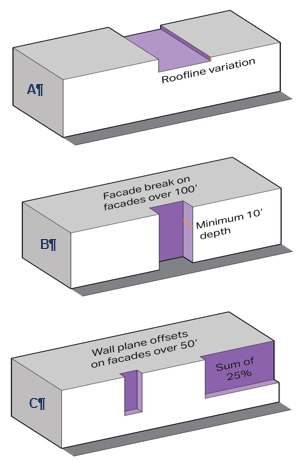
J.
Pedestrian Design. The following standards shall apply to all buildings in MU zones, including Countywide MXD and IX zones.
1.
Primary Entrance. All buildings shall have at least one primary entrance opening onto the sidewalk of the primary corridor frontage or frontage with the greatest ROW width. This may open onto a public open space or interior courtyard.
2.
Separated Entries. Residential and commercial uses that are located on the same floor, where permitted, shall not have a common entrance hallway or common balcony, except that common entrance hallways shall be allowed in a single-story structure
3.
Blank Walls. Within the MU and IX zones, a maximum of 20 feet in length of windowless expanses of walls on a street-facing façade is allowed. Blank walls shall be treated with an accent material, accent color, or mural, or treated with landscaping that screens a minimum of 30 percent of the wall area.
4.
Shading. Shade structures (e.g., awnings and canopies including retractable features) shall be permitted along all primary corridors consistent with the following standards:
a.
Minimum four-foot projection, maximum 10-foot projection allowed.
b.
Shade structures shall allow at least eight feet of vertical clearance from sidewalk elevation.
c.
Shade structures shall not conflict with existing trees or any structure within the public ROW.
d.
Supporting structures or footings connecting to the ground are prohibited.
e.
Shade structure shall be of a high-quality material that resists fading or deterioration.
f.
Projections into the public ROW shall require an encroachment permit in accordance with Section 16.18.030 (Excavation or Encroachment Permit).
5.
Outdoor Dining and Activities. Outdoor dining and activities are encouraged in MU zones consistent with the following:
a.
Outdoor dining shall be permitted where an effective public realm width of 10 feet or greater is provided through a combination of public ROW and private setback.
b.
A clear path of travel measuring four feet shall be maintained at all times.
c.
Outdoor dining and activities shall be permitted within the street setback.
d.
An encroachment permit is required where outdoor dining or activities extend into the public ROW. Refer to Section 16.18.030 (Excavation or Encroachment Permit) and Section 22.140.410 (Outdoor Dining).
6.
Pedestrian-Scaled Exterior Lighting. All development shall provide exterior lighting designed to illuminate the sidewalk and building entries for pedestrians consistent with the following:
a.
Parking Lot Lighting. Parking lot lights, if any, shall be installed to minimize glare and illumination on neighboring residences.
b.
Light Trespass. Fully shielded fixtures shall be used for exterior and directional lighting to prevent light trespass to adjacent Residential Zones or sensitive uses.
7.
Lighting shall be provided at building access points, along pedestrian accessible walkways, or along any building face fronting a street to illuminate the storefront, the sidewalk, or access point to enhance pedestrian safety.
8.
Lighting shall be designed to minimize or prevent shadows or glare, such that visibility is not impaired. Examples include illumination of recessed entryways, and lighting evenly distributed along the store frontage or walkways such that near uniform foot-candles are registered along any pedestrian accessible area.
K.
Architectural Elements. The following standards shall apply to all MU Zone (including the MXD Zone) development with street frontage along the Primary Corridors; see Figure 22.418.090-2 (Public Realm Width).
1.
Elements Required. To promote a high-quality built environment in Florence-Firestone, buildings shall incorporate architectural elements along the street frontage based on the following menu:
a.
Architectural elements, which shall be repeated and distributed throughout the street frontage:
•
Balconies
•
Bay windows
•
Benches
•
Benches or seating for pedestrians, distributed along the length of the entire frontage and clustered at interest points
•
Decorative exterior stairs
•
Raised planters, with live plants, distributed along the length of the entire frontage
•
Recessed upper loggias or pergolas
•
Working tile/masonry water fountains
•
Courtyards
•
Forecourts
•
Outdoor Dining
•
Plazas
2.
Parcel Requirements.
a.
Parcels with 40 feet or less of street frontage shall provide a minimum of three architectural elements.
b.
Parcels with greater than 40 feet of street frontage shall provide a minimum of three architectural elements, plus one additional architectural element for each segment, or a portion, of 40 feet of frontage.
c.
Architectural elements shall be distributed throughout the width of the building façade.
L.
Parkway/Street Tree Requirements. Private development in MU and IX zones over 6,000 square feet in GFA, shall install street trees consistent with the following:
1.
Street Tree Requirement. One street tree shall be required per every 30 feet of street frontage measured from the center of the tree well. Public Works shall have the discretion to eliminate, relocate, or add, based on field conditions. Street tree shall be installed by private development in the Furniture Zone of the public ROW.
2.
Maintenance. All street trees shall be maintained by Public Works.
M.
Fencing. The following standards shall apply to all MU, MXD, and IX zones in Florence-Firestone:
1.
Measuring Height of Fences and Walls. Notwithstanding Section 22.110.070.A (Measuring Height of Fences and Walls), the height of a fence or wall shall be measured inclusive of any architectural feature, fixture, or support element attached to or part of said fence or wall.
2.
Location. Fences (including freestanding walls, raised planters, and similar) are permitted within the street setback only when enclosing permitted outdoor dining areas or in front of residential dwelling units.
a.
Exceptions are allowed for guardrails; maximum height shall be regulated by the Building Code. The guardrail shall be at least 50 percent transparent.
3.
Fence Transparency. Fences shall be open and non-view obscuring for portions greater than 42 inches in height, and shall adhere to the following:
a.
Any material obscured by live plant material (trees, shrubs, flowers, plants, and hedges) greater than 42 inches in height shall not be considered non-view obscuring; and
b.
Vertical support elements maintain a minimum distance of five feet apart.
N.
Private and Common Open Space Standards.
1.
Required Common and Private Open Space. Each residential or mixed-use development shall provide the minimum area of open space based on unit size consistent with Table 22.418.090-D (Required Open Space by Residential Unit Type) and consistent with the following standards:
a.
Private open space shall be contiguous to, attached to, and accessed from within an individual dwelling unit, and may include an atrium, balcony, patio, porch, or terrace.
b.
At least 60 percent of Common Open Space shall be outdoors, and at least 80 percent of outdoor Common Open Space shall be open to the sky.
c.
Common Open Space calculations may include required interior yards/setbacks where the minimum dimension is achieved; all required street setbacks shall be excluded from Common Open Space calculations.
d.
To qualify as required open space, the standards of Table 22.418.090-E (Open Space Qualifying Standards) and the following shall apply:
2.
Functional Space. Off-street parking and loading areas, driveways, ROW encroachments, and other vehicular access areas, service areas, and perimeter landscaping that is less than the minimum required width per Section 22.418.090-E (Height Regulation) shall not count as required Open Space.
3.
Required Landscaping. All common areas shall be improved as either active or passive facilities with landscaping or hardscape elements designed to serve the residents of the project.
a.
A minimum of 25 percent of the Common Open Space shall be planted areas of at least 30 inches in each direction.
b.
Hardscape. A maximum of 25 percent of Common Open Space may be paved in standard concrete. Remaining areas shall use one of the following enhanced paving techniques: brick, natural stone, unit concrete pavers, textured and colored concrete, concrete with exposed or special aggregate. Alternative paving may be allowed per Director of Public Works approval.
c.
All common areas shall be developed and professionally maintained in accordance with approved landscape and irrigation plans.
d.
All common areas shall be developed and professionally maintained in accordance with approved landscape and irrigation plans.
e.
Common Open Space is for the exclusive use of residents of the development and may include features as listed in Table 22.418.090-F (Common Open Space Features).
O.
Public Open Space Requirements.
1.
Each residential or mixed use development shall be required to include public open space subject to the standards of Table 22.418.090-G (Public Open Space by Project Size).
2.
Dimensions. A minimum area of 400 square feet with a dimension of at least 20 feet in each direction is required for Public Open Space.
3.
Location. Half of developed public open space, or 1,000 square feet, whichever is larger, shall be directly accessible from and at sidewalk elevation. Remaining required public open space may be located on upper stories and shall be accessible to the general public with signage.
4.
Access. A maximum of 20 percent of the Public Open Space may be used as outdoor dining for a restaurant; a minimum of 80 percent of the Public Open Space shall be accessible to the general public.
5.
Privately Owned Public Space Signage. Signage shall be provided consistent with public use signage requirements per Section 22.418.080.E (Signage) of this Chapter.
6.
Required Landscaping.
a.
A minimum of 25 percent of the Public Open Space shall be planted areas of at least 30 inches in each direction.
b.
Hardscape. A maximum of 25 percent of Public Open Space may be paved in standard concrete. Remaining areas shall use one of the following enhanced paving techniques: brick, natural stone, unit concrete pavers, textured and colored concrete, and concrete with exposed or special aggregate. Alternative paving may be allowed per Director of Public Works approval.
c.
All areas shall be developed and professionally maintained in accordance with approved landscape and irrigation plans.
7.
Required Trees.
a.
In addition to trees required per Chapter 22.126 (Tree Planting Requirements), a minimum of two trees shall be planted for every 800 square feet of public open space.
b.
Species and tree size shall be consistent Section 22.126.030 (Tree Requirements).
P.
Open Space Reductions for Throughways. Pedestrian Throughways. Common Open Space and Public Open Space requirement can be fulfilled by a project through the provision of a pedestrian throughway per Section 21.24.210 (Pedestrian Ways) if the following criteria are met:
1.
Parcel is over 350 feet in dimension;
2.
Located on a block of 700 feet (taking up more than half);
3.
Connects to an alley or street; and
4.
All pedestrian way maintenance requirements and design standards shall apply per Section 21.24.210 (Pedestrian Ways).
(Ord. 2024-0032 § 45, 2024; Ord. 2023-0013 § 4, 2023.)
22.418.100 - Circulation and Parking Standards.
A.
Required Parking by Use or Zone. Except as specified otherwise by State law, the standards for parking requirements contained in Chapter 22.112 (Parking) shall apply to all development in the Specific Plan Area with the following modifications. Reductions are intended to provide parking supply that supports TOD development and allows for greater flexibility in design and multi-modal access.
1.
Nonresidential Requirements. Nonresidential uses not exempt by State law shall provide parking consistent with Table 22.418.100-A (Parking Standards by Zone); these requirements modify Chapter 22.112 (Parking) as a reduction percentage.
2.
Accessible Vehicle Parking. In all zones, accessible parking for persons with disabilities shall be calculated based on the total number of parking spaces required prior to the modifications authorized in Table 22.418.100-A (Parking Standards by Zone).
3.
Bicycle Parking. In all TOD MU and IX zones, bicycle parking spaces and bicycle facilities shall be required. In addition to the standards and requirements of Section 22.112.100 (Bicycle Parking Spaces and Bicycle Facilities), a minimum of eight additional short-term, and two additional long-term, bicycle parking spaces shall be provided on-site for the general public, directly accessible to pedestrians.
4.
Employee Commute Reduction Program for Large Employers. Per South Coast Air Quality Management District (AQMD) Rule 2202 - On-Road Motor Vehicle Mitigation Options, an Employee Commute Reduction Program (ECRP) can be implemented by any large employer, consistent with AQMD definitions. The ECRP focuses on reducing work-related vehicle trips and vehicle miles traveled to a worksite. See South Coast AQMD Rule 2202 for a program overview, including applicability, program implementation, administration, and employee commute reduction strategies.
B.
Parking Location Siting Requirements. With the exception of subterranean parking, where parking is provided, all vehicle parking areas shall be:
1.
Located in the rear of the structures or at the rear of the lot, except that up to 25 percent of required parking may be located along one side of the building if an access driveway is provided; and
2.
Completely screened with walls or landscaping so that the parking areas are not visible from a major or secondary highway, unless the parking areas are located along access driveways, in which case walls or landscaping may be placed only if they do not impede adequate line-of-sight to the public ROW.
3.
Off-site Parking. Parking requirements for non-residential uses may be met within 1,500 feet from the site of the development.
4.
Developments are allowed a maximum of one curb cut per street frontage per property, or as otherwise consistent with Fire Department regulations.
5.
Not more than 20 feet of a property frontage shall be devoted to parking access, such as driveways, for every 100 feet of lot frontage. Where additional driveway width is required by the County, or where there are other legal or permit requirements, no more than the minimum of the greater requirement specified shall be required.
6.
Oversize Vehicles. Parking for vehicles that exceed 20 feet in length or nine feet in width shall be located as far as possible from any abutting residentially-zoned lots.
7.
Where the standards of this Specific Plan are silent, the standards of Section 22.112.080 (Parking Design) shall apply.
C.
Residential Parking Siting Requirements. All residential surface parking or garages, if provided, shall meet the following requirements:
1.
Provide a minimum three-foot setback for shared garage access.
2.
Provide a three-foot minimum setback or greater than 18 feet for individual unit garages.
3.
Driveway widths between three feet and 18 feet are not allowed.
4.
Residential garage access is not allowed from any Primary Corridor unless no other feasible option is available.
5.
Street-facing garages shall be limited to a maximum of one garage serving a maximum of two cars for any project with four or more units. Parcels/projects with more than one street frontage shall be permitted one garage facing each street frontage.
6.
Garages are encouraged to be alley loaded or have access from interior circulation, whenever possible.
7.
Where a garage does not face the street frontage, the setback to the garage wall shall be the same as the required setback to the building.
D.
Unbundled Parking.
1.
Residential Unbundled Parking. Where parking is voluntarily provided, unbundled parking is required for residential units in the TOD Mixed Use Zones. Unbundled parking is also permitted in the RM and RSS zones subject to a Ministerial Site Plan Review (Chapter 22.186).
a.
For any building with new residential units, automobile parking spaces shall be leased or sold separately from the rental or purchase fees, such that renters or buyers have the option of renting or buying the residential unit at a lower price than if the parking was included.
b.
For deed-restricted affordable units, one parking space shall be included in the base rent of each unit. The tenant may choose to receive the parking space or receive a rent discount equivalent to half the amount charged for monthly lease of a parking space. Tenants of affordable units shall not sublease their parking spaces.
c.
Renters or buyers have the right of first refusal to parking built for their unit. Any remaining spaces may be leased to other users on a month-to-month basis. New occupants shall have the opportunity to lease or purchase parking built for their unit.
E.
Shared Parking.
1.
Shared Parking Areas. In addition to the parking provisions regarding shared parking in Chapter 22.178 (Parking Permits), parking may be shared among multiple uses to meet required parking for commercial uses in commercial or mixed use zones, provided a site plan has first been approved by the Director and the following standards are met. In the event the applicant does not or cannot comply with the following after approval of the Site Plan Review, approval of said site plan shall be revoked until parking areas are provided as follows, in accordance with Chapter 22.112 (Parking):
a.
Such off-site or shared parking facility shall be located within 1,320 feet (1/4 mile) from any publicly accessible entrance of the use to which they are provided;
b.
Such off-site or shared parking facility is located on a lot where parking is permitted;
c.
Such area shall be clearly marked as being made available for parking for the subject use(s) at the location of subject use(s) and at the location of the off-site or shared parking area; and
d.
The applicant:
i.
Is the owner of the lot where such off-site or shared parking facility is located; or
ii.
Has control of such off-site or shared parking facility through leasing or other arrangement in such a way as to prevent multiple leasing for the same spaces or cancellation without provided alternate spaces. Such leasing or other arrangement shall contain other guarantees assuring continued availability of the spaces and shall be provided to the Director at the time of site plan application submittal.
2.
Electric Vehicle. The provision of electric vehicle charging spaces (EV spaces) capable of supporting future electric vehicle supply equipment shall be provided per Title 27Section 85-7 (Electric Vehicle Charging Station System Requirements):
3.
The number of required EV spaces shall be 10 percent of the total number of parking spaces provided for new residential units in MU zones and new non-residential buildings in all MU and IX. Calculations for the required number of EV spaces shall be rounded up to the nearest whole number.
(Ord. 2024-0032 § 46, 2024; Ord. 2023-0013 § 4, 2023.)
22.418.110 - Economic Development Incentives.
The following incentives shall apply to MU zones within Florence-Firestone to support desired uses and economic development within the community.
A.
Community Priority Use Incentive. The following community-supportive priority uses shall be administratively incentivized in all mixed use and non-residential zones, provided the proposed use meets the qualifying conditions listed in Sections 22.418.110.B for Grocery/Food Stores, or Section 22.418.110.C for all other uses. The GFA of the use, to a maximum of 10,000 square feet GFA, for all the following uses shall not count toward the maximum FAR of the parcel or project subject to conditions.
1.
Administrative Review. No additional review requirements, beyond those identified in the applicable Land Use Permissions table, shall be applicable to utilizing this incentive.
2.
FAR Exempt Uses.
a.
Community Center.
b.
Day Care: Child Care Center.
c.
Grocery/Food Store.
B.
Grocery Store Qualifying Conditions.
1.
The use is part of a horizontal or vertical mixed use project that includes residential units.
2.
The use is located primarily (50 percent or more of the total uses GFA) on the ground floor. Use may be multi-story; however, only the ground floor area shall be exempted.
3.
Minimum Fresh Foods Requirement. Any food market that devotes more than 30 percent of selling space to perishable fresh food items shall qualify.
4.
Tenancy. Proof of a minimum five-year tenancy contract shall be provided to qualify.
5.
The ground floor of the building is designed to meet the MU height standards of Section 22.418.090.H (Active Ground Floor Design) of this Chapter.
6.
Shared or Reduced Parking. The required parking spaces for the Grocery Store shall:
a.
Qualify as guest spaces for any residential units developed as part of an on-site horizontal or vertical mixed use project.
b.
Be considered shared parking and qualify as one-quarter of the required parking for any residential units developed as part of an on-site horizontal or vertical mixed use project. A shared parking study shall not be required.
c.
Be reduced by one space per 1,000 square feet if located within 1/4 mile of a Metro Transit Station and bicycle parking is provided on-site.
d.
The three incentives listed may be used individually or together for an integrated horizontal or vertical mixed use project.
C.
All Other Use Qualifying Conditions.
1.
The use is part of a horizontal or vertical mixed use project that includes residential units.
2.
Multi-story GFA up to 10,000 square feet shall be exempted.
3.
A curb-side or interior drop-off location is provided; such facility shall be designed to accommodate a minimum of three vehicles at a time. Where this is provided, the required parking may be reduced by an additional 20 percent beyond any other applicable parking reductions.
4.
The ground floor of the building is designed to meet the MU Height standards of Section 22.418.090.H (Active Ground Floor Design) of this Chapter.
D.
Lot Consolidation Incentives.
1.
Applicable Zones. Multi-lot development within MU-T, MU-3, and MU-2 zones may qualify for an incentive bonus on FAR and height under this Section. The increased FAR is intended to allow greater flexibility of design for mixed use development to meet the maximum densities allowed.
2.
Incentive. To encourage consolidation of two or more small lots to make it economically viable to build mixed use development, the project may be granted an administrative incentive bonus on FAR and height per Table 22.418.090-H (Lot Consolidation Incentives).
(Ord. 2023-0013 § 4, 2023.)
22.418.120 - Modifications to Countywide Zones.
This Section modifies the land use regulations and development standards of the Title 22 base zone for all structures and uses within the unincorporated Florence-Firestone Community.
A.
Commercial Zones. In addition to the standards contained in Chapter 22.20 (Commercial Zones), the following standards shall apply to all commercial zones in Florence-Firestone.
1.
Façade Standards.
a.
Variation of form and massing shall be used in building designs to provide visual interest. Long, unbroken façade are prohibited.
b.
For building façade with street frontage, at least 30 percent of the façade above the first story shall consist of materials or designs different from the rest of the façade. Examples of such materials include recessed windows, balconies, offset planes, or similar architectural accents or features.
2.
Mechanical Equipment. All mechanical equipment shall be located in a manner that avoids obstructing the architectural design of a building.
a.
Air Conditioning Units. Ground-mounted air conditioning units shall be screened or enclosed with landscaping or screening so as to not be visible from public areas at ground level and shall be screened with appropriate sound and vibration isolating mounts and barriers.
i.
Roof-mounted air conditioning units shall be screened by architectural features so that the equipment will not be visible from public areas at ground level.
ii.
Window-mounted or wall-mounted air conditioning units shall be placed to minimize overhang and impacts to the design of the building. Casements shall match the design of the façade.
b.
Other Mechanical Equipment. Other mechanical equipment shall be screened from view using architectural features or screening materials so as to not be visible from public areas at ground level.
3.
Security.
a.
Chain link, barbed wire, concertina wire, or similar fences are prohibited. Corrugated metal shall not be used as fencing material.
b.
Solid security grilles or roll down gates are prohibited.
c.
Security grilles shall be installed in the interior of a building and not be visible from the exterior of the building when not in use. Such security grilles shall not obstruct the public's view of the interior of the building and shall remain open during business hours.
4.
Loading. In addition to the standards of Section 22.112.120 (Loading Spaces), commercial zones in the Florence-Firestone Community shall be subject to Section 22.418.080.C (Loading Areas).
5.
Open Space and Parking Modifications.
a.
Parking Modifications. C-3 zoned parcels may be subject to a 30 percent reduction in required parking by use where the standards of Section 22.418.090.I (Building Form Modulation) are met; see exception in Section 22.418.100.A.5 (Change of use with nonconforming parking).
b.
Exemption to Reductions. Entertainment or assembly uses shall provide required parking spaces in accordance with Chapter 22.112 (Parking), except the use type "Dining rooms, cafes, cafeterias, coffee shops, nightclubs, outdoor dining areas, restaurants, and other similar uses" shall qualify for the reduction listed in Table 22.418.100-A (Parking Standards by Zone).
c.
Parking Reductions by Providing Increase Open Space. New development in the C-2 and C-3 zones within Florence-Firestone may qualify for a parking reduction consistent with MU-3 zones, identified in Table 22.418.100-A (Parking Standards by Zone), with an approved site plan if the proposed development complies with the requirements as provided. This provision shall not be combined with any other ministerial parking reduction, and accessible parking for persons with disabilities shall be calculated based on the total number of parking spaces required prior to any reduction authorized by this Section.
i.
A minimum of 10 square feet of privately owned public space shall be provided for every foot of lot frontage. The public space shall be provided on-site, along and directly accessible to pedestrians from a commercial corridor, or where a commercial corridor is not present, a street. Said privately owned public space shall be maintained by the property owner in the manner depicted in submitted maintenance, lighting, landscaping, and site plans.
ii.
In addition to those required architectural elements, pursuant to Section 22.418.090.K (Architectural Elements), the public space shall contain at least one of the following:
(a)
Any privately maintained type of courtyard, plaza, or public circulating area which incorporates benches and pedestrian seating, landscaping, or hardscaping, including water features and shade trees;
(b)
A privately maintained garden, accessible to the public, which incorporates benches or pedestrian seating, and landscaping or hardscaping, including water features, and shade trees;
(c)
Any type of privately maintained, landscaped open space, including a micro-park, green space, or other urban area that includes shade trees, and benches or public seating; or
(d)
Any type of privately maintained, landscaped animal-friendly space, including micro-park, dog run, green space, or other open area that includes on-site pet waste stations, shade trees, and benches or public seating.
iii.
Signage for the privately owned public space shall be provided consistent with Section 22.418.080.E (Required Signage).
iv.
Bicycle Parking Spaces and Bicycle Facilities. In addition to the standards and requirements of Section 22.112.100 (Bicycle Parking Spaces and Bicycle Facilities), a minimum of eight additional short-term, and two additional long-term, bicycle parking spaces shall be provided on-site for the general public, directly accessible to pedestrians.
B.
C-M Zone Modifications.
1.
Development Standards.
a.
Height. If located within 250 feet of a Residential Zone, a new structure shall have a maximum height of 45 feet above grade, excluding chimneys, rooftop antennas, rooftop mechanical equipment, and structure-mounted renewable energy systems.
b.
Setbacks. All new buildings and structures that face a Residential Zone or sensitive use shall have a minimum setback of 10 feet from the front property line. The setback shall be completely landscaped, except where there is required parking or a driveway. The landscaping shall be maintained in the manner provided in Subsection d, below.
c.
Lot Coverage. The maximum lot coverage shall not exceed 70 percent. At least 10 percent of the net lot area shall be landscaped with lawns, shrubbery, flowers, trees, or live plants. The landscaping shall be maintained in the manner provided in Subsection d, below. Incidental walkways, if any, shall not be counted toward the 10 percent landscaping requirement.
d.
Buffers. Properties that adjoin a Residential Zone or sensitive use shall have a minimum five-foot landscaped buffer along the common property line. One 15-gallon tree for every 100 square feet of landscaped area shall be planted equally spaced in the buffer strip. The landscaping shall be maintained with regular watering, pruning, weeding, fertilizing, litter removal, and replacement of plants when necessary.
e.
Loading Spaces. In addition to the standards of Section 22.112.120 (Loading Spaces) in Section 22.418.080.C (Loading Areas), no loading space shall be permitted along a property line that adjoins a Residential Zone.
f.
Truck Access. Industrial properties with multiple street frontages shall permit truck access only from the street that is furthest from any adjacent or nearby Residential Zone.
g.
Use Modifications. All C-M zoned parcels within the Florence-Firestone Community shall be regulated by use regulations of Section 22.20.030 except as modified by Table 22.418.120-A.
2.
Nonconforming Uses. Nonconforming residential uses in the C-M Zone shall be exempt from the following:
a.
The termination periods set forth in Section 22.172.050 (Termination Conditions and Time Limits) as long as the residential use continues; and
b.
The provisions in Section 22.172.020.G (Repair of Damaged or Partially Destroyed Buildings or Structures Nonconforming Due to Use and/or Standards).
C.
C-2 Zone Modifications.
1.
Use Modifications. All C-2 zoned parcels within the Florence-Firestone Community shall be regulated by use regulations of Section 22.20.030 (Land Use Regulations for Zones C-H, C-1, C-2, C-3, C-M, C-MJ, and C-R) except as modified by Table 22.418.120-B (Use Modifications).
D.
C-3 Zone Modifications.
1.
Height Modifications. Residential and mixed-residential/commercial structures shall have a maximum height of 50 feet above grade. All other structures shall have a maximum height of 45 feet above grade. These height limits do not include chimneys, rooftop antennas, rooftop mechanical equipment, and structure-mounted renewable energy systems.
2.
Use Modifications. All C-3 zoned parcels within the Florence-Firestone Community shall be regulated by use regulations of Section 22.20.030 (Land Use Regulations for Zones C-H, C-1, C-2, C-3, C-M, C-MJ, and C-R) except as modified by Table 22.418.120-C (Use Modifications).
E.
Countywide Residential Zone Modifications. The following development standards shall apply to all countywide residentially zoned properties in Florence-Firestone (R-1, R-2, R-3, R-4), in addition to or superseding the standards of Chapter 22.18 (Residential Zones).
1.
Front Yard Landscaping. All residential-only development and residential uses not included as part of a mixed use development shall provide front yard landscaping.
a.
For lots less than 40 feet in width, front yards shall have a minimum of 25 percent landscaping.
b.
For all other lots, front yards shall have a minimum of 50 percent landscaping.
2.
Fences, Walls, and Landscaping for Single-Family Residence or Two-Family Residence Uses.
a.
Front Yards. The provisions of this Chapter shall supersede the provisions of Section 22.110.070 (Fences and Walls) as follows, including in Table 22.418.120-D (Fence Height by Lot Type).
b.
Corner or Reversed Corner Lots. Table 22.418.1200-D (Fence Height by Lot Type) identifies the maximum height for fences, walls, and landscaping for corner or reversed corner lots.
i.
Where such fence or wall exceeds 42 inches in height, such front yard shall maintain live plants in the portion of the yard between the fence or wall and the right-of-way. Such plants shall comply with the provisions of this Chapter.
c.
All Other Lots. Table 22.418.120-D (Fence Height by Lot Type) identifies the maximum height for fences, walls, and landscaping for all other lots.
i.
Where such a fence or wall exceeds 42 inches in height, such front yard shall maintain live plants in the portion of the yard between the fence or wall and the right-of-way.
ii.
When located within an area outside a driveway zone between the right-of-way line and 10 feet from the right-of-way line towards the property, fences, or walls shall be open and non-view obscuring for any portion of the fence or wall greater than 42 inches in height. A fence, wall, or portion thereof shall be considered open and non-view obscuring when:
(a)
A minimum of 80 percent of that fence, wall, or portion thereof, evenly distributed horizontally along the entire length of said fence, or wall, or portion thereof, is transparent or permits views. Glass or chain link fencing with live plant material shall not be considered open and non-view obscuring; and
(b)
Vertical support elements maintain a minimum distance of five feet apart.
d.
Corner Side Yards. Fences, walls, hedges, and landscaping within a required corner side yard shall comply with the provisions of Section 22.110.080.C (Side Yards).
e.
Location.
i.
Notwithstanding the provisions of Section 22.110.080.E (Limited Secondary Highways) and Section 22.110.040 (Accessory Structures and Equipment), any fence, wall, hedge, or landscaping shall comply with the provisions of this Chapter.
ii.
Notwithstanding the provisions of this Chapter, any encroachment within the public right-of-way requires a permit issued by Public Works as set forth in Section 16.06.010 (Permit - Prerequisite to Commencement of Certain Work) within Title 16 (Highways) of the County Code.
F.
R-4 Zone Modifications. The following development standards shall apply to all R-4 zoned properties in Florence-Firestone, in addition to or superseding the standards of Chapter 22.18 (Residential Zones).
1.
Building Height. A building or structure in Zone R-4 shall not exceed a height of 35 feet above grade, excluding chimneys, rooftop antennas, rooftop mechanical equipment, and structure-mounted renewable energy systems.
G.
M-1 Zone Modifications. In addition to the development standards of Chapter 22.22 (Industrial Zones), the following standards shall apply to all M-1 zoned properties in Florence-Firestone.
1.
Development Standards.
a.
Minimum Lot Size. Except for lots legally created prior to the effective date of the ordinance establishing this Chapter, the minimum lot size shall be 8,000 square feet.
b.
Buffers. Properties that adjoin a Residential Zone or sensitive use shall have a minimum five-foot landscaped buffer along the common property line. One 15-gallon tree for every 100 square feet of landscaped area shall be planted equally spaced in the buffer strip. The landscaping shall be maintained with regular watering, pruning, weeding, fertilizing, litter removal, and replacement of plants when necessary.
c.
Setbacks. All new buildings and structures that face a Residential Zone or sensitive use shall have a minimum setback of 10 feet from the front property line. The setback shall be completely landscaped, except where there is required parking or a driveway.
d.
Lot Coverage. The maximum lot coverage shall not exceed 70 percent. At least 10 percent of the net lot area shall be landscaped with lawns, shrubbery, flowers, trees, or live plants. The landscaping shall be maintained in the manner provided in Subsection G.1.b, above. Incidental walkways, if any, shall not be counted toward the 10 percent landscaping requirement.
e.
Height.
i.
If located within 250 feet of a Residential Zone, a new structure shall have a maximum height of 45 feet above grade, excluding chimneys, rooftop antennas, rooftop mechanical equipment, and structure-mounted renewable energy systems.
ii.
If located east of the Alameda Corridor, south of Florence Avenue and North of Nadeau, no structure shall exceed a height of 50 feet above grade, excluding chimneys, rooftop antennas, rooftop mechanical equipment, and structure-mounted renewable energy systems.
f.
Main Entrance. Any property that has frontage on both Roseberry Avenue and Alameda Street shall have its main entrance on Alameda Street.
g.
Loading Spaces. In addition to the standards for Loading Spaces in this Chapter, no loading space shall be permitted along a property line that adjoins a Residential Zone.
h.
Truck Access. Industrial properties with multiple street frontages shall permit truck access only from the street that is furthest from any adjacent or nearby Residential Zone.
i.
Outdoor Businesses. All principal business activities, except plant nurseries, parking lots, and customer parking, conducted outside an enclosed structure within 250 feet of a Residential Zone or sensitive use shall require a Conditional Use Permit (Chapter 22.158) application.
j.
Outdoor Storage. In addition to the requirements of Section 22.140.430.B (Zones C-3, C-M, C-MJ, C-RU, and MXD-RU), outdoor storage shall be kept so as not to be publicly visible to anyone in an adjacent Residential Zone.
k.
Fences or Walls. Properties that adjoin a Residential Zone or sensitive use shall have a minimum eight foot high solid masonry wall along the common property line in compliance with Section 22.140.430.C.2 (Fences and Walls) and sight distance requirements established by Public Works.
2.
Use Modifications. All M-1 zoned parcels within the Florence-Firestone Community shall be regulated by use regulations of Section 22.22.030 (Land Use Regulations for Zones M-1, M-1.5, M-2, and M-2.5), except as modified by Chapter 22.84 (Green Zone) on lots with a Green Zone (-GZ) Combining Zone as a suffix to a zoning symbol.
3.
Nonconforming Uses. Nonconforming residential uses in the M-1 Zone shall be exempt from the following:
a.
The termination periods set forth in Section 22.172.050 (Termination Conditions and Time Limits) as long as the residential use continues; and
b.
The provisions in Section 22.172.020.G (Repair of Damaged or Partially Destroyed Buildings or Structures Nonconforming Due to Use and/or Standards).
H.
M-2 Zone Modifications. The following development standards shall apply to all M-2 zoned properties in Florence-Firestone, in addition to or superseding the standards of Chapter 22.22 (Industrial Zones).
1.
Minimum Lot Size. Except for lots legally created prior to the effective date of the ordinance establishing this Specific Plan, the minimum lot size shall be 15,000 square feet.
2.
Buffers. Properties that adjoin a Residential Zone or sensitive use shall have a minimum five-foot landscaped buffer along the common property line. One 15-gallon tree for every 100 square feet of landscaped area shall be planted equally spaced in the buffer strip. The landscaping shall be maintained with regular watering, pruning, weeding, fertilizing, litter removal, and replacement of plants when necessary.
3.
Loading Spaces. In addition to the standards for Loading Spaces in Section 22.418.080.C (Loading Areas), no loading space shall be permitted along a property line that adjoins a Residential Zone.
4.
Truck Access. Industrial properties with multiple street frontages shall permit truck access only from the street that is furthest from any adjacent or nearby Residential Zone.
5.
Outdoor Businesses. All principal business activities, except plant nurseries, parking lots, and customer parking, conducted outside an enclosed structure within 250 feet of a Residential Zone or sensitive use shall require a Conditional Use Permit (Chapter 22.158) application.
6.
Use Modifications. All M-2 zoned lots within the Florence-Firestone Community shall be regulated by use regulations of Section 22.22.030 (Land Use Regulations for Zones M-1, M-1.5, M-2, and M-2.5), with the following exceptions:
a.
Recycling processing facilities shall not be permitted on properties adjoining a Residential Zone or sensitive use; and
b.
In other cases where applicable, as modified by Chapter 22.84 (Green Zone) on lots with a Green Zone (-GZ) Combining Zone as a suffix to a zoning symbol.
(Ord. 2024-0032 § 47, 2024; Ord. 2023-0013 § 4, 2023.)

