
Los Angeles County Unincorporated
City Zoning Code
City Zoning Code
Division 9
ADMINISTRATION
22.220.010 - Purpose.
This Chapter identifies the powers and duties of the officials responsible for administering Title 21 (Subdivisions) and this Title 22.
(Ord. 2019-0004 § 1, 2019.)
22.220.020 - Board of Supervisors.
The Board, established pursuant to Title 2 (Administration) of the County Code and Section 25000 et seq. of the California Government Code, has the following zoning and administrative powers and duties:
A.
Initiates amendments to the General Plan, Title 22, or Zoning Map.
B.
Adopts amendments to the General Plan, Title 22, or Zoning Map.
C.
Considers and certifies CEQA documents and hears appeals on CEQA determinations by the Commission, Hearing Officer, or Director.
D.
Affirms, modifies, or reverses decisions made by the Commission; as provided for in Chapter 22.240 (Appeals).
E.
Establishes fees to file applications and for services provided by the Department.
F.
Appoints commissioners as provided for in Chapter 2.108 (Regional Planning Commission) in Title 2 of the County Code.
G.
Appoints the Director as provided for in Chapter 2.106 (Department of Regional Planning) in Title 2 of the County Code.
H.
Appoints Hearing Officers and Hearing Examiners based on the recommendation of the Director.
(Ord. 2019-0004 § 1, 2019.)
22.220.030 - Regional Planning Commission.
The Regional Planning Commission (Commission) is established pursuant to Title 2 (Administration) of the County Code and Sections 65101 and 65902 of the California Government Code. The Commission has the following powers and duties:
A.
Initiates amendments to the General Plan, Title 22, or Zoning Map.
B.
Recommends approval or denial of amendments to the General Plan, Title 22, or Zoning Map and other legislative actions to the Board.
C.
Conducts public hearings and, based on findings, approves, conditionally approves, or denies discretionary applications.
D.
Considers, adopts, or certifies CEQA documents for applications.
E.
Affirms, modifies, or reverses decisions made by the Hearing Officer through appeals or calls for review pursuant to Chapter 22.240 (Appeals) and Section 65903 of the California Government Code.
(Ord. 2019-0004 § 1, 2019.)
22.220.040 - Hearing Officer.
The Hearing Officer is appointed by the Director and confirmed by the Board. The Hearing Officer has the authority to approve, conditionally approve, or deny applications and CEQA documents, subject to this Title 22. The Hearing Officer has the following powers and duties:
A.
Conducts public hearings and, based on findings, approves, conditionally approves, or denies discretionary applications or refer the decision to the Commission.
B.
Considers, adopts, or certifies CEQA documents.
C.
Considers and sustains, modifies, or rescinds appeals from Final Zoning Enforcement Orders pursuant to Chapter 22.242 (Enforcement Procedures).
(Ord. 2019-0004 § 1, 2019.)
22.220.050 - Director of Regional Planning.
The Director of Regional Planning (Director) is appointed by the Board pursuant to Chapter 2.106 (Department of Regional Planning) in Title 2 of the County Code. The Director may delegate powers and duties to Department staff, who are supervised by and report to the Director. The Director has the following powers and duties:
A.
Performs initial reviews of ministerial and discretionary applications and notifies the applicant if additional information is necessary to complete review of the application.
B.
Approves or denies ministerial applications.
C.
Reviews applications subject to CEQA and the County's environmental review requirements and prepares CEQA documentation for the Review Authority as defined in Section 22.222.030.
D.
Interprets Title 22 pursuant to Chapter 22.234 (Interpretations).
E.
Recommends appointment of candidates for Hearing Officer and Hearing Examiner for decision by the Board.
F.
Issues Final Zoning Enforcement Orders pursuant to Chapter 22.242 (Enforcement Procedures).
(Ord. 2019-0004 § 1, 2019.)
22.220.060 - Hearing Examiner.
The Hearing Examiner is appointed by the Director and confirmed by the Board. The Hearing Examiner has the following powers and duties, pursuant to Section 22.222.190 (Hearing Examiner Public Hearing):
A.
Conducts public hearings and receives public testimony, when determined by the Director.
B.
Provides a report of the public hearing and makes recommendations to the Commission.
(Ord. 2019-0004 § 1, 2019.)
22.222.010 - Purpose.
This Chapter identifies common procedures for administering permits, reviews, and legislative actions and for administering Type Reviews in this Title 22.
(Ord. 2019-0004 § 1, 2019.)
22.222.020 - Applicability.
A.
Unique procedures in this Chapter shall apply only when a specific reference is made to this Chapter, or Section, or subsection of this Chapter.
B.
Unique procedures in this Chapter may be modified if specifically stated in a permit or review.
(Ord. 2019-0004 § 1, 2019.)
22.222.030 - Review Authority.
The Review Authority is the decision maker for an application. The Review Authority may refer an application to another Review Authority for a decision on the application. Table 22.222.030-A, below, identifies each Review Authority.
(Ord. 2019-0004 § 1, 2019.)
22.222.040 - Appeal Body.
The Appeal Body is the decision maker for an appeal of a decision by the Review Authority, when applicable.
(Ord. 2019-0004 § 1, 2019.)
22.222.050 - Advisory Body.
An Advisory Body includes:
A.
A Review Authority that provides a recommendation to another Review Authority.
B.
Other County departments and experts in relevant subject areas that provide comments and recommendations to the Review Authority. Such bodies include, but are not limited to, the Subdivision Committee, Significant Ecological Area Technical Advisory Committee (SEATAC), Environmental Review Board (ERB), and the Fire, Public Works, Parks and Recreation, and Public Health Departments.
C.
Any federal, State, County, or local agency.
(Ord. 2019-0004 § 1, 2019.)
22.222.060 - Multiple Applications.
A.
Review Authority in Multiple Applications. When two or more applications are filed on a property, all applications associated with said property may be subject to concurrent review by the Review Authority.
B.
Findings for Multiple Discretionary Applications.
1.
General. When two or more discretionary applications are filed on a property, the Review Authority in making its findings shall consider each case individually and as if each application was filed separately.
2.
Housing Accountability Act. When two or more discretionary applications are filed for an emergency shelter or a housing development project, including housing for very low-, low-, or moderate-income households, as defined in Section 22.14.080, findings and decisions on all such applications shall be subject to Section 22.222.200.B.2 (Housing Accountability Act).
C.
Application Submittals for Multiple Applications. When two or more applications are filed on a property, the Director may waive individual application submittal requirements.
(Ord. 2023-0038 § 16, 2023; Ord. 2019-0004 § 1, 2019.)
22.222.070 - Application Filing and Withdrawal.
A.
Application Forms and Submittal Information.
1.
The Director shall prepare a checklist that indicates the forms, information, and materials necessary for processing each permit or review application.
2.
For each permit or review requested by the applicant, the application submittal shall include:
a.
Forms, information, and materials required by the checklist.
b.
Fees or deposits, in compliance with Section 22.222.080 (Fees and Deposits).
3.
The accuracy of the permit or review application submittal shall be the responsibility of the applicant.
4.
All materials submitted for an application become County property. Said materials may be made available for public review.
B.
Applicants. The following persons may file applications:
1.
The owner of the subject property;
2.
An agent for the applicant with written authorization by the owner of the subject property;
3.
The plaintiff in an action in eminent domain to acquire the subject property, or any portion thereof; or
4.
A public agency in negotiation to acquire the subject property or any portion thereof.
C.
Resubmission of Application. No discretionary application shall be filed or accepted if a final action (approval or denial), excluding a denial of an inactive application in accordance with Section 22.222.100 (Denial of Inactive Application), has been taken within one year on an application requesting the same or substantially the same permit.
D.
Withdrawal of Application.
1.
An application may be withdrawn at any time prior to final action by filing a written request with the Director.
2.
The request shall be signed by all persons who signed the original application, or their successors in interest.
3.
Refunds shall be issued in compliance with Section 22.222.080.C (Refunds).
(Ord. 2023-0038 § 17, 2023; Ord. 2019-0004 § 1, 2019.)
22.222.080 - Fees and Deposits.
A.
Filing Fees and Deposits Required. No application shall be accepted without payment of the required fee or deposit. Fees and deposits are established in Chapter 22.250 (Applications, Petitions, and Fees).
B.
Additional Fees. In addition to any fees or deposits required by this Title 22, the applicant shall pay any fees or deposits required by any other agency, statute, or ordinance.
C.
Refunds.
1.
Fee Refunds. If an application is withdrawn as provided in Section 22.222.070.D (Withdrawal of Application), the Director shall refund a portion of the filing fee in accordance with the refund policy on file with the Department. The purpose of the refund policy is to ensure that the Department recovers the costs it has incurred up to the time the application is withdrawn. There shall be no refund of any portion of the filing fee after the publication of notice per Section 22.222.180 (Publication).
2.
Deposit Account Refunds. If requested by the applicant, the Director shall refund the unused portion of a deposit account after final action has been taken on an application or after the application has been withdrawn.
(Ord. 2023-0038 § 18, 2023; Ord. 2019-0004 § 1, 2019.)
22.222.090 - Initial Application Review.
A.
Review of Application. The Director shall review the application and determine if additional materials are required.
B.
Request for Materials. The Director may require materials to clarify, correct, or otherwise supplement the application after it has been accepted by the Department for processing. Materials may include additional or revised applications, exhibits, site plans, elevations, information, fees, and any other materials that are necessary to complete the review of the application. When materials are required, the Director shall provide a written request to the applicant. If the requested materials are not provided, the Director may deem the application inactive per Section 22.222.100.A (Inactive Application).
C.
Consultation. The Director may consult with any Advisory Body (Section 22.222.050) regarding an application that has been accepted by the Department for processing. The applicant shall pay any additional fees required for said consultation in compliance with Section 22.222.080.B (Additional Fees) or as required by said agency for such consultation. If any required fee is not paid, the Director may deem the application inactive per Section 22.222.100.A (Inactive Application).
D.
Inspections. Any County official participating in the review of the application shall be granted access to the premises or property that is the subject of the application. Failure to cooperate with any County official may result in suspension of application processing until the inspection is completed. If access is not granted, the Director may deem the application inactive per Section 22.222.100.A (Inactive Application).
E.
Review Authority. Where applicable, the Director shall refer an application to the Review Authority for review and decision after all required materials or fees are submitted and all required reviews, consultations, and inspections have been completed.
(Ord. 2019-0004 § 1, 2019.)
22.222.100 - Denial of Inactive Application.
A.
Inactive Application. If the applicant does not provide all items required by Section 22.222.070 (Application Filing and Withdrawal) or Section 22.222.090 (Initial Application Review) within the time period specified by the Director, or, if no time is specified, within 30 days of notification, the Director may deem the application inactive. The Director may extend the time period upon written request from the applicant. Unless contrary to State law, the Director or Hearing Officer may deny an application according to Subsection B or C, below, once the Director deems an application inactive.
B.
Denial by Director. When any of the following applications are deemed inactive per Subsection A, above, the Director may deny the application without a public hearing. The Director's decision is final and not subject to administrative appeal.
1.
Adult Business Permit (Chapter 22.150);
2.
Administrative Housing Permit (Chapter 22.166) unless filed concurrently with a discretionary or legislative application;
3.
Los Angeles County Mills Act Program (Chapter 22.168);
4.
Lot Line Adjustments (Chapter 22.170);
5.
Oak Tree Permit (Chapter 22.174) unless a public hearing is required in accordance with Section 22.174.040;
6.
Parking Deviations, Minor (Chapter 22.176);
7.
Requests for Reasonable Accommodations (Chapter 22.182);
8.
Revised Exhibit "A"s (Chapter 22.184);
9.
Site Plan Review, Ministerial (Chapter 22.186);
10.
Special Events Permits (Chapter 22.188); and
11.
Urban Agriculture Incentive Zone Program (Chapter 22.192).
C.
Denial by Hearing Officer. When any application not listed in Subsection B, above, is deemed inactive per Subsection A, above, the Hearing Officer may deny the application without a public hearing. The Hearing Officer's decision is final and not subject to administrative appeal.
D.
If an application is denied for inactivity in accordance with Subsection B or C, above, the denial shall be issued in accordance with Section 22.222.220 (Notice of Action). No application requesting the same or substantially the same permit shall be filed or accepted within 30 days after the final action.
(Ord. 2023-0038 § 19, 2023; Ord. 2022-0008 § 120, 2022; Ord. 2019-0004 § 1, 2019.)
22.222.110 - Project Evaluation and Staff Report.
The Director shall evaluate the project and provide a staff report to the Review Authority based on information in the record at the time of preparation.
(Ord. 2019-0004 § 1, 2019.)
22.222.120 - Public Hearing Procedure.
A.
Initiation and Scheduling.
1.
Initiation. A public hearing before the Commission or Hearing Officer may be initiated:
a.
If the Board instructs the Commission, Hearing Officer, or Director to set the matter for a public hearing;
b.
Upon the initiative of the Commission; or
c.
Upon the filing of an application.
2.
Scheduling. After initiation of a public hearing pursuant to Subsection A.1, above, the Director shall schedule a time and place for the public hearing as required by this Title 22.
B.
Public Hearing.
1.
Review Authority and Hearing Examiner.
a.
A public hearing shall be held before the Commission or Hearing Officer unless the Director determines that the Hearing Examiner shall first hold an initial public hearing.
b.
If the Director determines that the Hearing Examiner shall first hold an initial public hearing, the initial public hearing shall be held in compliance with Section 22.222.190 (Hearing Examiner Public Hearing).
2.
Notice of Public Hearing.
a.
Notice Content. Notice of public hearing shall include the following information:
i.
The information in Section 22.222.140 (Notice Content).
ii.
The date, time, and place of the public hearing and the Review Authority (Commission or Hearing Officer) or Hearing Examiner.
iii.
A general description of the County's procedure concerning the conduct of the public hearing.
iv.
A statement that written comments may be submitted to the Director prior to the hearing and that comments may be made or written material may be submitted at the public hearing.
v.
A statement that any interested person or authorized agent may appear and be heard at the public hearing.
b.
Mailing. Notice of public hearing shall be mailed in compliance with Section 22.222.150 (Mailing) at least 30 days before the public hearing.
c.
Notification Radius. Notice of public hearing shall be mailed in compliance with Section 22.222.160 (Notification Radius).
d.
Sign Posting. A notice of public hearing sign shall be posted in compliance with Section 22.222.170 (Sign Posting) at least 30 days before the public hearing.
e.
Publication. Publication of the notice of public hearing shall be in compliance with Section 22.222.180 (Publication).
3.
Alternative Notice of Public Hearing. As an alternative to Subsection B.2, above, the Director may provide an advertised notice in the time and manner authorized by the California Government Code.
4.
Time and Location. A public hearing shall be held at the date, time, and location for which notice was given.
C.
Continued Public Hearing.
1.
A public hearing may be continued without further notice, provided that the Commission or Hearing Officer announces for the record the date, time, and location where the hearing will be continued before the adjournment of the hearing.
2.
If the public hearing is continued to an undetermined date or taken off the public hearing calendar, the applicant shall pay the rehearing fee per the Filling Fee Schedule before the public hearing is rescheduled. Notice of the continued public hearing shall be provided in the same manner as required for the application.
(Ord. 2019-0004 § 1, 2019.)
22.222.130 - Notice of Application.
A.
Notice of application shall contain notice content in compliance with Section 22.222.140 (Notice Content).
B.
Notice of application shall be mailed in compliance with Section 22.222.150 (Mailing).
(Ord. 2019-0004 § 1, 2019.)
22.222.140 - Notice Content.
Notices shall include the following information:
A.
The application number.
B.
A general description of the application and location of the subject property.
C.
A statement that the application's CEQA document will be considered, if applicable.
D.
A statement that written comments may be submitted to the Director within the specified time period.
E.
The phone number, street address, and website of the Department, where an interested person can call or visit to obtain additional information.
(Ord. 2019-0004 § 1, 2019.)
22.222.150 - Mailing.
A.
Notice shall be mailed or delivered to:
1.
Owner and Applicant. The owner of the subject property, the applicant, and the applicant's agent, when applicable.
2.
Surrounding Properties.
a.
Owners of properties, as required by the permit, review, or this Title 22; and
b.
Such other persons whose property might, in the Director's judgment, be affected by such application.
3.
Persons Requesting Notice. A person who has filed a written request for notice of a specific application with the Director.
4.
Public Agencies. Any public officials, departments, bureaus, or agencies, who, in the opinion of the Director, might be interested in the application.
B.
Failure of any person or entity to receive notice shall not invalidate the actions of the Review Authority.
(Ord. 2019-0004 § 1, 2019.)
22.222.160 - Notification Radius.
A.
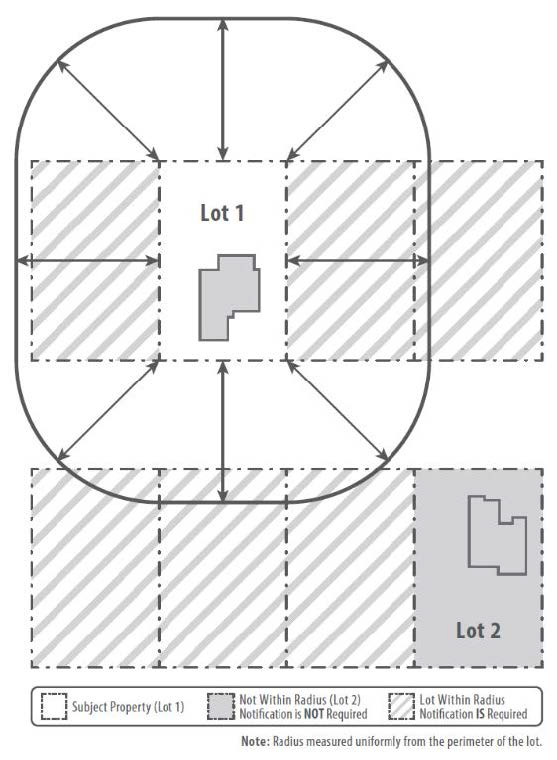
Standard Radius. Notice shall be mailed to all owners of property located within a 500-foot radius of the exterior boundaries of the subject property noted on the application, as shown on the County's last equalized assessment roll. For example, see Figure 22.222.160-A, below.
FIGURE 22.222.160-A: NOTIFICATION RADIUS
B.
Additional Radius. Notwithstanding Subsection A, above, notice shall be mailed to all owners of property located within a 1,000-foot radius of the exterior boundaries of the subject property noted on the application, as shown on the County's last equalized assessment roll, unless a more specific radius is required by this Title 22, for properties in the following areas:
1.
Fifth Supervisorial District.
2.
East San Gabriel Valley Planning Area.
3.
Workman Mill Zoned District.
4.
South San Gabriel Zoned District.
5.
The Metro Planning Area.
(Ord. 2024-0032 § 20, 2024; Ord. 2024-0029 § 7, 2024; Ord. 2019-0004 § 1, 2019.)
22.222.170 - Sign Posting.
A.
Time. The applicant shall post signs required by this Section on the subject property.
B.
Dimensions, Materials, and Content. Sign size, height, materials, colors, content, and lettering shall adhere to the specifications described in the checklist by the Department.
C.
Location. One sign shall be erected on each public road frontage adjoining the subject property. The sign shall be legible and accessible by foot from said public roads. If the subject property is not visible from an existing public road, this Subsection C may be modified by the Director.
D.
Additional Posting Requirements. The Director may require additional signs or that signs to be larger and/or constructed of stronger weather-proof materials to improve visibility and legibility at the posted locations.
E.
Verification. At least 30 days prior to the public hearing or decision date, the applicant shall provide the Director with:
1.
A photograph showing the signs erected on the subject property; and
2.
A signed affidavit stating that the signs have been placed on the subject property in compliance with this Section.
F.
Maintenance and Display. The applicant shall be responsible for maintaining signs in a satisfactory condition and continuously displaying the sign according to the period of time specified prior to the public hearing or decision date.
G.
Failure to Comply. Failure of the applicant to comply with this Section shall result in postponement of the public hearing or decision.
H.
Removal. The applicant shall remove signs from the subject property within one week following the close of the public hearing or decision date.
I.
Exception. This Section shall not apply to public hearings on matters initiated by the Board or Commission. The Director may post signs for such public hearings at locations where deemed appropriate.
(Ord. 2022-0008 § 121, 2022; Ord. 2019-0004 § 1, 2019.)
22.222.180 - Publication.
A.
Notice of public hearing or notice of application shall be published once in a newspaper of general circulation in the County available in the community of the subject property and at least 30 days before the public hearing or decision date.
B.
Hearings on general amendments to this Title 22 shall be published once in a newspaper of general circulation in the County at least 30 days before the public hearing.
(Ord. 2019-0004 § 1, 2019.)
22.222.190 - Hearing Examiner Public Hearing.
A.
At the discretion of the Director, the Hearing Examiner may hold an initial public hearing on any matter subject to a public hearing before the Commission or Hearing Officer by Title 21 (Subdivisions) or this Title 22 except, however, the Hearing Examiner may not conduct appeals or calls for review of projects decided by a Hearing Officer.
B.
The Director shall determine which matters shall have an initial public hearing held by the Hearing Examiner before a public hearing is conducted by the Commission or Hearing Officer. One or more of the following factors will generally indicate to the Director that an initial public hearing before the Hearing Examiner should be held:
1.
An Environmental Impact Report is required.
2.
An update to, or preparation of, a community or area wide plan is proposed.
3.
A major amendment to the General Plan or Title 22 is proposed.
4.
The construction of 50 or more residential units or 50,000 square feet or more of commercial or industrial floor area is proposed.
5.
A major project pursuant to the provisions of Chapter 22.262 (Major Projects Review Trust Funds) is proposed.
6.
A subdivision, General Plan Amendment, Ordinance Amendment, or Zone Change is proposed.
7.
The Director determines that:
a.
The subject property is remote from downtown Los Angeles;
b.
The public hearing may generate significant public controversy; or
c.
The application has other aspects that indicate a Hearing Examiner hearing is appropriate.
C.
The Hearing Examiner shall hold an initial public hearing in compliance with Section 22.222.120.B (Public Hearing).
D.
Prior to the Commission's or Hearing Officer's public hearing on a matter for which the Hearing Examiner has first conducted an initial public hearing:
1.
The Hearing Examiner shall prepare a report to the Commission or Hearing Officer. The report shall include an analysis of the proposal, proposed findings and conditions where applicable, recommendations, and other pertinent materials to be submitted to the Commission or Hearing Officer.
2.
The Director shall:
a.
Provide a notice of action in compliance with Section 22.222.220 (Notice of Action). The notice of action shall include a synopsis of the Hearing Examiner's initial public hearing, and the written recommendation to the Commission or Hearing Officer; and
b.
Provide a notice of public hearing before the Commission or Hearing Officer in accordance with Section 22.222.120 (Public Hearing Procedure).
(Ord. 2022-0008 § 122, 2022; Ord. 2019-0004 § 1, 2019.)
22.222.200 - Findings and Decision.
A.
Findings. After evaluating the application, plans, testimony, reports, and all other materials that constitute the administrative record, the Review Authority shall make findings required by this Title 22 or State law. Findings required by this Title 22 are specific to the permit or review, zone, use, supplemental district, or as otherwise specified by this Title 22. The Review Authority may make findings, in addition to the findings required by this Title 22, after evaluating the administrative record.
B.
Decision.
1.
General. After evaluating the administrative record, the Review Authority may approve, conditionally approve, or deny the application:
a.
Approve. Where the Review Authority finds that the administrative record substantiates all of the findings required by this Title 22, the Review Authority may:
i.
Approve the application;
ii.
Approve the application contingent upon compliance with applicable provisions of other ordinances; and
iii.
Impose conditions of use deemed reasonable and necessary to ensure that the approval will be in compliance with the findings made by the Review Authority.
b.
Deny. Where the Review Authority finds that the administrative record does not substantiate all of the findings required by this Title 22 for approval, or the administrative record substantiates the findings required by this Title 22 for denial, the Review Authority shall deny the application.
2.
Housing Accountability Act. Notwithstanding Subsection B.1, the Review Authority shall not deny, conditionally approve to reduce the density of, or make infeasible emergency shelters or housing development projects, including housing for very low-, low-, or moderate-income households, without making the required findings, pursuant to section 65589.5 of the California Government Code, also known as the Housing Accountability Act.
(Ord. 2023-0038 § 20, 2023; Ord. 2019-0004 § 1, 2019.)
22.222.210 - Decision After Public Hearing.
A.
Board of Supervisors.
1.
After closing the public hearing, the Board shall take action on the application.
2.
The decision of the Board shall be final on any matter except a local coastal program amendment or a Coastal Development Permit, including a Coastal Development Permit located in an area without a certified local coastal program.
B.
Commission.
1.
After closing the public hearing, the Commission shall take action on the application.
2.
The Commission shall publicly announce the appeal period for filing an appeal of its action, if applicable. The decision shall be final, unless the decision is appealed to the Board, in compliance with Section 22.222.230 (Effective Date of Decision and Appeals).
3.
After the public hearing on a legislative action, the Commission shall forward their recommendation to the Board. If a discretionary application is heard concurrently with a legislative action, the Commission shall forward their recommendations and findings on the discretionary application and the legislative action to the Board concurrently.
C.
Hearing Officer.
1.
After closing the public hearing, the Hearing Officer shall:
a.
Make a decision on the application; or
b.
Refer the decision to the Commission.
2.
The Hearing Officer shall publicly announce the appeal period for filing an appeal of its action, if applicable, unless the Hearing Officer refers the decision to the Commission. The decision shall be final, unless the decision is appealed to the Commission, in compliance with Section 22.222.230 (Effective Date of Decision and Appeals).
(Ord. 2019-0004 § 1, 2019.)
22.222.220 - Notice of Action.
A.
Notice of Action. After taking its final action on an application, the Review Authority shall issue a notice of action. The notice of action shall:
1.
Describe the action taken; and
2.
If applicable, include:
a.
Any applicable findings or conditions; or
b.
Instructions for filing an appeal.
B.
Delivery. The Director shall mail the notice of action to:
1.
The applicant;
2.
Every member of the public who testified at the public hearing for whom addresses are available; and
3.
Any other person or entity who filed:
a.
A written request for notification; and
b.
A written protest with the Director.
(Ord. 2019-0004 § 1, 2019.)
22.222.230 - Effective Date of Decision and Appeals.
A.
The Review Authority's decision shall be effective on the 15th day following the date of the decision, unless an appeal of the decision is timely filed or an Appeal Body calls for review of the decision.
B.
Appeals or calls for review shall be processed in compliance with Chapter 22.240 (Appeals) and this Section.
C.
Any person dissatisfied with the action of the Review Authority may file an appeal. The appeal must be filed within 14 days of the Review Authority's decision. If an Appeal Body calls for review of the Decision, the Appeal Body must make the call for review within 14 days of the Review Authority's decision.
D.
If the last day to file an appeal or call for review falls on a non-business day for the Appeal Body, then the appeal period shall extend to the next business day and the effective date of the decision shall also extend to the business day following.
E.
In all cases in which a permit or review received an approval issued concurrently pursuant to Title 21 (Subdivisions) and this Title 22, the decision shall become effective on the first day after expiration of the time limit established by Section 66452.5 of the California Government Code as set forth in Section 21.56.010 (Procedures—Submittal and Determination) of Title 21 of the County Code.
F.
Where a decision on a permit or review is appealed to, or called for review by, the Board, the date of decision by the Board of such appeal or review shall be deemed the date of grant in determining the effective date.
(Ord. 2019-0004 § 1, 2019.)
22.222.240 - Documentation, Scope of Approval, and Exhibit "A."
A.
Site plans, floor plans, building elevations, maps, or information submitted to the Department during the application review process may be deemed a part of the Exhibit "A" for an approved application.
B.
Unless otherwise indicated by the Review Authority, the Exhibit "A" shall not be stamped as approved until the permit or review becomes effective per Section 22.222.230 (Effective Date of Decision and Appeals), complies with Section 22.222.260 (Performance Guarantee and Covenant), and any applicable conditions of approval have been completed, unless as otherwise indicated in the conditions of approval.
C.
Approvals may be subject to periodic review to determine compliance with the Exhibit "A" and the conditions of approval.
D.
It shall be the responsibility of the property owner, permittee and their successors to comply with the Exhibit "A" and conditions of approval.
(Ord. 2019-0004 § 1, 2019.)
22.222.250 - Use of Property Before Final Action.
Any property involved in a discretionary application shall not be used for the use requested in the application until and unless the permit or review has become effective, in compliance with Section 22.222.230 (Effective Date of Decision and Appeals), and an approved Exhibit "A" has been issued by the Department, in compliance with Section 22.222.240 (Documentation, Scope of Approval, and Exhibit "A").
(Ord. 2019-0004 § 1, 2019.)
22.222.260 - Performance Guarantee and Covenant.
Approval may require the permittee to guarantee, warrant, or ensure compliance with the provisions of this Title 22, approved plans, or conditions of approval. To ensure compliance, the County may require the permittee to:
A.
Record the terms and conditions of approval with the Registrar-Recorder/County Clerk. Upon any transfer or lease of the property during the term of the grant, the permittee shall provide a copy of the permit approval and its conditions to the transferee or lessee;
B.
Deposit a fee, financial assurance, bond, or other mechanism in a reasonable amount, as determined by the County, to ensure the faithful performance of one or more of the conditions of approval;
C.
Record a covenant restricting the use of the subject property (e.g., limitations on occupancy or maintenance of affordability) with the Registrar-Recorder/County Clerk; or
D.
Record a covenant guaranteeing use and maintenance on a separate property necessary to comply with requirements (e.g. adequate access) with the Registrar-Recorder/County Clerk.
E.
Filing of bonds and insurance shall be in compliance with Section 22.222.290 (Bonds and Insurance).
(Ord. 2022-0008 § 123, 2022; Ord. 2019-0004 § 1, 2019.)
22.222.270 - Expiration and Extension for Unused Permits and Reviews.
A.
Except as specified otherwise, an approved permit or review shall be used within the time limit specified in the conditions, or, if no time limit is specified, two years after the date the decision is made by the Review Authority. If the permit or review is not used within the applicable time limit, the approval shall expire and become null and void.
B.
Except as specified otherwise, where an application requesting an extension is timely filed prior to the expiration date, the Hearing Officer may, one time, extend the time limit in Subsection A, above, for a period of not to exceed one year.
C.
In the case of discretionary applications heard concurrently with a subdivision, the time limit shall be concurrent and consistent with those of the subdivision.
D.
In the case of an application requiring approval by the Coastal Commission, the time limit shall comply with Chapter 22.56 (Coastal Development Permits).
E.
In the case of a permit or review for a publicly-owned use, no time limit shall apply to use the approval, provided that the public agency:
1.
Acquires the property involved or commences legal proceedings for its acquisition, within one year of the effective date of the approval; and
2.
Immediately after the acquisition of, or the commencement of legal proceedings for the acquisition of the property, posts the subject property with signs, having an area of not less than 20 square feet or more than 40 square feet in area per face indicating the agency and the purpose for which it is to be developed. One sign shall be placed facing and located within 50 feet of each street, highway, or parkway bordering the property. Where the property in question is not bounded by a street, highway, or parkway the agency shall erect one sign facing the street, highway, or parkway nearest the property.
F.
A permit or review shall be considered used, within the intent of this Section, when construction or other development authorized by such permit or review has commenced that would be prohibited in the zone, if no permit or review had been granted. For this Subsection F, construction or other development shall include grading with grading permits and construction with required building permits from Public Works.
(Ord. 2022-0008 § 124, 2022; Ord. 2019-0053 § 30, 2019; Ord. 2019-0004 § 1, 2019.)
22.222.280 - Cessation of Use.
Unless otherwise specified, an approved discretionary permit or review shall automatically cease to be of any force and effect if the use for which the permit or review was granted has ceased or has been suspended for a consecutive period of two or more years.
(Ord. 2019-0004 § 1, 2019.)
22.222.290 - Bonds and Insurance.
A.
Filing of Bonds.
1.
Assignment of Savings and Loan Certificates Permitted When. If any provision of Chapter 22.162 (Development Agreements), Chapter 22.198 (Zone Changes), or Section 22.06.060 (Zoned Districts Established) requires the filing of any bond as a prerequisite to any particular use of any property, the person making or proposing to make such use may, in lieu of such bond, deposit with the Executive Officer-Clerk of the Board and assign to the County, savings and loan certificates or shares equal in amount to the required amount of the bond. Such deposit and assignment shall comply with all of the provisions of Chapter 4.36 in Title 2 (Administrative Code) of the County Code.
2.
Agreement on Satisfaction of Final Judgment. If any provision of Chapter 22.162 (Development Agreements), Chapter 22.198 (Zone Changes), or Section 22.06.060 requires the filing of any bond as a prerequisite to any particular use of any property, and either requires that such bond include as obligee a person other than and in addition to the County, or that a policy of insurance be filed and no policy of insurance is filed, or that such bond include as obligee a person other than and in addition to the County with no alternative, a person who deposits and assigns savings and loan certificates or shares in lieu of such bond also shall file a written agreement with the Board of Supervisors that the County may satisfy, either in whole or in part, from such certificates or shares, any final judgment the payment of which would have been guaranteed by such bond or policy of insurance.
B.
Bonds or Assignment of Savings and Loan Certificates or Shares and Insurance.
1.
Bond or Assignment of Savings and Loan Certificates or Shares Required When. When one or more conditions are attached to any grant, modification, or appeal of a zone change, permit, variance, or nonconforming use or structure review, the Board, Commission, or Hearing Officer may require the owners of the property to which such approval applies, to file a surety bond or corporate surety bond, or to deposit money, savings and loan certificates, or shares with the Board in a prescribed amount for the purpose of guaranteeing the faithful performance of conditions placed on the approval.
2.
Procedure for Assignment of Savings and Loan Certificates or Shares. Where savings and loan certificates or shares are deposited, they shall be assigned to the County subject to all provisions of Chapter 4.36 in Title 2 (Administrative Code) of the County Code.
3.
Insurance Required When—Exceptions. The Board, Commission, or Hearing Officer may also require the owner of the property to which such approval applies to file a policy of insurance equal in amount to the amount of the required bond or deposit, insuring all persons against any injury or annoyance arising from the breach of such conditions unless:
a.
If the bond is filed, it includes as obligees all such persons; or
b.
If money, savings and loan certificates, or shares are deposited, such owners also file an agreement in writing with the Executive Officer-Clerk of the Board that the County may satisfy in whole or in part from such deposit any final judgment, the payment of which would have been guaranteed by such bond or policy of insurance.
(Ord. 2022-0008 § 125, 2022.)
22.224.010 - Purpose.
This Division establishes four Type Reviews. Each Type Review prescribes a set of specific administrative procedures from Chapter 22.222 (Administrative Procedures) used for processing permits and reviews in this Title 22. Permits and reviews in Division 8 (Permits, Reviews, and Legislative Actions) are assigned a Type Review or are prescribed unique administrative procedures for application processing.
(Ord. 2019-0004 § 1, 2019.)
22.224.020 - Type Review Characteristics.
Table 22.224.020-A, below, identifies the four Type Reviews and their general application processing characteristics:
(Ord. 2019-0004 § 1, 2019.)
22.224.030 - Permits and Reviews Assigned a Type Review.
Table 22.224.030-A, below, identifies permits and reviews and the Type Review used to process the application:
(Ord. 2019-0053 § 31, 2019; Ord. 2019-0004 § 1, 2019.)
22.224.040 - Permits and Reviews Assigned Unique Administrative Procedures.
Table 22.224.040-A, below, identifies permits and reviews that are not assigned a Type Review for processing the application. These permits and reviews contain unique processing procedures and directly reference Chapter 22.222 (Administrative Procedures) for processing the application.
(Ord. 2019-0053 § 32, 2019; Ord. 2019-0004 § 1, 2019.)
22.226.010 - Purpose.
The Type I Review is a ministerial process for reviewing applications. This process requires the Director to verify that a proposed use, structure, or development of land complies with all applicable provisions of this Title 22.
(Ord. 2019-0004 § 1, 2019.)
22.226.020 - Review Authority.
The Director is the Review Authority for an application that requires a Type I Review. The Director may approve or deny the application.
(Ord. 2019-0004 § 1, 2019.)
22.226.030 - Application and Review Procedures.
A.
Multiple applications shall be in compliance with Section 22.222.060 (Multiple Applications).
B.
Application filing and withdrawal shall be in compliance with Subsections A, B, and D of Section 22.222.070 (Application Filing and Withdrawal).
C.
Fees and deposits shall be in compliance with Section 22.222.080 (Fees and Deposits).
D.
Initial application review shall be in compliance with Section 22.222.090 (Initial Application Review).
(Ord. 2019-0004 § 1, 2019.)
22.226.040 - Decision.
A.
The Director shall approve or deny the application.
B.
The decision on the application shall be based on an assessment of whether the use, structure, development of land, or application of development standards is in compliance with all applicable provisions of this Title 22.
C.
The Director's decision is final and is not subject to Chapter 22.240 (Appeals).
(Ord. 2019-0004 § 1, 2019.)
22.226.050 - Notice of Action.
After taking action on an application, the Director shall notify the applicant by mail of the decision.
(Ord. 2019-0004 § 1, 2019.)
22.226.060 - Documentation.
The decision may be in the form of a letter or in the form of a stamp, signature, or other official notation or documentation on the site plan.
(Ord. 2019-0004 § 1, 2019.)
22.226.070 - Effective Date of Decision.
The decision is effective the date the letter is signed or site plan is stamped, signed, or officially noted.
(Ord. 2019-0004 § 1, 2019.)
22.226.080 - Expiration Date and Extension for Unused Permits and Reviews.
A.
An approved application shall be used within two years after the grant of such approval. If the approved application is not used within the time limit, the approval becomes null and void.
B.
Notwithstanding Subsection A, above, where an application requesting an extension is timely filed prior to such expiration date, the Director may, one time, extend the time limit in Subsection A, above, for a period of not to exceed one year.
(Ord. 2022-0008 § 126, 2022; Ord. 2019-0004 § 1, 2019.)
22.228.010 - Purpose.
The Type II Review is a discretionary process for reviewing applications. This process requires a public hearing and may require public notification of the application by publication and mail.
(Ord. 2019-0004 § 1, 2019.)
22.228.020 - Review Authority.
The Hearing Officer is the Review Authority for an application that requires a Type II Review. The Hearing Officer may approve, conditionally approve, or deny the application or may refer the application to the Commission for decision.
(Ord. 2019-0004 § 1, 2019.)
22.228.030 - Application and Review Procedures.
A.
Multiple applications shall be in compliance with Section 22.222.060 (Multiple Applications).
B.
Application filing and withdrawal shall be in compliance with Section 22.222.070 (Application Filing and Withdrawal).
C.
Fees and deposits shall be in compliance with Section 22.222.080 (Fees and Deposits).
D.
Initial application review shall be in compliance with Section 22.222.090 (Initial Application Review).
E.
Project evaluation and staff report shall be in compliance with Section 22.222.110 (Project Evaluation and Staff Report).
(Ord. 2019-0004 § 1, 2019.)
22.228.040 - Public Hearing.
A.
The application shall require a public hearing. The public hearing shall be held in compliance with Section 22.222.120 (Public Hearing Procedure).
B.
Notwithstanding Section 22.222.120.B.2.c (Notification Radius), notice shall be mailed to all owners of property located within a 300-foot radius of the exterior boundaries of the subject property noted on the application, as shown on the County's last equalized assessment roll, unless a more specific radius is required by this Title 22.
C.
Section 22.222.120.B.2.d (Sign Posting) shall not apply.
(Ord. 2019-0004 § 1, 2019.)
22.228.050 - Findings and Decision.
The Hearing Officer shall make findings and decisions for the application in compliance with Section 22.222.200 (Findings and Decisions).
(Ord. 2019-0004 § 1, 2019.)
22.228.060 - Notice of Action.
The Director shall issue and mail a notice of action in compliance with Section 22.222.220 (Notice of Action).
(Ord. 2019-0004 § 1, 2019.)
22.228.070 - Effective Date of Decision and Appeals.
A.
The effective date of decision and appeals shall be in compliance with Section 22.222.230 (Effective Date of Decision and Appeals).
B.
Notwithstanding Chapter 22.240 (Appeals), if the decision of the Hearing Officer is appealed to the Commission, the Commission's decision on an appeal shall be final and effective on the date of decision and shall not be subject to further administrative appeal.
(Ord. 2019-0004 § 1, 2019.)
22.228.080 - Post-Decision Actions and Regulations.
A.
Documentation, scope of approval, and Exhibit "A" shall be in compliance with Section 22.222.240 (Documentation, Scope of Approval, and Exhibit "A).
B.
Use of property before final action shall be in compliance with Section 22.222.250 (Use of Property Before Final Action).
C.
Performance guarantee and covenant shall be in compliance with Section 22.222.260 (Performance Guarantee and Covenant).
D.
Expiration date and extension for unused permits and reviews shall be in compliance with Section 22.222.270 (Expiration Date and Extension for Unused Permits and Reviews).
E.
Cessation of use shall be in compliance with Section 22.222.280 (Cessation of Use).
(Ord. 2019-0004 § 1, 2019.)
22.230.010 - Purpose.
The Type III Review is a discretionary process for reviewing applications. This process requires a public hearing and may require public notification of the application by publication, mail, and a sign posted on the property.
(Ord. 2019-0004 § 1, 2019.)
22.230.020 - Review Authority.
Unless specified by this Title 22, the Commission or Hearing Officer is the Review Authority for an application that requires a Type III Review. The Commission or Hearing Officer may approve, conditionally approve, or deny the application.
(Ord. 2019-0004 § 1, 2019.)
22.230.030 - Application and Review Procedures.
A.
Multiple applications shall be in compliance with Section 22.222.060 (Multiple Applications).
B.
Application filing and withdrawal shall be in compliance with Section 22.222.070 (Application Filing and Withdrawal).
C.
Fees and deposits shall be in compliance with Section 22.222.080 (Fees and Deposits).
D.
Initial application review shall be in compliance with Section 22.222.090 (Initial Application Review).
E.
Project evaluation and staff report shall be in compliance with Section 22.222.110 (Project Evaluation and Staff Report).
(Ord. 2019-0004 § 1, 2019.)
22.230.040 - Public Hearing.
The application shall require a public hearing. The public hearing shall be held in compliance with Section 22.222.120 (Public Hearing Procedure).
(Ord. 2019-0004 § 1, 2019.)
22.230.050 - Findings and Decision.
The Review Authority shall make findings and decisions for the application in compliance with Section 22.222.200 (Findings and Decisions).
(Ord. 2019-0004 § 1, 2019.)
22.230.060 - Decision After Public Hearing.
The Review Authority's decision after the public hearing shall be held in compliance with Section 22.222.210 (Decision After Public Hearing).
(Ord. 2019-0004 § 1, 2019.)
22.230.070 - Notice of Action.
The Director shall issue and mail a notice of action in compliance with Section 22.222.220 (Notice of Action).
(Ord. 2019-0004 § 1, 2019.)
22.230.080 - Effective Date of Decision and Appeals.
The effective date of decision and appeals shall be in compliance with Section 22.222.230 (Effective Date of Decision and Appeals).
(Ord. 2019-0004 § 1, 2019.)
22.230.090 - Post-Decision Actions and Regulations.
A.
Documentation, scope of approval, and Exhibit "A" shall be in compliance with Section 22.222.240 (Documentation, Scope of Approval, and Exhibit "A").
B.
Use of property before final action shall be in compliance with Section 22.222.250 (Use of Property Before Final Action).
C.
Performance guarantee and covenant shall be in compliance with Section 22.222.260 (Performance Guarantee and Covenant).
D.
Expiration date and extension for unused permits and reviews shall be in compliance with Section 22.222.270 (Expiration Date and Extension for Unused Permits and Reviews).
E.
Cessation of use shall be in compliance with Section 22.222.280 (Cessation of Use).
(Ord. 2019-0004 § 1, 2019.)
22.232.010 - Purpose.
The Type IV Review is a discretionary process for reviewing legislative applications that require Board approval. This process requires a public hearing and may include public notification of the application by publication, mail, and a sign posted on the property.
(Ord. 2019-0004 § 1, 2019.)
22.232.020 - Review Authority.
The Board is the Review Authority for an application that requires a Type IV Review. The Commission shall review the application at a public hearing and make a recommendation to the Board. If the Commission recommends approval, the Board shall review the application at a public hearing. If the Commission recommends denial, the Board shall not be required to take further action, but may review the application at a public hearing if the application is appealed.
(Ord. 2019-0004 § 1, 2019.)
22.232.030 - Application and Review Procedures.
A.
Multiple applications shall be in compliance with Section 22.222.060 (Multiple Applications).
B.
Application filing and withdrawal shall be in compliance with Section 22.222.070 (Application Filing and Withdrawal).
C.
Fees and deposits shall be in compliance with Section 22.222.080 (Fees and Deposits).
D.
Initial application review shall be in compliance with Section 22.222.090 (Initial Application Review).
E.
Project evaluation and staff report shall be in compliance with Section 22.222.110 (Project Evaluation and Staff Report).
(Ord. 2019-0004 § 1, 2019.)
22.232.040 - Commission and Board Actions.
A.
Commission Action.
1.
Public Hearing. The Commission shall hold a public hearing in compliance with Sections 22.222.120.B (Public Hearing) and 22.222.120.C (Continued Public Hearing).
2.
Findings.
a.
The Commission shall make findings in compliance with Section 22.222.200.A (Findings).
b.
The Commission may recommend approval or denial based on the findings required by Subsection A.2.a, above, and this Subsection A.2.b.
i.
The Commission may:
(1)
Recommend approval only after making all of the required findings;
(2)
Recommend approval contingent upon compliance with applicable provisions of other ordinances; or
(3)
Recommend conditions of use deemed reasonable and necessary to ensure that the approval will be in compliance with any findings made by the Commission.
ii.
The Commission shall recommend denial of the application if one or more of the required findings are not made.
3.
Commission Recommendation.
a.
Recommendation of Approval. A recommendation of approval by the Commission shall be by resolution carried by the affirmative vote of not less than three of its members. Such recommendation is final and conclusive and may not be reconsidered by the Commission except upon a referral by the Board.
b.
Recommendation of Denial. A recommendation of denial by the Commission shall not require further action by the Board. The action of the Commission shall become final in accordance with Section 22.222.230 (Effective Date of Decision and Appeals) unless an appeal is timely filed to the Board, in compliance with Chapter 22.240 (Appeals).
4.
Notice of Action. The Director shall issue and mail a notice of action in compliance with Section 22.222.220 (Notice of Action).
B.
Board Action.
1.
Public Hearing. After receipt of the Commission's recommendation for approval, the Board shall hold a public hearing and shall give notice of public hearing pursuant to Section 22.222.120.B.2 (Notice of Public Hearing).
2.
Board Action on Commission Recommendations. The Board may approve, modify, or reject the recommendation of the Commission, provided:
a.
For a Zone Change, Ordinance Amendment, or Plan Amendment, any modification of the recommendation of the Commission by the Board that was not previously considered by the Commission during its hearing, shall first be referred to the Commission for report and recommendation. The Commission shall not be required to hold a public hearing for consideration of said report and recommendation; and
b.
Failure of the Commission to report within 40 days after the reference, or such longer period as may be designated by the Board, shall be deemed to be approval of the proposed modification.
3.
Notice of Action. The Board shall issue and mail a notice of action in compliance with Section 22.222.220 (Notice of Action).
(Ord. 2019-0004 § 1, 2019.)
22.234.010 - Purpose.
This Chapter establishes the authority of the Director to interpret this Title 22.
(Ord. 2019-0004 § 1, 2019.)
22.234.020 - Authority.
When the Director determines that the meaning or applicability of any provision of this Title 22 is subject to interpretation, the Director may issue a written interpretation.
(Ord. 2019-0004 § 1, 2019.)
22.234.030 - Record of Interpretation.
Any written interpretation made by the Director shall be kept on file with the Department and be made available to the public.
(Ord. 2019-0004 § 1, 2019.)
22.236.010 - Purpose.
This Chapter establishes procedures for the modification or elimination of conditions of a previously approved Conditional Use Permit without filing a new Conditional Use Permit (Chapter 22.158) application. This process can be used where such modification or elimination of conditions of the previously approved Conditional Use Permit will not result in a substantial alteration or material deviation from the terms and conditions of the previously approved Conditional Use Permit and is necessary to allow the reasonable operation and use previously granted.
(Ord. 2019-0004 § 1, 2019.)
22.236.020 - Applicability.
Any person desiring to modify or eliminate one or more conditions of a previously approved Conditional Use Permit may file an application, except that no application shall be filed or accepted within one year of final action on the same or substantially the same application or within one year of final action on the Conditional Use Permit.
(Ord. 2019-0004 § 1, 2019.)
22.236.030 - Prohibited Modifications.
A.
Any request to modify or eliminate the following shall be denied:
1.
A change of an alcohol license previously approved for a site.
2.
An increase of shelf space devoted to alcohol.
3.
Substantial alteration or material deviation from the terms and conditions of the previous approval.
4.
Modification or elimination of any condition specified as mandatory in this Title 22 or any condition which relates to a development standard that may only be modified through a Variance (Chapter 22.194).
5.
Modification of the time limit for use, grant term, or expiration date.
B.
To request a modification or elimination of conditions listed in Subsection A, above, the applicant may file a new Conditional Use Permit (Chapter 22.158) application.
(Ord. 2022-0008 § 128, 2022; Ord. 2019-0004 § 1, 2019.)
22.236.040 - Application and Review Procedures.
A.
Application Checklist. An application submittal shall contain all materials required by the Modification or Elimination of Permit Conditions Checklist.
B.
Type II Review. The application shall be filed and processed in compliance with Chapter 22.228 (Type II Review—Discretionary) and this Chapter. Notwithstanding Section 22.228.040.B, notice shall be mailed to the same notification radius that was required for the public hearing for the previously approved Conditional Use Permit.
(Ord. 2019-0004 § 1, 2019.)
22.236.050 - Findings and Decision.
A.
Common Procedures. Findings and decision shall be in compliance with Section 22.222.200 (Findings and Decision), and include the findings in Subsection B, below.
B.
Findings.
1.
The findings and decision in Section 22.158.050 (Findings and Decision) for the Conditional Use Permit as modified has been satisfied.
2.
The modified Conditional Use Permit will not materially deviate from the terms and conditions imposed in the previously approved Conditional Use Permit.
3.
Approval of the application is necessary to allow the reasonable operation and use granted in the Conditional Use Permit.
(Ord. 2019-0004 § 1, 2019.)
22.236.060 - Conditions of Approval.
A.
In approving the application, the Review Authority may impose additional conditions, if deemed necessary to ensure that the modification or elimination of any condition will be in accordance with Section 22.236.050 (Findings and Decision).
B.
Notwithstanding Subsection A, above, the Review Authority shall not modify or eliminate any condition specified as mandatory in this Title 22 or any condition which relates to a development standard that may only be modified through a Variance (Chapter 22.194) application.
(Ord. 2019-0004 § 1, 2019.)
22.238.010 - Purpose.
This Chapter establishes procedures for the County to modify or revoke any discretionary permit or review which was granted by the Board, Commission, or Hearing Officer. These actions, which supplement Chapter 22.242 (Enforcement Procedures), are intended not only to serve a corrective purpose, but also as a deterrent to violating this Title 22.
(Ord. 2019-0004 § 1, 2019.)
22.238.020 - County Action.
A.
Modifications. The County's action to modify a permit or review approval shall have the effect of modifying individual conditions while allowing the remaining privileges granted by the original approval.
B.
Revocations. The County's action to revoke a permit or review approval shall have the effect of terminating the approval and denying the privileges granted by such approval.
(Ord. 2019-0004 § 1, 2019.)
22.238.030 - Initiation.
A.
A modification or revocation of a discretionary permit or review may be initiated:
1.
If the Board instructs the Commission to set the matter for a public hearing and recommendation;
2.
Upon the initiative of the Commission; or
3.
Upon the initiative of the Director.
B.
If, in the course of a modification or revocation proceeding, the applicant requests a revision to the approved Conditional Use Permit, the applicant shall file a Conditional Use Permit (Chapter 22.158) application.
(Ord. 2019-0004 § 1, 2019.)
22.238.040 - Grounds for Modifications or Revocations.
A.
After a public hearing is held in accordance with this Chapter, the Commission may modify or revoke any discretionary permit or review which has been granted by the Board, Commission, or Hearing Officer pursuant to this Title 22, on any one or more of the following grounds:
1.
That such approval was obtained by fraud;
2.
That the use for which such approval was granted is not being exercised;
3.
a.
That the use for which such approval was granted has ceased or has been suspended for one year or more;
b.
Subsection A.3.a, above, does not apply to a surface mining operation for which a valid permit is in full force and effect, or for which a valid, unexpired zone exception was granted prior to November 23, 1970, or which was lawfully established in former Zone Q, provided such operation complies with the requirements of Chapter 22.190 (Surface Mining Permits) for intermittent mining operations and if from the cessation of use the outer boundaries of the premises have been continuously posted with signs as described Section 22.190.050.I (Boundary Markers);
4.
Except in case of a dedicated cemetery, that any person making use of or relying upon the permit, variance, or other approval is violating or has violated any conditions of such permit, variance, or other approval, or that the use for which the permit, variance, or other approval was granted is being, or recently has been, exercised contrary to the terms of conditions of such approval, or in violation of any statuette, ordinance law, or regulation; or
5.
Except in the case of a dedicated cemetery, that the use for which the approval was granted is so exercised as to be detrimental to the public health or safety, or so as to be as nuisance.
B.
In all cases where the Director determines that it is in the public interest or where the Board, either individually or collectively, requests it, a public hearing shall be scheduled before the Commission. In such case, all procedures relative to notification, public hearing, and appeal shall be the same as for a Conditional Use Permit (Chapter 22.158). Following the public hearing, the Commission shall approve or deny the proposed modifications and/or revocation, based on the findings required by this Section.
(Ord. 2022-0008 § 129, 2022; Ord. 2019-0004 § 1, 2019.)
22.238.050 - Nonconforming Uses and Structures—Additional Grounds.
In addition to Section 22.238.040 (Grounds for Modifications or Revocations), a nonconforming use or structure may be modified or revoked after the public hearing if the Commission finds:
A.
That the condition of the improvements, if any, on the property are such that to require the property to be used only for these uses permitted in the zone where it is located would not impair the constitutional rights of any person; or
B.
That the nature of the improvements are such that they can be altered so as to be used in conformity with the uses permitted in the zone in which such property is located without impairing the constitutional rights of any person.
(Ord. 2022-0008 § 130, 2022; Ord. 2019-0004 § 1, 2019.)
22.238.060 - Commercial or Industrial Uses.
A.
This Section provides a just and equitable method to be cumulative with any other remedy available for the abatement of certain nuisance activities. These include existing land uses which have become public nuisances or are being operated or maintained in violation of any other provision of law.
B.
Notwithstanding any other provision of this Title 22 to the contrary, the Commission may recommend to the Board the modify, revoke, or order the removal of a commercial or industrial use if the Commission finds that as operated or maintained, such use:
1.
Jeopardizes or endangers the public health or safety of persons residing or working on the premises or in the surrounding area;
2.
Constitutes a public nuisance;
3.
Has resulted in repeated nuisance activities including but not limited to, disturbances of the peace, illegal drug activity, public drunkenness, drinking in public, harassment of passersby, gambling, prostitution, sale of stolen goods, public urination, theft, assaults, batteries, acts of vandalism, loitering, excessive littering, illegal parking, loud noises in late night or early morning hours, traffic violations, curfew violations, lewd conduct, or police detentions and arrests; or
4.
Violates any provision of any federal, State or County regulation, ordinance, or statute.
(Ord. 2022-0008 § 131, 2022; Ord. 2019-0004 § 1, 2019.)
22.238.070 - Public Hearing and Action.
A.
Public Hearing Procedure.
1.
Public Hearing.
a.
A public hearing shall be held in compliance with Section 22.222.120.B (Public Hearing).
b.
The Commission may continue the public hearing in compliance with Section 22.222.120.C.1 if, for any reason, the testimony of any case set for public hearing cannot be completed on the appointed day.
2.
Notice Requirements. In addition to Section 22.222.120.B.2 (Notice of Public Hearing), the Director shall also serve notice upon every person, if any, in real or apparent charge and control of the premises involved, the record owner, the holder of any mortgage, trust deed, or other lien or encumbrance of record, the holder of any lease of record, the record holder of any other estate or interest in or to the premises or any part thereof, written notice of the time and place of such hearing, either in the manner required by law for the service of summons, or by registered mail, postage prepaid:
a.
To appear at a public hearing at a time and place fixed by the Commission; and
b.
At the public hearing, to show cause why the permit should not be revoked or revised, or why the use, building, or structure should not be modified, discontinued, or removed, as applicable.
B.
Decision After Public Hearing.
1.
After the public hearing, the Commission shall approve or deny the modification or revocation of the subject use or structure.
2.
As part of any recommendation for modification, the Commission shall impose conditions as deemed appropriate.
3.
The decision shall be supported by written findings, in compliance with Section 22.222.200.A (Findings), including a finding that the action does not impair the constitutional rights of any person. However, the Commission may order that a use be discontinued or a building or structure removed only upon finding that:
a.
Prior governmental efforts to cause the owner or lessee to eliminate the problems associated with the premises have failed (examples include formal action by law enforcement, building and safety, or zoning officials); and
b.
That the owner or lessee has failed to demonstrate, to the satisfaction of the Commission, the willingness and ability to eliminate the problems associated with the premises.
C.
Notice of Action.
1.
The Commission shall issue and serve a notice of action in compliance with Section 22.222.220 (Notice of Action).
D.
Appeal and Board Action. If an applicant or an interested party disagrees with the decision of the Commission, the applicant or interested party may file an appeal with the Board in accordance with the procedures for the filing of appeals to the Board in Chapter 22.240 (Appeals).
(Ord. 2022-0008 § 132, 2022; Ord. 2019-0004 § 1, 2019.)
22.238.080 - Requirement or Condition Imposed by Final Action.
It shall be unlawful to violate or fail to comply with any requirement or condition imposed by final action of the Board pursuant to this Section. Such violation or failure to comply shall constitute a violation of this Title 22 and shall be subject to the same penalties as any other violation of this Title 22.
(Ord. 2019-0004 § 1, 2019.)
22.240.010 - Authorization.
A.
Appeals. To avoid results inconsistent with the purposes of this Title 22, decisions of the Director, unless otherwise specified, may be appealed to the Commission, decisions of the Hearing Officer may be appealed to the Commission, and decisions of the Commission may be appealed to the Board, unless otherwise specified in the permit or review.
B.
Calls for Review. To avoid results inconsistent with the purposes of this Title 22, decisions of the Hearing Officer or Director may be called for review by the Commission; and decisions of the Commission may be called for review by the Board, unless otherwise specified in the permit or review.
(Ord. 2019-0004 § 1, 2019.)
22.240.020 - Filing of Appeals.
A.
Eligibility. Any person dissatisfied with the action of the Commission, Hearing Officer, or Director may file an appeal in compliance with this Chapter, unless otherwise specified or limited by this Title 22.
B.
Time Limit. Appeals and calls for review shall be initiated prior to the effective date of decision, in compliance with Section 22.222.230 (Effective Date of Decision and Appeals).
(Ord. 2019-0004 § 1, 2019.)
22.240.030 - Initiation of Appeals.
A.
Filing. An appeal shall be filed with the secretary or clerk of the designated Appeal Body on the prescribed form, along with any accompanying appeal fee, and shall state specifically whether the basis of the appeal is that:
1.
The determination or interpretation is not in accord with the purposes of this Title 22;
2.
It is claimed that there was an error or abuse of discretion;
3.
The record includes inaccurate information; or
4.
The decision is not supported by the record.
B.
Appeal Vacates Decision. The filing of an appeal vacates the decision from which the appeal is taken. Such decision is only reinstated if the Appeal Body fails to act or affirms the decision in its action.
(Ord. 2019-0004 § 1, 2019.)
22.240.040 - Initiation of Calls for Review.
A.
A call for review may be initiated by the affirmative vote of the majority of the members present of the designated Appeal Body per Section 22.240.010.B (Calls for Review). A call for review by a designated Appeal Body shall be made prior to the effective date of the decision being reviewed. No fee shall be required.
B.
When the Commission makes a recommendation to the Board on any legislative action, any concurrent decision by the Commission on any discretionary, non-legislative land use application concerning, in whole or in part, the same lot shall be deemed to be timely called for review by the Board.
(Ord. 2019-0004 § 1, 2019.)
22.240.050 - Fee for Appeals.
A.
Processing Fee for Appeals to the Board.
1.
Applicant Appeal of Decision.
a.
If the appellant is an applicant, the appellant shall pay a processing fee as listed in Chapter 22.250 (Applications, Petitions, and Fees) for an Appeal to the Board of Supervisors by an Applicant, to cover the cost incurred by the Department for processing the appeal.
b.
Only one appeal fee shall be charged for the appeal of any related concurrently acted upon entitlements under this Title 22, which concerns, in whole or in part, the same project. Notwithstanding the provisions of Section 21.56.010.A of Title 21 (Subdivisions) of the County Code, when an appeal of a decision made under this Title 22 is timely filed with an appeal of any tentative map, parcel map, or request for waiver concurrently acted upon under Title 21 (Subdivisions) which concerns, in whole or in part, the same project, only the appeal set forth in Section 21.56.020 (Appeals) shall be paid for all such appeals.
2.
Applicant Appeal of Conditions. If the appellant is the applicant or any representative thereof, and files an appeal of no more than a total of two conditions of the approved discretionary permit, tentative map, or parcel map or request for waiver or other entitlement concurrently acted upon under Title 21 (Subdivisions) which concerns, in whole or in part, the same approved map, in any combination, the appellant shall pay a processing fee in an amount determined by the Executive Officer-Clerk of the Board to be ample to cover the cost of a hearing to be held by the Board. The appellant shall also pay a processing fee as listed in Chapter 22.250 (Applications, Petitions, and Fees) for an Appeal to the Board of Supervisors, Applicant for One or Two Project Conditions. This fee shall be applied to the Department to cover the costs of processing the appeal.
3.
Non-Applicant Appeal. If the appellant is not the applicant or any representative thereof, of an approved discretionary permit, map, or waiver or associated entitlement, the appellant shall pay a processing fee in an amount determined by the Executive Officer-Clerk of the Board to be ample to cover the cost of a hearing to be held by the Board. The appellant shall also pay a processing fee as listed Chapter 22.250 (Applications, Petitions, and Fees) for an Appeal to the Board of Supervisors, Non-Applicant. This fee shall be applied to the Department to cover the costs of processing the appeal.
B.
Processing Fee for Appeals to the Commission.
1.
Applicant Appeal of Decision. If the appellant is an applicant, the appellant shall pay a processing fee as listed in Chapter 22.250 (Applications, Petitions, and Fees) for an Appeal to the Regional Planning Commission, Applicant. The fee shall be applied in its entirety to the Department.
2.
Applicant Appeal of Conditions. If the appellant is an applicant or any representative thereof, and the appellant files an appeal of no more than a total of two conditions on the approved discretionary permit, tentative map, parcel map, or request for waiver or other entitlement concurrently acted upon under Title 21 (Subdivisions) which concerns, in whole or in part, the same approved map, in any combination, the appellant shall pay a processing fee as listed in Chapter 22.250 (Applications, Petitions, and Fees) for an Appeal to the Regional Planning Commission, Applicant for One or Two Project Conditions. This fee shall be applied in its entirety to the Department.
3.
Non-Applicant Appeal. If the appellant is not the applicant or any representative thereof, of an approved discretionary permit, map, or waiver or associated entitlement, the appellant shall pay a processing fee as listed in Chapter 22.250 (Applications, Petitions, and Fees) for an Appeal to the Regional Planning Commission, Non-Applicant. This fee shall be applied in its entirety to the Department.
(Ord. 2019-0004 § 1, 2019.)
22.240.060 - Procedures for Appeals and Calls for Review.
A.
Hearing Dates. The Appeal Body may delegate the setting of hearing dates to its secretary or clerk.
B.
Public Hearing.
1.
An appeal or review hearing shall be a public hearing if the decision being appealed or reviewed required a public hearing.
2.
A public hearing on an appeal from an action of the Hearing Officer is not subject to Chapter 22.222.190 (Hearing Examiner Public Hearing).
3.
The Appeal Body shall consider the matter directly at its public hearing. Notice of public hearings shall be given in the manner required for the decision being appealed or reviewed.
C.
Plans and Materials. At an appeal or review hearing, the Appeal Body shall consider only the same application, plans, and materials that were the subject of the original decision. Compliance with this provision shall be verified prior to or during the hearing by a representative of the person or body that made the original decision. If new plans and materials which differ substantially from the original are submitted, the applicant shall file a new application. Changes to the original submittal made to meet objections by the staff, the Appeal Body, or the opposition below need not be the subject of a new application. As part of the decision, the Appeal Body may impose additional conditions on a project in granting approval to a modified project.
D.
Hearing. At the hearing, the Appeal Body shall review the record of the decision and hear testimony of the appellant, the applicant, the party or body whose decision is being appealed or reviewed, and any other interested party.
E.
Decision and Notice.
1.
After the hearing, the Appeal Body shall affirm, modify, or reverse the original decision or refer the matter back for further review.
2.
As part of the decision, the Appeal Body may impose additional conditions on a project in granting approval to a modified project.
3.
When a decision is modified or reversed, the Appeal Body shall state the specific reasons for modification or reversal.
4.
The secretary or clerk of the Appeal Body shall mail the notice of decision in compliance with Section 22.222.220 (Notice of Action), within 10 days after the date of the finalized decision.
F.
Effective Date of Decision. Where the decision of the Appeal Body is final and the application is not subject to further administrative appeal, the date of decision by the Appeal Body on such appeal shall be deemed the date of grant in determining said expiration date.
G.
Failure to Act. If the Appeal Body fails to act upon an appeal within the time limits prescribed in Subsection E.4, above, the decision from which the appeal was taken shall be deemed affirmed.
(Ord. 2022-0008 § 133, 2022; Ord. 2019-0004 § 1, 2019.)
22.240.070 - Additional Procedures for Appeals to the Board.
In addition to the foregoing procedures, upon receiving an appeal or initiating a call for review, the Board may take one of the following additional actions:
A.
Affirm the action of the Commission;
B.
Refer the matter back to the Commission for further proceedings with or without instructions; or
C.
Require a transcript of the testimony and any other evidence relevant to the decision and take such action as in its opinion is indicated by the evidence. In such case, the Board's decision need not be limited to the points appealed, and may cover all phases of the matter, including the addition or deletion of any conditions.
(Ord. 2019-0004 § 1, 2019.)
22.242.010 - Purpose.
This Chapter establishes procedures for enforcement of the provisions of this Title 22. These enforcement procedures are intended to assure due process of law in the abatement or correction of nuisances and violations of this Title 22.
(Ord. 2019-0004 § 1, 2019.)
22.242.020 - General Prohibitions.
A.
No structure shall be moved into an area, erected, reconstructed, added to, enlarged, advertised on, structurally altered, or maintained and no structure or land shall be used for any purpose, except as specifically provided and allowed by this Title 22.
B.
No person shall use or permit to be used any structure or land, nor shall any person erect, structurally alter, or enlarge any structure, or advertise on any structure, except in accordance with the provisions of this Title 22.
C.
No permit or entitlement may be issued or renewed for any use, construction, improvement, or other purpose, unless specifically provided for or permitted by this Title 22.
(Ord. 2019-0004 § 1, 2019.)
22.242.030 - Violations.
A.
Every person violating any condition or provision either of this Title 22, permit, or approval thereto, is guilty of a misdemeanor, unless such violation is otherwise declared to be an infraction in Section 22.242.050 (Infractions). Each violation is a separate offense for each and every day during any portion of which the violation is committed.
B.
Each violation determined to be an infraction by this Title 22 shall be punishable by a fine of $100 for the first violation. Subsequent violations of the same provision of this Title 22 shall be punishable by a fine of $200 for the second violation and $500 for the third violation in a 12-month period as provided by applicable law. The fourth and any further violations of the same provision of this Title 22 which are committed at any time within a 12-month period from the date of the commission of the first violation shall be deemed misdemeanors. The three infraction violations which are the basis for the fourth and any further violations being misdemeanors may be brought and tried together. The increased penalties set forth in this Section for subsequent violations shall be applicable whether said subsequent violations are brought and tried together with the underlying previous violations or separately therefrom.
(Ord. 2019-0004 § 1, 2019.)
22.242.040 - Public Nuisance.
Any use of property contrary to the provisions of this Title 22 shall be, and the same is hereby declared to be unlawful and a public nuisance, and the authorized legal representative of the County may commence actions and proceedings for the abatement thereof, in the manner provided by law, and may take such other steps and may apply to any court having jurisdiction to grant such relief as will abate or remove such use and restrain and enjoin any person from using any property contrary to the provisions of this Title 22.
(Ord. 2019-0004 § 1, 2019.)
22.242.050 - Infractions.
Violations of the provisions contained in the following list are deemed infractions:
A.
Automobile, truck, or other motor vehicle repair conducted outside of an enclosed building.
B.
Inoperative vehicle parking or storage.
C.
Keeping or parking of vehicles in violation of Section 22.112.040.C (Residential and Agricultural Zones), Section 22.140.585.F.8.a.i.(a), or Section 22.140.585.F.8.a.ii.
D.
Outside display and/or sales, except when authorized by and in accordance with a Special Event Permit (Chapter 22.188).
E.
Signs prohibited by Section 22.114.040 (Prohibited Signs Designated).
(Ord. 2020-0032 § 32, 2020; Ord. 2019-0004 § 1, 2019.)
22.242.060 - Injunction.
The provisions of this Title 22 may also be enforced by injunction issued by any court having jurisdiction over the owner or occupant of any real property affected by such violation or prospective violation.
(Ord. 2019-0004 § 1, 2019.)
22.242.070 - Zoning Enforcement Order and Noncompliance Fee.
A.
Final Zoning Enforcement Order.
1.
In the course of enforcing any provision of this Title 22, the Director shall have the authority to issue a Final Zoning Enforcement Order concerning any property not in compliance with the provisions of this Title 22. Such order shall state, in not less than 14-point type in substantially the following form, that "Failure of the owner or person in charge of the premises to comply with this order within 15 days after the compliance date specified herein, or any written extension thereof, shall subject the violator to a noncompliance fee in the amount indicated on the Filing Fee Schedule, unless an appeal from this order is received within 15 days after the compliance date. Such appeal shall comply with Section 22.242.070.C of the Los Angeles County Code." The Director's issuance of a Final Zoning Enforcement Order shall be final unless an appeal from the order has been received.
2.
Service of a Final Zoning Enforcement Order shall be upon:
a.
The person in real or apparent charge and control of the premises involved;
b.
The record owner;
c.
The owner or holder of any lease of record; or
d.
The record owner of any interest in or to the land or any building or structure located thereon.
3.
Service shall be by personal delivery or by registered or certified mail, return receipt requested, at the Director's election.
4.
In the event the Director, after reasonable effort, is unable to serve the order as specified above, proper service shall be by posting a copy of the order on the premises. The date of service is deemed to be the date of mailing, personal delivery, or posting, as applicable.
B.
Noncompliance Fee.
1.
If a Final Zoning Enforcement Order has not been complied with within 15 days following the compliance date specified in the order, or any written extension thereof, and no appeal of such order has been timely received as provided in this Section, the Director shall have the authority to impose and collect a noncompliance fee in the amount indicated on the Filing Fee Schedule. The fee shall be subject to annual review and adjustment as provided in Section 22.250.010.D (Annual Fee Review).
2.
The purpose of the noncompliance fee is to recover costs of zoning enforcement inspections and other efforts by the Director to secure substantial compliance with a zoning enforcement order. Not more than one such fee shall be collected for failure to comply with a zoning enforcement order. The noncompliance fee shall be in addition to any other fees required by the County Code.
3.
The determination of the Director to impose and collect a noncompliance fee shall be final, and it shall not be subject to further administrative appeal.
C.
Appeal of Final Zoning Enforcement Order.
1.
Any person upon whom a Final Zoning Enforcement Order has been served may appeal the order to the Hearing Officer within the time specified in Subsection A, above. Such appeal shall contain any written evidence that the appellant wishes to be considered in connection with the appeal. If applicable, the appeal shall state that said person has applied for the appropriate permit or other administrative approval pursuant to this Title 22.
2.
The Hearing Officer shall consider such appeal within 45 days from the date that the appeal is received and shall notify the appellant of the decision within a reasonable period of time thereafter in the manner described in this Section for service of a Final Zoning Enforcement Order. The Hearing Officer may sustain, rescind, or modify the Final Zoning Enforcement Order. The decision of the Hearing Officer shall be final and effective on the date of decision, and it shall not be subject to further administrative appeal.
D.
Imposition and Collection of the Noncompliance Fee.
1.
The Director shall notify the person against whom a noncompliance fee is imposed in the manner described in this Section for service of a Final Zoning Enforcement Order. The Director may waive the imposition and collection of a noncompliance fee where the Director determines such waiver to be in the public interest.
2.
The person against whom the noncompliance fee is imposed shall remit the fee to the Director within 15 days after the date of service of said notice.
E.
Penalty After Second Notice of Noncompliance Fee. If the person against whom a noncompliance fee has been imposed fails to pay such fee within 15 days of notification as provided above, the Director may send a second notice of noncompliance fee in the manner described in this Section for service of a Final Zoning Enforcement Order. If the fee has not been paid within 15 days after the date of service of the second notice of noncompliance fee, the County shall withhold the issuance of a building permit or other approval to such person until the noncompliance fee has been paid in full. An administrative penalty assessment equal to two times the noncompliance fee and a collection fee equal to 50 percent of the noncompliance fee shall also be imposed if the fee is not paid within 15 days after the date of service of the second notice. The administrative penalty assessment and collection fee, after notice, shall become part of the debt immediately due and owing to the County. The County thereafter shall have the right to institute legal action in any court of competent jurisdiction to collect the amount of the noncompliance fee, administrative penalty assessment and collection fee. In any suit brought by the County to enforce and collect the noncompliance fee, administrative penalty assessment and collection fee, the County shall be entitled to collect all costs and fees incurred in such proceedings.
(Ord. 2019-0004 § 1, 2019.)
22.244.010 - Purpose.
An Ordinance Amendment may be initiated to alter the boundaries of districts, to impose regulations not previously imposed, or to remove or modify any regulation already imposed by this Title 22. An Ordinance Amendment may be approved whenever the Board finds that the public convenience, general welfare, or good zoning practice justifies such action, in compliance with this Chapter, this Title 22, and Title 7 (Planning and Land Use) of the California Government Code.
(Ord. 2019-0004 § 1, 2019.)
22.244.020 - Applicability.
A.
Initiation. A public hearing before the Commission or Hearing Officer may be initiated for an Ordinance Amendment:
1.
If the Board of Supervisors instructs the Department to set the matter for a public hearing;
2.
Upon the initiative of the Commission; or
3.
Upon the initiative of the Director.
B.
Urgency Ordinance. In the case of this Title 22, the Board may also adopt an urgency measure as an interim ordinance in compliance with Section 65858 of the California Government Code.
(Ord. 2019-0004 § 1, 2019.)
22.244.030 - Review Procedures.
Ordinance Amendments shall be processed in compliance with Chapter 22.232 (Type IV Review—Discretionary/Legislative) and this Chapter.
(Ord. 2019-0004 § 1, 2019.)
22.244.040 - Findings.
A.
Common Procedures. Findings and decision shall be made in compliance with Section 22.222.200 (Findings and Decision), and include the findings in Subsection B, below.
B.
Findings.
1.
The amendment is consistent with the surrounding area, if applicable.
2.
The amendment is consistent with the principles of the General Plan.
3.
Approval of the amendment will be in the interest of public health, safety, and general welfare.
4.
The amendment is consistent with other applicable provisions of this Title 22.
(Ord. 2022-0008 § 134, 2022; Ord. 2019-0004 § 1, 2019.)
22.246.010 - Legislative Provisions.
A.
Continuation of Existing Law. The provisions of this Title 22, as long as they are substantially the same as the provisions of any ordinance, or portions of any ordinance repealed by provisions codified in this Section, shall be construed as restatements and continuations of these ordinances, and not as new enactments.
B.
Proceedings Pending as of November 5, 1971 — Procedure Generally. No hearing or other proceeding initiated or commenced prior to November 5, 1971, and no right accrued, is affected either by amendments to Ordinance 1494 effective on November 5, 1971, or by the provisions of this Title 22, but all proceedings taken after this date shall conform to the provisions of this Title 22 as far as possible. Where the Commission, prior to November 5, 1971, has recommended the granting, denial, revocation, or modification of any permit, exception, license, or other approval to the Board, the Board may act upon such recommendation either before or after November 5, 1971. In all other cases, the Commission shall grant, deny, revoke, or modify as now provided in this Title 22, even if the action was initiated prior to November 5, 1971.
C.
Proceedings Pending as of November 5, 1971 — Applications for Exceptions. If, prior to November 5, 1971, an application for an exception has been heard by the Board, Commission, or Hearing Officer but has not been decided on by November 5, 1971, the Board, Commission, or Hearing Officer may, where applicable, consider the case as either an application for a variance or for a Conditional Use Permit, and shall decide or recommend pursuant to the provisions of this Title 22 as they now exist.
D.
Zone Exception.
1.
Deemed Variance When. Where a Zone Exception granted by action of the Board or Commission prior to November 5, 1971, may be granted as a variance under the present provisions of this Title 22, it shall be deemed a variance.
2.
Considered Nonconforming Use When. In all cases other than as provided in Subsection D.1, above, where a Zone Exception was granted by action of the Board or Commission prior to November 5, 1971, such use shall be considered a nonconforming use under the provisions of this Title 22, provided:
a.
That such uses shall remain in compliance with and subject to all limitations and conditions imposed by such grant; and
b.
That all provisions governing nonconforming uses not in conflict with the limitations and conditions of such grant shall apply.
3.
Considered Conditional Use. Notwithstanding the provisions of Subsection D.2, above, where a Zone Exception, granted by action of the Board or Commission prior to November 5, 1971, may be granted as a Conditional Use Permit (Chapter 22.158) under the present provisions of this Title 22, it shall be deemed a Conditional Use Permit.
E.
Rights Under Existing Approval Not Affected. No rights given by any permit, license, or other approval under any ordinance repealed by the provisions of this Section are affected by such repeal, but such rights shall hereafter be exercised according to the provisions of this Title 22.
F.
Convictions for Crimes. Any conviction for a crime under any ordinance which is repealed by this Section, which crime is continued as a public offense by this Title 22, constitutes a conviction under this Title 22 for any purpose for which it constituted a conviction under such repealed ordinance.
G.
Repeal Does Not Revive Any Ordinance. The repeal of any ordinance amending this Title 22 shall not revive any amendment adopted prior to the repealed ordinance amendment.
(Ord. 2019-0004 § 1, 2019.)
22.246.020 - Applicability of Zone Changes and Ordinance Amendments.
A.
Unless otherwise specified in this Title 22, if a complete application, as determined by the Director, was submitted to the Department prior to the effective date of a Zone Change (Chapter 22.198) or an Ordinance Amendment (Chapter 22.244):
1.
The applicant may choose whether the application will be subject to the zoning and regulations that were applicable to the project prior to the effective date of such Zone Change or Ordinance Amendment; and
2.
If the applicant chooses to have the application be subject to the zoning and regulations that were applicable to the project prior to the effective date of such Zone Change or Ordinance Amendment:
a.
The application may be modified prior to consideration by the Commission, Hearing Officer, or Director, and still be subject to the previously applicable zoning and regulations so long as the requested modification does not:
i.
Change the project's housing type (e.g., from single-family residential to two-family or multi-family residential);
ii.
Increase the project's residential density;
iii.
Increase the project's floor area or lot coverage for non-residential space;
iv.
Change the project's tenure;
v.
Increase the amount of grading for the project; or
vi.
Increase the area of ground disturbance resulting from the project.
b.
Such a modification may necessitate submittal by the applicant of revised, updated, or additional materials, including, but not limited to, site plans, elevations, and Oak Tree Reports.
c.
If the requested modification does not meet all of the criteria set forth in this Subsection A.2, the modified project shall be considered a new application subject to the Zone Change or Ordinance Amendment.
B.
Modifications to Approved Permits Requested After Effective Date of Zone Changes and Ordinance Amendments.
1.
If an application for a modification to an approved but not used permit that is valid on the effective date of a Zone Change or Ordinance Amendment, is filed, and the proposed modification is a minor change and will result in a project that substantially conforms with the project previously approved by the permit, as determined by the Director, the modification, at the election of the applicant, may be subject to the zoning and regulations applicable to the permitted use prior to the effective date of Zone Change or Ordinance Amendment. In all other cases, an application for a modification to such a permit shall be considered a new application and shall be subject to the Zone Change or Ordinance Amendment.
2.
If an approved permit has been used prior to the effective date of such Zone Change or Ordinance Amendment and the permit contains a grant term, the permit may continue until the end of the grant term, and, at the end of the grant term, the permit shall cease and the property shall be subject to the provisions of this Title 22 in effect at that time. If, during the grant term, a request for a modification to the previously approved and used permit is made and the modification will result in a project that substantially conforms with the project previously approved by the permit, as determined by the Director, the modification shall be subject to the zoning and regulations applicable to the use prior to the effective date of such Zone Change or Ordinance Amendment. In all other cases, a request for a modification to the previously approved permit shall be subject to the provisions of Title 22 in effect at the time of filing the application for the modification.
3.
If an approved permit has been used prior to the effective date of such Zone Change or Ordinance Amendment and the permit does not have a grant term, the use may continue indefinitely without regard to the amended zoning and amended regulations resulting from such Zone Change or Ordinance Amendment. Notwithstanding the preceding sentence, all applicable provisions in Chapter 22.172 (Nonconforming Uses, Buildings and Structures) regarding nonconforming uses shall apply to the previously approved permit. If a request for a modification to the previously approved permit is made, and the modification will result in a use that substantially conforms with the project previously approved by the permit, as determined by the Director, the modification shall be subject to the zoning and regulations in effect prior to the effective date of such Zone Change or Ordinance Amendment. In all other cases, a request for a modification to the previously approved permit shall be subject to the provisions of this Title 22 in effect at the time of filing the application for the modification.
(Ord. 2021-0018 § 20, 2021; Ord. 2019-0004 § 1, 2019.)
22.246.090 - Public Art in Private Development Program.
A.
Purpose. The purpose of this Section is to promote the general welfare and enhance livable communities by requiring the use and incorporation of works of publicly accessible art in private development. By doing so, the County preserves and enriches the character and environment of its unincorporated communities; improves the quality of life for those who visit, live, or work in the County; mitigates potential adverse impacts of construction and increased density; fosters the economic vitality of communities; and engages residents, neighborhoods, businesses, and community organizations in creative partnerships with Artists. This Section sets forth requirements for the provision of the Public Art in Private Development Program, in connection with conditions for the design of residential, mixed use, commercial, and industrial development projects, and repair, addition, and alterations of such development projects.
B.
Applicability. The provisions of this Section shall apply to all new Eligible Projects, as defined in Section 22.14.160 (P), that are not entitled as of the effective date of this ordinance.
C.
Exemptions from Public Art in Private Development Program. The following shall be exempt from the provisions of this Section:
1.
Residential, mixed use, commercial or industrial development consisting exclusively of rehabilitation work required for seismic safety or to comply with all applicable building requirements, and governmental mandates, including, but not limited to, the Americans With Disabilities Act of 1990, Pub. L. No. 101-336, 104 Stat. 328 (1990), as amended, regardless of valuation;
2.
Repair intended to upgrade an existing building or structure that does not change the use or type of such building or structure and does not alter the size or occupancy load of the building or structure;
3.
Repair or alterations of an existing building, including replacement of on-site Public Art, that has been partially or completely destroyed by a fire or natural disaster up to the original building valuation. Improvements in excess of the original building valuation shall not be exempt;
4.
Commercial or industrial development projects owned solely by a nonprofit organization, as defined in Section 22.14.140 (N), provided the premises are operated by a nonprofit organization and used exclusively in furtherance of nonprofit purposes;
5.
Commercial or industrial development projects, or portions thereof, that are designed and dedicated exclusively to nonprofit artistic or cultural use. Exempt facilities include museums, theaters, performance arts centers, or other similar facilities as determined appropriate by the Department of Arts and Culture. This exemption does not include gymnasiums or other sports facilities, commercial movie theaters, private recreation facilities, or buildings dedicated primarily to administrative activities; or
6.
All affordable housing, senior citizen housing, and special needs housing, as defined in Section 22.14.010 (A), including, but not limited to, homeless shelters, transitional housing, senior citizen housing development, veteran housing, or special needs housing.
D.
Administration. In accordance with Chapter 2.89 (Department of Arts and Culture) in Title 2 (Administration) of the County Code, the Department of Arts and Culture shall:
1.
Promulgate Policies and Procedures, pursuant to this Section;
2.
Maintain records of Public Art created and supported, pursuant to this Section; and
3.
Report annually to the Board as required by Section 22.246.090.J (Use of Fees Collected).
E.
Establishment of Public Art in Private Development Program. When a development project is subject to the requirements of this Section, any Eligible Project will comply with one or more of the following options, as set forth in further detail in the Policies and Procedures:
1.
One of four categories of Public Art:
a.
Newly commissioned work of permanent art;
b.
Construction, repair, or funding of improvements to cultural facilities on the development site or within a radius as approved by the Department of Arts and Culture;
c.
Restoration, conservation, or preservation of existing publicly accessible Public Art on the development site or within a radius as approved by the Department of Arts and Culture; or
d.
Funding of artistic and cultural programs or services on the development site or within a radius as approved by the Department of Arts and Culture.
2.
Public Art In-Lieu Fee Option. As an alternative to providing Public Art as described in Subsections E.1.a through d, above, the Developer may pay a fee to be deposited in the Public Art in Private Development Fund equal to one percent of the building valuation of a development project. Alternatively, if the Developer provides Public Art as described above, and the value of such Public Art is less than one percent of the building valuation, the Developer shall pay the difference between one percent of the building valuation and the Public Art to the Public Art in Private Development Fund.
F.
Compliance with Public Art in Private Development Program.
1.
When a Developer elects to fulfill the Program Requirement by means other than paying the In-Lieu Fee, no building permit shall be issued until the Department of Arts and Culture has received, approved, and accepted the Art Plan with a proposal committing the Developer to comply with the Program Requirement by a pre-determined date. Once the Developer is notified of acceptance of the Art Plan, the Developer shall submit a Deposit of Security with the County, in such format as specified by the County, in an amount equivalent to one percent of the building's valuation, as defined in Section 22.14.160 (P). No building permit shall issue until the Developer submits the Art Plan and posts a Deposit of Security as described herein. The County may hold the deposit until a Certificate of Occupancy is issued for the development project. The County, in its sole discretion, may provide additional forms of deposit for Developers to satisfy this requirement. A Certificate of Occupancy may be issued, and the deposit in the amount equal to the direct costs expended returned, when approved by the Department of Arts and Culture after the Public Art is determined to be delivered in compliance with this Section and the County's Public Art in Private Development Program Policies and Procedures. If the Program Requirement is not met, and the Developer has been given a reasonable time to cure, the Department of Arts and Culture shall collect on the value of the Deposit of Security and deposit the funds into the Public Art in Private Development Fund.
2.
When a Developer has elected to pay the In-Lieu Fee, pursuant to Subsection E.2 (Public Art In-Lieu Fee Option), above, no building permit shall be issued until such In-Lieu Fee has been paid.
3.
For Public Art placed on the Developer's property, the Public Art is to be owned and maintained by the Developer or, if applicable, by occupants or owners of the subject property. Maintenance of the Public Art shall be adequately provided for in a covenant as approved by the Department of Arts and Culture, which shall run with the land for a minimum of 25 years, unless a different timeframe is approved by the Department of Arts and Culture. If the nature of the Public Art requires other appropriate provisions be made for the proper care and maintenance of the Public Art, in addition to or in lieu of a covenant, such additional or alternate provisions will be agreed to, pursuant to a form and standards as approved by the Department of Arts and Culture. Any Public Art to be removed, altered, or relocated from the subject property at any time shall be deaccessioned in accordance with the Policies and Procedures.
4.
The cost of services or utilities necessary to operate or maintain the Public Art over time is not included in calculating the value of the Public Art for the purpose of satisfying the Program Requirement.
G.
Public Art Compliance with Zoning Requirements.
1.
The proposed Public Art shall comply with all zoning regulations prescribed by this Title 22, including zoning regulations for the proposed development project, permitted uses for the zone, applicable entitlements for the use, and development standards including, but not limited to, height, parking, and setbacks. Entitlements for the proposed Public Art, if applicable, shall be submitted concurrently with site plans and any required entitlements for the development project.
2.
All on- and off-site Public Art, in conjunction with a development project, located within the geographic area governed by the Marina del Rey Specific Plan shall be submitted to the Design Control Board for review. Any recommendations, including a written report or marked plans, that illustrate the Design Control Board's conclusions relating to the project's architectural design and site planning, shall be submitted to the Commission or Hearing Officer within 120 days of the filing of a Coastal Development Permit application in compliance with Section 22.46.1110.D (Design Control Board).
H.
Public Art Standards.
1.
All Public Art shall comply with the following standards:
a.
The Public Art satisfies the artistic and cultural needs of the development project so as to reduce the need for public artistic or cultural facilities, services or community amenities to serve the patrons, occupants, or owners of the development project, and is responsive to the needs of the community in which the development project or Public Art will be located to be determined by the Department of Arts and Culture;
b.
The Public Art shall be in an area open and publicly accessible at least eight hours each day of at least five days per week;
c.
A cultural facility that is being improved, pursuant to Subsection E.1.b, above, shall be publicly accessible during its regular business hours; and
d.
The Public Art shall be in substantial compliance with any applicable arts and cultural master plan, policies, and implementation procedures adopted by the Board.
2.
For purposes of compliance with Subsection H.1, above, the following costs shall not be included to satisfy the Program Requirement, nor shall any such costs be included in the budget for the proposed Public Art:
a.
Directional elements, such as supergraphics, signage, or color coding;
b.
Artworks that contain a commercial message by referencing, presenting, or promoting a product or service that is available on- or off-site of the subject property through text, image, logo, trademark, or other mechanism;
c.
Mass produced objects, or objects of standard design;
d.
Reproductions, by mechanical or other means, of original works of art, except in cases of film, video, photography, traditional fine art printmaking, or other media arts;
e.
The architecture of the building or facility, or any portion thereof, including decorative, ornamental, or functional elements, unless designed by an Artist specifically commissioned for this design enhancement purpose;
f.
Landscape architecture and landscape gardening, except where these elements are designed by an Artist specifically commissioned for this design enhancement purpose; or
g.
Services or utilities necessary to operate or maintain the Public Art over time.
I.
Public Art in Private Development Fund.
1.
A Public Art in Private Development Fund shall be established and shall continue from year to year. The fund shall consist of one account to be used in all Supervisorial Districts, to be established by the Auditor-Controller and administered by the County Department of Arts and Culture apart from the general revenue funds and accounts of the County. All interest and investment earnings in said fund shall accrue to the use and benefit of the applicable fund.
2.
All Public Art in Private Development In-Lieu Fees received by the County, pursuant to this Section, shall be deposited in the Public Art in Private Development Fund and shall be appropriately accounted for and expended. The fund is authorized to accept gifts, grants, and donations made to the County for Public Art in Private Development.
3.
Any appropriations, gifts, grants, or awards of money or property received for Public Art in Private Development from either public or private donors shall be placed in trust for and inure to the use and benefit of the County for Public Art in Private Development purposes, and such property or funds shall be expended, utilized, and disbursed, pursuant to the provisions of this Section. Any gifts, grants, or awards received subject to a condition shall be expended in accordance with such condition.
J.
Use of In-Lieu Fees Collected.
1.
The Department of Arts and Culture shall make recommendations to the Board for expenditures from the Public Art in Private Development Fund in accordance with County budgetary procedures and adopted Policies and Procedures, which expenditures shall be administered by the Department of Arts and Culture and used exclusively for the acquisition, commissioning, installation, improvement, maintenance, insurance, restoration, conservation, or preservation of Public Art in any form, and the provision of any similar arts or cultural activities, programs, or arts services for the benefit of the County.
2.
The Department of Arts and Culture shall provide an annual report to the Board which outlines Public Art in Private Development activities for the previous fiscal year. The report will detail the provision of Public Art in Private Development undertaken during the year, and the use of all Public Art in Private Development In-Lieu Fees collected and deposited in the Public Art in Private Development Fund. The report may set priorities for use of the Public Art in Private Development Art Fund in future years.
(Ord. 2021-0047 § 4, 2021.)
22.248.010 - Purpose.
The purpose of this Chapter 22.248 is to ensure review of whether certain County real estate activities conform with the General Plan, consistent with Section 65402(a) of the California Government Code.
(Ord. 2019-0004 § 1, 2019.)
22.248.020 - Applicability.
A.
This Chapter 22.248 shall apply to the following County real estate activities:
1.
Acquisition of real property for street, square, park, or other public purposes by dedication or other means;
2.
Disposition of real property; and
3.
Vacation or abandonment of a street.
B.
Notwithstanding Subsection A, above, this Chapter 22.248 shall not apply to the following County real estate activities:
1.
Disposition of the remainder of a larger parcel which was acquired and used in part for street purposes, if such disposition is of a minor nature, as determined by the Director;
2.
Acquisitions, dispositions, or abandonments for the purposes of street widening, if such acquisitions, dispositions, or abandonments are of a minor nature, as determined by the Director; and
3.
Alignment projects, if such projects are of a minor nature, as determined by the Director. The County shall be exempt from this requirement unless such an application is required by a specific plan adopted by the Board.
(Ord. 2019-0004 § 1, 2019.)
22.248.030 - Review Process.
A.
If a County real estate activity is subject to this Chapter 22.248, the lead County department shall identify the location, purpose, and extent of the real estate activity and submit this information to the Director for review.
B.
The Director shall review the information required by Subsection A, above, and determine whether the County real estate activity conforms to the General Plan, the development standards of this Title 22, and good planning practices. The Director shall provide this determination to the lead County department within 40 days of submittal unless the review is referred to the Commission pursuant to Section C, below.
C.
The Director may refer the review of any County real estate activity to the Commission. The Commission shall determine whether the County real estate activity conforms to the General Plan, the development standards of this Title 22, and good planning practices and shall provide this determination to the lead County department within 40 days of the submittal of the request to the Director.
(Ord. 2019-0004 § 1, 2019.)
22.248.040 - Determination.
The Director or Commission shall provide a report to the requesting entity as to whether the County real estate activity conforms to the General Plan.
(Ord. 2019-0004 § 1, 2019.)
22.250.010 - Filing Fees and Deposits.
A.
For the purpose of defraying the expense involved with any application or petition required or authorized by this Title 22, the following fees, as provided in Table 22.250.010-A, below, shall accompany the application or petition. Table 22.250.010-A may be referred to as the Filing Fee Schedule.
B.
Additional Fees.
1.
Fire Department. In addition to the required filing fees in Subsection A, above, the applicant shall pay to the Fire Department the fees and deposits for oak tree inspections and report reviews as required in Section 328 in Title 32 (Fire Code) of the County Code.
2.
Conditional Use Permits for Land Reclamation Projects. In addition to the required filing fee in Subsection A, above, where the land reclamation project involves a new or expanded Class III landfill, the applicant shall pay an additional deposit fee equal to the amount of the initial fee for each additional 20,000,000 cubic yards of capacity, or fraction thereof, in excess of the first 20,000,000 cubic yards of capacity.
3.
Housing Permits.
a.
Housing Permit Evaluation Fee. The applicant shall pay directly to the LACDA a one-time fee in the amount of $2,379 for the LACDA's review of a Housing Permit (Chapter 22.166) application.
b.
Housing Permit Monitoring Fees. The applicant for an approved Housing Permit (Chapter 22.166) shall be required to pay monitoring fees directly to the LACDA, as follows:
i.
An amount equal to $170 × 55 years per unit of the rental affordable housing set-aside, except that for housing developments with more than 10 affordable housing set-aside units, the fee shall be the same amount as a housing development with 10 affordable housing set-aside units. The fee may be paid annually or capitalized as a one-time lump sum payment, as approved by the LACDA;
ii.
A one-time lump sum in the amount of $2,934 per unit of the for-sale affordable housing set-aside;
iii.
One-time lump sum payments shall be made prior to covenant and agreement recordation. Annual payments require execution of a fee schedule with the LACDA; and
iv.
Such fees shall be deposited into a LACDA account from which costs shall be deducted by the LACDA to defray the ongoing monitoring costs.
4.
In addition to any fees or deposits required by this Title 22, the applicant shall be responsible for any fees or deposits that would be required by any other statute or ordinance.
C.
Deposit Requirements for Selected Planning and Zoning Permits.
1.
The applicant shall pay the minimum initial deposit as set forth in Subsection A, above, from which actual costs shall be billed and deducted, for the purpose of defraying the expense involved in the review of the following planning and zoning permits:
—
Development agreements;
—
Plan amendment requests; and
—
Specific plans.
2.
Supplemental Deposit Requirements. The applicant shall also pay the following supplemental deposits, from which actual costs shall be billed and deducted, when actual costs exceed the amount of the initial deposit:
a.
If during the planning and zoning permit review process, actual costs incurred reach 80 percent of the amount on deposit, the applicant shall be notified and required to submit a minimum supplemental deposit up to the amount of the initial deposit. There is no limit to the number of supplemental deposits that may be required prior to completion or withdrawal of the planning and zoning permit review.
b.
If the initial or supplemental deposit is not received by the Department, within 30 days of notification that such deposit is due and payable, all work shall be discontinued until such deposit is received.
c.
At the sole discretion of the applicant, the amount of an initial or supplemental deposit may exceed the minimum amounts defined herein, except that at no time shall such initial or supplemental deposit be less than the minimum requirement.
3.
Final Fee Determination. The final fee for the zoning permits listed in this Subsection C shall be based on actual costs incurred by the Department to review and process all required zoning permit documentation.
a.
Planning costs shall be computed on a monthly basis and deducted from the amount on deposit. The planning and zoning permit fee shall be finalized upon completion of the review process. If final planning costs do not exceed the amount on deposit, the unused portion shall be refunded to the applicant.
b.
Should the application be withdrawn, costs to date shall be computed and the unused portion of the amount on deposit shall be refunded to the applicant.
c.
Costs shall be computed using actual hours expended by planning staff multiplied by the most current applicable hourly rates, approved by the Auditor-Controller, that are available at the time that costs are assessed.
d.
Cost data used to determine planning and zoning permit fees shall be maintained, by the planning business office, and made available for public review while work is in progress and for three years following final action or withdrawal of the application.
D.
Annual Fee Review. The fees in this Section shall be reviewed annually by the Auditor-Controller. Beginning on January 1, 1992, and thereafter on each succeeding January 1, the amount of each fee in this Section shall be adjusted as follows: Calculate the percentage movement in the Consumer Price Index for Los Angeles during the preceding January through December period, adjust each fee by said percentage amount and round off to the nearest dollar. However, no adjustment shall decrease any fee and no fee shall exceed the reasonable cost of providing services.
(Ord. 2023-0044 § 7, 2023; Ord. 2022-0008 § 141, 2022; Ord. 2019-0072 § 4, 2019; Ord. 2019-0053 § 33, 2019; Ord. 2019-0004 § 1, 2019.)
* Editor's note: Fee changes in this section include changes made by the director of planning due to increases in the Consumer Price Index and are effective March 1, 2026.
22.250.020 - Fee Waivers, Exemptions, and Reductions.
A.
Waiver Authorized by the Board. When the Board, by adopted resolution, determines that it is in the public interest to accept applications or petitions without a filing fee, the Director shall accept such applications or petitions subject to the requirements specified in said resolution.
B.
Fee Exemption and Reduction for Affordable Housing. An applicant for a Housing Permit (Chapter 22.166) may request an exemption from, or a reduction in, the payment of any planning and zoning fees or deposits, if a housing development provides income-restricted units, pursuant to Chapter 22.120 (Density Bonus), Chapter 22.121 (Inclusionary Housing), Section 22.128.200 (Supportive Housing Streamlining), Section 22.130.200 (Motel Conversions, Permanent), or Section 22.140.660 (Motel Conversions, Temporary) subject to the following:
1.
Fee Exemption. Request for a fee exemption shall be granted, if the housing development consists solely of dwelling units, exclusive of a manager's unit or units, that are affordable to extremely low, very low, lower, or moderate income households.
2.
Fee Reduction. Request for a fee reduction shall be granted, if the housing development provides an income-restricted unit(s), but the applicant is not eligible for the fee exemption described in Subsection B.1, above. The rate of reduction shall be the total number of income-restricted dwelling units divided by the total number of dwelling units. For the purpose of this Subsection B.2, "total number of dwelling units" means all dwelling units within the housing development, exclusive of a manager's unit or units, and inclusive of dwelling units permitted by the density bonus(es) awarded, if applicable.
3.
For the purpose of this Subsection B, "planning and zoning fees or deposits" are the fees or deposits provided in Section 22.250.010 (Filing Fees and Deposits) incurred by the Department of Regional Planning. This Subsection B does not authorize any exemption from, or reduction in, the payment of fees or deposits incurred by other County departments or agencies.
C.
Fee Exemption for Shelters and Accessory Overnight Safe Parking. An applicant may request an exemption from the payment of planning and zoning fees for a Ministerial Site Plan Review to develop a domestic violence shelter, emergency shelter, accessory emergency shelter, or accessory overnight safe parking. For the purpose of this Subsection C, "planning and zoning fees" are the fees provided in Section 22.250.010 (Filing Fees and Deposits) incurred by the Department. This Subsection C does not authorize any exemption from the payment of fees or deposits incurred by other County departments or agencies.
D.
Fee Exemption for Mobilehome Parks. An applicant for a mobilehome park may request an exemption from the payment of the fees or deposits provided in Section 22.250.010 (Filing Fees and Deposits) incurred by the Department. This Subsection D does not authorize any exemption from, or reduction in, the payment of fees or deposits incurred by other County departments or agencies.
(Ord. 2021-0018 § 22, 2021; Ord. 2021-0017 § 33, 2021; Ord. 2019-0053 § 34, 2019; Ord. 2019-0004 § 1, 2019.)
22.250.040 - eRecordation Fee.
A fee shall be added for in-house electronic recordings directly with the Los Angeles County Registrar Recorder's Office as requested by applicant, agent, and/or property owner as an added planning service to members of the public, as provided in Table 22.250.010-A, above.
(Ord. 2023-0044 § 8, 2023.)
22.250.050 - Yard Sale Registration Fee.
A fee shall be added for processing all yard sale registrations, as provided in Table 22.250.010-A, above.
(Ord. 2023-0044 § 9, 2023.)
22.252.010 - Intent and Purpose.
The Woolsey Fire destroyed tens of thousands of acres of land in Los Angeles County in November 2018. More than 1,700 structures were damaged or destroyed throughout Los Angeles County, including more than 850 structures in unincorporated areas. The regulations and standards herein will facilitate the establishment of temporary housing for residents affected by the Woolsey Fire and facilitate the process for rebuilding structures damaged or destroyed by the fire while protecting the public health and safety of the residents within the declared disaster area.
(Ord. 2019-0048U § 2, 2019.)
22.252.020 - Authority.
This Chapter 22.252 is approved and amended, pursuant to sections 25123(d) and 25131 of the California Government Code, allowing for ordinances for the immediate preservation of the public peace, health, or safety.
(Ord. 2019-0048U § 3, 2019.)
22.252.030 - Duration of Urgency Ordinance.
The provisions in this Chapter shall remain in effect until December 31, 2022, unless extended or modified by the Board. If not extended or modified, this Chapter shall expire on December 31, 2022, and be of no further force or effect. No residential recreational vehicle use or other temporary housing authorized, pursuant to this Chapter, shall be used for permanent housing after the expiration date of this Chapter.
(Ord. 2019-0048U § 4, 2019.)
22.252.040 - Definitions.
"Like-for-like replacement." Replacement of structures that are in the same location, are the same size, and are covering the same building footprint as previously existing legally-established structures.
(Ord. 2019-0048U § 5, 2019.)
22.252.050 - Temporary Housing.
Notwithstanding any contrary provisions in this Title 22, recreational vehicles, as defined in section 18010 of the California Health and Safety Code, in addition to mobile homes and manufactured homes, as defined in sections 18007 and 18008 of the California Health and Safety Code, respectively, shall be permitted as temporary housing subject to the following standards:
A.
Temporary housing shall be permitted only on a lot or parcel of land where a legally-established single-family residence or legally-established employee housing was irreparably damaged or destroyed by the Woolsey Fire;
B.
Within Significant Ecological Areas, temporary housing units shall be exempt from the permitting requirements listed in Section 22.56.215;
C.
Any structure used as temporary housing may not exceed a maximum floor area of 3,000 square feet;
D.
Temporary housing shall be located on the existing building pad or graded area of the parcel on which the destroyed or damaged home or employee housing was located;
E.
Temporary housing may only be occupied by the property owner(s) and household members who reside with them;
F.
Temporary housing to replace employee housing shall be limited to employees who work on-site;
G.
All structures used for temporary housing must contain sleeping, cooking, bathing, and sanitary facilities;
H.
Temporary housing must be connected to a permanent source of potable water approved by the County;
I.
Temporary housing must be connected to a wastewater disposal system approved by the County;
J.
Temporary housing must be connected to an electrical source approved by the County;
K.
Where temporary housing is used to replace legally-established employee housing, more than one structure may be used. The temporary housing shall be designed to accommodate no more than the number of employees who lived on-site before the Woolsey Fire;
L.
In addition to the one-year length of temporary housing allowed, pursuant to Chapter 22.258 (Temporary Housing After a Disaster), the Director may grant up to three one-year time extensions for a maximum duration of four years, not to exceed the life of this urgency ordinance; and
M.
All temporary housing structures shall be removed within 24 hours of the expiration date listed on the temporary housing approval or the expiration of this urgency ordinance.
(Ord. 2023-0025 § 5, 2023; Ord. 2020-0037U § 1, 2020; Ord. 2019-0048U § 6, 2019.)
22.252.060 - Rebuilding Damaged or Destroyed Structures.
Notwithstanding Section 22.336 of the County Code, structures destroyed by the Woolsey Fire may be replaced, and any development standard or regulation that prohibits or delays said reconstruction may be waived by the Director, subject to a ministerial site plan review and the following:
A.
Replacement of a destroyed structure and waiver of development standards and regulations applies only to the reconstruction of structures that were legally established prior to the Woolsey Fire;
B.
Structures irreparably damaged or destroyed by the Woolsey Fire will be reconstructed as a like-for-like replacement and shall not exceed either the floor area, height, or bulk of the destroyed structure by more than 10 percent;
C.
The height of a rebuilt structure shall not exceed the height maximum outlined by the underlying zone, CSD standard, or condition of approval, as applicable;
D.
Notwithstanding Section 22.336.040.B, structures located within the significant ridgeline protection area shall not be expanded, shall only be constructed as a like-for-like replacement, and shall not encroach further into the protected zone of the significant ridgeline;
E.
Where a previous entitlement(s) that established the use occupying the destroyed structure remains valid and in full effect, the rebuilt structure(s) shall comply with any previous conditions of approval;
F.
For uses that require a conditional use permit and no such conditional use permit exists or has previously expired:
1.
Non-residential uses must obtain a conditional use permit prior to reconstruction or resuming operations.
2.
Residential land uses may be re-established with a site plan review, so long as an application for a conditional use permit is, or has been filed, and is under review by the Department.
G.
Minor relocations of structures to be replaced may be authorized due to changes in topography or alteration of drainage features (e.g., creeks, streams, waterways, etc.) resulting from mudslides and other forms of debris flows, and consistent with other applicable standards and regulations in this urgency ordinance.
H.
After completion of like-for-like reconstruction of structures destroyed in the Woolsey Fire, all future development on-site will be subject to all applicable requirements within Title 22 of the County Code.
(Ord. 2019-0048U § 7, 2019.)
22.252.070 - Waiver of Certain Permitting Requirements.
A.
Oak Tree Permits. Notwithstanding Chapter 22.174 of the County Code, activities related to demolition and reconstruction of structures eligible under this urgency ordinance are not subject to the County's Oak Tree Permit requirements, subject to and except for, the following:
1.
Waiver of applicability of Chapter 22.174 applies only to legally-established structures located within the protected zone of an oak tree on the day the structure was destroyed by the Woolsey Fire;
2.
Structures to be reconstructed within the protected zone of a protected oak tree will be a like-for-like replacement of legally-established structures irreparably damaged or destroyed by the Woolsey Fire;
3.
Reconstruction does not result in new encroachments into the protected zone of subject oak tree or the removal of said tree;
4.
Subject oak trees shall be fenced off and protected during construction activities; and
5.
Reconstruction activities that irreparably harmed oak trees shall be subject to Chapter 22.174, including, but not limited to, requiring a retroactive Oak Tree Permit and requirements to plant replacement oak trees at a ratio determined by the Hearing Officer.
B.
Significant Ecological Areas. Notwithstanding Chapter 22.102 of the County Code, activities related to demolition and reconstruction of structures eligible under this urgency ordinance are not subject to Chapter 22.102, subject to and except for, the following:
1.
Waiver of applicability of Chapter 22.102 applies only to structures legally established on the day the structure was destroyed by the Woolsey Fire;
2.
Structures to be reconstructed within a significant ecological area must be a like-for-like replacement of legally-established structures irreparably damaged or destroyed by the Woolsey Fire; except, relocation of reconstructed structures may be approved by the Director pursuant to Section 22.252.060.G if no new impacts to the significant ecological area will occur as a result of the relocation;
3.
Reconstruction does not result in new impacts to the significant ecological area; and
4.
Any sensitive biological resources shall be avoided and protected during construction activities.
(Ord. 2019-0048U § 8, 2019.)
22.252.080 - Grading Standards.
A.
Structures to be rebuilt shall not be subject to the standards of Section 22.336.060.D.4, which prohibit the commencement of grading operations during the rainy season (from October 15 through April 15). Said grading activities shall provide erosion control to the satisfaction of Public Works;
B.
Notwithstanding Section 22.336.060.D, grading projects related to the rebuilding of structures destroyed in the Woolsey Fire shall abide by the following permitting requirements:
1.
Grading required for a like-for-like rebuild, that exceeds 5,000 cubic yards of total cut plus total fill material, shall not require a conditional use permit (Chapter 22.158) and shall instead be processed with a site plan review. Only the minimum amount of grading required to prepare the lot for rebuilding the fire-damaged structures will be allowed. For purposes of determining the minimum amount of grading, justification by the project Soils Engineer, Geologist, and/or Civil Engineer will be required and be subject to verification by the Department of Public Works, Building and Safety Division.
C.
Notwithstanding Section 22.336.060.D.3, a haul route for off-site transport of 1,000 or more cubic yards of cut or fill shall be permitted with a site plan review.
(Ord. 2019-0048U § 9, 2019.)
22.252.090 - Vineyard Standards.
Applications requesting to re-establish vineyards destroyed by the Woolsey Fire shall comply with all applicable standards for new vineyards in Section 22.336.060.H.
(Ord. 2019-0048U § 10, 2019.)
22.252.100 - Area of Applicability.
This Chapter applies to parcels located in the unincorporated area affected by the Woolsey Fire, as identified on Map 1, below.
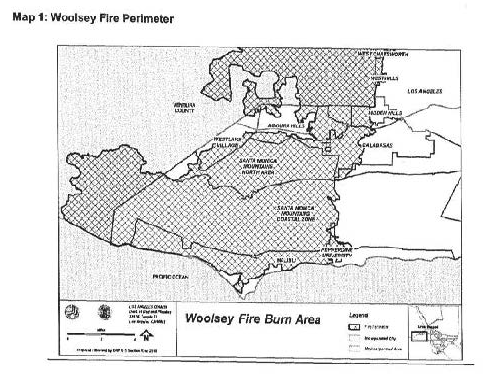
(Ord. 2019-0048U § 11, 2019.)
22.254.010 - Intent and Purpose.
The Lake Fire and the Bobcat Fire destroyed over one hundred thousand acres of land in Los Angeles County in 2020. Dozens of structures were damaged or destroyed throughout the unincorporated areas of Los Angeles County. The regulations and standards herein will facilitate the establishment of temporary housing for residents affected by the Lake Fire or the Bobcat Fire and facilitate the process for rebuilding structures damaged or destroyed by the fires while protecting the public health and safety of the residents within the declared disaster areas.
(Ord. 2020-0058U § 1, 2020.)
22.254.020 - Authority.
This Chapter 22.254 is approved pursuant to sections 25123(d) and 25131 of the California Government Code, allowing for ordinances for the immediate preservation of the public peace, health, or safety.
(Ord. 2020-0058U § 1, 2020.)
22.254.030 - Duration of Urgency Ordinance.
The provisions in this Chapter shall remain in effect until December 31, 2024, unless extended or modified by the Board. If not extended or modified, this Chapter shall expire on December 31, 2024, and be of no further force or effect. No residential recreational vehicle use or other temporary housing authorized, pursuant to this Chapter, shall be used for permanent housing after the expiration date of this Chapter.
(Ord. 2020-0058U § 1, 2020.)
22.254.040 - Definitions.
"Like-for-like replacement." Replacement of structures that are in the same location, are the same size, and are covering the same building footprint as previously existing legally-established structures.
(Ord. 2020-0058U § 1, 2020.)
22.254.050 - Temporary Housing.
Notwithstanding any contrary provisions in this Title 22, recreational vehicles, as defined in section 18010 of the California Health and Safety Code, in addition to mobile homes and manufactured homes, as defined in sections 18007 and 18008 of the California Health and Safety Code, respectively, shall be permitted as temporary housing subject to the following standards:
A.
Temporary housing shall be permitted only on a lot or parcel of land where a legally-established single-family residence or legally-established employee housing was irreparably damaged or destroyed by the Lake Fire or the Bobcat Fire;
B.
Within Significant Ecological Areas, temporary housing units shall be exempt from the permitting requirements listed in Chapter 22.102;
C.
Any structure used as temporary housing may not exceed a maximum floor area of 3,000 square feet;
D.
Temporary housing shall be located on the existing building pad or graded area of the parcel on which the destroyed or damaged home or employee housing was located;
E.
Temporary housing may only be occupied by the property owner(s) and household members who reside with them;
F.
Temporary housing to replace employee housing shall be limited to employees who work on-site;
G.
All structures used for temporary housing must contain sleeping, cooking, bathing, and sanitary facilities;
H.
Temporary housing must be connected to a permanent source of potable water approved by the County;
I.
Temporary housing must be connected to a wastewater disposal system approved by the County;
J.
Temporary housing must be connected to an electrical source approved by the County;
K.
Where temporary housing is used to replace legally-established employee housing, more than one structure may be used. The temporary housing shall be designed to accommodate no more than the number of employees who lived on-site before the Lake Fire or the Bobcat Fire;
L.
In addition to the one-year length of temporary housing allowed, pursuant to Chapter 22.258 (Temporary Housing After a Disaster), the Director may grant up to three one-year time extensions for a maximum duration of four years, not to exceed the life of this urgency ordinance; and
M.
All temporary housing structures shall be removed within 24 hours of the expiration date listed on the temporary housing approval or the expiration of this urgency ordinance.
(Ord. 2023-0025 § 6, 2023; Ord. 2020-0058U § 1, 2020.)
22.254.060 - Rebuilding Damaged or Destroyed Structures.
Notwithstanding any applicable Community Standards District standards in Division 10 of this Title 22, structures destroyed by the Lake Fire or the Bobcat Fire may be replaced, and any development standard or regulation that prohibits or delays said reconstruction may be waived by the Director, subject to a ministerial site plan review and the following:
A.
Replacement of a destroyed structure and waiver of development standards and regulations applies only to the reconstruction of structures that were legally established prior to the Lake Fire or the Bobcat Fire;
B.
Structures irreparably damaged or destroyed by the Lake Fire or the Bobcat Fire will be reconstructed as a like-for-like replacement and shall not exceed either the floor area, height, or bulk of the destroyed structure by more than 10 percent;
C.
The height of a rebuilt structure shall not exceed the height maximum outlined by the underlying zone, Community Standards District standard, or condition of approval, as applicable;
D.
Notwithstanding any applicable Community Standards District significant ridgeline protection standards in Division 10 of this Title 22, structures located within the significant ridgeline protection area shall not be expanded, shall only be constructed as a like-for-like replacement, and shall not encroach further into the protected zone of the significant ridgeline;
E.
Where a previous entitlement(s) that established the use occupying the destroyed structure remains valid and in full effect, the rebuilt structure(s) shall comply with any previous conditions of approval;
F.
For uses that require a conditional use permit and no such conditional use permit exists or has previously expired:
1.
Non-residential uses must obtain a conditional use permit prior to reconstruction or resuming operations.
2.
Residential land uses may be re-established with a site plan review, so long as an application for a conditional use permit is, or has been filed, and is under review by the Department.
G.
Minor relocations of structures to be replaced may be authorized due to changes in topography or alteration of drainage features (e.g., creeks, streams, waterways, etc.) resulting from mudslides and other forms of debris flows, and consistent with other applicable standards and regulations in this urgency ordinance.
H.
After completion of like-for-like reconstruction of structures destroyed in the Lake Fire or the Bobcat Fire, all future development on-site will be subject to all applicable requirements within this Title 22.
(Ord. 2020-0058U § 1, 2020.)
22.254.070 - Waiver of Certain Permitting Requirements.
A.
Oak Tree Permits. Notwithstanding Chapter 22.174, activities related to demolition and reconstruction of structures eligible under this urgency ordinance are not subject to the County's Oak Tree Permit requirements, subject to and except for, the following:
1.
Waiver of applicability of Chapter 22.174 applies only to legally-established structures located within the protected zone of a protected oak tree on the day the structure was irreparably damaged or destroyed by the Lake Fire or the Bobcat Fire;
2.
Structures to be reconstructed within the protected zone of a protected oak tree must be a like-for-like replacement of legally-established structures irreparably damaged or destroyed by the Lake Fire or the Bobcat Fire;
3.
Reconstruction does not result in new encroachments into the protected zone of a protected oak tree or the removal of said tree;
4.
Subject oak trees shall be fenced off and protected during construction activities; and
5.
Reconstruction activities that irreparably harmed oak trees shall be subject to Chapter 22.174, including, but not limited to, requiring a retroactive Oak Tree Permit and requirements to plant replacement oak trees at a ratio determined by the Hearing Officer.
B.
Significant Ecological Areas. Notwithstanding Chapter 22.102, activities related to demolition and reconstruction of structures eligible under this urgency ordinance are not subject to Chapter 22.102, subject to and except for, the following:
1.
Waiver of applicability of Chapter 22.102 applies only to:
a.
Structures legally established on the day the structure was irreparably damaged or destroyed by the Lake Fire or the Bobcat Fire; and
b.
Fuel modification and brush clearance activities that are legally required for such structures at the time such structures are reconstructed, with the exception of tilling and discing, as approved by the Fire Department;
2.
Structures to be reconstructed within a significant ecological area must be a like-for-like replacement of legally-established structures irreparably damaged or destroyed by the Lake Fire or the Bobcat Fire; except, relocation of reconstructed structures may be approved by the Director pursuant to Section 22.254.060.G if no new impacts to the significant ecological area, other than new impacts related to activities listed in subsection B.1.b above, will occur as a result of the relocation;
3.
Reconstruction does not result in new impacts to the significant ecological area other than new impacts related to activities listed in subsection B.1.b above; and
4.
Any sensitive biological resources shall be avoided and protected during construction activities.
(Ord. 2020-0058U § 1, 2020.)
22.254.080 - Grading Standards.
Notwithstanding any applicable Community Standards District grading standards in Division 10 of this Title 22, grading required for a like-for-like rebuild, that exceeds 5,000 cubic yards of total cut plus total fill material, shall not require a conditional use permit and shall instead be processed with a site plan review. Only the minimum amount of grading required to prepare the lot or parcel of land for rebuilding the fire-damaged structures will be allowed. For purposes of determining the minimum amount of grading, justification by the project Soils Engineer, Geologist, and/or Civil Engineer will be required and be subject to verification by the Department of Public Works, Building and Safety Division.
(Ord. 2020-0058U § 1, 2020.)
22.254.090 - Area of Applicability.
This Chapter applies to lots or parcels of land located in the unincorporated areas of Los Angeles County affected by the Lake Fire or the Bobcat Fire, as identified on Maps 1 and 2, below.
(Ord. 2020-0058U § 1, 2020.)
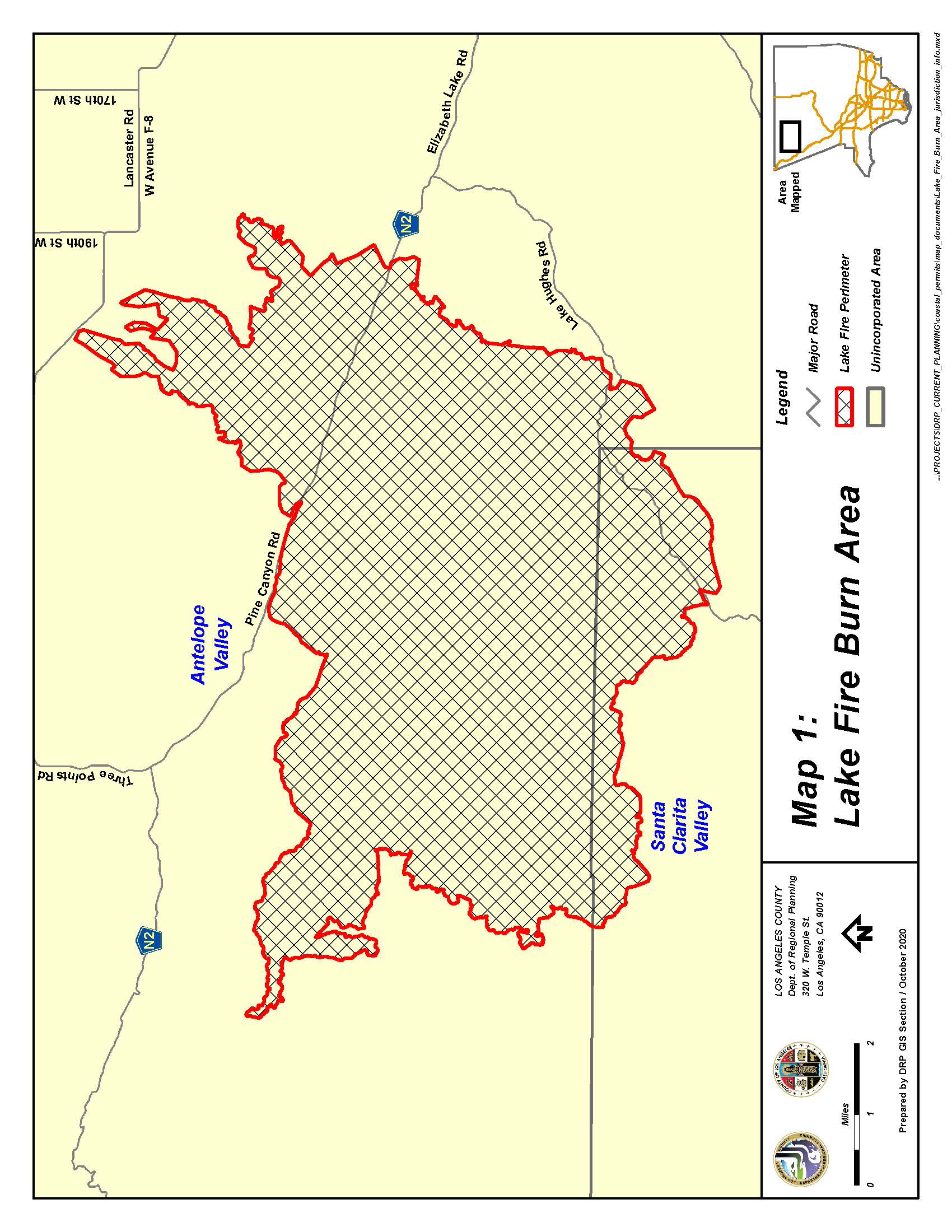
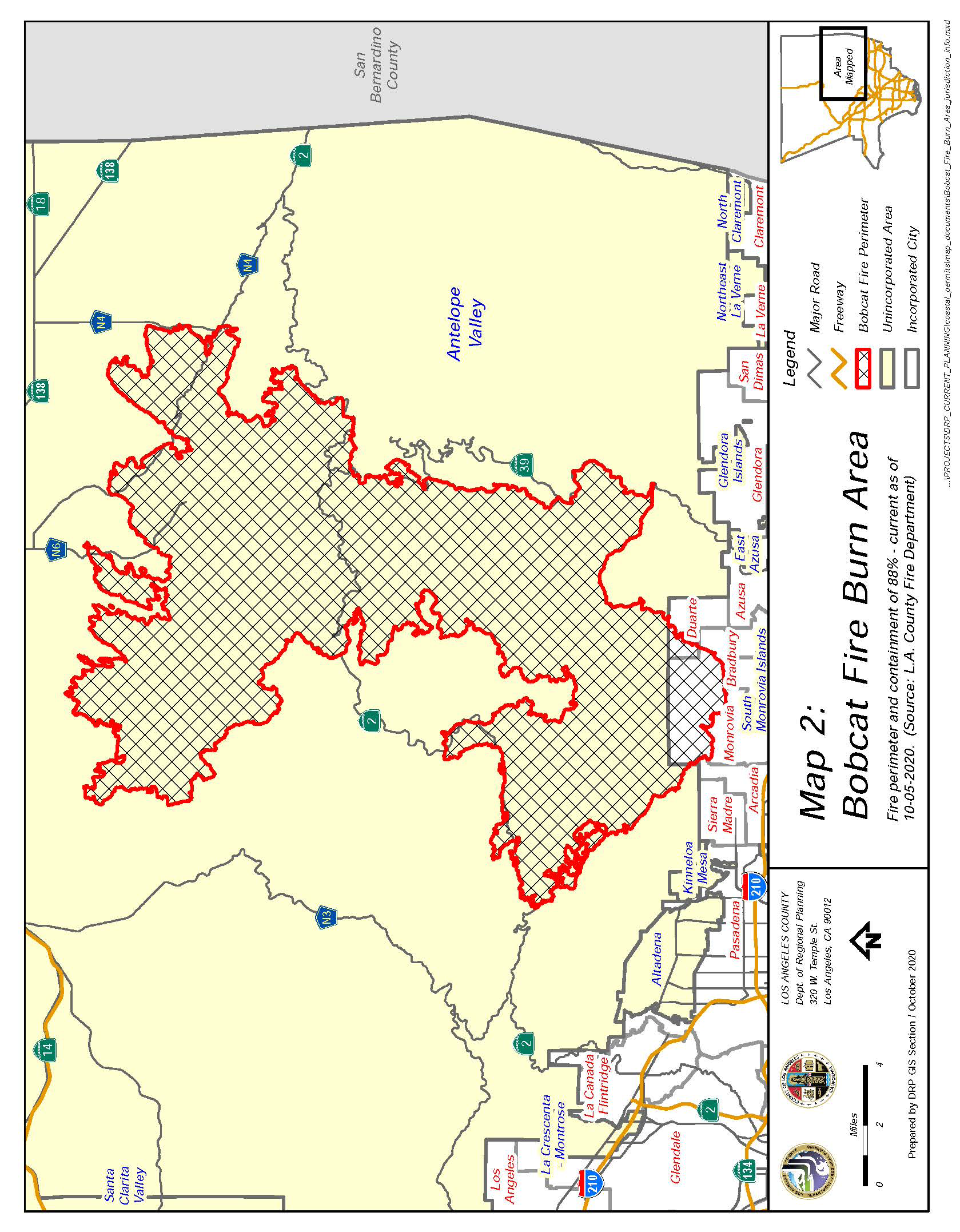
22.256.010 - Purpose.
This Chapter establishes procedures and regulations for temporary housing, like-for-like replacements, and accessory structures necessary, to prevent further damage or destruction to the lot or remaining structures, subsequent to a disaster.
(Ord. 2023-0025 § 7, 2023.)
22.256.020 - Definitions.
Specific terms used in this Chapter are defined in Division 2 (Definitions), under "Disaster Recovery."
(Ord. 2023-0025 § 7, 2023.)
22.256.030 - Implementation.
A.
Applicability.
1.
The Director may implement this Chapter following a disaster. Implementation shall require a written statement and shall include a map that identifies the area of applicability. The area of applicability shall be limited to within the boundary of the disaster. Such statement and map shall be kept on file with the Department, made available to the public, and provided to the Board.
2.
Following a disaster, where the Director has not implemented this Chapter in accordance with Section A.1, Chapter 22.258 (Temporary Housing After a Disaster) shall apply.
3.
This Chapter shall not apply in the Coastal Zone.
B.
Application Requirements, Permit Duration, and Extension.
1.
Notwithstanding any contrary provisions in this Title 22, a Ministerial Site Plan Review (Chapter 22.186) application is required for Section 22.256.040 (Temporary Housing), Section 22.256.050 (Like-For-Like Replacement of Structures), and Section 22.256.060 (Accessory Structures).
2.
Any application filed in accordance with this Chapter shall be filed within two years of a declaration of emergency being first declared.
3.
Any permit approved for temporary housing shall expire two years following a declaration of emergency being first declared.
4.
The Director may grant up to three one-year extensions of the time periods specified in Subsections B.2 and B.3, above, for a maximum cumulative duration of five years, if the Director determines that additional time is necessary because systemic delays beyond the control of the property owner have occurred affecting financing or construction.
(Ord. 2023-0025 § 7, 2023.)
22.256.040 - Temporary Housing.
Notwithstanding any contrary provisions in this Title 22, temporary housing shall be permitted, subject to the following standards:
A.
Temporary housing shall be limited to the following eligible dwelling units: a single-family residence, an accessory dwelling unit, a caretaker's residence, or a farmworker dwelling unit.
B.
The Director shall not accept an application for temporary housing, unless the applicant lived in the dwelling unit on the lot within 12 months of a declaration of emergency being first declared. The applicant shall substantiate their eligibility to file such an application by providing, to the satisfaction of the Director, a driver's license or other government-issued identification card, property tax bill, utility bill, or similar document.
C.
The Director shall not accept an application for temporary housing until, to the satisfaction of the County, the lot has been cleared of disaster-related debris, rubble, ash, hazardous waste, or other items that otherwise constitute a threat to the public health, safety, or general welfare.
D.
Temporary housing shall be limited to one unit per eligible dwelling unit. A maximum of two units of temporary housing may be placed on any lot.
E.
Temporary housing shall not exceed a maximum floor area of 1,500 square feet or the floor area of the eligible dwelling unit, whichever is smaller.
F.
One temporary storage structure, not to exceed 450 square feet and 10 feet in height, shall be permitted with each permitted unit of temporary housing.
G.
Temporary housing and temporary storage structures shall be located on any developed portion of the lot, including the building pad and all graded slopes, all structures, decks, patios, impervious surfaces, and parking areas.
H.
A minimum distance of six feet shall be required between temporary housing and any other structure on the same lot.
I.
Temporary housing shall contain sleeping, cooking, bathing, and sanitary facilities.
J.
Temporary housing shall be connected to a permanent source of potable water approved by the County.
K.
Temporary housing shall be connected to a wastewater disposal system approved by the County.
L.
Temporary housing shall be connected to an electrical source approved by the County.
M.
Except as otherwise authorized by this Section, temporary housing shall comply with all other applicable requirements of this Title 22.
N.
For the purposes of Section 22.140.670 (Occupied Recreational Vehicle Parking During a County Declared Shelter Crisis), temporary housing authorized pursuant to this Section shall not be considered a legally-established single-family residence.
O.
Temporary housing and temporary storage structures authorized pursuant to this Section shall be removed within 24 hours of the expiration date established in accordance with Section 22.256.030.B.
P.
Temporary housing and temporary storage structures authorized pursuant to this Section shall be removed within 30 days after the issuance of the certificate of occupancy for like-for-like replacement of an eligible dwelling unit, in accordance with Section 22.256.050.
(Ord. 2023-0025 § 7, 2023.)
22.256.050 - Like-For-Like Replacement.
Notwithstanding the existence of any covenants, conditions, or restrictions that may conflict, and notwithstanding any community standards district, specific plan, or any other applicable regulation in this Title 22, like-for-like replacement shall be permitted, subject to the following standards:
A.
Where modifications to any like-for-like replacement are required by Title 26 (Building Code) or Title 32 (Fire Code), as determined by Public Works or the Fire Department, such modifications shall be no greater than necessary to accommodate such modification, and in any case, such modification shall not exceed either the floor area, size, height, or bulk of the damaged or destroyed structure by more than 10 percent.
B.
The height of any like-for-like replacement shall not exceed the maximum height limit of this Title 22 or the damaged or destroyed structure, whichever is smaller.
C.
Any like-for-like replacement located within a required yard or setback shall not encroach further into any required yard requirement or setback.
D.
Any like-for-like replacement located within a significant ridgeline protection area shall not encroach further into the protected zone of the significant ridgeline.
E.
Minor relocation of any like-for-like replacement shall be approved by the Director when the like-for-like replacement is within the same general area of the damaged or destroyed structure and:
1.
There are changes in topography or alteration of drainage features, including, but not limited to, creeks, streams, and waterways, resulting from mudslides or other forms of debris flows caused by a disaster; or
2.
The structure damaged or destroyed by a disaster was nonconforming due to standards, and a minor relocation of the like-for-like-replacement will result in compliance with current Title 22 standards; or
3.
The minor relocation of the like-for-like replacement will result in equal to or fewer impacts to protected oak trees, significant ridgelines, SEAs, or SEA Resources.
F.
Where a use entitlement, which established the use for the structure damaged or destroyed by a disaster, remains valid and in full force and effect, the like-for-like replacement shall comply with all previous conditions of approval.
G.
This Section shall not be construed to extend any termination date set forth in Chapter 22.172 (Nonconforming Uses, Buildings, and Structures).
H.
After structures are rebuilt in accordance with this Section, all future development on the lot shall be subject to all applicable requirements of this Title 22.
(Ord. 2026-0024U § 1, 2026; Ord. 2025-0043U § 1, 2025; Ord. 2025-0034U § 1, 2025; Ord. 2023-0025 § 7, 2023.)
22.256.060 - Accessory Structures.
Accessory structures that are necessary to prevent damage to temporary housing or like-for-like replacements, or to prevent further damage to the lot or to remaining structures shall be permitted. Accessory structures, such as fences, retaining walls, utilities, or poles for temporary power, shall comply with all applicable standards of Title 22.
(Ord. 2023-0025 § 7, 2023.)
22.256.070 - Waiver of Certain Permit Requirements.
A.
Oak Tree Permits. Temporary housing, like-for-like replacements, accessory structures, and related development activities eligible under this Chapter are not subject to Chapter 22.174 (Oak Tree Permits), subject to and except for the following:
1.
Waiver of applicability of Chapter 22.174 (Oak Tree Permits) applies only to oak trees where a legally-established structure was located within the protected zone of a protected oak tree on the day the structure was damaged or destroyed by a disaster.
2.
Temporary housing, like-for-like replacement, accessory structures, and related development activities shall not result in the encroachment into the protected zone of a protected oak tree not otherwise described in Subsection A.1.
3.
Temporary housing, like-for-like replacement, accessory structures, and related development activities shall not result in the removal of any protected oak tree.
4.
Protected oak trees within 200 feet of proposed construction, grading, landfill, or other development activity shall be fenced and protected during site activities to the satisfaction of the Director and in accordance with the following:
a.
For protected oak trees that have retained their canopy after a disaster, the protected zone is established according to whichever has the greatest area:
i.
The area within the dripline of a protected oak tree extending therefrom to a point at least five feet outside of the dripline; or
ii.
The area within 15 feet from the trunk of a protected oak tree.
b.
For protected oak trees that have lost all their canopy due to the disaster, the County shall presume that such trees are alive for at least two years following the disaster. For such trees, the protected zone is established as the area within the radius extending 18 inches per one inch of trunk diameter. Trunk diameter shall be measured four and one-half feet above the natural grade.
c.
For protected oak trees that have lost part of their canopy due to the disaster, the County shall presume that such trees are alive for at least two years following the disaster. For such trees, the protected zone is established according to the following:
i.
Where the canopy remains, as measured by Subsection A.4.a, above; and
ii.
Where the canopy has been lost, as measured in accordance with Subsection A.4.b, above.
d.
Chain link fencing not less than four feet in height shall be installed around the protected zone of protected oak trees in order to restrict storage, machinery storage, and access during rebuilding activities. Said fencing shall be in place prior to commencement of any development activity on the lot. Said fencing shall remain in place throughout the entire period of development and shall not be removed until development activities have concluded.
e.
Any excavation or grading allowed within the protected zone of a protected oak tree shall be limited to hand tools or small hand-power equipment; and
f.
Utility trenching shall avoid encroaching into the protected zone of a protected oak tree on its path to and from any structure.
5.
Removal of any protected oak tree damaged by a disaster is prohibited for two years following the disaster, unless such tree poses a danger to people or property as determined by the County Forester or unless an Oak Tree Permit (Chapter 22.174) is obtained. The Director shall reduce the two-year time period, to not less than one year, if the rainfall in the disaster area in the winter or spring following the disaster is greater than the average rainfall for such winter or spring, and the Department Biologist or County Forester determines that the protected oak tree is dead.
6.
Activities that damage, encroach, or remove protected oak trees not otherwise authorized by this Subsection A shall be subject to Chapter 22.174 (Oak Tree Permits), including, but not limited to, requiring a retroactive Oak Tree Permit and requirements to plant replacement oak trees at a ratio determined by the Review Authority.
B.
Significant Ecological Areas. Temporary housing, like-for-like replacement, accessory structures, and related development activities eligible under this Chapter are not subject to Chapter 22.102 (Significant Ecological Areas), subject to and except for the following:
1.
Waiver of applicability of Chapter 22.102 (Significant Ecological Areas) applies only to significant ecological areas and SEA Resources where a legally-stablished structure was located in a significant ecological area on the day the structure was damaged or destroyed by a disaster.
2.
Temporary housing, like-for-like replacements, accessory structures, and related development activities shall result in equal to or fewer impacts to the significant ecological area or SEA Resources.
3.
All priority biological resources shall be avoided and protected during development activities.
4.
Activities that impact the significant ecological area, by damaging or removing SEA resources not otherwise authorized by this Subsection B, shall be subject to Chapter 22.102 (Significant Ecological Areas), including, but not limited to, requiring a retroactive SEA review or permit.
C.
Grading. Temporary housing, like-for-like replacement, and accessory structures eligible under this Chapter are not subject to Chapter 22.158 (Conditional Use Permit) for grading and a haul route, subject to and except for the following:
1.
Waiver of applicability of any requirement in this Title 22 where a Conditional Use Permit (Chapter 22.158) is required for grading or haul route applies only to where a legally-stablished structure was damaged or destroyed by a disaster.
2.
The Director shall approve only the minimum amount of grading required to restore the lot to a pre-disaster state or prepare the lot for like-for-like replacement. For purposes of determining the minimum amount of grading, justification by the project soils engineer, geologist, or civil engineer may be required by the Director and may be subject to verification by Public Works, Building and Safety Division.
3.
Any such grading activities shall provide erosion control best management practices to the satisfaction of Public Works.
4.
Any requirement in this Title 22 that prohibits the commencement of grading operations during the rainy season (from October 15 through April 15) shall not apply.
(Ord. 2023-0025 § 7, 2023.)
22.258.010 - Intent and Purpose.
In January 2025, the Eaton Fire caused the damage or destruction of 6,921 structures in the unincorporated Altadena and Kinneloa Mesa communities. The regulations and standards herein will help facilitate disaster recovery, including reconstruction and permitting for properties that suffered irreparable damage or destruction, while protecting the public health, safety, and welfare of the residents and businesses within the declared disaster area.
(Ord. 2026-0024U § 1, 2026; Ord. 2025-0043U § 1, 2025; Ord. 2025-0034U § 1, 2025; Ord. 2023-0025 § 8, 2023.)
22.258.020 - Definitions.
The following definitions shall apply to this Chapter:
Like-for-like rebuild project. A development project on a property that was damaged or destroyed and consists entirely of like-for-like replacement structures. A like-for-like rebuild project may include new accessory dwelling unit(s) and/or new junior accessory dwelling unit(s), provided those new dwelling units comply with applicable Title 22 requirements in effect at the time the complete application was filed. A like—for—like rebuild project may also include new accessory structures in accordance with Section 22.258.030.A.
Like-for-like replacement structure. The rebuild, repair, or replacement of a legally-established structure that was damaged or destroyed and generally has the same or smaller floor area, size, and bulk, and generally covers the same footprint as the prior legally-established structure.
New structure. The construction of a new structure on a property that was damaged or destroyed.
Non-like-for-like rebuild project. A development project on a property that was damaged or destroyed and consists entirely of non-like-for-like replacement structures and/or new structures, or a mix of like-for-like replacement structures, non-like-for-like structures, and new structures. Non-like-for-like replacement structures and new structures shall comply with applicable Title 22 requirements in effect at the time the complete application was filed. The project shall also comply with applicable Title 22 requirements that apply to the entire project and/or the entire property at the time the complete application was filed, including, but not limited to, the requirements in Division 3 (Zones), Division 4 (Combining Zones and Supplemental Districts), Division 5 (Special Management Areas), Division 6 (Development Standards), Division 7 (Standards for Specific Uses), and Division 10 (Planning Area and Community Standards Districts).
Non-like-for-like replacement structure. The rebuild, repair, or replacement of a legally-established structure that is not a like-for-like replacement structure.
Standalone accessory dwelling unit. A new accessory dwelling unit on a property that was damaged or destroyed and does not have a primary dwelling unit. A standalone accessory dwelling unit shall comply with applicable Title 22 requirements in effect at the time the complete application was filed.
(Ord. 2026-0024U § 1, 2026; Ord. 2025-0043U § 1, 2025; Ord. 2025-0034U § 1, 2025; Ord. 2023-0025 § 8, 2023.)
22.258.030 - Development Standards.
Notwithstanding the existence of any covenants, conditions, or restrictions that may conflict, and notwithstanding any community standards district, specific plan, or any other applicable regulation in this Title 22, like-for-like replacement shall be permitted, subject to the following standards:
A.
Accessory Structures. Notwithstanding Section 22.256.060 (Accessory Structures), a like-for-like rebuild project or a non-like-for-like rebuild project may include any accessory structure, not just accessory structures that are necessary to prevent damage to like-for-like replacement structures, or to prevent further damage to the lot or to remaining structures. A new accessory structure that is part of a like-for-like rebuild project, or a non-like-for-like replacement accessory structure, or a new accessory structure that is part of a non-like-for-like rebuild project, such as fences, retaining walls, or utilities, shall comply with applicable Title 22 requirements in effect at the time the complete application was filed.
B.
Direct Pedestrian Access. Notwithstanding Section 22.140.520.F.3.b (Direct Pedestrian Access), a non-like-for-like rebuild project associated with a residential use on a lot where sidewalks are not present and the front property line does not directly adjoin a street may provide the direct pedestrian pathway to the primary building entrance through a vehicle driveway.
C.
Expansion. A like-for-like replacement structure associated with a residential use may exceed the damaged or destroyed structure's previous footprint and total gross floor area by 10 percent or 200 square feet, whichever is greater, provided it meets all setback requirements in Subsections D (Front Yard Setback) and F (Minor Relocation), below, and current Building Code, Fire Code, and Health and Safety Code requirements.
D.
Front Yard Setback.
1.
Notwithstanding Section 22.320.090.D.1.a (Zone Specific Development Standards, Zone R-1, Yard Requirements), the minimum front yard setback in Zone R-1 within the Altadena Community Standards District shall be 20 feet, unless the property is subject to Section 22.320.090.E.2, in which case the minimum front yard setback in the Front Yard Setback District shall apply.
2.
If a damaged or destroyed structure had a previous front yard setback greater than 20 feet, the like-for-like replacement structure may have a smaller front yard setback, provided it is at least 20 feet, and the like-for-like replacement structure otherwise complies with the setback requirements in Subsection F (Minor Relocation), below, and all applicable requirements for like-for-like replacement structures in Chapter 22.256 (Disaster Recovery).
3.
If a damaged or destroyed structure had a previous front yard setback less than 20 feet, the like-for-like replacement structure may have the same front yard setback or a front yard setback that is larger than the previous front yard setback but less than 20 feet, provided the like-for-like replacement structure otherwise complies with the setback requirements in Subsection F (Minor Relocation), below, and all applicable requirements for like-for-like replacement structures in Chapter 22.256 (Disaster Recovery).
E.
Height. Notwithstanding Section 22.256.050.B (Like-for-Like Replacement), the maximum height of any like-for-like replacement structure shall be the height of the damaged or destroyed structure or the maximum height limit of this Title 22, whichever is greater, provided that the number of stories does not increase.
F.
Minor Relocation. Notwithstanding Section 22.256.050.E (Like-for-Like Replacements), minor relocation of a like-for-like replacement structure, including a like-for-like replacement accessory structure, shall be allowed. The like-for-like replacement structure may have setbacks that are larger than the damaged or destroyed structure's setbacks, so long as 50 percent of the original footprint is maintained and provided the like-for-like replacement structure otherwise complies with all applicable requirements for like-for-like replacement structures in this Section and in Chapter 22.256 (Disaster Recovery).
G.
Oak Tree Permits. Notwithstanding Section 22.256.070 (Waiver of Certain Permit Requirements), a like-for-like replacement structure or a non-like-for-like replacement structure shall not be subject to Chapter 22.174 (Oak Tree Permits), if the replacement structure results in equal to or fewer impacts to the protected zone of a protected oak tree than the damaged or destroyed structure.
H.
Parking. Required parking for like-for-like rebuild projects and non-like-for-like rebuild projects associated with a residential use shall be as follows:
1.
Notwithstanding Section 22.112.070 (Required Parking Spaces), parking for a non-like-for-like rebuild project may be uncovered;
2.
Notwithstanding Section 22.256.050.E (Like-for-Like Replacements), parking for a like-for-like rebuild project may be uncovered; and
3.
If an accessory dwelling unit fully or partially overlaps with the footprint of a damaged or destroyed covered parking structure, no replacement parking is required.
I.
Standalone Accessory Dwelling Units. A household may temporarily occupy a standalone accessory dwelling unit while they wait for a like-for-like rebuild project or a non-like-for-like rebuild project to be constructed on the property until January 7, 2030, which is five years after the Board of Supervisors proclaimed the existence of a local emergency for the January 2025 Windstorm and Critical Fire Events.
J.
Yard Measurement. Required front, side, and rear yards shall be measured from the property boundary, unless such boundary is located within a public or private street or right-of-way providing access to one or more lots, in which case required yard areas shall be measured from the edge of the street or right-of-way closest to the interior of the lot.
(Ord. 2026-0024U § 1, 2026; Ord. 2025-0043U § 1, 2025; Ord. 2025-0034U § 1, 2025.)
22.258.040 - Temporary Uses.
A.
Purpose. This Section allows the Director to approve applications for the following temporary uses with a Zoning Conformance Review, which is a ministerial Type I Review, pursuant to Chapter 22.226 (Type I Review - Ministerial), for an initial period of up to one year with one-year extensions up to one year each, subject to the requirements and limitations set forth herein:
1.
Pop-up events, pop-up restaurants and other eating establishments, and pop-up retail and commercial uses in parking lots and vacant lots that have been cleared of debris in Commercial and Industrial Zones. The use shall not be an adult business, as defined in Section 22.14.010, and may include alcoholic beverages sales for on-site and/or off-site consumption, if authorized by a valid California Department of Alcoholic Beverage Control license, and the outdoor display of any goods, equipment, merchandise, or exhibits. The use shall be sponsored by one of the following:
a.
A public agency, a nonprofit, or a religious, fraternal, educational, or service organization directly engaged in civic, charitable, or public service endeavors;
b.
A business currently operating in the area impacted by the Eaton Fire. The use can be on a parking lot on the same property where the business is located or on a parking lot or a vacant lot on a different property than where the business is located; and
c.
A business that operated in the area impacted by the Eaton Fire within the 12 months prior to January 7, 2025. The use can be on a parking lot or a vacant lot on the same property where the business previously operated, or on a parking lot or a vacant lot on a different property than where the business was located.
2.
Temporary uses necessary to facilitate rebuilding and disaster recovery, as determined by the Director, such as sawmills and construction equipment, machinery, and/or materials storage, on a property owned by a public agency or a public utility.
B.
Decision. When making a decision on the application in accordance with Section 22.226.040 (Decision), the Director may consider whether:
1.
Adequate parking, including bicycle facilities, will be available in the vicinity of the use;
2.
The proposed site is adequate in size and shape to accommodate the use without material detriment to the use and enjoyment of the property of other persons located in the vicinity of the site;
3.
The use will jeopardize, endanger, or otherwise constitute a menace to public health, safety, or general welfare;
4.
If the use is a pop-up event, a pop-up restaurant or other eating establishment, and/or a pop-up retail and commercial use, whether the sponsor has a history of noncompliance with this Title 22, or other applicable federal, State, or local codes, laws, rules, regulations, and statutes, including those of the California Department of Alcoholic Beverage Control; and
5.
If the use is a temporary use necessary to facilitate rebuilding and disaster recovery, as determined by the Director, whether the use can operate without negative impacts on residential uses within a 300-foot radius of the property.
C.
Development and/or Performance Standards. If the Director approves the application, the Director may apply development and/or performance standards to the use, including, but not limited to, those in Sections 22.188.040.A (Short-Term Special Events Permit) and 22.140.030.I (Performance Standards for Deemed-Approved Uses), and those in a valid conditional use permit authorizing alcoholic beverages sales for on-site and/or off-site consumption that is associated with the business sponsoring the use.
D.
Inspections. If the Director approves the application, the Director may require inspections to be conducted to determine the permittee's compliance with the applicable development and/or performance standards included in the approval.
E.
Revocation. The Director may revoke an approval at any time, if the temporary use does not comply with the applicable development and/or performance standards included in the temporary approval, this Title 22, or other applicable federal, State, or local codes, laws, rules, regulations, and statutes, including those of the California Department of Alcoholic Beverage Control. The Director's decision shall be final and not subject to an appeal.
(Ord. 2026-0024U § 1, 2026; Ord. 2025-0043U § 1, 2025; Ord. 2025-0034U § 1, 2025.)
22.258.050 - Disaster Recovery Permit.
The Disaster Recovery Permit is established to allow disaster rebuild projects, which can be a like-for-like rebuild project, a non-like-for-like rebuild project, or a standalone accessory dwelling unit.
A.
Like-for-Like Rebuild Project.
1.
Applicability. This Subsection A applies to an application for a like-for-like rebuild project.
2.
Application and Review Procedures.
a.
Application Checklist. The application submittal shall contain all of the applicable materials required by the Disaster Recovery Permit Checklist.
b.
Type I Review. The application shall be filed and processed in compliance with Chapter 22.226 (Type I Review - Ministerial) with the following modifications:
i.
Section 22.226.030.A shall not apply because only one application shall be required;
ii.
Notwithstanding Section 22.226.030.C, the fee is established in Section 22.258.060 (Fees); and
iii.
Notwithstanding Section 22.226.080 (Expiration Date and Extension for Unused Permits and Reviews), an approved application shall be used by January 7, 2030, which is five years after the Board of Supervisors proclaimed the existence of a local emergency for the January 2025 Windstorm and Critical Fire Events. If an application requesting an extension is timely filed prior to such expiration date, the Director may, one time, extend the time limit for a period not to exceed one year.
B.
Non-Like-for-Like Rebuild Project, Ministerial Review.
1.
Applicability. This Subsection B applies to an application for a non-like-for-like rebuild project or a standalone accessory dwelling unit. The application shall be used for any of the following projects without a separate application, provided the Disaster Recovery Permit complies with the applicable provisions of this Title 22:
a.
A project that requires an administrative housing permit, in which case the application shall be reviewed in accordance with the applicable provisions of Chapter 22.166 (Housing Permits);
b.
A project that requires an Oak Tree Permit without a public hearing, pursuant to Section 22.174.040.D (Application Without a Public Hearing), in which case the application shall be reviewed in accordance with the applicable provisions of Chapter 22.174 (Oak Tree Permits); and
c.
A project that requires a ministerial Significant Ecological Area review, pursuant to Section 22.102.060 (Ministerial SEA Review), in which case the application shall be reviewed in accordance with the applicable provisions of Chapter 22.102 (Significant Ecological Areas).
2.
Application and Review Procedures.
a.
Application Checklist. The application submittal shall contain all of the applicable materials required by the Disaster Recovery Permit Checklist.
b.
Type I Review. The application shall be filed and processed in compliance with Chapter 22.226 (Type I Review - Ministerial) with the following modifications:
i.
Section 22.226.030.A shall not apply because only one application shall be required;
ii.
Notwithstanding Section 22.226.030.C, the fee is established in Section 22.258.060 (Fees); and
iii.
Notwithstanding Section 22.226.080 (Expiration Date and Extension for Unused Permits and Reviews), an approved application shall be used by January 7, 2030, which is five years after the Board of Supervisors proclaimed the existence of a local emergency for the January 2025 Windstorm and Critical Fire Events. If an application requesting an extension is timely filed prior to such expiration date, the Director may, one time, extend the time limit for a period not to exceed one year.
C.
Non-Like-for-Like Rebuild Project, Discretionary Review.
1.
Applicability. This Subsection C applies to an application for a non-like-for-like rebuild project that requires discretionary review, pursuant to this Title 22. When the non-like-for-like rebuild project requires applications for an animal permit, conditional use permit, conditional use permit, minor, oak tree permit with a public hearing, protected tree permit, variance, parking deviation, minor, discretionary housing permit, and/or a parking permit, separate applications shall not be required provided that the Disaster Recovery Permit complies with the applicable corresponding provisions of these permits in this Title 22.
2.
Procedure A.
a.
Applicability.
i.
Procedure A shall apply to the following applications:
(1)
An application that would otherwise require a parking deviation, minor;
(2)
An application that would otherwise require a yard modification;
(3)
An application that includes modifications to development standards in Chapter 22.110 (General Site Regulations);
(4)
An application that includes modifications to the development standards in Section 22.140.520 (Residential Design Standards);
(5)
An application that includes modifications to the development standards in Section 22.140.580 (Single-Family Residences);
(6)
An application that includes modifications to the development standards in Section 22.320.070.A (West San Gabriel Valley Planning Area Standards District Zone-Specific Development Standards for Commercial and Mixed Use Zones);
(7)
An application that includes modifications to the development standards in Section 22.320.090 (Altadena Community Standards District); and
(8)
An application that includes modifications to front yard setbacks in Chapter 22.72 (Setback Districts).
ii.
Procedure A shall not be used to modify development standards that would conflict with any legal covenants, conditions, and restrictions for the property.
b.
Review Authority. The Review Authority shall be the Zoning Administrator, as referenced in California Government Code section 65900. The Director, as defined in Section 22.14.040 - D, shall serve as the Zoning Administrator, in accordance with the powers and duties provided in Section 22.220.050 (Director of Regional Planning).
c.
Application and Review Procedures.
i.
Application Checklist. The application submittal shall contain all of the materials required by the Disaster Recovery Permit Checklist.
ii.
Review Procedures.
(1)
Application filing and withdrawal shall be in compliance with Section 22.222.070 (Application Filing and Withdrawal).
(2)
The fee is established in Section 22.258.060 (Fees), although other applicable fees in Chapter 22.250 (Applications, Petitions, and Fees), including, but not limited to, fees for appeals, e-recordation, environmental assessments, inspections, and rehearings, shall be required.
(3)
Initial application review shall be in compliance with Section 22.222.090 (Initial Application Review).
iii.
Noticing. Prior to taking action, the Director shall provide notice of application in compliance with Section 22.222.130 (Notice of Application), except where modified herein:
(1)
Notice Content. The notice shall also indicate that any individual may oppose the granting of the application by a written protest to the Director;
(2)
Comment Period. The Director shall allow a minimum comment period of 15 days after the notice has been sent and digitally posted. The end of the comment period shall be stated on the notice; and
(3)
Mailing. Notices shall be mailed or delivered in accordance with Section 22.222.150 (Mailing). Notwithstanding Section 22.222.160.A (Notification Radius), the notices shall only be sent to owners of properties adjoining the exterior boundaries of the subject property, and if applicable, owners of properties across a street or alleyway from the exterior boundaries of the subject property noted on the application, as shown on the County's last equalized assessment roll. Notices shall also be:
(a)
Emailed to any available email addresses on file within the unincorporated Altadena or Kinneloa Mesa communities that, in the Director's judgment, may be affected by or be interested in such application;
(b)
Sent to any known active community-based group on file within the unincorporated Altadena or Kinneloa Mesa communities that, in the Director's judgment, may be affected by or be interested in such application; and
(c)
Posted on the following County websites: Planning.lacounty.gov and Recovery.lacounty.gov.
iv.
Findings and Decision.
(1)
Findings and decision shall be made in compliance with Section 22.222.200 (Findings and Decision), and notwithstanding anything to the contrary in this Title 22, include the findings in Section 22.160.050.B (Findings) for conditional use permits, minor, and any additional findings required by Title 22 for corresponding applications, pursuant to Subsection C.2.a.1 of this Section.
(2)
Findings for modifications to front yard setbacks within a Setback District shall be made in compliance with Section 22.320.090.F.4.a.
v.
Notice of Action. The Director shall issue and mail a notice of action in compliance with Section 22.222.220 (Notice of Action), except that, in accordance with Section 22.222.220.B (Delivery), notices shall also be:
(1)
Emailed to any available email addresses on file within the unincorporated Altadena or Kinneloa Mesa communities that, in the Director's judgment, may be affected by or be interested in such application.
(2)
Sent to any known active community-based group on file within the unincorporated Altadena or Kinneloa Mesa communities that, in the Director's judgment, may be affected by or be interested in such application.
(3)
Posted on the following County websites: Planning.lacounty.gov and Recovery.lacounty.gov.
vi.
Effective Date of Decision and Appeals.
(1)
The effective date of decision and appeals shall be in compliance with Section 22.222.230 (Effective Date of Decision and Appeals).
(2)
Notwithstanding Section 22.222.230 (Effective Date of Decisions and Appeals), the decision of the Director shall become final, unless an appeal is timely filed pursuant to Chapter 22.240 (Appeals).
(3)
The decision on an appeal shall be made by a Hearing Officer, and the decision shall be final and effective on the date of decision.
vii.
Post-Decision Actions and Regulations.
(1)
Documentation, scope of approval, and Exhibit "A" shall be in compliance with Section 22.222.240 (Documentation, Scope of Approval, and Exhibit "A").
(2)
Use of property before final action shall be in compliance with Section 22.222.250 (Use of Property Before Final Action).
(3)
Performance guarantee and covenant shall be in compliance with Section 22.222.260 (Performance Guarantee and Covenant).
(4)
Expiration date and extension for unused permits and reviews shall be in compliance with Section 22.222.270 (Expiration Date and Extension for Unused Permits and Reviews).
(5)
Cessation of use shall be in compliance with Section 22.222.280 (Cessation of Use).
3.
Procedure B.
a.
Applicability. Procedure B shall apply to applications that would otherwise require an animal permit, a conditional use permit, minor, an oak tree permit with a public hearing, and/or a protected tree permit.
b.
Application and Review Procedures.
i.
Application Checklist. The application submittal shall contain all of the materials required by the Disaster Recovery Permit Checklist.
ii.
Type II Review. The application shall be filed and processed in compliance with Chapter 22.228 (Type II Review - Discretionary) with the following modifications:
(1)
Section 22.228.030.A shall not apply because only one application shall be required.
(2)
Notwithstanding Section 22.228.030.C, the fee is established in Section 22.258.060 (Fees), although other applicable fees in Chapter 22.250 (Applications, Petitions, and Fees), including, but not limited to, fees for appeals, County biologist review, e-recordation, environmental assessments, inspections, and rehearings, shall be required.
4.
Procedure C.
a.
Applicability. Procedure C shall apply to applications that would otherwise require a conditional use permit, a discretionary housing permit, a parking permit, and/or a variance.
b.
Application and Review Procedures.
i.
Application Checklist. The application submittal shall contain all of the materials required by the Disaster Recovery Permit Checklist.
ii.
The application shall be filed and processed in compliance with Chapter 22.230 (Type III Review - Discretionary) with the following modifications:
(1)
Section 22.230.030.A shall not apply because only one application shall be required; and
(2)
Notwithstanding Section 22.230.030.C, the fee is established in Section 22.258.060 (Fees), although other applicable fees in Chapter 22.250 (Applications, Petitions, and Fees), including, but not limited to, fees for appeals, County biologist review, e-recordation, environmental assessments, inspections, and rehearings, shall be required.
D.
Non-Like-for-Like Rebuild Project, Discretionary Review, Time Extension.
1.
Applicability. This Subsection D applies to an application requesting an extension of the time limit to use an approved Disaster Recovery Permit that was subject to discretionary review, as specified in the conditions of approval.
2.
Application and Review Procedures.
a.
If an application requesting an extension is timely filed prior to such expiration date, the Hearing Officer may, one time, extend the time limit for a period not to exceed one year.
b.
The fee is established in Section 22.258.060 (Fees).
E.
Rebuild Project, Amendment.
1.
Applicability. This Subsection E applies to an application requesting amendments to any approved Disaster Recovery Permit.
2.
Application and Review Procedures.
a.
Application Checklist. The application submittal shall contain all of the applicable materials required by the Disaster Recovery Permit Checklist.
b.
Type I Review. The application shall be filed and processed in compliance with Chapter 22.226 (Type I Review - Ministerial) with the following modifications:
i.
Section 22.226.030.A shall not apply because only one application shall be required;
ii.
Notwithstanding Section 22.226.030.C, the fee is established in Section 22.258.060 (Fees); and
iii.
Notwithstanding Section 22.226.080 (Expiration Date and Extension for Unused Permits and Reviews), an approved application that amends a Disaster Recovery Permit that was subject to ministerial review shall be used by January 7, 2030, which is five years after the Board of Supervisors proclaimed the existence of a local emergency for the January 2025 Windstorm and Critical Fire Events. If an application requesting an extension is timely filed prior to such expiration date, the Director may, one time, extend the time limit for a period not to exceed one year. If an approved application amends a Disaster Recovery Permit that was subject to discretionary review, it shall be used within the timeframe specified in the conditions of approval.
c.
Criteria for Amendment. If the Disaster Recovery Permit was subject to discretionary review, the Director may approve the amendments, if they meet the criteria below. If they do not meet the criteria below, an application for a new Disaster Recovery Permit shall be required:
i.
Are consistent with the scope of the project and the findings made in the original approval;
ii.
Comply with all existing conditions of approval; and
iii.
Comply with the standards and regulations of the zone, unless specifically modified by the conditions of approval.
(Ord. 2026-0024U § 1, 2026; Ord. 2025-0043U § 1, 2025; Ord. 2025-0034U § 1, 2025.)
22.258.060 - Fees.
A.
For the purpose of defraying the expense involved with any application or petition required or authorized by Section 22.258.050 (Disaster Recovery Permit), the following fees, as provided in Table 22.258.060-A, below, shall accompany the application or petition. Table 22.258.060-A may be referred to as the Disaster Recovery Permit Filing Fee Schedule.
B.
Annual Fee Review. The fees in this Section shall be reviewed annually by the Auditor-Controller. Beginning on January 1, 2026, and thereafter on each succeeding January 1, the amount of each fee in this Section shall be adjusted as follows: calculate the percentage movement in the consumer price index for Los Angeles during the preceding January through December period, adjust each fee by said percentage amount and round off to the nearest dollar. However, no adjustment shall decrease any fee, and no fee shall exceed the reasonable cost of providing services.
(Ord. 2026-0024U § 1, 2026; Ord. 2025-0043U § 1, 2025; Ord. 2025-0034U § 1, 2025.)
22.258.070 - Area of Applicability.
This Chapter applies to parcels located in the unincorporated areas affected by the Eaton Fire, as identified on the Eaton Fire Burn Area map, below.
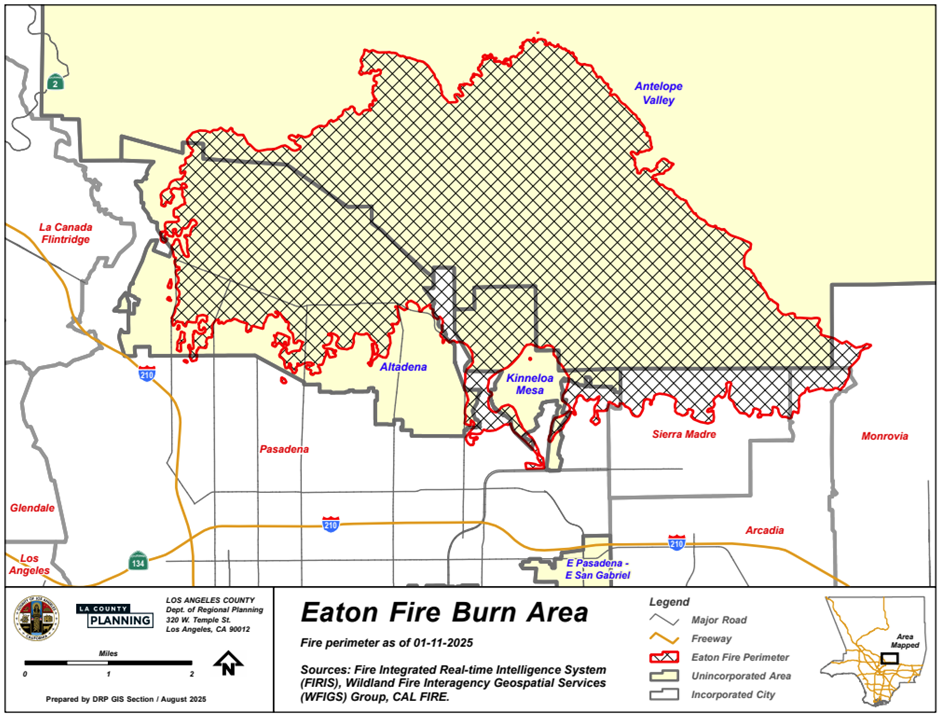
(Ord. 2026-0024U § 1, 2026; Ord. 2025-0043U § 1, 2025; Ord. 2025-0034U § 1, 2025.)
22.260.010 - Purpose.
A.
This Chapter implements, in part, the County General Plan, which provides guidelines for future development in areas depicted within urban expansion or nonurban categories on the General Development Policy Map.
B.
The General Plan recommends a development qualification procedure, in part, to ensure that proposed new projects in areas designated in the General Plan as urban expansion or nonurban will not create substantial net costs on County government, special districts, and existing taxpayers.
C.
This Chapter is intended to establish procedures for the implementation of the General Plan by providing for the designation of lands which will receive special benefits from the acquisition, construction, and improvement of certain public facilities set forth in this Chapter, and the imposition of special assessments on land related to benefits received.
(Ord. 2022-0008 § 142, 2022.)
22.260.020 - Areas of Benefit Authorized.
In order that the burden of the cost of constructing public facilities may be borne by all of the lands benefited thereby, areas of benefit may be designated and facilities benefits assessments, as defined in Section 22.260.030 (Definitions), chargeable to and against such lands may be imposed in accordance with procedures set forth in this Chapter.
(Ord. 2022-0008 § 142, 2022.)
22.260.030 - Definitions.
Specific terms used in this Chapter are defined in Section 22.14.160(P) of Division 2 (Definitions), under "Procedural Ordinance for Financing of Public Facilities."
(Ord. 2022-0008 § 142, 2022.)
22.260.040 - Initiation of Proceedings.
Upon the receipt of an application by a landowner or his designated agent, or on its own motion, the Board may initiate proceedings for the designation of an area of benefit by adopting a resolution stating its intention to do so. The Board shall refer the proposed public facilities project to the Director of Public Works and shall instruct the Director of Public Works, with the assistance of the Director of Regional Planning and, where appropriate, interested landowners, to make and file with the Board a written report. The report shall contain:
A.
One or both of the following:
1.
An implementation program for future development; or
2.
A financing plan with respect to the proposed public facilities project.
B.
General description of the proposed public facilities project.
C.
An estimate of the total cost of the public facilities project based on the projected time for commencement and completion thereof in accordance with the capital improvement program.
D.
A capital improvement program establishing a schedule for the timing of construction of the public facilities project and the estimated cost for the project.
E.
A map showing the area of benefit to be designated and the boundaries and dimensions of the subdivision of land within the area of benefit.
F.
Preliminary information concerning the method pursuant to which the costs are proposed to be apportioned among the lots within the area of benefit in proportion to the estimated benefits to be received by those lots and a preliminary estimate of the amount of the facilities benefit assessments which will be charged to each such lots.
G.
The amount of the contribution or advance, if any, which the County or other public entity will make toward the total cost of the public facilities project.
(Ord. 2022-0008 § 142, 2022.)
22.260.050 - Resolution of Intention.
Upon receipt of the report described in Section 22.260.040 (Initiation of Proceedings), the Board may declare its intention to designate an area of benefit by adopting a resolution of intention which shall include the following:
A.
A definitive description of the specific public facilities project, the cost of which is proposed to be charged to the properties located within the area of benefit.
B.
A capital improvement program with respect to the public facilities project.
C.
The proposed boundaries of the area of benefit.
D.
Information concerning the method by which the costs are proposed to be apportioned among the lots within the area of benefit and an estimate of the amount of the facilities benefit assessments which will be charged to each such lot.
E.
The basis and methodology by which automatic annual increases in the facilities benefit assessment will be computed, assessed, and levied, without the necessity for further proceeding pursuant to Section 22.260.130 (Annual Adjustment of Facilities Benefit Assessment), if, in the discretion of the Board such automatic annual increases are determined to be necessary.
F.
The amount of the contribution or advance, if any, which the County or other public entity will make toward the total cost.
G.
The time and place at which the Board will hold a public hearing to consider designation of the area of benefit.
(Ord. 2022-0008 § 142, 2022.)
22.260.060 - Notice of Hearing.
Notice of the public hearing shall be provided by publishing the Resolution of Intention in a newspaper of general circulation at least 14 days before the date set for the public hearing and by mailing copies of the Resolution of Intention to the owners of the affected properties located within the proposed area of benefit at the addresses shown on the latest equalized assessment roll, or as otherwise known to the Assessor, or by any other means which the Board finds reasonably calculated to appraise affected landowners of the public hearing.
(Ord. 2022-0008 § 142, 2022.)
22.260.070 - Protests.
At any time not later than the close of the public hearing, any owner of property within the proposed area of benefit may file a written protest against the public facilities project proposed to be undertaken, the extent of the area to be benefited by it, the facilities benefit assessments proposed to be levied within the area of benefit, or any or all of the foregoing. The protest shall be in writing, signed by the protester, and shall contain a description of the property in which the signer is interested. The description shall be sufficient to clearly identify the property. If the signer is not shown on the last equalized assessment roll as the owner of that property, the protest shall contain or be accompanied by written evidence that the signer is the owner of the property. All such protests shall be delivered to the Board and no other protests or objections shall be considered. Any protests may be withdrawn by the owners requesting the same, in writing, at any time prior to the conclusion of the public hearing.
(Ord. 2022-0008 § 142, 2022.)
22.260.080 - Hearing.
At the time and place established in the resolution of intention, the Board shall hear and consider protests filed against the proposed public facilities project, the extent of the area of benefit, the amount of the facilities benefit assessments proposed to be levied within the area of benefit, or any or all of the foregoing. The public hearing may be continued from time to time. A majority protest is established when timely written protests have been filed by the owners of more than one-half of the area of the property proposed to be included within the area of benefit. If sufficient protests are not withdrawn, so as to reduce the area represented to less than one-half, then the proposed proceedings shall be abandoned unless the protests are overruled by an affirmative vote of four-fifths of the members of the Board. The Board shall not overrule a majority protest unless it finds that the public health, safety, or general welfare require that provision be made for the installation of the proposed public facilities project. In the event a majority protest is not withdrawn or overruled, the Board shall not, for one year from the filing of that written protest, commence, or carry on any proceedings for the same public facilities project under the provisions of this Chapter. If any majority protest, which is not withdrawn or overruled, is directed against only a portion of the public facilities project, then all further proceedings under the provisions of this Chapter to construct that portion of the public facilities project shall be barred for a period of one year; but the Board shall not be barred from commencing new proceedings for any part of the public facilities project which has not been barred.
(Ord. 2022-0008 § 142, 2022.)
22.260.090 - Resolution of Designation.
At the conclusion of the public hearing, and provided there is no majority protest or a majority protest is overruled, the Board may adopt a resolution ordering designation of the area of benefit and the establishment of the amount of the facilities benefit assessment against each lot within the area of benefit. The resolution shall include the following:
A.
A definitive description of the public facilities project, the cost of which is to be charged to the properties located within the area of benefit.
B.
A capital improvement program with respect to the public facilities project.
C.
The boundaries of the area of benefit.
D.
The method by which the costs are to be apportioned among the lots within the area of benefit and the amount of the facilities benefit assessments which will be charged to each such lot.
E.
The basis and methodology by which automatic annual increases in the facilities benefit assessment will be computed, assessed, and levied, without the necessity for further proceeding pursuant to Section 22.260.130 (Annual Adjustment of Facilities Benefit Assessment), if, in discretion of the Board, such automatic annual increases are determined to be necessary.
F.
The amount of the contribution or advance, if any, which the County or other public entity will make toward the total cost.
(Ord. 2022-0008 § 142, 2022.)
22.260.100 - Filing of Map and Recording of Notice of Assessment as Lien.
A.
After the adoption by the Board of a resolution of designation, the Director of Public Works shall prepare a map of the boundaries of the area of benefit based on said resolution and shall file same with the Board. The Director of Public Works shall also file a copy of the map referred to in this Section with the Registrar-Recorder/County Clerk.
B.
After recording the assessment and map, the Director of Public Works shall execute and record a notice of assessment with the Registrar-Recorder/County Clerk.
C.
From the date of the recording of the notice of assessment in accordance with the provisions of Subsection B, above, all persons shall be deemed to have notice of the contents of such assessment. Immediately upon such recording with the Registrar-Recorder/County Clerk each of the assessments shall be a lien upon the property against which it is made.
D.
In its discretion, and for good cause shown, the Board may, upon terms and conditions prescribed by the Board in its resolution or thereafter, allow the lien of the facilities benefit assessment to become subordinate to the lien of deeds of trust executed by landowners to secure loans to finance the construction of improvements on the property within the area of benefit.
E.
The Director of Public Works shall file a copy of the map and notice of assessment referred to in this Section with the Assessor.
(Ord. 2022-0008 § 142, 2022.)
22.260.110 - Payment of Benefit Assessments.
After the adoption by the Board of its resolution, no building permits shall be issued for development on any land included within the area of benefit unless and until the facilities benefit assessments established by the resolution of designation for such lands have been paid. The facilities benefit assessment shall be paid by the landowner upon the issuance of building permits for development or at such time as the capital improvement program for the area of benefit in which the assessed land is located calls for the commencement of construction of the public facilities project. In the event that a landowner desires to proceed with development of a portion of the landowner's property, based on a phased development program, which is subject to a lien for the total amount of facilities benefit assessments as provided in this Chapter, the landowner may obtain building permits for the development phase after paying a portion of the facilities benefit assessments and making provision for payment of the remainder of the facilities benefit assessments to the satisfaction of the Director of Public Works. Money received by the County as payment of the facilities benefit assessments shall be deposited in a special fund established for the area of benefit and shall thereafter be expended solely for the purposes for which it was assessed and levied. Upon payment of the facilities benefit assessment as provided in this Chapter, the lien which attaches pursuant to Section 22.260.100 (Filing of Map and Recording of Notice of Assessment as Lien) shall be discharged. In the event partial payment is made based on a phased construction program, the County shall release the portion of the property for which building permits have been issued from the lien of the facilities benefit assessment.
(Ord. 2022-0008 § 142, 2022.)
22.260.120 - Recordation of Notice of Pendency of Sale or Foreclosure.
Where there is a delinquency in payment of the facilities benefit assessments as required by Section 22.260.110 (Payment of Benefit Assessments), the County may initiate foreclosure proceedings in accordance with the procedures set forth in this Chapter and in any and all applicable State and local laws. If a sale or foreclosure is commenced, notice of the pendency of such sale or foreclosure shall be recorded with the Registrar-Recorder/County Clerk not later than 10 days after commencing an action or proceeding in any court to foreclose the lien of such assessment. The notice of pendency shall state that the County has commenced a sale or foreclosure, as applicable, and shall refer to and identify such sale or foreclosure and shall describe the property affected thereby. The County shall be entitled to recover the cost of recordation of any such notice of pendency in any sale or foreclosure resulting from such delinquency, and provisions shall be made in any notice, order or judgment authorizing or providing for such sale or foreclosure.
(Ord. 2022-0008 § 142, 2022.)
22.260.130 - Annual Adjustment of Facilities Benefit Assessment.
The Board may, annually after the adoption of the resolution of designation and subject to the requirements set forth in Sections 22.260.040 (Initiation of Proceedings) through 22.260.100 (Filing of Map and Recording of Notice of Assessment as Lien) cause an adjustment to be made in the facilities benefit assessments established by the resolution. The adjustments may reflect increases or decreases in the actual cost of the public facilities project, or if the public facilities project has not yet been constructed, the estimated cost of the proposed capital improvements, which reflect changes in the scope of the public facilities project or any other indices as the Board may deem appropriate for this purpose. The modifications may also reflect changes in the improvements proposed to be constructed as well as the availability, or lack thereof of other funds with which to construct the capital improvements.
(Ord. 2022-0008 § 142, 2022.)
22.260.140 - Consideration in Lieu of Assessment.
A.
Notwithstanding any contrary provisions of Section 22.260.100 (Filing of Map and Recording of Notice of Assessment as Lien), upon application by the landowner or his authorized agent, the Board may accept consideration in lieu of the facilities benefit assessments required pursuant to this Chapter, provided the Board, upon recommendation of the Director of Public Works, finds that the substitute consideration proposed:
1.
Has a value equal to or greater than such facilities benefit assessments;
2.
Is in a form acceptable to the Board; and
3.
Is within the scope of the public facilities project.
B.
The Board may accept consideration in lieu of the facilities benefit assessments required pursuant to this Chapter where the Board finds that the substitute consideration proposed is less than the value of such facilities benefit assessment after payment of an amount equal to the difference between the value of the substitute consideration as determined by the Board and the amount of such facilities benefit assessments.
(Ord. 2022-0008 § 142, 2022.)
22.260.150 - Termination of Area of Benefit.
Upon the receipt of an application by a landowner or his designated agent, or on its own motion, the Board may initiate proceedings for the termination of an area of benefit by adopting a resolution stating its intention. The resolution of intention shall state the time and place at which the Board will hold a public hearing to consider such termination. If, at the conclusion of such hearing, the Board finds and determines that the public facilities project for which the area was originally formed will not be required in the reasonably foreseeable future, or that the installation of said public facilities project may be financed more effectively by another method, the Board may adopt a resolution declaring the area of benefit terminated.
(Ord. 2022-0008 § 142, 2022.)
22.260.160 - Reimbursement and Refund.
A.
In the event of an annual adjustment of assessment as provided by Section 22.260.130 (Annual Adjustment of Facilities Benefit Assessment), which reduces the facilities benefit assessment, amounts in the special fund which are no longer required shall be refundable to the current owners of the property as shown on the last equalized assessment roll in proportion to the amount of the original payments.
B.
In the event the Board agrees to accept consideration in lieu of facilities benefit assessments, as provided by Section 22.260.140 (Consideration in Lieu of Assessment), the Board may enter into an agreement with a developer pursuant to which said developer may be reimbursed for the amount of the otherwise applicable facilities benefit assessments. The agreement shall set forth the amount to be reimbursed, and the time and manner in which payments shall be made only from revenues paid into the special fund created for the area of benefit.
C.
Upon termination of an area of benefit as provided by Section 22.260.150 (Termination of Area of Benefit), any money remaining in the special fund established in connection therewith shall be refunded to the current owners of the property as shown on the last equalized assessment roll in proportion to the amount of the original payments.
(Ord. 2022-0008 § 142, 2022.)
22.260.170 - Alternative Method.
This Chapter is intended to establish an alternative method for spreading the costs of certain public improvements against the lands which will be benefited thereby; and the provisions of this Chapter shall not be construed to limit the power of the Board to utilize any other method for accomplishing this purpose but shall be in addition to any other requirements which the Board is authorized to impose as a condition to approving new development pursuant to State and local laws.
(Ord. 2022-0008 § 142, 2022.)
22.262.010 - Definitions.
Specific terms used in this Chapter are defined in Section 22.14.130(M) of Division 2 (Definitions), under "Major Project Review Trust Funds."
(Ord. 2022-0008 § 143, 2022.)
22.262.020 - Creation of the Funds.
A.
There are hereby authorized within the treasury of the County special trust funds to be known as the "Major Projects Review Trust Funds."
B.
Each fund shall be used to provide additional human and physical resources to the County solely to process discretionary land use actions and to prepare and review associated environmental documents for major projects proposed in the County.
(Ord. 2022-0008 § 143, 2022.)
22.262.030 - Administration of the Funds.
A.
Each fund shall be administered by the Department to provide for necessary staffing, expense, and equipment for the aforesaid purposes only, and in accordance with established County practices.
B.
Each fund shall be interest bearing, and a separate fund shall be established for each major project.
C.
All amounts received from a project applicant under a supplemental service agreement, as defined in Section 22.262.040 (Supplemental Fee Agreement), shall be placed in the fund established for that major project. Notwithstanding any other ordinances to the contrary, when a project applicant enters into a supplemental service agreement with the County, any fees paid by that applicant related to processing the discretionary land use actions shall be placed within the fund and not in the general fund. Funds from any appropriation to the fund approved by the Board shall be placed in the fund.
D.
The Department shall be responsible for maintaining the accounting records relating to each fund.
E.
The Board declares its intention to authorize positions necessary to carry out the work programs provided for in each supplemental service agreement for the fiscal year, which positions and related expenses will be funded from the fund. The Chief Executive Officer may authorize interim staffing during the fiscal year when needed to provide for necessary adjustments in personnel during any quarterly period.
F.
The County services authorized by this Chapter shall be paid for at rates sufficient to provide for the full recovery of the costs to the County of providing the services, and the rates shall be reviewed and approved by the Auditor-Controller.
(Ord. 2022-0008 § 143, 2022.)
22.262.040 - Supplemental Fee Agreement.
A.
Any supplemental service agreement entered into pursuant to this Chapter shall be negotiated by the Department and executed by the Chief Executive Officer.
B.
The agreement shall include, but need not be limited to, substantially the following provisions:
1.
The County and the applicant, hereinafter referred to as the "parties," shall agree upon the processing services which will be required to process the discretionary land use actions, including environmental reviews, and the personnel, estimated time, and physical resources which the County will need to accomplish those processing services.
2.
The parties shall agree on the number and type of employees that the County shall assign to perform the processing services with the understanding that one or more employees may be utilized to perform any designated tasks and that the County may replace any employee that is assigned to perform a processing service at any time.
3.
The costs which are to be funded shall consist of the actual costs to the County which include, but are not limited to: wages, other benefits, and overhead, which are incurred in connection with the employees assigned to perform the processing services for the major project, the direct costs of material and equipment required to furnish the processing services, the reasonable out-of-pocket expenses incurred by any employee assigned to furnish the processing services, and the costs of hiring outside consultants necessary to provide the County with special expertise.
4.
The applicant shall deposit funds into a fund for that major project on a quarterly basis in an amount estimated to pay for the costs of providing the processing services for the following quarterly period.
5.
The parties shall meet quarterly during the term of the agreement to review the amount of funds remaining in the fund and to review, reevaluate and negotiate in good faith the number and type of employees necessary to accomplish the processing services for the next quarterly period and the estimated costs for the services.
6.
The Department shall promptly advise the applicant if, at any time during the quarterly period, the Department believes that the costs of accomplishing the processing services for the quarterly period will exceed the previous estimate.
7.
The parties shall agree to a procedure for deposit of additional funds if the existing funds are not adequate to pay for the agreed upon services for the quarterly period.
8.
The involved County departments shall maintain appropriate records of their actual costs of the processing services.
9.
Entering into the agreement is voluntary.
10.
The agreement shall not control, limit, or influence any County approval, disapproval, or condition of any discretionary land use action or associated environmental document. The County has the sole discretion to direct the work of any County employee or consultant retained to evaluate, or to assist with the preparation of, any discretionary land use action or associated environmental document. The cooperation of any such employee or consultant shall be exclusively determined by the County and shall not be dependent upon the approval by the County of any discretionary land use action. The agreement is not contingent upon the hiring of any specific employee or the retention of any specific consultant.
(Ord. 2022-0008 § 143, 2022.)
22.264.010 - Purpose.
The purpose of this Chapter is to:
A.
Implement goals and policies of the General Plan, which:
1.
Promote an equitable distribution of the costs and benefits of governmental actions;
2.
Promote a distribution of population consistent with service system capacity and resource availability;
3.
Seek to maintain a balance between increased intensity of development and the capacity of needed public facilities; and
4.
Give priority to upgrading existing public facilities in areas lacking adequate facilities;
B.
Mitigate any significant adverse impacts of increased residential development upon public library facilities as required by the CEQA; and
C.
Implement the Mitigation Fee Act (section 66000 et seq. of the California Government Code).
(Ord. 2022-0008 § 144, 2022.)
22.264.020 - Definitions.
Specific terms used in this Chapter are defined in Section 22.14.120(L) of Division 2 (Definitions), under "Library Facilities Mitigation Fee."
(Ord. 2022-0008 § 144, 2022.)
22.264.030 - Applicability.
A.
The provisions of this Chapter shall apply only to residential development projects which, as of the effective date of the ordinance codified in this Chapter*, are yet to receive final discretionary approval and the issuance of a building permit, or other development right, and to any new residential use of existing buildings, which has not yet commenced as of said effective date.
B.
No tract map, parcel map, Conditional Use Permit, other land use permit, or other entitlement, shall be approved unless payment of the library facilities mitigation fee is made a condition of approval for any such entitlement.
(Ord. 2022-0008 § 144, 2022.)
22.264.040 - Exemptions from Fee.
The following shall be exempt from the provisions of this Chapter:
A.
Individual single-family residences, where not more than one such residence is proposed to be built by the same person or entity on contiguous lots; or
B.
Additions or modifications to existing residential units, provided that such additions or modifications do not increase the number of families that can be housed in such residential units.
(Ord. 2022-0008 § 144, 2022.)
22.264.050 - Establishment of Library Facilities Mitigation Fee.[15]
A.
There is hereby established a library facilities mitigation fee. The amount of the fee to be imposed on a residential development project is based upon the findings and conclusions of the County Librarian, as set forth in the "Report on Proposed Developer Fee Program for Library Facilities—Prepared by the County of Los Angeles Public Library, October 1998," and shall not exceed the estimated reasonable cost of providing library facilities for such residential development project.
B.
The library facilities mitigation fee shall be a uniform fee within each library planning area, based on the estimated cost of providing the projected library facility needs in each library planning area, as identified in Table 22.264.050-A, below:
(Ord. 2022-0008 § 144, 2022.)
Editor's note— Fee changes in this Chapter include changes made by the County Librarian due to increases in the Consumer Price Index and are effective July 1, 2026.
Editor's note— Ordinance 98-0068, which enacts Chapter 22.264 (Ch. 22.72 at that time), is effective December 26, 1998.
22.264.060 - Annual Review of Fee.
A.
The amount of the fee established by Section 22.264.050 (Establishment of Library Facilities Mitigation Fee) shall be reviewed annually by the County Librarian, in consultation with the Auditor-Controller. On July 1st of each year, the fee in each library planning area shall be adjusted as follows: calculate the percentage movement between April 1st of the previous year and March 31st of the current year in the Consumer Price Index (CPI) for all urban consumers in the Los Angeles, Anaheim, and Riverside areas, as published by the United States Government Bureau of Labor Statistics; adjust the fee in each library planning area by said percentage amount; and round to the nearest dollar. No adjustment shall increase or decrease the fee to an amount more or less than the amount necessary to recover the cost of providing the applicable library facilities.
B.
If it is determined that the reasonable amount necessary to recover the cost of providing the library facilities exceeds the fee as adjusted by Subsection A, above, the County Librarian shall present an alternative fee proposal to the Board for consideration. Such proposal may reflect increases or decreases in the actual cost of library facilities projects or, if such projects have not been completed, then the estimated cost of the proposed library facilities. The proposal may also reflect changes in the library facilities proposed as well as the availability or lack of other funds with which to provide such facilities.
C.
The County Librarian shall also present an alternative fee proposal to the Board for approval, as may be necessary, to ensure that the library facilities mitigation fee is a fair and equitable method of distributing the costs of the library facilities necessary to accommodate the library needs generated by the development of land in the unincorporated areas of the County which will increase library needs and usage.
(Ord. 2022-0008 § 144, 2022.)
22.264.070 - Time of Payment of Fee.
A.
No building or similar permit for residential use shall be issued and no new residential use of an existing building shall occur until the applicant has paid the applicable library facilities mitigation fee to the County Librarian. In the event that an applicant desires to proceed with development of a portion of the residential development project, the applicant may obtain building permits for that portion of the project after paying a proportional share of the total applicable library facilities mitigation fee for the project, to the satisfaction of the County Librarian.
B.
The provisions of Subsection A, above, shall apply to payment of the library facilities mitigation fee for a residential development project if the fee will reimburse the County for expenditures already made, or if the County has previously adopted a capital improvement plan, or proposed construction schedule, and has established an account and appropriated funds for the library facilities to be financed by the fee. In all other cases, notwithstanding the provisions of Subsection A, above, payment of the fee for a residential development project shall not be required prior to the date of the final inspection or the date the certificate of occupancy is issued for the first dwelling in the development, whichever occurs first. In such cases, execution of an agreement to pay the required fee, or applicable portion thereof, within the time specified herein, shall be a condition of issuance of the applicable building or similar permit. Such agreement shall constitute a lien for the payment of the fee and shall be enforceable as provided in section 66007 of the California Government Code.
(Ord. 2022-0008 § 144, 2022.)
22.264.080 - Deposit and Use of Fees Collected.
All library facilities mitigation fees received by the County shall be deposited in a special library capital facilities fund and expended solely for the purposes for which the fee was collected. A separate library capital facilities fund account shall be established for each of the seven library planning areas. All interest income earned shall be credited to each account and shall be used solely for the purposes for which the fee was collected.
(Ord. 2022-0008 § 144, 2022.)
22.264.090 - Consideration in Lieu of Fee.
A.
The County Librarian may accept substitute consideration in lieu of the library facilities mitigation fee required pursuant to this Chapter, provided the County Librarian finds that the proposed substitute consideration:
1.
Has a value equal to or greater than the applicable library facilities mitigation fee otherwise due;
2.
Is in a form acceptable to the County Librarian; and
3.
Is within the scope of the applicable library facilities project.
B.
The County Librarian may accept substitute consideration in lieu of a portion of the library facilities mitigation fee, required pursuant to this Chapter, where the County Librarian finds that the substitute consideration proposed is less than the value of the required fee but is in a form acceptable to the County Librarian and is within the scope of the applicable library facilities project. Such substitute consideration may be accepted by the County Librarian only after payment of an amount equal to the difference between the value of the substitute consideration, as solely determined by the County Librarian, and the amount of the otherwise required fee.
(Ord. 2022-0008 § 144, 2022.)
22.264.100 - Reimbursement.
The provisions of Section 22.264.090 (Consideration in Lieu of Fee) shall not prevent the execution of a reimbursement agreement between the County and a developer for that portion of the cost of library facilities paid by the developer which exceeds the need for the library facilities attributable to and reasonably related to the development.
(Ord. 2022-0008 § 144, 2022.)
22.264.110 - Alternative Method.
This Chapter is intended to establish an alternative method for the financing of public library facilities, the need for which is generated directly or indirectly by a residential development project or projects. The provisions of this Chapter shall not be construed to limit the power of the County to utilize any other method for accomplishing this purpose, but shall be in addition to any other fees or requirements which the Board is authorized to impose as a condition to approving new development pursuant to State and local laws.
(Ord. 2022-0008 § 144, 2022.)
22.266.010 - Purpose.
The purpose of this Chapter is to:
A.
Implement goals and policies of the General Plan with respect to the unincorporated urban expansion areas of Santa Clarita, Newhall, and Gorman, which:
1.
Promote an equitable distribution of the costs and benefits of governmental actions;
2.
Promote a distribution of population consistent with service system capacity and resource availability;
3.
Seek to maintain a balance between increased intensity of development and the capacity of needed public facilities; and
4.
Give priority to upgrading existing public facilities in areas lacking adequate facilities;
B.
Mitigate adverse impacts due to the inadequacy of law enforcement facilities that might otherwise occur due to new development; and
C.
Comply with the procedures for adoption of developer fees contained in the Mitigation Fee Act in section 66000 et seq. of the California Government Code.
(Ord. 2022-0008 § 145, 2022.)
22.266.020 - Definitions.
Specific terms used in this Chapter are defined in Section 22.14.120(L) of Division 2 (Definitions), under "Law Enforcement Facilities Fee."
(Ord. 2022-0008 § 145, 2022.)
22.266.030 - Applicability.
A.
The provisions of this Chapter shall apply to new development projects which, as of August 23, 2008, the effective date of the ordinance establishing this Chapter are yet to receive final discretionary approval and/or the issuance of a building permit or other development right. The fees provided in this Chapter shall also be imposed upon a previously improved lot when a building permit is issued to add 1,000 square feet, or more, to an existing building unit upon such lot.
B.
No tract map, parcel map, discretionary permit, building permit, other land use permit, or other entitlement, for a new development project as defined in this Chapter, shall be approved unless payment of the law enforcement facilities mitigation fee is made a condition of approval for any such entitlement.
C.
Additionally, the fees provided for in this Chapter shall be imposed upon a lot, which has been previously improved with a building unit, whenever a building permit is issued for a new building unit on an adjoining lot under common ownership and which new unit constitutes, in effect, an addition of 1,000 square feet, or more, when constructed, or an expansion of use of the previously improved lot. Such fee shall be calculated upon the total square footage of new construction and paid by every person or entity for which a building permit is issued.
(Ord. 2022-0008 § 145, 2022.)
22.266.040 - Exemptions from Fee.
The following shall be exempt from the provisions of this Chapter:
A.
Notwithstanding the provisions of Section 22.266.030.A, additions to residential structures that are less than 2,000 square feet in size shall not be subject to the fees otherwise required by this Chapter.
B.
No fee imposed by this Chapter shall be imposed upon the issuance of building permit for the restoration of existing buildings, or buildings damaged by fire, or natural disasters such as earthquake, wind, or flood, where the replaced building, or portion thereof, does not exceed the original gross floor area. For purposes of this Section, "gross floor area" shall be determined by the Director of Public Works, or the Director of Public Works' designee, and excludes accessory structures such as decks, patios, barns, sheds, and kiosks.
(Ord. 2022-0008 § 145, 2022.)
22.266.050 - Establishment of Law Enforcement Facilities Mitigation Fee.
A.
This Chapter establishes a law enforcement facilities mitigation fee. The amount of the fee to be imposed on a new residential, commercial, office, and/or industrial development project is based upon the findings and conclusions set forth in the "Santa Clarita-North Los Angeles County Law Enforcement Facilities Fee Study, October 29, 2007," and shall not exceed the estimated reasonable cost of providing law enforcement facilities for such residential, commercial, office, and/or industrial development projects.
B.
The law enforcement facilities mitigation fee shall be a uniform fee within each law enforcement facilities fee zone, based on the estimated cost of providing the projected law enforcement facility needs in each such zone, as identified in Table 22.266.050-A, below:
(Ord. 2022-0008 § 145, 2022.)
22.266.060 - Annual Review of Fee.
A.
The amount of the fees established by Section 22.266.050 (Establishment of Law Enforcement Facilities Mitigation Fee) shall be reviewed annually by the Sheriff, in consultation with the Auditor-Controller. On July 1st of each year, the fee in each law enforcement facilities fee zone shall be adjusted as follows: calculate the percentage movement between April 1st of the previous year and March 31st of the current year in the Engineering Record-News Building Construction Cost Index-Los Angeles (ENR-BCCI); adjust the fee in each law enforcement facilities fee zone by said percentage amount; and round to the nearest dollar. No adjustment shall result in a fee that is greater than the amount necessary to recover the cost of providing the applicable law enforcement facilities.
B.
If it is determined that the reasonable amount necessary to recover the cost of providing the law enforcement facilities exceeds the fee as adjusted by Subsection A, above, the Sheriff shall present an alternative fee proposal to the Board for consideration. Such alternative fee proposal may reflect changes in the actual cost of completed law enforcement facilities projects or, if such projects have not been completed, then the estimated cost of the proposed law enforcement facilities. The proposal may also reflect changes in the law enforcement facilities proposed, as well as the availability or lack of other funds with which to provide such facilities.
C.
The Sheriff may also present an alternative fee proposal to the Board for approval, as may be necessary, to ensure that the law enforcement facilities mitigation fee is a fair and equitable method of distributing the costs of the law enforcement facilities necessary to accommodate the law enforcement needs generated by the development of land in the unincorporated areas of north Los Angeles County.
(Ord. 2022-0008 § 145, 2022.)
22.266.070 - Time of Payment of Fee.
A.
No building or similar permit for any new development project, as defined in this Chapter, shall be issued until the applicant has paid the applicable law enforcement facilities mitigation fee to the Sheriff. In the event that an applicant desires to proceed only with development of a portion of the development project, the applicant may obtain building permits for that portion of the project, after paying a proportional share of the total law enforcement facilities mitigation fee for the project to the satisfaction of the Sheriff.
B.
Notwithstanding the provisions of Subsection A, above, payment of the law enforcement facilities mitigation fee for a single-family or multi-family development project shall not be required prior to the date of the final inspection or the date the certificate of occupancy is issued for the first unit in the development, whichever occurs first, unless the County has previously adopted a capital improvement plan or proposed construction schedule and has established an account and appropriated funds for the law enforcement facilities to be financed by the fee, or unless the fee is intended to reimburse the County for expenditures already made. Additionally, notwithstanding the provisions of Subsection A, above, payment of the law enforcement facilities mitigation fee for projects for occupancy by lower income households, meeting the criteria set forth in section 66007(b)(2)(A) of the California Government Code, shall not be required prior to the date of the final inspection, or the date the certificate of occupancy is issued for the first unit in the development, whichever occurs first. Where payment of the fees may only be collected on the date of final inspection or the date the certificate of occupancy is issued, as provided in this Section, execution of an agreement to pay the required fee or applicable portion thereof, within the time specified herein, shall be a condition of issuance of the applicable building or similar permit. Such agreement shall constitute a lien for the payment of the fee and shall be enforceable as provided in section 66007 of the California Government Code.
(Ord. 2022-0008 § 145, 2022.)
22.266.080 - Deposit and Use of Fees Collected.
All law enforcement facilities mitigation fees received by the County shall be deposited in a special law enforcement capital facilities fund and expended solely for the purposes for which the fee was collected. A separate law enforcement capital facilities fund account shall be established for each of the three law enforcement facilities fee zones. All funds from the imposition of fees provided herein shall be deposited into such accounts to be used exclusively for the purpose of land acquisition, engineering, construction, installation, purchasing, or any other direct cost of providing law enforcement facilities, as defined in Section 22.266.020 (Definitions), and for no other purpose. All interest income earned shall be credited to each account, and shall be used solely for the purposes for which the fee was collected.
(Ord. 2022-0008 § 145, 2022.)
22.266.090 - Consideration in Lieu of Fee.
A.
The Sheriff may accept substitute consideration in lieu of the law enforcement facilities mitigation fee required pursuant to this Chapter, provided the Sheriff finds that the proposed substitute consideration:
1.
Has a value equal to or greater than the applicable law enforcement facilities mitigation fee otherwise due;
2.
Is in a form acceptable to the Sheriff; and
3.
Is within the scope of the applicable law enforcement facilities project.
B.
The Sheriff may accept substitute consideration in lieu of a portion of the law enforcement facilities mitigation fee required pursuant to this Chapter where the Sheriff finds that the substitute consideration proposed is less than the value of the required fee but is in a form acceptable to the Sheriff and is within the scope of the applicable law enforcement facilities project. Such substitute consideration may be accepted by the Sheriff only after payment of an amount equal to the difference between the value of the substitute consideration, as solely determined by the Sheriff, and the amount of the otherwise required fee.
(Ord. 2022-0008 § 145, 2022.)
22.266.100 - Reimbursement.
The provisions of Section 22.266.090 (Consideration in Lieu of Fee) shall not prevent the execution of a reimbursement agreement between the County and a developer for that portion of the cost of law enforcement facilities paid by the developer which exceeds the need for the law enforcement facilities attributable to and reasonably related to the development.
(Ord. 2022-0008 § 145, 2022.)
22.266.110 - Alternative Method.
This Chapter is intended to establish an alternative method for the financing of public law enforcement facilities, the need for which is generated directly, or indirectly, by new development projects. The provisions of this Chapter shall not be construed to limit the power of the County to utilize any other method for accomplishing this purpose, but shall be in addition to any other fees, or requirements which the Board is authorized to impose as a condition to approving new development pursuant to State and local laws.
(Ord. 2022-0008 § 145, 2022.)
22.268.010 - Applicability.
This Section applies to projects eligible to pay an affordable housing replacement fee pursuant to Section 22.119.050.E.
(Ord. 2021-0018 § 23, 2021.)
22.268.020 - Amount.
A.
The amount shall be the applicable replacement fee per square foot multiplied by the gross floor area of the units requiring replacement. If the square footage of the units requiring replacement is not known, a per-unit fee shall apply.
B.
The fees shall be applied by submarket area, as defined in Section 22.14.010.A under "Affordable housing and senior citizen housing" and in accordance with Table 22.268.020-A.
(Ord. 2021-0018 § 23, 2021.)
22.268.030 - Calculation.
The replacement fee shall be calculated using the effective rate on the date the complete permit application for the principal project is submitted to the Department.
(Ord. 2021-0018 § 23, 2021.)
22.268.040 - Timing of Payment.
A.
If no discretionary approval is associated with the project, the replacement fee shall be due and payable prior to approval of the principal project by the Department.
B.
If the project requires a discretionary approval other than a land division, the replacement fee shall be due and payable concurrently with fees submitted pursuant to Section 22.222.260.B (Performance Guarantee and Covenant).
C.
If the project is a land division, the replacement fee shall be due and payable with final map submittal, pursuant to Section 21.44.050 (Materials required for submittal) in Title 21 (Subdivisions).
(Ord. 2021-0018 § 23, 2021.)
22.268.050 - Annual Fee Update.
The replacement fee shall be updated annually based on the annual increase in the Construction Costs Index ("CCI") published by Engineering News Record for Los Angeles, or a similar construction industry index selected by the Department in the event the CCI is discontinued.
(Ord. 2021-0018 § 23, 2021.)
22.268.060 - Use of Fees.
Replacement fees shall be used by the County, a County-designated agency, or a qualified nonprofit for any of the purposes described in section 33334.2(e) of the California Health and Safety Code. The use of such funds shall be prioritized within the same unincorporated submarket area of the project.
(Ord. 2021-0018 § 23, 2021.)

