
Los Angeles County Unincorporated
City Zoning Code
City Zoning Code
Division 7
STANDARDS FOR SPECIFIC USES
22.140.010 - Purpose.
This Chapter establishes standards for specific uses that are permitted in this Title 22.
(Ord. 2019-0004 § 1, 2019.)
22.140.020 - Applicability.
A.
When a specific use in this Title 22 refers to a section or subsection in this Chapter 22.140, the regulations and standards listed in such section or subsection shall apply to the specific use as described in such section or subsection; and
B.
When a specific use in this Title 22 requires a Conditional Use Permit (Chapter 22.158) application and Minor Conditional Use Permit (Chapter 22.160) application and refers to a section or subsection in this Chapter 22.140, the Review Authority may impose the regulations and standards for such a specific use as part of the conditions of approval.
(Ord. 2019-0004 § 1, 2019.)
22.140.030 - Alcoholic Beverage Sales.
A.
Purpose. This Section provides comprehensive regulations for alcoholic beverage sales to protect and promote public health, safety, comfort, convenience, and general welfare.
B.
Definitions. Specific terms used in this Section are defined in Section 22.14.010.A of Division 2 (Definitions), under "Alcoholic Beverage Sales."
C.
Exceptions. This Section shall not apply to:
1.
Tasting rooms and remote tasting rooms (Section 22.140.590); or
2.
Wineries (Section 22.140.610).
D.
Alcoholic Beverage Sales Within Specific Plans and Local Implementation Programs. If a zone or land use category within a Specific Plan or Local Implementation Program is silent with respect to alcoholic beverage sales, the Director may accept a Conditional Use Permit (Chapter 22.158) application for alcoholic beverage sales if the Director determines that such sales are accessory to another use permitted within such zone or land use category. The application shall be subject to this Section.
E.
Operating Regulations for Uses Subject to Conditional Use Permit. The following operating regulations shall apply to any use selling alcoholic beverages for off-site consumption, which is the subject of a Conditional Use Permit (Chapter 22.158) application filed on or after October 19, 2017, the effective date of this Section:
1.
If the use is located within a 500-foot radius of another use selling alcoholic beverages for off-site consumption, the shelf space devoted to alcoholic beverages shall be limited to five percent of the total shelf space, as depicted on the approved shelf plan.
2.
The use shall offer a minimum of three varieties of fresh produce free from spoilage and a minimum of two whole grain items for sale on a continuous basis. These products shall be displayed in high-visibility areas meeting one or more of the following criteria, as depicted on the approved floor plan and/or shelf plan:
a.
Within ten feet of the front door;
b.
Within five feet of a cash register;
c.
At eye-level on a shelf or within a cooler, refrigerator, or freezer case;
d.
On an end cap of an aisle; or
e.
Within a display area dedicated to produce that is easily accessible to customers.
3.
All employees of the use who directly serve or are in the practice of selling alcoholic beverages, including managers and security personnel, shall participate in the License Education on Alcohol and Drugs Program provided by the California Department of Alcoholic Beverage Control or a similar program, such as Standardized Training for Alcohol Retailers. A certificate or plaque indicating participation in the training program shall be displayed in a publicly accessible area of the use, such as the lobby. Proof of employees' completion of the training program shall be available upon request.
4.
The following operating regulations shall also apply if the use is an automobile service station that sells alcoholic beverages for off-site consumption:
a.
Distilled spirits shall not be sold;
b.
Alcoholic beverages shall not be displayed within five feet of the cash register or the front door, unless the alcoholic beverages are displayed in a permanently affixed cooler;
c.
Alcoholic beverages shall not be displayed in an ice tub;
d.
Alcoholic beverages shall not be sold from a drive-in window;
e.
Alcoholic beverage advertising shall not be displayed on motor fuel islands, and self-illuminated alcoholic beverage advertising shall not be located on buildings or windows; and
f.
Where authorization is specifically granted for alcoholic beverage sales between the hours of 10:00 p.m. and 2:00 a.m., employees on duty shall be at least 21 years of age in order to sell alcoholic beverages.
5.
The regulations in Subsections E.1 and E.2, above, may be modified by the Commission or Hearing Officer subject to Subsection F.3, below.
F.
Findings for Uses Subject to Conditional Use Permit.
1.
Additional Findings.
a.
The requested use at the proposed location will not adversely affect the use of a place used exclusively for religious worship, school, park, playground, or any similar use within a 600-foot radius;
b.
The requested use at the proposed location is sufficiently buffered in relation to any residential area within the immediate vicinity, so as not to adversely affect said area;
c.
The requested use at the proposed location will not adversely affect the economic welfare of the nearby community; and
d.
The exterior appearance of the structure will not be inconsistent with the exterior appearance of commercial structures already constructed or under construction within the immediate neighborhood, so as to cause blight, deterioration, or substantially diminish or impair property values within the neighborhood.
2.
Public Convenience or Necessity.
a.
In addition to the findings required by Subsection F.1, above, findings of public convenience or necessity pursuant to this Subsection F.2.b, below, shall be made when:
i.
The requested use is located in a high crime reporting district or in an area of undue concentration, pursuant to the California Alcoholic Beverage Control Act and the regulations adopted under that Act; or
ii.
A use selling alcoholic beverages for off-site consumption is proposed within a 500-foot radius of another use selling alcoholic beverages for off-site consumption.
b.
A finding of public convenience or necessity shall be based upon review and consideration of relevant factors, which shall include, but not be limited to, the following:
i.
The extent to which the requested use would duplicate services and, therefore, contribute to an over-concentration of similar uses;
ii.
The extent to which alcoholic beverage sales are related to the function of the requested use, and the possibility of the use operating in a viable manner without alcohol sales;
iii.
The extent to which the requested use will enhance the economic viability of the area;
iv.
The extent to which the requested use will enhance recreational or entertainment opportunities in the area;
v.
The extent to which the requested use compliments the established or proposed businesses within a specific area;
vi.
The ability of the requested use to serve a portion of the market not served by other uses in the area;
vii.
The convenience of purchasing alcoholic beverages at the requested use in conjunction with other specialty food sales or services;
viii.
The aesthetic character and ambiance of the requested use; and
ix.
The extent to which the requested use, location, and/or operator has a history of law enforcement problems.
3.
Modifications.
a.
When approving a modification to Subsection E.1, above, at least one of the following additional findings shall be made:
i.
The requested use is not located in a high crime reporting district, as described in the California Alcoholic Beverage Control Act and the regulations adopted under that Act;
ii.
The requested use is a specialty retailer with a unique product mix that requires a greater allocation of shelf space to alcoholic beverages than would be the case for a general purpose retailer; or
iii.
The requested use involves the relocation of a use that was not previously subject to the alcoholic beverage shelf space limitation provided in Subsection E.1, above, and the new location will allocate less shelf space to alcoholic beverages than was the case at the previous location.
b.
When approving a modification to the fresh produce and whole grain sales requirement provided in Subsection E.2, above, an additional finding shall be made that the requested use is not a general purpose retailer and is located in an area with sufficient access to fresh produce and whole grains.
G.
Conditions of Approval for Uses Subject to Conditional Use Permit.
1.
Additional conditions may be imposed to ensure that the requested use will be in accord with the findings required by Subsection F, above. Such conditions may involve pertinent factors affecting the establishment, operation and maintenance of the requested use including, but not limited to:
a.
Limitations on the days of the week and times of day during which alcoholic beverages may be sold;
b.
Requirements to purchase existing liquor license(s) issued by the California Department of Alcoholic Beverage Control within a specified area to ensure that the number of such liquor licenses within such specified area is not increased or is reduced;
c.
Restrictions on live music, live entertainment, dancing, or other similar activities;
d.
Restrictions on "happy hour" specials, "two for one" alcoholic beverage specials, or other similar specials or promotions;
e.
Restrictions and regulations related to exterior lighting to ensure proper illumination during operating hours, while preventing impacts to neighboring uses;
f.
Restrictions on the size of alcoholic beverage containers that may be sold on the premises; and
g.
Restrictions on packaging related to the number of alcoholic beverage containers in a package.
2.
The conditions of approval shall be retained on the premises at all times and shall be immediately produced upon request by agents of the Department, Sheriff's Department, or California Department of Alcoholic Beverage Control. The manager and all employees shall be knowledgeable of the conditions of approval.
3.
Any use which operates in violation of the conditions of approval may be subject to Chapter 22.238 (Modifications and Revocations).
H.
Deemed-Approved Uses.
1.
As of October 19, 2017, the effective date of this Section, any legally-established use that sells alcoholic beverages without a Conditional Use Permit (Chapter 22.158), and which did not require a Conditional Use Permit to sell alcoholic beverages, pursuant to this Title 22, at the time it was established, shall be considered a deemed-approved alcohol sales use for the purposes of this Section.
2.
Each deemed-approved alcohol sales use shall retain its deemed-approved status and shall not require a Conditional Use Permit (Chapter 22.158) application, as long as it complies with the performance standards provided in Subsection I, below, and does not have its deemed-approved status revoked pursuant to Subsection J, below.
3.
Notwithstanding Subsection H.2, above, a deemed-approved alcohol sales use shall require a Conditional Use Permit (Chapter 22.158) application when:
a.
The use proposes to change the type of alcoholic beverages to be sold by changing the type of retail liquor license within a license classification;
b.
The use substantially changes its mode or character of operation, which includes, but is not limited to:
i.
A 10-percent increase in the floor area devoted to alcoholic beverage sales or inventory; or
ii.
A 25-percent increase in facing used for the display of alcoholic beverages.
c.
The use has been abandoned, has discontinued operation, or has ceased selling alcoholic beverages for at least three consecutive months.
I.
Performance Standards for Deemed-Approved Uses. Each deemed-approved alcohol sales use shall comply with the following performance standards:
1.
The use shall be operated and maintained in accordance with this Title 22 and all other applicable federal, State, or local codes, laws, rules, regulations, and statutes, including those of the California Department of Alcoholic Beverage Control.
2.
The premises shall be maintained free of garbage, trash, debris, or junk and salvage in exterior areas, except in designated trash collection containers and enclosures.
3.
All portions of the premises visible to public view including, but not limited to, any structure, wall, fence, sidewalk, curb, ground surface, vehicle, rock, or other surface, shall be maintained free of graffiti. In the event of graffiti occurring, the operator shall remove such graffiti within 24 hours of such occurrence, weather permitting. Paint utilized in covering such graffiti shall be of a color that matches, as closely as possible, the color of the adjacent surfaces.
4.
The premises shall be maintained with all signage required by this Title 22, or other applicable State and local law including, but not limited to, signs prohibiting loitering, public drinking, and/or the presence of open alcoholic beverage containers on the premises.
5.
Temporary window signs shall comply with this Title 22, and the view into the interior of the use from any parking lot, public street, or other right-of-way shall not be otherwise obstructed by refrigerator cases, promotional displays, equipment, or any other items.
6.
The operator shall maintain a current and valid County business license and shall conduct business in full accordance with any and all conditions imposed therein.
7.
The operator shall not cause, allow, or permit nuisance and other unlawful activities on the premises including, but not limited to:
a.
Loitering;
b.
Drinking alcoholic beverages and/or possessing open alcoholic beverage containers in exterior portions of the premises, other than in a designated patio or other area approved for on-site consumption by the Department and/or California Department of Alcoholic Beverage Control;
c.
Littering;
d.
Creating excessive noise that does not comply with Title 12 (Environmental Protection) of the County Code to the satisfaction of the Department of Public Health, especially in the late night or early morning hours;
e.
Disturbing the peace;
f.
Engaging in illegal tobacco sales, drug activity, gambling or prostitution;
g.
Trafficking in stolen goods;
h.
Harassing of passerby or business patrons;
i.
Panhandling;
j.
Engaging in acts of vandalism; and
k.
Otherwise engaging in conduct that is unlawful and/or constitutes a nuisance.
8.
The operator shall take all reasonable steps to ensure that the conditions and activities on the lot or parcel of land on which the use is located do not constitute a public nuisance. For purposes of this performance standard, reasonable steps include, but are not limited to, the following:
a.
Requesting that those persons engaging in conduct that constitutes a nuisance to cease such conduct, unless the operator has reasonable cause to believe such request may jeopardize his or her personal safety;
b.
Calling the Sheriff's Department if the operator's attempts to abate the nuisance conduct have been unsuccessful, or if the operator has reasonable cause to believe such attempts may jeopardize his or her personal safety; and
c.
Timely preventive actions to address conditions that facilitate loitering and other nuisance activity on the premises, such as removing furniture from areas adjacent to the entry of the establishment, prohibiting persons from using any portion of the premises for the installation and/or operation of a temporary business or other use, and/or other preventive actions.
J.
Revocation of Deemed-Approved Status.
1.
After a public hearing, as provided in Subsection J.2, below, the Commission may revoke the deemed-approved status of a deemed-approved alcohol sales use due to non-compliance with Subsection I, above, and require a Conditional Use Permit (Chapter 22.158) application for any subsequent sale of alcoholic beverages on the subject premises.
2.
Public Hearing.
a.
A public hearing may be initiated by the Board of Supervisors, Commission, or Director.
b.
A public hearing shall be held in compliance with Section 22.222.120.B (Public Hearing).
i.
In addition to Section 22.222.120.B.2 (Notice of Public Hearing), the Director shall also serve notice to the operator, if different than the property owner, and the property owner:
(1)
To appear at a public hearing at a time and place fixed by the Commission; and
(2)
At the public hearing, to show cause why the deemed-approved status should not be revoked.
c.
After consultation with the Sheriff's Department and the California Department of Alcoholic Beverage Control, the Director shall prepare a report regarding the use's compliance with Section 22.140.030.I (Performance Standards for Deemed-Approved Uses) for consideration by the Commission at the public hearing.
d.
At the public hearing, the Commission shall determine whether the use is in compliance with Subsection I, above. In making its determination, the Commission may consider the following:
i.
The length of time that the use has been out of compliance with the applicable performance standards Section 22.140.030.I (Performance Standards for Deemed-Approved Uses);
ii.
The impact of the violation of the applicable performance standards in Section 22.140.030.I (Performance Standards for Deemed-Approved Uses) on the community; and
iii.
Any information regarding the operator's efforts to remedy the violation of the applicable performance standards in Section 22.140.030.I (Performance Standards for Deemed-Approved Uses).
e.
The public hearing may be continued, as provided in Section 22.222.120.C.1 (Continued Public Hearing). The public hearing shall not be suspended if there is a subsequent change of operator or a subsequent change of property owner, if different than the operator.
f.
At the close of the public hearing, the Commission may allow the use to retain its deemed-approved status, or may revoke the deemed-approved status when the information in the Director's report, or presented at public hearing, substantiates the following findings:
i.
Due to non-compliance with Section 22.140.030.I (Performance Standards for Deemed-Approved Uses), the use results in adverse effects to the health, welfare, peace, or safety of persons visiting, residing, working, or conducting business in the surrounding area; and
ii.
Due to non-compliance with Section 22.140.030.I (Performance Standards for Deemed-Approved Uses), the use jeopardizes or endangers the public health, welfare, or safety of persons visiting, residing, working, or conducting business in the surrounding area.
g.
At the close of the public hearing, the Commission shall publicly announce the appeal period for filing an appeal of its action. In addition, the Commission shall serve notice of its action upon the operator and the property owner, if different than the operator, and any persons testifying or speaking at the public hearing.
h.
The Commission's action may be appealed to the Board of Supervisors or called up for review by the Board of Supervisors, in accordance with Chapter 22.240 (Appeals).
3.
If a use continues to sell alcoholic beverages without a Conditional Use Permit after its deemed-approved status is revoked, the operator and property owner, if different than the operator, shall be subject to Chapter 22.242 (Enforcement Procedures). In addition, the operator and property owner, if different than the operator, shall be subject to any civil and criminal remedies necessary to ensure compliance with the County Code. Enforcement procedures and pursuit of civil and criminal remedies shall not be suspended if there is a subsequent change of operator or a subsequent change of property owner, if different than the operator.
(Ord. 2022-0008 § 91, 2022; Ord. 2019-0004 § 1, 2019.)
22.140.040 - Amateur Radio Antennas.
A.
Purpose. This Section ensures that amateur radio antennas are designed and located in a way that avoids hazards to public health and safety and minimizes adverse aesthetic effects, while reasonably accommodating amateur radio communications.
B.
Definitions. Specific terms used in this Section are defined in Section 22.14.010 of Division 2 (Definitions), under "Amateur Radio Antennas."
C.
Applicability.
1.
This Section applies to amateur radio antennas as an accessory use in all zones.
2.
Amateur radio antennas, antenna structures, and masts in existence as of May 26, 1995, the effective date of this Section, may continue to be used without complying with the provisions of this Section, except as provided, and shall be considered a legal nonconforming use. Amateur radio antennas, antenna structures, and masts that are a legal nonconforming use shall comply with the development standards of this Section to the extent that they are capable of doing so without modification. Existing amateur radio antennas, antenna structures, and masts may be enlarged, expanded, or relocated only if brought into compliance with the development standards of this Section. In the absence of such compliance of proposed expansion, enlargement, or relocation, a Minor Conditional Use Permit (Chapter 22.160) application is required.
D.
Application Requirements.
1.
Ministerial Site Plan Review. A Ministerial Site Plan Review (Chapter 22.186) application is required for amateur radio antennas, structures, and masts that comply with Subsection E, below; or
2.
Minor Conditional Use Permit.
a.
Application. A Minor Conditional Use Permit (Chapter 22.160) application is required for amateur radio antennas, structures, and masts that request a modification to Subsection E, below.
b.
Additional Findings.
i.
Strict compliance with the development standards specified in this Section would unreasonably interfere with the applicant's ability to receive or transmit signals, or would impose unreasonable costs on the operation when viewed in light of the cost of the equipment; or
ii.
Strict compliance with the development standards is not, under the circumstances of the particular case, necessary to achieve the goals and objectives of this Section.
c.
Conditions. In approving the application, the Commission or Hearing Officer may impose conditions reasonably necessary to accomplish the purposes of this Section, provided those conditions do not unreasonably interfere with the ability of the applicant to receive or transmit signals, or impose unreasonable costs on the amateur radio operator when viewed in the light of the cost of the equipment.
3.
Agency Review. The Director shall refer the application to the Fire Department for review and comment prior to application approval.
E.
Development Standards.
1.
Lowering Device. All amateur radio antenna structures, capable of a maximum extended height in excess of 35 feet (inclusive of tower and mast), with the exception of whip antennas, shall be equipped with both a motorized device and a mechanical device, each capable of lowering the antenna to the maximum permitted height when not in operation.
2.
Permitted Height.
a.
The height of an antenna structure shall be measured from natural grade at the point the mast touches, or if extended, would touch the ground.
b.
When in operation, no part of any amateur radio antenna structure shall extend to a height of more than 75 feet above grade of the site on which the antenna structure is installed.
c.
When not in operation, no part of any amateur radio antenna structure, excepting whip antennas, shall extend to a height of more than 35 feet as measured above grade of the site on which the antenna is installed.
3.
Number Permitted. One amateur radio antenna structure, and one whip antenna over 35 feet, shall be permitted on each building site.
4.
Siting. The antenna structure shall be located on-site in a manner which will minimize the extent to which the structure is visible to nearby residents and members of the general public. Antenna structures shall be considered to satisfy this criteria if:
a.
No portion of the antenna structure or mast is located within any required setback area;
b.
No portion of the antenna structure or mast is within the front 40 percent of that portion of the building site that abuts a street; and
c.
In the event a building site abuts two or more streets, the antenna structure or mast is not located within the front 40 percent of that portion of the building site where primary access is provided to the property, or within 20 feet of any other abutting street or public right-of-way.
F.
Installation and Maintenance.
1.
All antenna structures shall be installed and maintained in compliance with applicable building standards.
2.
All antennas and their supporting structures shall be maintained in good condition.
3.
All ground-mounted antennas and their supporting structures shall be permanently installed.
(Ord. 2019-0004 § 1, 2019.)
22.140.050 - Ambulance Emergency Services Facilities.
A.
Applicability. This Section applies to ambulance emergency service facilities in all zones where permitted.
B.
Ambulance Storage. No more than two ambulances may be stored on-site at any one time.
C.
Designated Parking. In addition to required parking for business and professional office use, a designated parking space shall be provided for each ambulance on-site.
(Ord. 2019-0004 § 1, 2019.)
22.140.060 - Animal Keeping, Commercial.
A.
Animals on Motion Picture Studios and Sets.
1.
Applicability. This Subsection A applies to animals on motion picture studios and sets, including indoor and outdoor sets, in Zones A-2, O-S, R-R, C-M, C-R, M-1, M-1.5, and M-2.
2.
Standards.
a.
If temporary keeping of domestic or wild animals is proposed in conjunction with a motion picture or television production on a motion picture set or premises, they shall be used, kept, or maintained pursuant to all regulations of the Department of Animal Care and Control.
b.
Animals shall not be retained on the premises for a period of more than 60 days. The Director may grant requests for extension of such time period not to exceed 30 additional days with a Ministerial Site Plan Review (Chapter 22.186) application if the extension remains consistent with the intent of this Subsection A and there are no proposed changes to the keeping of animals listed on the original application.
B.
Animals in Circuses and Temporary Animal Exhibitions.
1.
Applicability. This Subsection B applies to animals in circuses and temporary animal exhibitions in Zones C-MJ, C-R, M-1, M-1.5, and M-2.
2.
Standards. Animals may be used, kept, or maintained as part of a circus or animal exhibition on a temporary basis for up to seven days in Zones C-MJ and C-R, and for up to 14 days in Zones M-1, M-1.5, and M-2 provided that such animals are used, kept, or maintained pursuant to all regulations of the Department of Animal Care and Control. Any requests for the keeping of animals for longer than the time specified for the zone in conjunction with the circus or temporary animal exhibition requires a Conditional Use Permit (Chapter 22.158) application.
(Ord. 2023-0038 § 8, 2023; Ord. 2019-0004 § 1, 2019.)
22.140.070 - Animal Keeping, Noncommercial or Personal Use.
A.
Purpose. This Section regulates animals as pets and animals for the use of persons residing on the property to provide for the keeping of domestic and wild animals that are accessory to the residential use of a property, as opposed to maintenance for commercial purposes. Such regulations presume a reasonable effort on the part of the animal owners to recognize the rights of surrounding neighbors by maintaining and controlling their animals in a safe and healthy manner at a reasonable location.
B.
Application Requirements.
1.
Permitted. Animal keeping in compliance with this Section is permitted; or
2.
Animal Permit. An Animal Permit (Chapter 22.152) application is required for animal keeping for animals other than those listed in, or in numbers greater than those given, or on lots having less than the area required in Subsection C, below.
C.
Animal Keeping Permitted—Limitations. A person shall not keep or maintain any animal for personal use in any zone other than those specified as permitted in this Section. This Section shall not prohibit the keeping of animals for personal use to the extent permitted by commercial provisions in the same zone, subject to the same conditions and restrictions of the zone.
1.
Livestock Kept as Pets.
a.
Applicability. This Subsection C.1 applies to livestock kept as pets in Zones A-1, A-2, R-A, R-1, R-2, R-3, R-4, and R-5.
b.
Maximum Number Permitted. Livestock listed in Table 22.140.070-A, below, may be kept or maintained as pets or for the personal use of persons residing on the property or lot having a minimum area of 15,000 square feet per dwelling unit, subject to the maximum number listed in such Table, not to exceed one animal per 5,000 square feet of lot area.
c.
Livestock Kept as Pets—Animals Existing as of February 27, 1974. Each lot having a minimum area of 10,000 square feet but less than 15,000 square feet per dwelling unit where horses, donkeys, mules or other equine, cattle, sheep, or goats are kept or maintained is hereby granted an Animal Permit permitting one such animal per 5,000 square feet of lot area, provided:
i.
That such animals were kept or maintained as pets or for the personal use of members of the family residing on the premises prior to and on February 27, 1974; and
ii.
That a notarized affidavit so certifying is filed with the Director within 120 days of September 20, 1974, the effective date of the ordinance establishing the provisions codified in this Section.
iii.
In computing the time period within which horses, donkeys, mules or other equine, cattle, sheep, and goats kept or maintained as pets or for personal use must be discontinued and removed, pursuant to the provisions of Section 22.172.050.B (Termination by Operation of Law), the date such uses became nonconforming shall be deemed to be September 20, 1974, the effective date of the ordinance establishing the provisions codified in this Section.
d.
Pigs and Hogs. Notwithstanding Subsection C.3, below, the keeping of pigs and hogs shall be prohibited in all Residential Zones.
2.
Dogs.
a.
Applicability. This Subsection C.2 applies to dogs in Zones A-1, A-2, R-A, R-1, R-2, R-3, R-4, and R-5.
b.
Maximum Number Permitted. No more than four dogs over the age of four months shall be kept per dwelling unit, whether kept or maintained for personal use or otherwise. A dog that is a service animal, as defined in Section 10.08.216 and as licensed in Section 10.020.090 in Title 10 (Animals) of the County Code, shall not be counted toward the number of dogs authorized to be kept or maintained.
3.
Pygmy Pigs.
a.
Applicability. This Subsection C.3 applies to pygmy pigs in Zones R-A, R-1, R-2, R-3, R-4, and R-5.
b.
Maximum Number Permitted. Only one pygmy pig, as defined in Section 10.08.205 (Pygmy Pig) of Title 10 of the County Code, may be kept per dwelling unit for personal use, in compliance with the requirements of Title 10 (Animals) of the County Code.
4.
Wild Animals Kept as Pets.
a.
Applicability. This Subsection C.4 applies to wild animals kept as pets in Zones A-1, A-2, R-A, R-1, R-2, R-3, R-4, R-5, M-1, M-1.5, M-2, and M-2.5.
b.
Maximum Number Permitted. For each dwelling unit, the occupant may keep the animals listed in Table 22.140.070-B, below.
c.
Other Wild Animals Permitted. In Zones A-2, M-1, M-1.5, and M-2, the following additional animals listed in Table 22.140.070-C, below, are permitted, provided that the animals are kept and maintained at a place where the keeping of domestic animals is permitted, except that on a lot having an area of less than 10,000 square feet per dwelling unit, a maximum of three of the following animals in any combination are permitted.
d.
No animals from species determined to be restricted by the California Department of Fish and Wildlife shall be kept as pets.
D.
Setback from Residences. Any structure used for housing any animal, fowl, or bird, wild or domestic, other than cats, dogs, canaries, or birds of the psittacine family and including corrals and fencing, shall be established at least 35 feet from any residence, except for an accessory dwelling unit or junior accessory dwelling unit regulated by Section 22.140.640 (Accessory Dwelling Units and Junior Accessory Dwelling Units).
(Ord. 2025-0029 § 6, 2025; Ord. 2023-0038 § 9, 2023; Ord. 2022-0008 § 92, 2022; Ord. 2019-0004 § 1, 2019.)
22.140.080 - Animal Raising.
A.
Applicability. This Section applies to animal raising in Zones A-1, A-2, O-S, R-R, W, C-R, M-1, M-1.5, and M-2.
B.
Animal Raising.
1.
Number Permitted. The maximum number of animals permitted per acre for animal raising is shown in Table 22.140.080-A, below.
2.
Development Standards.
a.
All buildings or structures used in conjunction with such animal raising shall be located not less than 50 feet from any street or highway or any habitable structure.
b.
Any lot used for grazing shall not be used in conjunction with any dairy, livestock feed yard, livestock sales yard, or commercial riding academy located on the same property.
c.
No buildings, structures, pens, or corrals designed or intended to be used for the housing or concreted feeding of such animals may be used on the premises for grazing other than racks for supplementary feeding, troughs for watering, or incidental fencing.
d.
In Zone M-2, Subsections B.2.b and B.2.c may be waived upon approval of a Conditional Use Permit (Chapter 22.158) application.
C.
Hogs or Pigs.
1.
Number Permitted. The maximum number of weaned hogs, pigs, or pygmy pigs allowed per lot is:
a.
In Zones A-1, R-R, C-R, M-1, M-1.5, and M-2, two.
b.
In Zone A-2, five.
2.
Development Standards.
a.
The pigs or hogs may be kept and located not less than 150 feet from any highway and not less than 50 feet from the side or rear lines of any lot. This Subsection C.2.a shall not apply to pygmy pigs.
b.
The pigs or hogs may be kept and located not less than 50 feet from any habitable building. This Subsection C.2.b shall not apply to pygmy pigs.
c.
In Zones A-1, A-2, R-R, C-R, and M-1, the pigs or hogs shall not be fed any market refuse or similar imported ingredient or anything other than table refuse from meals consumed on the same lot, or grain.
(Ord. 2023-0038 § 10, 2023; Ord. 2019-0004 § 1, 2019.)
22.140.090 - Apartment Houses, Incidental Commercial Services.
A.
Applicability. This Section applies to incidental commercial services in apartment houses in Zones R-4, R-5, and C-H.
B.
Permitted Uses. Incidental restaurants and commercial service concessions offering newspapers, tobacco, notions, grocery, and similar items for sale may be permitted in apartment house complexes having at least 100 dwelling units.
C.
Use Restriction. The facilities shall be designed and operated for the convenience of the occupants and are no more extensive than is necessary to serve the development.
D.
Access. All public entrances to such facilities shall be from a lobby, hallway, or other interior portion of the development.
E.
Visibility Restriction.
1.
The facilities shall be located so as not to be visible from the outside of the building; and
2.
No sign advertising or identifying such facilities may be visible from outside of the building.
(Ord. 2019-0004 § 1, 2019.)
22.140.100 - Automobile and Vehicle Sales and Rentals, Automobile Service Stations, and Automobile Supply Stores.
A.
Zones C-1, C-2, and C-RU. This Subsection A applies to accessory uses to automobile and vehicle sales and rentals, automobile service stations, and automobile supply stores in Zones C-1, C-2, and C-RU.
1.
Incidental Repair and Installation of Parts. Incidental repair and installation of parts is permitted as an accessory use to the sale of new automobiles, automobile service stations, and automobile supply stores, subject to the following standards:
a.
Automobile repair activities shall exclude body and fender work, painting, major engine overhaul, or transmission repair.
b.
All repair and installation activities shall be conducted within an enclosed building only.
c.
All repair or installation activities shall be confined to the hours between 7:00 a.m. and 9:00 p.m. daily.
d.
No automobile awaiting repair or installation service shall be parked or stored for a period exceeding 24 hours except within an enclosed building.
e.
A masonry wall shall be established and maintained along an abutting property line in a Residential or Agricultural Zone in accordance with Section 22.112.080 (Parking Design), as if the area was developed for parking.
f.
Landscaping shall comprise an area of not less than two percent of the gross area developed for the primary use.
2.
Incidental Washing, Waxing, and Polishing. Incidental washing, waxing, and polishing is permitted as an accessory use to new automobile sales and automobile service stations, subject to the following standards:
a.
Automobile washing, waxing, and polishing shall be done by hand only.
b.
Automobile washing, waxing, and polishing shall be conducted within an area no greater than 500 square feet.
3.
Trailer Rentals. Rental of trailers, box and utility only, is permitted as an accessory use at automobile service stations only, subject to the following standards:
a.
Trailer beds shall be not larger than 10 feet.
b.
Rental activity shall be conducted within an area not exceeding 10 percent of the total area of such automobile service station.
B.
Zone MXD-RU. In Zone MXD-RU:
1.
Incidental repair and installation of parts is permitted as an accessory use to automobile service stations in compliance with the following:
a.
Subsections A.1.a through A.1.d, above; and
b.
A masonry wall is established and maintained along any boundary that abuts a property located in a residential or agricultural zone, as if the area were developed with parking subject to Subsections F.2 (Side and Rear Yards) and F.3 (Modification) of Section 22.112.080.F.2.
2.
Automobile washing, waxing and polishing, is permitted as an accessory use to the sale of new automobiles and automobile service stations.
3.
Accessory installation of parts for automobile supply stores is prohibited.
C.
Zone C-MJ. In Zone C-MJ, the following accessory uses are permitted:
1.
Automobile Sales and Rental of New and Used Motor Vehicles. Incidental service and repair are permitted as an accessory use for automobile sales and rental of new and used motor vehicles, provided that all repair activities are conducted within an enclosed building.
2.
Automobile Supply Stores. Incidental service and repair and rental of utility trailers is permitted as an accessory use for automobile supply stores in compliance with Subsections A.1 and A.3, above.
D.
Development Standards for Certain New Automobile Service Stations and CNG Fueling Stations.
1.
Development standards in this Subsection D shall apply to the following:
a.
A new automobile service station that is subject to a Conditional Use Permit (Chapter 22.158) in Zones C-1, C-2, C-3, C-M, C-MJ, or C-R; or
b.
A new CNG fueling station within a 500-foot radius of a sensitive use in certain communities, as specified in Table 22.20.030-B (Principal Use Regulations for Commercial Zones).
2.
General. New automobile service stations or CNG fueling stations subject to this Subsection D shall locate the gasoline or fuel dispensing areas at least 50 feet from the nearest sensitive uses.
3.
Additional Standards for New Automobile Service Stations or CNG Fueling Stations Adjacent to or Adjoining Sensitive Uses.
a.
Building Setback. A minimum of 10-foot setback shall be provided along the property lines adjacent to or adjoining sensitive uses.
b.
Building Height. Any portion of a building or structure, excluding chimneys, rooftop antennas, roof-mounted solar panels, or other rooftop equipment, including HVAC units, air purifiers, etc., shall set back one additional foot for every foot above 35 feet in height up to a maximum height of 45 feet.
(Ord. 2024-0028 § 15, 2024; Ord. 2019-0004 § 1, 2019.)
22.140.110 - Automobile Body and Fender Repair, Painting, and Upholstering as an Accessory Use.
A.
Applicability. This Section applies to automobile body and fender repair, painting, and upholstering as an accessory use to the sale of new automobiles in Zones C-3 and C-M.
B.
Development Standards. This use shall comply with the following standards:
1.
Enclosure. All operations shall be conducted within an enclosed building.
2.
Area. No more than 25 percent of the area devoted to service or repair of automobiles may be devoted to body and fender work, painting, or upholstering.
3.
Spray Booths. No more than one paint spray booth shall be permitted.
4.
Noise. All areas or structures used shall be so located or soundproofed as to prevent annoyance or detriment to surrounding properties.
5.
Screening. All damaged or wrecked vehicles awaiting repair shall be effectively screened so as not to be visible from surrounding properties of the same elevation or within ten feet of such properties.
6.
Hours of Operation. All repair activities shall be confined to the hours between 7:00 a.m. and 9:00 p.m., daily.
7.
Storage. No damaged or wrecked vehicles shall be stored for any purpose other than repair and shall not constitute an automobile impound yard.
C.
Prohibition. Dismantling of vehicles for any purpose other than repair or the sale of used parts is prohibited.
(Ord. 2019-0004 § 1, 2019.)
22.140.120 - Automobile Impound Yards.
A.
Applicability. This Section applies to automobile impound yards in all zones where permitted.
B.
Enclosure. All operations and storage, including all equipment used in conducting such business, other than parking, shall be conducted within an enclosed building or within an area enclosed by a solid wall or solid fence.
C.
Fences and Walls. Where fences or walls are provided, they shall be developed as provided below.
1.
All fences and walls shall be of a uniform height in relation to the ground upon which they stand, and shall be a minimum of eight feet in height. Where fences or walls exceed a height of 10 feet and are located on street or highway frontages, they shall be set back at least three feet from the lot line. The area between the fence and the lot line shall be fully landscaped according to the specifications described in Subsection E, below.
2.
All fences and walls open to view from any public street or highway or any area in a Residential, Agricultural, or Commercial Zone shall be constructed of the following materials:
a.
Metallic panels, at least 0.024 inches thick, painted with a "baked on" enamel or similar permanent finish;
b.
Masonry; or
c.
Other materials comparable to the foregoing, if approved by the Director.
3.
Other required fences may be constructed of material other than specified in Subsection C.2, above.
4.
All fences and walls shall be constructed in a workmanlike manner and shall consist solely of new materials unless the Director approves the substitution of used materials where, in the Director's opinion, such used materials will provide the equivalent in service, appearance, and useful life.
5.
All fences and walls shall be painted a uniform neutral color, excluding black, which blends with the surrounding terrain and improvements, and shall be maintained in a neat, orderly condition at all times. Such fence or wall shall contain no painted signs or posters except as approved by the Director.
6.
Any structures which are used as part of the yard boundaries or are exposed to view from the street frontage shall be painted to conform with the color of the fencing. The Director may approve other appropriate architectural treatment.
D.
Pavement. The entire yard shall be paved with an asphalt surfacing or an oil and aggregate mixture to prevent emission of dust or tracking of mud onto public rights-of-way; provided, however, the Director may:
1.
Approve other paving materials which provide, in the Director's opinion, the equivalent in service and useful life; or
2.
Modify such requirements within existing yards in those areas where material is stored and the Director finds no dust or mud problem would result.
E.
Landscaping. At least one square foot of landscaping shall be provided for each linear foot of street frontage, and said landscaping shall be developed in accordance with a site plan which complies with the following criteria:
1.
Landscaping shall be distributed along said frontage and visible from the right-of-way in accordance with the site plan approved by the Director.
2.
No planting area shall have a horizontal dimension of less than three feet.
3.
A permanent watering system or hose bibs shall be provided which satisfactorily irrigates all planted areas. When hose bibs are utilized, they shall be so located as to permit the watering of all planted areas with a 50 foot hose.
4.
All landscaped areas shall be continuously and properly maintained in good condition.
F.
Storage.
1.
No impounded vehicles shall be placed or allowed to remain outside of the enclosed yard area.
2.
No impounded vehicles shall be stored at a height greater than that of the surrounding fence or wall unless the land upon which the yard is located is in Zone M-3 and such storage above said fence or wall is not within 500 feet of any other zone.
G.
Additional Regulations. The standards of development forautomobile impound yards as set forth in this Section shall not relieve the proprietors of such automobile impound yards from complying with all regulations, laws, and ordinances of the County and the State of California.
H.
Schedule for Compliance.
1.
All automobile impound yards are hereby required to comply with the requirements set forth in Subsections B through G, above, in accordance with the following schedule:
a.
All storage of impounded vehicles shall cease to be carried on in any area outside the confines of the fenced or walled area of the yard and above the height of the fence or wall, in compliance with Subsection B, above, within six months from January 26, 1980, the effective date of this Section.
b.
All other requirements in Subsections C through G, above, shall be complied with within two years from January 26, 1980, the effective date of this Section.
c.
Upon a showing of substantial compliance with the provisions of in Subsections B through G, above, the Commission may extend the time for compliance with the requirements set forth in Subsection H.1.a, above, for a period not to exceed six additional months, and may extend the time for compliance with Subsection H.1.b, above, for a period not to exceed one additional year.
2.
Failure to comply with the requirements of Subsections B through G, above, shall be deemed to automatically terminate any existing nonconforming use or Conditional Use Permit (Chapter 22.158) authorizing the establishment of an automobile impound yard. Compliance with said requirements shall not in and of itself constitute sufficient grounds for the granting of a Conditional Use Permit (Chapter 22.158) or the extension thereof.
I.
Modification. The requirements in Subsections B through G, above, may be modified upon approval of a Variance (Chapter 22.194) application.
(Ord. 2022-0023 § 29, 2022; Ord. 2019-0004 § 1, 2019.)
22.140.130 - Building Materials Storage—Temporary.
A.
Applicability. This Section applies to temporary storage of building materials in all zones where permitted.
B.
Location. All building materials, including the contractor's temporary office, shall be used on the same lot as the building project on-site or on property adjoining the construction site.
C.
Time Limit. All building materials, including the contractor's temporary office, may be stored on-site during construction of a building or project and up to 30 days thereafter.
(Ord. 2019-0004 § 1, 2019.)
22.140.134 - Cannabis.
A.
Purpose and Intent. Except for personal use of cannabis otherwise allowed under MAUCRSA, this Chapter prohibits any medical or non-medical cannabis businesses or activities until the County adopts a comprehensive regulatory framework for medical and non-medical cannabis, and imposes reasonable regulations regarding personal cannabis cultivation otherwise allowed by State law. Specific terms used in this Section are defined in Section 22.14.030 of Division 2 (Definitions), under "Cannabis".
B.
Cannabis Businesses and Activities—Prohibited. Except for personal use of cannabis otherwise allowed under MAUCRSA, and personal cultivation as provided in Subsection D, below, the establishment, maintenance, and/or operation of any cannabis business or activity is prohibited in all zones within the unincorporated area of the County.
C.
Renting, Leasing, and Permitting Cannabis Businesses and Activities—Prohibited. Except for personal use of cannabis otherwise allowed under MAUCRSA, and personal cultivation as provided in Subsection D, below, the renting, leasing, and/or permitting the use, of property for any cannabis business or activity is prohibited in all zones within the unincorporated area of the County.
D.
Personal Cannabis Cultivation. Personal cannabis cultivation may be established and maintained accessory to a legally established dwelling unit, as set forth in this Chapter and under State law.
1.
Single-Family Residences and Detached Residential Condominium Projects. Cannabis for personal use may be cultivated at a single-family residence or a dwelling unit in a detached residential condominium project. The following standards apply to both indoor and outdoor cultivation:
a.
Cannabis cultivation shall not be visible from a public right-of-way, private drive, or fire lane.
b.
Cannabis cultivation areas shall be enclosed in a locked space.
c.
Cannabis cultivation shall be limited to six plants per residence, pursuant to MAUCRSA. If a lot is legally improved with a single-family residence and an accessory dwelling unit, no more than six of the combined total number of plants may be cultivated outdoors upon the grounds on that lot.
d.
The following additional standards apply to outdoor cultivation:
i.
Cannabis cultivation shall be prohibited within 600 feet of any park, library, or school, as defined in California Health and Safety Code Section 11362.768; day care center, as defined in California Health and Safety Code Section 1596.76; or youth center, as defined in California Health and Safety Code Section 11353.1;
ii.
Cannabis cultivation shall be limited to a maximum of six plants per lot;
iii.
Cannabis plants may not exceed a maximum height of six feet;
iv.
Cannabis cultivation is prohibited within the required front yard setback;
v.
Cannabis cultivation at all times shall be located at least 10 feet from side yard and rear yard property lines; and
vi.
Cannabis cultivation areas shall be located within an area that is enclosed and secured by a solid wall or fence and locked:
(1)
All fences and walls shall be of a uniform height in relation to the ground upon which they stand and shall be a minimum of six feet in height, not to exceed the height limit of the zone, community standards district, or other more restrictive requirement applicable to the lot.
(2)
All fences and walls shall be constructed with masonry, wood, or similar materials as approved by the Director. Chain link fencing for the screening, enclosing, or securing of cannabis cultivation areas is prohibited.
(3)
All fences and walls shall be constructed in a workmanlike manner.
(4)
All fences and walls shall be a uniform neutral color, excluding black, which blends with the surrounding terrain and improvements, and shall be maintained in a neat, orderly condition at all times.
2.
All Other Residences. Two-family residences and dwelling units in an apartment house and attached residential condominium projects are expressly prohibited from establishing outdoor cannabis cultivation for personal use. Outdoor cannabis cultivation includes, but is not limited to, cultivation on balconies, patios, common areas, and walkways. Indoor cannabis cultivation is permitted subject to the following standards:
a.
Cannabis cultivation shall not be visible from a public right-of-way, private drive, or fire lane.
b.
Cannabis cultivation shall be limited to a maximum of six plants per dwelling unit.
c.
Cannabis cultivation areas shall be fully enclosed in a locked space.
(Ord. 2019-0004 § 1, 2019.)
22.140.140 - Caretaker Residences, Including Mobilehomes.
A.
Applicability. This Section applies to caretaker residences, including mobilehomes, as an accessory use in Zones A-1, A-2, O-S, R-R, C-1, C-2, C-3, C-M, C-R, C-RU, MXD-RU, M-1, M-1.5, M-2, and M-3.
B.
Continuous Supervision. In Zones R-R, C-1, C-2, C-3, C-M, C-R, C-RU, MXD-RU, M-1, M-1.5, M-2, and M-3, caretaker residences, including mobilehomes, may be allowed where continuous supervision of the premises is required.
C.
Short-Term Supervision. In Zones M-1, M-1.5, M-2, and M-3, when supervision of the premises is required for a duration of six months or less, a recreational vehicle may be used as a caretaker residence in lieu of a mobilehome.
D.
Zones A-1 and A-2. With the exception of mobilehomes for use as a caretaker residence, per Subsection D, below, approval for a caretaker residence may be granted in Zones A-1 and A-2 even though the number of existing residences on the lot is the maximum number permitted by Chapter 22.110 (General Site Regulations).
E.
Mobilehomes as a Caretaker Residence.
1.
Development Standards.
a.
Density. The use of a mobilehome as a caretaker residence shall not exceed the density permitted by this Title 22, or the adopted General Plan, whichever is less. A mobilehome shall contain only one dwelling unit.
b.
Placement. The placement of the mobilehome shall be at a location where the erection of residential structures is otherwise permitted.
2.
Additional Standards for Zones O-S, R-R, A-1, A-2, C-1, C-2, C-3, C-M, and C-R.
a.
In Zones O-S, R-R, A-1, A-2, C-1, C-2, C-3, C-M, and C-R, the use of a mobilehome as a caretaker residence are subject to the following standards:
i.
Time Limitation. The mobilehome shall be removed from the site prior to the end of five years unless a different time period is specified by the Commission or Hearing Officer.
ii.
Modification. The requirements in Subsection E.1, above, may be modified upon approval of a Variance (Chapter 22.194) application.
(Ord. 2022-0008 § 93, 2022; Ord. 2019-0004 § 1, 2019.)
22.140.150 - Cargo Shipping Containers.
A.
Applicability. This Section applies to all zones where a cargo shipping container is permitted on a lot for storage purposes that are incidental to the permitted principal use on the same lot.
B.
Application Requirements.
1.
Ministerial Site Plan Review.
a.
Industrial Zones. A Ministerial Site Plan Review (Chapter 22.186) application is required to approve any number of cargo shipping containers on a lot for storage purposes, subject to the standards in Subsection C, below.
b.
Other Zones. In all other zones where permitted, a Ministerial Site Plan Review (Chapter 22.186) application is required to approve up to one cargo shipping container on a lot for storage purposes, subject to the standards in Subsection C, below.
2.
Conditional Use Permit. In Zones C-3, C-M, C-RU and MXD-RU, a Conditional Use Permit (Chapter 22.158) application is required to approve two or more cargo shipping containers on a lot for storage purposes.
C.
Development Standards.
1.
Each cargo shipping container shall be:
a.
In Zones A-1 and A-2, limited to a lot of at least two acres in size and accessory to and used in connection with a lawfully established verifiable farming, agricultural, or non-commercial activity occurring on the property, or as used in Subsection C.1.b, below.
b.
In Residential Zones and Zones C-1, C-2, C-R, and C-MJ, approved as a temporary storage unit for construction equipment and building materials on site during construction and up to 30 days after a certificate of occupancy has been issued.
c.
In Zones C-3, C-M, C-RU, and MXD-RU and Industrial Zones, may be used for temporary or permanent storage, in compliance with the requirements of Section 22.140.420 (Outdoor Storage), and shall be used only for the commercial use on the lot.
d.
Limited to a maximum dimension of 10 feet in height, 10 feet in width, and 40 feet in length.
e.
Placed a minimum distance of six feet from the legally established primary structure on the same lot.
f.
Painted one uniform color and the sides of containers shall not display signs, images, or lettering, except for signs, images, or lettering providing safety information related to the contents stored within, if such safety information is required by the County Code or other applicable federal, State, or local regulations.
g.
Maintained in compliance with the Building Code Manual of Public Works, and any required miscellaneous permit issued by Public Works.
2.
In Zones C-RU and MXD-RU, where two or more cargo shipping containers are approved, the additional cargo shipping containers shall comply with all the requirements of Subsection C.1, above, shall not be stacked upon each other, and shall be placed at least six feet apart from any other cargo shipping container, unless otherwise indicated on the approved site plan.
(Ord. 2022-0008 § 94, 2022; Ord. 2019-0004 § 1, 2019.)
22.140.160 - Dairies.
A.
Dairies in Zone A-2.
1.
Applicability. This Subsection A applies to dairies in Zone A-2.
2.
Minimum Lot Size. Dairies shall have a minimum lot size of 10 acres.
3.
Uses Permitted. Processing and sale of milk and dairy products are permitted only if they are lawfully produced from the dairy located on the same lot.
4.
Development Standards. All buildings or structures used in connection with the dairy shall be located not less than 50 feet from any street or highway or any habitable structure.
B.
Dairies in Zone M-2.
1.
Applicability. This Subsection B applies to dairies in Zone M-2.
2.
Exemption. No permit is required for an enlargement, alteration or addition of an existing dairy if the dairy has been established on the same lot on or before July 16, 1936.
(Ord. 2019-0004 § 1, 2019.)
22.140.170 - Density-Controlled Developments.
A.
Applicability. This Section applies to density-controlled developments in Zones A-1, A-2, R-R, R-A, R-1, and R-2.
B.
Underlying Zone Standards Apply. Unless otherwise specified as a condition of the grant, all development standards of the zone in which a density-controlled development is proposed shall be deemed to be conditions of every Conditional Use Permit granted for such development, whether such conditions are set forth in the permit or not.
C.
Required Standards. In approving a Conditional Use Permit (Chapter 22.158) application for density-controlled development, the Commission or Hearing Officer shall impose the following standards. The standards in this Subsection C may not be modified unless a Variance (Chapter 22.194) application is granted:
1.
Preservation of Commonly Owned Areas.
a.
All commonly owned areas shall be permanently reserved and maintained in perpetuity, by establishment of a homeowner's association, maintenance district, or other appropriate means or methods to ensure to the satisfaction of the Commission or Hearing Officer the permanent reservation and continued perpetual maintenance of the required commonly owned areas.
b.
Each dwelling unit shall be sold together with an undivided interest in any commonly owned areas. Such undivided interest shall include either:
i.
An undivided interest in the commonly owned areas; or
ii.
A share in the corporation or voting membership in an association owning the commonly owned area, where approved as provided in this Section.
2.
Required Area Per Dwelling Unit. Notwithstanding the minimum lot area established by the zone in which the development is located, where a density-controlled development is approved by the Commission or Hearing Officer, the lot area or lot area per dwelling unit requirements specified in the application shall be deemed the minimum required area or required area per dwelling unit established for the lots where approved.
3.
Dwelling Unit Type. All dwelling units shall be single-family residences unless a townhouse development is requested and approved.
4.
Location, Separation, and Height of Buildings. The Commission or Hearing Officer shall impose any conditions deemed necessary to govern the location, separation, and height of buildings to insure compatible placement on the proposed site and with relationship to the surrounding area. This provision shall not be deemed to permit approval of a greater height than is permitted in the zone where development is proposed.
D.
Additional Standards. In approving a density-controlled development, the Commission or Hearing Officer may impose the following standards:
1.
Location of Automobile Parking Facilities. If the proposed development will contain design features offering amenities equal to or better than a development plan incorporating required automobile parking facilities on the same lot, such automobile parking may be located on a separate lot, provided that such automobile parking facility is:
a.
In full compliance with all provisions of Chapter 22.112 (Parking).
b.
Located on a separate lot under common ownership.
c.
Conveniently located and easily accessible to the dwelling it is intended to serve.
d.
Not greater than 200 feet from the residence it is intended to serve.
2.
Architecture. Conditions may be imposed governing the suitability of architecture as necessary to integrate the proposed development project within the proposed site and the surrounding area, including appearance of the proposed development from surrounding property.
3.
Yards. Any or all yard requirements of the zone may be modified for a density-controlled development to the extent such modification will:
a.
Encourage design features promoting amenities equal to or better than a development plan incorporating required yards; and
b.
Assist in integrating the proposed development in relation to location on the site and its relationship to the surrounding area. Nothing in this Subsection D shall be construed to prohibit the imposition of yard depths exceeding the minimum provided in the zone.
4.
Landscaping. A landscaping plan for the landscaping of any or all parts of the development may be required to be submitted to, and approved by, the Commission or Hearing Officer to ensure that the development will be complementary to, and compatible with, the uses in the surrounding area.
5.
Utilities. Evidence of arrangements with the applicant and the serving utilities to install underground all new facilities necessary to furnish service in the development may be required to be submitted and may be a condition of approval.
(Ord. 2021-0010 § 31, 2021; Ord. 2019-0004 § 1, 2019.)
22.140.180 - Domestic Violence Shelters, Emergency Shelters, and Accessory Emergency Shelters.
A.
Purpose. The purpose of this Section is to permit certain domestic violence shelters, emergency shelters, and accessory emergency shelters.
B.
Definitions. Specific terms used in this Section are defined in Division 2 (Definitions).
C.
Applicability. This Section shall apply to all zones where permitted.
D.
Application Requirement. A Ministerial Site Plan Review (Chapter 22.186) is required, except in Zone M-2.5 where a Conditional Use Permit (Chapter 22.158) is required.
E.
Requirements.
1.
Domestic Violence Shelters and Emergency Shelters. Notwithstanding other Title 22 requirements, domestic violence and emergency shelters, pursuant to this Section, shall comply with the following:
a.
Parking. One space per employee during peak shift.
b.
Outdoor lighting. Outdoor lighting shall be shielded and focused away from all adjoining properties.
c.
On-site management. On-site management shall be provided at all times for shelters with more than five occupants. For the purposes of this Section, on-site management shall be at least one person employed to oversee the shelter.
2.
Accessory Emergency Shelters. Government or a nonprofit organization, including faith-based organizations, may establish an accessory emergency shelter on a property with an existing nonresidential use, if the property is owned or leased by the government or a nonprofit, or the accessory emergency shelter will be operated by the government or a nonprofit, and shall comply with the following:
a.
Parking. Accessory emergency shelters shall be subject to Subsection E.1.a, above.
b.
Outdoor lighting. Accessory emergency shelters shall be subject to Subsection E.1.b, above.
c.
On-site management. Accessory emergency shelters shall be provided at all times for shelters with more than five occupants. For the purposes of this Section, on-site management shall be at least one person, and shall be either the property owner or a person appointed by the property owner to oversee the accessory shelter.
F.
Development Standard Waiver or Modification for Existing Buildings.
1.
No enlargement, addition or expansion. At the request of the applicant, the Director shall waive or modify Title 22 development standards, if the shelter is proposed within an existing, legally-built building, and no enlargement, addition, or expansion is proposed to the existing, legally-built building.
2.
Enlargement, addition, or expansion. At the request of the applicant, the Director shall waive or modify Title 22 development standards, if the shelter includes an enlargement, addition, or expansion to the existing, legally-built building subject to this Section, unless the Director makes one of the following findings:
a.
The development standard for which the applicant is requesting a waiver or reduction does not physically preclude the conversion;
b.
The waiver or reduction would have a specific adverse impact upon public health and safety, or the physical environment, or upon any real property that is listed in the California Register of Historical Resources, or the waiver or reduction would have a specific adverse impact for which there is no feasible method to satisfactorily mitigate or avoid the specific adverse impact; or
c.
The waiver or reduction is contrary to State or federal law.
(Ord. 2021-0017 § 19, 2021; Ord. 2019-0004 § 1, 2019.)
22.140.185 - Drive-through Establishments, Drive-through Facilities, and Drive-through Services.
A.
Applicability. A new drive-through establishment, drive-through facility, or drive-through service that is subject to a Conditional Use Permit (Chapter 22.158) in Zones C-H, C-1, C-2, C-3, C-M, or C-MJ due to its proximity to sensitive uses in certain communities, is subject to all applicable development standards in this Section.
B.
Standards and Requirements.
1.
General.
a.
A maintenance plan shall be submitted as part of the Conditional Use Permit application, to the satisfaction of the Director, and the drive-through establishment shall comply with the maintenance plan.
b.
Hours of operation for the drive-through area shall be no earlier than 6:00 a.m. and no later than 12:00 a.m.
c.
The required trash bin shall be enclosed by a decorative wall measuring at least five feet tall, but not more than six feet tall, and shall have solid doors.
2.
Additional Standards for New Drive-through Establishments Adjacent to or Adjoining Sensitive Uses.
a.
A minimum of a 10-foot setback shall be provided along the property lines adjacent to or adjoining sensitive uses.
b.
The location of the drive-through area, including cashier microphone, speakers, and drive-through lane, shall be located at least 20 feet from the property line of any adjoining residentially-zoned lot. Speakers and lighted menus shall be oriented away from any adjoining residentially-zoned lot.
c.
A buffer, which may include a six-foot solid wall, as depicted on the site plan, shall be provided to reduce noise trespass from the drive-through area to any adjoining residentially-zoned lot.
(Ord. 2024-0028 § 16, 2024.)
22.140.190 - Dry Cleaning Establishments.
A.
Applicability. This Section applies to dry cleaning establishments in Zones C-1, C-2, C-3, C-M, C-MJ, C-R, C-RU, MXD-RU, M-1, M-1.5, M-2, and MXD.
B.
Enclosure. All activities and equipment relating to dry cleaning shall be within an enclosed building.
C.
Requirements.
1.
In Zones C-1, C-2, C-3, C-M, C-R, C-RU, and MXD-RU, buildings used for dry cleaning shall be constructed so that all installed equipment and all activities enclosed within are conducted or maintained so as to confine or reduce all noise, vibration, dust, odor, and any other objectionable factor to the extent that such factors will not annoy or injure people or property outside of such buildings.
2.
In Zones C-MJ, M-1, M-1.5, M-2, and MXD, dry cleaning establishments shall comply with American Society of Heating, Refrigerating and Air Conditioning Engineers (ASHRAE) 62-2001 Indoor Air Quality Standards.
22.140.200 - Electric Distribution Substations, Including Related Microwave Facilities.
A.
Applicability. This Section applies to electric distribution substations, including related microwave facilities, in Zones C-H, C-1, C-2, C-3, C-M, C-MJ, C-RU, MXD-RU, and M-1.
B.
Development Standards.
1.
Walls.
a.
All installations shall be completely surrounded by a masonry wall a minimum of eight feet in height.
b.
The requirements in Subsection B.1.a, above, may be modified upon approval a Minor Conditional Use Permit (Chapter 22.160) application. The Commission or Hearing Officer may approve the substitution of such wall with an industrial-type fence that serves a similar purpose, such as a chain-link fence with embedded plastic or PVC strips or screen planting that evenly obscures at least 95 percent of the fence surface area.
2.
Landscaping. The area between the fence or wall and the property line shall be landscaped and maintained while such use exists.
(Ord. 2019-0004 § 1, 2019.)
22.140.220 - Farmers' Markets.
A.
Purpose. The purpose of this Section is to facilitate the establishment and operation of farmers' markets and to ensure their compatibility with surrounding uses by establishing development standards.
B.
Applicability.
1.
This Section shall apply to farmers' markets in all zones where permitted.
2.
A farmers' market that is proposed to be located within a Significant Ecological Area or any portion thereof shall be subject to Chapter 22.102 (Significant Ecological Areas) and this Section.
3.
No farmers' market or any portion thereof shall be allowed in an environmentally sensitive habitat area, as defined in Section 30107.5 of the California Public Resources Code or any applicable County local coastal program adopted pursuant to the California Coastal Act.
C.
General Provisions. The following provisions shall apply to all farmers' markets:
1.
Hours of Operation. A farmers' market shall operate no earlier than 8:00 a.m., and no later than 8:00 p.m., on any day, excluding the time needed for set up and clean up. Set up and clean up for a farmers' market must occur on the same day as the farmers' market.
2.
Noise. No amplified sound or music of any kind shall be allowed at any farmers' market.
3.
Trash. All trash shall be removed from the farmers' market site and the site shall be restored to a pre-market and neat condition no later than midnight of the day the farmers' market operates.
4.
Prohibited Accessory Uses. Farmers' markets shall not include petting zoos.
5.
Inspections. Farmers' markets may be subject to inspections at the Director's discretion to verify compliance with this Section and any other applicable provisions of the County Code or other applicable federal or State law.
6.
Forms of Payment. Farmers' markets shall accept CalFresh benefits via electronic benefit transfer ("EBT") card in addition to accepting other forms of payment.
7.
Farmers' Market Manager. All farmers' markets shall have a designated farmers' market manager on-site at all times during the event, which manager shall ensure, among other things, that:
a.
Prior to commencement of the farmers' market, the Department has been provided proof that the farmers' market has been certified by the County Agricultural Commissioner, and has been issued a valid United States Department of Agriculture Food and Nutrition Service ("FNS") number, demonstrating the farmers' market's ability to accept CalFresh benefits;
b.
The farmers' market is conducted in accordance with all applicable requirements in this Title 22, including the terms of the applicable grant or approval on file with the Department;
c.
A copy of the applicable grant or approval issued by the Department is clearly posted and visible at each farmers' market event; and
d.
All applicable inspection fees are paid when due.
D.
Parking Requirements.
1.
General Requirement. A farmers' market shall have sufficient land area to allow, at a minimum, one vehicle parking space for each vendor, plus one vehicle parking space for each vendor stall.
2.
Reduction in Parking Allowed. The parking requirement in Subsection D.1, above, may be reduced by up to 50 percent if the Director determines that the number of parking spaces provided will accommodate the number of vendors and customers expected at the farmers' market without any undue adverse impact to the surrounding community, and also if the farmers' market is located within one-half mile of a transit stop for:
a.
A bus that travels along a major or secondary highway or that is part of a bus rapid transit system; or
b.
A rail line within a fixed rail system.
3.
No Other Permit Required. Any alternative parking arrangement for a farmers' market approved by the Director pursuant to this Subsection D shall not require a separate Parking Permit (Chapter 22.178), Minor Parking Deviation (Chapter 22.176), or Variance (Chapter 22.194) application.
E.
Additional Application Materials. In addition to the application materials required by this Title 22, an application for a farmers' market shall contain the following information:
1.
The name and address of the farmers' market manager, if different than the owner or applicant.
2.
A schedule, with proposed dates and times for operation of the farmers' market at the location proposed in the application during that calendar year, which schedule shall be updated annually during the life of the grant or approval.
3.
A site plan depicting the boundaries of the subject property to be used for the farmers' market, the location of all highways, streets, and alleys in relation to the subject property, the boundaries of the farmers' market, the location and dimension of all vendor stalls, and the area for required vehicle parking.
4.
When the applicant/owner proposes alternative parking arrangements:
a.
A description of the unique characteristics of the farmers' market or special programs which are proposed which will reduce the need for the otherwise required number of vehicle parking spaces;
b.
When off-site parking is proposed, evidence that the applicant/owner has written permission from the owner or owners of such off-site property; and
c.
Such other information as the Director may require.
5.
In cases where non-agricultural products will be sold at a site adjacent to, and under the management of, the farmers' market:
a.
A site plan depicting the location and dimension of the area intended to be used for these sales; and
b.
The respective percentages of the area intended to be used for the sale of non-agricultural products and the area intended to be used for the farmers' market.
F.
Covenant and Agreement. Prior to obtaining any approval to conduct a farmers' market pursuant to this Section, the applicant shall provide to the Director a suitable covenant for recordation with the Registrar-Recorder/County Clerk that runs with the land for the benefit of the County, signed by the owner of the premises, declaring that:
1.
The farmers' market shall be maintained in accordance with the information provided in the application and the development standards as required by this Section.
2.
The applicant shall obtain all necessary federal, State, and local approvals to conduct a farmers' market, including the applicable certification from the County Agricultural Commissioner for a valid FNS number, prior to commencing operation.
3.
Any violation of the covenant and agreement required by this Section shall be subject to Chapter 22.242 (Enforcement Procedures).
(Ord. 2019-0004 § 1, 2019.)
22.140.230 - Farmworker Housing.
A.
Purpose. Under Section 65580(a) of the California Government Code, the Legislature has declared that the availability of housing, including farmworker housing, is of vital statewide importance. The purpose of this Section is to promote the development of, and to establish development standards for, farmworker housing consistent with this legislative declaration and pursuant to Section 17000 et seq., of the California Health and Safety Code, known as the Employee Housing Act.
B.
Definitions. Specific terms used in this Section are defined in Division 2 (Definitions), under "Farmworker Housing."
C.
Applicability. This Section applies to farmworker housing in all zones where permitted.
D.
Prohibited Areas for Farmworker Housing.
1.
Farmworker housing shall be prohibited at any location where any portion of the building site is located in:
a.
An airport influence area, as described in the applicable Airport Land Use Plan adopted by the County Airport Land Use Commission, as such plan may be amended from time to time; or
b.
An Environmentally Sensitive Habitat Area, as described in Section 30000 et seq., of the California Public Resources Code (California Coastal Act) or any applicable County Local Coastal Program adopted under the Act.
2.
A farmworker housing complex shall also be prohibited in any location designated by the Fire Department as a Very High Fire Hazard Severity Zone.
E.
Application Requirements for Zones R-3 and R-4.
1.
Ministerial Site Plan Review. A Ministerial Site Plan Review (Chapter 22.186) application is required for a farmworker housing complex that:
a.
In Zone R-3:
i.
Does not exceed the maximum density pursuant to Section 22.02.050.B.2 (Maximum) or Section 22.06.020 (Suffixes to Zoning Symbols); and
ii.
Consists of any of the following housing types:
(1)
An apartment house;
(2)
A two-family residence; or
(3)
Multiple detached residential units on one lot, each unit of which complies with Subsections B through E of Section 22.140.580 (Single-Family Residences), subject to any applicable requirements of the Subdivision Map Act in Section 66410 et seq., of the California Government Code, or Title 21 (Subdivisions) of the County Code, regarding a lease-project subdivision; or
b.
In Zone R-4:
i.
Does not exceed the maximum density pursuant to Section 22.02.050.B.2 (Maximum) or Section 22.06.020 (Suffixes to Zoning Symbols); and
ii.
In addition to the housing types listed in Subsection E.1.a.ii, above, a farmworker housing complex may also consist of a rooming or boarding house; or
2.
Conditional Use Permit. A Conditional Use Permit (Chapter 22.158) application is required for any farmworker housing complex that consists of housing types other than those listed in Subsection E.1, above.
F.
Farmworker Housing Requirements.
1.
In addition to complying with the Employee Housing Act, all farmworker housing shall comply, where applicable, with the California Mobilehome Parks Act in Section 18200 et seq., of the California Health and Safety Code, and the California Special Occupancy Parks Act, in Section 18860 et seq., of the California Health and Safety Code.
2.
Farmworker housing may be developed or maintained for the purpose of providing temporary, seasonal, or permanent housing for farmworkers, where temporary and seasonal housing shall have the same meaning as "temporary employee housing" and "seasonal employee housing," as defined in Sections 17010(a) and 17010(b), respectively, of the California Health and Safety Code.
3.
Farmworker housing shall be allowed, but shall not be required to be:
a.
Developed or provided by the employer of the farmworkers; or
b.
Located on the same property where the involved farmwork is performed.
4.
If farmworker housing is developed or provided by a person or entity other than the farmworkers' employer, the farmworker housing shall consist only of:
a.
Temporary or seasonal farmworker housing, as described in Subsection F.2 of this section; or
b.
A mobilehome, manufactured home, travel trailer, or recreational vehicle, if such housing is intended to be permanent.
5.
Prior to obtaining an approval for a farmworker housing complex, the applicant shall submit all required information and obtain all applicable approvals to and from the Fire Department and the Departments of Public Health, Public Works, and Regional Planning related to the complex. All fees associated with each department's review shall be paid to the respective department. Improvements to the farmworker housing complex required by these departments shall be constructed or installed by the applicant.
6.
Within 30 days after obtaining the appropriate permit from the California Department of Housing and Community Development ("HCD") to operate farmworker housing, and annually thereafter, the applicant shall submit a completed verification form to the Director describing the farmworker housing; the number of units, spaces, or beds; the number and employment status of its occupants; any other employment information of the occupants required by the Director; and proof that the HCD permit for the farmworker housing is current and valid.
G.
Development Standards.
1.
Setbacks. Notwithstanding any setback standards required by the zone, all farmworker housing shall be located a minimum of 75 feet from any barn, pen, or other structure that houses livestock or poultry, and a minimum of 50 feet from any other agricultural use, as described in Section 1140.4(a) of the California Labor Code.
2.
Floor Area. Notwithstanding any floor area standards required by the zone, farmworker housing complexes that consist of group living quarters, such as barracks or a bunkhouse, shall have a minimum floor area of 50 square feet per occupant for sleeping purposes.
H.
Covenant and Agreement. Within 30 days after approval of an application for farmworker housing, the applicant shall record with the Registrar-Recorder/County Clerk a covenant running with the land for the benefit of the County, declaring that the farmworker housing will continuously be maintained as such in accordance with this Section and also that:
1.
The applicant will obtain and maintain, for as long as the farmworker housing is operated, the appropriate permits from HCD pursuant to the regulations of the Employee Housing Act;
2.
The improvements required by the Fire Department and the Departments of Public Health, Public Works, and Regional Planning related to the farmworker housing shall be constructed or installed, and continuously maintained by the applicant;
3.
The applicant will submit the annual verification form to the Director as required by Subsection F.6, above; and
4.
Any violation of the covenant and agreement required by this Section shall be subject to Chapter 22.242 (Enforcement Procedures).
(Ord. 2021-0010 § 32, 2021; Ord. 2019-0004 § 1, 2019.)
22.140.240 - Grading Projects.
A.
Applicability. This Section applies to grading projects, both on-site and off-site, in all zones where permitted, except that Zone O-S shall comply with Subsection D, below.
B.
Grading Projects, On-Site. On-site grading projects are subject to the following requirements:
1.
Grading Permit. In addition to the permit specified in Division 3 (Zones), a grading permit is also required for any grading project, as provided in Title 26 (Building Code) of the County Code.
2.
Exemption. An application is not required for any project where the Commission or Hearing Officer has considered a grading proposal as indicated by approval of an environmental document incorporating consideration of such grading project.
C.
Grading Projects with Off-Site Transport. Off-site transport grading projects, as defined in Section 22.14.070 of Division 2 (Definitions), under "Grading project, off-site transport", are subject to the following requirements:
1.
Grading Permit. In addition to the permit or review specified in Division 3 (Zones), a grading permit is also required for any grading project, as provided in Title 26 (Building Code) of the County Code.
2.
Exemptions. An application shall not be required when the grading project with off-site transport is related to public construction, including grading for:
a.
Any work of construction or repair by the County or any district of which the Board is ex-officio the governing body;
b.
Construction or repair by the County or such district performed by force account; or
c.
Construction, maintenance, or repair of any "State Water Facilities" as defined in Section 12934 of the California Water Code.
3.
Hauling Route. All hauling as approved under this Section shall be restricted to a route approved by the Director of Public Works.
4.
Compliance with Other Regulations. Compliance shall be made with all applicable requirements of other County departments and other government agencies.
5.
Suspension. If any condition of this Section is violated, or if any law, statute or ordinance is violated, the privileges granted herein shall lapse and such approval shall be suspended.
D.
Grading Projects in Zone O-S.
1.
Application Requirements.
a.
Ministerial Site Plan Review. A Ministerial Site Plan Review (Chapter 22.186) application is required for any grading, excavation, or fill that does not exceed 500 cubic yards of material where necessary to prepare a site, except as provided in Section 7003 of Title 26 (Building Code) of the County Code. Any grading projects proposed on a lot located within a Significant Ecological Area shall be reviewed by the SEATAC, and recommendations shall be sent to the Director prior to approval; or
b.
Conditional Use Permit. A Conditional Use Permit (Chapter 22.158) application is required for any grading, excavation, or fill that exceeds 500 cubic yards of material and any proposal shall be reviewed by SEATAC prior to public hearing.
2.
Grading Permit. A grading permit is also required for any grading project, as provided in Title 26 (Building Code) of the County Code.
3.
Additional Findings. When a Conditional Use Permit is required, additional findings shall be made:
a.
The use or structures requested are clearly accessory and subordinate to, will not alter the nature of, and are limited to facilities compatible with the intent and purpose of Zone O-S on the property where proposed.
b.
In a Significant Ecological Area, such placement will not contribute to the detriment of the resources constituting the basis for classification as a Significant Ecological Area.
(Ord. 2019-0004 § 1, 2019.)
22.140.250 - Guest Houses.
A.
Applicability. This Section applies to guest houses as an accessory use in Zones A-1, A-2, R-A, R-1, R-2, R-3, and R-4.
B.
Maximum Number Permitted. One detached guest house is permitted as accessory to a single-family residence.
C.
Development Standards. Guest houses shall comply with the following standards:
1.
A guest house shall be located on the same lot as a single-family residence and shall be located at least 20 feet away from such residence.
2.
A guest house shall not have a kitchen or kitchen facilities.
3.
A guest house shall not be rented or otherwise used as a separate dwelling.
4.
A guest house shall be only for the use of temporary guests or servants of the occupants of the single-family residence.
5.
A guest house shall not be established on a lot having less than one and one-half times the required area, except that the guest house may be established on any lot containing 10,000 square feet or more.
D.
Prohibitions.
1.
A guest house attached to a single-family residence is prohibited.
2.
A guest house is not permitted where an accessory dwelling unit exists on the lot.
3.
A guest house is not permitted on a compact lot.
(Ord. 2020-0032 § 30, 2020; Ord. 2019-0020 § 15, 2019; Ord. 2019-0004 § 1, 2019.)
22.140.255 - Gun Dealers.
A.
Applicability. This Section applies to gun dealers in zones C-3, C-M, C-MJ, C-R, C-RU, M-1, M-1.5, M-2, and M-2.5.
B.
Conditional Use Permit. A conditional use permit (Chapter 22.158) application is required for all gun dealers in zones C-3, C-M, C-R, C-RU, M-1, M-1.5, M-2, and M-2.5.
C.
Existing Uses. Gun dealers that were lawfully existing as of January 18, 2024, the effective date of this Section, and are in compliance with Chapter 7.46 (Gun Dealers) of the County Code, may remain in their present condition, subject to the provisions of Chapter 22.172 (Nonconforming Uses, Buildings, and Structures), except that the termination period enumerated in Subsection B.1.e of Section 22.172.050 (Termination Conditions and Time Limits) shall not apply.
D.
Hours of Operation. Hours of operation are limited to 8:00 a.m. to 8:00 p.m.
E.
Business License. Gun dealers shall obtain a business license in accordance with Chapter 7.46 (Gun Dealers) of the County Code.
F.
Prohibited.
1.
The property boundary of a gun dealer shall not be within 1,000 feet of the property boundary of a park, school, library, childcare center, or another gun dealer.
2.
The discharge or firing of any pistol, revolver, rifle, shotgun, firearm, accessory, component, or other device designed, modified, or capable of being used as a weapon so as to expel a projectile on premises for the gun dealer use shall be prohibited.
(Ord. 2023-0060 § 15, 2023.)
22.140.260 - Health Retreats.
A.
Applicability.
1.
This Section applies to health retreats in Zones A-1 and A-2.
2.
For health retreats in Zone R-R, Subsection B, below, shall apply.
B.
Minimum Lot Size. Health retreats shall be located on a lot having an area of not less than two acres.
C.
Number of Persons on Premises. Not more than 10 persons, including staff, patrons, and guests, shall be in residence at such retreat at any one time.
D.
Activities. All activities shall be conducted as part of a live-in healthcare program only; the providing of services for persons maintaining residence for less than 24 hours shall be prohibited.
E.
Screening. All exercise, gymnasium, therapy and similar equipment, and areas used for sunbathing, shall be located within a building or shall be effectively screened so as not to be visible to surrounding property. Such screening shall consist of walls, screening fences, or suitable landscaping. Where the buildings housing the retreat are visible to surrounding property, all structures shall be compatible with the dwellings and structures in the vicinity.
F.
Transport. All patrons shall be transported to and from the property unless otherwise expressly authorized by the Commission or Hearing Officer.
G.
Signs. No signs shall be permitted in conjunction with such use.
(Ord. 2019-0004 § 1, 2019.)
22.140.270 - Historic Vehicle Collections.
A.
Applicability. This Section applies to historic vehicle collections in Zones A-1, A-2, R-A, R-1, and R-2.
B.
Application Requirements.
1.
Ministerial Site Plan Review. A Ministerial Site Plan Review (Chapter 22.186) application is required for a historic vehicle collection that complies with this Section; or
2.
Conditional Use Permit. A Conditional Use Permit (Chapter 22.158) application is required for a historic vehicle collection that requests a modification to the standards listed in this Section.
C.
Screening. A historic vehicle collection shall be fully screened from off-site public view by means of walls, fences, or landscaping, or any other screening methods acceptable to the Director.
D.
Setback and Required Yards. No portion of a historic vehicle collection shall be located within five feet of any building or structure, with the exception of garages, or within any required yard area.
E.
Maximum Storage Area. The area used to store vehicles shall not exceed 10 percent of the total area of the lot.
F.
Health and Safety. The historic vehicle collection shall be kept or maintained so as not to constitute a health or safety hazard.
G.
Covenant. The applicant shall sign a covenant and agreement indicating that the applicant has read and understands the standards enumerated above and such other conditions that the Director may impose, and will faithfully abide by each and every standard and condition.
(Ord. 2019-0004 § 1, 2019.)
22.140.280 - Holiday and Seasonal Sales.
A.
Applicability. This Section applies to holiday and seasonal sales in all zones where permitted.
B.
Christmas Tree Sales. A lot that proposes to offer Christmas trees for sale shall only conduct the sale between December 1 and December 31 in the same calendar year, both dates inclusive. All structures, facilities, and materials used in conjunction with the sales shall be removed from the premises by December 31 and the lot restored to a neat condition.
(Ord. 2019-0004 § 1, 2019.)
22.140.290 - Home-Based Occupations.
A.
Purpose. Home-based occupations may be established so that a resident may carry on a business activity which is clearly incidental and subordinate to a dwelling unit in a Residential Zone. The establishment of a home-based occupation shall be compatible with the surrounding neighborhood and uses, and shall not adversely change the character of the dwelling unit or detract from the character of the surrounding neighborhood.
B.
Applicability. This Section applies to home-based occupations in Zones A-1, A-2, R-A, R-1, R-2, R-3, R-4, R-5, C-MJ, C-RU, MXD-RU, and MXD.
C.
Development Standards. Home-based occupations shall comply with the following standards:
1.
The home-based occupation shall be demonstrably secondary and incidental to the dwelling unit and shall not change the character and appearance of the dwelling unit.
2.
The home-based occupation shall not generate pedestrian or vehicular traffic in excess of that which is customary for a dwelling unit, or which would have a disruptive effect on the neighborhood.
3.
The home-based occupation shall not be conducted in any attached or unattached structure intended for the parking of automobiles.
4.
The home-based occupation shall not create or cause noise, dust, vibration, odor, gas, fumes, smoke, glare, electrical interferences, hazards, or nuisances. There shall be no storage or use of toxic or hazardous materials other than the types and quantities customarily found in connection with a dwelling unit. Any noises shall comply with Chapter 12.08 (Noise Ordinance) in Title 12 (Environmental Protection) of the County Code.
5.
Only one home-based occupation is permitted per dwelling unit.
6.
No more than one person not residing on the property may be employed, either for pay or as a volunteer, to work on the property as part of the home-based occupation. One on-site standard sized parking space shall be provided for such employee or volunteer in addition to other required parking set forth in this Title 22.
7.
Signage, in any form, that indicates, advertises, or otherwise draws attention to the home-based occupation is prohibited.
8.
No stock in trade, inventory, or display of goods or materials shall be kept or maintained on the property, except for incidental storage kept entirely within the dwelling unit.
9.
No mechanical equipment is permitted in connection with the home-based occupation, other than light business machines, such as computers, scanners, facsimile transmitting devices, digital printers, and copying machines.
10.
Activities conducted and equipment or material used shall not change the type of construction of the residential occupancy and shall be subject to all required permits.
11.
The home-based occupation shall not involve the use of commercial vehicles for delivery of materials and products to or from the property in excess of that which is customary for a dwelling unit or which has a disruptive effect on the neighborhood. Such delivery services can include, but are not limited to, mail, express mail, and messenger services. No tractor trailer or similar heavy duty delivery or pickup is permitted in connection with the home-based business.
12.
No more than one client visit or one client vehicle per hour shall be permitted, and only between the hours of 8:00 a.m. to 8:00 p.m., Monday through Friday, in connection with the home-based occupation.
D.
Prohibitions. The following uses are prohibited as home-based occupations as listed in Table 22.140.290-A, below.
(Ord. 2025-0029 § 7, 2025; Ord. 2020-0008 § 51, 2020; Ord. 2019-0020 § 16, 2019; Ord. 2019-0004 § 1, 2019.)
22.140.310 - Hotels in Zone R-4 and R-5.
A.
Applicability. This Section applies to hotels in Zone R-4 and R-5.
B.
Maximum Number of Guest Rooms Permitted.
1.
A maximum of 75 guest rooms per net acre may be permitted if the Commission or Hearing Officer finds that:
a.
The proposed site has frontage on one or more major or secondary highways, parkways, or local streets having a minimum width of 80 feet;
b.
Such highways, parkways, or streets are improved as necessary to carry the kind and quality of traffic to be generated; and
c.
The provisions for access and circulation to adequately accommodate such traffic are provided.
2.
A maximum of 50 guest rooms per net acre may be permitted if the Commission or Hearing Officer finds that the proposed site has frontage on highways, parkways, or local streets having a minimum width of less than 80 feet.
3.
In computing the allowable number of guest rooms, each guest suite shall be considered the equivalent of two guest rooms.
4.
In any case where the Commission or Hearing Officer fails to specify the total number of guest rooms permitted, it shall be deemed to be 50 guest rooms per net acre.
C.
Incidental Businesses. Hotels having not less than 100 guest rooms are permitted to have incidental commercial service concessions in accordance with Section 22.140.090 (Apartment Houses, Incidental Commercial Services), subject to all development standards therein.
D.
Guest Rooms or Suites with Cooking Facilities. Guest rooms and suites where expressly permitted by the Commission or Hearing Officer to have bar sinks or gas, electrical, or water outlets designed or intended to be used for cooking facilities, shall conform to the following standards:
1.
The design of such hotel, including lobbies, service areas, dining and kitchen facilities, elevators, and other features, is intended to be used for transient occupancy as a hotel rather than as dwelling units for permanent occupancy.
2.
At least 90 percent of the guest rooms and suites shall only be rented out to be occupied on a temporary basis by guests staying 30 days or less.
3.
The hotel shall be registered with the Treasurer and Tax Collector as provided by Chapter 4.72 (Transient Occupancy Tax) in Title 4 of the County Code.
4.
In any case where the Commission or Hearing Officer does not specifically approve such bar sinks or gas, electrical or water outlets, they shall be deemed to be prohibited.
(Ord. 2019-0004 § 1, 2019.)
22.140.320 - Joint Live and Work Units.
A.
Purpose. This Section facilitates the establishment of, and to ensure the compatibility of, residential and commercial uses within joint live and work units by allowing such uses in certain Commercial Zones, the Rural Zones, and the Mixed Use Development Zone, with appropriate development limitations and standards, and to streamline the permitting procedure for such uses. Joint live and work units may occupy portions of buildings designed for mixed use developments.
B.
Applicability. This Section applies to joint live and work units in Zones C-H, C-1, C-2, C-3, C-M, C-MJ, C-RU, MXD-RU, and MXD.
C.
Application Requirements.
1.
Ministerial Site Plan Review. A Ministerial Site Plan Review (Chapter 22.186) application is required for joint live and work units on lots that:
a.
Meet the locational criteria specified in Note 18 of Table 22.20.030-B (Principal Use Regulations for Commercial Zones) in Zones C-H, C-1, C-2, C-3, and C-MJ;
b.
Are outside of the prohibited areas specified in Note 14 of Table 22.24.030-B (Principal Use Regulations for Rural Zones) in Zones C-RU and MXD-RU; or
c.
Are in Zone MXD.
2.
Conditional Use Permit. A Conditional Use Permit (Chapter 22.158) application is required for joint live and work units on lots that:
a.
Do not meet the locational criteria specified in Note 18 of Table 22.20.030-B (Principal Use Regulations for Commercial Zones) in Zones C-H, C-1, C-2, C-3, and C-MJ; or
b.
Are in Zone C-M.
3.
Modification.
a.
Except as otherwise specified, the requirements in this Section may be modified upon approval of a Conditional Use Permit (Chapter 22.158) application.
b.
Notwithstanding Subsection C.3.a, above, in Zones C-H, C-1, C-2, C-3, C-MJ, and MXD, the development standards specified in Subsection G, below, may be waived, reduced, or modified in accordance with Chapter 22.120 (Density Bonus) or Chapter 22.121 (Inclusionary Housing), subject to an Administrative Housing Permit (Section 22.166.040), in which case Subsection C.1, above, also applies.
D.
County Agency Review. All joint live and work units that require approval by Public Works shall first be referred to the Department for review and approval to ensure that the use exceptions specified in this Section are properly evaluated.
E.
Reserved.
F.
Permitted Uses. Notwithstanding the uses otherwise permitted in the zone, the commercial component of the joint live and work units shall only include:
1.
The following uses as listed in Table 22.140.320-A, below.
2.
In Zone C-M, in addition to the uses specified in Table 22.140.320-A, above, the following assembly and manufacture uses involving previously prepared materials, and excluding the use of drop hammers, automatic screw machines, punch presses exceeding five tons capacity, and motors exceeding one horsepower capacity that are used to operate lathes, drill presses, grinders, or metal cutters, are permitted provided that all activities are conducted within an enclosed building, as listed in Table 22.140.320-B, below.
G.
Development Standards.
1.
General Standards. All joint live and work units shall conform to the following development standards:
a.
Minimum Unit Size. The minimum size of a joint live and work unit shall be 1,000 square feet.
b.
Minimum Working Space Floor Area. The minimum floor area for working space shall be 250 square feet.
c.
For a multi-story joint live and work unit that is located partially on the ground floor, the working space shall be located on the ground floor.
d.
Where a ground-floor joint live and work unit fronts upon a street or highway, the working space shall be oriented to the street or highway.
e.
The joint live and work unit shall have at least one shared external entrance/exit for the working space and the living space.
f.
There shall be direct access between the living space and working space.
2.
Zone Specific Development Standards.
a.
Zones C-H, C-1, C-2, C-3, and C-M. Section 22.140.350.A.6 (Development Standards) shall apply to joint live and work units in Zones C-H, C-1, C-2, C-3, and C-M.
b.
Zone C-MJ. Section 22.140.350.B.4 (Development Standards for Mixed Use Developments) shall apply to joint live and work units in Zone C-MJ.
c.
Zone MXD. Section 22.26.030.D (Development Standards) shall apply to joint live and work units in Zone MXD. Modifications of development standards in Section 22.26.030.D are subject to Section 22.26.030.E (Modifications of Development Standards).
H.
Performance Standards.
1.
General Standards. All joint live and work units shall conform to the following performance standards:
a.
At least one resident of the living space shall perform or oversee the commercial activity performed in the working space.
b.
The living and working spaces within a joint live and work unit shall not be rented, leased, or sold separately.
c.
The maximum number of employees who do not reside within a joint live and work unit is two.
2.
Zone Specific Development Standards.
a.
Zones C-H, C-1, C-2, C-3, and C-M. Section 22.140.350.A.7 (Performance Standards) shall apply to joint live and work units in Zones C-H, C-1, C-2, C-3, and C-M.
b.
Zone C-MJ. Section 22.140.350.B.5 (Performance Standards for Mixed Use Developments) shall apply to joint live and work units in Zone C-MJ.
c.
Zone MXD. Section 22.26.030.F (Performance Standards) shall apply to joint live and work units in Zone MXD.
I.
Covenant and Agreement. The applicant shall record with the Registrar-Recorder/County Clerk, an agreement that the joint live and work units will be maintained in accordance with this Section as a covenant running with the land for the benefit of the County, and the covenant shall also declare that any violation thereof shall be subject to Chapter 22.242 (Enforcement Procedures).
(Ord. 2021-0010 § 33, 2021; Ord. 2019-0053 § 22, 2019; Ord. 2019-0004 § 1, 2019.)
22.140.330 - Live Entertainment, Accessory.
A.
Purpose. This Section regulates accessory live entertainment to ensure land use compatibility and prevent adverse impacts on adjacent uses.
B.
Applicability. Live entertainment may be permitted as an accessory use in a legally existing bar, cocktail lounge, or restaurant having an occupancy load of less than 200 persons and located within an enclosed building in all zones where bars, cocktail lounges, or restaurants are permitted, and the building is in compliance with Subsection E, below.
C.
Prohibition. Accessory live entertainment shall not be permitted if:
1.
The principal use is a nonconforming use in the zone where it is located; or
2.
The principal use is legally operating pursuant to a Variance (Chapter 22.194) or in a building nonconforming due to standards as specified in Subsection E, below, unless and until the principal use is in compliance with these standards.
D.
Application Requirements.
1.
Ministerial Site Plan Review. A Ministerial Site Plan Review (Chapter 22.186) application is required for accessory live entertainment when all of the requirements in Subsection E, below, have or can be met; or
2.
Conditional Use Permit.
a.
A Conditional Use Permit (Chapter 22.158) application is required for accessory live entertainment when any of the requirements in Subsection E, below, have not or cannot be met.
b.
This application shall not be construed to authorize the modification of development standards required for the establishment of such bar, cocktail lounge, or restaurant, unless a Variance (Chapter 22.194) application is granted.
E.
Development Standards.
1.
Parking. Automobile parking shall be developed as follows:
a.
Parking for the principal use shall comply with all of the requirements in Chapter 22.112 (Parking).
b.
Access and egress to such parking shall be located so as to reduce or eliminate the impact of traffic on residential development in the immediate area.
(Ord. 2019-0004 § 1, 2019.)
22.140.340 - Manufacturing as an Accessory Use in Commercial Zones.
A.
Applicability.
1.
This Section applies to manufacturing as an accessory use in Zones C-3, C-M, and C-R and to retail laundries in Zones C-3 and C-MJ.
2.
This Section shall not apply to manufacturing as a principal use as permitted in Zone C-M by Chapter 22.20 (Commercial Zones).
B.
Uses Allowed. Manufacturing as an accessory use shall include processing, packaging, treating, and incidental storage related to and operated in conjunction with and accessory to a business conducted on the same lot.
C.
Location.
1.
Activities shall be restricted to the ground floor of the building and shall not occupy more than 25 percent of said ground floor area.
2.
Any such activities shall be conducted wholly within a completely enclosed building.
D.
Employees. Not more than five employees shall be engaged in such activities.
E.
Appearance. A commercial appearance shall be maintained by office or window display space, or both, across all the street or highway frontage of the building, except doorways, to a depth of not less than two feet.
F.
Setbacks. Any portion of the building devoted to such activities shall be not nearer than 50 feet to any Agricultural or Residential Zone.
G.
Performance Standards. All noise, vibration, dust, odor, and all other objectionable factors will be confined or reduced to the extent that no annoyance or injury will result to persons or property in the vicinity.
H.
Interpretation. Where a conflict in interpretation occurs regarding application of any provision of this Section, the Director shall make such determination.
(Ord. 2019-0004 § 1, 2019.)
22.140.350 - Mixed Use Developments in Commercial Zones.
A.
Mixed Use Development in Zones C-H, C-1, C-2, C-3, and C-M.
1.
Purpose. This Subsection A facilitates the establishment of and ensures the compatibility of residential and commercial uses within mixed use developments by allowing such uses in certain Commercial Zones with appropriate development limitations and standards, and to streamline the permitting procedure for such uses. Joint live and work units may occupy portions of buildings designed for mixed use developments.
2.
Applicability. In addition to the requirements of Section 22.140.520 (Residential Design Standards), this Subsection A applies to mixed use developments in Zones C-H, C-1, C-2, C-3, and C-M.
3.
Application Requirements.
a.
Ministerial Site Plan Review. A Ministerial Site Plan Review (Chapter 22.186) application is required for mixed use developments on lots that meet the locational criteria specified in Note 18 of Table 22.20.030-B (Principal Use Regulations for Commercial Zones) in Zones C-H, C-1, C-2, and C-3;
b.
Conditional Use Permit. A Conditional Use Permit (Chapter 22.158) application is required for mixed use developments on lots that:
i.
Do not meet the locational criteria specified in Note 18 of Table 22.20.030-B (Principal Use Regulations for Commercial Zones) in Zones C-H, C-1, C-2, and C-3; or
ii.
Are in Zone C-M; or
c.
Modification.
i.
The requirements in this Subsection A may be modified upon approval of a Conditional Use Permit (Chapter 22.158) application.
ii.
Notwithstanding Subsection A.3.c.i, above, the development standards specified in Subsection A.6, below, may be waived, reduced, or modified in accordance with Chapter 22.120 (Density Bonus) or Chapter 22.121 (Inclusionary Housing), subject to an Administrative Housing Permit (Section 22.166.040), in which case Subsection A.3.a, above, also applies if the mixed use development is on a lot that meets the locational criteria specified in Note 18 of Table 22.20.030-B (Principal Use Regulations for Commercial Zones) in Zones C-H, C-1, C-2, and C-3.
4.
Prohibited Uses. Notwithstanding the uses otherwise permitted in the zone, the following uses are prohibited in the commercial component of a mixed use development, as listed in Table 22.140.350-A, below.
5.
Development Standards. The following development standards shall apply:
a.
Minimum Floor Area for Residential Use. At least two-thirds of the square footage of the mixed use development shall be designated for residential use. For the purpose of this Subsection A.6.a:
i.
The two-thirds calculation is based upon the proportion of gross square footage of residential space and related facilities to gross development building square footage for an unrelated commercial use;
ii.
"Related facilities" means any manager's units and any and all common area spaces that are included within the physical boundaries of the housing development, including, but not limited to, common area space, walkways, balconies, patios, clubhouse space, meeting rooms, laundry facilities, and parking areas that are exclusively available to residential users, except any portions of the overall development that are specifically commercial space; and
iii.
Additional density, floor area, or units granted pursuant to Chapter 22.120 (Density Bonus) are excluded from this calculation.
b.
Vertical Mixed Use. Where the commercial and residential uses are located in the same building:
i.
With the exception of entrance hallways and joint live and work units, commercial and residential uses shall not be located on the same floor;
ii.
With the exception of joint live and work units and parking areas, the ground floor space shall be devoted solely to commercial uses; and
iii.
Commercial uses may occupy floor spaces above the ground floor, provided that all commercial uses other than joint live and work units are located on the lower level(s) below the residential uses.
c.
Pedestrian Access. Pedestrian access shall be provided as follows:
i.
All street-fronting buildings shall have at least one pedestrian accessible entrance fronting and directly accessible to pedestrians on the street; and
ii.
Pedestrian walkways shall be provided between all buildings on the lot.
d.
Parking and Vehicular Access.
i.
With the exception of fully subterranean parking structures and parking within a non-street-fronting building, parking areas shall be:
(1)
Located in the rear portion of, or behind a street-fronting building, or at the rear of the lot, except that up to 25 percent of required parking may be located along one side of the street-fronting building where an access driveway is provided; and
(2)
Completely screened with walls or landscaping so that the parking areas are not visible from the street or highway that provides frontage, unless the parking areas are located along an access driveway, in which case walls or landscaping may be placed only if they do not impede adequate line of sight to the public right-of-way.
ii.
Commercial and residential parking spaces shall be provided in compliance with Chapter 22.112 (Parking).
iii.
On a corner lot or reversed corner lot, vehicular access shall be provided from the side street.
e.
Loading Areas.
i.
Loading areas shall comply with the standards of Section 22.112.120 (Loading Spaces).
ii.
Loading areas shall be located:
(1)
Away from primary pedestrian ingress and egress areas by at least 20 feet; and
(2)
Toward the rear of the building and shall not be visible from the street or highway.
f.
Trash/Recycling.
i.
Areas for the collection and storage of refuse and recyclable materials shall be located on the site in locations that are accessible to both the residential and commercial uses.
ii.
The trash enclosures for refuse and recycling bins shall be:
(1)
Located within parking structures, at the rear or side of buildings, or between buildings, and shall not be between a building and a street or highway;
(2)
Located not farther than 150 feet from the building;
(3)
Not placed in any public right-of-way; and
(4)
Screened by solid masonry walls between five and six feet in height, if located outside.
g.
Mechanical Equipment. Mechanical equipment shall be completely screened from view through the use of walls or landscaping.
h.
Required Interior Side and Rear Yards. Interior side and rear yards abutting lots zoned Residential or Agricultural shall have the minimum depths as follows:
i.
In Zones C-H, C-1, and C-2:
(1)
Interior side yard: five feet.
(2)
Rear yard: 15 feet.
ii.
In Zones C-3 and C-M:
(1)
Interior side yard: five feet where no building exceeds two stories in height; or five feet plus one foot for each story that exceeds two stories, except the maximum required side yard depth is 16 feet.
(2)
Rear yard: 15 feet.
6.
Performance Standards. The following performance standards shall apply:
a.
Hours of Operation. The hours of operation for commercial uses shall be no earlier than 7:00 a.m., and no later than 10:00 p.m., daily.
b.
Operating Activities Prohibited. The following operating activities shall be prohibited:
i.
Storage or shipping of flammable liquids or hazardous materials beyond that normally associated with a residential use; and
ii.
Welding, machining, or open flame work.
7.
Covenant and Agreement. The applicant shall record with the Registrar-Recorder/County Clerk, an agreement that the mixed use developments will be maintained in accordance with this Section as a covenant running with the land for the benefit of the County, and the covenant shall also declare that any violation thereof shall be subject to Enforcement Procedures (Chapter 22.242).
B.
Mixed Use Development in Zone C-MJ.
1.
Applicability. In addition to the requirements of Section 22.140.520 (Residential Design Standards), this Subsection B applies to mixed use developments in Zone C-MJ.
2.
Application Requirements:
a.
Ministerial Site Plan Review. A Ministerial Site Plan Review (Chapter 22.186) application is required for mixed use developments on lots that meet the locational criteria specified in Note 18 of Table 22.20.030-B (Principal Use Regulations for Commercial Zones) in Zone C-MJ;
b.
Conditional Use Permit. A Conditional Use Permit (Chapter 22.158) application is required for mixed use developments on lots that do not meet the locational criteria specified in Note 18 of Table 22.20.030-B (Principal Use Regulations for Commercial Zones) in Zone C-MJ; or
c.
Modification.
i.
The requirements in this Subsection B may be modified upon approval of a Conditional Use Permit (Chapter 22.158) application.
ii.
Notwithstanding Subsection B.2.c.i, above, the development standards specified in Subsection B.4, below, may be waived, reduced, or modified in accordance with Chapter 22.120 (Density Bonus) or Chapter 22.121 (Inclusionary Housing), subject to an Administrative Housing Permit (Section 22.166.040), in which case Subsection B.2.a, above, also applies if the mixed use development is on a lot that meets the locational criteria specified in Note 18 of Table 22.20.030-B (Principal Use Regulations for Commercial Zones) in Zone C-MJ.
3.
Prohibited Uses. Subsection A.5 (Prohibited Uses), above, shall apply to mixed use developments in Zone C-MJ.
4.
Development Standards for Mixed Use Developments. The following development standards shall apply:
a.
Subsection A.6.a (Minimum Floor Area for Residential Use), above, shall apply to mixed use developments in Zone C-MJ.
b.
Recreational Spaces for Mixed Use Developments.
3.
Prohibited Uses. Subsection A.5 (Prohibited Uses), above, shall apply to mixed use developments in Zone C-MJ.
4.
Development Standards for Mixed Use Developments. The following development standards shall apply:
a.
Subsection A.6.a (Minimum Floor Area for Residential Use), above, shall apply to mixed use developments in Zone C-MJ.
b.
Recreational Spaces for Mixed Use Developments.
i.
Areas Defined.
(1)
Common Recreational Space. Recreational space shall be for the exclusive use of the residents in the development, and may include the following as listed in Table 22.140.360-B, below.
(2)
Private Recreational Space. Recreational space attached to and accessed from, within an individual dwelling unit, and may include an atrium, balcony, patio, porch, or terrace.
(3)
Excluded from Recreational Space. Off-street parking and loading areas, driveways and other vehicular access areas, service areas, and perimeter landscaping with no more than two feet in width shall not count as useable recreational space.
ii.
Minimum Dimensions. For every dwelling unit in a mixed use development, a minimum of 100 square feet for private and commercial recreational space shall be provided and maintained. Landscaping required for the development may count towards this requirement as long as the landscaping is usable recreational space.
iii.
Additional Standards for Common Recreational Space.
(1)
Accessibility. Common recreational space shall be located on the same property as the units it serves, and shall be available exclusively for the use of all residents of the development.
(2)
Roof Top Common Recreational Space. Where a roof top is used for common recreational space, the roof top shall incorporate landscaping, decorative paving materials, and recreational amenities of the type listed in Subsection B.4.b.i.(1), above. Mechanical equipment storage areas on roof tops shall not be counted towards recreational space.
c.
Other Residential Amenities for Mixed Use Developments. Any development that includes dwelling units shall provide adequate private or common laundry facilities that are reserved for the exclusive use of the residents residing in the development.
d.
Loading. Off-street loading areas shall be located towards the rear of the structures, where feasible, and shall not be visible from the street.
5.
Performance Standards for Mixed Use Developments. The following performance standards shall apply:
a.
Hours of Operation. The hours of operation for commercial uses shall be no earlier than 6:00 a.m., and no later than 12:00 a.m., daily.
b.
Loading. Loading, unloading, and all maintenance activities shall be conducted within the hours of operation noted in Subsection B.5.a, above, and in such fashion to prevent annoyance to adjacent residents and tenants.
c.
Noise. Noise shall be controlled in such a manner so as not to create a nuisance or hazard on any adjacent property.
d.
Operating Activities Prohibited. The following operating activities shall be prohibited:
i.
Storage or shipping of flammable liquids or hazardous materials beyond that normally associated with a residential use; and
ii.
Welding, machining, or open flame work.
(Ord. 2024-0049 § 21, 2024; Ord. 2024-0036 § 13, 2024; Ord. 2022-0023 § 30, 2022; Ord. 2021-0010 § 34, 2021; Ord. 2019-0053 § 23, 2019; Ord. 2019-0004 § 1, 2019.)
22.140.360 - Mixed Use Developments in Zone MXD-RU.
A.
General. In addition to the requirements of Section 22.140.520 (Residential Design Standards), this Section applies to mixed use developments in Zone MXD-RU.
1.
In Zone MXD-RU, as part of a mixed use development that includes a commercial component, residential uses shall be permitted as listed in Section 22.24.030 (Land Use Regulations for Rural Zones) for "mixed use developments, vertical or horizontal," subject to the development standards set forth in Section 22.24.040 (Development Standards for Rural Zones) and this Section.
2.
The conversion of any mixed use development to an exclusively residential use shall be prohibited.
B.
Development Standards.
1.
Vertical Mixed Use Developments. The following development standards shall apply to vertical mixed use developments in Zone MXD-RU:
a.
Parking.
i.
With the exception of fully subterranean parking structures, all parking areas shall:
(1)
Be located in the rear of the structure; and
(2)
Be completely screened with walls or landscaping so that they are not visible from the street that provides frontage, except that views of parking areas down or along access driveways need not be screened.
ii.
Commercial and residential parking spaces shall be provided in compliance with Chapter 22.112 (Parking).
b.
Loading/Unloading. Off-street loading areas shall be located toward the rear of the building and shall not be visible from the street.
c.
Trash/Recycling. Areas for the collection and storage of refuse and recyclable materials shall be located on the site in locations that are accessible to both the residential and commercial uses. The trash enclosures shall be located toward the rear of the building and shall not be visible from the street.
d.
Mixed Use Development Type.
i.
With the exception of entrance hallways and joint live and work units, commercial and residential uses shall not be located on the same floor.
ii.
With the exception of joint live and work units, the ground floor space shall be devoted solely to commercial uses.
iii.
With the exception of joint live and work units, all floor space above the ground floor shall be devoted solely to residential uses.
2.
Horizontal Mixed Use Developments. The following development standards shall apply to horizontal mixed use developments in Zone MXD-RU :
a.
Maintain a minimum distance of 10 feet between any residential building established on the same lot, unless otherwise approved with a Conditional Use Permit (Chapter 22.158), notwithstanding the provisions of Section 22.110.050 (Distance Between Buildings); and
b.
Provide separate vehicular access for commercial and residential uses.
C.
Performance Standards. The performance standards set forth in Section 22.140.350.A.7 (Performance Standards) shall apply to all mixed use developments in Zone MXD-RU.
D.
Covenant and Agreement. The requirement of a covenant and agreement set forth in Section 22.140.350.A.8 (Covenant and Agreement) shall apply to all mixed use developments in Zone MXD-RU.
E.
Prohibited Uses. For any commercial component of a mixed use development in Zone MXD-RU, in addition to prohibited uses for commercial components of mixed use developments in Section 22.140.350.A.5 (Prohibited Uses), the uses listed in Table 22.140.360-A shall be prohibited:
(Ord. 2024-0049 § 22, 2024; Ord. 2024-0036 § 14, 2024; Ord. 2022-0023 § 31, 2022; Ord. 2021-0010 § 35, 2021; Ord. 2019-0053 § 24, 2019; Ord. 2019-0004 § 1, 2019.)
22.140.370 - Mobilehome Parks.
A.
Applicability. This Section applies to mobilehome parks in all zones where permitted.
B.
Application requirements. A Conditional Use Permit (Chapter 22.158) is required to establish, maintain, or expand a mobilehome park.
C.
Modification. The requirements of this Section may be modified by either of the following:
1.
The Commission or Hearing Officer, in granting the Conditional Use Permit (Chapter 22.158), may impose additional conditions or modify the requirements of Subsection E, below; or
2.
The requirements of Subsection D.1 and Subsection E, below, may be modified, waived, or reduced in accordance with Chapter 22.120 (Density Bonus), subject to a Housing Permit (Chapter 22.166).
D.
Density.
1.
The total number of dwelling units within a mobilehome park shall not exceed the maximum density, pursuant to Section 22.02.050.B.2 (Maximum) or Section 22.06.020 (Suffixes to Zoning Symbols).
2.
In those zones or General Plan categories where residential densities have not been established, the density shall be established by the Commission or Hearing Officer.
E.
Development Standards.
1.
Access and Circulation. At least two access points to a public street or highway from the mobilehome park shall be provided, which can be used by emergency vehicles.
2.
Screening. Public street frontages of a new mobilehome park shall be screened to a height between five feet and eight feet with a wall, a decorative fence, an opaque hedge of shrubs or trees, or a landscaped berm. Such screening shall be tapered to less than five feet, where needed, to provide unobstructed visibility for motorists.
3.
Signs.
a.
Signs shall be subject to the provisions of Chapter 22.114 (Signs), except that in lieu of business signs, standards as listed in that Chapter, a mobilehome park may only display the following signs:
i.
One wall-mounted or freestanding sign not exceeding 20 square feet in sign area, or 40 square feet in total sign area, to identify the mobilehome park may be located at each principal entrance.
ii.
One freestanding sign, not exceeding six square feet in sign area or 12 feet in total sign area, advertising property for sale, lease, or rent, or indicating vacancy status, may be located at each principal entrance.
iii.
Temporary subdivision sales, entry, and special feature signs shall be allowed, as specified in Section 22.114.180 (Temporary Subdivision and Real Estate Signs).
iv.
A directional or informational sign indicating the location of each residence by number shall be located at each principal entrance and at other appropriate locations for use by emergency vehicles, as well as the convenience of guests. The size, location, and number of such signs shall be established by the Commission or Hearing Officer.
b.
No source of illumination for any signs shall be directly visible from adjoining streets or residential property, and no such signs shall be erected within five feet of any exterior property line.
F.
Local Park Space Obligations. Local park space shall be provided to serve the mobilehome park, or a fee shall be paid in lieu thereof, as required for subdivisions by Title 21 (Subdivisions) of the County Code.
G.
Fire Protection. Notwithstanding any provision of State law, the Commission or Hearing Officer may require amenities or conditions in accordance with Title 32 (Fire Code) of the County Code, that the Fire Department deems necessary to protect life and property, including but not limited to fire hydrant systems, water supply, fire equipment access, posting of fire equipment access, parking lot identification, weed abatement, debris abatement, combustible storage abatement, and burglar bars.
H.
Prohibitions.
1.
A mobilehome park shall have no conventionally constructed or stud-framed residences or apartment houses, other than one dwelling unit for the use of a caretaker or manager responsible for maintaining or operating the property.
2.
here shall be no commercial uses, except those uses approved by the Commission or Hearing Officer.
I.
Repair. Notwithstanding the provisions of Subsection 22.172.020.G (Repair of Damaged or Partially Destroyed Buildings or Structures Nonconforming Due to Use or Standards), a mobilehome park may be repaired as follows:
1.
A damaged or destroyed mobilehome park may replace legally established structures as a like-for-like replacement, and shall not exceed the area or number of dwellings that were damaged or destroyed;
2.
Where a previous entitlement(s) that established the mobilehome park remains valid and in full effect at the time of damage, the rebuilt park shall comply with any previous conditions of approval;
3.
Where the mobilehome park does not have a previous entitlement(s) that is valid and in full effect at the time of damage, the mobilehome park shall obtain a valid Conditional Use Permit prior to reconstruction.
J.
Maintenance. Notwithstanding Section 22.172.020.H (Maintenance of Buildings or Structures Nonconforming Due to Use), maintenance and routine repair is permitted in a mobilehome park as follows:
1.
Where the mobilehome park is within the grant term of a valid Conditional Use Permit or Nonconforming Use and Structure Review, maintenance and routine repair shall be subject to the conditions of such entitlement.
2.
Where the mobilehome park is nonconforming due to use and within its amortization period, maintenance and routine repair is permitted, provided that such maintenance and routine repair does not involve any alteration, enlargement, or addition to any building or structure; increase in occupant load; or any enlargement of area, space, or volume occupied by or devoted to such use.
3.
Where the mobilehome park is nonconforming due to use, its amortization period has ended, and it does not have a valid Conditional Use Permit or Nonconforming Use and Structure Review, maintenance and routine repair is subject to the approval of a Conditional Use Permit (Chapter 22.158) application.
K.
Waiver of Time Limits. When a mobilehome park, which has been constituted of only rental spaces, has completed a conversion to 51 percent owner-occupancy, all time limits established by the original permit may be waived at the request of the property owner, upon notification and presentation of evidence to the satisfaction of the Director.
(Ord. 2023-0038 § 11, 2023; Ord. 2021-0018 § 13, 2021; Ord. 2021-0010 § 36, 2021; Ord. 2019-0053 § 25, 2019; Ord. 2019-0004 § 1, 2019.)
22.140.380 - Mobilehomes Used as a Residence During Construction.
A.
Applicability. This Section applies to mobilehomes used as a residence during construction, as a temporary use, in all zones where permitted.
B.
Time Limitation. A mobilehome may be used as a temporary residence for the owner and his family during the construction by such owner of a permanent residence, but only while a building permit for the construction of such residence is in full force and effect.
C.
Density and Size. The mobilehome shall contain only one dwelling unit not to exceed 12 feet in width and shall have no structural attachments.
D.
Removal. The mobilehome shall be removed from the site prior to the end of the date listed in the approved application.
(Ord. 2019-0004 § 1, 2019.)
22.140.390 - Model Homes.
A.
Applicability. This Section applies to model homes in Zones A-1, A-2, R-A, R-1, R-2, R-3, R-4, and R-5.
B.
Development Standards.
1.
Model homes shall be established on an approved lot in a tentative tract that has been filed and approved by the Commission or Hearing Officer.
2.
Model homes may be used in conjunction with an approved temporary tract office but not a general real estate business.
3.
Any structure used for such purpose at the end of two years shall either be removed or restored for a use permitted in the zone where located, except that the Director may, upon a showing of need by the owner of the property, extend the permitted time beyond two years.
(Ord. 2019-0004 § 1, 2019.)
22.140.400 - Oil Wells and Production Facilities.
A.
Applicability.
1.
This Section applies to oil wells and production facilities in all zones.
2.
New oil wells and production facilities are prohibited in all zones.
3.
In accordance with Section 22.172 (Nonconforming Uses, Buildings and Structures), existing, legally established oil wells, or production facilities lawfully operating without an approved Conditional Use Permit or other discretionary permit, are nonconforming due to use on the effective date of this Section.
4.
This Section shall not apply to:
a.
Underground gas storage projects, as defined by Title 14, section 1726.1(a)(6) of the California Code of Regulations; and
b.
Where accessory to an underground gas storage project:
i.
Injection wells, as defined by Title 14, section 1720.1(f) of the California Code of Regulations; and
ii.
Active observation wells, as defined in section 3008(c) of the California Public Resources Code.
B.
Definitions. Specific terms used in this Section are defined in Section 22.14.150 of Division 2 (Definitions), under "Oil wells and production facilities."
C.
Signs.
1.
Notwithstanding Chapter 22.114 (Signs), the following signs shall be provided:
a.
Site Identification Signs.
i.
Where oil wells or production facilities are the sole use on a lot, signs shall be required at each entrance to the lot. Such signs shall:
(1)
Provide the information required in Subsection C.1.a.iii, below, in lettering not less than two inches in height.
(2)
Comply with Section 22.114.190 (Directional or Informational Signs) requirements for directional or informational signs for Zone C-1.
(3)
Be placed in a location so that the sign is clearly readable to a person on a public street or highway.
ii.
Where oil wells or production facilities are on a lot with another primary use and such oil wells or production facilities have individual perimeter fencing, an identification sign shall be required on each fenced area in a place clearly readable to a person passing by and shall provide the information required by Subsection C.1.a.iii, below.
iii.
Each site identification sign shall provide the name of the operator, the name of the lease, the telephone number of the operator, the telephone number of the Department of Regional Planning Land Use Regulation Division, and the telephone number of the South Coast Air Quality Management District for odor complaints.
b.
Well Identification Signs. Each well shall have an identification sign that provides the name of the operator, name of the lease, the lease number of the well, and the API (American Petroleum Institute) number of the well.
c.
The Director may approve existing identification signs if they substantially comply with the intent of this Subsection C.
2.
Signs shall not be constructed, erected, maintained, or placed on the property, except those required by federal, State, or local regulations to be displayed in connection with the drilling or maintenance of the well.
3.
All signs required by federal, State, or local regulations shall be properly posted and maintained in good condition, clearly visible and not obstructed from view.
D.
Comment and Complaint Log.
1.
The operator shall maintain a written log of all calls and emails registering comments or complaints regarding site operations. The log shall include the date, time, nature of the comment or complaint, and the response or resolution offered.
2.
The operator shall respond to each call or email comment or complaint within 24 hours or the next business day, as applicable, with an update on the operator's actions to address the comment or complaint.
3.
A copy of the log shall be provided to the Director upon request.
E.
Site Maintenance.
1.
All structures, fences, walls, signs, and landscaping shall be maintained in a neat and orderly fashion where visible from the public right-of-way.
2.
All structures, fences, walls, and signs that are visible from the public right-of-way shall remain free of graffiti. If graffiti occurs, the operator shall remove such graffiti within 24 hours, weather permitting. Paint used to cover such graffiti shall be of a color that matches, as closely as possible, the color of the adjacent surfaces.
3.
All structures, fences, walls, signs, and equipment shall be maintained free of rust, oil, and stains.
4.
The site shall be kept free of debris, trash, and pools of oil, water, or other liquids. The area within 25 feet of any oil well or production facility shall be kept free of dry weeds, brush, or other combustible material.
5.
Any equipment used to repair, clean out, plug and abandon, or for any other work on an existing well, shall be removed within 90 days after completion of such activities.
6.
Restoration Upon Abandonment. Within 90 days after the abandonment of any well, the well site shall be restored as nearly as practicable to its original condition.
F.
Bonds.
1.
The operator shall file with the Board an indemnity bond for each site in the amount specified by the Director. The Director shall determine the bond amount based on the site and existing operations, including the total number of wells, operations, size, and nature of the operations on the property, and other relevant conditions related to the existing site operations. The amount of the bond shall be not less than $152,000 per well.
2.
Such bonds shall be executed in favor of the County to cover the costs in the event of a failure of the operator to perform any proper oil well operating actions, such as actions taken to ensure the operation of wells and production facilities in accordance with all federal, State, and local regulations; the completion of plugging and abandonment of each oil well on the site, the reabandonment of any oil well on the site where directed by CalGEM, remediation of contamination of the property, and site remediation, to the extent not fully covered by CalGEM bonds, if any such work was performed by the County.
3.
Such bonds shall include the County as an obligee. All bonds shall be duly executed by a solvent surety company that is authorized by the State of California, is listed in the United States Department of the Treasury's Listing of Approved Sureties, and is satisfactory to the County.
4.
The operator shall also file a written agreement with the Board that the County may satisfy, either in whole or in part, from such bonds described in this Subsection F, any final judgment, the payment of which has been guaranteed by such bonds.
5.
Such bonds may be reassessed by the Director not more than once every five years to ensure the amount is sufficient to ensure coverage as specified in this Subsection F.
6.
After all wells have been plugged and abandoned and the lot has been restored consistent with CalGEM requirements and in accordance with this Section, to the satisfaction of the Director, the Director shall release bonds required by this Subsection F.
G.
Well Plugging and Abandonment and Restoration.
1.
All CalGEM requirements shall be fulfilled related to the plugging and abandonment of a well; removal of equipment, trash, and other waste materials; and well site and lease restoration.
2.
All equipment and pipelines which are not necessary for the operation or maintenance of other oil wells or production facilities on the property shall be removed.
3.
The well site or lease area shall be restored so that the site is free of oil, rotary mud, oil-soaked earth, asphalt, tar, concrete, litter, and debris.
4.
Restoration of the well site shall be completed within 60 days following plugging and abandonment of the well.
5.
When the last oil well on a lot is plugged and abandoned, or the production facility on the lot is removed, restoration of the lot shall begin within three months and be completed within one year after the plugging and abandonment of the last oil well on the lot, unless the CalGEM approves a schedule with a longer timeline for restoration. The lot shall be restored in compliance with all GalGEM requirements and to the satisfaction of the Director.
H.
Schedule for Compliance. Existing oil wells and production facilities shall comply with the requirements in Subsections C through G, in accordance with the following schedule:
1.
Existing oil wells and production facilities shall comply with Subsection E (Site Maintenance) and Subsection G (Well Plugging and Abandonment and Restoration) on the effective date of this Section.
2.
Existing oil wells and production facilities shall comply with Subsection C (Signs) and Subsection D (Comment and Complaint Log) one year from the effective date of this Section.
3.
Existing oil wells and production facilities shall comply with Subsection F (Bonds) two years from the effective date of this Section.
(Ord. 2023-0004 § 16, 2023; Ord. 2019-0004 § 1, 2019.)
22.140.410 - Outdoor Dining.
A.
Applicability. This Section applies to restaurants with outdoor dining in all zones where permitted.
B.
Application Requirements.
1.
Ministerial Site Plan Review. A Ministerial Site Plan Review (Chapter 22.186) application is required for outdoor dining that complies with Subsections C through G, below; or
2.
Conditional Use Permit. A Conditional Use Permit (Chapter 22.158) application is required for outdoor dining and a request to modify the requirements in Subsections C through G, below.
C.
Walls. Where areas are used for outside eating, drinking, or assembly within 75 feet of a Residential or Agricultural Zone, a solid masonry wall between five and six feet in height shall be required along the lot lines adjoining said zones, except that:
1.
Where such wall is located within 10 feet of any alley, street, parkway, or highway and would interfere with the line-of-sight of the driver of a motor vehicle leaving the property on a driveway, or moving past a corner at the intersection of two streets or highways, said wall shall not exceed a height of 42 inches; and
2.
The Director may approve substitution of a decorative fence or wall, where, in his opinion, such fence or wall will adequately comply with the intent in Subsection C.1, above, and any required application findings.
D.
Lighting. Lighting shall be so arranged to prevent glare or direct illumination in any Residential or Agricultural Zone.
E.
Awnings. All awnings shall conform to the requirements in Title 26 (Building Code) of the County Code for roof coverings.
F.
Music. There shall be no amplified sound or music in the outdoor dining area.
G.
Fencing. A 42-inch high wall, fence, or hedge, or a five-foot wide landscaped area shall be established along the outside eating, drinking, and assembly area adjoining any public sidewalk, street, or highway; except where all of the tables and chairs are removed daily.
H.
Additional Standards. All applicable provisions of Title 11 (Health and Safety) of the County Code shall be observed in all areas of the restaurant.
(Ord. 2019-0004 § 1, 2019.)
22.140.420 - Outdoor Display.
A.
Applicability. This Section applies to outdoor display in Zones C-H, C-1, C-2, C-3, C-M, C-MJ, C-RU, MXD-RU, M-1, M-1.5, M-2, M-2.5, and M-3.
B.
Use Regulations. All sales and displays of goods shall be located entirely within an enclosed building, except for as listed in this Subsection B.
1.
Outdoor display is permitted as listed in Table 22.140.420-A, below.
2.
In Zones C-RU and MXD-RU, outdoor display is permitted provided that no vehicle or equipment is stacked upon each other.
C.
Uses Not Listed. Outdoor display for uses other than those listed in Subsection B, above, may be authorized by a Special Event Permit (Chapter 22.188), where in compliance with Section 22.188.030.B.2.b.
(Ord. 2022-0008 § 96, 2022; Ord. 2019-0004 § 1, 2019.)
22.140.430 - Outdoor Storage.
A.
Applicability. This Section applies to outdoor storage in Zones C-3, C-M, C-MJ, C-RU, MXD-RU, M-1, M-1.5, M-2, M-2.5, and M-3.
B.
Zones C-3, C-M, C-MJ, C-RU, and MXD-RU. This Subsection B applies to outdoor storage in Zones C-3, C-M, C-MJ, C-RU, and MXD-RU.
1.
Outside storage is permitted on the rear of a lot when such storage is strictly incidental to the permitted use existing in a building on the front portion of the same lot.
2.
Any outdoor area used for storage shall be completely enclosed by a solid masonry wall and solid gate which shall be between five and six feet in height, except:
a.
The Director may approve the substitution of an industrial-type fence that serves a similar purpose, such as a chain-link fence with embedded plastic or PVC strips or screen planting that evenly obscures at least 95 percent of the fence surface area.
b.
A request for substitution shall require a Ministerial Site Plan Review (Chapter 22.186) application.
3.
The storage enclosure shall be at least 50 feet away from the front property line.
4.
The height of stored items shall not exceed the enclosure surrounding it.
C.
Industrial Zones. This Subsection C applies to outdoor storage in Zones M-1, M-1.5, M-2, M-2.5, and M-3.
1.
Exemptions. The following uses are exempt from this Subsection C:
a.
Outdoor display, per Section 22.140.420 (Outdoor Display).
b.
Outdoor storage that is subject to the standards in Chapter 22.84 (Green Zone).
2.
Fences and Walls. Where a fence or wall is required pursuant to this Subsection C, it shall be developed as provided herein:
a.
All fences and walls shall be of uniform height in relation to the ground upon which they stand, and shall be a minimum of eight feet in height and shall not exceed 15 feet in height. Where fences or walls exceed a height of 10 feet and are located on street or highway frontages they shall be set back at least three feet from the property line. The area between the fence and the lot line shall be fully landscaped according to the specifications hereinafter described in Subsection C.4, below.
b.
All fences and walls open to view from any street or highway or any area in a Residential, Agricultural, or Commercial Zone shall be constructed of the following materials:
i.
Metallic panels coated with permanent metal finish;
ii.
Masonry, brick, or concrete block; or
iii.
Other materials comparable to the foregoing, if approved by the Director.
c.
Required fences which are not open to view from any street or highway or any area in a Residential, Agricultural, Commercial, or Mixed Use Zone may be constructed of material other than as specified in Subsection 2.c, above, if constructed and maintained in accordance with the provisions of this Subsection.
d.
All fences and walls shall be constructed in workmanlike manner and shall consist solely of new materials unless the Director approves the substitution of used materials where, in his opinion, such used materials will provide the equivalent in service, appearance, and useful life.
e.
All fences and walls, excluding masonry, brick, concrete block, and approved permanent metal-finish panels, shall be a neutral color, excluding black, which blends with the surrounding terrain, and improvements shall be maintained in a neat, orderly condition at all times.
f.
No portion of the wall or fence shall be used for advertising or display purposes except for the name and address of the firm occupying the premises, and such identification sign shall not consist of an aggregate area in excess of 30 square feet.
g.
Any structures which are used as part of the yard boundaries or are exposed to view from a street or highway frontage shall be subject to materials, finish, color, maintenance and sign requirements for fences and walls as provided in Subsections 2.e and 2.f, above.
3.
Modification of Fences or Walls.
a.
Upon approval of a Minor Conditional Use Permit (Chapter 22.160) application, the Commission or Hearing Officer may modify fences or walls not open to view from any street or highway, or any area in a Residential, Agricultural or Commercial Zone:
i.
Where adjoining property is located in an Industrial Zone and is developed with another outside storage use; or
ii.
Where substantial fences, walls, or buildings are located adjacent to property lines on surrounding property which serve to enclose such yard as well or better than the wall or fence required herein.
b.
Should the use, fence, wall, or building providing justification for such modification be removed, such wall or fence shall be provided in compliance with this Section within six months from the date of such removal.
4.
Landscaping Requirements.
a.
All required fences or walls that are open to view from any public street or highway, or from any Residential, Agricultural, or Commercial Zone, shall be provided with at least one square foot of landscaping for each linear foot of such frontage, and this landscaping shall meet the following standards:
i.
Landscaping shall be distributed along the street or highway frontage in accordance with a site plan approved by the Director.
ii.
No planting area shall have a horizontal dimension of less than three feet, as shown in Figure 22.140.430-A, below.
FIGURE 22.140.430-A: MINIMUM PLANTING AREA DIMENSION
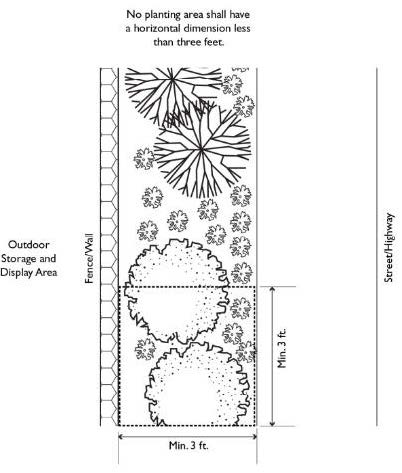
iii.
Landscaping shall be maintained in a neat, clean, and healthful condition, including proper pruning, weeding, removal of litter, fertilizing, and replacement of plants when necessary.
iv.
A permanent watering system shall be provided that satisfactorily irrigates all planted areas. Where the watering system consists of hose bibs alone, these bibs shall be located not more than 50 feet apart within the required landscaped area. Sprinklers used to satisfy the requirements of this Subsection C.4 shall be spaced to assure complete coverage of the required landscaped area.
b.
The Director may approve alternative methods of providing landscaping where the criteria established above would cause unnecessary hardship or constitute an unreasonable requirement and an alternative plan will, in his opinion, provide as well or better for landscaping within the intent of this Subsection C.4.
5.
Storage Restrictions.
a.
All portions of outdoor storage areas shall have adequate grading and drainage, and shall be continuously maintained.
b.
All raw materials, equipment, or finished products that are stored outdoors pursuant to this Subsection C:
i.
Shall not be stored above the height of the fence or wall within 10 feet of the fence or wall;
ii.
Shall be stored in such manner that it cannot be blown from the enclosed storage area; and
iii.
Shall not be placed or allowed to remain outside the enclosed storage area.
(Ord. 2024-0028 § 17, 2024; Ord. 2022-0023 § 32, 2022; Ord. 2022-0008 § 97, 2022; Ord. 2019-0004 § 1, 2019.)
22.140.440 - Parking as a Transitional Use.
A.
Applicability. This Section applies to parking as a transitional use in Zones A-1, A-2, R-R, R-A, R-1, R-2, R-3, and R-4.
B.
Location. The lot to be used for transitional parking shall adjoin or be separated by an alley from a property with a qualifying zone. Qualifying zones include: C-1, C-2, C-3, C-M, CPD, M-1, M-1.5, MPD, M-2, M-2.5, M-3, B-1, and B-2.
C.
Distance. Parking shall be limited to an area within 100 feet from the boundary of a property with a qualifying zone.
D.
Access. The area developed with parking shall have direct vehicular access to an improved public street, highway, alley, or to the property with a qualifying zone.
E.
Requirements. The lot developed with transitional parking, including access, shall:
1.
Have a side lot line adjoining, or separated only by an alley, for a distance of not less than 50 feet, from the property with a qualifying zone; or
2.
Have a rear lot line adjoining or separated only by an alley from the property with a qualifying zone, provided that a Parking Permit (Chapter 22.178) has been approved.
3.
Where the lot referred to in Subsection E.1, above, has a width less than 100 feet, additional lots may be considered for parking provided:
a.
They have successive contiguity on side lot lines with the first lot described in Subsection E.1, above;
b.
That in no event shall the total area developed for parking extend more than 100 feet from the property with a qualifying zone; and
c.
That all area extending from the subject property is developed for parking.
F.
Length. The side lot line of the lot developed with parking shall not exceed the length of the lot line common to the property with a qualifying zone. The Director may modify this provision to the extent permitted in Subsection E, above.
G.
Area Requirements. Any remaining portion of a lot developed with parking shall contain not less than the required area or width.
H.
Design. Parking shall be developed in accordance with the provisions of Section 22.112.080 (Parking Design), except that the required portion of the front yard, where required by the zone, shall be landscaped.
I.
Limitations. Parking shall be limited to motor vehicle parking lots exclusively and shall exclude vehicles over two tons rated capacity.
(Ord. 2019-0004 § 1, 2019.)
22.140.450 - Plant Nurseries, Retail.
A.
Applicability. This Section applies to plant nurseries, including propagation of nursery stock and retail sales, in Zones A-1, A-2, and R-R.
B.
Minimum Site Area. Retail plant nurseries shall have a minimum site area of five acres.
C.
Products for Sale. Products offered for sale shall be limited to nursery stock and related materials incidental to the planting, care, and maintenance of plants, including fertilizer, pesticides, seeds, and planting containers, but shall exclude general building materials, hardware, the sale and rental of tools other than for soil preparation, and general landscaping.
D.
Enclosure. All storage, display, and sale of products other than nursery stock shall be conducted within a completely enclosed building or within an area enclosed by a solid wall or fence and gate between five and six feet in height.
E.
Storage. No storage shall be higher than the enclosure surrounding the nursery.
(Ord. 2022-0008 § 98, 2022; Ord. 2019-0004 § 1, 2019.)
22.140.460 - Produce Stands.
A.
Applicability. This Section applies to produce stands as an accessory use in all zones where permitted.
B.
Products for Sale. Produce stands, including other on-site retail sales, may be used as an accessory use to crop production, small animal raising, or community gardens. All products displayed or sold shall be lawfully grown or produced on the subject lot.
C.
Additional Development Standards for Zones A-1, A-2, O-S, R-R, and M-1. This Subsection C applies to produce stands in Zones A-1, A-2, O-S, R-R, and M-1:
1.
Minimum Site Area. There shall be a minimum lot size of one gross acre.
2.
Maximum Floor Area. The stand shall have a maximum floor area of 300 square feet.
3.
Location. The stand shall be a minimum of 20 feet from any street or highway that the lot fronts, or from any adjacent residences.
4.
Materials. The stand, except for the floor, shall be exclusively of wood-frame construction.
(Ord. 2019-0004 § 1, 2019.)
22.140.470 - Real Estate Tract Offices.
A.
Applicability. This Section applies to real estate tract offices, as a temporary use, in Zones A-1, A-2, R-A, R-1, R-2, R-3, R-4, and MXD.
B.
Approval Period. Real estate tract offices may be approved for a period of up to two years. The Director may, upon a showing of need by the owner of the property, extend the permitted time beyond two years.
C.
Location. Real estate tract offices are permitted in a residential development for the initial sale of lots within that development. The office may be located within a new residence that is part of the development or within a temporary building.
D.
Restriction. Real estate tract offices shall not be used to conduct general real estate business for properties outside of the residential development.
E.
Removal of Building or Structure. If a temporary building is used for this purpose, upon termination of the use or time period specified in the permit, it shall be either removed or restored for a use permitted in the zone where located.
(Ord. 2019-0004 § 1, 2019.)
22.140.480 - Recreation Clubs and Facilities—Neighborhood, Commercial, and Private.
A.
Uses. Recreation clubs and facilities may include tennis, polo, swimming, and similar recreational activities, together with related accessory uses, unless as otherwise specified in this Section.
B.
Neighborhood Recreation Facilities.
1.
Applicability. This Subsection B applies to neighborhood recreation facilities in Zones R-A, R-1, R-2, R-3, R-4, and R-5.
2.
Development Standards. A neighborhood recreation facility, if not accessory to a principal use, shall be operated as a non-profit corporation limited to the use by the surrounding residents in a neighborhood. This provision shall not be interpreted to permit commercial enterprises.
C.
Commercial and Private Recreation Clubs.
1.
Applicability. This Subsection C applies to commercial and private recreation clubs in all zones where permitted.
2.
Development Standards.
a.
Accessory Uses. Unless as otherwise specified in this Subsection C.2, a commercial or private recreation club may also include an accessory clubhouse, pro shop, or restaurant.
b.
Zones A-1, A-2, and C-H. In Zones A-1, A-2, and C-H, where specifically designated a part of an approved Conditional Use Permit (Chapter 22.158) application, a private recreation club may include a pro shop or restaurant, as an accessory use.
c.
Zone O-S. A private recreation club may be established in Zone O-S according to the following standards:
i.
Activities shall be limited to hunting, shooting, fishing, or boating.
ii.
Adequate land or water facilities shall be provided to accommodate the recreational activity for which such club is organized. In no event shall the recreation club be less than five acres in size.
iii.
Where specifically designated a part of an approved Conditional Use Permit, such use may include a restaurant and bar as accessory uses.
(Ord. 2019-0004 § 1, 2019.)
22.140.490 - Recreational Vehicle Parks.
A.
Applicability. This Section applies to recreational vehicle parks in Zones A-1, A-2, O-S, R-R, W, C-1, C-2, C-3, C-M, C-RU, MXD-RU, and C-R. The Commission or Hearing Officer, in granting the Conditional Use Permit (Chapter 22.158), may impose additional conditions relating to park perimeter walls or enclosures on public street frontage, signs, access, and vehicle parking, may prohibit certain uses from recreational vehicle parks, but may not modify any of the following standards listed in this Section, except as otherwise provided in this Section or pursuant to a Variance (Chapter 22.194) application.
B.
Development Standards.
1.
Signs. Signs shall be subject to the provisions of Chapter 22.114 (Signs), except that in lieu of business signs standards as listed in said Chapter, one freestanding or roof business sign not exceeding 20 square feet in sign area, or 40 square feet in total sign area, shall be permitted at a location approved by the Commission or Hearing Officer.
2.
Maximum Duration of Occupancy, Very High Fire Hazard Severity Zones. For Recreational vehicle parks in the Very High Fire Hazard Severity Zones, as depicted in the General Plan, occupancy by any one occupant or party shall be limited to 90 consecutive days in any six-month period.
3.
Area. The recreational vehicle park shall have an area of not less than five acres in all applicable zones, except Zones C-1, C-2, C-3, and C-M where there is no lot size limit.
4.
Fire Protection. Notwithstanding any provision of State law, the Commission or Hearing Officer may require amenities or conditions in accordance with Title 32 (Fire Code) of the County Code that the Fire Department deems necessary to protect life and property, including but not limited to fire hydrant systems, water supply, fire equipment access, posting of fire equipment access, parking, lot identification, weed abatement, debris abatement, combustible storage abatement, and burglar bars.
5.
Prohibitions.
a.
A recreational vehicle park shall have no permanent residency or dwelling units except that of a caretaker, a manager, or employees responsible for maintaining or operating the property, as permitted by the zone and authorized by the Commission or Hearing Officer as part of the Conditional Use Permit.
b.
Facilities within the recreational vehicle park shall be used only by the occupants of the park, except where otherwise authorized by the Conditional Use Permit.
c.
No commercial uses are allowed, except those permitted by the zone and authorized by the Conditional Use Permit. This Subsection does not prohibit accessory uses where authorized by the permit, including, but not limited to, areas for the storage of unoccupied recreational vehicles.
6.
Zone O-S. A recreational vehicle park may be permitted only in conjunction with a principal use permitted in Zone O-S.
7.
Compliance with Other Regulations. Approval of a Conditional Use Permit (Chapter 22.158) application for a recreational vehicle park shall not relieve the applicant and his successors in interest from complying with all other applicable statutes, ordinances, rules and regulations.
(Ord. 2022-0008 § 99, 2022; Ord. 2021-0018 § 14, 2021; Ord. 2021-0017 § 21, 2021; Ord. 2019-0004 § 1, 2019.)
22.140.500 - Rehabilitation Facilities for Small Wild Animals.
A.
Applicability. This Section applies to rehabilitation facilities for small wild animals as an accessory use in Zones A-1, A-2, R-A, R-1, and C-RU.
B.
Licensing. The animals shall be cared for by a licensed rehabilitator who shall be a resident of a single-family residence on the subject lot.
C.
Type and Number of Animals Allowed.
1.
The animals shall be indigenous to Los Angeles County and shall weigh no more than 30 pounds.
2.
Coyotes, bobcats, deer, mountain lions, bears, and other similarly dangerous animals shall not be allowed.
3.
The allowable number of animals shall be as follows:
a.
For lots with at least 10,000 square feet of area, up to 20 animals.
b.
For lots of 7,500 to 9,999 square feet of area, up to 16 animals.
c.
For lots of 6,000 to 7,499 square feet of area, up to 12 animals.
d.
For lots of 5,000 to 5,999 square feet of area, up to six animals.
4.
The Commission or Director, after consultation with the Departments of Animal Care and Control and Public Health, may allow a higher number of animals than the numbers specified in Subsection C.3, above.
D.
Authorization. The facilities shall only be authorized for as long as the applicant maintains a continuously valid permit and Memorandum of Understanding from the California Department of Fish and Wildlife, or in the case of wild migratory birds, a valid permit from the United States Department of Fish and Wildlife.
(Ord. 2019-0004 § 1, 2019.)
22.140.510 - Renewable Energy.
A.
Purpose. This Section establishes standards, conditions, and procedures that support and facilitate the development of small-scale solar energy systems, utility-scale solar energy facilities, temporary meteorological towers, and small-scale wind energy systems in a manner that protects public health, safety, and welfare and minimizes significant impacts to the environment.
B.
Definitions. Specific terms used in this Section are defined in Section 22.14.180 of Division 2 (Definitions), under "Renewable Energy."
C.
Applicability.
1.
Applicability of this Section. This Section applies to the development of any small-scale solar energy system, utility-scale solar energy facility, temporary meteorological tower, or small-scale wind energy system.
2.
Exemption. Subject to Subsection C.3 below, this Section shall not apply:
a.
To any structure-mounted small-scale solar energy system, structure mounted utility-scale solar energy facility, or small residential rooftop solar energy system as defined and regulated by Section 65850.5 of the California Government Code and Title 26 (Building Code) of the County Code in Zone R-1, when a building permit has been issued prior to January 12, 2017, the effective date of this Section;
b.
To any ground-mounted small-scale solar energy system, structure mounted utility-scale solar energy facility in Zone R-1 other than a small residential rooftop solar energy system as defined and regulated by Section 65850.5 of the California Government Code and Title 26 (Building Code) of the County Code, ground-mounted utility-scale solar energy facility, temporary meteorological tower, or small-scale wind energy system when a Ministerial Site Plan Review (Chapter 22.186), a Minor Conditional Use Permit (Chapter 22.160), or a Conditional Use Permit (Chapter 22.158), as applicable, has been granted prior to January 12, 2017, the effective date of this Section; or
c.
When preempted by regulation under the jurisdiction of the California Public Utilities Commission or preempted by other applicable law.
3.
Modification to Existing System or Facility. This Section shall apply when a modification to a lawfully existing, as of January 12, 2017, the effective date of this Section, small-scale solar energy system, utility-scale solar energy facility, temporary meteorological tower, or small-scale wind energy system, occurs as follows:
a.
Any modification that would substantially increase the physical size, height, or footprint of an existing small-scale solar energy system, utility-scale solar energy facility, temporary meteorological tower, or small-scale wind energy system;
b.
Any modification that would substantially change the type of equipment used by an existing small-scale solar energy system, utility-scale solar energy facility, temporary meteorological tower, or small-scale wind energy system except for replacement of equipment for maintenance purposes; or
c.
Any modification that would convert a small-scale solar energy system into a utility-scale solar energy facility; and
d.
Any modification that would convert a small-scale wind energy system into a utility-scale wind energy system is prohibited.
4.
Applicability of Zone and Supplemental District Regulations. All provisions of the zone and any supplemental district in which a small-scale solar energy system, utility-scale solar energy facility, temporary meteorological tower, or small-scale wind energy system is located shall apply as follows:
a.
For a small-scale solar energy system, temporary meteorological tower, or small-scale wind energy system, where a provision of the zone or supplemental district regulates the same matter as this Section, the provision of this Section shall apply; and
b.
For a utility-scale solar energy facility, where a provision of the zone or supplemental district regulates the same matter as this Section, the more restrictive provision shall apply, except for the height of structure-mounted facilities and perimeter fences, in which case, this Section will control.
5.
Prohibition. The following shall be prohibited:
a.
Ground-mounted utility-scale solar energy facilities within adopted Significant Ecological Areas designated in the General Plan and Economic Opportunity Areas designated in the Antelope Valley Area Plan; and
b.
Utility-scale wind energy facilities, including conversion of a small-scale wind energy system into a utility-scale wind energy facility.
D.
Small-Scale Solar Energy Systems.
1.
Application Requirements.
a.
Permitted. Structure-mounted small-scale solar energy systems are permitted in compliance with this Subsection D;
b.
Ministerial Site Plan Review. Ground-mounted small-scale solar energy systems, except in Zones O-S and W, shall require a Ministerial Site Plan Review (Chapter 22.186) application, in compliance with this Subsection D; or
c.
Minor Conditional Use Permit. Ground-mounted small-scale solar energy systems in Zones O-S and W shall require a Minor Conditional Use Permit (Chapter 22.160) application, in compliance with this Subsection D; and
d.
Modification. A Minor Conditional Use Permit (Chapter 22.160) application shall be required where a modification to a development standard has been requested.
2.
Additional Application Materials.
a.
Ministerial Site Plan Review. In addition to the application materials required for a Ministerial Site Plan Review (Chapter 22.186), the application shall contain the following information:
i.
A site plan that depicts the small-scale solar energy system's footprint, height, and setback from all property lines; and
ii.
A minimum of six color photographs, displaying various angles illustrative of the project area, with a photo-key map.
b.
Minor Conditional Use Permit. In addition to the application materials required for a Minor Conditional Use Permit (Chapter 22.160), the application shall contain the following information:
i.
A minimum of six color photographs, displaying various angles illustrative of the project area, with a photo-key map; and
ii.
Color photo simulations of the project area before construction of the project and after construction of the project.
3.
Development Standards. Small-scale solar energy systems shall comply with the following standards:
a.
Conformance with Federal, State, and County Requirements. A small-scale solar energy system shall comply with the California Solar Rights Act (California Civil Code Section 714 et seq.), the California Solar Shade Control Act (California Public Resources Code Section 25980 et seq.), and any other applicable federal, State, and County legal requirements (and as may be modified by this Section).
b.
Additional Standard for Structure-Mounted Small-Scale Solar Energy Systems. In addition to the applicable standards of this Subsection D.3, the combined height of a structure and structure-mounted small-scale solar energy system shall not exceed the height limit of the zone by more than five feet.
c.
Additional Standards for Ground-Mounted Small-Scale Solar Energy Systems. In addition to the applicable standards of this Subsection D.3, a ground-mounted small-scale solar energy system shall also comply with the following standards:
i.
Height. The height of a solar array shall not exceed 15 feet.
ii.
Maximum Lot Coverage. The maximum lot coverage for solar arrays and any accessory structures shall be 25 percent of the lot or 2.5 acres, whichever is lesser.
d.
Additional Standard for Lot Coverage Modification to Ground Mounted Small-Scale Solar Energy Systems. In addition to the applicable standards of this Subsection D.3, a lot coverage modification for a ground mounted small-scale solar energy system shall also comply with Subsection E.3.c.vii (Signs), below.
4.
Aviation Review. When a Minor Conditional Use Permit (Chapter 22.160) is required by Subsection D.1, above, and the small-scale solar energy system is located within a Military Operations Area (MOA) or Airport Influence Area (AIA), Subsection H, below, shall apply.
5.
Additional Findings. When a Minor Conditional Use Permit (Chapter 22.160) application is required by Subsection D.1, above, the following additional findings shall apply, as applicable.
a.
Additional Findings for a Minor Conditional Use Permit.
i.
The project complies with all applicable development standards in Subsection D.3, above;
ii.
The project is sited and designed and will be constructed in such a way to minimize significant impacts to the environment; and
iii.
The project is sited in such a way to minimize site disturbance, such as grading, brush clearance, and other forms of earthwork.
b.
Additional Findings for a Modification to Development Standards.
i.
Due to topographic or physical features of the site, strict compliance with all the required development standards would substantially and unreasonably interfere with the establishment of the proposed project on the subject property; and
ii.
The requested modification would not be contrary to the purpose of this Section.
c.
Additional Findings for Projects Requiring Aviation Review. Where an application requires aviation review and the application request would penetrate the lower floor elevation of any MOA mapped in the County General Plan, the following additional findings are required:
i.
The MOA military operator has determined:
(1)
The project would not be detrimental to the function of that MOA; and
(2)
The project would not pose a health or safety hazard to MOA personnel or the public.
6.
Conditions of Approval. In addition to the conditions that may be imposed under Section 22.160.060 (Conditions of Approval), when a Minor Conditional Use Permit (Chapter 22.160) application is required by Subsection D.1, above, the following conditions of approval shall be imposed:
a.
Development Standards. The applicable development standards in Subsection D.3, above, unless specifically modified as provided herein.
b.
Conditions to Ensure Compliance with Findings. Any additional conditions deemed necessary to ensure that such use will be in accordance with the required findings in Subsection D.5, above.
c.
Additional Conditions of Approval for a Lot Coverage Modification to Ground-Mounted Small-Scale Solar Energy Systems. In addition to the conditions of approval required by this Subsection, when a lot coverage modification has been requested for a ground-mounted small-scale solar energy system, Subsections E.6.d.v and E.6.d.vii, below, shall apply.
E.
Utility-Scale Solar Energy Facilities.
1.
Application Requirements.
a.
Minor Conditional Use Permit. Structure-mounted utility-scale solar energy facilities in Zone R-1, except small residential rooftop solar energy systems as defined and regulated by Section 65850.5 of the California Government Code and Title 26 (Building Code) of the County Code, shall require a Minor Conditional Use Permit (Chapter 22.160) application, in compliance with this Subsection E; or
b.
Conditional Use Permit. Ground-mounted utility-scale solar energy facilities in Zones A-2, C-H, C-1, C-2, C-3, C-M, C-R, C-MJ, C-RU, M-1, M-1.5, M-2, M-4, R-R, MXD-RU, MXD, and IT shall require a Conditional Use Permit (Chapter 22.158) application, in compliance with this Subsection E.
2.
Application Materials.
a.
Minor Conditional Use Permit. In addition to the application materials required for a Minor Conditional Use Permit (Chapter 22.160) application, the application shall contain the following information:
i.
A minimum of six color photographs, displaying various angles illustrative of the project area, with a photo-key map; and
ii.
Color photo simulations of the project area before construction of the project and after construction of the project.
b.
Conditional Use Permit. In addition to the application materials required for a Conditional Use Permit (Chapter 22.158) application, the application shall contain the following information:
i.
All materials and information required by Subsection E.2.a, above;
ii.
A site plan that depicts the following:
(1)
Solar array footprint and height;
(2)
Solar array setbacks from all property lines;
(3)
Area and amount of proposed grading and site disturbance;
(4)
Topography of the site;
(5)
Any watercourses on the site;
(6)
Access roads;
(7)
Any required fencing;
(8)
Any required signage;
(9)
Any required lighting;
(10)
Transmission lines; and
(11)
Any significant ridgelines on the site.
iii.
A detailed landscaping plan that depicts:
(1)
Any required fencing;
(2)
Proposed plant species palette, the number and size of each plant;
(3)
Proposed water usage for planting and maintaining proposed landscaping; and
(4)
Proposed timing and phasing of proposed landscaping.
iv.
A decommissioning plan;
v.
A hydrology study;
vi.
A conceptual dust control plan;
vii.
A glare study; and
viii.
A description of amount and source of water necessary for the construction and operation of the project.
3.
Development Standards. Utility-scale solar energy facilities shall comply with the following standards:
a.
Conformance with Federal, State, and County Requirements. A utility-scale solar energy facility shall comply with any applicable federal, State, and County legal requirements (and as may be modified by this Subsection E).
b.
Additional Standards for Structure-Mounted Utility-Scale Solar Energy Facilities. In addition to the applicable standards required by this Subsection E, a structure-mounted utility-scale solar energy facility shall also comply with the following standards:
i.
Height. The combined height of a structure and structure mounted utility-scale solar energy facility's solar arrays shall not exceed the height limit of the zone by more than five feet.
ii.
Setbacks. If a structure-mounted utility-scale solar energy facility is mounted to a building, setbacks from the perimeter of the roof shall be:
(1)
Three feet on residential buildings; or
(2)
Four feet on non-residential or mixed use buildings.
c.
Additional Standards for Ground-Mounted Utility-Scale Solar Energy Facilities. In addition to the applicable standards of this Subsection E.3, a ground-mounted utility-scale solar energy facility shall also comply with the following standards:
i.
Coastal Zone. Within the Coastal Zone, the placement of any ground-mounted utility-scale solar energy facility shall comply with the applicable Local Coastal Plan.
ii.
Fencing. Fencing shall be required around the perimeter of the ground-mounted utility-scale solar energy facility. In addition to compliance with the California Public Utilities Commission and United States Occupational Safety and Health Administration fencing guidelines for substations, all fencing shall comply with the following, except as otherwise required by Public Works to maintain minimum corner sight distance:
(1)
Opaque and non-opaque fences are permitted;
(2)
Fencing up to eight feet in height is permitted;
(3)
Fencing shall not be located within 15 feet of a public right of way but may be located within the required setback area; and
(4)
Facility perimeter fencing shall incorporate small animal permeable design.
iii.
Height. The height of any solar array shall not exceed 25 feet.
iv.
Lighting. In addition to the requirements of Chapter 22.80 (Rural Outdoor Lighting District), any outdoor lighting required for safety and security purposes shall be shielded and directed downward to avoid light trespass and shall include:
(1)
Motion sensors for entry-lighting to the on-site equipment, structures, and buildings; and
(2)
Light-sensor or motion-sensor lighting for the main facility access gate, operations and maintenance building doorways, and any parking areas of facilities with operation and maintenance buildings.
v.
Setbacks. Setbacks from the property line shall be:
(1)
A minimum of 30 feet in Agricultural Zones; or
(2)
As provided in the base zone for all non-Agricultural Zones.
vi.
Significant Ridgelines. The highest point of a ground mounted utility-scale solar energy facility shall be located at least 50 vertical feet and 50 horizontal feet from a significant ridgeline identified in the General Plan or in an applicable Community Standards District.
vii.
Signs. One pole-mounted project identification sign shall be located at each temporary or permanent ingress or egress point. Signs shall include owner and emergency contact information. No other signs shall be posted at the ground-mounted utility-scale solar energy facility other than safety, directional, and warning signs as required in Chapter 22.114 (Signs).
viii.
Landscaped Buffer. A landscaped area at least 10 feet in depth shall be maintained along any facility perimeter fencing and between such fencing and any public right-of-way or adjacent property with an existing residential or agricultural use.
4.
Aviation Review. When a Minor Conditional Use Permit (Chapter 22.160) or Conditional Use Permit (Chapter 22.158) is required by this Subsection E and the utility-scale solar energy facility is located within a MOA or AIA, Subsection H, below, shall apply.
5.
Additional Findings.
a.
Conditional Use Permit and Minor Conditional Use Permit. When a Conditional Use Permit (Chapter 22.158) application or Minor Conditional Use Permit (Chapter 22.160) application is required by Subsection E.1, above, the following additional findings shall apply, as applicable:
i.
The project complies with all applicable development standards in Subsection E.3, above;
ii.
The project is sited and designed and will be constructed in such a way to minimize significant impacts to the environment, including impacts to birds and bats, through appropriate measures including minimizing proximity to perch sites such as transmission lines and towers; and
iii.
The project is sited in such a way to minimize site disturbance, such as grading, brush clearance, and other forms of earthwork.
b.
Additional Findings for Ground-Mounted Utility-Scale Solar Energy Facilities. In addition to the findings required by this Subsection E.5, for ground mounted utility-scale solar energy facilities, the following additional findings shall apply, as applicable:
i.
The proposed vegetation required along the facility perimeter fencing sufficiently provides a buffer from adjacent residential and agricultural uses through variable placement and muting of frontage or other sensitive viewsheds so as to provide a natural visual transition between the project and its surroundings;
ii.
The proposed vegetation sufficiently provides ground cover to the satisfaction of a County biologist; and
iii.
The proposed vegetation sufficiently provides such buffer and ground cover in a timely manner to the satisfaction of a County biologist.
c.
Additional Findings for a Modification to Development Standards. In addition to the findings required by this Subsection E.5, when a modification has been requested to any development standard required by Subsection E.3, above, the following additional findings shall apply, as applicable:
i.
Due to topographic or physical features of the site, strict compliance with all the required development standards would substantially and unreasonably interfere with the establishment of the proposed project on the subject property; and
ii.
The requested modification would not be contrary to the purpose of this Section.
d.
Additional Findings for Projects Requiring Aviation Review. In addition to the findings required by this Subsection E.5, where a project requires aviation review and the project would penetrate the lower floor elevation of any MOA mapped in the County General Plan, the Commission or Hearing Officer, the following additional findings shall apply, as applicable:
i.
MOA military operator has determined:
(1)
The project would not be detrimental to the function of that MOA; and
(2)
The project would not pose a health or safety hazard to personnel or the public.
6.
Conditions of Approval. In addition to the conditions that may be imposed when a Minor Conditional Use Permit (Chapter 22.160) or Conditional Use Permit (Chapter 22.158) is required by Subsection E.1, above, the following conditions of approval shall be imposed:
a.
Development Standards. The applicable development standards in Subsection E.3, above, unless specifically modified as provided herein.
b.
Findings. Any additional conditions deemed necessary to ensure that such use will be in accordance with the required findings in Subsection E.5, above.
c.
Glare. All utility-scale solar energy facilities shall be designed and located in such a way to minimize reflective glare toward any habitable structure on adjacent properties as well as adjacent street rights-of-way.
d.
Additional Conditions of Approval for Ground-Mounted Utility Scale Solar Energy Facilities. In addition to the conditions of approval required by this Subsection E.6, ground-mounted utility-scale solar energy facilities shall also require the following conditions of approval:
i.
Access Roads. All temporary and permanent ingress and egress points to the ground-mounted utility-scale solar energy facility shall be designed and sited to the satisfaction of Public Works and Fire Department, shall consider adequate spacing from intersections, and shall maintain adequate sight distances. Dirt access roads shall be treated with a suitable non-toxic long-term soil binder or application of similarly effective material to control dust, such as gravel.
ii.
Decommissioning.
(1)
The decommissioning plan shall be prepared to the satisfaction of the Director and the Director of Public Works.
(2)
Prior to any ground disturbance or the issuance of any grading or building permit, performance and financial guarantees in an amount sufficient to ensure the performance of the decommissioning plan shall be determined to the satisfaction of the Director and the Director of Public Works and incorporated into a final decommissioning plan. This amount shall be posted by the permittee.
(3)
Prior to any ground disturbance or the issuance of any grading or building permit, the permittee shall record an easement granting access to the County for activities related to decommissioning. A draft easement document shall be submitted prior to easement recordation, for review and approval by the Director and the Director of Public Works.
(4)
In the event that any portion of a ground mounted utility-scale solar energy facility ceases operation for a consecutive period of six months, or the permit for the use has expired, operations for that use shall be deemed to have been abandoned. Within six months after the written notice is mailed from the Director to the permittee advising of the abandoned use, the facility or portions thereof shall be removed from the property. However, within the six months after written notice of abandonment is mailed to the permittee, the permittee may provide the Director with a written request and justification for an extension to resume operations of the facility or portions thereof, so long as the permit has not expired.
iii.
Landscaped Buffer.
(1)
A landscaped area at least 10 feet in depth shall be maintained along any facility perimeter fencing and between such fencing and any public right-of-way or adjacent property with an existing residential or agricultural use.
(2)
Existing non-invasive drought-tolerant vegetation approved by a County biologist shall be retained and/or new non-invasive, drought tolerant vegetation approved by a County biologist shall be planted within the landscaped area within the time frames specified in the permit conditions.
(3)
The landscaped area shall incorporate a variety of design elements appropriate for the surrounding area, including but not limited to hardscape, such as decorative rocks, boulders, berms, and fencing and softscape, such as trees, shrubs, vines, and succulents. In no way shall the hardscape or softscape features adversely affect drainage patterns.
(4)
The landscaped area shall be established in such manner that adequate corner sight distance is maintained from all access roads to the public right-of-way to the satisfaction of Public Works.
(5)
The landscaped area shall be planted and temporary irrigation system installed prior to final permit inspection of the project or project phase to the satisfaction of the Director. Establishment of the plantings shall be verified at the time of regular inspections according to inspection time frames in the permit conditions; and
(6)
The landscaped area shall be maintained throughout the life of the facility.
iv.
Scenic Resources. Any ground-mounted utility-scale solar energy facility placed within the viewshed of a Scenic Drive, Scenic Highway, or Scenic Route identified in the General Plan, an applicable Area or Community Plan, or Community Standards District shall be analyzed for any associated negative impacts, including but not limited to visual impacts. Appropriate conditions relating to siting, buffering, height, and design of the facility may be imposed to minimize significant effects on the viewshed.
v.
Site Disturbance.
(1)
Air Quality Management District. State requirements imposed by the applicable Air Quality Management District conditions shall apply.
(2)
Soil Erosion. To ensure dust control and minimal soil erosion, existing vegetation may be mowed, but removal of existing vegetation root systems shall be prohibited, except where necessary for construction of access roads, substations and related underground transmission lines, tanks, basins, inverter pads, or other areas required by the County.
(3)
Hydrology. The facility shall be designed to minimize erosion, sedimentation, or other impacts to the natural hydrology and drainage patterns of the property. Existing topography and watercourses shall be retained or restored to pre-development conditions following construction and during operations, except for drainage features specifically designed to mitigate drainage impacts. Prior to any discretionary approval, a hydrology study shall be prepared in compliance with the most recent County standards for addressing drainage impacts to the satisfaction of Public Works.
(4)
Grading. To control fugitive dust and preserve the natural topography, the facility shall be designed in such a way that ground disturbance or grading is limited to only the access roads, substations and related underground transmission lines, tanks, basins, inverter pads, or other areas required by the County. The facility shall comply with all applicable grading standards.
(5)
Fugitive Dust Control Plan. A fugitive dust control plan including a dust plume response plan shall be prepared by the permittee for review and approval by applicable agencies prior to any earthwork activities.
(6)
Construction Practices.
(a)
Fugitive Dust. Fugitive dust emission shall be controlled by phased earthwork, site watering, use of clean gravel not to exceed a depth of six inches where applicable, application of non-toxic soil stabilizers, limiting public access on unpaved areas, posting private roadways with reduced speeds, and/or re-vegetation. Use of other fugitive dust mitigation measures may be implemented by the permittee if determined by applicable agencies to be suitable methods to adequately control dust in a safe manner during construction, operation, and removal and restoration activities.
(b)
Vegetation. Work where the facility components are being installed in areas with existing vegetation shall be conducted with minimal disturbance, and the permittee shall take all necessary precautions to not use vehicles or machinery for grading or alter the exiting grade in these areas. When vehicles or machinery are deemed necessary for installation, appropriate ground protection practices, such as construction mats, stabilizers, or established vegetation, shall be utilized for both dust suppression and to ensure that the use of vehicles or machinery is compatible with continued and future vegetation growth. The permittee shall retain a biologist to confirm that construction practices are compatible with continued and future vegetation growth. Any grading, disking, scraping, or other ground disturbance proposed as part of the facility shall be permanently stabilized with an earth-stabilizing product or other measure that is acceptable to the Department and the Departments of Public Works and Public Health to prevent fugitive dust.
vi.
Transmission Lines. On-site and off-site transmission lines shall be placed underground to the satisfaction of the Department and Public Works, except where above-ground crossings are otherwise required, such as over the California Aqueduct. A franchise agreement shall be required for distribution/transmission facilities within the public right-of-way. Disturbed areas shall comply with Subsection E.6.d.v (Site Disturbance), above to ensure dust control and minimal soil erosion.
vii.
Water Quality Protection. Measures to protect groundwater and surface water from waste discharge shall be incorporated into the facility design, as appropriate, and shall meet the requirements of the Regional Water Quality Control Board.
viii.
Water Use.
(1)
The facility shall use the minimum amount of water required during the construction period. The facility shall be limited to the maximum use of water as established by the Commission or Hearing Officer, as applicable, for the duration of the construction period.
(2)
The facility shall use the minimum amount of water required during the operation of the facility. The facility shall be limited to the maximum use of water as established by the Commission or Hearing Officer, as applicable, for the operation of the facility for the duration of this grant.
(3)
The facility shall use piped recycled water if it is available from the public right-of-way within one mile from the property at fair market value, suitable for use, and deemed appropriate by a County biologist. If such piped recycled water does not meet all of the facility's water demand, the facility shall use piped potable water to supplement piped recycled water if it is available from the public right-of-way within one mile from the property at fair market value and suitable for use.
(4)
The permittee shall maintain a daily log, which shall include the number of gallons and acre feet of water used on the property used for the following, which includes, but is not limited to, construction, operation, maintenance, landscaping, and irrigation. The permittee shall complete the record of monthly water usage by source within eight days following the conclusion of each calendar month. The log shall be made available to the Department upon demand.
F.
Temporary Meteorological Towers.
1.
Permit Required.
a.
Minor Conditional Use Permit. Temporary meteorological towers in Zones R-1, R-2, R-3, R-4, R-5, R-A, A-1, A-2, O-S, C-RU, and MXD shall require a Minor Conditional Use Permit (Chapter 22.160) application, except when modified by this Subsection F.
2.
Application Materials. In addition to the application materials required for a Minor Conditional Use Permit (Chapter 22.160) application, the application shall contain the following information:
a.
A minimum of six copies of the proposed site plan, elevation plan, and location map depicting the project location on United States Geological Survey topographic sheets. On each set of the required site and elevation plans, the applicant shall depict the type and location of any safety lights and energy storage devices; and
b.
Drawings to scale of the structure, including the tower, base, wind-measuring devices, and footings, if any.
3.
Development Standards. Temporary meteorological towers shall comply with the following standards:
a.
Minimum Lot Size. The minimum lot size shall be 0.5 acres.
b.
Maximum Tower Height. Tower height shall be measured from the ground to the top of the tower, excluding the wind measuring devices, and be consistent with the following:
i.
The tower shall not exceed a height of 35 feet above grade for lots less than one acre in size;
ii.
The tower shall not exceed a height of 65 feet above grade for lots from one acre to less than two acres in size; and
iii.
The tower shall not exceed a height of 85 feet above grade for lots two acres or greater in size.
c.
Location.
i.
The minimum distance between a temporary meteorological tower and any property line or road right-of-way shall be the distance which is the equivalent to the height of the temporary meteorological tower including any wind measuring devices provided that the required distance shall also comply with any applicable fire setback requirements pursuant to Section 4290 of the California Public Resources Code;
ii.
No part of a temporary meteorological tower shall be located within or over drainage, utility, or other established easements, or on or over property lines; and
iii.
Safe clearance shall be provided between a temporary meteorological tower and all structures and trees.
d.
Design.
i.
Colors. The colors used in the construction materials or finished surface shall be muted and visually compatible with surrounding development.
ii.
Lighting. A safety light that meets Federal Aviation Administration (FAA) standards shall be required for all towers exceeding 50 feet in height including any wind-measuring devices. A safety light may also be required on shorter towers. All required lights shall be shielded from adjacent properties, and no other lights shall be placed upon the tower.
iii.
Climbing Apparatus. All climbing apparatus must be located at least 12 feet above the ground, and the tower must be designed to prevent climbing within the first 12 feet.
e.
Signs. One sign, limited to 18 inches in length and one foot in height, shall be posted at the base of the tower; the sign shall include a notice of no trespassing, a warning of high voltage, and the phone number of the property owner to call in the event of an emergency.
f.
Displacement of Parking Prohibited. The location of a temporary meteorological tower shall not result in the displacement of required parking as specified in Chapter 22.112 (Parking).
g.
Maintenance. Temporary meteorological towers shall be maintained in operational condition that pose no potential safety hazards.
h.
Removal. Within six months after the operation of a temporary meteorological tower has ceased or its permit has expired, whichever occurs first, the permittee shall remove the temporary meteorological tower, clear the site of all equipment, and restore the site as nearly as practicable to its condition prior to its installation. Failure to remove the temporary meteorological tower as required above shall constitute a public nuisance. Prior to installation of any temporary meteorological tower, the permittee shall post a performance security, satisfactory to the Director of Public Works, in an amount and form sufficient to cover the cost of the removal of the temporary meteorological tower as provided herein. In the event the temporary meteorological tower is not so removed within 90 days after the permittee's receipt of notice requiring removal, the County may itself cause it to be removed, and the permittee shall be required to pay the County's cost of removal.
i.
Guy Wires. The use of guy wires shall be prohibited.
4.
Aviation Review. The Director shall distribute copies of the proposed temporary meteorological tower site plan, elevation plan, and location map to aviation related regulatory agencies and facilities with flight operations in the vicinity, as determined by the Director, such as the FAA, Fire Department, Sheriff, Edwards Air Force Base, and Air Force Plant 42, as applicable. Any comments received within 30 days of distribution will be considered in establishing conditions, as appropriate.
5.
Additional Findings.
a.
Minor Conditional Use Permit. When a Minor Conditional Use Permit (Chapter 22.160) application is required by Subsection F.1, above, the following additional findings shall apply, as applicable:
i.
The project complies with all applicable development standards in Subsection F.3, above, unless modified by Subsection F.5.b, below.
b.
Additional Findings for a Modification to Development Standards. In addition to the applicable findings required by this Subsection F.5, when a modification has been requested to any development standard in Subsection F.3, above, the following additional findings shall apply, as applicable:
i.
Due to topographic or physical features of the site, strict compliance with all the required development standards would substantially and unreasonably interfere with the establishment of the proposed project on the subject property; and
ii.
The requested modification would not be contrary to the purpose of this Section.
6.
Conditions of Approval. In addition to the conditions that may be imposed under a Minor Conditional Use Permit (Chapter 22.160) application, the following conditions of approval shall be imposed:
a.
Development Standards. The applicable development standards in Subsection F.3, above, unless modified by Subsection F.5, above.
b.
Findings. Any additional conditions deemed necessary to ensure that such use will be in accordance with the required findings in Subsection F.5, above.
G.
Small-Scale Wind Energy Systems.
1.
Application Requirements.
a.
Minor Conditional Use Permit. Small-scale wind energy systems in Zone R-1, R-2, R-3, R-4, R-5, R-A, A-1, A-2, and O-S shall require a Minor Conditional Use Permit (Chapter 22.160) application, except when modified by this Subsection G.
2.
Additional Application Materials.
a.
In addition to the application materials required for a Minor Conditional Use Permit (Chapter 22.160), the application shall contain the following information:
i.
A minimum of six copies of the proposed site plan, elevation plan, and location map depicting the project location on United States Geological Survey topographic sheets. On each set of the required site and elevation plans, the applicant shall depict the type and location of any safety lights and energy storage devices; and
ii.
Drawings to scale of the structure, including the tower, base, wind turbine generator, blades, footings, and associated equipment.
3.
Development Standards. Small-scale wind energy systems shall comply with the following standards:
a.
Minimum Lot Size. The minimum lot size shall be 0.5 acres.
b.
Maximum Tower Height. Tower height shall be measured from the ground to the top of the tower, excluding the wind turbine generator, blades, and wind measuring devices, as applicable, and be consistent with the following:
i.
The tower shall not exceed a height of 35 feet above grade for lots less than one acre in size;
ii.
The tower shall not exceed a height of 65 feet above grade for lots from one acre to less than two acres in size; and
iii.
The tower shall not exceed a height of 85 feet above grade for lots two acres or greater in size.
c.
Location.
i.
The minimum distance between a small-scale wind energy system and any property line or road right-of-way shall be the distance which is the equivalent to the height of the system including any wind turbine generator, wind measuring devices, and the highest vertical extent of any blades, provided that the required distance shall also comply with any applicable fire setback requirements pursuant to Section 4290 of the California Public Resources Code.
ii.
No part of a small-scale wind energy system shall be located within or over drainage, utility, or other established easements, or on or over property lines.
iii.
Safe clearance shall be provided between a small-scale wind energy system and all structures and trees.
d.
Design.
i.
Colors. The colors used in the construction materials or finished surface shall be muted and visually compatible with surrounding development.
ii.
Lighting. A safety light that meets FAA standards shall be required for all systems exceeding 50 feet in height including any wind turbine generator, wind-measuring devices, and the highest vertical extent of any blades. A safety light may also be required on shorter towers. All required lights shall be shielded from adjacent properties, and no other lights shall be placed upon the tower.
iii.
Climbing Apparatus. All climbing apparatus must be located at least 12 feet above the ground, and the tower must be designed to prevent climbing within the first 12 feet.
e.
Signs. One sign, limited to 18 inches in length and one foot in height, shall be posted at the base of the tower; the sign shall include a notice of no trespassing, a warning of high voltage, and the phone number of the property owner to call in the event of an emergency.
f.
Displacement of Parking Prohibited. The location of a small scale wind energy system shall not result in the displacement of required parking as specified in Chapter 22.112 (Parking).
g.
Guy Wires. The use of guy wires shall be prohibited.
h.
Clearance of Blade Above Ground Level. No portion of a small scale wind energy system blade shall extend within 20 feet of the ground.
i.
Automatic Overspeed Controls. A small-scale wind energy system shall be equipped with manual and automatic overspeed controls to limit the blade rotation speed to within the design limits of the small-scale wind energy system.
j.
Wind Turbine Generator.
i.
The wind turbine generator shall be certified by a qualified, licensed engineer as meeting the requirements of wind turbine-specific safety and/or performance standards adopted by the national or international standards-setting body, including, but not limited to IEC (International Electric Code) standard 61400-2.
ii.
The wind turbine generator shall have a manufacturer's warranty with at least five years remaining from the date the application is filed.
iii.
The model of equipment proposed shall have a documented record of at least one year of reliable operation at a site with average wind speeds of at least 12 mph.
k.
Noise. Noise from a small-scale wind energy system shall not exceed 60 dBA SEL (single event noise level) as measured at the closest neighboring inhabited dwelling, except during short-term events, such as utility outages and severe windstorms.
l.
Visual Effects.
i.
No small-scale wind energy system shall be placed or constructed in such a way that it silhouettes against the skyline above any major ridgeline when viewed from any designated Major, Secondary, or Limited Secondary Highway on the County Highway Plan Policy Map, from any designated Scenic Highway, or from any significantly inhabited area, as determined by the Director. As used in this Section, major ridgeline shall mean any ridgeline that surrounds or visually dominates the landscape, as determined by the Director, due to its:
(1)
Size in relation to the hillside or mountain terrain of which it is a part;
(2)
Silhouetting appearance against the sky, or appearance as a significant natural backdrop;
(3)
Proximity to and visibility from existing development or major transportation corridors; or
(4)
Significance as an ecological, historical, or cultural resource, including a ridgeline that provides a natural buffer between communities or is part of a park or trails system.
ii.
The top of a small-scale wind energy system, including the wind turbine generator and the highest vertical extent of the blades, shall be located at least 25 vertical feet below the top of any adjacent major ridgeline, and a small-scale wind energy system shall be located at least 100 horizontal feet from any adjacent major ridgeline.
iii.
Any small-scale wind energy system that is placed within the viewshed of a designated Major, Secondary, Limited Secondary, or Scenic Highway shall be assessed for its visual effects, and appropriate conditions relating to siting, buffers, and design of the system shall be applied.
iv.
The placement of a small-scale wind energy system shall not obstruct views of the ocean from any residence or highway, and shall otherwise conform to the policies and standards of any applicable Local Coastal Plan.
m.
Maintenance. Systems shall be maintained in operational condition that poses no potential safety hazards.
n.
Removal. Within six months after the operation of a small-scale wind energy system has ceased or its permit has expired, whichever occurs first, the permittee shall remove the system, clear the site of all equipment, and restore the site as nearly as practicable to its condition prior to the installation of the system. Failure to remove such system as required above shall constitute a public nuisance. Prior to installation of any such system, the permittee shall post a performance security, satisfactory to the Director of Public Works, in an amount and form sufficient to cover the cost of the removal of the system as provided herein. In the event the system is not so removed within 90 days after the permittee's receipt of notice requiring removal, the County may itself cause the system to be removed, and the permittee shall be required to pay the County's cost of removal.
o.
Additional Standards for Ground-Mounted Small-Scale Wind Energy Systems. In addition to the standards required by this Subsection G.3, a ground mounted small-scale wind energy system shall also comply with the following:
i.
Use of trellis-style towers is prohibited;
ii.
Buffers. The following buffers shall apply to reduce impacts to birds and bats:
(1)
No part of the ground-mounted small-scale wind energy system shall be closer than 300 feet or five times the tallest wind tower height including the wind turbine generator, wind-measuring devices, and highest vertical extent of any blades, whichever is greater, from the following:
(a)
Bat roosting sites;
(b)
Recorded open space easements and publicly designated preserve areas; and
(c)
Riparian areas and wetland.
(2)
No part of the ground-mounted small-scale wind energy system shall be closer than one mile from a known golden eagle nest site; and
iii.
Tower Base. The vegetation within a 10-foot radius of the base of a wind tower shall be mowed, and appropriate measures shall be applied to prevent re-growth, but removal of existing vegetation root systems shall be prohibited.
4.
Aviation Review. The Director shall distribute copies of the proposed site plan, elevation plan, and location map to aviation related regulatory agencies and facilities with flight operations in the vicinity, as determined by the Director, such as the FAA, Fire Department, Sheriff's Department, Edwards Air Force Base, and Air Force Plant 42, as applicable. Any comments received within 30 days of distribution, or more if additional review time is granted by the Director, will be considered in establishing conditions.
5.
Additional Findings. When a Minor Conditional Use Permit (Chapter 22.160) application is required by Subsection G.1, above, the following additional findings shall apply, as applicable.
a.
Due to topographic or physical features of the site, strict compliance with all the required development standards would substantially and unreasonably interfere with the establishment of the proposed project on the subject property; and
b.
The requested modification would not be contrary to the purpose of this Section.
6.
Conditions of Approval. In addition to the conditions that may be imposed under Section 22.160.060 (Conditions of Approval), when a Minor Conditional Use Permit (Chapter 22.160) application is required by Subsection G.1, above, the following conditions of approval shall be imposed:
a.
Development Standards. The applicable development standards in Subsection G.3, above, unless modified by Subsection G.5, above.
b.
Findings. Any additional conditions deemed necessary to ensure that such use will be in accordance with the applicable findings in Subsection G.5, above.
H.
Aviation Review. For any small-scale solar energy system or utility-scale solar energy facility subject to a Minor Conditional Use Permit (Chapter 22.160) or Conditional Use Permit (Chapter 22.158) and located within a MOA or AIAs as identified by the General Plan or applicable Airport Land Use Compatibility Plans, the following provisions apply:
1.
Consultation. Aviation-related agencies shall be consulted for review of the proposed use for any potential impacts to ensure the safety of residents and continued viability of military training and testing operations. The Department shall distribute copies of the proposed site plan, elevation plan, and location map to the aviation-related agencies and shall request comments within a 30 day period. Applicable aviation-related agencies to be consulted include, but are not limited to, the FAA, United States Navy, Edwards Air Force Base, Air Force Plant 42, United States Forest Service, California Department of Transportation Division of Aeronautics, Public Works—Aviation Division, Airport Land Use Commission, Fire Department, and Sheriff's Department. The consultation review shall request consideration of the following:
a.
Uses that produce electromagnetic and frequency spectrum interference, which could impact military operations;
b.
Uses that release into the air any substances that may impair visibility such as steam, dust, or smoke;
c.
Uses that produce light emissions that could interfere with pilot vision or be mistaken for airfield lighting, such as glare or distracting lights;
d.
Uses that physically obstruct any portion of the MOA due to relative height above ground level; and
e.
Uses, such as utility-scale solar energy facilities, that may affect aviation fire-fighting operations.
2.
Any comments received through consultation shall be considered by the Department and provided to the Commission or Hearing Officer, as applicable.
I.
Enforcement Procedures.
1.
Pursuant to Section 22.242.070.A (Final Zoning Enforcement Order), the Director is authorized to issue a Final Zoning Enforcement Order, without prior issuance of a Notice of Violation, to any permittee operating a small-scale solar energy system, utility scale solar energy facility, temporary meteorological tower, or a small-scale wind energy system not in compliance with the provisions of this Section. The Final Zoning Enforcement Order shall subject the non-compliant permittee to enforcement actions pursuant to Section 22.242.070 (Zoning Enforcement Order and Noncompliance Fee). In addition, the non-compliant permittee may be subject to any civil and criminal remedies.
2.
Nothing in this Subsection I shall preclude the Director from issuing a warning, field notice of violation, Notice of Violation, or citation prior to issuing a Final Zoning Enforcement Order for a non-compliant small-scale solar energy system, utility-scale solar energy facility, temporary meteorological tower, or small-scale wind energy system.
(Ord. 2022-0008 § 100, 2022; Ord. 2019-0004 § 1, 2019.)
22.140.520 - Residential Design Standards.
A.
Intent. This Section prescribes standards that ensure residential development is designed to foster walkable, livable, and healthy neighborhoods that enhance the comfort of residents and the experience of the public. The desired outcome of implementing these standards is to design sites which inspire active lifestyles by making it easier for residents to walk and bike to and from their homes; provide direct pedestrian and bicycle connections to the adjoining rights-of-way, including sidewalks, trails, etc., and within and around the development; and encourage pedestrian and other forms of non-vehicular mobility/activity for users of all ages and abilities by ensuring pathways are spacious, well-maintained, accessible, and safe.
B.
Applicability. All residential development projects, including projects that are wholly new or that propose additions to existing structures, shall comply with all applicable standards in this Section. These standards should be applied alongside other requirements of this Title 22, particularly the provisions of Division 7 (Standards for Specific Uses), and shall not supersede any conflicting development standards prescribed by State laws. State laws may supersede the regulations set forth in this Chapter, such as, but not limited to, floor area, setbacks, building height, or number of building stories. If a residential development project is also subject to a Community Standards District, Specific Plan, or other zoning overlay, such standards shall apply instead. Where a Community Standards District, Specific Plan, or other zoning overlay is silent, this Section shall apply. Where conflicts arise or it is unclear which competing standard applies to a development project, the Director shall determine the applicable standards.
C.
This Section shall not apply to:
1.
Interior remodels that do not add square footage or change the existing building footprint or envelope;
2.
Renovations, rebuilds, maintenance, or other construction authorized by Chapter 22.172 (Nonconforming Uses, Buildings and Structures); and
3.
Mobilehomes and manufactured homes where provisions in this Chapter regulate building articulation, building façade details, balconies, and patios.
D.
Modification of Development Standards.
1.
Requests to deviate from any of the development standards contained in this Section shall be subject to the following permitting requirements:
a.
Minor Conditional Use Permit. To deviate from one standard contained in this Section and subject to the requirements of Chapter 22.160 (Conditional Use Permits, Minor);
b.
Conditional Use Permit. To deviate from two standards contained in this Section and subject to the requirements of Chapter 22.158 (Conditional Use Permits); and
c.
Variance. To deviate from three or more development standards contained in this Section and subject to the requirements of Chapter 22.194 (Variances).
2.
Additional Findings. In addition to the findings required for a minor conditional use permit, conditional use permit, and variance, any request for deviation from the development standards contained in this Section shall also substantiate the following:
a.
The requested modification(s) promotes high quality design of the subject building(s) and contributes to and is cohesive with the surrounding built and natural environment;
b.
The requested modification(s) results in a design that considers all sides of the building(s); and
c.
The requested modification(s) results in a design that encourages pedestrian and other forms of non-vehicular mobility/activity for users of all ages and abilities.
E.
Building Types. All residential developments are categorized into one of three building types, as defined in Table 22.140.520-A, below. The development standards in this Section are organized around these building types, as noted in each Subsection below. In addition to other applicable development standards elsewhere in this Title 22, only those standards listed in the Subsection below corresponding to a particular building type in a residential development project apply.
F.
Single-Unit Standards.
1.
Applicability. All residential development projects consisting of only one primary dwelling unit, including projects that are wholly new or that propose additions to existing structures, shall comply with all applicable standards in this Section. Projects that consist of one primary dwelling unit and one or more accessory dwelling units, including ADUs and JADUs, are included in this Section.
2.
Additional Standards. In addition to the provisions below, the standards for any specific use identified in Division 7 (Standards for Specific Uses) shall also apply.
3.
Building and Site Access.
a.
Intent. The intent of this Subsection is to enhance the environment along public and private streets and in residential neighborhoods by ensuring that pedestrians, cyclists, and other non-motorists are provided with safe and pleasant access to residential buildings.
b.
Direct Pedestrian Access. All buildings shall have a minimum of one direct pedestrian pathway from an adjoining street sidewalk or public right-of-way where sidewalks are not present to the front entrance of the building(s) or courtyard.
i.
Where a sidewalk in the public right-of-way is not required by other County-approved plans, a pedestrian pathway connecting the building entrance to the street shoulder shall be provided.
ii.
Where the primary building is located more than 100 feet from the front property line, the direct pedestrian pathway to the primary building entrance may be provided through a vehicle driveway.
iii.
When a development has one primary unit and one or more accessory dwelling units, the direct pedestrian access can be shared by all units on the property.
4.
Front Yards and Building Orientation.
a.
Intent. The intent of this Subsection is to enhance the environment along streets and in residential neighborhoods through private property site design, as shown on Figures 22.140.520-A, B, C, and D, below.
b.
Orientation. The primary dwelling unit of all single-unit buildings shall have at least one primary pedestrian entrance along the frontage oriented toward the primary adjoining street. See Section 22.140.520.F.5.b (Primary Entryways). If an accessory dwelling unit is located between the primary dwelling and the front property line, the primary entrance shall be oriented toward the street.
c.
Canopy Tree Requirement. A residential development shall provide a minimum of one canopy tree per lot in the first four feet of the front yard setback area adjacent to the street, as shown on Figure 22.140.520-B, below. Additionally, a residential development shall provide one additional canopy tree per each 40 linear feet of lot frontage above 40 feet. Trees planted to meet this requirement shall count toward satisfying the requirements of Chapter 22.126 (Tree Planting Requirements). This requirement shall not apply if any of the following conditions exists in those areas of the lot adjacent to the street, as shown on Figure 22.140.520-B, below:
i.
The site is constrained by topography, as defined by Chapter 22.104 (Hillside Management Areas);
ii.
There are conflicts with fuel modification requirements, as defined in Title 32 (Fire Code) of the County Code;
iii.
The property fronts a street classified as a limited secondary highway or parkway where no sidewalks or curbs and gutters are required;
iv.
The property fronts an existing unimproved street or private drive; or
v.
The property fronts a street or highway in which street or parkway trees in the right-of-way are required, similar to Figure 22.140.520-A, below.
FIGURE 22.140.520-A: COUNTY STANDARD FOR RESIDENTIAL, INTERIOR LOCAL, OR COLLECTOR
STREETS FOR SINGLE-UNIT AND MULTI-UNIT (PRIVATE ENTRY) DEVELOPMENTS WHERE A LANDSCAPED
PARKWAY WITH STREET TREES IS PROVIDED IN THE
PUBLIC RIGHT-OF-WAY
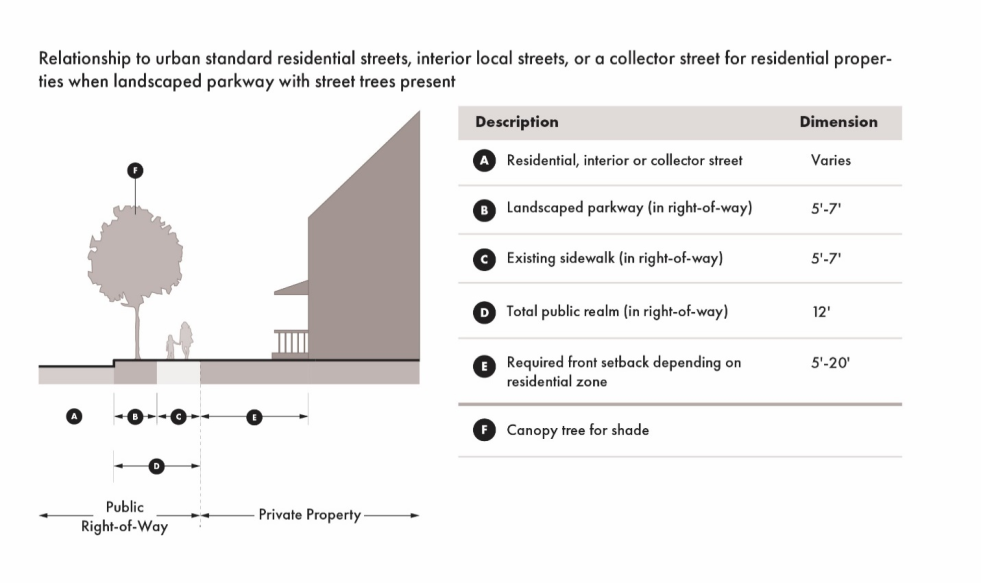
FIGURE 22.140.520-B: COUNTY STANDARD FOR SINGLE-UNIT AND MULTI-UNIT (PRIVATE ENTRY)
DEVELOPMENTS WHERE NO SIDEWALK OR STREET TREES ARE PROVIDED IN THE
PUBLIC RIGHT-OF-WAY
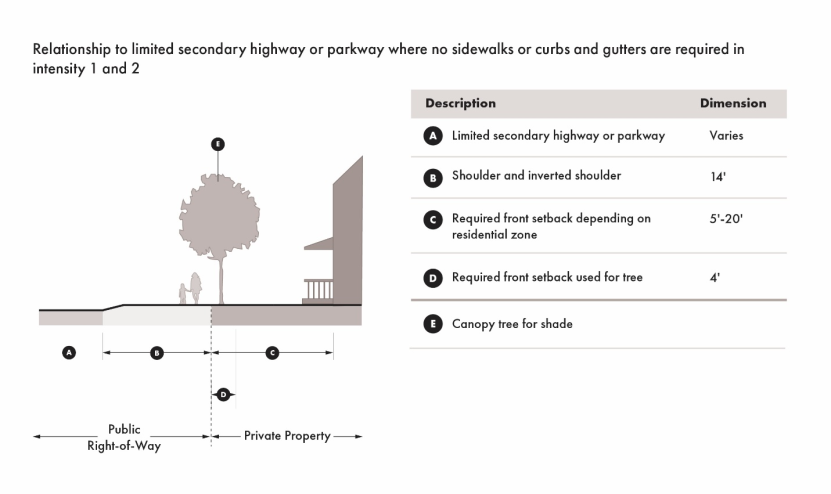
FIGURE 22.140.520-C: COUNTY STANDARD FOR SINGLE-UNIT AND MULTI-UNIT (PRIVATE ENTRY) DEVELOPMENTS FRONTING MAJOR AND SECONDARY HIGHWAYS WHERE A SIDEWALK IS PROVIDED WITHOUT STREET TREES
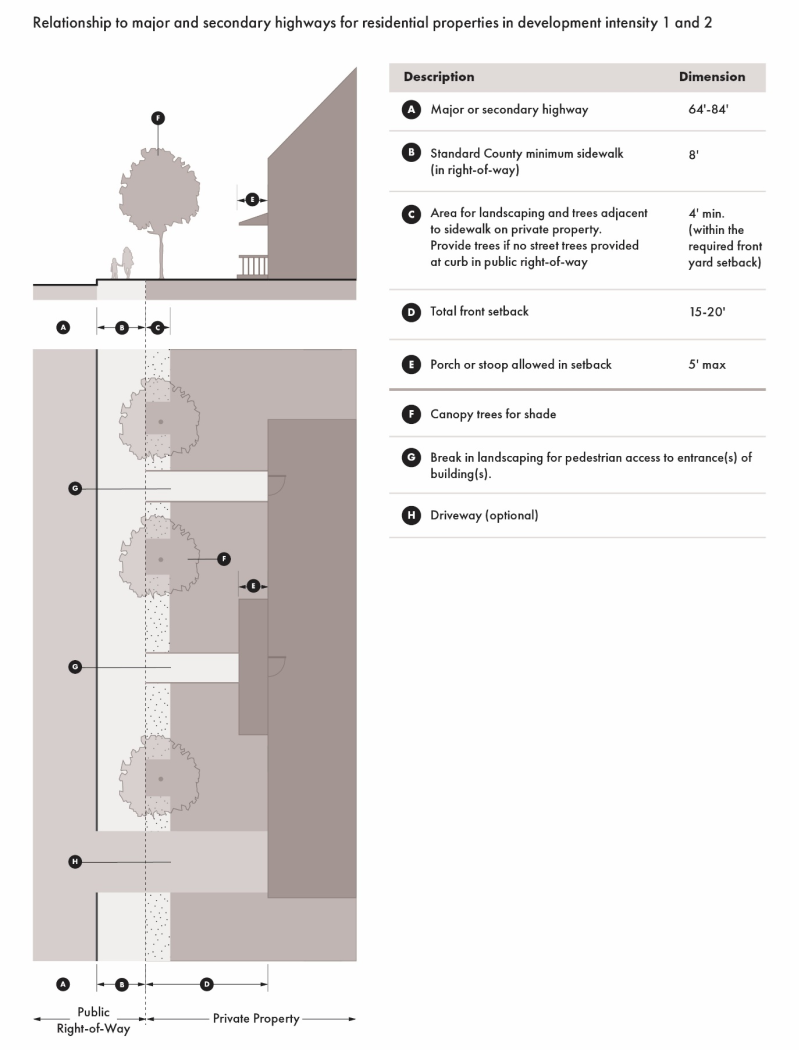
d.
Tree Sizes. All trees planted on-site to meet the requirements in Section 22.140.520.F.4.c (Canopy Tree Requirement), above, shall adhere to species and sizes required by Chapter 22.126 (Tree Planting Requirements).
5.
Ground Floor Treatments.
a.
Intent. The intent of this Subsection is to ensure that primary entryways to the primary building are oriented toward the public right-of-way to encourage pedestrian activity to and from the building. On corner lots, the primary pedestrian entrance may be along the frontage oriented toward either adjoining street.
b.
Primary Entryways. All street-fronting primary buildings shall have at least one primary pedestrian entrance that meets all the following requirements:
i.
Be oriented to the front lot line of the subject property. If the proposed building includes an interior courtyard with an entrance located on such a street, the pedestrian entrance may face such courtyard;
ii.
Not be oriented to face or take access from a vehicle parking area; and
iii.
Be lit with a minimum of one light fixture. The light shall provide a minimum of two foot-candles on the ground within a minimum of five feet from the entryway door.
c.
Entryway Articulation. The primary entryways of all primary buildings shall incorporate at least two of the entryway articulation strategies listed in Table 22.140.520-B, below.
d.
Entryway Widths. The primary entryway areas (recessed, projecting, or porches) of all primary buildings shall be at least five feet wide, as shown in Figure 22.140.520-D, below.
FIGURE 22.140.520-D: ENTRYWAY WIDTH FOR SINGLE-UNIT OR MULTI-UNIT (PRIVATE ENTRY)
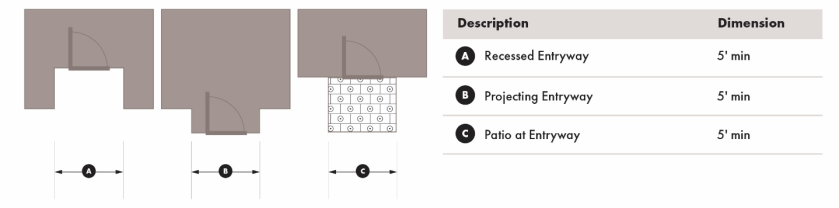
6.
Building Articulation.
a.
Intent. The intent of this Subsection is to ensure that the design of a residential development is considerate of its surroundings in all directions by breaking up large, otherwise featureless spaces, masses, or volumes on all building façades with architectural detailing and modulations.
b.
Façade Variety. The building façades of all primary buildings over 20 feet long facing a street, highway, alley, or corner of such street or highway shall incorporate articulation and architectural detailing that meet all the following criteria:
i.
The façade wall shall include at least one articulation or architectural detailing strategy and shall include an additional articulation or architectural detailing strategy for every 30 linear feet of horizontal building façade, distributed across the width of each street, highway, or alley-facing building façade utilizing the strategies in Table 22.140.520-C, below. Strategies used to satisfy this requirement shall not be used to satisfy another requirement within this Section.
ii.
Primary buildings facing two frontages, such as on corner lots, shall incorporate articulation and architectural detailing along each frontage with at least 20 linear feet of horizontal building length.
7.
Building Façade Details.
a.
Intent. The intent of this Subsection is to ensure primary buildings are designed holistically on all sides to create a cohesive architectural idea and enhance the surrounding neighborhood in all directions by considering the use of materials for sides of a building equally, not just the frontage.
b.
Façade Material Variety. All primary buildings shall include a minimum of two materials, colors, or textures along façades.
i.
One of the two materials, colors, or textures shall be used on a minimum of 10 percent of the building façade.
ii.
Fenestration shall not count towards the material requirement.
c.
Material Continuity. Primary building façades shall be treated as a whole and finished with similar materials on all sides to provide continuity; however, the percentages of each material may vary. To avoid a superficially tacked-on appearance, building façade materials shall not change at a vertical external corner of a building. Instead, materials shall adhere to one or more of the following conditions, as shown on Figure 22.140.520-E, below:
i.
Continue around the vertical external corner for a minimum distance of four feet;
ii.
End a minimum of four feet from a vertical external corner; and/or
iii.
Transparent metal screens and railings which project a minimum of six inches from the main building façade are exempt from the material change requirements.
FIGURE 22.140.520-E: LEFT—MATERIAL CHANGE ENDS AT THE VERTICAL CORNER OF A BUILDING. RIGHT—MATERIAL CONTINUES AROUND THE CORNER OF A BUILDING
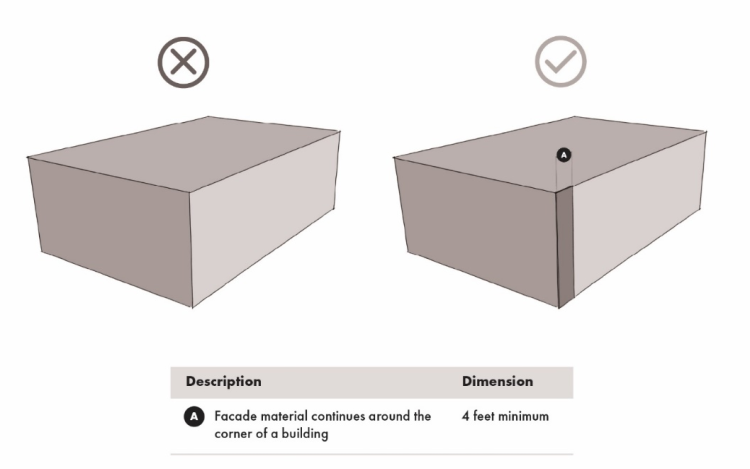
d.
Prohibited Materials. The façades of primary buildings shall not use any of the following materials on more than two percent of the visible surfaces:
i.
Polished metal or glossy plastic with a Light Reflective Value (LRV) over 60;
ii.
Plywood (Rated Construction Grade, C or D); and
iii.
Stucco with a sand finish of less than 20/20. This provision shall not apply to buildings situated more than 50 feet from the front property line.
e.
Energy Efficiency. The primary buildings of single-unit developments shall comply with the following to promote flexibility and encourage energy efficiency:
i.
Natural Lighting. All habitable rooms (rooms for living, sleeping, eating, or cooking) shall be provided with natural light by means of exterior glazed windows, doors, clearstories, skylights, or a combination. The exterior glazed surface area shall be a minimum of 10 percent of the floor area of the attached rooms or a minimum area of 10 square feet, whichever is larger;
ii.
Natural Ventilation. Unless prohibited by other codes (e.g., the Building Code, Fire Code, etc.), all habitable rooms shall be provided with natural ventilation by means of openable exterior windows or doors with an area not less than five percent of the floor area of such rooms, or a minimum of five square feet, whichever is larger. Units with multiple exposures shall include a minimum of one openable window on each exposure; and
iii.
Solar Readiness. All buildings shall comply with the requirements of section 110.10 (Mandatory Requirements for Solar Ready Buildings) of the California Building Energy Efficiency Standards, as applicable.
8.
Landscaping, Walls, Fences, and Screening.
a.
Intent. The intent of this Subsection is to ensure developments utilize landscaping, walls, and fences designed to be in harmony with adjacent lower intensity/smaller scale uses; soften the appearance of large massing along the street; allow for both privacy and visibility; and increase the developments' resiliency to wildfire, heat, drought, and floods.
b.
Trees and Plants.
i.
Coverage. A minimum of 20 percent of the lot area not used for buildings and structures, such as setbacks and open space, and up to 5,000 square feet shall be landscaped with a combination of trees, ground cover, shrubbery, planters, or flowers. Areas of existing landscaping and naturally occurring vegetation may count toward this requirement. Pedestrian walkways may be developed in the landscaped area and count towards the minimum landscaped area requirement.
ii.
Plant Species. At least 80 percent of the on-site landscaping coverage area shall consist of trees and plants native to southern California or non-invasive and drought tolerant plants, as approved by the Director. This provision does not apply to those plants grown for personal consumption.
c.
Walls and Fences.
i.
Transparency. Fence design may include a combination of solid planes and/or open fencing.
ii.
Materials. Fences shall be constructed of wood, wood composite, concrete, masonry, clay, aluminum, iron, steel, or glass. The use of barbed or razor wire, electrified fence, and chain-link and wired fence in conjunction with any fence, wall, roof, or hedge is prohibited, unless required by any local, State, or federal regulation, as applicable. Notwithstanding the foregoing, residential projects on properties in the Antelope Valley and Santa Clarita Valley Planning Areas may use chain-link fencing.
d.
Screening.
i.
Trash Enclosures. All residential development projects that include trash enclosures shall comply with Chapter 22.132 (Storage Enclosure Requirements for Recycling and Solid Waste).
ii.
Mechanical Equipment and Utilities. Fire Department backflow prevention devices, water meters, transformers, and other utility-related equipment are prohibited in the front yard, unless completely screened in a manner that is incorporated into the design of the development. This provision does not apply to water tanks and landscaping equipment, such as irrigation and sprinkler control systems.
(1)
If air conditioning units or vents are located on the front façade, they shall not project more than six inches from the face of the building.
(2)
If on a rooftop or in a yard, the equipment must be screened from view from the street with a wall, fence, or landscaping.
(3)
If mechanical equipment and utilities are not visible from the front property line, screening is not required.
9.
Vehicle Parking Facilities.
a.
Intent. The intent of this Subsection is to foster a pedestrian-oriented environment between the street and the primary building and to maintain and enhance the visual character of residential neighborhoods by minimizing the visual dominance of parking areas.
b.
Parking Locations. In addition to the standards that follow, the primary building of single-unit developments shall comply with Section 22.112 (Parking), unless located underground.
i.
Garages or uncovered surface parking lots shall not be located closer to the front property line than the front door of the building closest to the front property line and shall comply with one of the conditions listed in Table 22.140.520-D, below, except if the site is located in a Hillside Management Area or as otherwise allowed by this Title 22. See Figures 22.140.520-F, G, and H, below, for examples of acceptable garage locations.
ii.
Garages shall make up no more than 50 percent of the total building frontage length, unless the development is located on a narrow lot, as defined in Section 22.110.130.B (Required Width), in which case the garage facing the street shall occupy no more than 80 percent of the total building frontage length of the dwelling unit and garage combined facing the street.
FIGURE 22.140.520-F: ACCEPTABLE LOCATIONS FOR
VEHICLE PARKING GARAGES AND ACCESS
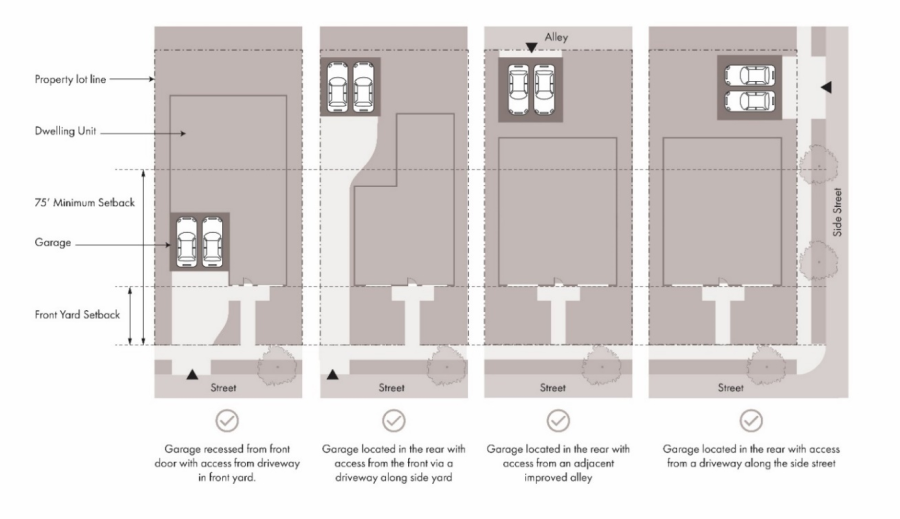
FIGURE 22.140.520-G: UNACCEPTABLE LOCATIONS FOR VEHICLE PARKING GARAGES AND ACCESS
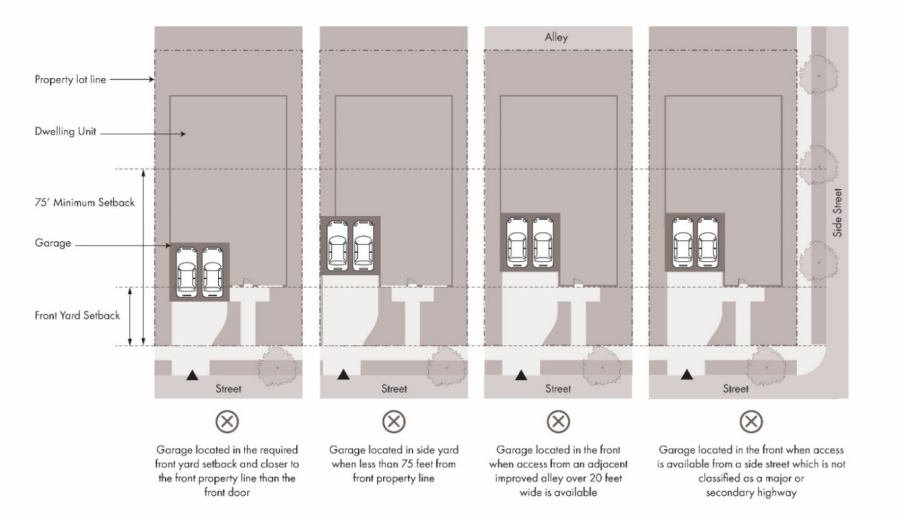
FIGURE 22.140.520-H: IF A GARAGE DOOR FACES THE STREET, THE FRONT PLANE OF THE GARAGE SHALL BE SETBACK FROM THE FRONT PORCH OR PATIO AND OCCUPY NO MORE THAN 50% OF THE BUILDING FRONTAGE
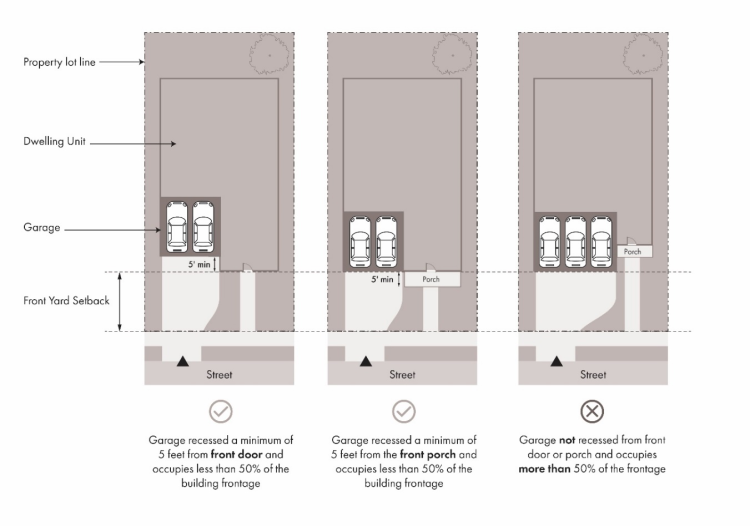
iii.
Garages on lots with 100 feet or more of frontage shall:
(1)
Provide non-street-facing parking, whether attached or detached, when located along the primary street frontage; or
(2)
Provide parking that is located in the rear of the lot, as allowed by this Title 22.
G.
Multi-Unit (Private Entry) Standards.
1.
Applicability. All residential development projects consisting of multiple primary dwelling units where residents can access each unit directly via a private external entry or via a small vestibule on the ground floor shall comply with all applicable standards in this Section.
2.
Additional Standards. In addition to the provisions below, the standards for any specific use identified in Division 7 (Standards for Specific Uses) shall also apply.
3.
Building and Site Access.
a.
Intent. The intent of this Subsection is to enhance the environment along public and private streets and in residential neighborhoods by ensuring pedestrians, cyclists, and other non-motorists are provided with safe and pleasant access to residential buildings.
b.
Direct Pedestrian Access.
i.
All buildings shall have a minimum of one direct pedestrian pathway from all adjoining street sidewalks or public rights-of-way where sidewalks are not present to the front entrance of the building(s), courtyard, or individual unit facing the street.
ii.
Where a sidewalk in the public right-of-way is not required by other County-approved plans, a pedestrian pathway connecting the building entrance to the street shoulder shall be provided.
4.
Front Yards and Building Orientation.
a.
Intent. The intent of this Subsection is to enhance the environment along streets and in residential neighborhoods through private property site design. See Figures 22.140.520-A, B, C, and D, above.
b.
Orientation. All multi-unit (private entry) buildings shall have at least one primary pedestrian entrance along the frontage oriented toward the primary adjoining street. See Subsection F.5.b (Primary Entryways), above.
c.
Canopy Tree Requirement. A residential development shall provide a minimum of one canopy tree per lot in the first four feet of the front yard setback area adjacent to the street, as shown on Figure 22.140.520-B, above. Additionally, a residential development shall provide one additional canopy tree per each 40 linear feet of lot frontage above 40 feet. Trees planted to meet this requirement shall count toward satisfying the requirements of Chapter 22.126 (Tree Planting Requirements). This requirement shall not apply if any of the following conditions exist in those areas of the lot adjacent to the street, as shown on Figure 22.140.520-B, above:
i.
The site is constrained by topography, as defined by Chapter 22.104 (Hillside Management Areas);
ii.
There are conflicts with fuel modification requirements, as defined in Title 32 (Fire Code) of the County Code; or
iii.
The property fronts a street or highway, in which street or parkway trees in the right-of-way are required, similar to Figure 22.140.520-A, above.
d.
Tree Sizes. All trees planted on-site to meet the requirements above shall adhere to species and sizes required by Chapter 22.126 (Tree Planting Requirements).
5.
Ground Floor Treatments.
a.
Intent. The intent of this Subsection is to ensure that primary entryways to a building are oriented toward the public right-of-way to encourage pedestrian activity to and from the building.
b.
Primary Entryways. All street-facing buildings shall have at least one primary pedestrian entrance that meets the following requirements. At least one primary pedestrian entrance shall:
i.
Be oriented to the right-of-way from the front yard of the subject property. If the proposed building includes an interior courtyard with an entrance located on such a street, the pedestrian entrance may face such courtyard;
ii.
Not be oriented to face or take access from a vehicle parking area; and/or
iii.
Be lit with a minimum of one light fixture. The light shall provide a minimum of two foot-candles on the ground, within a minimum of five feet from the entryway door.
c.
Entryway Articulation. All primary building entryways shall incorporate at least two of the entryway articulation strategies listed in Table 22.140.520-E, below.
d.
Entryway Widths. All primary building entryway areas (recessed, projecting, or porches) shall be at least five feet wide, as shown in Figure 22.140.520-D, above.
e.
Ground Floor Privacy. Multi-unit (private entry) developments in which some units take pedestrian access from the right-of-way, such as townhouse-style developments, or internal open space, such as a courtyard or paseo, shall mitigate privacy concerns for residents by implementing at least two of the strategies outlined in Table 22.140.520-F, below.
FIGURE 22.140.520-I: GROUND FLOOR OF MULTI-UNIT (PRIVATE ENTRY) ADJACENT TO A PUBLIC SIDEWALK AND STREET
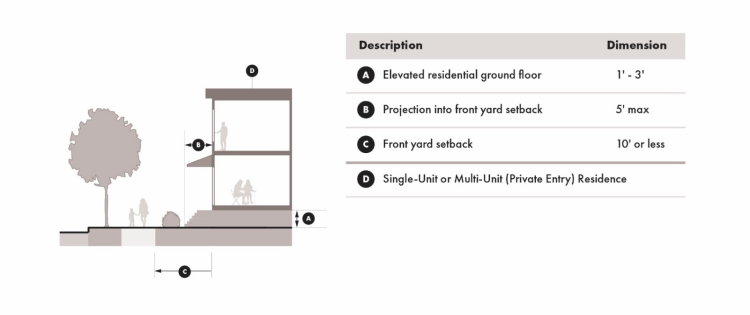
6.
Building Articulation.
a.
Intent. The intent of this Subsection is to ensure that the design of a residential development is considerate of its surroundings in all directions by breaking up large, otherwise featureless spaces, masses, or volumes on all building façades with architectural detailing and modulations.
b.
Façade Variety. All building façades over 20 feet long facing a street, highway, alley, or corner of such street or highway shall incorporate articulation and architectural detailing strategies that meet all the following criteria:
i.
The façade wall shall include at least two articulation or architectural detailing strategies and shall include an additional articulation or architectural detailing strategy for every 30 linear feet of horizontal building façade, distributed across the width of each street, highway, or alley-facing building façade utilizing the strategies in Table 22.140.520-G, below. Strategies used to satisfy this requirement shall not be used to satisfy another requirement within this Section.
ii.
Buildings facing two frontages, such as on corner lots, shall incorporate articulation and architectural detailing strategies along each frontage with at least 20 linear feet of horizontal building length.
c.
Articulation of Interior Building Façades. A development or subdivision comprised of multiple buildings facing internal private roadways and paseos/courtyards shall incorporate at least two of the accent types in Table 22.140.520-G, above.
d.
Vertical Recess, Gap, or Opening. Any multi-unit building facing a public or private street or right-of-way with a length of 150 feet or longer shall be divided by a vertical opening, gap, or recessed plane with a total minimum floor area of at least 24 square feet with a minimum width of 8 feet and depth of 3 feet and encompassing all floors. See Figure 22.140.520-J, below.
FIGURE 22.140.520-J: FOR BUILDINGS ABOVE 150 FEET IN LENGTH, ONE VERTICAL OPENING
WITH A TOTAL OF
24 SQUARE FEET MINIMUM
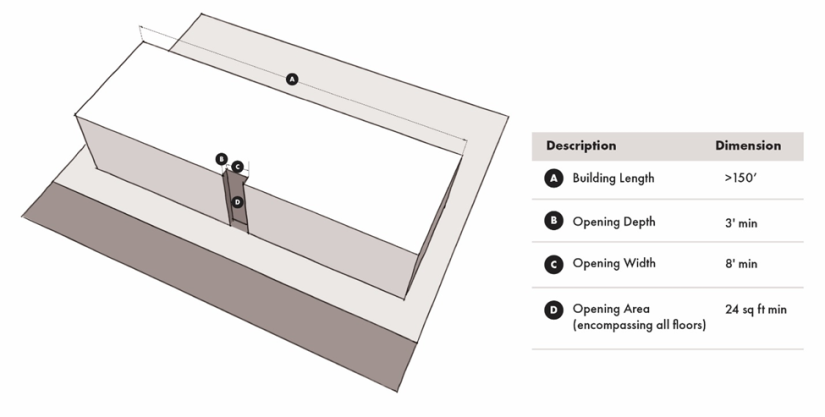
7.
Building Façade Details.
a.
Intent. The intent of this Subsection is to ensure buildings are designed holistically on all sides to create a cohesive architectural idea and enhance the surrounding neighborhood in all directions by considering the use of materials for sides of a building equally, not just the frontage.
b.
Façade Material Variety. All buildings shall include a minimum of two materials, colors, or textures along façades.
i.
One of the two materials, colors, or textures shall be used on a minimum of 10 percent of the building façade.
ii.
Fenestration shall not count towards the material requirement.
c.
Material Continuity. Building façades shall be treated as a whole and finished with similar materials on all sides to provide continuity; however, the percentages of each material may vary. To avoid a superficially tacked-on appearance, building façade materials shall not change at a vertical external corner of a building. Instead, materials shall adhere to one or more of the following conditions, as shown in Figure 22.140.520-E, above:
i.
Continue around the vertical external corner for a minimum distance of four feet;
ii.
End at a minimum of four feet from a vertical external corner;
iii.
Transparent metal screens and railings, which project a minimum of six inches from the main building façade, are exempt from the material change requirements; and/or
iv.
Color. Paint color changes on a continuous material may occur at any point along the façade, including at vertical external corners.
d.
Prohibited Materials. Façades shall not use any of the following prohibited materials on more than two percent of the visible surfaces:
i.
Polished metal or glossy plastic with a Light Reflective Value (LRV) over 60;
ii.
Plywood (Rated Construction Grade C or D); and
iii.
Stucco with a sand finish of less than 20/20.
e.
Energy Efficiency.
i.
Natural Lighting. All habitable rooms, such as rooms for living, sleeping, eating, or cooking, shall be provided with natural light by means of exterior glazed windows, doors, clearstories, skylights, or a combination. The exterior glazed surface area shall be a minimum of 10 percent of the floor area of the attached rooms or a minimum area of 10 square feet, whichever is larger.
ii.
Natural Ventilation. Unless prohibited by other codes, such as the Building Code, Fire Code, etc., all habitable rooms shall be provided with natural ventilation by means of openable exterior windows or doors with an area not less than five percent of the floor area of such rooms, or a minimum of five square feet, whichever is larger. Units with multiple exposures shall include a minimum of one openable window on each exposure.
iii.
Solar Readiness. All buildings shall comply with the requirements of section 110.10 Mandatory Requirements for Solar Ready Buildings of the California Building Energy Efficiency Standards, as applicable.
8.
Balconies and Patios.
a.
Intent. The intent of this Subsection is to provide usable private open space for residents to encourage socialization, provide ample light and fresh air for the residents, and add dimensional variety to building façades.
b.
Exceptions. The following types of multi-unit (private entry) developments are exempt from this Subsection:
i.
Residential development consisting only of a primary dwelling unit with ADU(s);
ii.
Residential development consisting of only two detached primary units; and
iii.
Residential development consisting of up to four attached dwelling units where the development provides an aggregate of at least 100 square feet of on-ground, on-site open space per unit.
c.
Access. Private balconies and patios shall be directly accessible from the residential unit. See Figures 22.140.520-K to M, below.
FIGURE 22.140.520-K: BALCONY AND GROUND FLOOR
PATIO DIMENSIONS
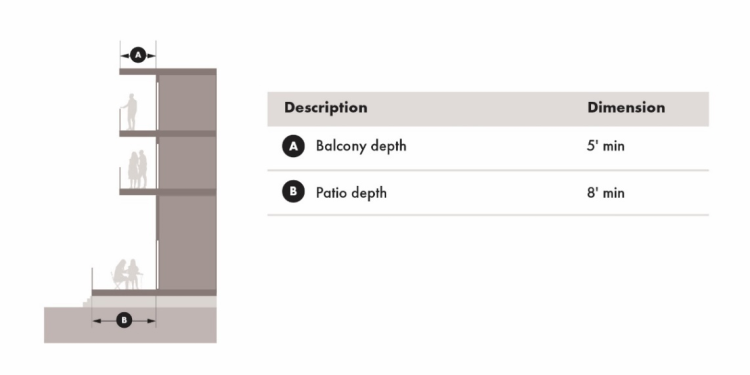
FIGURE 22.140.520-L: CANTILEVERED, SEMI-RECESSED,
AND RECESSED BALCONIES
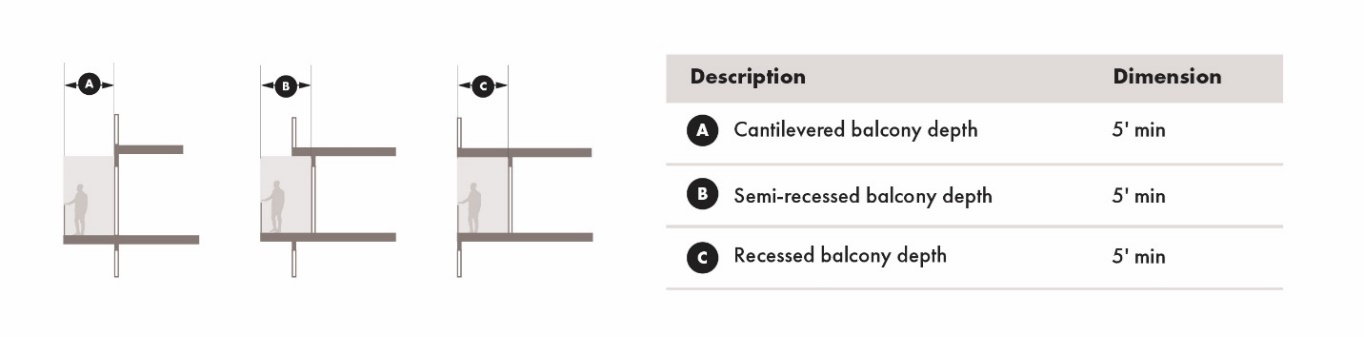
FIGURE 22.140.520-M: CORNER BALCONIES
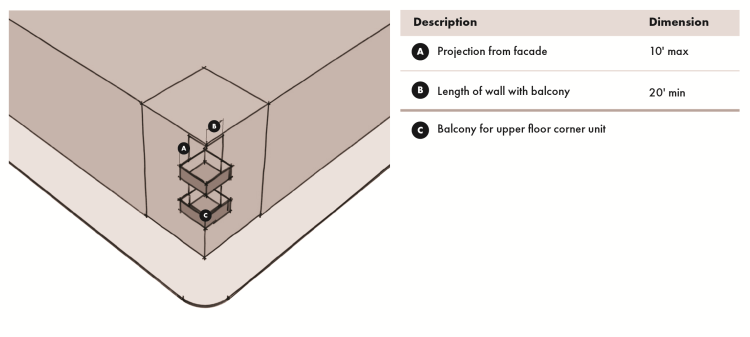
i.
Location. Patios and balconies shall be provided, as outlined in Table 22.140.520-I, below. Required balconies may be located along exterior building walls, along internal walls facing courtyards, or a combination of both.
ii.
Ground Floor Units. If residential units are located on the ground level or a podium, provide private patios for a minimum of 25 percent of those units on the ground floor or podium. Each patio shall be a minimum of 100 square feet in area and 7 feet deep.
iii.
Upper Floor Units. Buildings shall provide the required amount of private full balconies, Juliette balconies, or a mix of both for upper floor units, as listed in Table 22.140.520-H, below.
iv.
Full Balcony Dimensions. Any full balcony designed to satisfy the requirements of this Subsection shall meet the following dimensions:
(1)
Balconies shall be a minimum of five feet deep;
(2)
The height of the balcony area shall not be less than the ceiling height of the adjoining floors; and
(3)
The number of bedrooms in the attached unit shall determine the minimum square footage of each balcony, as defined in Table 22.140.520-I, below.
v.
Juliette Balcony Dimensions. Any Juliette balcony designed to satisfy the requirements of this Subsection shall meet the following dimensions, as shown in Figure 22.140.520-M, above:
(1)
Barrier or railing shall project outward a minimum of three inches from the building façade; and
(2)
Barrier or railing shall extend beyond the sides of the doorway a minimum of three inches from each side of the connecting door frame.
9.
Landscaping and Screening.
a.
Intent. The intent of this Subsection is to ensure developments utilize landscaping, walls, and fences designed to be in harmony with adjacent lower-intensity/smaller-scale uses, soften the appearance of large massing along the street, allow for both privacy and visibility, and increase a development's resiliency to wildfire, heat, drought, and floods.
b.
Trees and Plants.
i.
Coverage. A minimum of 20 percent of the lot area not used for buildings and structures, such as setbacks and open space, shall be landscaped with a combination of trees, ground cover, shrubbery, planters, or flowers.
(1)
Required landscaping within parking lots does not count toward this coverage requirement.
(2)
Pedestrian walkways, plazas, and outdoor dining areas may be developed in the landscaped area and count towards the minimum landscaped area requirement.
ii.
Plant Species. At least 80 percent of the on-site landscaping coverage area shall consist of trees and plants native to southern California or non-invasive and drought tolerant, as approved by the Director. This provision does not apply to those plants grown for personal consumption.
c.
Walls and Fences.
i.
Transparency. Fence design may include a combination of solid planes and open fencing. Any fence in the front yard setback over 3 feet tall shall be a minimum of 50 percent transparent along the frontage.
ii.
Materials. Fences shall be constructed of wood, wood composite, concrete, masonry, clay, aluminum, iron, steel, or glass. The use of barbed or razor wire, electrified fence, and chain-link fence in conjunction with any fence, wall, roof, or hedge is prohibited, unless required by any local, State, or federal regulation, as applicable.
d.
Screening.
i.
Trash Enclosures. All residential development projects that include trash enclosures shall comply with Chapter 22.132 (Storage Enclosure Requirements for Recycling and Solid Waste).
ii.
Mechanical Equipment and Utilities. Fire Department backflow prevention devices, water meters, transformers, and other utility-related equipment are prohibited in the front yard, unless completely screened in a manner that is incorporated into the design of the development. This provision does not apply to landscaping equipment, such as irrigation and sprinkler control systems.
(1)
Air conditioning units or vents located on the front façade shall not project more than six inches from the face of the building.
(2)
If on a rooftop or in a yard, the equipment shall be screened from view from the street with a wall, fence, or landscaping.
e.
Security Bars and Grilles. When installed, all security bars or grilles shall be installed on the inside of the building.
i.
Horizontally folding accordion grilles installed on the outside of a storefront are prohibited.
ii.
Building security grilles shall be:
(1)
Side-storing, concealed interior grilles that are not visible from the exterior of the building when not in use during business hours; or
(2)
Roll-up shutters or grilles which can be concealed in the architectural elements of the building.
10.
Vehicle Parking Facilities.
a.
Intent. The intent of this Subsection is to foster a pedestrian-oriented environment between the street and the building and to maintain and enhance the visual character of residential neighborhoods by minimizing the visual dominance of parking areas.
b.
Exceptions. Townhouses and bungalow courts with parking consolidated in a lot or structure instead of individual garages are exempt from the following standards.
c.
Parking Locations. In addition to the standards that follow, multi-unit (private entry) developments shall comply with Section 22.112 (Parking), unless located underground. See Figures 22.140.520-F, G, and H, above.
i.
Garages or surface parking lots shall not be located closer to the front property line than the front door of the building closest to the front property line and shall comply with one of the conditions listed in Table 22.140.520-D, above, except if the site is located in a Hillside Management Area or as otherwise allowed by this Title 22. See Figures 22.140.520-F, G, and H, above, for examples of acceptable garage locations.
ii.
Parking Access with Side Street or Alley. If a development site is adjacent to an alley or corner, parking areas shall be accessed from the alley or side street except in the following conditions:
(1)
If the development site abuts an improved alley less than 20 feet wide;
(2)
If the development site sits on a corner lot with two street frontages and has a total gross building area of 200,000 square feet or more, parking access is allowed on both frontages; or
(3)
If the side street is classified as a major or secondary highway.
iii.
Parking Access without Side Street or Alley. If there is no alley or side street access available, parking shall be accessed from the primary adjoining street.
iv.
Garage Placement.
(1)
Applicability. This Subsection shall apply only to developments with one to four dwelling units. See Figure 22.140.520-H, above, and Figures 22.140.520-N to Q, below.
(2)
Garages on lots with 100 feet or more of frontage shall:
(a)
Provide non-street-facing parking, whether attached or detached, when located along the primary street frontage; or
(b)
Provide parking that is located in the rear of the lot, as allowed by this Title 22.
(3)
Street-Facing Parking. Garages facing the street and located to the side of or below the primary dwelling unit shall:
(a)
Only be allowed if access or physical constraints, such as being located in a Hillside Management Area, make it infeasible to locate it in the rear or face away from the street;
(b)
Occupy no more than 50 percent of the total building frontage length of the dwelling unit and garage combined facing a street, unless the development is located on a narrow lot, as defined in Section 22.110.130.B (Required Width), in which case the garage facing the street shall occupy no more than 80 percent of the total building frontage length of the dwelling unit and garage combined facing the street; and
(c)
The front plane of a garage wall facing the street shall be set back from the front of the longest street-facing wall of the dwelling unit frontage in a manner consistent with one of the conditions listed in Table 22.140.520-D, above.
d.
Common Driveways. In addition to all requirements in Chapter 22.112 (Parking), developments shall provide shared common driveways for vehicular access. Common driveways shall comply with all applicable provisions of Title 32 (Fire Code) of the County Code.
i.
Alley-abutting lots shall use the alley for vehicle access. See Figure 22.140-520-N, below.
FIGURE 22.140.520-N: ALLEY-ABUTTING LOTS SHALL USE
THE ALLEY FOR VEHICLE ACCESS
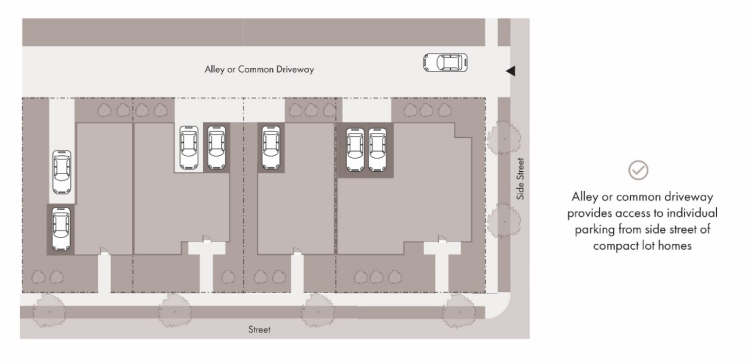
ii.
For townhouses where on-site parking is provided, a T-shaped, I-shaped, or L-shaped shared private driveway shall be provided, if the development site sits on a mid-block lot (not abutting an alley). See Figures 22.140.520-O and P, below.
FIGURE 22.140.520-O: TOP: T-SHAPED COMMON DRIVEWAY.
BOTTOM: L-SHAPED COMMON DRIVEWAY
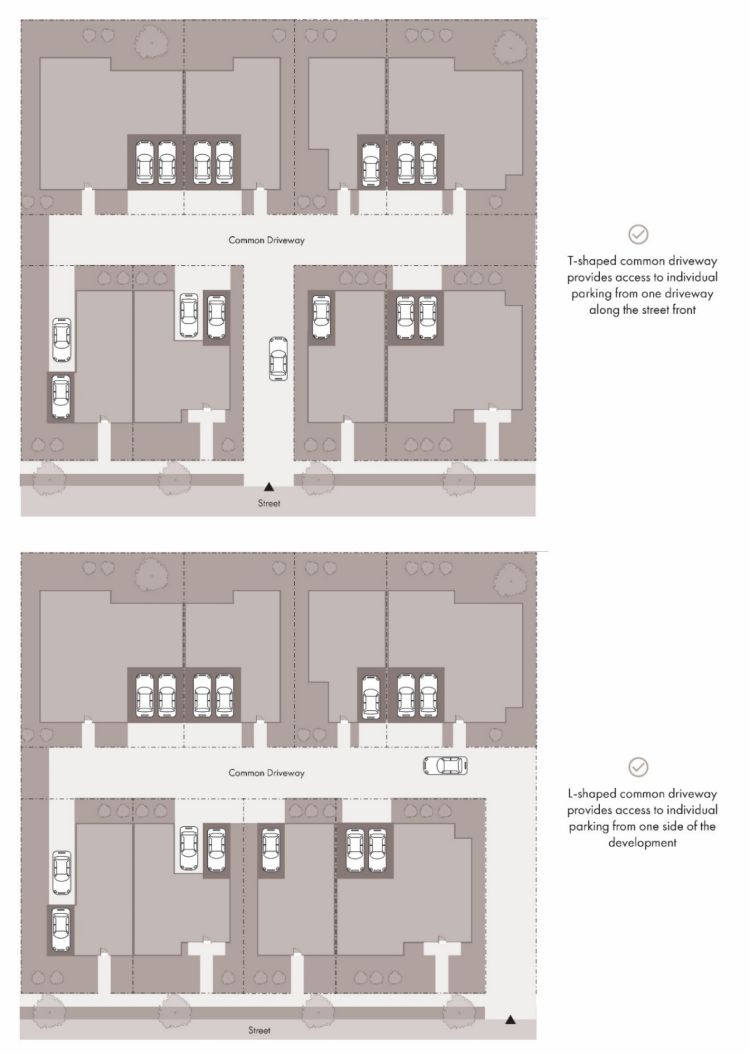
iii.
Variations in the configurations of shared common driveways and a shared common private driveway with the adjoining property owner may be allowed, if approved by the Director of Public Works. See Figures 22.140.520-P and Q, below.
FIGURE 22.140.520-P: SHARED COMMON DRIVEWAY BETWEEN TWO ADJACENT LOTS
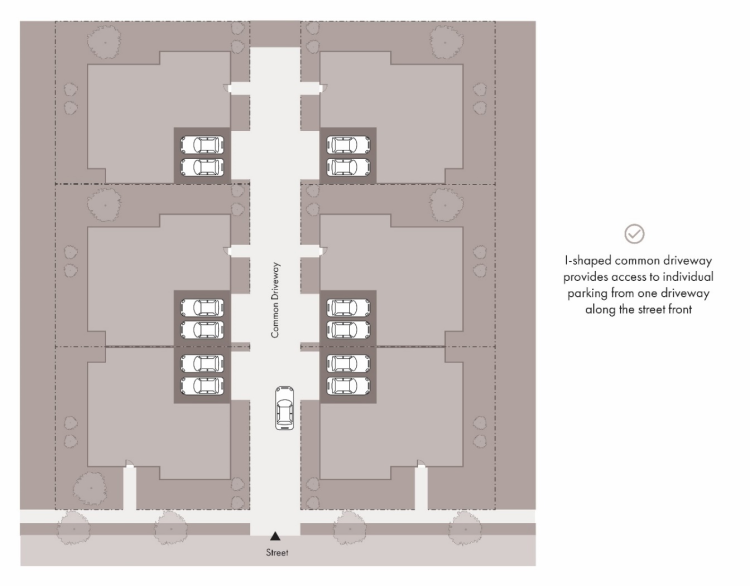
FIGURE 22.140.520-Q: UNACCEPTABLE LAYOUT WITH MULTIPLE INDIVIDUAL DRIVEWAYS ALONG STREET-FACING UNITS INSTEAD OF UTILIZING A COMMON DRIVEWAY
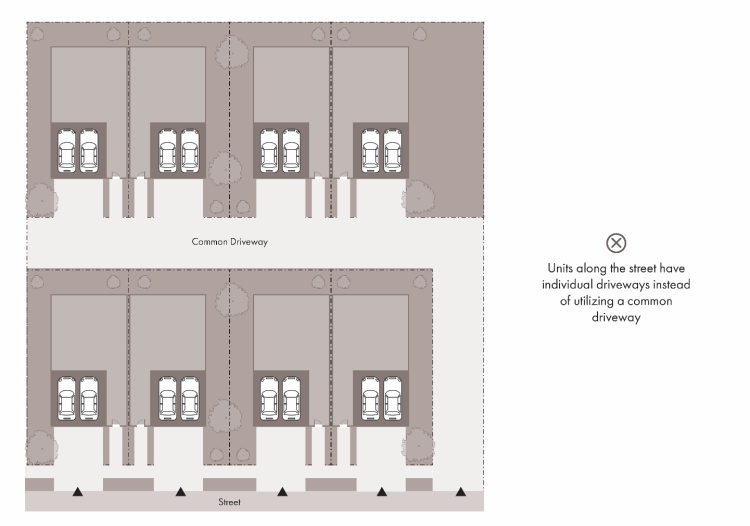
iv.
For bungalow courts, an L-shaped or U-shaped common driveway shall be permitted, if the development is a mid-block lot (not abutting on an alley or side street). See Figure 22.140.520-R, below. A U-shaped common driveway may have two curb cuts on the primary street, each a maximum of 20 feet wide if the common driveway is one way. A five-foot minimum landscape buffer shall be provided around the perimeter of the property adjacent to the common driveway, unless the common driveway is shared with an adjacent adjoining property.
FIGURE 22.140.520-R: COMMON DRIVEWAYS FOR BUNGALOW COURTS
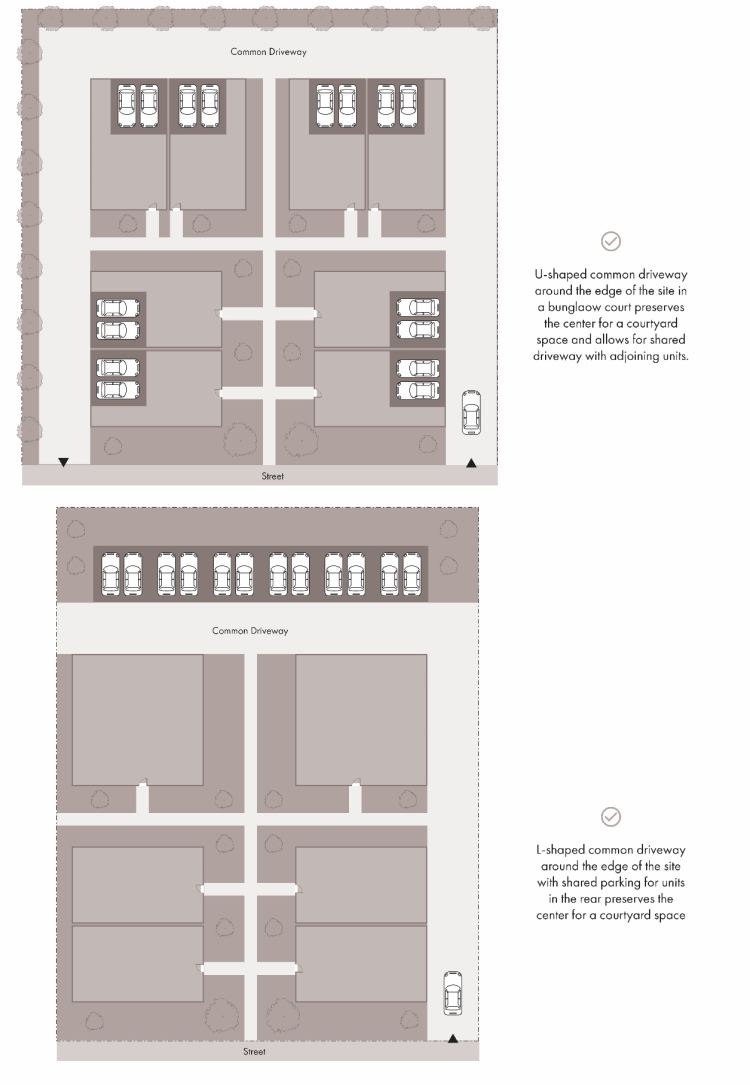
v.
When a property has a lot depth less than 90 feet and has primary street access, the standards for single-unit access shall be followed for driveway locations.
e.
Parking Frontage. Street-fronting units shall locate individual garage doors away from the street. See Figures 22.140.520-N to R, above.
H.
Multi-Unit (Common Entry) and Mixed Use Standards.
1.
Applicability. All residential developments consisting of multiple dwelling units, the majority of which are typically accessed through internal lobbies and hallways and not directly from exterior of the building(s), shall comply with all applicable standards in this Section.
2.
Additional Standards. In addition to the provisions below, the standards for any specific use identified in Division 7 (Standards for Specific Uses) shall also apply.
3.
Building and Site Access.
a.
Intent. The intent of this Subsection is to enhance the environment along public and private streets and in residential neighborhoods by ensuring pedestrians, cyclists, and other non-motorists are provided with safe and pleasant access to residential buildings.
b.
Direct Pedestrian Access. All buildings shall have a minimum of one direct pedestrian pathway from all adjoining street sidewalks or public rights-of-way where sidewalks are not present to the front entrance of the building(s), courtyard, or individual unit facing the street. Pedestrian paths shall be provided to create connections between all structures, entries, facilities, amenities, and parking areas on-site.
i.
If the development site has multiple buildings, a system of pedestrian pathways on the property shall be provided to connect all building entrances to the sidewalk along the street.
ii.
Where a sidewalk in the public right-of-way is not required by other County-approved plans, a pedestrian pathway connecting the building entrance to the street shoulder shall be provided.
iii.
All pedestrian paths on private property shall be a minimum of five feet wide and lit with lights or bollards on at least one side of the path. Lighting shall provide two foot-candles for the entire length and width of the path at the walking surface. Where such property is located in the Rural Outdoor Lighting District, all lighting shall comply with applicable standards.
iv.
Where primary pedestrian paths or walkways cross, overlap, or run immediately adjacent to parking areas, driveways, or fire lanes, the space prioritized for pedestrian use shall be defined by changes in material, color, or a combination of both.
c.
Trail Access. For trail locations that adjoin private property, refer to the Los Angeles County Trail Manual maintained by Parks and Recreation and the County's Board-adopted regional trails network that provides connectivity to recreation.
4.
Front Yards and Building Orientation.
a.
Intent. The intent of this Subsection is to enhance the environment along streets and in residential neighborhoods through private property site design. See Figures 22.140.520-A, B, C, and D, above.
b.
Orientation. The frontage of all multi-unit (common entry) and mixed use buildings shall have at least one primary pedestrian entrance along the frontage oriented to the primary adjoining streets or open space. See Section 22.140.520.H.5.
c.
Setbacks.
i.
Adjacent to Limited Secondary Highways. Where not already required by the underlying zoning, developments adjacent to limited secondary highways shall provide the following front yard setbacks:
(1)
R-5 and MXD Zones.
(a)
For buildings with a height less than 35 feet, no minimum setback at the ground floor is required, unless the total width of the sidewalk and parkway is narrower than 10 feet. See Figure 22.140.520-S, below.
(b)
For buildings with a height greater than 35 feet, a setback of at least five feet at the ground floor shall be provided.
(c)
No building shall have a setback greater than 10 feet at the ground floor.
(2)
In All Other Zones. The setback at the ground floor shall be a maximum of 15 feet.
FIGURE 22.140.520-S: MULTI-UNIT (COMMON ENTRY) AND MIXED USE PROPERTIES (IN R-5 AND MXD ZONES) ADJACENT TO LIMITED SECONDARY HIGHWAYS WITH ADDITIONAL PAVED SETBACK AREA. DOTTED LINES ILLUSTRATE HOW UPPER BUILDING FEATURES MAY EXTEND TO THE PROPERTY LINE
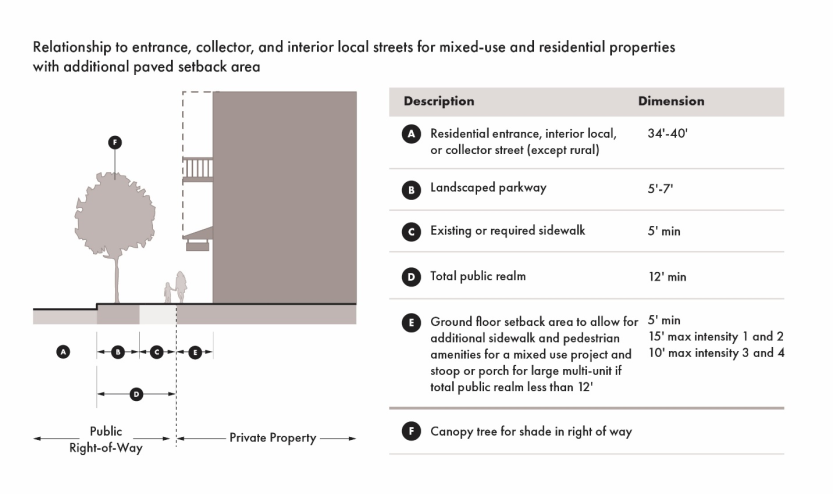
ii.
Adjacent to Major and Secondary Highways. Where not already required by the underlying zoning, developments adjacent to major or secondary highways shall provide the following front yard setbacks:
(1)
In the R-5 and MXD zones, the front yard setback shall be no less than 5 feet and no more than 10 feet at the ground level; and
(2)
In all other zones, the setback at the ground floor shall be a minimum of 15 feet.
iii.
Setback Usage in Mixed Use Developments. Mixed use developments shall use the front setback for landscaping, outdoor dining, building entries, and other pedestrian amenities. See Figure 22.140.520-T, below, and Subsection G.5.e (Ground Floor Pedestrian-Oriented Strategies), below.
FIGURE 22.140.520-T: SETBACKS FOR MULTI-UNIT (COMMON ENTRY) AND MIXED USE PROPERTIES AT MAJOR AND SECONDARY HIGHWAYS. DOTTED LINES ILLUSTRATE HOW UPPER BUILDING FEATURES MAY EXTEND TO THE FRONT SETBACK LINE
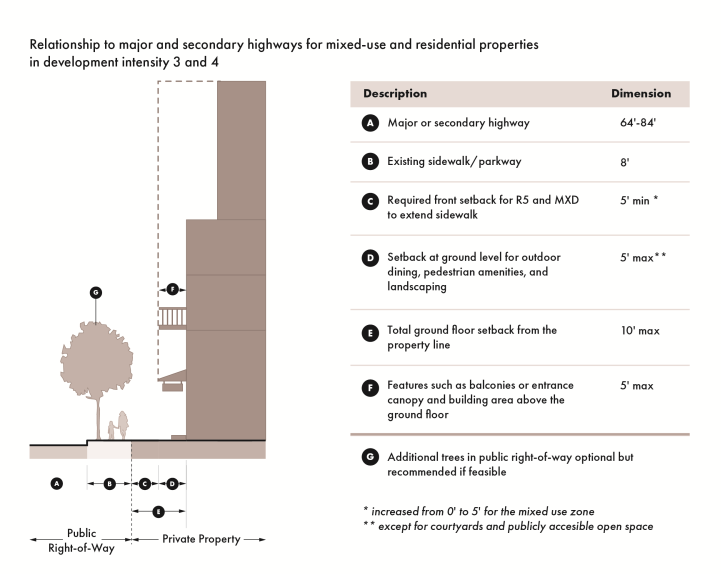
5.
Ground Floor Treatments.
a.
Intent. The intent of this Subsection is to ensure primary entryways to a building are oriented toward the public right-of-way to encourage pedestrian activity to and from the building.
b.
Primary Entryways. All street-facing buildings shall have at least one primary pedestrian entrance that meets the following requirements. At least one primary pedestrian entrance shall:
i.
Face the sidewalk at the front yard of the subject property. If the proposed building includes an interior courtyard with an entrance located on such a street, the pedestrian entrance may face such courtyard;
ii.
Not be oriented to face or take access from a vehicle parking area; and/or
iii.
Be lit with a minimum of one light fixture. The light shall provide a minimum of two foot-candles on the ground, within a minimum of five feet from the entryway door.
c.
Entryway Articulation. All primary building entryways shall incorporate at least two of the entryway articulation strategies listed in Table 22.140.520-J, below.
d.
Entryway Widths. All primary building entryway areas (recessed, projecting, or porches) shall be at least eight feet wide, as shown in Figure 22.140.520-U, below.
FIGURE 22.140.520-U: ENTRYWAY WIDTH FOR MULTI-UNIT
(COMMON ENTRY)
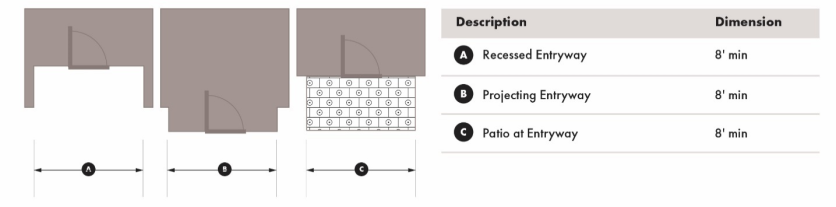
e.
Ground Floor Pedestrian-Oriented Strategies.
i.
Transparency. The ground floor of a multi-unit (common entry) and mixed use building shall provide transparent and non-tinted windows and doors to avoid obscuring visibility and to create a direct visual connection between pedestrians outside and activities occurring inside the building as follows:
(1)
Residential Only. Buildings with residential uses at the ground floor shall have a minimum transparency of 30 percent along the ground level façade facing a street or internal courtyard. However, if these buildings have frontage on a primary or secondary highway that has average noise levels above 65 dB as measured at the front property line, the minimum percentage of wall area along that frontage devoted to windows may be reduced to 10 percent, if the building includes an internal courtyard to provide light and air into spaces fronting the street.
(2)
Mixed Use. Buildings with retail, restaurants, or other commercial uses at the ground floor shall have a minimum transparency of 50 percent along the ground level façade facing a street or internal courtyard.
(3)
Window and Door Openings. To count towards this transparency requirement, the ground floor window or door opening shall have a maximum sill height of 24 inches above grade and a minimum head height of 6 feet 8 inches above grade.
ii.
Parking. Parking shall not be visible on the ground floor. See Subsection H.10 (Vehicle Parking Facilities), below.
iii.
Pedestrian-Oriented Strategies. Buildings that face a highway, street, or sidewalk shall implement at least one of the pedestrian-oriented strategies listed in Table 22.140.520-K, below, along the total ground floor building frontage facing a highway, street, or sidewalk.
6.
Building Articulation.
a.
Intent. The intent of this Subsection is to ensure the design of a residential development is considerate of its surroundings in all directions by breaking up large, otherwise featureless spaces, masses, or volumes on all building façades with architectural detailing strategies and modulations.
b.
Façade Variety. All building façades over 20 feet long facing a street, highway, alley, or corner of such street or highway shall incorporate articulation and architectural detailing strategies that meets all the following criteria:
i.
The façade wall shall include at least two articulation or architectural detailing strategies and include an additional articulation or architectural detailing strategy a minimum of every 30 feet horizontally, on average, distributed across the width of each street, highway, or alley-facing building façade utilizing the strategies in Table 22.140.520-L, below. Strategies used to satisfy this requirement shall not be used to satisfy another requirement within this Section.
ii.
Corner buildings shall incorporate articulation and accents along both street fronts.
c.
Articulation of Interior Building Façades. A development or subdivision comprised of multiple buildings facing internal private roadways and paseos/courtyards shall incorporate at least two of the accent types in Table 22.140.520-C in Section 22.140.520.F.6.b, above.
d.
Vertical Recess, Gap, or Opening. Any multi-unit or mixed use building facing a public or private street or right-of-way with a length of 150 feet or longer shall be divided by a vertical opening, gap, or recessed plane with a total minimum floor area of at least 24 square feet with a minimum width of 8 feet and depth of 3 feet and encompassing all floors. See Figure 22.140.520-J in Section 22.140.520.G.6.d, above.
e.
Base, Middle, and Top. All buildings four stories or taller shall define a base, middle, and top by selecting a minimum of two strategies listed in Table 22.140.520-M, below. None of the below listed features may project into public right-of-way.
f.
Transition to Lower Height.
i.
The portion of any building sharing a common side or rear lot line with property that has a maximum allowable building height of 35 feet or less shall have a step-back from that common side or rear lot line so that the height of a multi-unit (common entry) and mixed use building is no greater than 45 feet at the edge of the building wall facing that common lot line, and shall be recessed back one foot for every additional foot in building height, up to a maximum height of 65 feet. See Figure 22.140.520-V, below.
ii.
Exception. If the height of the building is less than the distance to the common lot line, upper floor step-back along the common lot line is not required. See Figure 22.140.520-W, below.
FIGURE 22.140.520-V: EXAMPLE: 65-FOOT-TALL BUILDING ADJACENT TO A LOT THAT HAS A MAXIMUM BUILDING HEIGHT OF 35 FEET OR LESS WITH ADDITIONAL STEP-BACKS, IF THE DISTANCE BETWEEN THE TWO BUILDINGS IS LESS THAN THE TOTAL HEIGHT OF THE BUILDING
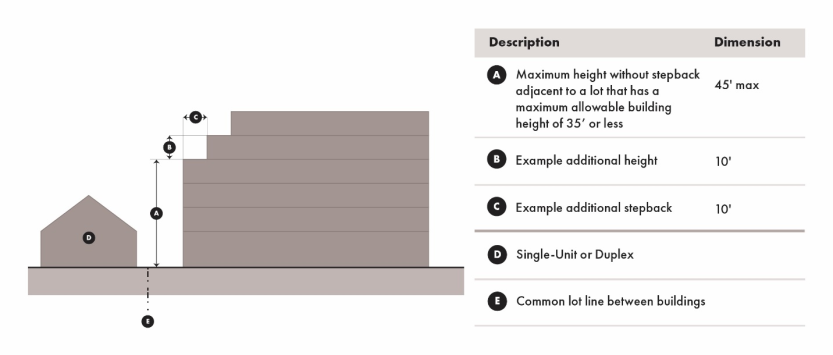
FIGURE 22.140.520-W: EXAMPLE OF 65-FOOT-TALL BUILDING ADJACENT TO A LOT THAT HAS A MAXIMUM BUILDING HEIGHT OF 35 FEET OR LESS (OR SEPARATED BY AN ALLEY) WITH NO REQUIRED UPPER-FLOOR STEP-BACK BECAUSE THE HORIZONTAL DISTANCE FROM THE COMMON LOT LINE IS GREATER THAN THE HEIGHT OF THE BUILDING
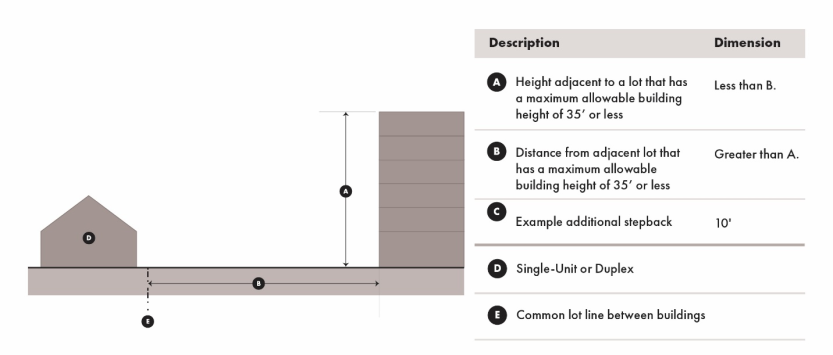
g.
Corner Treatments. Corner sites located at the intersection of two streets classified as major or secondary highways and with a building height greater than 35 feet shall incorporate at least one of the corner treatment strategies listed in Table 22.140.520-N, below.
FIGURE 22.140.520-X: CORNER TOWER OR STAIRCASE
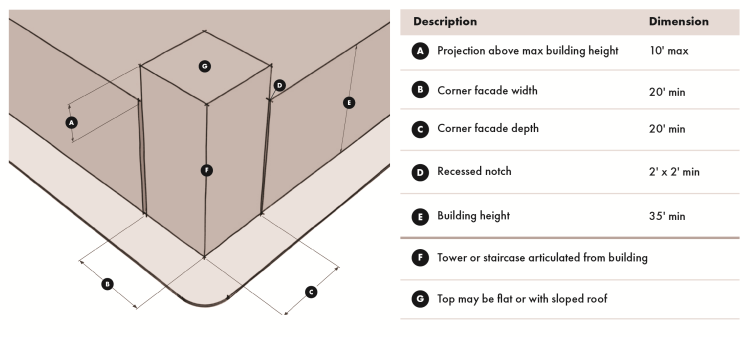
FIGURE 22.140.520-Y: CORNER BALCONIES ON UPPER FLOORS
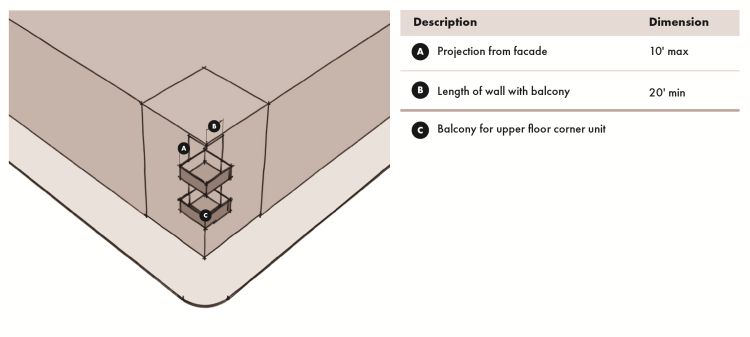
FIGURE 22.140.520-Z: RECESSED CORNER FROM FAÇADE
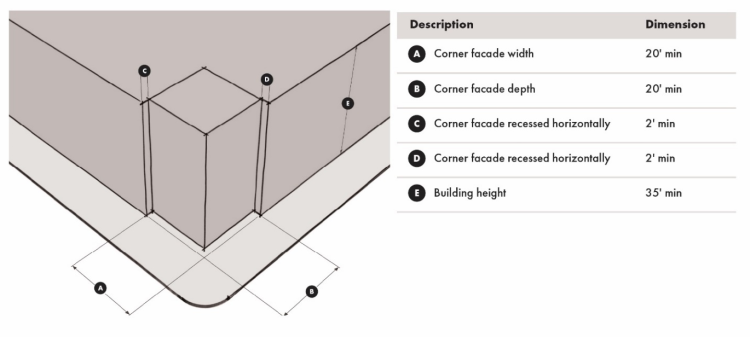
FIGURE 22.140.520-AA: CORNER POPPED OUT FROM REST
OF FAÇADE
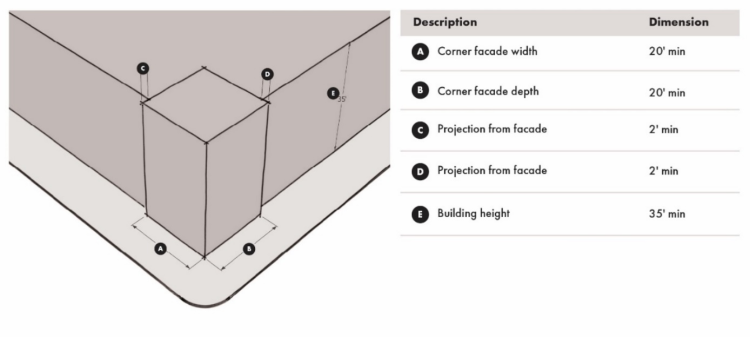
FIGURE 22.140.520-BB: CORNER LOWER THAN THE ROOF OF THE REST OF THE BUILDING
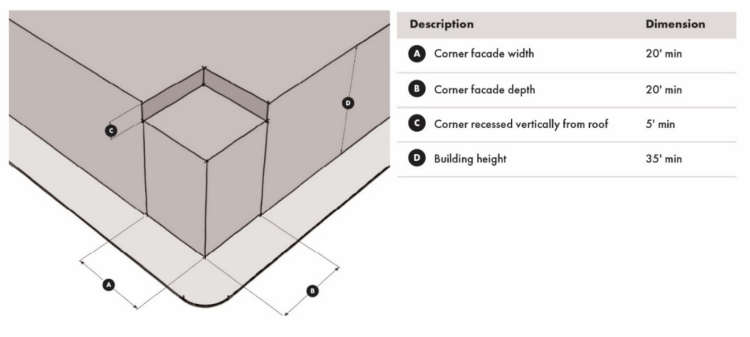
FIGURE 22.140.520-CC: GLAZING FOR WINDOWS AND DOORS AROUND THE CORNER
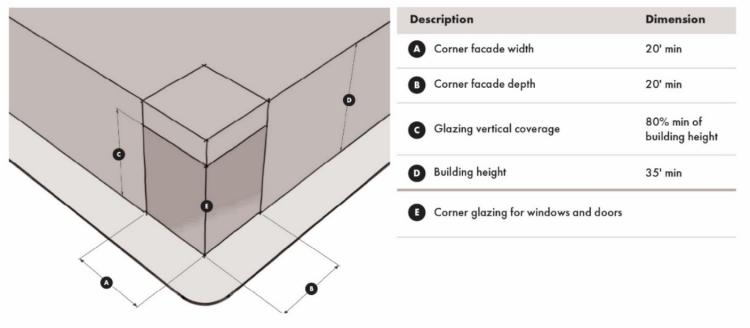
FIGURE 22.140.520-DD: ROUNDED CORNER WITH 20% OF
THE CORNER LEFT UNROUNDED
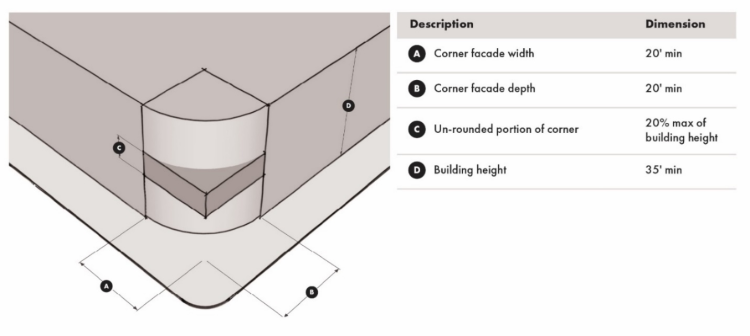
FIGURE 22.140.520-EE: CHANGE IN MATERIAL AT THE CORNER FOR 80% OF THE BUILDING HEIGHT
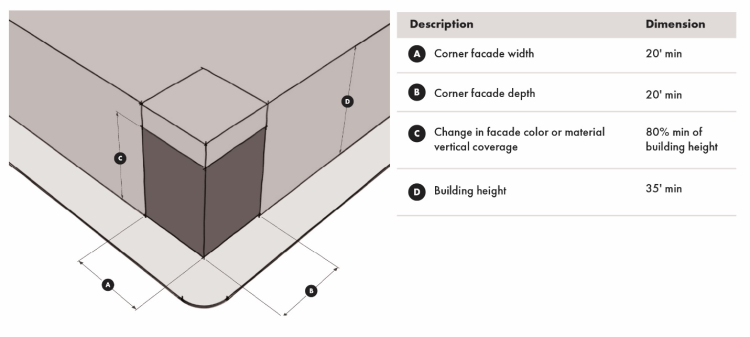
FIGURE 22.140.520-FF: RECESSED GROUND FLOOR 3 FEET FOR 80% OF THE BUILDING FRONTAGE
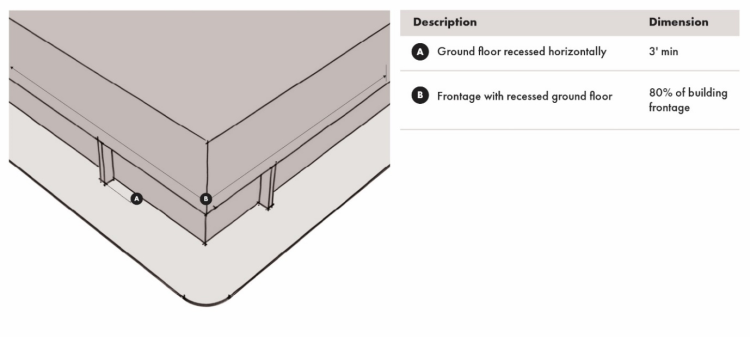
FIGURE 22.140.520-GG: FIVE-FOOT-DEEP AWNING COVERING 50% OF THE BUILDING FRONTAGE
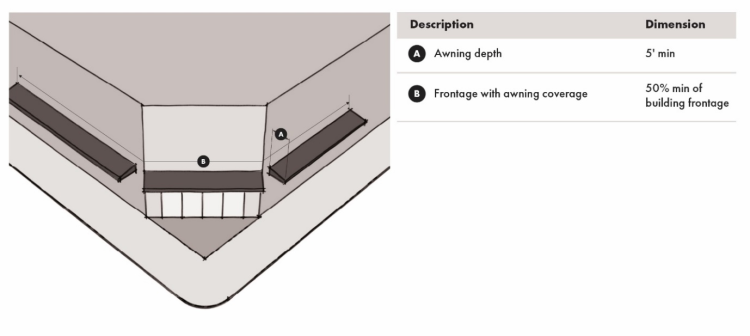
FIGURE 22.140.520-HH: OPEN SPACE FOR RESIDENTIAL USE
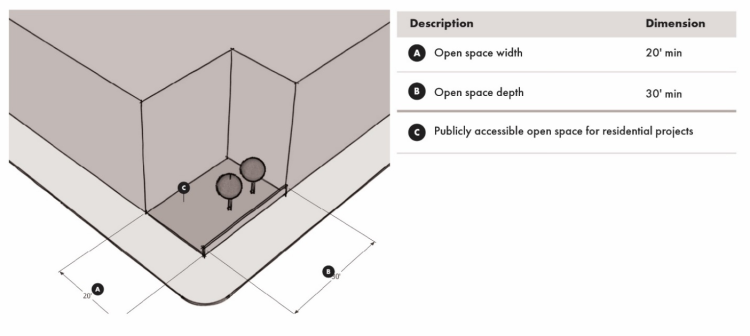
FIGURE 22.140.520-II: OPEN SPACE FOR AN OUTDOOR DINING AREA
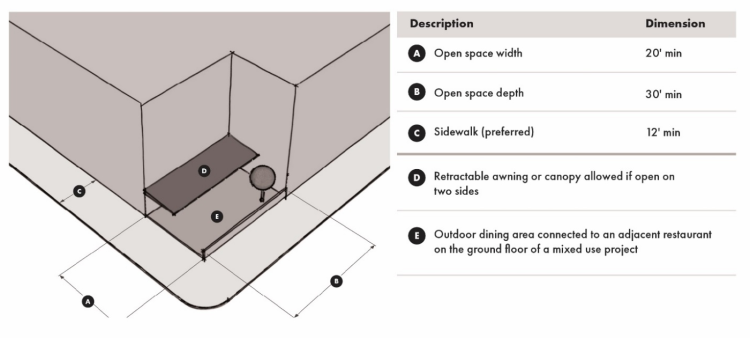
FIGURE 22.140.520-JJ: CORNER PLAZA AT THE INTERSECTION
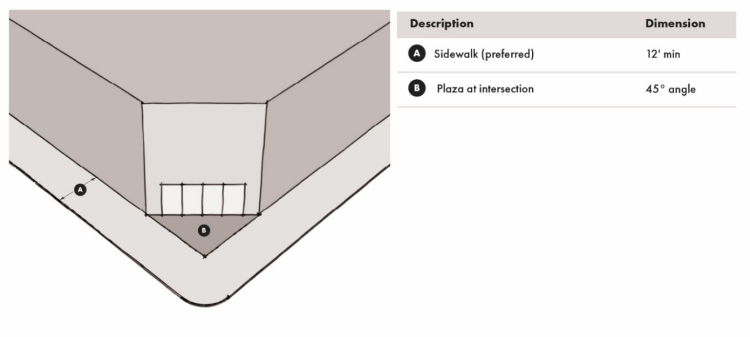
7.
Building Façade Details.
a.
Intent. The intent of this Subsection is to ensure buildings are designed holistically on all sides to create a cohesive architectural idea and enhance the surrounding neighborhood in all directions by considering the use of materials for sides of a building equally, not just the frontage.
b.
Façade Material Variety. All buildings shall include a minimum of two materials, colors, or textures along façades.
i.
One of the two materials, colors, or textures shall be used on a minimum of 10 percent of the building façade.
ii.
Fenestration shall not count towards the material requirement.
c.
Material Continuity. Building façades shall be treated as a whole and finished with similar materials on all sides to provide continuity; however, the percentages of each material may vary. To avoid a superficially tacked-on appearance, building façade materials shall not change at a vertical external corner of a building. Instead, materials shall adhere to one or more of the following conditions, as shown in Figure 22.140.520-E, above:
i.
Continue around the vertical external corner for a minimum distance of four feet;
ii.
End a minimum of four feet from a vertical external corner;
iii.
Transparent metal screens and railings which project a minimum of six inches from the main building façade are exempt from the material change requirements; and/or
iv.
Color. Paint color changes on a continuous material may occur at any point along the façade, including at vertical external corners.
d.
Prohibited Materials. Façades shall not use any of the following prohibited materials on more than two percent of the visible surfaces:
i.
Polished metal or glossy plastic with a Light Reflective Value (LRV) over 60;
ii.
Plywood (Rated Construction Grade C or D); and
iii.
Stucco with a sand finish of less than 20/20.
e.
Energy Efficiency.
i.
Natural Lighting. All habitable rooms, such as rooms for living, sleeping, eating, or cooking, shall be provided with natural light by means of exterior glazed windows, doors, clearstories, skylights, or a combination. The exterior glazed surface area shall be a minimum of 10 percent of the floor area of the attached rooms or a minimum area of 10 square feet, whichever is larger.
ii.
Natural Ventilation. Unless prohibited by other codes, such as the Building Code, Fire Code, etc., all habitable rooms shall be provided with natural ventilation by means of openable exterior windows or doors with an area not less than five percent of the floor area of such rooms, or a minimum of five square feet, whichever is larger. Units with multiple exposures shall include a minimum of one openable window on each exposure.
iii.
Solar Readiness. All buildings shall comply with the requirements of section 110.10 Mandatory Requirements for Solar Ready Buildings of the California Building Energy Efficiency Standards, as applicable.
8.
Balconies and Patios.
a.
Intent. The intent of this Subsection is to provide usable private open space for residents to encourage socialization, provide ample light, and fresh air for the residents, and add dimensional variety to building façades.
b.
Access. Private balconies and patios shall be directly accessible from the residential unit. See Figures 22.140.520-K to M, above.
c.
Location. Patios and balconies may be located along exterior building walls, internal walls facing courtyards, or a combination of both.
d.
Ground Floor Units. If residential units are located on the ground level or a podium, provide private patios for a minimum of 25 percent of those units on the ground floor or podium. Each patio shall be a minimum of 100 square feet in area and seven feet deep.
e.
Upper Floor Units. Buildings shall provide the required amount of private full balconies, Juliette balconies, or a mix of both for upper floor units, as listed in Table 22.140.520-H in Section 22.140.520.G.8.c, above.
f.
Full Balcony Dimensions. Any full balcony designed to satisfy the requirements of this Subsection shall meet the following dimensions:
i.
Balconies shall be a minimum of five feet deep;
ii.
The height of the balcony area shall not be less than the ceiling height of the adjoining floor; and
iii.
The number of bedrooms in the attached unit shall determine the minimum square footage of each balcony, as defined in Table 22.140.520-I, above.
g.
Juliette Balcony Dimensions. Any Juliette balcony designed to satisfy the requirements of this Subsection shall meet the following dimensions. See Figure 22.140.520-M, above.
i.
Barrier or railing shall project outward a minimum of three inches from the building façade; and
ii.
Barrier or railing shall extend beyond the sides of the doorway a minimum of three inches from each side of the connecting door frame.
9.
Landscaping, Walls, Fences, Screening, and Site Furnishing.
a.
Intent. The intent of this Subsection is to ensure developments utilize landscaping, walls, and fences designed to be in harmony with adjacent lower-intensity/smaller-scale uses, soften the appearance of large massing along the street, allow for both privacy and visibility, and increase the developments' resiliency to wildfire, heat, drought, and floods.
b.
Trees and Plants.
i.
Coverage. A minimum of 20 percent of the lot area not used for buildings and structures, such as setbacks and open space, shall be landscaped with a combination of trees, ground cover, shrubbery, planters, or flowers.
(1)
Required landscaping within parking lots does not count toward this coverage requirement.
(2)
Pedestrian walkways, plazas, and outdoor dining areas may be developed in the landscaped area and count towards the minimum landscaped area requirement.
ii.
Plant Species. At least 80 percent of the on-site landscaping coverage area shall consist of trees and plants native to southern California or non-invasive and drought tolerant, as approved by the Director.
c.
Walls and Fences.
i.
Enclosures.
(1)
Fences and free-standing walls are prohibited along street frontages in mixed use developments, except to enclose an outdoor dining area or open space area, such as a private residential patio. Planter boxes and other similar amenities may also enclose an outdoor dining area or open space. Such fences, walls, planter boxes, and other similar amenities shall not exceed 42 inches in height.
(2)
If located in the front yard setback, the wall, fence, or similar feature shall be placed a minimum of one foot from the edge of a public sidewalk, if present, with landscaping to buffer the wall.
ii.
Transparency. Fence design may include a combination of solid planes and open fencing. Any fence in the front yard setback over three feet tall shall be a minimum of 50 percent transparent along the frontage.
iii.
Materials. Fences shall be constructed of wood, wood composite, concrete, masonry, clay, aluminum, iron, steel, or glass. The use of barbed or razor wire, electrified fence, and chain-link fence, in conjunction with any fence, wall, roof, or hedge, is prohibited, unless required by any local, State, or federal regulation, as applicable.
d.
Screening.
i.
Trash Enclosures. All residential development projects that include trash enclosures shall comply with Chapter 22.132 (Storage Enclosure Requirements for Recycling and Solid Waste).
ii.
Mechanical Equipment and Utilities. Fire Department backflow prevention devices, water meters, transformers, and other utility-related equipment are prohibited in the front yard, unless completely screened in a manner that is incorporated into the design of the development. This provision does not apply to landscaping equipment, such as irrigation and sprinkler control systems.
(1)
Air conditioning units or vents located on the front façade shall not project more than six inches from the face of the building.
(2)
If on a rooftop or in a yard, the equipment must be screened from view from the street with a wall, fence, or landscaping.
iii.
Security Bars and Grilles. When installed, all security bars or grilles shall be installed on the inside of the building.
(1)
Horizontally folding accordion grilles installed on the outside of a storefront are prohibited.
(2)
Building security grilles shall be:
(a)
Side-storing concealed interior grilles not visible from the exterior of the building when not in use during business hours; or
(b)
Roll-up shutters or grilles which can be concealed in the architectural elements of the building.
e.
Site Furnishings - Amenities. If common recreational spaces are provided, developments shall provide at least three of the active and passive amenities listed in Table 22.140.520-O, below, within the common recreational spaces.
f.
Outdoor Lighting. All outdoor light fixtures installed on the exterior of buildings where visible from surrounding properties shall be shielded to avoid spilling over to surrounding residential areas. Additionally, outdoor light fixtures shall be shielded to avoid night sky light pollution. Where applicable, outdoor lights shall also adhere to the requirements of Chapter 22.80 (Rural Outdoor Lighting District).
10.
Vehicle Parking Facilities.
a.
Intent. The intent of this Subsection is to foster a pedestrian-oriented environment between the street and the building and to maintain and enhance the visual character of residential neighborhoods by minimizing the visual dominance of parking areas.
b.
Parking Locations. Pursuant to Section 22.112.040.C.1, no vehicle parking shall be located in the required front yard, corner side yard, or any additional area of a lot situated between the road and the building or structure closest to the street adjacent to the primary frontage, unless located underground. See Figures 22.140.520-F and G, above.
i.
Garages or surface parking lots shall not be located closer to the front property line than the front door of the building closest to the front property line and shall comply with one of the conditions listed in Table 22.140.520-D, above, except if the site is located in a Hillside Management Area or as otherwise allowed by this Title 22. See Figures 22.140.520-F to H, above, for examples of acceptable garage locations.
ii.
Parking Access with Side Street or Alley. If a development site is adjacent to an alley or corner, parking areas shall be accessed from the alley or side street, except in the following conditions:
(1)
If the development site abuts an improved alley less than 20 feet wide;
(2)
If the development site sits on a corner lot with two street frontages and has a total gross building area of 200,000 square feet or more, parking access is allowed on both frontages; and
(3)
If the side street is classified as a major or secondary highway.
iii.
Parking Access Without Side Street or Alley. If there is no alley or side street access available, parking shall be accessed from the primary adjoining street.
c.
Loading and Service Areas. Loading docks and service areas shall be oriented to the side and rear of the building. If this is not feasible due to site conditions, any loading or service areas shall be entirely behind a solid roll-up door. Passenger loading areas may be located along the front of the building.
d.
Parking Structures.
i.
Parking Frontage. Areas dedicated to vehicle use along the frontage (driveways, garage openings, loading entries, or utility access) shall be limited by the width of the lot, measured along the side adjacent to the street.
(1)
Lots with a width of 100 feet or less shall not have more than one garage entrance on the front of a building.
(2)
Lots with a width of over 100 feet shall have no more than one garage entrance on the front of a building every 100 feet of lot width.
(3)
Each garage entrance shall not exceed 25 feet in width, unless wider is required by federal, State, or County requirements.
ii.
Screening. Above-ground parking structures adjacent to a public or private street shall be internalized, wrapped with other active ground-floor uses (retail, office, or residential), or screened along the street, so parked cars and driveway aisles are only visible at access points for vehicles and pedestrians. When it is not feasible to line the ground level with active uses, the façades of street-fronting parking structures shall be screened from view of the street or sidewalk using at least one of the strategies listed in Table 22.140.520-P, below, or a combination of those strategies totaling 80 percent of the façade area.
iii.
Projections. All pedestrian entryways into a parking structure shall be highlighted by incorporating all the projecting elements listed in Table 22.140.520-Q, below. All entry projections shall be located within 12 feet of the top or side edge of the entryway.
e.
Surface Parking Lots.
i.
Existing Standards. All surface parking lots shall comply with Section 22.112.080 (Parking Design) in addition to the following standards below.
(1)
Pedestrian Amenities. Surface parking lots shall incorporate a pedestrian pathway through, or adjacent to, the parking lot to the main building it is associated with. Surface parking lots shall also incorporate at least one of the pedestrian amenities listed in Table 22.140.520-R, below. See Figure 22.140.520-KK, below.
FIGURE 22.140.520-KK: SURFACE PARKING LOT WITH
PEDESTRIAN-FRIENDLY AMENITIES
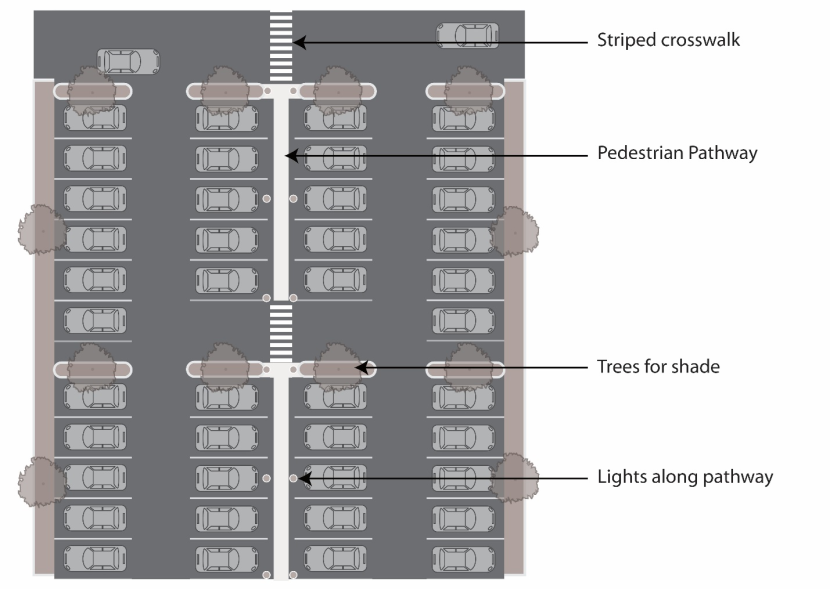
(2)
Green Design Strategies. Surface parking lots shall implement at least one of the green design strategies listed in Table 22.140.520-S, below, except where not feasible due to water table levels, contamination, or permeability of the soil. Where Title 26 (Building Code) of the County Code requires the use of any of these strategies in parking lots, compliance with the Title 26 requirements will satisfy this standard.
ii.
Where conflicts exist between these requirements and Title 26 (Building Code) of the County Code requirements, Title 26 shall prevail. Surface parking lots shall also comply with all applicable provisions of Title 32 (Fire Code) of the County Code.
(Ord. 2024-0049 § 23, 2024.)
22.140.540 - Shared Kitchen Complex.
A.
Purpose. This Section establishes standards for shared kitchen complexes to accommodate this type of food business while minimizing the potential impacts to surrounding uses.
B.
Applicability. This Section applies to shared kitchen complexes in all zones where permitted.
C.
Development and Performance Standards. A shared kitchen complex shall comply with the following:
1.
Hours of Operation. When adjacent to a residential use or Residential Zone, hours of operation shall be limited to 7 a.m. to 10 p.m., daily.
2.
Loading Spaces.
a.
Notwithstanding Section 22.112.120.A (Number of Spaces Required), one Type A loading space is required per shared kitchen complex tenant, except that the loading space may be shared by shared kitchen complex tenants whose operation hours in the shared kitchen complex do not overlap.
b.
Designated loading spaces shall be located away from adjacent residential uses or Residential Zones to the greatest extent feasible.
3.
On-Site Sales. On-site sales shall be prohibited.
(Ord. 2024-0032 § 18, 2024.)
22.140.550 - Secondhand Stores.
A.
Applicability. This Section applies to secondhand stores in Zones C-2 and MXD.
B.
Residential Uses Prohibited. A residential use, accessory or otherwise, is prohibited on the same lot as a secondhand store, unless the residential use is within a mixed use development that has a secondhand store and otherwise complies with Section 22.140.360 (Mixed Use Developments).
C.
Enclosure. The areas of a secondhand store for donation drop-off, sorting, storing, and distributing shall be located entirely within an enclosed building.
D.
Required Sign. A secondhand store shall post one wall sign, with a minimum of one square foot and a maximum of four square feet of sign area, notifying the public that donation drop-offs to the secondhand store during non-business hours are prohibited. The sign area for this wall sign shall not be included in calculating the maximum wall sign areas permitted for the secondhand store under Section 22.114.110 (Wall Signs).
(Ord. 2019-0004 § 1, 2019.)
22.140.560 - Self-Service Storage Facilities.
A.
Purpose. This Section establishes comprehensive regulations to provide self-service storage facilities which are compatible with the surrounding community. The minimum development standards for self-service storage facilities are intended to protect property values, aesthetics, and the public health, safety, and general welfare.
B.
Applicability. This Section applies to self-service storage facilities in all zones where permitted.
C.
Minimum Lot Area: The minimum lot size shall be one acre, unless the Commission or Hearing Officer approves a smaller lot.
D.
Resident Manager.
1.
A resident manager shall be required at the facility, housed in a structure with an architectural style and exterior finish compatible with the other buildings on the subject property.
2.
Failure to provide and maintain such a manager to ensure compliance with the provisions of this Section shall constitute a public nuisance and grounds for revocation of an approved permit.
E.
Access and Circulation.
1.
Vehicular ingress and egress shall be limited to one point for each side of the subject property adjoining any street or highway, and shall conform to the Fire Department standards.
2.
At least 40 feet of clear, unobstructed driveway depth shall be provided from the road to the primary access gate or principal entry point of the facility.
3.
Interior driveway widths shall be at least 26 feet unless, due to the irregular shape or configuration of the lot under consideration, the Commission or Hearing Officer specifically authorizes a width less than 26 feet, if in conformity with Fire Department standards. A driveway providing access to storage units on one side only of the facility shall be not less than 20 feet in width.
F.
Parking and Loading.
1.
At least two covered parking spaces shall be provided adjacent to the manager's residence.
2.
One parking space shall be provided for use by each employee in addition to the manager. Employee parking spaces shall be located adjacent to the manager's residence.
3.
One standard parking space for each 7,000 square feet of gross floor area shall be provided, made conveniently accessible and arranged as not to obstruct any driveways or adversely affect vehicular ingress and egress to the facility.
4.
Loading areas shall be provided in an amount sufficient to ensure that driveways remain unobstructed and conveniently accessible.
G.
Site Design.
1.
The architecture of the self-service storage facility, including, but not limited to fences, walls, gates, buildings, and landscaping, shall, to the maximum extent possible, be compatible with the community.
2.
Buildings shall be designed, located, and screened so that the views of boat and vehicle storage, overhead doors, and the interior driveways within such facilities are not readily visible from adjacent streets.
3.
No door openings for any storage unit shall be visible at ground level from any residentially zoned property.
H.
Building Height and Lot Coverage.
1.
Building height shall be approved by the Commission or Hearing Officer.
2.
Total lot coverage by buildings shall not exceed 50 percent.
I.
Setbacks.
1.
Front Yards. All buildings and structures shall be set back a minimum of 10 feet from the front lot line, except where abutting a Residential Zone, where they shall be set back a minimum of 20 feet.
2.
Side and Rear Yards. All buildings and structures in side and rear yards abutting a Residential Zone shall be set back as follows:
a.
Single-story buildings, a minimum of 10 feet.
b.
Two-story buildings, a minimum of 15 feet.
c.
Three or more story buildings, a minimum of 20 feet.
d.
In all other cases, the required setbacks in the side and rear yards shall be determined by the development standards of the zone in which the lot is located.
J.
Landscaping and Screening.
1.
All areas between required fences or walls and the lot lines that are not used for driveways shall be fully landscaped with lawn, shrubbery, trees, or flowers.
2.
In addition to Subsection J.1, above, for every 20 feet of street frontage of the subject property, a minimum of one 24-inch boxed tree shall be planted and continuously maintained.
K.
Fences and Walls.
1.
All fences or walls shall be constructed of materials such as textured masonry, concrete block, wood, or other similar materials to assure an aesthetic visual effect to passers-by. No chain link fencing is permitted.
2.
The design and materials used in the construction of fences and walls shall be compatible with the architecture of the buildings of the self-service storage facility and with buildings in the area surrounding the facility.
3.
When the facility adjoins a residentially zoned property, a masonry or decorative block wall at least six feet in height shall be constructed along the property lines.
4.
When the facility is across from or adjacent to a residentially zoned property, a masonry or decorative block wall or wrought iron fence at least six feet in height shall be constructed along the required setback line. The decorative side of the block shall face the residential area.
5.
Exterior wall surfaces shall at all times be kept free from graffiti or any other marks of vandalism.
6.
No fencing or walls shall be permitted in the required front yard area unless specifically authorized by the Commission or Hearing Officer.
L.
Outdoor Storage.
1.
The following may be stored outside of an enclosed building, in an area designated and approved for such outdoor storage, if such storage is permitted in the zone:
a.
Boats.
b.
Campers.
c.
Passenger vehicles, as defined in Section 465 of Title 15 (Vehicle and Traffic) of the County Code.
d.
Recreational vehicles.
e.
Travel trailers.
2.
Outdoor storage shall further comply with the following conditions:
a.
Outdoor storage shall not be visible from any adjoining lot or from adjacent streets when viewed at ground level.
b.
Outdoor storage is prohibited within required setback areas.
c.
Any vehicle or piece of equipment stored shall not be permitted to exceed 15 feet in height, as measured from grade.
d.
Areas proposed for outdoor storage within the facility shall be clearly indicated on the site plan and approved prior to the use of any such area for outdoor storage.
M.
Outdoor Lighting. Outdoor lighting shall be shielded to direct light and glare only onto the premises of the facility. Such lighting shall be deflected, shaded, and focused away from all adjoining properties. Such lighting should not exceed an intensity of one foot-candle of light throughout the facility.
N.
Signs. Notwithstanding Chapter 22.114 (Signs), the following standards apply:
1.
Signage shall, to the maximum extent possible, be unobtrusive and harmonious with the surrounding area of the facility.
2.
No signage shall appear or be permitted on any fences or walls unless specifically authorized by the Commission or Hearing Officer.
3.
No signs, other than ground-mounted and monumental signs, shall be permitted in the required front yard, unless specifically authorized by the Commission or Hearing Officer.
O.
Public Restrooms. A public restroom, as defined in Chapter 13.26 (Public Restrooms) Title 13 of the County Code, shall be installed and be conveniently located on the site for use by customers. Said public restroom shall include separate facilities for men and women, each with toilets and sinks suitable for use by persons with disabilities, in accordance with applicable State regulations.
P.
Trash Receptacles.
1.
All such receptacles shall be placed within a masonry or decorative block wall enclosure of adequate height to preclude view of the receptacle. Said enclosure shall have a wooden or other type of opaque gate.
2.
One four-cubic-yard trash receptacle and surrounding enclosure shall be provided as follows:
a.
Between 0 to 60,000 gross square feet, one receptacle.
b.
Over 60,000 gross square feet, two receptacles.
Q.
Use Restrictions and Prohibitions. In addition to those activities and uses that are prohibited in the zone in which the facility is proposed, the following uses and activities are prohibited, and each such prohibition is a mandatory condition of every approved Conditional Use Permit (Chapter 22.158) application. Rental or lease contracts to each individual lessee shall include clauses in conspicuous print and clear language indicating these prohibitions:
1.
Water, gas, or telephone service to any rental space;
2.
The public sale of any item from a rental space or within a self-service storage facility such as, but not limited to, auctions, commercial, wholesale or retail sales, or miscellaneous or garage sales, except as otherwise permitted by law;
3.
The storage of any caustic, hazardous, toxic or flammable or explosive matter, material, liquid, or object;
4.
The storage of any matter, material, liquid, or object which creates or tends to create obnoxious or offensive dust, odor, or fumes;
5.
The construction, repair, servicing, renovating, painting, or resurfacing of any motor vehicle, boat, trailer, or other machine or implement including, but not limited to, furniture, toys, carpets, or similar equipment, objects, or materials;
6.
Any commercial, business, professional, industrial, or recreational use or activity;
7.
The establishment of a transfer and storage business;
8.
Use of parking and loading spaces required by Subsection F, above, as rental storage space;
9.
Human habitation of any rental space;
10.
Animal boarding in any rental space; and
11.
Utilization of any cargo shipping container on the subject property, unless specifically authorized by the Commission or Hearing Officer.
R.
Modification. The requirements in this Section may be modified upon approval of a Variance (Chapter 22.194) application.
(Ord. 2019-0004 § 1, 2019.)
22.140.570 - Shared Water Wells.
A.
Applicability. This Section applies to shared water wells as an accessory use in Zones A-1, A-2, R-A, R-1, and R-2.
B.
Additional Application Requirements. In addition to any application materials required by this Title 22, an application for a shared water well shall include:
1.
Description. The legal description of each lot that will share the well.
2.
Statement. A detailed statement of:
a.
The number and location of the dwelling units that will share the well and each of their existing and proposed uses. For purposes of determining the number of dwelling units that will share the well:
i.
A primary unit, accessory dwelling unit, caretaker's residence (either conventional or mobilehome), and a senior citizen residence shall each be considered one dwelling unit; and
ii.
A detached or attached guest house without a kitchen shall not be considered a dwelling unit.
b.
The amount of water that will be available to each dwelling unit that will share the well and the intended uses for the water.
3.
Site Plan. A site plan that shows:
a.
The location and depth of all existing and proposed infrastructure for water and sewers on the lot, including, but not limited to, the infrastructure for:
i.
Existing wells, including abandoned wells;
ii.
Newly proposed wells; and
iii.
Existing and proposed sewage or waste disposal systems.
b.
Existing and proposed easements, covering any portion of the lot.
4.
Water Test Results. Test results for boring, chemical constituent, and bacteriology, showing, to the satisfaction of the Department of Public Health, the adequacy of groundwater depth, well yield, water flow, and water quality to service the dwelling units that will share the well.
5.
Access Easement. An access easement prepared by a licensed attorney, licensed surveyor, or registered civil engineer, showing, to the satisfaction of the Fire Department and the Departments of Public Health and Public Works, that access to the shared water well, and its related pumps, tanks, and pipes, has been granted to the owners of the dwelling units that will share the well.
6.
Covenant. A covenant prepared by a licensed attorney, signed by the owners of all of the dwelling units that will share the well, setting forth, to the satisfaction of the Fire Department and the Departments of Public Health, and Public Works:
a.
The information described in Subsections B.1 and B.2, above.
b.
The procedures for modifying and amending the covenant.
c.
That the owner of the lot that contains the shared water well has agreed to:
i.
Ensure a continuous flow of water to all dwelling units that will share the well;
ii.
Submit a bacteriology report to the Department of Public Health every three years following the approval of the shared well, prepared by a registered civil engineer, registered engineering geologist, or certified hydrologist with hydrology-related experience, describing the quality of the water from the shared water well; and
iii.
Submit a report to the Department of Public Health or other appropriate County department every three years following the approval of the shared well, prepared by a California-registered geologist or registered engineer holding a valid Class A general engineering contractor C-57 or C-61 (D-21) license, certifying that the shared water well is fully operational.
d.
That each owner of a lot that will share the well has agreed to ensure that the water from the shared water well will be used exclusively to service those dwelling units described in the application for the shared well.
e.
That the applicant will obtain all necessary permits and approvals from the Fire Department and the Departments of Public Health and Public Works.
7.
Documentation Regarding Assumption of Risk. A document prepared by a licensed attorney, and satisfactory to the County, demonstrating that all owners of the dwelling units that will share the well and all successors, assigns, and tenants of such owners agree to assume all risks, waive all liability, covenant not to sue, and indemnify the County, its agents, officers, and employees for any damages resulting from the County's approval of, or imposition of, conditions on the application or subsequent use of the shared water well by such persons.
8.
Waivers. During review, the Director may waive any of the requirements set forth in Subsections B.1 through B.7 above, provided that the Director obtains an approval for such waiver from the Fire Department and the Departments of Public Health and Public Works.
C.
Notice. The application shall comply with all noticing requirements as required by a Minor Conditional Use Permit (Chapter 22.160) application, except that the notification radius shall be 1,000 feet from the exterior boundaries of the lots that propose to share a water well. In addition, noticing of the filing and the application materials shall also be sent to the Fire Department and the Departments of Public Health and Public Works for their review and conceptual approval.
D.
Additional Findings.
1.
The shared water well will not be materially detrimental to the affected aquifer/water table levels;
2.
The shared water well will not be materially detrimental to the use, enjoyment, or value of the properties adjacent to the properties where the subject dwelling units are located;
3.
The shared water well will not induce significant growth in the area surrounding the shared water well; and
4.
The shared water well will not have a significant adverse effect on public services, facilities, and roads in the area surrounding the shared water well.
E.
Conditions. The Hearing Officer may impose any conditions deemed appropriate to ensure that the use of the shared water well will be consistent with the findings in Subsection D, above, and will further the objectives of all other provisions of this Section, including, but not limited to, conditions requiring that:
1.
Prior to the construction of the shared well, the applicant shall obtain all necessary permits and approvals from the Fire Department and the Departments of Public Health and Public Works; and
2.
Prior to the use of the shared well, the documents described in Subsections B.5, B.6, and B.7, above, shall be recorded with the Registrar-Recorder/County Clerk and that such recorded documents shall constitute covenants running with the land for the benefit of the County.
(Ord. 2019-0020 § 18, 2019; Ord. 2019-0004 § 1, 2019.)
22.140.580 - Single-Family Residences.
A.
Applicability.
1.
This Section applies to single-family residences in all zones where permitted.
2.
In Zone O-S, a single-family residence may be developed only as an accessory use to a farm or ranch as a principal use, with the approval of a Conditional Use Permit (Chapter 22.158) application.
B.
Minimum Building Width.
1.
Required Width. A single-family residence shall be not less than 20 feet wide.
2.
Exception to Required Width. Notwithstanding Subsection B.1, above:
a.
A single-family residence may be a minimum of 18 feet wide, if the lot is less than 26 feet in width.
b.
To allow for flexibility and creativity of design, a single-family residence may be less than 20 feet wide, but not less than 12 feet wide, if the floor area, exclusive of accessory structures, is at least 900 square feet and the side or sides oriented toward a public street, highway, or parkway have a dimension of at least 20 feet.
3.
Additions. Additions to a single-family residence are not restricted in width.
C.
Minimum Floor Area. A single-family residence shall have a floor area of not less than 800 square feet.
D.
Roof and Exterior Siding Materials.
1.
Every single-family residence shall have a roof constructed with wood-shake, shingle, asphalt composition, crushed rock, or other roofing material with similar appearance, quality, and durability, in compliance with Title 26 (Building Code) of the County Code;
2.
Every single-family residence shall have an exterior siding of brick, wood, stucco, metal, concrete, or other material with similar appearance, quality, and durability, in compliance with Title 26 (Building Code) of the County Code;
3.
Metal roof and exterior siding materials with a factory-applied surface coating are permitted if in compliance with Subsection D.4, below. Factory-applied surface coatings include "baked on" enamel, powder coating, or other similar permanent coating applied to the roof or siding materials by the manufacturer; and;
4.
The following roof and exterior siding materials on every single-family residence are hereby prohibited:
a.
Shiny, glossy, polished, and metallic-looking materials; and
b.
Any materials with a finished surface that result in glare or direct illumination across the bounding property line from a visible source of illumination, where the intensity of such resulting glare or direct illuminations creates a nuisance or detracts from the use or enjoyment of another property.
E.
Modification.
1.
Applicability. Except as specified in Chapter 22.120 (Density Bonus), Chapter 22.121 (Inclusionary Housing), or Chapter 22.166 (Housing Permits), the requirements in Subsections B through D, above, may be modified upon approval of a Minor Conditional Use Permit (Chapter 22.160) application or a Conditional Use Permit (22.158) application for the zones that require such Conditional Use Permit, subject to Subsection E.2, below.
2.
Additional Findings.
a.
A finding that such modification would not be materially detrimental to the use, enjoyment, or value of property of other persons which is located in the vicinity of the residential site can be made; and
b.
Any of the following findings can be made:
i.
That such modification would be architecturally compatible with existing residences in the surrounding neighborhood;
ii.
That a proposed alteration or addition to an existing single-family residence will be a continuation of its existing architectural style;
iii.
That such modification is needed for safety reasons to comply with other applicable codes, laws, ordinances, rules, and regulations; or
iv.
The site of the proposed single-family residence is sufficiently remote or screened so as to preclude the proposed modification from having a detrimental effect upon the surrounding area.
F.
Additional Standards for Zones C-RU and MXD-RU. In Zones C-RU and MXD-RU, the following additional standards shall apply:
1.
Single-family residences are permitted only in conjunction with any use listed in Section 22.24.030.C.1 (Principal Uses) for said zone in the "Retail/Commercial Uses" or "Services Uses" Category, provided that the use is legally established on the same lot.
2.
Single-family residences shall comply with the standards in Section 22.18.040 (Development Standards for Residential Zones) for Zone R-1.
3.
The standards required by this Chapter shall not apply to any the commercial development on the same lot.
G.
Additional Standards for Zones C-H, C-1, C-2, C-3, C-M, and C-R. In Zones C-H, C-1, C-2, C-3, C-M, and C-R, single-family residences shall comply with the following standards:
1.
Height. Maximum height shall be 35 feet.
2.
Yard Setbacks.
a.
Zones C-H, C-1, C-2, and C-3. Yard setbacks shall comply with Section 22.20.050 (Development Standards for Zones C-H, C-1, C-2, and C-3).
b.
Zone C-M. Yard setbacks shall comply with Section 22.20.050.C (Zone C-3).
c.
Zone C-R. Yard setbacks shall comply with Section 22.16.050 (Development Standards for Zones A-1 and A-2).
3.
Other development standards. All single-family residences shall comply with all other applicable development standards in Division 6 (Development Standards).
4.
Modifications. Except as specified in Chapter 22.120 (Density Bonus), Chapter 22.121 (Inclusionary Housing), or Chapter 22.166 (Housing Permits), development standards listed in this Subsection G may be modified with a Conditional Use Permit (Chapter 22.158) application subject to Subsection E.2, above.
(Ord. 2022-0008 § 101, 2022; Ord. 2019-0004 § 1, 2019.)
22.140.585 - Single-Family Residences on Compact Lots.
A.
Purpose. This Section is to provide for the development of single-family residences on compact lots in Zones R-2, R-3, and R-4 with appropriate development standards and regulations.
B.
Definitions. Specific terms used in this Section are defined in Division 2 (Definitions), under "Single-family residence on a compact lot."
C.
Applicability.
1.
This Section applies to the development of single-family residences on compact lots in Zones R-2, R-3, and R-4.
2.
This Section shall not apply to the development of single-family residences on undersized lots, underwidth lots, substandard lots or lots containing an area of less than 5,000 square feet as modified by a Housing Permit (Chapter 22.166), a Conditional Use Permit (Chapter 22.158), or a Variance (Chapter 22.194), if such lots are not shown on a tentative map and on the final map or parcel map with the words "DIVISION OF LAND FOR COMPACT LOT PURPOSES ONLY" printed on the face of the map.
D.
Application Requirement.
1.
A Conditional Use Permit (Chapter 22.158) application is required for the development of single-family residences on compact lots in Zones R-2, R-3, and R-4.
2.
This application shall not be construed to authorize the modification of development standards listed in Subsection F, below, unless:
a.
A Variance (Chapter 22.194) application is granted;
b.
A Housing Permit (Chapter 22.166) application is granted in accordance with Chapter 22.120 (Density Bonus); or
c.
As specified otherwise in Subsection F, below.
E.
Conditions of Approval. The Commission or Hearing Officer shall impose the following conditions if the project is within as Airport Influence Area:
1.
The project shall comply with the requirements of Chapter 22.76 (Noise Insulation Program);
2.
The project shall dedicate an aviation easement to the airport; and
3.
The project shall issue a real estate transfer disclosure notice pursuant to State law that the property is within an Airport Influence Area and that the property may be subject to noise and/or annoyances in proximity to aircraft operations.
F.
Development Standards. Development of single-family residences on compact lots shall comply with the following development standards:
1.
Required Area and Width.
a.
Required Area. Each compact lot shall contain the required net area shown in Table 22.140.585-A, below. There is no required area for a parking-only lot.
b.
Required Width. Each compact lot shall contain the required width shown in Table 22.140.585-B, below. There is no required width for a parking-only lot.
2.
Required Yards.
a.
General. Table 22.140.585-C, below, identifies the minimum yard depths on compact lots:
FIGURE 22.140.585-A: MAINTENANCE EASEMENT IN INTERNAL YARD
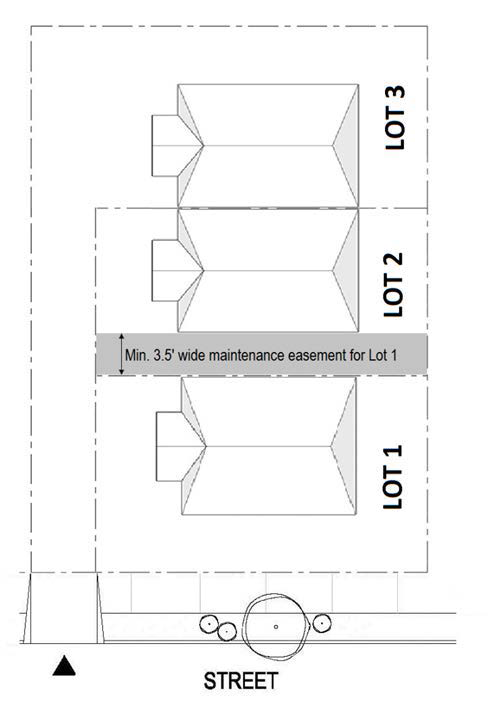
b.
Exceptions. Notwithstanding Subsection F.2.a, above, where an existing, legally-built principal residential building is to remain:
i.
The depth of a yard between the existing principal residential building and an existing lot line shall be deemed to have the required yard depth, even if the depth of said yard is less than the minimum yard depth identified in Table 22.140.585-C, above.
ii.
If, as the result of a highway dedication required for the compact lot subdivision, the depth of a yard of the existing principal residential building is reduced to less than the minimum yard depth identified in Table 22.140.585-C, the depth of said yard shall be deemed to have the required yard depth.
iii.
Exceptions provided by this Subsection F.2.b shall not apply to the following:
(a)
An existing, legally-built principal residential building if more than 50 percent of the total floor area of said building is demolished as part of the compact lot subdivision. For the purposes of this Subsection F.2.b.iii.(a), total floor area includes all enclosed areas; or
(b)
Any proposed addition to an existing principal residential building.
3.
Single-Family Residence Standards. Sections 22.140.585.B (Minimum Building Width) and 22.140.585.C (Minimum Floor Area) shall not apply to single-family residences on compact lots.
4.
Minimum Width of Ground Floor Habitable Space. The ground floor of a single-family residence on a compact lot shall contain a habitable space of at least 14 feet in width.
5.
Minimum Floor Area. A single-family residence on a compact lot shall have a floor area of not less than 575 square feet.
6.
Maximum Height. A single-family residence on a compact lot shall not exceed two stories and 35 feet above grade in height. A detached accessory structure on a compact lot shall not exceed one story and 15 feet above grade in height, except that such detached accessory structure may be two stories and 25 feet above grade in height if it contains habitable spaces above a garage or carport.
7.
Projections in Private Common Driveways. Any portion above the level of the first floor of a building may project into a private common driveway, provided that such driveway is at least seven and one-half feet in width open to the sky. Projection is prohibited when the private common driveway is designed a fire lane by the Fire Department.
8.
Parking. Parking shall be provided in compliance with Chapter 22.112 (Parking), with the following exceptions:
a.
General.
i.
Notwithstanding Section 22.112.040.C.1:
(a)
A person shall not keep, store, park, maintain, or otherwise permit any vehicle or any component thereof on a private common driveway, in the required perimeter front yard, the required perimeter corner side yard, or the required internal yard where there is a maintenance easement as required in Subsection F.2.a, above, or any additional area situated between the highway or street and any building or structure located thereon.
(b)
Uncovered parking spaces may be located within the required perimeter rear yard, or any additional area situated between an alley and any building or structure located thereon.
ii.
Notwithstanding Section 22.112.040.C.3, a person shall not keep and maintain a historic vehicle collection in a compact lot subdivision.
iii.
Notwithstanding Section 22.112.080.B.1.c.i (Tandem Parking Spaces for Residential Uses), parking spaces in a compact lot subdivision may not be developed as tandem parking spaces except as provided in Subsection F.8.c.i, below.
b.
Parking-Only Lot. Some or all of the parking spaces required pursuant to Section 22.112.070 (Required Parking Spaces) may be provided on a parking-only lot within a compact lot subdivision, subject to the following:
i.
Ownership. Owners whose parking spaces are located on the parking-only lot shall own a share of said lot.
ii.
Location. The parking-only lot shall not abut on a highway or street, except where the parcel of land to be subdivided is a corner lot, the parking-only lot may front the side street subject to the screening requirements provided in Subsection F.8.b.iii.(a), below.
iii.
Screening.
(a)
Perimeter Corner Side Yard. A solid masonry wall not less than 30 inches nor more than 42 inches in height shall be established parallel to and not nearer than five feet to the perimeter corner side lot line. All areas between the solid masonry wall and the perimeter corner side lot line that are not used for a driveway shall be fully landscaped with drought-tolerant plants. For example, see Figure 22.140.585-B, below.
FIGURE 22.140.585-B: PARKING-ONLY LOT SCREENING AND LANDSCAPING - PERIMETER CORNER SIDE YARD
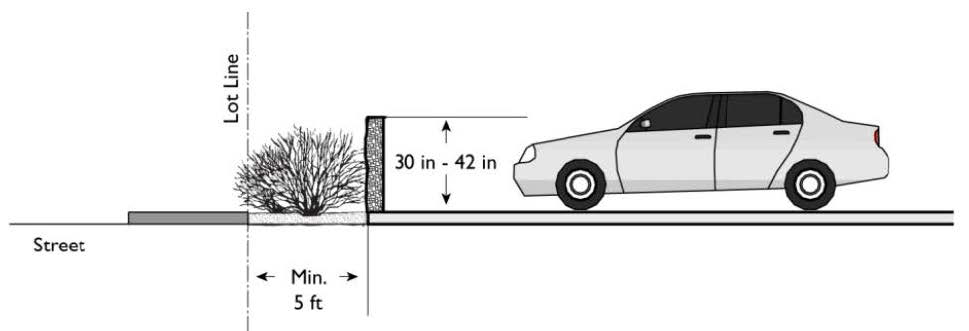
(b)
Perimeter Interior Side and Perimeter Rear Yards. Where a parking-only lot is located adjacent to the perimeter interior side or perimeter rear lot lines of a compact lot subdivision, a solid masonry wall not less than five feet nor more than six feet in height shall be established along such lot lines, except that where such wall is located within 10 feet of any alley and would interfere with the line-of-sight of the driver of a motor vehicle leaving the property on a driveway, or moving past a corner at the intersection of two streets or highways, said wall shall not exceed a height of 42 inches.
c.
Parking on Compact Lots. Where parking spaces are provided on a compact lot:
i.
Tandem parking spaces are allowed on alley-fronting compact lots where vehicles back directly onto the alley.
ii.
Mechanical parking stackers may be used where two parking spaces are provided in a garage in Zone R-4.
d.
Modification.
i.
Reduction in the number of required parking spaces shall be subject to Section 22.112.020.B (Reduction of Required Parking and Loading Spaces).
ii.
In granting the Conditional Use Permit (Chapter 22.158), the Commission or Hearing Officer may modify the following standards:
(a)
Maneuvering aisle. The width of a maneuvering aisle serving standard parking spaces may be reduced to 23 feet where such standard parking spaces have a minimum width of 10 feet based on a 90-degree parking layout, and the Commission or Hearing Officer finds that the topographic features or other site conditions create an unnecessary hardship or unreasonable regulation or make it obviously impractical to require compliance with the provision of Section 22.112.080.B.2.a (Standard).
(b)
Screening. The solid masonry wall required in Subsection F.8.b.iii (Screening), above, may be substituted by a decorative fence or wall or a landscaped berm where, in the opinion of the Commission or Hearing Officer, such fence, wall, or landscaped berm will adequately comply with the intent of the aforementioned Subsection.
iii.
Regulations in Subsections F.8.a.i.(a), F.8.a.ii, and F.8.b.i, above, may not be modified.
9.
Private Usable Open Space. Each compact lot shall provide private usable open space on-site, subject to the following regulations:
a.
Minimum Dimensions. Each compact lot shall provide no less than a total of 100 square feet of private usable open space, of which at least one open space area shall have a minimum dimension of eight feet wide by eight feet long. Parking areas, driveways and internal yards with maintenance easements shall not count as private usable open space.
b.
Projections Permitted. Projections into the required private usable open space shall be limited to three feet, provided that there is a minimum eight-foot vertical clearance under such projections.
c.
Modification. In granting the Conditional Use Permit (Chapter 22.158), the requirement of Subsection F.9.a., above, regarding the total square footage of private usable open space per compact lot may be reduced by up to 10 percent by the Commission or Hearing Officer.
10.
On-Site Tree Planting.
a.
Amount of Trees.
i.
A minimum of one tree shall be planted within a required perimeter front yard for every 25 feet of street frontage. Street trees located within the right-of-way may count towards meeting this requirement.
ii.
A minimum of one tree shall be planted on each of the other compact lots not subject to Subsection F.10.a.i., above.
iii.
A minimum of one tree for every four uncovered parking spaces shall be planted on a parking-only lot that contains uncovered parking spaces.
iv.
If the number of trees required by this Subsection F.10.a contains a fraction, that fraction shall be rounded to the nearest whole number. Any such fraction equal to or greater than 0.50 shall be rounded up to the nearest whole number and any such fraction less than 0.50 shall be rounded down to the nearest whole number.
b.
Tree Species. The tree species planted pursuant to Subsection F.10.a shall be those that provide adequate shade, are not invasive, are resistant to local pests and diseases, are adaptable to the local climate, and are appropriate for the planting location. The Director shall prepare and maintain the Tree Species List, which shall contain a list of tree species which the Director has determined to satisfy the first three criteria set forth in this Subsection F.10.b.
c.
Tree Sizes.
i.
All required trees pursuant to Subsections F.10.a.i and F.10.a.iii, above, shall be a minimum of a 24-inch box in size at the time of planting.
ii.
All required trees pursuant to Subsection F.10.a.ii, above, shall be a minimum of 15 gallons in size, and shall have a minimum trunk diameter of .75 inches as measured six inches above the soil line at the time of planting.
d.
Tree Locations.
i.
Trees shall be planted in locations that maintain the required lines of sight unobstructed for safe pedestrian and vehicular movement and will not cause root damage to the sidewalk or other public infrastructure, to the satisfaction of Public Works.
ii.
Trees planted adjacent to the buildings or fire lanes shall be placed in locations that do not adversely impact Fire Department operations or response times, to the satisfaction of the Fire Department.
iii.
Trees within the required perimeter front yard shall be planted in locations that maximize the shade coverage onto the sidewalk. When multiple trees are required pursuant to Subsection F.10.a.i, above, their trunks shall be planted a maximum distance of 25 feet apart. Street trees that are counted towards meeting the requirement of Subsection F.10.a.i, above, regarding the amount of trees shall also be subject to this 25-foot spacing limit.
iv.
For parking-only lots that contain uncovered parking spaces, trees shall be planted in locations where a minimum of 50 percent shade coverage of the uncovered parking area is anticipated within 15 years of planting the required trees. A shade plan meeting the specifications set forth in the Tree Planting Guide, to be maintained by the Director, is required.
v.
No trees shall be planted in the required internal yard where there is a maintenance easement as required in Subsection F.2.a, above.
e.
Tree Maintenance.
i.
Trees shall be supported with staking and ties that are made of soft and mold resistant material (such as rubber), until the trees are able to support themselves; and
ii.
Trees failing to survive shall be replaced.
f.
Waiver or Modification of Tree Planting Requirements. In granting the Conditional Use Permit (Chapter 22.158), the requirements of Subsection F.10.a, above, regarding the amount of trees that must be planted may be waived or modified by the Commission or Hearing Officer when:
i.
The requirements are physically impractical because of existing development;
ii.
Mature trees already exist on-site at the required locations;
iii.
The requirements are found to be impractical due to topographic conditions, neighborhood patterns, or are otherwise not beneficial to the area;
iv.
The applicant documents in a notarized letter by a certified arborist, submitted to the Director, that the required trees will not survive on the site due to the soil type thereon; or
v.
The requirements would conflict with other provisions set forth in the County Code. When, pursuant to this Subsection F.10.f, the Director reduces the required shade area for a parking-only lot that contains uncovered parking spaces because there is not enough square footage for both the required shade area and the required parking, so long as the parking requirements are met, the Director may replace the tree requirements intended to create the shade area with a cool pavement requirement, preferably permeable, to be used in uncovered parking areas as defined in Division 2 (Definition).
11.
Landscaping.
a.
Requirements.
i.
Required perimeter front and corner side yards, excluding areas covered by accessory buildings, accessory structures and equipment, or architectural features such as driveways, walkways, uncovered porches, and fireplace structures, shall be entirely permeable and of that area, at least 75 percent landscaped with drought-tolerant plants.
ii.
All other areas not covered by buildings, parking areas, driveways, walkways, or private usable open space shall be landscaped with drought-tolerant plants.
b.
Modification. In granting the Conditional Use Permit (Chapter 22.158), the requirements of this Subsection F.11.a regarding the square footage of landscaped areas may be reduced by up to 10 percent by the Commission or Hearing Officer.
c.
Planting and Irrigation Plan Required. Landscape plans shall be submitted with an application for the development of single-family residences on compact lots. The landscape plans shall be prepared by a licensed landscape architect or a certified landscape designer (APLD) and include a scale map of the project site that shows the location, species, and size of each plant to be included in the site landscaping, as well as a detailed depiction of the proposed irrigation system.
12.
Fences and Walls. Sections 22.110.070.B.1 through B.5 shall not apply to fences and walls within a compact lot subdivision, which instead shall be subject to the following regulations:
a.
General. Except as specified otherwise in this Subsection F, walls and fences, including retaining walls within a compact lot subdivision shall not exceed six feet in height.
b.
Perimeter Front and Perimeter Corner Side Yards.
i.
Fences and walls within the required perimeter front and perimeter corner side yards shall not exceed three and one-half feet in height.
ii.
At least 50 percent of the area of a fence or wall shall be non-view obscuring if such fence or wall is erected on the front or corner side lot line of the perimeter of a compact lot subdivision.
iii.
If less than 50 percent of the area of a fence or wall is non-view obscuring, such fence or wall shall be set back at least three feet from the front or corner side lot line of the perimeter of the compact lot subdivision. The area between such fence or wall and the front or corner side lot line of the perimeter of the compact lot subdivision shall be landscaped with drought-tolerant plants.
c.
Perimeter Rear Yard with Access from an Alley. Where there is a vehicular access from an alley, fences and walls within five feet of the rear lot line of the perimeter of the compact lot subdivision shall not exceed three and one-half feet in height.
d.
Internal Yard with Maintenance Easement.
i.
No walls or fences shall be erected in the required internal yard where there is a maintenance easement as required in Subsection F.2.a, above.
ii.
Notwithstanding Subsection F.12.d.i, above, a wall or fence may be erected on or along an interior lot line between two abutting compact lots, so long as:
(a)
The exterior wall of the zero-lot-line single-family residence is not obstructed by any freestanding walls or fences; and
(b)
The owner or resident of the zero-lot-line single-family residence shall have unrestricted access to the maintenance easement at all times. An unrestricted access may include an unlocked gate.
e.
In Proximity to Private Common Driveways. Fences and walls within five feet of a private common driveway shall not exceed three and one-half feet in height.
f.
Retaining Walls Topped with Walls or Fences.
i.
Where a retaining wall protects a cut below the natural grade and is located on a perimeter front, perimeter side, perimeter rear, or an interior lot line, such retaining wall may be topped by a fence or wall of the same height that would otherwise be permitted at the location if no retaining wall existed. Where such retaining wall contains a fill, the height of the retaining wall built to retain the fill shall be considered as contributing to the permissible height of a fence or wall; provided that a non-view obscuring fence of three and one-half feet may be erected at the top of the retaining wall for safety protection.
ii.
Where a wall or fence is located in the required yard adjacent to a retaining wall containing a fill, such wall or fence shall be set back from said retaining wall a distance of one foot for each one foot in height, to a maximum distance of five feet. This does not permit a wall or fence in a required yard higher than permitted by this Subsection F. The area between such wall or fence and said retaining wall shall be landscaped and continuously maintained in good condition.
13.
Exterior Lighting. On-site exterior lighting shall be subject to the following restrictions:
a.
The light source, such as light bulb, shall not be directly visible to the eye.
b.
Exterior lighting shall not produce spill light onto adjacent lots or into the night sky.
14.
Accessory Buildings in Required Yards. Section 22.110.030 shall not apply to accessory buildings on compact lots, which instead shall be subject to the following regulations:
a.
Garages or Carports within Perimeter Front Yards on Sloping Terrain. A one-story attached or detached garage or carport may be used within a required perimeter front yard on sloping terrain, provided that:
i.
The difference in elevation between the curb level and the natural ground at a point 25 feet from the highway line is five feet or more; or where there is no curb that a slope of 20 percent or more from the property line parallel to the public right-of-way to a point on natural ground 25 feet from said property line exists. Measurement in all cases shall be made from a point midway between the two lot lines of the compact lot on which the garage or carport is located perpendicular to the property line parallel to the public right-of-way;
ii.
The garage or carport is located not closer than five feet to a highway line; and
iii.
The garage or carport does not exceed a height of 15 feet above the level of the centerline of the adjoining street or highway.
b.
Garages or Carports in Perimeter Interior Side and Perimeter Rear Yards. One-story detached garage or carport may be used within a required perimeter interior side or perimeter rear yard, provided that:
i.
The garage or carport may be used within a required perimeter interior side yard only if the garage or carport is located on a compact lot or parking-only lot with one of its boundary lines being the perimeter rear lot line of the compact lot subdivision;
ii.
Where the garage or carport has direct vehicular access to an alley, the distance between the garage or carport and the opposite right-of-way line of the alley shall be the same as the required maneuvering aisle width set forth in Section 22.112.080.B.2 (Maneuvering Aisles) or Subsection F.8.d.ii.(a) (Maneuvering Aisle), above;
iii.
The provision is made for all roof drainage to be taken care of on the same compact lot, or as permitted by the low impact development requirements of Chapter 12.84 of Title 12 of the County Code, subject to the applicability provisions of said Chapter; and
iv.
No more than 50 percent of the required perimeter rear yard shall be covered by buildings or other roofed structures.
c.
Other Accessory Buildings in Perimeter Rear Yards. Other one-story accessory buildings permitted in the zone may be used within a required perimeter rear yard, provided that:
i.
Such buildings are not placed within a required perimeter corner side or perimeter interior side yard;
ii.
Such buildings are placed not closer than five feet to the rear lot line of the perimeter of the compact lot subdivision; and
iii.
No more than 50 percent of the required perimeter rear yard shall be covered by buildings or other roofed structures.
15.
Accessory Structures, Equipment, and Other Elements in Required Yards. Section 22.110.040 shall not apply to accessory structures and equipment on compact lots, which instead shall be subject to the following regulations:
a.
Planter Boxes and Masonry Planters. Planter boxes or masonry planters, including the plants therein, shall not exceed a height of three and one-half feet in the required perimeter front and corner side yards, and in the required perimeter rear yard where there is a vehicular access from an alley.
b.
Guard Railings or Fences for Safety Protection. Guard railings or fences for safety protection adjacent to depressed ramps may be placed in any yard, provided that:
i.
A railing or fence is used; and
ii.
Such railing or fence does not exceed a height of three and one-half feet.
c.
Driveways, Walkways, and Patio Slabs. Driveways, walkways, patio slabs, and other areas constructed of concrete, asphalt, or similar materials, and wooden decks, may be used in any required yard. The maximum height of such structures in a required yard may not exceed one foot above ground level. Steps providing access between areas of different elevation on the same property are included in this requirement.
d.
Ground-Mounted Equipment. Ground-mounted air conditioners, heaters, filters, and fans may be used in required perimeter rear yards, provided that:
i.
Such structures or equipment are at least two and one-half feet from any lot line; and
ii.
Such structures or equipment do not exceed a height of six feet measured from the base of the unit.
e.
Equipment in Perimeter Rear Yards. The following equipment may be placed in perimeter rear yards:
i.
Trash enclosures.
ii.
Movable dog houses.
iii.
Moveable children's play equipment.
f.
Temporary Signs in Perimeter Front Yards. Temporary signs advertising the sale or lease of the premises on which the sign is located may be placed within the perimeter front yard if a minimum setback of 10 feet is maintained from the highway line. All such signs shall comply with Chapter 22.114 (Signs).
16.
Distance between Accessory and Main Buildings on Compact Lots. Section 22.110.050.A shall be superseded by the following regulations:
a.
A minimum distance of three and one-half feet shall be required between a main residential building and an accessory building on a compact lot.
b.
Projections are prohibited within such minimum.
17.
Projections into Yards. Section 22.110.090 shall be superseded by the following regulations:
a.
Projections are prohibited within the required internal yard.
b.
The following projections are permitted in the required perimeter yards subject to the provisions of this Title 22 and of Title 26 (Building Code) or Title 30 (Residential Code), as applicable, of the County Code:
i.
Eaves and Cantilevered Roofs. Eaves and cantilevered roofs may project a maximum distance of two and one-half feet into any required perimeter yard, provided that:
(a)
Such eaves or cantilevered roofs are not closer than two and one-half feet to any lot line or highway line;
(b)
No portion of such eaves or cantilevered roofs are less than eight feet above grade; and
(c)
There are no vertical supports within the required perimeter yard.
ii.
Awnings and Canopies. Awnings and canopies may project a maximum distance of two and one-half feet into a required perimeter interior side or perimeter corner side yard, and five feet into a required perimeter front or perimeter rear yard, provided that:
(a)
Such structures are not closer than two and one-half feet to any lot or highway line;
(b)
Such structures have no vertical support within such perimeter yard; and
(c)
Such awnings or canopies extend only over the windows or doors to be protected, and for not more than one foot on either side thereof.
iii.
Fireplace Structures. Fireplace structures not wider than eight feet measured in the general direction of the wall of which they are a part, buttresses, and wing walls may project a maximum distance of two and one-half feet into any required perimeter yard, provided that:
(a)
Such structures are not closer than two and one-half feet to any lot or highway line; and
(b)
Such structures shall not be utilized to provide closets or otherwise increase usable floor area.
iv.
Uncovered Porches, Platforms, Landings, and Decks. Uncovered porches, platforms, landings, and decks, including any access stairs exceeding an average height of one foot, which do not extend above the level of the first floor may project a maximum distance of three feet into a required perimeter interior side or perimeter corner side yard, and a maximum distance of five feet into a required perimeter front or perimeter rear yard, provided that:
(a)
Such porches, platforms, landings, and decks shall not be closer than two feet to any lot or highway line; and
(b)
Such porches, platforms, landings, and decks are open and unenclosed; provided, that an openwork railing not to exceed three and one-half feet in height may be installed.
v.
Rain Conductors. Rain conductors, spouts, utility-service risers, shut-off valves, water tables, sills, capitals, bases, cornices, and belt courses may project a maximum distance of one foot into any required perimeter yard.
vi.
Equipment. Water heaters, water softeners, and gas or electric meters, including service conduits and pipes, enclosed or in the open, may project a maximum distance of two and one-half feet into a required perimeter interior side or perimeter rear yard, provided that such structures or equipment are not closer than two and one-half feet to any lot line. Gas meters, if enclosed or adequately screened from view by a structure permitted in the yard, may project a maximum distance of two and one-half feet into a required perimeter front or perimeter corner side yard, provided that such equipment is not closer than two and one-half feet to any lot or highway line.
vii.
Stairways and Balconies. Stairways and balconies above the level of the first floor may project a maximum distance of two feet into a required perimeter interior side or perimeter corner side yard, or four feet into a required perimeter front or perimeter rear yard, provided that:
(a)
Such stairways and balconies shall not be closer than three feet to any lot or highway line;
(b)
Such stairways and balconies are open and unenclosed; and
(c)
Such stairways and balconies are not covered by a roof or canopy except as otherwise provided by Subsection F.17.b.ii (Awnings and Canopies), above.
viii.
Covered Patios. Covered patios attached to a dwelling unit may project into a required perimeter rear yard, provided that:
(a)
Such patio roofs are not closer than five feet to any lot line;
(b)
No more than 50 percent of the required perimeter rear yard is covered by buildings or other roofed structures; and
(c)
Such patio shall remain permanently open and unenclosed on at least two sides. This provision does not preclude the placement of detachable screens.
ix.
Uncovered Patios. Uncovered patios shall comply with Subsection F.14.c (Other Accessory Buildings in Perimeter Rear Yards), above.
x.
Wall and Window Mounted Air Conditioners, Coolers, and Fans. Wall- and window-mounted air conditioners, coolers, and fans may be used in any required perimeter yard, provided that such equipment is not closer than two and one-half feet to any lot line.
18.
Yard Provisions in Specific Plans, Planning Area Standards Districts, and Community Standards Districts. Where a Specific Plan, a Planning Area Standards District, or a Community Standards District specifies a provision pertaining to a required yard, such as building setback, front yard landscaping, or street fencing, said provision shall apply to the equivalent perimeter yard of a compact lot subdivision.
(Ord. 2024-0032 § 19, 2024; Ord. 2020-0032 § 31, 2020.)
22.140.590 - Tasting Rooms and Remote Tasting Rooms.
A.
Purpose. This Section provides comprehensive standards for tasting rooms and remote tasting rooms to facilitate the development of such agriculturally supportive businesses, while at the same time to minimize their potential impacts to surrounding uses.
B.
Definitions. Specific terms used in this Section are defined in Division 2 (Definitions), under "Tasting Rooms and Wineries."
C.
Applicability. This Section applies to tasting rooms and remote tasting rooms in all zones where permitted.
D.
Application Requirements.
1.
Minor Conditional Use Permit. A Minor Conditional Use Permit (Chapter 22.160) application is required for tasting rooms and remote tasting rooms when Subsection D.2, below, does not apply; or
2.
Conditional Use Permit. A Conditional Use Permit (Chapter 22.158) application is required if:
a.
The applicant requests a modification to any development or operating standard as set forth in Subsections F and G, below, for the tasting room or remote tasting room, including a request to allow the tasting room or remote tasting room to hold additional wine events, or to allow the on-site consumption of additional food items or additional types or qualities of alcohol, beyond what would otherwise be allowed by this Section; or
b.
The subject lot for where a proposed tasting room or remote tasting room is located within:
i.
A national recreation area or within one mile of a national recreational area;
ii.
A 500-foot radius of any use selling alcoholic beverages for on-site or off-site consumption; or
iii.
A high crime reporting district, as described in the California Alcoholic Beverage Control Act or the regulations as established under the Act.
E.
Additional Application Materials for Remote Tasting Rooms. In addition to the materials required by the applications listed in Subsection D, above, when an application is filed in Zones A-1, A-2, or R-R for a remote tasting room, the application shall contain the following information:
1.
Maps showing the existing topography of the subject lot on which the remote tasting room is located, delineating all portions of such lot with a slope of 25 percent or greater; and
2.
Site plans showing the location and area of the subject lot, or the adjoining lot as applicable, where the existing agricultural products that are under cultivation for the purpose of wine production are situated, as well as photographic evidence of such products.
F.
Development Standards.
1.
Tasting Rooms.
a.
Maximum Floor Area. Tasting rooms shall not occupy more than 20 percent of the total floor area of the associated winery facilities, or 10,000 square feet, whichever is less.
2.
Remote Tasting Rooms. In Zones A-1, A-2, and R-R, remote tasting rooms shall comply with the following:
a.
Lot Size. The lot on which the remote tasting room is located shall have a minimum net area of two acres. For the purpose of this Subsection F.2, net area shall exclude any significant ecological area in addition to those areas excluded from the definition of "net area" in Section 22.14.140 of Division 2 (Definitions).
b.
Use of Lot. Remote tasting rooms shall be permitted only:
i.
On a lot containing existing agricultural products under cultivation for the purpose of wine production, provided that such agricultural products cover at least 50 percent of the net area of such lot; or
ii.
On a lot adjoining a lot as described in Subsection F.2.b.i, above, that is owned or leased by the same person owning or leasing such adjoining property, provided that the owner or lessee records a covenant with the Registrar-Recorder/County Clerk, as approved by the Director prior to recordation, agreeing to continue to own or lease the adjoining lot for as long as the remote tasting room remains in operation, with any violation of said covenant being subject to Chapter 22.242 (Enforcement Procedures).
c.
Access. Remote tasting rooms shall provide access to the nearest public roadway to the satisfaction of the Fire Department and Public Works, and such access shall have a minimum width of 28 feet.
d.
Lot Coverage. The lot coverage of a remote tasting room shall be a maximum of 15 percent of the net area of the lot on which it is located or 15,000 square feet, whichever is less.
G.
Performance Standards. Tasting rooms and remote tasting rooms shall comply with the following standards:
1.
Noise Control. Tasting rooms and remote tasting rooms shall comply with the noise control provisions of Chapter 12.08 (Noise Ordinance) in Title 12 of the County Code.
2.
Employee Training. Any employee who serves or sells alcoholic beverages in any tasting room or remote tasting room shall complete a responsible beverage service training program that meets the requirements of the California Alcoholic Beverage Control Act within 90 days of hire. Records of such training shall be kept and maintained on the tasting room or remote tasting room premises and shall be made available upon request by the Department or Sheriff's Department.
3.
Tasting Amount. Wine tastings shall be limited to the serving of no more than three ounces of wine per customer per day.
4.
Complimentary Food Items. Complimentary food items customarily offered with wine tasting may be offered to customers, including but not limited to fruit slices, cheese, and crackers, provided that:
a.
No advertisements for such food items shall be placed on any signage for the associated tasting room; and
b.
Food items are prepared and offered in accordance with any and all regulations or requirements of the applicable government agencies regarding the preparation, licensing, and inspection of such food items.
5.
Packaged Food Sales. Tasting rooms and remote tasting rooms may engage in the retail sale of packaged food for off-site consumption, including, but not limited to, jam, jellies, and olive oil, provided that:
a.
The packaged food is produced from agricultural products grown on lots owned or leased by the holder of a Type 02 license issued by the California Department of Alcoholic Beverage Control;
b.
The associated winery's logo is permanently and prominently affixed to all such packaged food sold; and
c.
The packaged food is prepared and offered in accordance with any and all regulations or requirements of the applicable government agencies regarding the preparation, licensing, and inspection of such packaged food.
6.
Incidental Merchandise Sales. Tasting rooms and remote tasting rooms may engage in the retail sale of incidental merchandise, provided that the associated winery's logo is permanently and prominently affixed to all such items sold.
7.
Additional Standards for Tasting Rooms. Tasting rooms in Zones A-1, A-2, and R-R shall also comply with the following additional standards:
a.
Operating Hours. Tasting rooms shall operate only between the hours of 10:00 a.m. and 7:00 p.m., every day.
b.
Noise. A tasting room shall produce no external amplified sounds. Live music, both inside and outside the tasting room, is prohibited.
c.
Wine Events. Tasting rooms may host wine events, if a Special Event Permit (Chapter 22.188) application is granted. Wine events may be hosted by the winery for its own financial gain, or for the financial gain of a private non-profit organization, as the term is defined in Section 23356.1 of the California Business and Professions Code.
8.
Additional Standards for Remote Tasting Rooms.
a.
Wine Events. Remote tasting rooms in Zones C-1, C-2, C-3, C-M, and C-R may hold a wine event without a Special Event Permit, provided that:
i.
The wine event is limited to a maximum of 25 guests or customers;
ii.
The remote tasting room holds no more than 20 wine events in any 12-month period; and
b.
A record of each wine event is maintained on the premises of the remote tasting room and is made available upon request by the Department or Sheriff's Department.
(Ord. 2019-0004 § 1, 2019.)
22.140.600 - Townhouses.
A.
Applicability. This Section applies where a Conditional Use Permit (Chapter 22.158) application is required for townhouses.
B.
Development Standards.
1.
Standards of Zone Apply. A townhouse development shall be subject to all standards of the zone in which proposed except as otherwise provided in this Section or in a Conditional Use Permit (Chapter 22.158) in which density-controlled development is requested and approved.
2.
Number of Townhouses. The maximum number of townhouses that may be confined within a single building shall be specified as part of the approval. In the absence of a specified number, not more than six townhouses shall be so placed.
3.
Distance Between Buildings or Structures. The required distance between buildings or structures shall be specified as part of the approval. In the absence of a specified number, the distance between buildings or structures in a townhouse development shall not be less than 10 feet.
4.
Modification. The requirements in this Subsection B may be modified upon approval of a Variance (Chapter 22.194) application.
C.
Conditions. In approving a townhouse development, the Commission or Hearing Officer may impose conditions pertaining to the following:
1.
Yards.
a.
The Commission or Hearing Officer may modify any or all yard requirements of the zone wherein a townhouse development is proposed. In reaching its determination to modify the yard requirements and to what extent, the Commission or Hearing Officer shall base its decision on whether such modification will:
i.
Encourage design features promoting amenities equal to or better than a development plan incorporating required yards, and
ii.
Assist in integrating the proposed development in relation to location on the site and its relationship to the surrounding area.
b.
Nothing in this Subsection C.1 shall be construed to prohibit the imposition of yard depths exceeding the minimum provided in the zone.
2.
Architecture. The Commission or Hearing Officer may impose conditions governing the suitability of architecture as necessary to integrate the proposed development project within the proposed site and the surrounding area, including appearance of the proposed development from surrounding property.
(Ord. 2021-0010 § 37, 2021; Ord. 2019-0004 § 1, 2019.)
22.140.610 - Wineries.
A.
Purpose. This Section provides comprehensive standards for wineries to facilitate the development of such agriculturally supportive businesses, while at the same time to minimize their potential impacts to surrounding uses.
B.
Definitions. Specific terms used in this Section are defined in Division 2 (Definitions), under "Tasting Rooms and Wineries."
C.
Applicability. This Section applies to wineries in all zones where permitted.
D.
Application Requirements.
1.
Ministerial Site Plan Review.
a.
A Ministerial Site Plan Review (Chapter 22.186) application is required for wineries in Zones A-2 and R-R, if:
i.
The production capacity is 5,000 cases of wine or less per year; and
ii.
The lot is not located in a national recreation area, or within one mile of a national recreation area; or
b.
A Ministerial Site Plan Review (Chapter 22.186) application is required for wineries in Zones C-M, M-1, M-1.5, and M-2, unless Subsection D.3.c, below, applies; or
2.
Minor Conditional Use Permit. A Minor Conditional Use Permit (Chapter 22.160) application is required where Subsection D.1, above, does not apply and where Subsection D.3, below, does not apply; or
3.
Conditional Use Permit. A Conditional Use Permit (Chapter 22.158) application is required for wineries:
a.
In Zones A-1, A-2, and R-R:
i.
The lot is located in a national recreation area, or within one mile of a national recreation area; or
ii.
The production capacity is more than 5,000 cases of wine per year; or
b.
In any zone, to request a modification to any requirement in Subsection F (Development Standards) or Subsection G (Performance Standards), below.
E.
Additional Application Materials for Wineries. In addition to the materials required by the applications listed in Subsection D, above, when an application is filed in Zones A-1, A-2, or R-R, the application shall contain the following information:
1.
Maps showing the existing topography of the subject lot on which the winery is located, delineating all portions of such lot with a slope of 25 percent or greater; and
2.
Site plans showing the location and area of the subject lot, or the adjoining lot as applicable, and showing where the existing agricultural products are under cultivation for the purpose of wine production, as well as photographic evidence of such products.
F.
Development Standards.
1.
Zones A-1, A-2, and R-R. Wineries in Zones A-1, A-2, and R-R shall comply with the following standards:
a.
Lot Size. The lot on which the winery is located shall have a minimum net area of two acres.
b.
Use of Lot. Wineries shall be permitted only:
i.
On a lot containing existing agricultural products under cultivation for the purpose of wine production, or;
ii.
On a lot adjoining a lot as described in Subsection F.1.b.i above, that is owned or leased by the same person owning or leasing such adjoining property, provided that the owner or lessee records a covenant with the Registrar-Recorder/County Clerk, as approved by the Director prior to recordation, agreeing to continue to own or lease the adjoining lot for as long as the winery remains in operation, with any violation of said covenant being subject to Chapter 22.242 (Enforcement Procedures).
c.
Access. Wineries shall provide access to the nearest public roadway to the satisfaction of Public Works and the Fire Department. Such access shall be at least 28 feet in width.
d.
Parking. In addition to any other parking requirement as provided in Chapter 22.112 (Parking), a winery shall provide a minimum paved parking area of 12 feet by 35 feet for any mobile bottling or crushing facility used by the winery.
e.
Maximum Size. The lot coverage of the winery facilities shall be a maximum of 25 percent of the net area of a lot on which the winery is located, or 50,000 square feet, whichever is less.
f.
Stream Setbacks. Winery facilities, parking, and private waste disposal systems shall be located at least 100 feet from any stream bank.
G.
Performance Standards.
1.
Sales. Wineries may sell wine to licensed wholesalers and retailers both on- and off-site. Wineries may ship wine directly to the general public if such shipping is the result of a wine sale transaction made at an off-site event or via an order made by mail, telephone, or Internet.
2.
Noise Control. Wineries shall comply with the noise control provisions of Chapter 12.08 (Noise Ordinance) of Title 12 of the County Code.
3.
Wine Events. Wineries may host wine events if a Special Event Permit (Chapter 22.188) application is granted. Wine events may be hosted by the winery for its own financial gain, or for the financial gain of a private non-profit organization, as the term is defined in Section 23356.1 of the California Business and Professions Code.
4.
Operating Hours. Wineries in Zones A-1, A-2, and R-R shall operate only between the hours of 7:00 a.m. and 7:00 p.m., every day.
5.
Waste Disposal. Winery waste and wastewater shall be disposed of in accordance with the requirements of the Los Angeles Regional Water Quality Control Board. Records of compliance with such requirements shall be maintained on the premises and made available upon request to the Department.
(Ord. 2019-0004 § 1, 2019.)
22.140.620 - Yard Sales.
A.
Purpose. This Section establishes comprehensive standards for the sale of personal property at a yard sale on property with an existing residential use in all zones in the unincorporated areas of the County. Subject to the requirements of this Section, these sales shall be permitted on one designated weekend per month, and up to two non-designated weekends during the calendar year.
B.
Permitted Yard Sales. Subject to the limitations in Subsections C and D, below, a yard sale shall be permitted in all zones as accessory to any residential use on any property that contains one or more dwelling units. Each dwelling unit on a property shall be permitted to conduct its own yard sale pursuant to this Section.
C.
Designated Weekends for Yard Sales. Except as provided in Subsection D, below, yard sales shall be permitted on "designated weekends" only. For the purposes of this Section, a designated weekend shall be defined as the last weekend of the month where both Saturday and Sunday fall within the same month. No yard sale shall be allowed on Monday through Friday in any month.
D.
Registration Required for Additional Yard Sales.
1.
In addition to yard sales permitted pursuant to Subsection C, above, up to two additional yard sales shall be permitted in any calendar year on a "non-designated weekend." For the purposes of this Section, a "non-designated weekend" shall be defined as any weekend of a month that is not a designated weekend, where both Saturday and Sunday fall within the same weekend. Prior to conducting any such additional yard sale, the operator of the yard sale shall register the yard sale with the Department on a form prescribed by the Department. Proof of registration shall be made available by the operator for inspection during the yard sale. A record of yard sales conducted on non-designated weekends shall be kept by the Department.
2.
When either a warning or a Final Zoning Enforcement Order is issued by the Department for failure to register prior to conducting the yard sale, the operator shall retroactively register the yard sale within 15 calendar days of the date specified in the warning or order. Retroactive registration will not be permitted for a second or subsequent violation of this Section that occurred within the same calendar year.
E.
Operational Standards for Yard Sales. Yard sales authorized pursuant to this Section shall comply with the following:
1.
Authorized Operators. The property owners or tenants of the dwelling unit associated with the yard sale shall be the only persons permitted to conduct the yard sale.
2.
Hours of Operation. A yard sale shall be held between the hours of 7:00 a.m. and 6:00 p.m., only.
3.
Items Allowed to be Sold. The items allowed to be sold at a yard sale shall be limited to secondhand, household, or incidental personal items owned by the property owners or tenants of the dwelling unit conducting the yard sale. This Section shall not authorize the sale of new items or new merchandise acquired for resale at a yard sale.
4.
Display of Items to be Sold. Items for sale at a yard sale shall be displayed only in the front or side yard of the residence or dwelling unit associated with the yard sale. No yard sale items shall be displayed for sale in any public right-of-way.
5.
Signage. Yard sale operators may have a maximum of two temporary signs advertising the yard sale, which signs shall be placed on the involved residence or dwelling unit. Each sign shall have a maximum area of four square feet, and may only be displayed one day prior to, and during, the yard sale, and shall be removed immediately after the yard sale has ended. No yard sale signs shall be placed in the public right-of-way.
(Ord. 2019-0004 § 1, 2019.)
22.140.630 - Secondary Land Uses Under High-Voltage Transmission Lines.
A.
Purpose. This Section facilitates the establishment of selected secondary land uses under high-voltage transmission lines to ensure compatibility with adjacent properties.
B.
Applicability. This Section applies to secondary land uses under high-voltage transmission lines in Zones A-1, R-A, R-1, R-2, R-3, R-4, and IT.
C.
Exemptions. This Section shall not apply to properties:
1.
With a natural slope of ten percent or more.
2.
In a National Forest, National Recreation Area, or Significant Ecological Area.
D.
Permitted Uses. Notwithstanding the uses subject to a Conditional Use Permit (Section 22.158) application and uses not listed in the basic zone, the following secondary land uses under high-voltage transmission lines are permitted:
1.
In Zones R-1, R-2, R-3, R-4, and IT:
a.
Crops; including field, tree, bush, berry, and row; and
b.
Plant nurseries, propagation of nursery stock only.
2.
In Zones R-A, R-1, R-2, R-3, R-4, and IT: greenhouses.
3.
In Zones A-1, R-A, R-1, R-2, R-3, R-4, and IT: parks, playgrounds, and beaches; including accessory facilities.
4.
In Zones A-1, R-A, R-1, R-2, and IT: riding and hiking trails, excluding trails for motor vehicles.
5.
In Zone IT: community gardens.
E.
Additional Application Materials. In addition to any information required by this Title 22, an application for a secondary land use under high-voltage transmission lines shall include:
1.
Authorization from the utility company for the applicant to apply for the secondary land use under high-voltage transmission lines;
2.
A site plan depicting the location and elevations of transmission towers and lines and the boundary of any utility easements shall be shown, if applicable; and
3.
Certification from the Fire Department and Public Works that the secondary land use under high-voltage transmission lines complies with all applicable Fire and Public Works regulations. Any modification or expansion to an approved site plan shall require new certification by the Fire Department and Public Works.
F.
Use Regulations.
1.
Use Regulations for Crops and Greenhouses. Where permitted by Subsection D, above, the following regulations shall apply to crops, including field, tree, bush, berry, and row; plant nurseries, propagation of nursery stock only; and greenhouses.
a.
Prohibitions.
i.
Grading. Grading of natural slopes is prohibited.
ii.
Native Vegetation. Removal of native vegetation is prohibited.
iii.
Retail Sales. In Zones R-A, R-1, R-2, R-3, R-4, and IT, retail sales are prohibited.
b.
Yards.
i.
Notwithstanding the yard requirements in the basic zone, where the subject property adjoins a Residential Zone or residential use, a yard of not less than 10 feet in depth shall be required.
ii.
The following uses and structures are permitted in any required yard:
(1)
Crops;
(2)
Greenhouses, up to 10 feet in height; and
(3)
Fences and walls, up to six feet in height.
c.
Storage. Storage, including structures, cargo shipping containers, storage areas for equipment or machinery, and storage piles or areas for bulk materials are permitted according to the following:
i.
Storage is permitted when strictly accessory to the permitted use.
ii.
Storage shall be screened from view where visible from the public right-of-way. Screening may include fences, walls, landscaping, or other screening materials.
iii.
Storage shall be located:
(1)
At least 10 feet from a Residential Zone or residential use; and
(2)
At least 20 feet from the public right-of-way.
iv.
Cargo shipping containers shall comply with the following additional regulations:
(1)
Number permitted.
(a)
For a property of more than one acre in size, one cargo shipping container shall be permitted per acre of subject property, up to a maximum of five cargo shipping containers per subject property.
(b)
For a property of less than one acre in size, one cargo container shall be permitted per subject property.
(2)
Development standards.
(a)
Cargo shipping containers shall not exceed 10 feet in height, 10 feet in width, and 40 feet in length.
(b)
Cargo shipping containers shall be placed at least six feet from any other structure or other cargo shipping container and shall not be stacked upon each other.
(c)
Cargo shipping containers shall be painted one uniform color, per cargo shipping container, and shall not display any images or lettering on their sides, except for images or lettering providing safety information related to the contents stored within, if such safety information is required by the County Code or other applicable local, State, or federal regulations.
v.
Storage of bulk materials shall comply with the following additional regulations:
(1)
Bulk materials shall be stored in such a manner that they cannot be blown from the subject property.
(2)
Bulk materials shall be stored up to a maximum height of six feet.
(3)
For the purposes of this Subsection F.1.c.v, bulk materials shall include mulch, soil, manure, perlite, peat moss, tree or plant containers, and other similar materials related to the growing of crops and use of greenhouses.
d.
Vehicular Circulation.
i.
Adequate vehicular circulation onto and off the property shall be provided as determined by the Director in consultation with Public Works and the Fire Department.
ii.
Vehicles shall be prohibited from backing onto the property from the public right-of-way and from backing off of the property onto the public right-of-way.
e.
Noise. If the subject property adjoins a Residential Zone or residential use, any vehicle, equipment, or machinery used in conjunction with the secondary land use under high tension power lines shall comply with the following:
i.
Loading and unloading activities shall be prohibited between the hours of 10:00 p.m. and 7:00 a.m.
ii.
Reverse signal alarms and back-up beeping devices shall not be used between 10:00 p.m. and 7:00 a.m.
iii.
Operation of power equipment and machinery shall be prohibited between the hours of 10:00 p.m. and 7:00 a.m.
f.
Fencing and Walls. Fencing and walls, if provided, shall comply with the following:
i.
Any fence or wall open to view from the public right-of-way or any area in a Residential, Agricultural, or Commercial Zone shall be constructed in workmanlike manner and shall consist solely of new materials unless the Director approves the substitution of used materials where, in his opinion, such used materials will provide the equivalent in service, appearance, and useful life.
ii.
Such fences and walls shall be of a uniform, neutral color, excluding black, which blends with the surrounding terrain.
g.
Maintenance.
i.
The subject property shall be maintained in a neat and orderly fashion where visible from the public right-of-way.
ii.
Fences, walls, landscaping, or any other screening material, if provided, shall be maintained in a neat and orderly fashion where visible from the public right-of-way.
iii.
All structures, walls, or fences that are visible from the public right-of-way line shall remain free of graffiti. In the event that graffiti occurs, the property owner, lessee, or agent thereof shall remove such graffiti within 24 hours, weather permitting. Paint utilized in covering such graffiti shall be of a color that matches, as closely as possible, the color of the adjacent surfaces.
(Ord. 2022-0008 § 102, 2022; Ord. 2019-0004 § 1, 2019.)
22.140.640 - Accessory Dwelling Units and Junior Accessory Dwelling Units.
A.
Purpose. This Section provides for the development of accessory dwelling units and junior accessory dwelling units with appropriate development restrictions, pursuant to Chapter 13 of Division 1 of Title 7 of the California Government Code.
B.
Applicability. This Section applies to accessory dwelling units and junior accessory dwelling units in all zones where permitted, except that in a Coastal Zone, as defined in Division 2 (Definitions of Title 22), accessory dwelling units and junior accessory dwelling units shall be subject to the regulations set forth in an applicable Local Coastal Program.
C.
Prohibited Areas. Accessory dwelling units, except for those described in Subsection H, below, shall be prohibited in areas as specified below:
1.
Where a lot, or any portion thereof, is located within a Very High Fire Hazard Severity Zone, as depicted in the General Plan, an accessory dwelling unit, except for those described in Subsection H, below, shall be prohibited on the lot, unless it has two distinct means of vehicular access to a highway that meet the following requirements:
a.
The two distinct means of vehicular access, as measured from the lot frontage to the point of intersection with a highway, shall not overlap with each other. For example, see Figure 22.140.640-A, below;
b.
Each distinct means of vehicular access shall be at least 24 feet in width, exclusive of sidewalks; and
c.
Each distinct means of access shall be built to standards approved by Public Works.
2.
Notwithstanding Subsection C.1, above, accessory dwelling units shall be permitted on lots with a single means of vehicular access, if such lots front a highway and vehicles enter directly from the highway. For example, see Figure 22.140.640-A, below.
FIGURE 22.140.640-A: VEHICULAR ACCESS REQUIREMENTS IN THE VERY HIGH FIRE HAZARD SEVERITY ZONE
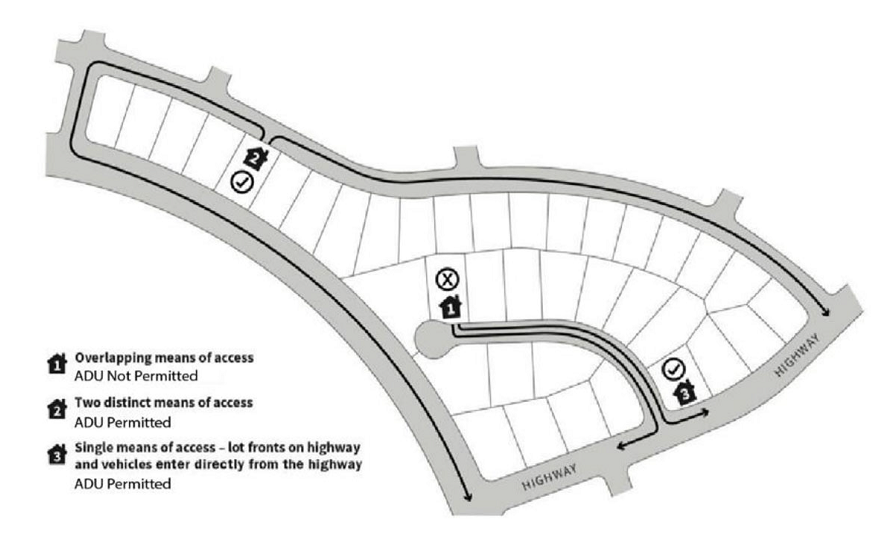
D.
Review and Decision.
1.
General. A decision on an application for an accessory dwelling unit or a junior accessory dwelling unit shall be made within 60 days of submittal of a complete application.
2.
If an application for an accessory dwelling unit or a junior accessory dwelling unit is submitted concurrently with a Ministerial Site Plan Review (Chapter 22.186), or a Conditional Use Permit (Chapter 22.158) application, for a new single-family or multi-family residence on the lot, a decision on the application for the accessory dwelling unit or junior accessory dwelling unit may be delayed until a decision on the application for the new single-family or multi-family residence is made.
3.
If the applicant requests a delay in writing, the 60-day time period shall be tolled for the period of the delay.
4.
If an application for an accessory dwelling unit or junior accessory dwelling unit is denied, a full set of comments shall be returned to the applicant within the time period described in Subsections D.1 through D.3, above, with a list of items that are defective or deficient and a description of how the applicant can be remedied by the applicant.
E.
Maximum Number of Accessory Dwelling Units and Junior Accessory Dwelling Units. Table 22.140.640-A, below, identifies the maximum number of accessory dwelling units and junior accessory dwelling units permitted on a lot:
F.
Use Restrictions. An accessory dwelling unit or a junior accessory dwelling unit shall be subject to all of the following use restrictions:
1.
Ownership. An accessory dwelling unit or a junior accessory dwelling unit shall not be sold separately from the principal residential building(s) on the same lot, except as provided in section 66341 of the California Government Code.
2.
Duration of Tenancy. An accessory dwelling unit or a junior accessory dwelling unit may only be used as a rental unit for a period of more than 30 consecutive days, in accordance with Section 22.140.770 (Short-Term Rentals).
3.
Home-Based Occupation Prohibited. No home-based occupation shall be conducted within an accessory dwelling unit or a junior accessory dwelling unit.
G.
Accessory Dwelling Unit Development Standards. The development standards in this Subsection apply to any accessory dwelling unit not described by Subsection H, below.
1.
Accessory Dwelling Units.
a.
Floor Area.
i.
Minimum. An accessory dwelling unit shall have a minimum floor area of 150 square feet, with one habitable room with a minimum floor area of 70 square feet.
ii.
Maximum.
(1)
General.
(a)
The maximum floor area of an accessory dwelling unit shall be 1,200 square feet, except as provided in Subsection (b), below;
(b)
There is no maximum floor area for an accessory dwelling unit, if the accessory dwelling unit is any of the following:
(i)
Entirely within an existing single-family or multi-family residence; or
(ii)
The result of the conversion of an existing accessory structure, with an expansion of not more than 150 square feet beyond the same physical dimensions of said structure, solely for the purpose of accommodating ingress and egress.
(2)
Planning Area Standards Districts, Community Standards Districts, and Specific Plans. Accessory dwelling units shall not be subject to any Planning Area Standards District, Community Standards District, or Specific Plan provision pertaining to floor area, gross structural area, or lot coverage.
b.
Height.
i.
The maximum height of an attached or detached accessory dwelling unit on a lot with an existing or proposed single-family or multi-family residence shall be 25 feet.
ii.
There is no maximum height for an accessory dwelling unit, if the accessory dwelling unit is any of the following:
(1)
Entirely within an existing single-family or multi-family residence; or
(2)
The result of the conversion of an existing accessory structure with an expansion of not more than 150 square feet beyond the same physical dimensions of said structure, limited to accommodating ingress and egress.
iii.
Planning Area Standards Districts, Community Standards Districts, and Specific Plans. Any new accessory dwelling unit, or expanded portion of an existing structure that is part of a proposed accessory dwelling unit, shall not exceed the maximum height specified in a Planning Area Standards District, Community Standards District, or Specific Plan, provided at least the following heights are allowed:
(1)
A height of 16 feet for a detached accessory dwelling unit;
(2)
A height of 18 feet for a detached accessory dwelling unit, with an additional two feet in height to accommodate a roof pitch that is aligned with the roof pitch of the existing or proposed single-family or multi-family residence, if it is on a lot that is within one-half mile walking distance of a major transit stop or a high-quality transit corridor as those terms are defined in section 2155 of the Public Resources Code; and
(3)
A height of 18 feet for a detached accessory dwelling unit on a lot with an existing or proposed multi-family residence.
iv.
Proximity to Scenic Resources. Notwithstanding Subsection G.1.b.iii, above, if any new accessory dwelling unit, or expanded portion of an existing structure that is part of a proposed accessory dwelling unit, is located within 200 feet of an adopted route with scenic qualities, Scenic Route, Scenic Drive, or Scenic Highway, the new accessory dwelling unit or expanded portion shall not exceed the height of the single-family or multi-family residence, or 18 feet, whichever is less, provided at least the heights in Subsection G.1.b.iii.1 to G.1.b.iii.3, above, are allowed.
c.
Required Yards.
i.
An accessory dwelling unit of 800 square feet or less may encroach into the required front yard setback, provided there is no other location on the property where the accessory dwelling unit could be constructed at the ground level.
ii.
No setback is required, if the accessory dwelling unit is any of the following:
(1)
Entirely within an existing single-family or multi-family residence; or
(2)
The result of the conversion of an existing accessory structure with no expansion of the floor area of said structure, or constructed in the same location and to the same dimensions as an existing structure, except as specified in Subsection G.1.c.iv, below.
iii.
Notwithstanding any contrary provisions in this Title 22, a four-foot setback is required for an accessory dwelling unit not described in Subsection G.1.c.ii, above:
(1)
Any new accessory dwelling unit, or expanded portion of an existing structure that is part of a proposed accessory dwelling unit, shall be at least four feet from the rear, interior side, and corner side lot lines.
(2)
An accessory dwelling unit that is built above a garage shall be at least four feet from the reversed corner side lot line.
(3)
An accessory dwelling unit shall not be subject to any step-back requirements in this Title 22.
iv.
Any new accessory dwelling unit, or expanded portion of an existing structure that is part of a proposed accessory dwelling unit, shall comply with all of the requirements in Section 22.110.090 (Projections into Yards), unless a greater projection is necessary to ensure the accessory dwelling unit functions as an independent living facility, provided projections shall be no closer than two and one-half feet from the property line. Where no setback is required, projections shall not encroach the property line.
d.
Parking.
i.
Parking Outside Very High Fire Hazard Severity Zones. No parking shall be required for an accessory dwelling unit that is located outside of a Very High Fire Hazard Severity Zone.
ii.
Parking Within Very High Fire Hazard Severity Zones.
(1)
Parking for an accessory dwelling unit located within a Very High Fire Hazard Severity Zone shall be provided in accordance with Chapter 22.112 (Parking), unless any of the following exceptions are met, in which case no parking shall be required:
(a)
The accessory dwelling unit has no bedroom;
(b)
The accessory dwelling unit is located within one-half mile walking distance of public transit, as that term is defined in section 66313 of the California Government Code;
(c)
The accessory dwelling unit is located within historic district;
(d)
The accessory dwelling unit is part of the proposed or existing single-family or multi-family residence or an accessory structure;
(e)
When on-street parking permits are required, but not offered to the occupant of the accessory dwelling unit;
(f)
When there is a car share vehicle location within one block of the accessory dwelling unit; or
(g)
When a permit application for an accessory dwelling unit is submitted with a permit application to create a new single-family or a new multi-family residence on the same lot, provided the accessory dwelling unit or the parcel satisfies any other criteria in this Subsection G.1.d.ii.1.
(2)
When a garage, carport, or covered parking structure is demolished in conjunction with the construction of an accessory dwelling unit or converted into an accessory dwelling unit, no replacement parking shall be required for the accessory dwelling unit or single-family or multi-family residence.
(3)
When parking is required for the accessory dwelling unit or single-family or multi-family residence, such parking may be located on a driveway, or in an area previously used as a driveway to a garage or carport that has since been demolished in conjunction with the construction of an accessory dwelling unit or converted into an accessory dwelling unit and may be provided as tandem parking.
e.
Distance from Publicly Dedicated Open Space. In any Fire Hazard Severity Zone, as defined in Title 32 (Fire Code) of the County Code, an accessory dwelling unit shall be located at least 200 feet from publicly dedicated open space, provided an accessory dwelling unit of at least 800 square feet with side and rear yard setbacks of at least four feet is allowed.
f.
County Historic Landmarks, Historic Districts, and Mills Act Contract Properties.
i.
Development Standards — New Accessory Dwelling Units or Accessory Dwelling Units Converted from Existing Non-Contributing Accessory Structures.
(1)
The height of a new detached accessory dwelling unit shall not exceed the maximum height in Subsection G.1.b, above, or the height of the existing single-family residence or multi-family residence, whichever is less, provided at least the heights in Subsection G.1.b.iii.1 to G.1.b.iii.3, above, are allowed.
(2)
The height of a new attached accessory dwelling unit shall not exceed the maximum height in Subsection G.1.b, above.
(3)
The architectural style and following elements of a new accessory dwelling unit or accessory dwelling unit converted from an existing non-contributing accessory structure shall be the same as the single-family or multi-family residence, as applicable: roof style, pitch, and shingle material; eave style and depth; siding material type, frame material, orientation, and material; chimney style and material; fenestration patterns; window type, vertical/horizontal orientation, and size; external door style and material; and external fixtures, such as lights.
(4)
Solar shingle roofing is an acceptable alternative to asphalt composition or wood shingle roofing.
(5)
Vinyl windows and windows with artificial muntin are prohibited.
(6)
Design Elements.
(a)
Design elements that are not on the single-family or multi-family residence are prohibited.
(b)
Design elements, such as dormers, bay windows, arched windows, and shutters, shall be the same as the design elements on the single-family or multi-family residence scaled to the accessory dwelling unit.
(7)
New Construction Accessory Dwelling Unit Attached to an Existing Primary Residence.
(a)
Location. To the extent feasible, the accessory dwelling unit shall be located in the rear yard and shall not be visible from the public right-of-way. If locating the accessory dwelling unit in the rear yard is infeasible, then the accessory dwelling unit may be located in the side yard. If locating the accessory dwelling unit in the side yard is infeasible, then the accessory dwelling unit may be located in the front yard.
(b)
Development Standards. The accessory dwelling unit shall be differentiated from the historic building by setting the accessory dwelling unit back from the historic structure's facade and using different window detailing. The window-to-wall ratio of an accessory dwelling unit should be similar to that of the historic building. An accessory dwelling unit in the side yard shall be set back from the primary facade at least four feet. New dormers constructed on the primary residence for attic conversions shall be located on the rear facade only, and the roof of the dormer(s) shall be set back 10 percent one each of the four sides of the portion of the primary residence's roof that the dormer is located on subject to Subsection G.1.c.iii, above. Accessory dwelling units shall not obscure or damage character-defining features, such as ornamental details, railing, windows, doors, porches, brackets, or roof lines.
ii.
Development Standards — Existing Contributing Accessory Dwelling Units and Accessory Dwelling Units Converted from Existing Contributing Accessory Structures.
(1)
Demolishing or moving an existing contributing accessory dwelling unit or moving an existing contributing accessory structure to convert to an accessory dwelling unit is prohibited.
(2)
Character-defining features of an existing accessory dwelling unit or an existing contributing space or accessory structure that is converted to an accessory dwelling unit shall be preserved in place.
(3)
Facades for an existing accessory dwelling unit or contributing accessory structure that is converted to an accessory dwelling unit visible from the public right-of-way may not be altered. Visible from the public right-of-way shall mean visible from the public right-of-way in the absence of site features that may be impermanent, such as landscaping or fencing.
H.
Development Standards — State-Exempt Accessory Dwelling Units.
1.
The following accessory dwelling units shall be permitted, subject only to the following development standards:
a.
On a lot with a proposed or existing single-family residence:
i.
One accessory dwelling unit is within the proposed or existing single-family residence, provided all of the following are met:
(1)
The accessory dwelling unit is within the proposed or existing space of a single-family dwelling or existing space of a single-family residence or accessory structure and may include an expansion of not more than 150 square feet beyond the physical dimensions of the existing structure solely to accommodate ingress and egress;
(2)
The space has exterior access from the proposed or existing single-family residence; and
(3)
The side and rear setbacks are sufficient for fire and safety.
ii.
One new detached accessory dwelling unit with four-foot side and rear yard setbacks on a lot with a proposed or existing single-family residence. The floor area of the accessory dwelling unit shall not exceed 800 square feet, with a height limitation as provided in Subsections G.1.b.iii.1 or G.1.b.iii.2, above, as applicable.
b.
On a lot with a proposed existing multi-family residence:
i.
A minimum of one accessory dwelling unit and maximum of 25 percent of the existing number of dwelling units, if the accessory dwelling unit(s) are proposed within the portions of existing multi-family residences that are not used as livable space, including, but not limited to, storage rooms, boiler rooms, passageways, attics, basements, or garages, and each accessory dwelling unit complies with State building standards for dwelling units.
ii.
A maximum of two detached accessory dwelling is on a lot with an existing or proposed multi-family residence, provided each accessory dwelling unit has four-foot side and rear yard setbacks, a maximum height as provided in Subsections G.1.b.iii.1 to G.1.b.iii.3, and a maximum size as provided in Subsection G.1.a.ii.a, above.
2.
Junior Accessory Dwelling Units.
a.
One junior accessory dwelling unit per lot zoned for single-family residences with a proposed or existing single-family residence may be constructed, provided all of the following are met:
i.
The junior accessory dwelling unit is within the space of an existing or proposed single-family residence; and
ii.
The space has exterior access from the proposed or existing single-family residence.
b.
Floor Area.
i.
Facilities. A junior accessory dwelling unit shall contain at least an efficiency kitchen, which includes a cooking facility with appliances and a food preparation counter and storage cabinets that are of reasonable size in relation to the junior accessory dwelling unit.
ii.
Planning Area Standards Districts, Community Standards Districts, and Specific Plans. The junior accessory dwelling unit shall not be subject to any Planning Area Standards District, Community Standards District, or Specific Plan provision pertaining to floor area, gross structural area, or lot coverage.
c.
Separate Entrance. A junior accessory dwelling unit shall have a separate entrance from the single-family residence.
d.
Access to Bathroom. Access to a bathroom shall be required, which may be part of the square footage of the junior accessory dwelling unit or located within the existing single-family residence. If the unit's bathroom is provided as part of the single-family residence, the junior accessory dwelling unit shall have interior access to the main living area of the single-family residence.
e.
Covenant Requirement for Junior Accessory Dwelling Unit. The owner shall record a covenant in a form prescribed by the County, which shall run with the land for the benefit of the County and provide for the following:
i.
A prohibition on the sale of the junior accessory dwelling unit separate from the sale of the single-family residence, including a statement that this may be enforced against future purchasers;
ii.
A restriction on the size and attributes of the junior accessory dwelling unit consistent with this Section; and
iii.
A requirement that either the remaining portion of the single-family residence or the junior accessory dwelling unit be the owner's bona fide principal residence, unless the owner is a governmental agency, land trust, or housing organization.
f.
Owner Occupancy. If a property contains a junior accessory dwelling unit, either the single-family residence or junior accessory dwelling unit shall be the principal residence of at least one legal owner of the lot, as evidenced at the time of approval of the junior accessory dwelling unit by appropriate documents of title and residency, unless the property is owned by a governmental agency, land trust, or housing organization. A junior accessory dwelling unit is not permitted on a lot owned by a corporate entity.
3.
The accessory dwelling units and junior accessory dwelling units described in Subsections H.1 and H.2, above, may be combined in the same lot in the following ways:
a.
An accessory dwelling unit described in Subsection H.1.a.i, above, or a junior accessory dwelling unit described in Subsection H.2.a, above, or both, may be combined with an accessory dwelling unit described in Subsection H.1.a.ii, above.
b.
Accessory dwelling units described in Subsection H.1.b.i, above, may be combined with accessory dwelling units described in Subsection H.1.b.ii, above.
I.
Release of Owner-Occupancy Covenant. The County releases its interest in any covenant for an accessory dwelling unit that required owner-occupancy in perpetuity of either the single-family residence or the accessory dwelling unit that is located on the same lot, recorded in the Registrar-Recorder/County Clerk, running with the land for the benefit of the County.
J.
Planning Area Standards Districts, Community Standards Districts, and Specific Plans. Planning Area Standards Districts, Community Standards Districts, and Specific Plans objective development standards shall apply. Where the regulations in this Section are contrary to the provisions in a Planning Area Standards District, Community Standards District, or Specific Plan regulating the same matter, the provisions of the Community Standards District or Specific Plan shall prevail.
K.
Notwithstanding any contrary provision in this Title 22, the approval of an accessory dwelling unit or a junior accessory dwelling unit shall not be subject to the correction of any nonconforming zoning condition, including buildings or structures nonconforming due to standards or use, as defined in Section 22.14.020 of Division 2 (Definitions), provided that the lot is in a zone that allows residential use.
L.
To the extent that any provision of this Title 22 is in conflict with Chapter 13 of Division 1 of Title 7 of the California Government Code, the applicable provision of State law shall control, but all other provisions of this Title 22 shall remain in full force and effect.
(Ord. 2025-0029 § 8, 2025; Ord. 2024-0054 § 8, 2024; Ord. 2020-0059 § 12, 2020; Ord. 2019-0020 § 19, 2019.)
22.140.650 - Accessory Overnight Safe Parking.
A.
Purpose. The purpose of this Section is to permit the use of certain existing parking lots for accessory overnight safe parking.
B.
Definitions. Specific terms used in this Section are defined in Division 2 (Definitions).
C.
Applicability. This Section shall apply to all zones where permitted.
D.
Application Requirements. A Ministerial Site Plan Review (Chapter 22.186) is required, except in Zones M-1.5 and M-2 where a Conditional Use Permit (Chapter 22.158) is required.
E.
Requirements. Notwithstanding other Title 22 requirements, accessory overnight safe parking, pursuant to this Section, shall comply with the following:
1.
Location. Accessory overnight safe parking is permitted on lots that include an existing parking lot, excluding parking as a transitional use that serves a nonresidential use, and excluding parking as a transitional use subject to Section 22.140.440 (Parking as a Transitional Use).
2.
Hours of Operation. Hours of operation of the accessory overnight safe parking lot shall not conflict with the hours of operation of the primary use on-site and may only be between 6:00 p.m. and 7:00 a.m.
3.
Rent. The vehicle occupants shall not be charged rent for use of parking spaces.
4.
Adequate and Sanitary Bathroom Facilities. Occupants of vehicles parked overnight shall have access to bathrooms in an existing building on-site, or in mobile bathrooms, at the ratio of one bathroom (including one toilet and one sink) per 20 vehicle occupants.
5.
Trash Facilities. Occupants of vehicles parked overnight shall have access to trash receptacles.
6.
On-site Management. On-site management shall be provided at all times for parking lots with more than five vehicles parked overnight. On-site management shall be at least one person, and shall be either the property owner or a person appointed by the property owner to oversee the accessory overnight safe parking.
7.
Outdoor Lighting. Outdoor lighting shall be shielded and focused away from all adjoining properties.
8.
Operable Vehicles. All vehicles parked overnight shall be operable.
9.
Maximum Vehicles. The maximum number of vehicles allowed to park overnight shall be no greater than the number of spaces in the lot.
10.
No disposal of graywater/blackwater from recreational vehicles is permitted on the lot, unless the applicant provides documentation for legal disposal.
(Ord. 2023-0038 § 12, 2023; Ord. 2021-0017 § 23, 2021.)
22.140.660 - Motel Conversions, Temporary.
A.
Purpose. The purpose of this Section is to permit and streamline the temporary conversion of certain existing, legally-built hotels, motels, and youth hostels to transitional housing or emergency shelters, thereby increasing the production of each.
B.
Definitions. Specific terms used in this Section are defined in Division 2 (Definitions).
C.
Applicability. This Section shall apply to all zones where permitted.
D.
Application Requirement.
1.
Transitional housing. An Administrative Housing Permit (Section 22.166.040) and a Ministerial Site Plan Review (Chapter 22.186) are required.
2.
Emergency shelter. A Ministerial Site Plan Review (Chapter 22.186) is required.
E.
Requirements.
1.
Transitional Housing. Notwithstanding other Title 22 requirements, the temporary conversion of certain existing, legally-built hotels, motels, and youth hostels to transitional housing, pursuant to this Section, shall comply with the following:
a.
Residential Use. Transitional housing shall be considered a residential use, subject to only those restrictions that apply to other residential dwellings of the same type in the same zone.
b.
Affordability. All dwelling units, exclusive of any manager's unit(s), shall be restricted to lower income households.
c.
Transitional Housing Dwelling Units. All dwelling units, exclusive of any manager's unit(s), shall be restricted to transitional housing. The number of transitional housing units shall be equal to the number of hotel, motel, or youth hostel rooms, except where a reduction in the number of rooms is necessary to create common areas and supportive services spaces required in this Section.
d.
Target Population. All dwelling units, exclusive of any manager's units(s), shall be restricted to the target population.
e.
Duration. The term of the affordability and transitional housing restrictions and requirements, pursuant to Section 22.166.070 (Covenant and Agreement), shall be at least 10 years, but not to exceed 20 years, from the issuance of the final certificate of occupancy by Public Works.
f.
No Enlargement. The conversion shall not result in any enlargement or addition to the existing, legally-built building.
g.
Supportive Services. Projects are subject to Sections 22.128.250.F (Supportive Services), 22.128.250.G (Supportive Services Plan), and 22.128.250.H (Dwelling Unit Facilities).
h.
Covenant and Agreement. A covenant and agreement shall be recorded, pursuant to Section 22.166.070 (Covenant and Agreement).
i.
Reduced Number of Transitional Housing Units Due to Termination of Subsidy. Project may request to reduce the number of transitional housing units due to termination of operating subsidy, subject to Section 22.130.260 (Reduced Number of Transitional Housing Units Due to Termination of Subsidy).
2.
Emergency Shelter. Notwithstanding other Title 22 requirements, the temporary conversion of certain existing, legally-built hotels, motels, and youth hostels to an emergency shelter, pursuant to this Section, shall comply with the following:
a.
Duration. The site shall remain an emergency shelter for at least 10 years, and not to exceed 20 years, from the issuance of the final certificate of occupancy by Public Works.
b.
Covenant and Agreement. A covenant and agreement, acceptable to the Director, shall be recorded by the applicant with the Registrar-Recorder/County Clerk, and shall include, without limitation, the following:
i.
The duration of shelter use;
ii.
A declaration that the shelter shall be maintained in accordance with the information in the application and the standards, as required by Section 22.140.180 (Domestic Violence Shelters, Emergency Shelters, and Accessory Shelters);
iii.
The improvements required by the Fire Department, Public Health, Public Works, and Regional Planning related to shelters shall be constructed or installed and continuously maintained by the applicant;
iv.
Any violation of the covenant and agreement required by this Section shall be subject to Chapter 22.242 (Enforcement and Procedures); and
v.
A transition plan for the end of the conversion term to ensure that change to the occupancy is made in a manner that minimizes occupant disruption and only upon the vacancy of shelter beds.
c.
No Enlargement. The conversion shall not result in any enlargement or addition to the existing, legally-built building.
F.
Development Standards. The applicant may request to waive or modify Title 22 development standards for temporary conversions, subject to this Section. The Director shall approve the request, unless the Director makes one of the following findings:
1.
The development standard for which the applicant is requesting a waiver or reduction does not physically preclude the conversion;
2.
The waiver or reduction would have a specific adverse impact upon public health and safety, or the physical environment or upon any real property that is listed in the California Register of Historical Resources, or the waiver or reduction would have a specific adverse impact for which there is no feasible method to satisfactorily mitigate or avoid the specific adverse impact; or
3.
The waiver or reduction is contrary to State or federal law.
G.
Discontinuance of Conversion.
1.
To re-establish the hotel, motel, or youth hostel at the end of the conversion term, the following is required:
a.
Application Requirement.
i.
Where the previous hotel, motel, or youth hostel was conforming or legal nonconforming and within its amortization period at the time when the conversion was approved, a Ministerial Site Plan Review (Chapter 22.186) is required.
ii.
Where the previous hotel, motel, or youth hostel was within the grant term of a valid Conditional Use Permit (Chapter 22.158) or Nonconforming Use and Structure Review (Chapter 22.172) at the time when the conversion was approved, a Revised Exhibit "A" (Chapter 22.184) is required. Such conversion shall be deemed substantially conforming with the Conditional Use Permit (Chapter 22.158) or Nonconforming Use and Structure Review (Chapter 22.172).
b.
Operative Law. Except as specified in Subsections c and d, below, the re-establishment of a hotel, motel, or youth hostel shall be subject to the provisions of this Title 22 in effect at the time when the final certificate of occupancy was issued for the original use.
c.
Legally Nonconforming. Where the previous hotel, motel, or youth hostel was legally nonconforming and within its amortization period at the time when the conversion was approved with no increased floor area:
i.
The hotel, motel, or youth hostel shall be exempt from Section 22.172.050.A (Termination by Discontinuance); and
ii.
The timeframe specified in Section 22.172.050.B (Termination by Law) shall be suspended until such time when the final certificate of occupancy is issued by Public Works for the re-established hotel, motel, or youth hostel, which may continue operation within the remainder of the amortization period; or
d.
Conditional Use Permit. Where the previous hotel, motel, or youth hostel was within the grant term of a valid Conditional Use Permit (Chapter 22.158) at the time when the conversion to interim housing was approved with no increased floor area, the grant term specified in the Conditional Use Permit shall be suspended until such time when the final certificate of occupancy is issued by Public Works for the re-established hotel, motel, or youth hostel, which may continue operation within the remainder of the grant term of the Conditional Use Permit.
(Ord. 2021-0017 § 24, 2021.)
22.140.670 - Occupied Recreational Vehicle Parking During a County-Declared Shelter Crisis.
A.
Applicability. This Section applies to occupied recreational vehicle parking during a County-declared shelter crisis in all zones where permitted.
B.
Requirements. During a County-declared shelter crisis, as defined in section 8698 of the California Government Code, an occupied recreational vehicle may be located at the rear of a property, pursuant to this Section, subject to the following:
1.
The property shall have a net lot area of at least 5,000 square feet;
2.
The property shall contain an owner-occupied single-family residence;
3.
The property shall contain no habitable structure other than a legally-built single-family residence, including an accessory dwelling unit and/or a junior accessory dwelling unit, as applicable;
4.
The property owner shall not charge rent for storage of the recreational vehicle or for occupancy of the recreational vehicle;
5.
The recreational vehicle shall be operative;
6.
The recreational vehicle shall park in a manner that complies with the required setbacks of the applicable zone, Community Standards District, or Specific Plan;
7.
A minimum distance of six feet shall be required between the parked recreational vehicle and the main residential building and between the parked recreational vehicle and any accessory building on the same lot;
8.
No disposal of graywater/blackwater from recreational vehicles is permitted by occupants in or around the lot, unless the property owner provides documentation of legal disposal;
9.
No structure, such as decks or porches, shall be built and attached to the recreational vehicle; and
10.
Occupancy of parked recreational vehicles shall end within 30 days after the expiration of the County-declared shelter crisis.
(Ord. 2021-0017 § 25, 2021.)
22.140.680 - Condominium Conversions.
A.
Purpose. The purpose of this Section is to ensure that tenants are notified of an applicant's intent to convert rental dwelling units to condominiums, and that notifications of such intent are provided to organizations qualified to acquire rental housing and maintain its long-term affordability.
B.
Applicability. The provisions of this Section apply to the conversion of rental dwelling units to residential condominiums, as defined in Division 2 (Definitions) under "Condominium conversion."
C.
Requirements.
1.
At least 60 days prior to the filing of a tentative map for a condominium conversion, the applicant shall provide to each of the tenants of the proposed condominium development notification of intent to convert, in accordance with section 66427.1 of the California Government Code.
2.
At least 30 days prior to the filing of a tentative map for the conversion of rental dwelling units to a residential or mixed residential and commercial condominium development, the applicant shall submit all of the following information to LACDA:
a.
The address(es) of the property(ies) that will be proposed to be converted;
b.
The number of rental dwelling units that will be proposed to be converted;
c.
The monthly rent collected per unit at the time the information is submitted;
d.
Whether the unit(s) are subject to the County's Rent Stabilization Ordinance; and
e.
The applicant's contact information.
3.
Condominium conversions shall be subject to all applicable provisions of Chapter 22.119 (Affordable Housing Replacement) in Title 22, Chapter 8.52 (Rent Stabilization) in Title 8 (Consumer Protection, Business and Wage Regulations) of the County Code, Title 21 (Subdivisions) of the County Code, and all other applicable provisions of section 66427.1 of the California Government Code.
(Ord. 2021-0018 § 15, 2021.)
22.140.690 - Alternative Financial Services.
A.
Purpose. This Section establishes standards for alternative financial services, which may have a detrimental effect on the health, safety, or welfare of the community, to minimize overconcentration while permitting these activities in specific Commercial and Industrial Zones.
B.
Definitions. Specific terms used in this Section are defined in Section 22.14.010 of Division 2 (Definitions), under "Alternative Financial Services."
C.
Applicability. This Section applies to alternative financial services in Zones C-3, C-M, M-1, M-1.5, and M-2.
D.
Prohibited Areas. Alternative financial services are prohibited within any area regulated by a Specific Plan.
E.
Existing Uses.
1.
Alternative financial services that were lawfully existing as of April 8, 2021, the effective date of this Section, may remain in their present condition, subject to the provisions of Chapter 22.172 (Nonconforming Uses, Buildings, and Structures).
2.
Alternative financial services that were lawfully existing as of April 8, 2021, the effective date of this Section, may be enlarged, expanded, or relocated only if the business is brought into compliance with the development and performance standards of this Section.
F.
Application Requirements.
1.
Ministerial Site Plan Review. A Ministerial Site Plan Review (Chapter 22.186) application is required for alternative financial services in Zones M-1, M-1.5, and M-2.
2.
Conditional Use Permit.
a.
Application. A Conditional Use Permit (Chapter 22.158) application is required for alternative financial services in Zones C-3 and C-M.
b.
Additional Findings.
i.
The requested use at the proposed location will not adversely affect the economic welfare of the nearby community.
ii.
When an alternative financial service is located within 1,320 feet of another alternative financial service, a finding of public convenience or necessity shall be made based upon review and consideration of relevant factors, which shall include, but not be limited to, the following:
(1)
The extent to which the requested use would duplicate services and, therefore, contribute to an over-concentration of similar uses;
(2)
The extent to which the requested use will enhance the economic viability of the area;
(3)
The ability of the requested use to serve a portion of the market not served by other uses in the area; and
(4)
The extent to which the requested use, location, surrounding area, and/or operator has a history of law enforcement problems.
G.
Additional Application Materials. In addition to any information required by this Title 22, an application for an alternative financial service shall include a site plan depicting the location of all businesses within a 1,320 foot radius of the subject property.
H.
Development Standards. Alternative financial services shall comply with the following development standards:
1.
Buffer. The property boundary of an alternative financial service shall be a minimum of 1,320 feet from the property boundary of all other alternative financial services.
2.
Sign Requirements. Alternative financial services shall post their loan rates in multiple languages including, but not limited to, English, Spanish, Korean, Chinese, Armenian, and Tagalog, adjacent to the customer service window using a letter height of not less than one-half inch.
I.
Performance Standards. Alternative financial services shall comply with the following performance standards:
1.
Hours of Operation. All alternative financial service activities shall be confined to the hours between 8:00 a.m. and 8:00 p.m., daily.
2.
Security.
a.
Security bars and accordion folding grilles installed on the exterior of a storefront are prohibited.
b.
Exterior cashier windows are prohibited.
c.
Building security grilles may be placed within the interior of the building if the grilles are concealed so that they are not visible from the exterior of the building when not in use during business hours.
d.
Video security cameras shall be installed to monitor the customer service area and exterior areas surrounding the business. The cameras shall record video for a minimum of 30 days and be available to law enforcement officers upon request.
(Ord. 2023-0038 § 13, 2023; Ord. 2021-0011 § 12, 2021.)
22.140.700 - Pallet Yards.
A.
Purpose. This Section establishes standards, conditions, and procedures that support and facilitate the development of pallet yards as a principal use in a manner that protects public health, safety, and welfare and minimizes significant impacts to the environment.
B.
Applicability. This Section applies to pallet yards in Zones M-1, M-1.5, M-2, and M-2.5.
C.
Application Requirements.
1.
A pallet yard as a primary use located in Zones M-1 and M-1.5 shall require a Minor Conditional Use Permit (Chapter 22.160).
2.
A pallet yard as a primary use located in Zones M-2 and M-2.5 shall require a Ministerial Site Plan Review (Chapter 22.186) application.
3.
Additional Application Materials. An operations plan that addresses all requirements specified in this Section shall be submitted with the application, pursuant to Subsections C.1 and C.2, above.
4.
Applicability of Supplemental District Regulations. For pallet yards subject to Chapter 22.84 (Green Zone) and a provision of Chapter 22.84 regulates the same matter as this Section, the more restrictive provision shall apply.
5.
Prohibition. Pallet yards are prohibited within the following areas as designated by the General Plan:
a.
Agricultural Resource Areas.
b.
High Fire Hazard Severity Zones.
c.
Hillside Management Areas.
d.
Significant Ecological Areas.
e.
Very High Fire Hazard Severity Zones.
D.
Development Standards.
1.
Materials Accepted. Pallet yards may accept new or used pallets that are made of wood, as well as raw material (lumber), that will be used in constructing new pallets or repairing used pallets.
2.
Permitted Activity and Equipment. Pallet yards may maintain activities associated with repair, deconstruction, reconstruction, recycling, or storage of pallets made of wood. Chipping and grinding or composting activities are subject to additional requirements specified in Section 22.140.740 (Organic Waste Facilities).
3.
Building Enclosures and Walls.
a.
All storage, including storage of all equipment used in conducting such business, other than parking, shall be enclosed by a building or a solid wall.
b.
When a pallet yard is adjacent to a sensitive use, the following shall apply:
i.
The entire operations and storage areas shall be conducted within an enclosed building; and
ii.
An air filtration system shall be installed in the building to protect indoor air quality in accordance with California Division of Occupational Safety and Health (Cal/OSHA) and CARB requirements, and for outdoor air quality in accordance with AQMD requirements. Public Health may be consulted on additional air quality recommendations.
4.
Building Setbacks and Height. Any buildings or structures, or any portion proposed for additions, excluding chimneys, rooftop antennas, or roof solar panels, shall be set back within an encroachment plane sloping upward and inward starting at 35 feet for the new building or structure at the setback, or at the top of the existing roof for additions. For every foot above 35 feet, one additional foot setback is required, up to 45 feet.
5.
Landscaping.
a.
At least one square foot of landscaping shall be provided for each linear foot of street or highway frontage verified by a landscaping plan submitted to the Department, and shall meet the following standards:
i.
Such landscaping area shall be planted with one 15-gallon tree for every 100 square feet.
ii.
Landscaping shall be distributed along said frontage and visible from the right-of-way in accordance with the site plan approved by the Commission or Hearing Officer.
iii.
No planting area shall have a horizontal dimension of less than three feet.
iv.
A permanent watering system that satisfactorily irrigates all planted areas shall be provided. When hose bibs are utilized, they shall be located not more than 50 feet apart within the required landscaped area.
v.
All landscaped areas shall be continuously and properly maintained in good condition.
vi.
Landscaping shall include only non-invasive plant species.
vii.
Landscaping equipment used for maintenance, such as lawn mowers and leaf blowers, shall be electric and non-combustion powered.
6.
Solid Walls.
a.
For any pallet yard that consists of outdoor operations or storage other than customer parking, a solid wall such as a masonry wall or a concrete block wall shall be provided along the street frontage or any other lot lines adjoining a lot that contains a non-industrial use. All walls shall meet the following standards:
i.
Be of a uniform height between eight feet and 15 feet;
ii.
Be a minimum thickness of six inches;
iii.
Be of a neutral color; and
iv.
Be constructed in workmanlike manner and consist of materials such as CMU or masonry, brick, etc.
b.
Where walls exceed a height of 10 feet and are located on street or highway frontages, they shall be set back at least three feet from the lot line. The area between the walls and the lot line shall be fully landscaped according to the specifications described in Subsection D.5, above.
c.
Any structures that are used as part of the yard or are exposed to view from a street or highway frontage shall be subject to color, maintenance, and sign requirements for walls as provided in Subsection D.6.a, above.
d.
All fences that are intended to substitute or serve as solid walls are prohibited.
7.
Storage of Materials.
a.
Pallets shall be stored at least 10 feet away from the surrounding walls, or the length equal to the wall height, whichever is greater.
b.
The height of pallets stored in an outdoor pallet yard shall not exceed the walls erected along the property lines.
8.
Drop-off and Loading. Areas for and access to drop-off and loading shall be clearly designated by signage, shall not impede the on-site vehicular circulation, and shall comply with the following:
a.
Drop-off and loading areas shall be located on-site and furthest away from lot lines that are closest to any nearby sensitive uses.
b.
"No Idling" Sign Required. Where loading spaces or area are provided, the loading area shall include at least one sign stating that vehicle idling shall be limited to five minutes. Graphics related to the vehicle idle limitation are permitted on said sign. Said sign shall be a minimum size of 12 inches wide by 18 inches in height and shall be prominently displayed and visible from the loading spaces/area. Said sign may contain language such as "5-minute idle limit," "spare the air," "please turn off engine when stopped," or similar language.
9.
Vehicle Circulation. On-site vehicular circulation, turnaround, queuing areas, and ingress and egress shall be designated in such a way that they do not impede any other permitted activities and avoid any impact on the public right-of-way as well as nearby sensitive uses, as approved by the Director and Public Works.
10.
Perimeter Identification Sign. In addition to the signs that are permitted by Chapter 22.114 (Signs), and notwithstanding any contrary provisions in Division 10 (Community Standards Districts) in Title 22, each pallet yard shall provide a perimeter identification sign that complies with the following:
a.
A perimeter identification sign shall be permanently affixed on a building or wall that is visible and with text that is legible from the public right-of-way for pedestrians, no higher than eight feet from the ground measured vertically from the base of the sign. Freestanding signs or portable signs are prohibited as a perimeter identification sign.
b.
A perimeter identification sign shall have a minimum sign area of four square feet and a maximum of nine square feet. The area for the perimeter identification sign shall not be accounted for in the areas for business signs specified in Chapter 22.114 (Signs).
c.
The perimeter identification sign shall permanently display hours of operation, schedule of charges, type of material that may be deposited, telephone number of the facility operator or a representative of the facility operator, emergency contact information for reporting any problems which may occur related to the operation of the facility, 24 hours a day, seven days a week. The perimeter identification sign shall also include the business name unless the property also contains a separate business sign that is clearly visible from the public right-of-way. The sign shall also include instructions for reporting violations to the Department with the following text, or as updated by the Department:
i.
"To report a violation to the Los Angeles County Department of Regional Planning, call 213-974-6453 Monday—Thursday, 7 a.m. - 6 p.m., dial 2-1-1 at any time or email zoningenforcement@planning.lacounty.gov"; and
ii.
"No loitering or littering is permitted on the premises. No materials shall be left outside of enclosures."
d.
Additional signs and/or measures may be required by the Director in order to protect personnel and public health and safety.
11.
Lighting. The facility, yard, and equipment shall be equipped with adequate lighting. All outdoor lighting shall be shielded in such a way that lighting is directed inward to the facility and away from any lots containing residential or agricultural uses.
12.
Cleaning and Maintenance. Facility shall be kept in a clean, safe, and sanitary condition at all times, and maintain a source of running water on site.
13.
Hours of Operation. Pallet yards may operate no earlier than 8:00 a.m. and no later than 6:00 p.m., Monday through Saturday. Pallet yards shall not operate on Sundays and national holidays, and comply with other restrictions regarding the hours of operations as approved by the Director.
E.
Additional Findings. In addition to the findings required in Section 22.160.050 (Findings and Decision), all projects subject to this Section that require a Minor Conditional Use Permit shall meet the following findings:
1.
The project is sited and designed in such a way to minimize and prevent impacts to the persons residing or working in the surrounding area or within the project site by incorporating appropriate operation measures, equipment, and other best practices.
2.
The requested use will operate in such a way that it promotes the responsible use of resources and protection of the environment by providing adequate measures to control the handling of materials, air emissions of dust or toxins, nuisance, and migration of residues off-site, and by incorporating best practices for operation as well as site maintenance. The operator has demonstrated through operation and maintenance plans that the facility will incorporate best practices for operation and site maintenance, including that the facility will be managed in a way that will not be a nuisance to surrounding properties and specifically sensitive uses.
F.
Modification. When a modification is requested for development standards listed in Subsections D.3, D.4, and D.6, above, the following findings must be made in addition to the findings required in Section 22.160.050 (Findings and Decision):
1.
The existing adjoining property is located in an Industrial Zone and is developed with a similar use, and/or existing structures serve as an enclosure as well as, or better than, the wall required herein; and
2.
The requested modification provides alternative means to prevent adverse effects on environment and health of the residents or occupants in surrounding areas.
G.
Schedule for Compliance.
1.
Notwithstanding Chapter 22.172 (Nonconforming Uses, Buildings and Structures), all existing pallet yards that have been legally-established shall comply with the schedule of compliance as follows:
a.
All pallet yards that have an approved Conditional Use Permit (Chapter 22.158) or an approved Ministerial Site Plan (Chapter 22.186) and are subject to Chapter 22.84 (Green Zone) shall comply with the schedule for compliance as specified in Section 22.84.050 (Schedule for Compliance for Existing, Legally-Established Uses).
b.
Other pallet yards that have an approved Conditional Use Permit (Chapter 22.158) shall be subject to all requirements of this Section upon a renewal of such permit.
c.
Other pallet yards that have an approved Ministerial Site Plan (Chapter 22.186) shall submit a Minor Conditional Use Permit (Chapter 22.160) application in compliance with all requirements of this Section within five years from the effective date of this ordinance.
H.
Revocation of Permit. Notwithstanding Chapter 22.238 (Modifications and Revocations), failure to comply with all requirements in this Section and all conditions of approval for the subject property shall result in an immediate citation of a Notice of Violation. Upon the issuance of a Notice of Violation, the facility may be subject to permit revocation proceedings, pursuant to Section 22.238 (Modifications and Revocations).
1.
If a permit granted for a facility is denied or revoked, the site shall be vacated within 30 days of the permit denial or revocation.
2.
Upon closure of the facility, the operator shall provide written notice of the intent to perform site restoration, at least 30 days prior to beginning site restoration. The site restoration procedures and scope shall ensure that the entire premises, structures, grounds, ponds, and drainage are clean of any residues and all machinery is removed.
(Ord. 2024-0028 § 18, 2024; Ord. 2022-0023 § 34, 2022.)
22.140.710 - Supermarket Accessory Recycling Collection Center.
A.
Purpose. This Section establishes standards, conditions, and procedures that support and facilitate the development of recycling collection centers as an outdoor accessory use to existing supermarkets in a manner that protects public health, safety, and welfare and minimizes impacts to the environment.
B.
Definition. Specific terms used in this Section are defined in Section 22.14.180 (R) in Division 2 (Definitions), under "Recycling and Solid Waste."
C.
Applicability. This Section applies to recycling collection centers that only accept beverage containers that are established on an existing supermarket site as an accessory use in Zones C-1, C-2, C-3, C-M, C-MJ, C-R, C-RU, MXD, MXD-RU, M-1, M-1.5, M-2, and M-2.5. Any other types of recycling collection centers or bins are prohibited as an accessory use.
D.
Prohibited. A recycling collection center as an outdoor accessory use to an existing supermarket as defined in Section 22.14.180 (R) in Division 2 (Definitions), under "Recycling and Solid Waste" is prohibited within a mixed-use development containing residential uses.
E.
Application Requirement. A Ministerial Site Plan (Chapter 22.186) application is required for each supermarket accessory recycling collection center provided that the property and the existing principal use comply with all currently applicable development standards and are free of any zoning violations.
F.
Additional Application Materials. In addition to the application materials required for a Ministerial Site Plan (Chapter 22.186), the application shall contain the following information:
1.
Letters of authorization from the supermarket operator and property owner authorizing the applicant to operate a supermarket accessory recycling collection center;
2.
A copy of the State certification allowing a supermarket accessory recycling collection center on the site; and
3.
A copy of the current and valid County business license issued for the supermarket.
G.
Development Standards. Supermarket accessory recycling collection centers as an accessory use shall comply with the following standards:
1.
Materials accepted. A supermarket accessory recycling collection center may only accept beverage containers in which a beverage is sold, and which is constructed of metal, glass, plastic, or any combination of these materials, such as bottles, cans, jars, or cartons.
2.
Permitted Activity. A supermarket accessory recycling collection center shall only receive material that has been separated for reuse prior to receipt. The center may not process materials except for sorting, bundling, or bailing.
3.
Distance. A supermarket accessory recycling collection center shall be located a minimum of 100 feet from Residential Zones, Commercial Zones, and Agricultural zoned parcels containing a residential use, or a mixed-use development containing residential uses.
4.
Size. The total area occupied for a supermarket accessory recycling collection center shall not exceed 500 square feet.
5.
Setback. The supermarket accessory recycling collection center shall be placed a minimum of 10 feet from all property lines, structures, a public right-of-way, or driveways.
6.
Equipment. Power-driven processing equipment, except for reverse vending machines, is prohibited.
7.
Storage of Collected Materials.
a.
The recyclable materials shall be deposited and stored in containers that have lids or closed containers. The containers shall be maintained in good condition and appearance with no structural damage, holes or visible rust, and be free of graffiti.
b.
When the container is placed near a public or private sidewalk, a minimum of five-foot clearance shall be provided between the container and the sidewalk.
c.
Vertical stacking of containers or receptacles is prohibited.
d.
The containers shall be placed on a paved surface.
8.
Drop-off and Loading Areas.
a.
Areas for and access to drop-off and loading shall be clearly designated and shall not impede the on-site traffic circulation.
b.
"No Idling" Sign Required. Where loading spaces or areas are provided, the loading area shall include at least one sign stating that vehicle idling shall be limited to five minutes. Graphics related to the vehicle idle limitation are permitted on said sign. Said sign shall be a minimum size of 12 inches wide by 18 inches in height and shall be prominently displayed and visible from the loading spaces/area. Said sign may contain language such as "5-minute idle limit," "spare the air," "please turn off engine when stopped," or similar language.
c.
A minimum of two containers shall be provided for customers to dispose of non-recyclable items. At least one of the containers shall have no perforations, mesh, or holes and be provided for customers to dispose any residual liquids from beverage containers prior to depositing them at the supermarket accessory recycling collection center.
9.
Site Identification Sign. One sign with a minimum dimension of two feet in width and two feet in length and maximum dimension of three feet in width and three feet in length shall be permanently fixed on the supermarket accessory recycling collection center in a location visible and with text that is legible to customers and from the front of the nearest street. No freestanding signs, portable signs, or banners shall be allowed. The sign shall include the hours of operation, type of materials that may be deposited, telephone number of facility operator or a representative of the facility operator, phone number of the Zoning Enforcement Section of the Department, and emergency contact information for reporting any problems which may occur related to the operation of the facility 24 hours a day, seven days a week. The sign shall also say the following: "No loitering or littering is permitted on the premises. No materials shall be left outside of enclosures."
10.
Required Parking. No additional parking is required for a supermarket accessory recycling collection center. However, supermarket accessory recycling collection centers shall not reduce the amount of parking for the existing uses on the property below the minimum required by Chapter 22.112 (Parking), unless a Minor Parking Deviation (Chapter 22.176) application is approved for the subject property.
11.
Lighting. The supermarket accessory recycling collection center shall be equipped with adequate lighting. All outdoor lighting shall be directed away from any lots containing residential or agricultural uses.
12.
Hours of Operation. Hours of operation are limited to 9:00 a.m. to 6:00 p.m., Monday through Saturday, and 12:00 p.m. to 5:00 p.m. on Sunday.
13.
The supermarket accessory recycling collection center must be removed within 60 days of the day the supermarket ceases to operate.
(Ord. 2022-0023 § 35, 2022.)
22.140.720 - Recycling Collection Facilities.
A.
This Section establishes standards, conditions, and procedures that support and facilitate the development of recycling collection facilities as a principal use in a manner that protects public health, safety, and welfare, and minimizes significant impacts to the environment.
B.
Definition. Specific terms used in this Section are defined in Section 22.14.180 (R) in Division 2 (Definitions), under "Recycling and Solid Waste."
C.
Applicability.
1.
This Section applies to recycling collection facilities as a principal use in Zones M-1, M-1.5, M-2, and M-2.5 for the deposit, drop-off, or buy-back of specific recyclable materials that may not involve processing, other than those specified in this Section.
2.
Exception. This Section does not apply to legally-established facilities that were approved with a Conditional Use Permit (Chapter 22.158) prior to the effective date of this ordinance. However, all requirements set forth in this Section shall apply to such facilities upon the expiration of the permit.
3.
Applicability of Supplemental District Regulations. For recycling collection facilities where a provision of the supplemental district regulates the same matter as this Section, the more restrictive provision shall apply.
4.
Emergency Situations. Where the Director has determined that an emergency exists, the Director has discretion to allow limited-term (not to exceed 12 months) recycling and solid waste collection and processing activities necessary to prevent or mitigate loss or damage to life, health, property, or essential public services through a Ministerial Site Plan Review (Chapter 22.186) application.
D.
Application Requirement. A recycling collection facility requires a Conditional Use Permit (Chapter 22.158) application and shall meet the following requirements:
1.
The parcel shall contain a minimum of 5,000 square feet of lot area; and
2.
If any portion of the lot containing the recycling collection facility is within a 500-foot radius of a lot containing a sensitive use, the entire facility shall be completely enclosed in a building.
E.
Co-location. A recycling collection facility that co-locates as a primary use on a parcel with an existing solid or recycling waste facility may be permitted to apply for a modification of an existing Conditional Use Permit, pursuant to Chapter 22.236 (Minor Modification or Elimination of Conditional Use Permit Conditions), provided that the following requirements are met:
1.
The existing use is established with an approved Conditional Use Permit;
2.
The approved Conditional Use Permit being modified is active and not expired; and
3.
The existing use is in compliance with all existing Conditional Use Permit conditions.
F.
Additional Application Materials. In addition to Subsection D, above, an operations plan that addresses all requirements specified in this Section shall be submitted.
G.
Development Standards.
1.
Materials Accepted. Recycling collection facilities may accept paper, cardboard, glass, non-ferrous metal, plastic, or other items deemed appropriate by the Commission or Hearing Officer. Liquid waste, organic waste, and mixed solid waste are prohibited. Collection of any hazardous waste is prohibited unless an appropriate permit from the Fire Department and/or California Department of Toxic Substances Control has been provided to the Director.
2.
Permitted Activity. A recycling collection facility shall only receive materials that have been previously separated off-site for reuse. The facility may not process materials, including briquetting, cleaning, compacting, crushing, flattening, grinding, re-manufacturing, and shredding, except for sorting, bundling, or bailing.
3.
Building Height. When a recycling collection facility is located on a site that is within a 500-foot radius of a lot containing a sensitive use, any building or structures, or any portion proposed for additions, excluding chimneys, rooftop antennas, or roof solar panels, shall be within an encroachment plane sloping upward and inward, starting at 35 feet for new building or structure at the setback, or at the top of the existing roof for additions. For every foot above 35 feet, one additional foot setback is required, up to 45 feet. In such cases, the maximum building height permitted shall be 45 feet.
4.
Walls, Fences, and Landscaping.
a.
If a recycling collection facility site is located within a 500-foot radius of a lot containing sensitive uses, walls, and landscaping shall be provided according to the requirements set forth in Chapter 22.84 (Green Zone).
b.
Any outdoor recycling collection facilities that are not subject to the requirements in Subsection 4.a, above, shall provide walls or fences according to the requirements set forth in Section 22.140.430 (Outdoor Storage).
5.
Storage of Collected Materials. All recyclable materials on-site shall be stored in a secured manner in designated receptacles, bins, or pallets, and located on a paved impermeable surface or stored within an enclosed building. Vertical stacking or storage of materials shall not exceed the height of the walls erected along the property lines.
6.
Accessory Structures and Utilities. Any recycling collection facilities that conduct outdoor operations shall provide at least one office building that is permanently affixed to the ground, and one toilet that is served by public water and sewer, or otherwise approved by the Director, as well as by Public Health and Public Works.
7.
Drop-Off and Loading for Facilities Open to General Public. Areas for, and access to, drop-off and loading shall be clearly designated and shall not impede on-site vehicular circulation. Drop-off and loading areas shall be located on-site furthest away from lot lines that are closest to a nearby sensitive use, and shall comply with the following:
a.
"No Idling" Sign Required. Where loading spaces are provided or the loading area shall include at least one sign stating that vehicle idling shall be limited to five minutes. Graphics related to the vehicle idle limitation are permitted on said sign. Said sign shall be a minimum size of 12 inches wide by 18 inches in height and shall be prominently displayed and visible from the loading spaces/area. Said sign may contain language such as "5-minute idle limit," "spare the air," "please turn off engine when stopped," or similar language.
b.
A minimum of two receptacles shall be provided within a designated area near unloading areas for customer use, with a sign that identifies the type of materials to be deposited:
i.
A trash receptacle for non-liquid waste.
ii.
At least one leak-proof receptacle to place any residual liquids prior to depositing liquid containers at the recycling collection facility.
8.
Vehicle Circulation. On-site vehicular circulation, turnaround, queuing areas, and ingress and egress shall be designated in such a way that they do not impede any other permitted activities and they avoid impacts on the public right-of-way as well as nearby sensitive uses, as approved by the Director and Public Works.
9.
Perimeter Identification Sign. In addition to the sign that is permitted by Chapter 22.114 (Signs), and not withstanding any contrary provisions in Division 10 (Community Standards Districts) in Title 22, each recycling collection facility shall provide a perimeter identification sign that complies with the following:
a.
A perimeter identification sign shall be permanently affixed on a building or wall that is visible and with text that is legible from the public right-of-way for pedestrians, no higher than eight feet from the ground measured vertically from the base of the sign. Freestanding signs or portable signs are prohibited as a perimeter identification sign.
b.
A perimeter identification sign shall have a minimum sign area of four square feet and a maximum of nine square feet. The area for the perimeter identification sign shall not be accounted for in the areas for business signs specified in Chapter 22.114 (Signs).
c.
The perimeter identification sign shall permanently display hours of operation, schedule of charges, type of material that may be deposited, telephone number of the facility operator or a representative of the facility operator, emergency contact information for reporting any problems which may occur related to the operation of the facility, 24 hours a day, seven days a week. The perimeter identification sign shall also include the business name unless the property also contains a separate business sign that is clearly visible from the public right-of-way. The sign shall also include instructions for reporting violations to the Department and AQMD, where a use is also regulated by AQMD. Information for reporting violations shall include the following text, or as updated by the Department or AQMD:
i.
"To report a violation to the Los Angeles County Department of Regional Planning, call 213-974-6453 Monday - Thursday, 7a.m. - 6p.m., dial 2-1-1 at any time or email zoningenforcement@planning.lacounty.gov"; and
ii.
"To report a violation to South Coast Air Quality Management District (SCAQMD), call 1-800-CUTSMOG or visit www.aqmd.gov."
c.
The sign shall also indicate the following: "No loitering," "No littering," and "No materials left outside of the recycling collection enclosure or containers."
d.
Additional signs and/or measures may be required in order to protect personnel and public health and safety.
10.
Surfacing Requirements. All areas designated for operations and storage of recyclable materials shall be paved and maintained to the satisfaction of the Director and Public Works.
11.
Lighting. The facility, yard, and equipment shall be equipped with adequate lighting. All outdoor lighting shall be directed away from any lots containing residential or agricultural uses.
12.
Grading. Where grading is proposed for a project subject to a Conditional Use Permit, such projects must comply with all federal, State, and local laws with regard to protection of Tribal Cultural Resources.
13.
Cleaning and Maintenance. The facility shall be kept in a clean, safe, and sanitary condition at all times, and maintain a source of running water on site.
H.
Additional Findings. In addition to the findings required in Section 22.158.050.B (Findings and Decision), all projects subject to this Section shall meet the following findings:
1.
The project is sited and designed in such a way to minimize and prevent impacts to the persons residing or working in the surrounding area or within the project site by incorporating appropriate operation strategies, mitigation measures, equipment, and other best practices.
2.
The requested use will operate in such a way that it promotes the responsible use of resources and protection of the environment by providing adequate measures to control the handling of materials, air emissions of dust or toxins, nuisances, and migration of residues off-site, and by incorporating best practices for operation as well as site maintenance. The operator has demonstrated through an operation and maintenance plan that it will incorporate best practices for operation and site maintenance, including that the facility will be managed in a way that will not be a nuisance to surrounding properties and specifically sensitive uses.
I.
Modification. When a modification is requested for development standards listed in Subsection F.4, above, the following findings must be made in addition to the findings required in Section 22.158.050.B (Findings and Decision):
1.
The existing adjoining property is located in an Industrial Zone and is developed with a similar use, and/or existing structures serve as an enclosure as well as, or better than, the wall required herein; and
2.
The requested modification provides alternative means to prevent adverse effects on the environment and the health of the residents and occupants in surrounding areas.
J.
Revocation of Permit. Notwithstanding Chapter 22.238 (Modifications and Revocations), failure to comply with all requirements in this Section and all conditions of approval for the subject property shall result in an immediate citation of a Notice of Violation. Upon the second Notice of Violation issued within a year from the first Notice of Violation, the project will immediately be scheduled for permit revocation proceedings, pursuant to Chapter 22.238 (Modifications and Revocations).
1.
If a permit granted for a recycling collection facility is denied or revoked, the site shall be vacated within 30 days of the permit denial or revocation.
2.
Upon closure of the recycling collection facility, the operator shall provide written notice of the intent to perform site restoration, at least 30 days prior to beginning site restoration. The site restoration procedures and scope shall ensure that the entire premises, structures, grounds, ponds, and drainage are clean of any residues and all machinery is removed.
K.
Fees. When a Conditional Use Permit (Chapter 22.158) is required, fees may be assessed to offset the costs associated with project mitigation, enforcement activities, operational impact mitigation studies, community benefit programs, and other costs related to the Project's impacts on the surrounding communities.
(Ord. 2024-0028 § 19, 2024; Ord. 2022-0023 § 36, 2022.)
22.140.730 - Recycling Processing Facilities.
A.
This Section establishes standards, conditions, and procedures that support and facilitate the development of recycling processing facilities in a manner that protects public health, safety, and welfare and minimizes significant impacts to the environment.
B.
Definitions. Specific terms used in this Section are defined in Section 22.14.180 (R) in Division 2 (Definitions), under "Recycling and Solid Waste."
C.
Applicability.
1.
This Chapter applies to recycling processing facilities, including transfer stations, materials recovery facilities (MRFs), construction and demolition debris (C&D) recycling facilities, automobile dismantling and recycling yards, scrap metal yards, inert debris processing facilities, conversion technology facilities (recycling), and other businesses processing used materials for recycling purposes. Incidental storage or sales may be permitted.
2.
Exception. This Section does not apply to legally-established facilities that were approved with a Conditional Use Permit (Chapter 22.158) prior to the effective date of this ordinance. However, all requirements set forth in this Section shall apply upon the expiration of such permits.
3.
Applicability of Supplemental District Regulations.
a.
Recycling processing facilities that are subject to the requirements in Chapter 22.84 (Green Zone) shall comply with the applicable requirements in Chapter 22.84 (Green Zone).
b.
For recycling processing facilities in which a provision of the supplemental district regulates the same matter as this Section, the more restrictive provision shall apply.
4.
Similar Uses.
a.
The Director may determine that a proposed type of recycling processing facility that is not listed in this Section, or in Division 2 (Definitions) may be allowed in compliance with requirements in this Section, as deemed appropriate.
b.
For a similar use, a Conditional Use Permit (Chapter 22.158) application is required.
c.
Emergency Situations. Where the Director has determined that an emergency exists through an official Emergency Ordinance, the Director has discretion to allow limited-term (not to exceed 12 months) recycling and solid waste collection and processing activities necessary to prevent or mitigate loss or damage to life, health, property, or essential public services through a Ministerial Site Plan Review (Chapter 22.186) application.
D.
Application Requirement. Recycling processing facilities that meet the requirements specified in Table 22.140.730-A, below, shall require a Conditional Use Permit (Chapter 22.158) application:
E.
Co-location. A recycling processing facility that co-locates as a primary use on a parcel with an existing solid or recycling waste facility may be permitted to apply for a modification of an existing Conditional Use Permit, pursuant to Chapter 22.236 (Minor Modification or Elimination of Conditional Use Permit Conditions), provided that the following conditions are met:
1.
The existing use is established with an approved Conditional Use Permit;
2.
The approved Conditional Use Permit is active (and not expired); and
3.
The existing use is in compliance with all exiting Conditional Use Permit conditions.
F.
Additional Application Materials. The applicant shall provide the following additional application materials:
1.
A detailed description of all aspects of proposed operations, including, but not limited to, requirements provided in this Subsection;
2.
A noise evaluation report and control plans for odor, dust, and vibration prepared by a licensed professional. These materials shall be approved by Public Health prior to finalization of the permit;
3.
When storage and/or processing is conducted outdoors, control plans for other hazards shall be required;
4.
A statement demonstrating consistency with the adopted County Solid Waste Management Plan and/or the County Hazardous Waste Management Program as approved by Public Works; and
5.
C&D debris facilities shall have diversion rates certified by Public Works or by a third party and approved by Public Works.
G.
Development Standards.
1.
Materials Accepted for Processing.
a.
Recycling processing facilities may accept materials such as paper, cardboard, glass, metal, plastic, C&D debris, inert debris, tires and rubber, automobiles or automobile parts, pallets, or other items deemed appropriate by the Director.
b.
Collection of any hazardous waste is prohibited unless the recycling processing facility site is located in Zone M-2 outside a 500-foot radius of a lot containing a sensitive use, and an appropriate permit has been obtained from the Fire Department and/or the California Department of Toxic Substances Control.
2.
Permitted Activity and Equipment. A recycling processing facility may use automated machinery for sorting, separating, bailing, briquetting, crushing, compacting, grinding, shredding, and sorting of source-separated recyclable materials, subject to additional dust mitigation measures as required by AQMD and/or noise mitigation measures as required by Public Health.
3.
Building Height. For any recycling processing facilities that adjoin or are adjacent to sensitive uses, any buildings or structures or any portion proposed for additions, excluding chimneys, rooftop antennas, or roof solar panels, shall be within an encroachment plane sloping upward and inward starting at 35 feet for new building or structure at the setback, or at the top of the existing roof for additions. For every foot above 35 feet, an additional one-foot setback is required, up to 45 feet. For other sites within a 500-foot radius of a lot containing a sensitive use, the maximum building height shall be 45 feet.
4.
Fences, Walls, and Landscaping.
a.
If a recycling processing facility site is located within a 500-foot radius of a lot containing a sensitive use, walls and landscaping shall be provided according to the requirements set forth in Chapter 22.84 (Green Zone).
b.
Outdoor recycling processing facilities that are not subject to Subsection F.4.a, above, shall provide walls or fences and landscaping according to the requirements set forth in Section 22.140.430 (Outdoor Storage).
5.
Drop-Off and Loading for facilities open to general public. Areas for and access to drop-off and loading shall be clearly designated and shall not impede the on-site vehicular circulation. Drop-off and loading zones shall be located on site furthest away from lot lines that are closest to nearby sensitive uses and shall comply with the following:
a.
"No Idling" Sign Required. Where loading spaces provided or loading area are provided, the loading spaces/area shall include at least one sign stating that vehicle idling shall be limited to five minutes. Graphics related to the vehicle idle limitation are permitted on said sign. Said sign shall be a minimum size of 12 inches wide by 18 inches in height and shall be prominently displayed and visible from the loading spaces/area. Said sign may contain language such as "5-minute idle limit," "spare the air," "please turn off engine when stopped," or similar language.
b.
A minimum of two receptacles shall be provided within a designated area near unloading areas for customer use, with a sign that identifies the type of materials to be deposited:
i.
A trash receptacle for non-liquid waste; and
ii.
At least one leak-proof receptacle to place any residual liquids prior to depositing liquid containers at recycling processing facility.
6.
Vehicle Circulation. On-site vehicular circulation, turnaround, queuing areas, and ingress and egress shall be designated in such a way that they do not impede any other permitted activities and they avoid impacts on the public right-of-way as well as nearby sensitive uses, as approved by the Director and Public Works.
7.
Storage of Collected Materials. All recyclable materials shall be stored on site in designated receptacles, bins, pallets, or areas.
8.
Perimeter Identification Signs. In addition to the signs permitted by Chapter 22.114 (Signs), and notwithstanding any contrary provisions in Division 10 (Community Standards Districts) in Title 22, each recycling processing facility shall provide a perimeter identification sign that complies with the following:
a.
A perimeter identification sign shall be permanently affixed on a building or wall that is visible and with text that is legible from the public right-of-way for pedestrians, no higher than eight feet from the ground measured vertically from the base of the sign. Freestanding signs or portable signs are prohibited as a perimeter identification sign.
b.
A perimeter identification sign shall have a minimum area of four square feet and maximum area of nine square feet. The area for the perimeter identification sign shall not be accounted for in the areas for business signs specified in Chapter 22.114 (Signs).
c.
The perimeter identification sign shall permanently display hours of operation, schedule of charges, type of material that may be deposited, telephone number of the facility operator or a representative of the facility operator, and emergency contact information for reporting any problems which may occur related to the operation of the facility, 24 hours a day, seven days a week. The sign shall also include the business name unless the property also contains a separate business sign that is clearly visible from the public right-of-way. The sign shall also include instructions for reporting violations to the Department and AQMD, where a use is also regulated by AQMD. Information for reporting violations shall include the following text, or as updated by the Department or AQMD:
i.
"To report a violation to the Los Angeles County Department of Regional Planning, call 213-974-6453 Monday - Thursday, 7a.m. - 6p.m., dial 2-1-1 at any time or email zoningenforcement@planning.lacounty.gov"; and
ii.
"To report a violation to South Coast Air Quality Management District (SCAQMD), call 1-800-CUTSMOG or visit www.aqmd.gov."
d.
The sign shall also indicate the following: "No loitering," "No littering," and "No materials left outside of the recycling enclosures or containers."
e.
Additional signs and/or measures may be required in order to protect personnel and public health and safety.
9.
Access. Any roads or highways that are used for vehicular access to a recycling processing facility site, as well as other areas on-site used for vehicular maneuvering, shall be improved and maintained to the satisfaction of Public Works and the Fire Department.
10.
Lighting. The facility, yard, and equipment shall be equipped with lighting. All outdoor lighting shall be directed away from any lots containing residential or agricultural uses.
11.
Grading. Where grading is proposed for a project subject to a Conditional Use Permit, such projects must comply with all federal, State, and local laws with regard to protection of Tribal Cultural Resources.
12.
Cleaning and Maintenance. The facility shall be kept in a clean, safe, and sanitary condition at all times, and maintain a source of running water on site.
H.
Specific Requirements for Materials Recovery Facilities and Transfer Stations.
1.
Any new MRF or transfer station sites shall be located outside a 500-foot buffer of a lot that contains a sensitive use.
2.
All operations and storage, including equipment used in conducting such business, other than parking, shall be conducted within completely enclosed buildings.
3.
Surfacing. All areas designated for operations and storage of recyclable materials shall be paved with impermeable surfacing, subject to approval by the Director and Public Works, to prevent off-site water leak, contamination, or tracking of dust or mud.
a.
All areas of broken concrete or asphalt, including, but not limited to, divots, cracks, potholes, and spalling of concrete or asphalt in the raw material receiving area of a recycling processing facility, or any portion of the facility where waste materials are unloaded and touch the ground outside of an enclosure, shall be patched, repaired, or repaved as necessary to prevent standing water or puddles with a surface area greater than one square foot from accumulating.
4.
Exceptions.
a.
Notwithstanding Chapter 22.172 (Nonconforming Uses, Building and Structures), existing recycling processing facilities that operate within completely enclosed buildings and are located within a 500-foot radius of a lot containing a sensitive use may continue operation provided that they have an approved Conditional Use Permit (Chapter 22.158) or obtain an approval for a Conditional Use Permit within seven years of the effective date of this ordinance.
b.
Notwithstanding Chapter 22.172 (Nonconforming Uses, Building and Structures), existing outdoor recycling processing facilities that are subject to the requirements in Chapter 22.84 (Green Zone) may continue operation provided that the facilities are in compliance with all applicable requirements in Chapter 22.84 (Green Zone), including Section 22.84.050 (Schedule for Compliance for Existing, Legally-Established Uses).
I.
Specific Requirements for Auto Dismantling Facilities and Scrap Metal Facilities.
1.
For auto dismantling or scrap metal facility sites located within a 500-foot radius of the lot containing a sensitive use, all dismantling activity and scrap metal crushing and shredding shall be conducted in an enclosed building. Ancillary operations, parking, and storage, including storage of equipment used in conducting such business, may be maintained outdoors, but shall be fully contained within the property boundaries and shall not extend onto adjacent public rights-of-way, or neighboring properties. The garage door or opening of the enclosed building for dismantling activity and scrap metal crushing and shredding shall face the opposite direction of the nearest sensitive use and may be kept open during operation for ventilation.
2.
Storage of Materials.
a.
All materials shall be stored in a secured manner within designated areas on a paved impermeable surface, or within an enclosed building.
b.
Any materials stored outdoors shall be located at least 10 feet away from the surrounding walls, or the length equal to the wall height, whichever is greater.
c.
The height of the materials stored outdoor shall not exceed the walls or fences erected along the property lines.
3.
Accessory Structures and Utilities. Auto dismantling facilities and scrap metal facilities that conduct outdoor operations shall provide at least one office building that is permanently affixed to the ground and one toilet that is served by public water and sewer, or otherwise approved by the Director and Public Health.
J.
Specific Requirements for C&D Debris and Inert Debris Processing Facilities.
1.
Materials Accepted. C&D debris or inert debris processing facilities shall receive materials that have been separated for reuse prior to receipt.
2.
Any C&D debris or inert debris processing facility sites shall be located outside a 500-foot buffer of a lot that contains a sensitive use.
3.
Any C&D debris processing facility or inert debris processing facility located between a 501 - 1,000-foot buffer of a lot that contains a sensitive use shall conduct all operations, including storage and equipment use, within completely enclosed buildings.
4.
Storage of Materials.
a.
All materials shall be stored in a secured manner within designated areas.
b.
Any materials stored outdoors shall be located at least 10 feet away from the surrounding walls, or the length equal to the wall height, whichever is greater.
c.
For any materials located within 50 feet of the property line or visible from the right-of-way, the height of the materials stored outdoors shall not exceed the walls or fences erected along the property lines.
5.
Accessory Structures and Utilities. Construction demolition debris or inert debris processing facilities that conduct outdoor operations shall provide at least one office building that is permanently affixed on the ground and one toilet that is served by public water and sewer, or otherwise approved by the Director and Public Health.
K.
Additional Findings. In addition to the findings required in Section 22.158.050.B (Findings and Decision), the following additional findings must be made:
1.
The project is sited and designed in such a way that the operation minimizes impacts, such as noise, dust, traffic, and odor to the environment and persons residing or working in the surrounding area or within the project site.
2.
The requested use shall operate in such a way that it promotes the responsible use of resources and protection of the environment by providing adequate measures to control the handling of materials, air emissions, dust, noise, nuisance, and migration of residues offsite.
3.
The operator has demonstrated through an operation and maintenance plan that the facility shall incorporate best practices for operation and site maintenance, including evidence that the facility shall be managed in a way that will not be a nuisance to surrounding properties and specifically sensitive uses.
L.
Additional Findings for a Modification to Development Standards.
1.
A modification may be requested for the following development standards:
a.
Subsection G.4 (Fences, Walls, and Landscaping);
b.
Subsections H.3 (Surfacing);
c.
Subsection I.3 (Accessory Structures and Utilities for Auto Dismantling Facilities and Scrap Metal Facilities);
d.
Subsection J.4.C (Storage of Materials for Construction Demolition Debris and Inert Debris Processing Facilities);
e.
Subsection J.5 (Accessory Structures and Utilities for Construction Demolition Debris and Inert Debris Processing Facilities), provided that the facility site is located within the Rural Outdoor Lighting District (Chapter 22.80);
f.
Minimum distance requirements as specified in Subsection J.2 (Specific Requirements for Construction Demolition Debris and Inert Debris Processing Facilities), provided that the facility site is at least seven acres in size and the entire operation area is located outside a 500-foot radius of the nearest lot containing a sensitive use; and
g.
Minimum distance requirements as specified in Subsection J.3 (Specific Requirements for Construction Demolition Debris and Inert Debris Processing Facilities), provided that the facility site is at least 25 acres in size and the entire operation area may be located outside a 1,000-foot radius of the nearest lot containing a sensitive use.
2.
In addition to the applicable findings required by Subsection K, above, a modification request shall meet the following findings to be approved, as applicable:
a.
Due to topographic or physical features of the site, strict compliance with all the required development standards would substantially and unreasonably interfere with the establishment of the proposed project or continuation of the existing operation on the subject property;
b.
The requested modification provides alternative means to prevent adverse effects on environment and public health of the surrounding communities; and
c.
Granting the requested modification is consistent with the goals of this Section.
M.
Revocation of Permit. Notwithstanding Chapter 22.238 (Modifications and Revocations), any recycling processing facilities that fail to comply with all requirements in this Section and all conditions of approval for the subject property shall result in an immediate issuance of a Notice of Violation. Upon the issuance of the Notice of Violation, the project may be subject to permit revocation proceedings, pursuant to Chapter 22.238 (Modifications and Revocations).
1.
If a permit granted for a facility is denied or revoked, the site shall be vacated.
2.
Upon closure of the facility, the operator shall provide written notice of the intent to perform site restoration, at least 30 days prior to beginning site restoration. The site restoration procedures and scope shall ensure that the entire premises, structures, grounds, ponds, and drainage are clean of any residues and all machinery is removed.
N.
Fees. When a Conditional Use Permit (Chapter 22.158) is required, fees may be assessed to offset the costs associated with project mitigation, enforcement activities, operational impact mitigation studies, community benefit programs, and other costs related to the Project's impacts on the surrounding communities.
(Ord. 2024-0028 § 20, 2024; Ord. 2022-0023 § 37, 2022.)
22.140.740 - Organic Waste Facilities.
A.
This Section establishes standards, conditions, and procedures that support and facilitate the development of organic waste facilities in a manner that protects public health, safety, and welfare, and minimizes significant impacts to the environment.
B.
Definitions. Specific terms used in this Section are defined in Section 22.14.180 (R) of Division 2 (Definitions), under "Recycling and Solid Waste."
C.
Applicability.
1.
This Section applies to facilities that handle organic waste, including mulching facilities, chipping and grinding facilities, composting facilities, and in-vessel organic waste conversion facilities as a principal use or as a co-located use with other recycling or solid waste facilities.
2.
Exception. This Section does not apply to existing, legally-established facilities that were approved with the appropriate land use entitlements and are not subject to the requirements in Chapter 22.84 (Green Zone). For such facilities that are subject to the requirements in Chapter 22.84 (Green Zone), this Section does not apply until the expiration of such entitlements. Facilities with an approved Ministerial Site Plan (Chapter 22.186) shall comply with the applicable provisions of this Section, pursuant to Section 22.84.050 (Schedule for Compliance for Existing, Legally-Established Uses).
a.
Co-location in Zones M-1 and M-1.5. An organic waste use that proposes co-location with an existing, legally-established solid-waste facility in Zones M-1 or M-1.5 that was approved with a Conditional Use Permit prior to the effective date of this ordinance, and not subject to the requirements in Chapter 22.84 (Green Zone), may be permitted to apply for a modification of an existing Conditional Use Permit, pursuant to Chapter 22.236 (Minor Modification or Elimination of Conditional Use Permit Conditions), given the following are met:
i.
The existing use is established with an approved Conditional Use Permit;
ii.
The approved Conditional Use Permit is active (and not expired); and
iii.
The existing use is in compliance with all existing Conditional Use Permit standards.
3.
Applicability of Supplemental District Regulations.
a.
Organic waste facilities that are subject to the requirements in Chapter 22.84 (Green Zone) shall comply with the applicable requirements in that Chapter.
b.
For recycling processing facilities where a provision of the supplemental district regulates the same matter as this Section, the more restrictive requirements shall apply.
4.
Similar Uses.
a.
The Director may determine that a proposed organic waste facility not listed in this Section, or in Division 2 (Definitions), may be allowed in compliance with requirements in this Section, as deemed appropriate.
b.
For a similar use, a Conditional Use Permit (Chapter 22.158) application is required.
c.
Emergency Situations. Where the Director has determined that an emergency exists, the Director has discretion to allow limited-term (not to exceed 12 months) recycling and solid waste collection and processing activities necessary to prevent or mitigate loss or damage to life, health, property, or essential public services through a Ministerial Site Plan Review (Chapter 22.186) application.
D.
Application Requirement. Organic waste facilities that meet the criteria specified in Table 22.140.740-A, below, shall require a Conditional Use Permit (Chapter 22.158) application:
E.
Co-location. An organic waste facility that co-locates as a primary use on a parcel with an existing solid or recycling waste facility may be permitted to apply for a modification of an existing Conditional Use Permit, pursuant to Chapter 22.236 (Minor Modification or Elimination of Conditional Use Permit Conditions), given the following are met:
1.
The existing use is established with an approved Conditional Use Permit;
2.
The approved Conditional Use Permit is active (and not expired); and
3.
The existing use is in compliance with all existing Conditional Use Permit standards.
F.
Organic Waste Accessory Uses.
1.
Permit Type. An organic waste use, including vermicomposting, in-vessel composting, such as an anaerobic digestion or biomass conversion facility, may be permitted through a Ministerial Site Plan Review or in conjunction with a required Conditional Use Permit application as accessory organic waste processing or composting when operated in conjunction with a commercial or institutional use permitted in the zone that generates large amounts of food or other organic waste on-site, including schools, hospitals, restaurants, supermarkets, plant nurseries, etc. The accessory use shall comply with the following requirements:
a.
Shall not exceed processing of 100 tons per day;
b.
Is limited to processing only organic waste generated on-site; and
c.
Is conducted completely in an enclosed structure that meets the requirements specified in Chapter 22.132 (Storage Enclosure for Recycling and Solid Waste).
2.
Location. The organic waste accessory use may be located within the primary structure or an accessory structure attached or detached from the primary structure. If the organic waste accessory use is located within a detached accessory structure, it shall comply with the following:
a.
Have a 10-foot separation from any building; and
b.
Have a 20-foot separation from any door or window.
3.
Building Permit. The organic waste accessory use shall be required to obtain a building permit from Public Works and must comply with additional restrictions, requirements, monitoring, and inspections pertaining to odor, noise, emissions, traffic, and other potential impacts as determined by Public Works.
G.
Additional Application Materials. The applicant shall submit additional materials as follows:
1.
A detailed description of all aspects of proposed operations and facility maintenance plans, including, but not limited to, all requirements provided in this Section, types and volumes of feedstocks, conversion technology process to be employed, proposed use of energy products, the types and volumes of any waste produced and ways to dispose of them, as applicable;
2.
A noise evaluation report and control plans for odor, dust, and vibration prepared by a licensed professional. These materials shall be approved by Public Health prior to the permit being finalized;
3.
A litter vector control plan and maintenance plan approved by Public Health; and
4.
A statement demonstrating consistency with the adopted County Solid Waste Management Plan and/or the County Hazardous Waste Management Program as approved by Public Works.
H.
Development Standards.
1.
Materials Accepted. Facilities may accept organic materials including, but not limited to, compostable materials, yard trimmings, untreated wood wastes, natural fiber productions, food waste, manure, biosolids, digestate, and other materials as approved by CalRecycle and the Director. Treated or untreated medical waste or hazardous waste are prohibited.
2.
Permitted Activity and Equipment.
a.
Transfer, pre-processing, mixing, composting, screening, chipping and grinding, storage, in-vessel processing, and other processing necessary to production of compost, compost feedstocks, chipped and ground materials, and other byproducts as approved by the Director.
b.
In-vessel digestion process may also involve additional types of operation, including thermal and mechanical process and biogas utilization, as approved by the Director.
3.
Enclosure. When a building enclosure is provided for facility operation, an appropriate air filtration system shall be required for indoor air quality in accordance with Cal/OSHA and CARB requirements, and for outdoor air quality in accordance with AQMD requirements. Public Health may be consulted on additional air quality recommendations.
4.
Fences, Walls, and Landscaping.
a.
If an entirely enclosed chipping and grinding or mulching facility site is located within a 500-foot radius of a lot containing a sensitive use, walls, and landscaping shall be included on a landscaping plan submitted to the Department and meet the following requirements:
i.
Walls. Walls should be constructed in a workmanlike manner using:
(1)
A uniform height between eight and 12 feet;
(2)
A minimum thickness of six inches;
(3)
A neutral color, except black; and
(4)
Materials such as CMU or masonry, brick, etc.
ii.
Any type of fence or wire is prohibited, except that metal gates may be permitted for vehicular access only.
iii.
Landscaping on street frontage.
(1)
Required solid walls along the street frontage shall be set back by landscaping of minimum five feet in depth.
(2)
Such landscaping area shall be planted with one 15-gallon tree for every 100 square feet. The remaining area shall also be landscaped. All plants provided for required landscaping shall be drought-tolerant.
(3)
The landscaping shall be maintained with appropriate watering, pruning, weeding, fertilizing, and litter removal. Plants shall be replaced when necessary.
(4)
Trees shall be planted in locations that maintain the required lines of sight for safe pedestrian and vehicular movement and will not cause root damage to the sidewalk or other public infrastructure, to the satisfaction of Public Works.
(5)
Trees planted near buildings or fire lanes shall be placed in locations that do not adversely impact Fire Department operations or response times, to the satisfaction of the Fire Department.
iv.
Landscaping Along the Adjoining Property Lines.
(1)
When the facility adjoins a lot containing a sensitive use, a minimum of 10 feet of landscaped setback shall be provided along the adjoining property lines.
v.
All landscaping shall include only non-invasive plant species.
vi.
Landscaping equipment used for maintenance, such as lawn mowers and leaf blowers, shall be electric and non-combustion powered.
b.
All other outdoor organic waste facilities that are not subject to Subsection 4.a, above, and are located on a parcel of one acre or less, shall provide walls or fences and landscaping according to the requirements set forth in Section 22.140.430 (Outdoor Storage).
5.
Drop-off and Loading. Areas for and access to drop-off, loading, and weighing shall be clearly designated and shall not impede the on-site vehicular circulation. Drop-off and loading areas shall be located on-site furthest away from lot lines closest to a nearby sensitive use, and shall comply with the following:
a.
"No Idling" Sign Required. Where loading spaces or a loading area are provided, the loading spaces/area shall include at least one sign stating that vehicle idling shall be limited to five minutes. Graphics related to the vehicle idle limitation are permitted on said sign. Said sign shall be a minimum size of 12 inches wide by 18 inches in height and shall be prominently displayed and visible from the loading spaces/area. Said sign may contain language such as "5-minute idle limit," "spare the air," "please turn off engine when stopped," or similar language.
6.
Vehicle Circulation. On-site vehicular circulation, turnaround, queuing areas, and ingress and egress shall be designated in such a way that they do not impede any other permitted activities and they avoid impacts on the public right-of-way as well as nearby sensitive uses, as approved by the Director and Public Works.
7.
Storage of Collected Materials.
a.
Physical contaminants and refuse removed from feedstock or final products shall be isolated and stored in a solid container and transported to an appropriate off-site waste management facility once per week, or as otherwise approved by the Director.
b.
All recyclable materials stored on-site shall be in designated areas or in receptacles, bins, or pallets in a secured manner, or within an enclosed building.
c.
At outdoor facilities, vertical stacking or storage of materials shall not exceed the height of the walls erected along the perimeter.
8.
Perimeter Identification Signs. In addition to the signs permitted by Chapter 22.114 (Signs), and notwithstanding any contrary provisions in Division 10 (Community Standards Districts) in Title 22, each organic waste facility shall provide a perimeter identification sign that complies with the following:
a.
A perimeter identification sign shall be permanently affixed on a building or wall that is visible and with text that is legible from the public right-of-way for pedestrians. Freestanding signs or portable signs are prohibited as a perimeter identification sign.
b.
A perimeter identification sign shall have a minimum area of four square feet and maximum area of nine square feet. The area for the perimeter identification sign shall not be accounted for in the areas for business signs specified in Chapter 22.114 (Signs).
c.
The perimeter identification sign shall permanently display hours of operation, schedule of charges, type of material that may be deposited, telephone number of the facility operator or a representative of the facility operator, emergency contact information for reporting any problems, which may occur, related to the operation of the facility 24 hours a day, seven days a week. The perimeter identification sign shall also include the business name unless the property also contains a separate business sign that is clearly visible from the public right-of-way. The sign shall also include instructions for reporting violations to the Department and AQMD, where a use is also regulated by AQMD. Information for reporting violations shall include the following text, or as updated by the Department or AQMD:
i.
"To report a violation to the Los Angeles County Department of Regional Planning, call 213-974-6453 Monday—Thursday, 7 a.m. - 6 p.m., dial 2-1-1 at any time or email zoningenforcement@planning.lacounty.gov"; and
ii.
"To report a violation to South Coast Air Quality Management District (SCAQMD), call 1-800-CUTSMOG or visit www.aqmd.gov."
d.
The sign shall also indicate the following: "No loitering," No littering," and "No material shall be left outside of the organic waste enclosure or containers."
e.
Additional signs and/or measures may be required in order to protect personnel and public health and safety.
9.
Surfacing. All areas designated for operations, storage of materials, and vehicular access shall be maintained and controlled so as to prevent excessive dust generated from operation, off-site water leak or contamination, or tracking of dust or mud, to the satisfaction of the Director and Public Works.
a.
All areas of broken concrete or asphalt, including, but not limited to, divots, cracks, potholes, and spalling of concrete or asphalt in the raw material receiving area of a recycling processing facility, or any portion of the facility where waste materials are unloaded and touch the ground outside of an enclosure, shall be patched, repaired, or repaved as necessary to prevent standing water or puddles with a surface area greater than one square foot from accumulating.
10.
Access. Any roads or highways that are used for vehicular access to a facility site shall be improved and maintained to the satisfaction of Public Works and the Fire Department.
11.
Lighting. The facility, yard, and equipment shall have adequate lighting. All outdoor lighting shall be directed away from any lots containing residential or agricultural uses.
12.
Projects that Propose Grading. Where grading is proposed for a project subject to a Conditional Use Permit, such projects must comply with all federal, State, and local laws with regard to protection of Tribal Cultural Resources.
13.
Cleaning and Maintenance. Facility shall be maintained in a clean, safe, and sanitary condition at all times, and maintain a source of running water on-site.
14.
Accessory Structures and Utilities. Any facility that conducts an outdoor operation shall provide at least one office building and one toilet that is served by public water and sewer, or otherwise approved by the Director and Public Health.
15.
Dust, Odors, and Vibration. All operations shall be conducted in a manner that minimizes odor, dust, noise, vibration, and vectors. The operation shall be controlled so that human contact with dust, particulates, and pathogenic organisms through inhalation, ingestion, and transportation are minimized. A noise evaluation report and control plans for odor, dust, vibration, and vectors prepared by a licensed professional shall be approved by Public Health.
16.
Fire Prevention. Once the facility is operational, the operator shall provide measures for fire prevention, protection, and control as required, approved, and regulated by the Fire Department.
I.
Specific Requirements for Chipping and Grinding, Mulching, or Composting Facilities.
1.
Setback.
a.
In A-2 Zone only, chipping and grinding and mulching facilities shall be set back a minimum of 30 feet from the public right-of-way.
2.
Storage of Materials in Outdoor Facilities.
a.
The maximum pile height of all feedstock and actively decomposing compost shall be 12 feet.
b.
Any contaminants or residuals removed from the feedstock shall be collected separately and shall not be stored on-site more than seven days.
3.
Fire Prevention.
a.
The areas within 100 feet of all windrows and piles shall be maintained free of any flammable vegetation and combustible materials.
b.
A fire lane of 20 feet in width shall be provided along the perimeter of the area where piles and windrows are located.
c.
A distance of 20 feet shall be maintained between any piles or windrows.
J.
Additional Findings. In addition to the findings required in Section 22.158.050.B (Findings and Decision), the following findings shall be made:
1.
The project is sited and designed in such a way that the operation minimizes impacts, such as noise, dust, traffic, and odor to the environment and to persons residing or working in the surrounding area or at the facility.
2.
The requested use will operate in such a way that it promotes the responsible use of resources and protection of the environment by providing adequate measures to control the handling of materials, air emissions, dust, noise, nuisance, and migration of residues off-site, and also by incorporating best practices for operation as well as site maintenance. The operator has demonstrated through an operation and maintenance plan that it will incorporate best practices for operation and site maintenance, including that the facility will be managed in a way that will not be a nuisance to surrounding properties and specifically sensitive uses.
K.
Additional Findings for a Modification of Development Standards.
1.
A modification can be requested for the following development standards:
a.
If the facility site is located within a Rural Outdoor Lighting District (Chapter 22.80), the following standards: Subsection H.4 (Fences, Walls, and Landscaping).
b.
If the facility site is located within a Rural Outdoor Lighting District (Chapter 22.80), the following standards: Subsections H.7.b and c (Storage of Collected Materials).
c.
Subsection H.14 (Accessory Structures and Utilities), provided that the facility site is located within the Rural Outdoor Lighting District (Chapter 22.80).
d.
Minimum distance requirements as specified in Table 22.140.740-A, above, provided that the entire operation area is located outside the required minimum distance for a specific type of facility from the nearest lot containing a sensitive use.
2.
In addition to the applicable findings required by Subsection J, above, a modification request may be required to meet the following additional findings, as applicable:
a.
Due to topographic or physical features of the site, strict compliance with all the required development standards would substantially and unreasonably interfere with the establishment of the proposed project or continuation of the existing operation on the subject property;
b.
The requested modification provides alternative means to prevent adverse effects on the environment and public health of the surrounding communities; and
c.
Granting the requested modification is consistent with the goals of this Section.
L.
Revocation of Permit. Notwithstanding Chapter 22.238 (Modifications and Revocations), failure to comply with all requirements in this Section and all conditions of approval for the subject property shall result in an immediate citation of a Notice of Violation. Upon the issuance of a Notice of Violation, the project may be subject to permit revocation proceedings, pursuant to Chapter 22.238 (Modifications and Revocations).
1.
If a permit granted for a facility is denied or revoked, the site shall be vacated within 90 days of the permit denial or revocation.
2.
Upon closure of the facility, the operator shall provide written notice of the intent to perform site restoration, at least 30 days prior to beginning site restoration. The site restoration procedures and scope shall ensure that the entire premises, structures, grounds, ponds, and drainage are clean of any residues and all machinery is removed.
M.
Fees. When a Conditional Use Permit (Chapter 22.158) is required, fees may be assessed to offset the costs associated with project mitigation, enforcement activities, operational impact mitigation studies, community benefit programs, and other costs related to the Project's impacts on the surrounding communities.
(Ord. 2024-0028 § 21, 2024; Ord. 2022-0023 § 38, 2022.)
22.140.750 - Solid Waste Facilities.
A.
This Section establishes standards, conditions, and procedures that support and promote sustainable ways of handling of solid waste facilities while protecting the environment and public health.
B.
Definitions. Specific terms used in this Section are defined in Section 22.14.190 (S) in Division 2 (Definitions), under "Solid Waste Facilities."
C.
Applicability. This Section applies to solid waste landfills, inert debris landfills, or facilities that convert solid waste to gas or energy in Zones A-2, M-2, and M-2.5.
1.
An expansion of an existing, legally-established solid waste landfill, inert debris landfill, or facility that converts solid waste to gas or energy may be permitted, provided it does not encroach into prohibited zones. This Section applies only to the expanded portion of the existing use.
2.
Exceptions. This Section shall not apply to the existing portion of solid waste landfills, inert debris landfills, or facilities that convert solid waste to gas or energy as of the effective date of this ordinance, and any portions thereof that have been operating with an approved Conditional Use Permit (Chapter 22.158). The requirements in Chapter 22.172 (Nonconforming Uses, Buildings, and Structures) shall not apply to the aforementioned facilities.
a.
Existing Facilities in Zones M-1 and M-1.5. For existing, legally-established facilities that were approved with a Conditional Use Permit prior to the effective date of this ordinance, in Zones M-1 or M-1.5, and not subject to the requirements in Chapter 22.84 (Green Zone), the use shall continue to be allowed with a new Conditional Use Permit upon expiration as determined by the Department.
b.
Co-location in Zones M-1 and M-1.5. A use that proposes co-location with an existing, legally-established solid-waste or recycling waste facility in Zones M-1 or M-1.5 that was approved with a Conditional Use Permit prior to the effective date of this ordinance, and not subject to the requirements in Chapter 22.84 (Green Zone), may apply for a modification of an existing Conditional Use Permit, pursuant to Chapter 22.236 (Minor Modification or Elimination of Conditional Use Permit Conditions), provided the following requirements are met:
i.
The existing use is established with an approved Conditional Use Permit;
ii.
The approved Conditional Use Permit is active (and not expired); and
iii.
The existing use is in compliance with all existing Conditional Use Permit standards.
3.
Prohibition.
a.
Conversion technology (solid waste) facilities or facilities that convert solid waste to gas or energy are prohibited within:
i.
A 1,500-foot radius of lots containing sensitive uses or agricultural uses when measured from the lot lines.
ii.
Agricultural Resource Areas.
iii.
Significant Ecological Areas.
b.
Solid waste landfills and inert debris landfills are prohibited within:
i.
A 1,500-foot radius of lots containing sensitive uses or agricultural uses when measured from the lot lines.
ii.
Agricultural Resource Areas.
iii.
FEMA 100-year flood zones.
iv.
Los Angeles County Floodways.
v.
Significant Ecological Areas.
4.
Modification to Existing Facility.
a.
Any modification to an existing, legally-established facility as of the effective date of this ordinance, that would encroach into the prohibited areas specified in Subsection C.3, above, requires approval of a Variance (Chapter 22.194) application and shall meet additional findings, pursuant to Subsections H.1 and H.2, below.
b.
Any modification to an existing, legally-established facility as of the effective date of this ordinance, that would not encroach into the prohibited areas may be permitted with a modification of an existing Conditional Use Permit, pursuant to Chapter 22.236 (Minor Modification or Elimination of Conditional Use Permit Conditions) and is subject to all development standards listed in this Section, provided that the following conditions are met:
i.
The existing use is established with an approved Conditional Use Permit;
ii.
The approved Conditional Use Permit being modified is active and not expired; and
iii.
The existing use is in compliance with all existing Conditional Use Permit conditions.
5.
Similar Uses.
a.
The Director may determine that a proposed solid waste facility not listed in this Section, or in Section 22.114.190 (S) in Division 2 (Definitions), may be allowed in compliance with requirements in this Section, as deemed appropriate.
b.
For a similar use, a Conditional Use Permit (Chapter 22.158) application is required.
c.
Emergency Situations. Where the Director has determined that an emergency exists, the Director has discretion to allow limited-term (not to exceed 12 months) recycling and solid waste collection and processing activities necessary to prevent or mitigate loss or damage to life, health, property, or essential public services through a Ministerial Site Plan Review (Chapter 22.186) application.
D.
Application Requirements. Solid waste landfills, inert debris landfills, and facilities that convert solid waste to gas or energy that meet the requirements specified below shall require a Conditional Use Permit (Chapter 22.158) application:
1.
Conversion technology facilities (solid waste).
a.
Conversion technology facilities (solid waste) may be established as a primary use or co-located with other types of recycling or solid waste facilities.
b.
Conversion technology facilities (solid waste) shall be located on a lot that has a minimum area of two and a half acres.
c.
A conversion technology facility (solid waste) shall not be located within a 1,500-foot radius of the exterior boundaries of a lot that contains a sensitive use or an agricultural use.
2.
Solid Waste Landfill. A solid waste landfill shall not be located within a 1,500-foot radius of the exterior boundaries of a lot that contains a sensitive use or an agricultural use.
3.
Landfill Gas-to-energy. A landfill gas-to-energy facility shall not be located within a 1,500-foot radius of the exterior boundaries of a lot that contains a sensitive use or an agricultural use.
4.
Transformation Facility. A transformation facility shall not be located within a 1,500-foot radius of the exterior boundaries of a lot that contains a sensitive use or an agricultural use.
E.
Additional Application Materials Requirement.
1.
Operation plan including:
a.
The types and volumes of acceptable feedstocks;
b.
The manner in which feedstocks will be accepted and stored;
c.
The conversion technology process to be used to produce energy products;
d.
The manner in which the energy products will be stored and transported;
e.
The proposed uses of energy products;
f.
The types, volumes of any wastes and residuals produced, and the manner in which those wastes will be disposed;
g.
Operating hours, including operating capacity such as daily, weekly, and annually;
h.
Groundwater protection;
i.
Traffic related mitigations;
j.
Community outreach efforts and information;
k.
Allowable activities;
l.
Prohibited materials;
m.
Measure to control and account for all solid waste, beneficial use material, and composting material entering into, and recycled material or diverted material leaving the facility;
n.
Programs intended to maximize the utilization of available landfill capacity;
o.
Recycling program in accordance with application County waste management plans; and
p.
Any specific biological or archaeological requirements.
2.
Noise evaluation report and control plans for drainage and spill, biogas, odor, dust, noise, and vibration prepared by a licensed professional.
3.
Litter and vector control plan and maintenance plan.
4.
Air quality mitigation measures.
5.
Any other evaluations, studies, or plans as required by appropriate review and permitting body.
6.
Additional permits required. Prior to issuance of grading or building permits issuance, applicants shall obtain permits, licenses, certificates, or other approvals from all applicable regulatory agencies, in addition to applicable County Departments:
a.
South Coast or Antelope Valley Air Quality Management District;
b.
Los Angeles or Lahontan Regional Water Quality Control Board;
c.
California Department of Resources Recycling and Recovery;
d.
California Department of Fish and Wildlife;
e.
California Department of Health Care Services; and/or
f.
The U.S. Army Corps of Engineers.
F.
Development Standards.
1.
Prohibited Materials. Solid waste landfills shall not accept hazardous or special wastes, including hazardous waste, household hazardous waste, radioactive materials as defined in Title 22, California Code of Regulations section 66261.3, auto shredder waste, biosolids, sludge, sewer sludge, incinerator ash, electronic waste, universal waste, and medical waste as defined in the California Health and Safety Code section 117690, liquid waste, waste that contains soluble pollutants in concentrations that exceed applicable water quality objectives, and waste that can cause degradation of waters in the State, as determined by the Regional Water Quality Control Board without an appropriate approval from the California Department of Toxic Substances Control prior to obtaining building permits.
2.
Storage of Materials. Physical contaminants and refuse removed from feedstock or final products shall be isolated and stored in a solid container and transported to an appropriate off-site waste management facility within seven days.
3.
Fire Prevention. Once the facility is operational, the operator shall provide fire prevention, protection, and control measures as required, approved, and regulated by the Fire Department.
4.
Waste Load Checking Program. The permittee shall implement a comprehensive Waste Load Checking Program approved by the Public Health. The program shall comply with other requirements of the Public Health, the California Department of Health Services, the California Department of Toxic Substances Control, and the Regional Water Quality Control Board.
5.
Surfacing. All areas designated for operations, storage of materials, and vehicular access shall be maintained and controlled so as to prevent excessive dust generated from operation, off-site water leak or contamination, or tracking of dust or mud, to the satisfaction of the Director and Public Works.
a.
All areas of broken concrete or asphalt, including, but not limited to, divots, cracks, potholes, and spalling of concrete or asphalt in the raw material receiving area of a recycling processing facility, or any portion of the facility where waste materials are unloaded and touch the ground outside of an enclosure shall be patched, repaired, or repaved as necessary to prevent standing water or puddles with a surface area greater than one square foot from accumulating.
6.
Grading. Where grading is proposed for a project subject to a Conditional Use Permit, such projects must comply with all federal, State, and local laws with regard to protection of Tribal Cultural Resources.
G.
Specific Requirements for Conversion Technology Facilities (Solid Waste).
1.
Permitted Activity and Equipment. Transfer, preprocessing, mixing, and biogas utilization may be permitted as approved by the Director.
2.
Enclosure. Conversion technology facilities (solid waste) shall provide completely enclosed buildings for all facility operations, including material storage, loading and unloading, and processing of materials. Conversion technology facilities (solid waste) shall employ an appropriate air filtration system for indoor air quality, in accordance with Cal/OSHA and CARB requirements, and for outdoor air quality, in accordance with AQMD. Public Health may be consulted on additional air quality recommendations.
3.
Walls, Fencing, and Landscaping.
a.
Walls. Walls should be constructed in a workmanlike manner using:
i.
A uniform height between eight and 12 feet;
ii.
A minimum thickness of six inches;
iii.
A neutral color, except black; and
iv.
Materials such as CMU or masonry, brick, etc.
b.
Fencing. Any type of fence or wire is prohibited, except that metal gates may be permitted for vehicular access only.
c.
Landscaping on Street Frontage. A landscaping plan shall be submitted to the Department and meeting the following requirements:
i.
Required solid walls along the street frontage shall be set back by landscaping of a minimum of five feet in depth;
ii.
Such landscaping area shall be planted with one 15-gallon tree for every 100 square feet. The remaining area shall also be landscaped. All plants provided for required landscaping shall be drought-tolerant and include only non-invasive plant species;
iii.
The landscaping shall be maintained with appropriate watering, pruning, weeding, fertilizing, and litter removal. Plants shall be replaced when necessary;
iv.
Trees shall be planted in locations that maintain the required lines of sight for safe pedestrian and vehicular movement and will not cause root damage to the sidewalk or other public infrastructure, to the satisfaction of Public Works;
v.
Trees planted near buildings or fire lanes shall be placed in locations that do not adversely impact the Fire Department operations or response times, to the satisfaction of the Fire Department; and
vi.
Landscaping equipment used for maintenance, such as lawn mowers and leaf blowers, shall be electric and non-combustion powered.
4.
Vehicle Circulation. On-site vehicular circulation, turnaround, queuing areas, and ingress and egress shall be designated in such a way that they do not impede any other permitted activities and they avoid impacts on the public right-of-way as well as nearby sensitive uses, as approved by the Director and Public Works.
5.
Perimeter Identification Signs. In addition to the signs permitted by Chapter 22.114 (Signs), and notwithstanding any contrary provisions in Division 10 (Community Standards Districts) in Title 22, each solid waste facility or site shall provide a perimeter identification sign that complies with the following:
a.
A perimeter identification sign shall be permanently affixed on a building or wall that is visible and with text that is legible from the public right-of-way for pedestrians, no higher than eight feet from the ground measured vertically from the base of the sign. Freestanding signs or portable signs are prohibited as a perimeter identification sign.
b.
A perimeter identification sign shall have a minimum sign area of four square feet and a maximum area of nine square feet. The area for the perimeter identification sign shall not be accounted for in the areas for business signs specified in Chapter 22.114 (Signs).
c.
Facilities not open to the public shall provide a perimeter identification sign that permanently displays the operator's name, address, and telephone number, as well as the location of the nearest facility open to the public.
d.
Facilities open to the public shall provide a perimeter identification sign that permanently displays hours of operation, schedule of charges, type of material that may be deposited, telephone number of the facility operator or a representative of the facility operator, emergency contact information for reporting any problems which may occur related to the operation of the facility, 24 hours a day, seven days a week. The perimeter identification sign shall also include the business name unless the property also contains a separate business sign that is clearly visible from the public right-of-way. The sign shall also include instructions for reporting violations to the Department and AQMD, where a use is also regulated by AQMD. Information for reporting violations shall include the following text, or as updated by the Department or AQMD:
i.
"To report a violation to the Los Angeles County Department of Regional Planning, call 213-974-6453 Monday—Thursday, 7 a.m. - 6 p.m., dial 2-1-1 at any time or email zoningenforcement@planning.lacounty.gov"; and
ii.
"To report a violation to South Coast Air Quality Management District (SCAQMD), call 1-800-CUTSMOG or visit www.aqmd.gov."
e.
The sign shall also indicate the following: "No loitering," "No littering," and "No material shall be left outside of the solid waste enclosure or containers."
f.
Additional signs and/or measures may be required in order to protect personnel and public health and safety.
6.
Access. Any roads or highways that are used for vehicular access to a facility site, as well as other areas on-site used for vehicular maneuvering, shall be improved and maintained to the satisfaction of Public Works and the Fire Department.
7.
Lighting. The facility, yard, and equipment shall be equipped with adequate lighting to ensure monitoring and operations. All outdoor lighting shall be directed away from any lots containing residential or agricultural uses.
8.
Fire Prevention. Once the facility is operational, the operator shall provide measures for fire prevention, protection, and control as required, approved, and regulated by the Fire Department.
H.
Additional Findings. In addition to the findings required in Section 22.158.050.B (Findings and Decision), the following additional findings must be made:
1.
The project is sited and designed in such a way that the operation minimizes impacts, such as noise, dust, traffic, and odor, to the environment and persons residing or working in the surrounding area or within the facility; and
2.
The requested use will operate in such a way that it promotes the responsible use of resources and protection of the environment by providing adequate measures to control the handling of materials, air emissions, dust, noise, nuisance, and migration of residues off-site, and also by incorporating best practices for operation as well as site maintenance. The operator has demonstrated through an operation and maintenance plan that it will incorporate best practices for operation and site maintenance, including that the facility will be managed in a way that will not be a nuisance to surrounding properties and specifically sensitive uses.
I.
Revocation of Permit. Notwithstanding Chapter 22.238 (Modifications and Revocations), failure to comply with all requirements in this Section and all conditions of approval for the subject property shall result in an immediate citation of a Notice of Violation. Upon the second Notice of Violation issued within a year from the first Notice of Violation, the project will immediately be scheduled for permit revocation proceedings, pursuant to Chapter 22.238 (Modifications and Revocations).
1.
If a permit granted for a facility is denied or revoked, the previously approved land use shall cease within 30 days of the permit denial or revocation.
2.
Upon closure of the facility, the operator shall provide written notice of the intent to perform site restoration, at least 30 days prior to beginning site restoration. The site restoration procedures and scope shall ensure that the entire premises, structures, grounds, ponds, and drainage are clean of any residues and all machinery is removed.
J.
Fees. When a Conditional Use Permit (Chapter 22.158) is required, fees may be assessed to offset the costs associated with project mitigation, enforcement activities, operational impact mitigation studies, community benefit programs, and other costs related to the Project's impacts on the surrounding communities.
(Ord. 2024-0028 § 22, 2024; Ord. 2022-0023 § 39, 2022.)
22.140.760 - Wireless Facilities.
A.
Purpose. The purpose of this Section is to:
1.
Facilitate wireless communications service providers to provide equitable, high-quality wireless communications service infrastructure to serve the current and future needs of the County's residents, visitors, businesses, and local governments quickly, effectively, and efficiently.
2.
Establish streamlined permitting procedures for the installation, operation, and modification of wireless facilities, while protecting the public health, safety, and welfare of the County residents.
3.
Establish standards to regulate the placement, design, and aesthetics of wireless facilities to minimize visual and physical impacts to surrounding properties.
4.
Comply with all applicable federal and State laws and regulations regarding wireless facilities.
B.
Applicability. This Chapter applies to all wireless facilities located on private property and public property, except for small cell facilities to be located in the public right-of-way which are subject to Chapter 16.25 (Small Cell Facilities) in Title 16 (Highways) of the County Code. Wireless facilities shall be permitted in all zones except Zones B-1 and B-2, subject to the required application as specified in Subsection D, below. Where another regulation in Title 22 applies to a wireless facility, that regulation shall take precedence over this Section. This Section shall not apply to areas within a local coastal program.
C.
Exemptions. The following shall be exempt from the provisions of this Section:
1.
A single ground or building-mounted antenna not exceeding the maximum height permitted by this Chapter, including any mast, is subject to the following restrictions:
a.
A satellite dish antenna 39.37 inches or less in diameter and (a) intended for the sole use of a person occupying the same parcel to receive direct broadcast satellite service, including direct-to-home satellite service, or to receive or transmit fixed wireless signals via satellite; or (b) a hub or relay antenna used to receive or transmit fixed wireless services that are not classified as telecommunications services, is permitted anywhere on a lot provided it is no higher than needed to receive or transmit an acceptable quality signal and in no event higher than 12 feet above the roofline.
b.
A non-satellite dish antenna 39.37 inches or less in diameter or diagonal measurement and (a) intended for the sole use of a person occupying the same parcel to receive video programming services via multipoint distribution services, including multichannel multipoint distribution services, instructional television fixed services, and local multipoint distribution services, or to receive or transmit fixed wireless signals other than via satellite; or (b) a hub or relay antenna used to receive or transmit fixed wireless services that are not classified as telecommunications services, is permitted anywhere on a lot.
2.
Amateur radio antennas that are in compliance with Section 22.140.040 (Amateur Radio Antennas).
3.
Like-kind equipment replacements to an existing cabinet, vault, shroud, or generator that do not increase pre-existing visual or noise impacts and are substantially similar in appearance and the same or less in size, dimensions, and weight.
4.
The following temporary facilities that will be placed for less than seven consecutive days, provided any necessary building permit or other approval is obtained and the property owner's written consent is provided to the County:
a.
Facilities installed and operated for large-scale events;
b.
Facilities needed for coverage during repairs, upgrades, or the temporary relocation of an existing and already-approved facility; and
c.
Emergency generators to provide auxiliary power to wireless facilities for seven or fewer days, provided they are to be located on private property, and comply with the Noise Ordinance in Title 12 (Environmental Protection) and other applicable law.
D.
Application Requirements.
1.
Ministerial Site Plan Review. A Ministerial Site Plan Review (Chapter 22.186) application is required to authorize the following:
a.
Installation and operation of a small cell facility located on private property and public property that is not a public right-of-way;
b.
An Eligible Facilities Request, as defined in Section 22.14.230 (W), for an existing facility that was previously approved with a Ministerial Site Plan Review (Chapter 22.186), but does not include a small cell facility located in the public right-of-way, which instead is subject to Chapter 16.25 (Small Cell Facilities) of the County Code;
c.
Installation and operation of a macro facility on an existing base station or tower that meets all standards in Subsection E, below, and does not require a waiver;
d.
Installation and operation of a temporary facility other than those described in Subsection C.4, above; and
e.
Placement and operation of an emergency generator to provide auxiliary power to a wireless facility for more than seven days, but no more than 90 days, provided the generator is not located in the public right-of-way, and complies with the Noise Ordinance in Title 12 (Environmental Protection) and other applicable law.
2.
Conditional Use Permit. A Conditional Use Permit (Chapter 22.158) application is required to authorize the following:
a.
Installation and operation of a new macro facility not installed on an existing base station or tower.
b.
Installation and operation of any wireless facility, of any type, that requires a waiver from one or more of the design standards specified in Subsection E, below.
3.
Revised Exhibit "A." A Revised Exhibit "A" (Chapter 22.184) application is required to collocate a macro facility on an existing base station or tower with an approved and unexpired discretionary permit that currently hosts another macro facility, or to make modifications to an existing macro facility with an approved and unexpired discretionary permit, including an Eligible Facilities Request for the macro facility. Certain conditions prescribed as part of the approval of the discretionary permit shall not be binding for modifications to a facility as part of an Eligible Facilities Request only to the extent that the Eligible Facility Request seeks to rectify those conditions (i.e., size, dimensions, or height), and all other conditions shall continue to apply.
4.
For every new application, the applicant shall provide all of the required materials listed on either the Land Use Application Checklist - Small Cell Facilities ("SCF"), Collocation And Eligible Facilities Requests ("EFR"), or the Zoning Permit Instructions and Checklist, whichever is applicable, and which may be periodically modified by the Director, including a report on the individual and cumulative radio frequency emissions levels of each wireless facility demonstrating that such emissions comply with adopted FCC guidelines. All applications shall provide proof of liability insurance for each facility covered by the application, and the applicant must comply with the public notification requirements as set forth in said Checklists.
5.
Pre-application consultation. Prior to submitting an application pursuant to this Subsection D to install or modify a wireless facility subject to this Section, the applicant is encouraged to schedule a voluntary pre-application meeting with the Department to discuss the proposed facility, the requirements of this Section, applicable checklists and guidelines, and any potential impacts of the proposed facility. The pre-application meeting shall not initiate any applicable time period as specified by applicable law, including any FCC-issued order(s), for the application.
E.
Development Standards.
1.
General Standards. All wireless facilities, except for facilities as part of Eligible Facilities Requests and small cell facilities, shall comply with the following standards. If a waiver is required for one or more of these standards due to technical infeasibility, Subsection D.2.b, above, shall apply.
a.
Compliance with all regulations. The facility shall comply with State and federal requirements, standards, and law.
b.
Location.
i.
Wireless facilities shall not encroach into any required setbacks for structures.
ii.
In Residential Zones, including in the public right-of-way, wireless facilities shall be placed no further than five feet from any common property line shared with adjoining lots, and shall be stealth or use concealment techniques.
iii.
Wireless facilities shall be located in compliance with regulations as specified in Chapter 22.102 (Significant Ecological Areas), Division 10 (Community Standards Districts), and Division 11 (Non-Coastal Specific Plans), where applicable.
iv.
New wireless facilities shall not be installed on buildings or structures listed or eligible for listing on the National, California, or County historic registers. New towers and support structures installed on the grounds of properties listed or eligible for listing on the National, California, or County historic registers shall be located and designed to eliminate impacts to the historic resource. A historic resource assessment, prepared to the satisfaction of the Director by a qualified architectural historian, may be required for a facility to be located on a site containing an eligible resource to identify impacts to historic resources, and identify mitigation to minimize impacts.
v.
The locating of new facilities shall take into consideration the least aesthetically intrusive location.
c.
Height.
i.
In Industrial, Rural, Agricultural, Open Space, Resort-Recreation, and Watershed Zones, the maximum height of a non-building-mounted wireless facility shall be 75 feet.
ii.
In Zones R-1, R-2, and R-3, the maximum height of a wireless facility shall be 35 feet.
iii.
In all other zones except Zones R-1, R-2, and R-3, the maximum height of a non-building-mounted wireless facility shall be 65 feet.
iv.
The height of a wireless facility, including those located within an Airport Influence Area, shall comply with the applicable FAA requirements.
d.
Design standards.
i.
Cables. All cables that serve the wireless facility shall be located within the interior of the structure, sheathed, or hidden to the fullest extent technically feasible.
ii.
Color. All pole-mounted equipment not concealed shall be treated with exterior coatings of a color and texture to match the predominant visual background or existing architectural elements to visually blend in with the surrounding development.
iii.
Associated Equipment. Associated equipment shall not be visible, and, if placed on the ground, shall be located in an enclosed structure, such as a building or underground vault (with the exception of required electrical panels), or screened and secured by solid fencing, walls, and gates, and shall conform to the height of the applicable zone. Radio units need not be enclosed but shall use concealment techniques.
iv.
Fencing. Barbed wire shall be prohibited.
e.
Safety standards.
i.
All wireless facility shall be designed by qualified, licensed persons to meet minimum standards for public safety, and shall comply with all applicable legal requirements, including the County Building and Fire Codes. All wireless facilities should be proactively monitored and maintained to ensure compliance with the safety design.
ii.
No facility or combination of facilities shall produce at any time exposure levels in any general population area that exceed the applicable FCC standards for radiofrequency (RF) emissions.
2.
Additional standards for monopoles.
a.
To the extent technically feasible, antennas shall be mounted directly on the structure for a streamlined design. If mounting equipment shall be required to make the facility feasible, the maximum length of each mounting equipment, such as a side arm, bracket, or extension, shall be two feet from the structure.
b.
Wireless facilities designed as flagpoles are prohibited.
3.
Additional standards for facilities mounted on structures other than towers or buildings. A facility mounted on a structure other than a tower or building, such as an architectural tower, bridge, pole sign, lamppost, monumental sign, outdoor advertising sign, stadium light, utility pole, water tank, or windmill, shall also comply with the following standards:
a.
Non-ground mounted equipment shall be shrouded or contained within the structure to the extent technically feasible.
b.
Cables shall be flush-mounted or fully sheathed to the structure to prevent visible gaps between the cables and the structure, unless expressly prohibited by a state regulation. Cables shall not be visibly loose or spooled.
c.
Shroud and cables shall be finished to match the structure exterior in color.
d.
Architectural towers. Architectural towers shall:
i.
Completely conceal equipment, including antennas; and
ii.
Blend in with the architecture of buildings located near the tower location.
4.
Additional standards for roof-mounted facilities.
a.
Roof-mounted facilities shall be completely concealed and not visible from any public right-of-way at ground level. Acceptable concealment includes screening or architectural features appropriate to the building such as parapets, penthouses, cupolas, steeples, chimneys, or architectural towers finished to match the building exterior.
b.
Chimneys and chimney-like textures as concealment shall not be permitted for the roofs of commercial buildings.
5.
Additional standards for façade-mounted facilities.
a.
Façade-mounted equipment shall be flush mounted, architecturally integrated, or completely screened.
b.
Architecturally integrated and screening elements shall be finished to match the building exterior.
F.
Development Standards for Small Cell Facilities.
1.
Setbacks. Small cell facilities shall not encroach into any required setbacks for structures.
2.
Height and size. The height and size of the small cell facility shall not exceed the dimensions specified in Section 22.14.230 (W) for "small cell facility."
3.
Design standards.
a.
All antennas, cables, and equipment shall be concealed or located within the antenna shrouds, pole, conduits, and other stealth apparatus.
b.
The small cell facility shall be finished with matching colors to blend in with the structure.
G.
Modifications to Existing Macro Facilities. Existing macro facilities may be eligible for either:
1.
A Ministerial Site Plan Review (Chapter 22.186) application if such facilities are redesigned with shorter mounting equipment that extends no more than two feet from the structure, or with removal of any existing mounting equipment, and with additional screening techniques, such as shrouds or walls, that blend in with the structure, including color and texture, and conforms to all standards in Subsection E, above, and does not require a waiver; or
2.
A Revised Exhibit "A" (Chapter 22.184) application for modifications to a facility where such modifications will not bring the facility into conformity with the standards in Subsection E, above, or which requires a waiver.
3.
An Eligible Facilities Request may be processed with a Ministerial Site Plan Review (Chapter 22.186) application if minor modifications will bring the facility in conformance with all standards in Subsection E, above, and does not require a waiver. Otherwise, the Eligible Facilities Request may be processed with a Revised Exhibit "A," in accordance with Subsection D.3, above.
H.
Standards for Wireless Facilities Subject to Conditional Use Permit. All facilities that are subject to a Conditional Use Permit (Chapter 22.158), pursuant to Subsection D.2, above, shall comply with the following standards:
1.
Location.
a.
Wireless facilities shall be located and designed to minimize visual impacts to vistas from adopted scenic highways and ridgelines.
b.
Wireless facilities shall be located to minimize visual impacts on adjacent residences and historic resources.
2.
Design standards. Wireless facilities shall incorporate the following concealment measures appropriate for the proposed location:
a.
Monopoles. Monopoles shall be designed as follows:
i.
Monopoles shall be located to utilize existing natural or man-made features including topography, vegetation, buildings, or other structures in the immediate surroundings to provide the greatest amount of visual screening.
ii.
If mounting equipment shall be required for the monopole, the maximum length of each mounting equipment, such as a side arm, bracket, or extension, shall be eight feet from the structure.
b.
Faux Trees. Any proposed faux tree shall be designed as follows:
i.
Wherever possible, faux trees shall be located within 50 feet of an existing grove of at least two live trees, and shall be similar in appearance to the species of the live trees.
ii.
The faux tree species shall be appropriate for the climate and environment of the location.
iii.
Antennas shall be painted, coated, or covered to match their background (e.g., leaves, branches, or trunk) and shall not extend beyond the tree branches or fronds.
iv.
Faux branches or fronds shall conceal the antennas to the extent technically feasible and shall be weather-resistant.
v.
Faux bark cladding shall be provided from the ground to five feet beyond where the faux branches begin; above the faux bark cladding, the pole shall be painted a flat non-reflective paint of the same color as the bark cladding.
c.
Faux Rock Outcroppings. Faux rock outcroppings, shall contain all equipment, including antennas, and shall be similar in appearance to real rocks in the immediate vicinity with respect to color, texture, and scale.
d.
Architectural Towers. Architectural towers shall:
i.
Completely conceal equipment, including antennas; and
ii.
Blend in with the architecture of buildings located near the tower location.
I.
Findings. If a wireless facility is subject to Subsection D.2, above, the following additional findings shall be made:
1.
The facility complies with all applicable standards in this Section, unless a waiver has been requested, pursuant to Subsection L, below;
2.
The design and placement of the facility are the least visually intrusive that are technically feasible and appropriate for the location;
3.
For new wireless facilities, the facility at the proposed location is necessary to close a significant gap in coverage; and
4.
For new wireless facilities, the location of the facility is the least intrusive feasible and does not create a safety hazard.
J.
Conditions of Approval. For wireless facilities subject to Subsection D.2, above, the Commission or the Hearing Officer may impose conditions to ensure that the approval will be in accordance with the findings required by the application. Such conditions may involve any pertinent factors that could affect the establishment, operation, and maintenance of the facility.
K.
Permit Duration. A Conditional Use Permit to authorize a wireless facility may be valid for a period of 15 years.
L.
Waivers.
1.
For wireless facilities subject to Subsection D.2, above, the Commission or Hearing Officer may grant a waiver to one or more of the development standards in this Section if the Commission or Hearing Officer determines that the applicant has established that the denial of an application would:
a.
Prohibit or effectively prohibit the provision of personal wireless services, pursuant to Title 47 of the United States Code, section 332(c)(7)(B)(i)(II), or any successor provision;
b.
Otherwise violate applicable laws or regulations; or
c.
Require a technically infeasible design or installation of a wireless facility.
2.
When a determination is made to grant a waiver, one or more of the applicable design or location standards may be waived, but only to the minimum extent required to avoid the prohibition, violation, or technically infeasible design or installation, and that does not compromise public safety.
M.
Abandonment. If a wireless facility has ceased to operate for a period of 90 consecutive days, the facility shall be considered abandoned. Any permit or other approvals associated with that facility shall be deemed terminated and discontinued, unless before the end of the 90-day period, the Director determines that the facility has resumed operations or an application has been submitted to transfer the approval to another operator. After 90 consecutive days of non-operation, the owner of, or permittee for, the facility shall remove the abandoned wireless facility and restore the site to its original condition. Said owner/permittee shall provide written verification to the Department of the removal of the facility within 30 days of the date the removal is completed. If the facility is not removed within 30 days after the permit/approval has been terminated pursuant to this Subsection, the wireless facility shall be deemed to be a nuisance, and the County may cause the wireless facility to be removed at the expense of the owner/operator or by calling any bond or other financial assurance to pay for removal.
(Ord. 2023-0001 § 14, 2023.)
22.140.770 - Short-Term Rentals.
A.
Purpose. This Section establishes standards for short-term rentals in this Title 22 in accordance with Division 3 (Short-Term Rentals Registration) of Title 7 (Business Licenses) of the County Code.
B.
Applicability. This Section applies to short-term rentals in all zones where permitted, except that in a Coastal Zone, short-term rentals shall be subject to the regulations set forth in an applicable Local Coastal Program.
C.
Guest Occupancy. Guest occupancy is limited to two persons per bedroom, plus two, with a maximum occupancy of 12 guests per booking or reservation.
D.
Business License. All hosts shall register in accordance with Division 3 of Title 7 of the County Code.
E.
Prohibited Uses. The following shall not be used for short-term rentals:
1.
Habitable accessory structures, including, but not limited to, accessory dwelling units and junior accessory dwelling units, guesthouses, pool houses, and recreation rooms;
2.
Non-habitable structures, including, but not limited to, garages, storage sheds, and vehicles; and
3.
Temporary structures used as a place of abode, including, but not limited to, houseboats, tents, and treehouses.
F.
Enforcement. In addition to the enforcement procedures of Chapter 22.242 (Enforcement Procedures) for violations of the uses and standards for short-term rentals as set forth in this Title 22, short-term rentals shall be subject to the enforcement procedures in Division 3 of Title 7 of the County Code.
(Ord. 2024-0054 § 9, 2024.)

