
Love Valley City Zoning Code
CHAPTER 3
- PERFORMANCE REQUIREMENTS
Section 3.1.- Purpose.
This chapter is used to specifically address certain land uses and provide requirements on an individual basis for certain uses. With certain land uses there is the need to have a set of requirements to govern that particular type of use. This section standardizes the requirements that a use must meet and groups these uses based on similarities.
Section 3.1.1. - Notes to the Table of Permitted and Special Uses.
The Table of Permitted and Special Uses in Chapter 2 contains a column on the far right labeled "R" for performance requirements. In any case where a use listed in the Table of Permitted Uses has a number in the "R" column opposite the use, the use must comply with the additional performance requirements contained in this section corresponding to the Performance Requirements number. For example, the use "mobile home park" has the number "19" in the "R" column opposite the use, therefore, the development of a mobile home park must meet the performance requirements for R19.
R1 - Accessory Buildings and Structures
For the purposes of determining square footage for this section measure from the outermost structural support members of any portion of the building that is under roof (including all covered porches, open storage areas, etc.).
Accessory buildings and structures shall meet the following requirements:
A.
In residential zoning districts, accessory buildings and structures:
1.
Shall NOT be erected in front of the front building line of the principal structure, except as provided for in B. below;
2.
Shall NOT be erected within twenty-five (25) feet of any side street on a corner lot;
3.
Shall NOT be erected within ten (10) feet of any property line NOT a street line or within ten (10) feet of any other building on the same lot;
4.
Accessory buildings and structures greater than 2000 square feet shall be setback a minimum of thirty (30)feet from any property line (the thirty (30 ) foot setback will NOT apply if the adjacent property is either zoned commercially or is a legal non-conforming commercial use);
5.
Shall NOT exceed the height limitation for the principal structure;
6.
Shall NOT be permitted except as accessory to a principal building either existing or under construction on the same lot.
7.
Shall NOT be used for human habitation except as provided for in R6, Accessory Dwelling Unit.
B.
Notwithstanding A (1) above, in residential districts on lots of one (1) acre or larger, an accessory building or structure may be located in the front yard provided it is NOT located within 150 feet of the frontage street right-of-way line. In addition in any residential district, one gazebo-type accessory building may be located in the front yard provided it is set back at least one-half (½) the required setback for the principal building.
A special use permit may be granted by the Board of Adjustment to allow accessory buildings and structures in front of the front building line provided the front setback is maintained.
Metal carports not exceeding 400 square feet are allowed in the front yard provided they meet the front setback requirement of the principal structure.
C.
In non-residential zoning districts, accessory buildings and structures:
1.
May be located in front of the front building line of the principal building, but shall follow the same front yard setback as the principal building;
2.
Shall comply with A (2), (3) and (5) above.
D.
Use of mobile homes for storage prohibited in residential and O&I district
The use of mobile homes, travel trailers, tractor trailers, mobile storage units, mobile office units, shipping containers and similar vehicles for storage purposes shall be expressly prohibited in all Residential and Office and Institutional Districts.
E.
Privately owned aircraft hangars are exempt from size limitations, but shall meet the accessory building setback requirements as described in A (1), (2) and (3) above.(amended 3/5/13, TA-2012-02)
F.
Any addition to an accessory building shall be treated based on the total square footage and must meet all the requirements above.
R2 - Agricultural Tourism
Agricultural tourism uses shall meet the following standards:
A.
A. Agricultural tourism that is operated on a bona fide farm is not subject to zoning regulations.
B.
The facility must be located in such a manner that visual impacts to adjoining properties used or zoned for residential or agricultural purposes are minimal.
C.
All tourism structures, parking, non-farm storage areas, and other uses related to the tourism facility must have a fifty (50) foot buffer from all side property lines or a thirty (30) foot buffer if screened according to the requirements of Section 5.2.2 of this Ordinance and must be thirty (30) feet from the road right-of-way. Existing cropland that is NOT part of the agricultural tourism activity shall be factored into the buffer requirement.
D.
All lighting shall be directed inward in such a manner so as NOT to produce glare onto adjacent property and so that the primary cone of illumination does NOT extend beyond the property lines.
E.
All permanent parking areas associated with the agricultural tourism shall be screened from adjoining properties used or zoned for residential purposes. Screening shall meet the requirements of Chapter 5 set forth in this ordinance. The Planning Director or his designee shall approve temporary parking on a case-by-case basis.
F.
Off-site parking is NOT permitted.
G.
There shall be a separation of at least 200 feet between residences on adjoining tracts and any building used for the agricultural tourism operation.
R3 - Airstrips, Private
A.
Setbacks:
1.
600 feet from the sides of the runway
2.
1,200 feet from the ends of the runway
B.
One structure may be constructed for storage of planes. The structures cannot be used or rented for storage of planes that do not belong to the property owner or lessee.
R4 - Bed and Breakfast Inns
A.
The maximum number of guest bedrooms shall be five (5).
B.
The inn shall be operated by a resident manager.
C.
The use shall be located in a structure which was originally constructed as a dwelling.
D.
The use shall contain only one kitchen facility. Meals served on the premises shall be only for overnight guests and residents of the facility.
E.
The use of such a facility by any one patron shall be limited to no more than fifteen (15) days per sixty (60) day period.
R5 - Major Subdivisions
For major subdivision requirements refer to chapters 8, 9, and 10.
A.
Agricultural and Rural Conservation Subdivisions. Major subdivisions developed in areas identified in the Iredell County 2030 Horizon Plan as either Agricultural Residential or Rural Conservation areas shall require that all individual wells and houses be setback a minimum of 200 feet from the property line if the adjacent property is a bona-fide farm.
B.
Landscaping
1.
All Cluster subdivisions shall provide a landscape roadway yard per Section 5.4.B along all existing road frontages. Internal roads do not require landscaped roadway yards. All other major subdivisions that are not cluster developments shall provide landscape roadway yards along all roads classified as a minor thoroughfare or higher. Existing mature vegetation that provides adequate visual separation and avoids the clearing of mature trees may be used in lieu of the roadway yard.
C.
Open Space Designation
1.
The total area of parcels dedicated or reserved as permanent open space shall make up at least twenty (20%) percent of the subdivision unless otherwise noted. For Cluster Subdivisions, at least (50%) open space is required.
Developers should consider the following options to reserve open space:
a.
Avoidance of development in any readily identifiable natural hazard areas such as floodplains, wetlands, and lands whose slope and/or soils make them susceptible to erosion.
b.
Protection of natural areas identified in the 2030 Horizon Plan, or other significant natural areas such as rare plant communities or important wildlife habitats.
c.
Conservation and protection of important historic resources such as homesteads, mills, barns, or archeological sites.
d.
Provision of active or passive outdoor recreation space either for the general public or for the subdivision's residents and guests. Examples include: ball fields, playgrounds, tennis courts, swimming pools, and picnic areas.
e.
Provision of walking trails, greenways, biking trails, nature trails, etc.
f.
Of required open space, only 20% may be used to accommodate off site septic areas, package plants, or application fields.
g.
Public trust waters shall NOT count as common area. No more than fifty (50%) percent of common open space shall be covered by water or used for power line right-of-ways.
2.
Developers may dedicate open space to the following entities to maintain for perpetuity. (Developers are NOT limited to these options):
a.
Conservation trusts
b.
Homeowners associations
c.
Historic preservation trusts
d.
Government agencies
An agreement shall be filed with the Register of Deeds outlining the responsibility of care and maintenance of the open space. Maintenance agreements may be incorporated within more comprehensive documents, such as homeowners' association covenants, so long as the document is recorded with the Register of Deeds.
D.
All sanitary sewage systems shall adhere Section 10.11. All treatment facilities, off site septic areas, and all related features shall be identified on the preliminary plat during the subdivision review process.
E.
Cluster Conservation Subdivisions
1.
Shall not be allowed on any tract of land less that ten (10) acres in size.
2.
Minimum yard requirements and minimum lot width may be reduced by fifty (50%) percent internally .
3.
Cluster developments shall be exempt from the minimum required lot size, provided that the maximum number of lots allowed shall be equal to the site total area (acreage), less the street right-of-way, divided by the minimum lot size of the zoning district or watershed.
4.
Reserved
5.
Cluster developments shall provide at minimum a dedicated 50' open space buffer along all exterior property boundaries of the parent tract, including existing road rights of way adjacent to the development. This buffer must be independent of building lots. The existing vegetation within the 50' buffer must be evaluated for screening purposes and vegetation shall be maintained between adjoining properties. If natural mature vegetation is removed, a planted buffer is required and shall follow one of the buffering diagrams in Section 5.2.1 (Figures 5.1, 5.2, or 5.3) or an alternative planting plan approved by the TRC. This buffer shall not apply to boundary lines between future development tracts if a phasing plan is approved during the subdivision review process. The buffer may be bisected by vehicular and pedestrian connections.
6.
Only single-family residential development may be allowed within a cluster development. Two-Family and Multifamily developments may not utilize the cluster provision.
F.
If a major subdivision is adjacent to a participant in the Voluntary or Enhanced Voluntary Agricultural District (VAD or EVAD) program, the Iredell County Subdivision Administrator shall determine the location of open space, keeping a minimum (50)foot buffer between the VAD or EVAD property and the parent tract.
G.
Special Considerations. Property in watersheds may NOT exceed the allowed density or built upon area as described below:
i.
Minimum lot sizes are not applicable to single family cluster development projects; however, the total number of lots shall NOT exceed the number of lots allowed for single family detached developments in Section 4.5.2. Density or built-upon area for the project shall NOT exceed that allowed for the critical area, protected area or balance of watershed, whichever applies.
ii.
All built-upon areas shall be designed and located to minimize stormwater runoff impact to the receiving waters and minimize concentrated stormwater flow.
iii.
The remainder of the tract shall remain in a vegetated or natural state. The title to the open space area shall be conveyed to an incorporated homeowners association for management; to a local government for preservation as a park or open space; or to a conservation organization for preservation in a permanent easement. Where a property association is not incorporated, a maintenance agreement shall be filed with the property deeds.
Property containing a proposed bike or pedestrian facility shown in a plan approved by the Iredell County Commissioners must plat and reserve right-of- way for the facility in the location and width recommended in the plan or negotiated to move to another area per Planning Staff approval
H.
Exceptions to Major Subdivision Requirements
1.
Open space shall not be required for major subdivisions that do not exceed the lot count threshold in section 8.5.1(C)(2)
2.
Family subdivisions, regardless of total lot count, shall be exempt from the major subdivision review process and shall follow the minor subdivision review process.
3.
Subdivisions with an average residential building lot size greater than 2 acres shall not be subject to the open space percentage requirements set forth in this section.
R6 - Accessory Dwelling Unit
A.
Permitted as an accessory dwelling unit to a single-family dwelling unit only. It shall be clearly subordinate to the principal structure.
B.
For detached dwelling units and those using separate septic and/or well systems, the minimum lot size shall be two times the minimum lot requirement for the district. Otherwise, the standards of the zoning district shall apply. See Chapter 2.
C.
Shall have heated floor area no greater than 650 square feet. The accessory unit may be combined with a garage, workshop, etc.
D.
No more than one accessory dwelling unit shall be located on the lot.
E.
Must be owned by the same person who owns the principal dwelling.
F.
Shall NOT be served by a separate driveway connected at the road from that of the principal dwelling.
G.
Must be located in the rear or side yard and meet rear and side yard setback requirements of a principal structure.
H.
Shall meet the height requirement of the zoning district. See Chapter 2.I.
R7 - Two Family, Single Family Attached and Multifamily Dwellings
A.
No multi-family dwellings or series of attached single-family, multi-family buildings or other such arrangements shall exceed a length of 150 feet when measured along the longest axis of the building or series of attached units when placed in a theoretical straight alignment.
1.
No multi-family development shall contain more than twenty (20) dwelling units unless the development shall have frontage along and direct primary access on a major or minor thoroughfare as shown on any (municipal or county) comprehensive transportation plan.
2.
No multi-family development shall contain more than sixty (60) dwelling units unless the development shall have frontage along and direct primary access on two major or minor thoroughfares or combinations thereof as shown on any (municipal or county) comprehensive transportation plan.
3.
Any multi-family development with more than 100 dwelling units shall meet the requirements of 2. above and shall submit a traffic impact analysis (Section 10.7).
B.
An individual multi-family building, two family dwelling or a single series of attached dwelling units to be located on an individual lot shall be developed in accordance with the area, yard and height requirements of the district in which located the same as any other individual building on an individual lot. The conveyance of ground space for single-family attached units or for common area or similar purposes shall NOT preclude development under this subsection. Such conveyances however shall be subject to the requirements of the Subdivision Ordinance and may be subject to the North Carolina Unit Ownership Act.
C.
In any case where more than one multi-family building more than one two-family dwelling or more than one series of attached dwelling units are proposed to be constructed on one lot, such development shall be in conformance with the following residential group development standards.
No zoning permit or building permit shall be issued for any construction in a group residential development except in accordance with a site plan approved by the Planning Board, in accordance with the standards herein. In any case where land is to be dedicated in a group residential development, a Subdivision Plan may be required by the Subdivision Ordinance. Developments that are proposed to be developed under the North Carolina Unit Ownership Act shall meet the requirements of that Act by recording the declaration and plan with the Register of Deeds. Where land is to be conveyed in accordance with such declaration and plan, the developer, shall first comply with the Subdivision Ordinance.
The number of dwelling units per unit of land area shall NOT exceed the number of dwelling units per unit of land area permitted in the district in which the development is located. Fractional units above one-half (1/2) may be rounded to the next highest number once the basic number of units exceeds twenty (20).
The following yard requirements are hereby established:
1.
Exterior. Along each exterior property line or public street, a minimum front, rear and side yard setback of thirty-five (35) feet shall be maintained.
2.
Interior. For each building erected along a private street or access way, a minimum setback of twenty (20) feet shall be maintained from the nearest edge of street or access way pavement.
3.
Distance Between Buildings. A distance of at least twenty (20) feet shall be maintained between all buildings within the development.
All private streets or access ways providing ingress and egress from the development to an existing public street system shall comply with the current standards being required by the subdivision regulations then in effect, including street drainage, except that no curb and gutter is required and a pavement width of only twenty (20) feet shall be required.
Sidewalks shall be installed in the same manner and under the same criteria as that established in the subdivision regulations.
Storm drainage improvements shall be made in the same manner and under the same criteria as that established in the subdivision regulations.
Stationary sanitary containers shall be located so as NOT to interfere with sight distance or the free movement of vehicles on streets or service drives and so as to allow collector trucks adequate maneuvering space to empty the containers and to leave the property without excessive backing. Concrete pads thirty (30) feet in length shall be located beneath and in the approach to each stationary sanitary container.
Storm water drainage shall be provided in the same manner as required in the Subdivision Ordinance.
Property containing a proposed bike or pedestrian facility shown in a plan approved by the Iredell County Commissioners must plat and reserve right-of-way for the facility in the location and width recommended in the plan or negotiated to move to another area per Planning Staff approval.
R8 - Accessory Mobile Home
An accessory mobile home is a manufactured home permitted on the same parcel as a stick-built or modular home, but that is clearly incidental and subordinate to the principle building.
A.
Only one accessory Class A or B mobile home shall be permitted per lot or parcel.
B.
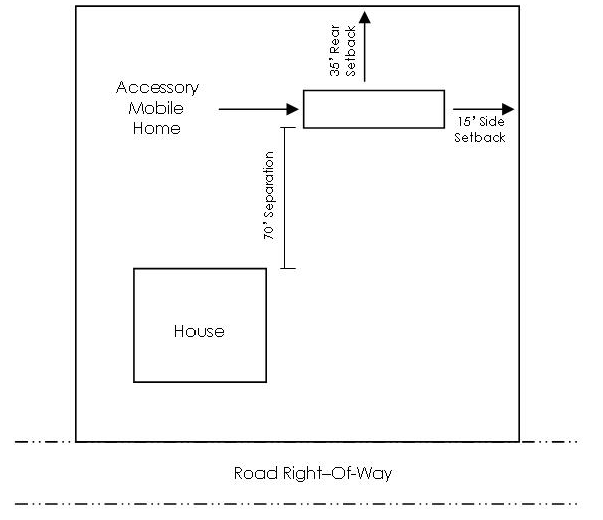
The lot or parcel shall contain sufficient land area for the principal residential structure and the accessory mobile home to be considered independent principal dwelling units with both individually meeting the minimum lot size and required setbacks. An imaginary lot line shall be assumed between the structures. See Figure 3.1.
Figure 3.1 Accessory Mobile Home Setbacks
C.
The accessory mobile home shall be occupied only by the following categories of persons:
1.
Any relative including in-laws, under the civil law of the first, second, or third degree of consanguinity to the head of the household owning and occupying the principal dwelling on the lot, or to the spouse (whether living or deceased) of the head of the household; or
2.
A son or daughter by legal adoption or the adoptive parents of the household or of his spouse (whether spouse is living or deceased).
D.
Any other residential occupancy of the structure is NOT permissible and is a violation of this ordinance unless a formal legal subdivision of the parcel takes place.
E.
The mobile home shall meet the requirements of R 9 or 10.
R9 - Multi-Sectional (Class A) Mobile Home on Individual Lot
A.
The minimum width of the manufactured (mobile) home shall be twenty-two (22) feet for a multi-sectional unit.
B.
The minimum length of a multi-sectional manufactured (mobile) home shall be forty (40) feet. On multi-sectional units the length shall NOT exceed four times the width, with length measured along the longest axis and width measured perpendicular to the longest axis.
C.
The pitch of the roof on multi-sectional manufactured (mobile) homes shall have a minimum pitch of 3/12 (a rise of a nominal three (3) feet for each twelve (12) feet of horizontal run or portion thereof). The roof shall be finished with a type of shingle that is commonly used in standard residential construction with a class C or better fire rating.
D.
All roof structures on multi-sectional manufactured (mobile) homes shall provide eaves and raker projections of no less than six (6) inches, excluding guttering.
E.
The exterior siding on multi-sectional manufactured (mobile) homes shall consist of vinyl or aluminum lap siding, wood or hardboard, comparable in composition, appearance and durability to the exterior siding commonly used in standard residential construction.
F.
All multi-sectional manufactured (mobile) homes shall have a continuous brick, stone, stucco or decorative block non load-bearing skirting or underpinning. The foundation shall be constructed to the specifications of the NC Building Code for single-family residential construction.
G.
All multi-sectional manufactured (mobile) homes shall be oriented so that the side having the front (main) entrance shall be no more than twenty (20) degrees from parallel to the front property line, except on corner lots. This does NOT pertain to manufactured homes that are at 200 feet or over from the right of way or lots with a previously approved septic system where parallel orientation would be impossible due to lot width and septic location. Mobile homes may be placed perpendicular to the road given the placement remains in keeping with the previously developed neighborhood. On lots that do NOT have frontage on a right-of-way, the line next to the easement leading to the property will be considered the front and the manufactured home shall be oriented toward the easement.
H.
The wheels, axles, transporting lights, and towing apparatus shall be removed and shall NOT be included in length and width measurements.
I.
All multi-sectional manufactured (mobile) homes shall have a deck or porch NOT less than thirty-six (36) square feet in area at all front entrances. This does not pertain to manufactured homes where the home has a built-in or recessed porch that is inset into the home. All porches, decks, steps, ramps, or other means of access to the porch or deck shall be constructed to comply with the requirements of the North Carolina Building code for single-family residential construction.
R10 - Single Sectional (Class B) Mobile Home on Individual Lot
A.
The mobile home shall have the towing apparatus, wheels, axles, and transporting lights removed. If the apparatus cannot be removed it shall be screened from public view.
B.
The mobile home shall be set up in accordance with the standards established by the North Carolina Building Code for single-family residential construction. In addition, a continuous under pinning of a material generally accepted in the mobile home industry shall be installed under the perimeter, unpierced except for required ventilation and access.
C.
A permanent front porch of at least thirty-six (36) square feet in area shall be constructed within twelve (12) inches of the floor elevation This does not pertain to manufactured homes where the home has a built-in or recessed porch that is inset into the home. All secondary entrances and exits to the mobile home shall also have approved steps.
D.
The single-sectional manufactured (mobile) home shall be oriented so that the longest measurement shall be no more than twenty (20) degrees from parallel to the front property line, except on corner lots. This does NOT pertain to manufactured homes that are at 200 feet or over from the right of way or lots with a previously approved septic system where parallel orientation would be impossible due to lot width and septic location. Mobile homes may be placed perpendicular to the road given the placement remains in keeping with the previously developed neighborhood. On lots that do NOT have frontage on a right-of-way, the line next to the easement leading to the property will be considered the front and the manufactured home shall be oriented toward the easement.
R11 - Temporary Family Healthcare Structure
Temporary family healthcare structures are regulated by GS 160D-915 and are allowed as accessory to a primary structure in any single-family residential district. These structures shall meet all setback requirements for the principal structure.
R12 - Facilities on or Adjacent to Lake Norman
A "pier" shall be any structure extending into the water from the shore, whether floating or fixed to the lake bottom, for use as a boat landing place or promenade. The term "pier facility" is intended to mean a pier and all appurtenances thereto such as floats, pilings, and buoys used to berth a boat at the pier. Such facilities shall comply with the shoreline management guidelines of the Lake Management Division of Duke Energy Company.
Marinas, piers, cruise boats and similar uses may be permitted to extend into/on the Lake provided they meet the requirements of this Article and provided further that the land base of such activity is located in a zoning district that permits the activity. Such facilities and activities shall comply with the shoreline management guidelines of the Lake Management Division of Duke Energy Company.
Floating homes and similar facilities for dwelling purposes, whether stationary or mobile, are expressly prohibited on, within or over in the surface waters of Lake Norman within the jurisdiction of this Ordinance.
R13 - Family Care Home and Family Day Care Home
A family care home with six (6) or fewer persons or a family day care home with eight (8) or fewer persons may be operated as an accessory use to a principal dwelling per GS 160-D-907.
R14 - Farm Buildings
The following guidelines apply to all farm buildings, when NOT associated with a bona fide farm. The size of farm buildings footprint shall be as follows:
A.
On lots less than two (2) acres the maximum size shall be 1,200 square feet
B.
On lots greater than two (2) acres the maximum size shall be 3,500 square feet. Setbacks shall follow the corresponding zoning district setbacks (found in the Dimensional Requirements Tables in Chapter 2) for principal structures.
R15 - Fences and Freestanding Walls
Unless otherwise specified within this Ordinance, fences and walls shall be exempt from setback and yard requirements provided they comply with the visibility requirements of Section 2.2.8 and do NOT exceed eight (8) feet in height.
Fencing greater than eight (8) feet in height is allowed when it is an integral part of a recreational use and where no visual obstruction occurs.
R16 - Home Occupations, Customary
A.
The home occupation shall be clearly incidental and subordinate to the residential use of the dwelling and shall NOT change the residential character of the dwelling.
B.
No accessory buildings or outside storage shall be used in connection with the home occupation.
C.
Use of the dwelling for home occupations shall be limited to twenty-five (25%) percent of one (1) floor of the principal building.
D.
Residents of the dwelling only may be engaged in the home occupations (except that NOT more than one (1) assistant may be employed by the following professional persons: lawyers, physicians, dentists, chiropractors).
E.
No display of products shall be visible from the street and only products accessory to the primary use may be sold on the premises.
F.
No internal or external alternations inconsistent with the residential use of the building shall be permitted.
G.
No machinery that causes noises or other interferences in radio and television reception shall be allowed.
H.
Only vehicles used primarily as passenger vehicles shall be permitted in connection with the conduct of the customary home occupation.
I.
Instruction in music, dancing and similar subjects shall be limited to six (6) students at one time.
J.
See Section 6.6.1 for sign regulations specific for home occupations.
R17 - Home Occupations Grading, Contractors, and Automotive Operation
A.
The minimum lot or parcel size shall be three (3) acres.
B.
All related buildings and storage facilities, both open and enclosed, and all signs and other appurtenances shall
1.
Reserved.
2.
Be setback a minimum of thirty (30) feet from any adjacent residentially zoned property and provide screening per Section 5.2; or
3.
Be setback a minimum of fifteen (15) feet from any adjacent property zoned commercially.
C.
The operator of the home occupation must reside on the same parcel of land upon which the home occupation is located.
D.
No more than three (3) people who do NOT reside on the premises may be employed by the home occupation on the premises.
E.
Other than incidental use of the dwelling, buildings associated with the home occupation may NOT exceed 3,500 square feet.
F.
Section 6.6.1 for sign regulations specific for home occupations.
R18 - Home Occupations, Rural
A.
All related buildings, signs and other appurtenances shall:
1.
Be setback a minimum of eighty (80) feet from any adjacent residentially zoned property; or
2.
Be setback a minimum of thirty (30) feet from any adjacent residentially zoned property and provide screening per Section 5.2; or
3.
Be setback a minimum of fifteen (15) feet from any adjacent property zoned commercially; or
4.
In the case where a lot line adjoins a lot of non-residential use, the minimum required yard (rear, side and/or front) for any building containing a rural home occupation shall be as required for single-family dwellings in the R-A Residential Agricultural District.
B.
A rural home occupation shall be contained entirely within one building with a maximum floor area of 2,000 square feet devoted to the use. There shall be no outside storage of materials or equipment involved with any rural home occupation.
C.
On a parcel of two (2) acres or more a rural home occupation may have a maximum floor area NOT to exceed 3,500 square feet provided that the setback from property lines is a minimum of eighty (80) feet.
D.
One rural home occupation shall be permitted per lot.
E.
The operator of the rural home occupation must reside on the same parcel of land upon which the rural home occupation is located.
F.
No more than three (3) people who do NOT reside on the premises may be employed by a rural home occupation.
G.
The rural home occupation shall NOT create smoke, odors, dust, or noise which would cause health hazard or nuisance to surrounding property.
H.
No vehicle associated with the use shall have more than six (6) wheels or more than three (3) axles.
I.
See Section 6.6.1 for sign regulations specific for home occupations.
R19 - Mobile Home Parks
Mobile Home Parks shall have the following requirements:
A.
Lot Dimensions
1.
Minimum mobile home park site size - Five (5) acres
2.
Minimum frontage on a public street for site - 100 feet
3.
Minimum lot area for each mobile home space - 4,000 square feet
4.
Minimum mobile home space width - Fifty (50) feet
B.
Setbacks
1.
Minimum setback of mobile home to exterior property line - Twenty-five (25) feet
2.
Minimum interior distance between mobile homes - Twenty (20) feet
3.
Minimum distance of mobile home to private street - Fifteen (15) feet
4.
Minimum distance in straight line between mobile home parks - ½ mile
C.
Density
1.
Minimum number of spaces - Two (2); maximum number of spaces - Forty (40)
2.
Maximum density - Seven (7) manufactured homes per acre
D.
Parking and Driveways
1.
Minimum number of parking spaces per mobile home space (located on the space) - Two (2) (may be stacked)Hard surface walk width required to connect each mobile home to parking spaces - Two (2) feet
2.
Minimum required paved private street width: two-way - eighteen (18) feet
3.
Maximum number of mobile home space driveways connected to public streets - 0
4.
Maximum number of private street connections to public streets per park - 3
5.
Minimum distance between private street connections to public streets - 150 feet
6.
Maximum length of dead end or cul-de-sac private street - 800 feet
7.
Minimum diameter of private turn-around at end of cul-de-sac for private street - Fifty (50) feet
E.
Utilities/Services
1.
Street lights required at all private street intersections or minimum intervals of 300 feet
2.
Underground utilities
3.
Approved water supply and sewage disposal plan- required
4.
Garbage collection and disposal plan
F.
Signs
1.
Approved private street name signs
2.
Sign plan
G.
Accessory Buildings/Structures
1.
Maximum number of accessory buildings for any mobile home space - One (1)
2.
Minimum distance between mobile home and accessory building and between accessory building and exterior property line - Ten (10) feet.
3.
Concrete patio size - 180 square feet for each space
H.
Landscaping and Open Space
1.
Screening device per Section 5.2
2.
Minimum open space per mobile home space - 200 square feet
3.
Property containing a proposed bike or pedestrian facility shown in a plan approved by the Iredell County Commissioners must plat and reserve right-of-way for the facility in the location and width recommended in the plan or negotiated to move to another area per Planning Staff approval.
I.
Existing Manufactured Home Parks
1.
Shall be allowed to continue in operation, including the replacement of manufactured homes on any existing manufactured home spaces. Existing manufactured home space sizes, road standards and existing setbacks shall be allowed to continue as long as it does not interfere with public safety or health.
2.
May be expanded as long as the proposed expanded portion of the park meets the minimum provisions of this ordinance, subject to the review and approval by the Board of Adjustment.
R20 - Planned Unit Development (PUD)
A.
PUD's shall be permitted only when requested as a Conditional Zoning District to one or more of the following Zoning Districts: RA-CD, RU-R-CD, RR-CD, R-20-CD, R-12-CD, and R-8-CD.
B.
Application for PUD shall be approved only if the following findings are made:
1.
That application of planned unit development requirements to the property will produce a development of equal or higher quality than otherwise required by the strict application of district regulations that would otherwise govern;
2.
That application of planned unit development requirements to the property will encourage innovative arrangement of buildings and open spaces to provide efficient, attractive, flexible, and environmentally sensitive design;
3.
That application of planned unit development requirements to the property will produce a development functioning as a cohesive, unified project; and
4.
That application of planned unit development requirements to the property will not substantially injure or damage the use, value, and enjoyment of surrounding property nor hinder or prevent the development of surrounding property in accordance with the adopted plans and policies of the County.
C.
An approved PUD and the approved verified development plan shall govern all uses and development activities in a PUD.
D.
Except as otherwise provided by this section, a PUD shall be subject to all the applicable standards, procedures and regulations of the other parts of this ordinance.
E.
No PUD shall be approved for a site of less than that fifteen (15) acres. The site must be contiguous property under unified ownership or control.
F.
Uses permitted in a PUD shall be in accordance with the following schedule, provided, that uses to be in a PUD shall be stated in the conditional use permit.
G.
In a PUD that qualifies for such uses by size, O&I and NB uses shall NOT exceed ten (10%) percent of the total land area and at no time shall the cumulative amount of land development for O&I and/or NB purposes exceed the cumulative amount of land development for residential purposes.
H.
Development in a PUD shall be exempt from the minimum required lot width, front yard, side yard and rear yard requirements of the Schedule of District Regulations and from Section 2.2.1 and 2.2.2 relating to relationship of buildings to lots and access to streets provided that the following development standards are followed. The overall residential density limitation and residential building types of the corresponding principal district shall apply in a PUD provided that a density bonus which may involve a different residential development type may be permitted during the PUD approval process as provided for herein.
1.
Lot size. The exemption from the Schedule of District Regulation provisions shall NOT apply in the following situations:
No lot for a single family detached dwelling shall be less than the minimum lot size for a single-family dwelling in the zoning district in which the PUD is located. Cluster developments and single-family semi-detached developments are permitted subject to the Special Requirements for such developments. Where the zoning district permits two-family and multi-family developments such uses are permitted subject to the Performance Requirements for such developments.
2.
Vehicle Access
a.
Areas between structures shall be covered by easements where necessary for access and to provide for maintenance and utility service.
b.
Primary vehicular access to office or commercial development shall NOT be through intervening residential development.
c.
Local streets shall be located and designed so that they do NOT encourage through access by traffic with origins and destinations outside of the development.
3.
Pedestrian Access. PUD's shall be designed and developed and uses so arranged to promote pedestrian access within the development.
4.
Non-Residential Areas. Non-Residential areas in PUD's shall be designed and located to principally serve the residents of the PUD and the immediate surrounding area.
5.
Boundary Treatment. The scale and setbacks of development in a PUD within one hundred and fifty (150) feet of the perimeter of the PUD shall be in harmony with development on adjacent lands.
6.
Environmentally Sensitive Areas. One of the principal purposes of the PUD procedure is to protect environmentally sensitive areas through the use of innovative arrangement of buildings and spaces. It is the intent of the PUD process that significant consideration in planning and design of PUD's shall be given to the following elements such as but NOT limited to:
•
Floodway and floodway fringe areas
•
Steep slopes and knolls
•
Wetlands
•
Water supply watersheds
•
Rock outcrops
•
Soil erosion and storm water management
•
Tree and foliage preservation
•
Habitat for threatened or endangered species
•
Areas of historical, archaeological or architectural significance.
•
Useable open space; recreation area
In any case where the Board of Commissioners finds in its opinion that the PUD provides for significant protection or enhancement of any one or more of the above elements, or a similar element as determined by the Board of Commissioners, the Board may award a bonus of up to ten (10%) percent increase in residential dwelling units for a PUD and may permit such additional dwelling units to be of a development type not otherwise permitted in the PUD. The determination by the Board of the significant protection or enhancement of a particular element shall be based upon a comparison between the type of development that could be placed on the property under the current zoning and other regulations and the proposed development scheme for the PUD.
7.
Unified Development Plan. The application for a PUD as part of a rezoning to a Conditional Zoning District shall be accompanied by a unified development plan in the form of a non-residential site plan (See Section 8.3).
8.
Phased Development. A PUD may be developed in phases in the same manner as a subdivision and subject to the phasing requirement for subdivisions.
R21 - Septage or Residential Sludge Disposal Sites
A.
Each disposal site shall be separated from private residence, place of business, or place of public assembly under separate ownership by 500 feet measured horizontally. Potable water supplies and surface waters shall comply with separation requirements as stated in the NC Septage Management Rules as amended.
B.
Screening device as specified in Section 5.2 shall be provided along all front, side and rear property lines, except in areas designated for ingress and egress.
C.
Each site shall be posted "No Trespassing" and at each entrance legible signs of at least two (2) feet x two (2) feet must be posted stating "Caution — Sludge or Septage Disposal Area" or other similar language as required by North Carolina Department of Environment and Natural Resources (NCDENR).
D.
No septage or sludge shall be deposited and no building or structures shall be located within 100 feet of the nearest property line or public road right-of-way in the disposal site area.
E.
The operation and responsibility of said use shall be carried out in accordance with all standards and rules prescribed by the NCDENR and the Iredell County Health Department.
F.
Site plans must have been approved by NCDENR when submitting application for special use permit.
G.
No hazardous wastes as defined by the Iredell County Hazardous Waste Ordinance shall be permitted on the site.
H.
No septage from any industrial or commercial waste water treatment plant shall be deposited on the site.
I.
All temporary Septage Detention Systems at the site shall be enclosed storage systems of steel, concrete, fiberglass or other approved tanks; and shall be located 100 feet from property lines.
R22 - Swimming Pool, Residential Accessory
A.
Pools shall be located to comply with the minimum exterior setback requirements for accessory buildings and structures of the district in which located.
B.
Pools which are not an integral part of the principal building shall be located at least the minimum distance from the principal building necessary to comply with N. C. Building Code requirements.
C.
Pools shall be protected by a fence or equal enclosure, a minimum of four (4) feet in height, and equipped with a self-closing and positive self-latching gate provided with hardware for permanent locking. Fencing is NOT required for above ground pools if they are at least four (4) feet in height, the ladder is removed, or when NOT in use have a gate to the ladder as described above.
R23 - Temporary Buildings
Temporary buildings, including mobile structures, incidental to a construction project may be permitted to be used concurrent with the permit for permanent building(s) or construction. Such temporary building shall be removed promptly upon completion of construction. No such building shall be used for dwelling purposes. Temporary buildings shall be located at least twenty-five (25) feet from any property used for residential purposes.
R24 - Temporary Events
The Planning Director may issue a permit for temporary events and structures provided he makes the following affirmative determinations:
A.
The duration of the event will be for fourteen (14) days or less.
B.
The location for the event has NOT had more than four (4) temporary events in the past twelve (12) months and no events in the past thirty (30) days.
C.
The owner of the property, or his agent, has authorized in writing for the event to be held on the property.
D.
The application for the permit is made at least ten (10) working days prior to the event.
E.
That ample off-street parking is available.
F.
That arrangements are made for suitable garbage disposal and site clean-up.
G.
That activities within 1,000 feet of residences NOT on the site are to be conducted in such a manner as to not create noise that will disturb the occupants of those residences.
H.
Structures associated with the use shall be permitted provided they are removed at the end of the event.
I.
Health Department approval if required.
J.
The applicant shall be required to provide written documentation stating that the event is in compliance with all applicable Local, State, and Federal regulations.
R25 - Amusement or Water Parks; Outdoor Batting Cages; Go-Cart Tracks; Golf Driving Ranges; Miniature Golf Facilities
A.
Minimum lot size for all development except miniature golf facilities and outdoor batting cages shall be five (5) acres.
B.
No principal buildings or structures shall be located within fifty (50) feet of any property line.
C.
Reserved.
D.
No amusement equipment, machinery, or mechanical device of any kind may be operated within 200 feet of any residentially zoned property.
R26 - Cemeteries; Churches, Synagogues and Other Associated Activities
Burial sites shall be set back a minimum of twenty (20) feet from all property and public street lines. Private burial site setbacks must meet setback requirements but no zoning approval required.
R27 - Colleges or Universities; Congregate Care and Group Care; Nursing and Convalescent Homes; Hospitals;
In any residential district:
1.
A minimum of one (1) acre shall be required to establish any one of the above uses.
2.
All structures including secondary and accessory structures shall be located a minimum of fifty (50) feet from any street line and, twenty (20) feet from any other property line.
3.
Existing uses as described above which do NOT meet the one (1) acre minimum requirement of 1. above at the time of the adoption of that provision may expand or be reconstructed provided such expansion or reconstruction meets the minimum dimensional requirements of the district in which located.
4.
Such use shall NOT be primarily for the treatment of contagious diseases, alcoholics, drug addicts or psychotics.
5.
In a residential district, no congregate care, group care, nursing home, convalescent home or hospital shall be located within one-half (½) mile in a straight line of a similar facility.
R28 - Cruise Boats
In granting a Special Use Permit for a Cruise Boat, the Board of Adjustment may impose such conditions and restrictions as they deem reasonable and appropriate including but not limited to conditions and restrictions related to:
•
Routes of operation
•
Passenger Capacity
•
Boat Size
•
Noise Level
•
Hours of operation
•
Frequency of operation
•
Proximity (distance from) to the shoreline while in operation
•
Sewage disposal and method of disposal
•
On shore supporting facilities
R29 - Day Care Centers; Nursery Schools and Kindergartens
A.
At least seventy-five (75) square feet of outdoor play area shall be provided in the rear yard for each child.
R30 - Golf Course; Including Pro Shop; Rural Commercial Recreational and Rural Commercial Educational Facilities; Saddle Clubs; Fraternal and Social Associations or Organizations, Event Centers, etc.
A.
There shall be a fifty (50) foot minimum setback between clubhouses, swimming pools, lighted tennis courts, athletic fields, and other activity areas and adjacent residentially zoned property.
B.
Outdoor swimming pools shall be protected by a fence, or equal enclosure, a minimum of four (4) feet in height, and equipped with a self-closing and positive self-latching gate provided with hardware for permanent locking.
R31 - Homeless Shelter
A.
Minimum habitable floor space of 100 square feet shall be provided for each individual sheltered.
B.
No such facility shall be located within one-half (1/2) mile of an existing shelter for the homeless or any other group care facility.
C.
The facility shall be contained within the building of and operated by a government agency or nonprofit organization.
D.
The facility operator(s) shall provide continuous on-site supervision by an employee(s) and/or volunteer(s) during the hours of operation.
E.
A complete site plan shall be provided for all homeless shelters, which must conform to all applicable health, building code, licensing laws and regulations.
F.
Screening and landscaping which complies with Chapter 5 shall be provided along all property lines abutting residentially zoned property.
R32 - Lake Access Lot Open to Public
No on site sales of goods or services
R33 - Marinas
In the R-A and R-R Districts Marinas permitted as Special Uses shall meet the following minimum standards:
A.
Minimum lot size—four (4) contiguous acres
B.
Minimum frontage on a public street—200 feet
C.
Minimum shoreline frontage—200 feet
D.
Minimum yard requirements—as required for the zoning district in which located provided that water dependent structures shall be exempt from setbacks from the shoreline.
E.
No outdoor storage of new or used parts, items for salvage, items for retail sale or similar items. Boats and/or boat trailers may be stored outdoors.
R34 - Private Recreational Vehicle Campsite
A.
One RV may be permitted per parcel. However, a maximum of three (3) RV's may be permitted on a parcel with a minimum of ten (10) acres per unit.
B.
Shall meet setbacks of the zoning district for principal structures.
C.
An adequate and safe sewer system shall be provided either by a municipal system or a system approved by the appropriate County or State agency vested with the authority to approve sewage disposal systems.
D.
Recreational vehicle units shall NOT occupy the parcel for a period in excess of ninety (90) days per calendar year.
R35 - Schools
These requirements shall apply during the initial construction of a school. The addition of a new classroom building or accessory building, for example, does NOT render the school site nonconforming with regards to this section.
A.
All structures including secondary and accessory structures shall be located a minimum of fifty (50) feet from any street line and, twenty (20) feet from any other property line.
B.
Must provide bicycle stands under a sheltered area near a school entrance.
C.
If sidewalks are present, must fully lead to an entrance.
D.
New elementary and middle schools should provide queue length for pick-up and drop-off in accordance with the most recent "Municipal and School Transportation Assistance School Traffic Calculator" from NCDOT. This requirement shall not apply to schools existing at the passage of this ordinance. In other words, the addition of a new classroom building or accessory building to an existing school does not render the school site nonconforming with regards to automobile queue length.
R36 - Shooting Ranges, Indoor and Outdoor
A.
Indoor. The facility shall be designed to absorb sound to the maximum extent feasible.
B.
Outdoor
1.
No portion of the range shall be closer than 300 feet to any exterior property line or 500 feet to any existing residential dwelling, excluding any dwellings located on the same parcel of land as the range.
2.
Access shall be controlled to prevent unregulated entrance to the firing area.
3.
Entire property shall be posted every 100 feet at the property line with signage indicating there is a shooting range.
4.
Berms shall be of sufficient height and thickness to stop all rounds fired downrange. Elevation control is required along the shooting stands to prevent rounds from being fired over the berm.
R37 - Swim and Tennis Clubs, Swimming Pools, Private
A.
In any residential district the minimum area shall be one (1) acre.
B.
There shall be a fifty (50) foot minimum setback between clubhouses, swimming pools, lighted tennis courts, or athletic fields and adjacent residentially zoned property.
C.
Outdoor swimming pools shall be protected by a fence, or equal enclosure, a minimum of four (4) feet in height, and equipped with a self-closing and positive self-latching gate provided with hardware for permanent locking.
R38 - Bars
A.
Property Separation. No such establishment shall be located within 200 feet of a church, elementary or secondary school, public park, or residentially zoned property.
B.
Frontage. The main entrance of the building shall be toward property zoned for nonresidential uses.
C.
Parking. Parking areas related to the establishment shall be located no closer than thirty (30) feet to the property line of abutting residentially zoned property.
R39 - Adult Oriented Business
A.
No such business shall locate within 1,000 feet of any other Adult Oriented Business, as measured in a straight line from property line to property line.
B.
No Adult Oriented Business shall be located within 1,200 feet of a church, public or private elementary or secondary school, child day care or nursery school, public park, residentially zoned or residentially used property, or any establishment with an on-premise ABC license, as measured in a straight line from property line to property line.
C.
The gross floor area of any Adult Oriented Business shall NOT exceed 3,000 square feet and all business related activity shall be conducted in a building.
D.
No Adult Oriented Business may have sleeping quarters.
E.
There shall NOT be more than one (1) Adult Oriented Business in the same building, structure, or portion thereof. No other principal or accessory use may occupy the same building, structure, property, or portion thereof with any Adult Oriented Business.
F.
Except for signs as may be permitted by Chapter 6 of this Ordinance, no printed material, slide, video, photograph, written text, live show, or other visual presentation format shall be visible from outside the walls of the establishment, nor shall any live or recorded voices, music, or sounds be heard from outside the walls of the establishment.
G.
No enclosed or underground parking shall be permitted.
R40 - Animal Shelters
A.
All structures and outdoor runs must be located fifty (50) feet from any residentially zoned property.
B.
Sewage disposal system and sanitation control methods as approved by the Iredell County Board of Health shall be required. (This provision shall include, but shall NOT be limited to, the sanitary removal or disposal of solid waste, carcasses, or any other items deemed necessary for removal or disposal because of unsafe or unsanitary conditions by the Health Department.)
C.
Minimum lot sizes shall be a minimum of one (1) acre per ten (10) animals. The minimum lot size requirements may be waived if a kennel is constructed to entirely enclose all kennel facilities so as to adequately protect all animals from weather extremes and to protect adjacent residences from noise, odors, and other objectionable characteristics, provided all building setback requirements are in accordance with subsection (a) above.
R41 - Auto Repair and Service; Service Stations Gasoline
A.
Pump islands shall be located at least fifteen (15) feet behind the property line.
B.
Pump island canopies may be permitted to extend to the street right-of-way line or future right-of-way line.
R42 - Automobile Storage; Automobile Towing & Storage; Automobile Wrecking or Junk Yards; Salvage Yards, Scrap Processing
A.
Outdoor storage associated with the above uses shall be completely screened by a screening device as set forth in Section 5.2.
B.
Automobile wrecking or junk yards; salvage and scrap processing uses shall require a minimum area of three (3) acres. Any area covered by 600 square feet or more of scrap material or seven (7) or more junk vehicles shall qualify as a use of this category.
C.
Uses subject to this note shall be separated in such a manner as to prevent dust and tracking of mud and debris onto adjoining streets.
R43 - Composting Facility
Composting facilities shall meet the following criteria. In the AC, RA, and RUR zoning districts a Special Use Permit is required.
A.
Site must be developed in accordance per the rules for Composting Facilities as provided in Section .1400 of Chapter 13B of Title 15A of the North Carolina Administrative Code ("North Carolina Solid Waste Compost Rules") and set forth by the North Carolina Department of Environmental Quality (NCDEQ) , Solid Waste Division. Confirmation shall be required that the site is developed in compliance with these rules as issued from the Solid Waste Division.
B.
Compost Permit shall be issued by the NCDEQ Solid Waste Division where required by Rule .1402(g) of the North Carolina Solid Waste Compost Rules. This shall be made a condition of the Special Use Permit where the applicant cannot obtain a Compost Permit without prior zoning approval from the County.
C.
The applicant shall submit a site plan and/or survey indicating that the proposed use complies with the requirements of Rule .1404 of the North Carolina Solid Waste Compost Rules.
D.
All associated uses with a Type 3 and 4 facility as defined in the NC Solid Waste Compost Rules shall be setbacks a minimum of five hundred (500) feet from any adjacent property zoned for single-family residential use or any residence (existing residence or one under construction).
E.
The applicant must submit decommissioning plans that describe the estimated decommissioning cost in current dollars, the method for ensuring that funds will be available for decommissioning and restoration, and the anticipated manner in which the site will be decommissioned and restored.
F.
The Board of Adjustment may add conditions to this type of request to insure proper road access and screening.
R44 - Drive-In Theaters
A.
Stacking space shall be provided for a minimum of ten (10%) percent of the vehicle capacity.
B.
The motion picture screen shall be positioned so that it cannot be seen from any public street or residentially zoned area.
R45 - Farm Type Enterprises (Services)
These regulations only apply for farm type enterprises when located in either a residential zoning district or the AC zoning district.
A.
All related buildings and storage facilities, both open and enclosed, and all signs and other appurtenances shall:
1.
Be setback a minimum of eighty (80) feet from any adjacent residentially zoned property; or
2.
Be setback a minimum of thirty (30) feet from any adjacent residentially zoned property and provide screening per Section 5.2; or
3.
Be setback a minimum of fifteen (15) feet from any adjacent property zoned commercially or zoned AC.
Temporary stands for retail sales may be located in the front setback provided they are at least fifteen (15) feet from the travel portion of the street and the side property lines.
R46 - Farm Type Enterprises (Processing)
These regulations only apply for farm type enterprises when located in the AC zoning district.
A.
All related buildings and storage facilities, both open and enclosed, and all signs and other appurtenances shall have a minimum separation of 500 feet between any existing residence or any residence under construction and any building. Residences built after the initial use shall NOT be factored into setback requirements.
B.
There shall be a minimum buffer of 100 feet from any property line.
C.
Screening may be required by Planning Staff around the perimeter of the operation, including the road side but excluding the driveway area, as provided for in Section 5.2 of the this Ordinance.
R47 - Kennels, Commercial (including breeding and training facilities)
A.
Commercial kennels in the AC, RA, and RU-R districts shall meet the following criteria:
1.
Minimum lot size shall be as follows:
For each additional acre beyond seven (7) acres, an additional ten (10) animals may be permitted. The minimum lot size requirements may be waived if a kennel is constructed to entirely enclose all kennel facilities so as to adequately protect all animals from weather extremes and to protect adjacent residences from noise, odors, and other objectionable characteristics, provided all building setback requirements are in accordance with subsection (c) below.
2.
All lots on which a kennel is located must have frontage on an existing street or a new street that meets the minimum requirements for acceptance and maintenance by the North Carolina State Department of Transportation.
3.
All structures and outdoor runs shall have minimum front, side, and rear yards of 150 feet. There shall be a separation of at least 500 feet between residences on adjoining tracts and any building used for kennel operation.
4.
Sewage disposal system and sanitation control methods as approved by the Iredell County Board of Health shall be required for all kennels. (This provision shall include, but shall NOT be limited to, the sanitary removal or disposal of solid waste, carcasses, or any other items deemed necessary for removal or disposal because of unsafe or unsanitary conditions by the Health Department.)
5.
Screening is required when adjoining either residentially or commercially zoned property and must meet the criteria in Section 5.2 concerning screening device and parking lot landscaping.
B.
Commercial kennels in the HB, GB, M-1 and M-2 districts shall meet the following criteria:
1.
All lots on which a kennel is located must have frontage on an existing street or a new street that meets the minimum requirements for acceptance and maintenance by the North Carolina State Department of Transportation.
2.
All structures and outdoor runs shall have minimum front, side, and rear yards of 100 feet. There shall be a separation of at least 500 feet between residences on adjoining tracts and any building used for kennel operation.
3.
Sewage disposal system and sanitation control methods as approved by the Iredell County Board of Health shall be required for all kennels. (This provision shall include, but shall NOT be limited to, the sanitary removal or disposal of solid waste, carcasses, or any other items deemed necessary for removal or disposal because of unsafe or unsanitary conditions by the Health Department.)
4.
Screening is required when adjoining either residentially or commercially zoned property and must meet the criteria in Section 5.2 concerning screening device and parking lot landscaping.
5.
All activities, with the exception of animal exercise areas, shall be conducted within an enclosed building.
R48 - Self-Storage Warehouses (Mini-Warehouse)
A.
All of the property for this activity shall be surrounded by a fence or wall eight (8) feet in height, and shall provide screening/buffering per Chapter 5 of this Ordinance. Self-Storage facilities where all storage units are only accessed internally will not be required to meet the above stated fencing requirement.
B.
There shall be only one (1) means of ingress and egress, with a direct connection to a state maintained road. The buildings shall be arranged as to allow internal circulation around all buildings.
C.
All buildings shall have a minimum front setback of forty (40) feet and side and rear setbacks of twenty (20) feet.
D.
Spaces are to be used only for storage. In no case shall a rental space be used for offices, garages, music rehearsal halls or any use other than storage. Space shall be available for a manager's or security patrol officer.
E.
Lighting shall be required to ensure the safety of the contents and patrons of the establishment.
F.
The outside storage of boats, campers or other large scale items shall be allowed within a designated area enclosed with a chain link fence eight (8) feet high. This designated area shall be paved or graveled . No junked items may be stored outside.
R49 - Recreational Vehicle Parks or Campsites
A.
Such uses shall comply with the following standards:
1.
Yard Requirements. The following yard requirements are hereby established:
a.
Exterior: Along any public street or public right-of-way, a setback of at least forty (40) feet from the edge of the public right-of-way shall be maintained.
b.
Distance between trailers: A distance of at least ten (10) feet shall be maintained between trailers and/or structures. Any accessory structures such as attached awnings, carports or individual storage facilities, shall, for the purpose of this requirement, be considered a part of the trailer.
2.
Open Space. A recreational area of NOT less than ten (10%) percent of the gross site area or 2,500 square feet, whichever is greater, shall be maintained in a central and convenient location to all trailer spaces.
3.
Lot Area. The lot for the park shall be a minimum of two (2) acres.
4.
Density. The density shall NOT exceed twenty-five (25) trailer spaces per acre of gross area.
5.
Parking. Adequate off-street parking and maneuvering space shall be provided on site. The use of any public street, sidewalk or right-of-way or any other private grounds not a part of the travel trailer parking area for the parking or maneuvering of vehicles is prohibited.
6.
Streets. All internal roadways shall be stabilized and of adequate width to accommodate the volume and type of anticipated traffic, and in any event, shall comply with the following minimum requirements:
a.
Internal one-way roadway and roadways on which parking is prohibited shall NOT extend for more than 500 feet in total length; serve less than twenty-five (25) trailer spaces; and be at least eleven (11) feet in width.
b.
Internal one-way roadway and roadways on which parking is permitted on one side and two-way roadways which do NOT allow parking shall be at least twenty-four (24) feet in width.
c.
Internal two-way roadways which permit parking on one side only shall be at least twenty-seven (27) feet in width.
d.
Internal two-way roadways which permit parking on both sides shall be at least thirty-four (34) feet in width.
7.
Water. Each travel trailer parking area shall be connected to an approved water supply system which provides an accessible, adequate, safe and potable supply of water.
8.
Sewer. An adequate and safe sewer system shall be provided in all travel trailer parking areas. Such system shall either be a municipal system or a system approved by the appropriate County or State agency vested with the authority to approve sewage disposal systems.
9.
Screening. A screening device as set forth in Section 5.2 shall be provided where the use adjoins residentially zoned property.
10.
Service Building. A central service building containing all necessary toilets, bathhouses and other plumbing fixtures specified in the most current edition of the North Carolina State Plumbing Code, as amended, shall be provided in all travel trailer parking areas. Service building shall be conveniently located within a radius of 300 feet to spaces which it serves.
11.
Trash. The storage, collection and disposal of trash and refuse in the travel trailer parking area shall comply with all applicable county and state regulations.
12.
Time of Stay. No person shall occupy a trailer space or the travel trailer parking area for a period in excess of thirty (30) days. A register of all occupants, the space occupied, and the time of arrival and departure shall be maintained.
R50 - Rural Commercial
A.
The following uses shall be permitted:
•
Antique stores.
•
Appliance and appliance repair shops.
•
Arts and crafts stores.
•
Automobile parts supply stores (new).
•
Automobile washing establishments.
•
Barber and beauty shops.
•
Clubs, lodges, and civic associations.
•
Convenience stores.
•
Farm supply stores.
•
Financial institutions.
•
Florist and gift shops.
•
Food Stores.
•
Furniture stores.
•
Hobby shops.
•
Laundromats.
•
Machine shops.
•
Offices (private and public).
•
Restaurants (excluding drive-in and fast food restaurants).
•
Service stations.
B.
The use shall be located on a lot which is located at an intersection of two (2) public roads. Such uses shall be prohibited on all other lots.
C.
Only one (1) principal structure per lot shall be allowed.
D.
All permitted nonresidential uses shall have maximum gross floor areas of 5,000 square feet. This measurement shall include all principal and accessory structures.
E.
No intersection in an R-A or AC District shall be developed for nonresidential purposes that is located closer than one (1) mile to an intersection having already been developed with nonresidential uses. This separation does NOT apply to intersections commercially zoned.
F.
No more than 10,000 square feet of gross floor area of rural commercial structures (both principal and accessory) per intersection shall be allowed. All permitted nonresidential uses as listed above shall have the following required yard setbacks:
•
Front yard—thirty-five (35) feet
•
Side yard—thirty (30) feet
•
Rear yard—thirty-five (35) feet
G.
The maximum permitted height of all such uses shall be thirty-five (35) feet.
H.
Screening as set forth in Section 5.2 shall be provided in all side or rear yards which abut any other lot(s) which contain and "R" zoning classification NOT being used for rural commercial purposes.
I.
All permitted nonresidential uses shall be located at least 400 feet from any portion of any existing principal residential structures on adjacent lots in different ownership.
J.
All permitted nonresidential uses shall be within 500 feet of an intersection.
R51 - Airports
A.
The minimum area shall be fifty (50) acres for any public airport with a 2,000 foot runway. Any public airport with a runway less than 2,000 feet shall have a minimum area of ten (10) acres.
B.
Security fencing shall be provided sufficient to control access to runways and taxiways. The fencing shall be a minimum six (6) feet in height.
C.
There shall be a maximum of 600 feet between the side of any runway or taxiway and the nearest property used or zoned for residential purposes. There shall be a maximum of 1,200 feet between the end of any runway or taxiway and the nearest property used or zoned for residential purposes.
D.
All FAA regulations that apply shall be met and indicated prior to approval.
R52 - Ammunition, Small Arms, and Explosives.
A.
No such facility shall locate within a 500 foot radius of any residentially zoned property.
B.
The facility shall meet all State and Federal regulations.
C.
Security fencing or a wall eight (8) feet high shall be provided around the operational area of such a facility.
D.
The facility and its operation shall observe all Fire Prevention and Protection requirements.
R53 - Asphalt and Concrete (ready mix)
A.
Setbacks
1.
Any such plant operations shall be located a minimum of 300 feet from any residential zoning district, 100 feet from any commercial zoning district, and 50 feet from any industrial zoning district. This setback would include buildings associated with the manufacturing of asphalt or concrete, storage areas and staging areas but would not include office buildings and parking areas.
2.
Asphalt and Concrete plant operations shall be 100 feet from any perennial stream as identified by the USGS maps.
B.
Security fencing, eight (8) feet in height, shall be provided around the perimeter of the operation.
C.
Rehabilitation
1.
Within one (1) year after the permanent cessation of production, all equipment and stock piles incidental to such operation shall be dismantled and removed by and at the expense of the owner.
2.
The site shall be drained to prevent the accumulation of standing water, and channelization of the drainage shall be designed and controlled so as NOT to cause erosion or silting of neighboring properties or public drainage ways, nor to appreciably increase the turbidity of any natural water course, or to occlude any existing drainage course.
D.
All unpaved storage areas shall be maintained in a manner which minimizes dust from adversely impacting adjacent properties.
E.
Access
1.
Access roads leading to any part of the operation shall be constructed with a gravel or asphalt stone surface and maintained in a dust-free manner.
2.
Access roads shall be located no closer than fifteen (15) feet to any property line other than a railroad right-of-way line.
3.
A plan shall be submitted showing truck routes to and from the site. Such routes shall be designed to minimize impacts on residential areas, schools, or other uses negatively affected by truck traffic. Such routes shall be adhered to.
R54 - Landfill, Land Clearing and Inert Debris
On-site landfills with a disposal area of a half acre or less will be exempt from these requirements but shall follow all NC Division of Waste Management guidelines per GS 130A-301.1. Beneficial fill including concrete, brick, block and uncontaminated soil, rock and gravel requires no zoning approval when the intent is to improve land use potential and no excavation is involved.
The following guidelines shall be required for all off-site landfills with a disposal area of 600 square feet or more and/or sites over a half acre of on-site items.
A.
Setback. There shall be 100 foot minimum distance from any property line.
B.
On sites less than two (2) acres applicant shall have recorded at the Iredell County Register of Deeds a LCID Notification form available from the North Carolina Department of Environmental and Natural Resources.
On sites larger than two (2) acres applicant shall contact the North Carolina Department of Environmental and Natural Resources for final approval.
C.
Use Separation
1.
There shall be a 300 foot minimum separation from any existing residence; and
2.
Fifty (50) foot minimum separation from all surface waters; and
3.
100 foot minimum separation from all commercial or public buildings, and wells.
D.
Access
1.
Access to the landfill shall be controlled with gates, chains, fences, ditches and/or trees to prevent unregulated dumping.
2.
Driveways and driveway cuts shall be installed to minimize sediment on adjacent roads.
E.
Dust. A dust management plan shall be required to prevent dust as part of any application. If approved this plan will become part of the approval. The dust management plan at a minimum shall include the following:
1.
A list of each dust generating activity or source.
2.
A list of each best management practice that will be implemented for each dust generating activity or source.
3.
A list of additional best management practices that will be implemented if initial controls are ineffective.
F.
Operation
1.
No filling is permitted in the 100-year floodplain. No filling is permitted in minor drainage ways unless the drainage has been piped in accordance with approved plans. No filling is permitted in utility easements.
2.
The operator shall monitor access road conditions and immediately clear any sediment or debris from the road.
G.
Signs
1.
An information board sign shall be posted and maintained at the entrance, listing the name and phone number of the current operator, the types of material accepted, and the hours of operation.
2.
The sign shall also instruct drivers to contact the operator upon finding any sediment that has been tracked from the site.
H.
See Section 4.5.2 for limitations in the water supply watersheds.
I.
Ancillary Uses. For the purpose of reducing the amount of inert debris, air curtain burning or grinding operations shall be permitted. Residue and mulch may be stored on site and/or mixed with other organic material prior to its covering or removal. This shall include both the retail and wholesale of the resulting bi-product. All such operations are subject to North Carolina Department of Environmental Quality Approval. The addition of ancillary uses to an existing operation shall require a revision to the Special Use Permit.
J.
The Board of Adjustment may add conditions to this type of request to address site specific and neighbor concerns.
K.
Planning staff will conduct yearly inspections to confirm compliance with these requirements and the Special Use Permit.
R55 - Landfill, Sanitary, Private
A.
An operations and rehabilitation plan shall be submitted for approval prior to permitting.
B.
Direct illumination resulting from the operation shall NOT fall upon any land NOT covered by the application.
C.
Equivalent sound levels at the boundaries of the fill site shall NOT exceed the following standards:
between 7:00 a.m. and 7:00 p.m. 60 DBA
between 7:00 p.m. and 7:00 a.m. 55 DBA
D.
The Rehabilitation Plan shall be referred to the Soil and Water Conservation District for review and recommendation, in particular regarding the landscape material specified, the planting and maintenance proposed to insure continuous growth and development, and the acceptability of the proposals for the handling of lakes, ponds, etc.
E.
The permanent roads, defined as those to be used in excess of one (1) year, within the fill site shall be surfaced with a dust free material, such as soil cement, bituminous concrete or Portland Cement concrete, or asphalt.
F.
Roads other than permanent roads shall be treated with dust inhibitors, to be specified in the Operations Plan, which will reduce to a minimum the generation of dust from the road surfaces as a result of wind or vehicular action. Properly operated water wagons are an acceptable means of dust inhibition.
G.
Where the proposed fill shall take place within 300 feet of a dwelling, school, church, hospital, commercial or industrial building, public building, or public land, a security fence at least six (6) feet high shall be installed.
H.
The operations plan and the rehabilitation plan shall be coordinated so that the amount of disturbed land is kept to the absolute minimum consistent with good practices and so that rehabilitation proceeds in concert with filling.
I.
All units must be sited and constructed per the rules set forth by North Carolina G.S. 13A Article 9, GS 130A-295.6 and 15A NCAC 13B
J.
See Section 4.5.2 for limitations in the water supply watersheds.
R56 - Mining and Quarrying
A.
Setback
1.
Any clay or sand extraction area, office building, or parking shall be at least fifty (50) feet from any property line.
2.
Any blasting, crushing of rock, processing of stone gravel shall be at least 500 feet from any property line.
3.
All operations shall maintain a 100-foot setback from any perennial stream as identified by the USGS maps.
4.
The blast line, defined as the minimum setbacks of blasting operations from adjacent uses (residential, non-residential, and farm uses), shall be reviewed and may be established during the approval process.
5.
Where the mining operation site is bounded by a railroad right-of-way currently being used for rail service to the mining operation, no setback shall be required between the railroad right-of-way and such operation.
B.
Security fencing, a minimum of six (8) feet in height, shall be provided around the perimeter of both existing and abandoned blasting operations.
C.
Rehabilitation
1.
Within one (1) year after the permanent cessation of production at all mining operations, all equipment and stock piles incidental to such operation shall be dismantled and removed by and at the expense of the owner.
2.
Except in a case where redevelopment for another permitted use is in progress on the site of an abandoned extraction operation, all excavations shall be graded to reduce the surface to gently rolling topography in substantial conformity to the land area immediately surrounding, and shall be planted with a cover of sod, trees, shrubs, legumes, or grasses which will minimize erosion due to wind or rainfall.
3.
The site shall be drained to prevent the accumulation of standing water, and channelization of the drainage shall be designed and controlled so as not to cause erosion or silting of neighboring properties of public ways, nor to appreciably increase the turbidity of any natural water course, or to occlude any existing drainage course.
D.
All operations involving blasting discernable beyond the external property line of a quarry shall only be conducted between the hours of 7:00 am and 6:00 pm.
E.
All unpaved storage areas shall be maintained in a manner which prevents dust from adversely impacting adjacent properties.
F.
Access
1.
Access roads leading to any part of the operation shall be constructed with a gravel or asphalt stone surface and maintained in a dust-free manner.
2.
Access roads shall be located no closer than fifteen (15) feet to any property line other than a railroad right-of-way line.
3.
A plan shall be submitted showing truck routes to and from the site. Such routes shall be designed to minimize impacts on residential areas, schools, or other uses negatively affected by truck traffic. Such routes shall be adhered to.
R57 - Petroleum, Biodiesel and Related Products (Wholesale or Manufacturing)
A.
Setback
1.
Storage tanks protected by either an attached extinguishing system approved by the Fire Marshal, or an approved floating roof, shall NOT be located closer to an exterior property line than a distance of either the diameter or height of the tank, except that such distance need NOT exceed 120 feet.
2.
Storage tanks NOT equipped as indicated in (1) above shall NOT be located closer to an exterior property line than a distance equal to one and one-half (1 1/2) times the greater dimension of either the diameter or height of the tank, except that such distance need NOT exceed 175 feet.
B.
Above ground storage tanks and loading facilities shall be located a minimum of 500 feet from any existing residence or residentially zoned property.
C.
Gravel or paved roadways shall be provided to all storage tanks.
D.
Security fencing, a minimum of six (6) feet in height, shall be provided along the entire boundary of such facilities.
E.
Dikes
1.
Tanks or groups of tanks shall be diked to prevent the spread of liquid onto other property, waterways, or drainage ways. The volumetric capacity of the diked area shall NOT be less than the capacity of the largest tank within the diked area.
2.
Dikes or retaining wall shall be of earth, steel, concrete, or solid masonry designed and constructed to be liquid-tight and to withstand a full hydraulic head. Earthen dikes three (3) feet or more in height shall have a flat section at the top not less than two (2) feet in width. The slope shall be consistent with the angle of repose of the material of which the dikes are constructed. Dikes shall be restricted to an average height of not more than six (6) feet above the exterior grade unless means are available for extinguishing a fire in any tank. Dikes enclosing such tanks shall be provided at the top with a flareback section designed to turn back a boil-over wave. A flareback section shall not be required for dikes and walls enclosing approved floating roof tanks. No loose combustible material, drums, or barrels shall be permitted within the diked area.
3.
Where provision is made for draining rainwater from diked areas, such drains shall normally be kept closed and shall be designed so that when in use they will NOT permit flammable liquids to enter natural watercourses, public sewers, or public drains. Where pumps control drainage from the diked area, they shall NOT be self-starting.
F.
Tank Maintenance
1.
All storage tanks shall be maintained in a leak-proof condition with an adequately painted, rust-free exterior surface.
2.
A firm substratum shall be constructed under each storage area to eliminate differential subsidence and to prevent the product from seeping.
G.
For wholesale operations in the M-1 District, the product shall be sold in the same form as received and shall NOT be altered, except that two or more products may be blended. Any other alteration of the product shall be deemed a manufacturing use.
H.
All storage facilities shall comply with the latest edition of the "Flammable and Combustible Liquids Code, NEPA 30" of the National Fire Protection Association.
R58 - Race Shops
A.
All buildings and structures shall be setback a minimum of fifty (50) feet from all property lines.
B.
All activities shall be conducted within an enclosed building provided that outside storage is screened and shall be permitted with a fifty (50) foot setback.
R59 - Sawmills
In the RA district, rural sawmills shall be permitted as Special Use and shall meet the following minimum standards:
A.
There shall be a minimum separation of 500 feet between any existing residence or any residence under construction and any building or non-vehicular equipment used in conjunction with the sawmill.
B.
There shall be a minimum buffer of 100 feet from any property line.
C.
Screening shall be provided around the entire operation, including the road side and but excluding the driveway area, as provided for in Section 5.2.2.
D.
All driveways must connect to a public road, must be graveled, and shall be a minimum of twenty-five (25) feet wide and a maximum of thirty-six (36) feet wide. Any portion of the driveway within twenty (20) feet of the public road travel way must be treated with a hard surface that meets NC DOT standards. In addition, any driveway 100 feet long and over must have eighty (80) feet of surge stone after the twenty (20) feet of hard surface.
E.
One free-standing sign shall be permitted, NOT to exceed six (6) feet in height and sixteen (16) square feet in copy area. No wall signage shall be permitted.
F.
A site greater than three (3) acres shall be located on a road classified as a minor thoroughfare or greater as referenced in the Iredell County Comprehensive Transportation Plan.
G.
The applicant shall provide a letter from the Building Inspections Department verifying that all building code regulations have been discussed.
H.
The applicant shall provide a site plan, per Section 9.2 of this Ordinance, detailing the location of all structures, parking, and outdoor storage areas.
I.
The applicant must provide documentation of adequate fire suppression plan to be used at the site as approved by the Fire Marshal.
J.
The hours and days of operation may be controlled by the Board of Adjustment to minimize any impact on surrounding properties on a case by case basis.
K.
There will be no hours of operation on Sundays.
R60 - Winery
A.
A winery, production only, that is located on a bona fide farm, and which utilizes primarily crops produced on-site is considered a bona fide farming use and is not subject to zoning regulations.
B.
A winery, production only, that does not utilize primarily crops produced on-site, regardless of whether it is located on a bona fide farm, is not considered a bona fide farming use and is subject to the regulations contained in this Ordinance. A winery in this category may be permitted in the AC, RA, and RUR districts with a Special Use Permit and must adhere to the following requirements:
1.
Facility must be located in such a manner that visual impact to adjoining properties used or zoned for residential or agricultural purposes is minimal.
2.
All structures, buildings, storage area, etc. associated with the winery must be setback a minimum of 100 feet from all property lines or street right of ways.
3.
Outdoor lighting shall be designed to minimize light from directly impacting adjacent property.
4.
If existing topography and natural vegetation does NOT provide a visual barrier, an appropriate buffering or screening device as set forth in sections 5.2 and 5.3 shall be provided along any parking or storage areas where the use adjoins residentially zoned property.
5.
Associated small scale uses, such as a tasting room, incidental to the winery are allowed.
6.
Uses associated with the winery but NOT incidental to the use (this may include restaurants, catering facilities, event centers, and other uses not deemed incidental) may be permitted with the issuance of a Special Use Permit and must meet the standards of this code even if operated on a bona fide farm.
R61 - Radio, Television or Communication Transmission Towers
A.
Transmission Towers shall comply with the following setbacks:
1.
Towers shall be sited to contain all ice-fall or debris from tower failure within the setback area. The minimum distance from the tower's base to the property line shall be one foot for each vertical foot of the tower's height. However, a lesser setback shall be permitted upon certification by a NC Registered Professional Engineer which ensures that the fall area of the tower and any appurtenances will be within the setback area proposed.
2.
The minimum distance from the tower's base to any existing dwelling or dwelling under construction shall be one foot to each vertical foot of the tower's height.
B.
No vehicles or materials shall be stored on the premises; and no offices shall be permitted.
C.
All buildings shall be setback at least twenty (20) feet from all property lines and shall be designed and landscaped with a buffer strip in such a way as to blend in with surrounding area.
D.
All structures shall be enclosed by a chain link fence at least eight (8) feet in height.
E.
Transmission Towers with a height of 300 feet or greater shall be subject to Board of Adjustment approval as a Special Use.
F.
Transmission Towers with a height of 100 feet or greater shall be designed and constructed to permit the capability for co-location of at least one additional wireless telecommunication use.
G.
Transmission Towers shall NOT be located within 2,000 feet of any other existing transmissions tower, unless concealed within a church steeple, farm silo, or other architecturally designed encasement.
H.
Transmission Towers shall provide a determination of "no hazard" from the Federal Aviation Administration (FAA).
R62 - Treatment Plants, Non-Governmental Public; Sewage Treatment Plants, Non-Governmental Public
A.
In residential zoning districts, no other use generally permitted in those districts shall be allowed on the site that is not directly related to the operation of the plant. However, nothing in this section shall prohibit the co-location of wireless telecommunication antennas (and related ground equipment) on legally permitted elevated water tanks.
B.
In residential zoning districts, no wastewater or sewage may be trucked in.
C.
In residential zoning districts and at facilities adjacent to residential zoned districts, no part of such facility shall be located within 150 feet from any existing residential structure or within forty-five (45) feet of any property line.
D.
In residential zoning districts and at facilities adjacent to residentially zoned districts, all non-vehicular storage must be located indoors; no outdoor storage shall be allowed.
E.
The facility's lighting shall be shielded to prevent light and glare spillover onto any adjacent residentially zoned properties.
F.
All structures shall be enclosed by a chain link fence eight (8) feet in height. Vegetative screening must be provided using the screening device regulations as set forth in Section 5.2. The vegetative buffer shall be located adjacent to the property line and between the property line and the fence.
G.
An Operation and Maintenance Plan shall be submitted requiring the owning entity of the facility to maintain, repair, and if necessary, reconstruct said facility in accordance with the plan. The plan must be approved as part of the Special Use Permit, or by the staff (in conjunction with the Iredell County Health Department) in the event that the facility is located in a non-residential district.
H.
A written position letter must be provided from the closest municipal jurisdiction that will detail their future utility expansion plans and the impact those plans will have on the proposed facility. Those comments will be considered in the decision to issue a permit. The municipality will have sixty (60) calendar days from the time the request is submitted to them to respond in writing. Otherwise, the position shall NOT be considered.
I.
In addition to these standards, the regulations of Chapter 14, Wastewater, of the Iredell County Code shall apply.
R63 - Wind Energy Structure
A.
One structure permitted per parcel, except as provided in B.4 below.
B.
Permitted and special uses
1.
Non-freestanding Structures: If a wind energy structure meets each of the following conditions it is allowed by right in all zoning districts and does NOT have to meet requirements C through K below:
a.
The structure is NOT freestanding-i.e., is attached to the roof of a preexisting structure.
b.
The turbine blades measure less than six (6) feet in diameter.
2.
Freestanding Structures under Fifty (50) Feet in Height: A freestanding wind energy structure up to fifty (50) feet tall is permitted by right in all zoning districts, but must meet requirements C through K below.
3.
Freestanding Structures from Fifty (50) to 350 Feet in Height: A freestanding wind energy structure more than fifty (50) feet tall and up to 350 feet tall is permitted with a special use permit in all zoning districts except the HB, GB, M-1, and M-2 districts. In those districts the use is permitted by right. Freestanding wind energy structures in all districts must meet requirements C through K below.
4.
For parcels with multiple wind energy structures, special use permits and adherence to requirements C through K are required, regardless of structure types.
C.
Applicant must submit a site plan proving adherence to all Wind Energy Structure requirements. Height is measured from the lowest adjacent grade to the tip of the turbine when it reaches its highest elevation. Once approved, all permits for construction of a wind tower are issued in reliance upon a presumption that the tower will in fact conform to the plans which are submitted as the basis for the permit. Once constructed, the tower must continue to be maintained in compliance with the provisions of this ordinance.
Figure 3.2 Windmill Height
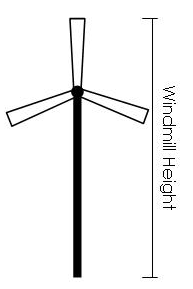
D.
The minimum distance from the tower's base to the property line shall be one-and-a-half feet to each vertical foot of the tower's height. In addition, the minimum distance of the wind energy facility to the nearest inhabited structure of an adjacent property owner and/or the nearest public road shall be two times the height of the tower.
Property line setbacks may be reduced if an adjacent property owner records an easement at the register of deeds, reserving one foot of land for each vertical foot of the tower's height for a tower fall area. The easement must NOT contain an inhabitable building.
E.
Audible sound from the wind energy facility must NOT exceed thirty (30) decibels at the property line (or easement line if applicable).
F.
The operator of the small wind energy facility is permitted to sell excess power to an energy or utility company.
G.
Tower must comply with applicable local, state, and federal regulations such as Airport Hazard regulations (Section 4.5) and FAA and FCC regulations.
H.
Wind energy structures shall NOT be artificially lighted except at the ground level, pointing toward the ground-except when required by a state or federal (such as FAA or FCC) regulations.
I.
No business signs, billboards, or other advertising shall be installed on a tower, nor shall any tower be painted or have a color considered obnoxious or offensive.
J.
Collector and conversion equipment shall be placed underground or inside a building- to the maximum extent possible.
K.
The property owner shall have six (6) months to complete decommissioning of the wind energy facility if no electricity is generated for a continuous period of twelve (12) months.
Applicant must submit decommissioning plans that describe the anticipated life of the wind power project, the estimated decommissioning costs in current dollars, the method for ensuring that funds will be available for decommissioning and restoration, and the anticipated manner in which the wind power project will be decommissioned and the site restored.
R64 - Wireless Telecommunication Towers and Facilities
A.
A site plan shall be submitted containing the name of the tower owner, property owner, scale, north arrow, and latitude/longitude coordinates. Existing site conditions, including contours, any unique natural or man-made features such as vegetation and ground cover. Exact boundary lines of the property containing the proposed tower construction, fall radius and any associated guide wires. Description of adjacent land use and all property owners(s) and their addresses. A front and side elevation profile, drawn to scale, of all existing and proposed towers and their antennas to be located on the property.
B.
Towers shall be sited to contain all ice-fall or debris from tower failure within the setback area. The minimum distance from the tower's base to the property line shall be one foot to each vertical foot of the tower's height. However, a lesser setback shall be permitted upon certification by a NC Registered Professional Engineer which ensures that the fall area of the tower and any appurtenances will be within the setback area proposed.
C.
Towers shall NOT be located within a one-half (1/2) mile radius of any other wireless telecommunication tower, unless concealed in a church steeple, farm silo, or other architecturally designed encasement (the ½ mile radius does NOT include water towers with collocation). Furthermore, towers located beyond a one-half (1/2) mile radius and NOT exceeding three (3) mile radius from any other wireless telecommunication tower shall NOT be permitted, unless the applicant can prove that collocation is not a viable option and no stealth location is possible.
D.
Towers shall be no closer than 500 feet from any existing residential dwelling, excluding any dwellings located on the same parcel of land as the tower.
E.
Towers with a height of 250 feet or greater shall be subject to Board of Adjustment approval as a Special Use Permit.
F.
Towers shall NOT exceed 350 feet in height as measured from ground level.
G.
Towers with a height greater than 150 feet shall be constructed to permit the capability for the co-location of additional provider antennas as follows:
151 feet to 200 feet -two additional antennas
201 feet to 250 feet -three additional antennas
251 feet to 300 feet -four additional antennas
301 feet to 350 feet -five additional antennas
H.
The applicant shall be required to provide written documentation showing that no proposed tower lies within a thirty (30) foot to one (1) foot run to rise ratio from the nearest point of the nearest runway of a private airstrip or airport registered with the Federal Aviation Administration (FAA).
I.
No business signs, billboards, or other advertising shall be installed on a tower, nor shall any tower be painted or have a color considered obnoxious or offensive.
J.
No offices or outdoor storage of equipment or materials are permitted on tower sites located in a residential district (equipment cabinets are not considered structures).
K.
Accessory or component buildings shall be setback fifty (50) feet from all property lines and rights-of-way. However, if the required setback of the primary tower is less than fifty (50) feet the required setback for accessory structures shall be the same as that of the tower.
L.
All structures shall be enclosed by a chain link fence eight (8) feet in height. The fence shall be screened according to Section 5.2.2 (B).
M.
The applicant shall be required to provide written documentation stating that the tower is in compliance with all applicable Federal and State regulations.
N.
Notice shall be provided to the Planning Department when any telecommunication tower is placed out of service. Towers not used for a period of six (6) months or more shall be removed by the owner within 120 days of receipt of notification to that effect. The applicant shall also provide the County with written documentation substantiating that the applicant has and will sustain the financial ability to disassemble and remove the tower, once no longer in operation.
O.
Additional provider antennas and equipment shelters associated with an approved telecommunication tower site are permitted, provided said changes do not increase the setback- requirement beyond the allowable limit according to tower height.
P.
Tower lighting shall NOT exceed the minimum for red obstruction lighting as administered by the Federal Aviation Administration (FAA).
Q.
All permits, for the construction of a wireless telecommunication tower are issued in reliance upon a presumption that the tower will in fact conform to the plans which are submitted as the basis for the permit. Once constructed, the tower must continue to be maintained in compliance with the provisions of this ordinance.
R.
Reserved.
S.
The applicant shall be required to provide written documentation stating that it is not viable to co-locate on existing facilities within the coverage area. Facilities include other towers, elevated tanks, electrical transmission lines, or other structures.
T.
The applicant shall provide the County with proof of liability insurance which protects against losses due to personal injury or property damage resulting from the construction or collapse of the tower, antenna, or accessory equipment. Such proof shall be supplied to the County by the applicant at the time of application.
U.
Reserved.
V.
Co-location is permitted by right in all zoning districts provided the following criteria are met:
1.
Any and all associated facilities must maximize the use of building materials, colors, and textures to blend in with the structure to which it may be affixed; and
2.
The overall height of the structure cannot be increased by more than ten percent (10%) or the height of one additional antenna array with separation from the nearest existing antenna not to exceed 20 feet.
W.
Distributed Antenna Systems (DAS) are permitted by right in all zoning districts provided the following criteria are met:
1.
Facilities located in a dedicated right-of-way must meet the following criteria:
a.
A permit issued by the North Carolina Department of Transportation.
b.
The DAS facility shall not exceed fifty (50) feet in height.
c.
No DAS facility shall be permitted in a dedicated right-of-way in a residential community where all utilities are underground unless the DAS facility is (1) concealed by existing vegetation and is no more than 10 (ten) feet above the existing vegetation canopy or (2) otherwise reasonably concealed by another method as approved by the Zoning Administrator.
2.
Facilities not located in the right-of-way must meet following criteria:
a.
Any DAS facility shall be set back from any existing residential dwelling at least one and one-half (1 ½) feet for every foot in height of the DAS facility. Excluded from this subsection are dwellings located on the same parcel as the DAS structure;
b.
Any DAS facility shall be set back thirty (30) feet from the property line;
c.
Any DAS facility shall not exceed a height of sixty (60) feet;
d.
Notwithstanding the above, if the DAS facility is (1) concealed by existing vegetation and is no more than 10 (ten) feet above the existing vegetation canopy or (2) otherwise reasonably concealed by another method as approved by the Zoning Administrator, it is not subject to any height or setback restriction.
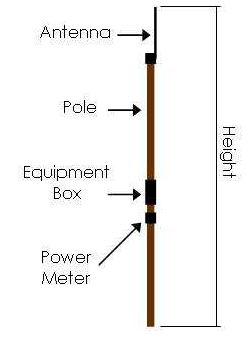
3.
The fiber optic cable in a DAS system shall follow the existing aerial utility line routes. If no aerial utility lines exist, the DAS fiber optic cable shall be buried underground.
4.
All accessory and component buildings associated with the DAS facility must meet the setbacks for the district in which they are located.
5.
The Applicant shall submit a site plan setting forth its compliance with this Section. Within fifteen (15) days of receiving the site plan, the Zoning Administrator shall review the site plan and issue a written determination that the Applicant has or has not met the above criteria. The Zoning Administrator shall issue a permit for the DAS facilities upon a determination that the Applicant has met the requirements of this Section.
6.
The applicant shall be required to provide written documentation stating that it is not viable to co-locate on existing facilities within the coverage area. Facilities include other towers, elevated tanks, electrical transmission lines, DAS facilities, or other structures.
7.
Notice shall be provided to the Planning Department when any DAS facility is placed out of service. Poles not used for a period of six (6) months or more shall be removed by the owner within 120 days of receipt of notification to that effect. The applicant shall also provide the County with written documentation substantiating that the applicant has and will sustain the financial ability to disassemble and remove the pole, once no longer in operation.
8.
Poles shall be at least as strong as what other public utilities in the area are using.
R65 - Solar Energy Systems.
Solar Energy Systems shall meet the following criteria. In the AC and RA zoning districts a Conditional District Zoning is required. Solar collection devices attached to rooftops or buildings are allowed in all zoning districts and are exempt from these requirements.
A.
The applicant must include a site plan drawn to scale that meets the requirements of Section 9.2.1 and the requirements below.
B.
Solar collection devices shall be designed and located to avoid glare or reflection onto adjacent properties and adjacent roadways and shall not interfere with traffic or create a safety hazard.
C.
Solar Energy Systems shall not be located within an airport primary approach zone as described in Section 4.6.1.
D.
All related equipment must be enclosed by a fence at least six (6) feet in height and must have clearly visible warning signage concerning voltage.
E.
An emergency shut-off mechanism is required and notice of its location should be submitted to Iredell County Emergency Management. The mechanism shall be clearly identified and unobstructed and shall be noted clearly on the site plan.
F.
No business signs, billboards, or other advertising shall be installed on a solar device.
G.
Removal of Solar Energy System equipment and site restoration:
1.
The property owner or responsible party shall have six (6) months to complete decommissioning of the solar facility if no electricity is generated for a continuous period of twelve (12) months, unless the responsible party provides substantial evidence (updated every six (6) months after twelve (12) months of no energy production) to the Zoning Administrator of the intent to maintain and reinstate the operation of the facility.
2.
A decommissioning plan shall be required as part of the Conditional District Zoning application. This plan shall be prepared by a third party engineer and must be signed off by the party responsible for decommissioning. The following items are required to be addressed or included:
a.
The identification of the party currently responsible for decommissioning.
b.
All costs for the removal of solar panels, buildings, cabling, electrical components, roads, fencing, and any other associated facilities down to 36 inches below grade.
c.
All costs associated with provisions to restore the land to a condition reasonably similar to its condition before development; including but not limited to: stabilizing the soil, restoring the ground cover, and disposal of all materials per good management practices that are in effect at the time of decommissioning,
3.
Prior to the issuance of the building permit, the decommissioning plan shall be recorded by the applicant in the Iredell County Register of Deeds.
4.
The decommissioning plan and estimated cost of removal shall be updated every five (5) years or upon change of ownership of either the property or the project's owner. Any changes or updates to the plan shall be recorded in the County's Register of Deeds.
5.
The owner of the solar energy system shall provide a bond, cash escrow, or irrevocable letter of credit in favor of the County in an amount equal to 1.25 times the estimated decommissioning cost prior to the issuing of a zoning permit.
6.
The full amount of the bond, certified check, or letter of credit must remain in full force and effect until the solar farm is decommissioned and any necessary site restoration is completed.
7.
The landowner or tenant must notify the county when the site is abandoned.
H.
The applicant shall be required to provide a written affidavit stating that the facility is in compliance with all applicable Federal and State regulations.
I.
Setbacks
1.
All related equipment within a solar energy system may not be closer than 500 feet to any existing residential dwelling, excluding any dwellings on the same parcel of land as the device.
2.
All related equipment must be set back fifty (50) feet from any existing residentially zoned property , one hundred (100) feet from a perennial stream, and ten (10) feet from any existing commercial or industrially zoned property at time of application.
J.
This section does not pertain to solar devices generating energy solely for on-site use, or rooftop mounted systems.
K.
Screening requirements may be added to address site specific and neighbor concerns as part of the Conditional Rezoning Process.
L.
The Planning Director shall examine the progress made toward developing the property per Section 11.6 (K).
R66 - Rural Commercial Recreational and Rural Commercial Educational Facilities and Event Centers
A.
There shall be a fifty (50) foot minimum setback between all structures, parking and other uses related to the facility and any adjacent residentially zoned properties.
B.
The minimum lot or parcel size shall be three (3) acres
C.
All parking must be on-site or at an approved off-site location
R67 - Source Reduction Facility (processing & wholesale)
These regulations do not apply for operations that are disposing of or processing from on-site products. These regulations do apply to operations where material is being brought from off-site.
A.
Setback
1.
There shall be a minimum one hundred (100 foot distance from any adjacent residentially zoned properties for all activity areas.
2.
There shall be a minimum fifty (50) foot distance from all other property lines.
3.
All grinding and crushing of block, stone, gravel, etc., shall be a minimum of two hundred (200) foot distance from any adjacent residentially zoned property and one hundred (100) foot distance from all other property lines.
B.
Use Separation
1.
All crushing, grinding, and burning shall have a five hundred (500) foot minimum separation from any existing residence.
2.
There shall be a one hundred (100) foot minimum separation from all perennial streams.
C.
Access. Driveways and driveway cuts shall be installed to minimize sediment on adjacent roads.
D.
Dust. A dust management plan shall be required to prevent dust as part of any application. If approved this plan will become part of the approval. The dust management plan at a minimum shall include the following:
1.
A list of each dust generating activity or source.
2.
A list of each best management practice that will be implemented for each dust generating activity or source.
3.
A list of additional best management practices that will be implemented if initial controls are ineffective.
E.
Screening. Screening shall be provided around the entire operation, including the road side in the form of one of the following:
1.
A four (4) foot berm with shrubs at least 18 inches when planted ;or
2.
A fifty (50) foot wide strip of existing vegetation at least 6 feet in height.
Screening is not required if the adjacent property is zoned for industrial uses as identified in the Table of Permitted Uses.
F.
Must also comply with all other State and/or Federal guidelines.
G.
The Board of Adjustment may add conditions to this type of request to address site specific and neighbor concerns.
H.
Planning staff will conduct yearly inspections to confirm compliance with these requirements and the Special Use Permit.
R68 - Short term rental (STR)—Vacation rental
A.
Application. A property owner shall submit a request for a zoning permit in accordance with Chapter 8 of this Ordinance. As part of the application process, the Zoning Administrator may request the submission of a site plan to illustrate compliance with the performance requirements; the Zoning Administrator may require, without limitation, the inclusion of the following on the site plan: the deed reference of the subject property, the number of bedrooms, location of signage and adequate parking. The applicant shall also acknowledge that it is the responsibility of the property owner to ensure compliance with any and all restrictive covenants, restrictions of homeowner or property associations governing the subject property, and/or lender requirements included in any deed of trust or loan documents for which the subject property serves as collateral.
The Zoning Administrator may deny or revoke a zoning permit in the event:
1.
The property owner submits incomplete or inaccurate information, or fails to illustrate how the requirements set forth herein will be met; or
2.
The property owner has previously incurred two (2) or more verified zoning violations of this Performance Requirement (R68) at the subject property.
A new permit for the same property that has a revoked STR permit shall not be approved until one (1) year has passed following the date of the revocation of the permit.
B.
Number allowed. Only one (1) STR shall be permitted per approved Dwelling Unit. An STR may be permitted in an Accessory Dwelling Unit. When a Main Building, as the primary dwelling unit, is used as an STR, an accessory dwelling unit may also be used as part of the STR rental only when rented as one (1) unit to the same party. In OI, NB, HB, GB, new dwelling units are not permitted; in the case of a legal non-conforming use and/or structure, a STR is permissible provided Chapter 15 and the requirements set forth herein are met.
C.
Maximum occupancy. The occupancy shall not exceed two (2) persons per bedroom, plus two (2) additional persons. Bedrooms used and advertised shall match the most recent Iredell County tax records for the subject property. The maximum occupancy shall be posted prominently with the STR; the property owner shall ensure that all online listings and advertisements set forth the maximum number of guests. For illustrative purposes only, if the Dwelling Unit has three (3) bedrooms according to the Iredell County tax records, a total of eight (8) persons are allowed. Children under three (3) years of age shall be excluded from the occupancy calculation.
D.
Parking. A minimum of one (1) off-street parking space for each bedroom is required. No on-street parking shall be allowed. All parking shall be entirely on-site, in the garage, driveway or otherwise out of the road right-of-way.
E.
Designated Responsible Party. All STRs shall have a contact available twenty-four (24) hours a day to respond to any questions, complaints or other issues that may arise. The contact name and phone number shall be permanently posted on the outside of the rental unit in a prominent location at driveway entrance not to exceed three (3) square feet. Any changes shall be promptly updated and reposted.
F.
Noise. All STRs are subject to and shall comply with the noise regulations set forth within the Iredell County Code of Ordinances as enforced by the Iredell County Sherriff's Office.
G.
Signage. No signage is permissible that advertises the property as a STR. One (1) on-site sign, not to exceed three (3) square feet, is permissible identifying name of property. Notwithstanding the foregoing, this limitation does not include the required posting of contact information set forth in Paragraph E herein, which shall be in addition to the one (1) on-site sign permitted by this Paragraph G.
H.
Events. STRs shall not be advertised or used to hold special events. Any large gatherings that exceed the occupancy limits of the zoning permit including but not limited to weddings, parties, reunions or other large gatherings, are prohibited. The property owner shall not make the STR available to short-term rental guests for a period of less than overnight.
I.
Effective Date, expiration and/or revocation. In the event of a sale or other transfer of any Dwelling Unit for which a zoning permit has been issued for a STR, the permit shall automatically expire upon the conveyance and recordation of the deed.
January 1, 2024, it shall be a violation of the Iredell County Land Development Code to operate a Short Term Rental without issuance of a zoning permit as set forth herein.
(amended 10/4/11, TA-2011-01; amended 12/6/11, TA-2011-02; amended 7/17/12, TA-2012-01; Ord. of 3-5-13(3); amended 12/3/13, TA-2013-01; amended 9/2/14, TA-2014-01; amended 2/21/17, TA-2017-02; Ord. of 1-17-17(1); Ord. of 12-5-17(2); Ord. of 7-16-19(1); Ord. of 3-4-20(1); Ord. of 4-20-21; amended 10/18/22, TA-2022-02; Ord. of 10-17-23(1); Ord. of 10-17-23(2))

