
Love Valley City Zoning Code
CHAPTER 8
- DEVELOPMENT PLAN AND PERMIT PROCESS
Section 8.1.- Purpose.
This chapter explains the regulations for and the process to be followed to gain approval of the various plans, plats, and permits required for the process of development. Included in this section will be a list of the general regulations, the type of approval required, and the process for obtaining approval. While this chapter details the regulations behind the development process, it is also part of a three chapter set (8-10) that addresses the entire development process.
Section 8.2. - General Plan, Plat, and Permitting Process.
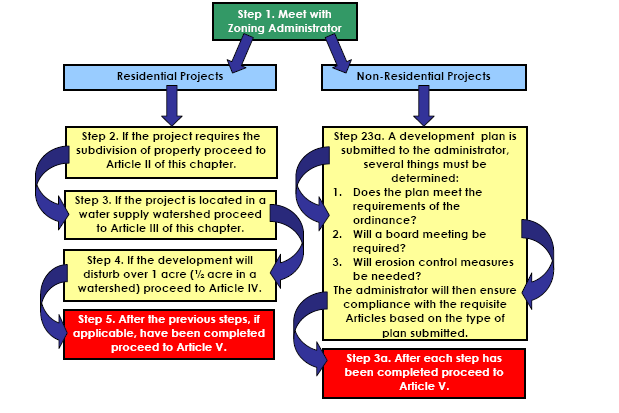
The flow chart below describes the steps taken to determine what kind of approval is necessary for the proposed project. These items are the general criteria needed for the Administrator to determine which process will be used. The following articles will detail how to navigate each process.
ARTICLE IV. - RESERVED[2]
Editor's note— An Ordinance adopted Dec. 5, 2017, §§ 3, 4, repealed art. IV. §§ 8.11—8.13, which pertained to erosion control plans and permits and derived from an Ord. adopted July 17, 2012. See Appendix H regarding soil erosion and sediment control.
Section 8.3. - General.
Prior to the issuance of any permits or the approval of any proposed development regulated by this Ordinance a site plan shall be submitted for review and approval. This requirement does not include single family dwellings (stick-built, manufactured, or modular), residential accessory buildings, residential swimming pools, and other uses generally associated with a single family dwelling. These uses are permitted by right and do not require site plan approval. All site plans shall be submitted to the Zoning Administrator.
Section 8.3.1. - Types of Plans.
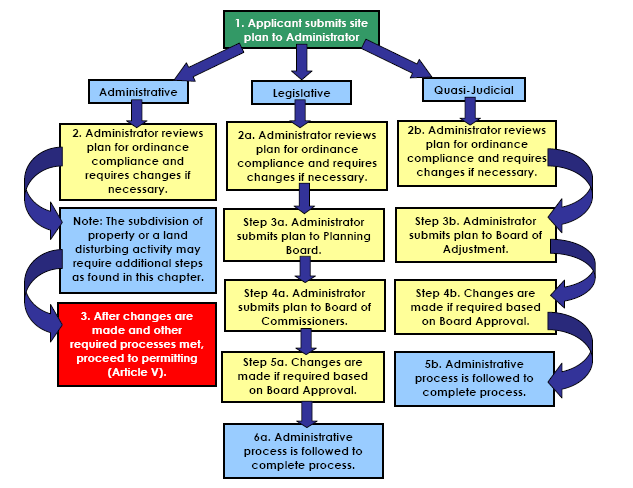
There are several types of non-residential development plans. These plans are generally differentiated by the type of review that is required for approval. The following is a list of the types of plan approval based on their review and a chart showing the steps to achieve:
A.
Administrative review. Site plans that require an administrative review shall be submitted to, reviewed, and approved by the Zoning Administrator. These types of plans generally do not require Board approval. Required information (i.e. what is required on the plan) for plan development is found in Chapter 9. Plans that require administrative review are as follows:
1.
Non-residential site plans with or without Board approval.
2.
Non-residential change of use.
3.
Billboard signs.
4.
Cell towers.
B.
Legislative review. These site plans require approval by the Planning Board and/or the Board of County Commissioners. Plans shall be submitted to the Zoning Administrator, who shall forward the plans to the appropriate Board in accordance with their rules for reviewing site plans. These plans often have associated Performance Requirements as found in the Table of Permitted Uses in Chapter 2. Required information for plan development is found in Chapter 9. The only plans that require legislative review are conditional rezonings and high-density requests.
C.
Quasi-judicial review. These site plans require approval by the Board of Commissioners or the Board of Adjustment and shall be forwarded to these Boards by the Zoning Administrator in accordance with their rules for reviewing site plans. These plans often have associated Performance Requirements as found in the Table of Permitted Uses in Chapter 2. Required information for plan development is found in Chapter 9. Plans that require quasi-judicial review are as follows:
1.
Special use permits.
2.
Variances.
3.
Expansion of nonconforming uses.
4.
Changes in nonconforming uses.
Section 8.3.2. - Non-Residential and Multi-Family Review Special Requirements.
A.
For development of facilities located on or directly adjacent to Lake Norman the Zoning Administrator shall submit one (1) set of plans to the Lake Norman Marine Commission for review and approval in accordance with adopted standards of the Marine Commission. Failure of the Lake Norman Marine Commission to respond to the plans within thirty-one (31) days after receiving them shall be interpreted as an approval.
B.
An additional set of plans shall be submitted to the North Carolina Department of Transportation (NCDOT) for review and/or approval of a driveway permit. However, such permit shall not be issued until the Zoning Administrator has approved the site plan and signed the driveway permit for the proposed project.
Section 8.4. - Purpose.
The purpose of this section is to establish procedures for the subdivision of land within the county.
Section 8.5. - Subdivision Defined.
For purposes of this Ordinance, the word "subdivision" is defined in NCGS 160D-801 and shall mean all divisions of a tract or parcel of land into two or more lots, building sites, or other divisions when any one or more of those divisions is created for the purpose of sale or building development, (whether immediate or future), and shall include all division of land involving the dedication of a new street or a change in existing streets; but the following shall not be included with the definition nor be subject to the regulations authorized by the Article:
A.
The combination or recombination of portions of previously subdivided and recorded lots, where the total number of lots is NOT increased and the resultant lots are equal to or exceed the standards of the county as shown in its subdivision regulations.
B.
The division of land into parcels greater than ten (10) acres where no street right-of-way dedication is involved.
C.
The public acquisition by purchase of strips of land for the widening or opening of streets or for public transportation system corridors.
D.
The division of a tract in single ownership whose entire area is no greater than two (2) acres into not more than three (3) lots, where, no street right-of-way dedication is involved and where the resultant lots are equal to or exceed the standards of Iredell County as shown in this Ordinance.
E.
The division of a tract into parcels in accordance with the terms of a probated will or in accordance with intestate session under Chapter 29 of the General Statutes.
(Ord. of 4-20-21)
Section 8.5.1. - Subdivision Types.
For all subdivisions of land as defined in Section 8.5, the following categories of subdivisions shall be used to determine the procedures required for review:
A.
Family Subdivision. A subdivision of land by a property owner among his/her immediate family as a gift, as settlement of the property owners estate, or for nominal consideration; the conveyance of a tract or tracts to a grantee who would have been an heir of the grantor if the grantor had died intestate immediately prior to the conveyance; or the conveyance of a tract or tracts for the purpose of dividing lands among the tenants in common, all of whom inherited by intestacy or by will, the land from a common ancestor. Only one lot may be conveyed per immediate family member per parent parcel.
Family Subdivision plats shall follow the same review process as minor subdivisions outlined in this ordinance. Family subdivisions may be exempt from regulations explicitly stated in this ordinance, so long as legal documentation is provided showing that the property meets the definition of a Family Subdivision as herein described above. Family Subdivisions must be recorded with the Register of Deeds office, and until recorded no building permits shall be issued. Family Subdivisions must comply in all respects with the requirements of the Zoning Ordinance, Watershed Ordinance, Floodplain Protection Ordinance of Iredell County, and where applicable, any other officially adopted plans or maps approved by any governmental body or agency. Family subdivisions, however, may be exempt from the road frontage requirements, so long as an easement of no less that twenty-five (25) feet provides reasonable, passable access to the newly created parcels.
B.
Minor Subdivision. A minor subdivision is defined as a subdivision where:
1.
no new roads are proposed or road rights-of-way dedicated; and ;
2.
ten (5) or fewer lots will result after the subdivision is completed.
C.
Major Subdivision. A major subdivision is defined as a subdivision where:
1.
new streets or roads are proposed or rights-of-way dedicated, and/or
2.
more than five (5) lots are created after the subdivision is completed.
D.
Planned Unit Development (PUD) Subdivision A PUD is defined as a development where:
1.
a type of major subdivision that is located within a Conditional District that is developed in accordance with Chapter 3, R 20 of this Ordinance.
2.
all PUD's shall be considered major subdivisions and shall follow all applicable procedures set forth for the approval of said subdivisions.
3.
design standards set out in this Ordinance may be waived or modified for PUD's provided that the intent of these regulations is NOT nullified or lessened and provided that sufficient proof is given substantiating the adequacy of the alternative design.
E.
Cluster Development Subdivision. A type of major subdivision that is intended to allow smaller than minimum lot sizes with dwelling units clustered in smaller areas in order to preserve larger areas of open space and environmental resources. It must be developed in accordance with Chapter 3, R5 of this Ordinance.
F.
Special Subdivisions. A Special Subdivision is for purposes other than general, residential or commercial development including:
1.
Building locations for condominiums or townhouses within an approved major subdivision, where applicable.
2.
Utility facilities such as sub-station sites, meter vaults, pump station sites, but NOT including wireless telecommunication sites.
3.
Cemetery plots.
(Ord. of 10-17-23(2))
Section 8.6.1. - Recombinations and Subdivision Exemption Plats.
For the recombination of previously subdivided land or for plats that do not meet the definition of a subdivision as set forth in Section 8.5, the following shall apply:
A.
The Subdivision Administrator shall confirm that the plat does not meet the definition of a subdivision, and that the most restrictive lot size requirements of this Ordinance are met.
B.
Prior to recording a plat for recombination, the applicant shall provide evidence to the Subdivision Administrator that the recombination of all or portions of parcels of previously subdivided and recorded lands, which have been recombined, in such a fashion that the resultant number of parcels is less than or equal to the original number of parcels and meets the requirements of this Ordinance, where applicable.
C.
Plats that do not fit the definition of a subdivision under Section 8.5 shall provide an exemption plat certificate in accordance with Appendix D that shall be signed by the Subdivision Administrator prior to recording at the Register of Deeds office.
Section 8.6.2. - Recombination and Re-subdivision Special Requirements.
A.
Any plat or any part of any plat may be vacated by the subdivider at any time before the sale of any lot in the subdivision. This may be done by gaining approval of and filing a plat that either is different from the originally approved plat, or shows the tract without the lots if no lots have been sold. The same procedures, rules, and regulations shall apply in gaining approval of and filing a plat for this purpose as prescribed herein for an original subdivision.
B.
The replatting of any previously platted property shall not abridge or destroy any public rights.
C.
The filing and recording of an amended plat shall serve to destroy the force and effect of the recording of the plat so vacated, and to divest all public rights in the roads, alleys, and public grounds, and all dedications laid out or described in such plat.
Section 8.7. - Minor and Special Subdivision Plats.
A subdivider may apply to the Subdivision Administrator for a plat review process for minor and special subdivisions. The steps in the following chart correspond with a detailed description of each step of the process on the following pages.
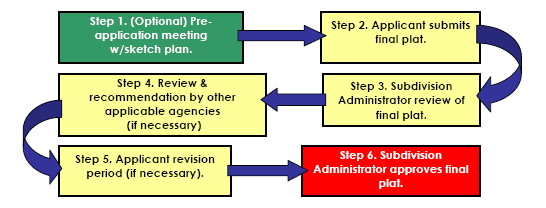
Step 1. (optional) Pre-Application Meeting with Sketch Plan
A.
The applicant may schedule a pre-application meeting with the Subdivision Administrator. The applicant shall bring a Sketch Plan of the proposed development to the meeting that meets the requirements set forth in Section 9.3.1.
B.
The Subdivision Administrator shall review the sketch plan for general compliance with the requirements of this Ordinance and any other applicable ordinance. The Subdivision Administrator shall advise the Subdivider or his authorized agent of the regulations pertaining to the proposed subdivision and the procedures to be followed in the preparation and submission of the final plats.
C.
One (1) copy of the sketch plan shall be retained as a part of the record of the Subdivision Administrator with one (1) copy being returned to the subdivider or his authorized agent along with any comments made by the Subdivision Administrator concerning the proposed plat.
Step 2. Applicant Submits Final Plat
A.
The applicant shall submit a final plat in accordance with the requirements set forth in Section 9.4.2. The applicant shall also submit with the plat an application, fee, and any other documentation required by this section.
B.
The Subdivision Administrator may request reports from the County Health Department, the Iredell County Soil and Water Conservation District, and other local, state, or federal officials, agencies, or consultants as deemed necessary.
Step 3. Subdivision Administrator Review Period
A.
The Subdivision Administrator shall review the plat in accordance with the requirements of this Ordinance and other applicable ordinances.
B.
The Subdivision Administrator may have any other applicable local, state, and federal officials, agencies, or consultants review the plat.
C.
Once the Subdivision Administrator has received the required number of copies of the final plat, he shall have thirty-one (31) days to review the plat and to approve, approve with conditions or disapprove the plat. If more than thirty-one (31) days is required for approval, the Subdivision Administrator must notify the Subdivider in writing advising him of the delay, the nature of the delay, and an approximate date as to when a decision can be forwarded. If a second period of thirty-one (31) days has passed, beyond the expected date of the final decision, the Subdivider may appeal to the Board of Adjustment to render a decision on the plat.
Step 4. Review & Recommendation by Other Applicable Agencies
The Subdivision Administrator may in his discretion determine that public agencies concerned with new development be given the opportunity to review and make recommendations on the plat. All recommendations shall be forwarded to the Administrator within fourteen (14) days from date of receipt. Said public agencies may include, but are not limited to, the following:
1.
NCDOT district highway engineer with regard to impacts on existing state-maintained streets.
2.
Health Department with regard to proposed water and sewerage systems.
3.
Fire Marshal.
4.
Iredell County Soil and Erosion Control.
5.
Iredell-Statesville Schools and/or Mooresville Graded School District.
6.
Iredell County Mapping Department.
7.
Any other agency or official designated by the Subdivision Administrator.
Step 5. Applicant Revision Period
The applicant shall revise the plat in accordance with the Subdivision Administrator's review. All necessary revisions shall be made prior to approval by the Subdivision Administrator.
Step 6. Subdivision Administrator Final Plat Approval
Following successful revision of the final plat by the applicant, the Subdivision Administrator shall approve the final plat by obtaining the applicable signatures as required by Appendix C.
Section 8.7.1. - Minor Subdivision Special Requirements.
A.
The minor subdivision process shall not be used a second time within three (3) years from the date of approval anywhere within the original property boundaries if the total number of lots would constitute a major subdivision. Major subdivision requirements shall be followed for further subdivision that takes place within three (3) years.
B.
Any lot created for immediate or future development or sale shall conform to the minimum lot requirements of this Ordinance with the exception of governmental or utility type infrastructures.
Section 8.7.2. - Special Subdivision Special Requirements.
A.
If the proposed Special Subdivision is within a major subdivision as herein defined, then the subdivider shall also comply with the review procedures for a major subdivision.
B.
All roads and rights-of-way shall conform to the minimum road requirements as provided in Chapter 10.
C.
Any lot created for immediate or future development or sale shall conform to the minimum lot requirements of this Ordinance with the exception of governmental or utility type infrastructures.
Section 8.8. - Major Subdivision Plats.
A subdivider shall apply to the Subdivision Administrator for a plat review process for major subdivisions. The steps in the following chart correspond with a detailed description of each step of the process on the following pages.
Section 8.8.1. - Review Process for Major Subdivisions (including PUD and Cluster Developments).
The numbers in the boxes below correspond with a detailed description of each step of the process on the following pages.
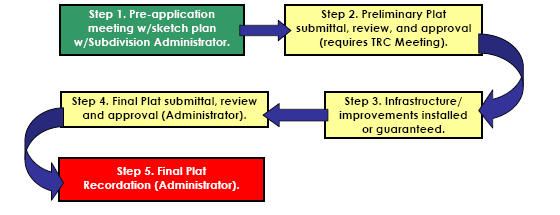
Step 1. Pre-Application Meeting with Sketch Plan
A.
The applicant shall schedule a pre-application meeting with the Subdivision Administrator. The applicant shall bring a Sketch Plan of the proposed development to the meeting that meets the requirements set forth in Section 9.3.1. The benefit of a pre-application meeting is to inform the applicant of all of the regulations and procedures up front and to discuss alternative designs given the unique circumstances of the subject property.
B.
The Subdivision Administrator shall review the sketch plan for general compliance with the requirements of this Ordinance and any other applicable ordinance. The Subdivision Administrator shall advise the subdivider or his authorized agent of the regulations pertaining to the proposed subdivision and the procedures to be followed in the preparation and submission of the preliminary plat and final plat. The Subdivision Administrator shall also advise the applicant if traffic impact analysis (TIA) will be required consistent with Chapter 10.
C.
The Iredell County Fire Marshal's (ICFM) office shall review the plan with respect to the NC Insurance Services Office (ISO) ratings (Section 10.15.2). This review shall follow the time frame established in Section 8.8.1.E.
D.
One (1) copy of the sketch plan shall be retained as a part of the record of the Subdivision Administrator with one (1) copy being returned to the Subdivider or his authorized agent along with any comments made by the Subdivision Administrator concerning the proposed plat.
Step 2. Preliminary Plat Submittal, Review, and Approval
A.
The applicant shall submit a preliminary plat for all subdivisions in accordance with section 9.4.1. The Subdivision Administrator and Technical Review Committee (TRC) shall review the preliminary plat in accordance with the requirements of this Ordinance and any other applicable ordinance.
B.
The TRC shall vote to recommend approval, approval with conditions, or denial of the proposed subdivision and shall provide comments to the Subdivision Administrator regarding the design of the subdivision as it relates to the requirements of this Ordinance and other local, state, and federal regulations.
C.
Once the Subdivision Administrator has received the required number of copies of the Preliminary Plat, he shall have thirty-one (31) days to review the plat and to approve, approve with conditions or disapprove the plat. If more than thirty-one (31) days is required for approval, the Subdivision Administrator must notify the subdivider in writing advising him of the delay, the nature of the delay, and an approximate date as to when a decision can be forwarded. If a second period of thirty-one (31) days has passed, beyond the expected date of the final decision, the Subdivider may appeal to the Board of Adjustment to render a decision on the plat.
D.
If the Subdivision Administrator does not approve the preliminary plat within the timeframe describe above, he shall instruct the subdivider concerning resubmission of a revised plat and the Subdivider may make such changes as will bring the plat into compliance with the provisions of this Ordinance and other local, state, and federal regulations and resubmit for reconsideration.
E.
The Subdivision Administrator may in his discretion provide that those public agencies concerned with new development be given the opportunity to review and make recommendations on the plat. All recommendations shall be forwarded to the Administrator within fourteen (14) days from date of receipt. Said public agencies shall include, but are not limited to, the following:
1.
NCDOT district highway engineer with regard to proposed streets, highways and drainage systems;
2.
County Health Department with regard to proposed water and sewerage systems;
3.
Fire Marshall;
4.
Iredell County Erosion Control; and
5.
Any other agency or official designated by the Subdivision Administrator and/or the Technical Review Committee.
Step 3. Infrastructure/Improvements Installed or Guaranteed
A.
Upon approval of the preliminary plat by the Subdivision Administrator, the Subdivider may proceed with the preparation of the final plat, and the installation of or arrangement for required improvements in accordance with the approved preliminary plat and the requirements of this Ordinance.
B.
Prior to approval of a final plat, the subdivider shall have installed the improvements specified in this Ordinance or guaranteed their installation as provided herein. No final plat shall be approved unless accompanied by a written notice from the subdivider's engineer acknowledging improvements have been made in compliance with this Ordinance or a written notice from the county manager stating that the improvement guarantee standards of this Ordinance as provided in Chapter 10 have been met.
Step 4. Final Plat Submitted, Review, and Approval
A.
The applicant shall submit a final plat that meets the requirements of Section 9.4.2. The final plat shall be submitted not more than two (2) years after the date on which the preliminary plat was approved, otherwise, such approval shall be null and void.
B.
The Subdivision Administrator shall review the final plat for compliance with the approved Preliminary Plat, verify that all required infrastructure improvements have been completed or guaranteed in accordance with Chapter 10, and ensure that the final plat meets the requirements of Section 9.4.
C.
Once the Subdivision Administrator has received the required number of copies of the final plat, he shall have thirty-one (31) days to review the plat and to approve, approve with conditions or disapprove the plat. If more than thirty-one (31) days is required for approval, the Subdivision Administrator must notify the subdivider in writing advising him of the delay, the nature of the delay, and an approximate date as to when a decision can be forwarded. After the thirty-one (31) days, the Subdivision Administrator shall update the subdivider in writing on the status of the review. If a period of thirty-one (31) days has passed, beyond the update, the subdivider may appeal to the Board of Adjustment to render a decision on the plat.
D.
If the Subdivision Administrator does not approve the final plat, he shall instruct the subdivider concerning resubmission of a revised plat and the subdivider may make such changes as will bring the plat into compliance with the provisions of this Ordinance and other local, state, and federal regulations and resubmit for reconsideration.
E.
During his review of the final plat, the Subdivision Administrator may employ the Mapping Department to confirm the accuracy of the final plat. If substantial errors are found, the costs shall be charged to the Subdivider and the plat shall not be recommended for approval until such errors have been corrected.
Step 5. Final Plat Recordation
Once the plat has received final approval, the Subdivision Administrator or the subdivider shall record the final plat with the Register of Deeds. No building permits shall be issued for the individual lots until the plat has been recorded.
Section 8.8.2. - Planned Unit Development (PUD) Special Requirements.
A.
The site plan (required by Chapter 3, SR20 of this Ordinance) approved by the Board of Commissioners at the time the Conditional district rezoning is approved will serve as the sketch plan. Therefore, PUD developments may skip Step 1 of the major subdivision approval process.
B.
A plan shall be submitted to the TRC along with the preliminary plat indicating the parties responsible for the maintenance of all private roads. Plat approval shall also include approval of said plan. Private roads shall be duly noted, as such, upon all plats.
C.
All efforts will be made to streamline the process of zoning and subdivision approval. The TRC and Subdivision Administrator shall coordinate their review and advisory efforts, wherever feasible, in order to limit any unnecessary delays. All PUD plats for subdivision review shall include the following additional information:
1.
Total number and type of dwelling units proposed;
2.
The density of the development;
3.
The location of all open space areas and total open space acreage; and
4.
The approximate location of all buildings and the types of buildings to be constructed.
Section 8.9.1. - Agreement and Security Required.
In lieu of requiring the completion, installation and dedication of all improvements prior to final plat approval, Iredell County may enter into an agreement with the Subdivider, whereby, the Subdivider shall agree to complete all required improvements within two (2) years, unless otherwise pre-approved. Once said agreement is signed by both parties and the security required herein is provided, the Final Plat may be approved by the Subdivision Administrator, if all other requirements of this Ordinance are met. To secure this agreement, the Subdivider shall provide to the County Manager either one, or a combination, of the following guarantees. The amount of such guarantees shall be in the amount of 1.25 times the cost of installing all required improvements and shall be satisfactory to the County Manager as to form, sufficiency and manner of execution, as set forth in these regulations. All such guarantees shall be made payable to Iredell County, along with any applicable filing fees as shown on the Iredell County Fee Schedule.
A.
Surety Performance Bond(s). The Subdivider shall obtain a performance bond(s) from a surety bonding company authorized to do business in North Carolina.
B.
Cash or Equivalent Security. The Subdivider shall deposit cash, an irrevocable letter of credit or other instrument readily convertible into cash at face value, either with the County or in escrow with a financial institution designated as an official depository of the County. The use of any instrument other than cash shall be subject to the approval of the County Manager.
If cash or other instrument is deposited in escrow with a financial institution as provided above, then the Subdivider shall file with the County Manager an agreement between the financial institution and himself guaranteeing the following:
1.
That said escrow account shall be held in trust until released by the County Manager and may NOT be used or pledged by the Subdivider in any other matter during the term of the escrow; and
2.
That in the case of a failure on the part of the Subdivider to complete said improvements, the financial institution shall, upon notification and submission to the financial institution of an engineer's estimate of the amount needed to complete the improvements by the County Manager, one of the following shall occur:
a.
immediately pay to the County the funds estimated to complete the improvement, up to the full balance of the escrow account; or
b.
deliver to the County any other instruments fully endorsed or otherwise made payable in full to the County.
(Ord. of 10-17-23(2))
Section 8.9.2. - Default.
Upon default, meaning failure on the part of the subdivider to complete the required improvements in a timely manner as spelled out in the performance bond or escrow agreement, then the surety, or the financial institution holding the escrow account, shall, if requested by the county manager, pay all or any portion of the bond or escrow fund to the Iredell County up to the amount needed to complete the improvements based on an engineering estimate. Upon payment, the County Manager, in his discretion, may expend such portion of said funds as it deems necessary to complete all or any portion of the required improvements. The county shall return to the bonding firm any funds not spent in completing the improvements. Should the amount of funds needed to complete installation of all required improvements exceed the amount in the bond or escrow account, the subdivider shall nonetheless be responsible for providing the funds to cover such cost. The subdivider shall always bear the financial burden for the installation of all required improvements.
Section 8.9.3. - Release of Guarantee Security.
The County Manager may release a portion of any security posted as the improvements are completed and recommended for approval by the Subdivision Administrator. Within thirty (30) days after receiving the Subdivision Administrator's recommendation, the County Manager shall approve said improvements and immediately release any security posted.
Section 8.10. - Applicability.
The specific regulations related to development within a Water Supply Watershed Overlay District are found in Chapter 4 and are depicted on the comprehensive zoning map. The regulations that follow are specific to the high density development option that is available in some watershed districts.
Section 8.10.1. - High Density Development Standards.
A.
The Board of Commissioners may approve high density development proposals consistent with the following standards:
1.
In the Watershed IV Critical Area (WS-IV-CA) a high density development approval may be given to exceed twenty-four (24) percent built-upon area, up to a limit of fifty (50) percent. In the event that a high density approval is given, engineered stormwater controls (as described in Chapter 10) shall be used to control runoff from the first one (1) inch of rainfall.
2.
In the Watershed IV Protected Area (WS-IV-PA) a high density development approval may be given to exceed twenty-four (24) percent built-upon area or thirty-six (36) percent built-upon area for projects without curb and gutter street systems, up to a limit of seventy (70) percent. In the event that a high density approval is given, engineered stormwater controls (as described in Chapter 10) shall be used to control runoff from the first one (1) inch of rainfall.
Section 8.10.2. - High Density Development Permit Application.
A high density development permit shall be required for new development exceeding the requirements of the low density option. The chart below gives an overview of the high density development application process. Each box corresponds with a detailed description of that step shown on the following pages.
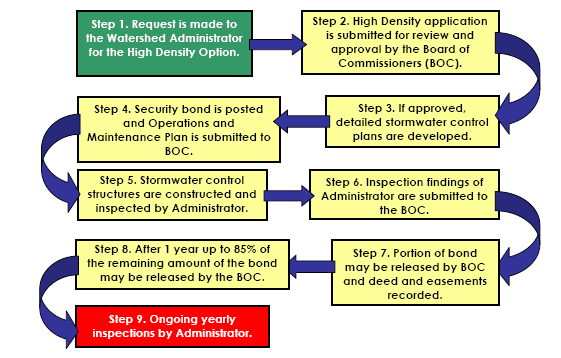
Step 1. Request Made to the Watershed Administrator
If an applicant finds that their project falls within one of the two (2) scenarios listed in Section 8.10.1 the applicant may schedule a meeting with the Watershed Administrator to discuss the process for obtaining a high density approval. The benefit of this meeting is to inform the applicant of all of the regulations and procedures attached to this process.
Step 2. High Density Request is Made to the Board of Commissioners
A.
Application for a high density development shall be addressed and submitted to the Board of Commissioners through the Watershed Administrator. Application for high density development approval shall be made on the proper form and shall include the following information:
1.
A completed high density development application signed by the owner of the property. The signature of the consulting engineer or other agent will be accepted on the application only if accompanied by a letter of authorization;
2.
Two (2) reproducible copies of the development plan within the drainage basin, detailed information concerning built-upon area, and specifications of the stormwater control structure consistent with Section 10.13;
3.
When applicable, written verification that a soil erosion and sedimentation control plan has been approved by the appropriate state or local agency; and
4.
Application fees consistent with fee schedule adopted by the County Commissioners.
B.
Prior to taking final action on any application, the Board or the Watershed Administrator may provide an opportunity to public agencies affected by the development proposal to review and make recommendations on the application. However, failure of the agencies to submit their comments and recommendations shall not delay the Board's action within prescribed time limit.
Step 3. Board of Commissioners Decision
A.
At their discretion, the Board of Commissioners shall either approve or disapprove each application for a high density development.
B.
First consideration of a completed application shall be at the next regularly scheduled meeting of the Board following its receipt. The Board shall take action on the application at its first consideration or within sixty-five (65) days of its first consideration.
C.
If the Board approves the application based on its findings, such approval shall be indicated on the permit and both copies of the site plan and both copies of the plans of the stormwater control structure.
D.
In addition to any other requirements provided by this Ordinance, the Board may designate additional permit conditions and requirements to assure that the use will be harmonious with the area in which it is proposed to be located and with the spirit of this Ordinance. All additional conditions shall be entered in the meeting minutes when the permit is granted, on all plans and on the permit certificate. All conditions so imposed shall run with the land and shall be binding upon the applicant and the applicant's heir, successors, or assigns during the continuation of the permitted use.
E.
If the Board disapproves the application based on its findings, the reasons for such action shall be stated in the minutes of the Board and presented to the applicant in writing either by personal service or registered mail, return receipt requested. The applicant may make changes and submit a revised plan. All revisions shall be submitted, reviewed, and acted upon by the Board pursuant to the procedures of this section.
F.
The Board shall issue a written ruling and make copies available at the office of the Planning Director and the Iredell County Clerk.
Step 4. Security Bond Posted and Operations and Maintenance Plan Submitted
A.
A high density development approval in the form of a zoning permit shall be issued after the applicant posts a performance bond or other acceptable security and executes an operation and maintenance agreement as required in this section. A copy of the permit and one copy of each set of plans shall be kept on file at the Watershed Administrator's office. The original permit and one copy of each set of plans shall be delivered to the applicant either by personal service or registered mail, return receipt requested.
B.
All new stormwater control structures shall be conditioned on the posting of adequate financial assurance for the purpose of maintenance, repairs, or reconstruction necessary for adequate performance of the stormwater control structures. Financial assurance shall be in the form of the following:
1.
Security performance bond or other security. The permit applicant shall obtain either a performance bond from a surety bonding company authorized to do business in North Carolina, an irrevocable letter of credit or other instrument readily convertible into cash at face value payable to Iredell County or placed in escrow with a financial institution designated as an official depository of Iredell County. The bond or other instrument shall be in an amount equal to one and one-quarter (1.25) times the total cost of the stormwater control structure, as estimated by the applicant and approved by the Board of Commissioners. The total cost of the stormwater control structure shall include the value of all materials such as piping and other structures; seeding and soil stabilization; design and engineering; and grading, excavation, fill, etc. The cost shall not be prorated as part of a larger project, but rather under the assumption of an independent mobilization.
2.
Cash or equivalent security deposited after the release of the performance bond. Consistent with the previous section, the permit applicant shall deposit with the county either cash or other instrument approved by the Board of Commissioners that is readily convertible into cash at face value. The cash or security shall be in an amount equal to fifteen (15) percent of the total cost of the stormwater control structure or the estimated cost of maintaining the stormwater control structure over a ten-year period, whichever is greater. The estimated cost of maintaining the stormwater control structure shall be consistent with the approved operation and maintenance plan or manual provided by the developer under Section 10.13.1.A. The amount shall be computed by estimating the maintenance cost for twenty-five (25) years and multiplying this amount by two-fifths (⅖) or 0.4.
3.
Default under the performance bond or other security. Upon default of the permit applicant to complete and/or maintain the stormwater control structure as spelled out in the performance bond or other security, the Board of Commissioners may obtain and use all or any portion of the funds necessary to complete the improvements based on an engineering estimate. The Board of Commissioners shall return any funds not spent in completing the improvements to the owning entity.
4.
Default under the cash security. Upon default of the owning entity to maintain, repair and, if necessary, reconstruct the stormwater control structure in accordance with the operation and maintenance agreement, the Board of Commissioners shall obtain and use all or any portion of the cash security to make necessary improvements based on an engineering estimate. Such expenditure of funds shall only be made after exhausting all other reasonable remedies seeking the owning entity to comply with the terms and conditions of the operation and maintenance agreement. The Board shall not return any deposited cash funds.
C.
Consistent with Section 8.10.2 (Step 2), the permit applicant shall enter into the binding operation and maintenance agreement between the Board of Commissioners and all interests in the development. Said agreement shall require the owning entity to maintain, repair, and if necessary, reconstruct the stormwater control structure in accordance with the operation management plan or manual provided by the developer. The operation and maintenance agreement shall be filed with Iredell County Register of Deeds by the Board of Commissioners.
Step 5. Stormwater Control Structures Constructed
Stormwater control structures shall be constructed to the standards found in Chapter 10.13, Infrastructure and Design.
Step 6. Stormwater Control Structures Inspected
The stormwater control structure shall be inspected by the Watershed Administrator, after the owning entity notifies the Watershed Administrator that all work has been completed. At this inspection, the owning entity shall provide:
A.
The signed deed, related easements and survey plat for the stormwater control structure ready for filing with the Register of Deeds; and
B.
A certification sealed by an engineer or landscape architect (to the extent that the General Statutes, Chapter 89A, allow) stating that the stormwater control structure is complete and consistent with the approved plans and specifications.
Step 7. First Partial Performance Bond Release
The Watershed Administrator shall present the materials submitted by the developer, the inspection report and recommendations to the Board of Commissioners at its next regularly scheduled meeting.
A.
If the Board of Commissioners approve the inspection report and accepts the certification, deed, and easements, the Board shall file the deed and easements with the Iredell County Register of Deeds, release up to seventy-five (75) percent of the value of the performance bond or other security and issue a zoning permit for the stormwater control structure, consistent with Section 8.14.
B.
If deficiencies are found, the Board of Commissioners shall direct that improvements and inspections be made and/ or documents corrected and resubmitted to the Board.
Step 8. Second Partial Performance Bond Release
A.
No sooner than one (1) year after the filing date of the deed, easements and maintenance agreement, the developer may petition the Board of Commissioners to release the remaining value of the performance bond or other security. Upon receipt of said petition, the County shall inspect the stormwater control structure to determine whether the controls are performing as designed and intended. The Watershed Administrator shall present the petition, inspection report, and recommendations to the Board of Commissioners.
1.
If the Board approves the report and accepts the petition, the developer shall deposit with the Board a cash amount equal to that described in Step 4 after which, the Board shall release the performance bond or other security.
2.
If the Board does not accept the report and rejects the petition, the Board shall provide the developer with instructions to correct any deficiencies and all steps necessary for the release the performance bond or other security.
B.
A development permit shall not be issued for any building within the permitted development until the Board of Commissioners has approved the stormwater control structure, as provided in Step 7.
Step 9. Ongoing Yearly Inspections
A.
All stormwater control structures shall be inspected at least once on an annual basis to determine whether the controls are performing as designed and intended. Records of inspection shall be maintained on forms approved or supplied by the North Carolina Division of Environmental Management. Annual inspections shall begin within one (1) year of filing date of the deed for the stormwater control structure.
B.
In the event the Watershed Administrator discovers the need for corrective action or improvements, the Watershed Administrator shall notify the owning entity of the needed improvements and the date by which the corrective action is to be completed. All improvements shall be made consistent with the plans and specifications of the stormwater control structure and the operation maintenance plan or manual. After notification by the owning entity the Administrator shall inspect and approve the completed improvements. The Administrator may consult with an engineer or landscape architect (to the extent that the General Statutes, Chapter 89A, allow) designated by the Board of Commissioners.
C.
Appeals of any order, requirement, decision, or determination made by the Administrator may be made to and decided by the Board of Adjustment consistent with Chapter 12.
Section 8.14. - General.
A.
No land shall be used or occupied and no building hereafter structurally altered, erected, or moved, shall be used, or its use changed, until a zoning permit has been issued by the Zoning Administrator stating that the building and/or the proposed use complies with the provisions of this Ordinance.
A record of all permits shall be kept on file in the office of the Zoning Administrator and copies shall be furnished, on request, to any persons having a proprietary or tenancy interest in the use or building. The county shall collect such fees for the issuance of zoning permits as are authorized by the fee schedule as adopted by the Board of Commissioners.
The issuance of a valid zoning permit shall confer with it the right to undertake and complete the development and/or use of property under the terms and conditions of such permit provided that such action as authorized by the permit is commenced within one hundred eighty (180) days of issuance and provided that all other permits are obtained. Otherwise the permit shall be void.
B.
After a permit has been issued, no change or deviation from the terms of the application, the plans and specifications, or the permit, may be made until specific written approval of the proposed change or deviation has been obtained from the Iredell County Department of Planning and Development. An exception can be made, however, if the change or deviation is clearly permissible under the State Building Code.
Section 8.15. - Residential Zoning Permits.
The flow chart below gives an overview of the process that must be followed to obtain a Zoning Permit for new residential construction. This generally includes single and two family development that does not require the submittal of a non-residential site plan, as described earlier in this chapter. The steps below correspond to the detailed steps that are found on the following pages.
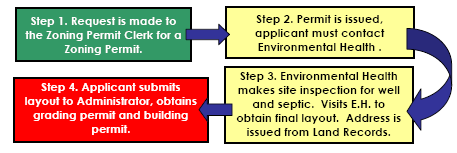
Step 1. Request Made to Zoning Administrator
A.
Prior to the initiation of any work on a parcel of land, a zoning permit must be obtained from the Department of Planning and Development, through the Zoning Permit Clerk.
B.
The applicant must provide enough information that the Clerk can determine what type of activity will be taking place, if the activity is a permitted use, where the property is located, and any other arrangements must be made prior to issuing a permit.
Step 2. Clerk Issues Permit
A.
If no additional information is needed and the Clerk has been able to determine that the use is permitted, a zoning permit can be issued.
B.
The permit will dictate a number of site requirements that must be met during the construction process. The applicant will be required to sign for this permit and thus will agree to the terms of the permit.
C.
Upon issuance of the permit, the applicant must contact (generally in person) the Environmental Health Division for the area in which the activity will be located (Mooresville or Statesville office). If sanitary sewer is to be used in lieu of a septic system, the applicant must furnish at the time of the permit application a letter from the entity owning or controlling the sewer granting approval to connect to the system.
D.
A well permit may be issued at this time also. Environmental Health will lead them through this process and should be consulted when contacted under the previous subsection.
Step 3. Environmental Health Inspection
A.
The Environmental Health Division will make a site inspection and develop a septic tank layout for the site. This will be made based on the topography, location of any structures and site improvements, the well, and other site features.
B.
If there is a problem with the layout and a system cannot be designed based on the construction that is being proposed, the applicant may need to make changes to the zoning permit, which will require contacting the Planning and Development Department.
C.
When the septic tank layout is complete, the applicant must physically obtain their copy from Environmental Health.
D.
At this time a physical address will be issued by the Zoning Clerk based on the information given on the permit. If the Clerk cannot issue an address the permit and address request will be forwarded to the Addressing Coordinator in the Land Records Department. If the information or the activity associated with the permit changes it will be necessary to reassess the address.
Step 4. Applicant Obtains Grading and Building Permits
A.
Once the septic tank layout is in hand, the applicant can then obtain their grading and building permits.
B.
The grading permit will be issued by the zoning permit clerk as a permit for site improvements.
C.
The building permit will be issued by the Building Inspections Department.
Section 8.15.1. - Residential Additions and Accessory Structures.
This process includes additions to residential structures and the construction of accessory buildings and swimming pools. The overall process is the same as for new residential construction; however a new septic tank layout may not be required.
Section 8.16. - Non-Residential Permits.
The flow chart below gives an overview of the process that must be followed to obtain a Zoning Permit for a new non-residential construction project (including signs). This generally includes both new construction and additions that require the submittal of a non-residential site plan, as described earlier in this chapter. The steps below correspond to the detailed steps that are found on the following pages.
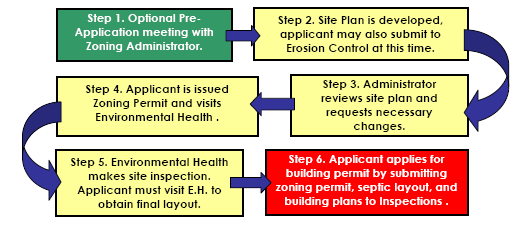
Step 1. Pre-Application Meeting
A.
Prior to the initiation of any work on a parcel of land, a zoning permit must be obtained from the Department of Planning and Development, through the Zoning Permit Clerk. If the work is non-residential (or multi-family residential) in nature, a non-residential site plan must be submitted.
B.
To begin the site plan process it is recommended that the applicant meet with the Zoning Administrator to discuss the regulations found in the Land Development Code that pertain to the project (Sections 8.2 and 8.3).
Step 2. Site Plan Development and Other Submittals
The applicant shall develop the site plan to meet the requirements detailed in Section 9.2. In addition, if an erosion control plan is required, it may be submitted to the Erosion Control Administrator at this time.
Step 3. Review and Necessary Changes
Zoning Administrator reviews site plan and requests any needed changes. In the event of a sign permit, the Administrator may visit the site to verify setbacks and other sign locations.
Step 4. Zoning Permit and Environmental Health
A.
Upon receipt of any necessary changes the Zoning Administrator shall issue a zoning permit and grading permit for the project.
B.
If necessary, the applicant must then visit the Environmental Health Division to discuss the project and set up a site visit. If sanitary sewer is to be used in lieu of a septic system, the applicant must furnish at the time of the permit application a letter from the entity owning or controlling the sewer granting approval to connect to the system.
Step 5. Environmental Health Inspection
A.
The Environmental Health Division will make a site inspection and develop a septic tank layout for the site. This will be made based on the topography, location of any structures and site improvements, the well, and other site features.
B.
If there is a problem with the layout and a system cannot be designed based on the construction that is being proposed, the applicant may need to make changes to the zoning permit, which will require contacting the Planning and Development Department.
C.
When the septic tank layout is complete, the applicant must physically obtain their copy from Environmental Health.
Step 6. Applicant Obtains Grading and Building Permits
A.
Once the septic tank layout and well permit is in hand, the applicant can then obtain their grading permit and submit their plans to Building Inspections.
B.
The grading permit will be issued by the Zoning Permit Clerk as a permit for site improvements.
C.
When the plans are approved through Building Inspections, the building permit may be issued.
Section 8.17. - Zoning Permit with Vested Rights.
It is recognized that it is necessary and desirable as a matter of public policy to:
1.
Provide for the establishment of certain vested rights in order to ensure reasonable certainty, stability, and fairness in the land use planning process, and
2.
Secure the reasonable expectations of landowners, and foster cooperation between the public and private sectors in land-use planning and development regulation.
The following section is provided based on G.S. 160D-108 and is referenced for additional clarification.
Permit Choice:
If a development permit applicant submits a permit application for any type of development and a regulation is amended, including an amendment to any applicable land development regulation, between the time the permit application was submitted and a decision is made, the application may choose which version of the rule or ordinance will apply to the permit. An applicant can choose which version of code regulations to follow when a change to the code has been made after an application has been filed with the County (160D-108(b))
Statutory vesting
1.
Six months. Building permits pursuant to G.S. 160D-1109 expire six months after issuance unless work under the permit has commenced. Building permits also expire if work is discontinued for a period of 12 months after work has commenced.
2.
One year. Other local development approvals pursuant to G.S. 160D-403(c), unless otherwise specified by statute or local ordinance expire one year after issuance unless work has substantially commenced. Expiration of a local development approval shall not affect the duration of a vested right established under this section or vested rights established under common law.
3.
Two to five years. Site-specific vesting plans. A vested right for a site-specific vesting plan shall remain vested for a period of two years. This vesting shall not be extended by any amendments or modifications to a site-specific vesting plan unless expressly provided by Iredell County. Site-specific vesting plans shall be vested for a period of two years but not exceed five years.
4.
Seven years. Multi-phase developments - Shall be vested for the entire development with the zoning regulations, subdivision regulations, and unified development ordinance in place at the time a site plan approval is granted for the initial phase of the multiphase development. For the purpose of this section, multi-phase developments are those that contain 25 acres or more that have submitted for development to occur in more than one phase and subject to a master development plan with committed elements showing the type and intensity of use of each phase.
In any case where an applicant desires to obtain a site-specific vesting plan authorized by NCGS 160D-108 the applicant shall submit a site specific development plan consistent with Article XIV shall be subject to Public Hearings by the Planning Board and Board of Commissioners as follows:
A.
Public Hearing. Notice of any Planning Board public meeting or Board of Commissioners public hearing shall be given as follows:
1.
A notice shall be published in a newspaper having general circulation in Iredell County once a week, for two (2) successive weeks, the first notice to be published NOT less than ten (10) days nor more than twenty-five (25) days prior to the date established for the Board of Commissioners public hearing.
2.
At least one (1) notice shall be conspicuously posted on the subject property at least ten (10) days prior to the Planning Board Meeting.
3.
A notice of the public hearing shall be sent by first class mail by the Planning Department to all adjoining property owners at least ten (10) days prior to the Planning Board meeting and the Board of Commissioners public hearing.
B.
Planning Board Review and Recommendation. Once the public meeting has been conducted, the Planning Board shall be given an opportunity to review the application and make a recommendation to the Board of Commissioners. The Planning Board shall have up to forty-five (45) days from the date the public meeting was concluded to make such recommendation. Alternatively, the Planning Board could request additional information of the applicant in order to aid them in their review of the application. If no recommendation is made during said forty-five (45) day period (except as herein provided) the application shall forthwith be forwarded to the Board of Commissioners.
C.
Board of Commissioners' Action. Once the public hearing has been conducted and concluded, the Board of Commissioners shall determine whether or not to approve the site-specific vesting plan and accord the vested right. In approving an application for vested rights of a site specific development plan, the Board of Commissioners may attach fair and reasonable ad hoc conditions which tend to support the required finding of facts as herein listed. The petitioner shall be given reasonable opportunity to consider and respond to any additional requirements prior to approval or denial by the Board of Commissioners. The Board of Commissioners may NOT require the landowner to waive his vested right as a condition of developmental approval.
The Board of Commissioners may approve the site specific development plan if it has evaluated an application and determined that:
1.
The use meets all required specifications of the Zoning Ordinance, and
2.
The use will NOT materially endanger the public health or safety and will NOT substantially injure the value of adjoining property if located where proposed. Conditions, if any, placed on the site specific development plan by the Board of Commissioners shall be adequate to meet this requirement.
3.
The site specific development plan is vested for a period of greater than two (2) years, this shall be based on one or more factors so described in Section 8.16 D.
The burden of proof of producing evidence to support these findings (and to overcome any challenges that approval of the site plan would be contrary to one or more of these findings) shall rest entirely with the landowner.
D.
Effect of Approval. The effect of the Board of Commissioners approving a site-specific development plan shall be to vest such site plan for a period of two (2) years from the date of approval. If the landowner requests, however, the Board of Commissioners may approve a vesting period NOT to exceed five (5) years from the date of approval. The vesting of any site plan beyond a two (2) year period may only be authorized by the Board of Commissioners where it is found that due to (i) the sizing and phasing of the development; or (ii) the level of investment; or (iii) the need for the development; or (iv) economic cycles; or (v) market conditions, and other considerations.
A vested right shall confer upon the landowner the right to undertake and complete the development and use of said property under the terms and conditions of the site specific development plan as provided for in this Section. Failure to abide by the terms and conditions placed upon such approval will result in the forfeiture of the vested right previously accorded.
A vested right, once established as herein provided, shall preclude any zoning action by the County which would change, alter, impair, prevent, diminish or otherwise delay the development or use of the property as set forth in the approved site specific development except under the following conditions:
1.
The affected landowner provides written consent to the County of his desire to terminate the vested right; or,
2.
The County determines, after having advertised and held a evidentiary hearing, that natural or man-made hazards exist on or in the immediate vicinity of the property which pose a serious threat to the public health, safety and welfare if the project were to proceed as indicated in the vested right; or,
3.
Compensation is made by the County to the landowner for all cost, expenses, and other losses incurred including, but NOT limited to, all fees paid in consideration of financing, and all architectural, planning, marketing, legal, and any other consultant's fees incurred after approval together with interest as provided in G.S. 160D-106; or,
4.
The County determines, after having advertised and held a evidentiary hearing, that the landowner or his representative intentionally supplied inaccurate information or made material misrepresentations that made a difference in the approval by the County of the vested right; or
5.
Upon the enactment or promulgation of a State or Federal law or regulations that precludes development as contemplated in the vested right. In such case the County may (after having advertised and conducted a evidentiary hearing) modify the affected provisions upon a finding that the change in State or Federal law has a fundamental effect on the plan.
Once a vested right is granted to a particular site specific development plan, nothing in this section shall preclude the County from conducting subsequent reviews and approvals to ensure compliance with the terms and conditions of the original approval, provided such reviews and approvals are NOT inconsistent with the original approval.
E.
Minor Modifications. A site specific development plan may be modified to the extent that changes in detail which do NOT change the basic relationship of the conditions set forth by the Board of Commissioners. Changes in detail which may be modified shall include, but NOT be limited to the reduction in square footage of buildings and signs, and the reduction in the number of buildings or lots.
Application for a minor modification shall include a new site specific development plan and a detailed description of the proposed changes. The Planning Director may authorize minor modifications to the site specific development plan. Any applicant may appeal the decision of the Planning Director to the Board of Commissioners. In no case shall a minor modification extend the approved vesting period for the site specific development plan.
F.
Revocation or Expiration of a Vested Right. The vested right resulting from the approval of a site specific development plan may be revoked by the Board of Commissioners as provided for in this Section. In addition, a revocation may occur if the Board of Commissioners determines that the landowner has failed to comply with the terms and conditions of the approval or with any other applicable portion of the Zoning Ordinance. The vested right shall otherwise expire at the end of the approval period established by the Board of Commissioners.
G.
Revocation of Building Permit. A building permit issued by Iredell County may NOT be revoked because of the running of time on a piece of property for which a site specific development plan has been approved and the vested right period has NOT otherwise expired.
H.
Amendments to the Zoning Ordinance. The establishment of a vested right on a piece of property for a site specific development plan shall NOT preclude the County from establishing and putting into place one or more overlay districts which may impose additional restrictions on said property, provided such restrictions do NOT affect the allowable type or intensity or use. Otherwise such regulations shall become effective with respect to the subject property upon the expiration or termination of the vested right. The County may also enforce on the property any additional regulations (adopted during the time the vested right was in effect) which are general in nature and applicable to all property subject to the regulations of this Ordinance.
(Ord. of 4-20-2021(1))
Section 8.18. - Reserved.
Editor's note— An ord. adopted Sept. 18, 2018(2), § 6, repealed § 8.18, which pertained to floodplain development permits and derived from the original Land Development Code.

