
Love Valley City Zoning Code
CHAPTER 5
- LANDSCAPING AND SCREENING
Section 5.1.- Purpose.
It is the intent of this section to enhance the natural environment and quality of life for the citizens of Iredell County and also protect the public health, safety, and general welfare by:
•
Reducing carbon dioxide levels in the atmosphere;
•
Preventing and reducing soil erosion;
•
Reducing stormwater runoff between properties;
•
Providing shade and thereby reducing surface level heat associated with pavement;
•
Increasing natural buffers and thereby reducing the effects of wind and noise;
•
Strengthening and protecting property values; and
•
Improving community appearance.
Section 5.1.1. - General Provisions for Landscaping.
The following landscape treatments shall be provided as set forth in this chapter or as may otherwise be required for a use or situation as required by this Ordinance.
Section 5.1.2. - Proper Planting Season.
Landscape and tree planting requirements may be deferred to an appropriate planting season based on a decision made by the Zoning Administrator in order to facilitate a property owner's desire to obtain a certificate of occupancy. A temporary certificate of occupancy may be issued on the grounds that the required landscaping is planted at a time deemed suitable by the Zoning Administrator. This provision is meant to allow for seasonal extremes in weather and soil conditions which may be incompatible to landscaping. It is not, however, meant to be used in any way to circumvent the intent and purpose of this Ordinance.
Section 5.1.3. - Maintenance.
The current owner(s) and subsequent owners of the landscaped property shall be responsible for the maintenance of all landscaped and/or buffer areas. Said areas shall be maintained so as to present a healthy, neat, and orderly appearance at all times and shall be kept free of refuse and debris even if active operations cease. Maintenance shall include the replacement of all dead or diseased plant material if that material was shown on the original landscape plan.
Section 5.1.4. - Visibility.
In no case shall the screening or buffering device required by this section interfere with visibility at intersections as set forth in Section 2.2.8 or with visibility at entrances and exits at public streets. In addition, such screening shall not be required to the extent that in the opinion of the Zoning Administrator, the screen would interfere with driveway visibility.
Section 5.1.5. - Exceptions.
A.
Where a non-residential development in either a commercial or industrial zoned district is proposed on a parcel adjoining a residentially zoned parcel, the buffering and screening requirements will not apply if any one of the following conditions are met:
1.
The adjoining parcel has the same ownership as the parcel being developed and the adjoining lot is of sufficient width to meet the minimum lot widths established in this Ordinance per Chapter 2.
2.
The parcel is a legal non-conforming use and there is not sufficient land area to install buffers, due to existing building, parking, septic areas, etc.
3.
Where topography exists such that the effect of the screening or buffering cannot be achieved.
4.
The adjoining parcel is identified as a non-residential classification in the Land Use Plan and is vacant or used commercially.
5.
The adjoining parcel has either a commercial or industrial use as identified in the Table of Permitted and Special Uses.
B.
Emergency services located in any district may be exempt from part of these requirements in this chapter where installing the landscaping may interfere with visibility when exiting the site.
Exceptions above do not apply if a Performance Requirement in Chapter 3 includes buffering and screening.
(Ord. of 12-5-17(2))
Section 5.2. - Buffering and Screening.
A.
The requirement for the installation of a buffering or screening device shall be initiated by the occurrence of any one or more of the following activities on the non-residential property:
1.
The initial use, development or occupancy of the non-residential property;
2.
Any change in use or occupancy of the non-residential property which results from a change in the zoning classification; and/or
3.
Any building expansion that increases the floor area of the non-residential use or any addition of parking that provides ten (10) or more spaces, whether required or not.
B.
Buffering and screening devices shall be provided along the full length of any property line or around the perimeter of the operational area as shown on the site plan.
C.
The buffering and screening devices shall be provided by the non-residential use even if the abutting residentially zoned land is vacant. However, if the proposed use of the adjoining property is a non-residential use as identified on the Land Use Plan, the buffering device will not be required.
D.
Buffering and screening devices apply to non-residential uses that adjoin the R-A, RU-R, R-R, R-20, R-12, or R-8 zoning districts. See Table 5.1 to determine which device applies.
Table 5.1 Buffering & Screening Applications
Section 5.2.1. - Buffering Requirements.
A.
Any non-residential use located in either the R-O, O-I, N-B, H-B, or G-B districts and located on property abutting any R-A, RU-R, R-R, R-20, R-12, or R-8 district, unless separated by a public street or railroad right-of-way, shall provide a buffering device as described below.
B.
The buffering device is intended to minimize visual contact and to create an impression of spatial separation between uses which are incompatible in nature. The buffer may be composed of a wall, fence, planted vegetation, or existing vegetation.
1.
Where planted vegetation is used, a buffer strip shall be planted. This strip shall be free of all encroachment of structures, parking areas, or other impervious surfaces (except driveways). The amount of buffer materials to be planted per one hundred (100) linear feet shall be as indicated in the diagrams below.
a.
Uses in GB, HB, & NB districts must provide a thirty (30) foot wide buffer using the following plantings (see Figure 5.1):
•
Four (4) canopy trees;
•
Three (3) Understory trees; and
•
Twenty-four (24) shrubs.
Figure 5.1 Thirty-Foot Buffer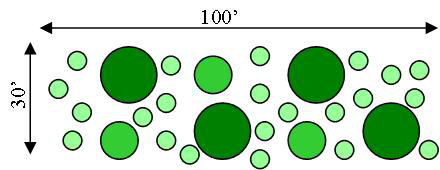
b.
Uses in RO & OI districts must provide a twenty (20) foot wide buffer using the following plantings. (See Figure 5.2):
•
Three (3) canopy trees;
•
Two (2) understory trees; and
•
Fifteen (15) shrubs.
Figure 5.2 Twenty-Foot Buffer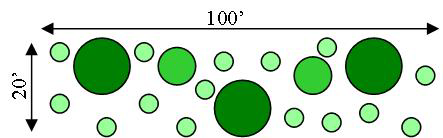
2.
Where a wall is used, it shall be constructed of brick, stone or masonry and shall be at least six (6) feet in height with a ten (10) foot wide buffer (See Figure 5.3) of evergreen shrubbery planted on the side of which faces the adjoining property and completely blocks the view from one land-use to another.
3.
Where a fence is used, it shall be constructed of durable wood or vinyl material and shall be at least six (6) feet in height with a ten (10) foot wide buffer (See Figure 5.3) of evergreen shrubbery planted on the side of which faces the adjoining property and completely blocks the view from one land-use to another.
Figure 5.3 Fence Buffer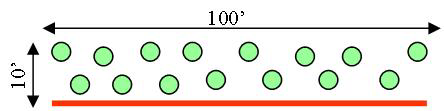
4.
Where an existing buffer area exists, further planting and/or improvements shall not be required, provided said buffer area is of sufficient width and depth and contains adequate and sufficient materials to meet the requirements of this Ordinance. If the buffer area is deficient, the developer shall make needed improvements and/or additions to satisfy the buffering requirements and intent of this Ordinance.
Section 5.2.2. - Screening Requirements.
A.
Any non-residential use located in either the M-1 or M-2 districts or any outdoor storage associated with any non-residential use in either O-I, N-B, H-B, G-B, M-1 or M-2 districts and located on property abutting any R-A, RU-R, R-R, R-20, R-12, R-8, or R-O district, unless separated by a public street or railroad right-of-way, shall provide a thirty-foot landscaping buffer as well as a screening device within the buffer as described below.
B.
The screen is intended to block visual contact between uses and to create a strong impression of spatial separation. A screening device shall be at least ninety (90) percent opaque from the ground to a height of at least six (6) feet. The screen may be composed of a wall, fence, planted vegetation, or existing vegetation. Compliance of planted vegetative screens or natural vegetation will be judged on the basis of the average mature height and density of foliage of the subject species, or field observation of existing vegetation. Planted vegetation must be a minimum of four (4) feet high and one (1) inch in diameter, measured six (6) inches above grade, when planted.
C.
In any case where vegetation, either existing or proposed, is to be used as the required screening device, if the vegetation is to be less than ten (10) feet in width (thickness), a fence, wall or similar device at least fifty (50%) percent opaque and six (6) feet in height shall be used in combination with the vegetation. In all cases, the screen must be at least ninety (90%) percent opaque in all seasons of the year. Existing vegetation must be equivalent of four (4) feet high and one (1) inch in diameter, measured six (6) inches above grade, upon issuance of a certificate of occupancy for the use.
Section 5.3. - Parking Lot Landscaping.
A.
In any zoning district where parking spaces for twenty-five (25) cars are required or provided for a use or uses on a site, the parking lot shall be landscaped with canopy trees as required by this section at the rate shown below. This requirement shall be initiated by the initial use or development of the property. In addition, in any case where ten (10) parking spaces are added to an existing development, whether required or not, the entire parking lot including existing parking areas shall be landscaped if the total on the site then equals twenty-five (25) or more.
B.
Canopy trees shall be provided at a rate of one (1) canopy tree for each twelve (12) spaces. Required canopy trees shall be distributed throughout the parking area and shall be located within or adjacent to parking lots as tree islands, at the end of parking bays, inside medians or between rows of parking spaces. In no instance shall canopy trees required in this section be located more than ten (10) feet from the parking area. Canopy trees must be a minimum of six (6) feet high and one (1) inch in diameter, measured six (6) inches above grade at planting.
C.
Parking lots for uses permitted in residential districts that adjoin any lot zoned for residential purposes are required to provide a ten (10) foot landscaping buffer with a continuous screen. This includes parking lots where the property is zoned residential across a road right-of-way. The screen shall consist of evergreen shrubs that are a minimum of three (3) feet high when planted and will grow to at least four (4) feet high at maturity.
Section 5.4. - Landscape Roadway Yard.
A.
A landscaped roadway yard is a landscaped area parallel to the public roadway designed to provide continuity of vegetation along the right-of-way and a pleasing view from the road. A landscaped roadway yard shall be provided by each use located on a minor thoroughfare or higher classified road. The requirement for a landscaped roadway yard shall be initiated by the occurrence of the same activities as set forth in Section 5.2.
B.
The landscaped area shall be penetrated only by driveways and crosswalks. The minimum width of the roadway yard shall be fifteen (15) feet measured from and parallel to the public road right-of-way or future right-of-way as designated by the Iredell County Thoroughfare Plan, whichever is most restrictive. It shall be landscaped and maintained with a combination of trees and shrubs, consisting of a minimum of one (1) tree and ten (10) shrubs for each fifty (50) feet.

