
Love Valley City Zoning Code
CHAPTER 7
- PARKING
Section 7.1.- Purpose.
This chapter provides the requirements for number, size, configuration, and other requirements for parking. This parking ordinance strives to protect pedestrians and motorists, minimize vehicular conflict, and limit property damage by reserving the proper amount and size of parking spaces for respective uses.
Section 7.2. - Off-Street Parking Requirements.
There shall be provided at the time of the erection of any building, or at the time any principal building is enlarged or increased in capacity by adding dwelling units, guest rooms, seats, or floor area; or before conversion from one type of use or occupancy to another, permanent off-street parking space in the amount specified by this section.
Section 7.2.1 - Table of Minimum Off-Street Parking Requirements.
Any fraction derived from the formulas found below shall be rounded up to the next whole number (e.g., 47.3 calculated required parking spaces equates to forty-eight (48) required parking spaces). The following off-street parking spaces shall be required:
Section 7.2.2. - Agricultural and Residential Uses.
Section 7.2.3. - Recreational, Educational, and Institutional Uses.
Section 7.2.4. - Commercial Uses.
Section 7.2.5. - Flexibility of Administration.
The presumptive standards set forth in the parking requirements table cannot cover every possible use or situation, nor can the table be considered exact. Therefore, the administrator is given flexibility to administer this section as follows:
A.
Parking space requirements for a use not identified in the table shall be based on a similar, listed use.
B.
In the case of unique land uses or those that have unusually high parking requirements, the landowner shall demonstrate to the administrator that sufficient off-street parking can be provided.
C.
Deviations from the number of spaces are permitted when the administrator determines that the requirements for a particular situation are unreasonable. The reasons for allowing the deviation or requirements shall be noted in writing by the administrator.
Section 7.2.6. - ADA Compliance.
Handicapped spaces should be provided in accordance with the Americans with Disabilities Act and the state building code. Handicapped spaces count towards the minimum off-street parking requirements.
Section 7.2.7. - Combination of Required Parking Spaces.
The required parking spaces for separate uses may be combined in one lot or parking structure, however the required parking spaces assigned to one use may not be assigned to another use at the same time.
Section 7.2.8. - Day Time/Night Time Assignments.
One-half (½) of the required parking spaces for churches, theaters, or assembly halls whose peak attendance is at night or Sundays may be assigned to a use which will be closed at night or Sundays.
Section 7.2.9. - Remote Parking.
For all off-street parking lots the required number of parking spaces shall be provided on the same parcel with the use or on a lot separated there from by not more than four hundred (400) feet, except for residential uses which must be provided on the same parcel.
Where provision of required off-street parking for a building or other uses established subsequent to the adoption of this section involves one (1) or more parcels or tracts of land that are not a part of the plot on which the principal use is situated, the applicant for a permit for the principal use shall submit with his application for a zoning permit an instrument duly executed and acknowledged, which describes the parcels or tracts of land to parking uses in connection with the principal use for which it is made available. The applicant shall cause said instrument to be registered in the office of the Register of Deeds upon the issuance of a zoning permit.
Parking in one zoning district in connection with a use not permitted in that district shall be permitted in accordance with the following:
•
Business and Office uses may park in Industrial Districts.
•
Industrial and Office uses may park in Business Districts.
•
Residential uses may park in Business, Office and Industrial Districts.
In addition, any use located in one zoning district which is also a permitted use in another zoning district may also park in such other zoning district in which the use is permitted.
Section 7.3. - Parking Lot Design and Location Requirements.
All off-street parking lots including exits, entrances, drives, and parking areas shall meet the following requirements.
A.
Parking spaces must be designed to allow for traffic movement in accordance with the principles of Section 7.2.1 and Figure 7.1.
B.
Parking lot spaces must be clearly marked before the issuance of a certificate of occupancy or before the parking lot is opened to the intended users, whichever comes first. Parking spaces and space markings must be maintained as long as the use which they serve exists. Examples of acceptable permanent markings include paint, stone wheel stops, or wheel stops.
C.
Parking lots must have physical access to a public street.
D.
Parking lots must be designed so that all access to the public street is by forward motion.
E.
Parking lots must be graded, properly drained, stabilized and maintained to prevent dust and erosion.
F.
The maximum grade permitted for any required parking shall not exceed five (5) percent.
G.
Any driveway connecting to a public street from a parking lot for six (6) or more cars shall be constructed with a hard surface for the portion of the driveway within twenty (20) feet of the public street travel way.
H.
Lots of six (6) or more cars shall not be located within ten (10) feet of any public right-of-way line.
I.
On major thoroughfares or roads of higher classification, a minimum of sixty (60) percent of parking spaces must be located in the rear or side yard. For the purposes of this item the front yard is defined as the yard with frontage on the road receiving the most traffic. Parking lot additions must be located in the rear or side yard, unless parking spaces added to the front yard do not exceed forty (40) percent of the total number of spaces.
J.
All parking areas must connect to adjacent parking areas where feasible.
K.
At the Zoning Administrator's discretion, some parking areas may be exempted from the parking requirements B., G., and I. above and the landscaping requirements of Sections 5.3 and 5.4. Land uses that may qualify for these exemptions may include temporary or seasonal events, agricultural tourism uses, rural commercial recreational uses, or other uses where cars park infrequently and a permanent parking area is not necessary.
Section 7.3.1. - Parking Space and Aisle Dimensions.
A parking space is the storage space of one (1) automobile. Parking space size shall be in accordance with Section 7.2.1, parking space dimensions. Parking aisle width must be in accordance to Figure 7.1, Aisle Widths. All two-way parking aisles must be twenty-six (26) feet wide. One-way parking aisles can range from twelve (12) feet to twenty-four (24) feet wide, depending on the angle of the parking space.
Table 7.2 Parking Space Dimensions
Figure 7.1: Aisle Widths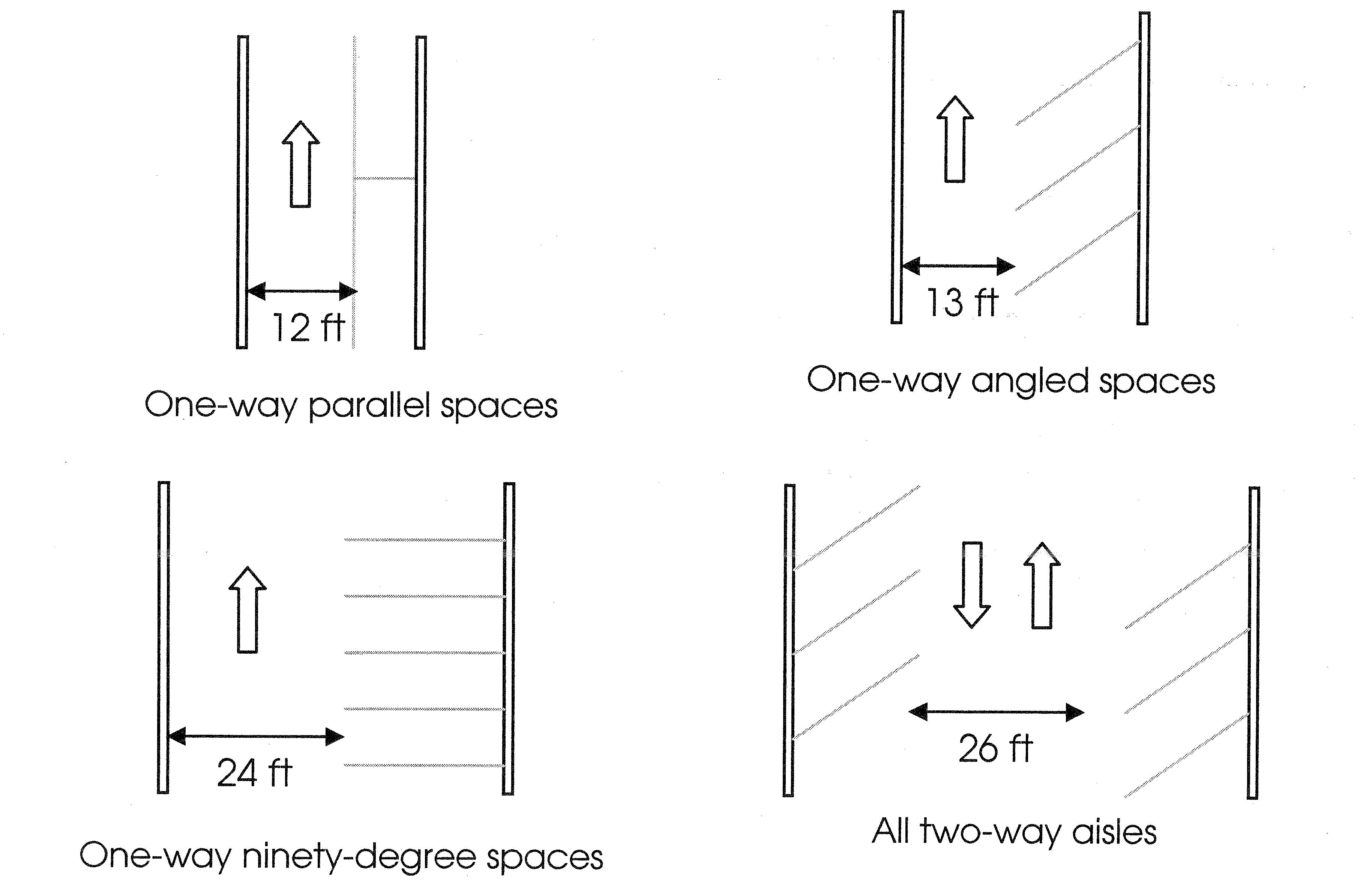
Section 7.3.2. - Impervious Parking Requirements.
This section applies to those areas that are not covered under a state or federally-mandated stormwater program.
A.
Parking lots shall not drain onto or across public sidewalks or into adjacent property, except into a natural watercourse or drainage easement. In already developed areas where this condition would be impossible to meet, the Director may exempt the applicant from this requirement, provided that adequate provision is made for drainage.
B.
For development projects that contain at least one (1) acre of vehicular surface area or result in an increase of one (1) acre of vehicular surface area one of the following shall apply:
1.
No more than eighty (80) percent of the vehicular surface area may be impervious surface; or
2.
The stormwater runoff generated by the first two (2) inches of rain that fall on at least twenty (20) percent of the vehicular surface area during a storm event must flow to an appropriately sized bioretention area that is designed in accordance with the standards established by the North Carolina Division of Water Quality, or the stormwater must flow into an approved stormwater system.
Section 7.3.3. - Landscaping.
See Chapter 5, Sections 5.3 and 5.4, for parking lot landscaping requirements.

