
Mason County Unincorporated
City Zoning Code
City Zoning Code
CHAPTER 17
30 - BUILDING DESIGN REQUIREMENTS IN THE BELFAIR UGA
17.30.010 - Purpose.
The purpose of this section is to:
(1)
Reduce the bulk and mass of large buildings.
(2)
Add visual interest to buildings.
(3)
Retain Belfair's small town character.
(4)
Encourage the utilization of design details and small-scale elements in the design of buildings so that they are attractive at a pedestrian scale.
(5)
Achieve a human scale by including elements that provide visual clues to the size of the building and activity within.
(6)
Encourage pedestrian activity.
(7)
Encourage the use of high quality and durable building materials.
(Ord. 133-04 Att. B § 2 (part), 2004).
17.30.020 - Standards.
The following standards apply to all commercial and multi-family development unless otherwise noted (developments in the B-I zone are exempted). The Mason County planning director may waive one or more of these standards where the applicant can demonstrate that such building design standards are not applicable since the applicable building or buildings are screened from public view from the street or adjacent properties and such design features are not typically found on buildings proposed for the subject use (retail and multi family uses shall not be exempted in any case).
(1)
Multi-story buildings shall include modulation and/or articulation features. Specifically, commercial buildings shall provide at least two of the modulation and articulation features listed below along the street front or primary façade at intervals of no more than fifty feet. Multi-family buildings shall provide at least two of the modulation and articulation features below along the street front or primary façade at intervals of no more than forty feet.
Modulation and/or articulation methods:
(A)
Providing building modulation of at least six feet in depth and six feet in width (required for multi family residential buildings);
(B)
Repeating distinctive window patterns at intervals less than the articulation interval;
(C)
Providing a porch, patio, deck, or covered entry for each articulation interval;
(D)
Providing a balcony or bay window for each articulation interval;
(E)
Changing the roofline by alternating dormers, stepped roofs, gables, or other roof elements to reinforce the modulation or articulation interval;
(F)
Changing materials and/or color with a change in building plane;
(G)
Providing lighting fixtures, trellis, tree, or other landscape features within each interval;
(H)
Using recessed building entries, plazas, courtyards, or seating and plantings areas;
(I)
Using alternative methods to shape a building such as angled or curved façade elements, offset planes, or terracing;
(J)
Using other methods as approved by the county as long as they meet the intent of the standards.
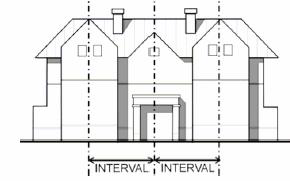
Figure 14. An example of building articulation.
(2)
Buildings greater than one hundred feet in length along the street front and/or primary façade should provide an additional special design features (for example: a broken or articulated roofline, inset or gabled entry, dormer, chimney, stepped roof, gable, prominent cornice or fascia, clock tower, fountain, or pedestrian open space) to add visual interest.
(3)
For commercial structures over forty thousand square feet in gross building footprint such as a grocery store, smaller uses and activities should be clustered near the entrance as shown on Figure 15. Alternatively, developments can provide at least six hundred square feet of pedestrian-oriented space near the building entry.
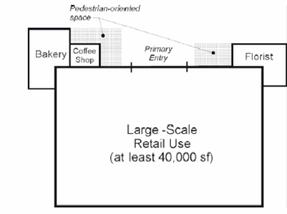
Figure 15. An example of clustering smaller uses near an entry of large commercial structures.
(4)
All buildings must employ at least two of the following elements or techniques toward achieving human scale. If a proposed building is over three stories in height, or more than one hundred feet wide as measured along any façade facing a street and visible from that street, the building shall use at least three of the following listed elements:
(A)
Balconies or decks in upper stories at least six feet deep and six feet wide. At least one balcony or deck per upper floor on the facades facing streets;
(B)
Bay windows that extend out from the building face at least one foot measured horizontally in upper stories, at least one per floor on the facades facing the street;
(C)
Individual windows in upper stories;
(D)
Multiple-paned fenestration (windows with multiple panes);
(E)
At least one hundred fifty square feet of pedestrian-oriented space;
(F)
Gable or hipped roof, providing that the hipped or gable roof covers at least one half of the building's footprint and has a slope greater or equal to three feet vertical in twelve feet horizontal;
(G)
A porch, covered entry, trellis, gateway feature, or similar element;
(H)
Upper story setbacks, providing one or more of the upper stories are set back from the face of the building at least six feet;
(I)
Any of the features noted in the "pedestrian-oriented facades" definition;
(J)
Other, similar method approved by the county. All proposals for achieving human scale are subject to approval by the county.
(5)
All buildings facing a street, park, public walkway, or parking area must include at least three of the following design detail elements:
(A)
Sculptural, mosaic, or other architectural details;
(B)
Transparent window area or window displays along at least fifty percent of the length of the ground floor façade for retail;
(C)
Pedestrian weather protection;
(D)
Decorative light fixtures;
(E)
Landscape trellises;
(F)
Decorative building materials incorporated into the building facade, including decorative masonry, shingles, brick, or stone;
(G)
Individualized patterns or continuous woods details such as fancy butt shingles in a geometric pattern, decorative moldings, brackets, wave trim or lattice work, ceramic tile, stone, glass block or similar materials;
(H)
Other materials with decorative or textural qualities as approved;
(I)
Gable or hipped roof, provided the hipped or gable roof covers at least one half of the building's footprint and has a slope greater or equal to six feet vertical in twelve feet horizontal;
(J)
Building articulation, with the upper story set back from the face of the building at least six feet or projecting out (forward) at least two feet;
(K)
Decorative artwork;
(L)
Other, similar element approved by the county. All proposals for achieving human scale are subject to approval by the county.
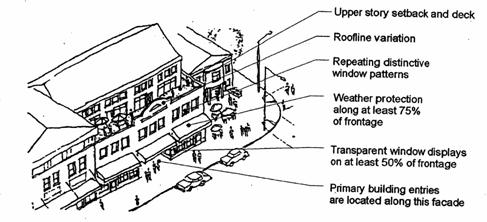
Figure 16. An example development illustrating some of the desired design details.
(6)
All buildings must provide a covered entry (such as an overhang, awning, or canopy) on their primary facade.
(7)
Untreated blank walls visible from public streets, sidewalks, pedestrian areas, and parking areas are prohibited. Where unavoidable, blank wall treatment should be provided in one or more of the following ways:
(A)
Installing a vertical trellis in front of the wall with climbing vines or other plants;
(B)
Landscaping that covers fifty percent of wall area within three years of planting;
(C)
Special materials (e.g., decorative patterned masonry);
(D)
Display windows;
(E)
Artwork or other treatment approved by the county.
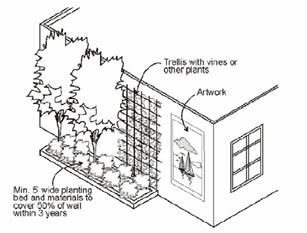
Figure 17. Blank wall treatments.
(8)
Durable and high-quality exterior materials must be used on buildings visible from a public right-of-way, pedestrian area, or parking lot. Highly reflective materials are not allowed. Materials should be typically used in the Northwest, including, but not limited to:
(A)
Bevel or lap siding;
(B)
Rock, stone, and brick material;
(C)
Architectural shake-style or "asphalt" shingle roofing;
(D)
Metal roofs.
(9)
If sheet materials (for example: composite fiber products or metal siding) are used as a siding material over more than twenty-five percent of a building's façade visible from a public right-of-way, pedestrian area, or parking lot, then material with a matted finish in a color must be used. The following must also be done:
(A)
Visible window and door trim painted or finished in a complementary color;
(B)
Corner and edge trim that covers exposed edges of the siding material.
(10)
All prefabricated metal buildings visible from a public right-of-way, pedestrian area, or parking lot shall include at least three of the following features:
(A)
Porch or recessed entry;
(B)
Overhanging eaves;
(C)
Visible trim at least four inches wide around all doors and windows in an accent color;
(D)
Other building elements such as a cupola, building wing, trellis, portico, etc.;
(E)
Picture windows or adjoining windows totaling at least thirty-two square feet;
(F)
Canopy or other weather protection feature over an adjacent walkway;
(G)
Other feature that meets the intent of the standards and as approved by the county.
(11)
If concrete blocks (concrete masonry units or "cinder blocks") are used for walls that are visible from a public right-of-way, pedestrian area, or parking lot, use one or more of the following architectural treatments:
(A)
Textured blocks with surfaces such as split-face or grooved;
(B)
Colored mortar;
(C)
Other masonry types, such as brick, glass block, or tile, in conjunction with concrete blocks;
(D)
Other similar treatment acceptable to the county.
(12)
Do not use the following materials for walls that are visible from a public right-of-way, pedestrian area, or parking lot unless an exception is granted by Mason County:
(A)
Mirrored glass;
(B)
Corrugated fiberglass;
(C)
Chain-link fences in front yards;
(D)
Synthetic materials with reflective surfaces, including galvanized steel and glossy vinyl siding.
(Ord. 133-04 Att. B § 2 (part), 2004).

