
Mason County Unincorporated
City Zoning Code
City Zoning Code
CHAPTER 17
33 - SAFETY IN THE BELFAIR UGA
17.33.010 - Purpose.
The purpose of this section is to:
(1)
To reduce criminal activity by providing natural surveillance opportunities onto public and semi-public spaces;
(2)
To ensure that a development's circulation system, parking areas, sidewalks, and open spaces contribute a perception of residential and controlled space where illegal activity will be observed and reported;
(3)
To encourage design measures that create a sense of individual territory and community responsibility by residents.
(Ord. 133-04 Att. B § 2 (part), 2004).
17.33.020 - Standards—Non-single residential development.
The following standards apply to all non-single family residential development:
(1)
Entries and pedestrian walkways shall be emphasized with lighting and landscaping so that occupants and guests can clearly see them;
(2)
Well-lit parking areas and walkways (at least two foot-candles evenly distributed on the ground) which allow users to identify faces at a reasonable distance and choose an appropriate route shall be provided. Avoid dead-ends or isolated places for pedestrian walkways.
(Ord. 133-04 Att. B § 2 (part), 2004).
17.33.030 - Standards—Multi-family residential development.
The following standards apply to all multi family residential development:
(1)
Multiple family residential development sites should be designed to assure that the following contribute to natural surveillance and provide for the personal safety for residents:
(A)
Orientation of a building,
(B)
Placement of windows and doors,
(C)
Alignment of sidewalks and paths,
(D)
Locations and levels of lighting,
(E)
Design and size of open spaces;
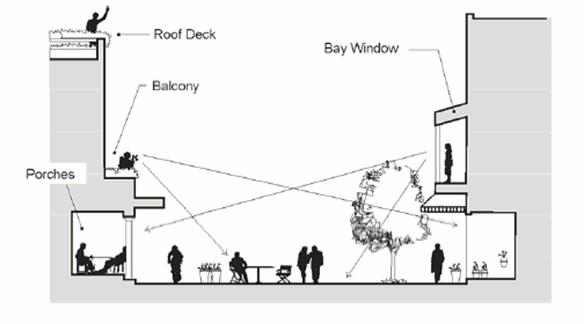
Figure 21. Design for safety by maximizing surveillance of common open spaces.
(2)
Buildings shall be arranged to allow visibility from dwelling units to open space areas, parking lots, and pedestrian walkways;
(3)
Entrances should be prominent and highly visible from other buildings and public areas;
(A)
Open spaces should be located in central areas to maximize resident's access the space and improve its visibility from surrounding dwelling units,
(B)
Windows, openings, and lighting should be included to provide visibility into common areas such as laundry rooms, mail kiosks, parking garages, exercise rooms, stair wells, and other parts of the site,
(C)
Windows on the street front façade should be provided, where possible, to provide views of the street for security,
(D)
Children's play areas must be centrally located, visible from dwelling units, and away from hazardous areas (garbage dumpsters, streets, parking areas, woods);
(4)
Attractive paved pedestrian walkways shall be provided, where applicable, for visible and convenient access between buildings, open space, public sidewalks, transit sites, and parking areas;
(5)
The visual and spatial transition between the living area of a residence and the street should be emphasized. This means providing a partial visual screen or space-defining element between the interior residential space and the public sidewalk.
Specifically:
(A)
Raise the ground level dwelling windows or provide landscaping as a transition, particularly where setbacks are minimal;
(B)
Avoid exterior access corridors next to dwelling windows on upper floors;
(C)
Provide appropriate screening and buffering to create a physical separation between pedestrians on the sidewalk and the windows of a residential unit.
(Ord. 133-04 Att. B § 2 (part), 2004).

