
Menomonee Falls Village
City Zoning Code
City Zoning Code
ARTICLE I
- ADMINISTRATION
Sec. 122-1. - Authority.
The regulations of this chapter are adopted under the authority granted by Wis. Stats. §§ 61.35, 61.351, 62.23(7), 87.30 and 144.26. Therefore, the village board does ordain as provided in this chapter.
Sec. 122-2. - Applicability and jurisdiction.
These regulations apply to all public and private use and development of properties within the corporate limits of the village, except as provided by state or federal law or as otherwise expressly stated in this chapter. The jurisdiction of this chapter shall include all lands and waters within the corporate limits of the village. The jurisdiction of this chapter shall also extend to those lands and waters lying within the unincorporated areas within one and one-half miles of the corporate limits that are approved by a majority of the members of the appropriate joint extraterritorial zoning committee pursuant to Wis. Stats. § 62.23(7a).
Sec. 122-3. - Purposes.
These regulations are adopted for the purposes of:
(1)
Promoting the health, safety, morals, prosperity, aesthetics and general welfare of the village;
(2)
Implementing the policies and goals of the village comprehensive plan and other relevant, officially adopted plans of the village; and
(3)
Achieving all of the other purposes and intent statements contained in this Code.
State Law reference— Purpose of zoning ordinances, Wis. Stats. §§ 61.35, 62.23(7)(c).
Sec. 122-4. - Intent of chapter.
It is the general intent of this chapter to regulate and restrict the use of all structures, lands and waters; regulate and restrict lot coverage, population distribution and density, and the size and location of all structures so as to: lessen congestion in and promote the safety and efficiency of the streets and highways; secure safety from fire, flooding, panic and other dangers; provide adequate light, air, sanitation and drainage; prevent overcrowding; avoid undue population concentration; facilitate the adequate provision of public facilities and utilities; stabilize and protect property values; further appropriate use of land and conservation of natural resources; preserve and promote the beauty of the community; and implement the community's comprehensive plan or plan components. In addition, the floodland zoning regulations set forth in this chapter have been adopted to prevent and control erosion, sedimentation, and other pollution of surface waters; to further the maintenance of safe and healthful water conditions and prevent flood damage to persons and property; and to minimize expenditures for flood relief and flood control projects. To this end, it is further intended to provide for the administration and enforcement of this chapter and to provide penalties for its violation.
Sec. 122-5. - Abrogation and greater restrictions.
It is not intended by this chapter to repeal, abrogate, annul, impair or interfere with any existing easements, covenants, deed restrictions, agreements, chapters, rules, regulations or permits previously adopted or issued pursuant to laws. However, whenever this chapter imposes greater restrictions, the provisions of this chapter shall govern.
State Law reference— Conflicts with zoning ordinances, Wis. Stats. §§ 61.35, 62.23(7)(g).
Sec. 122-6. - Interpretation.
In their interpretation and application, the provisions of this chapter shall be held to be minimum requirements and shall be liberally construed in favor of the village and shall not be deemed a limitation or repeal of any other power granted by the state statutes.
Sec. 122-7. - Compliance.
(a)
Land or water may not be used for any purpose other than ones that are allowed by the provisions of this chapter and all other applicable local, county, state and federal regulations.
(b)
A building or structure may not be erected, located, moved, reconstructed, extended, converted or structurally altered except as allowed by this chapter.
(c)
Buildings, structures and land shall only be used and occupied in compliance with the provisions of this chapter.
(d)
All lots created or modified must comply with all applicable provisions of this chapter, and chapter 94 of this Code.
Sec. 122-8. - Municipalities and state agencies regulated.
Unless specifically exempted by law, all cities, villages, towns, school districts and counties are required to comply with this chapter and obtain all required permits. State agencies are required to comply as provided in Wis. Stats. § 13.48(13). The construction, reconstruction, maintenance, and repair of state highways and bridges by the state department of transportation are exempt from compliance when Wis. Stats. § 30.12(4)(a) applies.
Sec. 122-9. - Nonliability.
The village does not guarantee, warrant or represent that only those areas designated as floodlands on the zoning district map or those lands contained within the conservancy-wetland zoning district will be subject to periodic inundation and hereby asserts that there is no liability on the part of the village board, its agencies or employees for any flood damages that may occur as a result of reliance upon and conformance with this chapter.
Sec. 122-10. - Zoning map.
(a)
Establishment. The location and boundaries of the zoning districts defined in these regulations must be established by ordinance and shown on the zoning map, which shall be available for inspection in the office of the zoning administrator.
(b)
Interpretation. Where the street or lot layout actually on the ground, or as recorded, differs from the street or lot lines as shown on the zoning map, the zoning administrator shall interpret the map in such a way as to carry out the intent and purposes of these regulations for the particular section or district in question. In case of any question as to the location of any boundary line between zoning districts, a request for interpretation of the zoning map may be made to the zoning board of appeals.
Sec. 122-11. - Delegation of authority.
Whenever a provision appears requiring the zoning administrator, village manager, or another officer or employee to perform an act or duty, the provision will be construed as authorizing that person to delegate the responsibility to others over whom they have authority. Delegation of authority is not allowed when the provisions of these regulations expressly prohibit such delegation.
Sec. 122-12. - Zoning administrator.
(a)
The administration of this chapter shall be carried out by the zoning administrator who shall be designated by the village manager.
(b)
The zoning administrator shall investigate all complaints, give notice of violations, and enforce the provisions of this chapter. The zoning administrator and those acting at the zoning administrator's direction may enter at any reasonable time any public or private lands or waters to make a zoning inspection.
(c)
The zoning administrator shall maintain a permanent record of all permits issued.
(d)
In the case of uses in floodplain districts, the requirements of section 122-971 shall also apply.
Sec. 122-13. - Actions regarding permits, approvals or similar actions by village officers.
Whenever under this chapter a permit, approval or similar action by the zoning administrator is required:
(1)
The function of the zoning administrator is to determine, whether the proposed action complies with all of the requirements of this chapter, and all other applicable chapters, laws and regulations. The zoning administrator shall determine to their satisfaction that all applicants for permits in floodland districts have secured all necessary permits from those governmental agencies required to issue permits by state and federal law. After such determination, the zoning administrator shall issue all required permits and approvals, or deny approval in writing stating the reason for denial.
(2)
In any case the zoning administrator may require the applicant to submit such information or documentation of the plan or proposal and in such form, including verified form, as the zoning administrator reasonably determines to be necessary in order to enable a fully informed and considered decision. Enumeration in this chapter of the information or documentation to be submitted, or the absences of any such enumeration, is not exclusive. If the applicant fails within reasonable time to supply requested information or documentation, the zoning administrator shall reject the application on that grounds without concluding as to its merits and without prejudice to the right of the applicant to resubmit a new application.
(3)
The zoning administrator may also refer any matter to the plan commission for its determination concerning this chapter. In any such event, the determination of the plan commission shall be advisory to the zoning administrator. Whether or not the zoning administrator adopts the determination of the plan commission, the final decision shall be that of the zoning administrator, and any further appeal, whether to the board of appeals or otherwise, shall be from the decision of the zoning administrator, per section 122-76.
(4)
In any case in which approval or other favorable action of the plan commission is required or permitted under this chapter, the plan commission may grant such approval subject to submission to and approval by the zoning administrator of particular details or final documentation. It shall be understood that the zoning administrator shall grant or withhold any approval based upon applicable requirements of this chapter and of other applicable chapters, laws or regulations and upon the officers understanding of the intention and decision of the plan commission; and that if the applicant and the zoning administrator fail to agree, the matter shall be returned to the plan commission for its determination.
Sec. 122-20. - Village board.
(a)
Powers and duties. The village board has the powers and duties expressly identified in chapter 2 of this Code and the state statutes. In addition, as it relates to this chapter, the village board has the powers to approve the following:
(1)
Comprehensive plan and modifications thereto.
(2)
Comprehensive outdoor recreation plan and amendments thereto.
(3)
Zoning code and amendments thereto, including zoning map modifications.
(4)
Appeals of the plan commission or architectural control board decisions.
(5)
Conditional use permits.
(6)
Special yard exceptions.
(7)
Planned residential developments.
(8)
Planned infill developments.
(9)
Location of any public building, including additions and replacement of existing buildings and facilities.
(10)
Location of any statute or other memorial.
(11)
Location, acceptance, extension, alteration, vacation, abandonment, change of use, sale, acquisition, or lease of land for any street, alley, or other public way, park, playground, airport, area for parking vehicles, or other memorial or public grounds.
(12)
Location, extension, abandonment, or authorization for any public utilities whether publicly or privately owned.
(13)
Final subdivision plats within the village's platting jurisdiction, including its extraterritorial platting jurisdiction.
(14)
Certified survey maps containing dedications, reservations, or public easements.
(15)
Location, character, and extent, or acquisition, leasing, or sale of lands for public or semipublic housing, slum clearance, relief of congestion, or vacation camps for children.
(16)
All annexations, incorporations, or consolidations affecting the village.
Sec. 122-21. - Plan commission.
(a)
Establishment. The plan commission is established as provided in chapter 2 of this Code. Except as otherwise provided by state statutes, the meetings of the plan commission shall be open to the public.
(b)
Membership. The plan commission consists of seven members as provided in chapter 2 of this Code.
(c)
Regular meetings. Regular meetings of the plan commission are held at 6:30 p.m. on the first Tuesday after the first Monday of every month. Any regular meeting falling on a legal holiday, or an election day, is held the next week, on the same day. When the regular village board meeting occurs on a Tuesday due to a holiday, the regular plan commission meeting shall be held the next week, on the same day.
(d)
Special meetings. Special meetings of the plan commission may be called by the plan commission chairperson or the village manager.
(e)
Chairperson. The village president shall designate a chairperson of the plan commission from among the members of the plan commission. The village president is eligible to be the chairperson.
(f)
Organization. The plan commission shall organize and adopt rules for its own government in accordance with the provisions of this section.
(g)
Concurring vote. If a quorum is present, the plan commission may take action by a majority vote of the members present.
(h)
Minutes. Minutes of the proceedings and a record of all actions shall be kept by the secretary, showing the vote of each member upon each matter, the reasons for the commission's determination, and its finding of facts.
(i)
Powers and duties. The plan commission has the powers and duties that are expressly identified in this chapter and the state statutes, as well as the following:
(1)
Approve, modify, or deny the following requests:
a.
Zoning permits referred to them.
b.
Site plan reviews referred to them.
c.
Certified survey maps without dedications, reservations or public easements.
d.
Preliminary plats.
e.
Special height and lighting exceptions.
(2)
Recommend the village board of trustees approve, modify or deny the following requests:
a.
Comprehensive plan amendments.
b.
Zoning code or zoning map modifications.
c.
Conditional use permits.
d.
Comprehensive outdoor recreation plan amendments.
e.
Planned residential developments.
f.
Planned infill developments.
g.
Location of any public building, including additions to and replacement of existing buildings and facilities.
h.
Location of any statue or other memorial.
i.
Location, acceptance, extension, alteration, vacation, abandonment, change of use, sale, acquisition, or lease of land for any street, alley, or other public way, park, playground, airport, area for parking vehicles, or other memorial or public grounds.
j.
Location, extension, abandonment, or authorization for any public utilities whether publicly or privately owned.
k.
Final subdivision plats within the village's platting jurisdiction, including its extraterritorial platting jurisdiction.
l.
Certified survey maps containing dedications, reservations or public easements.
m.
Location, character, and extent, or acquisition, leasing, or sale of lands for public or semipublic housing, slum clearance, relief of congestion, or vacation camps for children.
n.
All annexations, incorporations, or consolidations affecting the village.
(3)
Recommend the architectural control board approve, modify or deny the following request:
a.
Village centre project review.
(j)
Decisions and appeals. Any person aggrieved by any decisions of the plan commission may appeal the decision to the village board of trustees pursuant to section 122-77.
Sec. 122-22. - Architectural control board.
(a)
Establishment. There is hereby established an architectural control board for the village for the purpose of promoting compatible development, aesthetics, stability of property values, and to prevent impairment or depreciation of existing developments. Except as otherwise provided by state statutes, the meetings of the architectural control board shall be open to the public.
(b)
Membership. The architectural control board shall consist of seven members appointed by the village president and confirmed by the village board.
(c)
Composition. Composition of the architectural control board is to be as follows when practicable:
(1)
Four of the architectural control board members shall be residents of the village.
(2)
Two of the architectural control board members should be registered architects or landscape architects.
(3)
One of the architectural control board members should be a real estate broker or appraiser.
(4)
One of the architectural control board members should be a builder, contractor or developer.
(d)
Terms. Terms shall be staggered for three-year terms. Vacancies shall be filled for the unexpired terms in the same manner as appointments for the full term.
(e)
Chairperson. The chairperson shall be designated by the village president.
(f)
Organization. The architectural control board shall organize and adopt rules for its own government in accordance with the provisions of this section.
(1)
Regular meetings. Regular meetings of the architectural control board are held at 4:00 p.m. on the fourth Tuesday of every month, except the December meeting is held on the third Tuesday of December.
(2)
Special meetings. Special meetings of the architectural control board may be called by the architectural control board chairperson or the village manager.
(3)
Applicant. The applicant may appear in person, by agent, or by attorney.
(4)
Minutes. Minutes of the proceedings and a record of all actions shall be kept by the secretary, showing the vote of each member upon each matter, the reasons for the architectural control board's determination, and its finding of facts.
(5)
Concurring vote. A quorum shall be three members, and all actions shall require a majority of those members present.
(g)
Powers. The architectural control board shall have the following powers:
(1)
Approve, modify or deny the following requests:
a.
Site plan review.
b.
Downtown design review.
c.
Downtown project review.
(2)
Recommend the plan commission approve, modify or deny the following requests:
a.
Height exceptions.
(3)
Recommend the village board of trustees approve, modify or deny the following requests:
a.
Conditional use permits referred to them.
b.
Planned residential developments.
c.
Planned infill developments.
d.
Specific implementation plans in the planned development overlay district.
(4)
The architectural control board may request assistance from other municipal officers, departments, boards and commission, or may seek outside professional opinion and pay for same provided funds for such consultation services are made available by the village board.
(5)
Require the applicant to furnish additional information when necessary.
(h)
Compliance. Permits shall not be issued for any structure in a site plan review, downtown design review, or downtown project review not approved by the architectural control board, unless such decision has been overturned by the village board of trustees.
(i)
Decisions and appeals. Any person aggrieved by any decisions of the architectural control board may appeal the decision to the village board of trustees pursuant to section 122-77.
(j)
Termination. Approvals by the architectural control board shall terminate if the associated building permit has not been issued within one year following such approval.
Sec. 122-23. - Zoning board of appeals.
(a)
Establishment. There is hereby established a zoning board of appeals for the village for the purpose of hearing appeals and applications, and granting variances and exceptions to the provisions of this chapter in harmony with the purpose and intent of this chapter.
(b)
Membership. The zoning board of appeals shall consist of five members appointed by the village president and confirmed by the village board.
(1)
Terms. Terms shall be staggered for three-year periods. Vacancies shall be filled for the unexpired terms in the same manner as appointments for the full term.
(2)
Chairperson. The chairperson shall be designated by the village president.
(3)
Alternate members. The village president shall appoint, for staggered terms of three years, two alternate members of the zoning board of appeals, in addition to the five members above provided for. Annually, the village president shall designate one of the alternate members as first alternate and the other as second alternate. The first alternate shall act, with full power, only when a member of the board refuses to vote because of interest or when a member is absent. The second alternate shall so act only when the first alternate so refuses or is absent or when more than one member of the board so refuses or is absent. The provisions in this section regarding the filling of vacancies shall apply to such alternates.
(4)
Qualification required by professional member. One member, if feasible, shall be a registered architect, registered professional engineer, builder or real estate appraiser.
(5)
Secretary. The secretary shall be the village manager or designee, and shall attend all meetings and present the position of defending the zoning ordinance.
(c)
Organization. The zoning board of appeals shall organize and adopt rules for its own government in accordance with the provisions of this section. Except as otherwise provided by state statutes, the meetings of the zoning board of appeals shall be open to the public.
(1)
Regular meetings. Regular meetings of the zoning board of appeals are held at 5:00 p.m. on the first Thursday of every month. Any regular meeting falling on a legal holiday, the day after a legal holiday, or an election day, is held the next week, on the same day.
(2)
Special meetings. Special meetings of the zoning board of appeals may be called by the zoning board of appeals chairperson or the village manager.
(3)
Minutes. Minutes of the proceedings and a record of all actions shall be kept by the secretary, showing the vote of each member upon each matter or question, the reasons for the zoning board of appeals determination, and its findings of facts.
(4)
Vote. If a quorum is present, the zoning board of appeals may take action by a majority vote of the members present.
(d)
Powers. The zoning board of appeals shall have the following powers:
(1)
Variances. To hear and decide applications for variances as provided in section 122-75, except that use variances shall not be granted.
(2)
Errors. To hear and decide appeals of administrative decisions as provided in section 122-76.
(3)
Permits. The zoning board of appeals may reverse, affirm wholly or partly, modify the requirements appealed from, and may issue or direct the issuance of a permit.
(4)
Assistance. The zoning board of appeals may request assistance from other village officers, departments, commissions and boards.
(5)
Floodplains. When a structure or use is located in a floodplain, the standards of sections 122-973 and 122-974 shall also apply.
(6)
Oaths. The chairperson may administer oaths and compel the attendance of witnesses.
State Law reference— Similar provisions, Wis. Stats. §§ 61.35, 62.23(7)(e)3, 62.23(7)(e)9; organization and meetings of board of appeals, Wis. Stats. §§ 61.35, 62.23(7)(e)3. Board of appeals required, Wis. Stats. §§ 61.35, 62.23(7)(e)1. Powers of board of appeals, Wis. Stats. §§ 61.35, 62.23(7)(e)7.
Sec. 122-30. - Responsibility for enforcement.
The zoning administrator is responsible for enforcing these zoning regulations.
Sec. 122-31. - Violations.
Unless otherwise expressly allowed by these regulations or, any violation of a provision of these zoning regulations—including any of the following—are subject to the remedies and penalties provided for in these zoning regulations.
(1)
To use land, buildings, or other structures in any way that is not consistent with the requirements of these zoning regulations.
(2)
To erect a building or other structure in any way not consistent with the requirements of these zoning regulations.
(3)
To install or use a sign in any way not consistent with the requirements of chapter 78 of this Code.
(4)
To engage in the use of a building, structure, or land, the use or installation of a sign, or any other activity requiring one or more permits or approvals under these zoning regulations without obtaining such required permits or approvals.
(5)
To engage in the use of a building, structure, or land, the use or installation of a sign, or any other activity for which a permit or approval has been granted under these zoning regulations or under previous zoning regulations of the village, that is in any way inconsistent with such permit, or approval or any conditions imposed on the permit or approval.
(6)
To violate the terms of any permit or approval granted under these zoning regulations, or under previous zoning regulations of the village, or any condition imposed on the permit or approval.
(7)
To violate any lawful order issued by any authorized public official.
(8)
To continue any violation after receipt of notice of a violation.
Sec. 122-32. - Continuing violations.
Each day that a violation continues constitutes a separate violation of these zoning regulations.
Sec. 122-33. - Cumulative remedies.
The remedies and enforcement powers established in these zoning regulations are cumulative, and the village may exercise them in any combination or order. Penalties may be imposed for each and every individual violation of the zoning regulations; for example, a property owner who has too many parking spaces or cars parked on the property may be issued a separate penalty for each additional parking space or car parked over the allowed number.
Sec. 122-34. - Persons subject to penalties.
The owner or tenant of any building, structure, premises, or part thereof, and any architect, builder, contractor, or agent, or other person (including a user of public property) who commits, participates in, assists in, or maintains such violations may each be found guilty of a separate offense and be subject to penalties, remedies and enforcement actions.
Sec. 122-35. - Remedies and enforcement powers.
The village has all remedies and enforcement powers allowed by law, including, without limitation, all of the following:
(a)
Withhold permit.
(1)
The zoning administrator is authorized to deny or withhold all permits, certificates, or other forms of authorization on any land structure or improvements if there is an uncorrected violation of a provision of these zoning regulations, or of a condition or qualification of a permit, certificate, approval, or other authorization previously granted by the village. This enforcement provision may be used regardless of whether the current owner or applicant is responsible for the violation in question.
(2)
The zoning administrator may deny or withhold all permits, certificates or other forms of authorization on any land where an uncorrected violation exists. The zoning administrator may also withhold all permits, certificates, or other forms of authorization on any other land owned by the owner of land on which an uncorrected violation exists. This enforcement provision may be used regardless of whether the property for which the permit or other approval is sought is the property in violation.
(3)
Instead of withholding or denying a permit or other authorization, the zoning administrator may conditionally grant such authorization subject to the violation being corrected.
(b)
Revoke permit.
(1)
A permit, certificate, or other form of authorization required under these zoning regulations may be revoked by the zoning administrator when the zoning administrator determines:
a.
That there are unapproved, significant departures from the approved plans or permits;
b.
That the development permit was procured by false representation or was issued in error; or
c.
That any of the provisions of these zoning regulations, or any approval previously granted by the village, are being violated.
(2)
Written notice of revocation must be served upon the owner, the owner's agent or contractor, or upon any person employed on the building or structure for which such permit was issued. If no persons can reasonably be served with notice, the notice must be posted in a prominent location.
(c)
Stop work. With or without revoking permits, the zoning administrator may stop work on any building or structure on any land on which there is an uncorrected violation of a provision of these zoning regulations, or of a permit or other form of authorization, issued under this or previous zoning regulations.
(d)
Injunctive relief. Compliance with the provisions of this chapter may also be enforced by injunctional order at the suit of the village or one of more owners of real estate situated within or adjacent to an area affected by the regulations of this chapter.
(e)
Abatement. The village may seek a court order in the nature of mandamus, abatement, injunction or other action or proceeding to abate or remove a violation or to otherwise restore the premises in question to the condition in which they existed prior to the violation.
(f)
Municipal citations. Any person, firm, company or corporation who violates, disobeys, omits, neglects, or refuses to comply with or who resists the enforcement of any of the provisions of this chapter, shall be subject to a penalty as provided in section 1-7 of this Code. Each violation and each day that a violation continues or occurs shall constitute a separate offense. This section shall not preclude the village from maintaining any appropriate action to prevent or remove a violation of this chapter.
(g)
Declared nuisances. Any building erected, structurally altered, or placed on a lot, or any use carried on in violation of the provisions of this chapter is hereby declared to be a nuisance per se, and the village may apply to any court of competent jurisdiction to restrain or abate such nuisance. Every structure, fill or development placed or maintained on floodland in violation of this chapter is a public nuisance and the creation of such nuisance may be enjoined and maintenance of a public nuisance may be abated by action at suit of the state, village or any citizen thereof.
(h)
Other penalties, remedies and powers. The village may seek such other penalties and remedies as are provided by law.
(i)
Continuation of previous enforcement actions. Nothing in these zoning regulations prohibits the continuation of previous enforcement actions, undertaken by the village pursuant to previous valid zoning regulations and laws.
(j)
Floodplain violations. When a violation occurs in a floodplain, section 122-990 shall apply.
State Law reference— Authority to provide penalties, Wis. Stats. §§ 61.35, 62.23(7)(f)1; misdemeanor penalty for certain violations, Wis. Stats. §§ 61.35, 62.23(8).
Sec. 122-36. - Enforcement procedures.
(a)
General. The zoning administrator may cause any building, structure, place, or premises to be inspected and examined, and may order in writing the remedying of any condition found to exist therein or thereon in violation of any provisions of this chapter. Any deviation from any permit or approval issued pursuant to these regulations, or any violation of this chapter shall be sufficient cause for the zoning administrator to issue a notice of violation, a cease and desist order, or revoke a permit or approval, and order any structures or improvements constructed which do not meet the terms of the permit or approval to be demolished or removed.
(b)
Non-emergency matters. In the case of violations of these zoning regulations that do not constitute an emergency or require immediate attention, the zoning administrator shall give notice of the nature of the violation to the property owner. Notices of violation must state the nature of the violation and the time period for compliance, and may state the corrective steps necessary and the nature of subsequent penalties and enforcement actions, should the situation not be corrected.
(c)
Emergency matters. In the case of violations of these zoning regulations that constitute an emergency situation as a result of public health or safety concerns, if not remedied immediately, the village may use the enforcement powers available under this chapter without prior notice, but the village must attempt to give notice to the property owner simultaneously with beginning enforcement action.
Sec. 122-37. - Appeals.
Except as otherwise expressly stated in this chapter or in the state statutes, a determination made by the zoning administrator, or other village official, that a zoning violation has occurred may be appealed by the affected party in accordance with section 122-76.
Sec. 122-40. - General.
(a)
Intent. The adoption and amending of the zoning code text and map, beginning with the adoption of the village's first zoning code, has resulted in some lots, uses, and structures becoming nonconforming - that is, they were established in compliance with regulations in effect at the time of their establishment, but were prohibited under subsequently adopted regulations. This section explains the effect of this nonconforming status and differentiates nonconformities, which have legal status under this chapter, from zoning violations, which are illegal and subject to penalties and enforcement action. The regulations of this section are also intended to:
(1)
Recognize the interests of property owners in continuing to use their property for uses that were lawfully established;
(2)
Promote maintenance, reuse, and rehabilitation of existing buildings; and
(3)
Place reasonable limits on nonconformities that have the potential to adversely affect surrounding properties.
(b)
Determination of nonconforming status.
(1)
The burden of proving that a nonconformity exists (as opposed to a zoning violation) rests entirely with the subject owner.
(2)
The zoning administrator is authorized to determine whether reliable evidence of nonconforming status has been provided by the subject owner.
(3)
Building permits, zoning clearance reports, lawfully recorded plats, lawfully recorded instruments of conveyance, aerial photography owned by a governmental agency, and other official government records that indicate lawful establishment of the use, lot, or structure constitute conclusive evidence of nonconforming status. If such forms of conclusive evidence are not available, the zoning administrator is authorized to consider whether other forms of evidence provide by the property owner are reliable and adequate to document nonconforming status. Common examples of evidence that may be determined to be reliable and adequate include:
a.
Professional registrations or business licenses;
b.
Utility billing records;
c.
Rent records;
d.
Advertisements in dated publications;
e.
Listings in telephone or business directories;
f.
Notarized affidavits affirming the date of lawful establishment of the use or structure;
g.
The zoning administrator's determination of nonconforming status may be appealed in accordance with section 122-76 of this chapter.
(c)
Change of tenancy or ownership. Nonconforming status runs with the land and is not affected by changes of tenancy, ownership or management.
Sec. 122-41. - Substandard lots.
(a)
Description. A substandard lot is a lot that was lawfully established but that no longer complies with applicable lot area, shape, frontage or locational requirements because of the adoption or amendment of applicable zoning regulations, or modification of the abutting right-of-way.
(b)
Use allowed. Any substandard lot of record in single ownership that does not meet the requirements of these regulations for required lot area and lot width, may be utilized for any use permitted in the zoning district in which the lot is located. Except as provided in subsection (c) and (d) below, all the requirements for such zoning district, except the required lot area and lot width, shall be met on such lot.
(1)
Variances may be permitted only as specified in section 122-75.
(c)
Residential. A one-family detached dwelling and its accessory structures may be erected, in any residential district, on any legal lot or parcel of record in the county register of deeds office before February 5, 1973, or of any amendment which makes the lot standard.
(1)
All the district requirements shall be complied with insofar as practical and subject to the following:
a.
Lot.
1.
Width: minimum 50 feet.
2.
Area: minimum 5,000 square feet.
b.
Building.
1.
Area: minimum 900 square feet with at least 750 square feet on the first floor.
2.
Height: maximum 35 feet.
c.
Yards.
1.
Street: minimum 25 feet; the secondary street yard on corner lots shall be not less than ten feet.
2.
Rear:
i.
Principal structure: minimum 25 feet.
ii.
Accessory structure: minimum ten feet.
3.
Side: minimum 30 percent of the frontage for both sides combined, but not less than ten feet on any one side.
(d)
Agricultural. A one-family detached dwelling and its accessory structures may be erected, in any agricultural district, on any legal lot or parcel of record in the county register of deeds office before February 5, 1973, or of any amendment which makes the lot standard.
(1)
The regulations of the R-1 single family residential district shall apply to all residentially oriented structures on substandard lots in agricultural districts. All agriculturally oriented structures shall comply with the setback requirements of the zone they are located in.
Sec. 122-42. - Nonconforming structures.
(a)
Description. Any established structure that conforms with the use of the zoning district it is located in, and was classified as "legal conforming" prior to the adoption or amendment of this chapter, but does not conform with the lot, yard, height, parking and loading, or access provisions of the zoning district it is located in shall be classified and considered a lawful nonconforming structure.
(b)
Continuation. The lawful nonconforming structure existing at the time of the adoption or amendment of this section may be continued although its size or location does not conform with the lot, yard, height, parking and loading, and access provisions of this section. Additions and structural alterations to the structure are permitted provided they comply with the provisions of this chapter.
(1)
Parking nonconformity. A structure that is considered nonconforming by means of parking quantity, may be expanded after the consideration, and approval, of the following:
a.
The submission of a report explaining how the potential benefits of the proposed modification outweigh any and all potential adverse impacts.
b.
A site plan review per the requirements of section 122-65.
(2)
Approval. The proposed modification of a nonconforming structure, by means of parking quantity, may be approved upon the determination by village staff and the village architectural control board, that the potential public benefits outweigh the potential adverse impacts on adjacent property, the character of the neighborhood, environmental factors, traffic factors, public improvements, or all other matters affecting the public health, safety or general welfare of the neighborhood.
(c)
Reconstruction. If a lawful nonconforming structure is damaged or destroyed in part or in whole by violent wind, vandalism, fire, flood, ice, snow, mold, or infestation, such structure may be reconstructed in such a manner that its nonconforming aspects do not exceed those existing prior to the damage or destruction, unless a larger size is required to comply with applicable state or federal requirements. If such structure is not to be rebuilt in the exact same size, character, appearance or location as the original dwelling, such rebuilding must receive the approval of the village architectural control board.
(d)
Nonconforming structures in floodplain districts. The additional standards contained in division 6 of article IX of this chapter shall apply for all nonconforming structures in floodplain districts.
Sec. 122-43. - Nonconforming uses.
(a)
Description. Any established use of land, dwelling, or building that existed lawfully before the current zoning ordinance was enacted or amended, but that does not conform with the use restrictions in the current ordinance, shall be classified as a legal nonconforming use. A nonconforming use may demonstrate its nonconformance through the use itself, or through a characteristic related to the operation of such use, such as hours of operation, number of employees, or services offered, were the term characteristic does not include a nonconforming structure.
(b)
Accessory uses. A nonconforming principal use does not allow the right to establish a new accessory use where the proposed accessory use either would constitute the expansion of the nonconforming use or would establish a new nonconforming use.
(c)
Moving of nonconforming use or characteristic. No nonconforming use or characteristic may be moved to any other part of a parcel of land upon which the use is conducted or upon which the characteristic is manifest, except those required by law or ordinance or such as may be required for safety.
(d)
Continuation. The lawful nonconforming use of a building, premises, structure, fixture, land or water may be continued, although the use does not conform with the provisions of this chapter. However:
(1)
Only that portion of the land or water in actual use may be so continued, and the structure considered nonconforming based upon its use may not be extended, enlarged, reconstructed, substituted, or moved when required to do so by law or order so as to comply with the provisions of this chapter.
(2)
The total structural repairs or alterations in such a nonconforming building, premises, structure, or fixture shall not during its life exceed 50 percent of its present equalized assessed value unless permanently changed to a conforming use.
a.
As used in this section, the phrase "structural repairs or alterations" shall mean any change in, or repair to, the supporting members of a structure, such as foundations, bearing walls, columns or girders; and shall not mean mere aesthetic alterations or repairs which do not affect the supporting members of a structure.
b.
Maintenance is not considered a structural repair or alteration; this includes painting, decorating, paneling and other nonstructural components and the maintenance, repair or replacement of existing private sewage or water supply systems or connections to public utilities.
(e)
Reclassification. Subject to the provisions of section 122-66, any such nonconforming use, except in the floodland districts, may be classified as a conditional use.
(f)
Discontinuation. If such nonconforming use is discontinued or terminated for a period of 12 consecutive months, any future use of the building, premises, structure, fixture, land or water shall conform to the provisions of this chapter. When a structure is classified as legal nonconforming because of its use, and is damaged by fire, explosion, flood, the public enemy or other calamity to the extent of more than 50 percent of its assessed value, it shall not be restored except so as to comply with the use provisions of this chapter.
(g)
Nonconforming uses in floodplain districts. The additional standards contained in division 6 of article IX of this chapter shall apply for all nonconforming uses in floodplain districts.
Sec. 122-44. - Changes and substitutions.
Once a nonconforming use or structure has been changed to conform, it shall not revert back to a nonconforming use or structure.
Sec. 122-50. - General provisions in the floodplains.
The standards and requirements for structures and uses in a floodplain can be found in article IX.
Sec. 122-51. - Standards in the shoreland-wetland district.
(a)
Statutory authorization. This section is adopted pursuant to the authorization in Wis. Stats. §§ 61.35 and 61.351 and Wis. Stats. §§ 87.30 and 144.26.
(b)
Finding of fact and purpose. Uncontrolled use of the shoreland-wetlands and pollution of the navigable waters of the village would adversely affect the public health, safety, convenience, and general welfare and impair the tax base. The state legislature has delegated responsibility to all municipalities to:
(1)
Promote the public health, safety, convenience and general welfare;
(2)
Maintain the stormwater and floodwater storage capacity of wetlands;
(3)
Prevent and control water pollution by preserving wetlands which filter or store sediments, nutrients, heavy metals or organic compounds that would otherwise drain into navigable waters;
(4)
Protect fish, their spawning grounds, other aquatic life and wildlife by preserving wetlands and other aquatic habitat;
(5)
Prohibit certain uses detrimental to the shoreland-wetland area; and
(6)
Preserve shore cover and natural beauty by restricting the removal of natural shoreland cover and controlling shoreland-wetland excavation, filling and other earth moving activities.
(c)
General provisions.
(1)
Compliance. The use of wetlands and the alteration of wetlands within the shoreland area of the village shall be in full compliance with the terms of this division and other applicable local, state or federal regulations. All permitted development shall require the issuance of a zoning permit unless otherwise expressly excluded by a provision of this division.
(2)
Municipalities and state agencies regulated. Unless specifically exempted by law, all cities, villages, towns, and counties are required to comply with this division and obtain all necessary permits. State agencies are required to comply if Wis. Stats. § 13.48(13) applies. The construction, reconstruction, maintenance and repair of state highways and bridges by the state department of transportation are exempt when Wis. Stats. § 30.12(4)(a) applies.
(3)
Abrogation and greater restrictions.
a.
This division supersedes all the provisions of any municipal zoning ordinance enacted under Wis. Stats. §§ 61.35, 62.23 or 87.30 which relate to floodplains and shoreland-wetlands, except that where another municipal zoning ordinance is more restrictive than this division, that ordinance shall continue in full force and effect to the extent of the greater restrictions, but not otherwise.
b.
This division is not intended to repeal, abrogate or impair any existing deed restrictions, covenants or easements. However, where this division imposes greater restrictions, the provisions of this division shall prevail.
(4)
Interpretation. In their interpretation and application, the provisions of this division shall be held to be minimum requirements and shall be liberally construed in favor of the village and shall not be deemed a limitation or repeal of any other powers granted by the state statutes. Where a provision of this division is required by a standard in Wis. Admin. Code ch. NR 117, and where the ordinance provision is unclear, the provision shall be interpreted in light of the chapter NR 117 standards in effect on the date of the adoption of this division or in effect on the date of the most recent text amendment to this division.
(5)
Severability. Should any portion of this division be declared invalid or unconstitutional by a court of competent jurisdiction, the remainder of this division shall not be affected.
(6)
Annexed areas. The shoreland zoning provisions in effect on the date of annexation remain in effect administered by the village for all areas annexed by the municipality after May 7, 1982. These annexed lands are described on the village's zoning map. The shoreland zoning provisions are incorporated by reference for the purpose of administering this section and are on file in the office of the zoning administrator.
(d)
Applicability. The shoreland-wetland zoning district includes all wetlands in the village located within a shoreland; however pursuant to Wis. Stats. § 61.353, this section does not apply to lands adjacent to an artificially constructed drainage ditch, pond, or retention basin if the drainage ditch, pond, or retention basin is not hydrologically connected to a natural navigable water body.
(1)
Shorelands include all lands in the village that are:
a.
Within 1,000 feet of the ordinary high water mark of navigable lakes, ponds, or flowages. Lakes, ponds and flowages shall be presumed to be navigable if they are listed in the state department of natural resources (DNR) surface water data viewer available on the DNR website, or are shown on United States Geological Survey quadrangle maps or other zoning base maps.
b.
Within 300 feet of the ordinary high water mark of navigable rivers or streams, or to the landward side of the floodplain, whichever distance is greater. Rivers and streams shall be presumed to be navigable if they are designated as continuous waterways or intermittent waterways on United States Geological Survey quadrangle maps. Flood hazard boundary maps, flood insurance rate maps, or other existing floodplain zoning maps approved by the DNR shall be used to delineate floodplain areas.
c.
Determinations of navigability and ordinary high water mark location shall initially be made by the zoning administrator. When questions arise, the zoning administrator shall contact the appropriate district office of the DNR for a final determination of navigability or ordinary high water mark.
(e)
Nonconforming structures and uses. The shoreland-wetland provisions of this division authorized by Wis. Stats. § 61.351 shall not limit the repair, reconstruction, renovation, remodeling or expansion of a nonconforming structure or of any environmental control facility related to such a structure in existence on the effective date of the shoreland-wetland provisions. All other modifications to nonconforming structures are subject to Wis. Stats. § 62.23(7).
(1)
Any legal nonconforming use of property which does not involve the use of a structure and which existed at the time of the adoption or subsequent amendment of this division adopted under Wis. Stats. §§ 61.351 or 62.231 may be continued although such use does not conform with the provisions of the ordinance. However, such nonconforming use may not be extended.
(2)
The maintenance and repair of nonconforming boathouses which are located below the ordinary high-water mark of any navigable waters shall comply with the requirements of Wis. Stats. § 30.121.
(3)
Uses which are nuisances under common law shall not be permitted to continue as nonconforming uses.
(f)
Principal building setbacks. All principal buildings shall be set back at least 50 feet from the ordinary high water mark.
(1)
A setback less than 50 feet may be allowed if all the following apply:
a.
The principal building is constructed or placed on a lot or parcel of land that is immediately adjacent on each side to a lot or parcel of land containing a principal building.
b.
The principal building is constructed or placed within a distance equal to the average setback of the principal building on the adjacent lots or 35 feet from the ordinary high water mark, whichever distance is greater.
(g)
Vegetative buffer zone. A vegetative buffer zone shall be maintained in the shoreland area in accordance with the following requirements.
(1)
A person who owns shoreland property that contains vegetation must maintain that vegetation in a vegetative buffer zone along the entire shoreline of the property and extending 35 feet inland from the ordinary high water mark of the navigable water, except as provided in subparagraphs b and c below.
(2)
If the vegetation in a vegetative buffer zone contains invasive species or dead or diseased vegetation, the owner of the shoreland property may remove the invasive, dead, or diseased vegetation, except that if the owner removes all of the vegetation in the vegetative buffer zone, the owner shall establish a vegetative buffer zone with new vegetation.
(3)
A person who is required to maintain or establish a vegetative buffer zone under this subsection may remove all of the vegetation in a part of that zone in order to establish a viewing and access corridor that is no greater than 30 feet wide for every 100 feet of shoreline frontage.
(h)
Earth movements. Earth movements such as construction, altering, or enlargement of waterways, removal of stream or lake bed materials, channel clearing, dredging, lagooning, grading, topsoil removal, filling, road cutting, ditching, and soil and water conservation structures require engineering and development department approval in addition to any permit required from the state agency having jurisdiction under Wis. Stats. § 30.11, 30.12, 30.19, 30.195, and 30.20.
(i)
Nonresidential buildings. The construction and maintenance of nonresidential buildings shall only be allowed if:
(1)
The building is used solely in conjunction with a use permitted in the shoreland-wetland district or for the raising of waterfowl, minnows or other wetland or aquatic animals;
(2)
The building cannot, as a practical matter, be located outside the wetland;
(3)
The building does not exceed 500 square feet in floor area; and
(4)
Only limited filling and excavating necessary to provide structural support for the building is allowed.
(j)
Discrepancies. When an apparent discrepancy exists between the shoreland-wetland district boundary shown on the official zoning maps and the actual field delineated wetlands, the actual field delineation shall take precedent and the zoning administrator shall have the authority to modify the district boundary based on actual field delineations.
(1)
Filled wetlands. Wetlands which were filled prior to January 30, 1988, in a manner which affects their wetland characteristics to the extent that the area can no longer be defined as a wetland, are not subject to this section.
(2)
Wetlands landward of a bulkhead line. Wetlands located between the original ordinary high-water mark and a bulkhead line established prior to May 7, 1982, under Wis. Stats. § 30.11, are not subject to this section.
(k)
Amending the shoreland-wetland zoning regulations. Notwithstanding subsection (j) above, the village may alter, supplement or change the district boundaries and the regulations contained in this chapter pertaining to shoreland-wetlands in accordance with the requirements of section 122-68, however:
(1)
In order to ensure that this article will remain consistent with the shoreland protection objectives of the state, the village may not rezone a wetland in a shoreland-wetland zoning district, or any portion thereof, where the proposed rezoning may result in a significant adverse impact upon any of the following wetland functions:
a.
Storm and floodwater storage capacity;
b.
Maintenance of dry season stream flow or the discharge of groundwater to a wetland, the recharge of groundwater from a wetland to another area or the flow of groundwater through a wetland;
c.
Filtering or storage of sediments, nutrients, heavy metals or organic compounds that would otherwise drain into navigable waters;
d.
Shoreline protection against erosion;
e.
Fish spawning, breeding, nursery or feeding grounds;
f.
Wildlife habitat; or
g.
Areas of special recreational, scenic or scientific interest, including scarce wetland types and habitat of endangered species.
Sec. 122-52. - Standards in the conservancy-wetlands district.
(a)
Dumping and filling. Lands lying within the CW-1 conservancy-wetlands district shall not be used for dumping or be filled except as authorized to permit establishment of approved bulk-head lines or to accommodate bridge approaches. Normal earth grading activities to permit utilization of the lands for open space, outdoor recreation, yard, parking, and similar uses are permitted so long as the water carrying capacity of the floodway is not decreased.
(b)
Dangerous materials storage. Lands lying within the CW-1 conservancy-wetlands district shall not be used for the storage of materials that are buoyant, flammable, explosive, or injurious to property, water quality, human or animal life, fish or other aquatic life, or plant life.
(c)
Incompatible use. Lands lying within the CW-1 conservancy-wetlands district shall not be used for any solid or hazardous waste disposal site or onsite soil absorption sanitary sewer system site, or the construction of any well which is used to obtain water for ultimate human consumption. Sewage treatment plants and treatment ponds shall not be constructed in the CW-1 conservancy-wetlands district.
(d)
Maintenance of drainageways. No development in the CW-1 conservancy-wetlands district shall adversely affect the channels, floodways or shorelands of the Fox River, Menomonee River, Lilly Creek, Nor-W-Way Channel, Butler Ditch, or any tributary thereto, drainage ditches, or other lands lying outside the floodlands.
Sec. 122-60. - General.
(a)
Authority to file. Unless otherwise specifically provided elsewhere in this chapter, applications for an approval, certificate, or permit under this chapter shall be filed with the zoning administrator by the village board, village plan commission, a village officer, or by a petition of one or more persons having an interest in the subject property.
(b)
Submittal requirements. Applicants must submit one full scale paper copy and one digital copy of all plans. The digital plans shall be in a format, and on a storage device, approved by the zoning administrator. Both the paper copy and the storage device containing the digital copy shall be labeled with the name of the project and the submittal date. Applications must include materials and information to assist the staff and the decision-making bodies in their consideration of the application, with specific application requirements further outlined in this division.
(c)
Completeness of an application.
(1)
An application will be considered complete and ready for processing only if it is submitted in the required form, includes all required information, does not contain significant inaccuracies or omissions, does not contain multiple minor inaccuracies or omissions, and is accompanied by the required fee amount established in chapter 42 of this Code.
(2)
If an application is determined to be incomplete, the zoning administrator may provide notice to the applicant along with an explanation of key deficiencies in the application. Notice of an incomplete application may be provided by personal service, electronic mail, or first-class mail.
(3)
Following notification, no further processing of an incomplete application will occur. The application will only be returned to the processing cycle if and when all deficiencies are corrected and the application requirements are fully met, whether or not each and every such requirement was expressly included in the list of deficiencies given to the applicant by staff. If an application is not complete within 60 days of the initial submission of the application to staff, the application will be deemed to have been withdrawn.
(4)
Only upon the completion of an application in accordance with this section shall any legal period within which an application may be "deemed approved" commence.
(5)
An applicant may amend an application without prejudice prior to the consideration of any application for any permit or approval by the plan commission, architectural control board, or village board.
(d)
Rejection of an application prior to full review. An application may be rejected prior to a full review if the decision-making body does not have legal authority to approve the application or if the application is not completed within 60 days of the application's initial submission to staff.
(e)
Application processing cycles. The zoning administrator, after consulting with review and decision-making bodies, is authorized to promulgate reasonable cycles and timelines for processing applications, including deadlines for receipt of complete applications.
(f)
Meeting agendas and materials. The agenda for any meeting of the plan commission, architectural control board, or zoning board of appeals shall be released at least 24 hours before the meeting at which listed matters are to be considered, unless a longer time period is required by law. A copy of all agenda items and related documents shall be filed with the zoning administrator and made available for public inspection at least 24 hours prior to the meeting, unless a longer time is required by law.
(g)
Decision-making.
(1)
Action. Review and decision-making bodies may take any action that is consistent with:
a.
These zoning regulations.
b.
The village comprehensive plan.
c.
Any rules or bylaws which apply to the review or decision-making body
d.
The notice that was given.
(2)
Conditions of approval. Review bodies are authorized to recommend conditions and decision-making bodies are authorized to approve the application with conditions.
a.
Once granted, approvals shall remain in effect as long as the conditions upon which the request was issued are followed.
(h)
Post-approval matters.
(1)
Amendments to approved permits and other development approvals. After approval has been granted, all amendments or changes to an issued permit, certificate, or other approval under these regulations must be processed and considered as a new application and the issuance of an additional zoning permit. However, the zoning administrator is authorized to review and approve minor changes when:
a.
The change is required because of conditions that were unknown at the time the approval was issued and have only minimal impact;
b.
The zoning administrator determines that the changes satisfy and are consistent with the intent of these regulations and the findings made by the decision-making body in connection with the approval and have only a minimal impact; and
c.
The changes involve one of the following:
1.
The placement of a building or structure which is less than ten percent of the applicable zoning standard, and which otherwise conforms with all other zoning requirements and conditions of approval.
2.
The use of materials or components, not otherwise part of the approval, accounting for not more than ten percent of the façade, where the performance and appearance is substantially similar to an approved material.
3.
A modification in landscaping that produces no additional negative effects.
(2)
Termination of approval.
a.
Unless a different period is stated elsewhere in this chapter, the start of construction of any permit or approval issued pursuant to these regulations must be initiated within 365 days of approval. Failure to initiate development within this period shall automatically terminate the approval or permit. Prior to such a termination, the applicant may request an extension of this period from the village board upon showing an acceptable justification.
b.
All work in connection with any permit or approval issued pursuant to these regulations must be completed within three years from the date of the original permit or approval. Failure to complete development within this period shall automatically terminate the permit or approval, except that with good cause shown, the village board may grant one or more extensions of the time to complete all or part of the work in connection with the site plan provided the total extension or extensions shall not exceed ten years from the date such permit or approval has been issued.
c.
"Work" for purposes of this subsection means all physical improvements required by the permit or approval.
d.
Unless a different period is stated elsewhere in this chapter, all permits or approvals which have been discontinued for a period exceeding 365 days shall automatically constitute a termination of said permit or approval. The burden of proof shall be on the property owner to conclusively demonstrate that the subject permit or approval was operational during this period.
(3)
Transferability. Except for certificates of occupancy, the status of permits and approvals is not affected by mere changes of tenancy (of the same use), ownership, or management.
(4)
Appeals. Appeals of any decision by a decision-making body pursuant to these regulations may be filed in accordance with sections 122-76 and 122-77.
Sec. 122-61. - Certificate of occupancy.
A certificate of occupancy may not be granted until the zoning administrator finds that the construction, erection, rehabilitation, use, alteration, and any other proposal requiring an approval or permit pursuant to these regulations complies with the associated approval and any conditions related thereto.
(1)
No land shall hereafter be occupied, used or developed until a certificate of occupancy has been approved by the zoning administrator and issued by the village. Such certificate shall show that the building or premises or part thereof and the proposed use are in conformance with the provisions of this chapter. Application for a certificate of occupancy shall be made in the same manner as a zoning permit, pursuant to section 122-62; and contain the fee established in chapter 42 of this Code.
(2)
When located within a floodplain, the standards of subsection 122-971(c) shall apply.
(3)
The zoning administrator may approve and the village may issue a temporary certificate of occupancy for part of a building.
Sec. 122-62. - Zoning permit.
(a)
All development, except for minor structures, shall obtain a zoning permit from the zoning administrator prior to beginning the development. A zoning permit shall be obtained before any new development or any structural repair or change in the use of a building or structure, including sewer and water facilities.
(b)
No land may be occupied or used; and no building shall hereafter be located, moved, reconstructed or structurally altered; an no nonconforming use shall be maintained, renewed or changed for any purpose whatsoever until a zoning permit has been issued by the zoning administrator stating that the premises or building complies with the provisions of this chapter.
(c)
The zoning permit shall show that the premises or part thereof, and the proposed use, are in conformance with the provisions of this chapter.
(d)
A building permit, if required, shall act as the zoning permit.
(e)
Applications for a zoning permit shall be made on forms furnished by the zoning administrator and shall include the following where applicable:
(1)
Names and addresses of the applicant, owner of the site, architect, professional engineer and contractor.
(2)
Description of the subject site by lot, block and recorded subdivision or by metes and bounds; address of the subject site; type of structure; existing and proposed operation or use of the structure or site; and the number of employees.
(3)
Plat of survey prepared by a registered land surveyor showing the location, boundaries, dimensions, elevations, uses and size of the following: subject site; existing and proposed structures; existing and proposed easements, streets and other public ways; off-street parking, loading areas and driveways; existing highway access restrictions; existing and proposed street, side and rear yards. In addition, the plat of survey shall show the location, elevation, and use of any abutting lands and their structures within 100 feet of the subject site.
(4)
When located in a floodplain, the requirements of subsection 122-971(b) shall also apply.
(5)
Such additional information as may be required by the zoning administrator.
(f)
Decision-making.
(1)
The plan commission delegates to the zoning administrator decision-making authority for zoning permit review except where expressly stated elsewhere in these regulations. The zoning administrator has discretion to refer a zoning permit review to the plan commission, which would then become the decision-making body.
(2)
Following the receipt of a completed application, the zoning administrator must act to approve the proposed zoning permit, approve the proposed zoning permit with conditions, or deny the proposed zoning permit, and state the reasons for its action on the record.
(3)
Zoning permits may be modified, conditioned or denied only if the proposal fails to satisfy the regulations contained in this chapter.
(g)
Decision-making criteria. In reviewing any application for a zoning permit, the authorized decision-maker must consider and base its decision on all aspects of the proposal and primarily whether the proposal in the application complies with all applicable sections of these regulations pertaining to the district in which the proposal is located. If there are any ambiguities in interpretation, the decision-maker shall make a decision in accordance with whether the proposal:
(1)
Is in harmony with the village comprehensive plan;
(2)
Conforms with the purposes of the district in which the proposal is located;
(3)
Will not be detrimental to existing development in the district because of its location, bulk, scale or design;
(4)
Does not create safety hazards in the proposed vehicular and pedestrian circulation pattern;
(5)
Will not seriously degrade traffic levels of service without providing mitigation measures;
(6)
Is compatible with adjacent properties;
(7)
Provides for the suitable arrangement of buildings, open space, and provision of light and air;
(8)
Properly provides for adequate provision of essential services; and
(9)
Does not place excessive demands on village services and infrastructure.
Sec. 122-63. - Other permits.
It is the responsibility of the permit applicant to secure all other necessary permits required by any state, federal or local agency.
Sec. 122-64. - Certificate of legal nonconformance.
(a)
A certificate of legal nonconformance may be issued by the zoning administrator if a property owner presents clear and convincing evidence that the certifiable nonconforming use or structure existing on the property was conforming at the time of its construction and became nonconforming after its construction by virtue of an amendment to these regulations.
(1)
An application for a certificate of legal nonconformance shall be made in the same manner as a zoning permit, and contain the fee established in chapter 42 of this Code.
(b)
If the evidence presented by the property owner is neither clear nor convincing, the zoning administrator shall refer the property owner to the plan commission. The plan commission shall determine whether the property owner has met their burden of proving the existence of a legal nonconformance.
(c)
If the property owner meets the burden of proof that the certifiable nonconforming use or structure was conforming to the requirements of this chapter at the time of its construction, either to the zoning administrator or the plan commission, as applicable, a certificate of legal nonconformance shall be issued. Such certificate shall state such use or structure shall for the purpose of this chapter, be considered a legal nonconforming use or structure until the date such use or structure becomes conforming, after which no nonconforming use may be operated on the property.
(d)
Failure of a property owner to obtain a certificate of nonconformance prior to applying for a zoning permit shall be taken as prima facie evidence of lack of intent to continue the certifiable nonconformance.
Sec. 122-65. - Site plan review.
(a)
Applicability.
(1)
Site plan review procedures do not apply to:
a.
Developments within a corporate campus overlay district.
b.
Single-family structures.
c.
Two-family residential structures.
d.
Any accessory structure on a parcel used for single-family or two-family residential purposes.
(2)
Except as provided in paragraph (1) above, site plan approval is required under any of the following circumstances:
a.
An addition is proposed that will add more than ten percent to the existing building area.
b.
New construction of any structure larger than 2,000 square feet in any non-residential district.
c.
New construction of any structure containing three or more dwelling units, or development of any mobile home park.
d.
Any activity requiring an increase of ten or more parking spaces.
e.
Any project in the OVC village centre overlay district.
f.
The zoning administrator determines the building alteration is significant. In making this determination, the zoning administrator shall consider the following factors:
1.
The impact to surrounding properties.
2.
The view from public streets.
3.
The view from surrounding properties.
(b)
Pre-application meetings.
(1)
Pre-application meetings provide an early opportunity for staff and applicants to discuss the procedures, standards and regulations required for development approval under these zoning regulations.
(2)
An applicant's failure to schedule and attend a pre-application meeting (or meetings, if more than one meeting is required by the zoning administrator) shall render the application incomplete.
(c)
Submittal requirements. All maps and plans shall include the date of preparation, north arrow, and scale. While the zoning administrator may excuse the applicant from submitting a particular document upon a finding that the document is not applicable, the submittal shall include one paper copy, and one electronic copy, of the following information:
(1)
List of owner(s). A list of the names and addresses of all owners of record of the properties that are the subject of the application.
(2)
Professionals assisting with the project. The name, address, phone number and email of the any engineer, architect and surveyor assisting with the project.
(3)
Contact person. The name, address, phone number and email address of a person provides a link for information between the owner(s) and the village.
(4)
Plan of operation. A brief description of the proposed use, the hours of operation, the number of employees (both full time and part time), and the number of employees on the largest shift.
(5)
Site location map. Location of the site within a half mile context of streets, and notable sites.
(6)
Plat of survey. The plat of survey shall be prepared by a registered land surveyor showing the location, boundaries, dimensions, elevations, uses and size of the following: subject site; existing and proposed structures; existing and proposed easements, streets, pavement, and other public ways; off-street parking, loading areas and driveways; existing highway access restrictions. In addition, the plat of survey shall show:
a.
The location, elevation, and use of any abutting lands and their structures within 100 feet of the subject site.
b.
The mean and historic high water lines and the 100-year flood elevation if within 40 feet of the subject site.
c.
Wetland locations, including the name of the person who identified the wetlands and the date of the wetland delineation.
d.
The location of any primary and secondary environmental corridor, as well as any isolated natural resource area located within 40 feet of the subject premises.
e.
Limits of woodlands and tree lines.
(7)
Phasing boundaries. If applicable.
(8)
Site plan. The site plan shall include:
a.
Location, boundaries and dimensions of any existing and proposed structures.
b.
Boundaries and dimensions of the exterior boundaries of the subject site.
c.
Location of any existing or proposed paved areas.
d.
Location, height and setback of all proposed lighting elements.
e.
Location of any surface water.
f.
Existing and proposed easements.
g.
Location of any outside storage including dumpsters and business vehicles.
h.
Zoning district boundaries if within 50 feet of the subject premises.
i.
Location of the vision triangle described in section 122-601.
j.
Table and chart describing the following site statistics:
1.
Total project area.
2.
Developable land.
3.
Square footage of proposed buildings and tenant spaces.
4.
Building height.
5.
Green space required and green space provided.
6.
Parking spaces required and parking spaces provided.
7.
Zoning district of the subject premises.
8.
Land use classification of the subject premises.
(9)
Building and floor plans. The plans shall include:
a.
Elevations of all sides of the building. These elevations shall be to scale and prepared by a licensed architect or architectural designer.
b.
HVAC system and any screening methods.
c.
The list of all materials, colors, and specifications of the proposed building materials.
d.
A material sample board with all building materials labeled.
e.
A rendering of the proposed building.
(10)
Use requirements. A table of uses is required on the building plan delineating locations and gross square footages of categories of uses, and illustrating compliance with the use table for the applicable building type, per article IV of this chapter.
(11)
Building elevations. Building elevations of all facades with proposed color, materials, depth of details, glass locations, and specifications of glass identified.
(12)
Landscape plan. The landscaping plan shall include all information found in section 122-623.
(13)
Parking plan. Parking layout plan with table of spaces keyed to plan, illustrating compliance with article VII of this chapter.
(14)
Sign plan. Sign plan and elevation illustrating compliance with the requirements of chapter 78 of this Code.
(15)
Grading plan. The grading plan shall identify the existing and proposed grades using one-foot contours. The grading plan shall also identify existing and proposed easements, utilities and structures.
(16)
Erosion control plan. The erosion control plan shall conform to the provisions of chapter 38 of this Code.
(17)
Stormwater management plan. The stormwater management plan shall be designed per chapter 38 of this Code, and shall incorporate information from the grading and landscaping plans. Computations must be provided showing how the plan meets the requirements of the stormwater management design guidelines adopted by the village board, as well as NR 151 and NR 216 when applicable.
(18)
Additional information. Any additional maps, plats, surveys, dimensioned site plans, engineering documents, environmental reports, traffic studies, and other materials and information the zoning administrator, plan commission, architectural control board, or village board may deem appropriate given the subject matter of the application, including:
a.
A transportation management plan addressing such factors as flexible working hours; bus, van or carpool usage; and bicycle use.
b.
A noise mitigation plan detailing the measures taken by the establishment to maintain an appropriate noise level.
c.
An odor control plan (required for laundromats, restaurants and industrial buildings).
d.
A security plan detailing security measures that will be undertaken by the applicant to control patron and/or visitor behavior inside and outside of the facility so as to not negatively impact the public safety, health, welfare and quality of life of those living in and frequenting the immediate area around the facility and so as to ensure compliance with all applicable provisions of this Code.
e.
A parking management plan demonstrating that there is adequate parking for users of the property.
f.
A photometric lighting plan if the requested lighting plan does not meet the standards in subsection 122-641(a)(1).
g.
Site pictures of the subject parcel from abutting properties, as well as the abutting properties from the subject parcel.
h.
Aerial photography, "fly over", or drone video of the neighborhood.
(d)
Staff review. The zoning administrator shall review the application materials to determine whether the petition fulfills the requirements of this section. If the zoning administrator determines that the petition is complete and fulfills the requirements of this section, the petition shall be forwarded to appropriate village departments and a staff report and recommendations shall be drafted for consideration. The staff report shall describe the reasoning behind the recommendation, and be forwarded to the applicant, and the associated commission or board members prior to each meeting. If the zoning administrator determines that the petition is not complete and does not fulfill the requirements of this chapter, the petition shall be returned to the applicant.
(e)
Approval process and decision making.
(1)
The site plan review requires approval from two decision-making bodies.
a.
The plan commission delegates decision-making authority to the zoning administrator for zoning and operational characteristics of the site plan review except where expressly stated elsewhere in these regulations. The zoning administrator has discretion to refer a site plan review to the plan commission, which would then become the decision-making body.
b.
The architectural control board shall be the decision making authority for the aesthetic and compatibility characteristics of the site plan review.
(2)
Following the receipt of a completed application, the zoning administrator must act to approve the proposed site plan, approve the proposed site plan with conditions, deny the proposed site plan, or refer the site plan review to the plan commission. The zoning administrator shall state the reasons for its actions on the record.
(3)
Site plans may be modified, conditioned or denied only if they fail to satisfy the regulations contained in this Code.
(4)
The decision of the zoning administrator, or plan commission if referred to them, and the stated reasons for its actions shall be forwarded to the architectural control board.
(5)
The architectural control board shall act to approve the proposed site plan, approve the proposed site plan with conditions, or deny the proposed site plan, and shall state the reasons for its action in the record.
(6)
Appeals from the decision of the zoning administrator may be made to the zoning board of appeals pursuant to section 122-76.
(7)
Appeals from the decision of the architectural control board or plan commission may be made to the village board pursuant to section 122-77.
(8)
To provide flexibility that will promote rehabilitation of existing buildings and new construction, the decision-making bodies may approve an application that deviates from the minimum requirements for building siting, height, open space, landscaping, lighting setback, parking, and signage, by up to 25 percent if the decision-making body finds that:
a.
The deviation from the minimum requirements is consistent with all relevant purposes and intent statements of these zoning regulations and with the general purpose and intent of the comprehensive plan.
b.
The deviation will not have a substantial or undue adverse effect upon adjacent property, the character of the area, or the public health, safety, and general welfare.
(9)
Except as provided in subparagraph (8) above, site plans reviews shall be in compliance with all provisions of this chapter. Variances shall only be granted as provided in section 122-75. Exceptions between 25 and 50 percent of the otherwise applicable standard for yard and height requirements, and exceptions allowing a higher mounting height for exterior lighting, shall only be granted as provided in section 122-71. Adjustments to the required parking shall only be granted as provided in section 122-734.
Sec. 122-66. - Conditional use permit.
(a)
Applicability. Conditional use permits are created to regulate a use that by its nature, character or circumstance is so unique, or so dependent upon the specific contemporary conditions, that predetermination or detailing of all individual standards, regulations or conditions necessary or appropriate to such use are not practical, but which may be permitted in the zoning districts as listed in this chapter subject to special conditions and requirements. The remaining portions of this section describe the process of submitting, reviewing, considering, acting and amending conditional use permits.
(b)
Pre-application meetings.
(1)
Pre-application meetings provide an early opportunity for staff and applicants to discuss the procedures, standards and regulations required for development approval under these zoning regulations.
(2)
An applicant's failure to schedule and attend a pre-application meeting (or meetings, if more than one meeting is required by the zoning administrator) shall render the application incomplete.
(c)
Submittal requirements. The following documents are required for all applications requiring conditional use permit review. All maps and plans shall include the date of preparation, north arrow and scale.
(1)
All information listed in the subsection 122-65(c) for the site plan review application submittal requirements.
(2)
Written information describing how the use will fit within the neighborhood and the impacts the use will have on adjacent properties and the surrounding neighborhood. This information shall include a narrative describing the nature of the business and its general operations addressing the following applicable information:
a.
Hours of operation.
b.
Hours of deliveries.
c.
Hours of garbage pickup.
d.
Total number of employees.
e.
Number of shifts.
f.
Number of employees on the shift with the greatest number of employees.
g.
Number of office employees.
h.
Number of manufacturing employees.
i.
Breakdown of full and part-time employees.
j.
Type and location of hazardous products or chemicals.
k.
Type and location of any outside storage.
l.
Type and location of any vehicles used in the business.
m.
Type, quantity, lumen intensity and height of all luminaries.
(3)
In all cases the applicant must show, with substantial evidence, that the requested use will not become a nuisance to surrounding properties.
(d)
Staff review. The zoning administrator shall review the application materials to determine whether the petition fulfills the requirements of this chapter. If the zoning administrator determines that the petition is complete and fulfills the requirements of this chapter, the petition shall be forwarded to appropriate village departments and a staff report and recommendations shall be drafted for consideration. The staff report shall describe the reasoning behind the recommendation, and be forwarded to the applicant, and the associated commission or board members prior to each meeting. If the zoning administrator determines that the petition is not complete and does not fulfill the requirements of this chapter, the petition shall be returned to the applicant.
(e)
Notices.
(1)
Newspaper notice. Prior to holding a public hearing, the village shall publish a class 2 notice pursuant to Wis. Stats. ch. 985, listing the date, time, and place of the public hearing, as well as a description of the subject and property and proposed action.
(2)
Mailed notice. The village shall mail a copy of the legal notice to the petitioner and the clerk of any municipality whose boundaries are within 300 feet of any lands included in the petition. The village may, it its sole discretion, mail notice of the public hearing to the owners of all lands lying within 300 feet of any lands included in the petition. The failure to give any notice to the clerk of any municipality whose boundaries are within 300 feet of any lands included in the petition, or to the owner of any property, shall not invalidate the action taken by the village board.
a.
Addresses for all mailed notices shall be based on the latest information provided by the land information system contained in the county website.
(3)
Constructive notice. Minor defects in the required notice will not be deemed to impair the notice or invalidate proceedings pursuant to the notice. Minor defects in the notice are limited to errors in a legal description or typographical or grammatical errors that do not impede communications or the notice to affected parties. If questions arise at the hearing regarding the adequacy of notice, the village attorney must make a finding about whether there was substantial compliance with the notice requirements of these zoning regulations.
(f)
Public hearings.
(1)
Prior to the public hearing. The public shall be allowed to inspect relevant public hearing materials. Questions, comments, or concerns related to the subject matter may be directed to the zoning administrator. Formal petitions and written comments or concerns submitted 24 hours prior to the public hearing will become part of the public hearing record; however only substantial evidence may be utilized by the village in making its decision on the subject matter.
(2)
At the public hearing. Any person or persons may appear and be heard and may be represented by agent or by attorney.
a.
Formal petitions, written comments, and verbal testimony regarding the subject matter may be submitted at the meeting; however only substantial evidence may be utilized by the village in making its decision on the subject matter.
b.
Interested persons may submit information and comments, verbally or in writing; however only substantial evidence may be utilized by the village in making its decision on the subject matter.
c.
The hearing body is authorized to establish reasonable rules and regulations governing the conduct of hearings and the presentation of information and comments.
(3)
Continuance of a public hearing.
a.
Once commenced, a public hearing may be continued by the hearing body.
b.
No re-notification is required if the continuance is set for a specified date and time, and that date and time is announced at the time of the continuance.
c.
If a public hearing is continued or postponed for an indefinite period of time from the date of the originally scheduled public hearing, a new public hearing notice must be given before the rescheduled public hearing.
(4)
Closing the public hearing. After the chairperson determines no additional person wishes to be heard, the public hearing shall be closed. After the public hearing is closed the applicant may address the board to address any issues brought up during the public hearing and provide additional context for the request.
(g)
Approval process and decision making.
(1)
Plan commission meeting. After a complete staff review per subsection (d) above, the request shall be placed on the next available plan commission agenda.
a.
Role of the applicant. The applicant must explain their reasoning for the request to the plan commission, and testify using substantial evidence to support their claim that all requirements and conditions established by the village are, or shall be, satisfied.
b.
Role of the plan commission. The plan commission shall consider the application and all related information, and make a recommendation to the village board that the application be approved, modified and approved, or denied. The recommendation shall also include conditions to be placed on the use.
(2)
Architectural control board meeting. After the plan commission formulates its recommendation, the request shall be placed on the next available architectural control board agenda. If the request does not entail a new building or architectural modifications, this step may be eliminated.
a.
Role of the applicant. The applicant must explain their reasoning for the design, building material choices, landscaping treatment, and any buffer or screening.
b.
Role of the architectural control board. The architectural control board shall consider the application and all related information, and make a recommendation in writing to the village board that the application be approved, modified and approved, or denied. The recommendation may also include conditions to be placed on the use.
(3)
Village board meeting. After receiving a recommendation from the plan commission, and architectural control board if applicable, the village board shall hold a public hearing pursuant to subsection (f) above. The applicant shall present information or evidence at the hearing concerning their ability to satisfy all requirements and conditions proposed by the village relating to the conditional use permit.
a.
Role of the applicant. The applicant must explain their reasoning for the request to the village board, and testify using substantial evidence to support their claim that all requirements and conditions established by the village are, or shall be, satisfied.
b.
Role of the village board. Before making its decision, the village board shall consider the staff report, recommendations of the plan commission and architectural control board, any information or revised plans provided by the applicant, and all substantial evidence as defined in Wis. Stats. § 56.69(5e) provided prior to, or during, the public hearing.
(4)
Decision making. Following the close of the public hearing, the village board shall act to approve the conditional use permit with conditions, modify and approve the conditional use permit with conditions, or deny the proposed conditional use permit, and state the reasons for its action on the record. The village board's decision shall be supported by substantial evidence.
a.
In reviewing applications for conditional use permit approval, the village board shall determine whether there is substantial evidence that all requirements and conditions in subparagraph (e) below have been or will be met.
b.
If granted, the conditional use permit shall:
1.
Be in harmony with the comprehensive plan;
2.
Comply with all applicable sections of the zoning code;
3.
Comply with the purposes of the district in which the proposal is located;
4.
Not be detrimental to existing development in the district because of its location, bulk, scale, design, or arrangement of buildings and open space;
5.
Not create safety hazards in the proposed vehicular and pedestrian circulation pattern;
6.
Not seriously degrade traffic levels of service without providing adequate mitigation measures;
7.
Be compatible with adjacent properties and be in harmony with the surrounding neighborhood;
8.
Not detract from, nor be inconsistent with, the purpose and intent of the district in which the use is located; nor shall it change, or significantly contribute to a change in the overall character and nature of the district in which the use is located;
9.
Not be detrimental to the control of stormwater at its source and the minimization of runoff;
10.
Not place excessive demands on village services or infrastructure;
11.
Provide landscaping, including vegetation and trees, that are appropriate to the district and enhance the public realm; and
12.
Meet the standards contained in subsection (h) below.
In addition to the above, the village board may impose further requirements and conditions on the issuance of the conditional use permit, including conditions on the permit's duration, transfer, or renewal. However, all such requirements and conditions shall be reasonable, related to the purpose of this chapter, based on substantial evidence and, to the extent practicable, measurable.
c.
If an applicant meets or agrees to meet all of the applicable requirements and conditions, the village board shall grant the conditional use permit.
d.
To provide flexibility that will promote rehabilitation of existing buildings and new construction, the village board may approve an application that deviates from the minimum requirements for building siting, height, street facades, accessory structures dimensions, landscape installation, buffers, fencing, lighting setback, parking, signage, and street design, by up to 25 percent if the village board finds that:
1.
The adjustment from the minimum requirements is consistent with all relevant purposes and intent statements of these zoning regulations, and with the general purpose and intent of the comprehensive plan; and
2.
The adjustment will not have a substantial or undue adverse effect upon adjacent property, the character of the area, or the public health, safety, and general welfare.
e.
Except as provided in subparagraph (d) above, and subsection 122-43(e), a conditional use permit shall be in compliance with all other provisions of this chapter. Variances shall only be granted as provided in section 122-75. Exceptions between 25 and 50 percent of the otherwise applicable standard for yard and height requirements, and exceptions allowing a higher mounting height for exterior lighting, shall only be granted as provided in section 122-71. Adjustments to the required parking shall only be granted as provided in section 122-734.
(h)
Standards. The following standards apply to every conditional use permit to ensure ample authority is preserved and applicable laws are followed:
(1)
The conditional use permit shall become effective upon approval by the village board.
(2)
The conditional use permit shall lapse if a building permit or occupancy permit for the conditional use permit has not been issued within one year following the issuance of the permit; however, the zoning administrator may extend the term of the permit by not more than 60 days upon written application for the extension by the holder of the permit, when the applicant establishes reasonable cause for the granting of the extension.
(3)
The conditional use permit shall lapse if the use ceases for longer than one year.
(4)
Construction and operation of the use(s) granted shall be in strict conformity to the approved site, building and operation plans filed with the village in connection with the petition(s) for this permit.
(5)
The conditional use permit and any related structure shall be constructed, maintained, and operated in accordance with the purpose and intent of this ordinance.
(6)
The conditional use permit and any related structure shall not be or become hazardous, harmful, offensive or otherwise adverse to the environment or the value of the neighborhood or the community.
(7)
The conditional use permit shall not impair an adequate supply of light or air to adjacent properties, substantially increase congestion in public streets, increase the danger of fire, endanger public safety, or substantially diminish or impair property values within the neighborhood.
(8)
Any violation(s) of the conditions of a conditional use permit will also be considered a violation of the zoning ordinance, and subject to sanctions or penalties in addition to any described in this article.
(i)
Appeals. If the village board denies the conditional use permit, the applicant may appeal the decision to the circuit court under Wis. Stats. § 62.23(7)(de)5.
(j)
Acceptance and mapping.
(1)
The standard and special requirements, and any other condition(s) placed on a conditional use permit shall be adopted by the village board, and such requirements and conditions shall be accepted by the applicant and owner of the premises for which the conditional use is granted.
(2)
Within 30 days after the decision of the village board, the zoning administrator shall mail to the applicant the conditional use permit, if granted by the village board, or a statement indicating the village board's denial of the conditional use permit. The permit shall be deemed issued or denied on the date of mailing by the zoning administrator.
(3)
Mapping. When a conditional use permit is approved, the building and occupancy and zoning use permit shall be appropriately noted, and such grant shall be applicable solely to the structures, use and property so described. Indication of such grant shall also be made on the zoning map.
(k)
Review for compliance. The village may conduct an investigation to ensure that the applicant is maintaining the use as applied for, in compliance with all conditions, and has not converted or modified the use. Failure to operate in accordance with the conditions of the conditional use permit shall be the subject of an enforcement action and civil penalties and/or grounds for setting the matter for public hearing to consider revocation of the permit. The election of civil penalties shall in no way act as a waiver of the revocation of the permit. The village may also pursue any other option permitted by law to require compliance with the conditions of the conditional use permit.
(l)
Revocation and termination of conditional use permits.
(1)
The conditional use permit shall lapse if a building permit or occupancy permit for the conditional use has not been issued within one year following the issuance of the conditional use permit; however, the zoning administrator may extend the term of the conditional use permit by not more than 60 days upon written application for the extension by the holder of the permit, when the application establishes reasonable cause for the granting of the extension. The conditional use permit shall lapse if a conditional use ceases for longer than one year.
(2)
Where a permitted conditional use does not continue in conformity with the conditions of the original approval, or where a change in the character of the surrounding area or of the use itself causes it to be no longer compatible with the surrounding areas, or for similar cause based upon consideration for the public welfare, the conditional use grant may be revoked per paragraph (3) below. Such use shall thereafter be classified as a legal nonconforming use, except that where the action is due to failure to comply with the conditions of the conditional grant, the village board shall enforce complete termination of such use.
(3)
Procedure and standards for revocation of a conditional use permit. The village board shall hold a public hearing to consider the revocation of a conditional use permit granted in accordance with the provisions of this chapter, after consideration and a recommendation from the plan commission.
a.
Such public hearing shall be noticed and held per subsections (e) and (f) above.
b.
A conditional use permit may be revoked if, from the facts presented at the public hearing or by investigation, the village board finds any one or more of the following grounds:
1.
That the permit approval was obtained by fraud;
2.
That the permit granted is being or has been exercised contrary to the conditions of such permit or in violation of any applicable licenses, permits, regulations, laws, or ordinances; and
3.
That the use for which the permit approval was granted is being or has been exercised as to be detrimental to the public health or safety or so as to constitute a nuisance.
(m)
Amendments. Amendments to approved conditional use permits must be submitted, processed, and considered in the same way as a new conditional use permit application, including all requirements for fees, notices and public hearings. Amendments to approved conditional use permits may only be considered if the zoning administrator confirms all existing and proposed structures and uses comply with the requirements contained in this chapter.
(1)
An application may be made at any time for expansion or other change of a conditional use permit, and such petition shall not prejudice the existing conditional use permit as herein authorized. Approved conditional uses shall continue in force until amended, revoked or terminated in accordance with the provisions and procedures of this chapter.
(n)
Telecommunication facilities. Additional requirements and standards for telecommunication facilities and antennas can be found in subsection 122-433(a)(4).
(Ord. No. 910-O-24, §§ 1—3, 8-19-24; Ord. No. 925-O-25, §§ 1, 2, 1-6-25)
Sec. 122-67. - Comprehensive plan amendment.
(a)
Applicability. The village shall make and adopt a comprehensive plan as provided in Wis. Stats. § 66.1001. The comprehensive plan shall be made with the general purpose of guiding and accomplishing a coordinated and harmonious development of the village which will, in accordance with the existing and future needs, best promote public health, safety or general welfare, as well as efficiency and economy in the process of development.
(b)
Pre-application meetings.
(1)
Pre-application meetings provide an early opportunity for staff and applicants to discuss the procedures, standards and regulations required for development approval under these zoning regulations.
(2)
An applicant's failure to schedule and attend a pre-application meeting (or meetings, if more than one meeting is required by the zoning administrator) shall render the application incomplete.
(c)
Submittal requirements. The following information is required for all comprehensive plan amendments:
(1)
The legal description of the area to be re-classified.
(2)
Reasons justifying the request.
(d)
Staff review. The zoning administrator shall review the application materials to determine whether the petition fulfills the requirements of this chapter. If the zoning administrator determines that the petition is complete and fulfills the requirements of this chapter, the petition shall be forwarded to appropriate village departments and a staff report and recommendations shall be drafted for consideration. The staff report shall describe the reasoning behind the recommendation, and be forwarded to the applicant, and the associated commission or board members prior to each meeting. If the zoning administrator determines that the petition is not complete and does not fulfill the requirements of this chapter, the petition shall be returned to the applicant.
(e)
Newspaper notice. Prior to holding a public hearing, the village shall publish a class 1 notice, pursuant to Wis. Stats. ch. 985, that is published at least 30 days before the hearing is held.
(1)
The class 1 notice shall contain at least the following information:
a.
The date, time, and place of the public hearing.
b.
A summary of the proposed comprehensive plan or amendment.
c.
The name of an individual employed by the village who may provide additional information.
d.
Information relating to where and when the proposed comprehensive plan or amendment to such a plan may be inspected before the hearing, and how a copy of the plan or amendment may be obtained.
(2)
Mailed notice. The requirements of subsections 122-66(e)(2) and (3) shall apply for the mailing of notices pertaining to a comprehensive plan amendment.
(f)
Public hearings. The requirements of subsection 122-66(f) shall apply to any public hearing regarding comprehensive plan amendments.
(g)
Approval process and decision making.
(1)
Plan commission.
a.
After a complete staff review per subsection (d) above, the request shall be placed on the next available plan commission agenda for an initial appearance.
b.
A public hearing shall be scheduled for the next available plan commission meeting after the initial plan commission appearance, and complying with publication deadlines noted in subsection (e) above.
c.
After the public hearing is closed, the plan commission shall consider the application materials, staff report, and all testimony heard during the public hearing and make a recommendation to the village board that the request be granted as requested, modified, or denied. Such recommendation shall be made by a majority vote and shall be in the form of a resolution.
(2)
Village board. After receiving a recommendation from the plan commission, the village board shall consider the resolution regarding an amendment to the comprehensive plan, and shall act to approve, modify or deny the request. Approval shall be by appropriate ordinance, and necessary changes to the comprehensive plan shall be made promptly. Should the board not concur in the recommendation of the plan commission, it may re-refer the matter to the plan commission for reconsideration before taking final action.
(3)
Notification of amendment. A copy of all adopted amendments to the comprehensive plan shall be sent annually to the following:
a.
The department of administration.
b.
The county.
c.
The appropriate school district—Hamilton and/or Menomonee Falls.
d.
The clerk of the following adjacent communities:
1.
Village of Richfield.
2.
Town of Lisbon.
3.
Village of Sussex.
4.
City of Pewaukee.
5.
Town of Brookfield.
6.
City of Brookfield.
7.
Village of Butler.
8.
City of Milwaukee.
9.
Village of Germantown.
10.
Village of Lannon.
e.
The Southeastern Wisconsin Regional Planning Commission.
f.
The Menomonee Falls Public Library.
Sec. 122-68. - Zoning amendment.
(a)
Applicability. The procedures of this section apply to:
(1)
Amendments to the text of these zoning regulations, except that they do not apply to reformatting of and non-substantive edits to the existing text, such as changing the typeface, font size or other physical attributes, margins, indentations, headers/footers, or similar edits which may be made by the village board or by village staff, from time to time, to facilitate printing, readability, consistency, or related goals; and
(2)
Amendments to the zoning map (rezonings) which change the boundaries of the zoning districts.
(b)
Authority. Whenever the public necessity, convenience, general welfare or good zoning practice require, the village board of trustees may, by ordinance, change the district boundaries or amend, change or supplement the regulations established by this chapter or amendments thereto.
(1)
Such change or amendment shall be subject to the review and recommendation of the plan commission.
(2)
Such change or amendment shall be consistent with the village's comprehensive plan.
(c)
Pre-application meetings.
(1)
Pre-application meetings provide an early opportunity for staff and applicants to discuss the procedures, standards and regulations required for development approval under these zoning regulations.
(2)
An applicant's failure to schedule and attend a pre-application meeting (or meetings, if more than one meeting is required by the zoning administrator) shall render the application incomplete.
(d)
Submittal requirements. Petitions for any change to the district boundaries or amendments to the regulations shall be filed with the zoning administrator, describe the premises to be rezoned, or the regulations to be amended, list the reasons justifying the petition, specify the proposed use and have attached the following:
(1)
The names of all the owners of properties proposed to be rezoned.
(2)
A legal description, encompassing all the lands proposed to be rezoned.
(3)
Additional information required by the plan commission, joint extraterritorial zoning committee, where constituted, or the village board.
(e)
Staff review. The zoning administrator shall review the application materials to determine whether the petition fulfills the requirements of this chapter. If the zoning administrator determines that the petition is complete and fulfills the requirements of this chapter, the petition shall be forwarded to appropriate village departments and a staff report and recommendations shall be drafted for consideration. The staff report shall describe the reasoning behind the recommendation, and be forwarded to the applicant, and the associated commission or board members prior to each meeting. If the zoning administrator determines that the petition is not complete and does not fulfill the requirements of this chapter, the petition shall be returned to the applicant.
(f)
Notices. The requirements of subsection 122-66(e) shall apply for all notices associated with a zoning amendment.
(g)
Public hearings. The requirements of subsection 122-66(f) shall apply for all public hearings associated with a zoning amendment.
(h)
Approval process and decision making.
(1)
The plan commission shall review all proposed changes and amendments and shall recommend to the village board that the petition be granted as requested, modified or denied. The recommendation shall be made at a meeting of the plan commission subsequent to the meeting at which the petition is first submitted, unless the plan commission determines, with no dissenting vote, that waiting until a subsequent meeting to make its recommendation is not necessary.
(2)
The appropriate joint extraterritorial zoning committee, when constituted, and the plan commission shall review all proposed changes and amendments within the extraterritorial zoning jurisdiction, but only the members of the appropriate joint committee shall vote on matters relating to their zoning jurisdiction.
(3)
Following the public hearing, and after careful consideration of the plan commission's and appropriate joint extraterritorial zoning committee's recommendations, when existing, the village board shall act to approve, modify and approve, or disapprove the proposed change or amendment. Approval shall be by appropriate ordinance, and necessary changes in the official zoning map or text shall be made promptly. Should the board not concur in the recommendation of the plan commission, it may re-refer the matter to the plan commission for reconsideration before taking final action.
(i)
Floodland district boundary changes limited. The village board shall not permit changes to the floodland district boundaries that are inconsistent with the purpose and intent of this chapter or in conflict with the applicable rules and regulations of the state department of natural resources (DNR) and the federal emergency management agency (FEMA). In addition:
(1)
Changes in the floodland district boundaries shall not be permitted where the change will increase the flood stage elevation by one one-hundredth foot or more, unless the petitioner has made appropriate legal arrangements with all affected units of government and all property owners affected by the stage increase. In no event shall a change be permitted that would increase the flood stage elevation by more than one foot unless a waiver is granted by FEMA. Petitions for floodland district changes shall show the effects of the change within the associated flood fringe, and shall provide adjusted water surface profiles and adjusted floodland limits to reflect the increased flood elevations.
(2)
Removal of land from any floodland district shall not be permitted unless the land has been filled to an elevation at least two feet above the elevation of the 100-year recurrence interval flood and further provided that such land is contiguous to lands lying outside of the floodlands.
(3)
Amendment of floodlands which were delineated by approximate methods shall not be permitted unless the petitioner provides the village with engineering data showing the flood profile, necessary river cross sections, flood elevations, and any effect the establishment of a floodway/floodfringe will have on flood stages. The effects shall be limited as set forth above for changes in subsections (1) and (2). If the approximate flood zone is less than five acres in area, and where the cost of the proposed development is estimated to be less than $125,000.00, the DNR will assist the petitioner in determining the required flood elevations.
(4)
No river or stream shall be altered or relocated until a floodland zoning change has been applied for and granted in accordance with the requirements of this section, and until all adjacent communities have been requested to review and comment on the proposed alteration or relocation. The flood-carrying capacity of the altered or relocated watercourse shall not be reduced to less than the flood-carrying capacity before the watercourse was altered or relocated.
(5)
A copy of all notices for amendments or rezoning in the floodland districts shall be transmitted to the DNR at least ten days prior to the public hearing. No amendments to the floodplain district boundaries or regulations shall become effective until approved by the DNR. In the case of floodland district boundary changes, an official letter of map amendment from the FEMA may also be required.
(6)
The standards found in division 8 of article IX of this chapter shall also apply.
(j)
Protest. In the event of a written protest against any amendment to the zoning district classification for any property, duly signed and notarized by either the owners of 51 percent or more of the area of the land included in such proposed amendment or the owners of 51 percent or more of the parcels of land located in or whole or in part within 1,320 feet of the property line of the land included in such proposed amendment, such amendment shall not become effective except by the favorable vote of three-fourths of the members of the village board voting on the proposed change. Each page of the protest shall describe the land that is the subject of the proposed amendment, a statement that the people signing the petition oppose the proposed amendment and a statement describing the reasons for the opposition to the proposed amendment. Any person signing a petition on behalf of an entity owner shall specify in the petition the name of the entity and the legal capacity on behalf of the entity in which he or she is signing the petition. The village shall conclusively determine which parcels are in or whole or in part within 1,320 feet of the land included in such proposed amendment by utilizing the buffer or notification feature of the current version of the village's GIS software. Any such protest must be filed with the clerk not later than 12:00 noon on the Friday preceding scheduled public hearing in front of the village board of trustees. Each signature in the protest petition shall be notarized, with the notary statement certifying each signature is from an owner qualified to protest under this section; the address of each owner is correctly included on the petition; the owners signed the petition with full knowledge of its content; and, the notary knows each signer signed on the date stated opposite their name.
Sec. 122-69. - Planned residential development (PRD) procedures.
(a)
Applicability. The PRD district is intended to allow for greater development flexibility and greater design freedom, in areas served by municipal sewer and water facilities, consistent with the most advanced development techniques in use today. In keeping with current economic considerations and the utilization of condominium laws, the PRD district is specifically intended to allow a more efficient development, with a mix of residential lot sizes and residential building types that are beneficial to the general welfare and economic prosperity of the village. In exchange for this flexibility, development within this district shall adhere to the following:
(b)
Pre-application meetings.
(1)
Pre-application meetings provide an early opportunity for staff and applicants to discuss the procedures, standards and regulations required for development approval under these zoning regulations.
(2)
An applicant's failure to schedule and attend a pre-application meeting (or meetings, if more than one meeting is required by the zoning administrator) shall render the application incomplete.
(3)
The petitioner may request, or staff may suggest, a conceptual meeting with the plan commission to discuss the preliminary scope and nature of the proposed development.
(c)
Submittal requirements. Following the preliminary consultation with the plan commission, if requested, a formal petition for a PRD project shall be submitted to the zoning administrator by the owner, or agent, of the property proposed for such development and for the approval of a specific plan with a specified density factor consistent with the village comprehensive plan. Such petition may be submitted along with a rezoning petition requesting the subject land be rezoned to the PRD district, or submitted after the land is rezoned to the PRD district. Such petition shall be accompanied by the following information:
(1)
A statement describing the general character of the intended development and the desirability of applying the regulations of this PRD district on this particular site. This statement shall include:
a.
Statistical data on total size of project area, area of open space, density computation and proposed number and types of residential units, economic analysis, market analysis, impact upon municipal services and any other similar data pertinent to a comprehensive evaluation of the proposed development.
b.
The proposed timetable for the project development and completion.
c.
A statement indicating the names of the principal officers of the development organization.
d.
A general outline of intended organizational structure related to a property owner's association, deed restrictions and private provision of common services.
(2)
A general development plan of the proposed project showing the following information or such additional information as may be required by the plan commission or the village board:
a.
An accurate map of the project area including its relationship to surrounding properties and adjoining streets.
b.
The size, arrangement and location of all lots, blocks and of all proposed buildings or building groups.
c.
The pattern of public roads, driveways and parking facilities for all dwelling units, and the intended design standards for each.
d.
The type, size, height and location of all structures.
e.
Preliminary architectural drawings and sketches illustrating the design and character of all proposed structures.
f.
The location of recreational and open space areas and areas reserved or dedicated for use by the residents.
g.
General landscape treatment, with particular attention given to the treatment and creation of a buffer zone between the proposed PRD and any adjacent development whether residential or otherwise.
h.
The location of sanitary sewer and water facilities.
i.
Existing topography and storm drainage pattern and proposed storm drainage system showing basic topographic changes and proposed grading elevations.
(d)
Staff review. The zoning administrator shall review the application materials to determine whether the petition fulfills the requirements of this chapter. If the zoning administrator determines that the petition is complete and fulfills the requirements of this chapter, the petition shall be forwarded to appropriate village departments and a staff report and recommendations shall be drafted for consideration. The staff report shall describe the reasoning behind the recommendation, and be forwarded to the applicant, and the associated commission or board members prior to each meeting. If the zoning administrator determines that the petition is not complete and does not fulfill the requirements of this chapter, the petition shall be returned to the applicant.
(e)
Approval process and decision making.
(1)
Plan commission meeting. After a complete staff review per subsection (d) above, the request shall be placed on the next available plan commission agenda. The plan commission shall make its recommendation to the village board, subject to the recommendations of the architectural control board, as to the appropriateness and desirability of the proposed project with the density factor requested, the suitability of the proposed development plans, and any changes or additional conditions applicable to such plans which it may feel necessary and appropriate.
(2)
Referral to architectural control board. Following the recommendation of the plan commission, and prior to its being received by the village board, the petition shall be referred to the architectural control board for its recommendations.
(3)
Basis for approval. The plan commission and the architectural control board, in making their recommendations, and the village board in making its determinations, shall give consideration to and be satisfied as to the following:
a.
That the proposed development is consistent with the spirit and intent of this chapter and would not be contrary to the general welfare and economic prosperity of the village, but rather that the benefits derived utilizing the most modern residential development techniques, justifies the resultant increase in density that the PRD district requirements provide, and is in keeping with current economic and social considerations and justifies the application of the PRD district requirements.
b.
That such development will create an attractive and satisfying residential environment of sustained desirability and economic stability beneficial to the village.
c.
That the plan will result in the preservation of open land in a manner which will enhance the total environmental setting and desirability of the development, and that adequate guarantee is provided for permanent retention as "open space" of the residual open land areas resulting from the application of the regulations of this subdivision, either by private preservation as an enhancement to the development, or by dedication to the municipality as determined by the village board.
d.
Ownership and tax liability of private open space reservation areas shall be established in a manner acceptable to the village board and made a part of the conditions of the specific plan approval.
e.
If the plan commission or architectural control board recommend the village board deny a particular PRD petition, the plan commission and/or architectural control board shall enumerate in writing its reasons for denying the petition, and such listing of reasons shall accompany its recommendation to the village board.
(4)
Determination. The village board, after due consideration, may deny the petition, approve the petition as submitted, or approve the petition subject to additional conditions. Such approval shall be by ordinance and shall constitute approval to permit this PRD for the specific project development plan proposed, and no other. The following requirements must be met:
a.
The approval of the petition for a planned residential development shall be based on and include as conditions thereto, the building, site and operations plans for the development as approved, as well as all other commitments offered or required as to project value, character or other factors, pertinent to an assurance that the proposed development will be carried out basically as presented in the official submittal plan. Detailed construction and engineering plans need not necessarily be completed at the time of petition submittal, but the approval of such preliminary plans are conditioned upon the subsequent submittal to and approval by the plan commission, the architectural control board and the village board of more specific and detailed plans as the development progresses, and no building permits shall be issued prior to such plan commission approval of the final detailed plans.
b.
The requirements of the subdivision control chapter respecting improvements shall be complied with by the developer unless specific modifications have been recommended by the village manager or designee. The village manager or designee is encouraged to accept modifications that will not adversely affect the health and safety of the residents, recognizing that excessive engineering requirements can seriously hamper the viability of a project. The village board shall be the sole judge as to the applicability of those provisions of the subdivision control chapter or any departmentally recommended modification relating to improvements after recommendation by the plan commission and appropriate municipal departments, if a question arises concerning their applicability to the project.
c.
After the approval of the PRD by the village board, the developer shall, at the time of application for building permits, pay a zoning fee as established in chapter 42 of this Code.
d.
No building permit shall be issued in a PRD district unless it is consistent with a specific PRD Ordinance approved by the village board.
(f)
Changes. Any subsequent changes or additions to an approved plan shall first be submitted for recommendation to the plan commission. The plan commission, after receiving recommendations from the architectural control board, when applicable, shall determine if the changes are "substantial". If the plan commission determines the changes are "substantial" it shall make its recommendation to the village board. If, in the opinion of the plan commission, such change or addition is "non-substantial", it shall act to approve, modify, or deny such change or addition. Without limitation to the plan commission's right to determine any other change substantial, a change in any of the following respects may be construed to be as substantial:
(1)
An increase of more than five percent in the total number of dwelling units from that shown in the approved project plan, i.e. a change in density.
(2)
A significant change in the size, value of type of structures from that indicated in the approved project plan.
(3)
The addition of any principal uses not included in the approved project plan.
(4)
A change in the basic concept of the site development which would significantly alter detrimentally the relationship of uses or open space, either within the project or as it may affect adjoining properties.
(g)
Compliance. Upon any question as to compliance of an approved PRD with the conditions and regulations as established in this subdivision and as made specifically applicable to such development, the appropriate responsible party shall be given at least 15 days' notice to appear before the plan commission to answer such charge of noncompliance. If the plan commission finds the charge substantiated and does not receive adequate assurance that the situation will be corrected within a reasonable time, as determined by the plan commission, it shall recommend to the village board appropriate action to secure compliance or to revoke the approval of the development plan. Upon such revocation, no building permits shall be issued within the project until approval has been reinstated in whole or in part. In the case of failure to resolve the problem or to complete the development for any reason, the village board may require revision of the development plan to whatever degree is deemed necessary to achieve modified development with consideration of the specific problems of adjustment to the surrounding neighborhood consistent with the spirit and intent of this chapter and of the original PRD approval.
(h)
Transferability. The original PRD approval shall be nontransferable at any time between initial approval and total completion of the project without first obtaining the written consent of the village board which may require such proof of character and financial responsibility as it deems advisable. However, individually developed lots, or groups of buildings, may be sold outright or condominiumized at any time after initial approval, if fully in accordance with the approved plan.
Sec. 122-70. - Conservation development district (CDD) procedures.
(a)
Intent. The purpose of the CDD is to preserve natural resource areas and other large areas of open land, while permitting residential development at low densities, in an open space setting, located and designed to reduce the perceived intensity of development and provide privacy for dwellings. Specific objectives are as follows:
(1)
To maintain and protect the village's character by preserving important landscape elements, including those areas containing unique and sensitive natural features such as woodlands, hedgerows, stream corridors, wetlands, floodplains, shorelands, steep slopes, critical species habitat, and natural areas by setting them aside from development.
(2)
To allow single-family residential development on lots with private wells and sewage systems where it can be determined that the proposed development will not adversely affect water wells in the area.
(3)
To minimize views of new development from existing streets.
(4)
To provide for the unified and planned development of parcels 35 acres or larger in size for clustered, low density residential uses, incorporating large areas of permanently protected common space.
(5)
To provide for greater design flexibility in the siting of dwellings and other development features than would be permitted by the application of standard district regulations in order to minimize the disturbance of rural landscape elements, scenic quality and overall aesthetic value of the landscape.
(6)
To create groups of dwellings with direct visual and physical access to common open space.
(7)
To permit active and passive recreational use of common open space.
(8)
To reduce erosion and sedimentation by retaining existing vegetation and minimizing development on steep slopes.
(9)
To permit various means for owning common open space and for protecting it from development in perpetuity.
(10)
To create an attitude of stewardship, or caring, for the land within common open space by requiring a land management, or stewardship, plan for the common open space.
(11)
To implement the objectives of the village's comprehensive plan.
(b)
Minimum development area. The minimum development area of a conservation development district shall be 35 acres.
(c)
Design standards. The following standards shall apply within a conservation development district.
(1)
All dwelling units shall be grouped into cluster groups, which shall be adjacent to common open space.
(2)
A plat may contain one or more cluster groups.
(3)
Cluster groups shall be defined by the outer perimeter of contiguous lotted areas.
(4)
The outer boundaries of each cluster group shall meet the separation distance requirements specified in subsection (d).
(5)
Cluster groups shall be defined and separated by common open space in order to provide direct access to common open space and privacy to individual lot or yard areas.
(6)
Cluster groups containing 11 or more dwelling units must provide a connection from the road to internal open space.
a.
The open space shall have a minimum street frontage of 60 feet.
(7)
Cluster groups shall be located to minimize the disturbance to woodlands, hedgerows, and individual mature trees.
(d)
Separation distances for cluster groups.
(1)
All separation areas for cluster groups along existing streets shall be landscaped in accordance with subsection (g), in order to block views of new residential development, preserve scenic views, and protect rural landscape character.
(2)
The outer boundaries of all cluster groups shall conform to the following separation distances:
a.
From existing or proposed arterial street rights-of-way: 100 feet.
b.
From all perimeter subdivision boundaries: 50 feet.
c.
From other cluster groups: 100 feet.
d.
From active recreation areas, such as playgrounds, courts or playing fields: 100 feet.
(3)
The separation distances from arterial streets may be reduced to no less than 50 feet if the applicant can demonstrate that existing vegetation and topography form an effective visual screen.
(4)
All other separation distances may be reduced by 50 percent if the applicant can demonstrate to the satisfaction of the plan commission that such reduced setbacks improve the plan's compliance with the cluster group design standards in subsection (c), the intent of this subdivision, and the objectives of the village comprehensive plan.
(e)
Calculation of site capacity. The calculation of site capacity, or the number of dwelling units permitted in a CDD, shall be based on net developable acreage. Net developable acreage shall be determined by subtracting the acreage of lands located in a floodplain and wetland from the gross acreage of the site. When the floodplain and wetland lands overlap, the overlapping acreage shall only be counted once.
(1)
The maximum dwelling units permitted in a CDD shall be determined by dividing the net developable acreage by three, and rounding to the nearest whole number.
(f)
Common open space. All common open space shall be a part of a larger continuous and integrated open space system within the parcel being developed.
(1)
Common open space shall, to the greatest extent possible, protect primary and secondary environmental corridors, isolated natural resource areas, and other significant natural and cultural resources identified in the site inventory and analysis described in subsection (h).
(2)
Natural features shall be maintained in their natural condition, but may be modified to improve their appearance, or restore their overall condition and natural processes, as recommended by a natural resource professional.
(3)
All wetlands, floodplains, lowland environmental corridors, and slopes over 25 percent shall be contained in common open space.
(4)
A minimum of 75 percent of upland primary environmental corridors, and a minimum of 40 percent of the development area, shall be contained in common open space.
(5)
The common open space shall maximize common boundaries with existing or future open space on adjacent lands, as shown in the village comprehensive plan.
(6)
The boundaries of common open space shall be marked by natural features, such as hedgerows, edges of woodlands, streams, or individual large trees, wherever possible. Where no such natural demarcation exists, additional plantings, fences, or other landscape features should be added to enable residents or the public to distinguish where common open space ends and private lot areas begin. Where structural demarcations are used, they shall be the minimum needed to accomplish this objective.
(7)
Trails located within 50 feet of homes shall be identified by plantings, fences, or other landscape features.
(8)
Common open space shall be distributed appropriately throughout the development to properly serve and enhance all dwelling units, cluster groups and other common facilities.
(9)
Safe and convenient pedestrian access, and access for maintenance purposes, shall be provided to common open space areas.
(g)
Landscaping. For the purpose of conserving the natural landscape and in recognition of the time value of existing vegetation, the preservation of existing vegetation shall always be preferred to the installation of new plant material.
(1)
A planted buffer area at least 25 feet in width shall be established between external streets and cluster groups to provide privacy.
(h)
Inventory and site analysis. The following steps must be taken prior to the submission of a preliminary plat under chapter 94 of this Code.
(1)
The submittal of a general "location map", showing vegetative cover, topography, soils, and floodplain information on the subject site and all lands within 2,000 feet.
a.
This map shall be utilized to make decisions regarding the design of the interconnected open space network.
(2)
An "existing resources and site analyses map", showing the primary and secondary environmental corridors, isolated natural resource areas, wetlands, floodplains, location of trees having a caliper greater than 12 inches, areas containing slopes greater than 25 percent, and historic and cultural resources such as farmhouses, barns, silos, wells, stone walls, trails and hedgerows.
a.
This map shall be utilized to make decisions regarding the areas of land to be preserved as common open space.
(3)
After the "location map" and "existing resources and site analysis map" are submitted, the applicant shall schedule a site walk with the director of community development or designee to observe the terrain and any natural or cultural features, and coordinate areas to preserve.
(4)
After discussing layout issues with the village planning staff, a "sketch plan" shall be submitted showing preserved open space areas, trails, lot and road layouts, that conform with the requirements of this section.
(i)
Ownership and maintenance. To ensure adequate planning for ownership, operation, and maintenance of common open space, recreation facilities, stormwater management facilities, common parking areas and driveways, private streets, and other common or community facilities, the following regulations shall apply:
(1)
Maintenance and operation of common facilities.
a.
A plan and narrative for the use, maintenance, and insurance of all common facilities, including provisions for funding, shall be approved by the village board prior to final plat approval. This submittal shall:
1.
Define ownership.
2.
Establish necessary regular and periodic operation and maintenance responsibilities.
3.
Estimate staffing needs, insurance requirements, and other associated costs and define the means for funding the same on an ongoing basis.
b.
Each individual lot owner within the subdivision shall have an undividable fractional ownership in the common open space contained in the final plat. In the event that the association established to own and maintain the common areas and facilities, or any successor organization thereto, fails to properly maintain all or any portion of the aforesaid common areas or facilities, the village may serve written notice upon each individual lot owner within the subdivision setting forth the manner in which the association has failed to maintain the aforesaid common areas and facilities. Such notice shall set forth the nature of corrections required and the time within which the corrections shall be made. Upon failure to comply within the time specified, the association, any successor organization, or each individual lot owner within the subdivision, shall be considered in violation of this subdivision. In this case, the village shall have the right to enter the premises and take the needed corrective actions. The costs of corrective actions by the village shall be assessed against each individual lot owner within the subdivision.
(2)
Conservation. Common open space shall be restricted in perpetuity from further subdivision and/or land development by deed restriction, conservation easement, or other agreement.
Sec. 122-71. - Special exceptions.
(a)
Applicability. Special exceptions, between 25 and 50 percent of the otherwise applicable standard for yard or height requirements of any structure in a business, industrial, or mixed use zoning district; or the lighting of any parking facility in any zoning district, may be requested by the property owner of such lot. The remaining portions of this section describe the process of submitting, processing and considering special exceptions.
(b)
Pre-application meetings. Pre-application meetings provide an early opportunity for staff and applicants to discuss the procedures, standards and regulations required for a special exception under these zoning regulations.
(1)
An applicant's failure to schedule and attend a pre-application meeting (or meetings, if more than one meeting is required by the zoning administrator) shall render the application incomplete.
(c)
Submittal requirements. The application shall include written information describing how the proposed structure, or lighting elements, will fit within the neighborhood; and the impacts the structure, or lighting plan, will have on adjacent properties and the surrounding neighborhood.
(1)
Yard and height exceptions. The name, address, and phone number of the property owner and contact person; the address and legal description of the subject property; the purpose of the request; a plat of survey, site plan, grading plan, landscape plan, building elevations; and payment of such application fees. Additional information may be required by the village board, village plan commission, village architectural control board, or village staff.
(2)
Lighting exceptions. The name, address, and phone number of the property owner and contact person; the legal description of the property; a plat of survey stamped by a licensed land surveyor showing lot lines, existing buildings, existing site features, and the proposed location of the lighting elements; a set of lighting specifications including information pertaining to the height of the lighting fixture(s) and their distance from the lot lines; a photometric plan showing how the lighting would exist if the requested exception were granted; a photometric plan showing how the lighting plan could be modified to meet the lighting standards if the exception were to be denied; and payment of such application fees. Additional information may be required by the village plan commission, village board, or village staff.
(d)
Staff review. The zoning administrator shall review the application materials to determine whether the petition fulfills the requirements of this chapter. If the zoning administrator determines that the petition is complete and fulfills the requirements of this chapter, the petition shall be forwarded to appropriate village departments and a staff report and recommendations shall be drafted for consideration. The staff report shall describe the reasoning behind the recommendation, and be forwarded to the applicant, and the associated commission or board members prior to each meeting. If the zoning administrator determines that the petition is not complete and does not fulfill the requirements of this chapter, the petition shall be returned to the applicant.
(e)
Approval process and decision making. Each type of special exception has its own review process and standards to be considered. These steps and standards are as follows:
(1)
Special yard exceptions. In all business, industrial, and mixed use districts, the minimum street yard, side yard, and/or rear yard requirements may be reduced on a case-by-case basis by the village board to not less than 50 percent of the otherwise applicable requirement after considering the recommendation from the plan commission. All special yard exceptions must follow the ensuing process:
a.
Initial plan commission meeting. At this meeting the applicant shall present substantial evidence showing how the proposed special yard exception will fit the character of the neighborhood, and the impacts it will have upon adjoining properties, all with a view to conserve the value of buildings and encourage the most appropriate use of land throughout the village.
b.
Public hearing. A public hearing shall be held at the next available plan commission meeting after the initial appearance. The notice of the public hearing shall follow the requirements of subsection 122-66(e) and the public hearing procedures found in subsection 122-66(f).
1.
Applicant responsibility. The applicant must explain their reasoning for the request to the plan commission, and testify using substantial evidence to support their claim that all requirements and conditions established by the village are, or will be, satisfied.
2.
Plan commission responsibility. The plan commission shall consider the petition and all related information and make a written recommendation to the village board that the petition be granted as requested, modified, or denied. The plan commission may recommend conditions upon any special yard exception per the specifications contained in subparagraph d. of this paragraph, and the principles contained in subsection (f) below.
c.
Village board. Upon receipt of the petition, recommendation of the village plan commission, and copies of all other information received, including the minutes of the public hearing, the village board shall consider all substantial evidence and either grant the petition as requested, modify and grant the petition, or deny the petition. The village board may impose reasonable conditions related to the purpose of this chapter upon any grant of a special yard exception per the specifications contained in subparagraph (d) of this paragraph, and the principles contained in subsection (f) below.
d.
Decision making. Following the close of the public hearing, the village board shall act to approve the special yard exception with conditions, modify and approve the special yard exception with conditions, or deny the proposed special yard exception, and state the reasons for its action on the record. The village board's decision shall be supported by substantial evidence.
1.
In reviewing applications for conditional use permit approval, the village board shall determine whether there is substantial evidence that all requirements and conditions below have been satisfied.
2.
If approved, the special yard exception shall:
(i)
Not be detrimental to existing development in the district because of its location, bulk, scale, design, or arrangement of buildings and open space;
(ii)
Not create safety hazards in the proposed vehicular and pedestrian circulation pattern;
(iii)
Be compatible with adjacent properties and be in harmony with the surrounding neighborhood;
(iv)
Not impair an adequate supply of light or air to adjacent properties, substantially increase congestion in public streets, increase the danger of fire, endanger public safety, or substantially diminish or impair property values within the neighborhood;
(v)
Not be detrimental to the control of stormwater at its source and the minimization of runoff;
(vi)
Not place excessive demands on village services or infrastructure; and
(vii)
Provide landscaping, including vegetation and trees, that are appropriate to the district and enhance the public realm.
In addition to the above, the village board may impose further requirements and conditions on the issuance of the special yard exception, including conditions on the special yard exception's duration, transfer, or renewal. However, all such requirements and conditions shall be reasonable, related to the purpose of this chapter, based on substantial evidence, and, to the extent practicable, measurable.
3.
If an applicant meets or agrees to meet all of the applicable requirements and conditions, the village board shall grant the special yard exception.
e.
Appeal. Any person having an interest in the subject property may appeal the decision of the village board regarding a special yard exception to the circuit court under Wis. Stats. § 62.23(7)(de)5.
(2)
Special height exceptions. In all business, industrial, and mixed use districts, and in the RM-2 district, the maximum height requirements may be increased on a case-by-case basis after considering the recommendation from the architectural control board. All special height exceptions must follow the ensuing process:
a.
Architectural control board. At this meeting the applicant shall present substantial evidence showing how the proposed special height exception will fit the character of the neighborhood, the peculiar suitability of the location, and the impacts it will have upon adjoining properties, all with a view to conserve the value of buildings and encourage the most appropriate use of land throughout the village. The architectural control board shall consider the petition and all related information and make a written recommendation to the plan commission that the petition be granted as requested, modified, or denied. The architectural control board may recommend conditions upon any special height exception per the specifications contained in subparagraph (c) of this paragraph, and the principals contained in subsection (f) below.
b.
Plan commission. A public hearing shall be held at the next available plan commission meeting after the architectural control board recommendation. The notice of the public hearing shall follow the requirements of subsection 122-66(e) and the public hearing procedures found in subsection 122-66(f).
1.
Applicant's responsibility. The applicant must explain their reasoning for the request to the plan commission, and testify using substantial evidence to support their claim that all requirements and conditions established by the village are, or will be, satisfied.
2.
Plan commission responsibility. Upon receipt of the petition, recommendation of the architectural control board, copies of all other information received, and additional information presented during the public hearing, the plan commission shall consider all substantial evidence and either grant the petition as requested, modify and grant the petition, or deny the petition. The plan commission may impose reasonable conditions related to the purpose of this chapter upon any grant of a special height exception per the specifications contained in subparagraph (c) of this paragraph, and the principles contained in subsection (f) below.
c.
Decision making. Following the close of the public hearing, the plan commission shall act to approve the special height exception with conditions, modify and approve the special height exception with conditions, or deny the proposed special height exception, and state the reasons for its action on the record. The plan commission's decision shall be supported by substantial evidence.
1.
In reviewing an application for a special height exception and approval, the village board shall determine whether there is substantial evidence that all requirements and conditions below have been satisfied.
2.
If approved, the special height exception shall:
(i)
Not be detrimental to existing development in the district because of its location, bulk, scale, design, or arrangement of buildings and open space;
(ii)
Not create safety hazards in the proposed vehicular and pedestrian circulation pattern;
(iii)
Be compatible with adjacent properties in all respects, including architectural harmony;
(iv)
Not impair an adequate supply of light or air to adjacent properties, substantially increase congestion in public streets, increase the danger of fire, endanger public safety, or substantially diminish or impair property values within the neighborhood;
(v)
Not be detrimental to the control of stormwater at its source and the minimization of runoff;
(vi)
Not place excessive demands on village services or infrastructure; and
(vii)
Provides landscaping, including vegetation and trees, that are appropriate to the district and enhance the public realm.
In addition to the above, the plan commission may impose further requirements and conditions on the issuance of the special height exception, including conditions on the special height exception's duration, transfer, or renewal. However, all such requirements and conditions shall be reasonable, related to the purpose of this chapter, based on substantial evidence and, to the extent practicable, measurable.
3.
If an applicant meets or agrees to meet all of the applicable requirements and conditions, the plan commission shall grant the special height exception.
d.
Appeals. Any person having an interest in the subject property may appeal the decision to the village board per section 122-77.
(3)
Special lighting exceptions. In all districts, and on a case-by-case basis, the lighting requirements of section 122-641 may be modified on a case-by-case basis by the plan commission. All special lighting exceptions must follow the ensuing process:
a.
Initial plan commission meeting. At this meeting the applicant shall present substantial evidence showing how the proposed special lighting exception will fit the character of the neighborhood, and the impacts it will have upon adjoining properties, all with a view to conserve the value of buildings and encourage the most appropriate use of land throughout the village.
b.
Public hearing. A public hearing shall be held at the next available plan commission meeting after the initial appearance. The notice of the public hearing shall follow the requirements of subsection 122-66(e) and the public hearing procedures found in subsection 122-66(f).
1.
Applicant responsibility. The applicant must explain their reasoning for the request to the plan commission, and testify using substantial evidence to support their claim that all requirements and conditions established by the village are, or will be, satisfied.
2.
Plan commission responsibility. The plan commission shall consider the petition and all related information, including information presented during the public hearing, and either grant the petition as requested, modify and grant the petition, or deny the petition. The plan commission may impose reasonable conditions related to the purposes of this chapter and the principles contained in subsection (f) below.
c.
Decision making. Following the close of the public hearing, the plan commission shall act to approve the special lighting exception with conditions, modify and approve the special lighting exception with conditions, or deny the proposed special lighting exception, and state the reasons for its action on the record. The plan commission's decision shall be supported by substantial evidence.
1.
In reviewing an application for a special lighting exception approval, the village board shall determine whether there is substantial evidence that all requirements and conditions below have been satisfies.
2.
If approved, the special lighting exception shall:
(i)
Not create any annoyance or safety problem;
(ii)
Be compatible and in harmony with existing adjacent land uses; and
(iii)
Not detrimentally impact the architectural design and aesthetic appearance of the building to which it is associated.
If an applicant meets or agrees to meet all of the requirements and conditions specified above, along with any further requirements and conditions imposed by the plan commission, the plan commission shall grant the special lighting exception.
d.
Modifications. If the plan commission modifies and grants the request, the applicant shall revise and submit plans in conformance with the plan commission's approval before work commences on the lighting installation.
e.
Appeals. Any person having an interest in the subject property may appeal the decision to the village board per section 122-77.
(f)
Principles. The following principles apply to every special exception to ensure ample authority is preserved and applicable laws are followed:
(1)
The structure associated with the special exception and all other structures on the subject property shall be constructed, maintained, and operated in accordance with the purpose and intent of this ordinance.
(2)
The structure associated with the special exception and all other structures on the subject property shall not be or become hazardous, harmful, offensive or otherwise adverse to the environment or the value of the neighborhood or the community.
(3)
The special exception for a yard or height modification shall lapse if a building permit associated with the special exception has not been issued within six months following the approval of the special exception. In the case of a special lighting exception, the approval shall lapse if the approved lighting plan has not been installed within nine months of approval. However, the zoning administrator may extend the term of the special exception by not more than two months upon written application for the extension by property owner, when the applicant establishes reasonable cause for the granting of the extension.
(g)
Acceptance. Any conditions that may be imposed upon the grant of a special exception shall be accepted by the petitioner and the property owner in writing.
(Ord. No. 910-O-24, §§ 4—10, 8-19-24)
Sec. 122-72. - Subdivisions and certified survey maps.
(a)
Applicability. The provisions of chapter 94 apply to the application requirements, review and decision-making elements for subdivisions and certified survey maps.
Sec. 122-73. - Overlay zoning districts.
(a)
Applicability. Each overlay zoning district contains the procedures to obtain approvals in said overlay zoning district. Article III of this chapter outlines the development procedures for each of these overlay zoning districts.
Sec. 122-74. - Other approvals authorized by state statutes.
(a)
Applicability. The state legislature specifically delegated matters to the village plan commission and village board of trustees. These statutes shall not be superseded by this chapter.
Sec. 122-75. - Variance.
(a)
Intent. The zoning board of appeals may grant a variance to grant relief to a property owner from strict compliance with the provisions of these zoning regulations. The intent of a variance is not to simply remove an inconvenience or financial burden that may result from compliance with applicable zoning requirements. Variances are intended to help alleviate an exceptional difficulty or unusual hardship that would result from literal enforcement of the subject zoning requirements. Variances are intended to provide relief when the requirements of these zoning regulations render property very difficult or impossible to put to reasonable use because of some unique or special characteristics of the property itself. Use variances shall not be granted.
(b)
Pre-application meetings.
(1)
Pre-application meetings provide an early opportunity for staff and applicants to discuss the procedures, standards and regulations required for development approval under these zoning regulations.
(2)
An applicant's failure to schedule and attend a pre-application meeting (or meetings, if more than one meeting is required by the zoning administrator) shall render the application incomplete.
(c)
Variance submittal requirements.
(1)
When such petition relates to a setback or offset variance, it shall be accompanied by a plat of survey showing the requested setback or offset.
(2)
When such petition relates to a variance other than a setback or offset, sufficient plans shall be submitted showing the requested variance.
(d)
Staff review. The zoning administrator shall review the application materials to determine whether the petition fulfills the requirements of this chapter. If the zoning administrator determines that the petition is complete and fulfills the requirements of this chapter, it shall be referred to the zoning board of appeals. If the zoning administrator determines that the petition is not complete and does not fulfill the requirements of this chapter, the application shall be returned to the applicant.
(e)
Notices. The requirements of subsection 122-66(e) shall apply for all notices associated with a variance.
(f)
Public hearings. The requirements of subsection 122-66(f) shall apply for all public hearings associated with a variance.
(g)
Approval process.
(1)
After the close of the public hearing, the zoning board of appeals must act to approve the requested variance, approve the variance with modifications and/or conditions, or deny the variance.
(2)
In approving a variance, the zoning board of appeals is authorized to impose such conditions and restrictions as the board determines to be necessary to ensure compliance with the standards found in subsection (i) of this section, to reduce or minimize the effect of the variance upon other properties in the area, and to better carry out the general purpose and intent of these zoning regulations.
(3)
If the zoning board of appeals grants a variance conditioned on satisfying conditions, such conditions must be explicitly set forth in writing.
(4)
A variance granted by the zoning board of appeals shall expire six months after the meeting it was granted unless a building permit is obtained and substantial work has commenced.
(5)
Applicants receiving variances in floodlands shall be notified in writing that increased flood insurance premiums and risk to life and property may result in the granting of a variance. The village shall keep a record of the notification in its files.
(h)
Notice to DNR and MMSD. The zoning board of appeals shall transmit a copy of each application for a variance to floodland regulations, and a copy of all floodland district appeals, to the state department of natural resources (DNR), and the Milwaukee Metropolitan Sewer District (MMSD) except for action within the Fox River watershed, for review and comment. Final action on the application shall not be taken for 30 days or until the DNR and MMSD have made their recommendation, whichever comes first. A copy of all decisions to floodland appeals shall be transmitted to the DNR and MMSD within ten days of the effective date of such decision. Such copy shall:
(1)
State the specific facts which are the basis for the zoning board of appeals decision.
(2)
Include the reasons for granting an appeal, describing the hardship demonstrated by the applicant in the case of a variance, within the minutes of the zoning board of appeals proceedings.
(i)
Standards. No variance to the provisions of this chapter shall be granted by the zoning board of appeals unless:
(1)
It finds upon a preponderance of the evidence that such variance will not be contrary to the public interest, where owing to special conditions, a literal enforcement will result in a practical difficulty or unnecessary hardship, so that the spirit and purpose of this chapter shall be observed and the public safety, welfare and justice secured.
(2)
The following facts and conditions exist and the zoning board of appeals so indicates in the minutes of its proceedings:
a.
A literal enforcement of the zoning regulations would result in practical difficulty or unnecessary hardship.
1.
The property owner shall bear the burden of proving practical difficulty or unnecessary hardship.
2.
The difficulty or hardship cannot be self-created.
3.
Economic loss or financial hardship shall not justify a variance.
4.
Only the minimum variance that would alleviate the difficulty or hardship may be granted.
b.
The difficulty or hardship is due to unique property limitations rather than considerations personal to the property owner.
c.
The variance does not grant, extend or increase any use prohibited in the zoning district.
d.
The variance does not damage the rights or property values of other persons in the area.
e.
The spirit of the ordinance shall be observed and public safety and welfare secured.
(3)
In addition to the criteria in this subsection, in order to qualify for a variance in the floodland districts, the following criteria must be met:
a.
The variance shall not cause any increase in the regional flood elevation.
b.
The variance can only be granted for lots that are less than one-half acre and are contiguous to existing structures constructed below the regional flood elevation (RFE).
c.
The variance shall only be granted upon a showing of good and sufficient cause, shall be the minimum relief necessary, shall not cause increased risks to public safety or nuisances, shall not increase costs for rescue and relief efforts and shall not be contrary to the purpose of the ordinance.
(4)
No variances shall be granted where:
a.
Filling and development contrary to the purpose and intent of the floodland districts would result.
b.
A change in the boundaries of the floodland districts would result.
c.
A lower degree of flood protection than a point two feet above the 100-year recurrence interval flood for the particular area would result.
d.
Any action contrary to the provisions of Wis. Admin. Code NR ch. 116 would result.
(5)
In addition to the criteria in this subsection, variances within a floodplain shall follow the standards of section 122-973.
(j)
Transferability. Approved variances run with the land and are not affected by changes of tenancy, ownership, or management.
(k)
Revocation. Any zoning permit granted in the absence of full compliance with imposed conditions shall be invalid and must be revoked by the zoning administrator.
(l)
Review by court of record. Any person aggrieved by any decision of the zoning board of appeals may further appeal in the manner prescribed by law.
State Law reference— Appeals from decisions of board of appeals, Wis. Stats. §§ 61.35, 62.23(7)(e)10.
Sec. 122-76. - Appeal of administrative decision.
(a)
Authority. The zoning board of appeals is authorized to hear and decide all appeals of an administrative decision made by village staff (including the zoning administrator and village manager) when it is alleged there has been an error in any order, requirement, decision or determination made by village staff in the administration, interpretation, or enforcement of the zoning regulations.
(b)
Right to appeal. Appeals of administrative decisions may be filed by any person aggrieved by the village staff's decision or action. The zoning board of appeals is authorized to make determinations about whether individuals filing appeals are "aggrieved" by the decision or action.
(c)
Submittal requirements. Applications for appeals of administrative decisions must be filed with the zoning administrator.
(1)
Appeals of administrative decisions must be filed within 30 days of the earlier of the following events:
a.
Receipt of the order, requirement, or decision from which such person may appeal.
b.
The publication of a notice or decision.
c.
Actual or constructive notice of an order, requirement or decision.
(2)
The application shall describe the decision being appealed and the alleged error, decision, or determination made by village staff in the administrative, interpretation, or enforcement of the zoning regulations.
(3)
Upon receipt of a complete application, the zoning administrator shall transmit the complete record related to the decision being appealed to the zoning board of appeals.
(d)
Notices. The requirements of subsection 122-66(e) shall apply for all notices associated with an appeal.
(e)
Public hearings. The requirements of subsection 122-66(f) shall apply for all public hearings associated with an appeal.
(f)
Effect of filing.
(1)
An appeal shall not stay any order, requirement, or decision that prohibits further construction or expansion of a use in violation of such zoning regulations, except to the extent that the zoning board of appeals expressly grants a stay.
(2)
An appeal from any other order, requirement, or decision stays all proceedings in furtherance of the action appealed, unless the plan commission or the zoning administrator certifies to the zoning board of appeals that, by reason of facts stated in the certificate, a stay would cause imminent peril to life or property. In such case, proceedings will not be stayed except by a restraining order, which may be granted by a court of record on application, on notice to the plan commission or the zoning administrator, and on due cause shown.
(g)
Decision-making.
(1)
The decision being appealed may be reversed, or wholly or partly modified, only if the zoning administrator erred.
(2)
In exercising the appeal power, the zoning board of appeals has all the powers of the zoning administrator. Upon a majority vote, the zoning board of appeals may affirm, or reverse the decision being appealed. In its determination, the decision may be modified or reversed, wholly or in part.
Sec. 122-77. - Appeal of the plan commission and architectural control board.
(a)
Authority. The village board of trustees is authorized to hear and decide all appeals of the plan commission and architectural control board when it is alleged there has been an error in any order, requirement, decision or determination made by the plan commission or architectural control board.
(b)
Right to appeal. Appeals of the plan commission or architectural control board may be filed by any person aggrieved by the decision or action of the plan commission or architectural control board. The village board of trustees is authorized to make determinations about whether individuals filing appeals are "aggrieved" by the decision or action.
(c)
Submittal requirements. Complete applications for appeals of the plan commission or architectural control board must be filed with the zoning administrator.
(1)
Appeals of the plan commission or architectural control board must be filed within 21 days of the meeting being appealed.
(2)
Upon receipt of a complete application for appeal, the zoning administrator shall transmit the complete record related to the decision being appealed to the village board.
(d)
Notices. The requirements of subsection 122-66(e) shall apply for all notices associated with an appeal.
(e)
Public hearings. The requirements of subsection 122-66(f) shall apply for all public hearings associated with an appeal.
(f)
Decision-making. The decision being appealed may be reversed, or wholly or partly modified, only if the plan commission or architectural control board erred.
(1)
In exercising its appeal power, the village board of trustees may affirm or may, upon the majority vote, reverse, wholly or in part, or modify the decision being appealed.
Sec. 122-99. - Definitions.
The following words, terms and phrases, when used in this chapter, shall have the meanings ascribed to them in this section, except where the context clearly indicates a different meaning:
Accessory use or structure means a use or detached structure subordinate to the principal use of a structure, land or water and located on the same lot or parcel serving a purpose customarily incidental to the principal use of the principal structure. An accessory structure shall not be used for human habitation.
Adjacent property means any real property that is close to, nearby, or the same general vicinity as a potential development, regardless of whether the adjacent property shares a common boundary line with the lot(s) on which the potential development may occur.
Alley means a special public right-of-way affording only secondary access to abutting properties.
Alteration means an enhancement, upgrade or substantial change or modification other than an addition or repair to a dwelling or to electrical, plumbing, heating, ventilating, air conditioning and other systems within a structure.
Antenna means communications equipment that transmits and receives electromagnetic radio signals and is used in the provision of mobile service.
Apartment means a suite of rooms or a room in a multiple dwelling, which suite or room is arranged, intended or designated to be occupied as a residence of a single family, individual or group of individuals.
Apartment house. See dwelling, multiple.
Applicant means the owner of a subject property, or the authorized representative of the owner, on which a land development application is being made.
Aquifer means a saturated, permeable geologic formation that contains and will yield significant quantities of water.
Arterial street. A public street or highway used or intended to be used primarily for fast or heavy through traffic. Arterial streets and highways shall include freeways and expressways as well as arterial streets, highways and parkways.
Articulation means off-sets, projections, recessed walls, windows, doors, etc., that provide variation to a building façade and its roofline.
Automobile service station means a place where motor fuel or lubricating oil or grease for operating motor vehicles is offered for sale to the public and deliveries are made directly into motor vehicles or into hand carried containers, and including greasing and oiling of vehicles, minor automotive repairs and emergency service on the premises, but not including trailer rental, sale of nonautomotive items, etc., nor the outside storage of automobiles or other vehicles.
Basement means any enclosed area of a building having its floor sub-grade, i.e. below ground level, which if occupied for living or working purposes, that portion so utilized shall be counted as building area.
Boathouse as defined in Wis. Stats. § 30.121(1) means a permanent structure used for the storage of watercraft and associated materials and includes all structures which are totally enclosed, have roofs or walls or any combination of structural parts.
Bed and breakfast establishment means any place of lodging that provides four or fewer rooms for rent for more than ten nights in a 12-month period, is the owner's personal residence, is occupied by the owner at the time of rental, and in which the only meal served to guests is breakfast.
Berm means a man-made mound of earth designed to provide visual interest on a site, screen undesirable views, buffer properties from adjoining uses, highways or noise, control the direction of surface water flow or fulfill other such purposes.
Boardinghouse means a building other than a hotel or restaurant where meals or lodging are regularly furnished by prearrangement for compensation for five or more persons not members of a family but not exceeding 12 persons and not open to transient customers.
Building means any structure having a roof supported by columns or walls used or intended to be used for the shelter or enclosure of persons, animals, equipment, machinery or materials.
Building, accessory means a building or portion of a building used for a purpose customarily incident to the permitted principal use of the lot and located on the same lot as the principal use.
Building area means the total living area bounded by the exterior walls of a building at the floor levels, but not including garages, porches, breezeways, and unfinished attics and basements. In calculating the area of an apartment, the "net" area shall be considered as all space enclosed within the exterior walls, the corridor walls and the walls separating one apartment from the next.
Building coverage ratio means a ratio of the summation of all ground level floor areas to the total area of the site.
Building height means the vertical distance measured from the main elevation of the finished lot grade along the front of the structure to the highest point of the roof or parapet wall.
Building line means a line established by the zoning administrator defining the dominant, above-ground limit of front facades along a block face, from which measurements of the build-to zone, and minimum setback, of a lot is taken. The building line location is available at the engineering and development department.
Building, principal means the building on a lot in which is conducted the principal use as permitted on such lot by the regulations of the district in which it is located.
Building type means a structure defined by the combination of configuration, form, and function. Refer to article V of this chapter, building types, for more information and the list of permitted building types.
Build-to line means an alignment establishing a certain distance from the right-of-way to a line along which at least 75 percent the building frontage shall be built. Front porches and handicap ramps shall be exempt from build to line requirements, but shall not interfere with required streetscape and overall public area design requirements.
Build-to zone means an area in which the front or side façade of a building shall be placed; it may or may not be located directly adjacent to a lot line, but is typically in reference to the building line. The zone dictates the minimum and maximum distance a structure may be placed from the lot or building line.
Caliper means the diameter measurement of a tree taken six inches above the ground up to and including four-inch caliper size, and 12 inches above the ground for larger sizes. Caliper of trees is a standard measurement used in the grading of nursery stock.
Campground means any parcel of land which is designed, maintained, intended or used for the purpose of providing sites for nonpermanent overnight use by four or more camping units, or which is advertised or represented as a camping area.
Camping unit means any portable device, no more than 400 square feet in area, used as a temporary shelter, including but not limited to a camping trailer, motor home, bus, van, pick-up truck, tent or other mobile recreational vehicle.
Cistern means a roof runoff collection system that detains water in above- or below-ground storage tanks, ranging in capacity from 100 to 10,000 gallons.
Class 1 collocation means the placement of a new mobile service facility on an existing support structure such that the owner of the facility does not need to construct a freestanding support structure for the facility but does need to engage in substantial modification.
Class 2 collocation means the placement of a new mobile service facility on an existing support structure such that the owner of the facility does not need to construct a freestanding support structure for the facility or engage in substantial modification.
Class 2 public notice means publication of a public hearing notice under Wis. Stats. ch. 985 in a newspaper of circulation in the affected area. Publication is required on two consecutive weeks, the last at least seven days prior to the hearing.
Clinic means a building where various types of medical, dental, surgical, therapeutic, psychiatric, osteopathic or other medical specialties are rendered as an outpatient service. Such building may contain a pharmacy for the dispensing of medicines solely for the patients prescribed to by the doctors associated with the clinic; however, no advertising in conjunction with the pharmacy may be visible on the exterior of the building.
Clock/temperature device means a mechanical device that has an element that provides either the time of day, the current temperature, or a combination of both.
Clothing repair shops means shops where clothing is repaired, such as shoe repair shops, seamstresses, tailor shops, shoeshine shops, clothes pressing shops, but none employing over five persons.
Clothing store means retail shops where clothing is sold, including department stores, dry goods and shoe stores, dress, hosiery and millinery shops.
Community structures means gazebos, pergolas, arcades, open-air shelters, public art, fountains, and reflecting pools that are intended for the common enjoyment of the residences and visitors to the development.
Conditional use means uses, the nature, character or circumstances of which are so unique, or so dependent upon the specific contemporary conditions, that predetermination or detailing of the individual standards, regulations or conditions necessary or appropriate to such use are not practical, but which may be permitted in the districts as listed subject to the special conditions and requirements set forth in section 122-66.
Cone of depression means the area, under which the water level in an aquifer is lowered by the pumping of a well.
Continuing-care (life care/graduated care) communities means a facility which offers a range of services and living arrangements, from completely independent units to skilled nursing facilities. Many have a "graduated care" arrangement which permits the resident to move from an independent unit into a facility with more services, should the need arise.
Corner lot means a lot abutting two or more streets at their intersection, provided that the corner of such intersection shall have an angle of 135 degrees or less, measured on the lot side.
DBH or dbh means "diameter at breast height"; a measure of trunk diameter in inches, taken at four and one-half feet above the ground. The measured section should be unbranched and representative of the typical age of the tree species. The dbh measurement is applied to existing trees (compared to caliper used for nursery stock).
Deciduous ornamental tree means a deciduous tree with characteristic flower or foliage color of ornamental/aesthetic value. Ornamental trees are generally smaller (20—40 feet mature height) than a shade tree.
Deciduous shade tree means a deciduous tree that is large, with deciduous foliage (leaves lasting only one growing season, bare in winter), generally reaching at least 40 feet in height at maturity.
Deck means an unenclosed exterior structure that has no roof, but has a permeable floor which allows the infiltration of precipitation.
Development means any artificial change to improved or unimproved real estate, including, but not limited to, the construction of buildings, structures or accessory structures; the construction of additions or alterations to buildings, structures or accessory structures; the repair of any damaged structure or the improvement or renovation of any structure, regardless of percentage of damage or improvement; the placement of buildings or structures; subdivision layout and site preparation; mining, dredging, filling, grading, paving, excavation or drilling operations; the storage, deposition or extraction of materials or equipment; and the installation, repair or removal of public or private sewage disposal systems or water supply facilities.
Direct light means light emitted directly from the lamp, off of the reflector or reflector diffuser, or through the refractor or diffuser lens of a luminaire.
District, or zoning district means a designation given to each lot within the village that dictates the standards for development on the lot. Refer to article II of this chapter, districts, for more information.
District, overlay means a designation providing for the possibility of superimposing certain additional requirements upon a zoning district without disturbing the requirements of the basic district. In the instance of conflicting requirements, the more strict of the conflicting requirements shall apply. Refer to article III of this chapter, overlay districts, for more information.
Divided lights means panes of glass that are divided by muntins.
Divided lights, simulated means panes of glass that are have the appearance of being divided by muntins with the use of interior or exterior grids.
Drainage system means one or more artificial ditches, tile drains or similar devices which collect surface runoff or groundwater and convey it to a point of discharge.
Dwelling means a building designed or used exclusively as a residence or sleeping place, but does not include boardinghouses or lodging houses, motels, hotels, tents, cabins or mobile homes.
Dwelling, multiple means a building or portion of a building designed for and occupied by more than two families, including row houses, apartment houses and apartment hotels.
Dwelling, one-family means a building designed for and occupied exclusively by one family.
Dwelling, two-family means a building designed for and occupied exclusive by two families.
Dwelling unit means a housekeeping unit designed and used for occupancy by a single family.
Efficiency apartment means a dwelling unit consisting of one principal room with no separate sleeping rooms.
Elevation, front means the straight-on view of a structure from an exterior property perpendicular from the main entrance.
Elevation, rear means the straight-on view of a structure from an exterior property line opposite of the main entrance.
Emergency shelter means public or private enclosure designed to protect people from aerial, radiological, biological or chemical warfare; fire, flood, windstorm, riots and invasions.
Enclosed parking means a structure or area used for the parking or storage of vehicles when a permanently affixed covering is provided above the vehicles, regardless of whether or not the structure or area has enclosed sides. Enclosed parking includes parking garages and carports but does not include open-air parking lots and driveways. A temporary covering such as a tent does not on its own create enclosed parking, unless the structure or area would otherwise fall under this definition.
Environmental control facility means any facility, temporary or permanent, which is reasonably expected to abate, reduce or aid in the prevention, measurement, control or monitoring of noise, air or water pollutants, solid waste and thermal pollution, radiation or other pollutants, including facilities installed principally to supplement or to replace existing property or equipment not meeting or allegedly not meeting acceptable pollution control standards or which are to be supplemented or replaced by other pollution control facilities.
Erected means the built, constructed, reconstructed, moved upon, or any physical operations on the premises required for the building. Excavations, fill, drainage, paving and the like shall be considered a part of erection.
Essential services means services provided by public and private utilities, necessary for the exercise of the principal use or service of the principal structure. These services include underground, surface or overhead gas, electrical, steam, water, sanitary sewerage, stormwater drainage and communication systems and accessories thereto such as poles, towers, wires, mains, drains, vaults, culverts, laterals, sewers, pipes, catch basins, water storage tanks, conduits, cables, fire alarm boxes, police call boxes, traffic signals, pumps, lift stations and hydrants, but not including buildings.
Existing manufactured home park or subdivision means a parcel of land, divided into two or more manufactured home lots for rent or sale, on which the construction of facilities for servicing the lots is completed before the effective date of this ordinance. At a minimum, this would include the installation of utilities, the construction of streets and either final site grading or the pouring of concrete pads
Existing nonconforming luminaire means any luminaire lawfully existing at the time of the adoption or amendment of this chapter may be continued although its size or location does not conform with the requirements of this chapter, it shall not be replaced, moved or altered except when required to do so by law or ordinance and to more nearly comply with the provisions of this chapter.
Expansion to existing mobile/manufactured home park means the preparation of additional sites by the construction of facilities for servicing the lots on which the manufactured homes are to be affixed. This includes installation of utilities, construction of streets and either final site grading, or the pouring if concrete pads.
Expression line means an architectural feature which is decorative, three-dimensional, linear element, horizontal or vertical, protruding or indented at least two inches from the exterior façade of a building, and with a minimum width or height of one and one-half inches, typically utilized to delineate floors or stories of a building.
Expressway means a divided arterial street or highway with full or partial control of access and with or without grade separated intersections.
Façade means that portion of any exterior elevation on the building extending from grade to top of the parapet, wall, or eaves and the entire width of the building elevation facing or oriented toward a street or roadway.
Family means any number of persons related by blood, adoption or marriage, or not to exceed three persons not so related, living together in one dwelling as a single housekeeping entity.
Five-year time of travel (TOT) means the area upgradient of a pumping well from the outer boundary of which it is determined or estimated that groundwater and potential contaminants will take five years to reach the pumping well.
Fixed houseboat as defined in Wis. Stats. § 30.121(1) means a structure not actually used for navigation which extends beyond the ordinary high-water mark of a navigable waterway and is retained in place either by cables to the shoreline or by anchors or spudpoles attached to the bed of the waterway.
Fixture means the assembly that houses the lamp or lamps, and can include all or some of the following parts: a housing, a mounting bracket or pole socket, a lamp holder, a ballast, a reflector or mirror and/or a refractor or lens.
Floodlands means all lands contained in the regional flood or 100-year recurrence interval flood. For the purpose of this chapter, the floodlands are divided into the floodway district, the conservancy-wetlands district and the floodplain fringe overlay district.
Floodlight or spotlight means any light fixture or lamp that incorporates a reflector or a refractor to concentrate the light output into a directed beam in a particular direction.
Floodplain means land which has been or may be covered by flood water during the regional flood. It includes the floodway and the floodfringe, and may include other designated floodplain areas for regulatory purposes.
Floodplain violation means the failure of a structure or other development to be fully compliant with the floodplain zoning ordinance. A structure or other development without required permits, lowest floor elevation documentation, floodproofing certificates or required floodway encroachment calculations is presumed to be in violation until such time as that documentation is provided.
Floodway means the channel of a river or stream and those portions of the floodplain adjoining the channel required to carry the regional flood discharge.
Floodwater control and conservancy areas means those lands which, by virtue of their location, topography, soils, wildlife and vegetal cover, constitute a valuable natural resource, which provide storage for surface water runoff and thereby serve to reduce the peak rate of discharge and downstream flood stages.
Floor area ratio (F.A.R.) means the total floor area of buildings allowed on a given lot, expressed as a percentage ratio to the total area of the lot; i.e. a F.A.R. of 100 percent allows a floor area equal to the total area of the lot; a F.A.R. of 50 percent allows a floor area of one-half the total area of the lot, etc. A floor area ratio of 50 percent could be applied to a one-story building occupying 50 percent of the lot or a two-story building occupying 25 percent of the lot.
Floor plate means the gross horizontal floor area of a single floor measured from exterior walls of a building or structure.
Fowl, large means any bird housed outdoors, kept or raised for sale, resale, human consumption or pleasure having a general weight of 50 pounds or more. This includes birds such as ostriches, emus and rheas.
Fowl, small means any bird housed outdoors, kept or raised for sale, resale, human consumption or pleasure having a general weight less than 50 pounds. This includes birds such as chickens, pigeons, ducks, geese, turkeys, peacocks and pheasants.
Freeway means a highway with full control of access and with fully grade separated intersections.
Frontage means the smallest dimension of a lot abutting a public street measured along the street line.
Garage, private means a structure primarily intended, and used for, the enclosed storage or shelter of the private motor vehicles of the residents living on the premises. Carports shall be considered garages within this definition.
Garage, public or commercial means any garage not falling within the definition of the term "private garage."
Gift store means retail stores where items such as art, antiques, jewelry, books and notions are sold.
Glare means light emitting from a luminaire with an intensity great enough to reduce a viewer's ability to see, and, in extreme cases, to cause momentary blindness.
Grade, established means the elevation of the finished street at the centerline as fixed by the engineer or by such authority as shall be designated by law to determine such an elevation.
Green roof means an engineered roofing system that includes vegetation planted in a growing medium above an underlying waterproof membrane material, designed to reduce the volume of stormwater runoff from building roofs.
Greenspace means the area of a lot or parcel of land with a naturally pervious ground surface open to the sky, covered by turf or other landscaping features approved by the architectural control board.
Gross acres means the acreage within the perimeter of a development tract or parcel of land.
Groundwater divide means a ridge in the water table, or potentiometric surface of an aquifer, from which groundwater moves away in both directions. The line of highest hydraulic head in the water table or potentiometric surface.
Hardware store means retail stores where items such as plumbing, heating and electrical supplies, sporting goods and paints are sold.
Height of luminaire means the height of a luminaire shall be the vertical distance from the ground directly below the center line of the luminaire to the lowest direct light-emitting part of the luminaire.
Highway. See traffic artery.
Historic structure means any structure that is either:
(1)
Listed individually in the National Register of Historic Places or preliminarily determined by the Secretary of the Interior as meeting the requirements for individual listing on the National Register;
(2)
Certified or preliminarily determined by the Secretary of the Interior as contributing to the historical significance of a registered historic district or a district preliminarily determined by the Secretary to qualify as a registered historic district;
(3)
Individually listed on a state inventory of historic places in states with historic preservation programs which have been approved by the Secretary of the Interior; or
(4)
Individually listed on a local inventory of historic places in communities with historic preservation programs that have been certified either by an approved state program, as determined by the Secretary of the Interior; or by the Secretary of the Interior in states without approved programs.
Hobby farm means insignificant agricultural operations where the expected income is incidental to the total household income of the occupants.
Hospital means an institution intended primarily for medical diagnosis, treatment and care of patients being given medical treatment. A hospital shall be distinguished from a clinic by virtue of providing for bed patient care.
Hotel means a building in which lodging, with or without meals, is offered for compensation and which has more than five sleeping rooms for this purpose.
Household occupation or home occupation means any occupation for gain or support conducted entirely within buildings by resident occupants only which is customarily incidental to the principal use of the premises, does not exceed 25 percent of the area of any floor, uses only household equipment, and no stock in trade is kept or sold except that made on the premises, and does not involve the coming and going of customers, clients, vendors, etc. A household occupation includes uses such as baby sitting, millinery, dressmaking, canning, laundering and crafts but does not include the display of any goods nor such occupations as barbering, beauty shops, dance schools, real estate brokerage, photographic studies, etc.
Human scale means the proportional relationship of the physical environment to human dimensions, acceptable to public perception and comprehension in terms of the size, height, bulk, and/or massing of buildings or other features of the built environment. This is underscored by surface texture, activity patterns, colors, materials and details. Spaces designed such that they conform to the geometric measurements of the human body.
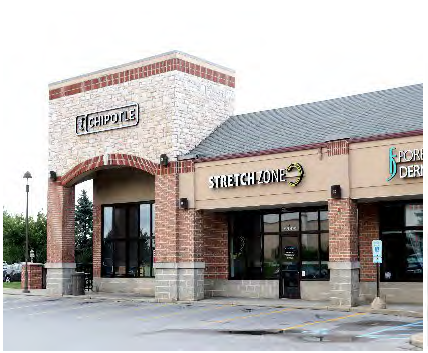
Figure 99.1 Example of Human Scale Proportioned Building

Figure 99.2 Example of Non-Human Scale Proportioned Building
Illumination level, calculated average maintained means the average illumination level at the horizontal ground plane of regulated lighting along roadways, pedestrian areas, and parking lots.
Indirect light means direct light that has been reflected or has scattered off of other surfaces.
Innkeeper means a proprietor of an inn or a person engaged in the hospitality business, especially in a supervisory or managerial capacity.
Interchange means a grade separated intersection with one or more turning lanes for travel between intersection legs.
Joint extraterritorial zoning committee means any zoning committee established in accordance with Wis. Stats. § 62.23(7a).
Kennel, commercial means an establishment where dogs or other animal pets not part of the actual household on the lot on which the facility is located are raised, bred or boarded.
Lamp means the component of a luminaire that produces the actual light.
Landmark building means a building which is located on axis with a terminating street or at a street intersection. Such buildings shall incorporate architectural features which address height and articulation that emphasize the importance of such a location.
Land use means any nonstructural use made of unimproved or improved real estate. (Also see development).
Light fixture means the assembly that houses the lamp or lamps, and can include all or some of the following parts: housing, mounting bracket or pole socket, lamp holder, ballast, reflector or mirror, refractor or lens.
Light trespass means the shining of light produced by a luminaire beyond the boundaries of the property on which it is located.
Livestock refers to domestic farm animals which are typically kept for breeding, production of agricultural products, sale, consumption or pleasure (see also "livestock, large" and "livestock, small").
Livestock, large. This category of livestock refers to livestock generally weighing over 500 pounds at maturity such as cattle, bison, and horses. Pigs generally weighing over 300 pounds at maturity are also considered large livestock.
Livestock, small. This category of livestock refers to livestock generally weighing less than 500 pounds at maturity such as sheep, goats, miniature horses, small ponies, llamas, and alpacas. Small bred pigs, such as potbellied pigs, generally weighing less than 300 pounds at maturity are also considered small livestock.
Live-work units means a dwelling unit also used for work purposes, provided the work component is restricted to the uses of professional offices, artist's workshop, or studio.
Living rooms means all rooms within a dwelling except closets, foyers, storage areas, utility rooms and bathrooms.
Loading area means a completely off-street berth on the same lot for the loading or unloading of freight carriers, having adequate ingress and egress to a public street or alley.
Lodginghouse means a building where lodging only is provided for compensation and having not more than five sleeping rooms for this purpose.
Loft means a residential unit designed with high ceilings, open plans, and large windows located on the second or higher level of a building.
Lot means a single parcel of contiguous land, abutting and having frontage on a public street in all districts except in a planned residential development (PRD) district, intended to be separately owned, developed, or otherwise used as a unit.
Lot, double frontage means an interior lot having frontage on more than one street or a corner lot having frontage on more than two streets.
Lot lines and area means the peripheral boundaries of a parcel of contiguous land and the total area lying within such boundaries, and exclusive of land provided for public thoroughfare.
Lot width means the distance of a lot, measured parallel to the right-of-way, at the minimum street setback line, or street build-to line.
Lumen means a unit of luminous flux. One foot-candle is one lumen per square foot. For the purposes of this chapter, the lumen output values shall be the initial lumen output ratings of a lamp.
Luminaire means this is a complete lighting system and includes a lamp or lamps and a fixture.
Machine shops means shops where lathes, presses, grinders, shapers and other wood and metal working machines are used, such as blacksmith, tinsmith, welding and sheet metal shops; plumbing, heating and electrical repair and overhaul shops, but not including drop forges.
Maintenance means the act or process of ordinary upkeep and repairs, including redecorating, refinishing, nonstructural repairs, or the replacement of existing fixtures, systems or equipment with equivalent fixtures, systems or structures.
Manufactured home means a structure transportable in one or more sections, which is built on a permanent chassis and is designed to be used with or without a permanent foundation when connected to required utilities. The term "manufactured home" includes a mobile home but does not include a "mobile recreational vehicle."
Mature tree means any tree eight inches or more in dbh, whether standing alone, in tree mass, or woodlands. A mature tree shall be a healthy specimen and shall be a desirable species, as determined by the village forester/department of community development.
Minimart means a retail store selling packaged and/or prepared foods and beverages and other convenience items for consumption off the premises by travelers and highway users. Sales of items are dependent upon convenience of location, speed of service, and highway accessibility and are not dependent upon comparison shopping or pedestrian traffic within the site or on adjoining sites.
Minor structure means any small movable accessory erection or construction such as birdhouses and dog houses.
Mobile/manufactured home park or subdivision means a parcel (or contiguous parcels) of land, divided into two or more manufactured home lots for rent or sale.
Mobile recreational vehicle means a vehicle which is built on a single chassis, 400 square feet or less when measured at the largest horizontal projection, designed to be self-propelled, carried or permanently towable by a licensed, light-duty vehicle, is licensed for highway use if registration is required and is designed primarily not for use as a permanent dwelling, but as temporary living quarters for recreational, camping, travel or seasonal use. Manufactured homes that are towed or carried onto a parcel of land, but do not remain capable of being towed or carried, including park model homes, do not fall within the definition of "mobile recreational vehicles."
Mobile service facility means the set of equipment and network components, including antennas, transmitters, receivers, base stations, power supplies, cabling, and associated equipment, that is necessary to provide mobile service to a discrete geographic area, but does not include the underlying support structure.
Mobile service support structure means a freestanding structure that is designed to support a mobile service facility.
Motel means a series of attached, semi attached or detached sleeping units for the accommodation of transient guests and which is distinguished from a hotel primarily by reason of providing direct independent access to and adjoining parking for each rental unit.
Natural vegetation means native trees, shrubs and prairie species and nonnative plants, excluding lawns.
Natural woodland area means a biological community dominated by trees and other woody plants covering a land area of 10,000 square feet or greater. Woodlands can be characterized as containing at least 100 trees with at least 50 percent of those trees having a two-inch dbh or greater.
Navigable waters means Lake Superior, Lake Michigan, all natural inland lakes within Wisconsin, and all streams, ponds, sloughs, flowages and other waters within the territorial limits of this state, including the Wisconsin portion of boundary waters, which are navigable under the laws of this state. Under Wis. Stats. § 144.26(2)(d), notwithstanding any other provision of law or administrative rule promulgated thereunder, shoreland ordinances required under Wis. Stats. §§ 61.351 or 62.221 and Wis. Admin. Code ch. NR 117 does not apply to lands adjacent to farm drainage ditches if:
(1)
Such lands are not adjacent to a natural navigable stream or river;
(2)
Those parts of such drainage ditches adjacent to such lands were not navigable streams before ditching; and
(3)
Such lands are maintained in nonstructural agricultural use.
Wisconsin's Supreme Court has declared navigable bodies of water that have a bed differentiated from adjacent uplands and levels or flow sufficient to support navigation by a recreational craft of the shallowest draft on an annually recurring basis (Muench v. Public Service Commission, 261 Wis. 492 (1952) and DeGaynor and Co., Inc., v. Department of Natural Resources, 70 Wis. 2d 936 (1975)). For example, a stream which is navigable by skiff or canoe during normal spring high water is navigable, in fact, under the laws of this state though it may be dry during other seasons.
Net developable acres. Net developable acres (NDA) is computed by taking the gross site acreage and subtracting the following: 100 percent of acreage in existing road rights-of-way, 100 percent of acreage in access or utility easements, 100 percent of floodplains, 100 percent of wetlands, 100 percent of water bodies and watercourses, 100 percent of slopes 25 percent or greater, 50 percent of slopes 15 percent—24.9 percent, without double counting any land.
Nonconforming structure means an existing lawful structure or building which is not in conformity with the dimensional or structural requirements of this ordinance. (For example, an existing residential structure in the floodfringe district is a conforming use. However, if the lowest floor is lower than the flood protection elevation, the structure is nonconforming.)
Nonconforming use means any structure, land or water lawfully used, occupied or erected at the time of the effective date of this ordinance, or amendments thereto, which does not conform to the current regulations of this ordinance or amendments thereto.
Nursing home means a place where five or more persons who are not related to the operator or administrator reside, receive care or treatment and, because of their mental or physical condition, require access to 24-hour nursing services, including limited nursing care, intermediate level nursing care and skilled nursing services, as defined in Wis. Stats. § 50.01.
Official letter of map amendment means official notification from the Federal Emergency Management Agency (FEMA), Federal Insurance Administration (FIA), that a flood hazard boundary map or flood insurance rate map has been amended.
Open space means an unoccupied space open to the sky on the same lot with the building it serves and not used for any other purpose. Required off-street parking space does not qualify as open space, nor do drives except with respect to single-family residences and duplexes.
Open space use means an unoccupied space open to the sky on the same lot with the building it serves and not used for any other purposes. Those uses having a relatively low flood damage potential and not involving structures. Required off-street parking space does not qualify as open space, nor do drives except with respect to single family and duplex residences.
Ordinary highwater mark means the point on the bank or shore up to which the presence and action of surface water is so continuous as to leave a distinctive mark such as by erosion, destruction or prevention of terrestrial vegetation, predominance of aquatic vegetation, or other easily recognized characteristic.
Outdoor lighting means the illumination of an outside area or object by any man-made device located outdoors that produces light by any means.
Outdoor recreational facilities means land and structures, along with accessory equipment, designed and utilized for leisure time activities of a predominantly outdoor nature and of more specific purpose than passive park-like open areas, and further classified as follows:
(1)
Public. Facilities owned and operated by a governmental agency for limited or general public use.
(2)
Private commercial. Facilities owned and operated by an individual or group for profit as a business whether or not open to general public use.
(3)
Private noncommercial group. Facilities owned and operated by a group for the exclusive use of the members of such group and their guests and not for profit as a business.
(4)
Private residential. Facilities owned by an individual, located on the same or adjoining lot to their residence, and intended solely for the use of their family and guests.
Parking lots means an open, hard-surfaced area, other than street, public way, or driveway, to be used for the storage, for limited periods of time, of operable passenger automobiles and commercial vehicles.
Parking space or parking stall means an area for the purpose of parking one automobile, hard-surfaced with concrete, paver blocks, permeable surfacing or asphalt, with access to a public street or alley.
Parking utility means a public or private agency that provides parking infrastructure services, including those structures necessary to deliver those services
Parties of interest means all abutting property owners, all property owners within 300 feet, and all property owners of opposite frontages.
Permeable surfacing means a material or materials and accompanying subsurface treatments designed and installed specifically to allow stormwater to penetrate into the material, thereby reducing the volume of stormwater runoff from the surfaced area. Permeable surfacing may include without limitation paver blocks, grass-block or similar composite material, and permeable concrete or asphalt.
Person means an individual, or group of individuals, corporation, partnership, association, municipality or state agency.
Photometric plan means a plan that indicates the luminous intensity, luminous flux, illumination, or brightness of a luminaire.
Planning agency means the municipal plan commission created under Wis. Stats. § 62.23(1), a board of public land commissioners or a committee of the municipality's governing body which acts on matters pertaining to planning and zoning.
Planting island means a landscaping element that is located within a parking lot. Planting islands have plant materials located within the island, and may be designed and used for stormwater treatment and control. Planting islands are typically surrounded on all sides with hard surfacing or parking, however when located on the perimeter of a parking lot planting islands must have at least two sides adjacent to the hard-surfaced area.
Polystructure. An enclosure having a frame of steel or other materials which is covered with plastic, polyurethane, vinyl, canvas, or other flexible sheeting material.
Private club or lodge means a structure or grounds used for regular or periodic meetings or gatherings of a group of persons organized for a nonprofit purpose, but not groups organized to render a service customarily carried on as a business.
Private sewage system means a sewage treatment and disposal system serving one structure with a septic tank and soil absorption field located on the same parcel as the structure. It also means an alternative sewage system approved by the department of commerce, including a substitute for the septic tank or soil absorption field, a holding tank, a system serving more than one structure or a system located on a different parcel than the structure.
Professional home offices means a portion of a residence of doctors of medicine, practitioners, dentists, clergymen, architects, landscape architects, professional engineers, registered land surveyors, lawyers, artists, teachers, authors, musicians or other recognized professions used to assist in conducting their professions where the office does not exceed one-third the area of only one floor of the residence and not more than one nonresident person is employed, and is not the principal office of the resident's business.
Professional offices means the offices of accountants, architects, attorneys, chiropractors, clergy, dentists, doctors of medicine, landscape architects, musicians, professional engineers, registered land surveyors, teachers, or other recognized professions used in conducting their professions.
Public utilities means those utilities using underground or overhead transmission lines such as electric, telephone and telegraph, and distribution and collection systems such as water, sanitary sewer and storm sewer.
Quarrying means the removal of rock, slate, gravel, sand, topsoil, or other natural material from the earth by excavating, stripping, leveling or any other process.
Rain barrel means a structure for the collection of roof runoff in a container typically ranging from 50 to 100 gallons in size, with subsequent release of water to landscaped areas.
Recharge area means an area in which water reaches the zone of saturation of an aquifer by surface infiltration and directly supplies groundwater recharge to a well.
Recreational vehicle means one of the following vehicles designed primarily for recreational, camping, travel, or seasonal use:
(1)
Motor or mobile home. A motorized recreational vehicle containing sleeping, eating and bathroom facilities.
(2)
Fifth-wheel trailer. A unit affixed and towed by a pickup truck equipped with a special hitch in the truck bed.
(3)
Tent camper. A unit with sides that collapse for towing and storage.
(4)
Travel trailer. A unit containing sleeping facilities designed to be towed by a car, van or truck by means of bumper or frame hitch.
(5)
Boat. A vessel propelled on water by oar, paddle, sail or engine.
(6)
Boat trailer. A trailer designed to launch, retrieve, carry and sometimes store a boat.
(7)
Utility trailer. Any trailer other than a boat trailer or travel trailer pulled by a motorized vehicle.
Residential development, rural means the division of land into lots or parcels with areas greater than ten acres.
Residential development, urban means the division of land into lots or parcels served with centralized public sanitary sewerage and water supply facilities.
Restaurant, class A means a restaurant with a dining room where food is served to the public on demand from a menu, served in and on reusable containers and dinnerware, intended to be eaten on the premises primarily inside the building at tables, or counters, with chairs and stools or in booths.
Restaurant, class B means a restaurant facility where food, frozen dessert, and/or beverages are served in disposable containers in a cafeteria line, or to customers while seated in their motor vehicles, to be consumed on the premises or taken off the premises for consumption.
Retail shops means retail operations that specialize in one type or line of merchandise. Such stores may include, but are not limited to, antiques stores, apparel stores, book stores, confectioners, delicatessens, jewelry stores, shoe stores, stationary stores, and similar establishments.
Retirement communities means housing specifically geared toward older individuals. May consist of single family dwellings, rental apartments, condominiums or cooperatives, which are sold or rented. Some offer transportation, home-delivered meals, or home care services.
Road. See street.
Roadside stand means a farm building used or intended to be used solely by the owner or tenant of the farm on which such building is located for the sale of farm products raised on such farm.
Sand and gravel pits. See quarrying.
Setback means the distance a structure is separated from a property line.
Senior housing means dwelling units (usually apartments) in a high-rise building or garden complex, which may offer services such as meals in a common dining room, housekeeping, personal care or other assistance, and are limited to persons 55 years of age or older.
Shoreland means lands within the following distances from the ordinary high-water mark of navigable waters; 1,000 feet from a lake, pond or flowage; and 300 feet from a river or stream or to the landward side of the floodplain, whichever distance is greater.
Shoreland-wetland district means the zoning district, created in this shoreland-wetland zoning ordinance, comprised of shorelands that are designated as wetlands on the wetlands inventory maps which have been adopted and made a part of this ordinance.
Sidewalk apron means the land between the curb of a street and the sidewalk.
Sign, directional means a sign intended solely for the purpose of directing patrons or customers to an establishment off the main traveled road and not including promotional advertising unnecessary to such directional purpose.
Sign, non-accessory means a sign related to commercial or similar activities other than those actually engaged in on the site on which such non-accessory sign is located.
Signs means any words, letters, pictures, figures, numerals, phrases, sentences, emblems, devices, designs, pictures, symbols, trade names or trademarks by which anything is made known and which are used to advertise or promote an individual, firm, association, corporation, profession, business, commodity or product and which is visible from any public street or highway, including specifically signs within buildings or under canopies or arcades when visible from the exterior.
Stable shall be interpreted similarly to the term "garage," one draft animal or saddle horse being considered the equivalent of one self-propelled vehicle.
Start of construction means the date the building permit was issued, provided the actual start of construction, repair, reconstruction, rehabilitation, addition, placement, or other improvement was within 180 days of the permit date. The actual start means either the first placement of permanent construction on a site, such as the pouring of slab or footings, the installation of piles, the construction of columns, or any work beyond initial excavation, or the placement of a manufactured home on a foundation. Permanent construction does not include land preparation, such as clearing, grading and filling, nor does it include the installation of streets and/or walkways, nor does it include excavation for a basement, footings, piers or foundations or the erection of temporary forms, nor does it include the installation on the property of accessory buildings, such as garages or sheds not occupied as dwelling units or not part of the main structure. For an alteration, the actual start of construction means the first alteration of any wall, ceiling, floor or other structural part of a building, whether or not that alteration affects the external dimensions of the building.
Story means that portion of a building included between the surface of a floor and the surface of the floor next above it, or if there is no floor above it, then the space between the floor and the ceiling next above it.
Street means a public right-of-way not less than 60 feet wide, providing primary access to abutting properties on both sides, and not less than 30 feet wide, if a frontage street with access on one side only.
Street line means a dividing line between a lot, tract or parcel of land and a contiguous street.
Streetscape means the area between the building and edge of the vehicular or parking lanes. The principal streetscape components are curbs, sidewalks, street trees, tree planters, bicycle racks, litter containers, benches, and streetlights. Treatments may also include a range of provisions such as paving materials, street/pedestrian/wayfinding signs, media boxes, parking meters, utility boxes, public art, water features, bollards, informational signage and other elements.
Structural alteration means any change in the supporting members of a structure, such as foundations, bearing walls, columns, beams or girders.
Structure means any manmade object with form, shape and utility, either permanently or temporarily attached to, placed upon or set into the ground, stream bed or lake bed, including, but not limited to, roofed and walled buildings, gas or liquid storage tanks, bridges, dams and culverts.
Structure, accessory means a structure or portion of a structure which is accessory or incidental to the principal use of a property, structure or building. An accessory structure shall not be used for human habitation.
Structure, permanent means a structure placed on or in the ground or attached to another structure in a fixed and determined position, and which is intended to, or in fact does, remain in place for a period of more than six months.
Structure, principal means a structure used or intended to be used for the principal use permitted on such lot by the regulations of the district in which it is located. Multiple structures in districts other than single-family residential districts, when intended for the principal use, must meet all requirements that apply to a single principal structure.
Structure, temporary means any structure other than a permanent structure.
Studios for artists means studios including dance, music, painting and sculpture, drama and other one-on-one instructional and practice facilities for arts and crafts. These activities must be conducted in fully enclosed building to block sound transmitted to the outdoors or to the property line.
Subdivision has the meaning given in Wis. Stats. § 236.02(12).
Substantial damage means damage of any origin sustained by a structure, whereby the cost of restoring the structure to its pre-damaged condition would equal or exceed 50 percent of the equalized assessed value of the structure before the damage occurred.
Substantial evidence means facts and information, other than merely personal preferences or speculation, directly pertaining to the requirements and conditions an applicant must meet to obtain a permit and that reasonable persons would accept in support of a conclusion.
Substantial improvements means any repair, reconstruction, rehabilitation, addition or improvement of a building or structure, the cost of which equals or exceeds 50 percent of the equalized assessed value of the structure before the improvement or repair is started. If the structure has sustained substantial damage, any repairs are considered substantial improvement regardless of the work performed. The term does not include either any project for the improvement of a building required to correct existing health, sanitary or safety code violations identified by the building official and that are the minimum necessary to assure safe living conditions; or any alteration of a historic structure provided that the alteration will not preclude the structure's continued designation as a historic structure.
Substantial modification means the modification of a mobile service support structure, including the mounting of an antenna on such a structure that does any of the following:
(1)
For structures with an overall height of 200 feet or less, increases the overall height of the structure by more than 20 feet.
(2)
For structures with an overall height of more than 200 feet, increases the overall height of the structure by ten percent or more.
(3)
Measured at the level of the appurtenance added to the structure as a result of the modification, increases the width of the support structure by 20 feet or more, unless a larger area is necessary for collocation.
(4)
Increases the square footage of an existing equipment compound to a total area of more than 2,500 square feet.
Support structure means an existing or new structure that supports or can support a mobile service facility, including a mobile service support structure, utility pole, water tower, building, or other structure.
Sustained yield forestry means management of forest lands to provide annual or periodic crops of forest products.
Temporary outdoor lighting means the specific illumination of an outside area or object by any man-made device located outdoors that produces light by any means for a period of less than seven days with at least 180 days passing before being used again. A temporary outdoor lighting permit must be approved by the department of community development.
Traffic artery means a right-of-way, designed on a comprehensive system, for the principal purpose of providing vehicular thoroughfare and not necessarily affording direct access to abutting property.
Trailer camp means any tract or parcel of land upon which two or more trailers, camp cabins, house cars or other mobile homes are located or trailer or camp sites are provided for the purpose of either temporary or permanent habitation.
Tripartite architecture means architecture that divides or composed a building to have three distinct parts. The three building elements consist of a base, middle, and a top.
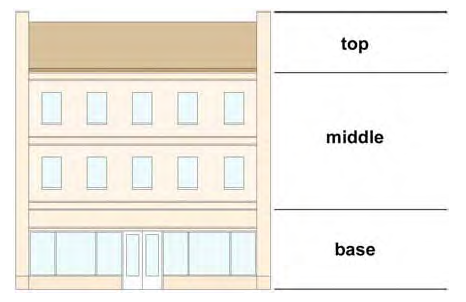
Turning lanes means an existing or proposed connecting roadway between two arterial streets or between an arterial street and any other street. Turning lanes include grade separated interchange ramps.
Unnecessary hardship occurs where special conditions affecting a particular property, which were not self-created, have made strict conformity with restrictions governing areas, setbacks, frontage, height or density unnecessarily burdensome or unreasonable in light of the purposes of the ordinance.
Use, accessory means a use customarily incident to the permitted principal use of property and on the same lot as the principal permitted use.
Use, permitted means that utilization of land by occupancy, activity, building or other structure which is specifically enumerated as permissible by the regulations of the zoning district in which such land is located.
Use, principal means the main or primary use of property or structures permitted on such lot by the regulations of the district in which it is located.
Utilities means public and private facilities such as water wells, water and sewage pumping stations, water storage tanks, power and communication transmission lines, electrical power substations, static transformer stations, telephone and telegraph exchanges, microwave radio relays and gas regulation stations, but not including sewage disposal plants, municipal incinerators, warehouses, shops and storage yards.
Variance means an authorization by the zoning board of appeals for the construction or maintenance of a building or structure in a manner which is inconsistent with dimensional standards (not uses).
Vegetated stormwater control measures means vegetated swales, infiltration systems as defined in chapter 38 of this Code, landscaped areas with amended soils or native plantings, or other similar practices that are designed and installed in order to provide stormwater treatment and control, and to promote evapotranspiration and infiltration of stormwater.
Veterinary clinic means an establishment providing for medical care and treatment of animal pets, but distinguished from a kennel in that it does not provide for boarding of animals except as incident to their hospitalization.
Village means the Village of Menomonee Falls.
Violation means the failure of a structure or other development to be fully compliant with this chapter. A structure or other development without required permits, lowest floor elevation documentation, floodproofing certificates or required floodway encroachment calculations is presumed to be in violation until such time as that documentation is provided.
Vision setback. See traffic visibility, section 122-621. An unoccupied space at the intersection of two or more streets.
Warehouse store means a place of business with some or all of the following characteristics engaged in the sales of merchandise to the public, or specific classes of the public: From a building which is typically constructed to industrial standards with or without finished ceilings; and the merchandise may be displayed on the floor; in bulk; from pallets; or on industrial grade shelving or pallet racks.
Waste enclosure means a vision screen enclosing waste containers, dumpsters, recycling bins, and other similar containers designated to store, or temporarily store, waste products. All waste enclosures shall be sited to prevent contaminated runoff from reaching storm drains or surface waters.
Well means an excavation opening in the ground made by digging, boring, drilling, driving or other methods, to obtain groundwater regardless of its intended use.
Well field means a piece of land used primarily for the purpose of locating wells to supply a municipal water system.
Well head protection area means the area as calculated in the well head protection plan for each well.
Wetland alteration means any filling, flooding, draining, dredging, ditching, tiling, excavating, temporary water level stabilization measures or dike and dam construction in a wetland area.
Wetlands means an area where water is at, near or above the land surface long enough to support aquatic or hydrophytic vegetation and which have soils indicative of wet conditions.
Yard means the area of a lot or parcel between a principal structure and the exterior boundaries of the same lot or parcel.
Yard, front means that portion of a yard between exterior property line(s) and the front elevation, extending horizontally from the corner of the front elevation to another property line.
Yard, rear means that portion of a yard between exterior property line(s) and the elevation opposite the main entrance, extending horizontally from the corner of the rear elevation.
Yard, side means a yard extending from a front yard to the rear yard.
Yard, street means that portion of a yard between a property line along a street and the principal structure, extending parallel to the same property line along a street from the corner of the principal structure closest to the same property line along a street to another property line. Lots with multiple street frontages will have multiple street yards. Street yards may be in the front, side or rear yards. Street setbacks take precedent over side and rear yard setbacks.
Yard Examples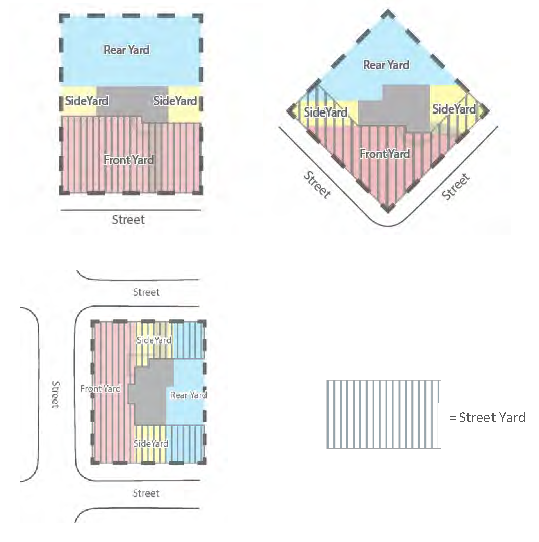
(Ord. No. 910-O-24, § 11, 8-19-24; Ord. No. 912-O-24, § 1, 8-19-24)

