
Menomonee Falls Village
City Zoning Code
City Zoning Code
ARTICLE III
OVERLAY DISTRICTS
Sec. 122-300. - Overlay district purpose.
The village overlay districts are intended to provide supplemental regulations or standards pertaining to specific areas of the village, wherever these are located, in addition to, but not necessarily more restrictive than the "base" or underlying zoning district regulations applicable within a designated area. Where there is a conflict between the regulations of a base zoning district and those of an overlay district, the overlay district regulations shall supersede the base district regulations.
Sec. 122-320. - Purpose and authority.
(a)
Purpose. The purpose of this division is to institute land use regulations and restrictions to protect the village well water supply, and to promote the public health, safety and general welfare of the residents of the village.
(b)
Authority. Statutory authority for the village to enact this division was established by the state legislature in 1983, Wisconsin Act 410, which specifically added groundwater protection to Wis. Stats. § 62.23(7)(c), to protect public health, safety and welfare.
Sec. 122-321. - Application of division.
The regulations specified in this division shall apply to all lands that lie within the five-year time of travel (TOT) of each village municipal well, a minimum of 1,200 feet, and are within the village corporate limits and which have a well head protection area delineated in a well head protection plan accepted by the village.
Sec. 122-322. - Violations.
It shall be unlawful to construct or use any structure, land or water in violation of any of the provisions of this division.
Sec. 122-323. - Enforcement.
Pursuant to Wis. Stats. § 66.0113(2), the zoning administrator and the utilities superintendent shall have authority to issue citations to enforce this division.
Sec. 122-324. - New uses or changes.
No new use or change in use of any structure, land or water shall be located, extended, converted or structurally altered, and no development shall commence without full compliance with the terms of this division and other applicable regulations.
Sec. 122-325. - Nonconforming uses.
(a)
Existing nonconforming uses. Nonconforming uses are regulated in section 122-43.
(b)
Requirements for existing facilities. Existing facilities are comprised of current facilities, practices and activities which may cause or threaten to cause environmental pollution within that portion of the village's wellhead protection area that lies within the corporate limits of the village. Existing facilities include, but are not limited to, the type listed in the department of natural resources' form 3300-215, public water supply potential containment use inventory form.
(1)
Existing facilities shall provide copies of all federal, state and local facility operation approvals or certificate and ongoing environmental monitoring results to the village.
(2)
Existing facilities shall provide additional environmental or safety structures/monitoring as deemed necessary by the village.
(3)
Existing facilities shall replace equipment or expand in a manner that improves the existing environmental and safety technologies already in existence.
(4)
Existing facilities shall have the responsibility of preparing and providing a satisfactory contingency plan to the village for the immediate notification of village officials in the event of an emergency.
Sec. 122-326. - Protection measures.
(a)
Lands immediately surrounding each municipal well are subject to the most stringent land use and development restrictions. This is due to the close proximity to each municipal well and the corresponding high threat of potential contamination.
(b)
Lands surrounding each well will be subject to the following required minimum horizontal separation distances between a well and the following land uses and facilities:
(1)
Ten feet between a well and an emergency or standby power system that is operated by the same facility which operates the well and that has a double-wall above-ground storage tank with continuous electronic interstitial leakage monitoring. These facilities shall meet the installation requirements of § ATCP 93.260 and receive written approval from the department of safety and professional services or its designated local program operator under § ATCP 93.110.
(2)
Fifty feet between a well and a storm sewer main or a sanitary sewer main where the sanitary sewer main is constructed of water main class materials and joints. Gravity sanitary sewers shall be successfully air pressure tested in place. The air pressure test shall meet or exceed the requirements of four psi low pressure air test for plastic gravity sewer lines found in the latest edition of standard specifications for sewer and water construction in the state. Force mains shall be successfully pressure tested with water to meet the AWWA C600 pressure and leakage testing requirements for one hour at 125 percent of the pump shut-off head.
(3)
Two hundred feet between a well and any sanitary sewer main not constructed of water main class materials, sanitary sewer manhole, lift station, one- or two-family residential heating fuel oil underground storage tank or above-ground storage tank or POWTS treatment tank or holding tank component and associated piping.
(4)
Three hundred feet between a well and any farm underground storage tank system or other underground storage tank system with double wall and with electronic interstitial monitoring for the system, which means the tank and any piping connected to it. These installations shall meet the most restrictive installation requirements of § ATCP 93.260 and receive written approval from the department of safety and professional services or its designated local program operator under § ATCP 93.110. These requirements apply to tanks containing gasoline, diesel, bio-diesel, ethanol, other alternative fuel, fuel oil, petroleum product, motor fuel, burner fuel, lubricant, waste oil, or hazardous substances.
(5)
Three hundred feet between a well and any farm above-ground storage tank with double-wall, or single-wall tank with other secondary containment and under a canopy; other above-ground storage tank system with double-wall, or single-wall tank with secondary containment and under a canopy and with electronic interstitial monitoring for a double-wall tank or electronic leakage monitoring for a single-wall tank secondary containment structure. These installations shall meet the most restrictive installation requirements of § ATCP 93.260 and receive written approval from the department of safety and professional services or its designated local program operator under § ATCP 93.110. These requirements apply to tanks containing gasoline, diesel, bio-diesel, ethanol, other alternative fuel, fuel oil, petroleum product, motor fuel, burner fuel, lubricant, waste oil, or hazardous substances.
(6)
Four hundred feet between a well and a POWTS dispersal component with a design capacity of less than 12,000 gallons per day, a cemetery or a stormwater retention or detention pond.
(7)
Six hundred feet between a well and any farm underground storage tank system or other underground storage tank system with double wall and with electronic interstitial monitoring for the system, which means the tank and any piping connected to it; any farm above-ground storage tank with double-wall, or single-wall tank with other secondary containment and under a canopy or other above-ground storage tank system with double-wall, or single-wall tank with secondary containment and under a canopy; and with electronic interstitial monitoring for a double-wall tank or electronic leakage monitoring for a single-wall tank secondary containment structure. These installations shall meet the standard double-wall tank or single-wall tank secondary containment installation requirements of § ATCP 93.260 and receive written approval from the department of safety and professional services or its designated local program operator under § ATCP 93.110. These requirements apply to tanks containing gasoline, diesel, bio-diesel, ethanol, other alternative fuel, fuel oil, petroleum product, motor fuel, burner fuel, lubricant, waste oil, or hazardous substances.
(8)
One thousand feet between a well and land application of municipal, commercial, or industrial waste; the boundaries of a land spreading facility for spreading of petroleum-contaminated soil regulated under ch. NR 718 while that facility is in operation; agricultural, industrial, commercial or municipal wastewater treatment plant treatment units. Lagoons, or storage structures; manure stacks or storage structures; or POWTS dispersal component with a design capacity of 12,000 gallons per day or more.
(9)
Twelve hundred feet between a well and any solid waste storage, transportation, transfer, incineration, air curtain destructor, processing, wood burning, one-time disposal or small demolition facility; sanitary landfill; any property with residual groundwater contamination that exceeds ch. NR 140 enforcement standards; coal storage area; salt or deicing material storage area; any single-wall farm underground storage tank or single-wall farm above-ground storage tank or other single-wall underground storage tank or above-ground storage tank that has or has not received written approval from the department of safety and professional services or its designated local program operator under § ATCP 93.110 for single-wall tank installation. These requirements apply to tanks containing gasoline, diesel, bio-diesel, ethanol, other alternative fuel, fuel oil, petroleum product, motor fuel, burner fuel, lubricant, waste oil, or hazardous substances; and bulk pesticide or fertilizer handling or storage facilities.
(c)
In addition, lands within the calculated well head protection area for each well are subject to the following permitted and prohibited uses:
(1)
Permitted uses. The following land uses are permitted uses within a well head protection area:
a.
Parks, provided there is no on-site waste disposal or fuel oil storage tank facilities associated within such use.
b.
Playgrounds.
c.
Wildlife areas.
d.
Non-motorized trails, such as biking, skiing, nature and fitness trails.
e.
Residential uses.
f.
Agricultural activities.
g.
Commercial and/or industrial uses, except those listed as prohibited in subsection (c)(2) of this section.
h.
Other permitted uses:
1.
Individuals and/or facilities may request the village to permit other land uses in the well head protection area.
2.
All requests shall be made in writing to the village and shall include a report assessing the potential for contamination of the public water supply wells concerned.
3.
A copy of the assessment report shall be provided to the village for consideration and approval by the village.
4.
Any permitted uses shall be conditional and the conditions of approval may include required environmental and safety monitoring consistent with local, state and federal requirements, and/or the posting of bonds and/or sureties satisfactory to the village.
(2)
Prohibited uses. The following uses are prohibited uses within the well head protection area:
a.
Animal waste storage facilities.
b.
Asphalt product; manufacturing.
c.
Bulk fertilizer and pesticide storage facilities.
d.
Bus or truck terminals.
e.
Dry cleaning facilities.
f.
Electroplating.
g.
Exterminating shops.
h.
Garage and vehicular towing.
i.
Gas stations.
j.
Hazardous and toxic materials storage and use.
k.
Hazardous and toxic waste facilities.
l.
Junkyards or auto salvage yards.
m.
Landfills or waste disposal facilities.
n.
Non-municipal spray wastewater facilities.
o.
Non-municipal wastewater treatment facilities.
p.
Other similar uses that pose a threat to groundwater quality.
q.
Paint and coating manufacturing.
r.
Printing shop.
s.
Public and municipal maintenance garages.
t.
Radioactive waste facilities.
u.
Salt storage.
v.
Septage and/or sludge spreading.
w.
Tire and battery services.
x.
Underground storage tanks.
y.
Vehicle repair establishments, including auto body repair.
Sec. 122-330. - Purpose.
The OC-5 commercial service overlay is intended to provide for the controlled development, at appropriate locations, of needed commercial services consisting of automotive, fast food, and other automobile intensive or highway oriented uses.
(1)
Applicability. The OC-5 commercial service overlay may be established on a single lot or parcel of land within a multi-tenant development, or on a single unit or part of a multi-tenant building, in the C-1 neighborhood business district, C-2 community business district, C-4 suburban retail business district, or the I-1 light industrial district.
(2)
Designation. The OC-5 commercial service overlay may be placed over the zoning districts listed in paragraph (1) above using the procedure for amending the zoning map in found in section 122-68. The requirements of the OC-5 commercial service overlay shall supersede the requirements of the underlying zoning district to the extent of any conflict.
Sec. 122-331. - Application.
The OC-5 commercial service overlay requires applicants to file a site plan review application per the requirements of section 122-65, unless a conditional use permit application is otherwise required by this chapter.
Sec. 122-332. - Standards.
(a)
Lot configuration.
(1)
Lot area. Minimum 30,000 square feet.
(2)
Lot width. Minimum 150 feet.
(3)
Multi-tenant buildings. In a multi-tenant building where the OC-5 commercial service overlay use occupies a single unit or part of the building, the minimum lot width and minimum area requirements apply to the entire lot or parcel where the building is located. In this case the legal description of the area to be in an OC-5 commercial service overlay shall include the area of the occupied space within the building, any adjacent common areas required to access the building, and the parking and driveway areas required to meet the parking requirements in article VII of this chapter.
(4)
Multi-tenant development. In a multi-tenant development where the OC-5 commercial service overlay use occupies an entire building, but not the entire development parcel, the minimum lot width requirements apply to the entire lot or parcel where the development is located. The minimum area shall include the area of the building, plus the minimum street, rear and side yards, plus the parking and driveway areas required to meet the parking requirements in article VII of this chapter.
(b)
Buildings. Buildings within the OC-5 commercial service overlay shall utilize the building types permitted by the underlying zoning district in article V of this chapter. Additional building types may be considered through a conditional use permit review. Building type regulations apply to all buildings with the following exceptions.
(1)
All corners on primary streets shall be occupied by buildings.
(2)
The edge of all canopies shall be located a minimum of 20 feet from the street lot line. All fueling pumps or other accessory structures, other than a canopy, shall be a minimum of 30 feet from all lot lines.
(3)
The rear setback of all buildings in the OC-5 commercial service overlay shall be a minimum of 50 feet.
(4)
When a commercial use and/or structure in an OC-5 commercial service overlay abuts a single-family residential district, the commercial structure may not be built closer than 100 feet from the single family residential district boundary. A planting screen, approved by the architectural control board, 15 feet in depth and at least six feet high shall be placed within the OC-5 district along the single family residential district boundary.
(c)
Uses. Uses that are permitted in this district are as follows: automobile, motorcycle, truck or recreational vehicle sales/service or rental establishments; banks; garden centers; motels; mini-marts; class "B" restaurants with a drive-through. Other structures and/or uses may be permitted with the issuance of conditional use if the use is determined to be specifically appropriate in the OC-5 commercial service overlay district.
(d)
Parking. The requirements of article VII of this chapter shall apply to parking requirements except the edge of parking lots shall be located no closer than 15 feet from a street lot line and no closer than ten feet from a property line.
Sec. 122-340. - Purpose.
(a)
Purpose. The corporate campus overlay is intended to apply to sites occupied by large civic or institutional uses, or corporate or divisional headquarters, containing multiple buildings on one or more parcels that work together to create a walkable campus with inter-related uses.
(b)
Applicability. A corporate campus overlay may be located in the I-1 light industrial district, I-3 executive office/light industrial district, C-6 office district, or CV-2 institutional district.
(1)
Within the I-3 executive office/light industrial district, and C-6 office district, a corporate campus overlay must contain a minimum of 30 acres containing offices and facilities for not less than 500 full time employees.
(2)
Within the I-1 light industrial district a corporate campus overlay must contain a minimum of 40 acres containing offices and facilities for a corporate or divisional headquarters employing not less than 1,000 full time employees. The boundaries of all parcels of the corporate campus overlay in the I-1 light industrial district need not be contiguous, but must be within 1,000 feet of another parcel in the corporate campus.
(3)
If a corporate campus consists of parcels in multiple zoning districts, the total area of the corporate campus overlay must contain a minimum of 40 acres and employ not less than 1,000 full time employees. In this instance, all listed accessory uses within the I-3 executive office/light industrial district shall be deemed to be a permitted use in the corporate campus.
(4)
Within the CV-2 institutional district a corporate campus overlay must contain 25 acres containing offices and facilities for not less than 1,000 full time employees. The boundaries of all parcels of the corporate campus overlay in the CV-2 institutional district need not be contiguous, but must be within 1,000 feet of another parcel in the corporate campus.
(5)
The requirements of the corporate campus overlay shall supersede the requirements of the underlying zoning district to the extent of any conflict.
Sec. 122-341. - Corporate campus creation.
In addition to the petition requirements found in subsection 122-68(d), all requests for a corporate campus overlay shall also contain the following:
(1)
Names and addresses. Names and addresses of the applicant, architect, professional engineer, and contractor.
(2)
General plan of operation. A written narrative describing the overall development concept and the nature of the business. This plan of operation shall specifically include the following information:
a.
How the development plan complies with each of the standards provided under section 122-344.
b.
Total estimated number of full- and part-time employees (include phasing information).
(3)
Site plan. The site plan shall include the following:
a.
Location, boundaries and dimensions of any existing structures.
b.
Location of all building envelopes and any proposed exceptions.
c.
Boundaries and dimensions of the exterior boundaries of the subject site.
d.
Lands opposite the subject site, including structures within 50 feet of the right-of-way and all street and driveway accesses.
e.
The 100-year flood elevation if within 40 feet of the subject premises.
f.
Wetland locations and the date and person who identified the wetlands.
g.
Location of any primary and secondary environmental corridor, as well as any isolated natural resource area located within 40 feet of the subject premises.
h.
Limits of woodland and tree lines.
i.
Existing easements.
j.
Zoning district boundaries if within 50 feet of the subject premises.
k.
Table and chart describing the following corporate campus statistics:
1.
Total corporate campus acreage.
2.
Developable acreage.
3.
Maximum amount of land covered by principal buildings.
4.
Maximum amount of land covered by surface parking, drives, and parking structures.
5.
Minimum amount of land devoted to open space.
(4)
Architectural design and aesthetics. A narrative describing the architectural design and aesthetics of the corporate campus including the primary and accent materials and colors being incorporated into the exterior design of the buildings within a corporate campus, understanding the design elements shall be consistent with the following:
a.
Image. The architectural character of each building and its additions and modifications, shall be designed with a quality and style appropriate for a corporate campus, and be designed such that the façades of the buildings relate architecturally with the first buildings constructed.
b.
Form and massing. Building form shall compliment the natural aspects of the parcel and respond to the functional needs of the occupant.
c.
Elevations. All sides of each building shall be of quality materials and be architecturally designed to be compatible with each other. The elevations shall express a design and style appropriate for a corporate campus.
d.
Building material colors. A limited palette of natural and compatible colors should be used. Buildings should maintain a similar palette of colors across the corporate campus.
e.
Structured parking. The architectural appearance of parking structures that extend more than two stories above grade shall be compatible with the primary office buildings.
(5)
Signs. A general narrative description of the sign standards, including types and sizes of signs.
(6)
Landscaping. A general description of landscaping standards, screening, and parking lot treatments. Naturalized landscaping, the use of native vegetation, preservation of existing trees and wooded areas, and tree planting that will provide additional tree canopy on the site are encouraged.
(7)
Site pictures. Site pictures shall be submitted of the subject site for all abutting properties from the location of the subject site.
(8)
Additional information. Additional information as may be required by the village board, village plan commission and village staff.
(9)
Receipt. Fee receipt from the village clerk in the amount established in chapter 42 of this Code.
Sec. 122-342. - Review and rezoning approval.
(a)
Staff review. Village staff shall review the application materials required under section 122-341 and prepare a staff report on the suitability of the project. The staff report may recommend conditions of approval, and must address any requested modification from the general standards of the corporate campus overlay found in section 122-344.
(b)
Plan commission. The rezoning process found in section 122-68 shall be utilized to consider the corporate campus overlay district approval. In addition to the plan commission's roll provided in section 122-68, the village plan commission shall base its recommendation regarding the corporate campus overlay district, and any conditions or modifications from the standards found in section 122-344 upon:
(1)
Compatibility with the comprehensive plan.
(2)
Consistency with the purpose of this chapter.
(3)
Recommendations from the village staff review.
(c)
Village board. Following the village plan commission's recommendation, the village board shall approve, modify and approve, or deny an ordinance rezoning the subject land to the corporate campus overlay district. Such ordinance shall contain any condition or modification from any standard for development within the specified corporate campus boundary
Sec. 122-343. - Site plan approval.
(a)
Submittal requirements. To initiate the corporate campus overlay approval process, the applicant shall submit the following information to the zoning administrator:
(1)
Names and addresses of the applicant, owner of the site, architect, professional engineer, and contractor.
(2)
Legal description of the subject site by lot, block and recorded subdivision or by metes and bounds.
(3)
Detailed plan of operation. A written narrative describing the development concept and the nature of the business. This plan of operation shall specifically include the following information:
a.
How the development plan complies with each of the standards provided under section 122-344 of this section and as set forth in the corporate campus designation approved by the village board.
b.
Total estimated number of full- and part-time employees (include phasing information).
c.
General hours of operation.
(4)
Plat of survey. The plat of survey shall be prepared by a registered land surveyor showing all the information required under subsection 122-65(c)(6).
(5)
Site plan. The site plan shall include all the information required in subsection 122-65(c)(8), in addition to a table and chart describing the following corporate campus statistics:
a.
Total corporate campus acreage.
b.
Development acreage.
c.
Maximum amount of land covered by principal buildings.
d.
Maximum amount of land covered by surface parking, drives, and parking structures.
e.
Minimum amount of land devoted to open space.
f.
Proposed number of buildings.
(6)
Grading plan. The grading plan shall identify the existing and proposed grades using one-foot contours. The grading plan shall also identify existing and proposed easements, utilities and structures.
(7)
Stormwater management plan. The stormwater management plan shall be designed to meet the requirements of article V of chapter 38 of this Code. The stormwater management plan shall also include computations showing how the plan meets the requirements of the stormwater management design guidelines adopted by the village board, NR 151 and NR 216, and how the plan integrates with proposed landscaping and grading.
(8)
Utility plan. A utility plan showing locations and sizes of existing and proposed utilities along with estimated use shall be prepared.
(9)
Erosion control plan. The erosion control plan shall conform to the requirements of article IV of chapter 38 of this Code.
(10)
Landscape plan. The landscape plan shall be prepared and stamped by a state-licensed landscape professional, be compatible with the other submitted plans, and identify the following:
a.
The location of all landscape materials used, differentiating between existing plant materials to be used, existing plant materials to be removed, and proposed plant material to be used.
b.
A landscape chart shall be placed on the plan showing the quantity, size (at time of planting and at maturity), spacing, and scientific and common names of the proposed landscaping as well as the existing landscaping proposed to remain.
c.
The landscape plan shall include the location and dimensions of all existing and proposed structures, including berms, planting strips and islands, areas designed as vegetated stormwater control measures, parking areas and drives, and rights-of-way, as well as identifying the vision triangle described in section 122-601.
d.
The methods used in staking, mulching, wrapping or any other tree care used.
e.
Detailed sections showing elevations of all proposed architectural features, such as retaining walls, lighting and water features.
(11)
Building plans. The building plans shall include the following information:
a.
Elevations of all sides of the building. These elevations shall be to scale and prepared by a licensed architect or architectural designer.
b.
HVAC system and any screening methods.
c.
The list of all materials, colors, and specifications of the proposed exterior building materials.
d.
A material sample board with all exterior building materials labeled.
e.
A rendering of the proposed building.
(12)
Site pictures. Site pictures shall be submitted of the subject site for all abutting properties from the location of the subject site.
(13)
Additional information as may be required by the village staff.
(14)
Fee receipt from the village clerk in the amount established in chapter 42 of this Code.
(b)
Review and approval.
(1)
Village staff shall review the submitted application materials and upon determining the application is complete, shall determine if the request in in conformance with the corporate campus overlay designation, and any modifications granted by the village board. Unless a modification is granted by the village board with the designation of the specific corporate campus overlay, or a variance is granted by the zoning board of appeals per section 122-75, all standards set forth in section 122-344 shall be met.
(2)
The zoning administrator shall prepare a statement approving, approving with conditions, or denying the corporate campus development plans based on the plans conformance with the following:
a.
Compatibility with the comprehensive plan.
b.
Consistency with the purpose of this chapter.
c.
Substantial conformance with the standards set forth in section 122-344 of this section.
d.
Substantial conformance with the plans approved by the village board for the corporate campus designation.
(3)
In the event of a denial of a proposed development by the zoning administrator, the applicant shall have the right to appeal this denial to the village board.
Sec. 122-344. - Standards.
Every corporate campus development shall meet the following standards, except as may be modified in the corporate campus designation approved by the village board:
(a)
Uses. In addition to large civic or institutional uses, or corporate or divisional headquarters meeting the requirements of section 122-340, the following accessory uses shall also be permitted within the corporate campus overlay:
(1)
Daycare facilities.
(2)
Wellness center.
(3)
Fitness center.
(4)
Athletic fields.
(5)
Gardens, greenhouses and supporting facilities.
(6)
Other services, establishments, activities or facilities designed and intended for the general health, welfare, convenience and collegial work environment for employees working on the corporate campus and visitors to the corporate offices which do not materially change the general character or stated purpose and intent of the I-3 executive office/light industrial district.
(7)
A corporate campus designation and the related permitted and accessory uses for a corporate campus shall only be applicable if the village board approves the corporate campus overlay in compliance with the provisions of this division. The corporate campus overlay development and use shall be subject to the terms and conditions of the ordinance rezoning the subject lands and any conditions or modifications specifically listed.
(b)
Design. Conceptual design elements, materials and standards shall be provided in the corporate campus designation application materials. Specific design elements, building elevations, materials and standards for each structure and improvement shall be contained in the detailed corporate campus development plans. Design standards include:
(1)
Primary building materials. All primary materials shall be of a good quality, be durable and have low maintenance finishes. Primary materials for major building elevations shall include:
a.
Stone, brick masonry, curtain wall and storefront glass systems (including spandrel panels), aluminum window systems, articulated cast concrete, articulated precast concrete panels, and architectural metal and wood panels.
(2)
Accent building materials. All accent materials shall be of a good quality, be durable and have low maintenance finishes. EIFS systems may be used as an accent material.
(3)
Fenestration. Fenestration and its proportions shall be part of an integrated overall design strategy that is specific to function. The use of sunscreens and solar shading devices may be permitted.
(4)
Roof elements. Rooftop screening or penthouse enclosures shall be compatible with and compliment the materials of the building.
(5)
Mechanical equipment or cisterns. Significant mechanical equipment and cisterns shall be enclosed or screened with and compliment the materials of the building.
(6)
Solar/wind equipment. Solar panels and wind equipment may be permitted subject to substantial evidence being provided that the placement of the equipment will not create shadows on adjacent property and the operation of such equipment will not create a noise impact on surrounding properties. Devices should be of compatible colors and shielded for view to the extent possible.
(7)
Miscellaneous or ancillary structures. Small ancillary structures, (such as guard houses, maintenance buildings, etc.), up to 10,000 square feet, shall be permitted and should be designed to be architecturally compatible with the primary buildings using a complimentary palette of materials that shall include:
a.
Natural stone, brick masonry, curtain wall and storefront glass systems (including spandrel panels), aluminum window systems, articulated cast concrete, articulated precast concrete panels, architectural metal and wood panels, EIFS system, Ipe and cedar siding or composite wood panels, painted cement board or steel siding, and specialty concrete block.
(8)
All buildings shall be designed and certified by a registered and licensed architect, and:
a.
All sides of a building shall be comprised of comparable materials, with equal design consideration and consistent detailing.
b.
All loading docks, loading areas and service or truck parking areas shall be screened from view of adjacent roadways and located at the rear or side yards of the building.
c.
All mechanical equipment, utility or refuse enclosures, and other rooftop or ground-mounted protrusions or structures shall be screened from view of adjacent roadways.
d.
Visible or other unenclosed outdoor storage of equipment, materials, merchandise or other property is prohibited.
(c)
Lot configuration. Developments within the corporate campus overlay shall contain the minimum lot area and minimum lot width as required in the base zoning district.
(d)
Space between structures. Space between structures shall not be less than required by applicable building codes.
(e)
Building setbacks. Building setbacks shall meet the requirements specified in the underlying zoning district the structure is located in.
(f)
Open spaces. The location and development of open space and recreational facilities shall be coordinated with the overall corporate campus development plans. All open spaces on a corporate campus shall be landscaped and maintained in accordance with their intended use as to not create a nuisance or hazardous condition.
(1)
All lawn areas shall have a minimum slope of not less than two percent.
(2)
Slopes of all berms shall not exceed a ratio of three to one.
(3)
All site development shall be designed in a manner which preserves, to the greatest extent practicable, any trees or wooded areas on the site.
(4)
All grading, cutting, filling and other excavation activities shall be in conformance with the grading or erosion control plan on file with the village.
(g)
Circulation, parking and loading. Adequate traffic circulation facilities shall be planned and installed for pedestrians and public and private vehicles. Parking and loading facilities shall be located near the uses they support and shall be adequately screened and landscaped in a manner to meet the requirements of this chapter. Private streets shall be constructed of adequate size and section to safely handle estimated traffic flows.
(1)
Views of large parking areas adjacent to public roadways shall be broken up with landscaping.
(2)
All parking areas and drives shall be paved and curbed on all sides.
Parking areas adjacent to public roadways shall be screened with landscaping to break up[.]
(h)
Landscaping. Landscaping shall conform to the requirements of article VI of this chapter. All vegetation shall be of a quality consistent with the standards of the American Standard for Nursery Stock (ANSI Z60.1-2004). All required vegetation shall be maintained on an ongoing basis, including seasonal tree and plant replacement.
(i)
Lighting. Lighting shall conform to the requirements of section 122-641.
(j)
Utilities. All utility plans shall be submitted for review and approval with the detailed corporate campus development plans. Transformers and substations shall be installed within buildings or otherwise screened from view. All utility lines shall be installed underground.
(k)
Signs. Building signs shall be designed to complement the architecture of the building to which they are attached. Freestanding signs shall be monumental in nature and be located in landscaping beds. When applicable, signage across a corporate campus should have coordinating elements. Signs shall be reviewed and approved in accordance with the requirements of chapter 78 of this Code, except buildings exceeding 200,000 square feet shall be permitted to have a building identification sign on up to two façades with each sign not to exceed 600 square feet. If signs are to be illuminated, the source of illumination shall not be visible or intermittent. A general signage program description shall be submitted with the corporate campus designation application material.
Sec. 122-350. - Purpose.
(a)
Purpose. The OVC is intended to implement the urban design recommendations of the village centre master plan by preserving and enhancing the historical quality of the village centre, and by attaining a consistent visually pleasing image for the village centre area.
(b)
Applicability. The following regulations apply to all locations shown in the OVC on the village zoning map.
(1)
Properties in the OVC used exclusively for residential purposes that do not have frontage on Main Street or Appleton Avenue are excluded from the provisions of this division.
(2)
All other proposed changes to the exterior appearance of properties within the OVC are subject to one of the following processes:
a.
Village centre maintenance review. Applications which involve only the maintenance of the exterior appearance of a property such as repainting, reroofing, residing or replacing with identical colors and materials previously approved by the architectural control board, or a change in the exterior appearance of a property in clear and complete compliance with the provisions of section 122-354, as determined by the zoning administrator, are subject to village centre maintenance review.
b.
Village centre design review. Applications which involve only a change in the appearance of a property such as painting, roofing, siding, architectural component substitution, fencing, or paving, are subject to village centre design review.
c.
Village centre project review. Applications which involve a modification to the physical configuration of a property such as grading, creating a new building, demolishing a building, or modifying the building area of an existing building, are subject to village centre project review by the zoning administrator, plan commission and the architectural control board.
(3)
The decisions of the zoning administrator, plan commission, and the architectural control board relating to approvals within the OVC may be appealed by any aggrieved party to the zoning board of appeals as provided in sections 122-76 and 122-77.
Sec. 122-351. - Village centre maintenance review.
(a)
Application requirements. All applications for village centre maintenance review shall be filed with the zoning administrator and shall be accompanied by the zoning permit application required under section 122-62. The application shall also be accompanied by all of the following:
(1)
A clear depiction of the existing appearance of the property. Clear, color photographs are recommended for this purpose. Scaled and dimensioned drawings of existing components such as windows, doors, railing, fencing or other site components, and/or detailed building elevations which are proposed for alteration or replacement may be required by the zoning administrator.
(2)
A clear depiction of the proposed appearance of the property. Paint charts, promotional brochures, and/or clear color photographs of replacement architectural components are recommended for this purpose. Scaled and dimensioned drawings of proposed components such as windows, doors, railings, fencing or other site components, and/or detailed building elevations which are proposed for maintenance or replacement may be required by the zoning administrator.
(3)
A written description of the proposed maintenance, including a complete listing of proposed components, materials and colors.
(4)
Written justification for the proposed maintenance, consisting of the reasons why the applicant believes the application is in harmony with the recommendations of the village centre master plan, particularly as evidenced by compliance with the standards set out in section 122-354.
(b)
Review by the zoning administrator. The zoning administrator shall determine whether the application simply requires certification of clear and complete compliance with the technical requirements below. As part of this process, the application for village centre maintenance review shall be reviewed by the zoning administrator as follows:
(1)
The zoning administrator shall determine whether the application is complete and fulfills the requirements of this chapter. The application shall be returned to the applicant if the zoning administrator determines the application is not complete or does not fulfill the requirements of this chapter.
(2)
The zoning administrator shall review the application and:
a.
Evaluate its status as requiring only village centre maintenance review;
b.
Evaluate and comment on the written justification for the proposed alterations requested in the application per subsection (a)(4) of this section; and
c.
Evaluate whether the proposed alteration is in harmony with the recommendations of the village centre master plan, particularly as evidenced by compliance with the standards of subdivision III of this division.
(c)
Action by the zoning administrator.
(1)
The zoning administrator may request further information and/or additional reports from the applicant.
(2)
The zoning administrator may approve the application as originally proposed, may approve the application with modifications, or may deny the application. Where the proposal requires discretionary aesthetic judgment, the zoning administrator shall forward the application to the architectural control board as an application for village centre design review.
(3)
The zoning administrator shall not approve any application without making written findings of facts regarding the application.
(4)
The approval of the requested maintenance shall be considered as the approval of a unique request, and shall not be construed as precedent for any other requested alteration.
(d)
Time limits on village centre maintenance approvals. All alterations shall be initiated within 200 days of their approval by the zoning administrator, and shall be completed within 365 days of such approval. Failure to initiate development within this period shall automatically constitute a revocation of the approval. Prior to such a revocation, the applicant may request an extension of this period. Such request shall require formal approval by the architectural control board and shall be based upon a showing of acceptable justification as determined by the architectural control board.
Sec. 122-352. - Village centre design review.
(a)
Preliminary discussion. Prior to filing an application requiring village centre design review, the applicant may meet with the architectural control board for a preliminary discussion of the scope and nature of the requested alteration to the appearance of the property.
(b)
Application requirements. All applications for village centre design review shall be filed with the zoning administrator and shall be accompanied by the zoning permit application required under section 122-62. The application shall be accompanied by all of the following:
(1)
A clear depiction of the existing appearance of the property. Clear, color photographs are recommended for this purpose. Scaled and dimensioned drawings of existing components such as windows, doors, railings, fencing or other site components, and/or detailed building elevations which are proposed for alteration or replacement may be required by the zoning administrator or by the architectural control board.
(2)
A clear depiction of the proposed appearance of the property. Paint charts, promotional brochures, and/or clear color photographs of replacement architectural components are recommended for this purpose. Scaled and dimensioned drawings of proposed components such as windows, doors, railings, fencing or other site components, and/or detailed building elevations which are proposed for alteration or replacement may be required by the zoning administrator or by the architectural control board.
(3)
A written description of the proposed modification, including a complete listing of proposed components, materials and colors.
(4)
Written justification for the proposed alteration, consisting of the reasons why the applicant believes the requested alteration is in harmony with the recommendations of the village centre master plan, particularly as evidenced by compliance with the standards set out in section 122-354.
(5)
A base fee as established in chapter 42 of this Code, plus the expenses of any village-retained outside experts, if required for this procedure.
(c)
Review by the zoning administrator. The application for village centre design review shall be reviewed by the zoning administrator in the following steps:
(1)
The zoning administrator shall determine whether the application is complete and fulfills the requirements of this chapter. The application shall be returned to the applicant if the zoning administrator determines the application is not complete or does not fulfill the requirements of this chapter.
(2)
The zoning administrator shall review the application, and evaluate and comment on the written justification for the requested alteration provided in the application per subsection (a)(4) of this section. The zoning administrator shall also evaluate the application to determine whether the requested alteration is in harmony with the recommendations of the village centre master plan, particularly as evidenced by compliance with the standards of section 122-354.
(3)
The zoning administrator shall serve as the liaison between the applicant and the architectural control board in facilitating the thorough and expedient review of an application, and shall ensure that the technical and procedural requirements of this chapter are met. As such, the zoning administrator shall prepare and forward a report to the architectural control board for the board's review and use in making its determination. If the zoning administrator determines that the proposal may be in conflict with the provisions of the village centre master plan, the zoning administrator shall note that determination in the report.
(d)
Review and action by the architectural control board.
(1)
The architectural control board shall serve as the final review and determining body in these matters, and shall focus its review on whether the application complies with sound aesthetic, urban design, historic and architectural practices pursuant to the procedures outlined in this section. In part, this effort shall be guided by the architectural design guidelines found in the village centre master plan.
(2)
The architectural control board shall consider the application at its next regularly scheduled meeting after the date of the staff report. The applicant may appear in person, by agent, and/or by attorney.
(3)
The architectural control board shall consider the staff report regarding the proposed alteration. The architectural control board may require further information and/or additional reports from the zoning administrator and/or the applicant. The architectural control board may take final action on the proposal at time of its initial meeting, or such proceedings may be continued at a subsequent meeting.
(4)
The architectural control board may approve the proposed alteration as originally proposed, may approve the proposed alteration with modifications, or may deny the proposed alteration. The architectural control board shall rely on the discussion of design themes and other guidelines outlined in this chapter and within the village centre master plan as the basis of their decision.
(5)
If the architectural control board approves an application, it shall state in the minutes its conclusion and any finding of facts supporting its conclusion as to each of the following criteria:
a.
Whether the potential public benefits of the proposed alteration outweigh potential adverse impacts of the proposed alteration as identified in the staff report outlined in subsection (c) above, after taking into consideration any proposal by the applicant and any requirements recommended by the applicant to relieve such impacts; and
b.
Whether the proposed alteration of appearance provide greater public benefit than replacement (including repainting) with new, identical materials.
(6)
The approval of the proposed alteration shall be considered as the approval of a unique request, and shall not be construed as precedent for any other proposed alteration.
(e)
Effect of denial. No application which has been denied (either wholly or in part) shall be resubmitted for a period of 12 months from the date of such order of denial, except on grounds of new evidence or proof of change of factors found valid by the zoning administrator.
(f)
Termination of an approved village centre design. Where an approved village centre design does not continue in conformity with the conditions of the original approval, or where a change in the character of the surrounding area causes it to be no longer compatible with the surrounding area, or for similar cause based upon consideration for the public welfare, the village centre design approval may be terminated by a majority vote of the architectural control board, following the procedures outlined in subsections (c) and (d) of this section. Such a use shall thereafter be classified as a legal nonconforming use.
(g)
Time limits on village centre design approvals. All alterations shall be initiated within 200 days of their approval by the architectural control board, and shall be completed within 365 days of such approval. Failure to initiate development within this period shall automatically constitute a revocation of the approval. Prior to such a revocation, the applicant may request an extension of this period. Such request shall require formal approval by the architectural control board and shall be based upon a showing of acceptable justification as determined by the architectural control board.
(h)
Change of ownership. All requirements of the approved OVC shall be continued regardless of ownership of the subject property. Modification of any village centre design review approval without approval by the architectural control board, shall be considered a violation of this chapter.
Sec. 122-353. - Village centre project review.
(a)
Preliminary discussion. Prior to filing an application for a proposal requiring village centre project review, the applicant may meet with the plan commission and/or the architectural control board for a preliminary discussion as to the scope and nature of the proposed site.
(b)
Application requirements. All applications for village centre project review shall be filed with the zoning administrator and shall be accompanied by the zoning permit application required under section 122-62. The application shall be accompanied by all of the following:
(1)
A clear depiction of the existing appearance of the property. Clear, color photographs are recommended for this purpose. Scaled and dimensioned drawings of existing components such as windows, doors, railings, fencing or other site components, and/or detailed building elevations which are proposed for alteration or replacement may be required by the zoning administrator or by the architectural control board.
(2)
A clear depiction of the proposed appearance of the property. Paint charts, promotional brochures, and/or clear color photographs of replacement architectural components are recommended for this purpose. Scaled and dimensioned drawings of proposed components such as windows, doors, railings, fencing or other site components, and/or detailed building elevations which are proposed for alteration or replacement may be required by the zoning administrator or by the architectural control board.
(3)
For all projects involving a new building, or an addition exceeding 100 square feet of gross floor area, a detailed site plan which provides the following information:
a.
A title block which indicates the name and address of the current property owner, and, if available, the address of the property;
b.
The date of the original plan and the latest date of revision to the plan;
c.
A north arrow and a graphic scale. Such scale shall not be smaller than one inch equals 100 feet;
d.
All property lines and existing and proposed right-of-way lines with bearings and dimensions clearly labeled;
e.
All existing and proposed easement lines and dimensions with a key provided and explained on the margins of the plan as to ownership and purpose;
f.
All existing and proposed buildings, structures and paved areas, including walks, drives, decks, patios, fences, utility poles, drainage facilities and walls;
g.
All required building setback lines;
h.
A legal description of the subject property;
i.
The location, type, and size of all signage on the subject property;
j.
The location, type and orientation of all exterior lighting on the subject property;
k.
The location of all access points, parking and loading areas on the subject property, including a summary of the number of parking stalls and labels indicating a dimension of such areas;
l.
The location of all outdoor storage areas;
m.
The location and type of any permanently protected green space areas;
n.
The location of existing and proposed stormwater management and drainage facilities; and
o.
In the legend, the following data for the subject property:
1.
Lot area;
2.
Floor area;
3.
Floor area ratio;
4.
Impervious surface area;
5.
Impervious surface ratio; and
6.
Building height.
(4)
A detailed landscaping plan of the subject property, at the same scale as the main plan, showing the location, species and size of all proposed plant materials, including any areas designed as vegetated stormwater management measures.
(5)
A written description of the proposed project, including a complete listing of proposed components, materials and colors.
(6)
Written justification for the proposed project, consisting of the reasons why the applicant believes the proposed project is in harmony with the recommendations of the village centre master plan, particularly as evidenced by compliance with the standards set out in section 122-354.
(7)
A base fee as established in chapter 42 of this Code, plus the expenses of any village-retained outside experts, if required for this procedure.
(c)
Review by the zoning administrator. The application for village centre project review shall be reviewed by the zoning administrator as follows:
(1)
The zoning administrator shall determine whether the application is complete and fulfills the requirements of this chapter. The application shall be returned to the applicant if the zoning administrator determines the application is not complete or does not fulfill the requirements of this chapter.
(2)
The zoning administrator shall review the application and evaluate and comment on the written justification for the proposed project provided in the application per subsection (b)(6) of this section. The zoning administrator shall also evaluate the application to determine whether the proposed project is in harmony with the recommendations of the village centre master plan, particularly as evidenced by compliance with the standards set out in section 122-354.
(3)
The zoning administrator shall serve as the liaison between the applicant, plan commission, and architectural control board to facilitate the thorough and expeditious review of an application, and to ensure the technical and procedural requirements of this chapter are met. As such, the zoning administrator shall forward a report to the plan commission for the commission's review and use in making its determination. If the zoning administrator determines the proposal may be in conflict with the provisions of the village centre master plan, the zoning administrator shall note this determination in the report.
(d)
Review and action by the plan commission.
(1)
The plan commission shall serve as the initial discretionary review body, and shall focus its review on whether the application complies with sound land use, site design and economic revitalization practices. In part, this effort shall be guided by the implementation strategies found in the village centre master plan.
(2)
The plan commission shall consider the application at its next regularly scheduled meeting after the date of the staff report. The applicant may appear in person, by agent, and/or by attorney.
(3)
The plan commission shall consider the staff report regarding the proposed project. The commission may request further information and/or additional reports from the zoning administrator and/or the applicant. The commission may take action on the application at time of its initial meeting, or may continue the proceedings.
(4)
The commission may recommend the proposed project as originally proposed, may recommend the proposed project with modifications (per the recommendations of the zoning administrator, authorized outside experts, or its own members), or may recommend denial of the proposed project.
(5)
If the plan commission recommends approval of an application, it shall state in the minutes or in a subsequently issued written decision its conclusion and any finding of facts supporting its conclusion as to the following:
a.
That the potential public benefits of the proposed project outweigh any and all potential adverse impacts of the proposed project, after taking into consideration any proposal by the applicant and any requirements recommended by the applicant to relieve such impacts; and
b.
The proposed appearance of the project provides greater public benefit than replacement, including repainting, with new, identical materials.
(6)
The plan commission shall forward its recommendation to the architectural control board.
(7)
The plan commission's recommendation on the proposed project shall be considered as the recommendation of a unique request, and shall not be construed as precedent for any other proposed project.
(e)
Review and action by the architectural control board.
(1)
The architectural control board shall serve as the final review body, and shall focus its review on whether the application complies with sound aesthetic, urban design, historic and architectural practices per the procedures outlined in this division. In part, this effort shall be guided by the architectural design guidelines found in the village centre master plan.
(2)
The architectural control board shall consider the application at its next regularly scheduled meeting after the recommendation by the plan commission. The applicant may appear in person, by agent, and/or by attorney.
(3)
The architectural control board shall consider the staff report and the plan commission's recommendation regarding the proposed project. The architectural control board may request further information and/or additional reports from the zoning administrator, the plan commission and/or the applicant. The architectural control board may take final action on the application at time of its initial meeting, or may continue the proceedings at the applicant's request.
(4)
The architectural control board may approve the proposed project as originally proposed, may approve the proposed project with modifications (per the recommendations of the zoning administrator, the plan commission, authorized outside experts or its own members), or may deny approval of the proposed project.
(5)
If the architectural control board approves an application, it shall state in the minutes or in a subsequent written decision its conclusion and any finding of facts supporting its conclusion.
(6)
The architectural control board's approval of the proposed project shall be considered as the approval of a unique request, and shall not be construed as precedent for any other proposed project.
(f)
Effect of denial. No application which has been denied (either wholly or in part) shall be resubmitted for a period of 12 months from the date of such order of denial, except on grounds of new evidence or proof of change of factors found valid by the zoning administrator.
(g)
Termination of an approved village centre project. Where an approved village centre project does not continue in conformity with the conditions of the original approval, or where a change in the character of the surrounding area causes it to be no longer compatible with the surrounding area, or for similar cause based upon consideration for the public welfare, the village centre project approval may be terminated by a majority vote of the architectural control board, following the procedures outlined in subsections (c)—(e) of this section. Such a structure shall thereafter be classified as a legal nonconforming structure.
(h)
Time limits on village centre project approvals. All projects shall be initiated within 200 days of the approval that project by the architectural control board, and shall be completed within 365 days of such approval. Failure to initiate development within this period shall automatically constitute a revocation of the approval. Prior to such a revocation, the applicant may request an extension of this period. This request shall require formal approval by the architectural control board and shall be based upon a showing of acceptable justification as determined by the architectural control board.
(i)
Change of ownership. All requirements of the approved village centre project shall be continued regardless of ownership of the subject property. Modification of any approved village centre project without approval by the architectural control board shall be considered a violation of this chapter.
Sec. 122-354. - Design standards.
(a)
Overall design theme. The design theme for the village centre overlay district is based on historic commercial and residential architectural styles. Existing buildings and structures shall be recognized as products of their own time, and are encouraged, but not obligated, to follow the overall design theme.
(1)
Nonresidential development. The design theme varies by location.
a.
Main Street frontage. Along the Main Street frontage, the nonresidential design theme is characterized by a variety of architectural styles popular between 1890—1920, including Italianate, Romanesque and Neoclassical, in a two-story format with office, storage or residential located over commercial. The facades of these buildings have a traditional main street storefront appearance, are relatively small in scale, have street yard and side yard setbacks of zero feet, have prominent horizontal and vertical patterns formed by regularly spaced window and door openings, detailed cornice designs, rich detailing in masonry coursing, window detailing and ornamentation, and are predominantly of brick, stone or wood. Exterior building materials are of high quality. Exterior appurtenances are minimal. Exterior colors are harmonious, simple and muted. Exterior signage blends, rather than contrasts, with buildings in terms of coloring (complementary to building), location (on building), size (small) and number (few).
b.
Appleton Avenue frontage and remainder of village centre overlay zoning district. In this area, the nonresidential design theme is characterized by a variety of architectural styles popular throughout the entire 20th century. Building styles, heights, setbacks and details vary significantly. In the desired theme, exterior building materials are of high quality. Exterior appurtenances are minimal. Exterior colors are harmonious, simple and muted. Exterior signage blends, rather than contrasts, with buildings in terms of coloring (complementary to building), location (on building), size (small) and number (few).
(2)
Residential development. This theme is characterized by a variety of architectural styles popular at this time, including Queen Anne, Gothic, High Victorian, Georgian and Prairie. These homes have generous street yard, side yard and rear yard setbacks, and are well landscaped with a mixture of canopy and understory yard trees, and foundation shrubs and/or flower beds. For illustrative purposes, examples of architectural styles which tend to have elements incompatible with village centre historic styles include (with no attempt to be inclusive) Spanish Mission, Scandinavian Modern, Bavarian and California Contemporary.
(b)
Nonresidential construction.
(1)
General. Nonresidential construction, including new structures, building additions, building alternations, and restoration or rehabilitation, shall correspond to the village centre design theme as determined by the architectural control board and as evidenced by certain existing structures within the village centre, and by the following requirements for building setback: height; building mass; horizontal rhythms (created by the placement and height of facade openings and related elements such as piers, columns); vertical rhythms (created by the placement and design of facade details such as sills, transoms, cornices and sign bands); roof forms; exterior materials; exterior surface features and appurtenances; exterior colors; exterior signage; on-site landscaping; exterior lighting; parking and loading area design; and the use of screening.
(2)
Building setback. Throughout the village centre overlay district, the setback of buildings from street yard and side yard property lines shall be compatible with existing buildings in the immediate area which conform to the general design theme noted in subsection (a) of this section, as determined by the architectural control board.
(3)
Building height. Throughout the village centre overlay district, the height of buildings shall be compatible with existing buildings in the immediate area which conform to the general design theme noted in subsection (a) of this section, as determined by the architectural control board. In no instance shall buildings be more than one story taller or shorter than the height of a building of similar use on one of the immediately adjoining properties, which conform to the general design theme noted in subsection (a) of this section, as determined by the architectural control board. (See figure 122-134.1).
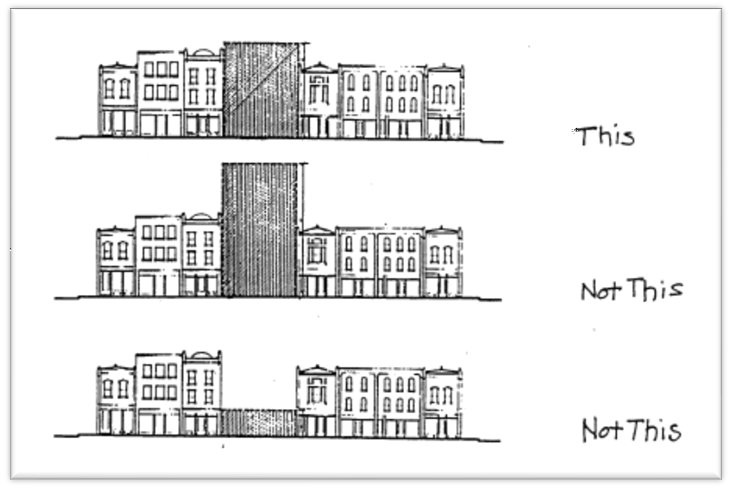
Figure 122-354.1
(4)
Building mass. Throughout the village centre overlay district, the mass of buildings shall be compatible with existing buildings in the immediate area which conform to the general design theme noted in subsection (a) of this section, as determined by the architectural control board. The characteristic proportion, or relationship between the façade height and width, of the general design theme shall be maintained. Building mass for structures with a façade area over 5,000 square feet shall be disguised through the use of façade articulations, or through the use of exterior treatments which give the impression of directly adjoining individual buildings, as determined by the architectural control board. (See figure 122-354.2).
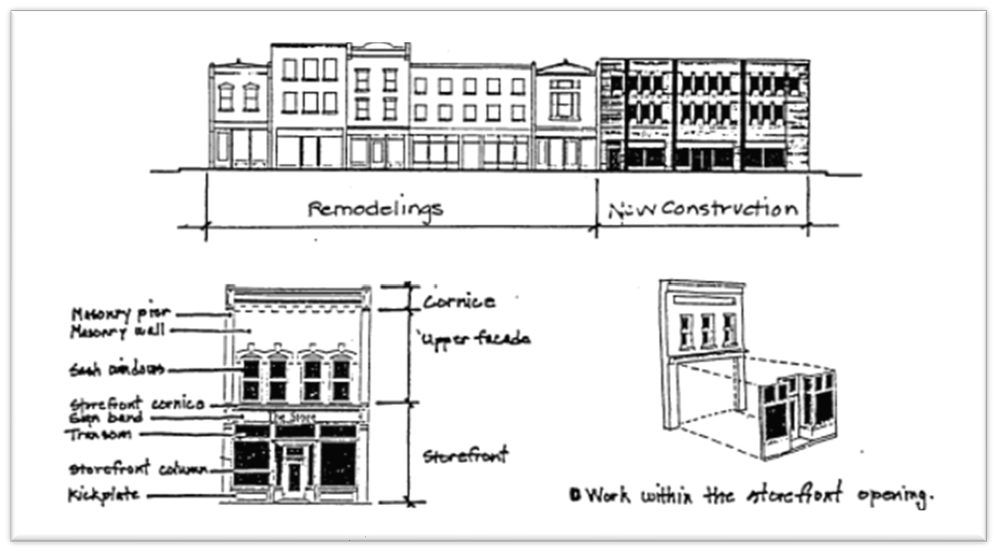
Figure 122-354.2
(5)
Horizontal rhythms. Along Main Street, the horizontal pattern of exterior building elements formed by patterns of building openings for windows and doors, and related elements such as piers and columns, shall be spaced at regular intervals across all visible facades of the building, and shall be compatible with those of existing buildings in the immediate area which conform to the general design theme noted in subsection (a) of this section, as determined by the architectural control board. (See figure 122-354.2).
(6)
Vertical rhythms. Along Main Street, the floor heights on main facades shall appear visually in proportion to those of adjoining buildings. The rhythm of the ground floor shall harmonize with the rhythm of upper floors. The vertical pattern of exterior building elements formed by patterns of building openings for windows and doors, and related elements such as sills, headers, transoms, cornices and sign bands shall be compatible in design and elevation with those of existing buildings in the immediate area which conform to the general design theme noted in subsection (a) of this section, as determined by the architectural control board. (See figure 122-354.2).
(7)
Roof forms. Along Main Street, flat or gently sloping roofs which are not visible from the street shall be used. Mansards or other exotic roof shapes not characteristic of the general design theme noted in subsection (a) of this section, as determined by the architectural control board, shall not be used. Throughout the village centre overlay district, roof shapes not characteristic of the general design theme noted in subsection (a) of this section, as determined by the architectural control board, shall not be used.
(8)
Exterior materials. Selected building materials shall be compatible with those of existing buildings in the immediate area which conform to the general design theme noted in subsection (a) of this section, as determined by the architectural control board. Specifically:
a.
Masonry. Along Main Street, stone or brick facing should be of even coloration and consistent size. Cinder block, concrete block, concrete slab, or concrete panel shall not be permitted.
b.
Siding. Along Main Street, wood or thin board textured vinyl or textured metal clapboard siding may be appropriate, particularly if the proposed non-masonry exterior was used on a building which conforms to the general design theme noted in subsection (a) of this section, as determined by the architectural control board. In certain instances, clapboard, board and batten may be in keeping with the general design theme. Asphalt shingles shall not be permitted.
c.
Glazing. Along Main Street, clear, or slightly tinted glass or related glazing material shall be used. Mirrored glass, smoked glass, or heavily tinted glass shall not be permitted.
(9)
Exterior surface appurtenances. Exterior surface appurtenances shall be compatible with those of existing buildings in the immediate area which conform to the general design theme noted in subsection (a) of this section, as determined by the architectural control board. Specifically:
a.
Along Main Street, the traditional storefront design theme (characterized by strong horizontal and vertical rhythms formed by building openings, storefront columns, storefront cornices, upper cornices, kickplates, signbands, large display windows, and transom windows) shall be employed for all new nonresidential buildings, including retail, office, professional service, personal service, maintenance, loading, entertainment and storage uses. (See figure 122-354.2).
b.
Throughout the village centre overlay district, avoid cluttering building facades with brackets, wiring, meter boxes, antennae, gutters, downspouts, and other appurtenances. Unnecessary signs shall also be avoided. Where necessary, such features shall be colored (or concealed with planter boxes or other means) so as to blend in, rather than contrast, with the immediately adjacent building exterior. Extraneous ornamentation which is inconsistent with the general design theme noted in subsection (a) of this section, as determined by the architectural control board, is also prohibited.
c.
Awnings. Throughout the village centre overlay district, awning size, color and placement should complement the architectural character of the building, as determined by the architectural control board. Soft, weather-treated canvas or vinyl materials which allow for flexible or fixed installations shall be used. Aluminum or suspended metal canopies shall be prohibited. Signage applied to awnings shall be simple, and durable. Backlit awnings are prohibited.
(10)
Exterior colors. Selected exterior colors for structures and appurtenances, including fixtures and signs, shall be compatible and harmonious with those of existing buildings in the immediate area which conform to the general design theme noted in subsection (a) of this section, as determined by the architectural control board. Specifically, throughout the village centre overlay district:
a.
Fluorescent, day glow and/or neon colors shall not be permitted. Where such colors constitute a component of a standardized corporate theme or identity, muted versions of such colors shall be used.
b.
High gloss paints, lacquers, varnishes or other shiny non-glazing surfaces shall not be used.
c.
Color combination schemes shall be limited to no more than three different colors for all the structures and appurtenances on a property. (Varying shades, tints or intensities of a color shall count as a different color for this purpose.)
d.
Color schemes shall be used consistently throughout the property, including on both the upper and lower portions of buildings, and on all facades of a building or structure.
Sec. 122-360. - Purpose and scope.
(a)
Purpose. The purpose of this overlay district is to encourage innovative design and a mix of uses in areas of the village where such development could positively contribute to the physical appearance and function of land and development.
(b)
Designation of the planned development overlay district. In determining the proper location for the PDO, the village shall consider the following:
(1)
That the application of this overlay district would provide a choice in the type of environment available to the public by allowing development that would not be possible under the strict application of other sections of this chapter.
(2)
That the application of this PDO would allow a creative approach to the use of land and related physical facilities which results in better urban design, higher quality construction and the provision of aesthetic amenities.
(3)
That the application of this PDO would allow the efficient use of land, so as to promote economies in the provision of utilities, streets, schools, public grounds and buildings and other facilities.
(4)
That the application of this PDO would allow innovations in development so that the needs and demands of the population may be met by a greater variety in type, design and layout of buildings, and by conservation and more efficient use of open space ancillary to said buildings, all in a manner so as to be consistent with the character of the zoning district over which the PDO is to be located.
(5)
That the application of this PDO would allow land uses which promote the public health, safety, comfort, morals and welfare.
(c)
Minimum size of district. In order to establish a coherence of design, and to achieve the community benefits of the PDO, the project size shall be at least three acres. Applications for a PDO on sites containing less than three acres, but not less than the underlying zoning district requirements, may be approved upon proof by the owner that the development is in the public interest and that one or more of the following conditions exist.
(1)
The property contains steep topography or other unusual physical features which necessitates substantial deviation from the regulations otherwise applicable, in order to ensure a safe, efficient and attractive development.
(2)
The property is adjacent to an existing PDO and will contribute to the maintenance of amenities and values of the neighboring district.
(3)
The property lends itself to creative design that will enhance quality of life in the proposed development.
(d)
Area, height, yard, and density requirements. The plan commission may recommend and the village board may authorize revisions to the applicable area, height, yard, density and other regulations of this chapter within the boundaries of such PDO. Any revisions to the underlying district require the plan commission to find such revision is for the purpose of promoting an integrated development, more beneficial to the tenants or occupants of such development, as well as the neighboring properties, than would be obtained from the underlying zoning district regulations. Any such revisions must be specifically approved by the village board as part of the PDO general plan per section 122-363.
(e)
Use regulations. The plan commission may recommend, and the village board may authorize, any specified use prohibited or allowed as a conditional use in the underlying district(s) to be considered a permitted use in the PDO, provided the uses are listed in the PDO general plan and the plan commission finds:
(1)
The uses permitted by such revisions are necessary or desirable and are appropriate with respect to the primary purpose and character of the PDO.
(2)
The uses permitted by such revision are not of such nature, or so located, as to exercise a detrimental influence on the neighborhoods surrounding the PDO, or upon the internal character of any part of the PDO.
(f)
Outdoor lighting, parking and landscape standards. The standards of the following shall apply unless specifically addressed in the PDO general plan:
(1)
Outdoor lighting requirements as set forth in section 122-641.
(2)
Off-street parking and loading requirements as set forth in article VII of this chapter.
(3)
Landscaping requirements as set forth in article VI of this chapter.
(g)
Expiration of plans. A PDO zoning designation shall remain on a parcel even if there is no approved specific implementation plan, or the general plan has expired.
Sec. 122-361. - Pre-application meeting.
(a)
Pre-application meeting with staff. This meeting shall be held to provide an early opportunity for staff and the applicant to discuss the procedures, standards and regulations required for development approval in a PDO. An applicant's failure to schedule and attend a pre-application meeting shall render the application incomplete. The applicant may apply for a conceptual discussion with the plan commission upon the zoning administrator's determination that sufficient information has been presented to adequately determine the concepts of the proposed development.
Sec. 122-362. - Initial plan.
(a)
Submittal requirements. In order to be considered by the plan commission, the applicant shall submit information addressing the following:
(1)
The need for PDO zoning.
(2)
The environmental, economic, and social benefits the development will bring to the village.
(3)
A statement of rationale explaining why the PDO is proposed. The statement shall detail in text, graphic, and statistical forms the difficulty of development with the underlying district, or any other zoning district consistent with the village comprehensive plan. The statement shall identify barriers that the developer perceives in other zoning districts and opportunities for community betterment the developer believes are available through the proposed PDO.
(4)
The impact to the village, specifically addressing:
a.
Planning/zoning issues, including conformance with the land use plan, neighborhood design standards, this chapter, and other applicable village codes and policies.
b.
Social and economic impact upon the community.
c.
Land development issues, including topographic and soil conditions.
d.
Site safety concerns.
e.
Private utility consumption, including electrical needs and natural gas usage.
f.
Noise conditions.
g.
Impact on schools.
h.
Air quality conditions.
i.
Environmental design and historic values including visual quality and historic resources.
j.
Community facilities and services, including refuse collection, sanitary and storm water management, and water supply.
k.
Public safety needs, including police, fire and emergency medical services.
l.
Open space, recreational and cultural elements.
m.
Transportation issues, including pedestrian access and circulation, auto and delivery vehicle traffic, and parking.
n.
Natural feature preservation, encroachment, and/or replacement.
o.
Any additional information required by the village to assure an adequate analysis of all-existing and proposed site features and conditions.
(5)
Names and contact information for the land owner, developer, developer's engineer, developer's architect, developer's landscape architect, and a person who shall be deemed the point of contact for the project.
(6)
A fee as established in chapter 42 of this Code.
(b)
Staff review. The application shall be deemed to be complete if it is submitted in the required form, includes all required information, does not contain significant inaccuracies or omissions, and does not contain multiple minor inaccuracies or omissions. The zoning administrator shall review the application materials to determine whether the petition fulfills the requirements of this section. If the zoning administrator determines that the petition is not complete and does not fulfill the requirements of this chapter, the application shall be returned to the applicant.
(1)
When the petition meets with the zoning administrator's approval, and all information required in subsection (a) above is submitted, the application shall be referred to appropriate village departments for their review.
(2)
Following village department reviews, a staff report shall be prepared on the suitability of the project. Such report shall contain staff comments and describe reasoning behind a recommendation. The report shall be forwarded to the applicant and plan commission prior to the meeting.
(3)
Following the completion of the staff report, the application shall be placed on the next available plan commission agenda for discussion.
(c)
Plan commission review. The plan commission may require additional information prior to acting to approve, modify and approve, or deny the initial plan. In making its determination, the plan commission shall give consideration to, and be satisfied that:
(1)
The proposed development is consistent with the spirit and intent of this chapter and would not be contrary to the general welfare and economic prosperity of the village, but rather that the benefits derived utilizing the most modern development techniques, and is in keeping with current economic and social considerations and justifies the application of the PDO district requirements.
(2)
The proposed development would provide a choice in the type of environment available to the public by allowing development that would not be possible under the strict application of other sections of this chapter.
(3)
The proposed development would allow a creative approach to the use of land and related physical facilities which results in better urban design, higher quality construction and the provision of aesthetic amenities.
(4)
The proposed development would allow the efficient use of land, so as to promote economies in the provision of utilities, streets, schools, public grounds and buildings and other facilities.
(5)
The proposed development would allow innovations in development so that the needs and demands of the population may be met by a greater variety in type, design and layout of buildings, and by conservation and more efficient use of open space ancillary to said buildings, all in a manner so as to be consistent with the character of the zoning district over which the PDO is to be located.
(6)
The proposed development would allow a land use which promotes the public health, safety, comfort, morals and welfare.
(7)
The proposed development meets the purpose of the PDO contained in section 122-360.
Sec. 122-363. - PDO rezoning application and general plan.
(a)
Submittal requirements. After the plan commission approves the initial plan, the applicant may submit an application for the general plan approval, and a formal request to rezone the subject lands to a PDO. The procedure for rezoning to a PDO shall follow the procedures of section 122-68 relating to the rezoning process; however in addition to the general rezoning process and application forms, the following additional information shall be submitted relating to a general plan:
(1)
A map of the project area including its relationship to surrounding properties and topography and other key features, such as, but not limited to, woodlots, specimen trees, streams, wetlands, floodplains, environmental corridors, rock outcroppings, and existing buildings or improvements. Specific impact analysis or other studies relative to key features may be required by village staff.
(2)
A statement of rationale explaining why the PDO is proposed. The statement shall detail in text, graphic, and statistical forms the difficulty of development with the underlying district, or any other zoning district consistent with the village comprehensive plan. The statement shall identify barriers that the developer perceives in other zoning districts and opportunities for community betterment the developer believes are available through the proposed PDO.
(3)
An analysis of social and economic impacts on the community from the PDO.
(4)
An analysis of how the proposal is consistent with, and will advance the goals, policies and objectives of the comprehensive plan.
(5)
A detailed analysis discussing the intended specific environmental design, the amenities to be gained by the PDO, and a specific statement as to why such benefits and amenities would not be realized under any other zoning district with this Code.
(6)
A general plan of the proposed project showing at least the following information in sufficient detail to make possible evaluation against criteria for approval:
a.
Public and private roads, driveways and parking facilities; bicycle and pedestrian facilities, and any other multi-modal forms of transportation and their related facilities.
b.
Land uses and size, arrangement and location of lots and proposed buildings or groups of buildings.
c.
The types, size, intended uses, and location of structures.
d.
A preliminary grading plan and general utility plan.
e.
The location of recreational and open space areas and facilities.
f.
General landscape plan.
g.
Statistical data on the size of the development, density/intensity of various parts of the development, ratio of various land uses, economic analysis of the development, expected staging, and any other plans or data required by the plan commission or village board.
(7)
Preliminary development code. The requirements of the development code are contained in section 122-365.
(8)
General outline of the intended organizational structure for the development, and any documents, deed restrictions, private easements or other documents addressing the private provision of common services.
(9)
A schedule for the completion of all public and private improvements proposed within the project plan.
(10)
A fee as established in chapter 42 of this Code.
(b)
Staff review. The application shall be deemed to be complete if it is submitted in the required form, includes all required information, does not contain significant inaccuracies or omissions, and does not contain multiple minor inaccuracies or omissions. The zoning administrator shall review the application materials to determine whether the petition fulfills the requirements of this section. If the zoning administrator determines that the petition is not complete and does not fulfill the requirements of this chapter, the application shall be returned to the applicant.
(1)
When the petition meets with the zoning administrator's approval, and all information required in subsection (a) above is submitted, the application shall be referred to appropriate village departments for their review.
(2)
Following village department reviews, a staff report shall be prepared on the suitability of the project. Such report shall contain staff comments and describe reasoning behind a recommendation. The report shall be forwarded to the applicant and plan commission prior to the meeting.
(3)
Following the completion of the staff report, the application shall be placed on the next available plan commission agenda for discussion.
(c)
Plan commission review. The plan commission may require additional information prior to making its recommendation, and shall recommend the village board either approve the general plan, approve the general plan with modifications, or to deny the general plan. The recommendation shall be made at a subsequent meeting at which the petition is first discussed unless the plan commission determines, with no dissenting vote, that waiting until a subsequent meeting to make its recommendation is not necessary.
(d)
Village board action. The village board shall hold a public hearing on the plan commission's recommendation, and shall act to approve, modify and approve, or disapprove the general plan and rezoning. Approval shall be by appropriate ordinance, and necessary changes in the official zoning map and text shall be made promptly. The zoning map designation of each PDO zoning shall contain a chronological number, starting at 1, after the letters (PDO-1, PDO-2, etc.), and all zoning code text relating to the overlay district shall be placed in article VIII of this chapter.
(1)
Approval of the PDO zoning shall establish the basic right of use for the area in conformity with the development plan as approved.
(e)
Criteria for approval. As a basis for determining the acceptability of a PDO, the following criteria shall be applied to the general plan with specific consideration as to whether or not it is consistent with the general purpose and intent of the village comprehensive plan and zoning ordinance; whether it has been prepared with competent professional expertise and guidance; whether is produces significant community benefits to compensate for revisions in the general standards of the zoning code; and whether it positively contributes to the physical appearance and function of the site.
(1)
Character and intensity of lands use. The uses proposed and their intensity and arrangement on the site shall:
a.
Provide a greater level of economic, social and other benefits than would otherwise be realized.
b.
Be compatible with adjacent properties.
c.
Provide a suitable arrangement of buildings and open space.
d.
Provide landscaping, including vegetation and trees that enhance the public realm while being appropriate for the district.
e.
Provides a transportation network that emphasizes connectivity and the reduction of motor vehicle trips, while providing a structure appropriate for pedestrian activity.
f.
Respect the physical attributes of the site with particular concern for minimizing the grading of the site while preserving the natural features, tree growth and open space.
g.
Produce an attractive sustainable aesthetic and ecological desirability, economic stability and functional practicality compatible with the development prospects for the area.
h.
Not adversely affect the anticipated provision of school or municipal services, or place excessive demands on village services or infrastructure.
i.
Not create traffic or parking demand incompatible with the existing or proposed facilities.
j.
Not be detrimental to the existing developments surrounding the district because of its location, bulk, scale, or design.
(2)
Economic feasibility and impact. The applicant of a PDO shall provide evidence satisfactory to the plan commission and village board that the project will not adversely affect the economic prosperity of the village or the values of surrounding properties.
(f)
Period of validity. The general plan, as approved by the village board, shall remain valid for a period of five years, unless the timeframe is specifically extended by the village board. The approval of the PDO and general plan shall not authorize the issuance of any building permits, however the general plan must be valid in order to apply for the specific implementation plan. Building permits shall not be issued until approval of the specific implementation plan by the village board.
Sec. 122-364. - Specific implementation plan.
(a)
Submittal requirements. After the village board approval of the general plan and PDO rezoning, and the satisfaction of all conditions of the general plan, the applicant may file a "specific implementation plan" for review and recommendation by the plan commission and architectural control board, and approval by the village board. If a specific implementation plan is not submitted for the entire area covered by the general plan prior to the lapse of the general plan, a new general plan must be approved by the village board, after holding a public hearing and considering a new recommendation by the plan commission, prior to consideration of any specific implementation plan.
(1)
The specific implementation plan shall be a precise plan for development, containing the following:
a.
Graphic and tabular information at a level of detail equivalent to the level of detail of a final plat.
b.
Building and site improvement placement, and scaled drawings of building dimensions.
c.
Accompanying text information describing in detail the development plans, methodologies and timetables, and building and site uses for all areas covered in the specific implantation plan.
d.
A fee as established in chapter 42 of this Code.
(2)
The plan commission or village board may specify other plans, documents or schedules that must be submitted prior to consideration or approval of the specific implementation plan, as such may be relevant to review procedures and standards.
(3)
The process for review and approval of the specific implementation plan shall be administrative, as contrasted with the legislative process of the general plan review and approval. As such, no public hearings are required with this step.
(b)
Staff review. The application shall be deemed to be complete if it is submitted in the required form, includes all required information, does not contain significant inaccuracies or omissions, does not contain multiple minor inaccuracies or omissions, and is accompanied by the fee established in chapter 42 of this Code. The zoning administrator shall review the application materials to determine whether the petition fulfills the requirements of this section. If the zoning administrator determines that the petition is not complete and does not fulfill the requirements of this chapter, the application shall be returned to the applicant.
(1)
When the petition meets with the zoning administrator's approval, and all information required in subsection 122-71(b)(4)(a) is submitted, the application shall be referred to appropriate village departments for their review.
(2)
Following village department reviews, a staff report shall be prepared on the suitability of the project. Such report shall contain staff comments and describe reasoning behind a recommendation. The report shall be forwarded to the applicant and plan commission prior to the meeting.
(3)
Following the completion of the staff report, the application shall be placed on the next available plan commission agenda for discussion.
(c)
Plan commission review of the specific implementation plan.
(1)
The plan commission shall review the specific implementation plan against the applicable standards of this chapter, the comprehensive plan and the previously approved general plan. Without limiting the plan commission's ability to recommend a specific implementation plan be denied, the plan commission must determine that the specific implementation plan is consistent with the general implementation plan as well as the applicable standards of this chapter and the comprehensive plan.
(d)
Architectural control board review of the specific implementation plan.
(1)
After the plan commission has made a recommendation to the village board regarding the specific implementation plan, the item shall be forwarded to the architectural control board for their recommendation.
(2)
The architectural control board shall review the specific implementation plan and offer a recommendation to the village board. In its review the architectural control board shall determine if the request is functional and compatible with the overall urban design of the area, and if the elements of the specific implementation plan are not unsightly or obnoxious and not disharmonious or so similar to existing neighboring developments that substantial depreciation of neighboring property or development will be caused by the request.
(e)
Village board review of the specific implementation plan.
(1)
After receiving recommendations from the plan commission and architectural control board, the item shall be forwarded to the village board for final action.
(2)
The village board shall consider and act on the specific implementation plan after reviewing the recommendations of the plan commission and architectural control board.
(3)
If the village board conditionally approves the specific implementation plan, the applicant shall submit plans and information to the zoning administrator satisfying all such conditions. Once the zoning administrator has verified all conditions have been satisfied, the applicant may apply for a building permit.
(4)
Only development in accordance with the approved development plan and specific implementation plan, and their supporting data, shall occur within a PDO. The approved PDO, development plan, specific implementation plan, and all supporting data shall be binding on the applicants, their successors, grantees and assigns and shall limit and control the use of the premises, including the internal use of buildings and structures, and location of structures in the PDO as set forth therein.
(f)
Period of validity. The specific implementation plan shall remain valid for a period of two years from the date of village board approval, or within one year of an extended timeframe if specifically provided in the specific implementation plan. No building permits shall be issued without a valid general plan and specific implementation plan; however a one-year extension of the specific implementation plan may be granted by the village board for good cause shown by the applicant.
(g)
Effect of specific implementation plan approval and alterations. The approval of the specific implementation plan shall only authorize the release of building and other land use permits necessary to carry out the development activities consistent with that approved plan, when all conditions or requirements of the specific implementation plan and other ordinances have been met. It is the responsibility of the applicant to provide proof of satisfaction of all conditions and requirements.
(1)
If a proposed amendment to the specific implementation plan is inconsistent with or alters an approved general plan, the specific implementation plan shall not be approved unless the general plan is amended in accordance with the procedures pursuant to this division.
(2)
Major changes may be approved only by the submission of a new specific implementation plan, and if the specific implementation plan is inconsistent with the approved general plan a new general plan shall also be submitted. The new specific implementation plan, and general plan if needed, shall follow the approval steps found in this division. Major changes which alter the concept or intent of the PDO include:
a.
Increases or decreases in the density by more than ten percent.
b.
Increases in the height of building(s) by more than ten percent.
c.
Reductions of proposed open space by more than ten percent.
d.
Changes in standards of infrastructure or alignment of streets, including major alterations in the placement of utilities, water, electricity, drainage or changes in the final governing agreements, provisions or covenants.
e.
Any change to the concept or intent of the development.
(3)
Minor changes, defined as any change not classified as a major change, may be approved by the zoning administrator, however any minor change shall be properly filed with the zoning administrator or it shall be automatically deemed to be a major change.
Sec. 122-365. - Development code.
All developments proposed within the PDO district shall provide a development code. A development code is a document or series of documents that ensures the implementation of the site, building, landscaping, signage, etc. The code shall regulate the materials, configuration, and construction techniques of the buildings and encourage variety while ensuring the harmony required to give character to the development and community.
(1)
Content of the development code. The development code shall contain the following:
a.
Regulating plan. A regulating plan consisting of standards presented though text and drawings of:
1.
Street types and pedestrian areas, the public area or semi-public areas reserved for squares, parks, and civic buildings.
2.
Floor area ratio, setbacks, green space requirements, buffer requirements, and other requirements determined necessary by the zoning administrator.
b.
Site regulations. Site regulations shall be produced as a matrix, which regulate private building types to help form the public realm. The site regulations shall be prescriptive, and contain information such as requiring a specified percentage of building facades to be on a common frontage line, and requiring parking in the rear or sides of lots. The site regulations should encourage the provision of certain building elements, such as stoops, porches and garden walls, which influence social behavior, and shall include signage and graphics for the development.
c.
Architectural regulations. Architectural regulations shall be produced as a matrix with text and drawings that regulate configurations, materials, and techniques of construction. The regulations are intended to produce harmony among buildings, control materials, and encourage new buildings to relate to the geographical history and climate of the area.
d.
Street sections. Street section development codes depict the character of the public spaces (roads, walks, plazas, etc.). The intention of the code is to make places where pedestrians feel safe and comfortable, and automobiles move efficiently. The proportion of building height to street width is clearly specified, as is the width of travel and parking lanes, the alignment of trees, and walkways. These variables are related to both the intended urban, rural, and village character of the streets and to utilitarian concerns. A full range of streets may include avenues, boulevards, and streets for high-density areas, streets for residential areas, service roads, and alleys. The relationship of buildings to parking lots shall also be indicated within this section. Also located within this section will be standards for street signage, lighting, street furnishing and other amenities.
e.
Landscape regulations. These regulations specify the planting for streets, squares, and parks to support the character of each place, as well as standards for landscaping private, commercial, office, and residential lots. Native species and techniques providing stormwater attenuation or treatment are preferred and specific species, design styles, and locational preferences shall be indicated.
(2)
Criteria for approval of the development code. The application will be reviewed to ensure it is consistent with the spirit and intent of this ordinance and has the potential for producing significant community benefits in terms of environmental and aesthetic design. The following criteria shall be applied as a basis for determining the acceptability of a development code within a PDO.
a.
Character and intensity of land use. Uses and their intensity, appearance and arrangement shall have a visual and operational character which:
1.
Is compatible with the physical nature of the site or area.
2.
Would produce an environment of sustained aesthetic desirability or functional practicality.
3.
Would not adversely affect the anticipated provision for school or other municipal service unless jointly resolved.
4.
Would not create traffic or parking demand incompatible with the existing or proposed facilities to serve it unless jointly resolved.
b.
Economic impact. A development shall not adversely affect the economic prosperity of the village or the area of the village where the development is proposed.
c.
Preservation and maintenance of open spaces. Adequate provision for the improvement, continuing preservation, and maintenance of attractive open space shall be made.
d.
Implementation schedule. Suitable assurances that each phase could be completed in a manner which would not result in an adverse effect upon the community as a result of termination at that point.
Sec. 122-370. - Purpose and scope.
(a)
The purpose of the planned infill development (PID) overlay zoning district is to provide regulations which govern the procedure and requirements for the review and approval, or denial, of proposed infill developments, and to provide for the possible relaxation of certain development standards pertaining to the underlying standard zoning district.
(b)
Generally, the PID overlay zoning district is intended to provide more incentives for redevelopment in areas of the community which are experiencing a lack of reinvestment. Furthermore, the PID overlay zoning district is designed to forward both aesthetic and economic objectives of the village by controlling the site design and the appearance, density or intensity of development within the PID overlay zoning district in a manner which is consistent with sound land use, urban design, and economic revitalization principles. The application of these standards will ensure long-term progress and broad participation toward these principles.
(c)
Specifically, PIDs are intended to provide incentives for infill development and redevelopment in terms of more flexible requirements for land uses, density, intensity, bulk, landscaping and parking requirements. In exchange for such flexibility, the PID shall provide a much higher level of site design, architectural control and other aspects of aesthetic and functional excellence than normally required for other developments.
(d)
PIDs have the potential to create undesirable impacts on nearby properties if allowed to develop simply under the general requirements of this chapter. In addition to such potential, PIDs also have the potential to create undesirable impacts on nearby properties which potentially cannot be determined except with a binding site plan, landscape plan and architectural plan, and on a case-by-case basis. In order to prevent this from occurring, all PIDs are required to meet certain procedural requirements applicable only to PIDs, in addition to the general requirements of this chapter. A public hearing process is required to review a request for a PID. This process shall essentially combine the process for a zoning map amendment with that required for a conditional use, with several additional requirements.
Sec. 122-371. - Provision of flexible development standards.
(a)
Permitted location. Planned infill developments (PIDs) shall be permitted with the approval of a planned infill development overlay zoning district, specific and unique to the approved PID, within the RM-1, RM-2, C-1, C-2, C-3, PDO and P-2 zoning districts.
(b)
Flexible development standards. The following exemptions to the development standards of the underlying zoning district may be provided with the approval of a planned infill development:
(1)
Land use requirements. All land uses listed as permitted by right and/or conditional uses in any of the zoning districts listed in subsection (a) of this section, may be permitted within a PID. However, only such land uses which are explicitly depicted on the required site plan approved by the village board as part of the approved PID shall be permitted, even if such land uses are otherwise listed as a land use which is permitted by right in such underlying zoning district. Any or all land uses within the PID may be exempt from the detailed requirements listed for a specific land use in the remainder of this chapter. Requested exemptions from these use standards shall be made explicit by the applicant in application (per subsection 122-373(5)), and shall be recommended by the plan commission and approved explicitly by the village board. If not so requested and approved, such exemptions shall not be permitted.
(2)
Density and intensity requirements. All requirements listed in this chapter for residential density and nonresidential intensity such as the maximum number of dwelling units per acre, the minimum number of square feet of site area per dwelling unit, or similar density or intensity standards used in this chapter may be waived or modified within a PID. However, only development density and intensity which is explicitly depicted on the required site plan approved by the village board as part of the approved PID shall be permitted, even if such density or intensity is otherwise listed as permitted in this chapter. Requested exemptions from these density and intensity standards shall be made explicit by the applicant in the application (per subsection 122-373(5)), and shall be recommended by the plan commission and approved explicitly by the village board. If not so requested and approved, such exemptions shall not be permitted.
(3)
Bulk requirements. All requirements listed in this chapter for bulk, such as minimum setback or maximum height, may be waived or modified within a PID. However, only development bulk which is explicitly depicted on the required site plan approved by the village board as part of the approved PID shall be permitted, even if such bulk is otherwise listed as permitted in this chapter. Requested exemptions from these bulk standards shall be made explicit by the applicant in the application (per subsection 122-373(5)), and shall be recommended by the plan commission and approved explicitly by the village board. If not so requested and approved, such exemptions shall not be permitted.
(4)
Landscaping requirements. All requirements listed in this chapter for landscaping may be waived or modified within a PID. However, only landscaping which is explicitly depicted on the required landscaping plan approved by the village board as part of the approved PID shall be permitted to substitute for the requirements of this chapter. Requested exemptions from these landscaping standards shall be made explicit by the applicant in the application (per subsection 122-373(5)), and shall be recommended by the plan commission and approved explicitly by the village board. If not so requested and approved, such exemptions shall not be permitted.
(5)
Parking and loading requirements. All requirements listed in this chapter for parking and loading may be waived or modified within a PID. However, only parking and loading facilities which are explicitly depicted on the required site plan approved by the village board as part of the approved PID shall be permitted to substitute for the requirements of the base zoning district and land use, even if such parking and loading is otherwise listed as permitted in this chapter. Requested exemptions from these parking and loading standards shall be made explicit by the applicant in the application (per subsection 122-373(5)), and shall be recommended by the plan commission and approved explicitly by the village board. If not so requested and approved, such exemptions shall not be permitted.
Sec. 122-372. - Pre-application meetings.
(a)
Pre-application meetings provide an early opportunity for staff and applicants to discuss the procedures, standards and regulations required for development approval under these zoning regulations.
(b)
An applicant's failure to schedule and attend a pre-application meeting (or meetings, if more than one meeting is required by the zoning administrator) shall render the application incomplete.
Sec. 122-373. - Application requirements.
The following information shall be submitted with all applications for development within a planned infill development (PID) overlay district. All maps and plans shall include the date of preparation, north arrow and scale.
(1)
A complete "application for review" form, accompanied by the fee established in chapter 42 of this Code.
(2)
A scaled map showing all lands for which the PID is proposed, along with all abutting lands, their lot dimensions and current zoning.
(3)
A written description of the proposed PID describing the type and locations of activities, buildings and structures proposed for the subject property.
(4)
A written description of each requested exemption from the requirements of the underlying zoning district, in this order:
a.
Land use exemptions.
b.
Density and intensity exemptions.
c.
Bulk exemptions.
d.
Landscaping exemptions.
e.
Parking and loading requirements exemptions.
(5)
Written justification for the proposed PID.
(6)
A site plan of the subject property as proposed for development. Such site plan shall conform to any and all of these requirements:
a.
A title block which indicates the name, address and telephone number of the current property owner and any professional or firm representing the owner.
b.
The date of the original plan and the latest date of revision to the plan.
c.
A north arrow and a graphic scale. Such scale shall not be smaller the one inch equals 40 feet.
d.
All property lines and existing and proposed right-of-way lines with bearings and dimensions clearly labeled.
e.
All existing and proposed easement lines and dimensions with a key provided and explained on the margins of the plan as to ownership and purpose.
f.
All existing and proposed buildings, structures and hard-surfaced areas, including walks, drives, decks, patios, fences, utility poles, drainage facilities and walls.
g.
All required building setback lines.
h.
A legal description of the subject property.
i.
The location, type, and size of all signage on the subject property.
j.
The location, type and orientation of all exterior lighting on the subject property.
k.
The location of all access points, parking and loading areas on the subject property, including a summary of the number of parking stalls and labels indicating the dimension of such areas.
l.
The location of all outdoor storage areas.
m.
The location and type of any permanently protected green space areas.
n.
The location of existing and proposed stormwater control measures and drainage facilities.
o.
In the legend, the following data for the subject property:
1.
Lot area;
2.
Floor area;
3.
Floor area ratio;
4.
Impervious surface area;
5.
Impervious surface ratio; and
6.
Building height.
p.
The location and elevation of all sanitary sewer, storm sewer, water mains, sidewalk and curbs located in the public rights-of-way adjacent to, or in easements on, the subject property.
(7)
A site grading plan referenced to the village datum.
(8)
A landscaping plan meeting the requirements of section 122-623.
(9)
A series of building elevations for the entire exterior of all buildings in the PID, including detailed notes as to the materials and colors proposed.
(10)
If the proposed PID involves land divisions, land combinations, relocated property lines, easements or other information or requirements typically proposed via the land division (platting or CSM) process a proposed preliminary plat (or CSM) or conceptual plat (or CSM) shall be provided in addition to the required site plan.
Sec. 122-374. - Review by the zoning administrator.
The proposed planned infill development (PID) shall be reviewed in the following steps:
(1)
The application shall be reviewed in order to ensure that all required portions of the application are provided. If the application is incomplete, all submitted information and fees shall be returned to the applicant with correspondence describing all missing information.
(2)
Upon receipt of a complete application, and payment of the appropriate fees, the zoning administrator shall review the site, existing and proposed structures, architectural plans, neighboring uses, parking areas, driveway locations, highway access, traffic generation and circulation, drainage, sewerage and water systems, and the proposed operation. A staff report shall be prepared on the suitability of the project evaluating and commenting on the written justification for the proposed PID provided in the application per subsection 122-373(5). Furthermore, such review shall evaluate the application based on the following questions:
a.
How is the proposed PID (the development in general) in harmony with the purposes, goals, objectives, policies and standards of the village comprehensive plan, this division, and any other plan, program or ordinance adopted, or under consideration pursuant to official notice by the village?
b.
How is the proposed PID (in its specific location) in harmony with the purposes, goals, objectives, policies and standards of the village comprehensive plan, this division, and any other plan, program or ordinance adopted, or under consideration pursuant to official notice by the village?
c.
Does the proposed PID, in its proposed location and as depicted on the required site, grading, and landscaping plans and building elevations result in a substantial or undue adverse impact on adjacent property, the character of the neighborhood, environmental factors, traffic factors, parking, public improvements, public property or rights-of-way, or other matters affecting the public health, safety or general welfare, either as they now exist or as they may in the future be developed as a result of the implementation of the provisions and policies of this division, the comprehensive plan, or any other plan, program, map or ordinance adopted or under consideration pursuant to official notice by the village or other governmental agency having jurisdiction to guide growth and development?
d.
Does the proposed PID maintain the desired consistency of land uses, land use intensities and land use impacts as related to the environs of the subject property?
e.
Is the proposed PID located in an area that will be adequately served by, and will not impose an undue burden on, any of the improvements, facilities, utilities or services provided by public agencies serving the subject property?
f.
Do the potential public benefits of the proposed PID outweigh any and all potential adverse impacts of the proposed PID (as identified in subsections (2)a—(2)e of this section), after taking into consideration any proposal by the applicant and any requirements recommended by the applicant to ameliorate such impacts?
(3)
The staff report shall be forwarded the applicant, plan commission and village board at least three days prior to the plan commission meeting at which the plan commission will make any recommendation to the village board.
Sec. 122-375. - Review by the plan commission and architectural control board.
The village board shall not approve a planned infill development (PID) without allowing for a recommendation from the plan commission and architectural control board per the provisions of this section.
(1)
Plan commission meeting.
a.
Role of the applicant. The applicant shall explain their reasoning for the request to the plan commission, and testify to support their claim that all requirements and conditions established by the village are, or shall be, satisfied.
b.
Role of the plan commission. The plan commission shall consider the application and all related information, and make a written report to the village board stating its findings regarding section 122-374, and its recommendations regarding the application as a whole. Such report shall include a formal finding of facts approved by the plan commission concerning the requirements of subsections 122-374(2)a—(2)f.
(2)
Architectural control board meeting. After the plan commission makes its recommendation to the village board, the application shall be forwarded to the architectural control board.
a.
Role of the applicant. The applicant shall explain their reasoning for the request to the architectural control board, explaining the reasoning behind the building site aesthetics.
b.
Role of the architectural control board. The architectural control board shall consider the application and all related information, and make a written report to the village board stating its findings regarding section 122-374, and its recommendations regarding the application as a whole. Such report shall include findings that:
1.
The site plan is functional and compatible with the overall urban design of the area.
2.
The elements of the proposed application are not unsightly or obnoxious and are not disharmonious or so similar to existing neighboring developments that substantial depreciation of neighboring property or development will be caused by the applicant's proposal.
Sec. 122-376. - Review by the village board.
Village board meeting. After the plan commission and architectural control board make their recommendations, the application shall be forwarded to the village board. Prior to taking final action on the request, the village board shall hold a public hearing pursuant to subsections 122-66(e) and (f).
(1)
Role of the applicant. The applicant shall explain the proposed project and may present information at the hearing showing how they intend to satisfy any requirements and conditions proposed by the village.
(2)
Role of the village board. The village board shall consider the recommendation of the plan commission and architectural control board regarding the proposed planned infill development. The board may request further information and/or additional reports from the plan commission, architectural control board, the zoning administrator, and/or the applicant. The board may take final action on such PID at any time of its initial meeting, or such proceedings may be continued from time to time for further consideration. The village board may approve the PID as originally proposed, may approved the proposed PID with modifications (per the recommendations of the zoning administrator, the plan commission, the architectural control board or the village board itself), or may deny the proposed PID. If the village board wishes to make significant changes in the proposed PID, as recommended by the plan commission and/or architectural control board, then the approved process must be repeated prior to board action. Approval of the proposed PID shall be considered the approval of a unique request, and shall not be construed as precedent for any other proposed PID. Once a PID is granted, no site plan approval, certificate of occupancy or building permit shall be issued for any development which does not comply with all requirements of the approved PID.
Sec. 122-377. - Effect of denial.
No PID application which has been denied (either wholly or in part) shall be resubmitted for a period of 12 months from the date of such order of denial, except on grounds of new evidence or proof of change of factors found valid by the zoning administrator.
Sec. 122-378. - Revocation of approval.
Any PID found not to be in compliance with the terms of its approval shall be considered in violation of this division and shall be subject to all applicable procedures and penalties. A PID may be revoked for such a violation by majority vote of the village board, following the procedures outlined in sections 122-375—122-377. A public hearing shall be held by the village board prior to final action on a revocation.
Sec. 122-379. - Time limits.
The start of construction of any and all PIDs shall be initiated within 365 days of their approval by the village board and shall be operational within 730 days of such approval. Failure to initiate development within this period shall automatically constitute a revocation of the PID. For the purposes of this section, the term "operational" shall be defined as the granting of a certificate of occupancy for the PID. Prior to such a revocation, the applicant may request an extension of this period. Such request shall require formal approval by the village board and shall be based upon a showing of acceptable justification (as determined by the village board). Any portion of the PID not completed within three years of approval by the village board shall be invalid, and subsequent development of such portions (even if in full compliance with the approved PID) shall require approval of a new PID proposal.
Sec. 122-380. - Discontinuance.
Any and all PIDs which have been discontinued for a period exceeding 365 days shall have their PID invalidated automatically. The burden of proof shall be on the property owner to exclusively demonstrate that the subject PID was operational during this period.
Sec. 122-381. - Change of ownership.
All requirements of the approved planned infill development shall be continued regardless of ownership of the subject property. Modification of any PID approved per section 122-376, without approval by the village board, shall be grounds for revocation of such PID approval per section 122-378.

