
Menomonee Falls Village
City Zoning Code
City Zoning Code
ARTICLE VII
PARKING
Sec. 122-700. - Intent.
The provisions are established to accomplish these goals:
(1)
Ensure an appropriate level of vehicle parking, loading, and storage to support a variety of land uses.
(2)
Provide appropriate site design standards to mitigate the impacts of parking lots on adjacent land uses and zoning districts.
(3)
Provide specifications for vehicular site access.
(4)
Protect against unnecessary reductions in landscaped green space, negative impacts on historic resources, and impairment of the urban design objectives of the village.
(5)
Encourage bicycle use as a mode of transportation by ensuring quick, convenient, and safe access to secure bicycle parking.
Sec. 122-701. - Authorized vehicles.
(a)
No truck, commercial trailer, house or camp trailer, or other vehicular equipment of a commercial or industrial nature shall be stored unenclosed, or parked regularly, on a lot in any district, except as specifically provided below:
(1)
Agricultural equipment shall be permitted without limitation where accessory to a permitted agricultural use.
(2)
Vehicles specifically approved by the village as part of a permitted or conditional use.
(3)
No more than two pick-up trucks, exceeding one ton each shall be permitted.
(4)
Without habitation, unenclosed parking of a recreational vehicle as defined in section 122-99 shall be considered an accessory use, and shall be regulated per subsection 122-532(a)(16).
Sec. 122-702. - Continuing character of obligations.
(a)
The requirement for off-street parking space and off-street loading space shall be the continuing obligation of the owner of the real estate on which any such structure or use is located as long as the structure or use is in existence and its use requiring parking or loading facilities continues.
(b)
It shall be unlawful for an owner of any structure or use affected by this article to discontinue, change or dispense with, or to cause the discontinuance or change of the required parking or loading space apart from an alternative parking or loading space which meets with the requirements of, and is in compliance with, this section.
(c)
It shall be unlawful for any business entity to use such structure without acquiring such land or other suitable land for parking or loading space which meets with the requirements of, and is in compliance with, this section.
Sec. 122-720. - Provided in all districts; exception.
In all districts, in connection with every use, except where a commercial space is located within the village centre overlay district, adequate off-street parking facilities shall be provided at the time any use or building is erected, enlarged, extended, or increased for all vehicles in accordance with this division.
Sec. 122-721. - Plan requirements for all uses except one and two-family structures.
(a)
A site plan shall be furnished for all proposed, enlarged/reduced, redesigned, or resurfaced parking lots within the village.
(b)
The site plan shall contain:
(1)
North arrow
(2)
Scale
(3)
Parking dimensions shall meet the requirements of figure 122-723.1, parking lot dimensions of this ordinance.
(4)
Chart indicating:
a.
Gross square feet of structure(s). When multiple uses are proposed for one structure the gross square feet of each use shall be provided.
b.
Maximum capacity of structure(s).
c.
Number of employees for largest work shift.
d.
Other information or measurements that may be needed to determine calculations such as floor area, service bay, tenant area, etc.
(c)
Related landscaping plan as required (refer to section 122-623).
Sec. 122-722. - Adequate access.
All off-street parking and loading facilities shall open directly onto an aisle, alley, or driveway designed to provide safe access to such facilities.
Sec. 122-723. - Parking space size.
(a)
The size of each parking space shall be determined in subsection (b) of this section, except for spaces provided for use by physically disabled persons, and parallel parking stalls.
(1)
Parking spaces for use by physically disabled persons shall be regulated by Wis. Stats. §§ 346.50—346.505.
(2)
Parallel parking stalls shall have a stall length of 21 feet.
(b)
Parking lot dimensions. The design of parking lots, and parking structures shall comply with figure 122-723.1, parking lot dimensions.
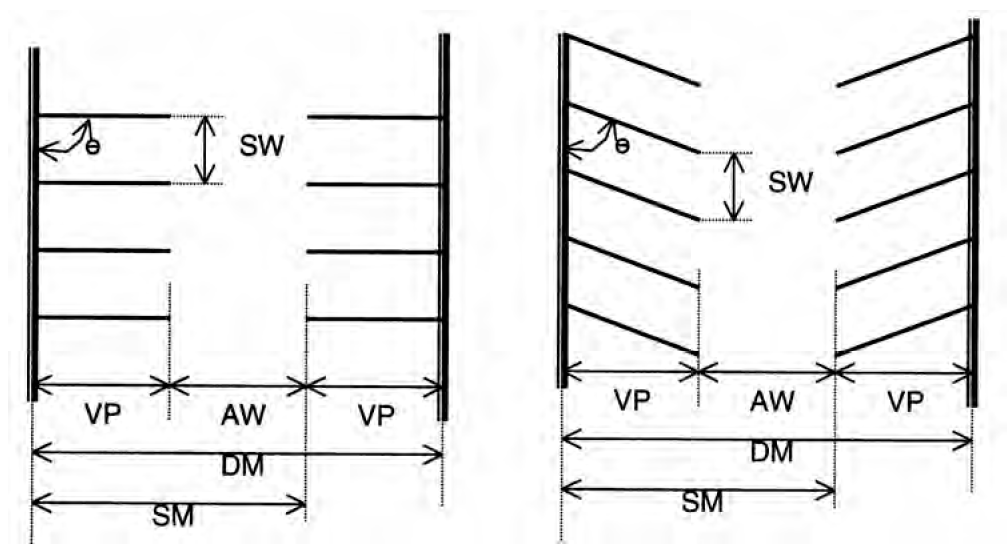
Figure 122-723.1 Parking Lot Dimensions
Sec. 122-724. - Location.
Refer to article V of this chapter for potential parking and loading restrictions with the specific building type. Parking stalls shall be located on the same lot as the principal use. When the required parking use is provided on a lot or parcel separated from the principal use, the parcel designated for parking must be restricted by means of a recorded easement, enforceable by the village and the owners of all lands adjacent to either parcel. The easement shall state the parcel is to be used solely for parking and shall be in such form as the plan commission may prescribe or approve.
Sec. 122-725. - Surfacing.
(a)
The driveway approach, located within the right-of-way, shall meet the village standards and be surfaced with asphalt or concrete pavement.
(b)
All driveways, except in agricultural districts, shall be surfaced with an asphalt pavement, concrete pavement, permeable surfacing or pavers, to provide a durable and dust free surface.
(1)
The plan commission may waive the pavement requirement of this section, in the I-2 heavy industrial district, if the applicant shows just cause, and maintains a dust free surface.
(2)
Surfacing shall be completed within in one year of occupancy in single family residential zoning districts.
(3)
Surfacing shall be completed prior to occupancy, except in single family residential or agricultural zoning districts.
Sec. 122-726. - Screening.
Any off-street parking area, other than that provided for a single-family residence, which abuts or faces a residential district shall provide and maintain a buffer meeting the requirements of section 122-630.
Sec. 122-727. - Setback.
Parking lots shall not be located closer than ten feet from the existing street line in all non-residential zoning districts. Parking lots shall not be located closer than five feet from the existing street line in all residential zoning districts. Parking lots shall not be located closer than three feet from any side or rear lot line in any district, except when access or parking easements are worked out jointly by the abutting properties.
Sec. 122-728. - Curbs and barriers.
Curbs, wheel stops or other barriers shall be installed to prevent parked cars from extending over the setback lines. The parcel of land between the street line and the parked vehicles shall be maintained as greenspace, and may include vegetated stormwater control measures.
Sec. 122-729. - Lighting.
Lights provided in any parking area shall be hooded or beamed so as not to create undesirable glare or illumination of adjacent residential property and shall meet the provisions of section 122-641.
Sec. 122-730. - Applicability.
This division shall apply to off-street parking for all new development and changes in use or intensity of use for existing development in all districts.
(1)
Compliance. Compliance with the standards outlined shall be attained in the following circumstances:
a.
Development of all new parking facilities, loading facilities, and driveways.
b.
Improvements to existing parking facilities, loading facilities, and driveways, including reconfiguration, enlargement, or the addition of curbs walkways, fencing, or landscape installation.
c.
Change in use requiring a change in the amount of parking.
Sec. 122-731. - Number of parking stalls required.
Figure 122-731.1, parking requirements, lists the number of parking stalls required for each use.
(1)
In the case of structures or uses not specified herein, the number of spaces specified for similar structure or use, as determined by the zoning administrator, shall apply.
(2)
In developments involving the establishment or addition of two or more uses on one lot or parcel, the cumulative number of spaces required for each use shall determine the total number of spaces required.
(3)
Unless noted otherwise, the minimum parking ratio is based on gross floor area.
(4)
When the parking calculation for a use results in a fractional number, the parking requirement shall be rounded to the next whole number.
(5)
For multi-family (three units or more) and retirement community (more than six dwelling units per building), enclosed parking (defined in section 122-99), if any, shall be located entirely within the primary structure and enclosed on all sides. However, an applicant may request a conditional use permit for enclosed parking in a detached structure, pursuant to the provisions of section 122-66.
Parking Requirements
Figure 122-731.1
(Ord. No. 912-O-24, §§ 2, 3, 8-19-24)
Sec. 122-732. - Changes in use or intensity.
(a)
Changes in occupancy or use. When the use of a building, structure, or land is changed to another use or occupant that requires more parking spaces than required for the use existing immediately prior to such change, additional parking spaces shall be constructed for the new use or occupant in the amount necessary to conform to this article.
(b)
Changes in intensity of use. When the intensity of use of a building, structure or land is increased by an addition of employees, gross floor area, seating capacity, or other unit of measurement, additional parking spaces shall be constructed for such additions in the amount necessary to conform to this article.
Sec. 122-733. - Seating and occupancy.
The seating or occupancy capacity of a building shall be as determined by the Wisconsin Administrative Code "Rules of the Industrial Commission".
Sec. 122-734. - Adjustments to required parking.
(a)
Purpose. The purpose of this section is to allow adjustments to the minimum number of parking spaces required to avoid constructing unneeded and excessive off-street parking facilities. Reducing the amount of excess off-street parking facilities is intended to provide for more cost-efficient site development, to eliminate constructing more impervious surface than necessary, to minimize stormwater runoff, to avoid construction of unnecessarily large stormwater management facilities, and to provide more landscape areas and open space on commercial and industrial sites. To achieve these purposes, the plan commission may reduce the minimum number of required off-street parking spaces in specific cases as described in this section.
(b)
Adjustments. The minimum number of required parking spaces may be adjusted by the plan commission on a case-by-case basis. The petitioner for such an adjustment shall show to the satisfaction of the plan commission that adequate parking will be provided for customers, clients, visitors, and employees. The following provisions and factors shall be used as a basis to adjust parking requirements:
(1)
Evidence that actual parking demands will be less than article requirements. The petitioner shall submit written documentation to the satisfaction of the plan commission that the operation will require less parking than the article requires.
(2)
Availability of shared or off-site parking. The petitioner shall submit written documentation to the satisfaction of the plan commission that shared or off-site shared parking spaces are available to satisfy the parking demand.
a.
Shared parking agreements shall provide evidence that either parking lots are large enough to accommodate multiple users or that parking spaces will be shared at certain times of the day (i.e. a church uses parking on Sundays, when other businesses are closed).
b.
Off-site parking lots shall not be located more than 400 feet from the principal use that it is intended to serve.
(3)
Parking management plans. Parking management plans/operations may be used as a basis to reduce required parking.
a.
Parking management plans may include but are not limited to:
1.
Flexible working hours.
2.
Bus transit.
3.
Van/car pool.
4.
Bicycle use.
b.
Proposals for adjustments of parking requirements under this section shall show how the alternative transportation modes will be implemented, the permanency of such modes, extent of the program, the number of vehicles the mode will replace, and other pertinent information that may be requested by the department of community development.
(4)
Space set aside for reduced parking. The site plan for proposed use shall be designed to provide sufficient open space on the subject site to accommodate the additional parking spaces otherwise required by this article. The open space shall be provided which, if converted to parking spaces, would provide off-street parking to meet the full requirements of this article along with all related open space requirements, stormwater management standards, and any other code regulation or adopted standards.
Sec. 122-735. - Bicycle amenities.
(a)
Bicycle racks shall be provided in all developments located in business, mixed use, and industrial zoning districts when the property is located along an existing or proposed bike route, multi-use trail, bike lane, or sidewalk.
(1)
When required, bicycle parking shall be provided at a rate of one bicycle space for every 20 parking spaces provided in the development.
(2)
Bicycle areas and bicycle racks shall be approved by the department of engineering and development.
Sec. 122-736. - Pedestrian amenities.
(a)
A minimum four-foot wide pedestrian connection shall be provided from the right-of-way to the establishment when a development is located in a business, mixed use, or industrial zoning district along a sidewalk, multi-use trail, or bike path that is planned, proposed or existing.
(b)
An internal pedestrian circulation system shall be provided in all parking lot containing 20 or more parking spaces.
Sec. 122-737. - Interconnecting parking lots.
Parking lots meeting all other applicable setbacks may be interconnected with an aisle having a maximum width of 24 feet.
Sec. 122-740. - Driveways.
All driveways installed, altered, changed, replaced, or extended after February 5, 1973, shall meet the following requirements:
(1)
Residential districts. In residential zoning districts, openings for vehicular ingress and egress shall be a minimum of ten feet wide, but shall not exceed 24 feet at the street line.
a.
Circular drives are permitted when the lot width is 110 feet or greater, and the front yard is at least 40 feet deep.
1.
A minimum ten-foot wide landscaped area is required between the drive and the front property line along a minimum of 65 percent of the street frontage.
(2)
Nonresidential districts. In all nonresidential zoning districts, openings for vehicular ingress and egress shall be a minimum of 24 feet wide, but shall not exceed 30 feet at the street line, except that additional width shall be permitted upon demonstration of necessity due to special circumstances and the submittal of plans (such as turning templates and turning movements) showing the special circumstances.
Sec. 122-741. - Highway access.
No direct private access shall be permitted to the existing or proposed rights-of-way of any state, county or federal highway without the permission of the highway agency having access control jurisdiction. Access barriers, such as curbing, fencing, ditching, landscaping, or other topographic barriers shall be erected to prevent unauthorized vehicular ingress or egress to the highway.
Sec. 122-742. - Intersection limitations.
No direct public or private access shall be permitted to the existing or proposed rights-of-way:
(1)
Within 500 feet of the centerline of the turning lane to any freeway, expressway, or interstate highway.
(2)
Within 100 feet of an arterial street right-of-way.
(3)
Within 50 feet of a non-arterial street right-of-way.
Sec. 122-743. - Loading requirements.
For all non-residential uses, adequate loading areas shall be provided so that all vehicles loading, maneuvering, or unloading are completely off the public ways and do not back onto, or off of, the public way.

