
Michigan City Zoning Code
ARTICLE 13
- MICHIGAN CITY NORTH END FORM-BASED DISTRICTS
Section 13.01 - Intent
Michigan City has forged a collective vision for the redevelopment of the downtown and waterfront, and the Michigan City North End Form-Based Overlay District is intended to facilitate a transformative change to Michigan City's downtown and waterfront area. This overlay district is to implement the North End Plan by doing the following:
(a)
Direct urban growth in the city's North End.
(b)
Develop a fully integrated, mixed-use, pedestrian-oriented and transit-oriented environment.
(c)
Create a synergy of uses to support economic development and redevelopment.
(d)
Minimize traffic congestion, inefficient surface parking lots, infrastructure costs and environmental impacts by promoting compact, mixed-use, pedestrian-friendly and transit-oriented development.
(e)
Regulate building height and placement to achieve appropriate scale along streets and critical mass of development to support transit.
(f)
Establish clear controls on building form and placement to frame a well-defined public realm comprised of human-scale streets, neighborhoods and public spaces, all of which contribute to creating a safe, comfortable and livable environment.
(g)
Advocate the building of civil communities through economically and environmentally sustainable development practices.
(h)
Build and preserve places that are useful, beautiful and meaningful.
(i)
Guide future deliberations and decisions which affect the way people build and live.
Section 13.02 - Scope of Application
(a)
The Michigan City North End Form-Based Overlay District is a district subject to development requirements, and any development within this district shall require a development plan as provided for in IC 36-7-4-1400 et seq.
(b)
Plan commission approval shall be required for any development plan for a multiple family building or a non-residential building. The information required for a site plan under Article 23 shall be submitted for plan commission approval.
(c)
Additions, renovations or re-occupancy of existing buildings shall be approved by the enforcement official following the procedures of Article 23.
(d)
The development or redevelopment of all lots in the overlay district shall comply with the provisions of this overlay zoning district. Where a conflict exists between the requirements of this overlay zoning district and the other regulations of this ordinance, the requirement of this overlay zoning district shall apply.
Section 13.03 - Uses Permitted
The uses permitted shall be regulated by the underlying zoning district. The review and approval process applicable in the underlying zoning district shall be followed.
Section 13.04 - Dimensional Requirements
The development or redevelopment of lots within the overlay district shall comply with the following requirements for each subdistrict.
(a)
Urban Neighborhood.
|
Building
height | Maximum 45 feet and 3.5 stories | 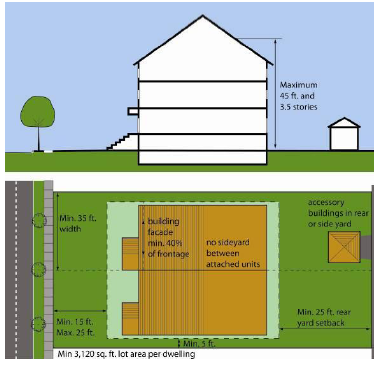 |
| Lot area | Minimum 3,120-square foot lot area per dwelling unit | |
| Lot width | Minimum 35 feet | |
| Lot coverage | Maximum 65% building coverage and 85% impermeable surface coverage | |
| Building Frontage Requirement | Building facade shall occupy a minimum of 40% of the frontage length between the minimum and maximum front yard setback | |
| Front yard | Minimum 15 feet and maximum 25 feet | |
| Side yard | Minimum 5 feet, except rows of attached townhouses | |
| Rear yard | Minimum 25 feet | |
| Residential floor area | Minimum 800 square feet of floor area for each dwelling unit | |
| Residential Density | Minimum 3,120 square feet of lot area for each residential dwelling unit | |
| Accessory buildings | Accessory building shall be located in side or rear yard. See Article 16 | |
| Parking | Parking shall be located in the side or rear yard |
(b)
General Urban.
| Building height | Maximum 120 feet and 11 stories | 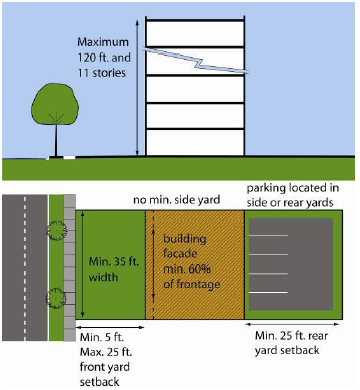 |
| Lot area | No minimum | |
| Lot width | Minimum 35 feet | |
| Lot coverage | Maximum 65% building coverage and 90% impermeable surface coverage | |
| Building Frontage Requirement | Building facade shall occupy a minimum of 60% of the frontage length between the minimum and maximum front yard setback | |
| Front yard | Minimum 5 feet and maximum 25 feet | |
| Side yard | No minimum | |
| Rear yard | Minimum 25 feet No minimum where adjoining an alley | |
| Residential floor area | Minimum 500 square feet of floor area for each dwelling unit | |
| Residential Density | No maximum | |
| Accessory buildings | Accessory building shall be located in side or rear yard. See Article 16 | |
| Parking | Parking shall be located in the side or rear yard | |
| Loading | All loading areas shall be located in the rear yard or alley |
(c)
Urban Center.
|
Building
height |
Minimum 2 stories
No maximum The first story shall be a minimum of 12 feet in height measured from floor to ceiling. | 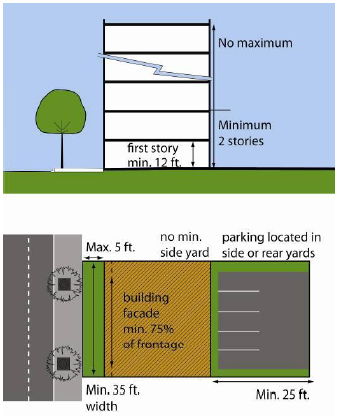 |
| Lot area | No minimum | |
| Lot width | No minimum | |
| Lot coverage | No maximum | |
| Building Frontage Requirement | Building facade shall occupy a minimum of 75% of the frontage length within the maximum front yard setback | |
| Front yard | Maximum 5 feet | |
| Side yard | No minimum | |
| Rear yard |
Minimum 25 feet
No minimum where adjoining an alley | |
| Residential floor area | Minimum 500 square feet of floor area for each dwelling unit | |
| Residential Density | No maximum | |
| Accessory buildings | Accessory building shall be located in side or rear yard. See Article 16 | |
| Parking | Parking shall be located in the side or rear yard | |
| Loading | All loading shall be located in the rear yard or alley |
(d)
Building Frontage and Maximum Front Yard Setback. Exceptions may be allowed to the building frontage and maximum front yard setback requirement of (a) through (c) above when the front yard area is used for one of the following purposes:
(1)
Widening the sidewalk along the frontage of the building;
(2)
Providing a public gathering area or plaza that offers seating, landscape enhancements, public information and displays, fountains, or other pedestrian amenities;
(3)
Accommodating an inset entranceway to the building;
(4)
Providing outdoor seating for the proposed use;
(5)
Where necessary to avoid underground utilities; or
(6)
The building is used for public or quasi-public/institutional purposes with a plaza or open space area provided in the front yard.
(e)
Waterfront. There shall be no minimum waterfront setback requirement. A minimum 10-foot wide walkway shall be maintained along the Trail Creek.
(f)
Transit-Oriented Development (TOD). The following TOD requirements shall apply to all lots that are within a quarter (¼) mile (1,320 feet) of a Northern Indiana Commuter Transportation South Shore Line station and any lots that front on a street with a Michigan City Transit route. Where a conflict exists between the TOD requirements of this section and the other regulations of this ordinance, the requirement of this section shall apply.
(1)
Minimum Building Height. The minimum building height shall be two stories. Maximum building height shall be regulated by the underlying district.
(2)
Residential Density. There shall be no limit on residential density, except through meeting minimum floor area, parking and maximum building height restrictions. There shall be a minimum 500 square feet of floor area for each dwelling unit.
(3)
Maximum Front Yard Setback. All buildings shall have a minimum front yard setback of zero feet and a maximum setback of five feet from the front lot line. A setback may be increased to 25 feet from the front property line if a courtyard, plaza or seating area is incorporated into the development adjacent to the street.
(4)
Building Facades. In addition to the requirements of Section 13.05, the following TOD requirements shall apply to all buildings:
a.
The main entrance of any building located on a street with a transit line must provide the main entrance on the facade facing the street with the transit line.
b.
Facades over 50 feet in length shall be divided into shorter segments by means of facade modulation, repeating window patterns, changes in materials, canopies or awnings, varying roof lines or other architectural treatments.
(5)
Minimum Lot Coverage. Minimum lot coverage is 60 percent of the net lot area. This minimum may be reduced if a minimum of 40 percent of the lot is developed as improved public open space. There shall be no maximum lot coverage requirement.
(6)
Parking.
a.
All uses located in the TOD zone shall be exempt from the parking requirements of Article 18, except residential uses, which shall be required to provide parking at a minimum of one parking space per dwelling unit.
b.
Off-street parking lots shall be prohibited from occupying the frontage along a public street sidewalk. There shall be a minimum depth of 20 feet of usable building space between the parking lot and the street right-of-way. On street parking shall be permitted where designated by the city.
c.
Parking structures shall have well-designed and marked pedestrian walkways and connections to the sidewalk system. Parking structures must include ground level retail along all streets.
d.
Driveways for parking lots and parking structures shall not be permitted directly on a street with a transit line and must access side streets.
(7)
Prohibited Uses. The following uses shall be prohibited in the TOD area:
a.
Retail uses with accessory drive through service;
b.
Lawn and garden supply, greenhouse and retail nurseries;
c.
Home improvement, building material sales and lumber with open storage;
d.
Tool and equipment rental;
e.
Automobile rental;
f.
Automobile sales (new/used);
g.
Automobile washes;
h.
Minor automobile service and repair;
i.
Major automobile service, body repair and painting;
j.
Motorcycle, snowmobile and ATV sales/service;
k.
Vehicle service stations;
l.
Restaurants with drive-thru/in service;
m.
Banks with drive through service; and
n.
Manufacturing and warehousing.
Section 13.05 - Building Design Requirements
This section outlines the building type specifications for the overlay district.
(a)
General and Mixed-Use Buildings. All commercial buildings and mixed-use buildings that contain non-residential and residential uses, such as retail on the ground floor, and residential on upper floors and live-work units, shall meet the following requirements.
| General and Mixed-Use Buildings | ||
|---|---|---|
|
Front
Facade | The front facade that faces a street or plaza shall include windows, cornice work, edge detailing and decorative finish materials. | 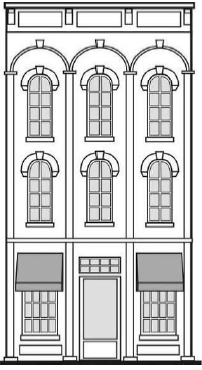 |
|
Ground Floor
Windows and Doors | Between 2 and 10 feet above the sidewalk, at least 50% of the ground floor facade area facing a street shall be clear windows and doorways. Required window areas shall allow views into retail space, working areas or lobbies, pedestrian entrances or display windows set into the wall. Windows may not be covered or blocked with the back of shelving units. | |
|
Upper Floor
Windows | Openings above the first story shall be vertical in proportion. | |
| Entrance | There shall be a minimum of one (1) usable pedestrian entrance along the front public sidewalk. Main pedestrian entrances shall have design details that enhance the appearance and prominence of the entrance so that it is recognizable from the street and parking areas. | |
| Blank Walls | Blank walls (without windows) longer than 20 feet shall not face a street. | |
| Garage Doors | Garage doors shall not be permitted on a front facade; except opening/doors for access to structured parking or rear yard parking are permitted. | |
|
Flat Roof
Buildings | Buildings with a flat roof appearance from the street shall have a decorative cornice. Flat roofs shall be enclosed by parapets. | |
| Pitched Roof Buildings | Buildings with a pitched roof shall be permitted where the eaves are at least 20 feet from the ground and the roof pitch is a minimum of 4:12. | |
| Mechanical Equipment Screening | All rooftop HVAC mechanical mounted equipment shall be screened from view on all sides of the building. Parapets and other screening treatment shall use high quality building materials and shall blend with the design of the building in terms of color and materials. | |
(b)
Franklin Boulevard Storefront Building. All buildings fronting on Franklin Boulevard, except civic buildings, shall meet the following requirements for the facade facing Franklin Boulevard. This building type shall be occupied by commercial uses or mixed-uses (which contain non-residential and residential uses, such as retail on the ground floor and residential on upper floors).
| Franklin Storefront Buildings | ||
|---|---|---|
|
Ground Floor
Storefront | Ground floors shall be designed with storefronts that have windows, doorways and signage, which are integrally designed and painted. Storefront buildings shall be designed to create a distinct and separated ground floor area through the use of accent such as a string course, change in material or textures, or an awning or canopy between the first and second stories. | 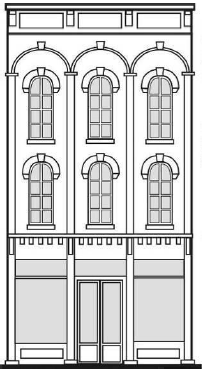 |
|
Ground Floor
Windows and Doors | Between 2 and 10 feet above the sidewalk, at least 70% of the storefront/ground floor facade facing the street shall be clear windows and doorways. Glass areas on storefronts shall be clear or lightly tinted. Mirrored glass is prohibited. Required window areas shall allow views into retail space, working areas, lobbies, pedestrian entrances or display windows. Windows shall not be blocked with opaque materials or the back of shelving units. | |
|
Upper Floor
Windows | Openings above the first story shall be a maximum of 50% of the total facade area. Windows above the first story shall be vertical in proportion. | |
| Entrance | There shall be a minimum of one (1) usable pedestrian entrance every full 50 feet of frontage along the front public sidewalk. Main pedestrian entrances shall have design details that enhance the appearance and prominence of the entrance so that it is recognizable from the street and parking areas. | |
| Blank Walls | Blank walls (without windows) longer than 20 feet shall not face a street and building walls shall be articulated with wall projections/recessions, variable materials, colors or details to visually break-up the wall. | |
| Garage Doors | Garage doors shall not be permitted on a front facade; however, openings for parking structure entrances and drives leading to loading areas are permitted. | |
| Secondary Facade | For a building located on a corner lot, the second front facade facing the lesser traveled street may have the above door and window requirement of the first floor reduced to 1/2 the required amount of fenestration, provided the secondary facade is not facing Franklin Boulevard. | |
|
Flat Roof
Buildings | Buildings with a flat roof appearance from the street shall have a decorative cornice. Flat roofs shall be enclosed by parapets. | |
| Pitched Roof Buildings | Buildings with a pitched roof shall be permitted where the eaves are at least 20 feet from the ground and the roof pitch is a minimum of 4:12. | |
| Mechanical Equipment Screening | All rooftop HVAC mechanical mounted equipment shall be screened from view on all sides of the building. Parapets and other screening treatment shall use high quality building materials and shall blend with the design of the building in terms of color and materials. | |
(c)
Cottage Shop Building. Buildings that were originally constructed as residences and converted to a non-residential use or constructed to appear as residential conversions shall meet the following requirements.
| Cottage Shop Building | ||
|---|---|---|
| Front Facade | There shall be a minimum of one (1) usable pedestrian entrance along the front public sidewalk. | 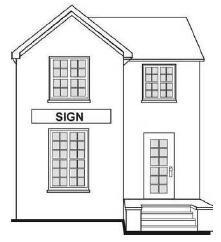 |
| Garage Doors | Garage doors shall not be permitted on a front facade. | |
| Ground Floor Windows and Doors | At least 25% of the ground floor facade facing a street shall be clear windows and doorways. | |
| Upper Floor Windows | Windows above the first story shall be vertical in proportion. | |
| Roof Design | Buildings with a pitched roof shall be permitted where the eaves are at least 20 feet from the ground and the roof pitch is a minimum of 4:12. | |
(d)
Apartment Buildings. Apartment buildings that contain only multiple-family dwellings shall meet the following design requirements. Multiple-family dwellings located in mixed-use buildings shall be subject to the general commercial/mixed-use building design requirements in Section 13.05(a). Apartment buildings are considered buildings with common entrances - where multiple family dwellings have individual entrances, they shall be subject to the townhouse design standards of Section 13.05(e) below.
| Apartment Buildings | ||
|---|---|---|
| Entrance | There shall be a minimum of one pedestrian entryway facing the street or opening onto a courtyard facing the street. | 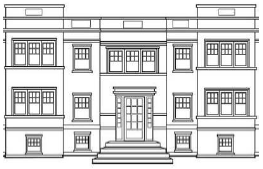 |
| Front Stoop | A front stoop shall be allowed to project into the front yard. ADA-compliant access ramps that connect to the stoop may also project into the front yard. | |
| Windows and Doors | The front facade of all residential units shall be a minimum of 25% and a maximum of 75% windows and doors. | |
| Roof Design | Buildings with a flat roof appearance from the street shall have a decorative cornice. Buildings with a pitched roof shall be permitted where the eaves are at least 20 feet from the ground and the roof pitch is a minimum of 4:12. | |
| Parking | Off-street parking lots and carports or garages shall be located in the side or rear yard. | |
(e)
Townhouses. Attached/townhouse dwellings shall meet the following design requirements. Townhouse dwellings are dwellings where each unit has an individual front entrance - multiple family dwellings with common entrances shall be subject to the apartment building design standards of Section 13.05(d) above.
| Townhouses | ||
|---|---|---|
| Entrance | Each dwelling shall provide a separate pedestrian entryway facing the front lot line with direct access to the sidewalk by way of a front porch or stoop with steps. | 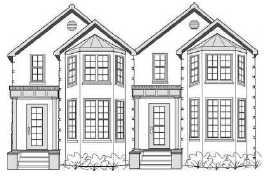 |
| Front Porch or Stoop | All dwellings shall include a front stoop or porch. The stoop or porch shall have a minimum depth of 4 feet and a minimum area of 24 square feet. Steps and ADA-compliant access ramps that connect to the stoop or porch may project into the front yard. | |
|
First Floor
Elevation | The stoop or porch shall be elevated a minimum of 21 inches above the sidewalk grade. This may be waived for units designed to be accessible by persons with disabilities. | |
| Windows and Doors | The front facade of all residential units shall be a minimum of 25% and a maximum of 50% windows and doors. | |
| Roof Design | Buildings shall be designed with a pitched roof with eaves at least 20 feet from the ground and a minimum roof pitch of 4:12. | |
| Garages | Attached or detached garages shall be located in the rear yard or on the rear side of the building and shall be accessed by a rear alley or drive. | |
(f)
Detached Single and Two Family Dwellings. Single family detached dwellings and duplex dwellings shall meet the following design requirements.
| Single-Family Detached and Duplex Dwellings | ||
|---|---|---|
| Entrance | All buildings shall provide at least one (1) pedestrian door facing the front lot line. Two family dwellings may have one (1) unit with a door on the side. | 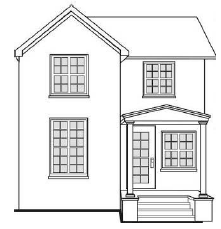 |
| Front Porch or Stoop | All dwellings shall include a front porch or stoop with steps. A minimum depth of 6 feet and a minimum area of 48 square feet shall be provided on single-family detached dwellings and duplex dwellings. Duplex units may share a single front porch. | |
|
First Floor
Elevation | The first floor elevation shall be a minimum of 21 inches above the average exterior sidewalk elevation in front of the building. | |
| Windows and Doors | The front facade of all residential units shall be a minimum of 25% and a maximum of 50% windows and doorways. | |
| Roof Design | Buildings shall be designed with a pitched roof with eaves at least 20 feet from the ground and the roof pitch is between a minimum of 4:12 and a maximum of 12:12. | |
| Garages | Detached garages shall be located in the rear yard. Garages may be accessed by a rear alley or by driveways that pass through the side yard of the lot. Front facing attached garages shall be permitted, provided they don't project past the front building line and do not encompass more than 50% of the total building width. | |
(g)
Civic/Institutional Buildings. The design of an institutional or community service building, such as a school, government office, library, post office or place of worship is subject to review and approval by the plan commission. The intent is to allow flexibility in the design and siting of these unique buildings that serve a public use while ensuring their positive contribution to a desired community character as stated in the North End Plan.
| Civic/Institutional Buildings | ||
|---|---|---|
| Front Setback | Civic/institutional buildings may exceed the maximum front yard setback of the district where a pedestrian plaza or landscaped front yard is provided. | 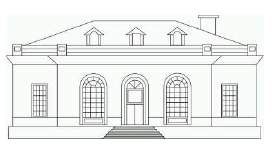 |
| Front Facade | Walls that face a public street, plaza, green or park shall include windows and architectural features customarily found on the front of a building, such as awnings, cornice work, edge detailing or decorative finish materials. | |
| Entrance | There shall be a minimum of one (1) usable pedestrian entrance along the front public sidewalk. Main pedestrian entrances shall have design details that enhance the appearance and prominence of the entrance so that it is recognizable from the street and parking areas. | |
|
Prominent
Design | The standards for General and Mixed-Use Buildings contained in Section 13.04(a) shall be used as a basis for the design of civic/institutional buildings; however, the plan commission may permit modifications from these standards based upon the unique needs for the building and the desire to create unique landmark features with civic/institutional buildings. | |
(h)
Building Materials. All buildings shall contain quality building materials that are in keeping with the character of traditional buildings in Michigan City. Permitted materials for exterior walls (exclusive of windows and doors) that are clearly visible from the street or parking lot, shall be limited to the following:
(1)
Primary building material shall comprise at least 75 percent of the visible wall materials. Trim material shall comprise no more than 25 percent of the visible wall materials. Wall area calculations are exclusive of windows and doors.
(2)
Provided the appearance is in keeping with the traditional architectural character of Michigan City, other materials not listed above that are of the same or higher quality in terms of durability and appearance/texture similar to brick, stone, or wood may be approved by the plan commission.
(3)
Wall materials including panel brick, tilt-up brick textured paneling, plain, smooth-face, or scored concrete masonry units, corrugated metal paneling and fiberglass sheeting are prohibited for walls that are clearly visible from streets, parks, civic squares, and civic greens.
(i)
Awnings and Marquees. Storefronts and building entrances may be enhanced by awnings or marquees, which give shade and shelter or add color and visual interest to the entry or display window of the storefront, provided that the following conditions are met:
(1)
Awnings and marquees may project over a sidewalk; however, they must be a minimum of eight-foot clearance provided from the sidewalk.
(2)
Awnings and marquees shall be functional and provide shade or shelter for pedestrians over a substantial portion of the sidewalk.
(3)
Awnings shall be positioned immediately above ground floor windows and have a straight shed that projects from the building.
(4)
Awnings shall be constructed of durable materials such as canvas or steel that will not fade or tear easily. Plasticized, rigid, cubed or curved awnings or mansard style canopies are prohibited. Marquees shall be constructed of materials compatible with the building and meeting the trim material specifications of Section 13.05(h).
(5)
Awnings shall not be internally illuminated and any signs shall be illuminated by fixtures located above the awning and directed downward.
Section 13.06 - Site Design Requirements
(a)
Parking. Each use shall be required to provide off-street parking in accordance with the requirements of Article 18.
(b)
Bicycle Facilities. All developments with parking lots shall be designed to accommodate bicycle travel by providing bike racks.
(c)
Loading. Off-street loading spaces shall be provided as required by Article 18. Waivers to loading space requirements may be granted by the plan commission for uses such as offices or banks where deliveries by truck will not be necessary. Loading and outdoor storage areas shall be located in the rear yard, an alley or within loading bays that are that are surrounded or enclosed by buildings, and not visible from the street. Loading areas not within loading bays shall be screened from any adjacent use by a six-foot tall brick wall or other masonry material matching the primary building material.
(d)
Landscaping and Screening. Landscaping and screening shall be provided for as follows:
(1)
Street Trees. One street canopy tree shall be provided for each 40 feet of street frontage. Street trees shall be minimum two and one-half inch caliper canopy trees.
(2)
Parking Lot Landscaping. Parking lots shall be landscaped with one canopy tree for every 15 parking spaces. Parking lots that are located in a rear yard and are not visible from the street shall be exempt from this requirement.
(3)
Parking Lot Screening. Where parking is visible from a street, it shall be screened by a three-foot tall brick wall that is an extension of the building facade along the sidewalk. Where a parking lot for a non-residential use is adjacent to a residential use or district, a six-foot tall brick screen wall shall be provided between the parking lot, including drives, and the residential use in accordance with Section 17.03.
(e)
Waste Receptacles. Waste receptacles shall not be visible from the street and shall be located in the rear yard. Waste receptacles shall be enclosed in accordance with Section 17.05. Multiple businesses may share a waste receptacle, provided there is a recorded agreement for shared use and maintenance.

